Month: June 2013

  • 2 Charged In US For Bid To Make Deadly X-Ray Weapon

    2 Charged In US For Bid To Make Deadly X-Ray Weapon

    In April 2012, the authorities said, an industrial mechanic walked into a synagogue in Albany and announced his intention to build a weapon that could help Israel kill its enemies while they slept. He wanted to know if anybody would provide financial backing. Turned away, prosecutors said, he sought money from another source: a leader in the Ku Klux Klan in North Carolina. Both the synagogue and the white supremacist group told the authorities about the man, Glendon Scott Crawford, who, until his arrest this week, devoted himself to building a weapon of the sort he had promised, the authorities said.

    The weapon was an X-ray-emitting device that could be activated by remote control, which he intended to use to kill Muslims, according to a criminal complaint unsealed in a court in Albany. Crawford, who the authorities say works for General Electric, believed the device would enable him to secretly poison people with lethal doses of radiation. Federal prosecutors charged Crawford and an engineer, Eric J Feight, who was described as a co-conspirator, with conspiring to provide support for the building of a weapon.

  • 10-Year-Old Prodigy To Enter Harvard University This Fall

    10-Year-Old Prodigy To Enter Harvard University This Fall

    MEXICO CITY: He’s only 10 years old but thanks to an IQ similar to Albert Einstein’s, Luis Roberto Ramirez will begin the next school year studying applied quantum physics at Harvard University. “My dream is to create a company and sell my inventions,” the boy said on a video aired by the Michoacan Radio and Television System. Ramirez, who lives in Zamora, Michoacan, taught himself English at 5 and is now learning to speak French and Chinese.

    He was identified as highly gifted just two years ago when his parents began to see he had problems relating to other children, and that his priorities and tastes were unlike anything that might be expected of a kid his age.It was then he was determined to have an IQ of between 152 and 160, around Einstein’s level.”It makes us very proud but it’s also a big responsibility,” his father, Roberto Ramirez, said.

  • The Executive’s Club

    The Executive’s Club

    Unfortunately for Mangano’s opponents in the county executive race, the large amounts of money given to Mangano and the Hicksville club have already been spent. By the time Andrew Cuomo’s Campaign Finance Bill passes, Mangano could be well on his way to a second term as county executive.
    Standing at a podium in a garish banquet hall at the Crest Hollow Country Club on Long Island, Nassau County Executive Ed Mangano is giving a speech in acceptance of an “Achievement in Crisis Communication” award for his handling of Superstorm Sandy. Mangano is equal parts charismatic and self-assured; his boyish smile is a magnet for the cameras, and traces of a Long Island accent give him a comforting authenticity as not just another politician in a suit but “one of the guys.”

    As the details the importance of “having a plan” to tackle unexpected natural disasters, it is clear he excels at these sort of events-more at ease playing the role of the glad-handing, schmoozing public official than policy wonk. “He’s very visible. He’s all over,” said former Assemblyman Jerry Kremer, who represented parts of Nassau County. “He doesn’t miss an opportunity to project his image. It’s campaign season in Nassau County, and the county executive seat is up for grabs.

    Democrats hope to win it back from Mangano, a Republican, after losing it to him in a stunning upset by a razor-thin margin in 2009. Back then Mangano was a relatively unknown county legislator given virtually no chance of toppling the prominent twoterm incumbent, Thomas Suozzi, whose attention was already focused past his reelection bid and on to higher office. According to Nassau County political observers, at the time Mangano was seen as “the last guy in the room” who could win, and dismissed as an empty suit with no real credentials or public policy to hang his hat on.

    A Siena College poll taken just weeks before the election found that only 32 percent of voters would cast a ballot for him if the election were held that day, compared with 54 percent for Suozzi. But as the Democrats learned on Election Day, those numbers did not reflect a countywide anti-incumbent sentiment, anger at Nassau’s mounting fiscal crisis and Mangano’s compelling personal narrative-putting himself through college by working as a high school janitor.

    After a lengthy recount Mangano prevailed, winning by a mere 386 votes out of the over 230,000 ballots cast. As leader of the county over the past three and a half years, Mangano has received mixed reviews. After inheriting a nearly $133 million deficit from his predecessor, Mangano immediately set out to streamline the county government, slashing a large number of county jobs, especially managerial positions. At the same time, though, he cut energy and property taxes, putting the county into a position where it had to balance its budget with “one-shot” borrowing.

    As a result, in 2011 the Nassau Interim Finance Authority voted unanimously to take over control of the county’s finances, citing the deficits the county was running. “How much of [Nassau’s fiscal situation] you can ascribe only to the economy, how much of it was Suozzi not paying attention the last year or two and how much Mangano can blame Suozzi for the economy, it’s a very difficult thing to separate,” said a source knowledgeable about Nassau County politics who asked to remain nameless so as not to antagonize the county executive. “Mangano did take some steps to rein in spending.

    The workforce is smaller, but he had to eat the young by pushing off expenses, and by negotiating contracts that have big payouts down the road.” Yet as his “Crisis Communication” award demonstrates, Mangano was widely praised for his steady hand in guiding the county through the immense challenges and destruction of Superstorm Sandy, and it is safe to say that his fortitude amid that trying time remains fresh in the minds of voters.

    His approval rating, at 45 percent before Sandy, improved to 51 percent in January, the high mark of his tenure. But while the narrative of Mangano as the calm at the center of the storm is compelling as a campaign optic, recent revelations indicate that Mangano may have exploited Sandy for his own ends. In the wake of the storm, various contractors and subcontractors who contributed heavily to Mangano’s campaign account received lucrative contracts from the county for performing such jobs as debris removal and general cleanup.

    Moreover, in addition to donating to Mangano, some of these contractors gave significant sums of money to a small political club in the hamlet of Hicksvillethe Hicksville Republican Club-run by Mangano’s chief deputy county executive, Rob Walker. According to numerous documents and campaign finance records, the Hicksville club appears to have served as a proxy fundraising vehicle for Mangano’s campaign.

    Wealthy donors, including individuals who have relationships with or are employed by Nassau County, and companies that contract with the county, have poured hundreds of thousands of dollars into the Republican club since Mangano and Walker took office. This money subsequently appears to have been spent on several lavish fundraising and campaign events, including for a $200,000 luxury suite at MetLife Stadium and highend golf outings at destination courses like Myrtle Beach.

  • Graduation Gains Begin Leveling Out

    Graduation Gains Begin Leveling Out

    NEW YORK (TIP): New York City’s highschool graduation rate dipped slightly in 2012 for the second consecutive year to 60.4% as it became tougher to qualify for a diploma, according to state data released Monday, June 17, says a Wall Journal report. The data released Monday showed that the New York City graduation rate has plateaued over the past two years, after making big gains since June 2005 when 46.5% of students graduated on time.

    For Mayor Michael Bloomberg, the announcement of the graduation rates represented a moment to reflect on education’s place in his legacy, after nearly 12 years of attempts to impose widespread changes on the public-school system. The graduation rate has been one of the clearest signs of success for Mr. Bloomberg’s policies. State and national test scores have been less consistently positive. At a news conference, the mayor cited what he said were several other education success stories during his tenure: better teacher-recruitment and retention rates, holding educators accountable through school closures, increasing city funding for schools and creating a plethora of schools for students and parents to choose from.

    “The bottom line is our schools are in better shape than they’ve ever been,” Mr. Bloomberg said. “We’ll continue to work to improve our schools with every remaining day we have in City Hall.” Several candidates to succeed Mr. Bloomberg have disagreed, saying students have been hurt by policies such as closing schools that post poor results, allowing class sizes to increase and emphasizing test scores. The 2012 graduation rates were no exception.

    “The Bloomberg approach of teaching to the test is not working,” said former city Comptroller Bill Thompson, a Democrat. “As mayor, I will provide the leadership for a different approach-one that supports our teachers, emphasizes critical thinking skills rather than rote learning.” Asked about the changes that could come under the next mayor, Mr. Bloomberg asked why “any rational person” would want to switch course. “If any of the candidates want to shill for the teachers’ union, talk to them, not us,” he said.

    “The next administration has to do more of this. We would just become the laughing-stock of the country if you were to roll back everything that has worked so well.” The seniors who graduated on time in June 2012 were the first class to be held to higher diploma standards: They were required to pass five Regents exams with a score of 65 or better, and the state had begun to require stricter grading controls to prevent score inflation.

    The state Board of Regents, which is appointed by the state Legislature and sets education policy, phased out what was called a “local diploma” for students with lower Regents test scores. The city’s graduation rate continued to lag far behind the statewide rate of 74%, a number that stayed flat from 2011. Graduation rates in some of the state’s other large cities fell far behind New York City’s. Notably, Buffalo’s has swung dramatically over the past four years, to a low of 46.8% this year from a high of 54% last year.

    Michael Mulgrew, the president of the United Federation of Teachers, criticized the Bloomberg administration for reorganizing the school system several times and for “relentless test prep.” The rate of students still learning English who graduated in four years by June fell to 35.4% in 2012 from 39.4% in 2011, according to city data. City officials said they should do a better job addressing the needs of students who don’t speak English as their first language, and pointed to those students as ones in particular who struggled with the new requirements.

  • Under The Radar

    Under The Radar

    While perhaps not as headlinegrabbing as the public corruption scandals that have recently ensnared New York state and city lawmakers, campaign finance violations continue to be a recurring epidemic. Arecent study conducted by the New York Public Interest Group found that in the last two years over 100,000 campaign finance violations went undetected. Candidates, political committees and corporations sometimes blatantly flout these laws.

    The state Board of Elections is tasked with enforcement but is widely considered toothless in its ability to curb and punish abuse. In fact, in the NYPIRG report, a $25,000 corporate contribution to Friends of Ed Mangano from Bolla Management Corp. was cited as an example of a campaign finance violation that should have normally prompted an immediate response from the state Board of Elections, but instead went undetected.

    Part of the problem with enforcing campaign finance laws is the partisan culture that pervades the Board of Elections, where an even number of Democrats and Republicans controls the board, and consensus is needed to initiate even the most mundane campaign finance investigation. Another problem is the lack of any enforcement infrastructure to pursue these cases. Yet even when provided with the resources to pursue violations, the agency has not followed through in hiring the manpower necessary to effectively probe them.

    “[The Board of Elections has] been offered the money to improve their infrastructure in the past and never taken it,” said NYPIRG’s research coordinator, Bill Mahoney. “In 2007, for example, Gov. Spitzer gave them the money to hire 18 new enforcement staff, and they didn’t bother hiring a single person, and Gov. Paterson took the money [back] a couple of years later.” Mahoney added that the result of the agency’s passivity in pursuing campaign finance violations is that local candidates feel empowered to reach out to the wealthiest donors possible, even if those donors happen to conduct business with that candidate.

    “It’s certainly common practice among state politicians. It’s very easy for a county executive to raise huge sums of money; it’s also easy for opponents to do so as well,” Mahoney said. “They’ll actually be incentivized to reach out to people who can give them five-figure checks in many cases. Often the people that have that money and are willing to do so are the people who have contracts before the county.” Gov. Andrew Cuomo, in his ongoing effort to “clean up” the state, recently introduced a campaign finance bill that would limit a club or committee like Hicksville from spending exorbitant amounts on a single candidate.

    The bill would impose a $5,000 limit on transfers or money spent by political party committees on behalf of candidates. Unfortunately for Mangano’s opponents in the county executive race, the large amounts of money given to Mangano and the Hicksville club have already been spent. By the time the bill passes, Mangano could be well on his way to a second term as county executive.

  • A History of Patronage

    A History of Patronage

    The apparent rewarding of family members and associates of county officials with patronage jobs and county contracts has been endemic to Nassau County dating back to the reign of former county Republican leader Joseph Margiotta. Famous for rewarding loyalty by recommending party supporters for political patronage jobs on municipal payrolls, Margiotta served as a mentor to such successful Nassau Republicans as former U.S. Sen.

    Alfonse D’Amato and current state Senate Majority Coalition Leader Dean Skelos. Multiple sources with knowledge of Nassau County politics maintain that D’Amato enjoys a good relationship with Mangano. Campaign finance disclosure reports show that D’Amato contributed $2,500 to Mangano’s campaign in 2011. According to a Newsday report, wellknown Republican Party supporter Robert McBride, the vice president of D’Amato’s lobbying firm, Park Strategies, held a fund-raiser for Mangano at his home in Hicksville in 2011.

    Later that year Veolia Transportation, a company represented by Park Strategies, won a large contract from the county to run Long Island Bus. Veolia subsequently donated $4,790 to Mangano’s campaign in 2012. In April 2013, a report from the Joint Commission on Public Ethics named Park Strategies the highest-grossing lobbying firm on Long Island.

  • Chief Deputy County Executive Rob Walker

    Chief Deputy County Executive Rob Walker

    “Ed had never managed anything. He was not town supervisor or mayor, and some felt [Mangano] should’ve brought in somebody who had done that,” said an expert in Nassau County politics who asked not to be identified so as not to offend the county executive. “Rob was an assemblyman; you don’t manage anything as an assemblyman.

    ” Multiple sources with knowledge of the inner working of county politics contend that the power dynamic between Mangano and Walker is this: Mangano is the figurehead for the county, the public official who attends the ribbon cuttings and public events, while Walker pulls the strings behind the scenes. As Mangano’s co-pilot and top deputy, Walker appears to be utilizing his network of connections to wealthy and connected donors to fill the Hicksville Republican Club’s coffers.

    Many of the people who have contributed to the club include individuals who have had long-standing relationships with Nassau County, some of whom are employed by the county or who have been contracted by it to provide various services. In April 2012, Aly and Keith Lizza-vice president and general manager, respectively, of Carlo Lizza & Sons Pavingcontributed a total of $90,000 to the Hicksville committee. Their company later received $4 million in contracts from the county to assist in tree removal and other miscellaneous post-Sandy work.

    The single largest donation to the club in 2012 was $50,000 from James Hagedorn, the CEO of Scott’s Miracle-Gro and a board member, along with Walker, of the Friends of Sands Point Preserve, which manages the property. In a report by Newsday in September 2012, Hagedorn indicated he was aware that Hicksville planned to use his contribution to help purchase the luxury box at Giants Stadium, saying he thought it was a smart way to “build financial horsepower.”

    Other large contributions to the committee include $10,000 from former MTA and Port Authority board member David Mack, currently the assistant Nassau police commissioner, and $25,000 from Donald Codignotto, whose brother, Robert, is also an assistant police commissioner with the county. The committee also received $10,000 from Joanne Smith, a secretary and treasurer of Standard Valuation Services who is married to its president, Matthew Smith.

    Standard Valuation Services is a property appraisal company that has been contracted several times by Nassau County since 2010, the year Mangano took office. Frank Intagliata, an employee with the county Office of Purchasing, contributed $4,000, while Michael Sposato, the acting Nassau County sheriff, contributed $3,500 to the Hicksville club. With the exception of Mack and Codignotto, none of these donors returned phone calls from City & State.

    When asked about the nature of his relationship with the committee and his reason for his contribution, Codignotto responded, “No comment.” Mack, who now runs a real estate company based in New Jersey, said that his contribution wasn’t solicited by Mangano or Walker, and that “there was a cause involved,” though one he could not recall. “It has nothing to do with [Mangano’s] campaign, not at all,” Mack said. “I wasn’t solicited for it.

    I heard they were raising money. You can see I give a lot of money to a lot of different friends. They were shocked and thanked me very much, and that’s it. I hope Mangano wins.” These donors were not the only ones with problematic ties to Mangano. An Associated Press report found that Friends of Ed Mangano received $144,000 in donations from Sandy contractors in the weeks after they were hired by Nassau County. Many of the companies that gave to Mangano’s campaign also contributed $6,000 to the Hicksville committee, and some of these companies’ high-ranking employees have close familial relations with county officials.

    For instance, Dejana Industries, a sanitation fi m, gave $12,575 to Mangano’s campaign, and a subsidiary, Dejana Truck and Equipment Company, gave $550 to the Hicksville committee. Mangano’s brother, John Mangano Jr., is the director of business development and municipal sales director for Dejana Industries. Dejana was one of the county’s Sandy contractors, receiving $36,288 for a “fuel truck rental.”

    Among the other contractors that contributed to the Hicksville club was Nelson & Pope Engineers, a surveying and engineering firm that previously employed Walker as a project manager and currently employs Walker’s wife, Elizabeth, as an administrative assistant. On September 12 of last year, Nelson & Pope made separate contributions of $425 and $700 to the Hicksville club. The firm also contributed $5,895 to Friends of Ed Mangano from 2010 to 2012.

    After Sandy hit in late October, Nelson & Pope received a $400,000 contract to assist in tree and debris removal at various sites throughout the county. Grace Industries, a company that services roads and highways, donated $1,000 to Hicksville and $13,000 to Mangano, while the company’s chairman, William Haugland, also made a $2,612 inkind contribution that was not itemized in Mangano’s filings. Grace Industries received two contracts for Sandy cleanup totaling $8 million.

    John and Anthony Gulino, owners of surveying and engineering company Laser Industries, gave a $13,000 in-kind contribution to Mangano, as well as $1,000 to the Hicksville club. Laser Industries received up to $6 million in contracts for Sandy work, according to the Associated Press. Yet another company, 192 Branch Interior Services, gave only $150 to the Hicksville committee but $5,000 to Friends of Ed Mangano.

    The company was awarded a $1 million contract to assist in the removal and disposal of water from various sites in the county. No one from these companies responded to requests for comment. Lastly, between 2011 and 2012 CSM Engineering contributed $5,375 to Friends of Ed Mangano, and $600 to the Hicksville committee in 2012. The firm is owned by Carolyn Shah Moehringer, sister of Shila Shah-Gavnoudias, the commissioner of the Nassau County Department of Public Works, the body responsible for procuring contracts for the design, construction, repair, maintenance and cleaning of all the streets and bridges in the county.

    CSM was one of the companies to receive an emergency contract for tree and debris removal after Sandy, in the amount of $250,000. In response to an inquiry from City & State, Shah-Gavnoudias wrote in a statement that recovering from Sandy “was the chief factor in securing all contracts necessary to restoring functionality and safety to Nassau County.” She should have recused herself in procuring the contract for CSM, she added. “In retrospect, while I recused myself from the technical selection committee I regret any impression created by the signing of a procedural routing slip and Comptroller Approval Form for CSM Engineering,” read Shah-Gavnoudias’ statement.

  • Friends of Mangano

    Friends of Mangano

    The common thread tying together the Hicksville Republican Club and Mangano’s campaign is Rob Walker. How did a relatively unknown former lawmaker rise to his current position of power in Nassau County? One could say he came full circle. One summer, before his political career got off the ground, Walker interned for Mangano in the county Legislature.

    The son of longtime Nassau County politician Rose Marie Walker, who took over Mangano’s seat in the county Legislature after he became county executive, Rob later became an assistant to Oyster Bay Town Supervisor John Venditto, where he was director of traffic survey and constituent services. After, Walker served for three years as deputy parks commissioner for Oyster Bay before running for the Assembly in a 2005 special election, which he won.

    Walker’s tenure as the assemblyman representing Oyster Bay was of little note, though his lack of accomplishments can be attributed to his being a Republican in the Democrat-dominated Assembly, rather than being a reflection on Walker’s chops as a legislator. In 2008 Walker left the Assembly to run Mangano’s campaign. When Mangano pulled off his unexpected victory over Suozzi, Walker was suddenly in a prime position to play a pivotal role in running Nassau County

  • A Legal Grey Area

    A Legal Grey Area

    The Hicksville committee also listed separate American Express payments of $2,206 and $1,792 in 2012 for a Myrtle Beach golf fundraiser for the Mangano campaign. Yet the invitation for the fundraiser, sent by Walker on behalf of Friends of Ed Mangano, states that donations of $1,895 per individual covered round-trip airfare to Myrtle Beach, three nights at a hotel, and food and beverage costs for several meals.

    The remaining cost of the fundraiser is not listed on either Mangano’s or Hicksville’s filings, which would seem to indicate expenditures missing from their respective disclosure reports. Another questionable Hicksville disbursement is $30,000 in total payments from April 2012 to July 10, 2012 to a business called KKL Associates for what is listed as “consulting” on the committee’s expenditure report.

    According to the New York Department of State, KKL Associates was not a registered business until July 11, 2012, meaning that the payments were being made to a company that did not yet exist. The address listed for the business in the committee’s filing, 404 Jerusalem Ave. in Hicksville, is an apartment complex where Walker’s former special assistant, Kristen DiCerbo, lives. City & State called a number listed for DiCerbo, but received no response.

    Further complicating matters is whether Hicksville’s status as a political committee precludes the club from spending such large amounts. According to the state Board of Elections, the Hicksville Republican Committee is registered as a “constituted county committee,” meaning that it can accept up to $102,300 in individual contributions and spend unlimited amounts on a Republican Party candidate.

    According to state campaign finance law, any monies that political committees expend toward a given campaign must be reported by that campaign. However, Jacobs filed a complaint with the Board of Elections, which includes a cause of action stating that the Hicksville club is neither a “constituted committee” nor “a political committee specifically authorized by Mangano to aid or take part in Mangano’s campaign.”

    Jacobs claims that the Hicksville club should be considered a duly constituted subcommittee of a county committee, which would place restrictions on what percentage of the contributions received could be used toward expenses related to funding a campaign, limiting the expenditure to not more than one cent per registered voter within the district where the committee is located. As this law applies to the hamlet of Hicksville- where there are over 28,000 registered voters- the maximum amount of money that could be spent would therefore be roughly $280, significantly less than the amount disbursed by the Hicksville committee.

    In response to an inquiry about the legal status of Hicksville’s committee, attorney John Ryan, of Ryan, Brennan & Donnelly LLP, who represents Mangano and Walker, wrote that the Hicksville Republican Club and the Hicksville Republican Committee are “two separate and distinct entities” and that the committee is a Republican Party committee “comprised of those Election Districts within the Assembly Districts of the unincorporated area of Hicksville in the Town of Oyster Bay, New York.” Whatever its status, questions arise as to whether the committee’s expenditures are legal.

    Henry Berger, a prominent state election lawyer, said that if the Hicksville club is indeed raising and spending money on behalf of Mangano, it could be considered a violation of state law. “If [Mangano is] using [the Hicksville committee] as a proxy to raise contributions that are then used to raise more money for him, it’s essentially a sham transaction,” said Berger. “If [the Hicksville committee is] making expenditures at these levels, accepting contributions for the purpose of raising money for Mangano and then making the expenditures to raise the money, it’s engaging in multiple violations of the law.”

    Jacobs’ complaint also details Hicksville’s campaign finance irregularities, along with a list of $110,000 in un-itemized expenses and $70,000 in corporate contributions that exceeded the $5,000 annual limit to which corporations are restricted by law. Responding to this complaint, Ryan, on behalf of Mangano and Walker, disputes nearly every allegation made in relation to Friends of Ed Mangano and the Hicksville club’s campaign finance disclosure reports, with the sole exception being what he explains as a typographical error in the date of two payments made from the Hicksville committee to KKL Associates.

    Ryan also denies that the Hicksville committee made any contributions to the campaign through the various fundraisers the club held, including the events at MetLife Stadium and Myrtle Beach. Ryan also claims that every dollar that the Mangano campaign accepted over the corporate contribution limit has been refunded to the respective companies-an adjustment that he asserts will be reflected in Friends of Mangano’s next filing. When reached by phone, a spokesman for the New York State Board of Elections declined to comment on the complaint filed by Jacobs and the response from Mangano and Walker, on the grounds that the complaint is currently under review.

  • Opposition Research

    Opposition Research

    Eager to avoid a repeat of his party’s 2009 debacle, Nassau County Democratic Committee Chairman Jay Jacobs last summer commissioned his staff to begin opposition research of Mangano. Among the areas he directed them to probe were the county’s GOP political clubs. Republicans control 70 different clubs in Nassau, and Jacobs had a hunch that if his team examined the campaign filings for every single one of them, they might be able to uncover a vulnerability to exploit in the coming election year.

    “When we pulled all of the clubs, we noticed 69 of them had normal traffic, if you will. They bring in $7,000, $12,000, $19,000, and they spend about the same,” Jacobs said. “The Hicksville Republican Club caught our attention, and we began looking back. The average [amount of total annual contributions the club received] over 10 years, in and out, was $29,000 a year. In the year that Mangano became county executive, it jumped to $111,000, which was way out of line with everything else.

    The following year, which was last year, it jumped to [over $300,000]. That was extraordinary, so of course the question was ‘What the hell is going on in Hicksville?’ ” Political clubs have long been a staple of Nassau County’s various towns and villages. Primarily they are utilized as vehicles for raising money and building up support for a party. Those clubs that are registered as political committees-Hicksville is registered as a constituted county committee-fall under the purview of the state Board of Elections when it comes to fundraising and spending practices.

    Sources familiar with these clubs say they typically don’t raise more than between $5,000 and $10,000 a year, and rarely have an actual physical headquarters. The Hicksville Republican Club, for instance, meets at a local Veterans of Foreign Wars post on the second Friday of every month. “It’s something that I’ve only seen in Nassau, but a lot of elected officials who may also be party leaders, who are very associated with a particular community, will tend to use clubs as a fundraising mechanism,” Kremer said.

    The Hicksville club has been led by Chief Deputy County Executive Walker, a former assemblyman, since 1999. After averaging over $29,227 per year in total annual contributions from 2006 to 2010-the year Mangano and Walker took office-the club’s contributions grew to $111,835 in 2011. Last year contributions to the club more than tripled, to $363,255, including over $6,000 from companies that had received contracts from the county for Sandy cleanup.

    Concurrently, expenditures reported by the Hicksville committee also rose dramatically. Between 2006 and 2010 the club reported a combined total of $120,546 in campaign-related expenditures, but that number shot up to $109,710 in 2011 alone. The following year that amount more than tripled, to $349,093. Among the committee’s outlays, as the Daily News first reported last August, was a $204,000 payment in 2012 to MetLife Stadium, home of the New York Giants and Jets, for a luxury suite used for two separate Mangano fundraisers.

    “I’m amazed they spent 200 grand on a skybox. I’m blown away by that,” said a Republican campaign strategist who requested anonymity so as not to hurt his business. “I can’t think of a single other political candidate or entity other than a national party paying for a skybox for something. That’s a lot of money.” An email invitation sent by Friends of Ed Mangano, Mangano’s campaign committee, which Walker also heads, invited individuals to the stadium for “the chance to pilot one of your automotive dreams,” in this case a Ferrari F430 or a Lamborghini Gallardo; a specially designed autocross track allowed attendees of the event to race the cars around the stadium.

    The cost to attend the event, according to the invitation, was $1,000 per person, and donors were instructed to make out their contributions to Mangano’s campaign committee. The Hicksville committee also sponsored a fundraiser at MetLife Stadium last September, in that instance for three nights of Bruce Springsteen and the E Street Band concerts. The invitation, sent by Walker from his campaign email address, offered 20 tickets for each night at $1,100 per person, a price that included food, drinks and limo transportation to the venue.

    Again, the invitation instructed attendees to make their checks payable to the Mangano campaign. It is unclear whether Mangano’s campaign used the luxury suite for which the Hicksville committee paid for any of that season’s Jets or Giants games-two preseason games and eight regular season games were included in the price. Mangano’s 2012 campaign filings show three separate payments to MetLife Stadium, however: $16,800 for “consulting,” and two other payments, for $2,550 and $960, listed as “fundraisers.”

    Neither Mangano nor Walker returned any of several phone and email requests for comment on this story. Brian Nevin, a spokesman for Friends of Ed Mangano and for the Nassau County Executive’s office, did respond, saying the events held at Giants Stadium were reported as an inkind contribution from the Hicksville committee to the Mangano campaign. Nevin pointed to what appears as an unitemized $48,000 contribution from an entity labeled “Anonymous,” as proof of the Mangano campaign’s payment for the luxury suite.

    Jacobs finds this explanation dubious. “They had three different fundraisers using that box. There are 10 games at the stadium, two preseason, eight regular season games, there were concerts and other events that the box was available for, in addition,” Jacobs said. “Who sat in the box the rest of the time? Was it empty?”

  • Third Front Is Workable

    Third Front Is Workable

    The idea of a third front, after all is not a new idea. It is also not a bad idea. If the agenda worked out by the collaborating parties is carefully crafted and taken to people there is no reason why people will not vote for it. However, real problems arise after the victory is achieved. It is then that the fight starts for getting the best ministerial positions.

    If the leaders of the partner parties can ensure there will be no infighting within the front for portfolios there is a lot that it can deliver if it conscientiously executes the agenda. People of India are tired of both the major partiesthe Congress and the BJP. They will welcome a change. They will be ready to experiment for once with any alternative. Regional parties have enough talent and they also have a strong voter base that can stand the third front in good stead.

    They already have the experience of governing and some of these parties have proved their mettle and endeared themselves to people. Let them come together in the interest of the nation and its people and give to the country responsible governance, free from corruption and a new dawn to the people of India.

  • Social Media And Our Responsibility: Individual And Collective

    Social Media And Our Responsibility: Individual And Collective

    While the Social media has undoubtedly revolutionized our communication and brought the world together, there are also multiple fallouts.
    Social media, especially the Facebook, Twitter and their multiple avatars, undoubtedly is a great revolution today. Perhaps, one of the greatest that humankind has witnessed. While we are yet to comprehend the impact of this media, the strides it has taken so far have been enormous – both on positive and negative aspects.

    Social media is not like any other media – print and electronic. It is unique and has revolutionized the interpersonal relationship and communication. Cutting across all boundaries – natural and manmade, the Social media today is in a different league, not affected by any of the limitations of print and electronic media. In fact, the evolution of technology in the recent decades, and the easy use of it by everyone is absolutely mind boggling.

    Consider the last three decades – perhaps from the early 1990s till this day. The introduction of mobile phones in the early 1990s and its subsequent wide use reduced the gap between us. Gone are those days when we patiently waited in STD/ISD shops, or the Post Office to make a phone call and speak to the other – either officially or personally. The growth of mobile phone and its reach is so much, that the telegrams today have become totally irrelevant and outdated.

    After being in use since the 1850s, the BSNL in India has officially decided to close down its telegram operations; those who would like to get nostalgic about sending and receiving telegrams, please try one last telegram before 14 July. Remember those days – sending telegrams on the arrival of new ones in our families, or the departure of older ones; marriage wishes; a happy note getting new job or promotion; intimation to our bosses of late returning to the work from our native village after being on leave and related multiple stories? Of course, we can’t blame the BSNL for closing it down.

    According to an estimate, today there are only 5000 telegrams sent all over the country every day, when compared to six million in 1985! Obviously, we have other means to reach out – to convey our personal and professional messages. From birth to death, from “I love you” to “Sorry, this will not work”, from “punctured tire; will be coming late to office,” to “seriously unwell. Give me leave”, the SMS has transformed our communication – both personal and official.

    Next came the internet, again in the 1990s, yet another communication revolution. It has thoroughly broken all the barriers of communication. Do we remember reading a newspaper from neighboring country or the region, on real time before the 1990s? Remember our personal letters and official communication before the 1990s? Remember our first leave letter, or the love letter? Remember our inland letter or the postcard to our father, asking for five hundred or thousand rupees extra for the month? Remember the long letters from our grandparents? Remember waiting for the postman? Today, the keyboards have taken over our handwriting skills; and never worry about your vocabulary or spelling; all you have to do is a right click! Today, we do not even have to remember our residential address. Emails and SMS will do the necessary communication.

    It has drastically revolutionized the way we communicate – in real time. A daughter can Skype (communicate on Skype) from any part of the world to her parents, with less or no cost. And parents witness the marriage of their children in Canada or Australia online! Then came the Social media during the last decade. Unlike the print media or the electronic media, where there is a gap between the speaker and the audience – physical and emotional, the social media puts the two directly in touch, that too in real time.We don’t have to wait to write to newspapers to get our response published; we send our responses immediately.

    All we need is a computer or a lap top, connected with the internet. However, the biggest revolution of the above three – is the complete merger of them, in terms one using the other. The mobile phones are connected to the internet; today we are talking about the super speed 3G connections and the use of Facebook and Twitter on our mobile. What this means is, we don’t have to wait to reach our computer or laptop, and ensure there is internet and electricity, before starting communication.

    If the internet has made us to access the rest of the world, the Facebook and Twitter are getting the world into our mobile network.We don’t have to read the newspapers in print, or even access their websites; they are delivered to us. Social media, does one thing even better; it enable us directly to contact someone who is sitting in a remote corner in Africa or Antarctica! All you need to do is to send a friend request. The Social media has completely broken any barrier that man has taken since the Treaty of Westphalia to distance each other.We can sit in the washrooms and keep communicating to our beloved ones.

    We can sit in front our parents in the dining table or in a classroom in front our teacher, yet messaging to our friends without anyone noticing. (And, where do children learn to message, keeping the phone below the table, but looking at you?). While the Social media has undoubtedly revolutionized our communication and brought the world together, there are also multiple fallouts. One great problem is the parenting; the children are hooked onto the Social media. In fact, this should be considered as one of the greatest dope that man has ever invented.

    We are addicted to the Social media; if anyone has a doubt, please notice, what the rest of us are doing while you travel next time in a public transport – either in train or bus. Second, there is a greater tendency to trivialize ourselves today. More than the event or experience, we would like to get that feeling across into our Facebook or Twitter. This has become common today: Oh, I should change my profile picture with this; wow, this picture will get more likes on my Facebook; I should have this in my twitter… It appears, instead of the Social media helping us to reach out to the other, is dangerously taking us in a path of reorienting our self.

    From “having a haircut” to “overcooked my chicken”, we seem to be in the path of becoming narcissistic, with ease and élan. Third and the most important aspect is the mayhem that it could create in distancing the people. As we could see in some of the recent conflict situations in Myanmar and Northeast, the Social media wreaked havoc in venting our anger and offending the other. Since Social media gives us the luxury to remain anonymous, and post any kind of messages, without realizing the impact. What is its greatest strength – the real time connectivity and mobility, is also the greatest liability in spreading hatred and venom.

    I can sit calmly in my washroom, yet create mayhem thousand miles away, without revealing my identity. I can tweet a harsh note, tweak a picture and pass it as real, and yet remain anonymous. Undoubtedly, Social media is a great revolution today; it has bulldozed all barriers between us in terms of distance and time. However, we also have a responsibility, to ensure that this revolution brings us closer, than divide us.

    The State cannot and should not attempt to regulate this; it should be left to our individual and collective conscience.We have a huge responsibility.

  • NRCC Appoints Indian-American Shalli Kumar To Foster Ties With Community

    NRCC Appoints Indian-American Shalli Kumar To Foster Ties With Community

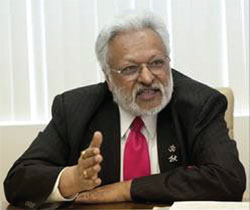
    WASHINGTON: An Indian- American has been appointed by a Republican Congressional panel to strengthen ties between the Republican Party and the community. The Indian American Executive Council of the National Republican Congressional Committee (NRCC) would be headed by Shalli (Shalabh) Kumar of Chicago, who early this year had taken a Congressional delegation to Gujarat, which had met Chief Minister Narendra Modi.

    According to a press statement, Kumar and the Indian American Executive Council shall help facilitate communications between National Republican Congressional Committee and the Indian-American community. In this capacity, Kumar will play an integral role in fostering relations between the NRCC and the Indian- American community. The NRCC will seek his input regarding how to increase Republican outreach efforts in the coming elections and identify potential candidates, the media statement said.

  • Four Indian Americans Charged With Healthcare Fraud

    Four Indian Americans Charged With Healthcare Fraud

    WASHINGTON (TIP): Four Indian Americans, including a physician and three co-owners of a health clinic from Chicago area, have been charged with healthcare fraud estimated to be running into millions of dollars. Federal law enforcement officials said three Indian Americans Ankur Roy, Akash Patel and Dipen Desai owned and operated Selectcare Health Inc., that provided outpatient physical and respiratory therapy in Park Ridge and Skokie.

    They were charged with submitting more than $4 million in false billings to Medicare between March and July 2011. Roy, 36, of Miami was arrested Tuesday, June 11 in south Florida, while Patel, 33, of Morton Grove, and Desai, 33, of Chicago, will be ordered to appear for arraignment on a later date in US District Court in Chicago. According to the indictment, the three allegedly submitted $4,009,094 in false billings for services that were purportedly provided between April 2010 and April 2011, resulting in payments totaling approximately $2,214,424 from Medicare and $320,881 from Blue Cross

    Blue Shield. The indictment seeks forfeiture of $2,535,305 in alleged fraud proceeds, including $446,974 in funds withdrawn by cashiers’ checks that were seized by the FBI in July 2012. In a second case Dr. Nalini Ahluwalia, 58, was charged with one count of violating the anti-kickback law for allegedly receiving $1,000 in exchange for referring two patients to a home health care agency in Aug 2012.

    The four are among 89 people charged with healthcare fraud running into about $233 million in false billing after a nationwide strike in eight cities, according to federal authorities. All the four Indian Americans charged are from the Chicago area. The charges demonstrate that “we will not tolerate medical professionals and providers who abuse our healthcare system,” said Gary S. Shapiro, US Attorney for the Northern District of Illinois.

  • US House Passes Bill Banning Abortion After 20 Weeks

    US House Passes Bill Banning Abortion After 20 Weeks

    WASHINGTON (TIP): The US House of Representatives passed a far-reaching anti-abortion bill that conservatives saw as a milestone in their 40-year campaign against legalized abortion and Democrats characterized as another example of what they see as Republicans’ war on women. The legislation, sparked by the murder conviction of a Philadelphia late-term abortion provider, would restrict almost all abortions to the first 20 weeks after conception, defying laws in most states that allow abortions up to when the fetus becomes viable, usually considered to be around 24 weeks.

    The legislation lays further groundwork for the ongoing legal battle that abortion foes hope will eventually result in forcing the Supreme Court to reconsider its landmark 1973 decision, Roe v Wade, that made abortion legal. In the short term, though, the bill will go nowhere. The Democratic-controlled Senate will ignore it, and the White House says the president would veto it if it ever reached his desk.

    The White House said the measure was “an assault on a woman’s right to choose.” But it was a banner day for social conservatives. Penny Nance, president of Concerned Women for America, called it “the most important pro-life bill to be considered by the US Congress in the last 10 years.” Democratic leader Nancy Pelosi called the legislation “yet another Republican attempt to endanger women.” Democrats repeatedly pointed out that all 23 Republicans on the chamber’s Judiciary Committee that approved the measure last week are men.

    The Republican leadership moved ahead on the abortion bill after the case of Kermit Gosnell, the Philadelphia abortion doctor who was recently sentenced to life in prison for what prosecutors said was the murder of three babies delivered alive. Abortion foes said it exemplified the inhumanity of late-term abortions. Some 10 states have passed laws similar to the House bill, and several are facing court challenges. Last month a federal court struck down as unconstitutional Arizona’s law.

  • Indian Appointed Dean Of Top Singapore B-School

    Indian Appointed Dean Of Top Singapore B-School

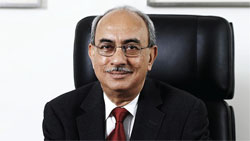
    SINGAPORE (TIP): Ravi Kumar, an IIT alumnus, was on June 19 appointed Dean of the Nanyang Technological University’s Business School here, with the prestigious institution describing him as an academic heavyweight with a good blend of East-West experience. Singapore’s Nanyang Technological University (NTU) appointed Professor Kumar as dean of its Nanyang Business School, a statement by the institution said.

    Kumar did his mechanical engineering from IIT-Madras in 1974. 61-year-old Kumar comes from the University of Southern California’s Marshall Business School where he held several key leadership positions, including that of Vice-Dean for international programs and Vice-Dean for graduate programs. His academic experience in the East comes from his two years as Dean of the College of Business at the Korea Advanced Institute of Science and Technology while on a leave of absence from University of Southern California.

    There he introduced reforms that saw the Korean college break into the top 100 of the Financial Times global MBA rankings, the statement said. The statement described Kumar as, “An academic heavyweight with a good blend of East-West experience. A passionate professor who believes in embedding ethics in his curriculum”. Commenting on his big move to NTU, Kumar said, “NTU has an ambitious leadership that has been consistently building its brand worldwide.

    As one of the pillars of the university, the Nanyang Business School has a great reputation for thought leadership.” NTU Provost Prof Freddy Boey said, “It has taken two years, as the person chosen as Dean of Business must have accomplishments that commensurate with the school’s reputation as one of the world’s finest business schools. Prof Kumar was a clear and compelling choice”.

  • Indian-American Sri Srinivasan Sworn In As Top Us Court Judge

    Indian-American Sri Srinivasan Sworn In As Top Us Court Judge

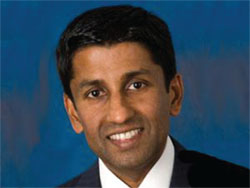
    WASHINGTON (TIP): The Chandigarh-born 46-yearold Srinivasan was sworn in a judge in the US Court of Appeals for the DC Circuit, the second most powerful court in the United States after the Supreme Court on June 18. He is the first Indian American judge in the second most powerful court of the country. Described by President Barack Obama as “trailblazer”, Srinivasan attributed phenomenal success to his family and the Indian American community.

    “You all made it possible,” Srinivasan told a gathering of Indian Americans at a reception hosted in his honor by the Indian Ambassador to the US, Nirupama Rao. “I am incredibly honored and humbled by the tremendous support you have given me,” he said. Srinivasan was first nominated by Obama on June 11, 2012. On January 2, 2013, his nomination was returned to the President, due to the sine die adjournment of the Senate. On January 3, 2013, Obama re-nominated him for the same office.

    Srinivasan was confirmed by a rare US Senate 97-0 votes, which he attributed to the overwhelming support he received from the Indian American community throughout the nation. Addressing the gathering, Rao said Srinivasan personifies the “extraordinary” accomplishments of the Indian Americans in the country and much more. Having achieved so much at this young age, Rao said the best is yet to come. She hoped that soon, there would be an Indian American in the US Supreme Court. Srinivasan began his legal career by serving as a law clerk for Judge J Harvie Wilkinson on the US Court of Appeals for the Fourth Circuit from 1995 to 1996.

  • World’s First Flying Car Up For Grabs For $1 Million

    World’s First Flying Car Up For Grabs For $1 Million

    NEW YORK (TIP): World’s first flying car, developed in 1949 by an American designer, is up for sale for nearly $1 million. Developed by inventor Moulton Taylor, the unique Aerocar could not only fly, it was designed to drive on roads, too. The flight system could be removed and towed by the car, then easily reassembled. The car which cruises at a 177 kph has foldable wings to keep it a street-worthy size is now on sale for $938,340.

    The 21-feet Aerocar is a two-place aircraft with sideby- side seating, four wheels, 30-feet wingspan and a single Lycoming 0-320 engine mounted over the rear wheels. The Aerocar was set to take the world by storm but after almost 25 years of campaigning Taylor still could not strike a deal – he even lost a deal with auto giants Ford, the New York Daily News quoted Caters News agency as reporting.

  • Afghan Peace Bid Stumbles, Talks Delayed

    Afghan Peace Bid Stumbles, Talks Delayed

    DOHA (TIP): A fresh effort to end Afghanistan’s 12-year-old war was in limbo on Thursday after a diplomatic spat about the Taliban’s new Qatar office delayed preliminary discussions between the United States and the Islamist insurgents. A meeting between U.S. officials and representatives of the Taliban had been set for Thursday in Qatar but Afghan government anger at the fanfare surrounding the opening of a Taliban office in the Gulf state threw preparations into confusion.

    The squabble may set the tone for what could be arduous negotiations to end a conflict that has torn at Afghanistan’s stability since the U.S. invasion following the September 11, 2001 al Qaeda attacks on U.S. targets. Asked when the talks would now take place, a source in Doha said, “There is nothing scheduled that I am aware of.” But the U.S. government said it was confident the U.S.-Taliban talks would soon go forward.

    “We anticipate these talks happening in the coming days,” said State Department spokesman Jen Psaki, adding that she could not be more specific. James Dobbins, the U.S. special representative for Afghanistan and Pakistan “is packed and ready to go with his passport and suitcase,” she said. One logistical complication is a visit by U.S. Secretary of State John Kerry to Doha on Saturday and Sunday. Kerry will discuss the Afghan peace talks with the Qatari hosts, senior U.S. officials said, but does not plan to get immersed in any talks himself or meet with Taliban representatives.

    A major part of his meeting will be devoted to talks on the Syrian civil war. The opening of the Taliban office was a practical step paving the way for peace talks. But the official-looking protocol surrounding the event raised angry protests in Kabul that the office would develop into a Taliban government-in-exile. A diplomatic scramble ensued to allay the concerns. Kerry spoke with Afghan President Hamid Karzai on Tuesday and again on Wednesday in an effort to defuse the controversy.

    NATO chief Anders Fogh Rasmussen appeared to side with Karzai by pointing out that alliance leaders at NATO’s Chicago summit last year had made clear that the peace process in Afghanistan must be “Afghan-led and Afghan-owned”. “Reconciliation is never an easy process in any part of the world,” Rasmussen told reporters in Brussels. A Taliban flag that had been hoisted at the Taliban office in Qatar on Tuesday had been taken down and lay on the ground on Thursday, although it appeared still attached to a flagpole.

    A name plate, inscribed “Political Office of the Islamic Emirate of Afghanistan” had been removed from the outside of the building. But a similar plaque fixed onto a wall inside the building was still there on Thursday morning, witnesses said. Asked whether the Taliban office had created any optimism about peace efforts, the source replied: “Optimism and pessimism are irrelevant. The most important thing is that we now know the Taliban are ready to talk, and sometimes talk is expensive.”

    Word of the U.S.-Taliban talks had raised hopes that Karzai’s government and the Taliban might enter their first-ever direct negotiations on Afghanistan’s future, with Washington acting as a broker and Pakistan as a major outside player.Waging an insurgency to overthrow Karzai’s government and oust foreign troops, the Taliban has until now refused talks with Kabul, calling Karzai and his government puppets of the West.

    But a senior Afghan official said earlier the Taliban was now willing to consider talks with the government. “It’s hard to talk and fight at the same time,” said Marc Grossman, Dobbins’ predecessor as the U.S. envoy for Afghanistan and Pakistan. The talks will be “really” difficult, said Grossman, now vice chairman at The Cohen Group consulting firm. He added that he was heartened that the protocol dispute, which he called “the first bump” in the process, was being worked out.

  • Rakeysh Omprakash Mehra’s Bhaag Milkha Bhaag Opens July 12

    Rakeysh Omprakash Mehra’s Bhaag Milkha Bhaag Opens July 12

    NEW YORK (TIP): Awardwinning filmmaker Rakeysh Omprakash Mehra (writer/director of India’s Oscar submission Rang De Basanti starring Aamir Khan) returns with his newest film BHAAG MILKHA BHAAG telling the true story of the “Flying Sikh” – world champion runner and Olympian Milkha Singh. Played by acclaimed actor Farhan Akhtar, Singh overcame the bloody massacre of his family, civil war during the India-Pakistan partition, and homelessness to become one of India’s most iconic athletes.

    BHAAG MILKHA BHAAG, which also stars Sonam Kapoor and Art Malik, opens across North America on July 12. The brand new theatrical trailer has just made its world premiere and can be watched here: Short link to share on social media: http://youtu.be/iY3qfhYPJSI Full link: http://www.youtube.com/watch?v =iY3qfhYPJSI

  • Moneygram Gives U.S. Consumers Chance To Watch ICC Champion’s Trophy Final

    Moneygram Gives U.S. Consumers Chance To Watch ICC Champion’s Trophy Final

    Promotion lets MoneyGram users enter for a chance to win all-expense-paid trip to Birmingham, UK, for the final
    NEW YORK (TIP): It was an easy, nostrings- attached deal: U.S. consumers who sent money to India, Pakistan, Bangladesh, Sri Lanka and Nepal between April 19 and May 19 were entered to win a trip to watch the 2013 ICC Champion’s Trophy Cricket final. The ICC Champions Trophy match runs June 6 through June 23, and is second only in importance to the Cricket World Cup (the winners of this year’s trophy will snag an estimated $2 million, the most since the game’s inception).

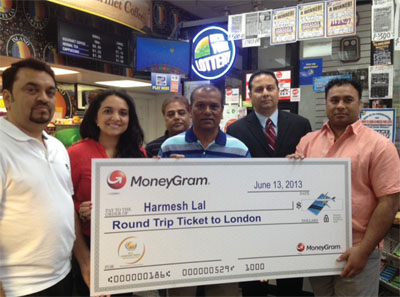
    The final game will be held June 23. All agent locations and online sends qualified for entry (consumers could also mail-in entry without purchase). The more transactions consumers made the more chances they had to win. Harmesh Lal from Bellerose, NY is the lucky winner. He sent money to his family in Hoshiarpur, India and was thrilled to learn that he would get a chance to experience the game up close.

    The transaction was sent at one of our top agent locations (Jai Hind) in the New York area, home to many immigrants using our services. The contest gave MoneyGram a chance to remind South Asian immigrants living in the U.S. that we are the official money transfer partner of the ICC. Plus, it promoted the sweepstakes and will send the lucky winner packing for one of the biggest games of the year.

    “Contests like these are a great way for MoneyGram to bring our consumers closer to the game of cricket and the memories they have of watching it in their home countries – it allows us to relate to our customers and give back to them a piece of what they might have left behind. It’s a way of thanking them for being a loyal consumer and increasing our brand awareness while doing so” says Zainab Ali, senior marketing manager.

    About MoneyGram MoneyGram, a leading money transfer company, enables consumers who are not fully served by traditional financial institutions to meet their financial needs. MoneyGram offers bill payment services in the United States and Canada and money transfer services worldwide through a global network of more than 300,000 agent locations – including retailers, international post offices and financial institutions – in 196 countries and territories. To learn more about money transfer or bill payment at an agent location or online, please visit moneygram.com or connect with us on Facebook.

  • New York Tamil Sangam Committee Dissolved

    New York Tamil Sangam Committee Dissolved

    NEW YORK (TIP): The current executive committee of New York Tamil Sangam headed by Prakash M Swamy has been dissolved with immediate effect, according to a communique from the Sangam. The announcement said as per the bylaws of the Sangam and in conformity with New York State Charities and Internal Revenue Service (IRS) Code fresh and transparent elections will be held and a new team will be elected at the general body meeting of all the paid members to be held soon in New York City.

    It said financial statements for three years will be submitted to the all the members at that meeting. This was never practiced in the past despite earnest appeals by some of us. The financials were never shared with the members either by post or by email attachments which is a violation of IRS rules. New York Tamil Sangam is a 501 © 3 non-profit organization formed to promote Tamil language and literature and will henceforth follow all rules and regulations of IRS and NY State Charities Board to prevent any misuse of power and to improve public accountability and transparency.

    In the 40 years, it had never held any general body meeting and this may even put the NYTS non-profit status in jeopardy. Also, the office bearers are selected internally by old bandicoots and not elected in open by the subscription paying members denying them their due rights. I want to bring in reforms and transparency before I step down, though I have one more year to go as President,” he said in a message sent to all members.

    “I was elected for a three-year period in Jan 2010 and my term ends in December 2013. I decided to step down a year ahead as I was feeling uncomfortable working with photo and publicity crazy, opportunistic, self serving, manipulative and stage and power-hungry individuals who wanted to use NYTS for their benefit and who took every opportunity to violate the IRS laws. During the last 12 years I had served as Vice President (Public Relations); Secretary and then President, I worked hard to improve the image of NY Tamil Sangam both in the media and on the ground.

    I served as joint treasurer of Fetna 2006 wherein I brought Supreme Star Sarath Kumar and Radhika without paying them any fee to attend the event using my personal contacts. I brought in NYC Comptroller John Liu, Indian Consul General Prabhu Dayal and scores of VVIPs from India to attend our events.

    I had invited free or at no cost a motley group of individuals from various fields – Music Director Bharadwaj, Aishwarya Rajnikanth, Mani Shankar Iyer, MP, Jinnah MP, Tiruchi Siva MP, Dr. Subramanian Swamy, Kalyana Malai Mohan, Ku Gnanasampandan, Y G Mahendran, Supreme Court Justice Karpaga Vinayakam, writer Gnani to name a few and all these were unheard in the past. For the past six years, I ensured that the corpus funds in the bank were not touched and we raised enough funds and sponsorship to do the programs and introduced new concepts such as picnics and bus trips.

    I changed the face and image of the Sangam which was not liked by old bandicoots who were using the Sangam for their personal benefits and illegal activities in the past,” the outgoing president said in the communique. Elections will be held for the following positions: President, Vice President, Secretary and Treasurer. Please wait for the announcement. Nominations are welcome. An election officer will be announced to receive nominations and to conduct elections for NYTS.

  • ICCR Chair On Contemporary Indian Studies At Rutgers University

    ICCR Chair On Contemporary Indian Studies At Rutgers University

    NEW YORK, NY (TIP): The Consulate General of India, New York in association with Rutgers University organized an event on June 19, 2013 announcing the commencement of the ”ICCR Chair on Contemporary Indian Studies” at Rutgers University. About 90 guests including high level officials of Rutgers University, New Jersey Department of Higher Education and Department of Labor, delegates from India, academicians from other universities, media persons, officials of the Consulate and others attended this memorable event.

    A Memorandum of Understanding was signed by Ambassador Dnyaneshwar Mulay, Consul General of India, New York on behalf of the ICCR and Dr. Richard L. Edwards, Executive Vice President for Academic Affairs and interim Chancellor, Rutgers University to initiate this academic partnership which will bring a distinguished visiting professor annually from India to teach courses on different subjects, deliver public lectures, and engage directly with staff and students at Rutgers University.

    Under the collaboration of the Singh- Obama 21st Century Knowledge Initiative, Rutgers University was one of five institutions with Tata Institute for Social Sciences (TISS) as its partner institute to be awarded the grant in the first round of awards announced during the India-US Higher Education Dialogue in 2012. As part of the study tour for this international scholar exchange, the University and representatives of TISS held a panel discussion, in which, experts on reforming education and training systems, discussed higher education and skills development in a transnational context.

    Rutgers is one of four U.S. institutions to receive a grant of approximately $250,000 from President Barack Obama and Prime Minister Manmohan Singh’s 21st Century Knowledge Initiative. The program was announced in November 2009 as an affirmation of the leaders’ commitment to enhancing India-U.S. partnerships in education. Each government pledged $5 million for this endeavor, for a total of $10 million to encourage mutual understanding, facilitate educational reform, foster economic development and engage civil society through academic cooperation.

    Rutgers, with the assistance of its partner institution, Tata Institute of Social Sciences in Mumbai, will welcome a distinguished visiting professor from India to teach courses, deliver public lectures and engage directly with faculty, staff and students. The initiative aims to increase study abroad opportunities for American students through international service learning, internships and dual degree opportunities.

  • IALI Presents Pioneer Awards 2013

    IALI Presents Pioneer Awards 2013

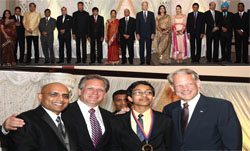
    LONG ISLAND, NY (TIP): The India Association of Long Island (IALI) held its 34th Annual Awards Dinner Gala on June 9th at the Hilton, Melville, NY. Dr. Kishore Kuncham, President of IALI, in his opening remarks said, “Tonight, we pay tribute to our global change-makers in the Indian-American community.

    We recognize them with the India Association of Long Island Pioneer Award to acknowledge their inspired leadership as they continue to enthuse others, deepen the meaningful work that is already in progress, and advance the common good with the vision of ‘one world family’- Vasudhaiva Kutumbakam to make the world an even better place. Let us celebrate life as we proudly honor our friends and families and esteemed honorees.”

    The 2013 Pioneer Awards were presented to nine most influential persons in the Indian American community. They included Purnachandra Aramalla, Pioneer Award 2013 for Excellence in Business Leadership; Gobind Bathija, Pioneer Award 2013 for Excellence in Community Service; Hussain Baqueri, Pioneer Award 2013 for Excellence in Aviation Leadership;. Pavankumar Darisi, Pioneer Award 2013 for Excellence in Community Service; Dr. Arti Datta, Pioneer Award 2013 for Excellence in Performing Arts; Mrs. Daman Dutt, Pioneer Award 2013 Young Entrepreneur; Dr. Madhu Korrapati, Pioneer Award 2013 for Excellence in Community Service; Kanwal Sra Pioneer Award 2013 for Excellence in Business Leadership and Sudhir Vaishnav, Pioneer Award 2013 for Excellence in Media & Entertainment.

    Dr. Kishore Kuncham, introduced each of the nine honorees highlighting their achievements and contributions to the Indian-American community and their global impact. Congressman Steve Israel and Nassau County Executive Ed Mangano graced the evening with their presence and each eloquently addressed the audience. Last, but not the least, there was a special recognition of Arvind Mahankali, the 13 year old Long Island native who recently won the 2013 Scripps National Spelling Bee Championship.

    Congressman Steve Israel congratulated all the honorees and spoke of his “first hand” experience with the critical relationship between the United States of America and India.. He said it was important to address any challenges and “deepen our ties.” Nassau County Executive Ed Mangano was warmly introduced by Dr. Kuncham who commended him for his support for many of the key intitatives of IALI.

    He thanked Mangano for the cricket pitch at the Cantiague Park and for agreeing to provide a bus to transport seniors to seniors programs. Most importantly, Dr. Kuncham thanked the County Executive for having his entire team meet with him and his committee to discuss the use of a county facility that could serve as “India House,” a permanent home and a cultural center County Executive Mangano in his remarks said, ” It is the greatest honor to partner with this organization.

    It is my hope that we do come together to get the “India House” done. We have made great progress along the way.” He congratulated all the honorees who have distinguished themselves and stated that it was his honor to join this ceremony to recognize them. On behalf of India Association of Long Island, President Kishore Kuncham presented “Lifetime Achievement” Awards to Congressman Israel and Nassau County Executive Mangano for their vision, outstanding leadership and extraordinary services to the people of Long Island and the Indian-American community.

    Dr. Kuncham thanked everyone for their support with special thanks to the Grand Sponsor of the Year, Salil Zaveri, Zaveri Insurance Co. and all other sponsors. He conveyed sincere appreciation to Gupta, Finance Chair, Mrs. Jharna Jaisinghani, Event Coordinator, and the members of the Executive Council of IALI. The event was emceed by Mrs. Mehar Bhasin and Vibhuti Jha. Mint Restaurant provided a spectacular array of exotic foods.

    A very lively entertainment was provided by Medley Entertainment. A $10,000 donation was announced to support the Interfaith Nutrition Network and Peter Bheddah was thanked for continuing to be a grand sponsor again. Other key partners including Patel Brothers, JHS Capital Advisors, Sagarsoft/Amicus Systems and Media were recognized from the podium. The gathering included people from various walks of life, including politicians and town and county officials.

  • Immigration Amendment Delayed

    Immigration Amendment Delayed

    WASHINGTON (TIP): Senators working to draft a new immigration border security amendment to the immigration bill fell short late Thursday, June 20 night and will try again Friday, June 21 morning, say reports. Senate Majority Leader Harry Reid (DNev.) said a core group of 20 senators had been working feverishly to complete the amendment spearheaded by Sen. Bob Corker (R-Tenn.) and Sen. John Hoeven (RN. D.), but that it would have been “senseless” to keep the upper chamber in session past 10:30 p.m. because the legislative language likely wouldn’t have been ready until at least midnight.

    “The amendment is ready but we have to make sure that it’s ready,” Reid said. “I’ve been to a few of these rodeos … we don’t want to want to have an amendment and then have to have to deal with it in some other way.”Opponents of the proposed border security measure and the underlying Gang of Eight bill criticized the process in which the amendment was being drafted and negotiated behind closed doors.

    Sens. Jeff Sessions (R-Ala.) spoke on the floor of the Senate late into the night, calling the Corker-Hoeven measure “a political response to a failing piece of legislation, a dramatic, desperate attempt.”