Month: June 2013

  • Stocks, Real Estate Boost US Household Wealth

    Stocks, Real Estate Boost US Household Wealth

    WASHINGTON (TIP): America as a whole has regained all the household wealth it lost to the Great Recession and then some, thanks to higher stock and home prices. The average household still has a long way to go. US household wealth jumped $3 trillion to $70 trillion in the January-March quarter this year, the Federal Reserve said on Thursday. That topped the previous peak of $68 trillion in the third quarter of 2007, just before the recession began.

    Yet because of inflation and a rising population, the average household has recovered only about 63 percent of the wealth it lost, according to calculations by the Federal Reserve Bank of St. Louis. Affluent households have benefited most because most of the recovered wealth has come from higher stock prices. The wealthiest 10 percent of Americans own about 80 percent of stocks. The recession cost Americans $15.6 trillion in wealth.

    Average household wealth, adjusted for inflation, was $539,500 at the end of last year, according to the St. Louis Fed. Yet most households own less than the average, which is skewed by how much wealth belongs to the most affluent. “Most families have recovered much less than the average amount,” the St. Louis Fed report says. Household wealth, or net worth, reflects the value of assets like homes, stocks and bank accounts minus debts like mortgages and credit cards. For America as a whole, higher home values and stock prices have helped create a “wealth effect.”

    This occurs when rising wealth gives Americans the confidence to spend more. The economy benefits because consumers drive about 70 percent of US economic growth. National home prices have been rising steadily since last summer, though they remain about 30 percent below their 2006 peak. Stocks have more than doubled since they bottomed in 2009, and stock averages hit record highs last month. The Fed’s low-interest rate policies have been intended to support both the housing and stock markets. The Fed’s policies have helped keep mortgage rates near record lows to encourage home purchases.

    They’ve also pushed bond yields fell so low that many Americans have shifted money out of bonds and into stocks. The resulting higher stock prices have helped boost household wealth. But the distribution of the wealth has been uneven. Such wealth disparities mean “a smaller fraction of the population is near the average,” says Dana Saporta, an economist at Credit Suisse. Over the past five years, inflation has eroded about 10 percent of America’s regained wealth.

    And the number of households has increased 3.8 million to 115 million from the third quarter of 2007 through the end of last year. So the regained wealth is now divided more broadly. Rising stock prices accounted for nearly two-thirds of the rebound in wealth through the end of 2012, the St. Louis Fed report estimates. The increase in stock prices has extended well into 2013, despite sharp declines the past two weeks. In the January-March quarter, gains in stocks and mutual funds accounted for about half the nation’s $3 trillion increase in wealth. Rising home prices made up about one-fourth.

    The rest came from higher pension fund reserves, greater ownership of cars and other goods and lower debts. Homes accounted for two-thirds of middle-class assets before the recession, estimates economist Edward Wolff of New York University. Stocks made up just 7 percent. Roughly half of Americans own stocks, directly or through mutual funds. But most of their holdings are small.

    As wealth has risen this year, many people have chosen to save less of what they earn and keep spending. Americans saved just 2.5 percent of their income in the first quarter. That compared with about 4 percent last year. “People feel wealthier, so they’re happier to spend more,” says John Calverley, head of macroeconomic research at Standard Chartered Bank.

  • US Gives No Quarter, Even To India, When It Comes To High-Tech Secrets

    US Gives No Quarter, Even To India, When It Comes To High-Tech Secrets

    WASHINGTON (TIP):Warm, fuzzy superlatives may be in vogue to describe current US-India ties, but when it comes to protecting its national interest and cutting edge intellectual property,Washington gives no quarter, even to its so-called “natural ally”. The FBI on Wednesday came down like a ton of bricks on Ketankumar Maniar, an Indian national who had worked till recently in New Jersey medical technology company Becton, Dickinson, and Company, accusing him of stealing trade secrets pertaining to self-administered disposable pen injector still being developed by the 116- year old US firm.

    Maniar was arrested from a New Jersey hotel just 48 hours before he was planning to relocate to India with proprietary information worth millions of dollars, authorities alleged. In a seven page criminal complaint filed in a New Jersey Court, the FBI said Maniar, 36, had resigned from the company in May this year after working there for 15 months. In the days leading to his resignation and even after he quit on May 24, the company claimed it discovered through an internal investigation that he had downloaded 8,000 files containing among other things proprietary information about the so-called “disposable pen” syringe which the company was developing.

    The company alleged that Maniar downloaded and transferred confidential files to his email and other devices even when he called in sick a day ahead of his resignation. “Information downloaded by the defendant collectively constitute a veritable toolkit for mass production of the Disposable Pen,” FBI Special Agent Laurie Allen said in the Bureau’s criminal complaint which gave details of what Maniar downloaded, including product design and assembly pictures, data on schedules for manufacturing, pricing, and other information that could be sold to BD’s competitors, to himself set up a new business, or simply to market himself for future employment.

  • India, Myanmar, Thailand Trilateral Highway May Start By 2015-16

    India, Myanmar, Thailand Trilateral Highway May Start By 2015-16

    NAY PYI TAW (MYANMAR) (TIP): The proposed trilateral highway covering India, Myanmar and Thailand is expected to be operational by 2015- 16, commerce and industry minister Anand Sharma said on june 7. Leading a business delegation, Sharma is here to attend the World Economic Forum on East Asia 2013. “India is working closely with Myanmar and Thailand to develop the trilateral highway as we call it. We are half-way there, and this should be fully operational by 2015-16,” Sharma said during a session – The Long-Term View.

    The idea of the highway – from Moreh in Manipur to Mae Sot in Thailand, via Myanmar – was conceived at the trilateral ministerial meeting on transport linkages in Yangon in April 2002. The highway represents the most significant step in the establishment of connectivity between India and South East Asian countries. It was visualized as a highway of opportunity and friendship that would facilitate not just the movement of goods and services but also of people and ideas.

    Sharma said the free trade agreement between India and ASEAN will act as a catalyst to boost trade and investment ties with countries in the region including Myanmar. He also said that India is looking to set up information technology institute and university in Mandalay. Besides, he added that New Delhi will share expertise with Myanmar in the enhancement of agricultural productivity, he added. “With this end in view, we are establishing an Advance Centre for Agricultural Research and Education at Yezin, and a Rice Bio Park is also being established in Myanmar through grant assistance by India,” Sharma said.

    The minister also highlighted the importance of developing high-quality infrastructure. “India is developing Kaladan Multimodal Transit-Transport Project which will connect Mizoram to Sittwe port in Myanmar.” Further, he said that with democracy tightening its grip in Myanmar, which has provided a right enabling environment to inspire investor confidence, India remains committed “to be a steadfast partner of Myanmar as it charters its path to growth and progress”.

  • Bangladesh Miracle Survivor Leaves Hospital For Job In Hotel

    Bangladesh Miracle Survivor Leaves Hospital For Job In Hotel

    SAVAR, BANGLADESH (TIP): A seamstress trapped in the rubble for 17 days after Bangladesh’s garment factory disaster in April emerged from hospital today, saying she felt “great” and was looking forward to a new job at a luxury hotel. Reshma, 18, who became a national heroine after the catastrophe that claimed more than 1,100 lives, was in good spirits and looked healthy at a ceremony at the military facility where she was admitted on May 10. “I feel great now.

    I am recovered mentally and physically,” she said, smiling. But after nearly a month of treatment, initially in intensive care, she admitted she was still troubled by nightmares about her ordeal beneath the wreckage of the collapsed Rana Plaza building. “I still get frightened in the night,” she told reporters, dressed in a peacock green dress and headscarf. “Whenever I think of those days I feel bad and frightened. I have forgotten most of what I did under the rubble.” The teenager, who uses only one name, drank rainwater and foraged food from co-workers’ lunch boxes to survive after her nine-storey workplace collapsed on April 24.

    Two days after her rescue, she said she would never return to Bangladesh’s accident-prone garment sector, the world’s second biggest, worth 20 billion dollars a year. Reshma, from a remote village in the western border district of Dinajpur, had begun work in the building just 22 days before it fell down. She was being paid a monthly salary of 4,700 taka (60 dollars). She has since been offered jobs in various hotels and charities, but decided to take up an opportunity at the luxury Westin Hotel in the capital Dhaka.

    “I never thought that I would get my life back again when I was trapped under the rubble,” she told the packed press conference in Savar, the Dhaka suburb where the disaster took place. Azim Shah, general manager of the Hotel Westin, told reporters he was proud Reshma was joining his team. “We’re sure this young girl will be exceptional in her new job,” he said, adding she was made a “ambassador in the housecleaning department”. The hotel officials took her to the new job after she was released by the military at around 11am Bangladesh time (0500 GMT), army spokesman Major Touhid-uz-Zaman, said.

    “Her family accompanied her to the hotel,” he said. At the time of the collapse more than 3,000 garment workers were on shift at the complex housing five factories, where they made clothing for Western retailers including Italy’s Benetton and Britain’s Primark. They were ordered back to their production lines even as cracks developed on the outside of the complex. The industry has since promised to clean up its act. Most major European buyers have signed up to a new accord promising better working conditions, as well as fire and building inspections.

  • Ind Vs SA: Shikhar Dhawan’s Ton Sets Up India’s Win Over South Africa

    Ind Vs SA: Shikhar Dhawan’s Ton Sets Up India’s Win Over South Africa

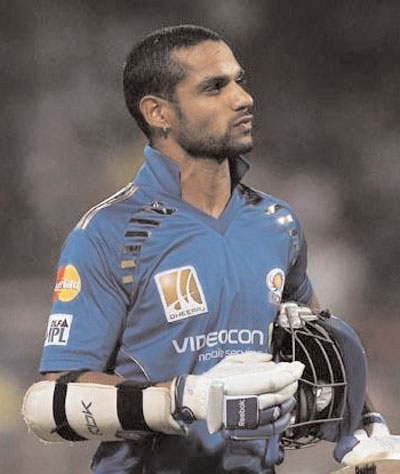
    CARDIFF (TIP): In the middle of all the madness surrounding cricket, if there’s one man having a blast, he’s Shikhar Dhawan. Confined to the first-class circuit for years, tagged a wasted talent and blamed for his off-the-field eccentricities, he’s emerged from those shadows to shine in the brightness of his abilities. He began the year 2013 with a bang, cementing his place in the squad after that spectacular century in his debut Test against Australia, and is now opening the innings for India in the Onedayers.

    On June 6 at the Sophia Gardens, in the opening match of the Champions Trophy against South Africa here, he continued in that same vein of form, scoring 114 runs off just 94 balls inclusive of 12 fours and a six that pushed the opposition into a corner early in the game. Riding on his entertaining innings, India posted a healthy 331-7 in the stipulated 50 overs, and took control of the proceedings. South Africa began the chase well but two suicidal run-outs and some avoidable strokeplay changed the course of their innings.

    Eventually, India won a match — dragged right till the end of the 50th over — by 26 runs. Dhoni hadn’t hinted much about the prospect of Rohit Sharma opening the innings with Dhawan. But on the morning of the match, when the two walked out, it didn’t come as a surprise to see the Mumbai batsman — who seems to have a very strong backing of his captain — open the batting. Dhawan’s form seemed to have rubbed off on Sharma and the duo brought the first 100 runs in just the 16th over, off 98 balls, to set the tone.

    Early on in the innings, it was Sharma who first went after the bowlers. Dhawan joined the party midway through the partnership as the do put on 127 runs. The only chance Dhawan gave in his innings was a stumping opportunity messed up by South Africa’s captain and wicketkeeper AB de Villiers. The rest of his innings only varied between having to make a choice between a drive and a loft and a six or a four as he made light of a wayward South African attack.

    The last 10 overs of India’s innings saw 82 runs scored for the loss of three wickets. That meant 149 runs coming between the 17th and the 40th over for the loss of just four wickets. It underlined Dhoni’s theory of taking a cautious approach and saving wickets for the end. That India were 213-2 at the end of 35 overs and SA 212-6 sums up the story. A great effort also came from allrounder Ravindra Jadeja who seems to be growing in confidence with each game regardless of the format.

    It’s no surprise that Jadeja has been MS Dhoni’s go-to man of late. On Thursday, the 24-year-old’s 29-ball 47 cameo consisting seven fours and a six helped India surge from 260-5 in the 42 over to the eventual total. On the field too, he was electric, picking a wicket, taking a catch, and most importantly, effecting a thriller of a run-out – of Robin Peterson – to snatch back the initiative for India. India now head to London to play the West Indies.

  • Raj Kundra ‘Has Confessed To Betting’

    Raj Kundra ‘Has Confessed To Betting’

    Rajasthan Royals Run Risk Of Franchise Termination

    NEW DELHI (TIP): Another IPL team owner has been caught betting. After Chennai Super Kings principal and the inoperative BCCI chief S Srinivasan’s son in law, Gurunath Meiyappan, was arrested by Mumbai police for being in touch with bookies and placing bets, Rajasthan Royals owner, Raj Kundra, has confessed to the Delhi Police of doing the same. While betting/gambling is a minor, bailable offence under the CrPC, the BCCI rules are pretty harsh.

    If an owner is caught betting, his team franchise can be terminated. So, Rajasthan Royals runs the risk of being scratched as Kundra is one of its owners. Meiyappan’s status as CSK owner is disputed. If he’s found to be not an owner but an important official in the team, CSK won’t be scratched but will probably attract a hefty fine. The Delhi Police commissioner told the media on Thursday that during his 11-hour interrogation on Wednesday, Kundra has confessed to placing bets on his team winning.

    He said Kundra has lost a lot of money on bets, which other police officers estimate it to be around Rs 1 crore in the last three IPL seasons. He also said that Kundra would place his bets through one Umesh Goenka, Kundra’s business partner, whom the commissioner described as a “bookie”. Kundra and his wife Shilpa Shetty went back to Mumbai on Thursday as Delhi police was undecided on whether to slap the anti-gambling laws against Kundra.

    Police sources said Kundra was betting for the past three years while his friend Umesh Goenka has been betting in matches for past 6-7 years and was also in touch with several bookies. The cops are now trying to ascertain whether the Kundra-Goenka betting link was in any way connected with spot-fixing. Police also revealed on Thursday that Shilpa Shetty had also placed bets in an IPL match. This was claimed by Umesh Goenka in his statement.

    Sources said they have identified a “money trail” and the bookies who routed Kundra and Goenka’s wagered money. TOI had first reported on Thursday that Kundra was betting on IPL matches. Raj Kundra reportedly told the cops that being a British national, “he was unaware of the fact that betting was illegal in India”. He said that betting was legal in the UK. A policer officer, however, said that ignorance of the law was no defence.

    In any case, it was strange that Kundra didn’t find anything odd in the manner in which bets were placed in India. Delhi Police sources say that Umesh Goenka, who was given VIP passes by Kundra for every RR match, used to talk to team players and would ask them about team’s strategy, pitch and other details and then place bets. Kundra gambled through Umesh, often by giving verbal instructions on the amount he would place and on what. In short, Goenka was acting as a bookie for Kundra.

    Umesh, claimed the police, was in touch with many other bookies. “In betting world, if a person bets and when it is taken further (or doubled), words like kha liya (ate it) are used or having won on the initial amount, if he gambles again on the winnings, it would be referred to as badha diya (increased),” said an officer. Officials said they will question Kundra once again and they currently taking a call on whether to charge him under gambling act or not.

    Shilpa Shetty denied the allegations on Twitter saying her involvement in betting was “complete nonsense” and that she had “never bet on any cricket match ever”. The tweets were retweeted by Kundra. Earlier in the day, the couple had tweeted denying all allegations. However, Delhi Police Commissioner Neeraj Kumar came on record to say, “Raj Kundra has admitted to betting. He used to bet on his own team. We have also come to know that he has lost a lot of money in betting.

    He used to bet through Goenka, who is also a bookie”. Police have confiscated the passports of Kundra and Goenka to ensure that they do not leave the country during investigations. According to sources, Kundra became one of the owners of the team in the third season of IPL. Reacting to police claims, Shilpa Shetty had tweeted earlier, “we love cricket, it’s the passion for the sport that made us a part of IPL. It’s extremely disheartening to keep clarifying that. For those who care, my apparent involvement in betting is complete nonsense and I have never bet on any cricket match ever.

    Truth will prevail. I won’t be saying any more as the case is subjudice.” Police sources said Goenka, who was born in Sikkim, was in the sponge iron business but had suffered losses. As he stayed near the residence of Kundra’s mother in West Punjabi Bagh and knew each other, he became family friends and went to London where he met Kundra after his business collapsed. In 2008, he returned and started Ashwani Steel Private Ltd in Ahmedabad in which he has 16% stake while Kundra has 42% stake.

    Sources said the name of Goenka, with whom Kundra owns a company dealing in steel business, came during the recording of statement of Trivedi, a prosecution witness in the case. In his statement recorded before a magistrate, sources said, Trivedi claimed that Goenka approached him and sought details about the cricket pitch in Ahmedabad and details about team formations.

  • Queen Elizabeth’s Husband Hospitalized For Surgery In London

    Queen Elizabeth’s Husband Hospitalized For Surgery In London

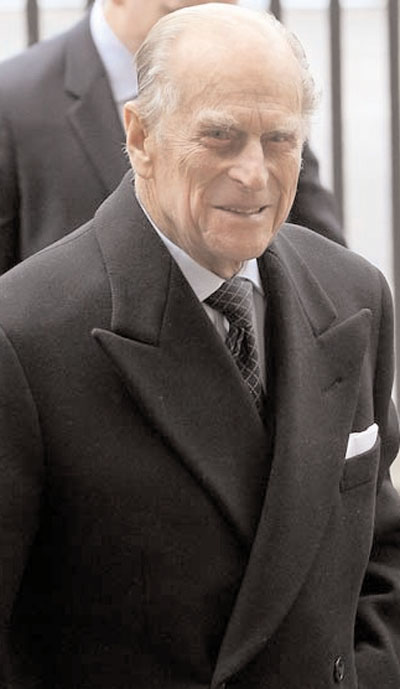
    LONDON (TIP): Queen Elizabeth’s 91- year-old husband Prince Philip has been taken to a London hospital for “an exploratory operation following abdominal investigations”, Buckingham Palace said June 6. The British monarch’s husband is expected to spend two weeks at the London Clinic, the palace statement said. It gave no further details and said further updates would be issued when appropriate.

    Philip has needed hospital treatment four times now since Christmas 2011, including for a bladder infection during the queen’s Diamond Jubilee a year ago which took some of the gloss off nationwide celebrations for the generally popular monarch. The longest-serving consort in British history has won admirers for his charity work and steadfast support of his 87- year-old wife, but he is also prone to verbal gaffes that have caused embarrassment over the years.

  • In A First, UK Pays Kenyans £20 Million For The Torture During Colonial Rule

    In A First, UK Pays Kenyans £20 Million For The Torture During Colonial Rule

    LONDON (TIP): Britain on Ju ne 6 announced its first ever financial compensation for those tortured under its rule. In a development that could pave the way for many other claims from around the world including from India, UK foreign secretary William Hague announced a compensation payment of £19.9 million for 5,228 elderly Kenyans tortured during the Mau Mau uprising. UK has also said it will support the construction of a memorial in Nairobi to the victims of torture and illtreatment during the colonial era. Hague admitted that the British used capital punishment on a large scale and sanctioned harsh prison regimes in their colonies.

    He said, “The British Government recognizes that Kenyans were subject to torture and other forms of ill treatment at the hands of the colonial administration. The government sincerely regrets that these abuses took place, and that they marred Kenya’s progress towards independence. Torture and ill treatment are abhorrent violations of human dignity which we unreservedly condemn.

    ” In December this year, Kenya will mark its 50th anniversary of independence from Britain. During the eight-year Mau Mau insurgency, up to 30,000 Kenyan deaths were recorded, both insurgent and loyalist. Around 80,000 to 300,000 people were detained in a network of camps, where many were tortured.

  • Heathrow Airport To Name And Shame Noisiest Airlines

    Heathrow Airport To Name And Shame Noisiest Airlines

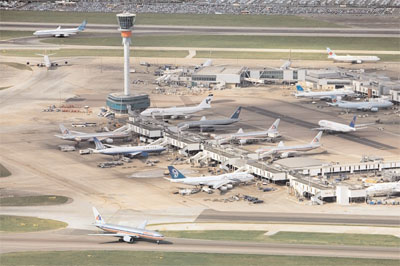
    LONDON (TIP): Air India flights landing in Britain’s biggest airport will now have to watch out how noisy their aircraft are. Heathrow has become the first major airport that has decided to name and shame noisy airlines. A new “Fly Quiet” scheme will rank airlines on the amount of noise their engines make. Airlines with loudest engines will have to pay a hefty fine. Heathrow is the UK’s only international hub airport, handling nearly 70 million passengers a year, and connecting the UK to 183 destinations around the world in 90 different countries.

    Aircraft noise is a significant issue for local residents living nearby. European research shows that around 6% of people are “highly annoyed” by road traffic noise above 55 decibel while a higher proportion – between 10-28% – are highly annoyed by aircraft. Heathrow officials said, “This shows that noise from aircraft is seen as more disturbing.” “Heathrow is at the forefront of international efforts to tackle aircraft noise.

    Airlines are rewarded for flying quieter planes, and penalized when they do not. New procedures for aircraft landing which reduce the noise experienced under the flight path have been pioneered. As a result, even though the number of planes using the airport has gone up, fewer people are affected by noise today than at any time since the 1970s. But despite these efforts, noise remains an issue,” they added.

    Heathrow already has some of the toughest noise restrictions in the world, which have resulted in important benefits for residents in terms of reduced noise. For example, aircraft flying in and out of Heathrow are on average 15% quieter than the other planes flying in the fleets of the same airlines which land at other world airports. As a result of the rules and incentives in place at Heathrow, airlines are increasingly using their newest and quietest planes on early morning routes.

    For example, Qantas, Singapore Airlines and Malaysian Airlines have all replaced their noisier Boeing 747- 400s with the A380 that has a 40% smaller noise footprint. Cathay Pacific has also changed to quieter Boeing 777 aircraft. British Airways will start to take delivery of A380s from summer 2013 and “we expect some of those to be used on its early morning flights. The use of quieter aircraft at night means the average noise per night movement has already fallen by 20% and this trend is set to continue.

    We will continue to use landing charges to provide an additional incentive for the use of the quietest planes at night,” Heathrow officials told TOI. Colin Matthews, CEO of Heathrow said, “Heathrow encourages the quietest aircraft through higher charges for the noisiest aircraft and reduced charges for the quietest aircraft. The airport will be proposing a significant increase in fines for airlines that break noise limits and, later this year, launching a ‘Fly Quiet’ programme which will publicly rank airlines according to their noise performance at Heathrow”.

    The airport also offers noise insulation for community buildings and homes, financial assistance with relocating to “quieter” areas and campaign for local planning authorities to restrict new developments in the noisiest areas. From 2014, we plan to launch a new “Quieter Homes” programme incorporating lessons from a pilot we are currently running.

    The number of “night flights” permitted at Heathrow is restricted by an annual ‘cap’ and there are noise restrictions on aircraft departing late at night and early in the morning. Heathrow also has a voluntary ban in place for arrivals scheduled to land between 4.30am and 6am not to touch down before 4.30am. In addition, departures are not scheduled between 11pm and 6am.

  • Russian President Putin, Wife Announce Divorce

    Russian President Putin, Wife Announce Divorce

    MOSCOW (TIP): Russian President Vladimir Putin and his wife Lyudmila announced on Thursday they are divorcing after nearly 30 years of marriage. The Putins made the statement on state television after attending a ballet performance at the Kremlin. “It was our joint decision,” Putin said. Lyudmila Putin was rarely seen in public during her husband’s long tenure at the top of Russian politics and implied that she didn’t like to travel with him on his frequent trips.

    “I don’t like publicity and flying is difficult for me,” she said. The Putins married on July 28, 1983, and have two daughters, Maria and Yekaterina. In the televised announcement of their divorce, Putin appeared reserved and Lyudmila smiled tentatively. “We practically never saw each other. To each his own life,” Putin said. Lyudmila Putin said, “We will eternally be very close people. I’m thankful … that he supports me.” There were no immediate indications of how the move would be perceived by the public.

    Divorce is common in Russia, and nearly 700,000 pairs dissolved their marriages in 2009, according to UNICEF. Russian leaders, unlike their counterparts in the West, generally keep their personal lives well out of public view. Mikhail Gorbachev’s wife Raisa raised many Russians’ hackles by her visibility, flair for fashionable dress and forthright comments.

    But Putin also has made a point of supporting traditional social values and appearing at holiday masses of the Orthodox Church. The church permits divorce under some circumstances; it is not clear if the Putins sought pastoral advice or permission before the split.

  • Turkey PM Urges End To Protests, Tells Supporters To ‘Go Home’

    Turkey PM Urges End To Protests, Tells Supporters To ‘Go Home’

    ISTANBUL (TIP): Turkish Prime Minister Recep Tayyip Erdogan called for an immediate end to mass protests against his rule but urged supporters to “go home” after they staged a major show of strength welcoming him home from an overseas trip. Waving Turkish flags and chanting “We will die for you, Erdogan” and “Let’s go crush them all”, supporters of the premier’s Justice and Development Party (AKP) staged their first rally after keeping largely silent during seven days of violent anti-government demonstrations across the country.

    “I call for an immediate end to the demonstrations, which have lost their democratic credentials and turned into vandalism,” Erdogan said in a speech at the Istanbul airport where he returned from a North Africa trip, to roaring cheers from the crowd. Flanked by his wife and prominent government ministers, the premier praised his supporters for their restraint in recent days, but stressed that he was “the servant” of every citizen in the country. “You have remained calm, mature and showed common sense,” he said. “We’re all going to go home from here… You’re not the type of people to bang pots and pans on the streets.

    ” Earlier, tens of thousands of angry anti-government protesters again packed cities across the country to call for the premier’s resignation. The nationwide unrest, fuelled by anger against what protesters see as Erdogan’s growing authoritarianism, has claimed a third life with the death of a policeman, media said. Doctors have reported thousands of injured in the past week as police tried to quell the rallies in major cities with tear gas, pepper spray and water cannon.

    Erdogan has so far responded with defiance to the biggest challenge of his decade-long rule, and further enraged protesters on Thursday by vowing to press ahead with the redevelopment of Istanbul’s Gezi Park, whose conservation fight lit the flame of the protests. Speaking in Tunis ahead of his return, Erdogan reiterated his claims that extremists and foreign agitators were to blame for the violence.

    “Among the protesters, there are extremists, some of them implicated in terrorism,” including some who were in Taksim Square where the trouble broke out last week, he told reporters. Seven foreigners implicated in the unrest have been arrested, Erdogan said, without specifying what part they had played in the violence. In Istanbul, whistle-blowing, bannerwaving demonstrators said they were determined to keep up their protests.

  • Britain To Restart Detainees’ Transfer To Afghan Authorities

    Britain To Restart Detainees’ Transfer To Afghan Authorities

    LONDON (TIP): Britain would restart the transfer of detainees captured in Afghanistan to the local authorities later this month. The process was suspended in November last year after it emerged the prisoners were being mistreated in Afghan custody. The fresh move comes days after Britain confirmed it had 90 Afghan nationals in its custody at Camp Bastion, the country’s biggest base in Afghanistan and dubbed as the UK’s version of Guantanamo Bay detention camp.

    They were being held without charges for up to 14 months with no access to lawyers in violation of the international law. “We have been working to identify a safe transfer route to Afghan custody and I am pleased that this work has come to fruition,” said defence secretary Philip Hammond. “I very much hope we do not face any further legal impediments in the British courts which could prevent us from transferring these detainees and force us to hold them for even longer in Camp Bastion.’

    ‘ The prisoners would be transferred to an Afghan National Army facility at Parwan, which has received positive reports from rights organizations. “Our coalition allies also now transfer detainees to the same Afghan facility. I am confident the safeguards in place will ensure detainees will not be at risk of mistreatment,” said Hammond. He justified detentions, saying they were crucial on the battlefield to stop those intend to kill British troops.

    “Our troops must be able to detain enemies on the battlefield and debrief them for intelligence purposes and will continue to do so before transferring them into the Afghan judicial system.” British forces in Afghanistan are part of the International Security Assistance Force and are allowed to detain suspects for 96 hours. The custody can be extended in “exceptional circumstance”. Since 2003, UK operations in Afghanistan have been conducted under Operation Herrick.

  • Real challenge for Sharif begins now

    Real challenge for Sharif begins now

    “Forces of destabilization are as active today as they were earlier. They are anxiously waiting for the withdrawal of the US-led troops from Afghanistan next year. The new scenario that will emerge in Afghanistan can affect Pakistan in various ways”, says the author.

    Most newspapers have preferred to highlight the fact that Nawaz Sharif is the first person in Pakistan to have become the democratically elected Prime Minister for a third time after a gap of 13 years. Thus, his success in capturing power is a historic development. In 1999 when his government was toppled in a military coup staged by the then Army Chief, Gen Pervez Musharraf, he had been written off as a politician with his party, the Pakistan Muslim League (N), struggling for survival.

    He was jailed and could have been hanged to death. That was the time when the world saw in his wife, Kulsoom, a fearless fighter for her rights. She made it clear to the General that she was not the one who would accept the designs of the dictator to throw her husband into the dustbin of history. She succeeded in making the Saudi rulers intervene in a clandestine cooperation with the US. Nawaz Sharif was forced to go on exile to Saudi Arabia.

    But the politician in him could not remain away from the hustle and bustle of politics forever. After all, he was destined to come back to power and change the course of politics in Pakistan. But this fact will be of no use to him as he begins his latest tenure at a time when most people in Pakistan are leading a miserable life because of daily power cuts for as long as 12 hours at some places. Pakistan during the PPP-led government somehow escaped having been declared a “failed state”.

    Its economy needs a surgical treatment to make it deliver the goods. Extremism promoted by elements like the Taliban has caused incalculable damage to the Pakistan economy. It invited drone attacks by the US which may now become history, as Nawaz Sharif has declared after taking over as Prime Minister. But how he manages to control extremists remains to be seen. Interestingly, the man who unsuccessfully tried to destroy Nawaz Sharif’s political career, Gen Musharraf, is in the dock when the PML (N) leader is in power.

    The world will be watching with interest whether Nawaz Sharif simply ignores him and allows the law to take its own course. He has no time to waste as people have great expectations from him. He was a successful business man before the PML (N) leader got inducted into politics during Gen Zia-ul-Haq’s rule. That is why Sharif’s approach has always been business-like. The privatization program with the setting up of the Privatization Commission of Pakistan began when he was at the helm of affairs.

    It’s a different matter that it was alleged those days that when government-owned undertakings were put on sale, his Ittefaq Group of Industries would purchase them. Despite this, Pakistan made some significant achievements on the industrial front during his past two tenures. But today the situation is different. Forces of destabilization are as active today as they were earlier. They are anxiously waiting for the withdrawal of the US-led troops from Afghanistan next year.

    The new scenario that will emerge in Afghanistan can affect Pakistan in various ways. But Pakistan can gain enormously by taking steps for the normalization of relations with India. Nawaz Sharif may face considerable pressure from businessmen to do all he can to increase business opportunities between India and Pakistan. Already the two countries are doing excellently on the bilateral trade front.

    Exports from India to Pakistan went up by around 15 per cent in 2012-13, adding $1.6 billion to bilateral trade between April 2012 and February 2013. Imports from Pakistan too increased to $488 million from $375 million, a rise of as much as 30 per cent. The new Prime Minister of Pakistan has a great opportunity available to him to change the economic profile of his country by concentrating on the Indo-Pak trade front.

  • The Issue Is Governance In Pakistan

    The Issue Is Governance In Pakistan

    “Pakistan has paid a heavy price for the slow pace of the change-over from a secret government to a transparent one. A closed system of governance undermines one of the salutary gifts of democracy – that in a democratic set-up the doings of the rulers become instantly known to the people unlike dictatorships whose mischief becomes public when it is often too late. Thus, it is absolutely necessary to ensure as transparent governance as possible”, says the author.

    As the dust of electoral controversy has settled down, the focus of the national debate should now be not only on what needs to be done first but also on the best possible way to move forward, for the central issue in Pakistan is still the mode of governance. The new Prime Minister may have to change his style of working and leading the government by realizing that the parliamentary system does not envisage a prime minister with overriding powers; it means rule by the Cabinet.

    The ultimate sanction for all government actions lies with the Cabinet and the advice a prime minister gives to the head of the state must be backed by the authority of the Cabinet. Also it is the cabinet that is collectively answerable to parliament. Strong prime ministers tend to treat the cabinet as a body that is good only for endorsing their own ideas and not as a vehicle for ensuring decision-making by consensus. A good Cabinet can offer effective checks to political leaders’ impulsive actions, the adoption of untested schemes and the temptation to bend the rules for a populist enterprise.

    Any attempt to make decisions or policies at the urging of an informal caucus (consisting of friends, family members, bureaucratic aides, etc) will amount to an encroachment on the rights of the Cabinet. Pakistan has paid a heavy price for the slow pace of the change-over from a secret government to a transparent one. A closed system of governance undermines one of the salutary gifts of democracy – that in a democratic set-up the doings of the rulers become instantly known to the people unlike dictatorships whose mischief becomes public when it is often too late.

    Thus, it is absolutely necessary to ensure as transparent governance as possible. A review of the right to information law appears to have become necessary so as to reduce the restrictions on disclosure and exemptions from the right to information to the absolute minimum. One is surprised at the absence of accountability from the list of priority tasks for the new government although it should be at the top of the agenda. A new, comprehensive and effective accountability mechanism must be put in place at the earliest.

    Without a system of across-the-board accountability good governance cannot be conceived; neither can the government enjoy due legitimacy nor will it be possible to relieve the courts of their unnecessary burden of going for the black sheep in the service of or among the politicians. One of the most encouraging observations made by Mian Nawaz Sharif during his predictably goodwill-laced address to his party’s newly elected parliamentarians related to his decision to take all parties along.

    This is in accord with the spirit of democracy which requires that once the electoral contest is over all, parties in parliament become collaborators in ensuring governance in accordance with the will of the people. While the opposition parties ought to continue their role as public watchdogs, they should also help the ruling party in moving away from majoritarian rule, sometimes by censuring it for its false steps and sometimes by supporting its fair initiatives.

    Despite its poor record in strengthening democratic conventions, Pakistan has certainly taken, over the past few years, some significant steps in the direction of participatory democracy. These included, for instance, increasing the role of multiparty standing committees of parliament, assigning the chairmanship of these committees to members of different parties, and giving the chairmanship of the Public Accounts Committee to the main opposition party. These experiments are in their initial stages and need to be nursed with care and imagination before they can achieve the goal of broadening the democratic base of governance.

    Another significant development in the recent past, for which the outgoing government deserves due credit, has been the opening of greater opportunities for private members to contribute to parliament’s legislative work. Indeed, further and consistent encouragement to private members, especially the women among them, to undertake public-interest legislation will consolidate the democratic dispensation.

    This will also balance the government’s preoccupation with legislative work designed to increase the state’s coercive or regulatory powers. It is perhaps time to take a critical look at the Rules of Business (Article 99 of the Constitution) for regulating the conduct of the federal government. These rules, originally framed by the viceroy in the colonial period, were revised by the government in 1973 and may have become due for changes required to strengthen the Cabinet’s role in decision-making, to streamline intra-government consultation, to increase interaction with the public, and to remove loopholes and anomalies that cause matters to be taken to the courts.

    The importance of the rules can be judged from the fact that Farooq Leghari, the then President, created a National Security Council by simply amending the rules. One wonders whether in a parliamentary system the prerogative to lay down the rules for the conduct of the federal authority should continue to vest in the head of state. The grand objective of taking everybody along is not realized by only making coalitions and giving ministries and parliamentary offices to persons outside the core ruling group.

    It demands the creation of mechanisms not only for parliament’s effective oversight of the executive’s functioning but also for guaranteeing all state organs’ regular and meaningful interaction with civil society. The sights must clearly be set on evolving a system that satisfies the ordinary women and men of Pakistan that their participation in governance does not start and end with the casting of ballots and that on everything that the government does or avoids doing their opinion matters. In fact, it is sought and considered or at least heard.

  • Shed Illusions On China

    Shed Illusions On China

    India’s appeasement policy won’t help
    It is high time the PMO and the MEA gathered courage to speak on the South China Sea and the issues having a bearing on national security, particularly in forums like the East Asia Summit, with the same clarity as the Defense Minister did.

    During the past month China inflicted a national humiliation on India by intruding 19 kilometers across what has been the traditional border between Ladakh and Tibet since the 17th century and forcing India to not only pull back from its own territory in the Daulat Beg Oldi sector, but also to dismantle defense structures in the Chumar sector.

    China has consistently refused to define where the so-called “Line of Actual Control” lies and acted aggressively when it finds Indian defenses neutralize its tactical and strategic advantages by pushing its claims westwards and well beyond what its own maps had earlier depicted. Moreover, apart from violating all past agreements on the Ladakh-Tibet border, China’s territorial claims also violate the provisions of the Wen Jiabao – Manmohan Singh Agreement of 2005 on the guiding principles for a border settlement which state: “The (Sino-Indian) boundary should be along well defined and easily identifiable geographical features, to be mutually agreed upon”.

    India’s claims, based on historical data, also fulfill the provisions of the 2005 agreement as they set the western borders up to the Indus river watershed, with the Karakoram mountains forming the natural boundary. After being militarily humiliated, India chose to subject itself to diplomatic ridicule in the joint statement issued after the visit of Premier Li Keqiang.

    While the joint statement paid lip service to the 2005 guiding principles, there was no mention of the need for defining the LAC in accordance with these guiding principles. Unless we do this and insist on China furnishing its version of the LAC, the Chinese will continue to stall and obfuscate while placing our forces in an untenable position along the borders, with India meekly agreeing to pull down any defenses the Chinese demand.

    Worse still, India agreed to accept some ridiculous and one-sided provisions which are clearly detrimental to its national interests. The most astonishing provision of the joint statement was the sentence: “The two sides are committed to taking a positive view and support each other’s friendship with other countries”. This, in effect, was an endorsement of Chinese policies of “low cost containment” of India.

    Over the past three decades China has provided Pakistan designs for its nuclear weapon, allowed the use of its territory in 1990 by Pakistan for testing nuclear weapons, upgraded Pakistan’s enrichment centrifuges, provided unsafeguarded plutonium production and reprocessing facilities and violated its commitment to the MTCR, by providing Pakistan wherewithal for manufacturing medium and long-range ballistic and cruise missiles.

    China is also Pakistan’s largest arms supplier, providing equipment ranging from JF 17 fighters and T 90 tanks to modern frigates. General Musharraf had made it clear just after the visit of then Chinese Premier Zhu Rongji that the Gwadar port being built with Chinese assistance would be made available to China if there were tensions with India. Moreover, does our ill-advised endorsement of the nature of Sino-Pakistani collusion not suggest an endorsement of Chinese growing presence in POK and the Northern Areas of Gilgit-Baltistan? As the Chinese government mouthpiece, The Global Times, mockingly observed: “India must accept and adapt to the enviable friendship between China and Pakistan.

    China cannot scale down this partnership merely because of India’s feelings!” On May 28 President Rajapakse of Sri Lanka signed a “strategic cooperation partnership” agreement with President Xi Jinping in Beijing, in which the two sides agreed to strengthen defense cooperation while jointly cracking down on the “three challenges of terrorism, separatism and extremism” and expanding cooperation on “international and regional affairs”.

    Virtually every South Asian leader choosing to challenge India, ranging from President Waheed in the Maldives to Begum Khaleda Zia in Bangladesh and Prachanda in Nepal, has received a warm welcome at the highest levels in Beijing. Moreover, China is bent on blocking India’s entry into forums like the Nuclear Suppliers Group. Worse still, India grandiosely agreed to support a Chinese role in the Gulf of Aden, without getting similar Chinese endorsement for its maritime and energy interests in the South China Sea, most notably for its exploration projects in the Phu Khanh Basin off the coast of Vietnam.

    Interestingly, while commissioning the first squadron of carrier-based Mig 29 aircraft on May 13, the Defense Minster, Mr. A.K. Antony, asserted that there should be freedom of navigation in the South China Sea, adding that while India is not a party to disputes there, it believes that these disputes should be settled according to the UN Convention of the Law of the Seas (UNCLOS). Mr. Antony added the protection of the sea lanes of communications is imperative for India’s trade, commerce and economic development.

    Sadly, such clarity on Indian interests is not evident in other parts of South Block. Moreover, Mr. Antony believes that there can be no “miracles” in the development of India-China relations and has no intention of either taking up residence in Beijing or waxing eloquent on the serenity and tranquility surrounding Tiananmen Square! New Delhi has to understand that the appeasement of an assertive China is a recipe for global and regional marginalization.

    Given China’s territorial claims, which have expanded from just Tawang, to the entire state of Arunachal Pradesh and its activities in PoK, India should not merely stop voicing the inane mantra that “Tibet is an Autonomous Region of China,” but make it clear that we did not invite the Dalai Lama to India. We would be happy if he reached an agreement to return to Tibet, with China respecting the provisions of the 17-point agreement it signed with the Tibetans in 1951. Moreover, apart from acquiring berthing facilities for the Navy in Vietnam, India would be well advised to provide Vietnam the ability to protect its maritime interests by the supply of Brahmos cruise missiles, much in the manner that China provides Pakistan ballistic and cruise missiles.

    On river waters, India is well placed to work with lower riparian states in the Mekong basin and, indeed internationally, to isolate China on its refusal to engage in prior consultations on projects on the Brahmaputra river. It is also high time the PMO and the MEA gathered courage to speak on the South China Sea and issues having a bearing on national security, particularly in forums like the East Asia Summit, with the same clarity as the Defense Minister, instead of appearing apologetic, weak and vacillating. The statements made and cooperation envisaged when the Prime Minister visited Japan are a good beginning.

  • ‘Spellebrity’ US Spelling Champions’ Indian Roots

    ‘Spellebrity’ US Spelling Champions’ Indian Roots

    IF you can spell words such as pathognomonic, doryline, melocoton, kaburi, conquistador, flibbertigibbet, humuhumunukunukuapuaa, physiognomy, weissnichtwo and gobbledegook, you might have stood a chance at the annual American spelling competition, but then this year you would have to know the meaning of these words too. Yet children between the ages of 8 and 14 battled with their pears to win the spelling bee competition and become ‘spellebrities’, as these brainy celebrities are known.

    In what has become a common occurrence, it was a child of Indian origin who won the competition this year, just as five others had done so in the past five years. This time the winner was a boy, Arvind Mahankali, another break in recent tradition where the past five winners, and 52 per cent of this year’s competitors, were girls. An exasperated Professor Henry Higgins said in the classic film, My Fair Lady, “There even are places where English completely disappears. In America, they haven’t used it for years!” Yet it is in this very nation, one that not particularly known for keeping true to the Queen’s English, that this competition has been held since 1925.

    This year there were 281 spellers, and 116 of them speak more than one language. Indians, it seems, have a natural affinity for spellings. The youngest competitor was eight-year-old Tara Singh. Two of the competitors, Vanya Shivashankar, and Ashwin Veeramani, have siblings who have previously won the competition. In fact, Arvind Mahankali too had missed the top honor twice, in the past, but he conquered his difficulties with Germanic origin words and got it right.

    This was not a case of third time lucky, more one of Bruce Lee and the Spider’s tale of try, try and try again. Now, that’s a good mantra to keep in mind whether you are in a spelling bee competition or generally negotiating the syntax of life.

  • Indian-American Cardiologist Pleads Guilty To Healthcare Fraud

    Indian-American Cardiologist Pleads Guilty To Healthcare Fraud

    WASHINGTON (TIP): An Indian- American cardiologist has pleaded guilty to charges that he falsely recorded the severity of patients’ illnesses in order to receive payment for numerous heart procedures. Sandesh Rajaram Patil, 51, a former doctor at a hospital in Kentucky, is the third cardiologist in the United States to be federally prosecuted for health care fraud related to the placement of heart stents, according to the US Attorney’s Office.

    The Justice Department said Patil admitted on Tuesday to making false statements regarding the placement of heart stents, the metal tubes surgically inserted into a patient’s arteries in order to improve blood flow. Patil reached an agreement with the US Attorney’s Office to serve a prison term between 30 and 37 months, pending a judge’s approval. Patil is scheduled for sentencing on August 27. St Joseph’s hospital has repaid the government USD 256,800 for cardiac stent procedures that Patil falsely submitted for reimbursement in 2009 and 2010.

    “Dr Patil violated the public’s trust in physicians,” said Kerry B Harvey, US Attorney for the Eastern District of Kentucky. For a cardiac stent procedure to qualify as a medical necessity, it is generally accepted that a patient must have at least 70 per cent blockage of an artery and symptoms of blockage. Patil admitted that he placed stents in arteries that had substantially less than 70 per cent blockage. He nonetheless recorded blockage of 70 per cent or more in patient documents to guarantee payment from Medicare and Medicaid.

  • Rising Stars in New Jersey

    Rising Stars in New Jersey

    BRIDGEWATER, NJ (TIP): Share and Care Foundation had a fundraising event to promote its signature program E 2 S – Educate to Success on 2nd June at Balaji Temple community center hall, Bridgewater, NJ. The young ambassador Ms. Charmie Mehta, a high school student organized this amazing, sold out, successful event: Rising Stars (35 performers), featuring variety of young teenage talents in classical music and dance to raise funds for E 2 S program while inspiring lots of others.

    Funds, donations and the quality of performances exceeded the expectations; donations are still pouring in online and mail. Your $50 contribution helps one needy child in tribal villages of N E India to get high school education. The foundation is pleased to support E2S program because it has a strong impact and track record of providing a high-quality and affordable high school experience that meets the needs of future challenges of vocational and college degree education.

    In this tough economic environment particularly in tribal areas of N E India, it is more important than ever to support brilliant students aspiring to make a better life for themselves but families cannot afford to pay for quality education.

  • Indian American Night Celebrated

    Indian American Night Celebrated

    LONG ISLAND, NEW YORK (TIP): Indian American Forum Inc. organized the Indian American Night on Sunday June2, 2013 at Harry Chapin lakeside Theatre, Eisenhower Park, East Meadow, Parking Field 6 & 6A. Program started with a Laughter Yoga session sponsored by Arya Samaj of Long Island Kite Flying Festival was a great attraction. Gobind Munjal event cochairperson organized the kite flying competition.

    Children men, women and even grandparents enjoyed flying kites. Jaya Bahadkar Cultural chairperson presented beautiful cultural program reflecting dances from different parts of India. Students from local dance schools participated. Vocal performances by Jyoti Gupta and actor Patel from New Jersey enthralled the audience with their memorable songs This Indian American Night is part of 2013 summer concert series sponsored by Nassau county Department of Parks, Recreation and Museums.

    Indian American Night is a showcase of Classical Indian music and folk dances from all regions of India. Nassau County Executive Honorable Edward P Mangano , Nassau County Comptroller George Maragos, National Chairman of All American Political Party Bobby Kumar, Chairman of Human Rights Commission Zahid Syed, Human Rights Commissioner Sharanjit Singh Thind, Park Commissioner Mr. Foskey, Deputy Commissioner for community affairs town of North Hempstead Mohinder Singh Taneja, Democratic District Leader from Queens Uma Sengupta and several other elected officials and community leaders were present.

    Nassau County Executive Honorable Edward P Mangano welcomed everyone and commended the Indian American Community for their outstanding achievements. Following members of Indian American community were presented with Nassau County citations. De Ajay Lodha, AAPI, Dr Kishore Kuncham, President India Association of Long Island, Dr Krishna Zaveri, Dr. Nidhi Vohra, specialist in prenatal medicine at NSLIJ Hospital, Dr Binita Shah, well known pediatrician, Mr. Vinod Motwani, member of Long Island Sindhi Association, Sharanjit Singh Thind, publisher of South Asian Insider, Veer Mukhi Founder of Arya Samaj of Long Island and Arvind Mahankali, Winner of Scripps National Spelling Bee.

    Indu Jaiswal Chairperson of IAF thanked all the sponsors and volunteers – Event co-chairperson Gobind Munjal, Bina Sabapathy, Dinesh Khanna, Gunjan Rastogi, Sangeeta Pandit, Anu Gulati, Vijay Goswamy, and Ajay Batra for their help in making the evening extremely successful

  • Barney’s New York & Maiyet Launch Of Varanasi Silk Capsule Collection At The Indian Consulate

    Barney’s New York & Maiyet Launch Of Varanasi Silk Capsule Collection At The Indian Consulate

    NEW YORK, NY: The Consulate General of India, New York in association with Barney’s New York & Maiyet, a luxury fashion brand, and NEST, a nonprofit organization hosted an event at the Indian Consulate here on May 9, 2013 to celebrate ground breaking of Varanasi Silk Weaving facility and Benaras Silk Capsule Collection.

    Rebecca Van Bergen, founding member of NEST highlighted the history of Varanasi silk weaving and gave a brief overview about the facility and Varanasi NEST’s working with an organization dedicated to saving the dying craft of silk weaving through the creation of a centralized weaving facility.

    The facility will be a focal point for the weaving business, a way to help improve the capacity and ability of the weavers of Varanasi, and a place to train the next generation of artisans, and NEST’s collaboration with world-renowned architect David Adjaye on this project. Consul General Ambassador Dynaneshwar Mulay welcomed the guests and congratulated the partners on their endeavors of preserving the Silk Weaving traditions of Varanasi.

  • Andhra Pradesh To Tie Up With MIT

    Andhra Pradesh To Tie Up With MIT

    NEW YORK, NY (TIP): The Government of Andhra Pradesh is to sign an MOU with the prestigious Massachusetts Institute of Technology (MIT) in Boston to tap its vast resources to develop interactive labs and utilizing its edX platform and open courseware, said Andhra Pradesh Minister of Information Technology and Communications Ponnala Lakshmaiah here Monday, June 3.

    Addressing an international media conference at Bombay Palace restaurant in Manhattan, he said on his return from Boston that Andhra Pradesh has 700 Engineering colleges that churn out over 250,000 engineers in various disciplines annually. The educational system needs a serious face lift back home in the absence of qualified teachers. The proposed partnership will help the State to develop interactive labs where small and rural colleges can have access to the expensive labs using the iLabs technology of the MIT.

    The tie-up will also help in the development of utilization of OSIDs – Open Software Interface Definitions. The MOU will help tap the edX platform and open courseware of MIT to develop alternative learning mechanisms in the wake of serious dearth of qualified teaching professionals, he said. The Minister said the finer details are being worked out and the MOU will be signed within a few months and this will be a major breakthrough in enhancing the quality of education in the state.

    Hyderabad is emerging as a knowledge economy, he said. The Minister highlighted in his discussions with the top-brass of MIT that one out of three IT professionals working in the US is an Indian and out of three Indians one is from Andhra Pradesh. Andhra Pradesh is the first state to pioneer e-governance projects across India and contributes 12 percent to national employment in the IT sector.

    “The MIT faculty was pleasantly surprised to learn that Andhra Pradesh has about 700 engineering colleges and assured their cooperation in skill development,” the Minister said. Answering questions, Lakshmaiah said the global potential of electronic hardware industry is estimated at $ 2.4 Trillion by 2020 and the demand for the Indian market that stood at $45 Billion is expected to touch $400 Billion by 2020.

    Andhra Pradesh unveiled the nation’s first electronic hardware policy for 2012-2017 highlighting special facilitation and incentives for electronics hardware in the areas of industrial electronics, communication and broadcast equipment and strategic electronics and components. The State Government is setting up a game city in an area of 30 acres near Hyderabad dedicated to the growing fields of gaming, animation, media and entertainment.

    Once completed the game city will deliver $500 Million as additional net export revenue to the regional economy for over five years. It is expected to provide employment to 15,000 people and over 200 animation and gaming centers will come up in the city, the Minister said. The game city along with ICT industry will make Andhra Pradesh world’s one of the most wired states in Asia Pacific region.

    India has mere one percent share of animation and gaming industry, he said. The Minister who walked the Red Carpet at the Cannes Film Festival said Andhra Pradesh produces largest number of movies in India with190 being made last year. More than 80 percent of visual effects of Oscar-winning movie Life of Pie were designed by Rhythm and Hues, a Hyderabad-based company that has 250 employees.

    The national award winning animation movie Ega (Flies) was developed in Hyderabad, he said. The New York Times mentions Hyderabad as one of the 41 must cities of the world and the only from India. It ranks at 19th place. The World Bank in its report has rated Hyderabad as best metro in India. The Harvard Business School has dubbed Hyderabad as most investment friendly in India, he added.

    Sanjay Jaju, Secretary to AP Government, Information Technology and Communications Department said India’s first electronic manufacturing cluster is to be set up in Hyderabad and Visakhapatnam to make the State electronics manufacturing capital of India. Jaju said the State contributes over 15 percent of national IT exports and makes 12 percent of national IT employment. It ranks fourth nationwide in IT performance and contributes 40 percent of total exports from Andhra Pradesh.

  • Helen Marshall Visits Whitestone Memorial Field

    Helen Marshall Visits Whitestone Memorial Field

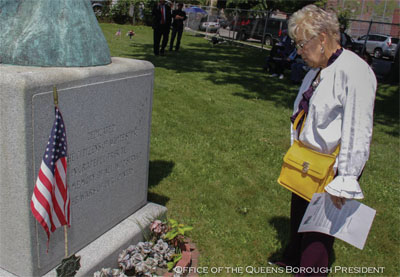
    Queens Borough President Helen Marshall reading the inscription at the base of the memorial statue at Whitestone Memorial Field prior to the start of the 89th annual Whitestone Memorial Day Ceremony and Parade on Monday, May 27th in Whitestone, Queens.

    The ceremony included Marshall, Mayor Michael Bloomberg and other dignitaries praising the heroic men and women who have served in the Armed Forces of the United States, especially those who paid the ultimate price.

  • International Kabaddi Legend Shivdev Singh Honored

    International Kabaddi Legend Shivdev Singh Honored

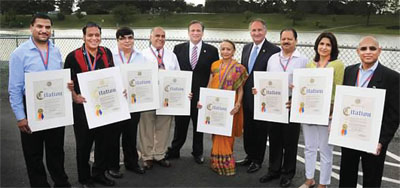
    International Kabaddi legend Shivdev Singh was in New York. His admirers gathered to host him at Nanking Restaurant in Long Island on June 4. He was honored with citation from the Town of North Hempstead.

  • AIA Hosts Consul General Dnyaneshwar Mulay

    AIA Hosts Consul General Dnyaneshwar Mulay

    NEW YORK, NY: The New York Chapter of The Association of Indians in America (AIA-NY) organized a dinner at Vermilion in Midtown, New York City on May 30th, 2013 to welcome the new Consul General of India to NY, Dnyaneshwar Mulay. Many community leaders and sponsors of AIA’s annual Deepavali celebration at the iconic South Street Seaport attended the event to show their continued support.

    This year’s Deepavali, the 26th in a row, takes place on October 6th, 2013. Introducing Mr. Mulay, Divya Shah, VP Events (AIA-NY), said Mr. Mulay is a seasoned Indian Diplomat since 1983. He started his Indian Foreign Service career in Japan and since has served in Russia, Mauritius, Syria and Maldives. He is also a well-known author and poet having written over 15 books.

    His original writings in Marathi have a large following especially amongst the youth who find it highly inspiring. Mr. Mulay recited the AIA Motto of ‘Indian Heritage- American Commitment’ as he appreciated the efforts that the AIANY Chapter has undertaken in the past and present to fulfill its commitment and promote the Indian culture. He went on to entertain the audience with excerpts from his writings and poems which were greatly appreciated and applauded.

    He assured streamlining of Visa, Passport and OCI card procedures at the Consulate during his tenure. AIA-NY president, Sunil Modi mentioned that the AIA Deepavali showcases a wide array of culture, rich heritage and elegant customs that India has offered to the world for centuries as he shared his thoughts and ideas by appreciating and recognizing his current executive committee and dignitaries present in the audience.

    Two captivating vocal performances by Devika Kedia & Ria Anand from AIA’s Youth wing were well appreciated by the guests. The evening was well attended by AIA members. The immediate past president of AIANY, Ranju Batra and other past presidents including Dr. Narinder Kukkar, Dr. Nirmal Mattoo, Dr.Urmilesh Arya, Santosh Khera, Smiti Khanna, Arun Bhatia and Dr. Rajendra Bansal were also present.

    Aroon Shivdasani, Executive Director of the Indo American Arts Council; Hesh Sarmalkar, Director at The Asia Society; Kishore Kuncham, President of the India Association of Long Island were among those who graced the event. Some of the sponsors present included State Bank of India, Star Plus India, Air India, Bank of Baroda, Veria Living, Touchdown Media, Kingfisher, Qatar Airways, Sufi Wines, New York Life and TV Asia.

  • A Nano Scientist Turned Social Reformer Speaks To The Indian Youth In America

    A Nano Scientist Turned Social Reformer Speaks To The Indian Youth In America

    NEW YORK (TIP): Overseas Volunteer for Better India (OVBI) organized a first-of-its-kind Google Hangout with upcoming youth icon, farmer’s champion and anticorruption activist Balasaheb Darade. This event was organized to update NRI community about relief work done by Balasaheb for Maharashtra drought relief and how can overseas Indians be a part of this movement.

    In the past few months, he has brought relief to over 100000 farmers and developed 20 model villages in Buldhana district. NRI community came in great support for he cause and more than 550 people attended the one hour interactive session with Balasaheb. OVBI (www.ovfabi.org) is a platform formed by like minded NRIs who came together to make a direct impact on the social issues in India.

    Balasaheb,an entrepreneur and nano technologist in the United States had returned to India to serve Vidarbha region of Maharashtra and has been working for last three years on various farmers issues. His integrity, effort and contributions won him a landslide victory in the local municipal elections over incumbent political candidates with no bribes and no underhand dealings.

    In the hangout, Balasaheb revealed his insight and inspiration in his extraordinary journey of transformation through service, resolve and integrity. He described his beginnings with the Shankara Rural Transformation Project that nurtures leadership among youth to uplift the standard of living of rural India. He then touched upon his journey with the India Against Corruption (IAC) movement.

    He concluded with a summary of the multiple projects he is running now, including the Jal Jagruti Abhiyan, a project that has brought relief to hundreds of thousands of farmers across drought-hit Maharasthra. He shared his motivation, “Be the change that you want to see in society”.

    Darade showcased his plan of action, covering far reaching topics from solutions for the farmer suicide phenomena that is plaguing India, to business and policy solutions for bringing about rural prosperity, to organic chemical free farming and more in his hour long session. The attendees comprised OVBI supporters, ex-IAC members, Darade’s ex-colleagues and concerned Indians.

    Inspired by Balasaheb’s vision, Indian overseas community has pledged financial support and will organize multiple fund-raising events all across the United States in August to support his initiatives. “We started the Overseas Volunteer For A Better India movement with a vision that the solution to the dramatic problems that afflict Indian Society lies in the heart and resolve of everyday people.

    I am enthused and inspired to see how many of us overseas Indians turned out to attend this event and am inspired by the support they all showed.We intend to keep this momentum going in the days to come with similar events,” shared Satej Chaudhary, one of the directors of the OVBI program.A recording of the video is now available at OVBI’s website.(www.ovfabi.org)