Month: July 2013

  • Bansal named CBI witness

    Bansal named CBI witness

    NEW DELHI (TIP): Former Union Railway Minister Pawan Kumar Bansal, whose nephew Vijay Singla and nine others have been chargesheeted by the CBI in the Rs 10 crore cash-for-post bribery case, has been named as a prosecution witness. The CBI chargesheet filed in a special court some days back mentioned that Bansal would be a prosecution witness, a source said. Now that he has been made a prosecution witness, it is understood that he has been given a clean chit.

    He was questioned only once at Jam Nagar House while the other accused were grilled at the CBI headquarters. The agency has also named Railway Board exchairman Vinay Mittal, joint secretary (confidential) P Rajeshkaran and joint director Vigilance (Int) R Vijayan Nair as witnesses. The agency had registered the case on May 3 and arrested Mahesh Kumar, Vijay Singla and other middlemen. In its FIR, the CBI has alleged middleman Sandeep Goyal had promised Kumar that he would arrange the post of Member (Electrical) in the Railway Board for him and allegedly demanded Rs 10 crore for it.

  • Rescue operation over in Badrinath

    Rescue operation over in Badrinath

    Dehradun (TIP): The mammoth multi-agency rescue operations to evacuate all stranded pilgrims and tourists in the flood-ravaged Uttarakhand concluded on July 3 with a group of 155 persons being evacuated from Badrinath. In all, around 1.1 lakh people — stranded due to flash floods and landslides after monsoon rains pounded the hill state on June 15 — were evacuated by joint teams of the Army, Indian Air Force, Indo-Tibetan Border Police (ITBP) and National Disaster Response Force (NDRF). “A total of 155 persons were evacuated today from Badrinath. Now for all intent and purpose, the evacuation of stranded pilgrims and tourists in Badrinath is complete.

    Now some locals remain there and they would be airlifted tomorrow,” said Chief Secretary Subash Kumar. Kumar said the state government has intensified operations to air-drop food packets in the areas that still remain cut off. “In Rudraprayag, copters made 31 sorties and 1,100 food packets were dropped,” he said. The Chief Secretary said sorties were undertaken in Munsiyari and Dharchula districts of Pithoragarh for air-lifting stranded locals.

  • Narayana Murthy recalled from Retirement to lead Infosys again

    Narayana Murthy recalled from Retirement to lead Infosys again

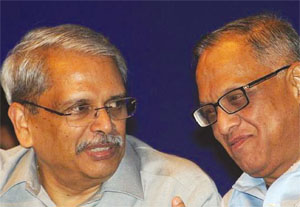
    BENGALURU (TIP): : Struggling IT major Infosys has recalled its founder N.R. Narayana Murthy and returned control of the company that has disappointed investors with poor earnings in the last nine quarters and losing ground to smaller rivals. Murthy, who had shed executive role seven years ago and finally retired as head of Infosys in August 2011, has been appointed Executive Chairman, replacing K.V. Kamath during whose tenure the company shares slumped 15 percent.

    The current executive co-chairman S. Gopalakrishnan will be redesignated executive vice-chairman while S.D. Shibulal, who was one of the seven engineers to launch the company in 1981 by pooling together USD 250, will continue as Chief Executive Officer (CEO). Billionaire Murthy accepted a five-year term, over which period he will earn a salary of one-rupee per year and will have his son, Rohan, as his executive assistant.

    Both Gopalakrishnan and Shibulal have requested that they too draw an annual compensation of 1 and the Board has accepted their requests, subject to necessary shareholder and government approvals. Describing his return as ‘very unusual’, Murthy, who will turn 67 in August, said the company was facing challenging times and his job would be to add value to Shibulal’s job with ideas. “The board has taken this step keeping in mind the challenges that the technology industry and the company faces,” Kamath said acknowledging calls from shareholders to strengthen executive leadership of the company. Under Murthy’s 19-year tenure as CEO until 2002, Infosys became the first Indian company to list on Nasdaq and grew to become an over 40,000 crore (USD 7.3 billion) enterprise.

    He is returning at a time when Infosys has performed below market expectations and has struggled to retain clients in North America and Europe. The firm has over past two years losts its IT bellwether status to Tata Consultancy Services, the country’s largest software services exporter. In FY13, revenues lagged its own forecast and projected lower growth in earnings than industry during the current year.

  • Remodeled Antuns by Minar hosts Rahat Fateh Ali Khan in Hicksville, NY

    Remodeled Antuns by Minar hosts Rahat Fateh Ali Khan in Hicksville, NY

    NEW YORK (TIP): The newly-renovated Antuns by Minar in Hicksville, New York hosted singer Rahat Fateh Ali Khan for a media night recently. The well-attended media event saw a brief performance by Rahat Fateh Ali Khan, ahead of his June 15 concert in NY. The cavernous ballroom of Antun’s by Minar saw the cream of the Long Island Indian American community, along with South Asian media, mingling informally with the maestro and his hosts, Rajeev Maini, Inder Singh and Gurvinder Sahni, the new owners of Antun’s by Minar.

    Following media interviews, the singer, his entourage and the sponsors, including Asif Jamal, vice president of sales and marketing at ARY Digital USA, addressed a press conference, recounting how the maestro enjoyed coming to the US while performing more than 60 shows in the past few years. “I try to ensure my music binds people from India and Pakistan,” he said. Khan also revealed during the press conference that he was working diligently on launching Khan Music Academy in the US.

    Introducing Khan, Rajeev Maini said that he could not imagine a better beginning for Antun’s by Minar than by hosting Rahat Fateh Ali Khan.

    “Just like Mr. Khan, we want to be known for our hard work, creativity and integrity,” Maini said, adding “Antuns by Minar is a dream for my partners and myself, and we are here to succeed, with your support and well wishes.” Antun’s by Minar is co-owned by Inder Singh (Neetu), who has run Minar and Benares and several other successful restaurants for more than 30 years, and is considered a veritable stalwart among Indian restaurateurs in New York.

    The media night with Rahat Fateh Ali Khan at Antuns by Minar was created and managed by India One and EEG Talent, both New York-based sister companies specializing in PR, marketing, talent and event management. Antun’s by Minar, Indya One and EEG Talent have recently teamed up to frequently bring Bollywood celebrity events to the New York area.

  • MOVIE REVIEW -GHANCHAKKAR

    MOVIE REVIEW -GHANCHAKKAR

    Cast: Emraan Hashmi, Vidya Balan, Rajesh Sharma, Namit Das
    Direction: Raj Kumar Gupta
    Genre: Thriller
    Duration: 2 hours 19 minutes

    STORY: A Maharashtrian thief married to an aggressive Punjabi woman carries out a bank heist. Before he can spend the loot, he meets with an accident. Will his memory and money come back to his use?

    MOVIE REVIEW: Director Raj Kumar Gupta is an ‘inspired’ writer/ filmmaker. He draws liberally either from other cinematic material or from headlines. His first film Aamir had many similarities to the Filipino film Cavite. His No One Killed Jessica was quite obviously taken from the Jessica Lal murder case. In his third movie outing Ghanchakkar, the director, is ‘inspired’ by innumerable Hollywood and UK black humour flicks.

    The film has an interesting premise. Sanjay Atre ( Emraan Hashmi) and his Punjabi wife Neetu ( Vidya Balan) have a humdrum existence. The colour in their lives comes from the loud clothes Vidya wears. Life promises change for them when Sanjay, who is an expert lock picker hooks up with small-time crooks Pandit ( Rajesh Sharma) and Idris ( Namit Das). The trio rob a bank. However, they cannot spend the money till the heat is off. So they give to Emraan for safe-keep. Three months later when it’s time to enjoy their loot, they find themselves stranded because Emraan has suffered a partial memory loss.

    For the viewer, part of the fun begins here. One scene that is hilarious is when Emraan and Vidya start to make love but need to break it up because Emraan, who has a bout of amnesia, forgets where he put the condoms. The constant sparring between the couple and the bickering between the three thieves is also funny.There is an unusual climax to look forward to. The music by Amit Trivedi deserves a mention. Lazy Lad, Allah Meherban and the title track have what it takes to get you in the mood. Of the talent-Emraan gets his bewildered expression correct. And for fear of losing it, he keeps it going for the most part. Vidya provides a few laughs trying to ape the Punjabi stereotype. However, her act doesn’t qualify for the real thing.

  • Man with guns, explosive devices arrested in Seattle

    Man with guns, explosive devices arrested in Seattle

    SEATTLE (TIP): Law enforcement is investigating a Nevada man who was driving a stolen pickup truck that contained a cache of dangerous weapons. The man, who was arrested Wednesday, June 3 night near the University of Washington in Seattle, had a stolen scoped rifle, a stolen shotgun, explosive devices and body armor in his possession. “The suspect is in custody,” University of Washington Deputy Police Chief Randy West said Thursday evening. “An investigation is underway.” Police haven’t released the name of the 21-year-old suspect. “We have no idea what his intentions are,” University of Washington Police Chief John Vinson said at a Thursday afternoon news conference. “This is a very active investigation. We’re trying to rule out everything at this point.”University of Washington police are working with the Seattle Police Department and the Federal Bureau of Investigation on the case. The suspect was taken into custody “without incident,” and booked into the King County Jail, said the Seattle Police Department. He wasn’t formally charged with a crime as of Thursday night, West said. The man was not cooperating with police, said Vinson, who also said that there did not appear to be any threat to the university community.

  • Politically connected ex-Mutual Bank president barred from banking

    Politically connected ex-Mutual Bank president barred from banking

    CHICAGO (TIP): Amrish Mahajan, former president of failed Mutual Bank of Harvey and a major fundraiser for imprisoned former Gov. Rod Blagojevich, has been barred from future participation in the banking industry under a newly released regulatory order. Mr. Mahajan consented, without admitting or denying unsafe or unsound banking practices, to a May 1 order by the Federal Deposit Insurance Corp. prohibiting him from participating “in any manner” in the conduct of the affairs of any federally insured institution. Until early 2009, Mr. Mahajan ran Mutual Bank of Harvey, one of the most active lenders to Indian-Americanowned businesses in the Chicago area and an enthusiastic commercial real estate lender in Chicago and other markets around the country.

    The bank, which had $1.7 billion in assets at its peak, failed spectacularly in 2009, saddling the FDIC’s insurance fund with an estimated $917 million in losses, according to the latest FDIC account. That makes it the costliest Chicago-area bank failure since the beginning of 2009. Mr. Mahajan is a defendant in an FDIC lawsuit against former officers and directors of Mutual Bank seeking $130 million in damages. That suit, filed in October 2011, is pending and in discovery. In its order – you can read the document at the end of this story – the FDIC said it had “reason to believe” that Mr. Mahajan had engaged in unsafe or unsound banking practices and that “such practices and breaches of fiduciary duty demonstrate personal dishonesty and/or willful or continuing disregard for the safety and soundness of the bank.” Mr. Mahajan didn’t respond to a request for comment.

    A spokeswoman for the law firm representing him declined to comment. Mr. Mahajan was known for his political connections, particularly to Mr. Blagojevich. Mutual Bank briefly entered the realm of national politics after news surfaced of the bank’s role in financing the purchase of a lot next to the home of then-U.S. Sen. Barack Obama. The Obama family bought part of the lot from the wife of Blagojevich fundraiser Tony Rezko after Mutual Bank lent her $500,000 to purchase the property.Mr. Rezko is in prison on charges of fraud, among other things. Mr. Obama, during his initial run for president, acknowledged later that the deal was a mistake.

  • Vivek Wadhwa named to Time’s List of Top Tech Thinkers

    Vivek Wadhwa named to Time’s List of Top Tech Thinkers

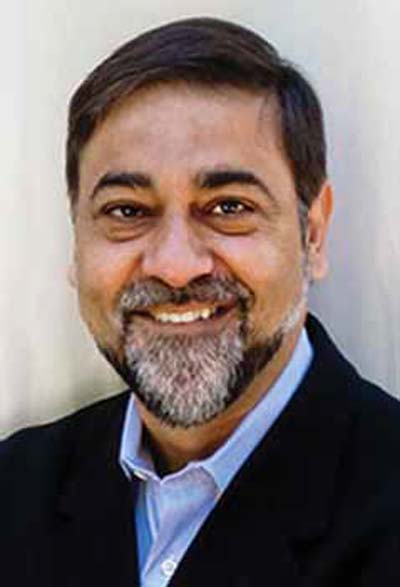
    NEW YORK (TIP): Vivek Wadhwa, who holds academic appointments at Singularity University, Stanford University and Duke University, and last year was named to Foreign Policy magazine’s list of the Top 100 Global Thinkers, was named by Time magazine recently to its list of the 40 “Most Influential Minds in Tech.” Wadhwa, the magazine said, “has become a leading voice in debates over technology policy, particularly with respect to entrepreneurship, innovation and immigration.” “In his recent book, ‘The Immigrant Exodus: Why America Is Losing the Global Race to Capture Entrepreneurial Talent,’ Wadhwa describes how the U.S. is now telling the best immigrants to go home, due to a lack of immigration visas,” Time said. “As a result of this ‘reverse brain drain,’ as Wadhwa and his colleagues call it, highly skilled workers and professionals are increasingly looking to other global markets to locate their businesses.” “We’re seeing a boom in technology entrepreneurship in India, China, and even Russia, because the U.S. won’t let people stay here,” Wadhwa told Time. Early in his career, Wadhwa worked at Credit Suisse First Boston, where he helped develop technology for creating computeraided software-writing systems. The Indian American entrepreneur later founded software firm Relativity Technologies. Wadhwa is a columnist at Bloomberg Business Week and a contributor to various other publications, including The Indian Panorama.

  • National GOP launches Indian American Executive Council

    National GOP launches Indian American Executive Council

    CHICAGO (TIP): The National Republican Congressional Committee has formed an Indian American Executive Council to “facilitate communication between NRCC and the Indian American community” and to “advise the Republican Party on key issues important to the community.” Shalli Kumar of Chicago, Ill., has been named the first chairman of the council. An engineer, inventor and chief executive officer of Carol Stream, Ill.-based AVG Advanced Technologies, he previously served on President Ronald Reagan’s Business Advisory Council in the early 1980s. The NRCC said in a statement that Kumar and the council “will play an integral role in fostering relations between the NRCC and the Indian American community. The NRCC will seek his input regarding how to increase Republican outreach efforts in the coming elections and identify potential candidates.”

  • Indian American convicted for the Largest Hepatitis-C Outbreak in Vegas

    Indian American convicted for the Largest Hepatitis-C Outbreak in Vegas

    LAS VEGAS (TIP): Dipak Desai, a former Indian American doctor has been convicted of 27 criminal charges against him. The former Las Vegas doctor and Endoscopy clinic owner is responsible for the largest hepatitis C outbreak in the history of Las Vegas, which occurred in the year 2007. Desai had surrendered his medical license, declared bankruptcy and in the recent years, he also handed over his business to his family members. The trial took so long because of Desai’s bad health, who had to suffer several strokes in the past years. Desai along with Ronald Lakeman, his former employee at Endoscopy Clinic of Southern Nevada used vials and syringes which were already used, thus playing with the life of numerous patients. These vials were contaminated with hepatitis C virus from two different patients and reusing the same on other patients lead to the infection of nine of his patients. Apart from this, more than 100 people were affected indirectly. The medical negligence by Desai also cost the life of one of his patients, Rodolfo Meana. Lakeman was found guilty of 16 of 27 charges against him. It is bit shocking to see the increasing number of Indians involved in medical fraud in the U.S. May be, AAPI will realize its duty to counsel physicians of Indian origin to not succumb to temptation of making money through fraudulent means.

  • Indian American honored with Healthcare Visionary of the Decade Award

    Indian American honored with Healthcare Visionary of the Decade Award

    MUMBAI (TIP): Mukesh Hariawala, an Indian American Cardiac Surgeon has been honored with the prestigious Indian Healthcare Visionary of the Decade award. A Harvard trained and internationally acclaimed Surgeon and Healthcare Economist, Hariawala was acknowledged at a recent ceremony of the 4th Annual Business Leadership Conclave at Hotel Leela in Mumbai, reports Jagran Josh. In his Keynote speech, Hariawala discussed about a medical tourism opportunity for India, worth 100 billion dollar, which is a part of Patient Protection and Affordable Care Act (also known as Obamacare) by President Obama. Hariwala appreciated India for its highly skilled doctors and nurses and the healthcare infrastructure the country posses. According to him, marketing of services and lobbying with insurance companies in the US is really important to maintain constant flow of patients. Apart from benefiting the healthcare industry, the medical tourism plan will also help many other sectors such as hospitality, travel, lodging, food, tourism, banking, shopping etc, in terms of revenue. Ratan Tata and Mukesh Ambani, two prominent Indian industrialists were also felicitated at the function.

  • Visiting Parliamentarians Felicitated

    Visiting Parliamentarians Felicitated

    LONG ISLAND, NY (TIP): At a special gathering held on 25th June 2013 here Mrs. and Subba Rao Anumolu hosted the Telugu Association of North America (TANA)’s felicitation of 12 Indian parliament members who were visiting USA. The distinguished group of parliamentarians included CM Ramesh (Andhra Pradesh), Shadilal Batra (Haryana), Bharat Kumar Raut (Maharastra), Bhubaneswar Kalita (Assam), Mrs. Poonam Jat (Gujarat), Mrs. Smriti Z Irani(Gujarat), Vivek Gupta (West Bengal), YS Chowdary (Andhra Pradesh), Harish Choudhary( Rajasthan), Modugula Venugopala Reddy(Andhra Pradesh), Ramesh Chandran (Kerala), and Badnore VPS (Rajasthan).

    These parliamentarians had attended the Leadership and Management Training Program at Yale University in New Haven and upon the request of TANA attended the facilitation event in Long Island before their departure to India. Mohan Nannapaneni, President of Telugu Association of North America (TANA) welcomed the Parliament members and thanked them for attending the event despite their hectic schedule. Nannapaneni introduced the host, Rao Anumolu who has an outstanding record of professional achievements, philanthropy and community service which have been already being recognized with the highest honor and acclaim in USA. Vijayawada’s Anumolu is the President & CEO of Long Island (New York) based, internationally known, high tech firm – ASR International Corporation.

    Anumolu is the only Asian Indian to have been cited by the US Congress for the contributions made towards homeland security in USA. He is also the recipient of the 2010 Ellis Island Medal of Honor. This prestigious award, highest civilian award for immigrants, recognizes recipients for outstanding contributions to their communities, their nation and the world. Both the United States House of Representatives and Senate have officially recognized the Ellis Island Medal of Honor and the recipients are read into the Congressional Record. Past medalists include six US Presidents.

    Anumolu has the unique distinction of being the only Asian Indian to have the dual honor of being cited by the US Congress and also the recipient of the Ellis Island Medal of Honor. Mrs. Smriti Irani, on behalf of the group, expressed deep condolences for the flood victims of Uttarkhand, and the audience observed a moment of silence. The parliament members addressed the gathering and expressed their vision for India in the near future. They predicted that India would become a dominant contributor for world economic and energy development within the next decade. All the parliament members were felicitated by TANA, with a shawl and a memento. The reception to visiting parliamentarians was attended by many well known Indian Americans from various walks of life. Jayasekhar Talluri, Chairman TANA Foundation conveyed vote of thanks to the attendees.

  • UN Women Partners with Geena Davis on firstever Global Gender in Film Research Study

    UN Women Partners with Geena Davis on firstever Global Gender in Film Research Study

    NEW YORK, NY (TIP): UN Women is partnering with the Geena Davis Institute on Gender in Media on a global study to analyze the depiction and representation of female characters in family films. The Geena Davis Institute on Gender in Media, with support from The Rockefeller Foundation, has commissioned the study from Associate Professor Stacy Smith of the Annenberg School for Communication and Journalism at the University of Southern California. It will examine the top-grossing international movies in Australia, China, France, Germany, India, Italy, Japan, Russia, Spain and the United Kingdom.

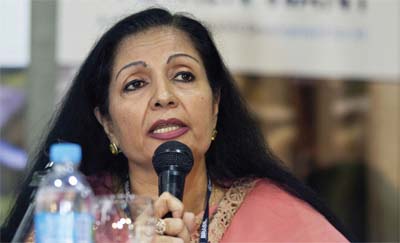
    It is the first such study ever undertaken. “There is no doubt that gender stereotypes in the media are influential sociopsychological factors in how women and girls are perceived. They also influence their self-esteem and relationships between the sexes,” said Lakshmi Puri, Acting Head of UN Women. “We cannot let the negative depiction of women and girls erode the hard gains that have been made on gender equality and women’s empowerment. We hope that the study will address factors that positively impact the perception of women in society, positive role models of women and girls and men and boys, and the value of respectful relationships that can foster and benefit from women’s empowerment,” she added.

    While research into the consequences of media exposure is complex, there is a general consensus among health professionals, researchers and educators that high levels of media exposure to negative imagery are related to negative outcomes for children and adults. These outcomes include effects in the areas of academic performance, body image, early sexual behavior, and social and cultural behaviors and beliefs. These effects may also affect future life and occupational choices for women.

    Previous research by the Geena Davis Institute on Gender in Media revealed that gender parity still does not exist on-screen. In family films, only 28.3 per cent of all speaking characters were female. This translates into 2.53 males to every one female. Not only are girls and women underrepresented on-screen, but many are depicted in a stereotypical and sexualized light. Occupationally, few women held positions of power on screen. Only 3.4 per cent of business leader characters and 4.5 per cent of high-level politicians were female. “By virtue of the dearth of female characters of substance in the media kids see, we are in effect teaching our children that women and girls don’t take up half of the space in the world.

    We’re teaching them to see that boys are doing the important and interesting things in society,” said Academy- Award -winner Geena Davis, the leading advocate for positive change in gender portrayals in the entertainment industry. “Media images have an enormous impact on children’s self-esteem and aspirations. This is why we decided to launch a global gender in media study: if girls see it, they can be it.” “The Rockefeller Foundation is pleased to support this important study that is sure to bring a discerning eye to the ways girls and women are portrayed and perceived,” said Rockefeller Foundation Associate Director, International Development, Sundaa Bridgett-Jones.

    “We hope the findings will be a clear call to resist the culture of casual stereotypes that so negatively impact global achievements in gender equality.” The Geena Davis Institute on Gender in Media will present the findings of the study during the 2nd Global Symposium on Gender in Media in fall 2014. UN Women is the UN organization dedicated to gender equality and the empowerment of women. A global champion for women and girls, UN Women was established to accelerate progress on meeting their needs worldwide. For more information, visit www.unwomen.org. UN Women, 220 East 42nd Street, New York, NY 10017, New York. Tel: +1 646 781-4400.

  • Statue of Sri Chinmoy and The Eternal Peace Flame Dedicated in Oslo, Norway

    Statue of Sri Chinmoy and The Eternal Peace Flame Dedicated in Oslo, Norway

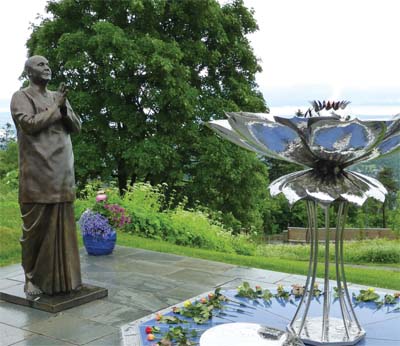
    OSLO (TIP): Norwegian leaders joined with ambassadors and representatives of 21 nations for the dedication ceremony of the statue of “Dreamer of World- Peace” Sri Chinmoy and The Eternal Peace-Flame at the worldfamous Holmenkollen ski area overlooking Norway’s capital city. This is one of sixteen statues in more than 10 countries. Peace activist Mr. Christian Ringnes who enabled the stunning event stated, “The vision of India born Sri Chinmoy and what he stood for are universal. They are linked to the brotherhood amongst humanity.

    Our good friend Sri Chinmoy is standing here, looking out and inspiring the whole world to hold hands together and to bring peace.” Earlier this month, photos of the third such statue of Sri Chinmoy in Prague partially submerged in water during the recent serious flooding of the city became a symbol of hope and oneness for millions. It was seen on many national television programs and front-page news stories. Ambassador of South Africa Her Excellency Queen Anne Zondo spoke on behalf of the entire diplomatic corps present – and all offered in silence their loving prayers for President Mandela. Mr. Pal Moen, former Director of Ports said, “There are people throughout the world who are struggling for peace, We have to start with a vision and with inspiration-and then we have to follow-up with action.

    Then there will be peace.” In just a few words, this is the philosophy of Sri Chinmoy, a tireless innovator for peace who founded the global Sri Chinmoy Oneness-Home Peace Run, wrote more than 1600 books, and traveled the globe to share India’s ancient message that “We are all members of a oneness-world-family. When we feel that we are brothers and sisters with the same hopes and dreams, then we shall not quarrel and fight. We shall work together to create a peaceful happiness-home.” (Press Release by Ashok Parulekar +91 98 9062 7118. Visit www.srichinmoy.org)

  • Top American Technology Companies hail passage of US Immigration Bill

    Top American Technology Companies hail passage of US Immigration Bill

    WASHINGTON (TIP): CEOs representing top American technology companies including Google, Yahoo, Microsoft and Cisco have hailed the passage of the comprehensive immigration reform bill by US Senate, arguing that this would give a big boost to the economic growth and attract high skilled workers. “In passing this legislation on a strong bipartisan basis, the Senate broke the logjam on immigration and high-skilled worker reforms,” said John Chambers, chairman and CEO of Cisco and co-chair of TechNet, the coalition of CEOs of US tech companies.

    “America’s economic success stems from our culture of innovation and the constant infusion of new ideas from a skilled and talented workforce. Now – as the House of Representatives takes up the issue – Cisco will continue to work with our legislative leaders to ensure that the reforms help attract the best, the brightest and the most ambitious minds from around the world to our shores,” he said. Steve Ballmer, CEO of Microsoft said by passing the comprehensive immigration reform, US Senate took a significant step toward reforming the nation’s outdated immigration policies. “If enacted, these changes will strengthen our economic security, foster innovation and enable continued job growth in the US.

    Equally important, the legislation makes critical investments in our workforce by strengthening STEM education in the United States, including instruction focused on computer science,” Ballmer said. “Microsoft applauds the Senate’s bipartisan collaboration and leadership in addressing this issue. As the House of Representatives moves forward, we will continue working on a bipartisan basis to enact much-needed reforms to immigration and education policies that will promote American competitiveness and opportunity,” the Microsoft CEO said. But according to USIBC the bill will really affect developing nations like India. “The Bill unfairly targets American companies trying to remain globally competitive by reducing their ability to contract with global IT service providers and restricting their access to the international expertise they need,” USIBC president Ron Somers said.

    “Comprehensive changes to our outdated immigration system are important for the US economy to remain the global leader in innovation,” said Safra Catz, co-president & CFO, Oracle and a member of TechNet’s executive council. “With approval of this bill, the Senate is sending a powerful signal that America is open for business, strengthening our economy and providing new opportunities for our workers,” he said. “The passage of this monumental, bipartisan legislation is a terrific victory for our country,” said John Doerr, general partner at Kleiner Perkins Caufield & Byers and co-chair of TechNet. “America’s economic success has always been based upon its ability to attract the best talent, no matter where they were born. We applaud the broad, bipartisan support for this measure in the Senate,” Doerr said. (Source: SiliconIndia News)

  • Egypt: The True Revolution has begun

    Egypt: The True Revolution has begun

    The fast developing situation in Egypt and the rapid ouster of President Mohamed Morsi has puzzled many and belied the expectation of those who thought that the revolution started two and a half years ago with the ouster of Hosni Mubarak. June 30, 2013 will be remembered as the day the true revolution began. Never before in the history of Egypt have there been such mammoth protests all over the country, sending a clear message that the people have rejected the Monolithic Islamic Nation that the Muslim Brotherhood tried to impose upon them. The people have declared that there is no place for political Islam in the ancient nation. The message was well received by the army which acted responsibly and in accord with the pulse of the masses; there was no choice but to respond and dismiss the Morsi government.

    As a precautionary measure, tanks were deployed in vital areas to prevent clashes between pro- and anti- Morsi demonstrators; the leaders of the Muslim Brotherhood were barred from leaving the country, and will face trial for their misdeeds. The deposed President is currently confined in army custody and many been detained and taken to custody to face trial. The one harsh year Egypt lived under the Muslim Brotherhood has made the public reject the MB ideology and their attempts to force changes and Islamize the State and education. Army chief Abdul Fattah Alsissi, while reading out his statement after the peaceful coup, was surrounded by all secular leaders, Coptic and Al Azhar religious leaders, youth movement representatives, and many liberal leaders.

    All this shows that the pulse of the revolution demanded change and a better government, with representatives from all strata of society with its colors, ethnic and religious affiliations. In other words, a true Egypt of its native rich heritage and cultured people. The Muslim Brotherhood’s short term in power has exposed them and their agenda. Their indulgence in assassination and violence was well known even prior to the 1952 revolution of Nasser. The funding from Saudi Arabia and Qatar did not help in making the radicals more dominant, but the 365 days of Morsi misrule made the people of Egypt understand their true colors and hidden plans to destroy Egypt.

    Other external forces tried to deal with Egypt as a project to change regime and destroy the social fabric by indulging in sedition and encouraging extremism in the region. Washington and the West woke up late to the dangers of these forces at their own doorsteps, and many believe that this prompted the Americans and the Russians to reach to an agreement to end terrorism in the region before it is too late. This understanding may yet bring about an end to the bloodshed in Syria, or else more stable Egypt and Tunisia and Turkey are next in the line for instability. The future of Egypt will be decided only by its own people.

    Though the challenges are horrendous, as the economy is in a shambles and inflation is high, the priority is to set the house in order and bring in a government that can deal with these issues in a pragmatic and transparent manner. It is the beginning of a new chapter, and if the army is able to contain the Muslim Brotherhood and its affiliated groups who may take to arms to settle scores, Egypt will be on the road to democracy. More importantly, it will regain its prestigious Pan- Arab status which has been lost for so long. (The author is a senior Arab International correspondent)

  • Egypt coup: the military has not just ousted Morsi; it has ousted democracy

    Egypt coup: the military has not just ousted Morsi; it has ousted democracy

    While millions of Mohamed Morsi’s opponents continue to celebrate his ousting, they ignore the long term fallout of the army’s intervention on state and society. The soft coup is fraught with risks and widens the ideological divide between Islamists and secularists. It does not resolve the fierce social and political struggles that have unfolded in Egypt in the two years since the removal of Mubarak. Instead, this latest turn is likely to further polarize Egyptians, already bitterly divided over the identity of the state and the role of the sacred in the political. And it undermines respect for both the peaceful transfer of power and for institutional procedures and rules.

    Trust among competing groups will be difficult to revive. Furthermore, the successful coup returns the military to centre stage in Egyptian politics and consolidates its role as a kingmaker and powerbroker. One of the major challenges that faced Egypt and other Arab countries in the wake of their popular uprisings was to subordinate the will of military leaders to civilian rule. This has now been undone. Future governments in Cairo will not dare to defy the military nor try to limit its authority, a serious handicap to democratization. Ironically, the same protesters who cheered Morsi’s ouster by force were often the same ones who opposed the ruling generals (Scaf – the Supreme Council of the Armed Forces) in the post-Mubarak transition period. The opposition asserts that the military had no choice but to respond to the popular will of millions of citizens, whose peaceful demands for Morsi to step down were met with defiance. The opposition ignores the fact, however, that there were other choices available to them.

    The military could have introduced political checks and balances that would have fettered Morsi’s hands, using its immense influence to force the secular-leaning opposition and the Islamistled administration to sit down and negotiate a peaceful compromise. This could have included appointing a new competent prime minister palatable to the opposition; an independent attorney general to replace Morsi’s loyalist; and redrafting the constitution to make it more inclusive and tolerant. In fact, these were the initial major demands of the opposition, which only later began to insist that Morsi had to go. There is no denying that Morsi was his own worst enemy, deaf and blind to the gathering storm that ultimately swept him away. He mastered the art of making enemies and blunders, and turned millions of ordinary Egyptians who voted for him into bitter enemies. He was the wrong man to lead Egypt, the most populous Arab state, at this critical revolutionary juncture. Morsi does not have the sensibility, the vision or the political acumen to tackle Egypt’s complex structural challenges.

    Instead of delivering on his promises, such as more jobs, greater inclusiveness and alnahda, or renaissance, he went to great lengths to monopolize power and to entrench his Islamist movement in state institutions. There exists a widespread belief among Egyptians of all walks of life that Morsi subordinated the presidency to the Muslim Brotherhood, a fatal error, to a proud nation that calls Egypt Umm al- Dunya (the mother of the world). More than a year after they won commanding parliamentary and presidential victories, the Islamists have proved to be as incompetent as the old secular regime at managing the economy and society. Morsi did indeed inherit a country that was politically polarized and financially bankrupt. These problems, however, grew under his watch; social and economic conditions worsened and political divisions deepened.

    Far from improving the economy, the Islamists’ muddled style of governance has exacerbated a structural crisis and caused more hardship and suffering among the poor and the dwindling middle class. What is unfolding in Egypt is a politicalideological struggle over the country’s future. It is not about good and evil, as some would have it. Morsi was too ambitious for his own good, and his movement incompetent, but not evilincarnate. There is a real danger though that the military’s ousting of Morsi will transform this political-ideological clash into a life-and-death struggle. The challenge now is to avoid a repeat of past errors, such as micromanaging the political process from the top down, or persecuting the Muslim Brothers and excluding them from the political arena. Such a course will only reinforce a longheld sense of injustice and victimhood among the Islamists, a recipe for further polarization, instability, and a potentially violent end to Egypt’s democratic experiment. Source: The Guardian

  • Egypt’s Morsi, Lincoln and Janis Joplin

    Egypt’s Morsi, Lincoln and Janis Joplin

    Agender-insulted Tunisian lit himself up and ignited the Arab Spring. Social media (SM) gave it wings. Egypt’s Morsi and the Brotherhood came to power in Tahrir q e and caused the unhappy ending of our stable relationship with Hosni Mubarak. But, Morsi gave not a thought to Lincoln’s Gettysburg Address, wherein he created a citizen’s right: that only a “government of the people, by the people, for the people, shall not perish from the earth.” The awesome self-selection power of “community” in SM, makes it the ultimate uncontrollable “genie out of the bottle,” for it aggregates each like-minded fellow citizen of the world, on like topics, and produces a tsunami of topical discontent. To paraphrase Janis Joplin, “Freedom is just another word for nothing left to lose, Nothing, that all that [Morsi] left me…”. Methinks, Lincoln could not have imagined that what he was unleashing was more powerful than the Magna Carta, for he gave every citizen the right to hold its leaders accountable as honest fiduciaries and deliver the most “common good.” With digital connectivity, the dangerous Wikileaks and Snowdens of the world expose every government’s good secrets and hidden mistakes to the harsh sunlight of a public unaware of the art of statecraft. History instructs that Rome’s “Bread and Circus” and Robespierre’s “Reign of Terror” cabins evil at various points of the governmental spectrum. Ravi Batra, Chair Nat’/ Advisory Council on South Asian Affairs

  • Thank you, Governor

    Thank you, Governor

    New Yorkers must be grateful to Governor Cuomo for announcing on Ju ly 2 the formation of the “Commission to Investigate Public Corruption” under the Moreland Act and Executive Law Section 63(8) to probe systemic public corruption and the appearance of such corruption in state government , political campaigns and elections in New York State. Attorney General Eric Schneiderman needs to be thanked for his assertion of commitment to deal firmly with matters of public corruption .

    He announced he will appoint the members of the Commission as Deputy Attorneys General. giving the Commission broad-based authority to investigate all matters that “involve public peace , public safety, and public justice .” The Indian Panorama welcomes the setting up of the commission and the pronouncements of the Governor and the Attorney General. In fact , we thank the duo for initiating measures to curb political corruption in the State. In fact, a couple of months ago, we had raised in the columns of The Indian Panorama the issue of corruption in fundraising for Nassau County officials and the Attorney General had taken note of the comment and assured us that he “will certainly keep these comments in mind as I continue to fight for your rights , and policies that will benefit all New Yorkers”. That was on May 20, 2013. We are happy to note that a serious effort to curb political corruption is being made and would like to wish Governor Cuomo and Attorn ey General Schneiderman all success.

  • Snowden’s PRISM: Friends Looking Out for Friends Or Spying and Breach of Privacy

    Snowden’s PRISM: Friends Looking Out for Friends Or Spying and Breach of Privacy

    Eddie Snowden has unleashed into the sunlight a core shadowy principle of statecraft, which Ronald Reagan in the midst of his warm engagement with Mikhail Gorbachev seeking to end the Cold War and the falJ of the Berlin Wall. used a Russian proverb translated as: Trust, but verify. Short of soldiers and bullets, is there a better way to protect sovereignty and public safety than “looking,” aka spying? The answer to the former is an easy “no,” but to the latter is split – threats from foreigners are “easier,” but homegrown threats have Constitutional bars, and hence, “tougher.” Upon learning the name PRISM, Europe has reacted with Casablanca-like feigned shock and protested, to help those in their own public squares feel good , and in so doing kept the distance between statecraft and internal democracy intact. Only India has acted with reasoned sanity in accepting cyber security.

    knowing that social media is forcibly shortening the necessary distance between statecraft and democracy. thereby forcing every government and its leaders to speak more truth, more often , to their own better­ informed and better-connected citizenry, To those confused by the Arab Spring and effects of social media, it is quite simple: the citizenry is better informed and better connected, and will no longer buy “the moon is made of blue cheese,” or worse, calculated and instigated hate at neighbors or neighboring countries as a distraction , with the notable exception of Syria’s Assad , who has successfully unleashed sectarian violence to drown out the discontent-based Arab Spring. Instead, citizenry will use its better understanding and connectivity to make governments perish that don’t honor Lincoln’s promise during his 1863 Gettysburg Address of “government …for the people…”. Just ask Egypt’s Morsi when Tahrir Square was refilled with proud Egyptians holding their government to account well before the election cycle, and welcomed the military’s overthrow of Morsi and instalJation of Chief Justice Adli Mansour as Interim President (no relation to Palestine’s UN Ambassador Riyad Mansour).

    The better informed citizenry is harder to please with platitudes , and harder to govern when the floor of basic human existence is breached with tanking economies – again, ask Morsi. To make matters worse for governance, social media , in addition to television and movies, has created a higher expectation in every human being of his/her basic rights and needs – in another 25 years or so, it will reach a near-universally accepted standard, such that what one is paid in New York for a particular task will be similarly paid in Seoul. Beijing, Tokyo, Mumbai, Jerusalem , Moscow, Cairo, Berlin, Palermo, Madrid , Rio, Toronto, Sidney, Cape Town and Casablanca. Itwould be as if the AFL-CIO had negotiated a global salary for all labor. Just “imagine,” as John Lennon warned , what that would do to alJ governments who are forced to do more good more efficiently to more people – it would be as if the rules of capitalism and corporate governance were applied to sovereign governments.

    Accountability. per GAAP. Just imagine. Now, turning to PRISM and listening to embassies of friends and foes alike. Anyone not watching embassies of other nations ought to be fired by their citizens, for the first order of business for any government , at any time in history, is to protect public safety from enemies foreign and domestic. That requires keeping your eyes open , at alJ times. So, looking and listening of embassies is good and needed . PRISM , on the other hand , is a very mild act of looking at a sender’s and a recipient’s email address, that’s it. No different than looking at a sealed envelope sent through the postal service (unlike a post card, which has open contents _ but, which converting envelope to postcard- power is available to Google, Microsoft and all other ISPs, including, Rediff mail in India , as they can and do read email- contents). What makes PRISM hot and heavy isn’t the email addresses, but the ability to remember them alJ , forever, and calculate nearly infinite permutations from them that generates an alert of danger-possibilities .

    It is akin to a really perfect card counter, like Dustin Hoffman in the movie “Rain Man ,” playing blackjack at a casino and winning each time as he could remember what had come and what was left in the card shoe. Pretty cool; and, pretty normal and legal even as casinos hate it. The United States, as a friend to many, armed with PRISM knowledge , alerts other nations of possible danger from terror. Friends looking out for friends. Indeed , other nations have warned the United States of possible danger to us, from their intelligence activities – again, friends looking out for friends. Indeed, this kind of help can convert an enemy into a friend! In any event, the right response to such help is a “Thank you ,” not friend-bashing. Left for last. is the right of privacy. This is a confusing topic, if one isn’t careful. Right of privacy – large, medium and smalJ – is an individual’s right against one’s government , corporate defalcation and foreign government. Rules of contract govern the dispute between a citizen and a corporation .

    It is what it is, unless the public policy says otherwise. As to one’s own government. as in the United States we have the 4th Amendment against “unreasonable searches and seizures,” and the 4th Amendment jurisprudence is well developed and privacy is at its “strongest.” Lastly, an individual’s rights against a foreigngovernment runs smack into the sovereign immunity of the intruding government. leaving the individual to ask their own government to complain to the intruder-government , as permitted in the comity of nations. A parting thought on privacy. Most citizens, natural and corporate, have ripped any privacy from any public space by installing security cameras, audio mikes etc.. and broadcasting it on the web. People, voluntarily, driven to be celebrity- like, have made Facebook and Twitter billions while giving up privacy over private acts and private thoughts. Perhaps.

    what is left somewhat private is an unspoken thought or an idea yet-not- born. But, PRISM like programs can already predict which fork in the road down yonder you will likely take, or if a shopper in a store is a mere “looker” or a real “buyer.” As to Snowden, he lost all principle- credibility and civic martyrdom when he left America, to bash it. To drive home that point is none other than the Russian President. Vladimir Putin, telling Snowden that he ought to stop anti- American activities and deeming his asylum application withdrawn. Not since the city-state of Athens has society endured chaotic democracy (mob rule) in its pure direct citizen-vote manner. Society has chosen republics as a better model. Over time, statecraft relied upon different tactics.

    Rome used “Bread and Circus” and Maximilien de Robespierre used Reign of Terror during the French Revolution; each, a friendly reminder of resident evil at any spot of the governance spectrum. With the representative form of republican government , statecraft is vital and necessary, and needs the governmental privacy that Snowden breached: deliberation privilege, along with the executive, legislative andjudicial privileges to function. The ultimate danger is that social media has the ability. in citizen-hands, to do to governments what a government can do with PRISM to citizens or foreigners. Lurking, in the shadows is chaos emanating from converting representative governments into direct citizenship-democracy of the city-state of Athens. The ultimate answer may well reside in the hard line of freedom drawn across history by Thomas Jefferson’s Declaration of Independence , subscribed by the brave, for it led to the hallowed Constitution and its goal “…to form a more perfect union.” The world , I submit. given its digital shrinkage, requires us all to “form a more perfect world .” Happy Birthday America! (The author is a New York based attorney. He can be reached at ravibatralaw@aol.com)

  • LADY LIBERTY OPENS AGAIN TO CELEBRATE 4TH OF JULY

    LADY LIBERTY OPENS AGAIN TO CELEBRATE 4TH OF JULY

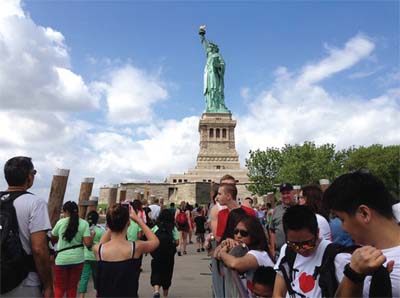
    NEW YORK (TIP): The Statue of Liberty, a beacon of hope for waves of immigrants at the turn of the century – and these days a destination for waves of tourists – reopened to the public Thursday, July 4th, almost nine months after the destruction caused by super storm Sandy. That October storm had left three quarters of Liberty Island underwater and destroyed electrical, phone, water and sewage systems. Sandy struck just a day after the statue had reopened following a yearlong renovation. And before that, there was the Sept. 11, 2001, terrorist attacks, which kept visitors from the inside of the statue for nearly 9 years. Officials said that they hoped that Thursday’s re-opening – the statue’s fourth since 1986 – would be its last for a while. The statue has drawn as many as 4 million visitors a year. And this time, the opening came with predictable patriotic fanfare, including a small marching band clad in Revolutionary War replica uniforms; members of Congress; Secretary of the Interior Sally Jewell; and, of course, New York Mayor Michael Bloomberg, whose pink-collared shirt was soaked through with sweat as he waited on the dais for his turn to speak.

    When he did, Bloomberg said that the statue was “at the heart of what America is really all about.” “Thank God we have people like the French,” Bloomberg added, nodding to the statue’s history, as a gift from France in the 1880s. Bloomberg also took the opportunity to make some pointed comments about climate change, which he said was at the root of increasingly volatile weather conditions across the country and, possibly, major events like Sandy. “Having an argument about climate change … is myopic,” Bloomberg said. “The bottom line is that we have to prepare for the future.” Liberty Island’s recovery, in which crews laid down 42,000 board-feet of new deck, 2,000 feet of hedging, and new electrical, heating, and cooling systems, stands in stark contrast to Ellis Island, which remains closed. Ellis Island was completely submerged after the storm, threatening the island’s archives, which were later removed by the National Park Service Museum Emergency Response Team and taken to a climate-controlled facility in Maryland, said Jonathan B. Jarvis, the director of the Park Service.

    And while work at Ellis Island continues, Jarvis declined to give an estimate, of a re-opening date for the island, saying that the challenges there were far greater. “Ellis is still a process,” he said. That hardly mattered to those on the ground Thursday at Liberty Island. Many visitors were ecstatic, some having come from halfway across the world to photograph and climb the stairs of the world’s most famous monuments.

  • South Asian Voters Sue NYC Board of Elections for Violations of the Voting Rights Act

    South Asian Voters Sue NYC Board of Elections for Violations of the Voting Rights Act

    NEW YORK (TIP): The Asian American Legal Defense and Education Fund (AALDEF), on July 2, sued the NYC Board of Elections (“the Board”) for failing to comply with the language assistance provisions (Section 203) of the federal Voting Rights Act. On October 13, 2011, the Census Bureau announced that Queens County, New York was covered under Section 203 for Asian Indian language assistance. Translated ballots and language assistance must be provided in Bengali. But four (4) elections have passed and the Board has never fully complied with the law. Ballots translated into Bengali were not provided during the Presidential Primary Election on April 24, 2012; Congressional Primary Election on June 26, 2012; State Primary Election on September 13, 2012; and the Presidential Election on November 6, 2012.

    Seema Agnani, Executive Director of Chhaya CDC, one of the plaintiffs whose group had been urging the Board to implement the new coverage, said, “The Board’s bureaucratic foot dragging has prevented many Bengali-speaking Americans with limited English proficiency from being able to fully exercise their right to vote. In New York City – as high as 60% of Bengali speaking residents have limited English Proficiency” Every other jurisdiction in the nation newly covered under Section 203 has been able to comply with the law and provide translated ballots since their Presidential Primary Election in early 2012.

    The Board proposed a compliance plan with interpreters and other translated materials for the June, September, and November Primary Elections. However, there were too few interpreters at poll sites and signs identifying interpreters were often missing, relegating Bengali-speaking interpreters to sit in front of Chinese “Interpreter Available” signs. The Board should have expected that the growing Asian Indian population would result in the new Census designation. Mazeda Uddin, National Women’s Coordinator of plaintiff Alliance for South Asian American Labor (ASAAL) has encouraged the Board to accommodate the growing Bengali-speaking community since May 2010.

    She said, “The requirement for Bengali ballots should have come as no surprise to the Board.” Glenn D. Magpantay, Democracy Program Director said, “Monitoring of past elections has shown that the level of assistance that was provided has been deficient. The Board has made many promises before. Now we want assurances. ” The Asian American Legal Defense and Education Fund (AALDEF), founded in 1974, is a national organization that protects and promotes the civil rights of Asian Americans.

    By combining litigation, advocacy, education, and organizing, AALDEF works with Asian American communities across the country to secure human rights for all. Based in Jackson Heights, Queens, New York, Chhaya Community Development Corporation (Chhaya) – meaning “shelter or shade” – was founded in 2000 to create more stable and sustainable communities by increasing civic participation and addressing the housing and community development needs of New York’s South Asians, new immigrants and their neighbors.

  • Indian Americans host Reception in Honor of Congressional leaders in Washington, D.C.

    Indian Americans host Reception in Honor of Congressional leaders in Washington, D.C.

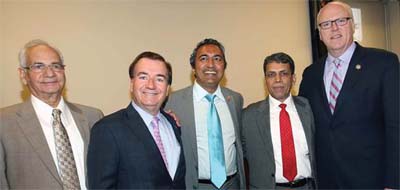
    WASHINGTON D.C.(TIP): The American India Public Affairs Committee (AIPACom) organized a reception in honor of Congressional leaders in Washington, D.C. on June 27th. Congressman Ed Royce, Chairman, Foreign Affairs Committee; Joe Crowley, Chair, India Caucus; Steve Chabot, Chairman, Subcommittee, South Asia; Gregory Meeks, Joe Wilson, Ami Bera, Grace Meng and several high-ranking officials from State Department, Senate and India Caucus participated. Joe Crowley Congressmen present expressed their whole-hearted support for India.

    Addressing the gathering, Mr. Jagdish Sewhani, President of the AIPACom said that the issue of pulling out the United States and its allied forces from Afghanistan by the end of 2014 and the rise of Taliban have created a sort of anxiety in the region. “There is a fear in the region that Taliban, supported by radicalized Pakistani army may make a forceful bid to take over Afghanistan and establish Sharia. This could trigger tension in the region,” he said.

    Disappointed over Pakistan’s sluggish pace of trial in the 26/11 Mumbai terror attack, Congressman Ed Royce, Chairman of the House Foreign Relations Committee demanded that the seven suspects, including LeT operational commander Zakiur Rehman Lakhvi, be handed over to the International Criminal Court to bring them to justice. Royce said there are rogue elements in the ISI who would use the opportunity of any instability in Afghanistan to go back to the Taliban era. “Ethnic cleansing is going on in Pakistan today against those who are speaking against it,” he said, alleging that the population of Hindus in Pakistan has now dropped to 1.5 per cent as against 25 per cent at the time of independence. Tracing the history of India Caucus, Sewhani said that the India Caucus has been a source of strength. It has done a commendable job to further cement an Indo-American relationship. Reminding the audience, Sewhani said that Pakistan is still the epicenter of terrorism.

    It is a wellknown fact that Pakistan is using terrorism as a tool to achieve its foreign policy objectives. At the moment, Pakistani society is the most radicalized society. Even though Pakistan Prime Minister Nawaz Sharif ostensibly wants to mend the relationship with India, Pakistan Intelligence Agency ISI is reported to have opened two new centers to train a large number of youngsters in terrorism on the other side of Jaisalmer in Indian state of Rajasthan. Trade between India and the USA has increased by 40% since the launch of Indo-US Strategic Dialogue by the Obama Administration 3 years ago and could cross $100 billion.

    The bilateral trade between India and the US could touch $500 billion mark over the next decade. Time has come for the oldest democracy in the world, the USA, to support the largest democracy in the world, the Republic of India and fourth economy in the world, in its bid to become the permanent member of the UN Security Council. “Both, USA and India are natural allies. Because of our mutual understanding and regard for each other, a new era in Indo-American relationship has dawned. The time has come to take this relationship from a mere friendship to a strategically meaningful relationship”, said Sewhany. (Based on a press release)

  • LIU REJECTS AGUILA SHELTER CONTRACTS

    LIU REJECTS AGUILA SHELTER CONTRACTS

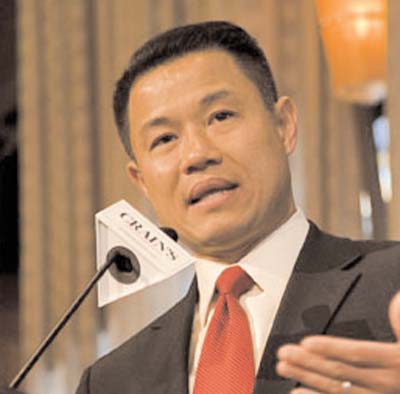
    NEW YORK, NY (TIP): New York City Comptroller John C. Liu has rejected contracts by the Department of Homeless Services (DHS) engaging Aguila Inc. to operate shelters in the South Bronx and West 95th Street in Manhattan, citing problems with the City’s Fair Share analysis concerning the siting of shelters by neighborhood. Liu said the DHS needs to clarify both the number of individuals who will be provided services and the length of those services. Given material inconsistencies, there was no choice but to reject, he said. “Transparency is paramount when siting homeless shelters, and these contracts failed the test on many counts.

    Contracts need to be clear and specific, to ensure that the DHS requires the vendor to stay within the parameters of the program,” Comptroller Liu said. “Overall, the Administration’s homeless policies have failed both the homeless and communities asked to accept shelters, and it would be unconscionable to compound past errors with these faulty contracts.” The contracts are in the amount of $46.8 million for 316-330 West 95th Street and $20.8 million for 1625-1631 Fulton Avenue in The Bronx.

    For the Upper West Side location, the Fair Share analysis indicates the shelter has 200 units which can accommodate up to 400 adults – which raises the question of whether DHS can comply with local laws governing total occupancy. Further, the Comptroller’s office is seeking additional documentation regarding inspections and correct certificates of occupancy. For the South Bronx location, there were also apparent discrepancies in the Fair Share analysis, again making it unclear whether the contract complies with local law.

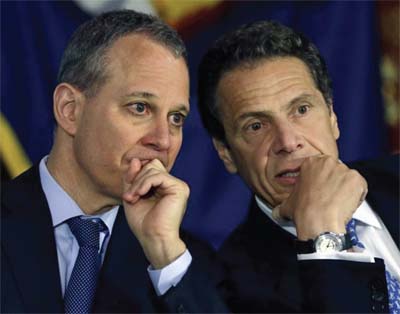
  • Clean up Albany’is Cuomo’s mandate for panel on corruption

    Clean up Albany’is Cuomo’s mandate for panel on corruption

    NEW YORK (TIP): A top-level commission armed with subpoena power and the authority to investigate anything and everything is about to examine New York’s often sordid brand of politics and government. And because the state’s new “Moreland Commission” is conceived and organized by two of the state’s most powerful figures – Gov. Andrew M. Cuomo and Attorney General Eric T. Schneiderman – it’s almost a sure bet that recommendations will come to radically reform the way the state’s politicians and government officials behave.

    So may indictments. “That’s certainly contemplated by the executive order,” Schneiderman said Wednesday, June 3 in a phone interview with The Buffalo News. And after failing to gain passage of a reform package he submitted to the State Legislature, Cuomo made good on his promise to instead create a Commission to Investigate Public Corruption under authority granted by the 1907 Moreland Act. In fact, the governor hinted Wednesday, June 3 that the commission may prove even more effective than the legislation would have. “This is a very, very powerful option that was at my disposal,” Cuomo said.

    “So I wanted a really sweeping resolution either way – legislative or Moreland.” The governor said the panel will ask basic questions about how state officials act. “They haven’t designed a perfect human being yet, and you will have politicians doing bad things,” Cuomo told reporters after an address to about 75 invited guests in the University at Buffalo Law School library. “The question is: Do you have a system in place that when someone does the wrong thing, they get caught and prosecuted? “Do you have a system in place that is designing a better way to remove the loopholes, et cetera, so that it is harder for people to do the wrong thing? And that’s what I want addressed.” The newest Moreland Commission includes prosecutors and legal experts from across the state. Cuomo described them as the “best and the brightest … the all-star
    team.” He said they will probe “systemic corruption and the appearance of such corruption in state government, political campaigns and elections in New York State.” All have been appointed as deputy attorneys general by Schneiderman, which he said grants them the authority to reach into any level of state or local government. “It’s an incredibly talented group of people who will make it very hard for anyone to attack as partisan or biased in any way,” the attorney general said. He predicted that the panel will submit by its Dec.

    1 reporting deadline a series of recommendations that could, for example, reform the current system of campaign finance. “The laws now are essentially a welcome wagon for ‘pay-to-play’ schemes,” he said. Schneiderman also cited the state Board of Elections and its inability to investigate many complaints as a state agency ripe for reform. He called such inadequacies “an invitation to misconduct.” “It’s good to catch bad guys after they’ve done something, but better to prevent crimes before they take place,” he said. Three prominent law enforcement figures will head the panel: Onondaga County District Attorney William J. Fitzpatrick, Nassau County District Attorney Kathleen M.

    Rice and Milton L. Williams Jr., a former state and federal prosecutor. Included among his appointees are two Western New Yorkers, Erie County District Attorney Frank A. Sedita III, and Makau W. Mutua, dean of the UB Law School. Both spoke at the event Wednesday, June 3. Special advisers to the commission include State Police Superintendent Joseph A. D’Amico, New York City Police Commissioner Raymond W. Kelly and former Manhattan District Attorney Robert M. Morgenthau. Cuomo had submitted the bills to address the influence of money in elections, strengthen prosecutors’ ability to fight corruption, increase penalties and give voters more access to the ballot box. No action was taken by the Legislature. The governor accepted responsibility Wednesday, June 3 for the bill’s failure to pass the Legislature because he acknowledged he would not compromise. “I said, on this one, I am unwilling to compromise because I want the toughest reform package this state has ever passed,” he said, adding he does not believe that the Legislature viewed the situation with his level of concern and urgency.

    But he also said he has ultimate confidence in the new panel he has given “a simple mandate: Clean up Albany.” “If someone did the wrong thing, prosecute them; if we have to make changes, tell us what,” he said. Cuomo reiterated his contention that New Yorkers should have trust in their government and a mechanism to examine and change practices that weaken the relationship between the people and its government. “There have been four or five months recently when almost every week, you pick up a newspaper and it shows where another legislator is in trouble,” he said. “We want to restore that trust. Why? Because I want the relationship intact.” Schneiderman echoed those thoughts. “The people in New York State have had enough,” he said. “They’re tired of talk, and they’re tired of excuses.

    We clearly have a system that makes it far too easy to engage in misconduct.” New York based prominent attorney Ravi Batra who has been spearheading a battle against political corruption has welcomed the creation of the commission. He said in his comment to The Indian Panorama: “Thanks to the steady drum beat of federal prosecutors Preet Bharara and Loretta Lynch parading public corruption shaming every New Yorker, Gov. Cuomo has acted boldly to let the sun shine in every nook, cranny and dark corner of Albany and beyond with a badge given by Attorney General. “Now, finally, New York will have a bright new dawn again, as the CIPC removes the corruption-cancer as they follow the money, and restore public trust in our elected fiduciaries – who in the main are honorable but tainted with rotten apples in their midst. “With this joint action between Gov. Cuomo, AG Schneiderman, and every member of CIPC New York can be proud again.” (with inputs from Buffalonews.com)