Year: 2014

  • KATRINA TO MISS X-MAS BASH AT THE KAPOORS

    KATRINA TO MISS X-MAS BASH AT THE KAPOORS

    Ranbir Kapoor and Katrina Kaif looked every bit the loved-up couple at their Christmas bash on Saturday. This had set off rumours that the actor may introduce his live-in partner as the ‘next Mrs Kapoor’ at the upcoming annual Kapoor luncheon at Shashi Kapoor’s Juhu house. Mirror has now learnt that Ranbir’s ladylove will give the big Christmas get-together a miss. Instead of spending the holiday in the warm climes of Mumbai, Katrina will have a white Christmas in London. “Katrina has left for London to be with her mom and sisters for Christmas. Although initially the plan was to join the Kapoors for their yearly bash, she later decided to spend the holidays with her family in the UK.” However, the source added, “Don’t be surprised if you see RK in London for New Year’s as the couple were toying with the idea of a small break together since it has been a hectic year for both of them.” On Christmas each year, Krishna Raj Kapoor along with her sons Rishi, Randhir and Rajeev, daughters Ritu and Reema and their families gather at Shashi Kapoor’s residence for a luncheon hosted by Shashi’s children Kunal and Sanjana.

  • MOVIE REVIEW PK

    MOVIE REVIEW PK

    Cast: Aamir Khan, Anushka Sharma, Sushant Singh, Rajput, Saurabh Shukla, Sanjay Dutt, Boman Irani
    Direction: Rajkumar Hirani
    Genre: Drama
    Duration: 2 hours 33 minutes

    Story: An alien lands on earth but loses his remote to go home. Does ‘PK’ return – and as he navigates the human world, what does he gain and lose?

    Review: Arriving on earth, an alien (Aamir) is immediately robbed of the only thing he’s wearing, the remote via which he can go home. Knowing nothing of human ways, language, clothing or lies, the alien searches desperately for his remote, his antics bizarre enough for people to ask if he’s ‘pee kay’ or drunk. One day, ‘PK’ meets Jaggu (Anushka), a TV reporter who helps him. Can they find PK’s remote, now with god-man Tapasvi ji (Shukla)? And do PK and Jaggu also find love? PK is as much a philosophy as a film. It takes the ‘stranded alien’ theme, familiar from classics like ET, but tells the tale equally from the lonely alien’s eyes – at times, evoking the beautiful story The Little Prince – as from his human narrator’s. Starting with the alien’s desperation, PK captures the fears and falsehoods humans weave around faith. When PK decides to pray for his remote, he’s bewildered about whom to and how to pray. PK features brave scenes – money extracted at temples, coconuts offered in confusion at a church, godmen doling out tortuous advice – and strong lines, including a Muslim girl bravely asserting, “Itna chota nahin ho sakta hamara khuda, ki use hamare school jaane pe aitraaz ho.” Capturing faith whipped into hate, PK’s sterling message, directed sensitively, stands out. As does Aamir Khan as the wide-eyed alien bemused by human life, a paan-chomping Chaplin from outer space, liked by rustic Bhairon Singh (Sanjay Dutt in a warming cameo). PK’s simplicity contrasts with Jaggu’s complicated life, heartbroken after she thinks her Pakistani boyfriend Sarfaraz (Sushant) ditched her in chocolate-box Belgium. Tapasvi warned Jaggu’s father (Parikshet Sahani) that her Muslim lover would betray her – does PK prove him wrong? Anushka presents a sprightly show while Boman Irani stands out as a TV channel head. Some supporting acts and special effects could’ve been sharper though while at points, editor Raju Hirani should’ve been sterner with director Raju Hirani in trimming tighter scenes. Between gods, frauds, love and bombs, there are multiple threads here. Some distract, others impact, like PK hilariously dazed by humans hiding when they make out – except when they announce it with band-baaja on their wedding day.

  • SPICEJET TOLD TO GIVE CASH FLOW PLAN IN WRITING

    SPICEJET TOLD TO GIVE CASH FLOW PLAN IN WRITING

    NEW DELHI (TIP): The government has asked cash-strapped SpiceJet to submit its proposed cash flow plan in writing by next Monday. The low cost carrier’s (LCC) former promoter Ajay Singh, who is leading the revival attempt by arranging funds from a unit of US-based J P Morgan Chase and other investors, met the entire aviation ministry brass on December 26 along with airline COO Sanjiv Kapoor. Singh is in talks with investors to pump in $200 million into the airline. They may buy out current promoter Sun Group chief Kalanithi Maran’s entire 58% stake in the LCC, as Maran has refused to bail out SpiceJet from its crisis. “We have been told that SpiceJet will get funding. So far, we have been supportive of the airline as we do not want any carrier to shut down. But, they have to give in writing their concrete fund flow plan as we will be able to take further decisions based on that only,” said a source. While oil companies are supplying to SpiceJet only on cash payment, banks have refused to give more loans unless the promoters put in some money. The aviation ministry has asked Airports Authority of India (AAI) not to put the LCC on cash-andcarry till the year-end despite having dues of almost Rs 200 crore. “We were told the Ajay Singh-led funding plan will take four to six weeks to fructify as the likely investors are doing due diligence. But, we need something in writing from the airline in order to AAI to decide what it does from January 1 — in terms of continuing giving credit or insisting on cash payment,” said another source. The AAI has warned the ministry that it does not want to end up with another Kingfisher like situation where it ends up with dues of hundreds of crores. Meanwhile, SpiceJet has cleared November salary dues to employees and paid off oil companies with advance funding of about Rs 17 crore arranged by Ajay Singh. “It was a very constructive meeting. Our airline was doing well commercially but there were some legacy issues,” Kapoor said after Friday’s meeting, adding that the LCC currently operates 18 Boeing 737s and operated 230 flights a day along with the Bombardier Q400 fleet. “We have no outstanding with any oil marketing company… SpiceJet has many well wishers including Ajay Singh,” the COO said. The LCC’s dues to foreign and Indian vendors, airport operators and oil companies are learnt to have grown from Rs 990 crore to Rs 1,230 crore between November 24 and December 10. The airline’s dues to foreign vendors, including lessors of aircraft and maintenance, repairs and overhaul (MRO) facilities, had risen from Rs 624 crore on November 24 to Rs 742 crore on December 10. Spicejet owes banks Rs 300 crore against collateral.

  • NASA SELECTS NEW COMMERCIAL SPACE PARTNERS

    NASA SELECTS NEW COMMERCIAL SPACE PARTNERS

    WASHINGTON (TIP): Nasa has collaborated with four US companies to develop intra-vehicular activity space suits and new launch vehicle capabilities among other advances in space exploration. The partnerships build on the success of Nasa’s commercial spaceflight initiatives to leverage Nasa experience and expertise into new capabilities. The Collaborations for Commercial Space Capabilities (CCSC) initiative is designed to advance private sector development of integrated space capabilities through access to Nasa’s spaceflight resources and ensure emerging products or services are commercially available to government and customers within approximately the next five years. ATK Space Systems, in Beltsville, Maryland, is developing space logistics, hosted payload and other space transportation capabilities, Nasa said. Final Frontier Design, in Brooklyn, New York, is developing intra-vehicular activity space suits. According to Nasa, Space Exploration Technologies, in Hawthorne, California, is developing space transportation capabilities that could be used to support missions into deep space. United Launch Alliance, in Centennial, Colorado, is developing new launch vehicle capabilities to reduce cost and enhance performance. “Companies in all shapes and sizes are investing their own capital toward innovative commercial space capabilities,” said Phil McAlister, director of commercial spaceflight development at Nasa Headquarters in Washington. “These awards demonstrate the diversity and maturity of the commercial space industry. We look forward to working with these partners to advance space capabilities and make them available to Nasa and other customers in the coming years,” said McAlister. The Space Act Agreements (SAAs) have no exchange of funds, and each party bears the cost of its participation. Nasa’s contributions could include technical expertise, assessments, lessons learned, technologies and data.

  • I’m not a machine, I’m human, says Saina Nehwal

    I’m not a machine, I’m human, says Saina Nehwal

    THIRUVANANTHAPURAM (TIP): India’s ace shuttler Saina Nehwal is keen to get her priorities right. She doesn’t want to overburden herself by playing back-to-back tournaments in the days ahead. A strong performance in the Jakarta World Championship in August next year and Rio Olympics in 2016 are her twin targets.

    In order to optimize her potential, she has decided to give some of the important national events a miss next year. The Hyderabad shuttler has stated that she will not feature in the National Games to be held in Kerala as well as the National Senior Badminton Championships to be held in Vijayawada. Both these events are scheduled to be held in January-February 2015.

    “I’m not a machine. I’m a human being. I can only play according to what my body permits. I play at least 12 to 15 tournaments around the globe a year. I have to prioritise the tournaments I play in and that will be done in consultation with my coach U Vimal Kumar, Badminton Federation of India and my back-up team that includes my family. And I don’t think I will be part of National Games and the Senior National Badminton Championship,” the World No. 4 said on the sidelines of a promotional event here.

    Though Andhra Pradesh is not likely to field a team in the team events of National Games, Saina could have played in the individual singles event. But she has ruled out that option.

    “Right now I’m taking a week’s break and I am here today only because of my obligation towards my sponsors. I’ll resume training from Monday or Tuesday with my coach in Bangalore. I can only take it from there. I’m going to start off with some light training. Usually, it takes two to three weeks to get into competition mode,” Saina said. “The World Championship is in August and Olympics in Rio is happening in another year’s time. I have to concentrate on these two as both are big tournaments for me. It will be tough. I want to stay fit in 2015. So I have to be choosy about the tournaments I participate in,” Saina said.

  • IALI Home Dream is now a historic Reality

    IALI Home Dream is now a historic Reality

    LONG ISLAND, NY (TIP): India Association of Long Island (IALI) has now a Home and the long cherished dream of the Indian Community and past presidents for almost four decades became a reality on Monday Morning Dec 22, 2014, when IALI closed on the property ideally located on Old Country Road in Hicksville Long Island, the hub of growing Indian Community in Long Island at 92 East, Old Country Road. The Indian Community in the tri State area can now be proud to finally own the India Center, it has been dreaming about for a long time and become a part of this historic event.

    INDIA ASSOCIATION OF LONG ISLAND (IALI) is one of the largest and oldest (37 years old) organizations in the whole Tri State Area. It is a community based non-profit 501 (c) (3) entity, with a mission to promote, share and celebrate the culture of India. It has about 2,000 members.

    The whole Executive Council members and past presidents of IALI were invited at the IALI home / India Center Monday Evening Dec 22, the day it closed on the IALI Home for a brief prayer and to celebrate this dream cum true historic event. President Mr. Satnam Parhar and IALI Home / India Center Chair, Mr. Gobind Munjal hosted this event and welcomed over 35 jubilant and enthusiastic IALI executive council members, past presidents and some other members of the community. All members prayed for the prosperity and progress of IALI and the community at large, followed by Tea, Snacks and Sweets.

    After prayers, President Mr. Parhar said in his speech, that together we have been able to achieve this dream and now we have to nurture this IALI Home / India Center and make it bigger and better for our younger generation and leave a legacy for the generations to come. Mr. Parhar and Mr. Munjal both thanked the officers and each and every member of the executive council member and past presidents for their support and guidance, without which this dream could not have become a reality.

    (Press Release by Gobind Munjal)

  • BOOST TO SCHOOL FUNDS IN TEXAS UNLIKELY IN UPCOMING SESSION

    BOOST TO SCHOOL FUNDS IN TEXAS UNLIKELY IN UPCOMING SESSION

    AUSTIN (TIP): It would seem that Texas schools might be due for a sizable funding boost when the Legislature convenes in January, particularly after a state judge ruled last summer that Texas was severely under funding its education system. But local school officials aren’t counting on much relief.

    • The lowest SAT scores in more than two decades.
    • School funding that ranks Texas among the bottom five states.
    • And oversized classes in nearly 1,300 elementary schools last year to save money.

    “If you look at how much we spend per child, it is really sad that Texas is funding public education at a level that is significantly lower than the average for the country,” said David Anthony, former superintendent of the Cypress-Fairbanks school district and chief executive for Raise Your Hand Texas, a public education advocacy group. “Money is not the only answer. It takes more than that to improve schools. But it is certainly a significant part of the solution.”

    And while legislative leaders have voiced willingness to consider some additional money for schools in the next two-year budget, they have also pointed to other state needs – and the desire of many Texans for lower taxes.

    In fact, lawmakers have talked more about cutting taxes – including school property taxes – than providing a funding boost for schools. Lawmakers have already offered several tax reduction bills.

    House Public Education Committee Chairman Jimmie Don Aycock, R-Killeen, said he expects lawmakers to consider some changes in school funding. But he added that major revisions are unlikely while the state appeals the school finance decision to the Texas Supreme Court.

    That order from state District Judge John Dietz found that the Legislature failed to meet its constitutional duty to adequately and fairly fund education for the state’s 5 million public school students. The decision came in a lawsuit filed by more than 600 school districts.

    “We will do small fixes within the present system and possibly put some additional money in,” said Aycock, a former Killeen school board member. “Beyond that, any bigger decisions will wait until we see what the Supreme Court does.”

    Lt. Gov.-elect Dan Patrick, outgoing chairman of the Senate Education Committee, said this fall that he had an open mind on school funding. But he argued that it would be irresponsible to simply pump more money into schools without demanding results.

    “We just can’t give them more money and let them keep doing the same things they’ve been doing,” Patrick said. “We need accountability. We need improvement.”

    Patrick has also taken issue with claims that schools are still reeling from the unprecedented funding cuts of 2011. Those reductions, which prompted school districts to sue the state, were partially restored in 2013

    “Our schools survived, and we did fine,” Patrick said.

    While Republican leaders generally favor a wait-and-see approach depending on what the Supreme Court does, many Democrats contend it would be a mistake to do nothing in the upcoming session.

    “There’s a lack of political will to do anything about our school finance system until we’re forced to do so by the court,” said Senate Democratic leader Kirk Watson of Austin. “Everybody knows our school finance system is broken, and continuing to do nothing about it is a disservice to the schoolchildren and taxpayers of Texas.”

    Watson has filed a package of bills that would boost various funding sources for school districts, such as more help with transportation costs.

    Representatives for school districts note that since the 2010-11 school year, funding per student in Texas has increased about half a percent a year, while school districts continue to enroll more low-income and limited-English students, who are more expensive to educate. They also insist there is now little waste in most districts.

    “Nothing more can be cut from public education,” said Wayne Pierce, former superintendent of the Kaufman school district and current executive director of the Equity Center. The center represents nearly 700 low- and medium-wealth school districts.

    Pierce said any effort to delay changes beyond the 2015-16 school year “will only hurt our schoolchildren.”

    But conservative groups challenge the notion that student achievement will improve with additional funding.

    “The current data does not show that increased resources lead to improvements in student performance,” argued former House Public Education Committee Chairman Kent Grusendorf, now a senior fellow at the Texas Public Policy Foundation.

    In a policy brief for the conservative think tank this fall, the former GOP lawmaker from Arlington said that after decades of investigation, “it is clear that how money is spent is much more important that how much is spent.”

    Grusendorf noted that some prominent studies have found that class size and school funding – “a rallying cry of education reformers for decades” – are not significant indicators of student achievement.

    But in Texas, results on the primary achievement test, the State of Texas Assessments of Academic Readiness, or STAAR, have been stagnant in reading the past few years while school funding levels were down for many districts – and class sizes were up.

    Many high school students have struggled on the five STAAR end-of-course exams. And that’s after lawmakers last year scrapped 10 course-exit tests – arguably the most difficult ones in the group.

    SAT math scores for the Class of 2014 in Texas were the lowest in more than two decades. Reading scores were the second-lowest during that period on the college entrance exam.

    State education officials attributed the drop to an increase in the number of minority students taking the exam. Minorities generally perform worse than white students on standardized achievement tests.

    But in California, students outperformed Texas students by big margins – 15 points in math and 22 points in reading. Student demographics are similar in both states. And California had more low-income students take the SAT than Texas this year.

    One difference, though, was that California spent about $800 more per student than Texas. The Lone Star State was in the bottom five among the 50 states and District of Columbia, according to figures compiled by the National Education Association, a teacher group that closely tracks spending.
    Clay Robison of the Texas State Teachers Association said lawmakers should recognize that inadequate funding is having an impact. For one thing, he said, larger class sizes make teaching more difficult.

    “Texas is enrolling more and more lower-income and limited-English students at the same time many of our elementary classrooms continue to exceed class size limits,” he said. “The problem is that those students need more attention. But that is hard to do when you have larger classes.”

  • Microsoft CEO Satya Nadella meets PM Narendra Modi

    Microsoft CEO Satya Nadella meets PM Narendra Modi

    NEW DELHI (TIP): Keen to invest more in India, Microsoft chief executive Satya Nadella on December 26 pledged support to Prime Minister Narendra Modi’s Digital India initiative. He is the third major tech executive to meet PM Modi, after Amazon’s Jeff Bezos and Facebook’s Mark Zuckerberg.

    Besides Modi, India-born Nadella also met finance minister Arun Jaitley and telecom minister Ravi Shankar Prasad and discussed modernization and security of the government’s digital infrastructure, among other issues.

    “It was a courtesy visit. Microsoft is the company that is a multinational but is operating in India for India and Indian businesses. In every meeting, of course, both ‘Digital India’ and ‘Make in India’ are top of mind and for us, top of mind in terms of our contribution to India,” Nadella said after his meeting with Jaitley.

    This was his second visit to India since taking over as global CEO of $86 billion technology giant Microsoft.

    Sources in the finance ministry said Nadella had informed Jaitley that Microsoft was keen on “investing more” in India.

    “The minister (Prasad) shared with Mr Nadella the initiative of Digital India taken by this government headed by the Prime Minister. He told the Microsoft CEO that Digital India is designed to bridge the gap between haves and have-nots,” communication and IT ministry said in a statement.

    Prasad also shared with him India’s potential in the field of e-commerce and how connectivity can play a role in harnessing this potential, he added.

    “The minister further urged Microsoft to work towards digital literacy in India… The minister also informed about the incentives for promoting electronic manufacturing in India as a part of ‘Make in India,’” it said.

    Microsoft is keen on collaborating with the government in providing last mile internet connectivity, especially through the Wi-Fi technology, the statement added.

    Nadella also shared his ideas on modernization of government, with Prasad stating that Microsoft can help in building secure government-controlled digital infrastructure.
    Other issues like data security and domestic electronic manufacturing were also discussed.

  • AGAIN, WHITE COP KILLS BLACK MAN IN US

    AGAIN, WHITE COP KILLS BLACK MAN IN US

    WASHINGTON (TIP): The familiar script of a white cop on hair-trigger alert gunning down a black man surfaced again on December 23 night less than five miles from Ferguson, Missouri, where a similar case in August this year triggered African-American unrest across the country.

    Police said the officer was on a routine patrol near a gas station after responding to a call of a theft when he approached two men near the building in the suburb of Berkeley, Missouri. The officer exited his vehicle to question them when one person pulled out a handgun. “Fearing for his life, the Berkeley officer fired several shots, striking the subject, fatally wounding him. The second subject fled the scene,” police said.

    A surveillance tape released by the police showed the confrontation but not the shooting itself. The police maintained the officer’s life was in imminent danger and using a pepper stray or taser was not a realistic option. “You have somebody that’s pointing a gun at a police officer. There’s not a lot of time. I can imagine that most of us would feel that we’re in imminent danger of losing our lives,” St Louis county police chief Jon Belmar said.

    The mother of the victim, whose name was given as Antonio Martin, later claimed that her son did not have any weapon on him and the police shot him as he attempted to run away. The second person who fled the scene has not been traced.

    Police maintained that the incident could not be compared to the Ferguson case, where there was no video footage of the incident itself. “It didn’t have to end with him approaching the officer with his arm extended with a 9mm pistol in his hand,” police chief Belmar said, adding that the teenager could have put down his weapon at any time but he made “bad choices” instead.

    The city’s black mayor supported the police. The officer, meanwhile, has been placed on an administrative leave pending an inquiry.

    It was a Grand Jury decision not to indict a white police officer Darren Wilson in the shooting of black teenager Michael Brown in nearby Fergusson that ignited a nationwide firestorm some weeks ago. Since then, there have been at least three such incidents highlighting use of force, often in circumstances that did no warrant it.

    Police broadly maintain that the blacks in question often have criminal records and cops have to act with caution and make split-second decisions, as was the case in Tuesday night’s confrontation in Berkeley.

    Black activists say white police have a lower threshold for black offenses and are quick to punish them for minor infractions – such as selling loose cigarettes in the case of Eric Garner, who was choked to death in New York -often with an intent to impose fines and raise revenues.

  • Peshawar school massacre mastermind killed

    Peshawar school massacre mastermind killed

    PESHAWAR (TIP): A senior Taliban commander, believed to be a key planner in the Peshawar school massacre, has been killed by the security forces in Pakistan’s troubled Khyber Agency.

    “Saddam had been killed in the Gundi area of Jamrud by the security forces in an operation yesterday. One of his accomplices has been captured alive,” Peshawar Political Agent of Khyber Agency Shahab Ali Shah told reporters.

    A member of the Tariq Gedar group of Tehreek-i-Taliban Pakistan (TTP), Saddam had facilitated the seven attackers who had attacked the Army Public School in Peshawar on December 16 and killed 150 people, mostly children.

    Saddam was also planner of killing of 11 security personnel and eight scouts in Khyber Pakhtunkhwa last year.

  • Sri Lanka mudslides kill 9

    Sri Lanka mudslides kill 9

    COLOMBO (SRI LANKA) (TIP): At least nine people have been killed in mudslides triggered by heavy rains in the central hills of Sri Lanka.

    Disaster-response officials say more than 60,000 people have been evacuated and 3,000 homes destroyed as floods and mudslides covered many parts of the Indian Ocean island in the last four days.

    Pradeep Kodippili, a spokesman at the state disaster management center, says nine people were killed in the Badulla district on Friday. Another eight have been injured and two are missing.

    It is a monsoon season in some parts of Sri Lanka, but many other areas not normally affected are also experiencing non-seasonal rain.

  • Taliban kill 7 Afghan policemen at checkpoint

    Taliban kill 7 Afghan policemen at checkpoint

    KABUL (AFGHANISTAN (TIP)): An Afghan official says seven policemen were killed in a northern province after their checkpoint came under attack by insurgents.

    Abdul Manan Raoufi, police operational chief of Jawzjan province, says that along with the seven killed, five other policemen were wounded in the attack late Saturday in a village in the province’s Qashtepa district.

    He says police reinforcements were sent to the location and a gunbattle ensued in which five insurgents died.

    The Taliban claimed responsibility for the attack.

    The militants have been stepping up their attacks against Afghan security forces in a bid to undermine the Western-backed government as foreign combat troops prepare to withdraw from the country by the end of the month.

  • A decade later, Asia remembers tsunami victims with tears, prayers

    A decade later, Asia remembers tsunami victims with tears, prayers

    BANDA ACEH, INDONESIA (TIP): Tearful memorials were being held on Friday across tsunami-hit nations for the 220,000 people who perished when giant waves decimated coastal areas of the Indian Ocean a decade ago. On December 26, 2004 a 9.3-magnitude earthquake off Indonesia’s western tip generated a series of massive waves that pummelled the coastline of 14 countries as far apart as Indonesia, Thailand, Sri Lanka and Somalia. Among the victims were thousands of foreign tourists enjoying Christmas in the region, carrying the tragedy of an unprecedented natural disaster into homes around the world.

    A chorus singing the Indonesian national anthem opened the official memorial at a 20-acre park at Banda Aceh — the main city of the province closest to the epicentre of the massive quake —which bore the brunt of waves towering up to 115 feet.

    “Thousands of corpses were sprawled in this field,” Indonesian Vice-president Jusuf Kalla told the crowd of several thousand — many among them weeping.

    “Tears that fell at that time… there were feelings of confusion, shock, sorrow, fear and suffering. We prayed. And then we rose and received help in an extraordinary way. Help came from Indonesia and everyone else, our spirits were revived,” he said, hailing the outpouring of aid from global donors.

    Mosques held prayers across the province while people visited mass graves — where many of the country’s 170,000 tsunami dead rest. But a Red Cross display of hundreds of salvaged ID documents and bank cards, also served as grim reminder that many victims simply vanished. In southern Thailand, where half of the 5,300 dead were foreign tourists, a smattering of holidaymakers gathered at a memorial park in the small fishing village of Ban Nam Khem, which was obliterated by the waves. As the ceremony began, survivors recounted stories of horror and miraculous survival as the churning waters, laden with the debris of eviscerated bungalows, cars and boats, swept in without warning, killing half of the village’s inhabitants.

    Swiss national Raymond Moor said he noticed something was amiss when he saw a white line on the horizon rushing towards the beach where he and his wife were having breakfast. “I told my wife to run for her life… it wasn’t a wave but a black wall,” he said, describing being caught up in the water moments later like “being in a washing machine”.

  • China raises Nepal aid 5-fold to compete with India

    China raises Nepal aid 5-fold to compete with India

    BEIJING (TIP): In what appears to be a straight competition for influence with India, China has increased its official aid to Nepal by more than five times. China has also promised to build electricity infrastructure in Nepal worth $1.6 billion to counter an Indian offer of soft loan for the power sector.

    Chinese aid to the Himalayan nation will rise from the present level of $24 million to $128 million in 2015-16. The announcement came after talks between Chinese foreign minister Wang Yi and his Nepali counterpart Mahendra Bahadur Pandey in Kathmandu on Friday.

    Besides, Beijing is building a police academy for Nepal as a special gift. This is probably because Nepalese police help control the flow of Tibetan refugees trying to enter India through Nepal.”As neighbors China and Nepal have common security needs … we need to work together to crack down on illegal border crossings and transnational crimes,” Wang said.Nepali elite have for sometime complained that India has taken its relationship with the country for granted, and has not done enough to meet its development aspirations.

  • Fifty Shades of Saffron

    Fifty Shades of Saffron

    On December 11, 2014, when the U.N. General Assembly adopted June 21 as the International Day of Yoga, as recommended by Prime Minister Narendra Modi, India rejoiced. Never mind that the day before was the first Human Rights Day under his watch; this crept by unnoticed.

    At the SAARC Summit, Mr. Modi declaimed, “As we seek to build bridges to prosperity, we must not lose sight of our responsibility to the millions living without hope.” He was, as always, matchless as a kathakar, an artiste whose fabulous retelling of fables reinforces them in the minds of the faithful as fact. But while his performances have zero defects, on the lives of the multitudes hanging on to his words, believing in them and daring to hope, they have had zero effect so far, because the responsibility of which the Prime Minister spoke is usually ignored.

    In 1990, the U.N. launched the Human Development Report based on the challenging predicate that “people are the real wealth of a nation.” How wealthy are we really? After two decades of rapid GDP growth, we bestride SAARC like a colossus doing the splits, one foot splayed eastward to keep China out, the other westward to keep Pakistan down. We loom like a giant among midgets, but on every parameter that measures equity in development, there is little to choose between us and our neighbors.

    The Human Development Index (HDI) for 2014 ranks us at 135 among 187 countries; Sri Lanka at 73 did way better than us, and we were shadowed by Bhutan at 136, Bangladesh at 142, Nepal at 145 and Pakistan at 146. The fact that India was a stable democracy, as the others were not, that our economy had galloped along, as theirs had not, had made very little difference to the lives of our citizens.

    Within the HDI, the Gender Inequality Index which measures three critical parameters – reproductive health, women’s empowerment and their participation in the labor market – is particularly important because it shows how a society treats its more vulnerable half. Sri Lanka at 75 is well ahead of us, but so is Nepal at 98, Bhutan at 102 and Bangladesh at 115. India is in lock-step with Pakistan, both ranked at 127. The Criminal Law Amendment Act, which brought in far-reaching measures to protect women, is now almost two years old; sadly, it has made little difference.

    Depth of deprivation

    My five years on the National Human Rights Commission were a humbling experience. In 2009, we had 82,000 complaints, in 2013, a lakh. A five-member Commission could not possibly do justice to more than a fraction of these. We dismissed 60 per cent of complaints in limine, or at the outset, 11 per cent with directions to officials to act (but never had the time to check if they did) and transferred 6 per cent to the State Human Rights Commissions, which were mostly ramshackle.

    Our investigative visits to rural India were dives into the darkness that contained the mass of the iceberg of which the complaints coming to us were only the tip. In a country still largely illiterate, a terrible violation of human rights in itself, very few knew the NHRC existed. Those who did wondered if it would be able to help; many thought it would not. For every complaint that came to us, a hundred did not, but since so many were on systemic problems affecting entire communities, they brought home to us the range, depth and persistence of discrimination and deprivation in India. The two are often linked, and that is the real cause of worry with our new dispensation. The poorest and the most vulnerable – women, Scheduled Tribes, Scheduled Castes and Muslims – suffer because the social bias against them is rooted in Hindu belief and practice, and still so strong that the laws meant to protect them are impotent. Even under a secular government, public servants would plead with the NHRC that there would be law and order problems if they tried to implement these. The danger now is that under a government so overtly Hindu, these practices will flourish even more. The hate speeches of Cabinet members signal where this could lead us.

    “Discrimination and deprivation are often linked to one another, and that is the real cause of worry with our new dispensation”

    Mr. Modi wants his party to be careful with their words, but there are fifty shades of saffron around, most of it strident. He wants civil servants to be sensitive, but they always are, to the wishes of the powers that be. He wants the police to be SMART, but they already are, reporting to the National Crime Records Bureau that in 2013 there were only two incidents of human rights violations by their personnel. The same year, 33,753 complaints to the NHRC, a third of the total received, were against the police, detailing how they preyed on those they should protect.

    In Mr. Modi’s defense, these are national problems he has inherited, not created, but Gujarat is the template he holds up to the rest of India, and there are a range of impartial reports that show how cavalier it has been about the lives of the State’s people. A 2013 Lancet study found that among the 11 rich States, Gujarat had done the worst in bringing down the mortality rate of children under five, one of the Millennium Development Goals. The Census established that the sex ratio in Gujarat has declined from 934 in 1991 to 920 in 2001 to 918 in 2011. Not surprisingly, the NCRB data shows a high incidence of crimes against women. So too, the data shows, are crimes against Scheduled Castes, at levels higher than in the other developed States: Maharashtra, Punjab and Tamil Nadu. The ASER/Pratham Reports on Education show low percentages of students in Standard V who could read a Standard II text, and could do divisions. That is not a model to copy.

    Dreadful cost

    Despite what he said in Kathmandu, Mr. Modi’s record as Gujarat Chief Minister shows that his sights are set on prosperity, not on “the millions living without hope.” ‘Make in India’ is his priority, and there the signs are ominous. A few weeks back, ASSOCHAM issued an advertisement which announced, “Repeal of archaic laws is the need of modern times…ASSOCHAM has identified 105 laws for review, which can promote a better regulatory framework for successfully actualizing Mr. Modi’s vision of ‘Make in India’.” These include 43 laws that protect human rights and safeguard labor welfare, including the Bonded Labor System (Abolition) Act, Protection of Forest Rights Act, Inter-State Migrant Workers Act, Child Labor (Prohibition and Regulation) Act, and the Minimum Wages Act. If these are the voices he listens to, development will come at a dreadful cost.

    India’s governments have so far pursued development with a human face. Vast social welfare programs protect those whom the market forces savage, but these are riddled with huge problems. For instance, hardly any materials go into the rural employment guarantee projects, but each year material costs claimed are well over 20 per cent of its budget. A survey done for the NHRC showed that 60 per cent of the allocation for the Integrated Child Development Services was being stolen. The list goes on. The answer does not lie in jettisoning these programs, but in making them work better. Without them, rural India will empty out.

    Our Prime Minister’s many admirers believe that Sardar Patel’s mantle has descended on him. Vallabhbhai Patel made India, Narendra Modi can unmake it. But with his extraordinary talents, integrity and ability, our Prime Minister can also be the making of India, and make India, all of India, proud. That should be his tribute to his idol, not the monstrous statue of the Sardar now rising in Gujarat like a prelapsarian Ozymandias.

    By Satyabrata Pal

  • Post-elections, what J &K needs

    Post-elections, what J &K needs

    The announcement of the election results has justifiably generated enormous excitement, both in the state as also the rest of the country, since the formation of a coalition government is proving to be a daunting proposition. With a turnout of 65 per cent-the highest in two decades-the people have voted overwhelmingly for change. It is a loud cry for basic amenities, people-sensitive governance, development, more jobs and justice. The results have been fragmented. In the 87-member House, the People’s Democratic Party is the largest with 28 seats. The National Conference, expectedly headed for a drubbing, has done better with 15. Its former coalition partner, the Congress, has escaped being fully singed and retains 12. Smaller parties and independents, having won seven seats, are now much sought after for support in forming a stable coalition. It is the BJP, the second largest party (25 seats), that has emerged as the belle of the ball.

    Having been inconsequential for long in the fractious politics of the Valley, the BJP, without even winning a single seat, has occupied political mind-space there, and emerged as a major player in the politics of the state. Its unsuccessful forays across the Pir Panjal range augur well for the democratic health of the state as all the ideological impulses of the political spectrum would now find traction. But on the flip side, it is the polarization of the Hindu vote in Jammu and the counter-polarization in Kashmir, to keep the BJP at bay, which has resulted in a vote palpably on religious and regional lines. Here lies the danger to the internal coherence of the sensitive border state, said to be a microcosm of India as an idea.

    Leaving the acrimony of electioneering behind, this is perhaps not the time to reheat the bubbling curry of recriminations in the state. Prime Minister Narendra Modi and the new coalition government would need to understand the looming dangers of fragmentation, and grapple with the highly complex challenges the state faces. For J&K is central to India’s vision of a truly secular, diversified and decentralized Union. It has consumed enormous political, economic, diplomatic and military resources, and remains to this day one of our national security pre-occupations. Post-elections, Narendra Modi and Mufti Mohammad Sayeed-in the event he heads the coalition – would have been cast in historic moulds. Modi must rise above his party’s Hindutva agenda, being pursued elsewhere in the country, and fulfill his promised commitment to Bharat Ratna Atal Bihari Vajpayee’s vision of “Insaniyat, Jamhooriat and Kashmiryat” to build a future for the youth of the state. The Mufti’s statesman-like and sagacious political attributes would help provide the psychological-emotional ‘healing touch’ for the much-needed youth engagement.

    Externally, India would have no truck with major powers taking initiatives to help address the Kashmir issue. Nor for that matter would it countenance the United Nations. The problem can only be resolved bilaterally by India and Pakistan. This track remains blocked. For even after the recent barbaric and heart-rending Peshawar school killings, it is unlikely that Pakistan would end its terror doublespeak any time soon.

    As Nida Fazli laments:
    Khoon ke napaak yeh dhabey Khuda se’ kaise chupaoge’ Masoomon ki kabron’ par chad kar Kaun se ‘jannat jaoge’?
    It is the internal New Delhi-

    Srinagar/Jammu/Leh pathway that offers myriad opportunities. First, in Kashmir, over a quarter of a century, the sense of alienation, notably among youth, runs deep. Their move from victimhood to grievance to resistance, with possible temptations of armed fighting is discernible. Afzal Guru’s hanging and the shoddy handling of the episode exacerbated the angst. Prime Minister Modi would need to encourage and empower regional sentiments and voices, and help provide political space rather than dilute regional identity. This is an important consideration to achieve greater cohesiveness of the three regions and dilute the consequential impact of religious identities and regional orientations affirmed by the vote.

    Secondly, equitable development of the three regions and promotion of a deep inter-regional (in effect, inter-faith) dialogue would dilute belligerence, and bridge the gap between Srinagar, Jammu and Leh. Simultaneously, layers upon layers of mutual inter-dependence, in a rising economic trajectory, would help create countervailing resilience against disruptive trends.

    Lastly, Wahabi-Salafi impulses have generated trends of religious radicalization among youth and its offshoot of willingness to take up arms, fanned by social media networking. This challenge is best met politically. Also the state’s inherently tolerant society, its elders, and community leaders, would need to draw upon the wellsprings of the sub-continent’s famed Sufi Islam which still envelops Kashmir, like the rest of India. Significantly, over 71 per cent of those elected are known to be committed to inclusive, secular and pluralistic sentiment.

    The important issues of Article 370, Armed Forces Special Powers Act
    (AFSPA) and return of Kashmiri Pandits need imaginative and creative handling. It would be instructive to recall that J&K is the only Part B state that negotiated its membership with the Indian Union, leading to its special status, legally sanctified by Article 370 of the Indian Constitution. It is a special identity marker the Kashmiris deeply cherish, and it would be unwise to seek to revoke it.

    As to AFSPA, people see it as one of the anti-democratic draconian statutes in force for decades along with the Disturbed Area Act and the Public Safety Act. Yet if the Army has to perform under tough conditions and circumstances, such powers are necessary for effective counter-terrorism operations. The answer perhaps lies in a discerning and gradual lifting of AFSPA from select areas, in consultation with the Army, along with stricter adherence to the guidelines, rules of engagement and standard operating procedures.

    The return of the hapless Kashmiri Pandit community, circumstantially clawed out from their geo-cultural moorings, has wide-ranging support in the Valley. But their proposed housing in ghetto-like conclaves would fly in the face of Kashmir’s inclusive and secular credentials, and give rise to a feeling of ‘otherness’. A dribble rather than mass flow needs to be encouraged through provision of liberal financial assistance, attractive employment packages and improved living conditions. Such initiatives would serve to create a congenial environment for the dignified return of a proud community that has for millennia been the cultural pivot of Kashmir.

  • ASSERTION OF SELF IS KEY TO FEMININE POWER: NIRUPAMA RAO

    ASSERTION OF SELF IS KEY TO FEMININE POWER: NIRUPAMA RAO

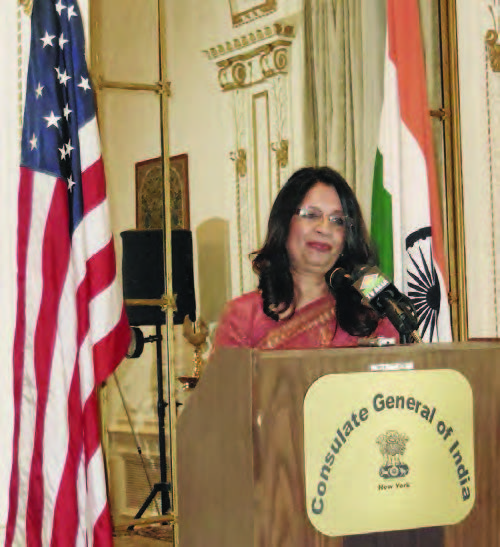
    NEW YORK CITY (TIP): The Consulate General of India, New York hosted its tenth Media India Lecture Series with a lecture “On Women who lead” by Nirupama Rao on December 16 at the Consulate Ballroom. She spoke about three leading ladies of India who brought ‘elemental changes’ in society -Hansa Mehta, Vijaya Lakshami Pandit, and Kamaladevi Chattopadhyay. Rao outlined how these three fought for social justice and demonstrated the power of women.

    FEMININE POWER NIRUPAMA RAO
    Consul General of India in New York Ambassador Dnyaneshwar M Mulay makes opening remarks

    Hansa Mehta represented India on the Nuclear Sub-Committee on the status of women in 1946. As the Indian delegate on the UN Human Rights Commission in 1947-48, she was responsible for changing the language of the Universal Declaration of Human Rights from “all men are created equal” to all human beings, highlighting the need for gender equality. She later went on to become the vice chairman of the Human Rights Commission of the United Nations in 1950. She was also a member of the Executive Board of UNESCO.

    Vijaya Lakshami Pandit was the first Indian woman to hold a cabinet post. Following India’s independence she entered the diplomatic service and became India’s ambassador to the Soviet Union, the United States and Mexico), and Spain. Between 1946 and 1968, she headed the Indian delegation to the United Nations. In 1953, she became the first woman President of the United Nations General Assembly.

    Kamaladevi Chattopadhyay is most remembered for her contribution to the Indian independence movement; for being the driving force behind the renaissance of Indian handicrafts, handlooms, and theatre in independent India; and for upliftment of the socio-economic standard of Indian women by pioneering the co-operative movement.

    Nirupma Rao said she had learnt from them many important lessons of her life .

    Prof. Manu Bhagavan of the department of History at Hunter College CUNY moderated a post lecture conversation with Rao where she shared her personal experiences as an Indian diplomat.

    Earlier Consul General Ambassador Dnyaneshwar M Mulay in his introductory remarks reiterated that the Consulate will continue to make every effort for the promotion of Indian intellectual heritage, Art and Culture through various cultural events and the Media India Lecture-Series, established in March 2014, with an objective to enlighten young students, mainstream American media and the American people as a whole, about India’s global image, identity, aspirations, role and projection in the contemporary world.

  • Sharada Bhansali named one of the Top Most Powerful Women

    Sharada Bhansali named one of the Top Most Powerful Women

    HAUPPAUGE, NY (TIP): CPA Practice Advisor has named Sharada Bhansali, Co-founder of AccountantsWorld, one of the Top Most Powerful Women in Accounting. The announcement and awards were presented at The Sleeter Group’s 2014 Accounting Solutions Conference held November 9-12 at Caesar’s Palace in Las Vegas.

    The award reflects the ever increasing number of women involved in the accounting industry and the influence that they have in the development of technology which helps accountants succeed and grow their practices. “This is truly a great honor, not only for me, but for professional women all across the United States. It reflects how the industry has changed, and demonstrates the impact that women have had on all areas of the industry be it technology, research or running their own business” said Sharada.

    Sharada holds a Master’s degree in both Engineering and Mathematics. She has led the development of a new class of “Accountant-Centric” solutions, making a long-lasting, significant contribution to the accounting profession. As an entrepreneur, Sharada has been serving the accounting profession for over 30 years.

    In 1984, she founded AccountantsWorld’s predecessor, Micro Vision Software, a leading producer of desktop solutions for accounting professionals. Micro Vision’s Tax Relief system was one of the most highly acclaimed professional tax software packages and the first to take full advantage of the Microsoft Windows platform. Along with her husband, Dr. Chandra Bhansali, Sharada co-founded AccountantsWorld where together they are forging new paths with cutting edge, accounting-centric software such as Accounting Power™, Payroll Relief, Cloud Cabinet, Website Relief, Directory Listing, After-the-Fact Payroll and Practice Relief – all designed specifically for accountants.

    For over 14 years, AccountantsWorld has been the leading provider of cloud-based solutions for accountants. AccountantsWorld offers a complete, integrated suite of innovative accounting, payroll, and practice management solutions to help accountants work collaboratively with clients, foster greater client loyalty, and improve the profitability of their practices. AccountantsWorld is also the only leading cloud solution provider that puts Accountants First™ by never competing with accountants or selling services directly to their clients.

    (Based on a press release)

  • Community mourns loss of innocent lives in Peshawar school carnage

    Community mourns loss of innocent lives in Peshawar school carnage

    LONG ISLAND, NY (TIP): The local community mourned on December 17 at the Nassau County Executive office ceremonial chamber, the loss of innocent lives of 142 children in a brutal and cowardly attack on a school in Peshawar in Pakistan on December 16.

    A candle light vigil and interfaith prayers were the highlights of the meeting where community leaders and officials of Nassau County offered their condolences. Officials present included Nassau County police commissioner Thomas C Krumpter, Senator Jack Martins, Assemblyman Charles Lavine, Nassau County legislator Richard Nicolello, Jon Kaiman, Representative of New York State Governor, and Assistant District Attorney Summer Hill.

    The host committee included Ajay Batra, Anila Midha, Zakir Siddiquie, Sharanjit Thind, Dr. Kamal Zafar, Kawaljit Chandi, Habeeb Ahmed, Rizwan Qureshi, Jay Singh and Mohinder Taneja.

    The 100 seat chamber was packed with mourners.

  • US Court Dismisses  1984 Rights Violation Case against Congress

    US Court Dismisses 1984 Rights Violation Case against Congress

    NEW YORK (TIP): A federal appeals court has dismissed a 1984 Sikh rights violation case filed against Congress Party by a rights group, saying that the case does not sufficiently “touch and concern” the US.

    A three-judge panel of the US Second Circuit Court of Appeals threw out the case, dismissing charges made by rights group Sikhs for Justice that the Congress was responsible for extra judicial killings and the riots that followed the assassination of then Prime Minister Indira Gandhi.

    The panel ruled that “even assuming that, as plaintiffs allege, defendants-appellees Indian National Congress Party and (Congress leader) Kamal Nath carried out or were responsible for acts of violence against Sikhs, those acts were taken by Indian nationals against other Indian nationals in India. Under the presumption against extraterritoriality, we lack jurisdiction over plaintiffs’ claims.” The panel said the victims’ claim lack “sufficient touch and concern” with the United States and also declined to rule on the issues of plaintiffs’ standing, the sufficiency of service of process and personal jurisdiction.

    “Accordingly, because all of the conduct relevant to the alleged ATS (Alien Torts Statute) violations occurred abroad, defendants’ alleged presence in the US is insufficient to displace the presumption against extraterritoriality and to establish jurisdiction under the ATS,” the appeals court said.

    SFJ legal advisor Gurpatwant Singh Pannun said that the group will re-litigate the case.

    Welcoming the ruling of the court, Congress party’s attorney Ravi Batra told PTI that SFJ should accept that its “lawsuit campaign is wrong, stop now and give up.”

  • An Art exhibition celebrating Women’s Empowerment

    An Art exhibition celebrating Women’s Empowerment

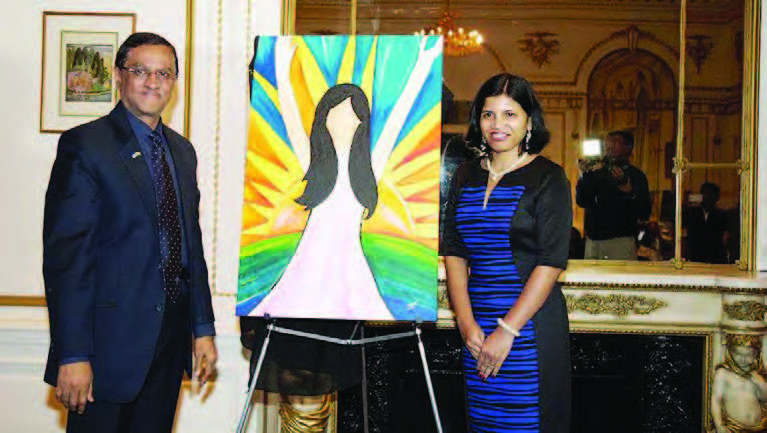
    NEW YORK CITY (TIP): A young budding artist Deepti Kulkarni showcased her art at the Consulate General of India here on Friday December 12, 2014. The theme of her art was women’s rights and their empowerment.

    The event opened with the lighting of the lamp and welcome remarks of Consul General Dnyaneshwar M Mulay, followed by an Introduction of the artist by Anil Bansal, Founder of Indus American Bank and AICC President.

    Speaking about her art and the exhibition at the Consulate, Deepti said, “I believe that everything can be perceived as an Art. As software professional, developing great code is definitely a science and logic but at some point, writing a better code can be perceived as an Art. People management is an Art as well. I strongly believe that “Art has a great power of love and expression” and so I’ve tried to put forward the social issues that a woman in society faces through my latest series ‘Women’s Rights and Empowerment’.

    The exhibits were eloquent expression of the adverse situations a female faces. Harassment, abuse, violence were beautifully expressed in the several paintings in the exhibition.

    On the occasion she presented her award winning poem on “Save Girl” which touched the heart of every one in the audience.

    Deepti gifted the Indian Consulate her artwork “The Rise” that symbolizes the Rise of a Woman.

    Ambassador of India to Trinidad and Tobago Gauri Shankar Gupta, who happened to be in New York, congratulated the artist for her fine work and encouraged people to support her work to raise social awareness.

    Deepti Kulkarni is a software engineer by profession but has always been an artist at heart. A self-taught artist and painter, she has been assiduously practicing art for several years. Her more recent exhibition was at the National Organization for Women in New Jersey. Her art has been featured in various art magazines in India. There is a lot of fire and mettle in the young artist who seems destined to make her mark in life.

  • Pope’s Christmas address focuses on Pakistani school attack victims

    Pope’s Christmas address focuses on Pakistani school attack victims

    VATICAN (TIP): A sombre Pope Francis steeped his Christmas message to the world in sadness for those with little cause for joy — abused children, refugees, hostages and others suffering from violence in the Middle East, Africa, Ukraine and elsewhere.

    Anguish for children who suffer maltreatment or violence, including in the recent attack on a Pakistani military school, tempered the pontiff’s traditional Christmas Day speech, which he delivered from the central balcony of St. Peter’s Basilica in Rome.

    “Truly there are so many tears this Christmas,” said Francis, looking solemn and smiling little, in contrast to his often jocular demeanour when addressing crowds.

    Francis decried the persecution of ancient Christian communities in Iraq and Syria, at the hands of ISIS militants, along with those from other ethnic and religious groups.

    “May Christmas bring them hope,” he said.

  • BHARAT RATNA for Vajpayee, Malviya

    BHARAT RATNA for Vajpayee, Malviya

    NEW DELHI (TIP): Former Prime Minister Atal Bihari Vajpayeeand Madan Mohan Malaviya will be conferred the nation’s highest civilian honor, the Bharat Ratna, the government announced on December 24 This came on the eve of Vajpayee’s 90th birthday and Malaviya’s 153rd birth anniversary.

    Prime Minister Narendra Modi and other senior BJP members, including LK Advani, will be present when the Bharat Ratna is presented to Vajpayee at his residence in Delhi as he won’t be able to attend a ceremony at Rashtrapati Bhavan due to ill health, a government official said. The date for this hasn’t been decided.

    Pandit Bhimsen Joshi also received the award at his home, in Pune, in 2009. Modi moved the Bharat Ratna proposal to President Pranab Mukherjee on December 23 evening.

    It was accepted by him on December 24 morning. The government had decided a while ago to give the Bharat Ratna to Vajpayee, said the official cited above. “It was only looking for a fitting occasion and what better than his 90th birthday,” the person said. He said the government was also keen to bestow the honour upon Malaviya as he was considered a Hindu nationalist besides being founder of the Banaras Hindu University in Modi’s constituency, Varanasi.

    “Malaviya’s grandson, Giridhar Malaviya, was a proposer of Modi when he filed nomination papers from Varanasi,” the official said. A Bharat Ratna for Malaviya, who was Congress president in 1909 and 1918, also serves to show that the award is not dictated by political affiliation. PM Modi tweeted: “Atal ji means so much to everyone. A guide, inspiration & giant among giants. His contribution to India is invaluable. Pt. Madan Mohan Malaviya is remembered as a phenomenal scholar & freedom fighter who lit the spark of national consciousness among people. Country’s highest honour to these illustrious stalwarts is a fitting recognition of their service to the Nation.”

    The government steered clear of criticising the previous UPA government for not bestowing the honour on Vajpayee. “The time and occasion is correct for the Bharat Ratna to Vajpayee,” Home Minister Rajnath Singh said.

  • SUNNY LEONE TURNS SEXY SANTA

    SUNNY LEONE TURNS SEXY SANTA

    The hot and sizzling Sunny Leone turns Sexy Santa this Christmas on zoOm. For all those gearing up for a cold X’-Mas, hold on, as Bollywood’s baby doll is sure to make it a red hot one in her sexy Santa avatar. And like a perfect Santa, she will bring along her bag of goodies for the B-town lovelies. alking about turning Santa, Sunny said, “I actually felt like Santa on the gorgeous sets, and not only was I sexy, I was cutely silly too. This is a little gift for all my lovely fans.” On the show, Sunny will also reveal the channel’s list of ‘What’s Sexy in 2014’. Get set to move and groove with her, as she peps up your mornings with chartbusters (all of Christmas week) on music show Sunny Christmas. Of course, Santa will give us a peek-a-boo into her exclusive X-Mas bash as well, where the hottest Bollywood stars will do a role-play. Watch out for sexy Santa on Christmas eve at 8 pm, and on Christmas day at 7.30 pm on zoOm.

  • Jharkhand gets first non-tribal CM

    Jharkhand gets first non-tribal CM

    Ranchi (TIP): The Jharkhand BJP Legislature Party (BJPLP) on December 26 elected Raghubar Das as its leader, paving the way for the first non-tribal to become the chief minister of the state.

    Das’s name was announced in the presence of two central observers — Union Health Minister J P Nadda and BJP vice-president Vinay Sahasrabuddhe — who arrived here as Narendra Modi’s emissaries.

    The swearing-in will take place on December 28 at Morabadi ground here, which will be attended by the prime minister.

    Since its creation in November 2000, Jharkhand has seen five chief ministers in nine governments and was under President’s Rule three times.

    While Arjun Munda and Shibu Soren each served as the chief minister thrice, Babulal Marandi, Madhu Koda and Hemant Soren each were chief ministers once. Incidentally, all were tribals representing either Kolhan region or Santhal Parganas.

    Das, who began his career as an employee of Tata Group, and later as a trade union leader, has won the Assembly polls for the fifth consecutive time from Jamshedpur East this time.

    The 59-year-old OBC leader, who earlier served as deputy chief minister, had previously won from Jamshedpur East in 1995, 2000, 2005 and 2009. In 2014, he won from his bastion with the highest margin of 70,157 votes.

    In the good books of Modi and Shah, Das is presently the BJP vice-president and was an undeclared rival of Arjun Munda for the top job in the state.

    The defeat of Munda cleared the decks for him. On Friday, he promised “sabka saath, sabka vikas”.

    Deccan Herald was the first national newspaper to have carried a story last week how a non-tribal was likely to be sworn in as the chief minister.

    Senior BJP leader Saryu Roy who won from Jamshedpur West, is one of the contenders for the Speaker’s post. The MLA from Ranchi, C P Singh, who was earlier Assembly Speaker, is the other claimant for the top constitutional post.

    A small ministry is likely to be sworn in on December 28 when Das takes oath. His Cabinet may include Loius Marandi, the Christian BJP leader who defeated outgoing Chief Minister Hemant Soren in Dumka, besides Rajkishore Mahto.

    The All Jharkhand Students’ Union (AJSU), which contested the polls in alliance with the BJP and won five seats, on Friday gave a letter of support to the Jharkhand Governor, thereby taking the strength of the ruling BJP-led alliance to 42 (The BJP has won 37 seats in 81-member House).

    Since AJSU president Sudesh Mahto himself lost from Silli, the regional party elected Chandraprakash Choudhary as its legislature party leader. He, too, is likely to be sworn in as a minister in the Das government.