Month: February 2014

  • Three explosions hit cinema in Peshawar, 11 killed

    Three explosions hit cinema in Peshawar, 11 killed

    ISLAMABAD (TIP): At least 11 people were killed and 25 wounded after three bombs went off in quick succession inside a cinema hall in Pakistan’s northwestern city of Peshawar on february 11 The attack took place during screening of a Pashto movie at Shama cinema, known for showing adult rated movies.

    “Three China-made hand grenades were used in the attack and up to 80 people were in the cinema at the time. The first blast happened in front, second at the rear and the third in the centre of the cinema hall,” said Ijaz Ahmed of the Peshawar police. He said cinema owners in Peshawar had been informed of the threats.

    “We had directed all cinema owners to install CCTV cameras.” The Pakistan Taliban, an umbrella organization of several militant and criminal groups, distanced itself from the attack. The blasts came almost two weeks after explosions at another cinema in the city killed five people. Several small but deadly bombs have hit Peshawar and surrounding areas since Monday. On Monday, four women were killed when a suicide bomber blew himself up at the house of a pro-government tribal elder.

  • Earthquake of 6.9 magnitude strikes western China

    Earthquake of 6.9 magnitude strikes western China

    BEIJING (TIP):
    A strong and shallow 6.8-magnitude earthquake struck China’s far western region of Xinjiang on February 12, but in a sparsely populated area, the US Geological Survey said. The tremor was only 12.5 kilometres (eight miles) deep but hit about 270 kilometres east-southeast of Hotan, the USGS said, in an extremely remote area. China’s Earthquake Networks Centre gave the magnitude of the afternoon quake as 7.3. Another tremor of magnitude 5.7 struck five minutes later, five kilometres deep, followed by a series of aftershocks of up to 4.2 magnitude, it said.

    “We were at the office at the time and felt strong shaking, the windows were rattling,” a reporter in Keriya county near the epicentre told state broadcaster CCTV, adding that few people lived in the mountainous area and there were no reports yet of casualties or damage. CCTV reported that Hotan was not seriously affected, while several people in the city told AFP they felt less than a minute of shaking. “The earthquake lasted less than one minute, it was not strong, there are no buildings collapsed,” said one resident by phone. An expert told CCTV that the affected area often experienced earthquakes but was thinly populated, so the impact was likely to be limited.

    A previous 7.3-magnitude earthquake struck the same county in March 2008, affecting 40,000 people, destroying 200 homes and causing an overall 10 million yuan ($1.7 million) in damage. China is regularly hit by earthquakes, especially its mountainous western and southwestern regions. A magnitude 6.6 earthquake in Sichuan province in the southwest killed about 200 people last April, five years after almost 90,000 people died when a huge tremor struck the same province. Twin 5.6 and 5.9 magnitude quakes killed at least 95 people in the northwest province of Gansu last July. But according to the USGS website, there was a 65 percent chance the latest quake had not caused any fatalities. “There is a low likelihood of casualties,” it said.

    Once a link on the Silk Road, Xinjiang covers 1.7 million square kilometres (660,000 square miles) — a sixth of China’s territory. It is home to the country’s mostly Muslim Uighur minority, and has seen sporadic attacks on police amid complaints by the ethnic group of religious and cultural repression. Beijing has justified tighter security in the area to stem a separatist movement it claims has links with foreign terrorist groups. Xinjiang is rich in natural resources, containing roughly 30 per cent of China’s onshore oil and gas deposits and 40 per cent of its coal, according to the official website china.org.mtp

  • 50 bodies discovered in Sri Lanka mass grave

    50 bodies discovered in Sri Lanka mass grave

    COLOMBO (TIP): Skeletal remains of at least 50 people have been dug out from a mass grave discovered in northeastern Sri Lanka, amid speculation that the remains were of Tamil civilians who had disappeared during the war with the LTTE.

    Police spokesman and Senior Superintendent Ajith Rohana said further digging will be continued with the deployment of a team from the crime investigation department to assist in investigations. Three more skulls were found on Monday, Rohana said. With this, the total skeletal remains discovered stand at 50.

    A team of forensic experts led by Judicial Medical Officer Dhananjaya Waidyaratne earlier stated that bodies had been buried in several layers at the site. The state water entity’s workers had stumbled upon the grave as they dug the ground to lay water supply connections late December last year in Thirukatheeswaram area in Mannar district.

  • Pieces from the Afghan puzzle are still missing

    Pieces from the Afghan puzzle are still missing

    One major problem is fitting Afghanistan into an effective regional framework. Neither the SAARC nor the SCO nor the Istanbul Process is willing to assume a leadership role

    At last count, there were some 1,365 policy papers on Afghanistan produced worldwide by recognized think-tanks and NGOs in the past five years. Here is one more, but substantially different paper, called Envisioning Afghanistan post- 2014: Joint Declaration on Regional Peace and Stability, produced by Friedrich-Ebert- Stiftung.

    Why is it different? It is truly regional, emanating from policy groups and 60 experts from the neighborhood who reconcile their national interests, through compromise, in seeking consensus to arrive at a common minimum interest paper, scripted, owned and driven by the Afghans. It took 18 months to produce. It was launched in Kabul, Istanbul, Islamabad, Brussels, Berlin, New York and Washington, DC – and will be launched in Central Asia and New Delhi later this year.

    The Regional Declaration seeks to make Afghanistan an asset for all, through actions at national, regional and international levels, encompassing the period of transition and transformation ending in 2025. The ultimate goal is to secure enduring neutrality for Afghanistan which it enjoyed for a 100 years, especially in the period between 1929 to 1978 which was the most prosperous. The paper on neutrality is a work-in-progress.

    If neutrality is accepted by the Pakistani Army, a grand bargain could follow. Pakistan agreeing to end its support for the Afghan Taliban in return for Afghanistan accepting the Durand Line as its international border. For Pakistan and the region there are a number of other benefits including reducing security concerns from two hostile fronts to one. The Regional Declaration recognizes a serious trust deficit between Afghanistan and Pakistan, and therefore, anoints Pakistan as the pivotal player – both as a spoiler and an enabler. The recommendations call for inclusive, transparent and democratic presidential and parliamentary polls, which are the conditions set by the international community for keeping their financial commitments.

    A National Transition Strategy coupled with a National Development Strategy constitutes Afghanistan’s national agenda. This agenda also includes capacity-building of Afghan National Security Forces to prevent civil war, the return of Al Qaeda and effectively combat the Afghan Taliban and other armed opposition. To put it mildly, the Declaration encourages all entities in Pakistan to genuinely cooperate in fighting cross-border threats and pursue its legitimate interests through peaceful means. It calls for the establishing of an Afghanistan-Pakistan Joint Experts’ Working Group to overcome historic bottlenecks and improve bilateral relations. Pakistan’s help is also sought for reconciliation with the Afghan Taliban in a dialogue with the High Peace Council. What emerges are two reconciliation processes: One with Pakistan, and the other with Afghan Taliban entities in Pakistan.

    The importance of Pakistan implementing the Afghanistan-Pakistan Trade and Transit Agreement is emphasized, as also its extension to India. Recognizing that India and Pakistan seem to be working at crosspurposes in Afghanistan, the Declaration encourages the two to end differences and tensions, and commence dialogue on Afghanistan. It also advocates a trilateral dialogue between Afghanistan, Pakistan and India. A bigger role is suggested for the UN Secretary General’s Special Representative in Afghanistan, and also the appointment of a dedicated UN Special Coordinator to assist in the peace dialogues. The Regional Declaration reminds the international community, the US and NATO in particular, of their commitment towards a responsible drawdown and to keep their pledges on funding the process of transformation.

    A key pillar of the Declaration is a noninterference mechanism which includes codification of ‘interference’ – what neighbors should and should not do. This has been pledged by regional players at Bonn I and II, the Istanbul Process and Geneva but never been implemented in letter and spirit. The UN Special Envoy, with endorsement of P5 countries, is recommended to observe, monitor and investigate any breach of the Code of Conduct (most recently the UN brokered a similar ‘Good Neighborliness’ code for neighbors of the Democratic Republic of Congo). However, noninterference is not about intent, but conduct. The Regional Declaration is thin on the vital aspect of transferring responsibility from international powers to a regional compact for the purpose of preserving the gains in Afghanistan.

    One of the key problems is fitting Afghanistan to an effective regional organization. Between the South Asian Association for Regional Cooperation, the Shanghai Cooperation Organization and the Istanbul Process (which is not an organization), none is willing or able to take charge since there is no one to assume leadership. Neither China, nor Russia, nor even India is willing to bell the cat. Instead, the region has sought collective leadership based on the Istanbul Process which has Track I institutions. At the very least, Afghanistan requires an active regional coordinator to channels the regional compact.

    With the US and West fast losing interest in Afghanistan, and India and Afghanistan both being in election mode, Pakistan appears to have assumed the role of a regional coordinator, at least to monitor inflow of funds and financial commitments made at Chicago, Tokyo, Brussels and by other international monetary institutions. The World Bank office in Islamabad is setting up a team, mainly of economists, to study the fallout of a shortfall in funds and drawdown of the economy in Afghanistan. Frequently, Afghans remind you of the fate suffered by President Mohammad Najibullah, after the Soviet Union switched off the money tap.

    Pakistan has rightly prioritized Afghanistan as its most important foreign policy issue, and also identified ‘a peaceful neighborhood for revival of its economic agenda’. The big concern is the likely increase in the burden of refugees (already three million) inside Pakistan, in the event of anarchy and civil war. In the last six months, Afghan President Hamid Karzai and Pakistani Prime Minister Nawaz Sharif have held three meetings. President Karzai has had meetings with former Pakistani Army chief General Ashfaq Parvez Kayani and his Director-General at the ISI on bringing the Afghan Taliban for talks to the table. Pakistan is seen as the most decisive player in the Afghan imbroglio.

    How is it that 30 million Afghans with the help of 2,00,000 US and ISAF troops, 3,50,000 ANSF personnel, supported by US air and drone power as well as Indian assistance, have not been able to disarm 20,000 Afghan Taliban? The reason is that instead of Pakistan acquiring strategic depth in Afghanistan, the Taliban have secured it inside Pakistan. Only Pakistan can rein in the Afghan Taliban but it says this is beyond its means. Pakistan has to make the right choice. Returning to the Regional Declaration, prospects of regionalization do not appear bright. Finding a regional political mechanism to address reconciliation among stakeholders in Afghanistan is also not bright, in the absence of any regional leadership. The Declaration has offered some ideas like neutrality and non-interference which are do-able. But let the Afghans decide.

  • CHURCH OF ENGLAND FAST-TRACKS LAW FOR FEMALE BISHOPS

    CHURCH OF ENGLAND FAST-TRACKS LAW FOR FEMALE BISHOPS

    LONDON (TIP):
    Ugly scenes in the British parliament during its most televised Prime Minister’s Questions (PMQ) are upsetting voters, a Hansard Society survey has revealed. It revealed “noisy”, “childish”, “over the top” and “pointless” were common words associated with PMQs. Twothirds of respondents agreed PMQs involved too much party political pointscoring while 47% said the event was “too noisy and aggressive”. The report, which examined public attitudes to PMQs, found only 5% who disagree that there is too much party political point-scoring instead of answering the questions.

    PMQs are best known aspect of the parliament’s work, famous throughout the world for its combative, adversarial atmosphere. It is the bit of parliament’s work that the public are most aware of and have likely seen on television news. “Supporters of PMQs in its current form argue that it is great parliamentary drama, envied by citizens in other countries whose leaders are rarely held to account in public,” said Hansard Society research director Ruth Fox.

    “But our focus group research shows that the drama and theatre of the event is not appreciated in a positive way. In the dismissive words of one participant, ‘this was noise and bluster and showing off – theatrical but not good’.” Fox said PMQs are a cue for the public’s wider perceptions of parliament. “It provides a lot of the raw material that feeds their negative assumptions about politicians.” Fox said the public think the conduct of MPs is childish and wouldn’t be tolerated in other work places. “They think politicians are simply not taking the issues that affect their lives seriously enough.”

  • Tunisia shines amid gloom

    Tunisia shines amid gloom

    Arab Spring protests not in vain
    After three years of turmoil and bloodshed in the Middle East and North Africa, where is the Arab Spring? Apart from the relatively tiny state of Tunisia, where it all started, the picture in the rest of the region that had been swept away by the storm looks bleak today. Egypt, the largest of the Arab world, seems to be retracing its steps to three decades of the Mubarak era, with the Army flexing its muscles.

    Libya, which never had recognized governing institutions during the long Gaddafi era, is seeking to emancipate itself from the unofficial rule of militias armed to the teeth. Nor is there encouraging news from elsewhere. Yemen has still a long way to go to achieve stability. Although the former ruler Saleh was pushed aside by a group of neighbors, he retains influence. And in Syria, in the throes of civil war, negotiations of a sort seem to be going nowhere. President Basher al-Assad is disinclined to give up power as his country is literally being destroyed.

    It is clear that he cannot remain the ruler of a united country, yet it is uncertain when circumstances will compel him to go. Obviously, he does not accept the agenda of Geneva I leading to an inauspicious start to Geneva II requiring an effective transitional authority to govern Syria by replacing the present leader. Amidst this deep gloom, it is instructive to examine the causes of the Tunisian success, tentative as it is. A key to the reconciliation in the country was the sagacity of the major Islamic party Ennahda and its leader Rached Ghannouchi, in recognizing the fact that although it was the dominant political force, it would have to meet the aspirations of others, particularly the secularists.

    In fact, it took the murder of two Socialist leaders to bring to the Islamists the truth that their philosophy must be brought into the national consensus. Going for Tunisia were its secular traditions and the freedoms women enjoyed. Significantly, the new constitution passed by Parliament as a technocratic government was formed is the most gender liberal in the Arab world. No wonder France’s President Francois Hollande graced the ceremony marking the birth of new Tunisia while the European Union gave its own blessings. Much work remains to be done, but Tunisia is showing the way to the future in the entire region. The starkly different picture in Egypt is more representative of the region.

    For a time after the Arab Spring, it seemed that the country was trying to break away from its military-dominated past. A president was freely elected for the first time in the country’s history, with the military allowing him to take office. But the task for Mohamed Morsi and his Muslim Brotherhood proved too arduous to manage. In short, he botched it, and as political dissent against Morsi and the Brotherhood mounted, a relieved Army under then General el-Sisi dethroned him. Although Sisi, now elevated to the rank of Field Marshal, is being coy in announcing his decision to contest the presidency, it is a matter of time before the announcement is made.

    The administration has taken draconian steps to try to crush the Brotherhood, calling it a terrorist organization and trying Mr. Morsi. The Brotherhood is no stranger to suppression in its 85-year history, but it has survived by its grassroots support through its long tradition of charity work in feeding and caring for the poor. And Egypt is in dire economic straits, thanks to the three years of political turmoil despite the attractive aid package the Gulf monarchies have given the military dispensation to express their relief at the end of the Brotherhood experiment.

    The Egyptian story is very much in the making because although the military will bask for a time in the popularity of Field Marshal Sisi, who is being presented as something of a new Nasser, the modern Arab hero, disillusionment will set in as he is crowned. Bred on military rule for more than half a century after the dethronement of Kung Farouq, there are few genuine democratic institutions for people to bank upon. Fattened on generous American military aid to further its own reasons and to protect Israel, the military has a vast economic empire. It is interesting that even during the yearlong Morsi presidency, the defense portfolio was given to Sisi and the defense budget was beyond prying civilian eyes.

    In short, the region of the Middle East and North Africa will remain turbulent for years and decades because the Arab Spring has broken the somnolence of at least half a century. It seems a matter of time before popular revolts will break out again. As it is, the continuing civil war in Syria is roiling the whole neighborhood as its neighbors and others are seeking to cope with more than two millions of Syrian refugees, and that weathervane of the Arab world, Lebanon, is increasingly being subjected to the storms raging all around it. The time frame for future events will be determined in part by how long it will take to douse the flames of war in Syria. The Basher al-Assad regime shows no inclination of leaving office, having bought time to accept the Russian-sponsored deal to divest itself of its deadly chemical arms.

    Russia has an obvious stake in retaining its foothold in Syria but there will come a time when Russian support for the Assad regime will prove too expensive. For the Tunisian street fruit seller who set off the Arab Spring by protesting against his suppression by the authorities through publicly ending his own life, it was a tragedy. But the larger tragedy has been the havoc and changes brought about by protestors leading thus far to a reassertion of the military in Egypt, thanks to the Muslim Brotherhood’s fumbling in seeking to buttress its own position, instead of giving good governance. But for the bright spot represented by Tunisia, the Middle East and North Africa will continue to roil until the US and Russia and the regional powers will make a genuine attempt to seek peace, instead of merely feathering their own nests.

    The Middle East and North Africa will remain turbulent for years and decades because the Arab Spring has broken the somnolence of at least half a century. It seems a matter of time before popular revolts will break out again. As it is, the continuing civil war in Syria is roiling the whole neighborhood as its neighbors and others are seeking to cope with more than two millions of Syrian refugees, and that weathervane of the Arab world, Lebanon, is increasingly being subjected to the storms raging all around it”, warns the author.

  • Chinese zoo keeper takes tiger for a walk

    Chinese zoo keeper takes tiger for a walk

    BEIJING (TIP):
    An animal keeper startled visitors to a zoo in China’s Henan province when he took a tiger for a walk through the public area of the zoo. It happened on February 11. The keeper said he it was therapeutic for the tiger which lives in cramped conditions. The keeper Hu held the 6-month old tiger with a thin iron chain as he walked it through the public walkway at the People’s Park Zoo in Jiaozuo city in northwest Henan Province. Hu said he was giving therapy to the tiger which was born with a deformity in its hind legs, a local paper said. It published a photograph showing the tiger being walked around.

    The keeper had been walking the tiger and massaging its limbs every day for the past three months before zoo visitors witnessed it. Veterinary experts have diagnosed the tiger for calcium deficiency and have put him on supplements. Initially visitors suspected it was a dog which had been painted like a tiger. Some even praised it saying the animal looked extremely “mighty and powerful”. No one has been injured by the animal. The paper quoted a zoo official saying the zoo is licensed to handle and breed tigers. But individual citizens cannot do so because tigers are endangered animals under firstclass state protection.

  • Ugly scenes in British parliament upsetting voters

    Ugly scenes in British parliament upsetting voters

    LONDON (TIP): Ugly scenes in the British parliament during its most televised Prime Minister’s Questions (PMQ) are upsetting voters, a Hansard Society survey has revealed. It revealed “noisy”, “childish”, “over the top” and “pointless” were common words associated with PMQs. Two-thirds of respondents agreed PMQs involved too much party political point-scoring while 47% said the event was “too noisy and aggressive”. The report, which examined public attitudes to PMQs, found only 5% who disagree that there is too much party political point-scoring instead of answering the questions.

    PMQs are best known aspect of the parliament’s work, famous throughout the world for its combative, adversarial atmosphere. It is the bit of parliament’s work that the public are most aware of and have likely seen on television news. “Supporters of PMQs in its current form argue that it is great parliamentary drama, envied by citizens in other countries whose leaders are rarely held to account in public,” said Hansard Society research director Ruth Fox. “But our focus group research shows that the drama and theatre of the event is not appreciated in a positive way.

    In the dismissive words of one participant, ‘this was noise and bluster and showing off – theatrical but not good’.” Fox said PMQs are a cue for the public’s wider perceptions of parliament. “It provides a lot of the raw material that feeds their negative assumptions about politicians.” Fox said the public think the conduct of MPs is childish and wouldn’t be tolerated in other work places. “They think politicians are simply not taking the issues that affect their lives seriously enough.”

  • A Sad Day for Indian Parliament

    A Sad Day for Indian Parliament

    Even for a country with a long and unedifying history of parliamentary pandemonium, nothing can be as shameful and disgraceful as the use of pepper spray by a member on his peers to disrupt proceedings. Vijayawada MP Lagadapati Rajagopal, one of six Congress lawmakers expelled for disorderly behavior earlier, wielded this weapon in the Lok Sabha in a desperate bid to stall the introduction of the Telangana Bill.

    The Speaker herself was affected by the lachrymatory substance, and quite a few members required medical attention. Mr. Rajagopal’s claim that he used pepper spray in self-defense is absurd. Another member has been accused of brandishing a knife, but he has denied it, claiming what he was holding was a microphone, probably one wrenched from its fixture. Parliamentary security was perhaps prepared for what many saw as the final battle for Telangana as the time came to introduce the contentious Bill that will pave the way for the reorganization of Andhra Pradesh.

    One MP had threatened to set himself on fire if the Bill was introduced, but no one could have expected that assorted weaponry would find its way inside for actual use. Many a distressed observer of bedlam in the House had been dreading such an incident, and it was only a matter of time before a desperate member went beyond routine ruckus. Speaker Meira Kumar should no more restrict herself to feeble entreaties to maintain decorum but adopt sterner measures, ranging from ordering eviction to allowing criminal prosecution in select instances.

    Legislative business is often the casualty of unseemly behavior and even though Home Minister Sushilkumar Shinde managed to introduce the Telangana Bill, the principal opposition, the Bharatiya Janata Party, doubts whether it had been introduced at all. The incident raises the question whether Parliament should go the way of State legislatures and resort to eviction of unruly members to ensure the smooth functioning of the House. En masse eviction of whole groups of legislators is quite common in State Assemblies. Parliament has been more democratic and tolerant but this restraint has often led to a small group of obstreperous members blocking key legislation, such as the women’s reservation bill.

    The Congress must bear responsibility for the present logjam, as it has been unable to build enough support through discussions. The BJP’s stand has been ambiguous: it supports the formation of Telangana in principle, wants the concerns of Seemandhra to be addressed, blames the UPA for the mess in Parliament and has demanded that there should first be order in the House. Political consensus may be the ideal way, but legislative activity cannot forever be hostage to deliberate disorder.

  • HASEE TOH PHASEE

    HASEE TOH PHASEE

    STORY: Straight-forward boy and eccentric girl are drawn to each other. Wait, they’re not the ones in a relationship. Will their love fructify?

    REVIEW: Hasee Toh Phasee is for the romantics who like their martinis stirred not shaken. Debutant director Vinil Mathew’s straight-forward approach is smart and fresh; his characters are lovable. Nikhil(Sidharth Malhotra) is an optimist, who believes once committed, there’s no straying. Meeta( Parineeti Chopra) is a nonconformist; she’s a go-getter in her personal and professional space. Naturally Nikhil and Meeta’s ideologies don’t match. But there’s an under-current in their equation that keeps the audience hoping they that they will seek each other out.

    Ok, so why aren’t these two together in the first place? Is it only because they are poles apart as people? No, it’s because Nikhil is engaged to be married to Meeta’s elder sister Karishma. And, Meeta herself has been missing from the family scene for seven long years chasing her professional dream. It is only when the prodigal returns, does she realise that there’s an emotional void in her life. Besides her father who dotes on her, she also feels the need for a companion like Nikhil who can put her topsy-turvy life into perspective.

    This romantic comedy mirrors the quirks in human nature subtly and provides humour in everyday situations; in the family and amongst friends. Parineeti’s relationship with her father(Manoj Joshi, in fine form) strikes the right emotional chord. The songs–Shake It like Shammi and the Punjabi Wedding Song add zing to an otherwise simple narrative. Parineeti who has come to represent the power-house performer passes with flying colours. And, Sidharth, whose good-looks distract, shows a definitive growth in his second outing as an actor after Student of the Year. If you’re looking to rediscover the magic of goofy love around Valentines, give HTP a shot.

  • WE SHOULD ALWAYS RESPECT WHAT SALMAN SAYS: KATRINA

    WE SHOULD ALWAYS RESPECT WHAT SALMAN SAYS: KATRINA

    Katrina Kaif has once again made headlines but unlike her last few news sightings, this one isn’t about her holiday pictures getting leaked or her rumoured tiff with alleged boyfriend Ranbir Kapoor. Katrina is under the limelight this time for her response to a question asked by a journalist on Salman rating her higher up on the honesty meter. At a recent awards function which was hosted by Salman, the superstar invited filmmaker Karan Johar on stage and threw a volley of questions at him in a mock rapid-fire round inspired by the latter’s popular celebrity chat show.

    Titled ‘Sherbat With Salman’, he gave Karan the names of a few actresses and asked Karan to rate them on their level of honesty. When Karan put Katrina right at the bottom of his list, Salman intervened and asked him to rank her a little higher. In an interview later when Kat was informed about the same, she replied with a smile and said “If Salman has said that then it is a very important thing. We should always respect what Salman says”. Well, compliments never hurt anyone and her ex-boyfriend’s compliment certainly put a bright smile across Katrina’s face.

  • SUNNY LEONE GETS BOLDER IN RAGINI MMS 2

    SUNNY LEONE GETS BOLDER IN RAGINI MMS 2

    Sunny Leone, who thrilled one and all with her bindaas attitude in Jism 2, is all geared up to set the screen on fire with her Baby Doll avatar in Ragini MMS 2. Sunny Leone launched the much awaited Baby Doll song in Mumbai. The former adult film star turned Bollywood actress Sunny Leone was seen in a cage dance performance at the unveiling of the most sensual song of the year, Baby Doll, from the film Ragini MMS 2. The actress is confident about the film and Ekta Kapoor, who was present at the event termed Sunny Leone to be the biggest side effect of Ragini MMS 2.

  • JENNIFER ANISTON TO STAR IN ‘CAKE’

    JENNIFER ANISTON TO STAR IN ‘CAKE’

    Actress Jennifer Aniston is set to star in ‘Cake’. Produced by Courtney Solomon produced, the film sees a collaboration between Chinese TV producer Shenghua Entertainment and After Dark Films, said The Hollywood Reporter. The film will be directed by Daniel Barnz and has been written by Patrick Tobin. Speaking about the collaboration Solomon said, “Our goal is to find great material and great talent and let them do what they do best and Shenghua has proven a great partner to make that happen.”

    “The formation of Cinelou Films DHJ, and this new venture with Shenghua is a unique pact which allows us to give great projects a chance to be made for the right reasons without many of the usual limitations put on indie films,” he added. Aniston, 44, who rose to fame with sitcom ‘Friends’, recently starred in ‘We’re the Millers’ alongside Jason Sudeikis, Emma Roberts and Will Poulter.

  • ELIZABETH HURLEY RUBBISHES CLINTON AFFAIR CLAIMS MADE BY EX

    ELIZABETH HURLEY RUBBISHES CLINTON AFFAIR CLAIMS MADE BY EX

    British actress Elizabeth Hurley took to Twitter to rubbish sensational claims made by ex-boyfriend Tom Sizemore that she allegedly had an year-long affair with former US president Bill Clinton. “Ludicrously silly stories about me & Bill Clinton. Totally untrue. In the hands of my lawyers. Yawn,” Hurley wrote on Twitter. She later updated that it had been a tough day for her.

    “Thank you very much for your (mostly) very nice comments on what has been a pretty gruesome day… It’s been a tough couple of months in many ways- thanks to all my friends & family for your unwavering support & kindness,” she added. In the undated audio tape, obtained by Radar Online, Sizemore is heard boasting in detail about how he set up Hurley with Clinton after meeting the president during a screening of ‘Saving Private Ryan’ at the White House in 1998. The actor, who has battled with substance abuse in the past, says on the tape that Clinton immediately called Hurley and sent a private plane to pick her up.

    Sizemore, however, has now done an about turn claiming his rants about Hurley and Clinton were recorded while he was high on drugs. “I’ve never met former President Clinton, I’ve never known him to know Hurley. I’m not denying that I said these things … I don’t remember saying these things,” Sizemore told HuffPostLive. “They’re the rantings of a guy that it has been well-chronicled had a very severe problem,” he added. Hurley and Sizemore are said to have dated after meeting on the set of 1992 thriller ‘Passenger 57’.

  • ROCK PAPER DICE ENTER

    ROCK PAPER DICE ENTER

    STORY:
    Set in a fictitious city called Strathaven in North America, the film is about a series of events that follow a diamond heist planned by a mysterious hacker named Roman. REVIEW: Before you think that this film has something to do with the rock-paper-scissors-stone game, nope, it has got nothing to do with that. Instead, by the end of the film, you are meant to deduce that ‘rock’ stands for diamonds, ‘paper’ for information, ‘dice’ for chance or certainty and ‘enter’ denotes technology. Roman, along with two associates, hacks into Strathaven’s ‘security protocol’ and then uses the threat of national security as bargaining leverage when he speaks with Strathaven’s figures of authority.

    As Roman then periodically calls the police chief and various other officials over an electronically distorted internet call, he tells them what he’s really after is world peace. The diamond heist is also connected to the cat-and-mouse game Roman plays with the officials. What is surprising is that in dealing with this threat to ‘national security’, the cops apparently struggle to trace a scrambled VOIP call. There are gaping plot holes, no character sketches and a shocking lacuna of logic at many points. Even more confounding is the plot, which is more muddled than the murky and gloomy atmosphere of the movie.

    The script borders between being rudimentary to random. It is made worse by the delivery and the poor acting that underscores everything. One redeeming factor is the music, which is good in small parts. However, the same pieces of music are used over and over again and loudly, even in sequences that could have worked using silence. One of Roman’s partners, Kat (Dicey) at one point exclaims ‘What is the point?’ or something similar, which might have you wondering whether it’s a comment about the movie itself. The only noteworthy thing about the movie is the concept it started out with – which to be fair, is unique. But despite that, it goes wrong in almost every other department.

  • Comcast to buy Time Warner Cable for $45 billion

    Comcast to buy Time Warner Cable for $45 billion

    NEW YORK (TIP):
    Comcast says it has agreed to buy Time Warner Cable for $45 billion in a deal that would combine the two biggest cable companies in the United States. If the deal is approved, the combined group would be the nation’s dominant provider of TV and Internet services. The two companies expect the merger to take effect by the end of the year, but regulators are likely to take a close look at the potential impact on consumers.

  • OVL inks agreements to raise $2.5 bn

    OVL inks agreements to raise $2.5 bn

    NEW DELHI (TIP):
    ONGC Videsh Limited (OVL), the overseas arm of Oil and Natural Gas Corporation Limited (ONGC), has signed separate agreements with two consortiums of international banks to raise $ 2.5 billion by way of offshore borrowings. This has been done to finance its acquisition of 10 per cent participating interest in Rovuma Area I Block in Mozambique offshore, the company said in a statement. The first facility for a five year term amounting to $1.775 billion was signed with consortium of international banks, including ANZ, Bank of Nova Scotia, BTMU, DBS, Mizuho, RBS, Societe Generale, SBI and SMBC. SMBC took the leadership role in this facility with commitment of $ 700 million and acting as Facility and Escrow Agent.

    This is the single largest offshore 5-year loan facility arranged by an Indian company during the last three years. The second facility is in the nature of a bridge finance of $ 725 million for a one year term with consortium of international banks including ANZ, BNP Paribas, BTMU, Citi, DBS, RBS and SBI. In this facility, Citi took the leadership with Facility and Escrow Agency roles.

  • Growth is still very weak: Rajan

    Growth is still very weak: Rajan

    NEW DELHI (TIP):
    Reserve Bank of India (RBI) Governor Raghuram Rajan, on Thursday, said growth was still very weak. Nevertheless, it was stabilising on the back of a good harvest, strengthening exports, and some early signs of resumption of large stalled projects, he added. “I have no doubt that the fiscal deficit for 2013-14 will be close to, or below, the Finance Minister’s red line,” said Dr. Rajan while delivering the D. R. Gadgil Memorial Lecture on ‘Inclusive growth and the role technology can play in it’, here.

    However, the RBI Governor said, “We have to work to ensure macroeconomic stability, which means strengthening growth, especially through investment, maintaining a moderate current account deficit, achieving a fiscal deficit consistent with the government’s fiscal roadmap, and reducing inflation.” Going forward, he felt that, “we need to continue on the path of fiscal consolidation constantly improving the sustainability and quality of fiscal adjustment. It is important that we spend money on needed public investment, even while reducing misdirected subsidies and entitlements.”

    Dr. Rajan said that good fiscal control would help the central bank in its fight against inflation. “So will moderation in agricultural support price inflation, which will ensure that these prices only provide a baseline level of support when the farmer is in difficulty, without displacing market prices.” Accurate market prices, together with good dissemination of data on sowing patterns, could do a far better job than support prices in directing agricultural production to where it was most valuable and needed, he added. “Somewhat paradoxically, raising energy prices to market levels will also lead to lower inflation over the medium term, the horizon over which the RBI is trying to contain inflation”, Dr. Rajan observed.

  • INTERIM RAILWAY BUDGET: HIGH-SPEED CORRIDOR ACCELERATES

    INTERIM RAILWAY BUDGET: HIGH-SPEED CORRIDOR ACCELERATES

    NEW DELHI (TIP):
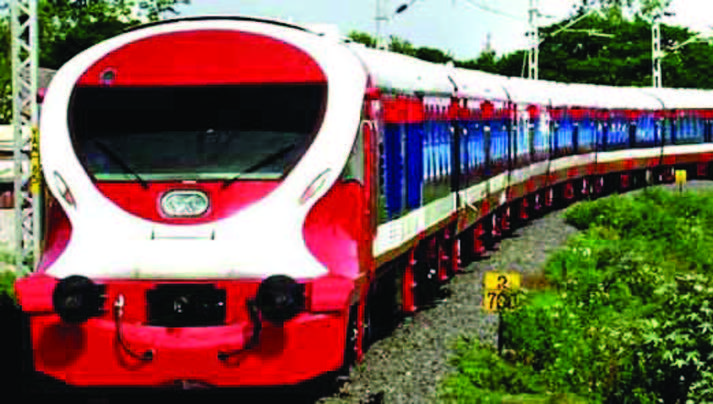
    High-speed trains in India could be a reality soon, with Indian Railways (IR) focusing on bringing new technology for modernisation of trains. The first high-speed rail (300-350 km/hour) will likely connect Mumbai and Ahmedabad, the two financial hubs in western India. It is expected to cut travel time between the two cities from the current eight hours to two hours. The railways is also focusing on achieving speeds of 160-200 km/hour on existing tracks.

    A joint feasibility study for the Mumbai-Ahmedabad high-speed corridor, which started in December 2013, is set to be completed in 18 months, minister Mallikarjun Kharge said in his speech on Wednesday. The study is being financed by Indian Railways and Japan International Cooperation Agency. An agreement for the partnership was finalised between the two sides in May 2013. Another business development study for the Mumbai-Ahmedabad corridor, undertaken by the French railways, will be completed by April 2014.

    After a report on the study is presented, IR will decide on the next course of action, as well as the modalities for implementation of the project, Kharge said. The railways is also exploring low-cost options to increase the speed of trains on select existing routes such as Delhi-Agra and Delhi-Chandigarh, to 160-200 km/hour. Earlier, the railways had said a High-Speed Rail Corporation (HSRC), a subsidiary of Rail Vikas Nigam Ltd, was being set up to increase the speed of passenger trains up to 200 km/hour. The High-Speed Rail Authority will be set up soon.

    While the authority will frame policies, it will be up to HSRC to implement these. The Mumbai-Ahmedabad and Delhi-Amritsar routes are two of the seven corridors HSRC plans to take up on a priority basis. For speeds of more than 200 km/hour, dedicated tracks and fencing are needed. Kharge said implementation of the eastern and western dedicated freight corridor projects was recording good progress, with about 1,100 km of civil construction contracts being awarded. In 2014-15, an additional 1,000 km of civil construction contracts are expected to be awarded, besides the those for systems contracts.

  • SPECTRUM SALE EXCEEDS EXPECTATIONS

    SPECTRUM SALE EXCEEDS EXPECTATIONS

    NEW DELHI (TIP):
    After 10 days of intense bidding, eight telecom companies, including Bharti Airtel and Vodafone India, on Thursday, bought spectrum worth a total of Rs.61,162.22 crore against the government’s estimate of Rs.47,933 crore. The Finance Ministry will now get revenues to the tune of Rs.18,296 crore this fiscal from the auction against the initial projection of Rs.11,340 crore. The value of the premium 900 MHz band spectrum, available only in three metro circles of Delhi, Mumbai and Kolkata, stood at Rs.23,589.62 crore (85 per cent higher than the value of the reserve price). Here, Bharti Airtel and Vodafone India, whose licences are expiring this year, managed to get the desired quantity of radio waves to ensure uninterrupted services to their customers. In the 1800 MHz band, radio waves available in all 22 telecom circles, the net value was put at Rs.37,572.60 crore .

    All of 46 MHz spectrum in the 900 MHz band was sold, but 78 blocks of the 390 MHz spectrum in the 1800 MHz band remained unsold. Here, the top three circles in terms of net value are: Delhi (Rs.7,644 crore), Mumbai (Rs.6,364 crore) and Maharashtra (Rs.4,064 crore). While Assam surprised all by clocking the highest value for spectrum in percentage terms — Rs.411.54 crore, which is 515 per cent over its reserve price of Rs.79.80 crore. Terming the auction as ‘extremely successful’, Communications and IT Minister Kapil Sibal told journalists: “The total revenue that will come to the government is Rs.61,162.22 crore…To that extent, particular auction has been extremely successful.”

    When asked whether high valuation of spectrum would lead to hike in mobile tariffs, he said: “Auction will really be successful if we are able to provide efficient service to consumers…The ultimate objective if any auction which has to provide service is that the service must be provided efficiently and at a relatively affordable price. We hope the tariffs will remain reasonable in the years to come.” Stating that he did not foresee any impact on tariffs, Telecom Secretary M. F. Farooqui said companies would have factored in all aspects before bidding for spectrum.

    “Market sentiment, economic situation and clarity in regulatory framework impact (spectrum) prices…We only provided transparent environment. Companies know their business better…If they have bid, they must have calculated the value of spectrum,” he said, and added that the telecom sector was poised for another round of growth where data usage would see a spurt.

    Cos seek cut in levies
    Though successful companies did not talk about any immediate increase in tariffs, they rued about ‘unreasonable’ reserve prices and demanded cut in levies imposed on telecom service providers. Stating that higher spectrum prices could impact the objectives of the telecom policy related to rural penetration, broadband for all, internet access, Rajan S. Mathews, Director-General, Cellular Operators Association of India (COAI), which represents GSM operators, said: “It remains to be seen if the operators will have the financial resources to invest in networks and marketing after bearing the high spectrum costs…To help the industry overcome this huge financial burden, the government should address the high tax/levy structure on the industry.”

  • CAN SMART RIFLE HIT BULL’S EYE?

    CAN SMART RIFLE HIT BULL’S EYE?

    WASHINGTON (TIP):
    The US army has confirmed that is testing new high-tech rifles that incorporate “computer vision and object tracking technologies” that allow “any soldier (to become) an extraordinary marksman”. A spokeswoman confirmed reports that specialist equipmenttesters had purchased six ‘scope and trigger’ kits built by Texas-based start-up TrackingPoint and would be testing them on XM 2010 sniper rifles. TrackingPoint’s technology consists of a scope with an on-board computer and a linked trigger.

    A shooter looking through the scope first ‘tags’ a target before the computer calculates the best place to shoot by measuring 16 different variables, including range, wind, temperature and humidity. A marker on the scope then indicates the correct “firing solution” and locks the trigger until the shooter has correctly aligned the sights with the target.

    Tracking Point stress that there is no automatic firing and that “the only way a round can be launched is through human pull force (on the trigger).” Lt Col Shawn Lucas from the army’s Program Executive Office said that the technology will help train soldiers for “a relatively small investment” and that it offers “significant increase in probability of hit and overall effectiveness by making an investment in advanced fire control.”

  • Lasers fuel hopes of unlimited, clean Nuclear-power

    Lasers fuel hopes of unlimited, clean Nuclear-power

    CALIFORNIA (TIP):
    A milestone has been reached in the 60-year struggle to harness the nuclear reactions that power the Sun in an experiment that could lead to a way of producing an unlimited source of clean and sustainable energy in the form of nuclear fusion. Scientists in California said that they have for the first time managed to release more energy from their nuclear fusion experiment than they put into it, which marks a critical threshold in eventually achieving the goal of a self-sustaining nuclear-fusion reaction.

    Nuclear fusion uses a fuel source derived from water and produces none of the more dangerous and long-lasting isotopes, such as enriched uranium and plutonium, that result from conventional nuclear power plants, which rely on the fission or splitting of atoms rather than their fusion. Researchers involved in the Nuclear Ignition Facility (NIF) at the Lawrence Livermore National Laboratory said that they have used 192 laser beams to compress a tiny fuel pellet less than half the diameter of a human hair in such a way that it triggered the net release of energy by nuclear fusion.

    The fuel, composed of the two hydrogen isotopes tritium and deuterium derived from water, was compressed together under enormous pressures and temperatures for less than a billionth of a second, but this was enough to see more energy coming out of the experiment than went into it. “We are fusing deuterium and tritium, which are isotopes of water, in a way that gets them to run together at high enough speed to overcome their natural electrical repulsion to each other,” said Omar Hurricane of the Livermore laboratory. “We are finally, by harnessing these reactions , getting more energy out of these reactions than we are putting into the deuterium-tritium fuel… We took a step back from what we tried before and in the process took a leap forward,” said Dr Hurricane, who led the NIF study published in the journal Nature.

    There are currently two parallel approaches to nuclear fusion. One uses laser energy to compress fuel pellets – like the NIF experiment – and aims to keep the fuel in place by a process known as inertial confinement. The other approach is to build a complex magnetic “bottle” to hold the hot, electrically charged plasma of the fuel in place. This magnetic confinement is the strategy of the Joint European Torus experiment in Culham, Oxfordshire, and the international ITER nuclear fusion plant under construction at Cadarache in southern France.

    Both approaches aim to gain more energy than is put into the system, and ultimately to a critical stage called “ignition” when the reaction becomes self-sustaining, which would mean that fusion could be exploited practically in power plants as an unlimited source of clean energy. The breakthrough at NIF was made possible by altering the laser pulses focusing on the fuel pellet in such a way that it led to the even compression of the capsule holding the deuterium and tritium, said Debbie Callahan, one of the researchers involved.

  • INDIAN SCIENTISTS CONVERT DISCARDED PLASTIC INTO PETROLEUM PRODUCTS

    INDIAN SCIENTISTS CONVERT DISCARDED PLASTIC INTO PETROLEUM PRODUCTS

    LONDON (TIP):
    In a major breakthrough Indian-origin scientists based in US have successfully converted plastic shopping bags into diesel, natural gas and other useful petroleum products. The conversion produces significantly more energy than it requires and results in transportation fuels like diesel. Other products such as natural gas, naphtha (a solvent), gasoline, waxes and lubricating oils such as engine oil and hydraulic oil also can be obtained from shopping bags. Brajendra Kumar Sharma, a senior research scientist at the Illinois Sustainable Technology Center led the research.

    He said it involved a process called pyrolysis which is essentially heating the bags in an oxygen-free chamber. Sharma said, “Plastic bags make up a sizeable portion of the plastic debris in giant ocean garbage patches that are killing wildlife and littering beaches. Plastic bags have been detected as far north and south as the poles. Over a period of time, this material starts breaking into tiny pieces and is ingested along with plankton by aquatic animals.

    Fish, birds, ocean mammals and other creatures have been found with a lot of plastic particles in their guts,” Sharma said. “Turtles, for example, think that the plastic grocery bags are jellyfish and they try to eat them,” he added. “You can get only 50 to 55% fuel from the distillation of petroleum crude oil,” Sharma said. “But since this plastic is made from petroleum in the first place we can recover almost 80% fuel from it through distillate ion”.

    World Watch Institute says factories around the world churned out 4-5 trillion bags in 2002 ranging from large trash bags to thick shopping totes to flimsy grocery sacks. Previous studies have used pyrolysis to convert plastic bags into crude oil. Sharma’s team took the research further by fractionating the crude oil into different petroleum products and testing the diesel fractions to see if they complied with national standards for ultra-low-sulfur diesel and biodiesel fuels.

    A mixture of two distillate fractions providing an equivalent of US diesel met all of the specifications required after addition of an antioxidant, Sharma said. “This diesel mixture had an equivalent energy content, a higher cetane number (a measure of the combustion quality of diesel requiring compression ignition) and better lubricity than ultra-lowsulfur diesel,” he said. The researchers were able to blend up to 30% of their plastic-derived diesel into regular diesel and found no compatibility problems with biodiesel.

    “It’s perfect,” Sharma said. “We can just use it as a drop-in fuel in the ultra-low-sulphur diesel without the need for any changes.” The first plastic bags were introduced in the United States in 1957. Plastic trash bags started appearing around the world by the late 1960s. North America and Western Europe account for nearly 80% percent of plastic bag use— though the bags are increasingly common in developing countries as well. A quarter of the plastic bags used in wealthy nations are now produced in Asia. Each year Americans throw away some 100 billion polyethylene plastic bags. Only 0.6% of this is recycled. The rest of the bags end up in landfills or escape to the wild, blowing across the landscape and entering waterways.

  • FARTHEST GALAXY CLUSTER FOUND

    FARTHEST GALAXY CLUSTER FOUND

    LONDON (TIP):
    Astronomers have found the farthest galaxy cluster till date – 10 billion light years from earth. Four unknown galaxy clusters each potentially containing thousands of individual galaxies have been discovered. Galaxy clusters are the most massive objects in the universe, containing hundreds to thousands of galaxies, bound together by gravity. In common parlance, this means that the light from the most distant of the four new clusters identified by the team has taken over 10 billion years to reach us. Up to now, the most distant clusters found by astronomers date back to when the universe was 4.5 billion years old.

    This equates to around nine billion light years away. While astronomers have identified many nearby clusters, they need to go further back in time to understand how these structures are formed. This means finding clusters at greater distances from the Earth. An international team of astronomers, led by Imperial College London, used a new way of combining data from the two European Space Agency satellites, Planck and Herschel, to identify more distant galaxy clusters than has previously been possible.

    The Planck satellite scanned the whole sky while the Herschel satellite surveyed certain sections in greater detail. The researchers from the UK, Spain, USA, Canada, Italy and South Africa believe up to 2000 further clusters could be identified using this technique, helping to build a more detailed timeline of how clusters are formed. Lead researcher Dr David Clements, from the department of physics at Imperial College London, explains “The clusters can be identified at such distances because they contain galaxies in which huge amounts of dust and gas are being formed into stars. This process emits light that can be picked up by the satellite surveys.”

  • SRI GURU GRANTH SAHIB

    SRI GURU GRANTH SAHIB

    When it slips from his hand, his body turns black, and his face withers away. Those who focus their consciousness on the True Guru – peace comes to abide in their minds. They meditate on the Name of the Lord with love; they are lovingly attuned to the Name of the Lord. O Nanak, the True Guru has bestowed upon them the wealth, which remains contained within their hearts. They are imbued with supreme love; its color increases day by day.

    || 1 || THIRD MEHL: Maya is a serpent, clinging to the world. Whoever serves her, she ultimately devours. The Gurmukh is a snake-charmer; he has trampled her and thrown her down, and crushed her underfoot. O Nanak, they alone are saved, who remain lovingly absorbed in the True Lord. || 2 || PAUREE: The minstrel cries out, and God hears him. He is comforted within his mind, and he obtains the Perfect Lord. Whatever destiny is pre-ordained by the Lord, those are the deeds he does.When the Lord and Master becomes Merciful, then one obtains the Mansion of the Lord’s Presence as his home.

    That God of mine is so very great; as Gurmukh, I have met Him. || 5 || SHALOK, THIRD MEHL: There is One Lord God of all; He remains everpresent. O Nanak, if one does not obey the Hukam of the Lord’s Command, then within one’s own home, the Lord seems far away. They alone obey the Lord’s Command, upon whom He casts His Glance of Grace. Obeying His Command, one obtains peace, and becomes the happy, loving soul-bride. || 1 || THIRD MEHL: She who does not love her Husband Lord, burns and wastes away all through the night of her life. O Nanak, the soul-brides dwell in peace; they have the Lord, their King, as their Husband. || 2 || PAUREE: Roaming over the entire world, I have seen that the Lord is the only Giver.

    The Lord cannot be obtained by any device at all; He is the Architect of Karma. Through the Word of the Guru’s Shabad, the Lord comes to dwell in the mind, and the Lord is easily revealed within. The fire of desire within is quenched, and one bathes in the Lord’s Pool of Ambrosial Nectar. The great greatness of the great Lord God – the Gurmukh speaks of this. || 6 || SHALOK, THIRD MEHL: What love is this between the body and soul, which ends when the body falls? Why feed it by telling lies? When you leave, it does not go with you. The body is merely blind dust; go, and ask the soul.

    The soul answers, “I am enticed by Maya, and so I come and go, again and again.” O Nanak, I do not know my Lord and Master’s Command, by which I would merge in the Truth. || 1 || THIRD MEHL: The Naam, the Name of the Lord, is the only permanent wealth; all other wealth comes and goes. Thieves cannot steal this wealth, nor can robbers take it away. This wealth of the Lord is embedded in the soul, and with the soul, it shall depart. It is obtained from the Perfect Guru; the self-willed manmukhs do not receive it. Blessed are the traders, O Nanak, who have come to earn the wealth of the Naam.

    || 2 || PAUREE: My Master is so very great, true, profound and unfathomable. The whole world is under His power; everything is the projection of Him. By Guru’s Grace, the eternal wealth is obtained, bringing peace and patience to the mind. By His Grace, the Lord dwells in the mind, and one meets the Brave Guru. The virtuous praise the ever-stable, permanent, perfect Lord. || 7 || SHALOK, THIRD MEHL: Cursed is the life of those who forsake and throw away the peace of the Lord’s Name, and suffer pain instead by practicing ego and sin. The ignorant selfwilled manmukhs are engrossed in the love of Maya; they have no understanding at all. In this world and in the world beyond, they do not find peace; in the end, they depart regretting and repenting. By Guru’s Grace, one may meditate on the Naam, the Name of the Lord, and egotism departs from within him.

    O Nanak, one who has such pre-ordained destiny, comes and falls at the Guru’s Feet. || 1 || THIRD MEHL: The self-willed manmukh is like the inverted lotus; he has neither devotional worship, nor the Lord’s Name. He remains engrossed in material wealth, and his efforts are false. His consciousness is not softened within, and the words from his mouth are insipid. He does not mingle with the righteous; within him are falsehood and selfishness. O Nanak, the Creator Lord has arranged things, so that the self-willed manmukhs are drowned by telling lies, while the Gurmukhs are saved by chanting the Lord’s Name.

    || 2 || PAUREE: Without understanding, one must wander around the cycle of reincarnation, and continue coming and going. One who has not served the True Guru, shall depart regretting and repenting in the end. But if the Lord shows His Mercy, one finds the Guru, and ego is banished from within. Hunger and thirst depart from within, and peace comes to dwell in the mind. Forever and ever, praise Him with love in your heart. || 8 || SHALOK, THIRD MEHL: One who serves his True Guru, is worshipped by everyone. Of all efforts, the supreme effort is the attainment of the Lord’s Name. Peace and tranquility come to dwell within the mind; meditating within the heart, there comes a lasting peace. The Ambrosial Amrit is his food, and the Ambrosial Amrit is his clothes; O Nanak, through the Naam, the Name of the Lord, greatness is obtained. || 1 || THIRD MEHL: O mind, listen to the Guru’s Teachings, and you shall obtain the treasure of virtue. The Lord, the Giver of peace, shall dwell in your mind, and your egotism and pride shall depart. O Nanak, when the Lord bestows His Glance of Grace, then, night and day, one centers his meditation on the Lord.

    || 2 || PAUREE: The Gurmukh is totally truthful, content and pure. Deception and wickedness have departed from within him, and he easily conquers his mind. There, the Divine Light and the essence of bliss are manifest, and ignorance is eliminated. Night and day, he sings the Glorious Praises of the Lord, and manifests the excellence of the Lord. The One Lord is the Giver of all; the Lord alone is our friend. || 9 || SHALOK, THIRD MEHL: One who understands God, who lovingly centers his mind on the Lord night and day, is called a Brahmin. Consulting the True Guru, he practices Truth and self-restraint, and he is rid of the disease of ego. He sings the Glorious Praises of the Lord, and gathers in His Praises; his light is blended with the Light.

    In this world, one who knows God is very rare; eradicating ego, he is absorbed in God. O Nanak, meeting him, peace is obtained; night and day, he meditates on the Lord’s Name. || 1 || THIRD MEHL: Within the ignorant selfwilled manmukh is deception; with his tongue, he speaks lies. Practicing deception, he does not please the Lord God, who always sees and hears with natural ease. In the love of duality, he goes to instruct the world, but he is engrossed in the poison of Maya and attachment to pleasure. By doing so, he suffers in constant pain; he is born and then dies, and comes and goes again and again. His doubts do not leave him at all, and he rots away in manure. One, unto whom my Lord Master shows His Mercy, listens to the Guru’s Teachings. He meditates on the Lord’s Name, and sings the Lord’s Name; in the end, the Lord’s Name will deliver him.

    || 2 || PAUREE: Those who obey the Hukam of the Lord’s Command, are the perfect persons in the world. They serve their Lord Master, and reflect upon the Perfect Word of the Shabad. They serve the Lord, and love the True Word of the Shabad. They attain the Mansion of the Lord’s Presence, as they eradicate egotism from within. O Nanak, the Gurmukhs remain united with Him, chanting the Name of the Lord, and enshrining it within their hearts. || 10 || SHALOK, THIRD MEHL: The Gurmukh meditates on the Lord; the celestial soundcurrent resounds within him, and he focuses his consciousness on the True Name.

    The Gurmukh remains imbued with the Lord’s Love, night and day; his mind is pleased with the Name of the Lord. The Gurmukh beholds the Lord, the Gurmukh speaks of the Lord, and the Gurmukh naturally loves the Lord. O Nanak, the Gurmukh attains spiritual wisdom, and the pitch-black darkness of ignorance is dispelled. One who is blessed by the Perfect Lord’s Grace – as Gurmukh, he meditates on the Lord’s Name. || 1 || THIRD MEHL: Those who do not serve the True Guru do not embrace love for the Word of the Shabad. They do not meditate on the Celestial Naam, the Name of the Lord – why did they even bother to come into the world? Time and time again, they are reincarnated, and they rot away forever in manure.

    They are attached to false greed; they are not on this shore, nor on the one beyond. O Nanak, the Gurmukhs are saved; the Creator Lord unites them with Himself. || 2 || PAUREE: The devotees look beauteous in the True Court of the Lord; they abide in the True Word of the Shabad. The Lord’s Love wells up in them; they are attracted by the Lord’s Love. They abide in the Lord’s Love, they remain imbued with the Lord’s Love forever, and with their tongues, they drink in the sublime essence of the Lord. Fruitful are the lives of those Gurmukhs who recognize the Lord and enshrine Him in their hearts.Without the Guru, they wander around crying out in misery; in the love of duality, they are ruined.

    || 11 || SHALOK, THIRD MEHL: In the Dark Age of Kali Yuga, the devotees earn the treasure of the Naam, the Name of the Lord; they obtain the supreme status of the Lord. Serving the True Guru, they enshrine the Lord’s Name in their minds, and they meditate on the Naam, night and day.Within the home of their own selves, they remain unattached, through the Guru’s Teachings; they burn away egotism and emotional attachment. They save themselves, and they save the whole world. Blessed are the mothers who gave birth to them. He alone finds such a True Guru, upon whose forehead the Lord inscribed such pre-ordained destiny. Servant Nanak is a sacrifice to his Guru; when he was wandering in doubt, He placed him on the Path.

    || 1 || THIRD MEHL: Beholding Maya with her three dispositions, he goes astray; he is like the moth, which sees the flame, and is consumed. The mistaken, deluded Pandits gaze upon Maya, and watch to see whether anyone has offered them something. In the love of duality, they read continually about sin, while the Lord has withheld His Name from them. The Yogis, the wandering hermits and the Sannyaasees have gone astray; their egotism and arrogance have increased greatly.

    They do not accept the true donations of clothes and food, and their lives are ruined by their stubborn minds. Among these, he alone is a man of poise, who, as Gurmukh, meditates on the Naam, the Name of the Lord. Unto whom should servant Nanak speak and complain? All act as the Lord causes them to act. || 2 || PAUREE: Emotional attachment to Maya, sexual desire, anger and egotism are demons. Because of them, mortals are subject to death; above their heads hangs the heavy club of the Messenger of Death. The self-willed manmukhs, in love with duality, are led onto the path of Death.