Month: May 2014

  • ‘SMALLER’ SIZE KEEPS WOMEN LOYAL TO MEN

    ‘SMALLER’ SIZE KEEPS WOMEN LOYAL TO MEN

    Does size of your penis worry you a lot? Stop thinking and get on with the act as a study reveals that women are more loyal to men with ‘smaller’ penises. A team of researchers from the US and Kenya found that there was a strange link between the size of the penis and infidelity in a marriage. Contrary to what many men may assume, they found that men with bigger penises are more likely to have wives who cheat on them.

    “The reason is that women experience more painful sex when their partner is ‘big’. That prompts them to seek another partner whom they may have more pleasurable sex,” the study noted. The study was conducted among the fishermen community in Lake Victoria in Kisumu County, Kenya.

    One of the women said that she had to look for another man with a “smaller one” so that she could “do it in a way” she could enjoy. According to the study, published in the journal PloS One, other possible reasons of a woman’s infidelity in a marriage include denying her a preferred sex position as well as domestic violence.

  • Kanimozhi denies of any role in KTV

    Kanimozhi denies of any role in KTV

    NEW DELHI (TIP): DMK MP Kanimozhi, facing trial in the 2G spectrum allocation scam case, on May 9 claimed innocence before a trial court saying she had no role in the management, administration or day-to-day operations of Kalaignar TV (KTV).

    Daughter of DMK supremo M Karunanidhi, Kanimozhi also accused the CBI of pressuring the witnesses in the case into deposing against her. Recording her statement before a special CBI court, Kanimozhi also declined to lead defence evidence in the case, adding that prosecution witnesses deposed against her only due to CBI pressure.

    According to the CBI, an amount of Rs 200 crore was paid by promoters of Swan Telecom, using their group entity Dynamix Realty, to KTV, through Kusegaon Fruits and Vegetables Pvt. Ltd. and Cineyug Films as loan application money. The investigating agency claimed in the charge sheet that the payment was illegal gratification for and on behalf of prime accused, the then communications minister A Raja and his associates in lieu of illegal favours.

    Replying to over 1700 questions running into 824 pages, Kanimozhi said that though she had 20 percent stakes in KTV, she acted as a director for a short period of two weeks between June 6, 2007 and June 20, 2007. “I never had anything to do with the management and operations of M/s Kalaignar TV (P) Ltd., except having been a director for a short period of two weeks and being a shareholder.

    Yet I was arraigned as an accused in the case. After my resigning from directorship on June 20, 2007, I have had no role whatsoever in the management, administration or running of day-to-day operations of the company. The transactions which are the subject matter of the present case have taken place between December 2008 and February 2011.

    In the said period I had no role in any manner in the running of the company,” Kanimozhi deposed. Meanwhile, Swan Telecom Promoter Shahid Usman Balwa, another accused in the case, was reprimanded by the court which said certain answers given by him in response to the court’s query were “objectionable”.

  • NATURAL CLEANERS YOU DID NOT KNOW

    NATURAL CLEANERS YOU DID NOT KNOW

    Here are some natural food items which are superb cleaners too. We never knew their benefits until now! Here are some food items, which can also be great cleaners –

    Ketchup
    It can be used to remove tarnish from copper utensils. But don’t forget to rinse them with warm water once you have scrubbed them with some ketchup.

    Oatmeal
    It acts as a natural cleanser of dirty hands. Slather some oatmeal with water and rub your hands together to remove all the dirt and germs.

    Club soda
    When was the last time you cleaned your kitchen sink? Take some baking soda and scrub it till it shines.

    Soaked rice
    While cleaning glass bottles and jars, use a cupful of uncooked rice to clean all of them. Fill a little more than half a jar with warm water and add a few grains of rice. Cover it up and shake it vigorously and then clean.

    Black tea
    Do you have a bucket full of tools which are rusty? Brew some black tea and let it cool down. Then immerse the tools for a few hours in the tea and wipe them with a cloth later.

  • ‘Pak should be given a path to nuclear normalcy’

    ‘Pak should be given a path to nuclear normalcy’

    ISLAMABAD (TIP): Pakistan should be offered a path to nuclear normalcy in the same way India was accepted into the nuclear club when it negotiated a civil nuclear deal with the US and was brought into the Nuclear Suppliers Group, Mark Fitzpatrick, Director of the Non-proliferation and Disarmament Programme, International Institute of Strategic Studies, UK said on Thursday.

    Fitzpatrick addressing a public talk show and his book launch “Overcoming Pakistan’s Nuclear Dangers organized by The Institute of Strategic Studies in Islamabad. He said Pakistan’s nuclear arsenal was one of the world’s fastest growing. He said that the triangular relationship between Pakistan, India and China has led to a unidirectional security competition whereby India’s security concerns and arms competition were fueled by a much larger China and Pakistan’s by a much larger India.

    “As a consequence Pakistan’s nuclear arsenal presently estimated to be around 120 was projected to be over 200 by year 2020 which was a cause of great concern for major powers around the world,” Fitzpatrick said. He suggested that Pakistan should negotiate the Fissile Material Cut Off Treaty and sign the Comprehensive Cut Off Treaty to give it a diplomatic high ground and to lock in India’s nuclear weapon potential which was much greater than Pakistan’s should it choose to develop it.

    Fitzpatrick recommended the path to negotiation for India and Pakistan for dealing with issues that may spark a nuclear war as well as conflict. He asked the Pakistani government to suppress extremist groups to reduce the dangers of seizure of its nuclear weapons. He also presented a perspective on dangers associated with Pakistan’s nuclear weapons.

    Among the major concerns that he highlighted was potential for escalation of South Asia’s strategic arms race and the subsequent increased potential for theft, sabotage and especially nuclear terrorism; nuclear accidents as well as concerns that Pakistan’s nuclear-weapons technology might again be transferred to nuclear aspirants; and above all the potential for a nuclear war possibly triggered by terrorist activities such as in the case of 2008 Mumbai attack. He identified that while the danger of extremist groups getting hold of nuclear weapons was in theory possible, the threat was exaggerated out of proportion in Western media.

  • Hindu households, temple attacked in Bangladesh

    Hindu households, temple attacked in Bangladesh

    DHAKA (TIP): A mob of nearly 3,000 attacked Hindu households and a temple in eastern Bangladesh after two youths from the community allegedly insulted the Prophet Muhammad on Facebook.

    Police on May 5 arrested 17 people, including the principal of Bagmara Madrasa, for the attack on the temple and over two dozen households at Homna in Comilla district, about 100km south east of Dhaka, last week. “We so far arrested 17 people and some of them made confessional statements regarding the attack.

    A manhunt is under way to arrest the rest of the culprits,” police chief of Homna, Aslam Shikdar said. He said suspected mastermind of the attack Nazrul Islam is still on the run. The local police chief said steps were under way to put the accused on trial on charges of attacking the Hindu households and the temple under a planned manner.

    A makeshift police camp was setup at the village where the incident took place on April 26 following rumours that two Hindu youths had allegedly insulted the prophet in a Facebook post. Earlier reports said culprits mobilized attackers mostly belonging to fundamentalist Jamaat-e-Islami and several other ultra-right groups who ransacked the temple and the nearby households and looted some valuables.

    “The attack continued for some 20 minutes but during the time, the culprits preferred not to injure anyone … our initial investigation found it was a pre-planned attack as they used loudspeakers and distributed leaflets to mobilize the attack,” Shikdar said.

    People at the neighbourhood said nearly 3,000 attackers, mostly from outside the locality, staged the attack as the village elders were set to hold a meeting to resolve the issue of the alleged defamation of the prophet. Shikdar said police immediately rushed to the scene but reached the remote village only when the attackers had fled.

  • Aid rushed to survivors of Afghan landslide

    Aid rushed to survivors of Afghan landslide

    AAB BAREEK (AFGHANISTAN) (TIP): Aid groups on May 4 rushed to help survivors of a landslide in northern Afghanistan that entombed a village, killing hundreds of people and leaving 700 families homeless in the mountains.

    Much of Aab Bareek village in Badakhshan province was swallowed on Friday by a fast-moving tide of mud and rock that swept down the hillside and left almost no trace of 300 homes. Government officials said the current death toll was at least 300 and warned it could rise by hundreds more, after initial reports suggested that as many as 2,500 people may have died.

    Large crowds gathered at the remote disaster site, where rescue efforts were abandoned due to the volume of deep mud covering houses. Only a few bodies have been pulled from the debris. “Around 1,000 families are thought to have been affected with some 300 houses totally destroyed,” the United Nations Office for the Coordination of Humanitarian Affairs said in a statement.

    “Assessments to determine priorities on immediate child protection and water, sanitation, and hygiene needs for (displaced) families are continuing.” It added that 700 families were displaced, with many fleeing their homes in fear the unstable hillside could unleash more deadly landslides. Tents, emergency food supplies, health services and support for children who lost parents were being organised after many survivors spent another night in the open.

    Wailing near her father’s destroyed house, Begum Nisa, a 40-year-old mother of three, described the moment when the wall of mud smashed through the village. “I was eating lunch by the window of my house, then suddenly I heard a huge roar,” she said. “I shouted to my family to save themselves, but it was too late. I have lost my dear father and mother. I also lost my uncle and five members of his family.”

  • MYTHS SURROUNDING VEGETARIAN DIET

    MYTHS SURROUNDING VEGETARIAN DIET

    Misconceptions over the years have surrounded vegetarian diets and those who adopt them. Let’s view the myths and see the actual reality MYTH: Vegetarians do not get enough protein. FACT: Well, there was a time when nutritionists and dietitians even said this, but no longer.

    Now, we know that vegetarians get plenty of protein. What they don’t get is the excessive amount of protein found in the typical modern diet. If you eat a variety of fruits, vegetables, grains and legumes, then getting enough protein is not an issue. MYTH: Vegetarians do not get enough calcium.

    FACT: This myth has been applied, in particular, to vegans who have eliminated milk products from their diets. Somehow, the notion got started that the only good source of calcium is milk and cheese. Granted, milk does have a good supply of calcium, but so do many vegetables — especially green, leafy veggies.

    The truth is, vegetarians suffer less from osteoporosis (a deficiency of calcium that leads to weak bones) because the body assimilates the calcium they eat more easily during digestion. FACT: First of all, a vegetarian diet isn’t out of balance.

    It has a good proportion of all the complex carbohydrates, protein and fat — the three macro nutrients that are the cornerstone of any diet. Plus, vegetarian food sources (plants) tend to be higher sources of most of micro nutrients. Another way to look at it is this: The average meat eater consumes one or fewer servings of vegetables a day and no servings of fruit. If a meat eater does eat a vegetable, chances are it’s a fried potato. “Out of balance” depends on your perspective.

    MYTH: A vegetarian diet is all right for an adult, but kids need meat to develop properly. FACT: This statement makes the assumption that protein from plants isn’t as good as protein from meat. The truth is, protein is protein. It is all made from amino acids.

    Children need 10 essential amino acids to grow and develop properly. These amino acids are as readily available in plants as they are in meat. MYTH: Humans were designed to eat meat. FACT: Although humans are capable of digesting meat, human anatomy clearly favours a diet of plant foods. Our digestive systems are similar to those of the other planteaters and totally unlike those of carnivores.

    The argument that humans are carnivores because we possess “canine” teeth ignores the fact that other plant-eaters have “canine” teeth, and that ONLY planteaters have molar teeth. Finally, if humans were designed to eat meat, we wouldn’t suffer from heart disease, cancer, diabetes, and osteoporosis from doing so.

  • Narendra Modi’s speech poll rhetoric: Bangladesh

    Narendra Modi’s speech poll rhetoric: Bangladesh

    KOLKATA (TIP): A day after reports of serious concern expressed in Dhaka’s corridors of power over BJP’s prime ministerial nominee Narendra Modi’s remark that his government would pack off illegal Bangladeshis to that country, there was growing acceptance in Dhaka that what Modi had said was nothing but electoral rhetoric.

    Senior Awami League politician and former Railway Minister of Bangladesh, Suranjit Sengupta, told TOI from Dhaka, “Modi’s statement should be taken in the context of elections in India. He (Modi) was playing the infiltrator card, just as many here play the ‘India card’ during elections. Nothing should be read into his statement. There is no need for any concern and we are not attaching importance to what Modi said.”

    Sengupta also said Indo-Bangla ties have become deeply entrenched and can easily resist all pulls and pressures. “Irrespective of which party comes to power in India, relations between the two countries will continue to be close,” he said. Foreign policy experts and sources close to the establishment in Bangladesh told TOI that such statements made with an eye on votes is part of election campaigns and do not cause any ripple.

    They suggested politicians on both sides of the border make many such statements, but once in office, they stick to established practices and don’t disturb bilateral ties. Acclaimed filmmaker and author Shahriar Kabir told TOI from Dhaka that the feeling in that country is that Modi may have made the statement to garner votes.

    “Everybody understands that Modi said that just to make himself popular with a section of the electorate,” said Kabir, a leading Bangladeshi intellectual. Kabir also said that a couple of days ago, at two back-to-back seminars held in Dhaka on Indo-Bangla ties, a number of Indian intellectuals, civil society leaders and foreign policy experts assured the Bangladeshi side there was no need to be alarmed about Modi’s statement.

    “In fact, even those perceived to be close to the BJP said Modi’s statement was with an eye on the polls and if he were to become the prime minister, he would never do any such thing, said Kabir. Monaem Sarkar, former Awami League ideologue, said Modi would never attempt to carry out his rhetoric. “What he said is part of his campaign. Politicians in both Bangladesh and India say a lot of things to come to power, but once they assume office, they behave soberly,” Sarkar said.

  • STOP TAKING ASPIRIN TO CUT HEART RISK

    STOP TAKING ASPIRIN TO CUT HEART RISK

    The United States Food and Drug Administration (FDA) has warned the public in a statement that most people shouldn’t take aspirin to prevent heart attacks. According to Bloomberg, the FDA said in a statement that ingesting aspirin on a regular basis isn’t recommended to people who have never experienced a cardiovascular event because the drug raises a person’s risk of experiencing stomach and brain bleeds.

    Even people who are at high risk for cardiovascular disease, but haven’t experienced any symptoms yet, should refrain from taking the drug as a preventative measure, they said. In short, the benefits of the drug only outweigh the risks in cases where people have already experienced a stroke or a heart attack.

    The announcement was prompted by the FDA’s decision last week to block pharmaceutical company Bayer AG from changing the drug’s labeling. The proposed changes would have allowed the company to market aspirin as a heart attack prevention drug for people who don’t have heart problems.

  • Bomb kills 3 policemen in western Afghanistan

    Bomb kills 3 policemen in western Afghanistan

    KABUL (TIP): An Afghan official says a roadside bombing has killed three policemen and wounded two in the country’s western Herat province.

    District police chief Shir Agha Alokozay says the attack took place in the province’s Obe district today morning, when the police vehicle the officers were riding in hit the roadside bomb.

    Alokozay says the bomb was set off by a remote control device and that the police have caught a suspect with the remote control.

    No one immediately claimed responsibility for the attack but Afghan security forces are frequently targeted by insurgents and violence has intensified in the country as most international troops prepare to withdraw at the end of the year.

  • JALEBI AMONG WORLD’S MOST FATTENING FOODS

    JALEBI AMONG WORLD’S MOST FATTENING FOODS

    Jalebi is one of the favourite sweets of Indians, but it has featured on an American news website’s list of fattening food items across the globe. Huffingtonpost.com has come out with the following list of unhealthy dishes in the world: JALEBI, INDIA: Jalebi is a deep-fried dough that is soaked in a sugary syrup.

    This plain fried dough is unhealthy on its own. CALZONE, ITALY: A traditional calzone uses the same amount of dough as an entire pizza-which serves four people. The Campania region of Italy gave birth to this version of pizza that is even unhealthier than the original. In a calzone, tomatoes, mozzarella and other traditional pizza toppings are stuffed into an easy-to-eat dough pocket and then served.

    ACARAJE, BRAZIL: A mere tablespoon of palm oil contains seven grams of saturated fat that makes the food taste great but is bad for health. Brazil’s acaraje is a black-eyed peas formed into a ball, deep-fried in palm oil, and then stuffed with spicy pastes made from dried shrimp, ground cashews and more palm oil. CHURROS, SPAIN: A popular way for locals here to start the day is with a meal of churros.

    These are frieddough pastries which are dipped in sugar and cinnamon and then dipped in a thick hot-chocolate drink. KHACHAPURI, GEORGIA: It’s a bread bowl that is stuffed with melted cheese and topped with an egg and a large pad of butter. NUTELLA CREPES, FRANCE: Two tablespoons of sweet chocolaty Nutella spread has 200 calories (110 of which are from fat). Many street carts and restaurants there fry up batter in butter and make thin pancakelike pockets which deliver Nutella.

    The crepes are usually topped with powdered sugar and sometimes even whipped cream. DEEP-FRIED MARS BARS, Scotland: A Mars bar which is deep-fried is a melted chocolate bar. The Mars candy company feels that the deep-fried dessert is not in line with the company’s goal of promoting a ‘healthy and active’ lifestyle. RAMEN, JAPAN: Ramen has exploded in popularity over the last few years. It is a traditional Japanese soup dish consisting of noodles in broth, topped with a variety of meats and vegetables.

    Soup is basically a health food but the broth is made with beef, lard and oil that really packs a fat punch even if the noodles aren’t friedJalebi is one of the favourite sweets of Indians, but it has featured on an American news website’s list of fattening food items across the globe. Huffingtonpost.com has come out with the following list of unhealthy dishes in the world: JALEBI, INDIA: Jalebi is a deep-fried dough that is soaked in a sugary syrup. This plain fried dough is unhealthy on its own.

    CALZONE, ITALY: A traditional calzone uses the same amount of dough as an entire pizza-which serves four people. The Campania region of Italy gave birth to this version of pizza that is even unhealthier than the original. In a calzone, tomatoes, mozzarella and other traditional pizza toppings are stuffed into an easy-to-eat dough pocket and then served. ACARAJE, BRAZIL: A mere tablespoon of palm oil contains seven grams of saturated fat that makes the food taste great but is bad for health. Brazil’s acaraje is a black-eyed peas formed into a ball, deep-fried in palm oil, and then stuffed with spicy pastes made from dried shrimp, ground cashews and more palm oil.

    CHURROS, SPAIN: A popular way for locals here to start the day is with a meal of churros. These are frieddough pastries which are dipped in sugar and cinnamon and then dipped in a thick hot-chocolate drink. KHACHAPURI, GEORGIA: It’s a bread bowl that is stuffed with melted cheese and topped with an egg and a large pad of butter. NUTELLA CREPES, FRANCE: Two tablespoons of sweet chocolaty Nutella spread has 200 calories (110 of which are from fat). Many street carts and restaurants there fry up batter in butter and make thin pancakelike pockets which deliver Nutella. The crepes are usually topped with powdered sugar and sometimes even whipped cream. DEEP-FRIED MARS BARS, Scotland: A Mars bar which is deep-fried is a melted chocolate bar.

    The Mars candy company feels that the deep-fried dessert is not in line with the company’s goal of promoting a ‘healthy and active’ lifestyle. RAMEN, JAPAN: Ramen has exploded in popularity over the last few years. It is a traditional Japanese soup dish consisting of noodles in broth, topped with a variety of meats and vegetables. Soup is basically a health food but the broth is made with beef, lard and oil that really packs a fat punch even if the noodles aren’t fried.

  • A MODI GOVERNMENT MUST PROJECT A MORE ROBUST FOREIGN POLICY

    A MODI GOVERNMENT MUST PROJECT A MORE ROBUST FOREIGN POLICY

    “Rather than debating a new conceptual framework for our foreign policy – more “nationalistic” or resting on an “India first” foundation – we could look at how some concrete issues should be addressed by a Modi-led government”, says the author.

    Now that it appears that the next government in New Delhi could well be Modi-led, questions about the possible changes in India’s foreign policy are being raised inside and outside the country. India’s external challenges are well known and policy responses have been examined over time by governments in power. Whether or not existing policies represent the best balance in coping with our external environment with the capacities we have can always be debated.

    Some say that our foreign policy is weak and accommodating, too risk-averse and lacking in self-confidence. Others argue that we are unsure of what we want and consequently we are reactive, allowing others to define the agenda on which then we position ourselves. ‘Modi is not above the law’: NaMo insists he has nothing to hide from snoopgate probe and denies corruption slur against Vadra Hurriyat supports Army Chief’s statement that Kashmir is the ‘jugular vein’ of Pakistan Pakistan Army chief calls Kashmir the country’s ‘jugular vein’ Such a foreign policy is not seen as compatible with India’s stature and role in international affairs.

    Refashion
    Some others advocate that the Modigovernment should make a break with the Nehruvian foreign policy that India has been practicing, even under the previous NDA government. The implications of this are unclear. It could mean that we should defend our interests more vigorously, worry less about international opinion and attenuate the moral overtones of our foreign policy. Inflammatory: Pakistan’s army Chief General Raheel Sharif recently termed Kashmir Pakistan’s ‘jugular vein’ More importantly, we should develop the necessary military sinews to pursue a more robust foreign policy, including accelerating our strategic programs and climbing down from the nuclear disarmament bandwagon.

    It could mean therefore a more muscular China and Pakistan policy. It could also mean discarding our allergy to alliances, getting rid of the malady of non-alignment that still afflicts us, shedding leftist, third world rhetoric and not allowing concepts of “strategic autonomy” to constrict more decisive foreign policy choices. Rather than debating a new conceptual framework for our foreign policy – more “nationalistic” or resting on an “India first” foundation – we could look at how some concrete issues should be addressed by a Modi-led government. Pakistan is a perennial problem, embodying the worst challenges India faces, whether of terrorism, religious extremism and nuclear threats, all linked to its territorial claims on us.

    The latest statements by Pakistan’s Interior Minister and its army chief reflect Pakistan’s abiding hostility towards us. Nawaz Sharif has been harping aggressively on the Kashmir issue, calling it Pakistan’s “jugular vein”, a phrase repeated by the current army chief. By speaking highly politically about Kashmir, the army chief has drawn a red line for Pakistan, besides signaling support to the separatists in Kashmir. An unreconstructed Nawaz Sharif is lobbying with the US and UK to intervene in the Kashmir issue.

    If by “jugular vein” Pakistan means that we can inflict death on Pakistan by thirst, it is dishonestly ignoring India’s strict adherence to the 1960 Indus Waters Treaty despite the 1965, 1971, 1999 armed aggressions by Pakistan, its terrorist onslaught against India since the mid-1980s, with the 2008 Mumbai terrorist attacks capping its emergence as the epicenter of international terrorism, and its policy of derailing our power projects on the western rivers allowed by the Treaty by dragging us into international arbitration.

    Mismanagement
    Meanwhile, by acquiring contiguity with China through its illegal occupation of parts of J&K and preventing our contiguity with Afghanistan, Pakistan’s “jugular vein” receives plentiful sustenance to counter us strategically. These Pakistani statements helpfully give room and reason to a Modi-led government to reject any hurried dialogue with Pakistan and exclude Kashmir and Siachen from any future structured agenda.

    Pakistan’s intransigence also argues against any back-channel contacts, because unless Pakistan can publicly speak of its willingness to compromise over its differences with India, the back-channel is simply a means to “soften” India and exploit its attachment to a come-what-may, dialogueoriented and “readiness to walk the extramile” approach to extract concessions. China presents a more complex case as it has outshone us in its diplomatic, economic and military performance and has decisively gained ground on us regionally and internationally. By mismanaging our democratic politics internally, neglecting our defense preparedness and failing to sustain high rates of economic growth, we have gravely weakened ourselves vis a vis China.

    Diminished
    China is thus setting the agenda for our bilateral engagement, advancing its interests, keeping us on the defensive with calculated provocations and evading any serious response to our concerns. We should continue our engagement of China but make it more balanced by calibrated countervailing steps by us like winding up the Special Representatives mechanism which is no longer serving the specific purpose for which it was set up, apart from allowing the Dalai Lama to call on India’s new leader after May 16, refusing visas to Tibetans in any Chinese delegation visiting India, avoiding any official meeting between the two sides on Tibetan territory and the new prime minister visiting Tawang and Japan before the expected visit of the Chinese president to India.

    The US seems to be giving diminished political attention to India while stepping up economic pressure on us. Its threats of isolating Russia and sanctioning powerful Russian political and business personalities for actions in Crimea in disregard of Russia’s nuclear armory, its huge resource base, European energy dependence on Russia, and the risk of losing Russian logistic support for Afghanistan and for dealing with Iran and Syria, contrasts with the US reluctance to punish Pakistan for its misdemeanors in the region that has cost American lives too. US’s domination of the global financial system and its readiness to use it as an instrument of coercion stresses the need for India to assess more carefully the future of the India-US strategic partnership. Much more than this will be on the new government’s plate, of course. But if the big morsels are chewed well, the smaller ones can be swallowed with ease.

  • DAILY CUP OF COFFEE GOOD FOR EYES

    DAILY CUP OF COFFEE GOOD FOR EYES

    Researchers have said that one cup of coffee could help prevent deteriorating eyesight and possible blindness from retinal degeneration due to glaucoma, aging and diabetes. Raw coffee is, on average, just 1 per cent caffeine, but it contains 7 to 9 per cent chlorogenic acid, a strong antioxidant that prevents retinal degeneration in mice, according to the Cornell study. The retina is a thin tissue layer on the inside, back wall of the eye with millions of light-sensitive cells and other nerve cells that receive and organize visual information.

    It is also one of the most metabolically active tissues, demanding high levels of oxygen and making it prone to oxidative stress. The lack of oxygen and production of free radicals leads to tissue damage and loss of sight. Chang Y. Lee, professor of food science and the study’s senior author, said coffee is the most popular drink in the world, and we are understanding what benefit we can get from that.

  • INDIA’S ELECTION: Gujarat Model of Development Vs. Nation’s Conscience

    INDIA’S ELECTION: Gujarat Model of Development Vs. Nation’s Conscience

    The author is saddened at the turn of events in the 2014 elections. He fears the
    heterogeneity of the nation will receive a hard kick if Narendra Modi led BJP came to power.

    “It is India’s heterogeneity that has earned the admiration of the world and has received the label “mother of all civilizations”. The existence of multiple religions, cultures, languages, social groups have enabled the country to enjoy the boons of “unity in diversity” making it intriguing to the outside world as well as conducive to an egalitarian society”, says the author.

    Priyamvada Gopal, in the faculty of English at the University of Cambridge, writing in Independent stated that if Modi won the election, India would have crossed a moral Rubicon, a reference to the river Rubicon in north-eastern Italy, which means to pass a point of no return. It refers to Julius Caesar’s crossing of the river in 49 BC, which was considered an act of war, because crossing it with an army was forbidden by the Roman Senate.

    The writer appears to give a stern warning that India is at the crossroads where the electorate may soon decide whether the country that has been a functioning democracy with pluralist and inclusive agenda will remain the same or give way to installing Narendra Modi, as prime minister, thereby “crossing a blood-soaked moral Rubicon”. Many also fear that this election could fundamentally transform India to the point of no return beyond an open society, where all citizens, regardless of whether they belong to a majority or minority community, are treated equally before the law.

    While the BJP might have earned the right to pursue their agendas through the traditional process of democratic governance, do they need to radically alter the face of the nation? However, if they are to pursue the radical nature of their goals, there will be consequences, the first of which would be to divide the nation based on religion, caste and region. It is India’s heterogeneity that has earned the admiration of the world and has received the label “mother of all civilizations”. The existence of multiple religions, cultures, languages, social groups have enabled the country to enjoy the boons of “unity in diversity” making it intriguing to the outside world as well as conducive to an egalitarian society.

    Moreover, India is known as the land of spirituality and philosophy. It was the birthplace of three world religions: Hinduism, Buddhism and Jainism. Our great sages attained extraordinary scholarship; mastered power of meditation; and lived simple and sacrificial lives advocating punishment for the wicked and protecting the poor and weak. Fast forward to 2014 and listen to an average Indian on the street or an NRI who is on an overseas assignment. They tend to make very similarsound bytes as this Indian woman from Detroit: “Even if Narendra Modi was involved in Gujarat riots, I don’t care. His economic work wins out.

    I will vote for him.”One wonders as to what happened to our age old civilization that emphasized good over evil? As I was thinking of writing this article two images came to mind. One is that of Dr. Manmohan Singh, the current Prime Minister and the chief architect of India’s new economy. He has taken a centrally planned, inward looking, public-centered economy and reversed its direction. What he has accomplished is just phenomenal. Actually this dramatic change paints a picture of a man who is some sort of a revolutionary. If India entered the 21st century, the current Prime Minister has a lot to do with it. Take a look and see how fellow Indians perceive himnow and many of whom appear to be repeating every word ofthe western critics calling him an ‘under achiever’ or ‘a complacent leader’.

    The opposition party leaders even label him as the ‘weakest Prime Minister ever’! It is quite astounding thatmany Indians look at this brilliantman of integrity and honorwith almost disdain. On the contrary, Mr. Narendra Modi, has presided over a pogrom in Gujarat; ran an autocratic administration that instilled fear in people for the past 13 years; silenced the opposition while putting potentialrivals in their place; and ran a propaganda campaign on Gujarat model of development based on falsehoods.

    Yet, Indians appear to be in awe of this man who is being heralded as a Messiah of the nation! Are we missing something here? What happened to our value system that once promoted positive attributes in behavior and glorifiedcompassion and empathyfor fellow human beings? It is indeed a dramatic shift that is taking place in India though many are stillvery judgmental on the western materialism and its narcissist lifestyle. Modi’s campaign has been tremendously successful in creating a positive narrative and cultivatingthe mindset of the majority community. The campaign incites that the majority isincreasingly at a disadvantage in India, as minorities are raking in all the benefits and even occupying the higher echelons of power. This notion is sinking in and the Congress party, so far, has been unable to counter it.

    As someone who has visited Gujarat right after the riots, my perspectives are shaped by what I have witnessed in many refugee camps and affected villages. I was part of a NRI Sadhbhavana Mission team headed by Mr. Shrikumar Poddar to promote peace and harmony in a state torn by religious and sectarian violence in 2002. We were accompanied by Nishrin Jafri Hussain, daughter of former Congress Member of Parliament Ehsan Jaffri who was killed during the riots. Gulbarg Society, a complex of 18 bungalows and two apartment blocks once occupied by upper-middle-class Muslims in the largely Hindu neighborhood of Chamanpura, is now a cluster of door-less burned shells where at least 35 Muslims were hacked and burned to death, including Nishrin’s father Ehsan Jafri.

    In a recent New York Times report, Roopa Mody, who was a witness to this attack recalled the final minutes of the onslaught on this complex by the mob. “When the mob grew restive, attempting to knock down a wall of the compound, Mr. Jafri made a final call to Mr. Modi, the chief minister. “All he got in return were abuses,” Roopa said in an interview, reiterating what she said in deposition before the Supreme Court. “We prepared ourselves to die.Everyone says that Modi is a good leader who built roads and bridges, these roads are built on dead bodies.”

    Thane Richard, founder of the Dabba, an independent digital radio station poses this poignant question “Has India become so desperate for rapid economic growth, so blinded by the promise of prosperity, that she has forgotten basic humanity? It seems that, in the race towards higher GDP, the majority of India is willing to inject itself with steroids of bigotry or ruthlessness. Ethics be damned.”

  • Rewarding Democracy

    Rewarding Democracy

    One of the most encouraging aspects of the 2014 Lok Sabha elections has been the significantly high voter turnout in areas affected by Left-wing extremism. Bastar in Chhattisgarh, that remains severely affected by Maoist insurgency, saw a voter turnout of almost 60 per cent as opposed to 47.33 per cent in 2009.

    Here, as well as in other areas, the Maoists had called for a total boycott of elections. But in most areas, in spite of the violence perpetrated by the Maoist rebels, people have come out in large numbers to cast their vote. In Gadchiroli constituency in Maharashtra, that is a part of the Maoists’ foremost guerrilla zone, the Dandakaranya Special Zone Committee, over 68 per cent votes were cast as opposed to 65.21 per cent in the 2009 elections.

    Munger and Jamui in Bihar also saw a 10 per cent increase in voter turnout. The only affected area where the turnout was low is Orissa’s Malkangiri that recorded a voting percentage of 48 per cent. One reason attributed to the higher turnout is the enthusiasm of first-time voters who came out in large numbers. Also, in many Maoist-affected areas, people are tired of the long cycle of violence, and want things to change. The voter turnout in Bastar has left the Maoists worried.

    After the elections in Bastar on April 10, they have held meetings at several places with Adivasis to understand what prompted this high turnout. Even in the formerly Maoist-hit areas in West Bengal, that went to the polls on May 7, the turnout has been exceptional. West Medinipur, Purulia and Bankura registered a turnout of 81.41, 78.75, 80.55 per cent respectively till 5 p.m. In Jhargram, it was almost 88 per cent. The challenge for the new government would be to focus on the development of the red corridor, especially when people there have expressed their faith in democracy.

    One major reason why the Maoists were able to entrench themselves in these regions was that the Indian state had completely forsaken its people. The void left by the state was just filled by Maoists. The onus is on whosoever forms the next government in New Delhi to change the equation. In many areas, there is sympathy among the Adivasis for Maoists. Security operations in these areas may have put Maoists on the back foot, but this can only be a temporary trend.

    In the absence of a real developmental intervention by the new government, there will be no ebb in violence in Bastar and other Maoist-affected areas. One of the biggest challenges before the new government will be to instill a sense of security among the people. That will only happen if the people have confidence in the government – after which they will reject Maoism.

  • Taxi driver convicted of raping female passenger, faces 25 years in prison

    Taxi driver convicted of raping female passenger, faces 25 years in prison

    NEW YORK (TIP): A Queens Court, on May 2, found Gurmeet Singh, 42, guilty of raping and kidnapping a 29-yearold female passenger but was cleared of robbery and assault as well as the top count of predatory sexual assault.

    The victim, a nonprofit employee, testified she hailed a yellow cab in Williamsburg after a Cinco de Mayo party in May 2011, dozed off and came to know when the defendant was on top of her. “Bound, gagged, blindfolded with a knife to her throat,” prosecutor Linda Weinman said in her closing argument.

    “(She) woke up to her worst nightmare.” The victim suffered cuts and a busted lip and her cell phone and $20 were missing. “I thought, ‘I’m going to get killed,’” she recounted through tears last week. Gurmeet Singh faces 25 years in prison when he’s sentenced May 12.

  • Vaisakhi 5 K Run organized

    Vaisakhi 5 K Run organized

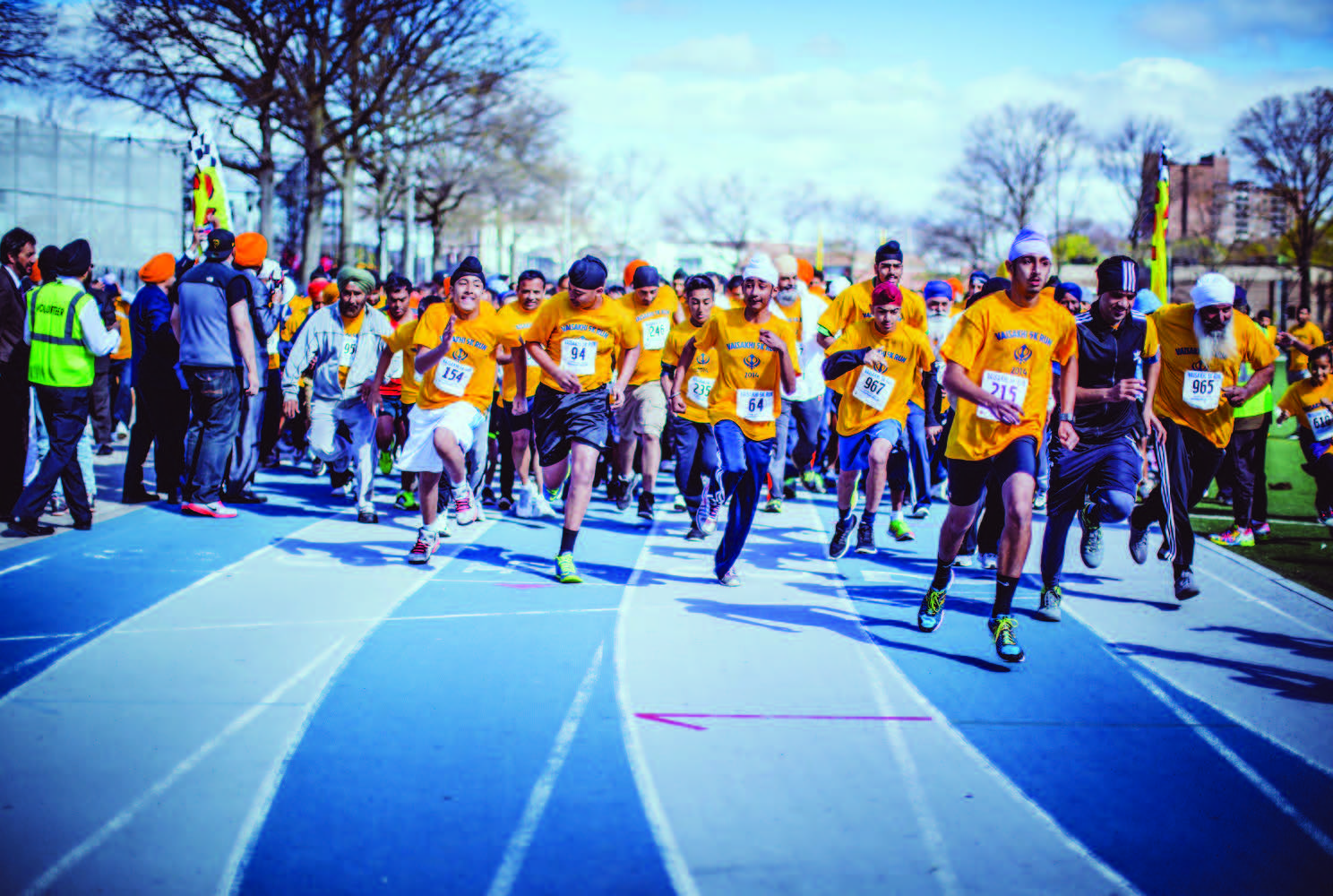
    RICHMOND HILL, NY (TIP): On Sunday, April 27th, 2014-after weeks of anticipation and virally growing interest-a first-of-itskind race took place at the beautiful Forest Park. Crowds arrived from across the tristate area for a day of competition, community, faith, and fun. The Vaisakhi 5K Run drew more than 500 participants of all backgrounds and levels of fitness.

    Runners aged 14 through 76 ran their own victory laps from a track aptly called Victory Field. Outfitted with the official golden-colored race t-shirt, runners lit up the park with their enthusiasm and positive mood. Prabhnoor Singh Badesha (BIB# 860) was the first-place male winner, and Jasvinder Kaur Vraich (BIB# 931) was the first place female winner.

    Male: 2nd place, Navdeep Bains (BIB# 860)
    Male: 3rd place, Manipal Singh (BIB# 289)
    Female: 2nd place, Sukhzinder Braich (BIB# 929)
    Female: 3rd place, Gabriela Sanchez (BIB# 38)

    The race was organized by a long-time marathoner Dr. Avtar Singh Tinna and India Association of Long Island President Satnam Singh Parhar in association with The Sikh Cultural Society. Vaisakhi 5K, Inc., the organizing committee for the event, was staffed with the finest officials and volunteers. Many proud sponsors and media partners served to make the event all the more complete. Since 1991, Dr. Tinna has been a regular in the 26.2-mile New York City Marathon and a number of other running events across the United States.


    19

    Donning his signature t-shirt labeled “Proud to be a Sikh,” he runs with his saffron (kesri) turban, attracting an enormous crowd of spectators as he treks through his many races. This year, Dr. Tinna’s objective was to get others to run. The Vaisakhi 5K was successful in what Dr. Tinna sees as a tradition in the making-a tradition promoting athleticism, fitness, and sport.


    20

    “What better way,” says Dr. Tinna, “than to get the community together and get fit as one?” Dr. Tinna, a dentist by profession, maintains a practice in Queens, New York City. He was born in Punjab, India in the village of Seh Jhangi, Jalandhar. Having studied at DAV College in Jalandhar and graduating from Punjab Government Dental College and Hospital in Amritsar, Dr. Tinna moved to New York in 1980.

    He lives there today with his wife and four children. For more information on the Vaisakhi 5K, the organization, or any sponsorship inquiries, please feel free to contact info@vaisakhi5k.com.

  • Appeal to Join the Support Aakash Rally on May 14th outside Governor Christie’s office in Trenton

    Appeal to Join the Support Aakash Rally on May 14th outside Governor Christie’s office in Trenton

    NEW JERSEY (TIP) A devout Hindu couple Dr. Adarsh Dalal and Harsha Dalal raised their only child, Aakash, born in New Jersey with love and care to live out their American dream. Aakash turned out to be a gifted student. He made an early mark in academic and extracurricular throughout his life.

    Aakash attended Lodi High School where he became Captain of the Tennis team. He won many award such as: second place in The National Chemistry Week Poster Contest, Bergen County Science League award, and second place American Chemical Society USA Science Competition.

    He scored 2280/2400 in SATs and joined Rutgers University, New Jersey in 2011. He soon became the President of Young Americans for Liberty at Rutgers and joined Presidential Candidate Ron Paul in New Hampshire during the Primary in 2011-2012. Around the end of January in 2012 Dr. & Mrs. Dalal’s worst nightmares started with Aakash’s interrogation by the Bergen County detectives in connection with the firebombing of synagogues.

    The interrogation was without the presence of an attorney or his parents. These nightmares culminated into catastrophic proportions that they are still suffering mentally, emotionally and financially since March 2nd, 2012 the day 19 years old Aakash was arrested in connection with these fire bombings of synagogues in Bergen County.

    The various Community organizations under Mr. Pradip Kothari are holding a protest on May 14, 2014 at 11.00 AM outside the office of Governor Chris Christie in Trenton in support of Aakash Dalal. Please join this protest keeping in mind that Aakash is an American citizen who has NOT been charged with a crime after his arrest since March 2, 2012 and since then languishing in solitary confinement. It could be you next.

    It is so easy to assume someone is guilty but that is not the way the judicial system should work. Obviously, the Bergen County Prosecutor and Courts have no evidence. Please join the protest to raise your voice against injustice and human rights violations.We Americans are famous for raising human right issues around the world so why not raise these issues at home also. Just remember the words of Reverend Martin Luther King Jr, “The great glory of American democracy is the right to protest for right”.

  • Mangano Announces World War II Encampment at Old Bethpage Village Restoration

    Mangano Announces World War II Encampment at Old Bethpage Village Restoration

    OLD BETHPAGE, NY -Nassau County Executive Edward P. Mangano has announced that Old Bethpage Village Restoration will host a World War II Encampment weekend on May 17th and 18th. Visitors will have the opportunity to step back in time and explore World War II history complete with living historians, tanks and artillery, and firefight demonstrations.

    “World War II was a significant event in American history,” said County Executive Mangano. “This annual Encampment at Old Bethpage allows residents to immerse themselves in history and learn about World War II in an interactive and meaningful way.”

    Old Bethpage Village Restoration, located at 1303 Round Swamp Road, is situated on 209 acres and the recreated 19th Century village offers a perfect impression of a rural European battlefield when American soldiers took on and defeated the Nazi Third Reich. Living historians in period gear representing a variety of forces will present vintage weapons and offer hands on displays while engaged in tactical exercises.

    Old Bethpage Village Restoration will be open from 10:00 a.m. to 4:00 p.m. on Saturday, May 17th and Sunday, May 18th. Reenactment activities will take place throughout both days. Admission is $10.00 for adults and $7.00 for children. For more information about Old Bethpage Village Restoration, please call: (516) 572-8400 or visit the website at: www.nassaucountyny.gov/parks.

  • Mahavir Jayanti celebrated with fervor

    Mahavir Jayanti celebrated with fervor

    EDISON, NJ (TIP): International Jain Sung (IJS) celebrated this year’s Mahavir Jayanti Program on April 20th with great pomp and show in Edison hotel Raritan center NJ, to commemorate the 2613th Birth Anniversary of Bhagwan Mahavir. Jains from all over NJ participated in the celebration.

    Bhagwan Mahavira was said to be born on the 13 day of the rising moon in Chaitra month in 599 B.C. making this year his 2613 birth anniversary, also known as janam kalyanak of Bhagwan Mahavir. The Janam Kalyanak of 24th and the last Trithinkar Bhagwan Mahavir was celebrated with great vigor and enthusiasm by the Jain community with Pooja , blessings from spiritual leaders Jainism messages from dignitaries.

    Program included Mahavir Bhagwan Pooja, Namokar Mantra Paath, Rath Yatra, Keynote speakers, Dignitaries and Guests, Essay Competition, Cultural program, Prizes followed by Social hour and lunch. The program started with Poojan where Lord Mahavir was worshiped and prayer was bestowed upon Bhagwan Mahavir with great devotion. This was followed by the Jaap of Namokar Mantra for world peace.

    Namokar Mantra is the most auspicious of all the mantras and if chanted with great devotion brings Bliss and happiness and destroys all evil. A grand colorful Yath Yatra (Procession) was taken out on this occasion reflecting the various stories of the 24 Trithankars in Jain religion with resplendent image of the Lord Mahavir in a procession in a chariot by all the devotees. The devotees praised lord Mahavir, singing and dancing with the idol of Mahavir Swami that was established and Abhisheakh ceremony was performed by all. . Upendra J. Chivukula who graced the occasion, expressed his views on Jainism.


    12
    Jain children who presented the cultural program

    Chivukula honored International Jain Sangh with”The State of New Jersey Assembly Commendation” to mark the 2613th birth Anniversary of Mahavir Jayanti The commendation read as “That I hereby honor and congratulate the International Jain Sangh, in recognition of its Mahavir Jayanti Program, salute its leaders and staff for their many years of selfless and tireless service to the people of this State, and extend the sincere best wishes for its continued vigor and success’ (pic attached) Key Note speaker at the function was Dr. Manoj Vora, a Jain vegetarian has made the mission to propagate peace and coexistence to all communities and only person from Jain faith who has conquered 7 summits in 7 continents including Mt. Everest in year 2013, enlightened the attendees by sharing his views on how Jain religion helped him achieve his goals and how the power of Namokar mantra brought energy and support in his mission. “IJS award of excellence” at the Mahavir Jayanti celebration program was presented this year to Dr. Manoj Vora, for all his achievements in furthering the cause of Jainism.

    Instituted in 2001, the IJS award of Excellence is presented annually to an exceptionally worthy person, who has visibly and verifiably demonstrated a great service to further the teachings of LordMahavir including peace, nonviolence, education, and compassion either by practice or by influencing public policies, The former recipients of this prestigious award are Bawa Jain, Dr. Dhiraj H.Shah, Arvind Vora, Dr. Tansukh Salgia, Pravin K.Shah, Dr. Sulekh Jain; Mahendra and Asha Mehta from Mumbai, and Dr. Sushil Jain Washington, DC A beautiful energetic cultural program was displayed on this event by the Jain children encompassing dances to the tune of bhajans, play and skits, hosted by Shalini Jain, Kids were recognized and presented with trophies for their performance and participation.


    13
    Assemblyman Upendra Chivukula presents to the President of the Jain Sangh “The State of New Jersey Assembly Commendation”.

    At the beginning of the program a Pledge for Mutual Respect and Nonviolence was taken by the attendees. The president of IJS Alok Jain gave the closing speech. The program ended on friendly, peaceful and devotional note. Jainism has been preached by a succession of twenty-four propagators of faith known as Tirthankaras. Jainism is a beautiful religion originating in India over two millennia ago, built on the principles of nonviolence, working on the self, and realization of multiplicity of truth through our varying perspectives of life. Lord Mahavir worked tirelessly all his life until he reached Nirvana, and then embarked barefoot to spread his message of truth across the great nation of India.

    Lord Mahavir practiced and preached environmental protection to safeguard trees, plants and animals for the living. The observation of the nonviolent practices of the Jainis was a major influence on the philosophy of the great Indian leader Mahatma Gandhi. The same principles of nonviolence and respect for life were practiced more recently by Dr. Martin Luther King, Jr., in the United States, as he led the struggle for civil rights for all Americans. Mahavir’s principles are extremely important today as well. Mahavir or the great soul taught us liberation of soul by right knowledge, right faith and right conduct. We must all bring this into our lives to make this world a better place for our children and grandchildren.

  • VODAFONE SEEKS ARBITRATION IN TAX ROW

    VODAFONE SEEKS ARBITRATION IN TAX ROW

    NEW DELHI (TIP): Conciliation talks between the Centre and Vodafone over a Rs 20,000 crore tax dispute have failed as the British telecom giant has decided to serve an arbitration notice to the government, a move which shuts out any possibility of a resolution through talks.

    The government had decided to withdraw its conciliation offer made to the telecom major for settling the nagging tax demand that arose from its 2007 acquisition of Hutchison Whampoa’s stake in Hutchison Essar. “Vodafone confirms that Vodafone International Holdings BV (VIHBV) has commenced an international investment arbitration against the Indian government under the Bilateral Investment Treaty (BIT) between India and the Netherlands,” a spokesperson for Vodafone Plc said in a statement from the company’s headquarter in London.

    “Since Vodafone and the Indian government have been unable to find an amicable means of resolving the dispute, Vodafone has commenced an international investment arbitration as a way to achieve resolution,” the spokesperson said. The arbitration notice was served on April 17, and Vodafone is understood to have settled for London as the venue for pursuing the case. Agency reports said the finance ministry had already moved a Cabinet note for withdrawal of the non-binding conciliation offer it had made to Vodafone in June last year.

    The telecom company has been given two months for response, which effectively means that arbitration would have to be handled by the new government, which takes charge after the general elections in mid-May. The Cabinet had on February 28 decided to put on hold the proposal to withdraw the conciliation offer, pending settlement of Vodafone’s transfer-pricing case at the Income Tax Appellate Tribunal (ITAT).

    Vodafone, in its notice, however, said it wants to move ahead with the arbitration without waiting for the ITAT decision on the Rs 3,700 crore transfer-pricing case. The Supreme Court had ruled in Vodafone’s favour on the capital gains tax issue in 2012, saying it was not liable to pay any tax over the acquisition of assets in India from the Hong Kong-based Hutchison. However, the government went ahead with its plans to collect the tax by changing the rules to claim tax retrospectively.

    “The BIT arbitration arises from the government’s 2012 enactment of retrospective taxation on VIHBV’s acquisition of indirect interests in Hutchison Essar, which the Supreme Court held was not taxable under the law at the time,” the Vodafone spokesperson said. In June last year, the Cabinet had approved a finance ministry proposal to go in for conciliation with Vodafone to resolve the capital gains tax dispute.

    While the basic tax demand is Rs 7,990 crore, the total outstanding comes at around Rs 20,000 crore after including penalty. Earlier this year, the finance ministry circulated a draft Cabinet note seeking to withdraw the conciliation talks after Vodafone demanded that the transfer-pricing row be clubbed with the capital gains tax case.

    This had followed a notice under the Bilateral Investment Promotion and Protection Agreement (BIPA) by Vodafone International Holdings BV to the government over the tax dispute. It said the amendment to the I-T Act will cause VIHBV substantial financial loss. The finance ministry has insisted that the tax case does not fall within the ambit of the India-Netherlands BIPA.

  • TATA-AIRASIA GETS LICENCE FROM DGCA

    TATA-AIRASIA GETS LICENCE FROM DGCA

    NEW DELHI (TIP): Indian flyers are soon going to be spoilt for choice and low fares may make a comeback. The Tata Sons’ JV budget airline with Malaysia’s AirAsia got the licence to fly from the directorate general of civil aviation (DGCA) on Wednesday.

    This clearance, however, is subject to the judicial ruling in this regard as BJP leader Subramanian Swamy has moved court against forming startup airlines using FDI from foreign airlines route. The JV, AirAsia India Pvt Ltd (AAIPL), will be India’s seventh airline and aims to start flying anywhere between one to three months from now. Its CEO Mittu Chandilya says the new low-cost carrier will offer “35% lower fares” from current fare levels.

    “As of now we have one Airbus A- 320 and we will induct one aircraft every month. We will like to begin operations with a fleet of three planes. While three network options have been worked out, the first flight could be out of Chennai (the airline’s hub). Initially, our network will be all the metros except Mumbai. We may fly to Delhi as leaving the national capital out of the network does not seem feasible for a national airline like AAIPL,” Chandilya said after getting the air operator’s permit from DGCA chief Prabhat Kumar.

    Prabhat Kumar said: “We have granted the Air Operator’s Permit (AOP or flying licence) to AirAsia India, subject to the final decision of the high court and that is, under the directions of the Supreme Court.” The airline marks the re-entry of the Tatas into airline business after several decades. They had tied up with Singapore Airlines (SIA) in the late 1990s to acquire a stake in Air india but due to opposition from some players in the airline business and political interference, the move fizzled out.

    Once UPA-II allowed FDI by foreign airlines into Indian carriers, the Tatas came back with a bang. While Tata-AirAsia has been cleared to take off, the DGCA is in the process of granting licence to a Tata-SIA JV full service airline that should also start flying this year. AirAsia CEO Tony Fernandes tweeted: “History has been made today in Aviation. Everything has been hard for Airasia but we never give up.

    Today AirAsia India has got APPROVAL….. Our CEO @MittuChandilya with Air Operators permit. What a battle that was. Proud day for me and all AirAsia stars.” Chandilya also tweeted: “Boom! 1815hrs(IST) today AirAsiaIndia was born. So, proud of my team. Who is ready to revolutionize Air Travel in India.” But, not everyone was happy. Swamy, who is opposing the Tata JVs, ‘condemned’ the move and said it was done “reckless disregard of the rules and regulations”.

  • COCA-COLA, PEPSICO TO REMOVE CONTROVERSIAL INGREDIENT FROM DRINKS

    COCA-COLA, PEPSICO TO REMOVE CONTROVERSIAL INGREDIENT FROM DRINKS

    NEW YORK (TIP): Coca-Cola and PepsiCo said on Monday they’re working to remove a controversial ingredient from all their drinks, including Mountain Dew, Fanta and Powerade. The ingredient, called brominated vegetable oil, had been the target of petitions on Change.org by a Mississippi teenager who wanted it out of PepsiCo’s Gatorade and Coca-Cola’s Powerade.

    In her petitions, Sarah Kavanagh noted that the ingredient has been patented as a flame retardant and isn’t approved for use in Japan and the European Union. Coca-Cola and PepsiCo have stood by the safety of the ingredient, which is used to distribute flavors more evenly in fruit-flavored drinks. But their decisions reflect the pressure companies are facing as people pay closer attention to ingredient labels and try to stick to diets they feel are natural.

    Several major food makers have recently changed their recipes to remove chemicals or dyes that people find objectionable. While food companies stress that the ingredients meet regulatory requirements, their decisions reflect how marketing a product as “natural” has become priority and a competitive advantage. PepsiCo had said last year that it would remove brominated vegetable oil from Gatorade.

    On Monday, the company said it has since been working to remove it from the rest of its products. PepsiCo also uses BVO in its Mountain Dew and Amp energy drinks. The company, based in Purchase, New York, didn’t provide a timeline for when it expects the removal to be complete. Earlier on Monday, Coca-Cola had also said that it’s removing the ingredient from all its drinks to be consistent in the ingredients it uses around the world.

    In addition to Powerade, Coca-Cola uses BVO in some flavors of Fanta, Fresca and several citrus-flavored fountain drinks. The company said BVO should be phased out in the US by the end of the year. Coca-Cola said it would instead use sucrose acetate isobutyrate, which it noted has been used in drinks for more than 14 years, and glycerol ester of rosin, which it said is commonly found in chewing gum and drinks.

    A Coca-Cola spokesman, Josh Gold, noted that BVO isn’t used in many other countries, but said it would be phased out in Canada and Latin America as well. The Center for Science in the Public Interest, a health advocacy group, notes that the Food and Drug Administration permitted the use of BVO on an interim basis in 1970 pending additional study. Decades later, the group notes that BVO is still on the interim list.

    Kavanagh, the Mississippi 17-yearold, had been planning on launching another petition on Change.org asking PepsiCo to remove BVO from all its drinks. She wasn’t immediately available for comment. Earlier in the day, however, she said, “It’s really good to know that companies, especially big companies, are listening to consumers.”

  • International Regional Hindi Conference 2014 held

    International Regional Hindi Conference 2014 held

    NEW YORK, NY (TIP): The Consulate General of India in association with ‘Yuva Hindi Sansthan’ and New York University organized the International Regional Hindi Conference 2014 in New York during 25-27 April 2014. The theme of the Conference was “The Hindi Language in the 21st Century Global World”.

    Under this, discussions were held on two sub-themes – “Hindi as the Language of the Indian Diaspora” and “Hindi Education”. On 25 April 2014, a welcome reception and dinner was held at the Consulate for all the experts and participants during which ‘Prayog Hindi Manch’, USA, staged the play “Andhon Ka Haathi” written by famous Hindi writer the late Sharad Joshi. On 26 April 2014, the Conference commenced with the lighting of lamp.


    8
    Staging of play “Andhon Ka Haathi” written by Late Sharad Joshi

    Addressing the participants present, Consul General of India, Dnayaneshwar M. Mulay expressed his good wishes for the success of the Conference. The Conference was inaugurated with the telecast of Ambassador of India to the USA, Dr. S. Jaishankar’s message. This was followed by a Keynote address by the Chairman of Yuva Hindi Sansthan, Dr. Surendra Gambhir of University of Pennsylvania on the subject “America’s Vision of Building a Multi-lingual Society: A Golden Period for Hindi”.

    During the Conference experts from the US, Canada and India discussed about the efforts made, difficulties faced, various experiments, use of technology, etc. in teaching Hindi. The second day of the Conference ended with a Kavi Sammelan in which poets from the US, Canada and India participated. A number of proposals were put forth during the Conference – setting up of a Hindi Center in the US, holding the Conference annually, making resources for learning/teaching Hindi available online, collaborating with the Resource Centers in India, etc.


    9
    Ambassador of India to the US, Dr. S. Jaishankar’s video inaugural address

    The experts and participants wholeheartedly supported these proposals. In the Closing Session of the Conference on the afternoon of 27 April 2014, Prof. Gabriela Nik. Ilieva of New York University presented the Conference Review. Following this Deputy Secretary (Hindi), Ministry of External Affairs of India, Smt. Suniti Sharma addressed those present.

    In this Closing Address, Consul General of India, Dnyaneshwar M. Mulay extended his congratulations on the successful conclusion of the Conference and expressed the hope that a similar Conference would be organized soon. He presented Certificates of Recognition to all the experts who had made presentations during the Conference. The Conference concluded with a vote of thanks by the Chief Coordinator of the Conference, Sugandh Rajaram.


    10
    Consul General of India, Dnyaneshwar M. Mulay’s closing address

  • A CAR SYSTEM THAT DETECTS PEDESTRIANS AT NIGHT

    A CAR SYSTEM THAT DETECTS PEDESTRIANS AT NIGHT

    LONDON (TIP): Researchers have designed a new system for cars that can detect pedestrians upto 40 metres away in low visibility conditions such as night time driving. Researchers at Universidad Carlos III de Madrid (UC3M) in Spain designed the system which is made up of infrared cameras that capture body heat.

    The system uses images captured by far infrared with two thermal cameras to identify the presence of individuals in their field of vision. The objective is to alert the driver to the presence of pedestrians in the path of the vehicle, and even, in the case of cars with automated systems, actually stop the vehicle.

    “With the model being used in our research, pedestrians up to 40 metres away can be detected, although this distance could be extended if we substitute the lens with one that has greater focus range,” said one of its designers, Daniel Olmeda, from the Intelligent Systems Laboratory (LSI) at UC3M.