Month: September 2014

  • INDIA- US RELATIONS

    INDIA- US RELATIONS

    I.S. Saluja

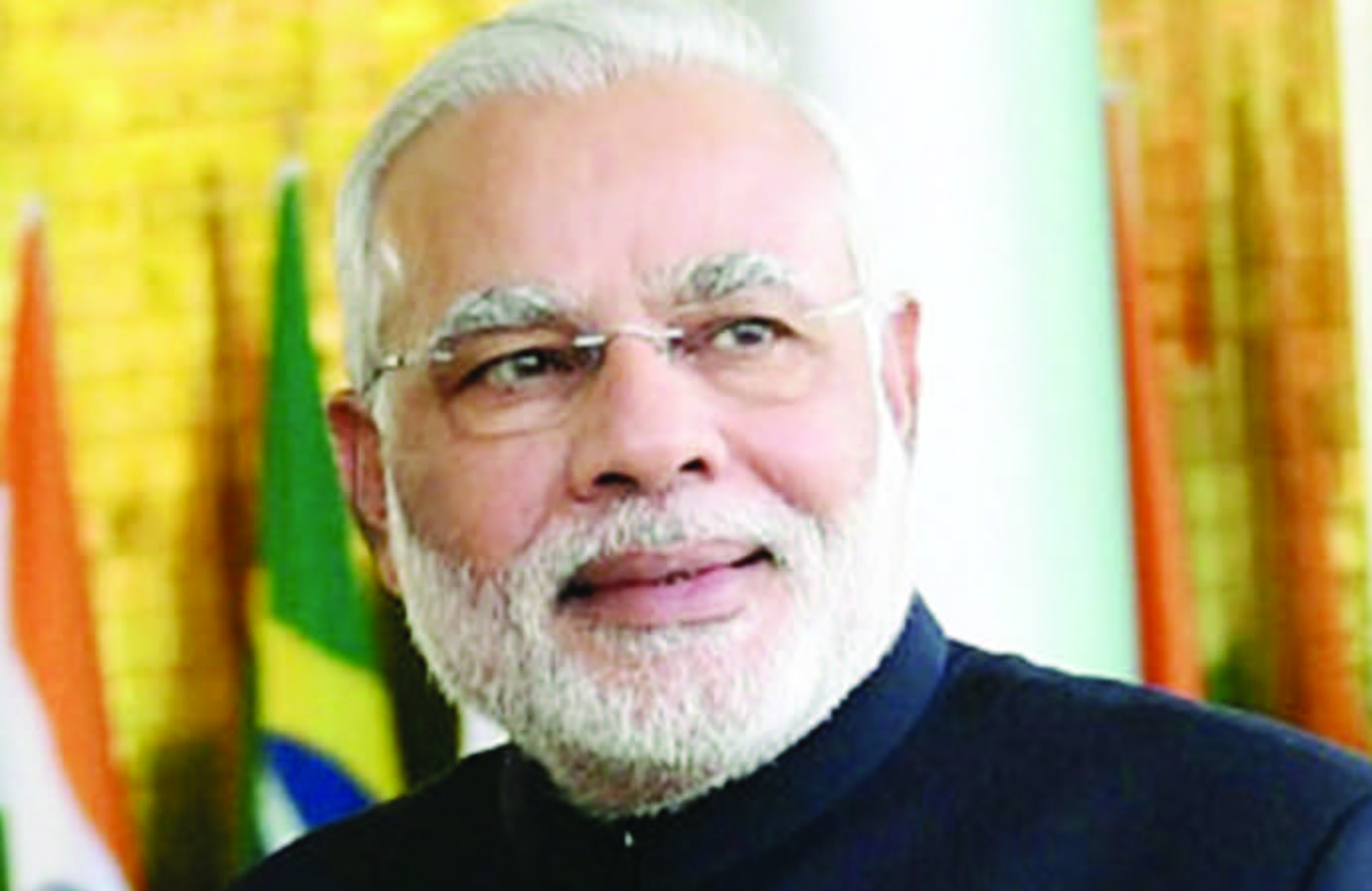
    Prime Minister of India, Narendra Modiarrives in New York today, September 26, on afive day visit to USA. His visit, the first asPrime Minister, is being viewed as a powerful push to ensure the relationship between the two democracies of the world acquires genuine warmth, which, over the last few years, hasnoticeably been on the decline.

    Only for a brief period, during the Prime Ministership of Atal Behari Vajpayee, the relationship really warmed up but again, over the years, there have been many hiccups inspite of the loud protestations of “strategic relationship and partnership”.The question which every Indian Americanis asking is : “Will Modi’s visit bring about achange in the US perception of India and createconditions for a genuine friendly relationship,realizing equal partnership and based onmutual respect.In order to obtain a perspective, I spoke withone of the best known Indian Americans, asuccessful and eminent Attorney, Ravi Batra,who has considerable inroads in to the mainstream politics and is familiar with thethinking of US lawmakers, being friendly withquite a few of them.

    EXCERPTS:

    ” It would well serve India to make regulardeposits of goodwill in the generational Bank of Goodwill, such as the one that exists betweenUS and England. I wish to see India see UnitedStates as its inseparable nation-partner”.Another one.” Just remember that United States and India are destined to be joined at the geo-political and economic hip, even as ourpeople share the identical Dream.”Yet another. “Every relationship between living breathing people has irritants. Same istrue of nations. But to define the US-Indiarelationship from the irritant-lens is bothinaccurate and offensive. India and USA are “onthe same page” more often than not. But everyelection, here or elsewhere, gives a turbo-boostin a longstanding relationship, such that itexperiences a honeymoon period again andagain. It’s the Honeymoon period now.”And, finally, this. Be honorable and loyalCitizens of the United States, and continue toreach for the stars – and become worthy ofbeing included in pictures, rather than askingto be in one!

    Here is the full interview.

    Q. What factors have dominated andgoverned the relationship between India andUSA?

    USA?People and governments, and the near-law ofphysics when applied to geopolitics.You must remember that the Americanpeople have loved India all the way back toVasco Da Gama and Christopher Columbus – it’sin America’s soul at birth – this India-love thing.Then came Mahatma Gandhi – a love object ofall humanity, even as governments abhorredhim as a pain without equal. The recent post-Cold War relationship has been economicallydriven, rather than strategically, for Pakistanwas much better located as a buffer to the oldSoviets. The recent IT revolution, however, andIndia’s youthful citizenry has made India,previously known as a “Golden Sparrow” morelike a “Golden Falcon” to the great AmericanBald Eagle – I take some pleasure in that nameand description. Remember now that the young1.3 billion Indians can add value to everynation’s bottom line, even as they produce, andconsume goods and services from across theglobe.

    Q. How far the initial Socialistic character ofIndia in the first 40 years of IndependentIndia has been responsible for distancingbetween India and USA?

    Well, systems come and go, as do strategicalliances. Communism has been discreditedwithout doubt. Capitalism, while it has its faults,has been proven to be the best engine of growthand development. Now, the environmentalistswould argue that development and growth arethemselves the enemy – I disagree. Even to arrestclimate change, we need development of the”green” variety, flying on the wings ofcapitalism. But to answer your question directly,United States which pushed Britain to let Indiabecome free wasn’t happy with the old Soviet-India connection. Glad, that is over. Now, likePresident Obama in his GA speech onWednesday, I look forward to Russia, having”absorbed” Crimea, will return into the fold andbehave in a law-respectful way rather than a PacMan of others’ sovereignty. With Obamapresiding over the Security Council, Russiavoted with everyone to overcome the evil of ISIS.

    Q. In International politics, what have beenthe expectations of US from India and viceversa and how far have these been fulfilled?

    United States expects India to be one of ourcloset allies, without trying to get the best dealin every transaction every time. It would wellserve India to make regular deposits of goodwill in the generational Bank of Goodwill,such as the one that exists between US andEngland. I wish to see India see United States asits inseparable nation-partner.As for India, I am not qualified to answer.

    Q. What have been the significant convergingpoints in the relationship between the twocountries?

    Civilizations that value culture, education,family, education, hard work, and separation ofchurch and state. And then there was terror:9/11 and 26/11.We are joined at the hip in thefight against terror.

    Q. What have been the major discordant notesin the relationship?

    India has had to change its dance partnerafter the collapse of the Soviet Union, and riseof extremism. Sometimes, we in the UnitedStates have not treated India with sufficientrespect, such that it bordered on downrightinsult.

    Q. Can you identify some highs and lows in therelationship between the two countries,clearly analyzing the causes?

    President Bush gave India the Civil Nucleardeal, even as India bought its nuclear powerplants from France and Russia – not nice, nomatter the price differential.While clearly not as important, KrittikaBiswas and Devyani Khobragade to name twoevents. Obviously, had the Indian citizenry notgotten emotionally involved, these casesbelonged in the minor item category. Krittikawill be remembered for America setting thingsright, due to our great independent judiciary.Devyani has now been resolved – I happilypushed the nice Ambassador. Nancy Powellinto early retirement for her apparentobstruction of Indian laws. And PresidentObama has given us – all of us – the highesthonor of appointing an Indian-American asour ambassador to India; this exceedsappointing the now-legendary Preet Bharara asSDNY US Attorney and Sri Srinivasan as afederal Circuit Judge.Wow. This is the “feelgood” stuff. There is so much more on agovernment-to-government basis that securesIndia’s safety.Just remember that United States and Indiaare destined to be joined at the geo-political andeconomic hip, even as our people share theidentical Dream.

    Q. How far do you think the significantly largepresence of people of Indian origin serving inimportant areas like medical services and IThas influenced US attitude towards India?

    Well, being around hardworking people doinggood for many is always goodwill causing. Byand large, our Indian-American doctors havegreat bedside manners beyond their dedicationand smarts. Our folks in the IT section ofsociety have become a brand – that’s how cool itis. Being of Indian blood makes youautomatically IT brilliant.Well, I’m anexception now – for I need kids help to programanything.

    Q. Do you think US will give in to India’sdemands on H1 B visa and other concessionswith respect to immigration, desired by India?

    We should, for its good for the Americaneconomy. But, “immigration” is a near-Thirdrail of national politics, as many Americanshave not recovered from the Great Recessionand see immigrants, legal and illegal, as jobeating,when H1B are highly skilled andunavailable in United States.When emotionsget married with politics, don’t expect reason torule.Q. Another concern of India is US support toPakistan? Do you think US will do somethingto change its policy towards Pakistan, toplacate India?United States owes Pakistan for its loyaltyduring the 50 odd years of the Cold War. Thatwe need exit routes or entry routes, as the casemay be, for Afghanistan and such only serves toremind that Pakistan needs to be treated better.I think we should support Pakistan-India opentradeso that open people-exchange can followin a decade or so. It is not right that people whoshare near-identical culture have had wars andgovernments have sowed distrust when theoverwhelming commonality should be a jointasset.We need to improve everyday Pakistani’slife, if we want to ever live free of local terror.Then, we ought to do so world-wide, to be reallyfree of terror.We need everyone to be living theAmerican Dream, when merit rules, so peace isas durable as the Pax Romana was.

    Q. India’s overtures towards Japan and Chinaand its involvement in BRICS have beingviewed with suspicion by US . What can Indiado to remove this suspicion?

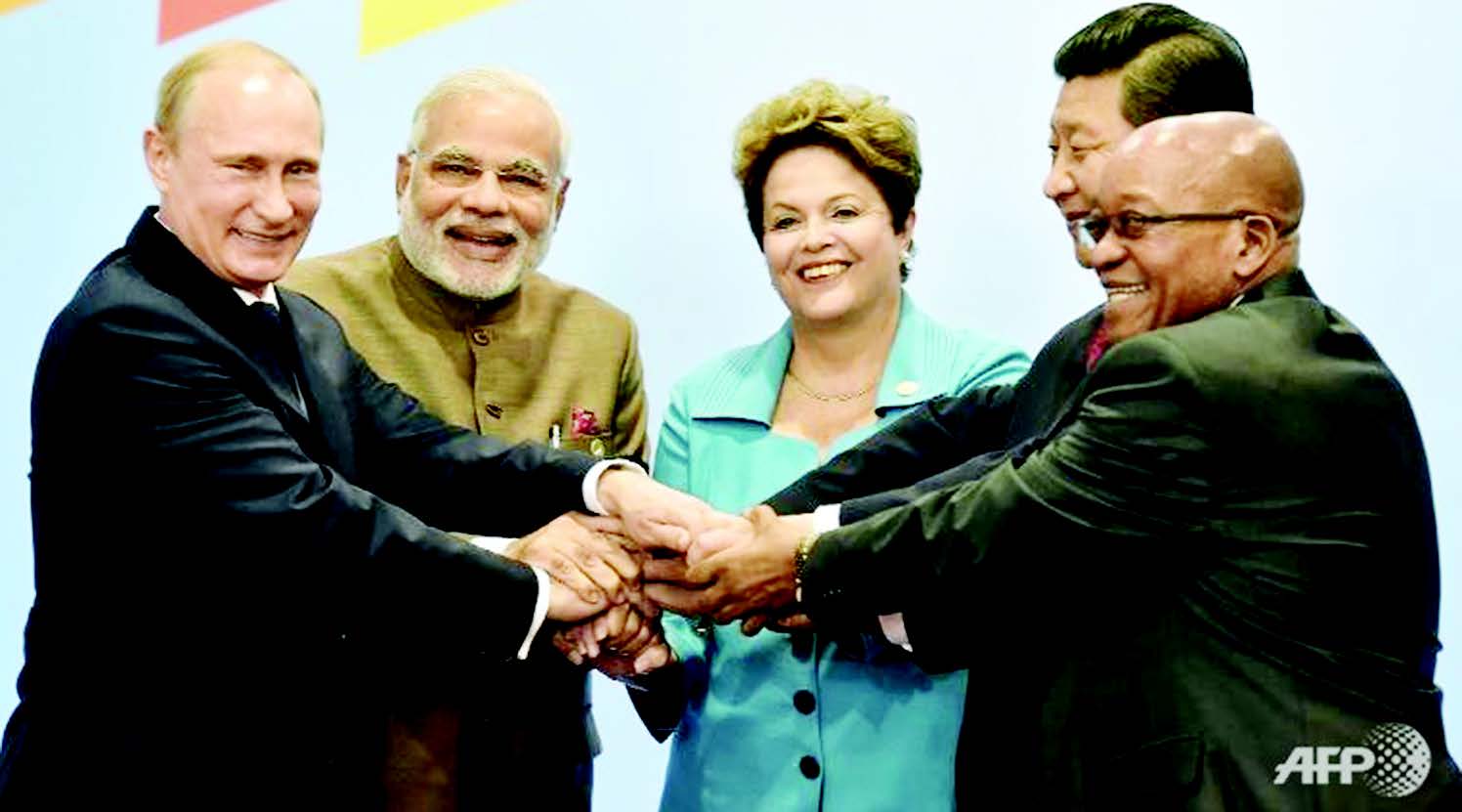
    BRICS were intended to cause suspicion, andhence, drive up the price for India and other BRICS nations. Of course, it was also a sort ofNAFTA across the air and sea among suchnations.

    Q. Do you think, US will act fast to acceleratethe process of reform of the Security Council,whereby seating India on the Council?

    The world order is based upon the P5 powersharing.That is the true geo-political axis that193 nations revolve around and exist with. It’sas real as the Sun in the sky. Yes, reforms areneeded, and Germany, Japan, India and SouthAfrica fantasize most about them. Ask me thisquestion in 25 years, and let’s see if it’s stillrelevant – as I suspect it will be.

    Q. Do you think Mr. Modi ‘s visit to US willgive new momentum to India- US relations ,given the fact that there are quite a fewirritants in their relationship?

    Every relationship between living breathingpeople has irritants. Same is true of nations.But to define the US-India relationship from theirritant-lens is both inaccurate and offensive.India and USA are “on the same page” moreoften than not. But every election, here orelsewhere, gives a turbo-boost in a longstandingrelationship, such that it experiences ahoneymoon period again and again. It’s theHoneymoon period now.

    Q . What would be your suggestions to the twocountries to strengthen their relations?

    Whatare the areas where the two can cooperate?Don’t do stupid stuff, like Devyani; for itmasks and overshadows tons of good stuffbetween the two nations that occur no matterwho governs in either capitol. Aside foravoiding an intended insult that Devyani was,avoid the unintended insult.During the official US/India RoundtableDiscussion in July 2014 held under theCongressional Dome to which my wife, Ranjuand I were independently invited to, I hadbluntly given my love potion: Respectful Reset,even as the “Reset,” between us and Russiadidn’t do so well. India and United States arenow a grown-up relationship, and discord needsnever to enter the public domain. Period.

    Q. What, do you think, the Indian Americancommunity should do to promote the processof strengthening of relations?

    Be honorable and loyal Citizens of the UnitedStates, and continue to reach for the stars – andbecome worthy of being included in pictures,rather than asking to be in one!
    Page 23

    Page 231

  • India Joins the Space Elite with Successful Mars Mission

    India Joins the Space Elite with Successful Mars Mission

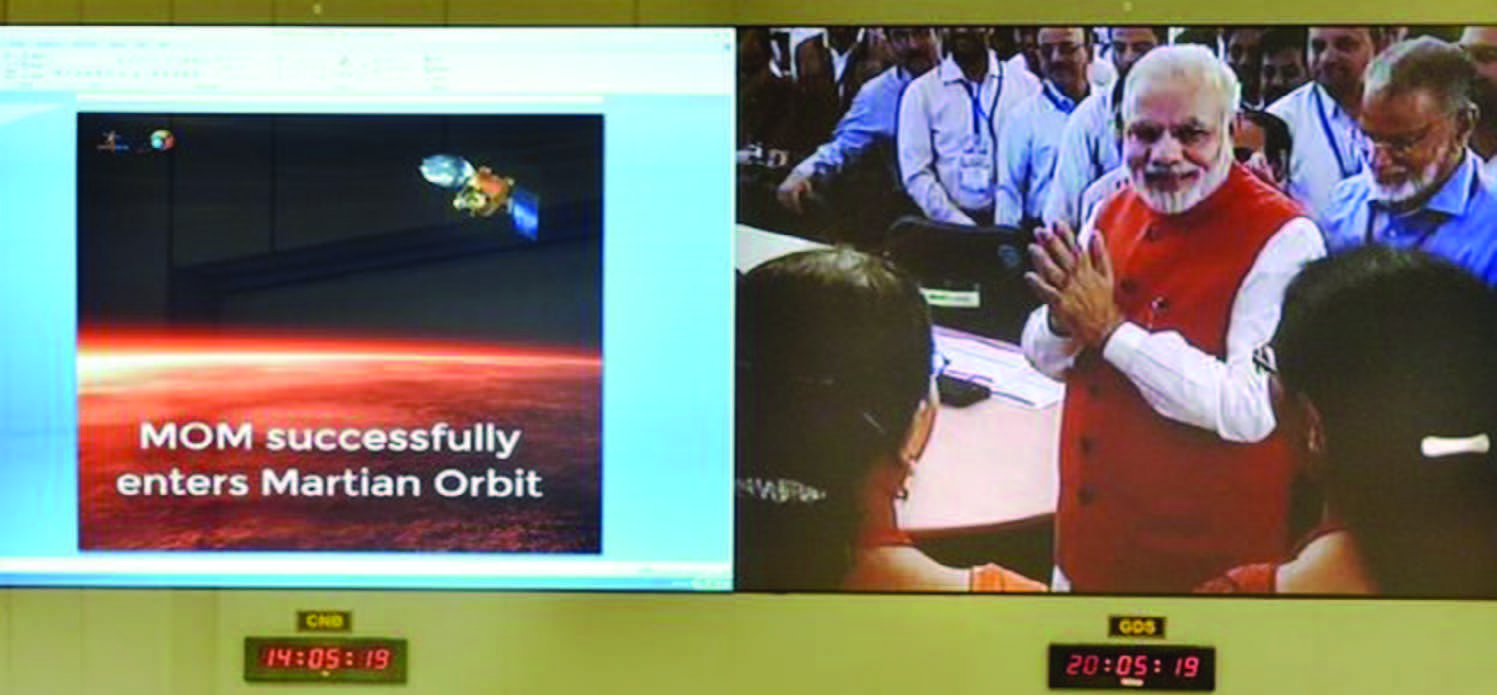
    BENGALURU (TIP): “We have gone beyond the boundaries of human enterprise and innovation,” an exultant Prime Minister Narendra Modi said, standing alongside Indian Space Research Organization (ISRO) scientists at the command center in the southern tech hub of Bangalore. “We have navigated our craft through a route known to very few.” India is the first country to reach Mars’ orbit on a maiden venture and the first Asian country to launch a successful Mars mission, all with a much cheaper price tag than any Mars mission before it.

    India now joins an elite club of nations who have successfully carried out interplanetary space missions, and has scored a significant point in its rivalry with China. The Mangalyaan satellite was confirmed to be in orbit shortly after 0800, Indian time., September 24 . It is, without doubt, a considerable achievement. This is a mission that has been budgeted at 4.5bn rupees ($74m), which, by Western standards, is staggeringly cheap. The American Maven orbiter that arrived at the Red Planet on Monday is costing almost 10 times as much. Back in June, Indian Prime Minister Narendra Modi even quipped that India’s real-life Martian adventure was costing less than the make-believe Hollywood film Gravity. Even Bollywood sci-fi movies like Ra.One cost a good chunk of what it has taken to get Mangalyaan to Mars. So how has India done it? For sure, people costs are less in this populous nation, and the scientists and engineers working on any space mission are always the largest part of the ticket price. Home-grown components and technologies have also been prioritized over expensive foreign imports. But, in addition, India has been careful to do things simply.

    “They’ve kept it small. The payload weighs only about 15kg. Compare that with the complexity in the payload in Maven and that will explain a lot about the cost,” says Britain’s Prof Andrew Coates, who will be a principal investigator on Europe’s Mars rover in 2018. “Of course, that reduced complexity suggests it won’t be as scientifically capable, but India has been smart in targeting some really important areas that will complement what others are doing.” Mangalyaan has gone equipped with an instrument that will try to measure methane in the atmosphere. This is one of the hottest topics in Mars research right now, following previous, tantalizing observations of the gas. Earth’s atmosphere contains billions of tons of methane, the vast majority of it coming from microbes, such as the organisms found in the digestive tracts of animals. The speculation has been that some methane-producing bugs, or methanogens, could perhaps exist on Mars if they lived underground, away from the planet’s harsh surface conditions.It is a fascinating prospect. So, even though Mangalyaan has a small payload, it will actually address some of the biggest questions at the Red Planet. Western scientists are excited also to have the Indian probe on station. Its measurements of other atmospheric components will dovetail very nicely with Maven and the observations being made by Europe’s Mars Express. “It means we’ll be getting three-point measurements, which is tremendous,” says Prof Coates. This will enable researchers to better understand how the planet lost the bulk of its atmosphere billions of years ago, and determine what sort of climate it could once have had, and whether or not it was conducive to life.

    I have read a lot about the criticism of Mangalyaan and India’s space program.There’s an assumption among many, I guess, that space activity is somehow a plaything best left to wealthy industrial countries; that it can have no value to developing nations. The money would be better spent on healthcare and improved sanitation, so the argument goes.But what this position often overlooks is that investment in science and technology builds capability and capacity, and develops the sort of people who benefit the economy and society more widely. Space activity is also a wealth generator. Some of the stuff we do up there pays for stuff down here. The industrialized nations know it; that’s one of the reasons they invest so heavily in space activity. Consider just the UK. It has dramatically increased its spending on space in recent years.

    The government has even identified satellites as being one of the “eight great technologies” that can help rebalance the UK economy and drive it forward. India wants a part of this action, too, and in Mangalyaan and its other satellite and rocket programs, the nation is putting itself into a strong position in international markets for space products and services. Commenting on the spectacular success of the Mars Mission, New York based attorney Ravi Batra said in a statement to The Indian Panorama: “India’s MOM’s success as the 1st nation to do so, and that too on a $74 million budget, speaks to India’s riches being in its people. PM Modi’s arrival in the United States for the GA and Pres. Obama now has a new credential – India’s people are smart and driven to touch the stars. Want to play together and build a better economy with Indian smarts?”

  • Prime Minister Modi calls for ‘global commitment and more concerted multilateral action’

    Prime Minister Modi calls for ‘global commitment and more concerted multilateral action’

    NEW DELHI (TIP): Prime Minister Narendra Modi, on his five-day visit to the U.S. arrives at JFK Airport in New York today, September 26. He will spend two days in New York, during which he will address the United Nations General Assembly and attend a community reception to welcome him before heading to Washington for his first meeting with US President Barack Obama. In a statement ahead of his departure, Modi said he was “confident that the visit will mark the start of a new chapter in our strategic partnership”. Time bound reform of UN Security Council, reforming international financial institutions, development agenda for third world countries and strong coalition to fight global terror will top the agenda of Narendra Modi’s maiden speech as India’s PM at UN General Assembly in New York on September 27. Modi, who will deliver his speech in Hindi, will utilize this opportunity to outline his global vision, sources said.

    This is his maiden foray at global stage, the first being BRICS Summit at Brazil in July. The PM gave a glimpse of his focus at UN in his statement on Thursday, September 25 before departing for New York via Germany. “I will call for a stronger global commitment and more concerted multilateral action in meeting these challenges. I will urge early adoption of the Post-2015 Development Agenda with focus on growth, development and elimination of poverty. As we head towards the 70th Session of the UNGA in 2015, I will also stress the urgency of early reforms in the United Nations, to ensure that it remains relevant and effective in dealing with the challenges of the 21st Century’ said Modi in his statement.

    Besides, global economic and health challenges will also be his focus at the maiden outing in the General Assembly. Here is the text of PM Modi’s statement before he left for his US trip: I am visiting the United States from 26 to 30 September 2014. I will attend the United Nations General Assembly in New York and, thereafter, visit Washington DC on 29-30 September 2014 for a bilateral summit with U.S. President Barack Obama. Since its participation as a founding member of the United Nations in 1945, India has shown unwavering commitment to multilateral processes to advance peace and security and promote broad-based inclusive economic development in the world. India’s contribution to UN peacekeeping operations over decades is a strong testimony of our efforts to contribute to the achievement of the objectives of the UN charter. The 69th session of the UN General Assembly is meeting at a moment of many pressing challenges for the international community – a still fragile global economy, turbulence and tension in many parts of the world, growth and spread of terrorism, the Ebola health crisis in Africa, climate change and the endemic global challenge of poverty.

    I will call for a stronger global commitment and more concerted multilateral action in meeting these challenges. I will urge early adoption of the Post-2015 Development Agenda with focus on growth, development and elimination of poverty. As we head towards the 70th Session of the UNGA in 2015, I will also stress the urgency of early reforms in the United Nations, to ensure that it remains relevant and effective in dealing with the challenges of the 21st Century. I will also meet the United Nations Secretary General Ban Ki Moon and leaders from other countries on the margins of the UNGA. The New York leg of my visit will also cover important elements of our bilateral relations with the United States. I look forward to meeting business leaders to invite them to participate more actively in India’s economic growth and transformation. This is message that I will also convey to the U.S. business community in Washington DC. My participation in a public event in Central Park in New York that on poverty is to focus international attention on this great challenge for humanity and affirm my support for global civic action, especially involving the youth, to address it. I keenly await the opportunity to meet the Indian American Community at the Madison Square Garden in New York. Their success in diverse fields, their contribution to the United States, their abiding bonds with India and their role as a vibrant bridge between the two largest democracies is a source of pride for us.

    They serve as a window to our heritage, progress and potential. I look forward to meeting President Obama over two days in Washington DC. This will be my first meeting with him. His life’s journey is a remarkable testimony to the rights and opportunities that democracies provide, and an inspiration for people around the world. Shared values, convergent interests and complementary strengths provide the foundation for natural partnership between the world’s oldest and largest democracies. I see the United States as a vital partner for our national development, drawing especially on the rich possibilities of partnership in education, skills, research, technology and innovation – and, above all, a shared commitment to human values. Working together, and with others, we can bridge the many divisions of our times and contribute to building a more peaceful, stable, secure, sustainable and prosperous world. I will discuss with President Obama how we can use the strength of all that we share and all that we have built so far to take our relationship to a new level in the interest of our two countries and the cause of this world. I am confident that the visit will mark the start of a new chapter in our strategic partnership.

  • MAKE IN INDIA

    MAKE IN INDIA

    The Prime Minister’s call for making India a manufacturing hub and creating jobs should boost small and medium enterprises as well

    By Charan Singh Prime Minister Narendra Modi’s ‘Make in India’ campaign is creating waves both in India and abroad. Given the government’s intention to boost domestic manufacturing and create new jobs, its proposal to introduce a new policy for Micro, Small and Medium Enterprises (MSMEs) deserves a closer look. While Mr. Modi’s invitation to international companies to make investments has been receiving a lot of attention, the government’s close interaction with industry associations from different regions and sectors within India to discuss specific problems inhibiting domestic enterprises deserves equal consideration. India’s MSME sector has recorded more than 10 per cent growth in recent years despite the economic slowdown. MSMEs contribute nearly eight per cent to the national GDP, employing over eight crore people in nearly four crore enterprises and accounting for 45 per cent of manufactured output and 40 per cent of exports from India. Thus, the focus of the government on MSMEs at this juncture is justified given their potential for providing growth and employment.

    Significant initiatives In view of the significance of the sector, the government had announced a number of measures in its first budget. Some of the significant initiatives were setting up of Rs.10,000 crore of venture capital fund and establishing a nationwide, district-level incubation and accelerator program for encouraging entrepreneurship. Other important budgetary announcements included establishing a network of Technology Centers; revising the definition of MSMEs for providing higher capital ceiling, friendly legal bankruptcy framework to enable easy exit, a program to facilitate forward and backward linkages with multiple value chain of manufacturing and service delivery to be put in place, and launching the Skill India movement for youth with an emphasis on employ ability and entrepreneurship. A committee was also proposed to examine the financial architecture with a view to removing bottlenecks and creating new rules and structures for the sector.

    The government recently inaugurated a holistic, innovative and low-cost National Small Industries Corporation’s online e-commerce shopping portal for buying and selling of products produced by MSMEs. MSMEs are mainly classified as manufacturing and service enterprises. There is a specific stipulated limit on investment in plant and machinery for each of the respective micro, small and medium segments in manufacturing with a maximum limit of Rs.10 crore, and for equipment in service enterprises with a maximum limit of Rs.5 crore. MSMEs with 94 per cent of units unregistered are highly diverse in terms of their size and the level of technology employed. The production in the sector ranges from output of grass-root village industries and auto components, to microprocessors, electronic components and electro-medical devices. Since 1948, successive governments have been making intense efforts to encourage MSMEs but the sector continues to be under stress. The office of Development Commissioner for MSMEs was set up in 1954 and a dedicated Ministry for MSMEs in 1999. The Small Industries Development Bank of India (SIDBI), established in 1990, is the principal financial institution for promotion, financing and development of the MSMEs in addition to commercial banks, State financial corporations, and State industrial development corporations. Despite such efforts, some of the key problems faced by MSMEs continue to be related to availability of technology, infrastructure and managerial competence, and limitations posed by labor laws, taxation policy, market uncertainty, imperfect competition and the skill level of the workforce. The problems faced by MSMEs need to be considered in a disaggregated manner for successful policy implementation as they produce very diverse products, use different inputs and operate in distinct environments. In general, there is need for tax provisions and laws that are not only labor-friendly but also entrepreneur-friendly. More importantly, there is need for skill formation and continuous upgrade both for labor and entrepreneurs. While the government has to strengthen the existing schilling efforts for labor, there is an urgent need for managerial skill development for entrepreneurs running MSMEs – an area that is considerably neglected. These programs for entrepreneurs could be offered in a structured way in Industrial Training Institutes and management schools to include modules on management, labor laws, accounting, financial markets, procurement and marketing skills. Further, the government could consider dedicated television and radio programs, similar to agriculture, to help educate entrepreneurs running small businesses. Consumer tastes have been evolving as greater integration with global markets takes pace. In order to keep pace with changing tastes, large corporate firms have made substantial investment in extensive research and developing suitable product ranges. However, due to shortage of office space and financial resources, many micro and small enterprises are unable to invest in R&D and develop new products, and perish as a result. Therefore, government support in undertaking research to help develop new products that are being produced by MSMEs could be very helpful, similar to what agriculture universities do. Similarly, to encourage products manufactured by MSMEs, India could illustratively showcase and promote their products such as phulkari of Punjab, bamboo works of Assam and West Bengal, and cotton weaving of Tamil Nadu via galleries and museums.

    Credit crunch Issues related to credit, like adequacy, timely availability, cost and mortgages continue to be a concern for MSMEs. Consequently, 93 per cent of units in the MSME sector are dependent on self-finance. Profit margins are extremely thin due to stiff competition and the small size of firms. The government drive for financial inclusion could benefit MSMEs. The government could consider dedicating specialized financial schemes for addressing difficulties in assessing and providing credit for the MSMEs, as also providing line of credit to firms which are under financial stress. Given the grand financial inclusion initiative, maximum employment and growth with minimum difficulty to the entrepreneur will augur well for the country. (Charan Singh is RBI Chair Professor of Economics, IIM Bangalore.)

  • Hockey India announces Indian team for Sultan of Johor Cup

    Hockey India announces Indian team for Sultan of Johor Cup

    NEW DELHI (TIP): Midfielder Harjeet Singh will lead the 18-member Indian Junior men’s hockey team in the 4th Sultan of Johor Cup, to be held in Johor Bahru, Malaysia from October 12-19, Hockey India announced on Monday. Defending champions India, who would be looking to retain their title, boost of names like Imran Khan, Gurinder Singh and Jarmanpreet Singh, besides Harjeet — all four of whom have represented the Indian senior men’s team at international level. Forward Imran Khan will be the vice-captain of the side in the tournament.

    The team was chosen by HI selectors BP Govinda, Harbinder Singh and RP Singh alongwith the coach of junior men hockey team Harendra Singh, coach B J Kariappa and physiotherapist Vinod Kumar on the basis of the performance of 33 junior men core probables during the selection trials conducted at Major Dhyan Chand National Stadium on September 19-20. “The boys made us proud last year by winning the third edition of the Sultan of Johor Cup and looking at their current form during the training sessions, I am confident that the team picked by selectors is ready to repeat their successful feat,” HI secretary general Narinder Batra said. Sultan of Johor Cup will see a total of six teams — Australia, Great Britain, Pakistan, New Zealand, Malaysia and India. India will be facing New Zealand in the opening match on October 12, followed by Great Britain (Oct 13), Pakistan (Oct 15), Malaysia (Oct 16) and Australia (Oct 18). The preparatory camp for the Sultan of Johor Cup is underway at the National Stadium since September 13 and will continue till the team’s departure on October 9.


    The list of players:
    Goalkeepers: Abhinav Kumar Pandey, Subodh Tirkey. Defenders: Harmanpreet Singh, Jarmanpreet Singh, Dipsan Tirkey, Anand Lakra, Varun Kumar, Gurinder Singh. Midfielders: Santa Singh, Sumit, Harjeet Singh (Captain), SH Nilkantha Sharma, Simranjeet Singh. Forwards: Imran Khan (Vice-Captain), Parvinder Singh, Pawan Kumar, Aarman Qureshi, Sumit Kumar.

    Out-of-box thinking is needed at Asiad: Dhanraj Pillay MUMBAI (TIP): For all the Olympic gold medals that India have won, the nation has only two gold medals at the Asian Games. Both have come in Bangkok (1966, 1998). India have the unfortunate distinction of finishing runner’s up on nine occasions and have a bronze, which they won four years ago in Guangzhao, China. A lot, though, is expected from the men’s hockey team from the Incheon Games in South Korea that begin on Friday. Dhanraj Pillay, under whom India last won the continental championships, feels meticulous planning from the coaching and support staff will play a critical role if India are to bag the yellow metal.

    “Strategy will be extremely important if India are to do well,” Pillay, coach of the Air India team that is playing in the Mumbai Hockey Association League, stressed. “The backroom staff will have to think out of the box and will have to be absolutely perfect in their gameplan,” Dhanraj, who scored the match-winner to help India win the final in Bangkok 16 years ago, said. Incheon will witness the implementation of the 15- minute-a-quarter rule for the first time. But Pillay felt the rule will suit the coaches more. “It is a good rule for coaches. They can put the best playing XI in the first quarter while give them some rest too. Basically, the coach will have the luxury of rotating his players. But, I am not sure if the Indian players will be comfortable with the rule.

  • COMING BY 2050, AN ELEVATOR THAT TRAVELS 96,000KM INTO SPACE

    COMING BY 2050, AN ELEVATOR THAT TRAVELS 96,000KM INTO SPACE

    MELBOURNE (TIP): A Japanese construction company aims to build an elevator that will reach 96,000km into space — and it may be ready by 2050. Japanese construction giant Obayashi said that robotic cars powered by magnetic linear motors will carry people and cargo to a newly-built space station, at a fraction of the cost of rockets. It will take seven days to get there, the company said. A space elevator can now become a reality because of the development of carbon nanotechnology, it said. “The tensile strength is almost a hundred times stronger than that of the steel cables so it’s possible,” Yoji Ishikawa, a research and development manager at Obayashi told ABC. Ishikawa admitted that at the moment they would be able to create carbon nanotubes that are only 3cm long, but cables long enough to reach into space may be ready by 2030. A working space elevator could signal the end of Earth-based rockets which are expensive and dangerous. Using a space shuttle costs about $22,000 per kilogram to take cargo into space. For the space elevator, the estimate is only about $ 200. Constructing the space elevator would allow small rockets to be housed and launched from stations in space without the need for massive amounts of fuel required to break the Earth’s gravitational pull. Obayashi is working on robotic cars that will carry 30 people up the elevator.

  • COMPUTERS TO GET FASTER, GREENER

    COMPUTERS TO GET FASTER, GREENER

    LONDON (TIP): Faster, smaller, greener computers, capable of processing information up to 1,000 times quicker than currently available models, could be made possible by replacing silicon with phase-change materials, according to a new study. Researchers found that the present size and speed limitations of computer processors and memory could be overcome by replacing silicon with ‘phase-change materials’ (PCMs).

    PCMs are capable of reversibly switching between two structural phases with different electrical states – one crystalline and conducting and the other glassy and insulating – in billionths of a second. Modelling and tests of PCM-based devices showed that logic-processing operations can be performed in non-volatile memory cells using particular combinations of ultra-short voltage pulses, which is not possible with silicon-based devices.

    In these new devices, logic operations and memory are co-located, rather than separated, as they are in siliconbased computers. These materials could enable processing speeds between 500 and 1,000 times faster than the current average laptop, while using less energy. The processors, designed by researchers from the University of Cambridge, the Singapore A STAR Data- Storage Institute and the Singapore University of Technology and Design, use a type of PCM based on a chalcogenide glass, which can be melted and recrystallized in as little as half a nanosecond using right voltage pulses.

  • ‘SECOND SKIN’ SPACESUITS TO EASE ASTRONAUTS’ LIFE

    ‘SECOND SKIN’ SPACESUITS TO EASE ASTRONAUTS’ LIFE

    WASHINGTON (TIP): Researchers at the Massachusetts Institute of Technology (MIT) are developing an active “secondskin” spacesuit for future astronauts that incorporates small, spring-like coils that contract in response to heat.

    These spacesuits will give astronauts the much-needed mobility and flexibility in the space environment. The coils are made from a shape-memory alloy (SMA), a kind of material that “remembers” an engineered shape and, when bent or deformed, can spring back to this shape when heated.

    “With conventional spacesuits, you are essentially in a balloon of gas that is providing you with the necessary one-third of an atmosphere (of pressure,) to keep you alive in the vacuum of space,” said Dava Newman, a professor of aeronautics, astronautics and engineering systems at MIT.

    Such skintight spacesuits were proposed earlier also but the hurdle was how to squeeze in and out of a pressurized suit that’s engineered to be extremely tight. In such a condition, shape-memory alloys may provide a solution. These materials only contract when heated, and can easily be stretched back to a looser shape when cool.

    “These are basically self-closing buckles,” said Bradley Holschuh, a researcher in Newman’s lab, who who conceived the coil design. The group’s designs and active materials may be used for other purposes such as in athletic wear or military uniforms. “We are trying to keep our astronauts alive, safe and mobile but these designs are not just for use in space,” Newman concluded.

  • New smartphone app can tell your state of mind

    New smartphone app can tell your state of mind

    WASHINGTON (TIP): Your smartphone may tell if you are depressed, stressed or lonely, thanks to a first-of-itskind app that automatically tracks users’ mental health, academic performance and behaviour. The StudentLife app, which compares students’ happiness, stress, depression and loneliness to their academic performance, also may be used in the general population —for example, to monitor mental health, trigger intervention and improve productivity in workplace employees. “The StudentLife app is able to continuously make mental health assessment 24/7, opening the way for a new form of assessment,” said Dartmouth College computer science Professor Andrew Campbell, the study’s senior author. “This is a very important and exciting breakthrough,” said Campbell. The researchers built an Android app that monitored readings from smartphone sensors carried by 48 students during a 10-week term to assess their mental health (depression, loneliness, stress), academic performance (grades across all their classes, term GPA and cumulative GPA) and behavioural trends. They used computational method and machine learning algorithms on the phone to assess sensor data and make higher level inferences.

  • ELECTRIC CAR SETS WORLD SPEED RECORD

    ELECTRIC CAR SETS WORLD SPEED RECORD

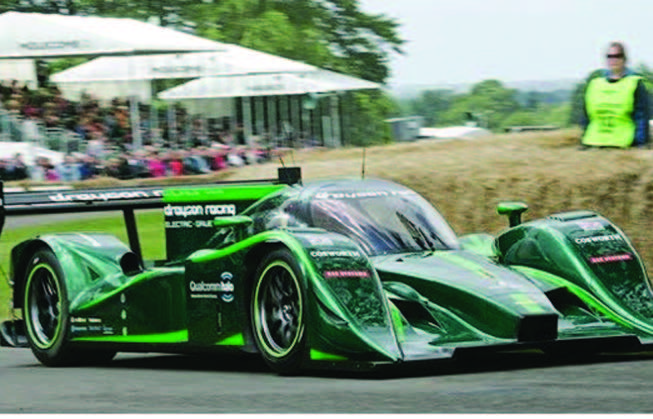
    WASHINGTON (TIP): An ultra-light electric car built by students at a US university has set a new land speed record in its class, besting the previous mark by nearly 80kmph. Electric Blue, an E1 streamliner designed and modified by more than 130 Brigham Young University (BYU) students over the past 10 years, averaged 330kmph on two qualifying runs this month. The new mark obliterates the previous record, 250kmph, which was set by the same BYU car in 2011.

    “When we set the record three years ago we felt like we left a lot on the table,” said BYU student and team captain, Kelly Hales. “On paper we thought we could get 322kph but we never had the conditions just right – until now,” said Hales. The car notched the record this month in front of approximately 180 teams and their cars at the Bonneville Salt Flats in northwestern Utah. Jim Burkdoll, president of the Utah Salt Flats Racing Association, drove the car to set the record, which was certified by the Southern California Timing Association. Electric Blue is called a streamliner because it has a long, slender shape and enclosed wheels that reduce air resistance.

  • ORISSA: OFF THE BEATEN TRACK

    ORISSA: OFF THE BEATEN TRACK

    Orissa (renamed Odisha) is one of India’s less frequented states, as it’s predominantly rural and “off the beaten track”. However, tourist interest in Orissa’s eclectic combination of attractions is growing. Orissa offers picturesque national parks and wildlife, unpolluted beaches, traditional music and dance, temples, handicrafts, tribal culture, and Buddhist relics.

    Konark Sun Temple
    Designed to be a huge chariot for the Sun God Surya, the intricately carved Sun Temple was constructed in the 13th century. It stands 30 meters high on 12 massive wheels. Erotic carvings similar to those on the Khajuraho temples are a renowned feature. The Sun Temple can be visited on a day trip from either Puri or Bhubaneshwar. However, it’s worthwhile seeing the temple in the late afternoon, after the day trippers have departed, and staying a night in Konark. You’ll appreciate the more peaceful atmosphere. The temple is open from sunrise until sunset.

    Bhubaneshwar
    The capital city of Orissa, Bhubaneshwar is most famous for its temples (there are over 700, mostly devoted to Lord Shiva) including the largest temple in the state — the Lingraj Mandir. The motley collection of caves cut into the hillside on the outskirts of the city are another popular attraction. They were once home to Jain aesthetics. The most interesting ones can be found at Udayagiri (Sunrise Hill). The complex is open from 6 a.m. until 6 p.m. If you’re interested in natural medicine, the ethereal Ekamravan garden of medicinal plants is notable and well worth visiting. DON’T MISS: A sunrise over Udayagiri if you’re an early riser. Numerous music and dance festivals are also held in Bhubaneshwar in January, along with the Adivasi tribal mela.

    Puri
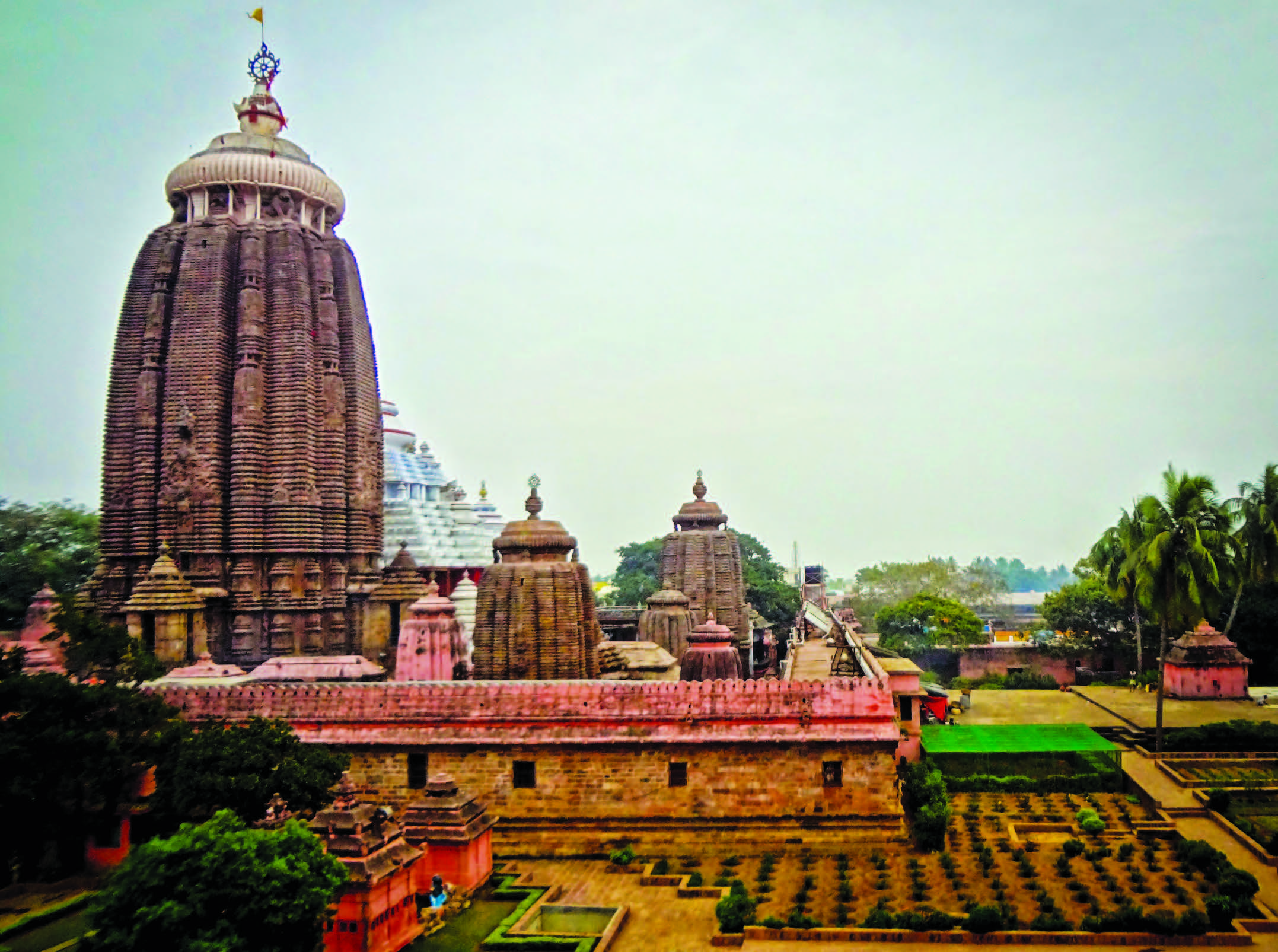
    Puri is located on the beach, but don’t go there expecting a beach paradise. You’ll need to head far away from the center to find an unpolluted patch of sand. Instead, Puri’s appeal lies in its holiness. The imposing Jagannath Temple is only open to Hindus, but the roof of the Raghunandan Library opposite offers decent views. Puri is also a good place to organize tribal tours and day trips. DON’T MISS: The Rath Yatra festival, which takes place in July/August each year. It’s the only occasion when non- Hindus can get to see the temple deities. A mere glimpse of Lord Jagannath on the chariot, or even to touch the chariot, is considered to be very auspicious. A Puri Beach Festival is also held every November.

    Raghurajpur Handicrafts Village
    With a picturesque green setting amongst tropical trees on the bank of the Bhargavi River, Raghurajpur is not only an attractive Indian village but one where every household is involved in a form of handicrafts. There are just over 100 households and 300 artisans in the village. Many have even won national awards for their work. You can wander around, check out the beautiful painted murals on the houses, chat to the friendly artisans and see them in action — and of course shop! Go there on a day trip from Puri, which is around 15 kilometers away. DON’T MISS: Pattachitra paintings are a specialty in the village, but the artisans make a wide variety of items including alm leaf engravings, stone carvings, wood carvings, and wooden toys.

    Chilika Lake
    If you want to spend time amongst nature, head to the remarkable Chilika Lake. Asia’s largest brackish water (a combination of sea and fresh water) lagoon is an ecological wonder spanning around 1,000 square kilometers. It’s full of wildlife, particularly fish and migratory birds from far off lands. There are even dolphins! The Lake also has a number of islands. Grassroutes Journeys offers ecofriendly Chilika Lake camping trips and birdwatching
    cruises. Also check out Mangalajodi Ecotourism. DON’T MISS: Exploring Chilika Lake and its various islands by boat. Most departures are from Satapada (where the dolphins are), located at the mouth of the Lake around 50 kilometers from Puri. Other departures are possible from Barkul, Rambha, and Balugaon.

    Tribal Villages
    There are more than 60 tribal communities in Orissa. These ancient people with mystical ancient ways dwell in Orissa’s remote, deep forests and hilly interiors. Most of them are in the southwest part of the state. Visiting the tribes can be a fascinating experience, but you’ll need to go on an organized tour. Some tribal areas are quite inaccessible and require permits, and language is also a barrier. Heritage Tours are professional and knowledgeable. Also try community-based Grass Routes Journeys in Puri. During a tribal tour of Orissa, you’ll get to mix with the local tribal people and learn their lifestyles. Tours run for at least five nights/six days, due to the amount of travel involved. Or, travel independently and stay at boutique Chandoori Sai Guest House in the heart of tribal Orissa.

    Buddhist Sites
    You could be forgiven for not knowing about the sacred Buddhist sites in Orissa (Odisha). After all, they’ve only been excavated relatively recently and are largely unexplored. The sites consist of a series of monasteries, temples, shrines, stupas, and beautiful sculptures of Buddhist images. Their rural setting, amongst fertile hills and paddy fields, is both picturesque and peaceful.

    Chandipur Beach
    Casuarina trees, sand dunes, and a tide that receeds out for miles all make Chandipur Beach special. This little known beach is the place to come if you want a tranquil beach getaway. Of course, if you’re looking for crystal clear water and golden sand, there are better beaches in India. However, this one is unique! It’s also very safe. Chandipur Beach is readily accessible by train from Bhubaneshwar, and also Kolkata in West Bengal. DON’T MISS: Walking on the huge stretch of seabed when the tide is out. It’s brilliant for beach-combing. Discover small puddles of water with tiny fish, sea shells, and crabs.

  • GANDHI JAYANTI

    GANDHI JAYANTI

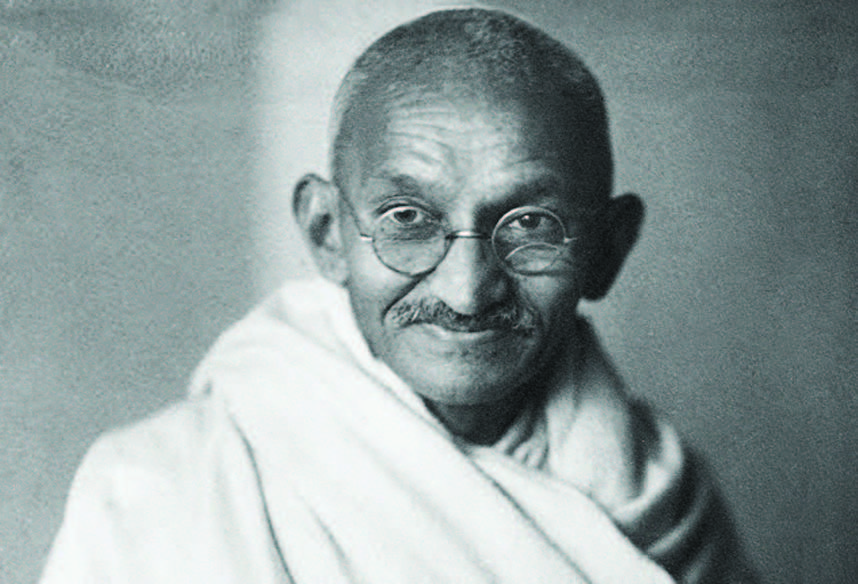
    Mohandas Karamchand Gandhi, more commonly known as ‘Mahatma’ (meaning ‘Great Soul’) was born in Porbandar, Gujarat, in North West India, on 2nd October 1869, into a Hindu Modh family. His father was the Chief Minister of Porbandar, and his mother’s religious devotion meant that his upbringing was infused with the Jain pacifist teachings of mutual tolerance, noninjury to living beings and vegetarianism. Born into a privileged caste, Gandhi was fortunate to receive a comprehensive education, but proved a mediocre student. In May 1883, aged 13, Gandhi was married to Kasturba Makhanji, a girl also aged 13, through the arrangement of their respective parents, as is customary in India. Following his entry into Samaldas College, at the University of Bombay, she bore him the first of four sons, in 1888. Gandhi was unhappy at college, following his parent’s wishes to take the bar, and when he was offered the opportunity of furthering his studies overseas, at University College London, aged 18, he accepted with alacrity, starting there in September 1888. Determined to adhere to Hindu principles, which included vegetarianism as well as alcohol and sexual abstinence, he found London restrictive initially, but once he had found kindred spirits he flourished, and pursued the philosophical study of religions, including Hinduism, Christianity, Buddhism and others, having professed no particular interest in religion up until then. Following admission to the English Bar, and his return to India, he found work difficult to come by and, in 1893, accepted a year’s contract to work for an Indian firm in Natal, South Africa.

    Although not yet enshrined in law, the system of ‘apartheid’ was very much in evidence in South Africa at the turn of the 20th century. Despite arriving on a year’s contract, Gandhi spent the next 21 years living in South Africa, and railed against the injustice of racial segregation. On one occasion he was thrown from a first class train carriage, despite being in possession of a valid ticket.Witnessing the racial bias experienced by his countrymen served as a catalyst for his later activism, and he attempted to fight segregation at all levels. He founded a political movement, known as the Natal Indian Congress, and developed his theoretical belief in non-violent civil protest into a tangible political stance, when he opposed the introduction of registration for all Indians, within South Africa, via noncooperation with the relevant civic authorities. On his return to India in 1916, Gandhi developed his practice of non-violent civic disobedience still further, raising awareness of oppressive practices in Bihar, in 1918, which saw the local populace oppressed by their largely British masters. He also encouraged oppressed villagers to improve their own circumstances, leading peaceful strikes and protests. His fame spread, and he became widely referred to as ‘Mahatma’ or ‘Great Soul’. As his fame spread, so his political influence increased: by 1921 he was leading the Indian National Congress, and reorganising the party’s constitution around the principle of ‘Swaraj’, or complete political independence from the British. He also instigated a boycott of British goods and institutions, and his encouragement of mass civil disobedience led to his arrest, on 10th March 1922, and trial on sedition charges, for which he served 2 years, of a 6-year prison sentence. The Indian National Congress began to splinter during his incarceration, and he remained largely out of the public eye following his release from prison in February 1924, returning four years later, in 1928, to campaign for the granting of ‘dominion status’ to India by the British. When the British introduced a tax on salt in 1930, he famously led a 250-mile march to the sea to collect his own salt.

    Recognising his political influence nationally, the British authorities were forced to negotiate various settlements with Gandhi over the following years, which resulted in the alleviation of poverty, granted status to the ‘untouchables’, enshrined rights for women, and led inexorably to Gandhi’s goal of ‘Swaraj’: political independence from Britain. Gandhi suffered six known assassination attempts during the course of his life. The first attempt came on 25th June 1934, when he was in Pune delivering a speech, together with his wife, Kasturba. Travelling in a motorcade of two cars, they were in the second car, which was delayed by the appearance of a train at a railway level crossing, causing the two vehicles to separate.When the first vehicle arrived at the speech venue, a bomb was thrown at the car, which exploded and injured several people. No investigations were carried out at the time, and no arrests were made, although many attribute the attack to Nathuram Godse, a Hindu fundamentalist implacably opposed to Gandhi’s non-violent acceptance and tolerance of all religions, which he felt compromised the supremacy of the Hindu religion. Godse was the person responsible for the eventual assassination of Gandhi in January 1948, 14 years later. During the first years of the Second World War, Gandhi’s mission to achieve independence from Britain reached its zenith: he saw no reason why Indians should fight for British sovereignty, in other parts of the world, when they were subjugated at home, which led to the worst instances of civil uprising under his direction, through his ‘Quit India’ movement. As a result, he was arrested on 9th August 1942, and held for two years at the Aga Khan Palace in Pune. In February 1944, 3 months before his release, his wife Kasturbai died in the same prison. May 1944, the time of his release from prison, saw the second attempt made on his life, this time certainly led by Nathuram Godse, although the attempt was fairly half-hearted. When word reached Godse that Gandhi was staying in a hill station near Pune, recovering from his prison ordeal, he organised a group of like-minded individuals who descended on the area, and mounted a vocal anti-Gandhi protest. When invited to speak to Gandhi, Godse declined, but he attended a prayer meeting later that day, where he rushed towards Gandhi, brandishing a dagger and shouting anti-Gandhi slogans. He was overpowered swiftly by fellow worshippers, and came nowhere near achieving his goal. Godse was not prosecuted at the time. Four months later, in September 1944, Godse led a group of Hindu activist demonstrators who accosted Gandhi at a train station, on his return from political talks.

    Godse was again found to be in possession of a dagger that, although not drawn, was assumed to be the means by which he would again seek to assassinate Gandhi. It was officially regarded as the third assassination attempt, by the commission set up to investigate Gandhi’s death in 1948. The British plan to partition what had been British-ruled India, into Muslim Pakistan and Hindu India, was vehemently opposed by Gandhi, who foresaw the problems that would result from the split. Nevertheless, the Congress Party ignored his concerns, and accepted the partition proposals put forward by the British. The fourth attempt on Gandhi’s life took the form of a planned train derailment. On 29th June 1946, a train called the ‘Gandhi Special’, carrying him and his entourage, was derailed near Bombay, by means of boulders, which had been piled up on the tracks. Since the train was the only one scheduled at that time, it seems likely that the intended target of derailment was Gandhi himself. He was not injured in the accident. At a prayer meeting after the event Gandhi is quoted as saying: “I have not hurt anybody nor do I consider anybody to be my enemy, I can’t understand why there are so many attempts on my life. Yesterday’s attempt on my life has failed. I will not die just yet; I aim to live till the age of 125.” Sadly, he had only eighteen months to live. Placed under increasing pressure, by his political contemporaries, to accept Partition as the only way to avoid civil war in India, Gandhi reluctantly concurred with its political necessity, and India celebrated its Independence Day on 15th August 1947. Keenly recognising the need for political unity, Gandhi spent the next few months working tirelessly for Hindu- Muslim peace, fearing the build-up of animosity between the two fledgling states, showing remarkable prescience, given the turbulence of their relationship over the following half-century. Unfortunately, his efforts to unite the opposing forces proved his undoing. He championed the paying of restitution to Pakistan for lost territories, as outlined in the Partition agreement, which parties in India, fearing that Pakistan would use the payment as a means to build a war arsenal, had opposed. He began a fast in support of the payment, which Hindu radicals, Nathuram Godse among them, viewed as traitorous.When the political effect of his fast secured the payment to Pakistan, it secured with it the fifth attempt on his life. On 20th January a gang of seven Hindu radicals, which included Nathuram Godse, gained access to Birla House, in Delhi, a venue at which Gandhi was due to give an address. One of the men, Madanla Pahwa, managed to gain access to the speaker’s podium, and planted a bomb, encased in a cotton ball, on the wall behind the podium. The plan was to explode the bomb during the speech, causing pandemonium, which would give two other gang members, Digambar Bagde and Shankar Kishtaiyya, an opportunity to shoot Gandhi, and escape in the ensuing chaos. The bomb exploded prematurely, before the conference was underway, and Madanla Pahwa was captured, while the others, including Godse, managed to escape.

    Pahwa admitted the plot under interrogation, but Delhi police were unable to confirm the participation and whereabouts of Godse, although they did try to ascertain his whereabouts through the Bombay police. After the failed attempt at Birla House, Nathuram Godse and another of the seven, Narayan Apte, returned to Pune, via Bombay, where they purchased a Beretta automatic pistol, before returning once more to Delhi. On 30th January 1948, whilst Gandhi was on his way to a prayer meeting at Birla House in Delhi, Nathuram Godse managed to get close enough to him in the crowd to be able to shoot him three times in the chest, at point-blank range. Gandhi’s dying words were claimed to be “Hé Ram”, which translates as “Oh God”, although some witnesses claim he spoke no words at all. When news of Gandhi’s death reached the various strongholds of Hindu radicalism, in Pune and other areas throughout India, there was reputedly celebration in the streets. Sweets were distributed publicly, as at a festival. The rest of the world was horrified by the death of a man nominated five times for the Nobel Peace Prize. Godse, who had made no attempt to flee following the assassination, and his co-conspirator, Narayan Apte, were both imprisoned until their trial on 8th November 1949. They were convicted of Gandhi’s killing, and both were executed, a week later, at Ambala Jail, on 15th November 1949. The supposed architect of the plot, a Hindu extremist named Vinayak Damodar Savarkar, was acquitted due to lack of evidence.

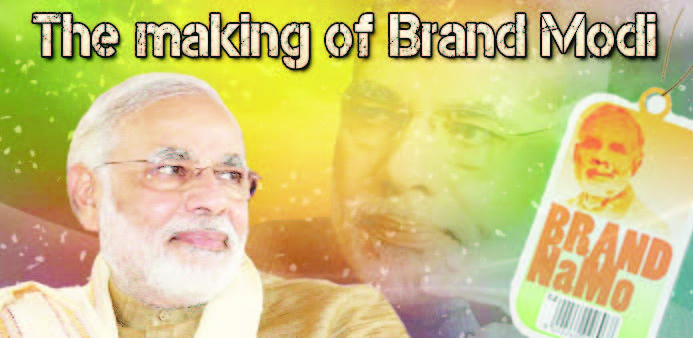
  • The Making of NAMO

    The Making of NAMO

    A Hindu pracharak becomes Prime Minister of India. Here are milestones in his journey of ascension to the pinnacle of power through landslide election victory in the 16th General Election of the world’s largest democracy.


    arendra Modi was born on 17th Sept 1950 in a middle class family of grocers in the small town of Vadnagar- the Temple Town of ancient India which is Varanasi of Gujarat. The town has a long and varied history. Sharmistha Lake, Hatkeshvar Mahdev and artistic Toran Gate are hallmarks of the past glory of the capital of Anart Province. Chinese traveler Yuan Swang visited this town in the sixth century. Akbar’s music maestro Tansen came to normalcy after listening to perfect Meghmalhar singing of Naggar girls Tana and Riri. Poet Narsinh Mehta ‘s son got married to Vadnagar Naggar Community’s bride here. Small town boy Narendra Modi imbibed the past glory of his birth place in Mehsana district of Gayakwad princely state in Gujarat. Modi became a member of RSS in childhood and acquired deep understanding of Hinduism, reading Hindu Scriptures and literature of Swami Vivekananda. He left home with the consent of his parents at a young age of 17 in search of his life’s mission. He traveled extensively and spent some time in the Himalaya , meditating in the tradition of Buddha who has influenced his life and thought considerably. Returning home after some time, he became a PRACHARAK with Rashtriya Swayamsevak Sangh in 1972. He stayed with his maternal uncle in Ahmedabad and helped him selling common people’s popular drink, tea, a job which he had done before in his father’s tea stall at the Vadanagar Railway station. One astrologer who was dinner guest at their family house in Vadnagar predicted to his mother that some day her son Narendra will either be a great sage of Shankaracharya’s caliber or supreme commander of the nation if he enters politics. Jawaharlal Nehru was supreme commander in Prime Minister’s position in those days in India. Savarkar’s message to Hinduise politics and militarise Hinduism appealed to young Narendra. He worked underground during the emergency period 1975-1977 and went jail briefly.
     

    Then, Jan Sangh adopted a new name BJP after losing partnership in the government with the collapse of Prime Minister Morarji Desai’s government . Narendra Modi actively participated in all activities of BJP especially Advani’s Rath Yatra and Unity pilgrimage of Murli Manohar in 1989-90. He was assigned the responsibilities of General Secretary in Gujarat and subsequently at the national level. Modi acquired mastery in public relations and party organization. His contribution in the capacity of General Secretary was well noticed by party stalwarts Advani and Vajpayee. He did not contest any legislative election and had no experience in any capacity in government when one day in the first week of October, 2001, Prime Minister Vajpayee asked him to be the Chief Minister of Gujarat in replacement of Keshubhai Patel who had received more complaints than complements in his handling of problems in the aftermath of earthquake in Kutch -Bhuj area on the Republic Day in January, 2001.

    A Timeline : 
    October 7,2001 Modi takes oath of office of Chief Minister. He is not a member of the legislative body.
    ● Feb.24,2002 : He is elected from Rajkot constituency . Next day he is officially admitted into membership of Gujarat Assembly.
    ● Feb 27,2002 . At Godhara Station in South Gujarat 59 passengers including women and children are burned down by the terrorist group which praised Bin Laden and his methods of terrorism. Those killed were active members and volunteers of Hindu organizations .In retaliation riots spread in Ahmedabad and elsewhere in Gujarat. Both Hindus and Muslims became targets of each others’ wrath for weeks .Media all over the world gave coverage of these events in their own ways.
    ● April 12,2002 BJP High Command meeting in Goa where discussion on the riots remained major issue, some demanded removal of Modi . Narendra Modi offered his resignation . Prime Minister Vajpayee was not soft towards Modi but Advani was firm on not accepting Modi’s resignation.
    ● July 19, 2002 C.M. Modi dissolved assembly and opted to seek new mandate
    ● December 15, 2002 . Favorable election results: BJP won 127 seats out of 182 assembly seats. Modi took oath for the second time in the presence of the Prime Minister. First time in India, a Prime Minister attended oath ceremony of a state chief minister. The Modi Government received national and international praise for restoration programs of earthquake disaster. Seminars for continuing education for elected assembly members and EGovernance were Modi’s new initiatives. Prime Minister Vajpaiyee invited the dynamic C.M. Modi to be in his entourage of Russia visit. Modi observed keenly Russian growth model . He vowed to make Gujarat a shining super state in India . The first vibrant Gujarat festivity program in 2003 attracted attention of investors . Progress
    Person Modi visited China, Japan and other countries to promote investment in Gujarat.
    ● May 21,2005. Rajiv Gandhi Foundation awarded Modi Government for the most well managed State.
    ● December 25,2007: Modi takes oath for the 3rd time after election victory.

    2012: 

    Modi became Chief Minister of Gujarat for the fourth time. In a lighter vein, he stated: ‘ I will remain CM for ever’.
    But Modi was destined for a higher position, as the stranger had once predicted.
    In September, 2013, Bharatiya Janata Party named him the party’s candidate for prime
    Minister’s position. Modi had already nominated to lead the election campaign. With every passing day, it became clearer that Modi had succeeded in convincing voters of India that BJP could bring about a change to their advantage. Some doubted BJP could have the numbers to forma government with its allies, not to speak of forming a government on their own.
    Some simply could not bear to see BJP in power. Eminent Economist Nobel Laureate A.K. Sen wrote: “I do not want Modi to be my Prime Minister “.
    However, voters of the largest democracy in the world countered him : “WE WANT MODI TO BE
    OUR PRIME MINISTER.”
    And there he is. Let us wait and watch his work.

  • NARENDRA MODI: Gandhi and Patel rolled in to one

    NARENDRA MODI: Gandhi and Patel rolled in to one

    By Bipin Sangankar Aphone call was placed by the office of Prime Minister Vajpayee for Narendra Modi who was attending funeral in New Delhi of a photo -journalist killed in a plane accident with prominent Congress leader Madhavrao Scindia in the first week of October, 2001. General Secretary of BJP Modi was asked that evening by the PM to take over reign of Gujarat Government from Chief Minister Keshubhai Patel whose Government overwhelmed handling rehabilitation of traumatic earthquake in Kutch-Bhuj area of Western Gujarat on the Republic Day of 2001.Page 253

    ‘I have no legislative experience and I have been out of Gujarat for six years’ was his argument for not accepting the Chief Minister’s position. It was decided by the party high command, the PM conveyed to him. He took a train to Ahmedabad and, since 7th Oct 2001 when he took oath as the Chief Minister of Gujarat, the small town boy from Princely State of Gayakawad in North Gujarat, Narendra Modi has remained in the news for good and bad. Bad news for him came within two days after he was elected from Rajkot constituency on February 25, 2002. At the railway station of Godhara in South Gujarat, Sabarmati Express carrying passengers from Varanasi was put on fire by some Islamic militants in which 59 Hindu volunteers were burned alive. Those dead, including women and children, were brought to Ahmedabad for funeral rites. Uncontrollable grief and wrath of people turned into riots in Ahmedabad and other towns in Gujarat killing 254 Hindus and 790 Muslims. The Godhara incident and subsequent riots received wide publicity . Narendra Modi from childhood has been an active member of Hindu organization RSS. Some accused him of his complicity but no official inquiry found evidence to support that accusation. Punish me if I am guilty was the theme of his defense. However, he was ready to tender his resignation at the BJP conference in Goa in April when Prime Minister Vajpayee gave his ears to Modi’s opponents in the Party. Modi took a gamble and dissolved assembly in July of the same year. He won 127 seats out of 182 in the election held in December of 2002 . He took oath for the second time and was reelected in 2007 and 2012 elections. Modi not only faced opposition from his opponents from Congress and other agencies but also from within his own party in Gujarat. Former Chief Minister Keshubhai Patel has always remained vocal critic and even went on to launch a new party. But people of Gujarat loved Modi. They were not happy when Congress President Mrs. Sonia Gandhi spoke harshly of Modi in one propaganda meeting in 2007. In the 2014 General Election no member of Congress from Gujarat was elected to parliament. Narendra Modi accompanied Prime Minister Vajpayee to state visit of Russia and he was deeply impressed by the economic model of Russia’s industrialization and economic growth. But unlike Nehru, instead of Marxian model , he adopted Adam Smith’s free enterprise for Economy of Gujarat. In 2003 he held the first vibrant Gujarat conference to attract investment in Gujarat. Soon he came to be recognized as a “Progress Person” and ushered many changes in Gujarat’s economy and polity . In India, entrepreneurial Gujarat state has remained in the forefront in the field of industry, trade and commerce . In 2005, Rajiv Gandhi Foundation praised Gujarat’s progress .

    Page 252
    Modi Government received accolades from several development agencies and newspapers organizations. He developed contacts with international development agencies also. India’s15th Prime Minister Narendra Modi is the first Prime Minister born in free India He studied in his home town Vadanagar in Mahasana District in North Gujarat His father Damodardas ran a tea stall at the railway station. After school hours Narendra went to help his father and sold tea to passengers of Taranga Local train . He enrolled in Visanagar College but left studies and home in search of vocation of his choice. A local doctor Parikh introduced him to Vivekanand in early childhood . He spent two years roaming from Rajkot to Bellur Math to some odd places in the lap of Himalayas in North India. In traditional Indian Society those days, marriages were arranged and performed even in child hood. Thus, Narendra was married to Jashodaben at the age of 17. However, the two did not stay together. Jasodaben is a retired school teacher now. Modi was deeply influenced by Vivekananda. Buddha and Mahaveer also had a deep influence on his mind. So, one day, in 1968, Modi left home in search of truth. Modi opted life of a sanyasi and spent time, it is said, in the Himalayas. But he is queerly reticent about this period of his life. Modi returned home briefly to see his mother whom he adores. He went to Ahmedabd to stay with his maternal uncle . He helped his uncle to run a canteen at a bus depot in the city. His mentor Mr. Inamdar advised him to stay at Hegdewar House in the city and be a volunteer to promote Hindu unity. He became thus, a PRACHARAK in 1972. In June of 1975, Indira Gandhi imposed emergency. RSS was banned . Modi opposed emergency rule while remaining underground. He donned attires of a Sadhu, a Sanyasi and a Sikh to be able to move around to oppose the emergency, without being detected. . He was briefly in jail also. During this period, he met many political stalwarts who opposed emergency rule. These leaders included Morarji Deasi and Jai Prakash Narayan. He came in close contact with Jan Sangh leader Advani. It was during emergency rule of Indira that he developed writing skill. His book about role of Gujarat during emergency has been translated into several vernacular languages and English. He also published several letters and booklets. He also developed his skill of public speech. He is a well read person among politicians and a good argumentative Indian. He did his bachelor through correspondence from Delhi University and Master in Political Science from Gujarat University. He has imbibed several qualities of Gujarat’s two great souls-one Mahatma Gandhi and , the other, Sardar Patel . He is as good as Mahatma Gandhi in personal relationship. Like Sardar Patel, he is a fearless leader and a good administrator. (A native of North Gujarat, Prof. Bipin Sangankar has taught at assorted universities, including New York and Fordham)

    Page 251

  • A Film Maker and a Healer Malik brings happiness either way

    A Film Maker and a Healer Malik brings happiness either way

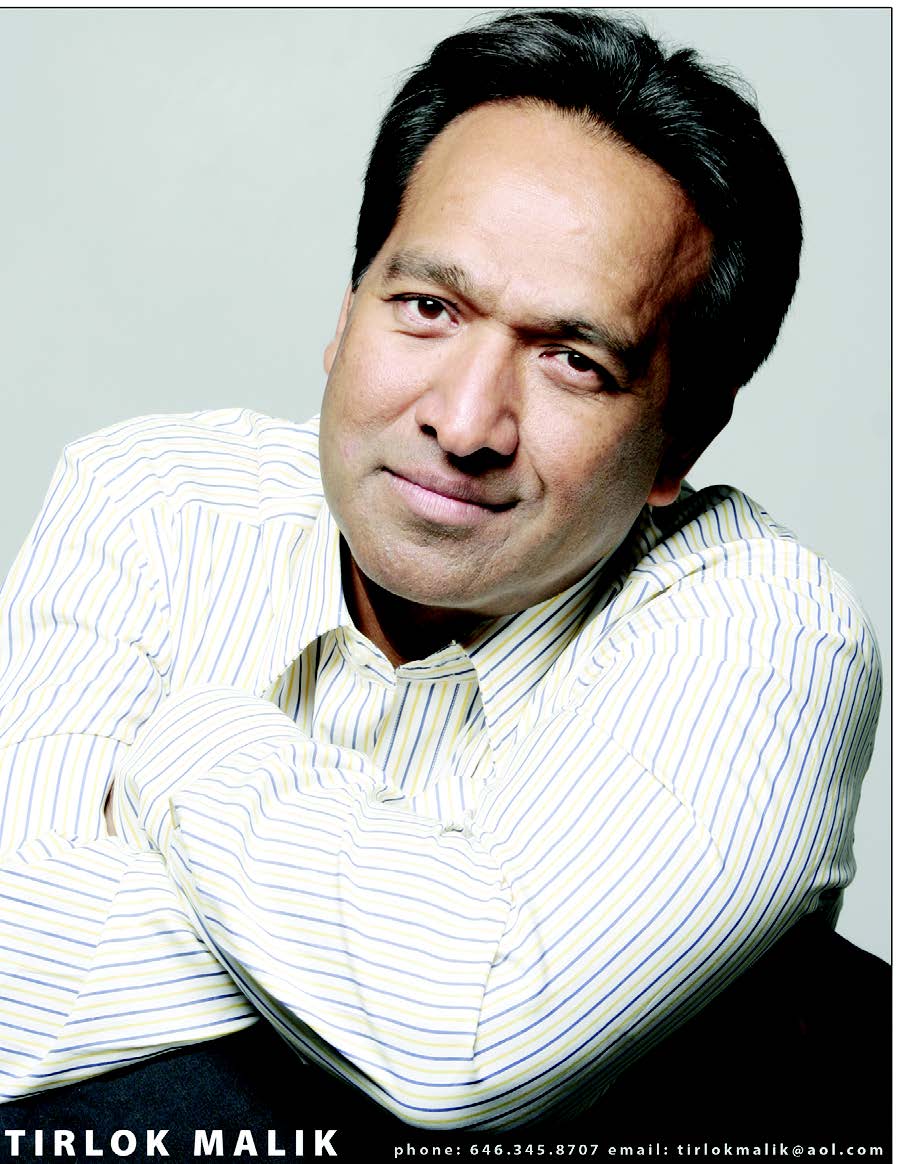
    Tirlok Malik (CEO of Apple Productions) is a New York Emmy Award nominated filmmaker. Apple Productions has produced many films since 1990 starting with its first pioneer film about Indian Americans, “Lonely in America.” The film was shown in 74 countries as well as on HBO and participated in 37 film festivals, winning many Awards. Malik continues to make films about Indian American experiences in America. His new film “On Golden Years” is ready for release soon. Mali’s work as an actor and a filmmaker has been acclaimed in the international and national media, including The New York Times, Hollywood Reporter, Variety, Entertainment, and other newspapers and journals. He also received the Pride of India Gold Medal for his work as a filmmaker from the Indian Ambassador to the USA. In August 2007, Tirlok Malik was presented with the New York Citizens’ Award from the New York Mayor’s Office. As an actor he has worked in many television series, and films. He has also done over 200 performances in New York theaters. He has acted in many ads and films for mainstream US television. Malik also founded the NRI TV Film Club, a platform for Indian and multicultural artists to create projects. Malik is also a restaurateur, bringing Ayurveda through his restaurant Ayurveda Café in Manhattan. He can be reached at Appleproduction@aol.com

  • MALINI SHAH | a multifaceted personality

    MALINI SHAH | a multifaceted personality

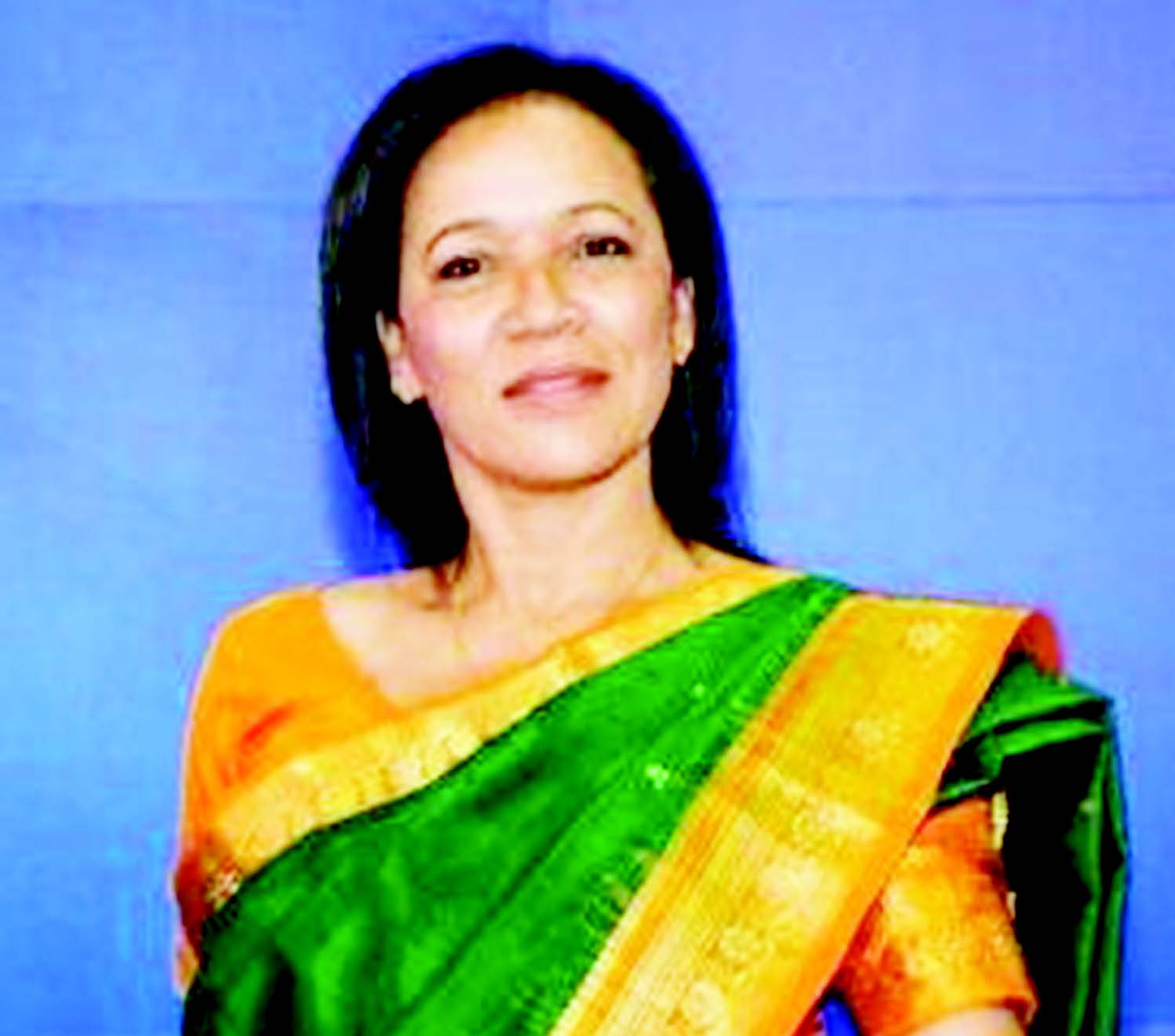
    Malini Shah is a community leader who is currently President of her diamonds company, Difference Inc. She is also the Founder of Nritya Kala Kendra which was founded in 1992. It is an organization that promotes India’s Art and Culture through classes,workshops, and lectures, visiting artist programs, children’s Day at the Indian Consulate, Asian Heritage programs, and Indian Educational programs in schools. She is currently on the Advisory Committee of the Queens Museum of Art, Community and Cultural Liaison for Council Member Paul Vallone, and has also served as the chairperson for Assemblyman Nick Perry,Women’s Group Bill de Blasio for Mayor, Vice chair Queens South Asians for Bill de Blasio for Mayor , Chair Indian Americans for Melinda Katz for Queens Borough President. She enjoys being a consultant to various organizations in the USA and other countries,where she visits and holds workshops. Today she has extended her proficiency to many schools within the country with the resolve of integrating cultural education along with academic skills. Malini received Bachelor’s in Arts and Child Education from The Teachers Training Institute in India. She has spent over 30 years teaching in schools, one of which includes “Modern School, one of the most prestigious schools of India, situated in Delhi. She has conducted various lectures in rural areas for the India International Rural Cultural Center, and at various Universities in the United States of America. Also, she has contributed vastly to educational film documentaries. NKK undertakes numerous educational and informative programs all around the country and abroad through programs such as the recent Internationals Children’s Day by the Turkish Women’s League of America & Ataturk School 2014, Asian Heritage Month Queens Borough Community College 2014, the incredibly successful “Year of India “2012-2013 at Queens College, New American Program at the Queens Library, DC 37and NYC Council’s Asian American Heritage Programs, Cultural Educational Programs in schools, annual Children’s day at the NY Indian Consulate, ‘Meeting God’ exhibition at the Museum of Natural History, India Columbia Day at the Queens Museum of Art, Culture Day at Barnard College and Columbia university, Tropical Carnival, Queens Festival, Caribbean American Information Day, A Salute to Diversity at York College, United Nations Staff day International Concert, Harmony Day, workshops at Pace University, Orphan International United , Borough of Manhattan community College events, Annual Rockaway Multicultural Family Fest, World Vision 2000 Global Youth Conference in DC, A Rainbow Community Business Development Arts & Culture Exposition, Brooklyn Botanical Gardens Celebrating Cultures Events, Sacred Arts conference at Cathedral of St. John the Devine. As a Cultural Ambassador she has traveled extensively abroad for festivals sponsored by the India Tourism Development, Air India, and ICCR (Indian Council for Cultural Relations) to countries which include Kula Lumpur, Athens, Bangkok, Singapore, New York ,Caribbean. She has had the privilege to travel as part of the Indian delegation of the Indian Council for Cultural Relations headed by the former Vice President of India, Mr. Shankar Dayal Sharma. When you work so devotedly, recognition must follow. Malini has received many prestigious awards such as ‘Jewel of India’ Award, “Positive Indo-Image Award”, An Exclusive “Distinguished Leadership in the Arts and Culture Award” from Assemblyman Nick Perry .City Council Citations, “Certificate of Recognition” from Kate Murray Supervisor Town of Hempstead, for outstanding community service and significant contribution to the community (SAWA) 2013,Citation from New York City Council member Peter Koo for recognition and honor for years of service to the Community, “Outstanding Mother Award” by C.A.P.S.C., Hind Rattan Award for Outstanding Services, London, Achievement and Contribution . She is also the recipient of “Exceptional Woman Award” from South Asian American Women’s Alliance. Her autobiography appeared in the “Who’s who in India” and Best of New York. Her autobiography appeared in the “Who’s who in India” and Best of New York.

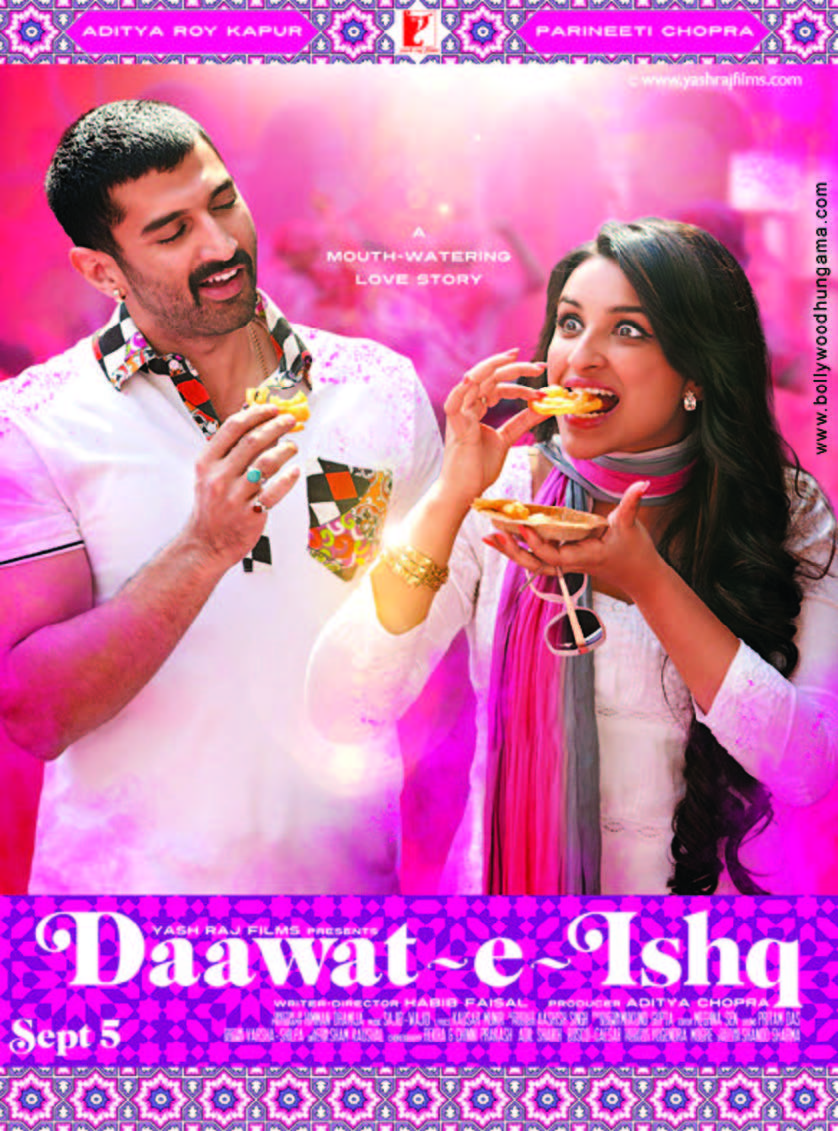
  • MOVIE REVIEW | Daawat-e-Ishq

    MOVIE REVIEW | Daawat-e-Ishq

    Cast: Aditya Roy Kapur, Parineeti Chopra, Anupam Kher,
    Karan Wahi
    Direction: Habib Faisal
    Duration: 2 hours

    Story: Wafting flavours of love simmer via the bestknown route possible – stomach. The daawat looks good, but will it leave romantics with an unforgettable taste of love? Review: Statutory Warning: Do not watch this film on an empty stomach, lest the growling belly overpowers the sweet of this gastronomic love affair. Food is magical – it inspires love, lust, art, poetry, sex and of course, cinema. The master chef of this one, director Habib Faisal, whips up a story in the city of nawabs – over kitchen fires, kebabs, dough and the (socially relevant) dowry system. It’s a feast for the eyes, though there’s not as much for the heart to savour. Meet Hyderabad ki Gulrez (Parineeti), she’s feisty (a well-roasted temper), gutsy and likes propah angrezispeaking men. Sadly, her Booji (Kher) finds only dowryseeking spineless men who boast of shallow degrees from ‘IIM’ (International Institute of Mehboobnagar!). She works as a salesgirl in a shoe-store but dreams of being a shoe-designer. Along with Booji, she masterminds a con-plan to frame dowry-demanding dulhas and make big bucks to pursue her dream. But her plans get skewered when she meets Lucknow ka aashiq Tariq (Aditya), a chef and owner of the legendary restaurant ‘Haidari Kababs’. Gulrez gets drawn to the warm, inviting aromas of love while he woos her with botis, rotis and shahi tukdas of his heart. Habib Faisal’s offering is definitely fresher than a packaged, frozen meal; but when he’s not paying attention the story boils over and the flavour escapes quickly. The second half crumbles (guess some recipes got nixed here) and the climax is far from slurp-worthy. There are some ‘specials of the day’ like Booji’s goofiness during the con-act, and the line-up of dowryhungry men walking into the trap, but the characters are not as indulgent as the dishes. Parineeti displays ‘high-cal’ emotions once again, with her sweet Hyderabadi accent and superb confidence. Aditya charmingly shows flair with his Lucknowi style and ada. Their chemistry doesn’t simmer; it’s low-fat kulfi at best. Kher peppers it with a stand-out sorbet act. This one won’t fill your hungry hearts, but one serving (not too bland, not too spicy) isn’t too bad for your appetite.

  • NEHA DHUPIA TO PRODUCE FILMS

    NEHA DHUPIA TO PRODUCE FILMS

    Film production is the new thing on actress Neha Dhupia’s mind. She says it may happen in the future. “The one business that I always wanted to do is the filmmaking business. I am looking to get into production in future. I want to produce films,” said Neha. If her wish comes true, she’s join the list of Bollywood beauties who have entered the production domain. The list already includes the likes of Pooja Bhatt, Shilpa Shetty, Dia Mirza, Lara Dutta, Juhi and Preity Zinta. Meanwhile, Neha will next be seen on the big screen in Ekkees Toppon Ki Salaami. Her role is that of a struggling actress. Of struggle in real life, the former beauty queen said: “It’s an ongoing process. Everybody is struggling – be it people in the top league or the newcomers.” The film features Neha in a song via which she has paid a tribute to celebrated actresses like Helen, Madhuri Dixit, Zeenat Aman and Aishwarya Rai. She says she was especially conscious about imitating dancer par excellence Helen. “It was a very challenging song where I had to copy the steps of legendary actresses. I was conscious about imitating Helenji. She is a legend and a fabulous dancer. The song is part of the film and it’s very unusual,” she added

  • PRIYANKA CHOPRA PERFORMS HANDSTAND IN HEELS

    PRIYANKA CHOPRA PERFORMS HANDSTAND IN HEELS

    Priyanka Chopra, who excelled in her onscreen avatar as iconic boxer M.C. Mary Kom, accepted and performed a handstand with a push up – a dare thrown up at her by Hrithik Roshan. And boy, she did it wearing a pair of heels! “The only girl I cud dare this! For super @priyankachopra my #bangbangdare HANDSTAND with a push up!! Do u accept! U have 3 days,” Hrithik posted on Twitter Sunday as part of an innovative promotional strategy for his forthcoming film “Bang Bang”. For the fierce and daredevil Priyanka, carrying out the challenge seemed like a cakewalk. In a video she posted on her Facebook page, Priyanka features wearing casuals and she does exactly what Hrithik asked her to do — albeit with a twist. “Here you go Hrithik Roshan…a handstand with 3 push ups! In high heels! #bangbangdare …next time try and make it a little difficult,” she quipped.

  • MOVIE REVIEW The Maze Runner

    MOVIE REVIEW The Maze Runner

    Cast: Dylan O’Brien, Aml Ameen, Thomas
    Brodie-Sangster, Will Poulter, Kaya Scodelario, Blake
    Cooper, Ki Hong Lee
    Direction: Wes Ball
    Genre: Mystery
    Duration: 1 hour 54 minutes

    Story: After erasing his memory, Thomas (Dylan O’Brien) is mysteriously deposited to the Glade – a grassy field, surrounded by high walls of a gigantic maze, where a few other boys have been trapped too. Can the group escape the deadly maze? Review: Horrified by the situation and plagued by flashes of an unsettling dream, Thomas seeks answers from fellow prisoners, who are equally clueless. All they know is how every morning, the door to the maze opens, giving the best runners of the group an opportunity to map the ever-shifting labyrinth to find a way out. However, they must return before the gate closes, as spending the night inside would mean battling dangerous creatures called the Grievers. In spite of multiple attempts, no one has ever escaped the maze so far. Could Thomas be the key? Based on James Dashner’s popular young adult novels, this dystopian, post-apocalyptic thriller has the ability to make you feel claustrophobic, every time the runners squeeze themselves through the narrow pathways of the maze. A few of these fast-paced sequences are bound to leave you breathless with anxiety. Tense, dark and atmospheric, constant fear of the unknown grips you, keeping you on the edge of your seat throughout. While its ‘battle for survival in a controlled environment’ theme reminds you of ‘The Hunger Games’, this has its own twists and turns. The teen actors perform with utmost conviction and are impressively understated. Also, what sets this film apart is how the story focuses on human emotions as much as it does on special effects. You feel for the characters and their trauma. Ultimately, the plot provokes you to think if ‘being safe to suffer’ is better than ‘risking your life to look beyond the obvious’. It also convinces you to move out of your comfort zone and face your fear. The climax might seem underwhelming for some but the build-up is a sure-shot winner. Deserves a sequel… SADIE FROST SPRINKLES SALT TO ABSORB NEGATIVE ENERGY

  • SADIE FROST SPRINKLES SALT TO ABSORB NEGATIVE ENERGY

    SADIE FROST SPRINKLES SALT TO ABSORB NEGATIVE ENERGY

    Actress Sadie Frost likes to sprinkle salt across the doorways of her house to absorb all the negative energy.

    The 49-year-old, who divorced Jude Law in 2003 after six years of marriage, has turned to the unusual technique to rid her home of bad feeling and she also encourages people to break up blocked energy in their homes by walking around chanting and hitting a gong, reports femalefirst.co.uk.

    Discussing the salt method in her upcoming wellbeing book, “Nourish”, she states: ”Leave for 24 hours, by which time it should have absorbed all the negativity.” In the book, Frost also gives tips on yoga, food, nutrition, exercise and meditation, which she does six times a week to rid herself of all the ”craziness” in her life. “It is kind of stepping back from the little things that are bothering you. When you’re thinking, ‘Oh I’ve got to go to the shop and buy some stamps.’ It’s getting rid of all that craziness,” she said.

    “I might go to the park and just do a walking meditation, which is just walking the dogs,” she added.

  • Archery: Indian women’s recurve team still in medal hunt

    Archery: Indian women’s recurve team still in medal hunt

    INCHEON (TIP): India’s women recurve team kept itself in medal contention by moving to the semifinals of the Asian Games even as the men’s recurve team suffered a close 3-5 defeat against Hong Kong to crash out in the elimination round of the archery competition on Friday. The trio of Deepika Kumari, L Bombayla Devi and Laxmirani Majhi blanked Uzbekistan 6-0 before recording a close 5-4 win over Taipei in the quarterfinals. Taking on the Uzbek team, consisting of Munira Nurmanova, Irina Savinova and Khilola Yunusova, the Indian women dominated the contest with the scores of 50, 56 and 52 in three sets.

    The Uzbek women could only manage 34, 47 and 31. The contest against Tapei’s Shu Chi Yuan, Chia En Lin and Nien Hsiu Yang was decided via a shoot-off as the two teams were locked 2-2 after splitting four sets. In the shoot-off, India totalled 26 with scores of 9, 9 and 8 while Taipei could only manage 24 with scores of 9,8 and 7. In the semifinals, the Indian women are now up against formidable hosts Korea. However, India men’s team comprising Atanu Das, Tarundeep Rai and Jayanta Talukdar lost the deciding fourth set by a narrow margin of one point (52-53) to crash out. After losing the first set 53-54 to the combo of Chun Man Chui, Kar Wai Calvin Lee and Hing Kin Ma they won the second 54-42. The third ended in a tie of (54-54). In the fourth, the 10 scored by Hon Kong archers on the first arrow proved decisive as they beat India by one point in the end.

  • KATHERINE HEIGL SHARES BEACH MOMENTS ONLINE

    KATHERINE HEIGL SHARES BEACH MOMENTS ONLINE

    Actress Katherine Heigl shared photographs of a beach party with her friends on photo-sharing website Instagram. The actress looked fit and happy in a bikini on the beach with friends in the picture posted Monday, reports usmagazine.com. With her hair in a messy bun, Heigl wore a purple two-piece alongside three friends who appeared to be drinking white wine. “Love love love! @cheyenneellis @tawnylehman @irritated_one,” she captioned the snap. In another picture, the four friends are seen dancing and singing together. “Could not have had more fun with these gals @cheyenneellis @tawnylehman @irritated_one. I love you guys…no I really really love you!!” Heigl wrote.

  • Ambani, Birla, Premji share their vision of ‘Make in India’

    Ambani, Birla, Premji share their vision of ‘Make in India’

    At the star-studded launch of Prime Minister Narendra Modi’s ambitious programme, attended by the likes of Reliance Industries Chairman Mukesh Ambani, Tata Group chief Cyrus Mistry and Aditya Birla Group’s Kumar Mangalam Birla, industry leaders said job creation and high growth would be possible only if the manufacturing sector gets into a high growth trajectory. These factors will include the buildup of critical infrastructure across the country supported by stable policies, transparent and competitive tax and duty structure, efficient and time-bound administration through the use of egovernance, cost effective and reliable energy coupled with logistics, critical for the competitiveness of industry,” Mistry added. Pledging his support to the initiative, Ambani said in order to succeed in this campaign, it was important to be open to capital and expertise from all over the globe, and implementation of GST will make India one market and strengthen overall Make in India programme. Ambani, who announced that Reliance Industries would create 1.25 lakh jobs in the next 12-15 months, further said it was also important for villages to stay connected to be a part of growth story.

    ICICI Bank Managing Director and CEO Chanda Kochhar said the ‘Make in India’ programme would become the next growth driver for the country. “Quite clearly in manufacturing we have lot of catching up to do. We need manufacturing to put the economy into a higher growth trajectory and to create millions of jobs,” Birla said “We need an educated workforce of thinkers to meet ‘Make in India’ vision. True success of manufacturing lies in being able to service global markets, said Azim Premji, Chairman, Wipro.

  • Indian men’s team wins silver in 25m center fire pistol

    Indian men’s team wins silver in 25m center fire pistol

    INCHEON (TIP): India bagged their second silver in the 17th Asian Games as the men’s shooting team finished second in the 25 metre center fire pistol at the Ongnyeon International Shooting Range on September 25. The Indian trio of Pemba Tamang, Gurpreet Singh and Vijay Kumar scored a combined 1740-68x to finish behind China’s team of Yongde Jin, Chuanlin Li and Feng Ding, who fired 1742-56x to take gold. For India, Tamang shot 288-22x (93, 99, 96 in precision and 99, 97, 97 in rapid) while Gurpreet scored 292-25x (98, 99, 95 in precision and 95, 96, 97 in rapid). 2012 Olympic silver medallist Vijay shot 285-21x (95, 94, 96 in precision and 100, 98, 96 in rapid) to help India get their 16th overall medal and eighth from the shooting range. South Korea, with the team of Youngmin Kim, Daekyu Jang and Jinil Kim, scored 1739-54x to win bronze ahead of Vietnam. However, none of the Indians managed to finish on the podium in the individual event. Pemba Tamang, Gurpreet and Vijay finished eighth, ninth and 12th respectively. The individual gold went to Qatar’s Oleg Engachev while China’s Jin took silver and Singapore’s Bin Gai won bronze.