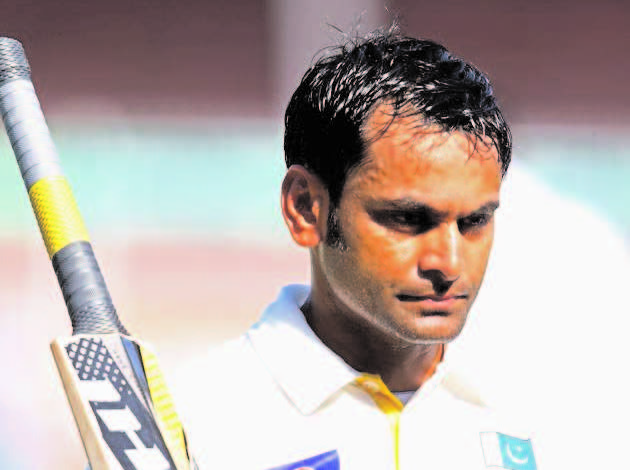
You didn’t have to know Australian batsman Phil Hughes to be shaken by the news of his death after a twoday battle in hospital upon being hit by a cricket ball in a Sheffield Shield game at the Sydney Cricket Ground. The world of cricket – players, coaches and other support staff, match officials, administrators, media persons and fans alike – will be united in grief. Over the past two days, there was hope that the kiss of life that Dr Orchard gave Hughes on the hallowed cricket pitch on Tuesday would have worked in his favour.
There was expectation that Hughes’ will to battle for life would be as strong as the determination that fetched him two hundreds in just his second Test. There was faith that the doctors would help him pull through. It took but a moment – and a text message from a friend in Australia – for those positive emotions, fuelled by an outpouring of prayers by the cricket world at large, to change to shock. Of course, the wise have told us that death is the most certain event in one’s life. But such philosophy is of little consolation when the end comes as an accident with tragic overtones.
More so, if the victim is in the flush of youth. Surely, 25 is no age to die. Surely, a blow received on the cricket field is not a reason to be dead. There is no doubt that Hughes’ death will cloud the impending Test series between Australia and India. You can expect players from both sides to have a grave demeanour for quite some time. As we pick up the pieces and try to move on, the players will be the most challenged by paradoxical needs to be aggressive and yet sombre; combative and yet intensely serious. We have seen the spectre of death loom over cricket and the world of sport -New Zealand left Sri Lanka because of a bomb blast outside the team hotel in Colombo in 1987. England played in Mumbai in 1993 weeks after serial bomb blasts. Six years ago, England returned after a short break caused by a terrorist attack in Mumbai.
Other grim memories come flooding back.
A strange scorecard entry: ‘Abdul Aziz absent dead’ from the Qaid-E-Azam Trophy final in Karachi in 1959. The decline of Hyderabad batsman CL Jaikumar after what seemed to be a good start to a first-class career after he was felled by a Robin Singh bouncer in a 1990 Ranji Trophy game in which he had made 169 in the first innings and was on 42 in the second. But the worst recall is that of former India opener Raman Lamba’s death in February 1998. One can feel the shivers down the spine when thinking of a dark, cold, rainy night when Lamba’s body was brought to Delhi from Dhaka.
Instead of walking through the arrival hall, he returned in a coffin in the cargo terminal with a few family and friends in attendance. Hughes’ death has lessons, not the least being the establishment of emergency response teams at venues. Perhaps, with greater monies coming in to cricket, the international centres should go beyond from having an ambulance on stand-by to exploring possibilities of instituting a medical centre within the premises so that no time is lost in providing the best aid to an injured player. May the world of cricket grieve together as one but long may the game remain beautiful as we have known it.
For it is but a reflection of the lives we live, a heady mix of pain and pleasure, agony and ecstasy, joyous and grim and all that lies between. But, above all, may Phillip Joel Hughes’ soul find lasting peace
Month: November 2014
-

Linda Mangano presented Humanitarian Award at J.E.T.S. 17th Annual Dinner
MASSAPEQUA, NY (TIP): Linda Mangano (center) was presented with The JuliAnna Blisaro 2014 Humanitarian Award at the J.E.T.S. (Joining Everyone To Share) 17th Annual Dinner. The organization helps people in need on a one-to-one basis, with proceeds from their journal ads providing financial help to the less fortunate. During the past year J.E.T.S. of America has helped several children suffering from life threatening illnesses, such as leukemia, by providing financial assistance with medical and other care costs. During the holiday season J.E.T.S. collects and buys toys for children at Winthrop University Hospital and other families in the community that cannot afford to buy gifts for their children.
-

USIBC Takes U.S.-India Smart Cities Initiative Forward
USIBC takes next step to develop Smart Cities in follow-up to Modi-Obama September Joint Statement
NEW DELHI (TIP): The U.S.-India Business Council (USIBC) concluded November 22 its weeklong mission in India with the commencement of the U.S.-India Smart Cities Conclave. Senior Cabinet-level officials from the Government of India welcomed U.S. industry leaders to address concerns and promote ideas to advance the goal of developing Allahabad, Ajmer and Visakhapatnam into smart cities as articulated in the joint statement between President Obama and Prime Minister Modi earlier this year.
Smart Cities are the integration of information technology, telecommunications, urban planning, smart infrastructure and operations in an environment geared to maximize the quality of life for a city’s population. Minister of Urban Development Venkaiah Naidu commented, “Smart Cities planned in India should reflect Indian culture and should not be a copy of any one model. There are a lot of opportunities for private-public partnerships in the area of smartcity development and the government is looking forward to involving everyone in these projects.
Smart Cities in India will be people-centric and will aim at making life comfortable for all citizens.” The conclave is the first of many events resulting from USIBC Chairman and MasterCard CEO Ajay Banga’s delegation meetings with ministry officials in June. Panels addressed the issues of economic development and financial viability of proposed projects. “The Council and its member companies look to play an integral role in India’s commitment to build 100 Smart Cities across the nation and particularly in the three projects identified in September,” said USIBC (Acting) President Diane Farrell.
“Smart Cities are sophisticated systems designed to simplify everyday life and USIBC has graciously accepted the invitation to visit the three cities.” Minister of State (Independent Charge) for Power, Coal and Renewable Energy Piyush Goyal noted that these Smart Cities, “need to reflect a revolution and evolution of ideas.” Additional key government officials included Secretary, DIPP, Ministry of Commerce and Industry Amitabh Kant, Secretary, Ministry of Urban Development, Shankar Aggarwal and Joint Secretary for Finance, Sharmila Chavaly and key U.S. Government officials.
A consortium of experienced industry leaders from USIBC member companies including, IBM, Cisco, Waste Management, Dow, GE and United Technologies Corporation discussed the role that industry will play as India develops Ajmer, Allahabad, and Visakhapatnam into Smart Cities and establishes sustainable economies and healthy communities. The Conclave comes at the culmination of key business and government interactions throughout the week for the Council; including the India-U.S. Technology Summit, the very successful meeting of the U.S.-India High Technology Cooperation Group, and ahead of the Trade Policy Forum, reconvening after a four-year hiatus.
About USIBC
Formed in 1975 at the request of the U.S. and Indian governments, the U.S.- India Business Council (USIBC) is the premier business advocacy organization advancing U.S.-India commercial ties. Today, USIBC is the largest bilateral trade association in the United States, with liaison presence in New York, Silicon Valley, and New Delhi, comprised of 310 of the top-tier U.S. and Indian companies. The Chairman of USIBC is Ajay Banga, President and CEO, MasterCard. -

Nationwide protests follow Grand Jury verdict in Michael Brown killing case
I.S. Saluja
NEW YORK (TIP): New York has been among the large number of cities across the United States of America to witness loud protests following the Grand Jury verdict to not indict police officer Darren Wilson who had shot and killed the 18 year old Michael Brown in Ferguson, a suburb of St. Louis County, Missouri on August 9, 2014. Since November 24 when the Grand Jury verdict was announced by Prosecutor McCulloch in a 20-minute press conference in Ferguson at least 400 protesters have been arrested across the US, as they rallied against the grand jury decision on the shooting of Mike Brown in Ferguson, and police violence in general.

Thousands of protesters marched through the streets of New York City for the second night on Tuesday 25th November, 2014, chanting loudly and blocking traffic on some of Manhattan’s busiest streets to express outrage over the decision not to indict a white police officer in Ferguson, Mo., in the death of an unarmed black man. The protesters marched on Franklin D. Roosevelt Drive, through Times Square and across the Manhattan Bridge, disrupting traffic along those routes and at the Lincoln Tunnel, and Union Square. The protesters, a diverse and relatively young crowd, held signs saying, “Hands up, don’t shoot,” and “Black Lives Matter.” Around 9 p.m. they began to enter the roadway on the Manhattan Bridge, chanting, “Whose bridge? Our bridge,” and then crossed into Brooklyn.
Some 200 activists were detained in Los Angeles. At 7:30 pm local time on Wednesday, November 26. Police told the demonstrators to leave within four minutes. Those who stayed were taken to police stations, with a possible bail of $500. If the bail isn’t paid, the detainees are to stay in prison until at least December 1. “We won’t stand aside. The LAPD’s temper is known to the whole world. There’s no need to think of the film plots! We should protect ourselves, our patience has run out, we’ll be seeking the re-examination of the Wilson case,” a protester called Angelo told a news agency.

In Oakland, California, hundreds of protesters marched through the city, spraying walls, billboards and bus stops with graffiti and smashing storefront windows. It all led to clashes with police in a public plaza adjacent to City Hall. San Diego saw a peaceful march, with around 300 people chanting “Ferguson, we’ve got your back!” In Dallas, Texas, three members of a group called ‘Come and Take It’ marched alongside demonstrators, saying they were prepared to step in and protect private property if things turned ugly.

Things have also been largely peaceful in Ferguson, Missouri. Amid the snowy weather, several dozen protesters remained near the police station. On Monday, protests turned violent, with looting, gunfire, and clashes leading to over 60 arrests. Forty-five more people were detained on Tuesday. Over 2,000 National Guard forces were sent to step up security in Ferguson over the past few days. The protests kicked off after Darren Wilson, a white police officer who shot dead unarmed African-American teenager Michael Brown back in August, was not indicted by a grand jury on Monday.
The governor of Missouri has reportedly rejected calls for a new grand jury to reexamine the case. In a statement on Wednesday, November 26 Wilson said that he had a “clean conscience” over the killing. Brown’s family said that they were “crushed” by the grand jury’s decision, and that their son was “crucified” by the prosecutors, but called on the rallies to remain peaceful. -

Centenary of KOMAGATA MARU TRAGEDY
The younger generation of Indians may not have heard about Komagata Maru. And the older one may have a faded recollection of one of the historic events in India’s struggle for independence. Inder Singh who has been associated with the foundation in USA to preserve history of Komagata Maru, here recounts the hundred year old event and speaks about how important it is not to forget our shining history. –EDITOR
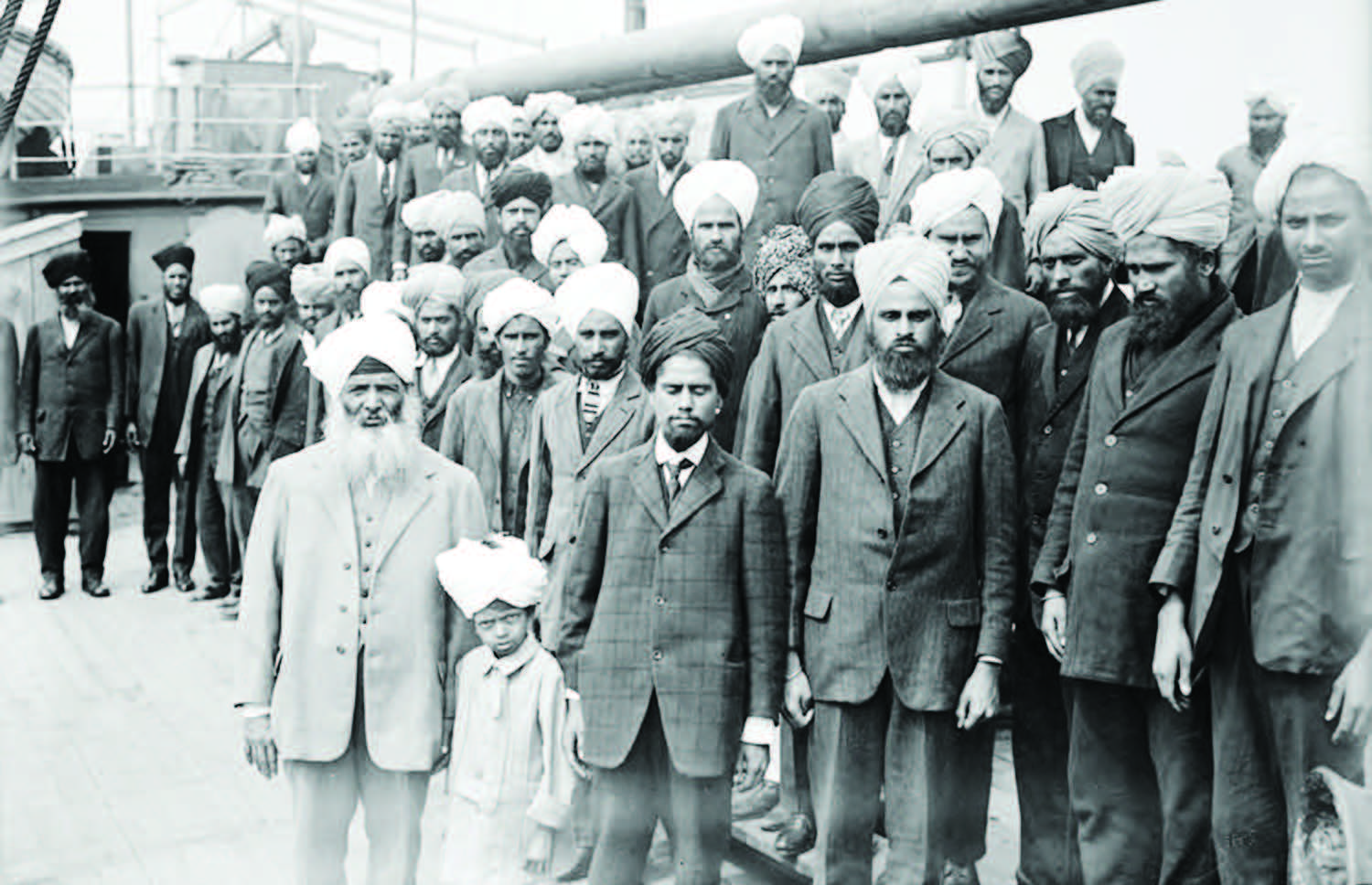
Komagata Maru was a ship that took 376 Indians to Canada in 1914 to challenge the racist Canadian law. The passengers had taken the voyage in search of economic opportunities. They were connected neither with the Gadar Party nor with any other freedom movement. On reaching Vancouver, they were not allowed to land and were forced to stay on the ship for two months, sometimes without food and water. They were unhappy, some even rebellious at the unjust verdict of the highest Canadian justice court. The British Indian Government considered the passengers not as opportunity seekers but anti-British freedom fighters. On their return journey, they were not allowed to land in Hong Kong, Singapore or Shanghai, from where they started their voyage.

Majority of the passengers wanted to find work and make some money before going to their villages. They paid heavy price for dreaming to improve their economic situation, some spent part of their lives in jail, many were confined to their villages and eighteen of them lost their lives. Indians started coming to Canada from 1904 for economic opportunities. They had an easier access to Canada as both India and Canada were British colonies. The new immigrants were willing to do any kind of manual job and found work on farms, in factories, mills and lumberyards.

They were paid lower wages and worked for long hours. Some Canadian employers considered India as a source of cheap labor and publicized the economic and job opportunities available in Canada to attract more workers. By the end of 1907, number of Indian immigrants had reached over 5000, comprising mostly of Punjabi military veterans, farmers and unskilled laborers. As the number of immigrants increased, the white workers felt threatened that the Indians would take over their jobs. Fear of labor competition led to jealousy, racial antagonism and demands for exclusionary laws for foreign workers.

The local press carried many scare stories against the Asians and “Hindu Invasion.” The Government of Canada came up with two new laws to curb Indian immigration to Canada. One law required Indians to carry $200 in cash upon landing in Canada and the other, the “Continuous Passage” Act 1908, required immigrants to come to Canada via direct passage from their point of origin. These restrictions were very unreasonable. There were no ‘through’ ships from India to Canada and $200 was a significant amount of money, considering an average daily wage of 10 Cents of an Indian worker at that time.
Thus, Indian immigration to Canada literally came to an end. The restrictive legislation led to discontent and anti-colonial sentiments within the Indian community. The Canadian immigration policy was exclusionist, based on race and nationality. Public and political sentiments were racist also. Over 2 million Europeans were welcomed from 1906 to 1915, while the number of Asian immigrants admitted during the same period was only about 50,000. Chinese immigrants had also to pay head tax on arrival, which was increased to $500 in 1904. Japanese government, by a gentleman’s agreement, was limited to issue only 400 passports for their nationals immigrating to Canada.
Indians, although British subject like Canadians, were prohibited in 1908 to land in Canada because of the “Continuous Journey” law. Many Indians in Hong Kong, Singapore, Shanghai and other places were keen to come to Canada. But Steamship companies were not allowed to sell tickets to Indians for Canada. An enterprising and resourceful Indian in Singapore, Gurdit Singh, chartered a Japanese vessel Komagata Maru to challenge the racist Canadian law.
He obtained clearance from the British Colonial secretary in Hong Kong to sail to Canada. He renamed the ship as Guru Nanak Jahaz in a prayer meeting and left Hong Kong with 165 passengers on April 4, 1914. He got 111 passengers at Shanghai and 85 more passengers joined at Moji, Japan. At Moji, Bhai Balwant Singh, head priest of Vancouver Sikh Temple, who was on a return journey to Vancouver, met with the passengers and explained them the attitude of the Canadian government. At Yokohama, Gyani Bhagwan Singh met with the passengers and told them the story of his deportation from Canada in November, 1913. Maulvi Mohammad Barkatullah, a renowned revolutionary who had lived in New York, also met with the passengers.
Both, Bhagwan Singh and Barkatullah, were involved with India Independence Movement, started in America and known as Gadar Movement. They brought latest issue of weekly Gadar magazine and other revolutionary literature for passengers to read. The ship arrived in Vancouver on May 23, 1914 with 376 passengers, all British subjects (340 Sikhs, 24 Muslims and 12 Hindus). British Columbia Premier Richard McBride, one day prior to the arrival of the ship, made statement that the Komagata Maru passengers would not be allowed to disembark. The passengers, however, thought that as British subjects, they had the right to enter Canada.
The Canadian public and political sentiments were against Indians getting permission to land. Canadian media in Vancouver was unsympathetic to the arriving passengers. Inflammatory articles in Vancouver newspapers helped to ignite and promote anti- Indian sentiments. The Sun newspaper called the passengers “Hindu Invaders.” Only an Indian newspaper, The Hindustanee welcomed the passengers.
The immigration officials did not allow the passengers to land in Vancouver. Indians in Canada and the USA were outraged. The local Indians rallied in support of the passengers and organized protest meetings against the racist policy of the government. They formed a shore committee to help the passengers with food, provisions and legal challenges. The last installment for chartering the ship was due. Neither Gurdit Singh nor the passengers had money to pay. The shore committee organized a meeting of local Indians to raise funds for making installment payment and for legal fee and other expenses.
In 1913, 38 Sikhs who had come by Panama Maru ship, were refused immigration. They challenged the continuous journey law in the court and were allowed to stay in Canada. The Government amended the Immigration law in January 1914 to plug loopholes and face any challenges. The shore committee hired an attorney to fight a test case against Canadian government’s refusal to allow Komagata Maru passengers to land in Canada. Unfortunately, the Court gave a unanimous judgment that it had no authority to interfere with the decisions of the Department of Immigration and Colonization. Only 20 returning passengers, and the ship’s doctor and his family were given permission to leave the ship.
All the other passengers were ordered to leave the Canadian waters. The passengers had endured incredible hardships on the ship for two months and refused to leave without provision for their journey back to India. The government brought a navy cruiser to intimidate the passengers into leaving. However, the last minute negotiations averted confrontation. On receipt of provisions for the return journey, Komagata Maru left the harbor on July 23, 1914. The action of the Canadian Government created bitterness, frustration and vengefulness among the passengers as also among Indians in Canada and the US.
Many passengers had boarded the Komagata Maru ship to Canada at Hong Kong, Singapore and Shanghai. On return journey, several of them wanted to land from where they had started their voyage but were refused permission to disembark. On September 5, 1914, before Komagata Maru reached India, the British authorities had enacted a new law, “Ingress into India Ordinance”, which empowered the Punjab Government to check the people entering India. The Government also had power to confine their movements to their villages or imprison them without trial. On reaching Budge Budge, near Calcutta, on September 29, 1914, the British Indian Government asked the passengers to board the train for Punjab.
Except 62 passengers, all others wanted to stay in Kolkata and find employment there. The passengers had the Holy Sikh Scriptures, Guru Granth Sahib which they wanted to deposit at the Sikh temple, Kolkata. They proceeded in a procession to go to the temple but the police did not want them to go. In the scuffle between the police and the passengers, the police opened fire resulting in the death of twenty-three people – eighteen passengers, two innocent Begalis, two European officials, and one Punjab police official. Several suffered injuries and were hospitalized. Gurdit Singh and forty five of the passengers escaped.
The police arrested two hundred and two passengers and put them in prison or confined them to their villages in Punjab for several years. (Harish Puri, The Ghadar Movement, 100) The brutal treatment of the returning passengers generated a wave of resentment against the British government. The Komagata Maru incident encouraged new converts to the Gadar cause, from not only North America but also Indians from all over the world and gave impetus to the movement for India’s independence. Jawala Singh had undertaken a simple business enterprise to transport his compatriots to Canada. But the venture ended with political implications. After evading arrest in Kolkata, he stayed in hiding for seven years.
Finally, he surrendered to the police at the birth anniversary celebration of Guru Nanak Dev, at Nankana Sahib on November 15, 1921. He spent five years in jail for violating no laws. He joined Congress and in 1937, contested Punjab Legislative Assembly election. Unfortunately, he lost to the Akali candidate, Partap Singh Kairon who later joined Congress and was Punjab Chief Minister from 1952 to 1964. In 1951, Jawala Singh requested Prime Minister Jawahar Lal Nehru to build a memorial at Budge Budge in memory of the martyrs of Komagata Maru. On January 1, 1952, Mr. Nehru unveiled the completed monument which is popularly known as the “Punjabi Monument”. (www.rangandatta.wordpress.com/2013/01/30/ komagata-maru-memorial-budge-budge-24- parganas-south/) Indian community in Canada did not forget Komagata Maru tragedy. Baba Gurdit Singh, his colleagues and the ship have become an integral part of the history of Canada.
A giant-sized mural of Baba Gurdit Singh and others in the ship, adorns the front wall of the Senior Citizen Housing Unit in Surrey, near Vancouver. A plaque commemorating the 75th anniversary of the departure of the Komagata Maru was placed in the Sikh temple in Vancouver on July 23, 1989. A plaque commemorating the 80th anniversary of the arrival of the Komagata Maru was placed in the Vancouver harbor in 1994.
The first phase of the Komagata Maru Museum was opened in June 2012 at the Khalsa Diwan Society, Ross Street Temple, Vancouver. A monument in remembrance of the Komagata Maru incident was unveiled on July 23, 2012. It is located near the steps of the seawall near Convention Centre West in Vancouver. The Canadian government provided funding for both the monument and the museum. A stamp commemorating the 100th anniversary of the arrival of the Komagata Maru was released by Canada Post on May 1, 2014. On August 3, 2008, Canadian Prime Minister Stephen Harper appeared at the 13th annual Gadri Babiyan Da Mela (festival) in Surrey to apology for the Komagata Maru incident.
In response to the House of Commons motion calling for an apology by the government, he said, “On behalf of the government of Canada, I am officially conveying as prime minister that apology.” On May 23, 2008, the Legislative Assembly of British Columbia unanimously passed a resolution “that this Legislature apologizes for the events of May 23, 1914, when 376 passengers of the Komagata Maru, stationed off Vancouver harbor, were denied entry by Canada.
The House deeply regrets that the passengers, who sought refuge in our country and our province, were turned away without benefit of the fair and impartial treatment befitting a society where people of all cultures are welcomed and accepted.” The Government of India has decided to commemorate the centenary of Komagata Maru incident. The inaugural function of the yearlong centenary commemoration was organized on September 29, 2014 by Union Ministry of Culture. Three granddaughters of Baba Gurdit Singh – Ms. Harbhajan Kaur, Ms. Satwant Kaur and Ms. Balbir Kaur were honored by the Culture Minister Shri Shripad Naik on the occasion. A set of commemorative coins of denominations of ?100 and ?5 was released to mark the occasion. The government also decided to build a memorial at Budge Budge port.
The National Film Development Corporation of India (NFDC) would make a film on the tragedy. A postal stamp would be issued in commemoration of the centenary. The Government of India has constituted a National Implementation Committee which has planned a number of programs such as national and international conferences, publications, development of digital archives and preparation of films and documentaries, etc. The Committee shall hold a week-long function at Vancouver from 23rd May to 30th May, 2015 which would include cultural events, seminars and exhibitions besides honoring the descendants of the Komagata Maru passengers as well as non-Indians including Canadians who rendered assistance both financially and legally to the cause of Komagata Maru passengers.
The Punjab government would commemorate the centenary of Komagata Maru tragedy by installing a replica of the steamship Komagata Maru at the Azadi Memorial at Kartarpur in Jalandhar. A statue of Gurdit Singh shall be installed in Amritsar. His small house at Sarhali village in Amritsar shall be renovated and preserved. The government would also organize a state level function in February 2015. A brochure on Komagata Maru tragedy would be published.
The book, Voyage of Komagata Maru, a translation of Gurdit Singh’s Zulmi Katha, edited by Darshan Singh Tatla and Prithipal Singh Kapur, shall be reprinted. A special library section is planned to house documents relating to Gadar and Komagata Maru in Punjabi University, Patiala. A play on Komagata Maru would be written, staged and video graphed for showing in colleges. This would be financed by Union ministry of Culture.
(The author regularly writes and speaks on Indian Diaspora. He is the author of The Gadar Heroics – life sketches of over 50 Gadar heroes. He is Chairman of Global Organization of People of Indian Origin (GOPIO) and was president of GOPIO from 2004-2009. He was Chairman of National Federation of Indian American Associations (NFIA) from 1992-96, and president from 1988-92. He was founding president of Federation of Indian Associations in Southern California. He is Chairman of Indian American Heritage Foundation which has been awarding scholarships for excellence to top Indian students in Southern California since 1987. He can be reached at indersingh usa@hotmail.com) -

Modi meets leaders, pushes for greater cooperation
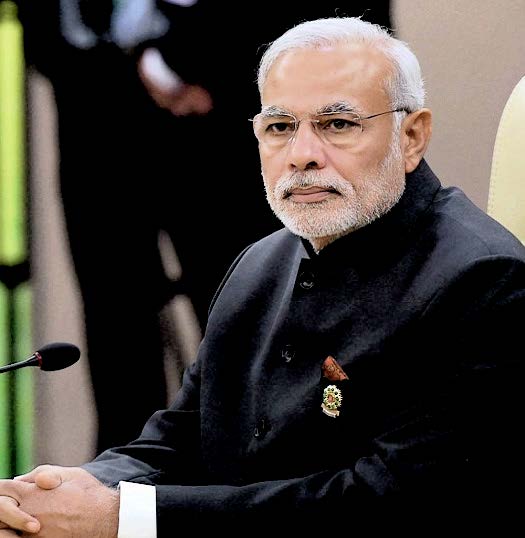
KATHMANDU (TIP): Prime Minister Narendra Modi today carried forward the engagement with leaders of SAARC nations where the central theme was the new energy he brought to the regional grouping through his vision for greater cooperation and connectivity among member states at the summit. On the sidelines of the SAARC Summit here, the Prime Minister had bilateral meetings with the Prime Minister of Bhutan Tshering Tobgay, Prime Minister of Bangladesh Sheikh Hasina, President of Afghanistan Ashraf Ghani, President of Sri Lanka Mahinda Rajapaksa and the President of Maldives Abdulla Yameen. “A large part of the discussions centred around the statements made and the events at the SAARC Summit. During the bilateral meetings, various heads of government complimented the Prime Minister for his statement at the SAARC Summit and his forward-looking vision.
The Prime Minister was also complimented for his initiative of the SAARC satellite. Some countries also shared what they look forward to from such a satellite. The Prime Minister’s emphasis on solar energy was also greeted with enthusiasm during these meetings,” MEA spokesperson said later. Besides the discussions on SAARC, the PM extended an invitation to the new Afghan President Ghani, hearing the views of the latter on his vision for the country as also the cooperation expected from India.
Specific proposals for economic cooperation and transfer of technology figured during the talks. President Ghani reassured that Afghanistan would not do anything to harm Indian security in the country, as India continued to face threats to its missions in there. The National Security Adviser will travel to Sri Lanka and Maldives next month. Maritime security shall be on the agenda during these visits. Bangladesh, Sri Lanka and Maldives reiterated their invitations to the Prime Minister and he, in turn, emphasised that engagement with SAARC nations was a priority with him.
The Prime Minister invited Bhutan Prime Minister Tshering Tobgay to visit India in January and also be part of the Vibrant Gujarat summit. The Prime Ministers of India and Bangladesh had a detailed exchange of views on matters relating to security and terrorism which impact both countries. The Burdwan blast which is currently being investigated by the National Investigation Agency and has linkages in Bangladesh also came up during the discussions.
Modi mentions Mumbai attack, urges member nations to combat terrorism
Addressing the Saarc summit, Prime Minister Narendra Modi mentioned the 26/11 terror attack in Mumbai, describing the ambush that left 166 people dead and 304 injured as a ‘horror’. “Today, as we remember the horror of the terror attack in Mumbai in 2008, we feel the endless pain of lost lives,” he said, urging South Asian countries to work and combat terrorism together.
“Let us work together to fulfil the pledge we have taken to combat terrorism and transnational crimes,” he added, on the sixth anniversary of the Mumbai terror attack. His remarks came close on the heels of Pakistan Prime Minister Nawaz Sharif saying his country preferred a dispute-free South Asia. Sharif also said instead of fighting each other, “we must jointly fight poverty, malnutrition”
-

SAARC SUMMIT SALVAGED AFTER MODI-SHARIF HANDSHAKE
KATHMANDU (TIP): A brief meeting between India’s Prime Minister Narendra Modi and his Pakistani counterpart on November 28 salvaged a summit of South Asian leaders, with all eight countries clinching a last-minute deal to create a regional electricity grid. The pact at the summit’s closing ceremony in the Nepali capital, will buttress Modi’s ambition for South Asia to become a viable economic counterweight to China, which has made sweeping inroads in the region.
Modi shook hands with Pakistani Prime Minister Nawaz Sharif at a mountain retreat outside Kathmandu and then again before the curtain went down on the conference. Television showed the two men smiling and exchanging a few words. “Both are talking in a friendly manner,” Nepal Prime Minister Sushil Kumar Koirala told reporters, when asked if his country, as summit host, had helped break the ice. Except for these brief exchanges, the two leaders had spent most of the summit cold-shouldering each other, however. India and Pakistan have fought three wars since independence from Britain in 1947.
On Thursday, the worst militant violence in more than a year in the Indian part of disputed Kashmir killed ten people, including three Indian soldiers. The squabbling between the rivals is widely blamed for the poor performance of the South Asian Association for Regional Cooperation (SAARC), initially founded with the goal of moving towards a European-style union. Despite a free trade pact in force since 2006, high tariffs and curbs on movement limit trade among South Asian nations to just five percent of their total trade. The grouping’s failure to foster closer ties over the past three decades has left the way open for China to step in, by helping to build ports and roads.
China has observer status at the grouping. Vice Foreign Minister Liu Zhenmin on Wednesday promised $30 billion for road building in South Asia over five years, and suggested increasing trade to $150 billion over the same period. Modi announced an easier regime for business and medical visas and promised to lower India’s trade surplus. Pakistan, which still refused to sign two other planned pacts to boost cross border road and rail traffic, was increasingly sidelined at the summit.
India and Pakistan have been trying for years to strike a deal to share energy across their heavily militarized border in Punjab, but Pakistan’s army has resisted the effort. After Thursday’s pact it was not immediately clear if the army was on board.
Modi suggests business traveller card
The PM announced that India would give a business visa for three to five years for SAARC, suggesting a SAARC Business Traveller Card by all member-states
SAARC, he said, accounted for less than 5 per cent of the regional’s global trade
It was harder to travel within the region than to Bangkok or Singapore
SAARC had failed to move with the speed with which the people expect -

Citing trade, Beijing seeks bigger role
KATHMANDU (TIP): The shadow of China seeking a greater role in the South Asian Association for Regional Cooperation (SAARC) and its presence in the eight-member grouping could not be missed here as the 18th Summit got underway. Over the past few days, reports emerged about Beijing pushing the envelope on the issue and today leaders from Bangladesh, Maldives, Pakistan and Sri Lanka advocating a greater role for observers in the regional grouping. SAARC has Australia, China, European Union, Japan, South Korea, Mauritius, Mynamar and the USA as observers and since 2007 have been invited to attend the summit meeting.
Today as the summit opened, Pakistan Prime Minister Nawaz Sharif emphasised the importance of SAARC observers and the benefit the grouping can draw from its interactions with them. “We should build on convergences and minimise divergences and most of all seek to augment complimentaries for the greater good of the people of the region”, he said. Similar sentiments were expressed by leaders of Bangladesh, Maldives and Sri Lanka. While none of them mentioned China, on his part Deputy Foreign Minister of China Liu Zhenmin, who participated, underscored the role Beijing was playing in the region and prepared for a larger role.
He mentioned that while China’s trade in the countries of the region stood at $150 billion, the country has $ 30 billion investments in the pipeline, clearly underscoring the economic muscle of Beijing. While New Delhi has not made any move to counter it, India maintained that the priority among member-countries of SAARC should be to ensure cooperation among the eight countries instead of seeking to expand the grouping in a horizontal direction. -

SAARC SUMMIT: ENERGY PACT SEALED, ROAD AND RAIL PACTS ON ANVIL
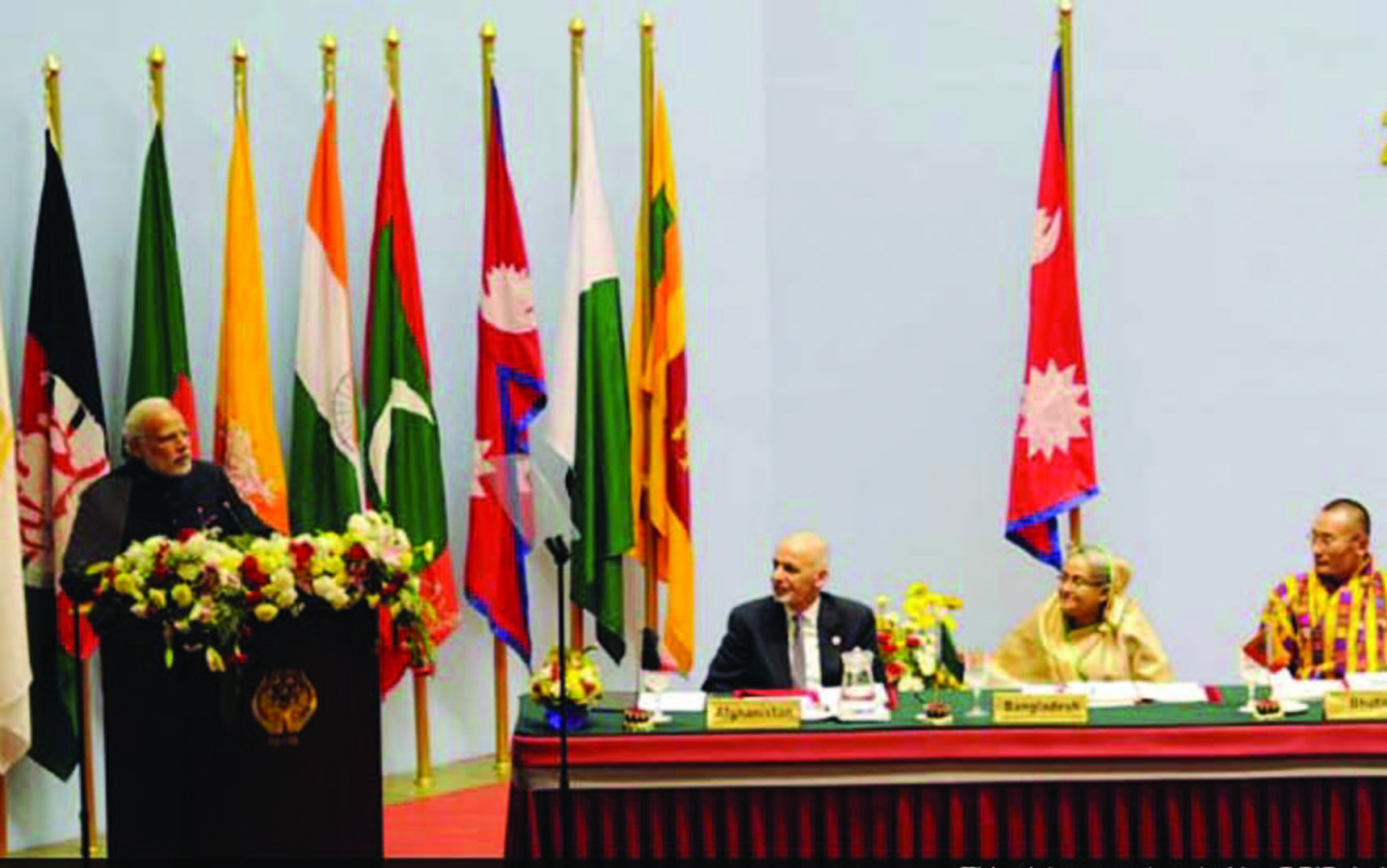
KATHMANDU (TIP): The 18th SAARC Summit concluded on November 27 in this scenic Nepalese capital with the eight South Asian nations signing a pact on energy cooperation and adoption of the Kathmandu Declaration that called for deeper regional cooperation in core areas of trade, investment, finance, energy, infrastructure and connectivity.
The two-day South Asian Association for Regional Cooperation summit started on a discordant note on November 26 with Pakistan blocking three proposed agreements. But it ended on a bright and positive note on Thursday with the eight countries signing the Saarc Framework Agreement on Energy Cooperation and promising to sign two other deals — the SAARC Motor Vehicles Agreement for the Regulation of Passenger and Cargo Vehicular Traffic, and the SAARC Regional Agreement on Railways — within three months. The energy agreement will enable greater cooperation in the power sector among South Asian countries.
It is expected to improve power availability in the entire SAARC region and would facilitate integrated operation of the regional power grid. According to the Kathmandu Declaration adopted at the closing ceremony Thursday, the summit decided to accelerate the process of creating free trade in the region and formulation and implementation of projects, programmes and activities of SAARC in a prioritised, focused and result-oriented manner. Similarly, the summit also agreed to launch regional and sub-regional projects in the agreed areas of cooperation, especially in the area of poverty alleviation, infrastructure building, connectivity and energy.
Strengthening the SAARC Development Fund, effective implementation of the SAARC Action Plan on Poverty Alleviation with a view to making South Asian free from poverty and hunger and enhancing regional connectivity through building and upgrading roads, railways, waterways infrastructure, energy grids, communications and air links, was also agreed on. The declaration called for combating terrorism in all its forms and manifestations and having effective cooperation among the member states for preventing the trafficking of people, arms and drugs and exploitation of children for forced labour.
Increasing agricultural productivity and ensuring food and nutritional security is also the part of the Kathmandu Declaration. Providing quality education, eliminating illiteracy, providing vocational education and training, and making South Asia an attractive common tourist destination by promoting public-private partnership, are also mentioned in the declaration. In the opening ceremony on Wednesday, Indian Prime Minister Narendra Modi, who was the cynosure of all eyes, exhorted the eight SAARC member states nations to “walk in step” as he proposed a slew of measures, including ease for business travel, a level playing field in trade, and initiatives in healthcare and tourism.
He referred to terrorism, especially the 26/11 Mumbai terror attack, in which 10 Pakistani terrorists unleashed mayhem in India’s commercial capital in 2008. “Today, as we remember the horror of the terror attack in Mumbai in 2008, we feel the endless pain of lost lives. Let us work together to fulfill the pledge we have taken to combat terrorism and trans-national crimes,” he said, without naming Pakistan. Urging for seamless connectivity in the region, Modi said “for India, our vision for the region rests on five pillars — trade, investment, assistance, cooperation in every area, and contacts between our people”. “There is a new awakening in South Asia; a new recognition of inter-linked destinies; and a new belief in shared opportunities,” he said. Host of the summit, Nepal Prime Minister Sushil Koirala, said that SAARC would focus on connectivity, security and eradicating extreme poverty.
While Bangladesh Prime Minister Sheikh Hasina sought implementation of the SAARC free trade agreement (FTA) that was signed nearly a decade ago, Pakistan’s Nawaz Sharif called for a dispute-free South Asia. Afghan President Ashraf Ghani asserted that his country would not endanger regional security. While Maldivian President Abdulla Yameen sought a common SAARC platform on climate change, Bhutan’s Prime Minister Tshering Tobgay called for greater integration among South Asian countries to bolster growth. Sri Lanka President Mahinda Rajapaksa called for a common voice among South Asian nations on international issues and cooperation on eradicating terrorism. The heads of state and government also held bilateral meetings on the sidelines of the summit.
After having met Nepal Prime Minister Koirala soon after his arrival here on Tuesday, Prime Minister Modi met his Bangladeshi and Bhutanese counterparts Hasina and Tobgay, and later the presidents of Afghanistan, Sri Lanka and Maldives — Ghani, Rajapaksa and Yameen. Though there was no meeting scheduled between the Indian Prime Minister and Pakistan’s Sharif, the two eventually greeted and informally spoke with each other at the retreat organised for the delegates at the Dhulikhel hill resort near Kathmandu on Thursday. Modi and Sharif shaking hands on the podium in the closing ceremony was the lasting image of the summit. -

Indian Prime Minister among Time magazine’s ‘Person of the Year’ top contenders
NEW YORK (TIP): India’s Prime Minister Narendra Modi is among 50 global leaders, business chiefs and pop icons named as contenders by Time magazine for its annual ‘Person of the Year’ honor. Time has asked its readers to vote for the individual who they think should get the title of Person of the Year and the winner of the readers’ choice poll will be announced in December before Time’s editors choose the individual from the 50 candidates as the honoree.
Modi has so far got 3.8% of the votes, the fourth highest after Russian President Vladimir Putin, Pakistani teenager Malala Yousafzai and doctors and nurses “risking lives to treat Ebola”. The Time ‘Person of the Year 2014’ will be announced in December and the publication said the title will be “bestowed to those who have, for good or for ill, most influenced the news and our lives in the past year”. Describing Modi as “once a controversial regional leader”, Time said he became India’s Prime Minister after leading his Bharatiya Janata Party (BJP) to a “landslide electoral victory on a platform of economic development”. -

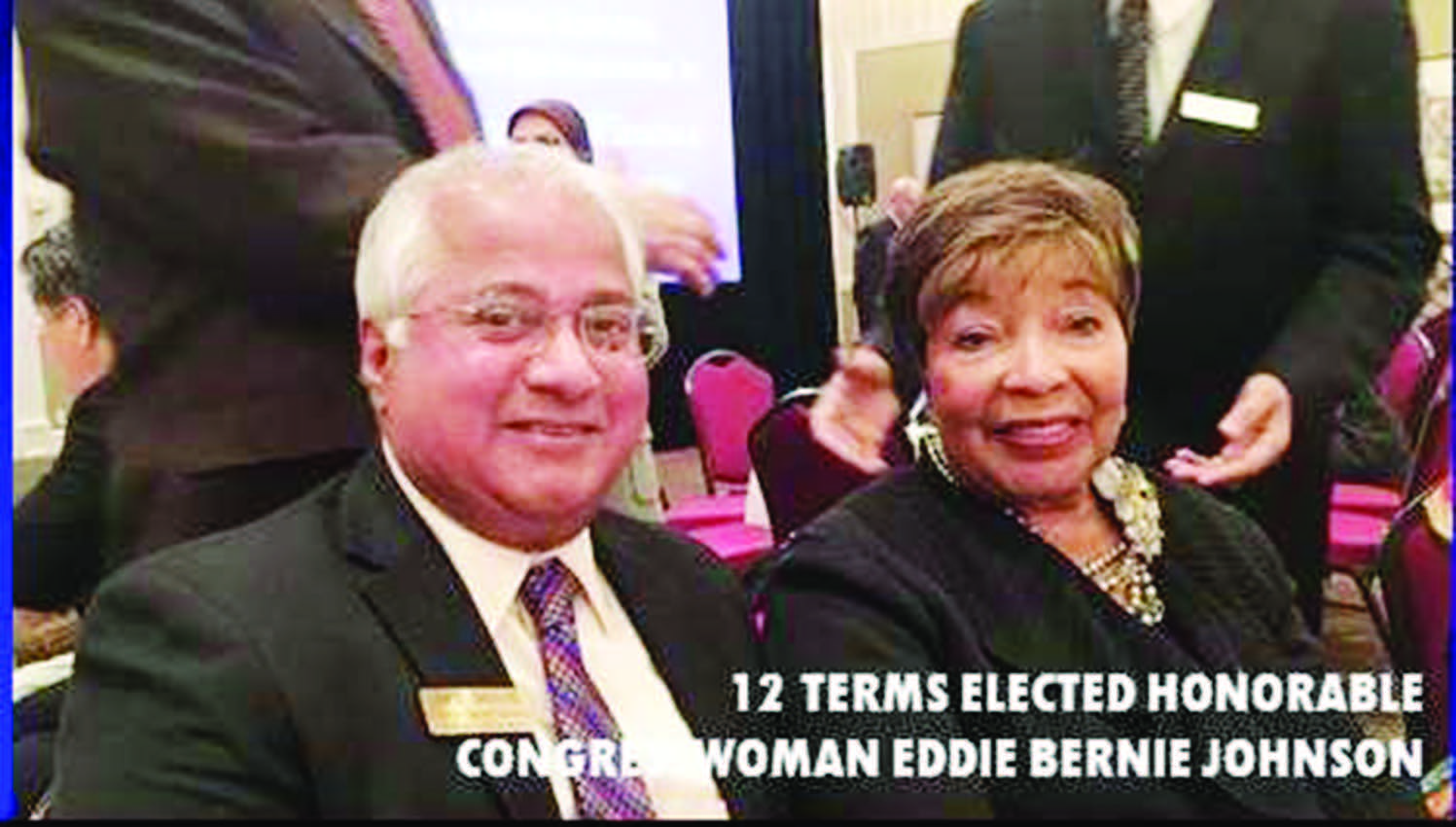
Congresswoman Eddie Bernice Johnson to grace the Thanksgiving Celebrations & Awards Nite in Dallas
DALLAS (TIP): Congresswoman Eddie Bernice Johnson is the guest of honor and key note speaker at the 16th Annual Thanksgiving Celebrations & Awards Nite on Saturday, November 22, 2014. During the evening’s celebrations, Congresswoman Johnson will recognize District 30 constituents for their outstanding service to the community followed by the delivery of her keynote address on gratitude. “The purpose of celebrating this event is to thank God for helping us learn to accept, respect and appreciate each other’s uniqueness and thank America for being the beacon of hope to the world” said Mike Ghouse, founder and chairperson of the event.
Give thanks for the blessed life we all enjoy in these United States of America, wish and pray the same for those who are less fortunate than us.Celebrate the diversity of God’s creation and enjoying the cultural heritage of each ethnic group.
Appreciate and recognize outstanding volunteers in each community.
Gather together as Immigrant Americans with naturally born Americans in celebrating this wonderful holiday.
For many of the immigrants it is an introduction to the American way of life.
Please join us for an interfaith dinner among multicultural attendees, gathered together under the belief that the more we learn about one another, the less misunderstandings are there to be had. If we can learn to respect others and accept the God given uniqueness of all, then conflicts fade and solutions emerge. Master Chef Ali will prepare a special thanksgiving plate that your taste buds will cherish.
Accepted Donations are $20/person or $50/person. You can reserve your place to attend via Eventbrite: Thanksgiving Celebrations & Awards Dinner
Saturday, Nov 22, 2014Time: 7:30 PM – 9:30 PM
Food: Separate Vegetarian food | Halal | Turkey
Place: Spicy Cuisine, Restaurant
Address: 1800 Valley View Ln, Irving, TX 75061
Poetry session in Urdu and Hindi on Gratitude 9:30 – 12:00
www.AmericaTogetherFoundation.com
www.ThanksgivingCelebrations.org
www.FoundationforPluralism.com The event will benefit the America Together Foundation, a 501 (3) (c) nonprofit charity committed to building a cohesive America where no American has to live in apprehension or fear of the other.
Mike Ghouse
(214) 325-1916
MikeGhouse@aol.com -

North Texas teachers, children killed on road trip
DALLAS (TIP): Two North Texas teachers and several of their children were killed overnight while driving through Louisiana for a Disney vacation. Trudi and Michael Hardman died in the single-vehicle crash on Interstate 20 just west of Calhoun, La. Trudi was a kindergarten teacher at Wills Point Primary School, and Michael taught second grade at JFK Elementary in Terrell. The couple’s 4-year-old daughter, Casey, Michael’s 7-year-old son, Andrew, and Trudi’s 15-year-old, Dakota, were also killed.
Trudi’s son, Hunter, and Michael’s son, Adam, survived and have been released from the hospital. Louisiana State Police said that the horrific crash happened around midnight. The16-year-old driving the family, Aaron Hardman, likely fell asleep at the wheel and left the road. He overcorrected and the family’s Chevy Tahoe began rolling, police said. Aaron remains hospitalized in intensive care in Shreveport. Police said six of the eight people in the SUV were not wearing a seatbelt and were ejected. “Our heartfelt condolences go out to all of the people affected by this tragic crash,” said Colonel Mike Edmonson with Louisiana State Police. “Crashes like this one don’t just affect the people involved.
They affect family members, friends, troopers, first responders and the community at large. In an instance this family vacation turned into an unspeakable tragedy. I cannot stress enough the importance of wearing a seatbelt anytime you are in a vehicle.” The family was reportedly on their way to Walt Disney World in Orlando. “These kids and parents were active in the school and in the Wills Point Baseball Association. This was a wonderful family and was loved by all the kids that these wonderful teachers touched,” The Van Zandt Co Fire Marshal’s Office posted on Facebook.
Terrell ISD’s superintendent described Michael Hardman as a dedicated teacher. “Our thoughts and prayers are with his family members, colleagues, students and friends.We must lift each other up during this difficult time,” said Superintendent Michael French. Wills Point ISD said the impact of the tragedy is far reaching and affects each campus in the district. “Words cannot express the sadness in our hearts today,” said Superintendent Suzanne Blasengame. At least 250 people, including neighbors, friends and colleagues paid tribute to the Hardman family at a candlelight vigil Thursday, November 20 night at the Wills Point baseball fields. The family spent much of their free team on the fields because Michael coached youth league baseball. -

AUDIT CRITICIZES TEXAS ECONOMIC DEVELOPMENT PROGRAM RUN BY SCHOOL DISTRICTS
AUSTIN (TIP): Texas school districts are giving away more than $200 million a year in property tax breaks without making sure companies actually create the high-paying jobs promised, the state auditor says. State Auditor John Keel based his criticisms on examination of four school districts’ practices that found inconsistent reporting of information on amounts invested and jobs spun off. “The school districts relied primarily on information that the businesses certified to be true and correct,” said Keel, who recommended the Legislature require independent verification.
He also urged lawmakers to impose tighter ethics policies on school board members and school district employees who handle applications for tax breaks. Last year, as big corporations such as chipmaker Samsung threatened not to expand their Texas operations unless the incentive program was extended, lawmakers renewed it for another 10 years. From 2001 to 2012, school districts agreed to dole out $2.4 billion in reduced appraisals and tax credits, according to state Comptroller Susan Combs. Under the program, known as “Chapter 313,” recipients must be manufacturing plants, energy generators and research-anddevelopment installations.
Districts can reduce a company’s property valuations up to 90 percent for 10 years. They also get credits to offset higher school taxes they pay during construction in the first two years. The Texas Education Agency offsets districts’ losses by ramping up their school aid. One of the program’s goals is to attract businesses that might locate in other states, though critics have questioned how that could be true for some of the selected beneficiaries, such as nuclear power plants, wind farms and natural gas processors.
Business groups have defended the program. Dale Craymer, who heads the Texas Taxpayers and Research Association, has said Texas has very high property taxes on industrial concerns and can’t compete for large relocations or expansions without incentives. “The school property tax is the 800-pound gorilla,” he told the Austin American- Statesman on the eve of last year’s legislative session. Keel was required to audit the program as part of the law extending it through 2024.
He looked at a Hewlett-Packard research facility in Austin, two wind farms in the West Texas town of Sterling City, a natural gas processing plant in Fort Stockton and two nuclear power generating units in Matagorda County that its owner, NRG, canceled in April 2011. The school districts in those communities passively accepted companies’ investment and job numbers before handing the information to two state agencies that help the districts obtain full reimbursement, the audit said. Nor did the comptroller’s office provide any background materials to support its findings that without the tax breaks, the companies wouldn’t have come to the four communities, the audit said.
Dick Lavine, a longtime critic of the program, said the audit confirms the program is too loose about making sure as many jobs as possible are created. “The reason it’s important to verify the numbers is to see if the state’s getting its money’s worth,” said Lavine, a former House tax-research analyst who is a fiscal expert at the center-left think tank the Center for Public Policy Priorities. Chapter 313 costs the state far more than its other business incentive programs, such as the Texas Enterprise Fund and Emerging Technology Fund, though they have drawn more attention, Lavine said. -

Rampal sent to jail, faces murder charges after 6 deaths in Satlok Ashram
CHANDIGARH, HISAR (TIP): Controversial godman Rampal and his close aides have been booked for murder on November 20. They have been blamed for the six deaths at Rampal’s Satlok Ashram near Barwala during the clashes with security forces. Haryana’s Director General of Police S.N. Vashisht told the media: “The murder cases relate to the six deaths at the ashram.” Vashisht said Rampal had been sent to Hisar for investigation of the fresh cases against him which include sedition, rioting, illegal detention and violation of Arms Act.
Earlier, he was sent to judicial custody till November 28 by the Punjab and Haryana High Court after days of stubborn resistance by his followers, which turned Barwala town in Haryana’s Hisar district into a virtual warzone. There was loud hooting as the godman emerged from the court after the hearing. Dressed in a shirt and track pant and wearing slippers, the godman sat through the hourlong hearings, which started earlier than scheduled.
The court ordered that Rampal be immediately sent to jai as the Division Bench cancelled his bail in the 2006 murder case. Rampal was put behind bars in Panchkula this morning after the high court cancelled the bail granted to him in April 2008 in a 2006 murder case. He was taken from a government hospital in Panchkula, where he was admitted early in the day, to the Sector 5 police station adjoining Chandigarh. Disappointment writ large on his face, Rampal stood in the lock up holding the iron bars, occasionally looking down. Before being taken to the police station, Rampal claimed that he was an innocent man.
“I am innocent. All the charges against me are baseless,” he told journalists. When asked if he sorry for the death of six people at his ashram during the Satlok Ashram standoff, he said, “I did not ask them to be there.” The 63-year-old godman was arrested on November 19 night, more than 24 hours after over 5,000 security personnel stormed his fortified ashram compound using water cannon, tear gas and batons. More than 500 devotees of Rampal, including nearly 250 members of his private army, called Baba’s Commandoes, were also arrested. -

Modi returns home after 3-nation tour of Myanmar, Australia and Fiji
NEW DELHI (TIP): After a threenation tour of Myanmar, Australia and Fiji that was spread over nine days, Prime Minister Narendra Modi arrived at the New Delhi aiport on November 20 morning. He was received by External Affairs Minister Sushma Swaraj and other dignitaries as he stepped out of the special Air India plane that flew the PM and his delegation from Fiji’s capital Suva. The plane landed at the airport in Delhi at 7:15 am after a 14-hour flight that included a two-hour refuelling halt at Yangon in Myanmar.
During his three-nation tour, Modi attended the East Asia and ASEAN-India Summits in Myanmar, the G-20 Summit in Australia and held bilaterals with his Australian and Fijian counterparts. Modi, the first Indian premier to visit the Pacific country after Indira Gandhi who had come here in 1981, held talks with his Fijian counterpart Frank Bainimarama and also announced a slew of Lines of Credit and development aid totalling USD 80 million for the country.
He also addressed Fijian parliament, the first by a foreign leader, after parliamentary elections, during which he said that India was prepared to build a “Digital Fiji”. Modi announced visa on arrival facility for all the 14 Pacific Island countries and hoped it will promote better understanding between the peoples. During his four-city tour in Australia, Modi and his counterpart Tony Abbott agreed on a landmark framework for security cooperation across the spectrum in defence, cyber and maritime security and combating terrorism, including the threats posed by foreign fighters joining extremists groups. The two countries also decided to conclude a long-pending Free Trade pact by the end of next year and an “early closure” of the civilian nuclear deal that will facilitate uranium imports to India.
Prior to arriving in Australia, Modi attended the ASEAN-India summit and the East Asia Summit in Myanmar. At the East Asia summit in Myanmar capital Nay Pyi Taw, Modi asserted that the world community must reject any linkage between religion and terrorism while formulating a “genuinely international” partnership in the fight against all forms of terror acts. On India-ASEAN relationship, Modi said there were “no irritants” in their ties and they can be “great” partners.
He said there will be “major improvement” in India’s trade policy and environment and proposed a special facility for speedy implementation of connectivity projects with the 10-nation ASEAN bloc. On the sidelines of the summits, Modi met Chinese Premier Li Keqiang, Malaysian counterpart Najib Razak, Russian Premier Dmitry Medvedev, and Thai counterpart Gen Prayut Chan-o-cha. -

Lok Sabha Speaker wants men to change their mindset about women
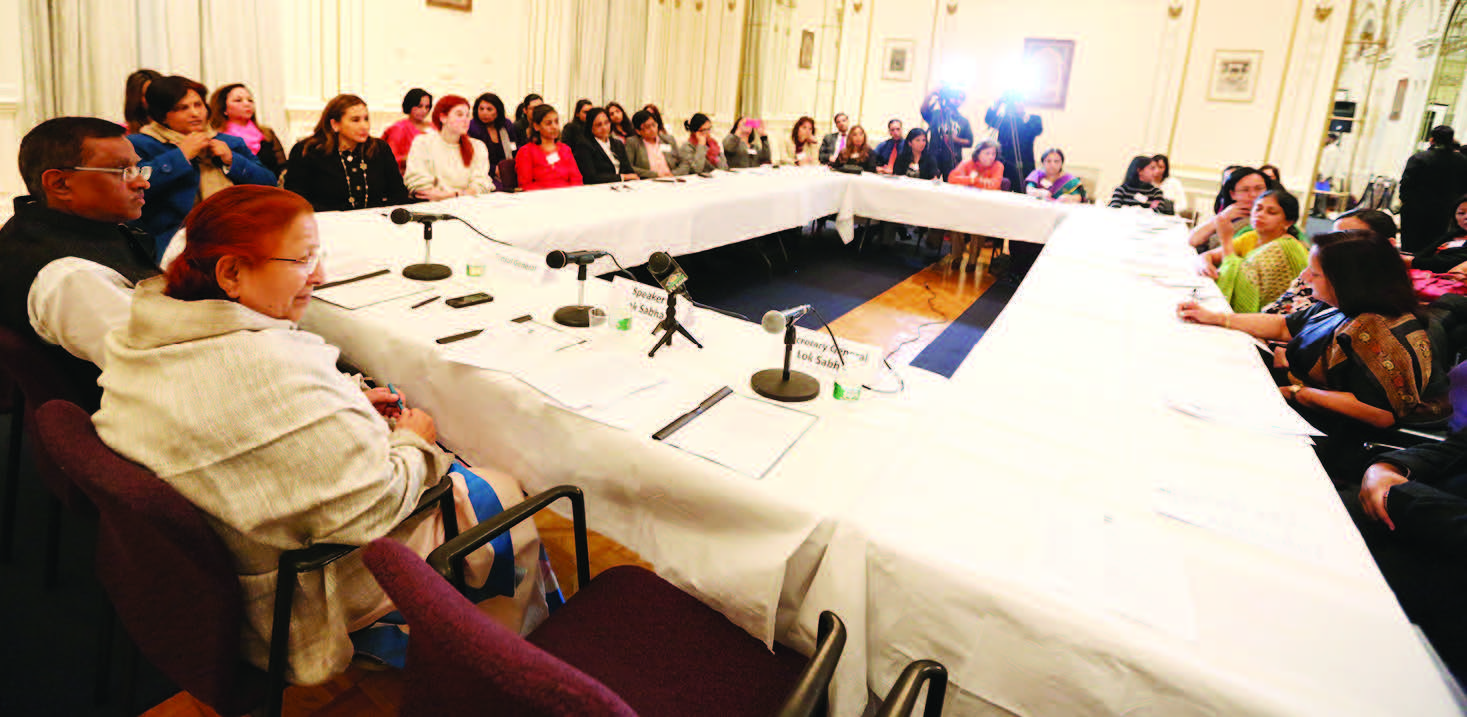
NEW YORK CITY (TIP): Changing the male mindset about women in India and treating them as human beings is the first step to bring gender equality, said Lok Sabha Speaker Sumitra Mahajan. She was addressing a gathering at the Indian consulate in New York on November 18. The Indian Women Forum and the Indian Consulate jointly hosted an interactive session with the Speaker to discuss issues relating to women’s development and their contribution to India-US relations at the Consulate, November 18.
The attendees that included women from various walks of life discussed issues relating to women’s development and their contribution to India-US relations. Among those who attended the forum were Dr Uma Mysorekar, President Hindu Temple Society of North America, Meera Gandhi, a humanitarian and the founder and CEO of The Giving Back Foundation, Dr Farah Usmani, chief, operational support and quality assurance, United Nations Population Fund. Consul General Dnyaneshwar M. Mulay introduced the significance of the event and appealed to them to encourage women empowerment.
Speaking on women empowerment issue, the Lok Sabha Speaker Sumitra Mahajan admitted that India is lagging behind but said the new government is determined to bring gender equality. “Our government is trying its best to ensure education for girls. But the most important thing is to change the mindset about women in our society. Women should be treated as human beings and they must be given their due respect. They should be recognized for their extra capacity of handling multiple things”, she said noting that it is equally important to retain the traditional role of woman in society.
She also spoke about projects launched by government of India including Ladli Laxmi, a scheme introduced to lay a firm foundation of girl’s future through improvement in their educational and economic status, Beti Bachao Beti Padhao, (Save the girl child and educate girl child scheme) and Roshni a skill development scheme aimed at youth in rural India. -

CRY AMERICA: Giving Wings to Children’s Dreams
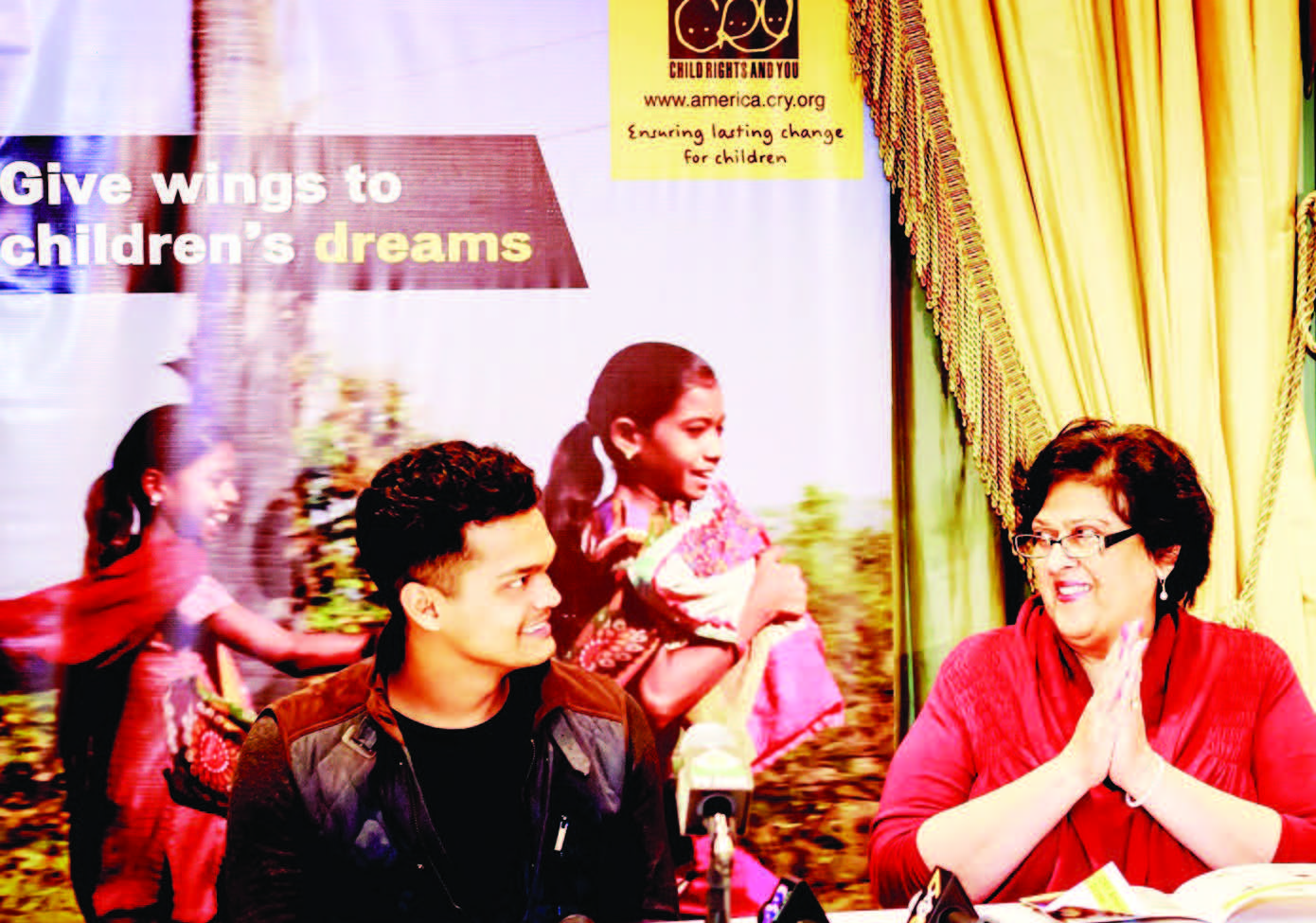
NEW YORK CITY (TIP): CRY, Child Rights and You America Inc (CRY America), a 501c3 non-profit that works to restore the rights of underprivileged children, especially in India, hosted its annual gala dinner ‘Pledge 2014’ on November 7, at the Taj Pierre in New York. Over 12 years, CRY America’s work with 70 Projects has resulted in 324,368 children enrolled in schools, 9,519 children freed from child labor, 177,814 children immunized, 95,444 births registered, 358 public healthcare centers strengthened and 501 villages free from child labor.
Speaking at Pledge 2014, Shefali Sunderlal, President of CRY America shared, “All children have dreams and aspirations. However, obstacles such as malnutrition, child labor, child marriage and lack of education destroy their childhood. CRY America has given wings to the dreams of 450,832 children by ensuring education, healthcare, nutrition and protection from exploitation.
This achievement has been possible only because of the support received from 20,000 generous donors and 2,000 committed volunteers.” Pledge 2014 was attended by over 100 high net worth guests from New York, New Jersey, Pennsylvania, who came together to partner CRY America’s work to benefit underprivileged children, including prominent personalities Madhur Mittal, Vipp Jaswal, Dr. Roshini Raj, Scarlett Pildes, Shikha & Mohit Bhatia, Anita & Ajay Agarwal, Maureen & Gerard Devas, Rishikant Singh, John Phillip and Rajeev Bhambri.

Paintings donated by famous Indian artists, Late Badri Narayan, Prakash Deshmukh, Anu Kulkarni, Dattatraya Thombare; Cricket bat autographed by Captain Sourav Ganguly, Jewelry donated by Surat Diamonds and a Beatles Album autographed by Paul McCartney and Ringo Starr, among other items were auctioned at the event by Priyanka Mathew, Head of Sales & Vice President of Contemporary South Asian Art at Sotheby’s. Madhur Mittal, Indian actor from Slumdog Millionaire & Million Dollar Arm felt that it is time to give children their due. Recalling his experience of working with children in the slums of Mumbai, he said “You can unlock the potential of children when they are given a chance.
Education plays a key role in the development of children and goes a long way in giving them the platform to realize their potential.” Vipp Jaswal, Head of International Affairs, Fox News urged people to support the cause by sharing, “Most of us are lucky to have received the education and healthcare that has resulted in us being successful today. It is important for us to support organizations like CRY that ensures children have better opportunities to succeed in life.” Also present at the event, Dr Roshini Raj, Physician at NYU Medical Center and founder of TULA skin care; feels that, “A healthy start in life goes a long way in setting a strong foundation for children.
We cannot let lack of awareness or access to healthcare be a deterrent in a girl’s life.” Ms. Sunderlal appealed for people to join CRY America as donors, volunteers and supporters and visit www.america.cry.org for more information. CRY America would like to thank it’s media partners Star TV, TV Asia, India Abroad, Indian Panorama, Mera Sangeet and it’s event sponsors Air India, Stratus, Nanak Foods, Taj Pierre, NetIP, Garnet Constructions, Deep Foods, Sukhadia Catering, Quality Sweets, Sajawat Decorators, Babu Kundu New York Life, Sardar Patel Foundation, Sufi Wines and Amrita Singh Jewelry for their support. Our thanks also goes out to our New York and New Jersey Chapter Volunteers, Photographer Ravi Bhatia, DJ Suren, Yaadein Events, One Stop Framing Shop, AHA Designs and the Mall at Oak Tree!
About CRY America:
CRY – Child Rights and You America Inc. (CRY America) is a 501c3 non-profit organization that is driven by its vision of a just world in which all children have equal opportunities to develop to their full potential and realize their dreams. With the support of over 20,885 donors and 2,000 volunteers, CRY America has impacted the lives of 450,832 children living across 2,642 villages and slums through support to 70 Projects in India and USA. For more information: Visit http://america.cry.org; Email support@cryamerica.org; Call 617-959-1273
(Press Release) -

Society of Indo American Engineers and Architects (SIAEA) organizes Annual Gala
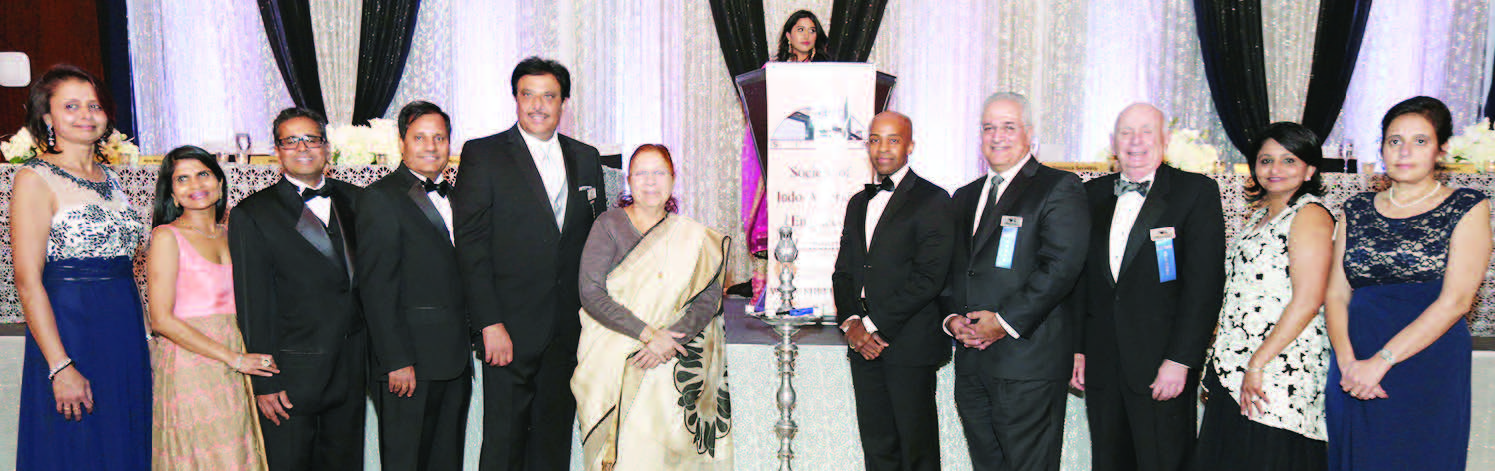
NEW YORK CITY (TIP): Speaker of India’s Parliament, Sumitra Mahajan lauded the achievements of the Indian diaspora at the Gala dinner of SIAEA (Society of Indo American Engineers and Architects)held at Grand Hyatt at Grand Central, NY on November 15 . The Gala was attended by 880 guests and dignitaries. India’s Consul General in New York, Ambassador Dnyaneshwar Mulay spoke appreciably of the contribution of the Indian American engineers and architects in the development of America.

SIAEA President Mihir Patel presents a memento to Sumitra Mahajan
He said India was proud of her sons and daughters abroad. In his presidential address, Mihir Patel stated that SIAEA had gone national with the opening of a chapter in Philadelphia. “We are planning to open DC chapter this December and Chicago chapter in March 2015. Our goal is to open three chapters every year,” he said. Other key speakers included Dominick M Servedio, Executive Chairman, STV Group, Inc, and Carmen Bianco, President, NYCT. Abhay Wadhwa, Ahmed Shakir, Amil Patel, Mita Amin, Nayan Parikh, Nitin Patel, Sharon Lobo, Snehal Patel, Sunil Bald received the 2014 Achievements awards .

: SIAEA President Mihir Patel presents a memento to Ambassador Dnyaneshwar Mulay
Young & Under 40 awards went to Alok Saksena and Manan Garg. 10 students of engineering and architecture were given scholarships of $2000 each. The 35 year old organization’s objective is to enhance the image of its members and their ability to ethically and professionally practice engineering and architecture. This it does through education, licensure advocacy, leadership training, multi-disciplinary networking and outreach. -

Indian Parliament Speaker urges NRI community to contribute to India’s Development
FORDS, NJ (TIP): Addressing a group of Indian Americans at Royal Albert’s Palace here, November 16, Lok Sabha Speaker Sumitra Mahajan called upon nonresident Indian community to be partners in the development of India. She urged them to visit India and actively participate and contribute in helping to make their homeland more reliant and selfsufficient.
The visiting dignitary attended the luncheon meeting organized by Indian American Community Foundation, headed by Dr. Bharat Barai to express appreciation of the cooperation it was given in organizing the historic Madison Square Garden community reception to Prime Minister Narendra Modi on September 28. On arrival, Mahajan paid a floral tribute to the statue of Sardar Vallabh Bhai Patel, which stands tall at the entrance of Royal Albert’s Palace. In her address, Mahajan lauded the Indian-American community for their achievements both here and back home in India.
“Work is not over, a lot needs to be done, especially in education and healthcare” she reminded the audience, and urged them to help in the various new initiatives undertaken by the Modi government. Majahan is soft-spoken but battle-hardened leader who has risen from the ranks to the top post of Lok Sabha Speaker. She was unanimously elected Lok Sabha speaker this June, becoming the second woman after Meira Kumar to be elected to the post. This year Mahajan won the Lok Sabha elections for the eighth time, one of the three members of the 16th Lok Sabha to do so, and the longest-serving woman member.
She has been representing Indore Parliamentary constituency of Madhya Pradesh since 1989. Starting her political life at the age of 39, she became the deputy mayor and then an MP from Indore in Madhya Pradesh. She was a minister of state in the Atal Behari Vajpayee cabinet from 1999 to 2004 and held various portfolios which included human resources, communications, IT, petroleum and natural gas. A lawyer-turned-politician, Mahajan is known for her trademark simplicity, honesty and clean image besides her impeccable winning record. Mahajan was in New York for the second meeting of the Preparatory Committee of the Fourth World Conference of Speakers of Parliaments at the United Nations. -

Modi’s new pitch for NRIs
Harnessing a potential for the country’s good
Harnessing the potential of Indians living abroad for long is a tried method for Mr. Modi. As Chief Minister of Gujarat, he tapped into the rich Non-Resident Indian’s deep pockets to induce him to invest in his state by institutionalizing the policy through annual jamborees lauding the role the NRI is playing. The underlying theme is that far from being looked down upon for his adventurous ventures around the world, he is welcome for having fought arduous battles to emerge on top,” says the author.
Perhaps the most significant aspect of Mr. Narendra Modi’s tours abroad as Prime Minister is his employment of the considerable number of Indians and persons of Indian origin settled around the world as instruments of Indian foreign policy. No previous Indian Prime Minister has tackled the potential of Indians abroad as assiduously as Mr. Modi.
This was clear yet again during his Australian tour. There is a measure of stage management involved, but the formula has become standard after his American visit. You gather Indians in their various avatars in a metropolis, enthuse them about the properties of the self-made Prime Minister, give him a rock-star reception and you have the ingredients of the gracious guest announcing goodies such as visas on arrival and no police reporting even for those with other passports.
And everybody goes home happily singing praises of Modi. In a sense, the Prime Minister is following a path trod by China for generations. Perhaps because the Chinese have distinctive racial and facial characteristics, they do not easily meld into local populations. But several shades of different Chinese governments have used their compatriots as instruments of their foreign policy. In independent India, on the other hand, the Nehruvian philosophy was to tell Indians who had left home shores to settle abroad to give their full allegiance to their new countries whose passports they had taken.
At the same time, he advised expatriate Indians to retain their cultural links with their original homes. Mr. Modi is now turning this approach on its head by following the Chinese model. There has always been great Indian pride in the achievements of Indians in the new homes they have adopted. Look at the columns of publicity in the print medium on an exceptional student or scientist who shines, an original Indian or his progeny making it to the political and administrative heights in his adopted home.
Indians living abroad, however remote their connection, have for their part observed Indian religious and cultural traditions, sometimes to an anachronistic extent. This is particularly true of Gujaratis in view of their distinctive dietary habits and taboos. As is true of all countries, Indian missions abroad seek to promote their merits through cultural centers and trade promotion initiatives.
The Indian dancing Siva, for instance, is a staple of all Indian embassies around the world. But no other Indian Prime Minister other than Mr. Modi has mined the potential of the born Indian or his progeny as he is setting out to. On the contrary, the typical attitude of the ordinary Indian is that there is an element of guilt and disloyalty in anyone’s decision to give up the homeland for pieces of silver and rosier prospects abroad. This is, of course, not true of the humble migrant worker who goes abroad to keep his family’s head above water. Harnessing the potential of Indians living abroad for long is a tried method for Mr. Modi.
As Chief Minister of Gujarat, he tapped into the rich Non- Resident Indian’s deep pockets to induce him to invest in his state by institutionalizing the policy through annual jamborees lauding the role the NRI is playing. The underlying theme is that far from being looked down upon for his adventurous ventures around the world, he is welcome for having fought arduous battles to emerge on top. Perhaps the tinge of envy many Indians feel towards the successful NRI is sublimated by the latter’s decision to share his fortune with his original home. One striking aspect of the NRI’s success is the new trend in countries extending from the United States to Fiji in deciding to send persons of Indian origin to their original homes as their ambassadors.
The jury is still out on how successful this experiment will be, but there can be no doubt of the success of these Indians who have reached the top in the diplomatic pecking order to merit the honor. As far as Mr. Modi is concerned, the Indian living abroad in his or her various forms is an asset to be cultivated and honored. He might have his cheer leaders to lionize him. Cheers of “Modi, Modi” at the big gatherings of NRIs in New York and Sydney are well rehearsed. His by now familiar theme of discourse of his own humble origin is meant to strike a chord with his audience who boast similar stories.
And in announcing goodies, he makes the point that he is a leader who keeps his word. In other words, he is the leader his overseas audiences have been waiting for. Judging by the unrehearsed reactions in New York, Sydney and elsewhere, Mr. Modi’s theme song seems to be working. For some, he is the decisive Indian leader they have been waiting for. For others, the promise of greater prosperity and less rule-bound administration are welcome steps. And despite the dark clouds of 2002 in Gujarat hanging over him, the world from President Barack Obama to Prime Minister Tony Abbot has accepted his new credentials as the dynamic leader of India set to take the country forward more in keeping with its true potential.
There are, of course, some dangers in lionizing the Indian settled abroad. India does not offer double passports, unlike many other countries, despite Mr. Modi’s audiences’ demands in New York, Sydney and elsewhere. But Nehru’s constant advice to his countrymen settled abroad to offer full loyalty to their new home governments, despite their cultural and emotional attachment to India, has some merit. Essentially, it is a question of finetuning what Mr. Modi expects from persons of Indian origin, apart from the obvious advantage of exploiting their wealth for the country’s development. But the new mantra is there to stay.
The NRI is not merely an honored guest but one who has a special responsibility of helping the country in various ways in whatever job he is doing in his adopted home. If Mr. Modi can combine his new evangelism without raising suspicions, he would have achieved a purpose.