Researchers have shown that consumers can improve their diets simply by enjoying white or brown rice as part of their daily meals. In a study, lead author Theresa Nicklas, DrPH, of Baylor College of Medicine, analyzed the National Health and Nutrition Examination Survey datasets from 2005-2010 and evaluated the association of rice consumption with overall diet quality and key nutrient intakes in a nationally representative sample of 14,386 U.S. adults.1 Nicklas said their results show that adults who eat rice had diets more consistent with what is recommended in the U.S. Dietary Guidelines, and they showed higher amounts of potassium, magnesium, iron, folate and fiber while eating less saturated fat and added sugars.
She said that eating rice is also associated with eating more servings of fruit, vegetables, meat and beans. In addition to the positive results in crosssectional studies linking rice consumption with healthier diets, a human clinical trial found that having white or brown rice at a meal increased satiety and feelings of fullness more than a calorically equivalent glucose solution control.4 Considering the cross-sectional and clinical findings, both enriched white rice and whole grain brown rice should be recommended as part of a healthy diet.
Month: December 2014
-

Nobel Peace Prize for ‘Indian Father & Pakistani Daughter’
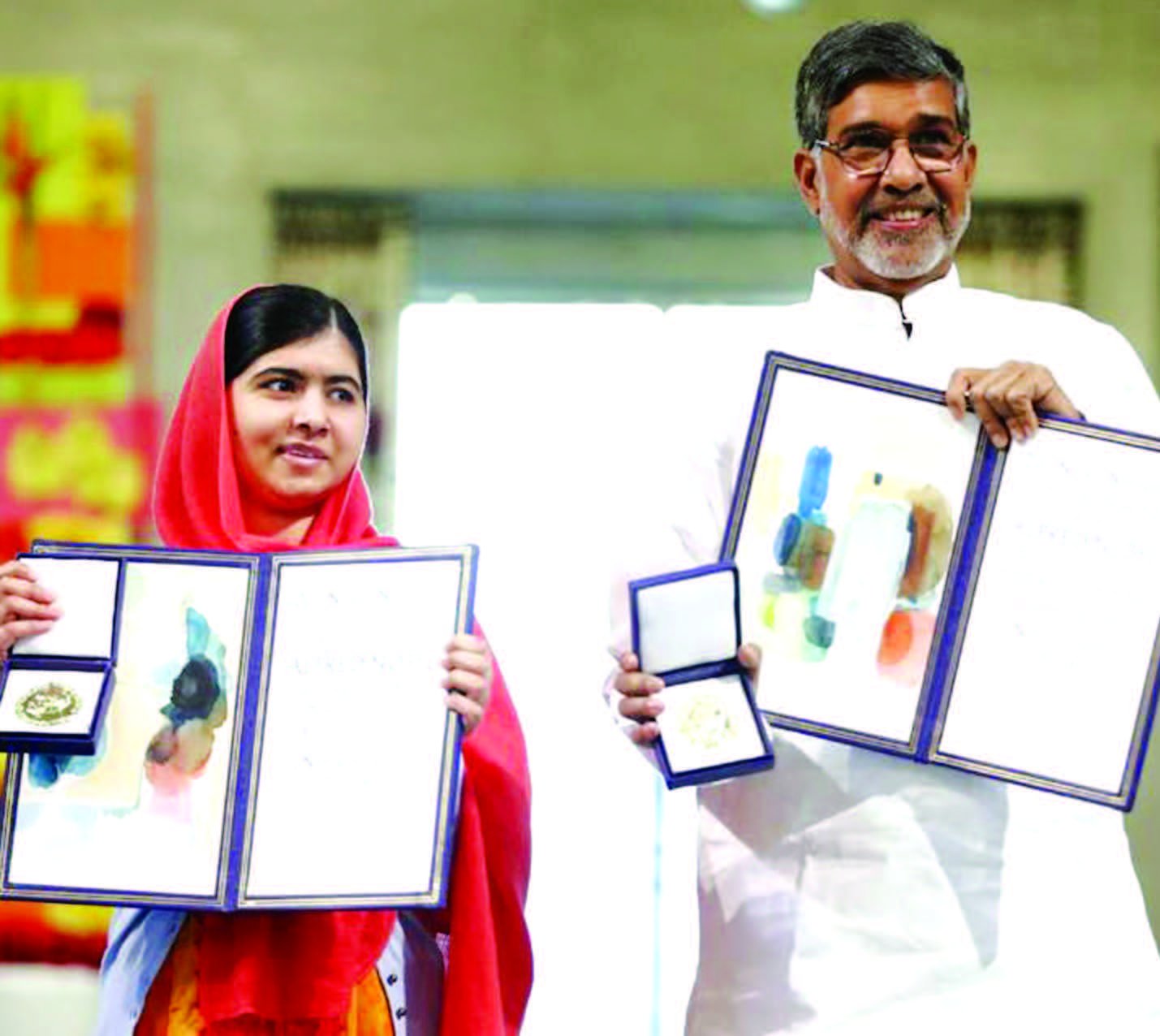
OSLO (TIP): It was a proud moment for an “Indian father and a Pakistani daughter” to stand together to accept the applause of a gathering of royals, dignitaries, family members and others in the vast and ornate chamber at the Oslo City Hall , Wednesday, December 10. The 60 year old Kailash Satyarthi of India and the 17 year old Malala Yousafzai of Pakistan shared the Nobel Peace Prize. Standing side by side to receive medals and diplomas, the two winners drew a standing ovation from the audience before them.

Malala Yousafzai at the U.N. on July 12, 2013
Speaking at the ceremony, his speech steeped in emotion, Kailash Satyarthi, declared that he represented “the sound of silence, the cry of innocence, and the face of invisibility.” “I have come here to share the voices and dreams of our children, because they are all our children,” he said. “There is no greater violence than to deny the dreams of our children,” he said. “I refuse to accept that the shackles of slavery can ever be more stronger than the quest for freedom,” he added. “The single aim of my life is that every child is free to be a child.” “We live in an age of rapid globalization,” he continued. “We are connected through high-speed Internet.We exchange goods and services in one single global market.

Kailash Satyarthi attends a human trafficking special session during the 2009 Clinton Global Initiative
Thousands of flights every day connect us to every corner of the globe. “But there is one serious disconnect. It is the lack of compassion,” he said, adding: “Let us globalize compassion.” Malala Yousafzai began her speech with acknowledging her gratitude to her parents and teachers. Malala went on to say the Nobel Prize “is not just for me.” “It is for those forgotten children who want education,” she continued. “It is for those frightened children who want peace.

Kailash Satyarthi: “Let us globalize compassion.”
It is for those voiceless children who want change.” “This is where I will begin, but it is not where I will stop,” she said. “I will continue this fight until I see every child in school.” She added: “Why is it that countries which we call so strong are so powerful in creating wars but so weak in bringing peace? Why is it that giving guns is so easy but giving books is so hard? Why is it that making tanks is so easy, but building schools is so hard?” Even before the ceremony, Ms. Yousafzai and Mr. Satyarthi seemed intent on using the occasion not simply as a platform for acknowledgment of their achievements, but also as a podium from which to renew their campaigns.

“We are here to tell children, especially, that you need to stand up. You need to speak up for your rights. It is you who can change the world”, said Malala .
“We are not here just to accept our award, get this medal and go back home,” Ms. Yousafzai told a news conference on the eve of the ceremony, according to Agence France-Presse. “We are here to tell children, especially, that you need to stand up. You need to speak up for your rights. It is you who can change the world.” “In this world, if we are thinking we are modern and have achieved so much development,” she said on Tuesday, “then why is it that there are so many countries where children are not asking for any iPad or computer or anything? What they are asking for is just a book, just a pen, so why can’t we do that?”

The Indian father and the Pakistani daughter greet people before the start of the ceremony
Pakistani youth activist Malala Yousafzai was awarded the 2014 Nobel Peace Prize on Wednesday, December 10, an honor she shares with Kailash Satyarthi, who has long been campaigning against child exploitation in neighboring India. But until about two years ago, Malala was just a 15-year old blogger on a school bus with her friends. It was Oct. 9, 2012, when armed Taliban men boarded Malala’s bus and shot her in the head, transforming her from a minor Internet celebrity into an international symbol.
It’s hard to believe that she’s accomplished so much – including recovery from her injuries – in only two years, but Malala’s story actually started long before the assassination attempt that launched her to worldwide fame. She was born in the Swat valley in Pakistan, in 1997, to parents who encouraged her love for education from a young age. As a toddler, Malala would sit in classrooms in her father’s school and follow lessons for 10-year olds. Aryn Baker wrote in her 2012 profile of Malala for TIME: By the time she was 2½, she was sitting in class with 10-yearolds, according to a close family friend and teacher at the school founded by Malala’s father.
The little girl with the huge hazel eyes didn’t say much, but “she could follow, and she never got bored,” says the teacher, who asked to remain anonymous for fear that she too might become a Taliban target. Malalaloved the school, a rundown concrete-block building with a large rooftop terrace open to views of the snowcapped mountains that surround the Swat Valley. As she grew older, she was always first in her class. “She was an ordinary girl with extraordinary abilities,” says the teacher, “but she never had a feeling of being special.” In 2008, everything changed.
The Taliban gained control of the Swat region, banning DVDs, dancing, and beauty parlors. By the end of the year, over 400 schools were closed. Ziauddin took Malala to Peshawar, where she made a famous speech in front of national press titled “How Dare the Taliban Take Away My Basic Right to Education?” She was only 11. In early 2009, Malala started blogging anonymously for the BBC about what it was like to live under the Taliban. Just a few days after she started, all girls schools were closed. In retrospect, some parts of Malala’s blog seem like ominous foreshadowing: “On my way from school to home I heard a man saying ‘I will kill you’,” she wrote on Jan. 3, 2009. “I hastened my pace and after a while I looked back if the man was still coming behind me. But to my utter relief he was talking on his mobile and must have been threatening someone else over the phone.” But there are also humorous parts that remind us that, at the time, she was only 11: “My mother liked my pen name ‘Gul Makai’ and said to my father ‘why not change her name to Gul Makai?’ I also like the name because my real name means ‘grief stricken’.” In December 2009, Ziauddin publicly identified his daughter, even though her real name has been widely suspected for months. That proved to be a dangerous move.
“We did not want to kill her, as we knew it would cause us a bad name in the media,” Sirajuddin Ahmad, a senior commander and spokesman for the Swat Taliban, told TIME for the 2012 magazine profile. “But there was no other option.” In 2012, armed men boarded the converted truck that Malala and her classmates used as a makeshift school bus. “Which one is Malala?” one of them asked. “I think we must have looked at her,” Malala’s classmate Shazia Ramzan told TIME’s Aryn Baker. “We didn’t say anything, but we must have looked, because then he shot her.” Malala took a bullet to the head.
She endured a traumatic operation in Pakistan that left her with a (temporary) metal plate in her head while they stored a piece of her skull in her abdomen, to reattach when she’s healed enough. She was then airlifted to a hospital in Birmingham, England, where she had more medical treatment and extensive rehabilitation. The rest of her story has played out in the public eye. Nine months after she was shot, Malala gave a now-famous speech at the UN. “They thought that the bullets would silence us. But they failed,” she said. “And then, out of that silence came thousands of voices.… Weakness, fear and hopelessness died.
Strength, power and courage was born.” Now relocated to England, Malala goes to Edgbaston School for Girls. She’s continued her high-profile campaign for girls’ education with The Malala Fund, which raises money to promote girls’ education. She’s used the fund as a platform to confront Barack Obama about drone strikes, help Syrian refugee children and demand the return of the Nigerian girls kidnapped by Boko Haram. And this September, she announced a $3 million multi-year commitment to partner with Echidna Giving to support girls education in developing countries.
Malala won Pakistan’s National Youth Peace Prize in 2011, before she was shot, but the prize been since renamed in her honor; it’s now the National Malala Peace Prize. She was shortlisted for TIME’s Person of the Year in 2012, and was one of the TIME 100 in 2013. She won a Mother Teresa Memorial Award for Social Justice in 2012 and the 2013 Simone de Beauvoir Prize for international human rights work on behalf of women’s equality.
India’s Kailash Satyarthi , born on January 11, 1954, is a human rights activist who has been at the forefront of the global movement to end child slavery and exploitative child labor since 1980 when he gave up a lucrative career as an Electrical Engineer for initiating crusade against Child Servitude. As a grassroots activist, he has led the rescue of over 78,500 child slaves and developed a successful model for their education and rehabilitation. As a worldwide campaigner, he has been the architect of the single largest civil society network for the most exploited children, the Global March Against Child Labor, which is a worldwide coalition of NGOs, Teachers’ Union and Trade Unions.
As an analytical thinker, he made the issue of child labor a human rights issue, not a welfare matter or a charitable cause. He has established that child labor is responsible for the perpetuation of poverty, unemployment, illiteracy, population explosion and many other social evils. He has also played an important role in linking the fight against child labor with the efforts for achieving ‘Education for All’. Mr. Satyarthi is a member of a High Level Group formed by UNESCO on Education for All comprising of select Presidents,
Prime Ministers and UN Agency Heads. As one of the rare civil society leaders he has addressed the United Nations General Assembly, International Labour Conference, UN Human Rights Commission, UNESCO, etc and has been invited to several Parliamentary Hearings and Committees in USA, Germany and UK in the recent past. As an advocate for quality and meaningful education, Mr. Kailash Satyarthi has addressed some of the biggest worldwide congregations of Workers and Teachers Congresses, Christian Assembly, Students Conferences, etc. as a keynote speaker on the issue of child labor and education.
He is on the Board and Committee of several International Organizations. Amongst all the prominent ones being in the Center for Victims of Torture (USA), International Labor Rights Fund (USA), etc.Mr. Satyarthi is an executive Board Member of International Cocoa Foundation with the Headquarters in Geneva representing the global civil society. He has survived numerous attacks on his life during his crusade to end child labor, the most recent being the attack on him and his colleagues while rescuing child slaves from garment sweatshops in Delhi on 17 March 2011.
Earlier in 2004 while rescuing children from the clutches of a local circus mafia and the owner of Great Roman Circus,Mr. Satyarthi and his colleagues were brutally attacked. Despite of these attacks and his office being ransacked by anti social elements a number of times in the past his commitment to stand tall for the cause of child slaves has been unwavering. He has set up three rehabilitation-cumeducational centers for freed bonded children that resulted in the transformation of victims of child servitude into leaders and liberators. His life and work has been explicitly covered in hundreds of programs on all the prominent television and radio channels including Wall Street Journal, BBC, CNN, ABC, NHK, Japan Broadcasting Corporation, Canadian T.V., ARD, Austrian News, Lok Sabha TV etc. and profoundly featured in several magazines like The Time, Life, Reader’s Digest, Far Eastern Economist,Washington Post, New York Times, Times London, Los Angeles Times, Guardian, Independent, The Times of India, etc.
In addition, to the Global March Against Child Labor, other organizations he has founded and/or led include Bachpan Bachao Andolan, the Global Campaign for Education, and the Rugmark Foundation now known as Goodweave. He is the Chair of another world body International Center on Child Labor and Education (ICCLE) in Washington, D.C. ICCLE is one of the foremost policy institution to bring authentic and abiding southern grassroots perspective in the US policy domain.
“The Global March Against Child Labour is a movement to mobilize worldwide efforts to protect and promote the rights of all children, especially the right to receive a free, meaningful education and to be free from economic exploitation and from performing any work that is likely to be harmful to the child’s physical, mental, spiritual, moral or social development.” Global March Against Child Labour is a movement born out of hope and the need felt by thousands of people across the globe – the desire to set children free from servitude. Bachpan Bachao Andolan (BBA) founded by Mr. Kailash Satyarthi is the ray of hope in millions of hearts, the first dream in their eyes, and the first smile on their faces.
It is the sky and wings together for innumerable children, excluded from human identity and dignity, with a desire to fly in freedom. It is the tears of joy of a mother who finds her rescued child back in her lap after years of helplessness and hopelessness. It is a battle to open the doors of opportunities, a fire for freedom and education in the hearts and souls of thousands of youth committed to wipe out the scourge of slavery and ignorance from the face of mankind. ” http://www.bba.org.in/ Rugmark (brainchild of Mr. Kailash Satyarthi) (now known as Goodweave) is an international consortium of independent bodies from a dozen carpet exporting and importing countries, which take part in a voluntary social labeling initiative to ensure that rugs have not been produced with child labor.
The International Center on Child Labor and Education (ICCLE) is a 501 (c) 3 nonprofit organization dedicated to mobilizing worldwide efforts to advance the rights of all children, especially to receive a free and meaningful education and to be free from economic exploitation and any work that is hazardous, interferes with a child’s education, or is harmful to a child’s health or physical, mental, spiritual, moral or social development. The Center serves as the international advocacy office of the Global March Against Child Labor, a movement representing some 2,000 organizations in 140 countries intended to highlight child slavery and hazardous child labor. The Center also serves as a clearinghouse – for the dissemination and sharing of information and knowledge on global child labor issues.
ICCLE has built up a great deal of goodwill and respect by being a key player in the establishment of the Global Task Force on Child Labor and Education with UNESCO, the World Bank, ILO, UNICEF, and the Global March.Mr. Kailash Satyarthi is the founder of ICCLE and is on the Board. The life and work of Kailash Satyarthi have been the subject of a number of documentaries, television series, talk shows, advocacy and awareness films,Magazines and news items of all leading print and electronic media worldwide. Satyarthi’s contribution has been recognized through several prestigious international awards. These include the recently awarded Nobel Peace Prize 2014. Satyarthi lives in New Delhi, India. His family includes his wife, a son, daughter-inlaw, a daughter, children , friends and colleagues. -

Russia provides a leg up to Modi’s ‘Make in India’ campaign
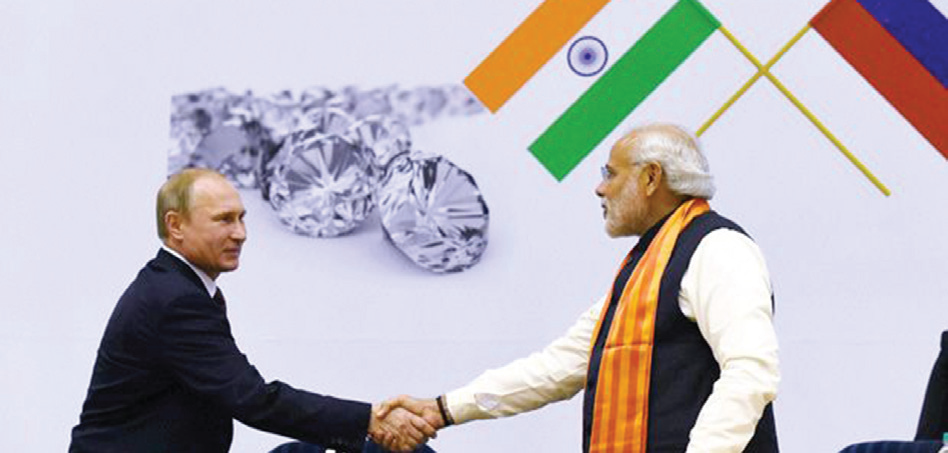
NEW DELHI (TIP): In what may appear to be a reaffirmation of sound friendly ties with Russia, notwithstanding Russia’s recent military cooperation agreement with Pakistan, Prime Minister Narendra Modi on Thursday, December 11, underlined the primacy of Moscow in New Delhi’s strategic calculus when he said Russia was and would remain India’s most important defense partner.
This, he said, was despite the fact that India now had more options, in what was seen as an oblique reference to its growing military and defense ties with the US. Modi’s remark came after his summit meet here with President Vladimir Putin, who offered India lucrative energy deals and sought to provide a leg-up to Modi’s “Make in India” campaign.
Pacts on 20 nuclear reactors, oil and gas among 20 pacts inked
After the talks, the two countries signed as many as 20 agreements – seven intergovernmental and 13 commercial – including a strategic vision for cooperation in peaceful uses of atomic energy. Another agreement was signed for partnership in oil and natural gas.. One of the agreements signed will facilitate training of Indian armed forces personnel in the military establishment of Russia’s defense ministry. Modi, who addressed the media in English, said apart from the 4 reactors at Kudankulam, the two countries outlined an “ambitious vision for nuclear energy of at least 10 more reactors” and would look at exporting it to third countries. Putin, in fact, said in his statement that Russia would help build 20 reactors in India. In a boost for Modi’s “Make in India” initiative, Putin also offered to build one of Russia’s most advanced helicopters in India. Putin said the joint initiative could consider exporting the helicopters to other countries.
Modi thanked Putin for the offer, saying Indian authorities would follow up on it quickly. Modi described Putin as a leader of a great nation with which “we have a friendship of unmatched mutual confidence, trust and goodwill”. “We have a strategic partnership that is incomparable in content. The steadfast support of the people of Russia for India has been there even at difficult moments in our history. It has been a pillar of strength for India’s development, security and international relations,” said Modi.
While it is not clear if the Indian side took up the issue of Russia’s agreement with Pakistan which could facilitate supply of arms to India’s neighbor, Modi suggested in his statement that he expected both sides to be sensitive to their concerns. “President Putin and I agreed that this is a challenging moment in the world. Our partnership and the strong sensitivity that we have always had for each other’s interests will be a source of strength to both countries,” he said.
Putin also mentioned the joint fifthgeneration fighter jet project which has failed to make much headway in the recent past. “I would also like to note that projects to jointly develop multi-purpose fighter aircraft and multirole transport planes is another step in our joint work,” he said. Modi also proposed that Russia locate manufacturing facilities in India for spares and components for Russian defense equipment. A joint statement titled “Druzhba-Dosti” said the two countries will study the possibilities of building a hydrocarbon pipeline system, connecting the Russian Federation with India.
Modi said cooperation between the two nations in the hydrocarbon sector had been disappointing until now and that they will pursue an ambitious agenda for partnership in oil and natural gas. Putin also said Russia is ready to cooperate in peaceful space exploration, specifically in the development of close-orbit satellites and use of the GLONASS satellite navigation system. The leaders condoled the loss of lives in “senseless terrorist acts” in recent days in Jammu & Kashmir and Chechnya (Russia). -

Americans Together organizes Thanksgiving Celebrations and Awards Night
Congresswoman Eddie Bernice Johnson graces the occasion
Report/photos by Zia Khan/ 214-207-7922 DALLAS (TIP): Congresswoman Eddie Bernice Johnson of Texas presided over the proceedings of the 16th annual thanksgiving celebrations and awards night organized by Americans Together on Saturday, November 22, 2014. It was a bridge building event between communities. We ought to be thankful to Native Americans, who did not put the electric fence around Americas to keep the illegal aliens like Columbus and other Europeans from entering America without a visa.

Mike Ghouse, President of Americans Together and the chief architect of the Thanksgiving celebrations underscored the importance of sharing, caring and thanksgiving.
Today, we are a nation of immigrants, other than the natives; almost all of us are immigrants from one to several generations. The event was organized by America Together Foundation, World Muslim Congress. And the Foundation for Pluralism, all committed to building a cohesive America where no American has to live in tension, discomfort, apprehension or fear of the other. The purpose of celebrating this event was to thank God for guiding us to learn to respect the otherness of others, and accept the God given uniqueness of each one of us. And more importantly it is to familiarize the new immigrants with the festivities.

The honorees with Congresswoman Eddie Bernice Johnson and Mike Ghouse
You’ll be surprised to find that many of them have not even seen the thanksgiving meal and its fixings. It was not a part of their study for citizenship and apparently no one has done this as a public event. “Congresswoman Johnson represents the aspiration of fellow Americans; justice and liberty for every American in his or her pursuit of happiness, and she fights for that relentlessly – Is that the kind of congressperson we want?, well here she is.” Mike Ghouse welcomed her amidst a thunderous applause.

A view of the gathering
To paraphrase Congresswoman Johnson, “we have made sacrifices to respect the human rights, civil liberties and freedom for our new generations and now they have those rights. On the map of the world, ours is still the best country. The immigrant community has always played an important role in the development of US.” It was a delight to watch the Congresswoman carve the symbolic turkey, and sharing what thanksgiving means to her; to count your blessings.
For many a immigrants it is an introduction to the American way of life and who else can do a better job than the Congresswoman? Through her efforts and against all impediments, she has realized her American dream. Chef Ali of Spicy Cuisine in Irving prepared delicious vegetarian and non-veg meals with a fixing of thanksgiving delicacies. Congresswoman Johnson presented the awards to four community leaders and delivered a beautiful keynote address on gratitude,while highlighting the need for events like this to bring people together regardless of their political, religious, racial or and social affiliation to build a safe, secure and a cohesive America.
Mike Ghouse, president of the foundation shared the real life stories that exemplify thanksgiving; stories about Appaiah and the hospitality in Saudi Arabia. How each one of us can restore the spiritual balance within and live a productive, meaningful and a purposeful life. The Appaiah story was published in Huffington Post Link , and the Saudi story, all pictures, and notes will be at www.ThanksgivingCelebrations.org The attendees were represented by people of different faiths, races, political orientations and other uniqueness’s. They cheered on when Mike Ghouse, chair of the event asked.
Whether you are Jewish, Hindu, Muslim, Gay, Lesbian, Black, White, Native, Immigrant, Republican or Democrat, how many of you like to see your Congress person represent you with equal care and consideration? How many of you would like to see your congress person treat you with dignity and respect regardless of who you are? Well here she is, Congresswoman Eddie Bernice Johnson.” She delivered a beautiful key note speech about Gratitude. The following individuals were recognized for their outstanding contributions to building bridges in the communities we live – the title conferred upon all of them was “Pluralist” – meaning someone who respects the otherness of others. Every society has heroes – that is men and women who have gone beyond their normal self to serve the communities at large, and it is our responsibility as a society to acknowledge, cherish and honor them.
Here is a brief introduction of the recipients; detail profiles will be available at www.thanksgivingcelebrations.org. Raja Zahid A. Khanzada –
a Journalist for his “Commitment to truth in Journalism.” He reports for the top news media conglomerates in Pakistan and has been a catalyst in a process of “forgiveness” of the robbers – where they surrendered their guns in return for acceptance in the society to live and breathe a normal life, and be the contributors of the nation. It is sort of what President Obama is doing with the undocumented aliens, a noble thing to do. Raja is a relentless pursuer of education with three Master’s degrees and a degree in Homeopathic medical sciences and holds certification from American Alternative Medicine Practitioner Board in practice of alternative medicine. He amazed everyone when he asked his mother to receive the plaque.
Amina Rab –
a community activist and leader for “Building Bridges.” Amina is deeply committed to building bridges between the Muslim community and other communities. It is not her job, but a passion to build bridges. She is the President of the Council on American Islamic Relations- DFW chapter and is the first woman to serve on the North Texas Islamic Council, and is a founding Board member of Texas Muslim Women’s Foundation. She is a Scientist in the healthcare industry for 20 years. Amina is an entrepreneur with a home based business, a mother, a grandmother and a community Activist with a passion to promote peace and justice in the world.
Anne Marie Weiss –
a community leader for “Bringing the DFW communities together.” Anne Marie single handedly started the DFW international in early nineties – she had the vision for making the Dallas/ Fort worth an international Metroplex, even before it was declared as such. Today, DFW International has become an exemplary institution in America. There is nothing like it. Where can you find connections to every cultural, religious, social and ethnic group in one place? None in America! She has put Dallas Fort Worth on the world Map. If you see the demographic statistics of nationalities and ethnicities in Dallas, it was her effort. It is her selfless devotion to the belief that DFW should genuinely reflect its diversity.
Sante Santhanam Chary –
is a national figure in “Connecting the World Leaders.” Sante is one of the very few Americans, perhaps the only immigrant who has met, shook hands and shared a message with 7 American Presidents and 8 Indian Presidents/Prime Ministers. Sante is continuously forging political and business ties between the United States and India and in September this year, he got the US Senate to pass a resolution creating “2014 U.S.-India Partnership Day” to honor Prime Minister Narendra Modi’s visit to the US. He has set a new world record by collecting over 55 contemporary signatures in solidarity on a USPS issued First Day Envelope with Mahatma Gandhi’s stamp on it. Sante is a healthcare entrepreneur with a focus on physician staffing services to small towns in the US. He is a graduate of The Harvard Business School and the Thomas Jefferson School of Law. -

Amitabh Bachchan to be the Chief Guest at AAPI’s Global Healthcare Summit in Mumbai
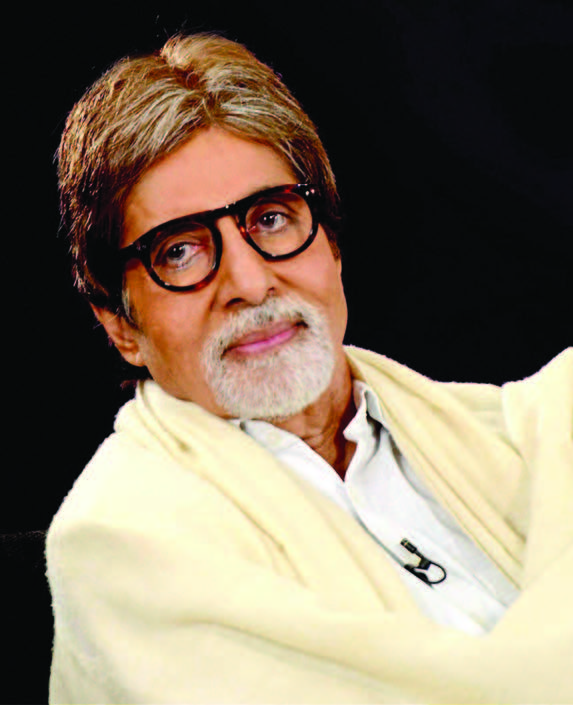
NEW YORK (TIP): “Bollywood Superstar Amitabh Bachchan will be the Chief Guest at the 9th annual Global Healthcare Summit 2015 (GHS) organized by the Association of American Physicians of Indian Origin (AAPI) in collaboration with the Indian Ministry of Health and Family Welfare from January 2nd to 4th, 2015 at the prestigious Trident Oberoi Hotel, Nariman Point, Mumbai, India,” Dr. Ravi Jahagirdar, President of AAPI, who has just returned from Mumbai after overseeing the preparations for the historic Summit, announced this week.
“We are honored to have Superstar Bachchan during the Banquet on Saturday, January 3rd, 2015 expressing his support for two long term AAPI initiatives: National Trauma and Head Injury Program and the Hepatitis Research Program,” Dr. Jahagirdar said. India has one of the highest accident rates leading to trauma and head injury. AAPI, in collaboration with leading healthcare institutions in India and the Indian Ministry of Health has embarked on a long-term project to create awareness on the need to prevent, treatment, special care and rehab services to those involved in accidents.
Hepatitis is another leading cause and continues to be a silent killer in India, which has led to AAPI’s Hepatitis Research Program. “Through his continued support for AAPI, the most admired and evergreen Bollywood star will promote the most innovative, efficient and cost effective healthcare solutions for India,” Dr. Jahagirdar added. “Harnessing the power of Indian doctors worldwide, the AAPI Global Healthcare Summit platform has evolved with the support of prominent global and Indian medical associations: including IMA, MCI, ASI, IPS, APA, API, ICON, JCI, AHA, Johns Hopkins and GAPIO,” Dr. Jahagirdar, explained.
In addition, several international healthcare industry partners will be participating at the historic event for greater collaboration on Research & Development and philanthropic engagements, he said. “The presence of the charismatic star who continues to strike gold at the Box Office even at the age of 60, will be a welcome addition to the many key officials and healthcare industry leaders who will join the 9th annual Healthcare Summit in Mumbai,” stated Dr. Seema Jain, President-Elect of AAPI. “This international health care summit is a progressive transformation from the first Indo-US Healthcare Summit launched by AAPI USA in 2007,” Dr. Ajay Lodha, Vice President of AAPI, while providing the background to the Summit said.
Since then, AAPI has organized eight Indo – US/Global Healthcare Summits and developed strategic alliances with various organizations. “It is these learning and relationships that have now enabled AAPI and participating organizations to plan ahead and prepare for an outstanding event,” added Dr. Ajeet Singhvi, Chairman of AAPI’s Board of Trustees. According to Dr. Gautam Samadder, Secretary of AAPI, the Summit is in partnership with the ministry of overseas Indian affairs and ministry of health and family welfare, along with collaboration with over 10 professional associations from all over the world.
“GHS 2015 is accredited from Accreditation Council for Continuing Medical Education for 14 hours of credits will be applied for each participant.” “The historic Healthcare Summit is expected to have over 300 very prominent and talented physicians and surgeons of Indian origin from around the world and are very passionate about serving their homeland, Mother India,” said, Dr. Naresh Parikh, Treasurer of AAPI. Before getting into the glittering world of movies, Amitabh Bachchan, popularly known as the angry young man or the Big B of Indian cinema (Bollywood), tried his luck as stage actor, radio announcer and Freight Company executive.
Though Amitabh’s first film “Saat Hindustani” sank at the Box Office, “Zanjeer” catapulted him to the status of “angry young man” of Hindi cinema. There was no looking back after the success of Zanjeer as people saw in Amitabh Bachchan their own self- the angry young man that was fighting against the corrupt system and the power brokers, in one film after another. Amitabh Bachchan emerged as a different kind of action hero, a Messiah, a Superhero, who appeared like an answer to all people’s problems.
Amitabh, on his part churned out one hit after another including Zanjeer, Deewar Namak Haram, Sharaabi, Shakti, Lawaaris, Kaalia, Shaan, Kaala Patthar, Trishul, Don, Amar Akbar Anthony, Sholay, Deewaar, only to name a few. Things changed so fast for Amitabh that even after crossing the age of 60, he is one of the busiest actors of Indian cinema. Today special characters and scripts are being written to suit the persona and the age of this ever green superstar. Amitabh is not one of those to disappoint- his power packed performance in “Baghban” and the most recent “Black” is a testimony to his undying and unfading charisma as an actor.
“Committed to working towards a just society that is built on humane values, the Bollywood superstar has given his time, talents, resources and his life itself to make India a healthier place for all,” said Dr. Jahagirdar, who is also the Chair of the GHS 2015. “The presence of the Superstar at the 9th annual Healthcare Summit will not only bring recognition to the many healthcare initiatives of AAPI, but will also create awareness and prompt action through the enactment of the right kind of policies and programs that will ensure the most innovative, affordable, accessible, and quality healthcare solutions for India.” For more information on AAPI and GHS 2015, please visit www.aapighsindia.org or www.aapiusa.org. -

Amitabh Bachchan to be the Chief Guest at AAPI’s Global Healthcare Summit in Mumbai
Bollywood Superstar will promote the most innovative, efficient and cost effective healthcare solutions for India
NEW YORK (TIP): “Bollywood Superstar Amitabh Bachchan will be the Chief Guest at the 9th annual Global Healthcare Summit 2015 (GHS) organized by the Association of American Physicians of Indian Origin (AAPI) in collaboration with the Indian Ministry of Health and Family Welfare from January 2nd to 4th, 2015 at the prestigious Trident Oberoi Hotel, Nariman Point, Mumbai, India,” Dr. Ravi Jahagirdar, President of AAPI, who has just returned from Mumbai after overseeing the preparations for the historic Summit, announced this week.
“We are honored to have Superstar Bachchan during the Banquet on Saturday, January 3rd, 2015 expressing his support for two long term AAPI initiatives: National Trauma and Head Injury Program and the Hepatitis Research Program,” Dr. Jahagirdar said. India has one of the highest accident rates leading to trauma and head injury. AAPI, in collaboration with leading healthcare institutions in India and the Indian Ministry of Health has embarked on a long-term project to create awareness on the need to prevent, treatment, special care and rehab services to those involved in accidents.
Hepatitis is another leading cause and continues to be a silent killer in India, which has led to AAPI’s Hepatitis Research Program. “Through his continued support for AAPI, the most admired and evergreen Bollywood star will promote the most innovative, efficient and cost effective healthcare solutions for India,” Dr. Jahagirdar added. “Harnessing the power of Indian doctors worldwide, the AAPI Global Healthcare Summit platform has evolved with the support of prominent global and Indian medical associations: including IMA, MCI, ASI, IPS, APA, API, ICON, JCI, AHA, Johns Hopkins and GAPIO,” Dr. Jahagirdar, explained. In addition, several international healthcare industry partners will be participating at the historic event for greater collaboration on Research & Development and philanthropic engagements, he said.
“The presence of the charismatic star who continues to strike gold at the Box Office even at the age of 60, will be a welcome addition to the many key officials and healthcare industry leaders who will join the 9th annual Healthcare Summit in Mumbai,” stated Dr. Seema Jain, President-Elect of AAPI. “This international health care summit is a progressive transformation from the first Indo-US Healthcare Summit launched by AAPI USA in 2007,” Dr. Ajay Lodha, Vice President of AAPI, while providing the background to the Summit said.
Since then, AAPI has organized eight Indo – US/Global Healthcare Summits and developed strategic alliances with various organizations. “It is these learning and relationships that have now enabled AAPI and participating organizations to plan ahead and prepare for an outstanding event,” added Dr. Ajeet Singhvi, Chairman of AAPI’s Board of Trustees. According to Dr. Gautam Samadder, Secretary of AAPI, the Summit is in partnership with the ministry of overseas Indian affairs and ministry of health and family welfare, along with collaboration with over 10 professional associations from all over the world.
“GHS 2015 is accredited from Accreditation Council for Continuing Medical Education for 14 hours of credits will be applied for each participant.” “The historic Healthcare Summit is expected to have over 300 very prominent and talented physicians and surgeons of Indian origin from around the world and are very passionate about serving their homeland, Mother India,” said, Dr. Naresh Parikh, Treasurer of AAPI. Before getting into the glittering world of movies, Amitabh Bachchan, popularly known as the angry young man or the Big B of Indian cinema (Bollywood), tried his luck as stage actor, radio announcer and Freight Company executive.
Though Amitabh’s first film “Saat Hindustani” sank at the Box Office, “Zanjeer” catapulted him to the status of “angry young man” of Hindi cinema. There was no looking back after the success of Zanjeer as people saw in Amitabh Bachchan their own self- the angry young man that was fighting against the corrupt system and the power brokers, in one film after another. Amitabh Bachchan emerged as a different kind of action hero, a Messiah, a Superhero, who appeared like an answer to all people’s problems.
Amitabh, on his part churned out one hit after another including Zanjeer, Deewar Namak Haram, Sharaabi, Shakti, Lawaaris, Kaalia, Shaan, Kaala Patthar, Trishul, Don, Amar Akbar Anthony, Sholay, Deewaar, only to name a few. Things changed so fast for Amitabh that even after crossing the age of 60, he is one of the busiest actors of Indian cinema. Today special characters and scripts are being written to suit the persona and the age of this ever green superstar. Amitabh is not one of those to disappoint- his power packed performance in “Baghban” and the most recent “Black” is a testimony to his undying and unfading charisma as an actor.
“Committed to working towards a just society that is built on humane values, the Bollywood superstar has given his time, talents, resources and his life itself to make India a healthier place for all,” said Dr. Jahagirdar, who is also the Chair of the GHS 2015. “The presence of the Superstar at the 9th annual Healthcare Summit will not only bring recognition to the many healthcare initiatives of AAPI, but will also create awareness and prompt action through the enactment of the right kind of policies and programs that will ensure the most innovative, affordable, accessible, and quality healthcare solutions for India.” For more information on AAPI and GHS 2015, please visit www.aapighsindia.org or www.aapiusa.org. -

AAPI NJ Honors Three during Annual Health Summit
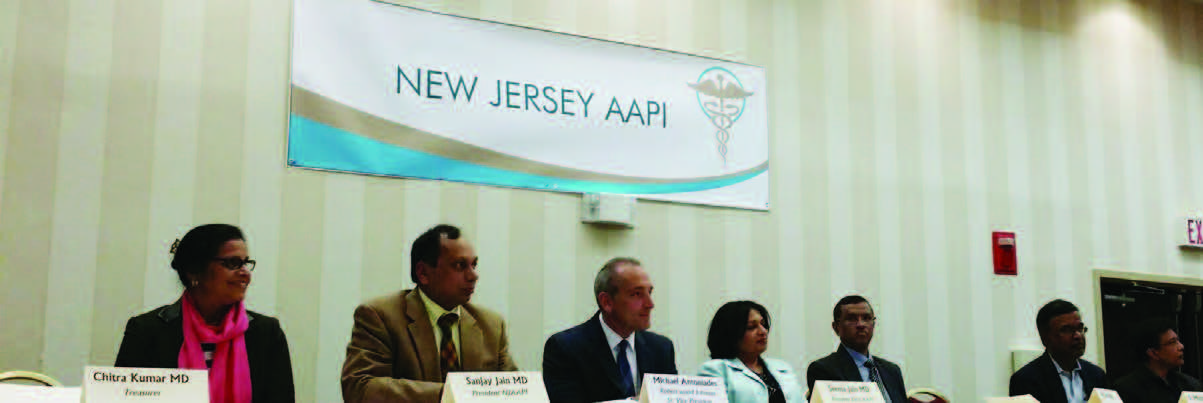
NEWARK NJ (TIP): Three prominent Indian American physicians were honored for their achievements in the field of medicine and for their contributions to the larger society during the annual meeting Health summit of American Association of Physicians of Indian Origin (AAPI) New Jersey Chapter on Saturday, November 22nd, 2014 at the Double tree Hilton, Newark, New Jersey.
Attended by nearly 350 physicians from the New York tristate region, the annual event with focus seminars on Life Style related Metabolic disorder disease, had CME programs, gala, awards ceremony and networking of AAPI delegates and an opportunity to strengthening of their bonds and collaboration. In his welcome address, Dr. Sanjay Jain, President of AAPI NJ said, “NJ AAPI is a professional association in New Jersey with a constituency of over 11,000 physicians.
AAPI is recognized as a strong voice in the healthcare legislation and policy arena, second to AMA. The mission of our organization is to serve as a forum to facilitate and enable physicians to excel in inpatient care, teaching and research and to pursue their aspiration in profession and community affairs.” Dr. Thomas Alapatt, Chairman of the Health Summit, said, “This is a unique opportunity to reach out to AAPI members and support the event as well as a great honor and privilege for us to have your presence at this event.” While seeking to draw the attention of the participants to the upcoming Global Health Summit in Mumbai and in the following year in New Delhi, Dr. Seema Jain, President-Elect of AAPI, said, The Global Healthcare Summit, while highlighting the meaningful gains so far, and spearheading further initiatives through education, training, panel discussions and the results of such will be presented at the Summit, disseminating the information to health providers across the nation.
It is these learning and relationships that have now enabled AAPI and participating organizations to plan ahead and prepare for an outstanding event that is expected to have over 300 very prominent and talented physicians and surgeons of Indian origin from around the world and are very passionate about serving their homeland, Mother India. Ambassador Dayaneshwar Mulay Consul General of India in New York, Chief Guest at the Gala, praised the contribution and achievements of Indian American Physicians, Michael Antoniades, Senior Vice President of the Robert Wood Johnson Hospital, in his keynote address stressed the importance and the need to work together with the physicians of Indian origin, who have made a name for themselves as innovators and for their hard work, dedication and compassion.
Dr. Sharad Sahu, Director of Physician Affairs, Chief Internal Medicine and Office of Medical Affairs, was honored by AAPI NJ for his leadership in the field of medicine. “As a second generation Indian American Physician, I am proud to state that we are not only the second largest physicians community after AMA, but also we have come to be part of the decision making process, especially in health related areas in this country.” Dr. Nilesh Patel, a famous Cardiac Surgeon,who has made a name for himself for his innovative, minimally invasive heart surgery procedure with least mortality in the state of New Jersey,was honored for his contributions in Best Outcome for Cardiac Interventions for Surgeries.
Dr. Keshav Shivshankar, a reputed Cardiologist with 32 years of expertise, was honored for his philanthropic initiatives, In addition to his medical expertise, Dr. Shivshankar has been a pioneer in working for the needy in the New Jersey region. He had started a successful Soup Kitchen for the poor and was also instrumental in establishing a scholarship for Indian American medical students in the states, which has now been taken over and managed by AAAPI NJ Chapter, benefiting dozens of medical students each year.
The Educational Seminars earlier in the day was a huge attraction as they offered insights into modern technologies and the ways to benefit both the physicians and the patients they are called to serve, especially after the launch of the Affordable Care Act. Drs. Ranjita Sengupta, a Cardiologist from Rutgers University, and Hemal Gada, and Prashant Pandya led the CME Sessions on cardiovascular diseases and the modern technology that helps prevent diseases and the best ways t treat patients in a cost effective manner.
Dr. Gaurav Gupta focused his lecture on neurosurgery, especially on technological advances in the surgical treatment of acute stroke and brain aneurysms. Gaurav Gupta, MD, Director, Cerebrovascular and Endovascular Neurosurgery at Robert Wood Johnson Medical School, who had coordinated the CME Program underscored the academic contributions/CME speakers from the Rutgers Robert Wood Johnson Medical School, “with whom AAPI has been having a strategic partnership since this technically a distinct separate entity from the RWJ hospital.” Dr. Kusum Punjabi, president of Young Physicians Section of AAPI, was the emcee for the Gala, who introduced the speakers and the awardees in addition to the AAPI NJ Executive Committee that had put together the entire day’s event. The event concluded with a sumptuous dinner and live music and dance by local artists. -

This, the NY City Department of Education!
Comptroller audit reveals thousands of computers and tablets lost and unused at the Department of Education
Unopened Computers and Tablets sit in boxes, some since 2011
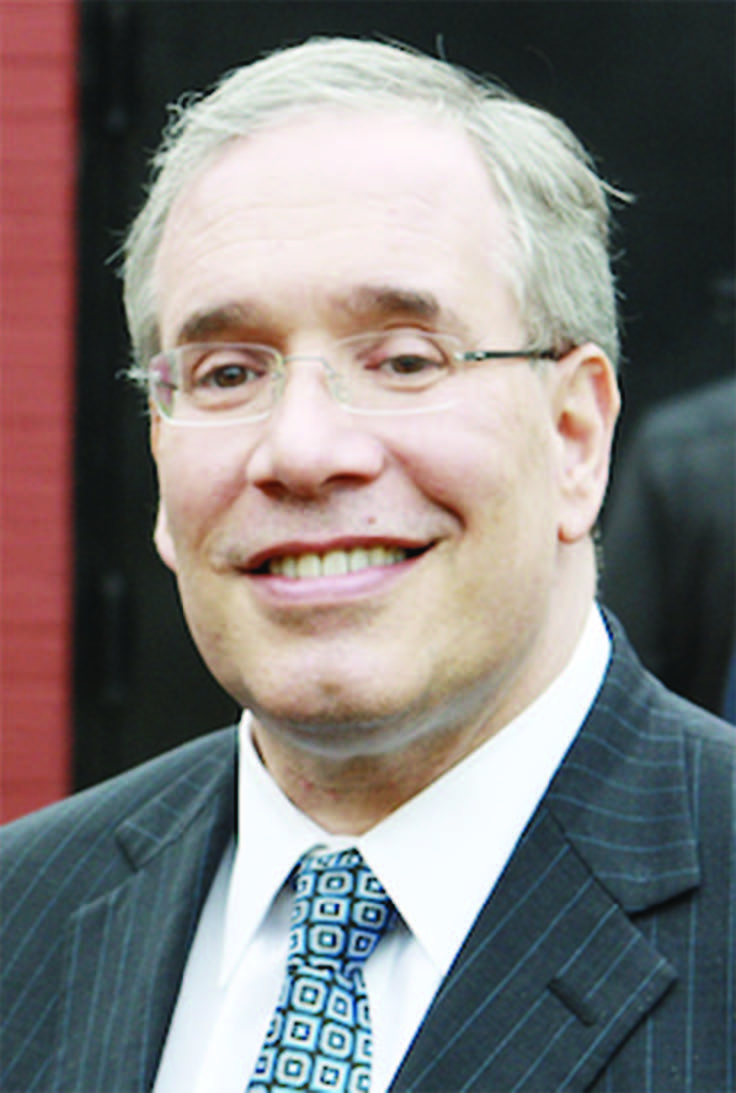
NEW YORK CITY (TIP): More than 1,800 computers were unaccounted for or missing entirely and nearly 400 laptops and tablets were found unpacked and unused in ten Department of Education (DOE) locations, raising concerns that millions in computer equipment may be lost citywide, according to an audit of DOE’s inventory control over nearly $200 million in computer purchases released December 2 by New York City Comptroller Scott M. Stringer. “It is an insult to families who are desperate to access technology for their children to leave brand new computers and tablets unused in closets and storage facilities,” Stringer said.
“If auditors can’t locate an average of 180 computers per DOE location, this may be just the tip of the iceberg. Every school should be prepared to use the devices they have and DOE should have a plan for where its computer hardware can best be put to use. Taxpayer dollars, and our children’s education, are too important to take this technology for granted.” The audit examined how DOE maintained inventory controls over computer hardware purchased through two separate contracts with Apple and Lenovo.
The contracts, entered into in September 2009 and July 2011 respectively, have been used to purchase over 211,000 pieces of computers and tablets worth more than $197 million as of September 2014. Auditors examined a sample of the computer and tablet inventory purchased from July 1, 2011 through June 30, 2013 for use at ten DOE sites – nine schools and one administrative building. At one of the schools, Bronx P.S. 168, auditors examined lists provided by DOE’s Asset Management System (AMS) database, a program which contains records of the computer and tablet purchases, but is not used by DOE to maintain inventory control. At the remaining nine sites, the results of auditors’ physical findings at these sites were compared with the AMS database.
Audit findings include:
Missing computers and grossly inaccurate records- DOE was unable to identify the location of 1,817 laptop and desktop computers that were supposed to be at the ten sites-1,090 that were listed as “asset location unknown” or were no longer listed at all at Bronx P.S. 168 and 727 that were not physically found at nine of the locations. The Department spent nearly $200 million during FY12-FY13 on computers and tablets, yet does not maintain a centralized inventory system to make sure they are sent to the right places. Instead, the DOE tasks schools with creating their own annual inventory lists. These school inventory lists are not reconciled with the AMS database of purchases, leaving the DOE with inaccurate counts and unknown locations of computers and tablets.
No system to track tablets – DOE spent $26.9 million on tablets during FY 2012 and 2013 citywide, but did not keep an inventory of these purchases, even though its Standard Operating Procedures requires it to do so. According to City records, 956 tablets were purchased for eight sampled schools during the audit period, but only 703 were listed on the individual sites’ inventory records, leaving 253 unaccounted for.
Computers sitting in closets – The audit found 394 devices had gone unused and unopened at the eight school sites that were physically examined. At Boys and Girls High School in Brooklyn, 78 laptops and iPads, some purchased in 2011, were found unopened.
“Parents have a right to expect that their kids have access to the technology that will prepare them for the global economy,” Comptroller Stringer said. “DOE has failed in its duty to ensure that when taxpayer dollars are spent on computers and tablets, that technology makes it into the classroom. The City is wasting precious resources, creating a climate that invites theft, and ultimately undermining our responsibility to educate our children.”
Recommendations submitted to the DOE by Comptroller Stringer’s office included:
Create a centralized inventory system – DOE should have a centralized inventory system for computer hardware that includes computer hardware purchases and delivery information, as well as the item’s current location.
Revise DOE’s Procedures – DOE should ensure that all hardware purchases are included in its AMS and require schools to do annual inventory counts that are reconciled with AMS.
Find every computer identified as missing – DOE should locate those computers identified as missing and take steps to ensure that other locations have accurate inventories.
Report any evidence of crimes – If evidence of illegal activity is uncovered as pat of the updated inventory, the DOE should immediately contact the proper authorities and cooperate with any investigation. -

GOPIO lines up Events in conjunction with PBD 2015 and Vibrant Gujarat
NEW YORK (TIP): The Global Organization of People of Indian Origin (GOPIO) will be holding a diaspora conference and banquet on 10th January, 2015 in Ahmedabad, India in conjunction with the annual Pravasi Bharatiya Divas (PBD2015) being held in Ahmedabad, India (7th – 9th January, 2015) and Vibrant Gujarat being (11th -12th January 2015). This information was given out to The Indian Panorama by Ashook Ramsaran, GOPIO International President. “PBD2015 will mark the Centenary Year celebrations of the return of the greatest Pravasi of all, Mahatma Gandhi, from South Africa” and GOPIO joins in this fitting tribute and celebration.
GOPIO’s events are expected to garner maximum delegates among GOPIO membership and others attending PBD2015 and Vibrant Gujarat. The program will focus on “Indian Diaspora’s Connection and Partnership with India”, with emphasis on economic, social and cultural need and opportunities, as well as GOPIO Growth & Development: Diaspora & Migration Trends”. GOPIO’s Chief Guest invited is HE Hon. Donald Ramotar, President of Guyana who is Chief Guest at PBD21015, as well as officials of Ministry of Overseas Indian Affairs and other ministries and states. Program details will be issued shortly.
There is an extra-ordinarily high level of euphoria excitement and anticipation of stronger partnership with India among worldwide Nonresident Indians (NRIs) and Persons of Indian Origin (PIOs) with Hon. PM Narendra Modi and his mandate and agenda for reform. It is a unique time in the history of the partnership between India and its Diaspora with many opportunities to strengthen the relationship on several fronts: economic, social and cultural. As the premiere global advocacy Indian diaspora organization representing the interests and concerns of NRIs and PIOs, GOPIO looks forward and supports more progress to strengthen the partnership between India and its Diaspora. GOPIO’s efforts continue to highlight the enormous successes and contributions of the Indian diaspora globally. For more information, please contact GOPIO International at +1-818-708-3885, Email: GOPIO-Intl@sbcglobal.net.
GOPIO is a non-partisan, nonsectarian global organization formed in 1989 and has chapters in several countries, actively promoting the interests of people of Indian origin worldwide by monitoring and addressing current critical issues of concern, and by enhancing cooperation and communication between groups of Indians living in various countries -

Eternal Vigilance is the Price of Liberty
I.S. Saluja
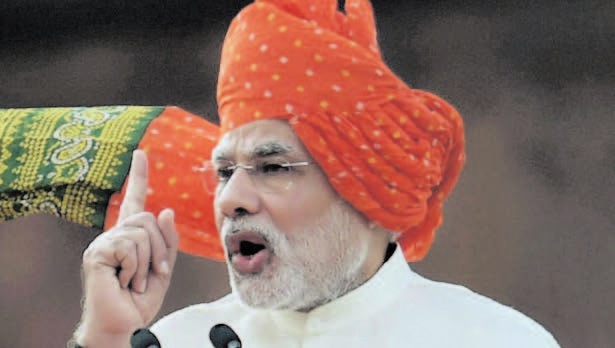
Prime Minister Narendra Modi addressed the nation from the ramparts of the Red Fort on the 68th Independence Day of India on 15th August, 2014. It has been almost 4 months since he spoke of his vision of India in his first address to the nation as Prime Minister. In his long speech, inter alia, he reminded the people of India that “Eternal vigilance is the price of liberty”.
I must agree with him as would the whole world. A people need to be vigilant and constantly evaluate their leaders. Hence, we are giving below the full text of Prime Minister Narendra Modi’s address to the nation and would like our readers to evaluate India’s Prime Minister. Please send in your comments to editor@theindianpanorama.news or to salujaindra@gmail.com. We will be happy to publish your valuable evaluation and comments.
Following is the English rendering of the Prime Minister’s address on the occasion. My dear countrymen,
Today, all Indians in the country and also abroad are celebrating the festival of independence. On this day of sacred festival of independence, the prime servant of India extends greetings to all dear countrymen. I am present amidst you not as the Prime Minister, but as the Prime Servant. The freedom struggle was fought for so many years, so many generations laid down their lives, innumerable people sacrificed their lives and youth, spent their entire lives behind bars.
Today, I pay my respect, greetings and homage to all those who laid their lives for the country`s independence. I also pay my respects to the crores of citizens of this country on the pious occasion of India`s independence, and recall all those martyrs who had laid down their lives in India`s struggle for freedom. The day of independence is a festival when we take a solemn pledge of working for the welfare of mother India, and also for the welfare of the poor, oppressed, dalits, the exploited & the backward people of our country.
What he stressed on during the speech My dear countrymen, a national festival is an occasion to refine and rebuild the national character. This National festival inspires us to resolve ourselves to lead a life where our character gets refined further, to dedicate ourselves to the nation and our every activity is linked to the interest of the nation and only then this festival of freedom can be a festival of inspiration to take India to newer heights. My dear countrymen, this nation has neither been built by political leaders nor by rulers nor by governments. This nation has been built by our farmers, our workers, our mothers and sisters, our youth.
The country has reached here today because of generation to generation rigours undertaken by our sages, our saints, our maestros, our teachers, our scientists and social workers. These great people and these great generations, who had worked for the country throughout their lives, deserve our deepest respect. This is the beauty of India’s Constitution, this is its capability which has made it possible that today a boy from small town, a poor family has got the opportunity to pay homage to the tri-colour of India at the ramparts of Lal Quila(Red Fort). This is the strength of India’s democracy. This is an invaluable legacy which we have inherited from our architects of the constitution.
I pay my respects to those architects of the constitution of India today. Brothers and sisters, today if we have reached here after independence, it is because of the contribution of all the PrimeMinisters, all the governments and even the governments of all the States. I want to express my feelings of respect and gratitude to all those previous governments and ex-Prime Ministers who have endeavoured to take our present day India to such heights and who have added to the country’s glory. This country has been built on such foundation of ancient cultural heritage, where we were told of only onemantra during Vedic period, which is indicative of our work culture, which we have learnt, we have memorized – “Sangachchhdhvam Samvadadhvam sam wo manansi jaanataam.” We walk together, we move together, we think together, we resolve together and together we take this country forward. Having imbibed this basic mantra, 125 crores of countrymen have taken the nation forward.
Yesterday only the first Parliamentary Session of the new Government had concluded. Today, I can proudly say that the Session of Parliament reflects our thinking and it is a reflection of our intentions. We are not for moving forward on the basis of majority, we are not interested to move forward by virtue of majority. We want to move ahead on the basis of strong consensus. “Sangachhadhwam” and, therefore, the nation has witnessed the entire Session of Parliament. Having taken all the Parties and Opposition along while working shoulder to shoulder, we achieved an unprecedented success and the credit for this does not go to the Prime Minister alone, the credit does not go to the people sitting in the Government, the credit for this goes to the Opposition also, the credit goes to all the leaders of Opposition too and also all the Members from Opposition.
From the ramparts of Red Fort, quite proudly I salute all the Members of Parliament, I also salute all the Political Parties and by virtue of their strong support, we could take some important decisions intended to take the nation forward and yesterday the Session of Parliament had concluded. Brothers and sisters, I am an outsider for Delhi, I am not a native of Delhi. I have no idea about the administration and working of this place. I have been quite isolated from the elite class of this place but during the last two months while being an outsider, I had an insider view and I was astonished.
It is not a political platform, rather it is a platform of a national policy and, therefore, my views should not be evaluated from a political perspective. I have already said, I salute all the ex-Prime Ministers and earlier governments who have brought the country thus far. But I am going to say something else and it may not be seen from political point of view. When I came to Delhi and noticed an insider view, I felt what it was and I was surprised to see it. It seemed as if dozens of separate governments are running at the same time in one main government.
It appeared that everyone has its own fiefdom. I could observe disunity and conflict among them. One department is taking on the other department and taking on to the extent that two departments of the same government are fighting against each other by approaching Supreme Court.This disunity, this conflict among people of the same country! How come we can take the country forward? And that is why I have started making efforts for razing those walls; I have started making efforts at making the Government, not an assembled entity, but an organic unity, an organic entity, a harmonious whole- with one aim, one mind, one direction, one energy. Let`s resolve to steer the country to one destination. We have it in us to move in that direction. A few days back…Nowadays newspapers are full of news that Modiji`s Government has come, officers are reaching office on time, offices open in time, and people get there in time. I observed that India`s National newspapers, TV media were carrying these news items prominently.
As the Head of the Government I could have derived pleasure in the fact that everything started going on time, cleanliness got the attention, but I was not taking pleasure, I was feeling pained. That thing, I want to tell today in public. And why, because if government officers arrive office in time, does that make a news? And if that makes news, it shows how low we have fallen. It becomes a proof of that, and that`s how, brothers and sisters, the governments have run? Today in the face of global competition, when we have to realize the dreams of millions of Indians, the country cannot run on the lines of ” it happens”, ” it goes”. In order to fulfil the aspirations of masses, we have to sharpen the tool called the Government machinery, we have to make it keen, more dynamic, and it is in this direction that we are working.
My countrymen, it`s not long since I have come from outside Delhi, but I give you an assurance that the people in the Government are very capable – from the peon to the Cabinet Secretary, everybody is capable, everybody has a power, they have experience. I want to awaken that power, I want to unite that power and want to accelerate the pace of the welfare of nation through that power and I shall definitely do it. I want to assure the countrymen that we will achieve that, we will definitely do that. I could not say this on 16th May, but today after my experience of twotwo and half months, keeping the tricolor as witness, I am saying on 15th of August that it is possible, it will be achieved.
Brothers and sisters, time has come to give a serious thought to the fact that whether we have a duty to create India of the dreams of those great people who gave us freedom, whether we have a national character? Brothers and sisters, can someone please tell me as to whether he or she has ever introspected in the evening after a full day`s work as to whether his or her acts have helped the poor of the country or not, whether his or her actions have resulted in safeguarding the interest of the country or not, whether the actions have been directed in country`s welfare or not? Whether it should not be the motto of one and a quarter billion countrymen that every step in life should be in the country`s interests? Unfortunately, we have an environment today wherein if you approach anyone with some work, he begins by saying “what does it mean for me?” He begins by saying “what does it involve for me?” and when he come to know that it does not entail any benefit for him, immediately he says “why should I bother?” we have to rise above the feelings of “what does it mean for me” and “why should I bother”. Everything is not for self interest only.
There are certain things which are meant for the country and we have to refine this national character. We have to rise above the feelings of “why should I bother” and “what does it mean for me” and instead we have to think that “I am for nation`s interest and in this field, I am going to lead”. We have to inculcate this sentiment. Brothers and sisters, when we hear about the incidents of rape, we hang our heads in shame. People come out with different arguments, someone indulges in psycho analysis, but brothers and sisters, today from this platform, I want to ask those parents, I want to ask every parent that you have a daughter of 10 or 12 years age, you are always on the alert, every now and then you keep on asking where are you going, when would you come back, inform immediately after you reach.
Parents ask their daughters hundreds of questions, but have any parents ever dared to ask their son as to where he is going, why he is going out, who his friends are. After all, a rapist is also somebody`s son. He also has parents. As parents, have we ever asked our son as to what he is doing and where he is going. If every parent decides to impose as many restrictions on the sons as have been imposed on our daughters, try to do this with your sons, try to ask such questions of them. \My dear brothers and sisters, the law will take its own course, strict action will be taken, but as a member of the society, as parents, we also have some responsibilities. If somebody tells me that those who have taken guns on their shoulders and kill innocent people are Maoists, are terrorists, but they are also somebody`s children.
I would like to ask of such parents if they had ever asked their children as to why they were taking a wrong path. Every parent must take this responsibility, he must know that his misguided son is bent on killing innocent people. He is not able to serve himself nor his family nor the country. I want to say to those youngsters who have chosen the path of violence that whatever they are and wherever they are, it is all because of mother India only that they have got it. Whoever you are it is all because of your parents. I want to ask you to think how green, how beautiful and how beneficial this earth can become if you shoulder the plough instead of the gun which spills blood on this land.
How long shall we have bloodshed on this land, how long shall we take the lives of the innocent people and what have we got after all this? The path of violence has not yielded anything to us. Brothers and sisters, I had gone to Nepal recently. There I said something publicly to draw the attention of the whole world. There was a time when the Emperor Ashoka who had chosen the path of wars, got converted to the path of Buddha at the sight of violence. There was a time in Nepal when their youngsters had opted for the path of violence but today I witness that the same youngsters are waiting for their constitution. The same people associated with them are framing the constitution.
And I further said that if Nepal could present the best example of moving from the weapons to the books then it could provide inspiration to the youngsters in the world to abandon the path of violence. Brothers and sisters, If Nepal, land of Budha, can give message to the world then why can`t India too do the same? So it`s the call of the hour that we renounce the path of violence and take the path of brotherhood. Brothers and sisters, for one reason or the other, we have had communal tensions for ages. This led to the division of the country. Even after Independence, we have had to face the poison of casteism and communalism. How long these evils will continue? Whom does it benefit? We have had enough of fights, many have been killed. Friends, look behind and you will find that nobody has benefited from it.
Except casting a slur on Mother India, we have done nothing. Therefore, I appeal to all those people that whether it is the poison of casteism, communalism, regionalism, discrimination on social and economic basis, all these are obstacles in our way forward. Let`s resolve for once in our hearts, let`s put a moratorium on all such activities for ten years, we shall march ahead to a society which will be free from all such tensions. And you will see that how much strength we get from peace, unity, goodwill and brotherhood. Let`s experiment it for once. My dear countrymen, believe in my words, I do assure you. Shun all the sins committed so far, give up that way, follow the way of goodwill and brotherhood, and let`s resolve to take the country forward.
I believe we can do that. With advancement of science, brothers and sisters, we have a rising feeling of modernity in our mind, but what do we do? Have we ever thought what the sex ratio in the country is like? 940 girls are born against per thousand boys. Who is causing this imbalance in the society? Certainly not God. I request the doctors not to kill the girl growing in the womb of a mother just to line their own pockets. I advise mothers and sisters not to sacrifice daughters in the hope of son. Sometimes mother-father feel tempted to have son in the hope of supporting them in old age.
I am a person who has worked in public life. I have come across families with five sons, each having bungalows, access to fleet of cars, but parents are forced to live in old-age homes, Vriddhashrams. I have seen such families. I have also seen families with only daughter as progeny, that daughter sacrifices her dreams, doesn`t get married, and spends entire life in taking care of old parents. This disparity points to female foeticide and the polluted and tainted mind the 21st century has.
We will have to liberate from it, and that is message to us of this Freedom festival. Recently Commonwealth Games were organized. Indian sportspersons brought glory to the country. Nearly 64 of our sportspersons won. Our sportspersons brought 64 medals. But of them 29 are girls. Let`s feel proud and clap for them. Girls also contribute to India`s fame and glory. Let`s recognise it. Let`s take them along, shoulder to shoulder. This way we can get over the evils that have crept in social life. Therefore, brothers and sisters, we have to proceed in that direction as a social and national character.
Brothers and Sisters, Development is the only way forward for the country. Good governance is the only way. There are only these two tracks to take the country forward – good governance and development, we can move forward only by taking them with us. We wish to move forward with the intent of taking them with us. When I talk of good governance, you tell me, when I ask a person in private job, he tells that he does the job; when you ask the same from a person in government job, he says that I do the service. Both earn, but for one it is job while for the other it is service. I ask a question from all brothers and sisters in government service, whether the word “Service” has not lost its strength, its identity? Persons in government service are not doing “job”, they are doing “service”. We have to revive this feeling, we have to take this feeling forward as a national character, we have to move forward in this direction.
Brothers and Sisters, whether the citizens of the country should take steps for the welfare of the nation or not? You imagine, ifthis 125 crores of countrymen move one step forward, then the country moves 125 crore steps forward. The meaning of democracy is not just limited to electing a government, but its meaning is that 125 crore of citizens work together joining shoulder with the government to fulfill hopes and aspirations of the country, this is the meaning of democracy. We have to create partnership with the people. We have to proceed under Public-Private Partnership. We have to proceed along with the participation of the people. But, please tell me why our farmers commit suicide? A farmer takes loan from the moneylender, but fails to repay his loans. He takes loan for the wedding of his daughter, but fails to repay.
He will have to suffer hardships during his whole life. He chooses to commit suicide. Who will save the poor families of such farmers? Brothers and sisters, I have come here with a pledge to launch a scheme on this festival of Freedom. It will be called`Pradhanmantri Jan-Dhan Yojana`. I wish to connect the poorest citizens of the country with the facility of bank accounts through this yojana. There are millions of families who have mobile phones but no bank accounts. We have to change this scenario. Economic resources of the country should be utilized for the well-being of the poor.
The change will commence from this point. This yojana will open the window. Therefore, an account holder under `Pradhanmantri Jan-Dhan Yojana` will be given a debit card. An insurance of One Lakh Rupees will be guaranteed with that debit card for each poor family, so that such families are covered with the insurance of One Lakh Rupees in case of any crisis in their lives. My brothers and sisters, it is a country of young people. The 65 percent population of the country happens to be under the age of 35 years. Our country has the largest number of youths in the world. Have we ever thought of deriving an advantage out of it? Today, the world needs a skilled workforce. Today, India also needs a skilled workforce. At times, we look for a good driver but he is not available, we look for a plumber, but he is not available.
If we need a good cook, he is not available. We have young people, they are unemployed but the kind of young people we seek for are not available. If we have to promote the development of our country then our mission has to be `skill development` and `skilled India`. Millions and Millions of Indian youth should go for acquisition of skills and there should be a network across the country for this and not the archaic systems. They should acquire the skills which could contribute towards making India a modern country. Whenever they go to any country in the world, their skills must be appreciated and we want to go for a two pronged development.
I also want to create a pool of young people who are able to create jobs and the ones who are not capable of creating jobs and do not have the opportunities, they must be in a position to face their counterparts in any corner of the world while keeping their heads high by virtue of their hard work and their dexterity of hands and win the hearts of people around the world through their skills. We want to go for the capacity building of such young people. My brothers and sisters, having taken a resolve to enhance the skill development at a highly rapid pace, I want to accomplish this.
Brothers and sisters, the world has undergone a change. My dear countrymen, the world has changed. Now India can not decide its future by remaining isolated and sitting alone in a corner. The economics of the world have changed and, therefore, we will have to act accordingly. Government have taken many decisions recently, made some announcements in the budget and I call upon the world and call upon the Indians spread world over that if we have to provide more and more employment to the youth, we will have to promote manufacturing sector. If we have to develop a balance between imports and exports, we will have to strengthen manufacturing sector. If we have to put in use the education, the capability of the youth, we will have to go for manufacturing sector and for this Hindustan also will have to lend its full strength, but we also invite world powers.
Therefore I want to appeal all the people world over, from the ramparts of the Red Fort, “Come, make in India”, “Come, manufacture in India”. Sell in any country of the world but manufacture here. We have got skill, talent, discipline, and determination to do something. We want to give the world an favourable opportunity that come here, “Come, Make in India” and we will say to the world, from electrical to electronics, “Come, Make in India”, from automobiles to agro value addition “Come, Make in India”, paper or plastic, “Come, Make in India”, satellite or submarine “Come, Make in India”. Our country is powerful. Come, I am giving you an invitation.
Brothers and sisters, I want to call upon the youth of the country, particularly the small people engaged in the industrial sector. I want to call upon the youth working in the field of technical education in the country. As I say to the world “Come, Make in India”, I say to the youth of the country – it should be our dream that this message reaches every corner of the world, “Made in India”. This should be our dream. Whether, to serve the country, is it necessary for the youth of the country to be hanged like Bhagat Singh? Brothers and sisters, Lal Bahadur Shastri had given the slogan “Jai Jawan, Jai Kisan”.
A soldier sacrifices himself at the border and protects Mother India. Similarly, a farmer serves Mother India by filling the godowns with grains. This is also nation`s service. Filling the granary is the biggest nation`s service that a farmer provides. That is why Lal Bahadur Shashtri had given the slogan of “Jai Jawan, Jai Kisan”. Brothers and Sisters, I would like to pose a question to my youngsters as to why despite them, we are forced to import even the smallest of things? My country`s youth can resolve it, they should conduct research, try to find out as to what type of items are imported by India and then each one should resolve that, through may be micro or small industries only, he would manufacture atleast one such item so that we need not import the same in future. We should even advance to a situation wherein we are able to export such items.
If each one of our millions of youngsters resolves to manufacture atleast one such item, India can become a net exporter of goods. I, therefore, urge upon the youth, in particular our small entrepreneurs that they would never compromise, atleast on two counts. First, zero defect and, second again zero effect. We should manufacture goods in such a way that they carry zero defect, that our exported goods are never returned to us. We should manufacture goods with zero effect that they should not have a negative impact on the environment. If we march ahead with the dream of zero defect in the manufacturing sector then, my brothers and sisters, I am confident that we would be able to achieve our goals.
Brothers and sisters, the youth of India has completely transformed the identity of India in the world. Earlier, in what manner did the world know our country? Till only 25-30 years back, if not more, there were many people in the world who thought that India was a country of snake charmers, it was a country which practiced in black magic. The real identity of India had not reached the world, but my dear brothers and sisters, our youngsters, 20-22-23 years old youngsters have mesmerized the whole world with their skills in computers. Our young I.T. professionals have given a new path of making a new identity of India. If our country has this strength, can we think something about the country? Our dream is, therefore, of “Digital India”. When I talk of “Digital India”, I don`t speak of the elite, it is for the poor people. You can imagine what a quality education the children in villages will get, if all the villages of India are connected with Broadband Connectivity and if we are able to give long distance education to the schools in every remote corner of the villages.
If we create a network oftelemedicine in the places where there is a shortage of doctors, we can have a clear guideline of the way in which health facilities have to be provided to the poor people living in those areas. The citizens of India have mobile phones in their hands, they have mobile connectivity, but can we walk in the direction of mobile governance? We have to move in a direction where every poor person is able to operate his bank account from his mobile, is able to demand various things from the government, can submit applications, can conduct all his business, while on the move, through mobile governance and if this has to be done, we have to move towards `digital India` and if we have to move towards `digital India` then we have a dream. Today we are importing electronic goods on a large scale. Friends, you will be surprised that we are bringing in these televisions, mobile phones, ipads and all these electronic goods.
It is a necessity to import petroleum products, oil, diesel and petrol. Second to this is the import of our electronic goods. If we move ahead with the dream of `digital India` to manufacture electronic goods and become self reliant at least there, how big can be the benefit for the treasury! Therefore, e-governance is what we need to take this idea of `digital India` forward. E-governance is easy governance, effective governance and also economic governance. Egovernance paves the way for good governance. There was a time when we used to say that the railways provided connectivity to the country.
That was it. I say that today it is IT that has the potential to connect each and every citizen of the country and that is why we want to realise the mantra of unity with the help of `digital India`. Brothers and sisters, if we move ahead with all this then I believe that a `digital India` will have the potential to stand with the world on equal footing. Our youth have that capability, it is an opportunity for them. Brothers and sisters, we want to promote tourism. Tourism provides employment to the poorest of the poor. Gram seller earns something, auto-rickshaw driver earns something, pakoda seller earns something and tea seller also earns something. When there is talk of tea seller, I feel a sense of belongingness.
Tourism provide employment to the poorest of the poor. But there is a big obstacle in promoting tourism and in our national character and that is – the filthiness all around us. Whether after independence, after so many years of independence, when we stand at the threshold of one and half decade of 21stcentury, we still want to live in filthiness? The first work I started here after formation of Government is of cleanliness. People wondered whether it is a work of a Prime Minister? People may feel that it is a trivial work for a Prime Minister but for me this a big work. Cleanliness is very big work.
Whether our country can not be clean? If one hundred and twenty five crore countrymen decide that they will never spread filthiness, which power in the world has ability to spread filthiness in our cities and villages? Can`t we resolve this much? Brothers and sisters it will be 150th birth anniversary of Mahatma Gandhi in 2019. How do we celebrate 150th birth anniversary of Mahatma Gandhi? Mahatma Gandhi, who gave us freedom, who brought so much honour to such a big country in the world, what do we give to Mahatma Gandhi? Brothers and Sisters, Mahatma Gandhi had cleanliness and sanitation closest to his heart.
Whether we resolve not to leave a speck of dirt in our village, city, street, area, school, temple, hospital, and what have you, by 2019 when we celebrate 150th anniversary of Mahatma Gandhi? This happens not just with the Government, but with public participation. That`s why we have to do it together. Brother and Sisters, we are living in 21st century. Has it ever pained us that our mothers and sisters have to defecate in open? Whether dignity of women is not our collective responsibility? The poor womenfolk of the village wait for the night; until darkness descends, they can`t go out to defecate.What bodily torture they must be feeling, how many diseases that act might engender.
Can`t we just make arrangements for toilets for the dignity of our mothers and sisters? Brothers and Sisters, somebody might feel that a big festival like 15th August is an occasion to talk big. Brothers and Sisters, talking big has its importance,making announcements too has importance, but sometimes announcements raise hopes and when the hopes are not fulfilled, the society sinks into a state of despondency. That`s why are in favour of telling those things, which we can fulfil just within our sight. Brothers and sisters, you must be getting shocked to hear the Prime Minister speaking of cleanliness and the need to build toilets from the ramparts of the Red Fort. Brothers and sisters, I do not know how my speech is going to be criticised and how will people take it. But this is my heartfelt conviction.
I come from a poor family, I have seen poverty. The poor need respect and it begins with cleanliness. I, therefore, have to launch a `clean India` campaign from 2nd October this year and carry it forward in 4 years. I want to make a beginning today itself and that is – all schools in the country should have toilets with separate toilets for girls. Only then our daughters will not be compelled to leave schools midway. Our parliamentarians utilizing MPLAD fund are there. I appeal to them to spend it for constructing toilets in schools for a year. The government should utilise its budget on providing toilets.
I call upon the corporate sector also to give priority to the provision of toilets in schools with your expenditure under Corporate Social Responsibility. This target should be finished within one year with the help of state governments and on the next 15th August, we should be in a firm position to announce that there is no school in India without separate toilets for boys and girls. Brothers and sisters, if we proceed with the dreams, we are in a position to realise them. Today, I wish to tell one more specific thing. It has its own importance to discuss the matters and express the views of nation`s interest. However, our Members of Parliament do not get opportunity though they are willing to do something.
They can express themselves, write to the government, agitate, give memoranda. Still they do not get opportunity to do something on their own. Today I have come to you with a new idea. We are running so many schemes in the name of the Prime Minister in our country, there are numerous schemes in the name of various leaders. However, today I am going to announce a scheme on behalf of the Member of Parliament- `Sansad Aadarsh Gram Yojana`. We shall fix some parameters. I urge upon the Members of Parliament to select any one of the villages having population of three to five thousand in your constituency. The parameters will be according to the time, space and situation of that locality.
It will include the conditions of health, cleanliness, atmosphere, greenery, cordiality etc. On the basis of those parameters, each of our MPs should make one village of his or her constituency a Model Village by 2016. Can`t we do at least this? Shouldn`t we do this? If we have to build a nation, we should start from the village. Make a Model Village. The reason of fixing this target for 2016 is that it is a new scheme. It takes time to formulate a scheme and then to implement it. After 2016, select two more villages for this purpose, before we go for the General Elections in 2019. And after 2019, each Member of Parliament, during his/her tenure of 5 years must establish atleast five model villages in his/her area. I also call upon the Members of Parliament from urban areas to adopt one village of their choice. I also urge upon the Members of Parliament from Rajya Sabha to adopt one of the villages. If we provide one model village in each district of India then the surrounding villages shall be automatically inspired to follow that model.
Let us establish a model village, let us establish a village well equipped with all systems and facilities. The birth anniversary of Jai Prakash Narayan Ji happens to be on 11th October. On 11th October, the occasion of birth anniversary of Jai Prakash Narayan Ji, I will present a complete blueprint of “S?nsad Adharsh Gr?m Yojana” (Members of Parliament Model Village Scheme) before all Members of Parliament and State Governments, and I urge upon State Governments also that as per the feasibility in their respective states, all the Members of Legislative Assembly resolve to establish a model villageYou can imagine all the Members of Legislative Assembly and all the Members of Parliament in the country establishing a model village.
All of a sudden, there would be a model village in each block of India which could inspire us to transform the amenities in rural areas and could give us a new direction and, therefore, we want to move ahead under this”S?nsad Adarsh Gr?m Yojana”. My dear brothers and sisters, ever since our government has taken charge, there has been a discussion in the newspapers, on T.V. channels as to what would happen to Planning Commission. I believe that when Planning Commission was constituted, it was done on the basis of the circumstances and the needs of those times. In recent years, Planning Commission has contributed to the growth of the country in its own way. I respect that, I am proud of that, but the prevalent situation in the country is different, global scenario has also changed, governments are no longer the centre of economic activities, the scope of such activities has broadened. State governments have been at the center of development and I consider this a good indication.
If we have to take India forward, it can happen only by taking the states forward. India`s federal structure is more important today than in the last 60 years. To strengthen our federal structure, to make our federal structure vibrant, to take our federal structure as a heritage of development, a team of Chief Minister and Prime Minister should be there, a joint team of the Centre and the states should move forward, then to do this job, we will have to think about giving the Planning Commission a look. So, I am saying from the rampart of the Red Fort that it is a very old system and it will have to be rejuvenated, it will have to be changed a lot. Sometimes it costs more to repair the old house, but, it gives us no satisfaction.
Thereafter, we have a feeling that it would be better to construct a new house altogether and therefore within a short period, we will replace the planning commission with a new institution having a new design and structure, a new body, a new soul, a new thinking, a new direction, a new faith towards forging a new direction to lead the country based on creative thinking, public-private partnership, optimum utilization of resources, utilization of youth power of the nation, to promote the aspirations of state governments seeking development, to empower the state governments and to empower the federal structure.
Very shortly, we are about to move in a direction when this institute would be functioning in place of Planning Commission. Brothers and sisters, today, on 15th August, we also have the birth anniversary of Maharishi Aurobindo. Maharishi Aurobindo, being a rebel, moved on to achieve the status of a Yoga Guru. With regard to the destiny of India, he remarked, “I have a faith that the divine power and spiritual heritage of India will play an important role towards the welfare of the world.” Such sentiments were echoed by Maharishi Arvind. I strongly believe in the words of legends. I have great faith in the statements made by ascetics, sages & saints and that’s why today at the ramparts of Lal Quila I am reminded of the words of Swami Viveknanda. He had said – “I can see before my eyes Mother India awakening once again.
My Mother India would be seated as the World Guru. Every Indian would render service towards welfare of humanity. This legacy of India would be useful for the welfare of the world”. These words were spoken by Swami Viveknanda ji in his own style. Friends, the words of Viveknanda ji can never be untrue. The words of Viveknanda ji, his dream of seeing India ensconced as World Guru, his vision, it is incumbent upon us to realize that dream. This capable country, blessed with natural bounty, this country of youth can do much for the world in the coming days. Brothers and sisters, our foreign policy is a much talked about issue. I clearly believe that India`s foreign policy can be multidimensional.
But there is an important issue to which I want to draw your attention that the way we fought for freedom, we fought together, we were not separate at that time. We were together. Which was the government with us? What were the weapons available to us? There was a Gandhi, a Sardar and lakhs of freedom fighters and such a huge empire. Didn`t we win in the struggle of freedom against that empire? Did we not defeat the foreign powers? Did we not force them to leave India? We were the ones, they were our ancestors only who showed this might. If the people of India could remove such a big empire without the power of the government, without weapons and even without resources, then friends, it is the need of the hour to eradicate poverty, can we not overcome poverty? Can we not defeat poverty? My 125 crore dear countrymen, let us resolve to eradicate poverty, to win against it.
Let us move with the dream of poverty eradication from India. Our neighbouring countries are also faced with the same problem. Why not get together with all the SAARC nations to plan out the fight against poverty? Let`s fight together and defeat poverty. Let us see at-least for once as to how wonderful is the feeling of being alive instead of killing and getting killed. This is the land where incidents from Siddharth`s life happened. One bird was shot with an arrow by one brother and the other took out that arrow to save it. They went to mother- whose bird, whose swan? Whether killer`s or saviour`s, they asked of mother. The mother replied, saviour`s. The saviour has more power than the killer and that makes him Buddha in future. And that`s why I seek cooperation from neighbouring countries for fighting against povertyin concert and cooperate with them, so that together with SAARC countries we can create our importance and emerge as a power in the world.
It is imperative that we work together with a dream to win a fight against poverty, shoulder to shoulder. I went to Bhutan, Nepal, all the dignitaries from SAARC countries took part in oath-taking ceremony; this marked a good beginning. This will definitely yield good results, it is my belief and this thinking of India, in the country and the world, that we want to do well to the countrymen and be useful for the welfare of the world, India wants such a hand to be extended. We are trying to move forward with these dreams to achieve them. Brothers and Sisters, today on 15th August we will resolve to do something for the country.
Let`s be useful for the country, we will move ahead with a resolve to take the country forward, and I assure you, Brothers and Sisters, as well as my colleagues in the Government, that if you work for 12 hours, I will do so for 13 hours. If you work for 14 hours, I will do for 15 hours. Why? Because I`m amidst you not as a Prime Minister, but as the first servant. I have formed the Government not as a ruler, but as a servant. Brothers and sisters, I assure that this country has a destiny. It is destined to work for the welfare of the world, it was said by Vivekanand ji. India is born, this Hindustan is born in order to achieve this destiny. One hundred and twenty five crore countrymen have to move forward wholeheartedly for the welfare of the nation. Once again I feel proud of the devotion, the sacrifices of the security forces of the country, para-military forces of the country, all the security forces of the country to protect Mother India. I say to the countrymen, jk”Vª;ke] tkxz;ke~ o;e~ Eternal vigilance is the price of liberty”. The army is vigilant, we should also be vigilant and the country scales new heights, we have to move forward with this resolution. Speak loudly with me with full force –
Bharat mata ki jai, bharat mata ki jai, bharat mata ki jai. Jai Hind, Jai Hind, Jai Hind. Vande Mataram, Vande Mataram, Vande Mataram!