WASHINGTON (TIP): Even as astronomers search for extraterrestrial life in planets that look a lot like Earth because of presence of oxygen, some such planets may not be habitable because of intense heat during their formative years, says a study. Some planets close to lowmass stars – prime targets in the search for extraterrestrial life – likely had their water and atmospheres burned away when they were still forming, the researchers found through computer simulations.
Low-mass stars, also called M dwarfs, are smaller than the sun, and also much less luminous, so their habitable zone tends to be fairly close in. “All stars form in the collapse of a giant cloud of interstellar gas, which releases energy in the form of light as it shrinks,” said Rodrigo Luger from University of Washington. “But because of their lower masses, and therefore lower gravities, M dwarfs take longer to fully collapse – on the order of many hundreds of millions of years,” Luger explained. Planets around these stars can form within 10 million years, so they are around when the stars are still extremely bright. “And that is not good for habitability, since these planets are going to initially be very hot, with surface temperatures in excess of a thousand degrees.
When this happens, your oceans boil and your entire atmosphere becomes steam,” Luger added. The researchers noted that M dwarf stars emit a lot of Xray and ultraviolet light, which heats the upper atmosphere to thousands of degrees. A side effect of this process could lead to huge oxygen build-up in the planets. “Because of the oxygen they build up, they could look a lot like Earth from afar – but if you look more closely you will find that they are really a mirage; there is just no water there,” Luger added.
Year: 2014
-
Angry Protests follow Grand Jury decision over chokehold death of Eric Garner
NEW YORK CITY (TIP): Barely a week after angry protests in New York in the wake of a grand jury decision not to indict police officer Darren Wilson in the case of death of Michael Brown in Fergusan, thousands of angry protesters flooded lower Manhattan and wreaked havoc at the heart of the evening rush – taking over the Brooklyn Bridge and the West Side Highway following a grand jury decision, December 3, not to indict a white police officer Daniel Pantaleo in the case of chokehold death of a black Eric Garner on July 7. Traffic came to a complete standstill as an estimated 7,000 demonstrators fanned out to major crossings and thoroughfares, keeping commuters gridlocked downtown. “Go home, a-holes!” a yellow cabbie yelled from his car window.
Mayor de Blasio addresses a press conference on December 3 and announces plans to retrain the entire New York Police force, numbering over 30,000
“This city won’t move until we have justice,” fired-up protester Felix Castro said. Cops preemptively gave up the bridge without a fight and allowed protesters the run of the city on the second night of marches following a Staten Island grand jury’s decision not to indict an NYPD cop in the chokehold death of Eric Garner. The NYPD scrambled choppers to watch over the demonstrators in Foley Square, right outside 1 Police Plaza, and cops spread out in groups of eight to patrol the mob.At one point, police built a human wall as one man screamed at them, “You’re all a bunch of animals!” Another crowd of about 1,500 formed in Harlem and marched along East 125th Street. Demonstrators began filing into lower Manhattan around 4:30 p.m. – posting fliers with a list of their demands, arranging coffins with the names of people killed by cops, waving posters with phrases like “Black lives matter” and “We can’t breathe.” The brown caskets were lined up in the center of the square with Staten Island’s box embellished with various names including Garner’s and the day he died – July 7, 2014.
“The caskets are a symbol,” said Adilka Pimentel, who helped make them in Bushwick with the help of other Make the Road New York volunteers. “They’re covered in names of people who have lost their lives to police abuse and police brutality.” A similar scene broke out in Union Square, where hundreds of protesters chanted “hands up, don’t shoot.” Between 75 to 100 cops were on hand to monitor the situation, but were not taking any action against the protesters.
The Union Square rabble rousers met their cohorts in Foley Square and proceeded to the Brooklyn Bridge, where they held signs that said “de Blasio, the blood is on your hands” while yelling “Whose streets? Our streets!” One of the protest’s organizers, This Stops Today, posted a list of demands for “Justice for Eric Garner” throughout Foley Square that included officers taking responsibility for Garner’s death, ending the “broken windows” policing and a federal investigation into the case.
#ThisStopsToday tweeted that 85 cities across the US hosted protests Thursday including Pittsburg, Penn., Orlando, Fla., St. Louis, Miss. Back in New York, the mothers of Sean Bell, Ramarley Graham, Mohamed Bah and Anthony Baez – all who had their children killed by cops in the past 20 years – joined the Foley Square demonstration Thursday, December 4. “We must not forget about Ramarley. We must rise up,” Constance Malcolm yelled into a loudspeaker. More than 80 people were arrested Wednesday, December 3 night, with six facing various criminal charges including disorderly conduct and resisting arrest in Manhattan Criminal Court.
Meanwhile, protesters shut down major highways in New York and Chicago, and demonstrations were held in other cities Thursday as outrage against a grand jury’s decision not to indict a white police officer in the death of an unarmed black man continued to be felt on city streets across the nation. Thousands of protesters, chanting “hands up, don’t shoot,” and “shut the whole system down,” marched across the Brooklyn Bridge, shut down parts of the West Side Highway, and blocked traffic in demonstrations all over Manhattan.
In Chicago, protesters walked onto the Dan Ryan Expressway and brought traffic to a halt. And in Washington, D.C, a crowd staged a “die-in” a block from the National Christmas Tree lighting ceremony near the White House. A grand jury on Wednesday declined to indict white NYPD officer Daniel Pantaleo in the July 17 death of Eric Garner, who died after being wrestled to the ground with Pantaleo’s arm around his neck, while telling officers, “I can’t breathe.” A bystander captured the incident on video.
Many felt the grand jury’s decision reaffirmed a belief that police are too often not held accountable for excessive force, especially when it comes to the deaths of unarmed black men. And the grand jury’s decision in the Garner case came a week after a Missouri grand jury declined to indict a white Ferguson police officer, Darren Wilson, for fatally shooting Michael Brown, who was unarmed, on Aug. 9. Mayor de Blasio and the Police Commissioner Bill Bratton, at a press conference on December 3, have spoken of plans to retrain the police personnel and to provide body cameras that the NYPD will begin using
-

Janata Parivar merger in the offing- Mulayam to lead
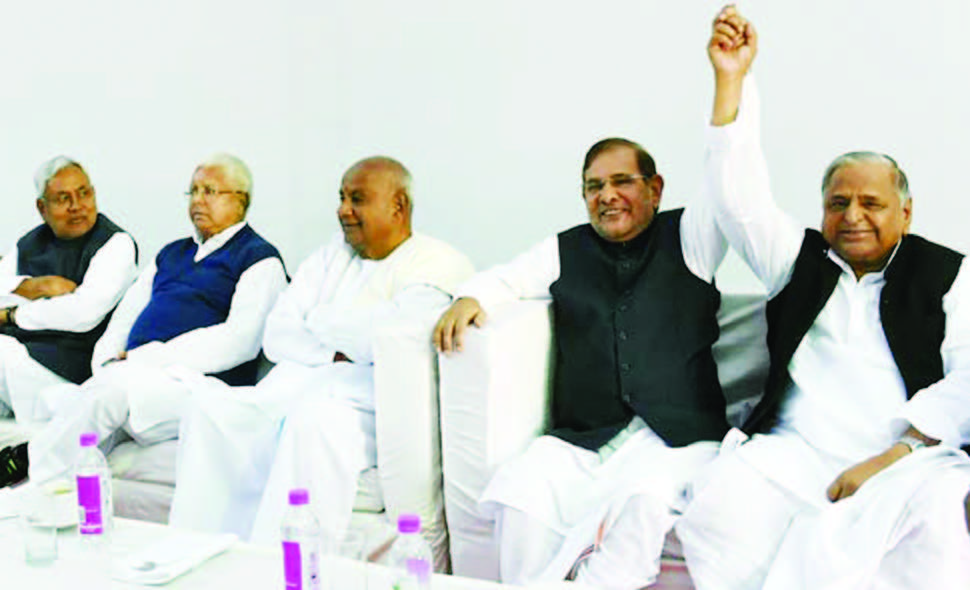
NEW DELHI (TIP): Call it fear of decimation at the hands of a fearsome political opponent or a genuine desire to promote the ideals and ideas of Ram Manohar Lohia and Jay Prakash Narayan, leaders of six parties that emerged from erstwhile Janata Parivar, on Thursday, December 4, decided to set in motion the process of their unification into a single political outfit, and mandated SP chief Mulayam Singh Yadav to work out the modalities to this end. Mulayam is tipped to be the president of the new outfit, which may be named Samajwadi Janata Dal.
Mulayam might also lead the new formation in the Lok Sabha, with JD(U) chief Sharad Yadav leading the pack in the Rajya Sabha. Those present at the luncheon, hosted by Mulayam at his residence, included former PM and JD(S) leader H D Deve Gowda, JD(U) leaders Sharad Yadav, Nitish Kumar and K C Tyagi, RJD president Lalu Prasad, SP floor leader in the Rajya Sabha Ram Gopal Yadav, INLD MP Dushyant Chautala and SJP chief Kamal Morarka. Sources said Nitish, Sharad and Lalu together suggested that because of his “seniority”, Mulayam should lead the proposed outfit and work out modalities for the merger.
Speaking to the media after the meeting, Nitish said there should not be any ambiguity over the proposed merger. “We all felt there should be one party because we have the same philosophy and principles,” he said. When asked had they come together because of threat from rising popularity of BJP, the former Bihar CM said, “Our aim is to forge a single platform in the current political atmosphere.” On why the reunification had not happened right away, Tyagi, JD(U) national spokesperson said, “There is standard process for merger. All six parties will have to call meeting of their respective national executives and pass resolutions regarding dissolving their parties and symbols.
All parties have been asked to complete these formalities within three-four months,” The sources also revealed Lalu told the participants that nobody should worry about Bihar. He said whatever problems might occur in Bihar, he and Nitish would mutually sort them out. The sources said the leaders resolved to move forward with the motto: unity (among themselves) and struggle (against the Narendra Modi government). Nitish announced they would jointly observe a Vaada Nibhao Diwas on December 22 and organise a dharna near Jantar Mantar to draw public attention to BJP’s failure to keep its electoral promises. -

Indian Consulate holds talk on Rise of Dalit Entrepreneurship
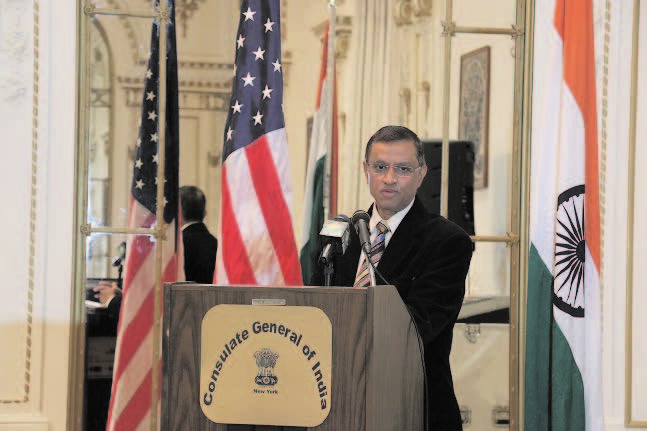
NEW YORK CITY (TIP): The Consulate General of India here hosted its Ninth Media India Lecture Series with Professor Devesh Kapur on ‘The Rise of Dalit Entrepreneurship’ on Thursday, November 20, 2014. Consul General Ambassador Dnyaneshwar M Mulay opened the discussion with introductory remarks, and welcomed constructive dialogue between intellectuals, the private sector and the government for comprehensive and inclusive social and political change.
Professor Kapur is the Director of the Center for the Advanced Study of India and an Associate Professor of Political Science at University of Pennsylvania. His latest book, Defying the Odds: The Rise of Dalit Entrepreneurs (coauthored with D Shyam Babu and Chandra Bhan Prasad), was published in July 2014 by Random House India, and outlines the success stories of 21 Dalit entrepreneurs. The hour long discussion and key note address was moderated by Laxman Narasimhan, CEO of PepsiCo.

Prof. Devesh Kapur said, “Dalits are more invested in a brighter future, rather than lamenting the past. Given this positive attitude, and increased confidence, Dalit entrepreneurs can benefit from institutional economic changes that support their business.”
Professor Kapur and his co-authors conducted a survey of 20,000 Dalit households in Uttar Pradesh to compile the most comprehensive data set about the status of economic and social growth in the Dalit community in independent India. The authors began their research by asking a simple, yet symbolic, question about commensality — who you eat with and who sits at your table. Caste based segregation and discrimination has been deeply rooted in Indian lifestyles and behavior, and in the past there were very few instances of where the upper caste would dine with members of the Dalit community.
The Indian government and its laws can prevent such discrimination, but Professor Kapur argues that instead on emphasizing on reinforcing laws that prevent such private discrimination, the attention needs to be shifted on economic empowerment, which will gradually contribute to political and social changes. Professor Kapur asserted that income inequality alone does not capture the day – to- day struggle of the Dalit community. Questions like how a member of the Dalit community reacts when they come across someone of an upper caste on the same village pathway reveal more about the status of the marginalized community.
Keeping this in mind, the authors set out to search for successful Dalit entrepreneurs, and Defying the Odds (Random House 2014) is a book about 21 Dalit entrepreneurs. In discussion with the audience, Professor Kapur outlined several examples of the change in attitudes of the Dalit community — there was a distinct absence of bitterness about the injustices done to them in the past; they had a great willingness to live and let live; and were pro-active donors for infrastructural maintenance in their local communities. Dalits, Professor Kapur said, are more invested in a brighter future, rather than lamenting the past.
Given this positive attitude, and increased confidence, Dalit entrepreneurs can benefit from institutional economic changes that support their business. Mr. Narasimhan closed the discussion asking Professor Kapur if the media was racist, and if in fact being a Dalit was the equivalent of being part of a segregated community in the USA. Professor Kapur concluded that discrimination in practice was still prevalent, and being labeled as a Dalit was still seen as a disadvantage in business, but the increasing numbers of Dalit millionaires is expected to soon change that mindset. -

MONROE COLLEGE SEMINAR TO ATTRACT SOUTH ASIANS AT QUEENS CAMPUS
NEW YORK (TIP): After successfully hosting a session with Fortune 500 companies in October, the Monroe College will be hosting three seminars on December 2, 3 and 4 to attract South Asians to their newly opened Queens branch for three courses. The three day-seminar will focus on courses in public health, business administration and criminal justice.
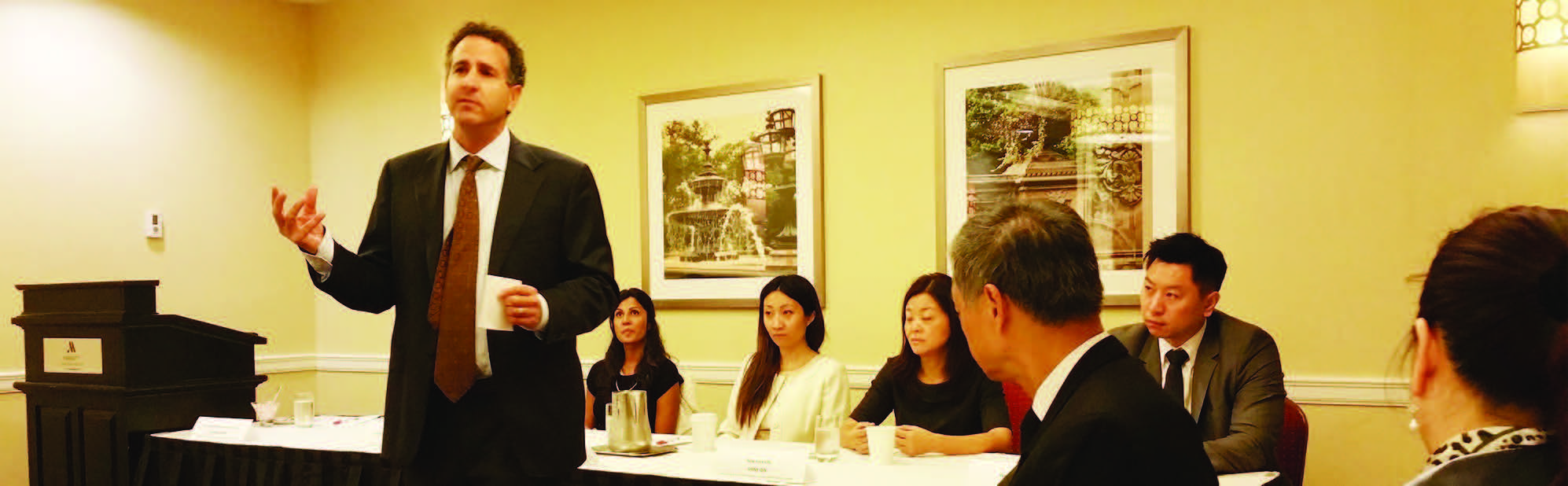
The reputed college has planned these seminars for international students, especially from Indian, Bangladeshi, Pakistani and Nepali communities in the US and also from South Asia. “The Queens Extension Site is focused on being a resource for busy adult professionals who live or work in Queens or the surrounding communities and want to take their career to the next level. The site offers a flexible, hybrid schedule of onsite and online, mainly graduate-level courses,” says Evan Jerome, Vice President and in-charge of developing the Queens branch. In the first seminar on December 2, participants will learn best practices, tips and success stories from an exclusive panel of professionals about Master’s in Public Health.
The second one – on December 3- would be a dialogue and discussion on the Master’s Degree in Business Administration. And finally on December 4, there will be a discussion on the Master’s of Science Degree in Criminal Justice. All the three sessions will be held between 5.30 pm and 7.30pm and will be followed by light dinner. Talking about the unique nature of the courses, Jerome said, “Monroe College prides itself on being student centered and that quality has been carried to the Queens site as well. Our class sizes are small so that students can get the one-on-one attention they need from the professors.
Our courses combine both the theoretical and practical aspects of the lectures. These courses also give students the opportunity to network with other professionals, since the graduate student population is made up of individuals with work experience looking to take their career to a higher level.” In the session on public health degree, professionals would focus on how holders of an advanced degree in public health can be found in employment sectors ranging from major hospitals and government agencies to academic institutions and charitable organizations.
The course is important because New York City’s healthcare and information technology sectors have high demand for middle-skill workers, commonly defined as people with more than a high school degree but less than a bachelor’s degree. There are over 25,000 job postings across positions in five healthcare occupation groupings that require a sub-baccalaureate credential. While the second seminar would focus on the MBA degree, the last seminar would be all about the Master’s of Criminal Justice degree and how to ascend to the leadership roles within the field.
This course is important as it would explain how the everpresent danger of terrorism and other forms of transnational crimes necessitates a closer collaboration among criminal justice agencies on all levels: federal, state, local and even international levels. In addition to talking about the courses, the seminar would also focus on the issue of financial support in the form of loans and scholarships. “Financial aid is offered. Eligible students are encouraged to apply for loans and/ or scholarships,” says Jerome. Though the campus is located in Queens, which is a hub of communities from South Asia, the courses are open to international students as well. “Monroe College accepts and welcomes international students.
We currently have relationships with high schools and college from over 70 different countries all around the world. We work to try and make students feel as though Monroe College is the Home away from Home,” says Jerome who will attend the seminars to explain the programs to young South Asians as well as to business executive for a continued education. The college also has plans in place to take care of the students’ post-education needs. “Monroe College’s Office of Career Advancement is available throughout a students’ educational and professional career to help guide the students.
The Office helps prepare student with resume writing workshops, interview preparation, job opportunity listings, among other things. We also hold two Career Fairs a year and invite companies throughout the community as well as larger corporations. Monroe also has a list of Corporate Partners who seek interns and employees from our pool of graduates. Monroe College equips students with the knowledge and life skills to continue moving forward after graduation,” says Jerome.
(PR) -

Indian Consulate in New York hailed as model of ‘Swachh Consulate’
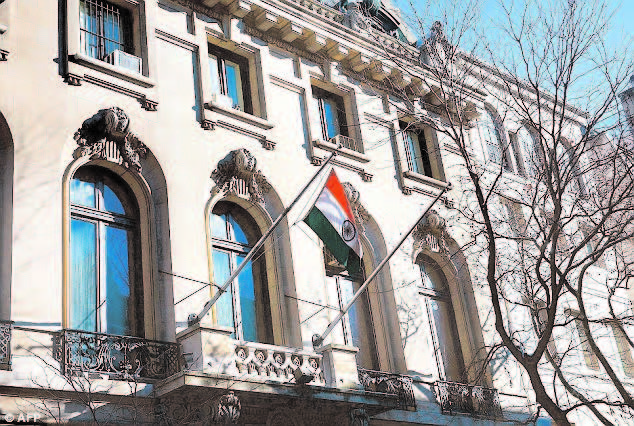
NEW YORK CITY (TIP): In keeping with the ‘Swachh Bharat’ campaign, the Indian Consulate here undertook a massive cleanliness drive at its premises and is being hailed as a model of ‘Swachh Consulate,’ setting an example for other Indian missions and posts abroad to take up similar efforts. The clean-up exercise was conducted under the aegis of India’s Consul General in New York, Ambassador Dnyaneshwar Mulay with the aim of serving the community better and keeping visa and passport records in a proper and easy to access manner.
The cleanliness drive is about “overall and holistic cleansing,” Mulay told PTI. “I think we should be clean in every respect,” he said, adding that a clean environment has a psychological impact on the morale of the staff. “Only when you keep the premises clean can one serve the people better.” The initiative has garnered appreciation from External Affairs Minister Sushma Swaraj who said in a communication to the Consul General that the extensive cleanliness drive “has come in for much praise as a stellar example.” Foreign Secretary Sujatha Singh also applauded the efforts in view of the Swachh Bharat mission and said the Consulate’s initiative will be shared with other Indian missions “in order to inspire them to similar efforts.”
The cleaning drive, which the Consulate began a year and half ago when Mulay took charge, was undertaken in the basement and staff offices at the Consulate premises which were cluttered with visa documents, files and other Consular paperwork accumulated over a period of many years. Ambassador Mulay said since the Consulate handles innumerable visa applications, passports, OCI and PIO cards, a lot of documents had accumulated that needed to be kept properly. However, the basement, sub-basement and passageways in the Consulate had become stacked with tons of documents, artifacts and files that posed a safety and fire hazard in the 111-year old historic building in the heart of Manhattan.
Mulay inspired his staff and personnel to whole-heartedly undertake the cleanliness drive, the end result of which is improved storage, creation of more space, better preservation of records and proper disposal of unwanted documents. In the second phase of the cleanliness drive, the Consulate would undertake renovation, modernization and conservation and is consulting experts from the renowned Metropolitan Museum of New York. During the exercise, several valuable artifacts, musical instruments and portraits of Indian leaders were also unearthed that are now being displayed at the Consulate.
The Consulate is in talks to hand over a collection of informative videos and documentaries to the New York University where they can be archived. Mulay emphasized that the Swachh Bharat campaign of the Prime Minister Narendra Modi can be taken to a global platform so that a deserving image of India is sent across the world. -

A Vegetarian Celebration of Thanksgiving: Vegetarian Vision promotes vegetarianism
LONG ISLAND, NY (TIP): Vegetarian Vision Inc., established in 1992, celebrated its 22nd Annual Thanksgiving Dinner November 23. Founded and Chaired by Harshad K. Shah, Vegetarian Vision has been successful in promoting Vegetarian way of life for over 2 decades. Under the leadership of President Chandra Mehta and with the overall coordination of Flora Parekh & Vinod Shah, Vegetarian Vision celebrated a fun filled “Save the Turkey” Thanksgiving Dinner musical evening.
Several dignitaries, community leaders and organization Presidents were in attendance at the event where Speaker Bob Dibenedetto included an excellent overview of the organization & importance of vegetarian diet for health and environmental reasons, followed by comedy evening by Ray Devito & Dr. Krishna Jhaveri. A beautifully sculptured turkey ice carving pleading to save turkeys was centered and highlighted by President Chandra Mehta, appealing all to consider vegetarian diet and also mentioned to have introduced new vegetarian dishes tasting like meat & even better.
Inspirational and motivating vegetarian quotes by various leading world personalities were continuously portrayed in the background. “The organization launches various programs to help spread Vegetarian way of life. Our youth is our future and we have been encouraging our youth to be a part of the organization to help spread noble cause.” – says Founder and Chairman H.K. Shah. Various projects like Children’s essay competitions, Youth Mr. & Ms. Vegetarian Pageant, Vegetarian Cruise, Thanksgiving dinners, Restaurant Meatless day participation programs, Food festivals, Street Fairs and many more have been successfully conducted over the past several years in an attempt to help spread vegetarian way of life thereby saving the environment and promoting healthy eating habits.
Additional information can be located on our website at www.vegetarianvision.org and our Facebook page for “The Vegetarian Vision – https://www.facebook.com/pages/The- Vegetarian-Vision/170321469719951. Executive council & upcoming events for 2015 were launched by President Chandra Mehta. “I am very excited and honored to be part of spreading such a noble cause” – says President Chandra Mehta.
“As we celebrate the year of Women empowerment, Vegetarian Vision takes pride recognizing several women leaders in the audience & in the Executive council for 2015” – says Vice-President Flora Parekh. Under the leadership and direction of H.K. Shah; Chandra Mehta, Flora Parekh, Vinod Shah along with several committee members & volunteers including Malati Shah, Suvarna Shah, Kirti Shukla, Nivea Kothari, Seema Shah, Kalpana Sukhwal, Minesh Desai, Ashok Acharya, Paresh Parekh, Dr. Krishna Jhaveri, Dr. Uttam Munver, Teena Sukhwal, Harshil Parekh, Kanak Golia and many more, worked tirelessly to make the program a huge success. The presence of several leaders & organization Presidents namely Pam Kwatra & Eric Kumar- SA4RC & G30 for India Vision Foundation (Kiran Bedi US based Organization), Dr. Ajay Lodha (AAPI), Dr. Shashi Shah (RANA), Dr. Bhavani Srinivasan (Queens- LI AAPI), Satnam Singh Parhar (IALI), Harshad & Tilu Lakhani ( Jain Temple Of NY), Rajni Gandhi & Dr. Jyoti Gandhi (Friends of ARCH), Setu Shah (VTNY), Rekha Tolat (Aarti), Ajit Vora & Divyesh Tripathi (Gujarati Samaj of NY), Animesh Goenka (AIA), Dr. Shyam & Maya Rao, Raj Mehta and many more graced the event. TV Asia (Mukesh Gangani) & ITV (Rene Lobo) coverage for the event. “Save the Turkey” raffle included many exciting prizes like NYC hotel stay, Perfume baskets, etc. Sumptuous dinner was served by Jassi restaurant and the attendees danced their hearts out to the tunes of DJ Vic. Vegetarian Vision personalized bags were handed to the attendees as a souvenir.
Executive Committee 2015 in the picture from Right to Left – Kirti Shukla, Malati Shah, H.K.Shah (Chairman), Chandra Mehta (President), Flora Parekh (Vice President), Kalpana Sukhwal, Nivea Kothari (Youth Chair), Teena Sukhwal, Vinod Shah (Development Director), Minesh Desai (Treasurer), Dr. Uttam Munver (Advisory), Harshil Parekh, Dr. Krishna Jhaveri (Advisory), Paresh Parekh.
(Press Release) -

A mixed Blessing for India
Lower petroleum prices hold obvious advantages for Indian consumers, but a bearish global oil market could also hurt several segments of the country’s economy
The Oil Ministers of 12 member states of Organization of the Petroleum Exporting Countries (OPEC) concluded their meeting in Vienna on November 27 by deciding to continue with their three-year-old production quota of 30 million barrels per day (mbpd). Thus, they calculatingly ignored nearly one mbpd oversupply in the global oil market which has pushed the crude prices down by over 30 per cent since June 2014.
The global oil glut, in turn, has been caused by a number of factors which include OPEC’s own overproduction, rising non-OPEC production (particularly by the U.S.- based “Shale Revolutionaries”) and lower demand from China and Europe. By declining to cut their output to shore up the prices, OPEC in general, and Saudi Arabia in particular, have refused to play the role of global “swing producer.” As most factors responsible for the current global demand-supply disequilibrium are systemic in nature, the world faces prospects for relatively bearish oil prices over the foreseeable future.
Indeed, the prices have continued to fall with the Indian basket touching $72.51/barrel on November 27 – a decline of nearly $9 from the average during the first fortnight of the month. As the world’s fourth largest importer of crude, India can afford to exult at this precipitous crude price decline. Still, given the strategic importance of this development, a more comprehensive analysis is desirable.
A virtuous cycle in the economy From the limited perspective of India’s consumer economy, lower global oil prices undoubtedly augur well. Lower pump prices reduce pressure on the consumer who can spend the savings elsewhere, spurring the demand side of the economy. As petroleum products form a large part of the consumer price indices, lower crude prices result in reduced inflation, which in turn paves the way for lower interest rates and greater buoyancy in investments.
Thus, lower oil prices can trigger a virtuous cycle in the Indian economy. After all, with India’s imports running at an estimated 3.7 mbpd in 2013, a $30/barrel decline in oil prices amounts to a $40 billion savings bonanza on annual imports. The impact would be best felt on the petroleum sector where marketers have been groaning under subsidy burden. The transport sector would also be a direct beneficiary. If we widen the impact analysis to consider the totality of the Indian economy, some challenges also appear.
First, as oil producers are India’s major markets and investment destinations, their economic decline may affect the country. Recent decline in the share prices of Bharti Airtel and Bajaj Auto due to the devaluation of the Nigerian Naira illustrates this more complex trend. Second, apart from being the fourth largest oil importer, India is also the world’s sixth largest petroleum product exporter earning over $60 billion annually – nearly a fifth of global exports.A bearish oil market would hurt this segment with reduced demand, lower unit prices and lower margins. Third, the oil price decline coincides with resumed foreign interest in investing in India. It is difficult to assess their mutual correlation, but lower oil revenues may attenuate arrival of petrodollars into India. Fourth, whenever oil revenues decline, countries that export Gulf oil try to tighten their belts by emphasizing local production and downsizing their foreign labor force in which Indians dominate. Thanks largely to over five million Indian expatiates there, India was the world’s largest recipient of remittances which topped $70 billion in 2013. The possibility of these remittances being reduced cannot be ruled out. This would have a serious impact on remittance-dependent States such as Kerala and Goa.
Fifth, lower crude prices may cast a shadow over the sputtering controversy over natural gas pricing norms in India as the latter generally follow the oil prices. Future investment decisions in oil-related sectors may get delayed. Sixth, lower pump prices may cause higher fuel consumption as sales of automotive products soar. This would worsen commuter woes as well as cause increased urban pollution. Finally, a decline in oil prices generally accompanies a global decline in commodity prices, particularly those of minerals and agricultural products. India remains a major exporter of these and would see lower realization, particularly of Guar Gum, a critical input for the shale industry.
The long-term impact of lower oil prices is likely to be felt beyond the economic domain. Geopolitically, persistent lower oil revenue could propel a number of emerging exporters towards domestic political instability as the ruling elites lose their capacity to provide “stomach infrastructure” to the common man. Countries with lower per capita oil revenue such as Nigeria, Iran, Algeria and Venezuela may be more at risk. In general, however, lower oil revenues may have a dampening effect on regional or domestic disputes. Measures to leverage oil prices India can leverage the current low oil prices for long-term gains. To this end, the following measures can be considered.
One, it can foster long-term crude supply relationships with exporters in return for stable prices, upstream engagements, inbound investments, etc.
Two, it can enter into oil-for-infrastructure barter deals to boost project exports.
Three, it can restructure public sector oil companies to make them more productive and globally proactive for leaner times ahead.
Four, it can channel some of the oil bonanza to mitigate the increased cost disadvantage of renewable and alternative energy sources.
Five, it can build its own strategic oil reserves. The current downturn in oil prices underlines the cyclic nature of commodity trade and illustrates OPEC’s reduced regulatory capacity consequent to it supplying only a third of global demand.
While Shale Revolution may be a new and price-sensitive factor, it is unlikely to vanish with time or with lower prices. During past oil bear-hugs in 1986, 1993-99 and 2008, the lower prices invariably spurred consumption and the oil bounced back.
There is no reason to believe that the oil prices shall not rise again. India would do well to recall an old oil adage, “The cure for high oil price is high oil price itself” – and use this rare, cyclic opportunity for long-term gains.
(The author has served as Indian ambassador to Algeria, Norway and Nigeria – all major oil exporting countries.) -

Racism and Law enforcement
Agrand jury’s exoneration of Darren Wilson, the white police officer who on August 9 shot dead an unarmed teenager on the streets of Ferguson, Missouri, sent shock waves across the United States this week. The fact that 18-year-old Michael Brown died violently on the streets of the quiet St. Louis suburb and no one will be held accountable for his death has left Americans of all colors once again searching their souls for answers. Some of them made their anger known to the world.
Thousands took to the streets across major cities, braving the likelihood of yet another heavy-handed crackdown by the police and the National Guard. In Ferguson, the rage spilled over and took an ugly turn as gunfire erupted across the night, dozens of buildings and police cars were set ablaze, and looters had a free run in parts of the city.
President Barack Obama reiterated his muted call for calm on all sides, but had clearly not sensed the mood of collective anguish that was engulfing the African-American community, or did not wish to confront the questions that they were asking: why had a behindclosed- doors grand jury that was 75 per cent white decided that there was no probable cause to take the case to trial? Why was police officers’ use of deadly force, especially against minorities, considered an acceptable practice? The Brown-Wilson case holds up a mirror unto the troubling state of race relations in America.
First, it is only the latest in a long list of flashpoints triggered by law enforcement brutality towards unarmed African- Americans, including the 2012 shooting of Trayvon Martin (17) and the videotaped 1991 beating of Rodney King, both cases in which the accused officers were acquitted. Second, it shows how public prosecutors or other government officials may maneuver juridical proceedings in a manner that renders a plaintiff victory effectively impossible. Since the verdict was announced, the St. Louis County Prosecutor, Robert McCulloch, has come under fire for his decision to use a grand jury in this highly sensitive case, thus precluding a transparent and exhaustive trial involving detailed cross-examination.
Third, the imprint of the racist stereotyping of African-Americans amongst police officers, which was arguably evident in the testimony of Mr. Wilson, has a wider echo in terms of relatively higher incarceration rates. The searing racism in the U.S. has often made it an uncomfortable place for minorities, as it was for Muslims, Sikhs and even Hindus in the aftermath of the 9/11 terror attacks. African- Americans of all backgrounds, however, face a daily, ongoing threat to their lives and security, given the toxic mix of historical prejudice and law enforcement’s gun culture.
(The Hindu) -

Black Friday madness sweeps across US
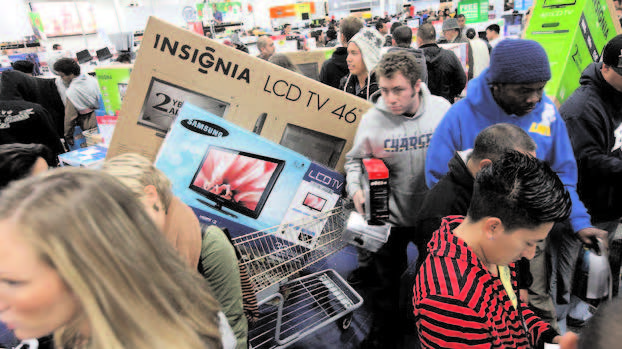
WASHINGTON: Shoppers brawled for everything from Barbie dolls to Xboxes and flat screen TVs as Americans indulged in a manic shopping spree known as Black Friday that follows gluttonous feats of over-eating on Thanksgiving on November 27 evening. Stores nationwide expanded their Black Friday to hours before (some, heretically, opened on Thursday evening) and some extended it to days after (Wal-Mart went in for five-day sale).
But that hardly dimmed the ardor of bargain hunters who stampeded through stores snapping up laptops for less than $150 and clothes for a song. Pitched battles were reported in some stores, butmercifully no deaths of the kind that occurred in previous years when crushing mobs overran theweak, the infirm, and sales people who couldn’t get out of the way. Seven people have died in Black Friday related incidents since 2006, according to the website blackfridaydeathcount.com that sells a “I Survived Black Friday T-shirts” with the incidents listed on the back.
In all, Black Friday indulgences, which is reportedly catching on in India after storming through the UK is expected to net something in the region of $60 billion in sales across the US. The National Retail Federation recorded 247 million shoppers spending an average of $423 over Black Friday weekend (which typically extends Thursday to Sunday) in 2012, but last year’s sales were much weaker. Stores have ramped it up this year by stretching it to manic Monday, bargain Tuesday etc, and market mavens will be holding their breath to see if the record quarterly growth of 3.9% registered in the most recent quarter — the highest in a decade — has rubbed off on consumers whose spending in turn fires up the economy.
The window between Thanksgiving and New Year (some stretch it as far as Valentine’s day) is said to account for more than 60% of American shopping. The term Black Friday itself is credited to the Philadelphia city police who, going back to the 1960s, used it to label the crowds of shoppers and ensuing traffic jams. It was later employed to identify the day retailers made profits (went into black) after months of being in red. Some attribute it to pre-dawn sales that begin in the wee hours of Friday when it is still dark -

Now, anyone can buy a drone. Heaven help us
WASHINGTON (TIP): Amateur photographers and Hollywood filmmakers turn to them for lush overhead shots. Geologists use them to look above the seas for oil-bearing rocks. Amazon executives are pushing to use them to plop packages onto doorsteps. But now drones — the unmanned flying vehicles the size of a pizza box — are also a favorite tool for more unruly groups: pranksters and troublemakers. As the price of drones has fallen and sales have risen, the machines have emerged as central characters in stunts from the puckish to the criminal.
In recent months, drone pilots have tried to smuggle contraband into prisons and disrupt sporting events at stadiums. Animal rights groups have turned to drones to stalk hunters as the hunters stalk wildlife. And in France, more than a dozen illegal flights over nuclear power plants have unnerved the authorities. The antics are forcing public safety officials to look at the air above them, generally thought safe and secure, as a place for potential trouble. And for groups pushing drones as legitimate business tools, the high jinks are an unexpected and unwelcome headache — one, they fear, that will bolster a push by regulators to keep a tight leash on the machines.
The Federal Aviation Administration has said that drones raise safety concerns, like running into people and planes. On Wednesday, the agency said it receives about 25 reports a month of drones operating near manned aircraft. The agency is expected to propose new rules for commercial use as early as next month. “It’s now in the hands of all types of people — good people, bad people, tricksters, pranksters, kids,” said Patrick Egan, a consultant on commercial drone projects and editor at sUAS News, a drone news site. “All hell is going to break loose as far as the shenanigans that are perpetrated with drones.”
For the most part, flying a drone is legal for recreational purposes, as long as operators follow a few guidelines, like staying below 400 feet. Declining prices — a four-rotor model with a mounted camera can cost as little as $500 — have attracted more buyers. Teal Group, an aerospace research firm, estimates the global civilian drone market to be worth $450 million this year, up 45 percent from last year. -

FERGUSON COP WHO SHOT BOY TO LEAVE FORCE
WASHINGTON (TIP): The Missouri police officer who killed an unarmed black teen sparking months of protests in the city of Ferguson will never return to policing, his lawyer said. Darren Wilson is currently in discussions with the Ferguson, Missouri police department on the terms and conditions of his departure, attorney Neil Bruntrager said this week. “There’s no way in the world he can go back to being a police officer,” the lawyer said. The shooting set off days of racially-charged protests that erupted again this week after a grand jury on November 25 announced that Wilson would not be charged over the fatal shooting. Bruntrager told mediapersons that Wilson, who has said his conscience is clear, could simply not go back to work given the outrage over the case.
-

US police kill gunman who targeted buildings in Austin
AUSTIN, TEXAS (TIP): Authorities shot and killed a man who they say opened fire on Austin police headquarters early November 28 morning, and a bomb squad was called in to search his vehicle. The man also targeted a US courthouse and the Mexican Consulate, Assistant Poice Chief Raul Munguia said at a news conference. Officers were searching the suspect’s Austin-area residents for possible explosives. Police did not immediately confirm whether the man, whose name was not immediately released, had explosives.
The gunfire was reported at 2:22 am on Friday, Munguia said, and some bullets hit police headquarters. Munguia did not immediately say whether the consulate and the courthouse were damaged. Both were closed at the time of the gunfire. “An officer outside the building saw the suspect, fired at the suspect, the suspect went down,” Munguia said. Officers then saw what appeared to be an improvised explosive device in his vehicle, and that “the suspect was wearing some type of vest,” Munguia said. He did not provide additional details on the garment. Police are trying to determine a motive for the gunfire, which shut down a stretch of Interstate 35 for hours but had reopened Friday morning. -

Woman’s selfie catches Bill Clinton ogling at her
LONDON: Bill Clinton was recently caught in action when his eyes wandered off to take a peek at a woman’s cleavage. Unaware that the stunning brunette Ari’elle Avdali was taking a selfie, the former US president was clicked with his gaze aiming at her breasts at Jerusalem’s Mount Herzl National Cemetery, which Avdali captioned “Billy boy checking on my tatas,” the Daily Star reported. In addition to that, the brunette’s friend posted the pic on Reddit saying that “Clinton did not realize that Avdali was taking a selfie with him.” The image instantly went viral and while one person said commented that Clinton, who had been previously entangled in a sex scandal with White House intern Monica Lewinsky during his term, would never change, while another commented: “Classic Bill.” Clinton was in Jerusalem to pay visit to the grave of the Israeli Prime Minister Yitzhak Rabin, who was assassinated in 1995 after addressing a large rally in Tel Aviv. The snap also appears on Ari’elle’s Facebook page, which shows her in a low-cut dress and says she is from Tel Aviv in Israel.
-

Russia expresses interest in aircraft production in India
NEW DELHI (TIP): Russia has expressed interest in production of civil and light transport aircraft in India with their technology, Parliament was informed on November 28. The Indian government has welcomed the Russian interest and is committed to enhancing bilateral investment and trade cooperation, commerce and industry minister Nirmala Sitharaman said in a written reply to the Lok Sabha.
“The Russian side expressed their interest in production of civil aircraft, light transport aircraft and helicopter in India with Russian technology,” she said. The eighth session of the Indian- Russia Forum on trade and investment was held here on November 5. Replying to a separate question on coffee industry, she said that stem borer pest is amongst major constraints affecting cultivation of Arabica variety of coffee. “The combined effects of higher temperatures, reduction of shade for increasing the yield of pepper grown as intercrop and lack of timely control measures by the growers have led to increase in the incidence of the pest,” she said.
About 3,200 hectares of productive area in Karnatka are reported to have been affected by stem borer due to long dry spell from November 2013 to May 2014 and resultant high temperatures. She added that several steps have been initiated to address the problem of pest in coffee cultivation. “The government has approved a two year action plan (2014-15 and 2015-16) for combating the stem borer in affected areas,” the minister said. -

Army to train students in border areas?
NEW DELHI (TIP): Government on November 28 hinted at taking up pilot projects to impart partial military training to students undergoing graduation degree in border districts. Responding to a private member bill on providing compulsory military training in Rajya Sabha, defence minister Manohar Parrikar said that if the government can work out a module it can start this on a trial basis in certain districts “where there is enthusiasm, districts face border”. He said module can be prepared for 50-60 hours training that can be done over a period of time. “One can take it as a course; like the way history, maths etc, we can take one course of defence training.
But I feel, along with this, what we need is nation building, character building,” the minister said. But he ruled out any compulsory military training. Parrikar added that after consulting members, the government will come out with an “appropriate mechanism” though it may take a few months. The bill, moved by BJP member Avinash Rai Khanna during last Parliament session proposed one-year compulsory military training in the age group of 14 and 15.
Members from different political parties in the House supported the bill, which Parrikar said proved how “nationalism does not have a colour” Though the minister appreciated the intent of the bill, he said compulsory military training was not possible since it would cost as much as Rs 60,000 crore annually. “…I would have supported the bill had I been sitting there (in opposition), but I am sitting on this side in government ….I will support the bill but I will point out issues which will create problems,” Parrikar said. He pointed out that providing military training to people in the age group of 14 and 50 is impractical.
Even if government takes up the task to provide similar training to people in the age group of 17 0r 18 years to 25, it would mean training 14-15 crore eligible youth. Asserting that nation-building and character development does not happen by military training alone, Parrikar said education system must do so, but “our teaching has slipped.” He pointed out even National Cadet Corps (NCC) training has “diluted” although the strength has increased to 15.18 lakh now from 13.8 lakh 3-4 years back.
Giving a personal touch the minister said he had got admission for the National Defence Academy and then Army Corps of Engineers. “Because of some reason I could not join. So, probably, there is something genetic which attracts me to defence forces. May be that got me here,” he said. -

PM praises high voter turnout in J&K
JAMMU (TIP): Prime Minister Narendra Modi on November 28 praised the record voter turnout in first phase of Jammu & Kashmir polls, calling it a victory for democracy irrespective of the outcome. He said militants were frustrated as democracy is still alive in the state despite their guns and bombs as he addressed two rallies in Udhampur and Poonch ahead of the second phase of polling next week. “The people of Jammu & Kashmir have shown that they are not going to be terrorized,” he said, a day after three civilians and as many soldiers were killed in a terror strike a few hundred kilometers away in Arnia.
Modi blamed the Congress, ruling National Conference and opposition People Democratic Party for lack of development and corruption in the state. “Give us one opportunity to end this loot. The development which has not taken place in last 30 years will happen in next five years if BJP is voted to power,” he said at his Udhampur rally. In Poonch, he promised to visit the remote area regularly, saying it took around 40 years for a Prime Minister to visit the place that is less than 24 hours from New Delhi. -

Post-Nirbhaya crisis centres get PMO boot
NEW DELHI (TIP): The much touted “one stop crisis centre” — conceived in the aftermath of the Nirbhaya case and the Justice Verma report — has been scrapped by the NDA government. The project worth about Rs 200 crore was expected to provide medical, legal, police and emergency services to women in distress. The women and child development (WCD) ministry, which was helming the project, had planned to set up the centres in every district of the country.
According to sources, the plan has been shot down by the Prime Minister’s Office (PMO) on the argument that the scheme was unnecessary and services could be provided through the existing infrastructure like hospitals and women police stations. WCD ministry sources however pointed out that there were many scenarios when women who were stalked, molested, raped or experienced violence and could not or were not willing to go to a police station.
“They require only shelter or counseling. The centre promises anonymity to the victim. It would have acted as an overnight shelter while making all the services of a hospital, police station, legal aid cell under one roof,” sources said. The cost of a centre was pitched at Rs 36 lakh. A collateral damage of the decision is the scrapping of the women’s helpline. “It will be difficult to run a helpline. Where will we send the women who require help if the centre does not exist?” the source said. The ministry had in fact already announced the centres and enlisted support from states including 90 members of Parliament who have allocated land for the purpose in their constituency.
WCD minister Maneka Gandhi had assured that the centres would be open by December. Despite several attempts Gandhi could not be reached for comment. The centres were a significant recommendation of the Justice Verma committee set up to suggest far-reaching reforms in police, judiciary and executive. The Verma committee had felt that there was absence of a single-point redressal system for heinous crimes against women. It felt, the victims faced a harrowing time in getting their complaints registered and did not mange to get medical and legal aid on time. -

Modi promised jobs, gave brooms: Rahul
CHAIBASA (JHARKHAND) (TIP): Rahul Gandhi on Friday took a swipe at Prime Minister Narendra Modi’s ‘Swachh Bharat Abhiyan’, saying he had promised employment to people, but instead handed them broomsticks. “Modi had said (in his Lok Sabha campaign) I will alone generate employment… I will alone build factories, roads and airports. But after forming government, he said you people take the broom, I am going to Australia,” Gandhi told an election meeting here in West Singhbhum district. Describing Modi as the “Prime Minister of ten industrialists” without elaborating, Gandhi said, “We want a development-oriented government rather than a government of moppers.”
The Congress intended to empower people with laws like RTI, MGNREGA and Land Acquisition Act, he said and expressed apprehension on the BJP government’s intention to change it to benefit the capitalists. Asking the people whether Modi could set up factories, roads and airports ‘alone’, he said Modi wanted to grab power and run the country without taking along the masses. “The difference between Congress and BJP is that we want to take along people from all sections of the society, while he (Modi) is trying to grab power and govern on his own,” Gandhi said. The AICC vice-president also claimed it was the Congress which always worked in the interest of tribal population. Earlier, he interacted with party workers at the airport in Jamshedpur. -

CBI may file FIR against Badaun girls’ family
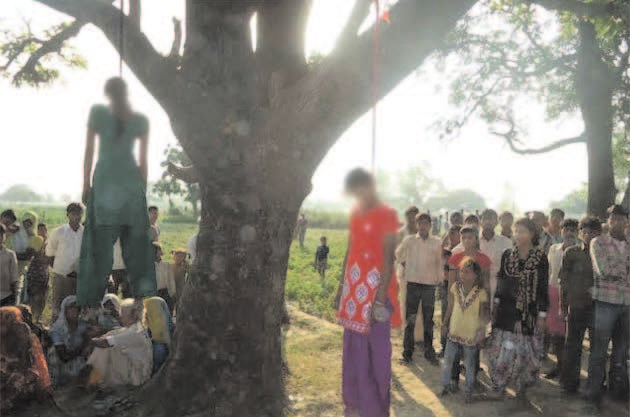
BAREILLY (TIP): A day after Central Bureau of Investigation claimed to have solved the sensation Badaun case, ruling out rape of the two teenaged girls found hanging from a mango tree on May 27, and maintaining that they were not murdered, reliable sources have revealed the probe agency would soon lodge an FIR against the victims’ family for falsely implicating the three Yadav brothers and two constables.
Filing a false police complaint is a criminal offence punishable with a jail term under sections 182 and 111 of the Indian Penal Code. The victims’ kin had filed an FIR, accusing three brothers Pappu, Awadesh and Urvesh Yadav and constables Sarvesh Yadav and Chhatrapal Gangwar. The local court had granted bail to all five accused in the case in September when CBI did not frame charges against them in 90 days. Sources told TOI: “At the time of incident, the family did not know that the girls had committed suicide, but they were aware that the five persons named by them in the FIR were innocent.
The girls’ family members had rewritten the content of police complaint three times before submitting the final version to Badaun police. In their first draft, the family had also accused Pappu’s father, who is in his sixties, of kidnapping and gangraping the girls. When villagers told them that nobody would believe that an old man along with his three sons committed the gruesome crime, the family removed the name of father from their police complaint.” Earlier on Thursday, the CBI had concluded on the basis of field investigations, forensic reports, the medical board’s opinion and its assumptions that the two girls had committed suicide out of shame.
On the basis of assumptions drawn from circumstantial and scientific evidence, the CBI had asserted that the girls probably fearing social stigma after their uncle caught them with a boy— while one of them was about to have sex with him —decided to kill themselves. The agency claimed that investigation revealed there was an affair between the elder sister and the boy, Pappu Yadav, for over six months before the deaths while the younger girl was facilitating it.
There were around 400 calls between Pappu and them. Giving details of how the victims’ family deliberately implicated all the five accused, sources said, “When the family went to the local police station around 2 am, the constables there asked them why they took so long to come to cops for help when they had learnt that the girls had gone missing around 8 pm and Nazru had seen them with Pappu. The constables’ question unsettled them and they later included the names of these constables in the FIR too, accusing them of rape and murder.” “CBI believes that the family of victims had deliberately filed a false complaint to implicate five persons in the case. The family hid facts to frame these five persons and misled the agency,” they said.
Sources also said that the family did not cooperate with the agency during the investigation. For example, when the agency enquired them about the mobile phone of one of the victims, the family members said she did not have a phone. However, the agency later recovered a mobile phone broken into more than 20 pieces from the house of the elder sister’s maternal uncle in Nabiganj village, 15 km away from their native Katra Shahdatganj. The agency would submit closure report in the court by next week.
When contacted, the victims’ kin reiterated that all five persons named by them in FIR had raped and killed the girls and they did not believe the agency’s suicide theory. Awadesh Yadav, who spent three-anda- half months in jail and was earlier an accused in the case, said, “We had faith in God and knew that truth would eventually come out.” -

IAF upgrades to computerized pilot selection system
MYSURU: To select the best pilots to fly the advanced aircraft being inducted into the armed forces, the Indian Air Force (IAF) inaugurated the Computerized Pilot Selection System (CPSS) at the No. 2 Air Force Selection Board here on Friday. It will replace the pilot aptitude battery test that was in use for decades. CPSS was conceived by APJ Abdul Kalam, the then scientific adviser to the prime minister in 1997, to develop a better tool for pilot aptitude test in consonance with the advanced IAF aircraft.
It also aims at addressing the alarming rate of flying accidents attributed to pilot error in IAF. After dedicating the new system to the nation, Air Chief Marshal Arup Raha said CPSS would be introduced in the other IAF selection boards at Dehradun and Varanasi soon. It has been jointly developed by the Defence Institute of Psychological Research and the Air Defence Establishment – premier organisations of the Defence Research and Development Organization.
Describing CPSS as a major step towards ensuring safety of our skies, the IAF chief said, “Only the best of the best can fully utilize the potential of the ultra-modern technology being inducted into IAF to establish it as a power to reckon with in South East Asia.” He said cockpits of the fifth generation fighter planes would place tremendous physical and mental workload on pilots and system operators and only the best will be allowed to occupy these cockpits. CPSS, he said, is a concrete step in the right direction towards meeting these objectives