Year: 2014

  • US, RUSSIA EXCHANGE THREATS AT TENSE UN MEETING

    US, RUSSIA EXCHANGE THREATS AT TENSE UN MEETING

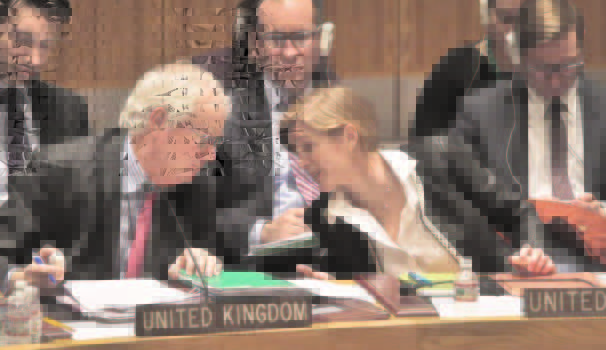
    UNITED NATIONS (TIP): Russia and the United States exchanged threats on March 19 at a tense UN security council meeting over the Ukraine crisis, with the Russian envoy saying the US ambassador’s “insults” are jeopardizing Moscow’s willingness to cooperate with Washington on other diplomatic matters.

    It was the council’s eighth meeting in three weeks on Ukraine, a show of determination by Western powers to highlight Russia’s diplomatic isolation over the Crimean Peninsula — even if the council is powerless to act because of Moscow’s veto power as a permanent council member. The meeting came as UN secretary-general Ban Ki-moon left for Russia and Ukraine in a bid to seek a diplomatic way out of the crisis. Ban will meet with President Vladimir Putin and other Russian officials in Moscow on March 20, said UN spokesman Stephane Dujarric.

    On Friday, the UN chief will travel to Kiev for talks with the acting president and prime minister. At the council, Russian ambassador Vitaly Churkin was once again alone in defending his country’s actions in Crimea. He began his speech by celebrating the treaty signed a day earlier by Putin declaring Crimea part of Russia, saying it honored the will of the Crimean people and complied with international law. “Yesterday, something truly historic happened,” Churkin declared. US ambassador Samantha Power warned Russia that, two days after the Obama administration and other countries imposed sanctions on Russia, the US and its allies “are prepared to take additional steps if Russian aggression or Russian provocations continue.”

    She also compared Russia’s takeover of Crimea to theft. “A thief can steal property, but that does not confer the right of ownership on the thief,” she said. The Russian ambassador shot back: “It is simply unacceptable to listen to these insults addressed to our country.” He added, “If the delegation of the United States of America expects our cooperation in the security council on other issues, then Power must understand this quite clearly.” By then, Power had left the meeting to her deputy. Churkin did not elaborate. The United States and Russia are the key players in efforts to establish peace talks in Syria, and also are involved in talks over Iran’s nuclear programme.

    The council also heard a briefing from Ivan Simonovic, assistant UN secretary-general for human rights, who expressed particular concern over the security of Tatars and other ethnic minorities in Crimea. He highlighted the disappearance of a Crimean Tatar activist after participating in a March 3 protest. Simonovic said the activist was found dead March 16 and his body bore marks of “mistreatment.” He said the United Nations is deploying a 34-member human rights monitoring mission to Ukraine, scheduled to be in place by Friday. Simonovic said he was not able visit Crimea because the authorities there refused to receive his mission or ensure its security until it was too late. But he said he spoke to representatives of displaced Tatars and victims of arbitrary arrests, torture and other human rights violations. Churkin dismissed Simonovic’s assessment as “one-sided.” He also blamed snipers for the killing of a Ukrainian soldier and a member of a local self-defense brigade in Crimea on Tuesday, saying the two were deliberately targeted to provoke confrontation.

  • 25 killed, 55 injured in Iraq violence

    25 killed, 55 injured in Iraq violence

    BAGHDAD (TIP): At least 25 people were killed and 55 wounded in separate attacks across Iraq March 19, police said. In Anbar province, sporadic shelling and fierce clashes erupted after midnight and continued during the day between gunmen and Iraqi soldiers in Fallujah city, some 50 km from Baghdad, killing 11 people and wounding 23, Xinhua quoted a police source as saying.

    Meanwhile, four policemen, including an officer, were killed and some 20 wounded in a car bomb explosion in Ishaqi area, some 90 km from Baghdad, a police source said. In a separate incident, unidentified gunmen shot dead two civilians from al-Shabak minority at a parking lot in the city of Mosul, some 400 km from Baghdad, a source said.

    Near Baghdad, two civilians were killed when armed men opened fire randomly on a marketplace in Taji area, some 20 km from Baghdad, a police source said. Separately, two soldiers were killed and three wounded when gunmen attacked their checkpoint in Abu Ghraib area, some 25 km from Baghdad, the source said. Abu Ghraib was also the scene of another attack when two roadside bombs went off in a quick succession, leaving a civilian killed and five wounded, the source added.

    In addition, a roadside bomb exploded near a popular restaurant in Palestine Street in the eastern part of Baghdad, wounding four people, a police source said. In Diyala province, a police commando officer and two of his guards were killed by gunmen using silenced weapons near Wajihiyah town near the provincial capital city of Baquba, some 65 from Baghdad, a police source said. A total of 8,868 Iraqis, including 7,818 civilians and police personnel, were killed in 2013.

  • US rejects dropping nomination of Vivek Murthy as surgeon general

    US rejects dropping nomination of Vivek Murthy as surgeon general

    WASHINGTON (TIP): The US on Wednesday rejected reports that it is abandoning the nomination of Indian-American Vivek Murthy as surgeon general, saying his name was approved with bipartisan support. “No”, White House press secretary Jay Carney said when asked if the Obama administration has abandoned its nominee for surgeon general for the United States.

    Murthy has been facing problems in the US Senate for his confirmation for his strong views against the gun culture. “Dr Murthy is a dynamic, entrepreneurial practitioner who had dedicated a lot of time, energy and passion to health and wellness,” Carney said. “As surgeon general, he will be a powerful messenger on these issues in each of the tenets of health: nutrition, activity and resilience.

    Dr Murthy, as you know, was approved out of committee with bipartisan support,” he said. Carney did acknowledge that the White House is recalibrating the strategy around Murthy’s floor vote. “We expect him to get confirmed ultimately and be one of the country’s most powerful messengers on health and wellness,” he said. “So we’re recalibrating our approach, but in answer to your question, no,” the White House press secretary said.

  • Israel gears up for possible unilateral strike on Iran

    Israel gears up for possible unilateral strike on Iran

    JERUSALEM (TIP): Israeli Prime Minister Benjamin Netanyahu and defence minister Moshe Ya’alon have ordered the military to continue preparations for a possible strike on Iran’s nuclear facilities during 2014, a media report here said.

    The Israel Defense Forces allocated up to NIS 12 billion ($3.5 billion), nearly a fifth of its budget this year, for preparations for a possible unilateral strike on Iran, approximately the same amount invested last year, reported Xinhua citing Israeli daily Ha’aretz on March 19. The figure was presented by top officers who briefed the joint committee in January and February on the military’s plans, said the lawmakers who spoke to Ha’aretz requesting anonymity.

    They said that some of their colleagues who were present at the meetings asked the officers whether it was justified to continue pouring billions into the preparations to strike Iran, citing the interim nuclear agreement inked between Tehran and the six powers last November, and the ongoing negotiations aimed at reaching a final accord. The officers replied that the military had received a “clear directive” from the political echelon, meaning Netanyahu and Ya’ alon, to continue training for a possible independent strike, the report said.

    It was regardless of the diplomatic efforts to resolve the Iranian issue peacefully, it added. The second round of nuclear talks was launched in Vienna Tuesday, with European Union foreign policy chief Catherine Ashton and Iran’s Foreign Minister Mohammed Zarif in attendance. The newspaper noted that both Netanyahu and Ya’alon have strongly indicated in recent months that Israel, which views a nuclear-armed Iran as an existential threat, has not abandoned the military option.

  • Soldiers killed in Egypt shootout

    Soldiers killed in Egypt shootout

    CAIRO (TIP): A raid by Egyptian police, military and special forces on a suspected bomb factory outside of Cairo turned into an hourslong gun battle with insurgents who detonated car bombs, fighting that killed two military officers and five militants, the Interior Ministry said on March 19.

    The ministry, which is in charge of police, said an investigation showed that the al-Qaida-inspired militant group Ansar Beit al-Maqdis, or Champions of Jerusalem, used the timber workshop in Arab Sharkas village in Qalioubiya province to build and store bombs. During the raid on March 19 morning, militants opened fire on security forces and set off the car bombs, sparking a gun battle that lasted several hours, the ministry said.

    The fighting killed a brigadier general and a colonel, both explosive experts, military spokesman Col Ahmed Mohammed Ali said in a post on his Facebook page. Authorities arrested four suspected militants, the ministry said. In the eight months since the military removed Islamist President Mohamed Morsi, violence targeting police officers and soldiers has increased, moving from the restive northern Sinai Peninsula closer to the capital. Ansar Beit al-Maqdis, based in Sinai, has claimed responsibility for most of the major attacks in and near Cairo. The most recent attack came Saturday when gunmen stormed a military police checkpoint, killing six soldiers, in an area not far from the workshop raided on March 19.

  • Plan to redo Mumbai complex lands Aamir in eye of a storm

    Plan to redo Mumbai complex lands Aamir in eye of a storm

    MUMBAI (TIP): Actor Aamir Khan’s futile hunt for a bungalow property in the Bandra-Khar area since several years has been further complicated. A motherdaughter duo objected to his proposal to redevelop their Pali Hill society, Bandra. Dr Geneve de Sa (50) and her mother, Pamela, (87) were among the five of the 23 members of Virgo housing society to oppose Khan’s proposal.

    Their contention is Khan, who has three flats here, has made a “purchase offer” and not a redevelopment proposal. “He wants to buy out the members willing to sell so he can build his 20,000 sq-ft bungalow on part of the land. Those who want to stay will be rehoused in a new building in a corner of plot,” said Geneve. The society has denied the allegation it was ramming through the actor’s proposal. “Aamir is our society’s blue-eyed boy.

    He has made an offer, but we will also invite quotations from other developers,” said a managing committee member. “It was the society that asked him to revive his earlier offer for redevelopment.” The member said Khan’s offer of Rs 70,000 a sq ft will fetch the De Sas Rs 28 crore for their two flats and garage. “Aamir’s offer is good as the land falls under CRZ II,” he said, adding the minority cannot blackmail the majority. Khan was categorical in a letter to the society secretary last month. “I would still recommend to the society to invite other offers from developers and builders and if our society receives a better offer than what I have given, then I too am open to selling.

    I would like to reiterate here that whether through my offer or the offer of any builder, I will not be entertaining any illegal cash dealings,” said Khan. On March 20, the actor’s spokesperson said, “He denies all allegations that he pressured the society to go in for redevelopment. Khan left the building more than a year ago, after a slab of concrete fell on the head of a member. In his absence, the society had several meetings, regarding redevelopment.

    The general body passed a resolution with 80% majority members voting in favour of redevelopment. The society made a request to Khan to make an offer. In his offer letter, Mr Khan suggested to the society to invite other offers to ensure best value for the society. Mr Khan takes strong exception to attempts being made to defame him.” But the de Sas said the buildings were in good condition. “Renovation at a cost of Rs 40L was done two weeks ago,” Geneva said. “The scheme is to sell the society’s property to Khan and deregister it,” they said in a complaint to the deputy registrar, cooperative housing societies this month.

  • 2G case: ED issues fresh summons to Karunanidhi’s wife Dayalu Ammal

    2G case: ED issues fresh summons to Karunanidhi’s wife Dayalu Ammal

    NEW DELHI (TIP): The Enforcement Directorate (ED) has issued fresh summons to DMK chief K Karunanidhi’s wife Dayalu Ammal in connection with its money laundering probe in the 2G spectrum allocation case. Ammal, 84, has been given an option to present her case through an authorised legal representative, in case she cannot come herself and answer questions of agency sleuths on March 28 here, sources said.

    The agency, they said, wants to investigate the role of Ammal with regard to alleged channelling of Rs 200 crore to the DMK family-run Kalaignar TV through a circuitous route in which her daughter Kanimozhi and MD of the TV group Sharad Kumar are also accused. The DMK supremo’s wife has, however, denied any wrongdoing in this case.

    A chargesheet in this case, under provisions of Prevention of Money Laundering Act (PMLA), is pending at present. The agency has already questioned Kanimozhi and former Telecom Minister A Raja in this regard. Both the DMK leaders and others have been questioned by ED about the alleged transfer of Rs 200 crore to the TV channel, in which Kanimozhi and Sharad Kumar each hold 20 per cent stake.

  • Will canvass rather than contest: Capt

    Will canvass rather than contest: Capt

    NEW DELHI (TIP): The Congress hunt for a strong candidate for the Amritsar seat is likely to stop at senior leader OP Soni with former Punjab Chief Minister Capt Amarinder Singh learnt to have expressed a desire to canvass for the party rather than contest.

    Though Amarinder on March 20 said he would abide by whatever Congress president Sonia Gandhi decided for him, there were indications that he was more interested in campaigning for the party across Punjab and the country. He is part of the 50-member central campaign committee of the party that Sonia heads.

    Amarinder reportedly met Sonia to apprise her of his views. His stand over his preference for campaigning vis-a-vis contesting remained unchanged since his name was first proposed for the Bathinda Lok Sabha seat by some Punjab Pradesh Election Committee members, including state party chief Partap Singh Bajwa. Bajwa today reiterated that Amarinder was a potential candidate against BJP’s Arun Jaitley, provided he decided to contest. “If Amarinder takes on Jaitley, there will be a mega fight and secular forces will win.

    If a leader of Amarinder’s stature fights, Jaitley will be history,” he said. Amarinder, however, maintained that he had left the decision on Sonia Gandhi and it would be worthwhile to wait for her decision. The comment is being seen as a hint that he is unlikely to be fielded. Senior Punjab Congress leaders said Amarinder’s case could not be equated to that of sitting MPs Bajwa and Manish Tewari, who were seen to be running away from elections till the high command forced them into the contest.

  • CBI ARRESTS 5 WITH FAKE MEDICAL DEGREES

    CBI ARRESTS 5 WITH FAKE MEDICAL DEGREES

    NEW DELHI (TIP): In a countrywide crackdown, the Central Bureau of Investigation on Thursday arrested five people possessing medical degrees from Russia and China and obtaining recognition from Medical Council of India through allegedly fraudulent means. CBI said based on information gathered, FIR had been filed against eight people who claimed they had medical degrees from Russia and China.

    At least three of the doctors, who had allegedly got a forged registration from MCI, were working in government hospitals in Gujarat, West Bengal and Chhattisgarh. The CBI has also registered case against unnamed officials of MCI and some other individuals. CBI conducted raids at the premises of a Meerut medical practitioner who was allegedly a conduit between MCI officials and the potential candidates coming from these countries.

    According to CBI, those arrested told the agency that they paid upto Rs 20 lakh for getting registration from MCI. Government has made it mandatory for screening test of medical students from erstwhile USSR countries and China to be eligible for medical practice in India. CBI alleged these candidates had colluded with MCI officials who gave them permission to practice in return for illegal gratification even as the doctors did not fulfill the necessary parameters.

    CBI sources said they would interrogate the accused on the role of officials in MCI, who are giving these fake registrations. Sources said more arrests are likely. The registration documents recovered during searches on Thursday would be sent for CFSL examination and files would also be taken from MCI. CBI Director Ranjit Sinha, who is personally monitoring the case, said, “This is a very important case as such people were playing with the lives of patients.”

  • Congress urges US court to respect India’s sovereignty

    Congress urges US court to respect India’s sovereignty

    NEW YORK/JALANDHAR/ (TIP): Strongly arguing to dismiss case filed against Congress party in a US court for serious human rights violations pertaining to November 1984 massacre of Sikhs, Congress counsel invoked issue of India’s sovereignty during the hearing in the case on March 19 and held that court should dismiss the case filed by Sikhs For Justice (SFJ).

    Its continuation would be an attack on India’s sovereignty, Congress argued. Congress counsel Ravi Batra had filed a motion to dismiss the case for lack of jurisdiction and on March 19 court of Judge Robert W. Sweet heard the arguments and reserved his ruling on the matter. Complaint by SFJ and two survivors of the massacre had accused Congress (I) of conspiring, aiding, abetting, organizing and carrying out attacks on the Sikhs after assassination of Prime Minister Indira Gandhi.

    Congress counsel argued that respecting India’s sovereignty US Court should decline to hear the Sikh Genocide case because whatever happened was on Indian soil and only Indians were involved in which lives were lost. Congress party is seeking dismissal of the 1984 Sikh rights violation lawsuit on the basis of lack of subject-matter jurisdiction; failure to state a claim; expiry of statute of limitation; and SJF’s legal standing to file the case. Congress counsel also argued that it was not a case of elimination of Sikhs as millions of Sikhs were living in the country and even the Prime Minister was a Sikh.

    ” While one innocent life lost in any nation is a wrong that cries out for relief, sovereignty serves the function of blocking every nation, except the host nation’s judiciary and political branches from remedying the alleged wrong,” Batra said. However SFJ strongly urged the judge to continue with 1984 case. Its attorney Michael Fitzgerald stated that in November 1984 Sikhs, a religious minority, was brutally attacked with intent to eliminate; 1984 was not an accident or coincidence; and was actually the plan to eliminate the Sikhs was hatched at Congress party headquarters.

    Challenging the Congress party’s argument that 1984 case is “”time barred”” under US Laws, attorney Fitzgerald pointed out that Sikh rights’ violation is a “”continuing offense”” because Congress party still provided impunity to perpetrators of 1984 and continues to threaten the plaintiffs in order to thwart victims’ attempt to seek justice. ‘We are not challenging the sovereignty of India but the case of immunity with impunity to perpetrators of massacre of a minority community, largest after 1947,” said SFJ legal advisor Gurpatwant Singh Pannun.

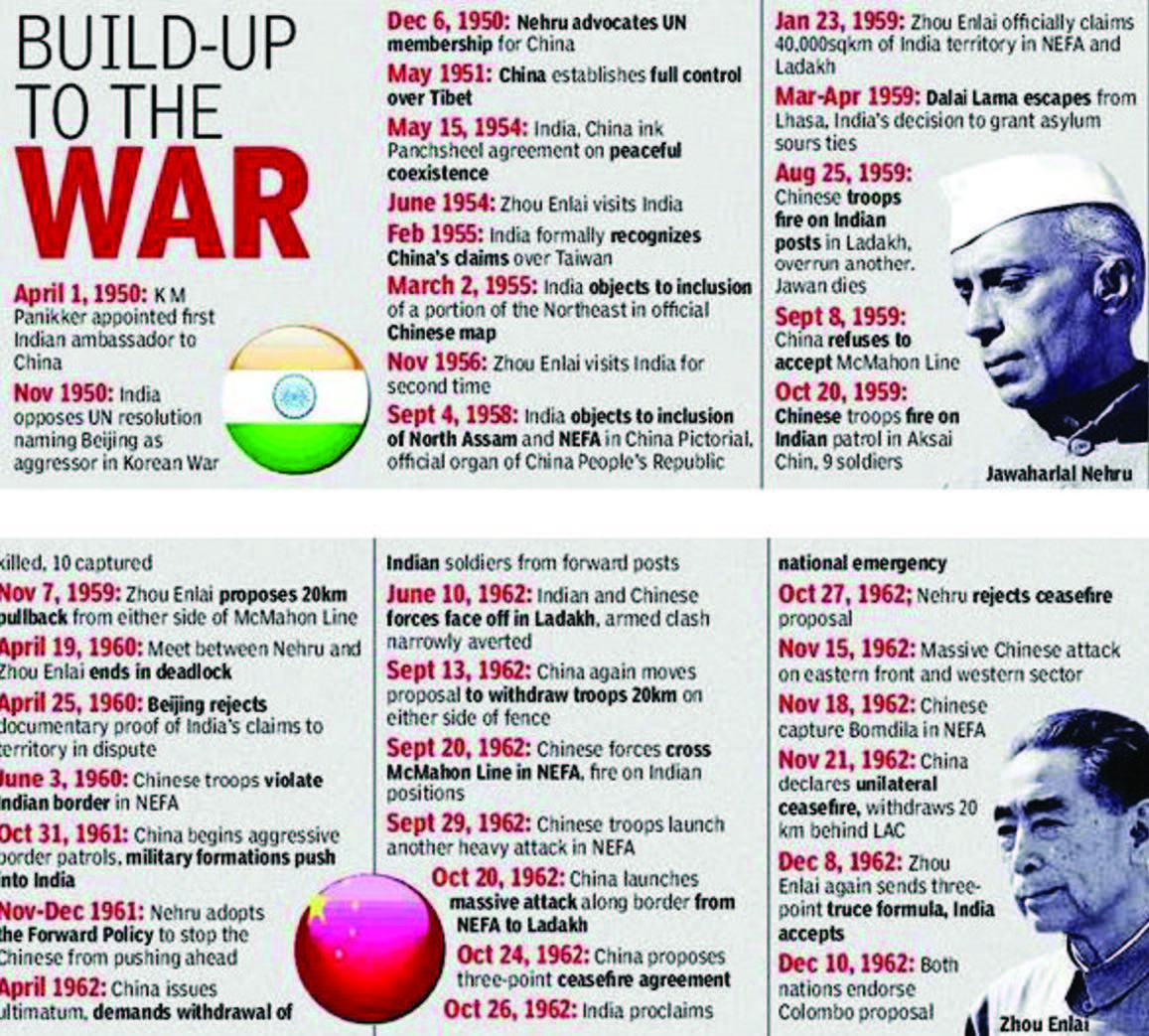
  • NEHRU RESPONSIBLE FOR 1962 WAR DEBACLE: REPORT

    NEHRU RESPONSIBLE FOR 1962 WAR DEBACLE: REPORT

    NEW DELHI (TIP): The conventional narrative in India about the 1962 war has largely revolved around portraying the Chinese as the unbridled “aggressors”, who ripped apart the nascent “Hindi- Chini bhai-bhai” construct forever. The reality is slightly different.

    True, China was nibbling away at what India perceived to be its territory both in Ladakh and North-East Frontier Agency (NEFA), as Arunachal Pradesh was then called, to consolidate its hold on Tibet. But what provoked Mao-led China to launch a full-blown military invasion into India on October 20, 1962 was the Nehru government’s ill-conceived and poorly executed Forward Policy, set in motion almost a year ago in November-December 1961.

    Already smarting from the Dalai Lama’s escape to India in early 1959 and the bitter exchanges over the Mc-Mahon Line, which it considered to be a “legacy of British imperialism”, China decided to teach India “a lesson” it would never forget through the one-month war. The Henderson Brooks-P S Bhagat report on the 1962 military debacle, kept firmly under lock and key by the Indian government for the last 50 years, makes it clear the “unsound” Forward Policy — directing Indian troops to patrol, “show the flag” and establish posts “as far forward as possible” from the then existing positions —”precipitated matters”, sources say.

    The sources, who have accessed the classified report, say the ill-timed Forward Policy “certainly increased the chances of conflict” at a time when India was militarily ill-prepared in Ladakh and NEFA, with China much better placed in terms of forces, equipment and logistics in both the sectors. The report apparently holds that the Forward Policy was based on the “flawed premise”, primarily driven by the then all-powerful Intelligence Bureau director B N Mullik, that “the Chinese would not react to our establishing new posts and that they were not likely to use force against any of our posts even if they are in a position to do so”.

    This gravely erroneous assumption, given credence by a complicit Army headquarters despite being in direct contrast to an earlier military intelligence “appreciation” that the Chinese “would resist by force any attempts to take back territory held by them”, percolated down to all levels of command to usher in “a sense of false complacency”. What compounded matters was the “appalling” and “disastrous” military leadership and its decision-making, ignoring the advice of commanders on the spot. First, the Army headquarters paid no heed to the quantum of forces required to implement the Forward Policy. Both Ladakh and NEFA had “a minimum requirement” of an additional infantry division (over 12,000 troops) each, with necessary airlift and logistical backing, to somewhat re-address the imbalance with China, as had been reinforced by war games conducted earlier in 1960.

    But no fresh induction of troops ever materialized. So, the report reportedly notes, while the Forward Policy may have been “politically desirable”, the Army simply did not have the wherewithal to implement it. The Western Command, for instance, had held that the Forward Policy should be kept “in abeyance” till there were enough Indian troops in Ladakh and that China should not be “provoked” into an armed clash. But the Army HQ disregarded all this. Neither did it strengthen Ladakh, nor reduce tensions with China. With the “probes forward” underway, the Army established 60 posts in sectors like Demchok, Chushul, Daulat Beg Oldi, Changla and Rezengla of Ladakh by July 1962, further stretching its already meagre resources there.

    Many of these “very weak, far-flung and uncoordinated” posts had barely 10 soldiers each. Similar was the story in NEFA. Instead of strengthening the “defence line”, forces were frittered away in “pennypackets” in forward areas. Tawang, for instance, had just a depleted brigade, while China had two divisions in the sector. Similarly, Bomdila had only one battalion. Thus, as in Ladakh, in NEFA too, the Army was hardly in a position to adopt the Forward Policy. That it was adopted proved that the “higher direction of war” was “faulty”, based as it was more on preconceived notions that China would not react rather than sound military judgment, say sources. React the Chinese certainly did. Drafted by then commander of the Jalandhar-based 11 Corps Lt-Gen T B Henderson Brooks, who was assisted by Brigadier P S Bhagat, this “operational review” details at great length how the outnumbered and out-gunned Indian Army was first complacent, then collapsed and finally panicked and fled under the Chinese onslaught.

    The report’s mandate was restricted to reviewing the Army operations but the covering note on it by Gen J N Chaudhari, who took over as Army chief after the war, did criticise then defence minister V K Krishna Menon’s continuous meddling in military matters. The report itself is sharply critical of the role played by Lt-General B M Kaul — a distant relative of Nehru and Menon’s favourite — first as chief of general staff at the Army headquarters and then as commander of the hastily raised IV Corps at Tezpur just before the Chinese invasion.

    The report holds that the “lapses” by Lt-Gen Kaul and his “handpicked officers” were “inexcusable” and “heinous”, say sources, adding they should not have allowed themselves to be “pushed” into a military adventure without requisite forces and proper planning. The 4th Infantry Division in NEFA, for instance, was neither militarily prepared nor mentally adjusted to fight the Chinese. When the Chinese troops reached its gate, there was total confusion that ultimately ended in panic and flight. “Senior commanders” — like the 4th Infantry Division commander Major-General A S Pathania in NEFA — “let down the units” under their command, held the report.

  • FED POISED TO TRIM BOND BUYING, REWRITE RATES GUIDANCE

    FED POISED TO TRIM BOND BUYING, REWRITE RATES GUIDANCE

    WASHINGTON (TIP): The Federal Reserve is set to trim its bond-buying stimulus for a third time in a row on Wednesday, and will probably rewrite its guidance on when it might eventually raise interest rates. The moves would represent both continuity at the US central bank as Janet Yellen chairs her first policy-setting meeting and a nod to economic reality.

    A reduction in the Fed’s monthly purchases of treasuries and mortgage-backed securities by $5 billion each, as widely expected, would bring the monthly total to $55 billion and keep the central bank on track for a measured wind down of the program as laid out by Yellen’s predecessor, Ben Bernanke. Less certain is what the Fed will do about its interest rate guidance. It has said since December 2012 that it would not consider raising short-term rates until the jobless rate dropped to at least 6.5%, as long as inflation looked set to remain contained.

    But the unemployment rate has already dropped to 6.7%, in part because of discouraged job hunters giving up the search, and officials think the economy is still far from ready for higher borrowing costs. Top Fed policymakers have indicated they are likely to scrap the numerical threshold and move to more qualitative guidance, but exactly how they will frame it is not certain. The challenge they face is making the change without shifting market expectations for the timing of a first rate hike, now seen as coming midway through next year — in line with views also held by top Fed officials. Bank of the west chief economist Scott Anderson said the upshot will probably be “a less transparent, and perhaps less helpful, qualitative statement” of the economic conditions the Fed wants to see before raising rates. It wants to ensure “that another sharp decline in the unemployment rate for the wrong reasons doesn’t send long-term interest rates soaring on expectations of an imminent rate hike,” Anderson said.

    KEEPING MARKETS IN LINE
    The Fed has kept overnight rates near zero since December 2008 and has bought more than $3 trillion in long-term debt to keep borrowing costs down and spur investment and hiring. It began to scale back its stimulus in December, announcing it would trim its monthly bond purchases by $10 billion, after it saw the economy pick up speed in the fall. In January, the Fed said it would cut the purchases by a further $10 billion. At the same time, it has sought to tamp down any market expectations that rate rises will soon follow with its so-called forward guidance.

    But the jobless rate threshold could soon be breached, and officials want to find a more durable way to telegraph their view on when they will tighten monetary policy. They want to keep market expectations aligned with their own forecasts. If traders start to price in earlier rate hikes, the result would be tighter financial conditions that could deter the very investment and hiring that the Fed wants to promote. Even officials who prefer an earlier rate hike want the Fed’s policy-setting committee to avoid surprises that could lead to market turmoil.

    “I’m sure this committee will be interested in doing its best to communicate about what we foresee for policy,” Jeffrey Lacker, the head of the Richmond Fed, said earlier this month. Several officials have signaled a preference for qualitative guidance around a broad set of economic indicators, including gauges for the labor market and inflation, which is tracking well below the Fed’s 2% goal. The Fed is set to announce its decision in a statement at 2pm. That will be followed 30 minutes later by Yellen’s first news conference since taking the helm of the world’s most influential central bank on February 1.

    Many Fed officials, including Yellen, have said recent weakness in economic data, from jobs and retail sales to industrial production and home building, appears largely due to the unusually harsh winter and should soon dissipate. If that assessment bears out, Fed officials have signaled they will likely end the bondbuying program later this year. On Wednesday, they will also release fresh projections for inflation, unemployment, economic growth and the likely path of rate hikes. Forecasts from December showed that most Fed officials saw rate hikes starting sometime next year and proceeding at a very gentle pace. With a shift away from guidance that relies on a specific level of the jobless rate, their views on the likely path of interest rates is likely to draw even more scrutiny.

  • Warning Russia, Biden says US will defend allies

    Warning Russia, Biden says US will defend allies

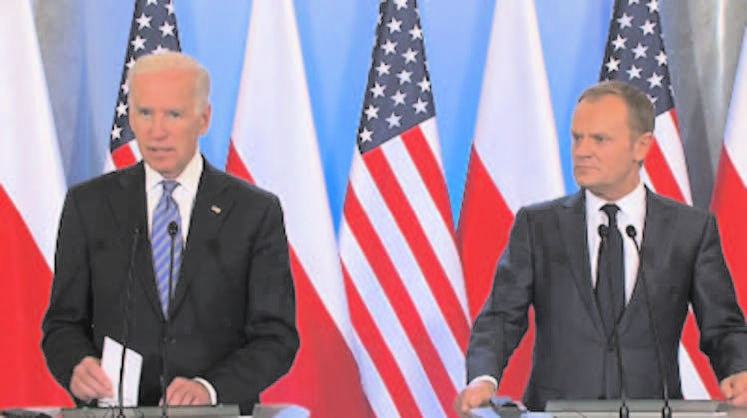
    VILNIUS, LITHUANIA (TIP): Issuing an outright warning to Moscow, Vice President Joe Biden declared Wednesday the United States will respond to any aggression against its Nato allies, as Russia’s neighbors looked warily to the escalating crisis in nearby Ukraine.

    Standing side by side with a pair of Baltic leaders in Vilnius, Lithuania, Biden said the US was “absolutely committed” to defending its allies, adding that President Barack Obama plans to seek concrete commitments from Nato members to ensure the alliance can safeguard its collective security. In a jab at Russia, he said the US stands resolutely with Baltic states in support of the Ukrainian people against Russian aggression.

    “Russia cannot escape the fact that the world is changing and rejecting outright their behavior,” Biden said, after meeting in Vilnius with Lithuanian President Dalia Grybauskaite and Latvian President Andris Berzins. Biden’s comments came at the close of a two-day trip to Lithuania and Poland with a two-pronged theme: Sending a stern message to Russian President Vladimir Putin that the US won’t abide Russian intervention in Ukraine, and reassuring fretful Nato allies that the US and others will come to their defense if necessary. “We’re in this with you, together,” Biden said.

    Amid the tough talk from Biden and the Baltic leaders, Russia’s annexation of Crimea was increasingly looking like a foregone conclusion. At the Ukrainian navy headquarters in Sevastopol, Crimea, militias stormed the base Wednesday, taking it over without resistance. Although senior Ukrainian officials planned to travel to Crimea in hopes of averting an escalation in hostilities, Crimea’s pro-Russian prime minister insisted they weren’t welcome and wouldn’t be allowed to enter. A day earlier, Putin declared Crimea part of Russia in a passionate speech steeped in Russia’s sense of being slighted and marginalized by the West in the years since the Cold War.

    While repeatedly insisting that Russia’s move is illegal and won’t be recognized, the US and other world powers have also turned their attention to eastern Ukraine and other areas with large ethnic Russian populations, lest Putin seek additional territory in what some fear could portend a return to Moscow’s traditional imperialist ambitions. To that end, Western powers were seeking fresh ways to show that Russia would incur real costs unless it changes course.

    Berzins announced that he and Polish President Bronislaw Komorowski had agreed that Poland and Latvia will start coordinating its security activities more closely. France’s foreign minister said leaders of the Group of Eight world powers have suspended Russia’s affiliation with the group over its actions in Ukraine. Obama invited the seven other members to discuss what comes next during an emergency meeting in Europe. Meanwhile, Britain said it was suspending military cooperation with Russia in light of the crisis. And German Chancellor Angela Merkel, in a phone call with Obama on Tuesday, agreed that U.N. and other international monitors must be sent in to other parts of Ukraine without delay.

  • Death of L’Wren Scott, Mick Jagger’s girlfriend, is ruled a suicide

    Death of L’Wren Scott, Mick Jagger’s girlfriend, is ruled a suicide

    NEW YORK (TIP): The death of fashion designer L’Wren Scott, the longtime girlfriend of Rolling Stones frontman Mick Jagger, was suicide, the New York City medical examiner’s office said on Wednesday. An autopsy completed on the body of 49-year-old Scott found that she died of hanging, according to Julie Bolcer, a spokeswoman for the city medical examiner.

    Scott was found dead in her Manhattan apartment on Monday morning. Police said her assistant found her kneeling with a scarf wrapped around her neck that had been tied to the handle of a French door. There was no note. The Stones canceled their seven-date tour of Australia and New Zealand in the wake of Scott’s death. Jagger called Scott his “lover and best friend” in a Facebook tribute and said he was struggling to come to grips with her death.

    Jagger’s bandmates voiced their support for him amid a trying time. Keith Richards said in a statement on Wednesday that “no one saw this coming” and that Jagger has “always been my soul brother and we love him.” “We’re thick as thieves and we’re all feeling for the man,” he added. Charlie Watts said the band’s priority is the 70-year-old Jagger. “Needless to say we are all completely shocked but our first thought is to support Mick at this awful time,” he said.

    “We intend to come back to Australia and New Zealand as soon as it proves possible.” Ronnie Wood echoed Watts’ statement. “This is such terrible news and right now the important thing is that we are all pulling together to offer Mick our support and help him through this sad time,” Wood said. “Without a doubt we intend to be back out on that stage as soon as we can.” Scott had been Jagger’s companion since 2001.

    The Rolling Stones frontman paid tribute to his girlfriend Tuesday on his Facebook page writing, “I will never forget her.” “I am still struggling to understand how my lover and best friend could end her life in this tragic way. We spent many wonderful years together and had made a great life for ourselves. She had great presence and her talent was much admired, not least by me.” The fashion label founded by Scott had been heavily in debt and was reportedly about to fold. Former New York Times fashion writer Cathy Horyn said in an essay on the paper’s website that Scott had been planning to announce that she was closing her business. Scott canceled her London Fashion Week show last month, citing production delays.

    Scott launched her high-end fashion label in 2006. First lady Michelle Obama, Nicole Kidman and Penelope Cruz were among the big names to wear her designs. Accounts filed by Scott’s LS Fashion Ltd. in London show the company had liabilities that exceeded assets by 4.24 million euros ($5.9 million) as of Dec. 31, 2012. The company’s long- and short-term debts totaled 6.75 million euros against assets, capital and reserves of 2.51 million euros, according to the accounts, which were filed in October. Scott was adopted by a Mormon couple and grew up in small-town Utah. She made her way to Paris after high school where, aided by her 6-foot-3 height (some say 6-foot-4) and striking looks, she found work as a model for some prominent photographers.

  • Osama bin Laden’s son-in-law tells US trial of 9/11 cave chat

    Osama bin Laden’s son-in-law tells US trial of 9/11 cave chat

    NEW YORK (TIP): Osama bin Laden claimed responsibility for masterminding 9/11 on the night of the attacks, his son-in-law has said as he unexpectedly testified at his federal trial in New York on terror charges.

    Suleiman Abu Ghaith, who married Bin Laden’s daughter Fatima, on Wednesday recounted a dramatic meeting with the jubilant al-Qaida chief in an Afghanistan cave complex on the night of September 11, 2001. “Did you learn what happened? We are the ones who did it,” Bin Laden declared, according to Abu Ghaith.

    The 48-year-old from Kuwait told the court he warned Bin Laden that he would feel the full force of America’s wrath following the attacks on New York and Washington. Bin Laden replied simply by telling him “You’re being too pessimistic.” Within months, the US-led invasion had ousted the Taliban from power in Afghanistan, and Bin Laden was forced onto the run. A 10-year manhunt ended when the al-Qaida leader was shot dead by US Navy SEALs during a daring raid on his hideout in Pakistan in 2011.

    Abu Ghaith had not been expected to testify during his trial where he is charged with conspiracy to kill Americans and conspiracy to support terrorists. He faces life imprisonment if convicted by a jury at the trial, which is expected to conclude within days. Speaking in Arabic, translated into English by an interpreter, Abu Ghaith also denied trying to recruit people for al-Qaida, as prosecutors have alleged. “There is no one recruiting, but Osama Bin Laden.

    My intention was not recruiting anyone,” he said. And, asked by his lawyer if he ever wanted to kill Americans, he responded “No.” “My intention was to deliver a message I believed in,” he said, denouncing the oppression of Muslims. Presenting himself as an imam, he said he went to Taliban-controlled Afghanistan in June 2001 because he had a “serious desire to get to know the new Islamic government.

    “His other aim was “teaching and preaching,” he said, adding that was something he didn’t accomplish.Clad in a suit with an open-collared shirt, the balding suspect sporting a salt-and-pepper beard admitted having recorded several videos at the request of Bin Laden, who, he said, summoned him after learning he was a Kuwaiti imam. He said he had never met Richard Reid, a British man who tried to explode a bomb hidden in his shoes on a Paris-Miami flight in December 2001, three months after the 9/11 attacks.

  • Former ISI chief knew of Osama’s Pak hideout: Report

    Former ISI chief knew of Osama’s Pak hideout: Report

    NEW YORK /ISLAMABAD (TIP): Former ISI chief Lt Gen Ahmed Shuja Pasha knew of Osama bin Laden’s hideout in Pakistan and LeT founder Hafiz Saeed was in regular contact with the slain al-Qaida chief, a media report said.

    Soon after the US Navy SEAL raid on bin Laden’s house, “a Pakistani official told me the US had direct evidence that the ISI chief, Lt Gen Ahmed Shuja Pasha, knew of Bin Laden’s presence in Abbottabad,” the New York Times reported in an article by senior journalist Carlotta Gall.

    “The information came from a senior US official, and I guessed that the Americans had intercepted a phone call of Pasha’s or one about him in the days after the raid,” Gall wrote in the article titled ‘What Pakistan Knew About Bin Laden’, adapted from the book “The Wrong Enemy: America in Afghanistan, 2001-2014′, to be published next month. Gall covered Afghanistan and Pakistan for the paper from 2001 to 2013.

    “He knew of Osama’s whereabouts, yes,” the Pakistani official was quoted as saying. “Pasha was always their blueeyed boy,” the official said, adding he was surprised to learn this.Reacting to the NYT report, Pakistani intelligence sources dismissed it as “baseless”.”There is no truth in the NYT report. It is a totally baseless story. Nobody in Pakistan knew about the presence of Osama bin Laden,” a Pakistani intelligence source said.

    The report added that the haul of handwritten notes, letters, computer files and other information collected from bin Laden’s house during the raid revealed regular correspondence “between Bin Laden and a string of militant leaders who must have known he was living in Pakistan, including Hafiz Muhammad Saeed, the founder of Lashkar-e-Taiba, a pro-Kashmiri group that has also been active in Afghanistan, and Mullah Omar of the Taliban”.

    “Saeed and Omar are two of the ISI’s most important and loyal militant leaders. Both are protected by the agency. Both cooperate closely with it, restraining their followers from attacking the Pakistani state and coordinating with Pakistan’s greater strategic plans. “Any correspondence the two men had with Bin Laden would probably have been known to their ISI handlers,” it said. Saeed, who is wanted by Indian security agencies in connection with the 2008 Mumbai attacks, also denied the report.

    He came live on various TV channels in Pakistan besides using his twitter handle to deny the charges.Bin Laden was shot dead by US commandos in May 2012 in a unilateral raid by them, catching the Pakistanis by surprise. It was always suspected that some on the Pakistani establishment knew bin Laden’s whereabouts as he was living a stone-throw away from the military academy in Abbottabad.

  • UNHRC members under US pressure on resolution: SRI LANKA

    UNHRC members under US pressure on resolution: SRI LANKA

    COLOMBO (TIP): Sri Lanka on March 19 claimed that most of the 47 member countries of the UN Human Rights Council are under pressure to back a tough US-sponsored resolution that has called for an international probe into alleged rights abuses during the country’s war with Tamil Tiger rebels.

    “Countries have told us they do not want to pursue Sri Lanka’s case. But they want to be seen with the US. Some of them have defence pacts with the US and wider trade links,” External affairs minister G L Peiris said. He said the pro-LTTE diaspora possess large sums of money to run the anti-Sri Lanka campaign in order to win over the Western countries.

    “They collected large sums of money during the war. They still own businesses in many countries,” Peiris said. Sri Lanka accused the pro-LTTE diaspora of creating pressure on the UN system to act against it for political reasons. The US-moved resolution, the third in as many years, is to be put to vote at the UN rights body later this month. Sri Lanka has condemned the move as a gross interference on its sovereignty.

    In the resolution, the US has endorsed recommendations by UN rights chief Navi Pillay for an external probe into charges that Sri Lankan troops killed up to 40,000 civilians during the final months of nearly quarter century civil war against the LTTE that ended in 2009.

    The previous two resolutions by the US were adopted with India’s support. Speaking in parliament earlier in the day, Peiris said that Sri Lanka could easily have avoided action at the UN Human Rights Council had it given in to international pressures. “We have a national pride. So we cannot give in,” he said. Meanwhile, the US explained the revised draft text of the resolution to other members and sought their views.

  • Pakistani fighter jets kill 30 militants

    Pakistani fighter jets kill 30 militants

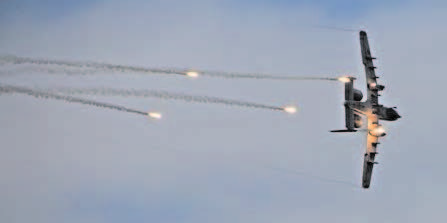
    ISLAMABAD (TIP): Pakistani fighter jets and helicopter gunships on Tuesday bombarded hideouts of the Taliban militants in the Waziristan region, killing at least 30 militants.

    The attacks on the hideouts in Waziristan tribal regions were the fourth in a series of air strikes by the Pakistan air force (PAF) since February 20. At least 30 militants were killed in the air strikes in the region stretched between south and north Waziristan, Geo News reported citing a security official.

    The fighter jets have been pounding the hideouts since the government’s efforts to engage the Pakistani Taliban in peace negotiations failed last week. The militants hideouts in Shawal valley and Dattakhel areas of Waziristan were attacked where their training centres are located.

  • Dozens arrested as Nepalese protest fuel price rise

    Dozens arrested as Nepalese protest fuel price rise

    KATHMANDU (TIP): Nepalese students protesting at fuel price rises set a parked bus on fire and vandalised other vehicles on March 19 during a strike in the capital Kathmandu, leading police to make more than 60 arrests.

    The city-wide strike, called by student unions to protest at an increase in the price of petrol, diesel, kerosene and aviation fuel last week, saw schools and colleges shut and most government vehicles stay off the roads. Some 2,000 police patrolled the streets, detaining protesters as they tried to enforce the strike by stopping vehicles.

    “We have arrested 67 protestors this morning for trying to stop and vandalise taxis, garbage-disposal trucks and other vehicles,” police spokesman Ganesh KC told AFP. “Protesters also set a parked bus on fire, but no one was inside it,” he said. Finance minister Ram Sharan Mahat decried the strike, tweeting that it would “only raise production cost and make our economy uncompetitive”.

    A cluster of student unions called the strike after the government refused to roll back increases of up to 7.6 percent in the prices of petrol, diesel, kerosene and aviation fuel, announced to offset the rising cost of oil imports. The Himalayan nation imports fuel from its southern neighbour India, itself an oil importer battling surging costs and high inflation.

  • Suicide attack kills 16 in north Afghanistan

    Suicide attack kills 16 in north Afghanistan

    MAZAR-I-SHARIF (AFGHANISTAN) (TIP): A suicide bomber killed at least 16 people at a crowded market in northern Afghanistan on Tuesday, officials said, despite a tightening of security for presidential elections less than three weeks away.

    There was no immediate claim of responsibility for the attack in Maimanah city, the capital of remote Faryab province which borders Turkmenistan and has a mixed population of Uzbek, Turkmen and Pashtun ethnic groups. A week ago Taliban insurgent leaders vowed to target the presidential election, urging their fighters to attack polling staff, voters and security forces before the April 5 vote to choose a successor to Hamid Karzai.

    “It was a suicide bombing in the middle of Maimanah city during the Tuesday bazaar,” provincial governor Mohammadullah Batash told AFP. “The blast happened on the main roundabout, which was very crowded. The bomber used a three-wheeler packed with explosives,” he added. Abdul Ali Haleem, the provincial health director, said 16 people had died and 40 were treated for injuries, among them a pregnant woman and two children aged six and seven.

    Northern Afghanistan is generally more peaceful than the south and east but Islamist insurgents, rival militias and criminal gangs are active in some districts. Six Afghan employees of the aid group ACTED working on rural development projects were shot dead in Faryab in December by suspected Taliban gunmen. The United Nations envoy to Kabul warned on Monday that election-related violence was on the rise in Afghanistan, where NATO combat troops are withdrawing after 13 years of fighting a fierce Islamist insurgency.

    “Security will have a major impact on these polls,” Jan Kubis said in an address to the UN Security Council in New York, adding he was “gravely disturbed” by the Taliban threat to unleash “a campaign of terror”. Previous Afghan elections have been badly marred by violence, with 31 civilians and 26 soldiers and police killed on polling day alone in 2009 as the Islamist militants demonstrated their opposition to the US-backed polls.

  • Bangladesh indicts former Prime Minister Khaleda Zia

    Bangladesh indicts former Prime Minister Khaleda Zia

    DHAKA, BANGLADESH (TIP): A court in Bangladesh’s capital on Wednesday indicted a former prime minister and leading opposition figure in two related cases involving charges of corruption for allegedly using an illegal fund to buy land for a charity named after her late husband.

    Judge Basudeb Roy accepted the charges against Khaleda Zia, who was present in the court. Defense lawyer Khandker Mahbub Uddin said the charges that Zia had illegally collected more than $1 million in donations for the charity named after late President Ziaur Rahman were not true. Zia says she is innocent and the charges are politically motivated.

    Authorities deny the allegations. Pressing the charges against Zia could further complicate the country’s tense political situation. Zia’s party and her allies boycotted troubled January 5 elections in which Prime Minister Sheikh Hasina returned to power with an overwhelming majority.

    Zia has vowed to restart protests against Hasina to oust her from power, but Hasina has said she would stand tough against any such moves in the South Asian nation, which is a parliamentary democracy. Zia heads the charity, which she established during her latest premiership, in 2001-2006.

  • Sri Lanka bows to international pressure, releases rights activists

    Sri Lanka bows to international pressure, releases rights activists

    COLOMBO (TIP): Under international pressure ahead of voting on a resolution against Sri Lanka at the UNHRC, the authorities here have released two leading rights activists after their detention under antiterrorism laws.

    Father Praveen Mahesan, a Catholic priest, and Ruki Fernando of the Colombo-based INFORM advocacy group were arrested on Sunday in the former LTTE stronghold of Kilinochchi in the north as they met Tamils who lost loved ones during the separatist conflict.

    They were detained under Prevention of Terrorism Act for inciting communal disharmony and dissent. “They were produced last night before the lady magistrate at court No 2 in Hulfsdorp. She ordered their release,” police spokesman Ajith Rohana said on Wednesday.

  • DEVYANI KHOBRAGADE RE-INDICTMENT

    DEVYANI KHOBRAGADE RE-INDICTMENT

    The US courts do have jurisdiction as the alleged crime (visa fraud) was committed on the US.

    The Indian Panorama sought the view of Attorney Anand Ahuja on the statement of MEA spokesperson after US had reindicted Devyani Khobragade. The comments of more knowledgeable sources are being obtained on the issue and will be published in the next issues of The Indian Panorama. Readers are invited to send their comments.

    The Indian Panorama question and the response of Attorney Anand Ahuja are given below.
    * India has reacted to re indictment of Khobragade. A spokesman for MEA has stated: “We reiterate that the case has no merit. Therefore this second indictment has no impact on our stated position. Now that Dr Khobragade has returned to India, the court in the US has no jurisdiction in India over her. Government will, therefore, no longer engage on this case in the US’ legal system.”

    Your take on the comment, please? Response:
    The US courts do have jurisdiction as the alleged crime (visa fraud) was committed on the US. The laws of various US departments such as US Department of State, and US Department of Labor, US Department of Homeland Securities were violated by her within the US jurisdictions. Therefore, US courts still have jurisdiction on her. The concerned authorities in the USA, legally can seek her extradition as both USA and India are signatory to such extradition treaty.

    However, considering the nature of her alleged crime, USA probably will not go in for extradition route. On the contrary, authorities in the USA will wait for her to enter USA. Once she enters USA, she would be, most likely, arrested then. * The MEA Spokesperson further said: “This was an unnecessary step. Any measures consequent to this decision in the US, will unfortunately impact upon efforts on both sides to build the India-US strategic partnership, to which both sides are committed.”

    Your take on it? Response:
    Both USA and India have taken a position that this unfortunate incident shall not and should not damper Indo-USA relationship. If it’s an unnecessary step or not is a matter of perception. The premise for India’s position is that USA should treat an Indian VIP, charged with crime, in the same manner it’s treated in India. This incident has exposed differences between the two countries over such basic concepts as fairness and equality. Devyani broke the USA laws and has been charged. The message that India is trying to convey to the world is that nobody can dare to treat Indian elite “a normal”, not even for violating the rule of law in a foreign country.

  • Devyani – a Kabuki, a Tragic Trilogy or a Bilateral Self inflicted Wound?

    Devyani – a Kabuki, a Tragic Trilogy or a Bilateral Self inflicted Wound?

    Alightning fast re-indictment on March 14th, within 2 days of a judge’s dismissal, speaks to the Prosecutor’s rebuke of those who misunderstand law and chose to personalize their disrespect, while continuing to seek to hold a person liable for her alleged criminal wrongs.

    Any and all attacks on the prosecution were wrong in-fact and counterproductive at best, and all those who wish to engage in that mind-numbing sport ought to cease and desist. The legal process deserves respect, especially given the adversarial system of justice – anything less misdirects logic and proportionality, the hallmark of justice, when forced to function in a river of insults.

    I am disturbed by what I have seen occur from December 12th to March 12th, when Judge Scheindlin issued her surprising and unexpected technical-dismissal of the January 9th Indictment. There has been much noise from all quarters since December 12th, who sought to vilify the United States and our abovepolitics United States Attorney Preet Bharara. Some, perhaps, to derail the bilateral relationship.

    Others, perhaps, questioning how could a friendly nation treat another so. Yet others, were playing for personal advantage – much as an undertaker does upon every death. But the most painful cut, made repeatedly, was the legally false or factually false-laced comment coming from a source whose job was to defend Devyani, within the bounds of law. While lawyers, like doctors, can misdiagnose, they ought not misrepresent facts. Certainly, to do both, and repeatedly, when you have over 1 billion good and decent people worried about national respect and national honor is beyond comprehension as it is a core wrong.

    This misdiagnosis and mis-statements caused legal and factual false predicates to give birth to false public expectations in India and false governmental bureaucratic judgment. I know, as I took unexpected heat for properly diagnosing that Devyani lacked diplomatic immunity while holding an A-visa – even as I admitted that the arrest-off-the-street was excessive and ought not have been done. It even gave false birth to genuine public anger against the United States and US Attorney Bharara. The height of which were folks marching in India against President Obama and the American Flag.

    There were even unseemly and false stories about US Attorney Bharara’s political ambitions. This was, and is, wrong. Preet Bharara has earned his spot in the pantheon of legendary Southern District prosecutors like my mentor, the great Bob Morgenthau. Perhaps, the greatest wrong are the birth defects of the Devyani case, which in retrospect, I’m sure no one in the State Department knowing what they now know, would have ever asked the Justice Department to prosecute Devyani. Just look at who is involved, and not merely what is alleged to have occurred.

    Sangeeta Richard, who twice went to the United States Embassy in Delhi to lie about her contract of employment and scam herself a visa-approval; Philip Richard, who after getting to the United States, wants a divorce because Sangeeta, he says, can’t be trusted and lies; Wayne May and his wife, who while posted in India were anti-India and anti-Indian – worthy of a “Ripley’s Believe it or Not” episode. Such a posting between friendly nations is diplomatic malpractice at best. Can you imagine our State Department posting an anti-Semite to Israel, and who, along with his wife while there, enjoy mocking the receiving nation and its citizens on Facebook? The second greatest wrong is the pre-birth twin facts of prior legal proceedings in India against Sangeeta Richard, and the shocking evacuation of Philip Richard and family, well timed to occur prior to Devyani’s December 12th arrest.

    The law would have been better enhanced, while being mutually respectful, if India’s prior case and America’s subsequent case, each against their respective defendant(s), took its turns and twists to find justice. The evacuation stands as a core wrong, with lingering need for redress. After the successful negotiations between our Secretary of State John Kerry, and India’s Foreign Minister Salman Khurshid, Devyani was legally allowed to go home due to the State Department’s grant of a G-visa to replace her Avisa. The A-visa did not immunize her from being charged or arrested for what she was, and now again, is. That the A-visa was replaced by G-visa, proved the vitality, portance and warmth both nations place upon the bilateral relationship – from President Obama to the everyday hardworking American citizen.

    But, then, Devyani made her most critical error: instead of resolving the criminal charges, with the best possible resolution, including, a non-jail sentence along with an additional civil resolution, she sought an outright dismissal of the criminal charges based upon a mere 1-day full immunity consequence of a G-Visa, which had no retroactive effect of cloaking her. This was nothing short Caesarian hubris, overlaid on legal misdiagnosis and misrepresentation of facts. A trilogy of tragic proportions. Now, what must be avoided at all costs is an unearned chill between friends – India and United States, and Indians and Americans.

    From the presence of Indian tea at the Boston Tea Party to the innocent blood shed upon Lord Cornwallis’ cold command when stepping foot in India after losing “the Colonies” to General George Washington, these two nations have a joint destiny. Indeed, even Christopher Columbus only found the New World because of India. History will not kindly look upon additional colossal errors, nor will destiny willingly permit same.

    Devyani was, and ought to remain, a mere hiccup in the most important bilateral relationship of the 21st Century. On this Ides of March, as I remember Julius Caesar who ruled the world and brought us the Pax Romana, it is good to embrace humility, as it helps minimize errors of judgment in any capital of a sovereign nation, and the need to separate from folks, whose misjudgments and misrepresentations. Let only those who know the actual law and honor the real facts have the right to make binding judgments to keep the public peace, enhance the public good, and seek to form a more perfect world.”

  • Problems of India are not confined to big business alone

    Problems of India are not confined to big business alone

    The private sector in India “hopes that everything would be hunky dory once the pro-business Modi becomes the PM. Unfortunately, problems of India are not confined to big business only. There are millions (45 per cent of industrial employment) employed in small-scale and micro-sector enterprises. Around 90 per cent of the labor force works in the unorganized sector. The small and medium industries contribute 50 per cent of exports and need policies that would increase their competitiveness” says the author.

    All businesses, whether domestic or foreign, are waiting for the results of India’s general election. Why should there be so much apprehension about the future of the Indian economy and why should it depend on who forms the next government at the Centre? After all, India is a mature, almost middle-income country with per capita income of Rs 39,961 per annum (2013-14) and GDP of $1.7 trillion.

    We have good roads, ports, airports, well-functioning courts of justice, mega cities, luxury housing, malls, schools, colleges, hospitals — everything a country needs. We have a thriving service sector and an established manufacturing sector. All these will remain intact even if the UPA goes and another party forms the government. huge economy like India’s should be on auto pilot.

    But it is not — because key decisions that would pave the path for the economy in future are perceived to lie today in the hands of the new government. Even though the Indian economy did take off and gather momentum, it lost speed mid-air and things began to look less clear and, in fact, far from rosy. Consequently, key business decisions were kept on hold and are now dependent on who will form the government at the Centre and what policy changes will come about.

    But the UPA government has left the country’s finances in good shape. In the last interim Budget Mr. Chidambaram wanted to play it safe by cutting public expenditure in order to control the fiscal deficit. The interim Budget has also increased the allocation of Central funds to states. Hence the power of the Centre in the next one year will be diluted vis-à-vis states. The incumbent government has tried its best to create a good image of itself in the last one month by inserting ads in national dailies every day about its achievements and clearing pending projects post haste.

    People, especially young voters, however, will make up their own minds. The common person is awaiting change and desires a reprieve from continuous inflation, corruption and general ineffectiveness of government decisionmaking. According to the latest data, in the last quarter of 2013, GDP growth was only 4.7 per cent and not 5 per cent, which would have indicated an upturn in the economy. There is, however, good news that in February 2014, manufacturing output has notched up and was at its highest in recent months but one month’s performance is not enough. Why has the UPA been so ineffective in pushing GDP growth in its second term? Why has it not been able to tame inflation? Why has corruption remained the biggest issue? Looking back, it was the three stimulus packages that the UPA government gave after the global economic crisis that was responsible for much of what is wrong today.

    As a result of the stimulus packages, the fiscal deficit rose and there was too much liquidity in the economy and inflation rose to 10 per cent. The government and the RBI had no option but to raise interest rates and it did so 13 times before the new RBI Governor took over. Meanwhile, the government’s interest rate policy did a lot of damage to business expectations and investors dithered and held back from investing in industry. People in general lost faith in financial assets, especially with the erosion of the rupee against the dollar, and began seriously buying gold. Consequently, the current account deficit ballooned and there was a threat of the rupee depreciating further.

    Only the announcement by the US Federal Reserve about staggering its monetary easing policy brought back FIIs which saved the current account deficit from deteriorating further. But what is alarming is the negative industrial growth which contracted by 0.7 per cent in the third quarter of 2013- 14. Industrial growth slowed down due to demand factors also. The fall in demand has affected all industries, including the fastest-growing automobile sector. The savings rate fell to 30.1 per cent (of GDP) from 36.8 per cent (2008) and per capita private spending growth slipped to 3.7 per cent in 2012-13 from 7.8 per cent a year earlier. People postponed buying consumer durable items and the high EMI (equated monthly installment) has been a daunting factor. If industrial growth, which is the biggest driver of GDP growth, goes down, then GDP growth also declines.

    Thus from the peak of 9.2 per cent GDP growth in 2007, today we are faced with a rate of below 5 per cent, which is not high enough to create an adequate number of jobs for youth. When incomes fall, then tax collection also is low and hence the rising fiscal deficit has been a problem. The fiscal deficit has been controlled by squeezing essential expenditure in key sectors which will impact the lives of people. More than anything else, India needs a higher rate of human development, food security, an increase in productivity in agriculture and manufacturing, better governance of cities, sanitation, education, health, safe water, pollution control and women’s safety. In infrastructure, we need better roads, public transport, housing for the poor to improve the quality of life of the less privileged. With cash-starved state governments, little can be expected by way of welfare measures for the poor and the needy. Delhi has no Chief Minister.

    It is in need of infrastructural improvements. One can only see a beginning made by Arvind Kejriwal, who ordered the setting up of temporary shelters for the homeless. If Narendra Modi becomes the Prime Minister, the private sector would expect speedy clearances and decisionmaking. It hopes that everything would be hunky dory once the pro-business Modi becomes the PM. Unfortunately, problems of India are not confined to big business only. There are millions (45 per cent of industrial employment) employed in small-scale and microsector enterprises. Around 90 per cent of the labor force works in the unorganized sector. The small and medium industries contribute 50 per cent of exports and need policies that would increase their competitiveness. What happens to the anti-poverty policies for the very poor will also be important. If subsidies are cut — which they are bound to be — what will happen to small and marginal farmers and the lives of those below the poverty line? What kind of social safety net will be offered? It could be training programs, cash in hand, housing, better agricultural inputs or jobs for the unemployed. It is a tall order for the next PM.