Kolkata (TIP): A day before he was scheduled to appear for questioning at the CBI office in connection with the Saradha chit fund scam,West Bengal Transport and Sports Minister Madan Mitra was on November 20 admitted to the state’s largest government hospital with a complaint of breathing disorder. Mitra, who was admitted in a private nursing home since Nov 18, left the health facility and reached SSKM Hospital on November 20 afternoon and was admitted in the Woodburn ward, reserved for VIPs.SSKM director Pradip Mitra said the minister complained of dyspnea (breathing problems). He was undergoing a series of tests. A journalist, who was with Madan Mitra just before he left the nursing home, claimed the minister “left suddenly” without taking even his security guard with him.
Year: 2014
-

Ebola vaccine running into patent cover in Canada?
NEW DELHI (TIP): A Canadian patent protection may be blocking an Ebola vaccine even as the world is struggling to stop the spread of the deadly virus. Almost a decade ago, Canada developed probably the world’s most promising vaccine to prevent spread of Ebola virus disease. However, the Canadian government shielded the vaccine with patent rights, limiting its further development for use in other countries, it is learnt. The Canadian government licenced the vaccine in 2010 to Bioprotection Systems Corporation, a subsidiary of NewLink Genetics, allowing the firm sole rights to develop and commercialize it. The profit-driven arrangement between the Canadian government and the firm has attracted criticism worldwide. Critics said since patenting a vaccine in such circumstances is affecting public health, the Canadian government should put it out in public domain in larger interest. The vaccine which was developed by a Canadian scientist, is based on a live attenuated vesicular stomatitis virus and has several known advantages as compared to other vaccine candidates in clinical trials.
-

MEXICANS MARCH AGAIN FOR 43 MISSING STUDENTS
MEXICO CITY (TIP): Tens of thousands of people angry at the presumed massacre of 43 students marched in Mexico City on Nov 20, many chanting for President Enrique Pena Nieto’s resignation in another day of nationwide protests. Protesters waved blackened flags of Mexico and chanted “He will fall, he will fall, Pena Nieto will fall!” Parents of the 43 male college students, who reject claims their sons are dead, led the march along the capital’s main boulevard toward the historic Zocalo square.
It was the latest protest over the government’s handling of a crime that has infuriated Mexicans fed up with corruption, impunity and a drug war that has left more than 100,000 people dead or missing since 2006. The case has turned into the biggest challenge of Pena Nieto’s nearly two-yearold presidency, on top of another scandal over a mansion his wife bought from a government contractor. “Mexico is used to tragedy, robberies and corruption, and we need to begin to exercise our rights as citizens to get the government working,” said Lili Correa, 46, wearing the black color of the protest. The demonstration coincided with the anniversary of the start of the 1910 Mexican revolution.
The government canceled the annual parade. Before the march, masked protesters threw firebombs and used tubes like makeshift bazookas to launch firecrackers at riot police, who hit back with tear gas to disperse the group on a street near the airport. The clash came after hundreds of protesters blocked the main road to the airport for an hour, while police vehicles picked up passengers walking with their suitcases along the road. Thousands of people also marched in the cities of Ciudad Juarez, Puebla and Chilpancingo, the capital of Guerrero, the violence-plagued southern state where the students vanished nearly two months ago. Thousands more marched in Bolivia and some 200 took to the streets in El Salvador.
Mexico and Real Madrid football star Javier “Chicharito” Hernandez tweeted a picture of himself wearing a black hoodie and the hashtag #WeAreAllAyotzinapa, referring to the young men’s Ayotzinapa teacher-training college. “The goal is to unite and mobilize the country, to lead it toward change,” said Omar Garcia, who attends the college. With the annual parade called off, Pena Nieto led a ceremony with top officials at the Campo Marte military field, where he and the defense minister denounced violent protests. “Mexico is hurting, but the only path to soothe this pain is through peace and justice,” he said, hours after making his personal assets public to quell conflict of interest allegations over his wife’s mansion.
Defense minister Salvador Cienfuegos said violence “only leads to national failure, social backwardness, ungovernability, instability.” The crisis erupted after the mayor of the city of Iguala ordered police to confront students on September 26, sparking a night of violence that left six people dead and 43 missing, authorities say. Prosecutors say corrupt police delivered the 43 young men to members of the Guerreros Unidos drug gang, who confessed to killing and incinerating the students. Officials stopped short of declaring the students dead pending DNA tests. Federal police teams continue to search for them in Guerrero. -

In blow to PM Cameron, Britain’s anti-EU UKIP party wins second parliamentary seat
GILLINGHAM (TIP): Britain’s anti-EU UKIP party won its second seat in parliament on November 21, defeating Prime Minister David Cameron’s Conservatives in a special election six months before what is shaping up to be a closely-fought national vote. Mark Reckless, the candidate for UKIP, the UK Independence Party, was a Conservative lawmaker until he defected in September. He won 16,867 votes or just over 42 percent of the vote in the south-eastern English constituency of Rochester and Strood. The Conservative candidate came second with 13,947 votes. Labour came third with 6,713 votes. The overall turnout was 50.67 percent.
-

Six nurses killed in latest attack on Chinese medical workers
BEIJING (TIP): Seven people, including six nurses, were stabbed to death at a hospital dormitory in northern China on Thursday, the official Xinhua news agency reported, the latest in a string of attacks on medical workers. A hospital administrator was among those killed and another nurse was seriously injured in the attack, Xinhua said. The hospital is in Beidaihe, a seaside resort close to Beijing favored by senior members of the ruling Communist Party. A suspect has been detained, the Xinhua report said without providing further details.
A spate of attacks on doctors and nurses in the past two years has prompted the health ministry to provide better security at hospitals. While the government has ramped up health spending, hospitals are frequently overwhelmed with patients. Doctors are also badly paid, leading to corruption and a suspicion that staff are more interested in making money by prescribing unnecessary drugs and treatment than tending the sick. Many other Chinese are unable to afford health care despite government efforts to provide a basic safety net, which has also prompted attacks in the past. Ministry data shows that violent attacks directed at doctors and other health care workers in the form of beatings, threats, kidnappings, verbal abuse and murder reached 17,243 cases in 2010, the latest year for which such figures are available -

Hong Kong activists clash with police, 4 arrested
HONG KONG (TIP): Tension spiked at democracy protests that have gripped Hong Kong for nearly two months as police arrested four men early Wednesday after a small group of activists tried to force their way into the city’s legislature in overnight clashes. The arrests came hours after authorities enforced a court order to clear some barricades from a small section of a site occupied by pro-democracy activists. Police used pepper spray, batons and riot shields against the umbrella-wielding protesters wearing masks, goggles and hardhats, who they said repeatedly charged their cordon and injured three officers. The protesters used metal barricades and concrete slabs to smash glass doors at the legislature before officers police rushed in to push them back. Pro-democracy lawmaker Fernando Cheung tried to intervene but was pulled aside by some protesters. Cheung told reporters that he saw one person enter the building. The violence apparently involved protesters who organized their action through an Internet forum known to attract people with radical views.
-

Kill Dil
Cast: Govinda, Ranveer Singh, Parineeti Chopra,
Ali ZafarDirection: Shaad Ali
Genre: Action
Duration: 2 hours 8 minutes
Story: A contract killer wants to reform for love; but wait, will the ones who order him to kill, allow him to listen to his dil?
Review: Shaad Ali’s Kill Dil is inspired by countless Hollywood movies that showcase the protagonists romancing the gun. Here too, the two heroes Dev (Ranveer Singh) and Tutu (Ali Zafar) are orphans who are raised by a local Delhi don, Bhaiyyaji (Govinda). Brought up against the backdrop of bullets instead of lullabies, the chaddi-buddies drop out of primary school and grow up to become contract killers. With mafia killings being a regular feature of the Indian city underbelly, the trigger-happy twosome goes about their work without remorse.
That is, until Dev bumps into Disha (Parineeti Chopra), an heiress who reforms criminals in her spare time. They find themselves drawn to one another, but she doesn’t know what he does for a living. That having been said, the more Dev falls for Disha, the more he starts distancing himself from his mentor. The boy, who once buried his books, now wishes to bury his gun and turn over a new leaf for love. His friend Tutu agrees to cover for him in their moonlighting operations. However, Bhaiyyaji plays a spoilsport in the game of love. Possessive about his ward, he wants to destroy Dev’s bliss. So there you go. There is enough pizzazz to divert you from the cliched plot.
It is certainly a step up from Shaad’s last disastrous outing, Jhoom Barabar Jhoom (2007). And what makes this film watchable is the effortless chemistry between Ranveer and Ali. Their poker-faced humour, jibes at one another and ability to break into a song are impressive. Supported by some corny dialogues — like pigs must always eat shit and never attempt to taste gulkand (a sweet preserve of rose petals used in paan) – they draw laughs as quickly as they draw out their weapons. Govinda’s on-screen entry and trademark dance step had the matinee crowd in a tizzy. Parineeti and Ali are good, but the film belongs to Ranveer. He’s as keyed up as an Energiser bunny, exuding charm and competence in equal measure. -

SPECIAL GIFT FOR SHRADDHA KAPOOR
If there is anyone else who is happy for Shraddha Kapoor’s back to back successes with Aashiqui 2, Ek Villain and now Haider, apart from her family is her house help. This house help has been in Shraddha’s house from the time Shraddha was a kid and she has been there with her throughout. Post the success of Haider, she was so proud and happy for Shraddha that she bought her a small gift in her capability. She personally went and picked up a congratulatory card and a small Ganesh idol for her as Shraddha worships Ganeshji a lot. Shraddha was very touched with this kind gesture of her house help and gave her a tight hug. They have a very strong bond and she has been living in their house since years now. On earlier celebratory occasions, she has also cooked Shraddha’s favourite dishes for her.
-

ILEANA D’CRUZ: DON’T PREFER TO TALK ABOUT MY PERSONAL LIFE
Actress Ileana D’Cruz, who is reportedly dating Australian Andrew Kneebone, says she prefers not to talk about her personal life with everybody. “I have never said anything about my personal life. I am single until I am married. I like to keep my personal life very private. As long as my family is aware about it, I am fine with that. I don’t want everyone to know about my personal life,” she said. Ileana, who made her Bollywood debut with Ranbir Kapoor starrer “Barfi!”, is now gearing up for the release of her next film, “Happy Ending” featuring Saif Ali Khan, Govinda, Kalki Koechlin and Ranvir Shorey. The actress revealed that Kneebone has a special appearance in the film too. “Andrew Kneebone has got a little bit of role but that happened for fun,” she said. Directed by Raj Nidimoru and Krishna DK, “Happy Ending” will release Nov 21
-

Kareena gifted a luxury watch for her cameo
We heard that Kareena Kapoor Khan, who has a cameo in Happy Ending, did not charge even a penny for her role. To express his gratitude, producer Dinesh Vijan gifted her a high-end designer watch, which ended up burning a bigger hole in his pocket. “It is the most expensive cameo for our company,” says Dinesh, good-humouredly. And looks like hubby Saif Ali Khan smartly chose to keep himself away from the sweet gesture.
-

IRAN STILL STALLING AS NUCLEAR DEADLINE LOOMS: UN AGENCY
VIENNA (TIP): Tehran has yet to explain away allegations it conducted atomic bomb research, the head of the UN nuclear agency said on Thursday, four days before a deadline for Iran and six world powers to reach a deal on the Iranian nuclear programme. As US secretary of state John Kerry flies to Vienna for what are meant to be final talks to clinch a deal with Iran, International Atomic Energy Agency (IAEA) chief Yukiya Amano said he was still unable to provide “credible assurance” Iran had no undeclared nuclear material and activities.
The talks — which have dragged on for more a year — are aimed at setting limits on Iran’s nuclear programme in return for an end to sanctions that have seriously hurt its economy. As one of the conditions, Western officials say Iran must stop stonewalling the IAEA investigation into concerns Iran may have worked on designing a nuclear-armed missile, although some experts feel this should not be a dealbreaker. “Iran has not provided any explanations that enable the agency to clarify the outstanding practical measures,” Amano told the UN agency’s 35-nation board of governors, also meeting in the Austrian capital.
He was referring to information Iran was supposed to have given the IAEA by late August concerning allegations of explosives tests and other activity that could indicate preparations for developing nuclear bombs. Those allegations were set out in an IAEA report in 2011 based on intelligence from some 10 IAEA member states as well as the agency’s own investigation. It did not identify the countries but they are widely believed to include the United States, Israel and some of Washington’s Western allies.
Iran denies any intention of seeking atomic weapons, saying its nuclear programme is aimed at generating electricity. “I call upon Iran to increase its cooperation with the agency and to provide timely access to all relevant information, documentation, sites, material and personnel,” Amano said. ‘Tactics of delay’ Iran’s IAEA envoy, Reza Najafi, said the allegations were based on “wrong and fabricated” information. To prove this, he told the IAEA board, Iran would be ready to give the UN agency “one managed access” to a western region, where, according to the allegations, explosives experiments took place.
The IAEA’s priority for its inquiry has been to visit another site, the Parchin military facility, refused by Iran. While the countries in talks with Iran — the United States, France, Germany, Britain, Russia and China — want Tehran to scale back its uranium enrichment programme to lengthen the timeline for any covert bid to assemble nuclear arms, the IAEA is investigating possible research on designing an actual bomb. Even though it has long been clear that the inquiry would not be completed before the target date for a deal with the powers, Western diplomats had hoped for more progress by now.
Israel and hawkish US lawmakers are likely to condemn any accord that they feel does not fully resolve the issue. Israel’s envoy, Merav Zafary-Odiz, said the IAEA investigation was “simply stuck because Iran has never abandoned its longstanding tactics of delay, concealment and reluctance to cooperate” with the UN agency. Iran says it is Israel’s assumed atomic arsenal that threatens peace and stability in the Middle East. -

UK’s bus powered by human waste hits roads
LONDON (TIP): UK’s first ever bus to run on human waste has finally hit the roads. The UK’s first ever bus powered on food and human waste was rolled out on Thursday which engineers believe could provide a sustainable way of fuelling public transport – cutting emissions in polluted towns and cities. The 40-seater Bio-Bus, which runs on gas generated through the treatment of sewage and food waste that’s unfit for human consumption, helps to improve urban air quality as it produces fewer emissions than traditional diesel engines.
Running on waste products that are both renewable and sustainable, the bus can travel up to 300 km on a full tank of gas generated at Bristol sewage treatment works – a plant run by GENeco, a subsidiary of Wessex Water. This week GENeco became the first company in the UK to start injecting gas generated from food waste and sewage into the national gas grid network and at the same time installed a gas refuelling plant for the bus. GENeco general manager Mohammed Saddiq said “Through treating sewage and food that’s unfit for human consumption we’re able to produce enough biomethane to provide a significant supply of gas to the national gas network that’s capable of powering almost 8,500 homes as well as fuelling the Bio-Bus.
Gas powered vehicles have an important role to play in improving air quality in UK cities, but the Bio-Bus goes further than that and is actually powered by people living in the local area, including quite possibly those on the bus itself.” “Using biomethane in this way not only provides a sustainable fuel, but also reduces our reliance on traditional fossil fuels.” The Bio-Bus can travel up to 300km on a full tank of gas, which takes the annual waste of around five people to produce.
The first passengers to get on board the Bio-Bus were visitors to the UK who were commuting from Bristol Airport to the historic city of Bath. Bath Bus Company, which is operating the service, said the bus was greener for the environment. Bristol sewage treatment works treats around 75 million cubic metres of sewage waste and 35,000 tonnes of food waste, collected from households, supermarkets and food manufacturers, every year. Through a process, known as anaerobic digestion, 17 million cubic metres of biomethane is generated a year at the Bristol plant – the equivalent of meeting the power needs of 8,300 homes. A newly built state-of-the-art gas plant injects the gas into the grid.
Charlotte Morton, chief executive of the Anaerobic Digestion & Bioresources Association (ADBA), said “The bus also clearly shows that human poo and our waste food are valuable resources. Food which is unsuitable for human consumption should be separately collected and recycled through anaerobic digestion into green gas and biofertilizers, not wasted in landfill sites or incinerators”. -

METROSEXUALS OUT, BEARD BACK IN STYLE
WARSAW: Jakub Marczewski grew a beard six years ago because he was too lazy to shave.Now he finds himself in the middle of a global trend. The 21-year-old got his hair and beard trimmed at a new shop with a hip retro vibe, the Barberian Academy & Barber Shop, which opened in Warsaw last month to serve the growing number of Polish men with facial hair. A revival in the culture of barbering in this Eastern European capital is just one sign of how popular beards have become, with actors, athletes and hipsters leading the way .
Metrosexuals be gone: Europe is agog for beards. “Worldwide, we are at the height of facial hair,” said Al lan Peterkin, a Toronto psychiatrist and author of “One Thousand Beards: A Cultural History of Facial Hair.” “It’s a delightful expression of masculinity, but not a super-macho expression.” After World War II, men were mostly clean-shaven, reflecting a military ethos that came to dominate corporate life, Peterkin said. Over the next decades facial hair was adopted by outcast groups like beatniks and hippies. Since the mid-1990s, it has been slowly spreading to the point that now the mountain man beard is all the rage across North America.
The 2008 financial crisis added to the beard momentum, with some men who lost their jobs ditching the conformist look as they reinvented themselves. “To grow a beard is to start a new life and to have more confidence in yourself. You look a little older, so people have more respect,” said Salvador Chanza, a 31-year-old master barber from Spain who trains professionals. Sporting both a handlebar moustache and a substantial beard, he said the embrace of facial hair reflected a rejection of the previous clean-shaven metrosexual ethos. Now facial hair is hugely popular across Western Europe, especially in fashion-conscious Paris. And in Britain and many other nations, it’s the month of “Movember” — when men are encouraged to grow a mustache to raise awareness and funds for men’s health issues. -

Indian-American Ami Bera re-elected to US Congress
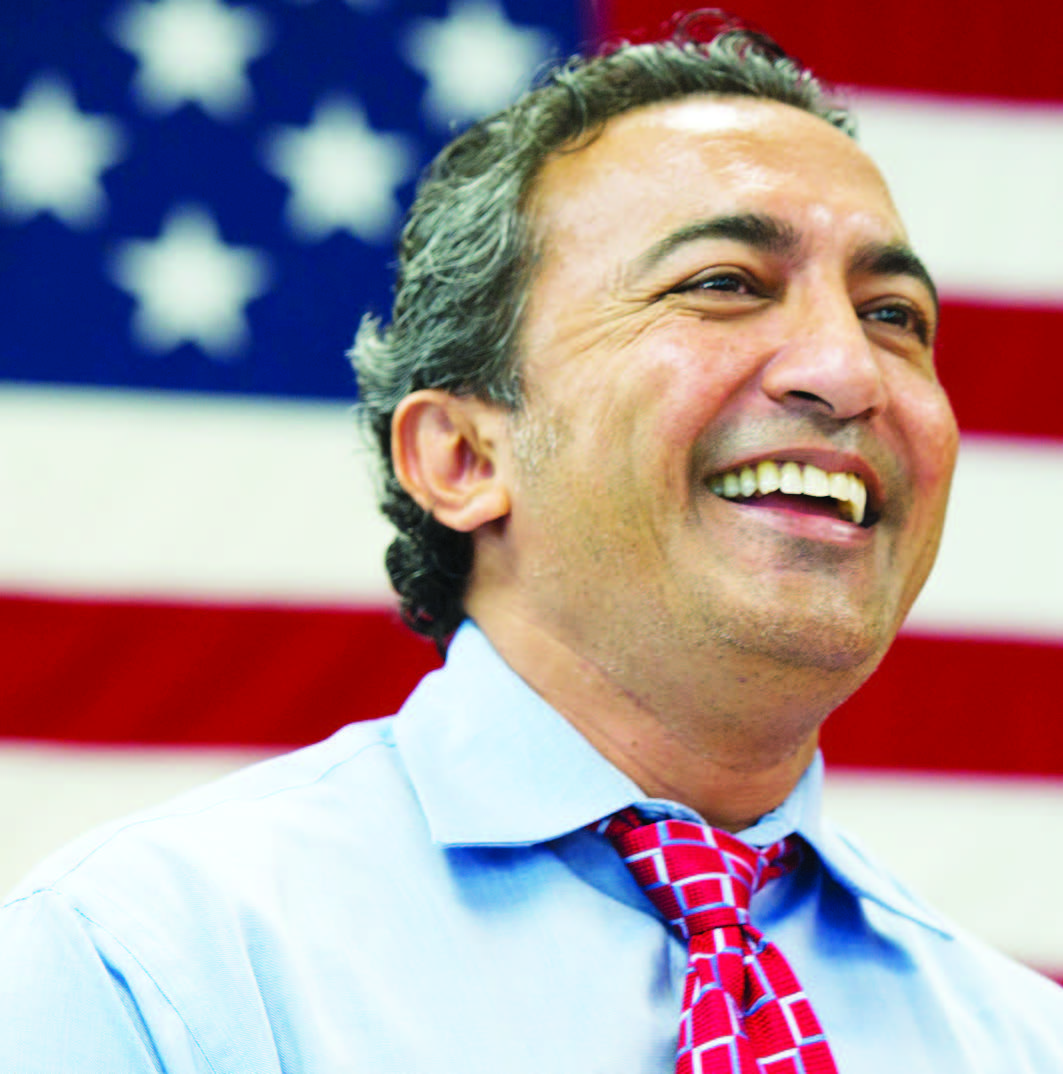
SACRAMENTO (TIP): Amiresh ‘Ami’ Bera, the lone Indian American lawmaker in the US House of Representatives, managed to edge out his Republican opponent in a California race two weeks after the elections. Bera, who had won in a similar fashion in 2012, trailed Republican Doug Ose by more than 3,000 votes at the close of election night and steadily closed the gap as election officials tallied tens of thousands of remaining ballots. Bera, the third Indian American House member after Dalip Singh Saund and current Louisiana Governor Bobby Jindal, had ousted then sitting Republican House member Dan Lungren in 2012.
“It’s been my honor serving this community as a doctor for the last 19 years and I am grateful I will have the opportunity to continue serving as the representative for California’s 7th Congressional District in Congress,” Bera said in a statement. “If you remember in the contest in 2012, we were tied and after the ballots were counted, we won by over 9,000 votes,” Bera said. Ose congratulated Bera on the hard fought win saying he “celebrates the fact that our institutions and our laws provide us a system whereby elections can be peacefully resolved”. The race was deemed the most expensive one with both candidates spending at least $19.6 million in the campaign, according to the Centre for Responsive Politics. -

Xoom Announces Instant Deposit Service to Bank of Baroda Accounts in India
SAN FRANCISCO, CA (TIP): Xoom Corporation (NASDAQ: XOOM), a leading digital money transfer provider, is now offering instant deposits to Bank of Baroda bank accounts in India. This revolutionary service allows Xoom customers to instantly deposit money into their recipients’ Bank of Baroda bank accounts, 365 days a year, including bank holidays. Instant deposits to Bank of Baroda are processed through Xoom’s partnership with Punjab National Bank. “Through our partnership with Punjab National Bank and the breakthrough IMPS technology, we are thrilled to expand our instant deposit service to Bank of Baroda, one of the largest public sector banks in India,” said Julian King, Senior Vice President of Marketing and Business Development for Xoom.
“Instant deposits are available 365 days, including bank holidays, so customers will never have to wait. Speed and convenience are what customers expect from Xoom’s service and we continue to do just that in our mission to provide instant deposit to even more banks in India.” In addition to Bank of Baroda, Xoom also offers instant deposits to ICICI Bank, HDFC Bank, Punjab National Bank, Union Bank of India, Federal Bank and Yes Bank. Xoom provides great locked-in exchange rates for money transfers to India, and there is no fee when customers send more than $1,000 and pay with their U.S.-based bank account. Plus, Xoom continues to provide fast bank deposits within four hours to all other banks in India, including to NRE and NRO accounts, when sent during bank processing hours in India. Customers can also download the Xoom App for Android and iOS mobile devices for free. Visit https://www.xoom.com/india for more information. -

Xoom Announces Instant Deposit Service to Kotak Mahindra Bank Accounts in India
SAN FRANCISCO, CA (TIP): Xoom Corporation (NASDAQ: XOOM), a leading digital money transfer provider, is now offering instant deposits to Kotak Mahindra Bank accounts in India. This revolutionary service allows Xoom customers to instantly deposit money into their recipients’ Kotak Mahindra Bank accounts, 365 days a year, including bank holidays.
Instant deposits to Kotak Mahindra Bank are processed through Xoom’s partnership with Punjab National Bank., a press release said. “Through our partnership with Punjab National Bank and the breakthrough IMPS technology, we are thrilled to expand our instant deposit service to Kotak Mahindra Bank,” said Julian King, Senior Vice President of Marketing and Business Development for Xoom. “Instant deposits are available 365 days, including bank holidays, so customers will never have to wait. Speed and convenience are what customers expect from Xoom’s service and we continue to do just that in our mission to provide instant deposit to even more banks in India.”
In addition to Kotak Mahindra Bank, Xoom also offers instant deposits to ICICI Bank, HDFC Bank, Punjab National Bank, Bank of Baroda, Union Bank of India, Federal Bank and Yes Bank. Xoom provides great locked-in exchange rates for money transfers to India, and there is no fee when customers send more than $1,000 and pay with their U.S.-based bank account. Plus, Xoom continues to provide fast bank deposits within four hours to all other banks in India, including to NRE and NRO accounts, when sent during bank processing hours in India. Customers can also download the Xoom App for Android and iOS mobile devices for free. Visit https://www.xoom.com/india for more information.
About Xoom
Xoom is a leading digital money transfer provider that enables consumers to send money to 30 countries in a secure, fast and cost-effective way, using their mobile phone, tablet or computer. During the 12 months ended June 30, 2014, Xoom’s more than 1.1 million active customers sent approximately $6.3 billion to family and friends. The company is headquartered in San Francisco and can be found online at www.xoom.com.
About Kotak Mahindra Bank
Established in 1985, the Kotak Mahindra group is one of India’s leading financial services conglomerates. In February 2003, Kotak Mahindra Finance Ltd. (KMFL), the group’s flagship company, received banking license from the Reserve Bank of India (RBI). With this, KMFL became the first nonbanking finance company in India to become a bank – Kotak Mahindra Bank Ltd (KMBL).
KMBL offers complete retail financial solutions for varied customer requirements. The Savings Bank Account goes beyond the traditional role of savings, and provides range of services through a comprehensive suite of investment services and other transactional conveniences like Online Shopping, Bill Payments, ASBA, Netc@rd, ActivMoney (Automatic TD sweep-in and Sweep-out) etc. Kotak’s Jifi, a first-of-its-kind fully integrated Social Bank Account, redefines digital banking by seamlessly incorporating social networking platforms like Twitter and Facebook with mainstream banking.
KMBL also offers an Investment Account where Mutual Fund investments are recorded and can be viewed in a consolidated fashion across fund houses & schemes. Further, the Bank offers loan products such as Home Loans, Personal Loans, Commercial Vehicle Loans, etc. Keeping in mind the diverse needs of the business community, KMBL offers comprehensive business solutions that include Current Account, Trade Services, Cash Management Services and Credit facilities. -

OBAMA’S SPEECH ON IMMIGRATION REFORMS
MYfellow Americans, tonight, I’d like to talk with you about immigration. For more than 200 years, our tradition of welcoming immigrants from around the world has given us a tremendous advantage over other nations. It’s kept us youthful, dynamic, and entrepreneurial. It has shaped our character as a people with limitless possibilities – people not trapped by our past, but able to remake ourselves as we choose. But today, our immigration system is broken, and everybody knows it.
Families who enter our country the right way and play by the rules watch others flout the rules. Business owners who offer their workers good wages and benefits see the competition exploit undocumented immigrants by paying them far less. All of us take offense to anyone who reaps the rewards of living in America without taking on the responsibilities of living in America. And undocumented immigrants who desperately want to embrace those responsibilities see little option but to remain in the shadows, or risk their families being torn apart. It’s been this way for decades.
And for decades, we haven’t done much about it. When I took office, I committed to fixing this broken immigration system. And I began by doing what I could to secure our borders. Today, we have more agents and technology deployed to secure our southern border than at any time in our history. And over the past six years, illegal border crossings have been cut by more than half. Although this summer, there was a brief spike in unaccompanied children being apprehended at our border, the number of such children is now actually lower than it’s been in nearly two years.
Overall, the number of people trying to cross our border illegally is at its lowest level since the 1970s. Those are the facts. Meanwhile, I worked with Congress on a comprehensive fix, and last year, 68 Democrats, Republicans, and Independents came together to pass a bipartisan bill in the Senate. It wasn’t perfect. It was a compromise, but it reflected common sense. It would have doubled the number of border patrol agents, while giving undocumented immigrants a pathway to citizenship if they paid a fine, started paying their taxes, and went to the back of the line.
And independent experts said that it would help grow our economy and shrink our deficits. Had the House of Representatives allowed that kind of a bill a simple yes-or-no vote, it would have passed with support from both parties, and today it would be the law. But for a year and a half now, Republican leaders in the House have refused to allow that simple vote. Now, I continue to believe that the best way to solve this problem is by working together to pass that kind of common sense law. But until that happens, there are actions I have the legal authority to take as President – the same kinds of actions taken by Democratic and Republican Presidents before me – that will help make our immigration system more fair and more just.
Tonight, I am announcing those actions. First, we’ll build on our progress at the border with additional resources for our law enforcement personnel so that they can stem the flow of illegal crossings, and speed the return of those who do cross over. Second, I will make it easier and faster for high-skilled immigrants, graduates, and entrepreneurs to stay and contribute to our economy, as so many business leaders have proposed. Third, we’ll take steps to deal responsibly with the millions of undocumented immigrants who already live in our country.
I want to say more about this third issue, because it generates the most passion and controversy. Even as we are a nation of immigrants, we are also a nation of laws. Undocumented workers broke our immigration laws, and I believe that they must be held accountable – especially those who may be dangerous. That’s why, over the past six years, deportations of criminals are up 80 percent. And that’s why we’re going to keep focusing enforcement resources on actual threats to our security. Felons, not families. Criminals, not children. Gang members, not a mother who’s working hard to provide for her kids.
We’ll prioritize, just like law enforcement does every day. But even as we focus on deporting criminals, the fact is, millions of immigrants – in every state, of every race and nationality – will still live here illegally. And let’s be honest – tracking down, rounding up, and deporting millions of people isn’t realistic. Anyone who suggests otherwise isn’t being straight with you. It’s also not who we are as Americans. After all, most of these immigrants have been here a long time. They work hard, often in tough, lowpaying jobs. They support their families. They worship at our churches. Many of their kids are American-born or spent most of their lives here, and their hopes, dreams, and patriotism are just like ours.
As my predecessor, President Bush, once put it: “They are a part of American life.” Now here’s the thing: we expect people who live in this country to play by the rules. We expect that those who cut the line will not be unfairly rewarded. So we’re going to offer the following deal: If you’ve been in America for more than five years; if you have children who are American citizens or legal residents; if you register, pass a criminal background check, and you’re willing to pay your fair share of taxes – you’ll be able to apply to stay in this country temporarily, without fear of deportation. You can come out of the shadows and get right with the law. That’s what this deal is.
Now let’s be clear about what it isn’t. This deal does not apply to anyone who has come to this country recently. It does not apply to anyone who might come to America illegally in the future. It does not grant citizenship, or the right to stay here permanently, or offer the same benefits that citizens receive – only Congress can do that. All we’re saying is we’re not going to deport you. I know some of the critics of this action call it amnesty. Well, it’s not. Amnesty is the immigration system we have today – millions of people who live here without paying their taxes or playing by the rules, while politicians use the issue to scare people and whip up votes at election time.
That’s the real amnesty – leaving this broken system the way it is. Mass amnesty would be unfair. Mass deportation would be both impossible and contrary to our character. What I’m describing is accountability – a commonsense, middle ground approach: If you meet the criteria, you can come out of the shadows and get right with the law. If you’re a criminal, you’ll be deported. If you plan to enter the U.S. illegally, your chances of getting caught and sent back just went up. The actions I’m taking are not only lawful, they’re the kinds of actions taken by every single Republican President and every single Democratic President for the past half century. And to those Members of Congress who question my authority to make our immigration system work better, or question the wisdom of me acting where Congress has failed, I have one answer: Pass a bill.
I want to work with both parties to pass a more permanent legislative solution. And the day I sign that bill into law, the actions I take will no longer be necessary. Meanwhile, don’t let a disagreement over a single issue be a dealbreaker on every issue. That’s not how our democracy works, and Congress certainly shouldn’t shut down our government again just because we disagree on this. Americans are tired of gridlock. What our country needs from us right now is a common purpose – a higher purpose. Most Americans support the types of reforms I’ve talked about tonight.
But I understand the disagreements held by many of you at home. Millions of us, myself included, go back generations in this country, with ancestors who put in the painstaking work to become citizens. So we don’t like the notion that anyone might get a free pass to American citizenship. I know that some worry immigration will change the very fabric of who we are, or take our jobs, or stick it to middle-class families at a time when they already feel like they’ve gotten the raw end of the deal for over a decade. I hear these concerns. But that’s not what these steps would do. Our history and the facts show that immigrants are a net plus for our economy and our society.
And I believe it’s important that all of us have this debate without impugning each other’s character. Because for all the back-and-forth of Washington, we have to remember that this debate is about something bigger. It’s about who we are as a country, and who we want to be for future generations. Are we a nation that tolerates the hypocrisy of a system where workers who pick our fruit and make our beds never have a chance to get right with the law? Or are we a nation that gives them a chance to make amends, take responsibility, and give their kids a better future? Are we a nation that accepts the cruelty of ripping children from their parents’ arms? Or are we a nation that values families, and works to keep them together? Are we a nation that educates the world’s best and brightest in our universities, only to send them home to create businesses in countries that compete against us? Or are we a nation that encourages them to stay and create jobs, businesses, and industries right here in America? That’s what this debate is all about. We need more than politics as usual when it comes to immigration; we need reasoned, thoughtful, compassionate debate that focuses on our hopes, not our fears.
I know the politics of this issue are tough. But let me tell you why I have come to feel so strongly about it. Over the past few years, I have seen the determination of immigrant fathers who worked two or three jobs, without taking a dime from the government, and at risk at any moment of losing it all, just to build a better life for their kids. I’ve seen the heartbreak and anxiety of children whose mothers might be taken away from them just because they didn’t have the right papers.
I’ve seen the courage of students who, except for the circumstances of their birth, are as American as Malia or Sasha; students who bravely come out as undocumented in hopes they could make a difference in a country they love. These people – our neighbors, our classmates, our friends – they did not come here in search of a free ride or an easy life. They came to work, and study, and serve in our military, and above all, contribute to America’s success. Tomorrow, I’ll travel to Las Vegas and meet with some of these students, including a young woman named Astrid Silva.
Astrid was brought to America when she was four years old. Her only possessions were a cross, her doll, and the frilly dress she had on. When she started school, she didn’t speak any English. She caught up to the other kids by reading newspapers and watching PBS, and became a good student. Her father worked in landscaping. Her mother cleaned other people’s homes. They wouldn’t let Astrid apply to a technology magnet school for fear the paperwork would out her as an undocumented immigrant – so she applied behind their back and got in. Still, she mostly lived in the shadows – until her grandmother, who visited every year from Mexico, passed away, and she couldn’t travel to the funeral without risk of being found out and deported.
It was around that time she decided to begin advocating for herself and others like her, and today, Astrid Silva is a college student working on her third degree. Are we a nation that kicks out a striving, hopeful immigrant like Astrid – or are we a nation that finds a way to welcome her in? Scripture tells us that we shall not oppress a stranger, for we know the heart of a stranger – we were strangers once, too. My fellow Americans, we are and always will be a nation of immigrants.
We were strangers once, too. And whether our forebears were strangers who crossed the Atlantic, or the Pacific, or the Rio Grande, we are here only because this country welcomed them in, and taught them that to be an American is about something more than what we look like, or what our last names are, or how we worship. What makes us Americans is our shared commitment to an ideal – that all of us are created equal, and all of us have the chance to make of our lives what we will. That’s the country our parents and grandparents and generations before them built for us. That’s the tradition we must uphold. That’s the legacy we must leave for those who are yet to come. Thank you, God bless you, and God bless this country we love.