Year: 2014

  • IM PLANS TO USE ‘STICKY BOMBS’ ON OIL TANKERS

    IM PLANS TO USE ‘STICKY BOMBS’ ON OIL TANKERS

    NEW DELHI (TIP): The Indian Mujahideen is planning to turn oilcarrying tankers into fireballs using magnetic explosive device for spectacular strikes, counter-terror officials familiar with the revelations made by the terror outfit’s top operative, Yasin Bhatkal, have told HT. “Bhatkal has revealed that the plan is to convert an oil-carrying goods train into a mega-bomb,” a counter terror official told HT requesting anonymity. “Once one wagon explodes due to an IED (improvised explosive device) blast, other wagons will also blow up, turning the goods train into a big firestorm.” One can easily imagine the devastation such a train bomb would cause at a busy railway station, the official said. Sticky bombs are sophisticated, hard to detect and more lethal than IEDs. Used extensively to devastating effect in Afghanistan and in Iraq during the latter part of US occupation, sticky bombs are rare to India.

    The only known instance is when an Israeli embassy car was badly damaged in the Capital on February 13, 2012 after a sticky bomb stuck on the rear of the vehicle went off, injuring four people. The IM, sources said, had already conducted initial experiments when Bhatkal and his aide, Asadullah Akhtar, were picked up by Indian counter-terror officials from Pokhra in Nepal and formally arrested at the Indo-Nepal border on August 29. Two IM operatives Tehseen Akhtar, alias Monu, and Waqas were preparing magnetic IEDs when their hideout in Mangalore, Karnataka was raided after Bhatkal’s arrest. “More than 50 magnets were found at the hideout. When Yasin was asked about the magnets, he revealed the whole plan – of fabricating the IEDs with magnets and sticking them on oil tankers.” The outfit was also planning to convert oil tanker lorries into ‘smaller’ bombs, said the official. Monu and Waqas are on the run. Security agencies last spotted Monu in Pushkar, Rajasthan, working as a tourist guide.

  • I had offered to quit before retirement: RK Singh

    I had offered to quit before retirement: RK Singh

    NEW DELHI (TIP): Former home secretary R K Singh has said that he had offered to resign when his successor Anil Goswami was brought in as officer on special duty almost two months before the end of his tenure, in a “deliberate move by minister Sushil Kumar Shinde to sideline him”. “It was completely absurd to bring in an OSD when I still had two months left. Apparently, Shinde had put pressure at the highest level in the government for the premature appointment. I did not like it and approached the cabinet secretary, offering to resign. However, I was dissuaded from doing so,” Singh said.

    The former home secretary, who earlier this week accused Shinde of interfering with the functioning and investigations of Delhi Police, said he had brought this to the notice of then principal secretary to the Prime Minister Pulok Chatterjee. Singh said his differences with Shinde really started after the latter insisted on removing then Delhi Police commissioner Neeraj Kumar over an attack by Jat protestors at his residence last year. Singh opposed this, arguing that it would be unfair to hold an officer above ACP-rank responsible. Thereafter, Neeraj Kumar confided in Singh about the alleged slips sent to him by Shinde’s staff directing him on transfers and postings in Delhi Police. “He even showed me SMSs sent to him to that effect,” Singh said. Slamming allegations that he was attacking Shinde because he had failed to land a post-retirement posting, Singh clarified that though he had applied for top posts in CAG, CIC and UPSC in the normal course, he was approached by Bihar government much before his retirement with an offer to join as an adviser.

    “I accepted the offer… so where is the question of lobbying for these central government posts when I had already committed to Bihar government,” he said. Singh also dismissed charges of opportunism, saying he chose to speak out against Shinde as the minister had “provoked” him by claiming to have “scolded” him over the Jat protests at his residence. “My differences with Shinde were already known… I had briefed principal secretary to the PM about the same,” said Singh. “And if my criticism of Shinde were to be politically motivated, why would I not have similar things to say about other ministers like P Chidambaram and A K Antony, both of whom I shared a good working relationship with,” the former bureaucrat said.

  • Hollande’s ‘dullest hour’ disappoints British press

    Hollande’s ‘dullest hour’ disappoints British press

    LONDON (TIP): Britain’s newspapers were on Wednesday left mystified by their French counterparts’ reluctance to quiz President Francois Hollande over claims of an affair, concluding “they do things differently” across the Channel. Britain’s rowdy media was gleefully awaiting an inquisition over his reported affair with actress Julie Gayet as he arrived to deliver a press conference at the Elysee Palace in Paris. But they were left disappointed when “deferent” journalists largely left Hollande free to explain a series of economic reforms. “How odd it all felt,” said the Daily Telegraph’s Michael Deacon. “For centuries we had mockingly stereotyped the French as sex-mad. When, in reality, these spotlessly abstemious souls have so little interest in sex that when their own head of state is caught up in the juiciest scandal to hit politics since Clinton- Lewinsky, they only want to ask about social security,” he joked.

    He asked whether the French “were mad, or are we?” The left-wing Guardian, generally supportive of Hollande’s claims to a private life, admitted that “they do things differently in France”. “Would he get away with this in Britain or America? Possibly not,” said the paper’s columnist Jon Henley. “But, outraged tweets by Anglo-Saxon hacks notwithstanding, this was France.” He praised the general quality of French journalism, but argued “there is a certain undeniable deference to the president, the living embodiment of the republic.” The paper carried a front-page photograph of the beleaguered leader under the headline “A very French affair”.

    The Times compared the developing story to the Profumo Affair, the 1963 British sexscandal that forced the resignation of secretary for war John Profumo. The Rupert Murdoch-owned paper said it was “clear that the big topic of the day would be treated with kid gloves by the French press corps.” “When Mr Hollande’s speech ended, Alain Barluet, a political correspondent for Le Figaro and the chairman of the Presidential Press Association, seized the microphone and rose to his feet with the look of a man facing a firing squad,” wrote the paper’s Adam Sage. The couple of other French journalists did broach the issue again, but that was pretty much that.

    In short, they ensured that the peace had been safeguarded in the republic once again.” Quentin Letts from the centre-right Daily Mail mocked those charged with quizzing Hollande, who he called the “most unlikely swordsman since Inspector Clouseau”. “Before him sat a salon of oyster munchers, the powdered, poodling, truthsmothering trusties of polite Parisian opinion,” he wrote. “They are aghast that the peasants should be told about presidential legeauver (sic). No wonder they never tell their people the truth about the European Commission,” he added. Popular tabloid the Sun slammed Hollande’s performance as “the dullest hour of anyone’s life”. It also said his insistence on privacy was a technique used “by elites worldwide since the dawn of democracy” to “let them be seen as they want to be seen — not as they are”.

  • UK gives Af atheist religious asylum

    UK gives Af atheist religious asylum

    LONDON (TIP): Britain has granted asylum to an atheist from Afghanistan due to fears he would be prosecuted back home, in what is believed to be the first case of its kind, his lawyers said on Tuesday. The unnamed man was brought up a Muslim but after arriving in Britain in 2007 at the age of 16, he gradually lost faith, said the university whose law school helped his case. His leave to remain will expire in 2013 but he feared going back because he might be prosecuted for abandoning his faith.

    The man’s case was taken up by Kent Law Clinic, a free service provided by University of Kent students in England and supervised by qualified lawyers. Claire Splawn, the undergraduate law student who prepared his case, said that an atheist should protected “in the same way as a religious person is protected.” The lawyers concluded that the man’s return could result in a death sentence for being an apostate unless he remained discreet about his atheist beliefs.

  • 8 arrested after blast in China’s gambling den killed 15

    8 arrested after blast in China’s gambling den killed 15

    BEIJING (TIP): Chinese police said eight people have been arrested in connection to an explosion which killed 15 people at a gambling site in Kaili City of southwest China’s Guizhou Province. It has not cited the cause yet of the blast which took place on January 12. State media quoted the police as saying that a “suspicious crater measuring between one and two meters in diameter” was found under the tent which was used as a gambling den.

    The police is collecting evidence and are trying to identify the bodies, it said. The blast also left eight people injured. All of them are in stable condition in hospital. The gambling site was a simple tent pitched on a flat area in mountains, it said. The gambling site specialized in a dice game called ‘Gundilong’ and took large bets from gamblers who travelled long distances in cars to gamble, locals told Xinhua.

  • DJ Dave Lee Travis ‘assaulted girls on air’, court hears

    DJ Dave Lee Travis ‘assaulted girls on air’, court hears

    LONDON (TIP): Veteran British presenter Dave Lee Travis sexually assaulted young women while live on television and in his radio studio, prosecutors told his trial on January 14. The 68-year-old former BBC star, one of the biggest names in British broadcasting during the 1970s and 1980s, denies assaulting 11 women, one of whom was underage at the time of the alleged crime. The jury at London’s Southwark Crown Court was shown footage of Travis allegedly putting his hand up a young woman’s skirt as he introduced a song by The Smurfs on the TV show “Top of the Pops” in 1978. Prosecutor Miranda Moore said Travis, who appeared in court under his real name David Patrick Griffin, was an “opportunist” who had targeted “young women who were very vulnerable”.

    Travis spent 25 years presenting on BBC Radio 1, and also hosted a music request show on the BBC World Service, a favourite of Myanmar’s opposition leader Aung San Suu Kyi who was at the time being held under house arrest. The youngest of his alleged victims says she was 15 when he attacked her — below the age of sexual consent in Britain, which is 16. She claims Travis groped her breasts and pinned her to her seat while in his trailer at a concert by the pop group Showaddywaddy in 1978. “In her words, she thought he was going to rape her,” Moore told the jury. Moore said another alleged victim was forced to flee a studio after Travis pressed his groin against her and put his hand into her underwear.

    “She told him to stop and he grabbed her and put the red light on,” Moore said — signalling the studio was broadcasting live and nobody should enter. Another accuser said she was groped by Travis while working at a theatre where he was performing as the “evil wizard” in the pantomime Aladdin in late 1990 or early 1991, the court heard. The jury was told that Travis pulled his hand out of her trousers when he heard a member of the comedy duo the Chuckle Brothers, who were also performing in the pantomime, walking past. Travis is accused of 13 counts of indecent assault between 1976 and 2003, and one count of sexual assault in 2008.

  • US Senate committee says Benghazi attack was preventable

    US Senate committee says Benghazi attack was preventable

    WASHINGTON (TIP): The US Senate Intelligence Committee on January 15 released a report on the deadly 2012 assault on the diplomatic compound in Benghazi, Libya, blaming the state department, the intelligence community and even the late ambassador Chris Stevens for failing to communicate and heed warnings of terrorist activity in the area.

    The highly critical report says the US military was not positioned to help the Americans in need, though the head of Africa Command had offered military security teams that Stevens _ who was killed _ had rejected weeks before the attack. Republicans have criticized the Obama administration over the Benghazi assault, in part because then-UN ambassador Susan Rice initially blamed the violence on mob protests over an anti- Islamic film. Al-Qaida-linked militant groups later were blamed. Militants overran the temporary US mission on September 11, 2012, and later that night, when militants fired mortars at the nearby CIA annex where the Americans had taken shelter.

    Republicans have said the Obama administration has been covering up what they consider misdeeds before, during and after the attack. Committee chairman Dianne Feinstein, says she hopes the report will put to rest conspiracy theories about the militant attacks that night. Vice chairman Saxby Chambliss says the report shows despite a deteriorating security situation in Benghazi, the US government did not do enough to prevent the attacks or to protect the diplomatic facility. The Senate report notes that the state department has created a new assistant secretary position for highthreat posts to focus on such dangerous areas, but it says the department should react more quickly to security threats and only in rare instances use facilities that are inadequately protected.

    The report also says the state department should not rely on local security alone in countries where the host government cannot provide adequate protection. The report notes that the state department in 2012 continued to operate the Benghazi facility, despite US intelligence reports showing the danger was growing. The report faults the military for being unable to help when needed. “No US military resources in position to intervene in short order in Benghazi to help defend” the US facilities in Benghazi, it says. Yet it points out that Stevens had rejected additional security. The defence department had provided a Site Security Team in Tripoli, made up of 16 special operations personnel to provide security and other help.

    The report says the state department decided not to extend the team’s mission in August 2012, one month before the attack. In the weeks that followed, Gen. Carter Ham, the head of Africa Command, twice asked Stevens to employ the team, and twice Stevens declined, the report said. The report also says, “Intelligence analysts inaccurately referred to the presence of a protest at the US mission facility before the attack based on open source information and limited intelligence, but without sufficient intelligence or eyewitness statements to corroborate that assertion.” The report says the US intelligence community then took too long to correct their error. The senators also criticize the Obama administration for failing to bring the attackers to justice more than a year after the Benghazi attacks. It says US intelligence has identified several individuals responsible, but can’t track them down because of limited intelligence capabilities in the region. White House spokesman Jay Carney said a number of the committee’s security recommendations are consistent with steps the state department has already taken.

  • Obama may enforce curbs on snooping

    Obama may enforce curbs on snooping

    WASHINGTON (TIP): President Barack Obama is expected to endorse changes to the way the government collects millions of Americans’ phone records for possible future surveillance, but he’ll leave many of the specific adjustments for Congress to sort out, according to three US officials familiar with the White House intelligence review. That move would thrust much of the decision-making on Section 215 of the USA Patriot Act toward a branch of government that is deeply divided over the future of surveillance.

    And members of Congress are in no hurry to settle their differences and quickly enact broad changes. Obama will speak about the bulk collections and other surveillance programmes in a highly anticipated speech on Friday at the justice department. White House officialscautioned that the review Obama has been conducting is not complete and that he could make additional decisions. They said that a panel recommendation that has proven particularly challenging for Obama is to strip NSA of its authority to hold phone records.

  • Doctor convicted in Michael Jackson death loses appeal

    Doctor convicted in Michael Jackson death loses appeal

    LOS ANGELES (TIP): A California appellate court refused on January 15 to overturn the conviction of Michael Jackson’s personal physician, Conrad Murray, who was found guilty of involuntary manslaughter in the death of the pop star. The three-judge panel of California 2nd District Court of Appeal unanimously upheld Murray’s 2011 conviction, ruling that there was sufficient evidence and there were no errors during his trial.

    Grenada-born Murray, 60, was released from a Los Angeles jail in October after serving two years. Murray’s six-week trial in 2011 grabbed global attention after Jackson, preparing for a series of comeback concerts in London, died unexpectedly in 2009 at age 50 from an overdose of the surgical anesthetic, propofol. Prosecutors successfully argued at the trial that Murray, who was hired by concert promoter AEG Live as Jackson’s general practitioner, was grossly negligent in administering the powerful anesthetic, which was used to help the singer sleep.

    Murray’s attorneys presented the case that Jackson had injected himself with the powerful anesthetic. The cardiologist’s current attorney handling his appeal, Valerie Wass, said she anticipated an appeal would be filed to the California Supreme Court. “I’m always of the opinion that he has a better chance in the (California) Supreme Court or federal court,” Wass said. Murray, whose medical license was either suspended or lapsed in California, Nevada, Texas and Hawaii, has said he wants to practice again, but so far his appeals have been turned down.

  • Britain’s World War I diaries go online

    Britain’s World War I diaries go online

    LONDON (TIP): Britain is recruiting an army of amateur historians to sift through more than 1.5 million pages of diaries written by World War I army officers, published online for the first time 100 years after the conflict began. Spanning the whole of the 1914-18 conflict, the diaries are the official record of the war by British army units — but deeply poignant testimony can be found among the battalions’ dayto- day accounts of their movements.

    “I have never spent and imagine that I can never spend a more ghastly and heart-tearing forty-eight hours than the last,” writes Captain James Patterson in an entry from the French trenches dated September 16, 1914. “Swarms of Germans on the ridge rather massed. Our guns open on them at 1,800 yards, and one can see a nasty sight through one’s glasses. Bunches of Germans blown to pieces.” The yellowing pages of Patterson’s diary are among some 2,000 files published online on Tuesday by Britain’s National Archives, as part of a project that will eventually see some 1.5 million similar documents made available on the Internet. “A lot of people think that a unit war diary will only mention places and dates and activities, but there are lots and lots of different stories amongst these records,” said William Spencer, the archives’ principal military specialist.

    “By digitizing them, we not only preserve them for future generations — we also make them available in a new way.” The archives are urging volunteers to help them catalogue the contents of the diaries as part of “Operation War Diary” (operationwardiary.org), a joint project with London’s Imperial War Museum and Zooniverse, a citizen science project. Members of the public will be able to tag key details mentioned on the online pages — such as names, places and dates — with the aim of making the diaries searchable for everyone from academics to family tree researchers. Organisers say the work of these “citizen historians” is crucial because the service records of many of the troops mentioned in the diaries were destroyed by bombing during World War II.

    Patterson’s own neatly typewritten diary, recording the movements of the 1st Battalion South Wales Borderers, comes to an abrupt end on October 25, 1914, when he was killed just three months into the war. His diary had recorded scenes “beyond description”. “Poor fellows shot dead are lying in all directions,” he wrote. “Everywhere the same hard, grim, pitiless sign of battle and war.” He describes his terror of firing into the night, writing: “One is very likely to kill one’s own men, and from wounds I have seen since, I am sure some of them were hit like this.” The diaries also describe lighter moments among the troops, such as rugby matches and tugs-of-war. “A somewhat scrappy game, ending in a draw,” reads the official account of one rugby match.

    Another diary entry — part of a batch yet to be published — describes the exploits of one Reverend Tron, chaplain to some of the battalions. “The padre … repeatedly struck the German in the face until they broke apart,” reads the entry. “Unslinging his glasses, the German thrust them into the hands of the astonished clergyman, and tended his surrender.” Luke Smith of the Imperial War Museum said the work of volunteers in sorting through the diaries would help piece together the stories of the priest and thousands of others who served in the war. “By working with citizen historians, we’re going to find all the references to Reverend Tron, and the half-a-million or so other named people in those diaries,” he said. “We’re going to uncover the story of the Western Front at an unprecedented level of detail.”

  • US suspends 34 nuclear missile officers over exam cheating

    US suspends 34 nuclear missile officers over exam cheating

    WASHINGTON (TIP): The US military has suspended 34 officers in charge of launching nuclear missiles for cheating on a proficiency test, Air Force leaders said on January 15. The scandal at Malmstrom Air Force Base in Montana marked the latest in a series of damaging revelations dogging the country’s nuclear force, including a separate probe into illegal drugs that came to light last week.

    “There was cheating that took place with respect to this particular test,” air force secretary Deborah Lee James told a news conference. “Some officers did it. Others apparently knew about it, and it appears that they did nothing, or at least not enough, to stop it or to report it.” She called the cheating “absolutely unacceptable behavior” but insisted the scandal did not call into question the safety or competence of the nuclear force.

    “And very importantly, I want you to know that this was a failure of some of our airmen. It was not a failure of the nuclear mission,” said James. The launch officers tied to the cheating allegations have also lost their security clearances. The cheating came to light as investigators were looking into suspicions of illicit drug possession by some officers at Malmstrom and other bases. Two of the officers implicated in the cheating also are linked to the separate drug case, which involves officers at other bases, officials said.

    The Air Force has come under growing scrutiny over a spate of embarrassing setbacks linked to the nuclear force, amid persistent reports of low morale among the troops assigned to the mission. All launch officers in the missile force have been ordered to take the proficiency exam again and the testing will be completed by Thursday, said James, who was accompanied by the Air Force chief of staff, General Mark Welsh. The Malmstrom base has a total of about 190 launch officers, including the 34 who have been suspended.

  • Xi Jinping warns of grim fight against corruption

    Xi Jinping warns of grim fight against corruption

    BEIJING (TIP): Chinese President Xi Jinping said that the drive to curb corruption in public life will become harsher and “all dirty hands will be caught”. The President called corruption a disease that has to be cured with “drastic medicine” and reminded Communist Party officials of an old proverb, which says that it is sometimes necessary to cut off the wrist that is bitten by a snake. Xi has made fighting pervasive corruption a central theme since assuming office and has warned, like others before him, that corruption threatens the party’s survival. “Xi Jinping stressed that while we affirm our achievements, we must also see that the fertile ground for corruption still exists,” state broadcaster CCTV said.

    “The anti-corruption situation remains grim and complicated, the unhealthy influence of the corruption problem is malignant and needs to be solved quickly,” CCTV cited Xi as saying. He said the party must “continue to beat the tigers and flies together”—meaning both high-flying politicians and lowly bureaucrats— to tackle corruption. Xi’s comments, made in a speech to the Communist Party’s anti-graft watchdog, on Monday reflect that the president and the party general secretary are not entirely happy with the progress of the anti-graft drive. Hotbeds of corruption still exist, and it is a complex problem, he said.

    Xi, who became China’s president in March last year, urged efforts to ensure “relatively independent and authoritative supervisory power” of disciplinary agencies at all levels. China saw a rise of 13.3% in anticorruption cases in 2013 as compared to the previous year. Antigraft officials also investigated 31 high profile officials and handed over their cases to prosecutors.

  • Intern’s plea: SC notice to Justice Swatanter Kumar

    Intern’s plea: SC notice to Justice Swatanter Kumar

    NEW DELHI (TIP): The Supreme Court today issued a notice to National Green Tribunal (NGT) Chairman Justice Swatanter Kumar on a PIL petition by a woman lawyer claiming that she was sexually harassed by Justice Kumar in May 2011 while she was an intern and he was a sitting SC judge. A Bench headed by Chief Justice P Sathasivam, however, made it clear that it was not expressing any opinion on the allegations against Justice Kumar and would go only into the prayer for setting up a permanent mechanism in the SC to deal with such complaints against sitting or retired judges.

    The Bench, which included Justices Ranjan Gogoi and Shiva Kirti Singh, clarified that the complaint in question would be referred to the proposed committee, subject to SC deciding to constitute it and finding merit in the allegation against the NGT Chairman despite the 30-month delay in filing it. The Bench also sought views of the Centre on the issue and asked senior counsel Fali S Nariman and PP Rao to assist the court as amicus curiae in adjudicating the matter. Attorney General GE Vahanvati would also help the Bench. At the outset, the Bench asked senior counsel Harish Salve, who appeared for the victim, as to why his client had chosen to remain silent for such a long time before coming out in the open despite the fact that as a lawyer she must have been aware of the need to file a complaint immediately on such issues.

    If such complaints were entertained, retired judges would run the risk of facing sexual harassment allegations even at the age of 80-85, decades after demitting office, the Bench noted. Salve said the SC did not have a mechanism to receive such complaints in 2011 and even the present committee set up under its own guidelines in the Vishakha case to deal with sexual harassment at workplaces did not have the mandate to entertain complaints against sitting or retired judges. His client approached the SC with her grievance after the court’s prompt action on a similar complaint by another intern against its former judge AK Ganguly in November- December 2012, he said. During the brief arguments, both Salve and the Bench refrained from taking the name of Justice Kumar, preferring him to mention him as “Respondent No. 2”.

    Asking Justice Kumar and the Centre to respond to the PIL within four weeks, the Bench posted the matter for next hearing on February 14. Justice Kumar has denied the allegations and moved the Delhi High Court claiming damages against the media organisations for denting his image and reputation by naming him, besides pleading for a ban on reporting the issue merely on the basis of unsubstantiated allegations. After hearing his plea, the HC today reserved its order to be delivered tomorrow. The victim, who did her graduation in law from the West Bengal National University for Juridical Sciences (WBNUJS) from 2007-12, had sent a sworn affidavit narrating the harassment to the CJI on November 30, 2011, but the court’s Secretary General intimated her on December 13 that her complaint would not be entertained in the light of the December 5, 2013, full court resolution against admitting such pleas against retired judges. At the time of her internship she was working at the residence of Justice Kumar, assisting him in organising a conference on environment as the SC was closed for the summer vacation.

  • Oxford apologizes for email blunder

    Oxford apologizes for email blunder

    MELBOURNE (TIP): Oxford University has apologized after an administrator accidentally emailed a list of all the poorly performing students’ marks to their peers on Wednesday. The email disclosed the names of students who were awarded marks graded 2.2 and below in their first-term exams at University College. The Oxford Student newspaper reported that a mistake on an Excel document meant that the names and marks of almost 50 students were sent out on an email originally written to inform students of timetables for upcoming exams. Abigail Reeves, president of the University College’s JCR, said that the staff member responsible was “mortified” by the mistake.

    Dr Anne Knowland, a senior tutor at the university said, “We would like to apologize to all the students affected by this disclosure for any distress this has caused and reassure them that we are investigating how this happened and are determined to make sure this does not happen again.” The email is believed to have been sent to hundreds of students. The college has 372 undergraduate and 221 graduate students.

  • Slow and steady tortoise beats rabbit, wins pet ski-off

    Slow and steady tortoise beats rabbit, wins pet ski-off

    BEIJING (TIP): A tortoise beat a rabbit in a skiing competition held for pets and their owners in China, a report said on January 13. Cats and dogs faced off against a menagerie including a rooster and a yellow duck in a race to the finish line on snowy slopes in Henan province, the state-run China News Service said. The 40 human competitors were allowed to place their animals on skis or sledges, or could guide the pet with a lead while skiing, the report said. In an unexpected outcome akin to an ancient Greek fable, a tortoise beat a rabbit, with the shelled reptile eventually claiming third place overall, the report said. “Because the rabbit loved jumping and didn’t follow its owner’s commands, it was overtaken by the tortoise,” it said.

    The tortoise — which would normally be expected to hibernate during the winter — apparently hitched a ride on its owner’s ski equipment, the report added. Pictures showed a yellow duck taking to the slopes in a fetching red neck tie, attracting curious stares from two dogs, before being held aloft by its owner who clutched a red certificate of honour after it waddled over the finish line — even though it finished last overall. The bird’s “spirit of persistence rendered onlookers speechless with admiration,” the report said. Skiing has become more popular in China in recent years, with a range of slopes opening across the country’s cold north, and it is bidding for the 2022 Winter Olympics.

    The bid, though, faces a number of challenges, not least that Asia will host both the 2018 winter Games in South Korea’s Pyeongchang and the 2020 summer Olympics in Tokyo. The US state of California plays host to an annual dog-surfing competition, and a Chinese farmer made headlines in 2012 for training pigs to dive from a threemetre platform.

  • Polls in Egypt close after final day of voting on new constitution: State media

    Polls in Egypt close after final day of voting on new constitution: State media

    CAIRO (TIP): Polls across Egypt closed on Wednesday evening, state media reported, after a second and final day of voting on a draft constitution that could pave the way for a presidential bid by army chief General Abdel Fattah al- Sisi. Though voting passed off more peacefully than on Tuesday, when nine people were killed, officials said police arrested at least 79 people during protests by supporters of deposed President Mohamed Morsi, who was removed from power by Sisi in July.

  • Sheikh Hasina sworn in for 3rd time as Bangladesh PM

    Sheikh Hasina sworn in for 3rd time as Bangladesh PM

    DHAKA (TIP): Sheikh Hasina was sworn in on Sunday for her second straight term as Bangladesh’s prime minister and third overall, following one of the most violent elections in the country’s history. Hasina took the oath of office a week after her Awami League party won an election marred by street fighting, low turnout and an opposition boycott that made the results a foregone conclusion. President Abdul Hamid also swore in 29 cabinet ministers and 19 deputies. The election was one of the deadliest since Bangladesh’s 1971 independence, as an opposition alliance led by Khaleda Zia, former prime minister and Hasina’s archrival, attempted to derail the vote by calling weeks of strikes and blockades. At least 18 people died in election day violence, and more than 100 polling centers were set on fire. Since last February, at least 300 people have died in political violence.

    Zia, leader of the opposition Bangladesh Nationalist Party, or BNP, was absent from the swearing-in ceremony at the presidential house in the capital, Dhaka. Many western diplomats attended the ceremony despite a call from the United Nations, the United States and the European Union for an inclusive election. The election boycott by Zia’s party means Hasina’s new government will have no strong opposition in parliament. The BNP has vowed to continue trying to force Hasina to step down and allow a caretaker government to oversee a new election in which the opposition party would take part.

    After she was sworn in, Hasina, who also served as prime minister from 1996-2001, said she would work to uphold democracy and would not hesitate to take any measures if a consensus was reached. The political gridlock plunges Bangladesh deeper into turmoil and economic stagnation. The country also is struggling to reinvigorate its $20 billion garment industry, which has been hit by a series of horrifying disasters including a factory collapse last April that killed more than 1,100 workers.

  • Revoking AFSPA will not help Kashmir: Army Chief

    Revoking AFSPA will not help Kashmir: Army Chief

    NEW DELHI (TIP): Army Chief General Bikram Singh warned against revoking or diluting the Armed Forces Special Powers Act (AFSPA) in Jammu and Kashmir and said he was positive that recent talks with Pakistan and China would ensure peace along the border. “There are inputs of a possible terrorist spillover into the Valley after the US drawdown in Afghanistan.We need to look at developments in Afghanistan in 2014 before we can look at perhaps tampering with or diluting the Disturbed Areas Act,” the General said while addressing the media ahead of the Army Day (Jan 15).

    It would be prudent to wait and watch for a while before taking a call on AFSPA, he said. On recent talks between the Director Generals of Military Operations (DGMOs) of India and Pakistan, the Army Chief said: “The meeting was very positive. The Indian side has taken up with Pakistan all issues pertaining to the peace and tranquility at the Line of Control (LoC).” “The talks are a step in right direction and will help in maintaining the ceasefire agreement. Peace is conducive for development and helps in addressing aspirations of people along the LoC. He, however, warned any infiltration attempt from across the border would elicit a strong response.

    “We will give a befitting reply if an infiltration attempt is made,” the General said. The Army Chief said the idea is not to escalate tension along the LoC but to give a professional response. “If rules are broken (by Pakistan), we cannot follow rules… then rules will be broken”, he said. To a query whether the Army gave an adequate response to Pakistan following last year’s gruesome beheadings or not, the General said: “This assertion that the Army has not taken action is not correct”. “Let me assure you that action has been taken.

    I invite the attention to a Geo TV (Pakistan news channel) report on December 23 which talked about their officer and nine jawans being killed and over 12 wounded. This has happened due to firing of your soldiers on the ground. They have done their bit,” the Army Chief told reporters. He pinned hopes on the Border Defence Cooperation Agreement (BDCA) signed in October 2013 for maintaining peace along the Line of Actual Control (LAC). Asked about India’s response to frequent incursions by Chinese troops in Ladakh, the General said: “We have increased patrolling in disputed areas. There has been an improvement in the situation along the LAC. Attempts are on to ensure that the agreements are adhered to.”

  • United States seeks probe into Sri Lankan war crimes

    United States seeks probe into Sri Lankan war crimes

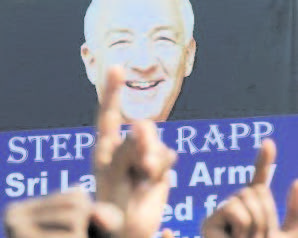
    COLOMBO (TIP): The US on Sunday pressed Sri Lanka to probe alleged rights abuses by its army through independent and credible investigations after a top American diplomat recorded eyewitness accounts of serious “abuses” during the final stages of the civil war with the LTTE. The US ambassador at large at the office of global criminal justice, Stephen J Rapp, concluded his week-long visit to Sri Lanka during which tweets from the US mission here carried photos of alleged sites in the north where people were killed due to Lankan military shelling in the 2009 war. Rapp had listened to eyewitness accounts of rights abuses “including those that occurred at the end of the war”, a statement from the US embassy said here.

    Sri Lankan military had defeated the Tamil Tiger rebels in May 2009. Colombo has resisted calls to probe claims that over 40,000 ethnic minority Tamils were killed by the military during the final phase of the civil war. ” … the government of the US encourages the government of Sri Lanka to seek the truth through independent and credible investigations, and where relevant, have prosecutions,” it said. Rapp called on foreign minister GL Peiris on Friday. Sri Lanka has denied charges that around 40,000 ethnic Tamil civilians were killed by the army during the final push that crushed the LTTE.

    The Lankan military has denied US accusations levelled through photographs during Rapp’s visit which came ahead of the March sessions of the UN human rights council in Geneva. The US has told Lanka that it could introduce a third successive resolution over rights accountability and reconciliation with the Tamil minority at the Council. Two previous resolutions, both US-moved, were supported by India. Rapp’s visit met with a protest opposite the US embassy. A nationalist group slammed the US for interfering in the country’s internal affairs. A protest was sparked when Rapp told the main Tamil party TNA that the March resolution would push for an international war crimes investigation.

  • DELHI HC PUTS CURBS ON MEDIA

    DELHI HC PUTS CURBS ON MEDIA

    NEW DELHI (TIP): The Delhi High Court restrained the media from publishing and telecasting the sexual harassment allegations levelled against National Green Tribunal (NGT) Chairman Swatanter Kumar by a woman lawyer. The alleged harassment took place in May 2011 while she was an intern with Justice Kumar, who was a judge of the Supreme Court at that time.

    Justice Manmohan Singh also directed the media to delete the defamatory parts of the news items and the photographs of Justice Kumar within 24 hours and stay away from carrying his photographs till further orders. The court passed the order on a petition filed by Justice Kumar seeking a gag order against the media and claiming damages from two news channels and an English daily for defaming him on the basis of unsubstantiated allegations by the ex-intern.

    The court issued notice to the complainant and the media organisations on Justice Kumar’s petition asking them to file their response. Posting the next hearing for February 24, the HC said its order would remain in force till then. The ex-judge of the SC has sought at least Rs 5 crore each as damages from the woman lawyer and the three media groups for attempting to sully his image and reputation built over an illustrious career spanning 43 years as a lawyer and a judge of high courts and the Supreme Court. The media had no business to undermine his fundamental right to good name and reputation, his counsel Mukul Rohatgi had contended yesterday.

  • Fire breaks out at Pak military hospital where Musharraf is undergoing treatment

    Fire breaks out at Pak military hospital where Musharraf is undergoing treatment

    ISLAMABAD (TIP): A small fire on Wednesday broke out at a military hospital in Rawalpindi, where former Pakistani military ruler General Pervez Musharraf is under treatment. The cause of the blaze, which broke out at the 4th floor of the Armed Forces Institute of Cardiology (AFIC), is suspected to be an electric short circuit, sources said. The fire was extinguished immediately, officials said. Local media reports said Musharraf was not affected. The former military ruler is under trial for treason over his imposition of emergency rule in 2007, charges he has dismissed as politically motivated. He was admitted to AFIC on January 2 after suffering “heart problems” while being driven to court.

  • Indian Army chief’s statement provocative: Pakistan

    Indian Army chief’s statement provocative: Pakistan

    ISLAMABAD: Pakistan has said Indian Army chief General Bikram Singh’s statement on ceasefire violations was provocative and regrettable. In a clear warning to Pakistan, General Bikram Singh said on Monday any militant who crosses the Line of Control (LoC) in Jammu & Kashmir would be fired at. Pakistan’s Inter-Service Public Relations ( ISPR) said in a press release later that it is contrary to the facts on ground. The Pakistan Army respects the ceasefire agreement in letter and spirit, it quoted a Pakistan military’s spokesperson as saying. After the meeting between the Directors General of Military Operations (DGMOs) Dec 24, 2013, the situation along the LoC has improved considerably.

    Such accusation and provocative statements are regrettable and counterproductive, the spokesperson added. The Indian Army chief in his statement Monday also said the army needed to continue guarding the troubled northern state “under the present circumstances”. “We will fire at any militant trying to enter through the LoC,” Gen. Bikram Singh said at the annual press conference ahead of Army Day Jan 15. His comments came as reports in the Pakistani media blamed India for violating the ceasefire and firing at a civilian near the LoC.

  • Himachal, Uttarakhand sops to continue till 2017

    Himachal, Uttarakhand sops to continue till 2017

    NEW DELHI (TIP): The Cabinet Committee on Economic Affairs (CCEA) extended the special industrial package for Himachal Pradesh and Uttarakhand till 2017, a move that will boost industrialisation and create more employment in the two hilly states. Both the states have seen phenomenal growth in investment and industrial growth in the last 10 years due to the package.

    However, the neighbouring states like Punjab have been opposing the extension of the package on the plea that it is driving industry out of the state towards the hilly states because of special incentives. Welcoming the decision to extend the package, Commerce and Industry Minister Anand Sharma said this would generate gainful employment, especially for the rural youth. “It will also give a fillip to manufacturing and the small and medium enterprises in these two states”, he said.

    A special package for industrial development in both the states was extended by the government in 2003 as these states were lagging in industrial growth. In 2007, it was curtailed, before being restored till 2010. The capital investment subsidy was one of the major components of a special industrial package offered to the states by the union government. The objective of the policy announced in 2003 was to provide the required incentives as well as enabling environment for industrial development, improve availability of capital and increase market access to provide fillip to private investment.

  • Seven militants killed in Afghanistan

    Seven militants killed in Afghanistan

    KABUL (TIP): At least seven militants were killed in separate military operations in Afghanistan, the interior ministry said in a statement on January 14. The Afghan police, army and the National Directorate for Security (NDS) have carried out several operations in Baghlan, Zabul, Uruzgan and Farah provinces and killed at least seven Taliban militants, injured three and arrested six others, Xinhua quoted the ministry as saying. They also found weapons and defused several improvised explosive devices and roadside bombs, it said.

  • Suicide attacker strikes police bus in Afghanistan, 6 injured

    Suicide attacker strikes police bus in Afghanistan, 6 injured

    KABUL, AFGHANISTAN (TIP) : Police say a suicide attacker has struck a bus carrying police recruits in eastern Kabul, wounding at least six police. Kabul Police Chief General Mohammad Zahir Zahir says three civilians were also very slightly wounded in the attack, which occurred around 3:30 p.m. local time (1100 GMT). Police spokesman Hashmat Stanekzai said Sunday that the attacker, who died in the attempt, rode a bicycle packed with explosives and targeted a bus from the Kabul police training center.