Prevention is better than cure. This saying does not seem to hold good for Indians as far as health care is concerned with only around 10 percent of adults opting for vaccines to reduce the threat of common diseases. Even as people become more health conscious only a minuscule population is opting for vaccines to prevent illnesses like flu and meningitis, health experts said. Some of the vaccines available for adults are against Hepatitis A, Hepatitis B, Influenza, Meningitis and the Human Papalloma Virus that causes cervical cancer.
“Prevention is always better than cure. But still preventive healthcare is lacking in India. People do not go to doctors until and unless it reaches a critical point,” Ravindra Gupta of the Internal Medicine department of Columbia Asia Hospital- Gurgaon told us. According to the WHO, around two billion people worldwide are infected with the Hepatitis B virus and 600,000 die each year due to its consequences. In India, approximately 80 million people harbour the Hepatitis B virus, which results in around 240,000 deaths annually. India reports one-fourth of the world’s cervical cancer cases. Gupta said: “In fact only less than 10 percent of people opt for vaccinations.
People need to be more aware and take charge of their own safety and well-being and keep away diseases and illnesses which can be prevented with vaccination.” Gupta said in some cases, even doctors are not aware about the various vaccines available for adults. However, he added, awareness has certainly improved among the masses as the knowledge about the available vaccines is growing. “There should also be a campaign on the need for adult vaccination at a greater level so that the people are informed about the vaccines available not just for children but for adults as well,” he said.
Ashu Sawhney, senior consultant and coordinator, neonatal intensive care, Jaypee Hospital, Noida, told us: “Immunization, which was previously limited to children, is becoming more and more popular for adults and the elderly. “It stimulates and enhances the body’s immune system to protect against various infectious diseases,” he said, adding that vaccination not only saves lives but is also more cost-effective considering the cost of treatment and loss of work days. Thus, more and more people should opt for vaccines to stay healthy, Sawhney added.
A senior health ministry official said that though the government does not have any national policy for adult vaccination like the child immunization programme, there are guidelines available. “Even the United States only has guidelines for adult vaccination,” the official said. Talking about the vaccines approved by the government, Atul Gogia of Sir Gangaram Hospital said: “Out of all the vaccines available for adults, only HPV vaccine has not been approved by the government. The rest of the vaccines are approved by the government”.
Year: 2014
-

The Kerala Center Honors Malayalee Achievers
NEW YORK (TIP): The Kerala Center held its 22nd Annual Awards Banquet at the World’s Fair Marina in Flushing, New York city on November 15th. Attended by a sold out crowd of over 250 people eight Indian American Malaylees were honored at the banquet for their achievements in their fields or for service to the community. The keynote speaker was Prof. Geeta Menon, 11th Dean of the Undergraduate College at NYU’s Leonard N. Stern School of Business and the Abraham Krasnoff Professor of Global Business and Professor of Marketing who was honored for her achievement in Education/ Other awardees are: Siby Vadekekkara, Founder, Chairman and CEO of Marlabs, New Jersey for Entrepreneurship; Suresh Nair, Head of Global Wealth and Investment Management Technology, Bank of America/Merrill Lynch, New York for Corporate Leadership; Abraham Pannikottu, Principal and Operations Manager, American Engineering Group, Akron, OH in Engineering; Dr. Gabriel D. Roy – ONR Global, Fairfax, VA for Service to Government; Dr. Thomas John Colacot, Global R&D Manager of Homogeneous Catalysis at the Johnson Matthey Catalysis and Chiral Technologies (JMCCT), West Deptford, New Jersey in Applied Sciences; Thelma Kizhakedan (Kollam Thelma), Dickinson, TX for Literature and Writing; Baby Uralil, former President, FOMAA Centereach, NY for Community Service; and Dr. Teresa Antony, Woodmere, NY with a Special Award.
-

Shots hit ambulette, injuring an elderly woman inside
Mohammed Jaffer NEW YORK (TIP): Shots were fired on an ambulette in Flatland, Brooklyn,Wednesday , November 19 afternoon and one of the bullets struck an ambulance – injuring an elderly woman inside.As CBS2’s Dave Carlin reported, home security video captured the suspects in the incident on Flatlands Avenue near East 51st Street. One man was seen running along the street,while a second was seen following close behind and holding what appeared to be a gun. Police believe the second man fired several times, and one shot went into an ambulance carrying senior citizens.
A second security camera angle shows the men running and the ambulette as its driver hits the brakes.The shot went through the windshield of the ambulette, and inside, a woman was injured.Witnesses said the wound appeared to be a gash caused by either a bullet fragment or broken glass.”An innocent bystander gets hurt for no reason,” said neighbor Jerry Thompson. Seconds earlier, a man whose name is not being released said he was outside his house and saw the two men and the gun up close. The suspects looked right at him. “Young guys – they’re not past 19 or 18, 17,” the witness said. “A light-skinned guy looked at me and the other guy said,went like that, ‘Forget it.’” As 1010 WINS’ Al Jones reported, the 71-yearold woman in the ambulance was hospitalized at Kings County Hospital. Doctors said they expect her to make a full recovery.Police were questioning a person of interest in the incident late Wednesday, and were looking for a second suspect. -

Message of UN Women Executive Director on the International Day for the Elimination of Violence against Women
UNITED NATIONS (TIP): Every year, on the International Day for the Elimination of Violence against Women (November 25), we are reminded how every day, women and girls experience violence in their lives. Women are beaten in their homes, harassed on the streets, bullied on the internet. Globally, one in three women will experience physical or sexual violence at some point in her life. More often than not, violence against women is committed by an intimate partner. Of all women killed in 2012, almost half died at the hands of a partner or family member.
It is no exaggeration that the overall greatest threat to women’s lives is men, and often the men they love. Yet we know how violence against women can be eliminated. In 1995, close to 20 years ago, 189 governments came together in Beijing. They adopted a Platform for Action that spelled out key strategies to end violence against women, empower women, and achieve gender equality. This includes effective prevention strategies that address the root causes of gender inequality. This includes better services for women surviving violence, such as hotlines, shelters, legal advice, access to justice, counselling, police protection, and health services.
This includes more accurate reporting rates, better data collection, and strengthened analyses of risk and prevalence factors. This includes greater support for women’s organizations, which are often on the frontline of the response. This includes having more men and boys standing up against violence, denouncing it, and stopping it. Male leaders, including traditional and religious leaders,must show the way. UN Women has launched HeForShe, a global campaign to engage men and boys as advocates and agents of change for the achievement of gender equality and women’s rights.We need men who believe in gender equality to take action now. A global review of progress and gaps in implementing the Beijing Platform for Action is underway.
Preliminary data show that many countries have introduced laws to prohibit, criminalize, and prevent violence against women. Yet implementation and enforcement of these laws are inadequate. Reporting of violence remains low and impunity for perpetrators remains high. Not enough resources are targeted at provision of quality services and effective prevention strategies. Next year, after the endpoint of the Millennium Development Goals, a new roadmap for development will be adopted by the international community. Ending violence against women and girls must have a central place in this new framework. The promises from 20 years ago are still valid today. Together we must make 2015 the year that marks the beginning of the end of gender inequality. Now is the time for action.
-

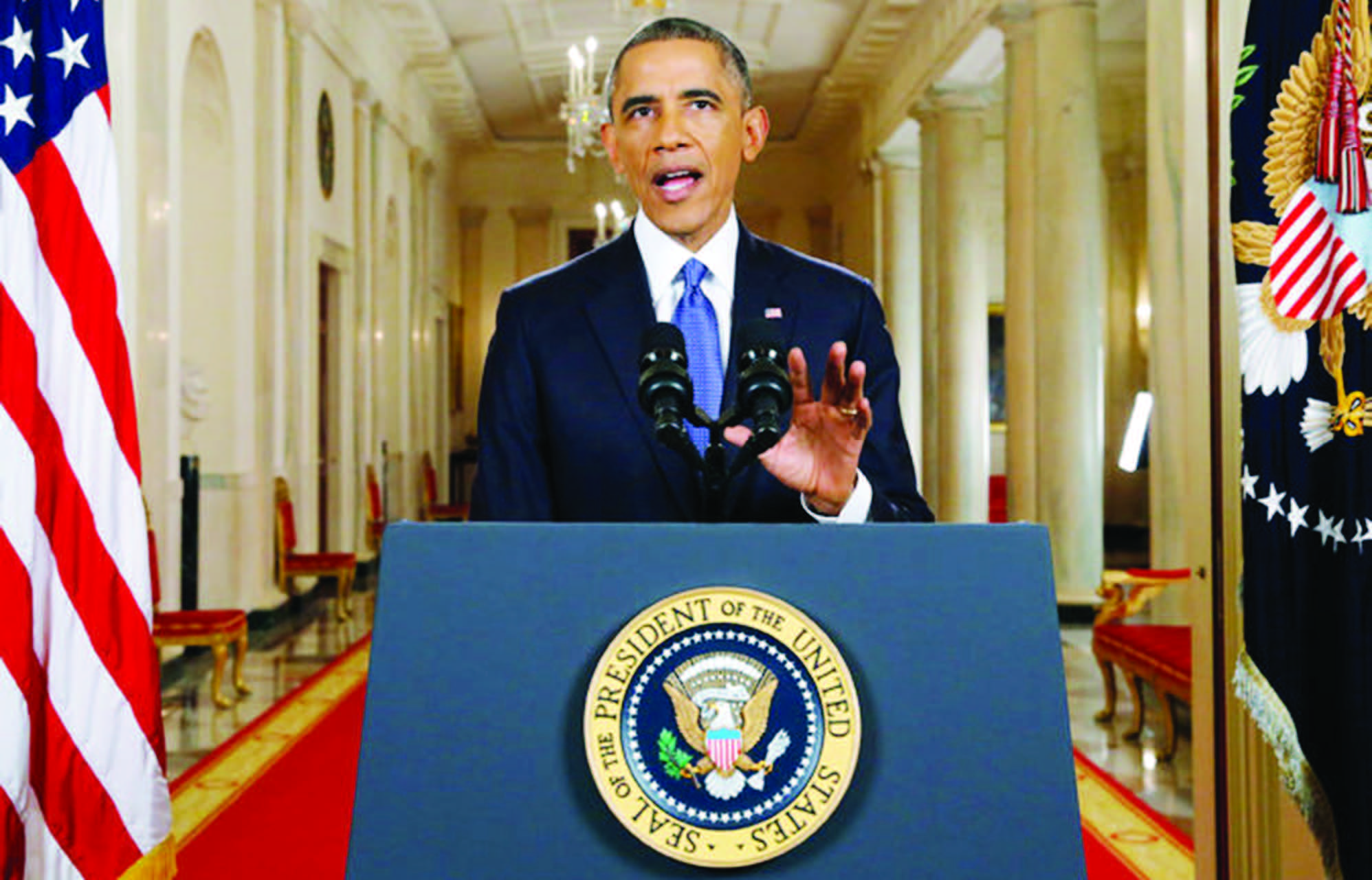
President Obama Announces Immigration Reform Plans
“Our immigration system is broken, and everybody knows it”: Obama
I.S. Saluja
WASHINGTON (TIP): Ignoring dire warnings of Republicans to “Emperor Obama” that his planned executive action to grant deportation relief to millions of undocumented immigrants would “poison the well” in Congress, Obama announced his immigration reform plans to the country on Thursday, November 20 to help build a system that “lives up to our heritage as a nation of laws and a nation of immigrants.” Stating “Americans are tired of gridlock”, Obama offered to “work with both the parties” to fix the “broken system”. However, he said that he had tried to work with Congress, and blamed the House of Representatives for a bipartisan Senate bill never seeing a yes-no vote.
Still, the president said, he hopes to eventually “pass that kind of common sense law.” “This plan, which will be enacted by executive action, “will help secure the border, hold nearly 5 million undocumented immigrants accountable, and ensure that everyone plays by the same rules,” the White House said in a press release. Obama announced the actions on immigration in an address from the White House. He is expected to sign the actions at a rally in Las Vegas on Friday, November 21. “Our immigration system is broken, and everybody knows it,” he said, later adding that his critics call the plan a form of amnesty. “Well, it’s not.” Obama said. “Amnesty is the immigration system we have todaymillions of people who live here without paying their taxes or playing by the rules, while politicians use the issue to scare people and whip up votes at election time.” Obama emphasized in his address that he is instead pushing for the accountability of undocumented immigrants.
“That’s the real amnesty-leaving this broken system the way it is. Mass amnesty would be unfair. Mass deportation would be both impossible and contrary to our character. What I’m describing is accountability-a commonsense, middle ground approach: If you meet the criteria, you can come out of the shadows and get right with the law,” the president said. “If you’re a criminal, you’ll be deported. If you plan to enter the U.S. illegally, your chances of getting caught and sent back just went up.” The three main elements of the actions will be cracking down on illegal immigration at the border; deporting felons, but not families; and establishing criminal background checks and taxes for undocumented immigrants.
“By registering and passing criminal and national security background checks, millions of undocumented immigrants will start paying their fair share of taxes and temporarily stay in the U.S. without fear of deportation for three years at a time,” the White House release said. If undocumented immigrants submit to these background checks, register with the government, pay fees and show they have a child born in the U.S., then they “will have the opportunity to request temporary relief from deportation and work authorization for three years at a time.” These reforms will actually make it more difficult to enter the country without documentation, Obama said, but some did not agree.
Texas Governor Rick Perry said in a statement that Obama’s “decision tonight will lead to more illegal immigration, not less.” Obama addressed critics of the plan, explaining that “tracking down, rounding up, and deporting millions of people isn’t realistic. Anyone who suggests otherwise isn’t being straight with you.” “By providing individuals with an opportunity to come out of the shadows and work legally, we will also help crack down on companies who hired undocumented workers, which undermines the wages of all workers, and ensure that individuals are playing by the rules and paying their fair share of taxes,” the release said. The president’s executive actions will also expand the existing Deferred Action for Childhood Arrivals program. The rule currently offers temporary relief from deportation to children who had been in the country for at least five years and meet certain criteria.
Now, anyone who came to the U.S. as a child can apply if they entered before Jan. 1, 2010-no matter how old they are now. The White House also said that DACA relief will be granted for three years in the country going forward. Obama’s reforms will also cover a wide swath of issues related to immigration such as shifting more resources to the border, streamlining the immigration court process, and implementing a new Priority Enforcement Program that removes criminals. Additionally, Secretary of Homeland Security Jeh Johnson will issue a memorandum making “clear that the government’s enforcement activity should be focused on national security threats, serious criminals, and recent border crossers,” as opposed to families.
In his address, Obama cited scripture: “We shall not oppress the stranger, for we know the heart of a stranger.” He went on to add “We were strangers once, too”. He said that this country is a country of immigrants, no matter what ocean they had crossed. He also quoted his predecessor Bush who had said about illegal immigrants, ” They are a part of American life”. The president’s actions will also cover several other facets of immigration and naturalization, including “enhancing options for foreign entrepreneurs” and “streamlining the process for foreign workers and their employers.” -

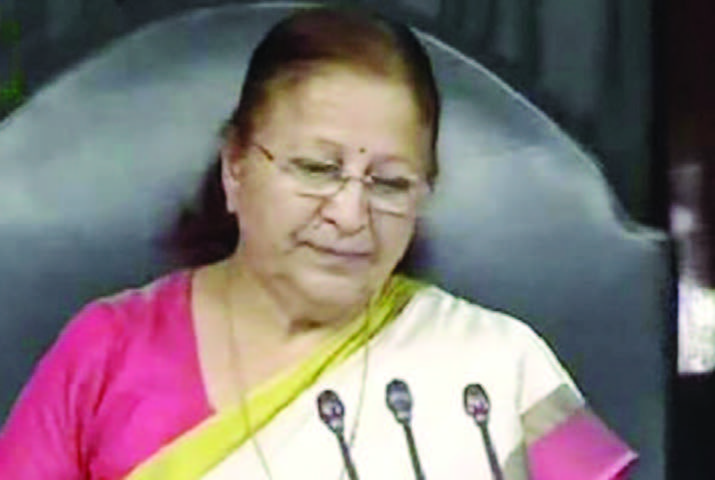
Lok Sabha Speaker Sumitra Mahajan calls for early Reforms to UNSC
UNITED NATIONS (TIP): “The Security Council is, undoubtedly, one of the most important institutions of global governance,” Sumitra Mahajan, speaker of Lok Sabha, the lower house of India’s parliament, stated. “If its legitimacy is in doubt then so would be the legitimacy of the United Nations. And, in fact, of the notion of global governance itself.” Mahajan was speaking Tuesday, November 18, at a session of the Preparatory Committee for the Fourth World Conference of Speakers of Parliaments on the subject of key challenges to world peace and democracy.
She pointed out that the Council’s composition was based on UN’s structure in 1945 and she asked in a series of rhetorical questions to drive her point home, “Is that composition still representative of the international community? The United Nations then had 51 members. The figure now is 193.” At the founding of the UN, there were only three African members, including South African apartheid regime, Mahajan pointed out. “Today it has 54,” she said.

The delegates at the Fourth World Conference of Speakers of Parliaments. Sumitra Mahajan is seated fourth from the right.
“How many permanent members of the Security Council are from Africa?” After a briefing by Liechtenstein Ambassador Christian Wenaweser on the work of the Accountability, Coherence and Transparency Group, which brings together 22 nations working on UN reform, Mahajan said she would like to know what it proposes to do to “bring more legitimacy to the permanent membership of the Council.” Pressing the case for changing the composition of the Council, she asked, “While improvement in working methods, or a code of conduct on use of the veto, are important, can they substitute for reform of the composition? Can improvement in working methods legitimize a structure that is not legitimate? To say that is anachronistic is only an understatement.”
In 2010 during the 65th Anniversary of the United Nations, world leaders had committed themselves to the early reform of the Council. She asked, “When would early be?” Although the membership of the Council was increased from 11 to 15 in 1965 with addition of four elected members, permanent membership continues to be restricted to the original five who wield veto powers. In any expansion of the permanent membership, India, Germany, Brazil, Japan and an African nation would be the top contenders.