Month: April 2015

  • New York Mayor’s  initiative on Obama’s Executive Order on Immigration

    New York Mayor’s initiative on Obama’s Executive Order on Immigration

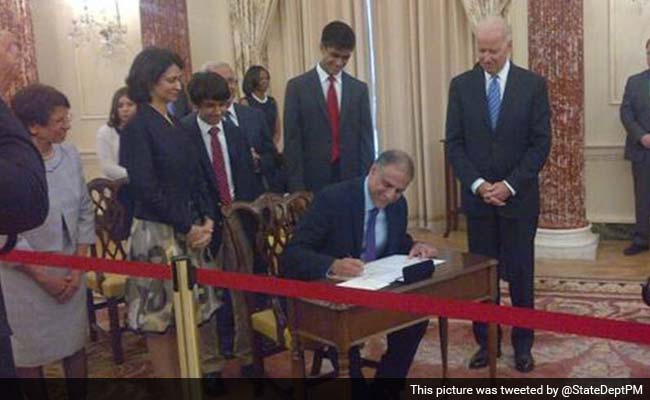
    NEW YORK  (TIP) : New York City’s new Indian American Commissioner Nisha Agarwal has rolled out a special series of engagements with the immigrant community clearly taking the biggest issue of her office bulls on.

    After assuming office in February, 2015 she, along with her team, started with Mayor de Blassio’s Municipal ID Card Program which is open to all NYC residents  regardless of immigration status. The Program has already seen applications in excess of a 100,000 and is growing . More centers  for  application processing are being set up to speed up the process and reduce delays, said Commissioner Nisha Agarwal.

    Commissioner Agarwal has also launched a special initiative to providing Free Legal screening by trusted immigration attorneys and Non-Profit Law firms.

    Commissioner Agarwal at a press briefing, April 2, held at the Centre for Community & Ethnic Media of CUNY Graduate School of Journalism started by saying that they will do everything possible for the over 200,000 illegal immigrants in New York City. She further stated that Obama’s Immigration reform, if approved, will help millions of immigrants get legal status in the United States. She laid special emphasis on reducing and checking Immigration Fraud and how her office is getting the City ready with good legal support for them.

    Commissioner Agarwal announced a Special Free  Screening by trusted attorneys on the12th April where anyone can come and explore his/her case on getting legal status in the United States. The Screening is planned at the  Jewish Temple – Emanu-EL in upper East side (1st East 65th Street) for the 12th April between 11am to 5pm.

    Registration is free and to schedule appointments anyone can register by calling 212 419 3700 

    A guidebook to City , State and Federal laws -Immigrant Rights and Services Manual- in 6 Languages has been prepared to remove the language barrier for the benefit of immigrants.

  • Deepening Ties Will Shape Global Balance of Power: Indian-American Diplomat

    Deepening Ties Will Shape Global Balance of Power: Indian-American Diplomat

    NEW YORK:  The deepening India-US ties are among the most significant strategic developments of the past several years and will shape the global balance of power in the years to come, a senior Obama Administration official has said.

    “In South Asia, we’re strengthening our security, economic, and people-to-people ties with India. In my view, India’s revival and deepening US-India ties are among the most significant strategic developments of the past several years,” US Assistant Secretary, Bureau of Political-Military Affairs Puneet Talwar said yesterday.
    “They will shape the global balance of power for many years to come,” the Indian-American diplomat said while addressing a session in San Francisco on US foreign policy priorities in 2015.

     
    He said that as the oldest and largest democracies, the US and India are seeing a natural convergence not only of values, but of “our vision for the future”.

    Mr Talwar cited President Barack Obama’s historic visit to India this year as Chief Guest on the Republic Day in January and said that while India is one of the world’s oldest civilisations, it has the world’s most young people, with a median age of 27 and 600 million people under the age of 25.

  • Indian-American Physicians’ Role Praised by US Lawmakers

    Indian-American Physicians’ Role Praised by US Lawmakers

    WASHINGTON:  US lawmakers have lauded Indian-origin American physicians for their role in passage of a bill by the Congress that reformulates the way physicians are reimbursed for a government health insurance for seniors.

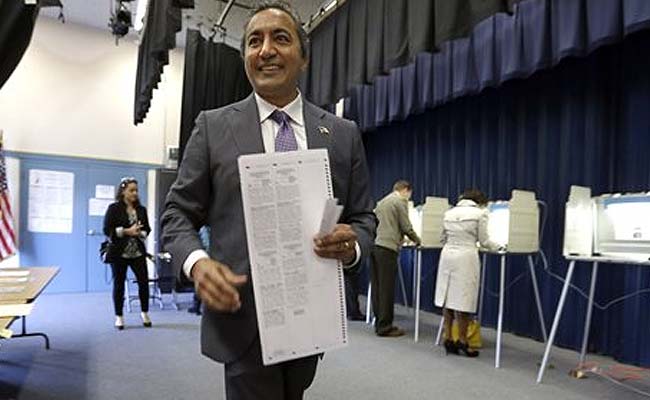
    Several US lawmakers – including Nisha Desai Biswal,Assistant Secretary of State for South and Central Asia, and Ami Bera, the lone Indian-American physician in the US Congress –  praised them for their hard work and their constant efforts to make healthcare affordable.

    “We are extremely delighted and grateful to the US Congress for passing this historic measure,” said Ravi Jahagirdar, President of the Association of American Physicians of Indian Origin (AAPI) urging the US Senate to take up the bill and pass it without delay.

    The legislation requires the Senate approval to repeal medicare sustainable growth rate (SGR) currently in use and would reformulate how physicians are reimbursed for Medicare, a government health insurance for seniors over 65.

    The passage of SGR bill came on March 26. The SGR formula places a cap on spending for physicians services, according to an AAPI statement.

    “AAPI has been a tremendous organisation for what you do here in the United States and for what you do in India and for what you do to improve and extend the US-India relationship,” Biswal said in her keynote address.

    Bera shared his own personal experience of growing up to be a physician and how he got elected in a district that has only 1 per cent Indian-Americans.

    “My story is your story and our story is that of the entire nation,” he said, adding: “I want my legacy to be how the generation is going to take us all to the next level and have many more Indian Americans get elected to the Congress.”

    AAPI is the largest ethnic organisation of physicians, representing over 100,000 physicians, fellows and students of Indian-origin in the US, who have been lobbying for the repeal of SGR formula for years.

  • Indian American Entrepreneurs Charged With Insider Trading in US

    Indian American Entrepreneurs Charged With Insider Trading in US

    NEW YORK:  Two Indian-origin entrepreneurs have been charged by the US authorities with insider trading for making over a million dollars in illegal profits through the proposed acquisition of Cooper Tire and Rubber by India’s Apollo Tyres.

    Amit Kanodia of Massachusetts, a 47-year-old entrepreneur and private equity investor, and his long-time friend Iftikar Ahmed of Connecticut, a general partner at a venture capital firm have been charged with fraud by the Securities and Exchange Commission (SEC) in a complaint filed in US district court in Connecticut.

    The SEC is seeking to have Mr Kanodia and Mr Ahmed return their allegedly ill-gotten gains with interest and pay civil monetary penalties.

    The US Attorney’s Office for Massachusetts today announced parallel criminal charges against Kanodia and Ahmed.

    Mr Ahmed, 43, is a graduate of the Indian Institute of Technology in New Delhi and Harvard Business School, while Kanodia received degrees from the University of Massachusetts.

    While the acquisition of American company Cooper by Apollo was never completed, the SEC complaint said that Cooper Tire’s stock price jumped 41 per cent when the acquisition was announced in June 2013.

    The SEC alleges that Mr Kanodia tipped Mr Ahmed and another friend prior to the acquisition announcement after learning of the deal from his wife, who was Apollo’s general counsel at the time, more than two months before the merger was announced.

    “Trading on insider information is fraud, plain and simple,” US Attorney Carmen Ortiz in Boston said.

    The SEC said, Mr Kanodia shared the highly confidential information with Ahmed who began buying significant amounts of Cooper Tire stock and options.

    Once news of the deal was public, Mr Ahmed immediately liquidated his Cooper Tire holdings, reaping more than 1.1 million dollars of ill-gotten profits, according to the complaint.

    The SEC said, Mr Ahmed later paid Mr Kanodia a kickback by transferring $ 220,000 to Lincoln Charitable Foundation, a supposed charity that Mr Kanodia controlled and used to mask kickbacks.

    A second close friend of Mr Kanodia, identified in the complaint as ‘Tippee 1’, also profited by trading on the confidential information provided by him and paid a portion of his illicit gains to Mr Kanodia using the same charity, the SEC’s complaint alleges.

    SEC Enforcement Division’s Market Abuse Unit Co-Deputy Chief Joseph Sansone said that Mr Kanodia gave inside information to two close friends who then paid a portion of their insider trading profits to a supposed charity that Mr Kanodia controlled.

    “Despite Mr Kanodia’s attempts at concealment, the SEC staff was able to uncover and unravel the scheme,” Sansone said.

    The SEC’s complaint charges Mr Kanodia and Mr Ahmed with violating federal anti-fraud laws and a related SEC rule.

    The SEC named Rakitfi Holdings LLC, a company owned by Mr Ahmed, and Lincoln Charitable Foundation as relief defendants.

    Apollo had agreed to buy Cooper Tire and Rubber for about $2.5 billion in 2013. The merger was abandoned in December that year.

  • Indian-American Hiten Patel Sentenced to 46-Year in Jail for Sex Crimes in US

    Indian-American Hiten Patel Sentenced to 46-Year in Jail for Sex Crimes in US

    NEW YORK:  An Indian-origin man has been sentenced to a 46-year prison term in the US state of New Jersey for sex-related crimes against five women in 2012.

    Hiten Patel, 36, was convicted in February of 22 criminal charges, including multiple counts of aggravated sexual assault and attempted sexual assault in Atlantic County, the prosecutor’s office said.

    Several women described attacks by Patel at a two-week trial in Mays Landing.

    According to the prosecutor’s office, Mr Patel contended the women were prostitutes who consented to his actions, a report in the Cherry Hill Courier Post said.

    One victim, a 21-year-old from Camden County, said Mr Patel claimed to be an undercover detective, showed a badge and ordered her into a van where she was sexually assaulted at gunpoint.

    Police arrested Mr Patel in August 2012 after the woman was able to escape from the van.

    The gun turned out to be an imitation, officials said.

  • Bikram yoga founder denies sexual assault allegations in exclusive interview to CNN

    Bikram yoga founder denies sexual assault allegations in exclusive interview to CNN

    Bikram Choudhury, the 69-year-old hot-yoga guru  who has built his name and fame over 5 decades has been accused of rape and sexual assault by six former students.

    Bikram has spoken out for the first time in an exclusive interview with CNN – and says he would never have to resort to physical aggression for sex because “women love me.” 

    Now with the Bikram brand is in jeopardy some yoga studios are already dropping his name.

    “If I really wanted to involve with the women, I don’t have to assault [them],” Choudhury said in an interview with CNN, which aired Wednesday. “I never assaulted them.” 

    “I don’t think they’re bad people,” he said of his accusers. “They’re influenced by lawyers.”  

    But Sarah Baughn and five others claim the Bikram founder – an icon to celebrities such as Madonna, George Clooney, Brooke Shields and Jennifer Aniston – indeed sexually assaulted them. 

    “We need to make this a relationship … I’ve known you from a past life,” Baughn said Choudhury told her during her first week of teacher training when he called her into his office. “I felt like my whole system imploded.” 

    Continued Baughn, who initially credited Bikram with transforming her life: “He crawled on top of me, he put his hand on the inside of my thigh …  he told me he needed someone to hold him, to brush his hair … to have sex.” 

    Baughn, who has a trial date set for August according to The New York Times, claims Choudhury made it clear she had to sleep with him in order to advance her career, stating she would never win a yoga competition if she didn’t have sex with him. 

    “I pushed him off me, and I said, ‘I can do this by myself.’ And he said, ‘No you can’t.’ ” 

    An emotional Choudhury said the allegations have devastated his family and that his wife of 30 years will no longer “look” at him. 

    “We die only once in our life. I die every day,” he said. “I work harder than any human being on this earth. And this is the reward? I’m a rapist?” 

    Concluded Choudhury: “Shame on your Western culture. It’s your job to go and tell the world the truth.”

    Choudhury is the founder of Bikram’s Yoga College of India. He’s featured prominently on its website, which details his system of performing 26 unique yoga poses while in a very hot room.

  • US Lawmakers Endorse AAPI’s Legislative Agenda During AAPI’s Legislative Day on Capitol Hill

    US Lawmakers Endorse AAPI’s Legislative Agenda During AAPI’s Legislative Day on Capitol Hill

    (Washington, DC: March 30th, 2015) While Physicians Shortage, J-1 Visa Waiver Program, Immigration Reform,  Delaying the Implementation of ICD-10, and Medical Liability Reform were part of the Legislative Agenda for 2015 for the annual Legislative Day and Reception at the historic Cannon Caucus Building on Capitol Hills organized by the Association of American Physicians of Indian Origin (AAPI), the passing of the Legislation repealing Medicare SGR on March 26th, 2015 by the US Congress by an overwhelming bipartisan majority on the same day AAPI delegates were gathering was the central theme for the day.

    During the annual AAPI’s Legislative Day and Reception, today here scores of AAPI delegates joined the US Congressmen who had come to address them and listen to their concerns, thanked and lauded the bipartisan efforts of the lawmakers for enabling this very important Bill to pass nearly unanimously, even while urging the US Senate to take up the Bill and pass it without delay. “After man years of advocacy and lobbying by AAPI and many other similar organizations, we are extremely delighted and grateful to the US Congress for passing this historic measure on the day when we are on the Capitol seeking to repeal the same,” said Dr. Ravi Jahagirdar, President of AAPI.

    “AAPI is once again in the forefront in bringing many burning health care issues facing the community at large and bringing this to the Capitol and to the US Congress,” said Dr. Sudhir Sekhsaria, Chair of AAPI Legislative Affairs Committee. In their efforts to make their voices heard on Capitol Hill, particularly on issues relating to healthcare, more than 100 members of AAPI from around the nation shared of the need to fix the many vital healthcare issues that confront the physicians in the US, even as the nearly two dozen US Lawmakers from both the Parties endorsed AAPI’s agenda and expressed strong support, while promising to do the needful in the US Congress.

    Members of AAPI, the largest ethnic organization of physicians, representing over 100,000 physicians, fellows and students of Indian origin in the US, had gathered at the historic Cannon Caucus Room on Capitol Hill on March 26th, 2015 to continue with their efforts to advocate and raise their voices for the larger physician community in the US.

    In her keynote address Assistant Secretary of State, Nisha Desai Biswal, the Obama administration’s point person for South Asia, praised the Indian American physicians and the broader Diaspora community for not just being catalytic in fostering the India-United States relationship, but for being the solid anchor that sustains this partnership through good times and bad. “AAPI has been a tremendous organization for what you do here in the United States and for what you do in India and for what you do to improve and extend the US-India relationship,” she said. She acknowledged that, API was one of the first Indian groups to recognize the need for outreach on the Hill. She urged AAPI to continue with the outreach, while crediting the Diaspora for enhanced Indi-US relations, contributing to the advance in global peace and prosperity.

    In his address, Deputy Chief of Mission at the Indian Embassy in the United States, Taranjit Singh Sandhu praised the Indian American community, and in particular, the physicians of Indian origin, for their great achievements and contributions to the their motherland, India, their adopted land, the US and in a very significant way to the transformation of the Indo-US relations. He emphasized the key role AAPI’s Global Healthcare Summits have made in transforming the delivery of healthcare system in India. “Our country has the best, the finest, bravest physicians in the whole world,” he said.  “If India has changed, the credit goes to you the physicians of Indian origin,” he said. “You have made a change in the perception of India in the US by your hard work, commitment and great achievements. And we are truly grateful to you,” he added.

    Rep. Joe Wilson reminded the AAPI members of the fact that first ever Asian to be elected to the US Congress was of Indian origin. “You are only 1% of the US population but are 10% of the total physicians in the country,” he said.  Reminding the AAPI members of his recent visit to India, the Congressman said, “I was impressed with the sense of optimism and the growing relationship between India and the US. We want to continue the close relationship and cooperation between the two great democracies.”

    Adhering to the near unanimous approval of the repeal of SGR Act by both the Parties in the US Congress, Rep. Steny Hoyer, Chief Democratic Party Whip, said, “Your voices are being heard today,” he said, while pointing to the passing of the SGR Bill. “This is the way to go and how things can be accomplished if both the Parties can work together.”

    Senator Amy Klobuchar (D-MN) while addressing the delegates said, “I am so proud of your contributions and for all the innovations you bring to our country.” Among the Fortune 500 companies, she pointed out that 90 are founded by foreign born and 35% of the Nobel laureates in the US are of foreign origin. Rep. Ed Royce said that the goal is to work towards half a trillion dollar trade between the two countries. “It has increased fourfold since in the last few years, but we have a long way to go. We are working on liberalizing trade between India and the US.”

    Rep. Ken Buck praised AAPI leadership for its advocacy on several health-related issues. “I want to thank AAPI for how you have contributed to the legislation on GPR. I look forward to working with you in more issues concerning physicians and healthcare delivery system.” Rep. Dina Titus lauded the efforts of AAPI members. “You do an amazing job. Your advocacy is very important. The affordable Care Act is a work in progress and we want to hear from you to make it work better.

    Rep. John Delaney praised the “entrepreneurial spirit you bring to the healthcare system. Your community does this to the high standards, with your vibrancy and being a very active community.” Rep. George Holding said that he wants to work towards increasing the number of members to the India Caucus and urged the Indian diaspora to continue to work for enhancing collaboration at the personal, cultural and national level to take to the Indo-US relationship to the next level. He praised the Modi government for understanding the concerns of the business community and it is trying to address them.

    Rep. Jim McDermott, MD (D-WA), co-chair of India Caucus in the US House, acknowledged the need to work on other areas of AAPI agenda after having achieved one of its objectives to have the Medicare sustainable growth rate (SGR) formula fixed.


    McDermott stated that he was coming to greet the AAPI members soon after he had voted for the repeal of SGR, for which AAPI had advocated for many years. “The next step for all of us is to address numerous issues and have the medical practitioners get involved in the process. I want to urge you to talk to your local Congressmen and continue your advocacy in the interest of the larger health delivery system.”

    Rep. Tulasi Gabbard while expressing support for AAPI’s agenda described the wonderful experiences she had while visiting nearly 10 cities in India. Rep. Joe Wilson, said, “I have born with a deep appreciation for the Indian American community in the US, and I join you today to thank you for all of your efforts to have a permanent fix to SGR.”

    Rep. Andy Barr (R-KY) and Congressman Ami Bera, M.D. (D-CA), in their remarks, referred to the bipartisan Bill they both introduced in the US Congress, Saving Lives, Saving Costs Act. “This legislation would lower healthcare costs and improve patient care by reducing medical malpractice and insurance fraud using evidence-based guidelines developed by doctors,” Barr said. Dr. Ami Bera, the lone Indian American physician in the US Congress, shared his own personal experience of growing up to be a physician and how he got elected in a district that has only 1% of Indian Americans. “My story is your story and our story is that of the entire nation’s,” he said. “I want my legacy to be how the generation is going to take us all to the next level and have many more Indian Americans get elected to the Congress,” he added.  Bera praised AAPI for its agenda for future working towards having as many as 20 Indian American Congressmen in the next two decades.

    Rep. Frank Pallone described the vote on SGR as “truly amazing” with nearly 400 Congressmen voting for the repeal of SGR. Pallone along with the other Congressmen promised to work in a bi-partisan way, reforming the immigration system, J-1 Visa, Increasing Residency Slots and the liability reforms. Dr. Janak Joshi from Colorado gave his perspective on his state’s legalization on the legalization of marijuana.


    Underscoring the tremendous contributions of the 100,000 strong Indian American physician community in delivering the healthcare in the US, dozens of US Congressmen and Senators praised them for their hard work, commitment to patients and their constant efforts to make health care affordable, accessible and  efficient for everyone in this country.

    While honoring AAPI with a seat at the American Medical Association (AMA) House of Delegates, Dr. Steve Sack, President-Elect of AMA, said, “Yours is the only ethnic organization that has the distinction of having a seat at the AMA House of Delegates.”

    Some of the speakers on Legislative Day included Rep. Jo Heck, Rep. Mark Tocar, Rep. Tulsi Gabbard, Parag Mehta, Rep. Ed Royce, Chirag K. Shah, Rep. Joe Wilson, Dr. Janak Joshi, Rep. Ken Buck, Dr. S. Shivangi, Rep. Jim McDermott, Rep. Andy Barr, Rep. Doug Lamor, Rep. Ami Bera, Rep. Frank Pallone, Rep. Barbara Comstock, Rep. George Holding, Rep. John Mica, Dr. Steve Sack, Rep. Steny Hoyer, Sen. Amy Klobuchar, Rep. Chris Van Hollen and Rep. Amata Radewagen.

     “We have many more urgent issues pending and we need to work on them and as Congressman Bera stated, our goal is to work to have several more Indian Americans elected to be lawmakers across the nation,” Dr. Sampat Shivangi, co-chair of AAPI’s Legislative Committee, said.

      “AAPI has been able to draw the attention of the Congressmen on several important issues that confront the physicians across the nation,” said Dr. Rachakonda Prabhu, Co-Chair of AAPI Legislative Committee. According to Dr. Suresh C. Gupta, a Co-Chair of AAPI’s Legislative Committee, “The Legislative Day has had detailed discussions on topics of importance to  AAPI members and how they can be part of the process in the implementation of the health care delivery in this country.”

    Dr. Rajeev Khanna, Co-Chair of AAPI’s Legislative Committee, said, “API physicians were able to communicate to the law makers the burden that CMS has imposed with the Meaningful Use and PQR reporting and the constant and dire threats of reimbursement cuts and penalties.” Dr. Harbhajan Ajrawat and Dr. Vinod K. Shah were among those who had played an advisory role in organizing the event. Several AAPI delegates came on stage to introduce the lawmakers from his/her own state, sharing with the audience their close relationship with the lawmakers.

    Ravi Jahagirdar, President of AAPI, while summarizing the deliberations during the daylong event on Capitol Hill, said, “AAPI has once again succeeded in bringing to the forefront the many important health care issues facing the physician community and raising our voice unitedly before the US Congress members. And  we were able to discover our own potential to be a player in shaping the health of each patient with a focus on health maintenance than disease intervention and to be a player in crafting the delivery of health care in the most efficient manner as well as to strive for equality in health globally.”

    For more information on AAPI’s the Legislative Day, please visit: http://www.aapiusa.org/


  • Woods plays 18 holes in practice at Augusta National

    Woods plays 18 holes in practice at Augusta National

    AUGUSTA (TIP): The lingering ‘will he play/won’t he play?’ scenario with Tiger Woods ahead of next week’s Masters entered a new phase on April 1 when the former world number one played a practice round at Augusta National.

    Woods’ manager Mark Steinberg said that Woods had played 18 holes at the iconic Masters venue as he continued to assess whether his game would be “tournament-ready” for the first major of the year.

    However, Steinberg did not say whether Woods was any closer to reaching a decision about competing this year at the Masters, where he is a four-times champion.

    Woods, whose ranking has plummeted to a mind-boggling 104th, has struggled badly for form and fitness this season, and has played only twice on the 2014-15 PGA Tour.

    He posted the highest score of his professional career, an 11-over-par 82, to miss the cut at the Phoenix Open in January, and withdrew from the Farmers Insurance Open early last month after 11 holes because of tightness in his back.

    Woods, who claimed the most recent of his 14 major titles at the 2008 US Open, said he would not return to the PGA Tour until his game was “tournament-ready” and many pundits believe he is suffering from the chipping ‘yips’.

    “I enter a tournament to compete at the highest level, and when I think I’m ready, I’ll be back,” Woods wrote on his website. “I hope to be ready for the Masters.” 

    If Woods does indeed have the yips, an involuntary movement of the muscles, Augusta National would be one of the most challenging venues for him to make a PGA Tour comeback because of its slick, heavily contoured greens. One thing in Woods’ favour is his huge comfort factor at Augusta National where in 2010 he tied for fourth at the Masters after not playing competitive golf for five months.

    He took an indefinite break from the game in late 2009, as his private life spectacularly unravelled, to try to repair his marriage amid revelations about his extra-marital affairs.

    “He knows his way around the Augusta,” Northern Irish world number Rory McIlroy said earlier this month. “If he feels ready to play and he does play then he knows what to do when there.”

  • DJOKOVIC BEATS FERRER TO ENTER MIAMI MASTERS SEMIS

    DJOKOVIC BEATS FERRER TO ENTER MIAMI MASTERS SEMIS

    MIAMI (TIP): Novak Djokovic recovered from a slow start and had to battle at the end to overcome tenacious Spaniard David Ferrer on April 1 to reach the Miami Masters semifinals.

    Serbia’s world number one triumphed 7- 5, 7-5 and advanced to a meeting with big-serving American John Isner, who overpowered Japan’s world number five Kei Nishikori 6-4, 6-3.

    Djokovic, the defending champion and winner of the Indian Wells title less than a fortnight ago, came from two breaks down in the first set as Ferrer celebrated his 33rd birthday with a runaway start.

    But Djokovic reeled him in to take the first set and served for victory leading 5-4 in the second.

    Ferrer was having no part of it. He broke Djokovic, but was broken himself a game later to let Djokovic again serve for the match.

    Djokovic now owns eight straight wins over the Spaniard, winner of three titles already this season.

    “David is one of the toughest opponents, I knew the match would be physical,” said Djokovic. “He gives you nothing and makes you work for every point.

    “My strategy was to try and dominate from the baseline, but stay alert for chances to come to the net. That is something I’ve been working.

    “It was a tough match, but one that I enjoyed. The next round will be totally different against Isner, who has one of the best serves in the game.” 

    The tense moments against Ferrer followed Djokovic’s great escape against Alexandr Dolgopolov, who was up a set and a break in his fourth-round loss to the Serbi. Isner, whose year has been modest at best, has exploded into form on the hardcourts of Miami, where he has yet to drop a service game.

    He ended the hopes of world number five Nishikori, Asia’s top player who reached the US Open final last September.

    It was Isner’s second top-10 win of the tournament, after his upset of sixth-ranked Milos Raonic on Tuesday.

    “Things just snowballed for me,” Isner said, adding that the hot conditions suited his game perfectly. He made the most of that firing 13 aces and 33 winners overall.

    “I just played well,” Isner said. “I’ve been serving well really for a while now, and I did that again today. I was taking care of my serve. I was taking my chances on his serve, and the ball was finding the right spots for me.” 

  • Jwala Gutta slams sports ministry for leaving her out of TOP scheme

    NEW DELHI (TIP): India’s ace doubles shuttler Jwala Gutta on April 1 slammed the sport ministry for ignoring her for the Target Olympic Podium (TOP) Scheme, saying that she did not deserve such a treatment from the government after all the struggle she had faced to bring laurels to the country.

    Jwala, a bronze medallist along with Ashwini Ponnappa in the 2011 World Championships, said that she was disappointed to have been left out of the scheme despite being a top shuttler all these while.

    “I just read news about Ashwini and my names not being there in TOP scheme. The only support we had was of Govt of India and now that also seems bleak. The players who are already having lot of corporate support are in the list and Ashwini and me not considered. I don’t know what more to be done. I am kind of tired, kind of disappointed,” Jwala said.

    “If we speak its called cribbing and if we don’t we will be just left out. We have struggled so much to just play doubles even after the performance which was never expected but continuously being discouraged like this by association and now the govt. How else are we suppose to motivate ourselves?” she asked.

    The TOP scheme identifies medal prospects from a few sports, including badminton, to provide funding for top-class training for the 2016 Olympics. Recently, Infrastructure Finance Company Limited (IIFCL) has pledged to contribute Rs 10 crore each for three years to the TOP Scheme for shuttlers.

    According to sources, Saina Nehwal, Kidambi Srikanth, Parupalli Kashyap, HS Prannoy, RMV Gurusaidutt, and PV Sindhu are the six shuttlers who have been selected for the scheme by a government-appointed committee, which also include chief national coach Pullela Gopichand.

  • Serena Williams claws into 10th Miami Open final

    MIAMI (TIP): A frustrated Serena Williams clawed into her 10th Miami final on April 1, defeating Simona Halep 6- 2, 4-6, 7-5.

    Williams, apparently rattled by the Halep cheer squad who drowned out most of the chants for the home hope, saw her mighty forehand desert her in the second set, in which Halep converted the only break point of the set to force a third.

    World number one Williams, who captured her 19th Grand Slam title at the Australian Open this year, regrouped to seize a 5-2 lead in the third only for the world number three from Romania to battle back.

    Finally Williams found a way, and she will bid for an eighth Miami title against Carla Suarez Navarro.

    Spain’s Suarez Navarro earned her place in the biggest match of her career with a 6-3, 6-3 victory over Germany’s Andrea Petkovic.

    Williams has won all four of her matches against Suarez Navarro without dropping a set.

  • Sania-Hingis enter Miami Open doubles semis

    MIAMI (TIP): Fresh from their maiden win in the Paribas Open title last month, Indian tennis ace Sania Mirza and her Swiss partner Martina Hingis have entered the women’s doubles semifinals of the Miami Open.

    The top-seeded Indo-Swiss duo served past the Rodionova sisters, Anastasia and Arina, 6-3, 6-4 in the quarterfinal encounter. The Sania-Hingis pairing has been much-talked about in the tennis circuit and the top seeds lived up to the hype by claiming their first title win in their maiden appearance together in Indian Wells in March. Hingis has won 11 Grand Slams in the team discipline (nine in women’s and two in mixed) while Sania has claimed three Grand Slams (all in mixed).

    The duo, which decided to unite in February, will now meet the seventh-seeded Hungary-French combine of Timea Babos and Kristina Mladenovic in the last-four clash.

  • MAKE SKIN SUMMER FRIENDLY

    MAKE SKIN SUMMER FRIENDLY

    Screen the sun

    Zero down on a sunscreen that best meets your requirements and contains sun protection factor (SPF). SPF 30 is best recommended for Indian skin types. Apply sun screen 20 to 30 minutes before stepping out and ensure you wear sunscreen every day, even when you stay indoors.

    Follow the essential routine

    Follow the cleansing, toning and moisturising ritual twice a day for best results. Summers are most nightmarish time for skin issues, specially acne. To keep your skin acne-free use a cleanser which contains salicylic acid and helps reduce acne and prevent future breakouts.

    Exfoliate

    Incorporating exfoliation into your skin care regime is a must to avoid dull skin! Exfoliants remove old, dry, dead skin cells, toxins and other deposits and allow new skin cells to surface. Scrub your elbows and knees at least twice a week to get rid of dead tissues. Rub a slice of lemon with sugar every alternate day to keep them clean and to remove tan.

    Hair woes

    Since hair tends to be moisture-deprived during summers, overuse of any kind of chemical and hair styling tool should be avoided. Shampooing often results in loss of shine and moisture. Consider switching to a gentle shampoo and use a deep conditioner to replenish the loss of moisture. Massage your hair with a mixture of coconut oil, castor and olive oil regularly to keep your hair nourished.

    Happy Feet

    Start with wearing an open sandal in the summer to keep your feet dry and give them a chance to “breathe”. Your feet are subject to sunburn just like the rest of your body. Use sunscreen during the day and during the evenings apply a lightweight moisturiser.

    Maintain a healthy diet

    With summers in full swing, it is advised that apart from drinking lots of water, a special summer diet consisting of light and healthy food would ensure a cool mind and body. To keep your skin hydrated, eat lot of fresh fruits and green vegetables. Include fruits and vegetables like bitter gourd, spinach, cucumber, watermelons, oranges, cherries, plums and lychee to your diet.

  • HOUSE PLANTS PURIFY YOUR HOME

    HOUSE PLANTS PURIFY YOUR HOME

    Decorate your living spaces with the following plants to that will filter the air you breathe.

    Bamboo palm is a great plant to have in your house as it can get rid of all sorts of chemicals in the atmosphere. It doesn’t require too much direct sunlight so it can be kept inside, where there is a shady spot. It eliminates carbon monoxide, benzene, formaldehyde, xylene, chloroform and more, making it the best choice for the laundry room, living room or bedroom.

    In India, rubber plants are very common. They need a lot of bright light, water and fertilizer to keep them healthy. This is a great choice for eliminating carbon monoxide, formaldehyde and trichloroethylene.

    The Areca palm is also like the bamboo palm. It has arch-like leaves that are attractive and graceful looking. It needs more sunlight and water to keep it growing. It’s a great choice for humidifying the air as well as eliminating benzene, carbon monoxide, xylene, trichloroethylene and formaldehyde.

    The pretty Chrysanthemums don’t just look lovely in the house but is also an air purifier. Place it under indirect sunlight and check the soil every day for moisture. It gets rid of ammonia.

  • EXERCISES TO TOUGHEN BELLY

    EXERCISES TO TOUGHEN BELLY

    BIRD-DOG CRUNCH

    Stronger abs don’t develop overnight -the deal is to first learn to activate your core. Start on the floor on all fours, hands placed under neath your shoulders, hips in line with your knees. Lift your right hand and extend your arm straight out in front of you, at shoulder height, while simultaneously lifting your left leg and extending it straight back. (a) Your body should be in a straight line from right fin gertips to left toes. Bring your left leg to touch your right elbow under your stomach. Extend your leg and arm out again. Return to starting position. (b) Repeat on the other side. Do five reps on each side.

    STANDING BICYCLE CRUNCHES

    Stand with your feet hip width apart, hands placed behind your head. With a tight core, back straight and relaxed shoulder, lift your right leg and raise your right knee and lower your left elbow towards each other.

    Return to the starting position.

    Repeat on the opposite side. Do five reps on each side.

    SEATED LEG LIFTS

    Sit on the floor, legs stretched straight out in front of you. Keeping your core engaged, lean back slightly, so you’re able to place your hands on either side of your glutes. Take a deep breath and lift one leg six inches off the ground. Hold for five seconds, and then put it down. Repeat with the other leg. Continue alternating for a-minute straight, then take a 20 second break.

  • FOLIC ACID HELPS ELDERLY DURING HEAT WAVES

    Folic acid supplements may be an inexpensive alternative for helping older adults to increase skin blood flow during heat waves and reduce cardiovascular events such as heart attack and stroke, suggests a new research.

    The study published online in the journal Clinical Science showed that supplemental folic acid can enhance blood vessel dilation in older adults.

    “We know that when older adults are exposed to heat, their bodies are not able to increase skin blood flow to the same extent that young subjects do, and as a consequence, older adults are at a greater risk for cardiovascular events, such as heart attack and stroke, during environmental heat waves,” explained Anna Stanhewicz, post-doctoral fellow at the Pennsylvania State University.

    [quote_right]FOLIC ACID SUPPLEMENTATION INCREASES NITRIC OXIDE PRODUCTION IN OLDER BLOOD VESSELS[/quote_right]

    Researchers know this is due, in part, to aged blood vessels that cannot produce enough nitric oxide, Stanhewicz said.

    Nitric oxide is the molecule produced by the blood vessels using an enzyme that requires tetrahydrobiopterin — BH4. As people age, BH4 bioavailability decreases, Stanhewicz said.

    Folic acid increases the bioavailability of BH4 in the body, so in this study researchers believe that folic acid increased nitric oxide production by increasing BH4, Stanhewicz said.

    Researchers tested very healthy older adults in order to isolate the affect of age without other cardiovascular diseases. The participants received both folic acid and lactated ringer’s solution, a placebo, at randomised sites on their arms so that they could serve as their own controls.

    “The bottom line is that folic acid supplementation increased nitric oxide production in older blood vessels,” Stanhewicz said. Folic acid is vitamin B that every cell in your body needs for normal growth and development. When folic acid is naturally in a food, it’s called folate.

    Some good sources of folate are beans, like lentils, pinto beans and black beans; leafy green vegetables, like spinach and asparagus, broccoli; peanuts; citrus fruits, like oranges and grapefruit among others.

  • MANAGE HIGH BP WITHOUT PILLS

    Go for a weekly jog

    Jogging for just an hour a week can increase your life expectancy by six years, according to a Copenhagen City Heart cardiovascular study of around 20,000 men and women aged from 20 to 93. Researchers believe jogging delivers multiple health benefits, improving oxygen uptake and lowering blood pressure, as well as many more benefits. However, any physical activity can help lower blood pressure by strengthening the heart so it can pump more blood with less effort, thereby decreasing the force on the arteries. Power walking can be just as effective as jogging.

    Enjoy yoghurt

    Just one small pot a day can reduce your chances of developing high blood pressure by a third, according to a study presented at the University of Minnesota in the US. Scientists think naturally occurring calcium can make blood vessels more supple, enabling them to expand slightly and keep pressure low.

    They found those who ate a 120g pot daily were 31 per cent less likely to develop high blood pressure over a 15-year period than those who did not.

    Go bananas

    Eating potassium-rich foods, such as bananas, and reducing salt intake could save thousands of lives every year, according to a new study published in the British Medical Journal online. Potassium is an important mineral that controls the balance of fluids in the body and helps to lower blood pressure. Making sure you eat five.

    Down with salt

    Salt draws in fluid, raising the volume and pressure of blood in your arteries. But it’s not just the salt cellar you have to worry about — processed foods such as biscuits, breakfast cereals, takeaways and ready meals contain 80 per cent of the salt we consume, says the Blood Pressure Association. Check labels: more than 1.5g salt per 100g is a lot, but less than 0.3mg per 100g is a little.

    Lose weight

    Research has shown that dropping just a few kilos can have a substantial impact on your blood pressure. Excess weight makes your heart work harder and this strain can lead to high blood pressure.

    Don’t smoke

    The nicotine in cigarettes stimulates your body to produce adrenaline, making your heart beat faster and raises your blood pressure, making your heart work harder.

    Work less

    Regularly putting in 40 hours per week at the office raises your risk of hypertension by 14 per cent, the University of California, US, found.The risk rises with overtime. Compared with those who worked fewer than 40 hours a week, workers who clocked up more than 51 hours were 29 per cent more likely to have high blood pressure. Overtime makes it hard to exercise and eat healthily, say researchers. So try to down tools with enough time to relax in the evening and eat a healthy supper. Set a message on your computer as a reminder to go home.

    Seek help for snoring

    Loud, incessant snoring is a symptom of obstructive sleep apnea. And more than half of those with this have blood pressure significantly higher than expected for their age and general health.

  • MAHAVIR JAYANTI

    MAHAVIR JAYANTI

    Mahavir Jayanti is the most important Jain festival. It celebrates the birth of Saint Mahavir in a small town called Vaishali. The importance of the festival owes to the fact that Saint Mahavir was the founder of Jainism as a religion. It is a peaceful religion that cherishes simplicity. Their core values are such that they do not believe in killing even an insect. The mood of this festival is also without any kind of drama, just a quite celebration with respect to their saint. There are dominantly four types of Jains: Digambars and Svetambaras, Deravasis and Sthanakvasis. The worship rituals of Jains are not very elaborate or striking as their leader Mahavir was against idol worship in its ideal sense. Out of the four sects only Deravasis go to temples, while the others regard their ideal faith to be purest when internalized.

    History/Significance

    Mahavir Jain was born in the 5th century B.C. He was born in a palace of Vaishali to King Siddhartha and Queen Trisala. During the pregnancy, the queen is said to have had dreams of auspicious nature. The number of dreams varies in belief of each sect. After running his kingdom faithfully till 30 years of his age, the great saint gave up all luxuries and comforts of palace for penance. For twelve long years the saint had been under penance. At this time he was enlightened. He was known to be the 24th and the last tirthankara to have received enlightenment. He gave up all redundancies of life. He would eat on his palms refusing to use a plate. He also gave up wearing clothes. Getting rid of these rudimentary materials he focused on the real things and the real meaning of life. He preached the importance of truth and non-violence along with the message of not owning anything and not stealing. He later formulated all his teachings into a religion that he names Jainism.

    Celebrations And Rituals


    The festival is celebrated throughout the country among Jain communities. Although they believe in simplicity and avoid grandiosity, there are some significant ceremonies that they uphold. One of the most significant traditions of this day is the visit to various tirthankar statues and temples. There are processions with pictures and images of Mahavir. The temples have varied pujas to honor the statue of Mahavir by flowers, rice, fruits and abhishek it with milk. There are places of gathering or temples where the core values and message of Mahavira is preached. Some places his life history is also told. Some of the believers also observe a fast on this day. Kheer is prepared in most houses as a sweet dish.

    Commonly Celebrated

    Lord Mahavira, as it is believed in Jainism was born somewhere around the 5th century B.C. His birth date according to Lunar calendar is on the thirteenth day of the month of rising moon called Chaitr. According to the Gregorian calendar it falls somewhere in the month of April. The most important places of celebration of Mahavir Jayanti are Gujarat and Rajasthan. Gujarat is said to have to maximum number of Jain shrines. They are also the states where highest numbers of Jains reside. In India, Gujarat holds the biggest fair for this festival. Palitana and Girnar are some of the most significant places of worship of the state. Yet Vaishali, in Bihar, being the birth place of Mahavir, has its own importance and also celebrates this Jayanti significantly.

  • THE UPANISHADS: SUPREME WORK OF THE HINDU MIND

    The Upanishads form the core of Indian philosophy. They are an amazing collection of writings from original oral transmissions, which have been aptly described by Shri Aurobindo as “the supreme work of the Indian mind”. It is here that we find all the fundamental teachings that are central to Hinduism —the concepts of ‘karma’ (action), ‘samsara’ (reincarnation), ‘moksha’ (nirvana), the ‘atman’ (soul), and the ‘Brahman’ (Absolute Almighty). They also set forth the prime Vedic doctrines of self-realization, yoga and meditation. The Upanishads are summits of thought on mankind and the universe, designed to push human ideas to their very limit and beyond. They give us both spiritual vision and philosophical argument, and it is by a strictly personal effort that one can reach the truth.

    Meaning of ‘Upanishad’

    The term ‘Upanishad’ literally means, “sitting down near” or “sitting close to”, and implies listening closely to the mystic doctrines of a guru or a spiritual teacher, who has cognized the fundamental truths of the universe. It points to a period in time when groups of pupils sat near the teacher and learnt from him the secret teachings in the quietude of forest ‘ashrams’ or hermitages. In another sense of the term, ‘Upanishad’ means ‘brahma-knowledge’ by which ignorance is annihilated. Some other possible meanings of the compound word ‘Upanishad’ are “placing side by side” (equivalence or correlation), a “near approach” (to the Absolute Being), “secret wisdom” or even “sitting near the enlightened”.

    Time of Composition

    Historians and Indologists have put the date of composition of the Upanishads from around 800 – 400 B.C., though many of the verse versions may have been written much later. In fact, they were written over a very long period of time and do not represent a coherent body of information or one particular system of belief. However, there is a commonality of thought and approach.

    The Main Books

    Although there are more than 200 Upanishads, only thirteen have been identified out as presenting the core teachings. They are the Chandogya, Kena, Aitareya, Kaushitaki, Katha, Mundaka, Taittriyaka, Brihadaranyaka, Svetasvatara, Isa, Prasna, Mandukya and the Maitri Upanishads. One of the oldest and longest of the Upanishads, the Brihadaranyaka says: “From the unreal lead me to the real! From darkness lead me to light!
    From death lead me to immortality!” The crux of the Upanishads is that this can be achieved by meditating with the awareness that one’s soul (‘atman’) is one with all things, and that ‘one’ is ‘Brahman’, which becomes the ‘all’.

    Who wrote the Upanishads?

    The authors of the Upanishads were many, but they were not solely from the priestly caste. They were poets prone to flashes of spiritual wisdom, and their aim was to guide a few chosen pupils to the point of liberation, which they themselves had attained. According to some scholars, the main figure in the Upanishads is Yajnavalkya, the great sage who propounded the doctrine of ‘neti-neti’, the view that “truth can be found only through the negation of all thoughts about it”. Other important Upanishadic sages are Uddalaka Aruni, Shwetaketu, Shandilya, Aitareya, Pippalada, Sanat Kumara. Many earlier Vedic teachers like Manu, Brihaspati, Ayasya and Narada are also found in the Upanishads.

  • COMET DUST COATING TURNS MERCURY DARK

    COMET DUST COATING TURNS MERCURY DARK

    Scientists believe that the planet is coated in billions of years’ worth of carbon dust, after millennia upon millennia of being ‘dumped on’ by passing comets.

    The planet Mercury has long enjoyed a certain glamorous sheen thanks to it being named after the fleet-footed messenger of the Roman gods.

    Now, however, it seems in danger of gaining an altogether less appealing association — as a celestial reminder of what happens if you don’t keep up with the dusting.

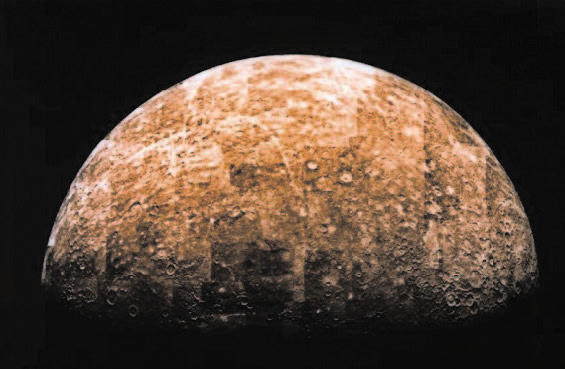
    American scientists believe that they have solved the mystery of why, compared with the Moon, its nearest airless neighbour, Mercury has a dark and decidedly non-silvery surface. The reason, they say, is that the planet is coated in billions of years’ worth of carbon dust, after millennia upon millennia of being “dumped on” by passing comets.

    The repeated showers of dusty “stealth-darkening agent”, they suggest, have in effect turned Mercury into “a painted planet”. Where to explore in the solar system. 

    The dim surface of the planet closest to the Sun, has long puzzled astronomers. Since it has the thinnest atmosphere of all the planets in the solar system, one possibility was that it was darkened by the effects of solar winds and the impacts of micro meteorites.

    Both processes, however, would leave a thin, dark coating of tiny, dark iron particles, and analysis found that there were in fact very few such particles on Mercury’s surface. the independentNow research, published in Nature.

    Geoscience and conducted by Megan Bruck Syal at Brown University in Rhode Island, has produced another possibility. “It’s long been hypothesised that there’s a mystery darkening agent that’s contributing to Mercury’s low reflectance,” she said. “One thing that hadn’t been considered was that Mercury gets dumped on by a lot of material derived from comets.” 

  • MOON’S FIRST SETTLERS MAY LIVE IN GIANT CITY-SIZED LAVA TUBES

    MOON’S FIRST SETTLERS MAY LIVE IN GIANT CITY-SIZED LAVA TUBES

    WASHINGTON (TIP): The first human settlers on the moon may live inside giant lava tubes large enough to house cities, which were formed by ancient volcanic eruptions, new research suggests.

    The volcanic features are an important target for future human space exploration because they could provide shelter from cosmic radiation, meteorite impacts and temperature extremes, researchers said.

    Lava tubes are tunnels formed from the lava flow of volcanic eruptions. The edges of the lava cool as it flows to form a pipe-like crust around the flowing river of lava. When the eruption ends and the lava flow stops, the pipe drains leave behind a hollow tunnel, said Jay Melosh, a Purdue University distinguished professor of earth, atmospheric and planetary sciences who is involved in the research.

    “There has been some discussion of whether lava tubes might exist on the moon,” he said. “Some evidence, like the sinuous rilles observed on the surface, suggest that if lunar lava tubes exist they might be really big,” said Melosh.

    Sinuous rilles are large channels visible on the lunar surface thought to be formed by lava flows. The rilles range in size up to 10kms wide, and the team explored whether lava tubes of the same scale could exist.

  • China plans huge solar power station in space

    BEIJING (TIP): China plans to build a huge solar power station 36,000km above the ground in an attempt to battle smog, cut greenhouse gases and solve energy crisis, much on the lines of an idea first floated in 1941 by fiction writer Isaac Asimov, state media reported on Monday.

    If realized, it will surpass the scale of the Apollo project and the International Space Station, and be the largest-ever space project.

    The power station would be a super spacecraft on a geosynchronous orbit equipped with huge solar panels. The electricity generated would be converted to microwaves or lasers and transmitted to a collector on Earth, staterun Xinhua news agency reported.

    In 1941, American science fiction writer Isaac Asimov had published a short story “Reason”, in which a space station transmits energy collected from the sun using microwave beams.

    Wang Xiji, an academician of the Chinese Academy of Sciences and an International Academy of Astronautics member, says Asimov’s fiction has a scientific basis. After devoting over 50 years to space technology research, Wang, 93, is an advocate for the station: “An economically viable space power station would be really huge, with the total area of the so lar panels reaching 5 to 6 sq km.” That would be equivalent to 12 of Beijing’s Tian’anmen Square, the largest public square in the world.”Maybe people on Earth could see at night, like a star,” says Wang.

    Wang says the electricity generated from the ground-based solar plants fluctuates with night and day and weather, but a space generator collects energy 99% of the time.Space-based solar panels can generate ten times as much electricity as ground-based panels per unit area, says Duan Baoyan, a member of the Chinese Academy of Engineering.”If we have space solar power technology”, hopefully we could solve the energy crisis on Earth,” Duan said. Wang says whoever obtains the technology first “could occupy the future energy market.” However, many hurdles lie ahead: A commercially viable space power station would weigh 10,000 tons. But few rockets can carry a payload of over 100 tons to low Earth orbit. “We need a cheap heavy-lift launchvehicle,” says Wang, who designed China’s first carrier rocket more than 40 years ago. “We also need to make very thin and light solar panels.” 

  • Speed bumps to generate power

    AHMEDABAD: Speed bumps have always been cursed by motorists for reducing vehicle efficiency and wasting petrol. But not any more. Eight engineering students of the state have come out with small speed bumps that can generate electricity through electro-spinning wheels installed beneath roads in heavy traffic zones, thereby powering streetlights and traffic signals.

    A conventional speed bump wastes a huge amount of kinetic energy when a car is forced to bring itself from a more efficient cruising speed to almost zero. Vicky Vyas, one of the students, explained: “A rotary is beneficial when the proportion of the right-turn traffic is extremely high; typically if it is more than 30%. They’re suitable when there are more than four approaches or if there aren’t separate lanes for right-turn traffic.” 

    By placing electro-mechanical units beneath speed breakers, we can conserve this energy. When vehicles pass over the spinning wheel, power is produced by the motion of wheels that is saved in a generator installed under electro-spinning wheels.

  • Bionic ants could power tomorrow’s industries

    Robotic ants the size of a human hand that work together could be the future of factory production systems.

    The developers, German technology firm Festo, say it’s not just the unusual anatomy of real-world ants that inspired the bionic version — the collective intelligence of an ant colony was also something they wanted to replicate.

    The bionic ants cooperate and coordinate their actions and movements to achieve a common aim — in the same way individual ants complete tasks for the whole colony. Festo says that in the future production systems will be based on intelligent individual components that adjust themselves to different production demands by communicating with each other. The ants are able to complete complex tasks like transporting large, heavy loads, that they wouldn’t be able to achieve individually, by working together.

    The robot features a stereo camera and a floor sensor that together allow the ant to work out its location and identify objects to be grabbed by grippers at the front of its “head”. The antennae double up as chargers for lithium batteries that power their movements. A radio module in the abdomen allows them to communicate with each other wirelessly. Just like their natural counterparts, the ants have six articulated legs.

    Festo says the way the ants are constructed is unique too. The bodies of the bionic ants are made from a 3D printed plastic powder melted layer by layer with a laser. The circuitry is also 3D-printed on top of the body. Festo says this is the first time the techniques have been combined.

    The ceramic legs and pincers are flexible actuators that move quickly and precisely without using much energy. Again, Festo says the application of this so-called ‘piezo’ technology to miniature robots like its bionic ants is a first.

  • PONDICHERRY – Travel Update

    PONDICHERRY – Travel Update

    Unlike much of India, including Delhi, Pondicherry seems to cherish its heritage rather than wiping it clean with shiny new buildings, or letting it crumble in indifference. Pondicherry’s brush with colonial history and international appeal—it was ruled by France from the 17th century to 1952, and briefly by the Dutch and the British—has always given its old-world charm a decidedly cosmopolitan flavour. The city’s official name Puducherry is a clue to how it negotiates the past. Originally known as Puducheri, a Tamil port, it was christened Pondicherry by the French, a name that remains popular.

    In recent years, Pondicherry has changed from a sleepy small town to a vibrant tourist destination, and is now dotted with heritage hotels, chic boutiques and Parisian-style cafes. Yet it is still a place that reveals its secrets at its own pace. It is only when you amble through its hushed alleys that you discover the languid mood that defines the city and the little pieces that make up its soul: a grand villa; a forgotten statue; a shady green park.

    Unlike most Indian cities, Pondicherry is ideal for exploring on foot. A canal broadly divides the city into two parts—the French and Tamil Quarters—with compact layouts which are best explored by cycle or walking. This is also the most visible legacy of French rule, during which Pondicherry was segregated into the sea-facing white town and the black town, the former for the rulers and the latter for the ruled.PONDICHERRY

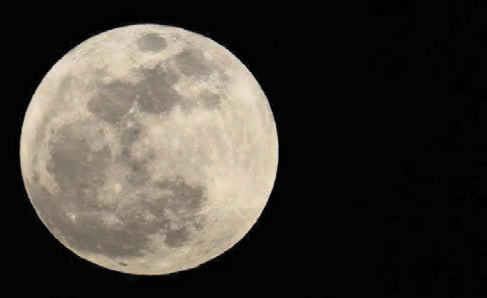
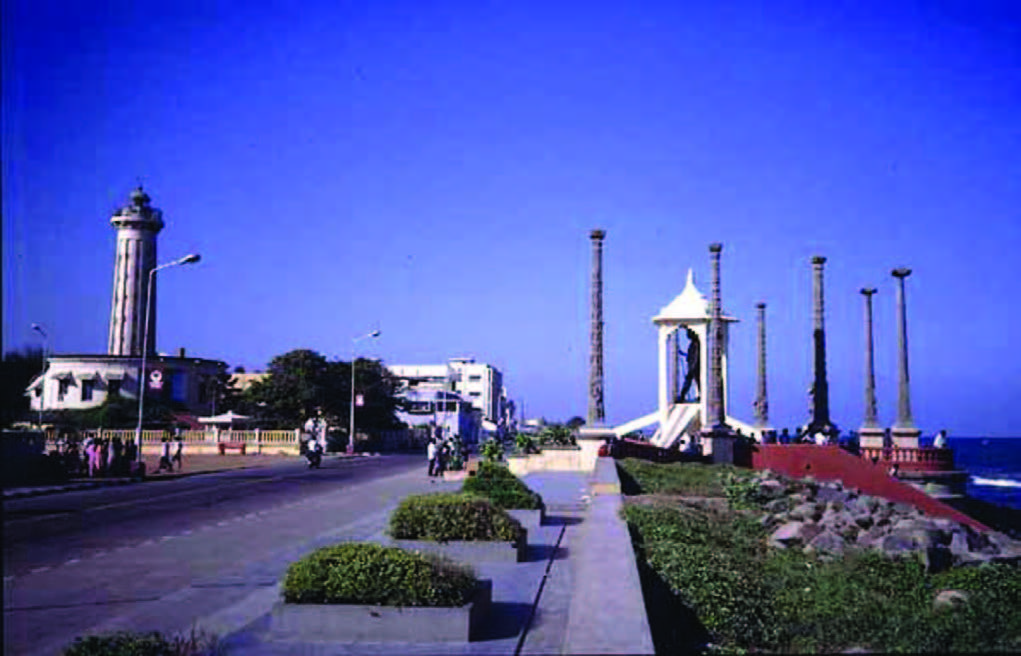
    The best area to explore the French part by foot is the sea-facing promenade that runs parallel to the Goubert Avenue. The 1.5-kilometre stretch of the promenade, a miniature version of Mumbai’s Marine Drive, is where its residents gather every evening to catch the sea breeze and the blue vista of the moon rising on the Bay of Bengal. At dusk, it’s buzzing with food vendors, people on evening walks, and friends chatting and loafing. The other side of the avenue is lined with a row of heritage buildings and scattered statues which let you soak in Pondicherry’s history. The avenue is also traffic-free and pedestrian-friendly between 6pm and 7.30am every day.

    The most convenient starting point for a stroll is the French cultural centre, Alliance Francaise. Located inside a white villa on the southern edge of the promenade, it looks out to the sea from one end and the French Quarter on the other. It has a charming garden restaurant, Le Cafe de Flore, and is bustling with regular film screenings, exhibitions, music and talks, much of the time.

    Behind Alliance Francaise, the tree-lined boulevards of the French Quarter are lined with spacious pastel and ochre-coloured buildings designed in the classical European style. A few steps away, inside an 18th-century mansion, Tamil women are busy with needlework at the Cluny Embroidery Centre—a charitable initiative by the Sisters of St Joseph of Cluny. Some of the surrounding edifices have been converted into heritage hotels, among them Hotel de Pondicherry and Hotel de l’Orient, while others house fancy boutiques and restaurants—both ingenious ways of breathing new life into the built heritage.

    Back on the promenade, little reminders of France dot the rest of Goubert Avenue. A whitewashed 19th-century lighthouse stands on one end. A statue of Dupleix, an illustrious French governor of Puducherry between 1742 and 1754, has now been relegated to one end of the avenue. Up ahead, a Joan of Arc sculpture stands alone in front of the well-kept 18th-century church, Notre Dame de Anges. This rose-and-cream building has an impressive, newly-restored interior, with a wooden image of Christ. Further on, the avenue is dotted with more colonial buildings-turned-offices, such as the French Consulate General and the Secretariat. Le Cafe, located in the middle of the promenade, is an excellent stop for filter coffee. It occupies what used to be a customs house and later, port office for Pondicherry’s harbour, and offers unparalleled views of the sea.

    History lessons and political power play continue with two other major monuments on the promenade. The austere First World War memorial commemorates the combatants who died during WWI. Diagonally opposite the memorial, a few steps on, a larger-than-life statue of Gandhi occupies centre-stage on the promenade, surrounded by antique pillars brought from the ancient seaport of Arikamedu.

    Opposite the Gandhi memorial, Bharathi Park is a green oasis surrounded by offices and important buildings such as the Raj Niwas and the Legislative Assembly. Once a parade ground, it is now a popular local spot for an afternoon siesta. It also encloses a striking white monument called the Ayi Mandapam, built in the mid-19th century by the French and rumoured to be named after a medieval courtesan who had constructed the tank that supplied water to Pondicherry. There is a striking contrast between the imposing grandeur of the Governor’s House or Raj Niwas, a whitewashed 18th-century mansion that was once the residence of the French Governor, and a dilapidated building on St. Louis Street that houses the Puducherry Museum. However, there are several historical gems in the museum’s scattered collection, including ancient Roman pottery shards from the trading port of Arikamedu nearby and antique French furniture.

    Pondicherry’s other claim to fame is its connection with Sri Aurobindo and Mirra Alfassa, deferentially known as the Mother, who evolved a new system of spiritual thought here. The grey-and-white building of the Aurobindo Ashram houses the duo’s samadhi. Inside, the atmosphere is quiet, orderly and reverential. If you’re intrigued, Auroville, the utopian, self-contained township founded by the Mother to promote ‘human unity,’ and now home to an international community of followers, is a short drive away. In sharp contrast to the pristine order of Aurobindo Ashram, the Manakula Vinagayar Temple across the road is full of colour and chaos. The only temple in the French Quarter, it is dedicated to Ganesha, and built in the typical Dravidian style of architecture with a towering gopuram (gateway) embellished with colourful carvings.

    From here, you can walk down to the Tamil Quarter, originally built around a nucleus of shrines. This part of the city has a contrasting architectural style, demonstrated in restored Tamil mansions like Hotel La Maison Tamoule and the house of Anand Rangapillai, a prosperous 18th-century merchant. These have unique elements like semi-public street verandahs for visitors outside the house, and inside, a central courtyard with grand columns. Not too far away, the Jawaharlal Nehru Street—the city’s main shopping avenue—is firmly rooted in the present. This is where you’ll find heavy traffic, numerous boutiques and the Hidesign flagship store that stocks the latest range of leather handbags sourced from the company’s main factory nearby.

    Pondicherry is still, thankfully, not as crowded as other tourist destinations in India, partly because the nearest airport in Chennai is a three-hour drive away. For now, through careful conservation of its heritage and multicultural ethos, it has found a delicate balance between its past and the present, and is a great example of an old city reinventing itself as a modern-day travel destination.