Month: April 2015

  • When will Rahul return, asks BJP; Soon, says Sonia

    When will Rahul return, asks BJP; Soon, says Sonia

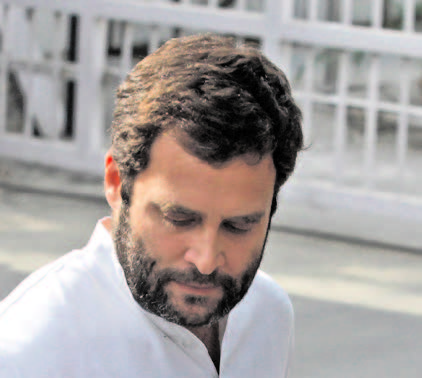
    NEW DELHI (TIP): The BJP on Thursday took a dig at Congress vice president Rahul Gandhi wondering when he will return but Congress chief Sonia Gandhi asserted that he will soon be back among the people.

    BJP spokesperson Shahnawaz Hussain on April 2 took a jibe at Rahul Gandhi, wondering if he was really set to return and attend the April 19 rally of his party against the new land acquisition law.

    “We do not know if reports about the date are true…Is his vacation finally over,” asked Hussain.

    Sonia Gandhi however asserted that Rahul Gandhi will come back soon.

    “He will come back soon and will be among people,” she said to questions on her son’s return after her visit to Neemuch in Madhya Pradesh to meet farmers whose crops have been damaged in the recent untimely rains.

    Rahul Gandhi had gone on “leave of absence” ahead of the budget session of parliament and there has been recurring speculation about the date of his return.

    The party had initially said that he had gone on two weeks’ leave but the period has extended to over a month now.

    Senior party leader Digvijaya Singh had indicated earlier this week that Rahul Gandhi is likely to attend a farmers’ rally being held by the party in the capital on on April 19.

    Noting the rally will be attended by all senior leaders, he said that “when I say senior leaders, it includes Rahul Gandhi as well.

    The Congress meanwhile said it had no specific information of Rahul Gandhi’s date of return.

    “I have no official intimation in this regard,” party spokesperson Meem Afzal said.

  • PANJABUNIVERSITY TEACHER GUIDES STUDENTS IN DEVISING LOW COST ROBOT AND BRAILLE PRINTER

    PANJABUNIVERSITY TEACHER GUIDES STUDENTS IN DEVISING LOW COST ROBOT AND BRAILLE PRINTER

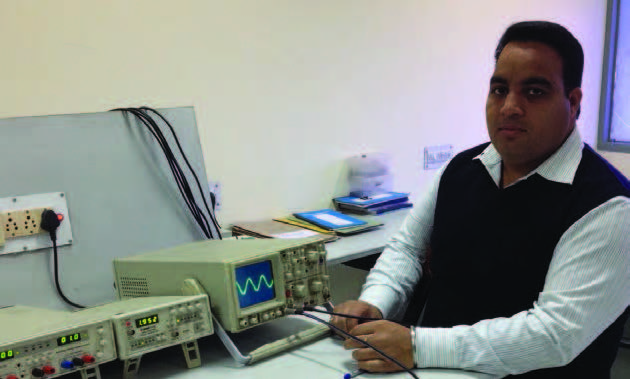
    CHANDIGARH(TIP): Rohan Arora and Pulin Aggarwal, the students of Electronics and communication Engineering department of UIET ( University Institute of Engineering and Technology ) of world renowned Panjab University, Chandigarh have devised a cheap video based robot under the guidance of their Assistant Professor Sarvjit Singh. This device can be utilized for the surveillance of homes. Assistant Professor Sarvjit Singh said that the cost of developing this device was about Rs 6800/- ( US $ 113 approx) and it can be connected to LAN through laptop or computer for video. It can be modified to connect it with WAN or internet. This wireless surveillance system can be moved in different directions through a remote control device. In this context, Professor Sarvjit Singh added that surveillance systems available in the market are quite costly, ranging between Rs30000/- (US $ 500 approx) to Rs40000/- (US $670 approx). Their device is affordable and it keeps watch over the house in the absence of its master, once it is connected to the internet. Besides, it can be used through mobile application. “Since it has a higher torque which enables it to get through a surface like muddy waters very easily,” claimed Assistant Professor Sarvjit Singh. According to him, this device can be further improved with better technology. Presently, their priority was to develop an inexpensive device. Had they made its chassis at their own, it would have cost even less. Also, the data it sends at present is just password protected but can be encrypted for use in army, for example. This project was completed in time span of 5 months. Assistant Professor Sarvjit Singh said that these students had earlier won an award for their autonomous surface monitoring robot.

    Two students- Oshin Garg and Saurabh Singh- of ECE (Electronics & Communication Engineering) branch of UIET (University Institute of Engineering and Technology) department of world renowned Panjab University Chandigarh have developed a low-cost desktop Braille printer for blind persons under the guidance of their Assistant Professor Sarvjit Singh. The creators of this device said that common Braille printer available in the market is very costly as its price ranges between Rs 25000/- (US $ 415 approx) to Rs 30000/- (US $ 500 approx). As such, it was sort of challenge for them to develop a low cost Braille printer costing between Rs5000/- (US $85 approx) to Rs10000/- (US $ 170 approx).

    There is a scope for further reduction in cost. This project was completed in time period of 5 months. This printer is ATmega 16 microcontroller based. It has a needle which moves with a motor to perforate a sheet of paper. This device runs on a 12 V adapter and the consumption of electricity is even less than that of 25 Watt CFL.

  • Rally in demand of Hindu Holidays on Friday 10 April

    In demand for Hindu Holidays in NYC schools, multiple Hindu groups in NYC will hold a ‘Grand Rally’ in front of City Hall on Friday, 10th April 2015 at 12 noon. The organizers are mostly Bangladeshi groups and had requested all other groups from any country to join.

    Organizers are expecting a huge crowd from at least 2 dozens organizations and requested everybody to join with their banner. The organizers planned to handover a memorandum to the Mayor on the same day.  

    Organizer Sitangshu Guha informed that they had sent memorandams to almost all city council members which stated that, NYC is home to about 1 million Hindus who are the immigrants  from India, Bangladesh, NepalSri LankaBhutan, Indonesia, Thailand, Malaysia, Afghanistan, the Caribbean (TrinidadGuyanaSuriname), Fiji, South Africa and African continent,  and other countries; and their descendants, followed by the thousands of American adherents of the ISKCON movement (the Hare Krishna group). It added, Hindu holidays are traditionally marked by various cultural festivities and spiritual retreats that promote and celebrate human excellence. Moreover, Hinduism propagates self-awareness and fosters tolerance, healing, and peaceful coexistence. The memorandum also pointed out that, when the city schools are closed on holidays of other faiths, not doing so on the Hindu holidays is akin to discrimination. 

    For more info: Sitangshu Guha  guhasb@gmail.com; & 646-696-5569; Shyamal Chakraborty 917-415-9261; Sushil Saha 646-454-1882; Suvo Roy 646-463-9282 & Pradip das 718-674-4545. Pradip Malaker 646-479-5275

  • Centre files review plea in SC over Jat quota verdict

    Centre files review plea in SC over Jat quota verdict

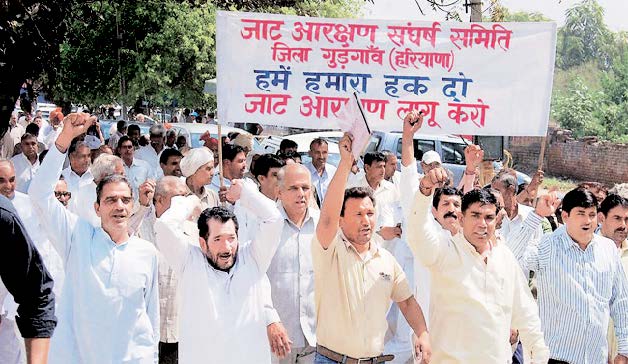
    NEW DELHI: (TIP): Compelled by electoral politics, the BJP-led NDA government has filed a review petition in the Supreme Court pleading for its nod to extend reservation to Jats in education and jobs under the Other Backward Classes (OBCs) category which enjoyed a 27% quota.

    The review petition comes in the wake of a Jat delegation’s meeting with PM Narendra Modi following the SC ruling The government’s move has come within a fortnight of the SC verdict on March 17 striking down the Centre’s March 2014 notification that had put Jats on the OBC list meant for 9 states —Haryana, HP, Uttarakhand, UP, Delhi, Bihar, Gujarat, MP and Rajasthan (Bharatpur and Dholpur districts).

    Only two days ago, the SC had reiterated its ruling by refusing to entertain a petition filed by Jat doctors pleading for exempting the admissions for the 2015-16 academic session from the purview of the judgment. The doctors, who had applied for post graduation medical courses under the OBC quota, had argued that since the admission process had begun much before the SC verdict, the quota for Jats should be retained at least for one more year. In the review petition, the government said the decision to include Jats in the OBC list was in consonance with the SC verdict in the OBC quota issue in the backdrop of the Mandal Commission report.

    All nine states had already included Jats in their OBC lists and had pleaded with the Centre to put them on the Central list as well.

    While the UPA government had extended the OBC quota to Jats on the eve of the 2014 LS elections, the Modi government supported this decision in the SC ahead of the Haryana Assembly polls last year.

  • Case against Giriraj Singh for racist remark

    Case against Giriraj Singh for racist remark

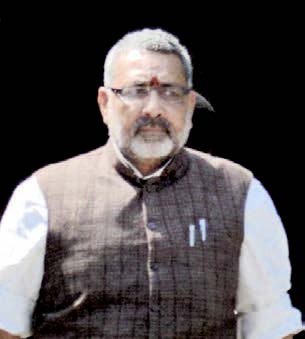
    NEW DELHI (TIP): A complaint was filed against Union Minister Giriraj Singh in a district court on April 2 by a Congress worker for his racist remarks against Congress president Sonia Gandhi.

    Sanjay Kumar Singh filed a complaint against Giriraj Singh in the court of Chief Judicial Magistrate Ved Prakash Singh, who transferred the case to the court of Sub-Divisional Judicial Magistrate Anju Singh.

    The SDJM directed Mithanpura police station to register a case against the minister on the basis of the complaint, Sumit Kumar, lawyer of the petitioner, said.

    The SDJM gave the order to Mithanpura police station under Section 166 of IPC (public servant disobeying law with intent to cause injury to any person).

    Meanwhile, Sonia Gandhi said she would not like to respond to people with narrow mindset. “I don’t think it is proper to respond to persons having narrow mentality,” Gandhi told reporters after surveying the damaged crops and meeting farmers in Neemuch district in Madhya Pradesh. Giriraj Singh had kicked up a row with his remarks asking whether Congress would have accepted Sonia Gandhi’s leadership had she not been white-skinned. “Had Rajiv Gandhi married a Nigerian woman and if she was not a white-skinned woman, would the Congress have then accepted her leadership?,” he told journalists on Tuesday. Various women leaders also attacked Singh, who is Minister of State for Micro, Small and Medium Enterprises, saying it reflected his racial mindset and attitude towards women. The Minister, who had courted controversies with remarks during Lok Sabha elections like people opposed to Narendra Modi can go to Pakistan, also mocked Rahul Gandhi’s absence from the political scene and likened it to the “missing Malaysian airliner”. Meanwhile, to a query on Congress Vice President Rahul Gandhi’s sabbatical, Sonia Gandhi said, “Rahul will come back soon and he will soon go in the midst of farmers.”

  • Govt mulls appointment of new Governors

    Govt mulls appointment of new Governors

    NEW DELHI (TIP): The Centre is mulling filling vacancies of Governors in nine states — five of them ruled by the Congress— soon as one Governor is holding the charge of four states while five others are in charge of at least two states each.

    “Since some Governors are holding additional charge of 2-3 states, new appointments are expected in the coming weeks,” official sources said.

    There are vacancies in Raj Bhavans in Assam, Himachal Pradesh, Meghalaya, Mizoram and Manipur, all ruled by the Congress. Opposition parties like JD-U, Left and TRS are in power in Bihar, Tripura and Telangana respectively.

    There is also vacancy in Punjab, ruled by the Akali Dal-BJP combine. The post of Lieutenant Governor in Puducherry is also lying vacant.

    West Bengal Governor Keshari Nath Tripathi is holding the additional charge of Bihar, Meghalaya and Mizoram while Nagaland Governor Padmanabha Acharya is in charge of the Raj Bhavans in Assam and Tripura.

    Haryana Governor Kaptan Singh Solanki has been given the additional charge of Punjab Governor and administrator of Chandigarh; Rajasthan Governor Kalyan Singh is holding the additional charge of Himachal Pradesh. Uttarakhand Governor KK Paul is in charge of the Raj Bhavan of Manipur too.

    ESL Narasimhan, who was the Governor of undivided Andhra Pradesh, continues to be the Governor of both Telangana and residuary Andhra Pradesh after the bifurcation while Lieutenant Governor of Andaman and Nicobar Islands Lt General Ajay Kumar Singh (retd) is holding the additional charge of the LG of Puducherry.

  • New anti-gay laws in US are ‘dangerous’: Apple chief

    New anti-gay laws in US are ‘dangerous’: Apple chief

    WASHINGTON (TIP): Apple chief Tim Cook slammed what he called a wave of “dangerous” laws in several US states that he said promote discrimination and erode equality, in an editorial published on Sunday.

    Cook – one of the most prominent chief executives to publicly acknowledge his homosexuality – wrote in the Washington Post that socalled “religious freedom” laws passed in several states threaten to undo progress toward greater equality.

    “There’s something very dangerous happening in states across the country,” Cook wrote in the editorial.

    “These bills rationalize injustice by pretending to defend something many of us hold dear. They go against the very principles our nation was founded on.” Cook’s comments follow the adoption of a controversial law in the state of Indiana last week that critics say would allow businesses to deny service to homosexuals on religious grounds.

    Activists say it makes it legal for businesses whose owners reject homosexuality on religious grounds to turn away LGBT customers.

  • US Senator Menendez indicted on corruption charges

    US Senator Menendez indicted on corruption charges

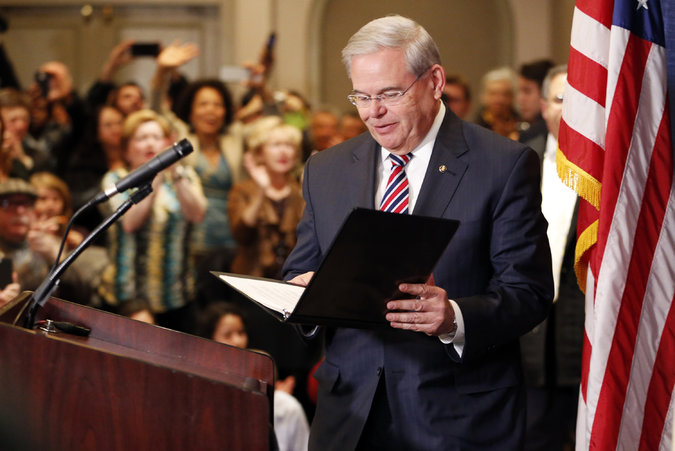
    WASHINGTON (TIP): US Democratic Senator Robert Menendez of New Jersey was indicted on corruption charges, allegations that the high-ranking lawmaker said he would address at a news conference on Wednesday night. Menendez was indicted by a grand jury in New Jersey for accepting gifts from Salomon Melgen, a Florida ophthalmologist, in exchange for using the power of his Senate office to benefit Melgen’s financial and personal interests, according to the court filing.

    The allegations against Menendez, a senior lawmaker on foreign policy and banking, raise the possibility of Republicans gaining a 55th Senate seat to strengthen their hand in policy fights with Democratic President Barack Obama, should the senator decide to resign his seat.

    Menendez was stepping down as ranking member, or top Democrat, on the U.S. Senate Foreign Relations committee, Senate aides saidMenendez and Melgen, both 61, were charged with one count of conspiracy, one count of violating the travel act, eight counts of bribery and three counts of honest services fraud. Menendez was also charged with one count of making false statements. Menendez, in response to previous reports of a federal investigation, has denied wrongdoing. Melgen and his representative could not immediately be reached for comment on the charges.

  • Zardari plans to launch daughter into politics

    Zardari plans to launch daughter into politics

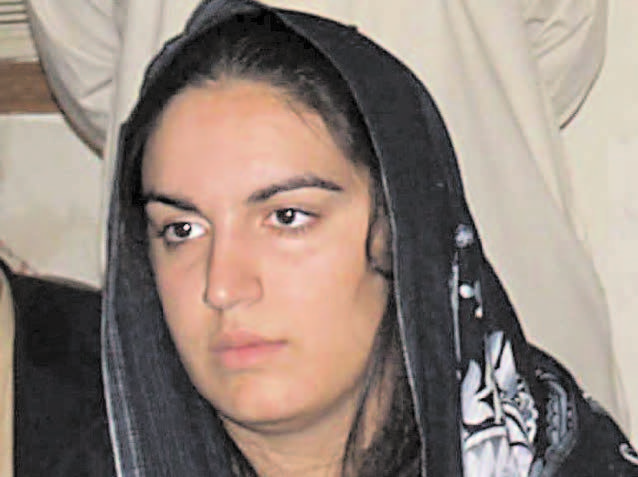
    ISLAMABAD (TIP): Pakistan’s former president and PPP co-chairman Asif Ali Zardari is planning to launch his daughter into politics, a move indicative of strained ties with his son Bilawal.

    Bilawal Bhutto Zardari formally stepped into politics last year, but soon developed differences with his father over handling of party affairs.

    According to party sources, Bilawal is living in London and planning to take a two-year break from politics to pursue his higher education after earlier completing his graduation from Oxford university.

    “In his absence, the party needs a Bhutto to be on the forefront and Zardari has decided to introduce his daughter Bakhtawar,” the sources said.

    Bakhtawar is being tutored in politics by senior women leaders of the party. She might deliver her maiden political speech at the death anniversary of her grandfather Zulfiqar Ali Bhutto on April 4.

    There is a little hope that Bilawal would attend the anniversary, used as a rallying point for party workers.

    Zulfiqar founded Pakistan People Party (PPP) and served as prime minister before he was hanged in 1979 by military dictator Ziaul Haq on dubious charges of murder.

    His daughter Benazir Bhutto was elected twice as prime minister before she was killed in an attack in 2007.

    PPP is associated with Bhuttos and after the death of Benazir, Zardari announced that all his children had decided to adopt Bhutto as part of their names

  • Afghan court sentences photojournalist’s killer to 20 years in jail

    Afghan court sentences photojournalist’s killer to 20 years in jail

    KABUL (TIP): An Afghan police officer who shot and killed a veteran Associated Press photographer during the country’s 2014 presidential election has been sentenced to 20 years in prison, a Supreme Court official told mediapersons on March 30.

    The official spoke on condition of anonymity because he was not authorized to give statements to the press.

    A second AP reporter was injured in the attack, which took place in eastern Khost province while they were sitting in their car inside a government compound.

    Anja Niedringhaus, 48, a German national, was killed instantly while Canadian reporter Kathy Gannon who had covered conflict in Afghanistan for 30 years survived the shooting.

    The police officer had initially been sentenced to death, but that decision was overturned by an appeals court and the Supreme Court upheld that ruling, the court official said.

  • Rhino on rampage in Nepal, kills 1, injures several

    Rhino on rampage in Nepal, kills 1, injures several

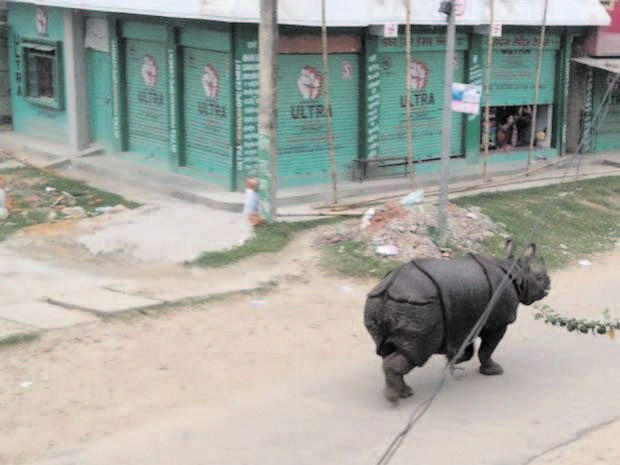
    KATHMANDU (TIP): A wild rhino charged into a city in southern Nepal on March 30, killing a woman, injuring several others and chasing panicked people through the main market and a hospital, an official said.

    Attempts to force the rhino out of Hetauda city by honking car horns and beating drums were unsuccessful, with the animal running from one area to another, government administrator Ram Prasad Thapaliya said.

    Teams with tranquilizer guns were on their way to attempt to capture it, he said.

    Thapaliya said the rhino fatally gored a 61-year-old woman on the outskirts of Hetauda, a city of about 135,000 people that borders a forested area. An unknown number of people were injured, he said.

    It chased people around the main downtown market and the city bus station, he said.

  • Another blogger hacked to death in Bangladesh

    DHAKA (TIP): A blogger was hacked to death in the Bangladesh capital on Monday, in the latest brutal attack on the country’s independent writers, a senior officer said.

    Police have arrested two men over the murder which comes just weeks after an American aethist blogger was also hacked to death in Dhaka, a crime that triggered international outrage, the officer said.

    Bangladesh arrests chief suspect in US blogger murder “He was brutally hacked to death this morning with big knives just 500 yards (460 metres) from his home at Dhaka’s Begunbari area,” local police chief Wahidul Islam told AFP.

    Islam said the men were arrested immediately after the attack trying to flee the scene.

    Police said they were unsure whether the victim, Washiqur Rahman, 27, was also an atheist blogger but another social media writer said that he was known to write “against religious fundamentalism”.

    “It appeared Rahman used to write using a penname Kutshit Hasher Chhana (Ugly Duckling),” Imran Sarker, head of Blogger and Online Activists Network in Bangladesh, told AFP.

    “He was a progressive free thinker and was against religious fundamentalism,” he said.

    They have also arrested a suspect over the killing in February of American atheist writer and blogger Avijit Roy. Roy was the second atheist blogger to have been murdered in the Muslim-majority country in the last two years and the fourth writer to have been attacked since 2004.

    His killing sparked an uproar at home and abroad with hundreds of secular activists holding protests for days to demand justice.

    They also slammed the country’s secular government for not doing enough to protect humanist writers.

  • 3 navy personnel arrested over Tamil lawmaker’s killing

    COLOMBO (TIP): Sri Lankan police have arrested three navy personnel over an ethnic Tamil lawmaker’s assassination that had been blamed on Tamil Tiger rebels.

    Police spokesman Ruwan Gunasekara said April 1 that the three men are suspected in the killing of Nadaraja Raviraj, who was shot dead in his car in 2006 during the country’s civil war.

    Raviraj was outspoken on greater self-rule for minority ethnic Tamils and explained the Tamil perspective of the conflict in Sinhala, the language of the majority.

    The government of former President Mahinda Rajapaksa blamed the killing on the now-defeated Tamil rebels, but Raviraj’s supporters suspected a government hand.

    Rajapaksa’s government was accused of operating paramilitary groups to kill and abduct rebel suspects and dissidents.

    The new government of President Maithripala Sirisena has promised accountability for wartime abuses.

  • Pakistan close to buying eight Chinese submarines: Financial Times

    BEIJING (TIP): Pakistan is close to signing a $4 to $5 billion deal to buy eight submarines from China, the Financial Times said on April 2, in what it added would likely be China’s largest overseas arms sale.

    The decision had been agreed “in principle”, the newspaper said, citing a hearing in the Pakistani parliament’s defence committee.

    Pakistani newspaper the Dawn said on Wednesday that negotiations with China on the sale were at an advanced stage.

    Neither China’s Defence nor Foreign Ministries immediately responded to a request for comment.

    China and Pakistan call each other “all-weather friends” and their close ties have been underpinned by long-standing wariness of their common neighbour, India, and a desire to hedge against U.S. influence across the region.

    China and Pakistan already have close defence ties and China has sold a large amount of military equipment to the country in the past.

  • Strangers in their own land: Dilemma of the Christian populace in India

    Strangers in their own land: Dilemma of the Christian populace in India

    Mr. Julio Ribeiro, Retired IPS officer, former DGP of Mumbai and Gujarat recently said: ‘As a Christian, suddenly, I am a stranger in my own country’. He was merely reflecting on the recent dilemma of the Christian community in India since the ascendance of Mr. Narendra Modi as Prime Minister of India. It is indeed the anguish of a distinguished public servant who has served the country with great zeal and dedication to protect and preserve its territorial integrity.

    Today, scores of Indian Christians who have contributed in so many ways towards the development of India especially in the social and educational sectors are pained to feel the same way as Mr. Ribeiro does!As a Christian and a member of the Diaspora, I truly share the sentiment of Mr. Ribeiro and salute him for his forthrightness in speaking out.

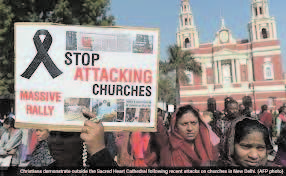
    What exactly has happened to bring about such anxiety and insecurity to such a small community that poses no harm to its fellow citizens? The latest reports from India point to two more attacks  targeting the Christian religious places of worship, one at St. George Church in Navi, Maharashtra and the other at St.Peter and Paul Church at Jabalpur, Madhya Pradesh, along with two schools that are managed by the churches. Incidentally, both Maharashtra and Madhya Pradesh states are governed by Prime Minister Modi’s party-BJP.

    These may have happened at the heel of another incident in Nadia district in West Bengal where a 72 year old Nun was gang raped by six individuals at the Jesus and Mary convent school. Reacting to the gang rape of the Nun, Surendra Jain, Joint Secretary of the Vishwa Hindu Parishad (VHP) blamed the ‘Christian Culture’ for the incident. He also justified the vandalizing of a Church in Haryana and stated that these attacks would continue if conversions do not stop.Church Attacks In India

    Several Churches in Delhi were vandalized and desecrated by religious extremists in the past months including St. Sebastian Church in Dilshad Garden which was reduced to ashes with its altar charred and Bibles strewn all over the ground. Archbishop Anil Couto said that the arson in St. Sebastian Church was condemnable not just because it was act of sacrilege and hate against the community and its faith, but because it could happen in the national capital which is recovering from a series of communal incidents. Also distressing to him is the sense of police impunity that long hours were lost, and possible evidence destroyed, before police finally came. Most of the culprits still remain at large and the law enforcement officials seem to show very little urgency in bringing them to justice.

    These incidents are not just limited to certain parts of India but happening across the country. The recent incident in a village in Chattisgarh reveals the fear and insecurity of those who have embraced Christianity as their faith. Sukhram Kashyap, a Christian from Chattisgarh, has not only seen his church vandalized but was denied food rations from the Hindu dominated village council and several of his friends were beaten up when they protested. Some of his fellow worshippers were reconverted in an aggressive campaign called ‘Ghar Wapasi’ by Hindu fundamentalists who have also banned any Christian clergy from entering the village.

    Breaking a long silence on this continuing onslaught by the Hindutva brigade on Christians and their Institutions around the country Prime Minister Modi said the following; ‘the tradition of welcoming, respecting and honoring all faiths is as old as India itself’. One wonders whether his ardent followers in BJP and RSS are listening!

    The President of Catholic Bishops Conference of India Cardinal Baselios Cleemis said that the recent attacks on churches and Christians in India have made many ‘feel that their Christian identity is being questioned and it gives a sense of sadness. It showed that not everybody had taken seriously the Prime Minister Narendra Modi’s assurance to minorities’. ‘Irrespective of their faiths, anybody being attacked was an Indian citizen and it was the government’s duty to protect them’ Cardinal added.

    In an interview to Karan Thapar on Headlines Today, Cardianal Cleemis also described as “very painful and sad” the comments of RSS head Mohan Bhagwat that Mother Teresa’s humanitarian works were driven by her motive to convert those she served. “It was very painful and very sad to hear about Mother Teresa whom the nation honored with Bharat Ratna,” he said.

    There is no doubt that that Cardinal Cleemis spoke on behalf of all Christians in India that may very well include many of the faithful in the Diaspora. Although he did not single out any organization over many of these incidents but went on to criticize the Modi government for observing Christmas as Good Governance Day, saying good governance should be done everyday and the Christian festival should be respected.

    One of the most astounding observations that can be made about these attacks on minorities in India is that there is a deafening silence on the part of the Diaspora in the US. Hindu American Foundation, Vishwa Hindu Parishad of America, and GOPIO along with many other organizations have decided to look the other way. Though relatively new as immigrants to this great country, Indians continue to demand our rightful place, justifiably so, at the table in sharing the riches and defending our values and traditions while not tolerating any injustice that offends our sensibilities. A huge segment of the community has indeed made tremendous strides in this short period realizing the American dream and integrating itself into the mainstream.

    However, Christians in India who have lived there for almost two Millennia are made to feel as if they are strangers in their own land. How a personal choice of faith that is guaranteed under the article 25 and 26 of the Constitution of India could make or break the ‘Indian ness’ of its citizenry is beyond the comprehension of any rational mind!  

    Undoubtedly, the forces of polarization and divisions have come out of the woodwork and kept themselves busy transforming India at the expense of the values and principles of inclusiveness and tolerance that brought the nation together. The current Government’s dual-track policy of providing good optics for the consumption of the global community while unleashing the extremist forces to undo the social progress of the last 65 years, mostly under the Congress rule, is troublesome and disheartening to most of its citizens!

    President Obama in his Siri Fort speech prodded the new Government ‘India will succeed so long as it is not splintered along the lines of religious faith, as long as it is not splintered along any lines and it is unified as a nation’. It sounds prophetic and to plainly put it, unless the Prime Minister reins in these extremist elements that run amok now, his dream of ‘modern India’ could be in increasing peril!

  • Family Abductions: Is there a solution?

    Family Abductions: Is there a solution?

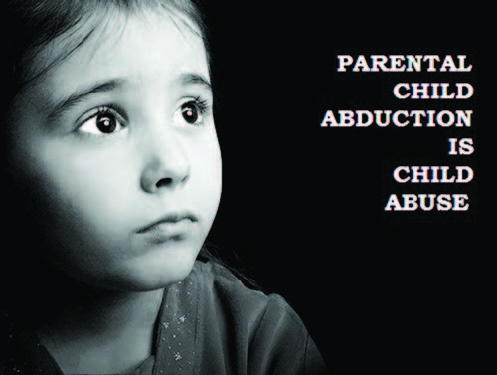
    International parental child abduction (IPCA) and the illegal retention of children abroad are criminal offences according to both US federal law and the United Nations Convention on the Rights of the Child (UNCRC).

    194 countries of the world including India but excluding the US, Somalia and South Sudan, have ratified the UNCRC, which legally binds their governments to use legislative and administrative measures to combat IPCA and illegal child retention. All Governments who have ratified this legally binding treaty are accountable to the international community.

    India ratified the UNCRC in 1992 and re-committed to it several times over the last 2 decades.

    Yet, today over a 1000 children a year are abducted out of the US by one of their parents, and the numbers are on the rise.

    India is the #3 top destination for IPCA.

    You can search everywhere on the Internet, just don’t expect to find any recent numbers or reports on IPCA cases. The US State Department stopped reporting these statistics after 2013.

    The US allows 1000s of children to exit US borders everyday without requiring the traveling parent to provide a letter of consent from the non-traveling parent. Once a child is abducted they rarely come back, and if they do, the psychological damage has already been done. https://www.psychologytoday.com/blog/buddy-system/201011/parental-child-abduction-and-its-impact

    India lets the abducted children in, and then the Indian Judicial system facilitates their illegal retention.

    These traumatized children remain in India for years while a long cross-border custody battle ensues between their feuding parents.

    Meanwhile an innocent child has lost their childhood for ever.

    Finally after the passage of a few years and several court dates, the Indian courts usually pass an order that the child remain in India under permanent sole custody of the abducting parent, since they have now already lived in India for so long that it would be against the best interests of the child to displace them from their new home!

    There is an unfortunate American woman of Indian origin, Bindu Philips, who was a New Jersey stay-at-home mother to her twin boys. Her 8 year old sons have been illegally retained in India by her abusive husband for 6 years now. She has not seen them in years. Her father has been fighting a losing custody battle on her behalf in India. http://bringseanhome.org/tag/bindu-philips/

    Left-behind parents like myself on average spend $100,000 in legal expenses in both the US and India- and we STILL don’t get our kids back.

    Here is a link to the chain of events that a left-behind parent can expect once a child is abducted to India, which I have outlined above. http://lifetimechild.com

    Is there any hope for a solution? The answer to this question depends on first finding the root of the problem.

    A number of organizations and communities of left- behind parents have now joined hands – BOKHome, BAKHome, IStand Parents Network amongst others.

    We have been doing our own research as to what are the underlying problems and what could be the possible solutions.

    Ironically, we found through our research that the laws against international parental child abduction and the illegal retention of children abroad are already in existence in both the USA and India. However, governmental agencies seem inexplicably reluctant to accept that these laws exist and to ensure that these laws are enforced.

    In the US: The US Department of State says that their hands are tied, although they promise they are doing everything they can. However, for over 2 decades they have failed so spectacularly to follow through with their own commitments that it appears now that maybe they simply don’t care. Not even the most simple, effective and totally free measures to prevent IPCA have been undertaken to date.

    There are even parents who claim that the US DoS has not only been unhelpful but have in fact aided in some abductions and re-abductions.

    I can get you in touch with one such American father who recently sued the U.S. State Department Office of Children’s issues- the case has gone up to the level of the US Federal court system now. His story is a heart-breaking story of how corruption still exists in the USA and how it has destroyed his life.

    In March, 2000 the US State Department committed to developing an interagency database of the cases of IPCA so that they could share data with the NCMEC, the Department of Justice, after it had been noted that the State Department was still “solving” cases whereas the abducted child was retrieved a month earlier by the FBI.

    This interagency database was supposed to be up and running in August 2000. 15 years later, it still does not exist.

    In India: IPCA is a crime in India, but the US DoS warns abducting parents clearly on its website “Parental child abduction is not a crime in India.”

    http://travel.state.gov/content/childabduction/english/count ry/india.html

    Left-behind parents have found unrelenting Congressional support and momentum for our cause in Congressman Chris Smith. He championed the Goldman Act which was enacted in 8/14, which gives the US Department of State more authority and also makes it accountable.

    https://www.govtrack.us/congress/bills/113/hr3212

    He recently questioned US Secretary of State John Kerry on Bindu Philips’ case. http://www.thehindu.com/news/kerry-quizzed-on-child-abductions-to-india/article6942102.ece

    4 Organizations of left-behind parents participated in a 3 day conference in Washington DC late last month, called the International Parents’ Conference, Embassy Walk & Congressional Lobby Day on March 25-26, 2015.

    http://www.istandparentnetwork.com/

    The highlight of this event was the OPEN Congressional

    http://childrenatborders.org/news-and-comments/

    Subcommittee hearing on 3/25/15.

    Our children need a voice.

  • Ominous Legislation

    The Gujarat Control of Terrorism and Organised Crime (GCTOC) Bill 2015The Gujarat Control of Terrorism and Organised Crime (GCTOC) Bill 2015 carries disturbing echoes of draconian anti-terror laws such as the Terrorist and Disruptive Activities (Prevention) Act (TADA) and the Prevention of Terrorism Act (POTA). Both were considered failed experiments that led to gross abuse. More specifically, the Bill seems to be modelled on the provisions of the Maharashtra Control of Organised Crime Act (MCOCA) that was implemented in 1999 and continues to be in force today. In fact, since 2002 it has also been in force in Delhi after the police insisted that such a law was needed as ‘organised crime has no limits’.

    The common thread running through all these controversial pieces of legislation is the notion that regular process, as outlined by the Code of Criminal Procedure, is not enough to deal with a changed internal security situation. GCTOC is therefore the latest chapter in a long-running search to find an ‘ideal’ anti-terror law, but like its earlier versions it raises important questions about the lines the state crosses in its attempts to fight crime and terror. GCTOC, like MCOCA, allows confessions secured in police custody to be admitted as evidence in courts, a disturbing provision that is tantamount to legitimising custodial torture. Similarly, it allows the custody of an accused for 180 days rather than the 90 days provided under normal law. The most troubling aspect of MCOCA has been the way it enables the police to sidestep rigorous investigation. It has been used as a charge in all manner of cases ranging from real estate deals, prostitution and match-fixing, as the police seek to stack the odds in their favour in order to secure a conviction. This practice has repeatedly met with censure from the courts and there is no guarantee that GCTOC won’t go down the same path.

    The debate around GCTOC in the coming days will most likely take a political hue. When the UPA government first rejected Gujarat’s attempts to pass an anti-terror law the then Chief Minister Narendra Modi claimed that he was only presenting a ‘xerox copy’ of MCOCA. The UPA argued that the Gujarat law was at variance with its policy on terror laws as articulated in the Unlawful Activities (Prevention) Act. The new government may well have a different national policy. After all, permission for MCOCA was given under the last NDA government. A more useful debate though, is on the manner in which these special laws are created. TADA came into being during the years of the Punjab militancy and POTA after the Parliament attack of 2001, and the genesis of MCOCA was from the Mumbai serial blasts of 1993. Knee-jerk reactions lead to severe laws. The focus should rather be on better resources and training for investigators who can continue to work under the existing Code of Criminal Procedure, which is already comprehensive in scope.

  • Dr. V.K. Raju Felicitated

    Dr. V.K. Raju Felicitated

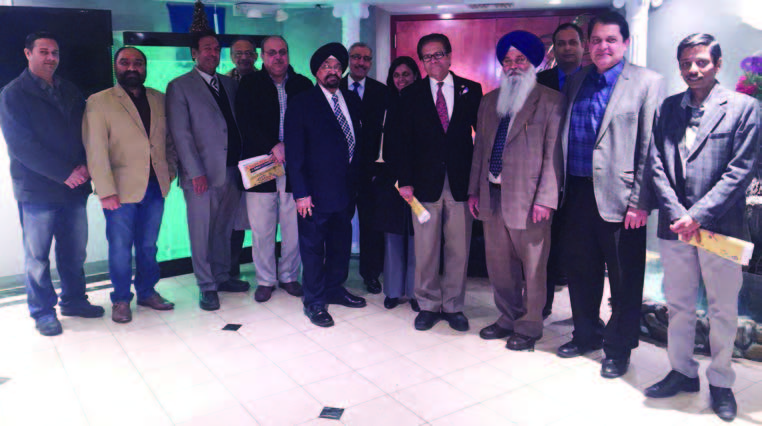
    NEW YORK (TIP): Eminent ophthalmologist Dr. V.K. Raju was on a visit to New York on March 27 to 29. He was in the City to give a presentation at Columbia University. Prof. Indrajit S Saluja hosted a dinner in his honor at Richie Rich Palace in Richmond Hill, Queens.

    Dr. V.K. Raju spoke at length about his mission to prevent blindness among children, in particular in India. He was concerned at the large number of children losing vision in India. He has been holding eye camps in India since 1977.

    Dr. Raju disclosed that he was worried about the growing number of people in Punjab suffering from sugar. He said he planned to hold camps in Punjab to screen patients of sugar and offer his medical advice. He said sugar was linked intimately with blindness.

    Dr. Raju also narrated his experiences in India during his visit in January and February. He felt sorry that India had not undergone any change with the change in government there though much was being expected of the new government, whose leaders had made tall promises during election campaign.

    Present on the occasion, among others, were Air India Regional Manager for Americas, Rishikant Singh, eminent film maker Tirlok Malik, HAB Bank Vice President Rizwan Qureshi, CEO of Centrum Technologies Karan Beri, INOC USA Chairman George Abraham, Jehangir Khattak of CUNY department of Journalism, Jarnail Singh Gilzian, and Davinder  and Balwant from PTC TV channel.

    Dr. V.K. Raju and his daughter Dr. Leela who accompanied him were warmly received and presented bouquets.

  • AIR INDIA PRESENTS  NEW SUMMER ONBOARD MENU

    AIR INDIA PRESENTS NEW SUMMER ONBOARD MENU

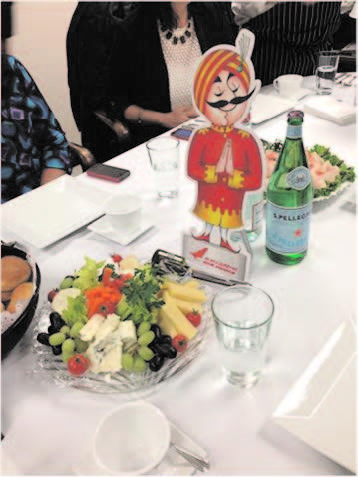
    JAMAICA, NY (TIP): Air India, New York invited Media Partners to “Air India’s New Summer 2015 Inflight Menu Presentation” on Wednesday, March 25, 2015 at Flying Food inflight caterers, at JFK International Airport in New York.

    Regional Manager – Americas Rishikant Singh, and members of his team welcomed the invitees.

    Samples of the menu in all three classes of service were on display for inspection.

    James Ball, Flying Food Group VP Sales & Services, and Intiaz Yasin, Account Manager for Air India, along with their team of talented chefs, were on hand to describe and present the variety of items served inflight, and described the entire process of food preparation and quality control.

    Air India has always been known for its onboard cuisine, and for the gracious hospitality with which it is served. Air India, unlike many airlines these days, still offers inflight entertainment, multiple meals and drinks onboard at no cost, and the quantities served ensure that passengers will have no trouble in falling asleep after their meals.

    The Regional Manager discussed the importance of food in Indian culture, and the great variety of cuisines found in India – all of which are reflected in Air India’s inflight menu. The dietary or religious requirements can be taken care of including kosher, halal and no beef. First class passengers enjoy the luxury of a multi-course meal at the time of their choosing.

    All Special Meal (SPML) requests need to be made at least 48 hours prior to departure, especially for economy class.

    Following are some of the types of meals offered by Air India which can be booked online or through your travel agent:

    • Asian Vegetarian (Hindu Vegetarian)
    • Jain Meal – (vegetarian meal without roots & tubers)
    • Hindu Meal (Non vegetarian excludes beef)
    • Baby Meal/Infant Food (Vegetarian/Non-Vegetarian)
    • Bland Meal (Vegetarian/Non-Vegetarian)
    • Child Meal (Vegetarian/Non-Vegetarian)
    • Diabetic Meal (Vegetarian/Non-Vegetarian)
    • Fruit Platter Meal
    • Gluten Intolerant Meal (Vegetarian/Non-Vegetarian)
    • Kosher Meal
    • Low Calorie Meal (Vegetarian/Non-Vegetarian)
    • Low Fat Meal (Vegetarian/Non-Vegetarian)
    • Low Salt Meal (Vegetarian/Non-Vegetarian)
    • Moslem Meal
    • Low Lactose Meal (Vegetarian/Non-Vegetarian)
    • Vegetarian Raw Meal
    • Seafood Meal – (only in first & executive classes)
    • Special Meal -(needs to be specified)
    • Vegan Meal – (vegetarian meal without dairy products)
    • Lacto-Ovo Meal (vegetarian meal with dairy products & eggs)
    • Vegetarian Oriental Meal

    Vegetarian or non-vegetarian choice needs to be specified with all Special Meal (SPML) requests in all classes.

    Take in a movie at leisure on comfortable and ergonomically designed seats !

    Please check our website www.airindia.in for more details about ouronboard service, and any other needs about your booking.

    Air India with 3 non-stops from Newark, New York and Chicago to Delhi and Mumbai with over 60 onward connections within India and to other continents is your window to Asian culture and the world.


  • By 2050, Hindus will become the world’s third largest population: Study

    By 2050, Hindus will become the world’s third largest population: Study

    WASHINGTON (TIP): Hindus will become the world’s third largest population by 2050, while India will overtake Indonesia as the country with the largest Muslim population according to a new study. According to the Pew Research Center’s religious profile predictions assessed data released on Thursday, the Hindu population is projected to rise by 34 per cent worldwide, from a little over 1 billion to nearly 1.4 billion by 2050.

    By 2050, Hindus will be third, making up 14.9 per cent of the world’s total population, followed by people who do not affiliate with any religion, accounting for 13.2 per cent, the report said.

    The people with no religious affiliation currently have the third largest share of the world’s total population.

    Muslims are projected to grow faster than the world’s overall population and that Hindus and Christians are projected to roughly keep pace with worldwide population growth, the report said.

    “India will retain a Hindu majority but also will have the largest Muslim population of any country in the world, surpassing Indonesia,” it said.

    “Over the next four decades, Christians will remain the largest religious group, but Islam will grow faster than any other major religion,” according to the report.

    The report predicted that by 2050 there will be near parity between Muslims (2.8 billion, or 30 per cent of the population) and Christians (2.9 billion, or 31 per cent), possibly for the first time in history.

    There were 1.6 billion Muslims in 2010, compared to 2.17 billion Christians.

    “The number of Muslims will nearly equal the number of Christians around the world,” it added.

    If the trend continues, Islam will be the most popular faith in the world after 2070, it said.

    By 2050, Muslims will make up about 10 per cent of the Europe’s population, up from 5.9 per cent in 2010.

    Over the same period, the number of Hindus in Europe is expected to roughly double, from a little under 1.4 million (0.2 per cent of Europe’s population) to nearly 2.7 million (0.4 per cent), mainly as a result of immigration, it said.

    In North America, the Hindu share of the population is expected to nearly double in the decades ahead, from 0.7 per cent in 2010 to 1.3 per cent in 2050, when migration is included in the projection models. Without migration, the Hindu share of the region’s population would remain the same.

    Buddhism is the only faith that is not expected to increase its followers, due to an ageing population and stable fertility rates in Buddhist countries, such as China, Japan and Thailand.

    The projections considered fertility rates, trends in youth population growth and religious conversion statistics.

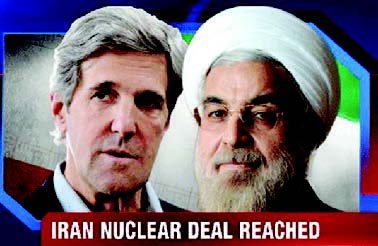
  • IRAN NUCLEAR DEAL – framework announced

    IRAN NUCLEAR DEAL – framework announced

    LAUSANNE, SWITZERLAND (TIP): April 2, 2015 becomes historic as Iran Nuclear deal framework is announced. It is a significant step towards a landmark deal aimed at keeping Iran’s nuclear program peaceful. Iran would reduce its stockpile of low-enriched uranium by 98% and significantly scale back its number of installed centrifuges, according to the plan. In exchange, the United States and the European Union would lift sanctions that have crippled the country’s economy. “It is a good deal, a deal that meets our core objectives,” U.S. President Barack Obama said in a speech from the White House Rose Garden. “This framework would cut off every pathway that Iran could take to develop a nuclear weapon.”

    The deal would include strict verification measures to make sure Iran complies, he said.

    “If Iran cheats,” Obama said, “the world will know it.”

    Given below are the key parameters of a Joint Comprehensive Plan of Action (JCPOA) regarding the Islamic Republic of Iran’s nuclear program that were decided in Lausanne, Switzerland.  These elements form the foundation upon which the final text of the JCPOA will be written between now and June 30, and reflect the significant progress that has been made in discussions between the P5+1, the European Union, and Iran. Important implementation details are still subject to negotiation, and nothing is agreed until everything is agreed. “We will work to conclude the JCPOA based on these parameters over the coming months”, a White House statement said. 

    • Iran has agreed to reduce by approximately two-thirds its installed centrifuges. Iran will go from having about 19,000 installed today to 6,104 installed under the deal, with only 5,060 of these enriching uranium for 10 years. All 6,104 centrifuges will be IR-1s, Iran’s first-generation centrifuge.
    • Iran has agreed to not enrich uranium over 3.67 percent for at least 15 years.
    • Iran has agreed to reduce its current stockpile of about 10,000 kg of low-enriched uranium (LEU) to 300 kg of 3.67 percent LEU for 15 years.
    • All excess centrifuges and enrichment infrastructure will be placed in IAEA monitored storage and will be used only as replacements for operating centrifuges and equipment.
    • Iran has agreed to not build any new facilities for the purpose of enriching uranium for 15 years.
    • Iran’s breakout timeline – the time that it would take for Iran to acquire enough fissile material for one weapon – is currently assessed to be 2 to 3 months. That timeline will be extended to at least one year, for a duration of at least ten years, under this framework. Iran will convert its facility at Fordow so that it is no longer used to enrich uranium 
    • Iran has agreed to not enrich uranium at its Fordow facility for at least 15 years.
    • Iran has agreed to convert its Fordow facility so that it is used for peaceful purposes only – into a nuclear, physics, technology, research center.
    • Iran has agreed to not conduct research and development associated with uranium enrichment at Fordow for 15 years.
    • Iran will not have any fissile material at Fordow for 15 years.
    • Almost two-thirds of Fordow’s centrifuges and infrastructure will be removed. The remaining centrifuges will not enrich uranium. All centrifuges and related infrastructure will be placed under IAEA monitoring. Iran will only enrich uranium at the Natanz facility, with only 5,060 IR-1 first-generation centrifuges for ten years.
    • Iran has agreed to only enrich uranium using its first generation (IR-1 models) centrifuges at Natanz for ten years, removing its more advanced centrifuges.
    • Iran will remove the 1,000 IR-2M centrifuges currently installed at Natanz and place them in IAEA monitored storage for ten years.
    • Iran will not use its IR-2, IR-4, IR-5, IR-6, or IR-8 models to produce enriched uranium for at least ten years. Iran will engage in limited research and development with its advanced centrifuges, according to a schedule and parameters which have been agreed to by the P5+1.
    • For ten years, enrichment and enrichment research and development will be limited to ensure a breakout timeline of at least 1 year. Beyond 10 years, Iran will abide by its enrichment and enrichment R&D plan submitted to the IAEA, and pursuant to the JCPOA, under the Additional Protocol resulting in certain limitations on enrichment capacity. Inspections and Transparency 
    • The IAEA will have regular access to all of Iran’s nuclear facilities, including to Iran’s enrichment facility at Natanz and its former enrichment facility at Fordow, and including the use of the most up-to-date, modern monitoring technologies.
    • Inspectors will have access to the supply chain that supports Iran’s nuclear program. The new transparency and inspections mechanisms will closely monitor materials and/or components to prevent diversion to a secret program.
    • Inspectors will have access to uranium mines and continuous surveillance at uranium mills, where Iran produces yellowcake, for 25 years.
    • Inspectors will have continuous surveillance of Iran’s centrifuge rotors and bellows production and storage facilities for 20 years. Iran’s centrifuge manufacturing base will be frozen and under continuous surveillance.
    • All centrifuges and enrichment infrastructure removed from Fordow and Natanz will be placed under continuous monitoring by the IAEA.
    • A dedicated procurement channel for Iran’s nuclear program will be established to monitor and approve, on a case by case basis, the supply, sale, or transfer to Iran of 3 certain nuclear-related and dual use materials and technology – an additional transparency measure.
    • Iran has agreed to implement the Additional Protocol of the IAEA, providing the IAEA much greater access and information regarding Iran’s nuclear program, including both declared and undeclared facilities.
    • Iran will be required to grant access to the IAEA to investigate suspicious sites or allegations of a covert enrichment facility, conversion facility, centrifuge production facility, or yellowcake production facility anywhere in the country.
    • Iran has agreed to implement Modified Code 3.1 requiring early notification of construction of new facilities.
    • Iran will implement an agreed set of measures to address the IAEA’s concerns regarding the Possible Military Dimensions (PMD) of its program. Reactors and Reprocessing
    • Iran has agreed to redesign and rebuild a heavy water research reactor in Arak, based on a design that is agreed to by the P5+1, which will not produce weapons grade plutonium, and which will support peaceful nuclear research and radioisotope production.
    • The original core of the reactor, which would have enabled the production of significant quantities of weapons-grade plutonium, will be destroyed or removed from the country.
    • Iran will ship all of its spent fuel from the reactor out of the country for the reactor’s lifetime.
    • Iran has committed indefinitely to not conduct reprocessing or reprocessing research and development on spent nuclear fuel.
    • Iran will not accumulate heavy water in excess of the needs of the modified Arak reactor, and will sell any remaining heavy water on the international market for 15 years.
    • Iran will not build any additional heavy water reactors for 15 years. Sanctions o Iran will receive sanctions relief, if it verifiably abides by its commitments.
    • U.S. and E.U. nuclear-related sanctions will be suspended after the IAEA has verified that Iran has taken all of its key nuclear-related steps. If at any time Iran fails to fulfill its commitments, these sanctions will snap back into place.
    • The architecture of U.S. nuclear-related sanctions on Iran will be retained for much of the duration of the deal and allow for snap-back of sanctions in the event of significant non-performance.
    • All past UN Security Council resolutions on the Iran nuclear issue will be lifted simultaneous with the completion, by Iran, of nuclear-related actions addressing all key concerns (enrichment, Fordow, Arak, PMD, and transparency).
    • However, core provisions in the UN Security Council resolutions – those that deal with transfers of sensitive technologies and activities – will be re-established by a new UN Security Council resolution that will endorse the JCPOA and urge its full implementation. It will also create the procurement channel mentioned above, which will serve as a key transparency measure. Important restrictions on conventional arms and ballistic missiles, as well as provisions that allow for related cargo inspections and asset freezes, will also be incorporated by this new resolution.
    • A dispute resolution process will be specified, which enables any JCPOA participant, to seek to resolve disagreements about the performance of JCPOA commitments.
    • If an issue of significant non-performance cannot be resolved through that process, then all previous UN sanctions could be re-imposed.
    • U.S. sanctions on Iran for terrorism, human rights abuses, and ballistic missiles will remain in place under the deal.
    • For fifteen years, Iran will limit additional elements of its program. For instance, Iran will not build new enrichment facilities or heavy water reactors and will limit its stockpile of enriched uranium and accept enhanced transparency procedures. 
    • For ten years, Iran will limit domestic enrichment capacity and research and development – ensuring a breakout timeline of at least one year. Beyond that, Iran will be bound by its longer-term enrichment and enrichment research and development plan it shared with the P5+1.
    • Important inspections and transparency measures will continue well beyond 15 years. Iran’s adherence to the Additional Protocol of the IAEA is permanent, including its significant access and transparency obligations. The robust inspections of Iran’s uranium supply chain will last for 25 years.
    • Even after the period of the most stringent limitations on Iran’s nuclear program, Iran will remain a party to the Nuclear Non-Proliferation Treaty (NPT), which prohibits Iran’s development or acquisition of nuclear weapons and requires IAEA safeguards on its nuclear program.
  • Obama to finally visit fatherland Kenya as president

    Obama to finally visit fatherland Kenya as president

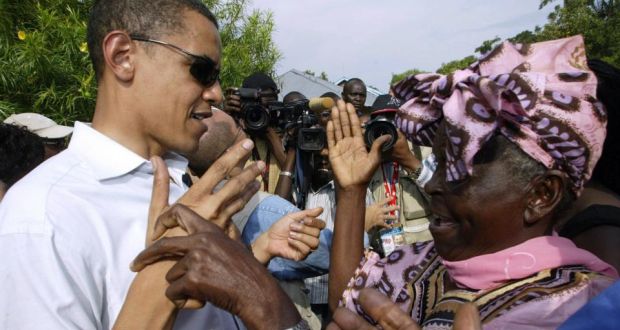
    WASHINGTON (TIP): President Barack Obama will finally visit Kenya, the land of his father and his forbears, in July this year.

    The US President has studiously avoided going to his paternal homeland in the six years plus he has been in the White House, perhaps apprehensive that it would provide political fodder for conservative wingnuts who have doubted if he was born in the United States and questioned his loyalty to the country, aside from his nationality.

    But now that there are no more electoral battles to be fought, the White House on Monday announced that Obama will travel to Kenya in July to co-host a forum on entrepreneurship as part of an effort to support economic development in Africa.

    Although he has been to Kenya thrice before, including once as US Senator, it will be his first visit as President, coming in the seventh year of his Presidency.

    The US President still has family living in Kenya, including half-brother and other siblings, although his father Barack Obama Sr died more than 30 years ago.

    Obama Sr came to the United States from Kenya for higher studies in 1959 and met Ann Durham at the University of Hawaii where they were both attending a Russian language class. They married soon after and Durham gave birth to Barack Obama in 1961.

    They separated soon after, pursuing their own academic careers and divorcing when Barack Obama Jr was only two. The young Obama would see his father only once after that, when he was around ten years old, before Obama Sr returned to Kenya and would die in a road accident in 1982 when Obama Jr was 21.

    The young Obama’s first known trip to Kenya was in 1988, when he spent five weeks there, according to his memoir Dreams from My Father. He returned to Kenya in 1992 with Michelle, then his fiance, and his half sister Auma, and again in 2006 during his first year in the US Senate.

    But Kenya stayed off the radar thereafter although he has visited 47 other countries as President, including neighboring Tanzania and South Africa (twice).

    A White House blog on the upcoming visit made no mention of Obama’s personal ties with Kenya although it alluded to it while pointing out that he has visited sub-Saharan Africa more than any other sitting president.

    ”Just as President Kennedy’s historic visit to Ireland in 1963 celebrated the connections between Irish-Americans and their forefathers, President Obama’s trip will honor the strong historical ties between the United States and Kenya -and all of Africa – from the millions of Americans who trace their ancestry to the African continent, to the more than 100,000 Americans that live in or visit Kenya each year,” it said.

    Inasmuch as Obama is done and dusted with elections, the Kenya trip is certain to stir up the hard right wing which has thrived on the so-called birther controversy -insisting that Obama was not born in the United States and thus ineligible to be President of the United States under Article Two of US Constitution.

    Although Obama released his birth certificate before he became President showing he was born in Hawaii, conspiracy theorists have maintained that it is a fake. Some polls have shown that up to 25 per cent of American still doubt Obama’s US birth.

  • SPLIT IN HARYANA BJP OVER ASHOK KHEMKA’S TRANSFER

    SPLIT IN HARYANA BJP OVER ASHOK KHEMKA’S TRANSFER

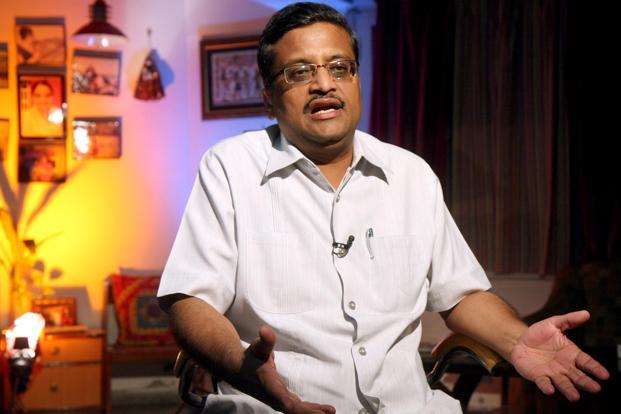
    CHANDIGARH (TIP): Differences surfaced in Haryana BJP over the transfer of whistleblower IAS officer Ashok Khemka, with cabinet minister Anil Vij saying he stands by Khemka and chief minister Manohar Lal Khattar calling the transfer “routine”.

    Health minister Anil Vij said, “I am totally with Khemka. I am with him since he fought the battle against corruption. I will stand by him… comment about this after talking to the CM.” 

    Khattar, who was in Hisar on April 2, “Jo sarkar ko jahan aavashyakta hoti hai, wahin harek adhikari ko bulaya jata hai. Hamari aavashyakta us hisab se jaisi hai, waisa hamney lagaya hai (government appoints any officer as per its requirements. We have posted him as per our requirements).” He said Khemka was a good and honest officer.

    A 1991 batch IAS officer, Khemka has faced 46 transfers during 22 years of service. He reacted to his transfer on Thursday with a tweet, “Tried hard to address corruption and bring reforms in transport despite severe limitations and entrenched interests. Moment is truly painful.”

    The government has not given any reason for his transfer, but sources said that the influential transporters’ lobby was unhappy with the officers’ order for stringent checking of trucks plying the inter—state route, especially those moving between Haryana and Rajasthan.

    Brushing aside suggestion of any role in Khemka’s transfer, transport minister Ram Bilas Sharma said, “It’s a routine matter. I have still kept him in my department. The archaeology (department) is under me.”

    Agriculture minister Om Prakash Dhankar saw no controversy in Khemka’s transfer either, unlike the previous Congress regime when he was allegedly shunted out over the Vadra land deal.

    “If he (Khemka) sees any issue, then he should talk to us or the CM,” said Dhankar, urging officers to not go to the media. “He (Khemka) is among the officers who goes to the media the most,” he added.

    The government had on April 1 transferred Khemka, 49, to a “low profile” assignment of secretary and director general of state archaeology and museums department, just four months after he was made transport commissioner.

  • TLCA Celebrates UGADI New Year

    TLCA Celebrates UGADI New Year

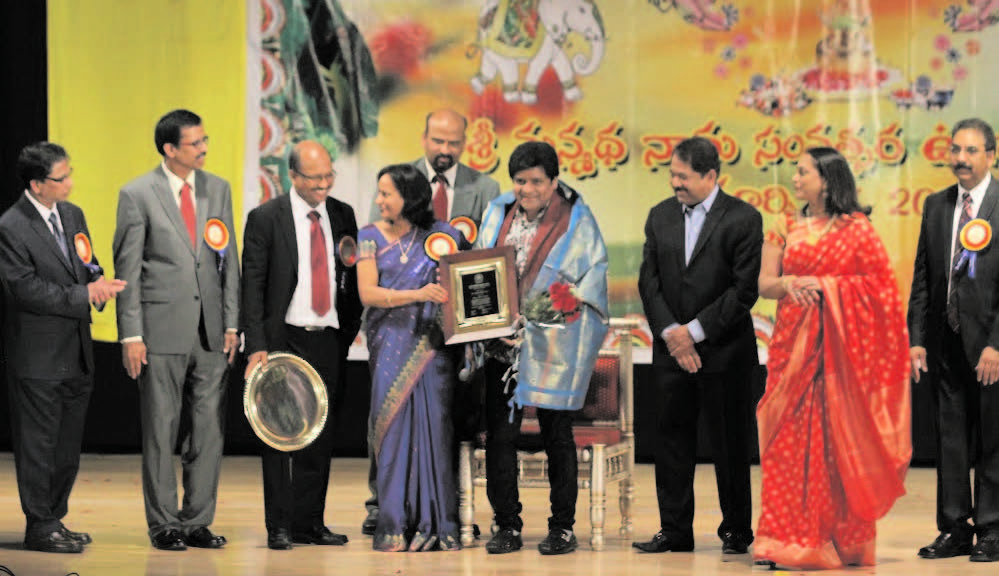
    QUEENS, NY (TIP): The Telugu Literary & Cultural Association celebrated Ugadi, the Telugu New Year ” Manmadha” on March 28th at the Hindu Temple Auditorium in Flushing, NY. An enthusiastic crowd packed the auditorium with over 650 excited guests.

    The celebrations opened with a prayer, followed by the “Pachanga Shravana” by Pundit Sri Gangadhar who gave the astrological significance of “Manmadha” New Year. In addition to the celebration of Ugadi, the actual day marked the commemoration of “Srirama Navami.” 

    HANUMAN CHALISA PERFORMANCE BY TLCA YOUTH UNDER THE DIRECTION OF MRS. UMA PUTANE
    HANUMAN CHALISA PERFORMANCE BY TLCA YOUTH UNDER THE DIRECTION OF MRS. UMA PUTANE

    In light of the observance of the International Women’s Day, at the request of President Raji Kuncham, all men in the audience gave a standing ovation to women for their contributions, leadership, love and for making a significant difference at home and in society. A special memento was released on the occasion that acknowledged the event sponsors and a record number of new year greeting messages from many dignitaries including Governor Cuomo, U.S. Senators & Congressional representatives, County and Town officials, Tamil Nadu Governor Rosaiah and Music Legend A.R. Rahman.

    All past presidents of TLCA were recognized and honored on this very special occasion. President Raji Kuncham thanked the past presidents for their vision, leadership and

    PAST PRESIDENTS HONORED BY SENATOR MICHAEL VENDITTO, ASSEMBLYMAN BRIAN CURRAN AND TLCA PRESIDENT RAJI KUNCHAM
    PAST PRESIDENTS HONORED BY SENATOR MICHAEL VENDITTO, ASSEMBLYMAN BRIAN CURRAN AND TLCA PRESIDENT RAJI KUNCHAM

    continued contributions to the TLCA and the community at large. Senator Michael Venditto and Assemblyman Brian Curran were present to celebrate the new year and joined President Raji Kuncham in honoring the past presidents in a befitting manner.

    The cultural program was superbly organized and executed lasting for seven hours. Children’s performances were amazing under the direction of teachers/dance schools. Nassau County Legislator Laura Curran was present for the children’s program.

    Tollywood artists enthralled the crowd with hilarious comedy skits and melodious songs. Comedy King Mohammed Ali, who has acted in over 1000 feature films, was honored with the title of “Haasya Kala Kovidha.” Trendy singers Hema Chandra and Sravana Bhargavi captivated the audience with popular tunes.

    TLCA EXECUTIVE COMMITTEE AND TLCA YOUTH LEADERS
    TLCA EXECUTIVE COMMITTEE AND TLCA YOUTH LEADERS

    President. Raji Kuncham thanked all the donors and sponsors for their generosity and support. Grand sponsors of the event included Mrs. Sadhana & Dr. Malla Reddy Paila, Drs. Subha & Purna Atluri, Dr. Sailaja & Mr. Satish Kalva. Corporate sponsors include Invagen Pharmaceuticals Inc., Netrovert Inc., State Bank of India, HAB Bank, Patel Brothers, Apna Bazar and Air India. Raffle prizes of two Toshiba laptops were donated by Maddipatla Foundation. TLCA Women’s Forum will be celebrating Mother’s Day and hosting a Stress Management Seminar on Saturday, May 3rd at the Cotillion, Jericho, NY.

  • Comptroller Stringer releases comprehensive manual to expand Immigrants’ access to City services

    Comptroller Stringer releases comprehensive manual to expand Immigrants’ access to City services

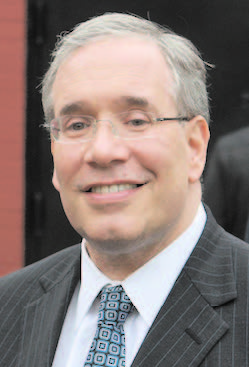
    NEW YORK CITY (TIP): On Friday, New York City Comptroller Scott M. Stringer released an “Immigrant Rights and Services Manual,” a new comprehensive guidebook to City, state and federal services. The 70-page manual, which will initially be translated into Chinese, Korean, Russian and Spanish, outlines the real-life impacts of recent legislation and policy changes, such as IDNYC, the new municipal identification card, and Local Laws 58 and 59, which restrict the City’s cooperation with Immigration and Customs Enforcement (ICE).

    “More than 200 languages are spoken every day in New York, and government must do everything it can to help immigrants participate in the life of our City,” Comptroller Stringer said. “Information is power, and the new manual we’re releasing is a helpful roadmap to health, legal, social and education resources that are available in all five boroughs.”

    The manual includes sections on: 

    • Language access rights-An overview of how City agencies are required to provide language access under Local Law 73 and Mayor’s Executive Order 120;
    • Public benefits-Information on the wide range of public benefits and programs available to immigrants, including the areas of health care, public schools and housing;
    • Immigrants’ rights and protections-A description of workers’ rights (such as prevailing wages and OSHA regulations), consumer and financial rights, anti-discrimination protections and the dangers of immigration consultant fraud;
    • Voting and civic participation-A summary of how immigrants can become involved in civic life, from filing taxes to attending and joining community boards;
    • Resource directory-A list of government agencies, community organizations and other resources that can help immigrants obtain benefits and services and enforce their rights, and
    • Deportation and detention-An in-depth overview of who can be deported and why, including when New York City does and does not cooperate with ICE, and the legal resources and assistance immigrants can access for these proceedings.

    “New York City has always been a beacon for the world, and the millions of immigrants who have come here didn’t just settle in our City, they helped build it. We must continue to welcome those who come here in search of a better life. New York has welcomed and celebrated immigrant diversity for more than 100 years, and this new manual is an important part of that tradition,” Stringer said.