Month: April 2015

  • OLA RAISES $400M, LED BY DST GLOBAL

    MUMBAI (TIP): In one of the largest financing rounds for an Indian internet startup, taxi-hailing service Ola said it has raised $400 million – or around Rs 2,500 crore – led by Russian tech billionaire Yuri Milner’s investment firm DST Global. With this, the four-year-old company is now valued at $2.5 billion, or more than Rs 15,000 crore.

    Ola has mopped up about $675 million across five rounds of funding in the backdrop of an all-time high investor sentiment around Indian consumer-facing tech companies.

    DST, known for its bets on Facebook and Twitter, is joined in the new round by Singapore’s sovereign wealth fund GIC, hedge fund Falcon Edge, Japan’s SoftBank, Tiger Global, Steadview Capital and Accel Partners US.

    A company statement said on Thursday the capital raised will be used to strengthen Ola’s leadership, expand into smaller markets by adding another 100 cities and pump$100 million into growing TaxiForSure (TFS), which it acquired recently. With this fund-raise, Ola becomes the third most valued domestic consumer internet company after Flipkart and Snapdeal, valued at $11 billion and $5 billion respectively. Just six months back, the taxi service venture was valued at $650 million when it raised funds from Softbank, making it a four-fold jump in its valuation.

    People familiar with the fund-raise said Milner’s DST will own 9% in Ola, having put $225 million. SoftBank, which is expected to have shelled out $90 million, will see its stake trim down to 25% from about 32%. Milner had personally invested in Ola last year.

    Founded by Bhavish Aggarwal and Ankit Bhati, batchmates at IIT-Bombay, Ola operates across 100 cities at present and, along with TFS, is a clear leader in the taxi aggregation market. The TFS buyout and now this massive raise are expected to give it a huge leg up over Uber which entered India in 2013. Aggarwal said Ola’s vision is that people shouldn’t find the need to own a car.

    “We have been able to make this possible for millions of customers in the past four years by creating over a hundred thousand driver entrepreneurs on the platform. With increasing smartphone penetration and immense growth in smaller cities and towns, we will be able to drive the benefits of this on-demand platform deeper into the lives of our customers and partners.” 

    Recently, Ola launched an on-demand cafe service and is also said to be toying with the idea of entering the highly competitive grocery delivery space. In the US, Uber has also been experimenting with other lines of businesses based on the delivery platform like Uber Movers for shifting house, UberRush, a courier service, and Uber Corner Store for grocery deliveries.

    India’s taxi market, estimated at over $10 billion in size, is largely unorganized but is fast changing with the advent of asset-light, aggregator services backed by heavy technology. Over the past year, the three players (Ola, Uber, TFS) have slugged it out with cut-throat competition, guzzling millions in investor money and throwing discounts to get larger market shares. Ola is said to be losing $30 million every month. It claims to be clocking 2 lakh average monthly rides.

    DST has been bullish about Asian tech-backed taxi companies as it picked up a stake in China’s largest taxi-hailing app Didi Dache, which recently merged with its closest competitor Kuaidi Dache, to form a $6-billion transportation behemoth. Buoyed by increased smartphone penetration, the 300-million strong internet user base in India is the next big opportunity for investors after China. Having come to the Silicon Valley as a relative unknown, Milner bulked up the DST portfolio by sinking in millions of dollars behind fast-growing internet firms like Airbnb, Spotify and Zynga, and is today one of the most sought after investors globally. Last year, it led a $210-million financing round in Flipkart, signalling the Russian investor’s interest in domestic tech firms.

  • NASA REVEALS FIRST-EVER COLOR IMAGE OF PLUTO

    NASA REVEALS FIRST-EVER COLOR IMAGE OF PLUTO

    WASHINGTON (TIP): NASA’s New Horizons spacecraft, set to fly by the Pluto system on July 14, has sent its first color image of the dwarf planet and its largest moon Charon.

    “The image reveals tantalising glimpses of this system,” Jim Green, director of NASA’s Planetary Science Division, said in a statement.

    Charon is seen dimmer than Pluto in the image taken from a distance of 115 million km.

    “The contrast may be due to a difference in composition of the two bodies or it could even be caused by a previously unseen atmosphere on Charon,” Green added.

    The uncertainty should clear up this summer when New Horizons gets history’s first good look at the two frigid, faraway objects.

    “We are going to Pluto because it is the human race’s first opportunity to study an entirely new class of world,” added William McKinnon, New Horizons co-investigator from the Washington University in St. Louis.

    Till date, astronomers knew about only one moon of Pluto called Charon which is nearly 50 percent as wide as the dwarf planet.

    Exactly 85 years after Pluto’s discovery, New Horizons has now spotted small moons orbiting Pluto.

    The moons, Nix and Hydra, are visible in a series of images taken by the New Horizons spacecraft at distances ranging from about 201 to 186 million km.

    The long-exposure images offer New Horizons’ best view yet of these two small moons circling Pluto which professor Clyde Tombaugh discovered at the Lowell Observatory in Flagstaff, Arizona Feb 18, 1930.

    Nix and Hydra were discovered by New Horizons team members in Hubble Space Telescope images taken in 2005.

    Hydra, Pluto’s outermost known moon, orbits Pluto every 38 days at a distance of approximately 64,700 km while Nix orbits every 25 days at a distance of 48,700 km.

    Pluto’s two other small moons, Styx and Kerberos, are still smaller and too faint to be seen by New Horizons at its current range to Pluto.

    There may be yet more moons waiting to be discovered, as well as a ring system or debris fields around Pluto.

    Such features could present a collision risk to New Horizons but mission team members are not too concerned, Space.com reported.

  • New blood test predicts breast cancer years ahead

    New blood test predicts breast cancer years ahead

    LONDON (TIP): A new blood test can predict if a woman would get breast cancer in the next two to five years and could create a “paradigm shift” in early diagnosis of the disease, reports a new study.

    “The method is better than mammography, which can only be used when the disease has already occurred,” said Rasmus Bro, professor of chemometrics at the University of Copenhagen in Denmark.

    “It is not perfect, but it is truly amazing that we can predict breast cancer years into the future,” Bro stressed.

    While a mammography can detect newly developed breast cancer with a sensitivity of 75 percent, the new metabolic blood profile is able to predict the likelihood of a woman developing breast cancer within the next two to five years with a sensitivity of 80 percent, the study noted.

    The research was based on a population study of 57,000 people followed by the Danish Cancer Society over 20 years.

    Inspired by research in food science, the researchers analysed all compounds a blood sample contains instead of – as is often done in health and medical science – examining what a single biomarker means in relation to a specific disease.

    “When a huge amount of relevant measurements from many individuals is used to assess health risks – here breast cancer – it creates very high quality information. The more measurements our analyses contain, the better the model handles complex problems,” continued professor Bro.

    The model does not reveal anything about the importance of the single biomarkers in relation to breast cancer, but it does reveal the importance of a set of biomarkers and their interactions, the researchers said.

    “No single part of the pattern is actually necessary nor sufficient. It is the whole pattern that predicts the cancer,” noted Lars Ove Dragsted from the University of Copenhagen.

    Managing stress uplifts mood in breast cancer patients

    Providing women with skills to manage stress early in their breast cancer treatment can improve their mood and quality of life many years later, says a new study.

    Published online in the journal Cancer, a peer-reviewed journal of the American Cancer Society, the findings suggest that benefits of stress management techniques during breast cancer treatment have long-term effects.

    “The results indicate that these skills can be used to reduce distress and depressed mood and optimise quality of life across the survivorship period as women get on with their lives,” said lead author Jamie Stagl from the Massachusetts General Hospital, in Boston.

  • SELF-POWERED CAMERA IS A REALITY

    SELF-POWERED CAMERA IS A REALITY

    NEW YORK (TIP): The world’s first selfpowered video camera that runs without a battery and can produce an image each second has been developed by researchers led by an Indian-origin scientist. To develop the prototype camera, researchers designed a pixel that can not only measure incident light but also convert the incident light into electric power.

    “We are in the middle of a digital imaging revolution,” said Shree K Nayar, TC Chang professor of computer science at the Columbia University , who led the study . He noted that in the last year alone, approximately two billion cameras of various types were sold worldwide.

    “I think we have just seen the tip of the iceberg. Digital imaging is expected to enable many emerging fields like wearable devices, sensor networks, smart environments, personalized medicine, and the Internet of Things. A camera that functions as an untethered device forever -without external power supply -would be incredibly useful,” said Nayar.

    Nayar realized that although digital cameras and solar panels have different purposes -one measures light while the other converts light to power -both are constructed from essentially the same components.

    At the heart of any digital camera is an image sensor, a chip with millions of pixels. The key enabling device in a pixel is the photodiode, which produces an electric current when exposed to light. This mechanism enables each pixel to measure the intensity of light falling on it.

    Nayar and colleagues used offthe-shelf components to fabricate an image sensor with 30×40 pixels.

    In his prototype camera, which is housed in a 3D printed body , each pixel’s photodiode is always operated in the photovoltaic mode. The pixel design is simple, and uses just two transistors.When the camera is not used to capture images, it can be used to generate power for other devices, such as a phone or a watch.

  • DEVICE TO HELP BLIND BOARD BUS

    MUMBAI (TIP): BEST has introduced on a trial basis a device which helps visually challenged persons board buses.

    The device helps users to identify the route number of buses at a bus stop and locate bus door, thereby enabling unsupervised boarding.

    Sources said that trials were conducted for more than two months. During the first phase of trials, units were fixed in 16 buses on routes 121 and 134, which led to over 100 boardings by visually impaired persons. The second phase saw the units in 24 buses operating from Backbay depot. The unsupervised boardings were successful, establishing the utility of the device in real settings, the sources said.

    The cost of the handheld device has not yet been determined. The pilot trials were largely funded by the Department of Science and Technology under their TIDE (Technology Interventions for the Disabled and Elderly) scheme. The next step will be to scale up the trials, officials said.

    M Balakrishnan, from ASSISTECH, IIT Delhi, said, “Nearly 350 unsupervised boardings over two months have given us immense confidence as well as feedback to take the project forward.” 

    BEST general manager Jagdish Patil said the transport undertaking was committed to provide safe and comfortable travel to all commuters. “It is a unique device that facilitates boarding of public buses by visually impaired persons,” he said.

  • Mexico’s ‘New Generation’ cartel takes police head-on

    Mexico’s ‘New Generation’ cartel takes police head-on

    OCOTLAN, MEXICO (TIP): The town still bears the scars from the unprecedented offensive launched by a powerful Mexican drug cartel against government forces: bullet-pocked buildings and blood stains on the street.

    The March 19 ambush that killed five federal gendarmerie officers, three gang suspects and three bystanders in Ocotlan signaled the start of a conflict between the authorities and the Jalisco New Generation Drug Cartel.

    The well-armed gang took its operation to a new level on April 6 when it surprised a Jalisco state police convoy, gunning down 15 officers in the deadliest single day for Mexico’s security forces in years of a bloody drug war.

    The western state of Jalisco is known as the birthplace of tequila, mariachis and the country’s most popular football team, the Chivas of Guadalajara.

    But now it is also known as the home of the New Generation, a rising power of Mexico’s underworld that had been overshadowed until now by other groups such as the Sinaloa, Zetas, Gulf and Knights Templar cartels.

    Officials say the Jalisco cartel has grown so powerful that it has produced its own assault rifles in makeshift gun assembly shops. The gang has even recruited military deserters, including foreign ones. “They were waiting for the moment when they felt strong to start this escalation,” Luis Carlos Najera, the chief prosecutor of Jalisco state, told AFP. Last year, authorities discovered a clandestine workshop with sophisticated equipment to build M16 and R15 rifles. Some of the homemade weapons were found following the recent attacks. The cartel has drawn the attention of the US government, which has funded Mexico’s battle against drug cartels by providing equipment, training and intelligence. Last week, the US Treasury Department slapped financial sanctions against the New Generation and its shadowy boss, Nemesio Oseguera, alias “El Mencho,” as well as its allies, the Los Cuinis cartel.

    The gang has expanded beyond Jalisco into neighboring Michoacan and Colima while forging ties with other criminal organizations in the United States, Latin America, Africa, Europe and Asia, according to the US Treasury.

    The growing power of the cartel is evident in the destruction it has left behind in Ocotlan, near Mexico’s second biggest city, Guadalajara.

    “My house was hit by 138 bullets,” said an Ocotlan resident who asked to remain anonymous due to safety concerns. The woman said she and her husband laid on the floor during the March 19 shootout, which lasted nearly two hours. That night, some 40 gunmen waited inside 12 pick-up trucks for the arrival of the convoy carrying the gendarmerie, a new elite police force launched last year by President Enrique Pena Nieto.

    The gangsters fired from several sides and rooftops, according to local residents. Soldiers rushed to the scene and burst into homes to find the shooters. People spent the night without light or telephone service because utility poles were hit in the firefight.

    Two weeks later, a new ambush was launched against the state police convoy, this time on a rural, curvy road in a mountain between Guadalajara and the Pacific resort town of Puerto Vallarta.

  • Prosecuting those responsible for MH17 crash key priority: Dutch minister

    Prosecuting those responsible for MH17 crash key priority: Dutch minister

    HAGUE (TIP): Prosecuting those responsible for shooting down Malaysia Airlines flight MH17 over Ukraine, killing all 298 passengers and crew —193 of them Dutch — is a key priority for the Netherlands, the justice minister said April 16.

    The Boeing 777 was shot down over war-torn eastern Ukraine in July last year.

    Kiev and the West have claimed that separatists, using a BUK surface-to-air missile supplied by Russia, were responsible, a charge denied by Moscow, which has in turn pointed the finger at Kiev.

    “Now that we are at an advanced stage of the repatriation mission, the (criminal) investigation and prosecution will occupy a more central place,” Dutch Justice Minister Ard van der Steur, said in a statement.

    Van der Steur and Dutch Foreign Minister Bert Koenders met Thursday on the sidelines of a cyber security summit in The Hague with delegates from countries affected by the disaster, including Malaysia and Australia as well as Ukraine.

    The Netherlands has taken the lead in the investigation into the cause of the incident and identifying the victims of the flight from Amsterdam to Kuala Lumpur.

    A preliminary report in September, which apportioned no blame, said the plane “broke up in the air probably as the result of structural damage caused by a large number of high-energy objects that penetrated the aircraft from outside”. A final report is due in the summer.

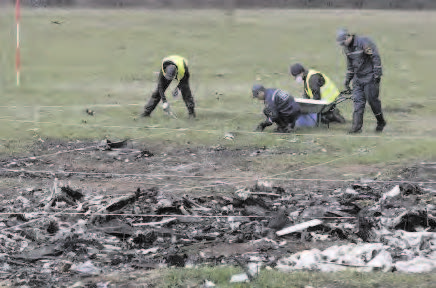
    Also on April 16 Dutch investigators recovered more body parts from the crash site after searching a location that was previously inaccessible because of clashes between pro-Russian separatists and the Ukrainian army.

    The fighting has lessened in intensity since a February ceasefire, paving the way for the investigators to continue their work, and Thursday’s operation focused on Petropavlivka, about 10 kilometres (six miles) west of Grabove where most of the debris fell.

    “The mission was again able to recover human remains and personal effects at two sites,” Jean Fransman, a spokesman for the Department of Justice, told media.

    “Personal effects were given to the members of the mission by the local population: it was jewellery,” the ministry added in a statement.

    Last year’s searches of the area had also turned up body parts, personal effects and pieces of the plane’s wreckage.

    The remains of all but two victims, both Dutch, have been identified.

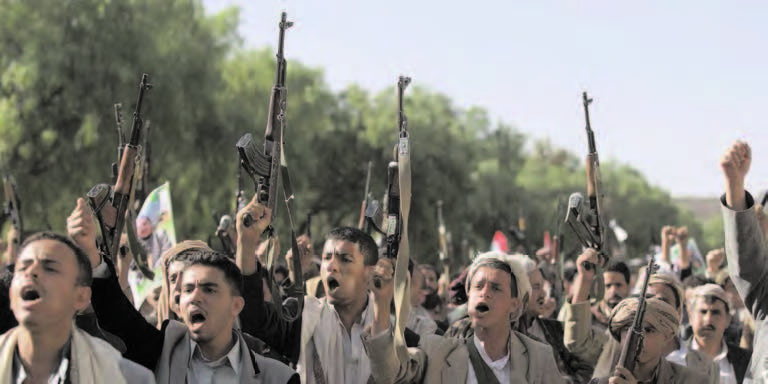
  • ‘Yemen is in flames’, says UN chief Ban Ki-moon, calls for immediate ceasefire

    ‘Yemen is in flames’, says UN chief Ban Ki-moon, calls for immediate ceasefire

    WASHINGTON (TIP): United Nations Secretary-General Ban Ki-moon called April 16 for an immediate cease-fire in Yemen to spur peace talks and get lifesaving aid into the impoverished Middle East nation.

    The UN chief addressed “the many fateful challenges” the world confronts, from 50 million refugees and displaced people – the largest number since World War II – to the urgent problem of climate change in a speech at the National Press Club.

    “Millions of people face hatred and persecution, billions suffer from hunger and exploitation,” he said. “The United Nations has appealed for $16 billion to cover humanitarian relief for this year – almost five times what we needed a decade ago.”

    Ban announced he will visit the Vatican later this month to meet with Pope Francis and discuss “common concerns,” including the encyclical on the environment that the pontiff plans to issue in the months ahead.

    He said he has invited the pope, President Barack Obama and all other world leaders to the United Nations in September to adopt new UN goals for 2030 to protect the environment, combat poverty and promote human rights and economic development that doesn’t contribute to climate change.

    Surveying the crisis-ridden state of the world and the “many fateful challenges on our plate,” Ban pointed to the ever-worsening “nightmare” in Syria, now in its fifth year, and said his envoy Staffan de Mistura will be holding a series of talks in Geneva to see if anyone is “truly serious” about engaging in meaningful negotiations to end the conflict.

    He made a special plea for Palestinians in the Yarmouk refugee camp caught between the Syrian government’s “military machine … and the brutality of extremist groups.”

    Ban said Yemen is “in flames,” and U.N.-brokered talks offered “the best way out of a drawn-out war with terrifying implications for regional stability.” He made no mention of Wednesday’s announcement that his special envoy for Yemen, Jamal Benomar, was stepping down.

    Ban said the UN is working on a plan of action, which will be launched in autumn, to fight violent extremism by the Islamic State group, Boko Haram and al-Qaida-linked groups such as al-Shabab in Somalia.

    On Nigeria, he expressed hope that the country’s new government, led by President-elect Muhammadu Buhari, can promote “a return to normalcy” and rescue schoolchildren kidnapped and mistreated by Boko Haram. In South Sudan, where a civil war continues despite cease-fires, Ban said U.N. bases are sheltering 115,000 people, “a landmark in our efforts to protect civilians.”

    The UN chief welcomed the framework agreement between six major powers and Iran to rein in its nuclear program and said the U.N. would do its best to help implement a comprehensive agreement once it is finalized.

    “This breakthrough can also create space for efforts to address the many other serious security challenges in the region,” he said.

    Earlier on April 16, Thursday, Ban met with U.S. Defense Secretary Ashton Carter and members of the Senate Foreign Relations Committee.

  • Queen Elizabeth faces rebellion from Windsor staff

    LONDON: For the first time in modern times, Queen Elizabeth is facing a rebellion – from the workers at her favourite castle – Windsor.

    Staff at Windsor Castle have voted to take industrial action in a row over appalling low pay making it the first time ever that the Queen has faced such an uprising.

    Windsor Castle is the largest and oldest occupied castle in the world and attracts 1.1 million visitors each year.

    In a ballot of 76 of the wardens at Windsor Castle, 84%voted for action on a turnout of 82%.

    Starting on as little as £14,400, in the last few years they have been asked to carry out extra duties for no additional pay, at the same time as suffering Treasury-imposed pay cuts.

    This includes giving tours of the castle that visitors pay extra for.

    The union said “Non-strike industrial action, including withdrawal of this goodwill, could start from the end of April”.

    The wardens, employed by a charitable arm of the Royal Households called the Royal Collection Trust, work at the castle entrance, around the grounds and inside the palace, helping visitors and protecting artworks. They only narrowly accepted an unsatisfactory pay offer last year on the understanding that additional allowances for paid-for tours and other skills would be considered this year.

    General Secretary of the union Mark Serwotka described them as loyal workers who are the “public face of Windsor Castle”.

    “With this vote their message to their employer is loud and clear. Staff should be properly rewarded for their commitment to ensuring visitors from around the world can fully enjoy their time at the castle,” he added.

    The Royal Collection Trust reacted, saying in a statement “Following the union ballot, we have been informed that some PCS-affiliated wardens at Windsor Castle will no longer participate in various activities undertaken during their working day, including using their language and first-aid skills, and conducting tours of specific areas of the Castle during August and September. These activities have never been compulsory; it has always been the choice of the individual as to whether they take part. While the outcome of the ballot is disappointing, it will have no effect on services to visitors to the Castle”.

  • ‘41 missing’ in Mediterranean boat tragedy

    ROME (TIP): As many as 41 migrants drowned after a small boat carrying refugees sank in the Mediterranean, Italian media said on April 16, days after 400 were lost in another shipwreck.Four survivors told Italian police and humanitarian organisations that their inflatable vessel sank not long after leaving the coast of Libya for Europe with 45 people on board.According to the men picked up by the Italian navy vessel “Foscari” after they were spotted by an aircraft, the old inflatable boat quickly began losing air forcing the migrants into the water.

    The four — a Ghanaian, two Nigerians, and a man from Niger — arrived in Trapani in Sicily today with 600 other migrants picked up by the Italian navy and coastguards as they tried to make the perilous crossing.The new tragedy happened as Italian police said they had arrested 15 people over allegations that Christians had been thrown from a migrant boat during an attempted crossing to Italy.

  • China reviewing policy on Mumbai attack ahead of Xi visit to Pakistan

    BEIJING: China is reviewing its approach towards the 2008 Mumbai terror attack carried out by Pakistani terrorists. It feels “awkward” about its own neutral stance, which has caused grave dissatisfaction in India. The revelation came from a Chinese think tank focussed on South Asia ahead of president Xi Jinping’s planned visit to Pakistan, and Prime Minister Narendra Modi upcoming tour of China next month. Pakistani media has said Xi will be visiting Islamabad on April 20. “China also feels quite awkward. It does not mean China is sympathizing with terrorist attacks. It is awkward diplomatically. It needs to handle this ticklish issue in a more diplomatic way,” Hu Shisheng, director of the government-run Institute of South Asia, South East Asia and Oceanic Affairs, which is part of the China Institute of Contemporary International Relations, said. There are signs China might advise Pakistan to take a more sensible approach in dealing with Lashkar-e-Taiba operative Zaki-ur Rehman Lakhvi, a prime accused in the Mumbai attack case, who was releases from a jail in Pakistan. India, US and France has opposed it but China has kept quiet.

  • ‘Suicide will soon become India’s number 1 killer’: Vikram Patel

    LONDON (TIP): India’s foremost mental health expert who spends most of his time between Goa and London has now been named as among TIME magazine’s 100 most influential people in the world.

    Professor Vikram Patel, who has done seminal research on suicides in India hopes that his presence in the list makes the Indian government wake up to the serious shortage of programmes and experts meant specially to deal with mental health problems.

    Speaking to TOI from Montreal, professor Patel who teaches at the London School of Hygiene and Tropical Medicine in UK and heads an organisation called Sangath in Goa said “the vast majority of people with mental disorders do not receive care which can greatly improve the quality of their lives. The treatment gap exceeds 90% for community based psychosocial interventions”.

    He added ” hope very much that this recognition will increase the attention that the world’s governments and donors afford to mental health, not just in India where issues like suicide, alcohol abuse, depression, autism and schizophrenia are almost entirely ignored by public health systems leading to enormous unmet needs and human rights abuses”.

    On being asked whether he thought the government of India was doing enough for mental health problems in India, Patel told TOI “Nowhere near the need, witness the complete absence of public health approach to suicide for example”.

    An earlier research by professor Patel on suicides in India had thrown up shocking findings. Four of India’s southern states — Tamil Nadu, Andhra Pradesh, Karnakata and Kerala — that together constitute 22% of the country’s population were found to have recorded 42% of suicide deaths in men and 40% of self-inflicted fatalities in women in 2010. Nadu, Andhra Pradesh, Karnakata and Kerala — that together constitute 22% of the country’s population were found to have recorded 42% of suicide deaths in men and 40% of self-inflicted fatalities in women in 2010.

    Maharashtra and West Bengal together accounted for an additional 15% of suicide deaths. Delhi recorded the lowest suicide rate in the country. In absolute numbers, the most suicide deaths in individuals, aged 15 years or older, were found to be in AP (28,000), Tamil Nadu (24,000) and Maharashtra (19,000).

    This was the first national study of deaths in India which was published in the British Medical journal The Lancet.

    Patel said suicide has become the second-leading cause of death among the young in India. Of the total deaths by suicide in individuals aged 15 years or older, about 40% suicide deaths in men and about 56% in women occurred in individuals aged 15-29 years. Suicide deaths occurred at younger ages in women (average age 25 years) than in men (average age 34 years). Educated persons were at greater risk of completing a suicide. The risk of completing a suicide was 43% higher in men, who finished secondary or higher education, in comparison to those who had not completed primary education. Among women, the risk increased to 90%.

    So what is professor Patel who is also from the Centre for Chronic Conditions and Injuries, Public Health Foundation of India, working on now? 

    He told media “I am working in five major areas – developing psychological treatments which can be delivered by community health workers, working in rural communities to increase awareness about and strengthen community responses to mental health problems, working with colleagues in cardiology and diabetes to develop integrated approaches for the care of chronic conditions, working with neuroscientists and computer engineers to develop novel diagnostic tools for brain disorders and working with government departments of health to scale up evidence based interventions for mental disorders through the district mental health programme”.

    The TIME 100 list describes Prof Patel as a “well-being warrior” and includes a tribute from Dr Barbara Van Dahlen, a psychologist and the founder of Give an Hour, a network of volunteer mental-health professionals, as well as the Campaign to Change Direction. She writes “It is hard to imagine a more difficult challenge than addressing the unmet needs of those from resource-poor countries who live with and suffer from mental-health disorders. And yet Vikram Patel has spent his career doing just that. He is a gifted psychiatrist, a dedicated researcher, a successful author of books and academic papers, and he is an effective communicator. In fact, he seems to have an unending supply of these critical skills. And as a co-founder of the NGO Sangath and the Centre for Global Mental Health at the London School of Hygiene & Tropical Medicine, he helps spread the simple yet profound idea of mental health for all. He provides hope that mental illness and trauma make us neither weak nor unworthy of love and respect”.

  • Journey of an Artist – KRISH SENGUPTA

    Journey of an Artist – KRISH SENGUPTA

    KRISH SENGUPTA 6 Krish arrived in USA (Chicago) in the summer of 2009 and it was only in early 2010 that he resumed his ‘hobby’ of painting, after a break of almost 15 years. He was born and raised in Kolkata, India and, except for a few childhood years, he did not have any formal art training. Largely self taught, drawing and painting has always been his singular passion outside of his career.

    KRISH SENGUPTA


    Krish is a banker by profession; and transferred with his job to USA. Between 2010 and 2012 he cultivated and grew his body of work in Chicago. He was part of various Chicago art groups and regularly attended workshops at the studios of Layne Jackson and Tom Robinson, both renowned Chicago artists. He participated in many art shows (refer list below) and the Tom Robinson gallery also hosted his solo exhibition in Chicago, Feb 2013.

    KRISH SENGUPTA 1


    He moved to New York City in March 2013. He works on his art mostly at his home studio; and he is also an active member of the Renaissance Art Workshop in midtown Manhattan, where he works closely with famous New York artist Raul Sebastian Santiago.KRISH SENGUPTA 3


    Krish’s style of art is realistic with shades of impressionism. He loves to dwell on form & figure and is captivated by movement and motion that he tries to capture in his art. He is fond of large bold brush strokes, texture and artistic play with the background. He says that he is still trying to find his personal style and until he gets there, everything that he creates is an experiment.


    In this painting that is presented at the show, “The Ballerina”, he has tried to emphasize the motion and drift of the two bodies as well as the wind catching the drape in the background. The ballerina girl is the central subject, the grace and swing of her body is conveying the mood & music as she is about to be ‘swept off her feet’ by her partner and the (imaginary) wind.

    Shows & Exhibitions:KRISH SENGUPTA 2

    • Drawing Attention II, Chicago – June 2011
    • Full Spectrum Art Show, Chicago – June 2011
    • Drawing Attention III, Chicago – June 2012
    • Naked July Art Show, Chicago – July 2012
    • Art & Friends, Solo Art Show, Chicago – Feb 2013
    • Drawing Attention IV, Chicago – June – 2013
    • Renaissance Workshop Art Show, New York – June 2014

    Krish Sengupta is based in New Jersey. He can be reached at krishnendusengupta6@gmail.com.

    KRISH SENGUPTA 5

  • Prime Minister Narendra Modi concludes visit to Canada with 13 agreements with the host country

    Prime Minister Narendra Modi concludes visit to Canada with 13 agreements with the host country

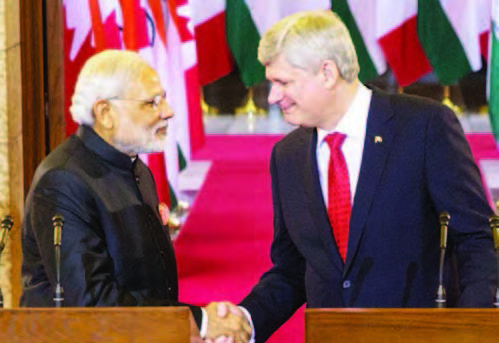
    VANCOUVER (TIP): Prime Minister Narendra Modi’s  “Initiative sign pacts and agreements” continued during his Canada visit where  India inked a deal with Canada for supply of uranium for its nuclear reactors, capping negotiations on safeguards that started five years ago. Modi himself made the announcement following talks with Canadian counterpart Stephen Harper.

    Under an agreement signed on Wednesday, April 14, after comprehensive talks Modi had with Harper, Cameco Corporation will supply 3,000 metric tons of uranium over five years to India for $254 million. The supply may begin in a year.

    “The agreement on procurement of uranium from Canada for our civilian nuclear power plants launches a new era of bilateral nuclear cooperation,” said Modi in his joint presser with Harper. This was the highlight of total 13 pacts that the two countries signed that also included a pact on space cooperation. “It also reflects a new level of mutual trust and confidence. Further, it will contribute to India’s efforts to power its growth with clean energy,” Modi said.

    A jubilant Modi, in his address to the Indo-Canadian community boated that what others could not do in 42 years, he achieved in 10 months.

    Modi and Harper also resolved to fight terror jointly. “We in India felt Canada’s pain when this city was struck by a senseless act of terrorism…

    We will deepen our cooperation to combat terrorism and extremism. We will also promote a comprehensive global strategy, and consistent policy and action against all sources of terrorism and its support,” said Modi.

    The two countries also decided to strengthen defense and security cooperation and decided to cooperate to stabilize the Asia Pacific region. Modi also announced Electronic Visa Authorization for tourist visa for Canadian nationals. They will also be eligible for 10-year visas now. The two countries also agreed for new framework for economic partnership.

    “I am confident that we can conclude the Bilateral Investment Promotion and Protection Agreement very soon. We will also implement the road map to conclude the Comprehensive Economic Co-operation Agreement by September 2015,” the PM said on deepening economic cooperation. India and Canada had signed a civil nuclear cooperation deal in 2010. It was followed by the signing of an administrative arrangement in 2012 under the Manmohan Singh government.

    Prime Minister Narendra Modi on April 17 visited a gurdwara and a temple in Vancouver in the final leg of this three-day visit to Canada which ends today. Later, the Prime Minister is scheduled to attend an official dinner hosted by his Canadian counterpart Stephen Harper, before departing for India.

    With their heads covered with a cloth -customary before entering a gurudwara – PM Modi and Prime Minister Harper offered prayers at the Gurdwara Khalsa Diwan. Later, both visited the Laxmi Narain Temple where Modi received a rousing reception. Saying that he was honoured to host one of the world’s great leaders, PM Harper said that India and Canada were “natural partners”.

    Earlier, on April 16 Modi, accompanied by Prime Minister Harper, visited the memorial in Toronto for the victims of Air India Flight 182 that was bombed in 1985, killing all 329 people on board. 268 of them were Canadian citizens, mostly of Indian descent. There were 24 Indian and 27 Britons as well.

    Air India Flight 182, a Boeing 747 named “Kanishka”, flying on the Montreal-London-New Delhi route on June 23, 1985, crashed into the Atlantic Ocean after being bombed while in Irish airspace.

  • Separatist leader Masarat Alam Bhat arrested

    Separatist leader Masarat Alam Bhat arrested

    SRINAGAR (TIP): Buckling under pressure from alliance partner BJP, the PDP-led government in Jammu and Kashmir on April 17 arrested separatist leader Masarat Alam Bhat in connection with the raising of Pakistani flags during a rally here on April 15.

    “Bhat has been arrested in the case registered in police station Budgam in connection with the provocative actions during the rally on Wednesday,” a senior police officer said.

    Masarat Alam Bhat
    Masarat Alam Bhat

    The 45-year-old hardline separatist leader, who was placed under house arrest late last night, was arrested from his home in Habbakadal area of the city early this morning and taken to police station Shaheed Gunj, the officer said.

    As he was being led away by police, Bhat said his arrest was nothing new as “Jammu and Kashmir is being ruled on the might of power.”

    “Raising of Pakistani flags and chanting pro-freedom slogans is nothing new in Jammu and Kashmir. It has been happening since 1947,” he said.

    The arrest comes hours ahead of Hurriyat Conference chairman Syed Ali Shah Geelani’s call for a march to Tral area of Pulwama district where two youth were killed in an anti-militancy operation on Monday. While the local residents allege that the duo were killed in fake encounter, the army is maintaining that they were militants and killed in a gunbattle.

    Police had registered a case against several separatist leaders including Bhat and Geelani for provocative activities including hoisting of Pakistani flag.

    “An FIR has been registered against Geelani, Bhat, Bashir Ahmad Bhat alias Peer Saifullah and other separatist leaders for provocative activities and hoisting Pakistani flag in Hyderpora,” a police spokesman said.

    “FIR No 92/2015 under sections 13 Unlawful Activities Prevention Act, 120-B (criminal conspiracy), 147
    (rioting), 341 (causing injury), 336 (attacking govt employee), 427 (mischief causing damage to the amount of Rs 50 or more) of RPC was registered in Police Station Budgam and investigation into the matter has been taken up,” he said.

    Bhat, who was released by the PDP-led government last month after spending over four years in jail under Public Saftey Act, said there has been no change in the policy of the state government despite a change in the regime.

    “I had said at the time of my release that there is no change in policy with the change in regime. This is the way they curb peaceful protests,” he added.

    Alam’s release had created a furore across the country and the issue had even figured in Parliament proceedings with Prime Minister Narendra Modi making a statement on the floor of the house.

    The waving of Pakistani flags and chanting of anti-India slogans at the rally orgainsed to welcome Geelani on Wednesday renewed calls for Bhat’s rearrest by the BJP, coalition partner of PDP in the state government.

    Meanwhile, police officials said they will not allow any march to Tral town in order to maintain law and order in the area.

  • RAHUL GANDHI RETURNS AFTER 2-MONTH LEAVE

    RAHUL GANDHI RETURNS AFTER 2-MONTH LEAVE

    [vc_row][vc_column][vc_column_text]

    NEW DELHI (TIP): Congress vice-president Rahul Gandhi on April 16 returned to Delhi from his almost two-month long “unexplained” sabbatical, which had raised questions over his leadership of the party that is struggling to find its feet after a string of electoral defeats.RAHUL GANDHI RETURNS AFTER 2-MONTH LEAVE

    The 44-year-old leader arrived here at 11.15am on a Thai Airways plane from Bangkok, ending days of intense speculation over his return and amidst celebrations by party workers who burst crackers outside his residence.

    Wearing a dark shirt and seated in the back seat of his vehicle, he arrived escorted by his security personnel and drove straight into the house without interacting with the waiting mediapersons.

    The return of Rahul comes ahead of the party’s planned farmers’ rally here on the contentious land bill issue which he is likely to address.

    The plane, which was scheduled to land at 10.35am, was delayed by 40 minutes, sources said. Shortly later, Rahul drove to his 12, Tughlaq Lane residence where his mother and Congress president Sonia Gandhi and sister Priyanka were waiting.

    Rahul had left quietly before the Budget session began on February 23 but it is still not known where he had spent the days.

    The party had then said that he “requested Congress president Sonia Gandhi for some time to reflect on recent events and future course of the party”.

    Ever since the announcement of his temporary break from political life, there has been speculation that he was unhappy with not getting a free hand to run the party, a contention which the party has officially denied.

    Rahul’s leave had come amid talk of an AICC session, where he was expected to be elevated as Congress president.

    During his absence, several party leaders including former chief ministers Amarinder Singh and Sheila Dikshit came out in the open pitching for Sonia Gandhi to continue as president and raised questions over his leadership.

    Congress leaders had announced that Rahul would be back by April 19 as he would be addressing a farmers’ rally on land bill issue at the Ramlila maidan here on that day.

    The rally is being held on the eve of the second phase of the Budget session of Parliament.

    Rahul had skipped the first phase which saw the Congress taking on the government over the land bill issue.

    Party leaders voiced confidence that Rahul will provide leadership with dynamism and commitment and take pro-active measures.

    “He is back and I have no doubt that he will be not only taking proactive measures but also with dynamism, with commitment provide leadership,” Congress leader Anand Sharma said, adding that farmers’ issue has been close to Rahul’s heart.

    [/vc_column_text][/vc_column][/vc_row][vc_row][vc_column width=”1/3″][vc_column_text]

    There are no ‘item numbers’ in politics: BJP

    The BJP, meanwhile, took potshots at the Congress vice-president, saying he “ran away” as he had lost all confidence.

    “From Nehru to Rahul, it is the withering away of the dynasty,” BJP spokesperson Sambit Patra said.

    “The Congress Party is saying that Mr Rahul Gandhi will conduct a successful kisan rally, to which we would say there is no item number in Indian politics or politics as such.

    You can’t just reappear, attend a rally and then vanish again. You have to be serious,” Sambit Patra said. He added that Rahul’s return from his sabbatical had hit the headlines for all the wrong reasons.

    [/vc_column_text][/vc_column][vc_column width=”2/3″][vc_column_text]


    HAS HIS TASK CUT OUT

    Lucknow (TIP): A contingent of party workers from Amethi will meet Congress vice-president Rahul Gandhi in New Delhi next week to brief him on issues his constituency was facing during his near 2-month long sabbatical.

    The issues include rain-damaged crops and the subsequent plight of farmers.

    Amethi’s district Congress president Yogendra Mishra said, “We will inform Rahul about the NDA government’s move to cancel the permission for the Shaktiman Mega Food Park. Rahul had laid the foundation stone of the park in 2013. On Wednesday, a protest was organised in Jagdishpur against cancellation of permission for the food park. More such agitations will be planned in the coming days.”

    “Work on Rajiv Gandhi Institute of Petroleum Technology has virtually stopped due to delay in allocation of funds. The state government is extending full cooperation but the Modi-led government is obstructing implementation of development schemes in Amethi. A sanctioned central hospital has also been delayed. We will meet Rahul and inform him about unfolding developments in the constituency,” said Mohammad Muslim, Congress MLA from Tiloi, Amethi.

    The contingent will meet Rahul on April 20 but they will be in the Capital a day early to attend the ‘Kisan-mazdoor’ (farmer-worker) rally.

    [/vc_column_text][/vc_column][/vc_row]

  • NETAJI FILES LOCKED UP IN KOLKATA’S SECRET CELL

    NETAJI FILES LOCKED UP IN KOLKATA’S SECRET CELL

    KOLKATA (TIP): The Nehru regime snoop reports that have rocked the country are only a trickle from the reams of classified documents on Netaji still locked away in a ‘secret cell’ in Kolkata.

    Sixty-four files pertaining to Subhash Chandra Bose — including intelligence reports on surveillance over his relatives between 1947 and 1968 — are still being kept secret by the Bengal government, says Netaji’s grandnephew Abhijit Ray. “The two files whose contents created a sensation last week are locked up in a safe at the Special Branch office on Lord Sinha Road. There are at least 62 other files in the same office, referred to as ‘home cell department’ of West Bengal, that are yet to be disclosed,” Ray said.

    Netaji researcher Anuj Dhar, who calls the secrecy over Netaji files the “biggest cover-up in the history of modern India”, confirmed the existence of these 64 files. “The reference to these files is made in the status report of the Mukherjee Commission,” said Dhar, adding that the contents that went public last week were photocopies of two such files.

    As demand for declassification of files gains momentum, Kolkata-based NGO India’s Smile — that had filed a PIL in Calcutta high court on January 6, 2014, seeking declassification of secret documents on Netaji and INA — filed supplementary affidavit on Thursday, stating that the Bengal government had 64 secret files in its possession but was denying its existence.

    In reply to an RTI, the state government had on February 25, 2014, said that it did not have any secret files on Netaji and that all files it had had been declassified. However, only a month later, on March 24, 2014, a letter (ref no. 921-PL/PF/14M-H/14) written by the home department, police establishment branch, at Nabanna, states that files on Netaji may be available in a hidden location. “I am directed to say that no information regarding this matter is available at this end and to say that the required information may be available from secret cell of this department,” an assistant secretary of the home department wrote.

    “This obviously means Netaji files are kept at the Special Branch office in Lord Sinha Road. Yet, the state government has been mum on the matter for years,” said Rajeev Sarkar, chief functionary officer of the NGO.

    Netaji’s grandnephew, Chandra Bose, is livid over the state government’s silence. “I find it incomprehensible that while Modi could pry out 40 minutes from his busy schedule — that included a meeting with German chancellor Angela Merkel — to meet Surya Bose and listen to the demand for declassification, chief minister Mamata Banerjee could not even spare time to make a statement on the burning issue,” he said.

    Netaji’s niece Chitra Ghosh said she was extremely disappointed that the state government was still holding on to the classified files.

  • Chinese president to visit Pakistan, hammer out $46-billion deal

    Chinese president to visit Pakistan, hammer out $46-billion deal

    ISLAMABAD (TIP): Chinese President Xi Jinping will launch energy and infrastructure projects worth $46 billion on a visit to Pakistan next week as China cements links with its old ally and generates opportunities for firms hit by slack growth at home.

    Also being finalized is a long-discussed plan to sell Pakistan eight Chinese submarines. The deal, worth between $4 billion and $5 billion, according to media reports, may be among those signed on the trip.

    Xi will visit next Monday and Tuesday, Pakistan’s foreign ministry said.

    Commercial and defence ties are drawing together the two countries, which share a remote border and long-standing mistrust of their increasingly powerful neighbour, India, and many Western nations.

    “China treats us as a friend, an ally, a partner and above all an equal — not how the Americans and others do,” said Mushahid Hussain Sayed, chairman of the Pakistan parliament’s defence committee.

    Pakistan and China often boast of being “iron brothers” and two-way trade grew to $10 billion last year from $4 billion in 2007, Pakistani data shows.

    Xi’s trip is expected to focus on a Pakistan-China Economic Corridor, a planned $46 billion network of roads, railways and energy projects linking Pakistan’s deepwater Gwadar port on the Arabian Sea with China’s far-western Xinjiang region.

    It would shorten the route for China’s energy imports, bypassing the Straits of Malacca between Malaysia and Indonesia, a bottleneck at risk of blockade in wartime.

    If the submarine deal is signed, China may also offer Pakistan concessions on building a refuelling and mechanical station in Gwadar, a defence analyst said.

    China’s own submarines could use the station to extend their range in the Indian Ocean.

    “China is thinking in terms of a maritime silk road now, something to connect the Indian Ocean and Pacific Ocean,” said a Pakistani defence official, who declined to be identified.

    For Pakistan, the corridor is a cheap way to develop its violence-plagued and poverty-stricken Baluchistan province, home to Gwadar.

    China has promised to invest about$34 billion in energy projects and nearly$12 billion in infrastructure.

    Xi is also likely to raise fears that Muslim separatists from Xinjiang are linking up with Pakistani militants, and he could also push for closer efforts for a more stable Afghanistan.

    “One of China’s top priorities on this trip will be to discuss Xinjiang,” said a Western diplomat in Beijing. “China is very worried about the security situation there.”

  • Bangladesh: Security lapses during Prez Hamid’s Agra, Ajmer visit

    AGRA (TIP): Pointing out a string of security lapses during Bangladeshi President Abdul Hamid’s visit to India last December, Dhaka has complained to New Delhi that he was taken to the Taj Mahal in a regular battery-operated public vehicle — called ‘golf cart’ in local parlance — and not in a private one normally used by VIPs and VVIPs visiting Agra.

    The Bangladeshi foreign ministry has also told the Centre that the five-star hotel in which the president stayed in Agra had a faulty lift. During Hamid’s visit to Rajasthan during the same trip, no appropriate arrangements were made to control the crowd at the Ajmer Sharif Dargah, the Union home ministry has been told.

    Agra Police are probing the matter and will submit a report to UP security agencies. The findings will then be forwarded to the MHA, which has shot off letters to chief secretaries of UP and Rajasthan, pointing out the security breaches and advising the Agra district administration on how to “secure” VVIPs during such visits in future.

    MHA under secretary Pranav Vishwas, in his letters to chief secretaries of UP and Rajasthan, said, “I am directed to say that it has been brought to the notice of the Union home ministry by central security agencies that Bangladesh President M Abdul Hamid paid an official visit to India (Delhi, Jaipur, Ajmer, Kolkata and Santiniketan) from December 18 to 23, 2014. His visit passed off peacefully without any incident. However some security lapses were noticed.” 

    Vishwas wrote, “In Agra, normal battery-operated vans were provided during the VVIP visit. Also, a lift in hotel Oberoi Amarvilas was not functioning properly.” 

    The letter offered suggestions to the district administration of Agra, asking it to ensure in future that VIP and VVIPs be taken to the Taj Mahal not in the regular battery-operated vehicles but separate, private ones.

    Under-secretary Babu Lal of the UP government has directed UP DGP (security) to check on the security lapses that occurred during the Bangladesh president’s visit and submit a detailed report, so appropriate action can be taken.

    Another letter was issued to the district magistrate of Agra by the security headquarters, UP, asking him to take the security protocol during VIP visits seriously.

    DM Pankaj Kumar admitted he had received the letter. “We are preparing an answer, and will comply with suggestions,” he told media.

    Agra SSP Rajesh Modak said a detailed report was being prepared and would be sent to authorities soon.

    Hamid was in India, primarily for talks to strengthen bilateral ties.

    The Taj Mahal remained closed for several hours on December 20, the day of his visit. He arrived late at the monument, and hundreds of tourists were stranded outside, unable to enter the monument. Many returned that day without seeing the inside of the Taj.

  • Over 120 killed in Thailand during Songran festival

    BANGKOK (TIP): Over 120 people have been killed and 1,281 injured in Thailand as thousands began their annual journey to their hometowns to celebrate the three-day water festival of Songkran heralding the Thai New Year.

    The water festival, which officially began today, started Friday evening as Thais took trains, planes, cars and bikes to head home to their parents and families, resulting in several road accidents which have so far claimed 121 lives.

    Bangkok and the northern town of Chiangmai are favourite destinations of foreign tourists who have come to take part in the festival. Life comes to a standstill in several countries in the region including Myanmar, Laos and Cambodia where the festival is celebrated. Instead of oil, talcum powder mixed in water is used and splashed at people. So far 1,281 injured in traffic accidents. Meanwhile, almost 2,000 policemen are keeping a watch around the backpacker haven of Khaosan and Silom area in downtown where Songkran revellers gather to celebrate.

  • Vietnam searches for 2 missing fighter jet pilots

    HANOI, VIETNAM (TIP): Vietnamese authorities say they are searching for two pilots who went missing on a training exercise. The Ministry of Defense said in a statement on its website late Thursday that the pilots on two Russian-made SU-22 fighter jets lost contact around noon on April 16 off the country’s central coast.

    It says a search aircraft spotted four floating reserve oil containers and oil traces. Disaster official Pham Hung Tan in the central province of Binh Thuan say the Navy, Maritime Police and the Coast Guard are taking part in the search. He says two reserve oil containers were recovered. The accident is the latest setback for the Vietnamese military after two helicopter crashes killed 24 military personnel in the past nine months.

    Russian remains the communist country’s main supplier of military hardware.

  • Former Maldivian defence minister jailed for 10 years

    MALE (TIP): A former Maldivian defence minister has been sentenced to 10 years in prison on charges of detaining a senior judge, the same case in which ex-president Mohamed Nasheed has also been jailed under an anti-terrorism law.

    Tholhath Ibrahim was sentenced by the Criminal Court last night after three judges presiding over the case unanimously agreed to prosecution’s allegations.

    The prosecution raised its charges against Ibrahim for his involvement in the arrest and detention of Criminal Court’s controversial chief judge Abdulla Mohamed in 2012 for 22 days.

    At a previous hearing during the trial, Tholhath said Nasheed had ordered the arrest of the judge.

    The judges said given witness testimonies and Tholhath’s own statement his involvement in Abdulla’s detention in an island used for military training was clear, Haveeru online reported.

    The prosecution further said Tholhath used the Maldives National Defence Force (MNDF) as a cover, but stressed the institution itself was absolved.

    Ibrahim was Nasheed’s defence minister at the time of the judge’s arrest.

    Nasheed, who had accused the judge of political bias and corruption, is currently serving a 13-year jail sentence over the same incident.

    The imprisonment of Nasheed, the first democratically elected leader of the Maldives, has drawn widespread international criticism, including from the US, the EU and rights groups. Nasheed resigned in 2012 after weeks of public protests over the judge’s arrest. The following year Nasheed lost to Yameen Abdul Gayoom, whose half-brother Maumoon Abdul Gayoom had ruled the country for nearly 30 years. Nasheed’s supporters allege the case is politically motivated and aimed at ending his political career.

  • The German drum gone silent

    The German drum gone silent

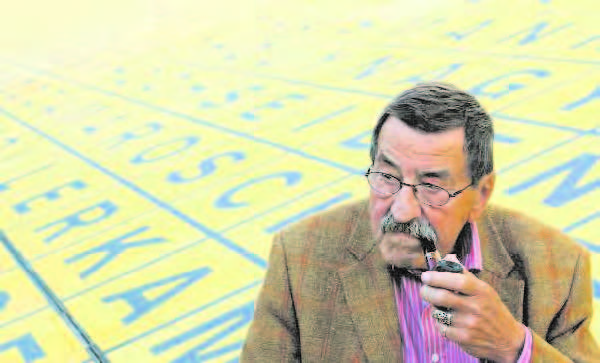
    The death of Günter Grass on Monday, April 13, a giant German writer of the post-World-War-II era, a novelist, playwright, poet, fine draftsman and a sculptor, who was awarded the Nobel Prize in 1999, has eclipsed an enormous creative force of modern-day German world of letters which has been equally venerable as it is universal. Throughout his literary journey, Grass tried to uphold a socio-political and cultural vigor he had fostered amongst the tribe of the writers to act as an ongoing check on the current political affairs. As such, he was often referred to as the moral conscience keeper of his country. He developed an early insight into the fact that writers usually tend to harp on endeavors that serve best their individual interests and motives, encapsulated, at the most, in the niches confined to their personal agendas. Hence, far from taking their rightful place in the socio-political arena, they often end up selling themselves and their voice for a price.

    As a liberal public intellectual with Leftist (though not communist) leanings, Grass had an unabated faith in the multiple realities of life which seems to have had an almost obligatory theme thrust upon his writings – the Third Reich and its legacies. He helped to shape the German postwar history – literary, political and personal – as no one else did, and turned to writing from arts in the hope of a better understanding of “ourselves, our time and our actions” by engaging himself with the meaning of our experiences and deeds, both political as well as personal. The central message of his writings, especially of the Danziger Trilogy: The Tin Drum, Cat and Mouse and Dog Years, as his entire engaged life too prompts one to recall George Santayana’s words: “Those who cannot remember the past are condemned to repeat it.”‘

    Caught between the opposites  

    Born on  October 16, 1927 in the Free City of Danzig, then East-Prussia, and now in Poland, Günter Grass attended the elementary school and later high school there. He later wrote in a poem called Kleckerburg: “And I grew up between / the Holy Spirit and Hitler’s Image”. It was his childhood dream to become an artist. The treasure of books his mother had and her passion for music and theatre supported, in addition, by his teachers gave an impressive kick-off to this vocation, while his father could only play rejection. Decades later Grass wrote: “When I was fifteen, I wanted to murder my father in thoughts, words and works with my Hitler Youth Dagger.”

    The Second World War broke into the life of the young boy with all the vehemence and violence and provided him with experiences, which would determine the largest part of Grass’ later works. Just at15 years of tender age, he fled his family’s tight grip and joined the German Navy as a volunteer, only to be later sent to the Waffen-SS.

    As one of those “who were spared by the capricious war and who became aware of the randomness of their existence,” Grass was now confronted with a future full of question marks, just as his entire generation too was “thrown from 1945 to the wild tracks of life,” as he once called it. Grass refused to lead a middle-class, secured life, which was recommended by his “unloved” father. Instead, he went on to lead “a reality-contemptuous, against all odds penetratingly decided realization of his childhood desire to become an artist,” wrote his biographer, Volker Neuhaus, in Günter Grass – writer, artist, and contemporary.

    After apprenticeship as a stone mason, Grass studied sculpture and graphics from 1948-1956 at the Academy of Arts, Düsseldorf. In 1953, he moved to the University of Fine Arts “in the more complicated Berlin”, where in the mid-1950s Grass debuted as a poet and playwright. After initial attempts as a writer, he became a member of the prestigious “Group47”. From 1957 to 1959 he lived with his first wife Anna in Paris, where his first great novel, The Tin Drum was completed. The pursuit to be a sculptor was abandoned until further notice which he engaged with only in later years, when he was back with the visual arts. However, he designed the covers of his books himself and illustrated many of them.

    Prone to controversies

    As an intellectual, Grass never shied away from controversies, though he never looked for one. They appeared rather as the by-products of his public engagement. For example, though the Swedish Academy, while awarding him the Nobel Prize for Literature in 1999, praised him for his espousal of “the enormous task of reviewing contemporary history by recalling the disavowed and the forgotten: the victims, losers and lies that people wanted to forget because they had once believed in them,” and called The Tin Drum “one of the enduring literary works of the 20th century,” a few years later the author of this masterpiece itself became controversial when he revealed in his autobiography Peeling the Onion, in 2006 that for almost a year or so he had had to join as a young man of 17 a unit of Hitler’s Army called Waffen SS, known for its inhuman acts and horrific crimes, both at home and abroad. Though he insisted that he was only engaged in doing relatively innocent jobs in the Army, but the revelation itself came as a shock and brought him a battery of accusations of hypocrisy. “It was a weight on me,” Grass had later stated. “My silence over all these years is one of the reasons I wrote the book. It had to come out in the end.”

    He was not the only one of his generation to be secretive of his wartime past, but being a pre-eminent public intellectual who had laid open the wounds the German history had both suffered from and inflicted on others, he became the object of mockery beyond the borders of Germany. But there were equal number of voices engaged in his defense as were engaged in his derision. Hardly anyone holds the Nazi seduction of the youngster for a problem, but what is held against him is rather the long silence to come out with it.

    Nevertheless, he seems to have required a whole lifetime to counter and put to death this immature shame he had put on himself at an adolescent age, which, however, he revealed only in the later years of his life. It must have had a cumulative effect on his artistic soul and hence in itself an incitement enough to turn himself into a cleanser of his soul, since he remained the moral voice of his country throughout his life.

    Books-dangerous tools 


    Grass has been vocal about the social misery and maladies of sorts prevalent in all societies. Not only himself, but he had rather wanted every writer to intervene and get involved in the day- to- day decisions made by the regimes. In his Nobel speech in 1999, he highlighted why books and their authors become so dangerous in the eyes of the powerful. He stated that “the evidence provided by literary works often proves that the truth exists only in the plural, just as there does not exist a single reality, but indeed a multitude of realities”. In one of his poems thematizing Grass on Grass, he states:

    “I want to be buried with a bag full of nuts and with the renewed teeth.

    If it then crackles, where I lie, can be assumed: It is him, still very much him.”

    My association with him too was a result of this engagement which began in 1987, when as Vice-President of Berlin Writers Association (NGL) I co-operated with him to get some incarcerated Turkish writers released in that country. This engagement evolved into my becoming active in the Writers-in-Prison Committee of the PEN.

    Later, I followed his call to support the former East-German PEN when the reunification process of both the PEN Clubs ran into difficulties as some West German members objected to the inclusion of some East German Members suspected of espionage for the Stasi, the much-hated State Security agency. Ultimately, his moral instance of not excluding anyone won the upper hand and the German PEN was at last reunited. By this time Grass had donated his historical residence to the German Academy of Arts and Literatures, where the writers of repute were to be given three months’ residencies to complete their ongoing literary works. I was lucky to have been given this residency twice within a span of three years.

    Kolkata connection

    Whatever his urge to intervene came up with was almost always polemical, and hence controversial, often undiplomatic but straightforward, though not always on the basis of facts, but always heard and commented upon by intellectual circles and media.

    In his more than three decades of association with Kolkata, Grass visited the city thrice and was overwhelmed by its cultural richness. At least on two occasions he stayed longer in the town, the longest in 1986 which invoked both his fascination for as well as his aversion to the existing realities there. Whereas the earlier sojourn had produced a chapter in a book called The Flounder, the later sojourn produced a full-length book in 1988 called Show your Tongue. In this book, written impressionistically in the form of a dairy, Grass’ more than thirty-years-old association with Kolkata had multiple shades conspicuous in the depiction of the “omnipresent stench”, city’s culture of hero worship, and  of a philanthropic reach out to its marginalized people like the rag pickers. Both the content as well as the tone of the Show your Tongue invoked criticism from both intellectuals as well as the politicians. But Grass never meant to insult anyone; he only wanted to prompt the authorities to do more than just talk.

    Until shortly before his death, Grass was deeply worried about the future of humanity. “We are heading for the third great war,” the Nobel Laureate said in an interview with the Spanish newspaper El País, which was recorded on March 21 in Lübeck and published for the first time on Tuesday, the day after his death.
    “There is war everywhere. We are in danger of making the same mistakes as before. Without realizing it, as if we were sleepwalkers, we can go to a new world war,” he had warned.

    In addition to the many political conflicts the world is facing today, Grass had complained in the interview against the prevalent “social misery all over the world”, as also against the problems of overpopulation and climate change.” The consequences are completely ignored…, there is one meeting after another between the leaders and experts, but the problem remains: Nothing is done,” he had complained.

    The author of novels such as Dog Years, Cat and Mouse, Local Anaesthetic, The Rat, The Call of the Toad, Too Far A field, Crabwalk and The Box, his latest novel as well as of My Century and Two States – One Nation? can now rest in peace leaving the onus of engagement with moral and political issues on his many successors.

    The writer was Poet-Laureate in Germany between 1997- 2008 and has published 14 anthologies of poetry.

    • The central message of the writings of Gunter Grass, especially of the Danziger Trilogy: The Tin Drum, Cat and Mouse and Dog Years, was to caution the humanity against the political misadventures that kill the conscience of an entire generation.
    • He remained candid about his beliefs to the extent of being blunt and hurtful.
    • Considered to be the voice of conscience of his times, he did not hesitate from writing in his autobiography Peeling the Onion, in 2006 that for almost a year he had had to join as a young man of 17 a unit of Hitler’s Army called Waffen SS, known for its inhuman acts and horrific crimes, both at home and abroad.
    • His book on Kolkata, Show your Tongue invoked criticism from both intellectuals as well as the politicians. He remained engaged in charity work for the street children of Kolkata till his death.
  • AAP initiates disciplinary action against rebels

    AAP initiates disciplinary action against rebels

    NEW DELHI (TIP): Aam Aadmi Party has initiated move to take disciplinary action against rebel leaders who held ‘Swaraj Samvad’ recently.

    The political affairs committee of AAP has concluded that the rebels have committed indiscipline, AAP leader Ashutosh said on April 16.

    The party’s disciplinary committee will serve notice to them. They will be given enough time to put up their view points, he added. If the committee is not satisfied with their replies, disciplinary action will be taken against them, Ashutosh said.

    The rebels had announced the formation of a new non-political group ‘Swaraj Abhiyan’ after their meeting on April 14.

  • Candidate Hillary

    Candidate Hillary

    OnApril 12, Hillary Clinton moved one step closer to becoming the first-ever woman President of the United States. The 2016 election will be her second presidential run. To succeed this time she will have to eschew the theme of
    “inevitability” that had crept into her bruising primaries battle against Barack Obama in 2008, and that ultimately sank her campaign. The former First Lady was off to a quick start in her campaign video and came out swinging for the fences as a would-be “champion of everyday Americans”. The implied focus on the welfare of the middle class is a throwback to liberal Democratic values and poses a challenge to Republican Party free-marketeers. It may also reflect her intention to separate her record from that of the inc umbent Mr. Obama; this was mostly evident in her comment that “the cards are still stacked” against the common person. Ms. Clinton is indeed a different beast to the President, although pundits predict she will borrow elements of campaign design from her former boss, and indeed the social media strategies employed so ably by Team Modi in 2013-14. Buttressing her nuts-and-bolts approach to campaign management, she can be expected to project her deep understanding of the paralysed politics of Washington, and be unapologetic about her political pedigree.

    But will all this be enough? And if it is, will she reshape the American story to fit better into a turbulent world?The Republican Party is not throwing up any inspiring leaders. Among the hopefuls, Jeb Bush has the clout of his last name but not much else. Ted Cruz is considered to be a fringe candidate, even among Republican heavyweights. Marco Rubio has passable charisma and an important connection to the Latino community, but he would flounder if he went toe-to-toe against a much more experienced Ms. Clinton. Though her entry into the Oval Office is far from being a certainty as of now, the greater challenge for her may be knowing what to do once she gets there. She was, after all, leading the Obama action that fumbled through the Arab Spring. Would she do it differently a second time? The rise of Islamic State will certainly dominate the attention of the next POTUS. She also promised, in a 2010 speech, that the administration would think “smart power” and focus on multilateralism, regional architectures and broad-strategic engagements with countries such as India, Russia and China. Clearly that dream didn’t materialise. On domestic policy , however, the Obama years offer hope. Just as he tackled the inequities of the health-care system head-on, Ms. Clinton could do much to close the gender pay gap, tackle America’s rape crisis, and upgrade its education system to help the millennials thrive in the workforce. That, and much more. Her time is now.