Month: April 2015

  • WHY INDIA MATTERS TO CANADA

    WHY INDIA MATTERS TO CANADA

    For two countries that Prime Minister Stephen Harper calls “natural partners” in a new global economy, Canada and India might appear to share a rather meek business relationship.

    Not even one per cent of Canadian exports currently ship to India, with goods exports around $3.1 billion in 2014 – less than one-sixth what Canada exports to China.

    Promising to open India to global commerce, Indian Prime Minister Narendra Modi’s historic three-day Canadian tour this week seeks to change that.

    His trip ends a 42-year dry spell since a head of state from the world’s largest democracy visited to talk bilateral relations.

    As Harper pushes for a free-trade pact with Modi, Canadian economists and business leaders representing South Asian professionals lay out their case for why India is a social, political, cultural and economic force that matters.

    1. A hot opportunity

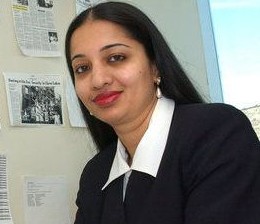
    “Let’s not forget there’s a race to get to India’s door,” says Jaswinder Kaur, director of the Canada-India Centre of Excellence in Ottawa.

    “We’re competing against Japan, the French, the Australians, and this is an opportunity for Canada to demonstrate how we can contribute and make a true partnership.”

    Canada’s Global Markets Action Plan identified India as a priority market, with a burgeoning economy and roughly 11 million people under 30 entering the workforce each year.

    India has for years remained the largest market for Canada’s pulses (grain legumes such as lentils and peas), and Canada also supplies lumber and potash.

    “But are Canadian companies ready to do business?” Kaur says. “That’s where the real work is going to begin.”

    The International Monetary Fund projects that by 2016, India’s GDP growth will outpace that of China’s becoming the fastest-growing major economy in the world.

    In the meantime, two-way bilateral trade has grown to $6 billion, up 47 per cent since 2010, when trade was around $4.09 billion.

    2. Energy demands

    Much has been made, Kaur notes, of Modi “shopping for uranium” as part of this Canadian tour.

    India needs the radioactive element to feed its nuclear reactors, and Canada has a vast supply.

    ‘Mr. Modi will be looking for a signed contract for Canada to be a supplier of uranium, as India desperately needs energy as it expands.’ – Elliot Tepper, Carleton University South Asian studies professor

    If Ottawa allows, Saskatchewan-based Cameco Corp. could resume uranium exports to India following a ban 40 years ago, when India was accused of testing a nuclear weapon in 1974, and then again in 1998, using Candu technology supplied by Canada.

    “Since then, our relations have slowly climbed back up to the point where we have a nuclear agreement,” said Elliot Tepper, a South Asian studies professor at Carleton University.

    “Mr. Modi will be looking for a signed contract for Canada to be a supplier of uranium, as India desperately needs energy as it expands, and wants to rely more on nuclear power.”

    Meanwhile, Canadian natural gas and oil will continue to be useful resources to India.

    3. Young population

    The under-35 demographic represents more than 65 per cent of India’s population, and many of them are migrating from rural areas to cities searching for education and employment, both of which Canada can help supply.

    Open for business. India’s Prime Minister Narendra Modi addresses the world’s largest industrial technology fair, the Hannover Messe, in Hanover, Germany, earlier this month. He has been on something of a world tour, trying to drum up industrial investment in job-hungry India.

    Modi’s “Make in India” initiative is encouraging international firms to set up manufacturing plants in India to spur job creation at home and become a low-cost alternative to China.

    Flipping the saying that China will grow old before it grows rich, Gary Comerford, president of the Canadian Indian Business Council, believes

    “India will grow wealthy before it grows old.”

    Over the last decade, he says, a large number of Indians have “pulled themselves out of poverty” and into a rising middle class.

    “And that means they’re consuming,” Comerford says of the next generation of big spenders. “They’re getting a fridge, a TV, a cellphone.

    “If you take that sheer population of 1.2 billion and convert it into a consuming group, as well as being an economic powerhouse, it will be a political powerhouse as well.”

    4. Cross-cultural understanding

    India remains a democracy with a “remarkably pluralistic society,” which Canada can appreciate as a state that welcomes diversity as a foundation of the country, says Tepper.

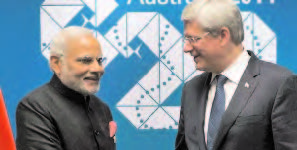
    Two business-friendly PMs, India’s Narendra Modi and Canada’s Stephen Harper chat at the G20 summit in Australia in November. (The Canadian Press)

    “That makes our two countries both natural allies and rather special in terms of the states of the world,” he says, adding that the two countries have worked together quietly for years on such things as counter-terrorism and sharing concerns about violent extremists.

    University of Toronto professor Kanta Murali, who analyzes Indian politics at the Centre for South Asian Studies, points to a 1.2 million-strong Indian diaspora in Canada as “central to the excitement surrounding Modi’s visit.”

    A shared history under British colonial rule, a broadly English-speaking population and a democratic system add to a sense of kinship, adds Comerford.

    5. A knowledge economy

    According to Dherma Jain, president of the Indo-Canada Chamber of Commerce, more than 15,000 Indian students have decided to pursue foreign studies at universities and colleges in Canada.

    Modi’s visit is expected to seal some educational co-operation agreements such as twinning programs, Tepper said.

    “Canada will be providing expertise that India invites as it wants to upscale its own capacity, from technology to agriculture, and attracting people to come to Canada instead of going elsewhere,” he said.

    India is interested in harnessing green tech as well, notes Karunakar Papala, chairman of the Indo-Canada Ottawa Business Chamber, which represents some 600 business owners in the capital.

    Modi’s plan for India to develop 100 high-tech “smart cities” that are more energy and resource efficient, could benefit from Canadian know-how. (The Indian prime minister made a similar pitch when he visited Germany recently.)

    “Solar technologies, green technologies, Canada has got a lot to offer there,” Papala said.

  • NY protesters for minimum wage of $15

    NY protesters for minimum wage of $15

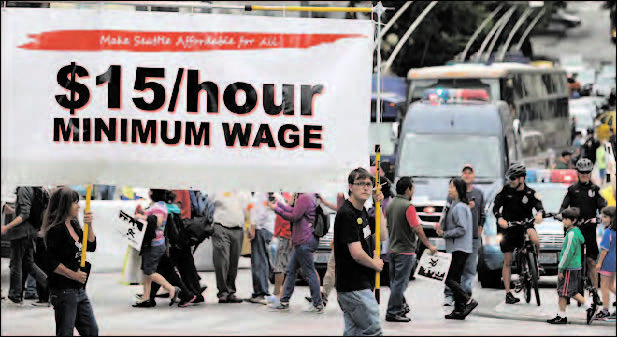
    NEW YORK (TIP): Thousands of demonstrators, including many fast-food workers, protested in New York demanding a minimum wage of $15 an hour to escape poverty in America’s largest city.

    Fast-food workers were joined by airport, construction and child care staff, as well as people working in education, in over 230 cities, organizers said, calling it the largest mobilization of underpaid workers in the US. The minimum wage in New York state is$8.75 an hour and due to rise to $9 in 2016. 


    Between 10,000 and 15,000 took part in the protest, they said.

    Pedro Gamboa, 58, is a baggage handler at JFK airport who works 40 hours a week and wakes up at 300 am (local time) to do it – earning USD 10.10 an hour.

    “It’s not enough. You have to be a magician to survive on that,” said the Guatemalan-born family man. “Once you pay your bills, there is nothing left in your pockets.” 

    In New York, a first protest began at around 6:00 am outside a McDonald’s outlet in Brooklyn.

    In Manhattan, fast-food workers were joined by students and activists, spreading out on the sidewalk outside another McDonald’s to demand better salaries, an AFP photographer said.

    They held up placards proclaiming: “Why poverty,” “Fight for 15” and “Because the rent won’t wait.”

    Workers say they are fed up with pay that does not come close to keeping them out of poverty and the threat of retaliation from employers hostile to them joining or forming unions.

    On April 1, McDonald’s said that it was raising hourly pay to USD 1 above the local official minimum wage for 90,000 employees in company-owned restaurants, and would offer them paid time off.

    The increase, however, does not apply to 660,000 employees working for restaurants owned by franchises, which comprise 90 percent of the 14,000 McDonald’s outlets across the United States.

    “Rather than mollifying employees, the paltry pay move is attracting ridicule and inspiring even more workers to join the walkout,” strike organisers said.

    There is a federal minimum wage of USD 7.25 but many US states have their own minimum wage.

    New York City Comptroller Scott Stringer said in a report yesterday that even when adjusted for cost of living, New York’s minimum wage is the lowest of any major US city.

    Pay of USD 15 an hour would save taxpayers USD 200-USD 500 million a year in food stamps and Medicaid spending, his report said.

  • Meng named Assistant Whip

    Meng named Assistant Whip

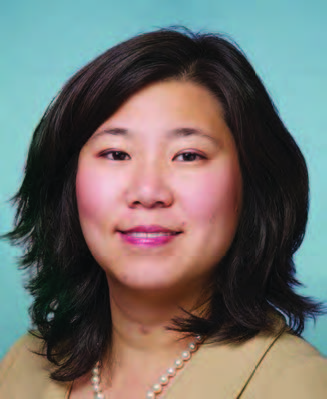
    NEW YORK (TIP): U.S. Rep. Grace Meng (D-Queens) has been selected to serve as an Assistant Whip in the House of Representatives.

    Meng was appointed to the position by House Democratic Whip Steny Hoyer (D-MD), the second highest ranking Democrat in the House.

    In his capacity as Democratic Whip, Hoyer works to build unity among House Democrats. He keeps track of how all Democrats in the House will vote on pending legislation, and builds support among House Democrats for particular positions on those bills.

    Meng will assist Hoyer by advising House Democrats on upcoming legislation. She will also advise Democratic leadership on the prevailing sentiments of the rank-and-file Democratic members.

    “I am pleased to announce that I have appointed Rep. Grace Meng to serve as an Assistant Whip in the 114th Congress,” said Hoyer. “In her first term, Rep. Meng has served as a tireless advocate for job creation and middle-class families and has proven to be a leading voice on issues facing small businesses. I am confident that she will be a strong addition to the Whip Team, and I look forward to working with her in this new role.”

    “I am honored to be chosen by Whip Hoyer to serve as a member of the Democratic Whip Team,” said Meng. “I look forward to working with him to pass important legislation that will improve the lives of all middle class Americans.”

    Meng, who was sworn in to her first term in Congress just two years ago, began her second term this past January.

  • Dean Skelos says he will cooperate with “any inquiry”

    Dean Skelos says he will cooperate with “any inquiry”

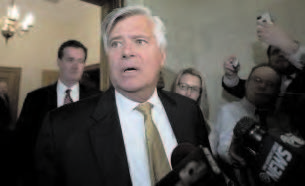
    NEW YORK (TIP): Senate Republican Majority Leader Dean Skelos has broken his silence on a New York Times report published Wednesday, April 14, that federal investigators are looking into the his dealings and those of his son Adam.

    In a one-line statement emailed  April 15 afternoon, Skelos said, “I have and will continue to cooperate with any inquiry.”

    He initially did not respond to the Times’ questions.

    The Times reported that Skelos and his son are the focus of a corruption inquiry and prosecutors have begun presenting evidence to a federal grand jury. NY1 reported that subpoenas for documents have been served to eight of the nine Long Island senators (a band of Republicans often referred to as the Long Island Nine), aside from Skelos, who represents part of Nassau County.

    Investigators from U.S. Attorney for the Southern District Preet Bharara’s office are looking at Adam Skelos’s business dealings with storm-water treatment company AbTech Industries, according to the Times. Investigators are reportedly trying to figure out if Skelos used influence in matters involving AbTech.

  • Now ‘Phoolan Devi: The Bandit Queen’ is opera; to premiere in New York

    Now ‘Phoolan Devi: The Bandit Queen’ is opera; to premiere in New York

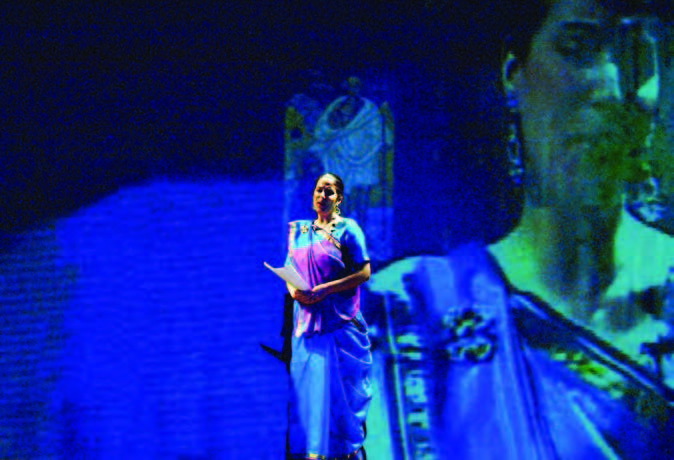
    NEW YORK (TIP): “Phoolan Devi: The Bandit Queen”, a multi-media chamber opera by Shirish Korde, a Uganda born composer of Indian descent, is set for its world premier shows in New York City on June 26-27.

    With a libretto by playwright Anusree Roy and directed by Tom Diamond, the full-length, semi-staged shows will be performed at the Alvin Ailey Citigroup Theatre. They are co-presented by the Indo-American Arts Council and Da Capo Chamber Players.

    The opera is a series of musically compelling and visually stunning scenes, a riveting dramatization that explores real (and re-imagined) events in the life of the notorious Phoolan Devi, according to a media release.

    “Born into poverty, sold as a child bride, abducted by bandits, abused and victimized, imprisoned, elected to India’s Parliament and then tragically gunned down in the streets of New Delhi in 2001, the Bandit Queen was just 37 at the time of her death.”

    “Phoolan Devi’s life raises difficult and universal questions about violence and women,” said Korde.

    “Her story is so compelling that it was imperative for me to expand my 2006 song cycle into this full length opera which only just begins to capture her extraordinary circumstances,” he said.

    Aroon Shivdasani, founder and executive director of the Indo-American Arts Council said: ” The energy and strength of Phoolan Devi is particularly powerful in the context of today’s awakening awareness of decades of brutality towards women.”

    Shirish Korde’s compelling score is a distinctive synthesis of Asian and contemporary Western traditions – among them are Indian classical singing, opera, jazz and hip hop.

    The award winning playwright/actor Anusree Roy has written a libretto that brings to life a woman of so many contradictions who polarized the Indian population.

    The performers include Zorana Sadiq, soprano, and Dashon Burton, bass baritone. They are set against a backdrop of stunning visuals created by multi-media artist Raphaele Shirley.

  • City Council Passes Bill Banning Credit Checks in Hiring

    City Council Passes Bill Banning Credit Checks in Hiring

    NEW YORK CITY (TIP): The City Council passed a bill, April 16 that will ban most employers from using credit histories to screen job candidates.

    The bill passed the Council by a vote of 47 in favor to three opposed.

    Left-leaning council members, labor unions and activist organizations argued that credit checks are discriminatory, unfairly targeting minorities and low-income New Yorkers with poor credit histories. The bill, known as the “Stop Credit Discrimination in Employment Act,” was hailed by supporters as one of the “strongest” measures in the country against employment credit checks.

    “Credit checks for employment unfairly lock New Yorkers out of jobs for a whole set of unfair reasons. Divorce, healthcare debt, student loans, identity theft, simple errors,” said Councilman Brad Lander, a Brooklyn Democrat and lead sponsor of the legislation, at a City Hall press conference. “There is no demonstrated correlation between people’s credit history and their likelihood to commit fraud or theft, between their job performance-this is smart legislation.”

    Council Speaker Melissa Mark-Viverito said the use of credit checks had a disparate impact on certain groups, ranging from people of color to domestic violence victims. “It is very much a discriminatory practice,” she said during a City Hall press conference.

    “All New Yorkers deserve the chance to compete for a job based on their skills and qualifications, not three digits on their financial report,” she said.

    During negotiations on the bill, some business groups called for broad carve-outs found in other municipalities, which often exempt the entire financial services industry from the law. Advocates, meanwhile, called for there to be almost no exceptions to the ban. Today’s legislation includes exemptions for a smaller category of jobs, council members said.

    “This is going to be the strongest law on this issue in the country,” Ms. Mark-Viverito said.

    Among those exempt-people whose credit history can still be checked-are police officers, peace officers, law enforcement personnel at the Department of Investigation, any position subject to DOI background checks, those bonded by city or state law, national security professions, and those with access to trade secrets or with the signatory authority to assets above $10,000.

    Mr. Lander said in eight of the other 11 jurisdictions with similar laws, the entire financial sector is exempt-“down to bank tellers and custodians”-with many locales allowing credit checks of anyone in any kind of managerial position or with access to a company credit card.

    “None of those are in this bill,” Mr. Lander said.

    Some business leaders, like Partnership for New York President Kathryn Wylde, were also pleased with the final language of the legislation.

    “The Partnership represents companies that employ almost a million New Yorkers. In this age of technology, where many employees have access to private customer and company information and funds, employers have a greater responsibility than ever to carefully vet their workforce,” Ms. Wylde said in a statement. “We worked with the Mayor’s office and the City Council to ensure that the final legislation allows employers some discretion in use of credit checks, which we hope proves sufficient to protect the interests of businesses and consumers.”

    But the bill didn’t find favor with everyone in the Council. Councilman Mark Weprin, a Queens Democrat, said he didn’t feel comfortable telling employers who they must hire, as long as they follow state and federal law.

    “I just feel this is a little bit too much of the nanny state,” Mr. Weprin, who voted against the bill, said.

    A coalition of 79 community, labor and student organizations, including the Working Families Party and the New York Public Interest Research Group, led a push for the credit check ban. Stuart Appelbaum, the president of the Retail, Wholesale and Department Store Union, said the bill “puts an end to a practice that puts job applicants behind an economic eight ball.”

    “Using a person’s credit worthiness to judge their workability is really just another form of discrimination,” he said. “In New York City, workers will never again have to face that kind of discrimination.”Ramon Lebron, a student at Bronx Community College, said student loan and personal debt had kept him from landing jobs in the finance industry.

    “We’re in school right now because we’re trying to get jobs, we’re trying to improve ourselves,” Mr. Lebron said. “How are we supposed to get jobs to improve or establish our credit if we can’t get jobs because that lack of credit history or not having good credit in general? Mayor Bill de Blasio is expected to sign the bill into law.

  • CHRISTIAN PRIESTS RAISE CONCERN OVER SECURITY

    MATHURA (TIP): Christian priests in Mathura on April 17 raised security concern after an attack on the 95-year-old St. Mary’s Church in Agra on April 16.

    The priests fear that they, too, could be attacked by anti-social elements.

    “The desperate elements could easily target any. Under the new government at the Centre, the attacks have become more frequent,” said Father Saji, a priest at a church in Jait village in Mathura district.

    Father Saji said the district administration made no security arrangements even after the recent spate of churches being attacked. Mathura district has around a dozen churches and educational institutions run by  different denominations, but their security is lax.

    In Agra, Christians marched with candles on Thursday evening to protest administrative indifference. Protests will continue till the culprits are nabbed, community leaders said.

    Rajesh Modak, senior superintendent of Agra police, said investigations were on with four teams on the job and that the suspects would be arrested soon.

    Father Moon Lazarus, parish priest, demanded arrest of the attackers who, he said, were “mentally diseased.” 

    A group has threatened to close down Christian missionary schools in Agra, if the culprits were not booked soon.

  • China’s economic growth dips to six-year low

    BEIJING (TIP): China’s annual economic growth slowed to a six-year low of 7.0 per cent in the first quarter as demand stayed weak, meeting analyst forecasts but fanning expectations that authorities will roll out more policy stimulus to avert a sharper slowdown. In the last quarter of 2014, China’s economy grew 7.3 per cent on an annual basis. On a quarterly basis, economic growth slowed to 1.3 per cent between January and March after seasonal adjustments, the National Bureau of Statistics said on Wednesday, compared with growth of 1.5 per cent in the previous three months.

  • RBI GOVERNOR GETS DEATH THREAT FROM IS

    MUMBAI (TIP): Reserve Bank of India (RBI) Governor Raghuram Rajan recently received a death threat from a purported Islamic State (IS) email account that is being accessed from across the globe.

    The governor received the threat on his official email address last month from isis583847@gmail.com—an account which the police said had been opened from Australia, Canada, Italy, Germany, US, Nigeria, Poland, Belgium, Hong Kong and Ukraine in a span of a few days.

    While security measures at the RBI has been beefed up, Mumbai Police Commissioner Rakesh Maria has asked the Cyber Crime Investigation Cell to conduct thorough investigations.

    The RBI refused to comment on the issue, but inside sources confirmed that Rajan was currently in the US along with Union Finance Minister Arun Jaitley to attend the World Bank group meeting in Washington. Without elaborating on the details of the e-mail, police sources said the IS warned Rajan that he would be eliminated as a contract had been received to execute him.

  • Salman’s vehicle was examined in 20 mins

    MUMBAI (TIP): A day after Salman Khan’s defence team questioned how the actor’s medical examination and blood extraction was done in five minutes, defence counsel Shrikant Shivade on Thursday alleged that the examination of the Toyota Land Cruiser Lexus was done in flat 20 minutes.

    He was questioning yet another bit of crucial evidence against the actor. “Is this possible? We have superfast experts now…medical and blood extraction done in five minutes…vehicle is examined in 20 minutes…surpirsing, amazing,” Shivade told additional sessions judge D W Deshpande of the Mumbai sessions court, who is conducting the retrial of the case.

    He said that a crucial witness, the official of the Regional Transport Office (RTO), has been changing statements over the time. “Once he said that he examined the vehicle on September 28, 2002 (Saturday) and then he says he did it on September 29, 2002 (Sunday)….he is a liar….he takes recourse of lies whenever it suits him…he will not hesitate to say that the Sun sets in the east,” Shivade said.

    He said that he had examined the car in 20 minutes. “If we see, we will find, it takes 5 to 7 minutes to check the steering, 2 to 4 minutes to check the brakes, one-and-a-half minutes to check the tyres…4 to 5 minutes to check the gear box, 10 minutes to check what is mentioned in column 4, 5 and 6, then 3 to 4 minutes to check what is mentioned in column 7, 1 to 2 minutes to check the spring…this itself amounts to more than 30 minutes and in 20 minutes this witness checks the car and also conducts a test drive of half-a-km during the morning busy peak hours,” he pointed out.

    “The attitude of this man towards truth is shocking….no remorse, whether he is lying or not,” he said , pointing out that when the officer arrived to check the car, he (R S Keskar) was not carrying the required performa to inspect the vehicle.

    “…instead, he points out that another official Imtiyaz helped him with technical details,” the defence counsel said, noting that this was the first imported car that he examined and perhaps the last. “He said that during his training he had examined a Tata Indica…and now he examines a Land Cruiser…it is like asking a student of Class II to appear for B.Sc,” he said.

    Shivade said that a tyre burst has caused the Land Cruiser Lexus to veer off the road. “Once the witness says, tyres were deflated, then he says air pressure was low…which is correct?Our version is correct…it was a tyre burst,” he said, pointing out that according to a survey, 35 per cent of the accidents are caused because of tyre bursts.

    Shivade also questioned the delay in completing the formalities of lodging of the FIR. “The RTO official said that till Sunday, he was not shown the FIR and was told that it was being prepared….but why this delay?” he asked.

  • India builds first smart city as urban population swells

    GANDHINAGAR (TIP): India’s push to accommodate a booming urban population and attract investment rests in large part with dozens of “smart” cities like the one being built on the dusty banks of the Sabarmati river in Gujarat.

    So far, it boasts modern underground infrastructure, two office blocks and not much else.

    The plan, however, is for a meticulously planned metropolis complete with gleaming towers, drinking water on tap, automated waste collection and a dedicated power supply – luxuries to many Indians.

    With an urban population set to rise by more than 400 million people to 814 million by 2050, India faces the kind of mass urbanisation only seen before in China, and many of its biggest cities are already bursting at the seams.

    Ahead of his election last May, Prime Minister Narendra Modi promised 100 so-called smart cities by 2022 to help meet the rush.

    At a cost of about $1 trillion, according to estimates from consultants KPMG, the plan is also crucial to Modi’s ambition of attracting investment while providing jobs for the million or more Indians who join the workforce every month.

    His grand scheme, still a nebulous concept involving quality communications and infrastructure, is beginning to take shape outside Gandhinagar, capital of Gujarat, with the first “smart” city the government hopes will provide a model for India’s urban future.

    “Most (Indian) cities have not been planned in an integrated way,” said Jagan Shah, director of the National Institute of Urban Affairs which is helping the government set guidelines for the new developments.

    Among the challenges to getting new cities built or existing cities transformed is the lack of experts who can make such huge projects work and attracting private finance.

    “To get the private sector in, there is a lot of risk mitigation that needs to happen because nobody wants a risky proposition,” he told Reuters, stressing the need for detailed planning.

  • Dairy farmers want ‘Aadhar’ like ID tags for milch animals

    MUMBAI (TIP): With slaughter of bulls and bullocks being banned, a section of dairy farmers in Maharashtra have mooted the idea of giving milch animals ID tags on the lines of ‘Aadhar’ cards to track their history, breeding cycle and economics of milk production.

    State Dairy Development Minister Eknath Khadse said while the government has not received any formal proposal from dairy farmers as yet, but it will look into the demand if the proposal will help them.

    “We have not got any proposal from the dairy farmers as yet. If we get a proposal, we will study it and if we find that the farmers stand to benefit, we do not mind accepting it,” Khadse said. The dairy farmers want the government to consider it seriously as this has been done in most countries that practice advanced dairy farming methods.

    “The most important benefit of UID number tagging is that it will enable to track the overall production pattern of cows, which is very important from business and planning point of view,” Prabhat Dairy’s Managing Director Vivek Nirmal said.

    “We help farmers in Maharashtra to buy cows through financial assistance schemes from financial institutions. The cows are insured and therefore UID for each cow is very important. The data of each cow is also stored on a ‘cloud’ (data storing software). The data can be used by the lending banks too to keep track of the cows.”

    Nirmal said his unit has already started tagging over 3,000 cows in Shrirampur and Ahmednagar – one of the largest milk producing districts in India.

    “Our ‘Cow Welfare Scheme’ has a provision of sharing information with Maharashtra Livestock Development Board (MLDB) through SMS. A large number of procurement partners at the village level collection centres co-ordinate in the milk procurement process with 70,000 milk farmers and registered milk vendors,” Nirmal said.

    “Since all cows look more or less alike, identification is essential. It is easy to create 12 digit unique ID Number by which dairy units, farmers and funding institutions can track the history of cow, breeding cycles, production trend, economics of milk production,” he said.

    Farmers can fill a form in their language giving the physical details of the animals like appearance and colour and also about themselves. The UID containing these could be tagged to one of ears of a cow, Nirmal said.

    All the animals could be tagged in a manner that they can be traced using the GPS/GPRS system in the event of a disease outbreak.

  • Govt prepares ‘Blue Book’ on disaster management

    NEW DELHI (TIP): The government is looking at ensuring “zero casualty” during natural disasters through proper mitigation measures but has warned states against “artificial suppression” of data on death and destruction.

    The suggestion is part of a draft ‘Blue Book’ to guide relief and rehabilitation efforts before cyclones, learning from the experience of successful management of cyclone Hudhud in 2013.

    “Care should be taken to see that the call for ‘zero casualty’ should not lead to artificial suppression of data,” the draft report, which was send to states seeking comments by April 30, said.

    After disasters, there have been allegations from victims as well as civil society that the authorities were not providing the real numbers and suppressing figures to avoid giving compensations.

    The proposal for ‘Blue Book’ came from the Prime Minister’s Office (PMO) and the Union Home Ministry set up an inter-ministerial panel in October last.

    With “looting” of relief materials during relief efforts a trend, the draft also warns against police action during disaster situations as it is “neither feasible nor will serve the need to roll out relief work”.

    “If any relief material is looted by the restless crowd, the strategy should be to send more relief material along the same route, in order to saturate the need at the intervening areas and to ensure that the material reaches interior areas quickly,” it said.

    Another proposal was the construction of helipads at regular intervals along highways. Earlier, the main problem in dealing with disasters were the accessibility factor and choppers will be able to land on such helipads giving an impetus to movement of man and material, a senior official said.

  • VOTING RIGHTS OF MUSLIMS SHOULD BE WITHDRAWN: SENA MOUTHPIECE

    MUMBAI (TIP): Shiv Sena courted controversy by demanding scrapping of voting rights of Muslims, saying the community has often been used for vote bank politics, evoking sharp reactions from several political parties which accused it of trying to inflame passions and divide people.

    An editorial in Sena mouthpiece ‘Saamana’ also likened the All India Majlis-e-Ittihadul-Muslimeen (MIM) and Owaisi brothers to “poisonous snakes” who spew venom to “exploit” the minority community.

    “Vote bank politics is being played in the name of fighting against the injustice meted out to Muslims. Their educational and health status is being used politically. This politics was once played by the Congress and now every other person calls himself secular.

    “If Muslims are only being used this way to play politics, then they can never develop. Muslims will have no future till they are used to play vote bank politics and thus Balasaheb had once said to withdraw Muslims voting rights. What he said is right,” the editorial said.

    Strongly condemning the remarks, Congress said they are aimed at dividing society and inflaming passions and are unacceptable. Those behind them have no place in a culture like ours.

    It also said such controversial statements continue to be made despite repeated assurances from Prime Minister Narendra Modi in Parliament.

    The Samajwadi Party castigated the remarks, saying it was aimed at creating enmity between various communities and demanded that the government initiate legal action against them. Those who do not believe in the Constitution have no place in the country and should leave it, it said.

    Under attack, the Shiv Sena later sought to downplay the issue, contending that the party is against “appeasement politics”.

    “The (Saamana) article tries to say that to achieve development in every sphere of life, the politics of appeasement being done by a section of leaders needs to be done away with as it is not in the interest of Muslims. These people are only misguiding the community without really helping them,” Sena MLC and spokesperson Dr Neelam Gorhe told PTI.

    The Sena in its editorial said the “secular masks” of all the so-called secular political parties will be worn out, once such voting rights are withdrawn, it said.

    Taking a dig at AIMIM MP Asaduddin Owaisi for daring Sena president Uddhav Thackeray to come to Hyderabad, the editorial said, “Owaisi dares us to come to Hyderabad. But we want to ask him if Hyderabad is in India or in Lahore, Karachi or Peshawar. The pride of Marathis is known in Pakistan, Afghanistan and Kandahar as well.”

    “By saving the hiding place of poisonous snakes, you cannot kill them. Owaisi and his party are like a snake which, if fed, will do no good to the nation. AIMIM is an old snake,” it said.

    Criticising the Sena, Congress leader Anand Sharma said, “These observations deserve to be condemned.It’s unacceptable. We are proud to be a constitutional democracy, a secular nation. We are proud of India’s diversity, its pluralism. India belongs to all and every citizen of this country enjoys the same fundamental rights.”

    He said it is very clear that there are elements who are creating conflict and division in society to inflame passions and there are multiple violations taking place by some leaders and members of the extended Sangh parivar despite assurances of the Prime Minister to Parliament and the nation.

    “It is for them now to realise that they have been elected to provide governance and not to create daily commodition,” he said.

    Another party leader Abhishek Singhvi said though he does not want to comment on “silly, ridiculous, ill informed and deliberately provocative” statements,”I think Saamna thinks it might be living in some Talibanised land and not in a secular, democratic, socialist, world’s largest vibrant democracy. I think it is Saamna which has no place in a culture like ours rather than those against whom they spread hatred.”

  • China jails journalist accused of leaking state secrets for 7 years

    BEIJING (TIP): A Chinese court has sentenced a journalist accused of leaking an internal Communist Party document to a foreign website to seven years in prison, her lawyer said on Friday, a ruling that reflects the sensitivity surrounding the party’s inner workings.

    Gao Yu, 71, who was tried behind closed doors in Beijing last November, was convicted on a charge of providing state secrets to foreign contacts, her lawyer, Mo Shaoping, said.

    Rights activists have condemned Gao’s detention and trial, saying it indicates a widening crackdown on dissent. The United States called on China to release Gao at the United Nations Human Rights Council session in Geneva last month. Mo said Gao had indicated as she was leaving the courtroom that she would appeal against the decision. “As defending counsel, I do not approve of the judgment. I feel the court has not sufficiently respected the facts and evidence in issuing this mistaken sentence,” Mo told Reuters by telephone.

    Gao was detained on accusations she had leaked a party document, which warned senior members against “seven mistaken ideologies”, including the “universal values” of human rights, according to Gao’s other lawyer, Shang Baojun. The State Council Information Office, the Cabinet’s media arm, did not respond to a request for comment.

    Gao, who was detained last May, was accused of passing the document to Ho Pin, head of Mirror Books, Shang said. Ho told Reuters from New York that Gao did not pass him the document. The maximum sentence for leaking state secrets is life imprisonment. However, prosecutors recommended a sentence of 5-10 years based on the level of sensitivity of the secrets Gao was accused of leaking, Shang said.

  • Federal Prosecutors Subpoena Documents in Investigation of State Senate Majority Leader

    NEW YORK (TIP): Federal prosecutors have subpoenaed documents as part of a grand jury investigation of state Senate Majority Leader Dean Skelos.

    A source with direct knowledge of the subpoenas says they were sent out in the past week, to eight of the nine state senators from Long Island -but not Skelos himself.

    The source says the subpoenas asked for documents dating back to January 1, 2013.

    According to the source, the documents involved focus on the state budget, and four or five different companies.

    They also focus on Skelos’s son, Adam.

    Neither Skelos nor his son have been officially accused of wrongdoing.

    Federal prosecutors have been targeting Albany corruption in recent months.

    Their most high-profile target has been former Assembly Speaker Sheldon Silver, who is now facing corruption charges.

    He’s accused of taking millions in bribes and kickbacks.

  • In wake of Dean Skelos investigation, Singas launches probe of Nassau contracts

    MINEOLA, NY (TIP): Nassau acting District Attorney Madeline Singas said Thursday, April 15; she will investigate Nassau County’s process for awarding contracts after disclosure of a federal probe into allegations against State Senate Majority Leader Dean Skelos and his son.

    Singas’ announcement was one of several developments in an inquiry that has the potential to rock not only Long Island but also New York State politics.

  • Fire Breaks Out at Gurudwara in Houston

    Fire Breaks Out at Gurudwara in Houston

    HOUSTON: A major fire broke out in a Gurudwara in Houston, Texas causing heavy damages to the building.


    The blaze started around 9.15 pm yesterday at the Guru Ravidas temple off Boone and Village Bend in West of Houston, fire officials said.


    No one was injured in the fire.


    The cause of the blaze has not yet been determined, they said.


    Houston area is home to several Sikh Gurdwaras. Sikh temples cater to the spiritual and religious requirements of Punjabi community in Houston.


    Besides celebrating major festivals like Baishaki, Gurdwaras in Houston also organise weekly Kirtan, Gurbani Vichar, Punjabi language classes to strengthen the cultural heritage of local Sikh community.

  • Lone Indian American among Outstanding New Americans selected for Paul & Daisy Soros Fellowships

    Lone Indian American among Outstanding New Americans selected for Paul & Daisy Soros Fellowships

    Today, The Paul & Daisy Soros Fellowships for New Americans, the premier graduate school fellowship for immigrants and children of immigrants, announced their 2015 recipients. The thirty recipients, called “Fellows”, were selected for their potential to make significant contributions to US society, culture, or their academic field, and were selected from a pool of 1,200 applicants.

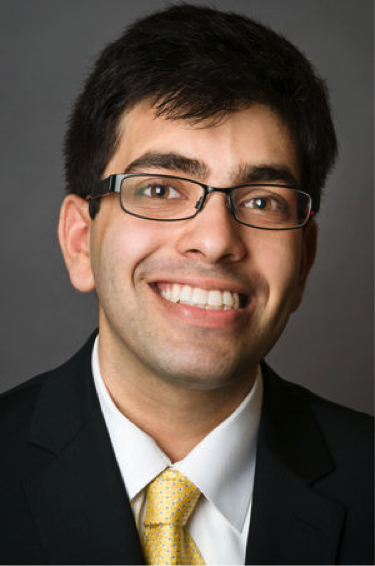
    One of the winners and the only Indian American to win this year is Paras Singh Minhas, a student at the Stanford School of Medicine.

    “I admire the Fellows’ ambition, accomplishments and work ethic,” said Daisy M. Soros, who co-founded the Fellowship program in 1997 with her late husband, Paul Soros (1926-2013). “They underscore the importance of New Americans to this country.” The couple, Hungarian immigrants, contributed $75 million to the organization’s charitable trust.


    In addition to receiving up to $90,000 in funding for the graduate program of their choice, each new Fellow will join the prestigious community of recipients from past years, which includes US Surgeon General Vivek Murthy, leading Ebola researcher Pardis Sabeti, Oscar health insurance co-founder Kevin Nazemi and over 500 other New American leaders.


    “It is extraordinary to see all that these Fellows have already accomplished,” said Craig Harwood, who directs the Fellowship program. “Whether they are in the sciences, music, medicine, law or education, it is clear that this group of individuals will have a tremendous impact on their respective fields, and on life in this country.”


    The 2015 class of Fellows includes researchers, mathematicians, writers, scientists, translators, musicians, entrepreneurs and future doctors and lawyers, as well as the first-ever Paul & Daisy Soros Fellow in the field of nursing. 


    The 2015 cohort of Fellows is extremely diverse in terms of family heritage, field of study and New American status:

    • 16 are female; 14 are male.
    • The youngest Fellow is 21; the oldest is 30. The average age is 26.
    • 22 were born abroad; 8 were born in the US.
    • 2 are DACA recipients; 5 are green card holders; 15 are naturalized citizens.
    • 13 Fellows are pursuing medicine; 7 natural science; 4 law; 3 music, visual and/or performing arts; 2 computer science; 2 business; 1 social science and 1 education. 3 Fellows are currently pursuing more than 1 degree.
    • 14 are first-generation college graduates; 10 are first-generation high school graduates.
    • The Fellows attended a total of 23 undergraduate institutions, and will attend a total of 14 graduate schools.


  • Nuclear Fears in South Asia – Pak Vs Ind

    Nuclear Fears in South Asia – Pak Vs Ind

    The world’s attention has rightly been riveted on negotiations aimed at curbing Iran’s nuclear program. If and when that deal is made final, America and the other major powers that worked on it — China, Russia, Britain, France and Germany — should turn their attention to South Asia, a troubled region with growing nuclear risks of its own. 

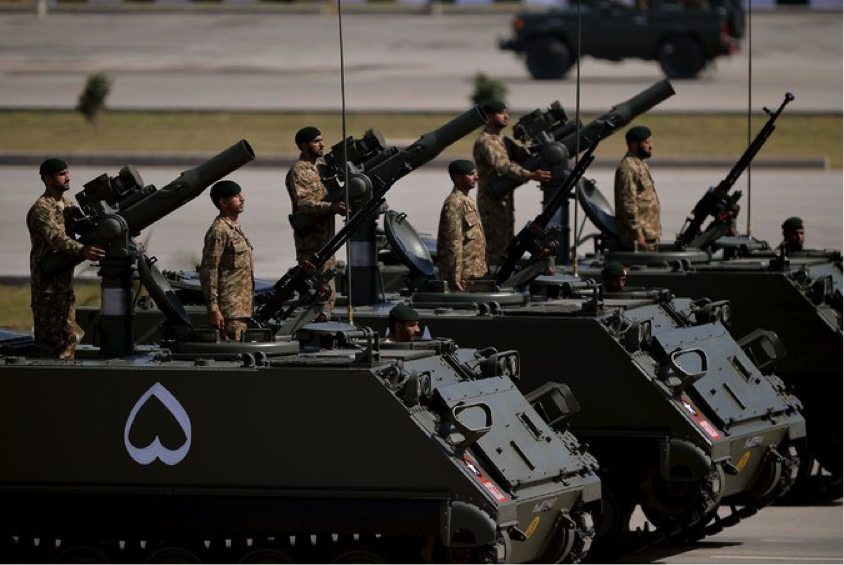
    Pakistan, with the world’s fastest-growing nuclear arsenal, is unquestionably the biggest concern, one reinforced by several recent developments. Last week, Pakistan’s prime minister, Nawaz Sharif, announced that he had approved a new deal to purchase eight diesel-electric submarines from China, which could be equipped with nuclear missiles, for an estimated $5 billion. Last month, Pakistan test-fired a ballistic missile that appears capable of carrying a nuclear warhead to any part of India. And a senior adviser, Khalid Ahmed Kidwai, reaffirmed Pakistan’s determination to continue developing short-range tactical nuclear weapons whose only purpose is use on the battlefield in a war against India.

    These investments reflect the Pakistani Army’s continuing obsession with India as the enemy, a rationale that allows the generals to maintain maximum power over the government and demand maximum national resources. Pakistan now has an arsenal of as many as 120 nuclear weapons and is expected to triple that in a decade. An increase of that size makes no sense, especially since India’s nuclear arsenal, estimated at about 110 weapons, is growing more slowly. 

    The two countries have a troubled history, having fought four wars since independence in 1947, and deep animosities persist. Prime Minister Narendra Modi of India has made it clear that Pakistan can expect retaliation if Islamic militants carry out a terrorist attack in India, as happened with the 2008 bombing in Mumbai. But the latest major conflict was in 1999, and since then India, a vibrant democracy, has focused on becoming a regional economic and political power.

    At the same time, Pakistan has sunk deeper into chaos, threatened by economic collapse, the weakening of political institutions and, most of all, a Taliban insurgency that aims to bring down the state. Advanced military equipment — new submarines, the medium-range Shaheen-III missile with a reported range of up to 1,700 miles, short-range tactical nuclear weapons — are of little use in defending against such threats. The billions of dollars wasted on these systems would be better spent investing in health, education and jobs for Pakistan’s people.

    Even more troubling, the Pakistani Army has become increasingly dependent on the nuclear arsenal because Pakistan cannot match the size and sophistication of India’s conventional forces. Pakistan has left open the possibility that it could be the first to use nuclear weapons in a confrontation, even one that began with conventional arms. Adding short-range tactical nuclear weapons that can hit their targets quickly compounds the danger.

    Pakistan is hardly alone in its potential to cause regional instability. China, which considers Pakistan a close ally and India a potential threat, is continuing to build up its nuclear arsenal, now estimated at 250 weapons, while all three countries are moving ahead with plans to deploy nuclear weapons at sea in the Indian Ocean.

    This is not a situation that can be ignored by the major powers, however preoccupied they may be by the long negotiations with Iran.

  • Obama Signs Bill Fixing Medicare Doctors’ Pay

    Obama Signs Bill Fixing Medicare Doctors’ Pay

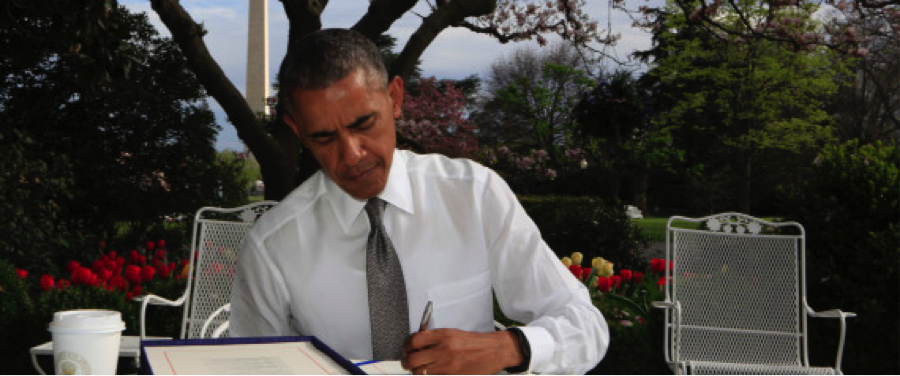
    WASHINGTON, April 16 (Reuters) – U.S. President Barack Obama signed a bill into law on Thursday that repairs the formula for reimbursing Medicare physicians after Congress, in rare bipartisan fashion, passed a fix earlier this week to prevent a 21 percent cut in doctors’ pay.

    Sitting outside in the White House Rose Garden in his shirt sleeves, Obama said he was signing the bill now rather than waiting for a formal ceremony so it could go into force right away.

    “This was a bipartisan effort,” Obama said, adding he hoped the practice of Republicans and Democrats working together would become a habit on Capitol Hill.

    “Because we wanted to make sure doctors’ payments didn’t get cut off, I’m signing it now.”

    The measure replaces a 1990s formula that linked Medicare doctor pay to economic growth, with a new formula more focused on quality of care. It also requires means-testing of Medicare beneficiaries so higher income people pay higher premiums.

  • Pakistan concerned over rights violations Kashmir

    Pakistan concerned over rights violations Kashmir

    ISLAMABAD: Pakistan on Thursday expressed serious concerns over the violations of human rights in Indian-occupied Kashmir and called for resolving the issue in the light of United Nations (UN) resolutions. 

    Speaking at a weekly press briefing, the Foreign Office spokesperson Tasneem Aslam said that Pakistan has differences with India regarding cases instituted against Kashmiri leaders and it will continue to support the people of Kashmir morally, politically and on diplomatic level. “We took up the Srinagar issue on appropriate forum, while human rights violations are continued in Indian-occupied Kashmir,” she added. “Indian torture of peaceful protesters is illegal.”

    About rising of Pakistani flag in the streets of Srinagar she said it was the manifestation of the deep and lasting emotional bonds between the people of Indian-Occupied Kashmir and the people of Pakistan. Aslam said it was regrettable that India chose to use excessive force against peaceful demonstrators over exercising their right to peaceful assembly. Pakistan believed that the charges against the Kashmiri leadership were bogus and illegal as India could not have any legal right to demand allegiance to India by the people of Kashmir, who belong to a disputed territory and whose final settlement according to UN Security Council resolutions was yet to happen.

    its editorial titled ‘Nuclear Fears in South Asia’. The editorial seems to be part of a familiar pattern of motivated and, at times ill informed, campaign which surfaces at regular intervals. The editorial analysis by the New York Times misses out entirely on the well-established facts about introduction of nuclear weapons in South Asia. Pakistan was not the first to introduce nuclear weapons in South Asia. Pakistan was forced to develop nuclear capability purely for self-defence.

    She said Pakistan is a responsible nuclear weapons state with a robust command and control structure headed by the prime minister. Pakistan strictly conformed to the concept of credible minimum deterrence and could not want a conventional or nuclear arms race in South Asia. “We have been compelled to develop a full spectrum deterrence capability to maintain regional stability and to deter aggression,” she maintained. Pakistan’s bilateral proposal to India of a Strategic Restrain Regime (SRR) remains on the table since 1999 without a positive response. The SRR consists of three interlocking elements of nuclear and missile restraint, conventional balance and conflict resolution. It is important to view the situation in South Asia in a non-discriminatory and neutral manner and support Pakistan’s efforts for stability and lasting peace in the region.


  • Raja Rajeswari Becomes New York’s First Indian-American Judge

    Raja Rajeswari Becomes New York’s First Indian-American Judge

    WASHINGTON:  Chennai born Raja Rajeswari, who came to America when she was 16, has become the first person of Indian descent to be named as a criminal court judge in New York City.

    Ms Rajeswari, 43, an assistant district attorney at the Richmond County District Attorney’s office, who was nominated to the bench by Mayor Bill de Blasio, formally assumed her new office on Tuesday. 

    “It’s like a dream. It’s way beyond what I imagined,” she was quoted as saying by silive.com, a Staten Island news website.

    “For someone like me, an immigrant who comes from India, I’m beyond grateful,” she said. “I told the mayor this is not only my American Dream, but it shows another girl from a far away country that this is possible.”

    Ms Rajeswari, who has worked at the district attorney’s office for 16 years, has been the deputy chief of the Special Victims Unit for more than four years.

    She hopes to use her new position to improve the judicial system by encouraging interpreters to have more access to aid immigrants, the news site said.

    As a prosecuting attorney in New York, she has come across numerous cases of spousal and child abuse within the South Asian community in New York, Ms Rajeswari said. “Many of the domestic violence victims have been South Asians, Sri Lankans.”

    Currently, there are two male judges of Indian descent in civil court settings – Jaya Madhavan on the New York City Housing Court in Bronx County, and Anil C Singh of New York County Supreme Court, 1st District, according to ethnic New India Times.

    Besides her legal acumen, Ms Rajeswari is an accomplished Bharat Natyam and Kucchipudi dancer who continues to perform at Indian events and temples with her troupe from the Padmalaya Dance Academy, named after her mother, Padma Ramanathan.

  • California man, 95, sets world record as oldest active pilot

    PLACERVILLE (CALIFORNIA) (TIP): A 95-year-old California man has become the world’s oldest active pilot.

    The Sacramento Bee reported Tuesday that Guinness World Record keepers confirmed that a flight last month by Peter Weber Jr. qualified him for the record book.

    Weber was 95 years, 4 months and 23 days old when he flew three looping circles around an airfield near Sacramento on March 30.

    Guinness lists Cole Kugel as the oldest pilot ever. Kugel, who lived in Colorado flew for the last time in 2007 at age 105 and died the same year.

    Weber says the record keepers have designated a new category: Oldest qualified pilot still licensed and flying solo.

    The Air Force veteran has been pilot for 72 years and says he flies about twice a month.

  • Alabama death row inmate to go free; 2nd released in 2 weeks

    MOBILE, ALABAMA (TIP): A death row inmate reached a plea deal Thursday that makes him the second prisoner to escape the death penalty in Alabama in less than two weeks.

    William Ziegler, 39, agreed to plead guilty to aiding and abetting in the slaying of Russell Allen Baker, and a Mobile County judge gave him credit for the more than 15 years he already has served in prison, Al.com reported.

    Ziegler was convicted of capital murder in 2001 and sentenced to die for Baker’s killing. Circuit Judge Sarah Stewart overturned Ziegler’s conviction in 2012, indicating there were numerous errors and serious doubts about his guilt.

    Prosecutors had said they planned to try him again, but Ziegler instead was allowed to plead guilty to the reduced charge to resolve the case.

    During a hearing, Stewart urged Ziegler to resist turning bitter and said she knew he recognized God’s grace.

    “I want you to appreciate that gift,” she said. “You need to be very careful with your gift. … The world is a very different place than it was 15 years ago when you went to jail.” 

    The decision came less than two weeks after another condemned Alabama prisoner was freed after claiming he was innocent.

    Anthony Ray Hinton was released April 3 after nearly 30 years on Alabama’s death row for a pair of killings in Jefferson County. Prosecutors in that case dismissed charges in the 1985 gunshot deaths of two fast-food workers after new testing on the defendant’s gun could not prove that it fired the fatal shots.

    Baker’s body was found in a wooded area in Mobile County in 2000. Authorities said Ziegler had quarreled at a party, and Ziegler was convicted along with three accomplices. But a key witness who claimed Ziegler had threatened Baker later recanted, helping lead to Stewart’s decision to overturn the case.

    With his plea, Ziegler acknowledged that his conduct helped lead to Baker’s death. Relatives of both Ziegler and Baker, from Bayou La Batre, came away from the hearing disappointed.