Month: April 2015

  • Vaisakhi- A Day to Celebrate Human Values

    Vaisakhi- A Day to Celebrate Human Values

    Rarely is found a person in the history of mankind who has left such a deep imprint on the life and character of people within a brief span of 42 years. More than three hundred years later he still continues to move millions of men and women not only in India, the great subcontinent of Asia, but the entire world. From the five beloveds he baptized in 1699, today, he has a following of 25 million and growing with the religion he gave enjoying fifth position among the world’s most favored religions.

    Guru Gobind Singh, the man I am referring to, was a unique person. The image of God he portrayed is exactly the same as painted by Guru Nanak Dev, the First Master of the Sikhs. The Mool Mantra of Jaap Sahib (a poetic work of Guru Gobind Singh) provides an interesting study from this point of view. The Almighty of Guru Gobind Singh is the “True Lord of All, has neither distinguishing signs nor marks, no one can discern him, and beyond limitations and is manifested as the Light of the Spirit, the Lord God of a myriad Indras and is proclaimed the King of Kings, the Master of the three worlds, of gods, men and demons”.

    Guru Gobind Singh gave the message of equality and fraternity i.e. Fatherhood of God and brotherhood of mankind. He said, some are Hindus, some Turks, some are of Shia persuasion and some of Imam Shafai; mankind is all of one race.

    Eminent historian Cunningham states that though the last apostle of the Sikhs did not see his own ends accomplished, he effectively raised the dormant energy of a vanquished people and filled them with the lofty, although fitful, longing for social freedom and national ascendancy, the true adjunct of that purity of worship which had been preached by Guru Nanak.

    Guru Gobind Singh not only patronized the Sikh institution of sacrifice, he actually sacrificed his whole family. He is an ideal and should be an idol for the young generation of today. All pessimism will vanish and instead a robust optimism will fill our youth should they imbibe the ideals and values of the Guru. Let them give up their weakness for intoxicants and have faith in their innate energy to countenance any challenge and overcome any obstacle. Let them follow the Guru’s progressive humanism empowered with spirituality and sacrifice. Let them derive strength and courage from the Tenth Guru who expressed all optimism and positive attitude for the victory of the forces of righteousness over evil and repression.

    Sikh culture and religion is a rich heritage to be protected and glorified. The mission of Guru Nanak-Guru Gobind Singh is cosmic. May the Almighty bestow His blessings on all human beings, particularly young generation of the Sikhs and fill them with tremendous strength and will to establish the Kingdom of God on Earth. May the Lord Almighty rid the Sikh leaders of arrogance and drunkenness of power! May they learn to be meek, humble, caring, loving and giving, following the dictates of our Gurus!

    Vaisakhi is a day to thank the Tenth Master for all His gifts to His Panth and also a day to dedicate ourselves to his mission. It is a day to celebrate the birth of the Khalsa. It is a day to commit ourselves to a just world order that the founding master of the Sikhs envisaged.

    [quote_center]Happy Vaisakhi![/quote_center]

    [vc_button title=”Read Our Vaisakhi Special Issue” target=”_self” color=”default” size=”size_large” href=” theindianpanorama.news/print-edition”]

  • 7 things men find unattractive about women

    7 things men find unattractive about women

    While many look at women as the ones who like to nitpick, men do have their nitpicky
    moments, too. Find out what they are…

    Unattractive female habits:Too much makeup, talking about bodily functions, and belittling the opposite sex are just a few of the female habits that men find unattractive about women. We know that not all women are like this, but when we meet them, boy do we know about it. Here are seven things men find unattractive in a woman:

    Being too drunk

    We all love a girl who knows how to have a good time but when she’s had such a good time that she’s slumped over a bar with her knickers tucked into her skirt and toilet paper trailing from her shoe, it’s not attractive and it doesn’t make us want to walk over and kiss you in a “hands off folks – she’s mine” kind of manner. You ladies also have the tendency to speak so loud that you drown the music out in a loud bar when you’re drunk. There’s nothing wrong with getting merry, but when everyone starts looking at us because we’re with “that drunk woman” who is putting her skirt over her head and laughing hysterically, it’s embarrassing.

    Talking about bodily functions

    Yes, we know we agreed not to keep secrets from each other but can we skip that rule on this occasion? The day we realised that women do ‘number twos’ was the day our world came crashing down, bringing all our sexual fantasies down with it. When you’re spending a long time in then bathroom, we like to think that it’s because you’re refreshing your makeup and hair. We could possibly – emphasis on the word “possibly” -stretch our imagination to think that you may be going for a tinkle, but we’d rather not. Please don’t talk about any of your bodily functions; leave topics about “the time of the month” and your bowel movements for your girl friends.

    Excessive body hair

    We associate body hair with testosterone and testicles so seeing it in excessive amounts on a woman can be quite a turn off. We know it’s painful to go through the rigmarole of waxing, plucking, epilating, and whatever other fancy hair removal systems you use (notice how we know all about this stuff because it’s one of those things you nag about?) but at least keep it trimmed so it looks presentable.

    Too much makeup

    It’s great to take pride in your appearance and that goes for clothes, hair, and makeup too. If this is a first date, wearing minimal makeup to enhance your looks is sexier than the overdone look, in our opinion. If we’ve been together for a while, we love you no matter how much makeup you wear, but we’d prefer it if you kept it to a minimum. Purple, pink and green eye shadow with red lips? Someone pass my sunglasses. We go in for a kiss and end up looking like a clown from the circus and it isn’t a good look for either of us. Ladies, if you insist on wearing that much makeup, please refrain from snuggling up on our shoulders – that’s my favorite white shirt you just stained with your makeup.

    Belittling us

    We can just about cope with being called “snuggle bunny” and “baby boy” but when you belittle us to the point that we look stupid in front of other people, that’s one step too far. Don’t correct everything we do and say as if we don’t know anything. Just because we do things differently to you, that doesn’t mean that your way is right. Swearing We can forgive you the odd cheeky swear word, but when you’re effing and jeffing like there’s no tomorrow it can be a real turn-off for some men. We like our ladies with a touch of class and cramming your vocabulary with swear words doesn’t quite ooze sophistication. What’s wrong with using normal words to express your feelings? Dictionaries and thesauruses are brimming with options – take your pick. We’re not suggesting that you
    express your feelings using sentences such as “I am feeling ever so disenchanted” or “I’m awfully embittered by this” but saying something along the lines of “I am flipping angry” or “this is blimming frustrating” are much nicer replacements for sentences packed with foul words.

    Nagging

    We’ve spent long enough silently moaning to ourselves about how annoying women are when they nag, that we’re taking this opportunity to get it off our chests once and for all. We can’t usually raise it in conversation you see, because no matter how delicately we approach the idea that you might possibly annoy us when you nag, we will be sentencing ourselves to even more endless nagging about pointing out that your nagging is getting too much. You nag at us for leaving the toilet seat up, you nag at us for “not caring”, you nag at us for not shaving for a few days… sheesh. Would you prefer us to got the toilet sitting down? Would you prefer us to be over emotional? And perfectly groomed? Then you’d nag at us for not being manly enough. Three words: we can’t win. Don’t mess with how nature intended men to be, and we won’t mess with how nature intended you to be. If you can’t handle that, then maybe you should be dating women. Sorted.

  • Tornado kills two people, destroys homes in Illinois town

    Tornado kills two people, destroys homes in Illinois town

    A second woman from a tiny Illinois farming community has died, Gov. Bruce Rauner confirmed Friday, a day after tornadoes struck a six-county swath of the state, injuring about a dozen other people and sweeping homes off their foundations.

    Crews embarked on detailed searches for missing residents Friday after at least one tornado brought chaos to Fairdale, a town of 150 people, around 7 p.m. the night before.

    Residents reported the skies blackening and windows exploding as the severe weather struck. Crews combed through each structure twice into the evening hours and searched again by equipment and by hand Friday morning. The second person killed had initially been reported missing and her body was found Friday morning, Rauner said. Most other injuries were minor.

    “We hope and pray that that is all the fatalities,” Rauner said. “We are very blessed that more people were not hurt. This was a devastating storm.”

    The two people killed were identified as Jacklyn K. Klosa, 69, and Geraldine M. Schultz, 67.

    About 15 to 20 homes were destroyed in Fairdale, according to DeKalb County Sheriff Roger A. Scott. Matthew Knott, division chief for the Rockford Fire Department, told The Associated Press that just about every building in the town about 80 miles from Chicago “sustained damage of some sort.”

    All homes were evacuated as a safety precaution and power was out across the area. The Red Cross and Salvation Army established a shelter at a local high school.

    Trees, power lines and debris lay strewn on the ground. Some homes in the rural farming village were barely standing and many had shifted from their foundations. Roofs were missing. Metal siding from barns was wrapped around trees.

    Residents gathered at a roadblock a mile from town Friday morning, eager to check the damage to their homes. Police, though, refused entry, saying it was too dangerous.

    Resident Al Zammuto, a 60-year-old machinist, said he and other residents received cellphone alerts at 6:45 p.m., but he dismissed it as previous warnings hadn’t amounted to anything.

    Then his windows exploded.

    He took cover as the severe weather struck. Bricks were torn off the side of his home. Minutes later he stepped outside and couldn’t believe his eyes. He said the town looked trashed “looked like a landfill” and the sounds were haunting.

    “People were screaming and yelling,” he said. “People were in total shock.”

    National Weather Service meteorologist Matt Friedlein said at least two tornadoes swept through six north-central Illinois counties, and that damage survey teams would visit the area to determine how long they stayed on the ground, their strength and the extent of the damage.

    After raking Illinois, Thursday’s storm and cold front headed northeast, dumping snow in Michigan’s Upper Peninsula and sweeping across the Ohio Valley overnight, Friedlein said. The system was headed into the Appalachian region Friday with the potential for severe thunderstorms but “not anywhere near the threat” that it packed in the Midwest, he said.

    Roughly 30 homes were damaged or destroyed in Ogle County, adjacent to DeKalb, Sheriff Brian VanVickle said, adding no deaths or significant injuries were reported there. He said 12 people had been trapped in the storm cellar beneath a restaurant that collapsed in the storm in Rochelle, about 20 miles southwest of Fairdale.

    One of those rescued from the Grubsteakers restaurant, Raymond Kramer, 81, told Chicago’s WLS-TV they were trapped for 90 minutes before emergency crews were able to rescue them, unscathed.

    “No sooner did we get down there, when it hit the building and laid a whole metal wall on top of the doors where we went into the storm cellar,” Kramer said. “When the tornado hit, we all got a dust bath. Everyone in there got shattered with dust and debris falling out of the rafters.”

  • Ek Paheli Leela Movie Review

    Ek Paheli Leela Movie Review

    STORY: London-based model Mira (Sunny Leone) comes to India on an assignment. She falls in love with a prince in Jaisalmer and gets married to him. Meanwhile, a budding musician Karan (Jay Bhanushali) is getting persistent nightmares after hearing an old Rajasthani folk tune and keeps muttering the name Leela in sleep. How is Mira related to Leela? This one is more than just a reincarnation tale.

    REVIEW: The tendency of not taking a Sunny Leone film seriously is going to change.  Ek Paheli Leela might not be a cinematic treat but its tricky climax Emakes it watchable. With a solid story in place, this vivaciously shot reincarnation drama is plotted carefully with its loose-ends knotting up into a thrilling end.

    Unlike the usual fare that compliment the actress’ bold persona, the forte of this film sprawls beyond its scintillating bits. It starts on a droopy note and meanders initially but once the parallel stories merge, it advances smoothly towards the jolt of its unexpected climax.

    What dampens the strength of the plot are its sexual innuendos and the needless songs that keep popping in frequently without adding much. There are nine songs forced into the package which water down the film’s punch. The story shifts briskly between the present and the past without seeming too disparate. With its runtime of over two hours, the film gets tedious, something that could have been easily rectified by sharper editing.

    Director Bobby Khan amps up the oomph quotient, helping Sunny pull a character than demands a steady performance. And to be fair, she has delivered her most earnest act so far. She has worked on her linguistic skills seriously and can emote a lot better than before. The men are good but Rajneesh Duggal has the most palpable chemistry with Sunny. Mohit Ahlawat and Jay Bhanushali are good and Jas Arora’s vamp act was wicked.

    You might guffaw at a few scenes because the film isn’t exactly an epitome of logical thinking. But as an entertainer, it’s colourful, crisp and convivial.

  • Detective Byomkesh Bakshy! Movie Review

    Detective Byomkesh Bakshy! Movie Review

    BYOMKESH LOOKS STUNNING – BUT COULD BE SHARPER!

    STORY: Byomkesh Bakshy wants to find Bhuvan babu – but what happens when Byomkesh unearths a highly sinister plot?

    REVIEW: Straight up,  Detective Byomkesh Bakshy! is possibly India’s best-looking sleuth flick till now. Based on Saradindu Bandhopadhyay’s vintage stories, DBB! is set in 1942 Calcutta where clever Byomkesh (Sushant) is asked by Ajit Banerjee (Anand) to help find his father, Bhuvan babu, mysteriously missing for months

    At Bhuvan’s lodgings, Byomkesh is befriended by doctor Anukul Guha (Neeraj Kabi) and Kanai Dao (Meiyang Chang) who sells opium – in a Calcutta that’s all about intoxicants, smugglers and smoke. Byomkesh finds a trail to Gajanand Sikdar’s chemical factory where sensuous film star Angoori (Swastika) intrigues him, imperious Satyawati (Divya) annoys him and rebellious Sukumar (Shivam) puzzles him – discovering blackmail, drugs, bodies and bombs, can Byomkesh solve not one but two dangerous plots?

    Byomkesh Bakshy is an iconic Bengali character brought to life by Sushant Singh Rajput with great elan – Sushant pulls off a role full of wry liveliness (a Sardarji cabbie nervously noting, ‘Ye babu ka nut dheela hai,’), fitting the character, from flowery dhoti folds to furrowed-forehead frowns, beautifully. He’s matched by dramatic Neeraj Kabi and calm Anand Tiwari who, after a Chinese gang leaves a courtyard strewn with corpses, tells caretaker Putiram (shakily precise Pradipto Kumar Chakrabarty), ‘Khoon rehne de…bas chai bana de.’

    Alongside, the look is remarkable – noir cinematography unfurls a Calcutta of jostling shadows and splendid squalour, trams like filigree running across the city, costume balls, dentists’ halls where murders are committed with violent slash. Dibakar Banerjee adds cheeky global touches too (Byomkesh’s painting resembles Edvard Munch’s Scream), tracking shots evoking Fellini’s moving camera, action punching between Guy Ritchie and Quentin Tarantino.

    But the film stretches, scenes between Byomkesh a nd a slow-talking, slow-smoking, slow-pouting Angoori losing pace. Superfluous characters (wailing wife, dumbstruck ex) make growing tension pop away like the bubbles on Angoori’s bath foam. A chilling climax masterfully ties up the tale – but 30 minutes less would’ve given this detective a much tighter grip.

    Still, DBB! is a fun watch, presenting another mysterious case – how Sushant looks good, despite a uni-brow?

  • INDIA AND FRANCE SIGN 17 PACTS

    INDIA AND FRANCE SIGN 17 PACTS

    PARIS (TIP): India and France signed 17 pacts, April 10, after the talks between French President Hollande and Indian Prime Minister Narendra Modi in Paris. An agreement on proceeding forward on the stalled nuclear project in Jaitapur in Maharashtra and purchase of Rafale fighter aircraft were  among the pacts signed.

    The Jaitapur project, where French company Areva is to set up six nuclear reactors with a total power generation capacity of about 10,000 MW, has been stuck for long because of differences over the cost of the power generated.

    The agreement between India’s Larsen and Toubro and France’s Areva is aimed at cost reduction by increasing localization and to improve the financial viability of the Jaitapur project.

    The original deal was for 126 fighter aircraft under the Medium Multi-Role Combat Aircraft contest, which began in 2007. Dassault Rafale was shortlisted in 2012 after rigorous evaluation but negotiations have been stuck over pricing and delivery guarantees for the aircraft manufactured by Hindustan Aeronautics Ltd. (HAL) in India.

    A direct purchase will drive down the costs as there is no technology transfer involved and the delivery of aircraft will be faster.

    The major reasons for the direct purchase of 36 Rafale jets from France are the fast-depleting fighter strength of the Indian Air Force, unending delays in the Medium Multi-Role Combat Aircraft negotiations and the steep price rise.

    The fighter aircraft strength has fallen drastically to 34 squadrons from the sanctioned 42 and is set to further dip with the phasing out of MiG-21s and MiG-27s in the next few years. The Chief of the Air Staff, Air Chief Marshal Arup Raha, has flagged the issue on several occasions. The MMRCA and the Light Combat Aircraft (LCA) Tejas, the replacements, are nowhere on the horizon. Also with the price crossing $20 billion, funding this was a concern for the government with other major modernization programs in the offing.

    Another pact reached during negotiations related to pre-engineering agreements between the NPCIL and AREVA in connection with studies that is intended to bring clarity on all technical aspects of the Jaitapur plant so that all parties (AREVA, ALSTOM and NPCIL) can firm up their price and optimize all provisions for risks still included at this stage in the costs of the project.

    France also informed India of its decision to implement a scheme for expedited 48 hours visa issuance for Indian tourists.

    Noting that Mr. Hollande had supported the “Make in India” initiative, especially in the defense sector, Mr. Modi said that in the area of nuclear power, France had been a major partner with India.

    France also announced an investment of 2 billion euros in India as Mr. Modi invited French companies to pump in money in technology in the fastest-growing economy.

    France will invest 2 billion euros in India, Mr. Hollande announced at a CEO forum here.

    He said France would partner India in urban development of infrastructure such as railways and defense and nuclear sector.

    Mr. Modi and Mr. Hollande enjoyed a joint boat cruise on La Seine river here which was described as “Naav Pe Charcha” (chat on the boat).

    MR. Hollande was seen giving details to Mr. Modi about various areas as the boat cruised through the river.

    Many people enjoying a boat ride in the river at that time were seen waving at the dignitaries, including French ministers.

    The two leaders had the boat ride after their detailed discussions, focusing on cooperation in the areas of civil nuclear energy, defense, space and trade.

    Mr. Modi is visiting France in the first leg of his nine-day three-nation tour that will take him to Germany and Canada also.

    It was the first time that Modi had ‘Naav Pe Charcha’ with any world leader.

    Earlier, Mr. Modi has had ‘Chai Pe Charcha’ (chat over tea) with some world leaders, including US President Barack Obama during his visit to New Delhi in January and Japanese Prime Minister Shinzo Abe during the Indian leader’s visit to that country last year.

    The concept of ‘Chai Pe Charcha’ came to be known during Modi’s campaign for Lok Sabha polls last year. During that, he used ‘Chai Pe Charcha’ as an election plank.

  • Signs of alien life will be found by 2025: NASA

    Signs of alien life will be found by 2025: NASA

    WASHINGTON (TIP): Signs of alien life will be detected by 2025, while “definitive evidence” of extra-terrestrial beings may be found within the next 20 to 30 years, top Nasa scientists say.

    “I think we’re going to have strong indications of life beyond Earth within a decade, and I think we’re going to have definitive evidence within 20 to 30 years,” Nasa chief scientist Ellen Stofan said.

    Stofan was speaking at a panel discussion that focused on Nasa’s efforts to search for habitable worlds and extra-terrestrial life.

    “We know where to look. We know how to look. In most cases we have the technology, and we’re on a path to implementing it. And so I think we’re definitely on the road,” Stofan added.

    John Grunsfeld, associate administrator for Nasa’s Science Mission Directorate, also predicted that signs of life will be found relatively soon both in our own solar system and beyond, ‘Space.com’ reported.

    “I think we’re one generation away in our solar system, whether it’s on an icy moon or on Mars, and one generation (away) on a planet around a nearby star,” Grunsfeld said.

    According to Grunsfeld, recent discoveries suggest that the solar system and broader Milky Way galaxy teem with environments that could support life as we know it.

    Oceans of liquid water, for example, slosh beneath the icy shells of the Jupiter moons Europa and Ganymede, as well as that of the Saturn satellite Enceladus.

    Researchers have found that oceans covered much of Mars in the ancient past, and seasonal dark streaks observed on the Red Planet’s surface today may be caused by salty flowing water.

  • SEASONAL CHANGES ON SUN CAN BETTER PREDICT SOLAR STORMS

    SEASONAL CHANGES ON SUN CAN BETTER PREDICT SOLAR STORMS

    WASHINGTON (TIP): Not just planet Earth but the Sun too experiences seasonal changes, finds a significant research. By better understanding how these seasonal instabilities are formed one can greatly improve forecasts of space weather events.

    According to a team of researchers led by the Colorado-based National Centre for Atmospheric Research
    (NCAR), Sun undergoes a type of seasonal variability with its activity waxing and waning over the course of nearly two years.

    This behaviour affects the peaks and valleys in the approximately 11-year solar cycle, sometimes amplifying and sometimes weakening the solar storms that can buffet the Earth’s atmosphere.

    The quasi-annual variations appear to be driven by changes in the bands of strong magnetic fields in each solar hemisphere.

    These bands also help shape the approximately 11-year solar cycle that is part of a longer cycle that lasts about 22 years.

    “What we are looking at here is a massive driver of solar storms,” said Scott McIntosh, lead author and director of the NCAR’s high altitude observatory.

    The overlapping bands are fueled by the rotation of the Sun’s deep interior, according to observations by the research team.

    As the bands move within the Sun’s northern and southern hemispheres, activity rises to a peak over a period of about 11 months and then begins to wane. “The quasi-annual variations can be likened to regions on Earth that have two seasons, such as a rainy season and a dry season,” McIntosh added. McIntosh and his team detected the twisted, ring-shaped bands by drawing on a host of NASA satellites and ground-based observatories that gather information on the structure of the Sun and the nature of solar flares and coronal mass ejections (CMEs).

    Researchers can turn to advanced computer simulations and more detailed observations to learn more about the profound influence of the bands on solar activity.

    The findings can help lead to better predictions of massive geomagnetic storms in Earth’s outer atmosphere that sometimes disrupt satellite operations, communications, power grids, and other technologies, concluded the study published in the journal Nature Communications.

  • NEW BATTERY CHARGES PHONES IN A MINUTE

    NEW BATTERY CHARGES PHONES IN A MINUTE

    New battery charges your phone in just 60 seconds! Washington: A new inexpensive aluminium battery that could charge cellphones in just one minute has been developed by Stanford scientists.

    The new aluminium battery is much safer than existing lithium-ion and alkaline batteries in wide use today and does not catch fire, researchers said.

    “We have developed a rechargeable aluminium battery thatmay replace existing storage devices, such as alkaline batteries, which are bad for the environment, and lithium-ion batteries, which occasionally burst into flames,” said Hongjie Dai, a professor of chemistry at Stanford University. “Our new battery won’t catch fire, even if you drill through it,” said Dai.

    Aluminium has long been an attractive material for batteries, mainly because of its low cost, low flammability and high-char8ge storage capacity. An aluminium-ion battery consists of two electrodes: a negatively charged anode made of aluminium and a positively charged cathode.

    “People have tried different kinds of materials for the cathode,” Dai said. “We accidentally discovered that a simple solution is to use graphite, which is basically carbon. In our study, we identified a few types of graphite material that give us very good performance,” said Dai.

    The team placed the aluminium anode and graphite cathode, along with an ionic liquid electrolyte, inside a flexible polymer-coated pouch.

    “The electrolyte is basically a salt that’s liquid at room temperature, so it’s very safe,” said Stanford graduate student Ming Gong, co-lead author of the study.

    Aluminium batteries are safer than conventional lithium-ion batteries used in millions of laptops and cell phones today, Dai added.

    Smartphone owners know it can take hours to charge a lithium-ion battery. But the team reported “unprecedented charging times” of down to one minute with the aluminium prototype. ptiAluminium batteries developed at other laboratories usually died after just 100 charge-discharge cycles. But the Stanford battery was able to withstand more than 7,500 cycles without any loss of capacity.

    “This was the first time an ultra-fast aluminium-ion battery was constructed with stability over thousands of cycles,” researchers said.

    “Another feature of the aluminium battery is flexibility. You can bend it and fold it, so it has the potential for use in flexible electronic devices. Aluminium is also a cheaper metal than lithium,” Gong said.

  • Mummies reveal how TB ravaged 18th century Europe

    LONDON (TIP): Samples from mummies in a 200-year-old crypt in Hungary have revealed that infections by multiple strains of tuberculosis (TB) gripped 18th century Europe when the disease was at its peak.

    Analysis of the samples taken from the naturally mummified bodies found in the Dominican church of VAic in Hungary yielded 14 tuberculosis genomes, suggesting that mixed infections were common at that point of time.

    “Microbiological analyses of samples from contemporary TB patients usually report a single strain of tuberculosis per patient,” said lead author Mark Pallen, professor at the Warwick Medical School in Britain.

    “By contrast, five of the eight bodies in our study yielded more than one type of tuberculosis – remarkably from one individual we obtained evidence of three distinct strains,” he noted.

    Pallen said the discovery was significant for current and future infection control and diagnosis.

    The researchers also used the 18th century sequences to date the origin of the lineage of TB strains commonly found in Europe and the US to the late Roman period, suggesting that the most recent common ancestor of all TB strains occurred as recently as 6,000 years ago.

    The team used a technique called “metagenomics” to identify TB DNA in the historical specimens.

  • MARIAH CAREY TEAMS UP WITH BRETT RATNER

    MARIAH CAREY TEAMS UP WITH BRETT RATNER

    Mariah Carey is set to star in an upcoming, untitled movie centered around Christmas, based on a theme related to music and her rumoured boyfriend Brett Ratner is co-producing the project.

    The 45-year old actress, who had herself pitched the exciting idea to her friend Ratner, will be playing a
    “major role” in the film that will also include Carey’s classic holiday songs along with music from other artists, E! Online reported.

    The plot of the project has not yet been revealed but it is known that it will be related to Christmas and portray how the power of music transports a person back in time, to their truest and most authentic feelings.

    The untitled movie will be produced by Jon Shestack and Ratner, and will be written by David Diamond and David Weissman.

  • GWYNETH PALTROW GOES PUBLIC WITH BRAD FALCHUK ROMANCE

    GWYNETH PALTROW GOES PUBLIC WITH BRAD FALCHUK ROMANCE

    Oscar-winning actress Gwyneth Paltrow went public with her new romance over the weekend when she took TV executive and “Glee” producer Brad Falchuk as her date to Robert Downey, Jr’s 50th birthday bash.

    The “Shakespeare In Love” star, who appeared on “Glee” in 2010, has been linked to Falchuk since last summer when they were spotted on vacation together in Utah, reported Us magazine.

    They have managed to keep the relationship low-key, but on April 4, Paltrow, 42, and her new man attended her “Iron Man” co-star Downey, Jr’s big party at the Barker Hangar in Santa Monica, California as a couple.

    Other guests at the event included Jason Bateman, Jennifer Aniston and her fiance Justin Theroux.

    Paltrow and Falchuk’s outing occurred days after the actress returned from a family vacation with her kids Apple and Moses in Mexico, where they were joined by the star’s estranged husband, Chris Martin.

    Paltrow and Martin split early last year after 10 years of marriage. The Coldplay frontman has since been linked to Jennifer Lawrence.

  • Fast And Furious 7 MOVIE REVIEW

    Fast And Furious 7 MOVIE REVIEW

    STORY: Dominic (Diesel), Brian (Walker), Letty (Rodriguez) Roman (Gibson) and Tej (Ludacris) are approached by Frank (Russell) to acquire a device called ‘God’s Eye’ designed by a hacker, Ramsey (Emmanuel). This is a backdrop for the real confrontation – Deckard Shaw (Statham) who seeks revenge from Dominic for the death of his younger brother. From the US to Azerbaijan, then Dubai and back to LA, the fight is, indeed, both fast and furious.

    REVIEW: Amazing stunts aside, James Wan (Insidious 2, The Conjuring) probably faced two big challenges when making this film. The first, crafting a movie that glorifies insanely reckless driving while also being sensitive to the fact that one of the leads (in a sad irony) died in a reckless sports car crash. Secondly, making a seamless film given the fact that Paul Walker – a name synonymous with this series – is no more. In both cases, he hits the sweet spot.

    The plot of this film is just an excuse for some of the best car chase/action scenes recently seen on screen. You get a taste of what’s to come in the beginning, when Shaw and Dom, much like two testosterone-fuelled bulls, ram their cars into each other head-on. No one backs away; no one bats an eyelid. They then step out of their mangled

    metal steeds and almost come to blows before Dom is rescued by Frank, who calls himself ‘Mr Nobody’. A deal is struck: Dom and his crew will help Frank nab the terrorist Jakande (Hounsou, with some ridiculous lines) and the ‘God’s Eye’ device and in return, Dom can use the device to locate Shaw. Ludacris is spot-on as the jester, whose cringing caution is a great counterfoil to the rampant machismo on display. The Rock packs some serious weaponry.

    Furious 7 has a humane angle. The touching tribute to Walker puts the entire series into perspective and will make many eyes teary. The film’s flaws suddenly vanish when you realise that if there is another film in this series, it just wouldn’t be the same. RIP Paul.

  • SUNNY LEONE SPORTS VARIOUS AVATARS IN ‘EK PAHELI LEELA’

    SUNNY LEONE SPORTS VARIOUS AVATARS IN ‘EK PAHELI LEELA’

    In her forthcoming film ‘Ek Paheli Leela,’ Sunny Leone will be seen in not one, but three different looks, which she hasn’t attempted before. Apart from the sex siren herself, credit for the outfits also goes to her personal stylist Hitesh Kapopara, who created her looks for her previous films.

    From traditional to modern, Sunny plays a village girl, a model and also a princess in this reincarnation drama directed by Bobby Khan. Along with her designer and producer Shaira Khan, the actress was involved in all aspects of her look, from the material of her costumes to other accessories.

    Apart from sporting cholis with heavy jewellery as a village belle, she will also be seen in branded designer wear for her role as a model from London. To add authenticity to her different looks, the actress and her producer went shopping in the local markets of Rajasthan and London. Kapopara, who sourced bandhani material, mojaris and accessories from Ahmedabad, says, “Producer Ahmed Khan was particular that every look of Sunny in the film was new and something she hasn’t done before. Sunny understands the script and what kind of outfits are required and suitable for each scene.” 

    The designer adds that having worked with the actress from the start of her career in Bollywood has helped in building an understanding between the two. “While Sunny knows she has to look sexy, her costumes are according to her scenes and shouldn’t look out of place/context. She’s hardworking and has a very good sense of fashion, so she gives valuable inputs,” says Hitesh.

  • ALIA BHATT HAS NO PLANS TO WORK WITH FATHER MAHESH BHATT

    ALIA BHATT HAS NO PLANS TO WORK WITH FATHER MAHESH BHATT

    Alia Bhatt has said that she does not want to become too exhausting for the audience by having too many releases in a year. The actress who was recently awarded with the Filmfare Award for Best Actor Female (Critics) said that three of her films released within six months of each other in the year gone by but she had not planned for that to happen. The Highway girl who wants her releases to be a little more spaced out, said that she had no plans yet about doing films with father Mahesh Bhatt’s production company.

  • RICHA CHADHA TURNS BELLY DANCER

    RICHA CHADHA TURNS BELLY DANCER

    Not many know that actress Richa Chadha is a trained Kathak and Street Jazz dancer. Interestingly, she will soon be adding ‘Belly dance’ to her resume.

    Since Richa will be playing a professional cabaret dancer in her next, she thought these skills could come handy and thus decided to try it.

    She said, “I went for a 5-day workshop of Belly dancing. There are various styles of doing it… Turkish, Egyptian. It’s a great form of workout. Also, since I am playing a dancer in my next, I must look convincing and this will help.”

  • PAISA HO PAISA – MOVIE REVIEW

    PAISA HO PAISA – MOVIE REVIEW

    STORY: While conducting an experiment in a lab, a college student accidentally invents a chemical which can turn things invisible. Taking undue advantage of the discovery, a few classmates decide to loot a wealthy woman. Can their plan succeed?

    REVIEW: While they do execute their plan and manage to flee with the money, they find themselves being chased by gangsters, cops and a CBI officer. This running around forms the story. The youngsters use their ‘spray’ quite often while on the run to misguide those chasing them and these scenes are supposed to look funny but they don’t. Low production value, poor dubbing (apparently this is not a remake but a dubbed version of the maker’s Tamil film), shoddy effects, atrocious songs, inconsequential concept and an irrelevant love story makes this journey a tiresome experience. The film is no Mr. India. Nor is it a sci-fi. It’s a badly made dramedy, which makes you want to magically disappear from the movie hall. Spray that thing on us, I say!

  • VIRASAT-E-KHALSA: A Wasat-e-Khalsa:  A Museum of Sikhism

    VIRASAT-E-KHALSA: A Wasat-e-Khalsa: A Museum of Sikhism

    A masterpiece of rich Sikh culture and religious history, the `Virasat-e-Khalsa` was dedicated to the nation in the Sikh holy city of Anandpur Sahib, the birthplace of the Khalsa, amidst an elaborate religious ceremony , on November 25, 2011. 

    Punjab Chief Minister Prakash Singh Badal honors world renowned architect Moshe Safdie who has designed Virasat-e-Khalsa, at the function to dedicate the monument to humanity at Sri Anandpur Sahib, on November 25, 2011
    Punjab Chief Minister Prakash Singh Badal honors world renowned architect Moshe Safdie who has designed Virasat-e-Khalsa, at the function to dedicate the monument to humanity at Sri Anandpur Sahib, on November 25, 2011

    The Rs.300 crore project was opened by Punjab Chief Minister Prakash Singh Badal in the presence of Bharatiya Janata Party (BJP) president Nitin Gadkari, Art of Living founder Sri Sri  Ravi Shankar and others. 

    VIRASAT-E-KHALSA- Wonder in the Making Inner ImageConceived as a repository of the rich heritage of the `Khalsa`, showcasing the history and culture of Punjab, the heritage complex has been built to emphasize the eternal message of the Sikh gurus. 

    Called the Khalsa Heritage Complex (KHC), it is touted as a landmark monument of one of the youngest religions in the world. 

    The project, announced in April 1999, was originally expected to be completed by September 2004 to coincide with the celebrations of the 400th year of the Golden Temple. However, the project got delayed for one or the other reason, better known to the authorities concerned. The monument dedicated is incomplete and only the first phase of the whole KHC project. 

    Being built on a 100-acre site at Anandpur Sahib, 85 km from Chandigarh, KHC stands at a site that is the birthplace of the Khalsa Panth, the present day Sikh religion. The second holiest Sikh shrine, Takht Keshgarh Sahib, is located here. 

    It was here in 1699, on the day of Baisakhi, that the 10th Sikh master, Guru Gobind Singh, founded the Khalsa Panth and baptized the `Panj Piaras` (the first five baptized Sikhs known to be the loved ones of the guru). 

    Boston-based Israeli-architect Moshe Safdie has designed the complex, which is shaped like open hands offering prayers. The monument is termed as a “wonder in the making”. 

    Tribute to tradition VIRASAT-E-KHALSA- Wonder in the Making Inner Image 1

    The project, which has been shaped like hands offering prayers, unfolds Sikh history and tradition -like never before. 

    People working on the project claim that a museum like this has never been built before in the country. It has got no precedent, no comparison. 

    Made up of building materials from all over India, the project is an architectural miracle and the world’s foremost, comprehensive Sikh heritage centre.

    Moshe Safdie, the internationally acclaimed Boston-based Israeli architect, has designed the Khalsa Heritage Complex. Punjab Chief Minister Prakash Singh Badal handpicked Safdie, during one of his visits abroad in mid ’90s.

    VIRASAT-E-KHALSA- Wonder in the Making Inner Image 2The project houses a museum, which will have souvenirs related to Sikh history comprising all 10 Sikh Gurus, Guru Granth Sahib and Sikh rulers like Maharaja Ranjit Singh. The museum will also have scriptures written by Guru Gobind Singh.

    The museum is conceived by Amardeep Behl, a Delhi-based designer running AB Design Habit, who is also working on restoration of Sri Harmandar Sahib.

    The project has two main complexes, which are joined with a connecting ceremonial bridge. The canopy on this bridge is an architectural experiment and is situated in the opposite direction of the sun and does not provide any shade.

    The western complex houses an auditorium with a seating capacity of 400. It will have temporary exhibition galleries and a library, housing all journals, magazines, books and periodicals on Sikhism.

    The eastern complex has a north wing also known as flower building. It has another part, which is called boat building or heritage building.

    The roof of the flower building is shaped in form of five petals – depicting Panj Piaras of Guru Gobind Singh. Each petal will house an exhibit tracing the life history of all gurus from birth to attaining salvation/ martyrdom. These will be permanent exhibits. The petal at the highest altitude will have information and exhibits on Guru Granth Sahib.

    The rooftops of all petals have been covered with special stainless steel sheets. At night the entire building will be illuminated with its large silhouette being reflected in seven acres around. It will also illuminate the night skyline of the historical city of the birth of the Khalsa.

    Exhibit galleries

    At the entry of the museum, permanent exhibits, depicting Punjab before birth of Guru Nanak, have been placed. These will showcase the climate, culture and life of pre-Guru Nanak times. The ceiling of this heritage building has been made of glass and its floor will be covered with water. The aim of this exhibit is to make the visitor introspect his life.

    Thematic carpets will adorn walls of this part of building for which weavers from Mirzapur have been roped in. Next the visitor is greeted with the thought-provoking concept of Ek Onkar – this mool mantra will echo all around this exhibit. This exhibit, with special sound effects, is situated in a drum-like building where lights will create an image of Ek Onkar and an audio message will highlight core principles of Sikhism.

    Then starts a mesmerising journey into the lives of first five Gurus in the five petals of the flower building. These five petals tell tales from Guru Nanak Dev to Guru Arjan Dev.

    The first petal will have the milieu of the times Guru Nanak Dev was born in, tracing his life with travels (udasi) undertaken. Further there will be galleries depicting achievements of Guru Angad Dev and Guru Amardas. One of the galleries is divided into two, by recreating a baoli in the middle, to highlight gurus contribution. It will have leather and shadow puppets with painted murals in background.

    The gallery in the fourth petal contains exhibits on the contribution of Guru Ram Das, including the construction of the city of Ramdaspur, adding 11 ragas to existing corpus of Gurbani and the Lavan. The city of Ramdaspur has been recreated in an embroidered creation.

    The gallery in the fifth petal showcases key events in history of Sikhism: construction of Harmandar Sahib and writing and installation of Adi Granth. A pathway leading to the gallery will have a replica of Harmandar Sahib. The gallery also has an ethereal, glowing representation of Prakash Sthal – the place of the Adi Granth in Harmandar, in the centre. Around this central installation are shown stories related to the establishment of Adi Granth. Four doorways around it recreate different scenes describing the life and times of Guru Arjan Dev.


    There is another gallery depicting Guru Arjan Dev’s martyrdom in the form of a sculpture on the terrace.

    Here, the events of martyrdom have been narrated in an evocative manner without showcasing horrendous scenes, usually associated with Sikh museums.

    There is also an exhibit, which will suggest coming together of five elements – fire, earth, water, air and space.

    Petals in the crescent building will cover lifespan of Guru Hargobind, Guru Har Rai, Guru Harkrishan, Guru Teg Bahadur, Guru Gobind Singh and Gurta Gaddi. The galleries at the lower level will chronicle the trials, tribulations and triumphs of the Khalsa from Banda Bahadur to immediately after Partition, when Sikh dynamism transformed Punjab with its `E9lan, energy and resilience.

  • US Opposes Former Goldman Sachs Director Rajat Gupta’s Plea to Reverse Conviction

    US Opposes Former Goldman Sachs Director Rajat Gupta’s Plea to Reverse Conviction

    NEW YORK:  India-born ex-Goldman Sachs director Rajat Gupta’s conviction on insider trading charges should not be thrown out as the government provided “overwhelming” proof against him for passing on illegal information in return for “expected potential pecuniary gains,” US prosecutors said.

    The prosecutors said the IIT and Harvard-educated former McKinsey head, who is serving a two-year sentence, had a “powerful” financial incentive to tip his billionaire hedge-fund operator friend Raj Rajaratnam.

    Attorney for the Southern District of New York, Preet Bharara, submitted a memorandum on behalf of the government opposing Mr Gupta’s plea to throw out his conviction based on a recent ruling by an appeals court in which it reversed the insider convictions of hedge-fund managers Todd Newman and Anthony Chiasson.

    In court papers filed on Thursday, prosecutors said Mr Gupta is “not an innocent man” as he abused his position as a corporate insider by repeatedly divulging inside information to Mr Rajaratnam, who reaped millions of dollars in illegal profits based on Mr Gupta’s tips.

    Mr Gupta, 66, is seeking to set aside his conviction, based on the Second Circuit’s decision in the case against Newman, in which the court ruled that prosecutors must show that a defendant got a personal benefit for passing illegal tips.

    Convicted in 2012, Mr Gupta began serving a two-year prison term on insider trading charges in June, 2014. He was also fined $five million.

    Stressing that the personal aspect of Gupta-Rajaratnam relationship was “undeniable,” the government said Mr Gupta personally invested in Galleon and participated in several actual and contemplated ventures with him.

    “In sum, Mr Gupta’s financial interests were heavily aligned with Galleon’s. Mr Rajaratnam bestowed corporate titles on Mr Gupta, gave him an ongoing financial interest in Galleon International…and generally granted him a level of access and corporate prestige that Mr Gupta craved.

    “As part of their business relationship, each had shared expectations. Mr Rajaratnam expected, and Gupta consistently delivered, inside information that Mr Gupta possessed as a corporate insider. For those tips, Mr Gupta clearly expected potential pecuniary gain in return,” the prosecutors said.

    The government termed Mr Gupta’s petition “substantively and procedurally unsound”, saying the trial record is replete with evidence of Gupta’s “financial entanglements” with Mr Rajaratnam and his hedge fund Galleon.

    “What was good for Galleon was good for Mr Gupta,” they said.

    “The evidence established — beyond a reasonable doubt — that Gupta had a powerful, ongoing financial incentive to tip Rajaratnam with material nonpublic information that Mr Rajaratnam could use to commit insider trading at Galleon,” the court papers said.

    Prosecutors rejected Mr Gupta’s petition, saying he “ignores or misconstrues this damning evidence” of his financial self-interest to tip Mr Rajaratnman and seeks refuge in Newman’s newly-articulated personal benefit standard.

    “…Gupta’s egregious conduct falls well within the heartland of criminality under the securities fraud laws. His guilt therefore endures, and his petition for post-conviction relief should be denied,” the papers said.

    The government said the pattern of Mr Gupta’s conduct was “simple and blatant” and he routinely disclosed inside information about Goldman Sachs and Proctor & Gamble to Mr Rajaratnam, who is currently serving an 11-year-prison term in a Massachusetts prison.

  • THE BIRTH OF THE KHALSA

    THE BIRTH OF THE KHALSA

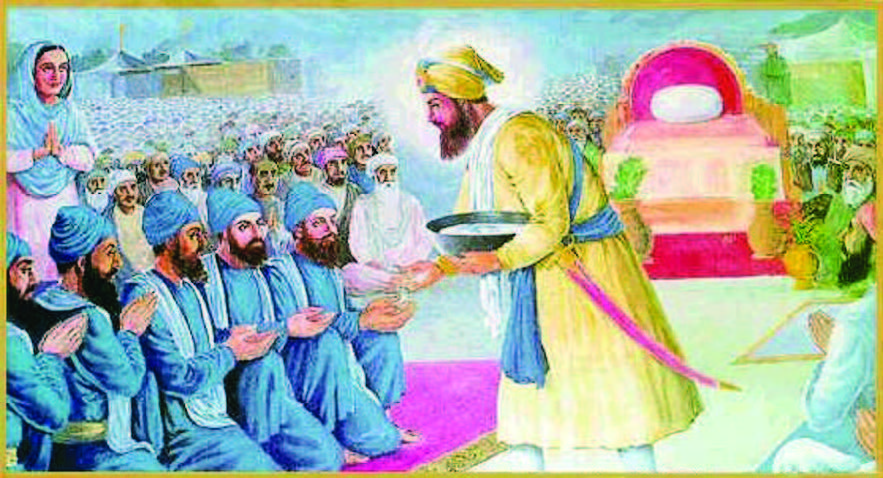
    IT was the Baisakhi day, March 30,1699. A large gathering of peasants was waiting anxiously. A strange excitement permeated the air. Something was going to happen. Something that would have an everlasting impact on Indian history. And it would have its genesis in Makhowal, a small hamlet on the banks of the Sutlej.

    As the farmers waited with bated breath, Shri Guru Gobind Singh ji, the Tenth Guru, appeared holding a naked sword in his hand. He raised his sword and demanded a head from one of his followers. A hush fell over the gathering. No one demurred. The Guru repeated his words. On hearing his demand for the third time, one Daya Ram of Lahore stepped forward and said: “My head is at your service, my Lord”, The Guru took the disciple into a nearby tent and soon returned. His sword was now dripping with blood. He raised his authoritative voice and demanded yet another head. Far from being daunted by the thought of death, another disciple, Dharam Das of Delhi, volunteered to sacrifice himself for his Guru. In the events that followed Guru Gobind Singh made three more such calls and consequently Mohkam Chand of Dwarka, Himmat of Jagannath, and Sahib Chand of Bidar came forward and offered their heads.

    The Guru was obviously testing his disciples and was not really interested in human sacrifice. He was so pleased by the devotion of these five followers that he called them the Five Beloved ones or the Panj Piyaras. One of them was a Khatri and the rest Shudras. As the Guru did not believe in caste system, he baptised all of them and announced the birth of the Khalsa. He addressed the dumbstruck crowd thus: “In the time of Guru Nanak, there was just one devout Sikh, Guru Angad; now there are five – totally devoted to their Guru. These shall lay the foundation of Sikhism”.

    It was a very dark period in Indian history. Aurangzeb’s persecution of non-Muslims was at its peak. In his essay Birth of Khalsa, Dr Hari Ram Gupta writes:

    “Aurangzeb had decided to use all the resources of a vast empire in suppressing Hinduism and converting the infidels to Islam…. In 1668 Hindu fairs and festivals were stopped. On April 9, 1669, a general order applicable to all parts of the Mughal Empire was issued to demolish all the schools and temples of the infidels and to put down their religious teachings”. In January, 1670, the biggest temple of Keshav Rae at Mathura was destroyed and the city was named Islamabad… . Hindus employed in public service, including clerks and accountants, were dismissed in 1671. The post of qanungo could be retained by a Hindu embracing Islam. Others who became Muslims received stipends, rewards, government jobs, release from jails, right to ancestral property and other privileges… . Jazia was charged from all Hindus from April 2, 1679″.

    Guru Gobind Singh was extremely disturbed by all this. Voluntary conversion to another religion is one thing; forcible conversion quite another. The Guru and his family were themselves among the worst sufferers. His father, Guru Tegh Bahadur, had been beheaded on November 11, 1675, by Aurangzeb. Hinduism in those days had become too ritualistic and dogmatic and the Hindus were, according to Dr Gokal Chand Narang, “too mild by nature, too contented in their desires, too modest in their aspirations, too averse to physical exertion and terror-stricken and demoralized, even though strongly attached to their religion. They had religion but no national feeling. Guru Gobind Singh sought to make nationalism their religion”. The Guru’s aim was Chiriaan kolon baaz marawaan; Taan main Gobind naam kahaawaan (Call me by the name of Gobind only if I succeed in making sparrows kill hawks).THE BIRTH OF THE KHALSA

    Earlier, it was a custom to drink the water with which the Gurus washed their feet, but as Guru Gobind Singh wanted to instil martial spirit in his followers, and thus change them from Sikhs to Singhs (lions), he proposed to baptise them by water stirred with a khanda (sword). To strike a blow against the class-ridden society, he urged all his followers to attach ‘Singh’ to their first names irrespective of their caste or creed. He also asked them to always have on their person Kesh, Kangha, Karha, Kaccha and Kirpan (long hair, a comb, a steel bracelet, a vest, and sword). His followers were to celebrate Holi by conducting martial arts, sport, military parades and mock battles. He later baptised about 20,000 disciples and named the place Shri Anandpur Sahib, the city of bliss.

    J.D. Cunningham writes in History of the Sikhs: “A new faith had been declared, and henceforth the Khalsa, the saved or liberated, should alone prevail. God must be worshipped in truthfulness and sincerity, but no material resemblance must degrade the Omnipotent; the Lord could only be beheld by the eye of faith in the general body of the Khalsa”.

    But the Guru was not only a great warrior. He was a great saint, poet, scholar and philosopher too. He had mastered Sanskrit, Gurmukhi and Persian texts. Under his directions major Sanskrit and Persian works were translated into the vernacular language so that the common man could benefit from them. Towards this end he employed 52 poets and scholars. In A History of the Sikh People, Dr Gopal Singh observes: “In Riti Kavya, or traditional poetry, the Guru’s poetry is unexcelled in the sweep of imagination, choice of word and phrase, and mastery over metre. There is no metre known to Indian prosody that has not been employed by this Great Master (he experimented with over 250 metres), nor a mood that he has not captured”.

    There are so many historical places associated with Guru Gobind Singh, but Shri Anandpur Sahib has a special significance. The city has had a very turbulent past, and because of its historical and spiritual status, it is one of the five most important places of worship of the Sikhs. The holy city was actually founded by Guru Tegh Bahadur in 1664. Its older name was Makhowal and Guru Tegh Bahadur had bought it from the then ruler of Bilaspur.

    The city is dotted with historical gurdwaras and forts. Gurdwara Kesgarh Sahib, Gurdwara Sis Ganj Sahib, Gurdwara Lohgarh Sahib, Gurdwara Fatehgarh Sahib, Gurdwara Bhora Sahib and Fort Anandgarh are the prominent ones.

    Gurdwara Kesgarh Sahib is clearly the most important gurdwara at Anandpur Sahib. It is one of the five important Takhts (seats) of the Sikh religion. The Khanda or the double-edged sword with which Guru Gobind Singh stirred the holy water in 1669 can be seen in this gurdwara. It also houses five other arms associated with the Tenth Guru – Katar, the dagger used by the Guru for hand-to-hand-fights and for hunting; the Karpa Barchha, spear; the Nagin Barchha, spear with a snake-shaped blade; and a musket.

    After the martyrdom of Guru Tegh Bahadur, Guru Gobind Singh began to plan his strategy at Gurdwara Fatehgarh Sahib. But before tackling the Mughal forces he had to reckon with Raja Bhim Chand of Bilaspur who had sent a force under Raja Kesari Chand to attack Anandpur Sahib. The Guru organised a battalion and ordered Bhai Uday Singh to get ready for battle. Bhai Uday Singh beheaded Kesari Chand and offered his head to the Guru. Guru Gobind Singh was very proud of his victorious army, so he built a fort at the spot and called it Fatehgarh Sahib.

    Gurdwara Guru ka Mahal was the residence of Guru Tegh Bahadur, and it was here that the sons of Guru Gobind Singh were born. Gurdwara Sis Ganj Sahib is very close to the bus-stand and the head of Guru Tegh Bahadur was cremated here. Shri Guru Tegh Bahadur Museum displays paintings depicting the sacrifices made by the Sikh Gurus.

    Anandpur Sahib is thronged by thousands of pilgrims during the month of Holi to celebrate the Hola Mohalla. The brave Khalsas display martial arts as well as horse-riding, sword-fighting and other military sport in front of an enthusiastic crowd. The entire city is then agog with feverish activity and it reminds us of the day 300 years ago when Guru Gobind Singh demanded the heads of his disciples, created the Khalsa, and picked up his sword to protect dharma:

    “For this purpose was I born, Bear this in mind all ye saints; To propagate dharma, to protect saints,To annihilate all tyrants.”

  • Guru Gobind Singh – THE SAINT SOLDIER

    Guru Gobind Singh – THE SAINT SOLDIER

    The tenth and the last Guru or Prophet-teacher of the Sikh faith, was born Gobind Rai Sodhi on Poh7, 1723 sk/22 December 1666 at Patna, in Bihar. His father, Guru Tegh Bahadur, the Ninth Guru, was then traveling across Bengal and Assam. Returning to Patna in 1670, he directed his family to return to the Punjab. On the site of the house at Patna in which Gobind Rai was born and where he spent his early childhood now stands a sacred shrine, Takht Sri Harimandar Sahib, one of the five most honored seats of religious authority (takht, lit. throne) for the Sikhs. Gobind Rai was escorted to Anandpur (then known as Chakk Nanaki) on the foothills of the Sivaliks where he reached in March 1672 and where his early education included reading and writing of Punjabi, Braj, Sanskrit and Persian. He was barely nine years of age when a sudden turn came in his life as well as in the life of tile community he was destined to lead. Early in 1675, a group Kashmiri Brahmans, drivels to desperation by the religious fanaticism of the Mughals General, Iftikar Khan, visited Anandpur to seek Guru Tegh Bahadur’s intercession. As the Guru sat reflecting what to do, young Gobind Rai, arriving there in company with his playmates, asked why he looked so preoccupied. The father, as records Kuir Singh in his Gurbilas Patshahi 10, replied, “Grave are the burdens the earth bears. She will be redeemed only if a truly worthy person comes forward to lay down his head. Distress will then be expunged and happiness ushered in.” “None could be worthier than yourself to make such a sacrifice,” remarked Gobind Rai in his innocent manner. Guru Tegh Bahadur soon afterwards proceeded to the imperial capital, Delhi, and courted death on 11 November 1675.

    Guru Gobind Singh SikhismGuru Gobind Singh was formally installed Guru on the Baisakhi day of 1733 Bk/29 March 1676. In the midst of his engagement with the concerns of the community, he gave attention to the mastery of physical skills and literary accomplishment. He had grown into a comely youth spare, lithe of limb and energetic. He had a natural genius for poetic composition and his early years were assiduously given to this pursuit. The Var Sri Bhagauti Ji Ki, popularly called Chandi di Var. written in 1684, was his first composition and his only major work in the Punjabi language. The poem depicted the legendary contest between the gods and the demons as described in the Markandeya Purina . The choice of a warlike theme for this and a number of his later compositions such as the two Chandi Charitras, mostly in Braj, was made to infuse martial spirit among his followers to prepare them to stand up against injustice and tyranny. 

    Much of Guru Gobind Singh’s creative literary work was done at Paonta he had founded on the banks of the River Yamuna and to which site he had temporarily shifted in April 1685. Poetry as such was, however, not his aim. For him it was a means of revealing the divine principle and concretizing a personal vision of the Supreme Being that had been vouchsafed to him. His Japu and the composition known as Akal Ustati are in this tenor. Through his poetry he preached love and equality and a strictly ethical and moral code of conduct. He preached the worship of the One Supreme Being, deprecating idolatry and superstitious beliefs and observances. The glorification of the sword itself which he eulogized as Bhaguati was to secure fulfillment of God’s justice. The sword was never meant as a symbol of aggression, and it was never to be used for self-aggrandizement. It was the emblem of manliness and self-respect and was to be used only in self-defense, as a last resort. For Guru Gobind Singh said in a Persian couplet in his Zafarnamah:

    When all other means have failed,

    It is but lawful to take to the sword.

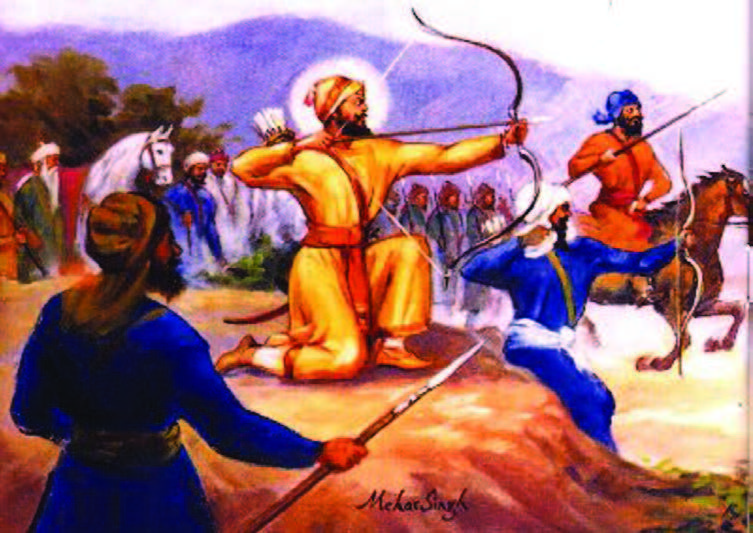
    During his stay at Paonta, Guru Gobind Singh availed himself of his spare time to practice different forms of manly exercises, such as riding, swimming and archery. His increasing influence among the people and the martial exercises of his men excited the jealousy of the neighboring Rajpat hill rulers who led by Raja Fateh Chand of Garhval collected a host to attack him. But they were worsted in an action at Bhangam, about 10 km northeast of Paonta, on 18 Assu 1745 sk/18 September 1688. Soon there after Guru Gobind Singh left Paonta and returned to Anandpur which he fortified in view of the continuing hostility of the Rajput chiefs as well as of the repressive policy of the imperial government at Delhi. The Guru and his Sikhs were involved in a battle with a Mughal commander, Alif Khan, at Nadaun on the left bank of the Beas, about 30 km southeast of Kangra, on 22 Chet 1747 Bk/20 March 1691. Describing the battle in stirring verse in Bachitra Natak, he said that Alif Khan fled in utter disarray “without being able to give any attention to his camp.” Among several other skirmishes that occurred was the Husaim battle (20 February 1696) fought against Husain K an, an imperial general, which resulted in a decisive victory for the Sikhs. Following the appointment in 1694 of the liberal Prince Muazzam (later Emperor Bahadur Shah) as viceroy of northwestern region including Punjab, there was however a brief respite from pressure from the ruling authority.

    In 1698, Guru Gobind Singh issued directions to Sikh sangats or communities in different parts not to acknowledge masands, the local ministers, against whom he had heard complaints. Sikhs, he instructed, should come to Anandpur straight without any intermediaries and bring their offerings personally. The Guru thus established direct relationship with his Sikhs and addressed them as his Khalsa, Persian term used for crown-lands as distinguished from feudal chiefs. The institution of the Khalsa was given concrete form on 30 March 1699 when Sikhs had gathered at Anandpur in large numbers for the annual festival of Baisakhi. Gurb Gobind Singh appeared before the assembly dramatically on that day with a naked sword in hand and, to quote Kuir Singh, Gurbilas Patshahz 10, spoke: “Is there present a true Sikh who would offer his head to the Guru as a sacrifice?” The words numbed the audience who looked on in awed silence. The Guru repeated the call. At the third call Daya Ram, a Sobti Khatri of Lahore, arose and humbly walked behind the Guru to a tent near by. The Gurb returned with his sword dripping blood, and asked for another head. At this Dharam Das, a Jat from Hastinapur, came forward and was taken inside the enclosure. Guru Gobind Singh made three more calls. Muhkam Chand, a washerman from Dvarka, Himmat, a water-carrier from Jagannath puri, and Sahib Chand, a barber from Bidar (Karnataka) responded one after another and advanced to offer their heads. All the five were led back from the tent dressed alike in saffron-colored raiment topped over with neatly tied turbans similarly dyed, with swords dangling by their sides. Guru Gobind Singh then introduced khande da pahul, i.e. initiation by sweetened water churned with a double-edged broad sword (khanda). Those five Sikhs were the first to be initiated. Guru Gobind Singh called them Panj Piare, the five devoted spirits beloved of the Guru. These five, three of them from the so-called low-castes, a Ksatriya and a Jatt, formed the nucleus of the self-abnegating, martial and casteless fellowship of the Khalsa. All of them surnamed Singh, meaning lion, were required to wear in future the five symbols of the Khalsa, all beginning with the letter K the kes or long hair and beard, kangha, a comb in the kes to keep it tidy as against the recluses who kept it matted in token of their having renounced the world, Kara, a steel bracelet, kachch, short breeches, and kirpan, a sword. They were enjoined to succour the helpless and fight the oppressor, to have faith in one God and to consider all human beings equal, irrespective of caste and creed. Guru Gobind Singh then himself received initiatory rites from five disciples, now invested with authority as Khalsa, and had his name changed from Gobind Rai to Gobind Singh. “Hail,” as the poet subsequently sang, “Gobind Singh who is himself Master as well as disciple.” Further injunctions were laid down for the Sikhs. They must never cut or trim their hair and beards, nor smoke tobacco. A Sikh must not have sexual relationship outside the marital bond, nor eat the flesh of an animal killed slowly in the Muslim way (or in any sacrificial ceremony).

    These developments alarmed the caste-ridden Rajput chiefs of the Sivalik hills. They rallied under the leadership of the Raja of Bilaspur, in whose territory lay Anandpur, to forcibly evict Guru Gobind Singh from his hilly citadel. Their repeated expeditions during 1700-04 however proved abortive . They at last petitioned Emperor Aurangzeb for help. In concert with contingents sent under imperial orders by the governor of Lahore and those of the faujdar of Sirhind, they marched upon Anandpur and laid a siege to the fort in Jeth 1762 sk/May 1705. Over the months, the Guru and his Sikhs firmly withstood their successive assaults despite dire scarcity of food resulting from the prolonged blockade. While the besieged were reduced to desperate straits, the besiegers too were chagrined at the tenacity with which the Sikhs held out. At this stagy the besiegers offered, on solemn oaths of Quran, safe exit to the Sikhs if they quit Anandpur. At last, the town was evacuated during the night of Poh suds 1, 1762 sk/5-6 December 1705. But soon, as the Guru and his Sikhs came out, the hill monarchs and their Mughal allies set upon them in full fury. In the ensuing confusion many Sikhs were killed and all of the Guru’s baggage, including most of the precious manuscripts, was lost. The Guru himself was able to make his way to Chamkaur, 40 km southwest of Anandpur, with barely 40 Sikhs and his two elder sons. There the imperial army, following closely on his heels, caught up with him. His two sons, Ajit Singh (b. 1687) and Jujhar Singh (b. 1691) and all but five of the Sikhs fell in the action that took place on 7 December 1705. The five surviving Sikhs bade the Guru to save himself in order to reconsolidate the Khalsa. Guru Gobind Singh with three of his Sikhs escaped into the wilderness of the Malva, two of his Muslim devotees, Gani Khan and Nabi Khan, helping him at great personal risk.

    Guru Gobind Singh’s two younger sons, Zorawar Singh (b. 1696) and Fateh Singh (b.1699), and his mother, Mata Gujari, were after the evacuation of Anandpur betrayed by their old servant and escort, Gangu, to the faujdar of Sirhind, who had the young children executed on 13 December 1705. Their grandmother died the same day. Befriended by another Muslim admirer, Ral Kalha of Raikot, Guru Gobind Singh reached Dina in the heart of the Malva. There he enlisted a few hundred warriors of the Brar clan, and also composed his famous letter, Zafarnamah or the Epistle of Victory, in Persian verse, addressed to Emperor Aurangzeb. The letter was a severe indictment of the Emperor and his commanders who had perjured their oath and treacherously attacked him once he was outside the safety of his fortification at Anandpur. It emphatically reiterated the sovereignty of morality in the affairs of State as much as in the conduct of human beings and held the means as important as the end. Two of the Sikhs, Daya Singh and Dharam Singh, were dispatched with the Zafarnamah to Ahmadnagar in the South to deliver it to Aurangzeb, then in camp in that town.

    From Dina, Guru Gobind Singh continued his westward march until, finding the host close upon his heels; he took position astride the water pool of Khidrana to make a last-ditch stand. The fighting on 29 December 1705 was hard and desperate. In spite of their overwhelming numbers, the Mughal troops failed to capture the Guru and had to retire in defeat. The most valorous part in this battle was played by a group of 40 Sikhs who had deserted the Guru at Anandpur during the long siege, but who, chided by their womenfolk at home, had come back under the leadership of a brave and devoted woman, Mai Bhago, to redeem themselves. They had fallen fighting desperately to check the enemy’s advance towards the Guru’s position. The Guru blessed the 40 dead as 40 mukte, i.e. the 40 Saved Ones. The site is now marked by a sacred shrine and tank and the town which has grown around them is called Muktsar, the Pool of liberations.

    After spending some time in the Lakkhi Jungle country, Guru Gobind Singh arrived at Talvandi Sabo, now called Damdama Sahib, on 20 January 1706. During his stay there of over nine months, a number of Sikhs rejoined him. He prepared a fresh recension of Sikh Scripture, the Guru Granth Sahib, with the celebrated scholar, Bhai Mani Singh, as his amanuensis. From the number of scholars who had rallied round Guru Gobind Singh and from the literary activity initiated, the place came to be known as the Guru’s Kashi or seat of learning like Varanasi.

    The epistle Zafarnamah sent by Guru Gobind Singh from Dina seems to have touched the heart of Emperor Aurungzeb. He forthwith invited him for a meeting. According to Ahkam-i-Alamgiri, the Emperor had a letter written to the deputy governor of Lahore, Munim Khan, to conciliate the Guru and make the required arrangements for his journey to the Deccan. Guru Gobind Singh had, however, already left for the South on 30 October 1706. He was in the neighbourhood of Baghor, in Rajasthan, when the news arrived of the death of the Emperor at Ahmadnagar on 20 February 1707. The Guru there upon decided to return to the Punjab, via Shahjahanabad (Delhi) . That was the time when the sons of the deceased Emperor were preparing to contest succession. Guru Gobind Singh despatched for the help of the eldest claimant, the liberal Prince Muazzam, a token contingent of Sikhs which took part in the battle of Jajau (8 June 1707), decisively won by the Prince who ascended the throne with the title of Bahadur Shah. The new Emperor invited Guru Gobind Singh for a meeting which took place at Agra on 23 July 1707.

    Emperor Bahadur Shah had at this time to move against the Kachhvaha Rajputs of Amber (Jaipur) and then to the Deccan where his youngest brother, Kam Baksh, had raised the standard of revolt. The Guru accompanied him and, as says Tarzkh-i-Bahadur Shahi, he addressed assemblies of people on the way preaching the word of Guru Nanak. The two camps crossed the River Tapti between 11 and 14 June 1708 and the Ban-Ganga on 14 August, arriving at Nanded, on the Godavari, towards the end of August. While Bahadur Shah proceeded further South, Guru Gobind Singh decided to stay awhile at Nanded. Here he met a Bairagi recluse, Madho Das, whom he converted a Sikh administering to him the vows of the Khalsa, renaming him Gurbakhsh Singh (popular name Banda Singh). Guru Gobind Singh gave Banda Singh five arrows from his own quiver and an escort, including five of his chosen Sikhs, and directed him to go to the Punjab and carry on the campaign against the tyranny of the provincial overlords.

    Nawab Wazir Khan of Sirhind had felt concerned at the Emperor’s conciliatory treatment of Guru Gobind Singh. Their marching together to the South made him jealous, and he charged two of his trusted men with murdering the Guru before his increasing friendship with the Emperor resulted in any harm to him. These two pathans Jamshed Khan and Wasil Beg are the names given in the Guru Kian Sakhian pursued the Guru secretly and overtook him at Nanded, where, according to Sri Gur Sobha by Senapati, a contemporary writer, one of them stabbed the Guru in the left side below the heart as he lay one evening in his chamber resting after the Rahrasi prayer. Before he could deal another blow, Guru Gobind Singh struck him down with his sabre, while his fleeing companion fell under the swords of Sikhs who had rushed in on hearing the noise. As the news reached Bahadur Shah’s camp, he sent expert surgeons, including an Englishman, Cole by name, to attend on the Guru. The wound was stitched and appeared to have healed quickly but, as the Guru one day applied strength to pull a stiff bow, it broke out again and bled profusely. This weakened the Guru beyond cure and he passed away on Kattak sudi 5, 1765 Bk/7 October 1708. Before the end came, Guru Gobind Singh had asked for the Sacred Volume to be brought forth. To quote Bhatt Vahi Talauda Parganah Jind: “Guru Gobind Singh, the Tenth Master, son of Guru Teg Bahadur, grandson of Guru Hargobind, great-grandson of Guru Arjan, of the family of Guru Ram Das Surajbansi, Gosal clan, Sodhi Khatri, resident of Anandpur, Prganah Kahlur, now at Nanded, in the Godavari country in the Deccan, asked Bhai Daya Singh, on Wednesday, 7 October 1708, to fetch Sri Granth Sahib. In obedience to his orders, Daya Singh brought Sri Granth Sahib. The Guru placed before it five piece and a coconut and bowed his head before it. He said to the sangat, “It is my commandment: Own Sri Granthji in my place. He who so acknowledges it will obtain his reward. The Guru will rescue him. Know this as the truth”.

    Guru Gobind Singh thus passed on the succession with due ceremony to the Holy Book, the Guru Granth Sahib, ending the line of personal Gurus. “The Guru’s spirit,” he said, “will henceforth be in the Granth and the Khalsa. Where the Granth is with any five Sikhs representing the Khalsa, there will the Guru be.” The Word enshrined in the Holy Book was always revered by the Gurus as well as by their disciples as of Divine origin. The Guru was the revealer of the Word. One day the Word was to take the place of the Guru. The inevitable came to pass when Guru Gobind Singh declared the Guru Granth Sahib as his successor. It was only through the Word that the Guruship could be made everlasting. The Word as contained in the Guru Granth Sahib was henceforth, and for all time to come to be the Guru for the Sikhs.

  • MOODY’S UPGRADES INDIA RATING OUTLOOK TO POSITIVE

    MOODY’S UPGRADES INDIA RATING OUTLOOK TO POSITIVE

    MUMBAI (TIP): Moody’s ratings revised India’s sovereign rating outlook to “positive” from “stable” on Thursday as it expects the actions by policymakers will enhance the country’s economic strength in the medium term.

    Moody’s also said that it expected structural advantages, supported by relatively benign commodity prices and liquidity conditions globally, will keep India’s growth above its peers over the rating horizon.

    The outlook revision was announced before Indian markets opened on Thursday. Analysts said they expected bank stocks to rise and the rupee to strengthen on the upgrade.

    The investor-friendly Narendra Modi government, which came to power last May promising faster growth, more jobs and quick clearances, has taken measures to fast-track clearances for investment projects, boost infrastructure investment and remove policy uncertainty in mining and coal sectors.

    The government has also relaxed foreign investments in sectors such as defence, insurance, e-commerce, railways and eased steps to allow businesses to acquire land and set up factories.

    “India’s policymakers are establishing a framework that will likely allow India’s growth to continue to outperform that of its peers over medium term and improve India’s macro-economic, infrastructure and institutional profile,” Moody’s said in its statement. However, Moody’s stopped short of raising the sovereign credit rating due to relative weakness in fiscal, inflation, infrastructure and poor asset quality among Indian banks.

    Constrained credit profile 

    “Recurrent inflationary pressures, occasional balance of payments pressures, and an uncertain regulatory environment have contributed to periods of volatility in growth, and have exposed India to external and financial shocks, constraining its credit profile,” Moody’s said.

    Moody’s has a Baa3 rating on India 

    After a recent revision in the methodology of measuring gross domestic product, which raised a lot of scepticism from policymakers including government and central bank officials, India registered growth of 7.5 per cent in the December quarter, higher than China’s.

    Under this new method, the Reserve Bank of India expects India to growth at 7.8 per cent for 2015/16, lower than the government’s estimate of 8.0-8.5 per cent.

    The government has been pitching to rating agencies to improve India’s credit rating, citing reforms, and on Thursday officials were to quick to welcome Moody’s improved outlook.

    “Upgrade of outlook proves government is moving in the right direction … it validates India’s commitment on fiscal discipline,” India’s chief economic adviser Arvind Subramanian said on news channel CNBC TV18.

  • SEBI STRUGGLES TO SHIELD SAVERS FROM MORE SAHARAS

    MUMBAI (TIP): As regulators try to contain one of India’s most spectacular investment scandals, dozens of smaller but similar schemes continue to mushroom, employing tactics similar to the ones that enriched the Sahara group and later brought it to its knees.

    Sahara began as a scheme for small depositors, but it grew over decades with investment plans that critics say were designed to avoid regulatory scrutiny. At its height, it was one of India’s biggest business empires, stretching from Formula One motor racing to New York’s Plaza Hotel.

    Now its boss is in jail for more than a year and some staff say much of its business is threatening to stall, after it raised billions of dollars from investors by selling bonds that were ruled to be illegal.

    Patchy oversight in India means countless illegal investment schemes continue to emerge, however, often in the villages.

    So far this year, the Securities and Exchange Board of India (SEBI) has barred more than 70 firms that raised funds through debentures or collective investment schemes, promising returns from cash put in land, cattle and even holiday homes.

    In most cases, it cited the court order against Sahara in support of its action.

    That is cold comfort for retired Indian army officer KL Sharma. Hoping to raise money for his daughter’s wedding, he placed a third of his savings into an investment scheme run by property developer PACL in 2007.


    The investment matured last year, but there is no trace of the 270,000 rupees ($4,339) he put in, never mind the promised returns that were supposed to double his money.

    “It was hard-earned money that I invested because agents for PACL in my village convinced me I would get good returns. Now I am stuck,” said Sharma, speaking from Rajasthan, western India.

    As late as November, months after PACL was put under investigation and barred by regulators, local media reported that SEBI told the Corporate Affairs Ministry it was still raising funds from depositors.

    SEBI officials say that despite increased monitoring and financial education programmes since the Sahara case and a spate of other scandals, they are still overwhelmed by a backlog of cases, as a financially illiterate adult population, less than half of whom have access to formal banking, continues to put its trust in local agents for such schemes.

    One official said many schemes had operated for decades without oversight, until legal changes last year gave SEBI broader powers.

    “A collective investment scheme in itself is not unlawful, but the way these schemes have been run, by and large as assured-return guarantee schemes, that’s not allowed,” he said.

    “The law is clear; it requires them to come and register with us. But they don’t, because they have operated without any oversight for years. Why will they want any supervision now?” 

    Collective investment schemes, often known locally as chit funds, operated in the regulatory gaps for years by getting licences from state authorities that were ill equipped to monitor them.

    Last year, SEBI was mandated to oversee any investment vehicle that raises more than 1 billion rupees from the public.

    Firms issuing any form of security to more than 49 investors are supposed to register with SEBI, but many flout the rules, and activists say even when caught and barred, companies can simply change their names and get back in the market.

  • Shell to buy BG for $70bn, take on Exxon

    Royal Dutch Shell agreed to buy smaller rival BG Group for 47 billion pounds ($70.2 billion) in the first major energy industry merger in more than a decade, closing the gap on market leader ExxonMobil after a plunge in prices.

    Anglo-Dutch Shell will pay a mix of cash and shares that values each BG share at around 1,350 pence, the companies said. This is a hefty premium of around 52% to the 90-day trading average for BG, setting the bar high for any potential counter-bid by a company like Exxon, which has said it would also use the oil markets downturn to expand. The third-biggest oil and gas deal ever by enterprise value will bring Shell assets in Brazil, East Africa, Australia, Kazakhstan and Egypt, including some of the world’s most ambitious liquefied natural gas (LNG) projects. Shell is already the world’s leading LNG company and it would get BG’s capacity in LNG logistics—complex infrastructure that includes terminals, pipelines, specialized tankers, rigs, super coolers, regasification facilities and storage points.

  • US-based mutual funds pull $1.3 billion out of bond funds

    NEW YORK (TIP): Investors in US-based mutual funds pulled $1.3 billion out of bond funds in the week ended April 1 as tax deadlines approached for retail investors, data from the Investment Company Institute showed.

    The outflows were the first in 12 weeks, or since early January, according to the data from ICI, a US mutual fund trade organization. The withdrawals came ahead of the April 15 tax filing deadline.

    Stock funds posted $1.6 billion in total outflows in a second straight week of withdrawals and their biggest since early January. Funds that specialize in US stocks posted $3.3 billion in outflows, for a fifth straight week of withdrawals, though they were less than the prior week’s $4.5 billion in withdrawals.

    Withdrawals from US-focused stock funds again accounted for the total outflows from stock funds. Funds that specialize in international shares attracted $1.8 billion in a 13th straight week of inflows. The inflows were the lowest in six weeks.

    “We are moving towards the tax deadline, whereby there is a tendency for people to liquidate some assets in order to pay their taxes due,” said Robbert van Batenburg, director of market strategy at brokerage Newedge USA LLC in New York.

    He said the tax season also may have contributed to outflows from US-focused stock funds, while the European Central Bank’s recently launched bond-buying stimulus program likely spurred inflows into foreign-focused stock funds.

    The benchmark S&P 500 stock index fell 0.1 percent over the period while the Barclays US Treasury Index gained 0.3 percent.

    Hybrid funds, which can invest in stocks and fixed income securities, attracted $720 million for a 12th straight week of inflows.