Month: October 2015

  • ‘ELECTROSMOG’ TO HELP FIGHT REAL SMOG

    ‘ELECTROSMOG’ TO HELP FIGHT REAL SMOG

    We are surrounded by “electrosmog” – invisible clouds of electromagnetic radiation that enable mobile and Wi-Fi networks. If captured, it can power small devices. Now, a former British science minister Paul Drayson, a peer in the UK’s House of Lords, has developed an efficient energy-harvesting system, called Freevolt, which uses an antenna to draw power from multiple wavebands of the electromagnetic spectrum while fitting into a unit the size of a credit card. “We can’t power a mobile phone, but we’ve found that the ambient energy density is sufficient to power sensors, beacons and some wearab les,” Drayson says.

    The technology, launched on Wednesday, was placed inside a personal air pollution sensor called CleanSpace, to allow individuals to monitor the air quality around them. The sensor, called Tag, pairs with a mobile app to keep track both of carbon monoxide levels and transport choices made by an individual.

    Users earn points each time they walk, run or cycle. These can be traded for rewards from partners including Amazon, Boohoo.com and MaxiNutrition. The data from individual sensors is then aggregated to build up a map of the air quality.

    “This is the first commercial device that is powered solely from ambient radio frequency energy,” says Drayson, who stumbled upon the idea when he came across the work of Imperial College, London, PhD student Manuel Pinuela Rangel, who was researching inductive power transfer, and set up Drayson Wireless.

    The team decided to create a personal air quality sensor in recognition of the increasing public awareness of air pollution as a health problem. About 29,000 people die each year in the UK because of poor air quality each year.

    Drayson now plans to license the technology to other commercial partners looking to create sensor networks, beacon-driven retail marketing tools or low-powered wearables. As it stands, the inventor contends that Freevolt could generate enough power for devices like the Fitbit Charge or Jawbone UP3. Drayson also points out that because Freevolt works across multiple bands of radio frequency , even if there isn’t any 3G or 4G signal, it can gather energy from Wi-Fi or even broadcast signals.

  • EAT DRIED PLUMS TO REDUCE COLON CANCER RISK

    EAT DRIED PLUMS TO REDUCE COLON CANCER RISK

    A diet rich in dried plums could reduce the risk of colon cancer according to a recent American study presented in Boston during the 2015 Experimental Biology conference. The fruit promotes the retention of beneficial bacteria for the colon.

    Researchers from the Texas A&M University and the University of North Carolina based their study on preexisting research that demonstrated how one’s diet can modify the metabolism and the microbiota composition of the colon (the bacteria present throughout the colon and digestive tract).

    According to Dr. Nancy Turner, among the trillions of gastro-intestinal bacteria present in the digestive tract, over 400 individual species have already been identified.

    Previous studies have shown that disruptions to the microbiota are involved in the beginnings of intestinal inflammation as well as recurring inflammatory bouts that can lead to the development of colon cancer.

    “Our research explored the potential cancer-protective properties of dried plums using a well-established rat model of colon cancer,” explains Dr. Turner. “Dried plums contain phenolic compounds, which have multiple effects on our health, including their ability to serve as antioxidants….”

    The experiment tested the hypothesis that the consumption of dried plums would promote retention of beneficial microbiota and patterns of microbial metabolism throughout the colon. In order to do so, the researchers fed the rats either a diet that included dried plums or a control diet. After having examined the intestinal contents and different segments of colon tissue, the researchers found that a diet of dried plums had increased the quantity of Bacteroidetes and reduced the amount of Firmicutes, two major kinds of intestinal bacteria found in the distal colon, without modifying the amounts found in the proximal colon. On the contrary, the rats that were fed the control diet had a weaker amount of Bacteroidetes and a higher amount of Firmicutes.

    In addition, the researchers noted that the rats that had consumed dried plums also presented significantly reduced numbers of aberrant crypts, generally observed in precancerous lesions.

    For the research team, the reduction in aberrant crypts associated with an inverse ratio of Bacteroidetes and Firmicutes support the hypothesis that dried plums appear to reduce the risk of colon cancer.

    The phenomenon could be explained in part by their ability “to establish seemingly beneficial colon microbiota compositions in the distal colon” concluded Dr. Turner.

    Both plums and prunes are considered anti-cancer foods thanks to their antioxidant properties.

  • SITTING IS TERRIBLE: SIT LESS, LIVE LONGER

    SITTING IS TERRIBLE: SIT LESS, LIVE LONGER

    Sitting down most of your waking hours is as likely to kill you as base jumping, indicate a gaggle of studies released this year that found sitting to be an early marker for heart disease, diabetes, cancers and early death. This makes sitting a lifestyle risk factor along with smoking, overweight, high blood pressure, among others.

    Irrespective of how much you exercise the rest of the time, spending a lot of time sittingups your risk of heart disease, diabetes, cancer and dying prematurely, concluded a large review published in the Annals of Internal Medicine this week. It’s not enough to exercise for one hour a day and be sedentary for 23 others, said the study, which found people spend half their day sitting at workstations or hutched over smartphones.

    This study echoed the findings of a 2012 review of 18 studies that included 794,577 people, which had found that sitting for long periods raises the risk of diabetes, heart disease and death. The study, published in Diabetologia, the journal of the European Association of the Study of Diabetes, also found that the risk remained even when people met physical activity guidelines.

    Trouble ahead

    Apart from leading to weight gain, sitting down raises calcification in the heart’s arteries, which is an early marker of heart disease, reported a study at the American College of Cardiology’s 64th Annual Scientific Session in March.

    Again, the study found no association between coronary artery calcification – calcium in plaques deposited within the heart’s arteries that cause narrowing and obstruction of blood flow measured through a heart CT scan — and the amount of exercise a person does, suggesting too much sitting cannot be countered by exercising.

    Sitting also shows a gender bias. Spending leisure time sitting raises women’s cancer risk by 10 per cent, specifically for multiple myeloma (a type of blood cancer), breast, and ovarian cancers. The risk for women remained after adjusting for physical activity, body weight and other factors.

    There was association between sitting time and cancer risk in men, showed the study – published in Cancer Epidemiology, Biomarkers, and Prevention — of more than 146,000 men and women (69,260 men and 77,462 women) who were part of the American Cancer Society Cancer Prevention Study II Nutrition Cohort.

    Fix it

    An average adult spends 50-70% of their waking hours sitting down, and by limiting the time spent sitting, the risk of diabetes, heart disease and death can be reduced. Breaks in sitting time improve markers of good health, such as lower body weight and improve diabetes control.

    Even healthy adults who exercise and sleep for eight hours each night should target to lower sitting time by two to three hours in a 12-hour work day, say experts. Cutting back on sitting time — for example, standing up or moving for one to three minutes every half hour and fidgeting when you can’t — should be a companion strategy to exercising an hour a day to lower risk of disease and death, show studies.

    This week, a study in American Journal of Preventive Medicine reports that fidgeting counters the adverse health impacts of sitting for long periods. The study, from the University of Leeds and University College London, found that while women who spent time sitting ranked high on risk levels, those who fidgeted a lot while sitting had the same low risk of disease as active women, showed data from more than 35,000 women aged 35 to 69 in the UK.

    Get smart

    Targeting sitting time, rather than physical activity, is the most effective way to reduce prolonged sitting, showed another review of strategies designed to reduce sitting time published in the journal Health Psychology Review earlier this week. The research, from King’s College London, searched the current existing literature on interventions that sought to reduce sitting time. Of the 38 interventions assessed, 23 (60 per cent) were found promising whilst 15 (39 per cent) were found to be worthless.

    Among things that work are offering employees sit-stand desks at work, keeping a record of individual sitting time, setting individual goals for limiting sitting time, and using prompts and cues on smartphones and fitness gadgets to remind you to get moving.

    The take-away for all of us is that prolonged sitting is a risk factor for lifestyle diseases independent of how much you exercise and the sooner you get up and start moving, the healthier you will be.

  • GET RID OF YOUR EX DIGITALLY | Break Ups

    GET RID OF YOUR EX DIGITALLY | Break Ups

    One in 5 Brit women stalk their ex online. Anyone who’s ever been in love knows that’s true of us too. Here’s technical help for a clean break.

    Hell hath no fury like a woman scorned, wrote British playwright William Congreve in his 1697 play, The Mourning Bride. Like most epic love stories, was a tragedy. Had Congreve adapted the plot to contemporary times, his lead Zara would most likely have been left with a broken heart and countless cuddling selfies to remind her of her love lost.

    So what do you do when your relationship is over and you are left to pick up the pieces? When comfort food isn’t able to fill the gaping hole of mushy Facebook statuses and kissy display pictures on Whatsapp, scorned lovers often turn to spying on expartners online.

    You are not alone. According to a UK survey, one out of five women admitted to stalking their exes online. While men also fall into the habit of snooping on the ex, it’s 30 per cent of women who said they ‘follow’ their exes openly via social media after a break-up, and 22 per cent confessed to creating a fake account to keep tabs on them. One out of five women even admitted to drunk-dialing their former boyfriend, only to regret it the morning after. Merely 18 per cent of them claimed they were able to resist the urge to contact their ex and cut off contact online, as well.

    Psychologists argue that besides being embarrassing, mulling over relationships that have gone sour can ruin your chances of discovering new love and move on.

    But there’s still hope for the other 72 per cent. If technology got you into the habit of fusing identities with the object of your affection online, it will get you out.

    Here’s our take on four apps that help you move on online:

    The ex-cleanse

    If you spend hours browsing through pictures of your ex-boyfriend, trying to read hidden clues in comments from his friends -stop. The Internet and around the corner bakeries are to blame for our depleting levels of self-discipline. Facebook allows you to choose the content that will show up on your timeline feed via adjustment in settings. Fiddle around and you should be able to control the information from your ex’s profile if you aren’t ready to hit the Unfriend button. Similarly, for email users, go to your filters and add the email ids of your ex to keep their funny cat video forwards from ruining your day.

    Block happy

    There’s also an online guardian called KillSwitch. The app’s tagline is pretty self-explanatory – Making Breakups Suck Less. Available for Android and iOs users, this app will erase every trace of your ex from your Facebook. Say bye-bye to photos of your weekend trip, that birthday surprise, his pokes, even flirty wall posts, comments and emoticons are sanitised from your view.

    For those hoping to revisit the memories when you are strong enough, there’s an e-folder to preserve the photos for later viewing.

    Phone monitor

    There is no shortage of apps to ensure you are able to block your ex’s calls. So what if they were actually built for annoying telemarketers; the function still applies.

    However, to know if you are the one with the problem, think about how rom-coms make you feel. When the hero runs to the airport to declare his undying love for the girl, do you feel like calling and doing the same? If so, you’ve got a case of the fidgety dial button.

    Mr Number comes to the rescue. This callblocker app blocks calls and text messages from a person, a business, a prefix, or the world.

    Better still is The Ex Lover Blocker, an app that believes in tough love. It sends a text message to a bunch of pre-decided friends in case you slip up and try to make contact with the ex. The makers of this app, obviously aware of your lack of will power, prefer to have your friends shame you or talk some sense into you. Either way, it’s effective.

    Filter and flush

    The interesting thing about drunken emotions is that while walking in a straight line seems like a task, putting words to feelings is suddenly easier.

    Don’t trust your drunk self to give up if your call blocker tries to talk sense to you. Drunk dialling is a loose term but extends to email, Twitter and so on when it comes to saying inappropriate things.

    For a blanket ban on digital communication while your body digests the five glasses of gin, visit the Sobriety Test website. Make sure you install the plug-in while you are still sober. Choose the services you want to block when you have had a couple of drinks – you can even add your own email and website to the list. Then, log in with Facebook and give permissions.

    How it works is that if you try to sign in when drunk, it will give you a series of challenges. For example, counting till 30 is usually enough time to knock some sense into you. For everything else, there’s chocolate icecream.

  • INDIA’S FASHION ‘QUEEN’ KANGANA RANAUT TURNS DESIGNER

    INDIA’S FASHION ‘QUEEN’ KANGANA RANAUT TURNS DESIGNER

    The reigning queen of Bollywood Kangana Ranaut is all set to make her debut as a designer. The actress has worked closely with the brand to design the couture-like VERO MODA MARQUEE AW’15 collection. With vibrant colours, impeccable designs and avant garde silhouettes, the clothing line will be unveiled tonight.

    There will be a high octane fashion show where the actress herself will walk the ramp in her favourite pieces from the collection. Kangana, who is very excited to have turned designer, said, “My fashion philosophy is to follow my mood for the day and wear what makes me feel good. I am not a blind follower of fashion trends, instead, I carve my own fashion niche and this line is a true representation of that. I am happy that my collection for VERO MODA MARQUEE is inspired by my very own personal sense of style.”

    Interestingly, last year Kangana made a stunning showstopper for the launch of MARQUEE ’14 collection designed by Karan Johar. Perhaps, that inspired her to try her hand at designing a line that is an extension of her personality.

  • CALENDAR GIRLS | MOVIE REVIEW

    CALENDAR GIRLS | MOVIE REVIEW

    Full on Tacky & as fake as it can get – Calendar Girls fails to impress but some feel its better than ‘Fashion’. From anti-Pakistan sentiment to Bigg Boss and match-fixing in IPL etc.

    STORY: Five women with big dreams become Calendar Girls – but how does time treat them?

    MOVIE REVIEW: Small-town schemer Mayuri (Ruhi), rebellious Paroma (Satarupa), free-spirited Sharon (Kyra), naive Nandita (Akansha) and Pakistani Bollywood aspirant Nazneen (Avani) are ‘calendar girls’ for industrialist Kumar (Suhel), whose glamorous almanac, with itsy-bitsy bikinis and sprawling white sands, is ‘India’s symbol of success’. Shot by ace photographer Timmy (Rohit), the ladies wear lip-gloss, attitude and little else, dreaming of fame, love and success.

    Calendar Girls has a surreal, slightly dated quality. Characters resembling other characters – Neha Dhupia, Akshaye Khanna, Mamta Kulkarni, even a cop like Shatrughan Sinha – float in and out. The story resembles other Madhur Bhandarkar stories – a note from Page Three, a stroke of Fashion, far too much from Heroine. There’s even Bhandarkar himself, but sans his once-sharp eye, mouthing, “Meri heroine se ek hi expression mil raha hai” – which describes Calendar Girls too. Despite this layered story of ambition, manipulation and desperation, where betting, bedding, broads and broadcasting meet, not much changes on the Calendar Girls’ faces.

    When Nandita’s in-laws say cheating is their ‘family parampara’ or Timmy enquires, “When was the last time you really felt a man?”, not an eyelash flickers, not a lip quivers. Only Keith Sequeira stands out as Paroma’s boyfriend Pinaki and Ruhi as fiesty Mayuri makes passing impact. Over-acting as a high-class madam, giving Kathakali-style glares, Mita Vashisht tries tilting the feeble dramatic balance – and fails.

    Dialogues don’t help. Nazneen’s boyfriend snarls she’ll become a ‘bleddy cheapo’ while Mayuri is constantly praised, “Tum bahut aage jaogi” – which is not something you can say for this film that, despite all its curves, stays flat.

    It’s a pity because this story could have broken new ground. With glimpses of his original flair, Bhandarkar puts cricket enthusiasts, prostitutes, ‘pahwa’ brokers, philanderers, builders and bewildered middle-class mata-pitas together. He has his trademark touches of glamour, pathos and personalities but lacks power-packed acting to hold this together. Instead, between scintillating skin, syrupy sympathy and sheer sloppiness, the film loses grip, bite – and plot.

  • HOPE WE LIVE UPTO EXPECTATIONS WITH ‘TAMASHA’, SAYS DEEPIKA

    HOPE WE LIVE UPTO EXPECTATIONS WITH ‘TAMASHA’, SAYS DEEPIKA

    Actress Deepika Padukone hopes that the team of Tamasha is able to live upto the expectations that the trailer of the Imtiaz Ali directorial has generated.

    “There are a lot of expectations from the film. I hope we live up to all those expectations,” Deepika said on the sidelines of an event here. The actress was last seen in the role of a Bengali architect who cares for her hypochondriac father in Shoojit Sircar’s comedy-drama Piku.

    Talking more about Tamasha, in which she stars with Ranbir Kapoor, the 29-year-old actress said: “Tamasha is a very different film from Yeh Jawaani Hai Deewani. For me, this is a dream team. “I always wanted to work together with Imtiaz and to have Ranbir as a co-star… As the trailer has earned positive feedback, I hope the audience would enjoy the movie as much as they enjoyed Yeh Jawaani Hai Deewani.”

    Tamasha will release on November 27. Meanwhile, she’s also filming Sanjay Leela Bhansali’s historical romance Bajirao Mastani, in which she plays Mastani. The film is scheduled to be released on December 18.

  • PARIS HILTON WANTS TO MARRY BOYFRIEND THOMAS GROSS

    PARIS HILTON WANTS TO MARRY BOYFRIEND THOMAS GROSS

    Television personality Paris Hilton reportedly wants to “settle down” and marry her Swiss businessman boyfriend Thomas Gross.

    The 34-year-old Simple Life star is ready to spend the rest of her life with the Swiss businessman, who she met in Ibiza earlier this year, reported Female First.

    “Paris wants to walk down the aisle sometime next year.

    She’s turning 35 and she’s ready to settle down,” a source said.

    Hilton’s mind turned to marriage after she attended her sister Nicky’s “perfect” nuptials to James Rothschild earlier this year.

    “Even since her sister, Nicky, got married, people have been asking Paris when she’s going to get engaged… Nicky is planning to have kids soon, and Paris loves the idea of them being pregnant at the same time,” the source added.

  • Maze Runner: The Scorch Trials

    Maze Runner: The Scorch Trials

    STORY: The human population is fast moving towards extinction. So, will a bunch of valiant teenagers be able to survive the virus that is turning men into zombies?

    MOVIE REVIEW: 2014’s The Maze Runner ended on a thunderous note with a State agency assuming the responsibility of eradicating the homicidal virus which transforms people into zombies. In this edition, the story picks up from there and unravels the survival journey of a bunch of kids after they escape from the underground paramilitary accommodation where they were put up after being rescued. A large part of the narrative is devoted to keeping the element of mystery consistent.

    In many ways, Maze Runner: The Scorch Trials is a lot more accomplished than its first part. For starters, it has a more coherent story to its credit and evokes a relentless sense of urgency in every frame. Its novice actors brilliantly bring out the overpowering element of uncertainty. Painting an intriguingly dystopian picture with a catastrophe looming large over their heads, the film’s pacey narrative also keeps you hooked.

    The only flaw in TS Nowlin’s otherwise imaginative screenplay is the lack of a convincing backstory. Blaming human extinction on a large hole in the ozone layer doesn’t validate the extinction of the human species. It seems too simplistic a theory to explain how people turn into zombies just because of the Earth’s shooting temperatures. How the atmospheric deterioration is connected with the deadly virus is never elucidated either, which is a glaring glitch.

    The piquant chase sequences and Dylan O’Brien’s go-fight attitude, makes up for the discrepancies by infusing steadiness in the film. He is beautifully understated in his performance and balances the movie on his shoulders alone.

    Another place where the film nullifies its odds is in its engaging cinematography. With its aptly macabre setting, the film’s locales look menacing. It borrows the ambiance of a thriller or a zombie horror, but mostly has the dramatic quality it aspires towards.

    Director Wes Ball imbues the right level of energy with inspired, high-octane action pieces keeping you glued. It might falter on many grounds but nonetheless, delivers solid entertainment for its entire runtime.

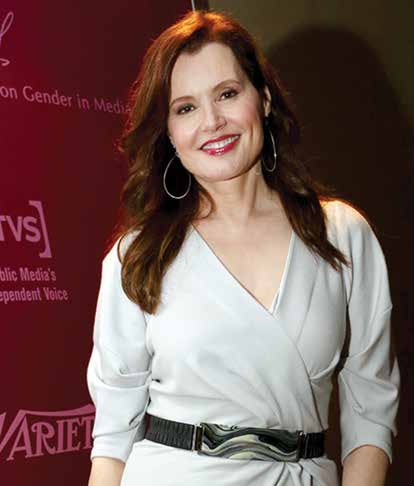
  • GENDER INEQUALITY IN FILM IS FRUSTRATING: GEENA DAVIS

    GENDER INEQUALITY IN FILM IS FRUSTRATING: GEENA DAVIS

    Actress Geena Davis says she finds it “frustrating” to see gender inequality in the media and film industries.

    Davis, who played Thelma Dickinson in 1991 feminist hit “Thelma & Louise”, said that despite playing some iconic female roles, none of the films she has appeared in have made a change, reported The Guardian.

    “Having been in some roles that really resonated with women, I became hyper-aware of how women are represented in Hollywood,” Davis said.

    “After Thelma & Louise, which was pretty noticed and potent and significant, people were saying ‘This changes everything!There’s going to be so many female buddy movies!’ and nothing changed.

    “And then the next movie I did was A League of Their Own, which was a huge hit and all the talk was, ‘Well now, beyond a doubt, women’s sports movies, we’re going to see a wave of them because this was so successful’. That’s balls. It took 10 years until Bend It Like Beckham came out. So, there was no trend whatsoever,” Davis said.

    The 59-year-old actress, who founded research organisation The Geena Davis Institute on Gender in Media in 2006, added that she is saddened by how little opportunity women are given to feel “empowered” by female characters.

    “The big takeaway I got from Thelma & Louise was the reaction of women who had seen the movie being so profound, so different,” she said.

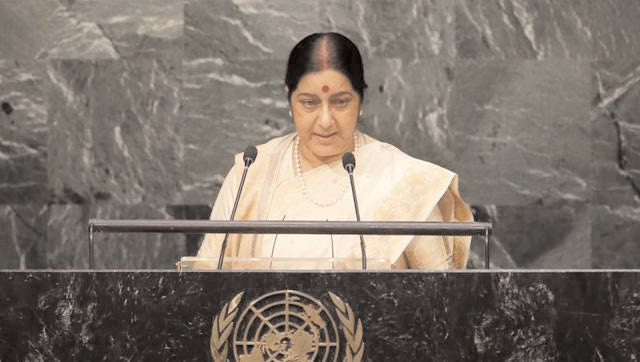
  • India Responds in UN | Sushma to Pakistan: Give up terrorism and then let’s talk

    India Responds in UN | Sushma to Pakistan: Give up terrorism and then let’s talk

    WASHINGTON (TIP): India on October 1 countered Pakistan Prime Minister Nawaz Sharif ’s four-point peace initiative with a one-point offer. “We don’t need four points, just one — give up terrorism and let’s sit down and talk,” external affairs minister Sushma Swaraj said in an address to the UN general assembly.

    In his UN speech on Wednesday, Sharif had proposed a four-point initiative: demilitarization of Kashmir, ceasefire along the Line of Control, affirmation to not use force and withdrawal from Siachen.

    Reaction from India was sharp and swift. It rubbished elements of the initiative and attempts by Sharif to portray Pakistan as a victim of terrorism, and blame India for its troubles.

    Swaraj rejected his initiative in toto, saying there was just one issue that needed to be taken care of. “Talks and terror cannot go together,” she said, adding that this was what was discussed and decided by Prime Minister Narendra Modi and Sharif in Ufa, Russia, in July.

    The national security advisers of the two countries can meet and discuss all issues connected to terrorism and the directors general of military operations can meet to tackle the border situation, she said.

    “If the response is serious and credible,” the minister said, “India is prepared to address all outstanding issues (which includes Kashmir in diplomacy-speak) through a bilateral dialogue.”

    “None of us can accept that terrorism is a legitimate instrument of statecraft,” she said, drawing attention to India’s frustration with continued cross-border terrorism despite assurances.

    She said these attacks are “meant to destabilize India and legitimize Pakistan’s illegal occupation of parts of the Indian state of Jammu and Kashmir”.

    The mastermind of the Mumbai 2008 attacks walks free, she said, calling it an “affront to the entire international community”.

    In an earlier response to Sharif ’s offer, foreign ministry spokesperson Vikas Swarup tweeted, “To demilitarize Kashmir is not the answer, to de-terrorize Pakistan is.”

    On Sharif ’s claim that Pakistan was a victim of terrorism, India said in a right-to-reply statement in the UN, “In truth, it is actually a victim of its own policies of breeding and sponsoring terrorists.”

    “Pak PM gets foreign occupation right, occupier wrong,” Swarup said about Sharif ’s charge of “foreign occupation” in Kashmir. “We urge early vacation of Pak-occupied Kashmir”.

    Relations between the neighbours have plummeted in recent days and weeks amid tension and firing along the border and cancellation of high-level talks. Both have withdrawn into their respective corners, saying it’s for the other side to make the next move; a long way from the optimism following talks in Ufa. Also, the August 24 NSA-level talks between Sartaj Aziz and his Indian counterpart Ajit Doval were cancelled after Pakistani high commissioner Abdul Basit invited Kashmiri separatists to a tea reception.

    In his speech, Sharif had sought to portray Pakistan, and himself, as more keen on peace than India. He had said after taking office in June 2013 that normalization of ties was one of his first priorities.

    He had reached out to the Indian leadership, he said, yet “today ceasefire violations along the LoC and working boundary are intensifying, causing civilian deaths”.

    “Wisdom dictates our immediate neighbour refrain from fomenting instability in Pakistan,” he said, concluding his attempt to take the moral high ground.

    India’s response was sharp and unsparing. “Pakistan’s instability arises from its breeding of terrorists. Blaming neighbours is not a solution,” Swarup said.

    Harping on Prime Minister Narendra Modi’s demand for the expansion of the UN security council, Swaraj said “if security, development and international peace is to be maintained, then security council needs to be reformed”.

    “We have to include more developing nations in the decision making structures of the security council,” Swaraj said.

  • Pakistan to hang man who claims he was 15 at time of crime

    Pakistan to hang man who claims he was 15 at time of crime

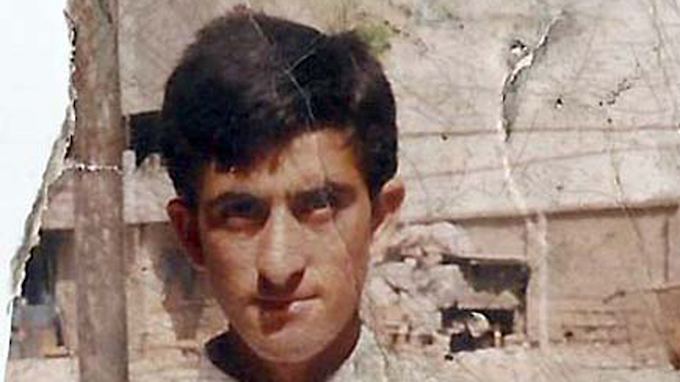
    ISLAMABAD (TIP): Pakistani authorities are set to hang a man who says he was 15 when he was arrested for a murder he claims he did not commit, lawyers said on Saturday, in the latest case to shine a spotlight on Pakistan’s crumbling criminal justice system.

    Ansar Iqbal says he was 15 when he and a friend were arrested 16 years ago for the murder of neighbor, which the victim’s family said was over an argument at a cricket match. Iqbal says police framed him because he was poor by planting two guns at his house.

    Pakistani law forbids the execution of juveniles, but the country’s courts have refused to examine Iqbal’s school records and birth certificate because they say they were submitted too late, said Maya Foa of British legal aid group Reprieve.

    His old school record and a new birth certificate issued this year give his age as 14 and 15 respectively. Record keeping in Pakistan is poor and records are easily forged.

    Instead, the court concluded he was in his early 20s based on a policeman’s estimate at the time of his arrest, Foa said. Iqbal’s friend was tried as a juvenile.

    “The onus has to be on the government and prosecution to prove that the individual facing the gallows is not a juvenile if all the available evidence points otherwise,” she said.

    “Otherwise it puts the defendant in an impossible position.”

    Iqbal’s lawyer, Munir Basit, confirmed his client had been tried as an adult and had been notified he was to hang at Sargodha jail next week.

    “He has received his black warrant in the concerned jail,” Basit said.

    Court and prosecution officials were not available for comment.

    Pakistan brought back hanging in December as a way to crack down on militancy after Taliban gunmen massacred more than 130 pupils at an army-run school.

    But very few of the 240 people hanged have any links to militancy. Most, like Iqbal, were convicted of murder. Many of their families say they were falsely accused and too poor to get good lawyers. Few, if any, wealthy convicts have been hanged.

    Pakistan’s criminal justice system is widely considered corrupt. Police frequently ask for bribes and few are trained in preserving a crime scene or collecting evidence. Instead, they rely on easily manipulated oral statements. Accusations of torture are common.

    Unskilled, poorly paid court-appointed lawyers often fail to examine witnesses or do not turn up for hearings, and tales of judges who ask for bribes are common.

  • 11 killed in US C-130 plane crash in Afghanistan

    11 killed in US C-130 plane crash in Afghanistan

    WASHINGTON (TIP): An American C-130J military transport plane crashed at the Jalalabad airport in Afghanistan early Oct 2, killing all on board, including six US service members and five civilian passengers, the Pentagon said.

    An Air Force C-130J assigned to the 774th Expeditionary Airlift Squadron, part of the 455th Air Expeditionary Wing, crashed at approximately 12:19 am at Jalalabad Airfield, a Pentagon statement said.

    The crew of six US service members and five civilian passengers died in the crash, it said.

    There was no immediate indication why the plane might have crashed. “The cause of the accident is currently under investigation. More information will be released as it is gathered,” the Pentagon said.

    Jalalabad, in eastern Afghanistan near the border with Pakistan, is home to several military operations. The Jalalabad airfield is adjacent to the civilian airport.

    The C-130 Hercules is a cargo plane built by Lockheed Martin. It is powered by four turboprop engines and is used extensively by the military to ship troops and heavy gear.

  • Sri Lanka likely to dodge international probe into war crimes

    Sri Lanka likely to dodge international probe into war crimes

    COLOMBO (TIP): Sri Lanka appears set to avoid an international inquiry into atrocities committed during its lengthy civil war if a new UN resolution is adopted next week.

    Colombo has lobbied successfully for a watering-down of an earlier motion demanding foreign involvement in any probe into human rights abuses during the 37-year conflict.

    The draft resolution, which is likely to pass unanimously next week, refers to the importance of having foreign experts involved in a potential investigation, but does not make the condition mandatory.

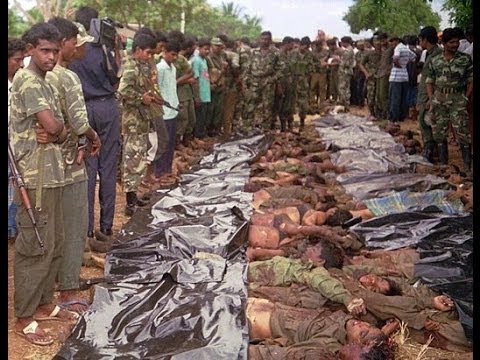
    The initiative was tabled at the UN Human Rights Council in Geneva late Thursday, a week after the publication of a long-awaited UN report that laid bare the horrific barbarity committed by both the army and the separatist Tamil Tiger rebels in the bitter 37-year war.

    The report said Sri Lanka’s criminal justice system was “not yet ready or equipped” to conduct an independent and credible investigation and called for a hybrid special court to include international judges, prosecutors, lawyers and investigators.

    But Sri Lanka has resisted a foreign inquiry, which many members of the island’s Sinhalese majority consider an infringement of sovereignty. The main minority Tamil party the Tamil National Alliance (TNA) said the resolution, initiated by the US and co-sponsored by Sri Lanka, was the “product of a difficult consensus”.

    “We are acutely aware that some of the language used in the interests of a consensus will not satisfy all victims of the conflict whom we represent and who have reposed their trust in the TNA.

    “However, we are of the view that the draft provides a constructive starting point for what will inevitably be a long road to reconciliation,” the TNA said in a statement.

    The resolution allows Sri Lanka to draw on foreign funding and expertise for a credible domestic investigative mechanism.

    Washington dropped its opposition to a domestic-only probe last month, and US Secretary of State John Kerry described the draft resolution as an important step towards a “credible transitional justice process” after the decades-log civil war. “The United States will remain steadfast in our commitment to walk with Sri Lanka as it takes these important but challenging steps,” he said in a statement issued by the US embassy in Colombo.

    Sri Lanka’s former president Mahinda Rajapakse had been at loggerheads with the US, other Western nations and India, which had censured Colombo over its rights record and failure to ensure accountability for the killings of tens of thousands of civilians.

  • Former US president Carter to build homes in Nepal

    KATHMANDU (TIP): Former US president Jimmy Carter who has been diagnosed with cancer will travel to quake-hit Nepal to build homes with 1,500 volunteers in November.

    In August, 90-year-old Carter said he had been diagnosed with cancer in his brain but still hoped to make a scheduled trip to Nepal.

    “I really wanted to go to Nepal to build houses,” he had said.

    NGO Habitat for Humanity in a press statement today said that Carter had received consent from his medical team to travel to Nepal.

    Carter and his wife Rosalynn will participate in Habitat for Humanity’s 32nd annual Jimmy & Rosalynn Carter Work Project from November 1 to 6 in Chitwan in southern Nepal.

    During the week, 1,500 volunteers from within Nepal and around the world will join him in building permanent homes in partnership with low-income families in Nayabasti Gairigaun village in the district.

    A majority of these families are Dalits, according to the Carter Centre.

    Nepal was devastated by a massive earthquake that struck the Himalayan nation on April 25 killing over 9,000 people while many more were left without shelter.

    Carter, the 39th US president and recipient of the Nobel Peace Prize, who founded the Carter Centre, has travelled the world as a peace broker and human rights advocate.

    He had also visited Kathmandu in November, 2013 to observe Nepal’s second Constituent Assembly election.

  • China as a Peer of the United States: Implications of the Joint Statement

    China as a Peer of the United States: Implications of the Joint Statement

    China is emerging as a peer and partner of the United States in international affairs. India’s response should be to work with China in the Asia Infrastructure Investment Bank and in China’s ‘Road and belt’ initiative to make the ‘Asian Century’ a reality as well as in the G20, which China will chair in 2016 (and India in 2018), to begin shaping the future global agenda, ‘global goods’ and institutions, including reform of the United Nations, while maintaining strategic autonomy to safeguard its maritime trade routes.

    New partners in climate change

    In the US-China Joint Statement on Climate Change, President Obama has met the criticism of the US Senate that unilateral emissions reductions should not give China a competitive advantage while President Xi has achieved for developing countries what the G77 collectively was finding difficult to attain.

    On 25 September, Xi and Obama outlined their “Vision for the Paris Climate Conference”,(re) defining the principle of common but differentiated responsibilities as a system that provides flexibility to developing countries “in light of their capacities” and “that differentiation should be reflected in relevant elements of the agreement in an appropriate manner”.

    They also agreed on joint support for a “global transition to a low carbon economy, renewed focus on adaptation “as a key component of the long-term response” to build resilience and reduce vulnerability and the “crucial role of major technological advancement in the transition”.

    The Statement recognizes that transparency provisions have to include both ‘action’ as well as ‘support’ provided to developing countries – a long standing demand of developing countries. Also, transparency provisions are expected to “provide flexibility to those developing countries that need it in light of their capacities”, emphasizing differentiation.

    The Joint Statement moves beyond the post-colonial North-South dichotomy and welcomes the provision of resources from countries “willing to do so;” it is no longer seen as a commitment based on notions of historical responsibility. Both countries will provide USD 3 billion each to help poor countries, with China announcing the establishment of a China South-South Climate Cooperation Fund. This puts pressure on all developed countries to enhance contributions towards the USD 100 billion to be provided by 2020. The need for bilateral investments to encourage low-carbon technologies and climate resilience, equating mitigation and adaptation (even though these terms are not mentioned) provides an opening to discuss the role of public finance in the transition.

    By endorsing a global goal of “low-carbon transformation” within the 21st century -convergence on an overarching meta-global goal is a significant development which the Sustainable Development Goals (SDGs) were not able to achieve – the statement also serves to define the ‘Objective’ of the Convention; something which has eluded the multilateral process since 1992.

    New forms of international co-operation

    Xi used his address to the United Nations General Assembly to reiterate China’s call for a “new type of international relations based on win-win cooperation.” He added: “We should resolve disputes and difficulties through dialogue and consultation,” as “the law of the jungle leaves the weak at the mercy of the strong.”

    Xi emphasized that China represents less powerful nations through its seat on the Security Council (“China’s vote at the U.N. will always belong to developing countries”) and projected China as a champion of the developing countries.

    The trip was planned so there would be major funding announcements on each of the three days Xi was at the UN General Assembly in New York, as that is what concerns the G77 the most. He pledged establishment of an assistance fund for South-South cooperation to implement the SDGs with USD 2 billion dollars; increasing investment in LDCs to USD 12 billion by 2030; and the exemption of debt owed by LDCs, LLDCs, and SIDS on interest-free loans; a USD 10 million contribution to the UN women’s agency, a USD 1 billion ‘peace and development’ fund and USD 100 million in military aid for the African Union. He also co-hosted a women’s summit at the UN.

    China already contributes more peacekeepers than other permanent members of the Security Council. Xi promised to send the first Chinese helicopter squad to join peacekeeping in Africa, train 2,000 peacekeepers from other countries in China over the next five years, and build a peacekeeping standby force of 8,000 troops. Xi’s largesse portrays China as a contributor to global growth and security amid international concerns about China’s economic stability and military ambitions.

    Global rules for the new services and knowledge economy  

    Over time, Xi’s success in implementing sweeping market reforms aimed at changing China’s economic model from an investment and export-driven one to an innovative consumer-driven and service-oriented one may be the critical factor in shaping Beijing’s economic and foreign policies in the future, as the economic relationship with the US will remain key.

    Cyber issues are now among larger concerns in the economic relationship, with bilateral trade totaling USD 590 billion in 2014 and China holding USD 1.2 trillion in US Treasury bonds. On cyber-security it was agreed that “neither country’s government will conduct or knowingly support cyber-enabled theft of intellectual property, including trade secrets or other confidential business information, with the intent of providing competitive advantages to companies or commercial sectors.” In addition, Xi and Obama agreed to create a cabinet-level mechanism and a hotline to address concerns. Both pledged to cooperate in creating a global code of conduct for cyber security. The Bilateral investment treaty Talks stalled as each side offered “negative lists” of items to be excluded and these lists can wall off industries considered strategic such as energy, aviation, telecommunications or access to state-owned industry procurement.

    New co-operative multilateralism

    The United States and China will remain the key global actors in developing a multilateral consensus on global issues as long as they successfully represent the concerns of the others. In an inter-connected world, the outcome will be a new model of co-operative multilateralism supplemented by bilateral understandings between national stakeholders that do not require the mediation of the United Nations Secretariat and prolonged negotiations over obscure texts.

    The post-world war multilateralism involved agenda setting by the G7 balanced by the G77 laying out their interests, or positions, at the start of a multilateral negotiation. Subsequent rounds of negotiations were designed to narrow the differences with secretariat documents suggesting consensus language and calls to capitals. Last minute compromises and trade-offs are very much part of the process, leaving most developing countries unhappy. The result has been continuing tension and the need for a United Nations secretariat to help mediate between the groups, siding more with the funders in achieving their goals. This arrangement has, at least for climate change, now lost its relevance.

    The 21st century, characterized by the majority of the middle class living in cities, a post-industrial knowledge economy and global trade dominated by services rather than goods, needs to respond effectively to global concerns through means for agenda-setting and securing a global consensus very different to those adopted for a fractured world emerging from colonialism and world war. With the two largest economies and most powerful countries that cut across the political divide emerging as peers and partners, agenda setting will require wider consultation in the G20, which China will chair next year. India, too, must shape the contours of the new multilateralism by working with China.

    New military and strategic balance in Asia

    The Dongfeng (East wind) 21D “carrier-killer” missile, which made a public appearance in a military parade on 3 September 2015, with a range of 1,550 km and a projected 10 times the speed of sound (faster than anything that could intercept it) after re-entering the atmosphere can manoeuvre on to a target, making it theoretically capable of landing a large warhead on or near a moving ship. Some analysts say such missiles reduce the threat from aircraft carriers – which form the basis of current US naval strategy – just what aircraft carriers themselves did to battleships with Japan’s 1941 attack on Pearl Harbor. While the potency of the DF-21D is debated in the defense community, these capabilities are changing the balance of power in Asia against the United States requiring it to strengthen its alliance system.

    The geopolitical world order established by the United States after World War II is unraveling because of the geo-economic shift to Asia. China’s Asian Infrastructure Investment Bank has served to focus minds in Europe and East Asia. The new Bank will be a rival to the IMF and World Bank and the US risks losing its ability to shape international economic rules, and global influence that goes with it. The UK described the decision as an “irresistible opportunity” and brought accusations from Washington about London’s “constant accommodation” of China, reflecting the two world-views on the emerging global order.

    For India, the lesson from the failed US attempt to obstruct the new bank is that, as Asia’s urbanization will require more than USD 8 trillion to be spent on infrastructure in this decade, countries in the region will welcome all the support they can get. Rather than be suspicious of China’s motives and seek to prevent the ‘Belt and road’ initiative, it should deal with the strategic concerns by joining in the development projects, for example, by providing the software packages required in the management of the ports. A mutual recognition of special interests of each other in the South China Sea and the Indian Ocean should be a strategic objective, and will be a strategic win-win for both.

    The ‘Asian Century’ provides an integrating theme to focus minds on shaping the economic integration of Asia, where two-thirds of future global growth is going to come from, and the alignment of the rail, road, sea routes and gas pipelines from Iran, for example, can position India as a node for South and Western Asia. Including a services component in the projects will add to their productivity and support cooperation between the Asian giants; trade is a win-win proposition.

    Conclusion

    The global trend is that countries are gaining in influence more because of the strength of their economy than the might of their military. India can either drift into the future remaining in its periphery or it can shape the future jointly with China to become one of the two engines of the Asian economy. China is likely to remain the world’s largest producer of goods and India has the potential to be the largest producer of services in the largest consumer market. According to McKinsey and Company, the services sector will be the real driver of growth in Asia as affluence will be concentrated in cities. The ability to design, finance, build and implement the big data-technology systems will be the defining comparative advantage in the future, and India and China can work together to make this happen sharing their respective expertise. The complex interdependencies will be a strong stabilizing force.

    According to Prime Minister Modi, China and India are “two bodies, one spirit” and President Xi has emphasized the “need to become global partners having strategic coordination”. The G20 meeting in 2016 provides the opportunity for the Asian giants to work together to define a global agenda, ‘global public goods’ and institutions to respond to the global middle class and the Asian Century with two centers of gravity, with India seeking to achieve this joint agenda when it chairs the G20 in 2018.

    (The author is an Ex civil servant and diplomat) – IDSA


  • Go Beyond Rhetoric | Systemic coordination is required for Swachh Bharat

    Go Beyond Rhetoric | Systemic coordination is required for Swachh Bharat

    In one year the Swachh Bharat Mission has created a buzz in the urban areas about the need for sanitation, thanks to an increased spending on advertising, but a systemic plan to clean India is not yet in place, leave alone concrete results on the ground. One of Narendra Modi’s key projects, it is not much different from Nirmal Bharat Abhiyan and the Total Sanitation Campaign of the past. With his cultivated gift for marketing, the PM has managed to bring the subject to national attention. Rhetoric apart, the Modi government reduced the budgetary spending for the clean India campaign from Rs 4,260 crore in 2014-15 to Rs 2,625 crore in the latest budget, hoping to meet the funding gap through a Swachh Bharat cess and corporate social responsibility contributions, and by coaxing states to chip in. This makes the fund flow uncertain.

    Secondly, there is no assessment of the magnitude of the challenge. The only data available for Swachh Bharat is about the number of toilets built and the money spent. Of the six crore toilets constructed in the past one year, 1.3 crore are defunct, according to media reports. Other requirements like sewerage, waste treatment and disposal, and water supply have not been made available along with toilets. To provide end-to-end solutions, coordination is important among various Central and state departments. The Union Ministry of Drinking Water and Sanitation looks after sanitation in the rural areas and the Ministry of Urban Development in the urban areas, while the HRD Ministry builds toilets in schools. There are separate plans for smart cities and smart villages. All these require coordination and the pooling of resources.

    Concepts of sanitation are deeply rooted in a society’s cultural values. However, public health experts are unanimous that sanitation, or lack of it, is linked to infant mortality, malnutrition, cognitive development and economic productivity. Three lakh children are lost to diarrhea every year. States have yet to realize the importance of sanitation. It is treated as a Central hobby-horse. Even the BJP-ruled states have not shown particular enthusiasm for the PM’s pet project.

  • Learn ABC of the Grammar of Governance

    Learn ABC of the Grammar of Governance

    During his US visit, Prime Minister Narendra Modi conveyed to his audience: “Reform in governance is my No 1 priority. We are for simplified procedures, speedy decision making, transparency and accountability.” As the Chief Minister of Gujarat, Modi was a
    “governance”addict. On his assuming Prime Ministership, “governance” became India’s flavor and the Center’s guiding mantra. The stated objective was to have a “governance architecture” that put people at the centre of the development process. The President’s address to Parliament in June last year also laid down the motto: “Minimum government, maximum governance”.

    However, even after 16 months there is no such governance architecture or blueprint. In the upper echelons of decision making, there is mixup of government and governance, as if both are the same. They are not. Governance is not just government; it is bureaucracy, laws, rules, policies, programs, processes and procedures. It is far more than that. In a democracy like India, governance should be “society-centered”. It should include the government, which is its dominant part, but transcend it by taking in the private (farming, business, industry) and voluntary sectors (civil society). All the three are critical for sustaining human, economic and social development.

    Governments create a conducive political, administrative, legal and living environment. The private sector promotes enterprise and generates jobs and wealth, while the voluntary sector educates and mobilizes citizens’ groups to participate in economic, social and political activities. Each has weaknesses and strengths, so governance is facilitated through a constructive interaction among all three. While government is a politico-bureaucratic entity, governance is a joint venture encompassing all. The difference is huge.

    Being a joint venture, governance should adhere to the basic functional norm of involving stakeholders in decision-making and implementation processes. The Modi government made a false start by putting out a “secret” Intelligence Bureau report condemning several civil society organizations and eminent opinion leaders who differed from government policies as “anti-national” and accusing them of thwarting India’s development! Since then, many NGOS are being harassed by abusing the Foreign Exchange Management Act and other laws. The voluntary sector, except the RSS as well as its affiliate “think-tanks” and individuals, are out of the reckoning as far as “governance” is concerned. As for farmers, they are treated more as mendicants than partners. The elitist vision of the BJP and its leader is replete with bullet trains, state-of-the-art highways, smart cities, insulated industrial corridors and “Digital-India.” These are far removed from the deprived lives of a majority of farmers. Agriculture, which accounts for 60 per cent of India’s population, and from where the poorest draw sustenance, is only an add-on in the scheme of things. In business and industry, it is “big-is-bountiful” and “small-is-not-beautiful”. This has been demonstrated during Modi’s high-profile foreign visits and the mad hunt for big-ticket FDIs. Last year, on the launch of the “Make-in-India” campaign at Delhi, about 10 big industrialists on the dais pledged to invest billions of Rupees. The same scenario was repeated while kick-starting the “Digital-India” initiative and billions were again promised. As if only big-ticket investors alone are “partners in development.” The grammar of good governance is about socio-economic harmony, arising out of the smooth interface between government, civil society, farming and business communities. Unless this is achieved across the board, no amount of reforms can bring about achche din. As to “minimum government, maximum governance,” David Thoreau wrote over a century ago: “That government is the best which governs the least.” Conversely, “that government is the worst which governs the most.” The latter seems to be true of India. The Union Territory of Chandigarh is also a case in point. From 1952 to 1966, Chandigarh was the capital of Punjab and its citizens were represented in the state’s Legislative Assembly. A Chief Commissioner headed the local administration. When the undivided Punjab was divided, both Punjab and Haryana claimed the new city for its capital. Pending the resolution of the issue, Chandigarh was made a Union Territory, with its administration functioning directly under the Centre. While the UT lost representation in the Assembly, it has a Member of Parliament. Till May 31, 1984 Chandigarh had an Administrator designated as the Chief Commissioner. On June 1, 1984, the Governor of Punjab took over as the Administrator and the Chief Commissioner was re-designated as the Adviser to the Administrator. This was a prelude to Operation Blue Star.

    The stated reason was to facilitate “co-ordination” between the districts of Punjab and the capital in Chandigarh. This ad hoc measure became permanent. The Governor of Punjab is the head of the UT Administration, though it is the Adviser who runs the show. The Municipal Corporation of Chandigarh (MCC) came into existence on May 24, 1994. Several functions were transferred from the Chandigarh Administration to it through notifications issued on September 28, 1995 and May 16, 1996. The elected body of the MCC came into being in December 1996. The first thing it did was to stall the decision to levy property tax on commercial and residential buildings in the city, thereby triggering a duel between the UT Administration’s bureaucratic and political wings that continues till date. The transfer of functions was a half-hearted affair. The bureaucratically run Chandigarh Administration  retains the bulk of the assets, including near-total control of funds and resources. Chandigarh has five governments/power centers: The Union Home Ministry, the Punjab Raj Bhavan, the UT Secretariat, the MP and the MCC. Things have been falling between several stools. In Chandigarh, Modi’s motto looks reversed to “Maximum government, minimum governance”!

    By M.G. Devasahayam (The author is a former IAS officer of Haryana Cadre, now settled in Tamilnadu)

  • The Long Island Sikhs participate in Prabhat Pheri and Asa Ki Var Kirtan at Glen Cove Gurdwara

    The Long Island Sikhs participate in Prabhat Pheri and Asa Ki Var Kirtan at Glen Cove Gurdwara

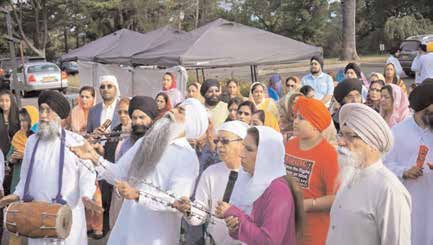
    GLEN COVE, NY  (TIP): Gurdwara Sahib Glen Cove, Mata Sahib Kaur, Long Island celebrated Guru Ram Das Ji’s Gurugaddi  Divas  on September 27th. The event began with a  Prabhat Pheri and ended with Asa ki Var.

    The sangat walked barefoot. The participants in the Prabhat Pheri walked singing hymns to the ecstatic music of dholak and  copper bells. Chanting  hymns from the holy scripture of the Sikhs-Shri Guru Granth Sahib-, they completed a small round of the 15 acre gurdwara grounds. The procession was full of vibrations and energy, and the chants echoed in the morning winds.

    The  Prabaht Pheri was  followed by Asa ki Var kirtan in a specially erected tent  where a Darbar Sahib  was beautifully  decked up in royal blue and gold silks. The slight chill and the winds did not keep the sangat away as they all sat down on the carpeted floors to enjoy two hours of uninterrupted spiritual bani sung by famous Ragi Jatha Ragi Mukhtiar Singh Philadelphia wale.

    The Asa ki  Var is usually recited in the early morning hours in a very melodious manner. These hymns are sung in special morning raagas which are very soothing. The kirtan was followed by a scrumptious  Langar.

    At the overwhelming response from the sangat, , Manmeet K Lamba, the general secretary of Glen Cove Gurdwara Management  announced joyously to continue this tradition from June- November  every year. The management also thanked all the event sponsors, the volunteers and the sangat for sharing their morning  with their event.

    The next Prabhat Pheri and Asa ki Var will be held on: Sunday November 22nd 2015 – 8.00 am- 12.00 pm. In celebration of Guru Nanak Dev Ji Gurpurab at Gurdwara Mata Sahib Kaur, 100 Lattingtown Road, Glen Cove, NY.

  • HEART-POUNDING, THRILLING NEW DRAMA “QUANTICO” ON ABC

    HEART-POUNDING, THRILLING NEW DRAMA “QUANTICO” ON ABC

    NEW YORK (TIP): “Run” — A diverse group of recruits has arrived at the FBI Quantico Base for training. They are the best and the brightest, so it seems impossible that one of them is suspected of masterminding the biggest attack on New York City since 9/11. “Quantico” aired SUNDAY, SEPTEMBER 27 (10:00-11:00 p.m. ET) on the ABC Television Network.

    Flashing back and forth between the future-the aftermath of a terrorist attack on Grand Central Station-and the present-a 20-week training course at the FBI Academy in Quantico, VA-we follow the lives of seven FBI recruits. These young adults are pushed to the brink as the class is gradually whittled down, until only the finest candidates remain. Haunted by questions about her late father and his mysterious career as an undercover agent, Alex Parrish joins the FBI searching for answers. Her fellow trainees include Ryan Booth (ex-military), Shelby Wyatt (an orphaned Southern belle), Eric Packer (a Mormon with a troubled past), Simon Asher (the first openly gay FBI recruit), Nimah Amin (an observant Muslim with a double life), and Caleb Haas (for whom the FBI is a family business). Their mentors at the Academy-Miranda Shaw and Liam O’Connor-have boundless experience but a complicated history with the Bureau and each other. When Alex Parrish learns that she’s been framed for the terrorist event, she has to run for her life while trying to figure out which of her former classmates is the real terrorist before they strike again.

    “Quantico” stars Priyanka Chopra as Alex Parrish, Josh Hopkins as Liam O’Connor, Jake McLaughlin as Ryan Booth, Aunjanue Ellis as Miranda Shaw, Johanna Braddy as Shelby Wyatt, Tate Ellington as Simon Asher, Graham Rogers as Caleb Haas and Yasmine Al Massri as Nimah Amin.

    Guest starring Anthony Ruivivar as Agent Julio “JJ” Jimenez, Brian J. Smith as Eric Packer, Anna Khaja as Sita Parrish, Ray Stoney as SWAT Team Leader and Johnathon Schaech as Michael Parrish.

    “Run” was written by Joshua Safran and directed by Marx Munden. Executive producers of “Quantico” are Joshua Safran, Mark Gordon, Nicholas Pepper, Jake Coburn and Robert Sertner. “Quantico” is produced by ABC Studios.


  • INOC Chair repudiates statements by Juned Qazi

    INOC Chair repudiates statements by Juned Qazi

    NEW YORK (TIP): In a written statement issued by George Abraham, Chair, INOC USA has said that Mr. Juned Qazi’s (former President) statement as regards Congress Party and its Vice-President Mr. Rahul Gandhi are his own personal views and not shared by the members of the Indian National Overseas Congress, USA.

    ‘It is quite regrettable that he has misused his position and privilege to undermine the credibility of the organization and hurt the Party in India. As chairman of the organization, I deplore his actions and repudiate his statements seemingly at the behest of INOC, USA.

    “We, at the INOC, have dedicated our time and efforts since 1998 to support the Congress Party and uphold its values and principles. We would like to see a Democratic and Secular India not only survives but thrives and establishes an ever closer relationship with the USA where we have made our residences. Regardless of the obstacles put in our way, we will continue to strive in that endeavor in the days and months ahead.

    “I congratulate Mr. Mohinder Singh Gilzian, the newly elected President of INOC, USA on his assumption of the office and wish him the very best.”

  • India, US and a New moment

    India, US and a New moment

    Prime Minister Narendra Modi’s visit to the United States has taken place at a moment of significant opportunity for India. The Chinese economy, which had seemed invincible, has faltered and is facing deep structural problems. India is poised to become the world’s best performing economy, though there are still signs of sluggishness and it is imperative that both domestic and foreign investment be accelerated for its full potential to be reached. Against this backdrop, Modi’s program, replete with high-profile meetings with CEOs of US financial, media and technology companies and a well-attended public function with the Indian community, addressed the business and diaspora constituencies that have been central to the prime minister’s foreign outreach since he assumed office.

    American technology companies see India as the next big growth opportunity, given the difficulties in operating in China and the fast growth of the smartphone market and e-commerce in India.

    This was evident from the enthusiasm with which Modi was received in Silicon Valley by the chief executives of America’s best known technology companies, several of whom, like Satya Nadella and Sundar Pichai, hail from India. India’s goal to harness the digital revolution to skill its people, improve infrastructure and delivery of goods and services opens up exciting possibilities. For India, the challenge is to leverage these opportunities to create employment for the millions who enter the job market each year, and develop domestic technical and manufacturing capabilities.

    In the last years of the previous government, American investors had become wary of doing business in India on account of slow decision-making and the unpredictability of the regulatory environment. But the high expectations that the new government, with a solid majority in the Lok Sabha, would be able to smoothen out these tangles quickly and expedite reform have been moderated as several key initiatives like the land amendments and GST have been abandoned or failed to make progress. The unpredictability of the tax regime has been a major concern of foreign investors and this is still a work in progress. India needs to step up its game to create a conducive business environment. Equally, high US visa fees for Indian software engineers deployed there for short periods, numerical quotas and the absence of a tantalization agreement constrain the business of Indian IT companies in America. These issues need to be addressed if businesses are to build on their synergies.

    The three million-strong Indian American community has come of age and is a vital bridge connecting the people of the two countries. Modi has paid special attention to the overseas Indian community as an asset for India’s development and a force-multiplier in India’s diplomacy. This was again visible at the public function in San Francisco with the Indian American community.

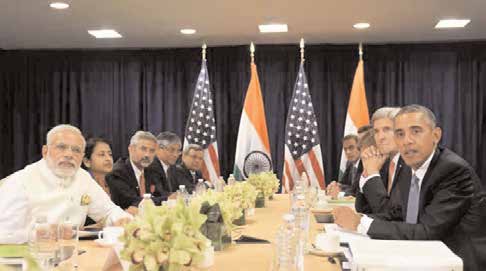
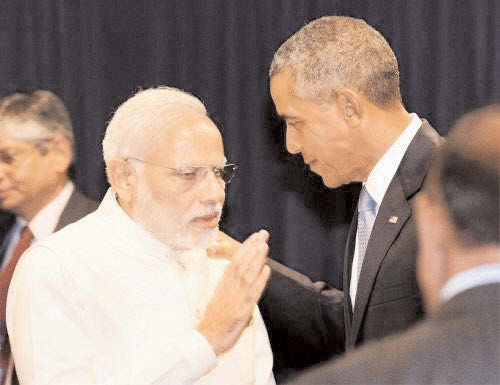
    This was not a bilateral visit, though Modi and President Barack Obama did meet – for the fifth time – on the sidelines of the UN. Climate change was uppermost on Obama’s agenda in the run-up to the Paris conference. With China having announced its intention to cap its emissions in 2030, there is pressure on India to announce its emission-reduction goals. Modi underlined that India will be a constructive player in Paris while keeping open avenues for meeting its developmental needs. In setting our national goals, Delhi needs to ensure that it does not disproportionately add to the costs of doing business in India. Affordable clean and renewable energy and energy efficiency hold the key to a less carbon-intensive future for India and it is here that an India-US partnership can bring real value to the table.

    Afghanistan faces an uncertain future post the withdrawal of US combat forces. The US, along with China, co-chaired a meeting on Afghanistan to which India was not invited. The US and Chinese efforts to stabilize Afghanistan with Pakistan’s cooperation should not lead to a situation that exacerbates terrorism challenges for India and the region. Continued support for strengthening the capacities of the Afghan government, particularly the army and the police, would be critical. There is need for candid discussions on Afghanistan between India and the US, and they have agreed to strengthen their consultations.

    Modi and Obama welcomed the progress made in giving shape to the joint strategic vision on the Asia Pacific and Indian Ocean regions and the joint engagement with regional powers like Japan. The upgraded trilateral ministerial consultations between India, the US and Japan were initiated on the sidelines of the UN. Japan is expected to participate in the Malabar naval exercise. Modi sought US support for India’s membership of the Asia-Pacific Economic Cooperation. Both India and the US have convergent interests in shaping an Asian balance grounded in international norms and conducive to peace and prosperity.

    The PM participated in the important UN Summit that adopted the Sustainable Development Goals. These set out an ambitious new agenda to end poverty by 2030 and promote shared economic prosperity, social development and environmental protection. India’s record on the Millennium Development Goals has been mixed, with considerable success in poverty reduction but more work to be done in health and education. The 17 new goals are in line with India’s national agenda for development, but achieving these would require renewed and sustained efforts by the government, civil society and the private sector over the next 15 years.

    The meeting of G-4 leaders shone a spotlight on UN Security Council reform, which has been languishing despite the growing recognition that the council, as it exists today, reflects the world as it emerged after World War II and needs to change to represent current realities and better fulfill its objectives. Four of the five permanent members of the Security Council, including the US, have expressed support for India’s candidature for permanent membership, while China has been ambivalent. Reform is likely to be a difficult process. The P-5 have been resisting change. A bottom-up approach -garnering support from members of the General Assembly combined with pressure from outside – would be required to generate momentum for Security Council reform.

  • BAN KI-MOON PUSHES FOR EQUAL RIGHTS FOR THE LGBT COMMUNITY

    BAN KI-MOON PUSHES FOR EQUAL RIGHTS FOR THE LGBT COMMUNITY

    UNITED NATIONS (TIP): Speaking at the High Level LGBT Core Group Event, the secretary general of the UN Ban ki-Moon pushed for equal rights for the community and urged government to end discrimination -something India has been struggling to do so.

    ban ki moonEchoing the motto of the sustainable development goal ‘Leaving No One Behind’, Ban ki-Moon said this guiding vision could be reached only if everyone regardless of their sexual orientation or gender entity is reached out to. “In too many countries, lesbian, gay, bisexual, transgender and intersex people are among the poorest, most marginalized members of society,” he said. Activists would agree that India is one of these countries. “Studies show that gay and lesbian people suffer disproportionate discrimination and abuse. They are rejected by their families… kicked out of their homes … and pushed out of school. Too many of our LGBT brothers and sisters are jobless, homeless and struggling to survive,” he added.

    The situation of transgender people is even worse overall, Ban ki-Moon said. “They have higher rates of homelessness, poverty and hunger. For individuals and their families, this is a personal tragedy. And for society, it is a shameful waste of human talent, ingenuity and economic potential,” he added.

    While India did not mention anything about LGBT rights at the UN, the situation in the country is dire. Homosexual relationships are considered criminal even after the Delhi high court decriminalized. The Supreme Court overturned the order and made it a crime again for people to have consensual relationships with the same gender. India is, however, one of the very country that legally recognizes transgender as a separate gender identity. However, the social stigma attached is strong and they face discrimination at every level of life.

    Urging governments to change their stance and be more proactive in protecting their rights, Ban ki-Moon said: “the human rights of LGBT people are abused, all of us are diminished. Every human life is precious – none is worth more than another”.

    The president of Zimbabwe Robert Mugabe created a furore when exclaimed “Zimbabwe is not gay!” at the UN General Assembly on Monday. “We equally reject attempts to prescribe new rights that are contrary to our norms, values, traditions and beliefs. We are not gays. Cooperation and respect for each other will advance the cause of human rights worldwide. Confrontation, vilification and double standards will not,” he said at the general assembly.

  • PM’s visit strengthened Indo-US bonds: American lawmakers

    PM’s visit strengthened Indo-US bonds: American lawmakers

    WASHINGTON (TIP): Prime Minister Narendra Modi’s just concluded US visit has strengthened the bonds between the two largest democracies of the world and opened up new avenues of co-operation, top American lawmakers have said.

    “There are many different areas and sectors where the US and India’s growing friendship will cover mutually beneficial ground. Prime Minister Modi’s second visit to the US has allowed us to continue to strengthen those bonds and explore new opportunities for us to work together,” Democratic Congresswoman from Hawaii, Tulsi Gabbard, said.

    Gabbard is the first ever Hindu Congresswoman elected to the US House of Representatives. She was among the top American lawmakers to have met Modi and attended his address to the community at SAP Center in San Jose, California.

    During her meeting with Modi, she and other members of Congress discussed plans to build US-India relations and promote technology partnerships.

    “Prime Minister’s 2-day tour of Silicon Valley included meetings with technology executives who offered their ideas and assistance in bringing India fully into the digital world,” she said.

    Congresswoman Loretta Sanchez, who also met Modi in San Jose, said Modi’s visit to Silicon Valley is symbol of the collaboration and cooperation between the US and India.

    “Innovation and entrepreneurship are values that both of our countries excel at and serve as a model for,” he said.

    Among the members of Congress who attended the event were Democratic Minority Leader Nancy Pelosi; Ed Royce, Chairman of the House Foreign Affairs Committee; Ami Bera and George Holding, co-chairs of the Congressional Caucus on Indians and Indian Americans; Eric Swalwell; Mike Honda and Jim McDermott.

    Congressman Matt Salmon said the India and the US were natural partners. “Our growing cooperation on issues like counter-terrorism, peacekeeping, and maritime security is a positive development for the region and the world,” he said.

    “At the same time, our economic and commercial ties have not kept pace with our deepening political ties,” he said.

    “I am pleased to support the elevation of commercial issues in the recently concluded first US-India Strategic and Economic Dialogue and Prime Minister Modi’s visit to the US, where he heard ideas first-hand from entrepreneurs and business leaders in Silicon Valley on how we might advance our economic relationship,” Salmon said.

    Following her meeting with Modi over the weekend, Congressman John Garamendi said that he raised the concerns of about the treatment of religious and ethnic minorities in India with the Prime Minister. He is Sikh Caucus Co-Chair.

    “I appreciate that Prime Minister Modi gave me the opportunity to discuss these critical issues. Rest assured that he knows where I stand and that the message of my constituents was heard loud and clear,” he said.

  • Ajay Banga, Indra Nooyi, Satya Nadella Attend Barack Obama’s State Dinner for Xi Jinping

    Ajay Banga, Indra Nooyi, Satya Nadella Attend Barack Obama’s State Dinner for Xi Jinping

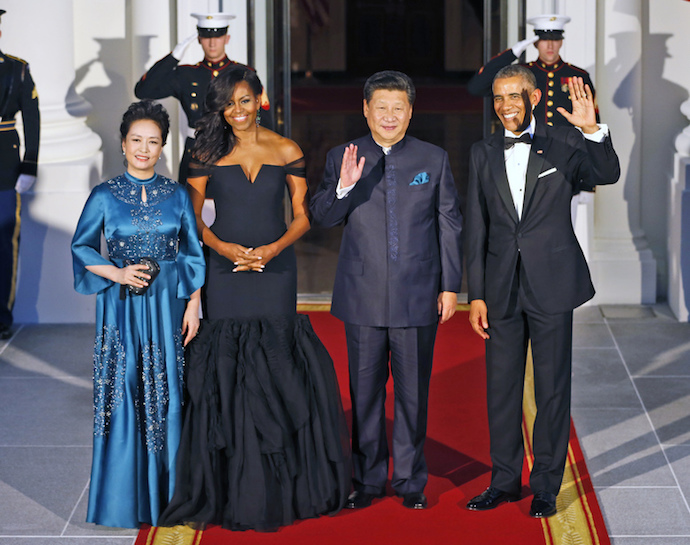
    WASHINGTON (TIP): Three Indian-American CEOs, Ajay Banga of Master Card, Indra Nooyi of PepsiCo and Satya Nadella of Microsoft, attended President Barack Obama’s lavish state dinner for Chinese President Xi Jinping.

    Mr. Banga, Ms Nooyi and Mr. Nadella, along with their spouses, were the only Indian-Americans invited by Obama for Xi’s state dinner in the White House, September 24 night.

    The 200-plus guest list included top brass from Apple, Microsoft, Facebook, Disney, DreamWorks and more.

    Many of the CEOs who attended the state dinner had either met Prime Minister Narendra Modi in New York a day earlier or will be meeting over a dinner in Silicon Valley.

    Mr. Banga and Ms Nooyi had also attended a dinner hosted by Fortune for an interaction with Modi in New York.

    Inspired by the harvest of the late summer and fall, chef Cris Comerford and Chef Susie Morrison, in collaboration with Chef Anita Lo, created original dishes that highlight American cuisine with nuances of Chinese flavors.

    Guests dined on wild mushroom soup, poached Maine lobster, grilled cannon of Colorado lamb and poppyseed bread and butter pudding.