Month: October 2015

  • Russia carries out airstrike near Homs in Syria: US

    WASHINGTON (TIP): Russia on Wednesday carried out its first airstrike in Syria, near the city of Homs, a US defense official said, marking the formal start of Moscow’s military intervention in the 4.5-year-old conflict.

    Speaking on condition of anonymity, the defense official said a Russian general working out of an intelligence center in Baghdad had walked over to the US embassy and given a verbal communique of the impending strike.

    “They gave us a heads-up they were going to start striking in Syria,” the official said, noting that the Russians gave about one hour’s advance warning. “It was in the vicinity of Homs.”

    The strike came shortly after Russian President Vladimir Putin won unanimous support from parliament to carry out strikes in Syria.

    The defense official said he was not aware of the impact of the strike or who was targeted.

    Pentagon officials have described Russia’s buildup of military hardware in the Latakia region in northwestern Syria and said Russia is making a forward operating base there.

    So far, at least 500 troops as well as 28 fighter jets and several bombers and artillery units have been deployed to the base, US officials say.

    The defense official said no action was necessary for coalition planes to avoid being in the same air space as Russian jets.

    The Pentagon has repeatedly warned of the need for “deconfliction” to ensure coalition and Russian planes don’t inadvertently cross paths.

  • US set to get first marijuana resort

    FLANDREAU (SOUTH DAKOTA) (TIP): The Santee Sioux is opening the nation’s first marijuana resort on its reservation in South Dakota. The experiment could offer a new money-making model for tribes nationwide seeking economic opportunities beyond casinos.

    Santee Sioux tribe leaders plan to grow their own pot and sell it in a smoking lounge that includes a nightclub, arcade games, bar and food service, and eventually , slot machines and an outdoor music venue.

    “We want it to be an adult playground,” tribal president Anthony Reider said.
    “There’s nowhere else in America that has something like this.” The project, according to the tribe, could generate up to $2 million a month in profit, and work is already underway a on the growing facility . The first marijuana cigarettes are s expected to go on sale Decemn ber 31at a New Year’s Eve party .

    The legalization of marijuana on the Santee Sioux land came in June, months after the justice department outlined a new policy that allows Indian tribes to grow and sell marijuana under the same conditions as some states. Many tribes are hesitant to jump into the pot business. But the profit potential has attracted the interest of many other tribes, just as the debut of slot machines and table games almost 27 years ago.

    A marijuana resort open to the public has never been tried in the US Even in states such as Colorado and Washington, where pot is fully legal, consumption in public places is generally forbidden.

  • Pope meets with family who drove 13,000 miles to see him

    PHILADELPHIA (TIP): Pope Francis met Sunday with a family who made a 13,000-mile trip over 194 days from Argentina to Philadelphia in an old Volkswagen van.

    Francis spent time with fellow Argentinians Catire Walker and Noel Zemborain and their four children, talking about their visit and praying.

    The family, on their Facebook page where they’ve been documenting their journey, said Francis called them “crazy” and laughed.

    Walker and Zemborain quit their jobs in food service and marketing to lead their children on the unforgettable tour of the Americas, using savings and soliciting donations to fund the trip to the World Meeting of Families in Philadelphia.

    Along the way they made 12 border crossings and stayed with dozens of host families, did lots of sightseeing and documented the trip online. They schooled their children _ Cala, 12; Dimas, 8; Mia, 5; and Carmin, 3 _ with the help of a distance learning program.

    The family said they got a call at 6 a.m. Sunday that Francis wanted to meet with them at the Saint Charles Borromeo Seminary, where he stayed this weekend.

    “You are the family who traveled from Buenos Aires?” the family recalled Francis telling them. He told them he had been following their trip.

    Zemborain told the Associated Press that Francis told her that they were crazy to drive so far with their children. She said it was like meeting an old friend and Francis hugged the children.

  • Titanic’s last lunch menu sells for $88,000 at auction

    NEW YORK (TIP): A menu for the last luncheon served to the first-class passengers aboard the ill-fated Titanic has sold for $88,000 at an online auction.

    The menu, which was saved by a first-class passenger, was sold on Wednesday to a private collector, Auctioneers Lion Heart Autographs said. The price was in line with pre-sale estimates. Stamped with a date of April 14, 1912 and the White Star Line logo, the menu included grilled mutton chops and custard pudding; corned beef; mashed, fried and baked jacket potatoes; a buffet of fish, ham and beef; an apple meringue pastry; and a selection of eight cheeses.

    Lion Heart Autographs said the menu was saved by Abraham Lincoln Salomon, one of the passengers who escaped on the so-called “money boat” lifeboat that was filled with wealthy people. It is thought to be one of only three or four menus from the ship’s last lunch that still exist. The menu was offered for sale by an unidentified person who was given some Titanic items by a descendant of one of the lifeboat survivors. The luxury ocean liner foundered in the Atlantic Ocean on April 15, 1912 after striking an iceberg during its maiden voyage from Southampton, England, to New York. Some 1,500 people lost their lives.

  • US support for Syria rebels illegal, Putin says ahead of Obama meeting

    MOSCOW (TIP): Russian President Vladimir Putin on Sunday branded US support for rebel forces in Syria as illegal and ineffective, saying US-trained rebels were leaving to join Islamic State with weapons supplied by Washington. In an interview with US networks recorded ahead of a meeting with US President Barack Obama, Putin said Syrian President Bashar al-Assad deserved international support as he was fighting terrorist organizations. Obama and Putin are scheduled to talk on Monday after Putin addresses the United Nations, although White House and Kremlin officials have disagreed on what the two leaders will discuss and even who initiated the meeting.

  • Black money: Government collects Rs 3,770 crore

    Black money: Government collects Rs 3,770 crore

    New Delhi (TIP): The disclosure of a meagre Rs 3,770 crore in black money held abroad by 638 declarants has raised serious doubts about the efficacy of government’s compliance scheme.

    The Finance Ministry today said 638 declarations received under the one-time compliance window, which opened on July 1 and ended on September 31, had brought out undisclosed foreign assets amounting to Rs 3,770 crore under the Black Money (Undisclosed Foreign Income and Assets) and Imposition of Tax Act. These figures were subject to final reconciliation.

    Tax at the rate of 30 per cent and penalty at the rate of 30 per cent will have to be paid by December 31 on these declarations.

    The Congress attacked the government and Prime Minister Narendra Modi for making false claims on the quantum of black money and bringing it back to the country. Party chief spokesperson Randeep Surjewala said Modi had claimed more than Rs 80 lakh crore in black money was stashed abroad and that he would bring it back within 100 days of coming to power and deposit Rs 15 lakh in everyone’s bank account.

    Tax consultants say the response to government’s scheme has been much below expectations. Girish Vanvari, National Head of Tax, KPMG in India said: “Seeing the quantum of declarations made, one can question as to whether the black money law has been successful. Expectations were of a much higher number. The low response can be attributed to uncertainty of the process and lack of clarity.”

    While comparisons may be not be strictly applicable, the service tax amnesty scheme launched by the UPA government in 2013 yielded around Rs 7,700 crore to the exchequer. The Voluntary Compliance Encouragement Scheme (VCES) was launched in May 2013 to enable service tax defaulters to pay dues without penalty or late payment charges.

    While various estimates of black money have been floating around, the government has said in Parliament there is no official estimate regarding the amount of black money generated in the country.

    Finance Minister Arun Jaitley had said in Parliament varying estimations of the amount of black money had been reported by different persons and institutions.

    He had said such estimations were based on different sets of facts, data, methods, assumptions leading to varying inferences.

    The question remains that given the low level of disclosures under the black money compliance window, either the humongous figures have been faulty or the black money abroad has been routed in a way that it has become legitimate through financial structures. The Supreme Court-appointed special investigation team (SIT) on black money headed by Justice MB Shah in its recent report had raised doubts if participatory notes (P-notes) being used by foreign portfolio investors are being used to funnel unaccounted wealth into India.

    “How can Cayman Islands with a population of less than 55,000 invest Rs 86,000 crore in a single country like India?” the SIT had stated in its report. It had expressed the suspicion that P-notes being used by foreign investors in the stock markets could be unaccounted wealth in the guise of FII money.

    Registered foreign institutional investors issue P-notes to overseas investors who wish to invest in the Indian stock markets without registering themselves with market regulator Securities and Exchange Board of India.

    The SIT report had raised concerns that some of the money coming into the market via P-notes could be the unaccounted wealth camouflaged under the guise of FII investment. The SIT had suggested that obtaining information on “beneficial ownership” of P-notes was of crucial importance to prevent their misuse.

    Industry had voiced concerns that the black money law was creating fear and panic. Industry chamber Assocham had said the compliance window in the black money law had created more confusion and fear in the minds of industry leaders, professionals, and trading entrepreneurs.

  • INS Kochi: Largest India-made warship commissioned in Mumbai

    INS Kochi: Largest India-made warship commissioned in Mumbai

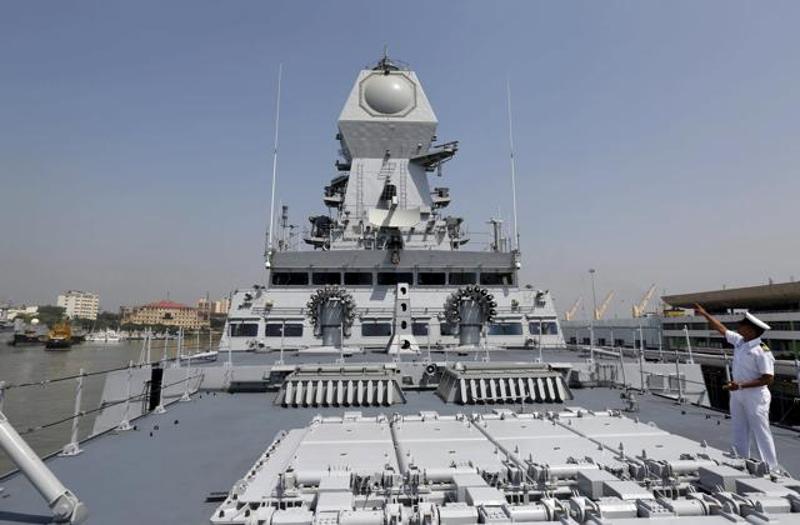
    MUMBAI  (TIP): Indian Defence Minister Manohar Parrikar commissioned, September 30th, the guided-missile destroyer INS Kochi in Mumbai.

    The INS Kochi is packed with weapons and sensors as well as advanced stealth features, it is the largest-ever warship to be built in India till now. The ships motto “Jahi Shatrun Mahabaho” loosely means “Armed to conquer the enemy” in Sanskrit.

    Induction of the 7,500-tonne INS Kochi, the second of the three Kolkata-class destroyers being built at Mazagaon Docks (MDL) at Mumbai for over ?4,000 crore apiece, will make it the 10th destroyer in India’s combat fleet.

    The ship comes with a displacement of 7500 tons, it is 164 meters in length and 17 meters at the beam, it is propelled with four gas turbines and designed to achieve speeds in excess of 30 knots.

    Destroyers are second only to aircraft carriers in projecting raw combat power on the high seas. The first of this class, INS Kolkata, was commissioned in August last year, while the third INS Chennai will be inducted towards end-2016. There is also the even bigger ongoing Rs 29,644-crore project to build another four stealth destroyers at MDL, with the first INS Visakhapatnam slated for delivery in 2018-2019.

  • Jaitley releases ‘Vision Document’ for Bihar poll

    Jaitley releases ‘Vision Document’ for Bihar poll

    PATNA (TIP): Taking a potshot at the ‘Grand Alliance’ of the RJD, JD(U) and Congress in Bihar, BJP leader Arun Jaitley today said they were running a “three-legged race” that cannot be won even as he warned voters of “anarchy” and “jungle raj” if the rival coalition came to power.

    Releasing his party’s ‘Vision Document’ for the upcoming Bihar Assembly poll, Jaitley also promised that the BJP-led National Democratic Alliance (NDA) would help bring the state out of its backwardness and put it on the path of progress and development as had happened in Madhya Pradesh under the BJP rule.

    Charging that the grand alliance was a contradictory coalition, he said, “Participants of the grand alliance are opportunists. Political consistency is not their virtue. There can be no other result but to push Bihar into anarchy in case they win.”

    Jaitley, the Union Finance Minister, said that while one could never comprehend an alliance between the BJP and Congress, it was even more difficult to imagine the followers of Ram Manohar Lohia joining hands with the Congress given their differing thoughts and ideologies.

    “We see such political inconsistency and such a contradictory alliance. A three-legged race cannot be run and even if it is run, it cannot be won,” he said.

    Jaitley also attacked Bihar Chief Minister Nitish Kumar, saying that he had allied himself with the creators of ‘jungle raj’.

    Despite Kumar having won the last three polls in Bihar on the promise of freeing the state from ‘jungle raj’, Jaitley claimed that nothing would change under a coalition of which Lalu Prasad was a part.

    He also slammed Lalu Prasad for his attack on the BJP over the reservation issue in the wake of RSS chief Mohan Bhagwat’s call for a review of the quota policy.

    “The RJD knows it cannot win on the issue of development and that is why it is trying to divide society over other issues,” alleged Jaitley.

    Talking about the ‘Vision Document’ for Bihar, he said it was for ushering in development in the state through the creation of roads and infrastructure, agro-based industry and employment opportunities. He also talked about Bihar’s rich human resources and agriculture to propel such progress.

    “The Centre will always stand behind Bihar to help it. If a BJP-led government is formed in Bihar, which we hope will happen, Bihar will rewrite its history,” he said.

  • Dadri: Mob kills man over rumours that he ate beef

    Dadri: Mob kills man over rumours that he ate beef

    NEW DELHI (TIP): A 50-year-old man, Mohammad Akhlaq, was beaten to death and his 22-year-old son severely injured earlier this week in UP’s Dadri, allegedly by residents of Bisara village, after rumours spread in the area about the family storing and consuming beef, police said.

    Six people were arrested in connection with the attack, around 45 km from Delhi, sparking protests that led to police firing, damage to vehicles and injuries to a 20-year-old welder who works for the National Thermal Power Corporation
    (NTPC) facility in the area.

    Police said they have sent samples of meat taken from Akhlaq’s home “to the forensics department for examination”. Akhlaq’s daughter, Sajida, said the family had “mutton in the fridge” and not beef.

    The attack on Akhlaq and his family took place around 10 pm in Bisara after an announcement about the family consuming beef was allegedly made at a local temple, police said.

    While Akhlaq, a farm worker, succumbed to injuries suffered during the attack, his son Danish was admitted to a government hospital where doctors described his condition as “critical”. Gautam Budh Nagar District Magistrate N P Singh said police have been deployed in the area and “as of now, the situation is under control”. “Some locals spread rumours that Akhlaq had cow meat at his home and engaged in cow-slaughtering. Following the rumours, tension ignited and some locals attacked his home in Bisara village,” Singh said.

    While a shopkeeper near the temple and Bisara village sarpanch Sanjeev Kumar Rana claimed that those arrested included the temple priest and an aide, police said the priest — identifed only as “babaji” — was released after questioning. Senior Superintendent of Police (SSP), Gautam Buddh Nagar, Kiran S, said “preliminary investigations revealed that an announcement was made from the temple” about the family consuming beef. “The priest was picked for questioning as we need to investigate the involvement of others in the case,” said Kiran. According to Sajida, Akhlaq’s 18-year-old daughter who was in the house when the attack took place, “a group of more than 100 people from the village” reached the house that night. “They accused us of keeping cow meat, broke down our doors and started beating my father and brother. My father was dragged outside the house and beaten with bricks. We came to know later that an announcement had been made from the temple about us eating beef,” said Sajida.

  • 3 INFANTS SEEK BAN ON FIRECRACKERS: PIL FILED IN SUPREME COURT

    NEW DELHI (TIP): In a first of its kind in the history of Indian judicial system, a petition in the Supreme Court has been moved on behalf of three infants aged between 6 and 14 months- for a ban on the use of firecrackers in the upcoming festival months and exercised their right to clean air guaranteed under Article 21 of the Constitution.

    “Our lungs have not yet fully developed and we cannot take further pollution through bursting of crackers,” said three infants in their petition before the Supreme Court seeking a ban on crackers. The infants – two six-month-olds Arjun Gopal and Aarav Bhandari and 14-month-old Zoya Rao Bhasin -moved the SC through their advocate fathers to seek several measures to mitigate pollution.

    The Supreme Court Rules permit minors to file petitions for the protection of their fundamental rights through their parents and guardians who term themselves as ‘next friends’.

    The petitioners sought the SC’s immediate intervention “against inevitable and upcoming widespread use of firecrackers and fireworks and other products of the same classification, especially during Dussehra and Diwali, but thereafter in all other events and festivities as well”. They also wanted measures to check pollution hazards like burning crop residues, polluting vehicles and open waste disposal.

    The infants also sought following directions from the court to the government on a ban on burning post-harvest crop residue, stringent action against those who dump dust, malba (concrete waste) and other pollutants and introducing Bharat-V emission norms for vehicles.

  • NOW, MIDDAY MEAL IS ELEMENTARY SCHOOL STUDENTS’ RIGHT

    NEW DELHI (TIP): Midday meal has become a right of students in elementary schools, run by the government or aided by it, with the Centre notifying rules for implementation of the scheme, including payment of food allowance in case of non-serving of the afternoon lunch under the Food Security Act.

    A gazette notification of the guidelines, issued on on Sept 30 evening to link the world’s largest afternoon meal programme with the provisions of the Food Security Act, guaranteed that every student within the age group of six to 14 years studying in classes I to VIII will be served midday meal everyday, except on holidays.

    It also made provisions for compensating students with payment of the cost of cooking and cost of food items that they are entitled for in case the midday meal is not served at a school due to non-availability of foodgrains, money, fuel or any other justifiable reasons   including absence of cook-cum-helper.

    To ensure that discontinuation of serving of midday meal does not continue for more than three to five days, the Centre’s guidelines make it mandatory for the state governments to take action and “fix responsibility” of the person or agency in such cases.

    Schools will have to provide midday meal to children from any of the fund available with it, if funds allocated under the Central scheme has been completely spent.

    The guidelines of the Human Resource Development Ministry, which came into immediate effect from the date of its gazette notification, however, does not speaks about how the food security allowance will be paid to students.

    Official sources said respective state governments will decide whether the allowance should be deposited directly into the accounts of students or their parents. “In case where neither parents nor students have any account, the allowance can be paid in cash,” it added.

    With the guidelines coming to effect, all primary school students are now entitled for midday meal with nutritional value of at least 450 calories and 12 gm of protein, while students of upper primary classes will get food under the scheme with nutritional value of at least 700 calories and 20 gm protein.

    Students of Madrasas and Maqtabs, supported under the Sarva Shiksha Abhiyan (SSA), will also come under the ambit of the guidelines. Any deviation from the prescribed nutritional value of the afternoon meal to be served to the children will amount to denial of the food security guaranteed under the law and authorities responsible for such conduct can be dragged to a court for legal remedy, official sources said. “In case where a child has not taken food on offer for whatever reasons, no claim of food security allowance shall lie with the state government or the centralised kitchens. Further, no claim shall lie with state government or Centralised kitchen for reasons of quality of food grains and meal,” the guidelines read.

  • INDIA TO BE PART OF ELITE ANTI-MISSILE GROUPING NEXT WEEK

    NEW DELHI (TIP): Barring an unpleasant last-minute surprise, India could be accepted as a member in the Missile Technology Control Regime (MTCR) next week. One of the world’s top four non-proliferation regimes, the MTCR plenary will be held in Oslo where the Indian application for membership will be considered. The 34-nation grouping takes decisions by consensus.

    Since India made a formal application for membership in summer this year, India has worked closely with key countries who have promised to support its membership. If India is accepted in the grouping it would be a huge fillip to its missile and space programmes, even allowing it to export its own technology to member countries. In recent years, MTCR has even assumed oversight regarding non-proliferation of UAVs -ironically, Pakistan, not a member of MTCR, has just developed its own armed drones which it has recently used on its own people.

    Accession to MTCR is one of the leftover tasks of the India-US nuclear deal. The US had promised to support India’s membership to all four – Wassenaar Arrangement, Nuclear Suppliers Group and Australia Group, along with MTCR. Initially, Indian diplomatic push was to bundle its membership to all four. The Indian thinking then was India could leverage its candidature all at once rather than lobby separately for all four. However, that thinking underwent a change and the MEA decided to approach all four regimes separately.

    It was originally believed that Australia Group would be the easiest to get into. But India still has to harmonize some of its controls on chemicals etc to make the cut. Instead the government has worked hard to harmonize its export control lists, called SCOMET with MTCR regulations. In March 2015, Indian government put in a host of new items on the SCOMET list which would need prior permission before exports and invite strict oversight by government agencies. A second list on military items also served to harmonize export licensing of military stores, a key compliance demand for MTCR. Acceptance to MTCR might make it easier for India to access the other regimes, though no one is in any doubt about how difficult it would be for India to get into the NSG, where China remains opposed. Between the PM, foreign minister Sushma Swaraj and even President Pranab Mukherjee, the government has lobbied with all the members of the MTCR in the past year. Officials said Indians have been ready with answers to any question put to them by MTCR members. The US has worked closely as well, lobbying for India, the first time after the nuclear deal waiver at the NSG. In the recently concluded Strategic Dialogue between Swaraj and John Kerry, the joint statement noted, “The US side affirms its support for India’s membership in the Missile Technology Control Regime at its upcoming plenary, the Nuclear Suppliers Group, and in the other global non-proliferation export control regimes.”

    China is not a member of the MTCR but has promised to abide by the original 1987 Guidelines and Annexure, but not the subsequent revisions. China has also asked for membership, but China, like Pakistan, is believed to have lax export control systems.

    Established in 1987, the MTCR aims to curb the spread of delivery systems like missiles which carry a minimum payload of 500 kg to a distance of a minimum of 300km.

  • Coal scam: Ex-Coal Secy kept then PM in dark, says court

    NEW DELHI (TIP): Former Prime Minister Manmohan Singh was kept in the “dark” by then Coal Secretary H C Gupta who had prima facie violated the law and the trust imposed on him on the issue of coal block allocation, a special court.

    Ordering framing of charges against Gupta and five others for their alleged roles in the allocation of coal block to Kamal Sponge Steel and Power Ltd (KSSPL), the court noted CBI’s allegations that Gupta had withheld complete and proper information from Prime Minister Office (PMO) on the matter. “Thus when accused H C Gupta withheld complete and proper information from the PMO either in his comments made while submitting the recommendation of the Screening Committee or in the meeting held with T K A Nair
    (principal secretary to PM) so the contention of senior PP that Minister of Coal (Singh) was also kept in dark by him does not appear to be without force,” Special CBI Judge Bharat Parashar noted in his order.

    “Accused H C Gupta thus prima facie acted in violation of the duty so imposed upon him and also in contravention of the directions of law in which such trust was to be discharged,” the court said while posting the case for October 14 for formal framing of charges.

    Besides Gupta, the court ordered framing of charges against two senior public servants, K S Kropha and K C Samria, firm KSSPL, its Managing director Pawan Kumar Ahluwalia and chartered account Amit Goyal.

  • Perform or take VRS, Gadkari tells officials

    NEW DELHI (TIP): In a stern warning to lethargic bureaucrats, Union Road Transport Minister Nitin Gadkari on Thursday asked them not to become obstacles in developing infrastructure by sitting on files. Sources said as the government aims to develop massive infrastructure projects in various sectors, including road, railways and ports, investors always complain against bureaucratic hurdles for clearing the projects.

    “Those who do not want to work, please take VRS. We need people with positive attitude….mindset needs to be changed. Performance audit will be conducted.

    “We will not hesitate to penalise those who do not work. Leave negative attitude. Red tapism would not be tolerated,” Gadkari said at a workshop on Road Asset Management for National Highways under a World Bank-funded project.

    Setting a goal of 100 km road construction a day, the minister said bureaucratic dragnet and red-tapism would no longer be tolerated and such officials would be thrown out to cleanse the system. “The world is ready to invest in India, especially in the highways sector, but we are not able to utilise our budgetary allocation. For work worth Rs 5 lakh crore to get rolling, we need faster clearances, quick project report preparations but there are officials sitting on files, not taking decisions. We have to build 100 km of roads a day and unless we bring fast-track projects, this is not possible. The road construction pace has reached 18 km a day now from 2 km when I took over the reins of the ministry,” he added.

  • A British Teenager is on the List of the World’s Most Wanted Terrorists

    A British Teenager is on the List of the World’s Most Wanted Terrorists

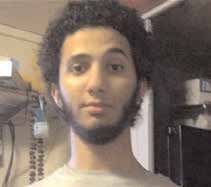
    LONDON (TIP): A teenager from Cardiff, Wales has been added to a UN banned list of the world’s most wanted terrorists at the request of Prime Minister David Cameron.

    Aseel Muthana, who was 17 when he traveled to Syria in 2014, was hit with the international sanction, along with four other prominent British jihadists. It is reportedly the first time a government has requested that its own citizens be added to the UN banned list in the fight against Islamic State.

    Aseel Muthana has boasted of his willingness to “die for the cause” and promoted the jihad lifestyle in media interviews since fleeing Wales last year with his brother Nasser, whose name is also on the list of banned jihadists. The sanction will see Muthana’s financial assets frozen and ban him from international travel, meaning the teenager will face deportation should he attempt to leave Syria.

    According to Downing Street sources, the group was targeted because they are currently plotting terrorist attacks both in Britain and abroad, and are active recruiters for Islamic State. Other extremists added to the UN list include Sally-Anne Jones, known as “Mrs. Terror”; Omar Hussain, dubbed the Supermarket Jihadi because he worked at Morrisons; Aqsa Hussain, who fled Glasgow two years ago; and Muthana’s brother, Nasser.

    A senior government official said the “notorious fighters” posed a “real threat” to the innocent public. Speaking of the list, the official stated the ban sends the “very clear signal
    [that] we will absolutely take action against those people who have gone to fight for Isil and will threaten our country.”

  • Israel PM calls for peace talks with Palestinians

    Israel PM calls for peace talks with Palestinians

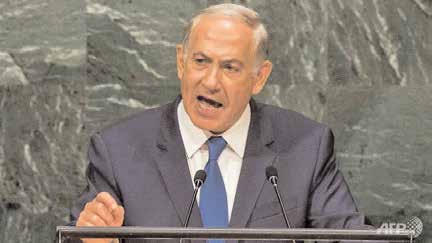
    UNITED NATIONS (TIP): Israel’s prime minister went to the United Nations on Oct 1 to call for an immediate resumption of peace talks with the Palestinians and to savage the international community’s nuclear deal with Iran.

    “I am prepared to immediately, immediately resume direct peace negotiations with the Palestinians without any conditions whatsoever,” Benjamin Netanyahu told the general assembly.

    Addressing Palestinian leader Mahmud Abbas directly, he said:

    “President Abbas, I know it’s not easy. I know it’s hard.”But we owe it to our peoples to try. To continue to try. Because together … if we actually sit down and try to resolve this conflict between us … we can do remarkable things for our people,” Netanyahu added.His remarks come with Netanyahu scheduled to speak with US President Barack Obama at the White House in November — their first meeting after a deep row about the Iranian nuclear row.Their frosty relations plummeted further during Netanyahu’s re-election campaign when he rejected a two-state solution for peace with the Palestinians.

    With the peace process in deep freeze, there are growing fears that tensions like those flaring at Jerusalem’s flashpoint Al-Aqsa mosque compound could spark a broader Palestinian uprising.Abbas told the United Nations on Wednesday that Israel’s refusal to release Palestinian prisoners and stop settlement activity, meant that Palestinians could no longer feel bound by past agreements.

    “They leave us no choice but to insist that we will not remain the only ones committed to the implementation of these agreements, while Israel continuously violates them,” he said.

    “We cannot continue to be bound by these signed agreements with Israel and Israel must assume fully all its responsibilities as an occupying power,” Abbas added, saying Palestinian patience “has come to an end.”

    Netanyahu used the first part of his speech to criticize the international community for reaching the nuclear deal with Iran.

    During his speech, he fell silent for 45 seconds after slamming the UN general assembly’s “deafening silence” in the face of repeated calls from Iran for the destruction of the Jewish state.

    “The response from this body,” he said, “has been absolutely nothing. Utter silence. Deafening silence.”

    Israel will do whatever it takes to defend itself and will not allow Iran to develop nuclear weapons, Netanyahu said.

    “Israel will not permit any force on earth to threaten its future,” he said. “Israel will do whatever it must do to defend our state and to defend our people.”

  • UK to lift curbs on turbans at work

    UK to lift curbs on turbans at work

    LONDON (TIP): A landmark rule will come into effect from Sept 30 to lift all restrictions on wearing turbans to work across the UK.

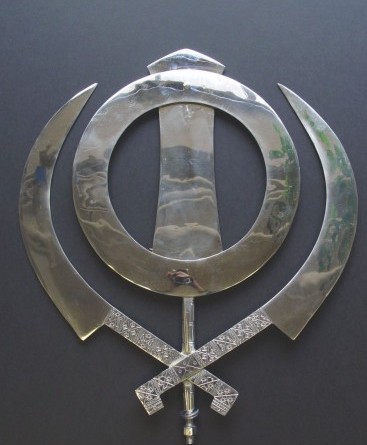
    Turban-wearing Sikhs will now have the right to choose not to wear head protection and will be exempt from legal requirements to wear a safety helmet in most workplaces, according to the UK’s minister of employment Priti Patel.

    A new clause into the Deregulation Bill 2015 says that should an individual suffer injuries as a consequence of not wearing head protection employers will be legally protected through the extension of limited liability.

    Patel said that for more than two decades, Sikhs working in the construction in dustry have been exempted from rules requiring head protection -but because of a legal loophole, those in less dangerous industries, such as those working in factories and warehouses, were not.This meant that Sikhs in many jobs who chose to wear turbans rather than the required head protection could be at risk of disciplinary action or even dismissal.

    There are exclusions for emergency response services and the military , which apply only in hazardous operational situations when the wearing of a safety helmet is considered necessary .

    This will not bar Sikhs from the armed forces or police and fire services and this clause will make no blanket ban on participation by turban wearing Sikhs.

  • Refugees face new diversion as Hungary prepares to seal Croatia border

    Refugees face new diversion as Hungary prepares to seal Croatia border

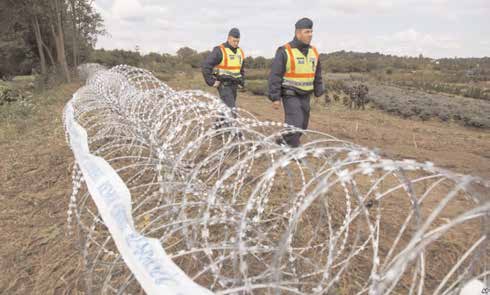
    ZAKANY, HUNGARY (TIP): A small gap in coils of newly laid razor wire is all that remains of the Zakany-Botovo border crossing between Hungary and fellow European Union member Croatia, as Budapest prepares to close off another route for refugees flocking to Europe.

    Heavy machinery is clearing trees and a 3-metre-high fence is taking shape along the line of the razor wire.

    The border, still traversed by thousands of refugees daily en route to Austria and Germany, could be sealed in a matter of minutes, potentially diverting the refugees into tiny Slovenia or stranding them in Croatia, where authorities are struggling with the scale of the influx.

    Prime Minister Viktor Orban, who has already thrown up a fence to shut down the refugee route over Hungary’s southern border with Serbia, said last week the closure was imminent, and speculation is rife that it might follow his return from the United Nations General Assembly in New York on Thursday.

    Border crossings have been fitted with gates of steel and concrete.

    At the Zakany train station, military armored personnel carriers guard a train car, one side of which has been covered in razor wire in what appears to be a replica of the wagon used to close the main refugee route from Serbia.

    The closure of that stretch of Hungary’s border saw violent clashes between police firing tear gas and water cannon and young, male refugees lobbing stones and smashed concrete.

    The European Union is moving ahead with a plan, opposed by Hungary and several other eastern, ex-Communist members of the bloc, to distribute 120,000 refugees, many of them Syrians, between its members.

    But that is just a portion of this year’s influx of refugees, which the U.N. refugee agency said on Thursday may reach 700,000 and possibly more in 2016, in the greatest movement of people in Europe since World War Two.

    Orban, one of Europe’s most vociferous opponents of immigration, says he need not wait for the fence to be completed before he orders the crossings closed. Razor wire would suffice.

    Fast-flowing river

    “We need not wait for the completion of the second layer to order the closure of the green border,” he told a news conference last week.

    “We cannot wait for an as-yet-unborn common European policy. Once everyone understands what the Hungarian intention is and they can prepare that the Serbian-Hungarian border status quo will extend to the Croatian-Hungarian border, we will put those rules in effect to enforce EU laws on border crossing.”

    The razor wire runs the length of Hungary’s border with Croatia, including along sections that follow the Drava river, a fast-flowing artery that some refugees may be tempted to swim.

    Unlike Hungary, Croatia is not a member of Europe’s Schengen zone of passport-free travel.

    Relations between the two countries have soured considerably since the refugees began flowing into Croatia after Hungary shut down their route from Serbia, reflecting the discord and recrimination running through the European Union.

    Closing the Croatia-Hungary border crossings may force Croatia to transport more refugees into Slovenia, a former Yugoslav republic of 2 million people that says it can manage an influx of 10,000 per day.

    It will likely lead to a backlog at Croatia’s eastern frontier with Serbia, crossed by thousands every day in sometimes chaotic and desperate scenes. Croatian officials have declined to comment on what might happen if or when Hungary seals the border.

    For now, the flow from Croatia into Hungary and on to Austria is unbroken, efficient even.

    Police, ambulance crews and aid workers await trainloads of refugees on the Croatian side, handing them bread, water, canned fish and an apple each before they stride across the bridge over the Drava. Lines of refugees snake through riverside shrubs to a gap in the razor wire, where Hungarian police officers and a waiting train greet them.

    Anil Safia, an 18-year-old boxer from Afghanistan, devoured the bread and fish.

    “I’m sorry I have to eat while I talk,” he told a reporter, “but I have not had anything for a day and I need to maintain my weight, you know.”

  • Another blast hits Chinese city where explosions killed 7

    Another blast hits Chinese city where explosions killed 7

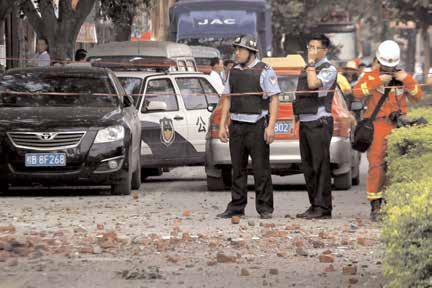
    BEIJING (TIP): An explosion damaged a six-storey building on Thursday in southern China, less than a day after more than a dozen blasts triggered by explosive devices delivered in mail packages killed at least seven people and injured over 50 in the same county in southern China, officials and state media said.

    The latest blast hit a civilian’s house near a highway administration bureau in Liucheng in Guangxi region, which borders Vietnam, but it was not immediately known if there were any casualties, according to the official Xinhua News Agency.

    The ministry of public security said it was treating the blasts on Wednesday as a criminal act, and not terrorism. It said a 33-year-old local man, identified only by his family name of Wei, was considered a suspect, but provided no further details, including a possible motive or whether the man had been detained. Local media reported that the suspect had been apprehended.

    Xinhua said that the suspect had hired others to help deliver the bombs.

    A local Communist Party newspaper, the Guangxi Daily, cited police as saying there were 17 explosions Wednesday afternoon in Liucheng, leaving seven people dead, two missing and 51 injured.

    Police in Liucheng said they will hold a news conference later Thursday.

    Oct 1 explosions, which occurred between 3:15pm and 5pm, hit a hospital, local markets, a shopping mall, a bus station and several government buildings, including a jail and dormitories for government workers, according to a police statement posted by the local newspaper Nanguo Zaobao.

    “There were so many of them, and they were so loud, everyone in (Liucheng) could hear them,” said a hotel employee who gave only his family name, Li. The hotel is near a township office building that was hit by one of the explosions.

    “They sounded like someone was blasting rocks in the mountains,” Li said.

    Zhou Changqing, the police chief for the city of Liuzhou, which has jurisdiction over Liucheng, said the blasts were triggered by explosive devices delivered in several mail packages, state broadcaster CCTV reported.

    A supermarket employee said the store was evacuated immediately when an adjacent supermarket was hit by an explosion.

    “All of us heard the blast. It was very loud,” he said by phone.

  • 50 KNIFED TO DEATH IN CHINA COAL MINE, UIGHURS SUSPECTED

    BEIJING (TIP): At least 50 people were knifed to death last month inside a coal mine in the restive Xinjiang province, reported US-based Radio Free Asia on Thursday – an attack suspected to have been carried out by Uighur separatists who are known to use knife for terror attacks.

    Radio Free Asia said the number of people killed in the September 18 attack at the Sogan colliery in Aksu had reached 50, with most casualties being members of the Han Chinese majority. The news came as the country marked 60 years since the establishment of what it calls the Xinjiang Autonomous Region.

    Radio Free Asia, citing its own sources, said that the attackers first “rammed their vehicles using trucks loaded down with coal”, while trying to block the entry of police personnel, who rushed to the scene. “Nearly all workers who were on the shift at the time were killed or injured,” police officer Ekber Hashim told RFA. “Some workers were sleeping while others were preparing to work when the attackers raided the building after killing the security guards.”

    Beijing’s concerns about Pakistan’s Taliban backing Xinjiang separatists features regularly in discussions between the two countries. A Communist Party official in charge of religious groups and ethnic minorities, Yu Zhengsheng, warned local authorities not to rest on their laurels because the threat from terrorists was severe.

    “We must fully recognize that Xinjiang faces a very serious situation in maintaining long-term social stability, and we must make a serious crackdown on violent terror activities the focal point of our struggle,” Yu said. Meanwhile, three more explosions rocked China’s Guangxi province, killing one more person on Oct 1.

  • INDIA BRIGHT SPOT IN SLOWING GLOBAL ECONOMY: IMF CHIEF

    NEW DELHI (TIP): Global growth will be likely weaker this year than last with only a modest acceleration expected in 2016, International Monetary Fund chief Christine Lagarde said on Wednesday, and reiterated that India remains a bright spot.

    “The good news is that we are seeing a modest pickup in advanced economies. The moderate recovery is strengthening in the euro area, Japan is returning to positive growth, and activity remains robust in the US and the UK as well. The not-so-good news is that emerging economies are likely to see their fifth consecutive year of declining rates of growth,” Lagarde said in a speech ahead of October 9-11 IMF-World Bank annual meetings.

    “India remains a bright spot. China is slowing down as it rebalances away from export-led growth. Countries such as Russia and Brazil are facing serious economic difficulties. Growth in Latin American countries, in general, continues to slow sharply. We are also seeing weaker activity in low-income countries – which will be increasingly affected by the worsening external environment,” she said.

    The IMF will release its World Economic Outlook next week. She said policy makers will need to strengthen policies to address current challenges and help lead the world economy to recovery.

    “I am calling on policy makers to make a policy upgrade to address the current challenges,” Lagarde said, adding that the world is at a “difficult and complex juncture”.

    The prospect of rising US interest rates, China’s slowdown, a sharp deceleration in the growth of global trade, and the rapid drop in commodity prices are contributing to global uncertainty, she noted.

    With conflict and forced migration, Lagarde said there is the “human toll” from economic dislocation and low activity. More than 200 million people remain unemployed worldwide, income inequality is rising, and women continue to be disadvantaged both in pay and labour market opportunities.

    “My key message today, however, is this: With the right policies, strong leadership, and global cooperation, it can be managed,” Lagarde stressed. “The bottom line is that proactive policy management by everyone…is now more important than ever.”

  • FORD AND VOLVO AMONG MORE CARMAKERS ACCUSED OVER EMISSIONS

    Massive levels of pollution are being emitted by diesel vehicles built by a wide range of carmakers, according to tests carried out by one of the world’s biggest independent motoring organizations.

    The findings are a further blow to the car industry already reeling from revelations that Volkswagen fitted vehicles with software that deceived US regulators about pollution from their diesel engines.

    According to the German motoring organization Adac, the Volvo S60, Renault’s Espace Energy and the Jeep Renegade all exceeded legal European emission limits for nitrogen oxide by more than 10 times.

    It also found that the Nissan-made X-Trail produced 14 times more than permitted, although Nissan insisted Adac had tested the wrong car.

    Adac, the world’s second-biggest motoring organization, used a strict new emissions standard that will not come into force in Europe for another two years.

    The findings reveal that the car emissions scandal extends far beyond Volkswagen and encompasses many other manufacturers including Mercedes, BMW, Mazda, Fiat, Ford and Peugeot.

    Consumers will be alarmed that many popular models are involved although, unlike VW, there is no suggestion that any of the other manufacturers have employed devices to cheat the testing regime.

    Instead the results highlight the shocking inadequacy of the EU testing regime. Manufacturers, including Nissan, Hyundai and Renault, said that they had abided by the rules. Studies show that rising levels of car pollutants are killing thousands of Britons every year.

    There has been widespread criticism of the EU’s lax current emissions standards and testing regime, known as the New European Driving Cycle (NEDC). All diesel car manufacturers have managed to meet this requirement. However, it is widely accepted that the “real-world” NOx emissions of diesel passenger cars are substantially higher than the certified limit.

    The Adac study employed a UN-sanctioned test which experts say better reflects real-life driving conditions. However the test is not due to come into force until 2017. Critics say car firms have lobbied fiercely to delay its implementation because of the cost of meeting stricter environmental controls.

    The report says the tougher UN emissions standard should be implemented “as soon as possible”. Adac said it employed the stricter test because the NEDC tests
    “are not realistic” and fail to give drivers sufficient information about emissions or fuel mileage rates.

    Nissan UK said the model Adac tested was a pre-production vehicle designed to meet previous EU NOx limits. “It is not correct. What they [Adac] have done is compared apples with pears,” a spokesman said. Nearly 1.2 million cars were sold in the UK fitted with the cheat software which sparked the emissions scandal, Volkswagen has announced. It admitted that a slew of models including VW, Audi, Seat and Skoda as well as commercial vehicles were sold to British customers fitted with so-called “defeat devices”.

    As many as one in 10 diesel vehicles on British roads are affected, which means the UK is one of the worst-affected countries after Germany where 2.8 million vehicles are involved. Worldwide, VW has said more than 11 million vehicles are affected.

    Richard Lloyd, executive director of the consumer group Which? said: “We now need the Government to urgently set out a timetable for action so that consumers can get redress. We also want the rest of the car industry to swiftly set out whether their tests have been manipulated and if their customers have been misled.”

    VW said it would pass vehicle identification numbers to dealers as well as setting up a way for owners to check for themselves. Affected customers would then be contacted about visiting a mechanic to have their vehicles refitted. Callers to VW’s helpline were told their vehicle log books would show if they were fitted with the affected EA 189 EU5 diesel engines.

    VW stressed all the vehicles are safe and roadworthy. Vehicles affected include more than 508,000 VWs, 393,450 Audis, 76,773 Seats, 131,569 Skodas and almost 80,000 VW commercial vehicles.

  • Maruti sales rise 3.7% at 1,13,759 units in September

    Maruti sales rise 3.7% at 1,13,759 units in September

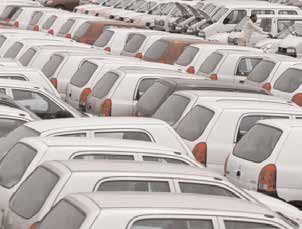
    NEW DELHI (TIP): Maruti Suzuki India, country’s largest carmaker, on Thursday reported 3.7 per cent rise in total sales in September at 1,13,759 units as against 1,09,742 units sold in the same month last year.

    Domestic sales increased by 6.8 per cent during the month to 1,06,083 units as against 99,290 units in September, 2014, Maruti Suzuki India (MSI) said in a statement.

    Sales of mini segment cars, including, Alto and WagonR, increased marginally to 35,570 units as compared to 35,547 units in the year-ago month.

    The company said sales of the compact segment comprising Swift, Estilo, Ritz and Dzire increased by 3.5 per cent to 44,826 units in September this year as against 43,304 units last year.

    MSI said sales of its compact sedan Dzire Tour surged over two-fold during the month under review at 3,229 units as against 1,221 units in September, 2014.

    The sales of mid-sized sedan Ciaz, which was launched in October, 2014, stood at 4,291 units.

    The company had sold 1,375 units of SX4 sedan in September, 2014. There was no sale of premium sedan Kizashi during the month. The company said it sold 3,600 units of its newly launched premium crossover S-Cross during the last month.

    Sales of utility vehicles, including Gypsy, Grand Vitara and Ertiga, rose by 5.9 per cent at 6,331 units in September this year from 5,980 units in the corresponding month last year.

    Sales of vans — Omni and Eeco — declined marginally to 11,836 units in September this year as compared to 11,863 units in the same period of previous year.

    Exports during the month declined by 26.6 per cent to 7,676 units as compared to 10,452 units in September last year, MSI said, adding that overseas shipment of around 3,500 units was delayed last month.

  • India’s manufacturing output slips to 7-month low in September

    NEW DELHI (TIP): India’s manufacturing sector output slipped to a seven-month low of 51.2 in September, as order flow turned sluggish amid “difficult economic climate”, a Nikkei survey said.

    The Nikkei India Manufacturing PMI — a composite monthly indicator of manufacturing performance –stood at 51.2 in September, down from 52.3 in August.

    A figure above 50 represents expansion while one below that level means contraction.

    “Despite having been supported by sustained increases in new work, growth of Indian manufacturing production in September was weighed down by a difficult economic climate,” Pollyanna De Lima, economist at Markit and author of the report, said.

    Nonetheless, the region’s growth prospects for the July-September quarter are encouraging. According to PMI data, the manufacturing sector looks set to provide a stronger contribution to GDP than it did in the April-June quarter, Lima added. According to the survey, PMI was weighed down by slower increases in new orders and output as growth of new work moderated to the weakest since June, reflecting challenging economic conditions.

  • LEGAL IMPRESSION : The Religious Land Use and Institutionalized Persons Act of 2000

    A lot of Indians running Gurudwaras/temples/mosques or being in detention centers, either owing to deportation or based on criminal convictions, are not aware of a big federal relief provided to them. And that is Religious Land Use and Institutionalized Persons Act of 2000 (RLUIPA), 42 U.S.C. §§ 2000cc, a federal law which protects individuals in detentions, houses of worship, and other religious institutions from discrimination in zoning and landmarking laws. What is it?

    Let us talk about a Sikh boy in a detention center. Immigration detention facilities, private or public have at times, rather most of the times forced Sikh detainees to have their hair cut. This is illegal. One of the Sikh’s religious tenets/beliefs is not cutting their hair. RLUIPA protects it–it is to include “any exercise of religion, whether, or not compelled by, or central to, a system of religious belief.” So, it is enough for the Sikh boy to say that it is part of his religion to have no hair cut. Government cannot compel him to do otherwise.

    Now, another example.  

    If some Sikh members want to open a Gurudwara and they buy a property, say, in Richmond Hill, in an area that is primarily residential. So, the members of the Gurudwara applied for a variance, so that they could construct the building of their choice and have a religious assembly or kirtan on a regular basis. But the zoning board or related authorities deny that permit. But meanwhile, a private non-religious school nearby acquires a piece of property and has successfully got it rezoned. Here, the Gurudwara can challenge that denial of the permit. Because it violated all of the RLUIPA’s discrimination laws. RLUIA prohibits the local land authorities, the following three:

    Equal Terms: 

    No government shall impose or implement a land use regulation in a manner that treats a religious assembly or institution on less than equal terms with a non religious assembly or institution.

    Nondiscrimination: 

    No government shall impose or implement a land use regulation that discriminates against any assembly or institution on the bases of religion or religious denomination.

    Exclusion and limits: 

    No government shall impose or implement a land use regulation that (a) totally excludes religious assemblies from a jurisdiction; or (b) unreasonably limits religious assemblies, institutions, or structures within a jurisdiction.

    If you feel that your religious rights were violated either in a detention center or regarding city or authorities denying you permission to have a temple or Gurudwara or a mosque, then you have a case.

    Attorney Karamvir Dahiya(The author is a graduate of Harvard Law School, studied tax law at New York University School of Law, bankruptcy law at St. Johns University School of Law and sociology of law from the International Institute of Sociology of Law, Onati, Spain.

    Karam has established a name in the bankruptcy courts combating predatory lenders’ claims and lawsuits as well as defending the debtors and their family members from predatory reach of the Chapter 7 trustees. He has, against jurisdictional and statutory odds, successfully taken the cases out of the bankruptcy courts (‘withdrawal of reference’) to the District Courts for a fuller and better adjudication of the clients’ claims including those related to constitutional protection and privileges. He is regularly called upon by his colleagues in matters and issues dealing with consumer protections laws related to TILA, HOEPA, NY usury and high cost loans.

    Dahiya’s special interest and expertise are federal jurisdiction and constitutional rights. He has successfully argued and obtained relief for several individuals under habeas and
    mandamus writs and navigated complicated immigration matters through the agencies to the circuit courts. In addition to New York State and Federal Courts, he is also certified to practice law in the Delhi High Court and Supreme Court of India. He can be reached at karam@legalpundit.com)