Month: October 2015

  • UK city of Coventry honours Ratan Tata

    LONDON (TIP): Leading Indian industrialist Ratan Tata has been felicitated by the city of Coventry with its highest award in recognition of his contributions to the West Midlands region of central England.

    The Tata Group Chairman Emeritus took oath as an Honorary Freeman of the City of Coventry, an award only 13 people have been conferred with since 1914.

    Tata, 77, was honoured alongside Indian-origin professor Lord Kumar Bhattacharyya, founder of the Warwick Manufacturing Group (WMG), at the University of Warwick in Coventry, at a special ceremony at Coventry Cathedral last week.

    “Recognising two people who have helped in the regeneration of the city is a way of celebrating all that is good about the city and its future,” said Coventry Lord Mayor, Councillor Michael Hammon.

    Earlier this year, Tata-owned Jaguar Land Rover (JLR) had reaffirmed its long term commitment to Coventry and the West Midlands with a confirmation of a further 600-million-pound investment to support product creation and advanced vehicle manufacturing.

    TATA group is also among key contributors to a new 150-million-pound National Automotive Innovation Centre under construction on the University of Warwick campus.

    Professor Sir Nigel Thrift, Vice Chancellor of the University of Warwick, said, “Coventry and much of the rest of our region has gained greatly through the vision of these two men. Mr Ratan Tata has transformed the fortunes of Jaguar Land Rover and part of that transformation has seen new jobs created for our city and region and strong new research partnerships pioneered with Professor Lord Bhattacharyya that are creating world leading engineering technologies”.

    Councillor Ann Lucas, Leader of Coventry Council, added, “The vision, leadership and commitment of Mr Tata and Professor Lord Bhattacharyya has been instrumental in placing Coventry on a world stage. Growing the city’s economy is fundamental to achieving our aim of becoming a top 10 city we are delighted to award Mr Tata and Professor Lord Bhattacharyya the highest honour in recognition of their impact on the city. We truly value their friendship”.

    The two men travelled to Coventry Cathedral from the city’s Council House in a 1955 Jaguar Mark VIIM, a car owned by Queen Elizabeth II’s late mother.

    “Mr Tata and Professor Lord Bhattacharyya have made a huge contribution to the British automotive industry, and even more significantly have planted some of the seeds for automotive research, innovation and advanced manufacturing in the future,” said JLR CEO Ralf Speth.

  • GANDHI JAYANTI

    GANDHI JAYANTI

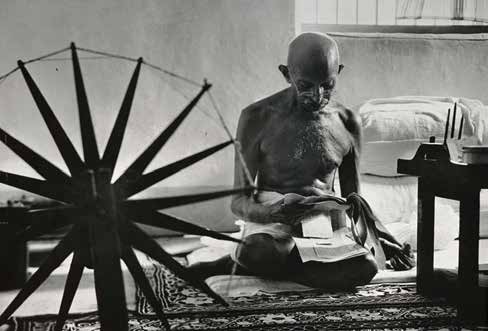
    Mohandas Karamchand Gandhi, more commonly known as ‘Mahatma’ (meaning ‘Great Soul’) was born in Porbandar, Gujarat, in North West India, on 2nd October 1869, into a Hindu Modh family.

    Gandhi Jayanti is a gazetted holiday in India on October 2 each year. It marks the anniversary of Mahatma Gandhi’s birth on October 2. Gandhi is remembered for his contributions towards the Indian freedom struggle.

    Born into a privileged caste, Gandhi was fortunate to receive a comprehensive education, but proved a mediocre student. In May 1883, aged 13, Gandhi was married to Kasturba Makhanji, a girl also aged 13, through the arrangement of their respective parents, as is customary in India. Following his entry into Samaldas College, at the University of Bombay, she bore him the first of four sons, in 1888. Gandhi was unhappy at college, following his parent’s wishes to take the bar, and when he was offered the opportunity of furthering his studies overseas, at University College London, aged 18, he accepted with alacrity, starting there in September 1888.

    Determined to adhere to Hindu principles, which included vegetarianism as well as alcohol and sexual abstinence, he found London restrictive initially, but once he had found kindred spirits he flourished, and pursued the philosophical study of religions, including Hinduism, Christianity, Buddhism and others, having professed no particular interest in religion up until then. Following admission to the English Bar, and his return to India, he found work difficult to come by and, in 1893, accepted a year’s contract to work for an Indian firm in Natal, South Africa.

    Although not yet enshrined in law, the system of ‘apartheid’ was very much in evidence in South Africa at the turn of the 20th century. Despite arriving on a year’s contract, Gandhi spent the next 21 years living in South Africa, and railed against the injustice of racial segregation. On one occasion he was thrown from a first class train carriage, despite being in possession of a valid ticket. Witnessing the racial bias experienced by his countrymen served as a catalyst for his later activism, and he attempted to fight segregation at all levels. He founded a political movement, known as the Natal Indian Congress, and developed his theoretical belief in non-violent civil protest into a tangible political stance, when he opposed the introduction of registration for all Indians, within South Africa, via non-cooperation with the relevant civic authorities.

    On his return to India in 1916, Gandhi developed his practice of non-violent civic disobedience still further, raising awareness of oppressive practices in Bihar, in 1918, which saw the local populace oppressed by their largely British masters. He also encouraged oppressed villagers to improve their own circumstances, leading peaceful strikes and protests. His fame spread, and he became widely referred to as ‘Mahatma’ or ‘Great Soul’.

    As his fame spread, so his political influence increased: by 1921 he was leading the Indian National Congress, and reorganising the party’s constitution around the principle of ‘Swaraj’, or complete political independence from the British. He also instigated a boycott of British goods and institutions, and his encouragement of mass civil disobedience led to his arrest, on 10th March 1922, and trial on sedition charges, for which he served 2 years, of a 6-year prison sentence.

    The Indian National Congress began to splinter during his incarceration, and he remained largely out of the public eye following his release from prison in February 1924, returning four years later, in 1928, to campaign for the granting of ‘dominion status’ to India by the British. When the British introduced a tax on salt in 1930, he famously led a 250-mile march to the sea to collect his own salt. Recognising his political influence nationally, the British authorities were forced to negotiate various settlements with Gandhi over the following years, which resulted in the alleviation of poverty, granted status to the ‘untouchables’, enshrined rights for women, and led inexorably to Gandhi’s goal of ‘Swaraj’: political independence from Britain.

    Gandhi suffered six known assassination attempts during the course of his life. The first attempt came on 25th June 1934, when he was in Pune delivering a speech, together with his wife, Kasturba. Travelling in a motorcade of two cars, they were in the second car, which was delayed by the appearance of a train at a railway level crossing, causing the two vehicles to separate. When the first vehicle arrived at the speech venue, a bomb was thrown at the car, which exploded and injured several people. No investigations were carried out at the time, and no arrests were made, although many attribute the attack to Nathuram Godse, a Hindu fundamentalist implacably opposed to Gandhi’s non-violent acceptance and tolerance of all religions, which he felt compromised the supremacy of the Hindu religion. Godse was the person responsible for the eventual assassination of Gandhi in January 1948, 14 years later.

    During the first years of the Second World War, Gandhi’s mission to achieve independence from Britain reached its zenith: he saw no reason why Indians should fight for British sovereignty, in other parts of the world, when they were subjugated at home, which led to the worst instances of civil uprising under his direction, through his ‘Quit India’ movement. As a result, he was arrested on 9th August 1942, and held for two years at the Aga Khan Palace in Pune. In February 1944, 3 months before his release, his wife Kasturbai died in the same prison.

    May 1944, the time of his release from prison, saw the second attempt made on his life, this time certainly led by Nathuram Godse, although the attempt was fairly half-hearted. When word reached Godse that Gandhi was staying in a hill station near Pune, recovering from his prison ordeal, he organised a group of like-minded individuals who descended on the area, and mounted a vocal anti-Gandhi protest. When invited to speak to Gandhi, Godse declined, but he attended a prayer meeting later that day, where he rushed towards Gandhi, brandishing a dagger and shouting anti-Gandhi slogans. He was overpowered swiftly by fellow worshippers, and came nowhere near achieving his goal. Godse was not prosecuted at the time.

    Four months later, in September 1944, Godse led a group of Hindu activist demonstrators who accosted Gandhi at a train station, on his return from political talks. Godse was again found to be in possession of a dagger that, although not drawn, was assumed to be the means by which he would again seek to assassinate Gandhi. It was officially regarded as the third assassination attempt, by the commission set up to investigate Gandhi’s death in 1948.

    The British plan to partition what had been British-ruled India, into Muslim Pakistan and Hindu India, was vehemently opposed by Gandhi, who foresaw the problems that would result from the split. Nevertheless, the Congress Party ignored his concerns, and accepted the partition proposals put forward by the British.

    The fourth attempt on Gandhi’s life took the form of a planned train derailment. On 29th June 1946, a train called the ‘Gandhi Special’, carrying him and his entourage, was derailed near Bombay, by means of boulders, which had been piled up on the tracks. Since the train was the only one scheduled at that time, it seems likely that the intended target of derailment was Gandhi himself. He was not injured in the accident. At a prayer meeting after the event Gandhi is quoted as saying:

    “I have not hurt anybody nor do I consider anybody to be my enemy, I can’t understand why there are so many attempts on my life. Yesterday’s attempt on my life has failed. I will not die just yet; I aim to live till the age of 125.” Sadly, he had only eighteen months to live. Placed under increasing pressure, by his political contemporaries, to accept Partition as the only way to avoid civil war in India, Gandhi reluctantly concurred with its political necessity, and India celebrated its Independence Day on 15th August 1947. Keenly recognising the need for political unity, Gandhi spent the next few months working tirelessly for Hindu-Muslim peace, fearing the build-up of animosity between the two fledgling states, showing remarkable prescience, given the turbulence of their relationship over the following half-century.

    Unfortunately, his efforts to unite the opposing forces proved his undoing. He championed the paying of restitution to Pakistan for lost territories, as outlined in the Partition agreement, which parties in India, fearing that Pakistan would use the payment as a means to build a war arsenal, had opposed. He began a fast in support of the payment, which Hindu radicals, Nathuram Godse among them, viewed as traitorous. When the political effect of his fast secured the payment to Pakistan, it secured with it the fifth attempt on his life.

    On 20th January a gang of seven Hindu radicals, which included Nathuram Godse, gained access to Birla House, in Delhi, a venue at which Gandhi was due to give an address. One of the men, Madanla Pahwa, managed to gain access to the speaker’s podium, and planted a bomb, encased in a cotton ball, on the wall behind the podium. The plan was to explode the bomb during the speech, causing pandemonium, which would give two other gang members, Digambar Bagde and Shankar Kishtaiyya, an opportunity to shoot Gandhi, and escape in the ensuing chaos. The bomb exploded prematurely, before the conference was underway, and Madanla Pahwa was captured, while the others, including Godse, managed to escape.

    Pahwa admitted the plot under interrogation, but Delhi police were unable to confirm the participation and whereabouts of Godse, although they did try to ascertain his whereabouts through the Bombay police.

    After the failed attempt at Birla House, Nathuram Godse and another of the seven, Narayan Apte, returned to Pune, via Bombay, where they purchased a Beretta automatic pistol, before returning once more to Delhi.

    On 30th January 1948, whilst Gandhi was on his way to a prayer meeting at Birla House in Delhi, Nathuram Godse managed to get close enough to him in the crowd to be able to shoot him three times in the chest, at point-blank range. Gandhi’s dying words were claimed to be “Hé Ram”, which translates as “Oh God”, although some witnesses claim he spoke no words at all.

    When news of Gandhi’s death reached the various strongholds of Hindu radicalism, in Pune and other areas throughout India, there was reputedly celebration in the streets. Sweets were distributed publicly, as at a festival. The rest of the world was horrified by the death of a man nominated five times for the Nobel Peace Prize.

    Godse, who had made no attempt to flee following the assassination, and his co-conspirator, Narayan Apte, were both imprisoned until their trial on 8th November 1949. They were convicted of Gandhi’s killing, and both were executed, a week later, at Ambala Jail, on 15th November 1949. The supposed architect of the plot, a Hindu extremist named Vinayak Damodar Savarkar, was acquitted due to lack of evidence.

    Gandhi was cremated as per Hindu custom, and his ashes are interred at the Aga Khan’s palace in Pune, the site of his incarceration in 1942, and the place his wife had also died.

    Gandhi’s memorial bears the epigraph “Hé Ram” (“Oh God”) although there is no conclusive proof that he uttered these words before death.

    Although Gandhi was nominated for the Nobel Peace Prize five times, he never received it. In the year of his death, 1948, the Prize was not awarded, the stated reason being that “there was no suitable living candidate” that year.

    Gandhi’s life and teachings have inspired many liberationists of the 20th Century, including Dr. Martin Luther King in the United States, Nelson Mandela and Steve Biko in South Africa, and Aung San Suu Kyi in Myanmar.

  • Oregon shooting: Gunman targeted Christians specifically

    Oregon shooting: Gunman targeted Christians specifically

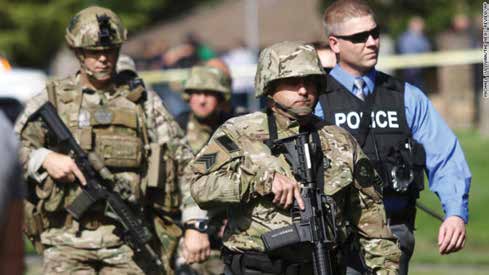
    WASHINGTON (TIP): Ten people were killed when a gunman opened fire at Oregon’s Umpqua Community College on Thursday, Oct 02, forcing the nation to face yet another mass shooting. The shooter is dead, Douglas County Sheriff John Hanlin told reporters while withholding the name of the shooter. “I will not name the shooter,” Hanlin said. “I will not give him the credit he probably sought.” However, multiple law enforcement officials familiar with the investigation identified the gunman as 26-year-old Chris Harper Mercer. Investigators have interviewed members of his family and friends, they said.

    Oregon shooting - Grieving  for the loss
    Oregon shooting – Grieving for the loss

    A law enforcement official said the shooter had body armor with him and was heavily armed, with a large amount of ammunition –enough for a prolonged gunfight.

    The shooter was targeting Christians specifically, according to the father of a wounded student.

    Anastasia Boylan, 18, told her father and brother before undergoing spinal surgery that the gunman entered her classroom firing, shooting the point blank.

    Others were hit, and everyone in the classroom dropped to the ground, she told her family.

    As he reloaded, the shooter ordered the students to stand up if they were Christians.

    “And they would stand up and he said, ‘Good, because you’re a Christian, you’re going to see God in just about one second,’” Boylan’s father, Stacy, told CNN. “And then he shot and killed them.”

    President Obama pushed for a change in gun laws when he spoke to reporters about the shooting Thursday.

    “Somehow this has become routine. The reporting is routine. My response here at this podium ends up being routine, the conversation in the aftermath of it. We’ve become numb to this,” he said.

    The President continued: “Our thoughts and prayers are not enough. It’s not enough. It does not capture the heartache and grief and anger that we should feel, and it does nothing to prevent this carnage from being inflicted someplace else in America – next week, or a couple months from now.”

  • Nepal Crisis Deepens; India Rejects Allegations of Blockade

    Nepal Crisis Deepens; India Rejects Allegations of Blockade

    NEW DELHI  (TIP): Ethnic groups’ protests have erupted in Nepal after the Himalayan nation adopted its first democratic constitution in Sep, 2015. Nepal saw an end to a decade-long Maoist insurgency in 2006 and abolished its centuries-old monarchy two years later.

    It spent years since then grappling with writing a new constitution in an attempt to end a period of political drift. India stepped in  two phases to help resolve the issues. Firstly, some BJP leaders said they wanted Nepal to become a Hindu state. Later, the NDA government began to negotiate with Nepal on behalf of the madhesis, which the Nepali leadership took as “an external interference”. Indian foreign secretary S. Jaishankar’s last-minute meetings with the Nepali leadership bore no fruit. This was followed by an indefinite economic blockade of Nepal by madhesi agitators.

    Nepal has been brought to a standstill after India imposed an “unofficial economic blockade,” according to officials in Kathmandu, following a row over its new constitution. India has rejected these allegations as “totally false”, saying it is the responsibility of the Nepal government to facilitate the entry of trucks.

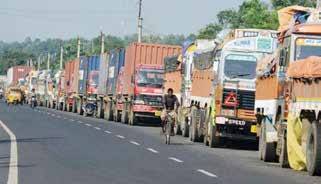
    Hundreds of trucks and tankers carrying everyday supplies have been halted at the Indian border, preventing them from entering Nepal, a landlocked country that has open borders with India to the south, east, and west, and relies on supplies – most importantly food and fuel – coming across.

    This is in reminiscent of the closure of 20 of the 22 official entry points by India in 1989, which, most Nepalis say, happened after King Birendra reportedly turned down a breakfast invitation by Rajiv Gandhi in Pakistan during a SAARC meeting.

    India has expressed concern over growing anti-India sentiment in Nepal saying it “won’t do any good to both countries”.

    “We have noticed anti-India sentiment in a section of media, in social (networking) sites and on the streets. We have taken it up seriously and we have brought it to the notice of the government of Nepal,” India’s ambassador to Nepal, Ranjit Rae  said at a press conference in Kathmandu on Wednesday night.

    Student wings of Nepal’s political parties have been staging protests in front of the Indian embassy in Kathmandu almost every day after supplies from the Indian side stopped last week.

    Expressing concern over anti-India protests in Nepal, the ambassador said the agitation in the Terai districts and difficulties faced in bringing supplies from India were being used to spread anti-India sentiments. “This is Nepal’s internal affair, not an issue between Nepal and India,” he said.

    “Torching India’s flag and effigy of Prime Minister Narendra Modi won’t do any good to both countries. That such incidents are happening is a serious matter,” Rae added.

    Here are the latest developments:

    • “We can only take goods up to the border and beyond the border, it is the responsibility of the Nepalese side to ensure that there is adequate safety and security for the trucks to enter that side,” External Affairs Ministry Spokesperson Vikas Swarup said October 2.
    • Long lines of trucks, extending as far as 10 kilometers, have been stranded on the Indian side of the border for over five days. The government says that the trucks are unable to proceed due to the disturbed security situation in the southern Terai region of Nepal.
    • But top Nepalese leaders have accused India of violating international laws by halting cross-border trade. “We are not getting fuel, cooking gas and vegetables from India and we don’t want such kind of friendship,” said KP Oli, chief of the ruling UML party, who is tipped to be the next prime minister.
    • Amid rising tension with India, there has been increased speculation in Kathmandu over whether fuel could be imported to Nepal from its other neighbor China. But Nepalese officials were quick to play down the reports. “There is no alternative to the road to India,” Prakash Adhikari, press advisor to Prime Minister Sushil Koirala told Reuters. “Getting petrol and petroleum products from mainland China is difficult due to the terrain.”
    • In capital Kathmandu, the government has begun rationing of petroleum products to tackle the fuel crisis. “Beginning on Thursday, we are further restricting distribution due to the very limited supplies we have. Private vehicles will not be able to purchase petrol or diesel,” said Laxmi Prasad Dhakal, a home ministry spokesman.
    • On Wednesday, trucks from India carrying essential goods and petroleum products started entering Nepal – about 100 cargo trucks entered the country from the Sunauli border in Uttar Pradesh.
  • The Indian Panorama Hosts Long Island Premiere of Tirlok Malik’s New Film ‘On Golden Years’

    The Indian Panorama Hosts Long Island Premiere of Tirlok Malik’s New Film ‘On Golden Years’

    LONG ISLAND, NY (TIP): The Long Island Premiere of Emmy Award Nominee Tirlok Malik’s new film “On Golden Years” was hosted on September 27, at Farmingdale Multiplex Cinemas   by The Indian Panorama and Prof. Indrajit Saluja who is also one of the lead actors in the film.

    On Golden Years1The premiere which was attended by many members of the cast and crew drew a huge gathering, filling up the theater. The guests included many media and community leaders from Long Island. At the premiere, filmmaker Tirlok Malik was presented a citation from Nassau County Office of the Comptroller. It was presented by Dilip Chauhan, Director of South East Asian Affairs with the office of the Nassau County Comptroller.

    Many of the audiences from Long Island had witnessed Mr. Malik’s previous films such as Lonely in America, Khushiyaan and many more. Malik’s films have been about Indian American immigrant experience in America. His work has been shown all over the world and has won many awards. Malik has given chances to many new talents in front of the camera and as well as behind the camera. Same was the case with the film “On Golden Years”. Many Long Island residents such as Indu Gajwani, Sunita Babber, Professor Indrajit Saluja, Lovllien Kaurr, Reeves Lehmann and others are also a part of this movie “On Golden Years.”

    The film also portrays the complex emotions, which come at the time of retirement for immigrants. Through various characters, who are residents of an Indian retirement community, the film deals with the conflicts such as India vs America, contentedness vs regrets and places to retire etc. This is the story about the retirement of the American Dream.

    Some of the guests at the premiere who gave their felicitations included  Dr. Parveen Chopra, Indu Jaiswal, Darshan Bagga, Rao Anumolu, Uma Sengupta, Sharanjit Singh Thind, Dharmatan Saran, Satnam Parhar, Jarnail Singh Gilzian, Parveen Chopra, Bidisha  Roy, Dr.Krishna Jhaveri, Dr. Ajay Lodha.

    Malik thanked Professor Saluja and The Indian Panorama for hosting the Long Island premiere. Malik also commented that Mr. Saluja has done the wonderful work as an actor in the film.

    The film On Golden Years stars RANJIT CHOWDHRY who was also the lead of Lonely In America, JYOTI SINGH, REEVES LEHMANN, SHETAL SHAH, NOOR NAGHMI, TIRLOK MALIK, SHRUTI TEWARI, FAROKH DARUWALA, INDU GAJWANI, PROF. INDRAJIT S. SALUJA, LOVLLIEN KAURR, SANDEEP SURI, IGGY IGNATIUS, KAMLESH GUPTA and many more. There are some new talents making their debut in the film.

    The film On Golden Years is written and directed by Tirlok Malik. The film is produced by Golden Movies. The idea of the story is inspired from the book Seeking Roots by Iggy. Iggy Ignatius is also the codirector of the film. The film was shot at the Indian retirement community Shantiniketan in Florida. Other credits of the film are Director of Photography Christo Bakalov B.A.C., Music by Peter Lobo, Art Direction by Sunita Babber, Editing by Tom Knight and others.

    On Golden Years On Golden Years24 On Golden Years8 On Golden Years9Singer Falu makes her film debut doing the item number song ‘Raba Raba’ in the film On Golden Years. The opening song of the film ‘Gayatri Mantra’ is sung by Sumitra Iyer who is an award winning Bollywood singer and who now lives in America.

    The film On Golden Years is in English language and is made for NRIs and an international audience. It is a romantic emotional comedy. Its length is 85 minutes. Tirlok Malik and the team of On Golden Years are happy to share this film with the audience.

    Tirlok Malik has recently launched the website which is the first ever streaming of Indian American movies www.nritvfilmclub.com. The purpose of the website is also promoting the new talents. One can go on the website and become a member. Malik’s dream is to create NRI-wood just like Hollywood and Bollywood. He invites everyone to join his vision.
    www.nritvfilmclub.com

    Another attraction at the event was the soulful Ghazal singing by Sudhir Narain who  follows the tradition of Agra Gharana. Sudhir who cut his first disc in 1995 has until now made many and is considered to be the best Ghazal singer after the late Jagjit Singh and Mehndi Hassan.

    On Golden Years11 On Golden Years10 On Golden Years9 On Golden Years8 On Golden Years7 On Golden Years6 On Golden Years2 On Golden Years3 On Golden Years24 On Golden Years5

  • Bronze Age Britons mummified dead

    LONDON (TIP): Ancient Britons may have mummified their dead during the Bronze Age, claims a study that is the first to show that mummification may have been a common funerary practise in the UK.

    Building on a previous study conducted at a single Bronze Age burial site in the Outer Hebrides in Scotland, Tom Booth from University of Sheffield used microscopic analysis to compare the bacterial bioerosion of skeletons from various sites across the UK with the bones of the mummified bodies from Yemen and Ireland.

    The damp British climate is not favourable to organic materials and all prehistoric mummified bodies in UK will have lost their preserved tissue if buried outside of a preservative environment, researchers said. “We know that bones from bodies that have decomposed naturally are usually severely degraded by putrefactive bacteria, whereas mummified bones demonstrate immaculate levels of histological preservation,” said Booth. “The idea that European Bronze Age communities mummified and curated a proportion of their dead fundamentally alters our perceptions of funerary ritual and belief in this period,” Booth said.

  • A fervor to glimpse ‘China’s Mona Lisa’

    BEIJING (TIP): An hour before the Forbidden City opened to visitors one recent morning, the stone courtyard just south of the ancient imperial palace was abuzz. Within the vermilion walls, the usual mix of uniformed palace workers, tour guides and tourists milled about beneath a pale blue sky. Loudspeakers blared a recording about ticketing policies.

    But at the center of it all was an atypical sight: a phalanx of more than 1,000 people, flanked by palace workers whose job was to keep the ranks in line. Unlike most visitors, this small army had come with only one goal: to see “Along the River During the Qingming Festival,” an early 12th-century painted scroll considered so iconic that it is often called “China’s Mona Lisa.”

    Since an exhibition celebrating the 90th anniversary of the Palace Museum opened in early September, people have been waiting for up to 10 hours to see this 17-foot-long masterpiece attributed to the painter Zhang Zeduan, an intricate ink-on-silk tableau of life in the Northern Song dynasty capital, Kaifeng. The best-known painting in the museum’s vast collection, it has been shown in public only a few times, in Beijing most recently in 2005 for the museum’s 80th anniversary.

    The fanatical interest in the work coincides with a concerted push by the Chinese government to encourage interest in traditional culture and values, as a way of emphasizing its links to a history that goes back thousands of years.

  • AT 110, ‘OLDEST’ REFUGEE REACHES GERMANY FROM AFGHANISTAN

    A man who claims to be 110 years old has applied for asylum in Germany after spending eight months travelling 3,000 miles from Afghanistan. Abdul Qadir Azizi, arrived in Germany with his 60-yearold daughter and eight other family members, who had to carry him for much of the journey.

    Aziz’s family, when asked by German officials, said he was born on January 1, 1905.He is believed to be the oldest refugee to arrive in Germany.

  • INS Kochi |Largest India-made Warship commissioned in Mumbai

    INS Kochi |Largest India-made Warship commissioned in Mumbai

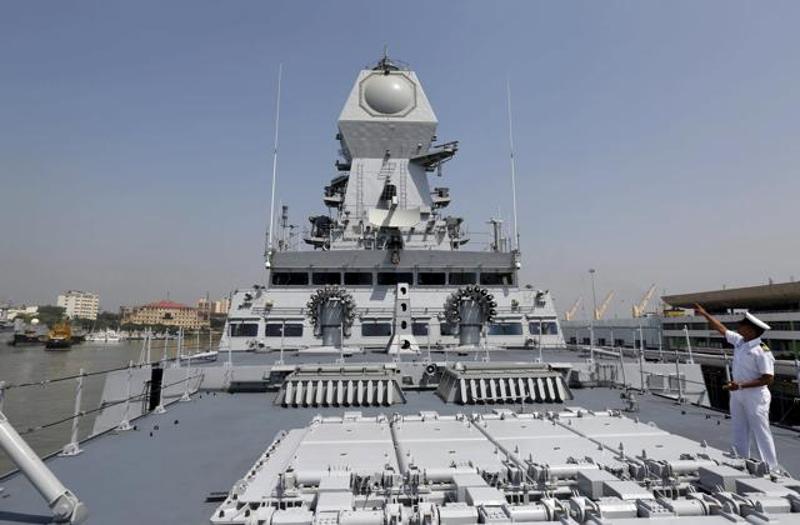
    Sep 30, 2015 (TIP): Indian Defence Minister Manohar Parrikar today commissioned the guided-missile destroyer INS Kochi in Mumbai.

    The INS Kochi is packed with weapons and sensors as well as advanced stealth features, it is the largest-ever warship to be built in India till now. The ships motto “Jahi Shatrun Mahabaho” loosely means “Armed to conquer the enemy” in Sanskrit.

    Induction of the 7,500-tonne INS Kochi, the second of the three Kolkata-class destroyers being built at Mazagaon Docks (MDL) at Mumbai for over ₹4,000 crore apiece, will make it the 10th destroyer in India’s combat fleet.

    The ship comes with a displacement of 7500 tons, it is 164 meters in length and 17 meters at the beam, it is propelled with four gas turbines and designed to achieve speeds in excess of 30 knots.

    Destroyers are second only to aircraft carriers in projecting raw combat power on the high seas. The first of this class, INS Kolkata, was commissioned in August last year, while the third INS Chennai will be inducted towards end-2016. There is also the even bigger ongoing Rs 29,644-crore project to build another four stealth destroyers at MDL, with the first INS Visakhapatnam slated for delivery in 2018-2019.