Month: October 2015

  • PFIZER, ALLERGAN IN TALKS TO CREATE $300BN DRUG GIANT

    PFIZER, ALLERGAN IN TALKS TO CREATE $300BN DRUG GIANT

    Pfizer, Allergan in talks to create $300bn drug giantBotox maker Allergan and Pfizer Inc on Thursday confirmed they were in preliminary, friendly talks on a potential merger, a deal that would create the world’s largest drugmaker. Both Pfizer and Irelandbased Allergan said no agreement has been reached and declined to discuss any terms that might leadto such a tie-up.

    Allergan shares jumped 8.2% to $310.92 in US trading, while Pfizer was off almost 1% to $35.12. A purchase of Dublin-based Allergan, with a market value of more than$113 billion, would be the biggest in Pfizer’s long history of huge deals and restore it as the world’s largest drugmaker, worth about $330 billion.

    Pfizer CEO Ian Read earlier on Thursday said he was open to any moves that produce the best long-term value for the company. Speaking at a Wall Street Journal event, Read said he was looking at various growth strategies, including a deal, “if thatwould add value to shareholders”.

    “Or we could sit tight or we could do a split. Or we could do a business development deal and then do a split, whatever produces the best long-term value,” Read said.

    Allergan, the product of a recent merger with generic drugmaker Actavis, is itself in the process of selling a large portfolio of generic medicines to Teva Pharmaceutical for$40.5 billion. Pfizer recently closed a $15-billion purchase of hospital products company Hospira.


  • RBI allows NRIs to subscribe to National Pension System

    RBI allows NRIs to subscribe to National Pension System

    MUMBAI (TIP): To enable Indians living abroad to access old age income security, Reserve Bank has allowed non-resident Indians (NRIs) to subscribe to the National Pension System (NPS).

    “It has now been decided, in consultation with the Government, to enable National Pension System (NPS) as an investment option for NRIs under FEMA, 1999,” RBI said in a notification here today.

    NRIs may subscribe to the NPS governed and administered by the Pension Fund Regulatory and Development Authority (PFRDA), provided such subscriptions are made through normal banking channels and the person is eligible to invest as per the provisions of the PFRDA Act, it said.

    The subscription amounts shall be paid by the NRIs either by inward remittance through normal banking channels or out of funds held in their NRE/FCNR/NRO account.

    The RBI, however, said there will be no restriction on repatriation of the annuity/ accumulated savings.

    NPS was launched on January, 1 2004 with the objective of providing retirement income to all the citizens. NPS aims to institute pension reforms and to inculcate the habit of saving for retirement amongst the citizens.

    Initially, NPS was introduced for the new Government recruits (except armed forces). With effect from May 1, 2009, NPS has been provided for all citizens of the country, including the unorganised sector workers, on voluntary basis.

  • Mark Zuckerberg Talks Net Neutrality at Meet With Lawmakers, India Inc Leaders

    Mark Zuckerberg Talks Net Neutrality at Meet With Lawmakers, India Inc Leaders

    NEW DELHI (TIP): Facebook founder and CEO Mark Zuckerberg today hosted a luncheon meeting with political and industry leaders to discuss various matters, including the controversial issue of net neutrality and zero-rating.

    Those present at the meeting included DIPP Secretary Amitabh Kant, Parliamentary Standing Committee on IT Chairman Anurag Thakur, Department of Telecom Secretary Rakesh Garg, Trinamool Congress MP Derek O’ Brien, Member of Parliament Rajeev Chandrasekhar and FICCI Secretary General A Didar Singh.

    “Amongst the issues that were discussed were the role of technology, regulation and policy in accelerating access to the internet… Specific issues and concerns relating to Net Neutrality and Zero Rating, as well as Internet.org and Free Basics (were also discussed),” Mr Singh said.

    He added that discussions also revolved around social media and eGovernance.

    Facebook and Free Basics (earlier called Internet.org), an initiative by the company to provide free basic Internet access to the developing world, has faced backlash with activists alleging that it violates net neutrality.

    The principle of net neutrality states that no priority should be accorded to an entity in Internet traffic flow on account of payments to service providers like telecom companies.

    “Mark Zuckerberg responded to most of the queries while expressing his deep commitment to India and to the issue of affordable access for the next billion citizens, nearly 250 million of which will come from India,” Mr Singh said.

    India is home to 300 million Internet users but also has the largest “unconnected” population (one billion) (without access to internet).

    “He (Zuckerberg) stated that, amongst all the countries in the world, India with a billion unconnected has the best possibility of aligning a best in class regulatory environment to ensure access to its citizens. No single country can boast of such an opportunity,” Mr Singh said.

    After the meeting, Mr Kant posted a selfie on Facebook and microblogging site Twitter with the young billionaire.

    “A fascinating interaction and a selfie with Mark Zuckerberg at the round table on ‘Bringing the next billion online’,” he wrote.

    Mr O’Brien also tweeted about the luncheon meeting. “Mark Zuckerberg hosted a working lunch for a group of 12 incl 3 MPs. Frank chat on #netneutrality & other issues. Then a 10 min one-on-one,” read his tweet.

  • THE HINDU TRINITY

    THE HINDU TRINITY

    As you know, Hinduism is a polytheistic religion, meaning that its followers believe in more than one god. In fact, worshippers commonly devote themselves to one god, their personal deity. Household shrines feature pictures and statues of the chosen gods. Individuals may choose this god for its special attributes. For example, Ganesh, the god with the head of an elephant, is known for overcoming obstacles and bringing success.

    Some of these gods appear in the famous Hindu epics, the Ramayana and the Mahabarata. These poems originated from the storytelling and parables of the Brahmins and ascetics. In present-day India these stories are beloved and more popular than the Vedas and Upanishads. Accessible and entertaining, rich with heroes and villains, they simultaneously provide moral and spiritual instruction.

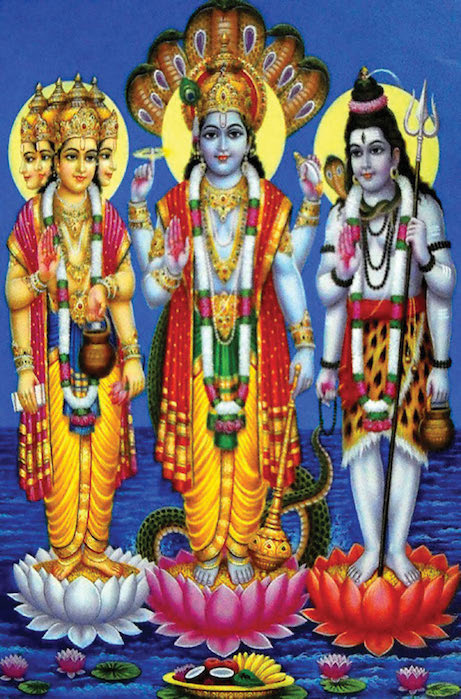
    The Rig-Veda introduced the foremost of the Hindu gods: Brahama, Vishnu, and Shiva. Although each of these deities possess special attributes, many Hindus believe they represent three properties of one god. Together they form the Hindu Trinity.

    Brahma: The Creator

    Brahma is considered the mystical creator,the supreme presence, or God. Many Hindus believe that all other gods originate from Brahma. To the right is a depiction ofBrahma. His four faces stand for the four corners of the universe. He holds a sacrifi-cial ladle, the four Vedas, a jar of holywater from the Ganges, and a necklace ofprayer beads. Like all Hindu gods, he sitsupon a lotus throne.

    At one time in the past, the two of the Hindu triad — Brahma and Vishnu — began an argument on who the most powerful of the triad was. The argument became so heated that the other gods asked Shiva, the third of the triad, to intervene. Shiva assumed the form of a gigantic lingam (the phallic symbol of Shiva that depicts him as a creator). The lingam was of flaming fire and it went up to the heavens and descended into the nether regions underneath the earth. Both Brahma and Vishnu agreed that if they could find how enormous the fiery lingam was they could determine who among the triad was the most powerful. Brahma took the form of a swan and went upwards along the length of the ascending lingam while Vishnu assumed the form of a boar and descended along the lingam into the nether regions. Both went on and on but neither could reach the ends. Vishnu, being very clever, realized that he had been outdone by Shiva and came back to acknowledge Shiva as the greatest of the triad. Unfortunately, Brahma decided that he could get past Shiva with trickery. On his ascent to determine the end of the upper part of the lingam, Brahma had passed the ketaki flower (Pandanus odorifer). Brahma requested ketaki, who was used to inhabit the upper end regions of the lingam, to testify before Shiva that he, Brahma, had reached the uppermost end. Ketaki agreed and, when brought before Shiva, the flower told Shiva that he had observed Brahma reach the upper end of the lingam. Shiva was angered at this lie. He cursed Brahma with the horror of not ever being worshipped on earth while he also cursed the flower with the depressing eternal condition of never ever being used in any Hindu worshiping rituals.

    Brahma is normally depicted as having 4 heads, though originally, he had 5. When Brahma made the universe, generated a female partner, Saraswati, out of his own substance. Through her he gave birth to the human race and represents maximum knowledge and wisdom. Brahma was charmed by his creation and had never seen such fine beauty and so he could see her from all angles, gave himself 4 heads. Where ever Saraswati went, see saw Brahma staring at her. Disgusted, she flew upward. Then, Brahma created a fifth head to look upward. Shiva was agitated by this and felt Saraswati was like Brahma’s daughter and he should be protecting her. To teach him a lesson, Shiva opened his third eye and burned off Brahma’s fifth head.

    Vishnu: The Preserver

    “Whenever the Sacred Law fails, and evil raises its head, I (Vishnu) take embodied birth. To guard the righteous, to root out sinners, and to establish Sacred Law, I am born from age to age.” (Bhagavad Gita IV. 6-8)

    Followers of Vishnu worship him as the preserver, greatest of the gods. His role is to maintain a balance between good and evil powers in the universe. In order to do this, Vishnu returns to earth in different forms, both animal and human. Tradition holds that there are ten avatars, incarnations, linked to Vishnu. However, only Rama and Krishna remain the focus of worship among Hindus. Here are the ten incarnations of Vishnu and the task each performed:

    MATSYA (FISH): As a giant fish, Vishnu warned the world of a great flood, rescuing both a famous sage and the Vedas from the flood.

    KURMA (TORTOISE): After the flood, Vishnu, in the form of a huge tortoise, retrieved the gods’ elixir of immortality, which was lost in the depths of the ocean.

    VARAH (BOAR): After the demon Hiranyakasipu plunged the earth into the ocean, Vishnu, in the form of boar, hoisted the world above water.

    NARASIMHA (MAN-LION): In order to destroy another demon, Vishnu became half-man, half-lion. This was because the demon, Hiranyakasipu, could be killed by neither animal nor man alone.

    read-more

  • ODISHA: THE LAND OF EXQUISITE TEMPLES AND MONUMENTS

    ODISHA: THE LAND OF EXQUISITE TEMPLES AND MONUMENTS

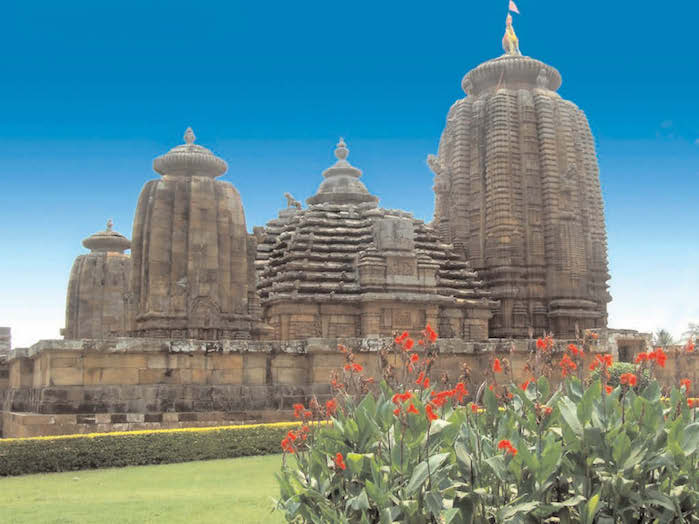
    There are some places in the India that are special, and Odisha (Orissa) tourism is definitely one of them. Filled with exquisite temples and extraordinary monuments, home to many thousands of prolific artists and craftsmen; and possessing beaches, wildlife sanctuaries, and natural landscape of often-enchanting beauty,Odisha (Orissa) tourism is a unique and fascinating land that is, nevertheless, still largely undiscovered by tourists.

    Tourism in Orissa (Odisha) India is a veritable museum of India’s sculptural and artistic heritage and has long been famous to scholars and connoisseurs for the magnificent Sun Temple at Konark (The legendary ‘Black Pagoda’ of European mariners), for the majestic temple of Lord Jagannath at Puri (renowned for the spectacular Rath Yatra chariot festival), and for the glorious temples of Bhubaneswar. The small but ever-growing number of sophisticated tourists who do manage to find their way to Orissa (Odisha) tourism are generally prepared with some knowledge of these temples, Puri tourism, of the delicate Orissan ikat textiles which have been become famous throughout the world, and, perhaps, of the beaches at Puri and Gopalpur on sea.

    ODISHAPURI

    Rest, Relax and Recall stand totally redefined on the seat of Lord Jagannath-Puri india. Known for its Historic antiquities, Religious sanctuaries, Architectural Grandeur, Seascape beauty, moderate climate and spiritual significance, this coastal district of Odisha (Orissa) attracts a number of visitors every year.Puri tourism has always been popular among traveler enthusiast due to the existence of many amazing Tourist Places in Puri including the Jagannath Temple Puri, Odisha(Orissa).

    With a rich historic heritage dating back to 3rd century BC, this temple town welcomes both the pilgrims and fun seekers with open arms, offering its splendid beaches to the latter. Having one of the largest briny water lakes in India namely the Chilika Lake, the city offers an ideal resort to migratory birds.

    Better known as the earthly abode of Lord Vishnu or Jagannath, Puri has a rich cultural heritage presenting a unique blend of claims of time and eternity with a power answerable only to wisdom. Considered to be utterly pious by the Hindus, Puri is one of the four sacred dhamas representing a rare spark of immortality owned against the powers of negation , through a spirit of university , adaptability by the Oriya people.

    The city is also possesses a very significant monastery in the form of Gobardhan matha established by Adi Shankaracharya on his visit to Puri. Other religious heads and dignitaries like Chaitanya Mahaprabhu, Rai Ramananda , Jayadeva, Gorakhanath- the father of Nath cult of religious iconoclasm and Saint Totapuri- a vedant teacher of Ramakrishna have also visited Puri leaving indelible imprints of their philosophies on the cultural curtain of the city.

    In addition to its undaunted spiritual significance, it is the quintessential characteristic of its culture and philosophy that has helped Puri to be transformed from Pan-Indian to Pan-Continental. This is further made clear by the celebration of ‘The Car-Festival of Lord Jagannath’ and ‘Puri Beach Festival’ with an equivalent gusto thus presenting a fine blend of spiritual and sensory pleasures.

    Recognition of the Rath Yatra at a global level, acceptance of Odissi as a classical dance form, Orissan School of architecture referred to as poetry frozen in stone and ‘the Mahaprasad brotherhood’ have no doubt helped a lot to fetch Puri, the status of an internationally known city.

    read-more

  • Ancient Wisdom in Modern Times at Bharatiya Vidya Bhavan

    Ancient Wisdom in Modern Times at Bharatiya Vidya Bhavan

    NEW YORK CITY (TIP): Bharatiya Vidya Bhavan, has been functioning in the USA since 1981 and is committed to the promotion of Indian culture and values through the media of arts, languages and literature. It has had a great impact on the local community – Indian and non-Indian, through its courses, lectures, seminars, concerts and publications.

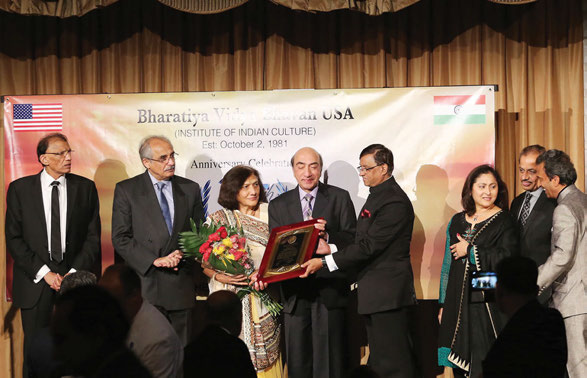
    Mr. A. R. Rahman Honored. L to R:  Sadhguru Jaggi Vasudev, A.R.Rahman, Mr. Kenny Desai, Mrs. Swati Vaishnav and Mr. Sudhir Vaishnav
    Mr. A. R. Rahman Honored. L to R: Sadhguru Jaggi Vasudev, A.R.Rahman, Mr. Kenny Desai, Mrs. Swati Vaishnav and Mr. Sudhir Vaishnav

    The founder of BVB Dr. K. M. Munshi, always said that “India will once again be acknowledged as the Vishwa Guru – a superpower that embodies the ideals of
    “Vasudhaiva Kutumbakam” – the global family and supremacy of “Dharma” which stands for moral and ethical values.

    Bhavan, USA has entered the 35th year of serving the Indian American community of the United States on October 2nd. To commemorate and celebrate this milestone the Bhavan will be organizing several cultural, educational and literary events to spread the message of unity and harmony.

    Dr. P. Jayaraman Honored. L to R : Sadhguru Jaggi Vasudev , H. R. Shah, Dr. P. Jayaraman, Ms Chandrika Krishnamurthy Tandon, Dr. Navin Mehta Ambassador Vijay Nambiar, Ambassador Dnyaneshwar Mulay, Mr. Kenny Desai
    Dr. P. Jayaraman Honored. L to R : Sadhguru Jaggi Vasudev , H. R. Shah, Dr. P. Jayaraman, Ms Chandrika Krishnamurthy Tandon, Dr. Navin Mehta Ambassador Vijay Nambiar, Ambassador Dnyaneshwar Mulay, Mr. Kenny Desai

    In light of this, Bharatiya Vidya Bhavan, USA organized a marquee sit down dinner event on Sunday, 18th October, 2015 at The Pierre Hotel, Central Park, New York City. At this prestigious event a select few individuals who have excelled in their chosen fields and touched many lives were acknowledged and honored namely Founder Executive Director Dr. P. Jayaraman, Late Prof. Robert Goheen-Former US Ambassador to India (Past Chairman for 23 years), Mr. Harishchandra Mistry a renowned philanthropist and Musical genius Mr. A. R. Rahman.

    Sadhguru Jaggi Vasudev, Dr. Deepak Chopra and Ms Chandrika Krishnamurthy Tandon presented very interesting symposium “Ancient Wisdom in Modern Times”. Enthralling and in-depth discussion left the audience spell bound. Ms. Tandon who is a long time supporter of the Bhavan, a Grammy award Nominee-A humanitarian and astute businesswoman initiated the evening with melodious prayers to Ma Durga with students from New York University. Mr. Anurag Harsh a renowned performer and Mr. Manu Narayan (Bombay Dreams) kept audience on the edge of the seats. Ms Gayatri Devi and Mrs. Sanjukta Sen offered prayers to Lord Shiva -Rudrashtakam and Ms. Siddhi Vaishnav and  students of Bhavan’s Nartanrang Dance School offered prayers to Lord Ganesha.

    Invocation. Ms Chandrika Krishnamurthy Tandon and  NYU students
    Invocation. Ms Chandrika Krishnamurthy Tandon and NYU students

    Bhavan’s former Chairman and Current President of Trustee Committee Dr. Navin C. Mehta conducted the whole evening with grace and aplomb.

    Chairman Mr. H. R. Shah welcomed everyone in his opening speech and was delighted to see former Bhavanites joining celebrations.

    Prime Minister of India, Mr. Narendra Modi and External Affairs Minister-Government of India, Mrs. Sushma Swaraj sent their good wishes on the occasion. Governor of New York state Hon. Andrew Cuomo and New York City Mayor Hon. Bill de Blasio, Consul General of India-New York, Ambassador Mr. Dnyaneshwar Mulay, Secretary-General’s Special Adviser on Myanmar Ambassador Mr. Vijay Nambiar, Sant Shri Morari Bapu, Shri S. P. Hinduja with whose support Bhavan started functioning and host of dignitaries wished Bharatiya Vidya Bhavan on this occasion.

    An animated  discussion on ancient wisdom in modern times . L to R:  Dr. Deepak Chopra, Sadhguru Jaggi Vasudev and Ms Chandrika Krishnamurthy Tandon
    An animated discussion on ancient wisdom in modern times . L to R: Dr. Deepak Chopra, Sadhguru Jaggi Vasudev and Ms Chandrika Krishnamurthy Tandon
    Mr. Harishchandra Mistry Honored: L to R :  H. R. Shah, Ambassador Vijay Nambiar, Mrs. And Mr. Harishchandra Mistry, Ambassador Dnyaneshwar Mulay, Mrs. Damini and Mr. Girish Soni and Mr. Kenny Desai
    Mr. Harishchandra Mistry Honored: L to R : H. R. Shah, Ambassador Vijay
    Nambiar, Mrs. And Mr. Harishchandra Mistry, Ambassador Dnyaneshwar Mulay, Mrs. Damini and Mr. Girish Soni and Mr. Kenny Desai

    It was a memorable evening for a rich cultural content and the presence of the gracious guests who all were profusely thanked for their participation.

  • Classical Heritage of  Music & Dance presented at  Media India Lecture Series at the Consulate

    Classical Heritage of Music & Dance presented at Media India Lecture Series at the Consulate

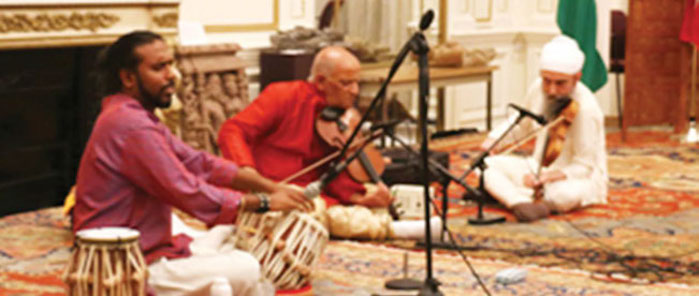
    NEW YORK CITY (TIP): Indian Classical Heritage: Music & Dance was the theme at the Media India Lecture Series organized by the Consulate General of India, New York on October 16, 2015.

    Sharanya Chandaran performs Bharatnatyam
    Sharanya Chandaran performs Bharatnatyam

    Ambassador Dnyaneshwar M Mulay, the Consul General extended a word of welcome to the performers Pandit Dinesh Prabhakar and Sharanya Chandaran and to a special guest Daryl Rand who is leading a delegation of distinguished women to India. Mr. Mulay briefly described the various activities of the Consulate, with special mention to the Consulate’s monthly outreach and the measures to strengthen ties between the two great democracies of the world-India and the US.

    Pt. Dinesh Kumar Prabhakar who is a violinist was born in 1950 into a family of great musicians. At the age of 8, he began his early training in music with his father, Late Pandit Husan Lal, a renowned Violinist, Vocalist and Music Director. Over the years, his presentation expanded in repertoire to include music composition and has been accredited with a number of musical performances not only in India but on the international level.

    He performed an evening Raga “Yaman”. The Vilambit was set to Ektaal (12 beats) and Drut in Teentaal. (16 beats). Accompanying him on table was Avirodh Sharma and on Violin was Daljeet Singh Sokhey.

    Bharatnatyam Dancer, Sharanya Chandaran has been learning Bharatanatyam from the age of four. She began learning both from her mother and Guru K Dakshinamurthi and presented her formal solo debut performance, the Arangetram, in November 2001.

    Sharanya is the Vice President of the Natya Vriksha, an organization to promote Indian Culture and Dance, where she is a senior dancer and choreographer. She also assists with cultural management and curating festivals & events at Natya Vriksha. Sharanya performed three pieces based on Indian Mythology. She received standing ovation from the audience.


  • U.S. India Business Council Applauds Conclusion of U.S.- India Trade Policy Forum

    U.S. India Business Council Applauds Conclusion of U.S.- India Trade Policy Forum

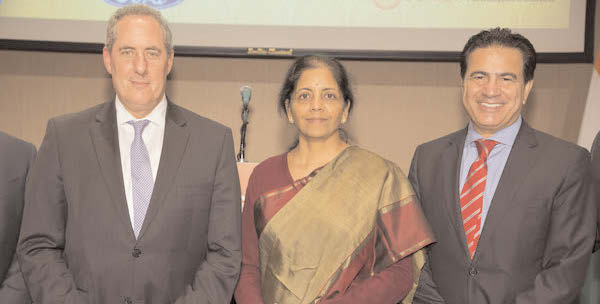
    WASHINGTON (TIP): Following the successful conclusion of the ninth round of U.S.-India Trade Policy Forum, the USIBC hosted a reception, providing an opportunity for deeper engagement between industry stakeholders and government officials from both the United States and India. The U.S.-India Trade Policy Forum (TPF) is a government-to-government trade dialogue aimed at increasing bilateral investment between the two nations.

    The trade policy forum comes on the back of U.S.-India Strategic and Commercial as well as Prime Minister Modi’s visit to the west coast of the United States. The talks focused on four primary areas of bilateral ties-agriculture, services, promoting investment in manufacturing, and intellectual property. USIBC member companies submitted recommendations under these four working groups to the USTR.

    The reception was attended by high ranking government officials such as Minister of Commerce and Industry Nirmala Sitharaman, United States Trade Representative Michael Froman, Commerce Secretary of India Rita Teotia and Deputy USTR Ambassador Holleyman.

    The event received broad representation from USIBC’s diverse membership base of 300+ companies that include Ford, MasterCard, Pfizer, Lockheed Martin, Bank of America, PayPal and Boeing.

    During the discussion, Minister Sitharaman and Ambassador Froman highlighted the direction in which the two nations are working together to foster a robust and open bilateral trade environment. Following Prime Minister Narendra Modi’s visit to the west coast and a series of successful dialogues over the last few months, both nations view the bilateral relationship with greater enthusiasm.

    Mukesh Aghi, President of the U.S.-India Business Council said, ” The trade policy forum couldn’t have come at a better time. We have seen India rise in World Bank’s Ease of Doing Business Index under the leadership of Prime Minister Modi. The Trade Policy Forum represents another important step towards strengthened trade relations between the U.S. and India. India is growing to be one of the most open economies in the world today and USIBC member companies are excited by the opportunity to grow the bilateral trade five-fold. Increasing FDI projects in sectors like manufacturing, defense, Smart Cities and clean technology along with positive environment fostered by initiatives like Make in India and Digital India are proving to be game changers and creating jobs for the Indian economy.”

    “We have seen enhanced engagement between the United States and India in the course of the past year, with a high bar set by President Obama and Prime Minister Modi,” said United States Trade Representative Michael Froman. “Our work this week under the Trade Policy Forum focused on translating engagement into tangible results that will increase the pace of trade growth between our economies. To that end, Minister Sitharaman and I focused our work on forward looking policy initiatives in intellectual property, manufacturing, agriculture and services that can expand trade and investment and benefit our manufacturers, workers, innovators, service providers, farmers, and ranchers.”

    Minister Sitharaman congratulated Ambassador Froman on the successful conclusion of the Trans-Pacific Partnership (TPP) after eight years of painstaking efforts and said, “The U.S.-India Trade Policy Forum was an intense engagement, one which we can say with confidence is moving forward with a lot of positive outcomes.”

    “Abbott continues to see India as a promising market for growth. The government’s vision for promoting ease of doing business and attracting investment enables Abbott to help more people live healthier, better lives,” said Claude Burcky, Vice President of International Government Affairs, Abbott.

  • OBAMA PRAISES US SOCCER’S INDIAN-AMERICAN CHIEF OVER WORLD CUP WIN

    OBAMA PRAISES US SOCCER’S INDIAN-AMERICAN CHIEF OVER WORLD CUP WIN

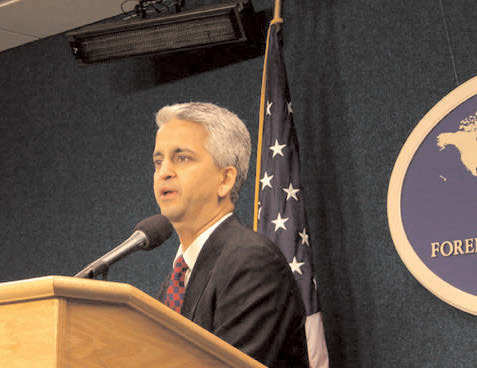
    WASHINGTON (TIP): US President Barack Obama showered praises on US Soccer Federation’s (USSF) Indian-American President Sunil Gulati as he welcomed the triumphant American women’s World Cup team to the White House to celebrate their victory after 16 long years on Tuesday, Oct 27.

    “I want to recognize a lot of people who made these incredibly talented women – put them in a position to be able to showcase their talent so effectively. First of all, U.S. Soccer President Sunil Gulati. Please give him a big round of applause,” Obama said, according to a press release.

    The US women’s soccer team, after a devastating loss in 2011 at the hands of Japan, dominated the World Cup final this year as it defeated Japan by 5-2.

    All 23 players, coaches and backroom staff filed in to the East Room, greeted by a loud ovation from the invited guests. Obama was joined by vice-president Joe Biden, Gulati and a 13-year-old girl Ayla from Massachusetts.

    Ayla shared a letter she wrote to President and the first lady towards the end of Canada 2015 with the crowd, explaining her anger after her brother told her that ‘boys are so much better at soccer than girls’, and that she wanted the White House’s help to prove him wrong.

    Obama hailed young Ayla’s courage and used her letter to frame his congratulatory remarks to the recent Women’s World Cup champions.

    “Girls like Ayla (were told that) they weren’t somehow supposed to be as good at sports as boys. And Ayla got mad, and she should be mad with those attitudes.

    “These champions deserve all the attention that they’ve been getting. After 16 long years, too much heartbreak, they flew north to put America back on top of the soccer world. And they did it in style. It was a victory that took all 23 players. It took Christie Rampone’s leadership, Alex Morgan’s playmaking, Heather O’Reilly’s game face. It took Becky Sauerbrunn’s quiet dominance. And Abby Wambach’s not-so-quiet dominance,” said Obama.

    Sunil Gulati was unanimously re-elected to a record third four-year term as United States Soccer Federation president in March 2014.

  • RSS TO DISCUSS RELIGIOUS CENSUS AT RANCHI MEET

    RSS TO DISCUSS RELIGIOUS CENSUS AT RANCHI MEET

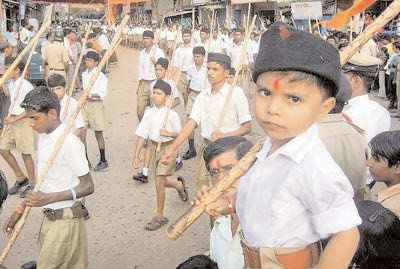
    RANCHI (TIP): With the recent census figures recording the Muslim population count at over 17 crore, the three-day RSS executive beginning on Friday is expected to adopt a resolution calling for a check in the “imbalance” of population growth.

    Addressing the media on the eve of the meet, RSS spokesperson Manmohan Vaidya said the recent census which had just come showed an imbalance in the growth of population.

    “There would be extensive deliberations on the subject during the meeting and a resolution in this context may be taken up,” he said.

    Entire top brass of the RSS, including its chief Mohan Bhagwat, will attend the meet.

    The recent census showed that the Muslim community had registered a moderate 0.8 per cent growth to touch 17.22 crore in the 10 year period between 2001 and 2011, up from 13.8 crore, while Hindus population showed a decline by 0.7 per cent at 96.63 crore during the period.

    In his Vijaya Dashmi address last week, Bhagwat had said that facts and figures of the last two census reports and the imbalances that had come to notice as a result were being widely discussed.

    “Our present and future is getting impacted by it. We need to rise above vote bank politics to formulate a holistic approach, equally applicable to all citizens, towards the population policy.

    “Such a population policy be enforced by our governments or laws alone. Considerable efforts are required to tune society’s psyche to the same. It would be prudent to think about it during policy-making exercise,” he had said.

    Vaidya also sought a countrywide debate over the Upamanyu Hazarika Commission’s report that illegal migration from Bangladesh is threatening to reduce the indigenous population of Assam to a minority by the year 2047.

    “Recently, the Hazarika Commission report has given a startling information about changing demographic situation in Assam and Bengal. If the trend continues then population of Indians would be reduced and foreigners would be increased,” he said.

  • HARBHAJAN-GEETA BASRA’S BIG, FAT PUNJABI WEDDING

    HARBHAJAN-GEETA BASRA’S BIG, FAT PUNJABI WEDDING

    JALANDHAR (TIP): The big fat Punjabi wedding celebrations of Geeta Basra and Harbhajan Singh culminated in their Anand Karaj ceremony on October 29 morning at a gurudwara in Phagwara, near Jalandhar.

    But before the bride and groom tied the knot, there was no dearth of celebratory events and festive moments at the traditional ceremonies held in the run up to the wedding ceremony. After a fairy-tale mehendi on Monday, which was gatecrashed by Bhajji, the couple spent some time dancing with friends, family and star guests at the sangeet. Mika Singh and Gurdas Maan were the entertainers of the evening, and actor/comedian Gurpreet Ghuggi made an appearance too. Some of Bhajji’s cricketer friends, including Parthiv Patel and RP Singh, joined in. The evening also saw the couple exchange rings, and make a Bollywood-style performance too.

    Wednesday night was all about the jago ceremony, an integral part of Punjabi marriage rituals. Bhajji’s sisters, mother and other relatives carried a decorated ghara and did some giddha, taking a round of the locality. “There was lot of halla gulla and dholis were called,” a source said. Bhajji wore a green Pathani suit for the occasion. After the jago ceremony, a special dinner was organized.Cricketers Sarandeep Singh and Rahul Sharma were present too.

    To maintain privacy, the cricketer’s house in a posh locality in Jalandhar was cordoned off. His wedding card has a special entry pass. On the jago evening, bouncers were given special T-shirts with Harbhajan and Geeta written on them. “The bouncers’ uniforms are being altered for each occasion,” the source said.

    Geeta and her relatives have been putting up at a resort, where the choora chadai ceremony took place and golden kaliren were attached to the bride’s bangles. Source: TOI

  • Gangster Chhota Rajan says never surrendered, wants to return to India

    Gangster Chhota Rajan says never surrendered, wants to return to India

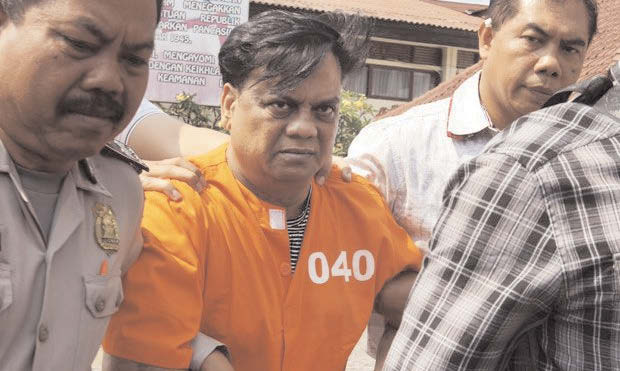
    BALI/MUMBAI (TIP): Underworld don Chhota Rajan, who has been arrested after being on the run for over two decades, claimed on October that he did not surrender and wants to return to India.

    There is intense speculation that the arrest of the gangster, who is wanted in over 75 heinous crimes ranging from murder, extortion to smuggling and drug trafficking, was part of a “deal” with Indian security agencies.

    “I never surrendered. I want to go back to India. Don’t want to go to Zimbabwe,” the one-time trusted aide of terrorist and crime boss Dawood Ibrahim told reporters.

    Rajan, one of India’s most wanted gangsters, was arrested in  Indonesia’s tourist destination Bali on a Red Corner Notice issued by Interpol after eluding law enforcement agencies for over two decades.

    Of these 75 cases, Rajan is facing four cases under Terrorist and Disruptive Activities (Prevention) Act (TADA), one under Prevention of Terrorism Act (POTA) and over 20 cases under the stringent Maharashtra Control of Organised Crime Act
    (MCOCA).

    Indian security agencies are likely to send a team of officials to Bali to bring back the gangster who has been in custody since Sunday.

    The sources are tight-lipped about the arrangements to bring him back because of security concerns arising out of his fierce rivalry with underworld don Dawood Ibrahim and his gang.

    They said agencies are working on more than one plan to bring back 55-year-old Rajan, once known as Dawood’s right hand man, factoring various permutations and combinations.

    Rajan was traveling with the identity of Mohan Kumar with passport number G9273860 when he was apprehended at the airport in Bali, after arriving there on a Garuda Indonesia flight GA715, by the Indonesian Police on a tip-off from Australian authorities, they said.

    The sources said Rajan was in touch with various police officials for the past six months seeking a passage to return to India as he feared for his life in Australia from Chhota Shakeel, a henchman of Dawood.

    In 2000, there was an attempt on his life when Dawood’s men tracked him down to a hotel in Bangkok but he managed a dramatic escape through the hotel’s roof.

    According to serving and former police officers, who have dealt with the Mumbai underworld, arrest of Rajan is a major success and his questioning is expected to shed light on hitherto unknown facts related to cases linked to his syndicate.

    Chhota Rajan assets worth over Rs 4,000 crore, claims Mumbai police

    Mumbai Police officials estimate Chhota Rajan’s current net worth to be in the range of Rs 4,000-5,000 crore. Fifty per cent of the investments are in India, especially in Mumbai and its satellite towns, they say. “According to our reports, Rajan owns a hotel in China, a few jewellery shops in Singapore, Thailand and a hotel in Jakarta. He has also invested in diamond trade in African countries, especially Zimbabwe,” said a senior Mumbai Police official.

    Sources claimed that Rajan tried to strike a deal with some officials from Zimbabwe to seek refuge in that country.

    But Zimbabwe did not want to be seen giving refuge to anyone who was wanted in India. “We found that he asked for Z-plus protection which was denied by them,” claimed the official.

    “The officials with whom Rajan negotiated promised to provide the best of health facilities but refused to extend security cover. Rajan suspected that he would eventually be tracked by the Dawood gang, and did not want to be attacked when he was at his weakest — while undergoing  dialysis for kidney failure,” said a source.

  • Navy, MoD move Supreme Court against permanent commission for women

    NEW DELHI (TIP): Even as it claimed that women officers in the Indian Navy are not discriminated against, the government has told the Supreme Court that permanent commission for women short service commission (SSC) officers is “something that the law itself bars” and such an order would “annihilate the functional autonomy of the armed forces”.

    Challenging the order of the Delhi High Court, which said on September 4 that women officers in the Navy should be offered permanent commission after they complete their short service stints, the Ministry of Defence (MoD) and the Chief of Naval Staff have said that it violates the principle of “separation of powers” between different wings. The petition urges the Supreme Court to stay the HC order, saying it
    “severely affects the operational structure and administrative exigencies in the Indian Navy.”

    Contending that “men and women are identified by the same yardsticks”, the appeal states that operation of the HC verdict would “result in disturbing the seniority of existing personnel and their promotional avenues”.

    “It would further cause financial and other constraints on the government and has resulted in the respondents (women officers) being provided with something that the law itself bars… the division bench (of HC) has effectively overridden the statutory provision and dictated the policy of the Indian Navy for recruiting women officers,” it adds.

  • PROGRESSIVE PUNJAB INVESTORS’ SUMMIT | Housing bags biggest pie share of investments

    CHANDIGARH (TIP): Housing emerged as the sunshine sector in Punjab accounting for the largest pie share of the total investment committed during the second Progressive Punjab Investors’ Summit that ended at the Indian School of Business here on Thursday.

    The final tally of committed investment touched a whopping Rs 1.15 lakh crore with the total number of players, who signed memoranda of understanding (MoUs) with the Punjab government going up to 378. Of the total MoUs signed, 25% pertained to the housing sector. The top five highest investments in the sector amounted to almost Rs 22,500 crore.

    The renewable energy sector also attracted big investment with five companies offering to invest almost rs 15,000 in bio-refinery and solar power plants. They include two international players– SUN AMP, a Singapore based company that will set up a 200MW solar project and Solar Capital (Pvt) Ltd, a South African firm that will come up with grid connected solar power plants of 200MW. Both companies will invest Rs 1,300 crore each.

    The health sector also caught fancy of big players with the top six investors pledging almost 8,000 crore. The number of MoUs, however, in the sector was not very high pointing towards the sector becoming a niche area with limited pre-established players calling the shots.

    In the final count, the agro food-processing sector attracted investment worth rs 8,000 crore with the top five players promising to pump in over 2,000 crore. However, as 14% of the total MoUs were signed in this sector, it clearly points to the fact that a host of smaller players have come up in the sector.

    The manufacturing sector seems to have generated a fair amount of interest. Over 33% of the total MoUs inked pertained to this sector. However, the investment amount pledged by the top five investors was a little over Rs 4,000 crore.

    Addressing mediapersons on the concluding say of the summit, deputy chief minister Sukhbir Singh Badal said the corporate sector had shown “faith” and “trust” in the policies of the SAD-BJP government even after “15 days of unrest” in the state. He was referring to the recent protests and violence in Punjab over incidents of sacrilege of Guru Granth Sahib.

    He said the fiscal sops to investors in Punjab will continue even after Goods and Services Tax (GST) is implemented. “We will give up Punjab’s share in GST,” said Sukhbir when asked about the fate of tax-free incentives offered to agro processing units in the state once the GST is rolled out.

    “We will come out with a special package by November end for the existing industry and MSME,” said the deputy chief minister. Earlier while delivering the valedictory address, Sukhbir said Punjab was moving towards establishment of various clusters.

  • 15-YR WAIT ENDS AS GEETA RETURNS FROM PAK

    15-YR WAIT ENDS AS GEETA RETURNS FROM PAK

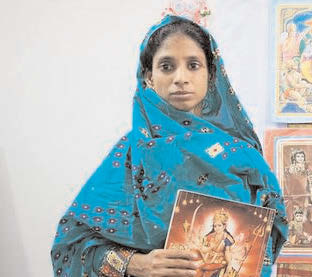
    NEW DELHI (TIP): Far from having a fairytale ending, the story of Geeta turned into a reality television show as she returned to India after a decade in Pakistan.

    Since the time she was separated from her family and appeared in Lahore, she has had an extraordinary life, learning to live with her disabilities, at the Edhi Foundation in Karachi, before diplomats negotiated the labyrinth of strained India-Pakistan ties to ensure her comeback. But the kind of homecoming that Geeta would have been praying for is hardly what she faces today; she will be handed over by the family that she knows and that took care of her well in Pakistan, to a welfare home in Indore.

    There she must now live until her real family is identified. The most difficult of it all is that her real-life agonies and the quest for her family are playing out in the glare of the arc-lights. Ever since the government decided to take up her case and have Geeta repatriated — she had made formal representations to come to India for at least five years — it has made a spectacle of its efforts.

    While External Affairs Minister Sushma Swaraj, to her credit, took a humane and personal interest in her welfare, the question is whether the intense publicity this young, frail girl has faced was required at all. Would it not have been easier if, once the Indian High Commissioner had formally identified Geeta as an Indian citizen (the High Commission had been in touch with her for years), she could have been brought to India along with the Edhi family on a private trip, or if necessary, several trips, to try and get a positive identification of her family before every move of hers was publicised?

    That way, when Geeta was transferred back, it would not be to a set of strangers at a halfway house that she would be handed over to, but to her own family.

    Instead of treating Geeta as a victim of the most tragic circumstances, not to mention her speech and hearing impairment, the government has made her a poster-girl for its commitment to Indians in need everywhere. She was paraded at a stiff media conference addressed by the Minister and the Foreign Secretary, while the media subjected her to some atrocious questions including on her age, what she ate, and whether she was converted while she lived in Pakistan.

    The hope is that from this point on the government will take its trusteeship of Geeta to a more private space, and ensure that she is reunited with her family at the earliest opportunity, be given an education, and made the master of her own future. Rather than being a time for flag-waving, this is a time for privacy, and sensitive and caring handling, away from the attentions of politicians and the media, for the young child who lost her way over the international border years ago, and has returned as Bharat ki beti.

  • How 4 federal lawyers paved the way to kill Osama bin Laden

    How 4 federal lawyers paved the way to kill Osama bin Laden

    WASHINGTON (TIP): Weeks before President Barack Obama ordered the raid on Osama bin Laden’s compound in May 2011, four administration lawyers hammered out rationales intended to overcome any legal obstacles — and made it all but inevitable that Navy SEALs would kill the fugitive Qaida leader, not capture him.

    Stretching sparse precedents, the lawyers worked in intense secrecy. Fearing leaks, the White House would not let them consult aides or even the administration’s top lawyer, attorney general Eric Holder. They did their own research, wrote memos on highly secure laptops and traded drafts hand-delivered by trusted couriers.

    Just days before the raid, the lawyers drafted five secret memos so that if pressed later, they could prove they were not inventing after-the-fact reasons for having blessed it. “We should memorialize our rationales because we may be called upon to explain our legal conclusions, particularly if the operation goes terribly badly,” said Stephen W Preston, the CIA’s general counsel, according to officials familiar with the internal deliberations.

    While the bin Laden operation has been much scrutinized, the story of how a tiny team of government lawyers helped shape and justify Obama’s high-stakes decision has not been previously told. The group worked as military and intelligence officials conducted a parallel effort to explore options and prepare members of SEAL Team 6 for the possible mission.

    The legal analysis offered the administration wide flexibility to send ground forces onto Pakistani soil without the country’s consent, to explicitly authorize a lethal mission, to delay telling Congress until afterward, and to bury a wartime enemy at sea. By the end, one official said, the lawyers concluded that there was “clear and ample authority for the use of lethal force under US and international law.”

    Some legal scholars later raised objections, but criticism was muted after the successful operation. The administration lawyers, however, did not know at the time how events would play out, and they faced the “unenviable task” of “resolving a cluster of sensitive legal issues without any consultation with colleagues,” said Robert M. Chesney, a law professor at the University of Texas at Austin who worked on a Justice Department detainee policy task force in 2009.

    “The proposed raid required answers to many hard legal questions, some of which were entirely novel despite a decade’s worth of conflict with al-Qaida,” Chesney said.

    This account of the role of the four lawyers — Preston; Mary B. DeRosa, the National Security Council’s legal adviser; Jeh C. Johnson, the Pentagon general counsel; and then-Rear Adm. James W. Crawford III, the Joint Chiefs of Staff legal adviser — is based on interviews with more than a half-dozen current and former administration officials who had direct knowledge of the planning for the raid. While outlines of some of the government’s rationales have been mentioned previously, the officials provided new insights and details about the analysis and decision-making process.

    The officials described the secret legal deliberations and memos for a forthcoming book on national security legal policy under Obama. Most spoke on the condition of anonymity because the talks were confidential.

    ‘The biggest secret’

    “I am about to read you into the biggest secret in Washington,” Michael G Vickers, the undersecretary of defense for intelligence, told Johnson.

    It was March 24, 2011, about five weeks before the raid. Not long before, officials said, Preston and DeRosa had visited the Pentagon to meet with Johnson and Crawford, the nation’s two top military lawyers. The visitors posed what they said was a hypothetical question: “Suppose we found a very high-value target. What issues would be raised?”

    One was where to take him if captured. Johnson said he would suggest the Guantanamo Bay prison, making an exception to Obama’s policy of not bringing new detainees there.

    But the conversation was necessarily vague. The Pentagon lawyers needed to know the secret if they were going to help, Preston told DeRosa afterward.

    By then, the two of them had known for over six months that the CIA thought it might have found bin Laden’s hiding place: a compound in Abbottabad, a military town in northeastern Pakistan. Policymakers initially focused on trying to get more intelligence about who was inside. By the spring of 2011, they turned to possible courses of action, raising legal issues; Thomas E. Donilon, national security adviser to Obama, then allowed the two military lawyers to be briefed.

    One proposal Obama considered, as previously reported, was to destroy the compound with bombs capable of taking out any tunnels beneath. That would kill dozens of civilians in the neighborhood. But, the officials disclosed, the lawyers were prepared to deem significant collateral damage as lawful, given the circumstances.

  • Pakistan loses UN Human Rights Council election

    Pakistan loses UN Human Rights Council election

    ISLAMABAD / UNITED NATIONS (TIP): Pakistan failed to win a re-election to the top UN human rights body, garnering just 105 votes in the 193-member General Assembly.

    The General Assembly on Oct 27 elected 18 members of the UN Human Rights Council through a secret ballot.

    Pakistan’s current term at the council is set to expire on December 31 and it was seeking re-election to the 47-member Human Rights Council.

    Sources said the loss came as a setback to the Pakistani delegation that had appeared confident of winning the seat.

    The sources attributed the loss to the way the Pakistani delegation fought the election, adding that it could not lobby effectively for the vote.

    The new members, who will start their three-year terms beginning January 1 next year, are Belgium, Burundi, Cote d’Ivoire, Ecuador, Ethiopia, Georgia, Germany, Kenya, Panama, Kyrgyzstan, Mongolia, Philippines, Republic of Korea, Togo, Slovenia, Switzerland, United Arab Emirates and Venezuela.

    Pakistan lost the seat in the Asia-Pacific category in which five seats were vacant.

    India is also a member of the council and its term will end in 2017.

    Members of the council are elected directly and individually by secret ballot by the majority of the members of the General Assembly.

    Geneva-based non-governmental human rights group UN Watch welcomed the defeat of Pakistan, terming it as a “major surprise.”

    Days before the vote, several human rights bodies had opposed the re-election of Venezuela, Pakistan and UAE to the UN Human Rights Council due to widespread criticism of these governments for egregious human rights violations.

    According to a report by UN Watch, Human Rights Foundations, and the Lantos Foundation, Pakistan, UAE, Burundi and Ecuador were cited by human rights groups for having committed serious violations of numerous articles of the Universal Declaration of Human Rights, including curbs on the freedoms of speech, press, religion, and assembly, along with disregard for fundamental due process.

    The candidate countries were also found to have voted against UN resolutions taking action for victims of human rights abuses in various hotspots, UN watch said.

    Sources in the Indian mission to the UN here welcomed the election of Mongolia and Kyrgyzstan against the backdrop of historical visits undertaken by Prime Minister Narendra Modi to these nations earlier this year.

  • Post-quake Nepal struggles to preserve vanishing skills

    Post-quake Nepal struggles to preserve vanishing skills

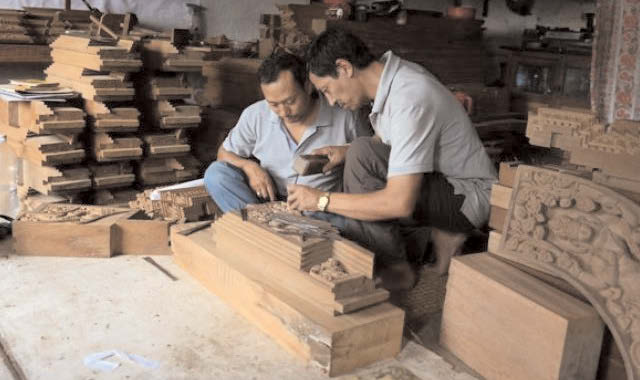
    BHAKTAPUR (TIP): In a dusty studio, Indra Kaji Shilpakar painstakingly carves intricate patterns into a wooden panel, one of a small group of highly-skilled craftsmen Nepal is relying on to rebuild its cultural heritage after April’s major earthquake.

    But Shilpakar, a master craftsman who learned at the hands of his father and uncle as a young boy, is one of a dying breed.

    The wood-carvers, stone-sculptors and metal-workers who created the spectacular temples and palaces of the Kathmandu Valley were once feted as far away as China, and paid handsomely from the royal purse.

    But over the decades their social status has fallen along with the money they are able to earn from their craft, and many young Nepalis are now rejecting the family trade to seek better paid work.

    That has left the country short of skills crucial for rebuilding the centuries-old monuments of the Kathmandu Valley lost in the April 25 quake.

    It is a problem made worse by the fact that these crafts have historically been the exclusive and jealously guarded preserve of a few families belonging to the Newar ethnic group indigenous to the Valley.

    Shilpakar, a slight, softly-spoken man of 52, says all his male relatives as far back as anyone can remember have worked with wood, producing the intricately carved panels that grace Nepal’s temples and traditional homes.

    “But many in the new generation want different jobs, office jobs,” he told AFP in his studio in the historic city of Bhaktapur, where he is working on the restoration of a classic three-tiered wooden pagoda temple from the 17th century.

    “Even in my own family, there are people who have not continued with the work that requires a high level of skill, because it doesn’t pay,” said Shilpakar, whose uncle’s family has moved to the more lucrative furniture business.

    “There isn’t much respect in Nepal –we are considered as workers, not artists. That is not the view of the UN cultural agency UNESCO, which describes the stone, timber and bronze craftsmanship of the Newars as among the most highly-developed in the world.

    Many of the palaces and temples they created date back to the period between the 12th and 18th centuries when the Valley – a World Heritage site – was divided into the three kingdoms of Kathmandu, Patan and Bhaktapur.

    Eager to lure back tourists, the government reopened the former Durbar (Royal) Squares of all three cities in June, despite warnings from UNESCO that this could cause further damage to the monuments.

  • Nepal’s parliament elects Bidhya Devi Bhandari as nation’s first female President

    Nepal’s parliament elects Bidhya Devi Bhandari as nation’s first female President

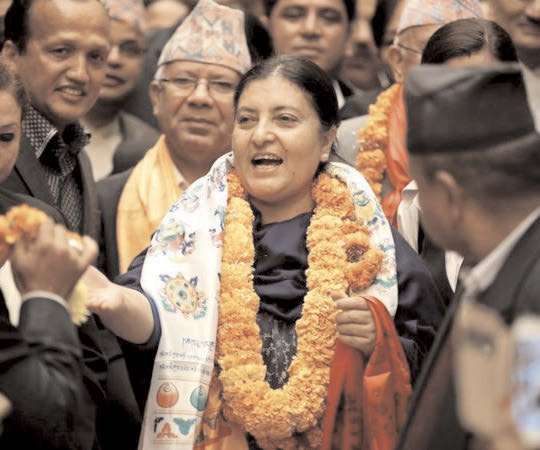
    KATHMANDU (TIP): Nepal’s parliament has elected a Communist leader who has long campaigned for women’s rights as the Himalayan nation’s first female President.

    Parliament speaker Onsari Gharti announced that Bidhya Devi Bhandari of the Communist Party of Nepal Unified Marxist-Leninist received 327 votes against her opponent’s 214 in parliament on Wednesday.

    Bhandari is the deputy leader of the party led by Prime Minister Khadga Prasad Oli. He was elected earlier this month and leads a coalition government.

    Bhandari is Nepal’s second president since the Himalayan nation was turned into a republic after abolishing the centuries-old monarchy. Ram Baran Yadav remained president for seven years because it took that long for the constitution to be prepared and adopted.

  • Drone strike at Pakistan-Afghan border kills three

    Drone strike at Pakistan-Afghan border kills three

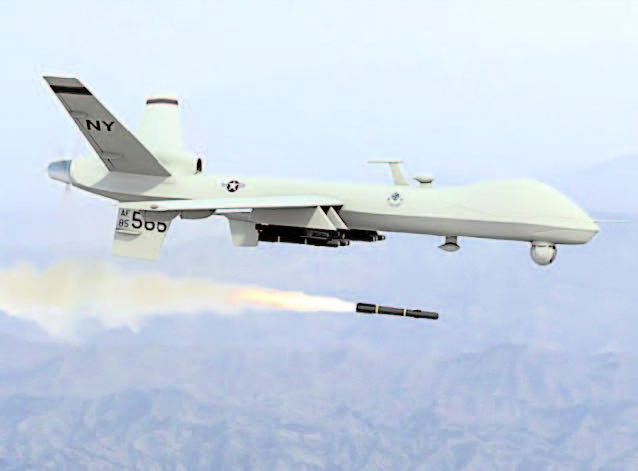
    ISLAMABAD/KABUL (TIP): At least three suspected rebels, belonging to the self-styled Islamic State militant group, were killed on Oct 29 in a US drone strike in Nangarhar province of Afghanistan, near Pakistan’s Khyber agency.

    Security sources said the drone targeted a militant compound in the Nazyan district, killing three suspected militants and injuring five others, Dawn reported.

    In a similar airstrike in the same area on October 23, at least 16 suspected militants belonging to IS were reported killed.

  • No amnesty for fasting Lankan Tamil prisoners: Govt

    No amnesty for fasting Lankan Tamil prisoners: Govt

    COLOMBO (TIP): There will be no common amnesty for over 200 prisoners, mostly Tamils, who staged a hunger strike in jails throughout the country, the Sri Lankan government said on Oct 26.

    The prisoners went on a six-day protest hunger strike demanding swift procedural action including a common amnesty.

    “There was a meeting held on Monday with the patronage of Prime Minister Ranil Wickremesinghe. A few decisions were taken. The Prime Minister said it was not possible to grant a common amnesty,” said Minister of National Dialogue Mano Ganesan.

    “But the bail procedure could be expedited. Those who are having their cases and those under police action could be granted bail. The officials have been advised to look at this process,” Ganesan said.

    The Tamil prisoners claim that they have been held for a long time with no charges being made against them.

    The protesting inmates ended the strike following an assurance from President Maithripala Sirisena that action would be in place to grant them redress by November 7.

    Sri Lanka has put through the legal process over 8,000 members of the LTTE who had surrendered to government troops during the last stages of the civil war that ended in May, 2009.

    Those in prisons are those who had been arrested for suspected links with the LTTE. The legal procedures related to them have been delayed due to the large backlog of cases.

  • Eminent Ophthalmologist VK Raju  invited to deliver lecture in Vietnam

    Eminent Ophthalmologist VK Raju invited to deliver lecture in Vietnam

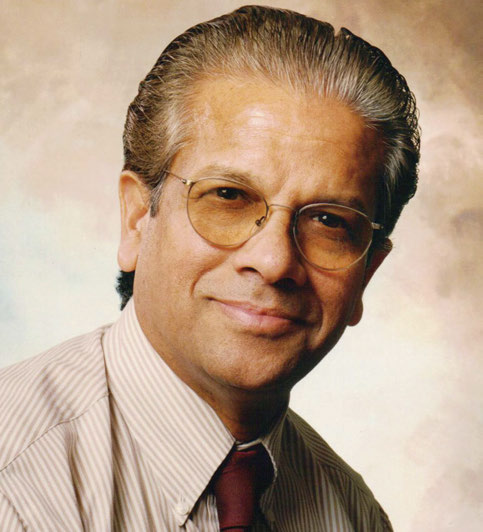
    NEW YORK (TIP): Morgantown , West Virginia based eminent Ophthalmologist  Dr. VK Raju has been invited to Vietnam as a guest lecturer at the Asean Ophthalmology Society. He left for Vietnam on October 26th of and will return November 5th. Dr. Raju is a  favorite with international institutions where he is invited as a guest lecturer and to deliver talks.

    The  Eye Foundation of America which he founded in 1977 to combat eye ailments, in particular blindness among children, has since its inception treated 2 million outpatients.

    The Foundation has performed 300, 000 surgeries, with 25,000 plus on children.

    This was completed by a team of Eye Foundation of America  in India and 21 other developing countries. Teaching and Training of health professionals is very important for the Eye Foundation of America.

  • In aviation policy draft, India seeks to make air travel affordable

    In aviation policy draft, India seeks to make air travel affordable

    NEW DELHI (TIP): Incentives to fly to small towns at affordable costs and easing the norms for domestic carriers to operate services abroad are some of the highlights of the new draft aviation policy, released on Friday for inputs from stakeholders before finalisation.

    The primary aim of the policy is to ensure a tariff of no more than Rs 2,500 per ticket for each flying-hour with a host of incentives and other benefits to both airport developers and operators to make that happen.

    “A lot of consultation has taken place. We invite suggestions from stakeholders and public — since it involves the people of India. After all those suggestions come in, we will look into it,” civil aviation minister Pusapati Ashok Gajapathi Raju said.

    “The policy will also have a fixed period of existence, so that Industry can plan in advance. That is the idea,” the minister told a press conference to unveil the new draft, along with his deputy Mahesh Sharma.

    Govt unveils draft civil aviation policy; proposes slew of tax incentives for airlines, maintenance works. — Press Trust of India (@PTI_News) October 30, 2015

    “The basic behind of National Civil Aviation Policy is to take flying to the masses,” Civil Aviation Secretary Rajiv Nayan Choubey said, adding: operators will get some doles to fly to smaller towns with incentives linked to fuel prices and inflation.

  • NOW, 50 TOP HISTORIANS PROTEST ‘INTOLERANCE’, DEMAND SECURITY FOR ALL

    NOW, 50 TOP HISTORIANS PROTEST ‘INTOLERANCE’, DEMAND SECURITY FOR ALL

    NEW DELHI (TIP): More than 50 historians from across India, including eminent names like Romila Thapar, Irfan Habib, B D Chattopadhyaya, Upinder Singh, M G S Narayanan and D N Jha, have issued a statement expressing concern about the “highly vitiated atmosphere prevailing in the country, characterized by various forms of intolerance”.

    They have urged the State to “ensure an atmosphere that is conducive to free and fearless expression, security for all sections of society and safeguarding of the values and traditions of plurality that India had always cherished in the past”.

    “Differences of opinion are being sought to be settled by using physical violence. Arguments are met not with counter arguments but with bullets. When a poor man is suspected to have kept a food item that certain sections do not approve of, his fate is nothing short of death by lynching,” the historians said.

    The statement follows others released by well-known scientists and several instances of writers returning their awards to the Sahitya Akademi and lately film personalities announcing that they will turn in their national awards.

    The historians pointed to the attack on Sudheendra Kulkarni and said, “At the launch of a book whose author happens to be from a country disapproved of by certain groups, the organizer is disfigured with ink thrown on his face. And when it is hoped that the head of government will make a statement about improving the prevailing conditions, he chooses to speak only about general poverty; and it takes the head of the state to make the required reassuring statement, not once but twice.”

    The statement also talked about writers returning awards and the government’s silence. “No comment is made about the conditions that caused the protest, instead the ministers call it a paper revolution and advise the writers to stop writing. This is as good as saying that intellectuals will be silenced if they protest,” they said.

    The historians said the trend was worrying as many of them had “already experienced attempts to ban our books and expunge statements of history despite the fact that they are supported by sources and the interpretation is transparent”. They said the present government wants “a kind of legislated history, a manufactured image of the past, glorifying certain aspects of it and denigrating others, without any regard for chronology, sources or methods of enquiry that are the building blocks of the edifice of history”.

    Signatories included Y Subbarayalu, K M Shrimali, A R Venkatachalapathy, Rajan Gurukkal, Nayanjot Lahiri, Mridula Mukherjee and others.

    Responding to finance minister Arun Jaitley’s attack on him, eminent scientist and founder of the Centre for Cellular and Molecular Biology P M Bhargava told TOI that since the situation had “completely gone out of control today” and
    “limits had been crossed”. Asked if he expected the Prime Minister to take note of the protests, he said, “It’s up to him to react, though it is unlikely that he will.”


  • Top Lashkar commander Abu Qasim, who plotted Udhampur attack shot

    Top Lashkar commander Abu Qasim, who plotted Udhampur attack shot

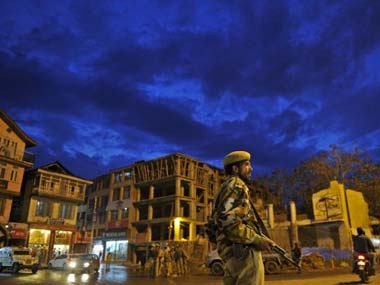
    SRINAGAR (TIP): Militant group Lashkar-e-Toiba Thursday suffered a major setback when Jammu and Kashmir Police and the Army, in a joint operation, killed its operational chief and its senior most commander and strategist in the Valley at Kulgam area in South Kashmir.

    Abdul Rahman alias Qasim had a cash reward of Rs 20 lakh on his head and had been active in the Valley since 2009.

    The National Investigation Agency (NIA) was also looking for Qasim after captured Pakistani militant Naveed Ahmad told the interrogators that he (Abdul Rahman) had tasked him and another Pakistani militant to carry out the August 5 attack at Udhampur in which two BSF personnel were killed.

    Police said apart from masterminding the Udhampur attack in August that left two BSF personnel dead and 12 others injured, he was also part of the LeT squad which carried out the 2013 fidayeen attack at Hyderpora in which 12 Armymen were killed and 16 injured.

    Naveed had exposed many hideouts of Qasim, especially in South Kashmir. But in the last two months, Qasim had escaped twice after shootouts with the security forces. Sources said it was with the help of the network of human intelligence that they finally managed to kill him.

    Inspector General of Police Kashmir Range Syed Javaid Mujtaba Gillani termed the killing of the Lashkar commander “a big success for the security forces”.