Month: October 2015

  • German authority orders recall of 2.4 mln Volkswagen cars

    German authority orders recall of 2.4 mln Volkswagen cars

    HAMBURG (TIP): German automotive watchdog KBA will force Volkswagen to recall 2.4 million vehicles in the country after Europe’s biggest carmaker admitted to cheating on emissions tests for diesel vehicles.

    “We are ordering the recall,” a spokesman for the motor transport authority said on Thursday, confirming a newspaper report.

    German daily Bild reported earlier that the KBA had rejected a proposal by VW under which owners of the affected diesel cars could voluntarily bring in their cars for fixes.

    Volkswagen admitted last month that it had installed software in diesel vehicles to deceive U.S. regulators about the true level of their toxic emissions. It has said up to 11 million vehicles were affected worldwide.

  • Adani’s coal mine project gets re-approval in Australia

    MELBOURNE (TIP): Indian mining giant Adani’s plan to build one of the world’s largest coal mines got a new lease of life on Thursday after the Australian government gave its re-approval to the 16.5 billion controversy-hit project but with “strictest conditions” amid environmental concerns.

    Over two months after an Australian court revoked the environmental approval for the project, environment minister Greg Hunt signed the papers, giving Adani the re-approval with conditions imposed that take into account community issues and would ensure that the company meets the highest environmental standards.

    he federal court in August had revoked the original approval due to a bureaucratic bungle over two vulnerable species — the yakka skink and the ornamental snake.

    Stating that Adani’s project was given re-approval “in accordance with national environment law”, Hunt said his nod for the project considered additional information provided by Adani and environmental groups.

    The approval would be “subject to 36 of the strictest conditions in Australian history,” he said.

    “The conditions I have imposed take into account issues raised by the community and ensure that the proponent must meet the highest environmental standards,” Hunt was quoted as saying by ABC News.

    “The rigorous conditions will protect threatened species and provide long-term benefits for the environment through the development of an offset package,” he said.

  • RELIANCE CAPITAL ANNOUNCES RS 150-CR ESOP SCHEME

    MUMBAI (TIP): Financial services major Reliance Capital on October 15 announced a major ESOP scheme under which select employees across all major operating businesses would be granted stock options with a notional value of Rs 150 crore.

    Reliance Capital is part of Anil Ambani-led business conglomerate Reliance Group and is present in insurance, mutual fund, broking and non-banking finance businesses among others.

    The ESOPs would be given to a total of 250 employees of Reliance Capital and its major business units –including Reliance Capital Asset Management, Reliance Commercial Finance, Reliance Life Insurance, Reliance Securities and Reliance General Insurance.

    All top management, including Sam Ghosh, Madhusudan Kela and business CEOs are also covered under this grant of ESOP.

    Reliance Capital’s Vice Chairman Amitabh Jhunjhunwala said the ESOPs, linked to the growth of the company, will provide long-term wealth creation opportunities to key talent.

    “This will not only help us reward and retain talent, but also align the employees’ sense of ownership with the business,” he added.

    The company said the eligible employees will get options on Reliance Capital’s listed stock and/or phantom shares of its businesses.

    The ESOPs comprise of 6,46,080 shares of Reliance Capital and the balance as Phantom Shares of operating subsidiaries.

    The notional value of the proposed stock options, at Rs 150 crore, represents 1.6 per cent of Reliance Capital’s market capitalisation.

    The Employee Stock Option (ESOP) Scheme 2015, which is subject to requisite approvals, has been approved by the boards of Reliance Capital’ and respective group companies.

    The company said the scheme is part of Reliance Capital’s Rewards Programme aimed at retaining and incentivizing key employees for their contribution to the growth and profitability of the company.

    “The ESOP scheme is an integral part of our Employee Rewards program, aimed towards driving and recognising superior performance. It will be our endeavour to consistently expand the scale and reach of our Rewards program through various such initiatives,” Reliance Capital’s chief people officer Pushkar Singh Kataria said.

    The options vest over a period of five years, with customary lock-in period.

  • China female cabin crew ‘ritual’ sparks online outrage

    China female cabin crew ‘ritual’ sparks online outrage

    BEIJING )TIP): Photos showing Chinese female flight attendants stuffed into an airplane’s luggage compartment by security officers has sparked widespread condemnation, the media reported on Oct 8.

    The photos were posted online from a personal Weibo account, China’s Twitter-like social networking platform, People’s Daily reported.

    The flight attendants were from Yunnan province-based domestic carrier, Kunming Airlines.

    The post said the airline attendants were forced to be carried into the luggage rack by the security officer of the airplane. The practice, which was called a tradition by the officers, has been repeatedly conducted for four or five years.

    These stewardesses were reluctant to do it but still lifted to the rack due to the concerns of being not cooperative with their colleagues.

    Some photos were also posted showing the stewardesses curling up in the luggage rack with hands covering their faces. A male staff member, who was believed as one of the security officers, was also seen in a photo and even posed with a huddled stewardess.

    Kunming Airline has investigated the incident and said that these inappropriate traditions happened after the crew members finished their flight missions.

    “this was like a ceremony for the new attendants to join the crew team. It is prevalent among other foreign airline companies. But the company paid high attention to the incident and pledged to prevent this from happening again due to its negative effect to the image of the company,” airline sources said.

  • DUSSEHRA

    DUSSEHRA

    Dussehra (Vijaya Dashami, Dasara, or Dashain) is a Hindu festival that celebrates the victory of good over evil. It is a gazetted holiday in India, which is marked on the 10th day of the bright half (Shukla Paksha) of the month of Ashvin (Ashwayuja), according to the Hindu calendar.

    Background

    Dussehra celebrates the Hindu god Rama’s victory over the demon king Ravana and the triumph of good over evil. The epic Ramayana tells the story of the Lord Rama who wins the lovely Sita for his wife, only to have her carried off by Ravana, the demon king of Lanka.

    Ravana plays an important role in the Ramayana. Ravana had a sister known as Shoorpanakha. She fell in love with the brothers Rama and Lakshamana and wanted to marry one of them. Lakshamana refused to marry her and Rama could not as he was already married to Sita.

    Shoorpanakha threatened to kill Sita, so that she could marry Rama. This angered Lakshamana who cut off Shoorpanakha’s nose and ears. Ravana then kidnapped Sita to avenge his sister’s injuries. Rama and Lakshamana later fought a battle to rescue Sita. The monkey god Hanuman and a huge army of monkeys helped them.

    The Mahabharata is another series of Hindu stories that play a role in the Dussehra festival. The Pandavas were five brothers who fought evil forces with a set of distinctive weapons. They abandoned their weapons and went into exile for one year. They hid their weapons in a Shami tree and found them at the same place when they returned from exile. They then worshipped the tree before going to a battle, which they won. This epic is also commemorated during Dussehra.

    What do people do?

    Many people of the Hindu faith observe Dussehra through special prayer meetings and food offerings to the gods at home or in temples throughout India. They also hold outdoor fairs (melas) and large parades with effigies of Ravana (a mythical king of ancient Sri Lanka). The effigies are burnt on bonfires in the evening. Dussehra is the culmination of the Navaratri festival.

    There are many local celebrations in some areas in India that can last for up to 10 days. Local events include:

    Performances of the Ramlila (a short version of the epic Ramayana) in Northern India.

    A large festival and procession including the goddess Chamundeshwari on a throne mounted on elephants in the town of Mysore in the state of Karnataka.

    The blessing of household and work-related tools, such as books, computers, cooking pans and vehicles in the state of Karnataka.

    The preparation of special foods, including luchi (deep fried flat bread) and alur dom (deep fried spiced potato snacks), in Bengal.

    Many Hindus also believe that it is lucky to start a new venture, project or journey on Dussehra. They may also exchange gifts of leaves from the Shami tree (Prosopis spicigera) as a symbol of the story of the Pandavas brothers’ exile in the Mahabharata stories.

  • RAM NAVAMI: BIRTH OF LORD RAMA

    RAM NAVAMI: BIRTH OF LORD RAMA

    Ram Navami is a famous Hindu festival that celebrates the birth of Lord Rama.

    At that time Ravan, king of Lanka, was terrorizing the people, and all were longing for liberation from his menace. Ravan had acquired great power because he had obtained from god Brahma the boon that he would never die at the hands of gods, or gandharvas, or yakshas (demigods) or demons. As he was not afraid of men he did not care to include men in the list of his potential slayers. So Brahmadev declared that Ravan would die at the hands of a man. Then the gods went to Vishnu with the request, “Dasarath is a glorious king. Please, take birth in the wombs of his three queens in four different degrees of your divinity.”

    When Dasarath’s sacrifice came to an end a shining figure appeared over the sacrificial kund, and offered the king a divine beverage called “payasam” to be given to his queens Kausalya, Kaikayi, and Sumitra. In due time Kausalya gave birth to Rama, Kaikayi to Bharat and Sumitra to Laxman and Shatrugna. Rama was born at noon of the bright ninth day of Chaitra. He was believed to be the embodiment of half degree of Vishnu’s divinity, (ardha ounsh).

    Legend

    Four storeys – even the original Ravana may not have been so tall. But this is the Kali Yuga, when evil is supposed to assume an even more terrifying form. Ravana has his moments of glory, and that too, on Rama Navami, the birthday of Rama.

    The effigy of the ten-headed Ravana swaggers through the town, wearing a gaudy crown and exaggerated moustache, with shouting hordes following. But once Ravana reaches the open ground that is his final destination, he is suddenly deserted by most of his “followers” – because the noble Rama has made his appearance.

    In the end, righteousness does triumph, even in Kali Yuga. Rama engages him in battle, and finally pierces him with a potent arrow. And the huge effigy of Ravana, filled to bursting with firecrackers, is set alight, and explodes into a thousand bits amid loud cheers from the crowd and shouts of Jai Shri Ram. This ritual is an important part of the Rama Navami celebrations in most parts of North India.

    Rama Navami falls on the ninth day of the shukla paksha, or bright phase of the moon, in the lunar month of Chaitra (April-May). The first day of Chaitra , or Ugadi, also marks the beginning of the Indian year.

    Rama is one of the ten avatars of Lord Vishnu, and one of the two most popular, along with Krishna. Consequently, Rama Navami is widely celebrated, though not on the scale of festivals like Diwali or Dussehra.

    According to legend, Rama was born at noon. Rama is the epitome of perfection, the uttama purusha, fulfilling all his duties towards both family and subjects.

    Rama was the first of the four sons of King Dasharatha of Ayodhya. When it was time for Rama to be made crown-prince, his stepmother, Kaikeyi, got Dasharatha to send him to the forest for 14 years. His wife Sita and his brother Lakshmana also accompanied him. In the forest, Sita was kidnapped by Ravana, the demon king of Lanka. Rama, together with Hanuman and the monkey army, built a bridge to Lanka, killed Ravana, and brought Sita back.

    It is believed that listening to the story of Rama cleanses the soul. Meditating on the noble Rama and chanting his name is believed to ease the pains of life and lead one to moksha, or liberation. It is also common practice to chant the name of Rama while rocking babies to sleep.

    Significance

    Though Rama Navami is a major festival for Vaishnavites, it is widely celebrated by worshippers of Shiva, too. It is considered auspicious to undertake a fast on the day in the name of Rama. The more devout fast for nine days, from Ugadi to Rama Navami. The objective of the fast is not to ask for special favours of the deity but to seek perfection as a human being. Devotees perform elaborate pujas and chant the name of Rama. Temples of Rama have special services and bhajan sessions through the day.

    One significant and popular element of the celebration is the Ramayana parayana, a discourse on the Ramayana, by a pundit or a professional story-teller. It usually lasts nine days, beginning on Ugadi and ending on Rama Navami. A skilled story-teller who can liven up the event by weaving in contemporary events attracts massive crowds.

    Since Rama is also one of the most sung-about deities in Indian classical music and literature, week-long (and sometimes, month-long) musical programmes are organised.

    Sacred places associated with Rama, like Ayodhya, Ujjain and Rameshwaram, draw tens of thousands of devotees. In Rameshwaram, thousands take a ritual bath in the sea before worshipping at the Ramanathaswamy temple.

  • I AM NOT A FEMINIST, SAYS PARINEETI CHOPRA

    I AM NOT A FEMINIST, SAYS PARINEETI CHOPRA

    Actress Parineeti Chopra, the brand ambassador for Haryana’s ‘Beti Bachan Beti Padao’ campaign, says she is not a “feminist” but strongly voices for gender equality.

    The 26-year-old actress said she would like to be seen as a role model rather than a “feminist”. When asked if her understanding on women issues developed more after joining films, she said, “I am very often confused to be a feminist but I am not. I am really not. Coming into Bollywood, I think definitely it has made me stronger and more responsible.

    “I do feel proud of my gender, of being a woman. I do speak against gender inequality. I am the brand ambassador for Haryana’s ‘Beti Bachao Beti Padao’ campaign. And I think it is very important for me personally to strive for equality, especially the industry that I come from,” said the actress, who was in the city today.

    The Ishaqzaade star feels her entry in Bollywood has reaffirmed her belief in gender equality and that there is a need in the society to fill gaps of inequality among men and women.

    “Now, I understand and accept that anything that I do, could and I hope should inspire young girls. Now, I am very particular about what I say or do. If that makes me half a feminist, then that’s okay. I want girls to be treated the way

    #PARINEETICHOPRA

  • BAJIRAO MASTANI MILESTONE IN MY LIFE: PRIYANKA CHOPRA

    BAJIRAO MASTANI MILESTONE IN MY LIFE: PRIYANKA CHOPRA

    Actress Priyanka Chopra, who is starring in Sanjay Leela Bhansali’s magnum opus Bajiao Mastani, says the film is a “milestone” in her life.

    “And it’s a film wrap! Being a part of #BajiraoMastani is a milestone in my life! Thank you Sanjay Sir for being a dream. Thank you team. Left a part of me behind,” Priyanka wrote on her Instagram page along with an image of the film’s set. The 33-year-old, who is receiving rave reviews for essaying the role of an FBI recruit in the international TV show ‘Quantico’, will portray the role of Kashibai, the first wife of Peshwa Bajirao, in Bajirao Mastani.

    The movie features Ranveer Singh as Maratha warrior Peshwa Bajirao I, while his love interest Mastani’s role is played by Deepika Padukone. Bajirao Mastani is slated to hit the theatres on December 18, 2015.

  • JENNIFER LAWRENCE LAMBASTS GENDER PAY DISPARITY IN HOLLYWOOD

    JENNIFER LAWRENCE LAMBASTS GENDER PAY DISPARITY IN HOLLYWOOD

    Jennifer Lawrence has lambasted Hollywood’s gender pay disparity in a powerful essay where she has finally opened up about the hacked Sony emails that revealed she was paid less than her male co-stars.

    Lawrence’s tone is angry and contemplative as she reflects upon the way women are perceived in Hollywood power circles in the piece that she wrote for friend Lena Dunham’s ‘Lenny Letter’ newsletter.

    The 25-year-old Hunger Games star said she had kept quiet because she avoids topics that are “trending”.

    “When the Sony hack happened and I found out how much less I was being paid than the lucky people with d***s, I didn’t get mad at Sony. I got mad at myself. I failed as a negotiator because I gave up early. I didn’t want to keep fighting over millions of dollars that, frankly, due to two franchises, I don’t need,” Lawrence wrote in the essay.

    Questioning what could have led to her poor negotiating skills, Lawrence said perhaps she did not want to come across as someone who is
    “difficult” or “spoiled.”

  • GIANT ALIEN ORBITING STAR FOUND NEAR MILKY WAY

    GIANT ALIEN ORBITING STAR FOUND NEAR MILKY WAY

    A large cluster of objects in space look like something you would “expect an alien civilization to build”, astronomers have said.

    Jason Wright, an astronomer from Penn State University, is set to publish a report on the “bizarre” star system suggesting the objects could be a “swarm of megastructures”, according to a new report.

    “I was fascinated by how crazy it looked,” Wright told The Atlantic. “Aliens should always be the very last hypothesis you consider, but this looked like something you would expect an alien civilization to build.”

    The snappily named KIC 8462852 star lies just above the Milky Way between the constellations Cygnus and Lyra. It first attracted the attention of astronomers in 2009 when the Kepler Space Telescope identified it as a candidate for having orbiting Earth-like planets.

    But KIC 8462852 was emitting a stranger light pattern than any of the other stars in Kepler’s search for habitable planets.

    Kepler works by analysing light from distant places in the universe —looking for changes that take place when planets move in front of their stars. But the dip in starlight from KIC 8462852 doesn’t seem to be the normal pattern for a planet.

    Tabetha Boyajian, a postdoc at Yale told The Atlantic: “We’d never seen anything like this star. It was really weird. We thought it might be bad data or movement on the spacecraft, but everything checked out.”

    In 2011 the star was flagged up again by several members of Kepler’s “Planet Hunters” team – a group of ‘citizen scientists’ tasked with analysing the data from the 150,000 stars Kepler was watching.

    The analysts tagged the star as “interesting ” and “bizarre” because it was surrounded by a mass of matter in tight formation.

    This was consistent with the mass of debris that surrounds a young star just as it did with our sun before the planets formed. However this star wasn’t young and the debris must have been deposited around it fairly recently or it would have been clumped together by gravity – or swallowed by the star itself.

    Boyajian, who oversees the Planet Hunters project, recently published a paper looking at all the possible natural explanations for the objects and found all of them wanting except one – that another star had pulled a string of comets close to KIC 8462852. But even this would involve an incredibly improbable coincidence.

    That’s when Wright, the astronomer from Penn State University and his colleague Andrew Siemion, the Director of SETI (Search for Extra-Terrestrial Intelligence) got involved. Now the possibility that the objects were created by intelligent creatures is being taken very seriously by the team.

    As civilizations become more technologically advanced, they create new and better ways of collecting energy — with the end result being the harnessing of energy directly from their star. If the speculation about a megastructure being placed around the star system is correct, it could for instance be a huge set of solar panels placed around the star, scientists say.

    The three astronomers want to point a radio dish at the star to look for wavelengths associated with technological civilizations. And the first observations could be ready to take place as early as January, with follow-up observations potentially coming even quicker.

    “If things go really well, the follow-up could happen sooner,” Wright told The Atlantic. “If we saw something exciting… we’d be asking to go on right away.”

  • AMANDA BYNES HEADS BACK TO FASHION INSTITUTE

    AMANDA BYNES HEADS BACK TO FASHION INSTITUTE

    Former child star Amanda Bynes has decided to fulfill her dream of studying fashion designing by joining the Fashion Institute of Design & Merchandising (FIDM).

    The 29-year-old She’s the Man actress first enrolled at the school in early 2014 but took a break before she was went under a psychiatric hold, reported Us magazine.

    “We are all so proud of her, and can’t wait to see her amazing designs on the runway someday,” her parents’ lawyer Tamar Arminak said.

    Bynes has been keeping a low profile since she went through a treatment for her erratic behaviour last year.

  • Facebook launches ‘3D Touch’ for faster postings

    Facebook launches ‘3D Touch’ for faster postings

    The Facebook social networking site has launched a new app that will help you take or upload photos and videos or update your status in a jiffy.

    Called “3D Touch”, the new application allows iPhone 6s and 6s Plus users to hard press the app icon that will offer a handful of shortcuts, technology website TechCrunch reported.

    “The addition is one of the more highly anticipated rollouts of third-party support for ‘3D Touch’, a new user interaction that’s something of a spinoff of the similar ‘Force Touch’ option on Apple Watch,” the report added.

    “3D Touch” is another gesture you can use with your device for faster access to apps.

    Facebook-owned Instagram was among the first to offer “3D Touch” support.

    WhatsApp, Messenger, Moments, Groups and other popular Facebook applications are yet to support the new interaction.

  • PHONE ADDICTION LEADS TO DEPRESSION

    PHONE ADDICTION LEADS TO DEPRESSION

    With people becoming increasingly dependent on their smartphones and tablets, doctors fear a rise in cases of gadget addiction. Psychiatrists said that gadget addiction can lead to Internet, porn and gaming addiction, which is commonly seen in adolescents and young adults. This can even lead to depression.

    Last month, Dr Harish Shetty, psychiatrist, Dr LH Hiranandani Hospital, treated about 10 residents from the city for gadget addiction. “Patients may require counselling but some may also need hospitalisation and medications in order to de-addict them,” said Dr Shetty, adding that the situation will only worsen if people do not follow what he called ‘gadget hygiene’.

    According to Mobile Internet Vision Report 2015, as of June this year, Internet users in India stood at over 350 million. In fact, a study conducted in 2013 by psychiatrist Dr Deepak Goel found that three-fourth (74%) of the 987 adolescents were found to be moderately addicted to the Internet.

    “During the study, we found that people with Internet addiction had developed anxiety, depression, and anxiety-related depression. Most of them were found surfing the Internet obsessively on the computers,” said Dr Goel, who runs a clinic in Worli and regularly treats patients with gadget addiction. He added that since Internet has become easy accessible owing to smartphones, the number of adolescents and young adults with Internet addiction is expected to rise. He is now studying how the youngsters are becoming increasingly addicted to social networking sites.

    Recently, Bengaluru-based National Institute of Mental Health and Neuro Sciences
    (NIMHANS) launched a tech de-addiction clinic.

    “If we forget our gadgets even for a day, we tend to become uneasy as we are so habituated to them,” said Dr Maya Kirpalani, Jaslok Hospital, Peddar Road, adding that gadget addiction especially is affecting marriages as the personal touch is getting lost. “Getting too absorbed in gadgets is raising many concerns so there needs to be a balance,” she said.

  • Tips to reduce your chances of arthritis

    Tips to reduce your chances of arthritis

    Taking simple measures as mentioned below can help reduce the chances of your arthritis becoming worse shares Dr. Mohan Desai, orthopedic surgeon.

    Arthritis affects people of all age and races. In India there are over 180 million people affected by this disease. Arthritis is an inflammation of one or more joints caused by inactivity. Dr. Mohan Desai, orthopaedic surgeon shares tips. Taking simple measures as mentioned below can help reduce the chances of your arthritis becoming worse.

    Seek an expert advice 

    Living with arthritis isn’t easy. If the pain aggravates, it’s advisable to consult an Orthopaedician. Delaying consultation may make the problem worse. Not only does the joint potentially become harder to repair, but one may also do permanent and irrevocable damage to the joint.

    Be well informed 

    It’s extremely crucial for the patient and his family to do an in-depth research before opting for any surgery, if at all required. For patients who are not willing to live a compromised life can opt for total knee replacement surgery. Last few years have seen a dynamic change in the technology used for knee surgeries. Technologically advanced, Oxidized Zirconium has lately been successful in offering long lasting knee. The material has proven to be a superior metal for use in the production of knee implants because of its hardness, smoothness and resistance to scratching. Advanced materials like this can help create better performing, longer lasting implants. It is tested to last for 30 years
    (under lab conditions). Hence it is highly recommended prosthesis for one to have an active life.

    Stay active 

    Studies show that physical activity is one of the best ways to improve your quality of life. Exercise boosts your energy. It can also strengthen your muscles and bones, and help keep your joints flexible. Try resistance training to build stronger muscles. Your muscles protect and support joints affected by arthritis. Maintaining a healthy weight relieves stress on painful joints.

    Eat a balanced diet 

    Studies show that a variety of nutrients may help ease arthritis symptoms. Foods rich in vitamin C especially fruits and vegetables and Omega-3 fatty acids, found in fish and fish oil, may also help relieve pain. Experts say it’s best to focus on a balanced diet.

    Control weight

    Being overweight puts undue strain on weight-bearing joints such as your knees, spine, hips, ankles, and feet. Losing weight can ease symptoms of arthritis.

  • HOW GENES INFLUENCE WOMEN’S FIGURES, DIABETES RISK

    HOW GENES INFLUENCE WOMEN’S FIGURES, DIABETES RISK

    Now you know what conditions a woman’s body shape and how susceptible she is to diabetes: A genetic variant! This variant near the KLF14 gene regulates hundreds of genes that govern how and where women’s bodies store fat, which affects their risk of developing Type 2 diabetes, according to research presented at the American Society of Human Genetics (ASHG) 2015 Annual Meeting in Baltimore.

    Specifically, different ’alleles’ or ’versions’ of the variant cause fat-storing cells to function differently. At the whole-body level, these differences between alleles are not associated with changes to overall weight or body mass index, but they do affect women’s hip circumference, explained lead author Kerrin Small of King’s College London.

    “Previous studies have shown that on average, women who carry fat in their hips — those with a ‘pear-shaped’ body type –are significantly less likely to develop diabetes than those with smaller hips. Looking at the variant we studied, large-scale genome-wide association studies show that women with one allele tend to have larger hips than women with the other one, which would have a protective effect against diabetes,” she said.

    These findings have important implications as researchers move toward more personalised approaches to disease detection and treatment, Small said, noting that if they can identify the genes and protein products involved in diabetes risk, even for a subset of people, we may be able to develop effective treatment and prevention approaches tailored to people in that group.

    The researchers have found that women have higher baseline levels of the KLF14 mRNA transcript, a precursor to the KLF14 protein, than men. This suggests the possibility of a threshold effect, in which men rarely or never attain the levels necessary to cause an increased risk of diabetes. Another hypothesis is that a different, sex-specific protein may interact with the KLF14 protein, enhancing or diminishing its effect in men or women.

  • WHY WOMEN LIKE FUNNY MEN

    WHY WOMEN LIKE FUNNY MEN

    In a relationship, sexiness wears thin after a while and beauty fades, too. In such a scenario, it is indeed a treat to be married to a man who makes you laugh every day.

    While each one of us are dealing with issues in our lives on a daily basis, be it at work or our personal lives, laughter, often, is the therapy we all like to turn to. Given below are the reasons why women these days choose men with a sense of humour over the oh-so-serious ones.

    They make the journey worthwhile…

    With their brilliant sense of humour, you will never have a dull moment in their company. They will make sure you are always entertained. The emphasis is on letting you have a good time when you are with them.

    They can make any situation better

    You can vouch for them to enlighten any dull conversation. They will easily make the situation so much lighter with their smart, but sensitive sense of humour, however tense the scenario is or even when you are worried about anything. They know when to crack that right joke which will cheer everyone up instantly.

    They strike a chord instantly

    With their effervescent personality, they can easily strike a chord with anyone within no time. Take him along to meet your group of friends and he’ll end up being the Mr. Popular among them with his wit. They easily get along with people, which is great for you as you never have to worry about him feeling out of place anywhere.

    They ooze confidence and charm

    They are extroverts and are extremely confident about themselves. They know that they can charm anyone with their spontaneous funny lines and chilled-out attitude. In fact, they even know how to get out of the silliest of situations with utter confidence. Women like men who are confident in their moves in every way.

    You will always make heads turn

    Wherever you are, be it on a cosy candle light dinner or in a really intense movie, you will often break into laughter, thanks to his wit. You will be the centre of attraction anywhere you go. While other couples are either busy with their phones or talk about serious things in life most of the time, you and your partner will be the target of their envious glances for the happiness that surrounds you.

    For the long haul

    Funny men make awesome life partners as your life will always be a party. While marriage brings along a great deal of responsibilities, having a partner who can share them with minimum fuss and more happiness is a real treat. Moreover, these men make good fathers as they are great with kids too, thanks to their crazy sense of humour.

    Why so serious?

    It’s not that these men never take things seriously and poke fun at everything that comes their way. They are equally passionate and serious about relationships and matters of importance. However, their sense of humour is a bonus as it simply adds to their charm that makes sure everyone around them always wears a smile.

  • Mars pebbles carried for miles

    Mars pebbles carried for miles

    WASHINGTON (TIP): Martian pebbles travelled roughly 50 kilometres down a riverbed from their source, according to a new study that provides evidence Mars once had an extensive river system, conditions that could support life.

    While recent evidence suggests that Mars may harbour a tiny amount of liquid water, it exists today as a largely cold and arid planet.

    Three billion years ago, however, the situation may have been much different, researchers said.

    In 2012 the Mars Curiosity rover beamed images back to Earth containing some of the most concrete evidence that water once flowed in abundance on the planet.

    Small, remarkably round and smooth pebbles suggested that an ancient riverbed had once carried these rocks and abraded them as they travelled.

    Douglas Jerolmack, from the University of Pennsylvania, and Gabor Domokos, of Budapest University of Technology and Economics, and colleagues report the first-ever method to quantitatively estimate the transport distance of river pebbles from their shape alone.

    The researchers’ estimate that the Martian pebbles travelled roughly 50 kilometres from their source, providing additional evidence for the idea that Mars once had an extensive river system, conditions that could support life.

    Determining how far pebbles have travelled could also be useful for studies on Earth, for example in identifying sources of river-transported resources, such as gold.

    “An object’s shape can itself tell you a lot. If you go to the beach, natural history is written underneath your feet. We started to understand that there is a code that you can read to begin to understand that history,” said Domokos.

    Rocks flowing in rivers evolve in shape from being abraded against other rocks in the riverbed, gradually losing mass and taking on a smoother, rounder shape.

    Domokos’ work showed that, when two particles of similar size bang together, the way in which they influence each other’s shape can be reduced to a purely geometric problem, regardless of the rock’s material or the environment in which it is moving.

    The research team went to the lab to test this theory, rolling limestone fragments in a drum and periodically pausing to record their shape changes and mass loss.

    The pattern of the rocks’ shape change closely followed the curve established by the mathematical theory.

    Next the researchers went to a mountain river in Puerto Rico.

    Plotting the data, they again found a trend between shape evolution and mass loss that agreed with the geometric model Domokos had developed.

    Applying their calculations to the basalt material found on Mars, with a correction that factored in the reduced Martian gravity, they arrived at the calculation that the pebbles had travelled an estimated 50 kilometres, or about 30 miles from their source.

  • Soon, a tree-planting drone to counter deforestation

    A British engineering firm is seeking international backing to develop the first automated tree-planting drones in order to help counter deforestation across the world. BioCarbon Engineering, an Oxford-based start-up company , believes drones may soon have the potential to plant around one billion trees per year, according to Horticulture Week.

    Addressing a recent UN Solutions Summit in New York, company engineer Susan Graham said the world is currently experiencing a net loss of six billion trees every year.

    Should the plan go ahead, the specially developed fixed -wing drones will take detailed images of a particular area to tell the company about its nutrients, biodiversity and topology .

    “We then churn that data through an algorithm to generate a precision planting pattern, which we upload into our quadcopter,” said Graham.

    “This flies at 2-3m above the ground and fires a biodegradable seed pod at each position, which contains all the nutrients for healthy tree growth.”

  • First nano-satellite functional: NASA

    WASHINGTON (TIP): A miniature satellite sent in the space aboard an Atlas V rocket from the Vandenberg Air Force Base in California on October 8 is working fine, Nasa has announced.

    The Optical Communications and Sensor Demonstration (OCSD) CubeSat spacecraft is in orbit and operational, said Nasa and The Aerospace Corporation of El Segundo, California.

    CubeSats are going to play a key role in exploration, technology demonstration, scientific research and educational investigations.

    They provide a low-cost platform for Nasa missions, including planetary space exploration, Earth observations, fundamental Earth and space science.

    “Technology demonstration missions like OCSD are driving exploration,” said Steve Jurczyk, associate administrator for the Space Technology Mission Directorate (STMD) at NASA headquarters in Washington, DC.

    “By improving the communication capability of small spacecraft to support data-intensive science missions, OCSD will advance the potential to become a more viable option for mission planners,” he said in a statement.

    CubeSats also allow an inexpensive means to engage students in all phases of satellite development, operation and exploitation through real-world, hands-on research and development experience.

  • A US-Pak nuclear deal would be a threat to India’s security

    A US-Pak nuclear deal would be a threat to India’s security

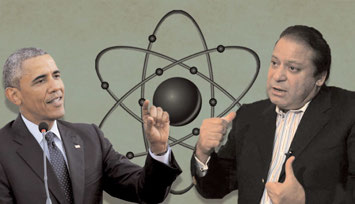
    If a report in a US newspaper is to be believed, a US-Pakistan nuclear deal might be on the cards. The report says that such a deal is being considered around Prime Minister Nawaz Sharif’s visit to Washington this month.

    The report would not have appeared credible but for the evasive comment of the State Department on the subject and the official reaction of the spokesperson of our Ministry of External Affairs cautioning the US authorities against any such decision.

    Ever since the India-US nuclear deal was signed, the Pakistanis, obsessed with the idea of parity with India, have been seeking a similar deal.

    Besides calling the India-US nuclear deal discriminatory, Pakistan has condemned it as threat to its security and warned that it would take all necessary steps to safeguard its interests. Pakistan’s Foreign Affairs Adviser Sartaj Aziz aggressively reiterated this on the occasion of President Barack Obama’s visit to India in January this year.

    By remaining silent, the US has only encouraged this absurd posturing by Pakistan.

    US soft on Pakistan

    Some western nonproliferation specialists have been advocating for some time a nuclear deal with Pakistan in order to remove its sense of grievance. They feel it would give Pakistan an incentive to limit the expansion of its nuclear arsenal and stabilize the nuclear situation in the sub-continent.

    Such advocacy is largely prompted by negative attitudes towards India which, with its historical opposition to the NPT, is seen as the one responsible for nuclearizing South Asia. In their eyes, this is one way of denying India any one-sided advantage in nuclear status.

    Until now, the US Administration has been differentiating India’s case from that of Pakistan and disclaiming any move to offer the latter a similar deal, thought the tenor of its statements has not been sufficiently convincing.

    In fact, both the US and China, to different degrees, have aided Pakistan in achieving its nuclear and missile ambitions.

    A US-Pak nuclear deal will erode the strategic importance of the Indo-US nuclear deal

    In the past, knowing the China-Pakistan nuclear and missile nexus, the US has waived the application of its laws for larger geopolitical reasons linked to the combat against the Soviets in Afghanistan. The Afghanistan factor has, unfortunately, continued to condition US thinking on Pakistan’s nuclear and other errant behavior.

    The US was remarkably soft with Pakistan on the AQ Khan case. It has tolerated Pakistan’s tactics to obstruct discussions on the FMCT at Geneva at a time when fissile material control was still on the US agenda.

    It has overlooked supplies of additional Chinese nuclear reactors to Pakistan in violation of China’s NSG commitments.

    One could speculate that having settled the nuclear question with India, this was one way for the US to allow Pakistan to be a beneficiary of external cooperation in its nuclear sector, as part of the traditional policy of “hyphenation”.

    US agencies and think tanks have been propagating information about the frenetic pace at which Pakistan has been expanding its nuclear arsenal, without any visible reaction from the US government.

    At one time, worried about the rise of radicalism in the country, the US was expressing concern about the security of Pakistan’s nuclear arsenal. But such fears are no longer being expressed.

    US conduct over the years suggests that it has favored the idea of a Pakistani nuclear capability to balance India’s. Remarkably, its complaisance towards the Pakistani nuclear program has continued long after the end of the Cold War.

    Adding to all this, US treatment of Iran’s nuclear ambitions contrasts strikingly with its handling of Pakistan’s nuclear transgressions. While draconian sanctions have been applied on Iran, in Pakistan’s case the US has argued that sanctions might hasten its slide towards failure as a state and increase the risk of its nuclear assets falling into the hands of religious extremists.

    This is specious logic as the US has not taken any precautionary step to curb the development of Pakistan’s nuclear assets, including its decision to introduce tactical nuclear weapons in the subcontinent. An expanded Pakistani nuclear arsenal is even more likely to fall into the wrong hands.

    US reaction to Pakistan’s loose talk about using nuclear weapons against India has been, moreover, notably mild. It could and should have been much stronger.

    The hesitation to impose sanctions on Pakistan contrasts also with the willingness to impose sanctions even on a powerful country like Russia, including its most senior leaders and functionaries.

    What inhibits the US to strong arm Pakistan despite its provocations remains unclear.

    The argument that for dealing with the situation in Afghanistan the US needs Pakistan’s assistance is not convincing. The US needs Russia even more for dealing with yet more complex and fraught problems as Iran and West Asia in general, including the rise of the Islamic State, not to mention the fall-out of mounting tensions in Russia-West relations.

    China-Pakistan axis

    It is mystifying why the US should want to politically legitimize Pakistan’s nuclear conduct through an India-like nuclear deal.

    In India’s case, the US wanted to make a geopolitical shift with the rise of China in mind. It saw India as a counterweight to China in Asia, but for this the nonproliferation issue which inhibited India’s international role had to be resolved.

    Pakistan is in fact China’s closest ally. The geopolitical purpose of a nuclear deal with Pakistan will only legitimize the China-Pakistan nuclear and security relationships and undermine India’s strategic interests vis-a-vis both these adversaries.

    The US has wanted to build a strategic relationship with India largely around shared interests in the Indian Ocean and Asia-Pacific regions in view of mounting signs of Chinese political and military assertiveness and its ambitious naval expansion program.

    Through the China-Pakistan Economic Corridor and the development of Gwadar, Pakistan is facilitating an increased Chinese strategic presence in the Indian Ocean, which contradicts this US strategy.

    Shocking rationale

    According to reports, the underlying reasoning offered by the US, if correctly reported, is almost shocking. In return for an NSG waiver, Pakistan will be asked to restrict its nuclear program to weapons and delivery systems that are appropriate to its actual defense needs against India’s nuclear threat, and not to deploy missiles beyond a certain range.

    This implies that the US accepts that India’s nuclear program is Pakistan-centric and that it poses a threat to Pakistan.

    The Chinese threat to India is being overlooked and the fact that India faces a double Pakistan-China nuclear threat – in view of the close nuclear collaboration between the two countries- is being ignored.

    The US, it appears, would be comfortable if only India would be exposed to the Pakistani nuclear threat, not others.

    US has been consistently soft on Pakistan’s errant behavior in matters like nuclear weapons

    But then, Pakistan’s nuclear arsenal, according to its own leaders, is India-centric. Pakistan is not threatening China, Iran or Saudi Arabia with its nuclear weapons. Which are the countries that the US wants to protect against the use of nuclear weapons by Pakistan?

    Pakistan is developing delivery systems to reach any point in India. The US would apparently be comfortable with that, but not if it developed missiles of longer range. But whose security is US worried about if Pakistan did that? US itself, Japan, Australia, Singapore, China, Iran, Saudi Arabia, Israel?

    China, we know, opposes India’s NSG entry without Pakistan. It would seem the US would be willing to accommodate both China and Pakistan if the latter limited its nuclear threat to India.

    By implication then, the US has no stakes in India’s security from an unstable and adventurous Pakistan, despite our so-called strategic partnership.

    A reward for Pakistan’s military

    The timing of a nuclear deal would be odd too. It is now universally recognized that it is General Raheel Sharif and not Nawaz Sharif who really hold the reins of power in the country. A nuclear deal will be a reward for the Pakistan military and not the civilian power, as Pakistan’s nuclear program is under military control.

    Does the US want to reward the Pakistan military for its operations in North Waziristan against the Pakistani Taliban and is this considered meritorious contribution to the fight against Al Qaeda and terrorism?

    One would have thought far more important for the US and the West is the rise of the Islamic State and its ideology. Compared to which North Waziristan is a side-show. In any case, the Pakistani military is not fighting the Haqqani group.

    Worse, while Pakistani is being accepted as an honest mediator in the Afghan reconciliation process, the Taliban showed its mounting force by occupying Kunduz.

    One hopes that the US report does not accurately reflect President Obama’s thinking.

    If it does, it will show how hollow is the strategic relationship between India and the US, and why it would not be wise to trust the US.

    The India-US nuclear deal will be eroded of much of its strategic importance bilaterally, as result. The US would have, in addition, administered a big political blow to Prime Minister Narendra Modi who has gone out of his way to improve strategic understanding with the US.

    But then, news reports are news reports, and they could merely be political kite-flying. In which case, the India-US relationship will not receive a big jolt for all the reasons mentioned in this article.

    (The author is a former foreign secretary of India. He has also served as India’s ambassador to Turkey, Egypt, France and Russia. He can be reached at sibalk@gmail.com)

  • Shiv Sena brings disrepute to the world class Mumbai

    Shiv Sena brings disrepute to the world class Mumbai

    Shiv Sena is in the news, and for all the wrong reasons. Acting as law makers and law enforcement on  certain issues, Shiv Sena during the last few days, have protested against some programs and forced their cancellation .In one case, Shiv Sainiks even blackened the face of the organizer of a program and threatened him with dire consequences.

    The first in the series, during the last one month, was protest against a concert by Ghulam Ali, the famous Pakistani Ghazal singer. Now, Ghulam Ali is not just a Pakistani citizen. He is  a world citizen. He is known as Ghazal King all over the world. As a man, too, he is hugely loved simply because he is humble and affectionate.

    The second incident related to the release in Mumbai of a book written by Khurshid Mahmud Kasuri, a former Pakistan Foreign Minister and now a leader of Imran Khan’s party Tehrique Iqbal.

    The Shiv Sainiks smeared the face of the organizer of the book launch, a former BJP ideologue Sudheendra Kulkarni and said it was a form of “peaceful protest” against Pakistan.

    The latest in the series was  forcing cancellation of Indo-Pak rock band show in Ahmedabad on Sunday, October 11.

    Going by the history of the Shiv Sena, one would not be surprised with  their conduct. But then what happens to Mumbai and the people of Mumbai who feel ashamed of having such elements in the world class city?The Shiv Sena  has not done any proud to a city which the world knows and possibly dreams of as  a glorious world by itself.

    It becomes the duty of the government  to rein in the “anti-social elements”. There should be zero tolerance for those who try to be the arbiters of law, more so when the Shiv Sena is part of the government at both the State of Maharashtra and at the Center.

  • Does India’s nuclear doctrine need a revision?

    Does India’s nuclear doctrine need a revision?

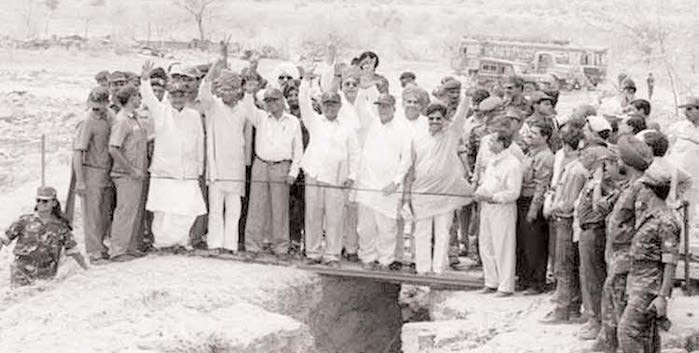
    India’s first nuclear test in 1974 called smiling Buddha in Pokhran desert was, for tactical reasons, characterized as “Peaceful Nuclear Explosion”. The second series of five nuclear tests in 1998 (Pokhran II) was again accompanied by a statement from the then PM Vajpayee attesting to lack of aggressive intent. The 2003 Indian nuclear doctrine went a step forward and made a written unilateral concession about India’s adherence to “No First Use” Doctrine. Since then a lot of debate has gone into the rationale, the need and the necessity for India to revise her Nuclear Doctrine and posture. Some foreign policy mandarins have tried to argue that India does not need to make any changes in the 2003 version of the doctrine. Though the election manifesto of the BJP prior to May 2014 Lok Sabha election noted the need to take a relook at India’s nuclear doctrine, subsequent statements by the PM nipped it in the bud.

    Site of India's first nuclear test in 1974 called smiling Buddha in Pokhran desert
    Site of India’s first nuclear test in 1974 called smiling Buddha in Pokhran desert

    While looking at the nuclear scenario, India has to take the contemporary threat perception and other geo-political factors into account while revising her strategic nuclear policy. It will be a good idea for India to periodically revise her nuclear doctrine every 10-15 years based on the geo-political situation. A lot has already changed since 2003. There is nothing sacrosanct about revising a document that was essentially tactical in nature. Newer nuclear threats have emerged from both the nuclear neighbors, China and Pakistan that mandate that India revise her nuclear doctrine and posture in order to avoid future nuclear blackmail.

    China has significantly diluted its “No first use” nuclear doctrine over the years. China has no intention of exercising restraint in the growth of its nuclear weapons program till the other two nuclear weapons superpowers (US and Russia) have brought down their number of nuclear weapons to China’s level. China has started deploying its nuclear powered submarines in the Indian Ocean region.

    Pakistani Nuclear program was initiated in 1970s by ZA Bhutto after Pakistan’s defeat in Bangladesh war of independence in 1971. His famous statement in 1965 in UNSC was about waging a thousand years war against India. Later on he talked about eating grass and obtaining Nuclear weapons. Pakistan’s nuclear weapons program has been, is and will remain an India-centric nuclear toy in the hands of ISI/GHQ/Pakistani military as the civilians do not control the program. From the beginning Pakistani nuclear program has had Chinese footprints all over.

    While Pakistan’s economy goes south, it remains a rentier state having extorted $31 billion from the US since 9/11. Pakistan keeps on getting tranches of money from the Kingdom of Saudi Arabia under an all-weather Sunni Alliance. Pakistan and ZA Bhutto had proudly proclaimed Pakistan’s nuclear weapons as “Islamic bomb” having been financed by Islamic money from KSA. Last year, Pakistani PM was able to obtain $ one billion from Saudi Arabia at a time when Pakistan’s economy took a hit. Money will never be a problem for Pakistani nuclear establishment as it grows at a disproportionate rate.

    Pakistani ballistic missile program has also heavily borrowed from China and North Korea since the 1990s. Hate IX (Vengeance-IV) Nasr was purpose built to carry tactical nuclear weapons (sub kiloton yield) over short range of 60-90 kilometers. On March 9 2015, Pakistan successfully tested the Shaheen-III surface-to-surface ballistic missile, capable of carrying nuclear warheads to a range of 2,750 km. Shaheen III nuclear capable missiles increase the range of Pakistani nuclear missiles to include the entire Indian land mass and the Indian Eastern naval command based in Andaman & Nicobar Islands. Pakistani has recently become the beneficiary of Chinese nuclear powered submarines that definitely pose a threat to India for her second strike capabilities.

    General Khalid Kidwai who was the director of Pakistani Army’s Strategic Planning Division (SPD) for a period of 15 years, in an open meeting in March 2015 at the Carnegie Endowment for International Peace, in Washington DC aggressively articulated Pakistan’s new offensive nuclear doctrine and posture. He brazenly threatened India with the first use nuclear attack threats painting a new picture. From the initial posture of credible minimum deterrence, Pakistan has moved to the concept of “Full Spectrum Deterrence” which envisages aggressive and offensive use of nuclear weapons by Pakistan against India in a number of scenarios. Not only Pakistan has linked its full spectrum nuclear deterrence doctrine with resolution of J&K dispute in its favor, Pakistan has threatened to use nuclear weapons against India if its tentacles in Afghanistan are cut off. Extra-territorial linkage with loss of its assets in Afghanistan widens the role for nuclear weapons under the new Pakistani doctrine.

    Pakistan has already developed tactical nuclear weapons to be used in the war theater on the mechanized divisions of Indian armed forces. Ostensibly, Pakistan has justified use of tactical nuclear weapons as a policy against Indian Army’s imaginary “Cold start doctrine” which was never officially promulgated.

    Pakistan is the only country that has single-handedly blocked an international agreement on FMCT while feverishly increasing its fissile material production. While traditionally cited figure is Pakistan has 90-110 nuclear weapons, reality has changed during last few years. The Pakistani nuclear armada is the fasted growing in the entire world with production of 10-20 new nuclear weapons every year.

    Pakistani state has brazenly and repeatedly indulged in nuclear blackmail and rent collection over the last several decades. This Pakistani behavior will NOT change only the sponsors and the rent-payers will change over time.

    There is NO reason for India to remain complacent while the nuclear threat perception changes. The PM will do a yeoman’s service to long-term strategic security of Indian nation if he revisits the Indian nuclear doctrine and allows it to grow some teeth. A number of remedial steps can be taken including discarding the meaningless no-first use doctrine to safe-guard nation’s security. Victors always write the history and India has lost repeatedly in history making.

  • Border Patrol gets new guidelines for immigrant detentions

    Border Patrol gets new guidelines for immigrant detentions

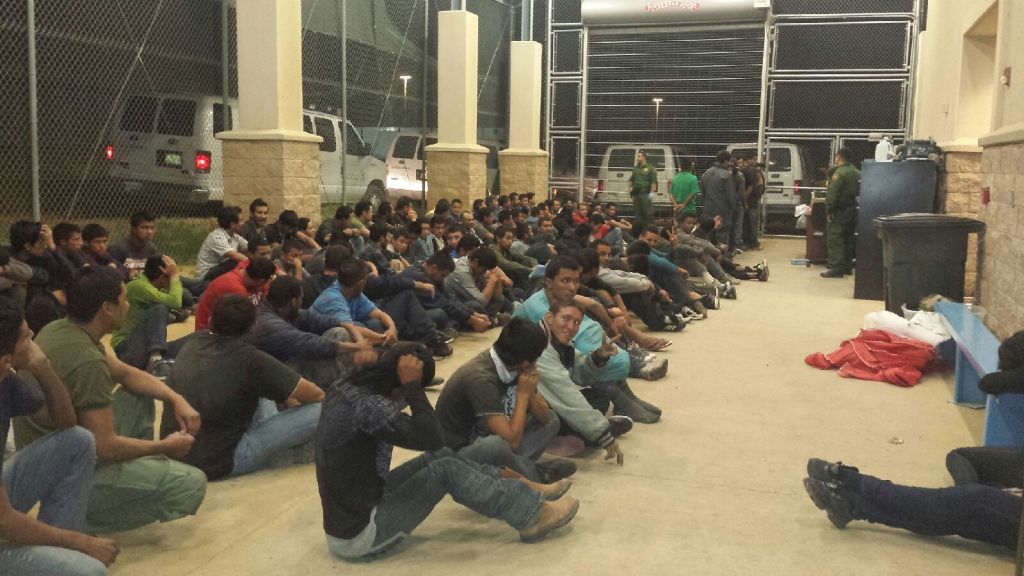
    DALLAS, TX (TIP): The U.S. Customs and Border Protection has issued a sweeping new set of standards for handling immigrant detainees, following a year of heightened criticism over agency practices.

    The 31-page document—the first of its kind of the parent agency of the Border Patrol–describes acceptable procedures for nearly 100 situations, and addresses the biggest pegs for recent controversy: adequate feeding, tolerable air temperature and cleanliness in detention facilities.

    The handling of immigrant detainees came to public attention especially through heavy media coverage of the summer 2014 surge of unaccompanied children seeking asylum in the United States. Most traveled from Central America to the Texas border, fleeing violence and poverty at home.

    This summer saw increased immigrant traffic at the Texas border, Gov. Greg Abbott said in September, with nearly 10,000 families or unaccompanied children caught crossing the Texas border in August.

    Those apprehended immigrants are held for up to three days in CBP detention facilities, where critics have alleged families were separated from their children, inadequately fed or confined in unsanitary, excessively frigid cells.

    “CBP has been under fire for some time for humanitarian violations at these facilities at the border,” said Amy Fischer, policy director of the Texas-based nonprofit Raices, which provides free legal services to immigrants at Texas detention facilities. “This was a long time coming as they’ve attempted to rectify the issues.”

    In June, immigrant families filed a class action lawsuit against the CBP, claiming they were denied basic sanitation, food and water while held in detention centers. A federal judge in July ruled in their favor, saying immigrants were held in “widespread and deplorable conditions.”

    Fischer recalled reports from the last two weeks of immigrants fed two bologna sandwiches per day, small children sexually abused by other detainees and food withheld as punishment.

    The new CBP standards prohibit denying food or changing facility temperature as a means of punishment. They require detainees to be searched or escorted by agents of the same gender. They mandate efforts to keep children with their others, to keep facilities clean, and to move immigrants to longer-term detention facilities managed by Immigrations and Customs Enforcement within three days of their apprehension.

    And the standards require regular meals and snacks to be distributed and logged.

    The new standards also include the agency’s first reference to homosexual or transgendered immigrants.

    Fischer said she was skeptical that the new standards would be implemented without an accountability mechanism in the document.

    In a press release, CBP commissioner R. Gil Kerlikowske said “As highly accomplished law enforcement professionals, CBP personnel are committed to ensuring safety, security, and care of people in our custody. Through this consistent and clear policy, CBP further reinforces this duty.”


  • Hillary Clinton’s Call to turn Texas Blue

    Hillary Clinton’s Call to turn Texas Blue

    SAN ANTONIO, TX (TIP): Hillary Clinton came to San Antonio Thursday, October 15 to receive the blessing of the Castro brothers, making her first official campaign stop in Texas and marking a significant moment in her second bid for the White House. At two events — a Q&A with the U.S. Hispanic Chamber of Commerce and an outdoor rally at Sunset Station — she sought to appeal to Hispanic voters, a core constituency of the Obama coalition, and underline the possibility that her campaign could mount a serious bid to win Texas in the 2016 general election.

    Clinton is one of the most fascinating figures in modern American politics, in part because of the remarkable, even Sisyphean, way that the nation’s political architecture rearranges itself seemingly with the intention of thwarting her.

    The Clintons appeared to have finally found the path to return Democrats from exile in 1992, with Hillary playing an unusually prominent role in making policy, but the Republican revolution of 1994 put a damper on that, and much of the rest of her time as first lady was derailed by other matters. She came back to independent prominence as a respectably centrist senator from New York in the 2000s, an Iraq war hawk and a defender of Wall Street, but when it came time to run for president, those positions helped sink her.

    Now, her supporters say, she’s one of the most experienced presidential contenders ever, and it’s a claim with some merit — she’s been the closest advisor of a governor and a president, and she’s served in the U.S. Senate and the cabinet. She’s been privy to history in the last quarter-century like few other people on the planet. And yet she’s running in a year of seemingly unprecedented hatred of the establishment, where her experience and record is in some ways a liability. She’s popular with Dems, for the most part, but she still needs to bolster her left credentials to win over parts of the base afflicted with Clinton fatigue.

    At the launch of the “Latinos for Hillary” initiative, October 16 Clinton was introduced by Julián Castro, who was in turn introduced by Joaquin Castro. Both brothers have now endorsed Clinton, and emphasized to the crowd that Clinton was someone for whom Hispanic issues were, and had always been, close to heart. “She’s always been there for us,” Julián Castro told the crowd, “and today we’re there for her.”

    Some Democrats had hoped to see Clinton take on more of the mantle of the left. On Thursday, she spoke about the wage gap and family leave policies, thanked the #BlackLivesMatter movement for their activism, and told the crowd she would take up immigration reform from the beginning of her presidency, aggressively pursuing a reform package with a full pathway to citizenship for undocumented people. She told the crowd that she would actively pursue gun control in office. “If you join me,” she said, “I will continue taking on the NRA!”

    Introducing Clinton, Julián Castro told the crowd he looked forward to seeing Fox News announce Clinton’s taking of Texas’ electoral votes come November, and Clinton responded by asking the audience to help her “turn Texas blue.” She lauded former San Antonio mayor Julián Castro’s advocacy for pre-K in San Antonio. She emphasized her belief that government could help level the playing field. “Talent is universal, and opportunity is not in America,” she said.

    And she lavished praise on the sitting president: “This country’s come a long way in the last six and-a-half years,” she said, thanks to the “leadership of President Obama.” He didn’t get enough credit for avoiding a second great depression, she said, to cheers. In other arenas, particularly when it comes to foreign policy, Clinton has carefully underlined differences with Obama. In front of this crowd of Texas Democrats, there was no such distancing.

    Another important thread at the Clinton event on Thursday was the possibility that Clinton’s campaign will invest some of its massive resources in Texas during the general election, with an eye to strengthening the party’s infrastructure here. That’s a hope related to long-running speculation that Clinton will pick Julián Castro to be her running mate when the time comes.

    Texas Democrats would love that, but there’s always been plenty of reason to be skeptical of the idea that Clinton would invest heavily in Texas. In a close presidential race, putting a lot of money in a state Democrats are exceptionally unlikely to win would be an inefficient use of resources, especially given the problems with party unity and competency that surfaced in 2014, and given that the third election for an incumbent party after two terms in office is traditionally a time of atrophying energy and turnout.

    But Thursday, it seemed clear that the Clinton campaign was trying to lay the foundation for a Lone Star subplot this cycle. There was the simple fact that today’s rally, the launch of the campaign’s Hispanic outreach project, happened in San Antonio, with the Castros. Introducing Clinton, Julián Castro told the crowd he looked forward to seeing Fox News announce Clinton’s taking of Texas’ electoral votes come November, and Clinton responded by asking the audience to help her “turn Texas blue.”

    Clinton also emphasized her time, spent with then-boyfriend Bill, doing organizing work in South Texas, by all accounts a formative experience for the two. Back then, she said, she and Bill, with his beard and big head of hair “like a Viking,” had a grand old time in Texas. They ate “a lot of green enchiladas,” and “drank our share of Shiner Bocks.” They “ate way too much mango ice cream at the Menger Hotel.”

    When Bill and Hillary came to Texas in 1972, they came to do campaign work for George McGovern, the liberal no-hope Democratic nominee who limped to a crushing defeat against Richard Nixon, winning only one state. That crushing defeat is one of the things that pushed the Clintons toward finding a kind of Democratic identity that could win in what was becoming a more conservative country. That search changed the Clintons in surprising ways: Years later, after Bill Clinton won the White House, Nixon and Bill became friends.

    History’s funny that way. Now the winds have changed again. The country is shifting, in some ways, to the left — at least in presidential elections, when younger and more diverse voters come out. And again, a Clinton is trying to surf the wave. Can she manage it this time? While most people are transfixed by the vulgar Republican primary, Clinton’s the best show in politics right now.


  • Birth Certificate Lawsuit a Ruse to Validate Foreign ID’s, say State of Texas Attorneys

    Birth Certificate Lawsuit a Ruse to Validate Foreign ID’s, say State of Texas Attorneys

    AUSTIN, TX (TIP): Attorneys for the state of Texas argued in federal court in Austin on Friday, October 17, that a lawsuit joined by dozens of undocumented Texans has nothing to do with their U.S.-born children being denied birth certificates by the state vital statistics unit. Instead, the attorneys claimed, the suit is a ruse to compel the state to accept Mexican consulate-issued identification.

    “This is more about the legitimacy of the matricula, I’m just throwing that out there,” argued Thomas Albright, an assistant attorney general for the state, referring to the contested form of photo identification that Department of State Health Services (DSHS) says it will not accept, and has never accepted, as proof of identity for undocumented parents seeking birth certificates for their American-born kids.

    Friday was the first time attorneys have appeared in court over the lawsuit, which was originally filed in May by four undocumented women from the Rio Grande Valley who allege that the state has wrongly denied them access to their children’s documents. They allege that in previous years, the state accepted the matricula consular for their now-older children as part of a selection of documents parents could use to prove their relationship. The matricula is a photo ID that the Mexican consulate issues to Mexican nationals living in the United States.

    U.S. District Judge Robert Pitman warned attorneys for the state of Texas to abandon previous written arguments they’d made against the “importance” of having a birth certificate at all — “You shouldn’t be spending any more ink or time on that one,” he said — and asked counsel on both sides to convince him that the current “scheme” devised by the state concerning families’ abilities to obtain birth certificates either is or is not constitutionally appropriate.

    Lawyers for the Texas Civil Rights Project (TCRP) and Texas RioGrande Legal Aid (TRLA), which now represents nearly 30 undocumented parents and their American citizen children who’ve joined the case, told a judge that the state changed its matricula policy amid anti-immigrant political rhetoric in the early 2010s and currently offers no “open doors” as a means by which undocumented parents can obtain birth certificates for their American children.

    The hearing on Friday concerned a motion for preliminary injunction, with TCRP counsel asking the judge to block the state from denying the birth certificates while the case proceeds through the court system. Otherwise, TCRP counsel warned, U.S. citizens could face immediate and irreparable harm in the form of being deported with their parents and unable to return to their homes in Texas, being unable to enroll in school, or unable to obtain medical treatment through public programs. Some children, they argue, could not even be baptized without their birth certificates.

    The judge wondered aloud in court, multiple times, whether the state’s refusal to accept the matricula was a solution in search of a problem.

    “The state must open one door to the undocumented parent community so there is some reasonable procedure they can follow to access their children’s birth certificates,” argued TRLA’s Jennifer Harbury. “Texas is the only state out of 50 that has locked all available doors.”

    American citizens are therefore wrongly being denied fundamental rights because of their parents’ immigration status, the plaintiffs’ attorneys argued. They asserted that none of the primary forms of identification the state currently accepts for birth certificates — including foreign passports with valid U.S. visas — are obtainable by undocumented Texans. And secondary forms of identification, they argued, should include the matricula or at least some other piece of identification accessible to undocumented parents, like expired driver’s licenses or voter ID cards.

    Harbury outright denied that the lawsuit was a ruse to legitimize the matricula, saying that TRLA’s concern, on behalf of their clients, “is get the birth certificates. We don’t care about the matricula.”

    Representatives for DSHS have said that their policy concerning the matricula has never changed, and that the state rejects the consulate-issued identification because it is not secure and could be used to fraudulently obtain birth certificates.

    But the judge wondered aloud in court, multiple times, whether the state’s refusal to accept the matricula was a solution in search of a problem.

    “What makes this burden necessary?” Pitman asked, that the state would seek to place such an obstacle between a U.S. citizen and access to her own birth certificate — access to, fundamentally, her very citizenship. “Tell me, is this a problem, is it such a problem that you have to enact this type of barrier?”

    Albright responded that he did not have any quantitative documentation of instances where the matricula had ever been used to fraudulently obtain a birth certificate, but that the threat of such an occurrence justified the statutory requirements for obtaining such documentation. He acknowledged the political nature of the case, which had generated “a lot of passion,” and asked Pitman to “disengage a bit of compassion and look at it from a legal standpoint.”

    Pitman concluded Friday’s two-and-a-half-hour hearing without a ruling and said that he would issue his decision on the preliminary injunction following further consideration.