Year: 2015

  • PRAVASI BHARATIYA DIVAS 2015

    PRAVASI BHARATIYA DIVAS 2015

    The 13th edition of Pravasi Bharatiya Divas is being organized at Gandhinagar, Gujarat from January 7 to 9, 2015. It is the first time that PBD has gone to Gujarat.

    The PBD 2015 is dedicated to Mahatma Gandhi, the greatest non-resident Indian who on January 9, 1915 had come back to India from his pravas.

    To connect India to its vast overseas diaspora and bring their knowledge, expertise and skills on a common platform, the PBD Convention – the flagship event of Ministry of Overseas Indian Affairs (MOIA), Government of India is organized from 7th-9th January every year since 2003.

    Pravasi Bharatiya Divas (PBD) is celebrated on 9th January every year to mark the contribution of Overseas Indian community in the development of India. January 9 was chosen as the day to celebrate this occasion since it was on this day in 1915 that Mahatma Gandhi, the greatest Pravasi, returned to India from South Africa, led India’s freedom struggle and changed the lives of Indians forever.

    PBD conventions are being held every year since 2003. These conventions provide a platform to the overseas Indian community to engage with the government and people of the land of their ancestors for mutually beneficial activities. These conventions are also very useful in networking among the overseas Indian community residing in various parts of the world and enable them to share their experiences in various fields.

    During the event, individuals of exceptional merit are honored with the prestigious Pravasi Bharatiya Samman Award to appreciate their role in India’s growth. The event also provides a forum for discussing key issues concerning the Indian Diaspora.

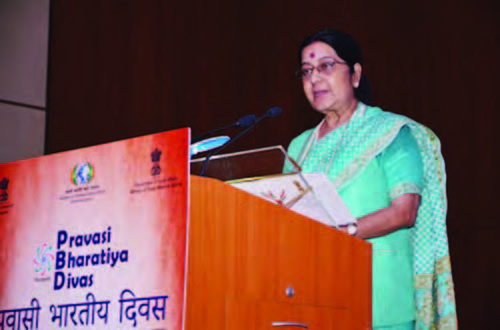
    Inaugurating the Youth Pravasi Bharatiya Divas (PBD) at Mahatma Mandir in Gandhinagar on January 7, Sushma Swaraj, Union Minister for External Affairs and Overseas Indian Affairs exhorted the Indian youth diaspora to ‘connect, celebrate and contribute’ to the transformational change being witnessed in India in the making of ‘Ek Bharat, Shreshth Bharat’.

    Sushma said, “The Indian youth diaspora can become ambassadors of the ‘new’ India as “you have retained a bit of India in your heart and each one of you have a bit of ‘Bharat’ in you.”

    PRAVASI BHARATIYA DIVAS 2015 1

    The Minister said that Youth PBD was not just about interacting with the young people of this country but has emerged as an important platform for the diaspora to discover and nurture their roots.

    She appealed to the youth to connect with the young generation of Indians – over 50% of the Indian people were under 25 years. Youth PBD, she said, was an occasion to celebrate India’s traditions, art and culture, even as the country strives to empower its youth with technology.

    “What excites the world today is India’s growth story,” Swaraj said and pointed to the government’s success in bringing about a complete transformation of the business sentiment in the country. This, she added, was the outcome of the numerous steps undertaken by the government to improve the ease of doing business.

    Swaraj said the diaspora could contribute significantly to the development of India through programs such as ‘Make in India’, ‘Digital India’, creation of smart cities and other physical infrastructure.

    Prime Minister Narendra Modi, on January 8, announced a string of facilities for expatriate Indians that seek to free them of regulations on their arrival to India and within the country.

    Inaugurating the 13th Pravasi Bharatiya Divas (PBD), organized by the Ministry of Overseas Indian Affairs (MOIA) in partnership with the Ministry of Youth Affairs & Sports and the Government of Gujarat, the Prime Minister said life time visa will now be granted to PIO cardholders and as a mark of respect to them, the regulation requiring them to visit a police station to verify their credentials once every week, has been scrapped.

    Modi said while the PIO and OCI cards have been merged, allowing similar facilities to either cardholder, electronic authorization of visa has commenced, apart from extending the facility of visa on arrival from 43 countries. In addition, the Pravasi Bharatiya Centre will be operational in Delhi soon. The Prime Minister said engaging with the pravasis was not a one-way street; “not everything should be seen in terms of pounds or dollar” he said, adding that overseas Indians need to be given unstinted support so that they feel enthusiastic in contributing to India’s development.

    The Prime Minister suggested that an online quiz competition could be started from the PBD platform on ‘Bharat ko Jano’ for teams of young people worldwide. This would help project India’s development effort in the right perspective. The competition, he said, could be conducted round the year so that the campaign for knowing India becomes a global movement.

    Modi urged the pravasis to actively participate in the government’s ambitious ‘Clean Ganga’ initiative by sharing their expertise in technology, innovations, ideas and resources. “There are opportunities for all along the river – in agriculture, water transport, city development and village rejuvenation and even adventure sports,” the Prime Minister said.

    On the occasion of the centenary of Mahatma Gandhi’s return to India from South Africa, the Prime Minister released Rs 25 and Rs 5 commemorative stamps and Rs 100 and Rs 10 coins.

    The Chief Guest at the PBD, Donald R. Ramotar, President of the Republic of Guyana, said India’s has seen a transformational change in recent years. The time has come arrived for India to demonstrate its mature political leadership to guide other developing countries, participate more actively in internal forums, look outwards for channelizing investments to other countries and strengthen air and maritime links with the rest of the world.

    He assured Guyana’s commitment to India’s pursuit of reform of the UN Security Council and expressed total support for India’s candidature for a permanent seat in an expanded Security Council.

    Maite Nkoana-Mashabane, Minister of International Relations and Cooperation, Republic of South Africa, the Guest of Honour, pointed out that the political, economic and cultural bonds between South Africa and India were strong. These were cemented by the community of Indians in South Africa, the second largest outside India. The bonds must be further strengthened by addressing the triple challenges of poverty, unemployment and under-development.

    She stressed the need for closer cooperation between the two countries in the fields of IT, healthcare and renewable energy and expressed confidence that India would support South Africa in its development efforts. Sushma Swaraj, Union Minister for External Affairs and Overseas Indian Affairs, emphasized that successful and politically influential diaspora is an asset to India. She called upon the diaspora to pursue a mutually rewarding participation in developing India.

    Anandiben Patel, Chief Minister of Gujarat, said that the new economic and social initiatives launched by the Central Government have unleashed a new wave of enthusiasm among the people. The pravasis with the sincere hard work had raised India’s image internationally, while keeping the links with the land of their origin alive.

    The three- day kumbh of the NRIs has attracted NRIs from all parts of the world. For most Gujaratis abroad it is a welcome visit home.

  • Circumstantial evidence indicates Sunanda poisoned by alprazolam: FIR

    Circumstantial evidence indicates Sunanda poisoned by alprazolam: FIR

    NEW DELHI (TIP): Circumstantial evidence points to “alprazolam poisoning” as the reason for Sunanda Pushkar’s death and injuries to her were caused by “blunt force” but did not cause death while her body also bore injection and teeth bite marks, says the FIR in the murder case.

    “The circumstantial evidences are suggestive of alprazolam poisoning,” said the three-page First Information Report, which has been accessed by IANS, adding poisoning was through oral route but an “injectable route” could not be ruled out.

    “All the injuries mentioned are caused by blunt force, simple in nature, non-contributing to death and are produced in scuffle, except injury number 10 which is an injection mark. Injury number 12 is a teeth bite mark. The injuries number 1 to 15 are of various duration ranging from 12 hours to four days,” the FIR said.

    Pushkar, wife of Congress leader Shashi Tharoor was found dead in a south Delhi hotel room Jan 17, 2014. Police registered a murder case Jan 1, 2015 based on a final medical report by AIIMS which said she died due to poisoning.

    The FIR said the latest report from autopsy board, received Dec 29, 2014, said Pushkar, 52, was neither ill nor suffering from any disease prior to her death.

    “She was a normal, healthy individual. In view of the above analysis, death due to natural cause is ruled out. The cause of death in this case is poisoning. The poisoning is through oral route, however injectable route too also can’t be ruled out,” the FIR said.

    Narrating the sequence of events, the FIR says that then station house officer (SHO) of Sarojini Nagar police station Atul Sood received a telephonic call on Jan 17, 2014 from Tharoor’s personal secretary (PS) Abinav Kumar that Pushkar “has done something” in room number 345 of Hotel Leela Palace. A daily diary entry regarding the death was lodged the same day.

    Pushkar had checked into the hotel at 5.48 p.m. Jan 15, 2014.

    The FIR says that the first autopsy, conducted by three doctors of All India Institute of Medical Sciences (AIIMS), opined poisoning as the cause of death.

    The concerned sub-divisional magistrate sent the report to Sarojini Nagar SHO asking him to conduct further investigation. It also asked him to request the director, Central Forensic Science Laboratory, for early report of viscera examination.

    The viscera, clothes and medicines found on the spot were sent to CFSL Jan 20 last year. Police got viscera analysis report in March last year and it was given to the AIIMS autopsy board the same month.

    In its subsequent report in September, the autopsy board opined “the cause of death in the case is poisoning”.

    The FIR says that autopsy board members along with CFSL expert team visited the scene of occurrence Nov 5 and again collected evidence.

    “The report in this regard was received on Dec 24, 2014 and the same was sent to autopsy board along with other relevant treatment papers related to the deceased on the same day,” the FIR said.

    A day before her death, Pushkar and Tharoor issued a joint statement denying reports that they had a row over his alleged affair with a Pakistani journalist. Tharoor was then a minister in the government of then prime minister Manmohan Singh. He was re-elected to the Lok Sabha in May last year.

  • Cricketer turned politician Imran Khan marries  former BBC journalist

    Cricketer turned politician Imran Khan marries former BBC journalist

    ISLMABAD (TIP): Pakistan’s most famous former sports star turned politician Imran Khan remarried on Thursday, January 8, in a low-key ceremony attended by a handful of friends.

    Despite repeated rumors of Imran Khan’s nuptials there had been no official confirmation he would marry former BBC journalist Reham Khan until a few pictures of the pared-down ceremony flashed across the nation’s TV screens.

    Earlier in the day one studio discussion speculated on the outfit Reham, a former BBC weather and regional news presenter, might wear.

    In the end she confounded the fashion pundits with a white embroidered traditional lehengha. Pictures from the ceremony at Imran Khan’s hilltop pile outside Islamabad showed a stiff and unsmiling politician wearing a cream, silk sherwani.

    The need for restraint comes as the country continues to recover from the December Taliban massacre of more than 130 schoolboys in Peshawar, the capital of the province controlled by the Pakistan Tehreek-e-Insaf (PTI), the party Khan founded and leads. The attack, which has been described as “Pakistan’s 9/11”, has put the country on a war footing with militant groups. The government has taken dramatic steps, including the scrapping of a death penalty moratorium and amending the constitution to allow military courts to try civilians.

    Absent from the tiny ceremony were key members of the family, who have expressed their displeasure at the union. “We are basically boycotting it,” said a relative who did not wish to be named. “The family only hoped that he married a good person and we don’t believe she is. He is an icon and he deserves much better.”

    In recent days Reham Khan has endured social media abuse after pictures and videos from her career as a BBC presenter circulated online. Her on-screen appearances in skirts and moderately revealing outfits were never going to go down well in some quarters of the conservative country.

    Earlier in the week Khan flew to London to inform his two teenage sons about the marriage. On his return he told a press conference “marriage is not a crime” but that his children were his “first priority”.

    Whether or not his sons gave him their blessing, Khan’s relatives in Pakistan remain angry.

    “No one in the family is happy with this soap opera,” said the relative who did not want to be named. “His hardcore supporters in the party are also disappointed because there is a myth about him that he left his family in order to save Pakistan.

    “They didn’t care about his playboy past because they said at least he is honest and sacrificed his family for his country. And now he is starting a new one.”

  • Rajapaksa concedes defeat in Sri Lanka’s historic elections

    Rajapaksa concedes defeat in Sri Lanka’s historic elections

    COLOMBO (TIP): Sri Lankan President Mahinda Rajapaksa on Friday, January 9 morning conceded defeat in presidential elections held on Thursday, even as trends showed a clear victory for united opposition candidate Maithripala Sirisena.

    Sirisena was leading with 18,25,014 (51.62 %) votes and Rajapaksa was trailing him with 16,76,242 (47.23 %) votes at 7am on Friday.

    Rajapaksa left the presidential residence, Temple Trees, “respecting the people’s verdict,” an official spokesperson said.

    Rajapaksa assured a smooth transition of power. He reportedly had a meeting with UNP leader and former Prime Minister Ranil Wikramasinghe.

    The counting of votes started at 5 pm on Thursday. Sirisena got a huge support from the minority dominant north, east, and northern west provinces. Tamil majority Northern Province largely voted for him.

    While Sirisena secured 2,53,574 votes in Jaffna district, Rajapaksa got only 74,454 votes. Similarly, Sirisena secured 80.5 percent votes in Vanni, and Rajapaksa secured only 19.5 percent of votes there. Sirisena was leading in country’s capital Colombo also.

  • Massive manhunt for 2 suspects in attack on Charlie Hebdo

    Massive manhunt for 2 suspects in attack on Charlie Hebdo

    PARIS (TIP): Police SWAT teams backed by helicopters tracked two heavily armed brothers with al-Qaeda sympathies suspected in the newsroom massacre of satirical French weekly that spoofed Islam, homingin on a region north of Paris as the nationmourned the dozen slain.Authorities fear a second strike by thesuspects, who US counterterrorism officialssaid were both on the US no-fly list, anddistributed their portraits with the notice”armed and dangerous.”More than 88,000 security forces weredeployed on the streets of France.They also extended France’s maximumterror alert from Paris to the northernPicardie region, focusing on several townsthat might be possible safe havens for the two- Cherif Kouachi, 32, and Said Kouachi, 34.A senior US official yesterday said theelder Kouachi had traveled to Yemen,although it was unclear whether he wasthere to join up with extremist groups like al-Qaeda in the Arabian Peninsula, which isbased there.Witnesses said the attackers claimedallegiance to al-Qaeda in Yemen during thebloody attack Wednesday.Both were also on the US no fly list, asenior US counterterrorism official said. Theofficials spoke on condition of anonymitybecause they were not authorized to discussforeign intelligence publicly.A French security official said Americanauthorities had shared intelligenceindicating that Said Kouachi had traveled toYemen several years ago for training andFrench authorities were seeking to verify theaccuracy of the intelligence. The officialspoke on condition of anonymity because ofthe sensitivity of the matter.The worst spasm of terror violence inmore than a half-century stunned France.The lights of the Eiffel Tower went out lastnight in a tribute to the dead from theelegant iron lady that symbolizes France to the world.

    At noon, the Paris Metro came to a standstill and a crowd fell silent near the Notre Dame Cathedral.

    The attack struck a chord beyond French borders and similar tributes were held around Europe and elsewhere.

    French President Francois Hollande -joined by residents, tourists and Muslim leaders – called for tolerance after the country’s worst terrorist attack in decades.

    “France has been struck directly in the heart of its capital, in a place where the spirit of liberty – and thus of resistance -breathed freely,” Hollande said.

    Nine people, members of the brothers’ entourage, have been detained for questioning in several regions.

    In all, 90 people, many of them witnesses to the grisly assault on the satirical weekly Charlie Hebdo, were questioned for information on the attackers, Interior Minister Bernard Cazeneuve said in a statement.

  • GOVERNOR’S RULE IMMINENT IN J&K

    GOVERNOR’S RULE IMMINENT IN J&K

    NEW DELHI (TIP): Jammu & Kashmir governor N N Vohra has sent a report to the Centre conveying a “political deadlock” in the state in the wake of failure of any party or political formation to cobble the numbers to form the next government as well as Omar Abdullah’s request to be relieved as the caretaker chief minister.

    “The ground situation in J&K is that of a political impasse,” a home ministry functionary said adding that the options indicated by Vohra to resolve it include a spell of Governor’s rule until a party or coalition of parties comes forward to stake claim to form the government.

    J&K elections that concluded on December 20 threw up a badly-hung House. PDP emerged as the single largest party with 28 seats, BJP bagged 25 seats, National Conference 15 and Congress 12 seats. Despite extensive talks on government formation between BJP and the regional parties, particularly PDP, a power-sharing formula is yet to be agreed upon.

    The impasse worsened on Wednesday night with Omar Abdullah requesting the J&K governor to be relieved as the caretaker chief minister. “Just to confirm I did meet Gov Vohra sahib last night and asked him to relieve me as caretaker CM. I had agreed to stay temporarily…Given the situation on the border and 10,000 displaced, the hardships of winter and the continuing need for relief for flood affected, I believe the interests of the state will only be served by a full-time administrator and not a caretaker with no mandate to govern,” Omar tweeted on Thursday.

    Incidentally, Constitutional experts insist that Governor’s rule is not the only option if Omar steps down as caretaker chief minister. “The governor can always appoint another caretaker chief minister, who may not necessarily be a member of the state assembly…This new caretaker may continue till a government is formed, or until the term of the incumbent state assembly expires on January 19, whichever is earlier,” legal expert Subhash C Kashyap said. A senior home ministry official, however, said it was “highly unlikely” that Vohra would go for a new caretaker CM.

  • Obama plan would help many go to Community College free

    Obama plan would help many go to Community College free

    WASHINGTON (TIP): President Obama said Thursday,January 8, that he would propose a government program topay the tuition of many community college students, anambitious plan that would expand educational opportunitiesfor millions of Americans, says a New York Times report.The initiative, which the president plans to officiallyannounce Friday, January 9, at a Tennessee communitycollege, aims to transform publicly financed higher educationin an effort to address growing income inequality.The plan would be funded by the federal government andparticipating states, but White House officials declined todiscuss how much it would cost or how it would be financed.It is bound to be expensive and likely a tough sell to aRepublican Congress not eager to spend money, especially ona proposal from the White House.

    “With no details or information on the cost,this seems more like a talking point than aplan,” said Cory Fritz, a spokesman for HouseSpeaker John A. Boehner, Republican ofOhio.Mr. Obama’s advisers acknowledgedThursday that the program’s goals would notbe achieved quickly. The president, however,was more upbeat. “It’s something that we canaccomplish, and it’s something that will trainour work force so that we can compete withanybody in the world,” Mr. Obama said in avideo posted Thursday night by the WhiteHouse.The proposal would cover half-time andfull-time students who maintain a 2.5 gradepoint average – about a C-plus – and who”make steady progress toward completing aprogram,” White House officials said. Itwould apply to colleges that offered credittoward a four-year degree or occupationaltrainingprograms that award degrees inhigh-demand fields. The federal governmentwould cover three-quarters of the averagecost of community college for those students,and states that choose to participate wouldcover the remainder. If all states participate,the administration estimates, the programcould cover as many as nine million students,saving them each an average of $3,800 a year.Mr. Obama will include the program,which would need congressional approval, inhis budget for the coming year, his adviserssaid, and detail it in his State of the Unionaddress Jan. 20.The plan is modeled after Tennessee’s freecommunity college program, called theTennessee Promise, which will be available tostudents graduating high school this year. Ithas drawn 58,000 applicants, almost 90percent of the state’s high school seniors, andmore than twice as many as expected.The program has gone a long way towardmaking community college attainable for allstudents. In addition, the proportion ofapplicants who are African-American and Hispanic is higher than their proportioncurrently enrolled in Tennessee colleges. Theprogram is backed by the state’s Republicangovernor, Bill Haslam, and largely financedfrom lottery funds.Still, Tennessee Promise has beencriticized by some who say it is structured tobenefit middle-income students more thanthe neediest.It is designed as a “last dollar” scholarship,paying only for tuition costs not covered byother programs. A low-income student who iseligible for a maximum Pell Grant of $5,730would not receive assistance under theTennessee program, because that amountwould already cover tuition. A more affluentstudent, however, could get full tuition paidby the program.Mr. Obama’s plan, by contrast, would covertuition costs up front, White House officialssaid.Representative Diane Black, Republican ofTennessee, said despite the success of herstate’s program, she was skeptical of theObama initiative, calling it “a top-downfederal program that will ask already cashstrappedstates to help pick up the tab.”Chicago, too, has a new free communitycollege initiative starting this year. Theprogram initiated by Mayor Rahm Emanuel,a Democrat, will give Chicago Public Schoolstudents who graduate with at least a 3.0grade-point average waivers to cover tuition,books and fees at the city’s seven communitycolleges.White House officials acknowledged in aconference call with reporters that theprogram was unlikely to win quick approvalin Congress. Still, they said, in proposing it,Mr. Obama was seeking to press states andcommunity colleges to beef up theirinvestments in high-quality education inways that would have a lasting effect evenbefore federal legislation was enacted.”We don’t expect the country to betransformed overnight, but we do expect thisconversation to begin tomorrow,” said CeciliaMuñoz, the president’s domestic policy chief.About 7.7 million Americans attendcommunity college for credit, of whom 3.1million attend full time, according to theAmerican Association of CommunityColleges, relying on 2012 data. Over all, thefederal government provides about $9.1billion to community colleges, or about 16percent of the total revenue the collegesreceive. Tuition from students provides $16.7billion a year, or nearly 30 percent ofrevenue.Senator Lamar Alexander of Tennessee, aformer education secretary, will attend the announcement at Pellissippi StateCommunity College in Knoxville, Tenn., onFriday.In an op-ed published on Thursday, heexpressed concern about the federal role insuch a program. Tennessee has beenhindered by federal bureaucracy, he wrote inThe Knoxville News Sentinel. “Let otherstates emulate Tennessee’s really good idea,”he wrote.

    (Source: New York Times)

  • Leander Paes wins the Bhupathi battle in Chennai

    Leander Paes wins the Bhupathi battle in Chennai

    CHENNAI (TIP): Chest thumps are back. This time though, it’s with partner No. 99, South Africa’s Raven Klaasen.

    Leander Paes and Klaasen enjoyed a good chemistry as they sent Mahesh Bhupathi and Saketh Myneni packing 1-6, 6-1, 10-7 in a dramatic encounter to make the doubles semifinals on Thursday.

    Incidentally, Leander Paes has won the doubles title here on six occasions, five with Mahesh. Paes won his last doubles crown here with Serbia’s Janko Tipsarevic in 2012.

    The first set saw Bhupathi-Myneni run amok, as they broke the Indo-South African duo in the second and sixth games. The second set was a mirror image of the first, save this time it was Paes-Klaasen pair in charge of the proceedings.

    The super tiebreaker was peppered with just the right amount of drama. At 3-3, Paes thundered down a blinder of a crosscourt shot to go up 4-3. At 9-6 in Paes-Klaasen’s favour, a Myneni serve landed deep, well past a lunging Klaasen.
    “It was a topsy-turvy match. It was more mental rather than tactical.Credit to Mahesh for playing the way he did in spite of not having a full season,” said Paes.

    Lopez falls on debut Feliciano Lopez hardly had the spice in his game on his Chennai Open debut, going down to qualifier Aljaz Bedene in straight sets.

    Out-of-sorts Lopez, despite being cheered on by the fans, was undone by Bedene, going down 4-6, 4-6. The other Spaniard, Roberto Bautista Agut, though, had it easy against Peter Gojowczyk, winning 6-3, 6-2 in another second-round match.

  • World Economy Past and future tense

    World Economy Past and future tense

    A Financial crash in Russia; falling oil prices and a strong dollar; a new gold rush in Silicon Valley and a resurgent American economy; weakness in Germany and Japan; tumbling currencies in emerging markets from Brazil to Indonesia; an embattled Democrat in the White House. Is that a forecast of the world in 2015 or a portrait of the late 1990s?

    Recent economic history has been so dominated by the credit crunch of 2008-09 that it is easy to forget what happened in the decades before. But looking back 15 years or so is instructive-in terms of both what to do and what to avoid.

    Then, as now, the United States was in the vanguard of a disruptive digital revolution. The advent of the internet spawned a burst of innovation and euphoria about America’s prospects. By 1999 GDP was rising by more than 4% a year, almost twice the rich-country average. Unemployment fell to 4%, a 30-year low. Foreign investors piled in, boosting both the dollar and share prices. The S&P 500 index rose to almost 30 times earnings; tech stocks went wild.

    The optimism in America stood in stark contrast to gloom elsewhere, as it does today. Japan’s economy had slipped into deflation in 1997. Germany was “the sick man of Europe”, its firms held back by rigid labor markets and other high costs. Emerging markets, having soared ahead, were in crisis: between 1997 and 1999 countries from Thailand to Brazil saw their currencies crash as foreign capital fled and dollar-denominated debts proved unpayable.

    Eventually, America ran into trouble too. The tech-stock bubble burst in early 2000, prompting a broader share price slump. Business investment, particularly in technology, sank; and as share prices fell, consumers cut back. By early 2001 America, along with most of the rich world, had slipped into recession, albeit a mild one.

    America the powerful

    Inevitably the parallels are not perfect. The biggest difference is China, a bit-part player in 1999 and now the world’s second-biggest economy, contributing disproportionately to global growth. But there are three trends at work that destabilized the world economy then and could do the same now.

    The first is the gap between America, where growth is accelerating, and almost everywhere else, where it is slowing. In the late 1990s Larry Summers, then the US deputy treasury secretary, warned that the world economy was “flying on one engine”. For 2015 The Economist’s panel of forecasters expects 3% growth in America, compared with 1.1% in Japan and the euro area. China’s growth rate may fall to around 7%.

    Americans can comfort themselves that, as in the late 1990s, the optimism gap is partially warranted. Jobs are being created in their country faster than at any time since 1999, cheap petrol has buoyed consumer spending and business investment has picked up. But the news is not all good: cheaper oil could tip plenty of America’s shale producers into bankruptcy in 2015, while a stronger dollar and weakness abroad will hurt exporters-just as they did 15 years ago. Britain, the other Anglosphere champion, may also be clobbered by the euro zone’s woes.

    The second worrying parallel with the late 1990s is the dismal outlook for the rich world’s two other big economies. Germany’s growth rate has tumbled to around 1% and there is a deeper malaise caused by years of underinvestment, a disastrous energy policy and a government that is too obsessed by its fiscal targets to spend money and too frightened of its voters to push through the sort of structural reforms that Gerhard Schröder implemented in 2003. Meanwhile Japan has repeated the error it made in 1997-thwarting its escape from stagnation with a premature rise in consumption tax.

    The third echo of the 1990s is the danger in emerging markets. Back then the problem was fixed exchange rates and hefty foreign debt. Now the debts are lower, the exchange rates float and most governments have built up reserves. Still, there are growing signs of trouble, especially in Russia. But other commodity exporters also look vulnerable, especially in Africa. Oil accounts for 95% of Nigeria’s exports and 75% of its government revenue. Ghana has already gone to the IMF for support. In other countries the danger lies in the corporate sector. Many Brazilian firms are heavily indebted in dollars. A rash of corporate defaults may prove less spectacular than Asia’s sovereign-debt crises in the 1990s, but they will make investors nervous and push up the dollar.

    Fear the hangover

    Add all this up and 2015 seems likely to be bumpy. Bears will bet that a surging dollar coupled with euro-zone torpor and a few emerging-market crises will eventually prompt a downturn in America. On the plus side, stock markets do not look as frothy as they did in the 1990s: the price/earnings ratio of the S&P 500 is 18, not far above its historical average. Although many big tech firms are investing recklessly, most have decent balance-sheets . And the global financial system is less leveraged and hence less vulnerable to contagion. In 1998 Russia’s default felled LTCM, a big American hedge fund. Such knock-on effects are less likely today.

    But if the world economy does stumble, restoring stability will be harder this time round because policymakers have so little room for maneuver. Back in 1999 the Federal Reserve’s policy rate was around 5%, leaving plenty of scope for cutting when the economy slowed. Nowadays interest rates all over the rich world are close to zero.

    The political scene is also different, and not in a good way. At the end of the 1990s most people in the rich world had enjoyed the fruits of the boom: median American wages rose by 7.7%in real terms in 1995-2000. Since 2007, by contrast, they have been flat in America, and have fallen in Britain and much of the euro zone. All over the rich world voters are already grumpy with their governments, as polling numbers and their willingness to vote for protest parties show. If they are squeezed next year discontent will turn to anger. The economics of 2015 may look similar to the late 1990s, but the politics will probably be rather worse.

    By James G Rickards

    The world economy in 2015 will carry troubling echoes of the late 1990s
    Economist, Jim Rickards explains the coming economic crisis in 2015.
    (The author is an American lawyer. He is a regular commentator on finance, and is the author of The New York Times bestseller Currency Wars: The Making of the Next Global Crisis, published in 2011, and The Death of Money: The Coming Collapse of the International Monetary System, published in 2014)

    (Source: The Economist)

  • Nishikori leads generation next into Brisbane semis

    Nishikori leads generation next into Brisbane semis

    BRISBANE (TIP): Japanese sensation Kei Nishikori led a trio of tennis young guns into the semifinals of the Brisbane International on Friday, sending out another message that the next generation are getting ready to challenge the old guard.

    Nishikori, still on a high after reaching the final of last year’s US Open, continued his impressive build-up to this month’s Australian Open when he demolished Bernard Tomic 6-0 6-4.

    He was joined in the last four by Milos Raonic and Grigor Dimitrov, another two up-and-comers tipped to challenge at the first grand slam of the season. Raonic rode his booming serve to a 7-6(5) 3-6 7-6(2) win over Australia’s Sam Groth to set up a mouth-watering semi-final clash against Nishikori.

    Dimitrov made light work of his quarter-final with Martin Klizan, defeating the Slovakian 6-3 6-4 to set up an encounter against either Roger Federer or James Duckworth in the last four.

    Raonic and Dimitrov both made the semi-finals at Wimbledon last year and while they stumbled against their more seasoned opponents they, along with Nishikori, have been earmarked as potential grand slam winners this year.

    Nishikori took less than an hour to brush past Tomic, who was also tipped for big things after reaching the quarters at Wimbledon as a teenager in 2011.

    “There was not a lot I could do,” the Australian told reporters. “That’s why he’s gotten to (number) five in the world and potentially has a big chance of becoming a top-three player this year.” Dimitrov saved two match points in his previous match against Frenchman Jeremy Chardy but the Bulgarian was always in control against Klizan. Raonic had a tougher workout against Groth, another big server. The towering Canadian served 15 aces but more importantly, he held his composure in the tiebreakers.

  • BILL GATES FOUNDATION TO TURN HUMAN FAECES INTO POTABLE WATER

    BILL GATES FOUNDATION TO TURN HUMAN FAECES INTO POTABLE WATER

    HOUSTON (TIP): With an aim to prevent diseases caused by contaminated water supply, Microsoft co-founder Bill Gates has joined hands with a US firm to develop a plant which can turn human faeces into potable water, saying the new technology could be a “great fit” in India.

    The plant known the Omniprocessor was designed and built by Seattle-based Janicki Bioenergy and backed by the Bill and Melinda Gates Foundation. The facility would try to prevent diseases caused by contaminated water supplies.

    According to a blog post of Bill Gates, at least 2 billion people worldwide don’t have access to adequate sanitation, with human waste often polluting the water supply and remaining untreated.

    Gates said the Omniprocessor could also be a “great fit” in India working with local entrepreneurs to make the machine a reality.

    “There’s no indication of price (it could be “several years” until it’s ready), but at the same size as two double-decker buses, it’s definitely not a consumer technology. Instead, it’s hoped that local governments and entrepreneurs will be interested,” he said in the blog.

    “Diseases caused by poor sanitation kill some 7,00,000 children every year,” Gates wrote, “and they prevent many more from fully developing mentally and physically,” he added.

    “Western toilets aren’t the answer, because they require a massive infrastructure of sewer lines and treatment plants that just isn’t feasible in many poor countries. So a few years ago our foundation put out a call for a new solution,” Gates said.

    “The “Omniprocessor” aims to help with this problem. Its development is led by Seattle-based engineering firm Janicki Bioenergy,” he added.The machine extracts water from sewage that’s piped in or delivered to the facility. The dry sewage is then incinerated to generate steam, which powers the entire machine.Gates publicly demonstrated his commitment to the new technology by drinking a glass of water on camera that entered the machine as feces just minutes before.

    He said that it’s as “good as any he’s had out a bottle” and would “happily drink it every day.A test plant is up and working at Janicki’s headquarters, according to the blog post. The first operational plant is planned for Senegal.”The next-generation processor, more advanced than the one I saw, will handle waste from 1,00,000 people, producing up to 86,000 litres of potable water a day and a net 250 kw of electricity,” he wrote. “If we get it right, it will be a good example of how philanthropy can provide seed money that draws bright people to work on big problems, eventually creating a self-supporting industry.” the blog post added.

  • Mangano sets Special Election for February 24th

    Mangano sets Special Election for February 24th

    MINEOLA, NY (TIP): Nassau County Executive Edward P. Mangano, in compliance with the Charter of the County of Nassau, ordered and proclaimed that an election be held on 24th day of February in the year 2015 for Member of the County Legislature, to fill the vacancy and unexpired term in the 12th Legislative District due to the election of Legislator Michael Venditto to the New York State Senate.

  • Sukhbir seeks release of 13 Sikh terror convicts serving life

    Sukhbir seeks release of 13 Sikh terror convicts serving life

    NEW DELHI (TIP): Punjab deputy chief minister Sukhbir Singh Badal on January 8 sought Union home minister Rajnath Singh’s intervention to facilitate the release of more than a dozen Sikh terror convicts serving life terms. However, home ministry sources said the Centre was unlikely to entertain Punjab government’s plea seeking amnesty for the terrorists, five of whom were convicted for the assassination of former Punjab chief minister Beant Singh.

    Sukhbir’s call for freeing the life-term convicts lodged in various prisons across the country comes a month after his father and Punjab chief minister Parkash Singh Badal wrote to five chief ministers and two Union Territory administrations seeking their premature release on “humanitarian grounds”. Sukhbir pressed for premature release of the Sikh terror convicts, underlining how some of them had served over 25 years in prison and were suffering from geriatric problems such as blindness, having crossed 90 years of age.

    Singh resisted giving any assurance in the matter, though Badal claimed after the meeting that he was told that the Centre would “legally examine” the Punjab government’s appeal.

    A home ministry official said that though legal opinion could be taken in select cases where prisoners were either too old or had completed 20 years in prison, this was not done for those convicted of serious offences.

    Among the 13 Sikh terror convicts whose release is being sought by the Punjab government are Lakhwinder Singh, Shamsher Singh and Gurmeet Singh, lodged in Burail jail, Chandigarh;

    Jagtar Singh Hawara, Paramjit Singh Bheora, Davinder Singh Pal Bhullar and Daya Singh Lahoria in Tihar jail; Waryam Singh in Bareilly jail; Gurmeet Singh Fauji serving life sentence in a Rajasthan jail; Gurdeep Singh Khaira in Gulbarga jail, Karnataka; Lal Singh Akalgarh lodged in Naba jail and Subeg Singh and Nand Singh serving in Chandigarh jail.

    Sukhbir Badal was on Thursday accompanied by SGPC president Avtar Singh Makkar and SAD leader Sukhdev Singh Dhindsa.

    The Punjab government’s pitch for the release of Sikh life-term terror convicts comes against the backdrop of former terrorist Gurbax Singh Khalsa’s hunger strike at Ambala since November 4. The SGPC is backing his demand for
    “permanent release” of seven Sikh terror convicts handed life sentence.

  • Video clip shows Naxals training to gun down choppers

    Video clip shows Naxals training to gun down choppers

    RAIPUR (TIP): A rare video footage of Maoists purportedly showing the rebels conducting a ‘commando-style’ training to gun down helicopters, used to ferry security personnel and VIPs in Chhattisgarh’s worst insurgency-hit Bastar region, has been recovered by police.

    The video of the outlawed CPI (Maoist) at a training camp apparently in forests of Sukma – south Bastar adjoining Andhra Pradesh and Odisha -shows a group of 15-20 guerrilla cadres doing a practice to bring down a chopper by using its ‘dummy’ with LMGs (light machine guns) and small weapons.

    “Documents detailing Naxals’ nefarious strategies to target choppers have been seized a number of the times from various places of Bastar, but for the first time it has come to our knowledge that they have made its clippings. Now it’s clear that the Naxals are conducting such trainings,” state Additional Director General of Police (anti-Naxal operations) R K Vij said.

    “Security will be beefed up around helipads in the dense forests and all necessary precautionary measures will be taken to ensure that Maoists do not get a chance to target choppers,” Vij said.

    The video clip, believed to be shot recently, shows a dummy of a flying machine, prepared with raw wood, plastic sheets and branches of trees, suspended on a rope tied to trees from two sides.

    In the footage, few cadres are seen swinging off the ‘dummy’ from one side to another in a descending pattern, quite like a helicopter lands from some specific height at the helipad, while the armed cadres positioned on the ground are seen firing at its bottom.

    The video also shows Maoists training in different techniques to engage helicopters with small weapons along with some sophisticated weapons positioned at strategic points.

    Machine guns mounted on tripods made of tree branches were also being used in the training, as per the footage.

    A Central Reserve Police Force (CRPF) official posted in Chhattisgarh said, “We have received number of inputs that they are being trained to bring down choppers generally used in casualty evacuation mission and to ferry VIPs and VVIPs.”

    Maoists generally try to fire at copters at the time of landing and take-off from around a kilometre away from the landing site, but they hardly get any success, he said on condition of anonymity.

    The rebels have also tried to divert the choppers to land at a wrong place in the dense forests, but they have never been successful in it, the paramilitary official said. As per police statistics, the Naxals last year looted as many as 41 assault rifles, including AK-47, Insas and SLR, after encounter with security forces in Bastar.

    Around eight of the snatched sophisticated weapons were built with Under Barrel Grenade Launchers
    (UBGL), which has a capacity to target to at least 800 metres.

    “The looted sophisticated weapons could be used to target choppers. We have asked our men to trace the locations of such camps (if any) meant to train to shoot down choppers, in Sukma and Bijapur,” the CRPF official said. In the past, the Naxals had targeted choppers several times in Bastar.

    In January 2013, an IAF helicopter, on a rescue mission to airlift an injured CRPF jawan and the body of another, was forced to make an emergency landing at a field in the densely-forested Sukma district after it came under fire from Maoists.

    In another incident in Sukma, Naxals had fired at an IAF helicopter flying to retrieve an injured CRPF personnel in November last year. An IAF commando had sustained bullet injuries on his leg in the Naxal firing.

  • Brooklyn Sikh missing in Mexico is found dead

    Brooklyn Sikh missing in Mexico is found dead

    NEW YORK (TIP): The Brooklyn man Hari Simran Singh Khalsa, 25, who had gone missing Tuesday, December 30 while hiking in the mountains outside Tepoztlan was found dead. His body was found Friday, January 2 in a narrow ravine, officials said.

    Khalsa had fallen while hiking, sustaining multiple fractures to his skull and dying instantly.

    Tepoztlan, a popular tourist destination near Mexico City, is known for its mountain peaks and the towering cliffs.

    His family is now dealing with the legal aspect of bringing his remains back to Virginia to be cremated, according to information on the website ‘findharisimran.com’ that was set up after the young yoga instructor went missing.

    The memorial service would be held at a Gurdwara in Sterling, Virginia and Khalsa’s family plans to create a foundation in his honour, “dedicated to his spirit of service and inspiration.”

    Vigils were held last week in cities in Virginia, New York, California and New Mexico as well as among communities in Europe, Latin America and China.

    A remembrance from members of the Occupy Wall Street movement was held over the weekend here.

    Khalsa was influential in establishing and leading the ‘Occupy Yoga NY’ movement, which brought meditation and yoga into the heart of the protests against social and economic inequality.

    Khalsa was a member of the Sikh-American community who originally hailed from Brooklyn and had been running a Yoga center in Virginia along with his wife.

    He was a long-time practitioner of the Kundalini yoga and had taught the yoga form and meditation to activists during the Occupy Wall Street campaign in 2011.

    He is survived by his wife and parents.

  • Mangano invites residents to donate blood on January 27th

    Mangano invites residents to donate blood on January 27th

    MINEOLA, NY (TIP): In recognition of National Volunteer Blood Donor Month, Nassau County Executive Edward P. Mangano is partnering with the Nassau County Department of Health, United Healthcare and NuHealth is supporting a blood drive to assist those in need. The blood drive will take place on Tuesday, January 27th from 11 a.m. to 4 p.m. at United Healthcare, located at 250 Fulton Avenue, Suite 121, in Hempstead.

    “I am proud of this partnership which helps save lives and promotes the importance of blood donation,” said County Executive Mangano. “A single blood donation may help save the lives of three people, and I encourage all who are good health to consider giving back this New Year.”

    For over 40 years, January has been recognized as National Blood Donor Month. The need for blood locally is constant, but due to inclement weather, holiday travel schedules and illnesses, January is often a difficult month to recruit people to donate blood.

    Donating blood is a simple lifesaving gift, and takes approximately one hour. To participate in this drive, donors must be in good health, weigh at least 110 pounds, and be 17 years of age or older. No appointment is necessary.

    For additional information, contact the Nassau County Department of Health at (516) 227-9675or United Healthcare at (516) 680-9580.

  • Australian Open prize money hits record $32 million

    Australian Open prize money hits record $32 million

    MELBOURNE (TIP): Australian Open organisers said Friday they had raised the prize money for the year’s first Grand Slam to a record Aus$40 million (US$32 million), with the singles winners taking home Aus$3.1 million each.

    The increase in the cash pool was meant to compensate for the decline in the Australian dollar, officials said, which fell to a five-and-a-half year low this week.

    “Obviously this is not a decision we have taken without a lot of consideration,” Tennis Australia chief Craig Tiley said.

    “But we have an ongoing commitment to the players that we are determined to help improve the pay and conditions of life on the international tennis tour.”

    The prize money was boosted to Aus$33 million last year, from Aus$30 million in 2013, when organisers reacted to threats of a boycott from players pressing for a greater share of revenue.

    “We have done a lot of work within our business to position ourselves to make this critical investment in the players and for the long-term future of the Australian Open,” Tennis Australia president Steve Healy added.

    The latest increase, which will see a first-round loser receive Aus$34,500, means the prize pot has doubled from Aus$20 million in 2007

    The tournament will be held at Melbourne Park from January 19 to February 1 and attracts the world’s top players, including seven-time Grand Slam champion Novak Djokovic and 18th Grand Slam singles title holder Serena Williams.

  • GOVT REFUSES TO DECLASSIFY NETAJI FILES, SAYS WILL HIT INTERNATIONAL TIES

    GOVT REFUSES TO DECLASSIFY NETAJI FILES, SAYS WILL HIT INTERNATIONAL TIES

    NEW DELHI (TIP): The government has refused to declassify at least 87 top secret files containing information about Netaji Subhas Chandra Bose, essentially on grounds that they are of “sensitive nature” that could be a problem for “India’s relations with other countries”.

    This came up in a written reply from minister of state for home Haribhai Parthibhai Chaudhary in Rajya Sabha last month. The minister was replying to questions from Trinamool Congress MP Sukhendu Sekhar Roy, who had asked how many files relating to Bose are lying with the government and whether the government is considering declassifying any of them.

    In his reply, Chaudhary said while there are 60 top secret files on Netaji Bose with the Prime Minister’s Office, of which only two have been declassified and sent to the National Archives, there are 29 files with the external affairs ministry, which the government is “not considering to declassify”. In his reply to the House on December 17, 2014, the minister said,
    “As informed by the ministry of external affairs, they are not considering to declassify the records and sending it to the National Archives. As informed by the Prime Minister’s Office, they have 60 files related to Netaji Subhas Chandra Bose, out of which two top secret files have been declassified and sent to the National Archives.” “The ministry of external affairs has informed that the information contained in these files is of sensitive nature and bringing this information in the public domain at this juncture is not desirable from the point of view of India’s relations with other countries,” said the reply.

    Chaudhary informed the House that the Union government had so far set up two commissions – Justice Khosla Commission and Justice M K Mukherjee Commission – to inquire into the “disappearance of Subhas Bose” on September 11, 970 and May 14, 1999 respectively.

  • Armed forces women to march on  for first time

    Armed forces women to march on for first time

    NEW DELHI (TIP): The armed forces for the first time will have all-women marching contingents, apart from their regular ones, in the Republic Day parade on the majestic Rajpath this year, which will have US President Barack Obama as the chief guest.

    It has been quite a scramble for the Army, Navy and IAF to look for 148 women each – one contingent commander, three platoon commanders and 144 in the marching block -since they still constitute a miniscule minority in the predominantly male environs of the over 13-lakh strong armed forces.

    “The orders came from the top since PM Narendra Modi was keen on women empowerment and ‘Naari Shakti’ as the main theme for the parade. Women officers, with proper turnout, drill standards and fit enough for the 10-km march, have been pulled out from different stations across the country,” said a source.

    Unlike paramilitary and police forces, the armed forces cannot draw women from other ranks for the parade since they induct them only as officers. Moreover, though women have been allowed to join the armed forces since the early-1990s, they currently number just about 3,000 of the 59,400 officers. The Army has around 1,300 women officers, IAF 1,350 and Navy 350.

    Women officers till recently could serve just a maximum of 14 years in branches like signals, engineers, aviation, intelligence, ordnance, air traffic controller and air defence due to what were called “operational, practical and cultural problems”. They can now opt for permanent commission but only in a few wings like legal, naval constructor, accounts and education.

  • Needles, Birth Control go missing from NYC school health centers: Comptroller’s audit

    Needles, Birth Control go missing from NYC school health centers: Comptroller’s audit

    ALBANY (TIP): New York State Comptroller Thomas P. DiNapoli said , January 8, that an audit of the New York State Department of Health (DOH) found that medications and potentially hazardous medical supplies were unaccounted for at its School-Based Health Centers (Centers).

    “The state Department of Health oversees the administration of essential health services to thousands of New York City school students at no cost to their families through school-based centers. Unfortunately, our audit found the agency has failed to safeguard inventories of medications and potentially hazardous medical supplies at School-Based Health Centers,” DiNapoli said. “We found too many instances of medication and medical supplies that were missing and that has to be addressed at once. The DOH has reviewed our findings, and I commend them for agreeing to take swift steps to implement controls over inventory that will help protect students and the supplies needed for the crucial delivery of health care to them.”

    The DOH operates 222 Centers that provide medical services to nearly 170,000 city students, accounting for about 700,000 health care visits every year. Most Centers – 129 – are on school property. The audit looked at the facilities’ operations between July 1, 2011 and Nov. 21, 2013.

    DOH requires the Centers to follow the same inventory controls and record-keeping rules as hospital pharmacies. DiNapoli’s audit sampled 11 health centers serving 47 schools and found they had no procedures to ensure they followed these regulations. Auditors noted that failure to control inventory not only allows important and hazardous medical supplies to go missing, but can also mean that medications are not ordered when they are in low supply or not available when needed.

    DiNapoli’s audit also found that 9 of the 11 audited Centers kept no records of the medications they received from or returned to parents and that they kept no record of their contact with parents regarding expired medication or arrangements to return medication at the end of the school year. In addition, the audit found the Centers’ list of drugs-on-hand included medications used to treat ADD/ADHD, autism, bipolar disorder and anxiety conditions that were not in the students’ medication cabinet.

    Officials said they must have either thrown them out or returned them to parents and forgotten to make a record of it.

    The DOH agreed to implement DiNapoli’s audit recommendations that it require the Centers to:

    Perform periodic physical inventories of medications and sensitive medical supplies;
    Document student-supplied medication transactions including type and quantity of the medication received and dispensed as well as contacts with parents; and
    Document the disposition of expired medications.

  • Daughter of senior AI executive travels in bunk

    Daughter of senior AI executive travels in bunk

    MUMBAI (TIP): In an alleged violation of aviation safety norms, a daughter of a senior Air India executive traveled in the bunk which is only meant for resting of flight crew members as per the DGCA norms, during one of the airline’s flight to Newark recently.

    K.V.J. Rao, a union leader and former Air India cabin crew, has also alleged in his complaint, lodged with the secretary in the Civil Aviation Ministry V. Somasundaran that a first class passenger was forced to sit in the executive class on one of the national carrier’s flights to Delhi from Frankfurt to accommodate a senior bureaucrat last month.

    According to Mr. Rao, the daughter of a senior Air India pilot was first allowed to sit on the jump seat and then rest in the bunk during the 14-hour long flight to Newark from Mumbai on December 13.

    A jump seat in the aircraft is meant for non-operating staff.

    “For take-off, rest and landing she was illegally allowed to sit in the cabin crew horizontal rest area [bunk] by the commander. Immediately after the flight took off, the First Officer of the flight was asked to relax in the vertical seat

    [jump seat] and denied his horizontal rest in the bunk beds.

    “When the second set of cockpit crew went to rest she was then moved to the cabin crew rest area,” Mr. Rao said in his complaint.

    When contacted, the Air India spokesperson refused to comment on the issue, while Mr. Somasundaran said he was not aware of any such complaint.