Month: September 2016

  • Saudi Arabia foreign ministry condemns passage of US 9/11 law

    Saudi Arabia foreign ministry condemns passage of US 9/11 law

    RIYADH (TIP): Saudi Arabia’s foreign ministry condemned the passage of a US law that would allow families of victims of the September 11, 2001 attacks to sue the kingdom for damages, calling it a matter of “great concern” in a statement on Sept 29.

    “The erosion of sovereign immunity will have a negative impact on all nations, including the United States,” said the statement, which was carried on state news agency SPA after a day of stony silence from Riyadh.

    The foreign ministry expressed hope that the US Congress would correct the legislation “to avoid the serious unintended consequences that may ensue,” without elaborating on what the consequences might be.

    The US Senate and House of Representatives voted overwhelmingly on Wednesday to approve legislation that will allow the families of those killed in the 2001 attacks on the United States to seek damages from the Saudi government.

    Riyadh has always dismissed suspicions that it backed the attackers, who killed nearly 3,000 people under the banner of Islamist militant group al-Qaeda. Fifteen out of the 19 hijackers were Saudi nationals.

    The Saudi government financed an extensive lobbying campaign against the “Justice Against Sponsors of Terrorism Act”, or JASTA, in the run-up to the vote, and warned it would undermine the principle of sovereign immunity.

    But Saudi officials who had lobbied against the bill stopped short of threatening any specific retaliation if the law was passed.

    The Saudi riyal fell against the US dollar in the forward foreign exchange market on Thursday after the law was passed.

    Analysts said a successful lawsuit against the Saudi government would be unlikely at best, but speculated that the uncertainty surrounding the legal implications could negatively affect bilateral trade and investment with a major ally. (Reuters)

  • South Korea shifts site of anti-North Korea US missile system

    South Korea shifts site of anti-North Korea US missile system

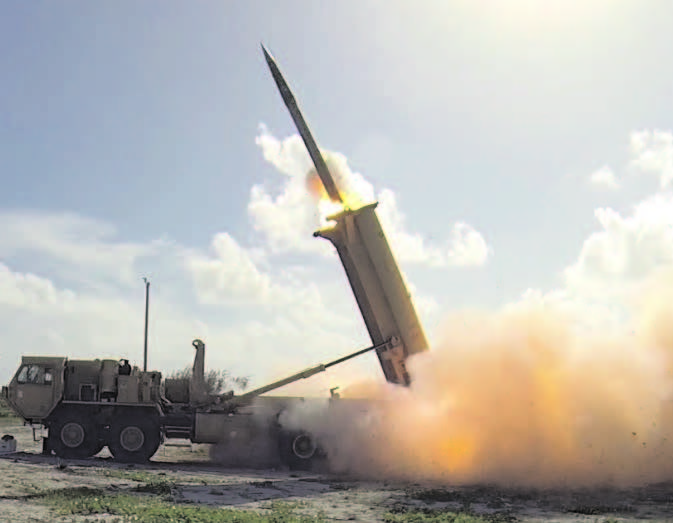
    SEOUL (TIP): South Korea on sept 30 formally announced a new location for deploying a North Korea-focused US anti-missile defence system, after vocal protests from local residents over potential health and environmental hazards.

    Seoul and Washington agreed to deploy the Terminal High Altitude Area Defense (THAAD) system in the South after North Korea conducted a series of missile tests in the wake of its fourth nuclear test in January.

    The decision was condemned by Pyongyang and also caused a damaging rift between Seoul and Beijing, which sees the deployment as a US bid to flex its military muscle in the region and undermine China’s own missile capabilities.

    There was also a strong domestic reaction in South Korea, particularly from people living near an existing missile base in the rural county of Seongju — 275 kilometres southeast of Seoul — where the first THAAD battery was to be installed.

    Residents said the system’s powerful radar would pose health and environmental hazards and argued that its presence would make them a priority target for the North Korean military.

    The defence ministry said on Friday that the site would be shifted 18 kilometres to the north of the air base to a golf course owned by the giant Lotte Group retail chain.

    The ministry said the new site was more isolated and located on higher ground, but nearby residents have still been protesting since news of the venue switch was leaked weeks ago.

    And followers of an indigenous school of Buddhism are also angered by the move, which would see the THAAD battery sited just three kilometres from one of their most important shrines.

    About a thousand Won-Buddhism followers held an outdoor prayer session at the shrine on Wednesday to protest the deployment.

    Some opposition lawmakers are also opposed to THAAD, despite President Park Geun-Hye’s insistence that the system is crucial to national defence.

    Since Seoul and Washington announced the THAAD deployment was going ahead, North Korea has continued to conduct missile tests and carried out a fifth nuclear test on September 9. (AFP)

  • Malaysian flight MH17 shot down by Russian-made missile: Probe

    Malaysian flight MH17 shot down by Russian-made missile: Probe

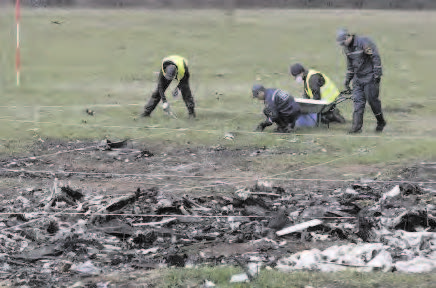
    NIEUWEGEIN, Netherlands (TIP): Malaysia Airlines flight MH17 was shot down by a missile fired from a launcher brought into Ukraine+ from Russia+ and located in a village held by pro-Russian rebels, international prosecutors said on Sept 28.

    The findings counter Moscow’s suggestion that the passenger plane+ , en route from Amsterdam to Kuala Lumpur in July 2014, was brought down by Ukraine’s military rather than the separatists. All 298 people on board, most of them Dutch, were killed.

    The conclusions were based on thousands of wiretaps, photographs, witness statements and forensic tests during more than two years of inquiries into an incident which led to a sharp rise in tensions between Russia+ and the West.

    Among the key findings were: the plane was hit by a Russian-made Buk-9M38 missile+ ; the missile was fired from the rebel-held village of Pervomaysk in eastern Ukraine; and the launcher was transported into Ukraine from Russia.

    “This Buk trailer came from the territory of the Russian Federation+ , and after the launch it was returned again to the territory of the Russian Federation,” said Wilbert Paulissen, chief investigator with the Dutch national police.

    The Ukrainian government said the findings pointed to Russia’s “direct involvement”. Russia – which has always denied Moscow or pro-Russian rebels were responsible -rejected the prosecutors’ conclusions, saying they were not supported by technical evidence and the inquiry was biased.

    Earlier on Wednesday, Kremlin spokesman Dmitry Peskov said its radar data had “identified all flying objects which could have been launched or were in the air over the territory controlled by rebels at that moment”.

    “The data is clear-cut … there is no rocket. If there was a rocket, it could only have been fired from elsewhere,” he said.

    The investigators, from the Netherlands, Australia, Belgium, Malaysia and Ukraine, said they had not had access to Moscow’s radar images but would gladly include a Russian contribution to the inquiry.

    Ukrainian and Western officials, citing intelligence intercepts, have long blamed the pro-Russian rebels for the incident, which played a big part in a decision by the European Union and United States to impose sanctions on Russia over the Ukraine conflict and has damaged Dutch-Russian economic ties.

    Suspects

    Prosecutors said that while they had not brought charges against culprits or established a court, they had identified 100 individuals of interest in relation to the crash on July 17, 2014.

    “Of a number of them, we know pretty exactly what their role and position was, for instance those who organised the arrival of the Buk rocket and who were in charge of the transport that day,” said Fred Westerbeke, chief prosecutor at the Netherlands National Prosecutor’s office.

    “We know exactly what happened, but who exactly was in charge, and whether it was done intentionally, there the investigation is still continuing,” Westerbeke said.

    He declined to specify the nationality of any potential suspects, and called on witnesses to come forward and help determine who gave the order to shoot the plane down.

    Victims’ families, who were informed of the findings earlier in the day, were sceptical about the investigation’s progress.

    Silene Fredriksz, whose son Bryce was on the airplane with his girlfriend, Daisy Oehlers, said Russia would never hand over any suspects voluntarily.

    Moscow was “going to have to be put under intense pressure, with sanctions – that’s the only way to make it possible”, she added.

    A civilian investigation by the Dutch Safety Board also concluded last year that MH17 was hit by a Buk missile fired from eastern Ukraine, but Moscow denied that pro-Russian rebels were responsible.

    At the time of the incident, pro-Russian separatists were fighting Ukrainian government forces in the region. The Boeing 777 broke apart in mid-air, flinging wreckage over several kilometres (miles) of fields in rebel-held territory.

    Prosecutors cannot file charges because there is no international agreement on what court a case would be heard in. (Reuters)

  • China warns Japan not to ‘play with fire’ in South China Sea

    China warns Japan not to ‘play with fire’ in South China Sea

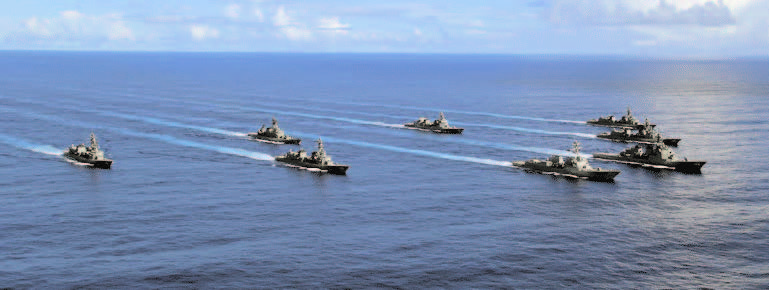
    BEIJING (TIP): China on Sept 29 warned Japan against “playing with fire” in the contested waters of the South China Sea, after Tokyo announced it may patrol alongside the US in the region.

    China also sent fighter planes for the first time over a strait near Japan on Monday as part of a group of more than 40 jets headed to train in the West Pacific.

    The move followed remarks by Japanese defence minister Tomomi Inada this month that Tokyo would increase its engagement in the South China Sea through joint training with the US Navy, exercises with regional navies and capacity-building assistance to coastal nations.

    The Chinese defence ministry said the aim of the announcement was “to mess up the South China Sea situation and try to gain interests from the troubled waters.”

    “If Japan wants to conduct any joint patrol or joint exercises in waters administered by China, it is just like playing with fire, and the Chinese military will not sit and watch,” ministry spokesman Yang Yujun told a regular press briefing.

    Beijing asserts sovereignty over almost all of the South China Sea, dismissing rival partial claims from its Southeast Asian neighbours. It rejects any intervention by Japan in the waterway.

    In recent months Japanese Prime Minister Shinzo Abe has criticised China for rejecting a July ruling by an international tribunal, which said Beijing’s extensive claims to the waters had no legal basis.

    Tokyo, a key US ally, is also strengthening defence ties with other countries in the disputed region. Japan and China are already at loggerheads over a longstanding territorial row in the East China Sea.

    That dispute relates to uninhabited islets controlled by Japan known as the Senkakus in Japanese and the Diaoyus in Chinese. (AFP)

  • China says countering Dalai Lama is top ethnic priority in Tibet

    China says countering Dalai Lama is top ethnic priority in Tibet

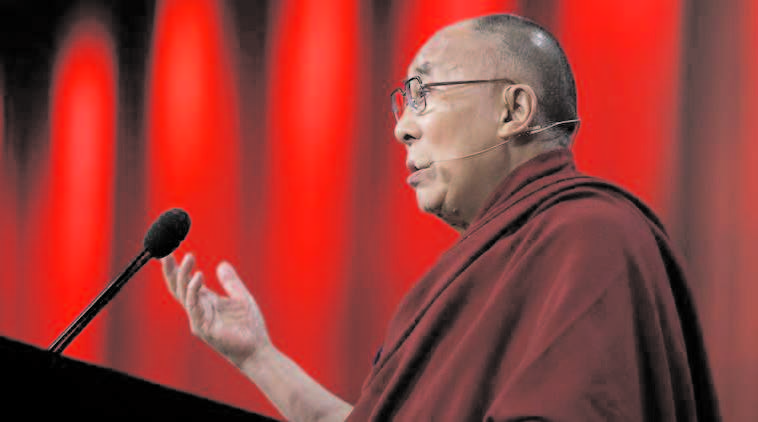
    BEIJING (TIP): China will make countering the Dalai Lama’s influence the “highest priority” in its work on ethnic affairs in Tibet, the region’s Communist Party boss has said, vowing to uproot the monk’s “separatist and subversive” activities.

    Beijing says its Communist troops peacefully liberated Tibet in 1950 and regards the 80-year-old, Nobel Peace Prize-winning Buddhist monk as a separatist.

    The self-exiled Dalai Lama says he merely seeks genuine autonomy for his Himalayan homeland.

    China’s foreign ministry expressed anger and threatened countermeasures this month after the Tibetan spiritual leader spoke at the European Parliament in France.

    “First, we must deepen the struggle against the Dalai Lama clique, make it the highest priority in carrying out our ethnic affairs, and the long-term mission of strengthening ethnic unity,” Tibet party secretary Wu Yingjie said in a speech published on Friday in the official Tibet Daily.

    “(We must) thoroughly expose the reactionary nature of the fourteenth Dalai Lama, crack down on separatist and subversive activities, and strive to eliminate at their roots harmful elements that damage ethnic unity,” Wu said.

    Public veneration of the Dalai Lama, who fled China in 1959 after an abortive uprising against Chinese rule, is prohibited in Tibet, though in private, many Tibetans revere the monk and display his picture.

    Identifying the effort to crack down on his influence the top task in the region’s ethnic affairs suggests Wu will ratchet up the government’s already hardline approach in the devoutly Buddhist region, which is prone to anti-Chinese unrest.

    Wu was appointed Tibet’s top official in late August, and has vowed stronger criticism of the Dalai Lama.

    The government rejects criticism from rights groups and exiles who accuse it of trampling on the religious and cultural rights of the Tibetan people, saying instead that its rule has brought prosperity to a once-backward region.

    Nonetheless, China faces no shortage of problems in the region, including those stemming from poverty, language barriers, and development that has at times clashed with a traditional herding lifestyle.

    Tibetans, one of China’s 56 officially recognised minority groups, are guaranteed legal protection for their languages and cultures. But they are often marginalised and treated with suspicion by Beijing, which views them as potential separatists.

    Officials see ethnic affairs work, such as improving Mandarin proficiency among minorities, as key to ensuring national cohesion and creating economic opportunity.

    There has been resistance to greater Mandarin education in schools in Tibet, with people fearing the government wants to culturally assimilate them. The government denies that. (Reuters)

  • US Army calls ‘Trump a liar’ on Twitter; apologizes and deletes tweet later

    Washington (TIP): The US Army issued an apology Wednesday after its official Twitter account posted a tweet saying Republican presidential nominee Donald Trump “lies once every 3 minutes, 15 seconds.”

    The post, which included a link to an article on TheNewCivilRightsMovement.com, was quickly removed Tuesday but not before it was seen by other social media users.

    A screenshot of the errant tweet was posted on the “US Army WTF! Moments” Facebook page.

    14449812_10154668482173606_5633728909347515052_n-1The Army said that the errant tweet was due to a mistake by a manager of its social media account.

    “An employee responsible for the Army’s social media accounts mistakenly posted a political article to the Army’s Twitter page that was intended for her personal account,” according to an official US Army statement provided to CNN.

    “The post is not the official position of the US Army,” the statement added, saying that the employee responsible has had their access to the Army’s social media account suspended.

    “We apologize for any confusion this may have caused our followers.”

  • Nassau County Comptroller George Maragos changes party registration to Democrat

    Nassau County Comptroller George Maragos changes party registration to Democrat

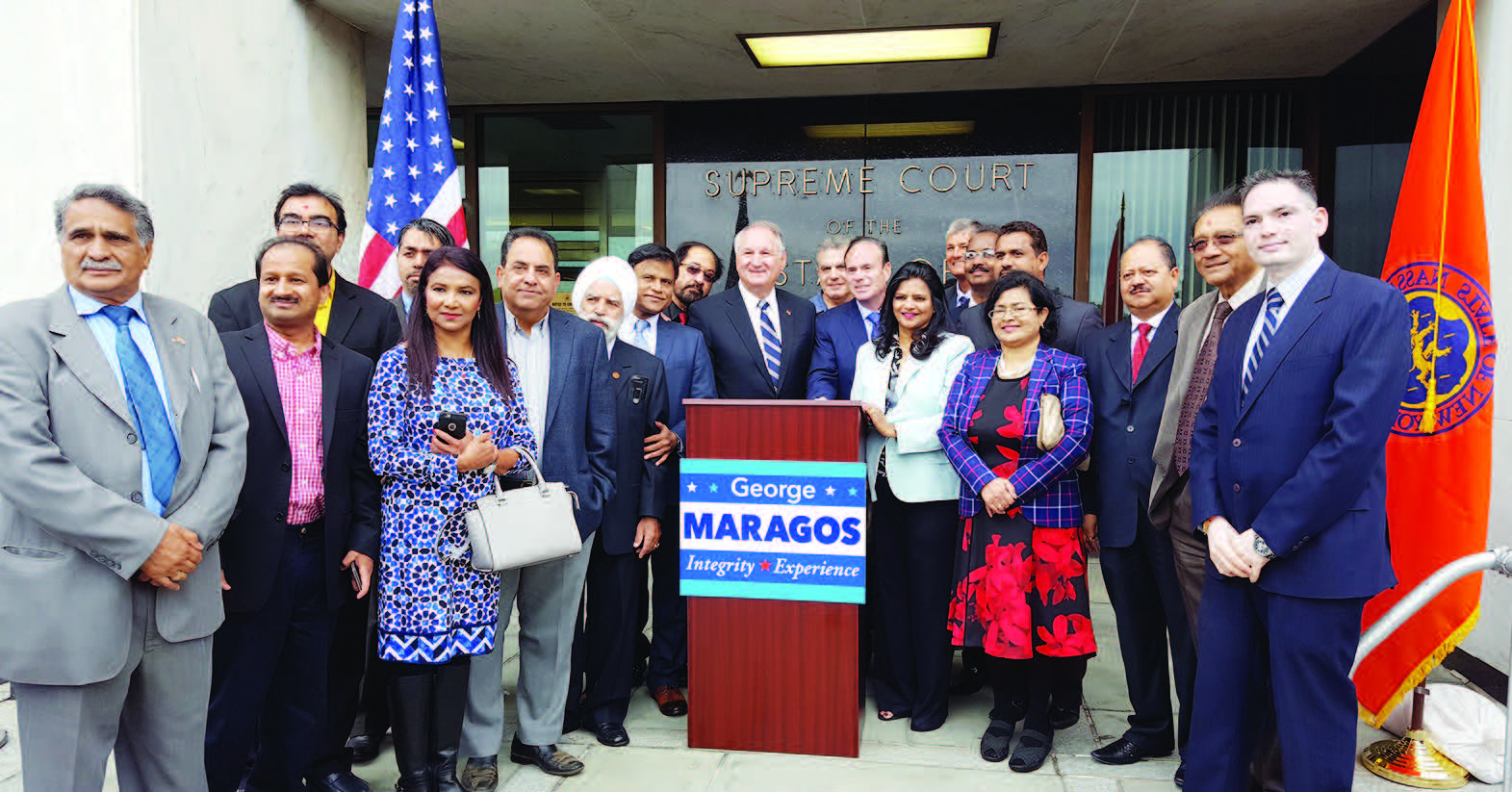
    MINEOLA, NY (TIP): Nassau County Comptroller George Maragos announced Thursday, September 29 that he has submitted “this morning to the Nassau County Board of Elections, an application to change my party registration to Democrat”.

    In a statement to the media, Maragos said, “I have been at odds with the Republican Committee over issues of fiscal responsibility, borrowing, waste, and trust in government. I have been at odds over raising the minimum wage, and increased opportunities for Women, Minorities and Veterans. Over time, I found that my values have become more aligned with the Democratic Party.Consequently, this morning, I have submitted, to the Nassau County Board of Elections, an application to change my party registration to Democrat”.

    Recalling his association with the Republican Party and the Republican Chairman Mondello, Maragos said, “I want to express my gratitude for the great opportunity he gave me to be of public service. I also, would like to thank my many Republican friends for their friendship. I hope that our friendship will continue and transcend party ideology”.

    Setting at rest any impact of his decision on his position as Comptroller, Maragos categorically stated: “My party change will have NO impact on my responsibilities as Comptroller. I will continue to run the office in an independent and bipartisan manner, as I have done in the past six years”.

    Commenting on the functioning of Nassau County, he said, “We are all aware that Nassau County faces significant financial challenges, multiple corruption allegations, weak economic growth, and a costly and unfair tax assessment system, We CANNOT continue to borrow in order to pay the bills, defer paying bills, or hit our residents with BIG fees.

    “Nassau County can do better! We need to restore trust in government, strengthen public health and safety, eliminate waste, balance the budget without borrowing, and finally fix the broken tax assessment system which is costing tax payers nearly$100M/ per year resulting in higher taxes for many.

    “In order to address these pressing issues, today, I am announcing that I will be seeking the Democratic Party nomination for Nassau County Executive.

    “As a two term Comptroller, I have intimate knowledge of the challenges facing our government, 35 years of proven senior management experience, and the integrity to deal with the issues facing Nassau County.

    “Together, we can make Nassau County a better place to stay, live, find good paying jobs, raise a family, and retire in our homes!  I look forward to work closely with Chairman Jay Jacobs and all elected officials to make Nassau County more affordable, vibrant and with a Government we can be proud of.”

  • Ten Indian American Students among Prestigious Broadcom MASTERS Finalists

    Ten Indian American Students among Prestigious Broadcom MASTERS Finalists

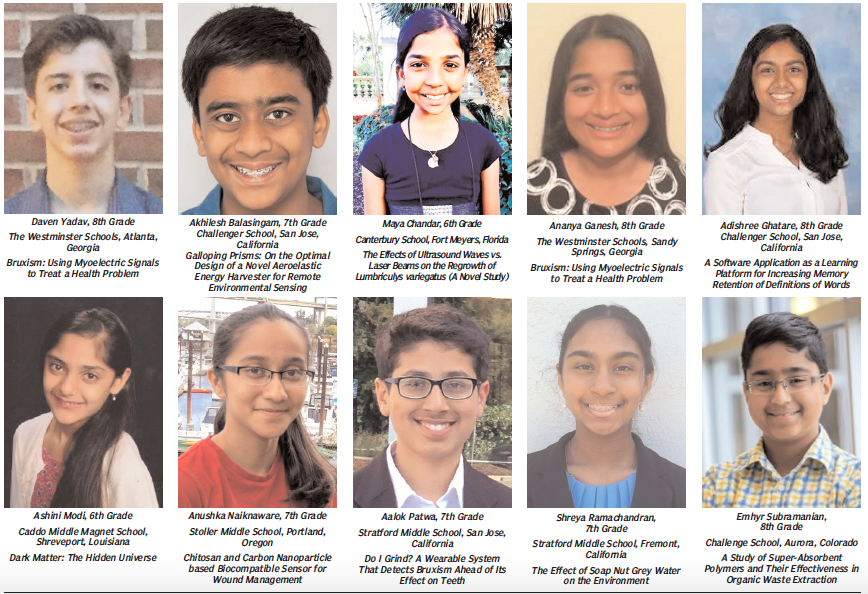
    The Broadcom Foundation and Society for Science & the Public (the Society) announced on September 20 the selection of 30 middle school students as finalists in the 2016 Broadcom MASTERS® competition.

    At least ten Indian American students are among the 30 finalists in the sixth annual Broadcom MASTERS (Math, Applied Science, Technology and Engineering for Rising Stars).

    The winners will be named on November 1 in Washington, DC, after completion of a rigorous competition that tests their abilities in STEM subjects, teamwork and collaboration. Congratulations to these 30 finalists, and to the 2,343 outstanding applicants for sharing their work this year.

    • The finalists include 15 girls and 15 boys covering 15 states and representing 28 schools and one home school. California has the most finalists with eight, followed by Florida and Georgia with three, and two each from Louisiana, Maryland, Texas and Virginia.
    • Finalists were selected by a panel of distinguished scientists and engineers from among 300 semifinalists and 2,342 applicants representing 49 states and 4 U.S. territories.

    “There is a sense of urgency to inspire more young people to become the scientists and engineers of the future,” said Paula Golden, President, Broadcom Foundation.

    “Our quality of life depends upon solving the grand challenges in health care, transportation, communication, environmental protection and sustainability. Broadcom Foundation is honored to partner with Society for Science & the Public to reach hundreds of thousands of young people with an important message that they can become the STEM innovators who will tackle these 21st century challenges. We look forward to celebrating the extraordinary achievements of this year’s Broadcom MASTERS finalists who are exemplars of inspired young science fair participants throughout the United States at the sixth annual Broadcom MASTERS,” added Golden.

    A Look at the Indian Origin Finalists

    Daven Yadav, 8th Grade
    The Westminster Schools, Atlanta, Georgia
    Bruxism: Using Myoelectric Signals to Treat a Health Problem

    Akhilesh Balasingam, 7th Grade
    Challenger School, San Jose, California
    Galloping Prisms: On the Optimal Design of a Novel Aeroelastic Energy Harvester for Remote Environmental Sensing

    Maya Chandar, 6th Grade
    Canterbury School, Fort Meyers, Florida
    The Effects of Ultrasound Waves vs. Laser Beams on the Regrowth of Lumbriculys variegatus (A Novel Study)

    Ananya Ganesh, 8th Grade
    The Westminster Schools, Sandy Springs, Georgia
    Bruxism: Using Myoelectric Signals to Treat a Health Problem

    Adishree Ghatare, 8th Grade
    Challenger School, San Jose, California
    A Software Application as a Learning Platform for Increasing Memory Retention of Definitions of Words

    Ashini Modi, 6th Grade
    Caddo Middle Magnet School, Shreveport, Louisiana
    Dark Matter: The Hidden Universe

    Anushka Naiknaware, 7th Grade
    Stoller Middle School, Portland, Oregon
    Chitosan and Carbon Nanoparticle based Biocompatible Sensor for Wound Management

    Aalok Patwa, 7th Grade
    Stratford Middle School, San Jose, California
    Do I Grind? A Wearable System That Detects Bruxism Ahead of Its Effect on Teeth

    Shreya Ramachandran, 7th Grade
    Stratford Middle School, Fremont, California
    The Effect of Soap Nut Grey Water on the Environment

    Emhyr Subramanian, 8th Grade
    Challenge School, Aurora, Colorado
    A Study of Super-Absorbent Polymers and Their Effectiveness in Organic Waste Extraction

  • Indian American Professor named a ‘Jerger Future Leader of Audiology’ for 2016

    Indian American Professor named a ‘Jerger Future Leader of Audiology’ for 2016

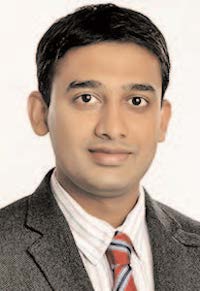
    NEW YORK (TIP): The American Academy of Audiology has named Dr. Vinaya Manchaiah, an Indian American associate professor and director of audiology at Lamar University, to the 2016 class of Jerger Future Leaders of Audiology.

    Manchaiah is one of only a dozen individuals selected nationally for the honor.

    Manchaiah is the Jo Mayo Endowed Professor and holds a Ph.D. in disability research from Linkoping University, Sweden, an executive M.B.A. from Swansea University, United Kingdom, the Doctor of Audiology from Nova Southeastern University, M.S. in Audiology from the University of Southampton, and a Bachelor’s of Science in Speech and Hearing from the University of Mysore, India.

    “He exemplifies the role of teacher, researcher and collaborator. His contributions have put the program of audiology at Lamar University in the national and global spotlight,” said Monica Harn, Diane H. Shaver Professor in Speech and Hearing Sciences and chair of the university’s Department of Speech and Hearing Sciences.

    In addition to his prolific research and teaching, Manchaiah is co-founder and director for strategic planning for the non-profit non-governmental organization Audiology India, for which he served as president from 2011 to 2015. The organization seeks to foster ear and hearing health care in India.

    The American Academy of Audiology is the world’s largest professional organization of, by, and for audiologists. The active membership of more than 12,000 is dedicated to providing quality hearing care services through professional development, education, research, and increased public awareness of hearing and balance disorders.

  • Indian Ministry of Culture and Metropolitan Museum of Art, New York sign Memorandum of Agreement

    Indian Ministry of Culture and Metropolitan Museum of Art, New York sign Memorandum of Agreement

    NEW YORK CITY (TIP): The Ministry of Culture, Government of India and the Metropolitan Museum of Art, New York, signed a Memorandum of Agreement on the Indian Conservation Fellowship Program in 2016. A pilot project was conducted in 2013 to 2016 and as it was found to be successful; hence it was renewed for five years until 2021. Under this agreement The MET will work with Ministry of Culture to impart a broad range of knowledge on modern operations of museums like conservation, planning of exhibitions, etc.

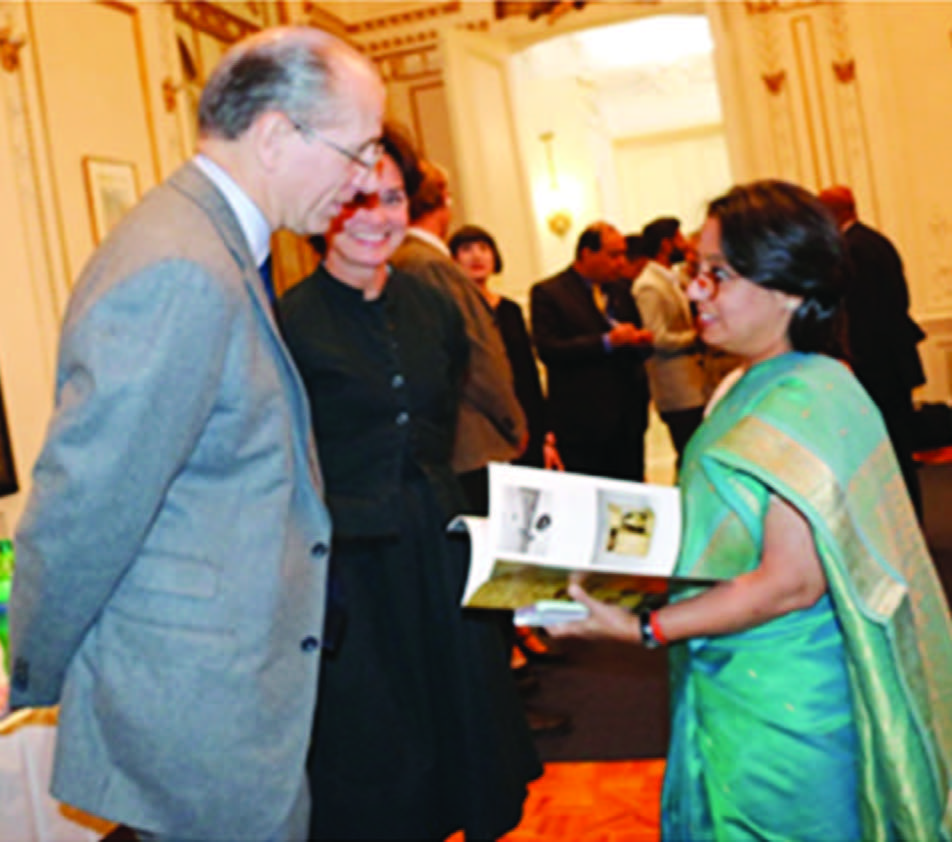
    For marking this occasion, the Consulate General of India organized a small reception with the Met Museum officials on Sept 27, 2016. Consul General Ambassador Riva Ganguly Das welcomed the initiative on behalf of Government of India and hope that this will enrich both sides from learning from each other and that it will help Indian conservationists to adopt scientific western methods of conservation and management.

    Ms. Carrie Rebora Barratt, Deputy Director for Collections and Administration, the MET, spoke about the rich cultural heritage of India and the need for conserving them and the mutual learning that will come to both sides because of the interaction of the people in the program here and abroad. Representing the Mellon Foundation, the chief sponsors for the Indian Conservation Fellowship Program, was Ms. Mariët Westermann, Executive Vice President for Programs and Research, who has expressed her happiness to be a part of the program and hoped that it will help conserve the rich cultural arts and artifacts of India.

  • Admirers and devotees of BAPS Pramukh Swami Maharaj throng to pay Tributes

    Admirers and devotees of BAPS Pramukh Swami Maharaj throng to pay Tributes

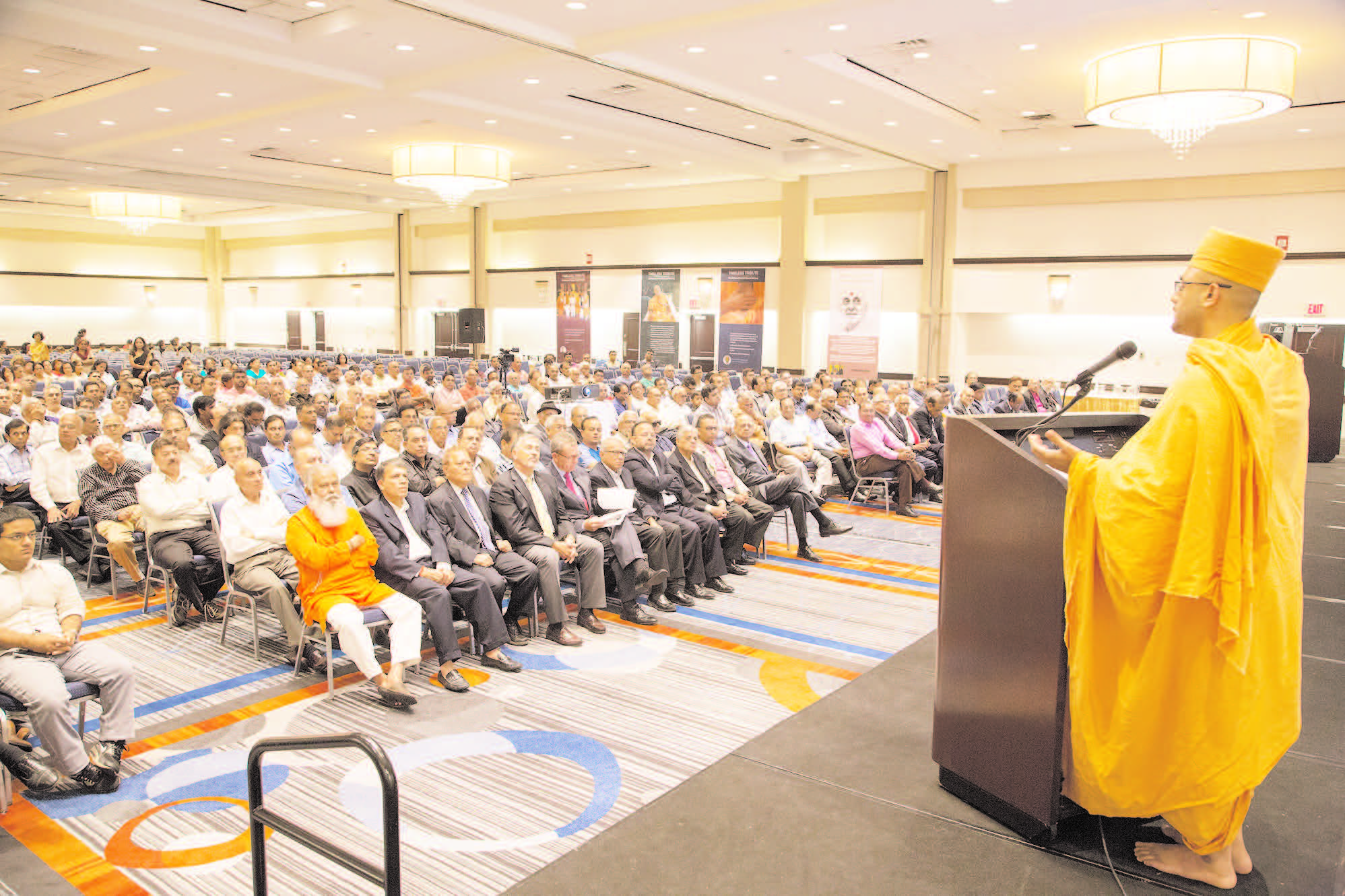
    NEW YORK (TIP): BAPS Pramukh Swami Maharaj was paid rich tributes by dignitaries, devotees, community leaders and well-wishers.in many parts of the world including the US.

    Tens of thousands of people gathered at the BAPS Shri Swaminarayan Mandirs in New York, Robbinsville, Edison, Parsippany and Jersey City (in New Jersey) as well as in Philadelphia, Boston, Dallas and Washington DC to pay tributes to the life of H.H. Pramukh Swami Maharaj on September 17 and 18.

    The fifth spiritual successor of Bhagwan Swaminarayan and leader of the BAPS Swaminarayan Sanstha passed away on August 13 at the age of 95. From establishing mandirs across the world to humanitarian work to creating community infrastructure for education and healthcare in remote towns, Pramukh Swami Maharaj’s contributions to society have spanned across generations.

    Tens of thousands of people honored Pramukh Swami Maharaj in special assemblies held throughout USA. Assemblies were also held across the globe in September to pay tributes to his life and achievements. Attendees shared memories of their uplifting interactions with Pramukh Swami Maharaj, reminiscing upon the heartfelt connection that cemented his influence and wisdom in their lives.

    President Obama shared a personal message with BAPS tribute assemblies. He noted that Pramukh Swami Maharaj “was a trusted ear and revered voice for countless people, and the lessons of his humility stirred not only the hearts of his followers, but also of men and women across the globe who were fortunate enough to have crossed his path. May the memory of His Holiness Pramukh Swami Maharaj continue to guide you, and may his legacy give us the courage to be our best selves”.

    President Bill and Hillary Clinton noted, “Pramukh Swami didn’t just teach virtues – he lived them every day…We hope that humanity will build upon his legacy for generations to come.”

    Dr. Bhupi Patel, a Long Island community leader praised the departed guru’s social contribution especially in de-addicting hundreds of thousands. Anand Patel, President-FIA described Pramukh Swami’s life as an open book.

    Pramukh Swami Maharaj’s impact on people’s lives was also felt by those who met only his disciples. Robbinsville, NJ Mayor Dave Fried said, “From interacting with his disciples who all live lives of humility and service, I can only imagine the life that their Guru, Pramukh Swami, lived. Through his disciples, he has left a permanent mark on the world, and especially on Robbinsville.”

    The speakers and guests from the Indian community present at the assembly at BAPS Shri Swaminarayan Mandir, Robbinsville, NJ on September 17, 2016 included Dr. Manoj Kumar Mohapatra, Deputy Counsel General of India; Dr. Navin Mehta, ENT surgeon; H.R Shah, Chairman of TV Asia; Sunil Hali, Publisher Indian Express; Sharad Shah, Chairman Share and Care Foundation; and Swami Shantananda, Resident Acharya, Chinmaya Mission, NJ to name a few.

    A message from the New Jersey Governor Chris Christie was read out.

    The speakers and guests from the Indian community present at tribute assembly in Long Island on September 18 included Dr. Subramanian, Cardio-thoracic surgeon who performed on Pramukh Swami Maharaj; Vijay Nambiar, Secretary General Ban Ki-moon’s special advisor to Myanmar, Mahendrapal Gulati, President VHP. Former Senator Michael Balboni, Huntington Councilman Mark Cuthbertson were also present.

    Prime Minister of India, Narendra Modi had visited Sarangpur, Gujarat and addressed saddened devotees before the funeral rites saying, “Pramukh Swami Maharaj was a stalwart among humans who embodied compassion and humility… Today you have lost a Guru, but I have lost a father.”

    Pramukh Swami Maharaj has been succeeded as BAPS head by Mahant Swami Maharaj.

  • Congressional candidate to headlight IAPC’s presidential debate at media meet

    Congressional candidate to headlight IAPC’s presidential debate at media meet

    NEW YORK (TIP): The Indo American Press Club (IAPC) is showing the Indian community a path to mainstream by holding a debate on October 9 in Connecticut on the upcoming presidential election.

    political-faceoffAt its 3rd International Media Conference (Oct 8-10, 2016) in Stamford, CT, IAPC is hosting the discussion between a prominent supporter of Hillary Clinton, Peter Jacob, and a prominent supporter of Donald Trump, Prof AD Amar. They will argue for who of the two presidential nominees will be good for America and for Indo-US relations.

    the-debaters-peter-jacob
    Peter Jacob

    Peter Jacob is an Indian American community organizer with a master’s degree in social work who is running as Democratic candidate for US House from New Jersey’s GOP leaning District 7. He has been endorsed by Democratic leader Bernie Sanders, whose site praised the 30-year-old’s commitment to the community with these words: “Raised in Union, New Jersey, Peter Jacob understands how important a safe and caring community is to success. Through various community organizations, Peter has helped fight the ongoing scourges of child abuse, human trafficking, and disastrous Iraq War.” His campaign for healthcare reform, environmental sustainability, and immigrant integration also comes in for praise.

    prof-ad-amar-founder-of-indian-americans-for-trump-2016
    Prof Amar Dev Amar

    Prof Amar Dev Amar is founder and President of Indian Americans for Trump 2016 who is actively involved in promoting the Republican nominee’s candidacy among the Indian community in the tristate area. He teaches and researches in managing organizations as Professor of Management at the Stillman School of Business, Seton Hall University, South Orange, NJ.

    moderator-prof-indrajit-s-saluja-chief-editor-of-the-indian-panorama
    Prof. Indrajit S. Saluja

    The moderator of the IAPC presidential debate will be Prof. Indrajit S. Saluja, Chief Editor & Publisher of The Indian Panorama, a prominent English language newspaper with editions in New York and Dallas. A professor of English in India, he first delved into media by publishing a news magazine from Punjab.

    IAPC had also hosted a discussion on the presidential election in Houston in which representatives from both the Trump and Hillary campaigns took part on Sept 11. It was attended by a large number of Indian Americans, political personalities and community leaders.

    IAPC’s Media Conference at Hilton Stamford Hotel and Executive Meeting Center, CT is bringing together an array of prominent journalists and media professionals from the US, Canada and India to deliberate at seminars and workshops. Many dignitaries will be in attendance and prominent people from India and North America will be honored for their service to society.

    IAPC President, Parveen Chopra, and Chairman, Ginsmon Zacharia, invite media professionals to attend the conference and presidential debate.

    IAPC was formed in 2013 with the lofty ideals of providing a common platform to media professionals of Indian origin living in North America, fostering closerbonds and cooperation with IAPC’s counterparts in India and to strive for betterment of society at large. It has 8 chapters in US and Canada.

    For more information: IndoAmericanPressClub.com

  • Hitting where it hurts: India must keep up the momentum

    Hitting where it hurts: India must keep up the momentum

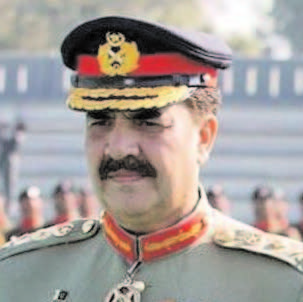
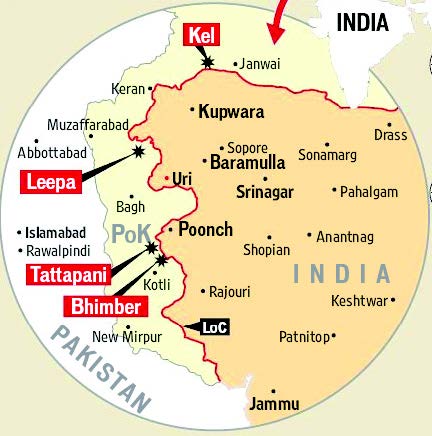
    As I write these lines, Pakistan has strongly denied that the Indian army carried out surgical strikes across the LoC. It has claimed, indeed asserted, through the official army spokesman that the Indian action was confined to the traditional exchange of fire across the LoC which the two armies have undertaken many times in the past, including heavy fire last year. In doing so, as of now, Pakistan has obviously sought to ensure that it does not come under pressure from its domestic public opinion to adequately respond to uphold the country’s honor. For if it acknowledges that Indian soldiers crossed the LoC, even by a short distance of a couple of kilometers, the Pakistani people, more so, Pakistani soldiers and officers will demand of its generals, especially army chief General Raheel Sharif, that the Indian Army be soonest taught a lesson so it does not undertake such an action again. This refrain would be heard the loudest from the jehadi tanzeems.

    Raheel Sharif has an image to live up to – his elder brother and maternal uncle were decorated with the Naishan-e-Haider, Pakistan’s highest gallantry award, and the Sharif family is greatly respected in army circles and by the public at large. Raheel Sharif is also credited with successful action in North Waziristan to clear Tehrik-e-Taliban-e-Pakistan cadres under the Zarb-e-Arz operation. Thus more than Prime Minister Nawaz Sharif, it is the General who is under greater scrutiny. It is obvious that his initial reaction has been not to immediately get into a tit-for-tat situation and to move cautiously. That is not unnatural, for the Pakistan General staff would need to carefully weigh all options, especially as the international community knows that Pakistan has provoked India continuously over two decades with its pursuit of cross-border terrorism and that no army would take the Uri terrorist attack lying down.

    The major powers, especially the US, have advised Pakistan that it has to take action against all terrorist groups, not only those that have turned against the state. This counsel has fallen on deaf ears, for there is no evidence that Pakistan army is willing to take a re-look at its security doctrines. These prescribe the pursuit of low-intensity conflict to contain India by keeping it off-balance. The fact is that despite the Pathankot attack and India’s acceptance of a Pakistani joint investigation team, including an ISI representative, to visit the Pathankot air base, it continued to essentially remain in denial, which is a clear evidence of its unwillingness to modify its security approaches. As India has crossed a threshold, Pakistan’s security planners will be under international pressure to modify their policies on the use of terror, even as they will not easily give it up. Why?

    The major powers, including Pakistan’s all-weather friend, China, do not want a conflagration between two countries with nuclear weapons. As India has always acted “responsibly”, it has ironically been under greater pressure to avoid taking any step that would enhance the chance of escalation. This has been so after every significant terrorist provocation, including the Parliament attack and the Mumbai outrage. Each time, India absorbed terrorist action, despite the loss of life. Indeed, influential sections of the Indian political and security classes advanced the view that terrorism did pose a real security challenge to the country. Thus Pakistan-sponsored terrorism was cynically relegated to a matter of political management. If this was the view of those who governed the country, the international community naturally went along. The Pakistan Generals too felt secure that India’s political masters would not really react with force. They were initially concerned that Prime Minister Narendra Modi may be different and they tested him even prior to his taking oath when the Indian consulate-general in Herat was attacked. When Modi flip-flopped, laying down red lines only to dissolve them, they felt that he was no different from his predecessors. They will now have to reassess.

    The only time the global powers brought pressure to bear on Pakistan was during the Kargil encroachment. Then India acted with determination to throw out Pakistan forces that had occupied the Kargil heights. It is because India refused to accept Pakistani action and the Indian Army started meeting with success despite great odds that the US put pressure on Pakistan to abandon its unacceptable misadventure. The US pressure was a contributory factor to Pakistan’s decision to withdraw. The Kargil lesson was that if India showed resolve and acted then Pakistan was asked to act responsibly. The key factor in all such situations is calm and sober resolve and deliberate action. Now after the surgical strikes, which have been undertaken with precision, it would be Pakistan that would be under pressure not to notch up the situation. That would be the quiet message that the Chinese would also give, notwithstanding the public postures that they may take.

    Modi government has also done well not to have undertaken the surgical strikes in isolation, but as part of a package of measures to show that India is re-examining the premises of its Pakistan policy. No previous government has focused on the Indus Waters Treaty and Pakistan’s MFN status. Nor has any government raised Pakistan’s human rights record in Balochistan internationally, that too at the UN. Most importantly, the withdrawal from the SAARC Summit -and, it is obvious that Afghanistan, Bangladesh, Bhutan and India have consulted on this matter – would not have gone unnoticed in important capital cities. While there will be routine counsels of restraint, there is no doubt that there will be an understanding that India has suffered much and Modi expended much political capital and the present action – with no intention, at present, to undertake any other surgical strike – was neither adventurous nor unnatural.

    There is little doubt that Pakistan will loudly proclaim the dangers of Indian action leading to the danger of acquiring a nuclear dimension. This is hogwash and self-serving. Pakistan will also renew efforts to draw attention to the Kashmir situation, but global indifference to developments in the Valley will continue as no country wants to intervene in it.

    So, how will Pakistan respond? Indian security managers should redouble their vigilance against a major terrorist strike.

    (The author is a former Secretary, Ministry of External Affairs)

  • Crossing the Line of Control

    Crossing the Line of Control

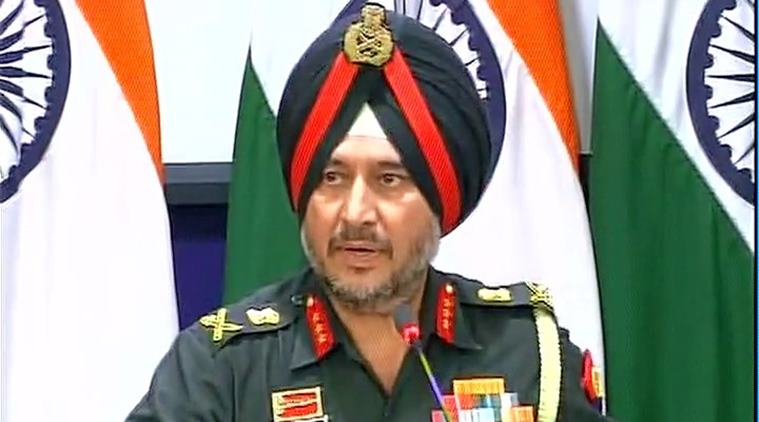
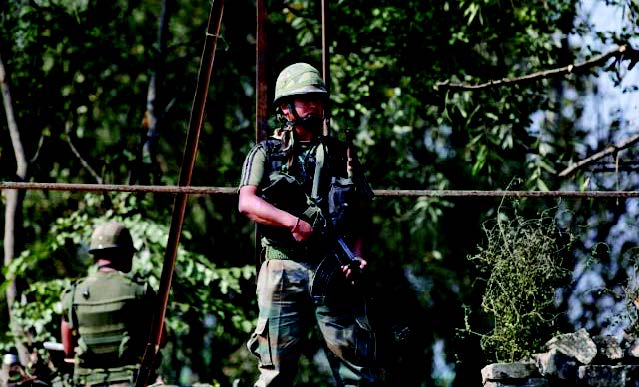
    After running through a variety of non-military responses to the September 18 terrorist strike at an Army camp in Uri, the Centre on Thursday announced that Indian forces had carried out “surgical strikes” across the Line of Control. With this, India’s next steps, post-Uri, are in uncharted terrain, with New Delhi abandoning the self-proclaimed policy of “strategic restraint” adopted in the face of earlier provocations by terrorists believed to be backed by Pakistan. The operation, that began and concluded in the early hours of Thursday, was claimed to be a military success, with no injuries to the Indian para-commandos who went across the LoC into Pakistan-occupied Kashmir to attack several locations. The decision to strike in this manner was evidently taken after specific intelligence that terrorist groups were planning attacks in India. This may not be the first time India has undertaken quick cross-LoC operations, but it has never before chosen to share information so publicly.

    The terms “surgical strike” and “pre-emptive strike” used by the Centre were intended to convey that this was not an attack on Pakistan’s defense forces, but a targeted action against terrorists poised to wreak damage in India. Pakistan of course has played down the Indian operation, characterizing it as an act of habitual cross-border shelling. It is welcome that New Delhi declared the strikes complete shortly after the operation, with the DGMO calling his Pakistani counterpart to convey that India would not escalate the conflict beyond this. This, along with the briefings held in New Delhi for envoys of various countries, indicates that the Centre wants to end hostilities with Pakistan for the moment. This strengthens the view that the operation was the result of pressure on the Modi government to manufacture a strong response to Uri. Over the past few days there has been a cascade of moves to underline that such provocations cannot be followed with business as usual. The government reviewed the working of the Indus Waters Treaty, declared it is flirting with the idea of reviewing Pakistan’s Most Favored Nation status, and pulled out of the SAARC heads’ meet to be held in Islamabad. Having made it known that India does not want further escalation, even as people living along the International Border and the LoC are shifted to safer locations, the Centre will need to articulate what it regards as the new normal – and indeed, how it hopes, or plans, to dissuade Pakistan from escalating the situation in turn.

  • Family Engagement Grows and More Work Lies Ahead

    Family Engagement Grows and More Work Lies Ahead

    September is a time for new beginnings and a time to build on the progress we’ve made as a community. I am excited to announce that family engagement is on the rise across the city. Thanks to the hard work of teachers, school leaders, staff, parent leaders and volunteers – more than 1,000,000 parents across the boroughs are attending a range of school based workshops and trainings in college preparation, English as a Second Language, resume writing, Common Core Learning Standards and in response to requests from families, even Zumba, and nutrition. Also, 1,983,000 families participated in parent teacher or student led conferences, 73,000 more compared to the year prior.

    Reaching every parent, grandparent and guardian is essential and while this is important progress, there is still more work to be done. ?

    For instance, during my visits to schools and even to the local market, I’ve learned that families are not only interested in their child’s learning but they want to support schools with their own professional growth and wellness. And schools are listening and bringing in tailored programs and creating learning hubs for their parent community.

    This school year, we are also reaching families with Equity and Excellence for All, a range of initiatives we announced last year that are all on their way to implementation. Equity and Excellence is the bedrock on which we are building student achievement through a variety of programs. Students across the city will have access to rigorous classes like Advanced Placement, one-on-one mentoring through the Single Shepherd program, increased extracurricular activities in STEM and the arts, and college planning in middle school to provide parents with tools and resources they need to navigate the college planning process.

    We’ve already hosted an AP for All event last spring for 300 students and their families in Washington Heights, which included a series of workshops on AP courses and college planning. And we launched FaceLab, a mini Makers Faire where students showcased their inventions and creativity to families – encouraging side by side learning. ?

    In addition, to the programming and engagement we offer, we have also expanded language services for parents with limited English. One critical change we’ve made is access to 24 hour over the phone interpreters, so school staff can communicate with parents in their native language after 5 pm. Now, a teacher can call a parent who only speaks Mandarin and can provide that parent with an update on their child’s progress in school with a Mandarin interpreter on the line. This expansion has resulted in a surge of phone calls being made to parents using over the phone interpreters.

    In addition, for the first time, we are holding citywide native language Parent Conferences conducted entirely in the family’s native language for Mandarin, Spanish, Bengali and Arabic speakers. ? I am proud of the incredible growth we have seen while engaging families as partners because it shows that the message is resonating: community involvement is critical and when a child sees a family member involved at their school it results in self-confidence and achievement.

    I want to encourage families to help us get other families involved too! This fall, schools will host parent-teacher conferences. For information on when your school’s next parent teacher night is scheduled for visit http://schools.nyc.gov/Calendar/default.htm?mo=10&yr=2016 #Conferences

    Finally, please Save the Dates for the following native language parent conferences:

    • October 14, 5:30 pm – College Access Conference for Middle School ELL Families at Tweed Courthouse, 52 Chambers Street, Manhattan
    • November 5, 10 am – Parent Conferences for Spanish speakers at Port Richmond High School, 85 St. Joseph’s Ave., Staten Island
    • November 19, 10 am – Parent Conferences for Spanish speakers, Monroe College, 2501 Jerome Ave, Bronx
    • December 3, 10 am – Parent Conference for Mandarin or Cantonese speakers, PS 94, 5010 6th Ave., Brooklyn
    • December 17, 10 am – Parent Conference for Arabic speakers, PS/IS 30 7002 4th Ave., Brooklyn
    • January 28, 10 am – Parent Conferences for Bengali speakers, Queens College, 65-30 Kissena Blvd., Queens
  • I will show Nawaz Sharif how to respond to Modi, says Imran

    I will show Nawaz Sharif how to respond to Modi, says Imran

    ISLAMABAD (TIP): Following Indian claims of “surgical strikes” at the terror launch pads in Pakistani Kashmir, Pakistan opposition party leader Imran Khan said he will show his Prime Minister Nawaz Sharif how to react to such “aggressions”.

    “Initially I had to give a message to Nawaz Sharif, but tomorrow I will send a message to Modi too,” the cricketer-turned politician said.

    Khan also urged people to participate in the march. “People from all over Pakistan should participate in the march to display unit,” he said, adding that “I will show Nawaz Sharif how to respond to Modi”.

    The Pakistan Tehreek-i-Insaf chief also referred to Nawaz Sharif’s “inability to govern” and said, “(Army Chief) Gen Raheel is representing the nation.”

    Pakistan has rejected the Indian claim of “surgical strikes” but confirmed that two of its soldiers were killed when the Indian military resorted to firing across the LoC, which divides Jammu and Kashmir between the two countries, on Sept 29.

  • Skirmish on LoC being called a strike, Pakistan army

    Skirmish on LoC being called a strike, Pakistan army

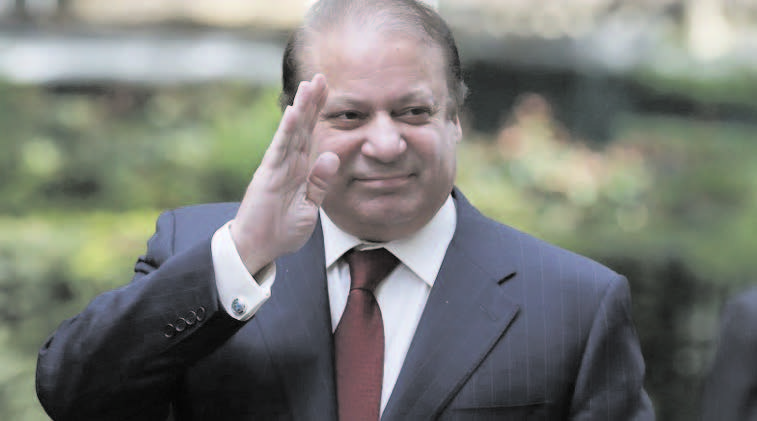
    ISLAMABAD (TIP): The Pakistan Army on Sept 29 denied the Indian Army’s claim of surgical strikes across the LoC, saying it forcefully responded to “cross-border fire” in which “two Pakistani soldiers were killed and nine injured”. Condemning the “firing on LoC”, PM Nawaz Sharif said Pakistan’s intent for peace should not be seen as its weakness. “Pakistan army is fully capable of defending the country and is ready to combat Indian forces,” he said. “We’ll give a befitting response if our sovereignty faces any danger,” he said.

    Defence minister Khwaja Muhammed Asif, widely quoted as having said that Pakistan would use nuclear weapons if it feels threatened, said “small firearms were used by India during the skirmish across the LoC”. “India is trying to present LoC violation as a surgical strike,” he said. Asif further said the Kashmir issue is not going to die down and Pakistan will fully support the freedom movement there.

    A statement from army’s media wing said, “There had been no surgical strike, instead a cross border fire was initiated by India.” The firing, the statement said, began after midnight and continued till 8 am. “Two Pakistani soldiers were martyred,” it said.

    Army spokesman Lt Gen Asim Saleem Bajwa told TV channels Pakistan was acting responsibly despite provocations. He said DGMOs of both countries talked over the phone where the Indian counterpart said they had witnessed movement at LoC, which they interpreted as possible infiltration. “But when we checked on the ground, we found nothing.” Dismissing that Indian paratroopers had entered Pakistan, Bajwa said, “It’s not possible….”

    About Indian claims of Pakistan’s involvement in the Uri attack, the spokesperson said India has a 3 to 4-km deep anti-infiltration grid.”There is also a three-layer fence which would electrocute even a bird that flies past,” he said. “Are they saying all these failed and infiltration occurred?” he asked.(TNN)

  • India has every right to hit out at Pakistan: Bangladesh

    India has every right to hit out at Pakistan: Bangladesh

    NEW DELHI (TIP): Bangladesh was the first neighbouring country to accept that India had “all legal and globally accepted right” to respond to any attack on her sovereignty, even as the United Nations urged India and Pakistan to exercise restraint after the Indian Army carried out surgical strikes at terror launch pads along the LoC.

    Iqbal Chowdhury, adviser to Bangladesh Prime Minister Sheikh Hasina, too called for “restraint” and said, “It (Kashmir issue) has been a long, continued dispute and there has been a… violation from the other side and Bangladesh always believes that any aggression or attack on the sovereignty of the independence and legal right of a country is not acceptable and Bangladesh always feels that any country must honour and respect the sovereignty of a third country”.

    He went on to add, “Bangladesh always feels that in these type of things, there should be restraint from all sides because we believe that in the Saarc countries, we need to live in a peaceful environment, honouring the sovereign rights of each member country,” he added.

    Meanwhile, the United Nations on Thursday encouraged India and Pakistan to resolve differences through dialogue. “The United Nations calls on the government of India and Pakistan to exercise restraint and encourage them to continue their efforts to resolve their differences peacefully and through dialogue,” UN spokesperson Stephane Dujarric said. Pakistan said two of its soldiers had been killed and nine wounded in what it described as small arms fire and dismissed the talk of surgical strikes as an “illusion” designed to whip up “media hype”. Dujarric said UN officials were following the increase in tensions in Kashmir “with great concern” and that UN military observers were in contact with both sides to obtain further information.

  • BANGLADESH, BHUTAN PULL OUT OF SAARC SUMMIT

    BANGLADESH, BHUTAN PULL OUT OF SAARC SUMMIT

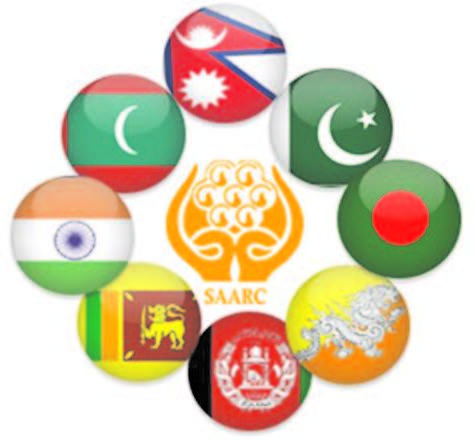
    NEW DELHI (TIP): Apart from India, Bangladesh and Bhutan have also pulled out of the Saarc Summit in Islamabad in November, saying the environment is not right for the successful holding of the meet.

    The decision was conveyed by Bangladesh and Bhutan on Tuesday to the Saarc chair Nepal, sources said.

    “The growing interference in the internal affairs of Bangladesh by one country has created an environment which is not conducive to the successful hosting of the 19th Saarc Summit in Islamabad in November 2016,” the communication by Bangladesh said.

    “Bangladesh, as the initiator of the Saarc process, remains steadfast in its commitment to regional cooperation, connectivity and contacts but believes that these can only go forward in a more congenial atmosphere. In view of the above, Bangladesh is unable to participate in the proposed Summit in Islamabad,” it said.

    Bhutan said while it is committed to the Saarc process and strengthening of regional cooperation, it is concerned over the “recent escalation of terrorism in the region, which has seriously compromised the environment for the successful holding of the 19th Saarc Summit in Islamabad in November 2016.” “Further, the Royal Government of Bhutan shares the concerns of some of the member countries of Saarc on the deterioration of regional peace and security due to terrorism and joins them in conveying our inability to participate in the Saarc Summit, under the current circumstances.” The decision by three countries of the eight-member grouping not to attend the summit would lead to its collapse. Prime Minister Narendra Modi on Tuesday also decided not to attend the Saarc Summit in Islamabad in November. The announcement by India came on a day foreign secretary S Jaishankar issued a second demarche to Pakistan High Commissioner Abdul Basit over September 18 Uri attack and confronted him with proof of “cross-border origins” of the terror strike in which 18 jawans were killed. The attack has triggered a strong response from India which has reviewed the 56-year-old Indus Water Treaty (IWT), and decide to reconsider the MFN status granted by it, unilaterally, to Pakistan.

  • Hillary Clinton fears nuclear suicide bombers from Pakistan

    Hillary Clinton fears nuclear suicide bombers from Pakistan

    WASHINGTON (TIP): Democratic presidential nominee Hillary Clinton has expressed concern over the possibility of Pakistan’s nuclear weapons falling into the hands of jihadists, which she said was “a threatening scenario”, according to a media report.

    “Pakistan is running full speed to develop tactical nukes in their continuing hostility with India,” the former secretary of state told a close-door fundraiser in Virginia in February, The New York Times reported, citing 50-minute audio audio being hacked from the Democratic Party’s computers.

    “But we live in fear that they’re going to have a coup, that jihadists are going to take over the government, they’re going to get access to nuclear weapons, and you’ll have suicide nuclear bombers. So, this could not be a more threatening scenario,” the daily quoted Clinton as saying in the audio that appeared on The Washington Free Beacon website.

    During the fund raiser, responding to a question on modernisation of nuclear weapons, the daily said, Clinton went beyond the question to warn of an emerging nuclear arms race, naming Russia and China as well as Pakistan and India.

    “This is one of the most dangerous developments imaginable,” Clinton said.

    Such remarks from the former secretary of state gains significance in view of an interview of Pakistani defence minister Khwaja Muhammad Asif to the local TV channel in which he threatened to unleash nukes against India.

    “If our safety is threatened, we will annihilate them (India),” Asif had said.

    The United States appears to have taken a strong note of Asif’s recent statements on use of nuclear weapons.

    “Nuclear capable states have the responsibility to exercise restraint regarding nuclear weapons and missile capabilities,” a state department official told PTI when asked about the statements being made by the Pakistani leader.

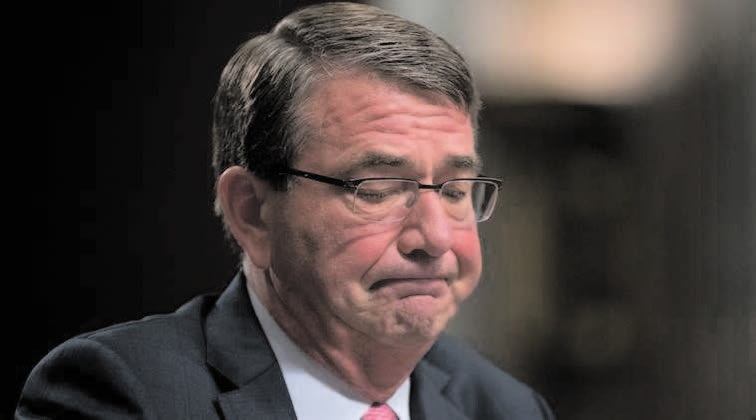
    Earlier, defence secretary Ashton Carter had said while India has generally shown responsible behaviour with nuclear technology, China conducts itself professionally, nuclear weapons in Pakistan are entangled in history of tensions.

    Meanwhile, in an opinion ‘Consequences of Pakistani Terrorism: Raids signal that India won’t tolerate more attacks in Kashmir’, The Wall Street Journal warned that Pakistan increasingly risks becoming a “pariah state” if it continues with policies.

    It said if Pakistan wants to prevent an escalation of violence it needs to shut down the terror groups it continues to support. “That should start with Jaish-e-Mohammad and Lashkar-e-Taiba, two major jihadist groups that operate openly in Pakistan and are prime suspects in these attacks,” it said. (PTI)


  • Rice phones Doval to put US support behind India, warns Pak on terror

    Rice phones Doval to put US support behind India, warns Pak on terror

    WASHINGTON (TIP): The Obama administration on Sept 28 affirmed its support to New Delhi on the issue of cross-border terrorism ahead of India’s surgical strike inside Pakistan occupied Kashmir, while putting Islamabad on notice for its failure to act against UN-designated terrorists and entities.

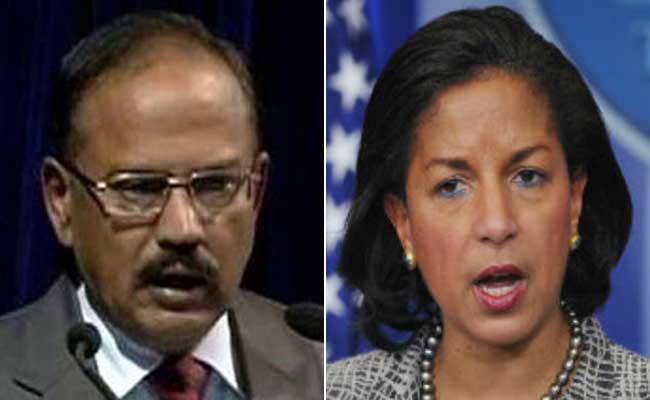
    US National Security Advisor Susan Rice spoke to her Indian counterpart Ajit Doval to offer condolences to families of the Uri attack victims and express support for India on the issue of terrorism, White House National Security Council spokesman Ned Price said in a read-out on the call. The call was initiated by Washington and took place before the Indian strike beyond the Line of Control.

    Although the statement did not explicitly pin the Uri attack on Pakistan, there was a broad censure of Islamabad for continuing to harbor proscribe terrorists and terrorist outfits, with a pledge that Washington would “deepen collaboration on counter-terrorism matters including on UN terrorist designations.”

    “Highlighting the danger that cross-border terrorism poses to the region, Ambassador Rice reiterated our expectation that Pakistan take effective action to combat and delegitimize United Nations-designated terrorist individuals and entities, including Lashkar-e-Tayyiba, Jaish-e-Muhammad, and their affiliates,” the statement said, in an unequivocal recognition of the Indian position that state-backed terrorist proxies have a free run in Pakistan. India has blamed Jaish operatives for the Uri attack, and has more recently identified the attackers and the camps in Pakistan-occupied Kashmir they came from.

    The US statement came amid recrimination from some Indian commentators that the Obama administration was hedging on backing India fully and was not putting pressure on Pakistan after the Uri attack. Although Secretary of State John Kerry gave Pakistan’s Prime Minister Nawaz Sharif an earful at the UN General Assembly last week, some analysts and retired Indian officials selectively highlighted pabulum in the statement to suggest that New Delhi had taken false comfort about US support, and everything was hunky-dory in Islamabad’s ties with Washington.

    The US statement on the Rice-Doval call leaves no doubt where Washington stands on the latest developments in the region, with none of the comforting crumbs that lower level US officials throw out for Pakistanis to feast on, such as recognizing Pakistan’s progress in the war on terror, commiserating with its claim that it is a victim etc.

    “There are no nuances here. The message to Pakistan is very clear,” a senior Indian diplomat said, as New Delhi stepped up international pressure on Islamabad.

    In fact, the Rice-Doval phone conversation, coming after New Delhi’s call to torpedo the SAARC meet, virtually endorses India’s decision to scupper the summit, without the salutary advice that the State Department invariably essays about the need for dialogue. (PTI)

  • Obama to attend Shimon Peres funeral in Jerusalem

    Obama to attend Shimon Peres funeral in Jerusalem


    WASHINGTON (TIP): US President Barack Obama will join other world leaders in attending the funeral of Israeli ex-president and Nobel Peace Prize winner Shimon Peres in Jerusalem, the White House said sept 28.

    Obama, who ordered US flags at half-staff late Wednesday, “will lead the US delegation to Jerusalem to participate in the funeral,” the White House said.

    He is to depart for Israel Thursday and return after the ceremony on Friday.

    The US president led tributes to the elder statesman as a friend who refused to give up on the dream of peace.

    Peres’ commitment to Israel’s security and pursuit of peace was “rooted in his own unshakeable moral foundation and unflagging optimism” the US leader said in a statement.

    Obama is to join world leaders including former US president Bill Clinton, French President Francois Hollande and German President Joachim Gauck as well as Britain’s Prince Charles in attending Peres’ Friday funeral at Jerusalem’s Mount Herzl, where many Israeli dignitaries are buried.

    Flags at the White House, on all public buildings and grounds, and at US buildings overseas will be flown at half-staff through sunset Friday “as a mark of respect for the memory of Shimon Peres,” the White House said in a statement. Peres, who was 93, held nearly every major office in the country, serving twice as prime minister and also as president, a mostly ceremonial role, from 2007 to 2014. (AFP)

  • Defense secretary: US will sharpen ‘military edge’ in Asia

    Defense secretary: US will sharpen ‘military edge’ in Asia

    SAN DIEGO (TIP): Defence secretary Ash Carter said on sept 29 the US will “sharpen our military edge” in Asia and the Pacific in order to remain a dominant power in a region feeling the effects of China’s rising military might.

    Carter made the pledge in a speech aboard the aircraft carrier USS Carl Vinson in port in San Diego.

    The Pentagon chief described what he called the next phase of a US pivot to Asia — a rebalancing of American security commitments after years of heavy focus on the Middle East.

    His speech, aimed at reassuring allies unsettled by China’s behavior in the South China Sea, came three days after he made remarks at a nuclear missile base in North Dakota about rebuilding the nuclear force. Those comments prompted a strong reaction from the Russian foreign ministry, which issued a statement saying it had interpreted Carter’s statement as a declared intention to lower the threshold for using nuclear weapons.

    Carter said the Pentagon will make its attack submarines more lethal and spend more to build undersea drones that can operate in shallower waters where submarines cannot.

    “The United States will continue to sharpen our military edge so we remain the most powerful military in the region and the security partner of choice,” he said. He added, “We’re going to have a few surprises as well,” describing them only as “leap-ahead investments.”

    With a broad complaint that China is “sometimes behaving aggressively,” Carter alluded to Beijing’s building of artificial islands in disputed areas of the South China Sea.

    “Beijing sometimes appears to want to pick and choose which principles it wants to benefit from and which it prefers to try to undercut,” he said. “For example, the universal right to freedom of navigation that allows China’s ships and aircraft to transit safely and peacefully is the same right that Beijing criticizes other countries for exercising in the region. But principles are not like that. They apply to everyone, and every nation, equally.”

    Carter’s speech was meant to set the scene for a meeting on Friday in Hawaii with his counterparts from the 10 member countries of the Association of Southeast Asian Nations, or ASEAN. The association focuses mainly on trade issues, but in recent years, with US encouragement, has sought to engage in a range of defence and military issues. The US is not a member of the organization but has sought to use it as a forum for further developing security partnerships amid regional concern about China’s military buildup.

    On Carter’s flight from San Diego to Hawaii later on Sept 29, a senior defence official aboard the plane told reporters that Carter expects to hear concerns from some Southeast Asian ministers, including those from Singapore, Indonesia and the Philippines, about the threat they perceive from an expected return of extremists who have been fighting for the Islamic State group in Syria and Iraq.

    The official, who spoke on condition of anonymity under ground rules set by the Pentagon, said “hundreds” of IS fighters already have returned to Southeast Asia from Syria and Iraq and said up to 1,000 more may return as the Islamic State group faces increased military pressure.

    Carter has described Pentagon efforts to execute a “pivot” to Asia by shifting, or rebalancing, US forces and attention toward the Asia-Pacific region after a decade and a half of Mideast-focused strategies and operations.

    In April, he said he was putting “the best people and platforms forward to the Asia-Pacific” by increasing the number of US military personnel in the region and by sending and stationing advanced weapons system there. He said that includes F-22 and F-35 stealth fighter jets, P-8 Poseidon maritime surveillance aircraft, continuous deployments of B-2 and B-52 strategic bombers and the newest surface warfare ships like the amphibious assault ship USS America.

    Among the Asia problems that have arisen for the Pentagon since Carter last met with the region’s defence ministers is a sudden and steep deterioration in relations with the Philippines.

    When Carter visited the Philippines in April, he praised the strength of the partnership. He said his visit had inaugurated “a major new era in a longstanding alliance.” He was referring to the US-Philippines Enhanced defence Cooperation Agreement. “I’m proud to say this alliance is as close as it’s been in years.”

  • Police in California kill black man acting erratically

    Police in California kill black man acting erratically

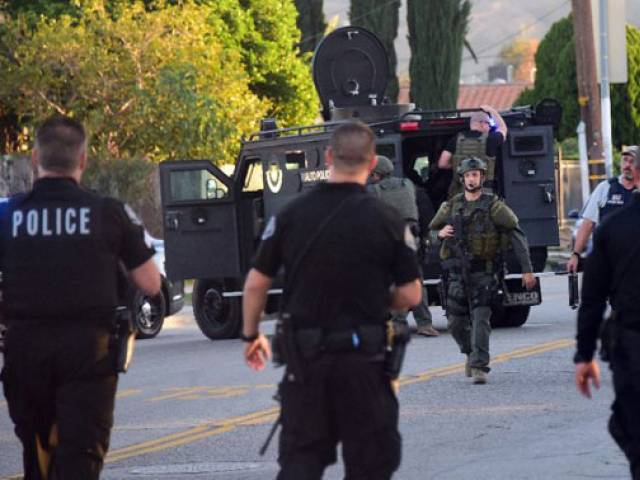
    LOS ANGELES (TIP): Police in a California city fatally shot a black man who had been acting erratically, prompting protesters to quickly gather and accuse officers of an unjustified killing.

    The shooting on sept 27 afternoon in El Cajon, 15 miles (24 kilometers) east of San Diego, was the latest in a string of killings of black men by police that have fueled outrage across America.

    Two police officers encountered the unidentified man, who was in his 30s, behind a restaurant after receiving reports of someone “not acting like himself” and walking in traffic, El Cajon police said in a statement.

    The man, who was pacing back and forth, refused officers’ orders to take his hand out of his pocket, police said.

    According to the police account, at one point, as the officers tried to talk to the man, he “rapidly drew an object from his front pants pocket, placed both hands together and extended them rapidly toward the officer taking up what appeared to be a shooting stance.”

    Police Chief Jeff Davis did not say what the object was, but told a news conference that no firearm was recovered.

    The officer whom the man was pointing at fired his weapon “several times,” while the second officer simultaneously fired his Taser, police said. They released a photograph taken from video footage, showing the man in a black tank top and blue jeans seemingly aiming at the officer.

  • Teen kills father, opens fire on South Carolina schoolyard

    Teen kills father, opens fire on South Carolina schoolyard

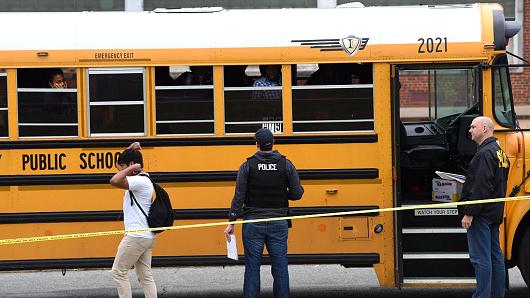
    CHARLESTON (TIP): A 14-year-old South Carolina boy shot and killed his father then drove to an elementary school playground where he wounded two children and a teacher with a handgun before being tackled by a firefighter who held him for police, authorities said on Sept 28.

    The suspect, whose name has not been released, was accused by police of fatally shooting his 47-year-old father, Jeffrey DeWitt Osborne, then driving a pickup truck about 3.2 km to Townville Elementary School where he crashed into a fence surrounding the playground.

    After the teenager began shooting, volunteer firefighter Jamie Brock pinned him down while staff led children to safety inside the building, Anderson County emergency services director Taylor Jones told a news conference.

    Police arrived within seven minutes of a teacher calling 911 to take the suspect into custody at the school in Anderson County, near the Georgia state line about 160 km northeast of Atlanta. The shooter never entered the building, said chief deputy Keith Smith. Authorities do not know the motivation of the shooting but ruled out race as both the shooter and victims were white. US schools have taken added security precautions since 2012 when a gunman shot and killed 20 children and six educators at Sandy Hook Elementary School in Newtown, Connecticut. Brock, a 30-year veteran of the Townville Volunteer Fire Department, was hailed on social media as a hero and credited with preventing another school massacre.