Month: October 2016

  • DIWALI ARRIVES EARLY IN USA WITH A STAMP FOREVER

    DIWALI ARRIVES EARLY IN USA WITH A STAMP FOREVER

    NEW YORK CITY (TIP): Diwali this year is a special one, with the USPS issuing a commemorative Diwali stamp. The month of October is very special for every Indian as it has the honor of having the birthday of one of the greatest sons of India-Mahatma Gandhi. But now onwards, 5th October is going to be very special for millions of Indians living in the USA. It was a moment of great pride for every single Indian American to stand and be counted at the Indian consulate in New York City on October 5, 2016 at the first-day-stamp. The commemorative stamp release is actually a 7-year “saga” of relentless journey of Diwali Stamp Project ChairRanju Batra who had, despite all odds, persevered and won for 1.3 billion Indians a US Diwali commemorative stamp. In her journey, Ranju got overwhelming support from the community and everyone was ecstatic to be part of the history making event.

    “I am very honored to be part of history as the United States Postal Service releases the Diwali Forever stamp at the consulate today,” said Ambassador Riva Ganguly Das, Consul General of India.

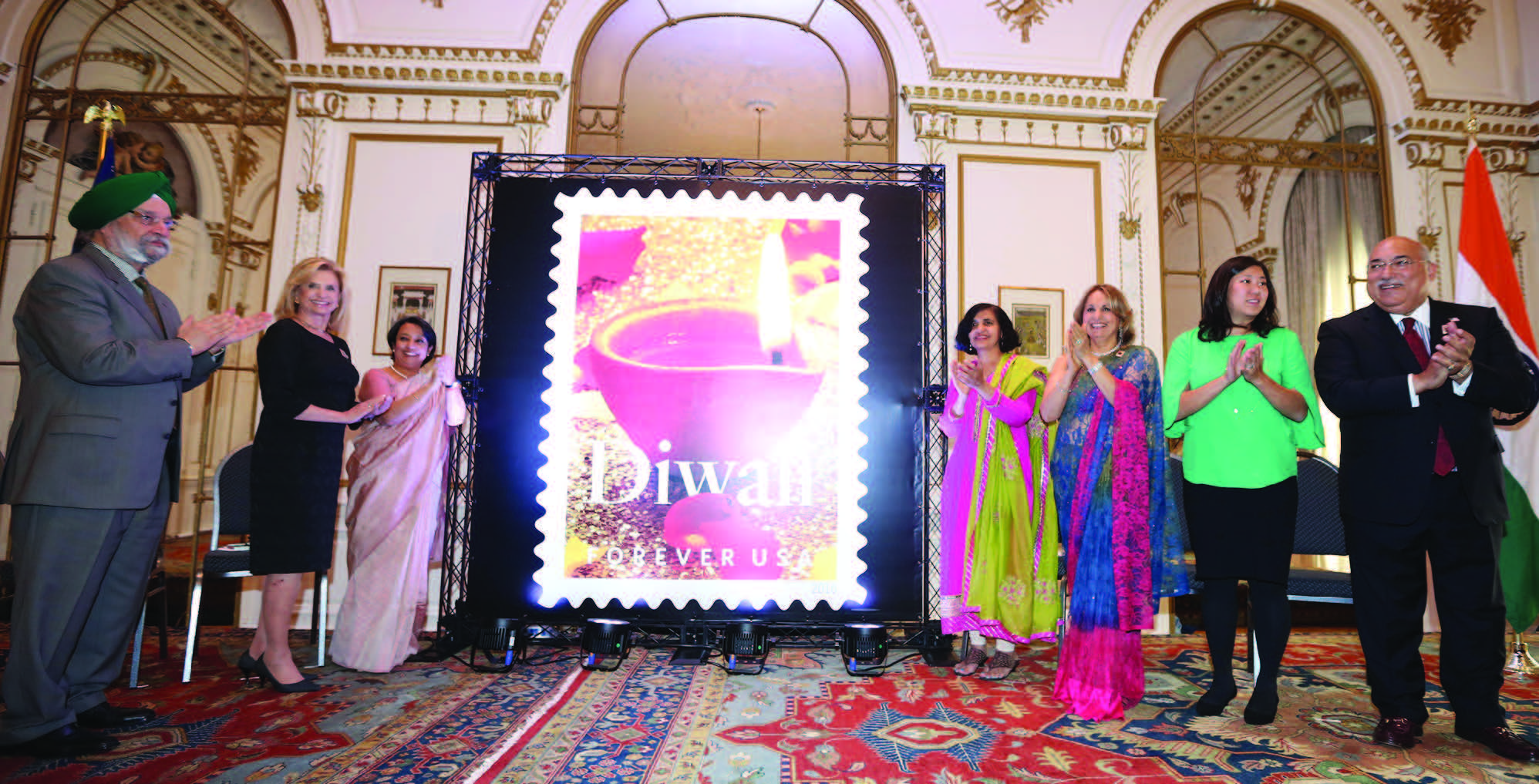
    Lighting the Lamp. Consul General of India Riva Ganguly Das lights the lamp to inaugurate the event. Seen in the picture, from L to R: Assemblyman David Weprin, Indian Merchants' Association President Shiv Dass, Congresswoman Carolyn Maloney, Consul General Riva Ganguly Das, Emcee of the event Ravi Batra (partially seen), Chair, Diwali Stamp Project Ranju Batra, Congresswoman Grace Meng, New York City Comptroller Scott Stringer, Ambassador Hardeep S Puri, Vandana Sharma, Regional Manager, Air India
    Lighting the Lamp. Consul General of India Riva Ganguly Das lights the lamp to inaugurate the event. Seen in the picture, from L to R: Assemblyman David Weprin, Indian Merchants’ Association President Shiv Dass, Congresswoman Carolyn Maloney, Consul General Riva Ganguly Das, Emcee of the event Ravi Batra (partially seen), Chair, Diwali Stamp Project Ranju Batra, Congresswoman Grace Meng, New York City Comptroller Scott Stringer, Ambassador Hardeep S Puri, Vandana Sharma, Regional Manager, Air India

    India’s national carrier Air India was also part of this historic event. Vandana Sharma, Regional Manager, Air India told TIP that they are giving 10 Air India Return tickets to India for promoting Diwali stamp. Air India Maharaja was seen holding the Diwali stamp with Ranju Batra, Vandana Sharma, Ravi Batra, Mohan Kothekar, Aban Chavda and others from Air India, in attendance.

    The event was full of entertainment with everything Indian at core – lighting of the lamp, unveiling of the stamp, presentation of Bollywood entertainment with Bhangra and Punjabi Dhol.

    The Consulate probably has never seen before such huge crowd, as on this very special and historic occasion. The rooms were packed to capacity, with many standing to watch the proceedings. There were endless lines of people eager to buy Diwali Stamps. In fact, USPS ran short of the stamps. Some of those who had already paid also were disappointed, as they could not get the stamps. Ranju Batra alone had sold 100,000 stamps before the day of retail sale on October 5.

    The stamp design is a photograph featuring a traditional diya oil lamp beautifully lit, sitting on a sparkling gold background. Diya lamps are usually made from clay with cotton wicks dipped in a clarified butter known as “ghee” or in vegetable oils.

    Sally Andersen-Bruce of New Milford, CT,who photographed the traditional Diwali diya is seen beside the unveiled stamp
    Sally Andersen-Bruce of New Milford, CT,who photographed the traditional Diwali diya is seen beside the unveiled stamp

    Sally Andersen-Bruce of New Milford, CT, photographed the diya. Greg Breeding of Charlottesville, VA, designed the stamp and William J. Gicker of Washington, DC, served as the project’s art director.

    The Diwali stamp has been issued as a Forever stamp. This Forever stamp is always equal to the value of the current First Class Mail 1-ounce price. “The Postal Service is honored to issue this Forever stamp that celebrates the Festival of Diwali,” said U.S. Postal Service Vice-President of Mail Entry and Payment Technology Pritha Mehra. “We hope these stamps will light up millions of cards and letters as they make their journey through the mailstream.”

    Singing the US National Anthem
    Singing the US National Anthem

    Ranju’s biggest supporter – her husband Ravi Batra, Esq., Chair, National Advisory Council South Asian Affairs whoof-issue dedication ceremony of the Diwali served as emcee of the event was elated as well. “Since the start of the American Revolution, destiny has beckoned the United States and India to be the closest allies. The Diwali Forever stamp represents nothing short of respectful inclusive indivisibility: E Pluribus Unum – within America and between two sovereigns.”

    In her speech Ranju described how getting USPS issue a Diwali Stamp became part of her daily life. Wherever she went, whomsoever she met – be it President Obama or Prime Minister Modi – she persuaded for the stamp, as she felt that though Diwali holds a great significance for millions of IndianAmericans and well over a billion people across the globe, the United States Postal Service has not recognized this beautiful festival of lights with a commemorative stamp, although it has done so for other major religious and cultural holidays such as Christmas, Hanukkah, Kwanzaa, and Eid.

    “While this journey may have taken years, the Postal Service has issued a Diwali stamp that will continue to resonate forever,” said Ranju. “Now for the first time there is a stamp that celebrates Hindus, Sikhs, Jains and Buddhists as Americans forever. Our heartfelt thanks to all of those who have supported this stamp. The Diwali stamp will be a matter of pride for generations to come.”

    Air India Maharaja admires the Diwali Stamp. Air India pitched in to promote the sale of Diwali Stamps by giving away 10 return tickets to India. Seen in the picture, from L to R: Aban Chavda, Marketing Assistant, Air India, two ladies, Mohan Kothekar, District Sales Manager, Ranju Batra, Chair Diwali Stamp Project, Vandana Sharma, RM Air India, Ravi Batra, Emcee of the event.
    Air India Maharaja admires the Diwali Stamp. Air India pitched in to promote the sale of Diwali Stamps by giving away 10 return
    tickets to India. Seen in the picture, from L to R: Aban Chavda, Marketing Assistant, Air India, two ladies, Mohan Kothekar, District
    Sales Manager, Ranju Batra, Chair Diwali Stamp Project, Vandana Sharma, RM Air India, Ravi Batra, Emcee of the event.

    Though Ranju now has the feather in her crown for winning the ‘battle’, it may rightly be recalled that a few other Indian community leaders here in New York and elsewhere in the US had also tried for Diwali stamp but could not succeed.

    One such person who in fact had initiated in this respect is a senior community leader and a business leader of New York Indian American community, Shiv Dass who as President of Jackson Heights Merchants’ Association had as far back as 2003 taken up the issue of a Diwali Stamp. Mr. Dass was very pleased at the unveiling ceremony of the Diwali Stamp and told The Indian Panorama that he felt as if his effort to have a Diwali Stamp had culminated after so many years. He had great praise for Ranju. “We tried a lot but eventually gave up. I’m happy that Ranju finally got this job done which was our dream.”

    Mr. Sante Chari who came all the way from Dallas, Texas, showed to The Indian Panorama a couple of letters he had managed to obtain in support of Diwali Stamp from lawmakers a couple of years ago. He mentioned how he had lobbied with lawmakers in Washington DC to have a USPS stamp in commemoration of the Hindu festival of Diwali issued.

    India’s former Permanent Representative to the United Nations Ambassador Hardeep Singh Puri feels that Ranju’s ‘sensible propagation’ of the agenda brought her the success. “It is not the strength of the number of petitions but doggedness and perseverance on the part of Ranju Batra that she achieved success whereas others dropped midway.’

    Grace Meng, member of the United States House of Representatives, representing New York’s 6th congressional district in the New York City borough of Queens, is confident that this stamp will spread message of peace and cultural harmony.

    In her journey Ranju had another ‘partner’ in Congresswoman Carolyn Maloney (D-NY) who also relentlessly fought for this cause as she felt that ‘a relatively small action would hold great meaning for millions of people.’ For her, a dream came true.”This stamp represents the triumph of knowledge over ignorance, light over dark and good over evil. These values, these virtues, are more important and relevant than ever before and I am thrilled that after many years of fighting for this stamp it has finally become a reality,” she said.

    Last year at an event Maloney said she had written two letters for two head of the states. First one was delivered. Recipient? US President Barack Obama. The second letter was meant for India’s Prime Minister Narendra Modi but it could not be posted, as it needed a postal stamp. Not any ordinary one, but a ‘Diwali Stamp.’ Maloney wanted to send the letter to Modi with that stamp only! Now the time has come.

    Those who missed buying the stamp on the first day of issue need not despair. They have 60 days to obtain the first-day-of-issue postmark by mail. They may purchase newstamps at local Post Offices, at The Postal Store website at usps.com?shop or by calling 800-782-6724.

    They should affix the stamps to envelopes of their choice, address the envelopes to themselves or othersand place them in a larger envelope addressed to:

    People rush to buy the first day issue of Diwali Stamp
    People rush to buy the first day issue of Diwali Stamp

    Diwali Stamp

    Stamp Fulfillment Services

    Cancellation Services

    8300 NE Underground Drive, Pillar 210

    Kansas City, MO 64144-9998

    After applying the first-day-of-issue postmark, the Postal Service will return the envelopes through the mail. There is no charge for the postmark up to a quantity of 50. There is a 5-cent charge for eachadditional postmark over 50. All orders must be postmarked by Dec. 5, 2016.

    The Postal Service also offers first-day covers for new stamp issues and Postal Service stationery itemspostmarked with the official first-day-of-issue cancellation. Each item has an individual catalog numberand is offered in the quarterly “USA Philatelic” catalog, online at usps.com?shop or by calling 800-782-6724. Customers may request a free catalog by calling 800- 782-6724 or writing to:

    U.S. Postal Service Catalog Request

    PO Box 219014

    Kansas City, MO 64121-9014


  • Sri Lanka PM Wickremesinghe bats for greater trade ties with south Indian states

    Sri Lanka PM Wickremesinghe bats for greater trade ties with south Indian states

    COLOMBO (TIP): Sri Lankan Prime Minister Ranil Wickremesinghe called for deeper economic engagement with India and proposed stronger trade and economic linkages with south Indian states.

    “There can be diverse economic models around India. India is a regional power. We have much in common with south Indian states. We are looking at bilateral agreements with deeper integration and carving special trade areas with southern states of India,” he told reporters on the sidelines of the World Economic Forum’s India economic summit on Thursday.

    He said his country was forging stronger economic ties with Singapore and proposed a trilateral arrangement with India to boost trade.

    Wickremesinghe said as far as Saarc was concerned, the level of economic activity was low and there was virtually no integration in the south Asian subcontinent. “Sri Lanka is pursuing a bilateral approach to forge greater trade and economic ties,” he added.

    Wickremesinghe also complimented PM Modi for the “restrained and far sighted leadership” in the wake of tension between India and Pakistan.Earlier, in his address at the summit, he said Sri Lanka and India were working to expand the India-Sri Lanka Free Trade Agreement to include services and investment as well. ” The Economic and Technical Cooperation Agreement, which has been under negotiation between the two countries, should be concluded by the end of the year,” he added.

    Wickremesinghe said as these agreements come into force, India would have access to not just the Sri Lankan market but also to markets in Singapore, Japan and China among others as the island nation was in the process of negotiating free trade pacts with several countries. He also invited Indian companies to invest in Sri Lanka, especially in areas such as infrastructure. (PTI)

  • Bangladesh court clears student of restaurant attack charges

    Bangladesh court clears student of restaurant attack charges

    DHAKA (TIP): A Bangladesh court has cleared a university student of all allegations related to the restaurant siege three months ago in which 20 hostages were killed.

    Metropolitan Magistrate Nur Nabi passed the order Wednesday after an investigator appealed for clearing Tahmid Hasib Khan, an undergraduate at the University of Toronto who has Canadian residency. Prosecutor Abdullah Abu said Khan was cleared of suspicion that he was involved in the attack July 1 on the Holey Artisan Bakery in Dhaka. He had walked free Sunday after a court grant him bail.

    The Islamic State group has claimed responsibility for the attack but the government has blamed local militant groups.

    Five of the attackers were killed.

  • Sikh man shot dead in Afghanistan

    Sikh man shot dead in Afghanistan

    PESHAWAR (TIP): A Sikh man was abducted from his home and gunned down by suspected militants in Afghanistan’s restive Nangarhar province bordering Pakistan, a media report said. Sardar Rawail Singh, who lived in Jalalabad, was abducted from his house by militants wearing military fatigues and killed in Khalis Famil area.

    The incident triggered a massive protest by the minority Sikh community who staged a demonstration by placing the body of Singh in front of the provincial governor’s house in Jalalabad and demanded the arrest of the killers.

    They accused security forces of negligence in arresting the killers and asked the government to bring to justice the killers as soon as possible.

    Later, deputy governor Mohammad Hanif Gardiwal met the protesting Sikhs and pacified them. He said a case has been filed and a manhunt launched to nab the culprits.

    The insurgents abducted Singh from his home at about 7:20 AM (local time) yesterday and gunned him down at Khalis Famil area, provincial governor’s spokesman Attaullah Khogyani was quoted as saying by Pajhwok Afghan News. Rawinder, one of the protesters, said Singh had a dispute with his neighbour on Friday Next morning, the neighbour came along with some gunmen and abducted Singh from his home before killing him, he said, adding that Singh had invited his friends for a party at his home when his neighbour objected. (TNN)

  • India ODI team picked by new selection committee likely to escape SC action

    India ODI team picked by new selection committee likely to escape SC action

    NEW DELHI (TIP): “If it aint broke dont fix it” goes the saying, and one area the Justice RM Lodha Committee has left alone is that regarding the players.

    The Supreme Court-appointed panel though suggested a three-man selection committee, which the Board of Control for Cricket in India (BCCI) has not accepted.

    As the board administration faces uncertainty with the Apex court due to pronounce its interim order on the Lodha panel’s status report demanding the removal of the BCCI top brass, the interesting question is whether the court will touch the squad chosen for the first three ODIs against New Zealand.

    Had the court passed its interim order on Thursday, and ruled the selection committee illegal because it includes two players who have not played Tests as recommended by the Lodha panel, the team selection would have been in trouble.

    However, that was not the case and it allowed the panel headed by former India stumper MSK Prasad to name the squad to be led by MS Dhoni for the first three ODIs of the series starting on October 16.

    The selection committee was one of the major areas where the BCCI chose to ignore the Lodha panel’s recommendation. The board picked the new committee on September 21 with only Prasad, Debang Gandhi and Sarandeep Singh ex-Test players. Jatin Paranjpe and Gagan Khoda have only played ODIs.

    The BCCI, which had invited applications for the job, argued that the Lodha panel’s conditions forced bigger names to keep away.

    So, will the Supreme Court order dissolve the selection panel, and by extension, the 15-member side picked?

    Sports lawyer, Vidushpat Singhania, said the squad may escape the court’s axe though it had flouted directives by the Lodha panel.

    “It is unlikely they will invalidate the team selection if it has taken place in the correct manner, but (I’m) not putting it out of the realm (of possibility),” he told HT.

    A mitigating factor could be that the new panel was chosen nine days before the initial compliance deadline of September 30 given by the Lodha Committee. But Singhania pointed out that the panel had given the cricket board enough time to implement directives.

    As the BCCI ignored the recommendation to select a three-member panel , “they (Supreme Court bench) could actually invalidate it – the chosen team,” Singhania said.

  • ITF hits back at criticism over their handling of Maria Sharapova issue

    ITF hits back at criticism over their handling of Maria Sharapova issue

    LONDON (TIP): The International Tennis Federation (ITF) hit back on Oct 6  at criticism over its handling of Maria Sharapova’s drugs ban for meldonium.

    The administrator of the Tennis Anti-Doping Programme denied it had sought a four-year ban for the former world number one and, in a statement, rejected suggestions by the Russian that its independent tribunal was “not neutral”.

    The ITF also emphasised it had not known, prior to this year when the drug was put on the banned list, that meldonium was in common use by eastern European athletes.

    Five-times grand slam winner Sharapova was cleared by the Court of Arbitration for Sport to return to action in April after her two-year suspension was reduced to 15 months on Tuesday.

    The 29-year-old said then that other sports federations had been more effective at communicating with athletes and hoped the ITF would take note.

    Her lawyer John Haggerty described the ITF’s procedure for relaying rule changes as a “night and day difference” to the “vivid and direct warnings” from others.

    “The ITF did not try to ban Ms. Sharapova for four years, as has been suggested,” the tennis governing body said. “The ITF stated clearly that it was the responsibility of the Independent Tribunal — and subsequently the CAS Panel — to determine what the appropriate sanction should be.

    “Ms. Sharapova has stated that the Independent Tribunal was ‘not neutral’,” it added.

    “Ms. Sharapova’s legal team was given the opportunity to object to the appointment of any member of that Tribunal in advance of the hearing, and they agreed in writing that they had no such objection.”

    The ITF believed it had taken appropriate steps to publicise changes to the prohibited list and it was “not true” to say that it was aware of widespread use of meldonium in Eastern Europe and should have given specific notice.

    “In fact, it was accepted by Ms. Sharapova in the hearing before CAS that the ITF did not know before 2016 about the extent to which meldonium was used by athletes from any region, or that Ms. Sharapova herself was using meldonium,” it said.

    The ITF pointed out that the WADA monitoring programme is conducted anonymously and WADA

    “does not inform any anti-doping organisation about the prevalence of such use until it publishes the results of the monitoring programme.”

    It said that was May 2016 for the 2015 monitoring programme.

  • WORLD’S FIRST DENGUE VACCINE APPROVED IN OVER 10 COUNTRIES

    WORLD’S FIRST DENGUE VACCINE APPROVED IN OVER 10 COUNTRIES

    Sanofi-Pasteur, the vaccines global business unit of Sanofi, announced today that the dengue vaccines have received approval in 14 countries.

    Recent approvals for Dengvaxia granted by health authorities are those from Indonesia, Thailand and Singapore.

    To date the vaccine is approved in Mexico, The Philippines, Brazil, El Salvador, Costa Rica, Paraguay, Guatemala, Peru, Indonesia, Thailand and Singapore.

    “We’re pleased to see the growing medical and public health recognition for the vaccine,” Su Peing Ng, head of Global Medical Affairs for Sanofi Pasteur, said in a statement. “With this new tool in hand, public health communities in dengue-endemic countries now have additional means to achieve the WHO objectives for 50 per cent reduction in mortality and 25 per cent reduction in morbidity due to dengue by 2020,” Su Peing Ng said.

    Notably, the Latin American Society for Pediatric Infectious Diseases recently published its support for dengue vaccination. National medical societies in Indonesia, Brazil and Mexico recently also recommended vaccination with Dengvaxia, a company statement said.

    In the clinical study population nine years old and older, the dengue vaccine has been documented to prevent two-thirds of dengue cases due to all four serotypes of dengue.

    The dengue vaccine also prevented 8 of 10 hospitalizations due to dengue and 93 per cent of serious dengue cases like the deadly hemorrhagic form of the disease, over the 25-month study follow-up period of the large-scale efficacy studies conducted in 10 endemic countries in Latin America and Asia.

  • MEDITATE FOR OVERALL WELLNESS

    MEDITATE FOR OVERALL WELLNESS

    Do you fail to keep a check on your emotions in situations that most demand it? If yes, then you may want to include meditation in your daily routine for a calmer you, say researchers.

    Mindfulness, a moment-by-moment awareness of one’s thoughts, feelings and sensations, has gained worldwide popularity as a way to promote health and well-being.

    “Our findings not only demonstrate that meditation improves emotional health, but that people can acquire these benefits regardless of their ‘natural’ ability to be mindful,” said lead investigator Yanli Lin, a graduate student at the Michigan State University.

    For the study, the team assessed 68 participants for mindfulness using a scientifically validated survey.

    The participants were then randomly assigned to engage in an 18-minute audio-guided meditation or listen to a control presentation of how to learn a new language, before viewing negative pictures (such as a bloody corpse) while their brain activity was recorded.

    The participants who meditated — they had varying levels of natural mindfulness— showed similar levels of “emotion regulatory” brain activity as people with high levels of natural mindfulness.

    In other words, their emotional brains recovered quickly after viewing the troubling photos, essentially keeping their negative emotions in check, the researchers said.

    Further, some of the participants were instructed to look at the gruesome photos “mindfully” while others received no such instruction.

    The people who viewed the photos “mindfully” showed no better ability to keep their negative emotions in check.

    According to Jason Moser, Associate Professor at Michigan State University, this suggests that for non-meditators, the emotional benefits of mindfulness might be better achieved through meditation, rather than “forcing it” as a state of mind.

    “If you’re a naturally mindful person, and you’re walking around very aware of things, you’re good to go. You shed your emotions quickly,” Moser said. “If you’re not naturally mindful, then meditating can make you look like a person who walks around with a lot of mindfulness,” Moser observed.

  • Antibiotic-resistance making kidney infections more deadly

    Antibiotic-resistance making kidney infections more deadly

    Medication-resistant bacteria are making it more difficult to treat a common but severe kidney infection, says a study.

    Pyelonephritis — infection of the kidney usually caused by E. coli bacteria and which can start as a urinary tract infection –causes fever, back pain and vomiting.

    About half of people infected require hospitalisation. If not treated with effective antibiotics, it can cause sepsis and death.

    “This is a very real example of the threat posed by the emergence of new antibiotic-resistant strains of bacteria, which greatly complicates treatment of infection,” said the study’s lead author David Talan, Professor at David Geffen School of Medicine at University of California, Los Angeles.

    In an earlier study based on data from 10 large hospital emergency departments in the US, almost 12 per cent of people diagnosed with pyelonephritis had infections resistant to the standard class of antibiotic used in treatment — fluoroquinolone. That is up from four per cent in a similar study conducted a decade ago.

    The new study — published in the journal Emerging Infectious Diseases — also documents the emergence of infections caused by a specific strain of E. coli that is resistant to additional types of antibiotics, severely limiting treatment options.

    That strain, dubbed ESBL for the antibiotic-destroying enzymes it produces

    (extended-spectrum beta-lactamases), was not detected in the previous study.

    Currently, there are only a few intravenous antibiotic options to treat ESBL-related infections, and no oral antibiotics that are consistently effective.

    The study included 453 people diagnosed with kidney infection. The study participants were diagnosed between July 2013 and December 2014 in 10 emergency departments at large hospitals in the US.

  • CAFFEINE CUTS DEMENTIA RISK IN OLDER WOMEN

    CAFFEINE CUTS DEMENTIA RISK IN OLDER WOMEN

    Older women who consume more than 261 mg of caffeine per day have lower risk of dementia, finds a new study.

    According to a recent research, among a group of older women, self-reported caffeine consumption was associated with a 36 percent reduction in the risk of incident dementia over 10 years of follow-up.

    This level is equivalent to two to three cups of coffee per day, five to six cups of black tea or seven to eight cans of cola.

    Study’s lead author Ira Driscoll said, “The mounting evidence of caffeine consumption as a potentially protective factor against cognitive impairment is exciting given that caffeine is also an easily modifiable dietary factor with very few contraindications.”

    “What is unique about this study is that we had an unprecedented opportunity to examine the relationships between caffeine intake and dementia incidence in a large and well-defined, prospectively-studied cohort of women,” Driscoll added.

    Driscoll and her team used data from 6,467 community-dwelling, postmenopausal women aged 65 and older who reported some level of caffeine consumption.

    Intake was estimated from questions about coffee, tea, and cola beverage intake, including frequency and serving size.

    In 10 years or less of follow-up with annual assessments of cognitive function, 388 of these women received a diagnosis of probable dementia or some form of global cognitive impairment.

  • NASA’S CURIOSITY ROVER BEGINS EXPLORING NEW MARS DESTINATIONS

    NASA’S CURIOSITY ROVER BEGINS EXPLORING NEW MARS DESTINATIONS

    WASHINGTON (TIP): Nasa’s Curiosity Mars rover is driving towards new uphill destinations to further study ancient, water-rich environments and potential for life on the red planet.

    The destinations include a ridge capped with material rich in the iron-oxide mineral hematite, about two-and-a-half kilometres from its current location, and an exposure of clay-rich bedrock beyond that.

    These are key exploration sites on lower Mount Sharp, which is a layered mound where the Curiosity rover is studying evidence of ancient, water-rich environments that contrast with the harsh, dry conditions on the surface of Mars today.

    “We continue to reach higher and younger layers on Mount Sharp,” said Curiosity Project Scientist Ashwin Vasavada, of NASA’s Jet Propulsion Laboratory in the US.

    Hundreds of photos Curiosity took in recent weeks amid a cluster of mesas and buttes of diverse shapes are fresh highlights among the more than 180,000 images the rover has taken since landing on Mars in August 2012.

    Newly available vistas include the rover’s self-portrait from the colour camera at the end of its arm and a scenic panorama from the colour camera at the top of the mast.

    “Bidding good-bye to ‘Murray Buttes,’ Curiosity’s assignment is the ongoing study of ancient habitability and the potential for life,” said Curiosity Programme Scientist Michael Meyer at NASA Headquarters, Washington.

    “This mission, as it explores the succession of rock layers, is reading the ‘pages’ of Martian history -changing our understanding of Mars and how the planet has evolved,” Meyer said.

    The latest drill site – the 14th for Curiosity – is in a geological layer about 180 meters thick, called the Murray formation. Curiosity has climbed nearly half of this formation’s thickness so far and found it consists primarily of mudstone, formed from mud that accumulated at the bottom of ancient lakes. The findings indicate that the lake environment was enduring, not fleeting.

    For roughly the first half of the new two-year extended mission, the rover team anticipates investigating the upper half of the Murray formation.

    “We will see whether that record of lakes continues further,” Vasavada said.

    “The more vertical thickness we see, the longer the lakes were present, and the longer habitable conditions existed here,” he said.

  • NEW MATERIAL TO MAKE COMPUTERS 100 TIMES MORE POWER EFFICIENT

    NEW MATERIAL TO MAKE COMPUTERS 100 TIMES MORE POWER EFFICIENT

    NEW YORK (TIP): Researchers including one of Indian-origin have engineered a material that could lead to a new generation of computing devices, packing in more computing power while consuming nearly 100 times less energy thant today’s electronics require.

    “Electronics are the fastest-growing consumer of energy worldwide,” said one of the study authors, Ramamoorthy Ramesh from Lawrence Berkeley National Laboratory in the US.

    “Today, about five per cent of our total global energy consumption is spent on electronics, and that’s projected to grow to 40-50 percent by 2030 if we continue at the current pace and if there are no major advances in the field that lead to lower energy consumption,” Ramesh said.

    Known as a magnetoelectric multiferroic material, it combines electrical and magnetic properties at room temperature and relies on a phenomenon called “planar rumpling.”

    The new material sandwiches together individual layers of atoms, producing a thin film with magnetic polarity that can be flipped from positive to negative or vice versa with small pulses of electricity.

    In the future, device-makers could use this property to store the binary digits that underpin computing devices.

    “Before this work, there was only one other room-temperature multiferroic whose magnetic properties could be controlled by electricity,” said John Heron, Assistant Professor at University of Michigan who worked on the material with researchers at Cornell University.

    “That electrical control is what excites electronics makers, so this is a huge step forward,” Heron noted.

    Room-temperature multiferroics are a hotly pursued goal in the electronics field because they require much less power to read and write data than today’s semiconductor-based devices.

    In addition, their data doesn’t vanish when the power is shut off. Those properties could enable devices that require only brief pulses of electricity instead of the constant stream that’s needed for current electronics, using an estimated 100 times less energy.

  • Encrypt your chats on Facebook Messenger now

    Encrypt your chats on Facebook Messenger now

    After the popular mobile messaging platform WhatsApp, parent company Facebook has reportedly rolled out end-to-end encryption for its Messenger users.

    People can toggle the “Secret Conversations” feature on in settings to enable end-to-end encryption on Messenger, technology website Engadget reported on Wednesday.

    But here is the catch. Unlike WhatsApp, where all messages are automatically encrypted once you turn the feature on, nearly one billion monthly active Messenger users will have to activate end-to-end encryption for every new message.

    “Once folks download the new version, they’ll see the option to tap “secret” in the top right corner of the “new message” screen. Both sender and receiver need the latest edition of the app to enable the encryption,” the report added.

    In the case of WhatsApp, users need to have an updated version to ensure that their chats are end-to-end encrypted.

    “Messages you send to this chat and calls are now secured with end-to-end encryption. Tap for more info,” is the message that WhatsApp users currently receive.

    The encryption ensures that users’ messages, videos and photos can’t be read by anyone else — not even WhatsApp.

  • GOOGLE REBRANDS CLOUD BUSINESS, ADDS MORE ARTIFICIAL INTELLIGENCE

    GOOGLE REBRANDS CLOUD BUSINESS, ADDS MORE ARTIFICIAL INTELLIGENCE

    Alphabet Inc’s Google said on Thursday it renamed its business-to-business cloud computing brand and enhanced some enterprise applications using artificial intelligence, the company’s latest gambit to better compete with Amazon.com and Microsoft Corporation in the lucrative cloud business.

    Discussing the rebranded Google Cloud, Diane Greene, senior vice president of Google’s enterprise business, said the company has made good progress courting customers and improving its technology.

    Cloud computing uses remote internet servers to store, manage and process data, and Google offers a range of apps like word processing and email, as well as the ability to host data and offer resources for developers. The new name replaces the Google for Work brand.

    “We are closing the gap incredibly fast” with competitors, Greene, a former CEO of VMware who joined Google last year to ramp up its cloud business, told experts and journalists at an event.

    Analysts say Google trails Amazon and Microsoft in market share but is gaining under Greene. Although the business is not big enough to break out separately in its quarterly earnings statement, Google reported a 33 percent surge in

    “other revenue” in its most recent quarter, which analysts said was probably due largely to gains in cloud computing. Greene has moved quickly to streamline engineering and appointed new leadership to beef up the company’s cloud business. This has helped improve sales, Google Chief Executive Officer Sundar Pichai said during the company’s latest earnings call. Earlier this month, Google acquired cloud software company Apigee Corp in a deal valued at about $625 million.

    The company  also announced a partnership with consultant Accenture to develop cloud services for clients in industries such a retail, healthcare and finance.

    In addition, the company said it had woven more artificial intelligence into its apps to help employees work more efficiently. Using machine learning to crunch troves of data, Google says its apps will prompt users to, say, open files at certain times of day or propose meetings based on their habits.

  • KOLKATA TEST: INDIA DEFEAT NZ, CLAIM NO.1 RANKING

    KOLKATA TEST: INDIA DEFEAT NZ, CLAIM NO.1 RANKING

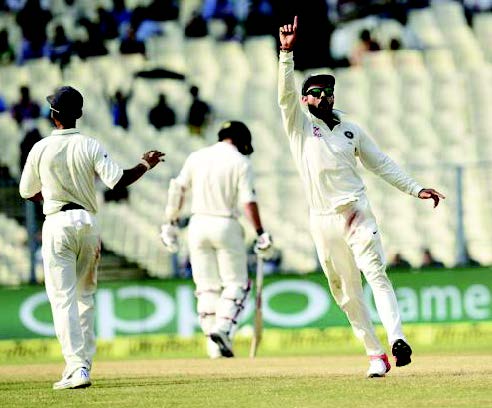
    KOLKATA (TIP): India regained their No.1 position in Tests with a massive 178-run victory against New Zealand on a tricky pitch that gave them an unassailable 2-0 lead in the series.

    A confident innings from Tom Latham saw New Zealand start strong but without their best batsman and captain Kane Williamson, saving the Test was always going to be tough. India’s bowling craft was its best too.

    As expected from a fourth day pitch, the spinners finally came into play but pacers played a vital part as well. Add to that Wridhhiman Saha’s gritty unbeaten knocks before an outstanding stint with the gloves and India never looked in danger of losing their way despite the visitors being 104/1 at one time. And then there was Virat Kohli’s instinct that is making him slowly look the captain India long needed to harness their talent.

    This win has come off a combined effort but for Saha, it will be special. Two unbeaten fifties have firmly established his credentials as a No.7 who can buttress the innings when needed. He isn’t the most graceful batsman, especially against pacers who have often jarred his hands and other parts of his body, but Saha has shown the courage to ride out the initial attacks and slowly make his presence felt. And when he backs his batting with the kind of catching that got Tom Latham out after a stubborn innings, India know they have the right person at the right position.

    Only after the dismissal of Latham — in the first over after tea — did India look likely to repeat their Eden feat of 2001 where they got the last seven wickets in the last session on Day 5. Here, another grueling day awaited New Zealand if they could get past the fourth.

    Still they showed some fight with the bat in a series that hasn’t been dominated by batsmen. Both teams are yet to score 400. And it took four innings for a team to put up a 50-run opening partnership in this Test. It could have been broken earlier though. Mohammed Shami hit Martin Guptill plumb on his pad but his appeal was turned down. Next time he appealed again, against Mitchell Santner, there was no ambiguity.

    Guptill however couldn’t utilise his second life. First over after lunch, he was done in by the dip of R Ashwin and ended leg-before. Henry Nicholls stitched a good 49-run partnership before edging Ravindra Jadeja to Ajinkya Rahane at slip. By the time Ross Taylor was snared by Ashwin, hopes of an early finish to the Test were on the rise.

    After the close of play, Kohli said he didn’t want to wake up 6.30 am on Tuesday. Home boy Saha made his wish come true and also ensured Kolkata wasn’t distracted from another day of Puja buildup. Despite producing one of the best innings of the series, Latham was bound to run out of patience one time. Ashwin’s drift was an entrapment, inviting him to drive but spinning viciously in the last second to take a faintest edge that Saha pouched superbly.

    Another home boy Shami kept his end of the deal too. With the pitch showing signs of slowing down, Jadeja and Ashwin were primed for long spells. But Kohli hardly adheres to convention. He brought Shami from the clubhouse end for a six-over spell. Santner already sent home, Shami beat BJ Watling’s outer edge to shatter his off-stump.

    Visibly tired, Shami was given a break by Kohli who put Jadeja and Bhuvneshwar Kumar in charge of the bowling. That too worked like a charm with Luke Ronchi and Jeetan Patel being dismissed in consecutive overs. The next two wickets took some time to come but with the right bowlers at their disposal, India were never short on patience.

  • GHANA SAYS IT WANTS TO REMOVE GANDHI STATUE FROM CAMPUS

    GHANA SAYS IT WANTS TO REMOVE GANDHI STATUE FROM CAMPUS

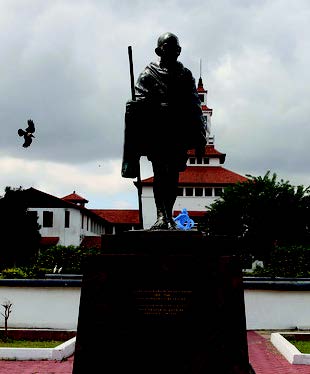
    ACCRA, GHANA(TIP): : Ghana has expressed its intention to remove a statue of Indian independence leader Mohandas Karamchand Gandhi from a university in the capital, citing a controversy over what critics call his “racist identity.”

    But the government made clear the move would be for the statue’s safety, telling the critics that “we must remember that people evolve.”

    Professors at the University of Ghana launched a petition last month calling for the removal of the statue, which was unveiled by Indian President Pranab Mukherjee in June.

    Ghana’s foreign affairs ministry said the government “would … want to relocate the statue from the University of Ghana to ensure its safety.”

    Obadele Kambon, one of the petition’s organizers, said Thursday there was no confirmation the statue would be removed. He said moving the statue to another location in Ghana would be insufficient.

    He urged the government to send it back to India.

    “We don’t think the statue would be well received anywhere in Ghana,” he said.

    Gandhi, a lawyer, traveled to South Africa in 1893 and stayed for two decades, fighting to expand rights for Indians there. The petition quotes writings from that period in which he refers to black South Africans as savages.

    At the same time, Gandhi’s approach of nonviolent protest influenced the African National Congress and its resistance to white minority rule.

    “While acknowledging that human as he was, Mahatma Gandhi may have had his flaws, we must remember that people evolve,” Ghana’s statement said. “He inspired movements for civil rights and freedom across the world.”

    The statement also expressed concern that the professors’ campaign could harm Ghana’s ties to India.

    The professors say the university instead should feature statues of local heroes like Yaa Asantewaa, who led a rebellion against British colonialism, or Kwame Nkrumah, Ghana’s first president.

  • Malaysia says debris found in Mauritius is from MH370

    Malaysia says debris found in Mauritius is from MH370

    KUALA LUMPUR (TIP): Malaysia said on Friday that a piece of plane debris discovered in Mauritius was from missing Malaysia Airlines flight MH370, which disappeared in March 2014 with 239 passengers and crew on board.

    The Boeing 777 disappeared on its way from Kuala Lumpur to Beijing, sparking a two-year search has turned up few leads. Analysis by the Australian Transport Safety Bureau had found that the debris was consistent with the trailing edge of an aircraft wing, Transport Minister Liow Tiong Lai said in a statement.

    Two pieces of plane debris were previously confirmed as being from the missing jet. The first was recovered from the French island of Reunion in July 2015, while the second was found on the island of Pemba, off the coast of Tanzania.

  • Celebrities Announced for Diwali at Times Square 2016

    Celebrities Announced for Diwali at Times Square 2016

    NEW YORK CITY (TIP): Event Guru has announced the celebrities arriving at the Times square Diwali. A press release issued by the organizers said  that  Shabbir Ahluwaliya, better known as “Rockstar Abhi,”and Sriti Jha, famous as “Pragya” in Kumkum Bhagya, Zee TV’s Saregamapa winner Kushal Paul, as well as contestant Jyotica Tangri, Zee TV’s “Dance India Dance” idol Siddhesh Pai and &TV’s “So You Think You Can Dance” star Kanchi Shah, You Tube sensation Arjun and Karan Tacker, actor and host of &TV’s The Voice India will be part of the October 16 Diwali at Times Square 2016 celebration, which is being presented by &TV and powered by Sling International and Air India. A local, young prodigy, Sparsh Shah, will also join the talent lineup.

    “We are thrilled to partner with &TV, and to bring popular Indian TV personalities to Diwali at Times Square 2016,” said Mrs. Neeta Bhasin, CEO of Event Guru. “We are emotionally attached to the characters these stars play as they visit our living rooms daily. It’s quite exciting for fans to see their favorites in person.”

    We are very excited to be a part of Diwali at Times Square 2016,” said Sameer Targe, Head of Sales, Zee TV USA. “It is a perfect opportunity for us to reach out to our community and introduce our new Hindi GEC & TV. Our artists and celebrities truly enjoy meeting their fans.”

    Shabbir Ahluwaliya and Sriti Jha will be on hand to delight the crowd. The event will showcase soulful performances from Kushal Paul and Jyotica Tangri, singing songs from their performances on the show. Sparsh Shah will also show off his singing talent. Dance performances by Siddhesh Pai and Kanchi Shah will add magic moments to the night. International singer-songwriter Arjun will melt many hearts with his breathtaking singing performance. And Karan Tacker will be our Master of Ceremonies.

    Save the date and plan to join the celebrations on Oct 16, 2016, starting at 2:00 p.m. to 9 p.m.

    For more information, contact info@diwalitimessquare.com / 212-216-9305

  • Hitler was drug addict; veins collapsed due to injections: Book

    Hitler was drug addict; veins collapsed due to injections: Book

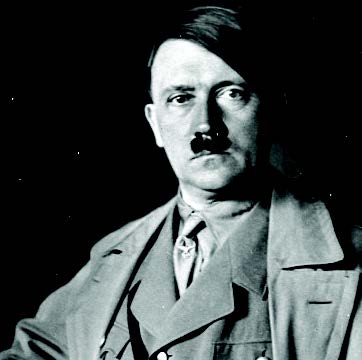
    LONDON (TIP): Adolf Hitler was a gibbering “super- junkie” whose veins were all but destroyed by thousands of opiate injections and the Nazi dictator’s heavy reliance on drugs was behind his “increasingly erratic” decision-making in later stages of World War II, a new book has claimed.

    According to Norman Ohler, an award-winning German author, the Fuhrer became addicted to a heroin-like substance called Eukodel which was prescribed following a nervous breakdown in 1944.

    Ohler’s book ‘Blitzed: Drugs in Nazi Germany’, which British historians have praised as a “remarkable” work of research, argues that the heroin-like opiate was largely to blame for Hitler’s erratic and paranoid behaviour towards the end of his life, The Telegraph reported.

    It brings to light extracts from the journal of Dr Theo Morell, Hitler’s personal physician, who once complained he could no longer inject the drug as nearly all of his patient’s veins had collapsed.

    “I cancelled injections today, to give the previous puncture holes a chance to heal,” one entry reads.

    “Left inside elbow good, right still has red dots (but not pustules), where injections were given,” it says.

    Ohler said Hitler began the drugs regime after narrowly surviving the 1944 assassination attempt known as

    ‘Operation Valkyrie’, in which the German resistance planted a bomb in a briefcase under his desk.

    The explosion shattered both of Hitler’s eardrums, riddled his body with splinters from a wooden table that shielded him from the blast and turned him into a nervous wreck.

    “I’m afraid that from 1944 onwards, Hitler did not spend a single day sober,” Ohler was quoted as saying.

    “Before then, he was a very public person…but the attempt on his life left him withdrawn, paranoid and anxious. He demanded that Dr Morell restore him to his former confident self, so from that point on he received thousands of injections — most frequently Eukodol, which is like heroin but with a greater potential to make you euphoric,” he said.

    In an extract from the book itself, Ohler writes: “Germany, land of drugs, of escapism and worldweariness, had been looking for a super-junkie.”

    “And it had found him, in its darkest hour, in Adolf Hitler,” it says.

    As the drugs took their toll, Hitler’s decision-making became more erratic.

    Antony Beevor, a British war historian, said the book’s findings explained Hitler’s “completely irrational” military tactics during the Battle of the Bulge, which was the dictator’s last-ditch attempt to defeat the allies.

    “All of these elements show how he was really no longer in control of himself, but he was still in control of the German armies,” he told the BBC’s Today programme.

  • Don’t count your chickens: Nawaz unable to influence Kashmir policy

    Don’t count your chickens: Nawaz unable to influence Kashmir policy

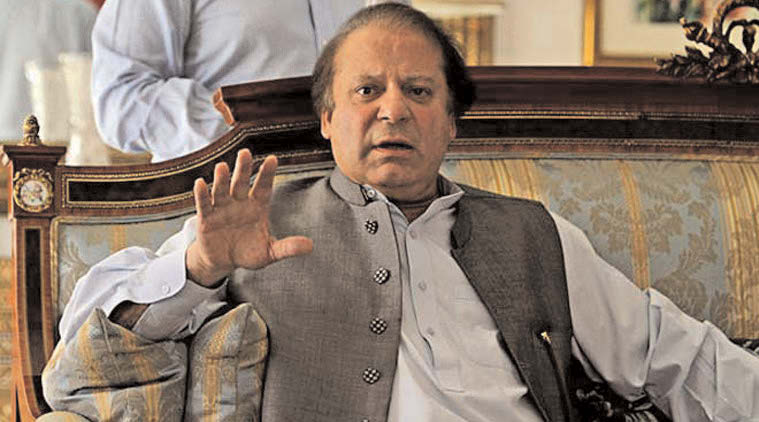
    Reports about Pakistan Prime Minister Nawaz Sharif berating the army, which he later denied, had warmed the cockles of even the most realist heart in India. Ram Madhav, a member of Prime Minister Narendra Modi’s inner group, hailed Nawaz’s counsel to the Pakistan military on terror as an “extraordinary development.” Ram Madhav’s reaction is more like clutching at a straw than a rational scrutiny of the circumstances that would have rendered inoperative had the Pakistan PM actually made the observation. Nawaz Sharif, like all Pakistan PMs in the past, is engaged in perpetual shadow warfare with the army to gain control over the levers of the state. The Sharif brothers have repeatedly tried to clearly demarcate responsibilities for investigation of terror crimes in the domestic sphere.

    Nawaz had taken this line after the Pathankot attacks by entrusting the probe to the Intelligence Bureau chief who reports directly to him. Asif Zardari had also tried to ensure impartial trials of the Mumbai attack masterminds. Mysterious forces stymied both investigations including the unexplained assassinations of two public prosecutors in the Mumbai attack case. Nawaz has found an ally in the Pakistan People’s Party on Pakistan’s diplomatic isolation in the entire neighborhood. Even the Pakistan army should find it galling that Sri Lanka boycotted the SAARC summit even though both countries have a long-standing defense relationship. Only Maldives, in the throes of acute political crises, acted neutral.

    Should India take on face value Nawaz and PPP’s deviation from remaining in denial mode? The firing on the LoC and attempts to storm Indian Army camps indicate that Pakistan’s Kashmir policy marches to a different drum beat. Nawaz may be playing the good cop in a routine that has been performed earlier. In fact, the stand of Pakistan’s political parties and its army on Kashmir is the same. They believe India unfairly snatched away the Valley and the final word has not yet been said. Thus even if Nawaz believes what he is saying, he neither has the capability to implement his views nor can it temper the ardor of forces trying to destabilize J&K.

  • Detox your skin and hair with your favourite beverage

    Detox your skin and hair with your favourite beverage

    While a shot of coffee instantly uplifts your mood and a cup of tea can relax you after a hard day at work, have you ever imagined the wonders it can do if you applied these on your skin and hair? Read on to know more about these beauty secrets…

    Coffee

    For your skin: “Caffeine helps in treating dark circles and is often found in most cosmetics, which are imported. It also helps reduce the build-up of blood under your eyes, which contribute to eye shadows,” says beauty professional Nishi Karamchandani. Apart from this, it contains anti-ageing properties, which delay the signs of ageing. Phytosterols

    (friendly plant sterols and stanols that blocks cholesterol absorption in our system) promote moisture and provides chemical-free sun protection. It also reduces the appearance of cellulite and tightens the skin. One can also use coffee beans as scrubs for the face and body.

    For your hair: It has rich antioxidant properties, which aid in repairing damaged hair and prevent breakage. Coffee also stimulates hair growth and thickens the mane. One can use coffee in hair packs as well. Several beauty parlours use coffee along with other ingredients when applying henna on a client’s hair. This adds shine and lustre to the hair. It is also an antioxidant that counteracts the effects of pollutants in the air.

    Tea

    Green: Apart from aiding in weight loss, tea also protects the skin from damage and reactivates dying skin cells.

    For your skin: EGCG (epigallocatechin gallate) in the green tea reactivates your dying skin cells. It also protects your skin from the harmful UV rays of the sun. Moreover, it gives a glow to your skin. It contains antioxidants, which help rejuvenate your skin and protects it against free radicals. Karamchandani says, “Green tea is also used as a skin toner, especially for those with oily skin. Soak green tea leaves in hot water for half an hour. Cool, strain and use the liquid to tone your skin.” Green tea bags can be dipped in water and applied over your eyelids like eye pads for instant cooling and relaxation. They help reduce the puffiness around your eyes and add brightness. Neha Matang, skin professional, says, “Green tea also serves as an exfoliator. If you use it in the form of a face mask, it will naturally help in getting rid of unwanted toxins and make you look healthy and add shine.”

    For your hair: This tea may also be used as a hair rinse, as the tannin in the tea helps to add lustre to your hair. Boil used tea leaves again in enough water. After boiling, cool and strain the water. Then add lemon juice to it and use this as a last rinse after shampoo. Matang says, “Green tea helps in reducing dandruff. It also stimulates hair growth and softens your hair. It contains vitamin C, vitamin E and panthenol, which are used as common ingredients in hair conditioners.

    Chamomile: Chamomile tea helps you achieve those golden streaks. Steep two chamomile tea bags in two cups of hot water for 5-10 minutes. Then add two tsps of lemon juice to the mixture. Use this as a final rinse on your hair after using a normal shampoo and conditioner. But do not rinse it out. This will help you bring the natural blonde or red tones in your hair and slightly lighten your hair without looking drastic or fake.

    Black: It helps fight free radicals that fasten the process of ageing of your skin. If you need a quick-fix for your under-eye bags, instantly dip two bags of black tea, cool and strain and put these on your eyes. It also serves as a natural astringent. All you need to do is make some tea, cool it and then splash it on your face for instant refreshment.

    Ginger: The anti-inflammatory properties of ginger help your skin against acne. Highly antiseptic in nature, it keeps your skin clean and blemish-free. Ginger is invigorating and stimulating to your skin, it is also used topically to treat cellulite. Ginger tea is excellent for your hair as well. It increases scalp circulation and encourages hair growth. It also helps get rid of dandruff. Rinse your hair with ginger tea at least once a week.

  • DON’T HAVE A PARTNER? MAKE DO WITH A BOYFRIEND PILLOW!

    DON’T HAVE A PARTNER? MAKE DO WITH A BOYFRIEND PILLOW!

    Move over animal pillows —pooches, cats, caterpillars and foxes. It’s now time to embrace the odds! And, we literally mean the odd. Recently, an online shopping portal went berserk with the sale of boyfriend pillows. BT lists out some of the interesting options that you can snuggle up to. Coz, hey!Comfort doesn’t have to be boring.

    Boyfriend pillow

    You don’t need a boyfriend anymore to cuddle up to. This pillow is in the shape of a guy’s arm that you can roll over your neck while sleeping. Make sure that you spritz a men’s perfume on the arm for that ‘little romantic’ effect!

    Hunky guy pillow

    Similar to that of a boyfriend pillow, if you fancy a muscular man, the hunky guy pillow is your best bet. This is also in the shape of a guy’s arm, just that it’s got those extra muscles!

    Tissue dispenser pillow

    When you want to have a good cry, there’s nothing like hugging a pillow that dispenses tissues. So, the next time you have a cold or want to vent out after a break-up, you know what to get for yourself.

    Make-out pillow

    If you want to get kissed to sleep, grab hold of a make-out pillow. These pillows or rather cushions have a man’s lips popping out of the cushion. This pillow allows singletons to practice their snogging skills!

    Lady lap pillow

    Shaped like a woman’s lap, this leggy pillow is for all the men out there. This is a cushiony mini-skirted human substitute, which is shaped like a pair of a kneeling woman. Apparently, this pillow was first created and sold in Japan and then caught on with the rest of the world.

    Hand pillow

    Shaped like two hands, this pillow is ideally used by parents to put their babies off to sleep. So, if you want your baby to have a sound sleep, while knowing that you are there to protect him/her, put these hands around your baby and watch him/her snoring away to glory!

  • VIJAYADASHAMI

    VIJAYADASHAMI

    Vijayadashami, also known as Dussehra or Ayudhapuja, is an important Hindu festival celebrated in a variety of ways in India, Nepal, Sri Lanka, “Dussehra” is derived from Sanskrit; Dasha-hara is a form of Dashanan ravan (“Ravana’s defeat”).

    The day marks the victory of Durga over the demon Mahishasura. The goddess fought with evil for ten days and nine nights.

    “Vijayadashami” is derived from the Sanskrit vijaya-dashami (victory on the dashami: the tenth day of the Hindu month). Diwali, the Festival of Lights, is celebrated twenty days after Vijayadashami.

    Significance

    Vijayadashami is celebrated on the tenth day of brighter fortnight the month of Ashwin according to the Hindu calendar, corresponding to September or October of the Gregorian calendar. The first nine days are celebrated as Navratri, culminating on the tenth day as Dussehra.

    Since the harvest season begins in India and Nepal at this time, the Durga is invoked by religious rituals to begin the harvest season and renew the fertility of the soil. Many Hindus observe the festival with social gatherings and food offerings to the gods at home and in temples throughout India and Nepal.

    Victory of Ram over Ravan

    On this day Ram (the seventh avatar of Vishnu) killed Ravan, who had abducted Ram’s wife Sita to his kingdom Lanka. Ram, his brother Lakshman, their disciple Hanuman and an army fought a battle to rescue Sita. The story is recorded in the Hindu epic, the Ramayan.

    On the day of Ashvin Shukla Dashami, Ram defeated Ravana and rescued Sita. Based on inferences from Valmiki’s Ramyan, Kalidas’s Raghuvasa, Tulsidas’ Ramcharitmanas and Keshavdas’ Ramchandrika, Ram, Sita and Lakshman returned to Ayodhya on the 30th day of Ashwin (19–20 days after Vijayadashami). To celebrate Ram’s return, in the evening the city’s residents lit millions of earthen lamps (deepak); the day is celebrated in India as Deepawali.

    Observers recite Sundar Kaand (the fifth book of the Ramayan) for five days. Yajnas are thought to keep the household clean and healthy. Some perform yajnas and Sandhyavandanam three times a day to keep the heart, brain and digestion balanced in the absence of adequate winter sunlight.

    Durga’s victory over Mahishasur

    Some of the demigods (asurs) were powerful and ambitious, and tried to defeat the devs and capture heaven. One asur, Mahishasur, grew powerful and wreaked havoc on earth. Under his leadership, the asurs defeated the devs. The devs combined into Shakti (a mass of incandescent energy) to kill Mahishasur.

    A bolt of lightning emerged from the mouths of Brahma, Vishnu and Shiva, and a young, beautiful female virgin with ten hands appeared. The gods gave her their weapons, and Shakti coalesced to form the goddess Durga. On a lion who assisted her, Durga fought Mahishasur for nine days and nights; on the tenth day, Mahishasur was killed. Durga, as Shiv’s consort, represents two forms of female energy: mild and protective, and fierce and destructive.

    Durga’s homecoming

    Daksha (Brahma’s son) and his wife, Prasuti, had a daughter named Sati. As a child, Sati worshiped Shiva as her would-be husband. Shiva, pleased with her worship, married her. Although Daksha opposed the marriage, he could not prevent it. He arranged a yajna, to which everyone but Shiva was not invited. Sati, ashamed of her father’s behavior, killed herself. Shiva, anguished when he discovered this, lifted Sati’s body on his shoulders and began dancing; the world was on the verge of destruction.

    Pandav exile

    In the age of Dvapar Yug, the pandavs (the five sons of Pandu [Sanskrit: ??????] with his wife, Kunti) lost to the Kaurav in a dice game and were exiled in the forest for twelve years. The brothers hid their weapons in a hole in a Shami tree before they entered the kingdom of Virat to complete their final year of exile. After that year, on Vijayadashmi they recovered the weapons, declared their true identities and defeated Kauravas, who had attacked King Virat to steal his cattle. Since that day, Shami trees and weapons have been worshiped and the exchange of Shami leaves on Vijayadashmi has been a symbol of good will.

    Kautsa’s gift

    Kautsa, the young son of a Brahmin named Devdatt, lived in Paithan. After completing his education with Rishi Varatantu, he insisted that his guru accept a present. The guru said, “Kautsa, to give dakshina in return for learning wisdom is not appropriate. Graduation of the disciple makes the guru happy, and that is the real Guru Dakshina.”

    Kautsa was not satisfied, since he still felt it his duty to give his guru something. The guru said, “All right, if you insist on giving me dakshina, then give me 140 million gold coins—10 million for each of the 14 sciences I have taught you.”

    Kautsa went to King Raghu, an ancestor of Rama who was known for his generosity. However, at that time he had spent all his money on the Brahmins. Raghu asked Kautsa to return in three days, and left to get gold coins from Indra. Indra summoned Kuber, the god of wealth. Indra told Kuber, “Make gold coins rain on the Shanu and Aapati trees around Raghuraja’s city of Ayodhya.”

    The rain of gold coins began. King Raghu gave the coins to Kautsa, who offered them to Varatantu Rishi. Since the guru had requested only 140 million, he returned the rest to Kautsa. Kautsa, considering honour more valuable than wealth, asked the king to take the remaining gold coins. The king refused, since kings do not take back a daan (gift).

    Kautsa distributed the gold coins to the people of Ayodhya. To commemorate this, leaves are plucked form the Aapati tree and given as gifts.

    Celebrations

    In Kashmir, Himachal Pradesh, Uttar Pradesh, Haryana, Punjab, Uttarakhand and western Bihar, it is tradition to plant barley in earthen pots on the first day of Navratri. On the day of Dussehra, the nine-day-old sprouts (called noratras or nortas) are used for luck; men place them in their caps or behind their ears.

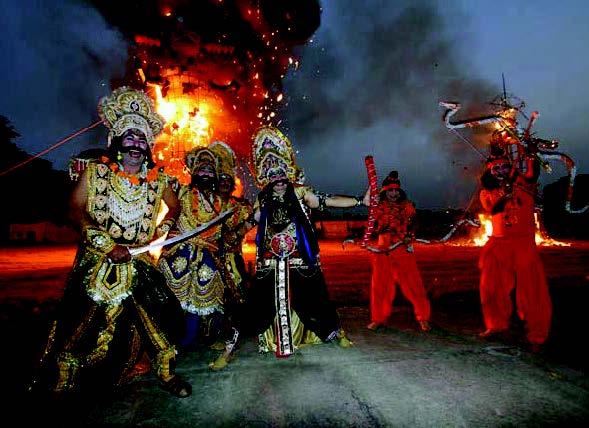
    In most of northern India and some parts of Maharashtra, Dasha-Hara is celebrated in honour of Rama. Plays based on the Ramayana (Ramlila) are performed at outdoor fairs, and large parades with effigies of Ravana (a king of ancient Sri Lanka), Kumbhakarna and Meghanada are held. The effigies are burnt on bonfires in the evening. After Dasara, the hot summer ends (especially in North India) and the onset of cold weather is believed to encourage infections. The burning of the effigies, filled with firecrackers containing phosphorus, supposedly purifies the atmosphere.

    In the Kumaon region of Uttarakhand, Dasara begins with the performance of a Ramlila based on theatrical traditions begun by Uday Shankar during his stay in Almora and elaborated by Mohan Upreti and Brijendra Lal Sah. Known as the Almora or Kumaon style, the Ramlila was recognised by UNESCO in its 2008 report as a representative Indian style.

    Kullu Dussehra, celebrated in the Kullu valley of Himachal Pradesh, begins on the tenth day of the rising moon and continues for seven days. Its history dates back to the 17th century, when King Jagat Singh installed an idol of Raghunath on his throne as a gesture of penance. After this, Raghunath was declared the ruling deity of the valley.

    Mysore Dussehra as is the Nadahabba

    (state-festival) of the state of Karnataka in India. It is also called Navaratri (Nava-ratri = nine-nights) and is a 10-day festival with the last day being Vijayadashami, the most auspicious day of Dasara. Dasara usually falls in the month of September or October. According to a legend, Vijayadashami denotes the victory of truth over evil and was the day when the Hindu Goddess Chamundeshwari killed the demon Mahishasura. Mahishasura is the demon whose slaying by the Goddess gave the name Mysore. The city of Mysore has a long tradition of celebrating the Dasara festival with utter grandeur and pomp to mark this day and the festivities there are an elaborate affair, attracting a large audience including foreigners. The Dasara festival completed 400th anniversary in year 2010.

  • Punjab Bhawan opens in Canada

    Photo Caption: The personalities whose portraits have been put up include Bhai Santokh Singh, Bhai Vir Singh, Prof Puran Singh, Prof Mohan Singh, Amrita Pritam, Balwant Gargi, Balraj Sahni, Karam Singh Historian, Sant Ram Udasi, Gursharan Singh Natakar, Kirpal Singh Chitarkar, Principal Jodh Singh, Sadhu Singh Hamdard, Dhani Ram Chatrik, Shiv Kumar Batalvi, Master Tara Singh, Prof Ravinder Ravi, Dr Parminder Singh, Dr Ganda Singh, Avtar Pash, Jaswant Singh Rahi and Prof Gurmukh Singh.

    With the objective to promote Punjabi literature, culture and art in Canada, Punjab Bhawan was inaugurated at Surrey in Canada today. It has been set up on Fraser Highway. The space for setting up the Bhawan where portraits of eminent Punjabi writers and others have been put up has been provided by Sukhi Bath, an NRI settled in Canada.

    Portraits of more eminent Punjabi writers, artists and others would be added to the photo gallery soon, said Prof Gurbhajan Gill, an eminent Punjabi writer.

    Gill, who was the chief guest at the function, was member of the committee set up to suggest the names of Punjabis for the photo gallery. Gill said soon another building of the bhawan would be ready to expand the scope of the activities related to Punjab.

    Bath said various Punjabi organisations such as Bhai Kanayia Sabha would hold their functions at Punjab Bhawan. The inauguration ceremony of the Bhawan was performed by two women Bibi Gian Kaur and Nimrata Bath. No politician from any stream was invited for the function. It was a gathering of writers, artists and social activists.

  • Indian Call Centers Raided for running IRS scam worth millions

    Indian Call Centers Raided for running IRS scam worth millions

    THANE (TIP) — In a major raid, over 500 employees of some call centers were detained & 70 people arrested for allegedly threatening Americans, which also includes Indian Americans, and siphoning off their money in the Mira Road area here, police said Oct. 5.

    The raid was carried out by over 200 police personnel, mostly from the Crime Branch, late Oct. 4 and continued in the wee hours on Oct. 5, they said.

    According to a report in Mid-day Oct. 6, the alleged mastermind of the tax scam is an Indian American who is “pulling the strings from the U.S.” The report added that a manhunt has been launched and the FBI has reportedly approached the Thane police for details of the case.

    The persons operated from call centers in the Mira Road locality, which comes under the jurisdiction of the Thane Rural Police, and posed as officials of the U.S. Tax Department demanding unpaid taxes, police said.

    “We will cooperate with any agency approaching us for information. It’s an international racket and involvement of foreign nationals is suspected. An investigation being conducted from all angles,” Parambir Singh, Commissioner of Police, Thane, is quoted as saying in the Mid-day report.

    They would call up the U.S. citizens and demand their financial and bank details, failing which they would allegedly threaten them with dire consequences, including legal action.

    Those who called back and believed the threats would fork out thousands of dollars to “settle” their case, Mumbai police officer Parag Marere said Oct. 6.

    The scam brought in more than $150,000 a day, Marere said without giving a total sum. If the scam netted that amount daily, it would have made almost $55 million in one year.

    Some victims were also told to buy gift vouchers from various companies, and hand over the voucher ID numbers which the impostors then used to make purchases, Marere said.

    Those arrested so far include several of the alleged ringleaders, as well as people accused of providing equipment and setting up the fake call centers. The criminal charges filed against the suspects include extortion, impersonation and violations of India’s information technology laws.

    Indian media reports said 70 percent of the scam’s proceeds were retained by the suspects in India, while the rest was paid to collaborators in the U.S.

    Indian news channel NDTV reported that one U.S.-based company allegedly collected the victims’ personal information and passed it to the fake call centers.