Month: January 2017

  • Setback to Climate Action Plans

    Setback to Climate Action Plans

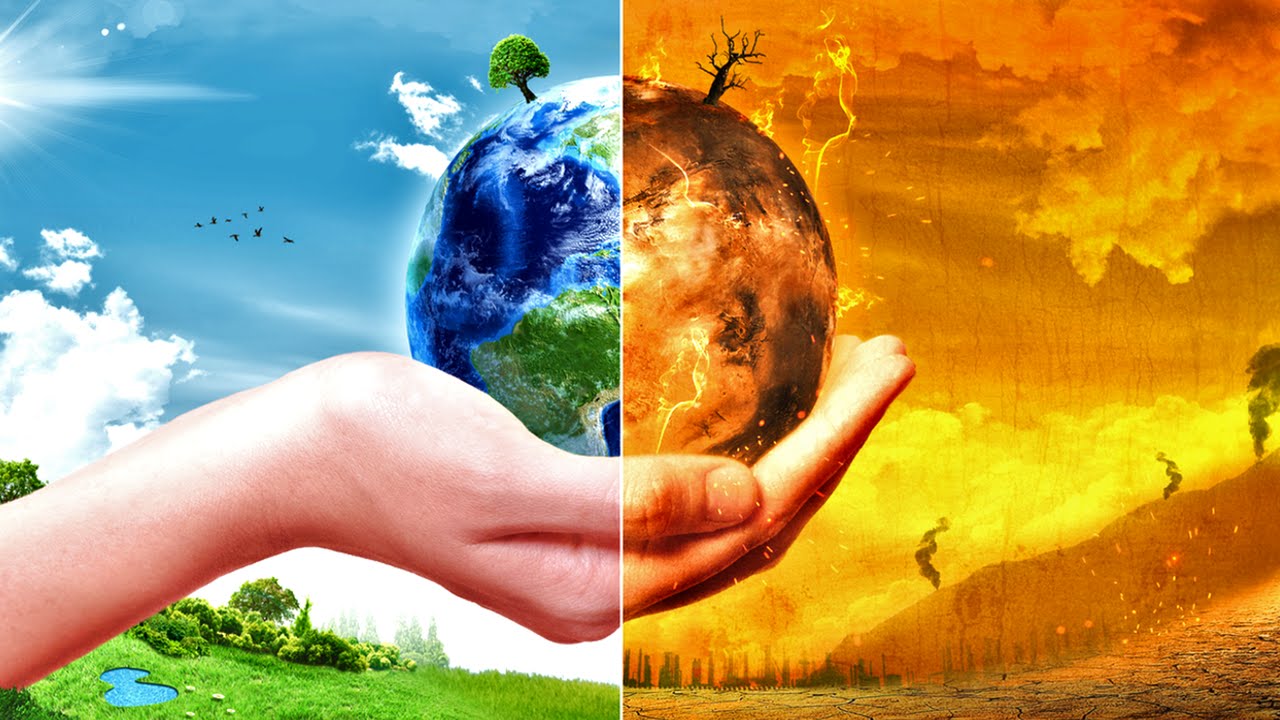
    That Donald Trump’s skepticism about climate change will adversely impact policies to address global warming became abundantly clear minutes after his swearing-in as U.S. President.

    The White House website quickly deleted all mention of climate change.

    Turning its attention to other agencies, the Trump administration instructed the U.S. Environmental Protection Agency to follow suit and scrub all mention of climate change from its website as well.

    But following a protest by scientists and others, the administration softened its stand and indicated that the agency’s website was only being “reviewed” and that it had “no immediate plans to remove the content” on climate change.

    Mr. Trump has also resurrected the controversial Keystone XL, that former President Barack Obama had blocked after a protracted battle with policymakers, and Dakota Access pipelines.

    Global warming is an expensive hoax

    The Trump administration had issued a gag order to scientists at the EPA and the U.S. Department of Agriculture to stop them from speaking to the media; it subsequently changed its policy with respect to EPA but has mandated that even routine data and studies be “reviewed” before being released to the public.

    In line with his thinking that “global warming is an expensive hoax”, Mr. Trump plans to re-energies the fossil-fuel industry. The America First Energy Plan listed on the White House website aims to increase fossil fuel extraction in the name of creating more jobs, and in the process “eliminating”, among other things, Mr. Obama’s climate action plan.


  • INOC(I) National President Lavika Bhagat Singh Passes away

    INOC(I) National President Lavika Bhagat Singh Passes away

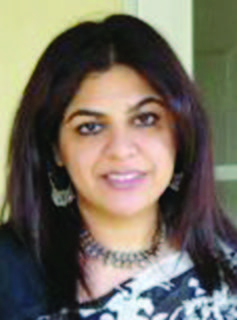
    Indian National Overseas Congress members are grieving nationwide over death of their beloved President Mrs. Lavika Bhagat Singh.

    Expressing his condolences, the AICC Vice President Shri Rahul Gandhi said “She worked hard to spread the ideology of the congress party”.

    Dr. Karan Singh, MP and Chair of AICC foreign affairs stated “Lavika was a fine lady and a successful President of INOC”. I remember she hosted a wonderful event in my honor in DC” further added Dr. Karan Singh.

    Former Union Law Minister Dr. Ashwani Kumar wrote, “No words can adequately express our sentiments at this time”. Many other Senior congress party leaders from India expressed shock over her death.

    “It’s my personal loss. I have lost my loyal & sincere friend”, said INOC Chairman Shudh Parkash Singh.

    “We are proud of the work Lavika did for INOC over last 15 years as Washington DC chapter President and National President. She was one of the most fun loving, cheerful and bold lady who always thought big. Despite of a very hard life taking care of a handicap son 24/7, she always had a smile on her face.

    General Secretary of INOC Rajender Dichpally expressed his shock over her death. “We have lost our dynamic leader. I worked very closely with her.

    “A team of INOC executives led by the senior Vice President Ravi Chopra attended the funeral services held in Washington DC.

    Vineet Nagpal, national treasurer also attended funeral. “I can’t believe she is no more” said Vineet.

    The Chairman of Haryana Pradesh Congress Committee NRI Dept. Budh Parkash Singh also travelled to DC for the funeral and conveyed HPCC solidarity to her husband Deshpal Singh. Senior Vice Presidents Phuman Singh & Kalathil Varughese said INOC will host a prayer meeting for the departed President in New York.

    Gurmeet Singh Gill, Punjab Chapter President, while campaigning in Punjab expressed his grief over loss of the INOC President. Lavika gained popularity in DC area known for her community and charity work.

    A February, 2015 group photo of INOC (I), after Lavika was elected President of INOC (I).
    A February, 2015 group photo of INOC (I), after Lavika was elected President of INOC (I).

    She headed USA chapter of “KHUSHI” patronized by famous Indian cricketer Kapil Dev. She was also well known for hosting many successful Bollywood shows. She was friends with lots of celebrities like Shatrughan Sinha and Shreya Ghoshal. She came to National lime light here and in India when she got elected to the prestigious position of National President of INOC USA in 2015. She became the first woman President of INOC. For INOC, she worked very hard for many years. She hosted many events serving as Washington chapter President for more than a decade. She was the main person keeping congress party name shining in the Capital and the Capitol. Almost every senior congress party leader attended her events from Anand Sharma & Bhupinder Hooda to Kapil Sibbal and Shashi Tharoor.

    Lavika was suffering from cancer for last year. In the end cancer spread all over body and took the precious life of the dedicated mother of two children. She is survived by daughter Angelica, son Heiman and husband Deshpal Singh. Lavika lived in Virginia – a suburb of Washington DC. Her sisters, uncles and other close relatives also live nearby. “She will be missed dearly by us all not just for her contributions to INOC and charities but also for her total personality of a super woman”, Added Shudh Parkash Singh.

    (Press Release)

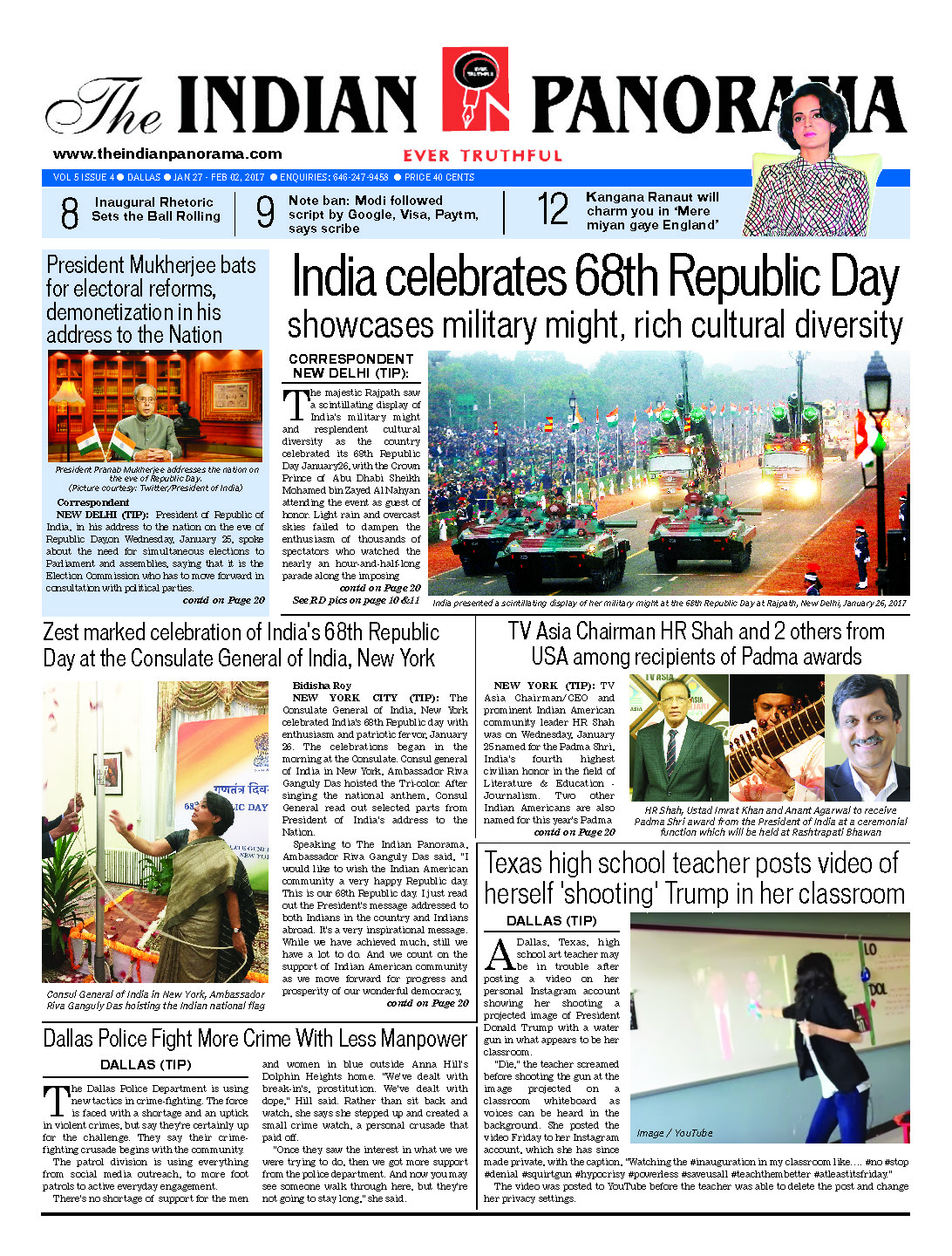
  • India celebrates 68th Republic Day showcases military might, rich cultural diversity

    India celebrates 68th Republic Day showcases military might, rich cultural diversity

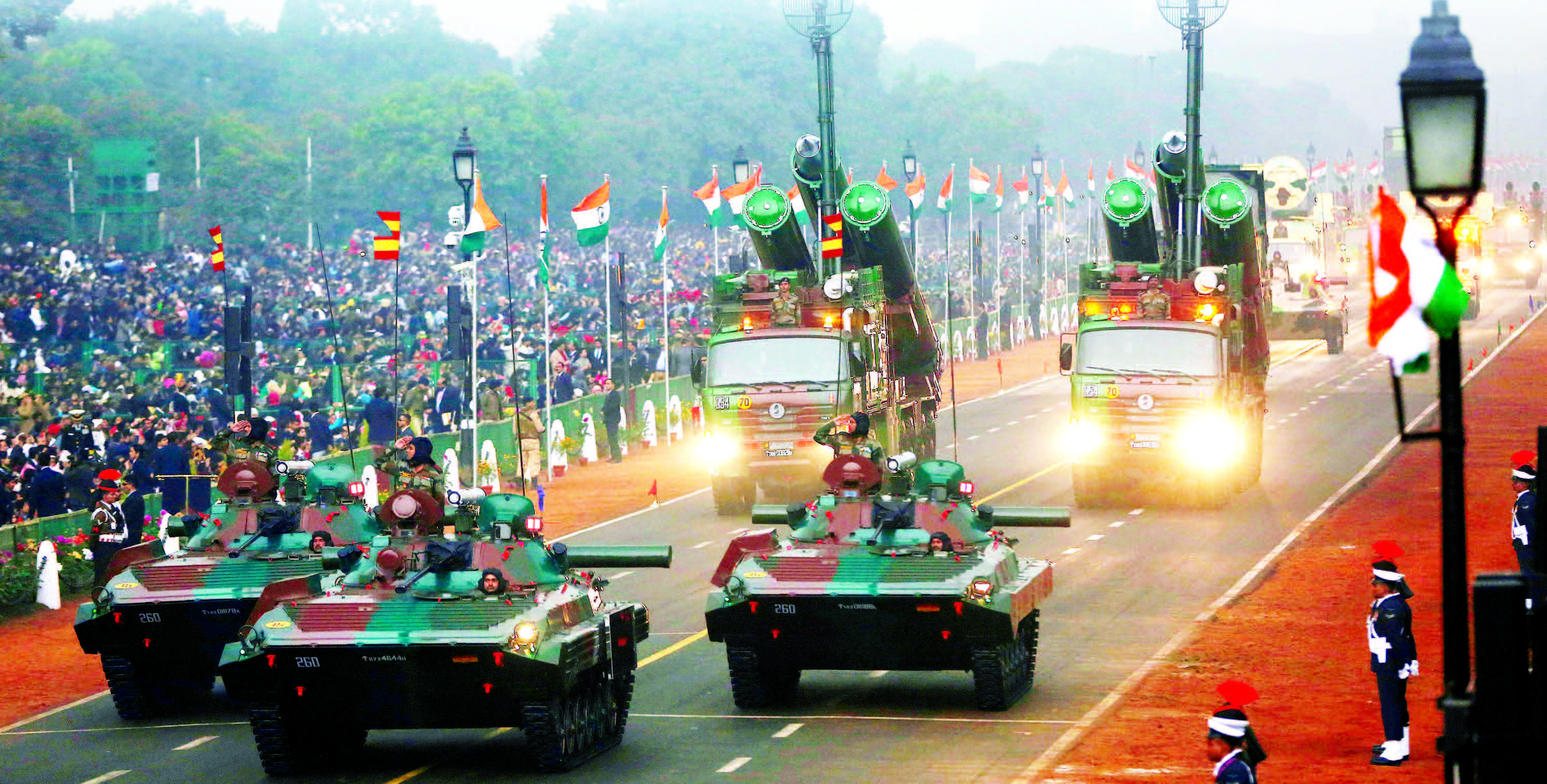
    he majestic Rajpath saw a scintillating display of India’s military might and resplendent cultural diversity as the country celebrated its 68th Republic Day January26, with the Crown Prince of Abu Dhabi Sheikh Mohamed bin Zayed Al Nahyan attending the event as guest of honor. Light rain and overcast skies failed to dampen the enthusiasm of thousands of spectators who watched the nearly an hour-and-half-long parade along the imposing

    Rajpath, India’s ceremonial boulevard. A major highlight of the parade was 149-member marching contingent from UAE comprising personnel from Presidential Guards, the Air Force, the Navy and Army, led by a band comprising 35 musicians from the Gulf country with which India’s defense and security ties are on an upswing.

    Al Nahyan, also Deputy Supreme Commander of the UAE armed forces, was seated next to Prime Minister Narendra Modi who wore a pink colored ‘safa’ (turban). The two leaders were seen sharing some light moments.

    Alongside the Crown Prince, the ceremonial parade was watched by Vice President Hamid Ansari, former Prime Minister Manmohan Singh, Congress chief Sonia Gandhi and the country’s top political and military brass, besides the diplomatic community.

    TEJAS, NSG MAKE DEBUT

    In a first, the ‘black cat’ commandos of the elite counter-terror force National Security Guard (NSG) participated in the parade which drew loud cheers from the spectators.

    A number of weapons systems and aircraft including the Tejas light combat jets and the Airborne Early Warning and Control System (AEW&C) developed by DRDO were on display, showcasing India’s military prowess.

    The Indian Army’s missile firing T-90 ‘Bhishma’ tank, Infantry Combat Vehicle BMP-2K, Mobile Autonomous Launcher of the BrahMos Missile System, Weapon Locating Radar ‘Swathi’ and Akash Weapons System, and Dhanush artillery guns were among the main draw in the mechanized columns. President Pranab Mukherjee took the salute of marching contingents.

    The splendid driving skills of ‘Dare Devils’–the MOTORCYCLE acrobatics team of Corps of Military Police was a major attraction of the parade. They performed breathtaking man oeuvres like Salute to President, Ladder, Double Bar, Lotus, Christmas Tree, Aircraft, Sudarshan Chakra, Flower Pot, Pyramid and Wheeling on moving motorcycles.

    SPECTACULAR SHOW BY AIR FORCE

    The ‘Netra’, an Airborne Early Warning and Control System aircraft also known as “Eye in the Sky” was one of the major attractions.

    It was followed by the ‘Globe Formation’ comprising one C-17 Globemaster flanked by two Su-30 MKIs. Next in line were the fighters, with five Jaguars fling in arrowhead formation, while five MiG-29 fighters darted through the sky in fulcrum style.

    It was followed by the breathtaking ‘Trishul’ formation comprising three Su-30 MKIs.

    The flypast concluded with another Su-30 MKI carrying out a ‘Vertical Charlie’ maneuver over the saluting dais. The ceremony concluded with the national anthem and release of colorful balloons.

    The theme of IAF tableau was “Air Dominance Through Network Centric Operations” and it displayed the scaled down models of Su-30 MKI, Mirage-2000, AWACS, UAV, Apache and Communication Satellite.

    The grand finale of the parade was a spectacular flypast by the Indian Air Force which displayed various formations like ‘Chakra’ and ‘Vic’ leaving spectators spell-bound. The ‘Hercules’ formation comprising three C-130J Super Hercules aircraft also drew loud cheers.

    CULTURAL HERITAGE ON FULL DISPLAY

    Tableaux from 17 states and Union Territories and six central ministries and departments showcased the varied historical, artistic and cultural heritage of the country. Interestingly, Goods and Services Tax (GST) was the theme of the tableau of Central Board of Excise and Customs.

    Tableaux from states, Union Territories and Union ministries presented the historical, artistic and cultural heritage of the country.

    Floats from Goa, Gujarat, Odisha, West Bengal, Assam and Jammu and Kashmir showcased the country’s progress in different fields.

    In the children’s pageant section, about 600 boys and girls drawn from three schools in Delhi and a group of school children from South Central Zone Cultural Centre, Nagpur, performed colorful dances on varied themes.

    The Indian Navy’s tableau showcased the lethal Marine Commandos proceeding for action, the indigenously built Kolkata Class Destroyer and the Kalvari Class next generation attack submarines. It also showcased a model of the P-8I Long Range Maritime Patrol Aircraft.

  • Nikki Haley sworn in as US ambassador to the UN

    Nikki Haley sworn in as US ambassador to the UN

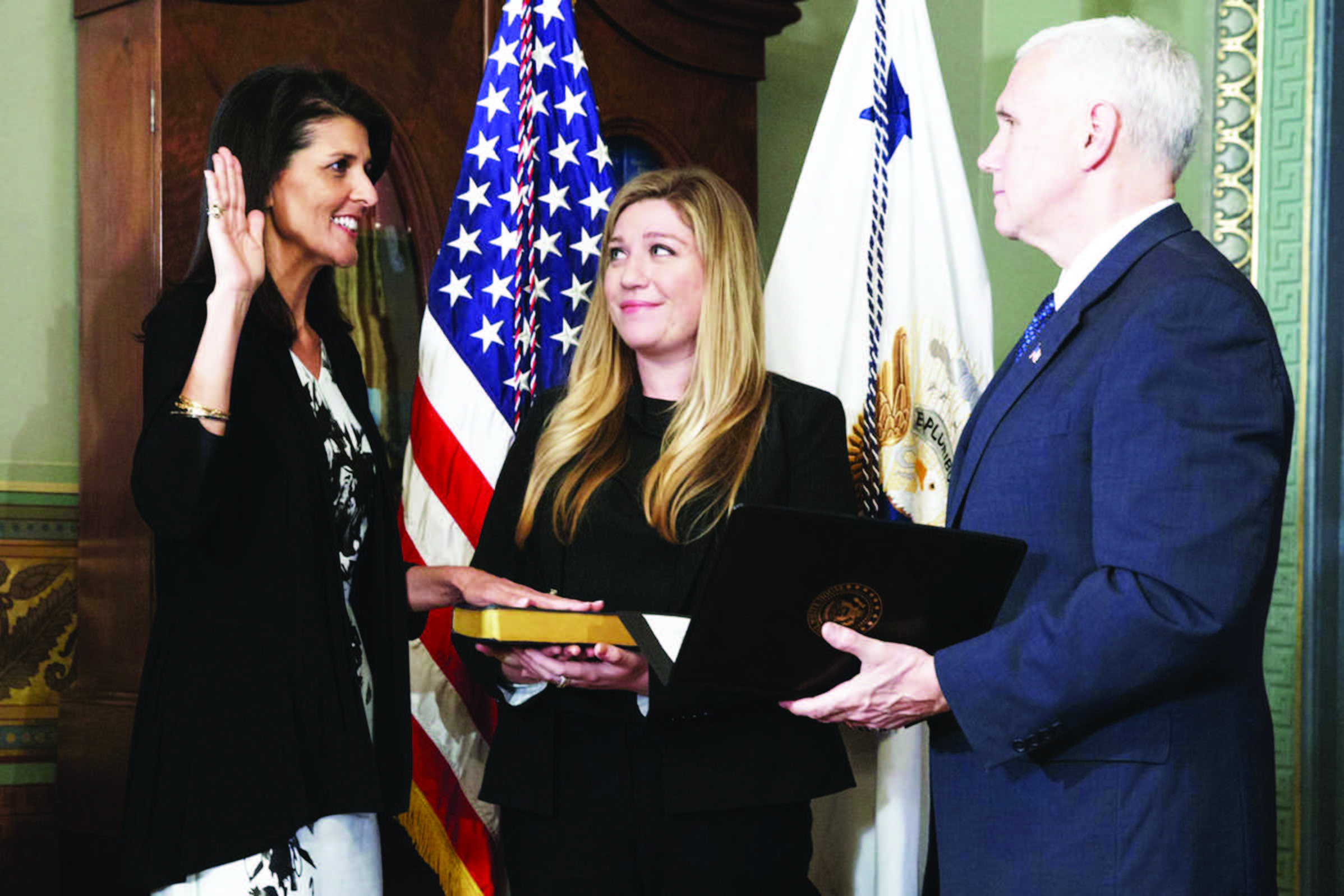
    On January 25, Former South Carolina Gov. Nikki Haley was sworn in as US ambassador to the United Nations. Vice President Mike Pence swore in Haley who served as the 116th Governor of South Carolina from January 2011 to January 2017. The South Carolina-born daughter of Indian immigrants became the state’s first female and first minority governor.

    The U.S. Senate officially confirmed Haley as the next ambassador to the United Nations Tuesday evening (January 24) in a 96-4 vote. The Senate voted overwhelmingly in favor of confirmation, with just four senators – Independent Bernie Sanders of Vermont and Democrats Chris Coons of Delaware and Tom Udall and Martin Heinrich of New Mexico – voting against her. Haley resigned as South Carolina’s Republican governor following the vote. She was succeeded by Lt. Gov. Henry McMaster.

    After officially resigning, Haley addressed a crowd in the Capitol lobby.

    “There’s lots of work to do, but we have the right person to do it,” she said, referring to McMaster. “It’s an absolute privilege and honor to turn over the reins to you.”

    Trump’s pick came as a surprise to many as Haley loudly criticized Trump during the GOP primary and endorsed one of his rivals, Florida Sen. Marco Rubio.

  • 13 Indian-American Students named Finalists in “Super Bowl of Science”

    13 Indian-American Students named Finalists in “Super Bowl of Science”

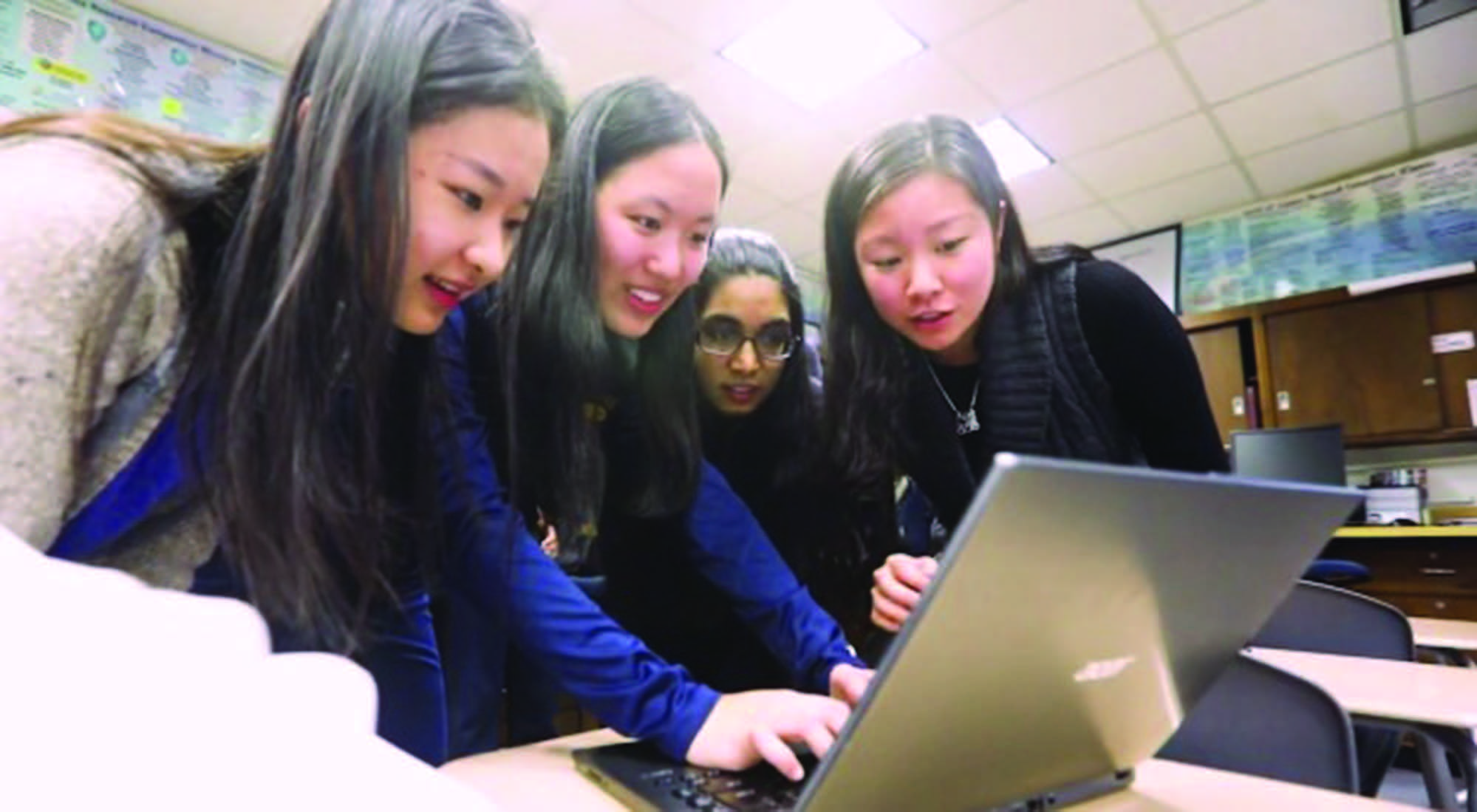
    Thirteen Indian-American students, including one each from New York and New Jersey, were among 40 high school students who were declared finalists Jan. 24 in the Regeneron Science Talent Search, the oldest and most prestigious science and math competition for high school seniors in the U.S.

    The Indian-American students include Archana Verma from Jericho Senior High School, Jericho, New York and Indrani Das from the Academy for Medical Science Technology, Hackensack, New Jersey.

    The finalists were selected, based on the scientific rigor and world-changing potential of their research projects.

    They will go to Washington, D.C. from March 9-15 to undergo a rigorous judging process to determine the top ten winners. They will also have the opportunity to meet with national leaders and share their projects with the public at the National Geographic Society.

    The selected students will compete for more than $1.8 million in top awards -more than half of the Regeneron Science Talent Search total annual award distribution of $3.1 million. The top 10 awards range from $40,000 to$250,000 for the first place winner. The winners will be announced at a formal awards gala at the National Building Museum on March 14.

    The finalists’ projects cover multiple disciplines of science, including behavioral and social science, biochemistry, cellular and molecular biology, chemistry, computer science, computational biology and bioinformatics, engineering, mathematics, medicine and health, physics, and space science.

    “These talented young scientists are already exploring life-changing solutions for the world’s problems and are poised to lead innovation for future generations,” said George D. Yancopoulos, President and Chief Scientific Officer of Regeneron.

    The Regeneron Science Talent Search, founded and produced by Society for Science and the Public, has been described as the “Super Bowl of Science.”

    Maya Ajmera, president and CEO of Society for Science and the Public and publisher of Science News, said in a statement that these 40 young scientists, engineers and mathematicians are poised to be the next generation of leaders in business and academia.

    “Science breeds curiosity, enabling innovators to develop solutions that will help solve our world’s most pressing challenges. We are proud to celebrate 75 years of recognizing new innovations and research demonstrating the outstanding capabilities of young minds,” Ajmera said.

    The finalists are from 34 schools in 17 states. Sixty-two percent of them are male while 38 percent are female. The 40 were selected from roughly 300 scholars and more than 1,700 entrants based on the originality and creativity of their scientific research as well as their achievement and leadership both inside and outside of the classroom, according to a Regeneron press statement.

  • Indian-American attorney appointed to key White House post

    Indian-American attorney appointed to key White House post

    WASHINGTON(TIP): US President Donald Trump has appointed prominent Indian-American attorney Uttam Dhillon to a key White House position to assist him on ethics and compliance matters.

    Dhillon, who served as chief oversight counsel for the House of Representatives Financial Services Committee, has been appointed as special assistant to the President.

    In this position, he would be part of the legal team to serve under White House Counsel Donald F McGahn with respect to compliance and ethics matters.

    Prior to joining Financial Services, Dhillon served as chief of the Department of Homeland Security’s Office of Counternarcotics Enforcement.

    He previously worked as an associate deputy attorney general for the Department of Justice, Chief Counsel for the House Select Committee on Homeland Security, Policy Director for the US House of Representatives Policy Committee, and as an Assistant United States Attorney in Los Angeles.

    Dhillon graduated from Boalt Hall School of Law at the University of California, Berkeley in 1987.

    Other members of the team are Stefan C Passantino who has been commissioned to serve as deputy assistant to the President and deputy counsel to the President along with Scott Gast and James D Schultz who have been commissioned to serve as special assistants to the President and associate counsel to the President.

    “The appointment of a team of this caliber reflects the importance of ethics compliance to the President and this administration,” said White House counsel Don McGahn.

  • TV Asia Chairman HR Shah and 2 others from USA among recipients of Padma awards

    TV Asia Chairman HR Shah and 2 others from USA among recipients of Padma awards

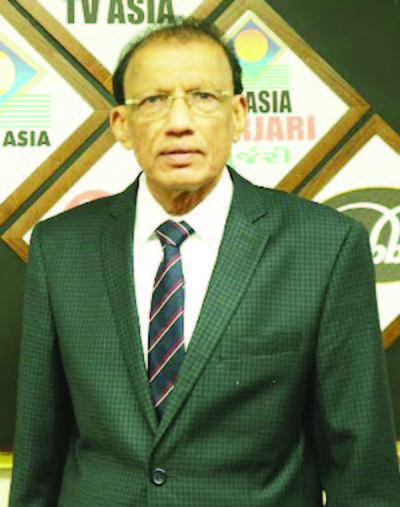
    NEW YORK (TIP): TV Asia Chairman/CEO and prominent Indian American community leader HR Shah was on Wednesday, January 25 named for the Padma Shri, India’s fourth highest civilian honor in the field of Literature & Education – Journalism. Two other Indian Americans are also named for this year’s Padma Shri award – Ustad Imrat Khan in the field of Art-Music and Anant Agarwal in the field of Literature & Education.

    The Padma awards are conferred by the President of India at ceremonial functions which are held at Rashtrapati Bhawan usually around March/ April every year. This year the President of India has approved conferment of Padma Awards to 89 persons. The list comprises of 7 Padma Vibhushan, 7 Padma Bhushan and 75 Padma Shri Awardees. 19 of the awardees are women and the list also includes 5 persons from the category of foreigners, NRIs, PIOs and 6 posthumous awardees.

    Mr HR Shah is the recipient of the prestigious 2005 Ellis Island Medal of Honor, which is bestowed only on those who display significant contributions to their own communities and to the US at large. He has received more than a hundred awards and citations from across the globe in serving ethnic American communities in different fields. He is a founding member of GOPIO as well as Past President and Trustee of the Federation of Indian Associations (FIA) and a member of the Board of Advisors of the Ellis Island-National Ethnic Coalition of Organizations (NECO). As the Chairman and Trustee of Bharatiya Vidya Bhavan (USA), the world famous institute of Indian culture, education, music and the arts, he has worked for the upliftment in lifestyle of Indians via education. With TV Asia, Mr Shah is the first NRI to run a 24/7 TV station in North America. He is also the first NRI to own a chain store business anywhere in the world – Krauszer’s Food Stores.

    Shah said “I am deeply humbled, honored and overjoyed that the Republic of India has decided to confer on me the Padma Shri”. He said he would “rededicate” himself to help India and US further strengthen their ties.

    “I look forward to receiving the Padma Shri in New Delhi later this year and rededicate myself to helping India and the United States further their close relations, as well as to promote India’s rich culture and heritage,” Shah said, January 25 after he was announced as a recipient of India’s prestigious civilian honor.

    (Click here to Read the profile of HR Shah published recently in The Indian Panorama)

    Ustad Imrat Khan, younger brother of sitar maestro Ustad Vilayat Khan, has established his reputation not only by an absolute mastery of two different instruments, the sitar and the surbahar, but also by the consistent purity and integrity with which he presents every aspect of the great Indian classical genres, spanning the whole spectrum of feeling and expression. He is the senior performer of the Imdadkhani gharana, the school of sitar and surbahar performance named after his grandfather Imdad Khan. He spends a portion of each year teaching classical Indian music and instructing sitar students at Washington University in Saint Louis. In 1988 Imrat Khan received a Sangeet Natak Akademi Award from the president of India.

    Anant Agarwal is currently the president of eDX.com in Massachusetts Institute of Technology (MIT), USA. In 2012, he was named by Forbes magazine among the 15 “classroom revolutionaries” who are using innovative technologies to reinvent education for students and teachers globally. Agarwal did his early education in city’s St Aloysius College right from std 1 to second PUC (1977). He then moved to IIT-Madras where he did his BTech, and followed it up with MS and PhD in electrical engineering from Stanford University, USA. At MIT, he led the development of Alewife, an early cache coherent multiprocessor, and founded Tilera, a fabless semiconductor company focusing on scalable multicore embedded processor design.

    Here is thecomplete list of 2017 Padma award winners. The list comprises of 7 Padma Vibhushan, 7 Padma Bhushan and 75 Padma Shri Awardees.  19 of the awardees are women and the list also includes 5 persons from the category of foreigners, NRIs, PIOs and 6 Posthumous awardees.

    PADMA VIBHUSHAN / Awardee Field of Prominence

    • Sharad Pawar / Public Affairs
    • Murli Manohar Joshi / Public Affairs
    • P.A. Sangma (posthumous) / Public Affairs
    • Sunder Lal Patwah (posthumous) / Public Affairs
    • K.J. Yesudas / Art – Music
    • Sadhguru Jaggi Vasudev / Others – Spiritualism
    • Udipi Ramachandra Rao / Science & Engineering

    PADMA BHUSHAN / Awardee Field of Prominence

    • Vishwa Mohan Bhatt / Art – Music
    • Devi Prasad Dwivedi / Literature & Education
    • Tehemton Udwadia / Medicine
    • Ratna Sundar Maharaj / Others-Spiritualism
    • Swami Niranjana Nanda Saraswati / Others-Yoga
    • H.R.H. Princess Maha Chakri Sirindhorn (Foreigner) / Literature & Education
    • Cho Ramaswamy (Posthumous) / Literature & Education –Journalism

    PADMA SHRI / Awardee Field of Prominence

    • Basanti Bisht / Art-Music
    • Chemanchery Kunhiraman Nair / Art-Dance
    • Aruna Mohanty / Art-Dance
    • Bharathi Vishnuvardhan / Art-Cinema
    • Sadhu Meher / Art-Cinema
    • T K Murthy / Art-Music
    • Laishram Birendrakumar Singh / Art-Music
    • Krishna Ram Chaudhary / Art-Music
    • Baoa Devi / Art-Painting
    • Tilak Gitai / Art-Painting
    • Aekka Yadagiri Rao / Art-Sculpture
    • Jitendra Haripal / Art-Music
    • Kailash Kher / Art-Music
    • Parassala B Ponnammal / Art-Music
    • Sukri Bommagowda / Art-Music
    • Mukund Nayak / Art-Music
    • PurushottamUpadhyay / Art-Music
    • AnuradhaPaudwal / Art-Music
    • WareppaNaba Nil / Art-Theatre
    • Tripuraneni Hanuman Chowdary / Civil Service
    • T.K. Viswanathan  / Civil Service
    • Kanwal Sibal / Civil Service
    • Birkha Bahadur Limboo Muringla / Literature & Education
    • Eli Ahmed / Literature & Education
    • Narendra Kohli / Literature & Education
    • G. Venkatasubbiah / Literature & Education
    • AkkithamAchyuthan Namboothiri / Literature & Education
    • Kashi Nath Pandita / Literature & Education
    • Chamu Krishna Shastry / Literature & Education
    • Harihar KripaluTripathi / Literature & Education
    • Michel Danino / Literature & Education
    • Punam Suri / Literature & Education
    • VG Patel / Literature & Education
    • V Koteswaramma / Literature & Education
    • Balbir Dutt / Literature & Education – Journalism
    • BhawanaSomaaya Literature & Education-Journalism
    • Vishnu Pandya Literature & Education-Journalism
    • Subroto Das Medicine
    • Bhakti Yadav Medicine
    • Mohammed Abdul Waheed Medicine
    • Madan MadhavGodbole Medicine
    • DevendraDayabhai Patel Medicine
    • Harkishan Singh Medicine
    • MukutMinz Medicine
    • Arun Kumar Sharma Others-Archaeology
    • Sanjeev Kapoor Others-Culinary
    • MeenakshiAmma Others-Martial Art
    • GenabhaiDargabhai Patel Others-Agriculture
    • ChandrakantPithawa Science & Engineering
    • Ajoy Kumar Ray Science & Engineering
    • ChintakindiMallesham Science & Engineering
    • Jitendra Nath Goswami Science & Engineering
    • DaripalliRamaiah Social Work
    • Girish Bhardwaj Social Work
    • KarimulHak Social Work
    • BipinGanatra Social Work
    • Nivedita Raghunath Bhide Social work
    • AppasahebDharmadhikari Social Work
    • Baba Balbir Singh Seechewal Social Work
    • ViratKohli Sports-Cricket
    • Shekar Naik Sports-Cricket
    • Vikasa Gowda Discus Throw
    • Deepa Malik Sports-Athletics
    • MariyappanThangavelu Sports-Athletics
    • DipaKarmakar Sports-Gymnastics
    • P. R. Shreejesh Sports-Hockey
    • Sakshi Malik Sports-Wrestling
    • Mohan Reddy Venkatrama Bodanapu Trade & Industry
    • Imrat Khan (NRI/PIO) Art-Music
    • Anant Agarwal (NRI/PIO) Literature & Education
    • H.R. Shah (NRI/PIO) Literature & Education-Journalism
    • Suniti Solomon (Posthumous) Medicine
    • Asoke Kumar Bhattacharyya (Posthumous) Others-Archaeology
    • Dr. Mapuskar (Posthumous) Social Work
    • AnuradhaKoirala (Foreigner) Social Work

    (Source: PIB)


  • Zest marked celebration of India’s 68th Republic Day at the Consulate General of India, New York

    Zest marked celebration of India’s 68th Republic Day at the Consulate General of India, New York

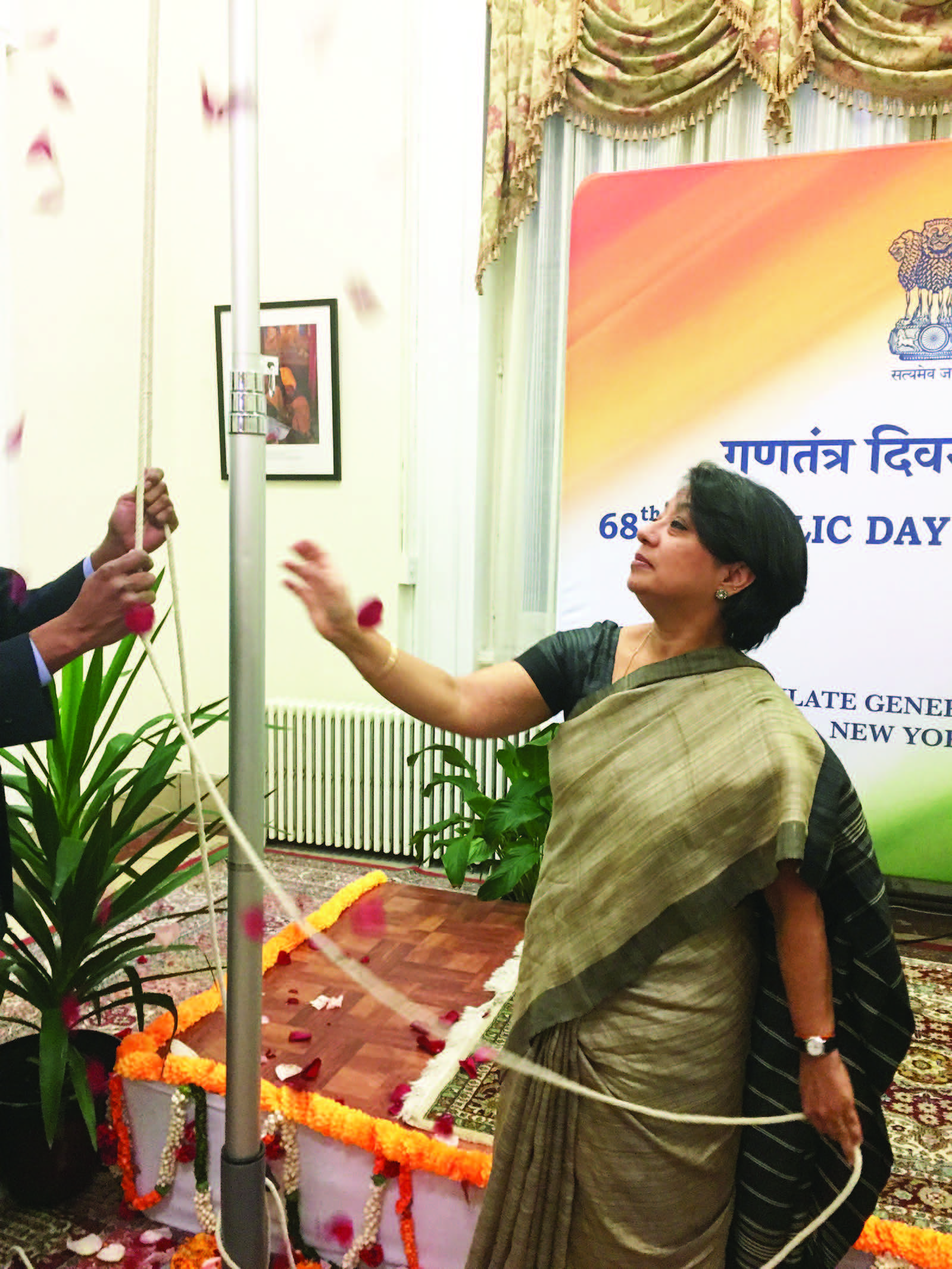
    NEW YORK CITY (TIP): The Consulate General of India, New York celebrated India’s 68th Republic day with enthusiasm and patriotic fervor, January 26. The celebrations began in the morning at the Consulate. Consul general of India in New York, Ambassador Riva Ganguly Das hoisted the Tri-color. After singing the national anthem, Consul General read out selected parts from President of India’s address to the Nation.

    Speaking to The Indian Panorama, Ambassador Riva Ganguly Das said, “I would like to wish the Indian American community a very happy Republic day. This is our 68th Republic day. I just read out the President’s message addressed to both Indians in the country and Indians abroad. It’s a very inspirational message. While we have achieved much, still we have a lot to do. And we count on the support of Indian American community as we move forward for progress and prosperity of our wonderful democracy, our wonderful nation.”


    In the afternoon, Ambassador rang the closing bell at New York Stock Exchange (NYSE). She was accompanied by Deputy Consul General Dr. Manoj Kumar Mohapatra and other dignitaries. John Tuttle, Global Head of Listings at NYSE welcomed them.

    In the evening, there was a huge gathering at the consulate where about 150 people were present from the tri-state area.


    Ambassador Syed Akbaruddin, India’s permanent representative to the United Nations told The Indian Panorama, “The Republic day comes at the beginning of the year and at a time when there is change in the air at the United Nations. Now we have a new secretary general and a new president. So, we expect change in the UN as well as in US. In these changing circumstances our goal is to protect and promote India’s national interest. Therefore, we seek the support of Indian community because India’s interest is not only promoted by diplomats but promoted by everyone who is Indian. So, we seek the support of Indian community to protect and promote India’s interest.”

    At the reception, the CG gave a welcome address and highlighted the significant achievements India has made in the last few decades.

  • President Mukherjee bats for electoral reforms, demonetization in his address to the Nation

    President Mukherjee bats for electoral reforms, demonetization in his address to the Nation

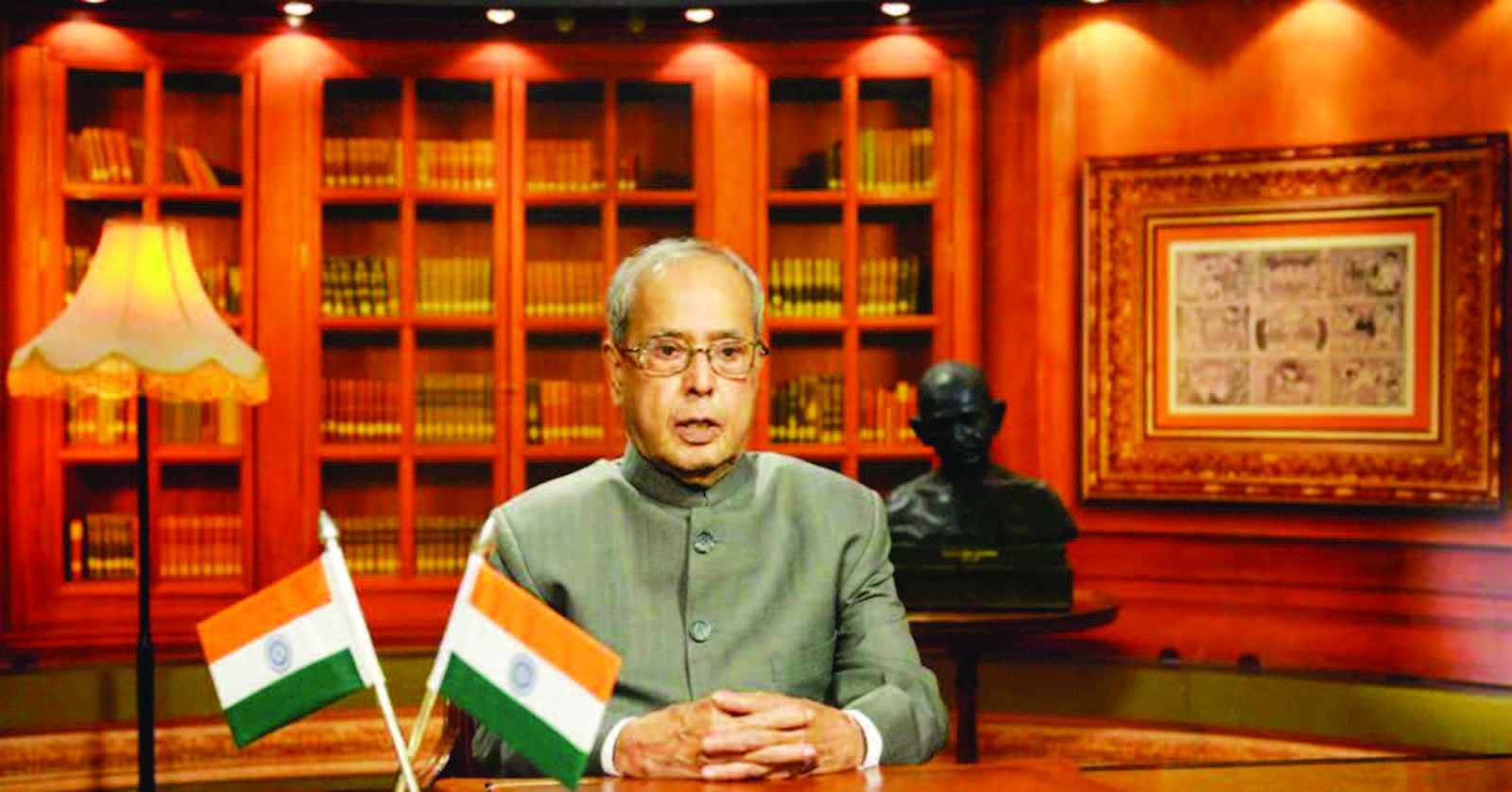
    NEW DELHI (TIP): President of Republic of India, in his address to the nation on the eve of Republic Day,on Wednesday, January 25, spoke about the need for simultaneous elections to Parliament and assemblies, saying that it is the Election Commission who has to move forward in consultation with political parties.

    The President also brought up the issue of demonetization in his speech and said that currency ban may have led to “temporary” slowdown in economy but it will bring more transparency in the system.

    The official celebration of Republic Day spans over four days. It is marked by illumination of Raisina Hill area, address by the President, parade past the India Gate and the Beating Retreat ceremony.

    The crown prince of Abu Dhabi, Mohammed bin Zayed bin Sultan Al-Nahyanwould is the chief guest for the parade.

    Highlights of President’s address to the Nation.

    President Pranab Mukherjee extends his greetings to all forces and pays his tribute to the soldiers who lost their lives in the line of duty.

    We waited till January 26, 1950 — when the Indian people got their constitution… On that day, we became the biggest democracy of the world,” the President says.

    Indian democracy has been a scene of oasis in a region troubled by unrest, says Pranab Mukherjee.

    President Mukherjee lists out the strides made by India in the fields of economy, development, education since its Independence.

    Our economy has been performing well despite global challenges…. we are showing sustained recovery, says Mukherjee, who was also the former finance minister of India.

    Demonetization may have led to temporary slowdown of economic activity, but it will improve the transparency of economy:?Mukherjee talks on the contentious issue of currency recall. The Narendra Modi-led government had demonetized old Rs 500/1000 notes in an announcement on November 8 last year. The Opposition, including Congress party, have maintained vigilant attack against the Modi government, saying that note ban has hurt the poor.

    Ahead of Assembly elections 2017 in which five states go to polls this year, the President says “time is ripe for a constructive debate on electoral reforms”.

    As our Republic enters her sixty-eighth year, we must acknowledge that our systems are not perfect #President Mukherjee
    –           President of India (@RashtrapatiBhvn) January 25, 2017

    Mukherjee enumerates the benefits of Clean India initiative, MGNREGA, Digital India, Start-up India, National Skill Development mission.

    Hailing the plurality of India, Mukherjee says ideas, tolerance and respect for others are values inherent to India. We are the “argumentative India”, not the “intolerant Indian”.

    “Our tradition has always celebrated the ‘argumentative’ Indian; not the ‘intolerant’ Indian… Multiple views, thoughts and philosophies have competed with each other peacefully for centuries in our country.”

    “We are a noisy democracy, yet we need more, not less.”

    We have to work harder because our pluralistic culture and tolerance are still being put to test by vested interests #PresidentMukherjee
    President of India (@RashtrapatiBhvn) January 25, 2017

    Referring to the recent Budget session that ended on December 16, Mukherjee slams parliamentary disruptions and says that legislators lost time arguing.

    In his speech, the President talks about the issues facing India, including ensuring the well-being of security personnel, women’s safety, ecological degradation and food security.

    “Our motherland asks each of us in whatever role we play to do our duty; with integrity, commitment & unflinching loyalty,” the President says, ending the speech swiftly.

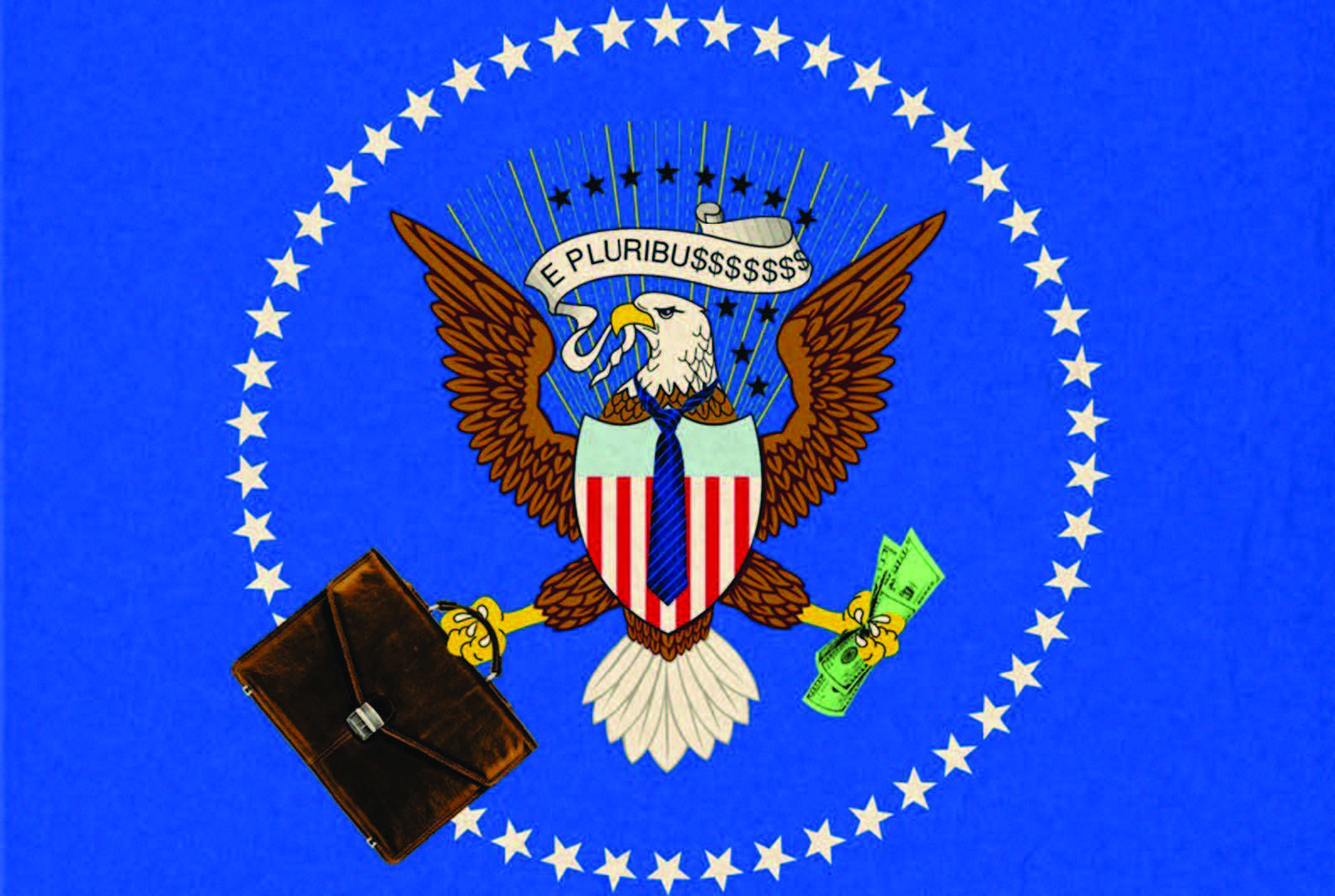
  • PRESIDENTS AREN’T CEOS ~ On the meaning and implications of the country’s first true businessman president

    PRESIDENTS AREN’T CEOS ~ On the meaning and implications of the country’s first true businessman president

    John Paul Rollert

    With respect to the best, unlike a president who has spent decades cultivating the hard skills that lend themselves to complex bureaucratic management and quantitative acumen, Trump consistently boasts of shunning hard analysis and expert opinion (“I don’t hire a lot of number-crunchers”) in favor of the oracle of gut instinct. On the other hand, in terms of the worst, Trump maintains a “my way or the highway” ethic that makes even the most stubborn CEOs look positively accommodating”, says the author – John Paul Rollert.

    Among the more arid and promiscuous expressions in the English language is saying that someone is “in business.” The pawnbroker, the accounts executive at CBS, and the risk arbitrageur are all nominally engaged “in business,” but that fact probably does more to obscure the differences in their daily affairs than to reveal any fundamental similarities.

    Donald J. Trump has certainly been “in business” for the better part of 50 years. And while his electoral success has made him a global face for American capitalism, the fact that he’s the first businessman to vault from the C-Suite straight to the presidency says little about what the country might expect from the next four years-or at least not nearly as much as many tend to think.

    Most presidents have had some experience in private enterprises before entering the Oval Office, a few of them quite substantial. Herbert Hoover made millions as a mining consultant; Jimmy Carter managed a successful peanut farm; and George W. Bush ran an oil company. No president, however, has ever spent his entire adult life immersed in the hustle and bustle of business or, to use Trump’s preferred nomenclature, deal-making. That activity-global in scope, arcane in detail-has received special scrutiny in light of the president-elect’s refusal to release his tax returns, and not without reason. Conflicts of interests come in many forms, but few are as worrisome as the leader of the free world keeping one eye on his portfolio whenever he contemplates some policy decision.

    Such concerns have always dogged presidential contenders who campaign on their business acumen, and the reason why so many Americans are willing to overlook the opportunities for cronyism and self-dealing is an abiding belief that spending time “in business” is ideal training for being the commander-in-chief. That assumption is hardly outrageous, but it is too often predicated on the belief that the president is essentially the nation’s CEO, a common misconception that warps one’s understanding of how exactly the federal government works.
    Instead of an obvious and (as far as the Founders were concerned) highly desirable consequence of the division of powers and divided government, Washington’s inability to “get things done” is unmistakable evidence of gross deficits in the character and competency of its leaders. If the president were simply more technically gifted, managerially adroit, and decisive in his decision-making-in other words, if he had the skills we often associate with successful CEOs-Washington would at last “work,” a remarkable conclusion that assumes surprising unanimity about the “work” that most American would like to see done.

    Beyond a strange insensitivity to the contending interests that enliven American politics as well as the dubious presumption that most political leaders are either knaves or fools (for otherwise they would just “get things done”), those who labor under the fallacy of the CEO president betray a profound ignorance about the actual powers of the American presidency. Then again, they’re in good company. “The most startling thing a new President discovers is that his world is not monolithic,” an unnamed Truman aide told Theodore White in The Making of the President 1960. “In the world of the presidency, giving an order does not end the matter. You can pound your fist on the table or you can get mad or you can blot it all and go out to the golf course. But nothing gets done except by endless follow-up, endless kissing and coaxing, endless threatening and compelling.”

    The contrast to the head honcho of a Fortune 500 company should be obvious. CEOs may assume their orders will be dispatched faithfully by subordinates, if not always to their full satisfaction, but when dealing with members of Congress, a president’s power is by and large confined to the power of persuasion. Yes, the president does have a limited battery of carrots and sticks-the promise of a political appointment, for example, or the threat of withholding support in the case of a bruising primary-but for the most part, when one can neither freely promote nor fire the individuals one must work with to get anything substantial accomplished, they are power centers unto themselves rather than pawns to be moved at will.

    The impotence of presidential authority is not without exception or work-around-the commander-in-chief has wide discretion in foreign affairs, and the use of executive orders is an example, albeit a circumscribed and highly controversial one, of unilateral decree-but relative to a CEO, the opportunity to fully envision and implement a single complex project, much less a comprehensive vision, is limited to the degree that a president can convince others to sign on. The same may be said for other high-ranking officials across the federal government. One cannot simply divine a remedy, channel one’s inner pharaoh, and expect one’s will be done.

    Not that this prevents some from trying. “I’ve seen a lot of people suck in government,” the TV host and former congressman Joe Scarborough observed in early December on Morning Joe, sounding a warning to Trump’s Cabinet-level nominees. “Some of the people that suck the worst are CEOs that go in there [saying], ‘This is the way I worked Trans-Saw Enterprises, and it’s going to work here!’ No, actually it doesn’t work that way.” He continued, making reference to the speed-trap of career civil servants. “They’re like vultures-they will pick your eyeballs out of your face.”

    As of yet, the president-elect’s eyes remain intact, as does his abiding belief that brute determination will overcome any obstacles to his ambition. “You can get any job done through sheer force of will,” Trump contends in The Art of the Deal, “and by knowing what you’re talking about.” If his presidential campaign seemed, at once, to affirm and embarrass this declaration, it suggests that a Trump presidency is likely to exhibit too little of the best, and too much of the worst, of what might be expected from a commander-in-chief who’s spent a lifetime “in business.”

    With respect to the best, unlike a president who has spent decades cultivating the hard skills that lend themselves to complex bureaucratic management and quantitative acumen, Trump consistently boasts of shunning hard analysis and expert opinion (“I don’t hire a lot of number-crunchers”) in favor of the oracle of gut instinct. On the other hand, in terms of the worst, Trump maintains a “my way or the highway” ethic that makes even the most stubborn CEOs look positively accommodating.

    In The Art of the Deal, the president-elect is unapologetic about his heedless determination when pursuing some initiative (“I’ll do nearly anything within legal bounds to win”) and entirely spiteful when things don’t go his way. Recounting the difficulties, the hotel magnate Barron Hilton had in the 1980s obtaining a gambling license in New Jersey even as Hilton Hotels had already started construction on a massive casino complex in Atlantic City, Trump says that, had he been in Hilton’s place, he would have been relentless in pursuit of the license. “I’m not saying I would also have won,” he admits, “but if I went down, it would have been kicking and screaming. I would have closed the hotel and let it rot. That’s just my makeup.”

    It shouldn’t escape notice that, while Donald Trump is president, this reckless approach to “getting things done” will be underwritten by the American people. To that end, The Art of the Deal, the vade mecum of Trumpology, is both instructive and admonitory, like a home-repair estimate prospectively authored by an arsonist. “I fight when I feel I’m getting screwed,” Trump warns his readers, “even if it’s costly and difficult and highly risky.”

    Hopefully this scorched-earth inclination will be reserved for bureaucratic infighting. Indeed, whatever the effective limits of executive authority, it is obviously true that President Trump will have far greater scope for his grand ambitions than he ever did “in business,” and he would hardly be the first commander-in-chief to believe that he shouldn’t be confined to the water’s edge. Even for an erstwhile casino magnate with six bankruptcies under his belt, this is high-stakes poker. Domestically, the president-elect will be playing with house money. Overseas, he will be gambling with blood and treasure.

    Whatever one makes of this prospect, the better framework for assessing what one may expect from a Trump presidency is less what might be extrapolated from the behavior of a conventional CEO than from that of a showboating businessman who has proven himself a mass-marketing savant and a master of self-promotion. To this end, rather than a proving ground for technocratic expertise, Trump favors another far less flattering vision of business, one in which the essential “arts,” as the economist Thorstein Veblen acidly described them, are “bargaining, effrontery, salesmanship, [and] make-believe.”

    Trump’s success in the 2016 campaign surely involved all four of Veblen’s ingredients, and, in fairness, he is far from the only political candidate to have called upon them. Since the advent of television advertising, politicians have consistently relied on sales techniques more familiar to selling Doritos than domestic policy; the president-elect’s was a virtuoso performance. “Trump created a sense of what the problem was, framed it and then juxtaposed himself as the solution,” the CEO of the American Marketing Association, Russ Klein, told The Washington Post shortly after the election. If anything, this undersells Trump’s success. Think of how many campaign catchphrases are now stamped in the popular consciousness. There are the primitive epithets (“Little Marco,” “Lyin’ Ted,” “Crooked Hillary”), the crude promises (“Drain the Swamp,” “Build the Wall,” “The Muslim Ban”), and, most importantly, the very premise of Trump’s entire campaign (“Make America Great Again”). In every one of these respects, the electoral apprentice proved himself a master of political sloganeering.

    Throughout the fall, Trump’s success was obvious to anyone watching his rallies. It wasn’t so much that the attendees knew all the old standards by heart; it was that, when they chanted “Lock her up!,” they believed fervently in the sordid request and that there was only one man who would honor it. In this conviction, they had encouragement. “I am your voice,” Trump declared at the Republican National Convention, adding “I alone can fix it.”

    That promise was consistent with the bombast of the GOP nominee, and more than any other artifact of his outrageous campaign, or any element of his business record, it portends his likely undoing as president. Consider the warning of Jerry Cave, a media consultant and enthusiast of Trump’s. In a recent interview with The Atlantic, he described the perils that lie ahead for a president who has shown himself to be uniquely gifted at selfpromotion in a campaign context. “It was the message and who he is and all this other stuff [that enabled him to win,]” he said. “But that has nothing to do with who’s governing.” Cave likened Trump’s electoral success to a used-car salesman getting a potential buyer to make his way to the dealership. Once the customer’s inside the front door, however, heady optimism soon gives way to hard reality, and there is almost inevitably a good deal of messy negotiation before the driver takes to the road.

    As a matter of policy making, for reasons already discussed, Trump will almost certainly fall short of his bluster, but even more than the failure to cut the extraordinary deals he’s promised, the fact that his powers of persuasion will be shown insufficient will risk breaking the spell among many of his supporters. Indeed, Trump’s marketing genius during the

    campaign effectively turned him into a textbook example of what’s called a “charismatic leader,” a figure whose hold on power is sturdiest only when it might be exercised in a distant tomorrow rather than the plain light of today.

    US President-elect Donald Trump and his wife Melania leave St. John’s Episcopal Church on January 20, 2017, before Trump’s inauguration

    The reason for this is simple: Charismatic leaders labor under impossible expectations of their own creation. As the sociologist Max Weber famously defined it, charisma typically describes a certain “supernatural, superhuman” quality that sets a leader apart from “ordinary men.” Indeed, it is often regarded as being of “divine origin” and is not infrequently supposed to be “resting on magical powers.” If, unlike Julius Caesar’s claim to be a direct descendant of Venus, the president-elect has yet to acknowledge his divinity, he has shown himself to be highly sympathetic to the notion that some people are simply exemplary by nature. In a 2009 conversation with the journalist and critic Deborah Solomon, he expressed confusion about the constitutional premise that all men are created equal. “It’s not true,” he said. “Some people are born very smart, some people are born not so smart. Some people are born very beautiful and some people are not, so you can’t say they’re all created equal.”

    Whatever one makes of this claim, Weber believed that it was a working assumption of those who gravitate to charismatic authority. Their loyalty tended to be characterized by “complete personal devotion,” he said, that is, until the promises of the leaders prove empty, at which point, like a crystal vase in careless hands, the fragile quality of charisma becomes strikingly evident. “If he is for long unsuccessful,” Weber writes, “above all if his leadership fails to benefit his followers, it is likely that his charismatic authority will disappear.” And once it is evaporated, followers have a tendency to be bitter and brutal, for having put their stock in no substantial talents or experience, they are saddled with a figurehead who is a constant reminder of their foolishness.

    This is the danger President Trump faces if he fails to live up to his bluster, and it is one reason why Peter Drucker, the godfather of modern management theory, inveighed against an over-reliance on charisma in business executives. “Every CEO, it seems, has to be made to look like a dashing Confederate cavalry general or a boardroom Elvis Presley,” Drucker wrote in one of his most famous essays. He not only scorned the emphasis on style over substantial accomplishment (the essay is pointedly titled “Leadership as Work”), he believed that powerful personalities became dangerously enchanted with the personas they had lovingly confected. Charisma is ultimately “the undoing of leaders,” he contended. “It makes them inflexible, convinced of their own infallibility, unable to change.”

    The tendencies toward inflexibility and assumed infallibility are occupational hazards of CEOs, which often makes them poorly equipped for the wheedling, cajoling, and occasional arm-twisting of government. Congenitally unapologetic and given to megalomania, Trump has made virtues of these traits, which helps to explain his successful claim to charismatic authority during the campaign season.

    What follows from such commitments as he ascends to the presidency remains to be seen, but as he prepares to become the most powerful person on earth, Trump might recall the slogan most often attributed to another showboating businessman, P. T. Barnum: “There’s a sucker born every minute.” Insofar as the president-elect has embraced the comparison with Barnum, he might bear in mind that the circus comes to town for only a few days at a time before departing, again, in the dead of night. Even if Barnum never said a sucker is born every minute-and history is unclear on this matter-he certainly knew that a sucker was best conned quickly, and that a showman risked his advantage when he stuck around for the moment of reckoning.

    Moments of reckoning mark the beginning and end of things. Last weekend, Ringling Bros. and Barnum & Bailey announced that it was shutting down its tour after a 146-year run. This weekend, a new show begins. The world will soon find out whether a stationary circus can endure for four years straight without the acts becoming tiresome, the customers wanting a refund, and the ringmaster having good reason to look for safe escape.

    (The author is an adjunct assistant professor at the Booth School of Business, and a lecturer at the Harris School of Public Policy, at the University of Chicago. He has written for The New York Times, Harper’s, and The New Republic)

    (Source: The Atlantic)

  • Redefining Leadership ~ Obama makes way for Trump, and shallowness

    Redefining Leadership ~ Obama makes way for Trump, and shallowness

    America is going through, what historian Arthur M Schlesinger Jr. calls “cycles” in American history, when the tide of action, passion, idealism and reform gives way to seasons of drift, quiescence, hedonism, and cynicism. The cheapness and shoddiness of the moment that saw Americans put their money on a salesman like Donald Trump will peter out. The liberal moorings of the traditional Americans and the innovative and exciting energy of the immigrants would see the Trump interregnum off, without permanent damage to the American soul”, says the author.

    Barack Obama hasvacated the presidency of the United States, the most powerful and still the most consequential office in the world. As his successor, the Americans have opted for a man who has not held an elective office before nor has any record of public service. Modern day advertisement mechanisms and social media gladiators ensure that the winner is deemed to be endowed with all the virtues of a noble ruler; Donald Trump is already being serenaded as a worthy tribute to the American democracy and its capacity for innovation and inclusion. Inversely, the Democrats’ defeat in the race for the White House is seen – both by the Trump fanatics and the liberals themselves – as a repudiation of Obama’s legacy and his leadership. But a fair question needs to be asked: do we necessarily have to lower our standards by which to judge a leader just because Mr. Trump has managed to swagger his way to the White House?Are democracies increasingly doomed to be saddled with skilled demagogues?

    Every nation constitutes itself into a political community, with its own peculiar history and geography, with its own sense of comfort over distribution of power, wealth and privilege, and with its own set of ideals and principles. Every political community experiences convulsions and conflict when the realities of power do not match the professed ideals. The Americans see themselves as having organized the United States into a unique political community, premised on lofted principles of equality, openness and opportunity. Historically the United States benefited, economically and culturally, from the raw energy and enterprise of the immigrant; and, in the post-World War the American political community redeemed itself as it struggled to redesign its civil rights regime in line with its own protestations of equality for all citizens. Post 9/11, the United States took it upon itself to be the global prosecutor for democracy.

    When Obama won the presidency in 2008, his victory was a triumph of the American ideal. The Americans were finally beginning – or, so it seemed – to come to terms with the logic of their own democratic history. A black man had come to live in the White House. A glorious moment that redeemed the uniqueness of the American experiment. And, it was comforting that Obama had won the presidential race not by inciting racial animosities in the manner of a Malcolm X but by inviting the Americans to be true to their own nobler instincts, by offering intelligent and worthy answers to America’s problems, and by assuring the outside world of a moderate, reasonable American leadership. Ironically enough, he is often chided for being too professorial, too cerebral, and too nuanced to be an “effective” leader.

    Was he a bad leader? Obama’s eight years in the White House turned out, at best, to be a mixed blessing. As a matter of fact, this “mixed blessing” is now perhaps the inevitable verdict on almost every leader in the modern democracy; more so in the American political arrangement where the Executive is institutionally obliged to negotiate power and authority with the Legislature. Effective leadership does not easily or automatically accrue to the President. And, it was sought to be denied to the first black President from the moment he walked into the Oval Office. That, of course, is simply politics.

    Yet the basic question that students of democracy around the world have to ask and answer for themselves is: do we need to redefine the qualities we look for in our leaders? Just because a real-estate mogul can successfully tap into the presumed anger and resentment of the white Americans, does the task of leadership stand redefined? Do leaders have necessarily to be crude and corny, always over-eager to appeal to our ugliest and baser instincts? Ultra-nationalists are on the rampage in Europe and there seems to be inevitability about these rogues. Compassionate competence of an Angela Merkel is sought to be belittled, while demagogues are being heard respectfully. And, depressingly enough, the narrative industry is working overtime to rationalize the rise of Trump and other ultra-right leaders in Europe as a justifiable revolt against the elites and their presumed indifference to the masses’ concern. The so-called elites are deemed to have received their well-deserved karmic comeuppance.

    America is going through, what historian Arthur M Schlesinger Jr. calls “cycles” in American history, when the tide of action, passion, idealism and reform gives way to seasons of drift, quiescence, hedonism, and cynicism. The cheapness and shoddiness of the moment that saw Americans put their money on a salesman like Donald Trump will peter out. The liberal moorings of the traditional Americans and the innovative and exciting energy of the immigrants would see the Trump interregnum off, without permanent damage to the American soul.

    While arguments and slogans are necessarily designed to mobilize a section of the electorate in a partisan way, the task of the political leadership is inherently a noble quest, especially in a democratic format. The political leadership imposes a noble burden on a President or a Prime Minister – the burden of pursuit of national interest, even national glory, in a manner that redeems, rather than diminishes, the citizen. Whenever a leader fails to live up to the spirit of that noble burden, his own fellow-citizens end up paying a price as does the world at large.

    We increasingly like to live un-historically. While it may be fashionably easy to castigate Barack Obama’s inadequacies, it would be worthwhile to ponder what would have been America’s – and, the world’s – fate if he had failed to defeat his Republican rival in 2008. America and the world would have certainly hurtled down to the path of one confrontation after another, instigating instability and disorder on a grand global scale. If nothing else, we should be thankful that Obama could roll back the George Bush-Dick Chenny era’s excesses. At home, on Obama’s watch, the United States became a calmer and easier society, even if a lot of Americans did become angrier and wilder. Trump’s success in no way diminishes Obama’s accomplishments. It would be a terrible historical mistake to read Trump’s arrival as historically inevitable.

    Centuries ago Aristotle had hinted at our present-day dilemma: the man or group of men to govern solely for the best interests of the people at large is rare and hard to be found. Democracy, of course, constitutes the best and fairest mechanism to locate and anoint such honorable rulers. And, precisely for that reason, Trump’s victory cannot be used to lower the bar in democracies around the world.

    (The author is Editor in chief of Tribune group of newspapers)

  • Modi’s Raisina Dialogue

    Modi’s Raisina Dialogue

    Prime Minister Narendra Modi spelt out the nation’s foreign priorities at the second Raisina Dialogue, an initiative by the current government which it hopes will eventually rival the conclaves in Munich and Singapore (Shangrila Dialogue). For a gathering that is constructed around the theme of “Neighborhood First”, Nepal spoilt the party shortly after the PM had delivered a roundup of Indian foreign policy when its Foreign Minister asked India to keep away from its internal affairs. Unlike last time, no prominent leader from Bangladesh and Sri Lanka turned up. The answer is not hard to find. Both countries are in the middle of an economic-military dalliance with China and might not have wished to turn up for an event where the hosts would invariably indulge in Beijing-bashing.

    The Prime Minister did make a brave effort to paint a vibrant picture of India’s diplomacy. For proof, he drew attention to the revival in ties with the US, Russia and West Asia. But problems on the foreign policy front are closer home as Nepal made bold to point out. The PM’s take on the China-Pakistan Economic Corridor (CPEC) showed that India is yet to resolve the conundrum of a portion of the route traversing through Pakistan-occupied Kashmir. While he held an olive branch to China, the PM’s subsequent observation on regional connectivity corridors showed the CPEC breach is far from being filled soon.

    As Modi himself said, Tuesday was a day of speeches. There was the Chinese President at Davos pushing for globalization and Theresa May laying out the roadmap for Brexit. But in the context of India’s neighborhood, the one by Mehbooba Mufti in Srinagar stood out. Her call for a CPEC-type corridor connecting South Asia and Central Asia with Jammu and Kashmir as its nucleus is worth considering because it has the potential to end the post-Independence isolation of J&K and Punjab from the natural trading routes. The government needs more out-of-the-box ideas such as these to remove the chill that has entered India’s ties with almost all its neighbors.

    (Tribune India)

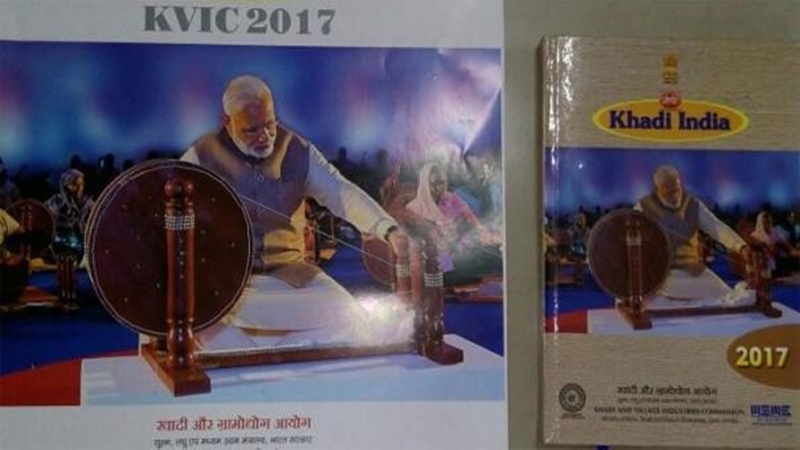
  • INOC, USA expresses strong objection at ‘Modi’ replacing Gandhiji on KVIC calendar

    INOC, USA expresses strong objection at ‘Modi’ replacing Gandhiji on KVIC calendar

    NEW YORK (TIP): Indian National Overseas Congress, USA strongly opposes the fact that the Prime Minister has replaced Mahatma Gandhi on the wall calendars and table diaries issued by the Government-owned Khadi Village Industries Commission (KVIC). The 2017 Calendars and Diaries carry a cover photograph of Narendra Modi, instead of Mahatma Gandhi, who had been on it for decades.

    “We are indeed pained by the action of the commission that reinforces the deep suspicion in the public domain that this is part of an ongoing effort to diminish the heroes of our independence and to erase their relevance”, said George Abraham, Chairman of the Indian National Overseas Congress, USA. “Despite the current Government’s efforts, Gandhiji will continue to live forever in the hearts and minds of the freedom loving people everywhere”, Mr. Abraham added.

    “The entire Khadi industry is based on Gandhi’s philosophy, ideas, and ideals. It is ludicrous to think that Modi can ever replace Gandhi as it biggest brand ambassador” said Mohinder Singh Gilzian, President of INOC. He further agreed with the assessment in the media that, ‘sitting in front of spinning wheel will never make anyone a Gandhi.’

    “We hope that KVIC will reexamine its wrongheaded decision and restore those calendars with the decade-long practice of using the image of Gandhi Ji who is adored and respected the world over”, Gilzian further added.

  • Indian American community has come of age, says Ambassador Sarna at FIA-led reception

    Indian American community has come of age, says Ambassador Sarna at FIA-led reception

    India’s new Ambassador to the US Navtej Singh Sarna feels that biggest change in the Indian community in the US is that ‘The community has come of age.’ He said that during a welcomereception hosted by Federation of Indian Associations in New York, New Jersey and Connecticut (FIA) at the Royal Albert’s Palace on January 12.

    In his speech Sarna, who served in the Indian Embassy in Washington, DC, 14 years ago, noted the tremendous changes that happened in his absence. He pointed out the changes and improvement in the Indo-US engagement. There were political changes, like the changes in the prime ministerial level. There were changes in security engagement too. “But the biggest change is the strength and standing the Indian community has acquired. The community has come of age.”

    “Indians are three million in America which is only one percent of the US population. Yet 13 percent of all start-ups are set up by the Indians, 50 percent of all hotel business is controlled by them and 8 percent of all doctors in the US is of Indian origin. It means all of you carry a weight much bigger than what your number of 3 million would have given. Wherever I go I see Indian elected officials in the local level or county level or state level,” Sarna said.

    He argued that the Fabulous Five people of Indian origin in the Senate and the U.S. House of Representatives has shown the growing political clout of the community.

    Sarna said he looks at the community’s work from three angles. “The diaspora is constantly engaged with the adopted country,” he said. “At the same time, they (its members) continue their engagements with the motherland. The third thing I noticed is the passion to bring the two together.”

    Going by these standards the Indian community is a huge success, he said.

    The ambassador pointed out that travel to India used to be hard 15 or so years ago, when he was in the U.S.

    He said that is “no more the same, thanks to Air India,” and added that “technology has helped the engagement with India. On TV, we see instantly what happens in India.

    He said things have changed in India, too.

    “It is not the same India when you had left. Opportunities are many, which you did not see during your time there,” Sarna said. “I know you all have invested in India in one way or the other. The Indian community here is a knowledge-based community. Our strength is our knowledge.”

    He pointed out that the US is moving to a new administration soon and said US-India relations are very robust and that everyone knows the strength of this relationship.

    He said, “We are all proud of the way India is moving forward, keeping its many freedoms, preserving unity in a multi-cultural, multi-religious society and the way the parliament functions.”

    New York Consul General Riva Ganguly Das also spoke on the occasion.

    New Jersey State house member Rep Raj Mukherji presented a proclamation in honor of FIA. He said it was a proud day for the community in New Jersey when Gurbir Singh Grewal was sworn in as the prosecutor of Bergen County, the most populous county in the state.

    Mukherji also lamented the apathy of the community to register as voters and go to vote. He said there are about 400,000 Indians in the state, but only very few are registered as voters. In his District in Jersey City, there are 30,000 Indians, comprising 15 percent of the population. Yet only 4,500 people are registered as voters and only 1,700 actually voted. He called for a change in the situation.

    New York based artist Manoj Vyas presented Sarna with a portrait he had made of the ambassador.

    At the start of the event FIA President Andy Bhatia greeted the ambassador and the community. Former president of FIA Ankur Vaidya was the emcee. Suchita Patel and Gurmail Singh Parmar, president of the Garden State Sikh Association presented flowers to the ambassador.

    Ramesh Patel, chairman of FIA, welcomed the Ambassador. He said there is only one ambassador of India, while all in the community are also ambassadors in an informal way.

    Vandana Sharma, regional manager of Air India noted that they are trying to make more gateways to India.

    Anil Bansal, president of the First National Corp and V-Splash, spoke about his career background and support for FIA. He also spoke of the need to bring the two countries together.

    Dr Ajay Lodha, president of the American Association of Physicians of Indian Origin, spoke about the recent health summit held in India.

    Albert Jasani of Royal Albert’s Palace, Philippose Philip, general secretary of Federation of Kerala Associations in North America (fokana) Kenny Desai, president TAK Group and vice chair of Bharatiya Vidya Bhavan, Srujal Parekh, executive vice president of FIA, Dr Sanjay Gupta, Pyare Singh of the Carteret Gurdwara, Neal Modi, president of the Association of Indians in America, and Anil Monga, founder of heavenly Palace in Punjab and trustee of America India Foundation were among the speakers.

    FIA President Andy Bhatia introduced HR Shah, chairman of TV Asia and Bharatiya Vidya Bhavan. Shah spoke about the many faceted personality of the ambassador – as a diplomat who served in UK and Israel and also as a renowned author.

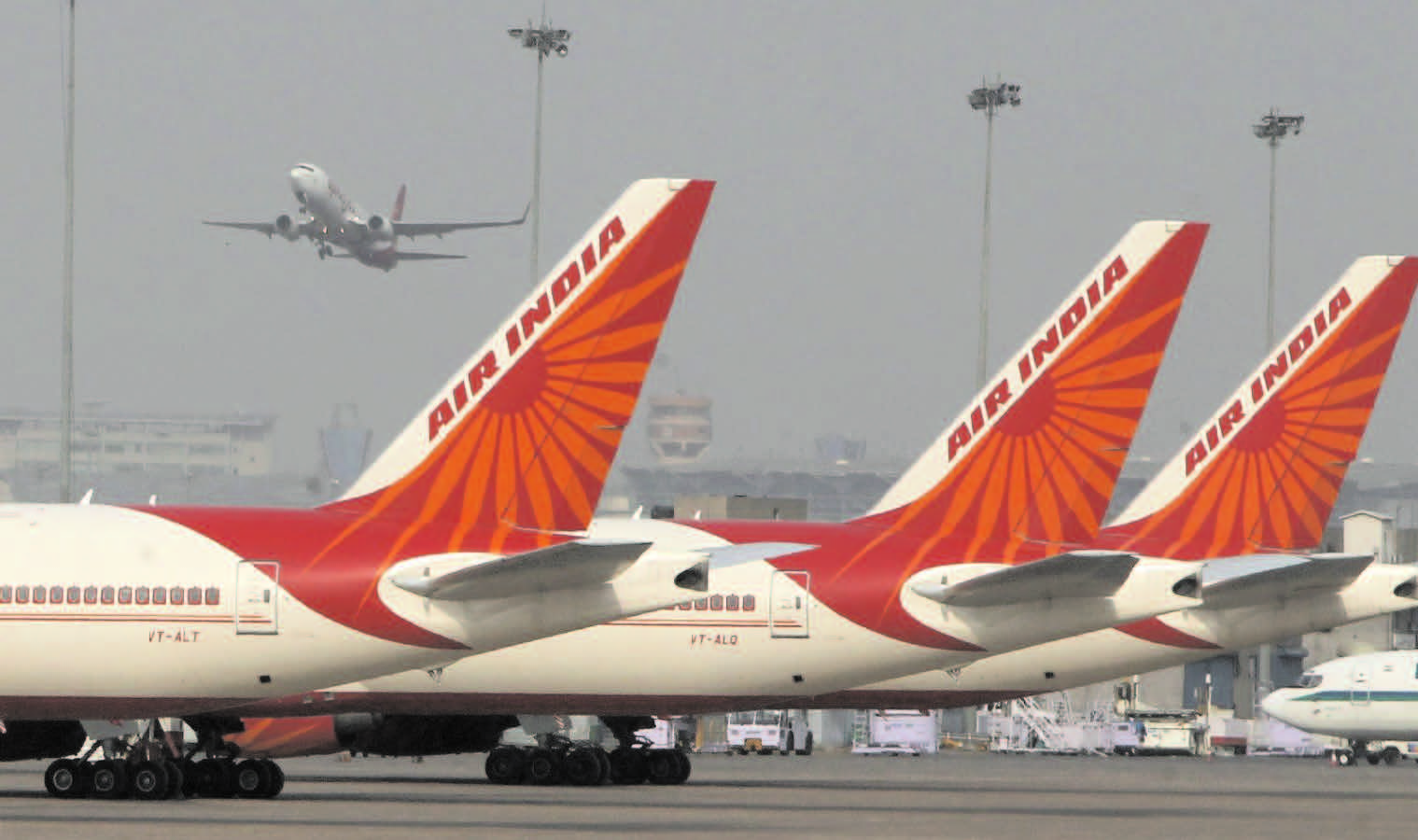
  • Air India to start Delhi-DC non-stop flight from July

    Air India to start Delhi-DC non-stop flight from July

    NEW YORK (TIP): Come July, Washington’s Dulles International airport will become Air India’s fifth U.S. destination, joining Chicago O’Hare, New York JFK, Newark Liberty and San Francisco. Air India would be the only carrier offering nonstop service to India from Washington.

    The service would begin in July, with India’s state-owned national carrier planning nonstop service from Delhi. The capital-to-capital route is expected to operate three times a week on Boeing 777 aircraft, The Times of India reports.

    On 22 August, last year, Air India commenced the first ever flight between Ahmedabad to Newark via London.

    In October Air India set a record with its flight from Delhi to San Francisco. Instead of traveling West over the Atlantic, it flew East over the Pacific on an over 15,000-kilometre, 14-and-a-half-hour journey.

    Air India has grown to become a mega international airline with a network of 34 destinations across the USA, Europe, Australia, Far-East and South-East Asia and the Gulf. The airline’s domestic network covers 52 destinations, including far-flung areas of the North-East, Ladakh, Andaman and Nicobar Islands. Air India, today, flies one of the youngest, state-of-the-art, fleet of aircraft comprising a mix of the wide-body Boeing B777s, B747s, its latest acquisition- the B787 Dreamliner and the narrow body Airbus A321s, A320s and A319 aircraft.

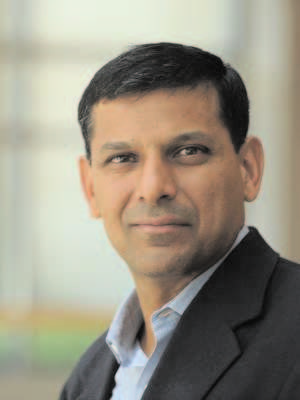
  • Raghuram Rajan recognized with distinguished service professorship

    Raghuram Rajan recognized with distinguished service professorship

    Former governor of the Reserve Bank of India Raghuram Rajan has been named the Katherine Dusak Miller Distinguished Service Professor of Finance by University of Chicago’s Booth School of Business. Another Indian American economist Oeindrila Dube was named the Philip K. Pearson Professor, an inaugural named professorship in The Pearson Institute for the Study and Resolution of Global Conflicts.

    Rajan was governor of the Reserve Bank of India from September 2013 to September 2016. Between 2003 and 2006, Rajan served as the chief economist and director of research at the International Monetary Fund.

    Rajan’s research interests are in banking, corporate finance and economic development, especially the role finance plays in it. He is co-author of Saving Capitalism from the Capitalists and author of Fault Lines: How Hidden Fractures Still Threaten the World Economy, for which he was awarded the Financial Times-Goldman Sachs prize for best business book in 2010.

    Rajan is a member of the Group of Thirty and served in 2011 as president of the American Finance Association. He is a member of the American Academy of Arts and Sciences. In 2003, the American Finance Association awarded Rajan the inaugural Fischer Black Prize for the best finance researcher under the age of 40. His other awards include the Infosys prize for the Economic Sciences, the Deutsche Bank Prize for Financial Economics, Euromoney Central Banker Governor of the Year in 2014, and Banker Magazine (FT Group) Central Bank Governor of the Year in 2016.

    Dube is an economist and political scientist who studies conflict and crime, primarily in Latin America and Sub-Saharan Africa. Her research examines the root causes of violence and sheds light on strategies for promoting post-conflict stability. For example, her work has demonstrated how economic shocks influence civil war and has shown how reconciling after civil war shapes the psychological and economic development of individuals and their societies.

    Her research has been published in leading journals including Science, Review of Economic Studies, Journal of Politics and American Political Science Review.

    Dube’s conflict and crime work is enriched by her affiliations with the National Bureau of Economic Research, the International Growth Center, the University of Chicago Crime Lab and the Abdul Latif Jameel Poverty Action Lab at MIT. She also held the Louis Dyer Peace Fellowship at Stanford University’s Hoover Institution over 2013-2014, and was a recipient of the Rhodes Scholarship in 2002.

  • Indian American Congresswoman Pramila Jayapal won’t attend Donald Trump’s Inauguration

    Indian American Congresswoman Pramila Jayapal won’t attend Donald Trump’s Inauguration

    Ms Jayapal said in a statement on Sunday, January15, that she will remain in her Seattle district to “be with constituents who are immigrants and immigrant advocates to hear their stories and concerns, and discuss a plan of action moving forward”, according to a report in the Stranger newspaper.

    “I was being specific about my duty as the Congresswoman for the 7th Congressional District to be right here in this district with constituents who are terrified about whether they’re gonna have a place in this city or country, and to make a plan for how we go forward,” Ms Jayapal told her supporters during a rally at Westlake Park in Washington.

    “I wanted to be with kids who don’t know if their mom is gonna be there when they come home because of this President-elect’s policies,” she said.

    The Democrats are boycotting the inauguration after Trump criticized US Representative and civil rights icon John Lewis, who said he doesn’t see Trump as a “legitimate President”. Ms Jayapal tweeted her support of Lewis on Sunday after Trump shot back that Lewis is “all talk, talk, talk”. “If I had any doubts about my decision, however, my resolve has only strengthened in the past few days as I watched Donald Trump’s response to one of our country’s great civil rights icons and a personal hero of mine, Congressman John Lewis,” Ms Jayapal said.

    “With Donald Trump’s tweet, he himself has inflamed the situation and now two dozen of my colleagues will also not be attending the inauguration. It has become a boycott,” she said.

  • Indian-American Jailed for $1 Million Insider Trading Scheme

    Indian-American Jailed for $1 Million Insider Trading Scheme

    An Indian-American man has been sentenced to 20 months in prison for a $1 million insider trading scheme involving the failed Apollo Tyres bid to takeover Cooper Tire, prosecutors said on Wednesday.

    Amit Kanodia, 49, was sentenced in Boston by Federal Judge Nathaniel M. Gorton, who also imposed a $200,000 fine and 100 hours of community service and ordered the forfeiture of the$242,500 illegal profit he made.

    A jury had found the real estate entrepreneur guilty of securities fraud and conspiracy after a six-day trial last October, but he was sentenced only now. Kanodia’s ex-wife was a lawyer for Apollo Tyres and he heard from her about her company’s plans to acquire the US-based Cooper Tire in 2013, according to the office of the federal prosecutor for Massachusetts.

    He tipped off two of his friends, Iftikar Ahmed and Steven Watson, about the proposed acquisition and they bought shares and options of Cooper Tires, which trades on the New York Stock Exchange, prosecutors said. When the takeover plan was unveiled in June 2013, the share prices shot up by 41 per cent giving the two friends a profit of more than $1 million and they gave Kanodia a share of it, according to officials.

    Ahmed fled to India when he was charged with insider trading and is believed to be still in India. US authorities consider him a fugitive from justice.

    Ahmed, an Indian Institute of Technology-Delhi and Harvard Business School graduate, has also been charged with embezzling $54 million from the investment company Oak Investment Partners, where he was a general partner.

  • Indian American Student Wins Big in Literary Contest on Dental Health

    Indian American Student Wins Big in Literary Contest on Dental Health

    NEW YORK(TIP): Arth Patel, an Indian American Student at The UCLA School of Dentistry was the winner of the first annual My Kool Smiles Scholarship Fund essay contest, sponsored by the Benevis Foundation. Arth earned a $5,000 scholarship for his winning essay on “How can dental health contribute to the well-being of families and children?”

    In his essay, Arth discussed his experience growing up in rural India where quality dental care was not available and how his family benefited from access to community-based dental health care programs after moving to the United States. He discovered his passion for dentistry while volunteering at a local community health clinic.

    “Kool Smiles created this scholarship fund to support talented students who are passionate about making a difference in dental care,” said Dr. Dale Mayfield, Chief Dental Officer for Kool Smiles. “Our 2016 essay question reflects the idea that dental health can impact so much more than a child’s smile. We look forward to reading what students have to say about this important topic.”

    The $5,000 scholarship was awarded to Arth whose essay on dental health demonstrated clarity of content, originality, creativity and persuasiveness.

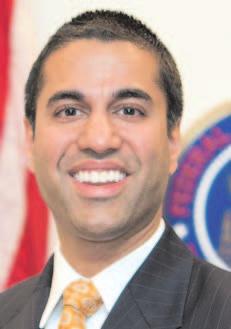
  • Indian American Ajit Pai tipped for FCC Chair?

    Indian American Ajit Pai tipped for FCC Chair?

    Donald Trump met Ajit Pai fueling speculation about his role in the incoming administration.

    NEW YORK (TIP): Washington: US presidentelect Donald Trump met Indian-American Ajit Pai, commissioner of the Federal Communications Commission, fueling speculation about his role in the incoming administration.

    Incoming White House Press Secretary Sean Spears said Trump met Pai, January 17. No other details were immediately available about the content of the meeting that Trump had with Pai. The president-elect normally has been holding meetings at the Trump Towers in New York with those who he intends to appoint at senior positions in his administration beginning January 20.

    Nikki Haley, his nominee for the US Ambassador to the United Nations, is the highest ranking Indian American in any presidential administration.

    Pai is the senior Republican on the Federal Communications Commission (FCC).

    Pai is widely expected to be tapped as interim FCC chair when President-elect Trump becomes President on January 20 and could be named permanent chair as well, though his fellow Republican Commissioner Michael O’Rielly is also in the conversation.

    He was nominated to the FCC by President Barack Obama and was confirmed unanimously by the Senate on May 7, 2012.

    Pai was born in the US after his parents moved from India to the US in 1971. His mother grew up in Bangalore, and father was raised in Hyderabad.

  • Inauguration of the 45th President of the US in pictures

    Inauguration of the 45th President of the US in pictures

    US President-elect Donald Trump and his wife Melania leave St. John’s Episcopal Church on January 20, 2017, before Trump’s inauguration

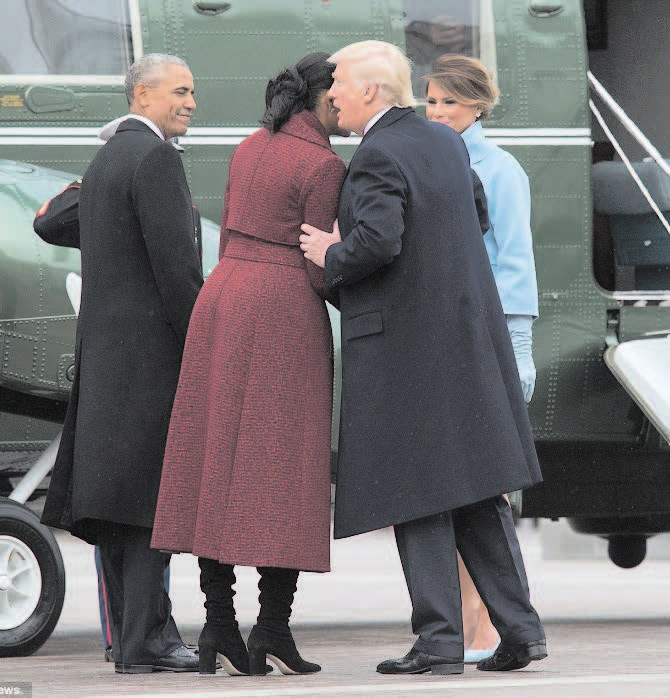
    On January 20, 2017, the peaceful transfer of American power took place in Washington, DC, as the 44th President of the United States, Barack Obama passed the office to President-elect Donald J. Trump.

    Hundreds of thousands attended the ceremony, gathering in the National Mall to hear the swearing in and Trump’s inaugural address, while groups of protesters clashed with police in some of Washington’s streets.

    President Trump, Vice President Mike Pence, and their wives then bid farewell to former President Obama and his wife, as the Obamas headed to Air Force One for one last flight.


    Au Revoir. Former President Barack Obama waves as he departs the U.S. Capitol
    Au Revoir. Former President Barack Obama waves as he departs the U.S. Capitol


  • Trump takes oath as 45th President of the United States of America

    Trump takes oath as 45th President of the United States of America

    Says he is restoring power back from Washington to people and “Together we will make America Great again”

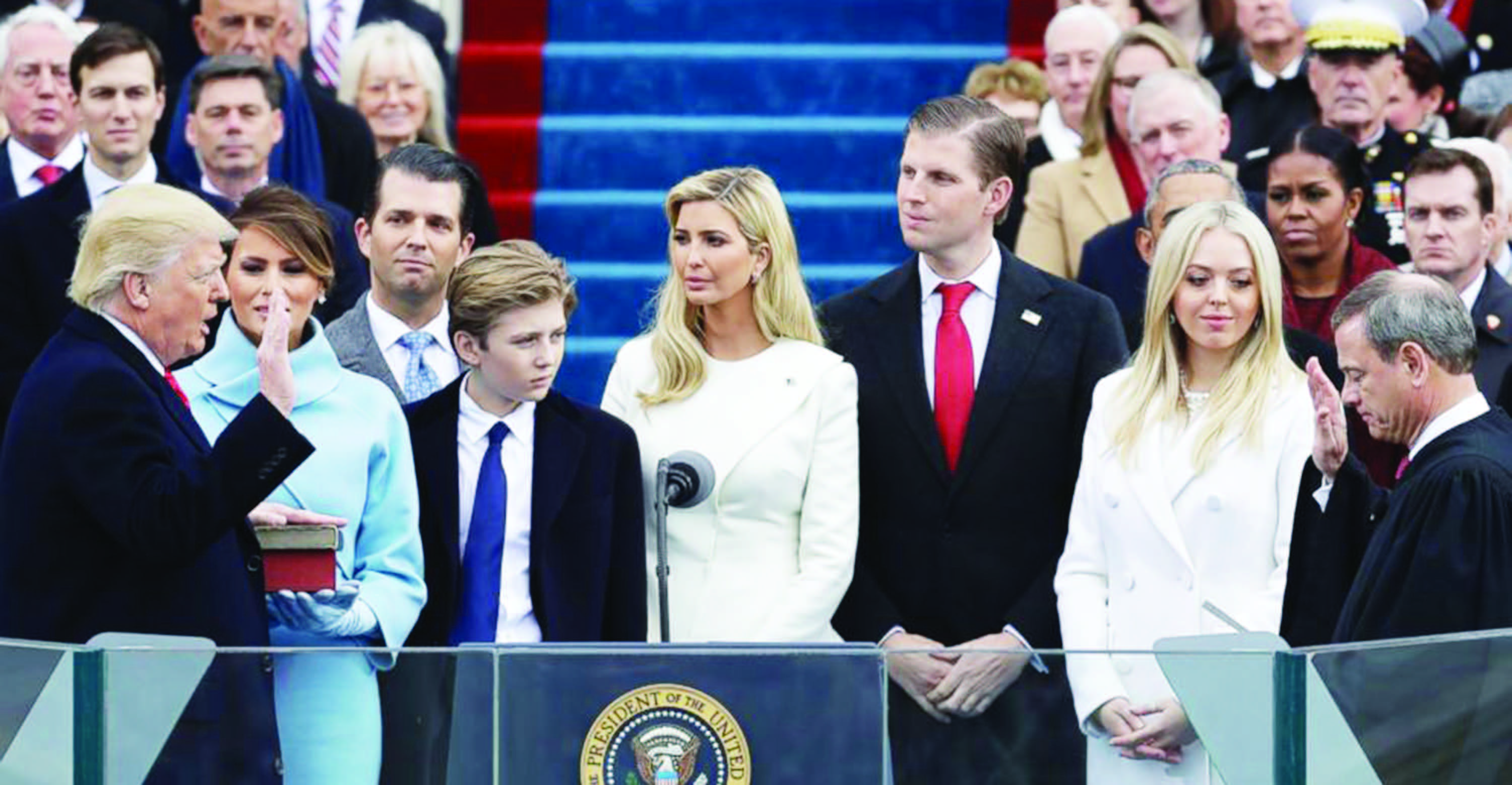
     Donald Trump became the 45th president of the United States Friday, January 20, as he was administered oath of office at a ceremony at the Capitol Hill. The oath was administered by the US Supreme Court Chief Justice John Roberts at 12 pm.

    An estimated around 800,000 guests attended the inaugural ceremonies – a number far below the crowd that came out for President Obama’s first inaugural.

    The 70-year-old billionaire was joined by his wife and children.

    Also on hand were three of the four living former presidents George W Bush, Bill Clinton, and Barack Obama, members of the Supreme Court and leaders of Congress. In addition, his Democratic rival in the election, Hillary Clinton was in attendance.

    In his inaugural speech as president Trump thanked outgoing president Obama for ensuring ‘A gracious transition.’ But his speech was almost copied from his many election campaign speeches.

    “January 20, 2017, people of America became the rulers of the country again. This is the transition of power from DC to you – you the people. Now government will be controlled by our people. The world has never seen this before”, said Trump.

    Here is look at the electoral promises that Trump reassured in his first presidential speech:

    Will put our interest first

    Will bring back our jobs

    Will protect our border first

    Rebuild America with American hands and labor

    Will change education system 

    Will make sure that people buy American and hire American

    Will eradicate Islamic terrorism

    Trump concluded his speech by saying “We’ll make America strong again, wealthy again, proud again, safe again, and great again.” Only time will say how he will do that.

    Some Images

    But Trump took over as President without his complete team. Various important offices in State Department and the all important intelligence agencies look for askance.

    The three days of inaugural festivities kicked off Thursday. Trump left his Trump-branded jet in New York and flew to Washington in a government plane, saluting an Air Force officer as he descended the steps with his wife, Melania. He and the incoming vice president, Mike Pence, solemnly laid a wreath at Arlington National Cemetery before joining supporters for an evening concert at the Lincoln Memorial.

    Cheerful Trump supporters flocked to the nation’s capital for the inaugural festivities, some wearing red hats emblazoned with his “Make America Great Again” campaign slogan.

    Trump tweeted Friday morning, “It all begins today! I will see you at 11:00 A.M. for the swearing-in.

    THE MOVEMENT CONTINUES – THE WORK BEGINS!

    On Friday morning, Trump, Vice President-elect Mike Pence and their families attended services at St. John’s Episcopal Church near the White House, a precedent set by Franklin D. Roosevelt and followed by every president since.

    The president-in-waiting then arrived at the White House for tea with President Barack Obama and first lady Michelle Obama. Before welcoming his successor, Obama took a final stroll from the Oval Office through the Rose Garden as a sitting president.

    Donald Trump scored an upset win in 2016 elections. With a clear victory in sight for Hillary Clinton at one point of time, a couple of factors weighed in his favor in the ultimate upset results to give him presidency.

    Trump won the White House on promises: Deporting immigrants, Banning and surveilling Muslims, building a wall at US-Mexico border, bringing back water boarding, making it easier to sue the press.

    Donald Trump, probably takes over as the least popular incumbent to the White House because of his treatment of women, minorities and the disabled during the campaign He takes over control of the most powerful nation of the world with a lot of baggage which is likely to impede his movement forward.

    Americans have never handed their highest office to a businessman with no experience in public service. Trump, the real estate mogul and reality television star is the only president to break away from the tradition of President divesting himself from his business interests. “The law’s totally on my side ? meaning, the president can’t have a conflict of interest,” Trump has said, dismissing warnings from a government ethics watchdog and experts with experience under Republican and Democratic presidents who have charged that his business entanglements will find him in violation of his oath from the very moment he takes it.

    This is a serious issue; some ethics experts point out.

    “There’s an issue about whether the president and his family will use the presidency for self-enrichment,” says Robert Weissman, president of the advocacy group Public Citizen in an interview with NPR. “The most important part of the problem is how these conflicts will affect policy-making. That is an inescapable and pervasive problem. It doesn’t matter whether Donald Trump is operating in good faith. So long as he has these conflicts, he can’t not know what he owns and he also can’t not know how policy decisions will affect his businesses.”

    Trump has indicated he will continue to own his many U.S. and foreign businesses, and has rejected calls to sell them and said that he will hand them over to his sons to manage – which falls well short of addressing the ethical conundrum he faces. “Stepping back from running his positions is meaningless from a conflicts of interest perspective. Nothing short of divestiture will resolve these conflicts,” Walter Shaub, director of the Office of Government Ethics, said earlier this month.

    For full text of Trump’s inauguration speech, click here

    View Trump’s inauguration speech

  • Thousands Attend Women’s March On Washington

    Thousands Attend Women’s March On Washington

    Hundreds of thousands of people protesting Donald Trump’s presidency swarmed events in U.S. cities and around the world in a rebuke to an incoming president unlike any seen in modern times.

    In the nation’s capital, marchers jammed city streets and filled the large swath of parkland between the U.S. Capitol and the White House known as the National Mall.

    Organizers expected 200,000 people, but officials were prepared for at least twice that many – The city’s public transit service, the Washington Metropolitan Area Transit Authority, recorded about 275,000 trips as of 11 a.m. Saturday, more than the 193,000 it recorded by 11 a.m. Friday ahead of Trump’s inauguration speech and parade.

    The huge crowd comes a day after empty space was spotted on the National Mall ahead of Trump’s inauguration speech and bare bleachers were noticeable along the inaugural parade route. Officials estimated about 900,000 people would file into D.C. for Friday’s parade and speech. That’s about half the attendance at former President Obama’s 2009 swearing-in, the largest event in the history of the nation’s capital.

    At a train station blocks from the White House on Saturday, trains filled with participants would stop, but there was no room for passengers. Finally, after three trains went by, a USA TODAY reporter was able to squeeze on.