Month: April 2017

  • #SUKMAATTACK  – Maoists claim responsibility in audio message, warn security forces not to crush ‘revolution’

    #SUKMAATTACK – Maoists claim responsibility in audio message, warn security forces not to crush ‘revolution’

    NEW DELHI (TIP): Maoists based in the Bastar region of Chhattisgarh have claimed responsibility for the recent attack on CRPF jawans – the worst in few years – and warned the security forces not to come in way of their ‘revolution’.

    A News18.com report claimed on April 28 (Friday) that the home-grown rebels have released an audio message in which they have claimed responsibility for the gruesome attack.

    Their attack on the CRPF jawan was in retaliation to Operation Green Hunt launched by the government against Naxals, they claimed.

    In the 16-minute long audio message clip, a spokesperson of the banned Communist Party of India (Maoist) also hailed the attack by the outfit’s military arm People’s Liberation Guerrilla Army (PLGA) on the CRPF personnel.

    The Maoists’ spokesperson, who spoke in Hindi, said that their “fight” was not with the paramilitary personnel, but warned central forces against standing in the way of “revolution”.

    He also appealed to them and to the police personnel to leave the forces, which he said were targeting activists and journalists.

    “In 2016, the government killed nine of our people in Chhattisgarh and 21 in Odisha. The ambush is a reaction to these killings and sexual violence against our women,” Vikalp, the Maoists spokesperson reportedly said.

    He also alleged that the state police had gang-raped tribal women and killed villagers in “fake” encounters.

    However, the veracity of the purported audio clip, which has become viral on the social media, and the claims made by the Maoists could not be confirmed.

  • Funds for my property not linked to husband  finances : Priyanka

    Funds for my property not linked to husband finances : Priyanka

    NEW DELHI (TIP): Congress president Sonia Gandhi’s daughter, Priyanka Vadra, has said funds for her properties are not linked to the finances of her husband, businessman Robert Vadra, or his company Skylight Hospitality.

    Priyanka’s denial came after a financial daily sent queries to Robert Vadra about his land deals and alleged profits.

    “The source of funds for this or any other property acquired by Priyanka Gandhi Vadra has no relationship whatsoever with Robert Vadra’s finances and/or Skylight Hospitality and no relationship whatsoever with DLF,” her office said in a statement on Thursday.

    The statement said Gandhi bought 5 acres of agricultural land in Amipur village in Faridabad district for Rs 15 lakh on April 28, 2006, six years prior to the purported land deal involving Skylight Hospitality.

    The land was resold to the original owner four years later for Rs 80 lakh, the then prevailing market price, the statement said, adding that all transactions were done through cheque.

    It said the earlier owner was made the offer to allow him exercise the right of first refusal.

    “The source of funds for the aforesaid purchase was rental income of Priyanka Gandhi Vadra from property inherited by her from her grandmother (former prime minister) Indira Gandhi,” it added. The statement added that any insinuations made about the land deal were “false, baseless and defamatory” and represented “a deliberate, politically motivated and malicious campaign to besmirch and destroy her reputation”.

    Political opponents of Robert Vadra had often raised questions about his company’s land deals in Haryana and Rajasthan. No charges, however, have been proved. A land deal in Himachal Pradesh, where Priyanka is building a hillside house, has earlier run into controversy following allegations that the then state government had relaxed laws to facilitate the transfer of the land to her.

  • 1% of Indians own 53% of country’s wealth, says UN report

    1% of Indians own 53% of country’s wealth, says UN report

    NEW DELHI (TIP): Indicating that inequality in India is increasing, a UN report released on Thursday said that the richest 1% own 53% of the country’s wealth.

    It also said that unlike other countries, development in India is not moving across states.

    “In terms of wealth inequality, India is second only to Russia, where the richest 1 percent own 53 percent of the country’s wealth,” said the report ‘The Better Business, Better World’ released here in a two day event of the United Nations Global Compact (UNGC) focussing on how through bold innovation, businesses can create solutions and tap new opportunities found within the 17 Sustainable Development Goals (SDGs).

    According to Lise Kingo, CEO and Executive Director of the UNGC, SDGs can open at least $1 trillion of market opportunity for the private sector in India.

    “This is out of a total global value of $12 trillion that could be unlocked by sustainable business models in four key areas, food and agriculture, energy, cities and health,” she said. Kingo added that over 72 million new jobs could be created in India by 2030 by adapting a sustainable business model. The report says that to reduce the inequality, India needs a ‘different economic model’ — one that is not only low-carbon but also recognizes poverty, inequality and lack of financial access. Source: IANS

  • INDIA SUCCESSFULLY TEST-FIRES AGNI III MISSILE

    BHUBANESWAR (TIP): India on April 27 (Thursday) successfully test-fired its intermediate-range ballistic missile Agni-III from Abdul Kalam Island off the Odisha coast.

    The missile lifted off from launch pad No.4 of the Integrated Test Range located on the island at 9.12 am, sources in the Defence Research and Development Organisation (DRDO) said.

    This was a user test, undertaken by the Strategic Forces Command — an especially raised missile-handling unit of the Indian Army. It carried out the test with logistics support from the DRDO.

    Agni-III is the mainstay of India’s nuclear arsenal, and the missile used for the test was randomly chosen from the assembly line, according to sources.

    The missile has a strike range of 3,000 km to 5,000 km and is capable of carrying both conventional and nuclear warheads weighing up to 1.5 tonnes.

    The missile is powered by a two-stage solid propellant engine. The missile is 17 metres long, with two-metre diameter, and weighs around 2,200 kg.

    The missile was inducted into the armed forces in June 2011.

    This test comes less than a week after the Indian Navy test-fired a land attack version of BrahMos from a naval ship.

    India also recently tested BrahMos missile with an extended 450 km range, has undertaken a drop test of the air version of BrahMos, exo-atmospheric Prithvi Defence Vehicle (PDV) interceptor missile and endo-atmospheric Advanced Air Defence missile, both part of a two-tier anti-ballistic missile system, Agni IV and Agni V in the last six months. Source: IANS


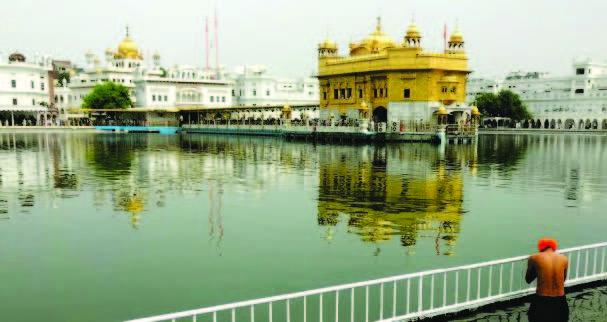
  • Sikhs Take out an Impressive Parade in New York City

    Sikhs Take out an Impressive Parade in New York City

    NEW YORK (TIP): Despite some showers, Sikh men, women and children in thousands thronged New York City to participate in the annual Sikh Day Parade, April 22. It is a day of the birth of Khalsa, the pure Sikhs. It was on the day of Vaisakhi in 1699 that the Tenth Master of the Sikhs, Shri Guru Gobind Singh Ji created Khalsa, the pure among the Sikhs. The Master(Guru) enjoined upon his Sikhs to fight for basic human rights and against all kinds of injustice, oppression and tyranny. Which made them a martial community. During the British rule of India, the Sikh soldiers were recognized for their valor and the most Victoria Crosses, the highest gallantry award were won by them. In independent India, Sikhs have proved time and again they were the sword arm of the country.

    The Sikhs number more than 25 million and are present in every part of the world. Their adventurous spirit has taken them far and wide in search of greener pastures. They created a great impression of themselves as honest and hardworking people. Many Sikhs have won laurels in various fields in countries across the world. The Sikh religion-Sikhism is one of the five major religions of the world. Sikhs believe in unity of mankind and seek good of all.

    On or around the day of Vaisakhi, which usually falls in the middle of April, Sikhs organize parades and prayers to celebrate their birth. In New York, as elsewhere, every year, thousands of Sikhs gather to celebrate the day.

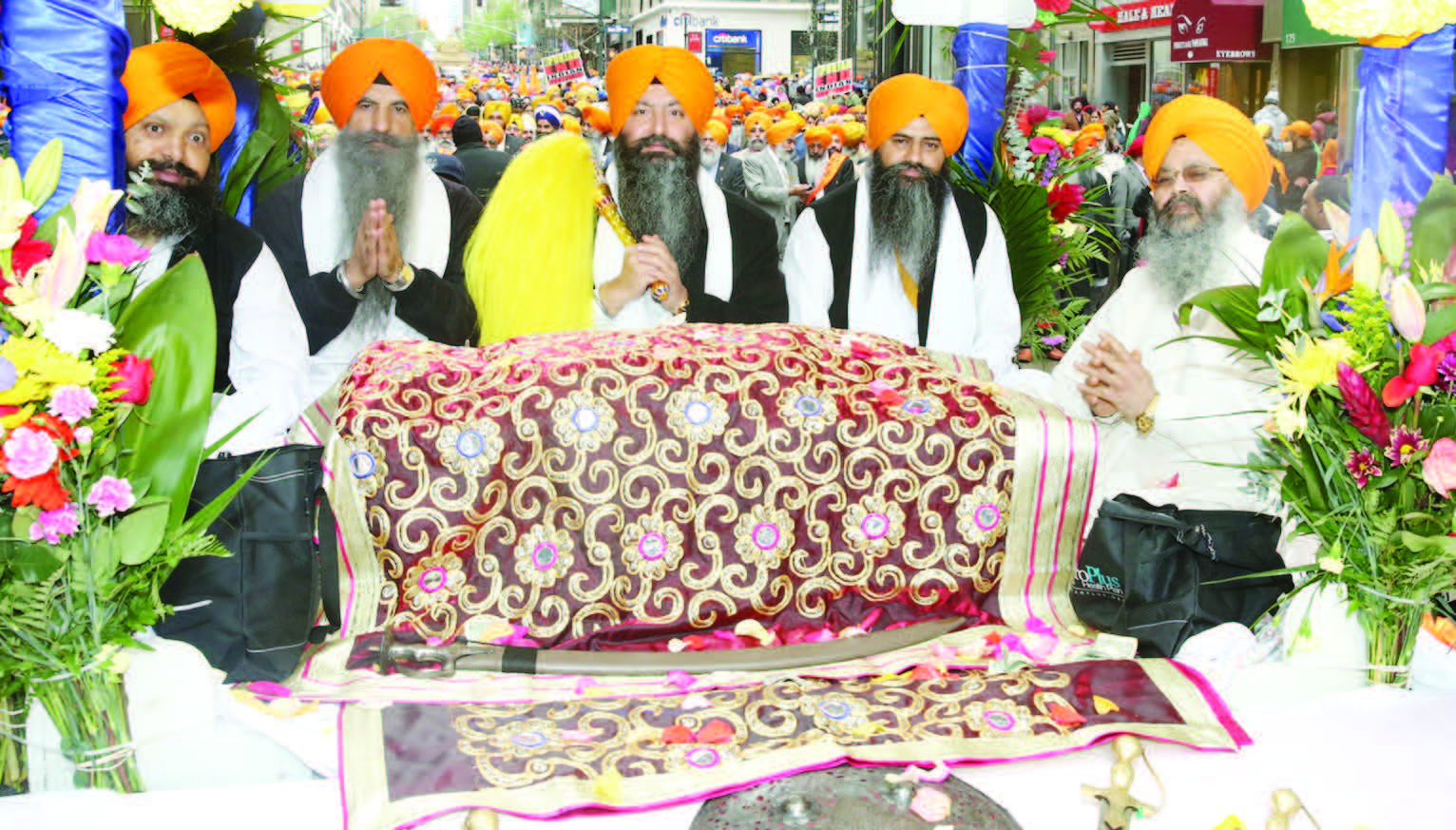
    The huge crowds, following their Guru, at the Parade in Manhattan on April 22.
    The huge crowds, following their Guru, at the Parade in Manhattan on April 22.

    Unconfirmed estimates suggested presence of over 25000 Sikh men, women and children in the parade this year. Over the years, the size of parade has grown, with non-Sikhs also joining in the parade.

    The Sikh Day Parade is more a religious affair than a mere social gathering. That is why, the parade is led by the Living Guru of the Sikhs- The Holy Guru Granth Sahib in whose presence a perfect decorum and an atmosphere of spirituality is maintained.

    A display of Sikh martial arts
    A display of Sikh martial arts

    On display at the parade were Sikh history, culture and traditions, as also the Sikhs’holy places. Various forms of Sikh martial art were displayed by the young and not so young.

    Many bands, including the NYPD band participated. NYPD Desi officers also were part of a contingent.

    A conference was a part of the celebrations where community leaders spoke about their religion and the community. A few politicians and officials also attended the parade and the conference.

    A community kitchen (Langar) proved to be a great attraction, with people enjoying many delectable dishes absolutely free. Sikhs are the only community in the world who have the unique tradition of langar. In every Sikh temple, food is provided free to everyone without any discrimination on any basis.The park at 23rd Street was a great place for people to sit in and enjoy the food which was served free to all.

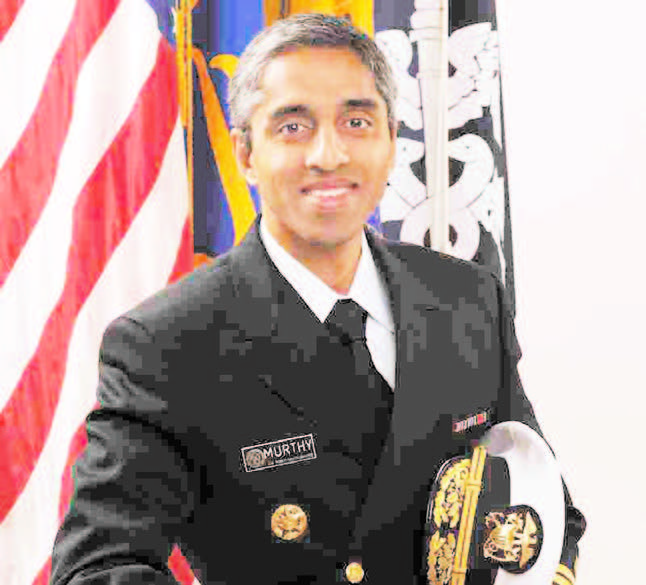
  • Indian American Medical fraternity praises contribution of its member, former US Surgeon General Dr. Vivek Murthy

    Indian American Medical fraternity praises contribution of its member, former US Surgeon General Dr. Vivek Murthy

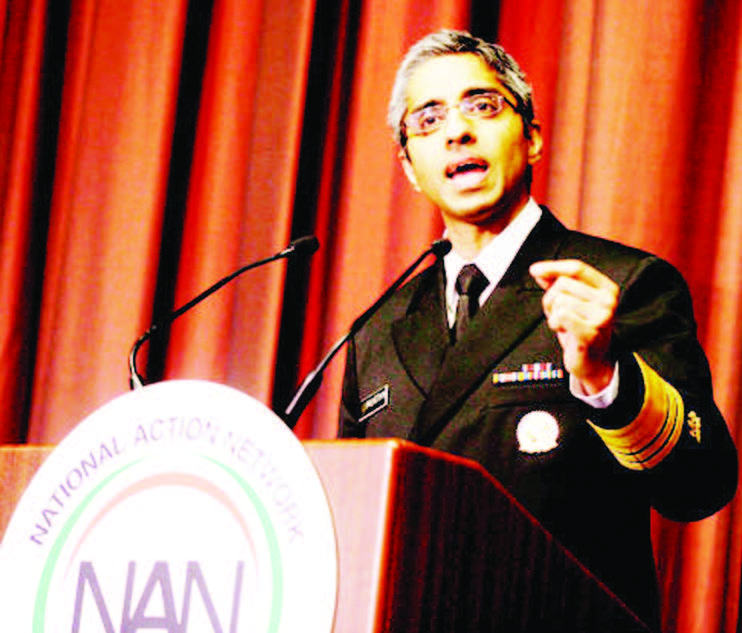
    NEW YORK (TIP): “On behalf of the American Association of Physicians of Indian Origin (AAPI), I want to applaud the many contributions and initiatives of Dr. Vivek Murthy, our AAPI member, in the healthcare sector in very short span of about two years since he became US Surgeon General in 2014,” said Dr. Ajay Lodha, President of AAPI.

    Dr. Murthy has attended several AAPI meetings and has always acknowledged the contributions of AAPI and the Indian community in his statement which he quoted as, “I am proud of our community of Indian physicians for all the progress that we have made over the years, and I know that AAPI has been a critical force in making this process possible. The advice you shared and assistance you kindly offered were important pieces of this journey,”

    The growing influence of doctors of Indian heritage is evident, as increasingly physicians of Indian origin hold critical positions in the healthcare, academic, research and administrative positions across the nation. With their hard work, dedication, compassion, and skills, they have thus carved an enviable niche in the American medical community. AAPI’s role has come to be recognized as vital among members and among lawmakers.

    The surgeon general represents the Health and Human Services Secretary in addressing public health practice in the nation. Murthy, 39, was America’s youngest-ever top doctor, and is also the first surgeon general of Indian-American representing the next generation of Indian American physician. His ethics, quiet leadership style and impeccable credentials made him the smart choice for this position.

    Dr. Murthy, grandson of a farmer, second generation Indian American physician, said, he will always be grateful to “our country for welcoming my immigrant family nearly 40 years ago and giving me this opportunity to serve.

    Dr. Murthy played key role in bringing to the forefront many crucial health issues confronting the nation. In a landmark report on addiction released in November, said dependency on opioids and other substances must not be looked on as a “character flaw,” in the first publication from a surgeon general that has addressed drug and alcohol addiction.

    Murthy embarked on a three-month listening tour of the U.S. ahead of a ceremonial swearing in to listen to the people and professionals before taking on this important role.

    AAPI is shocked and saddened with his departure and wishes him well as he moves on to a new phase in life and is confident that his talents. skills, and experiences will be utilized effectively for the greater good of the nation.


  • Trump sends Indian-American Vishal J Amin’s name to Senate for ‘IP Czar’

    Trump sends Indian-American Vishal J Amin’s name to Senate for ‘IP Czar’

    WASHINGTON (TIP): Indian-American Vishal J Amin’s name has been sent by President Donald Trump to the Senate for confirmation as America’s new ‘IP czar’ to coordinate the country’s law-enforcement strategy around copyright, patents and trademarks.

    If confirmed by the Senate, Vishal, who is currently Senior Counsel on House Judiciary Committee, would succeed Daniel Marti in the White House.

    Earlier this month, Trump had tapped him as the US’ new Intellectual Property Enforcement Coordinator –dubbed as ‘IP czar’ — to coordinate US law-enforcement strategy around copyright, patents and trademarks.

    Amin has served in the administration of former president George W Bush at the White House as Associate Director for Domestic Policy and at the US Department of Commerce as Special Assistant and Associate Director for Policy in the Office of the Secretary, the White House said.

    Vishal received his bachelor’s degree in neuroscience from Johns Hopkins University and his law degree from Washington University in St Louis.

    The Recording Industry Association of America welcomed his nomination.

    “The prompt appointment and consideration of this position is critical, and we commend President Trump for his choice. Vishal Amin is a smart, thoughtful leader and we look forward to working with him,” said Cary Sherman, chairman and CEO of the Recording Industry Association of America.


  • Indian-American Investment Banker Avaneesh Krishnamoorthy Charged with Insider Trading

    Indian-American Investment Banker Avaneesh Krishnamoorthy Charged with Insider Trading

    WASHINGTON (TIP): Indian-American Avaneesh Krishnamoorthy has been charged with insider trading by the Securities and Exchange Commission (SEC).

    Avaneesh Krishnamoorthy, a Vice President in the risk management department of Nomura Securities, a New York-based investment bank, allegedly used the confidential information of a private equity firm’s acquisition to conduct insider trading, the American Bazaar online reported on Wednesday.

    He was charged with one count of securities fraud, which carries a maximum sentence of 20 years in prison and a maximum fine of $5 million. According to the SEC’s complaint, Mr. Krishnamoorthy made approximately $48,000 in illicit profits through insider trading.

    Federal prosecutors said Mr. Krishnamoorthy learned through the course of his work that the private equity firm Golden Gate Capital intended to acquire the online analytics and marketing firm Neustar.

    Mr. Krishnamoorthy then began trading in Neustar securities through two brokerages accounts that he allegedly kept hidden from his employer, which had been approached by Golden Gate Capital to finance the transaction, according to the report.

    “As alleged in our complaint, Krishnamoorthy was entrusted with confidential, market-moving information by his employer and he misused it for personal gain,” said Andrew M. Calamari, Director of the SEC’s New York Regional Office.

    Mr. Krishnamoorthy was presented in Manhattan federal court before US Magistrate judge Kevin Nathaniel Fox on Tuesday. Acting Manhattan US Attorney Joon Kim said Mr. Krishnamoorthy was charged with violating his duty to his company and trading on insider information.

    “Avaneesh Krishnamoorthy allegedly exploited his access to information about a pending acquisition to purchase stock and options, making tens of thousands of dollars in illegal profit for himself,” she said.

    This was the first criminal insider trading case filed by Ms Kim, who in March succeeded Indian-American Preet Bharara, who was sacked by new President Donald Trump as part of his administration reshuffling.

  • Dr. Vivek Murthy fired as America’s Top Doctor by Trump

    Dr. Vivek Murthy fired as America’s Top Doctor by Trump

    WASHINGTON (TIP): The Indian American Hero Dr. Vivek Murthy, America’s top doctor, was dismissed by Donald Trump’s administration on Friday, April 21, 2017 as the US Surgeon General.

    Dr. Vivek Murthy taking charge as the US Surgeon General cemented the reputation physicians of Indian origin have across America. President Obama made the right choice in naming a highly-qualified physician to serve as America’s surgeon general.

    The surgeon general, known as “America’s doctor,” represents the Health and Human Services Secretary and Assistant Secretary in addressing public health practice in the nation. Murthy, 39, was America’s youngest-ever top doctor, and he is also the first surgeon general of Indian-American descent. Dr. Vivek Murthy represents the next generation of Indian American physician. His ethics, quiet leadership style and impeccable credentials made him the smart choice for this position.

    Murthy was named America’s top doctor by President Barack Obama in 2014, making him the first Indian American ever named to the post, one among many growing achievement of a tiny but economically powerful ethnic community. In a very short span of time, Dr. Murthy had played key role in bringing to the forefront many crucial health issues confronting the nation. Dr. Murthy said, being picked for the job was a “uniquely American story” for the “grandson of a poor farmer from India.”

    It was not immediately clear why Murthy was relieved from duty, the New York Times said while noting that employees at the Department of Health and Human Services privately expressed surprise at his sudden departure. Murthy, the 19th Surgeon General, and the first Indian American to hold this post said in a Facebook Post that it was an honor and privilege to work for this prestigious position.

    “For the grandson of a poor farmer from India to be asked by the President to look out for the health of an entire nation was a humbling and uniquely American story. I will always be grateful to our country for welcoming my immigrant family nearly 40 years ago and giving me this opportunity to serve,” he said.

    In a post on Facebook, Murthy said. “For the grandson of a poor farmer from India to be asked by the President to look out for the health of an entire nation was a humbling and uniquely American story. I will always be grateful to our country for welcoming my immigrant family nearly 40 years ago and giving me this opportunity to serve,” he added.

    Murthy went on to recount his goals and achievements as surgeon general and said he “had hoped to do more to help our nation tackle its biggest health challenges, (but) I will be forever grateful for the opportunity to have served”. He says he was the ‘grandson of a poor farmer from India’.

    The US health and human services said in a statement on Friday he had been asked “to resign from his duties as surgeon general after assisting in a smooth transition into the new Trump Administration … (and stood) relieved of his duties”.

    Rear Admiral Sylvia Trent-Adams, a nurse by training and currently deputy surgeon general, was named to serve as the acting surgeon general and assume leadership of the US public health service commissioned corps.


  • The Indo-American Heritage Museum’s reveal: “Unstitched -The Art of Sari Draping”

    The Indo-American Heritage Museum’s reveal: “Unstitched -The Art of Sari Draping”

    CHICAGO, IL (TIP): The Indo-American Heritage Museum’s  April 23 presentation of “Unstitched: The Art of Sari Draping” at Ashton Place, 341 75th Street, Willowbrook, IL, was a winner on all counts, judging by the audience reaction. IAHM, a non-profit educational organization, was established in 2008 and is the only institution of its kind in the country. The event is among many the museum organizes throughout the Chicago area as part of its efforts to preserve the history of Indian Americans and promote understanding of their diversity, culture and contributions to American life.

    Morning cocktails, hors d’oeuvres and music by The Red Line band greeted arrivals and set the tone for the fascinating program that followed. Following a vandana by Geetanjali Maru of Raag ‘N’ Rock, IAHM Board member Amita Banerji spoke about the museum and its work. Padma Rangaswamy, also an IAHM Board member called for the community to participate in the upcoming exhibition, Beyond Bollywood: Indian Americans Shape the Nation, from the Smithsonian Exhibition Traveling Exhibition Service. The exhibit, which will open in July with support from the Chicago Community Trust, is being co-presented by the Field Museum and IAHM in Chicago. The Smithsonian exhibition is being augmented with the Chicago chapter of the Indian American story by IAHM.

    Dr. Rangaswamy pointed out that IAHM as a grass roots organization welcomes community participation in helping tell the Chicago story. Community members can send in videos and images for a video portrait of community life that will be showcased at the Field during the exhibition. They can sign up for a docent training session and guide visitors through the exhibition. They can volunteer to help with the programs IAHM is organizing during the 5 months the exhibition will be running. Interested persons can e-mail info@iahmuseum.org or visit www.iahmuseum.org for more information.

    After IAHM President Madhoolica Dear’s address and Guest of Honor Indian Consul General Neeta Bhushan’s remarks, renowned textile expert and sari historian RTA Kapur Chishti took over with a kaleidoscopic multimedia presentation of the history, design concepts and varieties of saris from the different regions of India. Women from the community modeled saris draped in various regional styles, wearing pure silver jewelry from Amrita Kar’s Vintage2Mod jewelry as they walked the runway to music by DJ Kollision. The event concluded with a lunch buffet from Gaylord Fine Indian Cuisine. Unstitched was sponsored by OROCHEM, Club of Indian Women (CIW), Geetanjali & Abir Maru of Raag ‘N’ Rock Entertainment, EbyN: Events by Nisar, Harp arte Photography, Patel Brothers, Vinni’s Salon and Spa,Wanda Willmore Schlafly of Sunshine Video, Gaylord Fine Indian Cuisine, DJ Kollision and The Red Line band. Information about the Indo-American Heritage Museum is at www.iahmuseum.org

    (Photograph and Press release by: Asian Media USA)

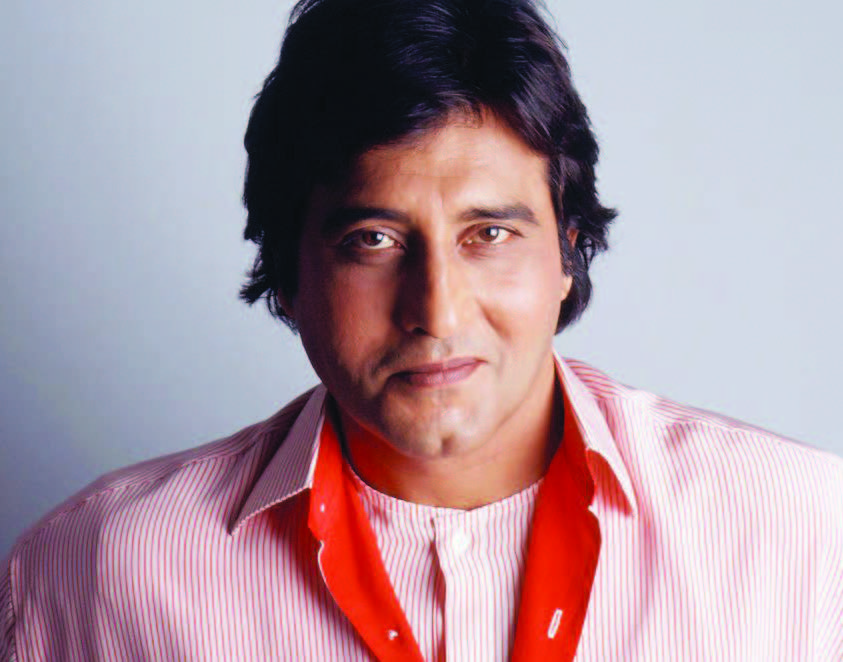
  • VINOD KHANNA – A MAN OF MANY PARTS

    VINOD KHANNA – A MAN OF MANY PARTS

    The man with many parts could no more fight against the terrible cancer  which had bowed him down for some time now and yielded to the Will of God on Thursday, April 27, 2017 at the HN Reliance Foundation and Research Center in Mumbai where he was being treated for advanced bladder cancer.

    The Indian Panorama mourns the superstar’s  sad demise.

    His filmography has many good roles, many forgettable parts, and at least a few questionable choices. But there is no doubt that here was one actor whose name was destined to be on the marquee, along with other such ’70s personages as Amitabh Bachchan, Rishi Kapoor and Mithun Chakraborty.

    One of Khanna’s most popular roles was alongside Bachchan and Kapoor in the multi-starrer Amar Akbar Anthony. The madcap comedy, directed by Manmohan Desai in 1977, follows three brothers separated during their childhood. Khanna had the least showy part, as the inspector Amar, who beats up Anthony (Bachchan) without realising that he is one of his two siblings.

    Khanna started out as a villain in a cinematic universe in which characters were etched in strong black and white shades. In Man Ka Meet (1968), produced by Sunil Dutt’s banner Ajanta Arts and directed by A Subba Rao, Khanna made his acting debut alongside Dutt’s brother Somdutt and Leena Chandavarkar. The movie was designed to boost Somdutt’s leading man prospects, but it was Khanna, who was 22 at the time, who caught the eye as the malefactor who schemes to marry the heroine.

    Khanna was born on October 6, 1946, in Peshawar in undivided India, to KC Khanna, a businessman, and Kamla, a housewife. He was one of five children. After the Partition, the Khannas arrived in Mumbai, where the family has lived since except for a few years in Delhi.

    By his own admission, Khanna wanted to join the movie industry after watching Mughal-E-Azam (1960) as a boy. He rebelled against his father’s dictates against partying and acting, and, was, as Protima Bedi recalls in her memoir Timepass, a South Mumbai layabout and a member of one of two local gangs (the other was led by actor and filmmaker IS Johar’s son Anil).

    “Almost all social life in the Bombay of the mid-sixties revolved around these groups,” Bedi writes. “Bistro and Volga, right next to each other in the Fort, were the places to go to. In Churchgate there was Napoli, and Venice at the Astoria, where Biddu used to sing as the lone Trojan, with his crowd gathered all around.”

    It was at a party that the young man with the hypnotic gaze, brooding personality and Kirk Douglas-style cleft chin met Sunil Dutt, who signed him up for Man Ka Meet. Several roles followed either as a hero in a low-budget movie or a side character in a prominent production, including Nateeja (1969), Aan Milo Sajna (1970), Purab aur Paschim (1970) and Saccha Jhuttha (1970). In Aan Milo Sajna, Khanna furthered the menace that marked his debut. He plays a mean-minded heir who brings home a fake girlfriend so that he can get his share of the inheritance.

    Khanna’s ability to mould his handsome features into a snarl was perfected in Mera Gaon Mera Desh (1971). Raj Khosla’s rural drama is a precursor to Sholay (1975) in numerous ways – it features Dharmendra as the saviour of a village plagued by a gang of dacoits led by the fearsome and sadistic Jabbar Singh. As Jabbar, Khanna is the blackest shade of black, and he delivers one of his most effective performances.

    In 1971, Khanna finally got the opportunity to expand his repertoire when Gulzar remade Tapan Sinha’s Bengali film Apanjan (1968). Khanna plays the leader of one of two packs of aimless young men whose constant clashes are mediated by a widow (Meena Kumari).

    More villainy awaited Khanna (for instance, Anokhi Ada, in 1973) before he could prove his ability to evoke empathy and identification rather than fear and revulsion. In Gulzar’s Achanak (1973), loosely based on the KM Nanavati case of 1959, Khanna is very effective as the Army officer who kills his wife and her lover and escapes, leading to a manhunt.

    Achanak marked the beginning of a shift in Khanna’s fortunes. He was now headlining films, and even though many of them didn’t set the cash registers ringing, his smouldering presence and ability to suggest a volcanic temperament were increasingly unmistakable. Khanna was the other Angry Young Man alongside Amitabh Bachchan in the ‘70s, grimacing at the injustice and corruption around him and using his conscience and fists to set things right.

    Unlike Bachchan, Khanna was a bona fide pin-up. In the arthouse thriller Shaque (1976), directed by the couple Aruna Raje and Vikas Desai, Khanna plays a bespectacled husband and father whose sudden wealth creates suspicion in his wife. The movie showcases Khanna’s casual sex appeal – it includes a brief lovemaking scene and a swimwear moment set on a beach, which has been enshrined on YouTube. Aruna Raje later celebrated Khanna’s manliness in her sexual liberation tract Rihaee in 1988.

    Among Khanna’s hits in the ’70s were Nehle Pe Delha (1976) and the multi-starrers Amar Akbar Anthony (1976) and Muqaddar Ka Sikandar (1978). Mahesh Bhatt cast Khanna in a double role in Lahu Ke Do Rang (1979), as an Indian National Army soldier who has an affair with a Hong Kong national, and as the son who tries to unravel his past.

    Khanna began the ’80s with Feroz Khan’s Qurbaani (1980), and its success bolstered his claim to star status. If Bachchan has played numerous characters named Vijay, Khanna has his share of Amars. In Qurbaani, Khanna’s Amar is a criminal who is one of two men (the other is Feroz Khan) who is besotted with the club singer Sheela (Zeenat Aman). The soundtrack has the club song Aap Jaisa Koi, sung by Nazia Hassan and composed by Khanna’s teenage friend Biddu, and the ballad Hum Tumhe Chahte Hai Aise, in which Khanna’s character pays tribute to the lissome Zeenat Aman.

    Despite his popularity, Khanna’s career remained a rough and tumble affair, marked by more misses than hits. A force greater than cinema was already beckoning the actor, who was by now married to his college sweetheart Geetanjali Taleyarkhan and the father of Rahul and Akshaye (both became actors in the ’90s). “I have always been a seeker,” he said in an interview to the Times of India in 2002. “In the film industry, I had money, glamour, fame but wondered a ‘now what?’”

    The answer was provided by Rajneesh, the headline-grabbing godman later known as Osho, who was running an ashram in Pune at the time. “Initially, I visited Osho’s ashram in Pune every weekend,” Khanna said. “I even diverted shooting schedules to Pune. I was finally initiated on December 31, 1975. When I announced my retirement from films, nobody believed me. I was called the ‘sexy-sanyasi’. I took it in my stride.”

    Khanna’s decision to quit films in 1982 left the field wide open for Bachchan, his close rival and frequent co-star. Another “What if ” in Khanna’s career concerns Bachchan, who similarly navigated a series of early disappointments before breaking out with Zanjeer in 1973. Bachchan’s unmatched hold over the ’70s was destined, but would he have continued to be the face of the ’80s if Khanna had chosen to stay and fight rather than shrug and walk away?

    “I was very angry… I had reached a saturation point,” he told Simi Garewal on her celebrity talk show Rendezvous with Simi Garewal, which began airing on Indian television in 1997. He began to meditate, which helped him become “the master of my mind” and pushed him further towards a spiritual journey that let to Rajneesh’s doorstep.

    Khanna was Rajneesh’s devotee for close to five years, and was a part of the cult leader’s controversial attempts to carve out a city for himself named Rajneeshpuram in the Oregon state in the United States of America in the ’80s. Rajneesh was deported from the US in 1985, and he returned to India and resettled in Pune, where he ran his commune till his death in 1990.

    At the ashram, the movie star went by the name Swami Vinod Bharti. “I was his gardener, I cleaned the toilets, I did the dishes, and his clothes were tried out on me because we were, physically, of the same stature,” Khanna told the TOI. “Gitanjali couldn’t take it any more: While I was at Rajneeshpuram, I was in touch with my family over the phone. But those were terrible times for my sons –they didn’t have me around and people said: Tumhara baap apne guru ke saath bhaag gaya… Gitanjali and I settled for divorce. When I returned to India, I had nothing.”

    Khanna’s close competitor had also undergone a change of heart about showbiz. Bachchan’s best films were already behind him, and he had taken an ill-advised break from acting to contest Lok Sabha elections on a Congress Party ticket. Bachchan won a parliamentary seat from Allahabad in 1982, but fled politics three years later, and was back under the arc lights in the same year as Khanna.

    Vinod Khanna made a better landing than Bachchan when he resumed acting in 1987. He had two hits that year. In Mukul Anand’s crime drama Insaaf, he plays a professor who becomes a criminal. In Raj N Sippy’s Satyamev Jayate, he plays a rule-breaking police officer who has a change of heart.

    As in the initial phase of his career, Khanna continued to labour in mediocre productions that brought in the cheques but no personal glory. There were some highlights – Rihaee (1988), the multi-starrer Batwara (1989), and Gulzar’s acclaimed ghost story Lekin (1990).

    Yash Chopra’s Chandni (1989) gave Khanna one of his best-loved roles. Khanna plays the sad-eyed and dignified Lalit, who overcomes his grief over his girlfriend’s death by falling for the titular heroine (Sridevi), only to reunite her with her one true love (Rishi Kapoor) in the end.

    Among Khanna’s hits in the ’90s was Mahesh Bhatt’s Jurm, a copy of the 1978 Hollywood movie Someone To Watch Over Me. Khanna plays a police officer who falls in love with the witness he is assigned to protect.

    In 1997, he launched his younger son, Akshaye Khanna, in the multi-starrer Himalayputra. In the same year, he joined the Bharatiya Janata Party and won the Lok Sabha elections from Gurdaspur in Punjab the following year. Khanna has represented Gurdaspur in Parliament in 1999, 2004 and 2014.

    Khanna enjoyed a later-career resurrection in paternal parts in Wanted (2009), and Dabangg (2010), both starring Salman Khan. One of his most relaxed roles is in the cricket match fixing comedy 99 (2009), in which he is perfectly cast by directors Raj and DK as a lush Delhi bookie.

  • ‘Modi sir, please help’: Jet Airways passenger’s tweet triggers hijacking scare

    ‘Modi sir, please help’: Jet Airways passenger’s tweet triggers hijacking scare

    JAIPUR (TIP): A Jet Airways passenger tweeted on April 27 that he suspected a Mumbai-Delhi flight had been hijacked, sending security agencies into a tizzy at the Jaipur airport.

    The Delhi-bound flight 9W355 — carrying 176 people on board, including 8 crew members — was diverted to Jaipur due to bad weather in Delhi.

    Soon after the aircraft landed in Jaipur, security agencies carried out a thorough check and the passenger who tweeted the message was offloaded.

    The passenger, who was travelling from Mumbai, tweeted in the morning saying, “@narendramodi sir we have been in jet airways flight for past 3 hrs, looks like hijacked, pl help 9W355”.

    In a statement, a Jet Airways spokesperson said a passenger tweeted a message involving a security threat necessitating activation of the security protocol.

    “The information was promptly shared with the concerned authorities including the CISF, and the Bureau of Civil Aviation Security (BCAS) and local law enforcement agencies in line with Standard Operating Procedures,” he said.

    According to the spokesperson, the concerned guest was subsequently offloaded for questioning by security agencies at Jaipur, owing to diversion of the flight.

    It could not immediately be ascertained what further action was taken against the passenger.

    Acting JIA director MP Bansal told PTI that five Jet Airways and one Oman Air flight coming from different locations which were supposed to land in New Delhi were diverted to Jaipur airport due to bad weather conditions.

  • A Fund Raiser for Health and Education

    A Fund Raiser for Health and Education

    Gift of Life USA Involves Community in the gigantic task

    NEW YORK (TIP): Gift of Life USA Inc., a 501 (c) (3) Non-profit organization, for health and education was launched with a Grand Gala Dinner Night at Leonard’s Palazzo, on April 23, 2017. The organization aims at supporting the specially-abled, creating awareness – health and education and encouraging talent of the specially-abled followed by specially-abled services and much more in the long run.

    A kick start of the event, celebrating month of autism, included attendees, key supporters and leaders from the South Asian & American community. Hosted by Harshil Parekh, the event brought together the resources available and need under the same umbrella to raise the awareness of its vision, mission and goals.

    Founders, Paresh & Flora Parekh, presented a detailed overview of the inspiration, mission and vision of the organization.

    “At Gift of Life USA, we aim at working in support of the ones with special needs, creating awareness, encouraging talent of the specially-abled, providing and assisting with needed resources, to help them be better, socially acceptable, self-respectable, self-supporting individuals and generating services in the long term. This is just the beginning…” Say Founders Flora & Paresh Parekh.

    Our goal is to have a better, healthier and happier world for children and adults everywhere – especially for the specially-abled” – says Treasurer & Host Harshil Parekh.

    Front row- L to R:Mr. Swaminathan, Pam Kwatra, Flora Parekh, Malti Shah, Manjari Bhatt, Dr. Hetal Gor, Madhu Parekh, Neela Pandya, Rupal Sehgal Second row- (L to R): Paresh Parekh, Eric Kumar, Lal Kwatra, H.K. Shah, Kamlesh Parekh, Dr. Harshad Bhatt, Bakul Matalia, Mom Speaker Kimberly Gilgeours, Harshil Parekh
    Front row- L to R:Mr. Swaminathan, Pam Kwatra, Flora Parekh, Malti Shah, Manjari Bhatt, Dr. Hetal Gor, Madhu Parekh, Neela Pandya, Rupal Sehgal Second row- (L to R): Paresh Parekh, Eric Kumar, Lal Kwatra, H.K. Shah, Kamlesh Parekh, Dr. Harshad Bhatt, Bakul Matalia, Mom Speaker Kimberly Gilgeours, Harshil Parekh

    The event was inaugurated with a special and traditional lamp lighting by key founders, committee, volunteers, supporters and community leaders. National Speaker Kerry Magro, (a young adult, diagnosed with a type of autism at the age of 4) who has talked at over 700 events an award-winning disability advocate, best-selling author of 3 books, movie consultant of 2 autism films, TV hosting his own local cable show) was the keynote speaker for the evening and shared his experiences. Mesmerizing performances by blind performers (singers, dancers, musicians), rocked the evening. The event also awarded children essay competition winners with cash prizes and Gift certificates. These kids participated in Essay Competition “I love someone with autism” in the beginning of the year and have been show casing their talent and support for the specially-abled at this very young tender age.

    Several distinguished individuals, dignitaries and community leaders joined hands to whole heartedly support this noble cause.

    Inspired by her mom, the event recognized the tireless efforts of 3 of the founders God mothers namely Manjari Bhatt, Malti Shah & Pam Kwatra; who have nourished several children with their dedicated love, care and support. Special experiences from Kimberly, mom of especially abed kid; spell bounded the audience. A special souvenir, portraying key business, facilitated by Eric Kumar, was launched at the event. Special raffles gave away exciting prizes like diamond ring by Paresh Parekh of Harshil Creations; a gold chain by East West Jewelers, Free Liposuction consulting and treatment by Dr. Hetal Gor, Gorgeous outfit by Wardrobe. The Gala Was the hard, tireless and dedicated work of several dedicated volunteers and committee members – Rupal Sehgal, Eric Kumar, Bakul Matalia, Kamlesh & Madhu Parekh, Kiran Mehta, Dr. Hetal Gor, Shashi Malik, Neela Pandya, Sanjay Sura, Aryan Sharma, Harshil Parekh, Dr. Sheetal Sheth, Aditi Patil and several others along with the support of donors, supporters and well wishers.

    Further information and donation opportunities visit website at www.giftoflifeus.org
    (Based on a press release by Neela Pandya)

  • Angelina Jolie planning to retire?

    Angelina Jolie planning to retire?

    Actress-filmmaker Angelina Jolie is planning to retire from Hollywood amid her ongoing divorce and custody battle against actor Brad Pitt, says a source.

    The ‘Maleficent’ actress is done making movies and wants to focus on her six children, reports aceshowbiz.com.

    “Angie is over starring in films. She wants to write and direct but as far as acting is concerned, she has retired. The next chapter of her life will focus on her children and all the important causes she supports. She finds acting shallow and wants to focus on the stuff in life that really matters,” the source told Naughty Gossip magazine.

  • 913 gold coins found in a piano in UK, declared a treasure

    913 gold coins found in a piano in UK, declared a treasure

    LONDON (TIP): A total of 913 gold coins dating back to the 18th century, the largest hoard of gold sovereigns in Britain, found hidden in an old piano, has been declared treasure by a court.

    The discovery was made in Shropshire in December last year when the piano’s new owners had it re-tuned and repaired.

    Shrewsbury Coroner’s Court decided the find qualified as treasure, which means ownership now lies with the Crown. It will be offered for sale to museums, the BBC reported.

    The tuner who found the hoard and Bishops Castle Community College, which owns the piano, will share a reward.

    There are 913 gold sovereigns and half sovereigns dating from 1847 to 1915, from the reigns of Queen Victoria, Edward VII and George V.

    The gold coins have a face value of over 770 pounds – the equivalent of roughly 500,000 pounds.

    The gold coins were found under the keyboard of the piano, carefully stitched into seven cloth-bound packets and a single leather drawstring purse, and amount to more than 6kg of gold bullion. The inquest revealed the original owner and their heirs remain unknown.

    The hoard’s market value will be decided by an independent Treasure Valuation Committee at the British Museum.

    The upright piano was made by Broadwood and Sons of London and sold to two music teachers in Saffron Waldon, Essex in 1906.

    After that, the piano’s history is unknown, until 1983 when it was purchased by the Hemming family in the Saffron Walden area. They moved to Shropshire in the 1990s and donated the piano to the college to help its students learn to play music.(PTI)

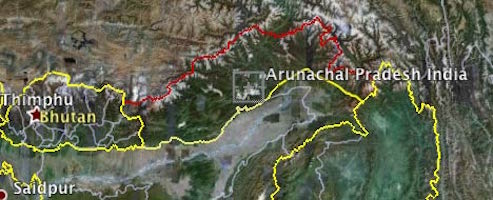
  • China renames towns in Arunachal Pradesh to support its claim

    China renames towns in Arunachal Pradesh to support its claim

    BEIJING (TIP): China has released “standardised” names of six towns of Arunachal Pradesh in Mandarin Chinese and Tibetan languages to buttress its claim over what it regards as “South Tibet”.

    The ministry tried to explain that it was a routine administrative work and part of an ongoing census on names of localities. But a Chinese expert, Xiong Kunxin, a professor of ethnic studies at the Minzu University of China in Beijing, contradicted the foreign ministry saying that the renaming exercise was aimed to “reaffirm Chinese sovereignty” over the area that belongs to India.

    The ministry of civil affairs in Beijing issued an order on April 14 saying that, “The official names of the six places using the Roman alphabet are Wo’gyainling, Mila Ri, Qoidengarbo Ri, Mainquka, Bumo La and Namkapub Ri”. It did not give the existing names of the six towns in Arunachal Pradesh.

    China had used a similar ploy naming islands in South China Sea or pulling out ancient records showing old Chinese names of islands to support its claims over the sea areas, and fight back similar claims from other countries including Vietnam, Indonesia and Philippines. China also began announcing weather forecasts of the disputed area to prove that they are part of Chinese territory.

    The new names will be shown in the international diplomatic arena as proof of China’s claims, informed sources said. China might even pull out old maps and records to show that these names existed for hundreds of years. At present, it has scant historical record to support its claims besides the fact that the 6th Dalai Lama was born in Tawang in Arunachal Pradesh, and the Tawang monastery was linked to monasteries in China in the past.

    “The standardization came amid China’s growing understanding and recognition of the geography in South Tibet. Naming the places is a step to reaffirm China’s territorial sovereignty to South Tibet,” the state backed Global Times quoted Xiong in an article on April 20, 2017.(PTI)

  • Cut down on trans fats in daily diet to reduce heart attack risk

    Cut down on trans fats in daily diet to reduce heart attack risk

    Hospitalisation for heart attacks and strokes is less common among people living in areas that restrict trans fats in foods compared to residents in areas without restrictions, new research has found.

    “Our study highlights the power of public policy to impact the cardiovascular health of a population,” said lead author Eric Brandt from Yale School of Medicine in New Haven, Connecticut, US.

    Trans fatty acids, or trans fats, are commonly found in fried foods, chips, crackers and baked goods. Eating even minimal amounts is linked to a greater risk of cardiovascular disease, the leading cause of death worldwide. Some communities in the US — most notably New York City — have eliminated the use of trans fats in restaurants and eateries in recent years.

    To study the impact of restricting trans fats, researchers compared outcomes for people living in New York counties with and without the restrictions.

    Using data from the state department of health and census estimates between 2002 and 2013, the researchers focused on hospital admissions for heart attack and stroke.

    They found that three or more years after the restrictions were implemented, people living in areas with the bans had significantly fewer hospitalisations for heart attack and stroke when compared to similar urban areas where no limits existed.

    SALTY SNACKS REDUCE THIRST, INCREASE HUNGER: STUDY

    Ever wondered, why you love those French fries with sprinkled salt and cannot keep your hands off ?

    In first of its kind, a study finds that salty food diminishes thirst and increases hunger, due to a higher need for energy.

    The results, published in the journal of Clinical Investigation, showed something different: salt stayed in the urine, while water moved back into the kidney and body.

    “It’s not solely a waste product, as has been assumed,” said one of the researcher Friedrich C Luft from Delbrück Center for Molecular Medicine in Germany.

    “Instead, it turns out to be a very important osmolyte — a compound that binds to water and helps transport it. Its function is to keep water in when our bodies get rid of salt. Nature has apparently found a way to conserve water that would otherwise be carried away into the urine by salt,” Luft added.

    The team carried out a simulated mission to Mars and an international group of scientists found exactly the opposite to be true, where Cosmonauts who ate more salt retained more water, weren’t as thirsty, and needed more energy.

    They divided participants in two groups of 10 male volunteers sealed into a mock spaceship for two simulated flights to Mars and were examined for 105 days.

    The second group was sent for over 205 days.

    Both the groups had identical diets and later they were given three different levels of salt in their food.

    The results confirmed that eating more salt led to a higher salt content in urine — no surprise there. Nor was there any surprise in a correlation between amounts of salt and overall quantity of urine.

    The findings suggest that the increase was not due to more drinking — in fact, a salty diet caused the participants to drink less. Salt was triggering a mechanism to conserve water in the kidneys.

  • Limit smartphone use to avoid personal, social problems

    Limit smartphone use to avoid personal, social problems

    People who use smartphones in excess may experience personal, social and workplace problems, warns new research.

    In the study, participants who identified themselves as “addicts” and “fanatics” exhibited signs that could indicate depression, social isolation, social anxiety, shyness, impulsivity and low self-esteem.

    “Our smartphones have turned into a tool that provides short, quick, immediate satisfaction, which is very triggering,” said Isaac Vaghefi, Assistant Professor at Binghamton University-State University of New York.

    “Our neurons get fired and dopamine is being released, and over time this makes us acquire a desire for quick feedback and immediate satisfaction. This process also has contributed to developing shorter attention spans and being more and more prone to boredom,” Vaghefi said.

    The umbrella term “technology addiction” refers to addictive behaviour related to social media, excessive texting, information overload, online shopping, gambling, video gaming, online pornography and overall smartphone usage.

    For the study, the researchers surveyed 182 college students and asked them to report their daily routine of smartphone usage. Based on the analysis of the responses, they classified the user as one of the following types —thoughtful, regular, highly engaged, fanatic and addict. 7%identified as “addicts” and 12% identified as “fanatics.”

    Both groups experience personal, social and workplace problems due to a compulsive need to be on their smartphones, according to the study published in the Information Systems Journal. Females were most likely to exhibit susceptibility to addiction, the study said.

    “While self-identified ‘addict’ users were in the minority, I predict technology addiction will increase as technology continues to advance and application, game and gadget developers find new ways to ensure users’ long term engagement with technology,” Vaghefi said.

    The researchers said that if you constantly check your smartphone, even when it does not ring or vibrate, or you get paranoid when the smartphone is not with you, seeking professional help might be a good idea.

    Moreover, if you use technology as a way of escaping problems or relieving feelings of helplessness, guilt, anxiety or depression, or you ignore what is happening in real time in favour of what is happening virtually, you might then be a right candidate to seek professional help, the researchers said.

  • IS YOUR SOCIAL DRINKING HURTING YOUR LIVER?

    IS YOUR SOCIAL DRINKING HURTING YOUR LIVER?

    Liver is the second largest human organ. It removes toxins in your body, controls cholesterol levels, fight infections, aids digestion among other key functions. Sadly, liver diseases don’t show any signs or symptoms until it reaches an advanced stage.

    Magnitude of Problem

    • ? Alcohol related toxicity is the third most common cause of morbidity and the fifth most common cause of disease burden worldwide.
    • ? It is the leading cause of mortality in people aged 15-49 years, and the total expenditure amounts to billions of dollars.
    • ? WHO estimates that 140 million people worldwide suffer from alcohol dependency, causing damage to lives and economies.
    • ? The National Institute on Alcohol Abuse and Alcoholism recommends that both males and females should not drink more than 28 g and 14 g per day, respectively.
    • ? In addition, steady daily drinking, as compared with binge drinking, appears to be more harmful
    • ? Persistent and heavy for long period more risky than sporadic heavy drinking.
    • ? In USA, 2nd leading cause for liver transplantation is alcoholic cirrhosis.
    • ? In India alcoholic liver disease occurs a decade early compared to west.
    • ? Women had greater susceptibility to ALD at any given level of intake.

    What is the spectrum of alcohol related liver disease?

    There are three main types: alcoholic fatty liver, alcoholic hepatitis and alcoholic cirrhosis.

    Alcoholic cirrhosis leads to complications of ascites, blood in vomitus, liver cancer at advanced stage.

    Alcohol related fatty liver

    Excess alcohol consumption leads to accumulation of excess fat in the liver in 90% of individuals. This is the earliest stage of alcohol-related liver disease and usually there are no symptoms. Although reversible, cirrhosis may develop in 10% of heavy drinkers.

    Patients who drink alcohol and are overweight or have diabetes have a higher risk of progressive liver damage.

    Alcoholic hepatitis

    In Alcoholic hepatitis, there is inflammation and swelling of the liver. It develops in individuals who are heavy drinkers and those who indulge in binge drinking. Symptoms include loss of appetite, nausea, vomiting, abdominal pain, fever and jaundice. One out of three heavy drinkers develops alcoholic hepatitis. If it is mild, liver damage may be reversed after stopping alcohol. Some patients of mild alcoholic hepatitis continue to drink alcohol, and they may quickly progress to severe alcoholic hepatitis and develop liver failure. Signs of liver failure are accumulation of fluid in the belly, swelling of feet and mental confusion. Severe alcoholic hepatitis is a very serious condition and fifty percent of patients with severe alcoholic hepatitis die within one month.

    Alcoholic cirrhosis

    Alcoholic cirrhosis is scarring of the liver — hard scar tissue replaces soft healthy tissue. It is the most serious type of alcohol-related liver disease. Between 10 and 20 percent of heavy drinkers develop cirrhosis. The damage from cirrhosis cannot be reversed and usually leads to development of ascites, mental confusion, and blood in vomitus or passage of blood in stools, frequent infections and ICU admissions.

    In one of the studies done by me in Liver ICU, consisting of 522 cirrhotic patients, majority (>50 per cent) had alcohol related liver disease. The prognosis of these patients was very poor with dismal survival. The cost involved in care of such patients may go upto 1 lakh rupees per day due to multiple organ failure state.

    Most of these patients require liver transplantation after a period of alcohol abstinence.

  • Cannabis may help treat itching and other skin diseases

    Cannabis may help treat itching and other skin diseases

    nti-inflammatory properties in a cannabis compound could help treat itching and a wide-range of other skin diseases, say researchers.

    The new study, published online in the Journal of the American Academy of Dermatology, summarises the current literature on the subject and concludes that pharmaceuticals containing cannabinoids may be effective against eczema, psoriasis, atopic and contact dermatitis.

    “Perhaps the most promising role for cannabinoids is in the treatment of itch,” said the study’s senior author Robert Dellavalle, Associate Professor of Dermatology at the University of Colorado School of Medicine in the US.

    In one study, eight of 21 patients who applied a cannabinoid cream twice a day for three weeks completely eliminated severe itching or pruritus. The drug may have reduced the dry skin that gave rise to the itch, Dellavalle said.

    The primary driver in these cannabinoid treatments could be their anti-inflammatory properties, he added.

    In the studies reviewed, the researchers found that THC (tetrahydrocannabinol) the active ingredient in marijuana, reduced swelling and inflammation in mice. At the same time, mice with melanoma saw significant inhibition of tumour growth when injected with THC.

    “These are topical cannabinoid drugs with little or no psychotropic effect that can be used for skin disease,” Dellavalle said.

    Still, Dellavalle cautioned that most of these studies are based on laboratory models and large-scale clinical trials have not been performed.

  • IS YOUR HOUSE ROMANCE READY?

    IS YOUR HOUSE ROMANCE READY?

    ecreate intimate moments in your home and celebrate romance every day! Celebrating the smaller things in life is what adds to your love for each other. So, make each day special by recreating some romantic moments – spending your day together at home.

    MONOGRAMMED MUGS & WINE GLASSES

    Have a little celebration with coffee cups or wine glasses, which have your and your partner’s monogrammed initials. Says Tanya Mehta, interior expert, “Monogrammed gifts and household items work very well on Valentine’s Day, as they add a personal touch.”

    WRITE A PICTURE POEM OR LOVE LETTER

    Love letters are rare things that don’t cost a thing. If you want to be more creative, how about a picture poem? Get a picture from a postcard and then write a love poem based on the picture. Shares Nisha Khanna, family therapist,”Expressing your feelings for each other creates an atmosphere of well-being for the couple and also boosts your love.”

    LOVE PILLOW

    Add the word ‘love’ with paint on your pillow, or just invest in a few heart-shaped pillows. Says Michael, “You can also colour co-ordinate the linen of your bedroom. Play up the sensuality with a red linen bedcover.”

    CHARM WITH CANDLES

    Candles have always been the quintessential ROMANTIC ACCESSORY. They bring warmth to your room. Red candles are for passion, pink for romance and white for comfort. Take your pick and add some magic to your day.

    CREATE A MEMORY BOARD

    How about putting your favourite romantic memories on a memory board?Create a paper decoration with messages for your loved one on a board. Says Gitanjali Sharma, therapist, “You can also frame your favourite ‘love quote’ and put it on the table for your partner to read.”

    EVERLASTING LOVE PAPER BOUQUET

    This bouquet never dies. You can create a flower bouquet with crepe paper in the colours of love like, red and pink.

    Here’s how: Cut a 20-inch strip of crepe paper into rounded petals. Leave about oneinch at the bottom so the strip won’t tear. Roll the crepe paper strip around the stem or wire, fluffing and shaping the petals as you go. Or you could even create a sweet floral arrangement. Simply fill a clear vase with heart candies.

    GIFT A BOOK OF LOVE

    Spend the day together with a love book, solving quizzes or simply cooking something together from a recipe book. Not only will you spend time together but also discover something new about one another. Says Khanna, “This is positive intimacy. Trivia, poems and recipes – sharing these will add to the celebration in a different way.”

    BREAKFAST IN BED

    Get a woven breakfast tray and start your day in style. Dish up a yummy and simple breakfast that the two of you can enjoy in bed. Interior designer and sexologist Dawn Michael says, “It’s these wonderful little things that add a touch of intimacy to your relationship.” How about serving some heartshaped egg fry rings? A perfect way to warm up to your man’s heart through his stomach!

  • SALTY SNACKS REDUCE THIRST, INCREASE HUNGER: STUDY

    SALTY SNACKS REDUCE THIRST, INCREASE HUNGER: STUDY

    Ever wondered, why you love those French fries with sprinkled salt and cannot keep your hands off ?

    In first of its kind, a study finds that salty food diminishes thirst and increases hunger, due to a higher need for energy.

    The results, published in the journal of Clinical Investigation, showed something different: salt stayed in the urine, while water moved back into the kidney and body.

    “It’s not solely a waste product, as has been assumed,” said one of the researcher Friedrich C Luft from Delbrück Center for Molecular Medicine in Germany.

    “Instead, it turns out to be a very important osmolyte — a compound that binds to water and helps transport it. Its function is to keep water in when our bodies get rid of salt. Nature has apparently found a way to conserve water that would otherwise be carried away into the urine by salt,” Luft added.

    The team carried out a simulated mission to Mars and an international group of scientists found exactly the opposite to be true, where Cosmonauts who ate more salt retained more water, weren’t as thirsty, and needed more energy.

    They divided participants in two groups of 10 male volunteers sealed into a mock spaceship for two simulated flights to Mars and were examined for 105 days.

    The second group was sent for over 205 days.

    Both the groups had identical diets and later they were given three different levels of salt in their food.

    The results confirmed that eating more salt led to a higher salt content in urine — no surprise there. Nor was there any surprise in a correlation between amounts of salt and overall quantity of urine.

    The findings suggest that the increase was not due to more drinking — in fact, a salty diet caused the participants to drink less. Salt was triggering a mechanism to conserve water in the kidneys.

    Cut down on trans fats in daily diet to reduce heart attack risk

    Hospitalisation for heart attacks and strokes is less common among people living in areas that restrict trans fats in foods compared to residents in areas without restrictions, new research has found.

    “Our study highlights the power of public policy to impact the cardiovascular health of a population,” said lead author Eric Brandt from Yale School of Medicine in New Haven, Connecticut, US.

    Trans fatty acids, or trans fats, are commonly found in fried foods, chips, crackers and baked goods. Eating even minimal amounts is linked to a greater risk of cardiovascular disease, the leading cause of death worldwide. Some communities in the US — most notably New York City — have eliminated the use of trans fats in restaurants and eateries in recent years.

    To study the impact of restricting trans fats, researchers compared outcomes for people living in New York counties with and without the restrictions.

    Using data from the state department of health and census estimates between 2002 and 2013, the researchers focused on hospital admissions for heart attack and stroke.

    They found that three or more years after the restrictions were implemented, people living in areas with the bans had significantly fewer hospitalisations for heart attack and stroke when compared to similar urban areas where no limits existed.

  • SOON, FACEBOOK TECH WILL LET OUR BRAINS TYPE

    SOON, FACEBOOK TECH WILL LET OUR BRAINS TYPE

    LOS ANGELES (TIP): Facebook is working on a new ‘silent speech’ technology that will allow people to type directly with their brains, drastically reducing the time it takes to convert our thoughts into written words.

    The silent speech system will be capable of typing 100 words per minute straight from the brain – five times faster than one can type on a smartphone today, Facebook said.

    At the annual two-day event F8, where developers come together to explore the future of technology – Facebook announced two projects focused on silent speech communications.

    “We shared a project we’re working on that will one day allow us to choose to share a thought, just like we do with photos and videos,” Facebook founder and CEO Mark Zuckerberg, said in a post.

    “Our brains produce enough data to stream 4 HD movies every second. The problem is that the best way we have to get information out into the world -speech – can only transmit about the same amount of data as a 1980s modem,” Zuckerberg said.

    “We’re working on a system that will let you type straight from your brain about 5x faster than you can type on your phone today,” he said.

    “Eventually, we want to turn it into a wearable technology that can be manufactured at scale. Even a simple yes/no “brain click” would help make things like augmented reality feel much more natural,” he added.

    “This isn’t about decoding your random thoughts. You take many photos and choose to share only some of them. Similarly, you have many thoughts and choose to share only some of them,” said Regina Dugan, head of Building 8.

    “This is about decoding those words you’ve already decided to share by sending them to the speech centre of your brain. It’s a way to communicate with the speed and flexibility of your voice and the privacy of text,” said Dugan.

    “We want to do this with non-invasive, wearable sensors that can be manufactured at scale,” she said.

    Building 8 is the product development and research team at Facebook focused on creating and shipping new, category-defining consumer products that are social first, and that advance Facebook’s mission.

    Products from Building 8 will be powered by a breakthrough innovation engine modelled after DARPA and shipped at scale.

    “We also have a project directed at allowing people to hear with their skin. We are building the hardware and software necessary to deliver language through the skin,” Facebook said.

  • THE SIKH WAY OF LIFE

    THE SIKH WAY OF LIFE

    Sikhs focus their lives around their relationship with God, and being a part of the Sikh community. The Sikh ideal combines action and belief. To live a good life a person should do good deeds as well as meditating on God.

    • There is only one God
    • God is without form, or gender
    • Everyone has direct access to God
    • Everyone is equal before God
    • A good life is lived as part of a community, by living honestly and caring for others
    • Empty religious rituals and superstitions have no value

    God and the cycle of life

    Sikhs believe that human beings spend their time in a cycle of birth, life, and rebirth. They share this belief with followers of other Indian religious traditions such as Hinduism, Buddhism and Jainism.

    The quality of each particular life depends on the law of Karma. Karma sets the quality of a life according to how well or badly a person behaved in their previous life. The only way out of this cycle, which all faiths regard as painful, is to achieve a total knowledge of and union with God.

    The God of grace

    Sikh spirituality is centred round this need to understand and experience God, and eventually become one with God.

    To do this a person must switch the focus of their attention from themselves to God. They get this state, which is called mukti (liberation), through the grace of God. That means it’s something God does to human beings, and not something that human beings can earn. However, God shows people through holy books, and by the examples of saints, the best ways to get close to him.

    Sikhs believe that God can’t be understood properly by human beings, but he can be experienced through love, worship, and contemplation.

    Sikhs look for God both inside themselves and in the world around them. They do this to help themselves achieve liberation and union with God.

    Getting close to God

    When a Sikh wants to see God, they look both at the created world and into their own heart and soul.

    Their aim is to see the divine order that God has given to everything, and through it to understand the nature of God.

    Most human beings can’t see the true reality of God because they are blinded by their own self-centred pride (Sikhs call it haumain) and concern for physical things.

    God inside us

    Sikhs believe that God is inside every person, no matter how wicked they appear, and so everyone is capable of change.

    God beyond ourselves

    Sikhs believe that God’s message can be found in several ways outside ourselves.

    The message is written in the whole of creation; look at it with open eyes and see the truth of God, for creation is the visible message of God

    Sikhs believe that most of us misunderstand the universe. We think that it exists on its own, when it really exists because God wills it to exist, and is a portrait of God’s own nature

    The message has been shown to us by the Gurus in their lives and in their words.

    The message is set down in the teachings of scripture

    Living a good life in this world

    Sikhs don’t think it pleases God if people pay no attention to others and simply devote themselves slavishly to religion.

    Sikhism doesn’t ask people to turn away from ordinary life to get closer to God. In fact it demands that they use ordinary life as a way to get closer to God.

    A Sikh serves God by serving (seva) other people every day. By devoting their lives to service they get rid of their own ego and pride. Many Sikhs carry out chores in the Gurdwara as their service to the community. These range from working in the kitchen to cleaning the floor. The Langar, or free food kitchen, is a community act of service.

    Sikhs also regard caring for the poor or sick as an important duty of service.

    The three duties

    The three duties that a Sikh must carry out can be summed up in three words; Pray, Work, Give.

    Nam japna Keeping God in mind at all times.

    Kirt Karna Earning an honest living. Since God is truth, a Sikh seeks to live honestly. This doesn’t just mean avoiding crime; Sikhs avoid gambling, begging, or working in the alcohol or tobacco industries.

    Vand Chhakna (Literally, sharing one’s earnings with others) Giving to charity and caring for others.

    The five vices Sikhs try to avoid the five vices that make people self-centred, and build barriers against God in their lives.

    • Lust
    • Covetousness and greed
    • Attachment to things of this world
    • Anger
    • Pride

    If a person can overcome these vices they are on the road to liberation.

    Five Sikh Symbols

    The Five Ks are the five items of dress and physical appearance given to Sikhs by Guru Gobind Singh when he gathered together the first members of the Khalsa on Vaisakhi day in 1699. These symbols give Sikhs a unique identity signifying discipline and spirituality. However, these items cannot be reduced to just symbols and must be worn in their full form.

    Kesh

    • Uncut hair, which is kept covered by a turban, or dastaar.
    • Kesh are a traditional symbol of holiness in India, and the turban is a symbol of leadership.
    • The dastaar is worn by men and some women to cover their long hair.

    Kirpan

    • A ceremonial sword, symbolizing readiness to protect the weak, and defend against injustice and persecution.
    • The kirpan is normally worn with a cloth shoulder strap called a gatra.
    • The kirpan exemplifies the warrior character of a Sikh.

    Kara

    • A steel bracelet, symbolizing strength and integrity.
    • Steel is symbolic of strength yet resilient under stress. In the same way, the human soul must become as strong and unbreakable as steel which has been tempered in the furnace.

    Kangha

    • A small wooden comb, symbolizing cleanliness and order.
    • The kangha is used to keep the hair clean and is normally tucked neatly in one’s uncut hair.
    • As a Sikh combs their hair daily, he or she should also comb their mind with the Guru’s wisdom.

    Kachhera

    • Cotton boxer shorts, symbolizing self-control and chastity; prohibition of adultery.
    Article Sponsored by Indo-US Foundation, Inc
    Article Sponsored by Indo-US Foundation, Inc
  • First detailed global Internet atlas developed

    First detailed global Internet atlas developed

    WASHINGTON (TIP): Scientists have developed the first global Internet Atlas — including a detailed map of the internet’s physical structure in India —an advance that could help guard the infrastucture from terrorism or extreme weather events.

    Despite the internet-dependent nature of our world, a thorough understanding of the internet’s physical makeup has only recently emerged through Internet Atlas developed by researchers from University of Wisconsin-Madison in the US and their collaborators.

    “Internet is in a constant state of flux and mapping is really important to understand the evolution of the Internet,” Ramakrishnan Durairajan, a PhD candidate at the University of Wisconsin-Madison said.

    “No single service provider can offer an authoritative perspective on the structure of the Internet,” Durairajan said. While average users rarely think of these elements, things like submarine cables – buried below the ocean floor —run between continents to enable communication. Data centres in buildings all over the world are packed with servers storing many types of data. Traffic exchange occurs between different service providers at internet exchange points.

    Though these and other elements may be out of sight for the average user, they are crucial pieces of the physical infrastructure that billions of people rely on.

    “We have over 1,200 maps worldwide including India. All the data are connected using web search,” said Durairajan.

    “From maps that we have in our repository I’d say we have fibre running across almost all the states in India. However, connectivity could be improved in the north-western and north-eastern regions,” he added.

    Mapping the physical internet helps stakeholders boost performance and guard against a number of threats, from terrorism to extreme weather events like hurricanes. Source: PTI