NEVADA (TIP): Hindus are urging all state and independent/private schools in Wales (United Kingdom) to close on Diwali, most popular of their festival, which falls on October 19 this year.
Distinguished Hindu statesman Rajan Zed, in a statement in Nevada (USA) said that it would be a step in the positive direction, as it was important to meet the religious and spiritual needs of Hindu pupils.
Zed, who is President of Universal Society of Hinduism, indicated that Wales schools should make efforts to accommodate the religious requirements of Hindu students and show respect to their faith by not conducting regular business and scheduling classes on Diwali. We did not want our students to be put at an unnecessary disadvantage for missing tests/examinations/papers, assignments, class work, etc., by taking a day-off to observe Diwali.
If schools had declared other religious holidays, why not Diwali, Rajan Zed asked. Holidays of all major religions should be honored and no one should be penalized for practicing their religion, Zed added.
Zed suggested that all Wales schools, state as well as independent/private, to seriously look into declaring Diwali as an official holiday, thus recognizing the intersection of spirituality and education. Zed noted that awareness about other religions thus created by such holidays like Diwali would make Wales students well-nurtured, well-balanced, and enlightened citizens of tomorrow.
Rajan Zed urged Welsh First Minister Carwyn Jones and Cabinet Secretary for Education Kirsty Williams to work towards adding Diwali as an official holiday in all the state schools of Wales, and persuading the independent/private schools to follow.
Zed further says that Hinduism is rich in festivals and religious festivals are very dear and sacred to Hindus. Diwali, the festival of lights, aims at dispelling the darkness and lighting up the lives and symbolizes the victory of good over evil.
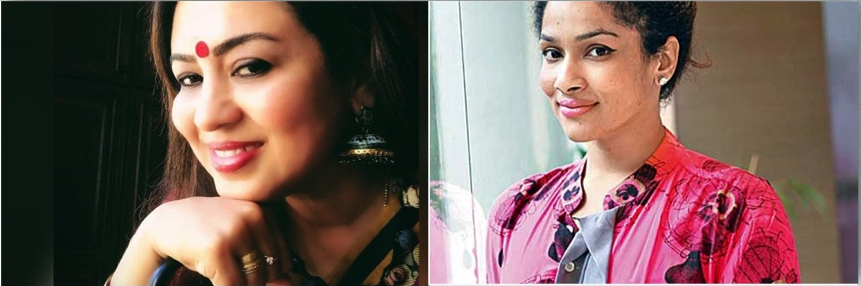
SAN JOSE (TIP): Bay area-settled Indian actress Jaishree Chandrasekar is presenting Urban Panache USA in partnership with House of Masaba to cast Masaba spell on Silicon Valley.
She is presenting international designer Masaba Gupta founder and creative head of House of Masaba at Amber India, 4296 El Camino Real, Los Altos on July 8 between 1 PM and 5 PM.
Gupta is the daughter of the National Film Award winning powerhouse of an actress, TV host and Theater producer, Neena Gupta and the legendary King of Swagger and Cricket, Sir Isaac Vivian Alexander Richards.
Gupta gave tennis, dance, music, radio jockey and acting a shot. Sixth time was the game changer for this young lady as she enrolled herself into fashion school. And like a phoenix, she rose and continues to soar high.
Back in 2009, her mentor Wendell Rodricks encouraged her to apply for Lakme Fashion Week in Mumbai at the tender age of 19 under Gen Next category. By 2010 she won the award for Best Emerging Designer by Cosmopolitan (2010).
Gupta kept scaling newer heights, as the fashion world raved about the ethereal Sonam Kapoor as she debuted Masaba Saree at Cannes 2011. Masaba became a celebrity favorite, and her designs featured on every major Fashion magazines and blogs. Her ability to turn everyday objects into retro prints caught the attention of women across the seven seas, including me. In 2015 Vogue Italia (2015) awarded her India’s most promising talents.
Masaba a diffusion line – unique and revolutionary is one of India’s most successful fashion labels. The strength of the label lies in the ability to marry traditional Indian sensibilities and aesthetics while keeping the modern context alive.
By 2017 she made it to the prestigious Forbes India’s 30 under 30 list. The headline rightfully said, “Masaba Gupta’s instinct-driven designs belie her age”. The Brand That Talk To the Mighty Girls
Her lust-worthy brand appeals to the modern women across the globe. From the ones who enjoy fuss-free kitschy clothing to the elegant show-stoppers. Her clothes are versatility personified. They can effortlessly transition from the tech conferences in Silicon Valley to the bustling streets of Florence.
Sonya & Trisha Suri, the dynamic mother and daughter duo founded Urban Panache. Trisha, a Business Management major and currently a student getting her masters in Computer Science at CMU, was helping her friend with her wedding trousseau. It was then that Trisha realized that there was a shortage of options in the United States when it came to catering locally to the American brides.
Jaishree is an Indian actress who has acted in Tamil-language films in the 1980s. She was introduced by veteran Tamil director C. V. Sridhar in the movie Thendrale Ennai Thodu in 1985. She got married in 1988 and lives in the San Francisco Bay area with her husband Chandrasekar and two sons.
Jaishree went back to school educated herself in Technology and has been a t technology professional for the past 17 years. However, she made a comeback with movie titled Kadhal 2 Kalyanam in 2014, but the movie release has been delayed. On Christmas Day 2016, Jaishree’s other comeback film Manal Kayiru 2 (the sequel of the original 80s iconic hit) released in theaters internationally. She is the granddaughter of late S Jayalakshmi singer and actress and is grand niece of globally renowned artist and painter S. Rajam & Veena Vidwan Padmabhushan S. Balachander, both her grandmother’s brothers.
She is now venturing into social media marketing with her page ‘Jaishree Chandrasekar Presents’.
For years, Jaishree’s clothing, jewelry, make-up style, cooking, recipes, kitchen ideas, travel ideas and suggestions & comments on assorted topics such as settling in the US, raising children have been of interest to her friends and family.
On her Facebook page, Jaishree Chandrasekar Presents, she hopes to expand this to a broader audience. The Face book page will promote items that she recommends & enable limited edition items and services as well, thereby opening up a vetted and credible shopping experience.
Jaishree and her team are currently in the process of quality-testing select vendors in the fashion industry, resorts and jewelry designers. One such company is Vaishali bangles inspired by the tradition meet modern design. They customize Jewelry according to the trend and also to suit custom requirements. Look out for recommendations on this page soon. For vendors who would like to reach quality clientele via Jaishree. Contact Jaishree at jaishreechandrasekarpresents@gmail.com
Parliament must resist a proposed amendment that compromises the 100-m no-construction zone
By Nayanjot Lahiri
“India’s monuments form an irreplaceable archive of our civilizational heritage. Our pride in our heritage has always been surplus while caring for that heritage suffers a huge deficit. Surely, India’s archaeological heritage, as diverse and priceless as our natural heritage, seventy years after Independence, deserves better than what has fallen to its lot”, says the author.
India’s monumental heritage is on the brink of a shameful shift. The Central government is poised to introduce an amendment to the Ancient Monuments and Archaeological Sites and Remains Act, 1958, in Parliament, which would remove the security net that exists around our nationally protected monuments.
Endangered structures
Why is this security net necessary, and why is its proposed infringement shameful? Our protected monuments, from the Taj Mahal to the monuments of Mamallapuram, have a designated prohibited area — at least a 100-m radius — to protect them, where no new construction is allowed. It is similar to the zoning around tiger reserves where the core area is set apart for the animals to live in, and where human disturbance is not permitted. Just as this is done to prevent human-animal conflict, zoning around monuments is necessary to prevent monuments from defacement and to prevent the present from displacing the past by marring historical landscapes. Monuments, it needs to be remembered, are endangered structures and vulnerable to human interference. If tigers have disappeared across large parts of the habitats they occupied even till the early part of the last century, so have several of India’s protected monuments. As it is, there are a mere 3,650 monuments which are nationally protected in a country where the records with the government show some 5,00,000 unprotected and endangered monuments.
The track record of the government in maintaining our nationally protected monuments, to put it most charitably, is an indifferent one. There are encroachments by government agencies and individuals. The 2013 report of the Comptroller and Auditor General (CAG) noted that of the 1,655 monuments whose records were scrutinized and which were physically inspected, 546 of them were encroached. This may well be because of a lack of basic manpower in the form of monument attendants. In 2010, the Archaeological Survey of India (ASI) stated on record that its staff strength did not permit the deployment of even a single person on a regular full-time basis at more than 2,500 of its monuments. This meant that more than two-thirds of India’s monuments that the Central government is supposed to protect were poorly guarded. At the same time, the CAG pointed to connivance by ASI officials as well. As the files of the ASI reveal, there are also numerous instances where politicians have proactively protected those who have illegally occupied the prohibited zone around monuments.
The only protection for our defenseless heritage has come from courts of law because there are legal provisions which, at least on paper, prevent the encroachment of the prohibited zone around monuments. The idea itself, that a security net ought to be created around heritage buildings, can be traced to Jawaharlal Nehru. As Prime Minister, he complained to the Union Minister of Education in 1955 that India’s old and historical places were getting spoilt by new buildings being put up around them. In order to prevent intrusions, Nehru suggested that the government “lay down that within a certain area no building should be put up without permission”. An example of his proactive approach in creating such protective barriers is the enclosure encircling the tomb of Abdur Rahim Khan-i-Khana in Nizamuddin. This was built after Nehru had visited the site and suggested that the adjacent grounds be converted into a garden because, as he put it, he did not want the colony of Nizamuddin East to extend into the area around the tomb. This idea eventually found its way into the Ancient Monuments and Archaeological Sites and Remains Rules of 1959 which unambiguously, for the first time, noted a prohibited and a regulated zone around protected sites and monuments.
Because of these rules, the High Court of Delhi in 2009 struck down all permissions that had been illegally granted by the ASI through an Expert Advisory Committee. As a consequence of this judgment, in 2010, the Government of India set up a committee which recommended a new bill to Parliament. It is now known as the Ancient Monuments and Archaeological Sites and Remains (Amendment and Validation) Act. Unanimously passed in March 2010, this legislation brought the prohibited and regulated zones around monuments within the ambit of the Act itself.
As a consequence of this statute, the National Monuments Authority was set up. It is shocking that even after these years, a major task of this authority remains to be done, that of preparing heritage bye-laws for nationally protected monuments. If India’s rulers cared at all for our monuments, by now not only would the bye-laws pertaining to the 3,650 national monuments have been prepared, they would also have been tabled in Parliament as was required by law. Instead of expediting the preparation of those bye-laws, the government has sought to dilute the 100 m prohibited area around nationally protected monuments. The proposed amendment aims to allow the Central government to construct within that area all kinds of structures. Incidentally, the Cabinet note shows that the Ministry of Culture, instead of protecting monuments, is now acting a clearing house for the Ministry of Road Transport and Highways. The amendment is necessary, the Cabinet note states, because, among other things, an elevated road needs to be built in front of Akbar’s tomb in Agra! The Ministry of Culture needs to be reminded that it is the nodal agency for protecting our monuments, not endangering them. Otherwise, it is better for the government to abolish this ministry since cultural protection is far from what it seems to be doing.
One people, two norms
What makes this amendment shameful is that our Ministers live in the Lutyens Bungalow Zone in New Delhi where overhead metro lines have not been permitted because, quite rightly, they would have permanently marred the aesthetics of the area. Hundreds of crores of rupees have been spent to ensure that there are no ugly railway corridors across that area. Yet, the ruling class has no compunction in pushing for a legislation which would allow overhead contraptions in the vicinity of our national monuments. Does the government believe that the aesthetics around government bungalows matter but not around monuments? Or is it possible that they believe that monuments do not matter and only highways do?
India’s monuments form an irreplaceable archive of our civilizational heritage. Our pride in our heritage has always been surplus while caring for that heritage suffers a huge deficit. Surely, India’s archaeological heritage, as diverse and priceless as our natural heritage, seventy years after Independence, deserves better than what has fallen to its lot
(The author is a historian and archaeologist of ancient India and a professor of history at Ashoka University)
Judging even by the high standards of personalized diplomacy set in place in the last three years, Prime Minister Narendra Modi’s three-day visit to Israel has to be judged as an astounding success. The Prime Minister was serenaded in lavish terms; the reddest of red carpet was rolled out for him, just as stiff protocol niceties were rolled away to honor him; we are told that the standards and excellence of hospitality and courtesies extended to him were so far reserved only for the mightiest of global leaders. Narendra Modi had always had, reportedly, a special relationship with his Israeli counterpart, based on mutual respect and admiration that leaders reserve for strong, tough practitioners of hard politics. Israel’s Prime Minister Benjamin Netanyahu naturally went out of his way to lionize our Prime Minister; and, it was only natural that the visit should have produced a ‘strategic partnership’.
A ‘strategic partnership’, in many ways, has become a charming amulet, diplomats have devised to upgrade a relationship. We have, for example, a strategic partnership with the United States, but we have very many valid and legitimate reasons to feel disappointed at Washington’s lack of appreciation of our strategic concerns and sensibilities. On the other hand, even without a strategic partnership, New Delhi has had a steadily growing, pragmatic, working relationship with Tel Aviv. Both countries have a shared sense of victimhood against global terror. This working arrangement already had in place all the ingredients of a strategic partnership. What the Modi visit has done is to put the de jure stamp on a de facto relationship.
Over the decades our relationship with Israel had got hyphenated with the knotty Palestine issues. There were both domestic and geostrategic reasons for a cultivated ambivalence; the India-Israel ties were overdue for an upgrade as most of these reasons for diffidence have melted away. Domestically, for the first time New Delhi has is a ruling regime that believes that it does not need to get bogged down by the Muslim community’s traditional sensitivities, at home or abroad. It is this substantive change in our internal political calculus that has lent a new substance to our ties with Israel.
“A lobbyist is an activist who seeks to persuade government members to enact legislation that would benefit their group. It is inextricably linked to the democratic political process. But equally true is that such petitioners are associated with bribery and looked down upon for endeavoring to influence decisions through wheeling and dealing and wining and dining”, says the author.
When the Prime Minister of India, the largest democracy in the world, met the President of the USA, the second largest democracy (in terms of population), last week, he got a red carpet welcome and the privilege to hobnob in the White House precincts. Among the other perks that come with the territory, Mr. Modi got to stay in the iconic Willard InterContinental Hotel that is located at a stone’s throw from the presidential mansion in Washington DC. He joined legends who have stayed in this luxurious property and contributed to the historic value of the 200-year-old hotel.
Due to its ideal location, the hotel has been the center of the US’ social and political scene. And, Willard loves to prop up the fascinating folklore attached with its celebrated guests. It is famously said that Martin Luther King Jr gave the finishing touches to his famous “I have a dream” speech here. Another tidbit: that Abraham Lincoln walked in its corridors before his inauguration.
Then, due to the goings-on in the hotel because of its strategic location, Willard has also had a role in the legitimization of a word – lobby, as in ‘seek to influence (a legislator) on an issue.’
Though lexicologists trace the term lobby to the British Parliament, the hotel has been fanning the myth related to its foyer. Most likely, the hotel’s saga helped reinforce and push the word into gaining acceptance worldwide. So, how is the Willard’s lobby related to the term lobbying?
The story originated during the presidency of Ulysses S Grant (1869-1877). President Grant enjoyed his drink and cigar while relaxing in the hotel lobby. And not-so fortuitously, folks fancying favors, flocked the foyer for a favorable influence on his decision-making. Thus, it came to be said and was even reported in newspapers that President Grant had coined the term by referring to the petitioners as “those damn lobbyists.”
Of course, now lobbying has evolved into an art that does not necessarily take place in a lobby. A lobbyist is an activist who seeks to persuade government members to enact legislation that would benefit their group. It is inextricably linked to the democratic political process. But equally true is that such petitioners are associated with bribery and looked down upon for endeavoring to influence decisions through wheeling and dealing and wining and dining. Wheeling and dealing is an attempt to make a deal or get an advantage by using complicated and sometimes unfair or dishonest means. And, to wine and dine someone is to entertain someone to a lavish meal and fine wines, usually with an ulterior motive.
In this context, I must confess that as a journalist, I have partaken of meals that often exude of a flavor of lobbying. I guess it’s a job hazard that a good professional would know how to deal with objectively.
Interestingly, the ‘Washington Post’, quoting a Gallup poll, has reported that the occupation most despised in the USA is lobbying. While lawyer jokes are legion and salesmen are lampooned routinely, lobbyists are so despicably low on ethics that they don’t even merit ridicule. The practitioners move around with such fancy titles as ‘government relations officer’.
No surprise that the Willard has, of late, been choosing to distance itself from the myth related to the coining of the term lobby.
In India, a public relations firm came for flak and ultimately winded up following the leak of its notorious ‘Nira Radia tapes’. But it is Dhirubhai Ambani who is synonymous with mastering the knack of corporate lobbying. His dealings in the corridors of powerful authorities during the rise of the Reliance group reveal wheels within wheels (hidden or unknown things that influence a particular situation, making it more complicated than it seems at first).
It seems that the warp and woof (the foundation of any structure or organization) of Ambani’s journey from a schoolteacher’s son to a giant tycoon is cemented by lobbying, along with competence, hard work, management skills and foresight. The phrase warp and woof comes from weaving, in which the warp — the threads that run lengthwise — and the woof — the threads that run across — make up the fabric.
I got a peep into Ambani’s fascinating and, at times, dark style of functioning on one of my trips abroad as I laid hands on his unauthorized biography ‘The Polyester Prince: The Rise of Dhirubhai Ambani’ by Hamish McDonald. The book is banned in India.
The book sums up human interactions thus: “Nobody is a permanent friend, nobody is a permanent enemy. Everybody has his own self-interest. Once you recognize that, everybody will be better off.” And, lobbying is justified by quoting Ambani himself thus: “You should not do anything illegal. First of all, the law should be changed.” So, he did exactly what he preached with prowess: by establishing connections with lawmakers.
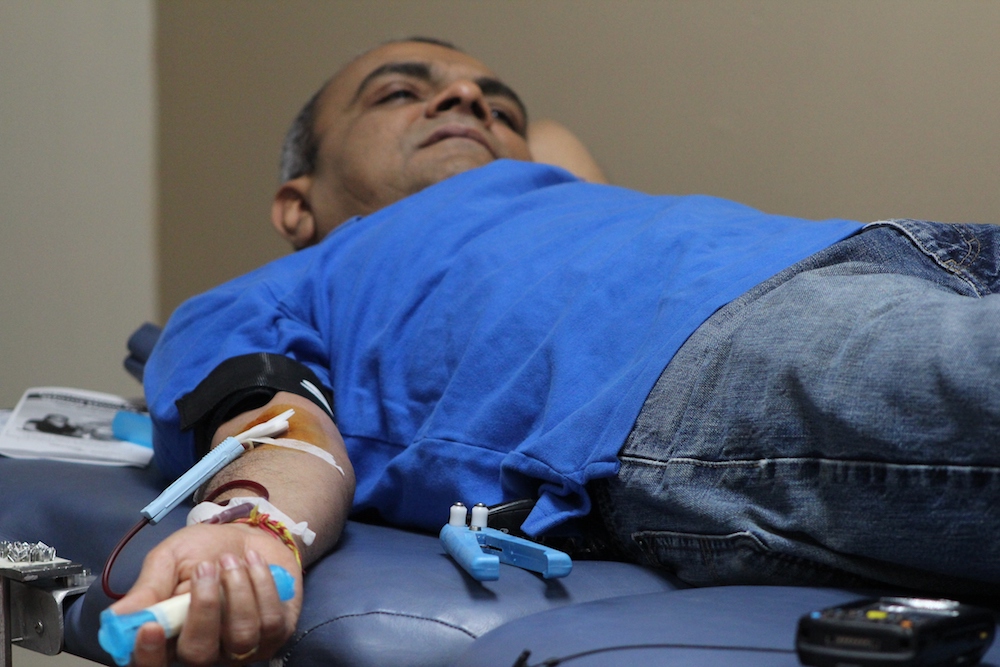
PARSIPPANY, NJ (TIP: Dozens of members of the local community committed its focus to the annual BAPS Charities Blood Drive in Parsippany, NJ. With a continuous need for blood donors from a diversity of backgrounds, the blood drive, held on Sunday 25th June 2017, gave community members an opportunity to save lives and close the gap on supply shortages faced by blood banks.
A total of 26 pints of blood were collected, which has the potential to save up to 78 lives in the community. Through a local partnership with Red cross, all of the collections were donated to local blood banks to serve nearby communities.
The Blood Drive organized by BAPS Charities is a crucial part of national efforts to address shortages. Statistics suggest that every two seconds someone in the United States needs blood. According to the American Red Cross, the majority of blood donations come from local, community-based drives such as this.
“We are happy for the opportunity to do this service on a regular basis and assist area agencies through our community’s contribution,” said Shailesh Patel referring to the event.
BAPS Charities also used the event as a platform to raise awareness around the need for regular blood donations and the significant impact they have, especially during demanding periods. Punit Patel from Parsippany, a blood drive participant, remarked, “I am glad to have come out today and participated in the blood drive. It is empowering to know that my donation could potentially save someone’s life and I look forward to sharing what I have learned with my friends and colleagues at work, so they will hopefully do the same.”
The Blood Drive event is one of several service events held by BAPS Charities each year. Health fairs, walkathons, children’s health and safety events, and bone marrow drives are also held annually and in multiple locations across the country. Through these activities, BAPS Charities aims to develop a broader spirit of volunteerism to enable individuals of all ages to make meaningful contributions to society.
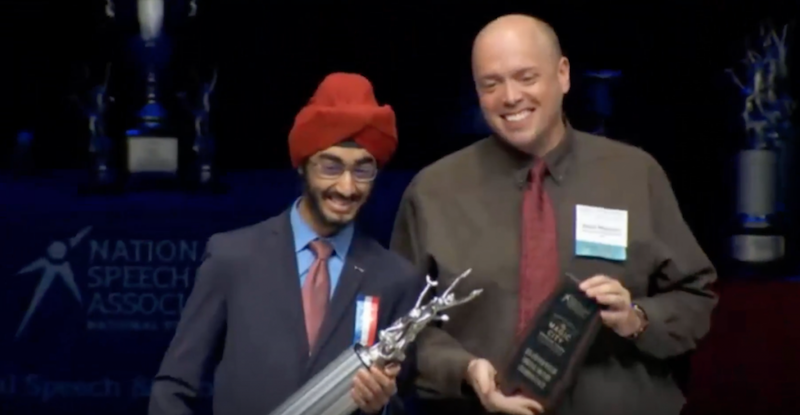
NEW YORK (TIP): Kapur, an Indian American Sikh high school student at Valley High School junior in West Des Moines, Iowa, has won this year’s National Speech and Debate Tournament which is considered as the most prestigious high school competition in the US.
The win continued his impressive string of victories, which included first-place finishes at the Emory University, Minneapple and Harvard University tournaments and the Barkley Forum for High Schools.
As an original orator, Kapur composed his own persuasive speech addressing a social issue. His speech, “Let’s Dance,” started out with a lively Bollywood dance and focused on his experiences as a Sikh American youth. He earned top rankings in the semifinal and final rounds of the Tournament of Champions before earning the championship trophy.
The Tournament of Champions is the most prestigious high school speech and debate competition in the U.S. To qualify, debaters must receive two bids, earned by advancing to late elimination rounds at select individual tournaments. Held annually at the University of Kentucky, the tournament provides the most successful debaters from individual tournaments with a chance to compete with each other. Valley seniors T.J. Foley and Trent Gilbert also made it to the elimination rounds of the Tournament of Champions.
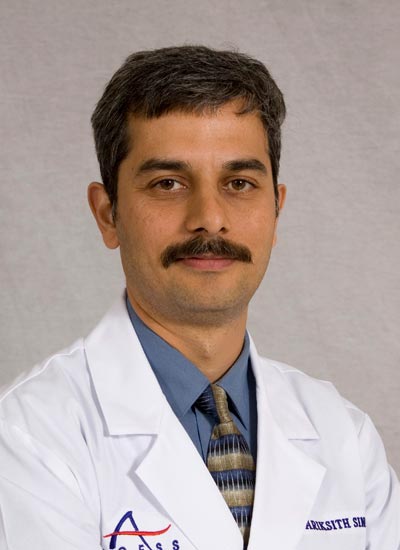
BROOKSVILLE, FL (TIP): Oak Hill Hospital recently recognized Pariksith Singh, MD, as this year’s Frist Humanitarian Physician Award winner.
The Frist Humanitarian Award was founded in 1971 and honors outstanding individuals for their humanitarian and volunteer activities. It is one of HCA’s Awards of Distinction and is one of the highest honors that HCA bestows on employees, physicians and volunteers. Named in honor of Dr. Thomas F. Frist Sr., a founder of HCA and renowned humanitarian, this award recognizes individuals whose daily dedication and care giving, epitomize the highest standards of quality and personal commitment.
Dr. Singh was presented with the Special Doctor Service Award by iLa Ganeshan, a member of Parliament in India
In recognizing Dr. Singh, his nomination included the following:
Provides excellent healthcare to the community
He puts his patients first
His actions speak louder than words
He shows respect for everyone
Dr. Singh received his medical training in India and completed his residency at Mount Sinai Elmhurst in 1996. He has held his Board Certification in Internal Medicine since that time. Upon completion of his residency, he moved to Florida and began his medical career. In 2001, he co-founded Access Health Care, LLC, where he continues as CEO, Medical Director, owner and physician.
Dr. Singh began the Auroveda Operating Foundation which includes the Community Outreach Center, Auro Community Garden, and the Kids’ Garden at Pine Grove Elementary School. Other organizations he supports include People Helping People, Disabled American Veterans, the Crescent Community Clinic, Wounded Warrior Project, and neighborhood schools
In addition, he has established the Auroveda Integral Foundation in Jaipur, India. Through the foundation, he has organized an Ayervedic and Homeopathic dispensary. The center provides cost-free treatment. Further, the foundation has submitted a proposal to establish a healthcare wellness and AYUSH Center in Jaipur that would have satellite locations in rural areas. AYUSH is an acronym that is used to describe the non-allopathic medical system in India. AYUSH refers to Ayurveda, yoga, unani, siddha and homeopathic.
Recently Dr. Singh was presented with the Special Doctor Service Award by iLa Ganeshan, a member of Parliament in India. The award was in recognition of Dr. Singh’s contributions to healthcare.
CHICAGO (TIP)The Securities and Exchange Commission has charged two top Indian-American former executives in greater Chicago area in the accounting fraud scheme, alleging that they siphoned off more than $4 million from the company over nearly five-year period. A criminal information filed in federal court in Chicago charged Quadrant 4 executives Nandu Thondavadi 63, of North Barrington, and Dhru Desai, 55, of Barrington, with wire fraud. Nandu Thondavadi was CEO of Schaumburg-based Quadrant 4 System, and Dhru Desai was its chief financial officer and chairman.
Quadrant 4 provides software products, platforms and consulting services to customers in the healthcare and education sectors. In 2015 the SEC launched an investigation of Quadrant 4 based on indications that the firm may have violated federal securities laws. The FBI initiated an investigation of Quadrant 4 in 2016. As set forth in the information against Thondavadi and Desai, the investigation revealed that Thondavadi and Desai engaged in a wide-ranging scheme to defraud Quadrant 4’s shareholders by misappropriating more than $3 million from the company, fraudulently inflating Quadrant 4’s revenue, and regularly concealing Quadrant 4’s liabilities. The information charges that Thondavadi and Desai certified false SEC reports.
The fraud scheme also involved numerous misrepresentations related to Quadrant 4’s acquisitions, including misrepresentations about the terms of Quadrant 4’s purchase of Momentum Mobile in 2013. As set forth in the charges, the investigation further revealed that Thondavadi and Desai attempted to obstruct the SEC’s investigation of Quadrant 4 as it related to the Momentum Mobile acquisition.
SACRAMENTO (TIP): The California Air Resources Board on June 21 honored recipients of the 2016 Haagen-Smit Clean Air Awards, California’s premier award recognizing individuals who have made outstanding contributions to improving air quality. Two Indians– Dr V. “Ram” Ramanathan, Distinguished Professor, Climate and Atmospheric Sciences, Scripps Institution of Oceanography, University of California, San Diego and Anumita Roychowdhury, Executive Director, Centre for Science and Environment, India were among the recipients.
“The Haagen-Smit Award is our way of honoring individuals who have championed public health with extraordinary contributions to air pollution research, science and clean air technology,” CARB Chair Mary D. Nichols said. “From shaping our understanding of air pollutants and informing policy on climate health, to advocating for the right to clean air in severely polluted cities, their long and distinguished careers have changed how we address climate change and fight air pollution around the world.”
Considered the “Nobel Prize” in air quality achievement, the Haagen-Smit Clean Air Awards are given annually to individuals who have made significant lifetime contributions toward improving air quality and climate change science, technology and policy, furthering the protection of public health.
Dr. Veerabhadran “Ram” Ramanathan is being recognized for his sustained and innovative contributions to understanding complex linkages between manmade emissions and climate change, especially the need for simultaneous and deep reductions of short- and long-lived climate pollutants in order to avoid the most catastrophic impacts of global warming. Dr. Ramanathan’s historic research on climate and atmospheric science has been widely recognized around the world. Because of his research, atmospheric physics was linked to atmospheric chemistry, leading to a paradigm shift in the way climate scientists approached the problem of global warming.
Anumita Roychowdhury is being recognized for her notable work on a suite of emission control strategies to mitigate severe air pollution. Ms. Roychowdhury has a long list of success stories for clean air and public health in India. Her most recent policy victory was the national adoption of sweeping new emission standards for cars, trucks, buses, two-wheelers and three-wheelers. Anumita remains a central force in air pollution control in India and throughout the developing world.
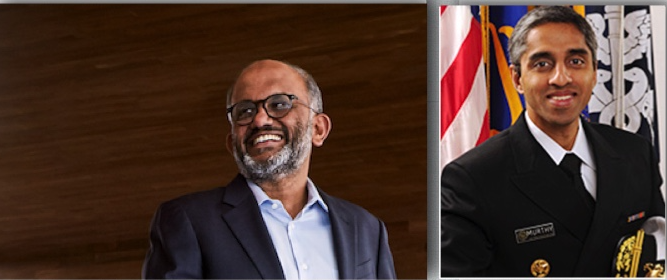
NEW YORK (TIP): The Carnegie Corporation of New York honored 38 immigrants, including two Indian Americans with their annual Great Immigrants tribute on July 4. Chairman, president, and CEO of Adobe Systems Incorporated Shantanu Narayen and former Surgeon General Vivek Murthy were honored with the prestigious awards.
Every year, Carnegie Corporation of New York, established by Scottish immigrant Andrew Carnegie, recognizes naturalized citizens who make America strong. Each year since 2006, the Corporation has recognized the contributions of naturalized citizens, and for 2017, the honorees represent more than 30 different countries of origin, a wide range of personal immigration stories, and a high level of professional leadership in numerous fields.
“Our annual tribute to Great Immigrants demonstrates the richness of talent, skills, and achievements that immigrants from around the world bring to every sphere of American society,” said Vartan Gregorian, president of Carnegie Corporation of New York. “This campaign reminds us of the debt the United States owes to generations of immigrants who become citizens and contribute to the progress of this country. Today, we celebrate and thank them.”
Originally from Hyderabad, India, Shantanu has an undergraduate degree in electronics engineering, a master’s degree in computer science, and an MBA from UC Berkeley. He is a board member of Pfizer and U.S.-India Business Council, and was named one of the world’s best CEOs by Barron’s magazine in 2016 and 2017.
Vice Admiral Vivek H. Murthy was confirmed on December 15, 2014, as the 19th United States Surgeon General. Dr. Murthy has devoted himself to improving public health through the lens of service, clinical care, research, education and entrepreneurship. As a clinician-educator, Dr. Murthy has cared for thousands of patients and trained hundreds of residents and medical students.
NEW YORK (TIP): The Carnegie Endowment for International Peace announced that Senior Fellow Milan Vaishnav will serve as the director of the South Asia Program in Washington.
The author of the widely acclaimed new book, When Crime Pays: Money and Muscle in Indian Politics (Yale University Press and HarperCollins India, 2017) and co-editor of the recent Rethinking Public Institutions in India (Oxford University Press, 2017), Vaishnav is an expert on India’s political economy and examines issues such as corruption, ethnic politics, governance and state capacity, election finance, and voter behavior. He joined Carnegie in 2012 after serving as a post-doctoral fellow at the Center for Global Development. He holds a PhD in political science from Columbia University.
“This is a critical moment in the internal and external trajectory of South Asia,” said Vaishnav. “I am excited about what my colleagues and I can accomplish together and honored to take on this new role at an institution I care so much about.”
Carnegie President William J. Burns said, “Milan offers a vivid demonstration of Carnegie at its very best. He is a first-rate scholar with uncanny policy savvy and a deep-seated commitment to offer real world solutions to some daunting governance challenges. He has more than earned his reputation as one of the most thoughtful analysts of his generation and one of the most admired members of the Carnegie Endowment family.”
CHICAGO, IL (TIP): “The American Association of Physicians of Indian Origin is pleased to support the nomination of Dr. Jerome Adams for United States Surgeon General, currently serving as Indiana Health Commissioner with a proven leadership record with a steadfast dedication to improving the lives of the communities around him,” said Dr. Gautam Samadder, President of AAPI, in a statement issued here.
Dr. Jerome Adams was nominated by President Donald Trump to serve as the new Surgeon General of the United States on June 29th. Adams, a physician anesthesiologist, has a long-tenured history in the health industry and is from Vice President Mike Pence‘s home state of Indiana.
If he is confirmed by the US Senate, he would serve a four-year term and would take over for Sylvia Trent-Adams, who’s served as the acting surgeon general since April 21 when Trump asked Vivek Murthy to resign from the top job as America’s Doctor. Murthy, a member and friend of AAPI, had served in the role since December 18, 2014 and was nominated by President Barack Obama.
According to Dr. Samadder, who assumed charge as the President of the largest ethnic organization of physicians in the US representing nearly 100,000 physicians and fellows of Indian origin, Dr. Adams has demonstrated this leadership on numerous fronts including during the recent HIV outbreak in southeast Indiana and with the ongoing opioid abuse epidemic nationally. He is also an active leader within organized medicine and serves on the Health and Public Policy and Governmental Affairs Committee for the American Society of Anesthesiologists and has served on several boards of the American Medical Associations including the Young Physicians Section.
Dr. Jerome Adams with YPS members
Dr. Adams is an anesthesiologist who has been outspoken against the opioid epidemic. He began serving as the Indiana State Health Commissioner in 2014 under then-governor Mike Pence and was in that role during the 2015 outbreak of HIV that spread among users of a prescription opioid, Opana. In the role, Adams oversees a number of branches of the state’s health departments: Public Health Protection and Laboratory Services, Health and Human Services, Health Care Quality and Regulatory, and Tobacco Prevention and Cessation Commissions. In addition to serving as the health commissioner, he’s also the secretary of the Indiana State Department of Health’s executive board and is also the chairman of the Indiana State Trauma Care Committee. Adams has testified in front of the US Congress and the Senate Committees
Dr. Adams holds a master’s degree in public health and was a key player in navigating Indiana’s response to an HIV epidemic directly associated with drug use in 2015. “I would respectfully suggest that we’re here today not so much to look back at what happened,” Adams said to the committee. “But to make sure it doesn’t happen in another community. You need to ask yourself, ‘Are you helping more people than you’re hurting?” Adams, who earned his medical degree from Indiana University’s School of Medicine, currently works as an assistant professor of clinical anesthesia at the school and also works as a staff anesthesiologist at Eskenazi Health. At Eskenazi, he’s the chairman of the Pharmacy and Therapeutics Committee.
Dr. Adams, with his wide range of experiences in the healthcare sector, understands the healthcare landscape, and will be a strong advocate for state public health, bringing a unique and valuable set of skills to the nation’s healthcare system. “AAPI would like to work closely with Dr. Adams in helping shape healthcare policies and programs benefiting the entire nation and the people of this great nation,” said Dr. Samadder, who has made making AAPI’s voice heard in corridors of power in the nation a top priority of his presidency.
DURBAN (TIP): The Fourth World Tamils Economic Conference is being held in Durban from November 16th to 19th, 2017. This was disclosed to The Indian Panorama by Dr.V.R.S. Sampath, founder and convener of World Tamils Economic Foundation who is also President of Madras Development Society.
In a note sent to The Indian Panorama, Mr. Sampath said, “The aim of this conference is to bring the Tamils and the Indian Community the world over together, in order to foster co-operation and tap the vast human and material resources for a collective growth. This will be a platform to discuss business and investment opportunities, professional networking, knowledge sharing and discuss present economic situation in the world
“The Fourth World Tamils Economic Conference will present a unique, dynamic, five day forum of not to be missed networking experience. This Conference will include Plenary Sessions, Paper presentation, Project Presentation, Community Leaders Speech, Awards, Exhibition, Networking, Get-together and Cultural Program. The participants will be coming from all over the world. Businessmen, Industrialists, Professionals will be attending this conference.
“The First World Tamils Economic Conference was held from 5th to 7th January 2009 at Chennai, 600 delegates participated from 25 countries. The Second World Tamils Economic Conference was held in Dubai, U.A.E from 1st to 4th October 2011 in which 650 delegates from 20 countries participated. The Third World Tamils Economic Conference was held in Chennai from 1st to 5th October 2016, 700 delegates from thirty countries participated in the conference.
“Ministers, Ambassadors of the various governments, distinguished guests, business leaders, community leaders, economists, professionals and academicians will be the key speakers of this conference.”
Visit conference website: www.economicconference.in for more information and registration.
Vaisakhi spirit of celebration and service to the fore
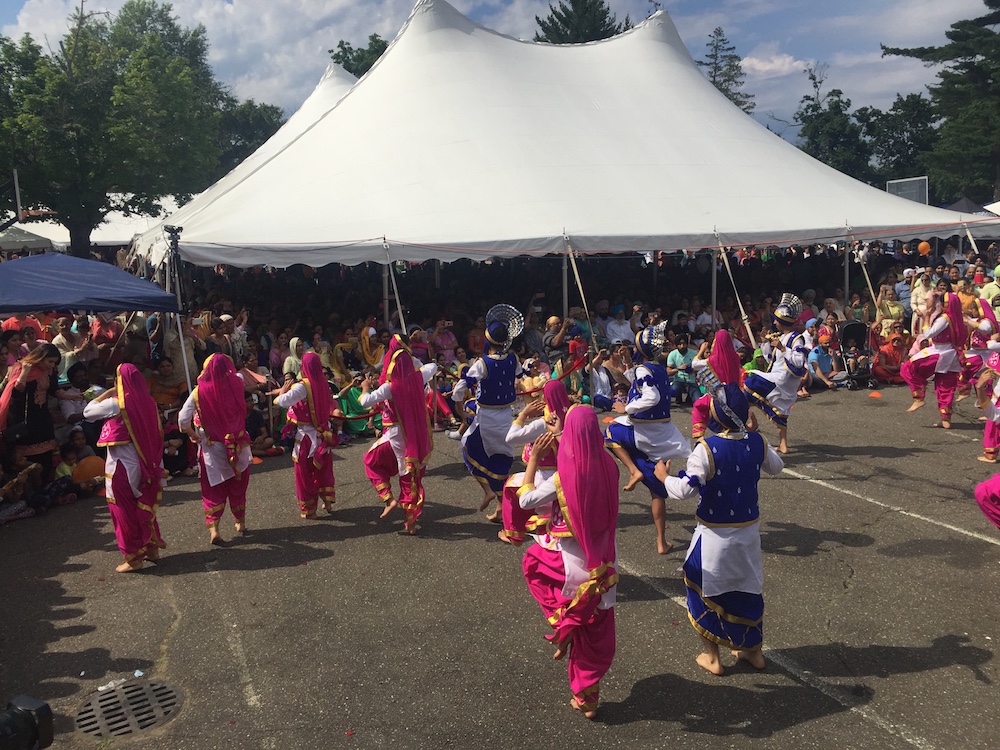
GLEN COVE, NY (TIP): Vaisakhi commemorates the beginning of Sikhism. It is a festival celebrated by 25 million Sikhs around the world. Gurdwara Glen Cove celebrated their annual event joyously on June 25th, 2017.
The architect of Vaisakhi Mela Manmeet Kaur Lamba, General Secretary of Gurdwara Mata Sahib Kaur poses for a photograph with Neeta Bhasin, creator of Diwali at Times Square (right) and Harvinder Bhatia, Mela committee member (left)
Whether or not one believes number 13th to be inauspicious or otherwise, for the organizers the number turned out to be auspicious as it was the 13th year of Vaisakhi Mela and the organizers told The Indian Panorama they were overwhelmed by joy with the turnout of 12,000 visitors and many dignitaries from Nassau County.
A view of the appreciative crowd
Surely, it was a matter of pleasure and pride for them to welcome such a large crowd and a number of dignitaries who included Judge Richard McCord, Congressman Thomas Suozzi, Ms. Barbara Peebles, Deputy Mayor of City of Glen Cove, George Maragos, Nassau County Comptroller, Dilip Chauhan, Director of Southeast Asian Affairs for Nassau County Comptroller.
Vaisakhi Mela committee members with Gurdwara Glen Cove head priest Bhai Paramjit Singh (Right)
“We welcomed all faiths, beliefs to enjoy, learn and celebrate together through a diverse range of colorful displays, engaging activities, entertainment and a lavish layout of free food (Langar). A shuttle service and parking was arranged for our visitors. All arrangements were organized and planned by a selfless and dedicated mela team which consisted of families from the Glen Cove Gurdwara and volunteers from all over who gave selflessly their valuable time to make the mela a memorable one”, said Manmeet Kaur Lamba, General Secretary, Gurdwara Mata Sahib Kaur.
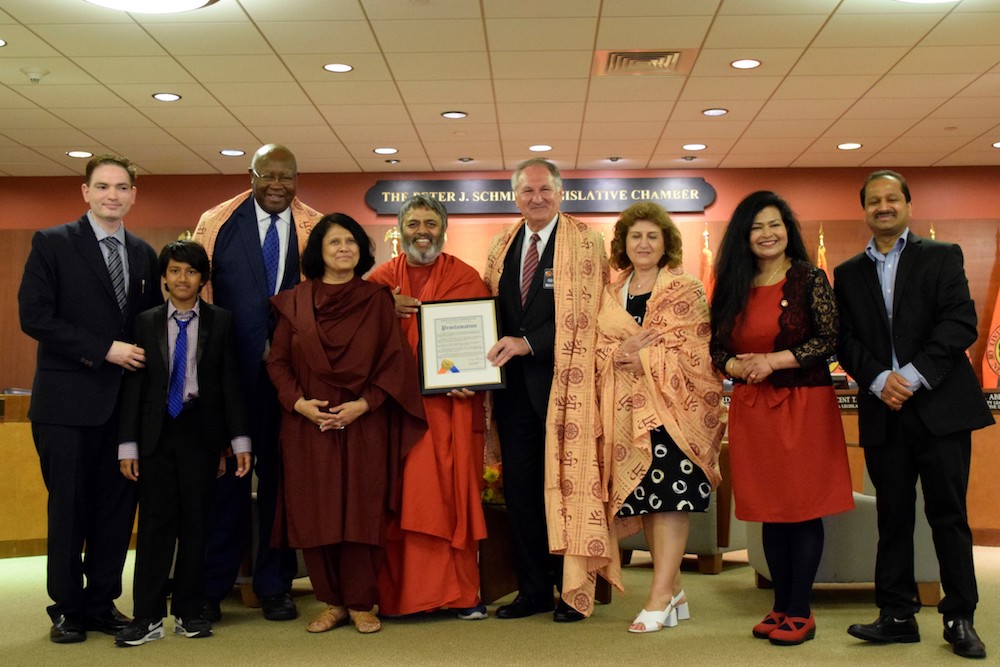
MINEOLA, NY (TIP): Nassau County Comptroller Hon. George Maragos welcomed Dr. Avadhoot Shivanand to Nassau County at a ceremony hosted by the Shiv Yog Foundation at the Theodore Roosevelt Executive and Legislative Building, June 13.
Dr. Avadhoot Shivanand is a celebrated humanitarian and spiritual leader of the global Indian community with followers in over 100 countries. His teaching of self-empowerment, sharing unconditional love, and accepting everyone in their originality is believed by his followers to have cured many psychosomatic diseases. His followers, who lovingly call him Baba Ji, felt like they were in the presence of divinity.
The honoring ceremony was attended by a standing room only audience of Nassau County followers.Comptroller George Maragos in his remarks welcomed Dr. Avadhoot Shivanand as “an inspirational spiritual leader” and presented Baba Ji with a Proclamation to commemorate the honor of his visit.
Dilip Chauhan, Prominent South Asian Community leader said the uplifting presence of Dr. Avdhoot Shivanand which could draw over 600 people in New York for such an intense spiritual ten day event is commendable. He said he was elated as an Indian American and lover of Indian culture for the official recognition extended to Dr. Shivanand. Shiv Yog Foundation has undertaken many projects to serve the humanity such as feeding the hungry, helping farmers, providing education for the poor, distributing free school uniforms, serving the disowned animals and providing free ration to the needy villagers, Chauhan added.
In his remarks, Dr. Avdhoot Shivanand expressed his happiness and praised the Shiv Yogis for their hard work in making the event a grand success. In his remarks, Shivanand Ji noted the success of the Indian community in Nassau County but reminded his followers that “one cannot achieve happiness and success without first health and family. If those two conditions are met, then the attainment of happiness is possible.”
It was so pleasing to watch beautiful rendition of Urdu poetry through a classical dance by Anupma Sharda, student of guru Purvi Bhatt from Dance School, wearing traditional dress. This song was from1981 Urdu film, Umrao Jaan, which has a deep connection with Urdu literature and the Aligarh Muslim University. This and other songs in the film were written by Urdu poet Shaheryaar from the University and the film was directed by another Aligarian Muzaffar Ali, who excelled in promoting Urdu literature. The presentation of this song at this event also conveyed a message to the audience that they would be coming to these Urdu promotion events, like this Urdu Mela, again and again. Is anjuman mein aap ko aana hai baar, baar Deevaar-o-dar ko gaur se pehchaan lijiye.
Nuzaira Azam, Master of Ceremony
This first Urdu Cultural Mela was the brain child of Tahira Anwar and Dr. Razi Raziuddin. Held on 20thMay, 2017 at the Seneca Valley High School, Germantown, Maryland, it attracted a large number of people from Metropolitan Washington area. It was organized by the Urdu Academy of Maryland with the collaboration of the Aligarh Alumni Association Metropolitan Washington and Pakistan Association of Metropolitan Washington. and also present a bouquet of activities to give glimpses of Urdu culture to the audience. The main purpose of mela was to making aware the community of the richness of Urdu culture and heritage.
Audience
Tahira Anwar, who started the Urdu Academy of Maryland in 2013, said that the Academy has succeeded in launching Urdu teaching in two schools of Montgomery County. She was very happy to announce that she was receiving requests for expanding the program to other schools. However, due to lack of resources she was not able to meet the demand. She is hopeful that the program could be expanded to other schools in Montgomery County and nearby other counties with help from the community. “In addition to preservation of cultural heritage, learning of mother tongue helps strengthen family and friendship bonds. Recent research has also shown that children growing up with multiple languages perform much better in highly competitive society,” she added. Activities of the Academy are available at: www.uamd.og.
Dr. A. Abdullah—a stalwart worker of Urdu spoke about origin and significance of Urdu in the Indian Subcontinent and now in North America. He praised the work initiated by the Urdu Academy of Maryland in Montgomery County of Maryland and expressed confidence that the work started by the Academy will establish its roots, spread its branches like a banyan tree and others will get benefit from it. In the beginning it does require sacrifice, hard work, and patience, however.
Shilpa Sharma and Sheikh Abdur Rahman presenting ghazals
Shoaib Ali Hasan eloquently presented Idgah—a classic short story by Munshi Premchand. This powerful story about a 4-years old orphan boy conveys a strong message how affection, motherhood, care, sacrifice, and satisfaction bring happiness.
Farheen Abdullah helped organize a colorful cultural show depicting traditional dresses representing different regions of India, Pakistan, and Bangladesh.
Regional costumes showRegional costumes show
Mrs. Shilpa Sharma, a physical therapist by professions and Dr. Abdur Rehman, a scientist at the National Institutes of Health, respectively, presented ghazals from notable Urdu poets. The program also included several boutiques for ladies to do Eid shopping and delicious food and Urdu books for sale.
Program organizers (L to R): Rahat Yususf, A. Abdullah, Farheen Abdullah, Firoza Salahuddin, and Tahira Anwer.
Nuzaira Azam was the Master of Ceremony. Mohammad Akbar, president, Aligarh Alumni Association, Washington-DC thanked the organizers and participants of the program, and the audience.
I spent a part of my impressionable years, that is to say, my boyhood school days in Islamabad, West Punjab, Pakistan. During my stay there, I made memorable visits mostly to the northern regions of Pakistan. I also visited the cosmopolitan cities of Karachi and Lahore. I was particularly enamored of Lahore, once a fabled city of the grand Mughals, Sikhs and later of the British Raj where Sikhs, Hindus, Muslims and other ethnic minorities once coexisted amidst great harmony and amity. Lahore in the British colonial days had rightly earned the enviable sobriquet as, “Paris of the Orient” (see the engrossing book, LAHORE: A SENTIMENTAL JOURNEY by PRAN NEVILE, 1993). Even in the late 1960s, it exuded a charm of its own with its Mughal monuments and gardens – the Lahore fort, Shalimar and Shahdara Baghs, Badshahi and Wazir Khan’s mosques, mausoleums of Jahangir and Nur Jahan, Anarkali bazaar and the tree lined Mall, to name a few. However, besides the “Ajab Ghar” (Lahore museum) and “Kim’s Gun” (Zamzama) made famous by Rudyard Kipling, the old Lahore fort along with its Sikh era exhibits which included the priceless collection of the last Sikh Maharaja Dalip Singh’s daughter, Princess Bamba Sutherland, attracted me the most.
On my very first visit to the Lahore fort, I was drawn to remnants of some interesting, fading Sikh murals on a wall in an inner courtyard. It looked somewhat incongruous in its setting and thus attracted my attention. However, the guide could not say much beyond reluctantly conceding with a grimace that,” woh Sikho ka hai” (those are of the Sikhs). He was neither interested nor knowledgeable in Sikh history. Such a peculiar mindset – one of disdain and denial – was understandable given that in wake of the Partition of British India in 1947, the horrors that befell the Punjab were still fresh. Furthermore, the guide was too eager to point out the Mughal features of the fort in which he was also ill informed. Leaving the fort, I went to see the adjacent, elegant Samadhi (tomb) of the Sikh Maharaja Ranjit Singh (1780-1839), the “one-eyed lion” of the Punjab. My abiding interest in the magnificent, yet short lived Sikh kingdom (1799-1849), and the history of the brave, hardy and industrious Sikhs of the Punjab had begun.
The Gurdwara seen in a fairly pristine condition in 1950, from the northeast. The architectural details on the exterior of the building can be clearly noted.
Ranjit Singh was a born ruler. He united the various Sikh misls (tribes) and built a powerful empire in the Punjab, with Lahore as his capital. At its zenith the whole of Punjab, Peshawar up to Khyber Pass, Kashmir, western Tibet (Ladakh) and Sindh was under his sway. In the context of his time, Ranjit arguably possessed the most formidable modern army in South Asia, trained and commanded by some legendary foreign mercenaries – Neapolitan and French officers – some of whom had once served in Napoleon’s army. However, the Sikh court politics and culture remained in a modern era, essentially medieval in character, with its penchant for intrigue, assassination, and dissension and reckless adventurism – initiating the disastrous wars with the East India Company. As a result, the once powerful Sikh kingdom was eventually annexed by the Company in 1849, following the Anglo-Sikh wars, only ten years after Ranjit’s death in 1839.
Since long, I have been reading up on the history of the Sikhs. Consequently, I have developed a great admiration for a brave, colorful, vibrant, enterprising and gregarious people. Even from the rusticity of the villagers in East Punjab emanate an endearing warmth, gaiety and celebration of life, especially, through their songs and dances during various festivals. On the other hand, the somber, sonorous and lilting devotional Kirtans sung in the Sikh Gurdwara are soulful, seemingly a constant reminder of their past sufferings as a people and their enduring quest for the unity of faith and appeal to the universal brotherhood of Man.
A distant view of the Gurdwaras, center, seen from the south. Auxiliary buildings and substantial landed property of the Gurdwara can also be observed in this rare photo taken in 1950.
A word about the Sikh religion. Sikhism is a monotheistic religion which originated in the Punjab in the 15th century, as propounded by Guru Nanak, its founder and first Guru or spiritual teacher. He was succeeded by nine other Gurus. On the death of the 10th Guru, Gobind Singh, the Sikh holy book, Guru Granth Sahib, was declared as the eternal Guru, whereby, its scriptures have become the embodiment of the temporal and spiritual guide of the Sikhs.
In Bangladesh, there are approximately 7 Sikh Gurdwara (temple) in Dhaka, Mymensingh, Chittagong and Sylhet. There are 10-12 million adherents to the Sikh faith worldwide.
In May 2016, Bangladesh Forum for Heritage Studies, an organization dedicated to the promotion of cultural heritage, handed over 4 rare photographs taken in 1950 of the Gurdwara Nanak Shahi (Sikh temple) at Nilkhet, Dhaka, to the Gurdwara Management Committee in a simple ceremony.
The 4 rare photographs of the Gurdwara of 1950, taken soon after the partition of British India in 1947, documents the main Gurdwara built in 1830, during the East India Company era. The adjacent auxiliary or support buildings, which then housed the Langar-khana (community kitchen and place for free distribution of food) and Musafir-khana (rest-house for guests/pilgrims), were probably also built during the same time as the Gurdwara, as evident from the same architectural pattern. The Gurdwara and the adjacent buildings as seen in these pictures of 1950, appear to have been in a pristine condition then.
The pictures show the main Gurdwara, a Company era building, with its distinctive Indo-Mughal architectural features (especially the interior). In one of the photos it is interesting to note the presence of Sikh Samadhis (graves) on the compound at the rear end of the Gurdwara. Also, in the pictures can be seen a few male Sikhs. One such photo probably show the then lone Granthi (priest), the brave and dedicated, Bhai Swaran Singh, sitting on an ornate wicker chair with his long, loose hair after a bath. Bhai Swaran Singh stayed back after the partition of 1947, to look after the Gurdwara, when all else had left for India. Sadly, he along with his Bengali Muslim friend were brutally killed during 1971, by the collaborators of the Pakistani Army.
Photographs collected by the author
Rear view of the Gurdwara, showing old Sikh Samadhis on the grounds. Closer inspection of the Gurdwara show intricate designs on the building.
Known today as the Gurdwara Nanak Shahi located in Nilkhet, on the Dhaka University Campus, the original Gurdwara was erected on this spot much earlier as it was deemed a sacred place by the Sikhs. Legend has it that Guru Nanak (1469-1539) on his visit to Dhaka, had stayed at this place to preach Sikhism. And, so did the 6th Guru Teg Bahadur (1621-1675) after him, who also lived in Dhaka for two years. The place was then a Mughal mohallah (locality) and fell under the Sujatpur mouza. A humble Gurdwara was first constructed here by a Sikh devotee, Bhai Natha, during the time of the 6th Guru. The Gurdwara in the photographs date from 1830, when the earlier old Gurdwara buildings were rebuilt along with additional ancillary edifices. Thus, this Gurdwara in Dhaka, is considered by the Sikhs as one of the oldest and holiest in the subcontinent.
From 1947 until 1964, the Gurdwara somehow managed to stay functional with financial help from local devotees and Sikh pilgrims from India. Monetary donations, however paltry, were also had from Sikh personnel working for UN agencies in Dhaka and the Indian Consulate and overseas Sikhs. However, such funds were insufficient for the overall physical upkeep of the Gurdwara buildings and premises. Consequently, the Gurdwara complex soon started to show signs of neglect and suffered from lack of repair. But the real downturn in the fortune of the Gurdwara started with the state sponsored communal riots in the then East Pakistan in 1964, followed by the Indo-Pak war of 1965, after which hostilities stopped all Sikh pilgrims from India. Therefore, regular funds were seriously affected. Within a very short time the Gurdwara complex bore a dilapidated, forlorn and abandoned look. Invasive vegetation and adverse climatic conditions made things worse. Through all this Bhai Swaran Singh prevailed until killed in 1971.
On the liberation of Bangladesh, when the Indian Army entered Dhaka on December 16, 1971, Sikh officers and soldiers prayed (gave thanksgiving) in this ruinous Gurdwara. During 1972 some funds were made available, and rudimentary efforts at restoration and cleaning up were conducted. In 1973 some laborers started to demolish a ruined portion of the Gurdwara adjacent to the Arts faculty of Dhaka University. Thankfully, it was stopped before any major damage was done to the remnants of the Gurdwara.
Finally, through the noble initiative of Sardar Harbans Singh, the then Chairman, International Jute Organization in Dhaka, a major restoration project of the Gurdwara was undertaken in 1988 and completed in 1989. Thus, the Gurdwara was made fully functional as a place of visitation and worship. Funds for this major restoration project were procured by the relentless efforts of Harbans Singh, from overseas Sikh donations. However, while the exterior façade of the Gurdwara has undergone major structural changes, care was taken to preserve the attractive original interior with some changes made in the layout, like the added Parkarma verandah around the holy inner sanctum to provide overall protection to the Sri Darbar Sahib, where the Sri Guru Granth Sahib (holy book) is kept on a new, beautifully carved, high marble kiosk. Wahe Guru! Sat Sri Akal!
(By Waqar A. Khan –The author is founder, Bangladesh Forum for Heritage Studies) (Source: The Daily Star / Bangladesh)
Governor McAuliffe, Mayor Bowser Join Indian Ambassador to the U.S. and MWAA Officials for Morning Flight Arrival and Press Conference
WASHINGTON (TIP): Washington Dulles International Airport and Air India will host a delegation from the Commonwealth of Virginia, the District of Columbia and the Indian Embassy on Friday, July 7, to celebrate the first ever nonstop connection between New Delhi and the National Capital Region. The morning event will include escorted airside views of the Boeing 777-200LR arrival, a ceremonial water cannon salute and a press conference with Indian Ambassador Navtej Sarna, Governor Terry McAuliffe and Mayor Muriel Bowser.
PROGRAM
Morning of Friday, July 7, 2017
o Escorted Airside Arrival: Arrival is scheduled for Friday, July 7, at 7:15 a.m., though an early arrival is expected. Media planning to attend for the escorted airside arrival must check-in at the Main Terminal by 6:00 a.m. RSVP by 3:00 p.m. on Thursday, July 6, to publicaffairs@mwaa.com or (703) 417-8370.
Press Conference: Scheduled to start at 8:30 a.m.
Press conference will include remarks from: –
o H.E. Navtej Sarna, Ambassador to the United States, Government of India
o Terry McAuliffe, Governor, Commonwealth of Virginia
o Muriel Bowser, Mayor, District of Columbia
o Ashwani Lohani, Chairman and Managing Director, Air India
o Pankaj Srivastava, Director of Commercial, Air India
o Margaret E. McKeough, Executive Vice President and Chief Operating Officer, MWAA
o Jerome L. Davis, Executive Vice President and Chief Revenue Officer, MWAA
o Mike Stewart, Vice President of Air Service Development, MWAA
Air India’s inaugural flight is the first nonstop route between the National Capital Region and New Delhi, directly connecting the world’s strongest democracy and the world’s largest democracy with three weekly round-trip flights.
The move comes after New Jersey lawmakers failed to pass a budget by the annual deadline
By I.S. Saluja
TRENTON, NJ (TIP): As if the existing woes were not enough for Chris Christie who is heading into his final six months as governor, a crisis in the form of government shutdown has added to his worries. Described as New Jersey’s biggest government crisis in more than a decade, the shutdown will literally turn the lights out in Trenton, beginning July 1. What a way to prepare for celebration of 4th of July!
New Jersey lawmakers failed to pass a budget by the annual deadline at midnight of June 30th, as required and Christie promptly issued an order prompting closure of “government offices and services deemed non-essential”. State parks and beaches are also closed, as will motor vehicle offices. Courts could be closed from Monday. Tens of thousands of state government employees will be furloughed.
And while the origins of the shutdown are complex, only one person is likely to bear the blame in the public eye: Governor Chris Christie.
“It’s all going to come down to when folks get up tomorrow for the July 4th weekend and drive down to Island Beach State Park to spend the day and a sign says it’s closed,” said Patrick Murray, director of the Monmouth University Polling Institute. “They’re going to blame Gov. Christie and nobody else.”
“I’m not happy about this,” Christie said in a press conference just eight hours before the shutdown deadline. “This is completely avoidable.”
After two terms that saw his rise to GOP superstardom derailed by Bridgegate and then a fallout with the Trump team, Christie — the least popular governor in New Jersey recorded history, with an approval rating at 15 percent — is already so politically toxic that his own lieutenant governor, Kim Guadagno, is running away from him while campaigning to succeed him.
Such a fiscal debacle had been avoided since 2006, when New Jersey Democrats shut down the government in an argument over raising the state sales tax despite controlling the governorship and both chambers of the Legislature.
But that streak was broken at midnight.
Signup to our Newsletter!
Don’t miss out on all the happenings around the world