Italian-American actor Annabella Sciorra has claimed that disgraced film producer Harvey Weinstein raped her in the 1990s, and sexually harassed her for years later.
Repotedly, the actor, who featured in Miramax’s ‘The Night We Never Met,’ said she had to receive therapy after the movie mogul forced sexual intercourse on her and subsequently harassed her on numerous occasions afterwards.
Sciorra said after a dinner meeting Weinstein forced entry into her apartment and cornered her until she was backed into her bedroom. The actor said she resisted while Weinstein raped her. Sciorra said her body then began to shake violently, almost as if she were ‘having a seizure,’ and Weinstein left.
The 57-year-old actor said she got so scared after the alleged attack that she started sleeping with a baseball bat by her bedside and sought therapy.
“Like most of these women, I was so ashamed of what happened. And I fought. I fought. But still I was like, Why did I open that door? Who opens the door at that time of night? I was definitely embarrassed by it.
I felt disgusting. I felt like I had f****d up.” Sicorra said the film producer attempted to contact her again, and continued to make unwanted sexual advances.
“I’d come home from work and there’d be a message that Harvey Weinstein had called. For nights after, I couldn’t sleep. I piled furniture in front of the door, like in the movies.”
The actor admitted she was fearful of what might happen to her career if she told anyone about her experience and regrets ‘not being stronger in the moment.’
Weinstein has been accused of sexual harassment, assault and rape by over 60 women. Sciorra is the latest addition to the growing list of women – including Lupita Nyong’o, Ashley Judd, Angelina Jolie, Gwyneth Paltrow and Heather Kerr – who have come forward to condemn the ousted Hollywood producer.
Model-actress Urvashi Rautela said her Twitter account was hacked and misused.
“I love being so popular and a b***h,” read a post on Urvashi’s account on the micro-blogging site on Tuesday.
Urvashi later clarified through a tweet that the post was not made with her consent. “My Twitter has been seriously hacked and we are looking for the perpetrators,” Urvashi tweeted to her over three lakh fans.
In another post, she wrote, “My Twitter handle hacked and will be restored shortly. If you see anything ambiguous, please know it’s not me.”
On the film front, Urvashi will next be seen in ‘Hate Story 4’, to release on March 2 next years.
Actress Deepika Padukone on Tuesday sought to brush away the matter of her remuneration for Sanjay Leela Bhansali’s ‘Padmavati’, which is reportedly more than co-stars Ranveer Singh and Shahid Kapoor, saying she was “comfortable” with what she got.
“Talking about my remuneration is not exciting for me. I am confident and comfortable with what I am paid,” she said at the 3D version trailer launch of the upcoming film.
“But let me tell you something and this is something I am really proud of is the fact that people like them (co-producer Viacom and director Bhansali) have invested this kind of money on a film like this and poster like this…that for me is hugely encouraging… this is the biggest film that Indian cinema has seen not in just terms of scale but in terms of budget and resources, and what is the poster behind it? For me that is the turning point for Indian cinema,” she added.
About the uni-brow looks her character Rani Padmini sports in the film, Deepika said she feels women are conditioned to think of beauty in certain way.
“Women have been conditioned to think of beauty in a certain way and I am glad with what we did with ‘Padmavati’ and my look. It takes immense amount of belief, not just for me but for my director as well, to take that risk. “Padmini’s beauty is beyond physical beauty. It is her soul, spirit and what she meant to her people. She is worshipped.”
Deepika also said that the role was extremely challenging and different than Mastani in ‘Bajirao Mastani’.
“Her (Rani Padmini’s) battles were very different. Her power and energy is very different. She doesn’t go out to battle field. She doesn’t have a sword or armour, here the spirit is similar.
“Her purity, intensity and values, are very relatable and identifiable, yet not in a literal sense. And for an actor, I found that even more difficult,” she said. “With Mastani, if I have to show a warrior princess, it is easier for me to have a sword, get a battle field, do horse-riding, and show exactly going to war is actually like.
“But how do you fight so much more than just a war? You’re standing up for your tradition, culture, heritage, passion and love, there is so much that is going on, how do you stand up for all that, just by emoting without any tools. That is what I found extremely challenging for me, with Padmavati,” she added.
On the tussle with Karni Sena and the recent Rangoli incident, Deepika said: “Whatever I had to say, I said it. Whatever was supposed to happen has happened! Like I always say, now nothing and no one can stop this film.”
NEW YORK/NEW DELHI (TIP): Five Indian women, including ICICI Bank CEO and MD Chanda Kochhar and Bollywood star Priyanka Chopra, have featured on the list of the world’s 100 most powerful women compiled by Forbes, which was topped by German Chancellor Angela Merkel.
Kochhar was ranked 32 on the coveted list while HCL Corporation CEO Roshni Nadar Malhotra took the 57th position, followed by Kiran Mazumdar-Shaw, founder-Chair, of Biocon, at 71.
Other Indians on the list include Shobhana Bhartia, Chairperson and Editorial Director for HT Media, at the 92nd place and Priyanka Chopra, “the most successful Bollywood actor to cross over to Hollywood”, at 97.
Some of the other India origin women who have made the cut include PepsiCo CEO Indra Nooyi at the 11th position while Indian American Nikki Haley has been placed 43rd.
The overall list was topped by Merkel, who retained the top spot for the seventh consecutive year and 12 times in total.
Merkel is followed by UK Prime Minister Theresa May at the second position, who is “leading her country through Brexit, a historic, complex and transformative time for the country and the European Union”, Forbes said.
May is followed by Melinda Gates, cochair of the Bill and Melinda Gates Foundation, who, along with her husband Bill, has donated more than US$ 40 billion in grants till date and supports organisations across over 100 countries.
Facebook COO Sheryl Sandberg, at the 4th position, and GM CEO Mary Barra (5th) rounded out the top five. This year’s list, ranked by dollars controlled, impact, spheres of influence and media presence, boasts of 23 newcomers. At the 19th spot, Ivanka Trump is the second-highest ranked newcomer.
“Ivanka’s step-mother Melania has mostly abdicated the first-lady spotlight (and doesn’t appear on this year’s list), but Ivanka has become a key player in the Donald Trump White House,” Forbes said.
The 2017 World’s 100 Most Powerful Women identifies a “new generation of icons, game-changers and gate crashers who are boldly scaling new heights and transforming the world”, Forbes said.
The list covered four metrics, money (either net worth, company revenues, assets, or GDP); media presence; spheres of influence and impact, analysed both within the context of each woman’s field (media, technology, business, philanthropy/NGOs, politics, and finance) and outside of it.
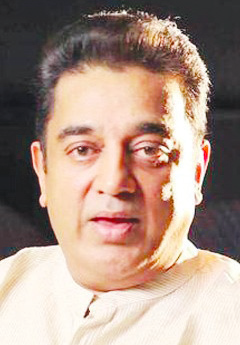
CHENNAI (TIP): Actor Kamal Haasan, who has been hinting at entering politics, has hit out at what he calls Hindu extremism, claiming that rightwing groups have taken to violence because their earlier “strategy” has stopped working.
Haasan took no names in his column in the latest issue of Tamil weekly ‘Ananda Vikatan’ when he alleged that right-wing outfits had “changed course”.
“Earlier such Hindu rightwingers, without indulging in violence against those belongingto other religions, made the latter indulge in violence through their arguments and counter arguments,” he said.
However, since “this old conspiracy” had begun to fail, the groups were indulging in violence, he wrote. “Extremism is in no way a (mark of) success or growth for those who call themselves Hindus,” wrote the Tamil film icon.
Haasan, who met Kerala chief minister Pinarayi Vijayan recently, also answered a question posed by the Marxist leader, who asked what the actor felt about “Hindutva forces weakening Dravidian culture through slow intrusion”.
“In recent times…we could see that racial discrimination and reactionism have been trying to gain a foothold in Tamil Nadu,” Vijayan said.
The actor replied: “The fading of the belief that truth will triumph and … strength will succeed will make us all barbarians”.
Sounding philosophical at one point, Haasan said: “Change is unchangeable”. “The day is not far when Tamil Nadu will again be a model for social reformation,” he said, adding, “Kerala is such a model and my greetings (to you) for that”.
In an earlier column in the weekly, Haasan said he would come out with a “communication strategy” next week, triggering speculation that he would announce his entry into politics.
The column was titled, “Be prepared… will tell all on November 7”, which is Haasan’s birthday.
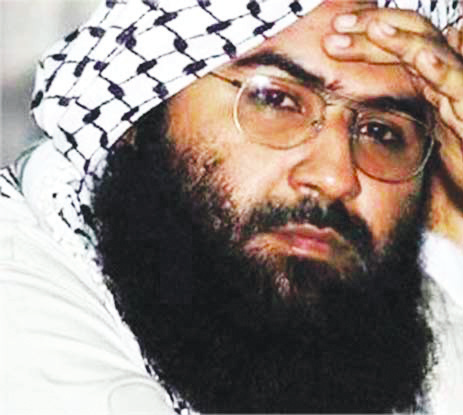
NEW DELHI (TIP): India has expressed “deep disappointment” at China’s decision to block consensus on the listing of Masood Azhar as an internationally designated terrorist under 1267 committee of the UN Security Council.
Raveesh Kumar, MEA spokesperson, said: “We are deeply disappointed that once again, a single country has blocked international consensus on the designation of an acknowledged terrorist and leader of UN-designated terrorist organisation, Masood Azhar.”
The application to proscribe Azhar, put on a technical hold three months ago for the fifth time by Beijing, expired today. The proposal backed by the US, France and the UK seeks to designate Pakistan-based JeM terror group chief and Pathankot attack mastermind Azhar as a global terrorist by the Al- Qaida sanctions committee, but has constantly faced the Chinese veto block. India strongly believes that double standards and selective approaches will only undermine the international community’s resolve to combat terrorism. We can only hope that there will be a realisation that accommodating with terrorism for narrow objectives is both shortsighted and counterproductive, Raveesh Kumar added.
Responding to queries, Chinese Foreign Ministry spokesperson had this week cited “disagreements” on the listing. “We believe the committee should follow principles of objectivity, professionalism and fairness and reach decisions by consensus based on solid proof. As for the listing by the relevant country, there are disagreements,” the spokesperson said. This despite the recent BRICS Summit declaration in Xiamen in China which named Pakistan-based terrorists and made a strong pitch to counter all manifestations of terror outfits and terror-financing, unlike the previous summit held in Goa.
‘We express concern on the security situation in the region and violence caused by the Taliban, ISIL/DAISH, Al- Qaida and its affiliates, including the Eastern Turkistan Islamic Movement, Islamic Movement of Uzbekistan, the Haqqani Network, Lashkar-e-Taiba, Jaish-e-Mohammad, TTP and Hizb ut- Tahrir,’ read para 48 of the Xiamen declaration.
NEW DELHI (TIP): The Gujarat Assembly election, scheduled for 9 and 14 December, is significant for Prime Minister Narendra Modi and Congress vice-president Rahul Gandhi.
While the former is eager to retain home turf, the latter is trying to mount a serious challenge to the BJP ahead of the 2019 General Election.
The BJP may have its numerous infrastructure projects and the bullet train to help sway votes, but the Congress has the saffron party’s flawed implementation of the GST and the demonetisation going in its favour.
The high-stakes battle in a state with only two major parties — BJP and Congress — will be contested on a number of issues that may well decide the outcome. The Gujarat election is considered even more important than Uttar Pradesh for Modi and a defeat will be embarrassing for the BJP.
With the quota agitation crippling Gujarat and the disenchantment growing, BJP might not find it easy to win the state and Congress appears to be putting up a good fight to counter the saffron party.
Congress vice-president Rahul Gandhi created a stir, especially on social media, with his swipe that the goods and services tax (GST) was nothing but a “Gabbar Singh Tax”. By drawing a reference to the celluloid bandit Gabbar Singh, immortalized in the cult film Sholay, Gandhi was being anything but subtle in his criticism of India’s marquee tax reform.
THE PATIDAR PROBLEM AND THE DALIT DILEMMA
The two sensitive issues that rattled the state and forced Anandiben Patel to resign as the chief minister were the protests for reservation for Patels in jobs and educational institutions, and the angry response against the flogging of Dalits.
The BJP was at its wits’ end thanks to the fierce agitation led by Hardik Patel. Party leaders were not allowed to hold public rallies and they were barred from many Patel dominated areas in a show of increasing irritation with the saffron party.
The issue has still not abated and Hardik has emerged as an influential leader able to sway votes in favour of whichever party he chooses to endorse. According to the India Today-Axis opinion poll, the Patidars play a decisive role in 21 of the state’s 182 seats and makes up almost 16 percent of the electorate. Hardik can give a bump of two percent to whichever party he supports.
The drifting away of the Patidars from the BJP might alter the result of the election because the party has been banking on these votes for last two decades.
The other issue which can play a major role in the election is the Dalit uprising. Gujarat witnessed one of the biggest Dalit uprising that ever took place in the state last year.
Anandiben faced criticism after four Dalit youths were beaten up in Una on 11 July, 2016 for allegedly skinning a dead cow.
Her exit was seen as BJP’s message to Dalits that the party was concerned about the growing unrest in the community. The Dalit anger, as The Hindupoints out, is mounting.
Dalit leader Jignesh Mevani extended his support to the Congress and met party leader Ashok Gehlot.
They comprise seven percent of the electorate in Gujarat and their vote in favour of the Congress could represent a huge loss for the saffron party.
THE GST DECISION AND DEMONETISATION GAMBLE
As Hindustan Times pointed out, small and medium-scale businessmen and traders, who form the core of the BJP support base, have been hit by what they call implementation glitches in the roll out of the Goods and Services Tax (GST).
Textile traders in the state want a roll back of the GST on cloth. According to the Times Now-VMR opinion poll, about 40 percent respondents feel that the quality of life has worsened after the implementation of GST and demonetisation.
Fifty-three percent of the people are dissatisfied with demonetisation, according to the India Today-Axis survey. The Opposition, specifically the Congress party, has been very vocal and vociferous in its criticism of the new tax regime.
Rahul termed it the ‘Gabbar Singh Tax’ and the party will also observe Black Day on the anniversary of demonetisation. This might shift the stakes in the favour of the Congress.
Traders have traditionally been BJP’s principal vote base but the disenchantment over the GST and demonetisation might shift the favour.
In the Gujarati press, The Hindu reported, there are alarming reports of disenchantment with the BJP government, particularly due to unemployment.
DEVELOPMENT AND INFRASTRUCTURE
Modi said that the election in Gujarat is a contest between development and dynasty.
“The elections for us are about politics of development while for the rivals it is about promoting dynastic politics. And let me tell you that the politics of development will win,” he was quoted as saying by Livemint.
BJP has perhaps been focussed on infrastructure projects because of this. Modi laid the foundation stone of Ahmedabad- Mumbai High-Speed Rail Network, commonly known as the bullet train, on 14 September in Gujarat along with his Japanese counterpart Shinzo Abe.
He also laid the foundation stone of a bridge between Okha and Beyt Dwarka. He also announced six-laning of the Ahmedabad- Rajkot National Highway and four-laning of the Rajkot-Morbi state highway.
During his visit to Gujarat, the prime minister inaugurated the Bhadbhut Barrage that will be constructed over the river Narmada, and also flagged off the Antyodaya Express from Surat to Jaynagar in Bihar, The Financial Expressreported.
With focus on these infrastructural projects and promoting its development pitch, BJP may be able to sway some voters who are concerned about the development of the state.
Almost 16 percent of the voters, according to India Today-Axis opinion poll, agree with Modi and BJP chief Amit Shah that it is the most important issue.
ANTI-INCUMBENCY
The BJP is facing the anti-incumbency sentiment and the Gujaratis are showing signs of fatigue from being ruled by the BJP since 1995, The Indian Express reported.
With the change of chief minister in the middle of a tenure and the absence of Modi as the chief ministerial candidate, the anti incumbency sentiment is perhaps apparent.
Achyut Yagnik, a leading expert on Gujarat, told Rediffthat there has been a difference in administrative control since Modi was elevated.
“Modi had tight control over the bureaucracy, which was not the case with Anandiben Patel and Vijay Rupani,” she said.
According to OpIndia, “with 20 years being in power, the state BJP seems to have peaked and reached a saturation point. Of these 20 odd years, Modi was the chief minister for little over 12 years. In the three years that Modi has moved to Centre, Gujarat has had two chief ministers.”
WASHINGTON (TIP): President Donald Trump nominated Jerome Powell to succeed Janet Yellen as Fed Chair. Yellen’s term expires in February 2018. Trump made the announcement during a Thursday, November 2 afternoon ceremony in the Rose Garden.
Powell led a diverse field of potential nominees that included former Governor Kevin Warsh, Stanford economist John Taylor, chief Trump economic advisor Gary Cohn and Yellen herself.
Yellen’s term has been marked by a mostly uninterrupted bull market that began in March 2009 and low interest rates even as the Fed has sought to unwind the stimulus initiated during the crisis.
“Today is an important milestone on the path to restoring economic opportunity to the American people,” Trump said with Powell standing to his right and the prospective chairman’s family nearby. The president said the Fed requires “strong, sound and steady leadership” and Powell “will provide exactly that type of leadership.”
“He’s strong, he’s committed and he’s smart, and if he is confirmed by the Senate, Jay will put his considerable talents and experience to work leading our nation’s independent central bank,” Trump added.
Powell led a diverse field of potential nominees that included former Governor Kevin Warsh, Stanford economist John Taylor, chief Trump economic advisor Gary Cohn and Yellen herself.
Yellen is “a wonderful woman who’s done a terrific job,” Trump said. “We have been working together for 10 months and she is absolutely a spectacular person. Janet, thank you very much. We appreciate it.”
“I’m both honored and humbled by this opportunity to serve our great country,” Powell said. “If I am confirmed by the Senate, I will do everything within my power to achieve our congressional assigned goals of stable prices and maximum employment.”
NYC terrorist was happy as he asked to hang ISIS flag in his hospital room. He killed 8 people, badly injured 12. SHOULD GET DEATH PENALTY!
11:43 PM – Nov 1, 2017
NEW YORK (TIP): The driver who plowed down pedestrians and cyclists on a New York bike path is a “soldier of the caliphate,” the ISIS terror group said on its weekly newspaper.
The attack Tuesday, October 31, killed eight people and left more than a dozen others injured.
“One of the Islamic State soldiers in America, attacked on Tuesday a number of crusaders on a street in New York City, near the monument of those who perished in the 11th of September incursion,” the al-Naba newspaper reported Thursday, November 2.
US President Donald Trump on Thursday, November 2, reiterated his call that the Uzbek immigrant accused of killing eight persons when he drove a truck down a New York City bike path should get the death penalty.
The suspect, Sayfullo Saipov, told investigators he was inspired by watching Islamic State videos and began planning Tuesday’s attack a year ago, according to a criminal complaint filed against him on Wednesday.
Saipov, 29, also said “he felt good about what he had done” and asked for permission to display the flag of the militant group Islamic State in his hospital room, the complaint said.
Trump on Wednesday had suggested sending Saipov to the Guantanamo Bay military prison in Cuba where multiple detainees are held, but on Thursday said that move would have been too complicated.
Saipov faces two charges, one of which carries the death penalty if the government chooses to seek it, Manhattan acting US Attorney Joon Kim said.
The charges are one count of violence and destruction of motor vehicles causing the deaths of eight persons and one count of providing material support and resources to a foreign terrorist organization – Islamic State.
The maximum penalty for the first is death; the maximum for the second life in prison, Kim said.
Dzhokhar Tsarnaev, the surviving member of a pair of ethnic Chechen brothers who killed three people and injured more than 260 when they bombed the 2013 Boston Marathon in an attack inspired by the Al-Qaida militant group, was sentenced to death in 2015. He is the only inmate among the 61 people on federal death row convicted for an act charged as terrorism.
Saipov’s charging document said he waived his rights to remain silent, avoid self-incrimination and have an attorney present when he agreed to speak to investigators from his bed at Bellevue Hospital Center in Manhattan, where he was being treated after being shot by a police officer.
It said he was particularly motivated by a video where Abu Bakr al-Baghdadi, the leader of Islamic State, exhorted Muslims in the United States and elsewhere to support the group’s cause.
Details that emerged at his initial court appearance Wednesday paint a picture of a man who was so devoted to ISIS, he wanted to display the terror group’s flag in his hospital room, documents show.
Saipov planned even more carnage after the deadly attack in Lower Manhattan, according to a criminal complaint. The 29-year-old Uzbek native planned to continue striking pedestrians on the Brooklyn Bridge on Tuesday, he told investigators, according to a criminal complaint.
Instead, he crashed his truck into a school bus in Lower Manhattan and then jumped out, brandishing imitation firearms, officials said. New York police Officer Ryan Nash fired nine shots at him, wounding him in the abdomen, before police took him into custody.
Saipov picked Halloween to carry out the deadliest attack in New York since 9/11 because he believed more people would be out on the streets for the holiday, according to the criminal complaint. More than a dozen people were also injured Tuesday.
Saipov had about 90 videos and 3,800 images on a cell phone featuring ISIS propaganda, including video of a beheading, according to the complaint.
“From the day you are brought in from the nursing home (hospital in India) where you are born, you really are inducted (into music) You don’t have a choice.”
~Ustad Zakir Hussain~
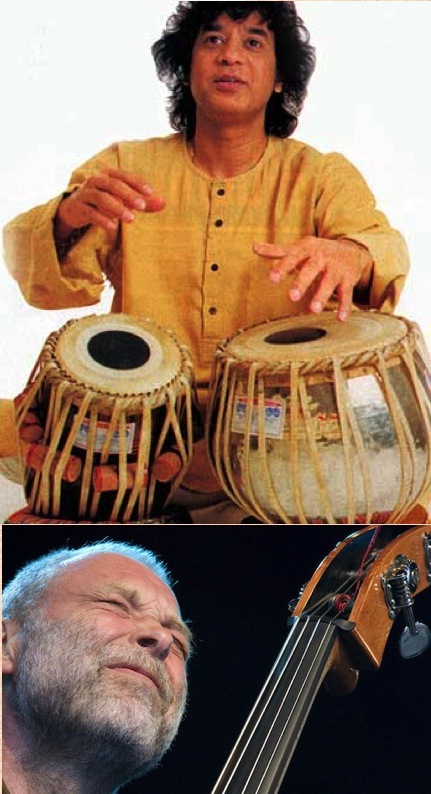
NEW YORK (TIP): Ustad Zakir Hussain reminisces “From the time I was 2 days old, it was his (father’s) routine every day to sit for an hour or so to singing rhythms in my ear. So, by the time I was 3, when I could actually reach the tabla and had hands slightly bigger to get on to the tabla. I already had all this information in my head and this big jumbled confusion which I had really no idea know what to do with.”
“So, I went through a confusing (for many people) being connected to Lord Ganesha, Lord Shiva, Krishna, Saraswati between 3 and 6 a.m.; and then between 7 and 7:45 dealing with the Quran, then from 8 to 8:20 dealing with the church and the hymns and the psalms, and so on. And then of course, going to school; and then (at home), the tabla.”
“All- the Bible, the Quran, the Gita, the Torah, the Ramayana – all have said ‘Love Thy Neighbor.’ It appeared to be that way in my childhood.”
Ustad Allarakha Qureshi, popularly known as Alla Rakha, Zakir Hussain’s father, teacher and mentor, an internationally renowned top award-winning tabla maestro, specialized in Hindustani Classical music.
Ustad Zakir Hussain is a world-renowned tabla virtuoso, producer, film actor and composer. He’s a two-time Grammy winner and a pioneer of world music. Among many other awards are the Padma Shree, the Padma Bhushan, The National Fellowship For The Arts and The National Endowment for the Arts.
One of India’s reigning cultural ambassadors, Hussain is known worldwide for his brilliant playing – The Washington Post says that “his virtuosity is barely to be believed” – but his innovative collaborations have also made him a chief architect of the contemporary world music movement.
“It’s the human condition: joy, loneliness, love, companionship, communion, and hope. The things by which we live….. The fundamentals that make us what we are as humans. They cross over gender, race and everything.”
~Dave Holland~
GRAMMY-winning bassist-composer Dave Holland, enjoying his fifth decade as a jazz superstar, was recently classified as “a master bassist and bandleader, and one of the most sophisticated composers and arrangers in the jazz world” by The Boston Globe.
Holland has never stopped evolving, reinventing his concept and approach with each new project while constantly honing his instantly identifiable voice. Dave Holland has been at the forefront of jazz in many of its forms since his earliest days.
As a leader and collaborator, Holland continues to tour the world and still serves the music in an educational role in Canada, the UK, the Berklee College of Music, and the New England Conservatory.
Most recently, Holland was made an Honorary Member of the Royal Academy of Music (UK)—a rare honor as membership is limited to 300 living musicians—and he’s been named a 2017 Jazz Master by the National Endowment for the Arts.
Over the years and through countless musical experiences, Holland defines his purpose as a musician—and he articulates it well: “I’m trying to create music that exists on multiple levels, such as simpler elements along with more complex elements.”
“It’s the human condition: joy, loneliness, love, companionship, communion, and hope. The fundamentals that make us what we are as humans. They cross over gender, race and everything. Cultural orientations may be different, but the fundamental truths people function under are still the same. It’s about their family, their love, their nurturing, their wanting to belong, and their wanting to have hope.”
As part of the CrossCurrents Music Tour that began in late October 2017 in the USA, The New Jersey Performing Arts Center (NJPAC) presents Zakir Hussain & Dave Holland along with other musicians: superstar Bollywood vocalist and music composer, Shankar Mahadevan; guitarist-composer Sanjay Divecha; pianist Louiz Banks, a standard-bearer of India’s contemporary jazz movement; sax player Chris Potter; and drummer Gino Banks.
CrossCurrents is a one-of-a-kind world music performance that melds the music of India with the energy of jazz, all built on the foundational duo of renowned tabla virtuoso Zakir Hussain and acclaimed bassist-composer Dave Holland.
When Hussain and Holland get together to play, they mesh their improvisational genius and musical intuition to pay tribute to pioneering musicians and composers on opposite sides of the world – those artists who first established the longstanding relationship between jazz and India’s classical music.
“When we compose music, we always try to bring some new flavor in it. It’s always exciting to create something which is not done before.”
~Shankar Mahadevan~
Shankar Mahadevan, superstar Bollywood vocalist and music composer, whose trio of Shankar-Ehsaan-Loy is behind hits like ‘Senorita’ and ‘Kajra Re’, says reinvention is the key to their longevity. “We have given many compositions which later became the trend in the industry. When we compose music, we always try to bring some new flavor in it. Sometimes, we re-invent ourselves from our existing compositions and that gives us immense confidence to churn out hit music. It’s always exciting to create something which is not done before,” said Mahadevan.
Whether you love jazz or world music (or both), you won’t want to miss the musical fireworks! Tickets to see Zakir Hussain and Dave Holland on Sunday, November 5, 2017 7:00 PM are available at NJPAC.org or 888.GO. NJPAC (888.466.5722) or by visiting the NJPAC Box Office.
(Mabel Pais is a freelance writer. She writes on The Arts and Entertainment, Social Issues, Health and Wellness, and Spirituality).
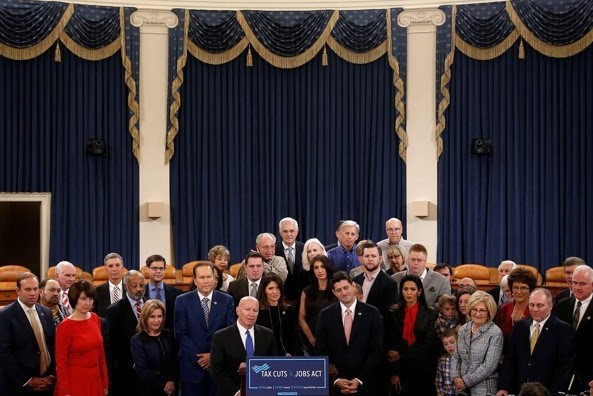
WASHINGTON (TIP): House Republicans unveiled their long-awaited tax cut legislation on Thursday, November 2, after having delayed it by one day, kicking off a fight that many in the GOP believe they must win to preserve their congressional majorities in the midterm elections next year.
House Speaker Paul Ryan, R-Wis., and GOP tax writers put forward a bill that would trim the number of tax brackets, while raising the standard deduction from $6,350 to $12,000 for individuals and from $12,700 to $24,000 for married couples.
The Tax Cuts and Jobs Act, which is subject to change and faces lingering questions of how it will be paid for, would cut the corporate tax rate to 20 percent from 35 percent, while eliminating the estate tax after six years.
CNN Money has published a rundown of key provisions that would affect individuals in an article What’s in the House tax bill for people by Jeanne Sahadi. Here is the published report
Here’s a rundown of key provisions that would affect individuals:
Reduces income tax brackets: There are seven federal income tax brackets in today’s code that are taxed at 10%, 15%, 25%, 28%, 33%, 35% and 39.6%.
The House bill consolidates those into four brackets:
12% (on the first $45,000 of taxable income for individuals; $90,000 for married couples filing jointly)
25% (starts at $45,000 for individuals; $90,000 for married couples)
35% (starts at $200,000 for individuals; $260,000 for married couples)
39.6% (starts at $500,000 for individuals; $1 million for married couples)
Nearly doubles the standard deduction: The bill raises today’s standard deduction for singles to $12,000 from $6,350 currently; and it raises it for married couples filing jointly to $24,000 from $12,700.
Eliminates personal exemptions: Today you’re allowed to claim a $4,050 personal exemption for yourself, your spouse and each of your dependents. The House bill eliminates that option.
For families with three or more kids, that could mute if not negate any tax relief they might enjoy as a result of other provisions in the bill.
Expands child tax credit: The bill would increase the child tax credit to $1,600, up from $1,000, for any child under 17.
But that $600 increase won’t be available to the lowest-income families if they don’t end up owing federal income taxes. That’s because unlike the first $1,000, the extra $600 won’t be refundable. Refundable means that if your federal income tax bill is zero, you get a check from the government because of the credit.
The bill would let more people claim the child tax credit. The income level where the credit starts to be phased out would increase to $115,000 for single parents, up from $75,000 today, and to $230,000 for married parents, up from $110,000.
Creates two new family credits: The bill would create two different $300 tax credits, but they would be in effect only for five years and would not be refundable.
The first would be for nonchild dependents — for instance, any son or daughter over 17 whom you’re supporting, an ailing elderly mother or an adult child with a disability. The second is a credit for each spouse if they file jointly (or, in the case of single parents, the head of household).
So, a family of four — two parents, a 12-year-old daughter and an 18-year-old son — could reduce their tax bill by $2,500, said Elaine Maag, a senior research associate at the Urban Institute. They would claim the $1,600 child tax credit for the daughter, the $300 nonchild dependent credit for the son and a $300 credit for each parent.
The income thresholds governing these two new credits are the same as for the child tax credit.
EDISON, NJ (TIP): Indian American financial executive Samip ‘Sam’ Joshi is among the six candidates running for the three, four-year terms available for the Edison Township Council in New Jersey in the upcoming election.
Joshi, a newcomer, will face Republican candidates Larry Deutchman, Wayne Mascola and Maria Orchid along with incumbents Robert Diehl, and Alvaro Gomez in November election.
According to a report by centraljersey.com, Joshi, who has been a lifelong resident of the township, is running for the council for the first time.
The 28-year-old candidate is the Executive Vice President at SD Capital Funding (mortgage financing firm); and Co-Founder of student loan refinancing firm Loanscribe.
Joshi holds a bachelor’s degree in political science and labor studies from Rutgers University and earned an MBA in marketing through the Rutgers University Executive Education Program.
Though Joshi is running for the first time, he has been serving the Edison Township community from 2004 with his participation in the Edison Youth Service Corps. In 2006, he was an intern in the Mayor’s office and later worked in the Municipal Court Violations Bureau.
From 2010-14, he served on the town’s Fair Rental Housing Board and, for the past year, on the Zoning Board of Adjustment.
“I am running for Township Council to represent the short and long-term interests of our community,” he was quoted as saying in the report. “I believe my combined experience in business and continuous local activism will bring a unique perspective to the Township Council.”
Joshi puts forward the idea of redeveloping the neighborhood nearest to the Edison Train Station, at Plainfield and Central Avenues, which will trigger the economic growth of the township. According to Joshi, attracting commercial investment will reduce the tax burden on residential property owners.
“There is a sufficient amount of underused property to develop or redevelop the area into a commercial marketplace. Attracting more commercial and small businesses and property tax revenue to Edison is a necessary step to help relieve the tax burden on residential property owners,” Joshi said.
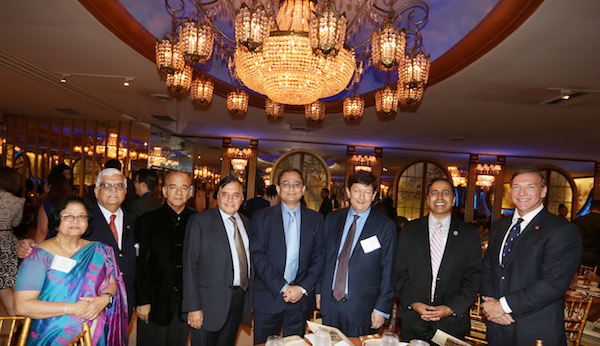
STONEY BROOK, NJ (TIP): “We need more Centers like this to train the new generation of Indian American leaders to swell the “Samosa Caucus” in the Congress,” said Representative Raja Krishnamoorthi of the Eighth Congressional District (Illinois). He said that in the short span of two decades, it has emerged as national model of the Indian American community’s engagement with a public university to create resources for a better understanding of India for the benefit of the campus and the community. He was speaking at a well-attended gala to celebrate Stony Brook university’s Matto Center for India Studies’ 20th anniversary.
Ambassador Sandeep Chakravorty, Consul General of India in New York, the guest of honor, commended the Center for making public service as much a priority as academic excellence. He said the Center’s stellar accomplishments deserved to be known more widely, including in India.
Dr. Nirmal K. Mattoo, Chairman of the Center’s Executive Committee, praised the university for its enlightened appreciation of the importance of India’s contributions to knowledge and the India community for their steadfast and generous support of the Center’s mission.
Accomplishments:
Professor S.N. Sridhar, SUNY Distinguished Service Professor and founding Director of the Center, recounted the evolution of the Center from its modest origin in student demand for courses on India. He recalled that, working with the university administration and Indian community, led first by Dr. Azad Anand and then by Dr. Mattoo, as partners, the Center successfully mainstreamed India studies into the core curriculum. It created structured programs, such as a Minor in South Asian Studies and helped offer a Major and Masters in Asian and Asian American Studies. Today, Stony Brook teaches more than 30 courses on India every year, and over 22,000 students have taken courses on India.
The Center’s accomplishments have exceeded expectations. The Arya India Studies Library features 13,000 titles; Its publication, Ananya: A Portrait of India includes articles by 40 of India’s leading scholars. The Center is leading an international consortium of translators of a Kannada Mahabharata to be published by Harvard University Press; its seminars, exhibits, lecture series, performing arts series have brought the best of India. It has conducted more than 200 outreach programs for schools, museums, and civic institutions and is serving as a resource to mainstream media, including PBS. It offers student scholarships and supports university departments, community associations, and student groups in their India-related initiatives.
‘Jewel in the Crown’
Students describe the Center’s Study Abroad program in Bangalore as “life-changing;” alumni describe the Center as a “home away from home.” Community leaders describe the Center as a proud community asset Stony Brook’s former president, Dr. Shirley Strum Kenny, described the Center as “the jewel in the crown of Stony Brook.”
Birthday presents:
The Center received two wonderful presents on its 20th birthday: a permanent endowment and a prestigious endowed Chair. In a fund-raising campaign led by Dr. Nirmal Mattoo, Mr. Sreedhar Menon, Mr. Rakesh Kaul, and others, the Indian American community raised $2.5 million dollars, which was matched dollar for dollar by the James and Marilyn Simons Foundation, resulting in a $5 million impact, the largest endowment for India Studies at any public university in the U.S.
The endowment includes the $1.25 million Nirmal K. and Augustina Mattoo Chair in Classical Indic Humanities; $250,000 gift by Drs. Yashpal and Urmilesh Arya for the Arya India Studies Library; three $150,000 gifts, by Sreedhar Menon, by Deepak and Neera Raj, and by an anonymous donor; three $100,000 endowments, by Dr. Krishna Gujavarty for an annual seminar on leadership and values; by Sudesh and Sudha Mukhi for courses and performances in Vedic studies and music; and by S.N. and Kamal Sridhar for teaching and research support; a lecture series by Drs. Rajesh and Sonali Kakani, and major gifts, by Dr. Vijay Arya, Dr. RishimaniAdsumelli, Dr. Nungavaram Ramamurthy, and Dr. Latha and Mr. Prem Chandran, as well as many others.
The Center also led an international faculty search, culminating in the appointment of Prof. Arindam Chakrabarti, an eminent authority on Indian philosophy from the University of Hawaii at Manoa, as the inaugural holder of the Mattoo Chair in Classical Indic Humanities. Professor Chakrabarti, and his wife Professor Vrinda Dalmia, a well-known scholar of feminist epistemology, will join Stony Brook in 2018.
Congratulating the Indian American community, Dr. Sacha Kopp, Dean of the College of Arts and Sciences, said that a public university “has the responsibility not only to serve the public through education but to give back to the public in the form of knowledge and sharing and fostering community and culture.”
Dr. Samuel L. Stanley, Jr., President of Stony Brook university praised the Indian American community for their tireless efforts in building the Center and the generosity that has helped secure the Center’s financial future.
Professor Sridhar, said, that the Center has made vital contributions to the university by expanding its intellectual horizons, to the students by giving them a global perspective and tools to compete in the global marketplace, and the community by enriching its cultural ambience. Furthermore, he noted, the Center helps Americans appreciate Indian Americans, the successful and increasingly influence 1%. He called the Center “a symbol of our generation’s gratitude to our home country that gave us the tools to succeed, and to our adopted home country that gave us the opportunities to succeed, and our legacy to the coming generations.” It is a symbol of our shared values and commitment to public education, he said. Looking to the future, he said the next goal would be to expand India studies at the graduate level and build the Center as a powerful think tank on Indian perspectives. To mark the occasion, the Center brought a colorful journal presenting the evolution of the Center and its multifarious accomplishments.
Contact: Professor S.N. Sridhar, Director, Mattoo Center for India Studies, East 5350, Melville Library, Stony Brook, NY 11794-3386. s.sridhar@stonybrook.edu Phone (631) 327-1318
“This will be our reply to violence: to make music more intensely, more beautifully, more devotedly than ever before,” Leonard Bernstein
“The significance of this concert is that people of all religions – Christianity, Judaism, Islam, Hinduism and Buddhism – will be here together and will listen. Pieces of music like Beethoven’s Ninth unite people, giving them a message that we are in this world together and we have to work for peace. That’s the only way we can have some understanding,” Luna Kaufman
“Most remarkable is Maestro Jason Tramm as the University’s director of choral activities and an assistant professor. He has opened Seton Hall’s doors to new musical experiences since his arrival in September 2011 and this is another gift he has given to all of us.” Laurie Pine, Director, Media Relations, Seton Hall University.
Choir singing prayer for peace
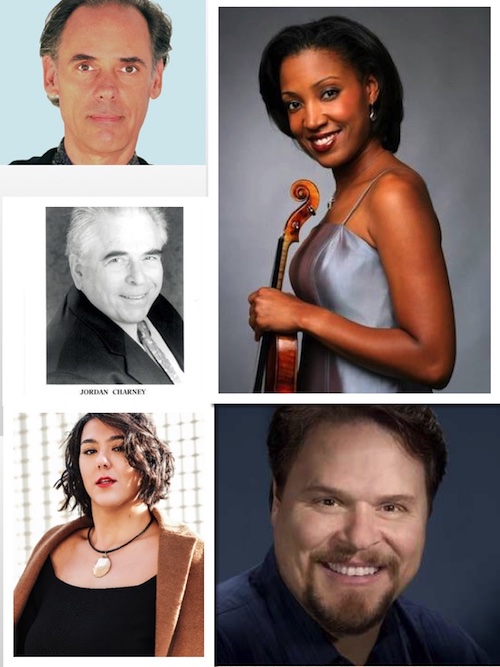
Prayer for Peace: The Power of One Voice reunited members of the Seton Hall University Chorus and the greater Seton Hall community with the Mid-Atlantic Opera Orchestra, under the baton of noted conductor and Assistant Professor Jason Tramm. Renowned international guest soloists soprano Allison Charney founder and host of NYC classical concert series “PREformances with Allison Charney at Merkin Concert Hall at Kaufman Music Center,” baritone Mark Delavan, tenor Adam Klein and mezzo soprano Karolina Pilou of the Metropolitan Opera, and acclaimed violinist Kelly Hall-Tompkins from Broadway’s Fiddler on the Roof performed. Concert narration featured veteran actor Jordan Charney, star of stage, screen and television.
Inspired by Leonard Bernstein’s statement, “This will be our reply to violence: to make music more intensely, more beautifully, more devotedly than ever before,” the concert seeks to celebrate peace messengers worldwide.
In keeping with this spirit, the concert honored lifetime messenger of peace, Luna Kaufman, and raised scholarship funds for refugees, said Laurie Pine, Director of Media Relations, Seton Hall University at South Orange, NJ.
Seton Hall University’s School of Diplomacy and International Relations and College of Communication and the Arts premiered the second cycle of their “Prayer for Peace” Concert Series at NJPAC in Newark, New Jersey on Friday, October 27. Inspired by Leonard Bernstein’s artistic mandate, the classical music concert is dedicated to music’s role as an instrument of peace, and took place at NJPAC’s Prudential Hall.
Luna Kaufman wants this event to build bridges of peace among all peoples
Central to the concert was a unique performance of A Survivor from Warsaw by Arnold Schönberg to honor Luna Kaufman, Holocaust survivor, educator, activist, author and lecturer. A trustee and chairperson emerita of the Sister Rose Thering Fund for Jewish-Christian Studies, Kaufman is the recipient of an honorary doctorate from Seton Hall University in 2009 as well as the Knight’s Cross of the Order of Merit, given to her by the president of Poland in 2011.
Kaufman’s life illustrates the theme of the Power of One Voice. Luna and her mother were the only two family members to survive the death camps out of 70 family members. Luna served as the New Jersey Opera Board President and was responsible for bringing Hans Krasa’s Brunidbar to North American audiences in 1988 and played a crucial organizational role in the creation of the Liberation Monument in New Jersey’s Liberty Park.
Today she is a tireless champion of Jewish-Christian understanding, having been inspired by the late Sister Rose Thering, the Catholic nun and Seton Hall professor who led the fight to eliminate anti-Semitism from school textbooks. Kaufman is acknowledged for teaching the truest and most profound meaning of forgiveness and reconciliation despite experiencing circumstances unimaginable to most people.
“When I first came to Seton Hall, they asked me to discuss my experiences. I was so bewildered. What do they want to know? To me, at that point, I didn’t talk about the Holocaust because who would talk about it? I was invited to come and talk for a Holocaust Observance in the Chapel. I had my prison uniform. When we left Poland, I was allowed to take only seven dresses, and among them I took this. They counted this as a dress. You know, a piece of fabric to buy and make myself a dress I can always do, but I wanted to have this as my memento. Why? I would never know. And I brought it and it traveled with me to Israel, and from Israel to here. They had it on the altar in the Chapel. I said, ‘Now we have arrived someplace. And now we’re joining hands and working together.’ Shortly after, I met Sister Rose and we became joined together. I was so impressed by what she was doing and the Sister Rose Thering Fund and the University in continuing this work.”
Kaufman shared why Schönberg’s A Survivor from Auschwitz holds a special significance for her. She was incarcerated in a concentration camp very close to Warsaw and saw the flames of the uprising, hoping to be liberated. In the last minute, owners of the factory, who had purchased her and the others for a few dollars each as slave laborers, sent them to Germany. There, she spent another two years in the camps.
“I returned to Poland on a trip with Governor Kean. We went to Auschwitz and Israel. The reporters asked me whether I feel some remorse or feeling like that. I said no.”
She said, “I felt like a victor. I said this is my victory because I survived through, though I lost my father. I lost my sister. We are not going to (lie) down. I said, ‘You know you have to go forward. You have to remember the Holocaust, but this is not enough. You have to do something about it. And you need to look at the other. When we were doing this concert this year I said make sure you include other genocides and other problems. This is a human issue, and we are part of humanity. To me this is a very important message that needs to be delivered.”
Kaufman wants this event to build bridges of peace among all peoples.
“The significance of this concert is that people of all religions – Christianity, Judaism, Islam, Hinduism and Buddhism – will be here together and will listen. Pieces of music like Beethoven’s Ninth unite people, giving them a message that we are in this world together and we have to work for peace. That’s the only way we can have some understanding,” she explained.
Laurie Pine, Director of Media Relations, Seton Hall University with a sense of fulfillment, comments, “What an incredible tribute this is to messengers of peace both here and around the world! To witness more than a thousand people gathered together at the Prayer for Peace concert, expressing our humanity and embracing each other at such an important time in our shared history. It was a remarkable testament to what we all can achieve together. I was especially proud of our Seton Hall University students, who worked so hard to be able to achieve such a powerful message along with our friends from the MidAtlantic Opera Orchestra and such fabulous soloists, coming together as a community, making music, making art and inspiring us all to be messengers of peace. Most remarkable is Maestro Jason Tramm who infuses his love of music and teaching with a passion and purpose that continues to enrich the repertoire of Seton Hall. As the University’s director of choral activities and an assistant professor, Jason has opened Seton Hall’s doors to new musical experiences since his arrival in September 2011 and this is another gift he has given to all of us.”
(Mabel Pais is a freelance writer. She writes on The Arts and Entertainment, Social Issues, Health and Wellness, and Spirituality)
“Though Pakistan has not enunciated a formal nuclear doctrine, its then head of strategic planning division of its nuclear command authority, Lt-Gen Khalid Kidwai, had averred that Pakistan’s nuclear weapons were “aimed solely at India”. Kidwai added that Pakistan would use nuclear weapons if India conquers a large part of Pakistani territory, or destroys a large part of its land and air forces. Kidwai also held out the possibility of using nuclear weapons if India tries to “economically strangulate” Pakistan, or pushes it to political destabilization”, says the author.
Led by the US and Soviet Union, the five Permanent Members of the UN Security Council tried to ensure, some five decades ago, that they alone had the divine right to possess nuclear weapons in perpetuity, with the signing of the nuclear Non-Proliferation Treaty (NPT). Their nuclear arsenals steadily increased and pleas for nuclear disarmament arrogantly disregarded. The world nuclear scenario today is now different to what the five envisaged. Nuclear stockpiles have steadily grown. In the past few decades, Israel, Pakistan, India and North Korea have joined the “nuclear club”. Others like Japan and Iran are capable of doing so when needed. There are an estimated 14,900 nuclear warheads in nine countries, with 93 per cent of these in the possession of the US and Russia.
While China tested and acquired nuclear weapons in the 1960s, the next country to acquire nuclear weapons was Pakistan, which commenced its quest for nuclear weapons after the 1971 Bangladesh conflict. India crossed the nuclear threshold only after it received a veiled nuclear threat from Pakistan during tensions over military exercises named “Operation Brasstacks” in January 1987. Instructions were issued in 1988 to nuclear scientist PK Iyengar and scientific adviser VS Arunachalam to assemble a nuclear arsenal. India’s distinguished strategic thinker, K Subrahmanyam, provided the strategic rationale for the nuclear weapons program. India decisively demonstrated its nuclear weapons capabilities 10 years later, with the Pokhran tests. Pakistan predictably followed suit, barely a fortnight later.
India is today confronted with a situation where China has not only provided Pakistan with designs and equipment for manufacturing nuclear weapons, but has also given Pakistan the knowhow and materials for manufacturing missiles capable of carrying nuclear weapons to every part of India, including the Andaman Islands. While these facts are known to those involved inside and outside the government in monitoring nuclear developments, it is astonishing that public knowledge on this crucial issue is limited. Sadly, it has never been debated seriously in Parliament. Surely, the public and Parliament need to know more on these issues, to promote awareness of the challenges the nation faces from two hostile neighbors working together dangerously. American nuclear analyst Gary Milhollin has perceptively noted: “If you subtract China’s help from Pakistan’s nuclear program, there is no Pakistani nuclear weapons program.”
While Zulfikar Ali Bhutto moved to establish a nuclear weapons capability within weeks of the Bangladesh conflict, his prison memoirs suggest that he was guaranteed of Chinese assistance after his meeting with Chairman Mao in 1976. China, with antiquated uranium enrichment facilities, benefited from designs stolen by AQ Khan from European (URENCO) enrichment facilities. By the early 1980s, China was providing Pakistan designs for nuclear weapons. China currently has approximately 280 nuclear warheads for delivery by 150 land-based and 48 sea-based missiles and fighter aircraft. While India is estimated to possess 110-120 nuclear warheads. Pakistan has 130-140 nuclear warheads, designed for delivery by ballistic and cruise missiles and aircraft. Experts estimate that Pakistan’s stockpile could potentially grow to 220-250 warheads by 2025, making it the world’s fifth-largest nuclear weapons state. Pakistan’s missiles, with ranges up to 2,750 km, are all of Chinese design and produced at the National Defence Complex facilities in the Kala Chitta Dhar mountain range to the west of Islamabad. The development, production and test launching of missiles is done at locations south of Attock, using road mobile Chinese-designed missile launchers, produced in Fatehjang.
According to former US Air Force Secretary Thomas Reed, himself a designer of nuclear weapons at America’s Los Alamos Laboratories: “The Chinese did a massive training of Pakistani (nuclear) scientists, brought them to China for lectures, even gave the design of the CHIC-4 device, which was a weapon that was easy to build as a model for export. There is evidence that AQ Khan used Chinese designs for his nuclear designs. Notes from those lectures later turned up in Libya. And the Chinese did similar things for the Saudis, North Koreans and Algerians.” The great champions of nuclear non-proliferation in the US, who lectured India for decades on non-proliferation, covered up and did nothing to curb these Chinese activities. Pakistan is also known to have received liquid-fueled ballistic missiles from North Korea in exchange for information on uranium enrichment, in a deal evidently undertaken with Chinese blessings.
Though Pakistan has not enunciated a formal nuclear doctrine, its then head of strategic planning division of its nuclear command authority, Lt-Gen Khalid Kidwai, had averred that Pakistan’s nuclear weapons were “aimed solely at India”. Kidwai added that Pakistan would use nuclear weapons if India conquers a large part of Pakistani territory, or destroys a large part of its land and air forces. Kidwai also held out the possibility of using nuclear weapons if India tries to “economically strangulate” Pakistan, or pushes it to political destabilization. India has declared that it will not be the first to use nuclear weapons and will use nuclear weapons only if its territory or armed forces face an attack anywhere, in which nuclear, chemical or biological weapons are used. Since India has no desire to conquer large parts of Pakistani territories or destroy its armed forces, there is no possibility of India provoking a nuclear conflict. But, given Kidwai’s utterances about a “full spectrum” deterrent, involving the use of tactical nuclear weapons, issued after he retired, New Delhi has to carefully review nuclear strategy imaginatively, bearing in mind that our “no first use” doctrine has served us well internationally.
It is obvious, especially after Xi Jinping’s recent enunciation of Chinese global ambitions at the Party Congress, that missile and nuclear proliferation by China to Pakistan will continue in its efforts to “contain” India. Pakistan has already tested a sea-based missile and China is set to strengthen Pakistan’s navy with substantial supply of submarines and frigates. China appears determined to use Pakistan as its stalking horse for its maritime ambitions to promote its OBOR projects in the Indian Ocean. The most crucial challenge we now face is how to deal with a jingoistic China, for which “containing” India has been a continuing strategic effort for over four decades now. Balancing Chinese power necessarily involves developing partnerships with others across the Indo-Pacific region. China’s policies are multi-faceted, and Beijing will likely avoid open hostility, even as it continues to keep up pressures along its borders with India and uses proxies across India’s immediate neighborhood to keep India tied up in South Asia. These issues will, hopefully, be reviewed and discussed in Parliament.
“The Congress’s de-option of Patel was an error, Hindutva’s co-option of Patel is an execration”, says the author.
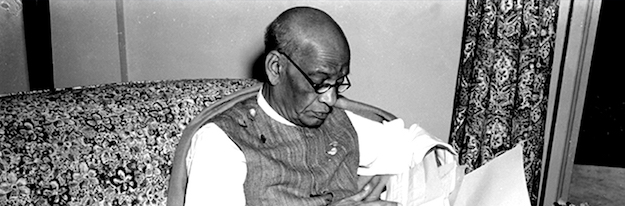
Vallabhbhai Patel (1875-1950), whose birth anniversary was observed on 31st October, is sorely missed. He has been, ever since he died at the none-too-great an age of 75, in 1950. He was the keel that the boat of the freedom struggle needed so as never to tip over, the ballast that the ship of state required to stay steady, move safe.
This is because he was, first and last, a patriot. A Congress patriot. And then, a man who knew India. The India which the Congress was seeking to define for itself, for India.
What was that India? Let us have Gandhi answer the question. In 1931, the year that Patel, for the first time, became Congress president, Gandhi went as the Congress’s sole representative to the second Round Table Conference in London. He defined at that Conference, the nature of the party, and explained to that gathering how the Congress represented the entire country. He explained, in fact, their inextricable oneness.
Under a big tent
In Gandhi’s words: “In as much… as I represent the Indian National Congress, I must clearly set forth its position. In spite of appearances to the contrary, especially in England, the Congress claims to represent the whole nation and most decidedly the dumb millions among whom are included the numberless untouchables who are more suppressed than depressed, as also in a way the more unfortunate neglected classes known as backward races…”
And again, at the Conference’s Minorities Committee: “…if you were to examine the register of the Congress, if you were to examine the records of the prisons of India, you would find that the Congress represented and represents on its register a very large number of Mohammedans. Several thousand Mohammedans went to jail last year under the banner of the Congress… The Congress has Indian Christians also on its register. I do not know that there is a single community which is not represented on the Congress on its register…even landlords and even mill-owners and millionaires are represented there…”
Serving the nation through that party representing ‘the whole nation’ and its various communities, strengthening that party at its plural grassroots, shaping the resolutions and decisions of its Working Committee and helping it form ministries in eight of the 11 provinces in the elections of 1936-37, Patel then guided it as it took over the reins of the Government of India in 1947. Working for and through the Congress was the Alpha and Omega of Patel’s political career.
That made him what he was, the ‘indomitable’ iron man of India. That also made the Congress, in very great part, what it was — an all-India organisation.
Congress was Patel’s life
No Patel, no national Congress. No Congress, no Sardar Patel. Congress patriotism was his patriotism; Congress politics was his politics.
No one, howsoever anxious to wrench his legacy off from that of the Congress, can dispute and much less deny that basic and incontrovertible fact. No one, howsoever desperate to annex his legacy to that of another body, cultural or political, like the Hindu Mahasabha or the Rashtriya Swayamsevak Sangh or the Bharatiya Janata Party, can succeed in staging so ridiculous a trapeze show.
Sardar Patel was the Congress’s spine. The Congress was Sardar Patel’s life.
Does that mean that the Sardar’s membership, leadership and stewardship of the Congress was free of tensions? Of course not, because he was human, and his party was led and peopled by other humans, each with tempers and temperaments that were distinct. Despite Gandhi’s pre-eminent position in it and in the hearts of the people of India, the Congress was not a hegemonic party and its most charismatic leader, Jawaharlal Nehru, was, by instinct, self-training and practice, its most natural democrat. Nehru’s was a lunar luminosity in Gandhi’s Congress. Nehru’s glow could brighten and lessen, and on a moonless light plunge the party in inky gloom. Patel, with his seven great skills — resoluteness, clarity, direction, focus, loyalty, grounded-ness and guts — was the party’s saptarshi, its Ursa Major.
The Congress not only accommodated personality and political variations, it regarded itself as their natural home. It was a place to which people belonged, not a place in which people assembled for a drill. Its sifat, to use a Persian word that stands for essence or ethos, was its diversity. And its Working Committee embodied that sifat. It had, Gandhi apart, Nehru the socialist and agnostic, Patel the conservative, C. Rajagopalachari the liberal, Rajendra Prasad the traditionalist, Abul Kalam Azad the scholar, J.B. Kripalani the scoffer. At different times it had Subhas Chandra Bose the nationalist, Sarojini Naidu the poet. Each Congressman and Congresswoman was himself or herself first, and then a soldier of the party. Each person was ‘rare’. Which is why, describing Acharya Narendra Deva in his obituary speech in Parliament, Nehru spoke of him being “…a man of rare distinction — distinction in many fields — rare in spirit, rare in mind and intellect, rare in integrity of mind and otherwise.” The Congress’s ranking leaders, as indeed its countless ‘file’, differed, debated, wrangled and even warred, but stayed true to the party’s sifat, because the party gave them that ‘play’, not as a policy but as an inherent personality trait, India’s trait.
The mutual differences between Nehru and Patel are no secret. The Congress did not believe in secrecy. Their mutual trust was no secret. The Congress believed in trust.
Their differences are not to be exaggerated. They are not to be minimized. They are to be contextualized. In the democratic spirit of that plural party.
Sardar Patel led a party as its Ursa Major that was anything but a homogenizing factory. It was as plural as it was because it saw itself in the words Gandhi used to describe its eclectic rolls in London in 1931.
‘India first’
Gandhi, who knew the meaning and action of political variegation, encouraged and succeeded in getting Nehru and Patel to work with coordination and cooperation if not coalescence. And for this, the realism of both leaders has to be thanked. Their realism, and their sense of ‘India first’.
India first was part of their idea of India. And ‘India first’ was integral to their sense of patriotism, their Congress patriotism.
Four days after Gandhi’s assassination, in a letter to his senior in politics, in the party and in age, Nehru wrote: “With Bapu’s death everything is changed… I have been greatly distressed by the persistence of whispers and rumors about you and me, magnifying out of all proportion any difference we may have.”
Patel replied on May 5, 1948: “I am deeply touched…We both have been lifelong comrades in a common cause. The paramount interests of our country and our mutual love and regard, transcending such differences of outlook and temperament as existed, have held us together.”
The very previous day, addressing the Congress Party in the Constituent Assembly, Patel described Nehru as “my leader” and said: “I am one with the Prime Minister on all national issues. For over a quarter of a century, both of us sat at the feet of our master and struggled together for the freedom of India. It is unthinkable today, when the Mahatma is no more, that we should quarrel.”
The Congress’s rank and file should ponder these observations of Nehru and Patel and rectify years of neglect, post-Nehru, of the Sardar’s legacy at the false altar of political cronyism. That neglect has lubricated the crassly opportunistic co-option of Patel by the Hindu Right which has no right, logical, political or moral, to that legacy. What the Congress squandered, Hindutva is shoveling in.
The Congress’s unwitting de-option of Patel was an error, Hindutva’s calculated co-option of Patel is an execration.
‘India first’ believers should be aware of both.
(The author is a former administrator, diplomat and Governor)
In reference the mischief-laden comment by the author Audrey Truschke, Beef Eating and Horse sacrifice in Vedas is a deliberate abuse of Vedic religion.
The fact however, is the Vedic Yagnas were pure satvik deeds. The Sanskrit word yagna(यज्ञ) itself means the pious worship. There was perfect vegetarianism in Vedas and Vedic Yagnas.
See the following references in Rig Veda-
Don’t kill any beings (Rig Veda 10/87/16)
In the Vedic Yagna, killing of an animal or eating meat is totally prohibited. (Mimansa 912/2/2)
Just like cows are given as charity in the yahya, horses are also offered in charity. (Mimansa 10/3/65)
Horses and cows are used only for giving in charity, but never eating their meat. (Mimansa 10/7/15)
It is common knowledge that satvik food includes- grains, cereals, vegetables, dairy products, and herbs etc., but never meat.
It is therefore, seen from above, not only meat eating, even offering the meat is avoided in the definition of Satvik food since Vedic times.
Similar references are included in the holy books of Hindus- Bhagvatam and Mahabharata. So much so, non-violence as one of the five Yamas means avoiding hurt by thoughts, words and deeds.
The evil minded hypocrites such as Audrey Truschke have started telling that Vedic principles in yagnas involved intoxicants and meat eating; it is not in the Vedas.
The worst terrorist attack in New York after the 9/11 tragedy came on Tuesday. Eight persons were killed and 12 injured when a rented pickup truck ran them down in a bicycle lane, in Lower Manhattan. The driver, Sayfullo Saipov, was shot at and arrested shortly afterwards. He is an immigrant from Uzbekistan, and the killing is believed to have been inspired by the ISIS, even though not explicitly claimed by the terrorist organization.
As the story of the immigrant-turned-terrorist unfurls, we see an alienated, frustrated, rootless man who was unable to adjust to life in the US. Yet, he managed to earn and provide for a family that he raised there. There is also the disturbing picture of how his frustrations took a violent hue and how he turned radical over a period of time. He was, allegedly, on the radar of the authorities and his conduct had raised concerns even among the preachers at one of the mosques he used to frequent.
Trump lost little time in blaming the Diversity Visa Lottery program under which Saipov had migrated to the US. Trump also said that he would consider sending Saipov to the military prison at Guantanamo Bay, Cuba. The President was unnecessarily critical of the federal justice system, which has delivered hundreds of convictions of terrorists since 9/11. Even as the law enforcement agencies and the justice system work in sync to bring the terror suspect to justice, New Yorkers, and Americans in general, have shown the will to weather this unfortunate “new normal” in the life in America. As for the right-wing “nativists”, the message to them would be the same as was affirmed by the White House Press Secretary after the killings in Las Vegas by a US-born white terrorist: “There’s a time and place for political debate, but now is a time to unite as a country.”
NEW YORK CITY (TIP): New York City Comptroller Scott Stringer hosted Diwali celebrations on October 25 when 3 leading community service organizations were honored for their services. The honored organizations included Chhaya Community Development Corporation (CDC), Federation of Indigenous Peoples of Nepal, and South Asian Council For Social Services.
The customary prayers were offered by Pandit Manoj Jadubans, followed by the Diya lighting ceremony. At hand were Comptroller Scott Stringer, Dr. Neeta Jain, District Leader, Assembly District NY – 25, Neeta Bhasin, President and CEO of ASB Communications, who introduced the Comptroller and a large number of guests.
Neeta Bhasin (extreme left) who introduced the Comptroller is seen with honorees
In his remarks, the Comptroller described Diwali as a celebration of good over evil and noted it was a major festival of India. He offered his greetings to Indian American community on the occasion. He spoke of the tremendous contribution of Indian American community to the growth of New York and the US in general.
Queens College Bhangra Knights gave a thrilling performance of Bhangra which is a folk dance of Punjab, and a rage all over the world.
Here is a brief biography of Honorees.
CHHAYA COMMUNITY DEVELOPMENT CORPORATION (CDC)
Chhaya CDC was founded in 2000 to advocate for the housing needs of New York City’s South Asian community. Chhaya’s mission is to work with New Yorkers of South Asian origin to advocate for and build economically stable, sustainable, and thriving communities.
Chhaya carries out this work in several ways, including free direct services, education, community organizing, and research and policy advocacy. Our work encompasses tenant rights, financial capacity and asset building, sustainable homeownership, civic engagement, immigration, and broader community building and research and advocacy around community needs.
By focusing on core areas of housing and economic development—the basic necessities essential to one’s stability—Chhaya is able to impact a range of social outcomes, including education, financial well-being, civic participation, and community pride. Through our work, Chhaya aims to develop a framework that will achieve long-term stability for New Yorkers of South Asian origin, giving them the tools and resources that will enable them to create positive, lasting change in their lives.
FEDERATION OF INDIGENOUS PEOPLES OF NEPAL
Federation of Indigenous Peoples of Nepal in America (FIPNA) is a not for profit organization registered in the State of New York since 2005. Its headquarters are in the City of New York and its wings are extended to various cities and states in the United States. FIPNA is a federal organization comprising of 18 indigenous Nepali community organizations in New York and beyond. The primary purposes of FIPNA are to preserve and promote the indigenous cultures of Nepali communities and help enrich the diversity of the City of New York. FIPNA also participates and advocates for the immigrants’ rights in the city and help in the empowerment of the Nepali communities in the mainstreaming process.
In coordination with the member organizations FIPNA hosts a couple of events each year which have significant impacts upon its communities and the city we live in. FIPNA hosts and leads the mega event Nepal Day Parade each year in the City of New York which helps the Nepali communities feel proud of for the diversity of the city. FIPNA is one of the major immigrants’ rights organizations who have advocated and endorsed the Citizenship Fund proposed by the NYC Comptroller, Honorable Scott M. Stringer. Nepal Indigenous Film Festival is another mega event hosted annually by FIPNA to observe Nepali cultural heritages in New York.
For further information please visit: www.fipnausa.org
SOUTH ASIAN COUNCIL FOR SOCIAL SERVICES
South Asian Council for Social Services, SACSS was founded in 2000, with the mission to empower underserved South Asians and other immigrants to actively engage in the economic and civic life of New York. While SACSS, started as a healthcare and social services agency it has grown and adapted to the changing needs of the population it serves. In the last 17-years SACSS has emerged as a gateway to new immigrants who are trying to gain a foothold in their new socioeconomic environment. Through services in the areas of Healthcare Access, Benefits and Senior Services, South Asian Food Pantry, English and Computer Classes and Civic Engagement, the organization assists immigrants to become self-reliant. Over 5,000 clients are served every year by staff that is culturally competent and speaks 11 South Asian languages (Hindi, Urdu, Gujarati, Punjabi, Bengali, Kannada, Telegu, Tamil, Malayalam, Nepali and Marathi) and Spanish and Creole.
In July 2016 SACSS started the first and only South Asian Food Pantry in New York City. In just one-year, the pantry has grown to serve 1,007 clients. This program addresses the issue of hunger and food insecurity among the underserved by ensuring clients receive food that is culturally palatable.
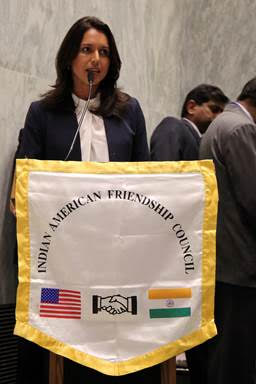
WASHINGTON (TIP): This evening in Washington, Rep. Tulsi Gabbard delivered a keynote address at the Indian American Friendship Council’s (IFAC) 20th Annual Legislative Conference. The congresswoman, a member of the House Foreign Affairs Asia-Pacific Subcommittee and the Democratic Co-Chair of the bipartisan Congressional Caucus on India and Indian Americans, spoke about bipartisan support behind strengthening mutually beneficial economic ties, building upon the existing U.S.-India security framework and a shared fight against terrorism, and expanding educational opportunities between the U.S. and India. Other speakers included the U.S. Ambassador to the United Nations, Nikki Haley, Foreign Affairs Committee Chair Ed Royce, Democrat Ranking Member Elliot Engel, and fellow lawmakers.
The congresswoman was recognized with IFAC’s National Service Award for her leadership in strengthening the U.S.-India partnership. Most recently in Hawaiʻi, the congresswoman has worked with state and local leaders to initiate a Sister-State relationship between Hawaiʻi and Goa, which will be formalized later this year.
Rep. Tulsi Gabbard and others at the Conference
Rep. Tulsi Gabbard said, “Over the years, the U.S. and India have made great strides in strengthening our important relationship, from cooperating in education to business to counterterrorism and so much more. As co-chair of the Congressional Caucus on India and Indian Americans and through my work on the House Armed Services and Foreign Affairs Committees, I’m working to strengthen the friendship and bonds that our two nations already share, and to encourage new opportunities for growth. The Indian American Friendship Council’s work to promote mutual exchange of knowledge and ideas, further understanding between elected leaders and those in the private sector, and provide a voice to the more than three million Indian Americans living in the United States has furthered this progress and expanded the U.S.-India relationship for the benefit of both countries and their citizens.”
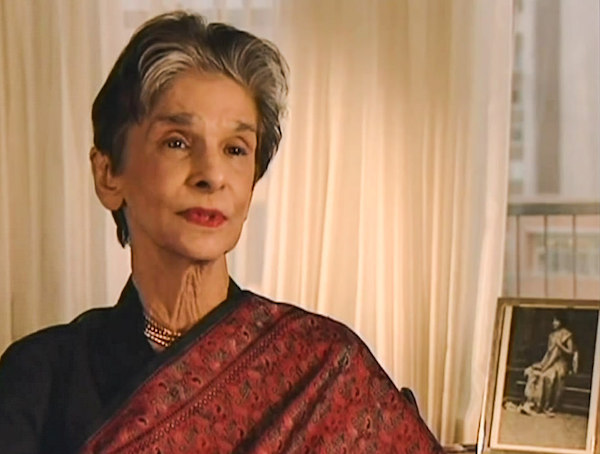
NEW YORK (TIP): Dina Wadia, daughter of Pakistan’s founder Mohammad Ali Jinnah, passed away peacefully at her home in New York on Thursday, November 2, family sources said in Mumbai. She was 98.
Further details were not immediately available.
Dina, who had married Bombay-based Parsi businessman Neville Wadia over her father’s objection and stayed back in India after Partition, is survived by her daughter Diana N Wadia, son Nusli N Wadia, her grandsons Ness and Jeh Wadia and two great grandchildren Jah and Ella Wadia.
Signup to our Newsletter!
Don’t miss out on all the happenings around the world