CAST: Charlize Theron, James McAvoy, John Goodman, Toby Jones
DIRECTION: David Leitch
GENRE: Action
DURATION: 1 hour 55 minutes
STORY
A lethal assassin fights for her life in Berlin during the Cold War as she uncovers a deadly game of spies.
REVIEW
We’ve seen a recent spike in strong female protagonists who can hold their own in battle; films like ‘Wonder Woman’, ‘Ghost in the Shell’, ‘Valerian’ and even ‘Logan’ come to mind. This is familiar territory for Charlize Theron who made quite an impact as Furiosa in ‘Mad Max: Fury Road’. Based on a graphic novel ‘The Coldest City’,’ Atomic Blonde’ is cut from the same cloth as ‘John Wick’ in that it features gunplay and close quarters hand-tohand combat that will make you wince. Keeping all that in mind, seeing the Oscar-award winning actor as Lorraine Broughton – an MI6 agent who is more than capable of receiving and dishing out a thorough bashing – isn’t exactly a far stretch.
On this front, Theron delivers by levelling the field to such an extent that her gender is almost irrelevant. Her skill-set is brutal and effective, but not unrealistic. This should be credited to director David Leitch, a former stuntman,who also directed some of the action in ‘John Wick’ and his dexterity with handling it is evident. There are gripping sequences in ‘Atomic Blonde’, and one in particular, that are a clever mix of camera work, editing and innovative fight choreography – enough to justify the cost of a ticket. Unfortunately, this comes at the price of a coherent plot.
Leitch isn’t as adept with storytelling, and he’s working with a convoluted screenplay that gives us twists and turns that seem to be thrown in just to make it all mean something. At the end of almost two hours, this gets a tad frustrating.
Additionally, the odd narrative choice to cut back and forth between Lorraine’s interrogation scenes as she replays the story as it occurred in the past, acts as a counterbalance to the tension and renders all the hard-work futile.
This does not detract from some solid performances by Theron, and especially James McAvoy who seems to be on a roll. He brings a manic energy to David Percival and manages to steal some scenes away from Theron. Aided by a soundtrack that mirrors the rebellious sentiment around the fall of the Berlin Wall, ‘Atomic Blonde’ is just enough fun. But it tries so hard to be mysterious and unpredictable that it ends up being more chaotic than it deserves to be. Truly a missed opportunity that leaves you more baffled than awestruck.
Actress Hilary Duff has lashed out at critics and said she does have flaws in her body but she is still proud of her body. Duff was trolled by people on her bikini body during a Hawaii holiday.
She took to Instagram on Friday to share a photograph of herself in swimsuit carrying her five-year-old son Luca.
“I am posting this on behalf of young girls, women and mothers of all ages. I’m enjoying a vacation with my son after a long season of shooting and being away from him for weeks. Since websites and magazines love to share ‘celeb flaws’ – well I have them,” Duff wrote alongside the image which shows her backside.
After a month-long tour of Europe, Sejal (Anushka) is just about to board her flight to India, when she realises that her engagement ring is lost. In quest of the object, she hires the same tour-guide Harry (Shah Rukh) and together they set off visiting the exact same spots that she and her family visited— in the hope of finding the heirloom. Of course the journey proves to be much more…
REVIEW
The plot is wafer-thin and it’s been done to death by none other than Imtiaz Ali in each of his earlier films—be it Jab We Met, Cocktail (writer) and Tamasha. It’s the routine girl is engaged elsewhere story but she discovers half-way through that her soulmate is someone other. In this case, Sejal is engaged to Rupen but actually ends up falling for Harry. Let’s give the devil his due, Imtiaz’s films do coax and cajole you to take a journey inwards instead of just doing the peripheral one. But in this film, the soul-searching bits between the leads don’t quite add up. What makes this film watchable though is the presence of Shah Rukh and Anushka both of who are in top-form in their Punjabi and Gujarati `impersonations’. In fact, SRK is like old wine, the more he matures, the better he romances. Boy, when he seals it with a kiss, he’s irresistible!
The music is average but Radha will definitely get you to attempt a bhangra-garba mix at your next house party. However, sound advice would be that you actually buy yourself a tour ticket to Europe and soak in the sights for real.
Of course, if you’re in the mood for a cheaper option of touring the continent, buy yourself a JHMS ticket and get transported to foreign destinations captured efficiently by cinematographer K U Mohanan, In this case, there’s the added advantage of a Punjabi `munda’ playing your friend, philosopher, lover and guide.
The journey from Netherlands to Nur Mahal treats you to an opera, pole-dancing and SRK in every frame. Despite it all, you’re tempted to tell the filmmaker that the script of this travelogue that seems to have gone missing, could perhaps be languishing in his own backyard.
After joining Instagram in April, Katrina Kaif has been keeping fans updated about exciting moments of her life, off the film sets and on it. In her recent post, she expressed herself saying that she was in a dilemma over her feelings.
As if the picture itself doesn’t convey her complex state of mind, she captioned the image as, “That feeling when you don’t know what you’re feeling anymore?????????????? (don’t ask about the random symbols…. it’s how I express myself)”
Meanwhile, she is currently filming for the sequel to Salman Khan’s 2012 action flick and soon be joining Shah Rukh Khan for the dwarf film helmed by Aanand L Rai.
Actress Kangana Ranaut said may be it is her destiny that she has to fight hard to get everything in life but she has made peace with it. The actress, who launched the trailer of her next, ‘Simran’, said she often wondered about her journey in Bollywood.
“My journey has been quite different. While flying to Mumbai for the conference, I was thinking about all sorts of questions that would be asked to me here. So I thought,’Has my journey really been unusual or is it only me who thinks that way?”
“But the one aspect that is striking about my journey is that I have to fight for everything in life, even the smallest of the things. I don’t know why it happens. Maybe it is my destiny but I have made peace with it.”
The actress said people might give her several tags but she will eventually take what is hers. “A lot of you might think, ‘to be or not to be’ but it is okay or like you guys use the word rebel, ladaku… I don’t take offence to that… I will take what is mine, be it by fighting or any other means.”
At the event, she was accompanied by director Hansal Mehta, who revealed that much before they collaborated for ‘Simran’, he had approached her with a film post her debut in ‘Gangster’. “I was pursuing her for a film since years. In fact, I had called her to my office for a script narration, just after ‘Gangster’. I was confident she will say yes.
But she refused,” Mehta said. To which, Kangana quipped, “I don’t remember this incident at all. He said his ego was hurt a lot. But this is the story of my life, whether I remember or not, I definitely hurt ego.” ‘Simran’ is scheduled to release on September 15. Source: PTI
NEW DELHI (TIP): More than 70 years after the Faizabad Civil Court rejected its claim over Babri Masjid as a Shia Waqf, the Shia Central Waqf Board of Uttar Pradesh has moved the Supreme Court to assert its claim over the disputed site.
Interestingly, the Special Leave Petition – which challenged a 1946 decision of the Faizabad Civil Court – said the Babri Masjid demolished by Hindu Karsevaks in 1992 was built by demolishing a Ram Mandir in Ayodhya.
The petition is likely to be taken up by a three-judge bench of Justice Dipak Misra, Justice Ashok Bhushan and Justice S Abdul Nazeer at 2 pm on Friday along with cross-appeals filed by various parties.
Almost seven years after the Allahabad High Court’s September 30, 2010 order dividing the 2.7-acre disputed land at the Ram Janmabhoomi-Babri Masjid site equally between Ram Lalla, Nirmohi Akhara and Sunni Waqf Board, the Supreme Court is scheduled to take up cross-appeals on August 11. Referring to the gazetteer of the district which contained references to Babri Masjid, the Shia Waqf Board said, “It shows that according to local affirmations, Babar came to Ajodhia in 1528 AD. And halted here only for a week and it was during his regime the Janmasthan temple was destroyed and on its site a mosque was built using largely the materials of the old structure.”
It said: “Trial court committed error in not appreciating that it is the Wakif who creates wakf. Even if someone (king) orders for building a mosque, the Wakif is the one who actually creates the Wakf by dedicating it to the God. In the instant case admittedly the mosque was built by Abdul Mir Baqi presumably out of his funds since Babar stayed near Ayodhya only for 5-6 days whereas construction of mosque took much more time (demolition of temple and building of mosque)..”, said the petition.
It said the “trial court failed to appreciate that merely `ordering’ to build mosque does not make that person as Wakif. Someone has to build it andhaving title, may be in the edifice, can dedicate it to the God. Maybe that Babar ordered Abdul Mir Baqi to build mosque, Mir Baqi (Shia) chose the site and having demolished the temple got the mosque built and dedicated it to the God, thereby creating a Shia Wakf”.
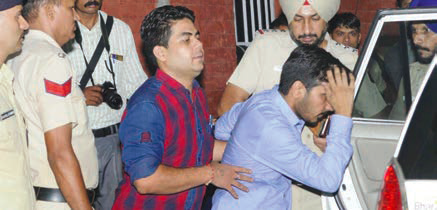
CHANDIGARH (TIP): A Chandigarh court remanded Vikas Barala, the son of Haryana BJP chief Subhash Barala, and his friend Ashish Kumar, in two days’ police custody on Thursday, a day after they were re-arrested and charged with a bid to kidnap disc jockey Varnika Kundu, 29, in addition to stalking her.
Civil judge Barjinder Pal Singh sent the two accused in police custody till August 12 after the police said they wanted to reconstruct the crime scene.
Defence lawyer Surya Prakash argued that the duo’s arrest was the result of a “media trial”.
“The woman feared kidnapping but no weapon has been recovered. The two are unnecessarily being harassed due to pressure from the media and other quarters. When they were caught by the police, there was no woman at the spot,” Prakash said.
Earlier, the two arrived at the district court complex from the Sector 26 police station amid tight security at 2.20pm. Dressed in a blue shirt Vikas, 23, who aspires to be a lawyer, and Ashish covered their faces with handkerchiefs to avoid the media glare. Vikas wore a grim look and appeared timid. Ashish appeared more confident even while responding to the judge. Vikas was barely audible.
Confronted with CCTV footage, Vikas is learnt to have admitted before the police that he was driving the Tata Safari Storme SUV last Friday night. He is learnt to have told the police that he was on his way to drop Ashish back to his residence in Panchkula. He denied stalking let alone attempting to kidnap Varnika.
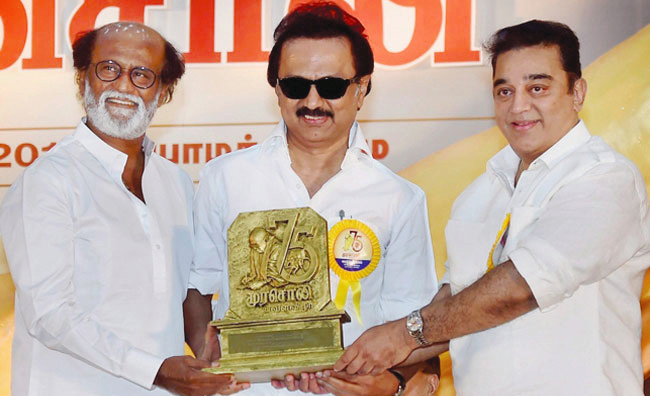
CHENNAI (TIP): Two reigning superstars of Tamil cinema – Rajinikanth and Kamal Haasan – on Aug 10 attended 75th anniversary celebrations of DMK’s mouth piece Murasoli in Chennai on Thursday amid speculation about their joining politics.
While Rajinikanth is being assiduously wooed by the ruling BJP at the centre, his contemporary Kamal Haasan has been critical of the AIADMK government in Tamil Nadu.
Haasan took a seat on the dais along with DMK working president MK Stalin and other senior party leaders. Rajinikanth, however, was sitting in the front row. The participation of the two actors, who have a large fan following, at the event of its mouthpiece is viewed as a coup of sorts in political event management by the DMK.
Ideologically, Haasan is perceived to be close to the DMK and might even consider associating with the opposition party. Stalin often defended Haasan against scathing attacks by AIADMK leaders for being critical of the government.
Rajinikanth, who has also indicated his intention to join politics a few weeks ago, is likely to launch his own party and have an alliance with the BJP, which is trying hard to make an inroad into the southern state.
Prime Minister Narendra Modi and Rajinikanth reportedly enjoy a personal rapport.
All the BJP leaders of significance make it a point to call on the superstar when in Chennai. The latest to call on him was BJYM president Poonam Mahajan, who was here the day before to address a rally. She is also said to have requested Rajinikanth to join the BJP.
However, RSS ideologue and chartered accountant S Gurumurthy, who is said to have the ear of the superstar, is convinced that Rajinikanth should float his own party and have an alliance with the BJP.
The moment of the day was when Stalin was flanked by the two superstars of Tamil cinema amid combined whir of camera shutters and flash bulbs popping to capture the event, beamed live over television.
Rajinikanth was invited on stage, where he was felicitated by Stalin. Source: HT
? Amit Shah’s presence in Parliament would be a morale booster for BJP members ? Shah has already clarified that even after becoming an MP, he will continue to be at the helm of the party ? There is no question of him joining the Union Cabinet, which is likely to be expanded shortly
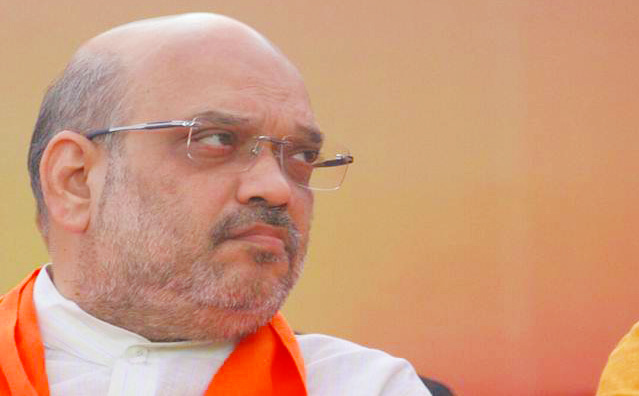
NEW DELHI (TIP): As BJP president Amit Shah gears up for his Rajya Sabha debut, Prime Minister Narendra Modi is believed to have cautioned party MPs who do not like to spend much time participating in proceedings of the Lok Sabha and the Rajya Sabha that their days of leisure are now over.
Addressing a parliamentary party meeting where he also praised Shah for completing three successful years as the party chief and bringing back the culture of hard work witnessed during Jan Sangh days, the PM is believed to have told the BJP lawmakers that he had said enough on the issue.
Now that Shah would be there in the Rajya Sabha, the days of leisure are over, sources quoted him as saying at the meeting—the last for the ongoing Monsoon Session that saw the government face an embarrassing situation when a united Opposition pushed through changes to a Constitution Amendment Bill on backward classes.
Sources said the words should act as a warning for habitual abstainers to get their act together. “We have asked you multiple times to be present in Parliament. Still some MPs remain absent. What do you think of yourselves…..You are nobody, I am nobody, it is the BJP that’s important,” is what the Prime Minister apparently told the MPs.
Notably, this is not the first time he has expressed anger over BJP members skipping Parliament proceedings, particularly in the Rajya Sabha where the collective NDA still lacks the numbers despite the BJP individually having overtaken the Congress there.
Shah had also made his displeasure known at the last meeting, which he conducted in the absence of the PM who was touring that day. He also made his displeasure known to the “missing MPs”, some of whom had gone to the airport last night to receive him there, sources say, predicting a sharp spike in Rajya Sabha’ attendance with Shah’s presence in the Rajya Sabha, which will now be conducted by senior BJP leader M Venkaiah Naidu.
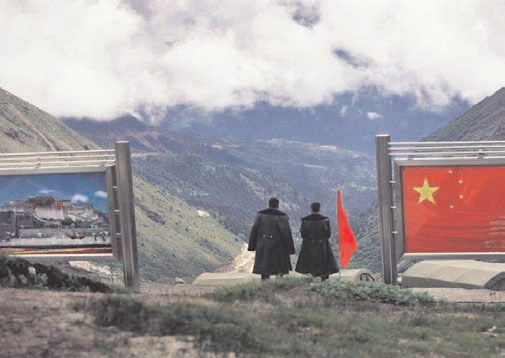
NEW DELHI (TIP): India and China continue to militarily reinforce their positions with the almost two-month long troop standoff in Doklam showing little signs of de-escalation, even as the Army on Thursday denied it had ordered evacuation of some villages near the Sikkim-Bhutan-Tibet tri-junction.
Government sources said there has been “some build-up” in terms of additional troops and tanks as well as artillery and air defence units in the Tibet Military District by the People’s Liberation Army (PLA), but there is “no major or unusual mobilization” towards the Line of Actual Control as yet to send alarm bells clanging in the Indian security establishment.
“Any major PLA mobilization towards our border will be
detected since it will take around a week. Our well acclimatized troops, backed by artillery, rockets and other heavy-calibre weapons, are currently deployed in the ‘no war, no peace’ mode. They are ready to respond quickly if required,” said a source.
Diplomatic channels, however, are also being used in a bid to diffuse the tense faceoff in the Bhutanese territory of Doklam, which erupted after Indian soldiers pro-actively blocked an attempt by the PLA to build a motorable road towards the trijunction in mid-June. “There is likely to be a border personnel meeting at Nathu La on Friday,” said another source.
The Army, on its part, rejected reports that some villages and hamlets in areas like Kuppup, Nathang and Zuluk near the border in Sikkim were in the process of being evacuated due to the heightened tensions. “No village has been evacuated. Neither does the Army propose to get any evacuated. Unnecessary panic should not be spread,” said a source. Source: TOI
CHANDIGARH (TIP): Giving a clean chit to power and irrigation minister Rana Gurjit Singh, the justice JS Narang Commission, probing allegations of irregularities in the sand mines auctions by the Punjab government, has said there was no loss of revenue and the auction was carried out in a transparent manner through e-tendering process.
Justice Narang handed over a 90-page report to chief minister Captain Amarinder Singh on Thursday. The CM had ordered constitution of the oneman commission in May this year following allegations of impropriety against Rana Gurjit in sand mine auctions.
Justice Narang met Amarinder at his (CM’s) official residence in the morning and handed over the report. “The CM has marked the report to the chief secretary and asked him to revert with his comments within two weeks,” said an official spokesperson.
Though Justice Narang refused to discuss the contents of his report calling it “confidential”, sources say the report attached replies to questionnaire given to all those named in the auction row, including the power minister, his close aide Amit Bahadur and officials of the mining wing of industries department. The report, sources said, also brought on record that the government earned much more in the auction as compared to the annual earnings during the previous Akali- BJP government. The report, sources revealed, said that no government official was pressured by the bidders. Source: HT
The Vice President-elect also disagreed with the view that there is growing intolerance, saying Indian society is the most tolerant in the world because of its people and civilisation
NEW DELHI (TIP): Vice President elect M Venkaiah Naidu today rejected as “political propaganda” the view that there is a sense of insecurity among minorities in the country , apparently a rejoinder to outgoing Vice President Hamid Ansari.
Though Naidu did not name anyone, his comments are seen as a response to Ansari’s remarks in a TV interview that there was unease and a sense of insecurity among Muslims in the country, and that “ambience of acceptance” is now under threat.
“Some people are saying minorities are insecure. It is a political propaganda. Compared to the entire world, minorities are more safe and secure in India and they get their due,” Naidu told PTI.
He also disagreed with the view that there is growing intolerance, saying Indian society is the most tolerant in the world because of its people and civilisation.
There is tolerance that is why democracy is so successful, he said. The former BJP president also cautioned against creating divide in the nation by singling out one community, saying it will draw adverse reaction from other communities.
“If you single out one community, other communities will take it otherwise. That is why we say all are equal. Appeasement for none justice for all,” the 68-year-leader and former Union minister said.
He said history has proved that there is no discrimination against minorities.
“They (minorities) got in prominent positions including constitutional responsibilities because there is no discrimination, and also on account of their merit,” he said.
Noting that India’s uniqueness is its unity in diversity, he said sarva dharm sadbhav and secularism is in the mind and blood of India.
“India is secular not because of political leaders but because of its people and civilisation,” he said. Ansari’s remarks come against the backdrop of incidents of alleged intolerance and violence by selfproclaimed cow protectors, for which opposition parties have attacked the central government.
Asked about incidents of alleged intolerance, Naidu said India is a huge country and there could be some “stray” occurrences, which are “nothing but aberrations”.
He, however, added that “Nobody can justify attacks on fellow citizens on the basis of community”. Such incidents should be condemned and action should be taken by appropriate authorities, he said.
Naidu also said that some people blow out of proportion such incidents for political considerations. Some go to the extent of “defaming” the county by raising such issues at international forum.
Some do it to create rift between communities and derive political mileage, he said, adding the basic problem arises due to vote bank politics and due to treating a community as vote bank.
A day before he takes oath as India’s next vice president, he said his advice to politicians is not to drag communities into politics. Source: PTI
FLUSHING, NY (TIP): Once again it is that time of the year to celebrate the biggest annual 9-day festival of the Hindu Temple Society of NA – Sri Ganesha Chaturthi. The colorful celebrations begin Friday, August 18th and conclude on Sunday, August 27th, 2017.
The culmination of the program is a very colorful procession of Lord Ganesha placed in a lavishly decorated Silver Chariot around the streets of Flushing on Sunday, August 27th starting in front of the Temple at 12:30 PM. This is the conclusion part of the biggest annual festival of Ganesha Temple. Thousands of joyful devotees accompany the procession and exhibit their exuberance by singing, chanting and dancing to the tunes of the drums and shehnai. Come in large numbers and enjoy the bliss and joy of the festival.
EDISON, NJ (TIP): Sravanth Malla correctly spelled the word “Chytridiales” (an order of simple, aquatic fungi of the phylum Chytridiomycota) during the 2017 South Asian Spelling Bee finals to clinch the title of national champion and took home a cash prize of $3,000.
Sreeniketh Vogoti from St. Johns, Florida was the National 1st Runner-Up at the Touchdown Media initiative on Aug.4, which was taped live for broadcast on Sony Entertainment Television
The initiative was organized by leading multicultural advertising firm, Touchdown Media Inc. Sony Entertainment Television was the exclusive rights holder and broadcast the initiative across the globe in over 120 countries, Kawan Foods returned as the powered by sponsor for the initiative which is now in its 10th year.
The South Asian Spelling Bee celebrated a decade of bees, which included some special guests at the finals such as 2016 South Asian Spelling Bee National Champion, Siyona Mishra and 2015 South Asian Spelling Bee National Champion, Shourav Dasari.
“It fills my heart to see such talented young spellers from across the country who make us proud as a community. The initiative is unique in its reach and engagement and we are very blessed to have the patronage for over a decade of families who make it a prestigious platform. My hearties congratulations to the winner,” said Rahul Walia, Founder.
The initiative was open to children up to 14 years of age and was held in 8 regional centers across the United States. These areas included, New Jersey, DC Metro area, Dallas, Chicago, Seattle, Boston, Bay Area, Charlotte, and the returning international center in Ghana.
Over 600 spellers from these centers participated from which 17 finalists took the stage at the Finals. Over 80% of the families and spellers are usually first time applicants aspiring to get the exposure and experience of being in the South Asian Spelling Bee. According to the applicant responses, 67% of the parents are from IT field, while 18% are from medical related fields and the remainder from legal, other professional and entrepreneurs. Families reported a median household income range of over $243,000 per annum.
“We are extremely happy with Sravanth’s win at the Bee as today’s South Asian kids are all rounders and highly dedicated to their craft. We produced a special section called “Meet the Spellers where the viewers will have an opportunity to get to know some of the spellers including Sravanth better,” said Tim Tan, Managing Director, Kawan Food, makers of the world’s most popular Roti Paratha Brand in the world – Kawan Paratha.
“Nail Biting contest year after year and I personally was unable to get up during the bee! It’s amazing to see the pool of talent from our community and am happy for Sravanth Malla’s win and excited to get to know him and some of the other spellers better in the “Meet the Speller” series airing shortly on Sony,” said Jaideep Janakiram, Head of North America, Sony Entertainment Television-Asia.
Children up to 14 years of age were eligible to participate and the contest saw spellers of even 6 years of age compete and make it past a few rounds. Registration for 2017 will open in October this year and for more information and to register your child, please visit www.SouthAsianSpellingBee.com.
Find us on Facebook at South Asian Spelling Bee and you can follow us on our Twitter handle at Spell South Asian.
About Touchdown Media Inc.:
Touchdown Media Inc. is a specialized South Asian advertising and promotions firm based in New Jersey. Now in its 13th successful year, Touchdown has helped clients, both mainstream and otherwise, reach out to the lucrative South Asian market. Touchdown Media represents more than 35 years of collective experience in this niche market. As a full-service ad firm, Touchdown has helped many clients achieve their media and marketing goals within the South Asian diaspora in the United States.
About Sony Entertainment Television Asia:
Since its launch on the Indian subcontinent in 1995, Sony Entertainment Television (SET) has enjoyed rapid success, leading to the establishment of European, North American and African feeds known as SET Asia. SET and SET Asia are now available in over 150 countries. The channels offer their viewers a distinctive blend of entertainment programs twenty-four hours a day, including, soap operas, dramas, sitcoms, concerts, movies, and game shows. For more information, visit www.setasia.tv.
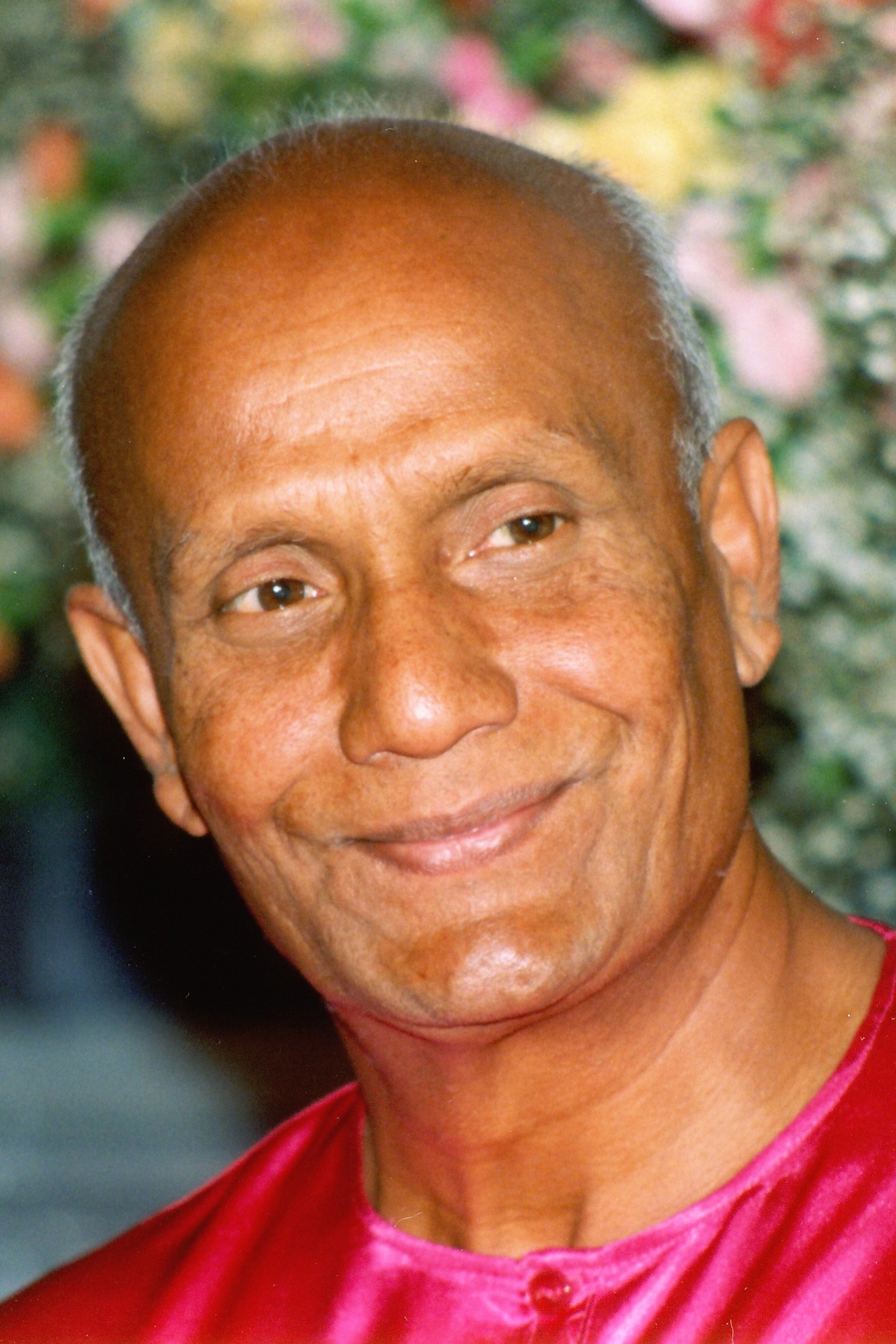
NEW YORK (TIP): Some new world records were set in the just finished 52 days long Sri Chinmoy self-transcendence 3100-mile race.
The 3100-mile race was started by the spiritual teacher, peace visionary and athlete Sri Chinmoy to discover the limits of their capacities and to try to go beyond them. Sri Chinmoy himself was an impossibility challenger. He transcended his capacity in many fields such as meditation, music, literature, poetry, art, sports and weight-lifting. (see www.srichinmoy.org). All his activities had one objective and that is universal oneness and peace.
Sri Chinmoy started this race 21 years ago and it is held every summer in which runners circle a single city block in a half mile loop, 18 hours a day. The race starts at 6 a.m. and continues till midnight. They are expected to run about 100 km a day to finish the race in allotted 52 days. The runners continue sometimes through extreme temperature, rain and pain. However, the runners experience deep inner peace and make a lot of inner and outer progress. This is something like ‘Tapas’ in India for spiritual progress.
Vasu Duzhly from Russia at the finish line of the Sri Chinmoy 3100 mile race in New York. He was 1st and he completed this race on 47th day.
This longest certified foot race is promoted by the Sri Chinmoy Marathon Team. Recently the New York Times wrote an article about this race. A few years ago, the Wall Street Journal, the Washington Post and the London Times too had articles. This year only five runners out of ten were able to complete the race by finishing within 52 days. Vasu Duzhly from Russia was 1st to finish on 47th day, Kaneenika Janakova from Slovakia and Nirbhasa Magee from Ireland finished on 49th day. Harita Davis from New Zealand and Yolanda Holder from USA finished on 52nd the last day.
Now the world’s longest race is over but it will inspire many around the world for self-transcendence or go beyond their capacity and find fulfilment.
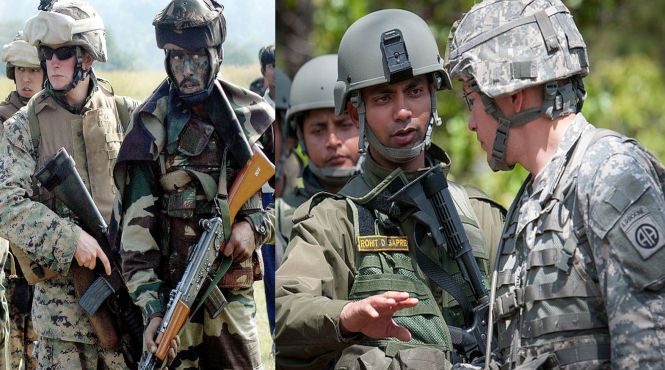
WASHINGTON (TIP): The prestigious Indo-US Joint Military Training Exercise, Yudh Abhyas – 2017 will be held from September 14-27 at Joint Base Lewis-McChord in the US. Over 200 Indian soldiers from the Gorkha Rifles will take part in the military exercise.
The exercise will be the thirteenth in the Yudh Abhyas series, which started in the year 2004 under US Army Pacific Partnership Program. It strengthens and broadens interoperability and cooperation between the Indian and US armies. It complements number of other exchanges and exercise between the forces.
Over the years the two countries have decided to progressively increase the scope and content of the combined training. Yudh Abhyas 2016 which was conducted at Chaubattia Military Station, Ranikhet, Uttarakhand, India witnessed a Brigade Headquarter based Command Post Exercise, an Infantry company carrying out Field Training Exercise and discussions on issues of mutual interest by experts of both countries. The exercise provided an ideal platform for the personnel of the two countries to share their experiences on counter insurgency and counter terrorist operations, especially in the mountainous terrain.
NEW DELHI (TIP): Indian American Democratic Congressman Raja Krishnamoorthi, who represents Illinois’ 8th District, met one-on-one with Indian Prime Minister Narendra Modi in the Indian capital to discuss the special relationship between the United States and India. The formal talks were held at the Prime Minister’s official residence on August 3.
“It was an honor to meet Prime Minister Modi and to discuss ways we can strengthen the special relationship between the world’s oldest and largest democracies,” said Congressman Raja Krishnamoorthi. “From billions in economic trade between our nations to our essential security partnership and ongoing cultural exchanges, the U.S.-India relationship is one of the most important in the world, and will only become more so in the coming century.”
“The United States and India are joined not only by our common interests and culture, but also by our shared commitment to the values of liberty, justice, and democracy. I look forward to helping to bolster the special ties between our countries for our mutual benefit in the years to come”, he further added.
NEW DELHI (TIP): August 1, 2017 marked the official launch of the US-India Strategic Partnership Forum (USISPF), a nonprofit corporation focused on stimulating business relations between the U.S. and India, and enhancing the strategic relationship between the two countries. India’s Finance and Defense Minister Arun Jaitley officially unveiled the new organization at a launch event this evening in New Delhi.
USISPF is committed to creating the most powerful strategic partnership between the U.S. and India. Promoting bilateral trade is an important part of USISPF’s work, but USISPF’s mission reaches far beyond this. It is about business and government coming together in new ways to create meaningful opportunities that have the power to change the lives of citizens. We are entering a new era based on a strategic partnership between the U.S. and India – one where we will work closely together with business and government leaders to achieve our goals of driving economic growth, job creation, innovation, inclusion, and entrepreneurship.
“Following the success of Prime Minister Narendra Modi and President Trump’s meetings in the U.S. in June 2017, I am incredibly confident about the powerful partnership between the U.S. and India – which is one that I believe can serve as a model for the rest of the world,” said John Chambers, Chairman of USISPF. “Our two countries will be able to make great strides in the months and years to come, and USISPF is honored to be a part of this exciting future.”
“The launch of USISPF represents a new chapter in the U.S.-India relationship,” said Mukesh Aghi, President of USISPF. “We are confident that we will be able to elevate the U.S.-India partnership to new heights by prioritizing mutual opportunities that will benefit businesses, governments, and citizens in both countries.”
USISPF’s leadership and Board have been carefully selected based on their unique expertise and strong government and business relationships in both the U.S. and India. Mukesh Aghi will lead USISPF as President and Gaurav Verma will serve as Chief Operating Officer. USISPF’s Board of Directors will include Chairman John Chambers (Executive Chairman, Cisco), Vice-Chairs Punit Renjen (Global CEO, Deloitte LLP) and Edward Monser (President, Emerson Electric), and Board Members Indra Nooyi (Chairman & CEO, PepsiCo), Ajay Banga (President & CEO, MasterCard), Ambassador Susan Esserman (Partner, Steptoe & Johnson), Secretary William Cohen (Chairman & CEO, The Cohen Group), Purna Saggurti (Chairman of Global Corporate & Investment Banking, Bank of America Merrill Lynch), and Ambassador Frank Wisner (International Affairs Advisor, Squire Patton Boggs).
This week, U.S. President Donald Trump endorsed a bill (a revised version of the RAISE Act) that seeks to reduce levels of legal immigration to the United States by 50%. The legislation would cut the number of green cards issued annually in half, from more than 1 million to fewer than 500,000.
If passed, the bill would radically transform the U.S. immigration landscape. It would remove the pathways to permanent residency that are currently in place for the siblings and adult children of U.S. citizens and green card holders, while also limiting the opportunities available to their spouses and minor children. The new legislation would eliminate various employment-based visa programs, which would be replaced by a difficult to achieve point system. This new system would reward prospective immigrants with points on the basis of their age, level of education, extraordinary achievements (if any), high salary, and proficiency in the English language, among other criteria.
The odds of the bill being enacted are slim, as it has failed to attract additional co-sponsors and Republican leaders in Congress do not plan to vote on immigration in 2017. However, President Trump has previously applauded similar systems that are already in place in countries such as Canada and Australia.
The bill proposes to admit immigrants into the U.S. on the basis of a strict point system, where those applicants with the highest “score” (not including special circumstances) would be rewarded with U.S. residency. The devil, as they say, is in the details. The absolute must-hit number of points is 30, making it nearly impossible for Indian applicants, especially those looking to study in the U.S. Unless an international student has won an Olympic medal against the likes of Michael Phelps or is a medical research prodigy who has found the cure for cancer at a young age, attaining those 30 points will be extremely challenging.
How would the points for an average international student add up? The vast majority of aspiring Indian students are between the ages of 18 and 21, which would award them six points. If this student were completely fluent in English, they would be entitled to 12 points instead. However, to qualify for these additional points, said student would need to display a higher proficiency in the English language than the average American citizen. Additionally, he or she would need to possess a US-based professional degree and/or doctorate. Furthermore, this student would need to convince a US employer to offer him/her a salary of over 200% of the median household income.
According to a recent study conducted by Korn Ferry, a leading research institute, the average annual starting salary for a 2017 college graduate is approximately USD 50,000. A US Census Bureau report published in September 2016 cites the median household income at USD 55,775 in 2015. Therefore, in order to qualify under President Trump’s radical new proposed immigration plan, an Indian college graduate would be required to earn at least USD 110,000 annually (twice the average US household income and more than double the average annual starting salary for a college graduate) in order to reach the required threshold of 30 points.
Reaching the requisite 30 points would even prove difficult for those immigrants with “extraordinary achievements,” such an Olympic Medal or a Nobel Prize. These exceptional applicants would qualify for a mere 25 points.
In light of the above insights, LCR Capital Partners is confident that the EB-5 visa program will continue to provide the safest and fastest route to securing U.S. residency. The EB-5 Investor Visa Program is in no way dependent upon the above stipulated criteria that applies to the various employment-based visas (EB-1, EB-2, EB-3 and L-1). Therefore, the bill will in no way affect the legal immigration route of an EB-5 applicant.
About the EB-5 Program
The EB-5 Immigrant Investor Program provides permanent U.S. residency to foreign investors and their immediate families (children up to age of 21) in exchange for a $500,000 investment into a new American business or real estate project that creates 10 full-time jobs. Put simply, the EB-5 Program is the fastest, simplest and most reliable way for immigrants to become permanent residents of the United States.
Since most alternative ways of obtaining a U.S. green card (e.g. H-1B, EB-2, EB-3) involve long waiting times and cumbersome processes, LCR’s clients are increasingly taking advantage of the EB-5 visa’s multiple benefits, including high approval rates, relatively quick processing times, and a competitive return on investment.
About LCR Capital Partners
LCR Capital Partners was founded in 2012 by first-generation U.S. immigrants who met at Harvard Business School. LCR is a U.S. private investment firm that provides growth capital to premier resort developments as well as the top performing brands in the franchise industry. Suresh Rajan, the CEO of LCR Capital, and his team are committed to providing high-net-worth investors with the best EB-5 processing experience possible. The LCR team is proud to offer quality investment projects that ensure both the safety of investors’ assets and the successful attainment of green cards for LCR’s clients. LCR’s primary client base comes from Latin America, India, South Africa, China, and the Middle East. As a firm founded by first-generation U.S. immigrants, LCR understands and seeks to alleviate the challenges and maximize the opportunities associated with starting a new life in the United States.
Two to three decades back, people emigrating from India was a rare occurrence. A decade back, it was a little more popular, but still only around 15-20% of the Indian population had some relative outside the country. Now, almost 40-50% of the Indians have some or the other relative residing outside the country. These days, hearing about someone’s spouse, aunt, uncle, parents, children, nieces or nephews living out of India is very common.
Whether to earn a better pay for their hard-work or to have a better way of living or to simply enjoy the work and life culture of a distant land – there are varied reasons for people opting to emigrate from India. However, what could be the reasons for the countries who are allowing so many immigrants?
Reasons for countries to allow immigrants
There may be various reasons for a country to allow – and even encourage to some extent – immigration. However, there are three main reasons for this, which are:
Shortage of skilled professionals: In an ideal world, every country has qualified personnel for each and every field in their country. However, in reality this is not so. Every country faces labor shortage in some or the other sector and, at times, there are professions that a select group of people can perform better than others. This is one of the core reasons for any country to accept immigrants.
Cost effective: Usually, the countries opting for immigrant workers are the First World countries. Hiring skilled workers or professionals from outside, especially from the Third World countries, is much more cost effective for these countries than employing the local residents. Most of the large companies and industries prefer transferring their employees from other branches in India, China, etc. A lot of money used for hiring and training new employees is saved this way.
Growth in economy: As immigration is a two-way beneficial set-up for both the applicant and the nation, every country opts for immigrants that belong to the skill-area they are facing a shortage in – mostly skilled professionals. These professionals in turn help not just the company they are working for but also contribute very well towards the growth of their adopted country’s economy.
However, there is another fact that is fast emerging as the main reason for countries to take up immigrants, and that is the ‘aging population’.
If we take up the example of Canada, according to a recent data released by Statistics Canada:
* With the front-end of the baby boom generation having reached 65 in 2011, the population of Canada is aging;
* Canadian society is urbanizing as more people are living in mid-sized and large cities;
* One-person households are more, reflecting high divorce rates and longer life spans; and
* As Immigration continues to shape Canada’s demographic profile, the population and workforce are becoming increasingly multi-ethnic.
The survey states that all of the above national-level trends are evident in B.C (British Columbia). The median age of British Columbians was 41.9 years by 2011. The median age has been steadily climbing for four decades. Twenty years ago, it was 34.7 and back in 1971, the typical B.C. resident was a youthful 28. Almost 700,000 were aged 65 and over out of the province’s 4.4 million people in 2011.
An important demographic development that needs to be mentioned is immigration and the role it plays in re-shaping the population. Measured relative to the size of the existing population, Canada stands near the top in the number of immigrants admitted globally. Canada welcomes 240,000 to 260,000 permanent newcomers in an average year, not counting the inflows of student and foreign temporary workers. According to the 2011 census, immigrants comprise 26% of British Columbia’s population; the proportion is much higher in the Lower Mainland — 41%.
The aforementioned statistics clearly display that with the average Canadian fast reaching the age of retirement, immigrants are the main driving force for Canada’s economic growth. This is the factor that is fast-emerging as one of the main reasons for Canada or any other country opting for skilled professional immigrants.
All are cordially invited to celebration of India’s 71st Independence Day on August 15 at 7.30 AM at the Consulate General of India, 3 E 64th Street (between Madison and Fifth), New York City, NY.
Flag hoisting ceremony will be performed in front of the Consulate building in the street which has been ordered blocked in the morning for the duration of celebrations.
The new CG, Ambassador Sandeep Chakravorty has appealed to the Indian American community to come in large numbers with family and friends, and as many as they can, bring along neighbors from mainstream, too. Ambassador Chakravorty has also suggested that the Indian American community exhort their elected representatives to attend Independence Day celebrations with the community at the Consulate on August 15.
The golden voice of Asha Bhosle, having been dubbed “the last empress of music,” will be ringing in the concert halls of America at Newark, New Jersey; San Jose, California; and Boston, Massachusetts in August 2017.
Different moods of Asha Bhosle
The diva will be accompanied by talented singer Javed Ali and her granddaughter Zanai Bhosle who will also enthrall the audience with her song-and-dance performances.
Stardust, the iconic Indian entertainment media brand, has been capturing the magic of Hindi cinema and music (Bollywood) over the last 4 decades through the glossy pages of its print magazine and its online portal.
Asha Bhosle and Zania Bhosle.
The magazine now carries forward the same magic through live events like film awards and musical concerts, both in India and overseas.
Stardust has hosted some of the most successful musical concerts in the last 3 years in the United Kingdom. After the unprecedented response to the UK concert last year with 50,000+ live audience participants, Stardust decided to bring the above concept to the USA in August 2017. It is believed that the USA concerts will be landmark events.
It is impossible to summarize everything about the wonder called Asha….. but, here’s an attempt….. a career spanning 7 decades, 13,000 songs to her name and still counting, Asha’s musical journey is a milestone in itself. Quite a rebel in many ways, she has managed to break stereotypes, defied convention and created a genre that is truly Asha!
Fondly referred to as Ashaji, Bhosle is one of the distinguished voices and icons of the Indian music fraternity who started her career in 1943. She has done playback singing for over a thousand Bollywood movies. In addition, she has recorded several private albums and participated in numerous solo concerts in India and abroad. The vivacious songstress has 13,000 songs cutting across various genres. Renowned for her voice range and often credited for her astounding versatility, Bhosle’s musical work includes film music, pop, ghazals, bhajans, traditional Indian Classical music, folk songs, qawwalis and Rabindra Sangeet. Apart from Hindi, she has sung in over 20 Indian and foreign languages.
In 2013, Ashaji made her debut at age 79 as the lead actress in the film Mai, and received critical acclaim for her performance.
She has been officially acknowledged by the Guinness Book of World Records as the most recorded artist in music history. The Government of India honored her with the Dadasaheb Phalke Award in 2000 and the Padma Vibhushan in 2008.
Her last performance in New Jersey will take her fans down memory lane. It will be an emotional moment for her and her fans. But, the melody in her voice will continue to regale the USA audience forever.
Thank you, Ashaji, for such wonderful memories. Please continue making more of them…
It was the monsoon of 2007 when a movie was readying for its release. In between the promos, a song caught up the fancy of cine goers – Ek Din Teri Raahon Mei – sung by a young, relatively unknown man was topping the charts. The song soon became a hit and paved the way for one of Bollywood’s most versatile singers, Javed Ali.
Javed Ali.
Blessed by a voice of chameleon-like versatility that can charm fans of all kinds of music, Javed was soon favored by top-notch Bollywood music directors in the industry to sing songs ranging from deep soulful melodies like ‘Jashn-E-Bahaara’ (Jodhaa Akbar) to naughty and playful compositions like ‘Tinku Jiya’ (Yamla Pagla Deewana).. Other hits began raking in….. Guzarish from Ghajini, and even Arziyan from Delhi 6, Tu Hi Haqeeqat from Tum Mile, Tum Tak from Raanjhanaa, Jab Tak Hai Jaan title track from Jab Tak Hai Jaan, Ishaqzaade title track from the film Ishaqzaade, Galat Baat Hai from Main Tera Hero, Nagada Nagada from Jab We Met, Tu Jo Mila from Bajrangi Bhaijaan.
Javed’s Bollywood career began in the year 2000, with Beti No. 1. He believes that music composers, today, are looking for freshness in voice and therefore his entry in Bollywood. He has never followed anyone’s style of singing.
Thanks to his versatility, Javed Ali is brilliant on stage as well. When he is performing, he doesn’t remember who he is and where he is. His body language and attitude change according to the song.
Never one to fall in the trap of fame, he remains a simple guy, who may turn rock star on stage, but in real life is as connected to music and keen on learning more as he was on the day he began his musical journey.
The singer is also considering offers of music reality shows for which he has been approached. He would like to sing Rap because he hasn’t tried it yet.
Born in a family inclined to music, Javed has always wanted to be a singer. Son of legendary Ustad Hamid Hussain, Javed was trained under Ustad Ghulam Ali.
Having sung live around the world, his fans abidingly throng to each of his concerts. Consistent and with a track record of some amazing hits from Bollywood, Javed Ali has a very promising future.
Zania Bhosle dancing
Legendary singer Asha Bhosle’s granddaughter Zanai (Anand Bhonsle’s daughter) feels a sense of pressure given the illustrious family of great singers from which she comes.
There is a sense of pressure as there are expectations from her. She would want to continue singing and work hard towards it. Her grandmother (Ashaji) thinks she has a melodious voice. But, Zanai adds, that she also wants to be as humble as her grandmother….. who treats everyone equally.
The 14-year-old singer has recorded a song “Hil Pori Hila” (a modern take on the popular Maharashtrian folk number with the same name) with India’s first transgender band – 6 Pack.
She believes they (transgenders) are ill treated in society. So, she hopes her song makes a difference in the way transgenders are treated. She feels everyone should be treated equally…..after all, we are all human beings.
Produced by Y-Films, the band’s song with Zanai was released in 2016.
Asha Bhosle feels proud to have sung songs for Yash Chopraji and his entire family for so long, and today, her granddaughter has sung for Y-Films, which is backing the 6-Pack Transgender Band. She can’t be happier and is glad that the relationship between them (her and Y-Films) has remained the same ever since.
The performance schedule of Stardust’s Asha Bhosle and the team concert is as follows:
San Jose, CA – August 12
NJPAC, NJ – August 19, and
Boston, MA – August 20
For tickets to the NJPAC performance, visit www.njpac.org or call 1 888 go NJpac (1-888-466-5722).
For information about the events, contact Magna Publishing Inc., New York at 212 725 7833.
Mabel Pais is a freelance writer. She writes on the arts and entertainment, health and wellness, social issues and spirituality.
The issue of women’s safety comes under the national limelight with shameful regularity. The recent incident of a woman being pursued at night by men in a car in Chandigarh is a reminder that neither law nor public odium is a sufficient deterrent to such crimes. Two men, one of them the son of the Bharatiya Janata Party’s Haryana State unit chief, have been booked for stalking the woman. They have been released on bail; Section 354D of the Indian Penal Code, which pertains to stalking, is a bailable offence. This has attracted the criticism that the police did not invoke more stringent provisions. It is believed that the police had originally sought to include sections relating to an attempt to kidnap the woman, but dropped the idea. The use of a particular section depends on whether the ingredients of the offence are present in the actions of the accused. The onus is on the Chandigarh police to show that available evidence is limited to the offence of stalking. The claim that there is no closed-circuit television footage from anywhere along the entire route needs investigating. The victim’s presence of mind to call the police in time foiled her pursuers’ designs, but not every woman may survive such an ordeal in the same manner. This is one reason why the police, as well as family and friends of the victim, ought to take complaints of stalking seriously, and act at an early stage.
As crimes against women go, stalking is far too often dismissed as harmless. However, it is important to understand how traumatic and inhibiting it is for a woman to be pursued with unsolicited interest, and for such stalking to be considered ‘normal’. There are times when stalking contains the seed for a bigger, often violent crime. It should not be forgotten that murders and acid attacks have had their origins in stalking. It became an independent offence in 2013, when the country’s criminal law was amended in the wake of the horrific gang rape of a woman in Delhi in December 2012. The hope that expanding the rigor and scope of penal laws would bring down crimes against women has, unfortunately, been belied often since then. The Chandigarh incident reveals that a sense of privilege, flowing as much from gender as political influence, permeates the offenders’ actions. The victim’s father is a senior civil servant, and it may not be easy to give this case a quiet burial. However, there is another, in fact quite familiar, element: the attempt by quarters close to the accused to cast aspersions on the victim. One can only hope that society has advanced sufficiently to call out such victim-shaming. Stalking tends to dominate the public discourse only when it relates to well-known people or results in violence — this episode should compel a deeper understanding of how widespread this offence is, and how rarely offenders are brought to justice.
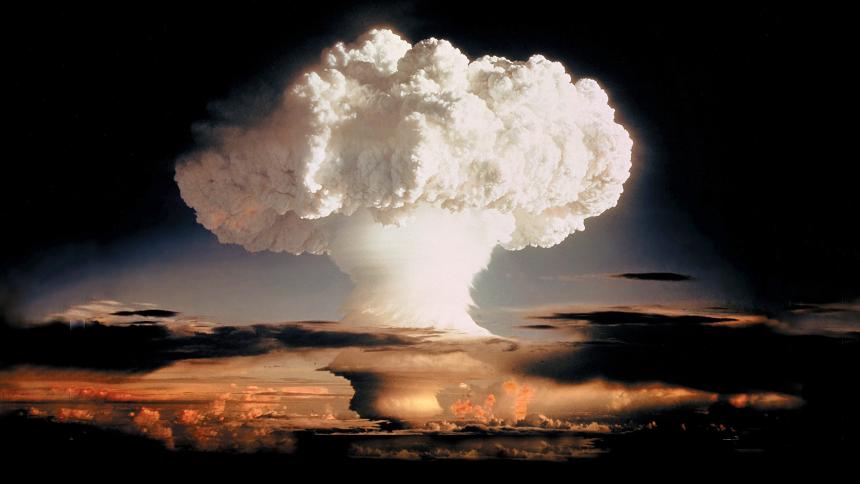
Reports say North Korea has developed nuclear weapons that can hit US. Experts, however, say the world is not on the brink of a Third World War. They say if any war were to happen, it would break out by accident, not by design.
Donald Trump has said he will launch “fire and fury like the world has never seen”. North Korea has promised to get its revenge “a thousand fold” on the US for any attack. But is the world really on the brink of a Third World War? Experts say probably not, while pointing out that it is easy to see how we might get there. A general consensus is that the US President’s statements are just bluster, although many emphasize the fact that bluster has an unfortunate history of leading to war.
The new escalation is the latest in an ongoing ratcheting up of tensions between Pyongyang and Washington, and came after a report that claimed North Korea had developed nuclear weapons small enough that they could be flown all the way to the US mainland and detonated there. After that came what prominent arms control expert Jeffrey Lewis has described a “carnival of bellicosity”.
Trump’s “fire and fury” statement is unprecedented in US relations with North Korea and markedly similar to the kind of rhetoric that emerges from Pyongyang. North Korea appeared to call the US leader’s bluff within hours of his statement, announcing it was exploring the possibility of attacking Guam, a US pacific territory that among other things houses strategic bombers.
Crucially, this statement appears to have been formulated in response to the US flying two B1-B bombers over the Korean Peninsula on Monday, a repeat of a similar operation carried out in July — and therefore not in response to Trump’s warning. Rex Tillerson, the President’s foreign policy chief, moved to calm the situation and advised the US public not to worry.
The message of de-escalation appears not to have influenced Trump, however, who woke up and tweeted that the US nuclear arsenal was “more powerful than ever before” — though adding that he hoped never to use it. Nevertheless, the US leader’s shift to outright belligerence towards North Korea has given rise to widespread fears around the prospect of a major global nuclear conflict, the fallout from which would inevitably see the destruction of large parts of the world.
My first order as President was to renovate and modernize our nuclear arsenal. It is now far stronger and more powerful than ever before….
— Donald J. Trump (@realDonaldTrump) 1502279793000
…Hopefully we will never have to use this power, but there will never be a time that we are not the most powerful nation in the world!
— Donald J. Trump (@realDonaldTrump) 1502280201000
So, is the world about to get destroyed by a nuclear war?
No, probably not, according to experts contacted by The Independent. Trump’s comments offer a significant and meaningful change in the rhetoric being exchanged between North Korea and the US — but they appear to be just rhetoric, for now.
“The first thing I would say is that I’m not sure that Trump’s comments change the fundamental calculus on the Korean peninsula, in the North or in the South,” said James Hannah, assistant head of the Asia program at Chatham House. “What’s obviously changed is the Trump factor and he has in a way emulated the North Korea bellicosity approach.”
Even the President’s voice is just one among many — albeit that of the Commander in Chief — in the White House, and is by far the most aggressive. Rex Tillerson said there was no “imminent threat” and that “Americans should sleep well at night”, while explaining that the President had adopted such a confrontational tone because this was language that Kim Jong-Un could understand. That does not mean there was no reason to be concerned.
“Having followed North Korea for a long time, I am getting more worried,” said Aiden Foster-Carter, honorary senior research fellow in sociology and modern Korea at Leeds University. “I worry about rhetoric getting out of control on either side and this leading to a miscalculation of some sort.”
Professor Foster-Carter stressed that he was not suggesting Trump’s comments or the US approach was anything like that of North Korea, only that there was an increasing degree of public enmity between the two sides. North Korea demonstrates better than any nation that bluster is important.
“I worry about loose rhetoric,” said Jeffrey Lewis, an adjunct professor at the James Martin Centre for Nonproliferation Studies. “Because I worry that allies or the North Koreans won’t understand that it’s just bluster. But having said that, I don’t believe that it’s evidence that the US is going to attack the North Koreans. In a strange way, it’s reassuring because it’s clear he doesn’t know what to do; if he had some plan to attack them, he wouldn’t be talking about his plan to attack them.”
Could conflict break out at some point in the near future?
Perhaps the most terrifying thing about the situation is how impossible that question to answer; there are simply too many disparate elements, each of them unpredictable on their own and amounting to a situation in which almost anything could happen.
“If the calculus hasn’t changed, what is being introduced is a greater level of unpredictability and rhetorical tension,” says Hannah. “Which has a number of knock-on effects. If the US is unpredictable, Trump supporters might see that as a pro — taking a harder line and putting pressure on the North and conceivably on China, by eventuating the threat. But equally, that unpredictability doesn’t wash well with US allies in the region, like Japan or South Korea. It creates a sort of echo chamber of inflated rhetoric.”
And with Trump in power, rhetoric tends to dominate the debate — and often become the debate. “If you do raise the rhetoric then I suppose there’s a greater worry that the chance of action in some quarters is increased,” adds Hannah.
It all really comes down to whether North Korea thinks that Trump’s statements actually mean anything. If he is just blustering — an activity they know well — then very little has changed; if they think that the rhetorical stance is something that puts them in danger, then conflict could arise.
How might war break out?
If any conflict were to happen, it is likely that war would break out by accident, not by design. Trump’s comments might be mostly powerful as rhetoric — but wars have been fought over similar rhetoric before. It’s worth noting that, of course, most people are still against the idea of nuclear wars. That is a fairly safe assumption and means that, whatever is said, nobody is going to choose to drop an atomic bomb on another country happily.
More simplistic military intervention, of the kind that western governments had hoped for when they went into Iraq in 2003, is also probably out of the question. As soon as North Korea felt it was being invaded, it would likely launch attacks on South Korea; if that happened, the big questions of North Korea’s nuclear range would be less important, since Seoul could be hit by simple artillery. The idea of risking those people for an intervention is all but impossible.
“Worried though I am about Trump I think he would be dissuaded from such a course,” says Professor Foster-Carter. “It would destroy South Korea, it would destroy the alliance; it would be more damaging even than all the conflicts that we’ve sadly grown used to in places like Iraq.”
But it’s not that simple.
“It has become more complicated to the point that concerns of miscalculations are higher, so that’s probably where the danger is,” says Hannah. “In a very complicated situation, I think the fear is of an unpredictable misstep or message that triggers some kind of chain reaction by one party or the other.”
That’s the chief concern about Trump’s comments — that they could be read as a suggestion that something damaging is about to happen, and that they could pre-emptively respond. And with such a swell of aggressive rhetoric swirling around the situation, any individual incident’s importance is going to be far higher.
The breakdown of negotiations and diplomacy between the US and North Korea also means that any minor event could be significant, since there’s no easy way for either country to address or calm any problem. Between 1994 and 2003, diplomatic agreements froze North Korea’s nuclear development and made it easier for diplomacy to go on between the country and its adversaries on other issues.
“What that means is when you have a conflict — when there’s a shoot-out on the maritime demarcation line, for instance — you’ve got a way to defuse tension,” said Professor Hazel Smith, author of North Korean Markets and Military Rule. “Today that doesn’t exist. So, if you have a relatively minor incident on the border, which is still disputed, which is still possible, there is a possibility for it to escalate. That’s how wars start. It is dangerous, the situation we have right now, especially when you have so many states with different interests involved.”
If that war happened, the US would ostensibly win it — that much is obvious, and is a key factor in the US military’s thinking. But that part of the world is surrounded by many of the biggest armed forces in the world, and any conflict would be “very, very bloody indeed”, said Professor Smith.
So, what is Donald Trump up to?
It’s possible that Trump’s comments are part of some master plan, unlikely though it might be. And the very fact that he is talking about the country is an important break from the Obama administration’s commitment to what it called strategic patience — but which really “was hard to distinguish from neglect”, says Professor Foster-Carter.
“Trump to his credit takes North Korea seriously but does it in such an extraordinary manner,” he said. Anyone minded to think of Trump as a strategic genius, may see his latest comments as evidence of a clearly though-through plan.
Those looking to be sympathetic, may suggest he is trying to match North Korea’s often aggressive commentary with similar attack of his own, or that his lack of care is a result of the “madman theory”, whereby a person behaves so bizarrely that they unsettle opponents and gain power from the perception they might do something crazy.
In some ways, it has the advantage of helping both sides. Both Pyongyang and Washington are led by men who are interested in making the other out to be evil and unhinged, both want to look strong and both can benefit from giving the appearance that, if prodded, they could trigger a nuclear Armageddon. Those are perhaps less likely than the theory Trump is simply wading into a discussion that he feels strongly about. Thankfully, the US leader is surrounded by people who are slightly more sensible — even if they’re not always able to stop him speaking.
The idea of the “fantastic, grim scenario” in which the world is pushed to nuclear was is “unbelievably frightening,” says Professor Foster-Carter. “But I don’t think it will happen because I think, hope and pray there’s enough adult supervision — in the military people, like Mattis and McMaster — and there’s no sensible strike option.”
It’s clear that those generals who now surround Trump — secretary of defense James Mattis, and national security advisor HR McMaster — do not want war, precisely because they are the most acutely aware of the damage it might do.
“One of the ironies is that it’s the generals that are trying to prevent the outbreak of military conflict — to look at alternative ways of what’s going on,” said Professor Smith.
Trump’s comments were in part notable because he did not appear to have taken direction on them — and may not have even planned to say it at all. Trump’s unpredictability reflects on the entire situation. The intervention of Rex Tillerson, who is among Trump’s more considered advisors, shows that the White House is still attempting to avoid all out escalation.
The danger depends in large part on whether those more sober heads can keep Trump calm, and quiet. The former reality TV star’s statement isn’t as significant in what he said as that he was able and willing to say it at all. It introduces a new instability to an already fairly shaky situation, in the form of the most powerful man in the world.
Who are North Korea’s allies?
Traditionally, North Korea has received help from countries like Russia and China. It might indeed be China that is at least partly motivating Trump’s recent outburst — playing as it does to his campaign comments about re-negotiating the two countries’ relationship. “I don’t think we’re seeing a US mobilization for nuclear war,” said Hannah.
“But Trump has invested himself heavily in the North Korea issue as an issue to prove himself. It’s also quite central to his approach to China. And China is a big part of his foreign policy, rhetorically at least.”
What does it mean for the UK and Europe?
Very little, both in terms of the immediate danger and the knock-on diplomatic effects. European countries will obviously take a close interest in the latest developments, but they are relatively small players where such matters are concerned. The US is involved because it has become a useful enemy for North Korea, for all sorts of reasons related to the Korean war and events before and since. But the most important countries are generally those around North Korea, including Japan and South Korea — both of which are in easy reach of any weapons and are allies of the US — as well as Russia and China.
How can we stop it?
This could have all been prevented in the 1990s. Then, there was an appetite in North Korea for a negotiated solution, and a desire in the US to acquiesce. Such a relatively straightforward solution may no longer be possible to fix a problem like Korea. The country believes, probably rightly, that its nuclear program keeps other countries from launching regime change, meaning its leadership is unlikely to relinquish its huge, atomic bargaining chip.
So, any security deal — bringing together all of the interested parties, including China, Russia and Japan as well as the US — would have to guarantee that there would be no regime change. That would be unpalatable to the US, since it would mean not only recognizing but committing to perpetuate an oppressive and deadly regime.
Even as Trump takes the hard line against Pakistan backing certain terror groups, there are many US generals who do not wish to antagonize Afghanistan’s neighbor
By Maj Gen Ashok K. Mehta (Retd)
“While McMaster is echoing Trump’s hard line, there are many generals, including Chairman, Joint Chiefs of Staff, John Dunford who do not wish to antagonize Pakistan and doubt whether a punitive approach can alter the behavior of the Rawalpindi generals. Eventually, the hard line could prevail but how it gets operationalized will be worth watching”, says the author.
The legendary Trump tantrums and tweets have so convulsed the White House that a four-star Marine General, John Kelly, in charge of Homeland Security, had to be transferred to the White House as Chief of Staff to maintain dignity and decorum and keep strategic policy-making insulated from chaos. Take Afghanistan, or Af-Pak. Inter-agency wrangles — between Pentagon, State Department, national security establishment and the CIA — have delayed the Af-Pak policy document. It was due in April but was put on hold as Secretary of State Rex Tillerson wanted to re-hyphenate Afghanistan with Pakistan.
Gen John Nicholson, US Commander, Resolute Force, in Kabul, who was in Delhi last month, had been told to expect the strategic directive latest by July 18. Instead, on July 19, in a stormy meeting of top generals at the White House presided over by Trump, he demanded to know why the war in Afghanistan was not being won even after 16 years, 2,740 US lives and USD 1 tn. According to one insider account, Trump wanted Nicholson sacked and replaced with his National Security Advisor, serving Lt Gen HR McMaster. The President’s NSC has met thrice seeking out-of-the-box ideas. Trump had famously told visiting President Xi Jinping over dinner that he had left the war-fighting to the generals.
At the July 19 meeting, Trump did not encounter any unconventional thinking, but was presented three widely accepted options — status quo, ramping up force levels, investing in a political solution. It seems he is incensed with Pakistan for consistently ‘not cooperating’ — after reviewing punitive policy recommendations made by Sen. John McCain, chairman, Senate Armed Forces Committee, following a brief visit last month to Pakistan; former Congressman Larry Pressler; and Lisa Curtis, Senior Director for South and Central Asia at the White House NSC. Trump is likely to get tough with Pakistan.
The message loud and clear from the White House was conveyed last week by McMaster to Pakistani generals. That Trump will not tolerate any support to terrorists, Pakistan has to change its paradoxical policy of supporting the Taliban, Haqqanis and other groups and has to stop those providing safe havens and support bases to these groups. The bottom line is changing the behavior of the deep state, which no US Administration has been able to achieve. Trump wants to win an unwinnable war hoping a tough and punitive policy on Pakistan’s non-compliance may open the door for better or worse in bringing a chastened Taliban/Haqqani network to the negotiating table. At the last count, the Taliban were in control of 95 of Afghanistan’s 407 districts.
While McMaster is echoing Trump’s hard line, there are many generals, including Chairman, Joint Chiefs of Staff, John Dunford who do not wish to antagonize Pakistan and doubt whether a punitive approach can alter the behavior of the Rawalpindi generals. Eventually, the hard line could prevail but how it gets operationalized will be worth watching.
The security situation in Afghanistan is worsening by the day as Kabul awaits Trump’s Ten Commandments. While at the strategic level there is a stalemate, at the tactical level advantage is with the Taliban and their affiliates. Earlier in the year, National Security Adviser Hanif Atmar, speaking at the IDSA, New Delhi, had said that the Afghan National Security Forces (ANSF) were losing on an average 29 soldiers a day fighting Taliban, Haqqanis and the ISIS. In comparison, Indian losses in Kashmir for all of 2016 were 95 combatants. Last three months have witnessed the most horrendous attacks ever — biggest truck bomb explosion in Kabul and the largest assault on an army camp in Balkh province killing hundreds of civilians and soldiers. These have sapped the confidence of Afghans who came on the streets demanding security from the National Unity government (NUG) riven with differences and afflicted by corruption. Meanwhile, the NUG has evolved a four-year (2017-2020) roadmap for enhancing ANSF fighting capabilities as agreed at the Warsaw NATO summit this May. The Americans and the West pay almost the entire cost of Afghanistan security and economy.
Pentagon’s latest report on Afghanistan states that India is the most reliable friend of the Kabul regime. Prime Minister Modi has repeatedly said that India will stick with Afghanistan through thick and thin. During last week’s US-India Forum at New Delhi, Foreign Minister Sushma Swaraj lauded sacrifices made by the US in preserving the gains of the last 16 years, including peace, security and democracy in Afghanistan. New Delhi’s development assistance for Afghanistan is worth USD 3 bn and is the largest to any country other than Bhutan.
Pakistan is the stick in the mud. Atmar had made plain that defeat of the Taliban was possible only if the Taliban and Haqqani sanctuaries were dismantled. He claimed that the Afghan Special Forces were the best in the world and the war could be taken to the sanctuaries. Senator Ted Poe has listed two legislations, one declaring Pakistan a state sponsor of terrorism and the other withdrawing the privileged status of Most Favored Non-NATO Ally. Trump advisers are convinced that only coercion and raising the costs for Pakistan will work. Besides curtaining funding, hard options such as surgical strikes against sanctuaries and targeted drone strikes to take out the Taliban and Haqqani leadership are on the table.
Since 2004, when drone strikes first started against Pakistan, 428 strikes have taken place, the last on July 3 in South Waziristan against ISIS targets. On June 13, US drones struck in Hangu district of Khyber Pakhtunwa, killing Abu Baqar Haqqani, in Pakistan beyond the drone-permissible tribal belt area. This is the second attack outside the agreed drone-strike areas, the last being in Balochistan which took out Taliban supremo Mullah Mansour last year.
It is estimated that approximately 1,200 to 1,600 terrorists have been killed in drone attacks. Will the drone strikes extend to Taliban and Haqqani sanctuaries on Pakistani soil? Will Afghanistan Special Forces assisted by US Rangers conduct surgical strikes against safe havens? A Trump authorization for either or both these options can be a game-changer. While admiring the chocolate cream dessert at the banquet for Xi, Trump informed him that Cruise Missiles had just attacked the Syrian airbase from where chemical attacks were launched by Assad forces in Syria. How far can Trump go to tame Pakistan to get out of Afghanistan? The long-awaited policy directive will conceal more than it will reveal!
(The author is a founder-member of the Defense Planning Staff)
Signup to our Newsletter!
Don’t miss out on all the happenings around the world