Year: 2017

  • India-America Chamber of Commerce Welcomes Ambassador Sandeep Chakraborty, new Consul General of India in New York

    India-America Chamber of Commerce Welcomes Ambassador Sandeep Chakraborty, new Consul General of India in New York

    NEW YORK CITY (TIP):  The India-America Chamber of Commerce (IACC) warmly welcomed the new Consul General, Ambassador Sandeep Chakraborty on Tuesday, October 17. The evening reception was hosted by Rajiv Khanna, President of IACC and Partner at the leading law firm of BakerHostetler. The event was attended by members of the Chamber, high profile business leaders and government officials.

    In his welcoming remarks, Rajiv Khanna stated: “Despite some friction on the outsourcing front, the relationship between the United States and India has been moving from strength to strength. President Trump recently confirmed India’s strategic importance in the war against terror in Afghanistan. According to the numbers released by the United States’ Trade Representative, India was the US’s 9th largest trading partner last year. The two-way trade between India and the United States was $67.7 billion last year. It is expected to reach $500 billion in the near future primarily from expansion in the defense and aerospace sector.

    Leading businessmen gathered to welcome Ambassador Chakraborty

    India’s economy is also moving from strength to strength. Epidemic corruption has been significantly reduced due to the Indian government’s recent anti-corruption measures and crack down on the parallel cash economy. India is sticking to its fiscal deficit reduction targets and inflation is under reasonable control.

    At this critical juncture, New Delhi has sent two of its brightest diplomats to strengthen the economic and commercial ties between the world’s largest democracy and the world’s greatest democracy. We are honored today to welcome our chief guest Ambassador Sandeep Chakraborty, the new Consul General of India.” Ambassador Sandeep Chakraborty welcomed the audience and expressed his gratitude towards Rajiv Khanna for hosting the event and telling a story to the chamber members on how he learned about Rajiv from the finance minister of India when he was moving to New York for his new role. He appreciated Rajiv’s involvement and support towards India.”

    He mentioned that his role will focus on building relationships and prompting economic events in New York City. Ambassador Chakraborty mentioned to the audience that the consulate is at your door steps and I welcome you all to come forward to discuss your issues. He stated clearly, “We are here to help you and work on the issues together.” He touched upon the following points with the audience:

    • Consulate office available at your door steps; available to help 24/7
    • Consulate at your disposal for any visa issues
    • Focus on supporting education, charities, and cultural exchange
    • Create dynamic relationships amongst the business community
    • India brings positive influence on the world
    • India and US are becoming close allies and we continue to build stronger relationships
    • Issue of trade and balance; proposal for more oil and gas transactions

    Ambassador Chakraborty concluded by thanking everyone for the warm welcome and emphasizing that the consulate is available to solve any hurdles and opened the floor for Q&A.

    About India-America Chamber of Commerce

    The India-America Chamber of Commerce works to promotes business-to-business dialog between the business and policy leaders of India and the U.S. — the two largest democracies in the free world. The Chamber serves as a platform for open and spirited interaction among U.S. and Indian business leaders from the private and public sectors. The Chambers’ monthly meetings include keynote presentations by visiting cabinet ministers, ambassadors and other prominent business leaders from the U.S. as well as India. India-America Chamber of Commerce was formed in 1932 and has since then, tirelessly worked to promote trade and investment between India and the United States. The Chamber is now accepting new members and forming a new board of influential members.

    (Based on a press release)

  • U.S. Federal Communications Commission scraps net neutrality rules

    U.S. Federal Communications Commission scraps net neutrality rules

    WASHINGTON (TIP): The U.S. Federal Communications Commission voted along party lines on December 14 to repeal Obama era landmark rules aimed at ensuring a free and open internet, setting up a court fight over a move that could recast the digital landscape.

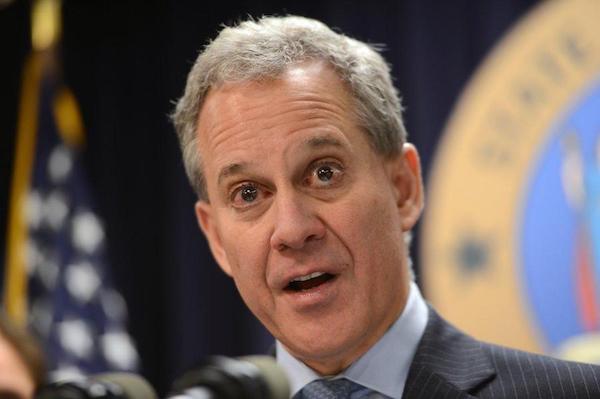
    New York Attorney General Eric T. Schneiderman has already announced that he will lead a multistate lawsuit to stop the rollback of net neutrality.

    Schneiderman released a statement which read, “The FCC’s vote to rip apart net neutrality is a blow to New York consumers, and to everyone who cares about a free and open internet. The FCC just gave Big Telecom an early Christmas present, by giving internet service providers yet another way to put corporate profits over consumers. Today’s rollback will give ISPs new ways to control what we see, what we do, and what we say online. That’s a threat to the free exchange of ideas that’s made the Internet a valuable asset in our democratic process.

    Today’s new rule would enable ISPs to charge consumers more to access sites like Facebook and Twitter and give them the leverage to degrade high quality of video streaming until and unless somebody pays them more money. Even worse, today’s vote would enable ISPs to favor certain viewpoints over others.

    New Yorkers deserve the right to a free and open Internet. That’s why we will sue to stop the FCC’s illegal rollback of net neutrality.

    Today’s vote also follows a public comment process that was deeply corrupted, including two million comments that stole the identities of real people. This is a crime under New York law – and the FCC’s decision to go ahead with the vote makes a mockery of government integrity and rewards the very perpetrators who scammed the system to advance their own agenda.

    This is not just an attack on the future of our internet. It’s an attack on all New Yorkers, and on the integrity of every American’s voice in government – and we will fight back.”

    The approval of FCC Chairman Ajit Pai’s proposal marks a victory for internet service providers like AT&T, Comcast and Verizon Communications and hands them power over what content consumers can access.

    Democrats, Hollywood and companies like Google parent Alphabet and Facebook had urged Mr. Pai, a Republican appointed by U.S. President Donald Trump, to keep the Obama-era rules barring service providers from blocking, slowing access to or charging more for certain content.

    Consumer advocates and trade groups representing content providers have planned a legal challenge aimed at preserving those rules.

    The meeting was evacuated before the vote for about 10 minutes due to an unspecified security threat, and resumed after sniffer dogs checked the room.

    FCC Commissioner Mignon Clyburn, a Democrat, said in the run-up to the vote that Republicans were handing the keys to the Internet to a handful of multi-billion-dollar corporations.

    Mr. Pai has argued that the 2015 rules were heavy handed and stifled competition and innovation among service providers. “The internet wasn’t broken in 2015. We weren’t living in a digital dystopia. To the contrary, the internet is perhaps the one thing in American society we can all agree has been a stunning success,” he said on December 14.

    The FCC voted 3-2 to repeal the rules. Consumers are unlikely to see immediate changes resulting from the rule change, but smaller startups worry the lack of restrictions could drive up costs or lead to their content being blocked.

    Internet service providers say they will not block or throttle legal content but that they may engage in paid prioritization. They say consumers will see no change and argue that the largely unregulated internet functioned well in the two decades before the 2015 order.

    WHAT EXACTLY IS NET NEUTRALITY?

    The net neutrality rules were approved by the FCC in 2015 amid an outpouring of online support. The intention was to keep the internet open and fair.

    Under the rules, internet service providers are required to treat all online content the same. They can’t deliberately speed up or slow down traffic from specific websites or apps, nor can they put their own content at an advantage over rivals.

    To take a classic example, this means Comcast can’t just choose to slow down a service like Netflix (NFLX) to make its own streaming video service more competitive, nor can it try to squeeze Netflix to pay more money to be part of a so-called internet fast lane.

    As Michael Cheah, general counsel at video site Vimeo, previously told CNNMoney: the point of the rules is “allowing consumers to pick the winners and losers and not [having] the cable companies make those decisions for them.”

    WHY IS NET NEUTRALITY SUCH A BIG DEAL?

    If there’s one thing that both sides can agree on, it’s that the internet is increasingly central to our lives. Any change to how it’s regulated is a hot button issue. (Remember the uproar over repealing internet privacy protections earlier this year?)

    “Everyone uses the internet, and everyone uses these tech platforms,” Michelle Connolly, a former FCC official who supports Pai, previously told CNNMoney. “So, issues that are coming up right now, people are seeing from a very personal perspective.”

    SO HOW WILL INTERNET PROVIDERS BE REGULATED?

    The FCC is doing away with rules barring internet providers from blocking or slowing down access to online content. The FCC would also eliminate some rule barring providers from prioritizing their own content.

    In the absence of a firm ban on these actions, providers will be required to publicly disclose any instance of blocking, throttling or paid prioritization. It will then be evaluated based on whether or not the activity is anti-competitive.

    As part of this shift, oversight of internet protections will shift from the FCC to the Federal Trade Commission.

    Maureen K. Ohlhausen, the acting head of the FTC, said in a statement Monday that the agency is “committed to ensuring that Internet service providers live up to the promises they make to consumers.”

    But consumer advocacy groups are less than optimistic.

     “Not only is the FCC eliminating basic net neutrality rules, but it’s joining forces with the FTC to say it will only act when a broadband provider is deceiving the public,” Chris Lewis, VP at Public Knowledge, a nonprofit that focuses on the open internet, said in a statement this week. “This gives free reign to broadband providers to block or throttle your broadband service as long as they inform you of it.”

    AND HOW WILL REPEALING NET NEUTRALITY AFFECT ME?

    First, it’s important to say what won’t happen: Billion-dollar services like Netflix are not going to disappear overnight without net neutrality. They have large enough audiences and bank accounts to survive in a changing regulatory landscape.

    Instead, net neutrality advocates worry how repeal will impact the next Netflix. Upstart companies may struggle to strike deals with providers and pay up to have their content delivered faster. That could fundamentally alter the future internet landscape.

    The repeal could change how customers are billed for services, both for good and bad. T-Mobile, for example, was criticized by net neutrality supporters for effectively making it cheaper for customers to stream videos from Netflix and HBO, putting other video services at a disadvantage.

    Without net neutrality, internet providers may pursue similar offers more aggressively, which would likely be viewed as a positive by consumers looking to save money on their streaming media.

    Yet, some fear it’s also possible internet providers will one day begin charging customers more to access services like Netflix that are currently included as part of your monthly bill.

    SO, IS THIS A DONE DEAL?

    Not quite. It’s very like this issue could end up being decided in court, or perhaps even by legislation in Congress.

    “Whenever we do anything big and major, people go to court,” a senior FCC official said last month. “I certainly would not rule that out.”

    (Source: CNN Money)

  • A Sikh American to be next top prosecutor in NJ

    A Sikh American to be next top prosecutor in NJ

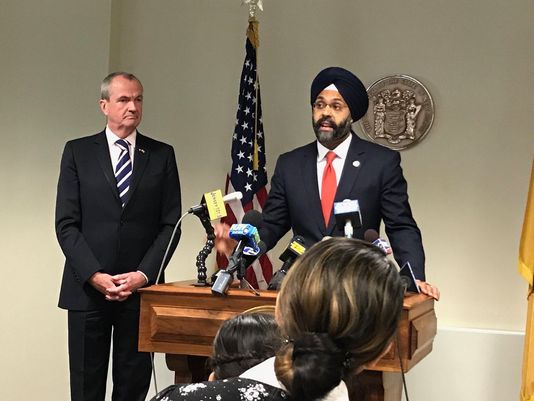
    TRENTON, NJ (TIP): On December 12, a Sikh Indian-American Gurbir S. Grewal, was nominated by NJ Governor-elect Phil Murphy as New Jersey’s next attorney general. Grewal, a Democrat, on confirmation by state Senate, will become New Jersey’s top law enforcement official. He will be the first South Asian attorney general in New Jersey and the first Sikh to hold the position in any state.

    Attorney general is the most powerful position in New Jersey government. He leads a number of departments including Law and Public Safety, civil rights, consumer affairs and police.

    Grewal was twice nominated by the current governor, Republican Chris Christie, to be prosecutor in Bergen County, New Jersey’s most populous county.

    Grewal left private law practice 14 years ago to enter public service.

    “I wanted to give back to a country that has given us, and other immigrant families like us so much,” Grewal, the Bergen County prosecutor, recalled, “I experienced hate and intolerance firsthand

    He said after the nomination: “The American dream is alive and well in New Jersey.”

    According to media sources Governor-elect Murphy, commented that he wanted an attorney general who would “stand up” to Trump and his fellow Republicans who control Congress.

  • Exit polls predict clear majority for BJP in Gujarat

    Exit polls predict clear majority for BJP in Gujarat

    The BJP is projected to win between 99 and 117 seats and the Congress between 64 and 82.

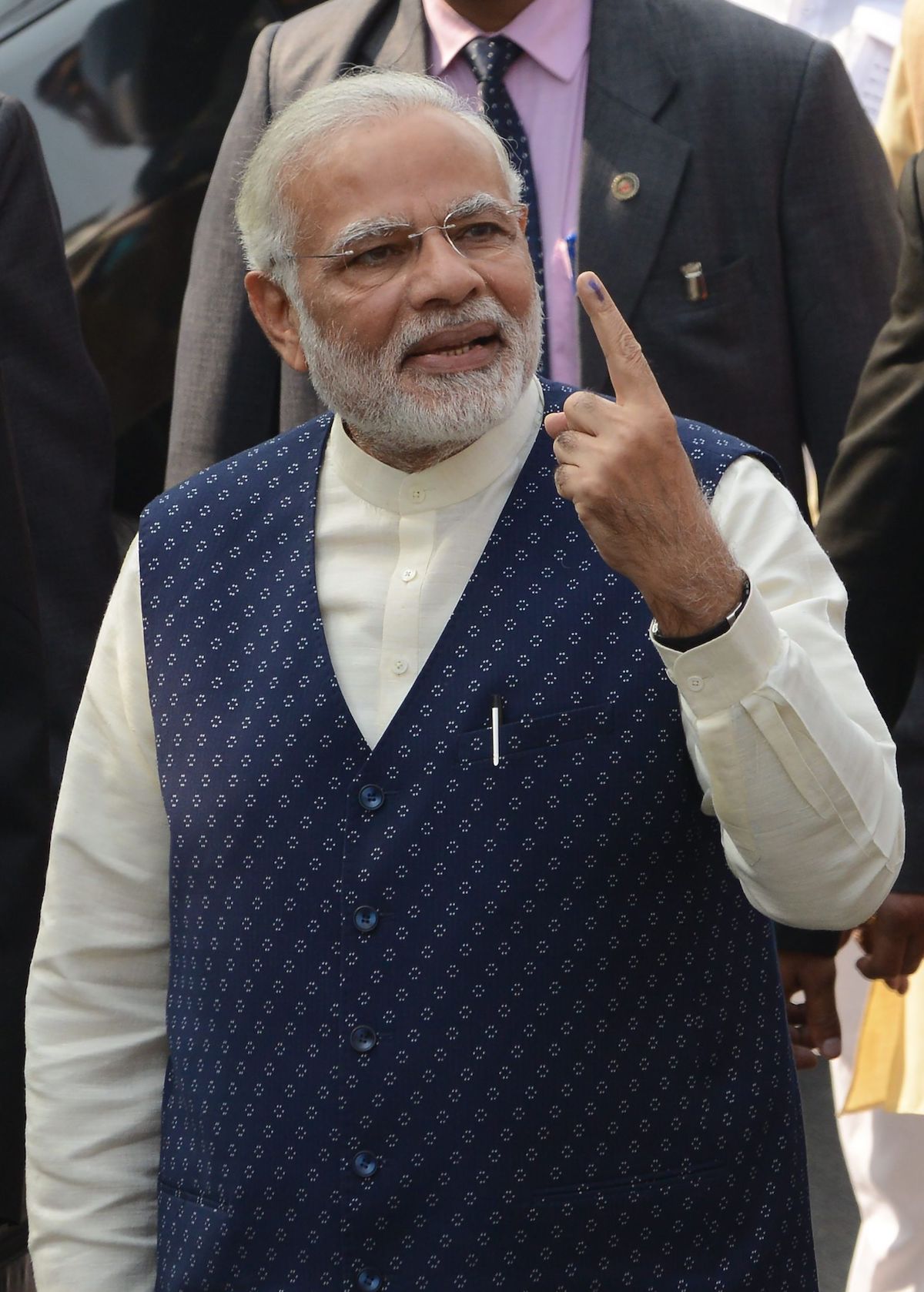
    NEW DELHI (TIP): Exit polls on December 14 predicted a victory for the ruling BJP in Gujarat, giving it a clear majority in the keenly-contested Assembly polls in the State, a PTI report said on December 14.

    Soon after voting ended in the second and final phase of the election, an exit poll gave the BJP 115 of the total 182 seats and the Congress 65. Another exit poll gave the ruling dispensation 108 seats and 74 to the opposition Congress.

    The Times Now-VMR exit poll predicted 115 seats for the BJP, 64 for the Congress, and the remaining for other parties. The Republic-C Voter exit poll gave the BJP 108 seats and the Congress 74.

    A poll on NDTV said the BJP would get 112 seats and the Congress 70.

    The ABP-CSDS survey by ABP News predicted a BJP victory in 117 seats as against the Congress’ 64.

    A survey by India Today’s Aaj Tak news channel also predicted that the BJP, which has been ruling Gujarat for almost 20 years, would retain power in the State. It said the BJP would emerge as the winner in 99-113 Assembly segments in the State, while the Congress could win 68-82 seats.

    A party has to win 92 seats or more to form a government in the State. In the 2012 Assembly polls in Gujarat, the BJP had won 115 seats, the Congress 61 and others six.

    Even though BJP gets majority to form a government in Gujarat, Congress seems to be on way to recovery in Gujarat.

  • Diwali Foundation USA’s “POWER OF ONE” Inaugural Award Bestowed on 6 Diplomats

    Diwali Foundation USA’s “POWER OF ONE” Inaugural Award Bestowed on 6 Diplomats

    UN Women’s Lakshmi Puri the only woman recipient of the Honor

    UNITED NATIONS (TIP): Diwali Foundation USA’s Inaugural “Power of One “Awards were presented here on December 11, 2017.  Belarus, Georgia and India joined with Diwali Foundation USA, to bestow “Power of One” Awards – essentially the “Oscars of Diplomacy” – upon six exceptional diplomats: Amb. Maged Abdelaziz, Amb. Ion Botnaru, Amb. Lakshmi Puri, Amb. Matthew Rycroft, Amb. Nawaf Salam, and Amb. Yuriy Sergeyev.

    The event was co-sponsored by Algeria, Armenia, Azerbaijan, Botswana, Cyprus, France, Honduras, Kazakhstan, Kuwait, Malta, Morocco, Republic of Korea, Romania, Slovakia, Spain, Sri Lanka, Thailand, Tunisia, Ukraine, United Kingdom, United States of America, Permanent Observer State of Palestine, and International Atomic Energy Agency-NY.

    All the awardees, with organizers and ambassadors

    Amb. Rybakov who was Master of Ceremonies invited Georgia’s Amb. Kaha Imnadze, India’s Amb. Syed Akbaruddin, Diwali Foundation’s chair Ranju Batra, National Advisory Council South Asian Affairs Chair Ravi Batra along with Amb. Frantisek Ruzicka, Chef de Cabinet to President of the 72nd General Assembly, H.E. Miroslav Lajcak, to light the Diya.

    Traditional lamp lighting. Seen from L to R: Amb. Rybakov, Amb. Akbaruddin (3rd from left), Ranju Batra (4th from left), Ravi Batra (extreme right).

    He expressed gratitude to all nations who agreed to Co-Sponsor the Award Ceremony, and named each of them. He said,

    “Having Diwali event held already second year in a row is hopefully becoming a regular tradition here in the United Nations. Being a symbol of charity, kindness and peace, Diwali is in lockstep with the goals and ideals of the United Nations.

    After a very successful launch of the Diwali stamp in 2016, this is now transformed into the “the power of one” awards acknowledging the role a person can play in the International community.

    We all hope that the “power of one” award will illuminate the way forward towards a more peaceful, safe and secure world in the United Nations and beyond.”

    Others who spoke on the occasion included CDC to PGA, Amb. Frantisek Ruzicka, Georgia’s Amb. Imnadze, India’s Amb. Syed Akbaruddin, Algeria’s Amb. Boukadoum, and Kazakhstan’s Amb. Umarov.

    Amb. Akbaruddin: “The power of one” award gives us the opportunity to honor those who have successfully brought about change.

    Ambassador Akbaruddin said, “The message of Diwali has been repeatedly stated to be the triumph of good over evil, light over darkness. It is also the reaffirmation of the foundational principles of the United Nations, which stand for universal good.

    “Today’s event, the “power of one” is to celebrate the outstanding contributions of those who are champions of the United Nations Charter and promoters of universal good. Each of them embodies in diverse ways what we all aspire for here in the UN. I am indeed humbled and grateful to be in the presence of all these outstanding champions, and would like to congratulate them for all their work they have put in over the years – which has made us all join in paying tribute to them.

    “As Mahatma Gandhi once said, “Be the change you want to see in the world.” The “the power of one” award gives us the opportunity to honor those who have successfully brought about change. Buddha said, “Be a light unto yourself; nobody can give this light to you.”

    The inaugural “power of one” awardees are all living examples of that important message.”

    Diwali Foundation USA Chair Ranju Batra: “I was determined to succeed in my goal to get the USPS to issue a Diwali Stamp”.

    Diwali Foundation USA Chair Ranju Batra thanked Amb. Valentin Rybakov “for a warm introduction”, and Ambassadors Ruzicka, Akbaruddin, Imnadze, Boukadoum, Umarov and Yelchenko for their “national and personal support and kindness”

    She said, “As you know, I was determined to succeed in my goal to get the USPS to issue a Diwali Stamp, despite knowing many others had tried and given up. I spent nearly 7 years chasing it peacefully, and using only inclusive and respectful means. Along the way, I got a lot of help from a lot of people. Congresswoman Carolyn Maloney accepted my invitation and provided national political leadership. I was happy that there were stamps for Hanukkah, Christmas, Eid, and Kwanza; but I also wanted one for Diwali. In October 2016, we won and got our Forever Diwali Stamp. I personally sold over 170,000 stamps to make the Diwali Stamp the USPS’ #1 Bestseller for Day One in its over 200-year existence. Among many who were of great support were Shiv Dass, now a Director of Diwali Foundation USA, Neeta Jain, Surinder Kathuria, Neeta Bhasin, Air India’s Vandana Sharma, Amb. Dnyaneshwar Mulay, and each of you who signed our petitions – which included many in the UN family – such as Palestine’s Ambassador’s daughter Reem Mansour. Aside from my Grassroot efforts, I also secured support from India’s Prime Minister Modi and America’s President Obama.

    “Days after the Official Dedication, we attended a dinner hosted by Georgia’s Ambassador Imnadze, and I told my story. Next day, Belarus’ Ambassador Dapkiunas called Ravi to tell him that he had booked this historic Chamber to celebrate the Diwali Stamp and honor my journey at the UN.

    “At that celebration last year, Minister Rybakov spoke of my determined efforts as “The Power of One,” and now-Minister Dapkiunas spoke of the Diwali Stamp’s journey being consistent with the highest ideals of the UN Charter, and that Diwali was Global. That event, like a seed, with added prompting, grew this year into the Diwali Foundation USA. In turn, that resulted in today’s inauguration of the “Power of One” Awards being bestowed upon globally exceptional people – who have toiled selflessly “to help form a more perfect,” peaceful and secure world for all of us.

    “Today, we are privileged to celebrate and recognize the unique contributions of our Honorees:

    Amb. Maged Abdelaziz, Amb. Ion Botnaru, Amb. Lakshmi Puri, Amb Matthew Rycroft, Amb. Nawaf Salam, and Amb. Yuriy Sergeyev.

     “This slate of Honorees has set the bar quite high for all future honorees. Whatever the UN Charter dreams of, the Diwali Foundation’s “Power of One” Honorees have helped to make it a reality!

    “Finally, I thank Belarus, Georgia and India for being Co-Organizers. I also thank every Co-Sponsor of today’s event, as well as the ambassadors, who by their presence, are supporting these Awards. The Co-Sponsors are: Algeria, Armenia, Azerbaijan, Botswana, Cyprus, France, Honduras, Kazakhstan, Kuwait, Malta, Morocco, Republic of Korea, Romania, Slovakia, Spain, Sri Lanka, Thailand, Tunisia, Ukraine, United Kingdom, United States of America, Permanent Observer State of Palestine, and International Atomic Energy Agency-NY.

    “At the core of our purpose, is the concept of harmonious inclusion. Respect of all peoples and all cultures, serves as the only proven path to a peaceful and just society. Diwali Stamp proves it. May God bless each nation, so every person is blessed too. That will make Diwali, Global.”

    National Advisory Council South Asian Affairs Chair Ravi Batra said, “When all nations agree to cosponsor these awards, we may have arrived at a near-perfect world”.

    National Advisory Council South Asian Affairs Chair Ravi Batra said, “All of you have just heard Ranju talk about how “Today” – was born. Last year, it was Andrei Dapkiunas the Bold – who saw Diwali as the embodiment of the highest ideals of the United Nations, and took it Global. It was Minister Valentin Rybakov who characterized Ranju’s peaceful 7yr Journey, respectful of all religions, use inclusive-based perseverance to get the Diwali Stamp: as the “Power of One.” That Ambassador Syed Akbaruddin of India, home of Diwali, allowed another nation to take the Lead speaks of his quiet confidence in humanity & diplomacy. That Ambassador Kaha Imnadze of Georgia – who played host to the birth of last year’s event, and now is a co-organizer is the very definition of both History made, and History corrected.

    “I must acknowledge the Co-Sponsors, and the Speakers from their midst. The Sponsorship is a principled statement by these nations that Humanity & Religious mooring ought not be banned, but rather, cherished – if Good, Light, Knowledge & Hope –  are to be given to our kids and grandkids so they can have a “more perfect” world. So, I thank each nation, each PR, and all Ambassadors present as well as Ambassador Sabri Boukadoum, Ambassador Kairat Umarov, now-Minister Kairat Abdrakhmanov, and Ambassador Volodymyr Yelchenko for their support and embrace. As a die-hard American, who claims intellectual ancestry to Thomas Jefferson, I especially thank Amb. Nikki Haley for America’s Co-Sponsorship.

    Turning to our Honorees, I note the irony: that “It takes a village to raise a child,” but with the “Power of One” you can save the world:  Be it Brahma, Jehovah, Jesus, or Allah. But, that of course, is the Divine Power of One, even as we celebrate great mortals today.

    These Diwali Foundation USA’s “Power of One Awards” are essentially the “Oscars of Diplomacy” for helping “Good” beat Evil and Suffering.  They are like Clint Eastwood – our Honorees – as “Harry Callahan” in “Dirty Harry” or as “Luther Whitney” in “Absolute Power” – or better yet, like the “Magnificent Seven” – with Yul Brynner, Steve McQueen and James Coburn.

    Ultimately, the “Power of One” Awards – to paraphrase our exceptional Constitution –  is “to help form a more perfect” world. Even Thomas Becket and the Barons in 1215 at Runnymede who got the Magna Carta could not imagine what occurred in Philadelphia in 1789; and we are most grateful to England because we stand on these wonderful shoulders. And thank you for the Common Law, as one of our Honorees will be gracing the International Court of Justice.

    When all nations agree to cosponsor these awards, we may have arrived at a near-perfect world.

    Ambassador Lakshmi Puri in her award acceptance speech said she was honored to receive the Power of One Award from the Diwali Foundation USA and would like to thank and congratulate the founder, inspiration and personification of this concept. Ranju Batra and her equal half Ravi Batra.

    “As an Indian and a UN diplomat my vision has always been that of Vasudhaiva kutumbakam – the whole world is an interdependent family and our destinies are connected each to each and across all borders and spaces.

    To me the significance of Diwali and the United Nations projects for humanity which I have been proud to serve for 43 years in different capacities are closely linked. I have envisioned my mission as one meant – to dispel the darkness of poverty, deprivation and despair everywhere

    – To end the evil of violence and injustice especially against women and girls

    – to light the lamp of prosperity and equity, sustainable development, peace and security, human rights and humanitarian action and resilience building for all,

    – To secure an International Compact for the triumph of the global public Good of gender equality, women’s empowerment and human rights

    And yes, I do believe in the power of one, in each of us being a lamp to illuminate and transform the world through the power of ideas and knowledge, advocacy and movement building, setting of global standards and values to realize the ideals of the United Nations and the Perfect World we all dream of, want and deserve.

    The power of one is about passion, commitment and indomitable courage and keeping faith with the causes we serve no matter the difficulties and setbacks. It’s about not giving up ever.

    And though I leave the United Nations shortly to go back to India to be with my soulmate I am not done with the UN. Just as you can take an Indian out of India but can’t take India out of her, you can take me out of the UN but cannot take the UN out of me!

    So, I will power on believing in the infinite possibility of all of us to achieve our infinite potential for good! Igniting that power of one, that godliness in each and every one of us is what the UN is about! “


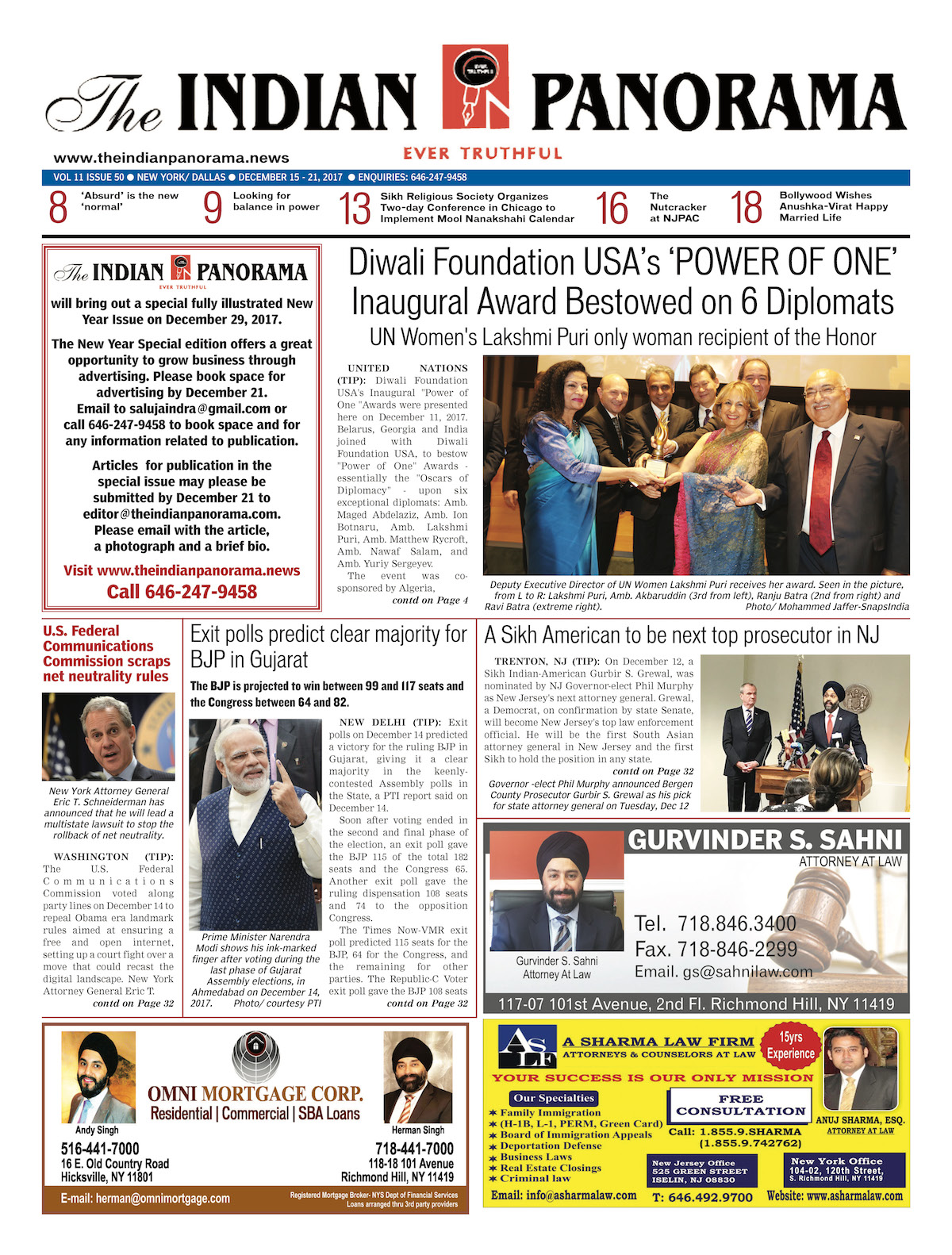
  • December 15 New York Print Edition

    December 15 New York Print Edition

    [vc_row][vc_column][vc_column_text]

    Print Replica ~ Digitally

    E-Edition

    [/vc_column_text][/vc_column][/vc_row][vc_row][vc_column width=”2/3″][vc_custom_heading text=”New York Edition” font_container=”tag:h2|text_align:center” google_fonts=”font_family:Istok%20Web%3Aregular%2Citalic%2C700%2C700italic|font_style:700%20bold%20regular%3A700%3Anormal” link=”url:https%3A%2F%2Fwww.theindianpanorama.news%2Fwp-content%2Fuploads%2F2017%2F12%2FTIP-December-15-NYC.pdf|||”][vc_single_image image=”89530″ img_size=”full” add_caption=”yes” alignment=”center” onclick=”custom_link” link=”https://www.theindianpanorama.news/wp-content/uploads/2017/12/TIP-December-15-NYC.pdf”][/vc_column][vc_column width=”1/3″][vc_single_image image=”82828″ img_size=”medium” alignment=”center” onclick=”custom_link” link=”https://www.theindianpanorama.news/advertising-media-kit-portal-indian-panorama/”][vc_single_image image=”82829″ img_size=”medium” alignment=”center” onclick=”custom_link” link=”https://www.theindianpanorama.news/advertising-media-kit-portal-indian-panorama/”][/vc_column][/vc_row][vc_row][vc_column][td_block_ad_box spot_id=”custom_ad_3″][/vc_column][/vc_row][vc_row][vc_column width=”2/3″][vc_custom_heading text=”Lead Stories This week” font_container=”tag:h2|text_align:center” google_fonts=”font_family:Istok%20Web%3Aregular%2Citalic%2C700%2C700italic|font_style:700%20bold%20regular%3A700%3Anormal” link=”url:https%3A%2F%2Fwww.theindianpanorama.news%2F|||”][td_block_5 limit=”8″][/vc_column][vc_column width=”1/3″][vc_widget_sidebar sidebar_id=”td-default”][/vc_column][/vc_row]

  • Perspective : Looking for balance in power

    Perspective : Looking for balance in power

    By Harsh V Pant

    An arrangement that had started with an attempt to manage American unipolarity is now being affected fundamentally by Chinese resurgence. Both Russia and India are having to deal with the externalities being generated by China’s rise. While Russia is getting closer to China, India is trying to leverage its partnership with other like-minded states in the wider Indo-Pacific region. As a multipolar world order takes shape, India will have to engage with multiple partners so as to limit bilateral divergences, says the author.

    A month after India was part of the ‘Quad’ discussion on the sidelines of the East Asia Summit in Manila involving Japan, Australia and the U.S., New Delhi hosted foreign ministers of Russia and China this week. The Russia-India-China trilateral held its 15th meeting in what can be construed as New Delhi’s attempt to get a semblance of balance in its ties with Moscow and Beijing.

    Scope of talks

    The broader discussions, according to a joint communique of the 15th meeting, “took place in the backdrop of the political scenario in West Asia and North Africa, numerous challenges in putting the world economy back on the growth track, concerns relating to terrorism, transnational organized crime, illicit drug trafficking, food security, and climate change.”

    But what was perhaps interesting was Russia and China’s continued attempts to frame global and regional politics through a similar lens, and the growing divergences between India and them. Russian Foreign Minister Sergei Lavrov made it clear that he believes that India can benefit by joining China’s Belt and Road Initiative. “I know India has problems, we discussed it today, with the concept of One Belt, One Road, but the specific problem in this regard should not make everything else conditional to resolving political issues,” Mr. Lavrov said. Targeting India’s participation in the ‘Quad’, he also underlined that a sustainable security architecture cannot be achieved in the Asia-Pacific region with “closed bloc arrangements.” Chinese foreign minister Wang Yi also cautioned against “spheres of influence” and “cliques” by arguing that China opposed “hegemony and power politics and disagree with the sphere of influence and cliques and promote the democratization of international relations.”

    China, meanwhile, continued to take an aggressive posture on Doklam and its aftermath. Mr. Wang said in a speech before his Delhi visit: “We have handled the issue of cross-border incursions by the Indian border troops into China’s Donglang (Doklam) area through diplomatic measures.” Though he suggested that “China and India have far greater shared strategic interests than differences, and far greater needs for cooperation than partial friction,” he maintained that “through diplomatic means, the Indian side withdrew its equipment and personnel which reflected the value and importance of China-India relations and demonstrated sincerity and responsibility of maintaining regional peace and stability.”

    Tension in the air

     The tensions in the trilateral framework are inevitable given the changes in the global geopolitical environment. The original conception of this framework was a response to a very different global environment. The proposal for a Moscow-Beijing-Delhi ‘strategic triangle’ had originally come from former Russian Prime Minister Yevgeny Primakov during his visit to India in 1998, when he argued that such an arrangement would represent a force for greater regional and international stability. This did not elicit as enthusiastic a response from China and India as Russia had perhaps hoped for. Thereafter, the three countries continued to focus on improving the nature of their bilateral relationships, maintaining a safe distance from the Primakov proposal. But, this idea of a ‘strategic triangle’ took a tangible form when former Foreign Ministers of Russia, China, and India — Igor Ivanov, Tang Jiaxuan and Yashwant Sinha — met on the margins of the UN General Assembly in New York in September 2002. Despite the fact that nothing concrete emerged out of that meeting, it represented the first major attempt by the three nations to deliberate on world affairs, and since then has become a regular feature of interactions among the three states.

    The three nations had very different expectations from this trilateral. Russia’s role was key as its loss of power and influence on the world scene was a major cause of concern for its leadership. There was a growing and pervasive feeling in Russia that it surrendered its once-powerful position on the world stage for a position of little international influence and respect. It is against this backdrop that Russia tried to establish itself as the hub of two bilateral security partnerships that could be used to counteract U.S. power and influence in areas of mutual concern. While Russia witnessed a downward slide in its status as a superpower since the end of the Cold War, China emerged as a rising power that saw the U.S. as the greatest obstacle, if it was to achieve a pre-eminent position in the global political hierarchy. As a consequence, China recognized the importance of cooperating with Russia to check U.S. expansionism in the world, even if only for the short term. In fact, American policies towards Russia and China moved the two states closer to each other, leading to the formation of a new balance of power against the U.S.

    India’s stance

     India, on the other hand, had different considerations, as it was still far from becoming a global power of any reckoning. India saw in the trilateral a mechanism to bring greater balance in the global order as it believed that a unipolar U.S.-dominated world was not in the best interests of weaker states like itself, even as strategic convergence deepened between Washington and Delhi. Moreover, all three countries realized the enormous potential in the economic, political, military and cultural realms if bilateral relationships among them were adequately strengthened.

    As a consequence, the trilateral did not lead to consequences of any great import. It merely resulted in declarations which were often critical of the West, and of the U.S. Yet this was also a period which saw significant shifts in Indo-U.S. ties as bilateral relations expanded while Russian and Chinese links with the U.S. have witnessed a downward shift.

    The joint declaration of the recent trilateral meeting said: “Those committing, organizing, inciting or supporting terrorist acts” must be held accountable and brought to justice under international law, including the principle of “extradite or prosecute.” It stopped short of naming Pakistan-based terror groups such as Lashkar-e-Taiba and Jaish-e-Mohammed, something that India would have liked in line with the most recent BRICS declaration.

    An arrangement that had started with an attempt to manage American unipolarity is now being affected fundamentally by Chinese resurgence. Both Russia and India are having to deal with the externalities being generated by China’s rise. While Russia is getting closer to China, India is trying to leverage its partnership with other like-minded states in the wider Indo-Pacific region. As a multipolar world order takes shape, India will have to engage with multiple partners so as to limit bilateral divergences.

    The Russia-India-China template comes with its own set of challenges. China’s Global Times, commenting on the recent trilateral, suggested that “the leaders of the three only meet with each other on international occasions,” adding, “this indicates it does not have high status in diplomacy and cannot bear more functions.” While this may be true, New Delhi’s continued engagement with the duo suggests that India is today confident of setting its own agenda in various platforms. Just as China engages with the U.S. on the one hand and with Russia on the other, a rising India is quite capable of managing its ties with Washington, Beijing and Moscow simultaneously. It will not always be easy, but in an age when the certitudes of the past are fast vanishing, diplomacy will have to tread a complex path.

    (The author is Professor at King’s College, London and Head of Strategic Studies at the Observer Research Foundation, New Delhi)


  • Guest Comment : Starting over: On Rahul’s elevation

    Guest Comment : Starting over: On Rahul’s elevation

    Rahul Gandhi spent so many years stepping up to become president of the Congress party that once he was elected unopposed, the biggest surprise remained the timing: in the middle of an Assembly election campaign in Gujarat, Prime Minister Narendra Modi’s home turf. Indeed, after the devastating blow to the Congress in the 2014 Lok Sabha election, and other electoral reverses since then, it was a bold decision — a signal that he is in for the long haul and that he is going to be undeterred by an election result that pundits, at least in the early days, had all but given to the Bharatiya Janata Party. No matter which way the result goes on December 18, Mr. Gandhi has made it clear that the responsibility of the party’s success rests on his shoulders and that there is no one but himself to blame for any missteps. That he would take over as president was clear since his mother Sonia Gandhi’s gradual retreat, but with a mere 18 months to go before the next general election, Mr. Gandhi doesn’t have the luxury of a great deal of time in reversing the party’s political fortunes. Given the personality cult that attaches itself to the Gandhis in the party, with every appointment and gesture read to see who’s in and who’s out, Mr. Gandhi will send the first signal about his leadership qualities by the speed and professionalism with which he constitutes his A-team. His swiftness in suspending family loyalist Mani Shankar Aiyar was an early indication of decisiveness and drawing a red line for party persons.

    Leadership is vital for the Congress to address its three big challenges: reviving the party organization; firming up alliances; and formulating a cohesive program as the main opposition party that is looking for another chance to govern India. Historically, once the Congress is edged out of a two-party contest in a State, its local organization tends to fray. With the party ruling in half-a-dozen States and running at third or lower place in big States such as Uttar Pradesh and smaller terrains like Delhi, the challenge is obvious. Alliance- formation has remained reactive since 2014 and Mr. Gandhi will have to forge decisions on pacts with regional parties, somewhat similar to what Ms. Gandhi did painstakingly before the 2004 election. A transitional moment such as the leadership change also gives the Congress an opportunity to bring its offshoots, such as the Trinamool Congress, into an understanding. All of this will be easier achieved if the Congress can articulate its outlook and agenda. It needs to spell out where it stands on the economy, social inclusion, minority rights, foreign policy, welfare. Simply reacting to the Modi government or being un-Modi will not suffice.

    (The Hindu)

  • As I See It : ‘Absurd’ is the new ‘normal’

    We now have a new level of normal. Murders are being justified by the keepers of law and order

    By Apoorvanand

    Let us not delude ourselves by extracting a condemnation which the media would present after each killing as a consolation to the Muslims. After all, how many times the poor PM is expected to issue statements? Nor is this about the BJP or the RSS. We know well that that anti-Muslim and anti-Christian hatred is their raison d’être. So, we should not have any expectation from them, says the author.

    Some well-meaning people have been appealing to the Prime Minister to condemn the ongoing killings of Muslims in different states of India on different pretexts. This begging must stop. One knows that it is not the person but the office of the Prime Minister one is looking up to. One takes this seat with the solemn oath to be a Samdarshi: protecting the rights of all human beings of the nation. Unfortunately, this has not been the case with the present Prime Minister.

    His aversion for Muslims is well known to the Muslims of Gujarat. They are not surprised that he is scaring the Hindus by saying that Pakistan wants to make Ahmed Patel the chief minister of Gujarat.

    A friend of mine, Hindu by religion, shivers while recollecting a meeting the then Chief Minister of Gujarat addressed in 2002 in Ahmedabad. The blood on the streets had not dried. He was in a Muslim-dominated are. Windows opened with curious women and men looking down to hear their CM. He theatrically swayed his hands with fingers pointed upwards and his first sentence was that he was there to make Mullahs of Pakistan to better hear what he had to say. Faces withdrew immediately, and the windows started getting shuttered. Such was the power of violence in his language. But this is not about him. We know him well. He is in Gujarat again, creating a fear in Hindus of Muslims. Uttering absurd and white lies; that Pakistan has asked Mani Shankar Aiyar to get him killed.

    People of Gujarat know that this is not about Pakistan. Hindus know that he is stoking a prejudice sleeping under their skin. He is using Pakistan and Ahmed Patel metaphorically. This time, they are forcing themselves not to be swayed.

    Muslims of Gujarat now hear all this with indifference. So, to ask a man who is so full of venom against Muslims to condemn the killing of Afrazul is to insult him. Let us not do that. Let us not delude ourselves by extracting a condemnation which the media would present after each killing as a consolation to the Muslims. After all, how many times the poor PM is expected to issue statements? Nor is this about the BJP or the RSS. We know well that that anti-Muslim and anti-Christian hatred is their raison d’être. So, we should not have any expectation from them.

    This murder is about us. Our response to this murder and our reflection on the earlier murders would decide whether India will live or not. After the first phase of shock and revulsion over the brutal and unrepentant manner in which the murder was committed and recorded will come its rationalization. We’ll start psycho-analyzing the murderer. The family of the accused has advanced a theory of ‘love jihad’. This time, fortunately, the police have not connived with them. There would be an economic reason: the murderer was jobless and, so, jealous of the laborer-turned-contractor.

    As time passes, we would be asked to understand that Hindus have a justified fear against Muslims. Even the Supreme Court and the High Court of Kerala have been persuaded that there could be an organized drive to convert Hindu girls to Islam by marrying them. Why blame this half-literate man then? Could he not be genuinely under the impression that the targeted man was after Hindu women? And he took a step to protect them?

    This was the Supreme Court’s argument when the quantum of punishment for the crime of the murder of Graham Staines and his sons was being decided. It awarded a lighter punishment to Bajrang Dal leader Dara Singh, arguing that his anger against Staines had to be understood as he was upset with the activity of conversion done by the Christian missionaries. Thus, the blame for making the murderer a murderer is put on the victim; otherwise good Hindus like Dara Singh would not have turned into murderers. This is how we seek to justify such killings.

    A Rajasthan Government minister has suggested that the killer was of unsound mind. No normal human being would do it. We know that as well. But we also know that the definition of the word normal has changed altogether. Would a normal man, with his senses intact, ever argue that Ram was born at the spot where He was claimed to be born? Was it not a former Home Minister who led a whole mass of Hindus to Ayodhya with this belief to demolish the mosque standing at the spot he wanted them to reclaim for Ram? Was he in a normal frame of mind? Or will he plead that an abnormal passion had overpowered him?

    We now have a new level of normal. Murders are being justified by the keepers of law and order. Our children are being taught that God Shiva had performed the first organ transplant. Teachers are being made to chant collectively talaq to China. Children and teachers alike are being told to believe that all Muslims rulers were plunderers and outsiders. The independence and autonomy of an adult woman is taken from her by the courts.

    All this might sound absurd to those who think themselves as normal. But all this is normal now. It has moved from streets to our textbooks, to our classrooms, to our public and political discourse, to our courts. The murder of Afrazul would not have been possible without this normality that India has achieved. If we want no more murders like this, we would need to reverse all this. If we do not do it urgently, it would be difficult to pull ourselves out from the morass which is pulling us in.

    (The author is a professor of Hindi at Delhi University)

  • Hindus urge India Govt. to mandate listing of gelatin source on food, which many times is beef

    Hindus urge India Govt. to mandate listing of gelatin source on food, which many times is beef

    NEVADA (TIP): Hindus are urging India Government and Food Safety and Standards Authority of India (FSSAI) to mandate food manufacturers to mention the source of gelatin, if used in the product, on its “Ingredients” label.

    When the source of gelatin is not listed and if it is beef, it is a serious non-disclosure affecting the Hindu devotees and would severely hurt their feelings when they would come to know that they were inadvertently consuming beef-laced popular food products, distinguished Hindu statesman Rajan Zed stresses.

    Consumption of beef was highly conflicting to Hindu beliefs. Cow, the seat of many deities, was sacred and had long been venerated in Hinduism; Zed, who is President of Universal Society of Hinduism, pointed out in a statement in Nevada (USA) today.

    “…there is no requirement to declare the source of gelatin on the product label under our regulations”, P. Karthikeyan, FSSAI Assistant Director, wrote responding to an email query from Rajan Zed.

    It would be shocking for the Hindu community to learn that some of the popular food products, which they might had been unknowingly eating for years, might contain beef as part of the gelatin while beef was not explicitly mentioned under the ingredients listed on the boxes/packages to caution them, Zed indicated.

    Rajan Zed further said that it was hard to comprehend that why corporations, both domestic and international, many times were not transparent enough to mention beef explicitly under the ingredients on the box/package when, being constituent of gelatin, it was part of the product inside, so that an ordinary consumer could make right and appropriate choices.

    Dutch-British transnational consumer goods company Unilever, which “has been in business since the 1880s” and which claims to have “developed a clear and global approach to nutrition labeling”, in a response to Zed, noted: Gelatin “is used in some of our products to provide a lower fat, lower calorie product with a pleasing texture and consistency…We cannot guarantee if the gelatin is derived from beef or pork”.

    Many products of Wrigley, said to be the largest manufacturer and marketer of chewing gum in the world, contain gelatin that is sourced from beef. Gelatin derived from beef is found in the many products of multinational Kellogg’s, which claims to be “world’s leading cereal company”.

    Gelatin/gelatine is procured from various animal body parts and is usually used as a gelling agent in food. It can be from cows, pigs, fish, chicken, etc.; but there are animal-free and plant-based alternatives to gelatin like seaweed extracts. Gelatin is an ingredient in some cereals, ice creams, candies, yogurts, desserts, marshmallows, aspic, trifles, dips, fruit snacks, sour cream, margarine, frosting, confections, gums, Chinese soup dumplings, puddings, nondairy creamers, cakes, cream cheese, lozenges, etc. It is also used for clarification of vinegar, juices and wine.

    FSSAI, headquartered in New Delhi, “has been created for laying down science based standards for articles of food and to regulate their manufacture, storage, distribution, sale and import to ensure availability of safe and wholesome food for human consumption”. Ashish Bahuguna and Pawan Kumar Agarwal are Chairperson and CEO respectively of FSSAI, whose tagline is “Inspiring Trust, Assuring Safe & Nutritious Food”.

  • Theater : The Nutcracker at NJPAC

    Theater : The Nutcracker at NJPAC

    By Mabel Pais

    The Nutcracker is the perennial favorite of generations of children and “children at heart,” Igor Levin

    “[NJPAC] has a great stage. It really is a beautiful theater. Shows always come out looking nice in that space,” Igor Levin

    The State Ballet Theater of Russia’s crystalline clarity is hard to match.  The dancing is vivacious, secure and diamond sharp,” San Diego Union Tribune.

    [The State Ballet Theater of Russia’s] The Nutcracker is sure to make some magical memories this holiday season!

    The Nutcracker, the 3rd and last ballet of Russian composer Pyotr Tchaikovsky, was completed a year before his death in 1893.

    The ballet ingeniously combines the straightforward open-hearted joy of a child with the deep philosophical reflection of the composer on life and death, beauty of the jest in the name of love and happiness.  The libretto or book for The Nutcracker comes from Marius Petipa based on the literary material of the fairy tale by the German romanticist Hoffman.

    A Scene from The Nutcracker.
    Photo / courtesy Hollywood Stars International Management, Inc.

    Tchaikovsky created a symphonic poem about a young innocent girl, Masha, standing at the threshold of the great world out there, dreaming about happiness and defeating evil.  The music paints a vivid picture of the children’s world, their joyful games, Masha’s magical dreams, which are sometimes quite uneasy and sometimes full of happiness.

    The treasured holiday adventure follows Masha’s journey through a fantasy world of fairies, princes, toy soldiers, and an army of mice.  A thrill to the same authentic Russian choreography that is performed in Moscow by the famous Bolshoi Ballet and set to Tchaikovsky’s beloved music, including “Waltz of the Flowers”, “Dance of the Sugar Plum Fairy”, and “Waltz of the Snowflakes,” the entire family will love this magical experience filled with spectacular sets and beautiful costumes.

    The incomparable State Ballet Theater of Russia presents the beloved classic, The Nutcracker, featuring traditional choreography and sparkling imagery. Internationally renowned, The State Ballet Theater of Russia brings The Nutcracker to life through graceful costumes, enchanting sets and astonishingly beautiful dances set to Tchaikovsky’s musical score.

    A Scene from The Nutcracker.
    Photo / courtesy Hollywood Stars International Management, Inc.

    The company is dedicated to maintaining a solid tradition of superior Russian classical dance. With a company over 55 superb dancers, they have drawn critical acclaim in performances throughout Europe, as well as the United States.

    In this production, the captivating story involves the family-feud of the Montagues and Capulets brought to life thanks to the talent of the acclaimed Bolshoi Theatre Ballet Choreographer Mikhail Lavrovsky who is also the show’s producer.

    The State Ballet Theatre of Russia was founded by Maya Plisetskaya, a legendary dancer and former principal dancer of The Bolshoi Theatre Ballet.

    For 17 years, Levin, President and CEO of Hollywood Stars International Management, Inc., has been coordinating and organizing Russian ballet tours in the States to great success.

    Levin spends almost half the year preparing all aspects necessary to bring to the United States a full production ballet company.

    A Scene from The Nutcracker.
    Photo / courtesy Hollywood Stars International Management, Inc.

    “When the company finishes a tour in February, I start on a new one right away – around mid-February,” he said, adding that the lengthy process includes choosing amongst a number of ballet companies, organizing the costumes and sets, bringing all necessary items over to the states, scheduling, booking travel and hotel arrangements, as well as obtaining visas for all the dancers and workers associated with the ballet company.

    One of the frequent venues Levin likes to set up as part of the tours he organizes is NJPAC – mostly due to the welcoming nature of all who work there.

    “They are great,” Levin said. “They are willing to work with those from another country and are very accommodating and very friendly. I always enjoy working with them.”

    Not only are the people a main factor as to why Levin chooses NJPAC as a stop to the ballet tours, but the venue is also a selling point.

    “[NJPAC] has a great stage,” he said. “It really is a beautiful theater. Shows always come out looking nice in that space.”

    “There is family history, but this production is much more modern,” Levin said alluding to the choreography. “It is modern, but it is rooted in the basics of traditional ballet.”

    The State Ballet Theater of Russia’s The Nutcracker is sure to make some magical memories this holiday season!

    The Nutcracker will be performed at NJPAC on Saturday, December 16 at 3 p.m.

    For additional information on The Nutcracker and NJPAC, please visit www.njpac.org.

    (Mabel Pais is a freelance writer.  She writes on The Arts and Entertainment, Social Issues, Health and Wellness, and Spirituality)

  • PBA Students present an evening of dances

    PBA Students present an evening of dances

    A bhangra performance by children

    PBA students presented Bhangra, Giddha, Malawi Giddha (Performances by all ages) at “SABHYACHARAK MELA 2017” on Saturday, December 9, 2017 at Bordentown Regional High School, Bordentown NJ’

  • IAGS Annual Event organized

    IAGS Annual Event organized

    The young display their talent
    Photos / Gunjesh Desai

    India Association of Garden State (IAGS) presented 41st Annual Day Event on Dec 9th, 2017 at Royal Albert’s Palace, Edison NJ

  • Nostalgia for Kapoors

    Nostalgia for Kapoors

    An attractive performance

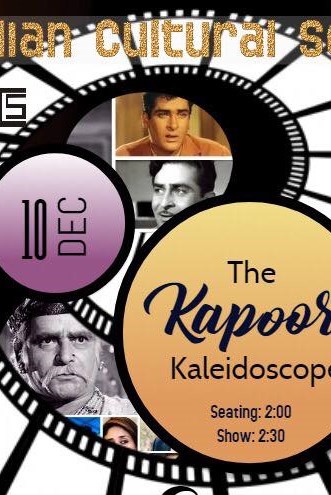
    Indian Cultural Society Presented 2017 Annual Gala – ‘The Kapoor Kaleidoscope’ on December 10th, 2017 at North Brunswick High School in North Brunswick NJ’

  • A Christmas Party in Edison

    A Christmas Party in Edison

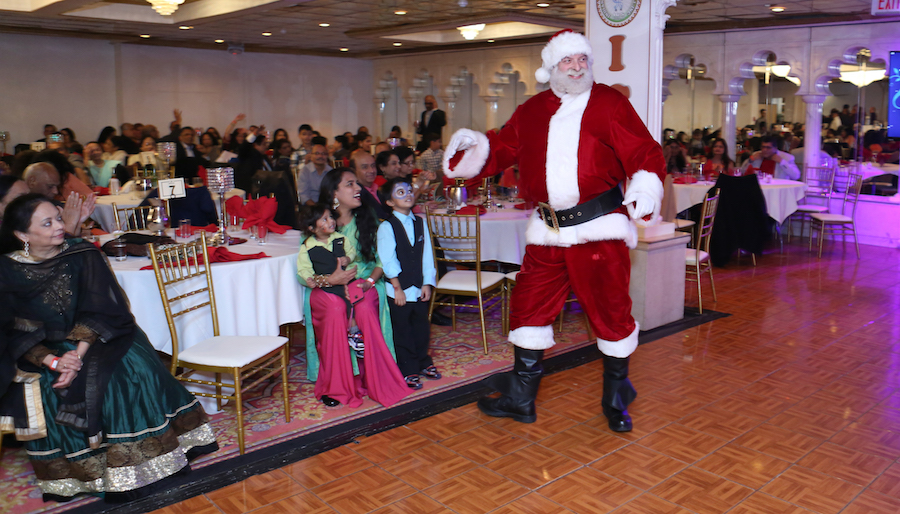
    Santa obliges by posing for a photograph with a section of the gathering
    Photos / Gunjesh Desai

    Indian Culture Society of New Jersey Inc organized Christmas Party on Dec 9th, 2017 at Akbar Restaurant in Edison NJ

  • Gujarati movie Love Ni Bhavai Screened

    Gujarati movie Love Ni Bhavai Screened

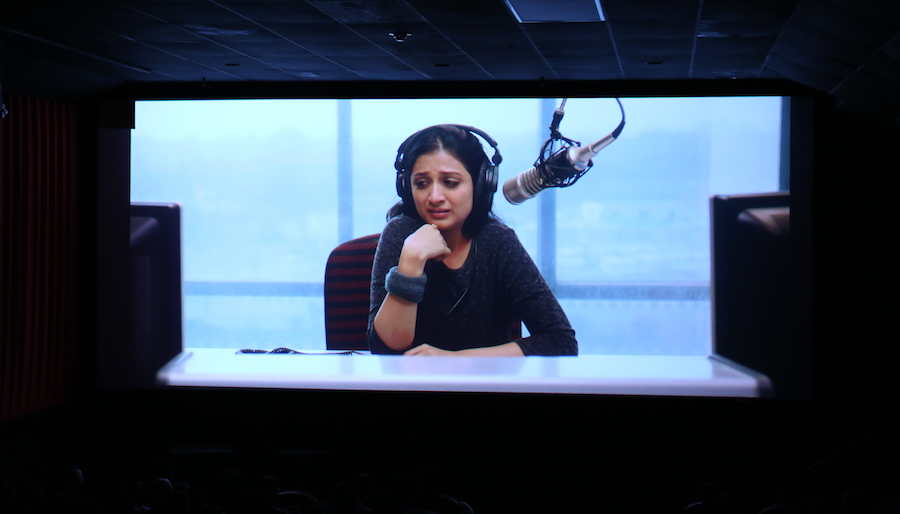
    A group of spectators at the theater
    Photo/ Gunjesh Desai

    Lohana Samaj USA & Gujarati Movies in US presented ‘Love Ni Bhavai’ First Show in USA on Dec 11th, 2017 @ Big Cinemas in Edison, NJ


  • Hindi Sangam Foundation Honors Consul General Sandeep Chakraborty

    Hindi Sangam Foundation Honors Consul General Sandeep Chakraborty

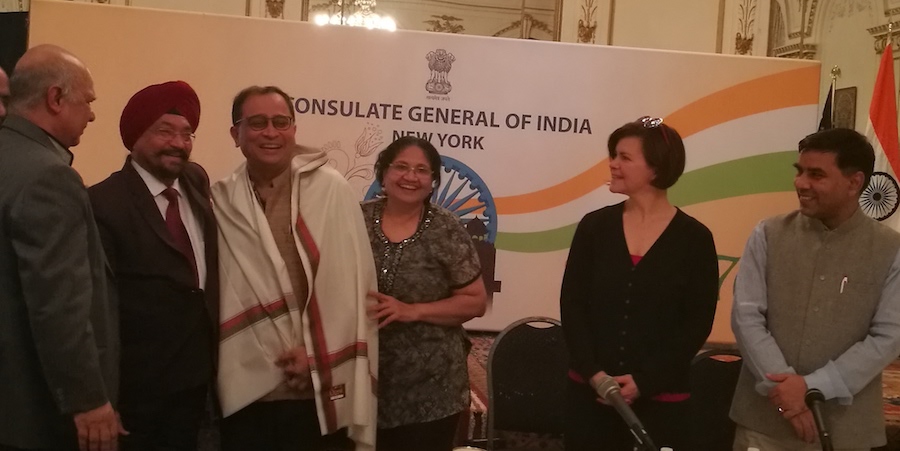
    Consul General of India in New York Sandeep Chakraborty was honored by Hindi Sangam Foundation as its Patron on December 6, 2018. Mr. Chakraborty (third from left) is seen with (from left) Ashok Ojha, president, HSF, Prof. Indrajit Saluja, Editor, The Indian Panorama, Mrs. Hema Ojha, Prof. Gabriela Nik Ilieva, NYU and Head of Chancery Jaideep.

  • JODIE FOSTER NEEDS A YEAR OFF AFTER EACH ACTING ROLE

    JODIE FOSTER NEEDS A YEAR OFF AFTER EACH ACTING ROLE

    Actor Jodie Foster said she always needs a break of at least a year off signing a new project. Reportly, the 54-yearold star said she finds it much easier to recover after completing a directing job than she does when she has been working on-screen.

    “The thing with directing is that it’s hard, it’s difficult and taxing, but once I’ve had a good sleep for about five days, I’m ready to get on the boat again.”

    “As an actor? I have to go on vacation for a year – a year minimum – before I’m ready to come back,” said Foster.

    The ‘Silence of the Lambs’ star said it is also important for her to focus on her family and breaks give her the freedom to do that.

    “There’s a lot of time that goes into being a good mother, a good daughter, a good friend. Listening to other people and what they’re going through.” “And saying, ‘I can take care of that.’ I want to have that time open. If I fill it up with a bunch of trivial things – even things I could make money for – I feel like I won’t have time to be the person I hope all this is for. That’s what I try to do,” she said. Source: PTI

  • SCARLETT’S CINEMA OUTING WITH EX-HUBBY

    SCARLETT’S CINEMA OUTING WITH EX-HUBBY

    Actress Scarlett Johansson reunited with her former husband Romain Dauriac to take their three-year-old daughter Rose to the cinema. Reportedly, in some photographs, Johansson, who finalized her divorce from Dauriac in September, looked happy with him during the outing over the weekend.

    Johansson is now dating ‘Saturday Night Live’ star Colin Jost. She shares custody of Rose with Dauriac. During the outing, the ‘Avengers’ star was seen in casual wear as she donned a thick grey trouser, a long blue woollen coat and scarf.

    Besides watching the film ‘Coco’, the former couple also lunched together and did Christmas shopping. Johansson and Dauriac got married in 2014 and separated last year.

    Source: IANS

  • MADHURI EXCITED TO TEAM UP WITH ANIL KAPOOR AFTER 17 YRS

    MADHURI EXCITED TO TEAM UP WITH ANIL KAPOOR AFTER 17 YRS

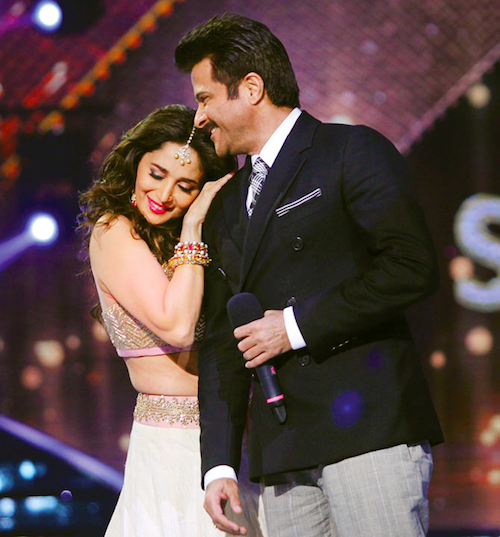
    The hit onscreen couple of Madhuri Dixit and Anil Kapoor is set to reteam for a film after a gap of 17 years for Inder Kumar’s ‘Total Dhamaal’. Last seen together in the 2000 film ‘Pukar’, Madhuri and Anil have given several hits films like ‘Beta’,’Parinda’, ‘Tezaab’, ‘Ram Lakhan’ among others.

    Reportedly,”I will be working with Anil ji after 17 odd years. I am really looking forward to it. It is a comedy, an entertaining film,” Madhuri told. The third installment in the ‘Dhamaal’ series, the film will reportedly also star Ajay Devgn, Riteish Deshmukh, Arshad Warsi and Jaaved Jaaferi.

    Madhuri was speaking on the sidelines of Star Screen Awards last night. New York based writer Sri Rao has penned the comedy series about a Bollywood star who settles down in the suburbs of America with her bicultural family.

    Madhuri left Mumbai after her marriage to Shriram Nene and moved to Denver, US, where she lived for 12 years.

    The actor returned to India in 2011, along with her husband and sons.

    Source: PTI

  • PRIYANKA CHOPRA: GLAD TO SEE FILMMAKERS INNOVATE

    PRIYANKA CHOPRA: GLAD TO SEE FILMMAKERS INNOVATE

    Actress Priyanka Chopra, who on Monday launched an interactive trailer of ‘Monsoon Shootout’, said she is happy to see filmmakers who push the envelope with something new.

    “Shoot or not to shoot? You get to decide what happens next in the trailer for ‘Monsoon Shootout’. What a cool idea! So glad to see filmmakers innovate and push boundaries of the filmmaking process,” Priyanka tweeted as she shared the trailer on social media.

    Priyanka also congratulated the film’s producer Guneet Monga and the team by and said it is “great stuff”. A story woven on the concept of making life-altering choices, the film has been directed by Amit Kumar.

    ‘Monsoon Shootout’ premiered at Cannes and won Best Thriller in several festivals internationally. The film stars Nawazuddin Siddiqui, Vijay Varma, Tannishtha Chatterjee and Neeraj Kabi. It will release on December 15. Monga was happy with Priyanka’s support.

    “It is indeed very kind of Priyanka to instantly agree and extend her support. She has produced and supported several independent films. She is a global icon and an amazingly talented actress who has a great sense of good content. It’s humbling to see someone like her to come forth in support of our film,” Monga had said earlier. Source: IANS

  • Nepal clocks 67% voter turnout in final phase of historic poll

    Nepal clocks 67% voter turnout in final phase of historic poll

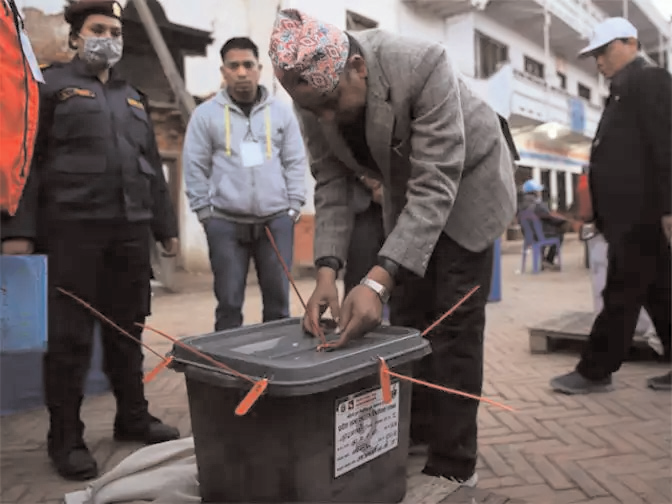
    KATHMANDU (TIP): Nepal registered 67 per cent voter turnout in the last phase of the historic provincial and parliamentary elections that many hope will bring the much – needed political stability to the Himalayan nation on Dec 7.

    This was slightly above from the first phase when 65 per cent voters had exercised their franchise on November 26.

    The counting of votes has also started in most of the districts following an allparty meeting.

    The voting, which began at 7 AM and closed at 5 PM, was by-and-large peaceful except some minor incidents of violence, Chief Election Commissioner Ayodhi Prasadi Yadav said.

    Three persons were injured in clashes between the cadres of the ruling Nepali Congress and the main opposition CPNUML at a polling centre in Bhaktapur district, about 14 km east of Kathmandu.

    The Election Commission said that 67 per cent votes were cast across 15,344 polling centres in 45 districts which went to the polls under the second and final phase of provincial and parliamentary elections.

    As many as 7,752 polling centres were arranged for today’s voting. A total of 155,000 employees and 200,000 security personnel were deployed on poll duty.

    More than 12.2 million voters were eligible to exercise their voting rights in the second phase of the polls. The voting took place for 128 constituencies of Parliament’s House of Representatives and 256 seats of Provincial Assemblies in 45 districts. The political fortune of 4,482 candidates, including Prime Minister Sher Bahadur Deuba, were sealed in ballot boxes. For the Parliament, 1,663 candidates contested while 2,819 candidates tried for the Provincial Assemblies.

    The first phase of the polls in the landlocked country was successfully held in 32 districts on November 26. Around 200,000 security personnel, including the Army, were deployed for the polls in an attempt to step up security in the wake of explosions ahead of the elections.

    This is for the first time that elections for Parliament and Provincial Assemblies are being conducted under the new Constitution promulgated in September 2015.

    In total, the elections will elect 128 Members of Parliament and 256 Members of the Provincial Assemblies. The House of Representatives consists of 275 members. Of them, 165 are elected directly under the First-Pastthe- Post system while the remaining 110 come through Proportional Representation system.

    The elections are being seen as the final step in Nepal’s transition to a federal democracy following a decadelong civil war till 2006 that claimed more than 16,000 lives.

    While many hope Nepal’s first state elections will hasten regional development, others fear they will spark a fresh wave of violence. (PTI)

  • Pakistani youth booked for treason for writing ‘Hindustan Zindabad’

    Pakistani youth booked for treason for writing ‘Hindustan Zindabad’

    PESHAWAR (TIP): A Pakistani youth, who wrote ‘Hindustan Zindabad’ on the wall of his house in Khyber- Pakhtunkhwa province, has been booked for treason, a media report said on Monday.

    Sajid Shah had written ‘Hindustan Zindabad’ on the outer wall of his home in Nara Amazi area of the province, the Daily Express quoted police as saying.

    He has subsequently been booked for treason, they said. Some local people told him to erase the slogan from the wall as it hurt their national pride, the police said.

    Some people took pictures of the wall on their smartphones and emailed them to senior police officials. “We have booked the young man on orders from the high-ups”, the officer said. (PTI)

  • Awesome TV Setsa New Bar in the World of Fashion: Unveils Top Model 2018

    Awesome TV Setsa New Bar in the World of Fashion: Unveils Top Model 2018

    BY BABITA SHARMA

    EDISON, NJ (TIP): With prestigious designers and an innovative thinking, New Jersey saw some interactive celebration of fashion, music and talent within the country and beyond, as AWESOME TV & ASC Production, laid the foundation of a high-toned and distinctive International Model hunt on December 1, 2017. AWESOME TOP MODEL 2018 event held at Royal Albert Palace in Edison, NJ, organized and hosted by Awesome TV in collaboration with ASC Production Inc., enthralled the audience with the ramp walk of models and talents covering a diverse array of specialties that ranged from unique Casual wear, Swimwear, Evening wear and much more.

    Team members (L to R): Bumi Veyg, Mike Speier, Hakim
    Dubois, Nutan Kalamdani, Mani Kamboj, Kenny ‘Kas’ Flanagan,
    Michele Sorvino, Jon Harari, Cheryl Jacobs, Roxanne Seunarine, Ritesh Parikh, John Dente, Nabeel Shams

    Ritesh Parikh, founder said the “The ‘Awesome Top Model’ hunt celebrated exceptional designers whose imagination and creativity broke new ground in fashion industry. The purpose was to discover, showcase and inspire modeling talent from around the world”.

    Nutan Kalamdani, co-founder added, “Awesome Top Model is a vision that we created with the purpose of offering a platform for models to progress further in their careers with the help of well-established individuals, industry professionals, mentors and the like, thereby giving them an opportunity to connect with them. We believe it is important to give a model the tools required to become successful, and create a path to lessen the struggles of such a profession, thereby making it easier to achieve their goal”.

    Amit Singh Chauhan, Nutan Kalamdani & Ritesh Parikh
    Photos / courtesySuresh Maisuria & Jeff Smith

    Amit Singh Chauhan, Founder of ASC Productions has been working with models for several years now and has been passionately active in the NY Fashion week over the years. He understands the business very well and has been instrumental in this model hunt event. A man of few words, Mr. Chauhan said, “I truly want to see all my models succeed. I want them to make a name for themselves. It gives me great sense of satisfaction when I see their progress. I want nothing else.”

    The event witnessed the embracing of unique fashion inspirations and design aesthetics that was showcased with an embodied craftsmanship. Designers Caren K by Kiran Khan, Kenny ‘KAS’ & LAVA LUXE, Layol loyal by Quiana Brown, Derrick J. Sellers for DJS Lifestyles, Zainab Ero-Phillips for Hot Momma, Original Crackage by Wesley Woods and Patty Such for Candy treated several hundred guests to a runway presentation of fashion trends of casual to swimwear to evening wear as the Models strutted the catwalk in designs.

    The glamorous event was judged by a panel of judges, Jon Harari, Michele Sorvino, Cheryl Jacobs, Kenny ‘KAS’ Flanagan, Mani Kamboj & Hakim Dubois who are known in the Fashion and Entertainment world, and did not limit the winners to garments in terms of fashion, but also focused on the presentation, grace, pattern, hair, accessories and the attires of the participants.

    Top winners: Meghan Martin & Tommy Maksanty

    Rox Seunarine covered red carpet for Awesome TV & AWSM Radio, while Lina Ludwicki, Jo Gagliardo, and Johann Ortiz hosted the event, Alaja Greene handled backstage, casting and styling. Liza Gibson helped the models develop their portfolios onstage and provided direction as they walked the ramp. In addition to being a unique opportunity for the fashion designers, the event put in spotlight the talented makeup artists (Johanna Jimenez, Jessica Alarcon, Wendy Aviles, Anthony Graciel and Alexis Kelhower and teams) and over 50 striking models.

    Bindi Liebowitz (as seen on the Voice on NBC) wowed with her performance that earned her a thunderous applause from the audience. Post event dinner included Indo-Italian fusion cuisine with open bar all night long. DJ Sunny Patel provided the musical backdrop.

    With over 50 Models participating in the Awesome Top Model 2018, the final top winners were Meghan Martin in the female category and Tommy Maksanty in the male category.

    All Winners: Elena Macnoughey, Bessie Gee, Carolyn Antal,
    Joselyn Zambrano, Meghan Martin, Tommy Maksanty, Kyree
    Moore & Jose Baez

    Among the sub-categories, the winners were as follows:

    MISS POPULARITY – Joselyn Zambrano and Mr. Popularity- Tommy Maksanty

    MISS PERSONALITY – Elena Maconaughey and Mr.Personality – Jose Baez

    MISS PHOTOGENIC – Katy Grey and Mr. Photogenic -Tommy Maksanty

    MISS PERFORMANCE – Bessie Gee and Mr. Performance -Kyree Moore

    MISS PHYSIQUE – Carolyn Antal and Mr. Physique – TommyMaksanty

    This event would allow the chosen winners to participate in future NY Fashion Week, along with an opportunity to feature on the cover of fashion editorial magazines, numerous entertainment opportunities, to host or act, amongst other gifts and prizes.

    With their sheer hard work and dedication of Awesome TV & AWSM Radio, (Mr. Ritesh Parikh & Mrs. Nutan Kalamdani) in association with ASC Production (Mr. Amit Singh Chauhan & Ms. Kiran Khan) teams were able to put up an outstanding event in a vivid manner. When you present your talent team along with authentic creativity, it gives an edge to your modeling event and inspires people to be a part of the show, something that was achieved effortlessly by the organizers.

    (Based on a press release)

  • Russia’s Putin to seek new presidential term in 2018

    Russia’s Putin to seek new presidential term in 2018

    NIZHNY NOVGOROD (TIP): President Vladimir Putin announced on Wednesday he would seek re-election in March 2018, a contest opinion polls show he will win comfortably, setting the stage for him to extend his dominance of Russia’s political landscape into a third decade.

    Putin, 65, has been in power, either as president or prime minister, since 2000. If he wins what would be a fourth presidential term in March, he would be eligible to serve another six years until 2024, when he turns 72.

    “I will put forward my candidacy for the post of president of the Russian Federation,” Putin told an audience of workers at a car-making factory in the Volga river city of Nizhny Novgorod. “There’s no better place or opportunity to put my candidacy forward. I’m sure that everything will work out for us.” Putin is lauded by allies as a father of the nation figure who has restored national pride and expanded Moscow’s global clout with interventions in Syria and Ukraine. His critics accuse him of overseeing a corrupt authoritarian system and of illegally annexing Ukraine’s Crimea, a move that has isolated Russia.

    The challenge for Putin is not other candidates — nobody looks capable of unseating him. Instead, his toughest task will be to mobilise an electorate showing signs of apathy to ensure a high turnout which in the tightly-controlled limits of the Russian political system is seen to confer legitimacy.

    Whilst next year’s election in March is devoid of real suspense about who will win, what follows is more unpredictable as attention will turn to what happens after Putin’s final term — under the current constitution — ends.

    There is no obvious successor, and many investors say the lack of a clear succession plan, and likely jockeying for position among Russian elites for dominance in the post-Putin era, is becoming the biggest political risk.

    If re-elected next year, Putin will have to choose whether to leave Dmitry Medvedev as prime minister, or appoint someone else. That decision will trigger a round of intrigue over the succession, as whoever holds the prime minister’s post is often viewed as the president’s heir apparent. (Reuters)