Year: 2017

  • Indian American caught in Macy’s money laundering scheme

    Indian American caught in Macy’s money laundering scheme

    SACRAMENTO (TIP): Indian American Suraj Patel, 38, of Long Beach, California, was ordered to pay approximately $925,000 to Macy’s after he pleaded guilty to mail fraud and money laundering in a $3.5 million distribution scheme from which he profited.

    Court documents state that Rampertab was a Macy’s employee who managed Macy’s distribution center in Carson, California and supervised the transport of merchandise to centers throughout the country and in July 2010, Rampertab began diverting the shipment to Patel, who has established several shipping companies.

    Rampertab even obtained approval for Patel’s companies to become third-party vendors for Macy’s but did not disclose that he operated and profited from the vendors.

    Prosecutors told cincinnati.com that Patel’s companies had received more than $3.5 million in Macy’s shipping and packaging jobs between July and December 2010 and together Patel and Rampertab generated more than $900,000 in net profits from the diverted business.

    They then used the proceeds to purchase real estate and vehicles, including a 2010 Aston Martin that cost $199,000.

    In September 2016, Patel pleaded guilty to mail fraud and money laundering and will serve one day in prison, followed by six months of home confinement as part of his three years of supervised release.


  • Indian-origin woman officer jailed for maid abuse in Singapore

    Indian-origin woman officer jailed for maid abuse in Singapore

    SINGAPORE (TIP): An Indian-origin former woman warrant officer in the Singapore Army was on Monday, November 20, jailed for four months and three weeks for abusing and beating her Indian maid.

    K Rajakumari, 57, who retired after 35 years of service, apologized to Sargunam Jeeva in Tamil and asked her not to tell anyone about her ordeal which included being hit by a plastic hanger until it broke.

    But the police officer investigating the case understood the language and Rajakumari was caught, ‘The Straits Times’ reported on Monday.

    She was charged for repeatedly abusing her maid in 2012.

    After a 14-day trial, District Judge Imran Abdul Hamid convicted Rajakumari on September 5 last year of five counts of causing hurt to Jeeva, then 35, in her condominium apartment.

    Jeeva first came to Singapore in late January 2012 but was abused between February and March of the same year.

    Rajakumari had picked her and she was to be paid Singapore dollars 350 a month without any days off.

    Jeeva, who had studied up to eighth grade and could not speak English, was regularly scolded with caustic remarks by Rajakumari by the second week of February 2012 and the abuse soon became physical.

    On the night of March 3, 2012, after Jeeva ironed Rajakumari’s uniform, the employer chided the maid for not knowing how to do a proper job of ironing.

    She then hit Jeeva on her left upper arm with a plastic hanger until it broke.

    Two days later, she scolded and slapped the maid hard on her face before pulling her hair and pushing her face against the window grill and kicking her in the waist.

    Jeeva told the employer that she could not “withstand this torture any more” and requested Rajakumari to send her back to the agent’s house.

    But Rajakumari told her this was not possible. That night, Jeeva gestured to a maid in a neighboring home for help and the latter called the police.

    A policeman later heard Rajakumari tell Jeeva in Tamil: “Please forgive me, I won’t do this anymore, please don’t tell anyone about the abuse”.

    Unknown to Rajakumari, the officer could speak the language. Rajakumari later admitted to him that she had hit Jeeva.

    Rajakumari’s lawyer Kalidass Murugaiyan had earlier asked the judge to sentence his client to probation, stressing that she has had three hip replacements.

    For each count of maid abuse, she could have been jailed for up to three years and fined up to Singapore dollars 7,500.

    (Source: PTI)

  • NRIs, PIOs don’t need to link bank a/c, PAN with Aadhaar: UIDAI

    NRIs, PIOs don’t need to link bank a/c, PAN with Aadhaar: UIDAI

    NEW DELHI (TIP):  NRIs and PIOs are not required to link bank accounts and other services with Aadhaar, the Unique Identification Authority of India (UIDAI) said on Friday, November17, while instructing various implementation agencies to work out a mechanism to verify the status of such individuals.

    It said the Prevention of Money laundering Rules 2017 and the Income Tax Act clearly stipulate that the linking of bank accounts and PAN respectively, “is for those persons who are eligible to enroll for Aadhaar”.

    It said all central ministries and departments, state governments and other implementation agencies should bear in mind that Aadhaar as an identity document can be sought only from those eligible for it under Aadhaar Act, and that most NRIs/PIOs/ OCIs may not be eligible for its enrolment.

    The Aadhaar-issuing body said several representations had been received about problems faced by Non-Resident Indians (NRIs), Person of Indian Origin (PIOs) and Overseas Citizens of India (OCI) where Aadhaar was being demanded with regard to various services and benefits.

    It said that some Departments and implementing agencies were asking NRIs/OCIs/PIOs to submit or link their Aadhaar for availing services and benefits, despite the fact that they were not entitled for the 12-digit biometric identifier.

    “The laws regarding submitting/linking of Aadhaar for availing the services/benefits applies to the residents as per the Aadhaar Act 2016… Most of the NRIs/PIOs/OCIs may not be eligible for Aadhaar enrolment as per Aadhaar Act…,” the UIDAI said in a note dated November 15 to central ministries and states.

    It has further instructed the implementing agency to device a mechanism “to ascertain the genuineness of status of such NRIs/PIOs/OCIs”.

    (Source: PTI)

  • Guest Comment : Politics and Padmavati

    Guest Comment : Politics and Padmavati

    Chief Ministers cannot cite law and order threats as an excuse to curb free expression

    Given the violence and the threats, it is perhaps not surprising that the producers of Padmavati have decided to ‘voluntarily’ defer its release. But irrespective of how this changed timetable plays out, the conduct of politicians over the past few days has been cynical and deeply unmindful of the rule of law. In February 1989, days after Ayatollah Khomeini of Iran had issued a fatwa against him for his novel The Satanic Verses, Salman Rushdie published an open letter to Rajiv Gandhi, then Prime Minister. He reminded the Prime Minister that his book had already been banned in India in October 1988, under the Customs Act, and that while issuing the curb on its import the Finance Ministry clarified that the “ban did not detract from the literary and artistic merit of Rushdie’s work”. “Thanks for the good review,” wrote Rushdie, adding that it appeared “as if your Government has become unable or unwilling to resist pressure from more or less any extremist religious grouping”. It is worth recalling that letter, as it provides a benchmark to map the race to the bottom in the current row over Padmavati. Today, as a number of Chief Ministers across north India rail against the film and threaten to disallow its screening without requisite cuts, there is no longer even that perfunctory clarification that their action has nothing to do with the artistic merit of the film. And it is no longer the case that the governments are unwilling to resist pressure from extremist groups such as the Karni Sena. Chief Ministers now are actually rallying opinion against the film to whip up caste and religious anxieties.

    Yogi Adityanath of Uttar Pradesh has forged an absurd equivalence between “those giving death threats” and Sanjay Leela Bhansali, the film’s director, for “hurting public sentiments”. Vijay Rupani in Gujarat has taken a cue from Shivraj Singh Chouhan in Madhya Pradesh and called for a ban. This is in complete disregard of the Supreme Court judgment in S. Rangarajan v. P. Jagjivan Ram that the state cannot cite concerns about a “hostile audience” in curbing freedom of expression. Vasundhara Raje of Rajasthan, in fact, has argued that the “censor board” must go beyond just certifying a film, and should be mindful of the possible results after its release. And Amarinder Singh in Punjab has said he opposes a ban but “cinematic license” cannot extend to twisting “historical facts”. The fact that these open appeals against cinematic expression are going mostly unchallenged across the political spectrum carries dark forebodings. The issue here is no longer Padmavati, its artistic merit or the factuality or otherwise of multiple retellings of the narrative. What is of real concern is the spectacle of state functionaries ignoring their constitutional responsibility in upholding free expression, and placing themselves alongside those out to intimidate, and release sectarian furies.

    (The Hindu)

  • Bilkis Bano case: Supreme Court grants time to Gujarat to apprise it on action against policemen

    Bilkis Bano case: Supreme Court grants time to Gujarat to apprise it on action against policemen

    The Supreme Court bench listed the plea for hearing in the first week of January.

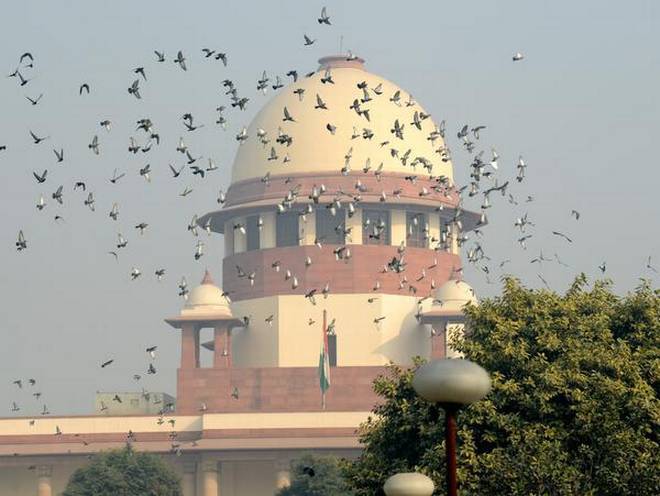
    NEW DELHI (TIP): The Supreme Court on Friday, November 24, granted six weeks’ time to the Gujarat government for apprising it on whether any disciplinary action has been initiated against policemen convicted in the 2002 Bilkis Bano gangrape case.

    A bench comprising Chief Justice Dipak Misra and Justices A M Khanwilkar and D Y Chandrachud, considered the submission of Additional Solicitor General Tushar Mehta, representing the state government, that some more time be given to get instruction on the authorities concerned in the case.

    The bench listed the plea for hearing in the first week of January.

    The bench, however, made it clear that the separate plea, seeking enhancement of compensation to be awarded to Bilkis Bano, would be taken up next week for hearing.

    The apex court had already granted time, on October 23, to the state government to apprise it whether any departmental action had been initiated or taken against police officers whose conviction was upheld in the Bilkis Bano gangrape case.

    The Bombay High Court had on May 4 upheld the conviction and life imprisonment of 12 people in the gangrape case, while setting aside the acquittal of seven people including policemen and doctors.

    Bilkis Bano, who was gang-raped in March, 2002, while she was pregnant, lost seven of her family members in the aftermath of the Godhra train burning incident.

    The bench had convicted seven persons, including five policemen and two doctors, for not performing their duties (sections 218) and tampering of evidence (section 201) under the Indian Penal Code (IPC).

    The convicted policemen and doctors are Narpat Singh, Idris Abdul Saiyed, Bikabhai Patel, Ramsingh Bhabhor, Sombhai Gori, Arun Kumar Prasad (doctor) and Sangeeta Kumar Prasad (doctor).

    A special court had on January 21, 2008, convicted and sentenced to life imprisonment 11 men in the case.

    They later approached the Bombay High Court challenging their conviction and sought for the trial court’s order to be quashed.

    The CBI had also filed an appeal in the high court seeking harsher punishment of death for three of the convicted on the grounds that they were the main perpetrators of the crime.

    According to the prosecution, on March 3, 2002, Bilkis Bano’s family was attacked by a mob at Randhikpur village near Ahmedabad during the post-Godhra riots and seven members of her family were killed.

    The trial in the case began in Ahmedabad. However, after Bilkis Bano expressed apprehensions that witnesses could be harmed and CBI evidence tampered, the Supreme Court transferred the case to Mumbai in August 2004.

    (Source: PTI)


  • “Do Your Bit” Youth Group Leads Thanksgiving Lunch for Disabled

    “Do Your Bit” Youth Group Leads Thanksgiving Lunch for Disabled

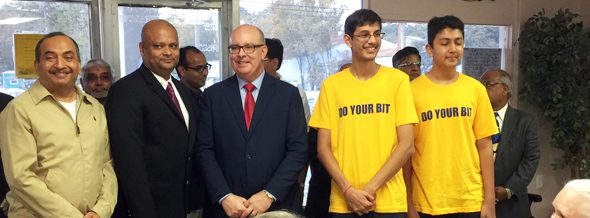
    HOUSTON (TIP): On Friday, Nov. 17, the Indo-American community in Houston, led by second-generation Indo-American youth Rahul and Varun Agarwal, celebrated Thanksgiving with people with disabilities and thanked them for their openness and warmth at the Volunteers of America center in northwest Houston.

    “Seeing the leadership of youth like Rahul and Varun, I am assured of America’s bright future. Nothing can be better than it” said Kevin Roberts, Texas State Representative from Houston and now a U.S. Congressional candidate in 2018.

    “Indo American community of Greater Houston is very progressive and they know how to give back to the community. Giving is an essence of being an Indian. Young generation is setting examples for generations to come on how to be innovative, how to be compassionate and how to be so giving to the community,” said India’s Consul General in Houston, Dr. Anupam Ray.

    Rahul and Varun Agarwal (in yellow “Do Your Bit” shirts) serve a Thanksgiving meal to the disabled at the Volunteers of America center along with representatives of Indo-American and other charitable organizations.

    Many people with disabilities got very emotional, hugged and thanked members of Indo-American community for such a nice gesture.  Lunch was sponsored by “Do Your Bit” foundation founded by Rahul and Varun Agarwal and hosted by Volunteers of America. Everyone enjoyed generous servings of traditional turkey, stuffing, green beans and pumpkin pie. There was also Indian staples of chole and bhature.

    Representatives from several Indo American organizations like Meenakshi Temple, Sewa International, India House, Indian Muslim League, BAPS, Gurudwara served lunch and thanked everyone.  Prominent Indo American community leaders, Family-to-Family network, and Indian Consular staff.

    Lunch guests thanked their Indian hosts, and everyone joined in prayer for Thanksgiving blessings.

    (Source: Indo American News)

  • Town of Oyster Bay former Supervisor John Venditto faces 21 new charges

    Town of Oyster Bay former Supervisor John Venditto faces 21 new charges

    One count of securities fraud; one count of conspiracy to commit wire fraud related to securities offerings; and 19 counts of wire fraud related to securities offerings.

    MINEOLA, NY (TIP): Those who mistook a period of lull for an end to investigation in to scandals of former Supervisor of TOB John Venditto may have got a rude shock when Venditto was indicted on Tuesday, November 21 on 21 new federal criminal charges involving securities fraud in the town’s public offering of more than $1 billion in securities between 2010 and 2016.

    According  to a Newsday report, the superseding indictment adds 21 more counts to the alleged corruption and kickback case which Eastern District federal prosecutors have already brought against Venditto, Nassau County Executive Edward Mangano and Mangano’s wife, Linda. The Manganos are not accused in the securities fraud.

    The thrust of the new charges accuse Venditto and unnamed others of being instrumental in the creation of the securities fraud and then failing to disclose in the town’s public offerings what federal prosecutors said is the crux of the fraud: having the town conceal millions in indirect loan guarantees to an unidentified Co-conspirator. Sources have said the Co-Conspirator is former restaurateur Harendra Singh.

    In a parallel action, the Securities and Exchange Commission also filed a separate civil suit, accusing Venditto and the town of securities fraud.

    The 21 new charges Venditto faces are: one count of securities fraud; one count of conspiracy to commit wire fraud related to securities offerings; and 19 counts of wire fraud related to securities offerings.

    Venditto’s arraignment on the new indictment is tentatively scheduled for December 5th. The Manganos — who are not charged with securities fraud — are also required to appear and plead to the superseding indictment.

    The overall securities fraud and conspiracy counts includes all 30 security offerings the town made between 2010 and 2016. But some are not included in the individual wire fraud counts because the federal statute of limitations on such crimes goes back only five years, to December of 2012.

    Each fraud count carries a maximum penalty of 20 years in prison, but if Venditto is convicted he is most likely to get a lesser sentence.

    Venditto previously was charged with obstruction of justice, conspiracy to commit bribery, and making false statements to investigators in connection with his dealings with Singh concerning the loan guarantees.

    (Source: Newsday)

  • India’s Nominee Dalveer Bhandari re-elected to ICJ

    India’s Nominee Dalveer Bhandari re-elected to ICJ

    Bhandari secured 183 of the 193 votes in the General Assembly and all 15 votes in the Security Council

    Prakash M Swamy

    UNITED NATIONS (TIP): The General Assembly and the Security Council of the United Nations, on November 20, elected the fifth judge to the International Court of Justice (ICJ) concluding the 2017 elections to the principal judicial organ of the United Nations.

    Justice Dalveer Bhandari, of India, received the absolute majority of votes in elections – conducted independently, but concurrently – at the Security Council and the General Assembly. He remained the sole candidate for the position after the United Kingdom withdrew the nomination of Christopher Greenwood.

    Bhandari joins Ronny Abraham of France, Antônio Augusto Cançado Trindade (Brazil), Nawaf Salam (Lebanon), and Abdulqawi Ahmed Yusuf (Somalia) as the five judges who will serve along with ten other judges at the ICJ. Their nine-year terms begin 6 February 2018.

    The Court is composed of 15 judges, who are elected by an absolute majority in both the General Assembly and Security Council. Five seats come up for election every three years. There is no bar on consecutive terms.

    Established in 1945, and based in The Hague in the Netherlands, the ICJ – informally known as the ‘World Court’ – settles legal disputes between States and gives advisory opinions on legal questions that have been referred to it by other authorized UN organs. The election of the first members of the World Court took place on 6 February 1946, at the first session of the UN General Assembly and Security Council.

    Bhandari was re-elected with more than two-thirds of the UN members backing him, forcing Britain to withdraw its candidate amidst high drama in the hard-fought race to the world court.

    In one of its “biggest diplomatic victories” in the UN, Bhandari got 183 of the 193 votes in the General Assembly and secured all 15 votes in the Security Council to fill the final vacancy on The Hague-based International Court of Justice after separate but simultaneous elections were held at The UN headquarters.

    The Ministry of External Affairs and Permanent Mission of India to the United Nations in New York mounted stellar efforts since June when New Delhi confirmed Dalveer Bhandari’s name for the International Court of Justice.

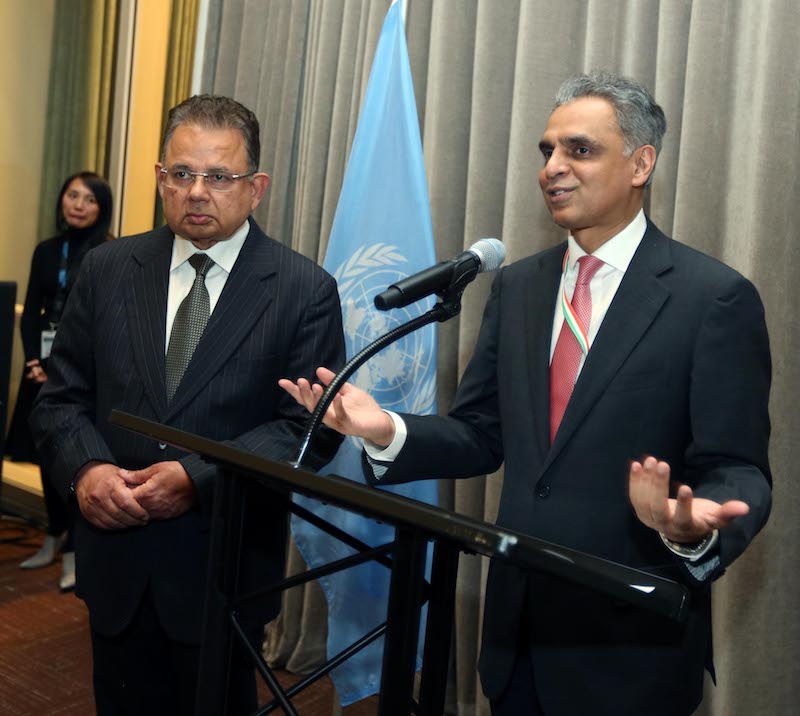
    India’s Ambassador to the United Nations Syed Akbaruddin sought the support of nearly 175 nations, including the permanent members of the Security Council. External Affairs Minister Sushma Swaraj telephoned her counterparts from nearly 60 countries to get Bhandari re-elected.

    Prime Minister Narendra Modi sought the support during his meetings with world leaders. “India never indulged in negative campaign. It was run on the strength of our candidate and strength of India strong constitutional system,” a diplomat said.

    British Permanent Representative to the UN Matthew Rycroft also mounted hectic efforts. Rycroft said in his letter to the members the current deadlock is unlikely to be broken by further rounds of voting and the UK therefore has decided to withdraw Greenwood’s nomination.

    “In taking this step, we have borne in mind the close relationship that the United Kingdom and India have always enjoyed and we will continue to enjoy…,” Rycroft said. According to sources, three hours before the voting, General Assembly president Miroslav Lajcak and Italian ambassador Sebastiano Cardi in his capacity as Security Council president for the month of November convened a consultative meeting with Rycroft and Akbaruddin.

    India refused to budge against any kind of pressure and insisted to complete the democratic process. It was a mystery what transpired in the next two hours that forced Britain to withdraw from the race.

    In Washington, US President Donald Trump convened a meeting with secretary of state Rex Tillerson and the US Ambassador to the UN Nikki Haley. With Bhandari’s election, Britain will not have a judge on the world court’s 15-member panel for the first time. Also for the first time in 70 years, a permanent member of the Security Council lost to a non-permanent member for a seat in the ICJ.

    Bhandari’s victory is also a big boost for India in Kulbhushan Jadhav’s case. The ICJ is likely to deliver its verdict in the case in December. Pakistan has already appointed an ad-hoc judge to the ICJ for the case. Bhandari’s victory means, now India will also have its own judge in the court. The ICJ has a bench of 15 judges, five of whom are elected every three years for a nine-year term. To be elected, the candidate needed majority in both the chambers.

  • Macy’s Thanksgiving Day Parade 2017 brings cheer with new balloons

    Macy’s Thanksgiving Day Parade 2017 brings cheer with new balloons

    Clear weather attracts large crowds, amid tight security

    NEW YORK CITY (TIP): The 91st annual Macy’s Thanksgiving Day Parade wound its way through New York City to the store’s 34th Street location Thursday, November 23 morning.

    Taking flight on Turkey Day were 17 giant character balloons including Olaf from “Frozen,” the Grinch, Charlie Brown and Scrat from the “Ice Age” movie series, along with 28 legacy balloons, 26 floats, 1,100 cheerleaders and dancers, 12 marching bands and six performance groups, Macy’s said in a news release.

    “For more than 90 years, Macy’s Thanksgiving Day Parade has signaled the start of the holiday season for millions of families.” said Susan Tercero, group vice-president of Macy’s Thanksgiving Day Parade in a news release. “We are thrilled to once again come together as a nation to give this gift of joy and wonder to all.”

    Featured stars included Harry Connick Jr., Whoopi Goldberg, Steve Harvey, Jane Krakowski, Gaten Matarazzo, Chrissy Metz, John O’Hurley, Martha Stewart and Thalia, along with performances by Gwen Stefani and the Radio City Rockettes.


  • AS I SEE IT :Time for action is now: Climate change is here

    AS I SEE IT :Time for action is now: Climate change is here

    By K C Singh

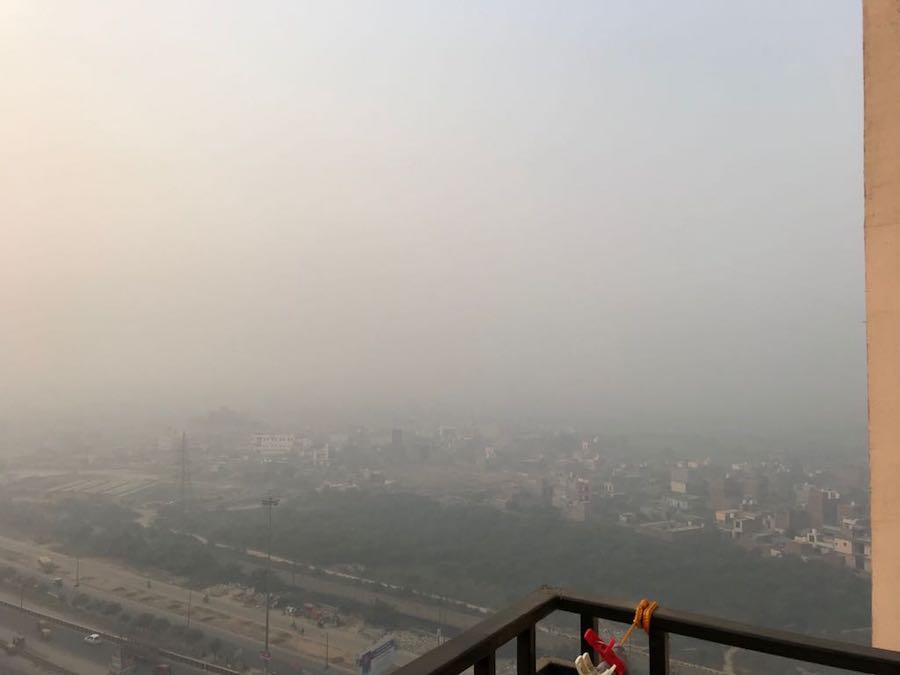
    The smog that choked millions did not stop at the India-Pak or India-Nepal borders. Nor at the borders of Indian states. What matters for India is not merely electoral victories for PM Modi, but what he does with the power he wields. Instead of tilting at windmills, why does he not start with “swacch” air? To do that he needs an integrated plan that is greener and yet equitable for the farmer, the worker, the urbanite and the entrepreneur, says the author.

    Toxic smog lingered over North India in the first half of November, dissipating after showers and strong winds. The air quality in New Delhi and the NCR remains poor as Particulate Matter (PM 2.5) hovers above safe limits. First to be blamed were farmers of Punjab and Haryana, although stalk burning after paddy harvesting is done across many states, and in Pakistan. Climate experts later argued that the crisis was exacerbated by a sandstorm in Arabia, well to India’s west.

    The political drama that followed reflects lack of accountability among Indian leaders. The chief ministers of Delhi, Haryana and Punjab commenced a blame-thy-neighbor game. Arvind Kejriwal sought meetings with the other two hoping to escape being pilloried, normal for any mishap in Delhi even though both the Lieutenant-Governor and the Union government plead before the Supreme Court that he has no powers. Punjab CM Capt Amarinder Singh only wanted the PM to convene a meeting as he needed thousands of crores to coax his farmers to not burn stubble. The CM of Haryana, ML Khattar met Kejriwal after some dithering. But PM Modi was not seen or heard. What “baat”, if any, was in his “mann” could only be deciphered from his intervention at the East Asia Summit in the Philippines on November 14, or at election rallies in Gujarat. There was naturally no mention of the crisis across North India.

    But the issue is broader than a tri-state squabble. The pollution levels in PM Modi’s own constituency, Varanasi, at the far end of UP were equally hazardous. Senator Sherry Rehman, senior leader of Pakistan People’s Party and friend of the late Benazir Bhutto, bemoaned in The Express Tribune that “half of Pakistan is enveloped in a nasty toxic smog”. She argued that these weather vagaries were attributable to climate change which was costing Pakistan 6 per cent of GDP. Quoting a UNDP report, she warned that Pakistan, already water stressed, would be dry by 2025 if it did not stop diverting 90 per cent of its waters to crops. She sensibly linked water, climate, energy and agriculture.

    The Union government announced that the National Thermal Power Corporation is to now buy stubble from farmers for power generation. The question arises why this was not done after a similar crisis last year, when besides the odd-even scheme and the shutting of schools, no long-term solution was put in place. As usual, the National Green Tribunal rushed in where angels feared to tread, assuming the role of executive, and in effect, even stalling whatever little the Delhi Government was planning to do.

    Coincidently, nearly 200 nations converged on Bonn for the review of action on “nationally determined contributions” (NDCs) under the 2015 Paris Agreement on climate change. Ironically, India and China having come on board at Paris on President Barack Obama’s urging by giving up their standard developing country chant that “polluters pay”, now found themselves left holding the baby as President Trump walked out of the accord. Fortuitously, US withdrawal is not implementable before November 4, 2020 — a day after the next US presidential election. The leadership of climate change action thus falls on Europe and the big emitters, India and China. Germany, the biggest European economy and host at Bonn, conceded that it would be unable to meet its commitment to reduce greenhouse-gas emissions to 40 per cent below the 1990 level, by 2020. That is due to its reliance on coal for power production due to its decision to abandon nuclear power generation after the Fukushima nuclear disaster as well as its strong growth and low oil prices.

    UN climate chief Patricia Espinosa lamented that “we need more action, more ambition and we need it now”. That is, indeed, necessary if the world has to ensure that global temperatures do not exceed 2 degree Celsius above the mean pre-industrial age temperature. The pledges at Paris were, unfortunately, voluntary and the current trajectory of global warming can lead to the melting of ice-sheets by the end of this century and their disappearance from Greenland and Antarctica. The consequent rise in sea levels and climate change leads paleo-climatologist Lee Kump to conclude that the rate at which we are discharging carbon dioxide is 10 times the level when mass extinction occurred during the pre-dinosaur stage which killed 90 per cent of life in the ocean and 75 per cent on land.

    India and China succeeded, along with 137 nations of the G-77 plus China, to make developed countries concede that acceptance by developing nations of voluntary commitment at Paris was contingent on the developed nations cutting emissions and providing finance for adaptation and mitigation by the developing world. At Paris, developed nations promised $100 billion by 2020 to help dispense green technologies. Canada and the UK formed this time at Bonn a 19-nation alliance to phase out coal power by 2030.

    Nuclear power, once considered the answer to clean energy, is being abandoned by the developed world. Two new reactors — Westinghouse’s AP1000 and Areva’s EPR — are about to be commissioned in China and Finland, respectively. They are considered proofed against natural disasters, terror attacks or even missile hits. India will have to choose a middle path between reducing dependence on thermal power and choosing renewables plus nuclear power. The obvious conclusion is that India needs to reassess its relations with China and Pakistan as climate change is a shared threat and a cause for collaboration that rises above narrow nationalistic divisions.

    Senator Sherry Rehman has framed the issue well. The smog that choked millions did not stop at the India-Pak or India-Nepal borders. Nor at the borders of Indian states. What matters for India is not merely electoral victories for PM Modi, but what he does with the power he wields. Instead of tilting at windmills, why does he not start with “swacch” air? To do that he needs an integrated plan that is greener and yet equitable for the farmer, the worker, the urbanite and the entrepreneur. His Gujarat model, as is now being argued, is skewed in favor of the last.

    (The author is a former Secretary, Ministry of External Affairs)


  • Feature : 5 Cities with Great Job Markets for People over 50

    Feature : 5 Cities with Great Job Markets for People over 50

    The years between age 50 and 70 represent a tricky transitional “life stage” for many professionals. If you’ve been successful at work, you may already have the means to retire. Chances are, though, that you’ve got too much energy, and too many “what if” ambitions, to commit to leisure full time. You may be ready for a big change, in other words – just not a change from “working” to “not working.”

    If this describes you, you’re part of a growing cohort. The average retirement age has risen steadily for the last 20 years. That’s partly a sign of greater financial strains on baby boomers who feel they can’t afford to retire, as Alicia Munnell of the Center for Retirement Research at Boston College wrote this week for MarketWatch. But it also reflects the rise of a well-educated segment of the workforce that has been able to extend their careers longer thanks to better health and the growing importance of “knowledge jobs.”

    Some U.S. cities have economic climates that are particularly friendly to job seekers in this demographic. Their job markets are generating opportunities that are great for locals—and good enough to encourage “pre-retirees” to consider relocating. Indeed, it’s not uncommon for empty-nesters to move to an area where they’re considering retiring, long before they actually stop working, when a new job facilitates such a move.

    Here are five cities that look particularly welcoming, based on the fastest-growing sectors of their economies and the cultural amenities they offer to a veteran professional who’s looking forward to some free time.

    Austin, Texas

    Unemployment rate: 3.2%

    Population: 948,000

    The booming tech industry in Texas’s state capital gets most of the attention, but the education, health, and leisure-and-hospitality sectors have added more than 11,000 jobs in the past year.

    A population boom and rising housing prices have dimmed some of the “Keep Austin Weird” reputation of the city’s arts community. But the city’s music and film scenes remain vibrant. And San Marcos, 32 miles south, is another university town where an artsy eccentricity and lower cost of living still prevail.

    Greenville, S.C.

    Unemployment rate: 3.8%

    Population: 67,000

    Greenville is the biggest city in South Carolina’s Upstate region in the Appalachian foothills. Upstate has become a hub for manufacturing and engineering in recent years, since state tax breaks lured employers like BMW, Michelin and GE. Jobs in financial services, government and education are on the rise as the region grows.

    The city’s mild winter weather and its web of hiking and biking trails make it a favorite haunt of outdoorsy baby boomers. Asheville, N.C., and the Blue Ridge mountains are an hour north, while South Carolina’s beaches are about four hours away. Greenville has also become a major foodie destination, with craft breweries, a huge selection of locally owned restaurants, and a popular farmers’ market.

    Minneapolis

    Unemployment rate: 3.4%

    Population: 414,000

    The Minneapolis metro area saw 2.3% job growth over the past year, according to the Bureau of Labor Statistics, almost a full percentage point more than the nation as a whole—adding nearly 45,000 jobs. The health care and business services sectors in the area have grown particularly quickly, and average wages in the city outstrip the national and regional averages.

    Winter weather drives some retirees away from the Twin Cities, but AARP reports that the area has actually seen a net migration of workers over age 50 in recent years. And healthy lifestyles, especially outdoor sports, are part of the draw. In surveys by the UnitedHealth Foundation, Minnesota has ranked among the nation’s 10 healthiest states every year since 1990, thanks to a strong statewide health-care network and very high rates of physical activity among residents.

    Orlando

    Unemployment rate: 3.8%

    Population: 277,000

    Orlando has been one of the nation’s fastest-growing job markets for several years, with an economy driven by immigration, affordable real estate, and “snowbirding” baby boomers resettling for their empt7-nest years.

    Joke all you want about grown men and women wearing Mickey Mouse ears, but the DisneyWorld and Universal Studios theme park complexes are major employers for people over 50 who want to trade the stresses of a white-collar career for something more light-hearted. Meeting planners, marketing pros and medical administrators are also in high demand in the Orlando.

    Salt Lake City

    Unemployment rate: 3.4%

    Population: 194,000

    Utah has become something of a refuge for knowledge-industry companies that no longer want to put up with the costs of real estate and wages in California or the Pacific Northwest. (Just ask the tech companies of the state’s “Silicon Slopes.”)

    But since Utah itself isn’t exactly populous, job openings often outnumber the available talent. Consequently, Salt Lake City has enjoyed among the highest rates of salary growth in the country over the past decade, according to BLS data. Those dollars stretch a lot further in a metro area where housing costs are quite a bit lower than the national average. The upshot: More disposable income for skiing and hiking excursions in the Mountain West.

    (Source: Fortune/ Matthew Heimer)

  • Feature: Why Indian Americans were among the biggest winners in U.S. State & Local Elections

    Feature: Why Indian Americans were among the biggest winners in U.S. State & Local Elections

    Indian Americans triumphed in state and local elections across the country in elections this month in another demonstration of the community’s growing political influence, engagement and organization. From Washington State to New Jersey, Indian Americans emerged victorious in some of the most competitive races in the country, many of which carried national implications. In more than one race, candidates overcame brazen acts of racism targeting their Indian American heritage and prevailed at the polls. Indian American women comprised the majority the winners.

    While the community has achieved success in the United States in several arenas like medicine, technology and business, its members are just beginning to leave their mark in the public realm. To be sure, Indian Americans like Bobby Jindal and Nikki Haley have become familiar names over time, but as former governors with national profiles, they are the exception rather than the rule. (Haley now serves as President Trump’s U.N. ambassador).

    On the federal level, the diaspora hit an important milestone in 2016: Indian Americans constitute 1% of the U.S. population and now constitute 1% of the U.S. Congress. Elections last year witnessed the number of Indian Americans serving in the legislative branch jump from one to five, with Reps. Pramilia Jayapal (D-WA), Raja Krishnamoorthi (D-IL), Ro Khanna (D-CA) and Sen. Kamala Harris (D-CA) joining Rep. Ami Bera (D-CA) on Capitol Hill to form what some have christened the “Samosa Caucus.”

    In total, staggering 25 Indian American candidates were elected or re-elected to various state and local offices across the United States, the biggest wave to date. Of these, fifteen are women. Sixteen of the twenty-five were elected in New Jersey alone — Raj Mukherji was re-elected to the New Jersey State Assembly while Vin Gopal was elected to the state Senate in a huge upset against the Republican incumbent.

    This month’s election victories also demonstrated that Indian American candidates have mainstream political appeal in the United States, capable of assembling broad coalitions of voters comprised of diverse cross sections of the constituencies they now represent. In other words, these candidates did not rely on Indian American voters for their electoral victories.

    Deepak Raj and Raj Goyle, co-founders of Impact, a new initiative that closely monitored the 2017 elections, offer a compelling explanation behind the recent surge of Indian Americans successfully running for public office.

    “At a time when so many of our values are under attack, Indian Americans are stepping up to run, win, and lead. Last Tuesday, 25 of them won their elections in New Jersey, North Carolina, Tennessee, and Washington State. We already know of 50 candidates on the ballot next November — so it is critical that we lay the groundwork now to elect the most viable candidates who reflect our community’s values. Our community is on the rise.” Goyle became the first Indian American elected to office in Kansas, serving two terms in the state legislature from 2006-2010.

    Congresswoman Jayapal, the first Indian American woman to serve in both the Washington state legislature and the U.S. House of Representatives, is encouraged by the groundswell of Indian Americans winning elections across the country. “I’m thrilled to see so many Indian-Americans running for office. In the end, I believe you get better policy when you have voices that represent the whole community at the table. I believe more voters will get engaged if they can see themselves in their elected officials.”

    Ohio State Representative Niraj Antani (R), the youngest Indian American elected official in the United States, sums it by saying, “Holding political power for the Indian American community is vital to our future.”

    Here is a closer look at some of those elected earlier this month.

    State Senator-elect Manka Dhingra (D-WA)

    : State Senator-elect Manka Dhingra (D-WA)
    Photo courtesy / Daily Cos

    Voters in Washington elected King County prosecutor Manka Dhingra to the state Senate to represent the 45th Legislative District in a special election, replacing an incumbent GOP lawmaker who died in office. The unexpected vacancy left the chamber evenly divided between state Democrats and Republicans. Whichever party won the seat would take control of the state Senate and, more importantly, establish single-party rule over the entire West Coast. The result would be a true “Blue Wall” of opposition to President Trump stretching the entire Pacific Coast.

    Until late last year, Dhingra had never considered running for office. But Trump’s unexpected victory, and the fear and uncertainty it created for many communities throughout the country, prompted Dhingra to change her mind and enter the race. Many saw the election as a barometer of the president’s impact on down-ballot candidates in reliably blue regions.

    In the end, Dhingra was elected with an overwhelming 55% percent of the vote. “We ran a campaign based on values,” Dhingra told the Seattle Times. “Not on hate, not on fearmongering, not on putting the other side down.”

    Mayor-elect Ravinder “Ravi” Bhalla (D-Hoboken, NJ)

    Mayor-elect Ravi Bhalla on election night.
    Photo Courtesy / Ravi Bhalla for Mayor

    Two-term Hoboken City Councilman Ravi Bhalla was elected New Jersey’s first Sikh mayor earlier this month after besting five other mayoral hopefuls. He will succeed incumbent Dawn Zimmer (D) who opted not to run for reelection. The civil rights attorney became a fixture of local government in the town of 56,000 while maintaining an active law practice.

    Just days before the election, Bhalla, a practicing Sikh who wears a turban, became the target of an anonymous election mailer that featured his picture and a message labeling him a terrorist, declaring, “Don’t let TERRORISM take over our town.” The racist flyers were left on car windshields across the city. Bhalla tweeted out the image to his followers, writing, “Yesterday, a flyer [with the] word “terrorist” above a pic of me was circulated in Hob[oken]. Of course, this is troubling, but we won’t let hate win.”

    Despite the attack, Bhalla cruised to victory, earning 33% of the vote.

    Edison Board of Education Member-elect Falguni Patel (D-Edison)

    Falguni Patel, left, was elected to Edison Board of Education.
    Photo courtesy / News India

    Bhalla wasn’t the only Indian American targeted by bigoted ads. Edison Board of Education Falguni Patel and Jerry Shi were also the subject of racist fliers that read “Make Edison Great Again” and “The Chinese and Indians are taking over our town.” The ads were discovered in mailboxes around the county. It called for the two candidates to be deported and bemoaned the “Chinese schools,” “Indian Schools” and “cricket fields” purportedly in town.

    Patel was outraged by the flyer’s content, telling the Associated Press, “I was born and raised in New Jersey,” she said. “To see the word ‘deport’ on my picture really it’s just outrageous.”

    Patel and Shi both ultimately triumphed in their races. Patel’s campaign focused on those issues more relevant to the town’s education system: overcrowding, school infrastructure and growth. She has been elected to a three-year term.

    M.R. Rangaswami, a prominent Silicon Valley venture capitalist and founder of Indiaspora, is optimistic about the what the future holds. “Indian Americans of both parties are eager to serve their country and communities. The two dozen or so folks who were elected earlier this month are just the first drop in a larger wave of Indian American public servants that is yet to come.”

    (Source: Forbes/ Ronak D. Desai)


  • IALI Organizes 22nd Annual Diwali Food Drive: $21000 donation to INN

    IALI Organizes 22nd Annual Diwali Food Drive: $21000 donation to INN

    Food Drive in memory of Karan Beri, Arvin Batra, Giri Chhabra and other IALI deceased members

    LONG ISLAND, NY (TIP): India Association of Long Island organized their 22nd Food Drive on November 11 at Mary Brennan INN Soup Kitchen. Besides organizers, IALI members and guests, MS Gooseby, who has been a great supporter of the IALI Food Drive and has invariably been present at each celebratory reception, was present and enthusiastically participated in the celebrations.

    The Food Drive this year was dedicated to the memory of Karan Beri, Arvin Batra, Giri Chhabra and IALI deceased members.

    Karan Beri, son in law of The Indian Panorama publisher and editor died at the age of 37 on May 6, 2017 in a car accident in Bengaluru, India. An MBA, he was running a successful call center in Bengaluru which served clients in UK and USA. He was planning to set up an operational office in New York. He leaves behind a young wife, Jaskiran and a five-year-old son Kabir.

    Arvin Batra son of Ajay Batra, a prominent and dedicated IALI member died a tragic death in an accident last year. Arvin was a well-known dancer and was running a garments business.

    IALI Food Drive raised $21000.00 and donated the amount to Interfaith Nutrition Network (INN).

    IALI Food Drive has in 22 years become an institution. Their community project is a model to be followed by others. The idea of associating itself with the INN’s initiative to provide food to the needy struck Peter Bheddah some 22 years ago. With cooperation from friends he launched the project and it has since been successfully carried out. Peter and his wife Dorothy have always been leading donors. And rightfully, Pater was honored for his philanthropy as was later Ishar Singh Bindra.

    Of the many selfless volunteers, the chairperson of Food Drive Aruna Saxena has been associated with Food Drive for 21 years. Similarly, Jaya Bahadkar, Co-Chair has been associated for a long time. The current President of IALI Bina Sabapathy has contributed a lot to the growth of the Food Drive. In fact, many more people have contributed over the years to make IALI Food Drive an effective program. They include Indu Chhabra, Rekha Chichara, Kishore Kuncham, Dev Ratnam and many more. They truly deserve appreciation for the good work they have done and are doing.


  • ‘Indo-US Democracy Foundation’- a Think Tank- launched on Nehru’s Birthday

    ‘Indo-US Democracy Foundation’- a Think Tank- launched on Nehru’s Birthday

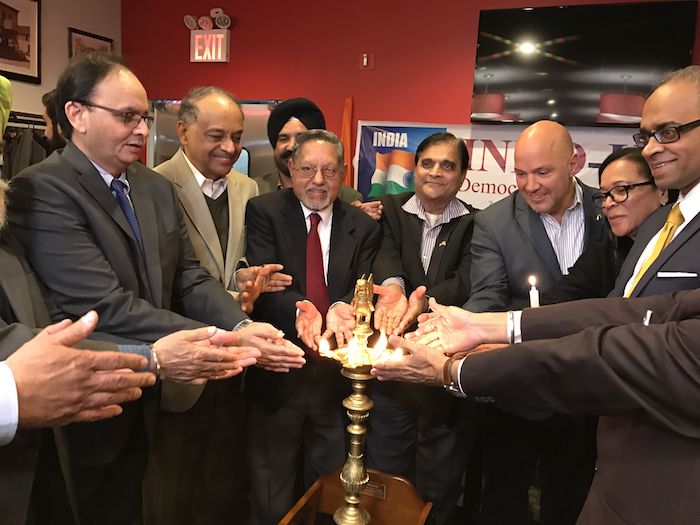
    BAYSHORE, NY (TIP): ‘Indo-US Democracy foundation,’ a Think Tank was inaugurated on November 14 – Nehru’s birthday – at a function held in Bayside, New York. Mr. Paul Vallone, a New York City Council Member, lighted a lamp and inaugurated the organization. He lauded the creation of the think tank and expressed hope that it will facilitate constructive dialogue between communities while promoting democratic values and principles.

    “The mission of the Indo-US Democracy foundation is to create awareness on threats to democracies in India and U.S. and to educate the public. Towards that end, we will be analyzing developing trends and informing our audience of the increasing danger to our way of life” said George Abraham, the Executive Director of the think tank. “The primary reason we have done the inauguration on November 14 is quite significant. Our mission fits well within the Nehruvian vision for India and that is to be a strong advocate for individual liberty and human justice to all citizens regardless of color, caste, creed, religion or gender” Abraham added.

    Prof. Manu Bhagavan, Professor at Hunter College, the keynote speaker lauded the contribution of Nehru to India and reminded the gathering that Nehru’s vision of ‘Progressive internationalism was premised on the principle that free people everywhere should determine their future—together—under the aegis of forged common ideals.  Difference and the will of the locality had to be respected, under the proviso that neither could serve as an excuse to oppress’.

    Dr. Jit Chandan, Professor at City University, noted Nehru’s contributions in the area of higher learning such as establishing IITs and IIMs and asked the new generation to seize the opportunities and create history.

    Dr. Joseph Cheruvelil, a retired Professor at St. John’s University pointed out that the Nehruvian vision transformed India and the Institutions he has helped to create are continuing to provide stability and strength to Indian democracy.

    Mr. Yuvaraj Singh, a graduate student at Columbia University who was also a panel member, highlighted Nehruvian perspective on Democracy that it isn’t about propagating one set of ideologies or relying on one source of ideas. It’s about paying heed to your opposition, collaborating with those who you might not agree with you, and adopt the best of all ideas wholeheartedly for the advancement of the common goals and objectives. “Nobody embodied that better than Pt. Nehru. So, the key lesson is that Democracy thrives on the opportunity to collaborate and not on the ambition to beat the opponent” Mr. Singh added.

    Mr. Harbachan Singh, Secretary-General of INOC, USA in his welcoming address said “In this very complex and fast-moving geo-political world environment and the nuclear age, it is essential for a think tank like body to be constantly up to speed and monitoring the world developments in every field of endeavor. It is to appraise national and international governments and to figure out which way the political and environmental winds were blowing through various technological means to forestall detrimental effects and calamities of war or natural disasters.”

    Mr. Bipin Sangankar, the President of Jawaharlal Nehru foundation recollected the story of Martin Luther King’s visit to India upon Nehru’s invitation and how the civil rights movement in U.S. got transformed with Gandhian principles going forward.

    Professor Indrajit  Saluja,  Chief Editor of the Indian Panorama Newspaper moderated the meeting and added ‘the progressing India of today, ready to assume economic leadership of the world , is the gift of a visionary who knew it was important to strike a balance between the harsh realities of struggles facing a nascent nation and the need to take bold leap forward in the realms of economy and technology, notwithstanding the challenges of ensuring basic needs for the billions, to take the nation on a path to progress. He was acutely aware of the dire need to protect the fledgling democracy and attendant values of freedom, justice, and peace. Nehru’s legacy is a bright star on the horizon of India’s history, impossible to be overlooked or ignored”.

    Mrs. Malini Shah thanked all the supporters and well-wishers at the meeting and urged close cooperation with the Think Tank.

  • SIAEA Annual Gala is a big draw

    SIAEA Annual Gala is a big draw

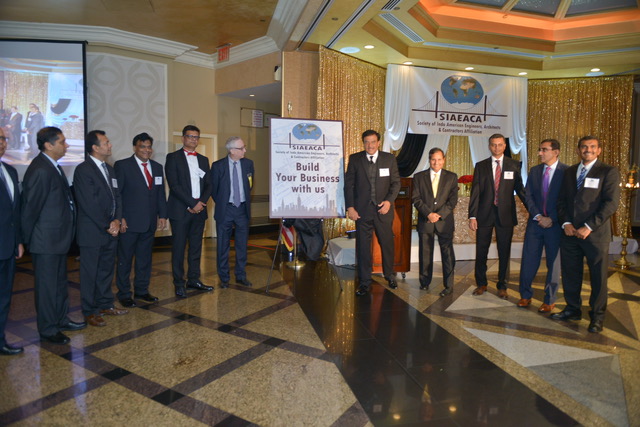
    QUEENS, NY (TIP): On Saturday, November 4th, 2017, The Society of Indo-American Engineers, Architects and Contractors Affiliation (SIAEACA), celebrated its Annual Holiday Gala at the iconic Terrace on the Park in Flushing, Queens. The event was organized by its advisory team which included Mr. Mihir Patel, principal of Monpat Construction and Mr. Nayan Parikh, principal of Ashnu International, along with several of their board members, who represent a diverse group of engineers, architects and contractors from the Tri-State Area. The theme of the event was primarily inclusion, and to welcome a diverse group of partners, and advisors engaged in the business of construction industry and creating an open platform for relationship building, new networking opportunities and recognition of the hard work put in by the professionals in the business of developing the future of the area.

    The event was attended by over 400 people, and among the attendees were several prominent engineering and architectural firms, along with some of the premier contractor firms, and construction management companies, who participated enthusiastically to showcase their support for the organization.

    The primary address was given by Mr. James Bakleh, P.E., Director Planning, Schedule and Design, MTA, New York City Transit, MTA Bus Company. In his address, Mr. Bakleh shared the upcoming projects in New York City, some of the challenges and certainly the opportunities that are available for companies within the construction industry. Mr. Jack Buchsbaum, PE, Deputy Chief Engineer at PA NY/NJ also attended this event, underscoring the importance that this organization has in the construction industry.

    SIAEACA’s, advisory board member, Mr. Nayan Parikh had opened the event with his comments thanking the sponsors, which was followed up by Mr. Mihir Patel, and then by Mr. Ketan Shah, Principal of Intercontinental Construction Contracting. A moment of silence was observed for Mr. Bansi Shah, principal of KG Industries and a dear friend of the community, who had passed away recently.

    Additionally, there was plenty of entertainment by a prominent dance group, and guests were engaged in a very strong networking and family fun filled night.

    In keeping with the sustainability theme, SIAEACA did not publish a traditional souvenir but created an all-digital brochure, recognizing all the sponsors and the event supporters.


  • Sikh Community Presence at UN Day in Dallas

    Sikh Community Presence at UN Day in Dallas

    By Ek Ong Kaar Kaur Khalsa-Michaud

    DALLAS (TIP): On Tuesday, October 24th, several Sikh activists attended a luncheon hosted by the Dallas Chapter of the United Nations Association of the United States of America. The luncheon took place at the University of North Texas at Dallas College of Law and was held in honor of UN Day – October 24, 2017.The Sikh businesswoman, Shabnam Modgill, V.P. of FunAsia, presided at the event. She is a highly visible and successful Sikh businesswoman in the Dallas/Fort Worth area. She is the Board President for the UNA-USA Dallas Chapter and served as the host for the UN Day – Dallas program. (http://www.unausa.org/membership/directory/chapter/dallas)

    The theme of the Dallas Chapter United Nations Day was Global Goals Local Leaders.

    Ek Ong Kaar Kaur Khalsa and her husband, Dr. Patrick Michaud, and respected Sikh scholar Dr. Harbans Lal attended the luncheon, as well.

    Hugh T. Dugan was the keynote speaker for the event. Mr. Dugan currently teaches as a guest scholar at Seton Hall University’s School of Diplomacy and International Relations. (https://www.shu.edu/news/hugh-dugan-appointed-new-sharkey-scholar.cfm) He has served in the U.S. Department of State for 32 years, working at the United Nations under 11 different USA Ambassadors to the UN. Mr. Dugan’s speech focused on President Donald Trump’s interaction with the United Nations this last year, and how the media is not giving the full picture. From Mr. Dugan’s observations, President Trump did signal in many different ways his commitment to the UN and the USA’s continued involvement at the UN. In Mr. Dugan’s view, President Trump may look to redefine that relationship, but he is not abandoning it.

    W3Mr. Dugan’s speech offered a fascinating perspective about President Trump’s visit to the United Nations from someone who has been deeply involved in the United Nations for the last 30 years.

    Also, Mr. Dugan informed those in attendance that the President of the General Assembly for the UN, Slovak Minister of Foreign Affairs Miroslav Lajcák, would be touring the United States next year. The tour would begin with an address at Seton Hall University. The President of the General Assembly is interested in speaking at other universities in the country. Mr. Dugan offered that if any University was interested in hosting the UN President of the General Assembly, to contact him and let him know.

    The UNA Dallas Chapter also honored the work of 3 local leaders, who have progressed 3 of the UN’s Global Goals in the Dallas area. Taylor Toynes, founder and Executive Director of the non-profit For Oak Cliff, which focuses on student support and development; Vana Hammond, Chief of Community Relations and GrowSouth for the Office of Dallas Mayor Michael S. Rawlings – helping to promote economic growth in southern Dallas, and Ericsson North America’s Cotishea Anderson for embedding Sustainability and Corporate Responsibility into their business models. Almas Muscatwalla, the Founding Member of Faith Forward Dallas – Nonprofit Organization with 500+ connections is seen in front row left of the photo. ·

    The United Nations Day in Dallas also saw the launch of a new book published by UNA Dallas Board members, Norma Tevis Matthews and Bill (John W.) Matthews. The book details The History of the Dallas United Nations Association 1953-2015. The title of the book is Hope Over Fear. Norma and Bill, both of whom are past presidents of DUNA probed into many events that contributed to the long life and panorama of projects that were initiated in Texas as well as at the UNO Headquarters in New York. Dr. Harbans Lal added a chapter in the book detailing the history of the Sikh participation in the UNO and UNA activities.

    UNA-USA Dallas members David and Nelda Reid were the 2017 UN Day Event Co-Chairs. The program also included opening remarks from Derrick Morgan of the UNT College of Law; the reading of the UN Day Proclamation by Dallas County Judge Clay Jenkins; and Tatiana Androsov, who introduced the keynote speaker, Hugh T. Dugan.

    https://www.xlibris.com/Bookstore/BookDetail.aspx?Book=742918

    Modified for the Blog from the Sikhnet.com with acknowledgment.


  • Biju Thomas Launches New Line of South Indian Spices

    Biju Thomas Launches New Line of South Indian Spices

    DALLAS (TIP): If you’ve eaten at one of Biju’s Little Curry Shop’s two locations, you know just how fresh and flavorful founder Biju Thomas’ cooking can be. Now, you can recreate that culinary magic in your own home kitchen using Thomas’ new line of South Indian spices.

    This month, Thomas released six varieties—Chili Lime Finishing Salt, Toasty Garam Masala, Vindaloo XX Blend, Madras Curry, Soup & Sambar X Hot, and Kerala Golden Turmeric— online, and at his two restaurants. (They’ll also be available at Whole Foods Market in the near future). But the spice line is simply Thomas’ first push into the retail realm: A collection of simmer sauces, as well as various snacks such as chips and roasted chickpeas, are on the way. All are rooted in the same bold flavors the chef is known for, and they’ll boast the same “clean-eating” ethos. The products are Paleo-diet friendly, vegan, and in the process of being Kosher certified.” I really put a lot of thought into this to make sure it’s good for people,” Thomas says.

    What really sets them apart, however, is the quality of the spices themselves. Thomas is sourcing from small farmers in his native Kerala and the surrounding region, often referred to as India’s spice coast. The spices are steam-sterilized rather than irradiated (which preserves the flavors), and then ground and blended in Boulder. As Thomas says, the spices are geared towards serious home cooks, while the simmer sauces and snacks will offer something quicker and more convenient for those with less time to spend in the kitchen.

    That’s not all: While Thomas pulled his two Whole Foods outposts of Biju’s Little Curry Shop, he will host frequent pop-ups at various Whole Foods locations in support of the retail line. He also has plans to franchise Biju’s in New Orleans, Dallas, San Francisco, Chicago, and Washington, D.C.

    Look for the spices, which retail at $7.99, at Biju’s Curry shop locations, online, and in Whole Foods Market very soon. The simmer sauces and snacks will roll out early next year.

  • November 17 New York & Dallas Print Editions

    November 17 New York & Dallas Print Editions

    [vc_row][vc_column][vc_column_text]

    Print Replica ~ Digitally

    E-Editions

    [/vc_column_text][/vc_column][/vc_row][vc_row][vc_column width=”1/3″][vc_custom_heading text=”New York Edition” font_container=”tag:h2|text_align:center” google_fonts=”font_family:Istok%20Web%3Aregular%2Citalic%2C700%2C700italic|font_style:700%20bold%20regular%3A700%3Anormal” link=”url:https%3A%2F%2Fwww.theindianpanorama.news%2Fwp-content%2Fuploads%2F2017%2F11%2FTIP-November-17-NYC.pdf|||”][vc_single_image image=”89060″ img_size=”full” add_caption=”yes” alignment=”center” onclick=”custom_link” link=”https://www.theindianpanorama.news/wp-content/uploads/2017/11/TIP-November-17-NYC.pdf”][/vc_column][vc_column width=”1/3″][vc_custom_heading text=”Dallas, Texas Edition” font_container=”tag:h2|text_align:center” google_fonts=”font_family:Istok%20Web%3Aregular%2Citalic%2C700%2C700italic|font_style:700%20bold%20regular%3A700%3Anormal” link=”url:https%3A%2F%2Fwww.theindianpanorama.news%2Fwp-content%2Fuploads%2F2017%2F11%2FTIP-November-17-Dallas-TX.pdf|||”][vc_single_image image=”89059″ img_size=”full” add_caption=”yes” alignment=”center” onclick=”custom_link” link=”https://www.theindianpanorama.news/wp-content/uploads/2017/11/TIP-November-17-Dallas-TX.pdf”][/vc_column][vc_column width=”1/3″][vc_single_image image=”82828″ img_size=”medium” alignment=”center” onclick=”custom_link” link=”https://www.theindianpanorama.news/advertising-media-kit-portal-indian-panorama/”][vc_single_image image=”82829″ img_size=”medium” alignment=”center” onclick=”custom_link” link=”https://www.theindianpanorama.news/advertising-media-kit-portal-indian-panorama/”][/vc_column][/vc_row][vc_row][vc_column][td_block_ad_box spot_id=”custom_ad_3″ tdc_css=””][/vc_column][/vc_row][vc_row][vc_column width=”2/3″][vc_custom_heading text=”Lead Stories This Week” font_container=”tag:h2|text_align:center” google_fonts=”font_family:Istok%20Web%3Aregular%2Citalic%2C700%2C700italic|font_style:700%20bold%20regular%3A700%3Anormal” link=”url:https%3A%2F%2Fwww.theindianpanorama.news%2F|||”][td_block_5 separator=”” limit=”8″ tdc_css=””][/vc_column][vc_column width=”1/3″][vc_widget_sidebar sidebar_id=”td-default”][/vc_column][/vc_row]

  • Indian American Student Killed After Driver of the Pick-Up Truck involved in accident Runs Her Over

    Indian American Student Killed After Driver of the Pick-Up Truck involved in accident Runs Her Over

    LONG ISLAND, NY (TIP): An Indian American, 18-year-old dental student at Adelphi University, was brutally killed after being run over by a driver who crashed into her SUV on Thursday, November 9.

    Taranjit Parmar, 18, got out of her SUV and attempted to exchange contact information with the person who accidentally bumped her vehicle in a fender bender near Long Island, New York. Once Parmar approached the pickup truck that was responsible for the crash, the driver revived the engine, ran over her and drove away, according to Newsday.

    Parmar was on her way home from school and was only five minutes away from her destination when the tragic incident took place.

    Nassau County Police Department Spokesman Vincent Garcia recounted the tragic event saying, “This was a minor auto accident and an 18-year-old girl lost her life.”

    An eye witness claimed that both parties tried “to exchange information,” but the “red truck guy ran over the girl” before the issue could be resolved. Another witness claimed that Parmar held onto the red pickup truck to stop it from fleeing.

    However, the witness added that he saw the truck driver drag Parmar about 30 feet before running her over and killing her in the process.

    “I feel horrible because it could happen to anybody’s kid, it shouldn’t happen that way, 18-years-old, it’s a horrible thing,” the concerned witness expressed.

    Local authorities are now seeking the aid of civilians and other eye witnesses in order to establish the identity of the red pickup truck driver. Investigators are now reviewing various surveillance footage to determine the perpetrator’s license plate number.

    “Nothing anyone can do. She was four days away from her 19th birthday,” a family member exclaimed.

    Meanwhile, the family on Thursday, November 16 started an Akhand Path in her memory at Gurdwara Nanak Darbar, Hicksville where, on Saturday, November 18, prayers, according to Sikh tradition, will be offered for the departed soul’s eternal peace. For further information, please call Ranjit Parmar at 516-512-2242.


  • Indian American Vikas P. Sukhatme appointed Dean of Emory University School of Medicine

    Indian American Vikas P. Sukhatme appointed Dean of Emory University School of Medicine

    NEW YORK (TIP): Emory University has appointed Vikas P. Sukhatme, MD, ScD, a distinguished physician-scientist, as the new Dean of Emory University School of Medicine. He also will serve as Chief Academic Officer of Emory Healthcare and as Woodruff Professor. Sukhatme will join Emory Nov. 1, 2017. Emory President Claire E. Sterk joined Executive Vice President for Health Affairs and Emory Healthcare CEO Jonathan S. Lewin and Emory Provost Dwight A. McBride in making the announcement.

    Sukhatme is currently Chief Academic Officer and Harvard Faculty Dean for Academic Programs at Beth Israel Deaconess Medical Center in Boston and the Victor J. Aresty Professor of Medicine at Harvard Medical School.

    “I am delighted to join President Sterk and Provost McBride in announcing this new appointment,” says Lewin. “Dr. Sukhatme is a highly recognized and exceptional biomedical scientist, clinician, and teacher. I am confident that under his leadership, the medical school will continue its upward trajectory in reputation and impact and will further enhance the Woodruff Health Sciences Center’s place as one of the world’s premiere academic health centers.”

    Sukhatme’s appointment is the culmination of a nearly year-long national search. He succeeds David S. Stephens, MD, who has served as interim dean and will continue his roles as vice president for research in Emory’s Woodruff Health Sciences Center and as chair of the Department of Medicine in Emory University School of Medicine.

    “Dr. Sukhatme’s eclectic academic background as a basic science researcher, a clinician, and a translational scientist will be a major asset to the School of Medicine, the University at large, Emory Healthcare, and to the full array of diverse communities with which Emory interacts,” said McBride. “We look forward with great excitement to the future of the School of Medicine under his stewardship.”

    “I am deeply honored to have been selected as the Dean of Emory University School of Medicine,” Sukhatme says. “With a stellar leadership team, an extraordinary faculty, an outstanding cadre of staff, trainees and students, and distinguished alumni and supporters, Emory’s future is bright. Now is the time to take on some of the most challenging problems in medicine and biology, and to tackle them through innovative, interdisciplinary approaches.”

    Sukhatme was born in India and raised in Rome, Italy. He completed a bachelor’s degree and then a doctorate (ScD) in theoretical physics at Massachusetts Institute of Technology. In 1979, he received an MD from Harvard Medical School in the Harvard-MIT program in Health Sciences and Technology. Following his residency in medicine and a clinical fellowship in nephrology at Massachusetts General Hospital, he spent two years at Stanford in immunology research.

    His first faculty appointment was at the University of Chicago, where he was also appointed an assistant investigator of the Howard Hughes Medical Institute. In 1992 he moved to Harvard Medical School and Beth Israel Deaconess Medical Center (BIDMC) as chief of the renal division in the Department of Medicine, and he subsequently received an appointment in the hematology-oncology division. He is also the founding chief of the Division of Interdisciplinary Medicine and Biotechnology at BIDMC. For eight years, he has been the Chief Academic Officer and Harvard Faculty Dean for Academic Programs at BIDMC.

    Sukhatme’s research spans numerous areas of medicine in both fundamental science and clinical care. He has over 200 scientific publications that have been cited more than 31,000 times. His longstanding interest in cancer currently centers around tumor metabolism and tumor immunology and on “outside-of-the-box” approaches for treating advanced cancer. He has conducted studies on genes important in kidney cancer and polycystic kidney disease.

    Sukhatme’s laboratory played a key role in the discovery of the cause of preeclampsia, a blood vessel disorder and a major cause of morbidity in pregnant women. His research also has provided insights into how blood vessels leak in patients with severe infections, and on how new vessels form to feed growing tumors. He has elucidated mechanisms by which statins can cause muscle damage.

    Sukhatme is known to be equally passionate about teaching medicine and educating communities outside of medical school. He initiated a course to bring MD/PhD students up to speed as they returned to the clinic after their graduate studies, as well as a mini-medical school series for the general public, and one for industry scientists highlighting unsolved clinical problems.

    According to Alan Garber, provost of Harvard University and himself a physician, “Vikas is a superb researcher with remarkable breadth and sophistication, all in the service of improved human health. He has a deep, discerning intellect and is dedicated to the success of his colleagues and students. Emory is fortunate to have attracted him as dean.”

    Sukhatme also is an entrepreneur, having cofounded several biotechnology companies based on discoveries from his laboratory. Along with his wife, Vidula Sukhatme, he is co-founder of a not-for-profit organization, GlobalCures, to conduct clinical trials on promising therapies for cancer not being pursued for lack of profitability.


  • Indian American Abhijit Das to Run for Massachusetts Congressional Seat

    BOSTON (TIP): Abhijit Das, the president and CEO of Troca Hotels, has announced he is running for the 3dr District Congress in Massachusetts. The Democrat candidate made the official announcement on his birthday amidst friends, family and community members at the Stonehedge Hotel and Spa in Tyngsborough. The seat is being vacated by Niki Tsongas in November 2018.

    “As most of you know, I’m not a fan of [President] Donald Trump,” Das said, adding that the unequivocal denunciation of hatred, bigotry and racism should be a prerequisite to running for president. “That notwithstanding, we should not demonize those who voted for him nor can we simply ignore their voices. It is by engaging other viewpoints that we ultimately achieve understanding, compromise and progress,” he said.

    Das attended the Brooks School in North Andover and earned a BA in political science from Middlebury College in Vermont. He later earned a law degree at the University of Michigan’s law school, focusing on constitutional law and the American political sector.

    “It was there (at the University of Michigan) that I learned the power of democracy,” he said.

    Early in his career, Das served as law clerk to U.S. District of Maryland Judge Benson Legg. There, Das said he was witness to the power of the federal government, its compassion and its injustice.

    Before starting Troca Hotels in 2011, Das was senior director of development for Hilton Hotels in South Asia, resurrecting 28 hotels in India from none. With Troca Hotels, Das’s mission is to revitalize communities.

    “Our state of the economy is troubling,” Das noted. “Something is not working, and we need to fix that. We must work diligently to turn this place to one of opportunity and innovation.”

    Das says his platform includes the economy, innovation, education and the mental health crisis, among other issues.

    “Washington is broken. I entered the possibility of this race because I saw friends (on both sides) shouting at each other,” Das said. “True dialogue is what we need. We need someone who is going to cross over that line and say, ‘let’s talk.’”

    The Democrat is among eight individuals from his party, as well as two Republicans, who hope to be victorious next November for the seat being vacated by Lowell-based Democratic incumbent Niki Tsongas, who is retiring after the current term.

     “Our state of the economy is troubling. Something is not working, and we need to fix that. We must work diligently to turn this place to one of opportunity and innovation,” Das said at the time in his announcement. His platform, he said, will focus on the economy, innovation, education and the mental health crisis, among other issues.

    The 44-year old Das was born in Woburn, and grew up in North Andover. He went to Brooks School, studied political science at Middlebury College in Vermont, and took two semesters of classes at UMass Lowell, where his mother Mitra Das is in her 45th year teaching sociology, the Eagle-Tribune reported.

  • Indian American Dr. Abhay Deshpande to lead Center for Frontiers in Nuclear Science

    Indian American Dr. Abhay Deshpande to lead Center for Frontiers in Nuclear Science

    NEW YORK (TIP): Physicist Dr. Abhay Deshpande has been appointed to lead the Center for Frontiers in Nuclear Science (CFNS), a new research center formed to lead the efforts to resolve one of the deep mysteries of the Universe. For the last 5 decades, physicists have known that protons and neutrons, the building blocks of the entire visible universe, are formed out of quarks and gluons. The interactions amongst quarks and gluons are governed by a theory called Quantum Chromodynamics (QCD). However, exactly how the interactions happen inside protons and neutrons to make them what they are: how their properties emerge from the collective interactions of quarks and gluons, is still a mystery, and one of the most challenging problems in physics today. A new collider accelerator facility called the Electron Ion Collider (EIC) is needed to address some of these questions.

    Two world class research organizations, Stony Brook University, a top public university in the US, and one of the premier nuclear physics labs of the US Department of Energy, The Brookhaven National Laboratory, have come together under the leadership of Dr. Deshpande, to form this Center. A generous grant from the Simons Foundation and a complementary one from the University/NY State together, have made this Center possible.

    Most difficult problems in Physics have in the past been solved by the collective wisdom and effort of a great many scientists working together, on research problems. With his new role, Dr. Deshpande hopes exactly this to happen. The Center will be the hub for scientists around the world interested in helping the realization of the EI Collider, and eventually solving the mystery of matter.

    Dr. Deshpande, who dedicated his entire life to understand aspects of nature that were most intriguing to him. The problem of the proton and neutron structure emerging from quarks and gluons has been on his mind for the last 25 years. During these years, he has performed experiments at CERN (the European Nuclear & Particle Physics Laboratory) in Geneva, Switzerland, at the German national laboratory called DESY, in Hamburg, Germany, and in the past few years he has been experimenting at the Brookhaven National Laboratory in Upton, NY and at the Thomas Jefferson Laboratory in Newport News, Virginia. What he learnt in all these experiments has resulted in the proposal for the Electron Ion Collider which he hopes to help realize in the next decade.

    Abhay grew up in Vile Parle, Mumbai. He is a graduate of Parle Tilak Vidyalaya, and the Mumbai University. He did his M.Sc. from IIT Kanpur and Ph.D. from Yale University in New Haven, CT.  This doctoral thesis was focused on understanding some of the rarest decays in (the Universe) of a particle called Kaon, which carries some very strange quarks.

  • Indian American man dies in nightclub shooting

    Indian American man dies in nightclub shooting

    CHARLOTTE (TIP): Indian American Akash R. Talati, 40, was killed in a nightclub shooting that happened in Fayetteville, North Carolina on Saturday, November 11 morning at 1:51 a.m.

    Talati was the owner of Diamondz Gentleman’s Club, where according to abc11, Markeese Dewitt, 23, began shooting after he got mad about being kicked out of the club.

    “I heard the gunshots, and ran to the front and saw my boss laying on the floor, it was chaos,” Cortez Wamble, who is a bouncer at the club, told WNCN.

    “I talked to this man every day. I look up to this man as a father figure,” he added.

    Family and friends of Talati told CBS North Carolina that he was always putting others first.

    Wamble and several other employees told WNCN that Talati had such a great impact in the community and even offered free rooms at his nearby motel for those affected by Hurricane Matthew.

    “Nobody feels safe, you have people traumatized and everything. It’s just messed up for everybody,” Sheron Bunn, one of Talati’s employees who said the club was like a home to many, told WNCN.

    According to WNCN, Talat’s family said the he died early Saturday morning after being hit by a stray bullet while inside the nightclub, three others have been injured as well.

    “We are in touch with the family of the deceased and will provide them all help,” Sushma Swaraj told IANS.

    The Fayetteville Police Department tweeted that Dewitt will be charged with attempted murder.

  • Indian American Mitesh kumar Patel pleads guilty in Ahmedabad – based call center scam targeting US residents

    Indian American Mitesh kumar Patel pleads guilty in Ahmedabad – based call center scam targeting US residents

    DALLAS (TIP): Miteshkumar Patel and his accomplices impersonated officials from the IRS and US Citizenship and Immigration Services (USCIS) to threaten people of imprisonment if they did not pay them money. Indian American Miteshkumar Patel on Monday, November 13, pleaded guilty to money conspiracy charges in the multimillion dollar India-based call center scam targeting victims from the United States.

    Patel, 42, who was based in Willowbrook, Illinois, joined six other defendants who recently pleaded guilty to the same charges for their roles in liquidating and laundering victim payments generated through a massive telephone impersonation fraud and money laundering scheme, the Justice Department said in a statement. Patel became the last defendant who pleaded guilty in this case.

    The other six defendants are Sunny Joshi, 47, of Sugar Land, Texas; Jagdishkumar Chaudhari, 39, of Montgomery, Alabama; Rajesh Bhatt, 53, of Sugar Land; Raman Patel, 82, of Gilbert, Arizona; Praful Patel, 50, of Fort Myers, Florida and Jerry Norris, 47, of Oakland, California. Miteshkumar Patel and the first three were pleaded guilty to one count of money laundering conspiracy, while the other three pleaded guilty to one count of conspiracy to commit fraud and money laundering offenses.

    The pleas were entered before US District Court Judge David Hittner of the Southern District of Texas between September 22 and November 6, except for Raman Patel’s plea, which was entered before US District Court Judge Michelle Burns in the District of Arizona on November 6. All six men are in the federal custody since their arrests in October 2016 and will remain detained until their pending sentencing dates.

    Mitesh kumar Patel, along with his co-conspirators, perpetrated a complex scheme in which individuals from call centers located in Ahmedabad, impersonated officials from the IRS and US Citizenship and Immigration Services (USCIS), and engaged in other telephone call scams, in a ruse designed to defraud victims located throughout the United States.

    The fraudsters used the information that they received from data brokers, and other sources and threatened targeted US victims of arrest, imprisonment, fines or deportation if they did not pay alleged amounts owed to the government. They instructed the victims how to provide payment, including by purchasing general purpose reloadable cards or wiring money. Upon payment, the call centers would immediately turn to a network of ‘runners’ based in the United States to liquidate and launder the fraudulently obtained funds.

    A total of 61 persons charged in this case and all the 24 defendants in the United States have pleaded guilty.

    Mitesh kumar Patel admitted to using a gas station he owned in Racine, Wisconsin to liquidate victim funds, and possessing and using equipment at his Illinois apartment to make fraudulent identification documents used by co-defendant runners in his crew to receive wire transfers directly from scam victims and make bank deposits in furtherance of the conspiracy.

    He is scheduled to be sentenced on March 7, 2018.

    (Source: DOJ)

  • Guest Comment : Stifling Padmavati:  IFFI row also undermines artistic liberty

    Guest Comment : Stifling Padmavati: IFFI row also undermines artistic liberty

    An unseemly row has erupted over Padmavati. No film can, and no film maker is obliged to appease the sentiments of a billion plus population. Instead, of providing safe passage to the release of Padmavati, several BJP-ruled states have joined hands with obscure outfits and self-appointed custodians of culture and history. The UP CM’s demand to postpone Padmavati’s release because it will disturb the law and order situation is self-defeating. He is giving undue credit to a Bollywood film. The UP CM has a responsibility to maintain law and order rather than give in to hooligans from fringe elements. ‘Film will hurt religious sentiments’ is an alibi the politicians have misused for too long. This is a smokescreen to hide bigoted attitudes.

    As if the Padmavati row was not bad enough, the government has placed itself on the wrong side of the film fraternity. Even before the Goa film festival could kick start, the government has pressed the delete button by dropping two films, duly selected by the eminent members of the jury who were handpicked by the Information and Broadcasting Ministry. Besides, Nude, which was to be the opening film of the Indian Panorama section, S Durga has also been axed. The unwarranted and undemocratic decision has forced three members of the jury, including well-known filmmaker and the jury head Sujoy Ghosh to resign.

    Even if it is conceded that these films contain some provocative content, how could I&B ministry overlook the fact that festival films are for evolved audiences who are intelligent enough to put things in proper perspective and context. Even otherwise, the right to reject a film, once cleared by the CBFC, must rest with the viewers. Much to the chagrin of those who champion artistic liberty, scuttling filmmakers’ right of expression has almost become a habit with the Centre. Creative freedom has been virtually under siege. Be it the IFFI row or the never-ending fracas over Padmavati, the government stance remains cussed; inexplicable and inexcusable. Cine enthusiasts who will be flocking to Goa seek a widening of horizons not myopic interpretation of cinematic values.

    (Tribune India)