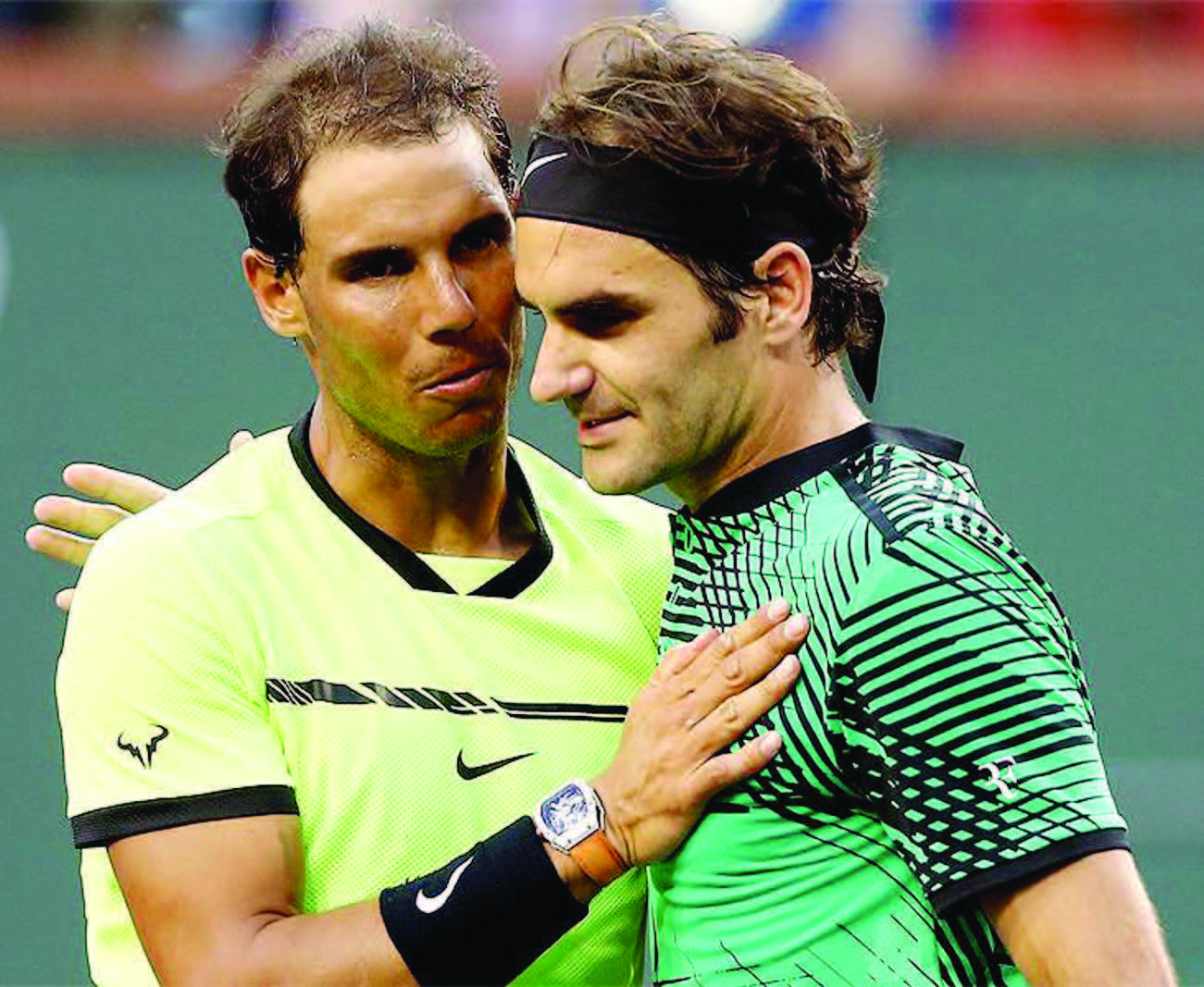
INDIAN WELLS (TIP): Roger Federer reprised his Australian Open triumph over Rafael Nadal on March 15, sweeping past the Spaniard 6-2, 6-3 to reach the quarter-finals of the ATP Indian Wells Masters.
In the 36th career meeting between the two superstars, Federer needed just 68 minutes to advance to a meeting with Australian Nick Kyrgios, who toppled five-time Indian Wells champion Novak Djokovic 6-4, 7-6 (7/3).
The victory marked the first time in a rivalry stretching back to 2004 that Federer has strung together three straight wins over Nadal. He beat him in the final at Basel in 2015 and in an epic Australian Open final in January in their two most recent previous contests.
Federer, who added another chapter to a storied rivalry with Nadal with an epic Australian Open triumph in January, dismantled the Spaniard 6-2, 6-3 to advance.
It was the first time since their first meeting in 2004 that Federer and Nadal had met before the quarter-finals of a tournament, and oddity of the rankings that had them and Djokovic –with 44 Grand Slam titles among the three of them — all grouped in the same quarter of the draw.
Federer broke Nadal to open the match, and seized a second break and 4-1 with a blistering backhand service return winner.
A forehand volley sealed the set, and another forehand winner put Federer up a break at 2-1 in the second.
Federer was firmly in control as Nadal served to save the match at 5-3. An unlucky net cord bounce, when Nadal’s forehand clipped the net and rolled back, gave Federer a double match point, and with a backhand return down the line the 36th meeting between the two was his.
The win marks the first time in the rivalry that Federer has strung together three wins over Nadal.
He beat him in the final at Basel in 2015 and in an epic Australian Open final in January in their two most recent previous contests.
“In Australia was a very close match,” Nadal said. “I had good chances to win. Today, not. Today he played better than me. I didn’t play my best match, and he played well. These kind of matches, when you’re not playing your match, it’s impossible to win.”
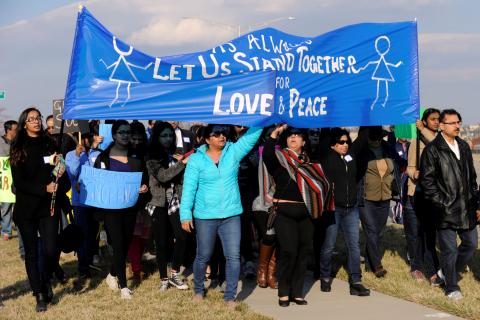
WASHINGTON (TIP): Silicon Valley Indian American Elected Legislative Officials expressed their concern regarding increasing hate crimes against Indian Americans in the Bay Area.
In a joint statement Congressman Ro Khanna, Assembly member Ash Kalra, Mayor Pradeep Gupta (South San Francisco), Mayor Savita Vaidhyanathan (Cupertino), Councilmember Arun Goel (Dublin),
Councilmember Raj Salwan (Fremont), and Councilmember Rishi Kumar (Saratoga) urged to promote diversity and equality to create an America where people continue to treat each other with respect.
“In the past few months, we have seen a number of hate crimes against Indian Americans in our own backyard. In San Jose, an Indian man driving a foreign car was questioned about his loyalty to America and told to ‘go back to [his] own country,’ an incident he later described as his ‘first racial encounter in his 41 years as a resident of this country.’ In Fremont, an Indian woman was slapped in an incident that was categorized a hate crime. There are other minor incidences that have not yet been reported to law enforcement officials.
“All of us are deeply hurt and saddened by these recent happenings, more so with the recent shooting in Kansas and Seattle. It is very unsettling that these hate crimes have popped up in Silicon Valley as well, where diversity and culture are so dearly treasured. America after all, has always been a nation of immigrants and has always valued the work and ideas that immigrants bring to its shores. That people are being attacked simply because of their skin color or their nation of origin is unacceptable and shameful.
“We, the undersigned, pledge that we will make it a priority to protect all minorities and immigrants from such attacks. We are invested in rolling back the climate of hatred that is seemingly sweeping the country, collaborating towards a society in harmony, working together for simple American values, and building a prosperous Silicon Valley and America. Together, we can promote diversity and equality to create an America where we continue to treat each other with respect.
“We have great confidence in the fundamental decency and kindness of the American people. We know these attacks represent a fringe that is not representative of our values. We are confident that here, in the Bay Area, we will rise above these attacks and be a model for the country of tolerance and respect.”
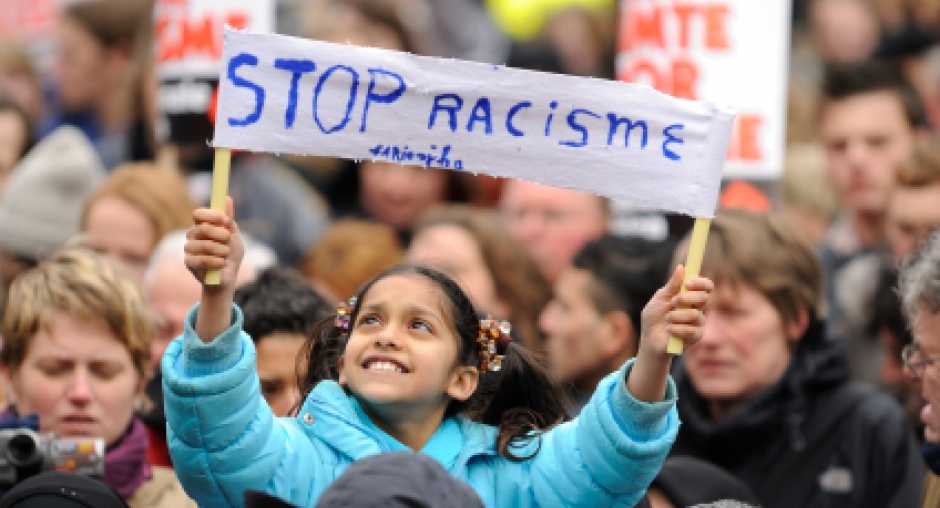
CHICAGO, IL (TIP): Chicago-based Indian-American Public Affairs Committee (IAPAC) has launched a campaign across the US to spread awareness about hate crimes against the community.
The committee plans to organize a series of grass root events and town halls across the country. “There is a need to bring understanding about the people of Indian-American and represent their interests,” Ashwani Dhall, one of the founding members of IAPAC, said in a statement.
The committee plans to highlight how Indian-Americans have been an intrinsic part of the American fabric and will also ask different state governments and cities to announce Indian-American awareness month.
“By bringing together elected officials, local and business leaders and the media, the aim is to assure Indian-American community that incidents like the hate-crime in Kansas City are not tolerated or repeated,” the statement read.
IAPAC will also organize events in San Francisco Bay Area, New York, New Jersey, Chicago, Dallas and Seattle as part of the campaign. It wants to ensure that correct information, not rumors, on existing policies is disseminated to people, according to the statement.
“It was heartening to hear [President] Trump denounce the Kansas City incident right at the start of his address to the Congress,” IAPAC president Vinesh Virani said. “We have hope that the current administration will work to bring everyone together,” he added.
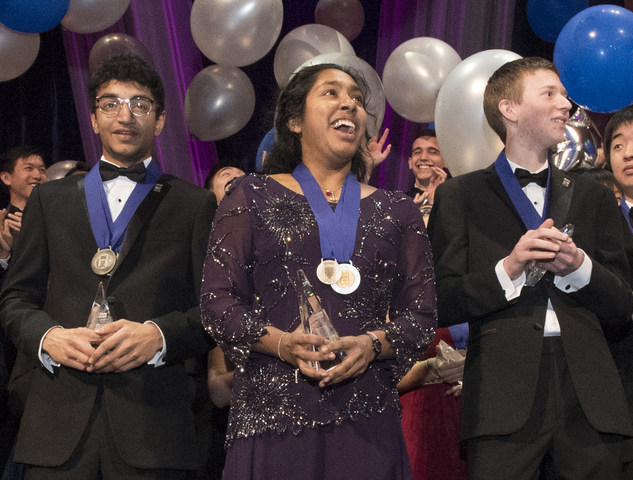
ORADELL, NJ (TIP): Indian American Indrani Das, 17, of Oradell, New Jersey, won the top award in the Regeneron Science Talent Search, the nation’s oldest and most prestigious science and math competition. Forty finalists, including Indrani, were honored on March 14 at the annual Regeneron Science Talent Search Awards Gala for their research projects demonstrating exceptional scientific and mathematical ability, taking home more than $1.8 million in awards provided by Regeneron.
Indrani won the top award of $250,000 for her study of a possible approach to treating the death of neurons due to brain injury or neurodegenerative disease. Another Indian student got third place. Arjun Ramani, 18, of West Lafayette, Indiana, came third for blending the mathematical field of graph theory with computer programming to answer questions about networks.
Archana Verma, 17, of Jericho, New York, Prathik Naidu, 18, of Potomac Falls, Virginia, and Vrinda Madan, 17, of Orlando, Florida took fifth, seventh and ninth places respectively. Eight other Indian-origin students were among the 40 finalists.
“Now more than ever, we need our nation’s best and brightest young minds to pursue their interest in science and use their talents to solve our world’s most intractable problems,” said Maya Ajmera, President and CEO of Society for Science & the Public and Publisher of Science News. “I congratulate our finalists, who are all poised to become our future scientific leaders.” Society for Science & the Public has organized and produced the Science Talent Search since it was founded in 1942.
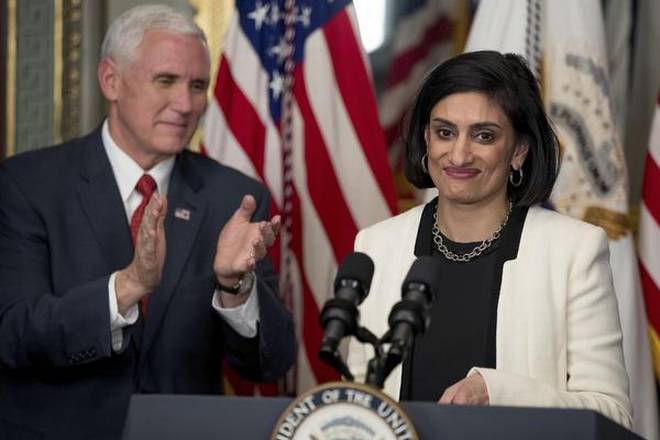
WASHINGTON (TIP): Indian-American healthcare consultant Seema Verma, on March 14, was sworn-in as the head of a key healthcare agency in the Donald Trump administration. The Senate on March 13 confirmed Verma as administrator of the Centers for Medicare & Medicaid Services (CMS) in a 55-to-43 vote. She was sworn in by U.S. Vice President Mike Pence as administrator of CMMS, which is part of the Department of Health and Human Services and oversees the Obamacare insurance markets, Medicare, and Medicaid.
“President Donald Trump has chosen one of the leading experts in America on state-based healthcare solutions to lead this important agency,” Vice President Pence said at the swearing-in ceremony at the White House. On November 29, 2016, President-elect Donald Trump nominated Verma to serve as administrator of the CMMS.
Verma is the founder and CEO of SVC Inc., a health policy consulting firm. She is president and CEO of the company, which has worked with the states of Indiana, Iowa, Kentucky, Maine, Michigan, Ohio, and Tennessee. In preparation for the implementation of Obamacare, Verma and SVC Inc. have worked with state insurance agencies and public health agencies to redesign their Medicaid programs. She developed Medicaid reform programs, including waivers, for Ohio, Kentucky, and Iowa. Her firm provided technical assistance to the state of Michigan in the implementation of their Section 1115 Medicaid waiver. SVC also assisted Tennessee in their coverage expansion proposal and supported Iowa’s Medicaid transition to managed care.
Following the passage of Obamacare, Verma worked with Indiana Governor Mitch Daniels on health care policy. She was the architect of the Healthy Indiana Plan. The health insurance program, designed for people with low income, requires participants to pay into a health savings account and has high deductibles.[3] According to Verma, “you have to make your contribution every month, with a 60-day grace period. If you don’t make the contribution, you’re out of the program for 12 months. It’s a strong personal responsibility mechanism.” The Healthy Indiana Plan received support from the Indiana legislature and passed into law in January 2008. She later created the related “HIP 2.0” under Governor Mike Pence.
Prior to consulting, Ms. Verma served as Vice President of Planning for the Health & Hospital Corporation of Marion County and as a Director with the Association of State and Territorial Health Officials (ASTHO) in Washington D.C.
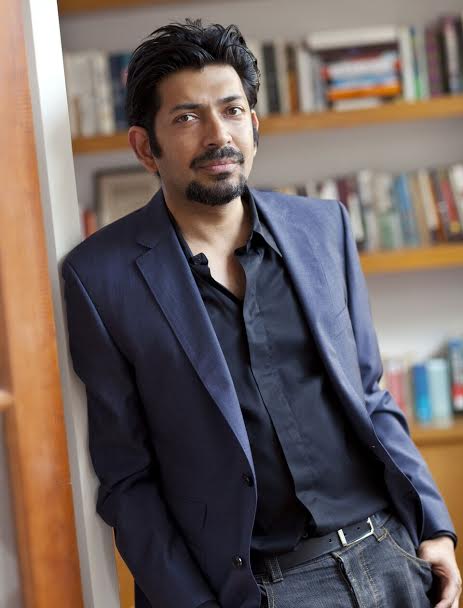
NEW YORK (TIP): Two Indian Americans – Dr Siddhartha Mukherjee and late Stanford neurosurgeon Dr. Paul Kalanithi were among those shortlisted for 2017 Wellcome Book Prize.
Siddhartha Mukherjee is a cancer physician and researcher, a stem cell biologist, and a cancer geneticist. He is the author of ‘The Laws of Medicine’ and ‘The Emperor of All Maladies: A biography of cancer’, which won the 2011 Pulitzer Prize in General Nonfiction and the Guardian First Book Award.
Siddhartha Mukherjee was shortlisted for his non-fictional work “The Gene: An Intimate History,” which was published in May 2016. The Gene’ is an epic, moving history of a scientific idea coming to life. The story of the gene begins in an obscure Augustinian abbey in Moravia in 1856, where a monk stumbles on the idea of a ‘unit of heredity’. It intersects with Darwin’s theory of evolution, and collides with the horrors of Nazi eugenics in the 1940s.
Paul Sudhir Arul Kalanithi, who died of lung cancer in March 2015, was named to the list for his memoir, “When Breath Becomes Air,” which was released posthumously in February 2016.
Paul Kalanithi
Paul Kalanithi was a neurosurgeon and writer. At the age of 36, on the verge of completing a decade’s training as a neurosurgeon, Paul Kalanithi was diagnosed with inoperable lung cancer. One day he was a doctor treating the dying, the next he was a patient struggling to live.
‘When Breath Becomes Air’ chronicles Kalanithi’s transformation from a medical student asking what makes a virtuous and meaningful life into a neurosurgeon working in the core of human identity – the brain – and finally into a patient and a new father.
The Wellcome Book Prize celebrates the topics of health and medicine in literature. It awards £30,000 each year to the winning author, and aims to stimulate interest and debate about medical science through books and reading. The prize crosses genres: fiction and non-fiction are both eligible, so its shortlists can include biography, crime, historical fiction, current affairs, sci-fi and more.
The shortlist for the prize was announced at a press conference on Tuesday 14 March at the London Book Fair. The winner will be announced at an evening ceremony on Monday 24 April at Wellcome Collection.
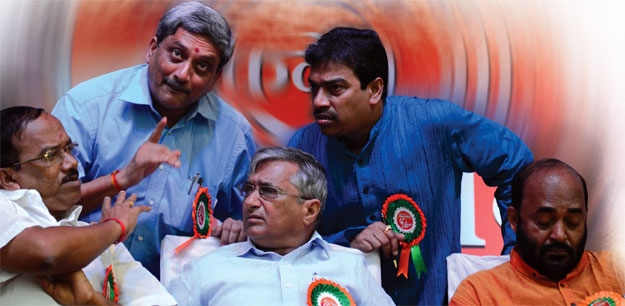
Manohar Parrikar won the trust vote on the floor of the House on Thursday, March 16.
PANAJI (TIP): The Manohar Parrikar-led coalition government in Goa won the floor test in the legislative assembly on Thursday, March 16, by getting 22 votes to 16 in the 40-member Goa assembly, one more than the simple majority figure of 21.
One MLA was made the speaker for the trust vote and did not vote while one Congress legislator walked out during the floor test against his own party. Congress MLA Vishwajeet Rane walked out during the floor test and later submitted his resignation to the pro tem speaker. Rane, son of Congress veteran Pratapsinh Rane who himself won his 11th term as an MLA in the Goa assembly elections, also resigned as a Congress member. He said he would re-contest from Valpoi constituency.
Apart from the Bharatiya Janata Party’s 13 MLAs, Parrikar also got support from three legislators of Maharashtrawadi Gomantak Party (MGP), three legislators of Goa Forward party (GFP), two independents, and Nationalist Congress Party’s lone member Churchill Alemao.
Before the floor test began, Rane told reporters that the delay caused by the Congress leadership in staking claim to form the government had demoralized the people of Goa. “They have lost the trust of voters in Goa,” he said.
Hours after the Goa governor appointed Parrikar as the chief minister, Rane had said that as many as 13 of the 17 Congress legislators were angry that the party leadership could not elect a legislative party leader. Later, Rane and other Congress legislator Jennifer Monserrate blamed All India Congress Committee general secretary and Goa observer Digvijay Singh for this delay. Singh hit back on Wednesday with a tweet asking Rane “what he was doing with Parrikar in a Goa hotel”.
A triumphant Parrikar told reporters at a press conference later that the BJP was always confident of winning the trust vote. “The Congress did not have the numbers ever. Today’s floor test was a voluntary vote for us. No MLA was hidden in a hotel or anything,” Parrikar said. The Goa chief minister, who earlier this week resigned as the defence minister and made some deft moves in Goa to stitch together a BJP-led coalition, said “all eyes in India were on this floor test”.
The floor test was ordered by the Supreme Court after the Congress party in Goa filed a petition on 13 March challenging Goa governor Mridula Sinha’s decision to appoint a BJP-led government.
Parrikar was sworn in on 14 March along with eight other ministers.
The chief minister said after winning the trust vote that portfolios would be announced on 18 March. Ministers from MGP and GFP are likely to get important portfolios. In the 40-member Goa assembly, the BJP won 13 seats in the recent elections and later received support from 9 others.
The Congress won 17 seats and emerged the single largest party but never staked claim to form the government. On Thursday morning itself, it became clear that the BJP would sail through the trust vote as the MGP and GFP leaders reiterated their support to the BJP.
NEW YORK (TIP): A career diplomat, Dr Manoj Kumar Mohapatra, Deputy Consul General of India in New York, who is returning to New Delhi end of this month after serving in New York for almost three years, says whatever good job he has done here is because of the “enormous support of the Indian community”. He was speaking with Bidisha Roy, assistant Editor of The Indian Panorama in an exclusive interview which he said was his last interview to The Indian Panorama and recalled his first interview to a newspaper in New York was also with The Indian Panorama.
Dr Mohapatra , who assumed the office as DCG (Economic, Political, Consular & Women’s Affairs) on 31 July 2014. has served in a variety of positions with the Indian Foreign Service. He has served as third secretary in the Embassy of India in Berlin; at the Ministry of External Affairs in New Delhi as the desk officer for India’s bilateral relations with Bangladesh; and as the first secretary and counselor in the Indian diplomatic missions in Budapest, Hungary, and Dhaka, Bangladesh, where he was in charge of political and commercial relations between India and these countries.
He has successfully coordinated many historic events in New York area such as the reception to Prime Minister Narendra Modi at Madison Square Garden in September 2014, a little after he joined as DCG in New York; International Yoga Day Celebrations in 2015 and 2016, and visits of many Chief Ministers from India which included Madhya Pradesh Chief Minister Shivraj Singh Chouhan, Chhattisgarh Chief Minister Raman Singh and Maharashtra Chief Minister Devendra Phadnavis.
Dr. Mohapatra played a significant role in bringing together people of a State to form a group named “Friends of” Thus, people here belonging to Madhya Pradesh formed a group called “Friends of Madhya Pradesh”. Similarly, with other States. The net result was a better coordination in extending reception to the visiting Chief Ministers by the people belonging to that State. At each of these visits, cooperation of Indian Americans with the State to which they belonged was the major issue of discussion. How people of a State could contribute to the development was an issue which remained the focus of all meetings. Reports from various States in India have suggested that, as a result of these visits by the Chief Ministers of some States and their interaction here with Indian American community which was facilitated by the Consulate here with Dr. Mohapatra leading and coordinating, great enthusiasm was evinced by investors to invest in various States. So much has been a single man’s contribution.
But this humble person gives all credit to the Indian American community. “Community has been an asset. They have always supported us. The events like PM’s reception at Madison Square Garden could not have been so successful without their help. It was made possible because of the tremendous support we got from the community”, Dr Mohapatra told The Indian Panorama.
Dr Mohapatra, who is credited with bringing efficiency and transparency in the functioning of the Consulate General of India, also shares the credit with the media. “I could excel because of the great help from media. The media was so helpful that in a very short period the Consulate was able to change its image. The perception of people (about Consulate) changed because of media.” He was particularly appreciative of The Indian Panorama and its editor-publisher Prof. Indrajit S Saluja who he said, was “my guruji and guided me on many issues”.
Nassau County Comptroller George Maragos presents a Citation to Dr. Mohapatra at the Indo-American Press Club gala, March 4, 2017 Photo/ Mohammed Jaffer-SnapsIndia
Dr. Mohapatra takes pride in the success of Outreach program of the Consulate. “We conducted community outreach programs in all ten states (under the jurisdiction of NY Consulate) and I met eight governors out of ten in a short period of time. It feels good that the Consulate played an important role in strengthening bilateral relationship.” Dr. Mohapatra believes that as a result of contact with the State governors and administration officials there was a growing desire among almost all States to have a closer relationship with the States in India.
And finally, he is confident that the bonhomie between the consulate and the community will continue. “I would request the community to give the same love and support to the Consulate and my successor that I got from them. The Consulate is for the community and vice versa. Our relationship should touch the sky.”
Indian Americans on March 21 will host a reception at Royal Albert’s Palace in Fords, New Jersey to bid farewell to their beloved outgoing Deputy Consul General of India.
The Indian Panorama family, spread over the US and India, looks upon Dr. Manoj Kumar Mohapatra as a worthy son of India who has done his best to keep the flag of India flying high here in the US, and wishes him all success and happiness wherever he goes on his next assignment.
Also, The Indian Panorama is happy to let him carry with him the warm appreciation coming from some community representatives who, in turn, represent adequately, the Indian community in the Tri-State area of New York, New Jersey, and Connecticut.
Dr. Manoj Kumar Mohapatra (10th from right) administered oath of office to FIA officials, January 28, 2017. Mr. Andy Bhatia, President who was sick and could not be present, was administered oath over the phone. Photo/ Gunjesh-Nayaface.com
Dr Manoj Kumar Mohapatra, Deputy Consul General of India in New York
——— From Connecticut, Mr. Andy Bhatia, President, Federation of Indian Associations, NY/NJ/CT says in appreciation of Dr. Mohapatra:-
“Dr. Manoj Mohapatra, Dy. CG has been a true friend of the Indian American community and it has been my privilege to have known him and work with him.
He has been tireless in his efforts to help the community and has always made himself available to us any day of the week.
He is credited for putting in systems in place In bringing efficiency and transparency in the Consulate.
He is a clear thinker and knows how to structure his thoughts to get his point across.
We will miss him and wish him lots of success in his new assignment in New Delhi.”
———
One of the senior community leaders, who is credited with having founded some of the first and the oldest organizations of Indians in the US, and presently, Chairman of GOPIO International, Dr. Thomas Abraham, from Connecticut writes:
“Dr. Mohapatra has been one of the most sincere and dynamic Deputy Consul General who also served as Acting Consul General during the absence of the Consul General. He has been on the top of most of the Consulate activities and has been performing very well with the outreach and resolving issue of the Indian community. He provided leadership in sorting out many of the consular issues and has been instrumental in organizing Open House meeting with the community every week. He had expanded the outreach to American political leaders by utilizing the Indian American community contacts. Community organizations found a good friend in him to promote common goals of our community and India. We will miss him in New York and wish him all success in his new assignment.”
———
And, Dr. Navin Mehta, who has for long been associated with Bharatiya Vidya Bhavan says of Dr. Mohapatra:
“Silent worker-
“When I am silent, I fall into that place where everything is MUSIC – Rumi”
Dr, Mohapatra works silently and have observed that his work is his music. Very few people can be this dedicated and still smile.
As Chanakya says about a diplomate
“मनसा चिंतित्म कर्म, वचसा न प्रकाशयेत्”
People of Indian origin, who are living in USA on refugee status, will soon be able to travel to India with a valid travel visa. The Government of India has decided to grant visa to applicants with refugee status living in USA.
This issue was handled by Manoj Mohapatra.
Pioneer and initiator of Outreach program where consulate for the first time reached door steps of common people.
One of the most excellent organizers ,,,, be it outreach program, Visa and Passport facility or PM visiting Madison Square Garden.
We will surely miss him but wish Dr. Mohapatra the best in life and wish that he continues to serve the Nation’s cause.”
———
And here is a comment from Ranjeet Singh, Manager at CKGS who worked under the watchful eye of Dr. Mohapatra .
“DCG Dr Mohapatra has been an inspiring diplomat who has always put community interests on top of his priorities.
Working with him was an enlightening experience. He went out of his way on many occasions to streamline things and make the consular services accessible to Indian diaspora in the best possible way.
He tirelessly worked on reducing the gap between Indian-American diaspora and the Indian government represented by its mission in NY through his innovative ideas and extraordinary execution of day to day work at NY Consulate.
CKGS family joins me in wishing him a great life and an extraordinary career ahead!!!”
———
And, the last comment which proves the saying “brevity is the soul of wit” comes from Mr. Rajiv Khanna, President of India-America Chamber of Commerce: “It was a great pleasure to work with Dr. Mohapatra. He is an outstanding foreign service officer who is dedicated to furthering India’s interest”.
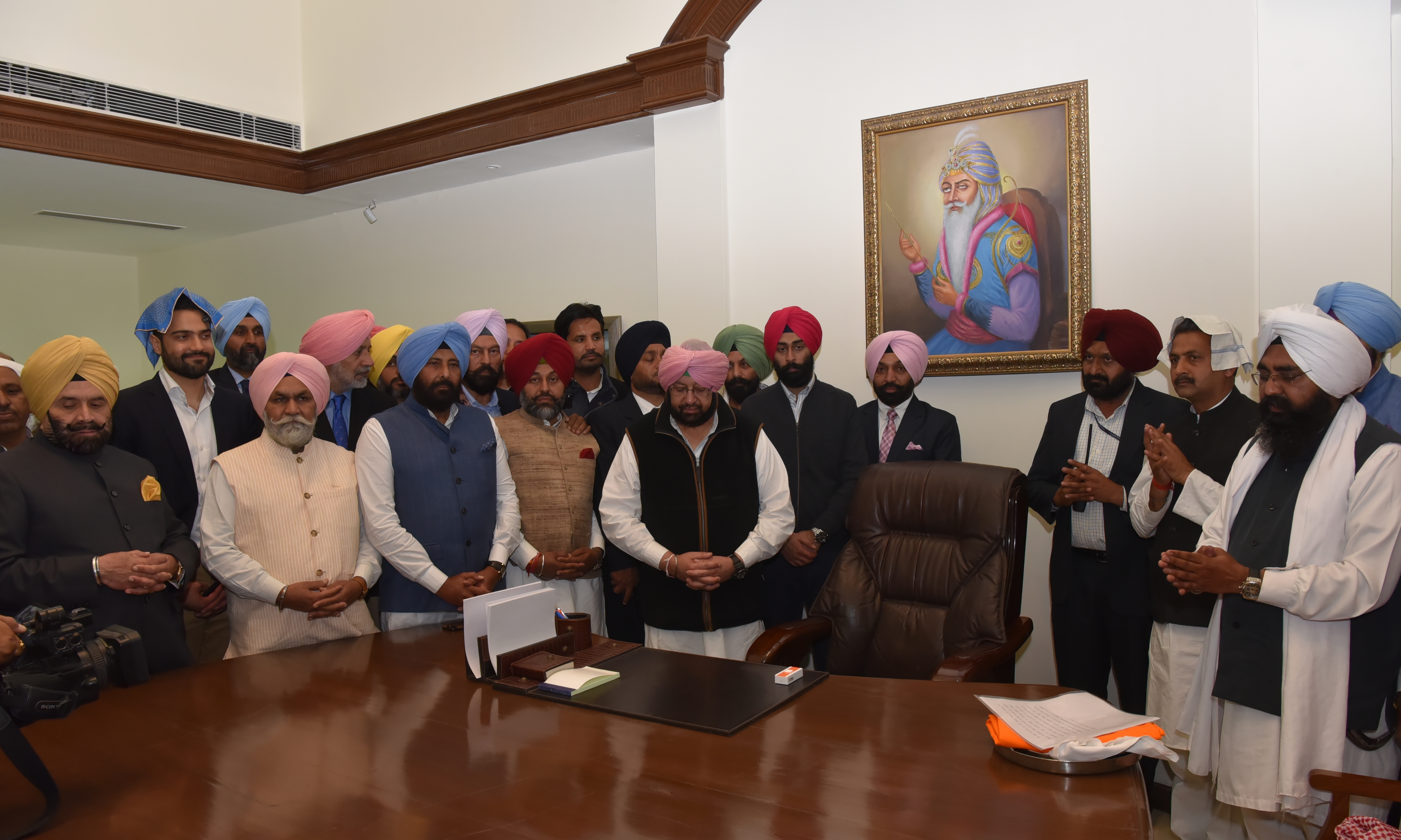
CHANDIGARH (TIP): Capt Amarinder Singh was on March 16 sworn-in, at a simple ceremony, as the Punjab chief minister for the second time with nine ministers, including Navjot Singh Sidhu also taking the oath. Earlier, he had led the Congress government from 2002 to 2007.
Navjot Sidhu, the cricketer-turned politician, was second among the list of nine ministers to be sworn in. Brahm Mohindra was sworn in as cabinet minister right after Amarinder.
Two ministers of State — both women — were sworn in at the ceremony attended among others by former Prime Minister Manmohan Singh and Congress vice-president Rahul Gandhi. The ceremony was held at the Raj Bhawan here and the oath was administered by governor VP Singh Badnore.
Sporting a black sleeveless jacket adorned with army medals, Amarinder took the oath in English.
Besides Sidhu those sworn in were Manpreet Singh Badal, estranged nephew of former chief minister Parkash Singh Badal, Sadhu Singh Dharamsot, Tript Rajinder Singh Bajwa, Rana Gurjit Singh and Charanjit Singh Channi.
Two women MLAs Aruna Chaudhary and Razia Sultana were sworn in as Ministers of State (Independent Charge).
The Council of Ministers has representation from different castes, regions and religious faiths.
While Mohindra, the senior-most minister after Amarinder, is a Hindu face in the cabinet hailing from the CM’s home district Patiala, the rest of the cabinet ministers are Sikhs which include Charanjit Singh Channi and Sadhu Singh Dharamsot, both from the Dalit community.
Capt Amarinder Singh, the new Chief Minister of Punjab, has put together a Cabinet that represents a selection of veterans which, if tea leaves are to be read, portends well for the state. He has managed a delicate balancing act. Although there are some who have been ministers before, many are new to a ministerial assignment. Brahm Mohindra, Manpreet Singh Badal and Tripat Rajinder Singh Bajwa have held ministerial assignments, but the untested Navjot Singh Sidhu, Rana Gurjit Singh and Charanjit Singh Channi are no spring chickens. Some kind of balance has been attempted among Malwa, Majha and Doaba regions. The ministers come from various castes and communities, and two of the Cabinet members are women.
The new Chief Minister needs to be complimented for weaving together a team of administrators, and the initial selection is of officers known for both integrity and efficiency, essential for working towards all-round development of the state. The temptation for any new political chief is always to seek the familiar. This can often be a mistake, more so in the case of Capt Amarinder Singh, whose coterie politics was widely believed to have been a major cause of discontent during his last term as Chief Minister. His successor, Parkash Singh Badal, succumbed to nepotism, which can equally be the undoing of any power figure.
Now that Capt Amarinder Singh’s core team is in place, the pressure would be on him from Day 1 to deliver on the promises, which would, of course, include those made behind closed doors as well as those to the public. If he concentrates on the latter, he will be able to ignore the puerile. The relatively simple swearing-in ceremony should set the tone. Punjab has had to bear the burden of ‘adjusting’ political and other ‘leaders’ in public offices rather than appointing capable individuals who may do justice to the responsibilities assigned. Change is expected by the voters, and those who entrusted with delivering it must keep their focus on the larger interests of Punjab, not just political gymnastics that have long been the bane of the state.
As expected the Manohar Parrikar government in Goa was able to prove its majority on Thursday, March 16, following a Supreme Court directive. Once the Governor had decided to invite the former Defence Minister, Parrikar to form the government, even though the Congress had emerged as the largest party, the dice got loaded in favor of the BJP.
In the end, the BJP with just 13 MLAs in a house of 40 managed to conjure up a slate of 22 legislators for voting in favor of chief minister Parrikar. The vote and the outcome are in perfect harmony with the Goan political culture of smaller parties and independents making themselves available for the highest bidder.
As the BJP is politically ascendant nationally and is flush with resources and imbued with resourcefulness, there was little doubt about its ability to win this round in Goa. Even before the final vote on Thursday, the Congress was making allegations of money changing hands.
It is the irony of our times that the winner not only gets to write the history but also re-writes the norms; it would be seen as cussedness to point out the ethical dimension of the denouement: the BJP was in power and it lost the majority in the election, ending up with only 13 MLAs yet storming its way back into power. Most curious and inexplicable is the case of all the three MLAs, belonging to the Goa Forward Party, siding with the BJP; in disgust, the GFP president, Professor Prabhakar Timble resigned from the party, accusing the BJP of inflicting a ‘political mafia raj’. So be it. The BJP’s cocky leadership would have the satisfaction of having one more state government under its belt.
Within days all the righteous anger about a ‘stolen government’ would subside. No one should be surprised if some of the Congress MLAs end up crossing over to the winning side. Goa would return to its happy and carefree habits and preferences. Above all, Manohar Parrikar’s exile in Delhi ends. Goa gets a chief minister it deserves and the country will, hopefully, get a defence minister it badly deserves.
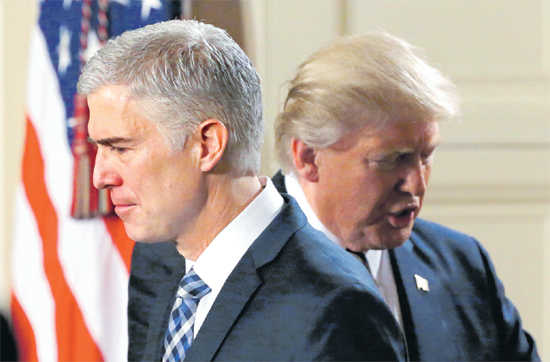
“One of the first acts of the new President Donald Trump was to announce the nomination of Judge Gorsuch, described by one columnist as ‘Scalia:2’!
Upendra Baxi
While the description may not quite hold true (as many distinguished Justices of SCOTUS have shown that constitutional reason does not always follow political reason), the bargaining in nomination by the President and the ensuing process in the Senate confirmation proceedings shows the strength of the distinctive American political belief that what matters is judicial political ideology, or orientation,” says the author – Upendra Baxi.
Those made more anxious by the Supreme Court’s decision invalidating the constitutional amendment and the law in the NJAC (National Judicial Appointment Commission) case may find no solace in the American constitutional alternative of the Senate confirmation method. Last year, a Republican 54-46 seat majority refused to consider President Obama’s nomination (upon Justice Scalia’s death) of Judge Merrick Garland for 293 days, lest it may swing the delicate balance of judicial vote towards a liberal direction. Senator Merkley (Oregon) was to describe the vacant seat on the SCOTUS (Supreme Court of the United States) as a ‘stolen seat’! It was, however, insisted that the Senate was within its rights to refuse to consider a nominee until the inauguration of a new President.
One of the first acts of the new President Donald Trump was to announce the nomination of Judge Gorsuch, described by one columnist as ‘Scalia:2’! While the description may not quite hold true (as many distinguished Justices of SCOTUS have shown that constitutional reason does not always follow political reason), the bargaining in nomination by the President and the ensuing process in the Senate confirmation proceedings shows the strength of the distinctive American political belief that what matters is judicial political ideology, or orientation.
The Senate Judiciary Committee decides after hearings to send nominations to the full Senate for a final confirmation vote. The 11 Republican and nine Democratic Senators chaired by Republican Chuck Grassley will decide on Judge Gorsuch’s confirmation (scheduled beginning March 20, 2017). At issue, more than ever before the full Senate, is the use of a filibuster — roughly, a form of prolonged speaking which obstructs progress in a legislative assembly but is not regarded as technically contravening the required procedures.
Overcoming filibuster requires a 60-vote super-majority. Because the Republicans hold 52 seats in the 100-seat chamber (and a further potential tie-breaking vote in Vice-President Mike Pence), the use of filibuster means blockade of the nomination. President Trump has urged the use of the ‘nuclear option’ abolishing the filibuster altogether. However, informed opinion suggests this as an unlikely move and empirical estimates place Gorsuch’s confirmation potential vote between roughly April 17 and May 11, 2017. It remains to be seen whether the ‘nuclear option’ is still invoked.
While in theory a filibuster move is possible, in practice the judicial confirmation is the most likely result. Of course, the hearings will intensely engage aspects of Gorsuch’s record: especially his perspectives on women’s rights, his apperceived anti-trade union decisions, and disinclination to promote campaign finance reform. But Opponents argue fiercely that the elevation will jeopardize the independence of judiciary.
Neil Gorsuch, at 49, is no doubt a distinguished Justice of the United States Court of Appeals for the Tenth Circuit. But he is often compared with Justice Antonin Scalia, whose death caused the vacancy now being filled. Gorsuch was part of an appellate panel, in the Hobby Lobby case, that ruled in favor of the owners of a chain of craft stores who entertained a moral objection to providing an insurance plan that covered contraception. This was a decision that partially undermined the Affordable Care Act, an Obama flagship legislation. A wider implication of this decision may affect future laws under the banner of religious freedom. In his concurring opinion, Gorsuch defended religious freedom which ‘doesn’t just apply to protect popular religious beliefs’: rather, most importantly, the task lies in ‘protecting unpopular religious beliefs, vindicating this nation’s long-held aspiration’ to ‘serve as a refuge of religious tolerance’. He argued that the Act would force businesses ‘to underwrite payments for drugs or devices that can have the effect of destroying a fertilized human egg’.
Gorsuch has not so far directly ruled on abortion rights, but some suggest that he would militate against Roe v. Wade. And his adherence of ‘originalism’ (looking only at the text of the Constitution), so favorite of Justice Scalia, raises a spectra of a conservative agenda.
As a former clerk to the Justice Anthony Kennedy, traditionally a swing voter on the court, the governance hope is that Justice Gorsuch will be able to sway Justice Kennedy, and even persuade him to retire (he is already 80) thus causing another apex vacancy.
No doubt, Justice Gorsuch would be questioned closely about his views at the Senate hearings, especially by the Democratic Senators. The questions will extend to his views on gun control, racial discrimination, torture, and even on military matters such as decisions to invade foreign lands in the name of preserving democracy or fighting terror (the so-called policies of putting ‘boots on the ground’). Such grilling may not affect the outcome, not just because of political arithmetic but because justices do not respond to hypothetical questions. And very often what Justices say during confirmation hearings is not necessarily what they will do at the apex court in adjudicating constitutional disputes.
But the Senate hearings will witness deep controversy on the independence of the judiciary. President Trump did not do full justice to his exalted constitutional position when he, in an infamous tweet, describes the ‘opinion of this so-called judge, which essentially takes law-enforcement away from our country, is ridiculous and will be overturned!’ And he went further: ‘What is our country coming to when a judge can halt a Homeland Security travel ban and anyone, even with bad intentions, can come into US?’ He also told his almost 24 million Twitter followers that he, ‘Just cannot believe a judge would put our country in such peril. If something happens blame him and court system. People pouring in. Bad!’ Apparently, the President overlooked that Judge Robart (who stayed his order) was an appointee of Republican President George W Bush and won Senate confirmation in 2004 by a vote of 99 to zero!
Incidentally, it must be said no Indian political incumbent has gone so far as Trump despite deep differences over the supremacy of adjudicative power. There is a grudging respect, even political grace, in the Indian acceptance of robust judicial independence as a constitutional virtue.
Justice Gorsuch is reported to have critiqued the action of the President as ‘disheartening and demoralizing’. He will most certainly be probed to enunciate further his perspectives on judicial independence, so far taken for granted in the US. The majority NJAC discourse of the Supreme Court of India may well be meaningful for the Supreme Court of the US.
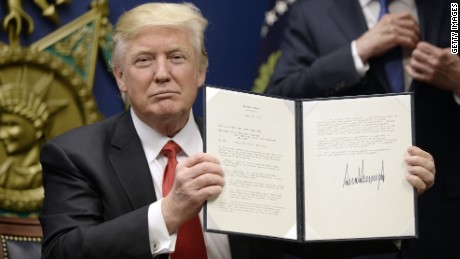
WASHINGTON (TIP): Hours before it was to take effect, President Donald Trump’s revised travel ban was put on hold March 15 by a federal judge in Hawaii after hearing arguments that the executive order discriminates on the basis of nationality.
District Judge Derrick Watson in Hawaii issued a temporary restraining order followed by District Judge Theodore Chuang in Maryland. Both judges attacked the executive order in part by analyzing intent. They found Trump’s actions were based on the motive of targeting Muslims, and they reached their conclusions by examining the record of what he and others connected to him had said. Both judges cited Trump’s statements about Muslims during the presidential campaign as part of their rulings.
Rep. Tulsi Gabbard (HI-02) released a statement after U.S. District Court Judge Derrick Watson in Honolulu issued a nationwide stay temporarily preventing the Trump Administration’s travel ban from going into effect:
“Hawaiʻi is a place where people with different ideas, backgrounds, religions, and ethnicities feel welcomed and respected. It’s only right that our Attorney General Doug Chin represent those values in working to stop this blanket travel ban from going into effect. This travel ban is bad policy, plain and simple.”
The Justice Department said it will defend the new travel ban. “The Department of Justice strongly disagrees with the federal district court’s ruling, which is flawed both in reasoning and in scope. The President’s Executive Order falls squarely within his lawful authority in seeking to protect our Nation’s security, and the Department will continue to defend this Executive Order in the courts,” DOJ said in a statement.
Over 22 million children in Pakistan between the age group of five and 16 are out of schools despite the government’s claim of improving their enrolment in educational institutions, according to a report.
The Pakistan Education Statistic 2015-16 report launched on Wednesday by a department of the Ministry of Federal Education and Professional Training disclosed that as many as 44 per cent children (22.6 million) between the age group of five to 16 are still out of school, Dawn reported.
The report said the number of out-of-school children has reduced from last year’s figure of 24 million to 22.6 million.
The statistics further said 21 per cent primary schools in the country are being run by a single teacher while 14 per cent have one room.
It said only 30 per cent children remain enrolled from class one till tenth. Balochistan region is home to the highest proportion of out-of-school children followed by the impoverished tribal region along Afghan border.
“As many as 70 per cent children in Balochistan and 58 per cent in Federally Administered Tribal Areas (FATA) are out of school,” the report said.
As regards to schools’ infrastructure, 40 per cent public sector primary schools were operating without electricity, 28 per cent did not have toilets, 25 per cent were without boundary walls and 29 per cent had no access to drinking water. While 7 per cent schools did not have any building and 43 per cent had unsatisfactory buildings.
“The situation is pathetic; it has been like this for a long time and is getting worse. The government should prioritise the education sector,” said Khalid Aftab, former vice chancellor of a government university, Lahore.
“I think, the actual figure of out-of-school children is much higher than 22.6 million; how can we rely on this data,” he said.
Speaking at the launching ceremony, minister of state for federal education Balighur Rehman said, the report noted considerable improvement in the Net Enrolment Rate in Primary Education, availability of physical facilities in government schools and reduction in number of out-of-school children (OOSC).
“The number of OOSC in classes one to 12 and the age bracket of five to 16 years has reduced by 3 per cent per annum from 25.96 million in 2012-13 to 22.64 million in 2015-16. Punjab province has outperformed other provinces by managing to reduce the number by 6 per cent per annum from 12.87 million to 9.92 million during the same period,” the minister said.
Rehman said the net enrolment rate in primary education had improved at the rate of 4 per cent per annum from 14.65 million in 2012-13 to 17.1 million in 2015-16. Again, Punjab had fared better than other provinces, making a contribution of 6 per cent per annum.
The minister also appreciated improvements in physical facilities in government schools and urged provincial governments to concentrate in this area. (PTI)
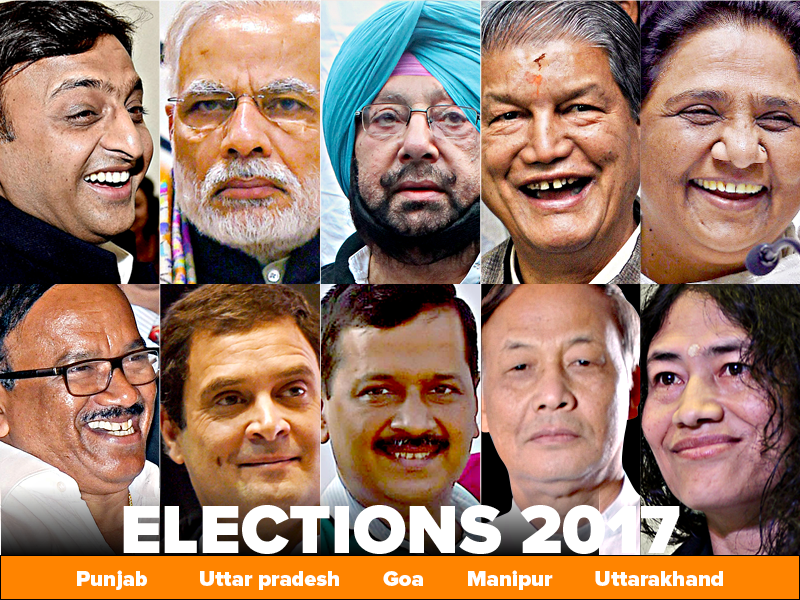
Voter turnout estimates are often revised for a final tally by the Election Commission, but by all accounts the current round of Assembly elections has witnessed deepened participation.
In the final, and seventh, phase of the Uttar Pradesh elections on March 8, the turnout for the 40 seats was initially estimated to be 60.03%, an increase of more than 2% over 2012, and hovering near the average for all the seven phases.
In the second phase of Manipur’s election the same day, for 22 of the total 60 constituencies, the turnout in three-quarters of the booths was reckoned to be more than 86%. In Punjab, which went to the polls on February 4, the turnout was 77.4%, marginally less than the 78.2%registered in 2012.
In Goa, which also voted on February 4, it was about 83%, indicating a marginal increase since 2012. And in Uttarakhand, which voted on February 15, early estimates put the turnout at 65.64%, against the 2012 turnout of 67.22%.
We must await the final estimates, though it is clear that none of these States has come close to matching Tripura’s Assembly election turnout of 90-plus. Even so, the voter participation in these elections has once again proved to be far-fetched the ever-hovering anxiety about voter fatigue, if not cynicism.
Indeed, in comparison to other mature democracies with their problem of low voting by the young, the so-called millennials, in India voter enthusiasm cuts across class and age. And as the 2014 Lok Sabha election turnout indicated, it has also bridged the gender gap, with the EC reckoning it has come down to 1.46 percentage points, from 4.42 in 2009.
At first glance, these figures are a repudiation of the worries about voter choice that keep afloat ideas such as deepening the None of the Above (NOTA) option on voting machines to include the right to reject.
In fact, ethnographic studies suggest that the Indian voter perceives voting day to be a special one, with a celebratory camaraderie at the polling booth reflecting a determination to make her vote count. And with turnouts generally rising as one goes from parliamentary to State to local polls, it is clear that personally felt outcomes matter most to voters. Besides, as the higher turnout in the Malwa region compared to the rest of Punjab this year indicates, where the party competition is keenest, voting is higher.
Nonetheless, the old thumb rule about higher turnout meaning an anti-incumbent vote is a thing of the past. Psephological data are rich with the reasons that motivate a vote, and each verdict must be read separately. The decreasing gender gap is one to particularly celebrate.
From the first election in 1951-52, when millions of women did not figure in the electoral rolls as they would not share their names, to the conversations on the sidelines of these elections, with women asserting they’d vote differently from their husbands, India has come a long, though not long enough, way. (The Hindu)
Globalization is stuck between Labor markets /Tax havens and Terrorists
The middle class in UK revolted against EU -seamless borders and trade and in US the victory of Trump is a big blow to Globalizers. He is unenthusiastic about Davos. The rise of Le Pen in France and Geert Wilders in Holland represent back to national sovereignty. Le Pen recently said in Koblenz “nation state” is back”, says the author.
Throughout the seventies and eighties, it was globalization [The G word] of manufacturing facilities that is Product Markets. The anecdotal evidence often told in many a business school classrooms used to be like this. The doors of the Ford car are made in Barcelona and the seat cushions near Budapest and gearbox in the suburbs of Paris and music system in Osaka and the assembly is done at Shanghai and the car is sold in Thailand. So, what is American about it? It is transnational and the geographical boundaries are crumbling and think global and act local we were told, and the term “glocal” came into existence. This was the ultimate in the process of global integration of economic activities through integration of manufacturing facilities to reduce cost, take advantage of pool of skilled resources available in the emerging markets. It also argued about “standardization “of live styles -mostly the American standards- in terms of Jeans, processed food and cola drinks.
Then the nineties saw the globalization of Financial Markets. You want to set up a facility in Chennai then you can think of raising funds from New York stock exchange or European Banks if the project is found to be attractive. Funds were looking for markets and “geographical diversification” became the buzzword. The pension funds were one of the largest investors running into nearly 18 trillion USD and at least 15 to 20 % of this was in non-domestic markets. The Funds started searching for markets instead of markets trying to attract funds. The life expectancy in the Europe and US increased significantly and the pension funds were to earn for longer period since old people have to be provided for. Then came the idea of consumption led growth and greed as the norm. On May 18, 1986 Ivan Boesky gave the commencement address at the University of California at Berkeley’s business school. “I think greed is healthy,” he told his wildly enthusiastic audience. “You can be greedy and still feel good about yourself.” A few months later Boesky was indicted on the charges that would land him in Southern California’s Lompoc Federal Prison, also known as Club Fed West.
The melt down of 2008 has impacted the idea of globalization. Suddenly countries which are supposed to be de-coupled from the global markets are considered smart. Not only that -The US congress included a “buy American” clause in the USD 787 billion stimulus package-2009- particularly mandating the use of U.S funded projects, it was clear that protectionism has trumped globalization. As a response, China has a “buy Chinese” clause in its stimulus package. So, the whole game is unravelling on the G front.
Interestingly, some US experts are suggesting a new grouping of G-2 to guide the world-This G-2 will have US and China as members. China has sold billions of Toxic Toys [chemical laced] to the USA and USA in turn has sold billions of its Toxic Treasury Bills to China. Hence there is a Mexican standoff between the two in Globalization sphere. Interestingly except India nobody is talking About the G-word in the Financial or Product sphere. Now Post-Trump victory Davos “Experts” wanting China to lead Globalization. Irony died multiple times!!
But the third and most important dimension of globalization is in the context of the Labor Markets to allow free flow of human beings to carry out brown collar work in the west.
There is aspecterhaunting the West. It is the specter of uncleared garbage, clogged drains and overflowing sewerages. It cannot be outsourced so easily as that of white collar work since the latter has significant content of software portion while as brown collar work still has requirements for human beings at locations. In the fifties and the sixties, millions of the Turks and Kurds and Iraqis went to Germany when that economy was booming and they were/ are called guest workers. The Algerians and Moroccans went to France and continue to be a significant minority in France and also active in their Soccer teams. More than a million Mexicans in USA are called “undocumented”-euphemism for “illegal”. These workers in France / Germany / USA etc. were mainly in the blue and brown collar jobs more so in the lower skill categories like cleaning restrooms and restaurants / meat cutting / grape picking/domestic help/ road laying/ garbage processing/plumbing/ handyman jobs; babysitting etc. The Demographic decline of Europe needed outside labor. Then came the economic slump in the early 2000 and these European countries have erected fences and reject visas etc. for third world labor.
The mass migration due to civil war in Yemen and Syria has added to the issue. If financial markets want a borderless world so be it for the labor markets but it is not acceptable by the West since they treat G as a one way street. Hence the presence of the “minutemen” in Arizona who will shoot illegals and rhetoric by Obama about Bangalore taking away the jobs from Buffalo and Trump talking about a wall and Brexit to split EU.
No truly global “world order’ has ever existed. What passes for order in our time was devised in Western Europe nearly four centuries ago, at a peace conference in the German region of Westphalia, conducted in 1648 after the thirty years’ war. Nearly a quarter of the population of Central Europe died from combat, disease, or starvation. The exhausted participants met to define a set of arrangements for the world. The principle of the sovereignty of states and the principle of non-intervention of one state in the internal affairs of another state
Interesting, all these are questioned by contemporary leaders of West and radical Islam.
Tony Blair the then Prime Minister of UK in his famous Chicago Address -1999-suggests”The most pressing foreign policy problem we face is to identify the circumstances in which we should get actively involved in other people’s conflicts. Non -interference has long been considered an important principle of international order….
“But the principle of non-interference must be qualified in important respects”. The NATO intervention in Kosovo and Afghanistan as well as US intervention in Iraq provide recent examples of breakdown of idea of Westphalia.
Interestingly, Radical Islam also consider that the world order based on Westphalian consensus will collapse. “In the aftermath of the 11 March 2004 Madrid attacks, Lewis ‘Atiyyatullah, who claims to represent the terrorist network Al-Qaeda, declared that “the international system built up by the West since the Treaty of Westphalia will collapse; and a new international system will rise under the leadership of a mighty Islamic state.”
The spread of ISIS across countries and activities of Boko Haram based in Nigeria in Kenya and Chad re-emphasis this point. Radical Islam do not accept territorial boundaries since it works for a global regime for global Ummah. The talk about Caliphate indicates that they are trans-border organizations.
On the other side, we find global corporations transcending sovereignty in search of global profits. For this they use tax havens as a tool. Tax havens-numbering more than 70 jurisdictions-facilitate bank facilities with zero taxes and no-disclosure of the names and in many cases anonymous trusts holding accounts on behalf of beneficiary. In the case of Bahamas one building seems to have had tens of thousands of companies registered there.
USA is literally waging war with major Giants like Amazon/Google/Microsoft etc. for not paying adequate taxes in USA in spite of being US based companies. Most of these companies have moved their profits to other Tax Havens.
A simple method of trade mis-invoicing by global companies using tax-havens have impacted developing countries nearly 730Billion USD in 2012 says Global Financial integrity. There is an increasing clamor in USA and EU about closing down these tax havens.
So,Globalization is stuck between Labor markets /Tax havens and Terrorists.
The middle class in UK revolted against EU -seamless borders and trade and in US the victory of Trump is a big blow to Globalizers. He is unenthusiastic about Davos. The rise of Le Pen in France and Geert Wilders in Holland represent back to national sovereignty. Le Pen recently said in Koblenz “nation state” is back.
In this, the traditional division of Left and right have lost its meaning. In BREXIT, we saw left supporting EU and part of right opposing it. Now, the new divisions are Globalizers versus Nation states both from left and right.
(The author is a professor of Finance at IIT, Bengaluru).
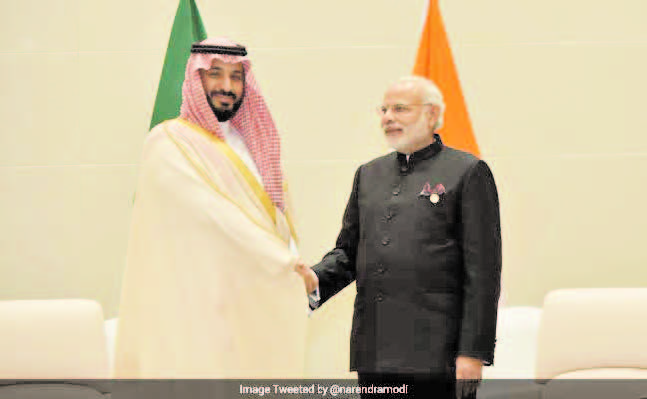
We have risen to the occasion to actively engage oil-rich neighbors to our west, where over six million Indians reside and remit back over $50 billion annually. We can also be proud that we have dexterously maneuvered to avoid being drawn into the sectarian Shia-Sunni, Arab-Persian and other rivalries in the region. PM Narendra Modi has skillfully established an Indian strategic profile with key players in the region by his visits to Saudi Arabia, the UAE and Qatar, while seeking to forge an energy and a connectivity partnership with Iran, based on shared interests in Afghanistan and Central Asia”, says the author – G Parthasarathy.
Swallowing considerations of national pride, after inheriting a bankrupt economy with collapsing exchange reserves forcing India to mortgage its gold in 1991, PM Narasimha Rao undertook a policy of economic liberalization. These measures not only radically changed the contours of domestic economic policies, but also led to closer economic integration with our economically vibrant eastern neighborhood. Quite logically, this new dimension in our foreign policy was labelled as ‘Look East’. In our western neighborhood, we continued with ‘business as usual’. The only significant change was our long overdue establishment of diplomatic relations with Israel.
India is now, a quarter-century later, seizing the opportunities provided by the geopolitical changes that have followed the worldwide discoveries of shale oil and gas. Till barely five years ago, the OPEC cartel of oil producing countries, virtually held us all hostage to their whims and fancy because of their ability to raise oil prices at will. The discovery of huge resources of shale oil and gas, particularly in North and South America, Australia and even in parts of West Asia, has sent global oil prices crashing. It has also given new leverage to large consumers like Japan, China and India to get the oil-producing countries in our immediate western neighborhood, to deal on more mutually beneficial terms, with large neighboring oil and gas consuming countries.
We have risen to the occasion to actively engage oil-rich neighbors to our west, where over six million Indians reside and remit back over $50 billion annually. We can also be proud that we have dexterously maneuvered to avoid being drawn into the sectarian Shia-Sunni, Arab-Persian and other rivalries in the region. PM Narendra Modi has skillfully established an Indian strategic profile with key players in the region by his visits to Saudi Arabia, the UAE and Qatar, while seeking to forge an energy and a connectivity partnership with Iran, based on shared interests in Afghanistan and Central Asia.
Following the American-led military interventions in Iraq and Libya and the suffering inflicted on the hapless people of Syria by meddling from external powers like the US and Russia and regional powers like Turkey, Saudi Arabia, Qatar and Iran, millions of Syrians have fled from their homes. This is a region where national borders drawn at the end of World War I are susceptible to being redrawn. India has avoided getting drawn into these rivalries, from which there will be no real winners, while people suffer misery in countries like Yemen. The Trump administration’s first military operation in Yemen, undertaken a few days after he assumed office, was a fiasco. Pakistan has undermined relations with its traditional friends like Saudi Arabia and the UAE, by making promises of military assistance and then backing off in Yemen. China has, however, played its cards skillfully by keeping out of sectarian and civilizational rivalries, while securing substantial investment opportunities.
This year began with India hosting the ruler of the UAE, Sheikh Khalifa bin Zayed. PM Modi had earlier visited the UAE, Saudi Arabia, Iran and Qatar. The FDI from the UAE, which is India’s 10th biggest foreign investor, has been increasing. Collectively, the Gulf countries constitute our largest trading partner, accounting for 15 per cent of our global trade. The UAE and Saudi Arabia are individually our third and fourth largest global trading partners. Yet another country, with which we need to cultivate closer ties, is Iraq, whose oil exports to India are rapidly expanding, like exports of Iran after the end of UN sanctions. Iraq, with its immense oil production potential can also become a good investment partner, in the energy sector. We need to look at possibilities of linking oil purchases to investment in Iraq. Naval cooperation is also increasing with the Gulf countries, where proximity gives us some advantages over China. Following the visit of Sheikh Khalifa, the Naval Chief, Admiral Lanba, has scheduled visits to the UAE and Oman
We cannot, however, be sanguine about these developments as we are still perceived as a country which takes an interminably long time in finalizing investment decisions. Iran has always been a difficult partner, when it comes to issues of investment. While we now use the western Iranian Port of Bandar Abbas for the transit of our goods to Afghanistan, Central Asia and Russia, we appear to be facing delays in finalizing the terms of participation in the construction of the Chabahar Port. This project, given Pakistan’s disinclination to give us transit facilities and its propensity to squeeze Afghanistan by delaying transit of its goods, is crucial for both Afghanistan and India. It needs careful follow-up and monitoring at the ministerial level to remove bottlenecks.
The tie-up with Arab monarchies will be reinforced during the proposed visit of the King of Jordan to India. Given our wise decision to delink our relations with Israel and the Palestinians, Jordan could serve as a good connecting point for visits of Indians, to meet leaders of the Palestinian Authority. Moreover, the monarchy in Jordan has continuously maintained a personal rapport with Indian leaders. We also have a moral obligation to stand by our principled position of supporting a two-State solution to the Israel-Palestinian issue, which while guaranteeing Israel’s security, also leads to the establishment of a viable Palestinian State.
India has come a long way from the days in the 1970s, when Saudi Arabia threatened to cut off oil supplies if we did not close down the Israeli Consulate in Mumbai. Not surprisingly, then PM Indira Gandhi flatly rejected the Saudi demand, despite our foreign exchange reserves being precariously low. It is heartening that Mr Modi is undertaking a standalone visit to Israel in coming months. It was shocking how our defense and other ties with Israel were undermined in the recent past by some of our senior ministers seeking to keep a distance from meeting their Israeli counterparts because of narrow, partisan, domestic political considerations. Israel has been a reliable friend of India and has stood by us in times of conflicts, including Kargil. There is no need for us to be apologetic about our relations with the Jewish State, especially at a time, when many of our Arab partners are finding Israel a useful ally, amidst the sectarian and civilizational rivalries and tensions prevalent in the Islamic world.
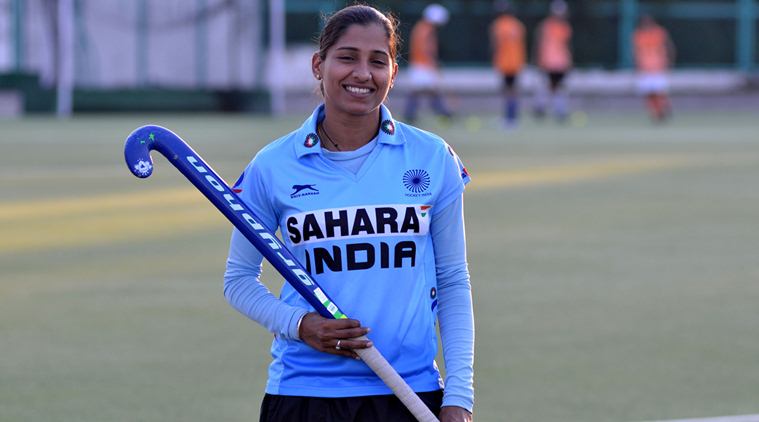
NEW DELHI: Former captain Ritu Rani shunned retirement to make a comeback in the Indian team after a seven-month sabbatical as Hockey India announced an 18-member Indian squad for the women’s Hockey World League Round 2, to be held in Canada from April 1.
The Indian squad includes experienced Deepika, Ritu, Vandana Katariya, Poonam Rani, Navjot Kaur, Deep Grace Ekka, Renuka Yadav, Monika, Sunita Lakra, Namita Toppo, and goalkeeper Savita who were all part of the Rio Olympics squad.
India will be up against Belarus, Canada, Mexico, Trinidad and Tobago, Uruguay and Chile in the Round 2.
Midfielder Ritu had announced her retirement in September last year, post her wedding.
Former hockey captain Ritu Rani shuns retirement to make a comeback in #Indian team after seven-month sabbatical. pic.twitter.com/3GAnQi7TJb
— All India Radio News (@airnewsalerts) March 9, 2017
“I am very happy and excited to be back in the national camp with my teammates. I thank Hockey India for allowing me to withdraw my retirement and giving me the opportunity to be part of the team again,” Ritu said.
“My family is extremely supportive of me playing hockey and they really encouraged me to pursue the sport even after marriage. They are the reason why I am back again. I think the women’s team has entered a new and exciting phase where I believe if we work hard, we can really make a mark in world hockey,” she said.
The Indian eves recorded an emphatic 5-0 whitewash of Belarus in the recently-concluded Test Series in Bhopal.
Speaking about the big win ahead of the Hockey World League Round 2, Sjoerd Marijne, the newly-appointed chief coach for the Indian women’s team said, “The most important thing in the Test Series was to understand each other. Besides that, we wanted to implement a few new things and the girls understand better and better which is really good. I am happy with the result and most importantly I am happy with their consistent performance.” (PTI)
ROSTOV-ON-DON (TIP): Henrikh Mkhitaryan bagged a precious away goal as Manchester United came away from their trip to Russia with a 1-1 draw in the first leg of their Europa League last-16 tie against Rostov on March 8.
On an awful pitch, the state of which had United manager Jose Mourinho fuming on the eve of the game, Mkhitaryan turned in the opener 10 minutes before half-time.
But Aleksandr Bukharov levelled for the home side in the 53rd minute at the Olimp 2 stadium, keeping Rostov hopes alive ahead of next week’s return at Old Trafford.
The build-up to the match had been overshadowed by United’s complaints about the playing surface and about concerns travelling fans could be targeted by Russian hooligans.
However, the evening passed off without incident inside the ground, where a little over 200 United supporters were in attendance along with ex-United assistant boss Carlos Queiroz.
“It was a very good performance in relation to the conditions. It was impossible to play better, impossible to play a passing game,” Mourinho told BT Sport.
“We played what the game demanded and we played well. We made one defensive mistake.
“I remember as a kid some matches like this in Portugal — non-league and amateur pitches. To see my players coping with it and the humility to fight for every ball is a good feeling for me.
“We have an open result for the second leg with a little advantage for us. There are no injuries.”
The result saw the visitors extend their recent unbeaten run in all competitions to 10 games as Mourinho made seven changes to the team held by Bournemouth last weekend.
One of those brought back into the starting line-up was Mkhitaryan, and it was he who swept United in front in the 35th minute from close range after good build-up play involving Marouane Fellaini and Zlatan Ibrahimovic.
Nevertheless Rostov, who are seventh in the Russian Premier League but had already won at home to Ajax and Bayern Munich in Europe this season, drew level thanks to a fine goal shortly after the break.
Timofei Kalachev delivered a ball over the top that was controlled on the chest inside the box and then fired home by Bukharov to secure the draw.
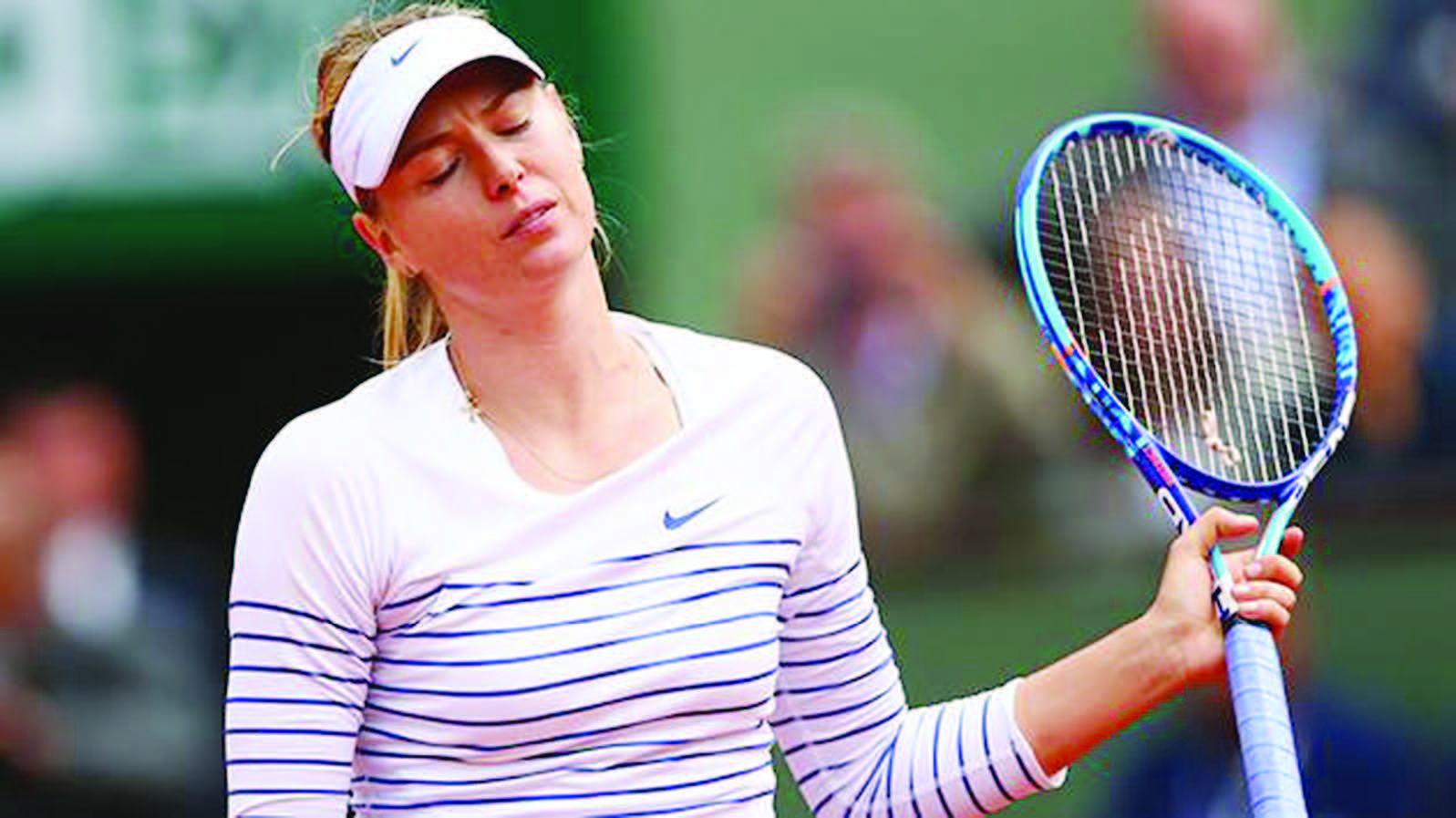
The wild card tournament invitations awaiting Maria Sharapova when she returns from a 15-month doping ban next month divided opinion among players at Indian Wells.
“This is, all over, a strange situation,” Germany’s Angelique Kerber said of the Stuttgart WTA tournament’s decision to issue a wild card to Sharapova, who will play her first match since the 2016 Australian Open on April 26 — just hours after her ban for using meldonium ends.
“I don’t know what to say about this because it’s a little bit strange for the other players that somebody can just walk on site Wednesday and play Wednesday,” added Kerber, who is set to return to number one in the world after Serena Williams’ withdrawal from the tournament in the California desert.
“This is a German tournament,” said Kerber, the reigning Stuttgart champion who indicated that there were plenty of German players who could benefit from a wild card.
Sharapova, without any world ranking to gain direct access to tournaments in the wake of her ban, has also been issued wild cards to play in Rome and Madrid.
She was also to meet with the French Tennis Federation to plead her case for a wild card at Roland Garros, where she is a two-time champion, although federation officials have voiced reservations about issuing a wild card to someone convicted of a doping offense.
France’s world number eight Jo-Wilfried Tsonga said he didn’t think five-time Grand Slam winner Sharapova should get a French Open wild card.
“I would not do it,” he said. “It’s like if you give a sweet to a kid who did a bad thing, it’s going to do it again. It sends the wrong message.”
Men’s number one Andy Murray hit out at the wild cards already issued Sharapova, telling The Times last week that he believed a player “should have to work your way back” from a drugs ban.”
Asked about it again at Indian Wells, Murray acknowledged that the logistics of accommodating a star of Sharapova’s magnitude could be difficult for the lower-level tournaments she would need to play to rebuild her ranking.
“The tournaments are well within their rights to give a wild card, there’s nothing saying they can’t,” he said.
“There’s no rule in place, so the tournaments are going to do what they think is best for their event. But should you get a wild card into every event when you come back? I’m not sure about that. That’s something that maybe should be looked at.”
Romanian Simona Halep thinks Sharapova’s past achievements justify the wild cards.
“She was number one in the world and won Grand Slam titles,” Halep said. “But even without wild cards she could come back easily.
“Her return is good for tennis. She is impatient, she wants to play and win.”
But a tweet from the WTA, since taken down, indicating that Sharapova’s fellow players were all eagerly awaiting her return, drew a sharp response from French player Alize Cornet who tweeted: “@WTA excuse me ….??”
Cornet’s tweet was also deleted — a sign perhaps of the divisiveness of the issue.
“The question of wild cards is complicated, I’m glad I’m not in charge of their attribution,” said Russian veteran Svetlana Kuznetsova. (AP)
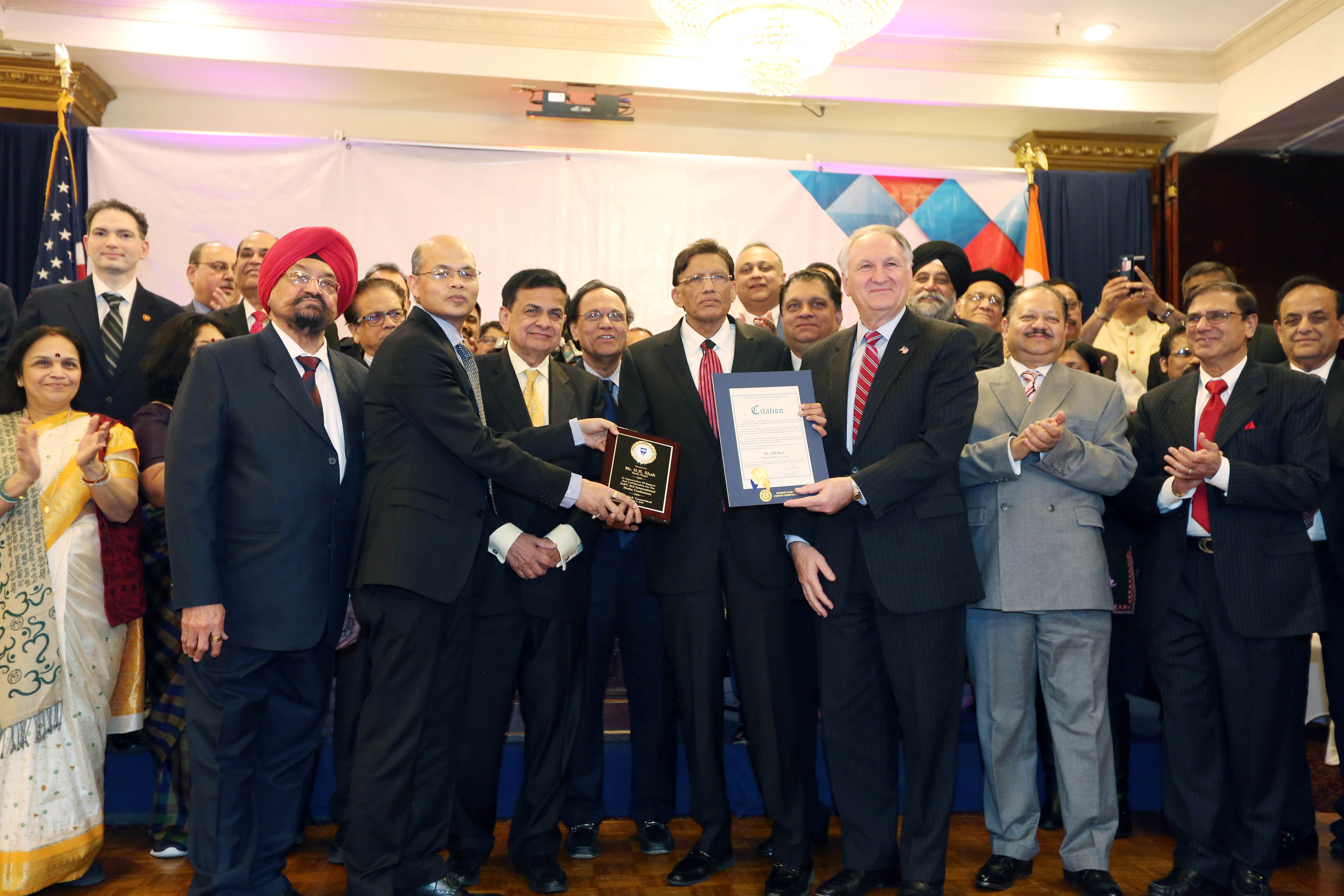
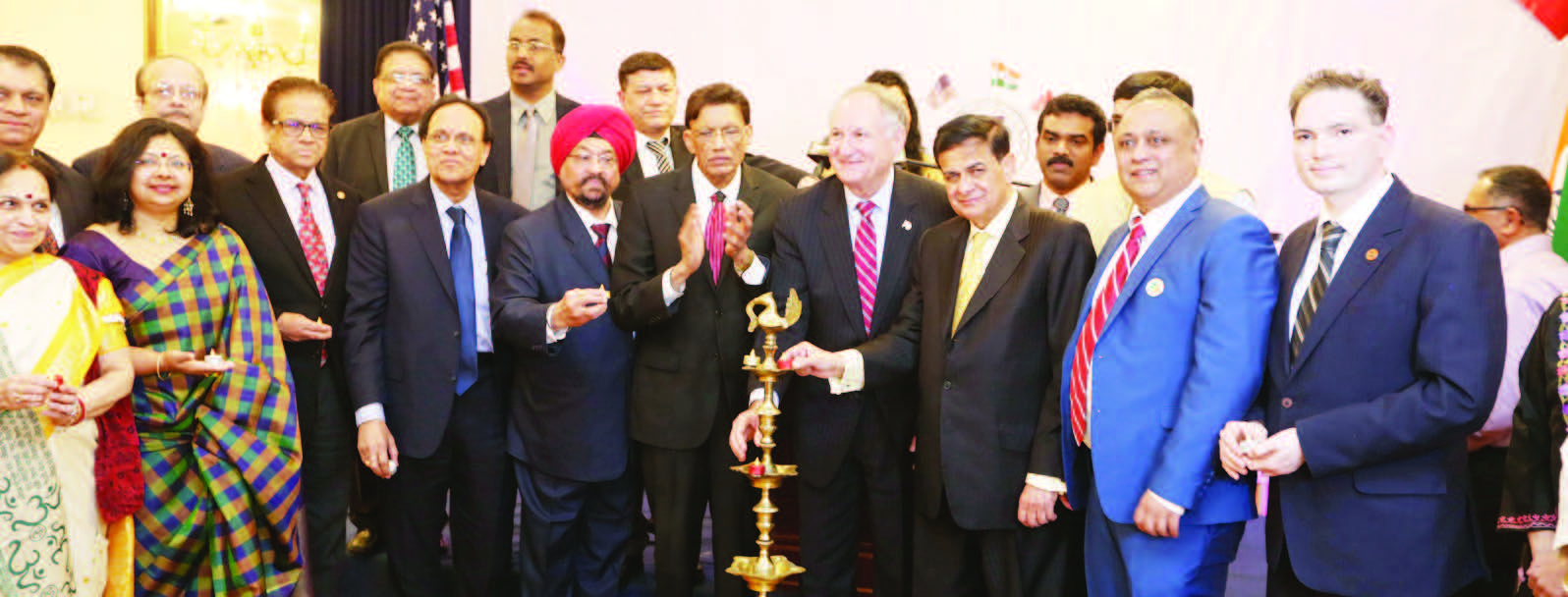
The Indo American Press Club (IAPC) held the inauguration of its new Executive Committee on March 4 here in the presence of community leaders and officials. Mr H.R. Shah, Chairman and CEO of TV Asia who was conferred with Padma Shri this year, was warmly felicitated at the gala event at Antun’s by Minar.
Professor Indrajit S Saluja, editor-publisher of The Indian Panorama, was sworn in as the new President, taking over from Parveen Chopra, Managing Editor of The South Asian Times and The Asian Era. Nassau County Comptroller George Maragos administered the oath of office to the new IAPC office-bearers including George Eapen (General Secretary) and Biju Chacko (Treasurer).
HR Shah is felicitated on conferment on him of Padma Shri, one of the highest civilian awards of India. Seen in the picture are IAPC officials, community leaders and County officials. Photo/ nayaface.com
Prof Saluja, in his acceptance speech, talked about the power of the media which can make a President, as well as bring down a presidency. Referring to the cover headline of the souvenir distributed on the occasion, he said he believes that “The bedrock of democracy is journalism. And the bedrock of journalism is facts. And facts alone.”
Nassau County Comptroller George Maragos administers oath of office to new Board of Directors led by Chairman Babu and Executive committee members, led by President Prof. Indrajit s Saluja Photo/Mohammed Jaffer-SnapsIndia
Ginsmon Zacharia, founder Chairman of IPAC who has interests in print and TV, stepped down after shepherding the organization for three years. The new Chairman Dr. Babu Stephen publishes two community newspapers from the Washington DC area: Express India and India This Week, and is the CEO of DC Healthcare Inc, and president of SM Reality LLC.
George Maragos honors Mr. Mohapatra with a citation from Nassau County
Deputy Consul General Mr. Manoj Kumar Mohapatra honors Ms Vandana Sharma with a plaque
George Maragos honors Jehangir Khattak with a citation from Nassau County
Joining in IAPC honoring Mr HR Shah for his Padma Shri were Deputy Consul General of India Manoj Mohapatra, Nassau County Comptroller George Maragos and many community leaders. Dr Dattatreyudu Nori introduced Mr Shah, his longtime friend.
Mr Shah, in his speech, dwelt on his initial struggles in media but said he did not give up. Under him, TV Asia is today the largest TV network for the Indian community in America. He thanked Prime Minister Narendra Modi and the Indian government for conferring on him one of the highest civilian awards of India. He lauded Prof. Saluja for felicitating him because it was media people honoring a mediaman. He also announced that TV Asia will be launching in India soon.
Dr. Sudhir Parikh, Chairman of Parikh Worldwide Media, while felicitating Mr. Shah, praised him as a man of vision and action who made it to the top with grit and determination.
Both Dr Parikh and Dr Nori are previous recipients of Padma Shri.
Comptroller Maragos underscored the role of media in a democracy and lauded Indian American media for doing a great job to promote interests of the community and serving the great American nation in the best fashion. He also revealed his intention to run for the office of Nassau County Executive.
The New IAPC leadership with George Maragos
In his keynote address, Jehangir Khattak, Co-Director, Center for Community and Ethnic Media, CUNY Graduate School of Journalism, spoke about how he has been fighting for more government dollars for the ethnic media, including desi media.
Dr. Manoj Kumar Mohapatra, Deputy Consul General, New York, rushed from an engagement in Boston to preside over the event.
Deputy Consul General of India Manoj Kumar Mohapatra launches the book “Medicine, Myth, and History-India’s Legacy” authored by Dr. VK Raju and Dr. Leela Raju
A book, ‘Musings on Medicine, Myth, and History – India’s Legacy’, by Dr. VK Raju and his daughter, Dr. Leela Raju was launched on the occasion. Through his Eye Foundation of America, Dr Raju is dedicated to eradicating childhood blindness in India and elsewhere.
Kalpita Chakote presents a captivating dance performance
Other dignitaries who graced the occasion included Vandana Sharma, Air India’s Regional Manager (Americas), Dr Ajay Lodha, AAPI National President, Dr. V. Chakote, AAPI President, Gobind Munjal, new President of AIA-NY chapter, Indu Jaiswal, Chairperson IAF, Bina Sabapathy, President, IALI, Arish Sahani, President, Intellectuals Forum, HAB Bank’s Sr. Vice President Rizwan Qureshi, Srujal Parikh Executive Vice President of FIA, Dr Bhupi Patel, Dilip Chauhan, Advisor to Comptroller Maragos, Rajiv Bhambri, CEO of India Abroad, Karan Beri, CEO of Opinio Media, TJ Anand, President of Lions Club, Mohinder Taneja, a former Director with Nassau County, Jay Jasbir Singh, publisher of Hum Hindustani, Shomik Chaudhary, a former COO with News India Group, were among the gathering. Many media fraternity which included representatives from TV Asia, Jus Punjabi, PTC TV, Desi Talk, News India, India Abroad, Hum Hindustani, The South Asian Times, The Indian Panorama, and Malyalam media were present.
The scintillating Bhangra
The roaster of entertainment included a skit by New Jersey street theater group, Prayas. Kalpita Chakote presented a classical dance, and Bhangra group Soormay, of St. John’s College students, gave an electrifying bhangra performance.
IAPC, with six active chapters in the US and Canada, has organized three successful annual international media conferences in New Jersey, New York and Connecticut over the past three years. A highlight of the conference last year was a presidential debate with representatives from Democratic and Republican sides.
Ms Sangeet Sharma was the charming master of ceremonies.
Mr. Mohapatra honors Antun’s Neetoo, and a social activist Anu Jain
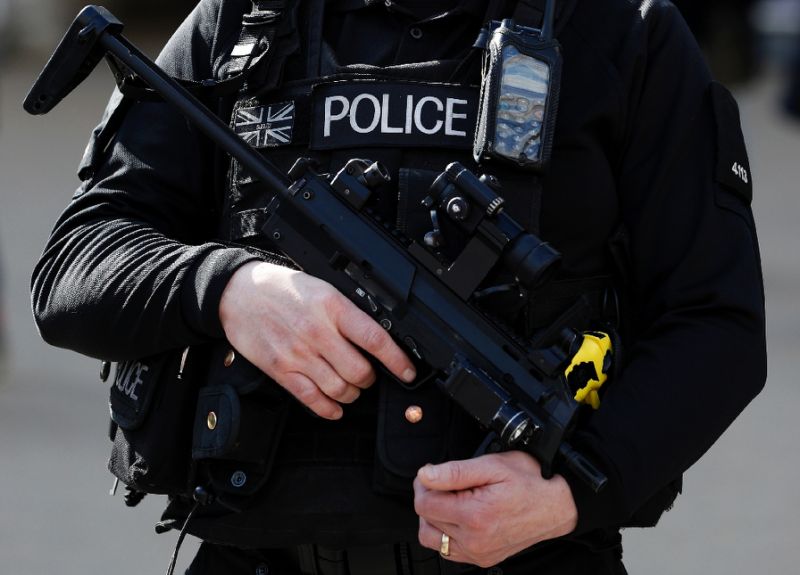
LONDON (TIP): Security services have foiled 13 potential terror attacks in Britain since 2013, its most senior counter-terrorism policeman said Monday, with more than 500 active investigations at any one time.
Mark Rowley, assistant commissioner of London’s Metropolitan Police, said incidents inspired by the Islamic State group were a “large part” of the problem although al-Qaida remained a significant threat, while the far-right was also an issue.
He was speaking at the launch of a campaign for more community involvement in combating terrorism, and revealed that one-third of the most high-risk investigations had been helped by information from the public.
“Together, the UK intelligence community and police have disrupted 13 UK terrorist attack plots since June 2013,” Rowley said.
“The threat is becoming more varied and the move towards low-tech attacks on crowded places, like those we have seen in major European cities and beyond, makes it even more important everyone remains vigilant.”
He added: “We’ve got over 500 investigations at any one stage.”
A study from the Henry Jackson Society, a conservative think tank, found Islamic-inspired terror offences almost doubled, from 12 each year between 1998 and 2010 to 23 each year in the following five years.
An analysis of 269 such offences since 1998 also found most perpetrators were British or dual nationals and a disproportionately high number were Muslim converts.
Women are also increasingly involved, accounting for four percent of incidents between 1998 and 2010, but 11 percent between 2011 and 2015.
The threat level for international terrorism in Britain has been “severe”, meaning an attack is considered highly likely, since August 2014.
Islamist attackers killed 52 people in suicide bombings on the London transport system in July 2005 and there have been isolated incidents since. (AFP)
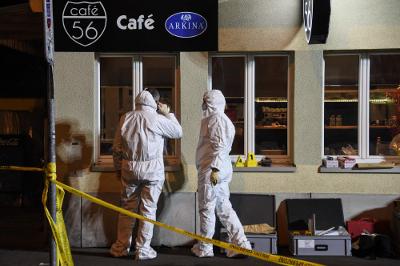
GENEVA (TIP): Two men shot dead two people and seriously injured a third on March 9 at a cafe in Basel, north-west Switzerland, police said as they hunt for the suspects.
“Two men came into Cafe 56” around 8.15 pm local time (1915 GMT) “and fired several rounds of shots,” police said in a statement, without providing information on a possible motive.
“Two customers were killed. Another is in a critical condition.”
The assailants were on the run following the shooting, according to police, who said they had headed in the direction of the railway station after the attack.
“The reason behind the attack is not yet known and will be investigated,” the Basel prosecutor’s office said in a statement. Police have asked anyone with information regarding the incident to come forward.
The road next to the cafe has been cordoned off and traffic redirected.
A bullet hole was visible in one of the windows of the establishment, a small cafe in a residential neighbourhood. An AFP photographer at the scene saw police dressed in white forensic garb collecting evidence at the site.
“Cafe 56 doesn’t have a bad reputation,” a neighbourhood resident told local newspaper Basler Zeitung.
“It was previously an establishment known for its links to the drug world, but since the owner changed several years ago it became an ordinary cafe,” the paper quoted another resident as saying. Gun crime is infrequent in Switzerland, even though the country has one of the highest rates of firearm ownership in the world.
Citizens are allowed to keep their army-issue weapons at home outside periods of mandatory military service. This right has been controversial as sometimes weapons are used at home in domestic incidents.
The number of weapons held at home is believed to be two million for a population of eight million, according to Swiss press. In January, a man clad in military clothing shot and injured two police officers as they searched his home in northeast Switzerland for a suspected cannabis plantation. (AFP)
China’s Foreign Minister Wang Yi has come up with the idea of extending the remit of BRICS by inviting other developing countries under a new banner, BRICS Plus.
Addressing his annual press conference on Wednesday on the sidelines of the National People’s Congress, the Chinese parliament, Wang said China would “explore modalities for BRICS-plus, to hold outreach dialogues with other major developing countries”.
“We hope to establish extensive partnerships and widen our circle of friends to turn it into the most impactful platform for South-South cooperation,” he said. China, which is the rotating president of BRICS this year, will host the next summit in September.
Analysts said China is trying to expand its influence by inviting its allies, and the move might result in the dilution of role played by India and other countries in BRICS. The club has five countries-Brazil, Russia, India, China and South Africa.
“India would be the worst affected among BRICS partners. After expansion, the organization would lose its focus and coherence on development issues and become more like a political platform for China,” Mohan Malik, professor at the Asia-Pacific Center for Security Studies at Honolulu in US, told TNN.
China may invite pro-Beijing countries like Pakistan, Sri Lanka and Mexico to join, Malik said. China may be trying to turn BRICS into a China centric organization along the lines of Shanghai Cooperation Organization, he said.
“At the 2016 BRICS summit in Goa, Beijing was successful in thwarting India’s attempts to isolate and condemn its ally Pakistan over cross-border terrorism,” Malik pointed out.
“The BRICS Plus concept would nip in the bud any future attempts at isolating China and its friends,” he said.
The Chinese foreign minister said China’s goal is to strengthen the BRICS partnership. It planned to introduce a system of stand-alone meeting of foreign ministers, hold sports and cultural events among BRICS countries.
“As President Xi put it, BRICS are like five fingers each with their own strength but when we come together we are a fist that can punch. When we stay united we won’t lose lustre but will shine more brightly,” he said.
The premier said that, “BRICS countries represent emerging economies,” he said. “Over the years, their fortunes may have risen or fallen, and each faces challenges.”
Analysts said China might find it difficult to obtain India’s approval to the idea of BRICS Plus.
“India surely will not be interested in expansion at this time,” Swaran Singh, professor at at the School of International Studies in Jawaharlal Nehru University told TNN. “BRICS will be focussed on consolidating at this time,” he said pointing to political instability in Brazil, economic slowdown in South Africa, and difficult relationship between India and China. Singh said India would avoid taking any decisive political positions because it is still analyzing the Donald Trump presidency in the U.S.
One of China’s goals is to extend the One Belt One Road+ to countries like India which has been reluctant to participate enthusiastically. Beijing is holding a forum on the Silk Road program in May.
“With protectionism and unilateralism on the rise, the Belt and Road will find common cause where all countries roll up their sleeves and pitch in together. We will help rebalance globalisation,” Wang said. (TNN)
Signup to our Newsletter!
Don’t miss out on all the happenings around the world