Year: 2017

  • WikiLeaks: We’ll work with tech firms to defeat CIA hacking

    WikiLeaks: We’ll work with tech firms to defeat CIA hacking

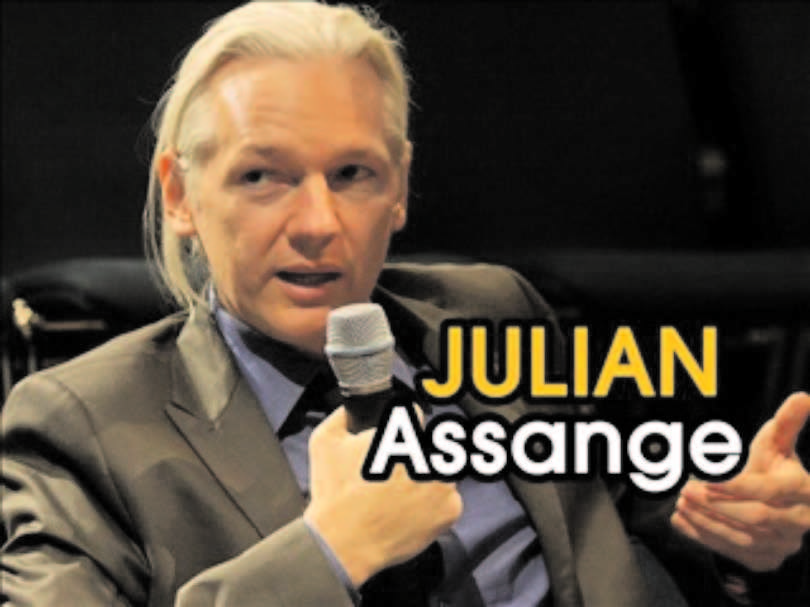
    WikiLeaks will work with technology companies to help defend them against the Central Intelligence Agency’s hacking tools, founder Julian Assange said on Thursday, an approach which sets up a potential conflict between Silicon Valley firms eager to protect their products and an agency stung by the radical transparency group’s disclosures.

    In an online press conference, Assange acknowledged that some companies had asked for more details about the CIA cyberespionage toolkit whose existence he purportedly revealed in a massive leak published Tuesday.

    “We have decided to work with them, to give them some exclusive access to some of the technical details we have, so that fixes can be pushed out,” Assange said. Once tech firms had patched their products, he said, he would release the full data of the hacking tools to the public.

    The CIA has so far declined to comment directly on the authenticity of the leak, but in a statement issued Wednesday it suggested that the release had been damaging by equipping adversaries “with tools and information to do us harm.”

    Assange began his online press conference with a dig at the agency for losing control of its cyberespionage arsenal, saying that all the data had been kept in one place.

    “This is a historic act of devastating incompetence,” he said, adding that, “WikiLeaks discovered the material as a result of it being passed around.”

    Assange said the technology was nearly impossible to keep under wraps— or under control.

    “There’s absolutely nothing to stop a random CIA officer” or even a contractor from using the technology, Assange said. “The technology is designed to be unaccountable, untraceable; it’s designed to remove traces of its activity.” (AP)

  • EU slaps down Poland, reappoints summit chair Tusk

    EU slaps down Poland, reappoints summit chair Tusk

    The leaders of the European Union delivered a withering snub to Poland’s right-wing government on March 8 by disregarding its objections and reappointing former Polish premier Donald Tusk to chair their summits.

    Tusk’s successor as prime minister Beata Szydlo, acting on instructions from her party leader Jaroslaw Kaczynski, a long-time political adversary of Tusk, had vowed to prevent him from securing a second 30-month term.

    Warsaw had portrayed the issue as one of fundamental principle, in which national objections should be respected and not ignored in Brussels.

    But the other 27 leaders had made no secret on arrival at the summit that they were exasperated by Warsaw’s tactics and even Kaczynski’s closest allies, like Hungarian Prime Minister Viktor Orban, had pledged support to Tusk.

    According to EU officials, Szydlo tried to get other leaders to postpone the decision on Tusk. But Maltese Prime Minister Joseph Muscat, who holds the rotating presidency of the EU, insisted the vote take place and all 27 other leaders backed the 59-year-old Pole.

    Tusk had left the room during the discussion and was greeted with applause as he returned to the chamber following the vote. He will play a key role over the next two years in overseeing Brexit negotiations with London.

    Czech Prime Minister Bohuslav Sobotka, usually an ally of Poland in EU affairs, tweeted: “Only Poland was against.”

    Leaders took barely half an hour to complete the matter and then continued with other business, notably on the economy. It was not yet clear whether Szydlo would take further action in protest.

    Some diplomats have speculated that Poland might withhold its formal approval of the summit decisions –though that would not legally obstruct Tusk’s second term in office.

    EAST-WEST DIVIDE

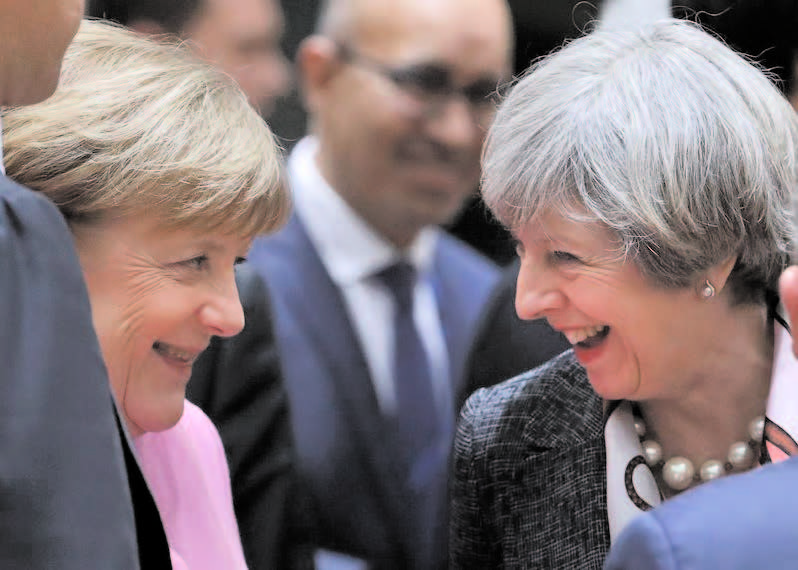
    With British Prime Minister Theresa May attending her last such summit before she formally launches the two-year Brexit process later this month, the remaining 27 EU leaders have bigger problems to worry about than the Council chair.

    They will meet again on Friday, minus May, to prepare for a “unity” summit to be held in Rome on March 25, the 60th anniversary of the treaty that laid the EU’s foundation.

    The row with Poland, the bloc’s biggest ex-communist state, has highlighted a deepening split between eastern members reluctant to cede national freedoms to Brussels and the richer western states that want to deepen EU integration in the hope it can boost prosperity and security and thus stem the rise of Brexit-inspired eurosceptics.

    Talk of a “multi-speed” Europe has intensified in recent months. Germany’s Angela Merkel and other leaders say allowing states willing to pull closer together is crucial to the EU’s survival, but wary easterners fear they could be left behind. Kaczynski holds Tusk “morally responsible” for the death of his twin brother. Tusk was prime minister in 2010 when Lech Kaczynski, then president of Poland, was killed in an air crash in Russia. Inquiries in both countries blamed pilot error.

    In a letter to fellow leaders, Szydlo said Warsaw wanted Tusk out because he criticised government policies back home.

    Tusk is concerned that Kaczynski is undermining Polish democracy, a view shared by others in the EU, but Szydlo framed her objections to his reappointment in terms of protecting sovereign national powers from Brussels. Thursday’s talks should see agreement on pressing ahead with new free trade pacts despite “protectionist tendencies” elsewhere – a reference to European concerns about new US President Donald Trump.

    Over dinner, leaders are due to pledge continued support – and possible EU and NATO membership – to western Balkan states where they are worried about what they see as the anti-EU influence of Russia.

    The leaders will also review plans to curb illegal migration from Libya to Italy. Arrival figures are already higher this year than in 2016.

    (Reuters)

  • China developing stealth drones to evade anti-aircraft missiles

    China developing stealth drones to evade anti-aircraft missiles

    BEIJING (TIP): China’s largest missile maker is developing military drones with stealth abilities that can evade anti-aircraft weapons, the official China Daily said on Thursday, in another advance for the country’s ambitious military modernisation programme.

    “Drones have become an indispensable weapon in modern warfare because they can play an important role in high-resolution reconnaissance, long-distance precision strikes, anti-submarine operations and aerial combat,” Wei Yiyin, deputy general manager of China Aerospace Science and Industry Corp, told the English language newspaper.

    Insisting it has no hostile intent, China is investing billions of dollars to update ageing equipment and develop new weapons, including stealth fighters and aircraft carriers.

    Its heavy defence spending, however, has unnerved a region already on guard over Beijing’s more assertive approach to disputes in the South and East China Seas and over self-ruled Taiwan, claimed by China as a wayward province. Wei told the newspaper his company was also developing near-space and long-range endurance drones.

    The paper described China Aerospace Science and Industry Corp as the country’s sole producer of cruise missiles, and said the drones also resembled cruise missiles.

    China has stepped up research into military drones, hoping to take market share from the United States and Israel with its cheaper technology and willingness to sell to countries that Western states are reluctant to deal with.(Reuters)

  • JAPAN SAYS NO BARRIERS TO AUTO IMPORTS AFTER US FIRES TRADE SALVO

    JAPAN SAYS NO BARRIERS TO AUTO IMPORTS AFTER US FIRES TRADE SALVO

    TOKYO (TIP): Japan on Friday rejected U.S. demands for more access to Japan’s auto market, saying the government has already taken steps to eliminate tariffs and non-tariff barriers.

    The rebuff by the government’s top spokesman came in reply to a statement the U.S. government submitted to the World Trade Organization on Wednesday saying, “a variety of non-tariff barriers impede access to Japan’s automotive market.”

    The U.S. government also said Japan’s agriculture sector remains protected by “substantial” barriers, offering the clearest indication yet of where battle lines will be drawn in a new economic dialogue between the two countries.

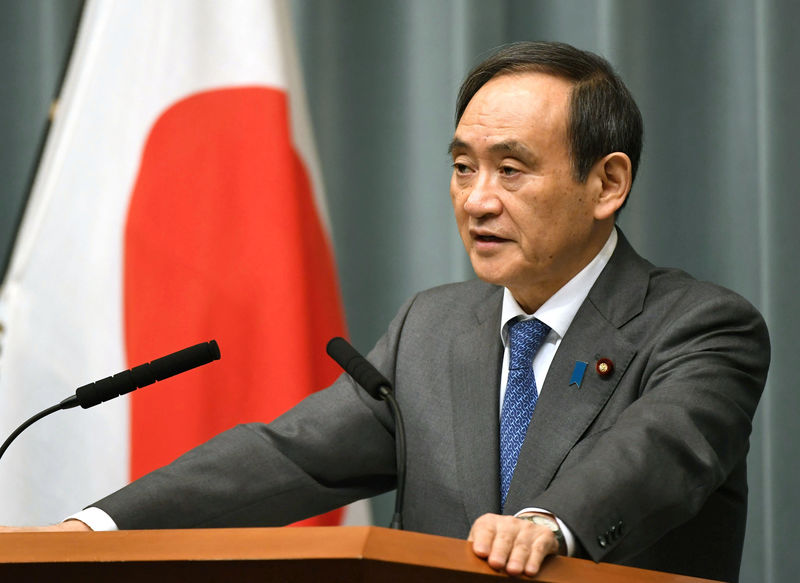
    “We do not impose import tariffs on cars, and we do not impose any non-tariff barriers,” Chief Cabinet Secretary Yoshihide Suga told reporters.

    “Our position is that Japan’s auto market is already open. This is something that will be settled in our bilateral dialogue.”

    In 2015 the U.S. government submitted a similar statement to the WTO as part of a regular review of Japan’s trade policies, but this year’s statement could carry more weight given the new U.S. administration’s emphasis on renegotiating trade deals.

    Japan’s Deputy Prime Minister Taro Aso and U.S. Vice President Mike Pence will chair a joint dialogue that could re-write economic ties between the world’s largest and third-largest economies.

    Japanese officials have indicated that they would prefer the talks focused on infrastructure, foreign direct investment and energy to avoid more thorny issues like autos and agriculture.

    Japanese media say the dialogue could start as early as next month, but the White House has made no official announcement.

    U.S. President Donald Trump rattled Japanese policymakers by criticising the small number of U.S. auto exports to Japan shortly after taking office in January.

    Trump has also clearly indicated that he prefers to curb free trade to protect U.S. jobs, raising fears of a return to trade friction that marred U.S.-Japan relations in the 1980s.

  • Iran successfully tests ballistic missile

    Iran successfully tests ballistic missile

    TEHRAN (TIP): Iran’s semi-official Fars news agency is reporting that the country’s Revolutionary Guard has successfully tested a ballistic missile.

    The Thursday report quotes Gen. Amir Ali Hajizadeh, chief of the Guard’s airspace division, as saying the missile destroyed target from a distance of 250 kilometers (155 miles). The report says the sea-launched ballistic missile dubbed Hormoz 2 was tested last week. The report provided no additional details. (AP)

  • TELEPATHIC SYSTEM CAN CORRECT ROBOT’S ERRORS IN REAL TIME

    TELEPATHIC SYSTEM CAN CORRECT ROBOT’S ERRORS IN REAL TIME

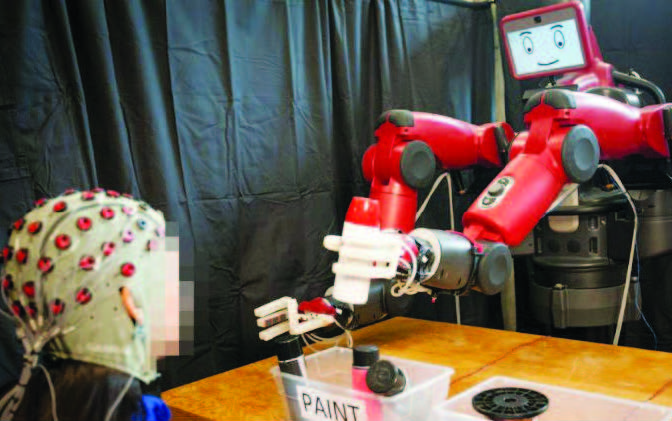
    Scientists have developed a new brain-computer interface that can read a person’s thoughts in real time to correct a robot’s errors, an advance that may lead to safer self driving cars. Most existing brain-computer interface (BCI) require people to train with it and even learn to modulate their thoughts to help the machine understand, researchers said.

    By relying on brain signals called “error-related potentials” (ErrPs) that occur automatically when humans make a mistake or spot someone else making one, the new approach allows even complete novices to control a robot with their minds.

    This technology developed by researchers at the Boston University and the Massachusetts Institute of Technology (MIT) may offer intuitive and instantaneous ways of communicating with machines, for applications as diverse as supervising factory robots to controlling robotic prostheses.

    “When humans and robots work together, you basically have to learn the language of the robot, learn a new way to communicate with it, adapt to its interface,” said Joseph DelPreto, a PhD candidate at MIT’s Computer Science and Artificial Intelligence Laboratory (CSAIL).

    “In this work, we were interested in seeing how you can have the robot adapt to us rather than the other way around,” he told ‘Live Science’. Researchers collected electroencephalography (EEG) data from volunteers as those individuals watched a humanoid robot decide which of two objects to pick up.

    This data was analysed using machine-learning algorithms that can detect ErrPs in just 10 to 30 milliseconds. This means results could be fed back to the robot in real time, allowing it to correct its course midway, researchers said. Source: Reuters


  • SAP to offer its business  apps on Google Cloud

    SAP to offer its business apps on Google Cloud

    FRANKFURT (TIP): Germany’s SAP is teaming up with Silicon Valley giant Google to allow customers to run SAP’s big business applications on Google’s cloud while offering Google’s suite of web-based desktop apps to users, the company said.

    Appearing on stage at Google’s Cloud Next conference in California, Bernd Leukert, SAP’s executive board member in charge of products and innovation, is set to announce the two companies are also working on joint machine learning initiatives to be unveiled at SAP’s own user conference in May.

    SAP has moved in recent years to encourage the multinational base of corporate customers using its financial planning and other business applications to switch from traditional packaged software running on clients’ own computers to cloud delivery.

    SAP, Europe’s largest technology company, said its flagship HANA database software was now running on the Google Cloud Platform (GCP) in order for customers to uncover real-time insights using big data from their operations on a grand scale.

    The pact will allow customers to run SAP’s powerful database from laptops and other memory-constrained computers using streamlined HANA express edition software, while off-loading more complex tasks to Google’s cloud delivery platform.

    SAP also said it was working over the next two months to make its own cloud platform ready to run on the Google cloud, allowing developers to take advantage of its containerisation features that allow technicians to automate software updates. Source: Reuters

  • Google vows fix for ‘inappropriate’ search results

    Google vows fix for ‘inappropriate’ search results

    WASHINGTON (TIP): Google said on Monday that it was working to fix a search algorithm glitch that produced “inappropriate and misleading” results from its search engine and connected speaker.

    The internet giant reacted after a blog post highlighted unsubstantiated search results indicating former president Barack Obama was planning a “coup d’etat’ and that four former US presidents were members of the Ku Klux Klan.

    The weekend post from Search Engine Land editor Danny Sullivan found Google delivered “terribly wrong” answers to some queries in its “one true answer” box at the top of search results and in queries to its Google Home speaker.

    “The problematic examples I review don’t appear to have been deliberate attempts,” Sullivan wrote. “Rather, they seem to be the result of Google’s algorithms and machine learning making bad selections.”

    Sullivan said when he asked the speaker if US Republicans were the same as Nazis, it answered in the affirmative.

    Similarly, he cited an example in which Google’s search engine listed four former US presidents as “active and known” KKK members, even though there has been no conclusive historical evidence supporting that.

    The news comes amid a growing controversy over “fake news” circulating online via Google or Facebook, and efforts by the internet giants to weed out hoaxes and misinformation.

    In a statement to AFP, Google said its boxed results at the top of a search query, known as “featured snippets,” are based on an algorithmic formula.

    “Unfortunately, there are instances when we feature a site with inappropriate or misleading content,” Google’s statement said.

    “When we are alerted to a featured snippet that violates our policies, we work quickly to remove them, which we have done in this instance. We apologize for any offense this may have caused.”

    Google also noted it includes a “feedback” link under these snippets that can allow the search giant to flag or remove inappropriate content.

  • AIRBUS POP.UP AKA VAHANA –THE FIRST FLYING ELECTRIC-CAR CONCEPT

    AIRBUS POP.UP AKA VAHANA –THE FIRST FLYING ELECTRIC-CAR CONCEPT

    Stuck in traffic? Look upwards and pray, “O God! Please get me out of here!” Then God sends his Vahana, lifts you out of the congestion and carries you to your destination by air!

    Fancy concept, right? Engineers at Airbus too thought so and designers at Italdesign then said, ‘Why not?’

    Enter Pop.Up, a fully-electric concept multimodal transport system that could ferry you through roads and if needed, airlift you out of traffic congestion.

    Not kidding! French aircraft major Airbus unveiled a concept of its Pop.Up at the Geneva International Motor Show on Wednesday, which the company claims “makes full use of the urban transportation space” in megacities like New York, London, Paris and Bejing. The company also has Mumbai, Delhi and Hyderabad on the map.

    The Pop.Up consists of three modules: A carbon-fibre capsule that would carry passengers or goods, a battery vehicle running on the ground and an aerial module electrically propelled by eight rotors. It essentially looks like a futuristic electric vehicle on the ground and like a drone-car in the air.

    The Pop.Up concept works like this:

    • You choose your destination and book a ride using an app.
    • Based on your preferences, the system gives you the best mode of transport.
    • The passenger capsule becomes an electric car and picks you up.
    • In case of congestion, the capsule disconnects from the car and is lifted by the aerial module, becoming a “self-piloted urban-air vehicle” that delivers you to your destination.
    • As the ride is completed, all components return autonomously to their nearest charging points (like a bus terminal) and await their next ride.

    Projects like Vahana, Skyways and CityAirbus are being sketched on the Pop.Up concept.

    Vahana, a Sanskrit word for vehicle, is essentially a single-seat electric vertical take-off and landing (VTOL) vehicle by A^3, a small innovation company of Airbus.

    The makers of Vahana are actively pursuing Vahana as a self-piloted flying vehicle platform for individual passenger and cargo transport, much like in the classic Hanna-Barbera cartoon show Jetsons.

    While the concept may sound fancy, the practicality of such an operation remains to be seen. CityAirbus is another project operating on the concept of a flying bus, more like a public chartered flight. CityAirbus Demonstration Chief Marius Bebesel says, “While Pop.Up relies on future technologies that are not yet mature enough, such as electric propulsion and sense-and-avoid technology, the basic idea of the vehicle is feasible.”

    Another brand associated with Pop.Up is Italdesign, famous for designing Lamborghinis and Alfa Romeos among other marquee cars. The company’s CEO Jörg Astalosch says on the Airbus website, “When we designed the concept, we always had in mind its accessibility to a wide public. The beauty of Pop.Up is that it could be an integral part of cities’ existing public metro or tram transport systems or integrate seamlessly into a future one. For example, the passenger capsule could easily be designed to be compatible with hyperloops.” While Hyperloop is still in its nascent stage, the Pop.Up is also expected to take 7-10 years for realisation.

    Meanwhile, Airbus is also keen on subletting their facilities to Amazon and DHL to deliver items. Amazon last year bought 40 Boeing 767 jets for faster product delivery and also delivered a product via drone to the customer 13 minutes after he ordered it.

    Source: HT

  • MOBILE USE FOR 10 YRS RAISES TUMOUR RISK

    MOBILE USE FOR 10 YRS RAISES TUMOUR RISK

    Is radiation from mobile phones harmful? Multiple studies globally have not conclusively reached an answer. But an analysis by AIIMS of all research on the subject has found an interesting pattern-government-funded studies show increased risk of brain tumour on long-term exposure to mobile phone radiation while industry-funded research tends to underestimate the risk.

    “We found that industry funded studies are not of good quality and tend to underestimate the risk. Government funded studies show increased risk of brain tumour on long-term exposure,” said Dr Kameshwar Prasad, head of neurology at AIIMS, who is lead author of the study .

    According to Prasad, based on studies on long-term mobile use (at least 10 years or over 1,640 hours), it can be said that such exposure increases brain tumour risk by 1.33 times. In other words, if 100 people suffer from brain tumour, factoring in radiation exposure increases the number to 133. The AIIMS professor and his team of neurologists recently analysed results of 22 case-controlled studies conducted globally on 48,452 participants from 1966 to 2016 that reported the results for the risk of brain tumour.

    Of this, 10 were funded by government, seven had mixed funding from phone industry, government and mobile manufacturers and at least three studies were solely funded by the phone industry.

    Results of this analysis, which has been published in medical journal Neurological Sciences, states that while government funded studies have a quality score of 7 or 8, all studies by phone industry and mixed sources have a score of 5 or 6. Lower quality score points to increased risk of selection or measurement bias that can affect results.

    AIIMS research shows studies with higher quality score show a trend towards harm, while lower quality score studies show a trend towards protection. “It is baffling how certain studies even propound that mobile phone use can protect against brain tumour,” said a researcher.

    Meta-analysis, according to sources of funding, clearly shows a consistent increase in risk of brain tumour with mobile phone use of more than 10 years.

    While summary estimate of government funded studies shows a 1.64 times increase in odds, mixed funded studies shows a 1.05 times increase in the odds of risk of brain tumours, the AIIMS research states.

    It clarifies that data for more than 10 years of use were not available for phone industry funded studies, a major weakness from the point of view of analysing a possible link between mobile phone radiation and the risk of brain tumour on long-term use.

    Dr Prasad said the association between mobile phone use and the risk of brain tumour is beset with controversies. The AIIMS paper provides an insight into the underlying reasons for this. Source: TOI

  • TANNING MAY TRIGGER SKIN AGEING, CANCER

    TANNING MAY TRIGGER SKIN AGEING, CANCER

    Heading to the beach to get a beautiful tan? Think again. A new study has found that radiation from the Sun or tanning sessions hasten skin ageing in the long run.

    Environmental factors can damage the skin in multiple ways, from short wave ultraviolet B (UVB) rays causing sunburns and uneven pigmentation to long wave ultraviolet A (UVA) and infrared radiation penetrating more deeply into the skin to damage existing collagen and reduce collagen production, resulting in wrinkles and sagging skin.

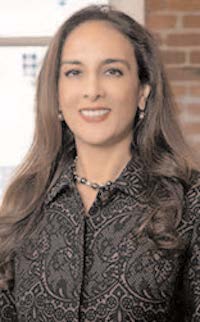
    “Ultraviolet radiation from the sun and indoor tanning beds not only can increase your risk of skin cancer but also can contribute to skin ageing,” said Arianne Shadi Kourosh, of Massachusetts General Hospital in the US.

    “Moreover, other forms of radiation, such as heat and visible light, can negatively impact the skin, as can pollution, so protecting your skin from the environment can benefit both your health and appearance,” said Kourosh on Saturday. Researchers from Massachusetts said that habitual ultraviolet exposure could cause blood vessels to become more prominent, causing skin redness, while visible light and pollution could cause uneven skin tone, especially in darker skin types.

    “Since both types of ultraviolet (UV) rays can damage the skin, it is important to use a broad-spectrum sunscreen that provides both long wave ultraviolet A and short wave ultraviolet B protection, with an SPF of 30 or higher” Kourosh said.

  • CAFFEINE CAN PROTECT AGAINST DEMENTIA

    CAFFEINE CAN PROTECT AGAINST DEMENTIA

    A recent study lists caffeine amongst the 24 compounds that have the potential to boost an enzyme in the brain which protects against dementia. The study appears in the journal Scientific Reports.

    The protective effect of the enzyme, called NMNAT2, was discovered last year through research conducted at IU Bloomington.

    “This work could help advance efforts to develop drugs that increase levels of this enzyme in the brain, creating a chemical ‘blockade’ against the debilitating effects of neurodegenerative disorders,” said Hui-Chen Lu, who led the study.

    Lu is a Gill Professor in the Linda and Jack Gill Center for Biomolecular Science and the Department of Psychological and Brain Sciences, a part of the IU Bloomington College of Arts and Sciences.

    Previously, Lu and colleagues found that NMNAT2 plays two roles in the brain: a protective function to guard neurons from stress and a “chaperone function” to combat misfolded proteins called tau, which accumulate in the brain as “plaques” due to aging. The study was the first to reveal the “chaperone function” in the enzyme.

    Misfolded proteins have been linked to neurodegenerative disorders such as Alzheimer’s, Parkinson’s and Huntington’s diseases, as well as amyotrophic lateral sclerosis, also known as ALS or Lou Gehrig’s disease. Alzheimer’s disease, the most common form of these disorders, affects over 5.4 million Americans, with numbers expected to rise as the population ages.

    To identify substances with the potential to affect the production of the NMNAT2 enzyme in the brain, Lu’s team screened over 1,280 compounds, including existing drugs, using a method developed in her lab. A total of 24 compounds were identified as having potential to increase the production of NMNAT2 in the brain.

    One of the substances shown to increase production of the enzyme was caffeine, which also has been shown to improve memory function in mice genetically modified to produce high levels of misfolded tau proteins.

    Lu’s earlier research found that mice altered to produce misfolded tau also produced lower levels of NMNAT2.

    To confirm the effect of caffeine, IU researchers administered caffeine to mice modified to produce lower levels of NMNAT2. As a result, the mice began to produce the same levels of the enzyme as normal mice.

    Another compound found to strongly boost NMNAT2 production in the brain was rolipram, an “orphaned drug” whose development as an antidepressant was discontinued in the mid-1990s. The compound remains of interest to brain researchers due to several other studies also showing evidence it could reduce the impact of tangled proteins in the brain.

    Other compounds shown by the study to increase the production of NMNAT2 in the brain — although not as strongly as caffeine or rolipram — were ziprasidone, cantharidin, wortmannin and retinoic acid. Source: ANI


  • Indian American attorney Harmeet Dhillon under consideration for key Department of Justice post

    Indian American attorney Harmeet Dhillon under consideration for key Department of Justice post

    WASHINGTON (TIP): Indian American attorney Harmeet Dhillon, a California GOP leader and vocal supporter of Trump, is under consideration to run the civil rights branch of the U.S. Department of Justice, according to a report by Los Angeles Times.

    Dhillon is a nationally recognized trial lawyer, trusted boardroom advisor, and passionate advocate for individual, corporate and institutional clients across numerous industries and walks of life. She has been awarded the prestigious designation of Northern California Super Lawyer in business litigation by Thomson / West Publishing, an accolade reserved for the top 5% of lawyers in the jurisdiction.

    Harmeet has practiced before numerous state and federal courts and administrative tribunals across the United States, has successfully handled numerous trials (jury and bench), arbitrations, and mediations (including international arbitrations), and has resolved many business disputes prior to the initiation of litigation. Admitted to practice law in New York and California, she has been a Solicitor of the Supreme Court of England and Wales.

  • Indian American Civil rights activist Deepa Iyer receives Justice in Action Award

    Indian American Civil rights activist Deepa Iyer receives Justice in Action Award

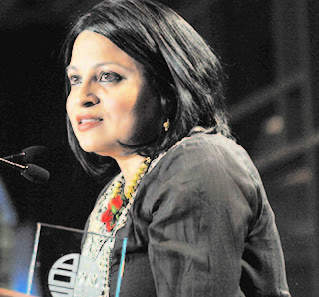
    NEW YORK CITY(TIP): Indian Americancivil rights activist and attorney Deepa Iyer received Justice in Action Awards from The Asian American Legal Defense and Education Fund (AALDEF) at its 2017 Gala on March 2, 2017 at Pier Sixty, Chelsea Piers, in New York City.

    A leading racial justice activist, Deepa Iyer served for a decade as the executive director of South Asian Americans Leading Together (SAALT), focusing on community building in post-9/11 America. She teaches in the Asian American studies program at the University of Maryland. As Senior Fellow at the Center for Social Inclusion, Deepa Iyer provides analysis, commentary and scholarship on the ways to build racial equity and solidarity in light of the rapid demographic transformation in America’s neighborhoods, schools and workplaces.

    The AALDEF Justice in Action Awards recognizes exceptional individuals for their outstanding achievements and efforts in advancing social justice. Past recipients include Congressman John Lewis, Yoko Ono, David Henry Hwang, Sandra Leung, Fareed Zakaria, Jose Antonio Vargas, BD Wong, Don H. Liu, Mira Nair, George Takei, Katrina Vanden Heuvel, Harry Belafonte, Seymour Hersh, Larry Tu, Ivan Fong, John G. Chou, A.B. Cruz III, and Margaret Cho.

    Since 1974, AALDEF has been protecting and promoting the civil rights of Asian Americans across the nation through litigation, advocacy, organizing, and community education. All proceeds from the gala will go directly towards supporting AALDEF’s legal and educational programs in immigrant rights, economic justice for workers, voting rights and civic participation, educational equity, housing and environmental justice, and the elimination of hate violence, police misconduct, and human trafficking.

  • Indian American in California arrested for killing daughter-in-law

    Indian American in California arrested for killing daughter-in-law

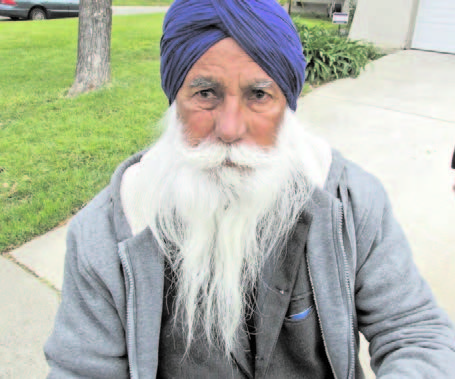
    SACRAMENTO (TIP): On March 8, 63-year-old Amarjit Singh was arrested for allegedly killing his daughter-in-law Shameena Bibi, in Suinsin City, California with a hammer.

    Suisun City Police Chief Tim Mattos said 29-year-old Bibi was killed while her in-laws and 2-year-old son were inside the house. According to investigators, it was only later

    at the police station when the father-in-law, Singh, confessed.

    According to police, Singh told investigators his daughter-in-law had “disrespected” him and they got into an argument involving a bicycle. The pair took the argument into the garage, where Singh grabbed a hammer and “delivered fatal blows” to Bibi’s head, according to investigators.

    Singh was booked into the Solano County Jail on a murder charge. He does not have an arrest history. There were some previous issues over the father-in-law’s acceptance of Bibi in his family, the police department said.

  • Indian American community leaders meet Kansas Governor over their security concerns

    Indian American community leaders meet Kansas Governor over their security concerns

    “The hateful actions of one man don’t define us-KS welcomes & supports Indian community,”:  Governor Sam Brownback

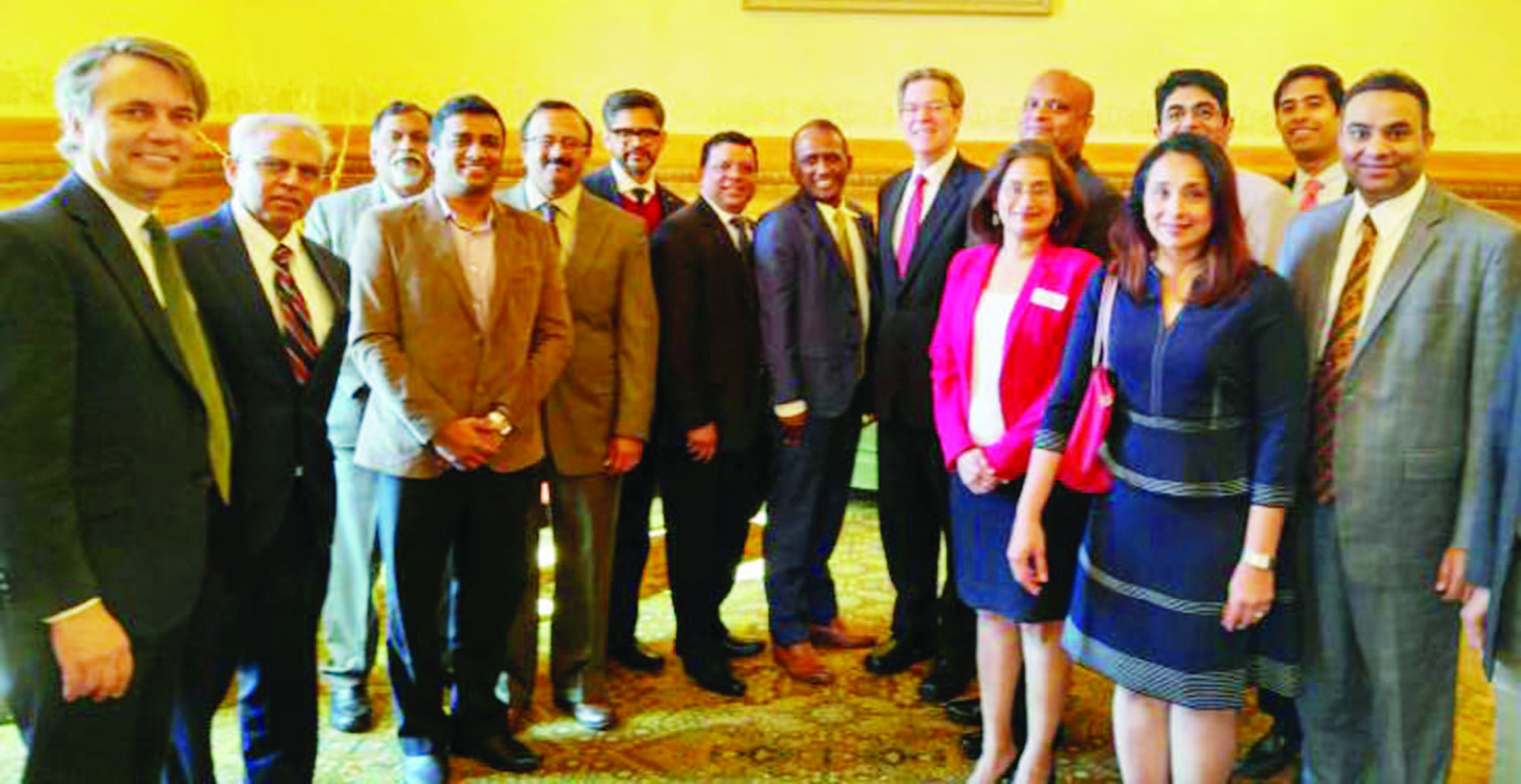
    Leaders of the Hindu American Foundation (HAF) joined the Indian American community of Kansas on March 3 to meet with Governor Sam Brownback and Lt. Governor Jeff Colyer. The topic at hand was the tragic hate crime shooting at a bar in Olathe, last month, in which Srinivas Kuchibhotla was killed and Alok Madasani was injured. Ian Grillot, an American bystander, remains critically injured from his heroic attempt to stop the shooter from inflicting more harm.

    The recent public Facebook post written by Sunayana Dummala, widow of Srinivas, was presented to the Governor. Messages for the Governor sent to the delegation from Sunayana and Alok were read as well, both thanking the Governor for his attention to the tragedy and urging for justice to be served.

    Governor Brownback gave assurances that the perpetrator in custody, Adam Purinton, currently facing first-degree murder and attempted first degree murder charges, would be prosecuted to ‘furthest extent of the law’. He further gave commitments that state officials would cooperate with federal authorities officially investigating the incident as a hate crime.

    “The hateful actions of one man don’t define us-KS welcomes & supports Indian community,” Governor Brownback said in a tweet shortly after the meeting.

    Lt. Governor Jeff Colyer also took to Twitter to express his support after the meeting, “Unique contributions of the Indian community make KS a better place. We stand with them in the face of this crime.”

    Anupam Ray, the Consul General of India based in Houston, TX, was also present to convey concern about the safety of its citizens from the Prime Minister of India, as well as gratitude for the heroism of Grillot. The delegation also included Mayor Usha Reddi of Manhattan, KS.

    Mr. Sridhar Harohalli, Chairman of the Board of Trustees of the Indian Association of Kansas City said, “The delegation which included Dr. Anupam Ray, the Indian Consul General, really helped us get assurance that this incident will be prosecuted effectively. Governor Brownback’s commitment help to get Srinivas’ widow Sunayana Dummala back to her home and career in Kansas was also heartening. We look forward to working with his office on initiatives such as the Indian Heritage Month to further enhance awareness about our community in the state.”

  • Canada allocates $650 Million for Global Reproductive Health

    Canada allocates $650 Million for Global Reproductive Health

    The money will help replace what President Trump cut when he took office

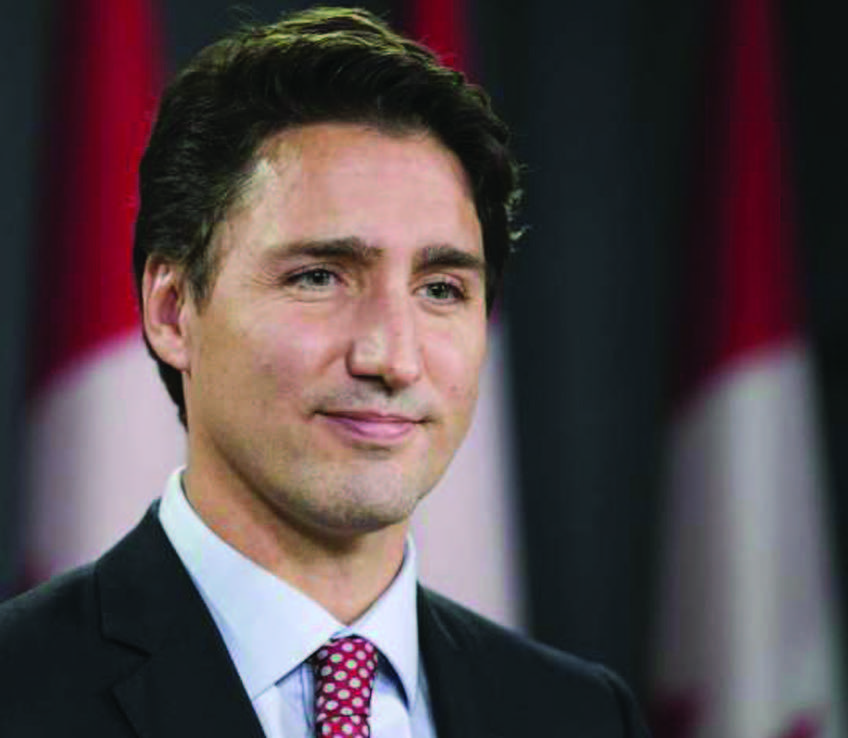
    OTTAWA (TIP): On International Women’s Day, March 8, Canadian prime minister Justin Trudeau announced Canada will contribute $650 million over the next three years to reproductive health and abortion-related services around the world, multiple outlets reported. The money will help fill a funding hole left when President Donald Trump signed the “global gag rule” on abortion, yanking funding from international health organizations that provide abortions or engage in abortion advocacy, even if they use their own funding for abortions, according to The Guardian.

    Trudeau pledged the money for sex education and reproductive health programs, including money set aside for the abortion-related services Trump defunded. The goal, Trudeau said, is to give women access to resources that give them control over family planning.

    “Like men, women should be able to choose when they want to start a family, how big their family should be, and who they want to start that family with,” Trudeau said in his announcement. “When women have equal power and equal weight and equal leadership influence, the kinds of decisions are better.”

    The global gag rule was introduced by Ronald Reagan in 1984, and every Republican since then has signed on. Trump signed the rule when he took office, and while that move was fairly routine for a conservative leader, Trump expanded the rule to restrict all global health funding, not just family-planning funding, including for those organizations whose primary focus isn’t family planning but which may mention abortion, according to Slate. The rule has the potential to strip $9.5 billion in funding from international health organizations, including$600 million in family-planning funding. Trudeau’s announcement targets the family-planning funding Trump stripped away, providing an alternate source of money for the organizations.

    By stripping family-planning funding, Trump is dealing a blow to reproductive health across the world, but since, according to Slate, he expanded the gag rule to include all health funding, even for those organizations whose focus is entirely different but which may mention abortion, he is endangering programs that do all kinds of things worldwide, including prevent HIV.

    Giving money to women’s health organizations, Trudeau said, will empower women and therefore make for a better world all around.

    “For far too many women and girls, unsafe abortions and lack of choices in reproductive health mean that they are either at risk, and at risk of death, or simply cannot contribute or achieve their potential through education, through involvement in their community, through a broad range of opportunities,” he said, according to CBC News. “It is important that as a world we recognize that empowering women, that respecting their rights, is fundamental to building a world in which everyone has a real and fair chance to succeed. “

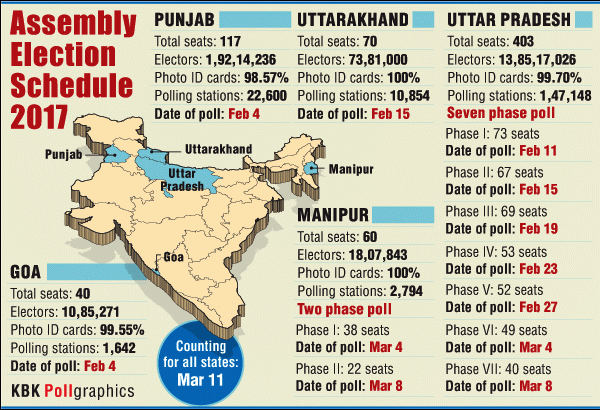
  • Assembly Elections 2017 Anti-Incumbency a dominant factor

    Assembly Elections 2017 Anti-Incumbency a dominant factor

    Exit polls find BJP ahead in UP, Goa; Cong & AAP neck-and-neck in Punjab

    NEW DELHI (TIP): Anti-incumbency appears to be a factor in deciding the fate of political parties in the fray in five States of India which have gone to polls. Results are expected on Saturday, March 11. However, exit polls, as in the past, have come up with their assessment of number of seats likely to be won by each of the parties in each of the States. The Bharatiya Janata Party could emerge as the single-largest party in three of five states, including Uttar Pradesh, which voted to elect new assemblies over the past month, exit polls showed on Thursday, March 9.

    The Congress and the Aam Aadmi Party were locked in a tight race in Punjab and the country’s principal opposition party was battling with the BJP to retain power in Manipur and Uttarakhand.

    The results, officially out on Saturday, March 11, will be seen as a referendum on Prime Minister Narendra Modi’s policies, including the shock recall of 500-and 1000-rupee banknotes – a decision that opposition parties slammed as anti-poor and turned into a poll plank.

    The five state polls are also billed as a virtual semi-final to the general elections in two years from now, and the results are likely to shape both upcoming presidential elections and policy formation. If the forecasts come true on March 11, the BJP-led central government could give a fresh impetus to politically unpalatable economic reforms, especially those in the labor sector.

    Exit polls have frequently gone wrong in the past, including in Bihar and Delhi in 2015. Analysts say states with diverse populations and complex caste, community and religious affiliations tend to throw pollsters off.

    Some of the polls predicted ranges of seats while others gave absolute numbers without mentioning any error margin.

    In UP, where the BJP is seeking to regain power after 14 years, all exit polls forecast a hung assembly. Two gave the BJP a clear advantage over its nearest rival, the Samajwadi Party-Congress alliance, while two others predicted a close fight between them.

    The Bahujan Samaj Party (BSP) was seen as a distant third in all four exit polls available for the 403-member house. In the event of the polls throwing a hung assembly in UP, post-poll re-alignments of political forces could not be ruled out.

    In a Facebook Live conversation with BBC Hindi on Thursday, UP chief minister Akhilesh Yadav was ambiguous about the possibility of the SP joining hands with the BSP to keep the BJP out of power.

    “No one will want President’s Rule in UP and that the BJP governs the state through a remote control,” he said in a cryptic reply to a query about the possibility of a post-poll arrangement with the BSP.

    The BJP was seen as surging ahead of the rivals in Goa and Uttarakhand as well.

    In Punjab, all exit polls unanimously predicted a drubbing for the ruling Shiromani Akali Dal-BJP combine. But the polls were divided on whether the Congress or the Aam Aadmi Party, which is fighting its debut assembly election in the state, will form the next government.

    Two exit polls predicted a photo-finish while two others were split between the Congress and the AAP in the 117-member assembly. The halfway mark is 59.

    In Uttarakhand, the BJP looked set to dislodge the Congress as four out of five exit polls gave a clear majority to the saffron party. One poll forecast a close fight in the 70-member legislature.

    Three exit polls suggested that the BJP could retain power in Goa. The AAP, which ran a high-voltage campaign in its debut outing in the state, was seen as failing to have had an impact in the 40-member assembly.

    But polls were split over Manipur, with one giving a majority to the BJP and the other to the ruling Congress.

    (With inputs from agencies)

  • WOMANHOOD CELEBRATED AT THE UN ON INTERNATIONAL WOMEN’S DAY

    WOMANHOOD CELEBRATED AT THE UN ON INTERNATIONAL WOMEN’S DAY

    NEW YORK (TIP); Aishwaryaa Rajinikanth Dhanush, famous filmmaker, UN Ambassador for Gender Equality and daughter of Super Star Rajinikanth presented a Bharathanatyam performance at the United Nations on the International Day for Women, March 8. The nattuvangam was provided by her dance guru noted Bharatanatyam dancer Meenakshi Chittaranjan. Last year the UN Woman named Aishwaryaa as Goodwill Ambassador for Gender Equality.

    It was the first time a celebrity dancer from Tamil Nadu performed at the world body in the presence of diplomats and invitees. The event was organized by the Permanent Mission of India to the United Nations.

    Aishwaryaa R Dhanush, is an Indian film director and a start up entrepreneur. She is the daughter of the Indian Superstar Rajinikanth who is one of Asia’s best known actors. She is married to Dhanushwho is today one among the most talented and successful Pan-Indian actors. She is a mother of two boys.

    Aishwaryaa completed her schooling at The Ashram in Chennai. She acquired a diploma in law from Chennai.

    She directed her first feature film “3” in 2011 featuring her husband Dhanush. The film was successful critically and commercially and it catapulted Aishwaryaa as a leading young director. The film was famous for the song “why this kolaveri” which became a worldwide Viral phenomenon. She was invited to several prestigious film festivals and panels post the release. Aishwaryaa’s second feature film “Vai raja Vai ” an ensemble cast venture released in 2015 was also equally successful.

    Aishwaryaa is a multi-talented person. She is trained Bharatnatyam dancer, a voracious reader and writes very well. She launched her company Ten Entertainment recently, which is a digital medium to promote short film content

    Aishwaryaa is keenly interested in the cause of women and has associated herself with various welfare activities. She strongly propagates the cause that every girl child in India should have the fundamental right to Education and to be independent. She is a perfect example of how an Indian woman juggles various roles. Her future plans include directing feature films and developing and extending her company Ten Entertainment in various digital media spheres.

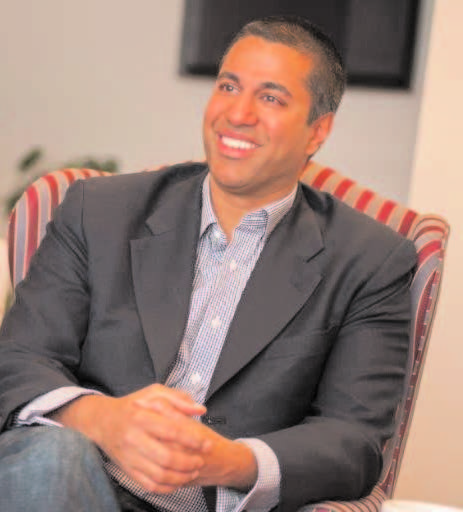
  • Indian American Ajit Pai renominated as FCC Chairman

    Indian American Ajit Pai renominated as FCC Chairman

    WASHINGTON (TIP): President Donald Trump renominated Ajit Pai as FCC Chairman on Tuesday, March 7, extending his role into a second five-year term.

    He was designated Chairman of the Federal Communications Commission by President Donald J. Trump in January 2017. He had previously served as Commissioner at the FCC, appointed by then-President Barack Obama and was confirmed unanimously by the United States Senate in May 2012.

    “I am deeply honored to have been nominated by President Trump to serve a second term on the Federal Communications Commission,” Pai said in a statement. “If I am fortunate to be confirmed by the Senate, I will continue to work with my colleagues to connect all Americans with digital opportunity, foster innovation, protect consumers, promote public safety, and make the FCC more open and transparent to the American people.”

    Pai graduated with honors from Harvard University in 1994 and from the University of Chicago Law School in 1997, where he was an editor of the University of Chicago Law Review and won the Thomas R. Mulroy Prize. In 2010, Pai was one of 55 individuals nationwide chosen for the 2011 Marshall Memorial Fellowship, a leadership development initiative of the German Marshall Fund of the United States.

    The son of immigrants from India, Pai grew up in Parsons, Kansas. He now lives in Arlington, Virginia

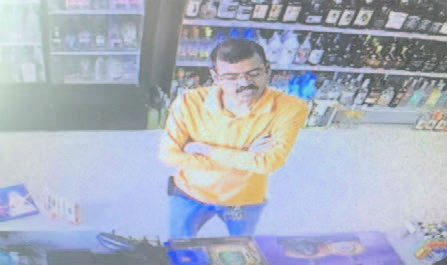
  • Indian American targeted in hate crime

    Indian American targeted in hate crime

    “Go back to your country” shouted in yet another hate crime. Fourth violent attack against Indian American reported

    LANCASTER, S CAROLINA (TIP): On March 2 night, a case of shooting death was reported from Lancaster, South Carolina. Convenience store owner, Indian American Harnish Patel’s body was discovered outside his home. Patel is survived by his wife and a child in elementary school, who were at home when he was killed. Local TV reported that there was palpable anger among the residents of Lancaster against the killing of Patel, who was a beloved member of the community. Police officials in Lancaster, however, would not label Patel’s killing was a hate crime as the investigation is still on.

    There have been multiple reports of hate-fueled attacks against people of Indian origin from across the US; close on the heels of the shooting death of Olathe based Indian Engineer Srinivas Kuchibhotla at a Kansas bar.

    On March 3 night a 39-year-old Sikh man working on his car in his driveway was approached by a masked gunman in Kent, Washington State. Following a brief altercation, the gunman yelled ‘Go back to your country’ before shooting the victim in his arm and running away. The victim’s injuries are considered not life threatening. The gunman has been described as a stocky, 6-foot-tall white man wearing a mask over the bottom part of his face. Kent police chief said the department is investigating whether this was a possible hate crime against the Sikh community.

    Family members of the victims in the Kansas shooting expressed fears about the current atmosphere in the US. They directly attributed this to President Trump’s negative rhetoric against immigrants. The White House disputed that claim. In his first State of the Union address President Trump condemned as ‘hate and evil’ the killing of Srinivas Kuchibhotla. Indian Americans who lived through the aftermath of the 911-terror attack have noticed a higher uptick in racial persecution and verbal abuses since the 2016 election.

    The US India Political Action Committee (USINPAC) expressed their concern about the incidents. USINPAC Chairman, Sanjay Puri, affirmed, “USINPAC urges the Trump administration to strongly condemn the hate fueled attacks on Indian Americans and to take firm steps to mitigate the negative atmosphere of fear and uncertainty prevailing among racial and ethnic minorities in the country. We are urging concrete steps by the Department of Justice and to address the community”

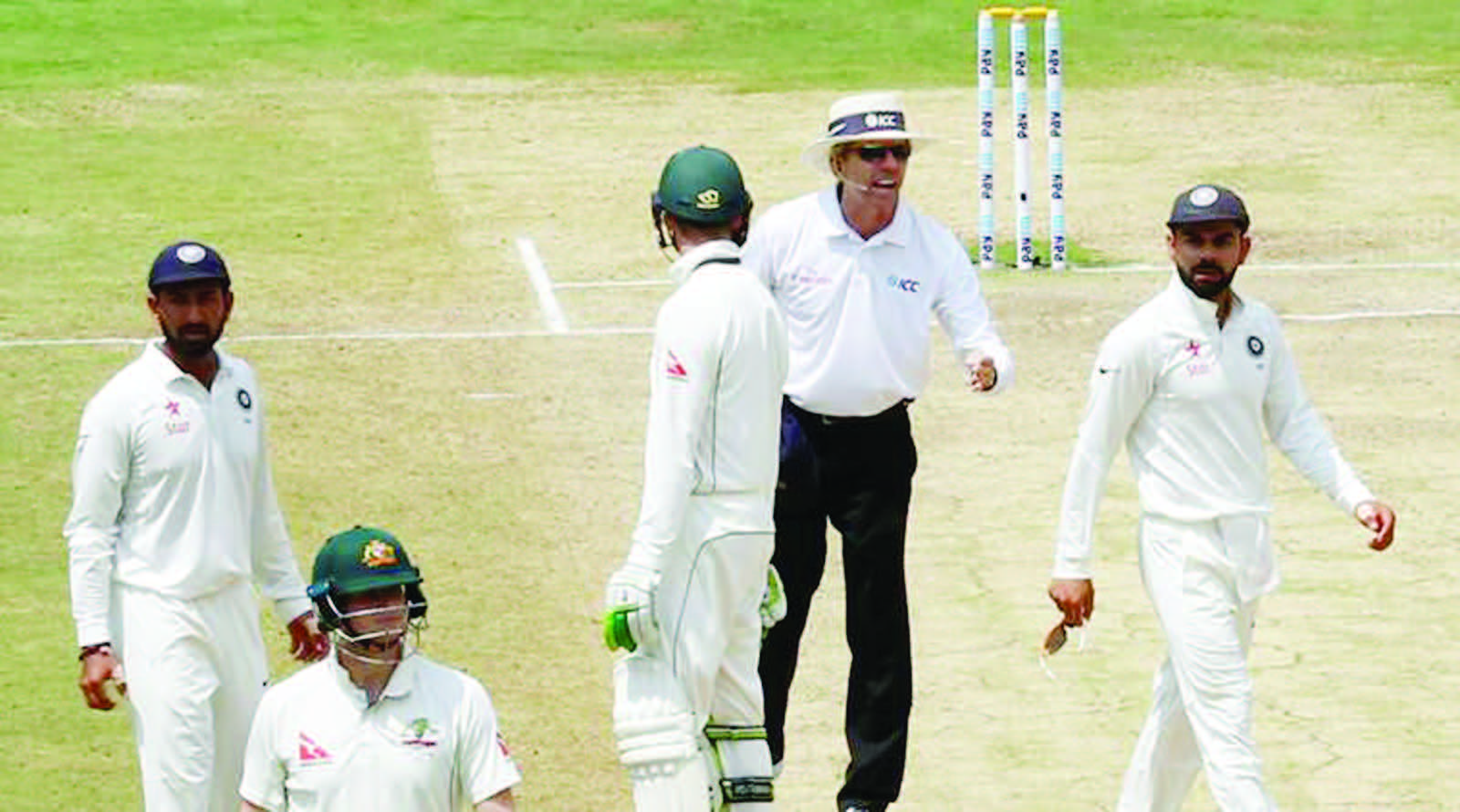
  • BCCI withdraws complaint against Steve Smith and Peter Handscomb

    BCCI withdraws complaint against Steve Smith and Peter Handscomb

    The BCCI on March 8 decided to withdraw the complaint against Steve Smith and Peter Handscomb on the controversial Decision Review System (DRS) call issue that led to war of words between the rival teams.

    The BCCI had lodged an official complaint trying to press Level 2 charge against Smith and Handscomb for violating spirit of the game.

    However Cricket Australia (CA) chief executive James Sutherland on Thursday met his opposite number Rahul Johri at the BCCI headquarters in Mumbai to resolve the issue. It was decided that the two captains would meet in Ranchi to solve the crisis.

    “BCCI and CA have resolved to restore focus on the ongoing series amidst the increased attention towards issues which have emanated during the course of the 2nd Test match in Bangalore,” a press release stated.

    Johri and Sutherland discussed the matters at length, agreed the importance of bringing back the focus to the game and the much anticipated next Test match in Ranchi.

    Sutherland said, “A series between India and Australia is bound to generate considerable excitement for fans in both the countries. On the field the two teams are fierce competitors who represent their countries with pride. As we have seen this week in Bangalore, with so much at stake, tensions can bubble over.

    “We are half way through what has already been a riveting series – and there is still much to look forward to. In discussing the relevant issues in depth, we have agreed that it is in the best interests of the game to put these differences aside and clear the way for the focus to be on the cricket, and the remaining matches of the series.”

    Johri on his part said “India has always cherished a contest with Australia and over the years, the performances of both, the teams and the players, are testimony to the level of competitiveness that exists between these two teams.

    “While having responded officially to one such incident which happened in the last Test, together, we believe that the focus of the teams and the joy they provide to the fans, should not be diluted and it is imperative to ensure that the rest of the series, which promises a great cricketing contest, not be compromised,” he concluded. (PTI)

  • Payment via Aadhaar card to be a reality soon

    Payment via Aadhaar card to be a reality soon

    NEW DELHI (TIP): Looking to make Aadhaar a more powerful financial tool, the government has instructed all banks across the country to launch Aadhaar Pay by the end of the month. It will facilitate financial transactions by using fingerprints. Reports said the banks would also have to enable ‘Pay to Aadhaar’ facility on the BHIM app by March 31.

    SBI and Punjab National Bank have been asked to provide the facility by the end of this week. This feature on BHIM app will help in making payments by simply entering the 12-digit Aadhaar number.

    Officials said this move would encourage the use of online payments among the poor and illiterate in rural areas and help the country move forward towards digitisation.

    The government has already prodded all banks to move to the Aadhaar Pay platform at the launch of IDFC Aadhaar Pay — the first Aadhaar-linked cashless merchant solution, offered by IDFC Bank Ltd. “All other banks must follow IDFC in adopting this model. If they don’t follow this lead, technology will make them redundant,” said Amitabh Kant, CEO, NITI Aayog.

    Aadhaar Pay is a service for merchants which will enable them to receive payments from customers without any physical payment instrument.

    The Aadhaar Pay app has to be downloaded by merchants on their phones and linked to an Aadhaar biometric reader. Once the merchant has this infrastructure in place, consumers can start transacting.

    To use this service, the customer has to first link his/her bank account to the Aadhaar number. To make a payment, the consumer just has to select the bank’s name and enter the Aadhaar number. The fingerprint is the password to authenticate the transaction.

    Aadhaar Pay works on any android-based phone, even a low-cost one, with an attached finger biometric device. A top government official said banks have been directed to take merchants on board for using BHIM, fitted with ‘Pay to Aadhaar’ feature and Aadhaar Pay.

  • COCA-COLA TO GO THE ‘HEALTHY’ WAY, MAY LAUNCH COCONUT WATER

    COCA-COLA TO GO THE ‘HEALTHY’ WAY, MAY LAUNCH COCONUT WATER

    NEW DELHI (TIP): Coca-Cola is preparing to launch packaged coconut water in India, as increasing consumer preference towards non-sugary drinks take the fizz out of cola sales.

    In India, Coke is test marketing Zico, a US coconut water brand it acquired in late 2013. Packaged coconut water is one of the fastest growing beverage categories in the world and the 2013 deal has given the company the top position in the segment. Positioned as a ‘natural replenishment’, brand Zico has been gaining traction in world markets, information posted on its website said.

    Coke is importing the product and testing it in at least two Indian markets, two trade officials directly aware of the matter said. “Though brands such as these are niche, Coca-Cola has to prepare the decks and hedge bets, as the backlash on cola consumption and health activism is gaining ground in the country,” one of them said.

    A Coca-Cola spokesperson didn’t respond to an email seeking comment. In India, Coke and rival PepsiCo are facing more troubles. Some trader associations in Tamil Nadu and Kerala said their members would not sell the soft drinks made by the two companies, which they accuse were drawing too much groundwater and depleting the water resources in the states facing a severe drought.

  • MALLYA CRIES FOUL OVER ‘MISTREATMENT’ BY LENDERS

    MALLYA CRIES FOUL OVER ‘MISTREATMENT’ BY LENDERS

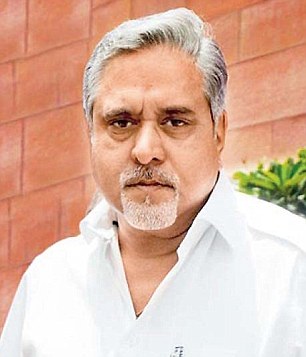
    NEW DELHI (TIP): Businessman Vijay Mallya told the Supreme Court that he had offered to settle his dues with banks but they were not willing to take it. Mallya, who lenders claim owe them Rs 9,000 crore in outstanding loans and interest, said he was being treated worse than a terrorist, though he was facing only a civil case.

    “This man has been made a poster boy of defrauding. Even the worst criminal … a terrorist, is entitled to all protection of the law. Here it is a civil default,” Mallya’s advocate CS Vaidyanathan argued at the court on Thursday.

    The case was recently shifted to a bench of Justices Adarsh Kumar Goel and UU Lalit from one comprising Justices Kurian Joseph and RF Nariman.

    Justice Lalit asked Mallya’s lawyer what he had done to purge himself of contempt after the previous bench had issued a contempt notice against him.