China has at least 10 White Houses, four Arcs de Triomphe, a couple of Great Sphinxes and at least one Eiffel Tower. Now a version of London’s Tower Bridge in the eastern Chinese city of Suzhou has rekindled a debate over China’s rush to copy foreign landmarks. This week, photos of the bridge were posted online by news outlets. One headline proclaimed: “Suzhou’s Amazing ‘London Tower Bridge’: Even More Magnificent Than the Real One.”
Indeed. Suzhou’s urban planners had clearly stepped up their game. The bridge, completed in 2012, has four towers — compared with the two spanning the Thames in London.
Suzhou has joined the scramble of Chinese cities in recent years to erect clones of famous foreign structures. Not everyone approves. Online comments about the Suzhou bridge have been scathing. “Piracy!” wrote one.
“Embarrassing,” wrote another. Li Yingwu, of the OAD architecture firm in Beijing, called the bridge outright plagiarism. “I was really surprised that it got built in Suzhou, because it has preserved its culture really well,” Li said. “It shows that local officials lack confidence in their own culture.”
A report on JSChina.com.cn, a news site of the Jiangsu provincial government, read, “We don’t have any reason to give a thumbs-up to the replicated iconic building.” The copy, it said, would impede the promotion of Chinese culture. According to Cheng Taining, an architect at the Chinese Academy of Engineering, many officials see foreign designs as shortcuts to achieve modernity and worldliness.
The criticism Suzhou bridge has been receiving is in line with President Xi Jinping’s calls for a greater emphasis on China’s cultural legacy. In December, at the Association of Literature and Art and the Chinese Writers’ Association, Xi called on artists to “consolidate confidence in Chinese culture.”
The version of the Tower Bridge is one of 56 copycat bridges in Suzhou.
Others include versions of the Sydney Harbor Bridge in Australia and the Alexandre III Bridge in Paris. The structures were in a bid to brand Xiangcheng district as an international trade and finance centre. (TNN)
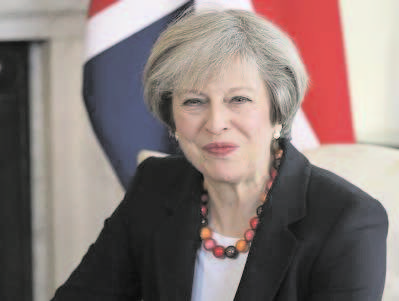
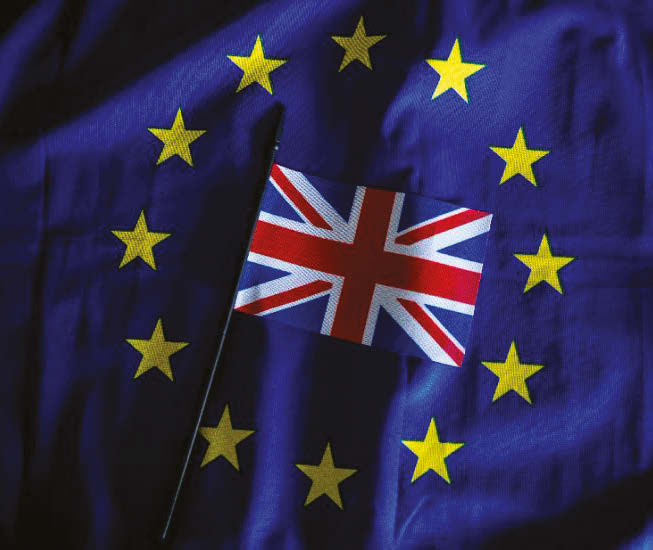
Prime Minister Theresa May has faced her first parliamentary defeat over Brexit after Britain’s upper house voted to amend and thereby delay a bill empowering her to begin talks for the UK’s exit from the EU. The House of Lords voted on Wednesday 358 to 256 for an amendment requiring ministers to protect the rights of EU nationals based in the UK following Brexit.
However, the government’s defeat in the Lords could prove a symbolic one as MPs can remove the amendment when it comes back to the House of Commons.
The Department for Exiting the EU said: “We are disappointed the Lords have chosen to amend a bill that the Commons passed without amendment. “The bill has a straightforward purpose – to enact the referendum result and allow the government to get on with the negotiations.” May has said that any guarantee of the rights of EU nationals must be part of a deal protecting UK expats overseas. The amendment backed by the Lords requires the government to introduce proposals within three months of Article 50 to ensure EU citizens in the UK have the same residence rights after Brexit.
May has set an end of the month deadline to invoke Article 50 of the Lisbon Treaty, which will trigger the two-year deadline for Brexit negotiations.
MPs have already backed the European Union (Notification of Withdrawal) Bill without amendments and can remove the Lords’ amendment when they vote on it again later this month. The government is said to be confident of defeating the changes to the bill in the Commons. Jeremy Corbyn, the Opposition Labour leader who ordered his MPs to support the bill unamended when it went through the Commons, described the result of the Lords vote as “great news”, raising the possibility that he might tell his MPs to back the amendment in the Lower House. “The government must now do the decent thing and guarantee the rights of EU citizens living in the UK,” he said.
The Lords will vote next week on a further amendment which would give MPs a “meaningful vote” on the outcome of May’s negotiations with the 28-member bloc. If that vote also goes against her, she could come under pressure from her own MPs to agree to that amendment passing into law. (AP)
Police raided the Paris home of French rightwing presidential candidate Francois Fillon on Thursday over an alleged fake job scandal as a senior party colleague warned him he risked dragging his party “into an abyss”.
Fillon revealed Wednesday he is set to be charged over allegations he paid his wife and children hundreds of thousands of euros for fake parliamentary jobs, but he has vowed to continue his bid for power.
After searches at his parliamentary office last month, police raided his central Paris home Thursday as he visited winegrowers on the campaign trial in southern France.
The raid “finished several hours ago”, a source in Fillon’s team told AFP late Thursday, confirming information first reported by Le Parisien newspaper.
Fillon was accused by Dominique de Villepin, another former premier from his Republicans party, of driving the right wing “into the abyss” with his insistence on running for the presidency.
“Going down this dead-end street is taking the state, our faith in democracy and its fellow travellers hostage,” de Villepin wrote in Le Figaro newspaper.
Fillon has called the charges against him “entirely calculated to stop me being a candidate for the presidential election” and has ruled out stepping aside.
But defections from his team and calls from senior Republicans for ex-premier Alain Juppe, 71, to replace him have underlined divisions in his camp.
“The French people back me,” Fillon insisted Thursday. “The base is holding.”
New polls suggest Fillon is in third place and would win 19-20 percent in the first round of the election on April 23, behind centrist Emmanuel Macron and far-right leader Marine Le Pen.
Thousands still turned out to Fillon’s rally in the town of Nimes on Thursday evening and his calculation appears to be that he can close the small gap on his rivals in the remaining two months.
The top two from the first round proceed to a run-off on May 7, which Macron is currently shown winning.
But analysts warn against firm forecasts after a rollercoaster campaign so far.
Le Pen’s legal woes also deepened as the European Parliament lifted her immunity to allow her to be prosecuted for retweeting images of Islamic State atrocities.
The anti-EU, anti-immigration candidate also faces a separate parliamentary expenses investigation and a campaign financing probe in France — all of which she, like Fillon, denounces as a plot to thwart her.
The investigation in focus on Thursday concerns graphic pictures including that of a beheaded journalist that Le Pen, an MEP, tweeted in 2015.
They were addressed to a French television journalist who had likened her National Front party to the Islamic State group, leading police to open a probe into “the dissemination of violent images”.
“The thing about the judicial affairs for Marine Le Pen and the National Front is that they are not about personal enrichment, while Francois Fillon’s family is directly implicated,” far-right expert Cecile Alduy from Stanford University told a conference this week.
Macron, meanwhile, promised a “strategy to make public life more ethical” as he unveiled his full programme for the first time.
The 39-year-old said he would ban parliamentarians from employing relatives, bar candidates with criminal records from standing for office, and increase the scrutiny of MPs’ expenses.
Speaking late Thursday, he also said he would pull out of the election if he was charged “in the same way, in principle, a minister must leave the government if he is charged”.
“To be president is to be the guarantor of institutions — that is to say someone who guarantees the dignity of our public life,” he told France 2 television.
Macron founded his independent movement “En Marche” (On the Move) only last April and has been the main beneficiary of Fillon’s woes.
He sought Thursday to take on critics who say his pro-European, pro-business platform lacks substance.
Mixing traditionally rightwing measures such as easing strict labour controls and cutting taxes, he also stressed the need for new investment in public schools and measures to help deprived, high-immigrant areas.
“We are not looking to adapt or reform, but to transform,” Macron told hundreds of journalists at a launch event to set out his agenda.
Macron believes France is too small to compete on its own in a globalised world and wants deeper integration between countries that use the euro, which would include the creation of a eurozone budget.
“Our responsibility in the years to come is to be able to rebuild the European dream,” he said, adding that he would seek to persuade the zone’s richest member Germany to invest in other countries. (AFP)
WARSAW (TIP): The prime ministers of four Central European nations met Thursday to discuss ways of strengthening the European Union after Britain leaves the bloc.
The meeting took place just days before an EU summit in Brussels and ahead of the March 25 EU meeting in Rome that will mark 60 years since the start of the European Economic Community, which later became the EU’s economic foundation.
In Warsaw, Polish Prime Minister Beata Szydlo hosted her counterparts: Bohuslav Sobotka of the Czech Republic, Slovakia’s Robert Fico and Hungary’s Victor Orban. The four nations are known as the Visegard group.
Szydlo’s spokesman, Rafal Bochenek, says the talks will focus on the EU’s future but also on the quality of the food that some international firms distribute in central Europe. According to some experts, the foods offered to Central European markets are inferior to those sold elsewhere.
The talks are also expected to include Poland’s lack of support for a second term for Donald Tusk, a former Polish prime minister, as European Council head. (AP)
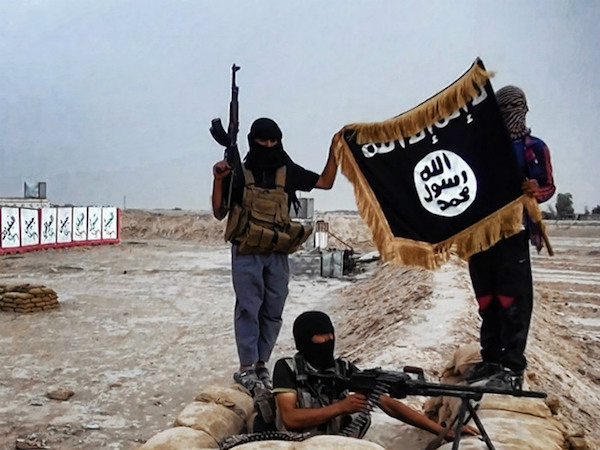
LONDON (TIP): Islamic State militants are planning “indiscriminate attacks on innocent civilians” in Britain on a scale similar to those staged by the Irish Republican Army 40 years ago, the head of the country’s new terrorism watchdog said.
In an interview with the Sunday Telegraph published on Sunday, Max Hill, the lawyer tasked with overseeing British laws on terrorism, said the militants were targeting cities and posed “an enormous ongoing risk which none of us can ignore”.
“In terms of the threat that’s represented, I think the intensity and the potential frequency of serious plot planning – with a view to indiscriminate attacks on innocent civilians of whatever race or colour in metropolitan areas – represents an enormous ongoing risk that none of us can ignore,” he said.
“So I think that there is undoubtedly significant ongoing risk which is at least as great as the threat to London in the 70s when the IRA were active on the mainland.”
The IRA abandoned its armed struggle for an end to British control of Northern Ireland and unification with Ireland in a 1998 peace deal. More than 3,600 people were killed, including more than 1,000 members of the British security forces, during a sectarian conflict that began in the late 1960s.
British security officials have repeatedly said that Islamic State militants, who are losing ground in Iraq and Syria, will target Britain. (Reuters)
Intensive treatment to lower systolic (top number) blood pressure to below 120 mm Hg can prevent 107,500 early deaths every year, according to a new study.
Systolic blood pressure refers to the pressure in the arteries when the heart beats. The bottom number, diastolic, refers to the pressure between beats.
Current guidelines recommend keeping systolic blood pressure below 140 mm Hg (millimeters of mercury).
However, the results also revealed that there was a 27 per cent reduction in mortality from all causes when systolic blood pressure was lowered to below 120, compared to the standard treatment of lowering blood pressure to below 140 mm Hg.
“If fully implemented, intensive lowering of systolic blood pressure could prevent about 107,500 deaths per year,” said researchers at Loyola University in Chicago.
For the study, published in the journal Circulation, the team enrolled more than 9,350 adults aged 50 and older who had high blood pressure and were at high risk for cardiovascular disease.
High blood pressure, or hypertension, is a leading risk factor for heart disease, stroke, kidney failure and other health problems.
While saving lives, an intensive blood pressure regimen also would cause serious side effects, the researchers said.
The study estimated that approximately 56,100 more episodes of low blood pressure, 34,400 more episodes of fainting and 43,400 additional electrolyte disorders would occur annually with implementation of intensive systolic blood pressure lowering in US adults.
But most of these effects do not have lasting consequences and are reversible by lowering blood pressure medications, the researchers noted. Source: IANS
Eating a walnut-enriched diet with 75 grams of walnuts every day may improve sperm vitality (movement) and morphology (form) — markers of semen quality, which is a predictor of male fertility — in men who added walnuts to their diet compared to men who did not, a study has found.
The findings showed that mice that consumed a diet containing 19.6% of calories from walnuts (equivalent to about 2.5 ounces per day in humans) had significant improvements in sperm quality by reducing lipid peroxidation — a process that can damage sperm cells.
“The study found that eating walnuts can actually help improve sperm quality, likely by reducing peroxidative damage in sperm cells,” said lead researcher Patricia A. Martin-DeLeon from the University of Delaware in Newark, US.
Cell damage harms sperm membranes, which are primarily made up of polyunsaturated fatty acids (PUFAs).
However, eating walnuts, the only tree nut that are predominantly comprised of PUFAs, may help reduce that damage as one ounce of walnuts contain 13 grams of PUFAs out of 18 grams of total fat, the researchers said.
“The findings suggest that walnuts may be beneficial for sperm health,” Martin-DeLeon added. For the study, the team took healthy male mice as well as mice that were genetically predetermined to be infertile (Pmca4-/- gene deletion) were randomly assigned to a walnut-enriched diet or a control diet without walnuts that was followed for 9-11 weeks.
Among the mice that consumed walnuts, fertile mice experienced a significant improvement in sperm motility and morphology and the infertile mice had a significant improvement in sperm morphology.
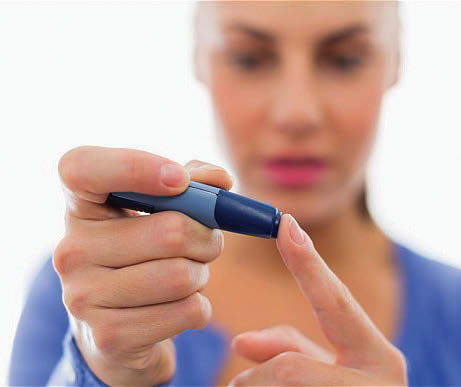
Researchers in the UK have found that a weight-loss drug also reduces the risk of type 2 diabetes by 80% compared to a placebo.
The drug, which increases the amount of appetite-supressing hormones produced by the gut, was tested on overweight people with ‘prediabetes’. This is also known as ‘borderline diabetes’, and is characterised by slightly increased blood sugar levels. The condition often leads to type 2 diabetes when untreated.
Prediabetes affects one in ten people in the UK, and progresses into diabetes in 5-10% of patients within ten years.
Prediabetes is curable with exercise and a healthier diet, but once it progresses into diabetes, it is significantly harder to treat. Both conditions are strongly linked to early death and poor health outcomes like nerve damage, blindness and amputation.
Now, obesity expert professor Carel le Roux from Imperial College London and colleagues have found that a drug already used for obesity and diabetes can help to prevent progression into diabetes when combined with diet and exercise, and could even cure patients of prediabetes altogether.
The study was published in The Lancet and was funded by Novo Nordisk.
The researchers recruited 2,254 obese adults with prediabetes at 191 research sites in 27 countries worldwide. After splitting participants into two groups, they studied whether adding daily self- administered injections of liraglutide to diet and exercise helped to prevent progression into diabetes, compared to diet and exercise alone.
After three years, the researchers found that the patients given liraglutide were 80% less likely to develop diabetes than those in the placebo group. In 60% of those patients, prediabetes was reversed and patients returned to healthy blood sugar levels. Of the patients who did go on to develop diabetes, those who were given liraglutide took nearly three times longer to develop the disease than those in the placebo group. In addition, liraglutide was linked to greater sustained weight loss after three years compared to placebo, with those on liraglutide losing 7% body weight compared to 2% body weight in the placebo group.
Co-author professor le Roux, from Imperial’s Department of Medicine, said: “These groundbreaking results could pave the way for a widely used, effective, and safe drug to reverse prediabetes and prevent diabetes in 80% of at-risk people.
This could improve the health of the population and save millions on healthcare spending.”
Professor le Roux added that the drug seems to work by mimicking the action of naturally-produced hormone that supresses appetite, called GLP-1. This compound is released in response to food, and interacts with the brain’s hypothalamus to suppress appetite.
However previous studies have found that many obese people produce less of this hormone, which may lead to them over-eating. Liraglutide mimics the effects of GLP-1, essentially doing the hormone’s job to regulate appetite.
Professor le Roux said: “Liraglutide promotes weight loss by activating brain areas that control appetite and eating, so that people feel fuller sooner after meals and their food intake is reduced. Although liraglutide’s role in weight loss is well known, this is the first time it has been shown to essentially reverse prediabetes and prevent diabetes, albeit with the help of diet and exercise.”
Liraglutide is already being used to manage weight and diabetes, but it is expensive and not yet widely available in the UK. However, future studies could help develop a test for GLP-1 deficiency, to ensure the drug is given only to those who would benefit.
Alternatively, patients could undergo a 12-week trial where the drug is stopped if there is no improvement within that time.
A type of fasting diet may reprogramme pancreas cells, promote the growth of new insulin-producing pancreatic cells and reduce symptoms of Type 1 and Type 2 diabetes, a study has showed.
In the study, led by researchers from the University of Southern California, mice were placed on fasting mimicking diet (FMD) for four days each week which showed remarkable reversal of diabetes.
The mice regained healthy insulin production, reduced insulin resistance and demonstrated more stable levels of blood glucose — even in the later stages of the disease, the researchers said in the paper published in the journal Cell.
The genes normally active in the developing pancreas of embryonic/foetal mice are reactivated in diabetic adult mice when cycling FMD with normal diets.
This increases production of the protein neurogenin-3 (Ngn3) and, as a result, promotes the creation of new, healthy insulin-producing beta cells.
Researchers also examined pancreatic cell cultures from human donors and found that, in cells from Type 1 diabetes patients, nutrients mimicking fasting also increased expression of the Ngn3 protein and insulin production.
“These findings warrant a larger FDA trial on the use of the Fasting Mimicking Diet to treat diabetes patients,” said Valter Longo from the University of Southern California.
“People with diabetes could one day be treated with an FDA-approved Fasting Mimicking Diet for a few days each month, eat a normal diet for the rest of the month, and see positive results in their ability to control their blood sugar by producing normal levels of insulin and improving insulin function,” Longo added.
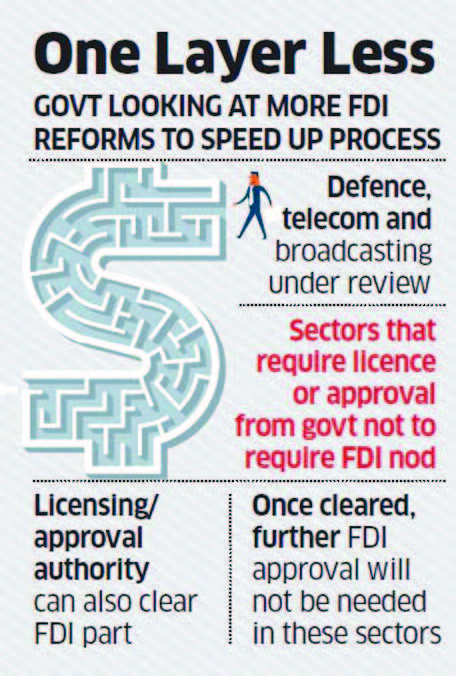
Relief for investors in defence, telecom and broadcasting
NEW DELHI: India is set to make further changes in its overseas investment regime, scrapping the need for approvals in sectors where licences are also required, such as defence, telecom and broadcasting, eliminating one layer completely from the process.
“Clearance for FDI (foreign direct investment) separately after securing a licence adds another layer of approval from same authorities,” said a senior government official. “Anyone who has gone through one level of scrutiny for licence from the authorities concerned should not need to go through the same checks again.”
Conditions related to FDI can be examined by the licensing authority, the person said. A big-ticket defence order expected to be floated soon should make quick progress once these changes are effected.
Under current rules, investors have to apply for licences in many sectors besides clearances from multiple ministries, including security from home affairs. After securing licences, they are required to apply for approval of foreign investment, if any, which again goes through an inter-ministerial clearance process.
Defence investment, for instance, is subject to industrial licensing under the Industries (Development & Regulation) Act, 1951. The licence is given by Department of Industrial Policy and Promotion in consultation with the ministries of defence, external affairs and home, a process that takes time.
“Why should there be a need for another level of clearance from same authorities?” said the official cited above.
Up to 100% FDI is allowed in defence on a case-to-case basis. India is the world’s biggest importer of defence goods, accounting for 13% of global purchases during 2012-16.
The government is looking to give a push to domestic manufacturing of defence equipment to reduce imports and also create more local jobs. Since 2000, the defence sector has attracted just over $5 million in FDI.
In the case of telecom too, 100% FDI is allowed but subject to licensing by the Department of Telecommunications. Similarly, broadcasting is subject to rules and conditions framed by the ministry of information and broadcasting.
Telecom has been among the biggest recipients of FDI with $24 billion in inflows since 2000, 7.4% of the total.
The government has already announced its intent to scrap the Foreign Investment Promotion Board (FIPB) and leave FDI clearance to the relevant ministries or departments in sectors where government approval is needed. The official cited above said removing the additional clearance could be taken up at the same time.
“Abolition of FIPB will be truly be impactful if government approval is done away with in FDI policy across sectors,” said Akash Gupt, partner, PwC.
“If a licensor would grant FDI approval under licensing requirement but RBI would eventually be monitoring the compliance of same under FEMA (Foreign Exchange Management Act), it would need some consistency and connecting of dots.”
A transition framework for replacing the FIPB process should be in place before the end of the financial year. The departments of industrial policy and promotion and economic affairs have begun consultations on the process.
Keen to attract foreign funds in the country, the government has put a number of sectors on the automatic route.
NEW DELHI (TIP): The Madras High Court quashed the petition filed to ban water supply to multinational cola makers #PepsiCo and #CocaCola in Tamil Nadu, while the retailers of the state stopped selling their beverages.
While the move is seen as a nationalistic measure to ban foreign companies to support Indian beverage makers, the Court restored water supply for continued production, of what trade associations called unhealthy beverages, which was responsible for the depleting water level in the state’s rivers.
The petition was filed Tirunelveli District Consumer Protection Association secretary DA Prabhkar, argued that the beverage makers were drawing water at subsidised rates, and leaving farmlands parched.
Separately, the ban, which was triggered during the Jallikatu protests as youths in large number supported the bull-taming game, might take a “swadeshi” turn if it is backed by the young population of Tamil Nadu, who are the largest consumers of cola.
The ban was called by two of the largest trade associations of Tamil Nadu — the Federation of Tamil Nadu Traders Associations (FTNTA) and the Tamil Nadu Traders Associations Forum (TNTAF).
A FTNTA spokesperson said foreign-made drinks are not good for health and added that the associations will promote Indian soft drinks and juices, and their manufacturing. They would also urge more retailers to push sales of Indian drinks over foreign drinks.
Meanwhile, the petition said that large beverage makers drew three million litres every day, which is not helping the farmers. To put things in context, the gross domestic product (GDP) of Tamil Nadu is $250 billion, the second largest in the country, which has 21% of its contribution from agriculture.
The cola companies did not make any comment on the situation.
However, the Indian Beverages Association, in a statement, defending Coca-Cola and Pepsi, “Coca-Cola and PepsiCo India together provide direct employment to 2,000 families in Tamil Nadu and more than 5,000 families indirectly, through their extensive supply chain. They also play a critical role in improving the livelihood of over 2 lakh retailers, who earn more than Rs. 400 crores in income by selling products manufactured by the two companies. The companies also sustain the interests of thousands of Tamil farmers, by procuring agri-produce.”
LONDON (TIP): Tata Motors-owned Jaguar Land Rover has unveiled a new model at a grand ceremony here.
Gerry McGovern, Land Rover Chief Design Officer, credited the final product to Tata Group chairman emeritus Ratan Tata. “I would like to thank Ratan Tata. Ever since he saw the first sketch of the Velar, he became a passionate advocate of it,” McGovern said at the function.
“Design has the power to enrich people’s lives… this is a vehicle with emotionally charged DNA and unquestionable pedigree,” he added. Described as one of the “hottest products this year”, the Velar is now open to orders from around the world, including India.
In a boost to British manufacturing, the company announced that the Velar will be built exclusively at JLR’s flagship Solihull plant in the West Midlands region of England.
“The expansion of our product range and building this British designed and engineered car in the UK is a sign of our confidence in British manufacturing. We are leading the global premium car industry with our commitment to our home market and our heart, soul and headquarters will always be in the UK,” said JLR CEO Ralf Speth.
The Range Rover brand has been heralded as Britain’s greatest luxury export since the 1970s and includes the Range Rover, Range Rover Sport and Range Rover Evoque.
Together they have helped transform the fortunes of the UK’s largest vehicle manufacturer, accounting for 85% of all premium cars produced in Britain and contributing 10 billion pounds to the UK economy every year, JLR said.
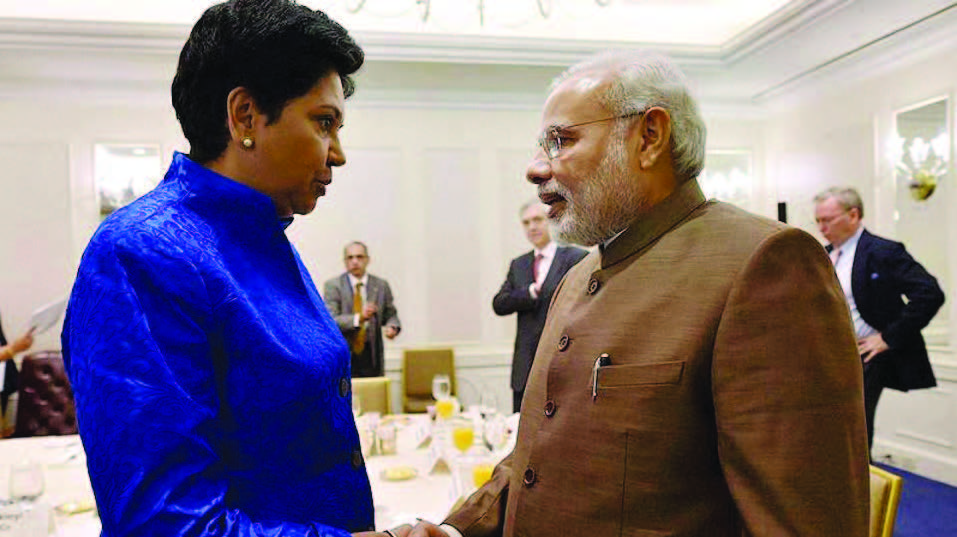
NEW DELHI (TIP): #PepsiCo Chairperson #IndraNooyi today met Prime Minister @NarendraModi and offered the company’s participation in the government’s efforts to deliver on national development goals, especially in supporting farmers.
She also apprised the Prime Minister on how PepsiCo’s new Quaker Oats products that take traditional recipes can contribute to improving health of Indian consumers.
“As I shared with Prime Minister Modi, PepsiCo is well positioned to help the government deliver on the national development goals he has outlined for farmers and supporting their livelihoods,” she said in a statement. Nooyi further said: “The Prime Minister and I had an engaging dialogue on how PepsiCo is making investments to grow, process and use more Indian-grown fruit juice in our sparkling beverages.”
She also said they discussed on how PepsiCo is focusing on new health-oriented products with local recipes. “We also discussed our launch of new Quaker Oats products that take traditional recipes and add in whole grain Quaker Oats to help Indians start their day in a healthy way,” Nooyi added.
NEW DELHI (TIP): Online marketplace Snapdeal, which is also the third largest e-commerce company of India, said on Thursday that it has partnered with Truecaller to enhance consumer experience by integrating Truecaller Priority in the company’s IVR and order confirmation numbers. Customers with Truecaller application installed on their mobiles will be able to easily identify and filter IVR or delivery verification calls when shopping on Snapdeal, the company said in a statement.
“It will help reduce a key friction point in the delivery process; ensuring that our customers don’t miss out on any important calls from Snapdeal, and also increase the daily rate of deliveries for us by increasing the call completion rate,” said Jayant Sood, Chief Customer Experience Officer, at Snapdeal.
In an e-commerce war, Snapdeal has been facing tough competition from Amazon and Flipkart. It has recently decided to lay off 500-600 people in a cost-cutting measure. Its founders Kunal Bahl and Rohit Bansal have also taken 100% salary cut. Bahl said in a letter to Snapdeal employees that the company had expanded into doing too many things without getting the first things right.
Meanwhile, there have been rumours of a three-way merger with Alibaba (its investor) and Paytm, which is the country’s largest mobile wallet, and also had a marketplace.
Across the world, too many women and girls spend too many hours on household responsibilities – typically more than double the time spent by men and boys. They look after younger siblings, older family members, deal with illness in the family and manage the house. In many cases this unequal division of labor is at the expense of women’s and girls’ learning, of paid work, sports, or engagement in civic or community leadership. This shapes the norms of relative disadvantage and advantage, of where women and men are positioned in the economy, of what they are skilled to do and where they will work.
This is the unchanging world of unrewarded work, a globally familiar scene of withered futures, where girls and their mothers sustain the family with free labor, with lives whose trajectories are very different from the men of the household.
We want to construct a different world of work for women. As they grow up, girls must be exposed to a broad range of careers, and encouraged to make choices that lead beyond the traditional service and care options to jobs in industry, art, public service, modern agriculture and science.
We have to start change at home and in the earliest days of school, so that there are no places in a child’s environment where they learn that girls must be less, have less, and dream smaller than boys.
This will take adjustments in parenting, curricula, educational settings, and channels for everyday stereotypes like TV, advertising and entertainment; it will take determined steps to protect young girls from harmful cultural practices like early marriage, and from all forms of violence.
Women and girls must be ready to be part of the digital revolution. Currently only 18 per cent of undergraduate computer science degrees are held by women. We must see a significant shift in girls all over the world taking STEM subjects, if women are to compete successfully for high-paying ‘new collar’ jobs. Currently just 25 per cent of the digital industries’ workforce are women.
Achieving equality in the workplace will require an expansion of decent work and employment opportunities, involving governments’ targeted efforts to promote women’s participation in economic life, the support of important collectives like trade unions, and the voices of women themselves in framing solutions to overcome current barriers to women’s participation, as examined by the UN Secretary-General’s High-level Panel on Women’s Economic Empowerment. The stakes are high: advancing women’s equality could boost global GDP by USD 12 trillion by 2025.
It also requires a determined focus on removing the discrimination women face on multiple and intersecting fronts over and above their gender: sexual orientation, disability, older age, and race. Wage inequality follows these: the average gender wage gap is 23 per cent but this rises to 40 per cent for African American women in the United States. In the European Union, elderly women are 37 per cent more likely to live in poverty than elderly men.
In roles where women are already over-represented but poorly paid, and with little or no social protection, we must make those industries work better for women. For example, a robust care economy that responds to the needs of women and gainfully employs them; equal terms and conditions for women’s paid work and unpaid work; and support for women entrepreneurs, including their access to finance and markets. Women in the informal sector also need their contributions to be acknowledged and protected. This calls for enabling macroeconomic policies that contribute to inclusive growth and significantly accelerate progress for the 770 million people living in extreme poverty.
Addressing the injustices will take resolve and flexibility from both public and private sector employers. Incentives will be needed to recruit and retain female workers; like expanded maternity benefits for women that also support their re-entry into work, adoption of the Women’s Empowerment Principles, and direct representation at decision-making levels. Accompanying this, important changes in the provision of benefits for new fathers are needed, along with the cultural shifts that make uptake of paternity and parental leave a viable choice, and thus a real shared benefit for the family.
In this complexity there are simple, big changes that must be made: for men to parent, for women to participate and for girls to be free to grow up equal to boys. Adjustments must happen on all sides if we are to increase the number of people able to engage in decent work, to keep this pool inclusive, and to realize the benefits that will come to all from the equal world envisaged in our Agenda 2030 for Sustainable Development.
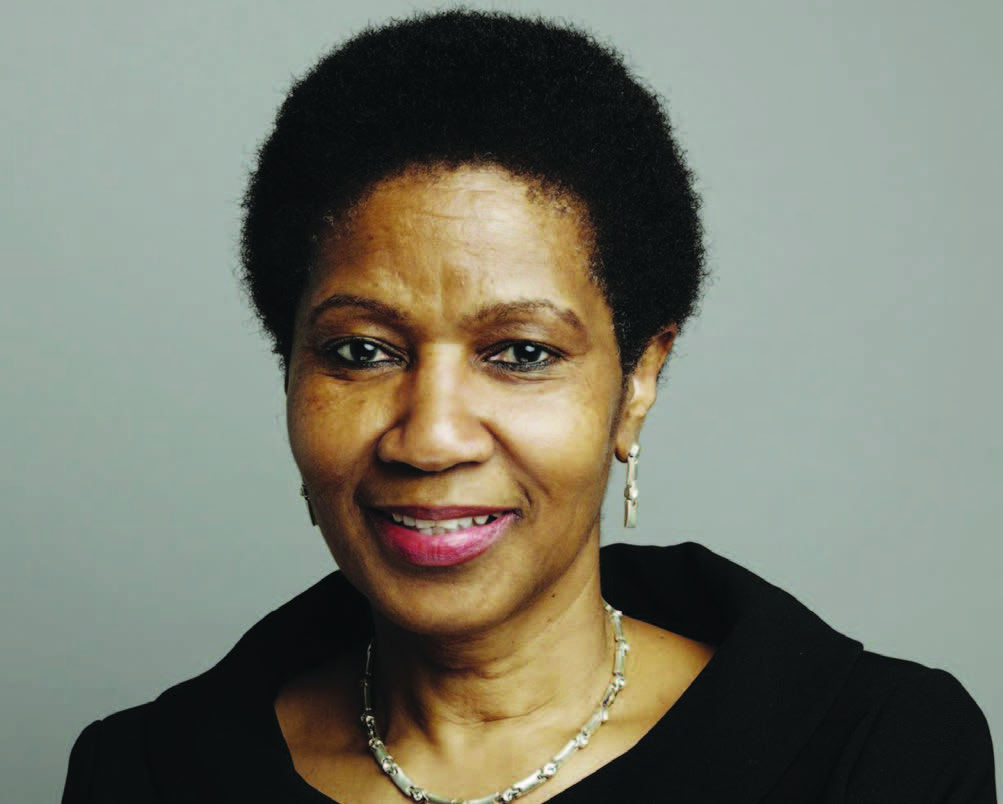
(Message of Executive Director, UN Women Phumzile Mlambo-Ngcuka)
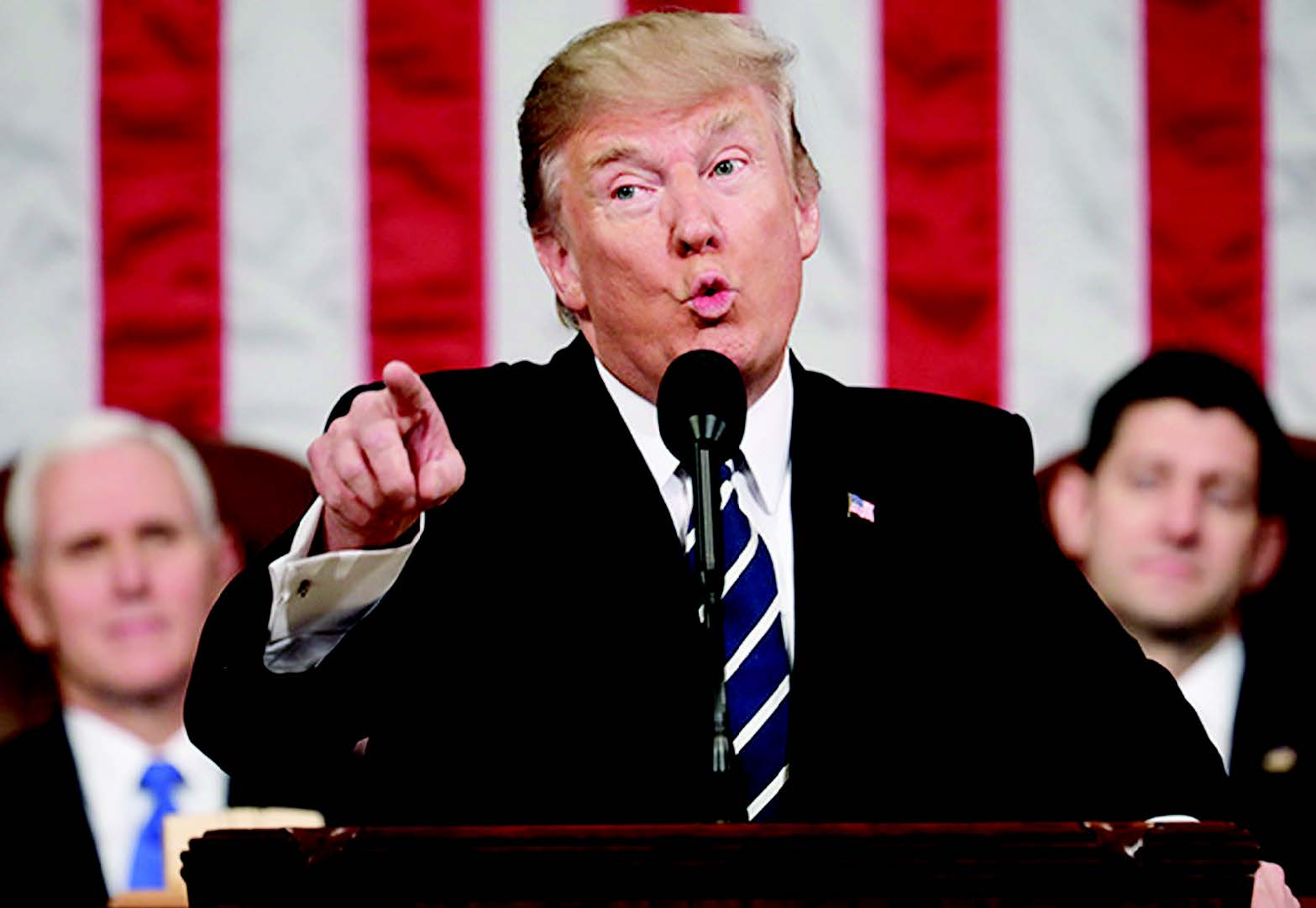
It was not the Trump Americans have known who addressed the joint session of Congress on February 28 night, He disappointed many by being so untrumpian. It was a different Trump that night whocalled on Congress to work with him on overhauling health care, changing the tax code and rebuilding the nation’s infrastructure and military. Trump said that he was eager to reach across party lines and put aside “trivial fights” to help ordinary Americans.
“I am asking all citizens to embrace this renewal of the American spirit. I am asking all members of Congress to join me in dreaming big, and bold, and daring things for our country,” Trump said.
Trump also – for the first time – sketched out a new approach to immigration, suggesting that the nation adopt a “merit-based” immigration system.
“It is a basic principle that those seeking to enter a country ought to be able to support themselves financially.” Trump said. “Yet, in America, we do not enforce this rule, straining the very public resources that our poorest citizens rely upon.” Congress should consider “switching away from this current system of lower-skilled immigration,” he said.
Trump said he believes real immigration reform is possible, but such a dramatic shift in immigration priorities will be certain to meet staunch Democratic resistance.
Trump promised a massive renewal of American jobs, infrastructure, and the military. The president wants a trillion-dollar infrastructure plan to rebuild the nation’s roads and create millions of jobs. “Millions lifted from welfare to work is not too much to expect,” Trump said, and “streets where mothers are safe from fear – schools where children learn in peace … are not too much to ask.”
The President also laid down clear principles for the repeal and replacement of Obamacare. “Obamacare is collapsing –and we must act decisively to protect all Americans,” he said, “Action is not a choice — it is a necessity.”
The President also signaled action on another key piece of his agenda — tax reform, promising “massive” relief for the middle classes and cuts in corporate tax.
President Trump’s address has by and large received praise. While the Republicans went overboard at his address which some described as the best ever I decades, Democrats were dismissive. House democratic leader Nancy Pelosi observed that while he sounded well, his actions were contrary to what he said. It remains to be seen how sincere this president is about “cutting across the party lines” and taking all along to work for the welfare of all Americans.
Could this Russian Angle be bigger than just Sessions, or Flynn???
NEW YORK (TIP) : Russian involvement in the US presidential elections and President Donald Trump’s ties with Putin began during his campaign and is now having effect on his month-old Presidency with members of his top circle getting hit every week.
First Manafort then Flynn and now Sessions. It seems everyone from his core team met and spoke to Russian officials during his campaign (which he knows nothing about) and then lied about these interactions.
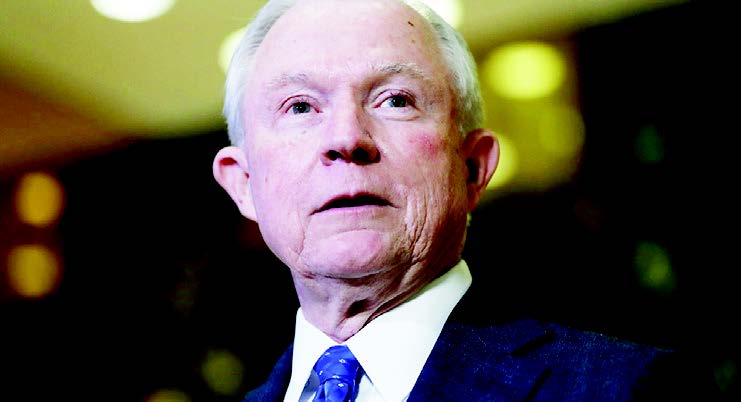
Attorney General Jeff Sessions now finds himself in the Russian seat for not disclosing at his confirmation hearing that he spoke twice last year with Russian Ambassador Sergey Kislyak which amounts to perjury.
U.S. intelligence agencies concluded last year that Russia hacked and leaked Democratic emails during the election campaign as part of an effort to tilt the vote in Trump’s favor. The Kremlin has denied the allegations.
Under fire, Jeff Sessions removes himself from campaign probes
U.S. Attorney General Jeff Sessions said on Thursday, March 2, that he would stay out of any probe into alleged Russian meddling in the 2016 presidential election but maintained he did nothing wrong by failing to disclose he met last year with Russia’s ambassador.
“I have recused myself in the matters that deal with the Trump campaign,” Sessions told reporters at a hastily arranged news conference.
Did Jeff Sessions lie under oath?
Yes, He Did!!!Here’s why: Jeff Sessions met twice with the Russian ambassador to the United States, Sergey Kislyak in July and September 2016.
At the time of Sessions’ contact with Kislyak, Sessions was not only serving as a surrogate for Donald Trump but had been named chairman of the Trump campaign’s National Security Advisory Committee.
Sessions denied he had contact with Russian officials when he was asked directly during his Senate confirmation hearing to become attorney general whether he had exchanged information with Russian operatives during the election campaign.
Now-Attorney General Sessions omitted both these meetings in his testimony during his confirmation hearings.
Sessions and his Trump backers pushed back against the revelations saying that it was, essentially, a misunderstanding—Sessions conducted those meetings in his role as United States Senator, not a Trump campaign adviser, therefore he didn’t perjure himself.
“He was literally conducting himself as a United States Senator,” Press Secretary Sean Spicer said Thursday. “This is what senators do in the course of conducting themselves in their jobs.”
But for now its on record that while still in the Senate, Jeff Sessions met with the Russian Ambassador at least twice—once at his Senate office in September and once at an event at the Republican National Convention in July.
(Read The transcript of Jeff Sessions’s recusal news conference, annotated)
Trump’s & White House’s Response : President Trump said earlier Thursday, March 2, he “wasn’t aware at all” of Sessions’ meetings and that the attorney general still has his “total” confidence.
Trump, Kellyanne Conway, Sean Spicer, Sessions and others on the Trump team have denied campaign officials’ communications and connections with Russian officials at least 20 times since July.
Trump and Republicans who control Congress are trying to move past early administration missteps and focus on issues important to them, including immigration, tax cuts and repealing the Obamacare healthcare law.
What questions remain?
It is still unclear what Sessions discussed with Kislyak, although either side could have recorded it or taken notes.
“As long as the conversation remains unknown, people will still be suspicious of what was said, whether that’s merited or not,” said Robert Walker, a former chief counsel to Senate and House ethics committees.
Investigators need to find out about anyone involved with Trump who spoke to Russian officials before he was inaugurated. Short of that, Russia potentially could use those conversations to its advantage if it’s being denied by Trump and his administration.
So far, investigators have found information showing contacts between Trump associates and Russians, including Russians linked to the Kremlin, NBC News has reported. Some of the information came from “routine intercepts” that normally might never have been examined, the source close to the investigation says.
It’s unclear whether that is how the information about the Sessions meetings came to light, but it has become clear that the Russian ambassador was under FBI scrutiny and his communications were being monitored.
A declassified report from U.S. intelligence agencies released in January concluded just that, saying, “Putin and the Russian government aspired to help President-elect Trump’s election chances when possible by discrediting Secretary Clinton and publicly contrasting her unfavorably to him.”
Russia is Laughing with eyes wide Open: The Kremlin, increasingly convinced that President Trump will not fundamentally change relations with Russia, is instead seeking to bolster its global influence by exploiting what it considers weakness in Washington, according to political advisers, diplomats, journalists and other analysts.
Russia has continued to test the United States on the military front, with fighter jets flying close to an American warship in the Black Sea this month and a Russian naval vessel steaming conspicuously in the Atlantic off the coast of Delaware.
“They think he is unstable, that he can be manipulated, that he is authoritarian and a person without a team,” Alexei A. Venediktov, the editor in chief of Echo of Moscow, a liberal radio station, said of President Trump.
Bundle of nerves: Are we getting paranoid about freedom of speech?
KC Singh
The rise of Modi and the continued Cabinet slots for those preaching sectarian hatred is not much different from President Trump listening to the whisperings of Rasputin-like Stephen Bannon, erstwhile publisher of Breitbart News – the mouthpiece of ‘alt-right’, who is White House chief strategist”, observes the author – KC Singh
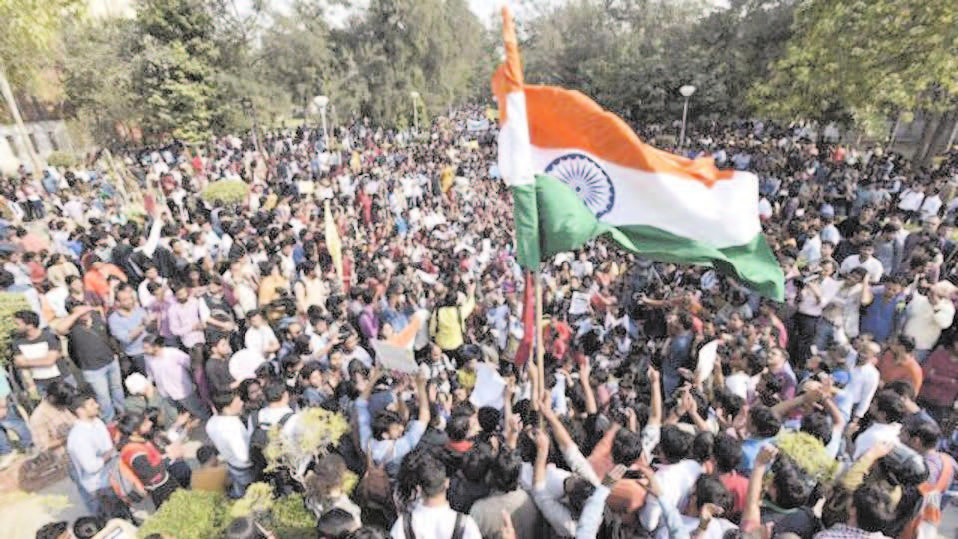
Two events over the last few days, on opposite continents of the world, raise questions about the future of democracy in the US, the world’s most powerful, and India, the world’s most populous. On February 22, Srinivas Kunchibhotla was gunned down in Kansas, sharing a drink with a friend after work, by a white US navy veteran, in patently a hate crime. In India, at Ramjas College, New Delhi, a fracas broke out when BJP-aligned students’ union, ABVP, disrupted a function organized by campus students not aligned to them and invitees from JNU. The passively observant police intervened, more to rough-up the organizers than restrain ABVP disruptors. The allegation is that anti-national slogans were in the air.
The attention got diverted from the melee when a young student, Gurmehar Kaur posted on social media placards denouncing the ABVP high-handedness, arguing that like her father – martyred fighting militants in Kashmir when she was little – she was unafraid to confront intolerance. The battle lines got promptly drawn, with intemperate remarks or tweets by an actor, a cricketer, a Union minister of state, and so on. In Gurmehar’s defense rose up senior journalists, retired soldiers, television anchors, etc. By nightfall, BJP spokesmen began distancing themselves from Gurmehar’s tormentors as their standard dubbing of any critic as anti-national did not work against a martyr’s daughter. The elections in UP also made it unwise to offend serving and retired servicemen.
The distraction aside, the issues in the US and India are not that apart. The rise of Modi and the continued Cabinet slots for those preaching sectarian hatred is not much different from President Trump listening to the whisperings of Rasputin-like Stephen Bannon, erstwhile publisher of Breitbart News -the mouthpiece of ‘alt-right’, who is White House chief strategist. Both leaders prefer political rallies and one-way communication with chosen media outlets than transparent and frank interaction with the media. If Modi has never contradicted ministerial colleagues tarring the media with the abusive phrase ‘presstitutes’, Trump does one better by directly and almost daily referring to ‘The Fake News’. At a Florida rally, he confidently advocated -uncaring that independent media strengthens democracy – that media ‘is not my enemy, it is the enemy of the American people’. A former President, George Bush, has been constrained to contradict Trump’s condemnation of the media, despite both being Republicans.
Both the racist killing of an Indian techie in Kansas and the ABVP use of violence to drown alternative views spring from identical philosophies and narrow visions. In case of India, it brings up the freedom of speech, while in the US it raises the spectra of nativism fed by a mix of xenophobia and fear of Islam. It is thus supremely ironical that while the Indian Government sends Foreign Secretary S Jaishankar to intervene with the US on the rising danger to Indian diaspora from white vigilantism, when under their noses similar intolerance is being happily marketed daily from election platforms in UP.
Illustratively, RL Stevenson related the story about George Meredith, author of the 19th century novel, The Egoist, written to purge Victorian England of this evil, that when a young friend of the writer complained that the protagonist ‘Willoughby is me’, the writer replied: ‘No, my dear fellow, he is all of us.’
The issues arising need a closer analysis. At stake in India is the definition of freedom of speech. Having inherited the common law-based criminal justice system from the British, India clings to antiquated laws on sedition. In the US too, immediately after their independence they enacted a sedition Act, which was allowed to lapse in 1801 as the nation matured and gained self-confidence. Following the Bolshevik Revolution in Russia, the fear of Communism made the US pass the Federal Espionage Act in 1917. Thus, while the British Common Law treats freedom of speech as ‘residual freedom’, circumscribed by societal needs of morality and public order, the US Supreme Court started treating it as a ‘fundamental right’ flowing from the First Amendment from 1925. In 1969, it upheld the right of students to wear black bands to protest Vietnam War. Justice OW Holmes ruled that while a nation is at war, many things that can be said in time of peace are taboo, but the test has to be whether there is ‘clear and present danger’ of sedition, not merely the expression of an opinion or a thought. What a person, in the exercise of his freedom of expression, is doing must be more than public inconvenience or annoyance, or even unrest.
India, with a concept of ‘Fundamental Rights’ borrowed from the US practice has to assess if what happened at JNU earlier, or now at Ramjas College, passes the Holmes test. The definition of nationalism cannot be crafted in Nagpur and implemented by an evangelical lynch mob. Is that not the same question that the US is today required to answer, whether ordinary whites carrying guns can ask any non-white to prove their immigration status, or why they are in the US at all. So, the diaspora that came to Madison Square Garden to chant ‘Bharat Mata ki Jai’, in response to Modi’s incantations, are being put to the kind of test of loyalty that misguided flag-carriers of the BJP, or fringe organizations of the Sangh Parivar, have been putting to their own countrymen. How does India ask Trump to be more considerate when President Obama reminded the Modi government before emplaning for the US in 2015, in his speech at Siri Fort, that Article 25 ensured freedom of conscience and it was the government’s responsibility to uphold it.
While it is true that the Indian geo-political environment does compel the government to be ever-alert to forces endangering Indian territorial integrity or sovereignty, but surely campus students holding placards, or sloganeering do not compose such a threat. As Voltaire, some say wrongly quoted, said: ‘I disapprove of what you say, but I will defend to the death your right to say it.’ Perhaps like the US Supreme Court, India’s highest court needs to re-balance the fundamental rights and the State’s obligations, and in the process, re-educate the lawyer-ministers of the BJP.
(The author, KC Singh, is a former Secretary, Ministry of External Affairs, Government of India)
US President Donald Trump sounded upbeat as he addressed a joint session of Congress for the first time. He condemned the murder of Srinivas Kuchibhotla, who was shot dead in Kansas by a white veteran, just as he deplored the vandalism of a Jewish cemetery. He spoke of a “new chapter of American greatness”, and said the country was seeing a “renewal of the American spirit”. In short, he sounded presidential-something not quite seen since he took over as the 45th President.
Many of the campaign promises were, predictably, repeated. The rhetoric, too, was familiar. The speech was woefully devoid of specifics, but he did spell out his agenda in a gaffe-less and measured manner, without the shrillness that has often dominated his pronouncements. He managed to reassure NATO, even as he asked the member-countries to “meet financial obligations”. He promised a strengthened military. He spoke of his replacement for Obamacare and addressed concerns about coverage of pre-existing health conditions. Trump outlined a huge $1 trillion infrastructure package, and said that he would give “massive” tax relief to the middle class. As expected, he was tough on immigration, and promised to “demolish and destroy” the ISIS.
It is clear that Trump’s mindset remains intact. Some details were fleshed out in the address; there was a wisp of nuance, on the immigration issue for instance; he refrained from attacking the Press this one time. However, what was most notable about President Trump’s address was not its content, but the moderate tone he adopted. It may be tempting to believe that the change in tone could be a case of the office asserting itself on the individual. Even if this is reading too much, in one performance, Trump’s address did manage to reassure the American people and the world at large that he was not a loony. A moment of relief.
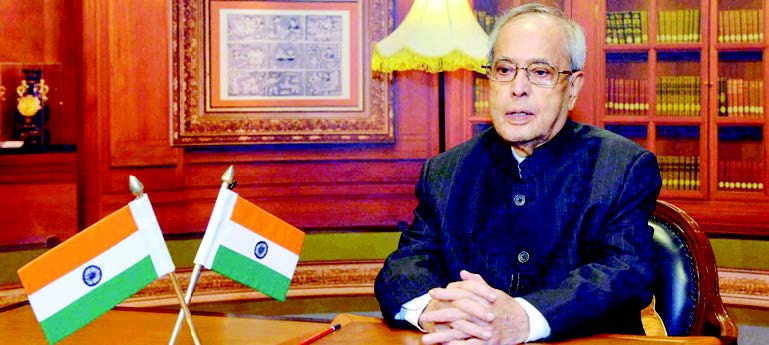
KOCHI (TIP): There is no room in this country for an intolerant Indian and students in India’s universities must engage in “reasoned discussion and debate” rather than “propagate a culture of unrest”, President Pranab Mukherjee said on March 2.
“There should be no room in India for the intolerant Indian,” President Mukherjee said while delivering the 6th KS Rajamony Memorial Lecture on “India@70” today in Kerala’s Kochi district. “Those in universities must engage in reasoned discussion and debate rather than propagate a culture of unrest. It is tragic to see them caught in the vortex of violence and disquiet,” he said. Although Mukherjee did not mention the Ramjas College row, his comments came amid the Left and right-wing groups engaged in a bitter, and even violent, debate over whether free speech is unpatriotic.
FREEDOM OF SPEECH GUARANTEED TO EVERY INDIAN:
President Pranab Mukherjee asserted that freedom of speech and expression is guaranteed to every Indian by the Constitution. “There must be space for legitimate criticism and dissent,” he said.
“India has been since ancient times a bastion of free thought, speech and expression. Our society has always been characterized by the open contestation of diverse schools of thought and debate or discussion. Freedom of speech and expression is one of the most important fundamental rights guaranteed by our Constitution,” he said.
In an apparent reference to the hounding of Delhi University student Gurmehar Kaur for questioning the RSS-backed Akhil Bharatiya Vidyarthi Parishad (ABVP), Mukherjee said the acid test for any society is how it treats it women and children.
“I do not consider a society or state to be civilized if its citizens’ behavior towards women is uncivilized. When we brutalize a woman, we wound the soul of our civilization. The acid test of any society is its attitude towards women and children,” he said.
POLITICIANS MUST NOT TAKE PEOPLE FOR GRANTED:
Addressing India’s politicians, Mukherjee said they should not take the people for granted. “The leaders or political activists must listen to people, engage with them, learn from them and respond to their needs and concerns. Our lawmakers must never take the people for granted. They must focus on the fundamental task of law making and raising of issues of concern to the people,” he said.
Mukherjee, however, did not dismiss the virtues of patriotism. “The time has come for collective efforts to re-discover the sense of national purpose and patriotism. Sense of national purpose and patriotism alone can lift our nation on to the road of sustained progress and prosperity. The nation and the people must always come first,” he said.
The contradictions within this class will now set the future course for Pakistan’s economy and its politics
S Akbar Zaidi
Attempts to quantify Pakistan’s middle class, largely based on income and the purchase of consumption goods, show that as many as 42% of Pakistan’s population belong to the upper and middle classes, with 38% counted as “the middle class”, says the author – S Akbar Zaidi.
The general perception still, and unfortunately, held by many people, foreigners and Pakistanis, is that Pakistan is largely an agricultural, rural economy, where “feudals” dominate the economic, social, and particularly political space. Nothing could be further from this outdated, false framing of Pakistan’s political economy. Perhaps the single most significant consequence of the social and structural transformation under way for the last two decades has been the rise and consolidation of a Pakistani middle class, both rural, but especially, urban.
Class categories transformed
As academics know, signifiers of social categories such as “class” are no longer fashionable and we work in an environment which no longer theorizes about classes of any kind. The political category of class has been replaced by numerous other categories such as “institutions” and other more generic and broader substitutes.
This is particularly the case in Pakistan, where while there is much literature on Pakistan’s over-determined military, there is some on the judiciary, media, gender, but little research and academic engagement with the social and structural transformation which results in how the nature of class composition has changed over time. The previous, more simplistic and simplified class categories such as feudals, industrialists, and “the working class” have not only been transformed but are also now even more problematic. In this academic environment, where there is little research of core social categories, trying to identify and calculate the size of the middle class becomes particularly difficult.
While a definition, and hence estimation of Pakistan’s middle class, or middle classes, has not been easy, the term has acquired much prominence in social and anecdotal references. Increasing references to the middle class – durmiana tubqa – both as a political category but also as an economic one, occur more regularly in the media. Often, Pakistan’s middle class is referred to by the consumer goods that it has increasingly been purchasing, from washing machines to motorcycles. But more importantly, the term is used for those having an active political constituency and presence. In many ways, the terms used in India after Narendra Modi’s 2014 election, of an “aspiring” or “aspirational” class – also somewhat vague but nevertheless signifying some political and developmentalist notion -have also found some currency in Pakistan.
Attempts to quantify Pakistan’s middle class, largely based on income and the purchase of consumption goods, show that as many as 42% of Pakistan’s population belong to the upper and middle classes, with 38% counted as “the middle class”. If these numbers are correct, or even indicative in any broad sense, then 84 million Pakistanis belong to the middle and upper classes, a population size larger than that of Germany and Turkey. Anecdotal evidence and social observations, supplemented by estimates other than what people buy, would also support the claim that Pakistan’s middle class is indeed quite formidable.
Girls shining
Data based on social, economic and spatial categories all support this argument. While literacy rates in Pakistan have risen to around 60%, perhaps more important has been the significant rise in girls’ literacy and in their education. Their enrolment at the primary school level, while still less than it is for boys, is rising faster than it is for boys. What is even more surprising is that this pattern is reinforced even for middle level education where, between 2002-03 and 2012-13, there had been an increase by as much as 54% when compared to 26% for that of boys. At the secondary level, again unexpectedly, girls’ participation has increased by 53% over the decade, about the same as it has for boys. While boys outnumber girls in school, girls are catching up. In 2014-15, it was estimated that there were more girls enrolled in Pakistan’s universities than boys – 52% and 48%, respectively. Pakistan’s middle class has realized the significance of girls’ education, even up to the college and university level.
In spatial terms, most social scientists would agree that Pakistan is almost all, or at least predominantly, urban rather than rural, even though such categories are difficult to concretize. Research in Pakistan has revealed that at least 70% of Pakistanis live in urban or urbanizing settlements, and not in rural settlements, whatever they are. Using data about access to urban facilities and services such as electricity, education, transport and communication connectivity, this is a low estimate. Moreover, even in so-called “rural” and agricultural settlements, data show that around 60% or more of incomes accrue from non-agricultural sources such as remittances and services. Clearly, whatever the rural is, it is no longer agricultural. Numerous other sets of statistics would enhance the middle class thesis in Pakistan.
Rise of the ‘youthias’
It is not only in economistic, or more specifically, consumerist, terms, that the middle class has made its presence felt, but also politically. The “naya Pakistan” of today is dominated by middle class voices and concerns. The “youthias”, as they are called, a political category of those who support Imran Khan and his style of politics, are one clear manifestation of this rise, as is the large support in the Punjab of Nawaz Sharif and his Punjab Chief Minister brother, Shahbaz Sharif. The developmentalist agenda and the social concerns of the Khyber Pakhtunkhwa government which is ruled by Imran Khan’s party, and those in the Punjab where the Sharif family dominates, are representative of this new politics. Free laptops, better governance, more information technology, better schooling, better urban health facilities, jobs for the educated youth, the right to information, and so on, represent government initiatives to appease this political category.
Vague, expectational foundations from Europe and other western countries, that the middle class is necessarily democratic, tolerant and secular, have all come undone by events in recent years. The expectation that the middle class is necessarily “liberal” no longer stands.
In the case of Pakistan, on account of many decades of a forced Siamization discourse, backed up by Saudi funding and growing jihadism, one might argue that Pakistan’s middle class is “Islamist”, very broadly defined, and also socially conservative and intolerant, pro-privatization and pro-capital. Yet, social and structural transformation, from Internet access to girls’ education and social media activism, also results in trends that counter such strict formulations. While still probably socially conservative, contradictory counter-narratives would suggest that there is a large noticeable tension which exists within this category of the middle class which questions a simple categorization of its ideological moorings.
A politics hardly progressive
It would be trite, though not incorrect, to argue that Pakistan’s middle class is in an ideological ferment and transition, but its aspirations do not extend to groups and social classes outside its own large category. They are not interested in the working classes or their issues, they are comfortable making economic and political alliances with large capitalist landowners and industrialists, many of whom have close links with the military. At present, the politics of this middle class is a far cry from even a soft version of the term “progressive”. It is the multiple fractions within the middle class which have been dominating the political and developmentalist agenda in Pakistan. It is going to be the contradictions within this middle class which will now set the future course for Pakistan’s economy and its politics. Perhaps from the fringes of this middle class, one could possibly expect the emergence even of progressive forms of politics.
(The author, S Akbar Zaidi, is a political economist based in Karachi. He teaches at Columbia University in New York, and at the IBA in Karachi)
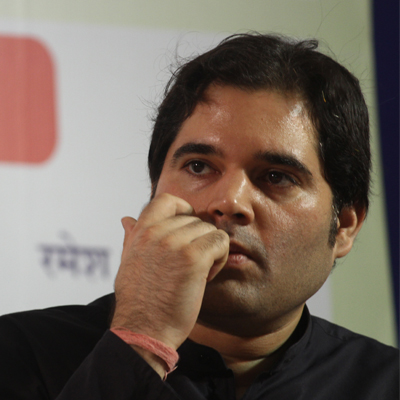
NEW DELHI (TIP): BJP MP Varun Gandhi is conspicuous by his absence in the Uttar Pradesh polls. His cold war with party chief Amit Shah has left him out of the list of star campaigners yet again.
Varun has not visited his own Lok Sabha constituency of Sultanpur after the announcement of the Assembly poll schedule, despite figuring in the party’s second list of campaigners for the third and fourth phase of polling; his constituency goes to polls on Monday.
In a move that has caused great embarrassment to the party, Varun delivered a lecture in Indore on Tuesday, where he questioned the Modi government’s outreach to farmers. He said the farmers continue to commit suicide.
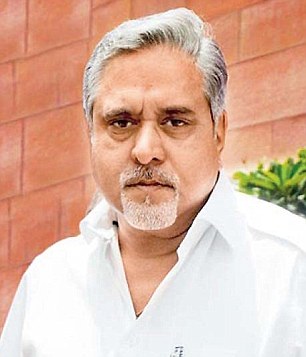
He also criticised the government’s inability to do something substantial about absconding loan defaulter Vijay Mallya.
NEW DELHI (TIP): With the UK legal system providing enough safeguards to industrialist Vijay Mallya take advantage of, India may have to wait long to get him extradited.
Though India and the UK have a bilateral Extradition Treaty in place since 1993, it is unlikely to help New Delhi in expediting the process.
The UK recently made it clear that it would strictly go by its Extradition Act, 2003, while determining if Mallya should be sent back.
Just days after New Delhi formally requested London to extradite Mallya to stand trial in loan default and money laundering cases, he was seen at Silverstone in the UK at the launch of a new racing car by his Formula One team –Sahara Force India.
Media reports quoted Mallya saying that he felt safe in the UK, notwithstanding India’s attempts to extradite him.
A source in New Delhi said what Mallya must be relying upon was the complexity of the UK’s legal system, which would make it difficult to get him back.
Legal process
The Extradition Act, 2003, of the UK puts the nations requesting the British government for extradition of fugitives into two categories – Category 1 for members of the European Union and Category 2 for India and other nations which has an extradition arrangement with it.
A team of British government officials met their counterparts in the Indian government here on Monday and Tuesday and explained the complexities of the UK legal system.
Another source said though UK officials agreed to act fast on India’s request to extradite Mallya and 15 other fugitives, they underlined that little could be done to speed up the judicial process.
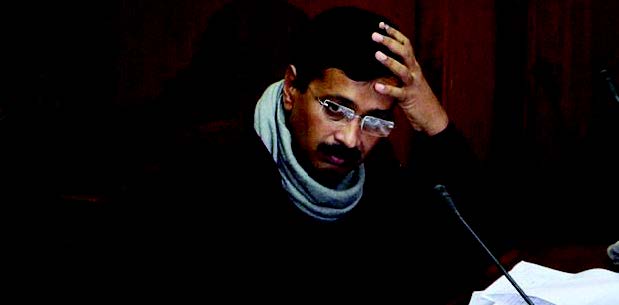
NEW DELHI (TIP): Aam Aadmi Party’s (AAP) national convener and Delhi chief minister Arvind Kejriwal has called a meeting of state in charges on Saturday to discuss the party’s national plan post-Punjab and Goa elections.
AAP will focus on the assembly elections in Gujarat later this year and Madhya Pradesh and Chhattisgarh next year, party sources said.The Aam Aadmi Party launched a multi-pronged attack against the BJP accusing it of engineering violence at Delhi’s Ramjas college to communally charge the Uttar Pradesh election and its governments in Gujarat and Chhattisgarh for unleashing police brutalities on farmers and tribals.
On a day the party’s highest decision making body — the political affairs committee —met to firm up the plan, AAP leaders in Delhi also raked up the issue of an alleged spy racket in MP in which a local BJP leader was arrested.
Party leader Kumar Vishwas accused the BJP along with its affiliate, the Akhil Bharatiya Vidyarthi Parishad — Rashtriya Swayamsewak Sangh’s student wing, of fomenting violence at Delhi University in the last two days.
“ABVP’s actions in Delhi University are triggered by the BJP’s impending defeat in UP,” Vishwas said. “They are trying to communalise the election,” he added. Party leader Gopal Rai, who is in charge of Gujarat, MP and Chhattisgarh led a delegation of farmers from Gandhinagar and tribals in Bastar to the National Human Rights Commission against alleged police atrocities.
Signup to our Newsletter!
Don’t miss out on all the happenings around the world