Year: 2017

  • India-Pak amity is the only way to thrive

    India-Pak amity is the only way to thrive

    Mutual hostility between two nations that have in the past shared a common heritage, culture and history is self-defeating. A united subcontinent can be a formidable force. Can two poor nations so situated afford to be in perpetual conflict?”, says the author – GURBIR SINGH.
    The way forward is for the people of both Punjabs to rediscover their roots and common interests by free interaction as a first step towards reconciliation between the two nations.  Secondly, the RSS Chief has a choice between an “Akhand Bharat”: a confederation of India and Pakistan he advocates, or politics of division to win elections. As long as the Muslims feel insecure there can be no peace in the subcontinent. Thirdly, the Muslim clergy must rise above dogma and meet the concerns of their own and other communities”.

    The partition of Punjab between India and Pakistan in 1947 is perhaps the most important event in the history of modern India, second only to its Independence. We are reaping its consequences in terms of geopolitics, erosion of civil liberties, communalism of politics and poverty.

    The end of World War II marked the start of the cold war between the Soviet Union and the West. A Russian presence in the Indian Ocean was seen as a threat to the Middle East and its oil under western control. Therefore, the declared British policy was to transfer power to a strong united India to prevent a Russian entry therein. The failure of the Congress and the Muslim League to reach a settlement made Partition inevitable.

    The demand for Pakistan did not originate from the Muslim-majority provinces of Punjab, Bengal, Sind and the Frontier but from the United Provinces (UP). In UP, the Muslim minority feared an existential threat from Hindu organizations such as the RSS, the Hindu Mahasabha and the right wing of the Congress. Punjab was ruled by the Unionist Party, a coalition of Muslims, Sikhs and Hindus led by Sir Sikandar Hyat Tiwana, who dismissed the concept of Pakistan as “Jinnahstan”. His successor Khizr Hyat broke with Jinnah on this issue. In 1946, Jinnah and his Muslim League managed to communalize Punjab politics by painting a doomsday scenario where the Punjabi Muslims would be at the mercy of the Hindu majority in India once the British left. The same argument was used by the Hindu and Sikh leaders in reverse. Hence the Partition.

    The Governor of Punjab, Sir Evan Jenkins, repeatedly warned that the partition of Punjab as proposed would result in widespread massacre and damage to property. His warning went unheeded. A million Hindus, Sikhs and Muslims were brutally murdered and another 15 million forced to migrate from the land of their forefathers. Millions lost their properties and thousands of women were raped, abducted and forcibly converted to another faith.

    The damage of Partition is permanent. It altered the geopolitics of this region. China is strategically located as a Pacific Ocean power. It borders Russia, Central Asia, South Asia and South-eastern Asia. In contrast, India’s strategic location has been greatly reduced. Undivided India would have bordered the Islamic world and been an influential interlocutor on the world stage. This advantage shifted to Pakistan and China. Pakistan’s strategic alliance with China to balance India has allowed the Chinese armed forces to establish a strong military presence in the subcontinent for the first time in history.

    The Kashmir conflict which is directly related to the partition of Punjab has made the subcontinent amongst the most dangerous, bloodiest and costly places on earth. Pakistan inserted Pathan tribal insurgents and their copycats into India as an extension of its military strategy. The Pathans have since evolved into the Mujahideen, the Taliban, regional ISIS and Kashmir jihadis. Two armies who fought as one in the world wars face each other with hostility. Both are nuclear powers with the capacity for mutual destruction. The apprehension of a nuclear device falling into “Islamic jihadi” hands is real.

    The violence and chaos caused by the holocaust in Punjab influenced the Constituent Assembly into creating a strong executive armed with draconian powers and weak legislatures. Gurnam Singh, a retired High Court judge and Chief Minister, felt that India did not evolve into a traditional liberal democracy. It was a hybrid system, half-democratic and half-colonial where power was transferred from nominated British officials to an elected Indian executive without accountability. He cautioned Prime Minister Jawaharlal Nehru that the system was open to abuse of power, corruption and intimidation of opponents by implicating them in false cases or branding them as antinational. Little wonder that in a system with weak checks and balances, Prime Ministers can take major decisions like “notebandi” by an executive fiat, without reference to the public, legislature or even the Cabinet.

    In Pakistan, Jinnah promised a nation where all citizens were equal and there was “no discrimination, no distinction between one community and another”. Partition ended such sentiments. Inevitably, a state founded on sectarian violence and fear of a large Hindu neighbor turned to the military and the clergy for its identity and survival. This system has little space for non-Muslims, liberal democracy and social reform. India and Pakistan are a house divided against itself. They are an anomaly: Both are sovereign states and an integral part of each other by their origins, history and culture. Both states can pay heed to the three Franco-German Wars (1870-1945), which cost a hundred million lives. Today, the one-time enemies are close allies and economic partners to their mutual benefit. For the same reason, India and Pakistan need to be friends not enemies. Punjab was the cradle of Hinduism, Sikhism and the evolution of Islam in India. It had seen many invasions and religious conflicts. However, Muslim, Hindu and Sikh elites were integrated by a common language, culture and shared economic interests. The forced migration of Hindus and Sikhs radically changed the religious, social and intellectual structure of West Punjab. However, 70 years of separation and conflict cannot totally erase millenniums of shared bonds.

    [poll id=”2″] The way forward is for the people of both Punjabs to rediscover their roots and common interests by free interaction as a first step towards reconciliation between the two nations. Secondly, the RSS Chief has a choice between an “Akhand Bharat”: a confederation of India and Pakistan he advocates, or politics of division to win elections. As long as the Muslims feel insecure there can be no peace in the subcontinent. Thirdly, the Muslim clergy must rise above dogma and meet the concerns of their own and other communities. So far it has refused to come to terms with the damage it has caused. No doubt any radical departure from the status quo will meet with strong resistance and even violence on both sides. However, our politicians and opinion makers must appreciate that great issues are settled by statesmanship, courage and common sense in the face of seemingly insurmountable hurdles.

    (The author, an educationist, is the President of the Guru Nanak Education Trust, Ludhiana)

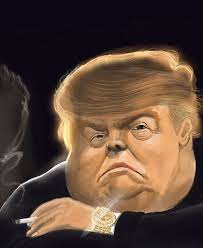
  • Trump terror stalks Europe

    Trump terror stalks Europe

    His hardline policies go against the West’s political, economic philosophy

    Phobia: There is a mix of anger, frustration, and a sense of foreboding

    “The areas of particular concern include his protectionist economic agenda; threat to wind up “obsolete” Nato that Europe regards as the cornerstone of the transatlantic alliance; and a deep-seated hostility to EU which he has accused of gaining unfair trade advantages from a “grossly undervalued” euro. Europe’s worst fears about his policies have been confirmed by his travel ban on seven Muslim countries (since suspended by a court) and freeze on Syrian refugees provoking a strong reaction from across the continent. German Chancellor Angela Merkel had a sharp exchange with him over the phone reminding him of America’s obligations under the Geneva Convention to help those fleeing war”, says the author – Hasan Suroor.
    Author: Hasan Suroor
    Hasan Suroor

    For the best part of the past 70 years, the Europe-US transatlantic alliance has been paraded as a guarantor of world peace and stability; and the best deal for free trade and liberal democracy. Despite occasional hiccups it has survived, but coming months could test it to destruction if Donald Trump’s bite turns out to be as bad as his bark.

    A few weeks ago, I wrote here about concerns that Vladimir Putin was trying to “undermine” EU institutions and create divisions among its allies. That was before Trump got going with his “America First” agenda and started wagging his fingers at Europeans. Now, it seems, Putin was a laugh; the real menace is “The Donald”. He has a visceral dislike of the EU, has called Brexit a “blessing to the world”, and urged others to follow the British example. European leaders are rattled by his abrasive pronouncements and hardline policies which they find both morally repugnant and contrary to the fundamentals of the West’s political and economic philosophy. European Council president Donald Tusk says Trump poses a serious threat to Europe.

    The expectation that once in power Trump would be forced by the demands of office to tone down his incendiary campaign rhetoric and conduct international relations with a greater sense of responsibility has been belied by the decisions he has taken in the first two weeks of his presidency. The recklessness that characterized his election campaign continues to mark his style in office. In European capitals, struggling to make sense of the new American President, there’s a mix of anger, frustration, and a sense of foreboding. A fear of Trump’s unpredictable behavior – the fear of “what he will do to us?”, as a brilliant essay in The Atlantic put it.


    The areas of particular concern include his protectionist economic agenda; threat to wind up “obsolete” Nato that Europe regards as the cornerstone of the transatlantic alliance; and a deep-seated hostility to EU which he has accused of gaining unfair trade advantages from a “grossly undervalued” euro. Europe’s worst fears about his policies have been confirmed by his travel ban on seven Muslim countries (since suspended by a court) and freeze on Syrian refugees provoking a strong reaction from across the continent. German Chancellor Angela Merkel had a sharp exchange with him over the phone reminding him of America’s obligations under the Geneva Convention to help those fleeing war.

    “She is convinced even the necessary, decisive battle against terrorism does not justify putting people of a specific background or faith under general suspicion,” her spokesman said.

    Trump’s bullying behavior, especially his threats over economic issues, has prompted an unusually sharp response even from the soft-spoken French President Francois Hollande. Trump was trying to “destabilize” Europe and its economy, he said. “The talk we’re hearing from the US encourages populism and extremism.”

    Businesses, meanwhile, are deeply concerned over Trump’s plans to raise trade barriers. His threat to impose 35 per cent tariff on car imports brought a caustic response from Germans who told him that America should learn to “start making better cars” if he didn’t want to import foreign cars. Siemens chief executive was struck by the absurdity of an immigrant-nation turning its face against the world. Even in Britain where the government has shamelessly broken ranks with its European allies to cozy up to Trump in pursuit of an elusive “special relationship” with America, public mood is incandescent. More than 1.5 million people have signed a petition calling for the cancellation of his state visit to Britain in the summer which will earn him a stay at Buckingham Palace and a ceremonial ride along the Mall with the Queen.

    There’s fury over Theresa May’s appeasement of Trump prompting comparisons with another Conservative PM Neville Chamberlain’s policy of appeasement towards Hitler in 1938. She has been dubbed “Theresa the Appeaser” for her fawning behavior during her visit to Washington when she became the first foreign leader to have an audience with Trump after he assumed office. She has been widely condemned not only in Britain, but also by her European allies for her initial silence over Trump’s travel ban until she was forced to issue a mealy-mouthed statement. At a press conference in Ankara she was heckled by journalists frustrated by her refusal to answer their questions on the issue. She declined three times to comment; when pressed a fourth time, she said America was responsible for its own policy on refugees. “Ours is to let in a number of refugees, particularly the most vulnerable”. The lengths to which she has gone in recent days to please/appease Trump has shocked many in her own party and those who otherwise admire her cautious and diplomatic style.

    May’s decision to invite Trump on a full state visit has provoked nationwide protests, and dragged the Queen into a controversy who’s said to have been “put in a very difficult position”. Experts say it’s rare for a US President to be given a state visit in their very first year. There are fears that the visit could end up in a shambles. An extraordinary diplomatic row has already erupted after the Trump team told their British hosts that the President doesn’t wish to meet Prince Charles and be “lectured” on issues they don’t agree on, especially environment. It’s believed to be an unprecedented departure from protocol and “threatens to disrupt” the visit, The Sunday Times warned.

    In a telling cartoon, the Queen, informed of Trump’s visit, is shown throwing up her hand and saying: “One suddenly feels tempted to build a wall.”

    Meanwhile, for all its appeasement, the May government might discover that it hasn’t got anything from him while alienating its European allies who already see Britain as a black sheep. It’s not the first time that London has dumped the rest of Europe for a mythical “special relationship” with Washington. Remember Tony Blair over Iraq? At a summit last week, EU leaders rejected May’s gratuitous offer to be a “bridge” between Europe and America. Thank you, but we don’t need an unreliable broker; we can look after ourselves, she was told. Summing up the mood, Hollande said the best way to protect Europe was to  have “a European conception of our future. If not, there would be – in my opinion – no Europe”.

    His dire warning shows how much Europe has been shaken by Trump’s bully-boy tactics, but it also reveals a deeper crisis of confidence within Europe that it is so rattled by a political upstart in the White House.

    (The author is a London-based commentator)


  • PM Modi’s Raincoat barb leads to disruption of Parliament

    PM Modi’s Raincoat barb leads to disruption of Parliament

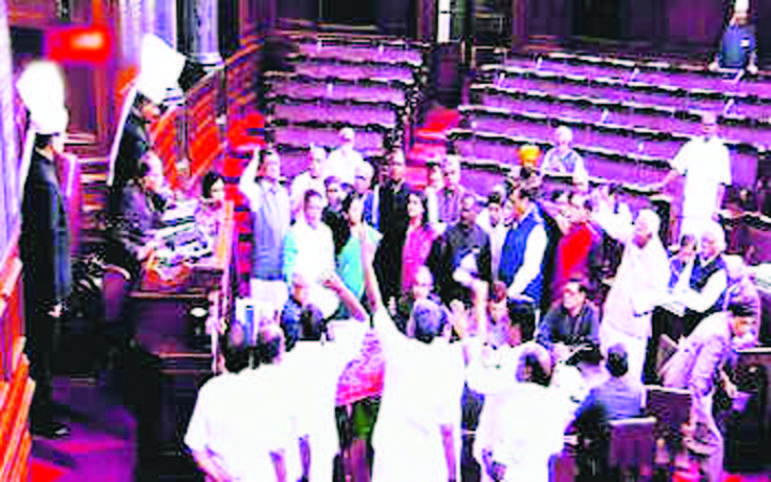
    NEW DELHI (TIP): The Rajya Sabha witnessed, February 9, repeated adjournments and was unable to function as the Opposition raised objections to Prime Minister Narendra Modi’s remarks made against Dr. Manmohan Singh a day earlier. In the Lok Sabha too, the Congress staged a walkout during Zero Hour in protest against the chair’s ruling of not allowing its floor leader Mallikarjun Kharge from raising the party’s objection to Modi’s “raincoat” remark against his predecessor Manmohan Singh.

    In the Rajya Sabha, the Opposition parties were particularly agitated over the remarks the PM made with reference to former Prime Ministers Manmohan Singh and Indira Gandhi, alleging Modi used “abusive” and “insulting” language. The members demanded an apology from the PM over his remarks. The House was first adjourned till noon and then till 2 pm.

    Congress’ Anand Sharma said Rule 238 disallowed use of offensive expression during a debate. “Prime Minister yesterday insulted the memory of Indira Gandhi. He has dragged political debate to a new low… he was abusive… we will oppose him,” he said.

    CPM leader Sitaram Yechury gave a notice under Rule 267 over the Prime Minister’s reference to late Communist leader Jyotirmoy Basu during his speech of Wednesday but the Chair rejected it.

    The Congress was joined in by the CPM and JD(U) saying they were not given an opportunity to seek clarifications during the debate yesterday despite Chairman Hamid Ansari citing precedence and tradition of the House that gave members the right to seek such response after Prime Minister or a minister’s statement.

    But it was not just the Congress members who were agitated but AIADMK counterparts also entered the well of the House demanding that Tamil Nadu Governor Vidyasagar Rao should discharge his Constitutional duty by swearing in VK Sasikala as Chief Minister without wasting any further time.

    In the Lok Sabha, Speaker Sumitra Mahajan ruled that the matter relating to the other House could not be raised amid noisy scene created by members of the treasury benches. Congress members first trooped into the Well raising slogans “Prime Minister mafi mango (PM should apologise)” and “Prime Minister shame, shame…” and then walked out of the House.

    Parliamentary Affairs Minister Ananth Kumar was also heard saying the issue could not be raised in the Lok Sabha.

    However, Kharge, before being cut by the Speaker, said, whatever Mr Modi has said about Dr Singh is not good for parliamentary democracy. He also noted that what the Prime Minister had said was an insult to the country.

    Taking a dig at Manmohan, Modi had said he knew the art of taking bath wearing a raincoat as there were many scams during his government, but he remained untainted. Earlier, the ongoing power struggle in Tamil Nadu was also played out in the Lok Sabha with AIADMK members disrupting proceedings by raising slogans apparently supporting VK Sasikala as the next Chief Minister.

    The Speaker asked them to raise the issue during Zero Hour and later adjourned the proceedings for nearly 20 minutes till 11.30 am.

    BJP hits back, says pun, fun part of democracy: Even as the Congress clamored for an apology from Prime Minister Narendra Modi for, what it called “ugly” and “unacceptable”, “raincoat” dig at his predecessor Manmohan Singh, the BJP escalated attack, asking the Opposition party to express regret for conduct in the Rajya Sabha yesterday and “absurd” and “cheap” language used by its leaders against the PM in the past.

    The Congress, they said, was angry and upset because the Prime Minister had “shown it the mirror”. Also, as per BJP leaders, the Opposition had no moral right to preach about Parliamentary etiquette given the “absurd” and “cheap” words used by its top leaders – inside and outside the Parliament -against the Prime Minister.

    “In the same Parliament they (Opposition) called him (the Prime Minister) ‘Hitler’, ‘Mussolini’, ‘Gaddafi’. The references were removed at our insistence. They have used meaningless phrases like ‘khoon ki dalali’ and ‘maut ka saudagar’ to describe him. It is a shame, they are giving ‘pravachan’ (sermons) to others now.

    “They are not able to understand the reality and are thus creating problems. Why should the Prime Minister apologize,” questioned Union Ministers M Venkaiah Naidu, Ravi Shankar Prasad and Ananth Kumar.

    On the contrary, as per BJP leaders, they should not just apologize to them but the entire country. “We have shown them the mirror, unmasked the Congress and they are now upset. The Prime Minister of India is an institution, respected not only in India, but worldwide,” they said.

    Moreover, as per Prasad “pun, fun and repartee was very much a part of the Parliamentary democracy”. “Mild exchange of words is all part of healthy democracy. So why is the Congress worried,” he wondered while responding to the Congress’ anger.

    Reminding Singh that he was the Prime Minister when “scams worth 12 lakh crore had taken place”, Prasad said he did not believe that words used by Singh to describe the demonetization scheme – “organized loot” and “legalized plunder” actually belonged to him. “We have observed him in Parliament in past 10 years. These are not his words. Rather, I feel sorry for him. He could not do anything to save the honor of his mentor (former PM Narsimha Rao), whose body was not even allowed to enter the AICC’ precincts,” Prasad said.

    Cong to boycott PM over ‘insult’: Meanwhile, The Congress said, Feb 9, it will boycott Prime Minister Narendra Modi for his jibe at predecessor Manmohan Singh and the “insult” he heaped on late Indira Gandhi, and that it would bring other Opposition parties too on board on the issue.

    Addressing a press conference today, Deputy Leader of Congress in Rajya Sabha Anand Sharma said the boycott will continue until the remaining half of the Budget Session starting March 9.

    “The PM has written the first chapter of this story. We will write the last,” Sharma said in a threatening tone a day after PM Modi questioned Manmohan Singh’s Prime Minister ship under the UPA government wondering how he could remain untainted in a government full of scams.

    Earlier, Congress Vice President Rahul Gandhi commented: “The PM has mastered the art of bathing with the rain coat on,” PM Modi had said triggering a walkout by Congress. Sharma today said Congress will boycott the PM, not listen to him but won’t assault the dignity of the Stepping up his attack on Prime Minister Narendra Modi, Congress vice president Rahul Gandhi on Thursday said he had lowered the dignity of his office by his “raincoat” jibe against Manmohan Singh in Parliament.

    “The Prime Minister’s office is not an ordinary one. Great honor is associated with it. So, by targeting his predecessor in that manner the Prime minister has lowered the dignity of his office,” Rahul said, addressing an election rally here.

    Member of Parliament Shashi Tharoor commented: "We are very-very disappointed by what the PM said on Wednesday".
    Member of Parliament Shashi Tharoor commented: “We are very-very disappointed by what the PM said on Wednesday”.

    And the gentleman politician Shashi Tharoor, Member Parliament said, outside Parliament: “We are very-very disappointed by what the PM said on Wednesday. I do not think in the history of Indian parliamentary democracy, we have ever heard the PM insulting his predecessor in such a manner using bathroom analogy. This is simply not heard of”.


  • Major Setback for Trump — Ninth Circuit Appeals Court unanimously upholds Federal Judge’s stay on travel ban

    Major Setback for Trump — Ninth Circuit Appeals Court unanimously upholds Federal Judge’s stay on travel ban

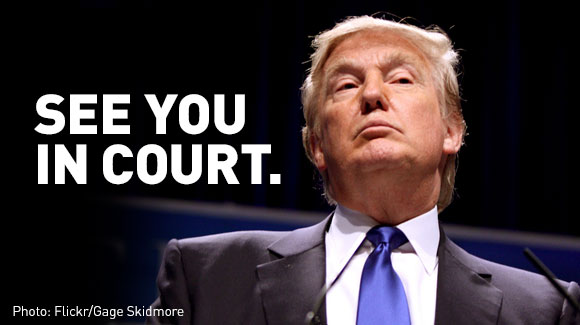
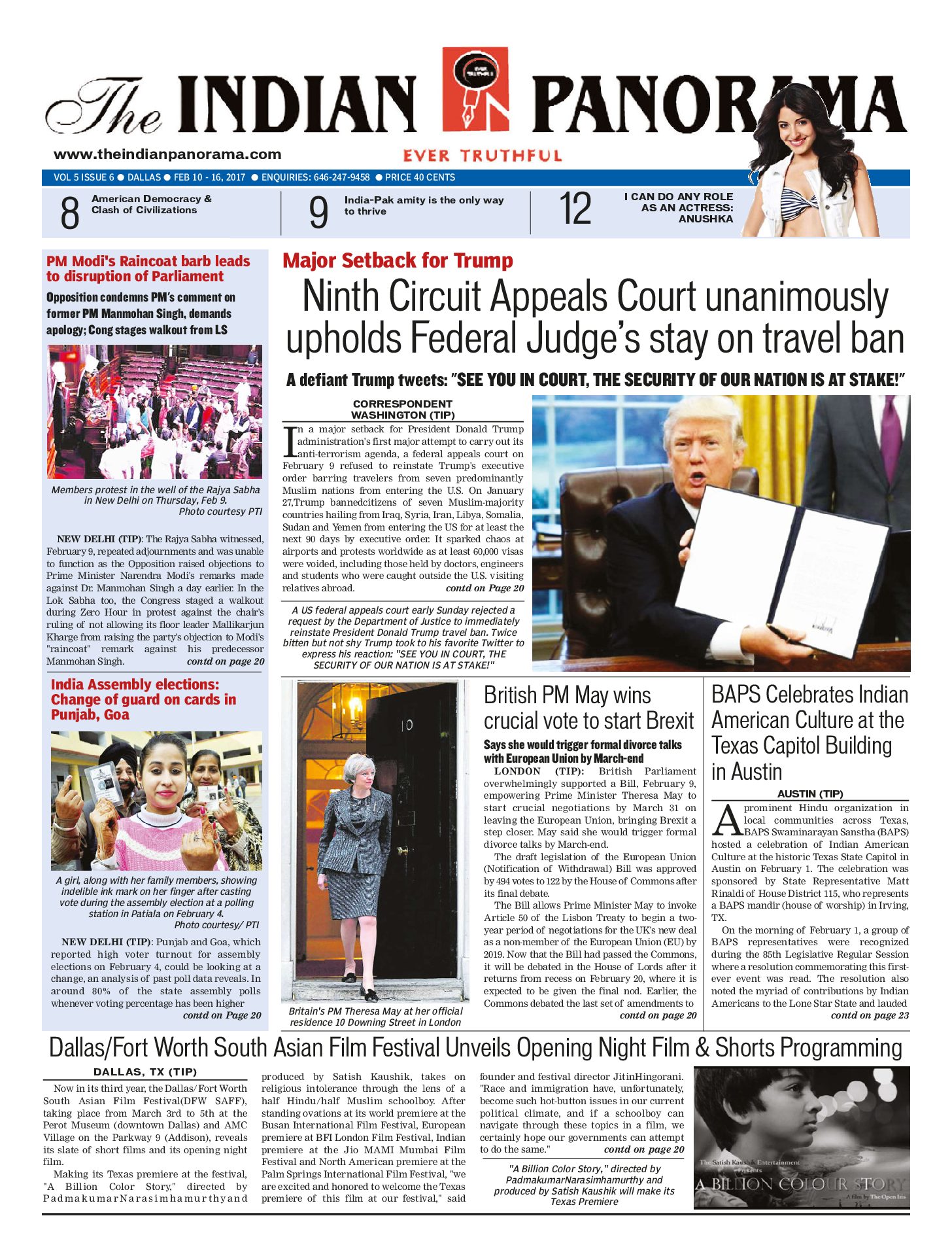
    A US federal appeals court early Sunday rejected a request by the Department of Justice to immediately reinstate President Donald Trump travel ban. Twice bitten but not shy Trump took to his favorite Twitter to express his reaction: “SEE YOU IN COURT, THE SECURITY OF OUR NATION IS AT STAKE!”

    A defiant Trump tweets: “SEE YOU IN COURT, THE SECURITY OF OUR NATION IS AT STAKE!”

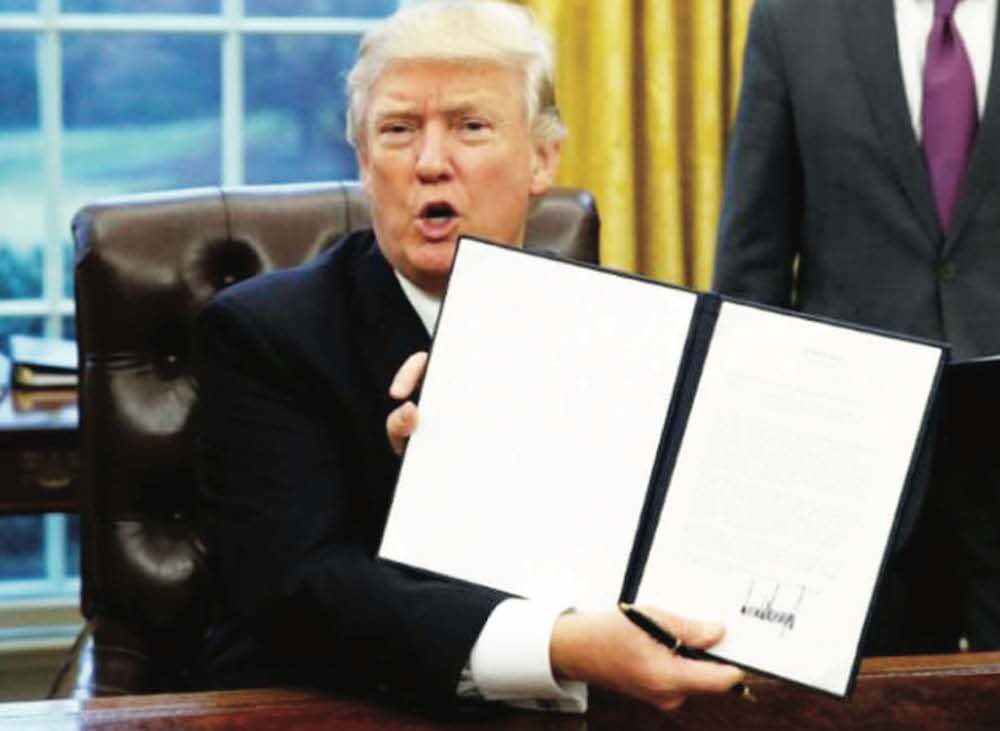
    In a major setback for President Donald Trump administration’s first major attempt to carry out its anti-terrorism agenda, a federal appeals court on February 9 refused to reinstate Trump’s executive order barring travelers from seven predominantly Muslim nations from entering the U.S. On January 27,Trump bannedcitizens of seven Muslim-majority countries hailing from Iraq, Syria, Iran, Libya, Somalia, Sudan and Yemen from entering the US for at least the next 90 days by executive order. It sparked chaos at airports and protests worldwide as at least 60,000 visas were voided, including those held by doctors, engineers and students who were caught outside the U.S. visiting relatives abroad.

    U.S. District Judge James L. Robart issued a temporary restraining order blocking enforcement of the order last week after concluding that a challenge by the states of Washington and Minnesota was likely to succeed. The Seattle-based judge, appointed by President George W. Bush, also concluded that halting the ban – at least for a while – would cause no undue harm to the country.

    A three-judge panel of the U.S. 9th Circuit Court of Appeals ruled that Judge James L. Robart’s earlier restraining order on the new policy should remain in effect while the judge further examines its legality. The three judges, two Democratic appointees and a Republican, unanimously said the administration had not shown an urgent need to have the order go into effect immediately. The judges on the Ninth Circuit panel were Judge Michelle T. Friedland, appointed by President Barack Obama; Judge William C. Canby Jr., appointed by President Jimmy Carter; and Judge Richard R. Clifton, appointed by President George W. Bush.

    “No one is above the law, not even the president,” Washington Attorney General Bob Ferguson, who brought the lawsuit against the executive order along with the state of Minnesota, said in a statement. “The president should withdraw this flawed, rushed and dangerous Executive Order, which caused chaos across the country.”

    The ruling was the first from an appeals court on the travel ban, and it was focused on the narrow question of whether it should be blocked while courts consider its lawfulness. The decision is likely to be quickly appealed to the United States Supreme Court.

    That court remains short-handed and could deadlock. A 4-to-4 tie in the Supreme Court would leave the appeals court’s ruling in place. If the Supreme Court decides not to review the 9th Circuit decision or can’t muster a majority vote, the ruling from the San Francisco court will remain in place while the Seattle judge further examines its legality.

    But Trump was defiant in response to the ruling against his travel ban.

    Minutes after the ruling was issued Thursday night, Trump tweeted a message in all caps: “SEE YOU IN COURT, THE SECURITY OF OUR NATION IS AT STAKE!”

    The American Civil Liberties Union, one of the many plaintiffs around the nation who have sued the administration over the travel ban, said this was just the first step.

    Former Republican Arkansas Gov. Mike Huckabee accused the court of protecting terrorists.

    The Council on American-Islamic Relations, which is opposed to the ban, greeted the ruling with a sigh of relief.

  • India Assembly elections: Change of guard on cards in Punjab, Goa

    India Assembly elections: Change of guard on cards in Punjab, Goa

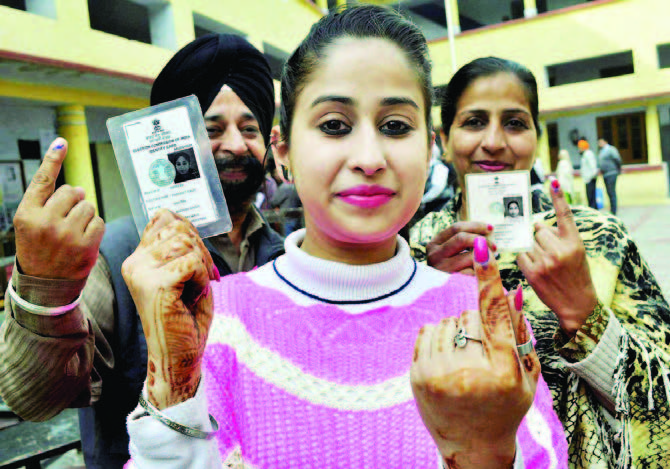
    NEW DELHI (TIP): Punjab and Goa, which reported high voter turnout for assembly elections on February 4, could be looking at a change, an analysis of past poll data reveals. In around 80% of the state assembly polls whenever voting percentage has been higher than the previous election, there has been a change in the government, election commission data for the last 20 years reveal. The probability of change is even higher when women voters outnumber men.

    Also Read Related Story: PUNJAB RECORDS 77.37% VOTER TURNOUT & Goa notches record 83% turnout

    Punjab reported 77.37% polling, a shade lower than 78.57% in the 2012 election. Goa turnout was 82.23% against 81.73% the last time. In both the states, more women turned up at polling booths than men.

    High voting, a recent phenomenon, has led to change in governments in most states though there are exceptions. Voters in Punjab took everyone by surprise in 2012 when they returned SAD-BJP to power, a first for the state where Akalis and Congress took turns to rule the state.

    Last year, Mamata Banerjee was given a second successive term by voters in West Bengal. When she ended the Left’s three decades of rule in 2011, it was a new voting record for the state. Sheila Dikshit returned as the chief minister of Delhi with a higher majority in 2003.

    “Invariably the enthusiasm at polling booths is for a change,” said Sanjay Kumar of the Centre for the Study of Developing Societies, which has been monitoring voting patterns of assembly elections for the last 20 years.

    Kumar said understanding voting pattern was a complex issue and could vary from state to state in a big country like India, as elections also have caste and community dimensions. “But what we observe from analyzing long-term data is that if people are satisfied with the incumbent government, they normally may not come out in large numbers,” he said.

    In the last 20 years, India has seen voters’ enthusiasm rise. Higher turnouts can primarily be attributed to three factors -weeding out of bogus names from poll rolls, the election commission’s efforts to encourage voting and bring polling stations closer to voters’ homes and adequate security. The number of polling stations has more than doubled in the last two decades. All polling booths now have a central election observer to ensure free and fair polling.

    At least 10% of the names on polls rolls were found to be bogus or duplicate and were struck off, EC has said. “The ECI has worked a lot on this and it is showing results,” former chief election commissioner SY Quraishi said. These factors have helped build voter’s confidence. In around 160 assembly polls, including those for union territories, held since 1990, higher voter turnout was reported in about 122 elections, leading to change in the government in about 79.4% cases. Moreover, data also show that it is getting increasingly difficult for the ruling parties to retain power when compared to early years of Independence.


  • Mangano, Venditto corruption trial date set for 2018: April 5 is the next court date

    Mangano, Venditto corruption trial date set for 2018: April 5 is the next court date

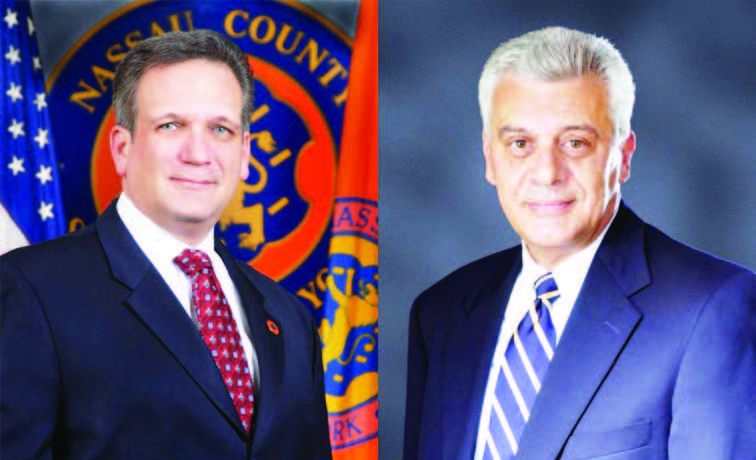
    MINEOLA, NY (TIP): A Newsday report published February 9, said a federal judge in Central Islip on Wednesday, February 8, set Jan. 15, 2018, as the start of the corruption trial of Nassau County Executive Edward Mangano and former Oyster Bay Town Supervisor John Venditto.

    U.S. District Court Judge Joan M. Azrack set the date as Mangano and Venditto, along with Mangano’s wife, Linda, who is also charged with a crime, all appeared in federal court for a status hearing on their case.

    Assistant U.S. Attorney Catherine M. Mirabile said the government has already turned over 10,000 pages of discovery to the defendants and intends to hand over 10,000 more pages.

    The judge set April 5 as the next court date.

    Outside court Mangano said the case has not affected his ability to govern.

    Mirabile and fellow federal prosecutors declined to comment after the court appearances. Mangano’s lawyer, Kevin Keating of Garden City, has refuted the allegations that the county executive was involved in a scheme to get a Long Island restaurateur county contracts. “We are pleased the court has set a trial date,” he said Wednesday. “My client is innocent and we will have an opportunity to clear his name.”

    Linda Mangano’s attorney, John Carman of Garden City, said, “I agree with my colleague’s remarks.”

    Venditto’s attorney, Marc Agnifilo of Manhattan, declined to comment.

    Mangano and Venditto were arrested in October and charged with receiving “bribes and kickbacks” from a businessman who also gave Mangano’s wife a lucrative no-show job, federal authorities said.

    The federal corruption charges center on a relationship involving Mangano, Venditto and a person identified only as a co-conspirator in the 13-count indictment, but whom sources identified as restaurateur Harendra Singh.

    Republicans Mangano, 54, of Bethpage, and Venditto, 67, of North Massapequa, are charged with conspiracy to commit bribery, fraud and obstruction of justice.

    Mangano’s wife, Linda, 54, is charged with obstruction and making false statements. Prosecutors contend she received more than$450,000 from the no-show job from April 2010, months after her husband took office, to August 2014.

    One of her phony jobs was to serve as a “food taster,” prosecutors said.

    Authorities accuse Edward Mangano and Venditto of scheming to award Singh contracts worth hundreds of thousands of dollars to provide food services to county agencies and secure multimillion-dollar loan guarantees for his businesses.

    In exchange, Mangano and Venditto received gifts from the co-conspirator, including “hotel and travel expenses, limousine services, free meals and other gifts,” according to the indictment.

    Among the gifts Mangano received were a massage chair worth $3,600, an ergonomic office chair worth $3,300, a Panerai Luminor watch worth $7,300, and installation of hardwood flooring in his bedroom, authorities said.

    In return for helping the businessman, Venditto got use of a private room at a restaurant, free chauffeur service for himself and his family, and discounted fundraisers at a restaurant, according to the indictment.

    The restaurants are not identified in the indictment, but sources said the fundraisers were held at Woodlands at the Town of Oyster Bay golf course, previously operated by Singh, and the private room was at Singh’s now-defunct restaurant in Bethpage, H.R. Singletons.

    If convicted of the top count, Edward Mangano, Linda Mangano and Venditto face up to 20 years in prison. The charges resulted from an investigation by federal prosecutors, and FBI and IRS agents.

    At their arraignments at federal court in Central Islip in October, all three pleaded not guilty through their attorneys and were each released on $500,000 bond.

    (Source: Newsday)

  • H1B visa curbs: Sleepless nights for Indian techies

    H1B visa curbs: Sleepless nights for Indian techies

    US President Donald Trump is yet to unroll the “America First” doctrine. But worryingly for India, Democrats are competing with him in imposing restrictions on low-cost foreign IT workers.

    The US House of Representatives has taken up a Bill for reforming H1B visas.

    Indians account for one lakh such visas every year, besides another 1.25 lakh that are renewed. The sponsor of the Bill is a veteran Democrat representing the Silicon Valley, indicating that the notion of Indian “cyber-coolies” is widespread.

    Officially, the Indian Government has withheld comment because similar Bills in the past have sunk into oblivion. But deep inside there must be considerable concern. The failure to create jobs inside India is being compounded by the inability to defend jobs for Indians abroad.

    The Trump administration has no plans to come out with an executive order on H-1B visas, Shalabh Kumar "Shally", a prominent Indian-American donor and supporter of the US President claimed.
    The Trump administration has no plans to come out with an executive order on H-1B visas, Shalabh Kumar “Shally”, a prominent Indian-American donor and supporter of the US President claimed.

    Currently, the US President is beyond the call of reason. In due course, he will appreciate that trade in services with India is not a one-way street. If India raked in $19 billion from the US last year, the corresponding figure was $12 billion. This is set to increase because of $28 billion US investment in this sector. Trump will also not be unaware that India’s $25 billion annual trade surplus in goods with the US may shrink. His predecessor has set the stage for increased US involvement in India’s infrastructure sector and energy supplies, both fossil and solar based.

    If those are not enough reasons to go slow on clamping down on H1B visas, three of Trump’s Cabinet picks were CEOs of Fortune 500 companies, the very section that has benefited the most from low-cost IT labor from India. Would they not be counselling their President against such a move? On the world stage, the US needs India because of its tensions with Pakistan and China and close ties with Japan, Singapore, Vietnam, Indonesia and Australia. The Obama days will not return anytime soon when India’s trade surplus and work visas had doubled. While fighting to retain the quota of H1B visas, India will also have to take a call on how long its corporates will make money on the back of modestly paid techies?

    (Tribune, India)

  • British PM May wins crucial vote to start Brexit

    British PM May wins crucial vote to start Brexit

    Says she would trigger formal divorce talks with European Union by March-end

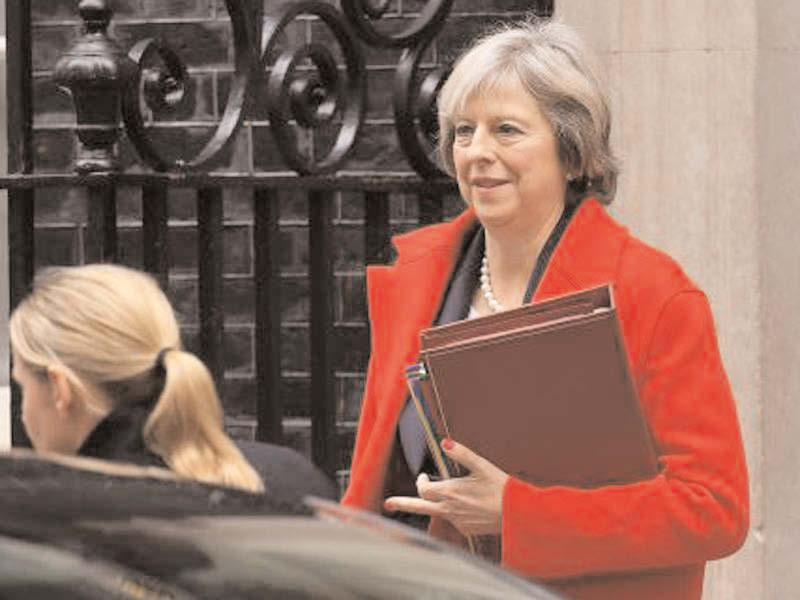
    LONDON (TIP): British Parliament overwhelmingly supported a Bill, February 9, empowering Prime Minister Theresa May to start crucial negotiations by March 31 on leaving the European Union, bringing Brexit a step closer. May said she would trigger formal divorce talks by March-end.

    The draft legislation of the European Union (Notification of Withdrawal) Bill was approved by 494 votes to 122 by the House of Commons after its final debate.

    The Bill allows Prime Minister May to invoke Article 50 of the Lisbon Treaty to begin a two-year period of negotiations for the UK’s new deal as a non-member of the European Union (EU) by 2019.

    Now that the Bill had passed the Commons, it will be debated in the House of Lords after it returns from recess on February 20, where it is expected to be given the final nod.

    Earlier, the Commons debated the last set of amendments to the Bill, including on key principles for the negotiation process, before the Bill went on to its third and final reading for the vote.

    Opposition Labour leader Jeremy Corbyn had instructed his MPs to vote in favor of the Bill whether any amendments are made or not. However, he faced a second round of rebellion after over 49 MPs had defied the whip at the last vote earlier this month.

    Some 52 Labour MPs rebelled in vote today, including Shadow business secretary Clive Lewis who resigned shortly beforehand. Shadow home secretary Diane Abbott, who missed last week’s initial vote on the Bill, backed it this time. She told the BBC she had “a lot of misgivings about the idea of a Tory Brexit” and predicted the UK would “come to regret it”, but added: “I’m a loyal member of the shadow cabinet and I’m loyal to Jeremy Corbyn.”

    May herself faced a rebellion of her MPs, but she managed to minimize the Tory rebellion by promising a Commons vote on Brexit before it is finalized.

    Britain sees no need for a second Scottish independence referendum and the devolved Scottish government should focus on improving the economy and tacking domestic issues rather than flirting with secession, Defence Secretary Michael Fallon said.

    An opinion poll published on Wednesday, February 8, showed support for Scottish independence rose after Prime Minister Theresa May proposed making a clean break with the European Union, stoking speculation that Scotland could demand another secession vote.


  • Ninth Circuit Denies Trump’s Travel Ban

    Ninth Circuit Denies Trump’s Travel Ban

    The US Court of Appeals for the Ninth Circuit unanimously (3-0) refused to reinstate President Trump’s Executive order on Muslim ban, put in place by Judge James Robart, federal judge in Seattle. The Ninth Circuit found that the two states, State of Washington and State of Minnesota, through their universities have a standing to sue. They established that their students, faculties and therefore their State Universities have suffered and will continue to suffer with this ban in place. The Court struck down the Government argument that the Government’s actions related to immigration and security are unreviewable. The Court said that it recognizes that the Government has a power in this area but the Court has a right to review any contravening constitutional principles and rights.

    The Court further rejected the Government’s separation of power argument saying that “Although our jurisprudence has long counseled deference to the political branches on matters of immigration and national security, neither the Supreme Court nor our Court has ever held that courts lack the authority to review executive action in those arenas for compliance with the Constitution. To the contrary, the Supreme Court has repeatedly and explicitly rejected the notion that the political branches have unreviewable authority over immigration or are not subject to the Constitution when policy making in that context“, quoting Zadvydas v. Davis, 533 U.S. 678, 695 (2001) (emphasizing that the power of the political branches over immigration “is subject to important constitutional limitations”);  Chadha, 462 U.S. at 940-41 (rejecting the argument that Congress has “unreviewable authority over the regulation of aliens,” and affirming that courts can review “whether Congress has chosen a constitutionally permissible means of implementing that power”).

    The Court has likewise made clear that “[a]lthough alienage classifications are closely connected to matters of foreign policy and national security,” Courts “can and do review foreign policy arguments that are offered to justify legislative or executive action when constitutional rights are at stake.”

    The Ninth Circuit Court states that while counseling deference to the national security determinations of the political branches, the Supreme Court states that the Government’s “authority and expertise in [such] matters do not automatically trump the Court’s own obligation to secure the protection that the Constitution grants to individuals,” even in times of war.

    The Ninth Circuit’s decision is guided by four questions: “(1) whether the stay applicant has made a strong showing that he is likely to succeed on the merits; (2) whether the applicant will be irreparably injured absent a stay; (3) whether issuance of the stay will substantially injure the other parties interested in the proceeding; and (4) where the public interest lies.”

    The Court found that the Government did not satisfy the burden of first two prongs.

    The Court could not find that the Government protected the States due process rights. In fact the Court states “The Government has not shown that the Executive Order provides what due process requires, such as notice and a hearing prior to restricting an individual’s ability to travel. Indeed, the Government does not contend that the Executive Order provides for such process. Rather, in addition to the arguments addressed in other parts of this opinion, the Government argues that most or all of the individuals affected by the Executive Order have no rights under the Due Process Clause.” The Court thus confirmed that the States have a due process rights too.

    What came back to bite President Trump are his previous statements about Muslims. The States maintain that the Executive Order violated the establishment and equal opportunity clauses as it disfavors the Muslims. The Court concludes by saying that “The States claims raise serious allegations and present significant constitutional questions. In light of the sensitive interests involved, the pace of the current emergency proceedings, and our conclusion that the Government has not met its burden of showing likelihood of success on appeal on its arguments with respect to the due process claim, we reserve consideration of these claims until the merits of this appeal have been fully briefed“. And considering the balance between hardship and public interest, declined to stay the District Court’s TRO.

    So at this time, the ban is lifted as the District Court’s Temporary Restraining Order allows the nationals of the seven countries to enter the country, while the case on the merits is pending.

    We are practicing Immigration Law at a time where immigration is part of our country’s focus. And we are witnessing the writing of Immigration history – to observe, comment and support the cause of immigrants.

    http://www.dallasobserver.com/news/they-were-told-they-would-have-to-go-back-immigration-order-sparks-chaos-protests-at-dfw-international-9132755

  • PREDICTED UPCOMING H-1B CHANGES (NOT LAW YET)

    PREDICTED UPCOMING H-1B CHANGES (NOT LAW YET)

    UNCONFIRMED AND UNSIGNED LEAKED PROPOSED EXECUTIVE ORDER ON H1B VISA & IMMIGRATION.

    President Trump has already signed several immigration-related executive orders. One unconfirmed and unsigned leaked proposed order, entitled “Executive Order on Protecting American Jobs and Workers by Strengthening the Integrity of Foreign Worker Visa Programs” includes a number of provisions related to the employment-based immigration system.

    None of these provisions is in effect. It is possible that this order will never be signed, or that it will be substantially modified prior to being signed. The order proposes the following:

    • “in consultation with the Secretaries of State and Labor … restore the integrity of employment-based nonimmigrant worker programs and better protect U.S. and foreign workers affected by those programs”
    • “consider ways to make the process for allocating H1B visas more efficient and ensure that beneficiaries of the program are the best and the brightest”
    • “… provide recommendations for making U.S. immigration policy better serve the national interest; and to recommend changes to the immigrations laws to move towards a merit-based system”

    • Secretary of Labor to issue a report on “… the actual or potential injury to U.S. workers caused … by work performed by nonimmigrant workers in the H1B, L-1, and B-1 visa categories.”

    • DHS to draft a regulation that would clarify the types of activities that are or are not permissible for B-1/B-2 visitors. More specifically, the order seeks to eliminate situations in which a B-1/B-2 is permitted to work while in the United States.

    • DHS to “review all regulations that allow foreign nationals to work in the United States, determine which of those regulations violate immigration laws or are otherwise not in the national interest and should be rescinded, and propose … a rule … to rescind or modify such regulations.” This may affect H-4 EAD program.

    • DHS to start work on a regulation that would “… reform practical training programs for foreign students to prevent the disadvantaging of U.S. students in the workforce, better protect U.S. and foreign workers affected by such programs, … and improve monitoring of foreign students.” This may affect OPT and CPT.

    • Department of State (DOS) and the DHS to “conform to Congressional intent … [in] determin[ing] when an immigrant visa is ‘immediately available.’” This may affect dual-chart visa bulletin system implement in October 2015, which, at times, allows for the filing of an adjustment of status application (form I-485) based on a ‘dates for filing’ chart.

    • DHS to propose regulatory reforms to the E-2 visa category. Details about the form and intent of any such reforms, however, remain unclear.

    • Immediate termination of parole programs that do not comply with the principles laid out in the memo, or that otherwise do not comport with immigration law.

    LEGISLATION PROPOSED BY U.S. REP. DARRELL ISSA (R-CALIFORNIA)

    On January 4, 2017, Congressman Darrell Issa (R-Calif.) today re-introduced the “Protect and Grow American Jobs Act,” in an effort to help stop the outsourcing of American jobs and to reform the nation’s high-skilled immigration program. The bill proposes to:

    • Raise salary requirement for H-1B visa positions to $100,000/year (up from $60,000/year currently); and
    • Require successful candidates to have a master’s degree from accredited institutions as determined by the Department of Homeland Security.

    The rules, if enacted, would apply only to US-based companies which have more than 50 employees and with more than 15% of that workforce comprising of H-1B visa workers.

    LEGISLATION PROPOSED BY U.S. REP. ZOE LOFGREN (D-CALIFORNIA)

    On January 4, 2017, U.S. Rep. Zoe Lofgren (D-Calif.) introduced “The High-Skilled Integrity and Fairness Act of 2017” to curtail abuse of the H-1B program.

    Among other reforms, the High-Skilled Integrity and Fairness Act of 2017 proposes:

    • Increases prevailing wage requirements to protect U.S. workers by replacing the current 4-level wage calculation with a new, more balanced, geographically based 3-level formula which eliminates the lowest wage level and puts upward pressure on the wages in the remaining levels.

    o Level 1 = mean of bottom 2/3 of wages surveyed
    o Level 2 = mean of all wages surveyed
    o Level 3 = mean of top 2/3 of wages surveyed

    • Prioritizes market-based allocation of H-1B visas as follows:
    1) Employers paying 200% of level 3 prevailing wage, then 150% of level 3
    2) Employers paying 200% of level 2 prevailing wage, then 150% of level 2
    3) Employers paying 200% of level 1 prevailing wage, them 150% of level 1

    • Removes the ‘per country’ cap for employment based immigrant visas so that all workers are treated more fairly and to move to a system where employers hire the most skilled workers without regard to national origin.

    • Raises the salary level at which H-1B dependent employer are exempt from attestation requirements to a new required wage level of 35 percentile points above the median national annual wage for Computer and Mathematical Occupations published by the Department of Labor Occupational Employment Statistics (roughly $132,000), which would be adjusted in the future without the need for new legislation, and eliminates the Master’s Degree exemption for dependent employers.

    • Sets aside 20% of the annually allocated H-1B visas for small and start-up employers (50 or fewer employers) to ensure small businesses have an opportunity to compete for high-skilled workers, while still protecting against outsourcing.

    • Removes visa hurdles for students and other temporary visa holders by building a bridge from F-1 student status to Lawful Permanent Residence.

    • Removes paperwork burdens by streamlining H-1B filing requirements and reducing administrative costs.

    • The legislation tightens employee protection by stipulating that employers may not reduce beneficiary wages, regardless of whether the deduction is in accordance with a voluntary authorization by the employee.

    • It makes exceptions for taxes, garnishments, and deductions that are reasonable and customary in the occupation.

    LEGISLATION PROPOSED BY SENATORS CHUCK GRASSLEY (R-IOWA) AND DICK DURBIN (D-ILLINOIS)

    On January 19, 2017, Senators Chuck Grassley and Dick Durbin, announced that they would reintroduce their bill for revamping the H-1B and L-1 visa programs. The bill was first introduced in 2007.

    • The bill will require U.S. Citizenship and Immigration Services to prioritize for the first time the annual allocation of H-1B visas. The new system would ensure that the best and brightest students being educated in the United States receive preference for an H-1B visa. The preference system also gives a leg up to advanced degree holders, those being paid a high wage, and those with valuable skills.

    • The bill would crack down on outsourcing companies that import large numbers of H-1B and L-1 workers. Specifically, the bill would prohibit companies with more than 50 employees, of which at least half are H-1B or L-1 holders, from hiring additional H-1B employees.

    • The bill also gives the Department of Labor enhanced authority to review, investigate, and audit employer compliance with program requirements, as well as to penalize fraudulent or abusive conduct. It requires the production of extensive statistical data about the H-1B and L-1 programs, including wage data, worker education levels, place of employment and gender.

    • The bill clarifies that working conditions of similarly employed American workers may not be adversely affected by the hiring of the H-1B worker, including H-1B workers who have been placed by another employer at the American worker’s worksite. In addition, it explicitly prohibits the replacement of American workers by H-1B or L-1 visa holders.

    • In addition, the bill includes several reforms of the L-1 visa program. These include establishment of a wage floor for L-1 workers; authority for the Department of Homeland Security to investigate, audit and enforce compliance with L-1 program requirements; assurance that intra-company transfers occur between legitimate branches of a company and don’t involve “shell” facilities; and a change to the definition of “specialized knowledge” to ensure that L-1 visas are reserved only for truly key personnel.

    LEGISLATION PROPOSED BY SENATOR SHERROD BROWN (D-OHIO)

    Senator Sherrod Brown also announced he would introduce an H-1B and L-1 Visa Reform Act in the Senate which would close loopholes in the H-1B and L-1 visa programs and provide increased protections for both American workers and visa holders. The bill would:

    • Require that employers first offer a vacant position to an equally or better qualified American worker before seeking an H-1B or L-1 visa holder.

    • Establish wage requirements for L-1 workers and improve H-1B wage requirements to encourage companies to hire qualified American workers and prevent them from using foreign workers as a source of cheap labour.

    • Under the H-1B and L-1 Visa Reform, the Department of Labor (DOL) and the Department of Homeland Security (DHS) would have additional oversight authority to investigate fraud and abuse as well as to increase penalties for companies that violate the bill’s requirements.

    • The bill also requires DOL and DHS to share information so that visa petitions are effectively scrutinized.

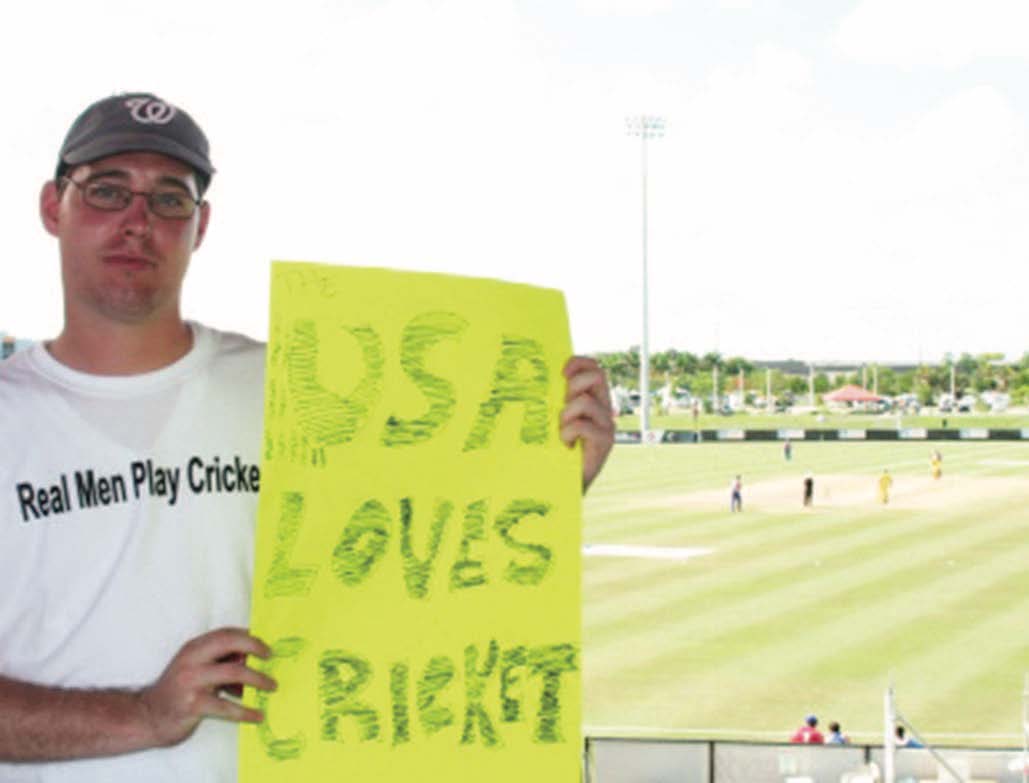
  • Cricket expands in USA with $2.4 Billion Infrastructure and 17,000 New Jobs

    Cricket expands in USA with $2.4 Billion Infrastructure and 17,000 New Jobs

    WASHINGTON (TIP): Global Sports Ventures, a sports development company, recently announced plans to build an estimated $2.4 Billion in infrastructure and business development to drive economic growth across eight states.

    This announcement comes on the heels of GSV’s recent $70 million licensing agreement of T20 rights from the United States of America Cricket Association (USACA). The T20 format is much shorter than the previously-existing form of cricket, and is closer to the time span of other popular team sports in the United States.

    GSV plans to professionalize cricket in the United States by creating a league that allows athletes to compete at the highest level while providing fans and audiences the ability to enjoy the game at GSV’s world-class facilities. This will be a strong foundation when the International Cricket Council (ICC) hosts any tournaments in line with its strategic framework for U.S.A. cricket, potentially hosting the ICC World Twenty20 in 2024.

    GSV is actively working with legislators to develop 26,000+/- seat stadiums in New York, New Jersey, Washington DC, Georgia, Florida, Texas, Illinois and California.

    Dennis Conaghan, the Executive Director of San Francisco Center for Economic Development added, “We are excited to welcome this opportunity that Global Sports Ventures have brought to us, as it will be a great addition to the professional sports network that we already have in San Francisco. It also reinforces our city’s reputation as not just the capital of innovation and technology, but as an exciting and diverse global hub for culture, arts and sport.”

    The cricket-centric, multi-purpose entertainment stadiums and lifestyle centers will create approximately 17,800 new jobs (1,500 construction and 725 permanent jobs per location) with opportunities in medical and rehab services; merchandising and procurement; media and broadcasting; tourism development; security; logistics and transportation; and, player, coaches and support staff.

    Each of these locations will cost an estimated $300 million and will generate approximately $8 billion in direct and indirect salaries over the next 20 years.

    “We are delighted to receive so much positive feedback and commitment from officials on a state level, and we’re dedicated to working with local communities and businesses to provide an estimated economic output upwards of$100 million per city,” said Jignesh (Jay) Pandya, Chairman of Global Sports Ventures.

  • Trump blasts Australian PM, hangs up on him

    Trump blasts Australian PM, hangs up on him

    WASHINGTON (TIP): US President Donald Trump said on Feb 2 that he’s having to make “tough phone calls” to stop countries taking advantage of the US after a diplomatic firestorm over the abrasive nature of his conversations with leaders of Australia and Mexico, and a public warning to Iran.

    “The world is in trouble, but we’re going to straighten it out, OK? That’s what I do -I fix things,” Trump told a National Prayer Breakfast meeting in Washington amid consternation in diplomatic circles over his style, temperament, approach to some religions, and his dissing of allies.

    On Thursday, Trump reopened an old adversarial front that had been pacified by the Obama administration -much to New Delhi’s advantage -with a stern warning to Tehran, saying “Iran has been formally PUT ON NOTICE for firing a ballistic missile” and it “should have been thankful for the terrible deal the US made with them!” Trump also repudiated a deal reached by the Obama administration with Australia to take in 1,250 refugees, saying he will re-examine it. The public disavowal of the agreement with one of Washington’s staunchest allies came amid reports that Trump had abruptly ended a phone conversation with Australia’s PM Malcolm Turnbull on Wednesday after accusing him of trying to ship off the “next Boston bombers” to the US. Trump reportedly told Turnbull that the conversation was “the worst call by far” he had taken that day, after the pleasant exchanges with Russian President Putin and three other world leaders.

    Trump himself confirmed the disagreement with Australia by tweeting “Do you believe it? The Obama Administration agreed to take thousands of illegal immigrants from Australia. Why? I will study this dumb deal!” Diplomats pointed out that the agreement involved around 1,200 refugees, not “thousands of illegal immigrants”, many of them persecuted minorities from Iran and Iraq.Many of them were shocked by the long-term implications of the Trump style. “#Australia may be the single most effective+loyal ally of the US. This is no way to treat a true friend,” said Bush-era diplomat Nicholas Burns.

    Trump is also reported to have threatened to send US troops to Mexico, according to leaked White House transcripts quoted by AP.

    “You have a bunch of bad hombres down there. You aren’t doing enough to stop them. I think your military is scared. Our military isn’t, so I just might send them down to take care of it,” Trump told Mexican President Enrique Pena Nieto. Some accounts characterised Trump’s tone as jocular, even as Mexico denied Trump made any such threat.

  • Hindu American Foundation expresses concern over Legality & Implementation of Immigration Executive Order

    Hindu American Foundation expresses concern over Legality & Implementation of Immigration Executive Order

    The Hindu American Foundation (HAF) expressed concern over the practical and legal implications of the recent executive order affecting immigration policy and its detrimental impact on refugees and legal immigrants.

    HAF’s legal team stated that while the Foundation understood the Trump Administration’s desire for diligent and extensive vetting of people entering the US from the nations that the Obama Administration identified as being potential sources of terrorist threats, even a temporary ban on the entry of all refugees, as well as those individuals already holding valid immigrant or nonimmigrant visas from these seven Middle Eastern and North African countries risked harm to innocent people.

    The Foundation found equally troubling reports that relevant agencies were not consulted nor provided notice by the Administration. That in the earliest hours, valid green card holders were detained indicated a disregard for how the order would actually be implemented by immigration officials, HAF staff attorneys asserted. HAF Executive Director, Suhag Shukla, Esq. noted that whether the Administration ultimately pushes to construct a new system or better enforce current regulations to vet refugees and visa applicants, implementing any sort of religious preference for admittance would be fundamentally unconstitutional and any permanent blanket ban based on national origin would be illegal.

    “Though the wording of the executive order does not express a preference for adherents of one religion,” said HAF Senior Director Samir Kalra, Esq., “President Trump’s statements immediately after signing, in which he emphasized that Christian refugees would carry priority, does elicit serious concerns.” Kalra also echoed the condemnations of several Christian leaders and organizations regarding the religious test implicit in the executive order.

    “From Yazidis in Iraq to the Ahmadiyyas in Syria,” Kalra further noted, “diverse populations and communities in several countries are in grave danger today.” The Foundation reports annually on Hindus and other minorities who face catastrophic risks in Pakistan, Bangladesh, Bhutan, Afghanistan, and many other countries.

    HAF’s staff lawyers also expressed concern that the issuance of these broadly worded executive orders risked unforeseen human rights consequences, as well as the potential of destabilizing established productive relationships with other nations.

    Both Shukla and Kalra voiced agreement with a joint statement released by senior Republican Senators John McCain and Lindsey Graham emphasizing that the executive order risked becoming a “self-inflicted wound in the fight against terrorism.” Going forward, HAF stressed that it would continue to work constructively with policymakers on both sides of the aisle in the spirit of strengthening America’s pluralistic society. They also would work with interfaith and civil society advocates to ensure that the rights of all Americans are protected, Kalra emphasized.

  • IAPC Atlanta Chapter Celebrates Republic Day

    IAPC Atlanta Chapter Celebrates Republic Day

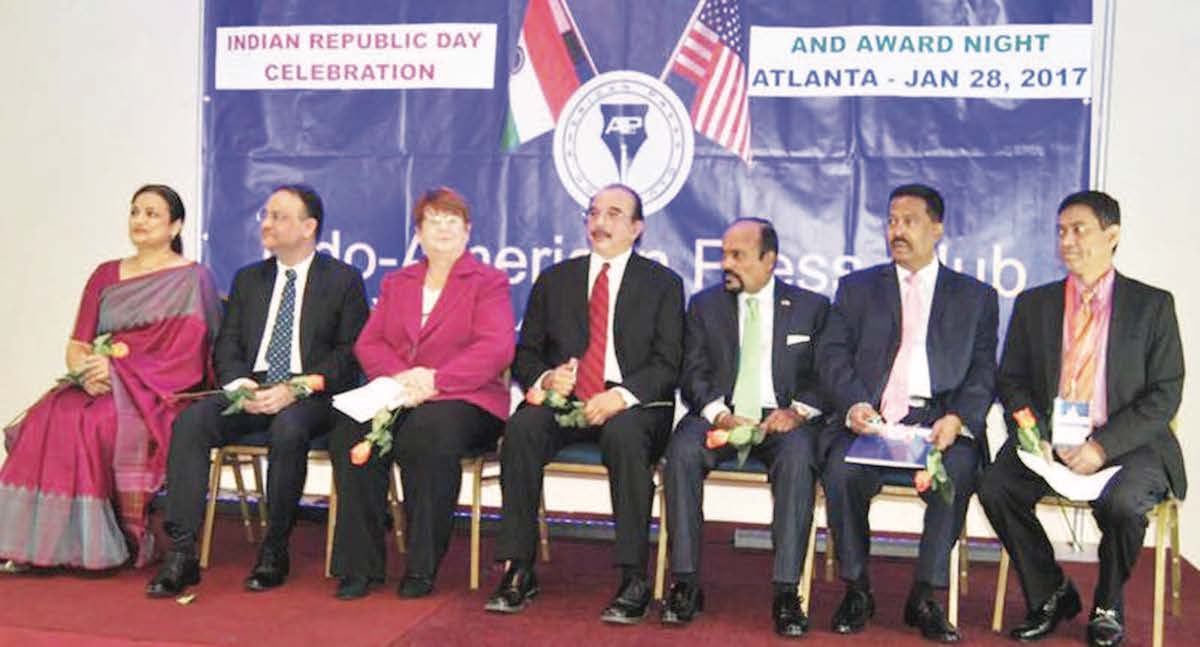
    The Indo American Press Club (IAPC) celebrated India’s 68th Republic Day as it formally launched its Atlanta chapter on January 28 at the Global Mall.

    The event brought together top community leaders of different faiths, and ethnic groups on a single platform as Indians to celebrate the Republic Day.

    “We normally have gatherings in our religious or language based groups. But this was on a wider and higher level platform, where we symbolically expressed our unity in diversity as sons and daughters of the great Nation of Bharat,” said Mustafa Ajmeri, social activist who was one of the honorees at the event.

    Nagesh Singh, Consul General of India in Atlanta, was the Chief Guest. Charlotte Nash, chair of Commissioners of Gwinnet County, was the Guest of Honor.

    After the Presidential address by Dominic Chackonal, IAPC President of Atlanta Chapter, prominent Indian Americans which included   Antony Thaliath, Executive Director Gandhi Foundation USA, Narender Reddy, Political Activist and Community leader, and Veena Rao, Editor of NRI Pulse newspaper spoke on the occasion.

    Honoring and recognizing prominent Indo Americans in different fields was appreciated by one and all. Life Achievement award was given to Dr. Sujatha Reddy. Humanitarian Award went to Dr. Jay Sampath. Businessman of the year was Satwant Singh, CEO of Doaba Consulting. Entrepreneur Award was bagged by Joy PI, CEO of Joy TV. Award of Honor was given to social activists Mustafa Ajmeri and Sabu Chemmalakuzhy. Media Excellence Award went to Parthiv N Parekh of Khabar Magazine.

    Winner of Photography contest was Siby Karikkampally and Essay writing competitionwinner was Joshua Mathew.

    A book written by poet Subini Lawrence was released on the occasion. The paintings by the famous artist Vinod Sharma added color to the event.

    IAPC is New York based with several chapters in USA and Canada.

    (Based on a Press Release)

  • KANGANA RANAUT OPENS UP ON HER HOLLYWOOD PLANS

    KANGANA RANAUT OPENS UP ON HER HOLLYWOOD PLANS

    At a time when a number of Bollywood stars like Priyanka Chopra, Deepika Padukone and Sonam Kapoor have packed their bags and headed to Hollywood for film projects, one can only wonder if feisty star Kangana Ranaut also has similar plans in mind.

    In a recent interview with a daily, the actress put forth her views about Hollywood endeavours. Kangana deemed it “stupid” to head to the West at a time when their theatre business is crashing. In her opinion, entertainment in Asia is on a strong ground – much like what Hollywood was about 15 years ago. Stating that it is a good time for movies in Bollywood, the ‘Rangoon’ star made it clear that she won’t “fall prey” to the Hollywood bait. Kangana also added that she won’t offer herself “on a platter to another industry”.

  • ILEANA D’CRUZ REVEALS ‘TRAUMATIC’ EVE-TEASING EXPERIENCE

    ILEANA D’CRUZ REVEALS ‘TRAUMATIC’ EVE-TEASING EXPERIENCE

    In a shocking revelation by actress Ileana D’Cruz, she admitted to have been eve-teased and harassed, describing the experience as ‘traumatic’.

    Sharing the link of an post that read, “I’m Leaking My Ex’s Dirty Messages and Voice Notes Because He’s Left Me No Choice”, she tweeted, “Absolutely despicable piece of c**p! So proud of this girl who exposed this s***e!Whoever you are lady mad respect”.

    Ileana then used the micro-blogging site to talk about her experience. “I’ve been a victim of eve-teasing and harassment and it’s traumatic. I’m lucky I have beautiful parents who gave me strength when I needed it,” she posted. Many actors and tinsel town crowd has come out in the open and have shared their experiences of abuse.

    Filmmaker Anurag Kashyap had also shared the same article which is about an anonymous girl troubled by her former boyfriend.

  • Going brunette for ‘A Walk To Remember’ changed Mandy Moore

    Going brunette for ‘A Walk To Remember’ changed Mandy Moore

    Actress Mandy Moore has said that colouring her hair brown for her film ‘A Walk to Remember’ changed her life forever.

    The 32-year-old actress revealed that she did not go back to being blonde after the film as this transformation came at a time when she was viewed just as a pop singer.

    “There was a real significance to colouring my hair. As silly as it sounds, there was a real significance in the way that people saw me, but also in the way that I carried myself and that I saw myself,” said ‘This Is Us’ star.

    Co-star Shane West added, “I remember that Mandy was very nervous about dying her hair. It’s amazing how it really changed her life.” ‘A Walk to Remember’ is celebrating its 15th anniversary this year.

  • EMMA STONE SCOOPS BEST ACTRESS FOR ‘LA LA LAND’

    EMMA STONE SCOOPS BEST ACTRESS FOR ‘LA LA LAND’

    Just a couple of weeks after her big Golden Globes win, ‘La La Land’s leading lady Emma Stone has won another award at the 2017 SAG Awards. Emma was able to walk away with Outstanding Performance by a Female Actor in a Leading Role.

    The 28-year-old, who plays a struggling but savvy actress in the musical comedy, fought off competition from Amy Adams for ‘Arrival’, Emily Blunt for ‘The Girl on the Train’, Natalie Portman for ‘Jackie’ and Meryl Streep for ‘Florence Foster Jenkins’.

    As she collected the award, Stone told the fellow actresses in the audience, “You are the greatest and your talent and intelligence are mind-blowing.”

    After thanking her writer-director Damien Chazelle and co-star Ryan Gosling (“Ryan, you’re the best, that’s just the truth, no one can argue with that”), Stone praised the room’s artists and filmmakers for creating work that is reflecting society and sharing joy.

    “We’re in a really tricky time in the world and in our country, and things are very inexcusable and need action,” she said. “I’m honored to be part of a community that wants to reflect things back to society.”

    The awards are being handed out at the Shrine Exposition Center in Los Angeles.

  • Balancing motherhood and marriage is tough: Salma Hayek

    Balancing motherhood and marriage is tough: Salma Hayek

    Actress Salma Hayek has said that managing motherhood and career is not much of a task for her as compared to balancing motherhood and marriage. The 50-year-old actress said that sometimes her husband, French businessman Francois-Henri Pinault tends to be a little overwhelming.

    “Sometimes the hardest things to balance is motherhood with marriage. They (husbands) take over, oh my God, they take over everything,” said Hayek.

    When asked how she strikes the balance, the mother to ten-year-old Valentina revealed that the trick was to make sure she spends as much time as possible with her family.

    “When it comes to my career, what I do is I only do roles that are shot in a way that I’m never more than two weeks away from my family,” Hayek added.

  • I WAS MOLESTED AT 7 AND RAPED AT 14, SAYS ASHLEY JUDD

    I WAS MOLESTED AT 7 AND RAPED AT 14, SAYS ASHLEY JUDD

    Hollywood actor Ashley Judd who is in the Capital, as a part of the World Congress Against Sexual Exploitation of Women and Girls initiative, spoke at length about gender discrimination, and said that she too has been a victim of sexual harassment.

    “I was molested when I was 7 years old. I was raped at 14, and then I was raped in 1998. It’s a miracle that I wasn’t trafficked,” she said. The 48-year-old has been in India for the last one week as a part of the initiative. At the press conference, the actor sported mehendi on her right palm, and greeted everyone with a Namaste. At the end of her five-minute speech, she spoke in Hindi and urged everyone to rise against sexual exploitation, and decriminalising of prostituted women and girls. “Ab samjhauta nahi,” she said.

    Hollywood has often been accused of discriminating against women. Ashley shared, “ There is a big pay gap in Hollywood, because of gender discrimination, and my life time earnings are 40 % less than what I should have earned, had there been pay equality in the industry.” Source: HT

  • Former UK PM Cameron tried to have paper editor sacked over EU stance: BBC

    Former UK PM Cameron tried to have paper editor sacked over EU stance: BBC

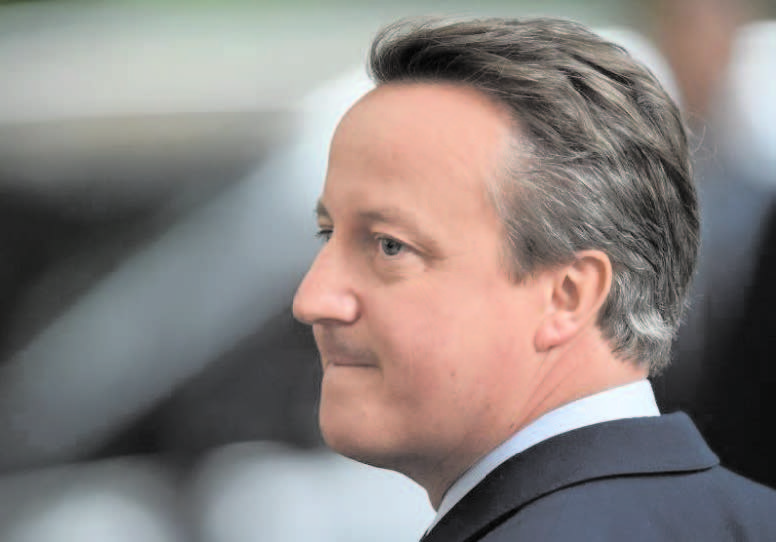
    LONDON (TIP): Former British Prime Minister David Cameron attempted to have the editor of a national newspaper that strongly supported Brexit sacked during last year’s European Union referendum campaign, the BBC has reported.

    Cameron, who led the campaign for Britain to stay in the EU, met the owner of the Daily Mail tabloid, the country’s second-biggest selling paper with the largest online audience, to urge him to either rein in or sack its editor Paul Dacre, according to the report by BBC TV’s “Newsnight” programme.

    A spokesman for Cameron told the BBC he denied the report and had merely sought to persuade them of his pro-EU case.

    The Mail, which Dacre has edited for 25 years, has long been a fierce critic of the EU and, like the majority of Britain’s national newspapers, was an outspoken supporter of the campaign to leave the bloc.

    Britons voted by 52-48 per cent for Brexit on June 23 last year, prompting Cameron to resign the next day.

    According to the BBC report, Cameron tried to persuade Dacre to “cut him some slack” in a private meeting last February on the day European Council President Donald Tusk unveiled a deal the bloc had agreed with Britain which Cameron hoped would secure victory in the referendum.

    The next day the Mail, which sells about 1.5 papers a day and attracts 14 million global users to its website daily, accused Cameron of “delusion and selling the country short”.

    Then in March, the BBC said Dacre learned that the then-prime minister had tried to press Jonathan Harmsworth, known as Lord Rothermere, to sack him leaving him “incandescent” and vowing to step up his anti-EU campaign.

    Cameron’s relationship with the Mail’s editor had deteriorated after he ordered a public inquiry in 2011 headed by a judge Brian Leveson to examine media ethics in the wake of a phone-hacking scandal at one of Rupert Murdoch’s newspapers, the BBC reported.

    The Leveson inquiry revealed the cosy ties between politicians and editors, although both sides insisted neither was unduly influenced by the other.

    “It is wrong to suggest that David Cameron believed he could determine who edits the Daily Mail,” his spokesman told the BBC, adding Cameron had privately made his case to Dacre and Rothermere for them not to back Brexit. A spokesman for Rothermere declined to confirm or deny the BBC report, but said the Mail’s proprietor had been “leant on by more than one prime minister” to remove editors over the years.

    Dacre also declined to comment, saying he had been free to edit the paper without any interference from Rothermere.

  • Philippine ministry asks Rodrigo Duterte to clarify military’s role in drug war

    Philippine ministry asks Rodrigo Duterte to clarify military’s role in drug war

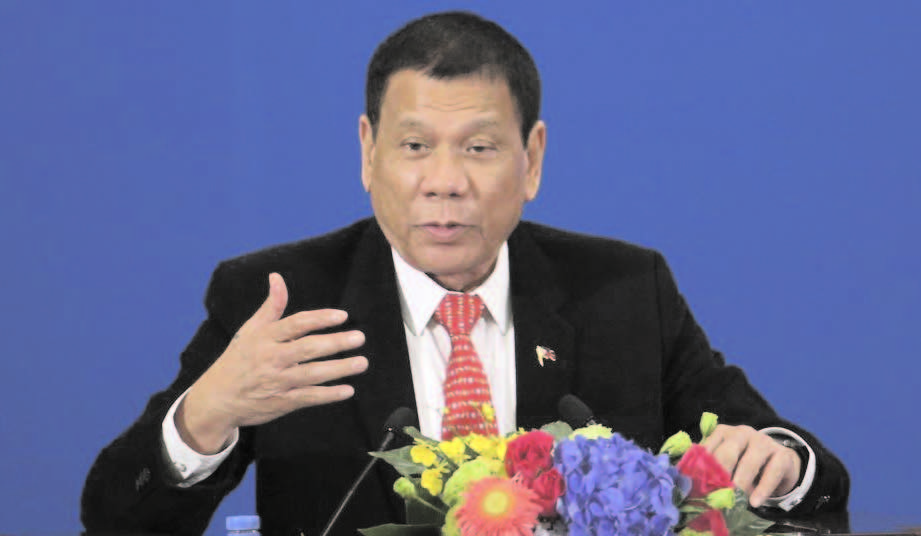
    MANILA (TIP): The Philippine defence ministry on Feb 1 asked President Rodrigo Duterte to issue an order for the military to play a role in his war on drugs, including granting troops powers to arrest “scalawag” police.

    The ministry asked Duterte to formalise remarks he made in a speech to army generals on Tuesday, when he said he needed their help in his drugs war, and to detain members of a police force he described as “corrupt to the core”. The ministry asked for “an official order regarding this presidential directive to serve as a legal basis for our troops to follow”.

    “By the same token, the president’s verbal directive to arrest ‘scalawag cops’ should also be covered by a formal order,” the ministry said in a statement.

    Duterte’s police chief ordered the Philippine National Police (PNP) on Monday to suspend their anti-drugs operations after the killing of a South Korean businessman by rogue drug-squad police. Duterte is infuriated and embarrassed by the incident, which he said had “international implications”.

    His suggestion that the military should fill the void left by police marks a stunning change of tack by the former city mayor, who had steadfastly backed the police amid allegations from human rights groups and some lawmakers they were operating with impunity.

    It was not clear why the ministry made public its request to Duterte. Any grant of powers of arrest to the Armed Forces of the Philippines (AFP) would require an executive order, or a declaration of martial law.

  • China tests missile with 10 nuclear warheads: Report

    China tests missile with 10 nuclear warheads: Report

    BEIJING (TIP): China has reportedly tested a new version of a missile that can carry up to 10 nuclear warheads, signalling a major shift in its nuclear capability as Beijing gears up for a possible military showdown with the US under Trump Presidency.

    The flight test of the DF-5C missile was carried out last month using 10 multiple independently targetable reentry vehicles, or MIRVs, the Washington Free Beacon reported.

    The test of the inert warheads was monitored closely by US intelligence agencies, said two officials familiar with reports of the missile test.

    The Dongfeng-5C missile, carrying 10 dummy warheads, was launched from the Taiyuan Space Launch Centre in Shanxi province, and flew to a desert in western China, the report said.

    The missile is a new variant of the DF-5, an intercontinental ballistic missile that first went into service in the early 1980’s.

    “The [Defence Department] routinely monitors Chinese military developments and accounts for PLA capabilities in our defence plans,” Pentagon spokesman Commander Gary Ross was quoted as saying by the report.

    For decades, the US has put the estimated number of warheads in China’s nuclear arsenal at about 250.

    But the report suggested that the latest test with 10 warheads meant the actual number could be larger.

    China also began adding warheads to older DF-5 missiles in February last year, according to US intelligence agencies.

    US defence officials have previously warned that China’s rapid development of long-range ballistic missiles, coupled with a lack of transparency about its nuclear capabilities, could bring uncertainty to stability in the region.

    The timing of the test coincided with the election of Donald Trump as US President who signalled a tougher stance against China over a range of issues, from the trade deficit to Beijing’s military build-up in the disputed South China Sea.

    Chinese military expert from an institute affiliated with the People’s Liberation Army+ , (PLA) said a new test would not have been aimed at Trump. (PTI)