Month: January 2018

  • National Mentoring Month Celebrated: 5,000 Additional High School Students Participated in Mentorship Programs

    National Mentoring Month Celebrated: 5,000 Additional High School Students Participated in Mentorship Programs

    City agencies, mentoring nonprofits, public schools, and the business community engaged 10,000 New Yorkers as volunteer mentors to 25,000 high school students

    NEW YORK (TIP): To celebrate national mentoring month, Chief Service Officer Paula Gavin and Schools Chancellor Carmen Farina announced, January 25, that 25,000 high school students and 10,000 mentors participated in programs associated with the NYC Youth Mentoring Initiative. Launched in January 2017, this initiative brings together individuals from city agencies, mentoring nonprofits and businesses to mentor high school students. In 2017, the local business community recruited nearly 6,000 of their employees as volunteer mentors through NYC Service’s Good for Me. Good for My City. campaign. Student participation increased 25 percent since the start of the initiative. This announcement puts the program on track to reach its goal of engaging 14,000 mentors and 40,000 students by 2022.

    “Connecting young people to caring adults is key to ensuring students in our city have every chance for success,” said Mayor de Blasio. “I want to thank the thousands of New Yorkers who answered the call to be a high school student’s personal champion over the last year.”

    “One year ago, our City came together to ensure more New Yorkers see the value in mentoring and take action, enabling more high school students to have a mentorship experience,” said NYC Chief Service Officer Paula Gavin. “Today we celebrate the work of our partners and recommit ourselves to our City’s high school youth through quality mentoring experiences. NYC Service is proud to continue collaborating with our partner agencies, mentoring nonprofits, and the Good for Me. Good for My City. partners to inspire more New Yorkers to mentor young people. I encourage every New Yorker to explore all the mentoring opportunities at nyc.gov/mentornyc and personally experience the joy of inspiring someone else, while at the same time, allowing them to inspire you.”

    “As the first in my family to go to college, I know it’s not a given that our students envision themselves going to college or pursuing certain careers. Strong mentoring is one way that we open students’ eyes to the options available to them and put them on the path to success,” said Schools Chancellor Carmen Farina. “I look forward to our continued partnership with NYC Service as we strengthen and expand mentoring programs for New York City high school students.”

    Mentors will continue to be recruited through citywide promotion of volunteer opportunities through colleges and universities, associations, faith-based organizations, and businesses. Increased mentee participation will be driven by the establishment of mentorship programs in 400 high schools, expanding embedded mentoring programs in DYCD workforce development programs, and expanding community-based organization programs at CBO centers.

    “The power of mentoring is profound, and DYCD is proud to be part of ongoing efforts to increase the number of mentors and mentees citywide,” said DYCD Commissioner Bill Chong. “Students in DYCD’s funded workforce development programs are being connected with responsible, caring adults—providing them with academic, career, and general life guidance as they grow into New York City’s next generation of leaders.”

    “The support of caring adults who can give good advice about challenges at school or home and help youth think about future plans can make all the difference in getting and keeping young New Yorkers on track for success in education and ultimately the world of work,” said David Fischer, Executive Director of the NYC Center for Youth Employment. “We are grateful for all our partners in this vital work and look forward to further expanding the reach of mentorship in our City.”

    “Mentorship benefits both the mentor and the mentee, opening the doors of possibility for our youth and building bonds between generations,” said NYS Senator Jesse Hamilton. “That’s why I join in celebrating this announcement that 10,000 mentors engaged with 25,000 mentees, putting our City on track to meet the ambitious 2022 goal of serving 40,000 high school students. Congratulations to all the partners and participants in making the NYC Youth Mentoring Initiative such an outstanding success.”

    “The NYC Youth Mentoring Initiative helps our public school students thrive,” said Daniel Dromm, Chair of the Committee on Finance. “Mentorship is an invaluable asset for all young people.  It helps them develop healthy habits that will lead to academic and professional success.  I applaud the Mayor for engaging our city’s business community in this productive manner and for prioritizing this important effort.  I am proud to support this program.”

    “The mentor-mentee relationship can be a powerful resource for a young person,” said NYC Council Member Mark Treyger, Chair of the Committee on Education. “As a former educator, I believe strongly that students can benefit greatly when they learn from the experiences of accomplished mentors. I applaud Mayor de Blasio and all those who have already volunteered as mentors for working to put more of our city’s students on a path toward a brighter future. I encourage more New Yorkers to see for themselves just how rewarding a mentor-mentee relationship can be.”

    “People with successful careers often credit the presence of a mentor during their younger years, and having worked with at-risk high school students for much of my career, I know firsthand how transformational this can be,” said NYC Council Member Debi Rose, Chair of the Committee on Youth Services. “Our young people can learn a lot from the experiences of people who have walked similar paths before them. I encourage all New Yorkers looking to inspire the next generation to check out the city’s mentoring opportunities online. A small amount of time can be a great investment in the future of your young people—and our city.”

    “Our students are the wave of the future and mentoring our youth through this initiative puts them on the path to successful careers,” said NYC Council Member Paul A. Vallone, Chair of the Committee on Economic Development.

    “Providing youth mentors who can serve as positive role models is crucial to the growth and maturation of our young people,” said NYC Council Member Mathieu Eugene. “I want to commend the leadership of the NYC Mentoring Coalition for their efforts to empower our young men and women, and I want to thank the 10,000 New Yorkers who have volunteered their time to making a difference in the community. The success of the Youth Mentoring Initiative will have a profound impact on lives of the students and their families, and it is a wonderful example of what is possible when we commit resources to supporting the next generation of leaders.”

    “There’s nothing more powerful than providing our youth with the knowledge they need to make progress toward their goals and pave their own success,” said AlphaSights Co-founder Max Cartellieri. “Our associates were impressed with the energy and drive the students brought to the table; we hope the values and stories we shared built upon those traits and empowered them to dream bigger.”

    “Since our founding in 1850, we at American Express have devoted ourselves to serving the communities in which we live and work,” said Timothy J. McClimon, President of the American Express Foundation. “We are proud to partner on the Good for Me. Good for My City. campaign in its second year and look forward to further serving the youth of New York City through the power of mentorship.”

    “Barclays is honored to partner with NYC Service on the city’s Good for Me. Good for My City. campaign,” said Deborah Goldfarb, Managing Director of Citizenship at Barclays. “Barclays has a strong history of volunteerism, and our colleagues care deeply about making a positive impact on the communities in which we live and work.”

    “When we joined Good for Me. Good for My City. as a campaign partner last year, we hoped it would provide an opportunity for our workforce to engage in meaningful mentorship and volunteer opportunities while providing a useful service to our community,” said Katie Kinney, Head of Corporate Social Responsibility, Brookfield Properties. “The program has far exceeded our expectations, and we are thrilled to continue to play a role in its success going forward.”

    “By joining the Mayor’s Good for Me. Good for My City. campaign, our company reaffirms its 233-year-old commitment to the City of New York,” said Daisey Holmes, President of the BNY Mellon Foundation. “We look forward to deepening our partnerships with NYC Service and the Department of Education to empower the city’s youth to become its future leaders.”

    “Hundreds of Citi employees across the five boroughs dedicated their time and talents last year as mentors and role models to support the next generation of business, civic and cultural leaders in our city,” said Brandee McHale, Director of Corporate Citizenship at Citi. “We have seen firsthand how these mentorship relationships can create onramps to educational and employment opportunities for youth and impact the volunteers themselves. We look forward to continuing this work with Mayor de Blasio and the Good for Me. Good for My City. campaign in 2018.”

    “The women and men of Con Edison are thrilled to help mentor students all across our great city,” said Frances A. Resheske, Senior Vice President of Corporate Affairs for Con Edison.  “By sharing their own work experiences, employees can help young adults focus on their skills and interests, and guide them toward productive careers.”

    “Credit Suisse is proud to be a part of the Good for Me. Good for My City. campaign and we are excited to partner with the Mayor’s Office on this important initiative for high school students across our city,” said Eric Williams, Corporate Engagement Manager for Corporate Citizenship at Credit Suisse. “Volunteering is an important part of our culture, and we understand the value and impact a mentor can have in a young person’s life.”

    “We are proud to continue this partnership with NYC Service and other businesses to promote and support employee engagement through volunteerism,” said Alessandra DiGiusto, Head of Corporate Social Responsibility, Americas at Deutsche Bank. “Deutsche Bank’s corporate social responsibility commitment includes a focus on youth. This partnership provides an excellent opportunity for employees to mentor New York City high school students to help them realize their full potential.”

    “Community service is a vital part of agency culture here at DigitasLBi,” said Clint Simpson, Managing Director, New York & Atlanta, DigitasLBi. “We’re proud to partner again this year with the Mayor’s Office and the Good for Me. Good for My City campaign to mentor New York City high school students and help them succeed.”

    “We are excited to once again be a part of the Good For Me. Good for My City. program,” said Mark Besca, New York City Office Managing Partner of Ernst & Young LLP (EY). “EY is proud to continue our support of engaging more organizations to help strengthen our communities through active participation and volunteerism

    “HBO Corporate Social Responsibility is excited to further our partnership with NYC Service as part of the city’s Good for Me. Good for My City. campaign,” said Dennis Williams, Senior Vice President, Corporate Social Responsibility, HBO. “Through this initiative, HBO continues to strengthen its relationships with NYC communities as well as allow HBO employees to make an impact through their commitment to volunteering and mentoring opportunities.”

    “Youth and education are two core pillars for JetBlue For Good, our platform for social impact and corporate responsibility. These areas are important to our nearly 22,000 crewmembers, our communities and our industry,” said Icema Gibbs, Director of Corporate Social Responsibility at JetBlue. “During and after Mentoring Month, it is vital for the public and private sectors to work together to help students achieve and impact systemic change.”

    “Macy’s is committed to making a difference in the lives of New York City high school students by providing professional advice to strengthen their life and educational skills,” said Tara Troy, Sr. Manager, Employee Giving and Volunteerism, Macy’s Inc. “We hope to make their lives shine brighter by navigating them through the college application process and setting them up for a successful future.”

    “Professional mentors are often the missing piece of the puzzle when it comes to success for first-generation youth. These mentors are able to motivate them and build their confidence and skills leveraging their own experiences and professional insights,” said Erin Shakespeare, Americas Head, Macquarie Group Foundation. “The time that our staff takes to support these young people is an investment in the future. The knowledge that these mentees gain gives them the courage to persist through college and obtain meaningful careers.”

    “Every day, our employees are making a difference in communities across the world – supporting local projects and addressing global challenges,” said Susan Warner, Senior Vice President, Internal Communications, Mastercard. “Our participation in the NYC Youth Mentoring Initiative  is the latest way we’re partnering with the public and private sector to make a difference and help students find the spark to start something priceless.”

    “As a global company we have seen the power of mentoring to change a workplace,” said Lesley Palmer, Managing Director and Head of Community Relations at Mizuho Americas. “We are excited to be part of this important mentorship initiative that is working to change the lives of many New York City youth.”

    “Moody’s is proud to participate in NYC Service’s Good for Me. Good for My City. campaign to expand youth mentoring opportunities,” said Arlene Isaacs-Lowe, Global Head, Corporate Social Responsibility at Moody’s. “Through our ongoing work with the Girls Who Code and Big Brothers Big Sisters programs, we’ve seen the impact mentoring can have in helping young people unlock their potential, enhancing our communities.”

    “At Morgan Stanley our employees are committed to giving back to the communities where we live and work,” said Joan Steinberg, Global Head of Philanthropy, Morgan Stanley. “We are proud to join forces once again with the city and the Good for Me. Good for My City. partners to have a real impact in New York City through mentoring.”

    “MUFG is always honored to participate in the New York City mentoring program,” said Yuka Nakamura, Vice President of Corporate Social Responsibility for the Americas, MUFG. “We are also incredibly proud of our colleagues who enthusiastically commit their time to counsel students from some of New York’s most challenged high schools.”

    “We are proud to extend our partnership with NYC Service as a charter member of the Good for Me. Good for My City. campaign,” said New York City Football Club President Jon Patricof. “We know that soccer is a force for good. Through our numerous staff and mentoring programs, we will continue to use our soccer expertise to empower the young people of New York.”

    “Every company today must prioritize social good. Tapping into the power and talent of employees and providing them with opportunities to mentor is an outstanding way to make a positive impact,” said Sara Link, Head of Oath for Good and President, Oath Foundation. “Oath is proud to join the Good for Me. Good for My City. campaign and connect NYC high school students with mentors to unleash their full potential.”

    “At RSM we take a special approach to giving back to the communities where we work and live.  We are delighted to leverage our ties to the New York City community by being a Good for Me. Good for My City. campaign partner,” said Stuart Taub, RSM New York Market Managing Partner.  “Our employees take great pride in volunteering their time to inspire today’s youth, and we are thrilled by their enthusiasm when representing our firm.”

    “SL Green is a proud partner in the Good for Me. Good for My City. campaign to promote high school mentorship and volunteering engagement,” said Marc Holliday, Chief Executive Officer of SL Green. “As New York City’s largest commercial landlord, we are excited to share our knowledge and management expertise to inspire the City’s future workforce.”

    “UBS is excited to partner with the Good for Me. Good for My City. campaign,” said Jamie Sears, Head of Community Affairs & Corporate Responsibility Americas at UBS. “Increasing college and career success for all students is a key focus of UBS’s philanthropic efforts in New York City and across the country, and mentorship plays a key role in that. We are proud to support this initiative and have our employees provide students with the guidance they need to pursue their ambitions and unlock their full potential.”

    “Viacom and its employees are committed to nurturing the potential of our youth by creating partnerships that benefit those eager to gain real-world experience and exposure to the entertainment industry,” said Alexandra Tuck, Vice President, Corporate Responsibility, Viacom. “We’re especially excited to work with the Good for Me. Good for My City. campaign to engage New York’s students through mentorship and empower them to advance their aspirations.”

    Thirty four businesses have already committed to the Good for Me. Good for My City. campaign in 2018, collectively pledging to recruit nearly 7,000 employees as high school mentors.

    About NYC Service

    NYC Service, a division of the Office of the Mayor, promotes volunteerism, engages New Yorkers in service, builds volunteer capacity, and mobilizes the power of volunteers and national service members to impact New York City’s greatest needs. To learn more about NYC Service and connect to mentoring opportunities across New York City, visit nyc.gov/mentornyc.


  • Can India and the Global Indians Contribute to the Scientific and Technology Revolution?

    Can India and the Global Indians Contribute to the Scientific and Technology Revolution?

    By Ven Parameswaran
    The only way the U.S. can expand its lead in Science and Technology is by working together with the scientists in India.     According to a recent report in the Times of India, India is all set to produce the world’s largest number of engineers.  While 85% Indian men have shown interest in engineering, the number stands at a close 79% among women in India, says the author. 


    “Science & Engineering Indicators”, a voluminous document, describing the state of American technology was just released by the National Science Foundation and National Science Board.  This contains facts and figures on research and development, innovation and engineers.   But the report’s startling conclusion lies elsewhere:   China has become—or is on the verge of becoming—a scientific and technological superpower.

    After all, science and technology constitute the knowledge base for economically advanced societies and military powers, and China aspires to become the world leader in both.  Still, the actual numbers are breathtaking for the speed with which they have been realized.

    25 years ago, China’s economy was tiny, and its high-tech sector barely existed.  Since then, here is what has happened.

    China has become the second largest R&D spender, accounting for 21 per cent of the world total of nearly $2 trillion in 2015.  Only the U.S., at 26% ranks higher, but if present growth rates continue, China will soon become the biggest spender.  From 2000 to 2015, Chinese R&D outlays grew an average of 18% annually, more than 4 times faster than the U.S. rate of 4%.

    There has been an explosion of papers on technology by Chinese teams.  Although the U.S. and the EU each produce more studies on biomedical subjects, China leads in engineering studies.  American papers tend to be cited more often than the Chinese papers, suggesting that they involve more fundamental research questions, but China is catching up.

    China has dramatically expanded its technology workforce.  From 2000 to 2014, the annual number of bachelor’s degree graduates went from about 359,000 to 1.65 million.  Over the same period, the comparable number of U.S. graduates went from 483,000 to 742,000.  This includes graduates of Chinese and Indian origin, may be 50%.

    Much of China’s high-tech production once consisted of assembling sophisticated components made elsewhere.  Now, says the report, it is venturing into demanding areas such as “supercomputers and smaller jetliners.”

    China still lags in patents received.  Over the past decade, American firms and inventors account for about half the US patents annually.    I should point out that there are so many eminent Indian American scientists and technologists who have accumulated large number of patents.  40% of start-ups in the Silicon Valley are started by Indians.

    Zero and mathematics were invented in India.  Algebra, Trigonometry, and Decimal /Fraction systems were invented in India.   Albert Einstein said that without zero there is no computer or internet.   The Indian Institute of Technology is the topnotch in the world.  A degree from IIT is equal to combined degrees from Harvard, M.I.T. and Princeton stated Leslie Stahl, CBS 60 Minutes anchor after she visited the IIT’s in India.   Sir C.V. Raman of Bangalore won a Nobel prize in Physics several centuries ago.  So many other Indians have also won the Nobel prize in Science.  Professor Ramanujan of Cambridge University, U.K. has made original contributions to advanced mathematics.  Laser Technologist, Bhowmik of Los Angeles had 100 patents.

    The only way the U.S. can expand its lead in Science and Technology is by working together with the scientists in India.     According to a recent report in the Times of India, India is all set to produce the world’s largest number of engineers.  While 85% Indian men have shown interest in engineering, the number stands at a close 79% among women in India.

    In India, the Software services industry alone recruits about 300,000 people every year.   Engineering tops the list of professions seen as most vital for economic growth.

    TRUMP OFFERS TO SHARE 100% of U.S. TECHNOLOGY

    President Trump has made a huge policy change benefitting India.   Trump stated that the US will share 100 per cent of all its technology with India and treat India as its closest ally.  This will enable American companies to set up shops in India and allow them to transfer technology to Indians.  Because of comparative advantage and availability of large supply of engineers, these American companies in joint venture with Indian companies could contribute to scientific and technological revolution, especially R&D.

    I recall that after India first tested nuclear bomb the US imposed heavy sanctions against India.  This prevented Indian scientists from attending international conventions.   This sanction continued for long and never lifted.  Only after President George W Bush’s offer of nuclear civil agreement, such sanctions were removed.

    If the U.S. and India work hand in hand, China will find difficult to compete for global leadership in Science and Technology.

    (The author, a resident of Scarsdale, NY is a former President & CEO, First Asian Securities Corp, NY.  An MBA from Columbia Business School, he is the Chairman, India, National Republican Asian Assembly, Washington D.C, and Senior Vice Chairman, Indian American Republican Committee)


  • Our Rapidly Changing Digital Hi-Tech World: The future is approaching faster than one can handle

    Our Rapidly Changing Digital Hi-Tech World: The future is approaching faster than one can handle

    BY 2020 (some suggest this is happening now) WHAT A UNIVERSITY STUDENT LEARNS IN THE FIRST YEAR OF A 4 YEAR DEGREE – WILL BE IRRELEVANT AND REDUNDANT BY THE TIME THE THIRD YEAR IS COMPLETED.
    OUR CHILDREN AND GRANDCHILDREN ARE ENTERING A COMPLETELY NEW WORLD THAT IS BECOMING FOREIGN TO US WITH EACH NEW YEAR.

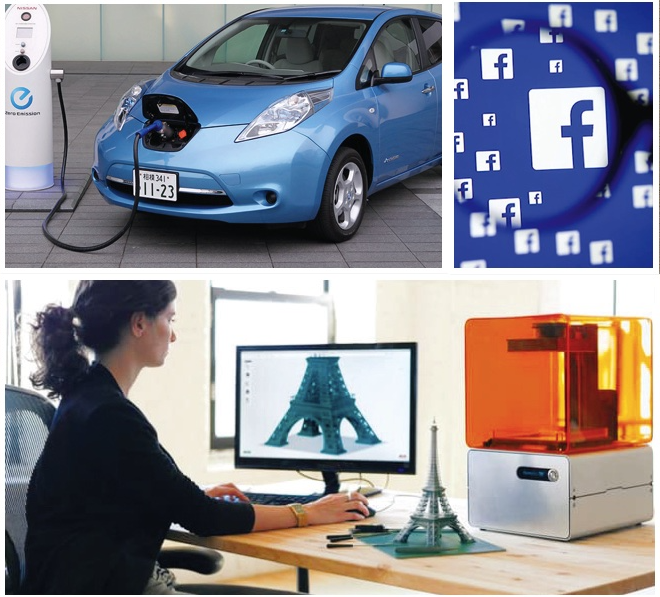
    In 1998 Kodak had 170,000 employees and sold 85% of all photo paper worldwide.  Within just a few years, their business model disappeared and they went bankrupt.  What happened to Kodak will happen to many industries in the next 5-10 years.  Did you think in 1998 that 3 years later you would never take pictures on film again?  Yet digital cameras were invented in 1975. The first ones only had 10,000 pixels but followed Moore’s law.  So as with all exponential technologies, it was a disappointment for a time, before it became way superior and became mainstream in only a few short years. It will now happen again (but much faster) with Artificial Intelligence, health, autonomous and electric cars, education, 3D printing, agriculture and jobs.

    Welcome to the 4th Industrial Revolution. Welcome to the Exponential Age.
    1. The software will disrupt most traditional industries in the next 5-10 years.
    2. Uber is just a software tool, they don’t own any cars, and are now the biggest taxi company in the world.
    3. Airbnb is now the biggest hotel company in the world, although they don’t own any properties.
    4. Artificial Intelligence: Computers become exponentially better in understanding the world this year, a computer beat the best Go-player in the world, 10 years earlier than expected.
    5. In the US, young lawyers already don’t get jobs. Because of IBM’s Watson, you can get legal advice (so far for more or less basic stuff) within seconds, with 90% accuracy compared with 70% accuracy when done by humans.So, if you study law, stop immediately. There will be 90% fewer lawyers in the future, only omniscient specialists will remain.
    6. Watson already helps nurses diagnosing cancer, its 4 times more accurate than human nurses.
    7. Facebook now has a pattern recognition software that can recognize faces better than humans. In 2030, computers will become more intelligent than humans.
    8. Autonomous cars: In 2018, the first self-driving cars will appear to the public. Around 2020, the complete industry will start to be disrupted. You won’t want to own a car anymore. You will call a car with your phone, it will show up at your location and drive you to your destination. You will not need to park it, you only pay for the driven distance and can be productive while driving.  Today’s very young children will never get a driver’s license and will never own a car. It will change the cities because we will need 90-95% fewer cars for that.   We can transform former parking spaces into parks.1.2 million people die each year in car accidents worldwide. We now have one accident every 60,000 mi (100,000 km); with autonomous driving that will drop to 1 accident in 6million miles (10 million km).  That will save a million lives worldwide each year.Most car companies will doubtless become bankrupt. Traditional car companies use the evolutionary approach and just build a better car, while tech companies (Tesla, Apple, Google) will do the revolutionary approach and build a computer on wheels.Many engineers from Volkswagen and Audi are terrified of Tesla.
    9. Insurance companies will have massive trouble; without accidents, the insurance will become 100x cheaper. Their car insurance business model will disappear.
    10. Real estate will change. Because if you can work while you commute, people will move further away to live in a more beautiful neighborhood.
    11. Electric cars will become mainstream about 2020. Cities will be less noisy because all new cars will run on electricity.
    12. Electricity will become incredibly cheap and clean: Solar production has been on an exponential curve for 30 years, but you can now see the burgeoning impact. Last year, more solar energy was installed worldwide than fossil. Energy companies are desperately trying to limit access to the grid to prevent competition from home solar installations, but that simply cannot continue – technology will take care of that strategy.
    13. With cheap electricity comes cheap and abundant water. Desalination of salt water now only needs 2kWh per cubic meter (@ 0.25 cents). We don’t have scarce water in most places, we only have scarce drinking water. Imagine what will be possible if anyone can have as much clean water as he wants, for nearly no cost.
    14. Health: The Tricorder X price will be announced this year. There are companies who will build a medical device (called the “Tricorder” from Star Trek) that works with your phone, which takes your retina scan, your blood sample and your breath into it. It then analyses 54 biomarkers that will identify nearly any disease.  It will be cheap, so in a few years, everyone on this planet will have access to world-class medical analysis, nearly for free.  Goodbye, self-serving medical practitioners and establishments.
    15. 3D printing: The price of the cheapest 3D printer came down from $18,000 to $400 within 10 years. At the same time, it became 100 times faster. All major shoe companies have already started 3D printing shoes. Some spare aeroplane parts are already 3D printed in remote airports. The space station now has a printer that eliminates the need for the large number of spare parts they used to have in the past. At the end of this year, new smartphones will have 3D scanning possibilities. You can then 3D scan your feet and print your perfect shoe at home. In China, they already 3D printed and built a complete 6-story office building. By 2027, 10% of everything that’s being produced will be 3D printed.
    16. Business opportunities: If you think of a niche you want to go in, first ask yourself: “In the future, will we have that?” and if the answer is yes, how can you make that happen sooner? If it doesn’t work with your phone, forget the idea.  Any idea designed for success in the 20th century is doomed to failure in the 21st century.
    17. Work: 70-80% of jobs will disappear in the next 20 years. There will be a lot of new jobs, but it is not clear if there will be enough new jobs in such a short time. This will require a rethink on wealth distribution.
    18. Agriculture: There will be a $100 agricultural robot in the future. Farmers in 3rd world countries can then become managers of their field instead of working all day on their fields.
    19. Aeroponics will need much less water. The first Petri dish produced veal; which is now available and will be cheaper than cow produced veal in 2018. Right now, 30% of all agricultural surfaces is used for cows. Imagine if we don’t need that space anymore.
    20. There are several startups who will bring insect protein to the market shortly. It contains more protein than meat. It will be labelled as “alternative protein source” (because most people still reject the idea of eating insects).
    21. There is an app called “moodies” which can already tell in which mood you’re in. By 2020 there will be apps that can tell by your facial expressions if you are lying. Imagine a political debate where it’s being displayed when they’re telling the truth and when they’re not – it will ultimately compel all politicians to be truthful (a truly unique & novel occurrence).

    (Article / Courtesy Ashook Ramsaran, President, Indian Diaspora International Council)

    (The author is a Business and Financial Consultant and Entrepreneur, with over 40 years of senior executive experience with three of the world’s largest corporations- ITT Industries of Canada, Financial Services Div. (1977-90); Senior VP & Director, HR and Administration, Deutsche Bank Int’l Financial Services Division (1990-03); Senior VP, HR and Administration with GE Capital, Int’l Financial Services Division (1993-2004).  He is the National Coordinator, Indian Diaspora Council, Canada)


  • NY’s Communities of Color Have Less Access to Retirement Savings, Banks, Pay More for Caregiving, Housing

    NY’s Communities of Color Have Less Access to Retirement Savings, Banks, Pay More for Caregiving, Housing

    AARP, Partners Launch Policy Solutions Agenda

    AARP, Asian American and Hispanic Federations, NAACP, Urban League join in unprecedented effort to disrupt racial and ethnic disparities in health, economic security and livable communities among NY’s 50+

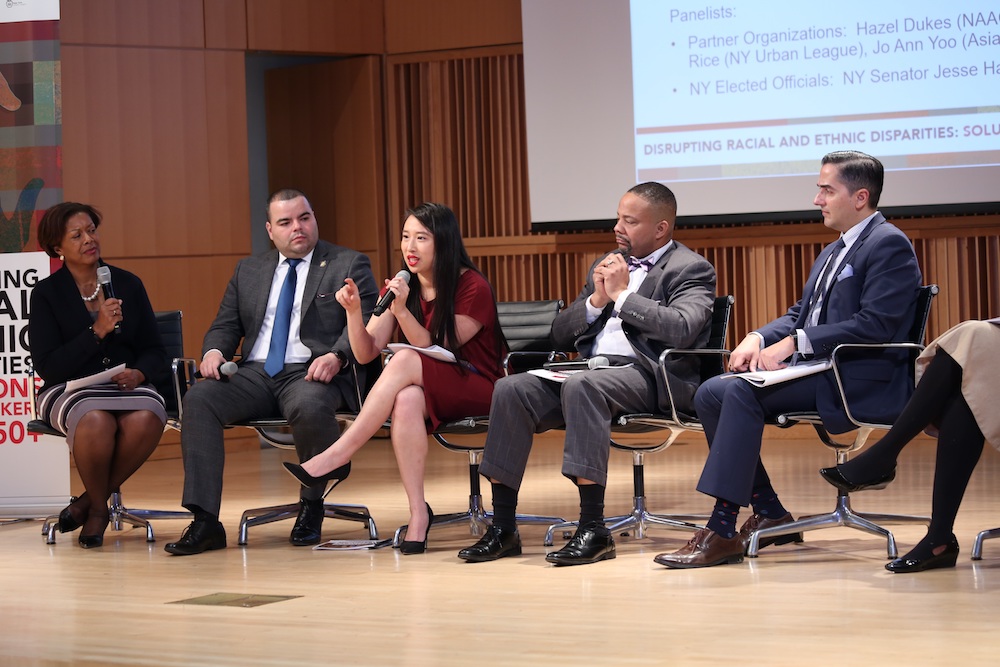
    NEW YORK, NY (TIP): AARP and top advocacy organizations for New York’s communities of color, on January 24, joined to launch an unprecedented policy solutions agenda aimed at disrupting vast racial and ethnic disparities among New Yorkers 50 and older as detailed in a new brief on health, economic security and livable communities.

    “Disrupting Racial and Ethnic Disparities:  Solutions for New Yorkers Age 50-Plus” (aarp.org/NYDisruptDisparities), compiled by AARP in partnership with the Asian American Federation, the Hispanic Federation, the NAACP, and the New York Urban League, takes a first-ever look at gaps specifically affecting New Yorkers of color 50 and older. It is the launch for a three- to five-year effort in which AARP and its partners will welcome information and potential solutions from the public.

    The brief includes the following findings – but also recommends achievable short- and long-term solutions:

    • New York State suffers the highest level of income inequality in the nation, with the top 1% of New Yorkers earning an astounding 45 times more than the bottom 99%.
    • Most private sector employees from New York’s communities of color work for companies that don’t offer a retirement savings plan option – including two thirds of Hispanic/Latinos (H/L)
    • There is just one bank branch for every 10,000 residents in New York City neighborhoods of color compared to 3.24 branches for every 10,000 residents in other neighborhoods.
    • In New York City and Long Island, student loan delinquencies are clustered in zip codes with significant middle-income African American/Black (AA/B) and H/L populations, suggesting that middle income people of color are likely to carry unaffordable student loan burdens.
    • Where payday lending is legal, lower-income people of color make up a disproportionately large segment of borrowers – and older adults are an especially fast-growing segment of payday loan borrowers in the U.S. Seniors in California, where payday lending is permitted, are now the largest age group of payday loan borrowers.
    • Family caregivers work an average of 18 hours a week providing care, even while 60 percent have full- or part-time jobs. And while average family caregivers spent nearly 20% of their income on out of pocket caregiving costs in 2016 nationally, caregivers from communities of color spent more – 44% of income for H/L caregivers.
    • Older residents of communities of color moved to nursing homes at higher rates nationally between 1999 and 2008 – H/L by 54.9%, Asian American/Pacific Islanders (AAPI) by 54.1%, AA/B by 10.8% – compared to a decrease among White Americans (10.2%).
    • Neighborhoods with the highest foreclosure risk are almost exclusively communities of color, including many middle- and upper-income AA/B neighborhoods with large 50-plus populations.
    • H/L households on average have just 3.4%, AA/B households 6.2%, and AAPI households 21% the wealth of the median white household.
    • Homeowners from New York’s communities of color are disproportionately “cost-burdened,” spending at least 30% of their income on housing (including 60% of H/L homeowners). In fact, residents of communities of color are twice as likely as White New Yorkers to pay over half their income for housing – and it’s even worse for women and immigrants.

    These harsh realities have resulted in alarming financial gaps and grave disparities. But coming together for the first time in a concerted effort, the organizations are urging New York State to:

    • Create a retirement savings option that businesses which don’t already have one can offer their employees – as Governor Andrew Cuomo proposed in his recent executive budget and Senator Diane Savino and Assemblyman Robert Rodriguez have proposed in Legislature.
    • Encourage electronic consultations and other telehealth applications through smart phones – as the Governor also proposed in his budget as part of initiatives to advance the use of telehealth to keep people in their home longer and out of institutional care.
    • Enact a family caregiver tax credit to help offset the out-of-pocket costs of those who care for loved ones.
    • Increase cost-effective funding for services that help New Yorkers age in their own homes – and relieve family caregivers of some of their burdens – to keep pace with the growing demands of an aging population.

    The brief focuses on disparities among communities of color statewide with particular emphasis on New York City, Long Island, and Buffalo. It is intended to spark a compendium of findings and solutions to help address these disparities within the next three to five years.

    A GROWING RACIAL AND ETHNIC POPULATION IMPACTED

    The 60 and over population of New York state’s communities of color grew by a staggering 43% between 2000 and 2010 – over 20 times that of the entire population (2.1%) and over five times the 8% increase among the state’s 60+ White population, according to the U.S. Census Bureau. This disproportionately rapid growth is projected to continue in the decades ahead and significantly worsen the wide gaps that already exist.

    “There are widespread racial and ethnic disparities across the United States, but for the large and rapidly growing 50+ population of color in New York, challenges around economic security and access to affordable housing, transportation and healthcare will continue to mount,” said Beth Finkel, AARP New York State Director. “Several studies have shed light on these disparities, but few, if any, have led to necessary policy changes or focused on New York’s 50+ populations. While no single policy solution can address all disparity causes and concerns, the time to join forces to disrupt ethnic and racial disparities is now.”

    “This report provides data to illustrate the magnitude of these disparities, as well as to propose policy recommendations that serve as a roadmap for a way forward”, said Hazel Dukes, President of The National Association for the Advancement of Colored People New York State Conference. “As the heroes of the Civil Rights Movement showed us, progress comes – sometimes quickly and dramatically, but more often through tough, unglamorous, incremental policy work. The time to get to work is long past, and we stand proudly with AARP to support New York’s 50-plus people of color.”

    “For more than a quarter-century, the Hispanic Federation has worked to empower and advance the Hispanic community,” said Jose Calderon, President of the Hispanic Federation. “We advocate for Hispanic children, women and men of all ages with programs and services for both young and old. In New York State, where the Hispanic community makes up almost 20% of the population, it is crucial that we meet the needs of 50-plus Hispanics and their families.”

    “Without strong policy interventions to address inequitable access to both public and private services, inequality has a nasty habit of reproducing itself from generation to generation,” said Jo-Ann Yoo, Executive Director of the Asian American Federation. “This report is notable in that, beyond stating the problems, it aims to provide concrete solutions. We are honored to be part of this coalition as our mission is to raise the influence and well-being of the pan-Asian American community through research, policy and advocacy.”

    “New York is one of the most urbanized states in the nation, with the majority of African Americans living in larger cities,” said Arva Rice, President and CEO of the New York Urban League, Inc. “Since 1910, we have been dedicated to ensuring the economic empowerment of historically underserved urban communities.  With the growing diversity of New York’s population, particularly among people age 50-plus, ensuring the well-being and equality of people of color in this age segment is more urgent than ever.”

    AARP’s Finkel added: “We are asking policymakers, advocates and the public at large to share their knowledge and experiences of existing disparities so we can press public officials to adopt policy changes that address these inequalities. By closing the serious gaps that exist, people in African American/Black, Asian American/Pacific Islander and Hispanic/Latino communities can enjoy the same stability and equal footing as everyone else by having more choices in how and where they live as they age.”

     Those interested in following or joining the conversation can visit aarp.org/NYDisruptDisparities which will serve as a platform to host the latest research findings, policy updates and information related to this effort, and a place to contribute ideas and insights (by emailing NYAARP@aarp.org).

    About AARP

    AARP is the nation’s largest nonprofit, nonpartisan organization dedicated to empowering Americans 50 and older to choose how they live as they age. With nearly 38 million members and offices in every state, the District of Columbia, Puerto Rico, and the U.S. Virgin Islands, AARP works to strengthen communities and advocate for what matters most to families with a focus on health security, financial stability and personal fulfillment. AARP also works for individuals in the marketplace by sparking new solutions and allowing carefully chosen, high-quality products and services to carry the AARP name. As a trusted source for news and information, AARP produces the world’s largest circulation publications, AARP The Magazine and AARP Bulletin. To learn more, visit www.aarp.org/espanol or follow @AARPenEspanol, @AARP and @AARPadvocates on social media.

     About the Asian American Federation

    The Asian American Federation works to raise the influence and well-being of the pan-Asian American community through research, policy advocacy, public awareness, and organizational development. Established in 1989, AAF supports over 40 Asian American community service agencies, which work to meet the critical needs of the fastest-growing population in New York City. For more information, please visit www.aafederation.org.

    About the Hispanic Federation

    The mission of the Hispanic Federation is to empower and advance the Hispanic community. The Hispanic Federation provides grants and services to a broad network of Latino non-profit agencies serving the most vulnerable members of the Hispanic community and advocates nationally with respect to the vital issues of education, health, immigration, economic empowerment, civic engagement and the environment. For more information, please visit www.hispanicfederation.org.

    About the NAACP New York State

    The NAACP New York State Conference has been a vital programmatic component of the National Association for the Advancement of Colored People for 80 of the 108-year history of the oldest, most effective and most respected civil rights organization in the Nation. The New York State Conference has played a pivotal role in moving the agenda for freedom and equality forward under the leadership of dynamic State Conference Presidents, each of whom addressed critical issues during their tenure.

     About the New York Urban League

    The National Urban League is a historic civil rights organization dedicated to economic empowerment in order to elevate the standard of living in historically underserved urban communities. Founded in 1910 and headquartered in New York City, the National Urban League spearheads the efforts of its local affiliates through the development of programs, public policy research and advocacy. Today, the National Urban League has 88 affiliates serving 300 communities, in 36 states and the District of Columbia, providing direct services that impact and improve the lives of more than 2 million people nationwide.


  • India@68

    India@68

    Will Modi be India’s Gorbachev?

    Remember, Gorbachev, a modern man heading a medieval Communist Party, introduced Glasnost (Transparency), without exactly working much for Perestroika (Reconstruction) in the 1985-91 era. The result was the dissolution of the “secular” Soviet Union and emergence of an Orthodox Christian Russia on its ruins!
    Modi has often been talking about transparency; and rarely about reconstruction!
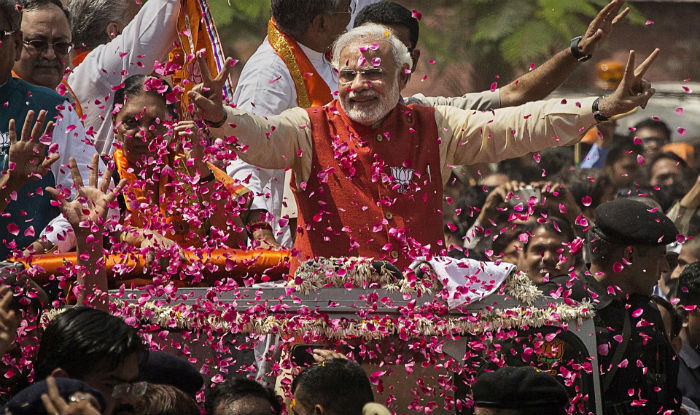
    As the year 2018 began, India’s politics is agog with the possible changes in the offing. Despite his currently steamroller majority in the Lok Sabha and the emerging one in the Rajya Sabha (Upper House), Modi appears buffeted more due to the circumstances not of his making but what he inherited. Like the Mahabharata’s great warrior Abhimanyu, he is struggling against seven enemies and he does not, apparently, know how to get out of the booby traps and landmines.
    Follow Story @
    https://www.theindianpanorama.news/featured/perspective-tired-titan-modi/

    As the “Sovereign, Socialist, Secular, Democratic Republic of India” celebrates its 68th anniversary on January 26, 2018, the world’s largest democracy refuses to grow old. It remains young, and, therefore, rather unpredictable, as ever. In fact, India has retained her youthfulness due to this very unpredictability; the vast nation, as sociologists and historians have noted, changes every ninth mile! And you are never sure which India best represents India!!

    When the war-crippled British Raj decided to leave India in 1947, dire warnings were given that the utterly brittle country of nearly 300 million diverse people divided across castes, creeds and customs would not survive for long and fall back upon its familiar, fissiparous path of slavery of another kind. India proved all dystopian warnings wrong.

    Winston Churchill was among the first politicians to predict India’s downfall from the British to the brutish era. The then war-time Prime Minister, who did not want to preside over the liquidation of the British Empire, had claimed that an Independent India would quickly disintegrate and return to the medieval era. Dr. B. R. Ambedkar, as Chairman of the Drafting Committee of the Constituent Assembly, had also expressed apprehension that India could lose her independence and territory once again and even become a dictatorship if she failed to put in checks-and-balances.

    Nothing of the sort has, however, happened. On the contrary, despite odds, India has not only retained her independence, sovereignty and territorial integrity, but has also been a beacon of independence to many “Third World” countries, thanks to its slow but sure progress and prosperity. She has not only emerged as the largest democracy in the world but also the third largest economy, the sixth space power, and an emerging world superpower. In other words, India has been a role model for many a nation the way her greatest son, Mahatma Gandhi, has been a role model for many a country vying for independence from a foreign yoke.

    Of course, the 2,000-year-old Mother India has had to struggle hard to put up the make up of a 20-year-old lady and walk the ramp of world powers. She had her own hours of reckoning, even dictatorship of sorts. She had to fight a war imposed by China in 1962, another by Pakistan in 1965, and a third during the Bangladesh Liberation in 1971. Also, she suffered a major embarrassment during the dictatorial Internal Emergency (1975-77), imposed by the then PM Indira Gandhi. Interestingly, it was also during the same Emergency that Mrs. Gandhi introduced the future seed of Indian politics: the 42nd Amendment to the Constitution, adding the word “secular” to the Preamble. This “secular” word would become the determinant of whither the Republic of India would march in the 21st century.

    For, when Mrs. Gandhi returned to power in 1980 after the brief Janata Party interregnum, she faced unprecedented turmoil in Punjab due to Pakistan-sponsored, financed and supported terrorism in the border state. For the first time, a “secular” India witnessed her Army storming a venerated shrine to flush out militants. India’s secularism was stretched to the limits and the woman who sought to conceive a “secular” India was consumed by the very forces she had unwittingly unleashed.

    Her son Rajiv Gandhi inherited the crown as well as the “secular” thorn from his mother. While he successfully fathered India’s communication revolution, he was also consumed by another kind of terrorism, from the Hindu Tamils of neighboring Buddhist Sri Lanka. Like his mother, he also stretched India’s secularism to the limits by first succumbing to the Muslims in the Shah Bano case and then to the Hindus on the Ayodhya issue.

    All governments that followed the Rajiv Gandhi era since 1989 were products of the struggle between the combination of Hindutva forces on one side and the “secular” ones on the other. This was the era of coalition governments in which alternated political groups led by the rightist Hindutva party, the BJP, and the “secular” fronts, led by the Congress, or ex-Congressmen.

    Interestingly, again, while Indira introduced “secular” content in the Constitution, her son Rajiv succumbed to both the Muslims and the Hindus, in that order, thus changing the very creed of the Congress—only Mahatma Gandhi had changed this creed in 1919 when he turned the Indian National Congress from being a post office to the biggest mass movement for India’s Independence.

    This change of creed became unstoppable. In fact, the Rajiv Gandhi-led Congress seemed to be the last sigh of the Grand Old Party (GOP), having won a massive majority of 404 seats out of 533 in the Lok Sabha (Lower House of Parliament) in 1984, riding a sympathy wave after the assassination of India Gandhi. In Independent India, this was the first election where the people voted on the basis of religion and a pro-Hindu sentiment began to take shape. Subsequently, it evolved further and empowered Narendra Modi to become the PM in 2014, heading the government led by the single dominant party (the BJP alone won 282 seats) after 30 years.

    It is this Republic that India of the 21st century has inherited.

    Where is India headed now?

    As the year 2018 began, India’s politics is agog with the possible changes in the offing. Despite his currently steamroller majority in the Lok Sabha and the emerging one in the Rajya Sabha (Upper House), Modi appears buffeted more due to the circumstances not of his making but what he inherited. Like the Mahabharata’s great warrior Abhimanyu, he is struggling against seven enemies and he does not, apparently, know how to get out of the booby traps and landmines.

    https://www.theindianpanorama.news/featured/perspective-tired-titan-modi/

    Only in the last week, fresh salvos have been fired at him. His friend-turned-foe, Dr Pravin Togadia, International Working President of the Vishwa Hindu Parishad, has gone ballistic against him and his government, even claiming that he could be killed in an organized “encounter” with the police! This demonstrates the internal bickering in the larger Sangh Parivar, and Modi may lose many foot soldiers for the ensuing 2019 General Elections next year, to be preceded by elections to eight state Assemblies. The Rashtriya Swayamsevak Sangh (RSS), which heads the Sangh Parivar, has been claiming to be the only champion of all that was Great in India of the bygone “Golden Age”, the only repository of the Hindu culture and civilization. But, ironically, the once-monolithic RSS is becoming more and more brittle and fissiparous in the image of India of Yesterday that it increasingly represents! The India of Tomorrow is going to be very different and the RSS would, predictably, embrace more and more irrelevance.

    Having known Modi personally since 1998, I can fairly assume that even Modi, apparently, realizes this increasing irrelevance of the RSS in which he cut his political teeth and activism since the early 1980s. A gizmo-loving Modi has almost been a ‘misfit’ in the RSS, being too modern an activist-politician emerging from the Sangh Parivar which has a strangely medieval, even ancient, mindset. But, like Atal Behari Vajpayee before him, he has had to suffer in silence this foot-soldier providing agency. That he is not an ideological junkie was proved when he systematically cut to size and made irrelevant the various Parivar constituents during his Chief Ministership of Gujarat (2001-14).

    And he also, apparently, realizes that the 2019 electoral battle will be very different from the one he won in 2014. Then, he could blame the Congress-led Government of Dr Manmohan Singh for the various ills; now, he cannot blame his own government for multiple failures to keep promises! Ironically, he continues to be the most popular politician in India at a time when his party is losing out, beginning with his home state of Gujarat.

    In other words, Modi’s popularity is independent of his own party’s, that of his government or even of the RSS. In still other words, it is somewhat like “Modi is India and India is Modi”, to borrow a famous phrase from the Emergency era when the then Congress President Dev Kant Barooah pronounced that “Indira is India and India is Indira”!

    A major reason for this overriding popularity of Modi is, apart from his own well-oiled PR network, also the failure of the country’s polity to produce another leader. In 2018, as of now, India is beset with the “There Is No Alternative” (TINA) syndrome. Although Rahul Gandhi, now the Congress President, has been able to revive some confidence during the last six months, he is no match to Modi’s political acumen, machinations and the ability to turn adversity into opportunity. Modi has been a full-time politician, with no baggage attached or inherited, and with no family, whereas Rahul has been a reluctant politician for most of his career.

    And it is Modi, not Rahul, who has actually inherited the political mantle of Indira Gandhi!

    Which takes us to figure out what Modi could do best, and the next.

    In the early 1980s, Indira’s lieutenants like the then Union Minister Vasant Sathe had released trial balloons wondering whether the country could adopt a Presidential system of governance to replace the current parliamentary system. The debate died down with the assassination of Mrs. Gandhi. It has been revived again.

    Can, therefore, Modi introduce the Presidential system? I remember Sathe having told me in the 1980s that, for this, the Parliament will have to merely pass an Amendment to make the President to be elected directly by the people. That is, election to the Presidency and the Lok Sabha will both be direct, and independent of each other. Be that, as it may, India could have in Modi her first President directly elected by the people!

    Clearly, it would be a paradigm shift in the Republic of India which will celebrate its Diamond Jubilee in 2024. Modi has often been talking about how India should celebrate the 75th anniversary of Independence in 2022 and hinted that he could continue to helm the affairs until 2024!

    As the first step towards this ‘destination’, Modi has been advocating holding of elections to the Lok Sabha and the state Vidhan Sabhas, simultaneously, ostensibly to save money. In the first two decades of Independence, simultaneous elections were held, but Indira Gandhi stopped this practice. If Modi revives it, he could have the advantage of superimposing his persona all over the simultaneous General Elections. Since he has no match, he is likely to win a Presidency hands down; and, even if the BJP/NDA lose the poll or majority, he will have the independence of being the elected President.

    Will, then, Modi-as-President be like Trump-as-President?

    Maybe.

    But he also risks becoming India’s own Mikhail Gorbachev! Remember, Gorbachev, a modern man heading a medieval Communist Party, introduced Glasnost (Transparency), without exactly working much for Perestroika (Reconstruction) in the 1985-91 era. The result was the dissolution of the “secular” Soviet Union and emergence of an Orthodox Christian Russia on its ruins!

    Modi has often been talking about transparency; and rarely about reconstruction!

    (The author is a journalist since 1983 and has worked with newspapers, news agencies and magazines in English and Hindi languages. He has contributed articles on diverse subjects. Currently, he is working as Consulting Editor with Business Line, the business daily of The Hindu Group of Publications in India. He is based in Ahmedabad in Gujarat, India. He can be reached at Virendra.pandit@gmail.com)


  • Queens Borough President Melinda Katz to deliver State of the Borough Address on Friday, January 26

    Queens Borough President Melinda Katz to deliver State of the Borough Address on Friday, January 26

    QUEENS, NY (TIP): Borough President Melinda Katz will deliver her annual State of the Borough address on Friday, January 26, offering a report on Queens’ recent milestones and her vision for the future of the borough. It will be her fifth address, since her first term election in Nov. 2013. She got re-elected Nov 2017 for another 4-year term.

    According to a press release issued by Sharon Lee from Borough President’s Press office.  Pre-registration from the public has been robust, and the venue is anticipated to reach capacity quickly. Doors will open at 9:00 AM. Members of the media seeking to attend the event are kindly asked to email in advance to press@queensbp.org.

    Arriving guests will enjoy music performed by a jazz quintet and a string ensemble, both from the Frank Sinatra School of the Arts. The program will begin with the presentation of colors by the Fire Department of New York (FDNY) Ceremonial Unit, followed by the Pledge of Allegiance led by Faatiha Aayat, a first grade student at P.S. 16 in Corona and resident of Elmhurst. Wendy Lin, a student at the Macaulay Honors College at the City University of New York (CUNY) and resident of Elmhurst, will sing the National Anthem. Gideon Frankel, Principal of the Frank Sinatra School of the Arts, will deliver brief welcome remarks. Following the program, a brief reception will feature music by the string ensemble and catering by DelishNY of Corona.

    WHAT:           Queens Borough President Katz Delivers 2018 State of the Borough Address

    WHERE:         Frank Sinatra School of the Arts (in the Tony Bennett Concert Hall), 35-12 35th Avenue in Astoria, Queens

    WHEN:           Friday, January 26, 2018 at 10:00 AM (doors open at 9:00 AM)

     The program will be live streamed via the Borough President’s website, Twitter, Facebook and YouTube. Official photos will be available on the Borough President’s Flickr following the event.

  • Restaurant Workers & Allies Rally Against Restaurant Association   for One Fair Wage

    Restaurant Workers & Allies Rally Against Restaurant Association for One Fair Wage

    Research shows that raising the tipped wage correlates to a decrease in sexual harassment claims

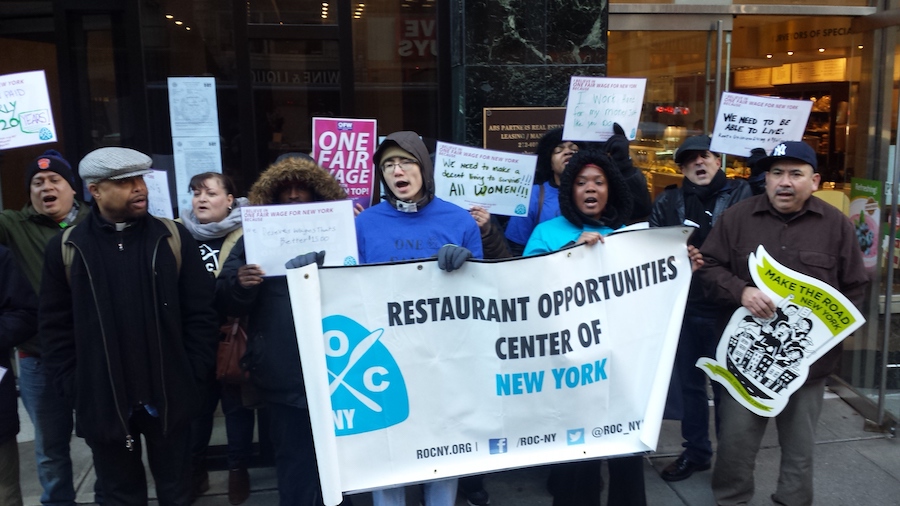
    NEW YORK (TIP): Restaurant workers and coalition partners, on January 25, rallied in the fight for One Fair Wage, a national effort to bring New York in line with seven other states, that pay tipped workers their state’s general minimum wage, on top of their tips. In New York, tipped food service workers make a subminimum wage ranging from $7.50 – $8.65, relying on tips to bring them up to the state’s general minimum wage, which ranges from $10.40 – $13.00, depending on the region. The National Restaurant Association (NRA) and the NYS Restaurant Association oppose one fair wage for tipped workers on the grounds that it will hurt employers and employees alike, despite evidence to the contrary in states like California and Nevada where the restaurant industry continues to thrive. Tipped-wage workers in states with one fair wage also report making as much or more in tips than tipped-wage workers in New York.

    “Sexual harassment is standard practice in the restaurant industry where employers are willing to profit off women but won’t pay them a fair wage,” said Saru Jayaraman, President and Co-Founder of ROC United, and author of Behind the Kitchen Door: The People Who Make and Serve Your Food. “With just a small change in policy New York can make a big difference for a majority female workforce.”

    Jayaraman recently appeared on HBO’s Real Time with Bill Maher to discuss the issue, and attended the Golden Globes with Amy Poehler as part of the #TimesUp campaign to end sexual harassment across industries.

    With nearly 13 million employees, the restaurant industry is the single-largest source of sexual harassment charges filed by women with the Equal Employment Opportunity Commission (EEOC), with a rate twice that of the general female workforce.

    Seventy percent of restaurant servers are women, who experience a disproportionate amount of sexual harassment as a result of the broken two-tiered wage system. Relying on tips to make a living wage forces workers to tolerate sexual harassment from customers in return for gratuities,” and they often receive additional pressure from management to dress in a revealing way to attract larger tips.

    According to a 2014 study conducted by ROC United, the lead organizer of the One Fair Wage campaign, women dependent on tips are twice as likely to experience sexual harassment than women who aren’t. A 2016 follow-up study in D.C. found that over 90% of restaurant workers surveyed experienced some form of sexualized behavior while at work. A similar 2016 study in Boston found that 35% of tipped workers had been sexually harassed by customers, over twice as many as other workers in the same survey.

    “New Economy Project fights for economic justice for all New Yorkers and strongly supports the elimination of the subminimum wage for tipped workers,” said Juleon Robinson, Program Associate at New Economy Project. “We’ve seen how low wages drive people into predatory debt traps and perpetuate racial and economic inequality. It’s time for New York to guarantee equal pay and a workplace free of discrimination and harassment, for all New Yorkers.”

    “New York women routinely endure discrimination and harassment in order to provide for their families,” said Dina Bakst, co-Founder and co-President of A Better Balance. “This is especially true for women in the restaurant industry, who must rely on tips in order to make minimum wage. As a legal advocacy organization dedicated to ensuring fairness and justice for low-income women, A Better Balance is proud to stand with our partners at Restaurant Opportunities Centers (ROC) United who are fighting through the One Fair Wage campaign to end the culture of sexism and abuse within the restaurant industry.”

    Background

    In his January State of the State address, Governor Cuomo announced that the State Department of Labor will hold hearings to examine elimination of the tipped-wage. The National Restaurant Association opposes the One Fair Wage campaign, spreading misinformation that it will deny workers their tips. This is false. The restaurant industry is thriving in states with One Fair Wage, and workers there make as much or more in tips as waitstaff in New York.

    Fast Facts
    • In 2015 New York State raised its Tipped Minimum Wage (TMW) from $5 to $7.50.
    • Salaries went up 6.4% on average.
    • Restaurant jobs in New York increased, by 1.1%
    • Pennsylvania border counties, which did not see a TMW increase, saw average full-service restaurant salaries go up 2.2% and employment decrease by 0.2%
    • One Fair Wage has nothing to do with tips. The proposal doesn’t eliminate tipping, and in the seven states that have eliminated the subminimum wage for tipped workers, tipping practices have remained the same. In some cases, tipping is higher in One Fair Wage states than in states with a subminimum wage.

    (Press Release by Alexis Grenell, alexis@pythiapublic.com)


  • Predictions For January 29 – February 4, 2018 – Horoscope & Astrology By Bejan Daruwala

    Predictions For January 29 – February 4, 2018 – Horoscope & Astrology By Bejan Daruwala

    Aries: Ganesha says as a result of your evaluation of yourself, there is genuine evolution. You gain in credibility, popularity and authority. People look up to you. Creative pursuits, be it the cinema, television, the performing arts, every aspect of the media, hobbies, even speculation and playing the market, will be indulged in. You have an open frame of mind leading to greater ingenuity as well as better, brighter ideas. Bonds and ties of love will give you new focus.

    Taurus: As a result of your involvement with family and domesticity, your handling of people is marvelous. Anyway, as I have always said, Taureans have a genuine fondness for people, in fact for the entire human race. You have reached a point in your personal growth where there is no room for hurt, acrimony, false expectations or acquisitions in all your interactions. Ganesha says that this has also been achieved in the professional sphere.

    Gemini: This is a period of quality interactions. There is gain at all levels; you make money and also powerful emotional bonds. You know that being adjustable and adaptable makes for greater happiness, peace, contentment. Ultimately, that’s what we all desire. You are more relaxed and responsive to others, and there are gains in the offing. You stand on solid ground and there is no dilly-dallying. You make sustained progress, and impressive as a result.

    Cancer: Money and the people in your life, though not necessarily in that order, will be the two main themes in this period. You will reach out to new and old friends and acquaintances and make good profits from business as well. You will be moving at great speed in a bid to improve both these areas of your life. But Ganesha warns against too much socializing and also mixing business with pleasure.

    Leo: Watch out for new developments. You will be looking at true growth, comprising your own assets and your larger role in the community. You will look inwards at your own limitations and will also spend time with welfare activities and charities. You move positively from the worldly affairs that occupied you till recently to more self-analysis and introspection. Your main criterion is personal growth and you will do all that you can to progress in the right direction.

    Virgo: You probably feel that you have been pursuing the wrong goals. The focus will be on loans and funds and, strangely, on passion and sex. There may also be some neuroses, anxiety, minor ailments and an unsettled feeling to contend with. You may turn to prayer and meditation. This is a testing time and you will tap into the spiritual nooks and crannies of your being, and your soul for answers. A lot has been happening and much too soon. You need to take stock of life and to slow down.

    Libra: Your good spirits will be restored. There will be success with people and you want to have fun and enjoy the limelight. You seek out good company, good friends, good food and all the good things of life which I mentioned earlier. Being sociable, amiable and outgoing, you will be partying and socializing. Ganesha has given you charisma and charm, even good looks and a deceptively seductive manner. The entire family will draw closer and surround you with warmth.

    Scorpio: Money and the people in your life will both be in sharp focus this period. You will look at new avenues of business, sources of income. Ganesha warns against both, a) too much socializing, once again, and not to b) mixing business with pleasure. This may lead to situations you don’t want to get into and are better off without. You are friendly and sociable and also keen to get on with overhauling of your both career and income.

    Sagittarius: Your life is moving at a certain pace and in the right direction and you will be fulfilled with a sense of satisfaction. Ganesha sends you your due rewards in several ways. This is a joyous phase filled with good tidings. There is a welcome twist too with travel, journeys for fun or for work, partnerships and ties, whether new or old romantic ties and attachments, even greater joy in matrimony and other bonds.

    Capricorn: This is the time for the expansion and extension of your mental horizons. New inclinations and predilections, a new focus, are even more likely to emerge than they were last period. You move towards spirituality and the higher issues of life and are concerned with justice, law and order and the higher consciousness. More than just acquiring knowledge, it will be a widening of the vistas of your mind that interests you. Travel, publicity, visits, interviews, meets, conferences, collaborations and networking within and outside the family.

    Aquarius: At one level, you are at the crossroads. You need to make strong decisions. You don’t want your success / popularity, good interactions to slip and falter. It is also a good time to help the community at large, to share resources, give charity or monetary help. You work with purpose and want to get your act together professionally in the larger social context as well as within your immediate social circle.

    Pisces: You will look at changing your lifestyle and priorities. You need to get your act together and need to do some hard rethinking. Ganesha tells you to look deep within yourself: you have had too much of a social life, been a party animal, and your expenses are also mounting. You need to guard against arousing animosity in others as well. Take the necessary precautions and you are in line for the four Gs – gains, glory, good times and genuine companions. What more does one need?

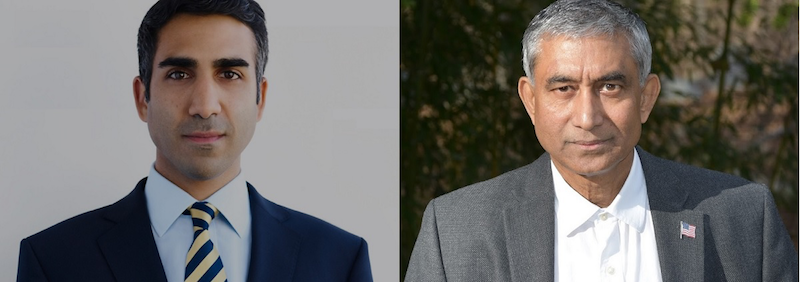
  • Indian American Democrats Omar Vaid, Radhakrishna Mohan seeking to run for Congress from NY 11th district

    Indian American Democrats Omar Vaid, Radhakrishna Mohan seeking to run for Congress from NY 11th district

    NEW YORK (TIP): another two Indian Americans are among the more than half a dozen Democrats vying to unseat GOP Rep. Dan Donavan in New York’s 11th congressional district.

    Omar Vaid and Radhakrishna Mohan are seeking their party’s nomination from the only New City congressional district that is currently held by the Republicans. The primary in New York is scheduled for June 26th. The 11th district is one of the least demographically diverse congressional districts in Big Apple. Nearly three fourths of the population is white.

    It is also the second congressional district in the country where at least two Indian Americans are running against each other in the primaries. In the Illinois 8th, two Indian Americans are running for the GOP nomination to take on incumbent Rep. Raja Krishnamoorthi, who is also an Indian American.

    Vaid, whose parents came to the United States from Gujarat, is a strong advocate of the rights of immigrants and unions. He believes “that both immigrants and unions make America stronger,” according to his website.

    He grew up in Illinois and Florida and moved to New York City after earning a bachelor’s degree in business management to launch his career in the movie industry.

    Vaid works on both props and set decoration for New York productions. So far, he has worked on TV shows such as “Luke Cage” and “The Get Down.”

    He has been a union member since joining the International Alliance of Theatrical Stage Employees, Local 52, in 2009.

    Information technology specialist Radhakrishna Mohan, who moved to the United States from India in 1989, has been an employee of the state of New York for the past 28 years. The New York State Insurance Fund employee also serves as an executive board member of chair of workers’ compensation statewide committee.

    He has a master’s degree in economics and a degree in mathematics and statistics and an associate degree in computer science.

    Like Vaid, Mohan is also a union activist and leader.

    He says on his campaign website that he successfully introduced telecommuting in the workplace and had his joint motion passed at the PEF convention to mandate equal time off for NY State female employees, which is now awaiting passage in the state legislature.

    Mohan advocates workers comp benefits and opposes privatization of state government jobs.

    Issues

    Vaid proposes affordable education, better transportation, stern action to fight climate change, quality Medicare for all, more union jobs and greater workers’ rights.

    “It is no secret that today in America the top 0.1% own as much as the bottom 90%,” he writes on his website. “To make matters worse, 99% of new income goes to the 0.1%. People rightfully feel the economy is rigged, jobs don’t pay what they used to, and unionizing efforts are in decline. It’s time for the billionaires to pay their fair share.”

    Vaid believes in a free-market system but regulated to protect the average citizen from corporate overreach and abuse. “I won’t accept so much as a free meal from a corporate lobbyist,” he says on the campaign website.

    “We have the power to change all of this,” says Vaid. “I don’t believe there is any other way forward. We must recalibrate our economy, so the pie begins to grow for everyone. Unity is our way forward. America is the greatest nation on Earth.”

    So far Vaid has been running a campaign largely focusing on social media. He has more than 20,000 Twitter followers.

    ‘Ask not, what your country…’

    “Today, I want to serve as your voice on Capitol Hill: a voice that echoes your concerns; a voice that matters; a voice that cares,” Mohan says on his website. “I strongly believe in the famous quote of President John F Kennedy, ‘Ask not, what your country can do for you. Ask what you can do for your country.’”

    He adds that he wants to play an active role in making the “community, state and country a safer, better place to raise my children, run my business, render service to the community and forge a future filled with unlimited promise and realized potential.”

    Other candidates running for the Democratic nomination are Michael DeCillis, Paul Sterling, Max Rose, Zach Emig, and Michael DeVito Jr.

    (Source AB WIRE)


  • Indian American Doctor Couple Indicted in Health Fraud Case

    Indian American Doctor Couple Indicted in Health Fraud Case

    The Rakhits intentionally distributed controlled substances outside the usual course of medical practice

    WASHINGTON (TIP):  An Indian American doctor couple has been indicted on charges of committing healthcare fraud by performing unnecessary medical tests and procedures on patients to get payouts from insurance companies.

    Dr Ashis K Rakhit, 65, and his wife Jayati Gupta Rakhit, 56, specialize in cardiovascular disease and internal medicine and practiced in Cleveland, Ohio.

    According to the indictment, the Rakhits ordered and performed unnecessary medical tests between 2011 and 2018, including unnecessary nuclear stress tests, cardiac catheterizations, bone density scans, echocardiograms, EKGs, carotid artery scans, venous ultrasounds of the legs and abdominal ultrasounds.

    They also recorded false symptoms in patient records to justify medically unnecessary tests on patients, including shortness of breath, palpitations, hypertension and abnormalities in breathing, according to the indictment.

    The Rakhits billed Medicare, Medicaid and private insurers with inflated codes to reflect a service more costly than that which was actually performed, according to the indictment.

    The Rakhits also intentionally distributed and dispensed controlled substances outside the usual course of medical practice.

    Ashis Rakhit is charged with distributing Percocet and Xanax in 2017, while Jayati Rakhit is charged with distributing Tramadol, according to the indictment.

    “This couple violated the trust of their patients, the taxpayers and the community,” US Attorney Justin E Herdman said.

    “They performed unnecessary medical tests and billed for services they didn’t actually provide in exchange for prescription medications – all of this at a time when our region is inundated in opioid deaths and addiction,” he said.

    “Not only did these physicians put their patients through unnecessary medical procedures so they could line their pockets with extra income, they also prescribed controlled narcotics that were not medically required,” said FBI Special Agent in Charge Stephen D Anthony.

    (Source: DOJ)


  • Indian American IIT grad marries gay partner in Maharashtra

    Indian American IIT grad marries gay partner in Maharashtra

    YAVATMAL (TIP): As they say, love always finds a way. A US-based Indian engineer married his gay lover in a traditional ceremony at Yavatmal on December 30, days before the Supreme Court agreed to review the criminalization of homosexuality. Police and the hotel where the wedding took place looked the other way, considering the legal ambiguity regarding gay marriage in India.

    Yavatmal native Hrishi Mohankumar Sathawane (40) married Vinh, said to be from Vietnam, with the blessings of his family and friends at a hotel a stone’s throw from the office of the superintendent of police.

    Hrishi, who holds a BTech from IIT-Bombay, currently lives in California and has a US green card. According to his social media profile, his parents were against his homosexual affiliation, but he succeeded in convincing them to bless him and Vinh.

    Photos on Hrishi’s social media account show the two got engaged in mid-2017, followed by an American wedding in October. Though the owners of the hotel claimed it was a simple get-together, the FB posts of the couple’s friends make it apparent that the marriage was solemnized in Yavatmal. The photos have since gone viral, with hundreds of likes. When asked, additional SP Amarsingh Jadhav first said he did not want to comment, but later added he had ordered an investigation.

  • Indian American NUMC surgeon tried to strangle nurse with elastic cord – Court documents

    Indian American NUMC surgeon tried to strangle nurse with elastic cord – Court documents

    EAST MEADOW, NY (TIP): A Nassau University Medical Center surgeon was charged with felony strangulation and assault Tuesday, January 23 after allegedly threatening the life of a nurse.

    According to a criminal complaint, Venkatesh Sasthakonar – a weight loss surgeon and the head of the bariatric surgery department at NUMC – was upset at a 51-year-old nurse for administering an injection into one of his patients at the wrong time.

    According to court documents, Sasthakonar then came up behind the nurse, took out an elastic cord from his sweatshirt and wrapped it around her neck. The complaint said this caused the nurse to gasp for air and caused substantial pain. It goes on to say that Sasthakonar said, “I could kill you for this.”

    Sasthakonar’s attorney Melvyn Roth says the whole situation was blown out of proportion and that the two had been friends for 10 years.

    “This shouldn’t be a criminal case. There was no intent to harm this nurse,” Roth told News 12.

    Roth says that his client did put the cord around the nurse’s neck but did so in joking manner.

    “It didn’t even touch the skin. That’s our version of events. He, in no way, meant to harm her. She was not hurt at all,” said Roth.

    NUMC says no patient was ever at risk at the time of the alleged incident.

    Sasthakonar has been suspended until further notice. He was released on bail on Tuesday, January 23.

    The nurse says she suffered pain in her neck because of the incident.

  • INDIA’S REPUBLIC DAY -A HISTORIC OCCASION

    INDIA’S REPUBLIC DAY -A HISTORIC OCCASION

    History of January 26; Birth of constitution of India; Grand celebrations

    India is a proud Republic, with a vibrant democratic system with the largest constitution of the world, which guarantees inalienable equal rights to all of its nearly 1.3 billion people. But the road to Republic has not been smooth. There was a long struggle to realize the dream of a vast population to be an independent nation and a Republic. Much sweat and blood went in to the struggle.

    On December 9, 1946 the Constituent Assembly met for the first time in the Constitution Hall of Parliament House, with the intention of putting together the document that would go on to form the backbone of the independent India’s government. Exuberant and full of hope, the 207 members out of 292 present in the first session started the debate and discussions which would continue for the next three months, culminating in the constitution of India.

    British government sent the Cabinet mission to India in 1946 to discuss with Indian leaders, the process for the peaceful transfer of power. As per the guidelines laid down by the mission, provincial legislative elections were held resulting in the nomination of 292 representatives who would go on to form the Constituent Assembly. Those elected included Sardar Vallabhbhai Patel, Maulana Abul Kalam Azad, Sarojini Naidu and Pandit Jawaharlal Nehru, among others. The task at hand was humongous. Resolutions laid out had to take care of aspects like territorial integrity, socio-economic equality, justice of law and minority rights. Setting out the objectives for the Constituent Assembly, Pandit Jawaharlal Nehru said, “The first task of this Assembly is to free India through a new constitution, to feed the starving people, and to clothe the naked masses, and to give every Indian the fullest opportunity to develop himself according to his capacity. This is certainly a great task.”

    In the next 3 years, the Constituent Assembly held 11 sessions over 165 days. The draft constitution was approved on December 9, 1949. About a month later, on January 26, 1950 the Constitution of India came into force officially, making the newly born nation of India a modern republic.

    The date chosen for the official enforcement of the constitution had a significance attached to the sentiments of the Indian nationalists. When on December 31, 1929, Nehru hoisted the tricolor in Lahore and demanded “purna swaraj”, the date set for independence was January 26, 1930. The day was celebrated as the “purna swaraj” day for the next 17 years. When independence was finally granted in 1947 however, the day set upon by the British was August 15. It is said that the independence day was so chosen to coincide with the second anniversary of the day when Japanese forces submitted to allied powers after the Second World War. In the words of Ramachandra Guha, “freedom finally came on a day that resonated with imperial pride rather than nationalist sentiment.”

    When the constitution of India was born, it was considered necessary by the makers of the document to celebrate it on a day associated with national pride and the best choice available was that of “poorna swaraj” day- January 26. For the next 68 years, India has been celebrating January 26 as the date when it elevated itself from an independent nation to a modern republic, strengthened in all its glory by a fully functioning constitution.

    Republic Day is celebrated with great pomp and show throughout the nation each year. Preparations begin almost a month ahead of  the actual day. A massive parade is held in the capital of India which reflects a touch of modernity in the display of might and technology and the capabilities of growth in various sectors. While the parade symbolizes the power and force, the different regional tableaus reflect the cultural themes and motifs.

    Dr. Rajendra Prasad became the first President of India. He   took the oath of office at the Durbar Hall in the Government House, which was followed by the Presidential drive along the five-mile route to the Irwin Stadium. He unfurled the National Flag at the stadium. This transition of India into a sovereign democratic republic nation is indeed a historic event. The two-decade long journey, right from the conceptualization of the dream in 1930 to its actual realization in 1950, is certainly worth a grand celebration. Today, the Indian Constitution is the longest in the world, consisting of 397 articles and 12 schedules, providing a single citizenship for the whole nation.

    The national holiday is celebrated with festivities and patriotic fervor across the whole nation.

    REPUBLIC DAY PARADE

    The grandeur of the Republic Day of India is visible in the grand parade that is held along Rajpath, beginning from Raisina Hill near the Rashtrapati Bhavan (President’s Palace) and moving on to Rajpath past India Gate and proceeding to the Red Fort.

    The occasion witnesses the presence of the President, the Prime Minister and several other high-ranking officials of the country. The parade starts with the arrival of the President of India, who is escorted by a group of bodyguards on horses. Next, the Prime Minister of India offers wreaths at the Amar Jawan Jyoti at the India Gate in memory of the martyrs of the Indian army.

    The national flag is unfurled by the President of India, who is also the Commander-in-Chief of the Indian Armed Forces. This is succeeded by the cheerful tune of the National Anthem and a 21-gun salute. Led by three different divisions of the armed forces , viz: Navy, Army and Air Force; the Republic Day Parade has all of them displaying their might along the Rajpath, saluting the President. The Armed Forces staff performs motorcycle rides whereas the staff of the Indian Air Force performs flying parade in fighter planes.

    The rich and colorful culture of India is showcased in the Republic Day parade. Traditional as well as cultural performances are given by professionals belonging to different regions. School children in picturesque costumes also participate in the display of different aspects of the glorious history of the country on this big day.

    The real heroes of the nation are honored with  bravery awards and medals. National Awards are given to children for selfless sacrifice and bravery.

    A row of IAF jets marks the end of the grand celebration, leaving behind a trail of colored smoke. It bids goodbye to the gathered audience by showering  rose petals on them.

    Beating the Retreat Ceremony

    The Republic Day celebration ends officially with the Beating the Retreat ceremony, which is held on the 29 January every year. The event symbolizes retreat after a day on the battlefield and features remarkable performances by the Indian Air Force, the India Navy, and the Indian Army.

    CHIEF GUESTS ON REPUBLIC DAY OF INDIA 2018

    The chief guests on Republic Day of India 2018 are 10 Great Leaders of the 10 nations of the world . They are Heads of ASEAN states. Below is the list of names of chief guests and their nations:

    Sultan and incumbent Prime Minister Hassanal Bolkiah – Brunei

    Prime Minister Hun Sen – Cambodia

    President Joko Widodo – Indonesia

    Prime Minister Thongloun Sisoulith – Laos

    Prime Minister Najib Razak – Malaysia

    President Htin Kyaw – Myanmar

    President Rodrigo Roa Duterte – Philippines

    President Halimah Yacob – Singapore

    Prime Minister Prayuth Chan-ocha – Thailand

    Prime Minister Nguyễn Xuân Phúc – Vietnam

    Republic Day 2018 has some very special features associated with it.

    For the first time in history, India will celebrate its Republic Day 2018 with the great leaders of all 10 Asean countries (Association of South East Asian Nations). 

    It is very special because the Southeast Asian bloc completed its 50 years of formation (created on 8 August 1967) and India completed its 25 years of partnership (started in 1992) with the grouping in 2017.

    • It is for the first time that ASEAN Flags will be displayed through fly in the sky over Rajpath.
    • It is for the first time that one of the floats will show “All India Radio” to display Prime Minister’s monthly address “Mann Ki Baat”.
    • One of the floats will be there from Income Tax Department to display anti-black money drive.
    • 113 BSF women will perform motorcycle stunts such as pyramid, shaktiman, fish riding, seema prahari, bull fighting, etc.
    • Aircraft Carrier (IAC) Vikrant is going to be displayed by the Indian Navy which will be commissioned in 2020.
    • “Nirbhay missile” and the “Ashwini radar system” from The Defence Development and Research Organization will be displayed.
    • “Airborne Early Warning and Control System (Netra) is going to fly over the Rajpath.
    • Group of students from Delhi school will perform to represent Indo-ASEAN ties.
    • Around 700 students from the guest countries will perform in the parade other than the Indian Army, Air Force, and Navy.
    • A float by Punjab will be displayed under the theme “Sangat and Pangat” (Sangat means communal harmony; Pangat means community kitchen) representing love for humanity.
    • Folk dances of many countries like Malaysia, Cambodia, Thailand, etc will be performed.
    • Around 61 tribal guests are invited to participate in the Republic Day celebration.
    • 100-odd government agencies are involved in the preparations of Republic Day parade 2018.
    • State capitals will celebrate republic day in the presence of governors of state.
    FAMOUS QUOTES BY FREEDOM FIGHTERS

    On this occasion, it will be pertinent to remember our great freedom fighters and what inspiring words they uttered.

    “Give me blood, I will give you freedom” — Subhas Chandra Bose

    “Patriotism is religion and religion is love for India” — Bankim Chandra Chatterjee

    “A country’s greatness lies in its undying ideals of love and sacrifice that inspire the mothers of the race” — Sarojini Naidu

    “The sanctity of law can be maintained only so long as it is the expression of the will of the people” — Bhagat Singh

    “The shots that hit me are the last nails to the coffin of British rule in India” — Lala Lajpat Rai

    “Swaraj is my birth right and I shall have it.” — Bal Gangadhar Tilak

    “Every Indian should now forget that he is a Rajput, a Sikh or a Jat. He must remember that he is an Indian.” — Sardar Patel

    “If yet your blood does not rage, then it is water that flows in your veins. For what is the flush of youth, if it is not of service to the motherland.” — Chandra Shekhar Azad

    “Long years ago, we made a tryst with destiny and now the time comes when we shall redeem our pledge… At the stroke of the midnight hour, when the world sleeps, India will awake to life and freedom.” — Jawaharlal Nehru

    “We believe in peace and peaceful development, not only for ourselves but for people all over the world.” — Lal Bahadur Shastri.

    CONSTITUTION OF INDIA

    India is a Sovereign Socialist Secular Democratic Republic with a parliamentary system of government. The Republic is governed in terms of the Constitution of India which was adopted by the Constituent Assembly on 26th November 1949 and came into force on 26th January, 1950.

    The Constitution provides for a Parliamentary form of government which is federal in structure with certain unitary features. The constitutional head of the Executive of the Union is the President. As per Article 79 of the Constitution of India, the council of the Parliament of the Union consists of the President and two Houses known as the Council of States (Rajya Sabha) and the House of the People (Lok Sabha).

    Article 74(1) of the Constitution provides that there shall be a Council of Ministers with the Prime Minister as its head to aid and advise the President, who shall exercise his/her functions in accordance to the advice. The real executive power is thus vested in the Council of Ministers with the Prime Minister as its head.

    Background

    The major portion of the Indian subcontinent was under British rule from 1857 to 1947. When the Constitution of India came into force on 26 January 1950, it repealed the Indian Independence Act. India ceased to be a dominion of the British Crown and became a sovereign democratic republic. The date of 26 January was chosen to commemorate the Purna Swaraj declaration of independence of 1930.

    Articles 5, 6, 7, 8, 9, 60, 324, 366, 367, 379, 380, 388, 391, 392, 393 and 394 of the Constitution came into force on 26 Nov 1949 and the remaining articles on 26 Jan 1950.

    Previous legislation used as sources

    It is drawn from many sources. Keeping in mind the needs and conditions of India its framers borrowed different features freely from previous legislation viz. Government of India Act 1858, Indian Councils Act 1861, Indian Councils Act 1892, Indian Councils Act 1909, Government of India Act 1919, Government of India Act 1935 and the Indian Independence Act 1947. The last legislation which led to the creation of the two independent nations of India and Pakistan provided for the division of the erstwhile Constituent Assembly into two, with each new assembly having sovereign powers transferred to it, to enable each to draft and enact a new constitution, for the separate states.

    Constituent assembly

    It was drafted by the Constituent Assembly, which was elected by elected members of the provincial assemblies. The 389 member Constituent Assembly took almost three years (two years, eleven months and eighteen days to be precise) to complete its historic task of drafting the Constitution for independent India, during which, it held eleven sessions over 165 days. Of these, 114 days were spent on the consideration of the draft Constitution. On 29 August 1947, the Constituent Assembly set up a Drafting Committee under the Chairmanship of Dr. B.R. Ambedkar to prepare a draft Constitution for India. While deliberating upon the draft Constitution, the assembly moved, discussed and disposed of as many as 2,473 amendments out of a total of 7,635 tabled. Dr B.R. Ambedkar, Sanjay Phakey, Jawaharlal Nehru, C. Rajagopalachari, Rajendra Prasad, Sardar Vallabhbhai Patel, Kanaiyalal Munshi, Ganesh Vasudev Mavalankar, Sandipkumar Patel, Maulana Abul Kalam Azad, Shyama Prasad Mukherjee, Nalini Ranjan Ghosh, and Balwantrai Mehta were some important figures in the assembly. There were more than 30 members of the scheduled classes. Frank Anthony represented the Anglo-Indian community, and the Parsis were represented by H. P. Modi. The Chairman of the Minorities Committee was Harendra Coomar Mookerjee, a distinguished Christian who represented all Christians other than Anglo-Indians. Ari Bahadur Gurung represented the Gorkha Community. Prominent jurists like Alladi Krishnaswamy Iyer, Benegal Narsing Rau and K. M. Munshi, Ganesh Mavlankar were also members of the Assembly. Sarojini Naidu, Hansa Mehta, Durgabai Deshmukh, Rajkumari Amrit Kaur and Vijayalakshmi Pandit were important women members

    The first temporary 2-day president of the Constituent Assembly was Dr Sachchidananda Sinha. Later, Rajendra Prasad was elected president of the Constituent Assembly.The members of the Constituent Assembly met for the first time on 9 December 1946.

    Drafting

    On the 14 August 1947 meeting of the Assembly, a proposal for forming various committees was presented. Such committees included a Committee on Fundamental Rights, the Union Powers Committee and Union Constitution Committee. On 29 August 1947, the Drafting Committee was appointed, with Dr B. R. Ambedkar as the Chairman along with six other members assisted by a constitutional advisor. These members were Pandit Govind Ballabh Pant, Kanaiyalal Maneklal Munshi (K M Munshi, Ex- Home Minister, Bombay), Alladi Krishnaswamy Iyer (Ex- Advocate General, Madras State), N Gopalaswami Ayengar (Ex-Prime Minister, J&K and later member of Nehru Cabinet), B L Mitter (Ex-Advocate General, India), Md. Saadullah (Ex- Chief Minister of Assam, Muslim League member) and D P Khaitan (Scion of Khaitan Business family and a renowned lawyer). The constitutional advisor was Sir Benegal Narsing Rau (who became First Indian Judge in International Court of Justice, 1950-54). Later B L Mitter resigned and was replaced by Madhav Rao (Legal Advisor of Maharaja of Vadodara). On D P Khaitan’s death, T T Krishnamachari was included in the drafting committee. A draft Constitution was prepared by the committee and submitted to the Assembly on 4 November 1947, which was debated and over 2000 amendments were moved over a period of two years. Finally on 26 November 1949, the process was completed and the Constituent Assembly adopted the Constitution. 284 members signed the document and the process of constitution making was complete. This day is celebrated as National Law Day or Constitution Day.

    The assembly met in sessions open to the public, for 166 days, spread over a period of 2 years, 11 months and 18 days before adopting the Constitution, the 308 members of the assembly signed two copies of the document (one each in Hindi and English) on 24 January 1950. The original Constitution of India is hand-written with beautiful calligraphy, each page beautified and decorated by artists from Shantiniketan including Beohar Rammanohar Sinha and Nandalal Bose. The illustrations on the cover and pages represent styles from the different civilizations of the subcontinent, ranging from the prehistoric Mohenjodaro civilization, in the Indus Valley, to the present. The calligraphy in the book was done by Prem Behari Narain Raizda. It was published in Dehra Dun, and photolithographed at the offices of Survey of India. The entire exercise to produce the original took nearly five years. Two days later, on 26 January 1950, the Constitution of India became the law of all the States and territories of India.

  • SAALT announces mass mobilization on Saturday, first anniversary of Trump’s Muslim ban

    SAALT announces mass mobilization on Saturday, first anniversary of Trump’s Muslim ban

    The group will form a human chain and will march to the downtown Trump Hotel, and the headquarters of the US Customs and Border Protection.

    WASHINGTON (TIP): The South Asian American advocacy organization SAALT will hold a mass protest in front of the White House on January 27, the first year anniversary of Trump’s Executive Order 13769 that bans Muslims/Refugees from entering the United States.

    The organization said that members of SAALT and its allies will form a human chain during the Islamic mid-day prayer on January 27th and will march to the downtown Trump Hotel, owned by the president’s family, and the headquarters of the US Customs and Border Protection.

    “DC friends, this Saturday, 1/27, on the one-year anniversary of the #MuslimBan, join SAALT and our allies for a mass mobilization in front of the White House to say in one unified voice, #NoMuslimBanEver,” tweeted SAALT through its official handle.

    Trump passed the Executive Order 13769, titled “Protecting the Nation from Foreign Terrorist Entry into the United States,” which later came to be known as the Muslim ban.

    The travel ban was introduced within days of Trump’ swearing in as the president. The administration later tweaked the order to include more countries. Citizens from eight countries — Chad, Iran, Libya, North Korea, Syria, Venezuela, Somalia, and Yemen — are now banned from entering the United States for 90 days.

    Faith leaders, members of the Muslim-American community, refugees and advocates who expressed opposition to Trump’s Muslim ban are also expected to gather for Saturday’s mass protest in front of White House.


  • Indian Origin ISIS Man, Dubbed “New Jihadi John”, Designated Global Terrorist By US

    Indian Origin ISIS Man, Dubbed “New Jihadi John”, Designated Global Terrorist By US

    WASHINGTON (TIP):  The US designated Indian-origin ISIS terrorist from Britain Siddhartha Dhar along with a Belgian-Moroccan citizen as global terrorists and imposed sanctions on them, the State Department said.

    Siddhartha Dhar, a British Hindu who converted to Islam and now goes by the name Abu Rumaysah, had skipped police bail in the UK to travel to Syria with his wife and young children in 2014.

    Siddhartha Dhar was dubbed as the “New Jihadi John” and became a senior commander of the dreaded outfit, the report had said.

    The State Department has designated two ISIS members, Siddhartha Dhar and Abdelatif Gaini, as Specially Designated Global Terrorists under Section 1(b) of Executive Order which also imposes sanctions on foreign persons determined to have committed, or pose a significant risk of committing, acts of terrorism that threaten the security of US nationals or the national security, foreign policy, or economy of the US, a state department spokesperson said in a statement.

    These designations seek to deny Siddhartha Dhar and Abdelatif Gaini the resources they need to plan and carry out further terrorist attacks, it said.

    Among other consequences, all of Siddhartha Dhar’s and Abdelatif Gaini’s property and interests in property subject to US jurisdiction are blocked, and US persons are generally prohibited from engaging in any transactions with them, it said. Siddhartha Dhar was a leading member of now-defunct terrorist organization Al-Muhajiroun. In late 2014, Siddhartha Dhar left the United Kingdom to travel to Syria to join ISIS, it said.

    He is considered to have replaced ISIS executioner Mohammad Emwazi, also known as “Jihadi John”, it said.

    Siddhartha Dhar is believed to be the masked leader who appeared in a January 2016 ISIS video of the execution of several prisoners ISIS accused of spying for the UK, the statement said.

    Abdelatif Gaini is a Belgian-Moroccan citizen believed to be fighting for ISIS in the Middle East. Abdelatif Gaini is connected to UK-based ISIS sympathizers Mohamad Ali Ahmed and Humza Ali, who were convicted in the UK in 2016 of terrorism offenses, it said.

    Today’s action notifies the US public and the international community that Siddhartha Dhar and Abdelatif Gaini have committed or pose a significant risk of committing acts of terrorism, it said.

    Terrorism designations expose and isolate organizations and individuals and deny them access to the US financial system. Moreover, designations can assist the law enforcement activities of US agencies and other governments, it said.


  • Indian American Jazz pianist Vijay Iyer to collaborate with writer Teju Cole for ‘Blind Spot’

    Indian American Jazz pianist Vijay Iyer to collaborate with writer Teju Cole for ‘Blind Spot’

    NEW YORK (TIP):  Indian American jazz pianist Vijay Iyer will collaborate with writer and photographer Teju Cole for a spoken prose with a live score event, titled Blind Spot, on February 9 at the Institute of Contemporary Art in Boston.

    The 45-year old Iyer, who was named as “one of his generation’s brightest jazz luminaries,” by the Time Out New York magazine, is a Grammy-nominated musician who has fans across the world.

    Blind Spot is the title of Teju Cole’s book, which is a synthesis of words and images that delves deep into the intricacies of humanity’s blindness to tragedy and injustice throughout history.

    His other books include Every Day is for the Thief (2007); a novel, Open City (2012); a collection of more than 40 essays, Known and Strange Things (2016); and a volume of photographs, Punto d’Ombra (2016).

    The new collaboration of Cole’s photography and spoken prose with a live score composed by Iyer is expected to garner newer audiences.

    Iyer’s live score will also feature Patricia Brennan on mallet percussion, Okkyung Lee on cello, and Stephan Crump on bass.

    According to the ICA, the tickets for the event will be open for all, with fare ranging from $45 for ICA members and students, and $50 for non-members.

    Iyer was born in Albany, New York, as the son of Indian parents who immigrated to the United States from the Indian state of Tamil Nadu. Since the age of 3, he received training in violin with focus on Western classical.

    Iyer is a self-taught pianist, who had a fascination for pianos which helped him in playing the piano by ear.

    (Source: AB Wire)


  • UN & Plight of Women Across The Globe – Part 01

    UN & Plight of Women Across The Globe – Part 01

    Ambassador Lakshami Puri – Deputy Executive Director of UN Women.

    [videopress zRNNC6N8]

  • Indian American Found Guilty of Moving Money for International Drug Trafficking Organizations

    Indian American Found Guilty of Moving Money for International Drug Trafficking Organizations

    LOS ANGELES, CA (TIP): A federal jury has convicted an Indian American man from Monrovia, California, for his role in an international money laundering organization that conspired to move millions of dollars in proceeds for narcotics traffickers that included the Sinaloa Cartel.

    Harinder Singh, 32, who also goes by “Sonu,” was found guilty Jan. 19, of conspiracy to commit money laundering, conspiracy to operate an unlicensed money transmitting business, and operating an unlicensed money transmitting business, according to a Jan. 23 press release from the U.S. Attorney’s Office for the Central District of California.

    Singh is scheduled to be sentenced by United States District Judge Christina A. Snyder on April 30. He faces a statutory maximum penalty of 20 years in federal prison for the conspiracy count, and five years for each of the other two charges.

    Prosecutors say in this case, drug traffickers used a traditional hawala network of brokers spanning the United States, Canada and India to secretly transfer millions of dollars of drug proceeds to the United States, where brokers such as Singh delivered money to couriers acting on behalf of the Canadian drug traffickers and Mexican drug cartels.

    The jury deliberated for less than two hours before finding Singh guilty of all three charges. With the verdicts against Singh, prosecutors have convicted 18 defendants who were named in a 2015 grand jury indictment that was the first major case in the United States involving “hawala” transfers of drug money.

    The evidence presented during the two-week trial in United States District Court – which included Punjabi language wiretap calls, Punjabi-speaking witnesses and a money laundering expert – showed that Singh participated in a “hawala” conspiracy that was moving money generated from drug sales in Canada to the United States to pay for multi-kilogram drug shipments that were purchased in Los Angeles and then routed back to Canada for distribution, the press release says.

    A hawala is an alternative form of money remittance which operates outside of traditional banking or financial systems, where the transfer of monetary value occurs between the brokers – who are typically located in different countries, but sometimes in different cities in one nation – based solely upon the trust that exists between the brokers.

    The hawala system, which originated on the Indian subcontinent, does not rely on promissory instruments, the Justice Department noted; rather, it relies on trust and long-established connections between brokers that are typically based on familial, ethnic, religious, regional and/or cultural grounds. Through hawala transactions, only the value of the money is transferred, not the money itself.

    Singh was stopped by the California Highway Patrol in October 2012, which led to the discovery of $274,980 in United States currency in rubber-banded stacks wrapped in black plastic. While the traffic stop was being conducted, special agents with the Drug Enforcement Administration were conducting surveillance and observed Singh’s wife exiting the couple’s apartment complex carrying a bag – which later revealed $388,100 in United States currency, again rubber-banded in stacks and similarly wrapped in black plastic.

    Prior to the traffic stop and the seizure at Singh’s apartment complex, a federal wiretap intercepted Punjabi language calls indicating that Singh and co-conspirators communicated over multiple telephones to arrange for the pick-up, transport and delivery of large amounts of United States currency – in amounts of up to $800,000 – across the Los Angeles area.

    During the course of a four-year investigation by the DEA’s LA Strike Force and IRS Criminal Investigation, authorities seized nearly $15.5 million in bulk United States currency, 321 kilograms of cocaine, 98 pounds of methamphetamine, 11 kilograms of MDMA (“ecstasy”) and nine kilograms of heroin.

    Previously in this case, 17 defendants have pleaded guilty, and several have already been sentenced, receiving prison terms as high as 70 months. The indictment also charges four other defendants who are currently fugitives.

    Singh is scheduled to be sentenced by United States District Judge Christina A. Snyder on April 30. At the time of sentencing, Singh will face a statutory maximum penalty of 20 years in federal prison for the conspiracy count, and five years for each of the other two charges.

    (Source: DOJ)


  • Indian American Cornell Student Receives Threats on Campus for Being a Conservative

    Indian American Cornell Student Receives Threats on Campus for Being a Conservative

    ITHACA, NY (TIP): A senior undergraduate student at Cornell University has been getting threats after sharing her conservative views on TV last year.

    In an essay posted on The College FixNeetu Chandak said that her comments on “Fox and Friends” criticizing the description of a college course called “America Confronts the World” for its anti-Trump and pro-Obama rhetoric attracted threats on her life. She claimed that she was constantly harassed to the point that she feared leaving her apartment and finally sought therapy.

    Chandak appeared on the Fox TV show in May 2017. She argued that the terms “xenophobic nationalism” and “pragmatic cosmopolitanism” in the course description, attached respectively to Trump and Obama, easily established negative and positive connotations and promoted what has been termed a “liberal bias”.

    “If I were to walk into the classroom I don’t think I would feel comfortable expressing my views. I am somebody who likes to take a fair stance. I think it’s important that we are critical of the president, but we also recognize the good that he’s done. I don’t think that would be encouraged in this class.”

    When you have a professor telling you what is right and what is incorrect rather than having the students decide for themselves, to research beyond the headline and analyze the situation, I think they just take whatever the professor tells them, and they are not able to see the indoctrination.”

     While Chandak expected some disagreement from other Cornell students, she said that she was unprepared for the mental and emotional backlash.

    She was particularly alarmed after receiving threats on Messenger, when someone expressed the intent to hurt her. The fact that the university’s College Republicans president was physically assaulted after Trump’s victory only worried her further.

    Chandak explained in her essay that she did the interview not to take one of the two clashing sides, but only to show the ridiculousness in comparing eight years of Obama’s presidency to the first 100 days of Trump’s term.”

    In an earlier interview with The Cornell Daily Sun, Chandak said that she appeared on the show to shed light on the experiences of conservative and moderate students at the university, where “sometimes they feel like they can’t speak up in class with their points of views without getting shut down, without getting ostracized or without having the fear that their grade could be negatively affected.”

    Chandak said that she is much better now. She argued that threats to safety must be reported, while hate speech must be dealt in “more respectful conversations.”

    (Source: Nextshark.com)

  • Indian Film Maker Twinkle Khanna meets Malala for Pad Man promotion at Oxford University

    Indian Film Maker Twinkle Khanna meets Malala for Pad Man promotion at Oxford University

    LONDON (TIP): Indian actor Twinkle Khanna met Malala Yousafzai at Oxford University while promoting her husband Akshay Kumar’s upcoming movie ‘Pad Man’. The two ladies posed with other students and faculty members of the prestigious university while holding sanitary pads.

    During media interactions, the Pakistani women’s activist and Nobel Peace Prize winner praised the movie theme which revolves around menstrual awareness and women hygiene. Malala said that Pad Man has an inspiring message. She said, “I’m really excited to see the film Pad Man… because the message behind the film is truly inspiring.”

    Twinkle also spoke to the Oxford students in her speech. She complained that Indian school girls in villages have to sit with a rag cloth or a rolled-up sock or even wadded up newspaper between their legs. “Pads are still seen as a luxury item. It is odd that pads are taxed at 12 percent in India but brooms are tax free,” she resented.

    Pad Man is Twinkle’s maiden production. It stars Akshay Kumar, Sonam Kapoor and Radhika Apte. Pad Man will now release on February 9, 2018.

    Release Date: February 9

    Director: R Balki

    Cast: Akshay Kumar, Sonam Kapoor and Radhika Apte

    Producer: Twinkle Khanna

    Trailer: https://www.youtube.com/watch?v=-K9ujx8vO_A

    Official Site: https://www.facebook.com/PadManTheFilm/

    SYNOPSIS:

    Pad Man is a fictionalized account of Padmashri Arunachalam Muruganatham, the man who revolutionized the manufacture of the low cost sanitary napkin in India. Lakshmi is a newly married, humble welder from a rural village in the heart of India. Lakshmi’s incredible journey starts when he is shocked to discover that his wife uses an unhygienic cloth during her periods. Unable to afford a branded pad, he decides to make a sanitary pad himself. After several attempts, his irate wife refuses to be a part of his experiments. Lakshmi’s love and concern for his wife, his determination to make the pad, leads him into situations that cause so much shock and embarrassment that it compels his wife to leave him and his village to banish him.

    Lakshmi doesn’t give up. His simplicity of thought, his resilience, his focus and his complete disregard for convention finally leads him to his destiny. A machine that can make a pad! The revolution that follows…from spreading menstrual hygiene, to empowering women, to starting mini cooperatives, to a vision of making India a 100% Pad using country, to accolades, to international glory and to a final resolution of his personal life, makes the rest of the feature “PAD MAN”. His journey to make India a 100% pad using country goes on…even today.

  • Indian Origin Woman Accused of Child Murder Faces Extradition to India

    Indian Origin Woman Accused of Child Murder Faces Extradition to India

    LONDON (TIP):  A London-based Indian origin woman faces extradition to India for her involvement in the murder of a 12-year-old orphan from Gujarat.

    Arti Dhir was arrested last year after an Interpol alert over the murder of the 12-year-old boy in February 2017.

    The 52-year-old appeared before Westminster Magistrates’ Court in London today for a hearing on her bail application, which remains pending as her family members put together nearly 50,000 pounds as security.

    “This should be sorted out in a week,” Chief Magistrate Emma Arbuthnot told Dhir, who remains in custody until the security is deposited with the court.

    An investigation by the Gujarat police has claimed that Dhir and two other accused – Nitish Mund and Kanwaljit Raizada – had hatched a plot to adopt 12-year-old and then insure him for around Rs.1.3 crores before staging his kidnapping and murder in India to split the life insurance payout three ways.

    Dhir, who worked at Heathrow Airport, allegedly met Mund and Raizada while they were students in London and had plotted the murder by hiring contract killers since 2015.

    The 12-year-old and his brother-in-law, Harsukh Patel, were stabbed to death on a road outside Rajkot in February 2017.

    Interpol issued a “red notice” for Dhir in April last year and she was arrested by Scotland Yard in June 2017.

    Dhir’s extradition hearing is scheduled at Westminster Magistrates’ Court for April 30.


  • Indian American Samir Paul, running for Maryland statehouse, gets key endorsements

    Indian American Samir Paul, running for Maryland statehouse, gets key endorsements

    MARYLAND (TIP): The Montgomery County Education Association (MCEA) and national Trump resistance organization Run For Something have endorsed Indian American educator Samir Paul, who is running for the Maryland House of Delegates from District 16.

    “In a chaotic political environment, we have to reaffirm our commitment to public schools as a place where we give every young person a shot. Samir is the perfect steward of that bold vision,” MCEA President Chris Lloyd said in a statement issued by the Paul campaign.

    These are the first organizational endorsements of any challenger for the District 16 race, according to the campaign.

    Run For Something, a leading Trump resistance group that launched in early 2017 to support young, progressive candidates for office, also extended their support to Paul.

    “Young people aren’t the future; we’re the present. I’m proud to be part of a nationwide tidal wave of millennials claiming a seat at the table. I see this as an opportunity to show my students that they’re never too young to make a difference,” Paul said about Run For Something’s endorsement.

    The district, which is in the affluent Bethesda area of the Montgomery County, are currently represented by Democrats C. William Frick, Ariana B. Kelly and Marc A. Korman.

    Kelly and Korma are running again, while Frick is running for county executive.

    In the most recent filing, Paul reported having $108,000 cash on hand—most by a challenger vying for the open seat.

    “We’re off to a strong start, and we have the resources to run a robust campaign,” he said. “These fundraising numbers are validation that our efforts to knock on doors and talk to voters are making an impact. This community wants to protect and strengthen our schools, transportation, economy, and environment, and I’ll never stop fighting for that vision — no matter what’s happening down the Red Line in Washington.”

    Paul’s parents came to the United States in the early 1980s.

     “My family’s American story was made possible by great public schools, and I’m eager to join with teachers, parents, and the wider community to renew that promise for my students and for a whole new generation of young people,” he said. “I’m ready to roll up my sleeves and get to work. It’s a great honor to have the support of educators across the state,” he added.

    Paul, who left a lucrative job in the private sector to teach computer science at Montgomery Blair High School in Silver Spring, his alma mater, was named Montgomery County’s “Rising Star Teacher of the Year” in 2016. Last year, the National Education Association recognized him as one of its “30 Under 30” educators.

    Paul started the STEM Talent Pipeline program for young for giving science education to 40 young, low-income, and underrepresented minority 3rd-grade girls.

    According to his campaign website, Paul was a teacher representative at the 2016 White House summit on expanding computer science education and led his students to the highest average AP Computer Science Exam scores in five years. He is also a leader in the Montgomery County Education Association, where he helps organize the county’s 13,000 teachers.

    “I want to be a voice for public institutions that make stories like mine possible for families across Maryland,” he said on his website. I want to make it easier to raise a family, move around the region, start a business, and age with dignity and comfort. That’s why I’m running to represent District 16 in Maryland’s House of Delegates this June.”

    Paul earned his bachelor’s in computer science from Harvard University. He also holds a Master’s degree in teaching from American University.


  • US federal court slaps Dr. Reddy’s with $5 million penalty; enters permanent injunction

    US federal court slaps Dr. Reddy’s with $5 million penalty; enters permanent injunction

    NEW JERSEY (TIP):  A federal court in New Jersey on Friday, January 19, slapped a penalty of $5 million on Dr. Reddy’s Laboratories Inc. and forced the pharmaceutical company to enter consent decree of permanent injunction after it allegedly distributed prescription drugs in packages that are not child-resistant.

    The judgment came after Dr. Reddy’s Laboratories Inc., the American subsidiary of Indian multinational pharmaceutical company based in Hyderabad, was found violating the US Poison Prevention Packaging Act (PPPA) and the Consumer Product Safety Act (CPSA).

    Dr. Reddy’s, by entering the consent decree will now have to implement a compliance program designed to ensure compliance with the PPPA and the CPSA.

    According to the prosecution, packs of Dr. Reddy’s oral drugs were found to be not child-resistant as required by the PPPA.

    It alleged that the company had been distributing such prescription drugs till 2012, despite previous warnings explaining the consequences of the malpractices that were expected to fail the PPPA’s child test protocol.

    The complaint said that the firm, despite knowing that they have fielded medicines that are not compliant with PPPA, failed to inform CPSC “immediately” as they are likely to cause risk of serious injury or death. The complaint said Dr. Reddy’s also failed to certify that its products were in conformance with the PPPA.

    “Dr. Reddy’s failed to ensure that children were protected from potentially harmful prescription drugs,” said Acting Assistant Attorney General Chad A. Readler of the Justice Department’s Civil Division. “The government will continue to take seriously alleged violations of laws meant to protect consumer safety.”

    “Child-resistant packaging is a critical safety measure put in place to protect our country’s children,” said CPSC Acting Chairman Ann Marie Buerkle. “I appreciate and value the support from and collaboration with the Department of Justice.”

    The consent decree has asked Dr. Reddy’s to mandatorily implement a compliance program and call back all medicines that failed the compliance program.

    The injunction further requires Dr. Reddy’s to maintain internal controls and procedures designed to ensure timely, truthful, complete, and accurate reporting to the CPSC as required by law.

    Even though Dr. Reddy’s has agreed to settle the case, it has not admitted to doing any violations.

    (Source: AB Wire)


  • Trump ‘known to’ mimic Narendra Modi’s accent

    Trump ‘known to’ mimic Narendra Modi’s accent

    WASHINGTON (TIP): President Trump frequently mimics Indian Prime Minister Narendra Modi’s accent, according to a report.

    The Washington Post reported on Sunday, January 21, citing senior administration officials that Trump “has been known to affect an Indian accent and imitate” the Indian leader.

    Modi reportedly told the US president during their Oval Office meeting that “Never has a country given so much away for so little in return” as the United States in Afghanistan.

    According to the report, Trump views Modi’s statement as “proof that the rest of the world viewed the United States as being duped and taken advantage of in Afghanistan.”

    It is not clear from the report whether Trump’s mimicking was to drive home a point on the US involvement in Afghanistan or to ridicule Modi.

    Indian American Rep. Raja Krishnamoorthi, D-IL, criticized Trump for mimicking Modi

    “I was appalled to read that President Trump reportedly affected an Indian accent to imitate Indian Prime Minister Narendra Modi,” he said in a statement issued Monday, January 22. “In the wake of the President’s recent comments disparaging entire regions of the world while we still face such division at home, behavior that belittles our allies and ‘otherizes’ entire communities of Americans is one of the last things we need. Americans are not defined by their accents, but by their commitment to this nation’s values and ideals.”

    The president is known for mimicking others often to make fun of others. During the 2016 campaign, he mocked a disabled reporter during a speech in South Carolina. The reporter, New York Times’ Serge Kovaleski, has a chronic condition that affects the movement of arms.

    Later he denied that he was mocking the reporter’s appearance.

    Earlier this month, Trump was widely criticized for allegedly calling Haiti, El Salvador and African nations “Shithole” countries during a White House meeting on immigration.

    Updated on 22nd January

    (Source: AB Wire)


  • Indian diaspora is growing

    Indian diaspora is growing

    By Mahendra Ved
    The author sees a growing number of overseas Indians is taking part in the electoral process in the countries of their adoption, which, he says is good for them. The Indian diaspora now total 31.2 million. D. Mulay, secretary, Department of Overseas Indians in the Ministry of External Affairs said they were impacting their societies and the economies.

    The growing role of overseas Indians in governance in their adopted homelands raises an interesting question when it comes to the world’s most powerful nation: Can an ethnic Indian be elected the next, or future, president of the United States?

    On his last day at the White House a year ago, president Barack Obama — although his strong endorsement failed to get Hillary Clinton elected as the first woman president — somewhat prophetically said his country could elect “not just a woman president, but could also see a Latino president, a Jewish president and a Hindu president in the future.”

    In a broad sense, Indian American Nikki Haley fits in. Michael Wolff, the author of Fast & Fury: Inside the Trump White House, said she considered herself worthy of the post and that her colleagues thought she was “ambitious and smarter than Donald Trump”.

    Trump had initially considered her as his secretary of state, but eventually sent her as ambassador to the United Nations.

    That Haley, born Nimrata Randhawa, is seen to be in the reckoning within nine months of doing her job is significant. She answers to another of Obama’s approving descriptions, of “mixed-up presidents”. She remains a Sikh while being married to a white Christian American.

    Not a dumb Trump follower, she was critical during the latter’s presidential campaign, receiving media hype for saying the phrase “bless your heart” in response to Trump’s Twitter attacks after she called for him to release his tax records.

    Being called “ambitious” and “smarter than Trump” carries obvious risks. But, she insists that she has no ambitions. “Every position I’ve ever had, people have assumed that I am looking toward something bigger,” she declared on becoming envoy to the UN.

    But, that was on April 4 last year. According to excerpts in The New York Times, Wolff said Haley “decided” by October last year that “Trump’s tenure would last, at best, a single term, and thought she could be his heir apparent”.

    Trump has trashed the book and its writer. Speculation is that Trump could eliminate Nikki, as he has done with many of his team, if he thinks she could block his second term bid in 2020.

    Unlike another Indian American politician Bobby Jindal, who briefly sought the Republican nomination in the 2016 presidential election, Nikki flaunts her Indian origin.

    “I am the daughter of Indian parents who said to me ‘whatever you do, be great at it and make sure people remember you for it’”.

    As a woman, she could have a formidable rival in Oprah Winfrey, who has captured Hollywood’s imagination after her Golden Globes address. Steven Spielberg, Tom Hanks, Meryl Streep — all want “president Oprah Winfrey in 2020”.

    Another Indian American, Aruna Miller, last week filed nomination papers to run for the US Congress from a Congressional seat in Maryland. Two dozen Indian Americans are contesting elections across America and in Canada, there are four Indian ministers.

    Across the Atlantic in Britain, Indian IT czar Narayana Murthy’s son-in-law, Rishi Suna, and Goa-born Suella Fernandes have joined the Theresa May government.

    Her earlier team had Priti Patel. The British Parliament has many Indian-origin lawmakers like Keith Vaz.

    They are among 285 Indian origin parliamentarians across the globe. Past heads of state have included New Zealand’s Anand Satyanand and Singapore’s C.V. Devan Nair. Prime ministers and ministers, who were elected in 19 countries, total more than 70. The recent entrants to the prime ministers’ club are Antonio Costa (Portugal) and Leo Varadkar (Ireland).

    The Indian diaspora now total 31.2 million. D. Mulay, secretary, Department of Overseas Indians in the Ministry of External Affairs said they were impacting their societies and the economies.

    India observed Jan 9 as the day for Indians overseas. The annual Pravasi Bharatiya Divas (PBD) has evolved into a biennial affair. It was held this month in Singapore. Prime Minister Narendra Modi hosted over 141 overseas Indian parliamentarians and mayors from 23 countries. Only sitting members of parliament and mayors — no ministers, heads of government/state or parliament speakers were invited. Delegations came from Guyana, Trinidad, Surinam, Curacao, Jamaica, US, Canada, the United Kingdom, Holland, New Zealand, Switzerland and Fiji.

    As Modi spoke to them, Congress President Rahul Gandhi addressed the Global Organisation of People of Indian Origin in Bahrain the same week, reflecting domestic political interest overseas Indians generate.

    Modi rhetorically said: “No matter where you are, I believe your ancestors will be very happy to see you all here. Your achievements (as legislators in your countries) are a point of pride for us. Even when you are nominated for political office anywhere, we are very happy. You affect geo-politics and the world and frame laws. Indians watching these developments are very happy to hear about your achievements.”

    Unsurprisingly, overseas Indians are seeking voting rights in India. A day before the commencement of PBD, Delhi journalist S. Venkat Narayan filed a public interest litigation before India’s Supreme Court seeking quashing of amendments made in the Citizenship Act in 2004, which deny voting rights to overseas citizens of India (OCI).

    Venkat Narayan said the denial of voting rights to persons

    having OCI status violated fundamental rights as it was “discriminative to a class of citizens of India who are not only being denied equality before law and equal protection of laws, but also rights and freedoms relating to life, liberty and dignity of the individual”.

    From getting elected abroad to seeking a voice in the Indian election, will the wheel take a full circle?

    (The author, NST’s New Delhi correspondent, is the president of the Commonwealth Journalists Association 2016-2018 and a consultant with ‘Power Politics’ monthly magazine. He can be reached at mahendraved07@gmail.com)

    (Source: New Straits Times)