Month: July 2018

  • Indian American Devotees Donate INR 13.5 Crore to Tirupati Temple

    Indian American Devotees Donate INR 13.5 Crore to Tirupati Temple

    TIRUPATI(TIP): Indian American Ika Ravi and Guthikonda Srinivas, who hail from Andhra Pradesh, donated INR 13.5 money to the temple ‘Hundi’ and various trusts run by Tirupathi temple authorities.

    Mr Ravi, Founder CEO of Rx Advance, a pharmaceutical company based in Boston, donated INR 10 crore to ‘Hundi’, while Mr Srinivas, CEO of JCG Technologies, a software development and consulting firm based in Florida, donated INR 3.50 crore to the trusts.

    They met the officials of Tirumala Tirupathi Devasthanam (TTD), which manages the richest Hindu temple in the world, handed over the checks in the presence of Andhra Pradesh’s Industry Minister Amarnath Reddy. The Minister lauded the gesture of the NRIs.

    Thousands of devotees, who visit the hill shrine every day, make their offerings in ‘Hundi’ while some devotees make their donations online. TTD runs several trusts engaged in social, religious, literary and educational activities.

    According to TTD officials, the temple’s earnings during 2018-19 are expected to be INR 2,894 crore, of which the offerings in temple ‘Hundi’ are likely to be INR 1,156 crore.

  • Indian American Sabrina Singh is key player to offensive communication strategy of the Democratic party

    Indian American Sabrina Singh is key player to offensive communication strategy of the Democratic party

    WASHINGTON(TIP): Sabrina Singh joined the Democratic National Committee (DNC) last year as its spokeswoman and deputy communications director. She alleged that the ruling Republican party has “created a toxic environment” and is struggling with telling the truth thus being a key player in the offensive communication strategy of the Democratic party against the alleged divisive policies of the Donald Trump administration.

    The Democratic leader said she is inspired by the works of her grandfather Sardar JJ Singh to fight the divisive policies of the Trump administration.

    As head of the India League of America, JJ Singh was a key figure among Indians in America fighting for the right to US citizenship.

    Some 18 months after Donald Trump entered the White House, Ms Singh said, the Democrats have gone on the offensive. “Democrats certainly have the wind at their backs right now. We’re holding the administration accountable and we’re not gonna let up until November and onwards till 2020. We just have to keep harnessing the momentum to keep charging forward,” she said.

    “What one sees every day is the Trump administration lobbying new attacks at different groups whether it’s Latino’s or Asian American and Pacific Islander (AAPI). The Trump administration has not done their job of their promise of ‘draining the swamp’. I think, if anything, it has gotten swampier,” Ms Singh said.

    In 1940s, JJ Singh along with a group of fellow Indians mounted a nationwide campaign against racially discriminatory policies of the US which led the then president Harry Truman to sign the Luce-Celler Act on July 2, 1946. The Act allowed a quota of 100 Indians to immigrate to the United States per year.

    The Act also permitted Indian nationals already residing in the US (of whom there were approximately 2,500-3,000 at the time) to become naturalized American citizens.

    Prior to the Luce-Celler Act, Indians were barred from becoming US citizens and they were allowed to enter the country only as visitors and tourists. “It’s a really important time to be working at the DNC. It’s a really important time to be a woman of color working in Washington,” Ms Singh said.

    “While the environment can be tough to wake up to see a tweet from Donald Trump saying ‘fake news, this is rigged and that is rigged and everyone’s out to get me’, I think we’re seeing a lot of incredible activism,” she said referring to various popular protests against the Trump Administration.

    Ahead of the November mid-term, Ms Singh said the focus of the DNC under its chair Tom Perez is to get as many seats as possible from the Congress to elected posts at local level.

    “People are excited about the mid-terms. People are ready for change. People are seeing that Trump is not delivering on some of the things that he campaigned on,” she claimed.

    Responding to the criticism that the Democratic party has now become a party of protests and marches, Ms Singh said, “We are holding the administration accountable. And one way to do that is to rally and to protest and to speak out. I don’t think there’s anything wrong with people going to the border to protest the administration’s policies that are separating families.”

    “We are not just anti-Trump. We are organizing and making sure that we are electing leaders at all levels…We are going to fight to make sure that women have the right to make the choices about their own reproductive health,” she added.

    Ms Singh alleged that the White House strategy is not to tell the truth to the press or the public. “You see Sarah Sanders or Raj Shah get in front of the podium every day and essentially lie to the American people,” she alleged.

    At the same time, Ms Singh noted that Mr Trump uses Twitter “very effectively” and is able to reach his base.

    “Many of his supporters like that he is very honest and truthful, but I think it’s also a bit scary for many people in this country to see Trump attacking our allies over twitter, or name calling sitting senators, and members of Congress, whether it’s racial slurs or derogatory names,” she said.


  • INDIAN ORIGIN YOGA CHAMPION NAMED ‘BRITISH INDIAN OF THE YEAR’

    INDIAN ORIGIN YOGA CHAMPION NAMED ‘BRITISH INDIAN OF THE YEAR’

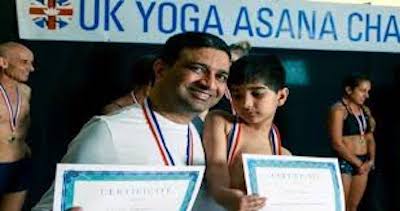
    LONDON(TIP): Indian-origin schoolboy who is the under-11 UK national yoga champion has been named the British Indian of the Year for his achievements in the field.

    Ishwar Sharma, 8, has won a string of titles in both individual and artistic yoga, most recently a gold medal representing Great Britain at the World Student Games 2018 in Winnipeg, Canada, in June.

    “I believe I am competing with myself rather than anyone else, which makes me challenge myself to do the difficult postures,” said the schoolboy, who studies at St Michael’s Preparatory School in Kent.

    “I will always be a student of yoga and am deeply grateful to my teachers for the wisdom they have shared with me,” he said.

    He was named British Indian of the Year in the Young Achiever category at the sixth annual awards ceremony held in Birmingham earlier this week.

    “We feel proud of his achievements and it has improved his academic performance. We want him to inspire adults and other children with this lifestyle habit,” said his father Vishwanath, himself a keen yoga practitioner.

    “He and I perform Vedic Yoga with choreography to music, which includes Hatha Yoga postures with Acroyoga and artistic yoga,” he said.

    The family is originally from Mysore, home to world-renowned yoga gurus, and travel to the region annually.

    “He rejuvenates himself there and would love to stay for more time and get yoga training with the teachers there,” added Vishwanath.

    His son has performed in more over 100 events across the UK and worldwide and among his many skills is the ability to chant up to 50 ‘shlokas’ from the ‘Vedas’ and ‘Bhagavad Gita’. He won a gold medal at the Euro Asian Yoga Championships in Turkey in May and has also performed at a number of charity events to raise funds for the under-privileged.

    Some of his upcoming competitions include one in Chile in December and then Beijing in January next year. He is also training for the World Games in Canada next year.

    “Ishwar is determined to spread awareness about yoga and its benefits, especially among children,” his father said.


  • Indian Origin Banker Found Dead In UAE

    Indian Origin Banker Found Dead In UAE

    ABU DHABI(TIP): An Indian- origin banker working in UAE has been found dead, a week after he went missing, a media report said on July 18.

    Jabar KP hails from Kerala. He stayed in Abu Dhabi city, but his body was found from Mussafah industrial area at city’s outskirts, as reported.

    Jabar’s body was initially kept in the mortuary as an unidentified corpse. Later social workers and community groups stepped in to locate a relative.

    On Monday his brother reached the mortuary and identified him, said the report.

    “We hail from Kannur district of Kerala. Jabar was staying in Abu Dhabi for nine years and he went missing last week,” said Muneer, Jabar’s brother who works with the same bank.

    “I don’t know about the day that the body was found on, but the location is Mussafah. Nor do I know the reason behind my brother’s death. He never had problem with anyone. I came to know about the news through social workers and identified the body. I have lost my brother,” he added.

    Jabar is survived by his wife and two children. The cause of death will be known following an autopsy, the report said.

  • Decoding Trump’s attack on Europe

    Decoding Trump’s attack on Europe

    His incendiary tour of the continent seeks to reverse the gains Europe has achieved over the last 70 years.

    By Ravi Arvind Palat
    Mr. Trump’s blistering attack on European states for not meeting their military spending obligations is misplaced. Not only does he fail to recognize that their military spending has risen since 2014 when they agreed to raise their military spending to 2% of their GDP by 2024 but also that European states are not positioned to be global powers. Unlike the U.S. which is bordered by the Atlantic and Pacific Oceans, Europe has no need for navies to patrol distant oceans and match the U.S. in defense spending. Moreover, rather than spending massively on defense as the U.S. has opted to do, European states provide their citizens with health care, education, and other welfare benefits.
    Far from Russia posing a threat to the Western alliance, the major source of destabilization to the EU comes from the flow of migrants from Africa. In this context, it is not higher military spending by member states that is crucial but the provision of aid. Members of the Organisation for Economic Co-operation and Development had pledged to contribute 0.7% of their GDP as aid to the poorest countries. Germany and the U.K. spend 0.66% and 0.7%, respectively, of their GDP in aid while the U.S. spends a mere 0.18%; Mr. Trump is threatening to slash even that by a third. Spending on aid, especially to African countries, will help stem the tide of refugees coming to Europe far more effectively than policing the Mediterranean.

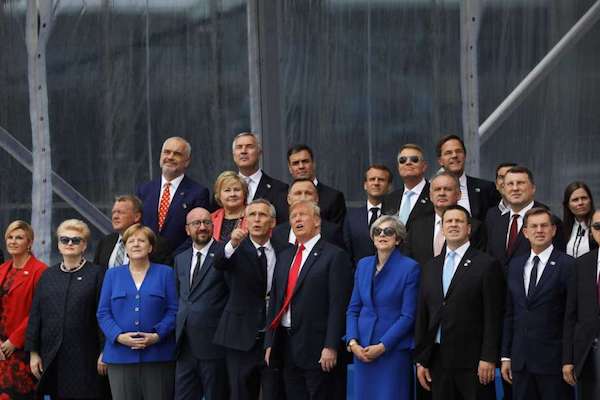
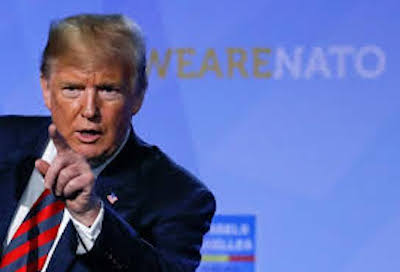
    U.S. President Donald Trump’s incendiary tour of Europe has justly generated extensive coverage for his disregard for diplomatic niceties and attacks on his allies, especially on German Chancellor Angela Merkel and British Prime Minister Theresa May, both of whom are facing stiff domestic opposition. Yet, mainstream commentaries on Mr. Trump’s attacks on the European Union and the North Atlantic Treaty Organization (NATO) do not place the trans-Atlantic relationship in the broader historical context.

    In the first instance, in the aftermath of the Second World War, the U.S. promoted economic integration among its European allies as an essential condition for the post-war revival of world trade. At war’s end, wealth had become concentrated in the new superpower — it accounted for 48% of world industrial capacity and 70% of gold reserves. With the demobilization of some 10 million soldiers in the U.S., the shift to a peacetime economy needed allies to open their markets to U.S. products and investments. Its European allies were too poor to provide a market and the notorious ‘meat-axe’ 80th Congress unwilling to undertake a program for European reconstruction.

    In this context, the U.K. government’s admission in February 1947 that it could no longer intervene in the Greek Civil War provided an opportune moment for U.S. President Harry Truman to follow Senator Arthur Vandenberg’s advice to “scare the hell out of the American people” by manufacturing the Cold War. A Congress that was not willing to aid Clement Attlee’s “socialist welfare state” was eager to rebuild Western Europe and Japan as levees to defend the ‘free world’ against ‘godless communism’.

    Along with NATO founded in 1949 was the Marshall Plan instituted in 1948. It was innovative not because of its size — $17 billion over four years was not substantially more than the $9 billion the U.S. had channeled to its European allies in the previous two years — but because it pressured West European states to reduce tariffs between themselves and to standardize regulations to facilitate the creation of a market viable enough to reap the economies of scale and for U.S. corporations to invest in the continent. This trans-Atlantic U.S. corporate expansion was welcomed by European governments and trade unions as these were the only entities with the funds to create employment.

    Post-war reconstruction

    A trans-Atlantic military alliance and European economic integration were thus the twin projects of a successful post-war reconstruction. Economic integration proceeded rapidly over the last 40 odd years, with the European Union (EU) becoming the largest economy on the planet and thereby threatening the U.S.

    At the same time, the rationale for the NATO military alliance — to protect Western Europe from Soviet expansion and to tie Germany to its neighbors — has largely evaporated with the breakup of the USSR and the dissolution of the Warsaw Pact.

    The Russian angle

    In the context of the current outcry among NATO member states about the Russian annexation of Crimea from the Ukraine, it is important to recall that U.S. President George H.W. Bush and other leaders had assured Russia in 1991 that the trans-Atlantic alliance would not extend beyond East Germany’s borders. Then when Russia was immensely weakened in the 1990s, U.S. President Bill Clinton led the charge to invite states in Central and Eastern Europe into the alliance. It was this expansion that led to a new confrontation with Russia once it had stabilized itself under President Vladimir Putin.

    Nevertheless, there is clearly no Russian threat to Europe. Even in the case of the Ukraine, as Steven Cohen, emeritus professor of Russian studies at New York University, has argued, the crisis was precipitated in 2014 when the EU pressured the Ukrainian government to sign an agreement that would have disadvantaged Russia. When then Ukrainian President Viktor Yanukovych hesitated, he was overthrown by EU- and U.S.-supported demonstrators even though he had signed an agreement brokered by three EU foreign ministers the previous day to form a coalition government. It was this march of NATO to the frontiers of Russia that provoked Mr. Putin to intervene in the Ukraine.

    Recasting security

    Far from Russia posing a threat to the Western alliance, the major source of destabilization to the EU comes from the flow of migrants from Africa. In this context, it is not higher military spending by member states that is crucial but the provision of aid. Members of the Organisation for Economic Co-operation and Development had pledged to contribute 0.7% of their GDP as aid to the poorest countries. Germany and the U.K. spend 0.66% and 0.7%, respectively, of their GDP in aid while the U.S. spends a mere 0.18%; Mr. Trump is threatening to slash even that by a third. Spending on aid, especially to African countries, will help stem the tide of refugees coming to Europe far more effectively than policing the Mediterranean.

    In this context, Mr. Trump’s blistering attack on European states for not meeting their military spending obligations is misplaced. Not only does he fail to recognize that their military spending has risen since 2014 when they agreed to raise their military spending to 2% of their GDP by 2024 but also that European states are not positioned to be global powers. Unlike the U.S. which is bordered by the Atlantic and Pacific Oceans, Europe has no need for navies to patrol distant oceans and match the U.S. in defense spending. Moreover, rather than spending massively on defense as the U.S. has opted to do, European states provide their citizens with health care, education, and other welfare benefits.

    Mr. Trump’s support for Brexit and his humiliating undermining of Ms. May, his outrageous comments on Germany being beholden to Russia and on Ms. Merkel in particular, and his alleged offer of a trade deal to French President Emmanuel Macron if France leaves the EU are all designed to break up the organization so that he can deal from a position of strength with small states. As Britain’s difficulties in exiting the union indicates, supply chains are so integrated across the continent that breaking up the EU would have disastrous consequences for production for all its member states and may even risk a global economic downturn.

    In short, what Mr. Trump is seeking to do is to reverse the gains Europe has achieved over the last 70 years and make it beholden once again to the U.S.

    (The author is a professor of sociology at the State University of New York at Binghamton, U.S.)

    (Source: The Hindu)


  • FIFA was Russia’s coming out party

    FIFA was Russia’s coming out party

    By Prabhjot Singh

    Moscow splurged over $11 bn to make the FIFA World Cup an event to make the ‘planet’ change its outlook about Russia. It worked, leading the FIFA chief to say, “ the whole world fell in love with Russia.’’

    FIFA World Cup 2018 was an all-European show. If France won the Cup, Russia, the hosts, won the hearts. The Americas — north, south and central — were all cut to size not only on the playfields of Russia but also in politics. It turned out to be a wonderful carnival of fun, sport and politics that witnessed many upheavals, besides showcasing Russia as a modern, dynamic and “normal” nation, ready for inclusion in the global economic, political, and sporting landscapes.

    Not only did all 32 nations that qualified laud the event as the “best ever”, a certificate of appreciation also came from FIFA president Gianni Infantino when he commented “the whole world fell in love with Russia” for hosting the best World Cup ever.

    FIFA World Cup 2018 was no different from the 2008 Beijing Olympic Games and 2016 Rio Olympic Games for grabbing criticism on corruption, organizational lapses and failure to provide “clean, healthy and sporting environs for free and fair competitions”. Intriguingly, at the end of these events, this criticism was changed to praise.

    The allotment of FIFA World Cup 2018 to Russia was not without a controversy. FIFA itself was dogged by allegations of corruption and impropriety. Sepp Blatter, the infamous suspended FIFA chief, was a special guest of Russian President Vladimir Putin.

    Allotment was made in 2011 and Putin had promised that the event would change the way the planet saw his “nation”. He had put in place a mechanism to keep the showcase event of FIFA free from threats of hooliganism, terrorist attacks or disruptions by political activists.

    Russia, an offshoot of the erstwhile Soviet Union, got the World Cup at a time when its relationship with both Europe and the US had touched the lowest ebb in decades. Its recent actions in Syria and Ukraine fractured further these ties.

    But unlike the 1980 Moscow Olympic Games held a year after the invasion of Afghanistan, this FIFA World Cup witnessed no boycotts. It was all the more credible to have a full FIFA house in Russia, especially when the hosts remain on the “suspension list” of the International Olympic Committee. In the last Olympic Winter Games in PyeongChang, Russia was not allowed, though its athletes participated under the banner of Olympic Athletes Russia. The World Cup provided a pleasant change. Between June 14 and July 15, the 64 games played in 11 cities not only saw Iceland making an impressive debut, but also defending champions Germany making an exit after the group matches.

    For Asia, it was Japan that carried the flag to the pre-quarterfinals, as other Asian contenders — Iran, Saudi Arabia and Korea —could not cross the group matches hurdle.

    Though India has seldom qualified for the prestigious FIFA event, it had its nominal representation through Rishi Tej (10) and John K Nathania (11) who were chosen to carry the ball for the games on June 18 and 23 in the Russia World Cup. Besides there were 100-odd football fans from India, including Amitabh Bachchan. There were also some volunteers from India.

    The FIFA World Cup is an event that is as prestigious, if not more, as the summer Olympic Games are. Russia spent more than $11.6 billion on infrastructure for the FIFA World Cup. Four years earlier, it had put in a huge amount for the Winter Olympic Games, an event that at the end soiled its credibility for conspiring to “drug” the games, with critics calling the 2014 Sochi Winter Olympics as “chemist” games.

    Besides the Russian Government’s expenditure on making the World Cup an event to make the “planet” change its outlook about Russia, FIFA’s budget for the just-concluded World Cup was a whopping $1,943 million.

    Compared to it, when Bhubaneswar holds the World Cup Hockey Tournament later this year, the total cost is estimated at about $19 million. The event will be spread over 19 days and feature 16 teams and 36 matches. FIFA World Cup, a 35-day event, witnessed 64 games played in 11 different cities.

    There were nearly half a million football fans, including several thousand from Peru alone, drinking on the streets of Russia, through the World Cup days.

    As the event progressed to its knockout rounds, some icons like Argentina, Spain, Portugal, Brazil and Uruguay made unceremonious exits, losing by results facilitated either by late goals, penalties, own goals or penalty shootouts. There were 29 penalties awarded in the tournament besides “own” goals, including the first goal of the final between France and Croatia. And then, the second goal came from a penalty.

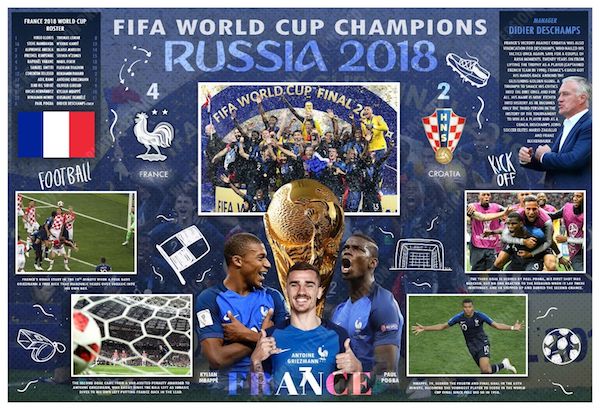
    By the time the tournament reached the semi-final stage, the challenge of Asia, Africa and the Americas had ended. The semi-finals and final were an all-European affair. Though Croatia made it to its first final of a World Cup, it could not stand up to the experience of the French, who won their second World Cup title in 20 years, and thus became only the sixth nation to win the elite soccer tournament two or more times.

    Harry Kane (England), Luka Modric (Croatia), Kylian Mbappe (France) and Thibaut Courtois (Belgium) were adjudged among the best players of this World Cup that also saw the fading away of Lionel Messi (Argentina), even as Cristiano Ronaldo (Portugal) and Neymar (Brazil) may continue to hawk headlines for some more time.

    And who can forget the Croatian President, Kolinda Grabbar-Kitarovic, who spent her own money to travel to Russia, sported the team jersey to watch the “silver team” play the final, from the stands, and greeted and consoled each member of the losing finalist team with a warm hug?

    (The author is a senior journalist. He is executive editor with the PTC TV Channel)

  • Trump – Putin Rocky Summit

    Trump – Putin Rocky Summit

    Donald Trump did enough, and more, to mess up his meeting with Vladimir Putin

    A summit between the leaders of the world’s strongest nuclear powers, which fought the Cold War for decades, is an opportunity to discuss areas of shared interest, find ways to dial down mutual tensions and work together to address global issues. But well before Donald Trump and Vladimir Putin sat down for their first formal summit meeting, in Helsinki, there were concerns that it would be overshadowed by allegations of Russian interference in the 2016 U.S. presidential election. The uproar in Washington over Mr. Trump’s remarks on the Russian meddling scandal — with even accusations of treason — and his subsequent U-turn suggest that such concerns were valid. Mr. Trump could have certainly managed the summit better by addressing genuine concerns in the U.S. over allegations of Russia’s election meddling. Days earlier, the U.S. Justice Department indicted 12 Russian intelligence officials for hacking and leaking emails of top Democrats. It therefore seemed surreal when the President accepted the Russian version over that of his own intelligence agencies and the Justice Department. Away from the controversy, the closed-door meeting between the leaders can be evaluated only on the progress made on a number of contentious issues before both.

    The new Strategic Arms Reduction Treaty (START) is set to expire in 2021 and Russia has shown interest in extending it. For a consensus, high-level talks between the U.S. and Russia are needed. From the crisis in Ukraine to the civil war in Syria, Russia-U.S. cooperation is vital to finding lasting solutions. The Iran nuclear deal, for which Mr. Putin and Barack Obama worked together despite differences, is in a shambles. Most of these issues, including the threat posed by nuclear weapons and intercontinental ballistic missiles, were discussed at the summit. But it’s not clear whether the talks will lead to any significant change in policies. Since the Ukraine crisis, the West has tried different methods, including sanctions and pressure tactics, to isolate Russia and change its behavior. But those methods have proved largely unsuccessful as Russia is now a far more ambitious foreign policy power with an enhanced presence in Eastern Europe and West Asia — even if its sanctions-hit economy is struggling. Instead of continuing a policy that has failed and ratcheted up global tensions, the Western alliance should junk its Cold War mentality and engage with Russia; Russia, in turn, will have to shed its rogue attitude and be more open and stable in its dealings. The stakes are high, and the bitterness of the past should not hinder U.S.-Russia relations. That should have been the message from Helsinki.

    (The Hindu)

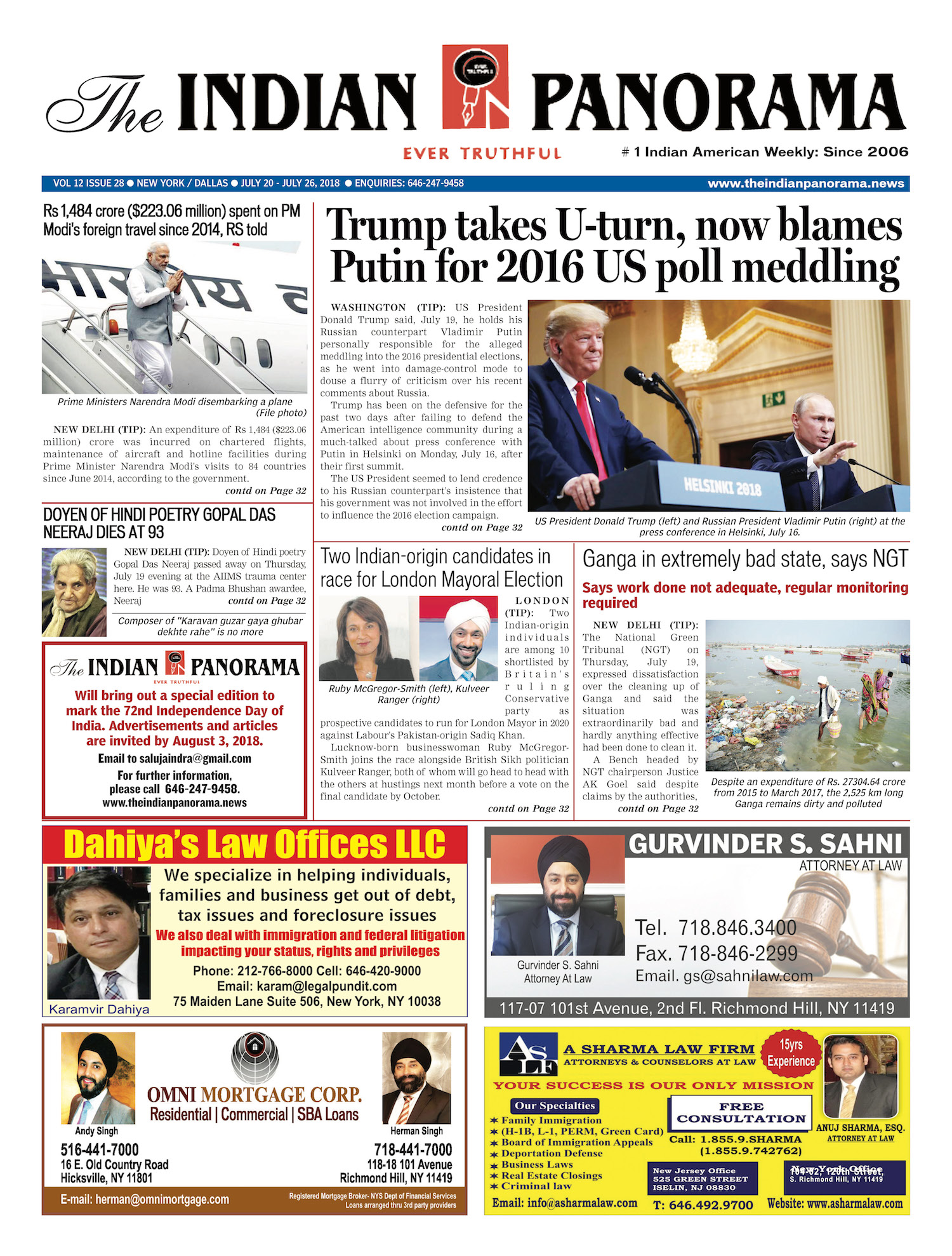
  • Two Indian-origin candidates in race for London Mayoral Election

    Two Indian-origin candidates in race for London Mayoral Election

    LONDON(TIP): Two Indian-origin individuals are among 10 shortlisted by Britain’s ruling Conservative party as prospective candidates to run for London Mayor in 2020 against Labour’s Pakistan-origin Sadiq Khan.

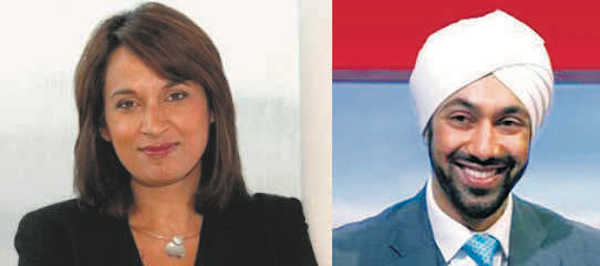
    Lucknow-born businesswoman Ruby McGregor-Smith joins the race alongside British Sikh politician Kulveer Ranger, both of whom will go head to head with the others at hustings next month before a vote on the final candidate by October.

    “It’s time for a Mayor who will re-ignite the possibility, opportunity and the confidence of the greatest city on earth. That’s why I’m running to be London’s Mayor,” McGregor said in reference to her bid on Wednesday.

    The 55-year-old peer in the House of Lords made history as the first Indian-origin woman to run a FTSE-250 company, Mitie Group, nearly a decade ago. She was awarded a Commander of British Empire (CBE) honor by Queen Elizabeth II in 2012 for services to business and promoting diversity.

    Ranger, a former transport adviser in the London Mayor’s office, also made the Tory shortlist for the mayoral race held every four years. “I was born here, grew up, studied, have worked in and for London. I am proud and humbled to be part of this list,” he said.

    (Source: PTI)

  • 3 Fort Worth bank employees shot during attempted robbery

    3 Fort Worth bank employees shot during attempted robbery

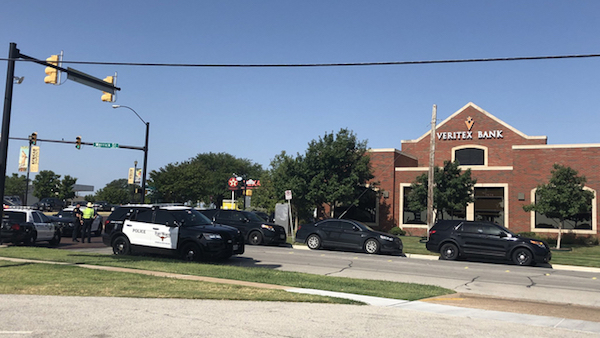
    FORT WORTH, TEXAS(TIP): Three employees were shot during an attempted bank robbery in the Arlington Heights neighborhood of Fort Worth Thursday, July 19 morning.

    Fort Worth Police Department’s Officer Chris Britt said it happened around 9:20 a.m. at the Veritex Community Bank on Merrick Street.

    According to preliminary reports, at least two men walked into the bank with weapons and fired shots.

    Three of the bank’s female employees were shot. All were taken to area hospitals in serious condition. Their injuries appear to be non-life-threatening, according to MedStar officials.

    The president and CEO of Veritex Community Bank said “we ask for a healthy and positive outcome for our three teammates which we believe is the best medicine. We will provide the Fort Worth Police Dept. With any assistance and cooperation they request of us. “

    Officers are still searching for the gunmen in the area. Britt did not have a description of them and said it’s not yet clear if they got away on foot or in a car.

    A home on Blackmore Avenue was surrounded by heavily armed police for nearly four hours. Investigators are gathering evidence at the scene where three people were detained in the area of this home.

    Just after 11 a.m., officers swarmed around the home in the 5700 block of Blackmore Avenue. A woman that was inside the home walked out frantically as guns were aimed at her.

    SWAT team members arrived on the scene and secured the perimeter of the home and nearby residents were evacuated just as a precaution.

    Police and Federal agents on the scene told FOX 4 News this white vehicle in the driveway next door was the suspect’s vehicle from the bank shooting.

    Two Fort Worth PD armored vehicles moved into the front of the home to provide officers with cover. From Sky 4, a huge police presence could be seen and SWAT officers strategically placed all around the home.

    For several hours, police worked patiently to try to make contact with who might be inside. Once a search warrant was obtained SWAT members moved into the home.

    Police say they have three people detained, but it’s still not clear if they are connected to the attempted bank robbery.

    “If anybody in the area saw anything unusual, vehicles leaving the scene quickly that now hearing about this seems odd, if they were any people running from the area that seems odd… if you saw anything that might seem unusual, please give us a call,” he said.

    One resident who lives in Arlington Heights described it as a very old and quiet neighborhood.

    “There are a lot of businesses and a lot of residences mixed together so as far as I know, this is very unusual for there to be a shooting here. But there is a lot of petty crime in the area as there is all over the city and the county,” said Brent Hyder, who lives in Arlington Heights.

    He called the shooting appalling.

    “I’m really sad for those ladies. That’s just unconscionable,” he said.

    Veritex’s Merrick Street branch is closed for the day, the bank said on its website.

    The FBI has the lead role on the investigation as authorities continue their effort to ID the suspects from evidence in the bank and any possible surveillance video.

    (Source: FOX 4)

  • Doyen of Hindi poetry Gopal Das Neeraj dies at 93

    Doyen of Hindi poetry Gopal Das Neeraj dies at 93

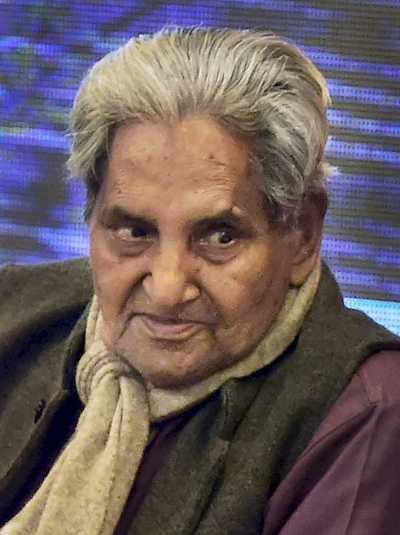
    NEW DELHI(TIP): Doyen of Hindi poetry Gopal Das Neeraj passed away on Thursday, July 19 evening at the AIIMS trauma center here. He was 93.

    A Padma Bhushan awardee, Neeraj had suffered a head injury following a fall at his house in Agra and was undergoing treatment at a hospital there, Dr Rajesh Malhotra, chief of the AIIMS trauma center, said.

    “He was shifted to the trauma center here last night in a critical condition. He had kidney failure, infection all over his body and head injury. He passed away today at around 7.30 pm,” he said.

    Neeraj’s family was by his side during his last hours.

    The poet had also written songs for Bollywood films. Neeraj had penned several hits such as ‘Ae Bhai Zara Dekh Ke Chalo’, ‘Dil Ne Phir Yaad Kiya’, ‘Dil Aaj Shayar Hai’, ‘Likhe Jo Khat Tujhe, among others.

    He was awarded Padma Shri in 1991 and Padma Bhushan in 2007.

    (Source: PTI)


  • Ganga in extremely bad state, says NGT

    Ganga in extremely bad state, says NGT

    Says work done not adequate, regular monitoring required

    Fact file

    •     2,525 km Total length of Ganga
    •     800 tanneries’ dump in it
    •     Rs 20,000 crore to clean it from 2015-2020
    •     Rs 7,304.64 crore spent up to March 2017

    NEW DELHI (TIP): The National Green Tribunal (NGT) on Thursday, July 19, expressed dissatisfaction over the cleaning up of Ganga and said the situation was extraordinarily bad and hardly anything effective had been done to clean it.

    A Bench headed by NGT chairperson Justice AK Goel said despite claims by the authorities, the work done on the ground for Ganga rejuvenation was not adequate and regular monitoring was required to improve the situation.

    The Green panel ordered survey to seek views of common man about what he feels on ground about the pollution in Ganga and said the feedback could be given through e-mail of the authorities concerned. The Bench also comprised Justices Jawad Rahim and RS Rathore, said.

    The NGT had earlier rapped the National Mission for Clean Ganga for not filing a report on the steps taken by the Centre and the UP and Uttarakhand governments to clean the river in the stretch between Gomukh and Unnao.

    The NGT had passed directions to rejuvenate Ganga, declaring ‘No Development Zone’ an area of 100 meters from the edge of the river between Haridwar and Unnao and prohibiting dumping of waste within 500 meters from it.

    Ganga Action Plan

    Launched in two phases by then PM Rajiv Gandhi on Jan 14, 1986, to free Ganga of pollution, domestic sewage and industrial chemical wastes. In first phase, it covered 25 towns in 3 states; in second, 59 towns in 5 states

    River Basin Authority

    Established on February 20, 2009 by the UPA government for ensuring effective abatement of pollution and conservation of the river by adopting a river basin approach

    Namami Gange

    Mission set up by the Narendra Modi govt in 2014 to accomplish twin objectives: abatement of pollution, river rejuvenation

    (With inputs from PTI)

  • Rs 1,484 crore ($223.06 million) spent on PM Modi’s foreign travel since 2014, RS told

    Rs 1,484 crore ($223.06 million) spent on PM Modi’s foreign travel since 2014, RS told

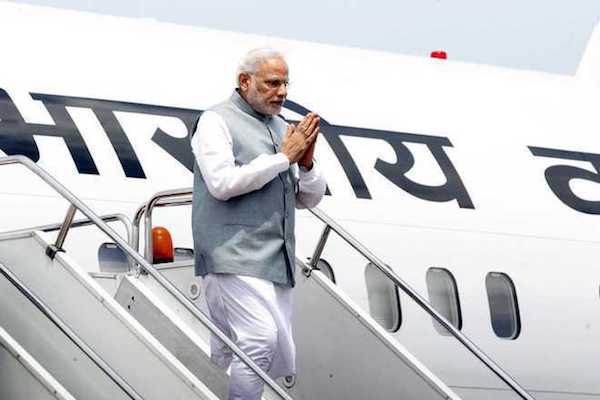
    NEW DELHI(TIP): An expenditure of Rs 1,484 ($223.06 million) crore was incurred on chartered flights, maintenance of aircraft and hotline facilities during Prime Minister Narendra Modi’s visits to 84 countries since June 2014, according to the government.

    The details of Modi’s foreign travel expenditure under the three heads were shared in the Rajya Sabha by Minister of State for External Affairs V K Singh.

    According to the data, a total of Rs 1088.42 crore was spent on maintenance of the prime minister’s aircraft and Rs 387.26 crore on chartered flights during the period between June 15, 2014 and June 10, 2018.

    The total expenditure on hotline was Rs 9.12 crore.

    Modi visited a total of 84 countries in 42 foreign trips since taking over as prime minister in May 2014.

    The details provided by Singh did not include expenditure on hotline facilities during his foreign visits in financial years 2017-18 and 2018-19. The cost of chartered flights for visits in 2018-19 was also not included.

    According to Singh’s reply, the prime minister visited a maximum of 24 countries in 2015-16 followed by 19 in 2017-18 and 18 nations in 2016-17.

    In 2014-15, Modi had visited 13 countries with first one as prime minister to Bhutan in June 2014. In 2018, he travelled to 10 countries with the last one being to China last month.

    The cost for chartered flights to overseas destinations in 2014-15 was Rs 93.76 crore while in 2015-16, it was Rs 117 crore. In 2016-17, the cost was Rs 76.27 crore and in 2017-18, the expense on chartered flight was Rs 99.32 crore.

    “Diplomatic outreach during this period (since May 2014) has included first ever visits from India to several countries at the head of government level,” Singh said.

    He said the outreach has led to enhanced engagement of India’s foreign partners in its flagship programs.

    (Source:  PTI)

  • Trump takes U-turn, now blames Putin for 2016 US poll meddling

    Trump takes U-turn, now blames Putin for 2016 US poll meddling

    WASHINGTON(TIP): US President Donald Trump said, July 19, he holds his Russian counterpart Vladimir Putin personally responsible for the alleged meddling into the 2016 presidential elections, as he went into damage-control mode to douse a flurry of criticism over his recent comments about Russia.

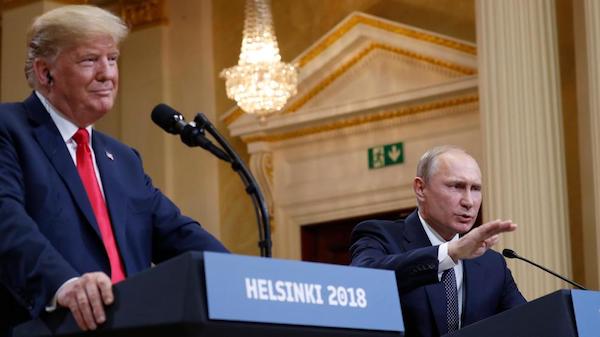
    Trump has been on the defensive for the past two days after failing to defend the American intelligence community during a much-talked about press conference with Putin in Helsinki on Monday, July 16, after their first summit.

    The US President seemed to lend credence to his Russian counterpart’s insistence that his government was not involved in the effort to influence the 2016 election campaign. Trump, a Republican, defeated his Democratic party rival Hillary Clinton in the election. Trump’s comments sparked a barrage of criticism from the media and lawmakers across the political spectrum, with many calling on him to correct himself.

    Speaking to CBS News, Trump said he would consider Putin culpable because he was Russia’s leader. “I would because he’s in charge of the country just like I consider myself to be responsible for things that happen in this country,” Trump said.

    “So, certainly as the leader of the country you would have to hold him responsible,” he said. Facing huge criticism, Trump quickly took a U-turn and attributed his comments at the joint press conference with Putin to a simple mistake.

     Looking forward to 2nd meeting with Putin

    US President Donald Trump said on Thursday, July 19, he looked forward to his second meeting with Russian President Vladimir Putin, insisting that the first meeting was a success despite howls of criticism at home and abroad

    “The Summit with Russia was a great success, except with the real enemy of the people, the Fake News Media. I look forward to our second meeting so that we can start implementing some of the many things discussed,” he wrote on Twitter

    Forces in US trying to derail Peace: Putin

    President Vladimir Putin on Thursday, July 19, accused forces in the United States of trying to undermine the success of his first summit with US President Donald Trump, and said the two leaders had managed to begin to improve US-Russia ties anyway

    Putin, speaking to Russian diplomats from around the world assembled in Moscow, said on Thursday that the summit had been a success overall, but complained about what he described as “powerful” US efforts to sabotage it.

    (With inputs from PTI)

  • July 20 New York & Dallas Print Editions

    July 20 New York & Dallas Print Editions

    [vc_row][vc_column][vc_column_text]

    Print Replica ~ Digitally

    E-Editions

    [/vc_column_text][/vc_column][/vc_row][vc_row][vc_column width=”1/3″][vc_custom_heading text=”New York Edition” font_container=”tag:h2|text_align:center” google_fonts=”font_family:Istok%20Web%3Aregular%2Citalic%2C700%2C700italic|font_style:700%20bold%20regular%3A700%3Anormal” link=”url:https%3A%2F%2Fwww.theindianpanorama.news%2Fwp-content%2Fuploads%2F2018%2F07%2FTIP-July-20-Dallas-TX.pdf|||”][vc_single_image image=”93693″ img_size=”full” add_caption=”yes” alignment=”center” onclick=”custom_link” link=”https://www.theindianpanorama.news/wp-content/uploads/2018/07/TIP-July-20-Dallas-TX.pdf”][/vc_column][vc_column width=”1/3″][vc_custom_heading text=”Dallas, Texas Edition” font_container=”tag:h2|text_align:center” google_fonts=”font_family:Istok%20Web%3Aregular%2Citalic%2C700%2C700italic|font_style:700%20bold%20regular%3A700%3Anormal” link=”url:https%3A%2F%2Fwww.theindianpanorama.news%2Fwp-content%2Fuploads%2F2018%2F07%2FTIP-July-20-NYC.pdf|||”][vc_single_image image=”93694″ img_size=”full” add_caption=”yes” alignment=”center” onclick=”custom_link” link=”https://www.theindianpanorama.news/wp-content/uploads/2018/07/TIP-July-20-NYC.pdf”][/vc_column][vc_column width=”1/3″][vc_single_image image=”82828″ img_size=”medium” alignment=”center” onclick=”custom_link” link=”https://www.theindianpanorama.news/advertising-media-kit-portal-indian-panorama/”][vc_single_image image=”82829″ img_size=”medium” alignment=”center” onclick=”custom_link” link=”https://www.theindianpanorama.news/advertising-media-kit-portal-indian-panorama/”][/vc_column][/vc_row][vc_row][vc_column][td_block_ad_box spot_id=”custom_ad_3″ tdc_css=””][/vc_column][/vc_row][vc_row][vc_column width=”2/3″][vc_custom_heading text=”Lead Stories This Week” font_container=”tag:h2|text_align:center” google_fonts=”font_family:Istok%20Web%3Aregular%2Citalic%2C700%2C700italic|font_style:700%20bold%20regular%3A700%3Anormal” link=”url:https%3A%2F%2Fwww.theindianpanorama.news%2F|||”][td_block_5 separator=”” limit=”12″ tdc_css=””][/vc_column][vc_column width=”1/3″][vc_widget_sidebar sidebar_id=”td-default”][/vc_column][/vc_row]

  • Historic celebration marks 25th anniversary of Jain Temple in Chicago

    Historic celebration marks 25th anniversary of Jain Temple in Chicago

    CHICAGO, IL (TIP): The Jain Society of Metropolitan Chicago (JSMC), Bartlett Illinois, celebrated a milestone – the 25th Anniversary of its temple, with great enthusiasm, color and pride, from June 22 to July 1, 2018 at Bartlett, IL. About 4000 people from US and outside witnessed this historic celebration over the 10 days. This is the first Jain temple in North America with “Shikhar” or dome to complete 25 years. A number of dignitaries, speakers, and faith leaders from US and India graced the occasion.

    The event was graced by political dignitaries including Illinois State Governor Bruce Rauner, Consul General of India Ms. Neeta Bhusan, US Congressman Raja Krishnamoorthi and Peter Roskam, State representatives Christine Winger and Laura Murphy, State senator Tom Cullerton and Bartlett Village trustees.

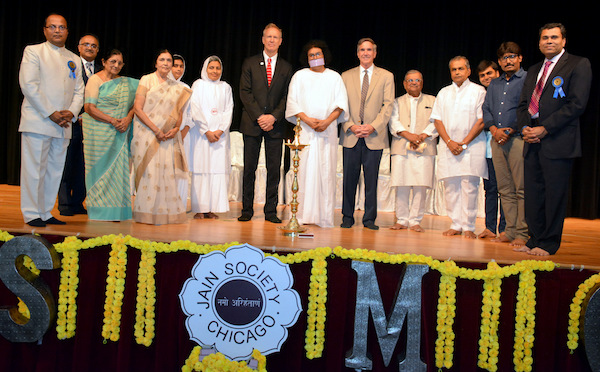
    Illinois State Governor Bruce Rauner, Acharya Dr. Lokesh Muniji performing Aarti at 25th anniversary of Jain Temple in Chicago

    Over the 10 days of celebration, numerous scholars and dignitaries from India, including Muni Shri Jinchandraji, Acharya Dr. Lokesh Muniji, Swami Shrutpragyaji, Charukeerti Bhattarakji, Gurudev Shri Rakesh Bhai Zaveri, Shri Dipakbhai Bardoliwala, Shri Sanjeevji Godha, Smt. Pramodaji Chitrabhanu, Smt. Tarlaben Doshi and Samanijis delivered thought provoking spiritual discourses to an eager audience. Keynote speeches on important topics were delivered by Padmashri Kumarpal Desai, Dr. Dipak Jain, Rahul Kapoor and Sajan Shah. Vidhikar Shri Hiteshbhai, Shri Narendra Nandu, Shri Lalitbhai Dhami, Megh Nandu and Veer Sainik Jinaybhai performed unique poojans and rituals for the first time in the US. Singers Ashish Mehta and Vicky Parekh enthralled the audiences with beautiful musical scores. JSMC’s home musical production Nem Rajul and Karmic Forces received an overwhelming response as much as the professional productions Sheth Motisha and Veer na Varasdaar played by Rangat Productions of Mumbai.

    Many activities for the youth including sports day, field day as well as youth-focused seminars and shibirs kept the youth engaged. Amazing work was done in creating replicas of sacred places of worship Ashtapad and Giriraj Shatrunjay.

    One of the highlights of the celebration was a 1.5-mile parade & procession starting at Bartlett’s Eastview Middle School and ending at the Jain temple. The Sanghpati’s of the 25th Anniversary Celebrations (Jayendra and Leena Shah, Kishor and Rashmi Shah, Prabodh and Lata Vaidya, Sanjay and Hemali Shah and Dr. Shailesh and Mayuri Zaveri) and other sponsor families walked with 12 superbly decorated floats, Bhaghwan Palkhi and Rath, live religious music and dance, motorcycles and horse carriage. Despite nearly 100 degree temperature, the parade had participation from more than 1000  members. The parade ended with a ceremonial flower shower from a helicopter. JSMC also created history by inaugurating the first memorial (Jeevant Smarak) of Gurudev Chitrabhanuji who is credited to have strengthened Jainism and united Jains in the US in the last 40 years. Gurudev’s bust was sponsored by Ravindra & Pallavi Kobawala and Satish & Kinna Shah.

    Since 1970s, Jain population in Chicago has exploded from less than thirty families to over 1900 families. With the mission of preserving and sharing the Jain way of life, the community built a beautiful Temple & Community Center in 1993 in Bartlett, IL on a 14 acre lot. Today this monumental temple and center standing on a 17.5 acre land with expanded facilities of 84,000 sq. ft.

    President of JSMC executive committee Mr. Vipul Shah was ecstatic and mentioned that, “In this milestone year for all Jains around Chicago and indeed all of US, we have delivered a great experience to all our dignitaries, guests and members blending religion, education, culture and entertainment. All our programs have been received with tremendous enthusiasm”. Chairman and Board of Trustees of JSMC, Mr. Atul Shah added, “Our unity, dedicated volunteers, generous donors and all other supporters have helped us to set a very high bar”. Every day during the celebration, JSMC provided 3 sumptuous meals to all attendees and visitors. Many guests from Chicago and outside were thrilled with the overall execution and planning by the dedicated team of volunteers, Executive Committee members and Board of Trustees.

    A view of the gathering

    PR & Media co-leads Mr. Hemant Shah (past Chairman) and Dr. Mukesh Doshi (past Chairman) also explained, “We are building on a very successful legacy of 48 years of JSMC.” Chicago is very fortunate to have remarkable history of the first Jain who landed 125 years ago – when Shri Virchand Raghavji Gandhi pioneered Jainism in western world and represented Jains in first parliament of World religious conference held in Chicago in 1893. Since 1970, this society is standing on contributions of generous donors, dedicated volunteers and passionate leadership of visionaries. We are humbled to be part of this society that is regarded as symbol of unity and harmony among all Jains.

    About Jain Center of Metropolitan Chicago (JSMC)

    Founded in 1970, JSMC caters to the religious, educational, cultural and community needs of Jains in and around Chicago. After building North America’s first Jain temple with Shikhar in 1993, the organization undertook a major expansion in 2008-09. With more than 1900 families as life members, JSMC has maintained its unity of Shwetamber, Digambar, Sthanakvasi and Shrimad sects over the years and has continued to inspire the Jain values of non-violence, multi-pluralism and non-possessiveness.

    These members engage in various religious, cultural, educational, and social and community activities on close to 160+ days in a typical year. Over 500 students register in the Pathshaala that meets every 1st and 3rd Sunday. The Center has also become a preferred location to host other events – given its state of the art community hall and dining facility. A 7-person elected Board and a 13-person elected Executive Committee manage JSMC with support from many /committees.

    Jainism is a religion and a way of life for Jains around the world. The primary purpose of JSMC is to increase the awareness of the principles of Jainism, achieve the unity of all Jains, provide a platform wherefrom to project the voice of Jain religion, promote the feeling of amity and unity among Jains and to promote inter-faith understanding. Jainism, which originated in India, at least five thousand years ago, has largest number of followers (about 4 million) in India. It has nonetheless, influenced the world peace through its message of non-violence and forgiveness. Jainism, indirectly influenced Dr. Martin Luther King Jr, as he followed the example and non-violent methods of Mahatma Gandhi in his struggle for equality and civil rights for all minorities in USA.

    Jains have been on a path of Non-Violence, Non-Absolutism (Anekantvad), and Non-possesion (Aparigrah) for thousands of years. For thousands of years, Jains have believed in meditation, yoga, animal compassion, vegetarianism, environmentalism, equal rights for women, respect for other cultures and forgiveness. Jains believe that universe is eternal and that Jain religion, which explains the rules of the universe, is therefore eternal, with no beginning and no end. Last perfected soul known (Tirthankar) to us is Lord Mahavir, who was born in 599BC, near Patna in Bihar, India.

    (Photographs and Press release by Asian Media USA)

  • Shaan’s Golden Voice to fill the Halls of NJPAC, July 28

    Shaan’s Golden Voice to fill the Halls of NJPAC, July 28

    By Mabel Pais
    About NJPAC

    The New Jersey Performing Arts Center (NJPAC), located in downtown Newark, N.J., has the most diverse programming and audience of any performing arts center in the country, and is the artistic, cultural, educational and civic center of New Jersey – where great performances and events enhance and transform lives every day.

    NJPAC brings diverse communities together, providing access to all and showcasing the state’s and the world’s best artists while acting as a leading catalyst in the revitalization of its home city.

    Through its extensive Arts Education programs, NJPAC is shaping the next generation of artists and arts enthusiasts. NJPAC has attracted more than 8 million visitors (including over 1.6 million children) since opening its doors in 1997, and nurtures meaningful and lasting relationships with each of its constituents.

    Get Social! Follow NJPAC Online:

    Website:     http://www.njpac.org/

    Twitter:       @NJPAC

    Hashtag:     #NJPACmusic

    Facebook:    facebook.com/NJPAC

    Youtube:      NJPACtv

    The New Jersey Performing Arts Center (NJPAC) presents an evening of romantic, high-energy music with Shaan – the “Golden Voice of India” and one of Bollywood’s most popular, versatile vocalists on Saturday, July 28, 2018 at 8:00 PM.

    Shantanu Mukherjee, popularly known as Shaan, is one of the most popular playback singers of the Indian music industry.

    Shaan has been one of the most in-demand playback singers in the Bollywood industry, active in Hindi, Bengali, Marathi, Urdu, Telugu and Kannada films. Among the most popular films that have featured his vocals are 3 Idiots (2009), Om Shanti Om (2007), Saawariya (2007), Fanaa (2006), Dus (2005), Jhankaar Beats (2003) and Kya Dil Ne Kahan (2002).

    Singer-songwriter Shaan has lent his voice to many a hit song in Bollywood, Suno Na (from Jhankaar Beats; 2003), Dus (2005), Chand Sifarish (Fanaa; 2006), and Behti Hawa Sa Tha Woh (3 Idiots; 2009), to name a few.

    He is considered as one of the most popular voices for romantic as well as melodious songs and is one of India’s most versatile singers. He has sung a wide variety of songs in many languages: Konkani, Kannada, Bengali, Punjabi, Nepali, English, Hindi, Oriya, Malayalam, Telugu, Marathi and Assamese.  He has also sung many Pakistani songs.

    In addition to his work on television and the big screen, Shaan has released a series of successful solo albums of his own compositions, among them Loveology, Tanha Dil, Aksar and Tishnagi. His song Shuruaat was made into a music video to promote the hit film, The Chronicles of Narnia: The Lion, the Witch and the Wardrobe. In recent years, he has also branched out into other musical genres, lending his expert vocals to pop, sad songs, patriotic, jazz, ghazals, hip-hop, rock and many more.

    He started his career at a very young age of 17 years in the year 1989. He has been showered with titles such as “Golden Voice of India”, “Voice of Paradise”, “Magician of Melody”, and “Voice of Youth”.

    Shaan became popular with the song Musu, and he kept his presence felt with many hit songs in Hindi films. Shaan is not only an outstanding singer but also a talented music composer and lyricist.

    Shaan, 45, is embracing reality with a smile. He sang for Bollywood for 20 years. The singer feels that an artist needs to evolve with time to survive in the industry, and he’s proud to have done that. There are no rules in the industry and he feels lucky to have been able to survive so long!

    Now, although he does not sing for the Bollywood movie industry, he is not out of work, he says. If there’s no film music, he has other avenues: he does live shows, he travels and he focuses his energies elsewhere. He released his independent single Surilee in 2017.

    He is also widely known as a television host, on popular programs like Sa Re Ga Ma Pa, Sa Re Ga Ma Pa L’il Champs, and The Voice: India Star Voice of India and STAR Voice of India 2.

    He appeared as a judge in Sa Re Ga Ma Pa L’il Champs 2014–2015 and The Voice India Kids 2016. In 2015 and 2016, Shaan was the winning coach in each of the first two seasons of The Voice. In 2016, in The Voice India Kids, he was the coach of the runner-up contestant.

    As a child, Shaan began his career singing jingles for advertisements. After giving it up for a brief period he returned and, along with jingles, began to sing remixes and cover versions. In the 1989 movie Parinda, at age 17, Shaan sang a single line in the song, Kitni Hai Pyari Pyari Dosti Hamari.

    Since Shaan belongs to a musical background: his grandfather lyricist Jahar Mukherjee, his late father composer Manas Mukherjee and his sister singer-actor Sagarika, all contributed to his in-depth knowledge of music. With his melodious singing, he has achieved a great place in the Indian music industry. With Shaan songs, many Bollywood films got an edge to their music.

    He is married to Radhika Jolly. They have two children. Shaan affirms he survived for 20 years in the industry because he sang songs differently, even if they were of the same genre. Until and unless, you try to sing songs differently, you will not survive in the industry, he says. When you sing differently, you make your own sound, and you get to make your own footing.  Further, he believes, if he did not constantly innovate himself, he would be outdated.

    Talking about how he got back into the non-film space, the singer had said that his wife, Radhika is his pillar of strength and helped him get over his fear of rejection. She encouraged him to make music for himself, and to enjoy what he is doing.  They have two sons.

    For more information on Shaan, visit http://www.njpac.org/events/detail/shaan

    For tickets to see Shaan, visit www.NJPAC.org or the NJPAC Box Office or call 888.GO. NJPAC (888.466.5722).

    (Mabel Pais writes on The Arts and Entertainment, Social Issues, Health and Wellness, and Spirituality)


  • The 2018 South Asian Spelling Bee Announces Dallas and New Jersey Winners

    The 2018 South Asian Spelling Bee Announces Dallas and New Jersey Winners

    DALLAS, TX  (TIP):Continuing its quest for the best speller in the community, the 2018 South Asian Spelling Bee (www.SouthAsianSpellingBee.com) traveled to Texas and New Jersey  with stops in Dallas and New Brunswick.

    With a huge turnout this year, the Bee attracted some top talent as well as young and new spellers that competed for the coveted prizes and titles.

    At the Dallas Regional, current Scripps National Champion and South Asian Spelling Bee alumnus Karthik Nemmani was at hand to interact with spellers and parents. Having attended the South Asian Spelling Bee for 5 years, Nemmani  had specific insights about his experience at the event and its contribution to his success.

    “The South Asian Spelling Bee gave me exposure and a competitive edge that other bees lacked,” he told a standing room only crowd at the regional.

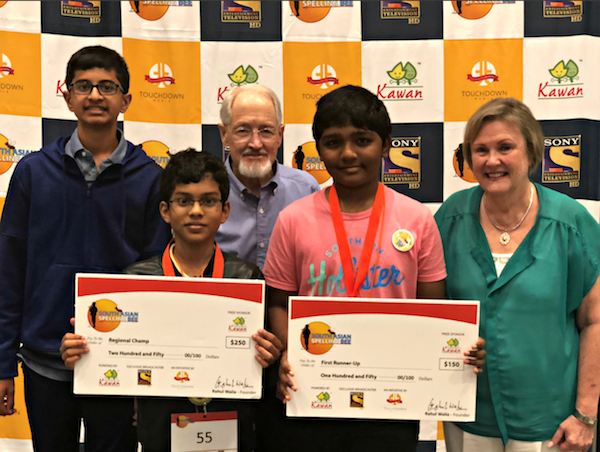
    Sohum Sukhatankar (12) of Dallas, Texas was the regional champ and Rohan Raja (12) of Irving, Texas, was the first runner up at the Dallas Regional.

    In New Jersey, Nitya Kathiravan (9) of Edison, New Jersey was the regional champ and Sujata Choudhury (11) of Cherry Hill, New Jersey, was the first runner up.

    The event is open to children of South Asian descent up to 14 years of age. It will give South Asian children a chance to test their spelling skills in their core peer group. Interested spellers need their parent or guardian to register them online at www.southasianspellingbee.com.

    Organized by Touchdown Media Inc., the South Asian Spelling Bee is celebrating its 11th anniversary this year and with regionals being held in 6 locations across the United States. Regional centers for this season include Washington, D.C. Metro, Charlotte, the Bay Area, Chicago, New Jersey, and Dallas. All events will be free to attend and open to the public. An international regional in Accra, Ghana was conducted earlier this year, from where spellers of South Asian descent will qualify for the finals.

    “For the past ten years, the Bee has consistently provided a firm platform for the community to come together and hone their craft. It’s become a family activity that contributes towards the overall development of the child. We are proud to enter our eleventh consecutive year and look forward to engaging some of these wonderful spellers,” said Rahul Walia, founder of the South Asian Spelling Bee and CEO of Touchdown Media Inc.

    Within the past year the South Asian Spelling Bee has been exhaustively featured in “Breaking the Bee” and an exclusive story on VICE News that followed the journey of South Asian Spelling Bee spellers and the importance of the South Asian Spelling Bee platform being a vital step in their spelling journey.

    The top two spellers of each regional competition will advance to the finals to be held in New Jersey in August. Champion’s grand prize of $3,000 will be awarded to the winner at the finals.

    This year, the Bee is proudly powered by Kawan- the world’s most popular Roti paratha brand returns as the powered by sponsor and as always, Sony Pictures Networks is the exclusive broadcast partner for the South Asian Spelling Bee and will be airing the series across 120 countries.

    “Kawan is proud to return as a sponsor and we have tremendous faith in contributing towards crucial family time for the community. We look forward to getting to know the spellers and their families through this wonderful journey,” said Tim Tan, Managing Director Kawan Food.

    “Year over year, the South Asian Spelling Bee has made for great programming that gels with our ethos of compete family entertainment. We are all about family values and encourage platforms such as these that highlight the talent of our community,” said Jaideep Janakiram, Head of Americas, Sony Pictures Networks.

    For a complete schedule, registration and any other information, please visit: www.SouthAsianSpellingBee.com.

    Find us on Facebook at South Asian Spelling Bee and you can follow us on our Twitter handle at Spell South Asian.


  • At the Crossroads: the Glen Cove Gurdwara

    At the Crossroads: the Glen Cove Gurdwara

    By I.J. Singh & Neena I. Singh

    There is no doubt that our beloved gurdwara is at an existential crisis at this time. We will stumble through it but will we learn any lessons?  Look at all the gurduaras around us in this country in despair.  Look at Sikh teachings and I am sure we can do much, much better.  Let’s see if we can remake our problems into a progressive opportunity rather than a destructive threat.

    No question that sharp lines, etched in stone, if judged by the vicious bitterness of current communication, now divide our community.  How best to move forward?  Welcome the differences; life teaches us that all progress stems from differences and how we handle them.

    We know of the move for all officers and trustees to resign and the gurduara to be managed by a collective of previous officers for a while, until we return to a more equitable and sensible frame of mind. Sounds good except for the correspondence that is hardly reflective, thoughtful, hopeful or helpful.

    An apology at the gurduara by one side was followed by harsh responses from many sides.  That cannot ever lead us to a productive solution. The issue of who has which papers and documents; how and when and to whom will they be delivered remains unresolved; also unresolved is the police report.

    Keep in mind that the gurduara is a community institution, not a private holding corporation.  We cannot allow any group to hijack the gurduara.  If it is a privately-owned corporation where the major agenda is the elaborate menu at langar with lack of relevant community programs then our note today is out of order, as is our attendance at the gurduara.  At this time the sangat is totally side-lined.  Do they have a place and a role in this gurduara?

    We offer a few working ideas here:

    1. Both sides should immediately stop issuing statements to justify their own behavior or condemning the other side.  Such activities absolutely do not help if the purpose is to resolve issues and differences.
    2. In the meantime, we should nominate a small group of 3 to 5 individuals (men and women) to run the gurduara as an interim arrangement. There should be representation of both sides in this subcommittee. A war of words has no place here. We need to talk to each other, not talk at each other.
    3. Let both sides provide any records they have to this small interim committee, who will hold them and secure them but will not issue any comments about them, except to see that they have received all material.
    4. This subcommittee would design what procedures – corrective steps, apologies, or resignations etc. – are necessary to bring the community together and not split it permanently. This subcommittee would also explore organizational and procedural mis-steps in how we run meetings, elections and related matters. At this time, we dare say that we have rules but rarely do we follow or understand them well.  At this time the daily briefings continue to roil the community.  They don’t help at all.
    5. This sub-committee should report its recommendations to the sangat in a public forum.

    Clearly, the goal is NOT to determine guilt but to close the divisions in the community.  Participants act from their own position that they think is justified and in good faith.  But an institution must have room for different views as well.  Good institutions have term limits for their officers.    We can revisit the Constitution as well, although the problem at this time may be that it is not being used.

    Let us create an institution that can be a model for other gurduarasthat our community – young and old — can find useful. Gurduaras should not collapse like Maharaja Ranjit Singh’s kingdom — a house of cards. He failed to foresee the future; let’s learn from that mistake. Gurduara of Slough in the UK seems like a good model; let’s explore their functioning.

    Let us focus on the program gurduaras can offer.  Keep an eye on waste of community funds and resources: time, money and energy! Procedures for resolution of problems must exist in the framework of every institution.

    Unanimity of opinion and homogeneity of thought does not make a successful progressive community and institution.  Respect differences and work with them.  An institution such as ours must display fundamental transparency, accountability and participatory self-governance.

    Any positive suggestions and initiatives should be both solicited and welcome?

    ijsingh99@gmail.com


  • Deep state, deeper problems: Pakistan

    Deep state, deeper problems: Pakistan

    Pakistan has been ill-served with the ‘corruption is the only problem’ oversimplification, as elections beckon

    By Husain Haqqani

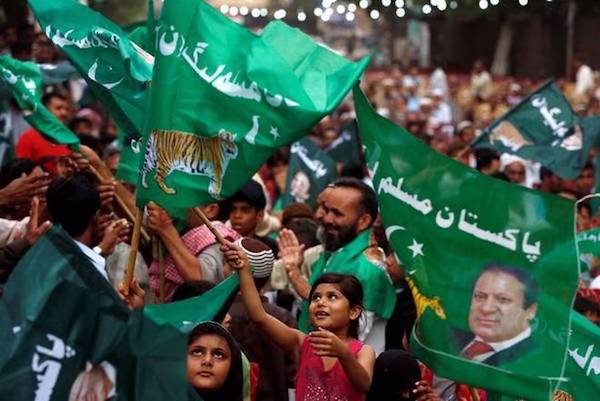
    It is ironic that Mr. Sharif faces jail ahead of an election that opinion polls indicate his party would win, if voting was free and fair, even as a long list of internationally designated terrorists is free to seek votes. That contradiction is at the heart of why the outcome of the elections is unlikely to change any of the fundamentals of the Pakistan crisis. If the PML-N overcomes all odds and still manages to win, the corruption cases will continue to cast their shadow. If someone like Imran Khan wins with the help of invisible hands, he would start his term under a different cloud.”

    Whatever their outcome, Pakistan’s general election scheduled for July 25 is unlikely to change four fundamental realities. First, Pakistan’s military-led establishment will continue to wield effective power, drawing strength from allegations of incompetence and corruption against civilian politicians. Second, civilian politicians will continue to justify their incompetence and corruption by invoking the specter of military intervention in politics. Third, jihadis and other religious extremists will continue to benefit from the unwillingness of the military and the judiciary to target them as well as the temptation of politicians to benefit from their support. Fourth and finally, Pakistan’s international isolation and economic problems, stemming from its ideological direction and mainstreaming of extremism will not end.

    The conviction of former Prime Minister Nawaz Sharif by an accountability court last Friday has set the stage for him to portray himself as the latest martyr for democracy. He has argued, as others have done before him, that he is being punished not for corruption but for standing up to Pakistan’s invisible government — the military-intelligence combine that has dominated the country effectively since 1958.

    His supporters are willing to ignore the fact that Mr. Sharif’s own political career was launched by the Pakistan Army and the Inter-Services Intelligence (ISI), and the likelihood that allegations of unusual expansion of the Sharif fortune since the family’s advent in politics are true.

    Spotlight on the judiciary

    The conduct of Pakistan’s judiciary in the matter has been far from judicious. The Chief Justice of Pakistan, Saqib Nisar, views himself less as an adjudicator in accordance with the law and more as a super policy maker. He has expressed interest in everything — from water scarcity to running of mental hospitals and prisons. He has taken to touring various government facilities and has even created a fund for the construction of dams. The fund will receive public contributions because the Chief Justice knows the exchequer does not have enough money to build the dams he wants built.

    None of these actions is part of a Chief Justice’s job description, even after recognizing that some judges are more activist than others. Justice Nisar has made his political biases well known and the case against Mr. Sharif proceeded in reverse order. Instead of beginning in a trial court where evidence of his wrongdoing was established beyond reasonable doubt, he was first disqualified by the Supreme Court and then put on trial.

    But perceptions and common knowledge of political corruption cannot be a substitute for following legal principles. Elsewhere in the civilized world, the Pakistani practice of accusing someone of criminal conduct first in the highest court and then demanding that they prove their innocence would be deemed grossly unjust. The fact that this happens only in political cases further strengthens the view that politics, not corruption, is at the heart of such ‘prosecutions’.

    Moreover, the Supreme Court invited representatives of the Military Intelligence and the ISI to help investigate the money trail for Mr. Sharif’s alleged properties in London. This highly unusual procedure itself casts doubt on the real motives behind the former Prime Minister’s trial. The military-led prosecutions of politicians, even when their malfeasance is well known, helps the politicians in building their case that their political conduct is the source of their troubles.

    Pakistan is, therefore, unable to hold the politically powerful accountable through its politicized judiciary. The cynical view of Pakistani politics would be that three decades ago the deep state advanced Mr. Sharif’s political career while portraying Benazir Bhutto’s spouse, Asif Zardari, as corrupt; now Imran Khan is the ‘chosen one’ while Mr. Sharif’s alleged corruption is being targeted.

    Problem with this ‘narrative’

    The military, which now refers to itself as ‘the institution’, has helped build a simplified narrative to justify its constant intervention in political matters as well as to explain Pakistan’s myriad problems. According to this narrative, civilian politicians are incompetent and corrupt, which is the only reason the military needs to periodically intervene to set things right. There is no explanation for how politicians would ever learn the art of governance if they are to be constantly corrected by unelected generals and judges.

    Another part of ‘the narrative’ is the notion that Pakistan’s dysfunction and periodic economic crises are the result of the massive corruption by civilians. Imran Khan and his supporters have been advancing that simplified narrative. Their message finds resonance with those who want to believe that once kickbacks on large projects and their corrupt practices are eliminated, Pakistan would somehow become the land of milk and honey.

    There is, of course, no justification or excuse for corruption but Pakistan has been ill-served with the ‘corruption is the only problem’ over-simplification. Since at least 1990, it has become an excuse to gloss over more significant policy issues that hold Pakistan back. Corruption has been exposed in many countries, from Iceland to China but none of them is as dysfunctional as Pakistan.

    Limiting national discourse to a discussion of corruption makes it impossible for Pakistanis to discuss how jihadi ideology and religious extremism are leading to Pakistan’s isolation. Similarly, Pakistan’s slow growth in exports, for example, is hardly a function of corruption. It reflects low productivity and inadequate value addition which are consequences of poor human capital development and failure to attract investment, among other factors.

    Pakistan is the sixth largest country in the world in terms of population, has the sixth largest army in the world, and possesses one of the largest nuclear arsenals. Yet, it has the highest infant mortality rate; more than one-third of its children between the age of 5 and 15 are out of school. The country’s GDP on a nominal basis ranks 40 out of nearly 200 countries while its GDP per capita stands at 158 out of 216 countries and territories, according to World Bank data.

    None of these facts, however, has found any mention in the election campaign of any Pakistani political party. Although Mr. Sharif’s Pakistan Muslim League (PML-N) and Bilawal Bhutto Zardari’s Pakistan People’s Party (PPP) have at least cared to publish detailed manifestos, Imran Khan’s Pakistan Tehreek-e-Insaf (PTI) published its manifesto on Monday, July 9, less than 20 days before the election. The party feels it only needs Mr. Khan’s charisma and the outrage against corruption or enemies of Pakistan to claim voters’ loyalty.

    Economic woes

    The anti-corruption enthusiasm has sometimes added to Pakistan’s economic woes. Pakistan is currently burdened with compensation payments running into billions that must be made to foreign companies whose contracts were cancelled as part of investigations into corruption of officials involved in awarding those contracts. But fighting corruption is a useful slogan if the deep state wants to avoid fighting all jihadis and does not wish to acknowledge the flaws of its national narrative.

    It is ironic that Mr. Sharif faces jail ahead of an election that opinion polls indicate his party would win, if voting was free and fair, even as a long list of internationally designated terrorists is free to seek votes. That contradiction is at the heart of why the outcome of the elections is unlikely to change any of the fundamentals of the Pakistan crisis. If the PML-N overcomes all odds and still manages to win, the corruption cases will continue to cast their shadow. If someone like Imran Khan wins with the help of invisible hands, he would start his term under a different cloud.

    Pakistan will, unfortunately, not emerge stronger after an election whose winner lacks credibility and whose loser is likely to initiate confrontation with the winner right after polling day.

    (The author,  Director for South and Central Asia at the Hudson Institute, Washington DC, was Pakistan’s Ambassador to the U.S. from 2008-11. His latest book is ‘Reimagi

  • The New Trade Order

    The New Trade Order

    By Philip I. Levy

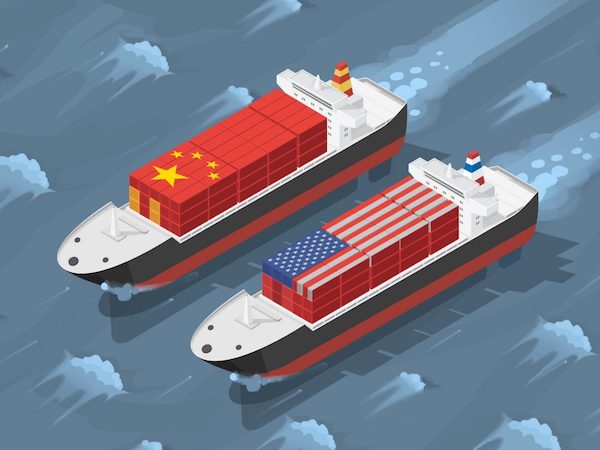
    Since the start of the year, U.S. President Donald Trump has lashed out at allies and adversaries alike on trade. Often, as with India, the U.S. has pushed for enhanced security cooperation at the same time it declared trade relations a national security threat. The belligerence has left many baffled.

    Some pointers

    A first question is why the Trump administration is launching its trade wars. There are at least three possible explanations worth considering: an actual casus belli, as with complaints about Chinese practices; a phantom casus belli, as in the preoccupation with meaningless bilateral trade deficits; or, finally, it might just be a straightforward desire to block trade.

    The evidence seems to point to the last possibility — simple protectionism. While the U.S. has significant concerns about Chinese economic practices, such as China’s aggressive approach to acquiring intellectual property from American businesses, the administration has been unable to focus its demands on these practices. When, a year ago, China offered a deal to address its steel overcapacity, Mr. Trump reportedly rejected the deal in favor of pursuing tariffs. Nor has the White House been able to prioritize among its global trade concerns. The discord with trading partners such as the European Union and Canada has undercut the possibility of presenting a united front on China complaints.

    Further, the Trump administration’s tariff justifications can shift rapidly. In May-June, the Trump administration extended steel and aluminum tariffs to Canada, among other countries. Ostensibly, the rationale was a threat to U.S. national security. Yet, at the G7 meetings later that month, Mr. Trump seemed to explain the aggressive U.S. stance by citing Canada’s protective dairy regime.

    There is ample evidence that Mr. Trump places a high priority on bilateral trade deficits, which he seems to equate with profit and loss statements. In May, hoping to assuage the President’s concerns, Chinese Vice-Premier Liu. He came to Washington to offer increased Chinese purchases of U.S. goods as a means of resolving the looming tariff threat. The Trump administration initially struck a deal, then reversed it roughly a week later. Countries with which the U.S. runs a trade surplus have also not been immune from trade attacks; Canada is a prime example.

    This then leaves the simpler explanation that Mr. Trump is fond of tariffs and believes that American industry will do better behind a wall of protection. He has been neither coy nor inconsistent about such feelings. When he first announced his intention to apply steel and aluminum tariffs in March, his press secretary was asked about the surprise policy move. She replied, “This is something, frankly, the President has been talking about for decades.”

    Within the system

    The U.S. prides itself, however, on its political system of checks and balances. Even with a protectionist President, how can one individual recraft a country’s long-standing trade position so dramatically? The puzzle deepens when one looks at the U.S. Constitution, which assigns the power to apply tariffs to Congress. And where are international protections against capricious protectionism?

    Domestically, Congress has tried to shift responsibility for trade on to the Executive Branch ever since it engaged in an ill-fated bout of protectionism in 1930. The underlying presumption was that individual members of Congress were more likely to succumb to protectionist pressures from their narrower constituencies, while the President was more likely to consider the broader national interest. Most domestic legislative safeguards, therefore, protected against a president being more liberal than Congress might desire; there are relatively few protections against a President who is more protectionist. Over the years, the legal authorizations for a President to apply protection accumulated, largely unused. Thus, the steel and aluminum tariffs were justified under an obscure provision of the Trade Expansion Act of 1962, a law granting national security powers from the midst of the Cold War. The upshot is that a protectionist President has ample tools at hand.

    Turning to the global trading system, the burgeoning trade war demonstrates its limitations. The General Agreement on Tariffs and Trade and World Trade Organization were never designed to block a major world power from running amok. They relied, instead, on the principal players in global trade respecting the system. Trade disputes were anticipated, of course, but they were intended to be sincere cases of disagreement about rules and acceptable practices. The WTO Dispute Settlement Mechanism cannot act quickly enough to address the mounting spats about trade protectionism emanating from the U.S., a major reason why countries around the world have not waited for verdicts from their WTO complaints and have instead proceeded with retaliation.

    What lies ahead

    Finally, we can ask: what comes next for the global trading system? In the near term, we are likely to see escalation. U.S. tariffs on $34 billion of imports from China took effect on July 6. China has promised equivalent retaliation. Mr. Trump has promised to retaliate against that retaliation.

    The Trump administration also announced its intention to use its national security justification for tariffs on the auto sector. There are reports that Mr. Trump wants such tariffs in place before the U.S. mid-term elections in early November. While such a move would be qualitatively similar to the action against steel and aluminum trade, it would be quantitatively much more significant, given the magnitude of the autos trade. Europe has threatened retaliatory tariffs worth $300 billion should the auto tariffs proceed.

    There is little sign that Mr. Trump will be turned from his protectionist path by earnest explanations of the virtues of trade, though there have been valiant attempts both from the private sector and from members of Congress. If there is to be a change in the U.S. position, it is likely to come from an active reassertion of congressional authority over trade policy. At the moment, that still appears unlikely, but the pressures are mounting.

    Even if the President has trumpeted his passion for protection for years, many in the U.S. assumed he was exaggerating. It is only in the last month or two that the effects of both protection and retaliation have begun to be felt. While some businesses have been helped, many more have been hurt. For example, while there are roughly 140,000 Americans who work in steel production, there are about 2 million who work in industries that use steel as a major input. Those latter industries are beginning to cry for help, along with farmers who are seeing sales lost to retaliatory barriers. Stories such as the relocation of production of Harley-Davidson motorcycles have called into question the President’s claim that protection would revive American manufacturing.

    All this has led to a deeply conflicted Republican Party, which holds a majority in both houses of the legislature. Traditionally, Republicans have been the more pro-business, pro-trade party and members of Congress running for re-election this November were planning to mount a campaign based on unity, tax cuts, and good stewardship of the economy.

    Now those candidates need to decide whether or not to act against their President’s trade measures. If they choose to, they have the power to legislate and block the President’s trade belligerence, at the cost of enraging him. If they choose not to, they will likely disappoint their constituents. Their choice is likely to determine the next turn in Mr. Trump’s trade war.

    (The author is a Senior Fellow at the Chicago Council of Global Affairs and adjunct Professor at the Kellogg School of Management, U.S.)


  • A difficult campaign: on the Pakistan elections

    A difficult campaign: on the Pakistan elections

    In the run-up to the election, Pakistan’s judiciary and military are showing their hand

    Democracy has always been fragile in Pakistan. It was only in 2013 that a transfer of power from one democratically elected government to another was realized for the first time. As the country heads for the second such transfer, with a general election scheduled for July 25, the celebration is muted, overshadowed by a series of dramatic developments. Last week, former Prime Minister and Pakistan Muslim League leader Nawaz Sharif was sentenced to 10 years in prison in a corruption case involving undeclared property in London. The case, first outed in the Panama Papers, has seen Mr. Sharif disqualified from office and then barred from holding a party position in the ruling PML(N) after being held guilty by the Supreme Court. The charges are serious, even for a country plagued by corruption in high places. But many Pakistanis, including Mr. Sharif’s critics, believe the anti-corruption court was overzealous, and even motivated by those in the deep state unhappy with his recent run as Prime Minister. In an unusual move, military and intelligence officers had been dispatched to cities around the world to gather as much evidence as possible against him. Mr. Sharif, who has been sentenced along with his daughter and son-in-law, accuses the Opposition parties led by Imran Khan’s Pakistan Tehreek-e-Insaf of having received support from the establishment to hold massive rallies calling for his ouster. This was a role Mr. Sharif himself played in the 1990s, when he was the politician favored by Pakistan’s all-powerful establishment.

    While the attempt to neutralize Mr. Sharif’s political role in Pakistan’s future is the biggest story in this campaign, it is by no means the only destabilizing trend. In the past few weeks, the media have battled harassment, with copies of the Dawn banned from cantonments. Journalists have faced death threats. This week, Awami National Party leader Haroon Bilour became the second member of his family to be assassinated, pointing to a systematic targeting of politicians who don’t adhere to an Islamist line or kowtow to the military. The atmosphere is by no means conducive to the conduct of a free and fair election and has been further vitiated by terrorist groups being ‘mainstreamed’ in the polity. The most notable such group is the Allah-o-Akbar Tehreek. Sectarian groups and radical Islamist ideology are being tolerated by the military, despite harsh strictures on terror funding from the Financial Action Task Force, and an international grey-listing that threatens to cripple the economy. The elections will serve as one marker for the democratic process; the larger struggle in Pakistan for the deepening of democracy will continue.

    (Tribune, India)

  • Trade War- US slaps more tariffs on $200b Chinese goods

    Trade War- US slaps more tariffs on $200b Chinese goods

    WASHINGTON(TIP): Escalating the US-China trade war, the Trump administration on Wednesday, July 11, announced 10 per cent tariffs on an additional $200 billion worth of Chinese imports, prompting Beijing to warn of “counter measures” to safeguard its interests.

    The Trump administration’s move comes after the US imposed 25 per cent tariffs on Chinese goods worth $34 billion last Friday. Beijing immediately responded with its own tariffs on US goods worth $34 billion. The retaliatory tariffs that China enacted Friday targeted US cars and major agricultural goods, such as soybeans and meat.

    US Trade Representative Robert Lighthizer released a list of thousands of additional goods that could face 10 per cent tariffs after a public comment period. It includes fruit and vegetables, handbags, refrigerators, rain jackets and baseball gloves.

    (Source: PTI)

  • Demarche to UK over ‘anti-India’ meet

    Demarche to UK over ‘anti-India’ meet

    NEW DELHI(TIP): India has issued a demarche to the UK protesting a meeting convened on August 12 in London by separatist organization Sikhs For Justice (SFJ).

    The SFJ that claims to be an international advocacy group has offered to sponsor youth and political activists from Punjab to travel to London for the August meeting.

    The meeting at Trafalgar Square is aimed at shaping up the “London Declaration on Referendum 2020” campaign seeking a separate Khalistan.

    India has lodged its protest through diplomatic channels against the proposed “anti-India activity”. “We have taken it up with UK and have issued a demarche. We expect UK will not allow such anti-India activities to be carried out in UK,” said MEA spokesperson Raveesh Kumar.

    India’s official response comes a day after the British High Commission spokesperson in Delhi defended the right of people in the UK “to gather together and to demonstrate their views, provided that they do so within the law”.

    “However, will not tolerate any groups who spread hate or deliberately raise community fears and tensions by bringing disorder and violence to our towns and cities and the police have comprehensive powers to deal with such activities,” the British High Commission spokesperson told The Tribune in a cautious statement.

     Khalistan remains a sensitive issue in bilateral ties between the two countries. In April, India had lodged a protest with the UK after the Tricolour was burnt by Khalistani elements at Parliament Square, while PM Narendra Modi was addressing a diaspora event in Westminster.

    “Majority of the Sikh community have good relations with India and with the country where they stay. The rest are fringe elements,” underlined Raveesh Kumar on Thursday.

     According to its legal adviser based in New York, the SFJ plans to provide sponsorship letters to participants from Punjab and also arrange free stay for them from August 10 to 14. It plans to unveil a declaration advocating for “Sikhs’ right to self-determination for the independence of Punjab” at the Trafalgar meeting.

    Separatist group Sikhs For Justice plans to sponsor Punjab youth and political activists to travel to London for August 12 meet aimed at shaping up the “London Declaration on Referendum 2020” campaign seeking Khalistan

  • ’84 anti-Sikh riots: New SIT fails to start work as member’s position remains vacant

    ’84 anti-Sikh riots: New SIT fails to start work as member’s position remains vacant

    NEW DELHI(TIP): A new SIT headed which was set up in January this year to further investigate 186 cases relating to the 1984 anti-Sikh riot cases in Delhi, has failed to start its work, the Supreme Court was informed on Thursday.

    Counsel for the petitioner who has been instrumental in getting the order for a fresh SIT probe told a Bench headed by Chief Justice of India Dipak Misra that a member’s position was vacant in the SIT headed by former Delhi High Court judge SN Dhingra.

     The SIT which is to probe 186 cases closed by the police, has yet to commence its work despite the court’s order to submit its first report in August, the petitioner’s counsel told the Bench.

    CJI Misra said he was aware of the matter and he would soon look into it.

    The Centre had on February 5 told the Supreme Court that ex-IPS officer Rajdeep Singh has refused to be a part of the new SIT and he would be replaced by former Indian Police Bureau Director General of Police NR Wasan. Serving IPS officer Abhishek Dular is the third member of the SIT.

    Justice Dhingra was a trial judge when punishments were handed out in 1990s to the accused of the Trilokpuri massacre of 1984. Kishori Lal, dubbed as the ‘butcher of Trilokpuri’, was among those sentenced by him.

    Almost 3,000 people were killed, most of them in Delhi, in the anti-Sikh riots that broke out following the assassination of then Prime Minister Indira Gandhi on October 31, 1984.

     The Bench had in January noted that the previous SIT had not carried out further probe into these 186 cases in which closure reports were filed. It had taken the decision after perusing the report of a two-judge supervisory panel which scrutinized 241 cases relating to 1984 anti-Sikh riots in Delhi closed by an earlier SIT formed by the NDA government for re-investigation.

     Submitted on December 6, the report of the supervisory committee comprising Justice JM Panchal and Justice KSP Radhakrishnan was perused by the court.

     The court had already made it clear that it would not reopen cases in which accused had been acquitted.

     It had assigned the task of examining the said 241 cases closed by SIT to the supervisory committee which was to make recommendations as to whether the cases were rightly closed or not.

    Counsel for the petitioner who has been instrumental in getting the order for a fresh SIT probe told a Bench headed by Chief Justice of India Dipak Misra that a member’s position was vacant in the SIT headed by former Delhi High Court judge SN Dhingra.

     The SIT which is to probe 186 cases closed by the police, has yet to commence its work despite the court’s order to submit its first report in August, the petitioner’s counsel told the Bench.

    It had assigned the task of examining the said 241 cases closed by SIT to the supervisory committee which was to make recommendations as to whether the cases were rightly closed or not.

     More than two years after the Narendra Modi government set up the SIT to re-investigate serious anti-Sikh riots cases of 1984 that had been closed, it has managed to file charge sheets only in very small number of cases taken up for further probe.