Month: November 2018

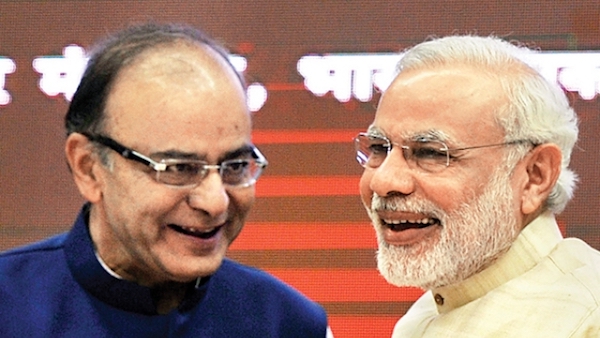
  • How Modi and Jaitley Gamed  World Bank’s Doing Business Rankings

    How Modi and Jaitley Gamed World Bank’s Doing Business Rankings

    BJP government adopted a competitive-exam strategy to improve India’s rankings, meeting minutes and official correspondence show.

    By Akshay Deshmane

    “The elaborate filing requirements of the Goods and Services Tax had hurt medium and small enterprises while demonetization had hamstrung their cash flows, Hazari said and added, “I would think it is surprising if the MSMEs have said that their ease of doing business has improved.”

    Yet, Modi and his government have been quick to market this improvement in India’s rank on an index prepared for mid-size firms operating in two of the most prosperous cities of India as evidence of an actual improvement of economic conditions across the country.

    Prime Minister Narendra Modi’s unhealthy obsession with the World Bank’s Doing Business ranking hijacked India’s reform agenda over the course of the Bharatiya Janata Party (BJP) government’s four-year tenure, according to hundreds of pages of meeting minutes, interviews with key players and official correspondence reviewed by HuffPost India.

    The documents reveal how the Modi government first sought to lobby the World Bank into changing its methodology to reflect a better rank for India. When that didn’t achieve any significant success, the government prioritized minor institutional and procedural tweaks to game the ranking system, rather than embark on a bold agenda of economic reform as promised.

    This monomaniacal focus on putting India among the top 50 countries in the ranking, economists said, gave the World Bank disproportionate influence in India’s economic reform process. It has also revived a persistent concern that the Modi government preferred to focus its energies on optics instead of actual governance and reform.

    This monomaniacal focus on putting India among the top 50 countries in the ranking, economists said, gave the World Bank disproportionate influence in India’s economic reform process

    “If you keep on finding the easiest things to change, then you are effectively letting the World Bank’s ratings decide what kind of changes you want, rather than deciding what is your own sense of priorities,” said Laveesh Bhandari, an economist and director of the Indicus Foundation, who had written a column for The Indian Express outlining these concerns.

    Reports published immediately after India’s dramatic rise up the rankings— from 142 to 77 over four years— have surmised as much. But this is the first comprehensive account that relies on previously unreported documents—accessed through the Right To Information—to provide a blow-by-blow account of how Finance Minister Arun Jaitley and officials in the Prime Minister’s Office adopted the “competitive exam”, tuition-center approach familiar to most Indians eager to improve their rank in a competitive setting.

    “You have literally to crack the code,” Jaitley said, at a self-congratulatory press conference on 31 October, the day when the latest ranking showed India rising up to the 77th position from 100 last year.

    Yet cracking the code, former bureaucrats involved in the process said, wasn’t necessarily good for the economy, much like cracking the board exams isn’t a good indicator of actual learning.

    “If we are improving our position, why are we not getting more investment?” said Arvind Mayaram, who served as Finance Secretary for the first few months of the Modi government’s tenure before he was shunted out to the Tourism Ministry.

    “I would only say that the proof of pudding is in the eating. If the investment rate was around 38% of the GDP in 2011, obviously ease of doing business must have been much superior then than it is in 2018, when it is around 27%,” Mayaram said.

    Cracking the code, former bureaucrats involved in the process said, wasn’t necessarily good for the economy, much like cracking the board exams isn’t a good indicator of actual learning.

    Amitabh Kant, a Modi favorite and former secretary of the Department of Industrial Policy and Promotion (DIPP), pushed back at this characterization of his government’s performance.

    “A lot of work has happened in the past four years on business reforms and the rankings are a reflection of that,” said Kant, now CEO of the NITI Aayog.

    Yet much of this work, HuffPost India found, was akin to rearranging the procedural deck chairs on the listing ship of India’s faltering economy.

    Preparing to crack the code

    On 26 December 2017, Jaitley held an important meeting at his ministry’s office in North Block with the Modi government’s most senior bureaucrats—revenue secretary Hasmukh Adhia, DIPP secretary Ramesh Abhishek, economic affairs secretary and former World Bank Executive Director Subhash Chandra Garg, among others—to address a pressing problem.

    The World Bank had moved the “cut-off date” for finalizing the Ease of Doing Business Report 2019 by a whole month. As a consequence, “the time available to introduce reforms is shorter by a month”, said DIPP secretary Abhishek, according to meeting minutes reviewed by HuffPost India.

    Abhishek could not be reached for comments on this story.

    The timeline and sequencing of the so-called reforms being discussed in the meeting, the minutes make clear, were not dictated by political considerations, discussions with coalition partners or, heaven forbid, an overarching economic vision or strategy. Rather, the reform process was treated like a World Bank-provided syllabus to be completed on time.

    The World Bank would send out its questionnaires to respondents by February 2018, said Abhishek, and “it is therefore important that these reforms are implemented at the earliest”. The questionnaires Abhishek referred to are sent to select businessmen, analysts and other private parties to corroborate claims of reforms made by governments.

    There are 10 quantitative indicators which the bank considers, including the ease of starting a business, getting construction permits and trading across borders, among others, for a mid-size firm, and each indicator is scored and ranked separately. These scores are then aggregated into an overall score for each country. Across the world, the Bank measures performance on the 10 indicators in two cities in the case of all large economies—in India, these cities are Mumbai and Delhi.

    The agenda of Jaitley’s meeting was to ram through as many quick changes as possible.

    To be sure, many of the changes sought in the meeting could have real benefits for a few. But while the government’s attempts to reduce red tape were laudable, analysts said, they were not a substitute for macro-economic reform.

    At Jaitley’s meeting, for instance, proposed “reforms” included eliminating the need for a company seal or rubber stamp to open a bank account, and eliminating the need to submit a cancelled cheque as part of the employee provident fund application process.

    His bureaucrats quickly identified streamlining cross-border trading as an easy way to improve rankings. Thus the department of revenue eliminated the need for traders to submit hard documents, and tried to improve the capacity of the online customs payment gateway.

    According to the minutes, Gopal Krishna, Secretary of the Shipping Ministry, said the Jawaharlal Nehru Port Trust, which handles about 40% of India’s oceanic trade, would digitize import and export related documentation. Interestingly, the port had made the same claim in 2015 for exactly the same reason .

    The focus on cross-border trade would pay off handsomely for the government, as India’s rankings in this specific indicator jumped to 80 in the Doing Business Report 2019 that was released on 31 October. A similar improvement of construction permit procedures saw India’s ranking jump from 181 to 52.

    Another area of focus was the time and paperwork needed to start a new business.

    At the meeting, Abhishek said India needed to reduce the number of official procedures to start a business to six, and the number of days to complete these procedures down to five, to rank amongst the top 50 economies.

    At the time, it took 30 days to start a new business, and required 11 procedures in Mumbai and 12 in Delhi.

    The latest report shows the government managed to eliminate one step by reducing procedures to 10, and also seemingly reduced the time required to 16 days for Delhi and 17 days for Mumbai. The rank for this indicator also jumped up by 21 ranks to 137 in the latest report for the preparation of which this was a key meeting of top officials.

    On that afternoon, the meeting concluded with Jaitley telling the senior officials to submit an action-taken report on the points discussed by 31 January 2018.

    Bhandari, the economist, said that allowing minor procedural changes to disproportionately influence the rankings in a significant way was not the government’s fault, but a flaw in the way the rankings were designed.

    This flaw, Bhandari said, could skew reform priorities away from comprehensive measures that could help the economy as a whole—like improving contract enforcement, skilling and employability or internal trade—towards quick fixes that result in an inordinate rise in the rankings but narrowly affect particular sectors like construction, for instance. Thus he cautioned against resorting to this approach repeatedly.

    How the efforts began

    Jaitley’s 26 December 2017 meeting was one of the most recent instances of an approach adopted immediately in the aftermath of the 2014 general elections which installed a new bunch of decision makers on the Raisina Hill.

    On 16 July 2014, two months after Modi swept to power on the promise of bringing jobs, investment and prosperity, his Principal Secretary Nripendra Misra held a meeting in the PMO to discuss a “concrete strategy for moving up India’s rank” on the EODB index with the secretaries of the corporate affairs ministry, department of economic affairs, DIPP and the ministry of commerce, according to meeting minutes reviewed by HuffPost India.

    “The meeting focused on the more immediate and quickly doable process improvements.” Dr KP Krishnan, an official representing the department of economic affairs in the PMO meeting, subsequently summed up in an internal noting.

    Interestingly, one of the tasks discussed at this meeting involved the streamlining and digitization of customs documents within one month, a “reform” measure that was also discussed in the December 2017 meeting with Jaitley.

    In what would become a familiar pattern for the Modi government, the Information and Broadcasting Ministry was tasked with “Preparation of literature and preparatory activities for global campaign to be taken up on to priority”.

    Crucially, all attendees were told to keep the World Bank abreast of all the good work they were doing.

    “It was emphasized that all these measures should be brought to the notice of the World Bank. All concerned should engage with the World Bank in this regard,” the minutes read.

    Two weeks later, on 29 July 2014, though they were not discussed in the meeting, the government announced changes to three central labor laws. The Indian press immediately hailed the changes as transformative; yet the government was sorely disappointed to learn that the World Bank was only planning to consider reforms made before 1 June 2014.

    Mayaram, the then Finance Secretary and Kant, the then DIPP secretary, were tasked with writing to the World Bank to plead for the deadline to be extended, and the new reforms to be taken into account, so the government could show an immediate improvement in India’s business environment in the Doing Business Report 2015, which was scheduled to be released a few months later. The PMO kept a close track of this.

    “It is learnt that the DBR, 2015 is at the stage of drafting and consolidation,” Mayaram, the then Finance secretary wrote to  MN Prasad, Executive Director of the World Bank for Bangladesh, Bhutan, India and Sri Lanka, on 21 August 2014. “In this regard, it is important that the reference period for documenting reforms in the report is extended to the middle of August, 2014 (instead of 1st June, 2014) to cover the recent reform measures also.”

    Kant, for his part, lobbied Kaushik Basu, then senior vice president and Chief Economist at the World Bank.

    “The new Indian government is deeply concerned about India’s low ranking on the ease of doing business as reflected in the “Doing Business 2014″ report published by the World Bank Group,” Kant wrote in a letter dated September 10, 2014 and reviewed by HuffPost India. “I would like to emphasize that the methodology adopted to arrive at the rankings needs to be further refined so as to paint the correct picture. Drawing conclusions based on the studies conducted in only two cities, namely, Mumbai and Delhi, overdependence on the regulations in place for small and medium enterprises and responses received from a narrow set of services users such as lawyers, accountants and brokers, inadequate appreciation of factors impinging on general business climate such as conservation of environment & ecology may lead to skewed conclusions, especially for a country like India with a huge geographical canvas dotted by varying shades of regulatory mechanisms.”

    Incidentally, this is one of the most persistent critiques made by independent experts about the ranking to this day.

    Despite these letters, the World Bank refused to extend the deadline or change its methodology as per India’s demands and in October 2014, when the Doing Business Report 2015 came out, India’s EODB ranking actually fell from 134 to 142.

    Methodology issues

    The Modi government, in its initial years, also sought to lobby the Bank into changing its methodology while seeking to rise up the ranking at the same time. In its official communications, it also compared the World Bank methodology with the World Economic Forum’s Global Competitive Index and was favorably inclined towards the latter as it showed a better rank for India.

    In his 21 August 2014 letter to the Bank’s Executive Director, Mayaram requested for a meeting with the “senior management” of the Bank with a delegation of Indian bureaucrats led by Kant to impress upon them India’s urgent concerns.

    “We must effectively engage with the World Bank to convince them about the need to change the methodology so that the DBR reflects India’s position more correctly,” Mayaram wrote, referring to the Doing Business Report by its initials. Official correspondence, released under the RTI, shows while Kant did not go for a meeting with the Bank’s Chief Economist Basu, he wrote the above quoted letter lobbying for a change in the methodology.

    When India’s rank improved marginally from 142 to 131 in October 2015 but still remained far from the ambitious target of top 50 countries set by Modi, senior government officials took to writing petulant letters to World Bank officials and to each other, questioning the basis of the rankings.

    On 1 April 2016, for instance, Revenue Secretary Adhia wrote to the then World Bank Executive Director for India and other South Asian countries, Subhash Chandra Garg, saying, “Whether we look at the Doing Business Report in relative terms or absolute terms, the findings seem seriously skewed.”

    (In July 2017, Garg would be repatriated from the Bank to the Indian government, where he was appointed as economic affairs secretary in the Finance Ministry.)

    In September 2016, anticipating a lackluster ranking for India on the index, DIPP Secretary Abhishek wrote to then economic affairs secretary Shaktikanta Das, expressing his disappointment with the World Bank team for relying on the opinions of chosen respondents on the reforms process, rather than on government data.

    “It was evident from the discussion that the Doing Business team is giving more credence to unsubstantiated averments of a few dozen respondents over the actual system log and individual case-wise database running in thousands of sheets” Abhishek wrote to Das following a video conference with the World Bank team to discuss the points of contention about reform claims made by the government for the then upcoming 2017 report, according to his letter dated 26 September 2016, reviewed by HuffPost India.

    So, on 25 October 2016, when much to the government’s embarrassment, India’s rank improved by one spot from 131 to 130 despite hectic lobbying, Modi went on the warpath.

    An official statement released by the PMO on 26 October 2016 about Modi’s sixteenth interaction through PRAGATI, a platform for the PM’s direct review meetings with officials, said, “Mentioning the World Bank’s latest Report on Ease of Doing Business, the Prime Minister asked all Chief Secretaries and all Secretaries of the Government of India to study the report, and analyze the potential areas where there is scope for improvement in their respective departments and states. He asked for a report from all concerned in this regard, within a month, and asked the Cabinet Secretary to review the same thereafter.”

    In November 2016, Modi would announce demonetization—now almost universally acknowledged as a terrible idea. Meanwhile, the government lobbied relentlessly with the Bank, according to a senior government official with knowledge of the matter.

    “Fact is, this government pleaded with the World Bank quite vehemently and initially, Amitabh Kant was at the vanguard of it. Indian government’s persuasion has worked,” this official said. He explained why he felt that Indian government’s “persuasion” (he chuckled at the word “lobbying” while saying this) worked with the Bank, “We are one of the largest borrowers which means that the interest we pay to the bank greases its salaries. So obviously there is a lot of clout that India also has over the bank.”

    “If the Prime Minister also tells the President that look, this is not right, India should be better than what you are showing,” the official continued. “They also oblige.”

    Whether we look at the Doing Business Report in relative terms or absolute terms, the findings seem seriously skewed: Revenue Secretary Hasmukh Adhia

    Over the next two years, the government’s efforts bore fruit. From 2014 to the most recent report that came out early this month, as India’s rank jumped from 142 to 77, the government changed its views on the Bank’s methodology.

    In late 2014, Jaitley told Parliament in a written reply to a question from a parliamentarian that the “government has indicated its concerns about the indicators used, methodology, sample size, use of ranking, neglect of qualitative and country specific business environment, etc. to the World Bank.”

    This November, as the government’s five-year effort at lobbying the bank paid off, Jaitley hailed the ranking as the product of “independent research” based on “objective criteria”.

    “Only a focused and a purpose oriented Government could have achieved this,” Jaitley concluded.

    Small and medium sized businesses feel demonetization and GST have adversely affected their prospects.

    An undesirable dream?

    As the Modi government continues to invest efforts into improving India’s Doing Business rankings keeping in mind the target of joining the top 50, some question if the government should really care so much about what is ultimately an arbitrary index produced by a multilateral lending agency.

    “They should be able to tell the investors which is a good country to invest in, right?” the former finance secretary Mayaram said about the ranking. “But if your methodology is flawed then it has no value. That’s what I said then and I still hold it today that there is not much value because the methodology is flawed.”

    The 2019 ranking for instance, put China—arguably the one place where the world has done the most business in the past decade—at 46, while Rwanda is ranked 29th.

    “If you consider yourself as the six largest economy or, by PPP, third largest economy in the world, then for you to get very upset or excited about what ranking the World Bank or World Economic Forum, or anyone else does, it only shows a little lack of confidence,” Mayaram concluded.

    Mumbai-based independent analyst Hemindra Hazari said he was struck by India’s improved rankings in context of a difficult time for small and medium size Indian companies.

    “If it is in terms of the large corporates, then it is perhaps possible that they have seen an improvement in the business,” Hazari said. “But when you talk about MSMEs, in the last two years, our dear government has given two mortal wounds in the form of demonetization and implementation of the GST.”

    The elaborate filing requirements of the Goods and Services Tax had hurt medium and small enterprises while demonetization had hamstrung their cash flows, Hazari said and added, “I would think it is surprising if the MSMEs have said that their ease of doing business has improved.”

    Yet, Modi and his government have been quick to market this improvement in India’s rank on an index prepared for mid-size firms operating in two of the most prosperous cities of India as evidence of an actual improvement of economic conditions across the country.

    On 3 November, for instance, Modi said, the rankings are an “indicator of India’s strengthening economy and quick progress”. He said this while answering a question posed by a BJP volunteer from Korba, Chhattisgarh, who wanted to know the relevance of the rankings in the life of the ‘common man’. Modi further said that the improvement in rankings over four years by almost half —going from 142 in 2014 to 77 in 2018—shows the Indian economy had improved twice over ever since his government was sworn in, and this marked a definitive change from the previous government. He also told party volunteers from election-bound Chhattisgarh, Madhya Pradesh and Rajasthan during the online interaction that he wants the BJP volunteers to keep track of good news about the country and ensure that they repeatedly speak about it among people, presumably voters.

    (Source: Huffington Post 11/20/ 2018)


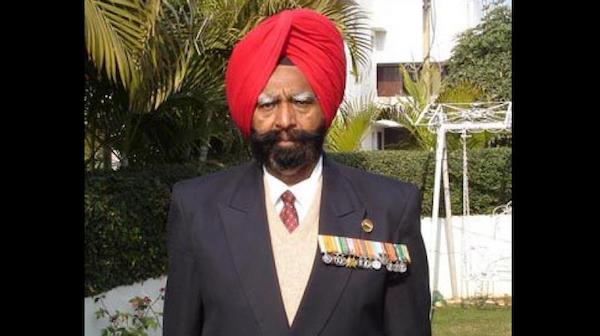
  • Brigadier Kuldip Singh Chandpuri, hero of 1971 Battle of Longewala, dies at 78

    Brigadier Kuldip Singh Chandpuri, hero of 1971 Battle of Longewala, dies at 78

    CHANDIGARH(TIP): Brigadier Kuldip Singh Chandpuri (retd), who is known as the hero of the historic 1971 Battle of Longewala, died on Saturday, November 17,  in a private hospital in Mohali, his family said. He was 78.

    Brig Chandpuri was suffering from cancer, his family said.

    He is survived by his wife and three sons.

    Kuldip Singh Chandpuri was a major in 23 Punjab when the Pakistan Army attacked the Longewala post in Rajasthan, India, early in the Indo-Pakistani War of 1971. Chandpuri and his company of 120 soldiers defended the post, in spite of considerable odds, against the 2000-3000 strong assault force of the Pakistani 51st Infantry Brigade, backed by the 22nd Armored Regiment. Chandpuri and his company held the Pakistanis at bay for a full night until the Indian Air Force arrived to provide air support in the morning.

    Chandpuri inspired his men, moving from bunker to bunker, encouraging them to beat back the enemy until reinforcements arrived. Chandpuri and his men inflicted heavy casualties on the enemy and forced them to retreat, leaving behind twelve tanks. For his conspicuous gallantry and leadership, Chandpuri was awarded the Maha Vir Chakra (MVC) by the government of India.

    A Bollywood film on the Battle of Longewala, made in 1997, with Sunny Deol playing Major Kuldip Singh Chandpuri, has immortalized the real hero in celluloid.


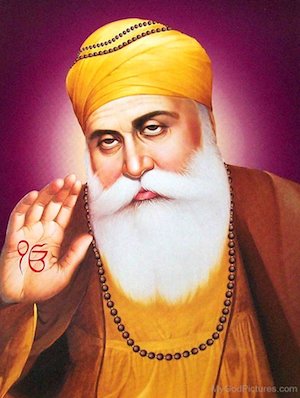
  • 550 Years of Shri Guru Nanak Dev Ji, the Founder of Sikhism

    550 Years of Shri Guru Nanak Dev Ji, the Founder of Sikhism

    Guru Nanak Dev Ji(1469-1539),is the Founder of Sikhism, the youngest and the fifth largest religion of the world, with a following of around 25  million worldwide. It is  a monotheistic faith founded in the Punjab region of India more than  500 years ago. Most of the world’s 25 million Sikhs live in India, but more than 500,000 have made  the U.S. their home.

    Guru Nanak was a precursor to modern world of democratic values. His teachings, universal in nature, include equality, brotherhood, compassion, charity- the values the civilized world cherishes.

    The Indian Panorama, with this issue , begins year- long celebration of the Great Master until His 550th  birth anniversary in November 2019.

    Readers may please contribute articles for publication. E mail to salujaindra@gmail.com

    ‘Guru Nanak’s message of inter-faith dialogue is the best solution to contain terrorism, radicalism: Dr. Manmohan Singh

    Dr Manmohan Singh, Former Prime Minister of India
    Photo / Courtesy Mukesh Aggarwal

    NEW DELHI(TIP): Dr.  Manmohan Singh, former Prime Minister of India  said, November 22,  that Guru Nanak Dev’s message of inter-faith dialogue was the best solution to terrorism and fundamentalism and should be followed to promote harmony in the country, which is witnessing social strife, religious acrimonies  and caste rivalries.

    “Guru Nanak’s message that all religions have merit and it is necessary to learn from each other is as relevant today as it was when He lived in our midst,” the former PM said in an exclusive interview to The Tribune on the eve of the 550th birth anniversary celebrations of the founder of Sikh religion.

    He stressed the urgency of mobilizing all institutions — political, religious and social — to end the scourge of terrorism. In reference to the recent terror act on the Nirankari congregation in Amritsar, he said that Punjab had suffered enough, and it would be sad  if terrorism were to again take root in the state.

    The Congress veteran called upon all segments of the Sikh society, the Hindus and Muslims and all others, to unite on the occasion of Parkash Utsav to promote the cult of good and honest living preached and practiced by Guru Nanak.

    A practicing Sikh and India’s first Sikh PM, Dr Singh quoted poet Allama Iqbal, who best described the “Master’s” advent: “Phir uthi aakhir sada tauheed hi Punjab se…Hind ko ek mard-e-kaamil ne jagaaya khwaab se…”

    (With Inputs from  The Tribune, India)

  • J&K polls to be held before May: CEC Rawat

    J&K polls to be held before May: CEC Rawat

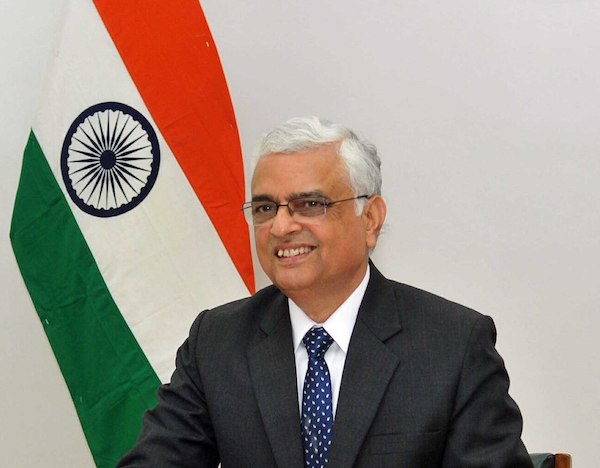
    NEW DELHI (TIP): The Election Commission on Thursday, November 22,  said fresh elections in Jammu and Kashmir would be held within the next six months even as it did not rule out the possibility of holding polls there before the Lok Sabha polls due next year.

    “The Jammu and Kashmir assembly polls must be held on the first occasion before May … it could be held before parliament elections also,” Chief Election Commissioner O P Rawat said.

    He said as per the Supreme Court, the outer limit for holding fresh polls after dissolution of a house is six months, that is May 2019.

    At the same time, he made it clear that the Commission will decide on poll dates after “considering all aspects.”

    He said, SC verdict, an outcome of Presidential reference, also said polls will have to be held on the first occasion which means even before six months.

    He said the same principle was applied in Telangana where the assembly was dissolved prematurely.

    The state Governor Satya Pal Malik dissolved the assembly on Wednesday evening, after People’s Democratic Party leader Mehbooba Mufti staked claim to form government along with her arch-rival Omar Abdullah’s National Conference (NC) and the Congress. They claimed the support of 56 lawmakers in the 87-member state assembly.

    Shortly after, People’s Conference leader Sajad Lone also staked claims to form the government. Lone, who has two lawmakers, said he had the support of the BJP’s 25 legislators and “more than 18” others.

    (Source:  PTI)

  • India, Pak to develop Kartarpur corridor on respective sides

    India, Pak to develop Kartarpur corridor on respective sides

    No clarity yet on bilateral consensus to make corridor functional

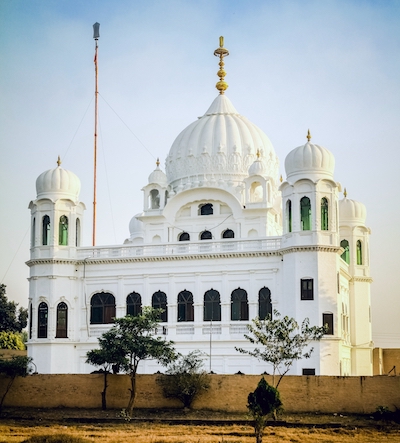
    NEW DELHI(TIP): After a long wait, and much dithering, India and Pakistan, on the eve of Guru Nanak birth anniversary, Thursday, Nov 22,  claimed moving  forward on opening of the Kartarpur Sahib corridor.

    Addressing the long-standing sentiments of Sikh community, a Union Cabinet meeting chaired by Prime Minister Narendra Modi on Thursday, Nov 22,  approved building and development of the Kartarpur corridor from Dera Nanak in Gurdaspur district in Punjab to the International Border with Pakistan.

    The cabinet resolution includes a detailed plan to celebrate across India and globally the 550th birth anniversary of Guru Nanak Dev, who spent 18 years at Gurdwara Kartarpur Sahib on the banks of Ravi river, across Dera Baba Nanak,  in Pakistan.

    “The Kartarpur Sahib corridor will be implemented as an integrated development project with Government of India’s  funding, to provide smooth and easy passage, with all modern amenities,” Finance Minister Arun Jaitley said. A note verbalecommunicating the same has been sent to Pakistan High Commission from MEA (Ministry of External Affairs) whose spokesperson Raveesh Kumar added that India has “approached and urged the Pakistan government to recognize the sentiments of Sikh community and build a corridor with suitable facilities in their territory to facilitate easy and smooth visits of pilgrims from India”.

    The Cabinet announcement came a day after Pakistan media reported that Islamabad has decided to lay foundation for the corridor. Foreign Minister Shah Mehmood Qureshi wrote in a tweet, “Pakistan has already conveyed to India its decision to open Kartarpur Corridor for Baba Guru Nanak’s 550th birth anniversary. PM Imran Khan will do break the  ground (ground breaking ceremony) at Kartarpur facilities on 28th November. We welcome the Sikh community to Pakistan for this auspicious occasion.”

    However, Indian sources claimed that Cabinet passed its resolution after many weeks of internal consultations and preparation within the government. “Any suggestion that the corridor or the celebrations are being planned as a response to a Pakistani proposal is not only preposterous, but hurtful to the sentiments of the Sikh community”, said an official.

    India’s intention is that the corridor must be a full-fledged one with no restriction on pilgrims and should be open not just on special occasions but 365 days and 24 hours, said sources. “There must be free and readily available consular access for Indian citizens on the Pakistani side,” added an Indian official.

    However, what remains unclear is bilateral consensus to operationalize the corridor with immigration check points at the International Border aside of development of the road by both countries on their respective sides. The matter was to be discussed if External Affairs Minister Sushma Swaraj had met with her counterpart SM Qureshi along sidelines of UNGA (United Nations General Assembly) in New York. But India called off the meeting within 24 hours of accepting the Pakistani offer of talks .

    “The modalities will need to be worked out to finalize logistical and procedural aspects, which will require some kind of a meeting,” said a Pakistani official.

    Meanwhile, political leaders welcomed the move and also rushed to claim credit for movement forward after stalemate on the issue. Punjab Chief Minister Captain Amarinder Singh welcomed the resolution “in response to the various letters and submissions he had made to the Prime Minister on this issue”.

    Shiromani Akali Dal(SAD) president and former Punjab deputy CM Sukhbir Singh Badal hailed the Modi government for its decision and announced that SAD and SGPC will take a delegation to Kartarpur Sahib in near future. Asked if Punjab minister and Congress leader Navjot Singh Sidhu’s  visit to Pakistan and controversial hugging of the country’s Army chief catalyzed the Government of India’s decision on the corridor, he quipped: “I do not know,” adding, “May be the recent grenade attack at religious place in Amritsar was because of it.”

    Sidhu had claimed that the Pakistan government has decided to open the corridor following his Islamabad visit for oath-taking ceremony of Prime Minister Imran Khan. ‘It will act like a soothing balm for two neighboring countries’ wrote Sidhu in a tweet.

    “Heartily welcome Kartarpur initiative , it will ease the situation between the two neighbors. J&K has been waiting for similar large heartedness since last 70 years. Need to carry forward Vajpayee ji initiative and open all the routes across LOC and IB in J&K,” PDP president and former J&K CM Mehbooba Mufti tweeted.

    President Ram Nath Kovind and Punjab Chief Minister Amarinder Singh will lay the foundation stone of the Kartarpur corridor at Dera Baba Nanak in Gurdaspur on November 26, Punjab Government announced. Union Home Secretary Rajiv Gauba has asked the state government to make preparations for the ceremony.

    (Source: TNS)


  • Sikhs in Queens Take out an Impressive Parade to Mark the 549th Birth Anniversary of Guru Nanak

    Sikhs in Queens Take out an Impressive Parade to Mark the 549th Birth Anniversary of Guru Nanak

    By I S Saluja
    I.S. Saluja

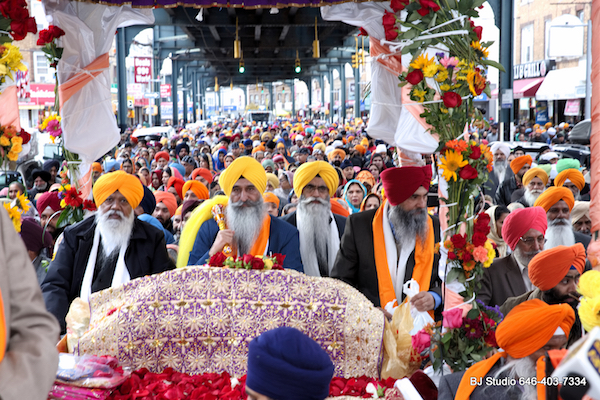
    RICHMOND HILL(TIP): Dedicated to the 549th birth anniversary of Shri Guru Nanak Dev Ji, the Founder of Sikhism, world’s youngest and the fifth largest religion, Sikhs of New York took out an impressive  parade through Richmond Hill in Queens, New York, Saturday, November 17.

    Organized by Gurdwara  Baba Makhan Shah Lubana, located in Richmond Hill, the colorful parade was a treat to watch. There was a  gorgeously decorated float  to carry the Living Guru of the Sikhs, Shri Guru Granth Sahib. This float was at the head of the parade. The Panj Piaras (the five beloveds of the Tenth Master Shri Guru Gobind Singh Ji) marched ahead of the float carrying Shri Guru Granth Sahib , with ragis singing devotional hymns  and the priests attending on Guru Granth Sahib.

    Behind the  float of Shri Guru Granth Sahib was a float of Sikh Martial  Art. Behind this float young and the old displayed  the traditional Sikh martial  art,  known as Gatka.

    The large number of the Sikhs as also their friends from other communities joined the parade, which marched through the Liberty Avenue and then moved on to Atlantic Avenue,  from where it headed towards Gurdwara Sikh Cultural Society on 118thStreet . It finally terminated at the starting point- Gurdwara Makhan Shah Lubana on 114thStreet and 101 Avenue.

    All along the route of the parade,  participants and onlookers were served with snacks and food (langar). Sikhs follow a rich tradition of serving free food to all at all their shrines and at all celebrations.

    Community leaders  paid rich tributes to Shri Guru Nanak Dev Ji. They were joined by politicians and leaders from other communities who spoke highly of  Guru Nanak, Sikhism,  and the Sikh community.

    Sikhs will be celebrating the 550thbirth anniversary of Shri Guru Nanak Dev Ji in November 2019.

    Government of India has announced yearlong celebrations in all Indian missions abroad, in preparation for the grand 550thbirth anniversary celebration  of Shri Guru Nanak Dev Ji.

    Government of Pakistan has extended invitation to Sikhs all over the world to visit Nanakana Sahib, the birth place of Shri Guru Nanak Dev Ji, on the occasion of the Master’s birth anniversary

    Shiromani Gurdwara Prabandhak Committee, the apex religious body of the Sikhs, with headquarters in Harmandir Sahib (Golden Temple) Amritsar, as also Delhi Sikh Gurdwara Managing Committee (DSGMC) have announced ambitious plans to  have year long celebrations of Guru Nanak Dev Ji’s 550thbirth anniversary.

    The Indian Panorama has launched with this edition year long celebration of the 550thbirth anniversary of Shri Guru Nanak Dev Ji. We will carry scholarly articles on Shri Guru Nanak Dev Ji and His faith to educate Sikh youth, as also non-Sikh readers of The Indian Panorama about the universal message of Guru Nanak who preached equality, brotherhood and charity- values which make life beautiful and the world a happier place to live in.

  • James Comey Responds to Subpoena from Republicans: ‘Let’s Invite Everyone to See’

    James Comey Responds to Subpoena from Republicans: ‘Let’s Invite Everyone to See’

    The former FBI director and Loretta Lynch received subpoenas before Thanksgiving to testify on Capitol Hill.

    WASHINGTON(TIP): Former FBI Director James Comey and former Attorney General Loretta Lynch received subpoenas on Wednesday from House Republicans investigating the role of the FBI in the 2016 presidential election, and Comey responded to his with a Thanksgiving tweet.

    “Happy Thanksgiving. Got a subpoena from House Republicans. I’m still happy to sit in the light and answer all questions. But I will resist a ‘closed door’ thing because I’ve seen enough of their selective leaking and distortion. Let’s have a hearing and invite everyone to see,” Comey wrote.

    ————————————————————————————————

    James Comey

    @Comey

     Happy Thanksgiving. Got a subpoena from House Republicans. I’m still happy to sit in the light and answer all questions. But I will resist a “closed door” thing because I’ve seen enough of their selective leaking and distortion.  Let’s have a hearing and invite everyone to see.

    225K

    10:21 AM – Nov 22, 2018

    ————————————————————————————————–

    Lynch hasn’t publicly responded to hers.

    Outgoing House Judiciary Committee Chairman Bob Goodlatte (R-Va.) is requesting that Comey and Lynch testify at depositions held Dec. 3 and 4, respectively, according to documents shared by Politico reporter Kyle Cheney.

    House Republicans’ probe into the FBI’s actions in 2016 will come to an end when Democrats take over the House in January. Republicans have alleged FBI bias against President Donald Trump has led to the bureau focusing on whether there were any Trump campaign ties to Russia instead of investigating Hillary Clinton’s use of a private email server for official business while she was secretary of state.

    Democrats say that it’s all a distraction from special counsel Robert Mueller’s Russia probe, which Trump has repeatedly described as a “witch hunt.”

    Comey’s attorney David Kelley said his client would fight the subpoena in court.

    “While the authority for congressional subpoenas is broad, it does not cover the right to misuse closed hearings as a political stunt to promote political as opposed to legislative agendas,” Kelley said.

    (Source: Huffington Post)

  • November 23 New York & Dallas Print Editions

    November 23 New York & Dallas Print Editions

    [vc_row][vc_column][vc_column_text]

    Print Replica ~ Digitally

    E-Editions

    [/vc_column_text][/vc_column][/vc_row][vc_row][vc_column width=”1/3″][vc_custom_heading text=”New York Edition” font_container=”tag:h2|text_align:center” google_fonts=”font_family:Istok%20Web%3Aregular%2Citalic%2C700%2C700italic|font_style:700%20bold%20regular%3A700%3Anormal” link=”url:https%3A%2F%2Fwww.theindianpanorama.news%2Fwp-content%2Fuploads%2F2018%2F11%2FTIP-November-23-NYC.pdf|||”][vc_single_image image=”95412″ img_size=”full” add_caption=”yes” alignment=”center” onclick=”custom_link” link=”https://www.theindianpanorama.news/wp-content/uploads/2018/11/TIP-November-23-NYC.pdf”][/vc_column][vc_column width=”1/3″][vc_custom_heading text=”Dallas, Texas Edition” font_container=”tag:h2|text_align:center” google_fonts=”font_family:Istok%20Web%3Aregular%2Citalic%2C700%2C700italic|font_style:700%20bold%20regular%3A700%3Anormal” link=”url:https%3A%2F%2Fwww.theindianpanorama.news%2Fwp-content%2Fuploads%2F2018%2F11%2FTIP-November-23-Dallas-TX.pdf|||”][vc_single_image image=”95413″ img_size=”full” add_caption=”yes” alignment=”center” onclick=”custom_link” link=”https://www.theindianpanorama.news/wp-content/uploads/2018/11/TIP-November-23-Dallas-TX.pdf”][/vc_column][vc_column width=”1/3″][vc_single_image image=”82828″ img_size=”medium” alignment=”center” onclick=”custom_link” link=”https://www.theindianpanorama.news/advertising-media-kit-portal-indian-panorama/”][vc_single_image image=”82829″ img_size=”medium” alignment=”center” onclick=”custom_link” link=”https://www.theindianpanorama.news/advertising-media-kit-portal-indian-panorama/”][/vc_column][/vc_row][vc_row][vc_column][td_block_ad_box spot_id=”custom_ad_3″ tdc_css=””][/vc_column][/vc_row][vc_row][vc_column width=”2/3″][vc_custom_heading text=”Lead Stories This Week” font_container=”tag:h2|text_align:center” google_fonts=”font_family:Istok%20Web%3Aregular%2Citalic%2C700%2C700italic|font_style:700%20bold%20regular%3A700%3Anormal” link=”url:https%3A%2F%2Fwww.theindianpanorama.news%2F|||”][td_block_5 separator=”” limit=”12″ tdc_css=””][/vc_column][vc_column width=”1/3″][vc_widget_sidebar sidebar_id=”td-default”][/vc_column][/vc_row]

  • AAPI-QLI Celebrates Culture, Heritage, Achievements & Contributions of Indian American Community at Diwali Gala on Long Island

    AAPI-QLI Celebrates Culture, Heritage, Achievements & Contributions of Indian American Community at Diwali Gala on Long Island

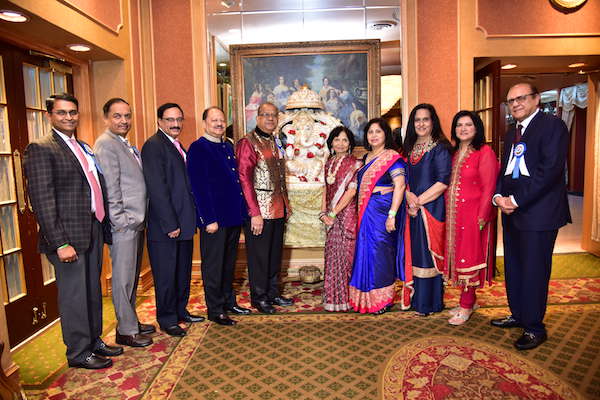
    MELVILLE, NY(TIP): “Tonight, our coming together here as members and supporters of AAPI-QLI, is a way of celebrating the achievements, contributions of our Indian American community, and cherish our ancient and rich cultural heritage,” said Dr. Jagdish K Gupta, President of American Association of Physicians of Indian Origin, Queens and Long Island Chapter (AAPI-QLI) in his welcome address.

    “We are here tonight to celebrate Diwali, the festival of lights, the festival of the celebration of the victory of goodness over evil,” Dr. Gupta, a practicing Gastroenterologist, serving the community for over 40 years, told the audience at the annual Diwali gala at the magnificent Leonard’s Palazzo on Long Island on November 4, 2018.

    The annual Diwali event organized under the leadership of Dr. Gupta, Dr. Ajay Lodha, Chair BOT, Dr. Raj Bhayani, Chairman of function and Executive Committee of AAPI-QLI, attended by over 300 guests, including AAPIQLI members, physicians, sponsors, community leaders and Crème de la crème of Indian Community, was in every sense a celebration of the true spirit of Joy and happiness during the festive season of Diwali.

    Dr. Ajay Lodha, past national President of AAPI, in his address, lauded the many achievements of the Indian Americans. “Tonight, as proud members of the AAPI-QLI, the largest and most active Chapter of national AAPI, we are celebrating the achievements of our community and our many contributions to the diverse society in New York and Long Island area.”

    Dr Naresh Parikh, AAPI President graced the occasion as Guest of Honor and Honorable Ambassador Shree Sandeep Chakravorty, Consul General of New York was the Chief Guest. In his address, Dr. Parikh described AAPI-QLI as the most vibrant, transformative and politically active Chapter among all AAPI chapters in the nation.” Dr. Parikh referred to the fact that Indian American Physicians serve every 7th patient in the nation and contribute enormously the healthcare industry of the United States.

    At the gala, two very dynamic and young physician achievers, Drs. Preeti and Nilesh Mehta, were recognized for their humane, state of the art services to the residents of Queens, Nassau and Suffolk Counties. Also, AAPI-QLI recognized Nargis Dutt Cancer Foundation for its decades long services, relieving and supporting the poorest and needy cancer patients and their families in India for over 37 years. Ramesh Goel, MBA, a simple, down to earth community leader, was recognized for his services to many religious and professional Alumni organizations.

    Earlier, Diwali festival celebrations began with the traditional, Deva Shri Ganesha recital and dance followed by invocation with Shankh-naad and Shlokas by Pandit, Dixit Ji and participation in lamp lighting ceremony by the entire audience. The celebrations came to a close with amazing dance performance followed by extravaganza of delicious food and custom designed Venetian Dessert show.

    AAPIQLI, one of the largest chapters of national AAPI, has been serving 800 member physicians since 1995, providing continuing medical education, charity, and discussing the state of the art topics in healthcare, wealth management and practice management.

    AAPI QLI has grown rapidly in membership and has been well accepted and appreciated by all local and national professional organizations. From the very beginning the leadership put heavy emphasis on transparency and the democratic process, which is the main ingredient for its enormous success.

    The Mission of AAPI Queens and Long Island has been to represent the interests of all physicians of Indian Origin in the area including providing Continuous Medical Education (CME) and engaging in charitable activities for the benefit of the larger community in the New York region.

    (Press Release by Ajay Ghosh)

  • IALI donates generously to the INN for Diwali Food Drive

    IALI donates generously to the INN for Diwali Food Drive

    LONG ISLAND, NY (TIP): The India Association of Long Island (IALI) has been partners with The Interfaith Nutrition Network (INN) in fighting hunger on Long Island for the past 23 years to help those in need across Long Island.

    Mr. Peter Bheddah, started the Diwali Food Drive, all those years ago, and itquickly gained momentum. Mr. Dev Ratnam joined the INN Board, tocontinue the charitable work. IALI presidents over the years and theirExecutive committees and members all pitched in with donations offood, medications, clothes and of course money, to help those in needand want across Long Island. IALI has helped to bring food to 800,000 to hungry and homeless Long Islanders. IALI is close to reaching 1,000,000 meals very soon.

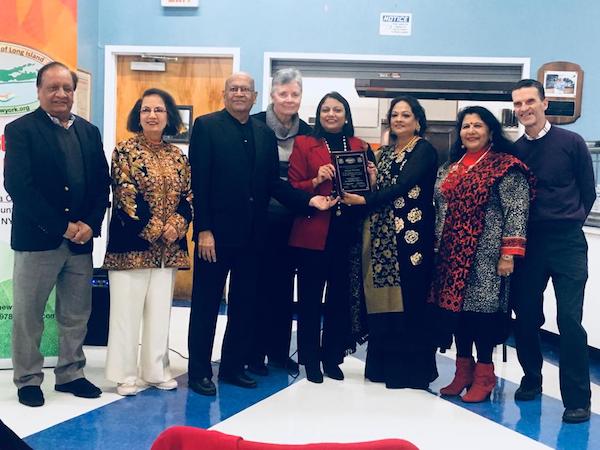
    On Sunday, November 11, 2018, this year, for the Diwali food drive, IALI gave a very generous check of $17000/- to INN to continue this exemplary service. This amount was accumulated by donations by IALI members and Major sponsors  Mr. Peter Beddah, Dr. Kishore Kunchum, Mrs. Indu Chhabra and Friends and Mr. Raj & Jyoti Gandhi.

    The Festive Diwali event took place at the Mary Brennan Inn, Hempstead. The program was admirably Emceed by Dr. Bhavani Srinivasan. A ceremonial lamp was lit by the dignitaries present, Mr. Tony Santino, former Supervisor Town of Hempstead, Councilwoman Dorothy Goosby, Mr and Mrs. Bheddah, Mrs. Indu Chhabra, Mr. Dev Ratnam, IALI President Gunjan Rastogi, IALI Officers and Executive Council members. Mrs. Aruna Saxena was honored for being the Chair of Diwali Food Drive for last six years.

     Young Tara Chaudhary gave a very lovely and lively dance recital and Mrs. Jyoti Gupta and Amita Karwal sang a beautiful song.

    The IALI President, Mrs. Gunjan Rastogi, along with Past Presidents, Mr. Satpal Malhotra, Mrs. Indu Jaiswal, and Dr. Bhavani Srinivasan, members of the executive committee, Mr. Lalit Aery, Mr. Gobind Gupta, Mr. Vimal Goyal and the standing Chairs, Mrs. Amita Karwal, Mrs. Jyoti Gupta, Mr. Rajeev Chaudhary and Mrs. Saroj Aery and Mrs. Jaya Bahadkar were all present. A large number of IALI members were in attendance for the celebration including Mr. Ved Behl, Mr. & Mrs. Sood,  longtime supporters of Diwali Food Drive.

  • IRS provides tax inflation adjustments for tax year 2019

    IRS provides tax inflation adjustments for tax year 2019

    NEW YORK (TIP): The Internal Revenue Service today announced the tax year 2019 annual inflation adjustments for more than 60 tax provisions, including the tax rate schedules and other tax changes. Revenue Procedure 2018-57 provides details about these annual adjustments. The tax year 2019 adjustments generally are used on tax returns filed in 2020.

    The tax items for tax year 2019 of greatest interest to most taxpayers include the following dollar amounts:

    The standard deduction for married filing jointly rises to $24,400 for tax year 2019, up $400 from the prior year. For single taxpayers and married individuals filing separately, the standard deduction rises to $12,200 for 2019, up $200, and for heads of households, the standard deduction will be $18,350 for tax year 2019, up $350.

    The personal exemption for tax year 2019 remains at 0, as it was for 2018, this elimination of the personal exemption was a provision in the Tax Cuts and Jobs Act.

    For tax year 2019, the top rate is 37 percent for individual single taxpayers with incomes greater than $510,300 ($612,350 for married couples filing jointly). The other rates are:

    o 35 percent, for incomes over $204,100 ($408,200 for married couples filing jointly);

    o 32 percent for incomes over $160,725 ($321,450 for married couples filing jointly);

    o 24 percent for incomes over $84,200 ($168,400 for married couples filing jointly);

    o 22 percent for incomes over $39,475 ($78,950 for married couples filing jointly);

    o 12 percent for incomes over $9,700 ($19,400 for married couples filing jointly).

    o The lowest rate is 10 percent for incomes of single individuals with incomes of $9,700 or less ($19,400 for married couples filing jointly).

    For 2019, as in 2018, there is no limitation on itemized deductions, as that limitation was eliminated by the Tax Cuts and Jobs Act.

    The Alternative Minimum Tax exemption amount for tax year 2019 is $71,700 and begins to phase out at $510,300 ($111,700, for married couples filing jointly for whom the exemption begins to phase out at $1,020,600). The 2018 exemption amount was $70,300 and began to phase out at $500,000 ($109,400 for married couples filing jointly and began to phase out at $1 million).

    The tax year 2019 maximum Earned Income Credit amount is $6,557 for taxpayers filing jointly who have three or more qualifying children, up from a total of $6,431 for tax year 2018. The revenue procedure has a table providing maximum credit amounts for other categories, income thresholds and phase-outs.

    For tax year 2019, the monthly limitation for the qualified transportation fringe benefit is $265, as is the monthly limitation for qualified parking, up from $260 for tax year 2018.

    For calendar year 2019, the dollar amount used to determine the penalty for not maintaining minimum essential health coverage is 0, per the Tax Cuts and Jobs act; for 2018 the amount was $695.

    For the taxable years beginning in 2019, the dollar limitation for employee salary reductions for contributions to health flexible spending arrangements is $2,700, up $50 from the limit for 2018.

    For tax year 2019, participants who have self-only coverage in a Medical Savings Account, the plan must have an annual deductible that is not less than $2,350, an increase of $50 from tax year 2018; but not more than $3,500, an increase of $50 from tax year 2018. For self-only coverage, the maximum out-of-pocket expense amount is $4,650, up $100 from 2018. For tax year 2019, participants with family coverage, the floor for the annual deductible is $4,650, up from $4,550 in 2018; however, the deductible cannot be more than $7,000, up $150 from the limit for tax year 2018. For family coverage, the out-of-pocket expense limit is $8,550 for tax year 2019, an increase of $150 from tax year 2018.

    For tax year 2019, the adjusted gross income amount used by joint filers to determine the reduction in the Lifetime Learning Credit is $116,000, up from $114,000 for tax year 2018.

    For tax year 2019, the foreign earned income exclusion is $105,900 up from $103,900 for tax year 2018.

    Estates of decedents who die during 2019 have a basic exclusion amount of $11,400,000, up from a total of $11,180,000 for estates of decedents who died in 2018.

    The annual exclusion for gifts is $15,000 for calendar year 2019, as it was for calendar year 2018.

    The maximum credit allowed for adoptions is the amount of qualified adoption expenses up to $14,080, up from $13,810 for 2018.

  • New tax law allows small businesses to expense more, expands bonus depreciation

    New tax law allows small businesses to expense more, expands bonus depreciation

    NEW YORK  (TIP): The Internal Revenue Service today reminded small business taxpayers that changes to the tax law mean they can immediately expense more of the cost of certain business property. Many are now able to write off most depreciable assets in the year they are placed into service.

    The Tax Cuts and Jobs Act (TCJA), passed in December 2017, made tax law changes that will affect virtually every business and individual in 2018 and the years ahead. Among those for business owners are tax rate changes for pass-through entities, changes to the cash accounting method for some, limits on certain deductions and more.

    Section 179 expensing changes

    A taxpayer may elect to expense all or part of the cost of any Section 179 property and deduct it in the year the property is placed in service. The new law increased the maximum deduction from $500,000 to $1 million. It also increased the phase-out threshold from $2 million to $2.5 million. These changes apply to property placed in service in taxable years beginning after Dec. 31, 2017. For most businesses, this means the 2018 return they file next year.

    Section 179 property includes business equipment and machinery, office equipment, livestock and, if elected, qualified real property. The TCJA also modifies the definition of qualified real property to allow the taxpayer to elect to include certain improvements made to nonresidential real property. See New rules and limitations for depreciation and expensing under the Tax Cuts and Jobs Act for more information.

    New 100 percent, first-year ‘bonus’ depreciation

    The 100 percent depreciation deduction generally applies to depreciable business assets with a recovery period of 20 years or less and certain other property. Machinery, equipment, computers, appliances and furniture generally qualify. The law also allows expensing for certain film, television, and live theatrical productions, and used qualified property with certain restrictions.

    The deduction applies to business property acquired after Sept. 27, 2017, and placed in service after Sept. 27, 2017, and before Jan. 1, 2023. In general, the bonus depreciation percentage is reduced for property placed in service after 2022. See the proposed regulations for more details.

    Taxpayers may elect out of the additional first-year depreciation for the taxable year the property is placed in service. If the election is made, it applies to all qualified property that is in the same class of property and placed in service by the taxpayer in the same taxable year. The instructions for Form 4562, Depreciation and Amortization, provide details.

    Business owners can refer to the Tax Reform Provisions that Affect Businesses page for updates.

  • IDC Honors Indian Soldiers on Armistice Day, 11 November 2018 in France

    IDC Honors Indian Soldiers on Armistice Day, 11 November 2018 in France

    NEW YORK(TIP): On the November 11, 2018, the centennial of the Armistice ending World War 1, members of the Indian Diaspora Council International(IDC) led by IDC president Mr. Ashook Ramsaranof New York, USA, participated in the inauguration of a specially designed monument at Laventi, France, to honour and pay homage to Indian soldiers killed in Europe fighting in World War 1 fighting in Europe. Ramsaran was ably assisted by Mr. Samarassame Taniga, president of IDC France.

    The monument was inaugurated on November 11 at 11 :11 :11 at Laventie, France.

    This ceremony at Laventi was preceded by a wreath laying ceremony at Neuve Chapelle, France where a special monument has been erected to honour of fallen Indian solider were members of the Garhwal Rifles regiment of the Himalayan region. This regiment lost nearly 700 soldiers during World War I.

    IDC collaborated with and supported Interfaith Shaheedi Commémoration Association (IFSCA) headed by Mr. Ramesh Vohra, in the design, construction and dedication of this monument at Levanti.

    Ashook Ramsaran laving the wreath at Lavanti, France – November 11, 2011

    The Mayor of the town of Lavanti, Hon. Jean-Philippe Boonaert, warmly welcomed everyone and presided at the dedication of the monument. The municipality and veterans of France provided a warm welcome with marching band, a special celebratory mass in nearby church of St. Vaast and refereshments.

    IDC collaborated with and supported Interfaith Shaheedi Commémoration Association (IFSCA) in the construction and dedication of this monument at Levanti. IFSCA is headed by Mr. Ramesh Vohra.

    This ceremony at Laventi was preceded by a wreath laying ceremony at Neuve Chapelle, France where a special monument has been erected to honour of fallen Indian solider were members of the Garhwal Rifles regiment of the Himalayan region. This regiment lost nearly 700 soldiers during World War I.

    “The Indian Army during World War I contributed a large number of divisions and independent brigades to the European, Mediterranean and the Middle East theatres of war in World War I. Over one million Indian troops served overseas, of whom 62,000 died and another 67,000 were wounded. In total at least 74,187 Indian soldiers died during the war. Of the 130,000 Indians who served in France and Belgium, almost 9,000 died”– https://en.wikipedia.org/wiki/Indian_Army_during_World_War_I

     World War I (1914-1918) ended at 11 a.m. on 11 November 1918 with the signing of the armistice between the Allies and Germany. It established the reputation of Indian soldiers for their bravery, courage and sacrifice.

    Around 1.3 million soldiers from India participated in World War I (1914-1918). Among them, 140,000 Indian soldiers were sent to France. They were Sikhs, Punjabis and Gurkhas who came to strengthen the British army to defend freedom and liberty in France against invasion.  They were soldiers from different ethnic, linguistic and religious backgrounds. The Indians troops were mobilized on August 8, 1914 at the request of London without even getting any approval from the parliament of New Delhi. At that time, India was under British rule.

    The Indian soldiers left the port of Bombay and landed at Marseille in France on September 26, 1914. They were immediately sent on the North front so as to help the French and Belgian soldiers to fight against the Germans. They were dressed in simple light cottons uniforms, which were far too light to face the extreme winter of North of France. They were having frozen feet, pneumonia and life in the muddy trenches was very hard to bear for the Indians who were not used to this climate. In 1914 and 1915, the Indian soldiers were engaged in the various fights.

    At Neuve Chapelle, Lavantie and Givenchy, they helped in the British offensive against the Germans. The Indian troops suffered a lot and only during that period 4047 Indians were recorded in the British casualty sheet.  This tragedy and sacrifice of these soldiers is well related in a film “Farewell My Indian Soldier“of an Indian filmmaker and novelist based in Paris, Vijay Singh. The soldiers wrote about their experiences in around 600 letters when they were in hospitals, records of which are maintained in the Haryana Academy of Art and Culture. “Soldiers used to send one rupee from their monthly salary to the academy, which went towards education of students,” says the filmmaker.

    As World War I was coming to its end, the Indian soldiers participated in the procession of the Bastille Day on July 14, 1916 in Paris.

    On October 07, 1927, The Memorial of Neuve Chapelle was inaugurated in the presence of Marshal Ferdinand Foch to honor the memory of Indian soldiers who died in France during World War I. On a wall, 4847 names of the soldiers are engraved, in alphabetical order and by combat unit. In the center of the memorial, one can read “In honor of the Indian Army who fought in France and Belgium, 1914-1918, and to perpetuate the memory of the soldiers whose names are engraved here.”

     On April 11, 2015, Indian Prime Minister Shri Narendra Modi was the first and only Indian Prime Minister to have travelled to the memorial of Neuve-Chapelle to pay tribute to the 10 000 brave Indian soldiers who died during the First World War and who never returned back to their home. “I am honoured to pay homage to the Indian soldiers here at the Indian Memorial at Neuve Chappelle. Our soldiers who fought in foreign lands in the Great War, have won the admiration of the world for dedication, loyalty, courage and sacrifice. I salute them. ” said PM Modi.

     For more information contact: Ashook Ramsaran at AshookRamsaran@gmail.com          Mobile (USA) +1 917 519 5783

    Indian Diaspora Council International (IDC), established in 1997, is   an international non-profit organization with global affiliates and membership in 21 countries with the objective to embrace, engage, and enhance the shared heritage, aspirations, and interests of persons of Indian origin with optimum inclusivity.


  • Diwali and Annakut Celebrated at BAPS Shri Swaminarayan Mandirs across North America

    Diwali and Annakut Celebrated at BAPS Shri Swaminarayan Mandirs across North America

    DALLAS, TX(TIP): A  glittering  array of  twinkles  filled the  night  as  traditional candles  were  lit  by  devotees. The  ancient tradition of lighting candles, or divos, during Diwali symbolizes the transition from darkness to light. While the divos lit on Diwali erase physical darkness, the festival’s rich traditions and rituals go deeper –inviting individuals  to make  efforts  in removing  darkness  in the  forms  of anger, envy,  greed,  arrogance, and resentment.  Diwali presents a time to reflect and introspect. The five  days  of Diwali  (including  the Hindu New  Year)  are rich  in  cultural traditions  and  rituals that symbolize  new  beginnings and  a  renewed commitment  to  family. The  bright  colors of Rangoli(intricate designs made  of  colored powder),  the  lighting of divos,  and  the  elaborate  variety of  vegetarian  foods offered to  God  (in a  display  called an Annakut),  all  mark a  renewal  of the  good  within and  the  goodwill towards everything around us. Diwali presents Hindus with an opportunity to connect with and celebrate the traditions of their roots with great fanfare.

    Offering  his  prayers to  Bhagwan  Swaminarayan, His  Holiness Mahant  Swami  Maharaj, guru  and current spiritual  leader of BAPS, prayed  for  devotees around  the  world for continued personal, and professional growth  in  this new  year.  Mahant Swami  Maharaj  took the  occasion  of Diwali  to  remind individuals  and families about the importance of leading spiritually-centric lives, grounded in strong values and increased attachment to God. This year, BAPS Shri Swaminarayan Mandirs across North America marked the auspicious festival of Diwali and its associated five days of celebrations with an elaborate Annakut, lighted divos, fireworks, and even a special children’s Diwali celebration. For many visitors, the most popular attraction and a highlight of the festivities is the Annakut festival on the  fifth  day.  As  practiced by  BAPS  Swaminarayan Mandirs,  the  Annakut is  a  unique and  awe-inspiring sight of devotion where hundreds of different traditional Indian foods and even some fusions with western cuisine are prepared by devotees in the community and arranged in front of the Mandir’s sacred images.

    In the evening, the offered dishes are served at dinner to everyone.  Vandan Shah said, “Diwali is all about good food, family gatherings, crackers, and I love it because of the excitement that fills the air when the festival nears. After coming to the Diwali Celebrations at BAPS Shri Swaminarayan Mandir, Robbinsville, I felt like I was in India. I experienced Indian culture while getting a taste of fine Indian cuisine. I truly felt at home. ”Being away from India, I brought my children to the BAPS Shri Swaminarayan Mandir in Edison, NJ  so they can learn about Diwali and our rich tradition”, said, Dinesh Prajapati. In addition to the Annakut, the BAPS’ Diwali celebrations featured spiritual and cultural themed events, which  engaged both  children  and adults,  in  order to  bring  positive energy  into  the New  Year.

    Furthermore, visitors  and  members learned  about  scriptural events  related  to Diwali and  observed traditions such as rangolis  and other traditional forms of decorations. Finally,  all children  were invited to participate in a children’s fair and Kids Diwali Celebration which included food, games and fun activities.  Attractions included a fireworks display. The celebrations were open to all. Visitors participated in celebration activities, offered prayers for new beginnings and had the opportunity to taste in the delicious offerings of the Annakut.

    About BAPS

    The  BAPS  Swaminarayan Sanstha  (BAPS)  is a  worldwide  spiritual and  humanitarian  organization that  is dedicated to community service, peace, and harmony. Motivated by Hindu principles, BAPS strive to care for the  world  by caring  for  societies, families,  and  individuals. Through  various  spiritual and  humanitarian activities, BAPS endeavors to develop better citizens of tomorrow with high esteem for their roots and culture. Its  3,300  international centers  support  these character-building activities.  Under  the guidance  and  leadership of His Holiness Mahant Swami Maharaj, BAPS aspires to build a community that is free of addictions as well as morally, ethically and spiritually pure. For more details, please visitwww.baps.org.

    About Mahant Swami Maharaj

     His Holiness Mahant Swami Maharaj is the sixth and current spiritual successor of Bhagwan Swaminarayan. He was  ordained a swami  by  Yogiji Maharaj  in  1961 and named  Sadhu Keshavjivandas. As  he was  appointed  the head (Mahant)  of  the Mandir  in  Mumbai, he  became  known as  Mahant  Swami. His  devout,  humble and service-focused  life  earned him  the  innermost blessings  of  Yogiji  Maharaj and  Pramukh  Swami Maharaj. Mahant   Swami   Maharaj travels   throughout  the   world   inspiring  people   through   his  insightful   spiritual discourses  and  disciplined conduct.  His  virtuous lifestyle  and  profound devotion  to  Bhagwan Swaminarayan and gurus are ideals toward which devotees strive. Mahant Swami Maharaj became the guru and President of BAPS upon Pramukh Swami Maharaj’s passing in 2016.About Pramukh Swami Maharaj Pramukh  Swami Maharaj  was  the fifth  spiritual  successor of  Bhagwan  Swaminarayan. Under  his  leadership, BAPS  grew into  an  international spiritual  and  humanitarian organization  with  over 3,300  centers  worldwide. He dedicated  his  life to  the  well-being of  others,  traveling  throughout the  world  to foster  love,  peace, harmony, righteousness, faith in God, and service to humanity. With genuine care and compassion, he reached out  to all  members  of society  irrespective  of class,  color,  or age.  Recognized  and  respected  as one  of  India’s greatest spiritual teachers, he lived by and promoted the principle: “In the joy of others, lies our own.”

    CONTACT:BAPS North American Headquarters  Phone: 732-777-1414Email: media@na.baps.org

    (SOURCE: BAPS)

  • Nassau County Executive holds Meeting with Asian Media and Community Members

    Nassau County Executive holds Meeting with Asian Media and Community Members

    MINEOLA, NY(TIP): Nassau County Executive Laura Curran and her executive staff , on November 15, joined members of the Asian media and community members for a discussion about the administration’s priority agenda and opportunities for community engagement.

    Present at the meeting were  Asian Advisory Board Members Abdul Aziz Bhuiyan, Advocate for the Bangladesh Community and President of Hillside Masjid, Dr. Isma Chaudhry, Executive Director of Islamic Center of Long Island, Christine Liu, Board Member of the Chinese American Association of North Hempstead,  Dr. Bhavani Srinivasan, Board Member of American Association of Physicians of Indian Origin Ammad Sheikh, President of South Asian Sports, Satnam Parhar, Past President of the India Association of Long Island, Minsun Kim, President of Long Island Conservatory and of the Korean American Association of Greater N.Y. Willy Wang, Community Leader for the Taiwanese Community, Charles Chan, Community Advocate for Hong Kong and East Asian Communities, Board member of North Shore Child and Family Center and St. Mary’s Church of Manhasset, and  James Mun, President, Korean-American Association of Long Island.

    Deputy County Executives present included Tatum Fox, Deputy County Executive for Public Safety, Evlyn Tsimis, Deputy County Executive for Economic Development, Mark Page, Deputy County Executive Finance, Brian Schneider, Deputy County Executive for Parks and Public Works, John Chiara, Deputy County Executive for Compliance, Kyle Rose-Louder, Deputy County Executive for Health and Human Services, and Mike Martino, Director of Communications

    The Media included  China Press, SinoVision TV, Bollywood Insider,   Dunya News, The Indian Panorama, The  South Asian Times, Korea Daily,   Korean Media,  Korean Channel,  NY Radio Korea, ITVUSA,  Pakistan News, Awaz Newspaper, Interfaith paper of Long Island,          Weekly Bangladesh, Bangla Patrika, Weekly Bangalee,  Voice Of South Asia,  Kate (Lei Zhu),Y.K. Chan,  JUS Punjabi,  Sing Toa Daily Press,     Punjab TV Channel (PTC).

  • The Festival of Lights-Diwali- Celebrated at Nassau County

    The Festival of Lights-Diwali- Celebrated at Nassau County

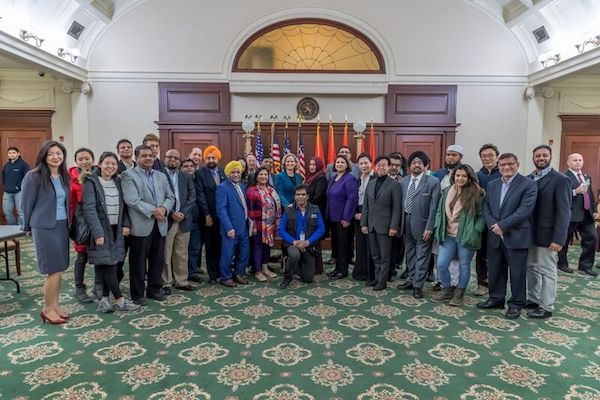
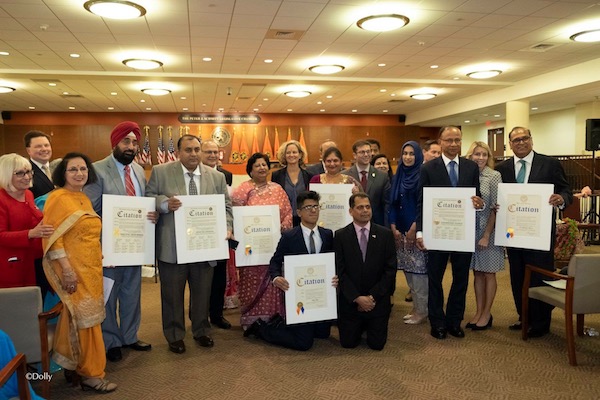
    MINEOLA, NY(TIP):Festival of Lights-Diwali- was celebrated at the Executive and Legislative Chambers of Nassau County, Nov 2. Around 350 guests attended. Dignitaries present included Nassau County Executive Laura Curran, Town of North Hempstead supervisor Judy Bosworth, Councilwoman Anna Kaplan, and Senator Eline Phillips.

    On the occasion,  9 individuals were honored. They included Pinki Jaggi,Vimal Goyal, Krishandra Rudra, Saroj Aery, Pritpal Singh Bindra, Aditya Sehgal, Deepak Bansal ,Kesh Berry and Dr Budhdev Manvar.

    The guests were entertained to an interesting cultural program.

  • Indian Consulate hosts “Diwali with Media Friends”

    Indian Consulate hosts “Diwali with Media Friends”

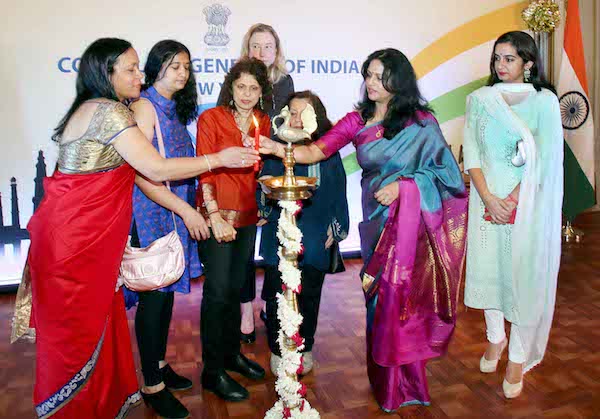
    NEW YORK CITY(TIP): The Indian Consulate in New York hosted, November 9, Diwali with Media friends. The formal event had all the ease of informality, as the Consul General Sandeep Chakravorty sought to make it a memorable event, without the speeches and formal observances. The only  formalities observed were the lighting of the lamp and words of welcome. The lamp was lighted by a group of ladies, led by the first lady of the Consulate Taruna Chakravorty.

    Kevin Thomas is honored. Seen from L to R: Ambassador Syed Akbaruddin, Kevin Thomas, Consul General Sandeep Chakravorty

    The singers  won the hearts of the audience with their mellifluous singing. The young dancers left all wondering their consummate performance.

    Enchanting Dance performances
    Enchanting Dance performances
    Superb singing

    Kevin Thomas, who won a Senate seat in New York Senate, happens to be the first Indian American ever to be elected to a State Senate. He was felicitated. Ambassador Syed Akbaruddin, the Permanent Representative of India to the United Nations honored Kevin with a shawl while the Consul General Sandeep Chakravorty presented him a plaque.

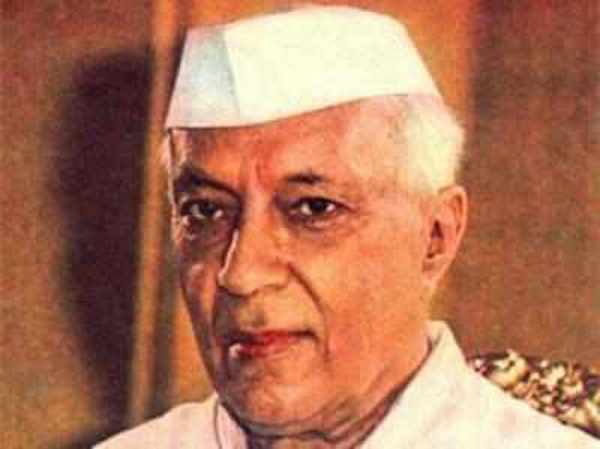
  • Attempts to Undo Nehru’s Legacy: Are we better off?

    Attempts to Undo Nehru’s Legacy: Are we better off?

    By George Abraham

    Times have changed indeed, and some of the policies Nehru has pursued may have become irrelevant.  However, critics would be deluding themselves if they are to deny his extraordinary legacy and his outstanding contribution in building a modern India in a traditional society. Nehru’s wisdom was the wisdom of the time, and we may be able to draw many lessons from that today. Our lives are not merely self-made instead we stand on the shoulders of those who have preceded us. Jawaharlal Nehru may have made his share of mistakes as any other human being, and yet, if we are to deny his rightful place in history, we will be doing it at our peril!

    Ever since the ascendance of BJP to the pinnacle of power in India, a visible campaign against one of the most influential leaders India had ever seen – Jawaharlal Nehru – is underway. One may wonder about this vitriolic campaign waged against a man who has contributed so much to the development of a nation and may ask why now?

    As Shashi Tharoor has pointed out in his biography of Nehru “Nehru’s legacy is ours, whether we agree with everything he stood for or not. What we are today, both for good or for ill, we owe in great measure to one man”. He was a true visionary who has not only built many of India’s venerable institutions but also laid the foundation for a pluralistic India. However, many in the opposition today are afraid that Prime Minister Modi’s plan may include dismantling the legacy of Nehru while appropriating the legacy of Sardar Vallabhbhai Patel, another great leader of the Congress Party.

    As Indians, we do take pride in the age-old civilization and culture and its lasting imprint on our lives. However, when the nation gained its independence, India was an impoverished country with 80 percent of the people who could not afford two meals a day. The average life span of an Indian was 31 years with only 20% of people who could read or write.

    From that Nehru built a country that is democratic and inclusive uplifting the masses that previously held no hopes of redemption from feudalism and Casteism that plagued the land. He was a great advocate for equity and justice in an unequal society and used his superb influence to incorporate those protective provisions into the Constitution.

    The constitution of India was amongst the largest in the world with 395 Articles and 9 Schedules. The preamble spells out the underlying philosophy and the solemn resolve of the people of India to secure justice, liberty, equality and fraternity for all its citizens. What Nehru has accomplished through this document with significant help and support from B.R. Ambedkar also is part of his vision to empower marginalized sections of the society.

    Nehru was a strong proponent of self-reliance, apparently recognizing that underdevelopment was the result of a lack of technological progress. Consequently, a new Industrial policy was enacted to develop critical industries. While Independent India was in its infancy, he identified the production of power and steel for self-sufficiency and planning. In collaboration with other countries, India built steel plants in Rourkela (Orissa), Bhilai (M.P.) and Durgapur (W. Bengal). Dam projects were undertaken in various places to produce hydro-electric power, including the flagship Dam at Bhakra Nangal, Punjab. The first oil refinery was inaugurated in Noonmati, Assam in 1962 as another leap forward towards industrialization. Nehru called them ‘the temples of modern India’.

    He built IITs, IIMs, and AIIMS for higher level education and thousands of Primary, Secondary and higher-secondary schools that have transformed the lives of millions of its citizens and many of those graduates from these prestigious institutions are heading multi-national corporations across the globe today  and it is a matter of great pride and joy to India.

    Nehru belonged to the privileged class, and he could have carried on while protecting the status-quo, yet he did not. He was a true visionary who saw the dire need to change the direction of the country in order to have a real transformation in the social order. Seventy years later, many of his dreams have come to fruition and at the uppermost; thanks to his stewardship, India remains a vibrant democracy and a beacon to many nations particularly in the developing world.

    However, BJP and the RSS are carrying on a campaign to place blame on Nehru and criticize him for his failure on the partition and the current stalemate in Kashmir. They have not forgiven him either for pursuing a policy of non-alignment globally or upholding the values of secularism at home. For the hardcore Sangh Parivar forces, Nehru has become anathema, a legacy that has to be erased.

    Since 2014, the status of Nehru Memorial and library has been diminished, and an earnest effort is underway to change the character and focus of the Museum. The Culture Minister in the BJP government not only approves discussions and seminars opposing Nehruvian ideology within its four walls but openly boasts about the place that it is no longer confined to Nehru. To add insult to injury, Mr. Arnab Goswami, a strident critic of Nehru family, has been added as a member of the Board to oversee the museum. According to some sources, the long-term plan may include converting the Nehru Memorial library into a Museum that houses the memory of all Prime Ministers.

    The right-wing bodies including Rashtriya Swayamsevak Sangh (RSS) have been on an overdrive to erase Nehru’s name from history books after the BJP government unveiled a new education policy in 2015. In Rajasthan, a BJP-ruled state, references to Nehru has been already removed from textbooks. Students of Class VIII will no longer learn that Jawaharlal Nehru was India’s first Prime Minister. Asked about this serious omission, Education Minister Vasudev Devnani said the following” it was the decision of an autonomous body and the government and I have nothing to do with it.”

    Prime Minister Modi, in his first Independence Day address to the nation, although he invoked great leaders like Mahatma Gandhi, Sardar Patel, and Jayaprakash Narayan but omitted any reference to Nehru. He also used the occasion to sentence the planning commission as the relics of the past, the signature machinery, Nehru promoted for making five-year plans for the effective use of the resources for development. The new President of India, Ramnath Kovind did not mention Nehru’s name either in his maiden address to the nation.

    Times have changed indeed, and some of the policies Nehru has pursued may have become irrelevant.  However, critics would be deluding themselves if they are to deny his extraordinary legacy and his outstanding contribution in building a modern India in a traditional society. Nehru’s wisdom was the wisdom of the time, and we may be able to draw many lessons from that today. Our lives are not merely self-made instead we stand on the shoulders of those who have preceded us. Jawaharlal Nehru may have made his share of mistakes as any other human being, and yet, if we are to deny his rightful place in history, we will be doing it at our peril!

    (The author is a former Chief Technology Officer of the United Nations and Vice-Chairman of the Indian Overseas Congress, USA)

  • India’s prosperity hinges on Religious Freedom

    India’s prosperity hinges on Religious Freedom

    The Indian-Americans have a moral duty to prevent India from being labeled as a “Country of Particular Concern” by the United States Commission on International Religious Freedom (USCIRF).

    By Mike Ghouse

    The quality of life is directly proportional to freedom from religious and cultural tensions, says the author.

    If India were to be ascribed with such a label, it would hinder the flow of foreign direct investments and subsequent reversal of economic prosperity achieved in the last twenty years. This label may not affect the poor Indians, but it will severely impact all those Indians working in information technology related jobs and businesses involved in software development and services.

    South Africa once was an apartheid nation, and its prosperity came to a grinding halt when the foreign corporations realized that they are supporting a regime that discriminates her citizens. The harassment, lynching, and killing of Dalits, Muslims, Christians, Sikhs and others in India needs to stop; if not, it will hurt all Indians as the investors will start pulling out of the country. Who wants to invest in a place where their investment is not secure?

    The success of the American economy is based on the rule of law, the law is enforced equally, and no criminal will get away with the power of his or he monies. If someone violates the rules, the individual or the company will pay the penalty, and this builds confidence and trust in the society and frees them from tensions. Every Indian should feel secure about his or her faith, ethnicity, language and culture.

    The First Amendment of America’s constitution serves as a model of success for any government. “Congress shall make no law respecting an establishment of religion, or prohibiting the free exercise thereof, or abridging the freedom of speech, or of the press, or the right of the people peaceably to assemble, and to petition the Government for a redress of grievances.”

    Ambassador Sam Brownback had once said that the prosperity of a nation hinges on religious freedom. Indeed, the success of a country is directly proportional to religious liberty. It frees people from the daily tensions of what to eat, drink, wear and believe. It allows them to become a productive employee to the company, and a fully participating member of the family by giving the family the full attention it deserves instead of worrying about a fellow employee at the place of work.

    Furthermore, the quality of life is directly proportional to freedom from religious and cultural tensions.

    The sense of security is diminishing rapidly. A Christian is apprehensive of going to the Church on a Sunday, and a Muslim is afraid of storing meat in his refrigerator should the vigilantes descend on him. The women including little girls are not safe either. The murderers and rapists got felicitated with Garlands from among the current leaders instead of sending them to prison.  The man who lynched and brutally killed a Muslim man was videotaped and shared on WhatsApp, and the lyncher was rewarded with a party ticket to contest elections.   This is shamefully a weekly occurrence.

    Ambassador Brownback had once said referring to mob violence around the world. If the leaders respond immediately to such incidents and tell the nation that the lynching and harassment of fellow citizens will not be acceptable, then the violence will cease or at least mitigate. Unfortunately, the current Indian leadership has remained silent when vigilantes kill and maim the people, causing every Indian to live in fear – both the minorities and the ones who frighten.

    Please note that Hindutva ideology propagated by RSS and its family of parties is not Hinduism. Hindutva is to Hinduism; what Islam is to Islamists. Hindutva and Islamist are anti-Hinduism and anti-Islam respectively.   It may take a few generations for Hindutvavadis and Islamists to see the value of respecting the otherness of the other and accepting the God-given uniqueness of the other. When we get there, conflicts will fade, and solutions emerge. Ultimately, every Indian wants to live in peace and feel secure about his faith and focus on contributing to the common good of the nation.

    The Indian Americans have equal access to all the opportunities in the market without discrimination, and I hope the Indian Americans would want India to treat her minorities as America does hers. It is an embarrassment to note that a few Indian Americans don’t want Muslims, Christians, and Dalits to have equal rights in India.  On top of it, they are poisoning their children with ill-will towards each other.

    The good news is that most of the American Indian youth are rejecting the ugliness of their parents and choose to respect the otherness of the other. After all, they have to work with people of different faiths and races, and it would be a pain for them to work with others if their parents have dumped their biases on their children. Should parents poison their children?

    We appeal to all the India oriented American organizations including the Hindu America Foundation, the Indian American Muslim Council, Federation of Indian American Christian Organization of North American to support our petition.

    The petition will be addressed to the Government of India to issue Visa’s to the Commissioners of USCRIF. They can do the investigations about the plight of Kashmiri Pandits, Sikh Genocides, Gujarat Massacre, Lynching and harassment of Dalits, Muslims, Christians, Sikhs, and others.

    If India gets a “Clean Chit” it will ensure continued prosperity and investor confidence in India’s democracy.  However, if the Indian government is found guilty of the violations of religious freedoms, then two choices left to deal with are; risk losing the confidence of the investors in the stability of India or fix the problems and earn a clean chit. Every Indian American must ensure the sustainability of India’s democracy and prosperity.

    In Washington DC, there are three Indians who regularly attend the meetings about religious freedom issues from among about seventy-five individuals to talk about the concerns in different nations. Jay Kansara has been representing the Hindu America Foundation, John Prabhudoss represents Federation of Indian American Christians of North America, and Mike Ghouse serves the Center for Pluralism, standing up for the rights of people from all faiths.  Now, Ajit Sahi of Indian American Muslim Council has joined the group to address Religious freedom issues of Indian minorities. The Dalits and Sikhs have been represented on an off by different visitors.

    Swami Agnivesh was in Washington DC and spoke to a group of defenders of religious freedom across the world.  The Ambassador of religious liberty Hon. Sam Brownback presided the meeting. He was eloquent and precise, and it was an honor to meet the man whom I have come to admire for his stand on eradicating bonded labor and fighting for religious freedom of all Indians.

    Dear Ambassador Brownback and my fellow campaigners for human rights and religious freedom. I am grateful to you for this opportunity to speak here. Since the time allotted for me to speak is limited, I will get to the point immediately.

    There is a grave threat today to civil liberties in general and religious freedom in particular in India. Indeed, the levels of violence we see in today’s India against the social and religious minorities are in many ways unprecedented in recent decades. The victims of such vicious violence are some of India’s poorest and most disadvantaged communities. They include Muslims, Christians, the Dalits, who are the former untouchables of the Hindu caste society, and the Adivasis, or the indigenous tribal people whose very existence is under threat.

    Moreover, the perpetrators of this violence are directly linked with the RSS, which is the mother organization of Prime Minister Narendra Modi’s BJP party. Especially since Mr. Modi became India’s prime minister in 2014, the attacks on the religious minorities have sharply increased. Armed mobs owing allegiance to the RSS and other Hindu groups have been lynching to death Muslims at will, accusing them of eating beef or slaughtering a cow. Such Hindu mobs also disrupt mixed-religion weddings in which the groom is Muslim, and the bride is Hindu because they don’t want Hindu girls to marry Muslim boys. There have been instances in which such Muslim grooms have been killed, too.

    Similarly, these vigilante groups owing allegiance to the RSS have been attacking Christian Churches, priests, and congregants all over India. Once again, they blame the victims for the violence, accusing the Christians of converting Hindus to Christianity.

    For thousands of years, the Dalits have suffered the worst violence and indignities at the hands of upper caste Hindus. However, now, that indignity is doubled because laws have been created to deny positive quota benefits to Dalits who convert out of Hinduism to Christianity and Islam. Converted Dalits face even greater violence and assault.

    As for the Adivasis, the indigenous people, the RSS-BJP have for decades been forcing Hinduism on them even though millions of these Adivasis clearly state that they are not Hindus and they have their indigenous faiths. I have myself been a victim of their violence over the years. Twice in the last six months only I have been attacked by these violent mobs. Of course, it is futile to expect any police action against such violent perpetrators.

    If I, being a prominent human rights defender in India, cannot expect the police to act against my attackers, you can imagine what would be the story of these social and religious minorities I have spoken about, the Dalits, the Adivasis, the Christians and the Muslims, who are being targeted in their hundreds of thousands across India.

    Even more worrying is that some organizations in the United States that claim to represent the interest of the Hindus defend the highly divisive and violent activities of the RSS-BJP and instead blame the religious minorities. They try to create a false equivalence between the highly organized and structural violence of the RSS-BJP, who are in power in the federal government in India as well as more than a dozen and a half of India’s 29 states, and random acts of violence against Hindus that may occur.

    The truth is that the biggest perpetrator of anti-minority violence in India is the RSS-BJP, which is now in power across India and is therefore grossly abusing its control of government machinery to provide impunity to its henchmen carrying out such violence. It would be a pity if the international community did not open its eyes and take notice of this worsening situation in the India of Mahatma Gandhi.

    Swami Agnivesh also added that he was coming from giving the keynote address at the Parliament for World’s Religions in Toronto, Canada and that the Hindu rightwing forces tried to prevent him from speaking there. He also said he had been a campaigner for justice for 50 years and had faced numerous attacks on his life, the most recent in Jharkhand in July, when hundreds of goons attacked him, and then again in Delhi in August. Swami Ji also spoke of his work with bonded laborers and said his organization had secured freedom and rehabilitation for more than 170,000 bonded laborers in India in the last thirty plus years.

    (The author  is a public speaker and the Executive Director of the Center for Pluralism in Washington, DC. He is committed to building cohesive societies and offers pluralistic solutions on issues of the day.  More about him at https://www.linkedin.com/in/mikeghouse/)


  • Salve for wounds of ’84

    Salve for wounds of ’84

    Justice delayed is better than no justice

    A conviction, in the court of an additional sessions judge, of two individuals held guilty of killing two others shows how the dogged pursuit of justice can deliver results. The murders were among the thousands in Delhi in 1984, and the murderers may have gone scot free had it not been for the work of the Special Investigation Team (SIT) set up in 2015, which secured a conviction in the first case it presented before a court.

    Victims of the 1984 Delhi riots have cried for justice for long and battled with indifference, the police not registering cases, active interference in investigations, as well as decades of delay, but some of them have continued their quest for justice. Successive governments have paid more lip service than taken action. This SIT, however, identified 52 of the 280 cases it scanned for further investigation. The dedicated team has shown that passage of time and indifference still allow for evidence to be found and presented in a manner which can bring justice.

    The shame of the killings of 1984 forced the horror to be brushed under the carpet. The survivors lived with the trauma of having seen their friends and family members murdered by mobs. Even when cases were registered, only shoddy action followed. A number of inquiry commissions were set up, but convictions were few and far between. The Delhi Police in 1994 had closed ‘for want of evidence’ even the case that has resulted now in convictions. The negative attitude and tardy progress have led to a feeling of injustice among the Sikhs. This, even though a certain number of men have been convicted of murder over the years. The sentencing of Naresh Sherawat and Yashpal Singh by Additional Sessions Judge Ajay Pandey for killing Hardev Singh and Avtar Singh in the Mahipalpur area on November 1, 1984, in South Delhi during the riots is a salve on the wounds of victims. It is also an example that justice delayed may not always mean justice denied.

    (Tribune India)

  • California’s Deadliest Fire: At least 63 are dead and more than 600 are missing

    California’s Deadliest Fire: At least 63 are dead and more than 600 are missing

    SACRAMENTO(TIP): The death toll from the devastating Camp fire jumped to 63 on Thursday, November 15,  as search crews recovered seven more bodies in the burn area.

    The number of people unaccounted for jumped dramatically to 631 people, up from 130 on Wednesday evening.

    Butte County Sheriff Kory Honea told reporters that crews found three bodies in Magalia, three in Paradise and one in Concow. One body in Paradise was found in a car that had been flipped on its side.

    The blaze has scorched 141,000 acres and destroyed 11,862 structures. It was 40% contained as of Wednesday evening.

    The Paradise fire is now by far the worst fire in California history, destroying an entire town in a matter of hours.

    Officials said it could take weeks to complete the search for victims,

    Thousands of survivors are now without homes and living in shelters and tent cities.

    The fire is also causing a major public health problem as smoke choked huge swaths of Northern California, including Sacramento and the Bay Area.

    It has pushed the region’s air quality into the unhealthy zone on the Environmental Protection Agency’s index. Many schools have been closed.

    (Source: Agencies)


  • Julian Assange has been charged, prosecutors reveal in inadvertent court filing

    Julian Assange has been charged, prosecutors reveal in inadvertent court filing

    WASHINGTON(TIP): A November 15 Washington Post report says WikiLeaks’ founder Julian Assange has been charged under seal, prosecutors inadvertently revealed in a recently unsealed court filing — a development that could significantly advance the probe into Russian interference in the 2016 election and have major implications for those who publish government secrets.

    The disclosure came in a filing in a case unrelated to Assange. Assistant U.S. Attorney Kellen S. Dwyer, urging a judge to keep the matter sealed, wrote “due to the sophistication of the defendant and the publicity surrounding the case, no other procedure is likely to keep confidential the fact that Assange has been charged.” Later, Dwyer wrote the charges would “need to remain sealed until Assange is arrested.”

    Dwyer is also assigned to the WikiLeaks case. People familiar with the matter said what Dwyer was disclosing was true, but unintentional.

    Joshua Stueve, a spokesman for the U.S. Attorney’s Office in the Eastern District of Virginia said, “The court filing was made in error. That was not the intended name for this filing.”

    An FBI spokeswoman declined to comment.

    Federal prosecutors in the Eastern District of Virginia have long been investigating Assange, and in the Trump administration had begun taking a second look at whether to charge members of the WikiLeaks organization for the 2010 leak of diplomatic cables and military documents which the anti-secrecy group published. Investigators also had explored whether WikiLeaks could face criminal liability for the more recent revelation of sensitive CIA cyber-tools.

    Special Counsel Robert S. Mueller III has also exploring the publication by WikiLeaks of emails from the Democratic National Committee and the account of Hillary Clinton campaign chairman John D. Podesta. Officials have alleged the emails were hacked by Russian spies and transferred to WikiLeaks.

    Mueller has also been exploring, among other things, communications between the group and associates of President Trump, including political operative Roger Stone and commentator and conspiracy theorist Jerome Corsi.

    In July, his office charged 12 Russian military spies with conspiring to hack DNC computers, steal the organization’s data and publish the files in an effort to disrupt the election and referred in an indictment to WikiLeaks, described only as “Organization 1,” as the platform the Russians used to release the stolen emails.

    A spokesman for the special counsel’s office declined to comment.

    It was not immediately clear what charges Assange would face. In the past, prosecutors had contemplated pursuing a case involving conspiracy, theft of government property or violating the Espionage Act. But whether to charge the WikiLeaks founder was hardly a foregone conclusion. In the Obama administration, the Justice Department had concluded that pursuing Assange would be akin to prosecuting a news organization. Former Attorney General Jeff Sessions, though, had taken a more aggressive stance and vowed to crack down on all government leaks.

    Barry J. Pollack, one of Assange’s attorneys, said, “The only thing more irresponsible than charging a person for publishing truthful information would be to put in a public filing information that clearly was not intended for the public and without any notice to Mr. Assange. Obviously, I have no idea if he has actually been charged or for what, but the notion that the federal criminal charges could be brought based on the publication of truthful information is an incredibly dangerous precedent to set.”

    The filing in the Eastern District of Virginia came on August 22, in a case that combines national security and sex trafficking. Seitu Sulayman Kokayi, 29, was charged with enticing a 15-year-old girl to have sex with him and send him pornographic images of herself. But he was detained in part, according to the court filing, because he “has a substantial interest in terrorist acts.”

    His father-in-law, according to the filing, has been convicted of terrorist acts. The case involves previously classified information, according to government filings, and prosecutors plan to use information obtained under the Foreign Intelligence Surveillance Act. Kokayi was indicted last week and is set to be arraigned Friday morning.

    The case had been sealed until early September, though by itself it attracted little notice. On Thursday, November 15 evening, Seamus Hughes, the deputy director of the Program on Extremism at George Washington University who is known for scrubbing court filings, joked about the apparent error on Twitter — which first brought it to the attention of reporters.

    Even if he is charged, Assange’s coming to the United States to face trial is no sure thing. Since June 2012, Assange has been living in the Ecuadorian embassy, afraid that if he steps outside he will be arrested.

    When he first sought asylum in the embassy, he was facing possible extradition to Sweden in a sex crimes case. He has argued that case was a pretext for what he predicted would be his arrest and extradition to the United States.

    In the years since, the Swedish case has been closed, but Assange has said he cannot risk leaving the embassy because the U.S. would attempt to have him arrested and extradited for disclosures of U.S. government secrets. Throughout that time, the U.S. has refused to say whether there are any sealed charges against Assange.

    If Assange were to leave the embassy and be arrested by British authorities, he would likely still fight extradition in the British courts.

  • Indian American Lawyer Neomi Rao to Replace Kavanaugh in US Court

    Indian American Lawyer Neomi Rao to Replace Kavanaugh in US Court

    WASHINGTON(TIP): Indian American Neomi Rao has been nominated by US President Donald Trump to fill Justice Brett Kavanaugh’s seat on the DC Circuit Court of Appeals.

    Trump, during Diwali celebrations  at the Roosevelt Room of the White House, announced the nomination of the 45-year-old regulatory czar for the DC Circuit which is considered next to the US Supreme Court.

    If confirmed by the Senate, Ms Rao, who is currently administrator, Office of Information and Regulatory Affairs (OIRA), would be the second Indian-American judge in this powerful court after judge Sree Srinivasan, who was appointed during the previous Obama regime.

    “She is going to be fantastic. Great person,” Trump said.

    Ms Rao will fill the seat vacated by Supreme Court Justice Kavanaugh, who served on the appeals court for 12 years.

    A formal announcement on her nomination is expected to be made by the White House.

    “I just nominated Rao to be on the DC circuit court of appeals, the seat of justice Brett Kavanaugh. That could be a big story,” Trump announced.

    Ms Rao thanked the President for the “confidence” he has shown in her.

    Called the ‘regulatory czar’ of Trump administration in her current capacity, she oversees implementation of the administration’s deregulatory agenda and regulation-related executive orders.

    She was confirmed by the Senate with a 54-41 vote in July 2017 to head the OIRA and is known among legal circles as a highly respected administrative law scholar who has distinguished herself for her right-of-center views, media reports stated.

    A former clerk for conservative Supreme Court Justice Clarence Thomas, Ms Rao was recommended for the post by former White House counsel Don McGahn. Trump’s nomination of Ms Rao is in recognition of her contribution in cutting down regulations.

    Ms Rao has previously served in all three branches of the federal government, and before taking on her current role in the executive branch, she was associate counsel and special assistant to the president for the George W Bush administration.

    A graduate of Yale University and the University of Chicago Law School, Ms Rao also worked in the private sector, in the international arbitration group of the London-based law firm, Clifford Chance LLP.

  • 2 Indian-origin Ministers quit British govt.

    2 Indian-origin Ministers quit British govt.

    LONDON(TIP): Two Indian-origin Ministers on Thursday, November 15 resigned their positions in protest at the draft withdrawal agreement passed by the British Cabinet, while a Pakistani-origin politician resigned from his role as trade envoy to Pakistan over the government’s approach to offering asylum to Asia Bibi as well as the Brexit deal.

    Shailesh Vara, the Minister of State for Northern Ireland and Suella Braverman, a Minister within the Ministry for Exiting the EU, both tendered their resignations to the Prime Minister in letters made public on Thursday morning, joining more senior figures, including Brexit Secretary Dominic Raab and Work and Pensions Secretary Esther McVey.

    Sri Lankan-origin Ranil Jayawardena also stepped down as a Minister. Rehman Chishti said he was stepping down as the Conservative Party’s vice chairman and the Prime Minister’s Trade Envoy to Pakistan.

    Mr. Vara became the first Minister to tender his resignation following the Cabinet meeting on Wednesday. In his letter, he said that he could not support an agreement that left Britain in a “half-way house with no time limit on when we will finally be a sovereign nation.”

    “There is every possibility that the U.K.-EU trade deal that we seek will take years to conclude. We will be locked in a customs arrangement indefinitely, bound by rules determined by the EU over which we have no say,” he warned.

    Pointing to Northern Ireland, he warned that it would be subject to a different relationship with the EU with the rest of U.K., threatening the economic and constitutional integrity of the U.K. While Mr. Vara had supported the Remain campaign in the run up to the referendum, he supported the leadership bid of Brexiteer Michael Gove in his party leadership campaign in 2016 following the resignation of David Cameron.

    “The proposed Northern Ireland Backstop is not Brexit,” insisted Ms. Braverman in her resignation letter. “It prevents an unequivocal exit from a customs union with the EU.”

    Ms. Braverman was an influential campaigner to leave the EU, chairing the European Research Group, which has been campaigning for a “hard” Brexit, until she joined the government earlier this year.

    Mr. Chishti also expressed his disagreement with the withdrawal agreement and his disagreement with the “lack of leadership shown by the U.K. government” over the Asia Bibi case. “What I found shocking is that this British government is failing to put into practice the core values that our country stands for; religious freedom, justice, morally doing the right thing… the government should not wait to see if another country offers sanctuary, we should have had the conviction to lead on this matter and offer sanctuary ourselves straight away,” he wrote in his letter.

    The resignations further reduce the presence of Indian-origin Ministers in the U.K. government, following the high-profile resignation of Priti Patel last year. Rishi Sunak, the son-in-law of Infosys’ Narayana Murthy, remains a Minister within the Department of Housing, Communities and Local Government, as does Alok Sharma, Britain’s Minister for Employment.

  • Trump praises Indian-American Officials at the Diwali Celebrations in the White House

    Trump praises Indian-American Officials at the Diwali Celebrations in the White House

    WASHINGTON(TIP):  Indian Americans were praised by the US President Donald Trump for their “incredible” performance in his administration. Trump has appointed more than two dozen Indian Americans to senior positions since he assumed office in 2017.

    “I’m grateful to have numerous Americans of Indian and Southeast Asian heritage who fulfill critical roles across my administration. And they’ve done an incredible job,” Trump said as he hosted Diwali celebrations in the Roosevelt Room, November 13.

    Except for the former South Carolina Governor Nikki Haley, around two dozen of his top Indian-American lieutenants were present at the celebrations.

    Ms Haley, the first-Indian-American appointed to top Cabinet-level position, resigned last month as the US ambassador to the UN.

    In eight years, former president Barack Obama had appointed more than 50 Indian-Americans to key administration positions, including Raj Shah as United States Agency for International Development administrator; Nisha Desai Biswal as the Assistant Secretary of State for South and Central Asia and Richard Verma as the US Ambassador to India.

    By appointing more than two dozen Indian Americans in key administrative positions, Trump seems to be on the track to breaking the record set by his predecessor.

    “Many of them are here today, including the Chairman of the Federal Communications Commissions, Ajit Pai,” Trump said as he called upon him.

    “Ajit, where’s Ajit? Come here, Ajit. I just didn’t like one decision he made, but that’s all right,” he said as the small audience burst into laughter. “Not even a little bit. But he’s independent,” said the president.

    Seema Verma, who in her capacity as administrator of the Centers of Medicare and Medicaid Services, is playing a key role in healthcare reforms, Trump said.

    “Chairman of the Federal Energy Regulatory Commission, Neil Chatterjee. Where is Neil? Good. Nice to see you,” said the US president indicating that he personally knows each one of these Indian-Americans.

    “The acting administrator of Drug Enforcement, and another person that I’ve become very close to, Uttam Dhillon,” Trump said.