Month: December 2018

  • Indian American Pediatrician named to Wisconsin Governor Elect’s Health Policy Advisory Council

    Indian American Pediatrician named to Wisconsin Governor Elect’s Health Policy Advisory Council

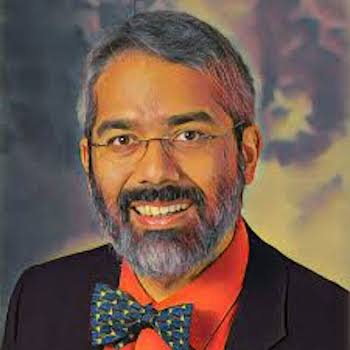
    WISCONSIN(TIP): Indian American Dr. Dipesh Navsaria has been named by Wisconsin Gov.-elect Tony Evers and Lt. Gov.-elect Mandela Barnes to their Health Policy Advisory Council, among others.

    Navsaria is a pediatrician at UW Health, as well as a faculty member at the University of Wisconsin School of Medicine and Public Health.

    He earned his medical degree at the University of Illinois College of Medicine and completed his residency at UW Hospitals and Clinics in Madison, Wisconsin.

    On Twitter, Navsaria said that he was honored “to be asked to serve the people of Wisconsin” and that this is just “a short-term, volunteer, advisory role.”

    According to a press release, the council will bring experienced voices from around the state to work with the transition team on health care issues, advising them on policy matters relating to the Department of Health Services, Office of the Commissioner of Insurance, the Department of Employee Trust Funds, and numerous state boards focused on health care.

  • Indian American Dr. Sumanta Chaudhuri Named Chief Medical Officer of KPC’s Hemet and Menifee Hospitals

    Indian American Dr. Sumanta Chaudhuri Named Chief Medical Officer of KPC’s Hemet and Menifee Hospitals

    HEMET, CA (TIP) : Indian American Dr. Sumanta Chaudhuri has been appointed as Chief Medical Officer for Hemet Valley Medical Center and Menifee Valley Medical Center according to KPC’s official announcement. Hemet Valley Medical Center and Menifee Valley Medical Center are two of seven hospitals affiliated with KPC’s southern California-based health system.

    A graduate of Northwestern University’s Feinberg School of Medicine, Dr. Sumanta Chaudhuri most recently served as Program Director of the Transitional Year Internship for graduate medical residents at Hemet Valley Medical Center.

    In addition, Dr. Chaudhuri served as the Associate Program Director of the Internal Medicine Residency Program and Director of the Peri-Operative Clinic of the Eye Institute at the Medical College of Wisconsin. Was selected as the Associate Program Director of the Internal Medicine Residency Program at Riverside Community Hospital and served as Medical Director for local Independent Physician Associations and Hospitalist groups.

    “Dr. Sumanta Chaudhuri brings with her a demonstrated track record of success, skill, passion, and expertise in healthcare through her clinical and academic credentials that are a tremendous benefit to the KPC health system and the communities we serve,” said Peter Baronoff, CEO of KPC Health.

    “I am honored to have this opportunity to serve as Chief Medical Officer for Hemet Valley Medical Center and Menifee Valley Medical Center and will continue to pursue my lifelong goal of supporting high quality and accessible healthcare for our patients and their families,” said Dr. Chaudhuri.

    KPC operates a group of integrated healthcare delivery systems consisting of acute care hospitals, Independent Physician Associations, medical groups, urgent care facilities, and various fully integrated multi-specialty medical facilities throughout the western United States.


  • IRS sees surge in email phishing scams; Summit Partners urge taxpayers: ‘Don’t Take the Bait’

    IRS sees surge in email phishing scams; Summit Partners urge taxpayers: ‘Don’t Take the Bait’

    WASHINGTON(TIP): With the approach of the holidays and the 2019 filing season, the Internal Revenue Service, state tax agencies and the nation’s tax industry warned people to be on the lookout following a surge of new, sophisticated email phishing scams.

    Taxpayers saw many more phishing scams in 2018 as the IRS recorded a 60 percent increase in bogus email schemes that seek to steal money or tax data. These schemes can endanger a taxpayer’s financial and tax data, allowing identity thieves a chance to try stealing a tax refund.

    The Internal Revenue Service, state tax agencies and the tax community, partners in the Security Summit, are marking “National Tax Security Awareness Week” Dec. 3 -7, with a series of reminders to taxpayers and tax professionals. In part two, the topic is email phishing scams.

    “The holidays and tax season present great opportunities for scam artists to try stealing valuable information through fake emails,” said IRS Commissioner Chuck Rettig. “Watch your inbox for these sophisticated schemes that try to fool you into thinking they’re from the IRS or our partners in the tax community. Taking a few simple steps can protect yourself during the holiday season and at tax time.”

    In the second part of this week’s National Tax Security Awareness Week series, the IRS and Summit partners warned against a new influx of phishing scams.

    Tax-related phishing scams reported to the IRS declined for the prior three years until a surge in 2018. More than 2,000 tax-related scam incidents were reported to the IRS from January through October, compared to approximately 1,200 incidents in all of 2017.

    One recent malware campaign used a variety of subjects like “IRS Important Notice,” “IRS Taxpayer Notice” and other variations. The phishing emails, which use varying language, demands a payment or threatens to seize the recipient’s tax refund.

    Taxpayers can help spot these schemes by examples of misspelling and bad grammar. Taxpayers can forward these email schemes to phishing@irs.gov.

    The most common way for cybercriminals to steal money, bank account information, passwords, credit cards or Social Security numbers is to simply ask for them. Every day, people fall victim to phishing scams or phone scams that cost them their time and their cash.

    Phishing attacks use email or malicious websites to solicit personal, tax or financial information by posing as a trustworthy organization. Often, recipients are fooled into believing the phishing communication is from someone they trust. A scam artist may take advantage of knowledge gained from online research and earlier attempts to masquerade as a legitimate source, including presenting the look and feel of authentic communications, such as using an official logo. These targeted messages can trick even the most cautious person into taking action that may compromise sensitive data.

    The scams may contain emails with hyperlinks that take users to a fake site. Other versions contain PDF attachments that may download malware or viruses.

    Some phishing emails will appear to come from a business colleague, friend or relative. These emails might be an email account compromise. Remember, criminals may have compromised your friend’s email account and begin using their email contacts to send phishing emails.

    Not all phishing attempts are emails – some are phone scams. One of the most common phone scams is the caller pretending to be from the IRS and threatening the taxpayer with a lawsuit or with arrest if payment is not made immediately, usually through a debit card.

    In addition, phishing@irs.gov continues to receive a large volume of IRS telephone scam complaints. These phone scams increased again in 2018 with reports to phishing@irs.gov recording thousands of telephone numbers from email complaints each week.

    Phishing attacks, especially online phishing scams, are popular with criminals because there is no fool-proof technology to defend against them. Users are the main defense. When users see a phishing scam, they should ensure they don’t take the bait.

    Here are a few steps to take to protect against phishing and other tax-related schemes:

    Be vigilant; be skeptical. Never open a link or attachment from an unknown or suspicious source. Even if the email is from a known source, approach with caution. Cybercrooks are adept at mimicking trusted businesses, friends and family — including the IRS and others in the tax business. Thieves may have compromised a friend’s email address, or they may be spoofing the address with a slight change in text, such as name@example.com vs narne@example.com. In the latter, merely changing the “m” to an “r” and “n” can trick people.

    Remember, the IRS doesn’t initiate spontaneous contact with taxpayers by email to request personal or financial information. This includes asking for information via text messages and social media channels. The IRS does not call taxpayers with aggressive threats of lawsuits or arrests.

    Phishing schemes thrive on people opening the message and clicking on hyperlinks. When in doubt, don’t use hyperlinks and go directly to the source’s main web page. Remember, no legitimate business or organization will ask for sensitive financial information via email.

    Use security software to protect against malware and viruses found in phishing emails. Some security software can help identify suspicious websites that are used by cybercriminals.

    Use strong passwords to protect online accounts. Each account should have a unique password. Use a password manager if necessary. Criminals count on people using the same password repeatedly, giving crooks access to multiple accounts if they steal a password – creating opportunities to build phishing schemes. Experts recommend the use of a passphrase, instead of a password, use a minimum of 10 digits, including letters, numbers and special characters. Longer is better.

    Use multi-factor authentication when offered. Some online financial institutions, email providers and social media sites offer multi-factor protection for customers. Two-factor authentication means that in addition to entering your username and password, you must enter a security code generally sent as a text to your mobile phone. Even if a thief manages to steal usernames and passwords, it’s unlikely the crook would also have a victim’s phone.

    The IRS, state tax agencies and the tax industry are working together to fight against tax-related identity theft and to protect taxpayers. Everyone can help. Visit the “Taxes. Security. Together.” awareness campaign or review IRS Publication 4524, Security Awareness for Taxpayers, to learn more. Tax professionals can also get more information through the Protect Your Clients; Protect Yourself campaign as well as the Tax Security 101 series.

    (Press Release)

  • The Chatwal Lodge Commences Construction with Ceremonial Groundbreaking in Rural Bethel, NY

    The Chatwal Lodge Commences Construction with Ceremonial Groundbreaking in Rural Bethel, NY

    Five-star luxury resort to anchor revitalization of iconic Catskill Mountains; opening 2020

    BETHEL, NY (December 6, 2018) – Developed by Dream Hotel Group and designed by Nunzio Marc DeSantis Architects, The Chatwal Lodge will be a driving force in the ongoing restoration and revitalization of New York’s famed Catskill Mountains.

    Nestled among 26 acres along the wooded shores of the 1,000-acre Toronto Reservoir, the five-star luxury retreat is expected to open in spring 2020 with 34 private villas and suite accommodations, refined rustic design and world-class, farm-to-table culinary experiences by DUCASSE Paris, founded by multi-Michelin-starred chef Alain Ducasse.

    Sant Chatwal speaking at the Groundbreaking
    Photo / Mohammed Jaffer-SnapsIndia

    The groundbreaking ceremony for this exciting development took place  Wednesday, December 5, 2018, at 11:00am, and featured New York State Assembly Member Aileen M. Gunther and Bethel Town Supervisor Dan Sturm as keynote speakers, leading members of the Dream Hotel Group team: Chairman Sant Singh Chatwal, CEO Jay Stein, and Vice President of Operations, Luxury Division Ashish Verma, as well as Chapin Estate Developer Steve Dubrovsky, Architect Nunzio DeSantis, and Granite Associates Chairman & CEO Alan Gerry, among others.

    Alan Gerry, an American billionaire and founder of Cablevision Industries, congratulating Sant Chatwal
    Photo / Mohammed Jaffer-SnapsIndia
    Chatwal Lodge mainstays. L to R: Steve Dubrovsky, Developer, Chapin Estate; Alan Gerry, Chairman & CEO Granite Associates, L.P. ; Sant Chatwal, Chairman Dream Hotel Group; and Jay Stein, CEO, Dream Hotel Group
    Photo / Mohammed Jaffer-SnapsIndia
    Jay Stein, CEO, Dream Hotel Group outlining the ambitious project
    Photo / Mohammed Jaffer-SnapsIndia

    “We’re grateful for Mr. Sant Chatwal and his Dream Hotel Group team bringing The Chatwal Lodge to the region. The caliber of this project is remarkable, and, once open, will become a world-class destination and an extraordinary addition to both New York State and Sullivan County,” said New York State Assembly Member Aileen M. Gunther.

    “The Chatwal Lodge will bring full- and part-time jobs, both during construction and after it opens,” said Bethel Town Supervisor Dan Sturm. “The new tourists and visitors that will come to Bethel will also bring new commerce and better economic opportunity for all the businesses already located here.”

    President and CEO of Sullivan Catskills Visitors Association Roberta Byron-Lockwood added, “The Catskills is a picturesque mountainous region that has been long known as a popular getaway since the beginning of the twentieth century. The Chatwal Lodge will help solidify its reputation as a global destination for years to come.”

    Rustic and refined, The Chatwal Lodge offers an elegant and charming play of details literally carved straight out of the woods from which it stands. The luxurious hideaway features hand-hewn timbers, oversized stone fireplaces and mighty trunks of 40-foot white pine trees towering from floor to ceiling in the Main Lodge. Luxurious meeting and event venues located at water’s edge are ideal for corporate retreats, social events and lavish destination weddings. Harmonizing with nature, its serene spa offerings will also include some of the most desirable wellness services.

    The opening of The Chatwal Lodge is part of a larger economic development plan for the town of Bethel, New York. Within this beautiful swath of the Catskills, located just 90 miles from midtown Manhattan, the wilds of nature are discovered in everyday life. The Chatwal Lodge is located within The Chapin Estate along the shores of Sullivan Country’s two largest lakes. Named as one of the ‘top 10 regions to visit in 2019’ by Lonely Planet, the Catskills and Sullivan County have seen an increasing number of visitors due to its vast recreational activities, as well as growing arts and culture community. The Chatwal Lodge is expected to generate tax revenue and create new jobs, while also offering the growing residential and business communities a new reason to work and play in the countryside destination.

    Siddhartha Pahwa, CEO Yo1 Luxury Nature Cure outlined the services his company will provide to rejuvenate the visitors to the Lodge
    Photo / Mohammed Jaffer-SnapsIndia
    Alleen M. Gunther , Assembly Member, New York State Assembly sharing her thoughts Prof. Indrajit Saluja, Chief Editor and Publisher of The Indian Panorama
    Photo / Mohammed Jaffer-SnapsIndia
    Ashish Verma, Vice President, Luxury Division, Dream Hotel Group, and Riyaz Akhtar, Executive Vice President, Human Resources, Dream Hotel Group spoke with The Indian Panorama about various aspects of the project
    Photo / Mohammed Jaffer-SnapsIndia

    “We are delighted to finally commence construction on this iconic project,” said Developer Steve Dubrovsky. “We greatly appreciate the patience and guidance of everyone involved as we carefully design and connect this new, five-star retreat within the expanse of Chapin Estate, one of the Catskills’ most serene and beautiful natural landscapes.”

    “The Chatwal Lodge is born from our signature New York City location and five-star luxury brand The Chatwal,” said Sant Singh Chatwal, Chairman, Dream Hotel Group. “Within this decadent and simply unprecedented country retreat, The Chatwal Lodge is a magical destination where luxury meets nature, and we are committed to embracing the natural resources of the area to create an enterprise that truly redefines the town and country luxury living experience.”

    “All of us at Dream Hotel Group are proud to play a role in creating what will be one of the most spectacular destinations in Sullivan County,” remarked Jay Stein, CEO, Dream Hotel Group. “Drawing inspiration from the Catskills’ rich history, rustic architecture and breathtaking natural setting, The Chatwal Lodge will be the star of Sullivan County and a critical addition to our growing global portfolio.”

    With 18 hotels open today and 20 new locations currently in development worldwide, Dream Hotel Group is on track to triple its existing portfolio by 2022. The groundbreaking of The Chatwal Lodge signals another exciting milestone in the continued growth and evolution of the company and its portfolio of lifestyle brands.

    Indian-American hotelier Sant Singh Chatwal voiced confidence in the county at a groundbreaking for The Chatwal Lodge. The hospitality mogul’s company, the Dream Hotel Group, plans to build the 50-room, $50 million, five-star luxury retreat inside The Chapin Estate, an elite residential community.

    Up to $100 million could eventually be invested, depending on the project’s success, Dream Hotel Group CEO Jay Stein told the Times Herald-Record last year.

    The Old World Charm of the location
    Photo / Mohammed Jaffer-SnapsIndia
    The Old World Charm of the location
    Photo / Mohammed Jaffer-SnapsIndia
    The Old World Charm of the location
    Photo / Mohammed Jaffer-SnapsIndia

    “Sullivan County has very great potential, just go back to the history of this area, and how it was number one for tourism in the tri-state area,” Chatwal said Wednesday. “Now, it’s time to bring it back.”

    “Look at Manhattan, and how no one wanted to go to Times Square,” and how it was redeveloped, Chatwal added. “This is the same story that should happen here” in Sullivan County.

    Dream Hotel Group operates 20 hotels, including the Chatwal New York and Time Hotels, and more than 50 restaurants and bars worldwide. The company has another 20 hotels under construction.

    Now, Chatwal is betting on the Catskills, after three decades of running uber-trendy, high-end urban hotels with long lines for attractions like rooftop bars.

    The Chatwal Lodge’s first 25 rooms at Chapin are due by the second half of 2020, followed by another 25 rooms. If they’re a hit, the 26-acre site has space for 50 more rooms, Stein said on Wednesday.

    Accommodations will cost between $500 and $5,000 per night. Some will be beside the Toronto Reservoir. The Nunzio Marc DeSantis-designed complex will include:

    ‒ 34 luxury villas with 50 total rooms. The rooms will be spread among accommodations such as eight one- and two-bedroom luxury cabins; three or four glamor-camping tents; a guest home with a presidential suite, and a handful of large, ultra-luxe, glass-roofed treehouses;

    a restaurant and catering by chef Alain Ducasse, and the Ducasse Paris company, which operates three restaurants that have each earned a coveted three-star Michelin rating;

    ‒ a pool, a fitness center, a wedding area and cabin amenities ranging from fire pits to decks to golf carts and kayaks; some spa elements on site and others at the YO1 Luxury Nature Cure center in the Town of Thompson;

    ‒ and a main lodge, created from Chapin Estate co-founder Steve Dubrovsky’s 13,000-square-foot home.

    Dubrovsky, Howard Schoor and Dan Silna began building The Chapin Estate in 2000. Residences sell for between $500,000 and $15 million. In July 2017, Chatwal took the leading stake in the community’s roughly 2,500 undeveloped acres, which amount to about 280 unsold lots.

    Sullivan County Legislature Chairman Luis Alvarez and other local leaders cheered Chatwal’s hotel plans on Wednesday.

    “Sullivan County is not standing behind on development,” Alvarez said. “We’re in the front again as a family destination.”

    Hal Teitelbaum, a Chapin Estate resident and Crystal Run Healthcare CEO, said he’s uncertain what the Dream Hotel Group’s project will bring to Bethel.

    “If they provide amenities, and if they’re good stewards of the environment, it could be a fantastic thing both for the Chapin community and for Sullivan County,” Teitelbaum said.

  • A Relationship Under Stress

    A Relationship Under Stress

    By Stanly Johny

    “Mr. Trump, wary of not disrupting his West Asia policy, may stay the course on Saudi Arabia for now. But the growing criticisms of the partnership on Capitol Hill can’t be ignored. The Senate has already voted with a huge majority to move forward legislation to end the U.S. involvement in the Yemen war.”

    The Central Intelligence Agency (CIA) has reportedly concluded that Mohammed bin Salman, the Saudi Arabian Crown Prince, personally ordered the killing of Jamal Khashoggi. The murder of the Saudi dissident journalist at the Kingdom’s Istanbul consulate on October 2 has already triggered a global outrage against MBS, as the Crown Prince is known. But U.S. President Donald Trump seems unfazed by both the findings of his spy agency as well as the mounting global outcry. He called the CIA assessment “very premature”, while Secretary of State Mike Pompeo said the U.S.’s “historic commitment” to Saudi Arabia is “absolutely vital to America’s security” and its “interests in the Middle East”.

    Thinking like realists

    This is a popular argument in Washington. Realists would say the relationship with Saudi Arabia is so vital for American national interests that the U.S. should overlook certain aspects of Saudi behavior. The Trump administration repeats this argument to justify its lack of action against Riyadh in the wake of the murder of Khashoggi. But does Saudi Arabia actually have such leverage over America?

    The Saudi-U.S. partnership can be dated back to the 1945 meeting between President Franklin D. Roosevelt and Saudi King Abdulaziz ibn Saud, the founder of modern Saudi Arabia and father of current monarch Salman bin Abdulaziz. In the meeting, held on board the USS Quincy in the Suez Canal, both leaders came to a two-way agreement: the U.S. would support and provide military training for Saudi Arabia, while the Kingdom would provide oil and political backing in return. This alliance made sense for both countries during the Cold War. The Saudis were anxious about communist expansion into the Arab/Muslim world. Half of Yemen fell into the hands of Marxists in 1967, and in 1978 communists took power in Afghanistan. And the U.S. wanted uninterrupted flow of oil for its own economic expansion and the post-war reconstruction of Europe. It also wanted a political ally in West Asia.

    But the conditions that laid the foundation of this partnership have changed. The Soviet Union fell apart almost three decades ago. America’s dependency on Saudi Arabia for oil has also decreased over the years. True, Saudi Arabia remains a major supplier of oil to the U.S. But it doesn’t have the leverage over the American economy as it had in 1973 when Arab countries imposed an embargo on mostly Western nations in protest against their support for Israel during the Yom Kippur War with Egypt. The U.S. is now one of the top three crude producers, along with Russia and Saudi Arabia.

    Other arguments in favor of stronger partnership cite the massive Saudi investments in the U.S., both treasury securities and private businesses. But Saudi Arabia acts in its interest, not with the goal of helping the U.S. economy. If it sells its U.S. assets, that would also hurt the Saudi economy badly. After all, from economic diversification at home to security guarantees, Saudi Arabia needs the U.S. more than the other way around, which offers Washington room for strategic man oeuvre.

    While the strategic potential of the partnership has been shrinking, the U.S. has come under greater scrutiny, especially in the post-9/11 world, for its support for Saudi Arabia, the Wahhabi kingdom that stands opposed to everything the U.S. preaches on global stages — from democracy and respecting human rights to religious freedom and independent media. It was this broad context that allowed former U.S. President Barack Obama to take a different approach towards Saudi Arabia. He retained the fundamental elements of the partnership, including trade and economic ties, arms sales and security guarantees, while refusing to act in Syria on the Saudis’ behalf and moving further ahead to strike a nuclear deal with Iran. He even asked the Saudis and the Iranians to share West Asia and institute a “Cold Peace” in the region.

    Back to square one

    But President Trump has reversed this approach and rebuilt the administration’s West Asia policy, making Saudi Arabia its centerpiece. The twin objectives of the Trump policy are to ensure Israel’s security and roll back Iranian influence. It’s this tilt that is now stopping him from moving against the Saudis. The administration has already declared what its Iran policy is. It has already pulled the U.S. out of the Iran nuclear deal. And the Americans need Saudi support in their effort to isolate and weaken Iran, something Israel too has been demanding for years. But this is not a larger national security argument, nor is it a realistic one. When the fundamentals of a partnership get weakened and the region undergoes major changes, how long can the U.S. allow its Iran obsession to dictate its policies towards West Asia?

    From the realpolitik point, even if the U.S. wants to limit Iranian influence, Saudi Arabia under MBS is not helping the cause. It lost the Syria war. Its intervention in Yemen drove the Houthis further into Iran’s embrace. The Qatar blockade has divided the Arab world (Qatar has now quit OPEC as well). The detention of the Lebanese Prime Minister last year has played Lebanese politics into the hands of Hezbollah, the Iran ally.

    Mr. Trump, wary of not disrupting his West Asia policy, may stay the course on Saudi Arabia for now. But the growing criticisms of the partnership on Capitol Hill can’t be ignored. The Senate has already voted with a huge majority to move forward legislation to end the U.S. involvement in the Yemen war. Republican Senator Bob Corker accused the White House of “moonlighting as a public relations firm for the Crown Prince”. Rand Paul, another Republican Senator, says it’s time for America to stand up and tell Saudi Arabia, “enough”. These are not isolated moral outbursts; they suggest changing undercurrents. There is a growing realization in Washington that the Saudi pillar of its West Asia policy is getting weak. Mr. Trump, driven by his own notional obsessions, might overlook it. But future American Presidents can’t. They may have to start from where Mr. Obama stopped.

    (Source: The Hindu. The author is a columnist. He can be reached at stanly.johny@thehindu.co.in)


  • Two Punjabs, one South Asia

    Two Punjabs, one South Asia

    By Kanak Mani Dixit

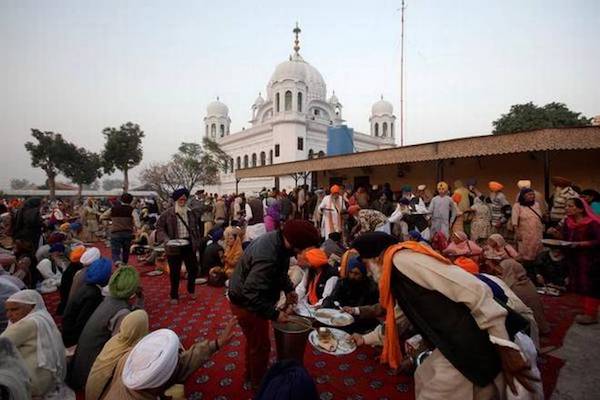
    Nothing has worked, and we are today in suspended animation between Mr. Modi’s India-centric vision of the region and the Pakistani military’s control of the geopolitical discourse in Islamabad. At such a time comes the possibility held out by the Kartarpur Corridor.

    For a flickering moment in the last week of November, it seemed as if Congress provocateur and Punjab Minister Navjot Singh Sidhu might set the geopolitical agenda, when he unabashedly spoke of the need for India and Pakistan to mend fences. He was in Lahore on the occasion of the start of work on the Kartarpur Corridor, meant to ease the travel of Sikh pilgrims to the resting place of Guru Nanak.

    Unfazed by ridicule on Indian television, the cricketer-turned-politician spoke of peace, trade and people-to-people contact, all of them lost causes of the ‘track two’ dialogues of past decades. His confidence seemed to emanate from being a Sikh and Punjabi reaching out to Pakistani Punjab, and in his wordy sermons one actually detected the formula for India-Pakistan cohabitation, which would also catalyze cooperation in the larger South Asian region.

    Ultra-nationalist fog

    Peace in the Subcontinent presupposes amity between India and Pakistan, and more than 40 years of efforts at regionalism has been held hostage by hostility of the two, with the other countries watching askance.

    The abuse hurled by the state establishments of each side is a populist political tool that distracts the public from pressing matters of growth, equity, democracy and accountability. That the cost of maintaining massive militaries in each country drags down efforts at social justice is lost in the fog of ultra-nationalism.

    India, as the more stable democracy, should inculcate empathy for the neighbor, but the New Delhi commentariat tends not to recognize the difference between the Pakistani state and its people, the latter struggling against extremism, military supremacy and state-centralism all at one go.

    Indian media by and large is not bothered by the travails of Pakistanis, as right-wing trolls rule the airwaves and social media. Similar to how dissent is sought to be silenced with the ‘Urban Naxal’ tag, since long those seeking India-Pakistan amity and South Asian regionalism are rejected as romantic peaceniks lighting meaningless candles at Wagah-Atari.

    The trolling and abuse on all matters related to Pakistan can be expected to peak as India’s general election of 2019 draws near, which will only help Islamabad’s military-intelligence complex tighten its grip on the society. It is high time to try once again for a plan for South Asian regionalism.

    Opportunity costs

    The potential of South Asia for sustained high growth has been blocked by the tightened national borders, with India playing its part by building barbed wire fences on the Pakistan and Bangladesh frontiers. In all of seven decades, the economic history of the Subcontinent has been forgotten, with the ultra-nationalist narrative having us believe that this separate living is how it has always been.

    Until Cyril Radcliffe drew the map of Partition, the economic synergy across the different parts of the Subcontinent was an unquestioned historical reality. There is no one to remember or remind that this reality of sealed borders was set only in 1947 for most parts of the Subcontinent, or that the door actually slammed shut only after the India-Pakistan war of 1965.

    As the historical ‘connectivity’ of the Subcontinent crumbled, it created massive dysfunction as economies of scale and production chains were disrupted. The opportunity costs have been incalculable in terms of infrastructure, production and commerce, and the loss in livelihoods would be heart-rending if only we cared to calculate.

    The present-day failure of South Asian academia is its unwillingness to theorize on the promise of economic growth and social justice that regionalism holds, through soft/open borders. Of the Indian intelligentsia, the failure is also in seeing economic geography through the New Delhi lens rather than those of the ‘peripheral’ regions, from Rajasthan to the Northeast.

    ‘South Asia’ must be understood as a project for social justice, to be achieved through economic rationalization, sub-regional interactions and reduced military budgets – and open borders such as exists between Nepal and India.

    Counter-populism

    The goal of the future should be to learn to compartmentalize one’s perceptions of the ‘other’, that Pakistan is made up of its state and its people just as India too is made up of its state and its people. The mutual demonization has to do with conflating the two, state apparatus and citizenry, as one.

    While the Pakistani state is rightfully critiqued for the way the military/intelligence calls the shots — from the Kargil misadventure to cross-border militancy, to even denying Punjab province the right to import energy from India — the self-perception of India as ‘good’ and Pakistan as ‘bad’ should have been abandoned long ago.

    In Pakistan, the space of the public intellectual is circumscribed by the jihadists, the army and the military intelligence. In India, a much freer country no doubt, there is the rise of pernicious ultra-populism that keeps public figures from speaking up.

    In the age of Narendra Modi, proposing South Asian solidarity is frowned upon to such an extent that academics and opinion makers, not to mention bureaucracy and even international funding agencies, all think it is better to keep aloof of the concept. Since 2016, the Prime Minister has been consistent in his refusal to attend the 19th SAARC Summit slated for Islamabad, which has rendered the regional organization comatose. His vision of South Asian regionalism is where the neighbors dance to India’s tune.

    The fear that South Asia as a concept heralds some kind of supra-sovereignty is misplaced, for there is no plan afoot for supplanting of the nation-state and associated group privileges. No, the capitals are not being asked to relinquish their powers to a Subcontinental center.

    Instead, a realistic formula for South Asian regionalism lies in allowing the federal units of the two largest countries — the provinces of Pakistan and the states of India — autonomy, which today exists only on paper. This is where the Punjab-Punjab formula comes in.

    Even as television sought to lampoon Mr. Sidhu, we saw what was required to push for peace in South Asia — chutzpah. The Yiddish word implies the gall or audacity of a showman, and the gift of repartee to challenge the harshest of televangelist anchors.

    It does seem that ultranationalist populism can only be cut by counter-populist hyperbole. Responding to the Pakistan Foreign Minister’s invitation to the Kartarpur Corridor ground-breaking, the Punjab Minister replied in a letter: “As our nations take this first step, the Kartarpur Spirit can make pilgrims of us all, venturing out on a journey that breaks the barriers of history and opens the borders of hearts and the mind, a journey that our people can walk together towards a future of shared peace and prosperity for India and Pakistan.”

    If you read the words and not the perception some have of the gentleman, the future of Punjab-Punjab, India-Pakistan and South Asia as a whole can be found in the paragraph.

    Punjabiyat

    Nothing has been left untried in the effort to ease India-Pakistan tensions — Atal Behari Vajpayee visiting Minar-e-Pakistan in Lahore; Mr. Modi flying in for Nawaz Sharif’s birthday; secret emissaries rushing hither and yon; and ‘track two’ and ‘track three’ events of every kind.

    Nothing has worked, and we are today in suspended animation between Mr. Modi’s India-centric vision of the region and the Pakistani military’s control of the geopolitical discourse in Islamabad. At such a time comes the possibility held out by the Kartarpur Corridor.

    Punjab province is by far the most powerful sub-national unit of Pakistan. The Indian Punjab may not be as powerful within India in relative terms, but it is no pushover either. The two Punjabs have one history, as the stepping stone for invaders, battlegrounds that go back millennia, the shared tragedy of Partition, and the shared culture and language of Punjabiyat.

    Given that South Asian regionalism can only come from a turn towards genuine federalism in India and Pakistan, Punjab Province and Punjab State are the places to start anew. It may just be Punjabiyat is the concept which will help bring India and Pakistan closer to peace, and make South Asia a safer and more prosperous place.

    (Source: Tribune.. The author, a  writer and journalist based in Kathmandu, is the founding editor of the magazine, ‘Himal Southasian’)

  • AgustaWestland bribery: Can CBI make the rare catch sing?

    Christian Michel fought long and hard to avoid a deportation to India. He was earlier successful in preventing a court appearance in Italy where the case against the chief of AgustaWestland for bribing Indian officials and politicians fell through for want of sufficient proof. Significantly, the then UPA government had moved the Italian court as a civil party. The die was cast for the extradition of Michel from Dubai in July last year when the Enforcement Directorate arrested Shivani Saxena for routing money on his behalf. The claim then, as it is now, was that Saxena will lay out the money trail, especially to politicians, since she herself was a conduit.

    Little has been heard of that case. Even in the first CBI charge-sheet, except for former IAF chief SP Tyagi and his kin, no other bureaucrat felt the heat. Indeed, probe into defense deals worldwide is like entering the Bermuda Triangle. Investigations generally run into lack of response from countries and companies involved in the case. The massive financial muscle of the worldwide military industrial complex is generally successful in ensuring that cases where graft is alleged are brushed under the carpet. Against that backdrop it is gratifying that India has bagged a foreigner middleman, an  elusive species in all past instances of corrupt defense deals.

    The BJP has hoisted Michel’s arrest into a poll issue even though two middlemen remain out of India’s grasp. The CBI also requires considerable legwork to prove that the alleged money trail went to highly placed political beneficiaries. The issue of middlemen infiltrating the IAF, the Defense Ministry and the higher political echelons needs sincerity of purpose rather than political grandstanding. The ball is in now in the legal domain and will be argued on merits. But there is also a gaping lacuna in the Indian defense acquisition process — onerous conditions have caused a paucity of authorized liaison persons to navigate foreign companies through the shoals of Indian babudom. This gives space for shadowy operators to ply their trade.

    (Tribune, India)

  • Dalit MP Savitri Phule quits BJP, says country needs ‘Constitution not temple’

    Dalit MP Savitri Phule quits BJP, says country needs ‘Constitution not temple’

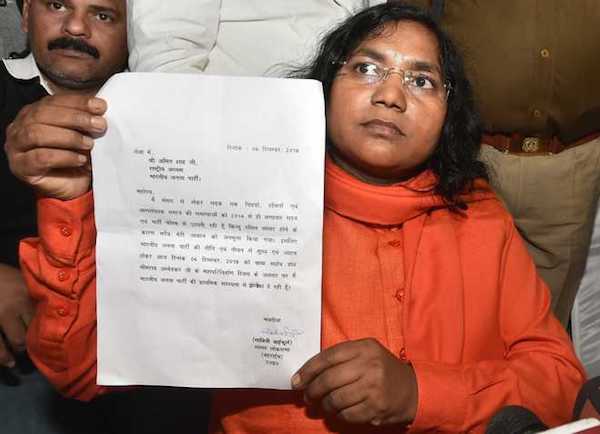
    LUCKNOW(TIP): Accusing the BJP of dividing society, disgruntled party MP from Bahraich Sadhvi Savitri Bai Phule on Thursday, December 6  resigned from the saffron party.

    Speaking to reporters in Bahraich, Dalit leader said upholding the Constitution and the rights it guarantees to the Scheduled Castes and Scheduled Tribes is her duty for which she is resigning.

    Phule announced to hold a massive rally at Ramabai Ambedkar maidan in Lucknow on December 23. She promised to make an “explosive announcement” at the rally.

    “I have resigned from the party. But I will continue as a Lok Sabha member till the end of my tenure,” she said.

    She has also accused the BJP of dividing society and often the party over its Hindutva plank.

    The Dalit MP, who has long been critical of the party’s leadership and resigned from the party on the death anniversary of B R Ambedkar, said she wants to get the Constitution implemented in letter and spirit.

    “Desh ke chowikdar ki pehredari mein, sansadhono ki chori karai ja rahi hai (the country’s resources are being looted under the watch of the country’s gateman),” she said in a derisive reference to Prime Minister Narendra Modi.

    Slamming the BJP, she said people did not get Rs 15 lakh as promised but money was being misused in the construction of statues and temples.

    “It (BJP) is spreading hatred by raking up Hindu-Muslim, India-Pakistan issues and doing nothing to bring back those who fled with our money,” the 37-year-old MP said.

    Ministers, she added, were making statements against the spirit of the Constitution “It seems the BJP wants to run the country from Manusmriti and not from the Constitution,” Phule asserted, referring to the ancient Hindu code.

    “I am resigning on the death anniversary of B R Ambedkar as Manuwadi mentality is being promoted and the RSS, the VHP and the BJP are hurting the sentiments of Dalits and Muslims by creating a 1992 like situation. They are playing divisive politics and vitiating the communal atmosphere…,” she said.

    Phule also said she wanted to draw the country’s attention towards the issue of reservations in promotion.

    Reacting to her resignation, BJP spokesperson Harishchandra Srivsatava said Phule was trying to hide her failures as she had failed to meet the expectations of the people of Bahraich.

    “From today onwards, I have nothing to do with the BJP. My voice was being ignored in the party as I am a Dalit. There is a great conspiracy against Dalits and their rights. Reservation for Dalits and backwards is also being slowly taken away,” she said.

    Known for her controversial statements, Phule has been attacking the BJP and its governments at the Centre and in Uttar Pradesh for their alleged indifference to the concerns of Scheduled Castes.

    On Tuesday, Phule said Lord Hanuman was “a Dalit and a slave of ‘Manuwadi’ people”, adding her voice to the row which erupted over UP Chief Minister Yogi Adityanath’s statement that the deity was a Dalit.

    Asked about the Ram temple issue, pending in the Supreme Court, Phule said the BJP is raking up the matter as it has no other issues.

    “The country does not need a temple. Will it end unemployment and other problems of Dalits and backwards? The temple will benefit Brahmins, who are only 3 per cent. The money offered in temples are used by them for their gains and make our community (Dalit) their slave,” she had said.

    Phule earlier also raised questions on BJP leaders dining at Dalit homes and termed Pakistan founder Muhammad Ali Jinnah, “a mahapurush” (great personality), causing embarrassment to her party.

    (With inputs from PTI and Tribune)

  • Manjit Singh GK resigns as DSGMC president

    Manjit Singh GK resigns as DSGMC president

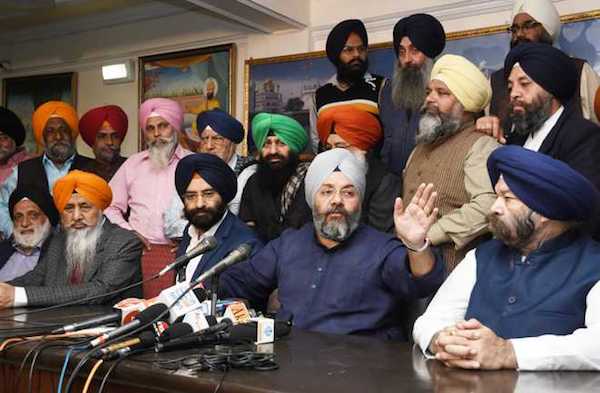
    NEW DELHI(TIP): Under fire over corruption allegations, Delhi Sikh Gurdwara Management Committee president Manjit Singh GK resigned from the post on Thursday, December 6. Other members of the executive committee, including general secretary Manjinder Singh Sirsa, have also resigned and sent their resignations to Akali Dal president Sukhbir Sigh Badal.

    Earlier, Manjit Sigh GK announced elections to the executive committee three months before the due date of March 29. The announcement was made after a meeting of the executive board called by general secretary Manjinder Singh Sirsa following the directions of Shiromani Akali Dal president Sukhbir Singh Badal.

    After heated arguments in the meeting between members, Manjit Singh GK announced that the elections will be held either on December 28 or December 29.

    A proposal for the elections would be sent to the Directorate of Gurdwara Elections, Delhi government, for the exact date.

    (Source: Tribune)

  • George H.W. Bush  Laid to Rest Next to Wife Barbara and Daughter Robin at his Presidential Library and Museum in College Station, Texas

    George H.W. Bush Laid to Rest Next to Wife Barbara and Daughter Robin at his Presidential Library and Museum in College Station, Texas

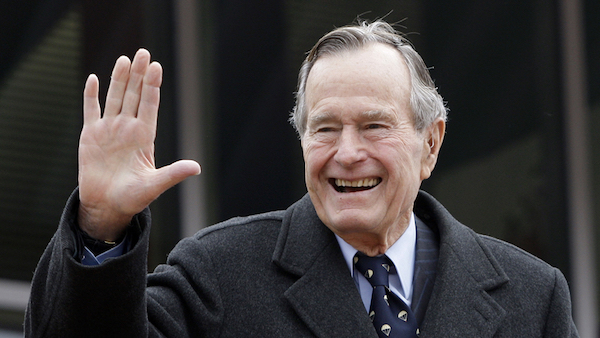
    HOUSTON(TIP): Following his second funeral service on Thursday, December 6 morning, the former president was buried at the family gravesite beside his wife of 73 years, Barbara Bush, who died in April at the age of 92, and their daughter Robin, who died of leukemia in 1953 when she was only three.

    After a state funeral on Wednesday in Washington that was attended by the country’s five living presidents and foreign dignitaries, Bush’s flag-draped coffin was flown to Houston.

    Located on the campus of Texas A&M University, the George H.W. Bush Presidential Library and Museum houses Bush’s presidential archives and is also home to exhibitions dedicated to him and the former first lady.

    Bush’s granddaughter Jenna Bush Hager takes comfort in the fact that the three of them have finally been reunited. “I had the opportunity to talk with my grandpa about the afterlife,” the Today show star, 37, captioned a touching tribute on Instagram. “This is what he said: He answered without any hesitation. ‘Yes, I think about it. I used to be afraid. I used to be afraid of dying. I used to worry about death. But now in some ways I look forward to it.’ And I started crying. I managed to choke out, ‘Well, why? What do you look forward to?’ “

    In response, he said: “‘Well, when I die, I’m going to be reunited with these people that I’ve lost.’ And I asked who he hoped to see. He replied, ‘I hope I see Robin, and I hope I see my mom.’”

    Her grandfather went on to share that he didn’t know whether his daughter would still look like “the 3-year-old that she was, this chubby, vivacious child,” when they saw each other again, or whether she would be all grown up.

    George W. Bush expressed the same gratitude for their reunion during the emotional eulogy he delivered at his father’s state funeral on Wednesday. “Every day of his 73 years of marriage, dad taught us all what it means to be a great husband … He was dedicated to her totally,” the 43rd president reflected on his parents’ relationship.

    Following the death of wife Barbara on April 17, Bush 41 remained devoted to his bride, sitting beside her casket for hours in his wheelchair as mourners paid their respects while she laid in repose one day before her invitation-only funeral.

    But the weight of her passing clearly took a toll on Bush, who was hospitalized less than 24 hours after burying his wife after contracting an infection that spread to his blood. He later recovered and traveled to the family’s beloved summer home in Kennebunkport, Maine, in mid-May, but a week later was readmitted to the hospital for low blood pressure and fatigue.

    In the days since the former president’s death last Friday at the age of 94, Washington and the rest of the country have come together to mourn his loss.

    His remains laid in state at the U.S. Capitol Rotunda, followed by a state funeral at the Washington National Cathedral on Wednesday. President Trump, First Lady Melania Trump, as well as all living former presidents and their spouses — Barack and Michelle Obama, Bill and Hillary Clinton, and Jimmy and Rosalynn Carter — attended to pay their respects in person.

    Shortly after the service, George W. and wife Laura Bush as well as their extended family traveled back to Houston with Bush’s casket on Special Mission 41. Following the second funeral service, the casket was transported by train to Bush’s final resting place at College Station, where he rejoined his wife and daughter at last.

    “We’re going to miss you,” George W. added during his eulogy. “So through our tears, let us know the blessings of knowing and loving you, a great and noble man … The best man a son or daughter could have … And in our grief, let us know that dad is hugging Robin and holding mom’s hand again.”

    (Source: Agencies)

  • December 6 New York & Dallas Print Editions

    December 6 New York & Dallas Print Editions

    [vc_row][vc_column][vc_column_text]

    Print Replica ~ Digitally

    E-Editions

    [/vc_column_text][/vc_column][/vc_row][vc_row][vc_column width=”1/3″][vc_custom_heading text=”New York Edition” font_container=”tag:h2|text_align:center” google_fonts=”font_family:Istok%20Web%3Aregular%2Citalic%2C700%2C700italic|font_style:700%20bold%20regular%3A700%3Anormal” link=”url:https%3A%2F%2Fwww.theindianpanorama.news%2Fwp-content%2Fuploads%2F2018%2F12%2FTIP-December-6-NYC.pdf|||”][vc_single_image image=”95551″ img_size=”full” add_caption=”yes” alignment=”center” onclick=”custom_link” link=”https://www.theindianpanorama.news/wp-content/uploads/2018/12/TIP-December-6-NYC.pdf”][/vc_column][vc_column width=”1/3″][vc_custom_heading text=”Dallas, Texas Edition” font_container=”tag:h2|text_align:center” google_fonts=”font_family:Istok%20Web%3Aregular%2Citalic%2C700%2C700italic|font_style:700%20bold%20regular%3A700%3Anormal” link=”url:https%3A%2F%2Fwww.theindianpanorama.news%2Fwp-content%2Fuploads%2F2018%2F12%2FTIP-December-6-Dallas-TX.pdf|||”][vc_single_image image=”95550″ img_size=”full” add_caption=”yes” alignment=”center” onclick=”custom_link” link=”https://www.theindianpanorama.news/wp-content/uploads/2018/12/TIP-December-6-Dallas-TX.pdf”][/vc_column][vc_column width=”1/3″][vc_single_image image=”82828″ img_size=”medium” alignment=”center” onclick=”custom_link” link=”https://www.theindianpanorama.news/advertising-media-kit-portal-indian-panorama/”][vc_single_image image=”82829″ img_size=”medium” alignment=”center” onclick=”custom_link” link=”https://www.theindianpanorama.news/advertising-media-kit-portal-indian-panorama/”][/vc_column][/vc_row][vc_row][vc_column][td_block_ad_box spot_id=”custom_ad_3″ tdc_css=””][/vc_column][/vc_row][vc_row][vc_column width=”2/3″][vc_custom_heading text=”Lead Stories This Week” font_container=”tag:h2|text_align:center” google_fonts=”font_family:Istok%20Web%3Aregular%2Citalic%2C700%2C700italic|font_style:700%20bold%20regular%3A700%3Anormal” link=”url:https%3A%2F%2Fwww.theindianpanorama.news%2F|||”][td_block_5 separator=”” limit=”12″ tdc_css=””][/vc_column][vc_column width=”1/3″][vc_widget_sidebar sidebar_id=”td-default”][/vc_column][/vc_row]