NEW YORK (TIP): Gift of Life USA is organizing the annual fund-raising gala on April 15, 2018 at Huntington Hilton.
Gift of Life, a 501 (C) (3) non-profit special needs organization, founded by Flora & Paresh Parekh, aims at helping the specially-abled in the areas of health, education and social awareness. With the Mission to Generate Efficient Resources to Support the Specially-Abled through Advocacy & Education, the organization conducts various programs and activities in benefit of the differently abled community namely “Save a Child” Support, We are Special” Talent & Skill Recognition, “Health & Education”, “Awareness” and many more.
This year’s Gala brings together highly inspiring Special Needs Performers, renowned special needs entrepreneurs and speakers. “Along with our annual programs, this year’s Gala focuses on higher education scholarship support for autistic / special needs”, said Flora Parekh.
Speaking about the program, Paresh Parekh listed some of the attractions of the gala this year. They include melodious singing by Rachel Barcellona (Miss SouthEastern USA Ambassador 2018 & Miss SouthEast International 2017 – Diagnosis: Autism/Asperger’s & Epilepsy);· live Band & Jazz Performances by FREE Drum & Bugle Corps (A Special Needs Band Competing for World Championship); Meet & greet inspiring Special Needs Entrepreneurs John Cronin of John’s Crazy Socks (Down Syndrome) & Brittany Schiavone of Brittany’s Baskets Of Hope ((Down Syndrome); Motivational special needs speaker, author & TV Show Host Kerry Magro (Autism Spectrum). & Many More.
For more information on sponsorship, advertising donations etc. visit www.giftoflifeus.org
“While the Russians will continue to play second fiddle to China whenever it suits them, both Russia and India have an interest in keeping their relationship forward looking, given their common interest in developing a multipolar world order. Moscow needs to be told clearly that the US, Australia, Japan, India “Quad” is to primarily maintain a viable balance of power in the Indo-Pacific Region, even as we seek an increasingly cooperative partnership with Russia”, says the author.
Given its size, potential and pride in its history, culture and democratic institutions, India has sought to retain its strategic autonomy, by maintaining a careful balance in its relationships with major centers of power-notably the US, Russia, China and the European Union. This has never been easy, given the inherent geopolitical rivalries between major centers of global power. The challenges we now face are unprecedented, because of the determination of a growingly aggressive China to become the unchallenged, sole center of power in Asia, while it prepares to match the United States, in wielding power globally. An assertive China will not brook the thought of India having a vital interest in asserting its right to influence events, especially across the Indian Ocean Region.
While the US and powers like Japan regard the role of India as important in maintaining a viable balance of power in Asia, there are doubts and misgivings about Russia’s approach towards India. Moscow’s policies are driven largely by the relentless hostility of the US, to oppose and contain Russia’s influence, even on its very doorstep in former Soviet Republics, which often have large Russian populations. Moscow has thus been literally driven into the arms of Beijing, resulting in a virtual Moscow-Beijing alliance, to counter American hegemony. Despite this, India has remained steadfast in endeavoring to maintain its strategic autonomy, by seeking to expand its relationship with Russia. This is being done internationally, by working with Moscow in forums like BRICS, the Shanghai Cooperation Organization and the India-Russia, China triangle, which was initially promoted by Russia. India has also sought to complement Moscow’s efforts to stabilize the secular Assad regime in Syria.
While limited connectivity has served as an obstacle to trade with Russia, the defense relationship between the two countries remains vibrant. The approximately 270 Russian Sukhoi 30 fighters are the main element of our Air Force’s strike and air defense potential. The lethal Brahmos missile, multi barreled rocket launchers, around 900 T 90 Tanks, an aircraft carrier with Mig 29 aircraft, guided missile stealth frigates and even a leased Russian nuclear submarine, are all meant for frontline use. These are but a small portion of the vast amount of Russian defense equipment with our armed forces. New acquisitions underway from Russia include highly advanced S 400 air defense systems and a large fleet of light helicopters. Russian defense exports to India in recent years account for around 39 per cent of its total exports and far exceed exports to China, which unlike India, has successfully developed a vibrant defense industry, with significant export potential.
Russia and India have a mutual interest in carrying forward defense and security cooperation, with regular meetings and exchanges between their Defense Ministers and National Security Advisers and periodic joint military exercises. While some concern has been voiced about Russian arms supplies to Pakistan, the Russians are well aware of the fact that a cash-strapped Pakistan cannot afford to buy its frontline equipment, which is presently confined to purchase of some MI 35 attack helicopters. The Russians also know that the Indian market will be closed for the equipment they supply to Pakistan. The greater concern in New Delhi, however, arises from Russian readiness to join with China and Pakistan in seeking to give legitimacy to the Afghan Taliban. This is rather ironic, given the fact that approximately 14,000 Soviet soldiers were killed and more than 35,000 wounded in action between 1979 and 1989 against ISI backed radical Islamic armed Afghan groups. This effort to legitimize the Taliban has been neutralized, by the Afghan Government’s insistence on direct talks with the Taliban.
While India’s trade with Russia remains limited because of problems in connectivity, mutual cooperation in investments in the petro-chemical sector is substantial and significant. The recent $ 12.9 billion deal for the acquisition of Essar Oil refinery by Russia’s largest oil producer Rosneft, is one of the single biggest foreign investments in India. India’s investments in Russia’s oil and gas industry are presently around $8 billion. They are likely to reach $15 billion by 2020, with India set to acquire an almost 50% stake in Rosneft Siberian oil project. Moreover, there are substantial prospects for increasing Russian supplies of coal, diamonds, LNG and fertilizers to India. Interestingly, while the much touted 2014 Russian gas deal with China was expected to generate $ 400 billion by gas sales to China, the drastic fall in gas prices is likely to reduce the returns by well over 60%. There is also considerable potential for Russia and India to reinforce each other, in executing energy and rail transportation projects in third countries, like Afghanistan and Vietnam. Russia and India are presently cooperating in the construction of the first nuclear power plant in Bangladesh.
It is evident that India cannot match China’s economic power in its relations with Russia. One should, however, remember that there has been grave mutual distrust between Russia and China for centuries. The Russians view China’s meteoric rise and its growing population, as a threat to their Siberian region and even to Vladivostok. The Soviet Union and Mao’s China, loathed each other, from the very inception of Communist rule in China. Mao was kept waiting for months in 1949, before he got to call on Stalin, who met him only after he met Indian Ambassador Dr. Sarvapalli Radhakrishnan, in January 1950. Mao made no secret about his contempt for both Stalin and Khrushchev. The two countries had several border skirmishes in 1968-1970, in which the Chinese were badly mauled. Just after the 1971 Bangladesh conflict, which saw the emergence of a US-China strategic nexus, the Indian Ambassador in Moscow was informed by a senior Communist Party functionary that the Soviet Union had deployed massive armored formations on the border with China, to deter Beijing from getting involved militarily, in the Bangladesh conflict.
These are historical and geopolitical realities that neither the Russians, nor the Chinese will forget easily. While the Russians will continue to play second fiddle to China whenever it suits them, both Russia and India have an interest in keeping their relationship forward looking, given their common interest in developing a multipolar world order. Moscow needs to be told clearly that the US, Australia, Japan, India “Quad” is to primarily maintain a viable balance of power in the Indo-Pacific Region, even as we seek an increasingly cooperative partnership with Russia.
WASHINGTON (TIP): President Donald Trump’s personal lawyer, the lead outside attorney providing advice to the president on the Russia investigation led by special counsel Robert Mueller, said Thursday, March 22, that he has resigned.
In a brief statement to NBC News, attorney John Dowd confirmed his move and said, “I love the president and wish him very well.”
News of Dowd’s resignation was first reported by The New York Times.
Trump slaps tariffs on Chinese imports; Beijing hits back
China retaliated with reciprocal tariffs on $3 billion of imports from the U.S. immediately as US President Donald Trump slapped sanctions for the “theft” of intellectual property.
WASHINGTON (TIP): US President Donald Trump on Thursday, March 22, imposed tariffs on Chinese imports to punish the country for its “unfair” seizure of American intellectual property, a move that could escalate the already tense trade relations between the world’s two biggest economies.
Trump directed the US trade representative to level tariffs on about $60 billion of Chinese imports after a seven-month probe into the intellectual property theft, which has been a longstanding point of contention in US-China trade relations.
“We have a tremendous intellectual property theft problem. It’s going to make us a much stronger, much richer nation,” Trump said. “This has been long in the making,” Trump told reporters at the ceremony in the White House while signing his memorandums targeting China’s economic actions.
Trump’s action comes a day after US Trade Representative concluded its Special 301 investigation against China and presented its report to him. The USTR report concluded that China uses foreign ownership restrictions, including joint venture requirements, equity limitations and other investment restrictions to require or pressure technology transfer from US companies to Chinese entities.
“This requires taking effective action to confront China over its state-led efforts to force, strong-arm, and even steal US technology and intellectual property,” said US Trade Representative Robert Lighthizer.
Trump said his Section 301 trade action could be about $60 billion. He instructed USTR to publish a proposed list of products and any tariff increases within 15 days and to pursue dispute settlement in the World Trade Organization to address China’s discriminatory technology licensing practices.
He also has directed the Treasury Secretary to address concerns about investment in the US directed or facilitated by China in industries or technologies deemed important to the country. Trump said America’s trade deficit with China was a whopping $504 billion per annum.
China which had earlier said it will not sit back idly in case US imposed tariffs, in a quick counter action announced plans for imposing reciprocal tariffs on $3 billion of imports from the U.S. including products from steel to pork.
Bloomberg, in a late evening breaking news, March 22 saw the Chinese retaliation as “the arrival of a trade war” between the US and China.
In a statement Friday, March 23, hours after Trump instructed U.S. Trade Representative Robert Lighthizer to slap tariffs on at least $50 billion in Chinese imports, China’s Commerce Ministry said it plans a 25 percent tariff on U.S. pork imports and recycled aluminum, and 15 percent tariffs on American steel pipes, fruit and wine.
China will also pursue legal action against the U.S. at the World Trade Organization, the statement said, and called for dialogue to resolve the dispute.
Policy makers across the world are warning of a brewing trade war that could undermine the broadest global recovery in years. Meanwhile, business groups representing companies ranging from Walmart Inc. to Amazon.com Inc. are warning U.S. tariffs could raise prices for consumers and sideswipe stock prices.
Vows tougher security steps to restrict developers’ access to such information.
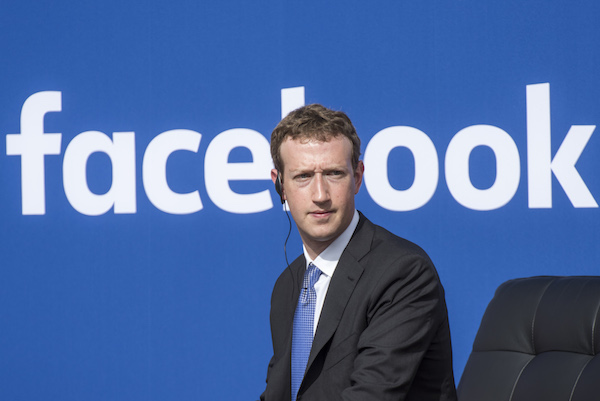
SAN FRANCISCO (TIP): Facebook Inc chief executive Mark Zuckerberg apologized on Wednesday, March 21, for mistakes his company made in how it handled data belonging to 50 million of its users and promised tougher steps to restrict developers’ access to such information.
The world’s largest social media network is facing growing government scrutiny in Europe and the US about a whistleblower’s allegations that London-based political consultancy Cambridge Analytica improperly accessed user information to build profiles on American voters that were later used to help elect US President Donald Trump in 2016.
“This was a major breach of trust. I’m really sorry this happened. We have a basic responsibility to protect people’s data,” Zuckerberg said in an interview with CNN, breaking a public silence since the scandal erupted at the weekend.
Zuckerberg said in a post on Facebook the company “made mistakes, there’s more to do, and we need to step up and do it.” He said the social network planned to conduct an investigation of thousands of apps that have used Facebook’s platform, restrict developer access to data, and give members a tool that lets them to disable access to their Facebook data more easily.
His plans did not represent a big reduction of advertisers’ ability to use Facebook data, which is the company’s lifeblood.
Zuckerberg said he was open to additional government regulation and happy to testify before the US Congress if he was the right person. “I’m not sure we shouldn’t be regulated…. I actually think the question is more what is the right regulation rather than yes or no, should it be regulated?… People should know who is buying the ads that they see on Facebook.”
Zuckerberg said Facebook was committed to stopping interference in the US midterm election in November and elections in India and Brazil. Zuckerberg, in an interview with The New York Times, referred to the artificial intelligence (AI) tools deployed by Facebook to detect fake accounts trying to manipulate news and influence the elections.
Such a tool was deployed for the first time in the French elections in 2017. “The new AI tools we built after the 2016 elections found, I think, more than 30,000 fake accounts that we believe were linked to Russian sources who were trying to do the same kind of tactics they did in the US in the 2016 election. We were able to disable them and prevent that from happening on a large scale in France,” he said.
This is for the first time that Zuckerberg has publicly talked about Facebook being allegedly used for influencing polls. “I feel a lot better about the systems now. At the same time, I think Russia and other governments are going to get more sophisticated in what they do, too. So, we need to make sure that we up our game,” he said.
“This is a massive focus for us to make sure we’re dialed in for not only the 2018 elections in the US, but the Indian elections, the Brazilian elections, and a number of other elections that are going on this year that are really important,” Zuckerberg said.
He said there is a lot of hard work that the Facebook needs to do to make it harder for nations like Russia to do poll interference. — Agencies
FB to Enhance security for India elections
Zuckerberg said Facebook is enhancing security features to ensure integrity of upcoming key elections in countries like India on its platform, as the social media giant faced flak over a major data breach scandal by a UK firm linked to Donald Trump’s poll campaign.
Mark Zuckerberg says he is “sure someone’s trying” to use Facebook to meddle with US mid-term polls in Nov
“I’m sure someone’s trying, “he said when asked about the possibility of meddling happening right now
“I’m sure that there’s v2, version two, of whatever the Russian effort was in 2016, I’m sure they’re working on that,” he said
Meanwhile, Facebook shares fell 1.5 per cent in premarket trading on Thursday, March 22, as the apology failed to quell Wall Street nerves
The company has lost nearly $46 billion of its stock market value over the past three days
Investors fear that any failure to protect personal data could deter advertisers and users and invite tougher regulation for the social media giant.
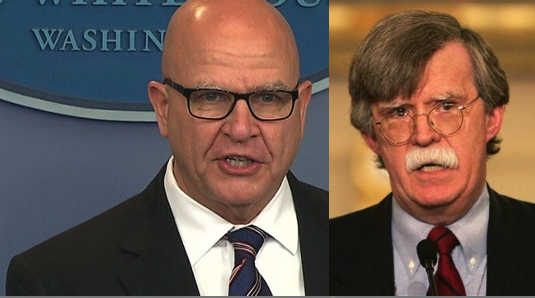
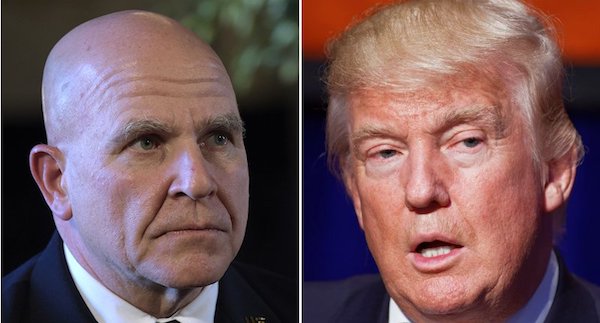
WASHINGTON (TIP): Readers of The Indian Panorama will recall the news we published last week that President Trump had made up his mind to give marching orders to his national security adviser H.R. McMaster. And we have been proved right, as Trump ousted McMaster who is to be succeeded by John Bolton, a former ambassador.
The president announced the news in a tweet on Thursday, March 22, saying that Bolton would take the job starting April 9, making him Trump’s third national security adviser in the first 14 months of his presidency. In dismissing McMaster from the job, Trump praised the Army general for his “outstanding work” and said he would “always remain his friend.”
Bolton, 69, served in the George W. Bush administration in a key arms-control job. Then-Secretary of State Colin Powell said he was strongly encouraged to take Bolton by Vice President Richard B. Cheney, who shared Bolton’s belief in American military power.
On March 13, Trump had fired Secretary of State Rex Tillerson and signaled in recent days that a shake-up at the top levels of his administration was not over.
“I’m really at a point where we’re getting very close to having the Cabinet and other things that I want,” Trump told reporters after Tillerson was fired.
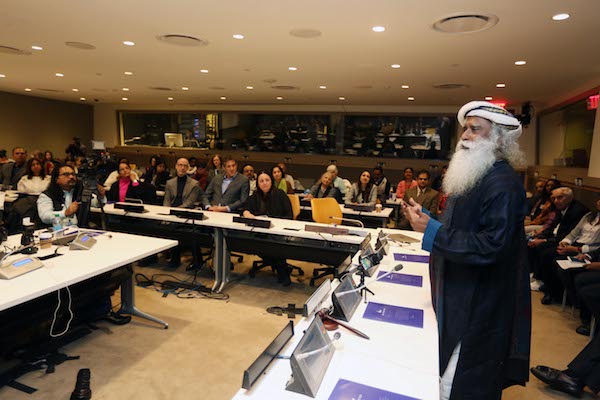
UNITED NATIONS (TIP): Renowned spiritual leader Sadhguru Jaggi Vasudev has welcomed the United Nations’ initiative to launch a new decade to focus action on management of water resources, saying such effort is critical towards helping in the survival of future generations and calling for concerted action by all to save the world’s water bodies.
Sadhguru, speaking at a special event on Water, Sanitation and Women’s Empowerment during the current session of Commission on the Status of Women here, on March 21, said it is “appropriate” that at this moment the UN has taken the step to launch the 10 year action plan. “It is most vital and it’s important that we make this into a success (for) the survival of this generation,” he said.
Concerned about the slow progress in implementing international agreed goals on water and sanitation, the United Nations General Assembly will launch a new decade to focus action on sustainable development and the management of water resources at an all-day event at the UN Headquarters on World Water Day, commemorated today.
The Decade, which will run from 2018-2028, calls for a greater focus on the sustainable development and integrated management of water resources for the achievement of social, economic and environmental objectives and on the implementation and promotion of related programs and projects, as well as on the furtherance of cooperation and partnership at all levels in order to help to achieve internationally agreed water-related goals and targets, including those contained in the 2030 Agenda for Sustainable Development.
Sadhguru, founder of the Isha Foundation, said if concerted action to save water bodies is taken now, then in 15-25 years communities can bring back the rivers of this world by at least 20 per cent. However, if action is delayed, it will take 100-150 years to have the same impact. “If we don’t act now, the recovery will take much, much longer…We are rapidly moving to a place where turning around will be very difficult,” he said, referring to the dire water situation across Asia and Africa.
With rivers in India having depleted by 60 per cent and across the world by about 35 per cent, Sadhguru called on people and communities to join hands for efforts towards water conservation, including through overhauling irrigation systems and putting enabling government policies in place.
He said given that agriculture in India consumes 80 per cent of the country’s water, emphasis should be given on creating more vegetation.
“Agriculture has become an aggressive process…One of the immediate corrective steps we can take is to increase vegetation. Without vegetation there is no way we can hold water in the soil. We don’t have enough vegetation for the number of people that we have right now,” he said.
He stressed that through his work, his focus is to bring back as much vegetation as possible, particularly around water bodies.
He pointed out that women are the first and most to suffer when water becomes scarce, as it impacts several aspects of their daily routines, including access to toilets. Underlining the “very significant role” role women can play in efforts towards water conservation, Sadhguru said women are “natural conservationists” as in families, conservation, whether economical or physical, is done by women. “Women can play a pivotal role in water resources management, agriculture and allied industries if they are empowered to take more economic decisions.”
Sadhguru had launched a nationwide campaign ‘Rally for Rivers’ in India, traveling across 16 states in 30 days with the message of rejuvenating India’s rivers by maintaining a minimum of one-kilometer tree cover on riversides.
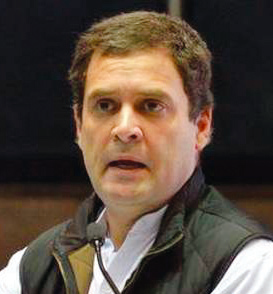
NEW DELHI (TIP): Is the Congress ready to shed its status quoist tag and take hard decisions as it prepares to fight a rampant BJP in the 2019 Lok Sabha elections? The answer may lie in Rahul Gandhi’s choice of candidates for the upcoming Rajya Sabha elections.
Selecting the “right” candidates for the Rajya Sabha elections was a key test for the 47-year Gandhi, who took over the reins of the grand old party from his mother Sonia Gandhi two months ago .
Gandhi nominated local leaders as the party’s candidates, ignoring, in the process, some well-entrenched Congressmen.
The move has rekindled hopes among Congress workers that Gandhi may be willing to take tough decisions in the party’s interest.
Sonia Gandhi would try not to antagonise the “Delhi coterie” and at times ignore the aspirations of regional leaders.
“Rahulji’s decision to field local leaders in Rajya Sabha elections has gone down well within the rank and file. It marks a significant shift in the party’s policies when it comes to rewarding hard working local workers,” senior Congress leader from Bihar Kishore Kumar Jha said.
“I am confident this will also check the growth of paratroopers and opportunists who seek all the benefits and then desert the party at critical times. The move will also encourage regional leaders to put in more effort on the ground and work for the party’s revival across the country,” he added.
Commenting on Rahul’s style of functioning, Sonia Gandhi said last week at an event that every person has a particular style of working.
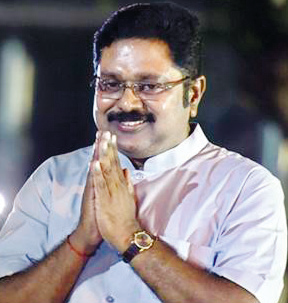
MADURAI (TIP): Rebel AIADMK leader TTV Dhinakaran on March 15 floated a new political party — Amma MakkalMunnetra Kazhagam — named after late Tamil Nadu CM J Jayalalithaa.
“From today, we will function with a name to retrieve the great movement of AIADMK from the betrayers,” Dhinakaran told a gathering on the occasion, challenging the ruling dispensation in the state. Dhinakaran and his followers often use the word “betrayers” to refer to the ruling AIADMK in Tamil Nadu, led by CM K Palaniswami and his deputy, O Panneerselvam. The party’s name roughly translates to
NEW DELHI (TIP): The bickering between India and Pakistan over alleged harassment of each other’s diplomats took a new turn after Islamabad called its High Commissioner home for consultations, which was termed by India as “routine” and “normal”.
Pakistan said it has called home its envoy Sohail Mahmood for consultations after repeated incidents of “harassment” of its diplomatic staff in New Delhi.
External Affairs Ministry Spokesperson Raveesh Kumar said the Indian High Commission in Islamabad was also facing a “litany of issues” that have not been resolved for several months.
“It is pretty normal and routine for any country to call its envoy for consultations,” Kumar said.
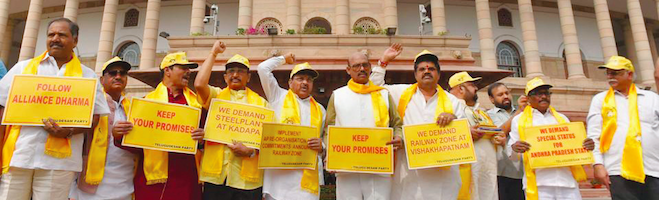
NEW DELHI (TIP): For the first time in its term, the Narendra Modi government may face a no-confidence motion on the floor of the house.
Andhra Pradesh’s YSR Congress Party led by Jagan Mohan Reddy, has given a notice to move a no-confidence motion against the government in the Lok Sabha over the issue of not giving the so-called “special category” status to his state. But before any vote takes place, the notice needs the support of 50 MPs ‘in an orderly house’. It is not clear the notice will get that.
With a comfortable majority in the house, the government is safe and will cruise through, even if the motion is admitted. The move is however expected to hasten the exit of The Telugu Desam
Party (TDP), which pulled its ministers out of the Bharatiya Janata Party led government, from National Democratic Alliance. The YSRCP has nine MPs, but four have defected, leaving it with an effective strength of five; the TDP has 16 MPs, and it can’t risk not supporting a motion that purportedly has the state’s best interests in mind.
TDP MP Thota Narasimham told PTI that the party will also support the motion. Later, Andhra Pradesh chief minister N Chandrababu Naidu too said the TDP would support the no-confidence motion.
“We will support a no-confidence motion, whoever moves it. We will be ready for that and our 16-17 MPs will fully support that. We will cooperate with whoever fights for the state’s rights,” Naidu told the state assembly, according to PTI. YSRCP MP YV Subba Reddy submitted a notice with the Lok Sabha secretariat, desiring to move a no confidence motion on Friday. Reddy has also written a letter seeking support from all non-NDA parties. The party initially planned to the motion on March 21, but advanced it amid apprehension that Parliament might adjourn sine die early in the wake of disruptions.
It has also suggested that its MPs will quit from Lok Sabha at the end of the session if the demands are not met.
The budget session is scheduled to end on April 6. The Congress, with 48 MPs, and the Trinamool Congress, with 34, were yet to take a call on the no-confidence motion late on Thursday. “We will firm up our strategy by Friday morning,” Congress’ chief spokesperson Randeep Singh Surjewala said. A TMC leader said the YSRCP had not reached out to the party yet. The Biju Janata Dal is unlikely to support the notice. A party leader said, “It is for a parochial issue. We may not support it.”
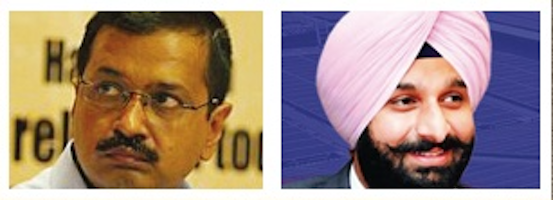
NEW DELHI (TIP): Delhi Chief Minister Arvind Kejriwal on March 15 apologized to former Punjab minister Bikram Singh Majithia for making “unfounded” allegations against him over his involvement in the illegal drug trade.
Majithia, a senior Shiromani Akali Dal leader, had filed a criminal defamation case against Kejriwal and two other AAP leaders for allegedly “tarnishing” his reputation by levelling “false, baseless and malicious charges”.
Following the apology, Majithia has decided to withdraw the court case against him.
However, the “meek surrender” drew flak from AAP Punjab unit leaders who termed Kejriwal’s step a “letdown”.
AAP leaders in New Delhi, however, said the move was to shed court cases, in which the party convenor finds himself mired, and hinted that a similar course could be adopted in the defamation case filed by Finance Minister Arun Jaitley.
Kejriwal apology “In the recent past, I made certain statements and allegations against you regarding your alleged involvement in drug trade. These statements became a political issue. Now I have learnt that allegations are unfounded,” Kejriwal said in a letter addressed to Majithia.
“I hereby withdraw all my statements and allegations made against you and apologies for the same,” the Aam Aadmi Party (AAP) chief said.
The damage caused to your esteem, the hurt caused to you, your family, friends, well-wishers, followers and the loss caused to you is regretted, he said.
Former Punjab minister Majithia claimed he was grateful that truth had won and Kejriwal had realized his mistake. Since the AAP leader had “tendered his apology”, he did not want to pursue the defamation case filed against him, Majithia said.
Accusing Majithia of playing with the youth of Punjab by “unleashing narcoterrorism in the state,” Kejriwal had once declared that he would “drag” the then Punjab cabinet minister “by his collar” to jail for his alleged role in a multi-million rupee drug racket.
Majithia, who was once probed by the ED in connection with the alleged Rs 6,000 crore money laundering drugs racket case, had often been at the receiving end of Kejriwal’s ire during the AAP convenor’s rallies in Punjab in the run-up to the Assembly election last year.
Drug abuse was a major issue in the high-octane Punjab Assembly elections last year and Kejriwal, who was leading the AAP charge, accused Majithia, then a minister in the state government, of being involved in narcotics trade.
Majithia had denied the charges against him.
In May 2016, he filed a criminal defamation case against Kejriwal, Sanjay Singh and Ashish Khaitan. Majithia said Kejriwal, Singh and Khaitan have “made it a habit” to target their political opponents by resorting to statements “filled with lies with the sole motive of hoodwinking the people”.
“I will not let anyone besmirch my and family’s honour. Anyone doing so will have to face the consequences. I am determined to make them face trial and be punished for their misdeeds,” the minister had said.
Majithia ‘accepts’ Kejriwal’s apology Talking to reporters, Majithia said he had accepted the apology.
“I thank Kejriwal for showing greatness in seeking apology for his remarks made against me. I have told my lawyers that from our side, this case ends as Kejriwal has sought apology. I have asked my counsels to withdraw the defamation case. Person makes mistake and with the grace of God, if I have the ability to forgive and I will forgive,” the SAD leader said.
Majithia had filed a defamation case against Kejriwal and Ashish Khetan in May 2015.
“I had said from the beginning that either he will say sorry or he will go to jail. Sending someone to jail is not my intention,” he asserted.
It is indeed a historical moment that a sitting chief minister has submitted a written apology in court withdrawing all statements he made against me,”said Majithia.
The SAD leader said although it was
“very torturous journey” for him as he battled the allegations. “The AAP, however, did not benefit as their candidate lost his security forfeited in my constitutency,” he said.
Majithia said the entire controversy
had taken a toll on his mother because she could not understand this kind of politics.
“My wife also went through a difficult phase, I thank the almighty that this chapter has ended and truth has prevailed,” he said, adding, “If my two little kids were asked in school that your father does such things, you can imagine what could have been my position. What answer I could have given to them.” AAP
leader Ashish Khetan had apologized as well, he added.
LUCKNOW (TIP): Delivering a major blow to the BJP, the Samajwadi Party won Gorakhpur and Phulpur Lok Sabha seats in Uttar Pradesh by-election. Samajwadi Party’s Nagendra Pratap Singh Patel defeated BJP’s Kaushlendra Singh Patel by 59,613 votes in Phulpur. In Yogi Adityanath’s bastion, SP’s Praveen Kumar Nishad defeated BJP’s Upendra Dutt Shukla by 21000 votes.
Gorakhpur and Phulpur are highprofile constituencies as both the seats were represented by BJP’s firebrand leader and current UP Chief Minister Yogi Adityanath and Deputy Chief Minister Keshav Prasad Maurya respectively. Adityanath represented Gorakhpur five times in the Lok Sabha, and it went vacant in 2017 when he was elected to UP Assembly to take over as the Chief Minister of the state.
In 2014, BJP had won both the seats with over 3 lakh vote margin. In Gorakhpur, BJP’s Yogi Adityanath had defeated SP’s Rajmati Nishad by 31,2783 votes. And in Phulpur, BJP’s Keshav Prasad Maurya defeated SP’s Dharam Raj Singh Patel by 3,08,308 votes. However, currently the BJP is trailing on both the seats. Ten candidates are in fray from Gorakhpur and 22 candidates contested from Phulpur.
ALARM BELLS IN BJP
The defeat of the Bharatiya Janata Party in all six Lok Sabha seats where byelections were held this year has sounded alarm bells in the party in Uttar Pradesh ahead of the 2019 Parliamentary polls, while stoking speculation about the Opposition stitching an alliance together to take the BJP on after tasting success in the recent bypolls.
The BJP failed to break the jinx of repeated failures in Parliamentary byelections in 2018 when it was defeated yesterday in Gorakhpur, the bastion of Chief Minister Yogi Adityanath, and Phulpur, earlier held by deputy Chief Minister Keshav Prasad Maurya.
The ruling partys candidates in the two constituencies lost to the Samajwadi Party (SP), triggering a debate on whether political outfits opposed to the BJP could forge a mega alliance before the 2019 Lok Sabha polls.
The SP, supported by the BSP, romped home in the bypolls.
SPs Pravin Nishad defeated Upendra Dutt Shukla of the BJP by 21,961 votes in Gorakhpur, a seat which had been with the BJP since 1989. Nagendra Pratap Singh Patel of SP cornered the Phulpur seat, drubbing the saffron partys Kaushalendra Singh Patel by 59,460 votes.
As the results of the two by-election were declared yesterday, Adityanath said there was a “lesson” to be learnt from the outcome, and cited over-confidence and the inability to understand the implications of the pact between SP and BSP as the prime reasons for the BJPs defeat.
UP Congress spokesperson Ashok Singh told PTI the outcome had brightened the prospects of the formation of a “maha gathbandhan” (grand alliance) ahead of the 2019 polls to defeat the saffron party.
“We will ponder seriously about a larger alliance keeping the next Lok Sabha polls in mind,” he said. The Congress had contested the 2017 UP Assembly polls jointly with the SP and might want to tackle the polls together next year, too, another senior party leader told PTI, requesting that he not be named.
The outcome of the March 11 bypolls has sparked talk in political circles about a continuing pact between the SP and the BSP — once bitter critics in Uttar Pradesh.
HICKSVILLE, NY (TIP): Restaurateur Harendra Singh said he saw his long-time friend Mangano as a “connection” that would help his businesses flourish.
Singh has pleaded guilty to bribing Mangano. The prosecution established that Singh helped Mangano financially throughout his rise in politics, donating thousands of dollars to his campaigns and catering food to his staff, volunteers and friends.
Singh said he did it to make sure he would have Mangano’s support in his restaurant dealings.
Singh told the court Thursday, March 15, he rented a building to the Republican at a discount, gave his office free food and bought him a $3,000 office chair.
It is learnt prosecutors have a long list of witnesses which includes a former Nassau County employee close to Mangano who frequently organized fundraisers for Mangano.
Between 2010 and last December, Mangano held the highest elected position in Nassau County.
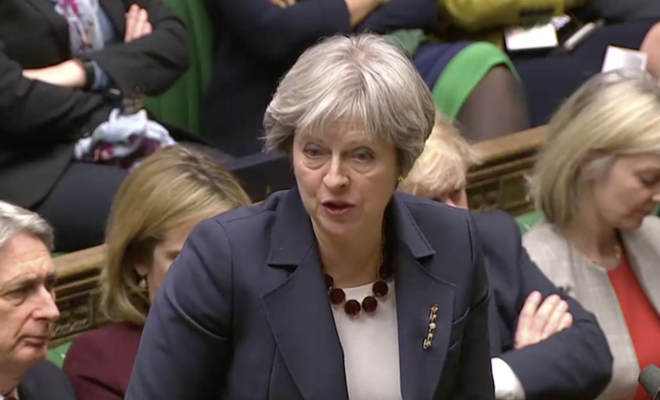
LONDON (TIP): British Prime Minister Theresa May, on March 14, held Russia responsible for the nerve agent attack against a former Russian spy and his daughter as she expelled 23 Russian diplomats and suspended high-level bilateral contact.
Former Russian spy Sergei Skripal, 66, and his daughter Yulia, 33, were found collapsed after being poisoned last week. Both remain in a serious condition along with a police officer who came in contact with the same substance.
Russia denies being involved in the attempted murder of the former spy and his daughter. “The Russian state was culpable of the attempted murder” of spy Sergei Skripal and his daughter, May told lawmakers. She said Britain will suspend high-level bilateral contact with Russia and revoke an invitation to Russian Foreign Minister Sergei Lavrov to visit the UK.
The Prime Minister announced that Britain will expel 23 Russian diplomats, saying they have one week to leave the UK. She identified those diplomats as “undeclared intelligence officers”, BBC reported.
Moscow, which had been given an ultimatum to provide a “credible response” over how a Russian-made nerve agent came to be used on British soil, had warned of “an equal and opposite reaction” against any UK reprisals.
The reprisals follow days of diplomacy since May first informed Parliament that there was enough evidence to conclude that it is “highly likely” that Russia is behind the poisoning ofSkripal and his daughter in Salisbury on March 4.
“Russia’s record of conducting state-sponsored assassinations; and our assessment that Russia views some defectors as legitimate targets for assassinations; the government has concluded that it is highly likely that Russia was responsible for the act against Sergei and Yulia Skripal,” she had said.
“It was an indiscriminate and reckless act against the United Kingdom, putting the lives of innocent civilians at risk. And we will not tolerate such a brazen attempt to murder innocent civilians on our soil,” she added, giving Moscow a Tuesday midnight deadline to respond on the circumstances surrounding the attack.
Downing Street said the British prime minister received the backing of Trump, who agreed in a phone call that Moscow “must provide unambiguous answers as to how this nerve agent came to be used”. Skripal was convicted of treason in 2006 and jailed for 13 years for selling secrets to MI6, which had recruited him in the 1990s.
Meanwhile, France and Germany have also held Russia responsible for the murderous attempt in London.
Trump has complained that H.R. McMaster, a three-star Army general, is too rigid and that his briefings go on too long and seem irrelevant, the Post reported.
WASHINGTON (TIP): U.S. President Donald Trump has decided to replace his national security adviser, H.R. McMaster, but the move is not expected to be made immediately, the Washington Post reported on Thursday, March 15.
Citing five people with knowledge of the plans, the Post said Trump was considering several possible replacements, including former U.S. Ambassador to the United Nations John Bolton and Keith Kellogg, the chief of staff of the National Security Council.
On Tuesday, Trump fired Secretary of State Rex Tillerson and the president has signaled in recent days that a shake-up at the top levels of his administration was not over.
“I’m really at a point where we’re getting very close to having the Cabinet and other things that I want,” Trump told reporters after Tillerson was fired.
McMaster is not expected to be ousted immediately, the Post reported. Trump is willing to take his time making the change to avoid humiliating McMaster and carefully choose a strong replacement, the Post said.
Trump never personally gelled with McMaster and the President recently told White House Chief of Staff John Kelly that he wanted McMaster replaced, according to the Post.
Trump has complained that McMaster, a three-star Army general, is too rigid and that his briefings go on too long and seem irrelevant, the Post reported.
McMaster is Trump’s second national security adviser, succeeding Michael Flynn who was dismissed a year ago for misleading Vice President Mike Pence about his contacts with the Russian ambassador to the United States.
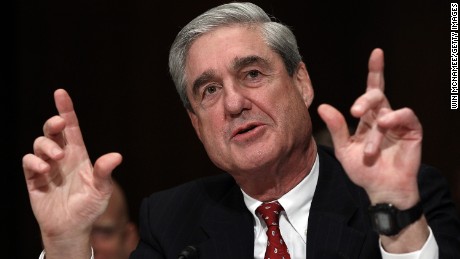
WASHINGTON (TIP): Special counsel Robert Mueller has subpoenaed the Trump Organization for business documents, CNN reported, quoting a source, on March 15.
The New York Times, which first reported the development, said the subpoena included documents related to Russia. The reports mark the first publicly known time that Mueller has demanded documents related to President Donald Trump’s businesses.
The subpoena is a sign that the Mueller investigation continues to pick up steam, even as Trump decries remaining questions about potential coordination between his associates and Russia and denies any wrongdoing. Trump has said he would view any investigation of his or his family’s personal finances that didn’t involve Russia as a “violation” by Mueller that crosses a red line.
CNN reported in January that the company had voluntarily provided documents on a range of events, conversations and meetings from Trump’s real estate business to Mueller and congressional investigators, according to three people familiar with the matter.
It will be interesting to watch how Trump reacts to this move of Mueller.
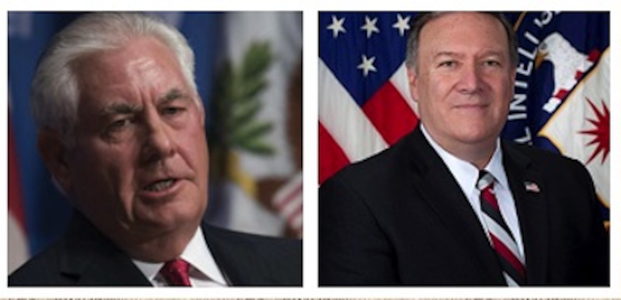
WASHINGTON (TIP): President Trump has removed Rex Tillerson as secretary of state and replaced him with current CIA Director Mike Pompeo, after months of speculation surrounding Tillerson’s role in the Trump administration, a fact Tillerson only learned was official when the announcement was made on Tuesday, March 13 morning.
Mr. Trump announced the news of Tillerson’s ouster on Twitter, thanking him for his service. The Washington Post first reported news of Tillerson’s firing, shortly before the president’s tweet.
Mike Pompeo, Director of the CIA, will become our new Secretary of State. He will do a fantastic job! Thank you to Rex Tillerson for his service! Gina Haspel will become the new Director of the CIA, and the first woman so chosen. Congratulations to all!
— Donald J. Trump (@realDonaldTrump) March 13, 2018
As Mr. Trump departed for a California trip Tuesday, March 13 morning, he told reporters that he and Tillerson “disagree on things,” and he singled out the Iran nuclear deal as an issue.
“Rex and I have been talking about this for a long time. We got along actually quite well, but we disagreed on things,” he said. “When you look at the Iran deal — I think it’s terrible. I guess he thought it was OK. I wanted to either break it or do something. And he felt a little bit differently. So we were not really thinking the same.”
Mr. Trump released a statement shortly before leaving for his trip to California saying he was “proud” to nominate Pompeo to replace Tillerson.
“His experience in the military, Congress, and as leader of the CIA have prepared him well for his new role and I urge his swift confirmation,” said Mr. Trump in a statement. He added, ” want to thank Rex Tillerson for his service. A great deal has been accomplished over the last fourteen months, and I wish him and his family well.”
According to the White House, Gina Haspel, the Deputy Director of the CIA, will be nominated to replace Director Pompeo. If confirmed, she would become the CIA’s first female director. She was only recently named deputy director.
Pompeo said in a statement of the president’s decision, “If confirmed, I look forward to guiding the world’s finest diplomatic corps in formulating and executing the President’s foreign policy.”
He added, “In my time as Director of the Central Intelligence Agency, I have worked alongside many remarkable Foreign Service officers and Department of State leaders serving here in the United States and on the very edge of freedom. I know I will learn from them and, as President Trump set out in his State of the Union Address, work hard to ensure that “our nation will forever be safe and strong and proud and mighty and free.”
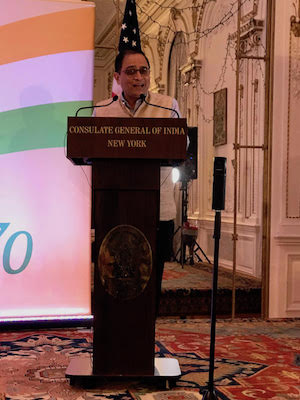
NEW YORK CITY (TIP): Insight for Creativity attained another milestone in the journey of its creative and constructive offerings by organizing a unique literary and cultural evening with the Indian Consulate in New York. It was aptly titled ‘Rang Darpan’ by Ashok Vyas, who roped in poets as well as essayist, story writer and theatre artists for a meaningful sharing of Hindi literature at the historical venue.
This literary evening ‘Rang Darpan’ happened by encouraging support of Consulate General Sandeep Chakravorty and the team of consul staff. Jaideep, consul (Cultural) and Vipul Mesaria, Consul (Political) worked closely with Insight for creativity and hosting this poetic evening.
Lighting the lamp
This “Rang Darpan’ evening began by invoking ‘Saraswati Mata’, Goddess of Knowledge, through a short and sweet classical dance by Pt Satya Narayan Charka Saraswati Mata, mother Goddess for knowledge and creativity.
Consul General talked about various initiatives that are being taken by the govt of India to promote Hindi. Jaideep shared a poem that highlighted the significance of innocence.
Yogacharya Dr Daya Shanker Vidhyalankar recited his poem and also wonderfully recited a poem of former PM of India Atal Bihari Vajpeyee.
Consul General Sandeep Chakravorty with Consuls and organizer Ashok Vyas and Mrs Vyas
Indian American poets started off connecting with the audience through their poems ranging from humor to romance to pure philosophy. Bindeshwari Agrawal offered a sense of satirical humor through her poem about the exaggerated sense of freedom.
Prof Indrajit Saluja revived the tradition of essays in Hindi at the request of Ashok Vyas and shared his thoughts on ‘Enthusiasm’.
Anoop Bhargav presented a sensitive poem about the impact of economic pressure on the sense of concern for each other. Poet after poet, audience was drawn towards the inexpressible space of raw emotions and longing for expansion in distinct way. Susham Bedi questioned the parameters of norms associated with love.
Seema Khurana conveyed a feel of mischievous and playful layer on the surface in her profound poem about different dimensions of a romantic relationship. Swadesh Rana imaginatively expressed the abandonment born out of pure commitment towards love. While arriving at the destination is important.
Dr Ram Das Singh ‘Mahtaab’ started with few lines in Punjabi and later he connected with the audience through his gazals.
A special issue ‘Rang Darpan’ was published by Jay Singh in his Hindi Newspaper ‘Hum Hindustani’, Hindi books of NRI authors were displayed on this occasion.
Ashok Vyas moderated this evening by making use of his own poems and poems of acclaimed poets. The poetry session culminated with his poems. Mr Vyas invoked a sense of oneness, peace and harmony through his poem. One of his poem was like a prayer, prayer with the desire of belonging to everyone with love.
Ameeya Mehta directed and presented Hindi Play ‘Amrit Ke Khareedaar’ with Himanshu Sharma and Deepak Gupta. Ashok Vyas authored the play
Ameeya Mehta directed and presented Hindi Play ‘Amrit Ke Khareedaar’ with Himanshu Sharma and Deepak Gupta. Playwright Ashok Vyas personified “fear” and faith in the play, it was a play based on the inner working of human mind. The message of being truthful was artistically interwoven with dramatic elements in the play. Ashok Vyas expressed deep sense of gratefulness for Sandeep Chakravorty, Consul General of Indian in New York, consul staff, invited poets and artists.
The Macron visit underlined the growing strategic convergence that draws India and France together
By Rakesh Sood
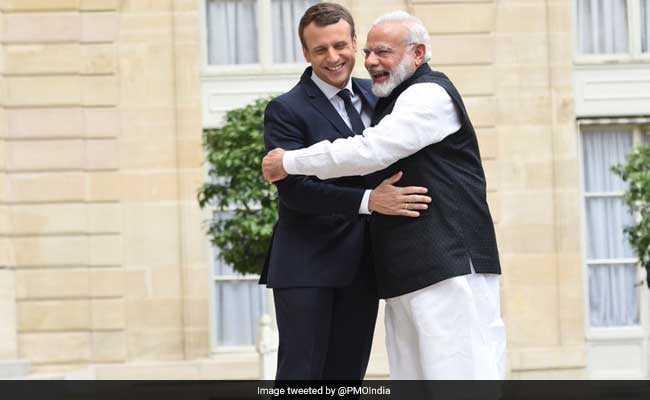
“The slew of bilateral agreements and memoranda of understanding signed, the detailed ‘joint statement’ and accompanying ‘vision statements’ on cooperation in space and the Indian Ocean Region, the boat ride in Varanasi, and Prime Minister Narendra Modi’s warmly reciprocated diplohugs indicate that the relationship has received a momentum that gives it critical mass and greater coherence”, says the author.
With French President Emmanuel Macron’s recent visit to India, the India-France Strategic Partnership launched in 1998 seems finally to have come of age. In these two decades, both sides have gradually enhanced cooperation in diverse fields covering civil nuclear, defense, space, counter-terrorism, education, research and development in science and technology, culture, urban development, climate change, trade and economics and people-to-people contacts. The slew of bilateral agreements and memoranda of understanding signed, the detailed ‘joint statement’ and accompanying ‘vision statements’ on cooperation in space and the Indian Ocean Region, the boat ride in Varanasi, and Prime Minister Narendra Modi’s warmly reciprocated diplohugs indicate that the relationship has received a momentum that gives it critical mass and greater coherence.
A shared worldview
As a country that has prided itself on its ‘exceptionalism’, France has always been sympathetic to similar Indian claims based on its ancient civilization. This is why both countries were quick to voice support for global multi-polarity once the Cold War ended. French discomfort with the U.S.’s unipolar moment in the 1990s was evident when it described it as a ‘hyperpower’.
Defense cooperation with France began in the 1950s when India acquired the Ouragan aircraft and continued with the Mystères, Jaguar (Anglo-French), Mirage 2000, Alizè planes and the Alouette helicopter. Joint naval exercises, later christened Varuna, date back to 1983.
Cooperation in the space sector has continued since the 1960s when France helped India set up the Sriharikota launch site, followed by liquid engine development and hosting of payloads. Today, it is a relationship of near equals and the ‘vision statement’ refers to world class joint missions for space situational awareness, high resolution earth observation missions with applications in meteorology, oceanography and cartography. Inter-planetary exploration and space transportation systems are cutting edge science and technology areas that have also been identified.
Yet the Cold War imposed limitations on the partnership. After the Cold War, France decided that its preferred partner in the Indian Ocean Region would be India. In January 1998, President Jacques Chirac declared that India’s exclusion from the global nuclear order was an anomaly that needed to be rectified. After the nuclear tests in May 1998 when India declared itself a nuclear weapon state, France was the first major power to open dialogue and displayed a far greater understanding of India’s security compulsions compared to other countries. It was the first P-5 country to support India’s claim for a permanent seat in an expanded and reformed UN Security Council.
Building a partnership
With the establishment of a Strategic Dialogue, cooperation in defense, civil nuclear, space, intelligence sharing, and counter-terrorism has grown. An agreement for building six Scorpène submarines in India with French help was signed in 2005. Similarly, technology sharing, and acquisitions of short range missiles and radar equipment were concluded. Joint exercises between the air forces and the armies were instituted in 2003 and 2011, respectively. The government-to-government agreement for 36 Rafale aircraft, salvaged out of the prolonged negotiations for the original 126 which were at an impasse, was as much driven by technical requirements as by political considerations. The ambitious offset target of 50% (nearly ₹25,000 crore), properly implemented, can help in building up India’s budding aerospace industry.
In the nuclear field, an agreement was signed about a decade ago for building six EPR nuclear power reactors with a total capacity of 9.6 GW for which negotiations have been ongoing between the Nuclear Power Corporation of India (NPCIL) and Areva, and now EdF. Terror strikes in France in recent years by home-grown terrorists have enlarged the scope of counter-terrorism cooperation to include cyber security and discussions on radicalization.
Even though these areas provided a robust basis for engagement, it remained primarily at a government-to-government level. In recent years, it was clear that for a wider partnership, strengthening business-to-business and people-to-people relationships was essential. Climate change and renewable energy resources, particularly solar, soon emerged as a new plank, reflected in the multilateral initiative of the International Solar Alliance. Another area identified was urban planning and management of services like housing, transport, water, sanitation, etc. using the public private partnership model which the French have employed successfully. Mr. Macron’s visit has enabled progress to be registered across a variety of sectors including the strategic partnership areas.
There has been a growing convergence of interests in maritime cooperation. Like India, France has expressed concern about China’s growing presence in the Indian Ocean Region. French overseas territories in the Indian and the Pacific Oceans provide it with the second largest exclusive economic zone globally. It has long maintained bases in Reunion Islands and Djibouti and established one in Abu Dhabi in 2009. This regional dimension is reflected in the Vision Statement on cooperation in the Indian Ocean Region.
The signing of MoUs regarding the provision of reciprocal logistics support to each other’s armed forces, exchange and reciprocal protection of classified information and developing shared space studies and assets for maritime awareness provide the basis on which to strengthen joint naval exercises. With the U.S., naval cooperation has been easier with the Pacific Command which covers China and the region up to the Bay of Bengal but more difficult with the Central Command which covers western Indian Ocean and the Arabian Sea because of Central Command’s privileged relationship with Pakistan. Therefore, strengthening cooperation with France, particularly in the western Indian Ocean Region makes eminent strategic sense even as India develops its presence in Oman (Duqm) and Seychelles (Assumption Island).
The agreement on the industrial way forward between NPCIL and EdF affirms that work at Jaitapur will commence before the end of 2018. Equally significant are the two agreements signed between EdF and other French entities and L&T and Reliance, respectively, reflecting the engagement of Indian industry.
Trade has grown in recent years but at $10 billion is half of the trade with Germany. The signing of nearly $16 billion worth of agreements at the business summit indicates that private sectors in both countries are beginning to take notice. There are nearly 1,000 French companies present in India including 39 of the CAC 40 while over a hundred Indian businesses have established a presence in France. In the past, Indian companies saw the U.K. as the entry point for Europe; now with Brexit approaching, Mr. Macron has cleverly pitched that India should look at France as its entry point for Europe and Francophonie! The flagship program of Smart Cities in which France is focusing on Chandigarh, Nagpur and Puducherry is taking shape as more than half the business agreements signed related to electric mobility, water supply, waste management and smart grids.
Educational links
Potentially, the most significant was the focus on youth and student exchanges. Currently about 2,500 Indians go to France annually to pursue higher education, compared to more than 250,000 from China. A target has been set to raise it to 10,000 by 2020. The agreement on mutual recognition of academic degrees and the follow-on Knowledge Summit, where 14 MoUs between educational and scientific institutions were signed, is a welcome move.
Tourism is another area that has received attention. A target of a million Indian tourists and 335,000 French tourists has been set for 2020. Given that France receives over 80 million tourists a year and India around nine million, these targets may seem modest but reflect that while there are only about 20 flights a week between India and France, there are four times as many to Germany and 10 times as many to the U.K.
The Strategic Partnership has already created a solid foundation; other aspects have now received the much needed focus and with proper implementation, it can add to the growing strategic convergence that draws India and France together.
(The author is a former Ambassador to France and currently Distinguished Fellow at the Observer Research Foundation. E-mail: rakeshsood2001@yahoo.com)
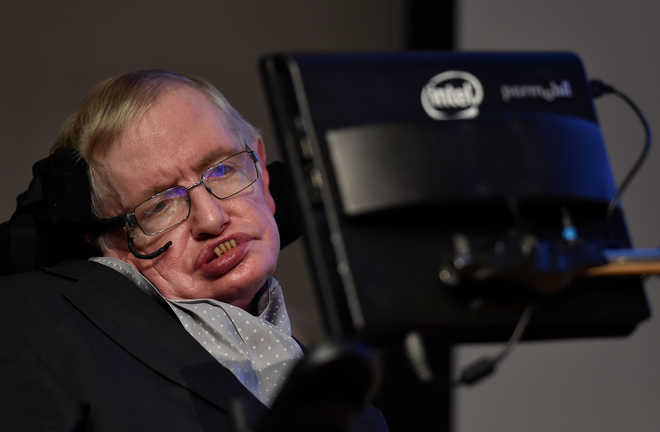
Perhaps by now, Stephen Hawking, who spent a lifetime studying physics and cosmology, has already unlocked the mysteries of the universe. That is, if we go by the theory of God’s existence and the common belief that we get to meet the Creator after death. Or, perhaps, he’s nothing now, after having lived for 76 years. That is, if we go by Stephen Hawking’s conviction that the brain is akin to a computer and you just cease to exist when its parts fail. There is no heaven or afterlife. So, how did the universe come into being? Professor Hawking believed: “Spontaneous creation is the reason there is something.” Both points of view are unsubstantiated. The curiosity to fathom the depth of the universe has been eternal: where do we come from?
It is this quest to know why the universe is as it is and why it exists that had led Hawking to trailblazing breakthroughs in the deep dark world of the cosmos. He earned a name for himself in the scientific community that often regarded him in the same league as Newton and Einstein. This distinction came from the British professor’s theoretical prediction that black holes are not so dense that things cannot escape their gravity, thus debunking the earlier theory on these objects. Scientists christened the thermal radiations theoretically emanating from the black holes as “Hawking radiation”. To explain the origins of the world, the physicist worked on uniting two theories: theory of relativity (the nature of space and time) and quantum theory (how the smallest particles in the universe behave). The common man connected with Hawking’s book, A Brief History of Time (1988), that delves into the ways of the space without jargon. It is an enduring bestseller.
Hawking became a star, with the brilliance of his mind that dazzled, more so because it incredibly overcame a debilitating progressing disease; one that left him wheelchair-bound and paralyzed for most of his life. A true tribute to the genius who pushed the limits of widely accepted truths about our universe as also the daunting diagnosis would be to follow his advocacy: use technology towards a more equitable world order. Meanwhile, the eternal question remains: Where do we come from?
More proof that propriety, protocol, punditry no longer hold sway in the U.S. administration
Even by his standards for unexpected diktats, U.S. President Donald Trump’s decision to fire his Secretary of State, Rex Tillerson, and replace him with CIA Director Mike Pompeo, came out of the blue. Mr. Tillerson, who was the CEO of ExxonMobil Corporation before taking up the role, did not agree with Mr. Trump on fundamental policy matters, the President said. This is widely seen as an allusion to Mr. Tillerson’s preference, contra-Trump, for diplomacy as a means of defusing the North Korean crisis. Also implied was a widening chasm between the two men on the merits of the Iran nuclear deal. With Mr. Tillerson’s departure, the number of senior officials exiting the Trump administration after a little more than a year has reached at least 24. Less than a week before the long-rumored “Rexit”, White House Chief Economic Adviser Gary Cohn, formerly a Wall Street banker, quit his post over his opposition to Mr. Trump’s proposal to levy hefty steel and aluminum tariffs. And, less than a week before Mr. Cohn, White House Communications Director Hope Hicks resigned after admitting to a Congressional panel investigating Russian influence on the 2016 election that she had occasionally told “white lies” on Mr. Trump’s behalf. Rumors now swirl that National Security Adviser H.R. McMaster may also soon be ousted. The question at this point is: does the existing coterie of senior White House officials enjoy the confidence of their President to a sufficient magnitude as to ensure that policies can be executed in a meaningful way?
In one sense, there does not appear to be cause for alarm over the incessant departures from the White House. It is quite possible that Mr. Trump has used his first year in office to consolidate his vision and attract the right talent to realize his governance paradigm, essentially rooted in a nationalistic, or “America First”, world view. Take the case of Mr. Pompeo: he is far more aligned with Mr. Trump’s hawkish approach towards the Kim Jong-un regime than Mr. Tillerson was. There is a case to be made that Mr. Trump’s hardline stance is what is ultimately bringing the North Koreans to the negotiating table. Mr. Tillerson, insistent on talks, was likely to have been an impediment to this strategy. The deeper message is that the liberal order of the Obama years is gone. Propriety, protocol and punditry no longer hold sway — Mr. Trump had no quarrel with Mr. Tillerson over the Secretary leaving numerous senior State Department posts vacant, but only cared about the top diplomat’s concurrence with his strategy. The President will likely apply this principle — and find himself the right people — in other policy areas as well, such as trade and immigration. Nations that engage with America may glean valuable lessons from this churn.
“The debate now veers around the reliability of the EVMs. Would they be the determinant of victory rather than public’s will? Two recent books and a Belfer Center, Harvard Kennedy School, report on the risks to democratic elections of cyber attacks and information operations raise some uncomfortable questions. How Democracies Die by Steven Levitsky and Daniel Ziblatt and People v. Democracy by Yascha Mounk debate the direction of democracy globally. The lessons apply to India under Modi”.
While Prime Minister Narendra Modi accompanied visiting French President Emmanuel Macron on the Ganges at Varanasi, at times hand-in-hand, for an iconic view of the Ghats, India hovered over multiple domestic inflexion points. While agreements were signed with France for strategic engagement, either by “reciprocal logistics” to enable mutual utilization of military facilities in the Indian Ocean or by advancing opaque defense purchases like the Rafale deal, or the kick-starting of the stalled giant nuclear project at Jataipur, promising untested EPR design reactors; farmers marched, many barefooted and hungry, towards the center of India’s financial capital Mumbai. Rural India, where still a majority of Indian voters reside, was signaling that India could not become a great power by lopsided growth and mere promises of achhe din.
The Modi government has, at best, just a year left or less, if early Lok Sabha elections are held, in tandem with the crucial state elections, due by December, in Rajasthan, Madhya Pradesh and Chhattisgarh, where the BJP faces anti-incumbency. But the Modi slogan of a corruption-free India is no longer paraded. The Nirav Modi and Mehul Choksi duo fleeing after swindling Punjab National Bank of over Rs 13,000 crore have dented the government’s reputation. A photo of Nirav amid top Indian businessman with PM Modi, and a video with prominent jewelers where the PM identifies “Mehul Bhai” by name while speaking, are seen as clues to their coziness with the regime.
The BJP’s poor performance in the recent bypolls in Rajasthan, Madhya Pradesh and even Uttar Pradesh fuel the debate that the re-election of Modi, taken as a given months ago, may no longer be certain. The debate now veers around the reliability of the EVMs. Would they be the determinant of victory rather than public’s will? Two recent books and a Belfer Center, Harvard Kennedy School, report on the risks to democratic elections of cyber attacks and information operations raise some uncomfortable questions. How Democracies Die by Steven Levitsky and Daniel Ziblatt and People v. Democracy by Yascha Mounk debate the direction of democracy globally. The lessons apply to India under Modi.
Levitsky-Ziblatt argue that in the 21st century democracies are endangered, not so much by military coups, like in the 20th century South Asia, or by younger hereditary rulers in the Gulf or by clerical rule (supreme leader in Iran), but the election of populist autocrats. The playbook is old, as Mussolini and Hitler also took the electoral route, albeit laced with threat of street violence, but the methodology is now subtler. The elected leader debases state institutions by weakening the judiciary, putting compliant appointees in control of the Election Commission, handing over investigative agencies to reliable and ruthless protégés for targeting businessmen and opposition figures, emasculates Parliament by negating its checks and balances. Intelligence agencies are co-opted or devalued, as Trump does regularly, and media bought or bludgeoned into submission.
The Mounk book explores flagging interest in democracy amongst youth and the millennials. While 71 per cent of those born in the 1930s in Europe and the US value living in a democracy, only 29 per cent of those born in the 1980s are so inclined. In fact, a quarter of the millennials think democracy is a bad way to run a nation. In polls in India, there is a tendency to favor authoritarian rulers, something that feeds Modi’s persona as a leader unmatched by his peers. Social media algorithms entrap users in vacuum chambers of similar prejudices and thus curtail debate. The leaders use the reach of Twitter and Facebook to perpetuate their skewed thoughts and browbeat opponents directly, or by their armies of bots. President Donald Trump routinely terms independent news outlets as “fake news”. A former Indian Army Chief, and now minister of state in the Modi government, coined the phrase “presstitutes”. As Rudyard Kipling wrote: “For the colonel’s lady and Judy O’Grady, Are sisters under their skins”. It seems so are the new breed of populist, rabble-rousing politicians across all continents.
The Belfer report is more worrisome as it reflects a debate in India that the Aam Aadmi Party initiated but was ignored — the possibility of integrity of EVMs being compromised — and thus the electoral process itself getting highjacked by the ruling party. In the US, the states have greater control over the electoral process, but two methods are used for vote casting. One, is optical scanners (OS), where voters cast a ballot by traditional pen and paper, or electronic ballot marking device, and then, the ballot is run through scanning machines. Thus, while an electronic tabulation is retained in the machine, so are the original paper ballots as physical record for subsequent audit or vote verification. Two, is direct recording electronic (DRE), as is done in India with option, as now proposed, of voter-verified paper audit trail (VVPAT). The problem is that the test audit of VVPATs by the Election Commission is of small samples and in a few constituencies.
The Belfer report concludes that “voting machines can be compromised via physical tampering (including using removable media) or through external connectivity (e.g. WiFi)”. It recommends that the OS method is safer than the DRE machines, including with VVPATs. This is a matter that needs debate in India, as a second time, after Indira Gandhi in the 1970s, a powerful Prime Minister is bending institutions to his own will. Therefore, the integrity of the electoral process needs to be not only safeguarded against the slightest doubt, but also done so publicly.
The next year is critical for Indian democracy, as indeed the idea of India as enshrined in the Constitution. While in 1975-77, when the Emergency was declared, the world was still mired in Cold War and democratic rule had not flowered globally. Now even the US and its Western allies are casting doubts on the efficacy of its functioning. President Xi Jinping having seized almost total power from the party and the military posits the Chinese model of economic success via authoritarian structures. Can India keep the flame of democracy and liberalism alive in Asia as a counterpoint? That is the drama that is about to unfold in coming year.
(The author is a former Secretary, Ministry of External Affairs)
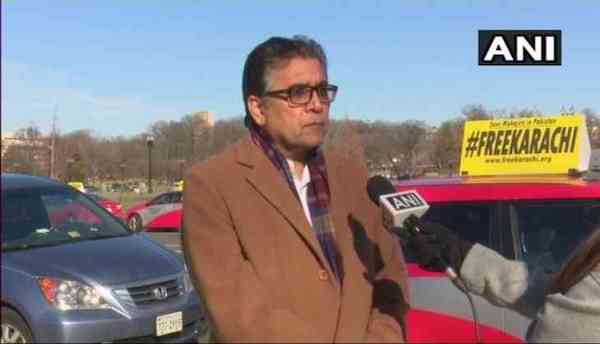
WASHINGTON DC (TIP): Mohajirs have welcomed India’s statement in United Nations human rights session on state atrocities committed by Pakistan in Sindh, Baluchistan and KPK.
This was said in a statement sent to The Indian Panorama on March by Nadeem Nusrat, Spokesperson of ‘ Free Karachi ‘ Campaign and former Convener of MQM.
Nadeem Nusrat said that the inclusion of the name of Sindh in India’s statement on human rights violations is an important and encouraging development for 70 million Mohajirs.
The people of Karachi and Urban Sindh are grateful to Indian government for raising voice on the plight of Mohajirs in Pakistan.
Nusrat further said that Sindh, especially Karachi and Urban centers of Sindh province had been neglected previously by world community while highlighting persecution of ethnic groups in Pakistan. More than 25,000 innocent Mohajirs have been brutally killed in Army and para military operations in Karachi since 1992. Enforced disappearances, abductions and extra judicial killings are on the rise in Pakistan’s port city of Karachi since the latest phase of operation in 2013.
Highlighting the issue of terrorism, Mr. Nusrat said that religious extremism, fanaticism and terrorism is being nourished by the state of Pakistan which has put peace and security of the region at stake. Pakistani soil has been used to plan and launch major terror attacks in the region. The providers and facilitators of terror sanctuaries in Pakistan must be hold accountable by United Nations and all peace-loving Nations.
He further added that ‘ Free Karachi ‘ Campaign has been drawing world’s attention towards the state atrocities of Pakistan on Mohajirs, Balochs, Pashtuns and other religious minorities.
Nusrat said that ‘ Free Karachi ‘ team is approaching international community, lawmakers, decision making bodies, human rights groups and is getting tremendous support from all quarters.
Nadeem Nusrat urged all the major regional powers of South Asia and international powers to put pressure on Pakistan to end crimes against humanity in Karachi and urban centers of Sindh along with Balochistan, KPK and FATA.
‘ Free Karachi ‘ Campaign was launched on January 15th on the eve of Martin Luther King Day to raise global awareness on human rights violations in Karachi and Urban Sindh.
Signup to our Newsletter!
Don’t miss out on all the happenings around the world