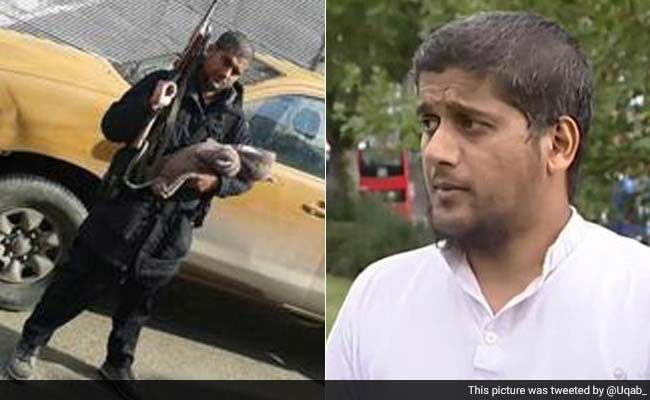
WASHINGTON (TIP): The US designated Indian-origin ISIS terrorist from Britain Siddhartha Dhar along with a Belgian-Moroccan citizen as global terrorists and imposed sanctions on them, the State Department said.
Siddhartha Dhar, a British Hindu who converted to Islam and now goes by the name Abu Rumaysah, had skipped police bail in the UK to travel to Syria with his wife and young children in 2014.
Siddhartha Dhar was dubbed as the “New Jihadi John” and became a senior commander of the dreaded outfit, the report had said.
The State Department has designated two ISIS members, Siddhartha Dhar and Abdelatif Gaini, as Specially Designated Global Terrorists under Section 1(b) of Executive Order which also imposes sanctions on foreign persons determined to have committed, or pose a significant risk of committing, acts of terrorism that threaten the security of US nationals or the national security, foreign policy, or economy of the US, a state department spokesperson said in a statement.
These designations seek to deny Siddhartha Dhar and Abdelatif Gaini the resources they need to plan and carry out further terrorist attacks, it said.
Among other consequences, all of Siddhartha Dhar’s and Abdelatif Gaini’s property and interests in property subject to US jurisdiction are blocked, and US persons are generally prohibited from engaging in any transactions with them, it said. Siddhartha Dhar was a leading member of now-defunct terrorist organization Al-Muhajiroun. In late 2014, Siddhartha Dhar left the United Kingdom to travel to Syria to join ISIS, it said.
He is considered to have replaced ISIS executioner Mohammad Emwazi, also known as “Jihadi John”, it said.
Siddhartha Dhar is believed to be the masked leader who appeared in a January 2016 ISIS video of the execution of several prisoners ISIS accused of spying for the UK, the statement said.
Abdelatif Gaini is a Belgian-Moroccan citizen believed to be fighting for ISIS in the Middle East. Abdelatif Gaini is connected to UK-based ISIS sympathizers Mohamad Ali Ahmed and Humza Ali, who were convicted in the UK in 2016 of terrorism offenses, it said.
Today’s action notifies the US public and the international community that Siddhartha Dhar and Abdelatif Gaini have committed or pose a significant risk of committing acts of terrorism, it said.
Terrorism designations expose and isolate organizations and individuals and deny them access to the US financial system. Moreover, designations can assist the law enforcement activities of US agencies and other governments, it said.
NEW YORK (TIP): Indian American jazz pianist Vijay Iyer will collaborate with writer and photographer Teju Cole for a spoken prose with a live score event, titled Blind Spot, on February 9 at the Institute of Contemporary Art in Boston.
The 45-year old Iyer, who was named as “one of his generation’s brightest jazz luminaries,” by the Time Out New York magazine, is a Grammy-nominated musician who has fans across the world.
Blind Spot is the title of Teju Cole’s book, which is a synthesis of words and images that delves deep into the intricacies of humanity’s blindness to tragedy and injustice throughout history.
His other books include Every Day is for the Thief (2007); a novel, Open City (2012); a collection of more than 40 essays, Known and Strange Things (2016); and a volume of photographs, Punto d’Ombra (2016).
The new collaboration of Cole’s photography and spoken prose with a live score composed by Iyer is expected to garner newer audiences.
Iyer’s live score will also feature Patricia Brennan on mallet percussion, Okkyung Lee on cello, and Stephan Crump on bass.
According to the ICA, the tickets for the event will be open for all, with fare ranging from $45 for ICA members and students, and $50 for non-members.
Iyer was born in Albany, New York, as the son of Indian parents who immigrated to the United States from the Indian state of Tamil Nadu. Since the age of 3, he received training in violin with focus on Western classical.
Iyer is a self-taught pianist, who had a fascination for pianos which helped him in playing the piano by ear.
LOS ANGELES, CA (TIP): A federal jury has convicted an Indian American man from Monrovia, California, for his role in an international money laundering organization that conspired to move millions of dollars in proceeds for narcotics traffickers that included the Sinaloa Cartel.
Harinder Singh, 32, who also goes by “Sonu,” was found guilty Jan. 19, of conspiracy to commit money laundering, conspiracy to operate an unlicensed money transmitting business, and operating an unlicensed money transmitting business, according to a Jan. 23 press release from the U.S. Attorney’s Office for the Central District of California.
Singh is scheduled to be sentenced by United States District Judge Christina A. Snyder on April 30. He faces a statutory maximum penalty of 20 years in federal prison for the conspiracy count, and five years for each of the other two charges.
Prosecutors say in this case, drug traffickers used a traditional hawala network of brokers spanning the United States, Canada and India to secretly transfer millions of dollars of drug proceeds to the United States, where brokers such as Singh delivered money to couriers acting on behalf of the Canadian drug traffickers and Mexican drug cartels.
The jury deliberated for less than two hours before finding Singh guilty of all three charges. With the verdicts against Singh, prosecutors have convicted 18 defendants who were named in a 2015 grand jury indictment that was the first major case in the United States involving “hawala” transfers of drug money.
The evidence presented during the two-week trial in United States District Court – which included Punjabi language wiretap calls, Punjabi-speaking witnesses and a money laundering expert – showed that Singh participated in a “hawala” conspiracy that was moving money generated from drug sales in Canada to the United States to pay for multi-kilogram drug shipments that were purchased in Los Angeles and then routed back to Canada for distribution, the press release says.
A hawala is an alternative form of money remittance which operates outside of traditional banking or financial systems, where the transfer of monetary value occurs between the brokers – who are typically located in different countries, but sometimes in different cities in one nation – based solely upon the trust that exists between the brokers.
The hawala system, which originated on the Indian subcontinent, does not rely on promissory instruments, the Justice Department noted; rather, it relies on trust and long-established connections between brokers that are typically based on familial, ethnic, religious, regional and/or cultural grounds. Through hawala transactions, only the value of the money is transferred, not the money itself.
Singh was stopped by the California Highway Patrol in October 2012, which led to the discovery of $274,980 in United States currency in rubber-banded stacks wrapped in black plastic. While the traffic stop was being conducted, special agents with the Drug Enforcement Administration were conducting surveillance and observed Singh’s wife exiting the couple’s apartment complex carrying a bag – which later revealed $388,100 in United States currency, again rubber-banded in stacks and similarly wrapped in black plastic.
Prior to the traffic stop and the seizure at Singh’s apartment complex, a federal wiretap intercepted Punjabi language calls indicating that Singh and co-conspirators communicated over multiple telephones to arrange for the pick-up, transport and delivery of large amounts of United States currency – in amounts of up to $800,000 – across the Los Angeles area.
During the course of a four-year investigation by the DEA’s LA Strike Force and IRS Criminal Investigation, authorities seized nearly $15.5 million in bulk United States currency, 321 kilograms of cocaine, 98 pounds of methamphetamine, 11 kilograms of MDMA (“ecstasy”) and nine kilograms of heroin.
Previously in this case, 17 defendants have pleaded guilty, and several have already been sentenced, receiving prison terms as high as 70 months. The indictment also charges four other defendants who are currently fugitives.
Singh is scheduled to be sentenced by United States District Judge Christina A. Snyder on April 30. At the time of sentencing, Singh will face a statutory maximum penalty of 20 years in federal prison for the conspiracy count, and five years for each of the other two charges.
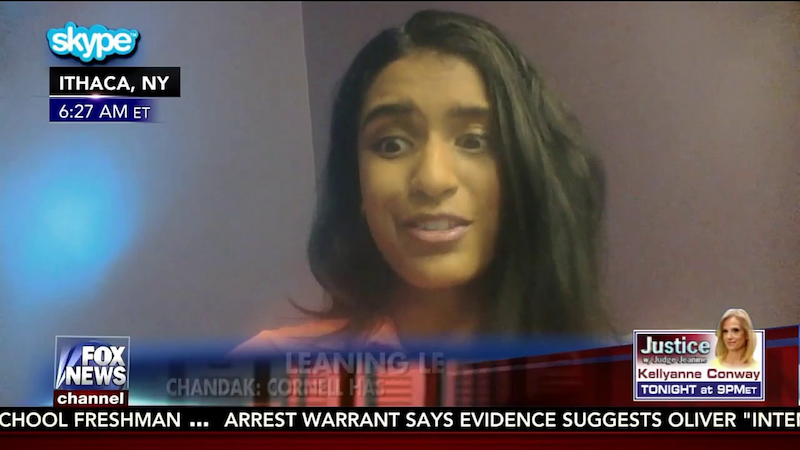
ITHACA, NY (TIP): A senior undergraduate student at Cornell University has been getting threats after sharing her conservative views on TV last year.
In an essay posted on The College Fix, Neetu Chandak said that her comments on “Fox and Friends” criticizing the description of a college course called “America Confronts the World” for its anti-Trump and pro-Obama rhetoric attracted threats on her life. She claimed that she was constantly harassed to the point that she feared leaving her apartment and finally sought therapy.
Chandak appeared on the Fox TV show in May 2017. She argued that the terms “xenophobic nationalism” and “pragmatic cosmopolitanism” in the course description, attached respectively to Trump and Obama, easily established negative and positive connotations and promoted what has been termed a “liberal bias”.
“If I were to walk into the classroom I don’t think I would feel comfortable expressing my views. I am somebody who likes to take a fair stance. I think it’s important that we are critical of the president, but we also recognize the good that he’s done. I don’t think that would be encouraged in this class.”
When you have a professor telling you what is right and what is incorrect rather than having the students decide for themselves, to research beyond the headline and analyze the situation, I think they just take whatever the professor tells them, and they are not able to see the indoctrination.”
While Chandak expected some disagreement from other Cornell students, she said that she was unprepared for the mental and emotional backlash.
She was particularly alarmed after receiving threats on Messenger, when someone expressed the intent to hurt her. The fact that the university’s College Republicans president was physically assaulted after Trump’s victory only worried her further.
Chandak explained in her essay that she did the interview not to take one of the two clashing sides, but only “to show the ridiculousness in comparing eight years of Obama’s presidency to the first 100 days of Trump’s term.”
In an earlier interview with The Cornell Daily Sun, Chandak said that she appeared on the show to shed light on the experiences of conservative and moderate students at the university, where “sometimes they feel like they can’t speak up in class with their points of views without getting shut down, without getting ostracized or without having the fear that their grade could be negatively affected.”
Chandak said that she is much better now. She argued that threats to safety must be reported, while hate speech must be dealt in “more respectful conversations.”
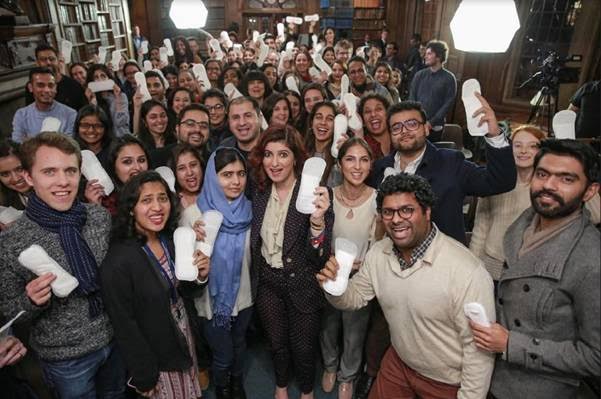
LONDON (TIP): Indian actor Twinkle Khanna met Malala Yousafzai at Oxford University while promoting her husband Akshay Kumar’s upcoming movie ‘Pad Man’. The two ladies posed with other students and faculty members of the prestigious university while holding sanitary pads.
During media interactions, the Pakistani women’s activist and Nobel Peace Prize winner praised the movie theme which revolves around menstrual awareness and women hygiene. Malala said that Pad Man has an inspiring message. She said, “I’m really excited to see the film Pad Man… because the message behind the film is truly inspiring.”
Twinkle also spoke to the Oxford students in her speech. She complained that Indian school girls in villages have to sit with a rag cloth or a rolled-up sock or even wadded up newspaper between their legs. “Pads are still seen as a luxury item. It is odd that pads are taxed at 12 percent in India but brooms are tax free,” she resented.
Pad Man is Twinkle’s maiden production. It stars Akshay Kumar, Sonam Kapoor and Radhika Apte. Pad Man will now release on February 9, 2018.
Official Site: https://www.facebook.com/PadManTheFilm/
SYNOPSIS:
Pad Man is a fictionalized account of Padmashri Arunachalam Muruganatham, the man who revolutionized the manufacture of the low cost sanitary napkin in India. Lakshmi is a newly married, humble welder from a rural village in the heart of India. Lakshmi’s incredible journey starts when he is shocked to discover that his wife uses an unhygienic cloth during her periods. Unable to afford a branded pad, he decides to make a sanitary pad himself. After several attempts, his irate wife refuses to be a part of his experiments. Lakshmi’s love and concern for his wife, his determination to make the pad, leads him into situations that cause so much shock and embarrassment that it compels his wife to leave him and his village to banish him.
Lakshmi doesn’t give up. His simplicity of thought, his resilience, his focus and his complete disregard for convention finally leads him to his destiny. A machine that can make a pad! The revolution that follows…from spreading menstrual hygiene, to empowering women, to starting mini cooperatives, to a vision of making India a 100% Pad using country, to accolades, to international glory and to a final resolution of his personal life, makes the rest of the feature “PAD MAN”. His journey to make India a 100% pad using country goes on…even today.
LONDON (TIP): A London-based Indian origin woman faces extradition to India for her involvement in the murder of a 12-year-old orphan from Gujarat.
Arti Dhir was arrested last year after an Interpol alert over the murder of the 12-year-old boy in February 2017.
The 52-year-old appeared before Westminster Magistrates’ Court in London today for a hearing on her bail application, which remains pending as her family members put together nearly 50,000 pounds as security.
“This should be sorted out in a week,” Chief Magistrate Emma Arbuthnot told Dhir, who remains in custody until the security is deposited with the court.
An investigation by the Gujarat police has claimed that Dhir and two other accused – Nitish Mund and Kanwaljit Raizada – had hatched a plot to adopt 12-year-old and then insure him for around Rs.1.3 crores before staging his kidnapping and murder in India to split the life insurance payout three ways.
Dhir, who worked at Heathrow Airport, allegedly met Mund and Raizada while they were students in London and had plotted the murder by hiring contract killers since 2015.
The 12-year-old and his brother-in-law, Harsukh Patel, were stabbed to death on a road outside Rajkot in February 2017.
Interpol issued a “red notice” for Dhir in April last year and she was arrested by Scotland Yard in June 2017.
Dhir’s extradition hearing is scheduled at Westminster Magistrates’ Court for April 30.
MARYLAND (TIP): The Montgomery County Education Association (MCEA) and national Trump resistance organization Run For Something have endorsed Indian American educator Samir Paul, who is running for the Maryland House of Delegates from District 16.
“In a chaotic political environment, we have to reaffirm our commitment to public schools as a place where we give every young person a shot. Samir is the perfect steward of that bold vision,” MCEA President Chris Lloyd said in a statement issued by the Paul campaign.
These are the first organizational endorsements of any challenger for the District 16 race, according to the campaign.
Run For Something, a leading Trump resistance group that launched in early 2017 to support young, progressive candidates for office, also extended their support to Paul.
“Young people aren’t the future; we’re the present. I’m proud to be part of a nationwide tidal wave of millennials claiming a seat at the table. I see this as an opportunity to show my students that they’re never too young to make a difference,” Paul said about Run For Something’s endorsement.
The district, which is in the affluent Bethesda area of the Montgomery County, are currently represented by Democrats C. William Frick, Ariana B. Kelly and Marc A. Korman.
Kelly and Korma are running again, while Frick is running for county executive.
In the most recent filing, Paul reported having $108,000 cash on hand—most by a challenger vying for the open seat.
“We’re off to a strong start, and we have the resources to run a robust campaign,” he said. “These fundraising numbers are validation that our efforts to knock on doors and talk to voters are making an impact. This community wants to protect and strengthen our schools, transportation, economy, and environment, and I’ll never stop fighting for that vision — no matter what’s happening down the Red Line in Washington.”
Paul’s parents came to the United States in the early 1980s.
“My family’s American story was made possible by great public schools, and I’m eager to join with teachers, parents, and the wider community to renew that promise for my students and for a whole new generation of young people,” he said. “I’m ready to roll up my sleeves and get to work. It’s a great honor to have the support of educators across the state,” he added.
Paul, who left a lucrative job in the private sector to teach computer science at Montgomery Blair High School in Silver Spring, his alma mater, was named Montgomery County’s “Rising Star Teacher of the Year” in 2016. Last year, the National Education Association recognized him as one of its “30 Under 30” educators.
Paul started the STEM Talent Pipeline program for young for giving science education to 40 young, low-income, and underrepresented minority 3rd-grade girls.
According to his campaign website, Paul was a teacher representative at the 2016 White House summit on expanding computer science education and led his students to the highest average AP Computer Science Exam scores in five years. He is also a leader in the Montgomery County Education Association, where he helps organize the county’s 13,000 teachers.
“I want to be a voice for public institutions that make stories like mine possible for families across Maryland,” he said on his website. I want to make it easier to raise a family, move around the region, start a business, and age with dignity and comfort. That’s why I’m running to represent District 16 in Maryland’s House of Delegates this June.”
Paul earned his bachelor’s in computer science from Harvard University. He also holds a Master’s degree in teaching from American University.
NEW JERSEY (TIP): A federal court in New Jersey on Friday, January 19, slapped a penalty of $5 million on Dr. Reddy’s Laboratories Inc. and forced the pharmaceutical company to enter consent decree of permanent injunction after it allegedly distributed prescription drugs in packages that are not child-resistant.
The judgment came after Dr. Reddy’s Laboratories Inc., the American subsidiary of Indian multinational pharmaceutical company based in Hyderabad, was found violating the US Poison Prevention Packaging Act (PPPA) and the Consumer Product Safety Act (CPSA).
Dr. Reddy’s, by entering the consent decree will now have to implement a compliance program designed to ensure compliance with the PPPA and the CPSA.
According to the prosecution, packs of Dr. Reddy’s oral drugs were found to be not child-resistant as required by the PPPA.
It alleged that the company had been distributing such prescription drugs till 2012, despite previous warnings explaining the consequences of the malpractices that were expected to fail the PPPA’s child test protocol.
The complaint said that the firm, despite knowing that they have fielded medicines that are not compliant with PPPA, failed to inform CPSC “immediately” as they are likely to cause risk of serious injury or death. The complaint said Dr. Reddy’s also failed to certify that its products were in conformance with the PPPA.
“Dr. Reddy’s failed to ensure that children were protected from potentially harmful prescription drugs,” said Acting Assistant Attorney General Chad A. Readler of the Justice Department’s Civil Division. “The government will continue to take seriously alleged violations of laws meant to protect consumer safety.”
“Child-resistant packaging is a critical safety measure put in place to protect our country’s children,” said CPSC Acting Chairman Ann Marie Buerkle. “I appreciate and value the support from and collaboration with the Department of Justice.”
The consent decree has asked Dr. Reddy’s to mandatorily implement a compliance program and call back all medicines that failed the compliance program.
The injunction further requires Dr. Reddy’s to maintain internal controls and procedures designed to ensure timely, truthful, complete, and accurate reporting to the CPSC as required by law.
Even though Dr. Reddy’s has agreed to settle the case, it has not admitted to doing any violations.
WASHINGTON (TIP): President Trump frequently mimics Indian Prime Minister Narendra Modi’s accent, according to a report.
The Washington Post reported on Sunday, January 21, citing senior administration officials that Trump “has been known to affect an Indian accent and imitate” the Indian leader.
Modi reportedly told the US president during their Oval Office meeting that “Never has a country given so much away for so little in return” as the United States in Afghanistan.
According to the report, Trump views Modi’s statement as “proof that the rest of the world viewed the United States as being duped and taken advantage of in Afghanistan.”
It is not clear from the report whether Trump’s mimicking was to drive home a point on the US involvement in Afghanistan or to ridicule Modi.
Indian American Rep. Raja Krishnamoorthi, D-IL, criticized Trump for mimicking Modi
“I was appalled to read that President Trump reportedly affected an Indian accent to imitate Indian Prime Minister Narendra Modi,” he said in a statement issued Monday, January 22. “In the wake of the President’s recent comments disparaging entire regions of the world while we still face such division at home, behavior that belittles our allies and ‘otherizes’ entire communities of Americans is one of the last things we need. Americans are not defined by their accents, but by their commitment to this nation’s values and ideals.”
The president is known for mimicking others often to make fun of others. During the 2016 campaign, he mocked a disabled reporter during a speech in South Carolina. The reporter, New York Times’ Serge Kovaleski, has a chronic condition that affects the movement of arms.
Later he denied that he was mocking the reporter’s appearance.
Earlier this month, Trump was widely criticized for allegedly calling Haiti, El Salvador and African nations “Shithole” countries during a White House meeting on immigration.
The author sees a growing number of overseas Indians is taking part in the electoral process in the countries of their adoption, which, he says is good for them. The Indian diaspora now total 31.2 million. D. Mulay, secretary, Department of Overseas Indians in the Ministry of External Affairs said they were impacting their societies and the economies.
The growing role of overseas Indians in governance in their adopted homelands raises an interesting question when it comes to the world’s most powerful nation: Can an ethnic Indian be elected the next, or future, president of the United States?
On his last day at the White House a year ago, president Barack Obama — although his strong endorsement failed to get Hillary Clinton elected as the first woman president — somewhat prophetically said his country could elect “not just a woman president, but could also see a Latino president, a Jewish president and a Hindu president in the future.”
In a broad sense, Indian American Nikki Haley fits in. Michael Wolff, the author of Fast & Fury: Inside the Trump White House, said she considered herself worthy of the post and that her colleagues thought she was “ambitious and smarter than Donald Trump”.
Trump had initially considered her as his secretary of state, but eventually sent her as ambassador to the United Nations.
That Haley, born Nimrata Randhawa, is seen to be in the reckoning within nine months of doing her job is significant. She answers to another of Obama’s approving descriptions, of “mixed-up presidents”. She remains a Sikh while being married to a white Christian American.
Not a dumb Trump follower, she was critical during the latter’s presidential campaign, receiving media hype for saying the phrase “bless your heart” in response to Trump’s Twitter attacks after she called for him to release his tax records.
Being called “ambitious” and “smarter than Trump” carries obvious risks. But, she insists that she has no ambitions. “Every position I’ve ever had, people have assumed that I am looking toward something bigger,” she declared on becoming envoy to the UN.
But, that was on April 4 last year. According to excerpts in The New York Times, Wolff said Haley “decided” by October last year that “Trump’s tenure would last, at best, a single term, and thought she could be his heir apparent”.
Trump has trashed the book and its writer. Speculation is that Trump could eliminate Nikki, as he has done with many of his team, if he thinks she could block his second term bid in 2020.
Unlike another Indian American politician Bobby Jindal, who briefly sought the Republican nomination in the 2016 presidential election, Nikki flaunts her Indian origin.
“I am the daughter of Indian parents who said to me ‘whatever you do, be great at it and make sure people remember you for it’”.
As a woman, she could have a formidable rival in Oprah Winfrey, who has captured Hollywood’s imagination after her Golden Globes address. Steven Spielberg, Tom Hanks, Meryl Streep — all want “president Oprah Winfrey in 2020”.
Another Indian American, Aruna Miller, last week filed nomination papers to run for the US Congress from a Congressional seat in Maryland. Two dozen Indian Americans are contesting elections across America and in Canada, there are four Indian ministers.
Across the Atlantic in Britain, Indian IT czar Narayana Murthy’s son-in-law, Rishi Suna, and Goa-born Suella Fernandes have joined the Theresa May government.
Her earlier team had Priti Patel. The British Parliament has many Indian-origin lawmakers like Keith Vaz.
They are among 285 Indian origin parliamentarians across the globe. Past heads of state have included New Zealand’s Anand Satyanand and Singapore’s C.V. Devan Nair. Prime ministers and ministers, who were elected in 19 countries, total more than 70. The recent entrants to the prime ministers’ club are Antonio Costa (Portugal) and Leo Varadkar (Ireland).
The Indian diaspora now total 31.2 million. D. Mulay, secretary, Department of Overseas Indians in the Ministry of External Affairs said they were impacting their societies and the economies.
India observed Jan 9 as the day for Indians overseas. The annual Pravasi Bharatiya Divas (PBD) has evolved into a biennial affair. It was held this month in Singapore. Prime Minister Narendra Modi hosted over 141 overseas Indian parliamentarians and mayors from 23 countries. Only sitting members of parliament and mayors — no ministers, heads of government/state or parliament speakers were invited. Delegations came from Guyana, Trinidad, Surinam, Curacao, Jamaica, US, Canada, the United Kingdom, Holland, New Zealand, Switzerland and Fiji.
As Modi spoke to them, Congress President Rahul Gandhi addressed the Global Organisation of People of Indian Origin in Bahrain the same week, reflecting domestic political interest overseas Indians generate.
Modi rhetorically said: “No matter where you are, I believe your ancestors will be very happy to see you all here. Your achievements (as legislators in your countries) are a point of pride for us. Even when you are nominated for political office anywhere, we are very happy. You affect geo-politics and the world and frame laws. Indians watching these developments are very happy to hear about your achievements.”
Unsurprisingly, overseas Indians are seeking voting rights in India. A day before the commencement of PBD, Delhi journalist S. Venkat Narayan filed a public interest litigation before India’s Supreme Court seeking quashing of amendments made in the Citizenship Act in 2004, which deny voting rights to overseas citizens of India (OCI).
Venkat Narayan said the denial of voting rights to persons
having OCI status violated fundamental rights as it was “discriminative to a class of citizens of India who are not only being denied equality before law and equal protection of laws, but also rights and freedoms relating to life, liberty and dignity of the individual”.
From getting elected abroad to seeking a voice in the Indian election, will the wheel take a full circle?
(The author, NST’s New Delhi correspondent, is the president of the Commonwealth Journalists Association 2016-2018 and a consultant with ‘Power Politics’ monthly magazine. He can be reached at mahendraved07@gmail.com)
Our fight to secure and complete the only subway elevator in the Richmond Hill/ Ozone Park community has been won, and it is now working! Thanks to all, including the Daily News, the West Indian, Caribbean Life, Queens Chronicle, Times Ledger, Kaieteur News, NY Guyana Chronicle, The Indian Panorama, Stabroek News, Guyana Times, and other media for publishing our petitions and public appeals to deliver and complete this important asset in our community-an absolute necessity for seniors, the physically challenged, babies, kids and pregnant mothers.
This $29 million project, commenced since 2014, was scheduled to be finished since the end of 2016, but excuses have abounded each time we enquired about the completion date. Anyway, better late than never! The MTA must be reminded that prompt and proper maintenance is a necessary component of public transportation and services.
We also wish to remind the Mayor to deliver on his promises to increase the amount of senior centers, deliver better schools, hospitals, city services and personnel, transparency in how benefits are awarded in our neighborhood, and to stop the over criminalization of New Yorkers-like stop making criminals of poor people who cannot afford the fare to travel to work on the trains-while transforming this city into a beacon that is in solidarity with the poor and working-class. He must also audit and scrutinize the many failing city agencies that routinely waste and abuse our tax dollars, while preserving New York as a “sanctuary city.”
(Albert Baldeo is a civil rights activist and community advocate, and his political battles placed previously ignored minority communities like Richmond Hill and Ozone Park firmly on the political and economic map. As the President of the Baldeo Foundation and Queens Justice Center, he has continued to fight for equal rights, dignity and inclusion in the decision-making process. He can be contacted at the Baldeo Foundation: AlBaldeo@aol.com or (718) 529-2300).
The author, who was India’s Permanent Representative to the United Nations in New York from April 2013 to December 2015, takes a close look at the issues before the United Nations, and lists the priorities for the World Body in 2018. The three priorities, according to him, are “Completion of process of reforming the UNSC”; “accelerated implementation of the socio-economic goals of Agenda 2030”; and “reforming the Human Rights Council to uphold fundamental human rights and freedoms”.
As the United Nations (UN) approaches its 75th anniversary in 2020, the world it represents has changed beyond recognition. From its original 51 founding members, the UN General Assembly (UNGA) today has 193-member countries. While the three “pillars” of the UN continue to be global governance in the political, socio-economic, and human rights areas, there is growing restiveness among the majority of the UNGA member states for reforming the UN to reflect ground realities.
The UNGA’s new assertiveness in influencing decisions on UN functioning was on display during the November 2017 vote in the UNGA on electing judges to the International Court of Justice (ICJ). The unscripted situation, in which India’s candidature enjoyed majority support among the countries in the UNGA, was offset by the power play in the UN Security Council (UNSC), orchestrated by the solidarity of its five permanent members, which prevailed on several other non-permanent members to consistently back the candidate of the United Kingdom. This deadlock was finally resolved through mature diplomacy, with the United Kingdom deciding to concede the election in view of the overwhelming preference of the UNGA. India remained the sole candidate for the fifth ICJ seat, which it duly won, being the only name left on the ballot. This outcome has been greeted in many countries as a harbinger of reforming the UNSC itself by the UNGA.
The issue of “UN reforms”, articulated by the UN Secretary General Antonio Guterres and endorsed by President Donald Trump of the United States at their joint meeting in New York in September 2016, has received prominence. However, these are reforms of the UN Secretariat, and reflect the interests of the main financial contributors to the UN budget. The intention is to get more “value” for money, with a parallel attempt to ensure that the interests of financial contributors are reflected in the key managerial positions of the Secretariat.
Member states of the UN represented in the UNGA, on the other hand, are acutely conscious that the UN faces a larger test of its credibility related to its decision-making process and the priorities it gives to its negotiated agendas. In these areas, the impetus for UN reform has to come from the UNGA, and not the UN Secretariat.
The linkage and inter-dependence between peace and development has been woven into the UN Charter since 1945. The perception that the world needs to “sustain” the peace arrived at after the end of the Second World War by “securing” the peace, created the two main organs of the UN under the UNGA. Realpolitik determined that one organ, the United Nations Security Council (UNSC), mandated by the UN Charter with the “primary responsibility” for maintaining international peace and security, operated on non-democratic principles. This was essentially due to the privilege given by Article 27.3 of the UN Charter to the five permanent members (China, France, Russia, the United Kingdom and the United States of America) to veto any decision of the UNSC without giving any reason or accountability. The other organ, the Economic and Social Council or ECOSOC, responsible for global socio-economic development, was imbued by the democratic principle of one-country one-vote, and adherence to the UNGA’s process of taking decisions by majority voting.
Due to this dichotomy, the focus of UN reform in the UNGA has been on the UNSC. The emergence of new challenges and threats to international peace and security in the 21st century has been accompanied by the mushrooming of crises across all the continents of the world. These include Europe (Ukraine and Cyprus), Asia (Syria, North Korea, Yemen, Iraq and Afghanistan), Africa (South Sudan, the Democratic Republic of Congo, Central African Republic, and Mali) and Latin America (Haiti and until recently Colombia). The UNSC has been singularly ineffective in resolving these crises, often looking to the UN peacekeeping operations it mandates to perform the role of preventive diplomacy.
The first priority of the UNGA in 2018, therefore, must be to complete the process of reforming the UNSC. The mandate for this reform was given to the UNGA by world leaders at the 2005 UN Summit thirteen years ago. The Summit had declared that “early reform” of the UNSC was needed to “enhance its effectiveness and the legitimacy and implementation of its decisions.”
How can the UNGA implement this objective in 2018? The UNGA has made incremental progress in implementing its mandate for UNSC reform. It has already agreed on five key areas for UNSC reforms, as well as on inter-governmental negotiations to conclude these reforms. In September 2015, the UNGA unanimously agreed to consider a text submitted by 122 countries (including permanent members France and the UK) containing proposals on each of the five areas, which would be integrated into a UNGA resolution.
Before 14 September 2018, when the 72nd Session of the UNGA ends, a minimum of 129 members of the UNGA must table and adopt a resolution amending the UN Charter to reform the UNSC. This will set the timetable for implementing the reforms holding elections to the new seats of the UNSC in 2019, enabling a reformed UNSC to begin operating by 2020, when the UN marks its 75th anniversary.
The opposition to any such attempt will continue to come from the five permanent members of the UNSC. However, in the UNGA these five countries do not have the veto. A two-thirds majority is needed to adopt such a UNGA resolution. This will set the stage for applying the moral power of the UNGA, based on its broad-based interest in reforming the UNSC, to prevail over the status-quo position of the five permanent members. In this context, introducing a multi-stakeholder campaign, including global thought and business leaders, in favor of a UNGA resolution on reforming the UNSC would accelerate the acceptance of such a resolution by the permanent members. Such an approach paid dividends in the UNGA’s success in September 2015 on agreeing on the ambitious UN socio-economic development objectives contained in Agenda 2030 on Sustainable Development. A multi-stakeholder approach is also built into the UN’s implementation of the Tunis Agenda for a digital global society.
A second major priority for UNGA member states in 2018 will be to accelerate implementation of the socio-economic goals of Agenda 2030. The overarching goal of this Agenda is the eradication of poverty by 2030. While individual members of the UNGA have agreed to focus on their national socio-economic programs to achieve the targets of the 17 Sustainable Development Goals at the core of Agenda 2030, the time has come for the UNGA to focus attention on two critical “means of implementation” which have been agreed to by all countries to catalyze this process.
These two areas are financing for development and the application of technologies for development. The way forward has been identified by the Addis Ababa Financing for Development Conference of July 2015, and the UNGA High-Level Review of the Tunis Agenda for a World Information Society in December 2015. At its High-Level Political Forum meeting in July 2018, the ECOSOC and the UNGA will have an opportunity to convene a dedicated forum to assess how global commitments on these two areas are being implemented on the ground in individual member states of the UNGA. This effort must be driven by member states, to ensure that the UN is responsive to their aspirations on the ground.
A third priority for the UNGA in 2018 is in the area of human rights. Already, calls have been made by the United States for reforming the HRC. These calls should be addressed within the UNGA framework. The UNGA has demonstrated its ability to address concerns expressed by some countries at the profile of countries represented in the HRC. For example, in 2015, Pakistan was unable to get re-elected to the HRC, as was Russia in 2016.
Reforming the HRC needs to go beyond the representation of countries, and address the ability of the HRC to uphold fundamental human rights and freedoms, as set out in the UN Charter. The UNGA in 2018 must address the actual work being done in the HRC, especially in its Universal Peer Review or UPR process. This process is critical to ensure adherence to the UN Charter’s human rights standards. The fact that the HRC devotes only three hours to the UPR of each of the 193 members of the UNGA is one such issue, since this limited time applied uniformly to all countries being reviewed does not allow either the country being reviewed or the countries reviewing the scope for a focused interactive discussion. Making such reforms in the HRC will enable it to become the main body under the UNGA for human rights issues. This, in turn, will mean that any concern on human rights issues by UN member states should be raised in the HRC, and not in the UNSC, which has been the practice for more than two decades now, resulting in “perilous interventions” in the words of a distinguished Indian envoy to the UN.
While these three priorities should engage the UN in 2018, the fact that the world is impacted by violent conflict and degrading poverty will ensure that “securing” the peace will have to precede “sustaining” the peace. The experience of multilateral diplomacy over the past seven decades has shown that to sustain peace, the focus has to be on resolving disputes peacefully, as set out in Chapter Six of the UN Charter. Any optimism about the success of the UN to become “fit for purpose” must be based on the convergence of the efforts of the UN Secretary General and the UNGA for preventive diplomacy, giving primacy to the diplomacy of peace over the diplomacy of war.
(Asoke Mukerji is a former Ambassador and Permanent Representative of India to the United Nations in New York. He can be reached at 1955pram@gmail.com)
BENGALURU (TIP): HungerBox, the Growth Story-promoted B2B food-tech company t announced, January 22, the closing of USD $2.5 million in pre-series A funding led by Lionrock Capital and Kris Gopalakrishnan, Co-Founder, Infosys.
Started in 2016, HungerBox is a full stack, food-tech company that is focused on the B2B space and operates 100+ digital cafeterias for more than 75 corporate clients including Qualcomm, Microsoft, FirstSource, Accenture, CapGemini, Genpact, ABB, Amazon and McKinsey, across Bangalore, Chennai, Hyderabad, Mumbai, Pune, Delhi/NCR and Jaipur.
“HungerBox’s business has scaled tremendously over the last 15 months with nearly 7 million orders placed on our platform till date. We are clocking more than 120,000 daily orders and expect to scale this to half a million orders per day by end-2018,” said Sandipan Mitra, CEO & Co-Founder, HungerBox. “The funding we have received from marquee investors will boost our ability to scale our operations to keep pace with the traction we are seeing for our digital cafeteria management solution.”
Kris Gopalakrishnan, Co-Founder, Infosys commented, “There is tremendous potential for innovation in the B2B food-tech arena as corporate spends on F&B are already massive and growing year-on-year. HungerBox addresses this large space with an easily scalable model and an end-to-end solution that provides a win-win to employees as well as to corporate clients”.
“The B2B food space has plenty of headroom for growth and innovation for years to come. The winners in the sector will be those with a powerful, tech-led offering and the ability to scale in-step with their clients. HungerBox certainly has all the credentials to be a leader in this space,” said Hari Kumar, Founder & CEO, Lionrock Capital.
Spending on F&B in the B2B space alone is estimated to reach US $ 14 billion in India in 2018. The space is growing at ~ 15% per annum.
HungerBox’s seamless, tech-led solution enables end-to-end digital cafeteria management with the company’s proprietary technology platform connecting food vendors to employees within client organizations through a customized mobile app available to each employee.
Using the app, employees can view the F&B menu provided by all enlisted food vendors at their workplace café’s, place orders and track delivery accurately. They can also provide ratings / feedback. HungerBox’s solution provides admin teams at the client organization with the ability to track the entire F&B operation including food consumption, orders, feedback etc., in real-time. More than 50 different payment methods are integrated into the service offering including in-app purchases by an employee, payment via smart cards, m-wallets, self-serve kiosks at the café’s etc.
HungerBox uses latest technology advancements like IoT in its solution to seamlessly connect the vendor side hardware (designed by HungerBox) and employees of corporate. The HungerBox solution also provides features like ‘Personalized Recommendations’ to employees through its AI-driven technology, ‘Health Mode’ for health conscious employees, ability to undertake group-ordering and orders from restaurants in the vicinity when corporate cafés are closed etc.
HungerBox employs 200 staff across India and was started by Sandipan Mitra and Uttam Kumar, who are both veterans of the food tech space in India whose previous stints included global food takeaway ordering service Just Eat’s India operations. HungerBox is promoted by GrowthStory, the venture-builder platform founded by serial entrepreneurs, K Ganesh and Meena Ganesh.
OTTAWA (TIP): A Sikh man was asked to remove his turban in a club in Canada by a woman, who also threatened to “rip” off the headgear and heckled him with racist remarks, according to a media report.
Jaswinder Singh Dhaliwal was playing pool with friends at the Royal Canadian Legion, a Canadian ex-service organization that includes people who have served in military, when the management approached the group and asked him to remove his patka as it was its policy to remove any headgear out of respect for the veterans, CBC News reported.
However, religious garments are exempted from the legion’s policy banning head coverings. The incident took place on January 17th at Tignish town in Canada’s Prince Edward Island.
A video of the incident shows a woman threatening to “rip” off the head covering in response to being filmed and a patron at the bar making an obscene gesture while saying the garment must be removed because “it is the law”.
Legion president Stephen Gallant later said that he plans to apologize to those involved as religious garments are exempted from their policy, the report said.
Mr Gallant said there was some confusion over whether the headdress was a religious garment, and the membership has met to clarify the branch’s policy regarding head coverings.
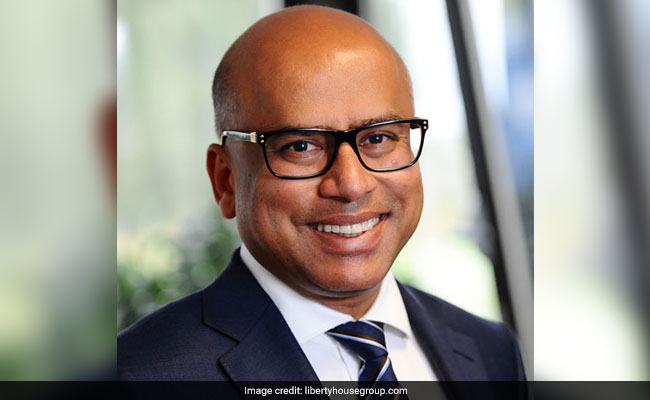
LONDON (TIP): UK-based Indian origin steel tycoon Sanjeev Gupta’s Liberty House Group is set to make an “unconditional and comprehensive offer” for the assets of two flagship French steel businesses.
The offer, to be made in court next week, is aimed at securing the jobs of close to 1,600 employees at six operations across France, as well as many supplier jobs.
Liberty plans to invest more than USD 366 millions over five years to stabilize and grow the business, including capital investment of USD 122 million to upgrade the sites and expand output.
“The market synergies between Asco Industries and our existing specialty steels business are compelling and we know that, by working together and complementing each other in the market, both businesses will grow and prosper,” Mr Gupta said.
He said the move will lead to Liberty, part of a wider GFG Alliance, implementing its GreenSteel and GreenAluminium strategies in France.
“The pro-business policies of the [French President] Macron government make France an exciting and attractive place for industrial investors such as us and we want to be part of the energetic new environment that is emerging,” he noted.
Under the proposal confirmed on the January 19th, Liberty has committed to protect the jobs of over 1,500 permanent employees and around 60 apprentices and pursue a wide-ranging development plan which complements its existing specialty steels business.
The company will apply its GreenSteel sustainable production strategy to the French operations utilizing recycled metal in the manufacture of technically advanced and engineering products.
“We firmly believe that, working together with the Ascometal and Ascoval teams, we can realize our strategy in France and build a globally-recognized manufacturer of specialty steels,” said Chief Executive of Liberty Steel UK Jon Bolton.
Liberty’s latest announcement follows a recent statement that the company has made a binding offer to acquire the 570-worker Aluminium Dunkerque – Europe’s largest aluminium smelter – from Rio Tinto as part of a 2-billion-euro investment that will create thousands of new jobs at the site and in the wider economy.
In common with the Asco strategy, Liberty’s plans for Aluminium Dunkerque are linked in part to projected growth in the international automotive market.
Liberty Specialty Steels’ offer to acquire the Asco Industries and Ascoval businesses will be formally presented to the court on January 24, with a decision expected soon afterwards.
Liberty Speciality Steels, part of the Liberty House Group, is a member of the GFG Alliance, a London-headquartered international group of businesses founded and owned by the Gupta family, with a revenue of over 10 billion dollars and 12,000 staff.
LONDON (TIP): Nus Ghani, an Indian origin parliamentarian in the UK, today became the first female Muslim minister to speak from the British Parliament dispatch box.
Ms Ghani, born in Birmingham to parents who migrated from Pakistan-occupied Kashmir, was cheered by her colleagues as she addressed the House of Commons as a junior minister in the Department for Transport.
“Made my debut as @transportgovuk Minister and made a bit of history as the first female Muslim Minister to speak from the House of Commons dispatch box,” she tweeted soon after her first Commons outing in her new role.
Dispatch box is the designated place where ministers stand and speak from in the Commons.
The 45-year-old was appointed Parliamentary Under-Secretary at the Department for Transport by British Prime Minister Theresa May as part of her New Year reshuffle last week.
The Conservative Party MP from Wealden was also given the assistant government whip in the reshuffle to oversee party discipline.
“The roles are both exciting and challenging opportunities… Transport is a subject on which I have campaigned passionately since being elected as the MP for Wealden. Alongside my ministerial duties, I will continue to be a strong voice for Wealden and deliver for my constituents,” Ghani had said in a statement.
The minister in charge of her department, transport secretary Chris Grayling, said Ms Ghani’s promotion proved the Tories “were a party of opportunity”.
“We’re the party to provide…the first Muslim woman minister to speak from the government dispatch box – the member for Wealden. I congratulate her – I’m very proud to sit alongside her,” he said.
Ms Ghani worked for charities such as Age UK and Breakthrough Breast Cancer as well as the BBC World Service before first standing as a Conservative Party candidate in Birmingham in the 2010 general election.
In 2015, she became the first Conservative party Muslim female candidate to be elected to Parliament.
After the June 2017 snap election, she made history after she repeated her oath of allegiance to Queen Elizabeth II in Urdu when she was sworn into Parliament.
“My motivation is simple. My parents are incredibly proud that I have been elected to serve as MP and I wanted to honor my mother by speaking in a language she understands and my mother tongue,” she had said at the time.
Soon after, she was appointed Parliamentary Private Secretary to the UK Home Office.
Her rapid rise in Theresa May’s government is seen as part of the British Prime Minister’s declared aim of moving away from an all-white middle-aged male Cabinet.
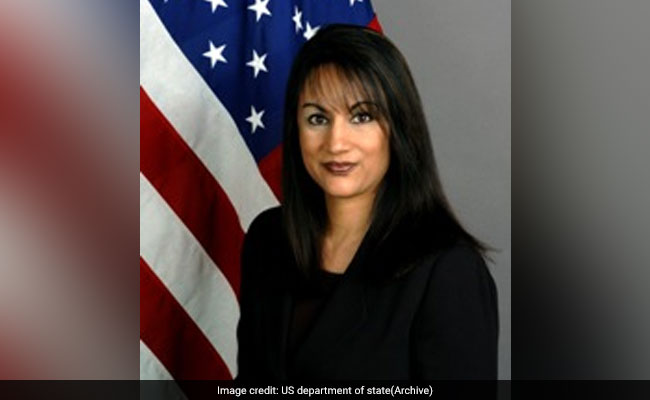
WASHINGTON (TIP): Noted Indian American lawyer Manisha Singh was sworn in to a key administration position in the State Department on January 20th, becoming the in-charge of the US economic diplomacy.
Ms. Singh, 45, born in Uttar Pradesh, is the first woman appointed as the Assistant Secretary of State for Economic and Business Affairs.
She was sworn in by Secretary of State Rex Tillerson.
She is currently the highest-ranking Indian American official in the State Department.
“My honor and privilege to be sworn in by Secretary Tillerson,” Ms Singh said in a tweet
“We will promote American growth and secure our future!” she said.
Confirmed by the US Senate on November 2, Ms Singh formally joined her duties at the State Department on November 28.
“She comes to the department with a wealth of experience that will benefit our economic and business efforts abroad,” said State Department Spokesperson Heather Nauert.
She previously served as chief counsel and senior advisor to US Senator from Alaska Dan Sullivan. He was himself a former assistant secretary in the Bureau of Economic, Energy and Business Affairs.
Ms Singh, who is fluent in Hindi, also previously served as the deputy assistant secretary in the Bureau of Economic, Energy and Business Affairs.
“We’re pleased to have her back again at the State Department as she will now lead our efforts to promote prosperity for Americans at home and abroad,” Ms Nauert said.
Ms Singh’s private sector experience includes practicing law at multinational law firms and working in-house at an investment bank.
She earned an LL.M degree in International Legal Studies from the American University Washington College of Law, a JD. from the University of Florida College of Law and a BA from the University of Miami at the age of 19.
Ms Singh, who also studied at the University of Leiden Law School in the Netherlands, is licensed to practice law in Florida, Pennsylvania and the District of Columbia.
Hollywood star Penelope Cruz says she felt a “responsibility” playing Italian fashion designer Donatella Versace in the series ‘The Assassination of Gianni Versace’ .
The Academy Awards winner’s comment comes just days after the designer expressed her distaste for the new Ryan Murphy series in an interview with Italian press last week, reports dailymail.co.uk.
During an appearance on a TV show, Cruz said: “You feel much more responsibility (playing a real person).
When Ryan called me… I said ‘I need to make (a) phone call and talk to Donatella about this before taking the job’.”
Cruz, 43, only felt comfortable with the role after speaking to Donatella herself.
“She told me if somebody was going to do it, she was really happy that it was me, because she I think she knows what I feel for her and Gianni.
“They’re the most kind people. It’s important to me that when she sees what I’ve done she can feel the love and respect that I have put there (and) how I feel for her.”
Cruz explained how Donatella returned the love by sending her a bouquet of flowers ahead of the Golden Globe Awards ceremony.
Actress Natalie Portman is reportedly in negotiations to replace Reese Witherspoon as the lead in ‘Pale Blue Dot’, about a successful female astronaut.
Reportedly, the makers will now look to find Portman’s male co-star.
Witherspoon had left the role in last November due to scheduling conflicts with season 2 of ‘Big Little Lies’. However, she will continue to produce the project with Bruna Papandrea.
It will be directed by ‘Fargo’ and ‘Legion’ creator Noah Hawley.
‘Pale Blue Dot’ follows a successful female astronaut who, after coming back home from a mission in space, starts to unravel when confronted by her seemingly perfect American dream life. The film explores the theory that astronauts who spend long periods of time in space begin to lose their sense of reality when they return home.
Anushka Sharma’s first film, post her marriage to Indian cricketer Virat Kohli, “Pari” will release on Holi, March 2.
The film, which is Anushka’s third production under her banner Clean Slate Films, is directed by debutante Prosit Roy.
It also features Parambrata Chatterjee, Rajat Kapoor and Ritabhari Chakraborty. The makers also released a motion poster of the film while not revealing much about the plot.
Anushka has previously produced “NH 10″ and “Phillauri”. Both the films featured her in the lead role. “Pari” also has KriArj Entertainment as one of the producers.
In the first look released on June 13 last year, the actor, who played a friendly ghost in “Phillauri”, gave some serious haunting vibes.
Pari is Anushka’s third film as producer (Clean Slate Films) after 2015’s critically acclaimed NH10 and this year’s Phillauri, which wasn’t as successful as NH10. Of the sort of films she wants to produce, Anushka told news agency IANS: “At Clean Slate, our endeavour is to tell stories that are not only meaningful and different, but also push the boundaries.”
Anushka Sharma’s next film, Jab Harry Met Sejal, releases on August 4. The film also stars Shah Rukh Khan and is directed by Imtiaz Ali. In fact, Anushka joined Jab Harry Met Sejal’s promotional exercise a little late as she was busy working on Pari.
Anushka has also signed up for Aanand L Rai’s next, which again features Shah Rukh and actress Katina Kaif. In the film, SRK plays the role of a dwarf.
Apart from this, Anushka also has a small role in Rajkumar Hirani’s Sanjay Dutt biopic, starring Ranbir Kapoor – her Ae Dil Hai Mushkil and Bombay Velvet co-star.
Deepika Padukone was spotted shooting for an advertisement in Mumbai, in which she was dressed as a cop – a welcome departure from her ethnic outfits and heavy jewellery during outings and promotions.
We loved that too but a change is always good. And look at how superb Deepika looks in fitted khaki trousers and crisp white shirt with her hair tied in an elegant back bun.
Also just saying, her rumoured boyfriend Ranveer Singh’s cop look in upcoming film Simmba has got nothing on Deepika’s swag.
What say? Fan clubs posted pictures of Deepika Padukone dressed as cop relaxing on the bonnet of a jeep.
Deepika Padukone is currently awaiting the release of Padmaavat, which is directed by Sanjay Leela Bhansali. The film’s original release date was December 1 last year, but due to the Central Board Of Film Certification’s delay, the film will now release on January 25.
Padmaavat, which was originally titled Padmavati, was cleared for release with a U/A certificate and five alterations including the title.
Padmaavat faced massive opposition (and continues to face) from Rajput Karni Sena and other fringe outfits which opposed the film’s release over alleged factual inaccuracies.
Several states have also banned the film’s release.
NEW DELHI (TIP): The Goods and Services Tax (GST) Council has reduced the rates on 29 goods and 53 categories of services, Finance Minister Arun Jaitley said following the Council’s meeting on Jan 18.
Against the backdrop of declining GST collections and waning compliance, the Council also discussed in detail various approaches to ease the return filing compliance burden, and the need for the implementation of anti-evasion measures.
Some of the services for which the rates have been cut include tailoring (18% to 5%), admission to theme parks (28% to 18%), and petroleum and natural gas mining and exploration (18% to 12%). The goods on which the rates have been reduced include biodiesel buses used for public transport (28% to 18%), sugar boiled confectionery, biodiesel, drinking water packed in 20 litre containers (all from 18% to 12%), and LPG supplied to domestic consumers by private distributors (18% to 5%). The new rates would come into effect on January 25.
“Rates have again been rationalised on few items, which is a step in the right direction,” Pratik Jain, Leader, Indirect Tax at PwC India, wrote in a note. More cuts to come “One would expect that over the next few months, this process would continue, particularly with respect to 28% category, which should only be for select luxury and demerit products,” he wrote.
Jaitley said that while the latest round of rate reductions would have an affect on the Centre’s revenues, the impact would be small.
CHANDIGARH (TIP): Punjab Chief Minister Amarinder Singh has accepted the resignation of power and irrigation minister Rana Gurjit Singh on Jan 18 following a meeting with AICC president Rahul Gandhi.
Rana Gurjit had submitted his resignation to Amarinder a few days ago. But the CM had not accepted it. He had left it to Rahul to take a call. The decision to accept the resignation was taken after a thorough discussion on the issue during a meeting of CM and Rahul Gandhi in Delhi today morning.
While sources said Amarinder was still backing his loyalist, Rahul and other leaders in the meeting are learnt to have prevailed upon the CM. PPCC President Sunil Jakhar, General Secretary Incharge Asha Kumari and AICC Secretary Harish Choudhary were also a part of the meeting.
Rana Gurjit was caught up in a controversy related to sand mine auction in May. His two ex employees had bagged sand mines in the first ever auction done by the Congress-led government. Then CM had then ordered a probe Justice JS Narang (retd) into the case. The commission had however given Rana a clean chit.
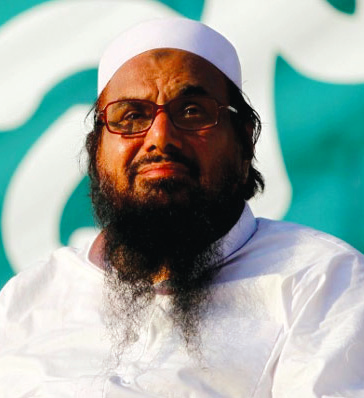
WASHINGTON (TIP): The United States has called for Hafiz Saeed’s prosecution “to the fullest extent of the law,” following Pakistan’s Prime Minister Shahid Khaqan Abbasi’s remark that no action could be taken against the United Nations-designated terrorist.
Abbasi, during an interview to Geo TV on Tuesday, referred to Saeed as ‘sahib’ or ‘sir’ “There is no case against Hafiz Saeed sahib in Pakistan. Only when there is a case, can there be action,” he said when asked why there was no action against Saeed.
US fumes at non-action Reacting strongly to the comments, State Department spokesperson Heather Nauert said the US believed that Saeed should be prosecuted and they have told Pakistan as much.
“We believe that he should be prosecuted to the fullest extent of the law. He is listed by the UNSC 1267, the Al- Qaeda Sanctions Committee for targeted sanctions due to his affiliation with Lashkar-e-Taiba, which is a designated foreign terror organisation,”Ms. Nauert told reporters at her daily news conference on Thursday.
“We have made our points and concerns to the Pakistani government very clear. We believe that this individual should be prosecuted,” she said.
Responding to a question, Nauert said the US has “certainly seen” the reports about Abbasi’s comment on Saeed. “We regard him as a terrorist, a part of a foreign terrorist organisation. He was the mastermind, we believe, of the 2008 Mumbai attacks which killed many people, including Americans as well,” she said. Saeed, the chief of the Jamaatud- Dawah (JuD), was released from house arrest in Pakistan in November.
The US has labelled JuD the “terrorist front” for the Lashkar-e-Taiba (LeT), a group Saeed founded in 1987. LeT was responsible for carrying the 2008 Mumbai attack that killed 166 people.
Pak need to do more Acknowledging that the US has had some challenging times with the government of Pakistan recently, Ms. Nauert has said the Trump Administration expects Pakistan to do a lot more to address terrorism issues. “That’s something that we’ve been very clear about all along. You know the news that we had that came out a couple weeks ago about our decision to withhold some of the security funding for Pakistan,” she said.
Nauert said the entire administration was on the same page on the issue of USPakistan relationship.
Early this month, the US suspended about $2 billion worth of security assistance to Pakistan accusing it of not doing enough in the fight against terrorism.
In retaliation, Pakistan suspended military and intelligence co-operation with the US.
The State Department on Thursday said it has not received any formal information in this regard from Pakistan.
Source: PTI
Signup to our Newsletter!
Don’t miss out on all the happenings around the world