Month: August 2019

  • August 30 New York & Dallas Print Editions

    August 30 New York & Dallas Print Editions

    [vc_row][vc_column][vc_column_text]

    Print Replica- Digitally

    E-Editions

    [/vc_column_text][/vc_column][/vc_row][vc_row][vc_column width=”1/3″][vc_custom_heading text=”New York Edition” font_container=”tag:h2|text_align:center” google_fonts=”font_family:Istok%20Web%3Aregular%2Citalic%2C700%2C700italic|font_style:700%20bold%20regular%3A700%3Anormal” link=”url:https%3A%2F%2Fwww.theindianpanorama.news%2Fwp-content%2Fuploads%2F2019%2F08%2FTIP-August-30-NYC.pdf|||”][vc_single_image image=”97312″ img_size=”full” add_caption=”yes” alignment=”center” onclick=”custom_link” link=”https://www.theindianpanorama.news/wp-content/uploads/2019/08/TIP-August-30-NYC.pdf”][/vc_column][vc_column width=”1/3″][vc_custom_heading text=”Dallas, Texas Edition” font_container=”tag:h2|text_align:center” google_fonts=”font_family:Istok%20Web%3Aregular%2Citalic%2C700%2C700italic|font_style:700%20bold%20regular%3A700%3Anormal” link=”url:https%3A%2F%2Fwww.theindianpanorama.news%2Fwp-content%2Fuploads%2F2019%2F08%2FTIP-August-30-Dallas-TX.pdf|||”][vc_single_image image=”97313″ img_size=”full” add_caption=”yes” alignment=”center” onclick=”custom_link” link=”https://www.theindianpanorama.news/wp-content/uploads/2019/08/TIP-August-30-Dallas-TX.pdf”][/vc_column][vc_column width=”1/3″][vc_single_image image=”82828″ img_size=”medium” alignment=”center” onclick=”custom_link” link=”https://www.theindianpanorama.news/advertising-media-kit-portal-indian-panorama/”][vc_single_image image=”82829″ img_size=”medium” alignment=”center” onclick=”custom_link” link=”https://www.theindianpanorama.news/advertising-media-kit-portal-indian-panorama/”][/vc_column][/vc_row][vc_row][vc_column width=”2/3″][vc_custom_heading text=”Lead Stories This Week” font_container=”tag:h2|text_align:center” google_fonts=”font_family:Istok%20Web%3Aregular%2Citalic%2C700%2C700italic|font_style:700%20bold%20regular%3A700%3Anormal” link=”url:https%3A%2F%2Fwww.theindianpanorama.news%2F|||”][/vc_column][vc_column width=”1/3″][vc_widget_sidebar sidebar_id=”mh-sidebar”][/vc_column][/vc_row]

  • Peru, India of South America

    Peru, India of South America

    “If one compares it with other fast emerging economies, Peru looks more closer  to India than any other  nation of Latin America. Peru is Latin America not only because of its geographical location or its Spanish heritage but also the role it has been playing as a helping brother of neighboring nations.”


    By Prabhjot Singh

    Holding of Pan Am Games has brought Peru to limelight. It is not only Its fiscal health is better than most of the South American countries, it has the ability and nearly stable political system to sustain such global challenges where it can successfully showcase its potential. It has become the third South American nation after Brazil and Argentina to hold a major sporting event in the past three years.

    Peru is amazing. Blessed with abundance of natural resources, including precious metals and natural gas, it has long sprawling fields of fertile lands. Its rich and nourishing basket of fruits, food grains, chocolate and coffee satiates healthy nourishment requirements of not only rest of Americas but also the global market. Unlike neighboring South American nations reeling under rapidly deteriorating fiscal health – Argentina being the latest – Peru is a sound economic power. It is perhaps one of few South American nations that has maintained the strength of its currency.

    Peru may not be a part of BRICS – Brazil, Russia, India, China and South Africa – yet its fiscal credentials give it a respectable position in the group of emerging economic powers.

    Athletics Stadium

    If one compares it with other fast emerging economies, Peru looks more closer  to India than any other  nation of Latin America. Peru is Latin America not only because of its geographical location or its Spanish heritage but also the role it has been playing as a helping brother of neighboring nations.Of a total population of nearly 31 million, nearly nine million live in the capital city of Lima. And these figures include citizens of other Pan American nations  who have moved out in search of jobs, health care and other basic civic amenities to Lima or Peru.

    There are not many who speak English. A strong similarity with India  is its status as a developing nation. Civic amenities are almost as good as in India. And Peruvians have special affinity for India for its rich history and cultural heritage. It may be the reason for the popularity of not only Indian cinema but also movements like Rama Krishna.

    The Athletes Village at Lima

    To accelerate its economic growth further, Peru needs infrastructure, machinery, manpower and technology. True to the adage “gold mine of natural resources”, Peru has abundance of gold, silver, other precious metals and  natural gas. Going by the size and magnitude of the nation, it has tremendous potential for solar energy.

    Holding of Pan Am Games has brought Peru to limelight. It is not only Its fiscal health is better than most of the South American countries, it has the ability and nearly stable political system to sustain such global challenges where it can successfully showcase its potential. It has become the third South American nation after Brazil and Argentina to hold a major sporting event in the past three years.

    Brazil earned the distinction of becoming the first South American nation to hold summer Olympics in 2016. And Argentina held the Youth Olympic Games in 2018. Peru is now playing host to the world’s third largest sporting event, Pan Am Games.

    More than 6000 athletes from 40-odd nations of North, South and Central America besides the Caribbean competed in what are being described as “most successful Pan Am Games”. The games went without a glitch.

    And Peru set an example for the rest of the world. It decided to allot an apartment  to each of its winners of gold, silver and bronze medals in the Games. Peru started the Games with a “double gold” by winning the grueling marathon event, both for men and women. In all there were more than 20 Peruvian athletes who got the apartments in the Games village allotted to them.

    Canadian contingent at the march past

    Peru was successful in showcasing its progress through opening and closing ceremony. The closing ceremony was specially designed to depict “Dance in Diversity”.

    Three things about Peru surprises everyone most. Bars in most of the hotels here remain open for 24 hours. The capital city is also dotted with 24-hour Casinos. Other than three main recognized Casinos, there are 40 others operating in different parts of the city and attract not only expatriates but also affluent tourists and the local business leaders.

    Speed breakers, too, are common. Every km you have a speed breaker. Roadside vendors selling eatables, daily use items are equally common. At major traffic intersections, you have young and old people swarming with eatables, soft drinks and other daily use products, exactly the way you find them in India.

    Those who are into small trade and practices are from Venezuela or Colombia. There are nearly 2 million immigrants from other South American countries trying to settle down in Peru.

    Peruvian athletes who won gold medals in marathon event for men and women, respectively

    Holding of games gave Peru a great opportunity to develop infrastructure, especially roads, bridges, motorways. hotels, stadiums and convention centers. While the Games were in progress, lot of construction activity was going on in the streets, towns, cities and districts of the capital Lima. Interestingly, among the major engineering companies engaged in infrastructure development  are from India.

    Other than construction companies, Indian business houses holding expertise in mining, oil and natural gas exploration and solar energy have got a big market share. Besides, leaders of India auto industry, including Bajaj, Hero Honda, Hyundai and others too enjoy a big market share. Infosys, Mahendra Tech and other IT companies too have bagged big contracts in Peru.

    Gold and silver traders from India in general and Gujarat in particular frequent Peru for export of precious metals to various parts of the world. There are a couple of Indian restaurants, including Mantra Garden in Mira Flores, one of the affluent districts of Lima.

    Other parameter is gauge Indian dominance is the virtual monopoly of cinema business in Peru. One Punjabi Kapoor family of Delhi owns not only more than 200 cinema screens but also runs a chain of hotels in Lima and other parts of Peru. Now the family plans to take its cinema trade to neighboring Bolivia.

    Of all Bollywood stars, Shah Rukh Khan is a big craze in Peru. Indian films as and when screened get huge public response.

    VIP dignitaries, including Heads of States, at the opening ceremony

    Gold and silver traders from India in general and Gujarat in particular frequent Peru for export of precious metals to various parts of the world. There are a couple of Indian restaurants, including Mantra Garden in Mira Flores, one of the affluent districts of Lima.

    Peru also encountered some of the problems facing the rest of the world. It witnessed a major terrorist attack in 1992 in which several people were killed. The attackers had planned to bomb off two major international banks in the area. Luckily, the bank towers escaped any damage.

    Like any other developing economy, Peru is grappling with  various problems, including provision of basic civic amenities. Solid waste and garbage disposal are the main problems. Garbage dumps are at street corners. The garbage is then carefully scanned for organic and inorganic waste, plastics, metals and paper as is being done by rag pickers, garbage collectors or  junk or Kabarri merchants in India.

    In the absence of public transport, private operators, with vehicles similar to Maruti or slightly bigger vans, take care of needs of commuters. The conductor of the vehicle hangs out making shouts to attract commuters for destinations his vehicle touches.

    The flag-bearer of Sikhism in Peru, Pratap Singh, at an official function

    And in Lima you have localities, avenues, towns and major roads named after all American nations, cities and even provinces. While in Lima you can travel to Canada, Brazil, Mexico, and El Salvador in a van or a bus. Each local public carrier carries on its sides the names of localities or avenues it touches. You do not have to remember the route number to go to a particular destination.

    Sun is a rarity. There is a common saying that there is a fold of clouds between Sun and Peru. Only lucky few  see sunlight here. Most of the time weather remains overcast with chilly breeze blowing throughout the day. In summer months, temperature touches past 30 degrees Celsius while in winter the maximum is around 19 degrees Celsius.

    India’s interest in Peru is significant. It is seventh largest trade partner from South America. Lots of Indian companies trading in precious metals, especially gold and silver, frequent Peru. Balance of trade lies in favor of Peru.

    India and Peru hope to sign Free Trade Agreement any time though many have doubts about it. Of late, Indian Vice-President V. Naidu visited Peru last year.

    Another common feature of India and Peru has been immigrant destination. While India continues to grapple with the problem of refugees or illegal immigrants from Bangladesh, Peru has been a signatory to an agreement where anyone from the signatory seven nations can go to any member country with legal travel documents, including passport, to settle there. This has brought influx of Venezuelans and Columbians to Peru.

    Though bilateral relations between India and Peru were established in early 60s, Peru has been supporter of not only for India’s seat in Security Council but also on Kashmir issue.

    Display of Peruvian culture at Athletes Village
    Photos / Prabhjot and the Organizing Committee of Lima 2019

    As of now there are about 500 Indians in Peru and nearly 200 Peruvians living permanently in India. Indians in Peru are into business, especially export and import of minerals, autos and auto parts.

    There is a lot of potential for strengthening the bilateral trade further and a Free Trade Agreement may act as a catalyst. It also holds the potential for hardworking Punjabi youth looking for green pastures overseas.

    (The author  was recently in Lima for Pan Am Games. A longtime friend  from my Ludhiana days, dating back to early eighties, Prabhjot very kindly acceded to my request to write his impression of Peru  for the readers of The Indian Panorama. Thank you, Prabhjot)


  • In Quest of Indian  Dream

    In Quest of Indian Dream

    “If there is one place on the face of this earth where all the dreams of the living men have found a home from the very earliest days when man began the dream of existence, it is India”.

                                             Romain Rolland, French Philosopher (1886-1944)

    “Prime Minister Modi has been re-elected with a huge majority. He has the extraordinary mandate to transform India into a modern nation”.

    “India has the potential to become the third big economic power in the short span of time , and the second big by 2035. “

    “Will Prime Minister Modi start the economic revolution based on capitalism to deliver Indian dream to every Indian?”

    On August 15, 2019 India  celebrated  its 73rdyear of independence from Britain.   The British ruled India from 1858 to 1947.  The East India Company ruled India from 1757 to 1858.  Therefore, the East India Company and the British government together colonized and ruled India for 190 years.   Failure of Indians (mostly Hindus) to defend India against Muslim terrorism and invasion resulted in Muslim rule for approximately 300 years prior to the British rule.

    India should be thankful to the United Kingdom  for two gifts it gave to India:

    1. English language
    2. The U.K. got rid of Muslim rule of India

    Today, India is the largest English-speaking country in the world  with 400 million Indians speaking  English.  Because of this advantage,  Indians earn leadership positions overseas. There are more C.E.O.’s of Indian origin than any other national origin in the U.S.A.   Indian Americans are leaders and dominate in American colleges and universities.  To cite some examples, Harvard, Cornell, MIT, Carnegie Mellon, University of Chicago, Kellogg School of Business, Northwestern U, have selected Indian Americans as their dean.

    The Prime Minister of Ireland and the President of Portugal are of Indian origin.  The new Prime Minister of the U.K. has appointed several Indians  for important portfolios of  his cabinet. Similarly, Canada has several Indians in the cabinet including the Defense  Minister.   President Trump has appointed several Indian Americans to  important positions in the U.S. government.

    On Independence Day, we can be proud  that the Indian Americans are the highest educated and they make the highest income. Indian Americans rank No.1 in both.  Indian Americans started immigrating to the USA in big numbers only from 1965, but their leadership is outstanding in every level of American society.

    Like Americans, India should be most optimistic.  Like American dream, India should have Indian dream. India has the capability and the capacity to achieve anything it wants.   Let us not forget that once upon a time, India was the most civilized, educated and affluent country in the world.  The proof of it is in the Mohenjo Daro and Harappa civilizations we all have studied about.

    Consider the inventions and the achievements of India.

             *  India invented the Number System.   Zero was invented by Aryabhatta.

    *The place value system, the decimal system was developed in India in 100 B.C.

              * Algebra, Trigonometry and Calculus came from India.

    *The value of pi was first calculated by Budhayana, and he explained the concept of what is now known as the Pythagorean Theorem.   British scholars have officially published in 1999 that Budhayana’s works dates  back to the 6thcentury, which is long before the European mathematicians.

    • Bhaskaracharya calculated the time taken by the earth to orbit the sun hundreds of years before the astronomer Smart. Time taken by earth to orbit the sun (5thcentury)365.258756484 days

    *According to the Forbes magazine, Sanskrit is the most suitable language for computer software.

     *Navigation was born in the ancient India 6000 years ago. The word Navigation is derived from the Sanskrit word NAVGATIH.  Navy is also derived from Sanskrit word.

    *Chess (Shataranja or AshtaPada) was invented in India.  It is mentioned in the Mahabharata.

    *Sushruta is the father of surgery.  In the ancient India, he and health scientists of his time performed surgeries like cesareans, cataract, brain, urinary stones and even plastic surgery and usage of anesthesia was well known in the ancient India.  Over 125 surgical equipment were used by Sushruta.

    *Ayurveda was invented 2500 years ago

    *The world’s first university was established in Takshila in 700 B.C.  More than 10, 500 students from all over the world studied  more than 60 subjects.

    *The University of Nalanda built in the 4thcentury B.C. was one of the greatest achievements of ancient India in the field of education.

    *Kautilya wrote the first book on Arthasastra (Science of Polity).  His book was followed by Aristotle’s The Politics. It is possible Aristotle got all the ideas for his book from Chanakya (Kautilya) thru Emperor Alexander on his return from India.

    Indian Dream, like American Dream is possible because India has made  many achievements already.

    To reinforce my thesis , I am giving below comments of some of the world-renowned leaders and philosophers  on India.

    “Many of the advances in the sciences that we consider today to have been made in Europe were in fact made in India, centuries ago”.

                                                               Grant Duff British Historian of India

    “We owe a lot to the Indians, who taught us how to count, without which no worthwhile scientific discovery could have been made.”

                                                                               Albert Einstein-Scientist

    “India was the motherland of our race and Sanskrit the mother of Europe’s languages.  India was the mother of our philosophy, of much of our mathematics, of the ideas embodied in Christianity…of self-government and democracy.  In many ways, Mother India is the mother of us all.”

                                         Will Durant – American Historian 1885-1981.

    “If there is one place on the face of this Earth where all the dreams of living men have found a home from the very earliest days when Man began the dream of existence, it is India.”

                                         Romain Rolland – French Philosopher (1886-1944)

    “India is the cradle of the human race, the birthplace of human speech, the mother of history, the grandmother of legend, and great grandmother of tradition.  Our most valuable and most constructive materials in the history of man are treasured up in India only.”

                                                              Mark Twain American novelist

    “India conquered and dominated China culturally for 20 centuries without ever having to send a single soldier across her border.”

                                             Hu Shih, former Ambassador of China to the USA

    India and  Indians should be rightfully proud of their inventions.  What is more, they should be proud of what the world-renowned philosophers and scientists have recognized-  the wisdom of India.   It may be a good idea for India to advertise India’s inventions and the quotes of world philosophers at India’s international airports and the public places of India.  All students should be taught about India’s inventions.

    WHAT SHOULD BE THE “INDIAN DREAM”?    JOBS, JOBS, JOBS.

    1. Every Indian should be employed. Holding a job creates respect, dignity of labor, and of course income.  Prime Minister Modi must move the earth and the heaven to create 20 million new jobs.   Modernizing India will create millions of jobs.
    2. Every Indian should be able to own his own shelter.This requires India builds millions of apartments and houses.  This will create millions of jobs.
    3. Clean drinking water should be available 24/7 to all Indians. Creating this should create millions of jobs.
    4. Garbage must be removed and treated on a systematic basic throughout India. This should create millions of jobs.
    5. Every household must have toilets. This should be supported by modern sewerage systems to eliminate and treat waste. This will create jobs.
    6. Every village/town must have schools of learning – Elementary; High School. This will create jobs.
    7. Every village/town must have medical clinic.This will create jobs.
    8. Every village/town must have minimum facilities to play sports – cricket, soccer (football), badminton, volleyball, field hockey, swimming, etc. This is very necessary to qualify Indians for international tournaments.  India has been unable to qualify for World Cup Soccer due to lack of training and organization.   This will create jobs.
    9. India needs to build largescale factories to manufacture millions of pieces of consumer products for export to the USA and the world. India does not have to invent a new wheel.  Just emulate what China has done.  Even Vietnam is catching up fast.  India has 500 million unskilled labor looking for jobs.  The factories can absorb them by creating millions of jobs.
    • Indians living metropolitan cities must have efficient and fastest mass transit system. For example, the mass suburban railroads in Mumbai built during the British must be modernized in a hurry. This activity will also create millions of jobs in various cities of India.
    • Presently in India, there are several million qualified professionals – engineers, managers, technologists looking for jobs.India’s modernizing process will create plenty of jobs for all these professionals.

    This is not the time to criticize past administrations.  India cannot afford to miss the bus because time is of essence. Once India formulates a new bold policy to modernize India and deliver the INDIAN DREAM to every Indian, the execution will create millions of jobs year after year.  India is the youngest country in the world because half of its population is under 25, two thirds under 35.  No other country can match this great advantage India has.  India is overpopulated  with 1.2 billion.  But a developed population is a  great asset.

    By embarking aggressively on the economic  revolution to modernize India, India should be able to wipe out its poverty of 300 million living in villages.  Once they are employed, they will be an asset.

    India can raise financial resources by privatizing 150 public sector corporations, maybe to the tune of over a trillion dollars.  India’s credit is good.  Therefore, India can float 50 or even 100-year Development Bonds that could be traded 24/7 in all leading financial markets of the world.

    Prime Minister Modi has been re-elected with a huge majority. He has the extraordinary mandate to transform India into a modern nation.

    India has the potential to become the third big economic power in the short span of time , and the second big by 2035.

    Will Prime Minister Modi start the economic revolution based on capitalism to deliver Indian dream to every Indian?

    (The author, former CEO, First Asian Securities corporation, NY and Senior Advisor, Imaginindia Institute, a New Delhi Think Tank,  lives in Scarsdale, NY. He  immigrated from India 65 years ago. He can be reached at vpwaren@gmail.com)


  • Reignite the growth story

    Reignite the growth story

    By G Parthasarathy

    India will have to step up its game to matter in an emerging global order

    President Trump’s protectionist policies have hurt America’s friends, allies and foes alike. His moves against globalization commenced as soon as he assumed office by US withdrawal from participation in the Trans-Pacific Partnership. This grouping linked major economies across the Asia-Pacific, from the US, Canada and Mexico to Australia, Japan and members of ASEAN. He unilaterally raised protectionist walls against major partners, including Canada, Mexico, China, Japan and South Korea”.
     With enthusiasm for post-Cold War style globalization declining in Europe and the US, India faces serious choices, given the security and diplomatic challenges it faces from an increasingly assertive China. While Chinese military and economic power can be balanced by partnerships with like-minded countries like Japan, Vietnam and Indonesia, India will have little leverage left with its ‘Act East’ partners if its economy lacks competitiveness, enabling it to become a significant economic partner.

    The advent of the 21st century marked the turning point in India’s economic growth. The end of Western sanctions, imposed after our nuclear tests in 1998, led to an economic boom, triggered by the economic liberalization ushered in by the then PM Narasimha Rao. The economy experienced an over 9% rate of growth during three consecutive years: 9.48% in 2005-2006, 9.57% in 2006-2007 and 9.32% in 2007-2008. The rate of growth, thereafter, reached 8.59% in 2009-2010. The growth rate has been lower in the present decade, varying between 6.7% and 7.4%, with an unusual fall to a mere 3.2% in 2013. While they are relatively high by global standards, they do not match the levels China continuously achieved for over two decades, when Deng Xiaoping’s reforms began paying rich dividends.

    The growth in India’s global merchandise trade during the first decade of the present century far exceeded the country’s domestic growth figures. Merchandise exports expanded significantly in the first decade, rising from $44.2 billion in 2001-2002 to $306 billion in 2011-2012. The same can’t be said of our exports of goods in the second decade. Merchandise exports remained almost stagnant in this period, at around $300 billion annually, while our annual imports have now gone past $500 billion. Service exports, spearheaded by information technology, however, rose from $137 billion in 2011-2012 to $205 billion in 2018-2019. But, continually high deficits in world trade of goods and services are neither desirable nor sustainable.

    PM Modi has set an ambitious goal of building a $5-trillion economy by 2025. This will necessitate an economic growth of over 8% per annum — a target we have achieved for a few years during the past two decades. Modi recently alluded to initiatives to boost the capital of public sector banks, promote productivity and exports of agricultural products, boost industrial production and incentivize the services sector, while fostering the ease of doing business. He expressed understanding of concerns of the business community and assured that honest taxpayers would not be harassed. Foreign investors, however, note that setting up new industries in India is often frustrating.

    The external challenges in promoting trade and industry today are more formidable. Globalization is now virtually a swear word in the US and parts of the EU, where industries, unable to face foreign competition, especially from China, are crying foul. India is losing its competitive edge in traditional industries like textiles to countries like Bangladesh and Vietnam. President Trump’s protectionist policies have hurt America’s friends, allies and foes alike. His moves against globalization commenced as soon as he assumed office by US withdrawal from participation in the Trans-Pacific Partnership. This grouping linked major economies across the Asia-Pacific, from the US, Canada and Mexico to Australia, Japan and members of ASEAN. He unilaterally raised protectionist walls against major partners, including Canada, Mexico, China, Japan and South Korea.

    The US has also clamped additional duties on a wide range of products from allies. The most wide-ranging trade sanctions have been imposed on China, though Chinese trade practices have not exactly been ethical. China had a massive trade surplus with the US — $420 billion last year. Trump’s actions have triggered the biggest trade war in contemporary history, with China retaliating on some US exports, with little or no impact. While the US trade deficit has reduced after the imposition of sanctions, China is already feeling the impact on its economic growth. This dispute has global repercussions.

    India, like many others, has been hit hard by enhanced US duties on a range of products like aluminum and steel, and measures to end trade preferences it enjoyed as a developing country. India has retaliated, with its own sanctions on a number of US products. Trump has indicated that like China, India will get no benefits available traditionally to developing countries. New Delhi also recognizes that its own trade practices are now seen as being excessively protectionist, with a large number of countries prepared to seek remedial measures by reference to the WTO. Negotiations have commenced with the US, which remains concerned by existing and new Indian protectionist tariffs/restrictions on items like medical devices, apart from electronics and telecom products. There is going to be serious bargaining ahead, before we can conclude a satisfactory trade pact. India must realize that it can’t become a significant, modern economic power unless it develops a vibrant electronics industry, with an indigenous capability for research and development, and a substantial manufacturing capability to produce crucial items like semi-conductors and computer chips.

    India’s ‘Act East’ policy has included Free Trade Agreements with ASEAN, Japan and South Korea. These agreements have brought us trade benefits. We need to improve our use of these arrangements. We face difficult choices in dealing with negotiations, now underway, for an Indo-Pacific economic community labelled as the Regional Comprehensive Economic Partnership (RCEP), which includes ASEAN members, together with Japan, China, South Korea, New Zealand and Australia. There are serious misgivings about joining the RCEP, given our concerns about China’s trade practices and our huge trade deficit with Beijing. These challenges have to be faced and overcome.

    With enthusiasm for post-Cold War style globalization declining in Europe and the US, India faces serious choices, given the security and diplomatic challenges it faces from an increasingly assertive China. While Chinese military and economic power can be balanced by partnerships with like-minded countries like Japan, Vietnam and Indonesia, India will have little leverage left with its ‘Act East’ partners if its economy lacks competitiveness, enabling it to become a significant economic partner.

    (The author is a former Indian diplomat)

  • The right call: Modi-Trump conversation can reduce tension

    The right call: Modi-Trump conversation can reduce tension

    Good diplomacy is extreme flexibility. Prime Minister Narendra Modi, after smarting from US President Donald Trump’s offer of mediation, took a big step forward by talking to the White House. This was his first interaction with Trump after the abrogation of Article 370. China’s move at the United Nation’s Security Council last Friday had cornered India. After over 50 years, the two countries that had carved up a disputed territory were using the United Nations forum to embarrass India over an internal legislative and administrative measure. The new status of Jammu and Kashmir does not alter the Line of Control or the Line of Actual Control, yet Pakistan and China have decided to internationalize it, virtually making a claim for Pakistan as a spokesperson for J&K, simply because of the state’s religious composition. The United Kingdom still has not officially denied the allegation that it had helped China call for the UN consultative meeting.

    It was in this context that Modi spoke to Trump about ‘the extreme rhetoric and incitement to anti-India violence’ being done by Pakistan Prime Minister Imran Khan, who has been labelling India ‘fascist and racist’ and using terms like ‘ethnic cleansing, genocide and Nazi ideology’. In fact, this sort of incitement is the prime reason for the lockdown in J&K. Soon after talking to Modi, Trump asked Khan to moderate the rhetoric. And tweeted later: ‘A tough situation, but good conversations!’ For a change, it sounded truly Presidential and has the potential to normalize the situation.

    This crisis is an opportunity for India to have a relook at the way it has been conducting business and diplomacy. After India’s liberalization we had thrown open our economy for foreign companies — private and state-run — to make billions, without getting any R&D or manufacturing facilities in return. Now, a beneficiary nation has dragged us to the UNSC for repealing our own laws through Parliament — democratically. India needs to leverage its domestic market and external buying power to safeguard its national interests. A closed-door, consultative meeting of the UNSC does not cause irreparable damage if it ends with just that. But it has definitely dented our relationship with China.

    (Tribune, India)

  • August 23 New York & Dallas Print Editions

    August 23 New York & Dallas Print Editions

    [vc_row][vc_column][vc_column_text]

    Print Replica- Digitally

    E-Editions

    [/vc_column_text][/vc_column][/vc_row][vc_row][vc_column width=”1/3″][vc_custom_heading text=”New York Edition” font_container=”tag:h2|text_align:center” google_fonts=”font_family:Istok%20Web%3Aregular%2Citalic%2C700%2C700italic|font_style:700%20bold%20regular%3A700%3Anormal” link=”url:https%3A%2F%2Fwww.theindianpanorama.news%2Fwp-content%2Fuploads%2F2019%2F08%2FTIP-August-23-NYC.pdf|||”][vc_single_image image=”97278″ img_size=”full” add_caption=”yes” alignment=”center” onclick=”custom_link” link=”https://www.theindianpanorama.news/wp-content/uploads/2019/08/TIP-August-23-NYC.pdf”][/vc_column][vc_column width=”1/3″][vc_custom_heading text=”Dallas, Texas Edition” font_container=”tag:h2|text_align:center” google_fonts=”font_family:Istok%20Web%3Aregular%2Citalic%2C700%2C700italic|font_style:700%20bold%20regular%3A700%3Anormal” link=”url:https%3A%2F%2Fwww.theindianpanorama.news%2Fwp-content%2Fuploads%2F2019%2F08%2FTIP-August-23-Dallas-TX.pdf|||”][vc_single_image image=”97279″ img_size=”full” add_caption=”yes” alignment=”center” onclick=”custom_link” link=”https://www.theindianpanorama.news/wp-content/uploads/2019/08/TIP-August-23-Dallas-TX.pdf”][/vc_column][vc_column width=”1/3″][vc_single_image image=”82828″ img_size=”medium” alignment=”center” onclick=”custom_link” link=”https://www.theindianpanorama.news/advertising-media-kit-portal-indian-panorama/”][vc_single_image image=”82829″ img_size=”medium” alignment=”center” onclick=”custom_link” link=”https://www.theindianpanorama.news/advertising-media-kit-portal-indian-panorama/”][/vc_column][/vc_row][vc_row][vc_column width=”2/3″][vc_custom_heading text=”Lead Stories This week” font_container=”tag:h2|text_align:center” google_fonts=”font_family:Istok%20Web%3Aregular%2Citalic%2C700%2C700italic|font_style:700%20bold%20regular%3A700%3Anormal” link=”url:https%3A%2F%2Fwww.theindianpanorama.news%2F|||”][/vc_column][vc_column width=”1/3″][vc_widget_sidebar sidebar_id=”mh-sidebar”][/vc_column][/vc_row]

  • Kashmir will become a developed state, a global state. It will become the pride of India: Ambassador Chakravorty

    Kashmir will become a developed state, a global state. It will become the pride of India: Ambassador Chakravorty

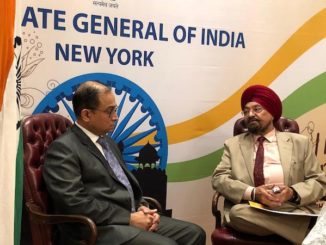
    The Indian Panorama team of chief editor Prof. Indrajit S Saluja and assistant editor Bidisha Roy interviewed Consul General of India Sandeep Chakravorty on August 7, 2019 to  elicit his views on certain recent developments in India and to address some issues related to the Indian American community here.

    Ambassador Chakravorty, as ever, candidly answered all our questions. We bring to readers of The Indian Panorama excerpts from the interview.

    We have decreased the turnaround time of our consular services. For instance, you apply for passport through CKGS today. It comes to us this evening. Tomorrow we do it and day after tomorrow you get it. So our turnaround time is just a day. Which means if somebody is in an emergency, we can give him the passport across the counter.

    TIP: We are here with you when India has lost one of her best human beings and an accomplished politician who, until a few months ago,  was India’s external affairs Minister, and your boss. I will like to begin with your memories of Sushma Swaraj Ji, and, of course, your condolences .

    Ambassador Sandeep Chakravorty with Late Smt. Sushma Swaraj

    CG :  We know politicians, we know leaders, ministers but Sushmaji was very special in the sense that she led our ministry (External Affairs) for five long years and she really had a very intimate relationship with all officer and staff. I think she changed our ministry. She changed the way our consulates work. She made us responsive to the community. On many issues, she played very very important role in keeping our embassy in forefront of diplomacy. She used the power of Twitter to help people. It is unparallel in the diplomatic history. No leader, no foreign minister used social media so effectively. There is an outpouring of grief. In New York she used to come every year for the General Assembly and we got the chance to meet her. I remember she would call me personally and ask me to help people in stress and trouble including patients in hospitals here in the United States. She connected beautifully to everybody. Everybody is missing her. We are poorer by her absence. She was a tall leader. We don’t have many women at the forefront of politics. She was the youngest minister at the central government. She has been in politics for 40 years. She was the face of Indian diplomacy. I think we will all miss her. My condolences to her family.

    TIP: Modi government has taken some decisions on the State of Jammu &  Kashmir which have divested the State of certain privileges and taken away some special rights of the people of J &K. Obviously, the decisions have altered the character of relationship between the State of J& K and the Center. How will you explain the action which you have called in your note circulated to media, including the NY Times, as “administrative action”? How does abrogation of Article 370 help people of J&K?

    CG – Before I get into answering it,  I would like to recall the last tweet of Sushmaji which she made just an hour before her cardiac arrest. She thanked Prime Minister Modi and said I could never imagine that I will see this day I was waiting for. I think it’s a very telling comment, poignant tweet. I’ve seen the tweet a number of times and I think it was a historic day. I would like to highlight two points. One is that – I believe that Article 370 was a temporary provision in our constitution, and it was made to protect the people of Kashmir to work for its development and protect their culture and uniqueness of Kashmir. Unfortunately,  because of several developments, it went to the contrary. It has not developed Kashmir. There is no institution, no hospital, no university, no medical college, no engineering college, no industry, no business.

    What will happen in next few years that Kashmir will become a developed state, a global state. It will become the pride of India. I got a comment from one company – they said, we’ll work with India to bring Kashmir to the forefront of technological change in the world. The people of Kashmir are as Indian as anybody else. Why they have been deprived for so many years of these benefits of development? No law of India was applicable to Kashmir including reservations for the backward classes. There was rampant corruption. Even the prevention of corruption act was not applicable. It was a jarring point in our political structure which has been corrected and I am so happy that our government has the courage to do so. The culture of Kashmir will be demolished – that’s not true. India is based on linguistic states and India celebrates its culture and diversity. More and more Kashmiri culture will come to the forefront. There have been forces who tried to kill the culture of Kashmir. This action will protect the culture of Kashmir. I am very very positive that this is a landmark decision and it will be a game changer. It will solve the problems that we have faced in the past. It will bring out the people of Kashmir to a high level of economic development.

    TIP: There are fears that when you open up the forbidden area to people to buy land, the land mafia will dispossess  the local people who are known to be poor. And that will drive them to greater poverty. What do you think?

    CG- I don’t think that is a correct description of the fact. It is a very hypothetical situation. It has not happened elsewhere. Nobody will force you to sell your land. Things will not happen overnight. If somebody has land and wants to build a hotel, why he should be denied? The land of Kashmir should have similar valuation like in Mumbai or Delhi. Tourism will prosper and protection will be given like in other parts of India. The beginning has to be made.

    TIP: Let me take you to your August 2017 interview with The Indian Panorama. You had said : There are three relationships here – India-US relationship, Indian community-US relationship, and Indian community-India relationship. All are very important, and we need to focus on all three. How do you assess yourself today with regard to your work in strengthening these relationships?

    Thank you for reminding me. It was a very useful framework to analyze our work. The India-US relationship has progressed enormously in  the last two years. The best indicator is the trade which has crossed 142 billion. It was less than 20 billion 20 years back. What is very interesting is trade deficit has been reducing. US export to India is growing. We believe in comparative advantages.  We are buying thing from US which we have never done before such as oil and gas. We are also increasing our defense purchases from the US. US is the biggest supplier of aircraft to India. On economic relations, the investment relationship is very strong. Indian companies are investing here. Strong presence of them in our jurisdiction. The US-India relationship has done well. It is prospering. Our Prime Minister and US leaders have said that this is the most important bilateral relationship in the world. It is the relationship of the future. There is great deal of understanding about the role of India. As the relationship advances it creates opportunities for us.

    As far as the Indian community-US relationship is concerned, that is also very significant. More and more Indians are participating in the political process. Indian origin men and women are participating in the local level across the US as assemblyman, councilman or judges or senators. That awareness is growing and people are talking about it. There is appreciation of role of Indian community in the US administration. Our community is the most educated and prosperous community and they are playing huge role in the development of United States. Today US is the technological powerhouse because of the contribution of people of Indian origin.

    Thirdly, the connection with India is growing. The concern which I have is whether the second or third generation is connected or not. As India is becoming economic powerhouse, the interest in India should be natural. The second or third generation should not connect to India because their parents belong to India. They should connect because they feel to do so just like other Americans do. That is happening. I find lot of people who deal with India, are investing in India. Our job is to facilitate that. I see my role as a bee, a pollinator – pollinating the flower. In diplomacy we don’t do business. Our role is to facilitate business. Here at the consulate, so many subsidiary relationships are blooming. I believe in supporting these contacts and relationships.

    TIP: Between 2017 and 2019, you have accomplished a lot. Also, you may probably have a feeling that much more could have been done. Do you have any flop side?

    CG- I think after two years, I am focusing on involving more and more mainstream Americans in the activities of the consulate. I have done, but I have to do more. My emphasis now will be trying to do more of that. I am trying to do things that will last. I am sitting on the success and hard work done by my predecessors.  We also increased our outreach. The feedback is very positive. We fail in many occasions but it’s not because of lack of effort. We failed because everything is not in our control. When we get feedback, we respond. We try to correct problems of people. We respond on google, Facebook, twitter, Instagram. We have developed our web Application – Pramit. It is an in- house development. It has ensured 100% response to any applicant who has any issue with the consulate. it is widely used. In the last 7 months about 10,000 people used it. We have redone our website in June 2018, we had 1.3 million hits since then. For a consulate, it’s very very satisfying.

    I believe that India’s time is now. India is on the way to becoming five trillion dollar economy and that cannot happen without greater India-US cooperation and involvement of Indian American community.”

    TIP: You inherited one particular initiative from Mr Mulay – Consulate at your doorstep – what have you done to promote that?

    CG- We have decreased the turnaround time of our consular services. For instance, you apply for passport through CKGS today. It comes to us this evening. Tomorrow we do it and day after tomorrow you get it. So our turnaround time is just a day. Which means if somebody is in an emergency, we can give him the passport across the counter. This has not happened before. Our turnaround time for visas is also one day. I am proud to say that we are one of the very few consulates globally who open on weekends to give emergency services. For transfer of mortal remains, we are open on Saturday and Sunday. I think hardly anybody does that. We give emergency visas and passport if anybody is critically ill. A proper procedure is established. The consulate is for the people. If we are not able to satisfy and help them, there is no point. Consulate at your doorstep is happening but because we have brought down the processing time, the demand has decreased. But still we are doing it in places like Boston and Philadelphia. Our jurisdiction is very compact.

    TIP: It is about Open House and redressal of grievances. Do you maintain a record of complaints received?

    CG – We do. We are very sensitive regarding this. If an appreciation makes my day, a complaint ruins my week. That is the importance we give to complaints. We respond to each and every complaint. Some of the complaints come because of our limitations when we say ‘No.’ We can’t say yes in every circumstance.  When we say ‘No’ people respond in a negative way. We understand their difficulties and we try to be as humane as possible. Most of the complaints are because of lack of response. Because of Pramit, the complaints have also drastically reduced. It’s a mixed bag and I take both in my stride. Our phone calls are now on recorder. We receive 120 to 130 calls a day and every call is recorded. I make sure by the end of the day we respond. We call and leave a message and I guarantee you that we’ll get back within 24 hours.

    TIP: What have been the most recurrent complaints and grievances?

    CG – Mainly two. One is for passport of people who are not documented here and asylum seekers who have not got US travel document. Sometimes they need to travel to India. There is a very flexible rule and we are compassionate. But sometimes people take benefit of the rule and then don’t travel to India. They say, somebody is unwell. So we give them the passport and then they don’t go. But that number is not large. One thing to notice that passport is not an identity document but a travel document. Some undocumented people who demand the passport they do not travel. They want identity. When we ask what the purpose is, they are unable to explain. We don’t want to jeopardize the US immigration system.

    Passport and Visa Consul Mr. Murugesan explains to The Indian Panorama assistant editor Bidisha Roy the new digital system of registration on arrival

    TIP:Congratulations for providing certain new facilities to visitors to the Consulate to transact business. We visited the office in the basement area and found the place much more welcoming than before. The comfortable new chairs and the ambience of the place are surely welcome. Bidisha who spoke with the Consul Passport and Visa Mr. Murugesan was told about the entire operation-how a visitor has to register on arrival and  then wait in the queue. The new digital queue monitoring and display makes things much easier for visitors. Bidisha also noted that the Consulate has provided free copying and computer services to fill in the forms. Mr. Murugesan also informed about the plans  to have a children’s section. Surely, there are enough indications of improvement.

    CG: We constantly review the services.

     TIP: What are your plans regarding the celebration of 550 years of Guru Nanak Devji and 150 years of Mahatma Gandhi?

    CG – In last several months we have arranged many events on 550 birth anniversary of Guru Nanak Devji. We have had many outstanding events at the consulate.  The latest one was at the Gurudwara at Hicksville. We are planning few more events. We have proposals from other Gurudwaras in our jurisdiction. We are planning with Mayor’s office in Norwalk, Connecticut where there is a sizable Sikh community to host an event in November on of Guru Nanak Devji’s birthday. We are planning to host it at mayor’s office with participation of mainstream people.

    In connection with the year long commemorative celebration of 150 birth anniversary of Mahatma Gandhi, we have partnered with  the State University of New York, Old Westbury (SUNY-OW),  and Shanti Fund to plant 150 trees in the Old Westbury Campus. We are requesting individuals to adopt trees. The Gandhi Peace Garden will be inaugurated in September during the visit of Prime Minister who will do it. On October 1 we are doing ‘Homage to Mahatma’ music concert by Sitarist Subhendu Rao and his wife at the consulate.

    TIP: We are a week away from celebrating India’s 73rd Independence Day. Your message , please.

    CG – On the occasion of our 73 rd Independence Day, I greet the readers of Indian Panorama and the larger  Indian American Community and the friends of India. I believe that India’s time is now. India is on the way to becoming five trillion dollar economy and that cannot happen without greater India-US cooperation and involvement of Indian American community. I felicitate you on this very very happy occasion. We should project what is good in India. I want to take this opportunity to invite you to participate at the grand celebration of August 15. Please join us and come in large numbers.

    TIP: Thank you, Ambassador Chakravorty for your time. Happy Independence Day1

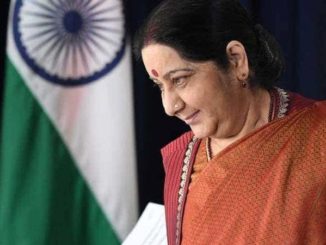
  • Sushma Swaraj -the best specimen of “Matri Shakti”

    Sushma Swaraj -the best specimen of “Matri Shakti”

    By Prof I.S.Saluja

    Sushma Swaraj (Sharma before her marriage to Swaraj Kaushal) was born on  14 February 1952  at Ambala Cantt, Haryana to Hardev Sharma and Shrimati Laxmi Devi. Her father was a prominent Rashtriya Swayamsevak Sangh member. Her parents hailed from the Dharampura area of Lahore, Pakistan.

    Sushma was educated at Sanatan Dharma College in Ambala Cantonment and earned a bachelor’s degree with majors in Sanskrit and Political Science. She studied law at Panjab University, Chandigarh.

    She  was a lawyer by profession. A senior leader of Bharatiya Janata Party, Swaraj served as the Minister of External Affairs of India in the first Narendra Modi government (2014–2019). She was the second woman to hold the office, after Indira Gandhi. She was elected seven times as a Member of Parliament and three times as a Member of the Legislative Assembly. At the age of 25 in 1977, she became the youngest cabinet minister of Indian state of Haryana. She also served as 5th Chief Minister of Delhi for a short duration in 1998.

    Swaraj was hailed as India’s “best-loved politician” by the US daily Wall Street Journal . In view of her failing health , she decided not to contest the 2019 Indian general election. She was not much seen in public. On August 6, 2019 she succumbed to a cardiac arrest, according to the doctors at the  AIIMS , New Delhi.

    The world grieved over her loss, as we do at The Indian Panorama. We grieve for her, the unreturning friend and benefactor.

    We received condolences from many people in India and abroad. In the short space available with us, we will carry excerpts from the condolences offered by them.

    A Diplomat Remembers Sushma Ji

    Aformer diplomat Asoke Kumar Mukerji was the Permanent Representative of India to the UN when Sushma Swaraj visited the United Nations for the first time as External Affairs Minister. He said in his condolence posted on Facebook

    “Deeply saddened by the untimely demise of Smt. Sushma Swaraj-ji, who was External Affairs Minister of India when I was finishing my innings in the Indian Foreign Service as Permanent Representative of India to the United Nations in New York. Her enthusiasm was infectious, and her attention to detail was astounding. Despite the challenging schedule that she committed herself to during her visits to the United Nations, she constantly radiated positive energy.

    The symbol of Indian mother, sister, daughter, bahu-the best face of an Indian Sushma Ji with UNSG Ban Ki-Moon, whose “India-connections” extended from his personal to his professional life
    Photo / Courtesy Asoke Mukerji

    I first received her as External Affairs Minister in New York on 24 September 2014, when she arrived just before our Prime Minister Shri Narendra Modi-ji’s first historic visit. It was her sagacity and support that ensured we were able to implement the Prime Minister’s idea for the UN General Assembly to declare June 21 every year as the International Day of Yoga in record time and with a record number of co-sponsoring countries. She participated in the First International Yoga Day in New York in 2015.  She placed the UN’s decision on the International Yoga Day in the context of India’s ability to set the global agenda at the last public function I participated in with her in New Delhi in March this year. The video of her remarks may be seen at

    http://www.fpap.in/video/modi-govts-sets-the-global-agenda/

    Her interest in the Holy Grail of India’s multilateral diplomacy, revolving around our efforts to reform the UN Security Council, was deep and focused, as was her interest in the welfare and effectiveness of the thousands of Indian soldiers serving in UN Peace Operations.

    She saw both as integral to India’s core national interests. She built a special rapport with President of the General Assembly Foreign Minister Sam Kutesa of Uganda to push for tabling a text to reform the Security Council, as well as to implement the UN General Assembly’s decision to construct a Permanent Memorial Wall to UN Peacekeepers on the grounds of the UN Headquarters in New York.

    The last time Ambassador Mukerji met Sushma-ji was at a function at the Nehru Memorial Museum and Library in March 2019, when she spoke extempore on the Modi Government’s Foreign Policy. From left to right: Dr Anirban Ganguly, Director of the SPMRF, External Affairs Minister Sushma Swaraj-ji, Ambassador Amar Sinha and Shri Vijay Chauthaiwale, In Charge of BJP’s Foreign Affairs Department.
    Photo / Courtesy Asoke Mukerji

    She leaves behind many memories. May God give her departed soul everlasting peace. Om Shanti!

    A New Yorker Misses his Sister

     New York based  BJP activist Jagdish Sewhani who knew Sushma ji for a long time , sent this condolence message on the passing away of Sushma ji.

    “Deeply saddened and Shocked at the sudden passing away of Sushma Swaraj ji, one of the tallest political leaders of her generation who had given more  than four decades of public service.

    Sushmaji had this amazing quality of connecting with People . She was people’s Minister and most loved politician, respected across the Party lines.

    She was great orator and great administrator.

    At personal level she was like a sister to me and always used to call me Bhai.”

    OFBJP-USA Pays Rich Tribute to Smt. Sushma Swaraj

    “Overseas Friends of BJP (OFBJP) – USA is shocked and deeply saddened to learn about the sudden demise of Smt.  Sushma Swaraj. It is indeed a huge loss to the nation as 1.3 billion people remember her yeomen service to the country. Her unmatched oratory skills and her human touch always mesmerized the people across all walks of life.

    Born into RSS family, Sushma Didi as she was fondly called had started her political journey with ABVP and during this journey, she broke many glass ceilings. She became the youngest cabinet minister in Haryana at the age of 25 and was the first woman Chief Minister of Delhi. She accomplished many firsts during her political career, including first full-time Foreign Minister. She was elected to the parliament for seven times. While she was an opposition leader, she won the accolades from both friends and foes. She had friends across the aisle and from all ideologies which speak volumes about her human interactions and outreach.

    She was a remarkable leader who devoted her life to the public service and was instrumental in affecting process changes in the Indian consulates across the globe aimed to help NRIs and India diaspora. She was just Twitter away in helping the distressed people.  Her quick wit and forever helping hand made her extremely popular in the community of Indian Diaspora.”

    GOPIO Recall their Association with Sushma Ji

    GOPIO Delegation with External Affairs Minister Sushma Swaraj in New York, Sept. 23, 2018

    Global Organization of People of Indian Origin conveys its heartfelt condolences in passing away of Smt. Sushma Swaraj, who served as External Affair Minister with Prime Minister Modi from 2014 to 2019. As minister looking after the Overseas Indian Affairs, GOPIO have had a close working relation and cooperation on many of the NRI and PIO issues as well as on new initiatives from her ministry.

    We have been working with Sushmaji since she has been the leader of BJP in the Rajya Sabha.

    In her passing away, we will miss a Statesman as well as a sincere and able political leader.

    GOPIO International conveys its heartfelt condolences. May her soul rest in peace.

    AAPI  Mourns the demise of Sushma Ji

    During the many years of public service to the nation, Ms. Sushma Swaraj brought her innate grace and charm into her work. She made her mark in her own way – connecting with the diaspora far and wide and reaching out to help them. She would respond to every appeal for assistance, and make sure the Indian missions responded to the requests. In this way she gave the human touch to the Ministry of External Affairs and won millions of admirers across the world.

    (TIP Bureau)

  • Readers’ Comments

    Readers’ Comments

    The Indian Panorama received from readers , for the special Independence Day edition, comments on recent developments in India with regard to the State of Jammu & Kashmir, in particular. We are fortunate to be living in America where we have unfettered freedom of expression . We are happy to note that readers have been fearless in their expression. The views expressed in various comments are readers’ own views and The Indian Panorama does not necessarily subscribe to or  endorse  any.

    India’s action will enhance peace and prosperity

    Ravi Batra

    This action must deliver enhanced peace & security to J&K, as well as between India & Pakistan. It’s time for the Sub-Continent to celebrate freedom – not only from Colonialism – but Terror too, so every citizen of every nation enjoys a full measure of Liberty’s bounty. The United States, as a friend of the Sub-Continent, wants peace & prosperity to reign, not fear & Terror.

    (New York based Ravi Batra is an attorney and Chair, National Advisory Council South Asian Affairs)

    A Note of Caution for India’s Future

    Ashok Ojha                                 

    I live and work in USA where everything is not perfect. There are people around us whose actions may lead to undermine others’ achievements and accomplishments. Progressive thoughts and ideas may not be supported by prosperity, that is the United States. However, I always feel that a common American person live within a framework where he or she indulges in daily activities in order to not only survive but also to pursue his/her happiness. A feeling of value-based society prevails around us. So whatever we do carries a purpose and meaning.  There is a visible consequence of not working. Few are passionate about what they are doing. People may be working just to earn their living. And that situation is not conducive for making a great society. However, the nation goes on with rules and guidelines applicable to all. India, on its part, has a long way to go before it successfully constructs an acceptable framework for its citizen to work, to live and pursue personal happiness.

    In today’s interconnected society I am constantly made aware of things happenings around the world. Considering what goes on the Western media on a daily basis I can say, from the Western point of view, that India is not an important question. India is important for those who claim India as their mother land. India is important for the generation whose roots lie in India. To that end we like to see a prosper India. People of Indian origin feel the pain of Indian brothers and sisters when they suffer from natural disasters and government apathy towards age old social problems.

    India has been enjoying consistent economic growth for the past two decades. Many experts have gone to the extent of saying that Indian will overtake China in the near future in terms of growth. For this reason the world has been very supportive to the issues India has been embroiled in the recent past. However, the support to India by the international community, especially the West, has not been without any expectations. The developed nations look at India as a  prospective buyer, a growing market for its products. India, on its part, opened its economy for products from the rest of the world. During the current decade its people put their trust to a promising leader like Narendra Modi, hoping that he would make India a better place to live for its teeming billions.

    How far the expectations of India’s middle class as well as its poor have been met by Modi? It is a big question. It may be early to answer this question. However, one can see that India’s financial health hasn’t been dealt wisely in the past few years. But hope is not yet lost for the simple fact that India has prospered to its current state not just by the government policies but by its enterprising and resilient population. One hopes that the ruling  Bharatiya Janata Party is genuinely eager to solve the social and economic challenges. We have some mixed feelings about the actions of the ruling party of India led by Narendra Modi. Some important matters must be finished before his report card is prepared.

    The ruling party of India, Bharatiya Janata Party, must not behave as if its fortune will stay for ever. Sine 2014 Prime Minister Modi has been busy launching campaigns for social change. We all know about impacts of ‘Swatchch Bharat’, ‘Ujjawala’ and ‘Beti Bachao’, ‘Insurance for farmers’ campaigns that didn’t go too far. Modi government is yet to create employment for the millions of unemployed youth. If the situation of unemployment and poverty in India remains unchanged no force on the earth can save it from mass unrest.

    Recently Modi government used its strength of popular mandate to demolish Article 370 of the Indian constitution. The Western media projected this move as  the seize of Kashmiri people. The neighboring country used every tactic to destabilize the region. India is fortunate to be enjoying the support of Western world as well as many wealthy Arab nations on Kashmir issue. Because of this reason I don’t see any difficulty for the Modi government working towards normalization of Kashmir. While Delhi has demonstrated high skills of administration after the abrogation of Article 370,  many BJP officials stand exposed with their small mindset. They continue to behave as if India has conquered a new territory. It is the time to stand polite and help the common people of Kashmir who might be in financial distress.  It is not the time to worry about Pakistan. India must focus on the welfare of the whole of Jammu and Kashmir region. We are not aware how much India was spending on upkeep of security forces in Kashmir. The financial cost of securing the Kashmir region must be very high. Should this money had been spent for the development of the region? Absolutely.

    (Ashok Ojha is a New Jersey based senior journalist and teacher.)

    This Independence Day is special

    Anu Jain

    Happy India Independence Day to all. We are very grateful to our leaders and pay tribute to and remember all the freedom fighters who contributed a lot and fought for the Independence of India. They have given us free India and today we are in our 73rd year of freedom and it is great pride for us.

    Today we play an important role in all important international affairs around the world. Indians are leading the world in every field. In fact, since the day of independence to this day, we have developed significantly in every sphere of life.

    We should be making every effort to make our motherland India and adapt homeland America powerful and honorable in the world.  Let’s unite, let’s work hard and tell our every friends and foes alike. We are friends with friends and when times come, we can roar.

    This Independence Day is very special because of  Government of India has scrapped the Article 370 from J&K, through a Presidential order on 5th August 2019 and Indian flag will be hosting in Kashmir and its liberation of Kashmir in true manner. Humanity at heart, Humanity in spirit!

    Jai Hind!

    (Anu Jain is a Long Island, New York based community activist, painter, writer and real estate salesperson)

     People of Jammu and Kashmir will benefit from abrogation of Article 370

    Jagdish Sewhani

    We congratulate Prime Minister Modi and Home Minister Shah for taking this bold step. It was long due, but it took the courage and vision of Prime Minister Modi to remove this unjust provision of the Indian constitution,” said Jagdish Sewhani, president of American India Public Affairs Committee.

    Undoing the seven-decades old wrong would not put India on fast track of development. “People of Jammu and Kashmir would be the first beneficiary of the economic development that the region would not experience,” he said adding that several Indian Americans are ready to invest in the tourism and other sectors of Jammu and Kashmir and Laddakh.

    New York-based Sewhani said Indian Americans are planning to felicitate Prime Minister Modi when he comes here to attend the annual session of the UN General Assembly in September.

    (Long Island, New York based Jagdish Sewhany is a BJP activist and a businessman)

    I Laud Prime Minister Modi for the bold action

    Ven Parameswaran

    I laud Modi for utmost secrecy.  Nobody knew. It was a pleasant surprise to India and the world blinked.

    I am glad officially Jammu and Kashmir including Ladakh/Aksai Chin are now fully integrated with India. I did not like the Special Status (370).   India has expended unlimited resources in Kashmir but the Kashmiris have not been accountable encouraging maximum corruption.  It is a disgrace that India was careless all these years

    Kashmir can be the Switzerland of Asia.  I am in favor of freedom for investors to invest in Kashmir.  All these 72 years, non-Kashmiris were not allowed to buy properties or invest.

    On Tuesday, that is today, the Lok Sabha will steamroll the new bill and status of Kashmir.

    Utterances of Chidambaram and Tharoor were irrelevant and insignificant.  So far there is no reaction from the US and the Western world. Even China has kept mum. Pakistan bribed China by ceding a part of its occupied Azad Kashmir. Pakistan is shocked that it is isolated.  So far there is peace. Modi seems to have done his homework and sent additional 35,000 forces.

    Pakistan will try to schedule a meeting of the Security Council.  India must use its diplomacy to prevent this. If Pak succeeds, India should send the most competent representative to argue.  India can count on Soviet veto. Pakistan China veto. It may be in the interest of the US not to have a meeting.  The US still has no official ambassador, I think.

    In any case, Modi has neutralized the Khan-Trump White House meeting.  India has denied what Trump said on mediation.  In Washington which diplomacy will succeed — India or Pakistan?

    Trump, I think will be careful because Trump has the largest foreign investment in India.

    (Scarboro , NY based Ven Parameswaran is a retired UN official and a contributor to publications)

     Don’t let your communal politics make you communal in your responses

    Mike Ghouse

    Modi and Shah scraped the article 370 of the constitution giving exclusive rights to the state of Kashmir, and it was the need of that day when Pakistan attacked Kashmir, and it chose to seek the protection of India. The law was passed to protect their rights until a referendum was organized to let the people decide what they want to do.

    In a democracy, the states have the rights, and the federal institution cannot bully them into obedience against their will. If you break the law once, you break it again, and in the end, it is dangerous to all. Kashmir is no different than Gujarat (when Modi was CM) Tamil Nadu or Bengal in going against the federal government.

    I am reading comments across the board- and have this to say to my friends in India. Don’t let your bias towards anyone make you unjust, and you would become an ugly person if you are unfair. If you stick to justice for all, you cannot go wrong. All the problems we have in society are due to injustice.

    Learn to talk about the people of India based on the individual’s rights and not on communal lines. Don’t let your communal politics make you communal in your responses.

    Protests will begin unless Modi acts like evil China’s repressive regime in Tiananmen Square. Thank God, 66% of Indians are still civil and democratic and respect the constitution and the rule of law.

    I always think of women in India – Men invariably beat them, treat them as inferior, and force them to remain silent. Finally, I am glad women spoke up and are restoring sense if justice among men.  Thanks to our founding fathers for respectfully accepting the protests without crushing them like the British did it in Jalianwala Bagh.

    All because our founding fathers honored their God-given right to protest. If women were prevented from speaking up, they would have continued to live in oppression by men. No people on the earth should be denied their right to protest. Without protest, democracy dies, and in the end, all of us will lose our freedoms.

    Those who oppose protestors tend to be oppressors themselves and insecure. Civilized people can deal with conflicts through dialogue; animals resolve their disputes by forcing others to through brut power.

     (Washington based Mike Ghouse is President, Center for Pluralism and an author . He blogs at www.AmericanMuslimAgenda.com ) 

  • An abrogation of democratic principles

    An abrogation of democratic principles

    By Navnita Chadha Behera

    The BJP government’s move has, however, not only completely swung the pendulum but is also antithetical to the very idea of inclusivity. By turning J&K, especially the Valley, into a virtually open air prison, with a full clampdown and information blackout, the message is clear: that New Delhi alone will decide the political future of the people of J&K with no room for any consultative process and no space for dissent.

    The Kashmir move affects the robust nature of Indian democracy in addressing internal conflicts and alienation

    The recent abrogation of Article 370 ending the special status of Jammu & Kashmir (J&K) in the Indian Constitution along with the Jammu and Kashmir Reorganisation Bill, 2019, bifurcating the State into two Union Territories (J&K and Ladakh), have delivered a knock-out blow to the long-drawn-out peace process in Kashmir.

    These moves also herald a paradigm shift in the fundamental premises and parameters of India’s approach towards the Kashmir issue, with long-term implications for its political strategy of tackling such internal conflicts. There are three cardinal principles which successive political regimes have hitherto followed in addressing internal conflicts and seeking political reconciliation with alienated segments of the populace. These in turn have bolstered the robust and resilient nature of Indian democracy. The future, however, appears much more uncertain. Here is why.

    Accommodative parameters

    The first principle entails adhering to the letter and spirit of the Indian Constitution. Its far-sighted and malleable nature has stood the test of time. Since 1947, India has faced a wide-ranging nature of political demands ranging from secession, to the creation of a separate State for Jammu, Union Territory status for Ladakh and others seeking affirmative discrimination for the Dogri language, Scheduled Tribe status for Gujjars and Paharis and so on.

    In response, the central leadership has tried finding ways and means within the overarching parameters of the Indian Constitution and have rarely been disappointed. In view of the difficult circumstances under which the Dogra Maharaja Hari Singh had acceded to India, Article 370 itself offered an excellent example as to how the special needs and political aspirations of the people of J&K could be politically and constitutionally accommodated by India’s Constitution makers.

    Decades later, when Ladakhi Buddhists launched an agitation in 1989, demanding Union Territory status, the Indian Constitution once again made space for political experimentation by introducing intermediate state structures — the creation of two autonomous hill councils for Leh and Kargil.

    Weakening federalism

    Against this backdrop, it is for the first time in independent India’s history that the Bharatiya Janata Party government has used constitutional provisions for opposite ends: to undermine and weaken India’s federal character by downgrading a State and territorially dividing it into two Union Territories without the consent of the people of J&K.

    The method adopted to execute this decision is of special concern because by equating or replacing the Constituent Assembly of J&K (which was dissolved in 1957) with the Legislative Assembly of J&K, and Parliament appropriating the latter’s powers since the State is under President’s rule, the Central government has acted unilaterally to reorganize the State of J&K.

    This rests not only on legally shaky ground but also flies in the face of constitutional norms and propriety. If this passes judicial scrutiny, it can then be done to any State in India, with drastic implications for its federal character.

    The second principle pertains to the maxim of ‘inclusivity’, that is, a political demand being made must be inclusive in terms of representing the interests of all those in whose name it is made. This supported bridge building and coalition-making among different communities certainly helped in shaping the peace process, in turn bolstering India’s deeply diverse and plural character.

    In J&K’s context too, it has also proven to be a critical common factor helping to explain the failures and successes of various political demands. The Kashmiri idea of self-determination in a multi-ethnic, multi-religious and multi-lingual society, for instance, was to call for a plebiscite as mandated by the UN resolutions of 1949 or seek an independent and sovereign State of J&K, but this was not the approach taken by other communities such as the Dogras, Kashmiri Pandits, Gujjars, Bakkarwals, and Ladakhi Buddhists. In the 1950s, as indeed in the 1990s, the demand by Kashmiri Muslims for a right to self-determination or azadi was politically checkmated by these communities as their political choices were very different; time and again, an exclusively Valley-focused approach has doomed the prospects of the peace process.

    Demographic impact

    The BJP government’s move has, however, not only completely swung the pendulum but is also antithetical to the very idea of inclusivity. By turning J&K, especially the Valley, into a virtually open air prison, with a full clampdown and information blackout, the message is clear: that New Delhi alone will decide the political future of the people of J&K with no room for any consultative process and no space for dissent.

    The decision to divide the State is particularly fraught with the risk of deepening regional and communal fault lines. While Ladakhi Buddhists, for instance, are now celebrating the fulfilment of their long pending demand for Union Territory’s status, the voices of Kargilis who are still under a strict curfew are yet to be heard. They may not support this decision because ‘a Union Territory without a legislature’ not only negates the idea of decentralization of power to the grassroots (the undergirding principle of the autonomous hill council) but could well lead to a shifting of the loci of power to Leh, resulting in losing whatever gains they have assiduously made over the years.

    The celebrations by Kashmiri Pandits are anticipated because of the gross injustice and displacement they have suffered since their forced exodus from the Valley in the early 1990s. It remains to be seen whether the abrogation of Article 370 by itself, would facilitate their return to the Valley without the support of local Kashmiri Muslims and rising violence.

    Instead of making all communities equal stakeholders in the peace process, the BJP government’s decision may well end up pitching one community against the other. A deepening of societal fissures and communal fault lines do not go hand in hand with the agenda of peace-making.

    The third principle refers to a promise and the practices of holding a dialogue process and sharing political power with opponents of all hues. In Kashmir, successive Central governments have until now never shut the door of dialogue in the face of political opponents who have ranged from the Sheikh Abdullah-led Plebiscite Front in the 1960s to the Muslim United Front in the 1980s to the Hurriyat leadership since the 1990s. This also holds true for militant groups.

    While the bottom line of Congress governments has been a commitment by their opponents to abjure the path of violence and abide by the Indian Constitution, the erstwhile Vajpayee-led National Democratic Alliance (NDA) regime was even more generous in offering the broad framework of ‘insaniyat, jamhooriyat and Kashmiriyat’.

    The Modi government faces an uphill task in identifying credible local partners in ushering in peace to the Valley, which may well end up in facing yet another impasse.

    Political fallout

    In a significant point of departure, the present government is pursuing a hard, top-down approach. The Home Minister has categorically ruled out any dialogue with militants and the Hurriyat and has even castigated the mainstream regional political leadership of the National Conference and Jammu and Kashmir Peoples Democratic Party for being corrupt, promoting family rule and fomenting separatism and violence. This move has nullified the very idea of a process of dialogue and runs the risk of discrediting the mainstream politicians and obliterating the middle ground between the militants and mainstream politicians.

    The Prime Minister in his recent address to the nation, expressed hope that new leadership in Kashmir would emerge from grass-roots politics. It is important to note that in 1,407 out of 2,135 halqas or village clusters, there was no voting at all in the panchayat elections that were held in 2018. This does not lend credence to youth being optimistic about joining mainstream politics especially after the abrogation of Article 370, a move which is only likely to deepen the alienation. The Modi government faces an uphill task in identifying credible local partners in ushering in peace to the Valley, which may well end up in facing yet another impasse.

    (Navnita Chadha Behera is the author of ‘Demystifying Kashmir’ and ‘State, Identity and Violence: Jammu, Kashmir and Ladakh’)

  • Tulsi Gabbard to report for active duty for 2 weeks

    Tulsi Gabbard to report for active duty for 2 weeks

    WASHINGTON(TIP): Tulsi Gabbard, Democrat from Hawaii and presidential candidate, will be taking a two-week absence from her campaign Monday to report for active duty with the Hawaiian Army National Guard in Indonesia, she said in an interview with CBSN’s Caitlin Huey-Burns.

    “I’m stepping off of the campaign trail for a couple of weeks and putting on my army uniform to go on a joint training exercise mission in Indonesia,” she said. Gabbard has also taken two weeks off to report for active service in 2017.

    “I love our country. I love being able to serve our country in so many ways including as a soldier,” she said. “And so while some people are telling me, like gosh this is a terrible time to leave the campaign, can’t you find a way out of it? You know that’s not what this is about.”

  • New regulation can deny green cards for immigrants using public benefits

    New regulation can deny green cards for immigrants using public benefits

    WASHINGTON(TIP):  The Trump administration rolled out a key item in its hardline immigration agenda that had been months in the making, issuing a sweeping rule on Monday that targets legal immigrants who use welfare benefits like food stamps and government-subsidized housing.

    The new regulation — detailed in a more than 800-page document — would dramatically expand the government’s definition of the centuries-old term “public charge,” effectively making it more difficult for certain low-income immigrants to secure permanent residency or temporary visas. The final and enforceable version of the rule is scheduled to be officially published on the Federal Register Wednesday and slated to go into effect in October.

    The rule affects most aspects of life for immigrants — from medical care and English language proficiency, to food stamps and other welfare programs. Critics say discussion of the rule’s roll-out had already been having a “chilling effect” on many immigrant communities, including households and families who are not directly affected by it on paper.

    Ken Cuccinelli, the acting director of U.S. Citizenship and Immigration Services (USCIS), the agency which administers benefits for immigrants, touted the change as a way to promote “self-sufficiency” and “success” among immigrant communities.

    “Through the public charge rule, President Trump’s administration is re-enforcing the ideals of self-sufficiency and personal responsibility ensuring immigrants are able to support themselves and become successful here in America,” Cuccinelli told reporters at the White House on Monday.

    What is a public charge?

    The “public charge” standard was first codified into U.S. immigration law in 1882 — the same year the U.S. enacted the Chinese Exclusion Act, which barred the entry of Chinese laborers into America on the premise that immigration from China endangered “the good order of certain localities.” The term essentially means being a burden on society.

    It was also included in the Immigration and Nationality Act of 1952, which stipulated that those who were deemed a “public charge” would be subject to deportation or barred from entering the country.

    In the 1990s, the Clinton administration issued guidance effectively saying that only cash benefits — like the Temporary Assistance for Needy Families (TANF) program — could be considered when determining whether an immigrant was a “public charge.”

    What would the new regulation do?

    Immigration authorities currently ask green card applicants to prove they won’t be a burden on the country, but the new regulation, if enacted, would require caseworkers to consider the use of government housing, food and medical assistance such as the widely-used Section 8 housing vouchers and the Supplemental Nutrition Assistance Program (SNAP).

    The rule would subject immigrant households who fall below certain income thresholds to the “public charge” test — which would also consider how well applicants speak, read and write English. Under the proposed rule, any diagnosed medical condition that requires extensive medical treatment would also “weigh heavily” in evaluations by caseworkers.

    Asylum seekers and refugees would be exempt from this “public charge” test.

    What have researchers, doctors and lawmakers been saying?

    When the 60-day public comment window on the proposed rule closed last December, more than 260,000 comments — nearly all critical of it — were submitted.

    A study in May by the Urban Institute found that more than 13% of adults in immigrant families said they were not participating in public programs such as food stamps and subsidized housing due to concerns that the so-called “public charge” rule would hinder their ability to obtain green cards. The number of immigrants reporting this fear rose to 20.7% among low-income families.

    Although the proposed rule would affect immigrants in the U.S. who are not citizens or permanent residents — as well as people seeking to immigrate to the country from abroad — the report by the Urban Institute detailed a “spillover effect” in which both green card holders and U.S. citizens reported avoiding public benefits because of the proposal’s expected implementation.

    Nearly 15% of immigrants in families in which all members had green cards and 9.3% of adults in families comprised of naturalized U.S. citizens said they did not participate in government assistance programs within the past 12 months due to concerns about the proposed rule’s impact on their and their family members’ ability to qualify for permanent residency.

    Another study late last year by the Urban Institute’s Health Policy Center predicts that as many as 6.8 million U.S. citizen children enrolled in Medicaid and the Children’s Health Insurance Program (CHIP) with parents who are non-citizens could be affected by the new regulation.

    Although the proposal does not include Medicaid and CHIP assistance in its “public charge” considerations, researchers at the Health Policy Center believe immigrant parents, particularly in Latino and Asian American communities, will drop these benefits due to concerns surrounding their immigration status and ability to remain in the U.S. legally with their children.

    The big picture:

    Advocates, doctors, civil servants and Democrats fear that the regulation will punish poor immigrants for using essential government benefits and prompt some parents to halt their children’s enrollment in nutritional and medical programs — even if the children are U.S. citizens in mixed-status households.

    Will the rule be challenged in court?

    As soon as the final rule was unveiled, several groups vowed to file lawsuits to try to block it.

    (Source: Agencies)

  • Delaware becomes first no-kill state after saving over 90% of its shelter animals, according to nonprofit

    Delaware becomes first no-kill state after saving over 90% of its shelter animals, according to nonprofit

    DELAWARE(TIP): Last year over 700,000 cats and dogs were euthanized in America’s animal shelters — but Delaware is working to combat what animal advocates believe are unnecessary deaths. The First State is living up to its nickname, becoming the first no-kill state in the nation, according to the nonprofit Best Friends Animal Society.

    “When every shelter in a community achieves a 90% save rate for all cats and dogs, that community is designated as no-kill,” the nonprofit noted on its website. The 10% margin of error factors in euthanasia for pets “who are suffering from irremediable medical or behavioral issues that compromise their quality of life and prevent them from being rehomed.”

    Delaware boasts a 92.9% save rate, meaning about 12,000 of the approximately 13,000 pets in its shelters were saved. Best Friends Animal society defines “saved” as if the pets are “returned to their owners or provided with expert care and safe places to call home.”

    “Delaware put a policy emphasis on animal issues,” Holly Sizemore, the Chief Mission Officer of Best Friends Animal Society, told CBS News. “There are some terrific organizations working collaboratively there and the residents care deeply about the issue and have stepped up to help.”

    The news was announced at the organization’s annual national conference in Texas late last month, a representative confirmed to CBS News.

    Best Friends Animal Society hopes to eventually find homes for every shelter animal “by helping end the killing in America’s animal shelters through building community programs and partnerships all across the nation.” Its goal is for every shelter in the U.S. to reach no-kill status by 2025.

    “All communities have something unique about them and each community has unique challenges as it relates to achieving no-kill, ” said Sizemore. “However, with about 4,300 no-kill communities across the U.S. achieving the no-kill benchmark, we know that it can be done. It can be done in rural communities, urban communities, East Coast communities, West Coast communities and everywhere in-between.”

    The United States, on average, is far behind Delaware, boasting a save rate of just 76.6%. Texas and California are the farthest from the goal, with save rates under 75%.

    (Source; CBS News)

  • Inviting Investors: Trump World Top Resort in Kashmir

    Inviting Investors: Trump World Top Resort in Kashmir

    By Robinder Nath Sachdev  &  Ven Parameswaran

    On August 5, 2019, the government of India took a historic step, executed in an elegant manner, to reorganize the governance of the Indian state of Jammu & Kashmir, into a Union Territory of Jammu & Kashmir, with a far-reaching vision of peace and beautiful ecology in the vales and rooftops of the Himalayas. To students of history, governments and policies, and international relations, this is a landmark step in the chronicles of India about which historians shall write a hundred years hence. Whereas in the now and present, over 1.3 billion people of India are feeling as if a burden of the past has been lifted, with a new dawn in the one-ness of India. No doubt there are also some voices within India that disagree with this decision of the Prime Minister Narendra Modi government. But that is the strength, beauty, and challenge that any democracy must navigate. By reasonable estimates this step and way forward has more than overwhelming goodwill in India, and the few dissenting voices will always be welcome to contribute to a healthy argument and debate which will help shape a more perfect Union of India.

    The Opening Gambit

    Above being said, what none should doubt is that this gambit by India has opened the gateways to peace and prosperity for the people of Kashmir, and for the people of India to contribute and participate in the harmony and its dividends, as within any territory of India. The next 6-12 months are critical and important as the security blanket in Kashmir is slowly lifted and life returns to normalcy. As the routine of lifestyles and business kicks back into gear, the challenge for the Modi government will be to deliver a seamless and smooth transition concurrent with an economic take-off in the Kashmir region. Within one-year Kashmir should be vibrant with peace, culturally colorful with life, and Mother Nature’s vast and gorgeous abundance of the region being shared by Indian and foreign tourists, nature enthusiasts, and seekers of calm and spirituality, minus its image as a region of “bombs-bombs-bombs”, that President Donald Trump talked about in his presser couple weeks ago.

    The entire might of India, strategic, and military, is now applied to ensuring the success of Kashmir as a peaceful, culturally vibrant, and the most beautiful of Himalayan region as captured in the simple words of the German philosopher F. Max Muller when he said that if there is a heaven anywhere on this earth – then it is only, and only, in Kashmir.

    The Business Opportunity for the Trump World Top Resort in Kashmir

    Based upon the expectation that positive scenario as above shall unfold, and that the alternative scenario of bombs and violence in Kashmir will be a thing of the past, this column proposes creative thinking and an unprecedented business opportunity for top investors of India.

    Though the chances of what we propose are slim, yet it must also be remembered that when ideas, audacity, and the universe align, then the returns on investments are beyond imagination and shape the tomorrow of history and generations. It is also well acknowledged that the project may be a non-starter due to the nuances and vagaries of geo-political and security issues, and the associated financial risk.

    Therefore this opportunity that we suggest is squarely and aimed at only such Indian investors and promoters who have accumulated significant corporate and personal wealth, and who are nationalist in their worldview, and would like to bring positive change in Kashmir, and, who will be patient and long term in their returns. So, what are we proposing? As a new age think tank and incubator that has seeded and succeeded in pioneering out-of-the-box initiatives over the past 20 years between countries globally, and including experience of over 40 years in investment banking deals on Wall Street, we believe that the historic opportunity in Kashmir can also be converted into a business opportunity.

    The Trump World Top Resort at Kashmir

    Nestled in the high woods and forests of the Himalayas, a vast estate that sprawls over the mountains, with its own airport and helipad, green and clean energy, conventions, conferences, festivals and arena facilities, hotel and villas, golf course, wellness and relaxation centers, lakes, rivers and springs, adventure sports, skiing and hiking trails, flower and herbal gardens, organic farms, art and cultural fairs, horse-riding, and more, the resort can be marketed very well as a destination for the upper income and rich of the world, and for world summits, global and national conferences, meetings, and retreats.

    A combination of Indian investment and the Trump brand, situated in one of the most exquisite locales virtually on the roof-top of the world, with savvy networks for worldwide promotion, coupled with unparalleled comfort, luxury and service.

    Some readers of this column may have visited the Trump International Hotel in Washington, DC. There is no hotel in this world which can compare to the luxury, service, and experience – the large reception and lounge area, rooms and beds are better than best of anywhere in the world.

    Of course, part of reason that the Trump International Hotel makes sense for visitors in DC to stay is that for businessmen and diplomats this is the best place to collect intelligence and make contacts. No need to make an appointment – you may run into a senior administration official at the bar, or at the lobby, or while sitting down for dinner. Liberally sprinkled with glamour of music, beauty, and dance shows that are unparalleled, this is where the elite and rich of America confabulate and shape the America and world of tomorrow.

    While the Trump International is famous for its excellence in luxury and networking with mere mortals, the Trump World Top Resort will be famous for the luxury and joy of living in the clouds of Himalayas. The Trump World Top Resort can truly be and become the elusive Shangri-La up in the Himalayas that the world travelers have been searching.

    And if not the Trump brand, then why not an Indian brand, with Indian promoters?

     (Robinder Nath Sachdev is president of The Imagindia Institute and Ven Parameswaran is Senior Advisor of Imagindia. The views expressed are those of the authors)

  • Parker Jewish Institute hosts 27th Annual Golf Classic

    Parker Jewish Institute hosts 27th Annual Golf Classic

    NEW HYDE PARK (TIP): Parker Jewish Institute for Health Care and Rehabilitation welcomed more than 110 golfers to its 27thAnnual Golf Classic at Glen Oaks Club, in Old Westbury, on Monday, August 5. The fundraiser’s honoree was Eric P. Simon, a health care industry expert and a principal of the New York City office of the law firm Jackson Lewis.

    A day on the links was followed by dinner and an awards program, during which Michael N. Rosenblut , Parker’s president and CEO, welcomed guests. He thanked Mr. Simon for his outstanding support to Parker and for his dedication to the field by representing more than 35 skilled nursing and rehabilitation facilities.

    “We are delighted to have Eric as this year’s honoree,” said Michael N. Rosenblut, Parker’s president and CEO. “He represents a firm that is aligned with similar beliefs as ours, demonstrating commitment to service excellence and leadership in our respective industries.  The money raised at the golf outing will go right back into Parker, helping us to continue to fulfill our mission as a nonprofit skilled nursing facility to deliver programs and advance quality of care for our patients.”

    Mr. Rosenblut recognized Parker Chairman’s Peter Seideman, along with members of Parker’s Board of Trustees for helping to make the event such a success.

    At the dinner, Mr. Rosenblut addressed the more than 150 guests.

    “The needs of our senior population – the nation’s largest – makes your support more critical than ever. They might be at Parker’s facility for sub-acute care, short-term rehabilitation, social adult day care, home health care, hospice, or our on-site dialysis clinic, Queens-Long Island Renal Institute. Perhaps they’re served by our medical transport division, Lakeville Ambulette, or AgeWell New York, our managed long-term care plan. Your generosity helps improve the quality of life for the many hundreds of people we serve each day,” he said.

    Since its inception in 1907 as a shelter for 25 indigent men and women, Parker Jewish Institute evolved into a nationally renowned 527-bed, non-profit center for the health care and rehabilitation of older adults, offering a comprehensive network of community health care programs. The institute is a leading academic campus for the training of health care professionals.

    Located at the border of Queens and Nassau counties, Parker’s campus provides a full range of care, including the Queens-Long Island Renal Institute. Offering a helping hand at every stage, Parker is also the majority member of AgeWell New York, a New York State authorized managed long-term care and Medicare Advantage plan, dedicated to delivering the level and scope of services needed to “feel well and live well” at home.

    Contact:  Lina Scacco, 718-289-2212 or lscacco@parkerinstitute.org.

  • Trump has made it clear mediation offer on Kashmir not on table anymore: Shringla

    Trump has made it clear mediation offer on Kashmir not on table anymore: Shringla

    WASHINGTON (TIP): US President Donald Trump has made it clear that his offer of mediation on Kashmir is not on the table anymore, a top Indian diplomat said on Monday.

    India’s Ambassador to the US, Harsh Vardhan Shringla, said America’s decades-old policy on Kashmir had been no mediation but to encourage India and Pakistan to resolve their differences bilaterally.

    “President Trump has made it very clear that his offer to mediate on Jammu and Kashmir is dependent on both India and Pakistan accepting it. Since India has not accepted the offer of mediation, he has made it clear that this is not on the table anymore,” Shringla told Fox News.

    On July 22, during his joint media appearance with Pakistan Prime Minister Imran Khan at the White House, President Trump stunned India by saying that Prime Minister Narendra Modi sought his mediation/arbitration on the Kashmir issue.

    India asserted that no such request was made by Modi to the US President and all issues would have to be resolved with Islamabad bilaterally.

    A week later, Trump said he would “certainly intervene” between India and Pakistan on Kashmir if they wanted him to. He said it was up to India and Pakistan to resolve the Kashmir issue, but he was ready to assist if the two South Asian neighbors wanted him to help in resolving the issue.

    India made it clear to America that any discussion on the issue, if at all warranted, would only be with Pakistan and only bilaterally.

    Shringla said America’s policy on Kashmir had been no mediation but to encourage the two South Asian neighbors to resolve their differences bilaterally, including Kashmir, the pace and scope of which would be chosen by New Delhi and Islamabad.

    “That has been the United States’ longstanding policy,” he said in response to a question referring to America’s decades-old policy.

    UN Secretary General Antonio Guterres, the ambassador said, was also very clear on the issue.

    “He says this issue has to be resolved bilaterally between India and Pakistan in keeping with the agreements that the two countries have signed: the Simla Agreement and the Lahore Declaration,” he said.

    “So, this is not an issue that is to be settled with, third parties. I think that was something that President Trump clarified and made clear,” Shringla said.

    State Department Spokesperson Morgan Ortagus last week said there is no change in its policy on Kashmir as it called on India and Pakistan to maintain restraint and hold direct dialogue to resolve their differences.

    (Source: PTI)

  • IDP USA Parade Revived after  a Gap of Three Years ; Extreme Heat Prevents Large Attendance

    IDP USA Parade Revived after a Gap of Three Years ; Extreme Heat Prevents Large Attendance

    HICKSVILLE, NY(TIP): The organizers hoped there will be equally great enthusiasm among people as they had shown in organizing the parade which was revived  after a gap of three years. However, their hopes were belied. Extreme heat and absence of shade of trees along the route prevented many who wanted to join the parade, to stay indoors. The absence of large crowds was offset by the large presence of lawmakers and  elected officials. The entire brigade of Nassau County officials led by the County Executive Laura Curran  seemed to have descended as also the Indian Consulate headed by Ambassador Sandeep Chakravorty, the Consul General of India in New York.

    The Indian Panorama received from the organizers a press release which we are publishing here as received. We take no responsibility for any claims made and  mistakes therein.

    “Under the banner of India Day Parade USA the entire community of South Asian Indians gathered to celebrate the 73rd Anniversary of India’s Independence Day in Hicksville New York. Parade’s slogan this year was Jai Jawan- Jai Kisan to salute our soldiers and farmers and to celebrate the community, unity, heritage and cultural diversity of South Asian Indians.

    IDP USA organized the 7th Parade in Hicksville NY on August 4th, 2019 starting from Patel Brothers on Broadway and ending with festivities at E Barclays Street.

    They had celebrity Grand Marshalls, Honorable Consul General of India in New York Mr. Sandeep Chakravorty, Bollywood Actor Raj Kummar Rao, Mr. Naveen Shah – Navika Capital, Businessman Mr. Chintu Patel, distinguished Elected Officials Congressman Tom Suozzi and from Nassau and Suffolk  NY State Senators Kevin Thomas and Senator Anna Kaplan, Nassau County Executive Laura Curran, Supervisor of North Hempstead Judy Bosworth, Supervisor of Oyster Bay Joseph Saladino, Supervisor of Hempstead Laura Gillen, Legislators Laura Schaefer and Rose Marie Walker, Minority Affairs E D Farrah Mozawalla, Suffolk County Human Rights Commissioner and 3 times Past President of IDP  Beena Kothari, Nassau Human Rights Commissioner Zahid Syed and others along with the President of the parade Mr. Jasbir (Jay) Singh, Mr. Kamlesh C Mehta, and several community leaders and invited guest Ms. Arti Patel, Co-Chief Executive Officer at Vass Pipe & Steel Co. Mr. Sunil Jain, Mrs. Chanchal Shah, who is the mother of Navika Group chief Naveen Shah, Advisors on stage, Indu Jaiswal, Sir Peter Bheddah, Beena Kothari, Mukesh Modi and other Committee members Mohinder Taneja,  Bina Sabapathy, Shashi Malik, Gautam Sanghvi to name a few for the inauguration and initiation of the parade at Patel Brothers. Satbir Bedi was the MC for the day. Breakfast was hosted by Patel Brothers and HAB Bank before the flag off.

    The South Asian Community has become an integral part and changed the face of Long island and made Hicksville a prominent, ever developing multicultural home for all Indians sharing pride, passion, presence and social bond as patriotic American Indians.

    A beautiful warm day with the whole crowd holding India’s Flag tricolor umbrellas sponsored by Mohinder Singh Miglani of Aero World marked Patel Brothers parking grounds. It was a sight to see as the parade later got flagged off with countless organizations from long island displaying pride and honor with marching groups and tricolor decorated festive floats sponsored by local organizations. The parade was led by IDP USA Indian National Flag bearers, Grand Marshalls and the IDP USA Committee in the biggest float in the parade as lead. The flowers were showered by helicopter on the full parade which mesmerized the local community and all Indian Community.

    At festivity grounds cultural dances by children and students of local dance schools performed at the beginning and other celebrities were invited to perform on stage after the parade reached E Barclays Street. Bollywood singer Mr. Deepak Kumar of Satellite India and Punjabi stage artist and singer Ms. Pooja had the crowd cheering, taking videos and pictures and joining the mood. A fashion Show by Nishi Behl and sponsored by Bhavna Sharma of Sarashiva gave a special romantic touch to the stage with upbeat music and beautiful clothes and glamourous ladies.

    BMW SUV sponsored by Mr. Naveen Shah of Navika Capital was the super prize of the raffle which had several other prizes including two 50” LG smart TVs made sure the crowd kept going back to the three IDP raffle booths. All prizes were drawn right there on stage and the BMW was won by an especially abled individual. The recipients of part proceeds were ‘Akshay Patra’ and ‘CRY’, two organizations that have led by example and changed the lives of thousands with their selfless mission for providing school lunch to poor children and for restoring children’s rights.

    IDP USA was started in 2012 and founded by Bobby Kumar Kalotee, Kamlesh Mehta and prominent community leaders. IDP USA 2019 was supported by a 108-member team, countless volunteers, Grand Sponsors like Food Universe, Posh Group Corp., Bolla Markets Group, Patel Bros, Omega Storage, Omni Mortgage, STI Consultants, food / retail / business vendors, advertisers, the media and the entire community.

    The success of the 2019 IDP USA Parade was celebrated by the community with a grand Gala at The Standard at North Shore in Muttontown and the Honor of Jewel of India was awarded to Mr. Naveen Shah and Mr. Chintu Patel and Lifetime achievement awards to Mr. Ravi Batra and Ms. Ranju Narang.

  • New Jersey’s Indian American Community Celebrates at IBA Parade

    New Jersey’s Indian American Community Celebrates at IBA Parade

    EDISON, NJ(TIP): Local leaders applauded the Indian Business Association, which organized the 15th Annual India Day Parade on Sunday. The parade ran from Edison to Iselin and included over a dozen floats, ethnic bands, dance groups, and representatives from over 100 New Jersey based organizations.  There was also a cultural show which was held at the end of the parade route and featured a number of local artists.

    Governor Phil Murphy, who joined Sunday’s festivities, acknowledged the Indian American community’s contributions to the State. “New Jersey is proud to be home to one of America’s largest, most deeply rooted Indian-American communities. The many faces of our Indian American community enrich our state in countless ways. I was honored to march alongside our Indian-American brothers and sisters during the India Day Parade and celebrate the strong bond between New Jersey and India,” said Governor Murphy.

    With official estimates placing the crowd size at a little under 45,000, the parade was the largest yet, according to organizers.  “We just got to make sure we keep it strong- the more people we get, it gets bigger year and year and we’re excited to be a part of it. So anything we can do to help continue that we’re more than happy and invested to do it,” said Edison Council President Alvaro Gomez.

    “I support IBA, the IBA is great for the Indian community. This parade is fabulous, and just watching the fans, spectators or whatever you want to call them, and you can see how much it means to them. You can see the passion in the community and thinking of back home. You can just hear it and see it and feel it when you’re walking home,” said Edison Mayor Thomas Lankey.  Woodbridge Mayor John McCormac joined Mr. Lankey in his praise for the parade and spoke of the similarities between the democracies of the United States and India.

    There were many familiar faces, including Congressman Frank Pallone. “I always come for the Indian Day Parade because this is a great opportunity to celebrate the Indian American Community and see all the clothes, the colors, the drums and all that. But it’s also the IBA that sponsors it and they’ve really done a great job in creating more businesses and jobs in the area so it’s a way to thank them too,” he said.

    “This is my 15th India day parade. We’ve got some great people here and they’ve added so much to America, New Jersey, and Middlesex County in particular, “ said Senator Samuel Thompson.

    Several stakeholders and policymakers, including the Governor, discussed the importance of the Indian American community and ties with India to the local economy.

    “I look forward to deepening this relationship as I prepare for my economic mission trip to India in September. I am confident that our efforts will foster deeper bonds between our people, and new opportunities for investment and growth in the Garden State,” said Mr. Murphy.

    Thomas Coughlin, CEO of BCB Indus American Bank said, “We think the Indian community is the fastest growing community in the tri state area and the businesses synchronize very well together.”

    Others noted the growth of the Indian American population across New Jersey.

    “Like Edison we have a large Indian community and for me, one of the most important things and gratifying things is the fact that we have such a diverse community that is made up of people from a lot of different backgrounds. The Indian community is very important to us – they contribute to the growth of the township and we are out here supporting you the way we’ve supported our community. I think it’s the right place to be and I’m thrilled to be here.” said East Brunswick Mayor  Brad Cohen.

    “It takes many people to bring this event together. My team of Trustees, Chandrakant Patel, Mahesh Shah, Manher Shah, the dozens and dozens of volunteers, our many sponsors, and the organizations that we work with,” said IBA President Dhiren Amin. “It is a diverse group of people with a common purpose.”

    Diversity and inclusion were running themes of the event.

    “Well I’m here at the parade and I’ve been here since the first parade we’ve ever had in Edison. I support the Independence Day for India; I support that the IBA does this every year and they have a long history of doing a great parade for the people. And that’s what this is all about- it’s about inclusion, it’s about getting everybody together. It’s about understanding other ethnicities and what their cultures are like and it’s so important that we blend together. That’s what makes us so strong,” said Assemblyman Robert Karabinchak.

    His sentiments were echoed by Middlesex County Sheriff Mildred Scott.

    “I’m here today to support the Indian Community and the IBA for everything they do. I think [parades] affect community in a large way. Sometimes people don’t realize there’s different diversities and something like this does bring it out so show there’s different diversities. And you meet and you greet, and you have an opportunity to talk and talk about different cultures,” she said.


  • Congressman Tom Suozzi’s anti-India letter angers Indian Americans

    Congressman Tom Suozzi’s anti-India letter angers Indian Americans

    Community demands retraction of the letter and apology

    By Prof I.S.Saluja

    NEW YORK(TIP): The strong Indian American community in New York on August 11 reacted angrily to a letter Congressman Tom Suozzi wrote to Secretary of State Mike Pompeo, alleging  India’s  highhanded in Kashmir , and that the human rights of Kashmiris were being violated.

    The moment the letter surfaced on August 11, the word spread like wildfire  in communities across the Tri-states area of NY, NJ,  CT that a Congressman who the Indian community has been supporting during the last more than two decades has turned against India.

    Some Indian American friends of the Congressman spoke with Tom Suozzi and suggested that he give an explanation and apologize to community which has always helped  in his campaigns and made it possible for him to move on the political ladder.

    The Congressman Tom Suozzi  met with the Indian American community Aug 11 at Apna Ghar in Hicksville to explain his letter to Secretary of State Mike Pompeo which was viewed by Indian American community as anti-India.

    The furious community leaders demanded that the Congressman retract the letter and apologize.

    However, the Congressman rejected the demand of Indian American community that he retract the letter. He defended his  writing the letter to Pompeo commenting on the situation in Kashmir consequent upon abrogation of Article 370.

    He said he was approached by some of his constituents who said they were not able to contact their families in Kashmir valley, as all communication links were snapped. He said his letter was prompted to know US administration’s view on the situation . He regretted his quoting a New York Times report which spoke of Indian highhandedness in Kashmir. His explanation did not satisfy the gathered Indian American community. Some said they will have nothing to do with Tom. Some others said the meeting was fixed by those who were out to defend Tom.

    Later, when the Congressman went to Queens to participate in an India Day parade, he had to face the ire of the Indian American community. When he was confronted by some, including the Indian National Overseas Congress General Secretary Rajinder Dischpally, he walked away from the parade.

    Later, on August 12, the congressman,  issued the following statement to explain his position.

    “On Sunday, I met with 100 of my Indian-American constituents regarding my recent letter to Secretary Pompeo expressing my concerns about recent developments in Kashmir. Based upon my meeting it is clear that it was a mistake to not consult with some of my Indian American friends and supporters before I sent the letter. I should have. I am sorry. If I had met with them before sending the letter, I would have framed my concerns differently.

    “ Throughout my career in public service, I have been an ardent supporter of India, their sovereignty, and have always stood with them in their fight against terrorism. The US-India relationship will be one of our most important over the next 50 years and beyond. I have spent my time in Congress promoting and elevating this relationship and will continue to do so.

    “India, the world’s largest democracy, remains critical for regional security and peace. The current situation in Kashmir presents some very serious challenges. The United States should seek to be helpful in securing safety and peace for all people.

    “Moving forward, I will make sure to solicit the input of all of my constituents who have a vested interest in Kashmir and work towards a peaceful region that roots out terrorism and corruption as well as respects human rights. It is my hope, that recent developments in the region will eventually lead to this.”

    However, the Indian American community is not satisfied with the explanation. Several community leaders The Indian Panorama spoke with want the Congressman to withdraw the letter written to Secretary of State, write another letter placing the facts that no human rights violation is being done in Kashmir which has not witnessed any violence since August 5 when Article 370 was abrogated by the President of India, and that he apologize to India and the Indian American community for having levelled malicious allegations against  India and the Indian government.

    The Indian Panorama office was flooded with calls by people who demanded strong action against the Congressman which included demonstrations in front of his office in New York and in Washington, his boycott, and complaining against him to Democratic and India caucus.

    The Congressman has surely created an ugly situation with hid thoughtless action for which he alone is responsible. It surely is not in his interest to antagonize a whole community which has been supportive of him always.


  • A Nation on the March

    A Nation on the March

    What a great feeling to find Indian Independence is 72-year-old, stepping in to 73rdyear. Let us congratulate each other that  India has withstood all weathers for 72 years and has come a long way from being an impoverished nation of .4 billion in 1947 to becoming a strong  and self-sufficient nation of 1.3 billion  in 2019.

    From being one of the underdeveloped countries 72 years ago, India has steadily marched on to become one of the fastest developing  countries. If the size of economy is an indicator of growth of a nation, India today is among the top 7 economies of the world. Projections are that she will be a USD500 trillion economy by 2024, and move on to become one of the top 3 economies of the world , behind China and Japan. What a coincidence that all top 3 economies in coming years will be from Asia.

    India has dared to explore the mysteries of space , as Indians in the distant past did. India is the fourth country, after Russia, USA and China to explore the outer world in a big way. Recently, India created quite a flutter by sending  Chandrayan 2  to Moon, which  is expected to soft land on Moon in September.

    When it comes to diplomacy, India has proven its mettle , time  and again. India today is a potent voice in the comity of nations. She is heard with respect and her views and policies on international issues are often admired and followed which explains her presence in most alliances and organizations in the world.

    Indian scientists , technologists , professionals and businessmen are leading figures in their respective fields across the world. In USA, some of the Fortune 500 companies are headed by persons of Indian origin. A Sundar Pichai is CEO of Google. A Satya Nadela is CEO of Microsoft. There are many more.

    A lot has been achieved. Yet, a lot is to be done. India must ensure the benefits of growth percolate down to the lowest, the humblest and the poorest. The battle against poverty, hunger, disease, illiteracy has yet to be won. India must work relentlessly to fulfill Mahatma Gandhi’s dream of “wiping every tear from every eye”.

    Hope and wish, India will grow from strength to strength to become Vishwa Guru- World leader- in not too distant a future.

    Happy Independence Day!

  • Andhra CM YS Jagan Mohan Reddy to visit Dallas on family tour

    Andhra CM YS Jagan Mohan Reddy to visit Dallas on family tour

    VIJAYAWADA:/ DALLAS (TIP):  Chief Minister YS Jagan Mohan Reddy will leave for Dallas on August 15 on a personal visit and return to the State on August 24. After participating in the Independence Day celebrations in the city on August 15, he will leave for Hyderabad and from there for the US along with his family members. It is learnt that Jagan is going to the US for the admission of his younger daughter Varsha Reddy in a graduation course. The CM will also address the Telugu people in Dallas on August 17.


  • New Texas gun laws that go into effect Sept. 1

    New Texas gun laws that go into effect Sept. 1

    DALLAS(TIP): Texas lawmakers have passed several measures protecting the rights of gun holders. From protecting licensed gun holders during natural disasters to raising the number of armed school marshals allowed on school campuses, Texas lawmakers have passed several measures protecting the rights of gun holders.

    Those licensed to carry firearms will soon be able do so in places of worship, such as a synagogue or a church.

    Legislators also created laws prohibiting residential or commercial property owners from restricting possession of firearms by residents or their guests.


  • Local Group of Indian Americans Helps North Texas Food Bank Provide More Than 4 Million Meals

    Local Group of Indian Americans Helps North Texas Food Bank Provide More Than 4 Million Meals

    DALLAS (TIP): With a rally cry of “Hunger Mitao” -meaning wipe out hunger- the North Texas Food Bank’s Indian American Council (NTFB-IAC) has quickly mobilized and engaged the Indian-American community through issue awareness, increasing volunteerism and raising critical funds to benefit the mission of the NTFB. In less than two years the Council has helped provide access to more than 4 million meals. Fueled by a passionate Indian American community, the group originally planned to provide support for one million meals annually. Thanks to an outpouring of support the group exceeded their year goal in a mere 7 months and now in their second year, has shown no signs of slowing down.

    In celebration of India’s Independence Day, the NTFB-IAC is launching the Second Annual Hunger Mitao Week, their signature campaign which works to showcase the unity, philanthropy and spirit of the Indian-American community by conducting peanut butter and fund for food drives all over the region served by the North Texas Food Bank. The week will conclude with a special volunteer shift on August 17 while the call for peanut butter donations continues throughout the month of August.

    “It is gratifying to see how much the IAC has grown in two short years,” said Raj Asava, co-founder of the NTFB-IAC alongside his wife, Aradhana “Anna” Asava. “We have known this community to be compassionate and generous problem solvers, but to see the momentum that started in North Texas translate into a major national-level movement is thrilling.

    The NTFB-IAC is the original Indian American Council that was created to benefit Feeding America Member Food Banks. Thanks to the success in North Texas, the concept is now being replicated in other US cities including Houston, New York City, Atlanta, Seattle, New Jersey, and Washington DC.

    “When we launched the IAC in North Texas, we were confident that the community would galvanize around the issue of hunger,” said Anna Asava, NTFB-IAC co-founder. “What we couldn’t have predicted is how quickly the movement would grow and how dedicated the community is to fighting hunger; it truly is all about the spirit of ‘give where you live.’”

    As the NTFB-IAC works to plan for the next 4 million meals, those that have benefitted the most from their efforts are the people facing food insecurity in North Texas.

    “Hunger is a complex issue, and it takes a community to ensure that we have the resources in place to feed those that need our help,” said Trisha Cunningham, President and CEO of the North Texas Food Bank. “The Asavas and each of the families and companies that make up the NTFB-IAC have played a critical role in ensuring our neighbors have the foods that they need to thrive.  We can’t thank them enough for their efforts to provide 4 million meals in less than two years and can’t wait to see what the next two years will bring for this tenacious group!”

    To find out more about Hunger Mitao Week and how to get involved with the NTFB-IAC visit ntfb.org/iac

    About the North Texas Food Bank

    The North Texas Food Bank(NTFB) is a top-ranked nonprofit hunger-relief organization operating a state-of-the-art volunteer and distribution center in Plano—the Perot Family Campus. Last year, the Food Bank worked hard in partnership with member agencies from our Feeding Network to provide access to almost 77 million nutritious meals across a diverse 13-county service area—this means more than 200,000 meals per day for hungry children, seniors and families. But the need for hunger relief in North Texas is complex, in order to meet the need, the NTFB is working to increase our food distribution efforts with a goal of providing access to 92 million nutritious meals annually by 2025.

    NTFB is a member of Feeding America, a national hunger-relief organization.

    About the Indian American Council

    The Indian American Council was formed to raise awareness, improve engagement, as well as channel resources and contributions of the Indian American community towards the overall mission of a hunger-free United States. In less than two years since its launch, the purely volunteer-run Indian American Council has helped enable over 6 million meals for those served by the North Texas Food Bank, Houston Food Bank, and Food Bank for New York City.

    (Source: Globe News Service)


  • 40,000 people register for ‘Howdy, Modi’ community summit in Houston

    40,000 people register for ‘Howdy, Modi’ community summit in Houston

    HOUSTON(TIP): Around 40,000 people have registered themselves for Indian American community summit “Howdy, Modi!” here, which will be addressed by Prime Minister Narendra Modi on September 22 during his visit to the US for the UN General Assembly session, organizers of the event said.

    “Howdy”, short for ‘How do you do?’, is a friendly greeting commonly used in southwestern United States.

    Attendance to the summit is free, but passes have to be obtained which is now open for public, said the host Texas India Forum, a Houston-based non-profit body, which expects around 50,000 people to attend the prime minister’s address to the Indian diaspora at the sprawling NRG football stadium in the U.S.’ fourth most populous city.

    Houston, which has one of the largest concentrations of over 5,00,000 Indian American community in the U.S., is the energy capital of the world. Energy security is a priority area for the prime minister.

    Houston Mayor Sylvester Turner said, “I look forward to welcoming PM Modi to Houston, home to one of the biggest and most vibrant Indian communities in the U.S.”

    ‘Visit will strengthen ties’

    “This historic visit will strengthen the already robust bonds between Houston and India on trade, culture and tourism — all of which benefit every Houstonian.”

    Over 39,000 people have signed up in the first two weeks. There are more than 1,000 volunteers and 650 Welcome Partner organizations for the event, the Texas India Forum said.

    According to convener of the organizing committee Jugal Malani, before the prime minister’s address, the event, with the tagline ‘Shared Dreams, Bright Futures’, will include a cultural program that puts a spotlight on Indian-American contributions to the United States.

    “We want the entire city of Houston to come enjoy the festivities and learn about Indian-Texan relations,” he said.

    This will be Mr. Modi’s third major address to the Indian American community after he became the prime minister in 2014 and the first after his re-election in May.

    The previous two were at the Madison Square Garden in New York in 2014 and the Silicon Valley in 2016. Both the events were attended by more than 20,000 people.

    U.S. Senator John Cornyn said, “On behalf of the hundreds of thousands of Indian-Americans in Texas, and as co-chair of the Senate India Caucus, I welcome Prime Minister Modi to Houston.”

    “India continues to be a key security and economic partner of the United States, and I look forward to seeing that relationship strengthen with his visit to Texas,” he said.

    A number group of organizations from a wide spectrum of the Indian diaspora in the United States has mobilized support for the “Howdy, Modi!” event.

    Sanjay Ramabhadran, the president of the Texas Lyceum said, “The future of Texas is inextricably tied to global trade and strategic relations. As a Texas-wide leadership group focused on civil discourse on the important policy issues facing our state, we recognize that this visit will be a giant step in further strengthening Texas- India relations on numerous fronts.”

    According to WISER Trade, the US Census Bureau, and the Foreign Trade Division, in 2019 (year to date), India is Houston’s fourth largest trading partner just behind Brazil, China and Mexico.

    New Texas gun laws that go into effect Sept. 1

    Texas lawmakers have passed several measures protecting the rights of gun holders. From protecting licensed gun holders during natural disasters to raising the number of armed school marshals allowed on school campuses, Texas lawmakers have passed several measures protecting the rights of gun holders.

    Those licensed to carry firearms will soon be able do so in places of worship, such as a synagogue or a church.

    Legislators also created laws prohibiting residential or commercial property owners from restricting possession of firearms by residents or their guests.


  • August 13 New York & Dallas Print Editions

    August 13 New York & Dallas Print Editions

    [vc_row][vc_column][vc_column_text]

    Print Replica- Digitally

    E-Editions

    [/vc_column_text][/vc_column][/vc_row][vc_row][vc_column width=”1/3″][vc_custom_heading text=”New York Edition” font_container=”tag:h2|text_align:center” google_fonts=”font_family:Istok%20Web%3Aregular%2Citalic%2C700%2C700italic|font_style:700%20bold%20regular%3A700%3Anormal” link=”url:https%3A%2F%2Fwww.theindianpanorama.news%2Fwp-content%2Fuploads%2F2019%2F08%2FTIP-August-13-NYC.pdf|||”][vc_single_image image=”97177″ img_size=”full” add_caption=”yes” alignment=”center” onclick=”custom_link” link=”https://www.theindianpanorama.news/wp-content/uploads/2019/08/TIP-August-13-NYC.pdf”][/vc_column][vc_column width=”1/3″][vc_custom_heading text=”Dallas, Texas Edition” font_container=”tag:h2|text_align:center” google_fonts=”font_family:Istok%20Web%3Aregular%2Citalic%2C700%2C700italic|font_style:700%20bold%20regular%3A700%3Anormal” link=”url:https%3A%2F%2Fwww.theindianpanorama.news%2Fwp-content%2Fuploads%2F2019%2F08%2FTIP-August-13-Dallas-TX.pdf|||”][vc_single_image image=”97176″ img_size=”full” add_caption=”yes” alignment=”center” onclick=”custom_link” link=”https://www.theindianpanorama.news/wp-content/uploads/2019/08/TIP-August-13-Dallas-TX.pdf”][/vc_column][vc_column width=”1/3″][vc_single_image image=”82828″ img_size=”medium” onclick=”custom_link” link=”https://www.theindianpanorama.news/advertising-media-kit-portal-indian-panorama/”][vc_single_image image=”82829″ img_size=”medium” alignment=”center” onclick=”custom_link” link=”https://www.theindianpanorama.news/advertising-media-kit-portal-indian-panorama/”][/vc_column][/vc_row][vc_row][vc_column width=”2/3″][vc_custom_heading text=”Lead Stories This week” font_container=”tag:h2|text_align:center” google_fonts=”font_family:Istok%20Web%3Aregular%2Citalic%2C700%2C700italic|font_style:700%20bold%20regular%3A700%3Anormal” link=”url:https%3A%2F%2Fwww.theindianpanorama.news%2F|||”][/vc_column][vc_column width=”1/3″][vc_widget_sidebar sidebar_id=”mh-sidebar”][/vc_column][/vc_row]