NEW YORK (TIP): Indian American Mamta Motwani Accapadi has been named vice provost for university life at the University of Pennsylvania, effective Aug. 17. The announcement was made last month by Provost Wendell Pritchett.
“I am delighted to welcome Mamta Accapadi to Penn at a critical moment in our history,” said Pritchett. “She is a highly experienced national leader in student affairs, whose career has been devoted to the goals of inclusion, community, and social justice. She has been a particular advocate for first-generation students, low-income students, and children of immigrants, reflecting her own background as a child of immigrants who went on to earn three degrees from the University of Texas at Austin.”
Accapadi has been vice president for student affairs at Rollins College in Orlando, Florida, since 2013, following four years as dean of student life at Oregon State University. Her earlier experience at UT-Austin included serving as university ombudsman, diversity education coordinator, advisor to Greek life and education, coordinator of the International Teaching Assistant Program, and assistant director of the Multicultural Information Center. She earned a Ph.D. and M.Ed. in higher education administration and a B.A. in microbiology from UT-Austin.
BOSTON (TIP): The U.S. Department of Energy (DoE) recently announced the names of 76 scientists who have been selected for their 2020 Early Career Research Program. The list includes five Indian Americans.
They are: Arun Devaraj, Pacific Northwest National Laboratory (WA), Ranganathan Gopalakrishnan, University of Memphis, Siddharth Karkare, Arizona Board of Regents for Arizona State University, Vedika Khemani, Stanford Junior University, and Karthish Manthiram, MIT.
Under the program, university-based researchers will receive grants for at least $150,000 per year and researchers based at DOE national laboratories will receive grants for at least $500,000 per year. The research grants are planned for five years and will cover salary and research expenses.
Arun Devaraj, Pacific Northwest National Laboratory (WA)
Dr. Arun Devaraj is a Material scientist in the Physical and Computational Sciences Directorate. His research focus is in microstructure-property relationship of metallic alloys, oxides and composite materials. Dr. Devaraj has extensive experience specifically in applying atom probe tomography (APT) for material characterization, in addition to scanning electron microscopy (SEM), energy dispersive x-ray spectroscopy (EDS), focused ion beam (FIB), transmission electron microscopy (TEM), x-ray absorption near edge spectroscopy (XANES), scanning transmission x-ray microscopy (STXM) and in-situ high energy x-ray diffraction (HEXRD) at beamlines of various DOE synchrotron facilities.
Ranganathan Gopalakrishnan, University of Memphis
Ranganathan Gopalakrishnan is an Assistant Professor in the Department of Mechanical Engineering at the University of Memphis. His research focuses on applying aerosol science and technology to Additive Manufacturing (AM) processes as well as fundamental aspects of aerosol science.
Siddharth Karkare, Arizona Board of Regents for Arizona State University
Siddharth Karkare is an assistant professor in the Department of Physics at Arizona State University. He comes to ASU following a 3-year post-doctoral research position at the Lawrence Berkeley Lab. His research is at the interface of accelerator physics and nano-science and focuses on the generation and manipulation of bright electron beams for various applications ranging from meter-scale electron microscopes to large km-scale particle colliders and free-electron lasers.
Stanford Junior University
Vedika Khemani Assistant Professor of Physics at Stanford completed her undergraduate studies at Harvey Mudd College, and her PhD at Princeton University. She was a Junior Fellow at Harvard University before starting as assistant professor at Stanford University. She works on theoretical investigations of quantum many-body systems and how they evolve dynamically.
Karthish Manthiram, MIT
Karthish Manthiram, the Theodore T. Miller Career Development Chair and Assistant Professor in Chemical Engineering in MIT, is working to synthesize chemicals and materials that we encounter every day in a sustainable manner that eliminates the carbon footprint. With the support of the DoE Early Career Award, the Manthiram lab is specifically looking at how water can be used as a source of oxygen atoms to convert alkenes, which are two carbon atoms attached by a double bond, into an epoxide, a triangular configuration of two carbon atoms and an oxygen atom.
CHICAGO (TIP): Indian American Microbiologist Ananda Mohan Chakrabarty, who is most notable for his creation of a biology-based solution for cleaning up toxic spills using Burkholderia cepacia, or B. cepacian, passed away July 10 in Illinois. Chakrabarty, 82, was an Emeritus distinguished professor of microbiology and immunology at the University of Illinois College of Medicine (UIC).
Chakrabarty earned his PhD at the University of Calcutta in India in 1965 and then moved to the University of Illinois Urbana-Champaign (UIUC). After six productive years in Urbana, Chakrabarty moved to upstate New York where he introduced plasmid mediated biodegradation work to the General Electric Company, which was making its first move toward bio and environmental microbiology.
In his days as a young scientist at General Electric, Chakrabarty developed the B. cepacia bacterium in his laboratory. The bacterium has the ability to break down crude oil into simpler substances that can serve as food for aquatic life. B. cepacia was the subject of a landmark 1980 U.S. Supreme Court decision that said forms of life created in the laboratory can be patented.
In “Diamond vs. Chakrabarty,” the U.S. Supreme Court held with a five to four vote that living, man-made microorganisms are patentable. The court ruled that patents could be issued for “anything under the sun that is made by man.” Many say that Chakrabarty’s battle for patent protection paved the way for future patenting of biotechnological discovery.
In 1979, Chakrabarty moved to the University of Illinois College of Medicine, and he remained at UIC until retiring in 2018. His large and productive laboratory group of Ph.D. students, postdocs and sabbatical visitors continued work with the molecular biology of plasmid-bearing Pseudomonas capable of metabolizing man-made toxic organic agents. An area of medically important research in Chakrabarty’s lab was the biosynthesis of alginate by the human infectious Pseudomonas.
Chakrabarty’s fame as the name on the first patent for a recombinant microbe led to a second career as an expert and lecturer on legal issues of patenting and intellectual property rights of biological significance. He sat on many American and international committees and taught in workshops for American and international judges on these matters. For his achievements in genetic engineering technology, he was awarded the prestigious civilian Padma Shri by the government of India in 2007. He was for many years a global roving ambassador for UIC.
NEW YORK (TIP): Indian origin Democrat Sara Gideon, the speaker of the Maine House of Representatives, on Tuesday July 14 formally became the Democratic nominee to challenge Sen. Susan Collins of Maine.
“We did it! Thank you to everyone who has supported our campaign to elect a senator who will fight for Mainers—not special interests,” Gideon said in a tweet after her victory.
“We are facing unprecedented challenges right now. The coronavirus pandemic continues to threaten our health, our safety, and our economy. And a broken Washington fails to take action because politicians put special interests and partisan politics before the people they’re supposed to represent. If we are going to come together and make real progress to improve the lives of people here in Maine and across the country, then we need new leadership. Because, after 24 years in Washington, Senator Collins has become part of that broken system, putting special interests and her political party first”, she further said in a statement.
Sara launched her campaign in June 2019 and has visited all sixteen counties in Maine, holding in-person and virtual events to meet and talk with voters about their concerns and challenges they face. Sara has been endorsed by more than 75 elected officials from across Maine, as well as the Maine State Building and Construction Trades Council, Maine Service Employees Association, Maine State Association of Letter Carriers, the League of Conservation Voters Action Fund, the National Resources Defense Council Action Fund, NARAL, Planned Parenthood Action Fund, End Citizens United, and Everytown for Gun Safety.
Daughter of Indian-American father and Armenian mother, Sara has raised a massive USD 23 million, which is a Maine record.
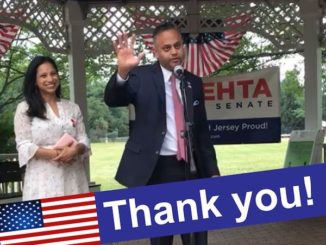
TRENTON, NJ (TIP): Former U.S. Food and Drug Administration official Dr Rik Mehta has won the Republican nomination for U.S. Senate from New Jersey and will take on incumbent Democrat Cory Booker in the general election in November.
Mehta defeated another Indian American Hirsh Singh by 12,532 votes, 39%-34%. Mehta is the first Asian American to win a statewide primary election.
“Thank you to voters who voted for me and the Republican and conservative leaders statewide who embraced our campaign from the start as the only one capable of attracting new voters to the Republican ranks, defeating Cory Booker in November, and lifting down ballot candidates in key congressional, special legislative, county, and local races”, Mehta said in a statement.
Dr. Rik Mehta is a biotech entrepreneur, innovator, healthcare policy expert and a licensed pharmacist and attorney. Trained at world-renowned Rutgers University as a pharmacist and lawyer, Dr. Mehta worked at the United States Food and Drug Administration as a Consumer Safety Officer to advance policies to expedite and increase access to quality, affordable drugs and health care. He also enforced against pharmaceutical companies taking millions of illegal prescription opioids off the market.
“As New Delhi seeks to reset ties with Beijing, it must take note of the ongoing Chinese debate on India”, says the author.
“Despite all the jingoism and rhetoric propagated through its official media, China is actually in a serious dilemma over its India policy. As we, in India, seek to reset ties with Beijing in the post-Galwan era, we should take note of the ongoing Chinese debate on India, factor in its many internal contradictions and perceived vulnerabilities vis-à-vis India, and leverage the same to our benefit.”
For China, which has long been preoccupied with its relentless pursuit to approach the center of the world and in managing a turbulent relationship with the United States, the June 15 incident of a violent face-off between Chinese and Indian troops at the Line of Actual Control (LAC), causing casualties on both sides, came as a big jolt. It brought the national focus back on an otherwise not-so-popular topic of China-India relations. The development took China’s strategic community by storm, while the intense debate and discussions that followed, rather than generating a consensus, brought out China’s many dilemmas vis-à-vis India.
On one side of the debate are China’s top India watchers such as Lin Minwang and Zhang Jiadong, from Fudan University, and Li Hongmei from the Shanghai Institutes for International Studies (SIIS) among others, who believe that the present conflict is not an “accident” but an “inevitable result” of what they perceive as “India’s long-standing speculative strategy on the China-India border”. From Doklam to Kashmir to India’s “unending infrastructure arms race” at the LAC, they say, Beijing was “fed up” and “had to teach India a lesson”.
Their key argument is that China-India relations hold no great prospect in the current international situation. There is no possibility of a negotiated settlement of the border dispute any time soon. India is already a “quasi-ally” of the U.S. with no scope for reversal. With opportunities for cooperation at the global level diminishing, regional competition intensifying and the earlier system of effective management of bilateral differences crumbling beyond control, periodic violent conflicts, they predict, are the “new normal” in China-India ties.
China, they argue, should reconsider its prevalent strategic thinking that India is not its main strategic challenge and, therefore, peace needs to be maintained in its direction as much as possible. Only by daring to fight, by showing strong determination, the will and the ability on the western frontier can China effectively deter its adversaries on the eastern coast. This is also, what they called, the right way to resolve China’s primary contradiction, that is the China-U.S. problem, by first breaking “its arms and legs”.
To deal with a resurgent India, Chinese hardliners suggest a policy of “three no’s”: “no weakness, no concession and no defensive defense”. In other words, China should take all opportunities to crack down on India, take the initiative to hit it hard whenever possible. This, it is argued, will not damage China-India relations; on the contrary, it will make it more stable. Didn’t the 1962 China-India war help China to maintain peace and stability on the western front for a long time and directly eliminate American and Soviet ambitions to use India to contain China? In this backdrop there is renewed interest among certain sections of the Chinese strategic community to: keep India under control by destabilizing the entire border region, creating tension across the board, from the McMahon Line in the east to the Aksai Chin area in the west; take the initiative to attack and seize territories under India’s control from Kashmir to Arunachal Pradesh, and weaken India internally, by supporting the cause of Maoists, Naga separatists and Kashmiris.
However, on the other side of the debate are Chinese political thinkers and professors such as Zheng Yongnian and Yu Longyu among others, who in their analysis of the Galwan Valley incident, have been somewhat critical about China’s policies towards India, which they say remain mostly tactical, of a “reactive nature” and are characterized by a “tit-for-tat” approach without any clear strategic intent. This, according to them, stokes extreme nationalism in India and unites the otherwise divided nation against China, which not only harms China’s interests but might eventually draw China into an untimely military conflict.
They criticize those vying to “teaching India a lesson” as being “short-sighted” and not “psychologically prepared for the rise of India”. China, they argue, lacks understanding of the fact that India, as a rising power, is very important to China and will be increasingly crucial in the future, with China-India relations evolving as the most important pair of relations after China-U.S. links.
If China-India ties are damaged beyond repair, they warn, India alone or in association with other countries will cause “endless trouble for China”. For instance, an openly hostile India will use every possible means to prevent China from reaching the Indian Ocean. On the other hand, the decoupling of China-India relations will further strengthen the “anti-China alliance” between the U.S., Japan, Australia, Vietnam, Indonesia and other countries, who will actively take the initiative to reshape global industrial chains, use the Indo-Pacific Strategy to check and balance China’s military and economic power, and expand international organizations such as the G-7 to weaken China’s influence in international affairs.
On a similar note, various commentaries in the Chinese press highlight that downgrading China-India relations to the level of India-Pakistan relations or a ‘Kashmirization’ of the China-India border is easier said than done as this will require a complete reversal of China’s present LAC policy of being “reasonable, profitable and economical”.
Strategically too, they say, it is “unwise” for China to take the initiative to get into a comprehensive military conflict with India — “a big country with comparable military strength”— at this point in time. The general view among these military analysts is that if China has an advantage in terms of psychology, equipment, and logistics mobilization, India too has advantage on various fronts such as deployment, supply line, practical war experience, topography, and climate, among others. If India’s disadvantage remains in the fact that its capital lies well within the bombing range of China, China’s key disadvantage is its particularly long supply lines. Therefore, if the conflict ends in a short period of time, it will benefit China. But if it is prolonged, China will be disadvantaged.
If a war starts, they argue, India will make all efforts to prolong it as long as possible, and the U.S. is likely to help India to attain this objective. Even if the two sides ended in a tie, in India it will be counted a victory and the national morale will rise sharply; on the contrary, in China, the morale will decline if it cannot beat India decisively. Therefore, in its effort to “teach India a lesson”, they fear, China might lose more than it would gain.
The overall consensus within this group is that it is still not the time to ‘resolve’ the India problem. Instead, China, for now, should strive to make India retreat without a military conflict, maintain basic peace and stability at the borders, and, at the minimum, not deliberately push it towards the U.S. Meanwhile, China simultaneously carries out its strategy of weakening India internally by leveraging its social and political differences, completing its strategic encirclement, improving troop deployment in the Tibet region to secure the China-Pakistan Economic Corridor, and stationing Chinese troops in the Gwadar Port (Arabian Sea), so as to secure China’s Indian Ocean sea routes, among other interests. In the words of another Chinese strategist, Yin Guoming, rather than winning a war, China should aim at attaining a comprehensive and overwhelming advantage in geopolitics vis-à-vis India, which cannot be altered by war.
To sum up, despite all the jingoism and rhetoric propagated through its official media, China is actually in a serious dilemma over its India policy. As we, in India, seek to reset ties with Beijing in the post-Galwan era, we should take note of the ongoing Chinese debate on India, factor in its many internal contradictions and perceived vulnerabilities vis-à-vis India, and leverage the same to our benefit.
(The author is a Researcher at the Delhi Policy Group (DPG). She is a graduate from Tsinghua University, China and has been a Chinese language fellow at the National Central University, Taiwan. She can be reached at antara@dpg.org.in)
Changes to U.S. visa rules might do more harm than good to US economy in the long term
The administration of U.S. President Donald Trump seems bent on pursuing controversial immigration policy measures following the COVID-19 pandemic. Now, visa issuance to students enrolled in universities or programs that are conducted entirely online for the fall 2020 semester will be stopped; such students will not be permitted to enter the U.S. The federal Immigration and Customs Enforcement agency also advised that active students currently in the U.S. enrolled in programs that would be administered in online mode are required to leave the country or transfer to a university with in-person instruction to remain in lawful status. If not, ICE cautioned, they risk the initiation of removal proceedings or similar immigration consequences. Palpable ripples of anger across the U.S. education system took the form of lawsuits, led by Harvard University and the Massachusetts Institute of Technology to block the ICE directive. This is the latest twist in an ongoing immigration policy crackdown by the Trump administration, which includes a halt in the issuance of visas for skilled workers, or H-1B and their dependents, visas for intra-company transfers, or L-1 and their dependents, and several other visa categories as well as a halt in green card processing, all until the end of the calendar year.
Taking a step back, the evolving Trump immigration paradigm leaves several big questions unanswered. First, while an argument, however harsh and myopic, could be made that the U.S. economy has suffered a battering in the wake of the COVID-19 pandemic and a key to recovery is to protect U.S. jobs from being cornered by foreign workers, what could the possible rationale be to imperil the lives of foreign students — all of them admitted to universities on merit, and none of them posing an immediate threat to jobs? Second, given that market forces of demand and supply have led to the U.S. economy being suffused with immigrant workers across sectors for many decades, how could the Trump administration now posit that its local population has adequate skilled labor to do the jobs that millions of Indians, Chinese and other foreign workers have so efficiently been doing all this while? Unless Mr. Trump is planning to massively overhaul the U.S. higher and professional education systems to imbue Americans with technical know-how and a culture of advanced learning, it may be futile to wall off large swathes of the economy to those capable of delivering value in such jobs. If Mr. Trump is only doing this to shore up his election campaign through political signaling, then it is the economic prospects of the very people he claims to be fighting for that he will damage in the longer term.
The notion of power behind the perpetuation of cruelty may be understood as a battle between the violator and his prey. It is a double-edged sword whereby the victim can either turn into a groveling, sniveling, emotional and physical wreck, or rise phoenix-like above his/her humiliation and transfigure into a determined combatant ready to take on the aggressor through dignified retaliatory action or role reversal.
Whether we fall by ambition, blood or lust,
Like diamonds, we are cut with our own dust. — John Webster
Alchemy, by definition, is a seemingly magical process of transformation, creation or combination, a medieval precursor of chemistry concerned with the transmutation of matter and with trying to find a medicine that could cure any disease. In the context of modern day reality overwhelmed by violence, it could well be a search for the philosopher’s stone that could alter the anatomy of violence.
Violence — the very word conjures up nightmarish visions of sadistic pleasures that challenge the very basis of human dignity and love. It is an endemic ‘pandemic’ that is slowly consuming the world more rapidly than any monstrosity hitherto known. One sees it all around now more than ever before and it is disturbing to know that life and the promise it holds out for us can be so fragile. When one wakes up every day to the reality of a host of injuries and losses on account of territorial disputes, manslaughter, murder, suicide, rape, domestic violence, lynching, acid attacks et al, the human spirit can be severely undermined. When the impact of a thappad (slap) reverberates through concentric circles to land squarely on a face uplifted in trust; when one hears the onomatopoeic Chhapaak of carelessly splashed acid or slush landing on an unsuspecting victim once too often, the alchemy of violence is born.
A random survey shows that the incidence of violence and trauma — acute, chronic or complex — in our country is as high as one per minute. The tragic deaths of Sushant Singh Rajput, Jayaraj and his son Bennix, George Floyd, the viciousness in the Galwan valley and other such horrifying incidents of unimaginable brutality, are all pretty much symptomatic of what ails contemporary civil society. While acute trauma results from a single incident and chronic trauma is the outcome of prolonged abuse, complex trauma arises from exposure to traumatic events, often of an invasive, interpersonal nature. Besides, there are a host of other afflictions and ailments that threaten to invade our bodies and mind without any warning and their possible prognosis can leave one gravely distressed. Thappad, Chhapaak and the other illustrations mentioned above thus metamorphose into multivalent symbols that float like leitmotif through most narratives of belligerence, with aggression figuring at the bottom of the pyramid of violence and brutality. So, it is important to not only keep oneself informed about the remedial options available and seek the assistance of healthcare professionals, psychotherapists, law enforcing agencies, NGOs etc., but also to generate public awareness and support against such hydra-headed insecurities. Positive action in the face of grave adversity can often alter the basic structures of emotion.
Violence works in several ways and at several levels — emotional, sexual, verbal and physical. In cases of interpersonal relationships and ‘trauma bonding’ — a strong emotional attachment between the abuser and the abused through intermittent cycles of reward and punishment — the perpetrator develops a stranglehold over his victim by eliciting fear and gratitude for being allowed to survive. But if the abuser gets away with impunity day after day, brutality begins to worm its way into his psyche so insidiously that he is ready to bare his teeth at the slightest hint of resistance or provocation from the stricken. Therefore, the whole notion of power behind the perpetuation of cruelty may be understood as a battle between the violator and his prey. It is a double-edged sword whereby the victim can either turn into a groveling, sniveling, emotional and physical wreck, or rise phoenix-like above his/her psychosomatic humiliation and transfigure into a determined combatant ready to take on the aggressor through dignified retaliatory action or role reversal. Violence, thus, has an alchemic power. While it can galvanize the victim into constructive action for oneself, by some extraordinary alchemy, it can also invest the sufferer with greater resolve to take up the cause of others similarly positioned. Conversely, the transgressor can either be contrite and seek redemption or sink further into the pits of depravity, even necrophilia sometimes and consequently be filled with self-loathing (Manto’s Toba Tek Singh) to a point of self-annihilation. What needs to be remembered then is that, when the thin line between passion and reason gets completely obliterated and the oppressor loses all sense of continence, the effect of the hand that inflicts the blow can very often boomerang on the striker himself and destroy him.
Violence, per se, is multi-causal. Whether villainy is in a habitual offender’s DNA or triggered by unhealthy competition, whether it is self-inflicted or provoked by an external agency, whether it is related to socio-economic, socio-cultural or religio-political dynamics, or whether it is driven by fear, anxiety, revulsion, anger or revenge, it is self-destructive. If resentment keeps simmering for too long, it threatens to erupt like a volcano and destroy all that is beautiful, leaving behind a trail of cinder and ash. As such, before raising a hand to deliver a fatal blow, the striker must wait for the iron to cool down rather than blow the bellows harder. Humans are no punching bags to vent frustration and inadequacies on. Nor are they percussion instruments to be slapped and banged with rhythmic regularity by warped minds to produce gruesome strains!
Since our physical appearance is our first introduction to our social milieu, the desire to feel and look good is a natural human desire. Ergo, the maintenance of good mental and physical health, should remain our primary concern. The contribution of healthy physical and nutritional habits to our well-being and our ability to face the world with equanimity thus can never be overemphasized. Hence, to ensure that things don’t fall apart and the center holds, seek if distressed and you shall stumble upon a solution; talk if in need of help and you’ll get a sympathetic ear; send out a smoke signal and you’ll be rescued.
(The author is Emeritus Professor of English, Panjab University, Chandigarh, India) / Tribune, India
“Historically, pandemics have forced humans to break with the past and imagine their world anew. This one is no different. It is a portal, a gateway between one world and the next. We can choose to walk through it, dragging the carcasses of our prejudice and hatred, our avarice, our data banks and dead ideas, our dead rivers and smoky skies behind us. Or we can walk through lightly, with little luggage, ready to imagine another world. And ready to fight for it.” – Arundhati Roy
The New Jersey Performing Arts Center’s (NJPAC’s) Community Engagement team has started a new series of social justice initiatives this summer. This begins with two series of events — both of them virtual – that will address these issues.
The first series is of online panel discussions around issues of race, equity and social justice.
“Democracy, Voting, Census: A Conversation about Power” was the first of these. It was a Zoom video conference event on July 6 at 7 p.m. that NJPAC hosted with colleagues at the New Jersey Institute of Social Justice and the Newark Branch of the NAACP. It was moderated by Andrea McChristian, Law & Policy Director for the Institute.
March for Democracy, Voting, Power Photo / Courtesy NJPAC
The goal for this event was to ensure that everyone understands the importance of taking part in civic life, and how to harness the power that we have as citizens, right before New Jersey’s next election, like completing the Census (and encouraging others to do so as well!), hosting a candidate’s forum, and advocating for criminal justice reform with our elected officials.
A cohort of activist thought leaders came together as panelists for this inaugural event. They included
A’Dorian Murray-Thomas Photo / Courtesy NJPAC
A’Dorian Murray-Thomas, the founder and CEO of SHE Wins, a social action organization for middle and high school girls in Newark, who is also, at 23, the youngest person ever elected to the Newark Board of Education;
Shennell McCloud Photo / Courtesy NJPAC
Shennell McCloud, the Executive Director of Project Ready, an education advocacy group;
Henal Patel Photo / Courtesy NJPAC
Henal Patel, Director of the Democracy & Justice Program at the New Jersey Institute for Social Justice; and
Denise Quijada Photo / Courtesy NJPAC
Denise Quijada, Census and Partnership Manager for Sadie Nash Leadership Project, which promotes leadership and activism in young women.
Andrea McChristian Photo / Courtesy NJPAC
Andrea McChristian, Law & Policy Director for the Institute, moderator
The Arts Center has formed a Social Justice Programming Task Force, to workshop ways we can examine the state of civil rights in our state and our nation, and how we can move progress forward.
“Dialogue can open a door. But to walk through that door, you have to actually ‘do’ something.” – Donna Walker Kuhne, Senior Advisor – NJPAC’s Community Engagement
The second series, which represents an evolution of NJPAC’s long-running PSEG True Diversity Film Series into the PSEG True Diversity Film Club. This series always focused on issues-based films; now it will highlight works that address race and social justice. To keep things safe during the pandemic, the Film Club is moving toward a book-club inspired model: Every month a film will be picked, and the public is invited to screen that film a week in advance of the event.
This is how it is done: For example, the documentary “13th”, the first selection, can now be screened for free on Netflix, even if you’re not a subscriber, or on YouTube.
Then, once all have watched the film, participants and observers get together on a Zoom video conference to discuss it, with a moderator who can bring context and insight to what we’ve seen. Our first entry, Ava DuVernay’s searing documentary “13th”, about the relationship between the abolition of slavery (established by the 13th amendment to the Constitution) and the mass incarceration of African American men, will give us many avenues to discuss inequality in our criminal justice system. Rick Thigpen, PSEG’s Senior Vice President, Corporate Citizenship, and the chairman of the PSEG Foundation, will host the first discussion on July 20 at 7PM. To join this live conversation via Zoom, you must register at www.njpac.org
There will be another panel conversation, and another film club meeting, every month.
“Conversations about justice, equality and access have always been an integral part of NJPAC’s role as an anchor cultural institution. As America’s most diverse performing arts center in terms of programming, staff and audiences, these values are embedded in our heart and soul.” – John Schreiber, President-CEO, NJPAC
About NJPAC’s Community Engagement
NJPAC’s Community Engagement is committed to being a resource for all who seek to educate themselves about the need for social justice, and to make their own voices heard. The organization will do its part to register voters, encourage Census participation, and make the contact information of our representatives in Trenton and in Washington D.C. easily available to anyone who wishes to speak to those in power about what their community needs. Links to all these resources are at www.njpac.org.
About NJPAC
From interns to ushers, artists to donors, NJPAC is the most diverse performing arts center in the nation with the best people on the planet. They come from many backgrounds. They’ve taken many journeys to get here. And they’re all proud to be part of the NJPAC community. Those who work at NJPAC today embrace that same desire for systemic societal change. At NJPAC, they’re ready to fight for it.
NJPAC located in downtown Newark, N.J., prior to COVID-19, has been America’s most diverse performing arts center, and the artistic, cultural, educational and civic center of New Jersey – where great performances and events enhance and transform lives every day. NJPAC brings diverse communities together, providing access to all and showcasing the state’s and the world’s best artists while acting as a leading catalyst in the revitalization of its home city. Through its extensive Arts Education programs, NJPAC is shaping the next generation of artists and arts enthusiasts. NJPAC has attracted nearly 10 million visitors (including over 1.7 million children) since opening its doors in 1997, and nurtures meaningful and lasting relationships with each of its constituents.
Get Social! Follow NJPAC Online:
Website: http://www.njpac.org/
Twitter: @NJPAC
Hashtag: #NJPAC
Facebook: facebook.com/NJPAC
YouTube: NJPACtv
(Mabel Pais writes on Social Issues, The Arts and Entertainment, Health & Wellness, and Spirituality)
The first Webinar on Augmenting US-India Healthcare Relations under Covid Challenge organized on June 1
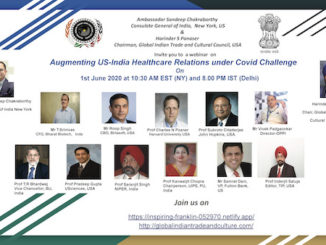
NEW YORK (TIP) :The first webinar on June 1 focused on augmenting US-India Healthcare Relations under Covid Challenge. The panelists included Ambassador Sandeep Chakravorty, Consul General of India at New York, Prof. T R Bhardwaj, Vice Chancellor, Baddi University, HP, India, Mr. Vivek Padgaonkar, Ex Director, Organization of Pharmaceutical Producers of India, Prof Saranjit Singh, Pharmaceutical Scientist, NIPER, India, Prof Kanwaljit Chopra, Chairperson, UIPS, PU, Prof Charles N Pozner, Head Emergency Medicine , Harvard University, Mr. Samrat Dani, Vice President, Fulton Bank, USA, Prof Pradeep Gupta, Burroughs Wellcome Professor of Pharmaceutics, Mr Roop Singh, Chief Business Officer, Birlasoft, USA, and Prof. Indrajit S Saluja, Publisher and chief editor The Indian Panorama.
H S Panaser
Welcoming and introducing the panelists Mr. H.S. Panaser, Chair, Global Indian Trade and Culture, USA. Spoke on the need for a series of webinars to deal with the subject of cooperation between the U.S. and India in the pharmaceutical sector. He said, “The dependencies and inter-dependencies of globalization especially between US and India, have been in headlines during the COVID-19 pandemic—and nowhere more so than in the Healthcare segment. More so, in pharmaceutical industry.
Mr. Panaser spoke about the Indian pharmaceutical scene and the healthcare sector. “The Indian healthcare sector is expected to reach Rs 19,56,920 crore (US$ 280 billion) by 2020. Rising income level, greater health awareness, increased precedence of lifestyle diseases and improved access to insurance would be the key contributors to growth. Indian Pharmaceuticals is a sunrise industry with a competitive advantage for India globally. we should leverage India’s position by unleashing entrepreneur spirit the bullish outlook for health care segment is now taking India in a forward momentum. The market size of India in Pharmaceuticals alone is estimated to be $100 billion and medical devices is $25 billion by 2025. Now with amendment in FDI policy where one can invest up to 100% specially if it is medical devices segment where India is importing 80% of medical devices”, Mr. Panaser said.
Ambassador Sandeep Chakravorty
Ambassador Sandeep Charkavorty, Consul General of India at New York who inaugurated the webinar series, said he was not aware there was to be a formal inauguration.
“I think webinar, zoom and WebEx conferencing are the new normal. It is high time that we start reconditioning our life to this new format . So I’m very happy to be here with such a distinguished panel. I will first like to congratulate our friend Harry Panaser for bringing up this panel of speakers .He has been working in the health care sector for several years now and he has deep knowledge and connections here in the United States and back home in India and it is not surprising that he has decided to hold a seminar on Indo US cooperation and collaboration in health care , particularly in the context of Covid challenge. To set the ball rolling, I am very happy to inaugurate this webinar”.
Mr. T Srinivas
Mr. T Srinivas, the CFO of Bharat Biotech of Hyderabad, India which owns 160 global patents said, “Our products help people in over 65 countries live to their fullest potential. Our manufacturing facilities are approved by USFDA, KFDA and WHO. We have delivered over 3 billion vaccine doses all over the world.”
Mr. Srinivas said “We started working on Covid vaccine in March 2020. We are now working on animal trials in India.
Prof. T R Bhardwaj
Prof. T R Bhardwaj, Vice Chancellor, Baddi University, HP, India said it was a matter of pride that India has emerged as a global Pharmaceutical Competitor. One third of the world’s generic drugs and formulations as well as bulk drugs, and Active Pharmaceutical Ingredients (APIs) are manufactured in India. “You will be surprised to know that one third of India’s production is from Himachal Pradesh , mainly from Baddi area, in the neighborhood of Baddi University. Baddi is Asia’s largest industrial hub and is only 45 Km from Chandigarh”.
“India has always been considering profession of Pharmacy as service to the mankind. Dr Yusuf Hamied , CIPLA Limited, has already served the poor AIDS patients of Africa by providing Anti – AID medicines at the cheapest rates. The same service to the mankind has been further repeated by our PM to provide Hydroxychloroquine and other preventive drugs to US and other countries during Corona Pandemic.”
Prof Bhardwaj said “You will be pleased to know, it is a matter of pride for us, that Baddi University extended their hostels facility to the staff, working round the clock ,of all these manufacturing companies during Covid – 19 lockdown. Although at present we have around 75 FDA and almost 70 approved by regulatory agencies of other countries such as Australia, South Africa, Europe etc.”, said Prof Bhardawaj
Mr. Vivek Padgaonkar
Mr. Vivek Padgaonkar, Ex Director, Organization of Pharmaceutical Producers of India said:” India-US partnership has been consolidating over the years and COVID-19 pandemic has further bolstered Indo-US partnership through supply of HCQ and other APIs. While there has been a huge strain on the healthcare system due to outbreak of COVID-19 pandemic, pharmaceutical companies have an unprecedented opportunity to play a significant role in this fight against the virus. With every adversity comes a learning opportunity. Covid-19 has been no exception. One major takeaway has been the power of collaboration”.
“In the middle of this global crisis, Indian pharma has proven to be consistent and reliable. The biopharmaceutical industry generates significant economic value in terms of job creation, R&D investment, and medications that improve patient productivity. However, the first quarter of 2020 saw disruption of many industries’ supply. Currently, Indian pharmaceutical companies account for around 40 per cent of the generic drug supply to the US market.”
Vivek said “We can partner with innovators (e.g., Serum Institute of India with two companies on the vaccine for COVID-19; Gilead is partnering with many Indian companies on Remdesivir.”
Prof Saranjit Singh
Prof Saranjit Singh, Pharmaceutical Scientist, NIPER, India said “Covid pandemic has helped Indian Industry to regain the stature to certain extent. Over a 10-year period (2009-2018), the U.S. saved about two trillion dollars through generic drugs. Foremost is re-building faith in Quality of Indian Generic Drug Production. He emphasized the importance of National Institute of Pharmaceutical Education and research and the visionary who initiated the institute, Late Prof Emeritus Harkishan Singh. There is a need for impetus for industry to get above the basic GMP compliance to high-tech manufacturing, so that quality is built into the product, and not tested. The academia also needs to rise to occasion and shall collaborate for training of students in high-tech emerging areas with leading International institutions using e-modes. The country needs to establish Centre’s of Excellence (COE) in areas, like viral drug research, continuous manufacturing, etc. Innovation and deep scientific research have to be thrust areas for pharma institutions in future” quoted Prof. Singh.
Prof Kanwaljit Chopra
Prof Kanwaljit Chopra, Chairperson, UIPS, PU, India emphasized the research at the university. She quoted a range of top CEOs and professionals in Academia, Government and Industry who are from Punjab University globally in Pharmaceuticals.
Prof. Charles N Pozner
Prof. Charles N Pozner, Head Emergency Medicine , Harvard University, presented the video clipping on operations process of stimulation now reaching India.
Mr. Samrat Dani
Mr. Samrat Dani, Vice President, Fulton Bank, USA presented his experience of putting finance in API and infrastructure. He highlighted the concept of mergers and collaboration in Medical Devices as well.
Prof. Pradeep Gupta
Prof. Pradeep Gupta, Burroughs Wellcome Professor of Pharmaceutics, talked on the importance of Universities participation in research and development on pharmaceutical formulations and new drug discoveries.
Mr Roop Singh
Mr Roop Singh, Chief Business Officer, Birlasoft, USA said: “Birlasoft has invested in next generation transformational PV Tools/ Platforms powered with cognitive technologies including ML/AI and natural language processing which have the capacity to deliver insights from the data-based evidence coming out of clinical trials to help us very rapidly understand which drug and vaccine candidates we should double down on because they hold the most promise to be effective and safe, vs. those in which we should stop investing.
Prof. Indrajit S. Saluja
Summing up the deliberations, Prof. Indrajit S Saluja congratulated panelists for an extremely meaningful discussion . He congratulated Harry Panaser for taking the initiative to bring the best minds together from the pharmaceuticals sector. Prof. Saluja appreciated Prof. Tilak Bharadwaj for making a solid claim for US India collaboration. Prof. Bharadwaj said India had a lot to attract US companies to operate in India. Strong manufacturing base, cost effectiveness, established network of labs, scientists and professionals, strong marketing and distribution network , potential growth of clinical trials, , fast growing health industry, quality control – all these are good enough attractions.
Prof. Saluja also recalled the great contribution of Padma Shri Prof. Harkishan Singh to promotion of pharmaceutical research and development. He recalled Prof. Kamaljit Singh Chopra’s words: “ His stellar contribution is the field of pharmaceuticals has had a great impact on research in the field of pharmaceuticals”.
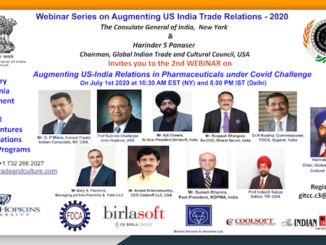
NEW YORK (TIP): The Global Indian Trade and Cultural Council in association with the Consulate General of India, New York organized the second webinar in the series “Augmenting US India Trade Relations – 2020” on July 1.
Welcoming the panelists, Mr. H.S. Panaser, President of The Global Indian Trade and Cultural Council said, “US strategic and trade affairs experts feel that US and India will be key to future production of medical supplies and pharmaceuticals not only to fight Covid-19 crisis but long thereafter.
“In the United States, every seventh American is seen by an Indian doctor, which will soon be 6:1, signifying the contribution of the diaspora in the American healthcare system. Today, as the world fights the corona pandemic and the US becomes its worst victim, with over 100,000 deaths and counting, health diplomacy has emerged as the new unifier for the two democracies and the driver for an intense partnership promising a big relief to the world with a timely vaccine against the coronavirus.
“Global Indian Trade and Cultural Council” wants to accelerate and promote US India Relation in Healthcare industry. We are helping in FDI, collaborations, mergers and technology transfers and researchers and students exchange programs. The US has already identified Indian pharmaceutical companies as one of the partners for mass productions to meet global demands. We were privileged to have CFO of Bharat Biotech Mr. T Srinivas in our first Webinar and you will find another Executive who are launching a Covid vaccine
Panelists included Devi Prasad Misra, Consul (Trade, Education and Commerce), Dr. Subroto Chatterjee, Dr. H. G. Koshia, Mr. Suresh Khanna, Mr.Roopesh Bhargava, Mr. Anand Krishnamurthy, : Mr. Gary Pasricha, Mr. Ajit Chawla, Prof. Indrajit S Saluja, and Mr. H.S. Panaser
Mr. Devi Prasad Misra
Mr. Devi Prasad Misra, Consul Trade, Education and Commerce at the Indian Consulate in New York participated briefly.
Dr. Subroto Chatterjee
Dr. Subroto Chatterjee is a Professor of Pediatrics and medicine in the division of Cardiology at the Johns Hopkins University School of a Medicine. His expertise is in the area of heart disease and inflammation. He has published over 200 papers book chapters. And has received international and national awards for his discoveries and patents. He serves as a thought leader to Merck, Novartis and has founded several Biotech companies
Prof Chatterjee said, “Studies show that inflammation is the underlying factor among others contributing to excessive morbidity and mortality in COVID-19 patients. And this pathology is attributable to the release of cytokines subsequent to the binding of the virus to the angiotensin-2 receptors in white cells circulating in the blood. One of these cytokines ,known as interleukin-6(IL-6) bind to cells in the blood vessels -further amplifying the release of cytokines causing multi-organ failure and death. Immunotherapy using antibody against IL-6 /IL-6 receptors has shown promise with delayed viral clearance and markedly improved recovery from infection and reduced hospitalization time.”
Dr. H. G. Koshia
Dr. H. G. Koshia is working as Commissioner at Food & Drugs Control Administration (FDCA), Gujarat, INDIA since January 2009. Notified as Commissioner of Food Safety of the Gujarat State from 5th August 2011. Diverse experience of 33 years in regulatory affairs working in government and industry. Leading a cross-functional team of 1465 diverse regulatory experts to implement; enforce applicable regulation to regulate 4697 drug manufacturers and 39865 sales units in Gujarat.
Hemant said, “The crisis has faded many boundaries and brought people and countries together to stand united against the fight! More so true when it comes to the pharmaceutical industry – India has stood as a strong partner and friend with many countries including the US and fulfilled the duty of ‘Pharmacy of the World’. I see tremendous avenues of US-India continued partnership in biomedical & pharmaceutical research and strengthen our regulatory & scientific relationship further. Exchange of knowledge, technology, science, and talent are few to name.”
Mr. Suresh Khanna
Mr. Suresh Khanna, Engineer by education, was Founder Chairman of M/s.Stabicon Life Sciences Pvt. Ltd. A Contract Research & Development Organization and Designated Partner of M/s. Dossiers Solutions Services LLP, a leading Regulatory Affairs Company. He is a Business Advisor and Member of the Boards of a few companies in both India and abroad. Currently he is a Steering Committee Member of KDPMA, Chairman of Pharma Training Institute and Permanent Trustee of Karnataka Pharmaceutical Trust (KPT), a not for profit Organization, engaged in the upliftment of Pharmacy Education in India.
Mr Suresh Khanna said “India stated that India has a huge potential for providing Pharma Services which people generally don’t talk about. India has very experienced and qualified pool of professionals who can assist in Formulation Product Development, Compiling Product Dossiers/API DMF’s for registration in markets worldwide, SOP Writing, Clinical/BE studies & Clinical Data Management, Validation protocols, setting up Pharmacovigilance Call etc. at a very competitive cost. These costs will be affordable by many small and medium Centers scale companies in USA, thereby making them more competitive commercially worldwide. These services are akin to services provided successfully by Indian software Industry worldwide.”
Mr. Roopesh Bhargava
Mr. Roopesh Bhargava is an Experienced in leading and growing all sectors of a business (Pharmaceuticals/ Nutraceuticals/ Vaccines) for the last three decades with Proven Credentials. He has served Companies like Sanofi as Senior Director / Besins Healthcare as Managing Director and Bharat Serums & Vaccines as Chief Operating officer till very recently .He has the experience of having Worked in Greater India, China and US markets. Currently, he is a consultant to the Pharmaceutical Companies to make it dynamic and Progressive organization. Possessing excellent communication skills and able to establish sustainable and profitable relationships with Customers, suppliers and stakeholders across the country.
He said “India and US have to augment each other to ensure that best of the Medicines / Vaccines reach to fellow humans at an affordable price with excellent Quality. India Supplies 40% of total Generic medicine required by USA. The Capacity to Produce vaccines also lies with India as required. Hence faster approvals and joint efforts by each other is the call of the day. The advantage which India has in terms of cost efficiency, Economic drivers, Policy support and Investments can be fully leveraged under the trying circumstances for a Win- Win situation.”
Mr. Anand Krishnamurthy
Mr. Anand Krishnamurthy, CEO, Coolsoft LLC, is a fast-growing company, focused on AI and ML it is providing consulting and application development services in Information Technology. COOLSOFT combines technical expertise with in-depth business knowledge to provide the best solutions to organizations in Healthcare, Transportation and Telecom.
Anand said “In the area of Pharmaceuticals, Science and technology will and should play a key role. Artificial Intelligence and Deep Learning will assist us in finding new cures for diseases. This will aid in discovery of cures for rare diseases where the ROI for the drug companies is not significant. Technologies such as blockchain will aid in the fight against counterfeit drugs which will save lives lost due to fake drug usage and administration. AI/ML and Genomics will cause as much a change to the human race as the industrial revolution did. More importantly, the close collaboration between academia, researchers and philanthropist between India and US should and will result in making new and affordable drugs for now and the future.”
Mr. Gary S. Pasricha
Mr. Gary S. Pasricha is the managing partner of the law firm of Pasricha & Patel LLC. He has been practicing law for over 25 years, specializing in representing businesses and individuals in business law matters such as contracting, mergers and acquisitions, secured lending, import and export regulations, labor law, and business immigration
Garry presented a ppt on laws in US under Covid 19 especially PPE
Mr. Ajit Chawla
Mr. Ajit Chawla is SVP & Global Head, Digital Business Unit, Birlasoft, a CK Birla group company whose Mission statement is “Making Societies more productive by helping our customers run their business”. Guided by the company mission,
“Both lives and livelihoods are important. Return-to-work strategies need to be comprehensive yet pragmatic. While on one side, organizations in sectors such as Pharmaceuticals who engage in mission-critical operations cannot afford more disruptions, their employees also look for confidence and assurance on health & safety front to return to work. Guided by its Mission statement “Making Societies more productive by helping our customers run their business”, Birlasoft has launched a solution named intelliOpen™ that leverages digital technologies to empower its customers to make their facilities safer during and post COVID-19. intelliOpen can help organizations in all industries but considering the ones in life-sciences industry touch human-lives directly, we are specially motivated in helping them balance productivity with safety.”
Prof. Indrajit Saluja
Prof. Indrajit S Saluja is the Publisher-Editor of The Indian Panorama (New York; Dallas), Advisor on Board at Global Indian Trade and Cultural Council., USA, President, Indo-US Media Inc., President, Opinio Media, Inc. is an Academician, Journalist, Writer, Poet, Speaker, Actor, Television Host/ Anchor. Recipient of many honors and awards, Prof. Saluja has served on Panjab University Academic Council and Languages Faculty and was nominated to a 2-year term on the National Youth Advisory Committee, headed by Prime Minister of India. Currently based in New York, he hails from Punjab, India where he was a college teacher of English language and literature for 35 years.
Prof. Saluja said there were enough areas and opportunities for cooperation between US and India. He underlined the present geopolitical scenario in which China which has hitherto been monopolizing trade with US , has fallen out with the nation which contributed most to its growth. It is an opportune time for India to take advantage of the situation and broaden its manufacturing base to substitute China for US needs of products from pins to toys to electronics etc.
Mr. H.S. Panaser
Mr. H.S. Panaser is the Founder and President of Global Indian Trade and Cultural Council, USA. He is a strong and innovative leader with more than three decades of experience in fortune 500 companies in Pharmaceutical, Medical Tourism and Food and Health segment in Global Marketing. Harinder had been working for over a decade as Chair for a Super PAC promoting US India relations. His Other affiliations and experience includes Chair, NJ, NY Chapter, US India Political Action Committee, Ex. President, Global Haryana Chamber of Commerce, Advisor on Board, C3Summit International LLC, Ex. President, US SAARK Business Forum, Director A I Nexus, President – Global Marketing NYSO, India and Ex. Member on Board, Automotive Aftermarket Industry Association, USA.
Panaser concluded by thanking the speakers at the panel of this webinar and saying as we quote “India has emerged as a global capital of generic medicines and can contribute to the world by producing cheap drugs, including vaccines. With US support in scientific advancement and technology at its command, a high-quality medical research enabled to India can aid the mass production of vaccines and essential drugs in India, eventually helping the world facing a crisis like Covid-19 currently.”
“In a continued effort of this series of webinars we are trying to get representatives from The Indian Council of Medical Research, Ministry of Health and Ministry of Chemicals, Government of India to join our webinar and address The Indian diaspora connected to the health care industry in the United States”, Panaser concluded. .
Covid-19 has not only devastated lives and livelihoods across the globe, but also played havoc with the academic calendar. Amid the restrictions necessitated by the pandemic, educational institutions have been engaging with students through online classes — a ‘something is better than nothing’ option that factors in the current unfeasibility of in-person teaching. In a move betraying total disconnect with the situation on the ground, the Donald Trump administration has made it tougher for international students to stay and study in the US. America’s Immigration and Customs Enforcement agency has said that it would not allow holders of student visas to remain in the country if their institution goes fully online for the upcoming fall season. These students face the risk of deportation if they don’t shift to universities and colleges offering a blend of in-person and online coursework.
The US State Department claims that this ‘temporary accommodation’ provides greater flexibility to foreign students, but it’s actually a coercive step that severely limits their choices and forces them to ‘take it or leave it’. The rash decision will particularly hit Indian and Chinese nationals as the two countries together account for about half of the over 11 lakh international students in the US. With India’s Foreign Secretary Harsh Vardhan Shringla promptly expressing concern over the development, the US is likely to find itself under increasing diplomatic pressure to do a rethink sooner than later.
The Trump administration has chosen to play the ‘us versus they’ card months before the presidential elections. The divisive order, which has been challenged in a federal court by Harvard University and the Massachusetts Institute of Technology (MIT), could prove to be counterproductive in more ways than one. Slamming the door on a large group of foreigners would deprive America of a major money-spinner at a time when its economy is in the doldrums. With no sign of a let-up in the Covid crisis, US universities and colleges are justified in switching to the online mode, albeit as an ad hoc, stop-gap measure. Maintaining the standards of education matters; so does the safety of students and teachers. The challenge lies in striking a balance between the two considerations.
The pandemic unlocked hidden energy in governments. The lethargy and inertia in governance disappeared without any loss of time as the threat to the common man’s life and livelihood was perilous. It led to prompt decision-making, rapid re-formulation of programs and policies to minimize the devastation and provide relief to the vulnerable population.
The Covid-19 pandemic has wreaked unprecedented havoc on mankind and across nations. The contagion is global, and perhaps, requires a coordinated worldwide response. It has blurred the distinction between the developed and under-developed worlds and seems to be pushing for a new socio-economic world order.
The devastation caused by the pandemic is debated and feared by everyone. Trade, business and industry have been impacted in equal measure, though agriculture seems to have shown some resilience to beat the ill-effects of the virus. The producers of food grains have so far found their way through the shutdown. They have succeeded in the harvesting of winter crops and the sowing of summer crops despite the pandemic. Even the governments were at ease in distributing grains in the face of broken food supply chains because of sufficient buffer stocks. But the loss of producers of perishable commodities such as fruits and vegetables, dairy and poultry products could not be prevented owing to disruptions in transportation and demand contraction.
Likewise, loss of jobs, particularly those in unorganized sectors could not be avoided as production processes halted and the markets were closed. Even after unlocking the markets, there are not many buyers due to the declining income and liquidity crunch. The gradual opening of businesses has, however, created hope for many in the MSME sector. The revival of employment in agriculture has somehow shown more promise than the other sectors of the economy.
Without undermining the losses thrust upon society and the economy, it has to be admitted that the pandemic has compelled the people for a change in behavior that is otherwise difficult to achieve. Avoidance of non-essential travel and luxurious spending, maintenance of social distancing, hand hygiene, and the wearing of the mask or any such thing that keeps one’s health assured or good and saves life are liked or at least not abhorred by the common man. Even those who preferred free loitering in groups are now maintaining social distancing.
At times, it was difficult to persuade people to take potable piped water connections, build toilets, avoid open defecation, ensure safe food quality and maintain sanitation in galis (lanes) and mohallas (localities). Today, the demand for such basic services has increased. The communities are compelling for the provisioning of these essentials. They are even ensuring surveillance on Covid-19 cases and travelers around their villages or habitations. Health consciousness has risen to a new high. Even the addicts are seeking treatment to return to normal living, much to the detriment of drug suppliers and peddlers.
The pandemic has propelled the use of digital technology. Fintech, proptech, edutech, and agri-tech are now common in day-to-day conduct of business. Digital education, unknown to over 90 per cent of teachers, is now widely preferred. During the recent harvesting and sowing of crops in Punjab, most farmers were eager to be a part of digital messaging through WhatsApp or other apps. They downloaded e-passes for the sale of their products and used debit/credit cards more often than ever before. The disrupted food supply chains were also kicking, even in containment areas, due to the use of digital technology. The Amazons and Zomatos were able to reach more households despite restrictions.
Another satisfying change is the decline in avoidable lavish spending on social occasions such as marriages and other such celebrations that are identified as one of the major reasons for the rising indebtedness amongst the farmers and landless workers. The restrictions on social extravaganza, tried many times earlier, succeeded, though forcibly during the pandemic. No policy or programme could achieve this and hopefully, it will be maintained in the future.
The pandemic unlocked hidden energy in governments. The lethargy and inertia in governance disappeared without any loss of time as the threat to life and livelihood for the common man was grave and hugely perilous. It led to prompt decision-making; rapid re-formulation of programs and adjustment of public policies to minimize, if not avoid, the devastation and provide immediate relief to the affected vulnerable populations. The quick proclamation of lockdown, rapid upgrade of health infrastructure, swift identification and resolution of unrealized problems such as migrant workers and fiscal stimulus are some of the outcomes of a new way of life and, of course, governance.
The pandemic has surely led to a new normal in our lives. It is different, but not so unusual. It may sometimes appear to be absurd and restrictive, but is not reprehensible or difficult. In many ways, it has taught us discipline, care for one another, use of technology, financial responsibility, and prudence in life. Covid-19 has made us realize values and systems, some of which can be termed as traditional, concerning hygiene, health, education and even society and communities in which we live. ‘Leave your shoes out’; ‘Take off your shoes; ‘Spitting not allowed’ or ‘Wash your hands’, though may appear to be the new normal, are not new or unfamiliar phrases for us. The pandemic has perhaps enforced conduct that requires the use of new techniques and technologies with the widespread adoption of old but otherwise normal systems and practices, which were lost in our pursuits to grow, perhaps unknowingly. The pandemic has driven us to a new world of work and living.
(The author is Chief Principal Secretary to Punjab CM)
Curbs are important, but India must work with other regional & global powers
By G. Parthasarathy
“We are now seeing the beginning of movements across many parts of the world, and particularly across Asia, objecting to China’s territorial ambitions and its ‘Belt and Road’ infrastructure projects. But, given the size of its economy and its conventional and nuclear weapon capabilities, China’s global influence will remain significant. It will continue to work closely with Pakistan to undermine and contain Indian influence and power. It will also seek to undermine Indian influence in Nepal and Bangladesh. Thus, while our bilateral economic restrictions on China are important, we should remember that China will be influenced only if we work in coordination with other regional and global powers. It is, nevertheless, imperative that military and diplomatic contacts and dialogue with China should continue, while taking appropriate measures to meet the security challenges we continue to face, in Ladakh and elsewhere, across our borders with China.”
Prime Minister Modi visited Ladakh on July 3 to express the nation’s gratitude to the armed forces and paramilitary for their role in defending the country, while facing serious challenges posed by China. His visit also came in the wake of seething public anger and calls for retribution, because parts of the Galwan valley and the Pangong Tso had come under Chinese control. Referring to China’s perfidy in seeking to expand its land and maritime frontiers, Modi noted: ‘Whenever the obsession for expansionist victories takes over someone, it causes dangers to world peace.’ He pointedly added: ‘Expansionism has been dangerous to mankind.’
China’s disastrous invasion of Vietnam in 1979, its ill-advised intrusions in Sikkim in 1975, the serious setbacks in its intrusions in Sumdorong Chu in Arunachal Pradesh in 1986, and in Doklam in 2017, have demonstrated that China’s army is not invincible. The Chinese have refused to disclose their casualties in the Galwan misadventure. Reliable western journals have, however, disclosed that 43 Chinese soldiers were killed in hand-to-hand combat. The Chinese must now understand how a relatively small, but determined group of Indian Army soldiers responded strongly, decisively and effectively, when their unarmed compatriots were treacherously killed. Modi pointedly noted that ‘territorial expansionism’ was the biggest threat to humanity. He was alluding to China’s arbitrary territorial claims on virtually all its neighbors, including Japan, Taiwan, Vietnam, Malaysia, Indonesia, the Philippines and even Russia, where some Chinese are now reviving claims to the Russian port of Vladivostok, which has been a part of Russia since 1860! China’s past actions, aimed at expanding its frontiers, will now meet greater opposition from its immediate neighbors, across the western Pacific Ocean. China had thus far overcome such opposition by a policy of ‘divide and rule’, backed by crude threats to those who disagree with it. Its ‘disincentives’ have included crude use of maritime military power against countries like Vietnam, Brunei, the Philippines and Indonesia. The primary motive for such behavior is to have unchallenged access to 11 billion barrels of untapped oil and 190 trillion cubic feet of natural gas in the South China Sea. China has used its powerful navy to take control of vast tracts of the sea, from its ASEAN maritime neighbors.
Three days after Modi’s visit to Ladakh, NSA Ajit Doval had detailed discussions with Chinese Foreign Minister Wang Yi. India’s Special Representative announced that Doval and Wang Yi agreed to complete the ongoing disengagement along the LAC and ensure de-escalation. This will reduce current tensions, but will it end the repeated violations of the LAC whose contours the Chinese refuse to define? It would require further negotiations to get China to pull out from Pangong Tso. This effort would have to be complemented by active international diplomacy that focuses on Chinese intransigence.
The leaders of ASEAN member states, meanwhile, have demanded that territorial and other differences should be settled in accordance with the provisions of the UN Convention of the Law of the Seas (UNCLOS). They added: ‘UNCLOS sets out the legal framework within which all activities in the oceans and seas must be carried out.’ The International Court of Arbitration at The Hague had issued a clear ruling in 2016 on a claim brought under the UNCLOS, against China, by the Philippines. The ruling was in favor of the Philippines. While China is a signatory to the treaty, which established the tribunal, it has refused to accept the verdict.
China cannot be pleased with the international diplomatic fallout of its behavior. US Secretary of State Mike Pompeo launched a scathing attack on China on June 25, averring that the US would deploy additional forces in the Indo-Pacific Region in response to growing Chinese threats to India and other countries. He indicated that he had spoken to his counterparts in the EU about threats China posed to its ‘peaceful neighbors like India’. He also alluded to Chinese threats to Vietnam, Indonesia and Malaysia, and its disregard for maritime frontiers. Pompeo’s words have been accompanied by the unprecedented deployment of two US nuclear-powered aircraft carriers in the Indo-Pacific region. India should, in turn, promote greater maritime cooperation between members of the recently formed Quad grouping, comprising the US, Japan, India and Australia. This grouping is moving towards coordinated actions to counter Chinese territorial threats.
We are now seeing the beginning of movements across many parts of the world, and particularly across Asia, objecting to China’s territorial ambitions and its ‘Belt and Road’ infrastructure projects. But, given the size of its economy and its conventional and nuclear weapon capabilities, China’s global influence will remain significant. It will continue to work closely with Pakistan to undermine and contain Indian influence and power. It will also seek to undermine Indian influence in Nepal and Bangladesh. Thus, while our bilateral economic restrictions on China are important, we should remember that China will be influenced only if we work in coordination with other regional and global powers. It is, nevertheless, imperative that military and diplomatic contacts and dialogue with China should continue, while taking appropriate measures to meet the security challenges we continue to face, in Ladakh and elsewhere, across our borders with China.
(The author is Chancellor, Jammu Central University & former High Commissioner to Pakistan)
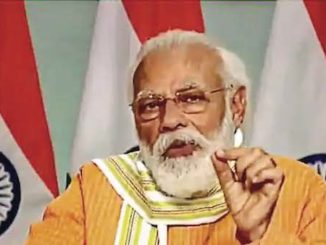
LONDON (TIP): In his first major speech to a global audience since the Covid-19 pandemic, Prime Minister Narendra Modi, July 9, assured the world that India will play a leading role in global revival in this crucial time with a spirit of reform and rejuvenation.
At his much-anticipated inaugural address of India Global Week, biggest international event on India’s globalization, the Prime Minister said that India is ready to do whatever it can to further global good and prosperity.
“In these times, it is natural to talk about revival. It is equally natural to link global revival and India. There is faith that the story of global revival will have India playing a leading role. I see this closely linked with two factors. The first is- Indian talent. World over, you have seen the contribution of India’s talent-force. This includes Indian professionals, doctors, nurses, bankers, lawyers, scientists, professors, our hard-working laborers. Who can forget the Indian tech industry and tech professionals? They have been showing the way for decades. India is a power-house of talent, that is eager to contribute, ever ready to learn. There is two-way synergy that is greatly beneficial”, he said.
“The second factor is India’s ability to reform and rejuvenate. Indians are natural reformers! History has shown that India has overcome every challenge, be it social or economic. India has done so with a spirit of reform and rejuvenation. The same sprit continues now”, he affirmed.
India Inc. Group – the UK-headquartered media house behind flagship publications ‘India Global Business’ and the recently-launched diaspora news network ‘iGlobal’ – brought together some of the best strategic minds and experts in their respective fields.
With +75 sessions, +250 speakers and +5000 participants from 49 countries, India Global Week cements itself as the event where ‘India Meets the World, and the World Meets India.
Prime Minister Modi tops a stellar list of speakers in packed program across three days between July 9 and 11, including External Affairs Minister Dr S. Jaishankar, Commerce Minister Piyush Goyal, IT & Law Minister Ravi Shankar Prasad and Skills Minister Mahendra Nath Pandey, from India.
The line-up covers a special address by HRH The Prince of Wales and several UK Cabinet Ministers, including Foreign Secretary Dominic Raab, Home Secretary Priti Patel, Health Secretary Matt Hancock, and International Trade Secretary Lizz Truss – all underlining the centrality of India to a post-Covid, post-Brexit Britain.
Other international speakers on a diverse range of topics, from geopolitics and business to culture and diaspora, and across four country streams of Australia, Singapore, the UK and the US include Steve Waugh, Former Australian Cricketer; Dr Mukesh Aghi, President and CEO, US-India Strategic Partnership Forum; Chng Kai Fong, Managing Director, Economic Development Board, Singapore; and William Russell, Lord Mayor of the City of London. Other big highlights include Kunal Nayyar, of ‘The Big Bang Theory’ fame, in conversation with Sadhguru, Founder, Isha Foundation; a conversation with Spiritual Leader Sri Sri Ravi Shankar; and an exclusive never-seen performance by Madhu Nataraj and her team.
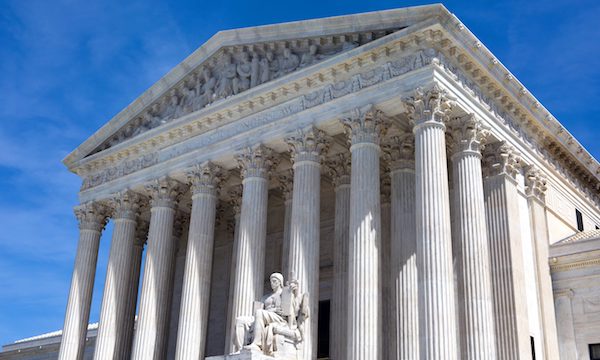
WASHINGTON (TIP): In a pair of historic rulings on Thursday, July 9, the U.S. Supreme Court rejected President Trump’s claim of absolute immunity under the law. The vote was 7 to 2 in cases involving grand jury and congressional subpoenas for Trump’s pre-presidential financial records.
The Supreme Court ruled that a New York prosecutor is entitled to see President Trump’s private and business financial records, ending an intense legal battle waged by the president to keep them secret.
The court said Manhattan District Attorney Cyrus R. Vance Jr. had the authority to subpoena the records from Trump’s private accounting firm. Trump had claimed an immunity from criminal investigations while in office.
Vance is investigating whether the Trump Organization falsified business records to conceal hush payments to two women, including pornographic film actress Stormy Daniels, who claimed they had sex with Trump before he took office. Trump has denied those claims.
Vance is seeking, Trump’s tax returns, among other records. The president has refused to make them public, unlike previous modern presidents. Because the records are for a grand jury investigation, they would not likely be disclosed before the election.
However, in a second decision on the House’s request for similar information, the court appeared to question the breadth of congressional authority.
The Supreme Court ruled that the lower court needs to consider separation of power issues related to the congressional subpoenas, suggesting that Congress did not have unlimited powers to investigate the president. That ruling was also 7-2, with Roberts writing the opinion.
Trump was apparently enraged by the outcome, tweeting a string of criticism that “this is all a political prosecution,” and “Courts in the past have given ‘broad deference.’ BUT NOT ME!”
New York District Attorney Cyrus Vance issued a statement calling the decision in the grand jury case “a tremendous victory for our nation’s system of Justice and its founding principle that no one — not even the president — is above the law.”
Trump’s personal attorney Jay Sekulow took a more optimistic tone than the president in his response to the Supreme Court rulings on the president’s financial information.
“We are pleased that in the decisions issued today, the Supreme Court has temporarily blocked both Congress and New York prosecutors from obtaining the President’s financial records. We will now proceed to raise additional Constitutional and legal issues in the lower courts,” Sekulow said in a statement.
NEW YORK (TIP): Sandeep Chakravorty, India’s former Consul General in New York who left the city June 28 after completion of an overwhelming successful tenure, has been named the new joint secretary of the all-important AMS (Americas) division that handles all issues related to the US and Canada.
Mr Chakravorty served as India’s Consul General in New York from August 2017 to June 2020. He was immensely popular in the Tri-State community for his innovative ideas, hard work and friendly approach. Before joining as Consul General of India in New York, he was Ambassador of India to Peru.
Sandeep Chakravorty, is a member of the Indian Foreign Service (IFS) since 1996. Before joining the Government of India, he worked for several years in organizations dealing with forestry, environment and watershed development issues in India.
He has served in India’s missions in Madrid, Bogota and Dhaka. In the Ministry of External Affairs of India, he served on several desks including working as Press Relations Officer as well as Private Secretary to Minister of State for External Affairs. He also served in the Eurasia Division dealing with Central Asia and in the East Asia Division dealing with China, Japan, Koreas and Mongolia. Before being appointed as India’s Ambassador to Peru and Bolivia, he was India’s Deputy High Commissioner in Dhaka, Bangladesh.
He holds a Master Degree in Advanced Studies from Geneva University and has an MA in Sociology. He has a PG Diploma in Forestry Management from Indian Institute of Forest Management (IIFM), Bhopal. He graduated in Physics from Delhi University.
The Ministry of External Affairs (MEA) has named 3 new joint secretaries, or point persons including Mr Chakravorty, taking up some of the toughest assignments in the ministry. While Arindam Bagchi, an IFS officer of 1995 batch, will head the crucial northern division of MEA, which handles Bhutan and Nepal affairs, J P Singh, an IFS officer of 2002 batch and expert on Pakistan-Afghanistan affairs, has taken over as joint secretary of the high-profile Pakistan, Afghanistan and Iran (PAI) division.
Coronavirus hot spots should pause reopening, not shut down again, recommends infectious diseases expert
WASHINGTON (TIP): States with spiking coronavirus cases still can contain them by pausing their reopening processes, rather than shutting down a second time, one of the nation’s top infectious disease experts said Thursday, July 9.
Dr. Anthony Fauci’s comments at an event hosted by The Hill news outlet contrast with what he said a day earlier: that states with a serious coronavirus problem “should seriously look at shutting down.”
“Rather than think in terms of reverting back down to a complete shutdown, I would think we need to get the states pausing in their opening process,” Fauci, director of the National Institute of Allergy and Infectious Diseases, told The Hill’s Editor-at-Large Steve Clemons on Thursday.
“If we can do that consistently, I will tell you, almost certainly, you’re going to see a down curve of those infections,” Fauci said.
On Wednesday, July 8, Fauci told the Wall Street Journal that a second shutdown might be the best move for states struggling with burgeoning coronavirus cases and hospitalizations.
“I think any state that is having a serious problem, that state should seriously look at shutting down,” Fauci told the newspaper in a podcast.
He did say Wednesday that simple steps short of full economic lockdowns — controlling crowds, wearing masks and doing a better job at physical distancing — would help.
The country and some states are setting records for average daily officially reported cases, ICUs in hot spots are reaching capacity, and most states are seeing spikes, recalling the uncertainty of months ago when the virus first broke out.
Another health expert echoed Fauci’s initial comment about second shutdowns.
“If you’re not doing the … things we’ve talked about in the past to get this outbreak under control, starting with test and trace … your only option is to shut down,” Dr. Ali Khan, former director of the CDC’s public health preparedness office said.
Climbing case numbers have motivated many states to pause or roll back plans to reopen economies after widespread shutdowns in the spring.
The US reached more than 3 million coronavirus cases this week, according to data from Johns Hopkins University. At least 33 states as of Thursday morning have seen an upward trend in average daily cases — an increase of at least 10% — over the last week.
Some states have recently reported alarming rates at which people are testing positive: 28% in Arizona; 26% in Texas; and 19% in Florida, according to The Covid Tracking Project.
Previous recommendations for reopening economies, expressed by the CDC, called for test-positivity rates of no greater than 20% just to reach first-phase reopenings, and less than 10% for fuller reopenings.
The country still is reckoning with job losses from the first stay-at-home orders. Though millions of jobs have come back, 18.1 million Americans currently are on continued unemployment claims, meaning they filed at least two straight weeks, the Department of Labor said Thursday, July 9.
And more than 3 million Americans appear to have lost jobs that aren’t coming back any time soon, economists say.
CHICAGO (TIP): Prof Vinay Kumar has been named the Lowell T. Coggeshall Distinguished Service Professor in the Department of Pathology at University of Chicago.
Kumar is a pioneer in the field of the cellular and molecular biology of natural killer cells and a global leader in medical education. He was one of the first to propose the existence of a novel subset of lymphoid cells with antileukemic activity, subsequently identified as natural killer cells. His research has focused on understanding the origin and differentiation of these cells and their role in the rejection of transplanted bone marrow. His group also discovered that mutations in the human perforin gene give rise to severe and fatal disorders of immune dysregulation. This paradigm-shifting work has been recognized as a “pillar of immunology” by the Journal of Immunology.
He is the senior editor and co-author of five pathology textbooks, including Robbins and Cotran Pathologic Basis of Disease, which has been translated into more than 13 languages and is the most widely used pathology text in the world. He has received many honors for his research, including election as a fellow of the American Association for Advancement of Sciences in 2004, and the 2019 Gold Headed Cane Award, which is the highest honor granted by the American Society for Investigative Pathology.
WASHINGTON (TIP): US President Donald J. Trump June 25 announced his intent to nominateVijay Shanker, of the District of Columbia, to serve as Associate Judge on the District of Columbia Court of Appeals.
Vijay Shanker serves as Senior Litigation Counsel in the United States Department of Justice, Criminal Division, and as Deputy Chief of the Appellate Section. Before joining the Department of Justice in 2012, Mr. Shanker was in private practice with the Washington, D.C., offices of Mayer Brown, LLP, and Covington & Burling, LLP. Upon graduation from law school, Mr. Shanker served as a law clerk to Judge Chester J. Straub on the United States Court of Appeals for the Second Circuit. Mr. Shanker earned his B.A., cum laude, from Duke University and his J.D. from the University of Virginia School of Law, where he served as a Notes Editor for the Virginia Law Review and was inducted into the Order of the Coif.
He has briefed and argued almost sixty federal appeals, including four en banc rehearings. Mr. Shanker is currently serving on detail as Senior Litigation Counsel in the Criminal Division’s Fraud Section, where he investigates and prosecutes violations of the Foreign Corrupt Practices Act and related offenses and advises attorneys and leadership on a range of legal issues and litigation matters.
From October 2012 to February 2014, Mr. Shanker served in the Office of the Assistant Attorney General for the Criminal Division, first as Senior Counsel and then as Acting Deputy Chief of Staff and Counselor to the Assistant Attorney General. Mr. Shanker has been awarded the Attorney General’s John Marshall Award, the Assistant Attorney General’s Award for Exceptional Service, and the Assistant Attorney General’s Award for Distinguished Service.
Mr. Shanker received his Bachelor of Arts degree in public policy studies, cum laude, from Duke University. He received his law degree from the University of Virginia School of Law, where he was named to the Order of the Coif and served as a Notes Editor on the Virginia Law Review. He was awarded the Roger & Madeleine Traynor Prize for “the graduate who has produced the best written work” and also the Law School Alumni Association Best Note Award. Following law school, Mr. Shanker clerked for the Honorable Chester J. Straub on the United States Court of Appeals for the Second Circuit.
NEW YORK (TIP): Rakesh Vohra, George A. Weiss and Lydia Bravo Weiss University Professor at Penn, has won the 2020 SIGecom Test of Time Award for his paper, “Calibrated Learning and Correlated Equilibrium.”
The SIGecom Test of Time Award recognizes research published between ten and twenty-five years ago that has, as the name suggests, stood the test of time in its field. SIGecom is the Association for Computing Machinery’s Special Interest Group on Economics and Computation, so it celebrates work that has “significantly impacted research or applications exemplifying the interplay” of those two topics.
Vohra’s paper, originally published in the journal Games and Economic Behavior in 1997, has served as an essential contribution to the literature on game theory.
Vohra is a Penn Integrate Knowledge professor with appointments in Penn Arts and Sciences’ Department of Economics and Penn Engineering’s Department of Electrical and Systems Engineering. He works at the intersection of economics, systems engineering, computer science and business, and is the Co-Director of the Warren Center for Network & Data Science. He is best known for his work on forecasting in low information environments and his many contributions to the economic field of mechanism design.
NEW YORK (TIP): A group of 58 Indian-origin executives heading various companies across 11 different countries, including the US, Canada and Singapore, collectively employ more than 3.6 million people and account for a combined USD 1 trillion in revenue, USD 4 trillion in market capitalization, according to a list released by a US-based top Indian diaspora organization.
Indian-origin business leaders are reaching the pinnacle of corporate success in greater numbers than ever, many use their platforms for social change advocacy, said Indiaspora, a nonprofit organization of global Indian diaspora leaders from various backgrounds and professions.
The Indiaspora Business Leaders List of 58 executives head companies headquartered across 11 different countries, including the US, Canada, England, and Singapore and these companies have delivered annualized returns of 23 per cent during the tenure of these executives, outperforming the S&P 500 by 10 per cent.
These companies collectively employ more than 3.6 million worldwide and account for a combined USD 1 trillion in revenue and USD 4 trillion in market capitalization.
“We wanted to capture this incredible feat that our community is achieving with increasing numbers,” said Indiaspora founder MR Rangaswami, a Silicon Valley-based entrepreneur and investor.
“The impact that the Indian diaspora is having in the realm of business is remarkable. It’s one of the reasons we launched this project, and we hope our lists will continue to raise the profile of those who have reached the very top of their fields while also serving as agents for positive change,” Rangaswami said.
The stereotype of the Indian CEO is someone who represents the tech sector, but this list of 58 CEOs dispels that myth, he said, adding that these leaders represent many different sectors, including banking, electronics, consumer goods, and consulting.
Releasing the list during a virtual press conference, Rangaswami said that these executives are as young as 37, all the way to age 74 with the median age of these executives being 54.
During this coronavirus pandemic, these companies have made lots of humanitarian aid contributions, and also, they’re taking care of their employees, their customers, their supply chain.
“So these companies are doing a lot to respond to COVID-19,” Rangaswami said.
Many of the executives on the list have taken an active position on issues like Black Lives Matter in making sure that they also stand along with the black community in terms of getting racial equality and racial justice, he said.
The list of Indian-origin CEOs includes immigrants from India as well as professionals born in countries such as Uganda, Ethiopia, England, and the US.
“I’m amazed to see how far we’ve come in terms of representation in business,” said Raj Gupta, former CEO of Fortune 300 company Rohm and Haas, and one of the first executives of the Indian diaspora to join the ranks of corporate leadership along with pioneers such as Indra Nooyi of PepsiCo and Dinesh Paliwal of Harman International.
“There used to be only a handful of us leading corporations. Now that we are reaching prominence, I am eager to see how the next generation leaves its own legacy,” said Gupta, an Indiaspora member, who serves as Chairman of two companies on the Business Leaders List, Aptiv and Avantor.
“It’s inspiring to see so many leaders of Indian heritage playing a significant role in business and in society,” said Ajay Banga, President and CEO of Mastercard.
“Our culture and our values are a common starting point. But it’s what we do with the opportunities presented to us that make a difference. When we lean into our diverse experiences to deal with challenges like the pandemic or racial injustice, we can have an even greater impact on the lives of those around us,” he said.
Indiaspora said that many of these diaspora executives have led their companies in advancing social change by addressing racial injustice, climate and sustainability justice, and the disproportionate effects of COVID-19 through policy and financial commitments.
Tech industry leader Sundar Pichai, CEO of Alphabet, has announced new goals for racial equity, including improving leadership representation of underrepresented groups at Google, and an “economic opportunity package” for the Black community.
Many of the leaders’ companies have created or contributed funds in response to COVID-19, with monetary and humanitarian aid totaling more than USD 400 million, Indiaspora said.
The Indiaspora Business Leaders List also calls attention to the presence of a glass ceiling that women, including Indian women, still face. Out of 1,000 companies represented on the Fortune 500 list, only 61 have women CEOs; the Indiaspora List has a marginally higher percentage of women, yet includes only five women out of the 58 leaders.
“It’s an honor to join so many outstanding leaders on this year’s Indiaspora Business Leaders list, each of whom is making a meaningful impact within their industry,” said Reshma Kewalramani, MD, CEO and President of Vertex Pharmaceuticals.
“As a physician and CEO dedicated to creating transformative medicines that improve the lives of people with serious diseases, I believe deeply in the critical role a diverse and inclusive culture plays in being able to achieve that mission at Vertex,” she said.
BOSTON (TIP): Indian origin Yogesh Surendranath is among nine faculty members in the MIT School of Science who have been granted tenure by MIT.
Solving environmental challenges by studying and manipulating chemical reactions is the focus of Yogesh Surendranath’s research. Using chemistry, he works at the molecular level to understand how to efficiently interconvert chemical and electrical energy. His fundamental studies aim to improve energy storage technologies, such as batteries, fuel cells, and electrolyzers, that can be used to meet future energy demand with reduced carbon emissions.
Surendranath joined the Department of Chemistry in 2013 after a postdoc at the University of California at Berkeley. His PhD was completed in 2011 at MIT, and BS in 2006 at the University of Virginia. Suendranath is also a collaborator in the MIT Energy Initiative.
PORTLAND (TIP): An Indian American is among seven people who have been arrested and face federal charges for their roles in weekend riots at the Mark O. Hatfield U.S. Courthouse in Portland, Acting Homeland Security Investigation (HSI) Special Agent in Charge Eben Roberts and U.S. Attorney Billy J. Williams announced July 7.
According to court documents, since May 26, 2020, protests in downtown Portland have regularly been followed by nightly criminal activity including assaults on law enforcement officers, destruction of property, looting, arson, and vandalism.
Shant Singh Ahuja, 28, of Oceanside, California, is charged with destruction of federal property. On July 4, 2020, Ahuja is accused of willfully destroying a closed-circuit video camera mounted on the exterior of the Hatfield Courthouse.
The Hatfield Federal Courthouse has been a repeated target of vandalism, sustaining extensive damage. U.S. Marshals Service deputies and officers from the Federal Protective Service, HSI and U.S. Customs and Border Protection (CBP) working to protect the courthouse have been subjected to threats; aerial fireworks including mortars; high intensity lasers targeting officers’ eyes; thrown rocks, bottles, and balloons filled with paint from demonstrators while performing their duties.
Signup to our Newsletter!
Don’t miss out on all the happenings around the world