NEW YORK (TIP): Bengaluru, India,-born Ramya Jawahar Kudekallu is all set to lead New York City Bar’s International Human Rights Committee making it a diverse, multicultural and inclusive body, prioritizing HR issues and advocacy approaches. One of the youngest and first woman of color to be appointed chairperson of one of the largest associations of lawyers in the US, Kudekallu, 32, considers her appointment as a “huge honor.”
But it’s “equally, an indication that the New York City Bar, stands to benefit from a membership that is diverse, multicultural and inclusive,” she told the Times of India.
Kudekallu said she’s excited to work with lawyers dedicated to the promotion and protection of human rights globally apart from ensuring there is a call to action on these issues in the US.
After schooling in Bengaluru, Ooty and Dubai, Kudekallu studied law in Bishop Cotton Women’s Christian Law College, Bengaluru. She did her masters in International Law and Human Rights at Fordham University, New York and currently teaches at Cardozo Law School, New York.
“There are several committees within the Bar that focus on various aspects of the law. It’s particularly meaningful to be in this because I’ve had a long association with this field,” Kudekallu said.
“My role as chair allows me to guide and prioritize different human rights matters, advocacy approaches and questions of law within my committee,” she said.
Engaging in community service was ingrained by my family, said Kudekallu. “I was taught not to ignore problems of society and, more importantly, I must reflect on my own role and privilege.”
“Studying at a law college for women helped me better understand applying a gender lens to the law,” she added.
“The committee did not have a woman of color as the chairperson all these days,” Kudekallu said in another media interview. “They have also picked a non-white young woman. I am ready to take risks involved with this responsibility.
“Fighting for human rights is always challenging, whether it is in India or anywhere. New York is comparatively safer,” she said.
Kudekallu’s mother, Dr. Amitha Malaki, a gynecologist, currently lives in Kushalnagar, Kodagu. Her father, Jawahar Kudekallu, a practising advocate in Bengaluru, passed away in July. “Her father would have been very proud of Ramya’s achievement,” said Dr Malaki.
Kudekallu also worked with the Alternative Law Forum in Bengaluru in 2014 and worked for the rights and justice for Bengaluru’s pourakarmikas, street vendors, transgenders, sex workers and their children, she said.
NYC Bar’s International Human Rights Committee follows legal developments, including the passage of new legislation and policies and investigates and analyzes legal developments and their impact on the full enjoyment of human rights, according to its website.
The Committee also monitors cases where lawyers are prevented from performing all of their professional functions through intimidation, hindrance, harassment or improper interference, or suffer or are threatened with prosecution or other sanctions are a result of their work.
As part of its work, the Committee sponsors human rights speakers and events. It aims to promote the role of lawyers, judges, and other jurists in the promotion of human rights in their individual countries, and regularly meets with prominent bar associations and other leading legal professionals.
The Committee also engages with other individuals and organizations working on human rights, including governmental and non-governmental groups and individuals, as well as intergovernmental organizations and advocacy groups.
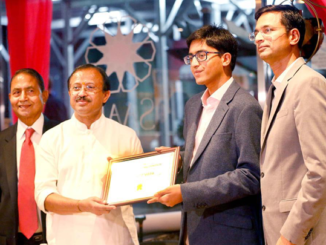
Mr. Prem Bhandari, Chairman Jaipur Foot USA spoke about Jaipur Foot, its Youth Chapter and the contribution of Nikhil Mehta and Ajay Tadinada. (Photo / Jay Mandal- on assignment)Organizers led by Mr. Prem Bhandari extending a floral welcome to Mr. Muraleedharan.A view of the gathering. (Photo / Jay Mandal- on assignment)Mr. Muraleedharan spoke about his long association with Jaipur Foot and praised the founder DR Mehta and Jaipur Foot USA Chairman Prem Bhandari for the good work being done by them across the world. He congratulated Nikhil Mehta for his charitable disposition (Photo / Jay Mandal- on assignment)
NEW YORK CITY (TIP): Jaipur Foot USA and Gracious Givers Foundation USA organized an event in New York on Monday, October 11 to felicitate the young Nikhil Mehtaand Ajay Tadinadafor their charitable work whichhas made remarkable impact in the lives of a large number of differently abled people.
Leading the youth chapter at Jaipur Foot USA as the chief youth coordinator, 17-year-old Nikhil Mehta is inspiring many with his social service. Jaipur Foot USA is a subsidiary of Bhagwan Mahaveer Viklang Sahayata (BMVSS), founded by Padma Bhushan D. R. Mehta. It is one of the largest organizations serving the global differently abled population. They provide artificial limbs, calipers, and other aids free of charge to help amputees and differently abled individualsto lead independent life.
The award to Nikhil Mehta was given by the MOS MEA Mr. Muraleedharan at a well-attended event. Deputy Consul General of New York Dr. Varun Jeph, former RANA (Rajasthan Association of North America) presidents, Haridas Kotahwala and K.K. Mehta, President of Rajasthan Foundation, USA, Kanak Golia, Ashok Sancheti, Dr. Raj Modi, Rahul Sur, IPS, his wife Meera Sur – both working at the United Nations at senior levels, and Andy Chinoy, among others, attended. Senior US govt official Deep and Sapna Chopra, Vilas Savargaonkar, and The Indian Panorama Chief Editor Prof. Indrajit S Saluja also attended the event. At the event, Prem Bhandari, the Chairman of Jaipur Foot USA, highlighted the NGO’s rich contribution to thedifferently abled community and shared the contributions of two of its youth members, Nikhil Mehta and Ajay Tadinada. Bhandari listed the contributions made by the two youths that benefitted a lot of people during the pandemic. In addition to the contributions already made to better the lives of many, Nikhil has also announced that he has raised funds through his school friends to provide 5,000 hearing aids to the needy. Kanak Golia of Jaipur Foot USA, Nikhil’s grandfather, also announced to match the funding for another 5000 hearing aids free of cost, bringing the total to 10,000 hearing aids. These devices were sent to BMVSS to be distributed in India under the leadership of Padma Bhushan, D.R. Mehta, Founder & Chief Patron BMVSS.
During the pandemic, Nikhil launched the “Oxygen on Wheels” program — a free service for needy patients in the rural villages that surround Jodhpur. The service provided free oxygen support from a mobile bus for COVID patients while they are waiting for admission into the then overpopulated hospitals. For this, Nikhil had approached Prem Bhandari who then arranged a bus through Vader Charitable Trust in Jodhpur, Rajasthan and fitted it with oxygen concentrator to help COVID-infected people suffering with breathing difficulties during transit. Nikhil also came up with the mobile service for differently abled in a bid to help the rural people in this COVID environment where the movements are restricted, and transportation is difficult. Nikhil’s family foundation came forward to fund the idea, which involved purchasing a large van, equipping and installing the equipment required, and a power generator to power the equipment in case the village doesn’t have electricity. The poster for the mobile van was launched by Mr. Muraleedharan in New York.
BMVSS was able to successfully complete 71 artificial limb fittings in Vadnagar, Gujarat – the birthplace of Prime Minister Narendra Modi through the mobile van, in just one week. In addition, the mobile van distributed calipers to 51 polio patients and 30 crutches.
Bhandari also highlighted the contributions of Ajay, who was inspired by the work of D.R. Mehta when he was in the 9th grade and joined Jaipur Foot USA. As part of the Jaipur Foot USA youth initiative, he has launched an internship program for youth to work with Jaipur Foot USA’s initiatives to help differently abled people in India.
Mr. Muraleedharan congratulated Ajay and Nikhil Mehta for the Oxygen on Wheels initiative, reaching out to the differently abled persons in remote places and for simplifying the foundation’s website by providing for automated contributions.
Bhandari lauded how India extended help to neighboring countries, Africa and South America by providing millions of vaccines and other COVID-related medicines. PM Modi launched the Vaccine Maitri (Vaccine Friendship) initiative to supply vaccines to low-income and developing countries globally.
Bhandari extended his special gratitude for resolving the long-standing OCI renewal process/procedure issue, which benefitted 6 million-plus OCI cardholders.
BOSTON (TIP): Finance Minister Nirmala Sitharaman was asked why there is no word on this from the Prime Minister, senior Ministers and why there is a “defensive reaction” when somebody asks questions about such things. The Lakhimpur Kheri violence, in which four farmers were killed, is “absolutely condemnable,” Finance Minister Nirmala Sitharaman has said, emphasizing that there are issues of such nature happening in other parts of India equally which should be raised “when they happen and not when it suits others” because there is a BJP government in Uttar Pradesh.
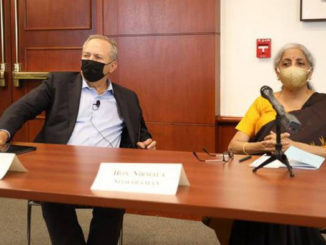
Ms. Sitharaman, who is on an official visit to the U.S., was responding to a question during a conversation at Harvard Kennedy School on October 12 about the killing of four farmers in Lakhimpur Kheri and the arrest of Ashish Mishra, son of Union Minister of State for Home Ajay Mishra.
She was asked why there is no word on this from the Prime Minister, senior Ministers and why there is a “defensive reaction” when somebody asks questions about such things.
“No, absolutely not… It’s nice of you to have picked up that one incident which is absolutely condemnable, every one of us say that. Equally there are instances happening elsewhere, is my concern.
“India has issues of such nature happening in very many different parts of the country equally. I would like you, and many others, including Dr. Amartya Sen, who all know India, to raise it at every time when it happens, not just raise it when it suits us because it’s a State where BJP is in power, one of my Cabinet colleague’s son is in probably trouble, and also assume that it’s actually them who did it and not anybody else. Due course of justice will also have a complete inquiry process to establish it,” she said.
“And it’s not being defensive about my party or my Prime Minister. It’s being defensive about India. I will talk for India; I will talk for justice for the poor. I will not be mocked at. And if it is mocking, I will be defensive to stand up and say ‘Sorry, let’s talk on facts’. That’s my answer for you,” she said.
Mr. Ashish Mishra was named in an FIR following allegations that he was in one of the vehicles that mowed down four farmers protesting over U.P. Deputy Chief Minister Keshav Prasad Maurya’s visit on October 3.
Farm laws
To a question on the farmers’ protests, Ms. Sitharaman said that the three acts which the government brought in were discussed by the various parliamentary committees over a decade.
She said all the three acts have been discussed variously by the State governments, by the Centre after the BJP came into power in 2014.
“This has been in the making for a decade now. Every stakeholder has been consulted,” she said.
“When the farm laws were brought in the Lok Sabha, there was an elaborate discussion and the agriculture minister gave his reply as well. It was only when it came to the Rajya Sabha, there was a lot of noise and disturbance,” she said.
Thousands of farmers from Punjab, Haryana and several other States have been protesting on various borders of Delhi since November 26 last year, seeking repeal of three farm laws enacted in September.
Dubbing these laws as “anti-farmer”, these farmers claim that the newly enacted legislations would pave the way for the dismantling of the minimum support price system, leaving them at the “mercy” of big corporations.
Ms. Sitharaman said the protesters belong to one State and some parts of other States — “Punjab, Haryana and some parts of western Uttar Pradesh”. She said the government has been saying that it is willing to talk with the protesters and has been engaging with them.
The government has asked pointedly what is that one aspect in any one of the three laws which have been passed to which the protesters object, she said.
“We are willing to talk about it, tell us that one particular aspect in any one of the three laws. Till date, we have not had even one particular aspect which is being questioned. And therefore, the protesters are not sure on what score they are protesting, what is it that they are objecting.
“Then there’s this issue about the minimum support price to be given to farmers,” she said, adding that the MSP are announced well in time and the farmers can decide whether they want to grow a crop or not and they can otherwise choose to grow something else. She said once the farmers choose to grow any of these, for which a minimum support price is announced and procurements are done, through direct benefit transfer using technology, money is deposited as a lump sum into their accounts. “The highest amount of procurement, the largest ever payment per farmer under the minimum support price which is declared has happened in the last seven years after Prime Minister [Narendra] Modi has come. Highest ever.
“The number of farmers, the total quantum of money, total quantum of grain procured in each one of them — the highest as has happened season after season in the last seven years,” she said.
Highlighting that there are recorded conversations “which you can see of farmers even from Punjab, even from Haryana”, she said farmers have got the entire amount into their account.
“This is verifiable, not a claim which I’m making. You can go and check it out. Highest amount and the entire amount is given into the account directly the day after procurement is done. No staggering, no delaying,” she said.
“So we have not been told what it is that they’re protesting against as yet and the Minister is willing to talk even today.”
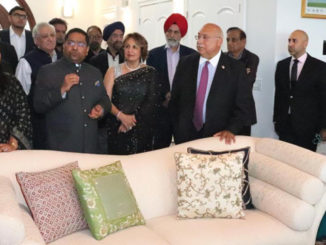
Ranju Batra welcomed the Jaiswal family and guests and reminisced how she had to make strenuous efforts to get the Diwali Stamp issued by the USPS five years ago.Ravi Batra described Mr. Jaiswal as a distinguished diplomat working to fulfill Narendra Modi’s 2016 Washington Declaration of Indivisibility with the United States of America.A view of the distinguished gathering.The Batras and the Jaiswals.
NEW YORK (TIP): Ranju and Ravi Batra hosted a lunch reception to honor and celebrate the Consul General of India Randhir Kumar Jaiswal for his commendable work to fulfill Indian Prime Minister Narendra Modi’s 2016 Washington Declaration of Indivisibility with the United States of America.
The distinguished gathering numbering around 60 listened with rapt attention to the consul general appreciating the contribution of the Indian American community in strengthening India in a number of ways, and also promoting friendlier and stronger ties between the two great democracies of the world. He also highlighted the remarkable initiatives of Modi government for taking India to ever greater heights.
Mr. Batra who had confided in me that there would be more fun than lecturing at the lunch ensured that except for the customary welcome by the hosts and a reply by the guest, there will be no more speeches. As such, Ranju Batra extended a word of welcome to the Jaiswals and guests, and briefly spoke about her struggle to get a Diwali Stamp issued by the USPS. The Indian American community, surely, recognizes her great contribution. It is not a question of a Stamp. It is a recognition of the festival of Diwali.
Ravi Batra who believes strongly in the friendship and strong relationship between the US and India complimented the Consul General for his work to fulfill Indian Prime Minister Narendra Modi’s 2016 Washington Declaration of Indivisibility with the United States of America. He thanked the guests for their presence.
Surely, the afternoon Lunch was more fun than speeches.
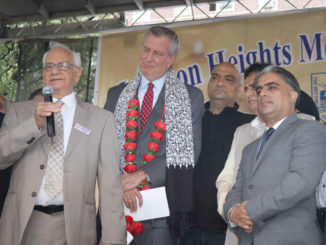
Shiv Dass honored Senator Chuck Schummer, Senate Majority leader. Also seen in the picture are Ranju Batra and Ravi Batra. (Photo / Shahzad)A scintillating dance performance the gathering enjoyed. (Photo / Shahzad)A view of the gathering . (Photo / Shahzad)
Weather forecast predicted doom with heavy rain around the same time as the Diwali Mela was to be held on the 74th Street, aka Kalpana Chawla Way, in busy Jackson Heights. But it was sheer magic that turned the clouds dry and allowed the celebration to go on full speed and unhampered. The organizers led by the President of Jackson Heights Merchants’ Association Shiv Dass could not have been more thankful to the weathergod.
For two years, the pandemic prevented any public gathering and festive celebration. And here was an opportunity to come together to have an afternoon of freedom, entertainment and abandon.
To the delight of the organizers, not only did the weather show grace, people, too, turned up in large numbers.
On top of it, the dignitaries obliged the organizers in a big way. Mayor of New York Bill de Blasio, Senate Majority leader Chuck Schummer, the Deputy Consul General of India, Varun Jeph, Council Member Danny , Shekhar, Democratic candidate for City Council, Dileep Chauhan representing the Brooklyn Borough President, and AK Vijayshankar, Consul, Community Affairs, Consulate General of India graced the occasion as also some prominent New Yorkers who included Ranju Batra who five years ago got the Indian American community the Forever Diwali Stamp, Attorney Ravi Batra, Dr. Hari Shukla, Dr. Sudhir Parikh, Neeta Bhasin who is the founder of Diwali at Times Square, Andy Bhatia, Subhash (Sam) Kapadia, Nitin Vora, and Prof. Indrajit S Saluja, among others. Ranju Batra was among the honorees who were presented citations and robe of honor. Speaking on the occasion, Mayor Bill de Blasio described Shiv Dass as a great leader of Indian American community who has for decades highlighted the community’s concerns. Appreciating the Indian American community’s contribution to the growth of the greatest city in the world, de Blasio assured the Indian American community of all help in whatever they want to do. Senator Chuck Schummer who described Shiv Dass as his personal friend who has done more for the Indian American merchants community than any other person, he spoke about the challenges the pandemic posed and praised the merchants community for their courage to keep running the wheels of economy. He spoke of Biden administration’s plans to help out the small businesses and assured the business community that they will always be given the desired help in furthering their interests.
Deputy Consul General of India Varun Jeff on the occasion offered the greetings of the consul General and his own on the occasion of Diwali and thanked the organizers for inviting him.
Classic Production USA, Inc – (Chaku) from India and Nrityanjali Dance Academy gave thrilling and entertaining performances of songs and dances.
The entire executive committee, under the guidance of Board of Directors Deepak Verma (chairman), Mahipal Singh Esq., Sunil Patel, of Jackson Heights Merchants’ Association worked hard to make the event the grand success that it came out to be. They included Chairman Kanu Bhai Chauhan, Celebration Chairman Mohinder Verma, President Shiv Dass, Vice President Harshit Chugh, Secretary Chander Shekhar, Co-chairman Manu Khaitani, Treasurer Virender Kanwar, Organizer Rahul Arora, Sr. Advisors Surinder Chugh, Ram Labhaya, Karan Verma, Pulkash Roy, Daniel Thomas, Financial advisor Braj Aggarwal, PRO Santa, Executive members Mohan Singh, Hari Ram, Vinod Kumar, Abid Mukhtar, Makhan Singh and Virender Bhalla.
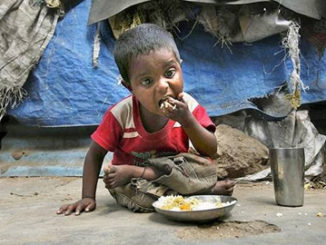
Behind most neighbors – Pakistan at 92, Nepal at 76 and Bangladesh also at 76
NEW YORK (TIP): The Global Hunger Index launched on Thursday, October 14 ranked India at the 101st position out of a total of 116 countries. India is also among the 31 countries where hunger has been identified as serious. India ranked 94 among 107 countries in the Global Hunger Index (GHI) released last year.
Only 15 countries fare worse than India. These include Papua New Guinea (102), Afghanistan (103), Nigeria (103), Congo (105), Mozambique (106), Sierra Leone (106), Timor-Leste (108), Haiti (109), Liberia (110), Madagascar (111), Democratic Republic of Congo (112), Chad (113), Central African Republic (114), Yemen (115) and Somalia (116).
India was also behind most of the neighboring countries. Pakistan was ranked 92, Nepal at 76 and Bangladesh also at 76.
Current projections based on the Global Hunger Index (GHI) show that the world as a whole — and 47 countries in particular — will fail to achieve even low hunger by 2030.
The Index tracks key indicators used to measure progress toward Zero Hunger by 2030 at national, regional, and global levels. Based on the values of the four indicators — undernourishment, child wasting, child stunting and child mortality — the GHI determines hunger on a 100-point scale, where 0 is the best possible score (no hunger) and 100 is the worst. Each country’s GHI score is classified by severity, from low to extremely alarming.
Somalia has the highest level of hunger according to the 2021 GHI ranking — its GHI score of 50.8 is considered extremely alarming. It is preceded by five countries with levels of hunger that are alarming — Central African Republic, Chad, Democratic Republic of the Congo, Madagascar, and Yemen — and 31 countries that have serious levels of hunger. “Although GHI scores show that global hunger has been on the decline since 2000, progress is slowing. While the GHI score for the world fell 4.7 points, from 25.1 to 20.4, between 2006 and 2012, it has fallen just 2.5 points since 2012. After decades of decline, the global prevalence of undernourishment — one of the four indicators used to calculate GHI scores — is increasing. This shift may be a harbinger of reversals in other measures of hunger,” says the report.
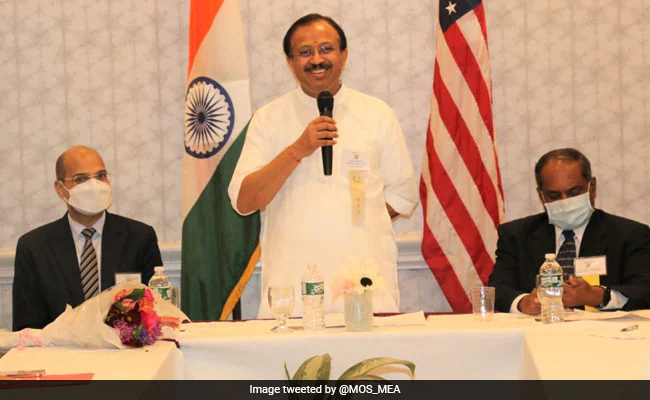
HARTFORD, CT (TIP): Union Minister of State for External Affairs (MoS) V Muraleedharan interacted with the Indian community in Connecticut, October 13. The Minister also celebrated the Azadi Ka Amrit Mahotsav with the Indian community. “Had an engaging interaction with the dynamic Indian community in #Connecticut Happy to see their zeal to participate in #AzadiKaAmritMahotsav & partner in New India’s growth story,” the Minister said in a tweet. India is celebrating Azadi ka Amrit Mahotsav, marking the country’s 75th year of independence amid patriotic fervor. A series of events are also being organized under the program.
Jack Ciattarelli – NJ nominee of Governor with the volunteers
GLEN ROCK, NJ (TIP): A group of local residents from Glen Rock, NJalong with Act of Humanity, a charitable organization, handed out free KN95 Masks, Hand Sanitizers, and Face Shields this Saturday, October 9, 2021, just outside the Rock Ridge Pharmacy on Rock Rd in Glen Rock, NJ.
The group was motivated by seeing many people who work at various establishments on Rock Road and around Glen Rock wearing surgical masks. They wanted to offer residents higher quality masks that provide better protection against the highly contagious Delta variant. With younger children still not eligible for Covid-19 vaccines, the CDC recommends that all vaccinated and unvaccinated people use KN95 masks indoors and in crowded places.
The team handed out over 5000 KN95 masks, 2000 bottles (8 oz) of hand sanitizer, and 400 facial shields. Recipients included Glen Rock families, town visitors, local store employees, and others — many expressed gratitude for getting high-quality masks and hand sanitizers for free. Jack M. Ciattarelli, New Jersey nominee for Governor in the 2021 gubernatorial election, stopped by at the event to show his support for the cause.
Special thanks to Act of Humanity for donating all handouts and Vishnu Patel, manager of Rock Ridge Pharmacy, who sponsored the event by providing logistical support. The team would like to call out Kimone James, CEO of The Amazing Help CEO (a social services organization in Paterson, NJ), for her participation and support. Thanks to Sanjiv Ohri, Amit Poddar, Priyanka Poddar (Youth of Glen Rock Indian Community), Sonal Thohan and Santosh Joshi for volunteering their time handing out the supplies. Thanks to Keller Williams real-estate professionals Rajeev Sinha & Ish Kennedy for extending a helping hand to the team.
Strengthen hands of real representatives of people of J&K
The Centre should listen carefully to Farooq Abdullah, the statesman, who was kept under detention for seven months after the abrogation of Article 370 on August 5, 2019. At the Shaheed Bunga Sahib gurdwara on Wednesday while attending the ‘antim ardas’ ceremony of Supinder Kaur, the slain principal of the government school in Srinagar’s Eidgah area, Farooq made a statement that should wake up our rulers in Delhi. Unequivocally, he told the gathering that Kashmir will never become Pakistan because ‘we are a part of India and will remain a part of India, come what may. They cannot change it even if they shoot me’. This three-time Chief Minister, who will soon turn 84, termed the cowardly, Pakistan-handled killers, who have been targeting Hindus and Sikhs, ‘beasts’ who serve the devil. Whatever might have been Farooq’s failings as an administrator, this one gesture exemplifies his stature as the tallest politician of Jammu and Kashmir and his role in building bridges and calming frayed nerves. And J&K needs its trusted, old politicians to play their mandated parts to restart the political process and re-engage the masses at the earliest. Farooq has always held the Indian flag aloft — be it in Geneva as part of the 1994 Indian delegation led by AB Vajpayee, or in 1996 when he revived and legitimized the electoral process in the troubled state.
Now, when a repeat of the exodus of Hindus and Sikhs is being feared and old memories of killings of Pandits in 1990 and Sikhs in 2000 are haunting the vulnerable minorities, the Centre should strengthen the hands of the real representatives of the people of J&K, for whom a threat to their lives is an occupational hazard. Pakistan is merely using the Afghan context to create greater terror and polarization in J&K, which can be effectively countered by the Indian forces under the political leadership of the sons of the soil. The J&K leaders who insist that they are Indians are our national treasure, but to appreciate their commitment to the Indian cause, our rulers need to remove their Hindutva goggles.
U.P. police must do a credible probe to inspire public confidence in farmers’ killing case
The arrest of Ashish Mishra, son of Union Minister of State for Home, Ajay Mishra, appears to be a course of action impelled mainly by the intervention of the Supreme Court, which voiced its dissatisfaction with the way the Uttar Pradesh police were handling the killing of four farmers and four others during a protest. By taking cognizance of the incidents that took place during a farmers’ protest at Tikonia in Lakhimpur-Kheri district, the Court may have helped infuse some much-needed impetus to the investigation. The Bench gave enough time until its next hearing on October 20 to the police to pursue the probe diligently, but not without thinking aloud on whether any other agency ought to take it over and asking the State police chief to preserve the evidence. The arrest of the Minister’s son, coming after he had skipped an earlier summons and was questioned for long hours once he appeared, is largely in response to the Court’s criticism. The Bench, headed by the Chief Justice of India, N.V. Ramana, wondered how investigators in a murder case could merely issue summons to the prime suspect instead of taking steps to apprehend him. Skepticism about the intentions of the State police is not misplaced. It is not the first time that the initial response is one of hesitancy and obfuscation, but once an incident blows up enough to occasion judicial intervention, there is some action.
What is known so far is that vehicles in the Minister’s convoy ploughed through a group of farmers, causing four deaths. Three others may have died in retaliatory violence by the infuriated mob, while Raman Kashyap, a television reporter, may also have been run over. Initial reports that the driver lost control after being hit by a hail of stones have been superseded by footage that seems to show the vehicle being driven into a group of unsuspecting people. The FIR says Ashish Mishra was in one of the cars, even though he claims to have been elsewhere. The role of the Union Minister should also be subjected to scrutiny, as some reports suggest he may have made a provocative speech earlier to the effect that the protesting farmers should either mend their ways or he would set them straight. The mention of a ‘conspiracy’ in the FIR gives scope to the police to examine this angle. It is regrettable that the Union government is noticeably silent, and there appears to be no effort to advise Mr. Ajay Mishra to step down until his and his son’s names are cleared. It is difficult to see how an impartial probe can go on as long as he is in office, and his party’s government in the State is seen to be soft on the accused. The onus is on the Uttar Pradesh police now to conduct a credible investigation, if the Court does not replace the present set of investigators.
JOHANNESBURG (TIP): Emigration consultants in South Africa have reported a huge surge in enquiries from South African Indians following the recent violence and looting that wrecked KwaZulu-Natal province in July.
The province is home to about a third of South Africa’s 1.4 million citizens of Indian origin, largely descended from the first settlers who arrived as indentured laborers and merchants in 1860.
Nicholas Avramis of Beaver Canadian Immigration Consultants, an emigration company that specializes in Canadian applications from South Africa, told the website businessinsider.co.za that it expects its client base, which was about 10 per cent Indian until July, to quadruple to 40 per cent before the end of this year.
Avramis said there was particular interest from female-headed and extended families with cash or businesses that can be relocated.
Other consultants said there was also increased interest in emigration to Australia and the UK.
“We believe there is still a huge, huge level of interest in getting out of the country,” Robbie Ragless, managing director of New World Immigration, told the website.
There also appears to be unprecedented enquiries about emigration to mainland Europe, something previously of little interest in the Indian community, agents said.
The Indian missions in South Africa could not provide details, but a reliably informed source said there had been a doubling of enquiries about the OCI (Overseas Citizenship of India) card after the July unrest.
Highly popular among overseas Indians, the OCI card provides long term visa free travel and stay in India and gives the cardholders a host of privileges normally not given to a foreign national. So far, India has issued close to 4 million OCI Cards. The agents emphasized that the enquiries did not necessarily translate into actual migration, as not everyone who seeks information goes through with it.
“In terms of the official immigration stats, only time will tell as immigration – especially business immigration – takes about six to 12 months to process,” said Avramis.
The increase in emigration enquiries started following the massive looting and arson in July when protests about former president Jacob Zuma starting a 15-month sentence for contempt of court degenerated into widespread violence. He has since been released on medical parole.
Many of the businesses that were either stripped bare, with even ceilings and counters carried away, or burnt to the ground, belonged to Indians. Some had stakes in national or multinational corporations that were affected.
President Cyril Ramaphosa had called the incident “a failed insurrection”, as police failed to take action for several days until he called in the army to quell the unrest.
Tensions also continue in the greater Durban area between the Indian and Black community after vigilantes in the mainly Indian suburb of Phoenix killed more than 33 Black people who entered their township during the unrest. Some were reportedly trying to get to their workplaces in Phoenix. The trial of about three men charged for the alleged murders is continuing, with protests on both sides occurring daily outside the court.
“A small body of determined spirits fired by an unquenchable faith in their mission can alter the course of history.” – MAHATMA GANDHI
October 15
October 15, 1815 – Napoleon Bonaparte arrived on the Island of St. Helena beginning a British-imposed exile following his defeat at the Battle of Waterloo.
Mata Hari
October 15, 1917 – World War I spy Mata Hari was executed by a French firing squad at Vincennes Barracks, outside Paris.
October 15, 1945 – Pierre Laval, the former premier of Vichy France, was executed for collaborating with Nazi Germany during World War II.
October 15, 1946 – Nazi leader Hermann Goering committed suicide by swallowing poison in his Nuremberg prison cell just hours before his scheduled hanging for war crimes.
October 15, 1964 – Soviet Russia’s leader Nikita Khrushchev was deposed as First Secretary of the Soviet Communist Party and replaced by Leonid Brezhnev.
October 15, 1991 – The U.S. Senate confirmed Clarence Thomas to the Supreme Court by a 52-48 vote following several days of tumultuous hearings before the Senate Judiciary Committee concerning sexual harassment charges made by a former aide. Thomas became the second African American to sit on the Court, replacing retired Justice Thurgood Marshall, an African American.
Birthday – German philosopher Friedrich Nietzsche (1844-1900) was born in the Province of Saxony. Best known for stating, “God is dead,” and for his prediction in the late 1800s, “There will be wars such as there have never been on Earth before.” He eventually succumbed to mental illness.
Birthday – Lee Iacocca was born to Italian immigrant parents in Allentown, Pennsylvania, October 15, 1924 (as Lido Anthony Iacocca). Dubbed “America’s first corporate folk hero,” he was a mechanical engineer who became an automobile executive at Ford and later helped save Chrysler from bankruptcy. He also served as foundation chairman for the rehabilitation of the Statue of Liberty and Ellis Island.
October 16
October 16, 1701 – Yale University was founded in Killingworth, Connecticut (as the Collegiate School of Connecticut). The school moved to New Haven in 1716. Two years later, the name was changed to Yale College to honor Elihu Yale, a philanthropist. In 1886, it became Yale University.
October 16, 1793 – Queen Marie Antoinette was beheaded during the Reign of Terror following the French Revolution. She was the wife of King Louis XVI and had become the symbol of the people’s hatred for the old regime due to her extravagance and frivolity. According to legend, she responded, “Let them eat cake,” when told poor people had no bread.
October 16, 1853 – The Crimean War began after the Turkish Ottoman Empire declared war on Russia, Britain, France and portions of Italy allied with the Turks against Russia. It became the first war observed up close by newspaper reporters and photographers. One of the battles was immortalized in Tennyson’s poem, The Charge of the Light Brigade. Amid poor sanitary conditions, disease killed many wounded French and British troops. British nurse Florence Nightingale then pioneered modern-style sanitation methods, saving many lives.
October 16, 1859 – Fanatical abolitionist John Brown seized the Federal Arsenal at Harpers Ferry with about 20 followers. Three days later, Brown was captured and the insurrection was put down by U.S. Marines under the command of Col. Robert E. Lee. Brown was convicted by the Commonwealth of Virginia of treason, murder, and inciting slaves to rebellion, and was hanged on December 2, 1859.
October 16, 1916 – The first birth control clinic in America was opened in Brooklyn, New York, by Margaret Sanger, a nurse who worked among the poor on the Lower East Side of New York City.
October 16, 1946 – Ten former Nazi leaders were hanged by the Allies following their conviction for war crimes at Nuremberg, Germany.
October 16, 1964 – China detonated its first nuclear bomb at the Lop Nor test site in Sinkiang.
October 16, 1978 – Cardinal Karol Wojtyla of Poland was elected Pope. He was the first non-Italian Pope chosen in 456 years and took the name John Paul II.
October 16, 1995 – The Million Man March took place in Washington, D.C., under the direction of Nation of Islam leader Louis Farrakhan, who delivered the main address to the gathering of African American males.
Noah Webster
Birthday – American teacher and journalist Noah Webster (1758-1843) was born in West Hartford, Connecticut. His name became synonymous with “dictionary” after he compiled the first American dictionaries of the English language.
Birthday – Irish poet and playwright Oscar Wilde (1854-1900) was born in Dublin, Ireland. Best known for his comedies including The Importance of Being Earnest. And his novel The Picture of Dorian Gray in which he wrote, “There is only one thing in the world worse than being talked about and that is not being talked about.”
Birthday – David Ben-Gurion (1886-1973) was born in Plonsk, Poland. He was largely responsible for founding the modern state of Israel in 1948 and is revered as “Father of the Nation.”
Birthday – American playwright Eugene O’Neill (1888-1953) was born in New York City. He wrote more than 35 plays and was the first American dramatist awarded a Nobel Prize for literature. He also received four Pulitzers. His dramas, which dealt realistically with psychological and social problems, included Beyond the Horizon, The Iceman Cometh, The Emperor Jones and Long Day’s Journey into Night.
Birthday – American jurist William O. Douglas (1898-1980) was born in Maine, Minnesota. He served as an associate justice on the Supreme Court for 36 years and was also a world traveler, conservationist, outdoorsman and author.
October 17
October 17, 1777 – During the American Revolutionary War, British General John Burgoyne and his entire army of 5,700 men surrendered to American General Horatio Gates after the Battle of Saratoga, the first big American victory.
October 17-25, 1944 – The Battle of Leyte Gulf, the largest naval battle in history, took place off the Philippine Islands, during World War II in the Pacific. The battle involved 216 U.S. warships and 64 Japanese ships and resulted in the destruction of the Japanese Navy including the Japanese Battleship Musashi, one of the largest ever built.
Pope John Paul I
Birthday – Pope John Paul I (1912-1978) was born in Forno di Canale, Italy (as Albino Luciani). He was elected the 263rd Pope of the Roman Catholic Church on September 28, 1978 but died in Rome just 34 days later.
October 18
October 18, 1685 – The Edict of Nantes was revoked by King Louis XIV of France thus depriving Protestant Huguenots of all religious and civil liberties previously granted to them by Henry IV in 1598.
October 18, 1945 – The Nuremberg War Crimes Trial began with indictments against 24 former Nazi leaders including Hermann Göring and Albert Speer. The trial lasted 10 months, with delivery of the judgment completed on October 1, 1946. Twelve Nazis were sentenced to death by hanging, three to life imprisonment, four to lesser prison terms, and three were acquitted.
October 19
October 19, 1781 – As their band played The World Turned Upside Down, the British Army marched out in formation and surrendered to the Americans at Yorktown. More than 7,000 British and Hessian troops, led by British General Lord Cornwallis, surrendered to General George Washington. The war between Britain and its American colonies was effectively ended. The final peace treaty was signed in Paris on September 3, 1783.
October 19, 1960 – The U.S. embargo of Cuba began as the State Department prohibited shipment of all goods except medicine and food.
October 19, 1987 – “Black Monday” occurred on Wall Street as stocks plunged a record 508 points or 22.6 per cent, the largest one-day drop in stock market history.
Mikhail Gorbachev
October 19, 1990 – Beset by a seriously eroding economy, Soviet Russia’s President Mikhail Gorbachev won parliamentary approval to switch to a market economy.
October 20
October 20, 1818 – The U.S. and Britain agreed to set the U.S.- Canadian border at the 49th parallel.
October 20, 1935 – Mao Zedong’s 6,000 mile “Long March” ended as his Communist forces arrived at Yanan, in northwest China, almost a year after fleeing Chiang Kai-shek’s armies in the south.
October 20, 1944 – During World War II in the Pacific, General Douglas MacArthur set foot on Philippine soil for the first time since his escape in 1942, fulfilling his promise, “I shall return.”
Jacqueline Kennedy
October 20, 1968 – Jacqueline Kennedy married multi-millionaire Greek businessman Aristotle Onassis, ending nearly five years of widowhood following the assassination of her first husband, President John F. Kennedy.
October 20, 1973 – The ‘Saturday Night Massacre’ occurred during the Watergate scandal as President Richard M. Nixon fired Special Prosecutor Archibald Cox and Deputy Attorney General William Ruckelshaus. Attorney General Elliot Richardson resigned. A firestorm of political protest erupted over the firings leading to widespread demands for Nixon’s impeachment.
Birthday – British architect Christopher Wren (1632-1723) was born in Wiltshire, in southwestern England. Considered one of the greatest minds of his time, he designed St. Paul’s Cathedral and 52 churches for the City of London. His secular buildings included the “new” wing of Hampton Court near London and Greenwich Hospital, now the Royal Naval College.
October 21
October 21, 1805 – The Battle of Trafalgar took place between the British Royal Navy and the combined French and Spanish fleets. The victorious British ended the threat of Napoleon’s invasion of England. British naval hero Admiral Horatio Nelson was mortally wounded aboard his ship Victory.
Thomas Edison
October 21, 1879 – Thomas Edison successfully tested an electric incandescent lamp with a carbonized filament at his laboratory in Menlo Park, New Jersey, keeping it lit for over 13 hours.
October 21, 1915 – The first transatlantic radio voice message was made by the American Telephone and Telegraph Company from Virginia to Paris.
October 21, 1944 – During World War II in Europe, American troops captured Aachen in western Germany after a week of hard fighting. It was the first large German city taken by the Allies.
October 21, 1967 – Thousands of anti-war protesters stormed the Pentagon during a rally against the Vietnam War in Washington, D.C. About 250 were arrested. No shots were fired, but demonstrators were struck with nightsticks and rifle butts.
Birthday – Jazz great Dizzy Gillespie (1917-1993) was born in Cheraw, South Carolina (as John Birks Gillespie). He was a trumpet player, composer, band leader and one of the founding fathers of modern jazz, known for his trademark puffed cheeks and bent trumpet.
Smaller players may hold the key this time in poll-bound state
By Radhika Ramaseshan
“The mowing down of four protestors, whose only ‘crime’ was to wave black flags before a UP minister signified a low in the ongoing agitation. Not only has the unrest spilled from the west to Avadh in central UP, the issues have gone beyond the refusal to ratify the Centre’s farm ‘reforms’ and the state government’s small one-time payment hike for sugarcane growers to the rise in agricultural inputs, power tariffs, uneven irrigation facilities and the continuous preying on fields and standing crops by rogue cattle. The range of issues affects every farmer, big, marginal and small. No longer is the agitation about the ‘prosperous’ sugar-cane Jat farmers of the west. It spans the peasants in the other districts, cutting across caste and class divisions. Against such a fluid backdrop, Tikait’s role will be closely monitored by the SKM as well as the Opposition to see if he gets closer to the BJP or whether his engagement with Adityanath and his apparatchiks was a limited one.”
The brutality and horror of Lakhimpur Kheri, marked by a callous Central regime, a slippery UP Government which survives on chicanery and repression, and an Opposition that arose belatedly from sleepwalking, brought other twists and turns to the state’s politics as well before the elections. An interesting aspect that emerged was the unpredictability of the smaller players, who have not yet launched their parties, as well as the minor political entities who punch above their weight, giving the impression that they are more sought after by the mainline parties this time. One of them is Rakesh Tikait, the BKU spokesperson, who was thrust into the spotlight once the farmers’ protest picked up steam in west UP, his home ground.
Where does Lakhimpur Kheri fit into this jumbled picture? It does, if only farmers form a cohesive federation based on their economic interests and not caste allegiances.
Tikait wore his celebrity-hood with assumed reluctance, as though his head felt heavy wearing the crown, although he savored every moment of the attention he drew from politicians and the media. If he had political ambitions that were blown away in the past because he lacked conviction in the cause he supposedly espoused, this time he did not reveal a thing. Sanjeev Balyan, the MP from Muzaffarnagar, tempted Tikait to float a party when the BJP, Balyan’s party, was in hot water. Tikait didn’t bite the bait but he possibly did a bigger favor to the BJP and the Yogi Adityanath government when he accepted the brief to mediate and quell tensions in Lakhimpur Kheri after the farmers’ killings and the reprisals. Tikait partially delivered on the mandate set by the CM but probably lost face among his colleagues in the Samyukt Kisan Morcha (SKM), who span the ideological circumference from the left to the center and right of center.
The mowing down of four protestors, whose only ‘crime’ was to wave black flags before a UP minister signified a low in the ongoing agitation. Not only has the unrest spilled from the west to Avadh in central UP, the issues have gone beyond the refusal to ratify the Centre’s farm ‘reforms’ and the state government’s small one-time payment hike for sugarcane growers to the rise in agricultural inputs, power tariffs, uneven irrigation facilities and the continuous preying on fields and standing crops by rogue cattle. The range of issues affects every farmer, big, marginal and small. No longer is the agitation about the ‘prosperous’ sugar-cane Jat farmers of the west. It spans the peasants in the other districts, cutting across caste and class divisions. Against such a fluid backdrop, Tikait’s role will be closely monitored by the SKM as well as the Opposition to see if he gets closer to the BJP or whether his engagement with Adityanath and his apparatchiks was a limited one.
What accounts for the salience of once peripheral individuals like Tikait? The state Opposition lay dormant for the better part of Adityanath’s tenure, although issues came thick and fast. No Opposition leader raised his or her voice, fueling a perception that they were nonchalant, scared of a counterstroke if they spoke aloud, or risked alienating the Hindus of UP. The last factor was premised on a belief that Hindus had voted almost en bloc for the BJP since the 2014 Lok Sabha elections and the leader in saffron robes who presides over North India’s richest monastic order in Gorakhpur consolidated his position as the new ‘monarch of the Hindu heart’.
On the ground, people, Hindus and Muslims, Jat, Yadav, Saini and Dalit, rich, middle-class and poor, urban and rural, had reasons to not just worry but despair. The Opposition was not around to tap the sentiments and funnel them into a movement against the establishment. When the winds of an agrarian uprising blew from Punjab and Haryana to UP, the farmers of the west divined the potential to vent their problems and organized themselves, almost spontaneously. The BKU, and later the RLD, headed by Jayant Chaudhary, were default beneficiaries of the signals beamed from Punjab and Haryana and not the catalysts. It’s a reflection of popular desperation and disillusionment that people were ready to resurrect a has-been like Tikait.
If indeed the impending contest is bilateral and not multi-polar as in the recent past, why is a politician like Om Prakash Rajbhar — courted, co-opted, dumped and wooed again by the BJP — hot property? Om Prakash, who represents the backward caste Rajbhars, tried to band together the most backward and extremely backward castes as well as Muslims into an umbrella outfit called the Bhagyadari Sankalp Morcha (BSM). The BJP was partially successful in attracting some of these castes into its fold since 2014. However, Adityanath, who allegedly carried his patronage of the Rajputs, the caste to which he belongs, to inordinate lengths, might have antagonized not just the Brahmins but the backward castes too. Om Prakash was approached not by Adityanath but state BJP leaders whose only pre-condition to him was excluding Asaduddin Owaisi’s All India Majlis-e-Ittehadul Muslimeen from his front. Om Prakash indicated that he would reveal his roadmap at a mahapanchayat in east UP on October 27. Simultaneously, the Samajwadi Party that has positioned itself as the BJP’s direct rival is soliciting the support of parties which addressed specific castes to widen its backward caste base.
Where does Lakhimpur Kheri fit into this jumbled picture? It does, if only UP’s farmers form a cohesive federation, underpinned by their economic interests and not caste allegiances. It nearly happened in Madhya Pradesh in the 2018 elections. Will MP repeat itself in UP?
The country’s path to power will be affected by the geopolitical and economic centers of gravity now shifting to Asia
By Shivshankar Menon
“Secular stagnation in the global and Indian economies and a retreat from globalization, the regionalization of trade, a shifting balance of power, the rise of China and others, and structural China-United States strategic rivalry have shifted the geopolitical and economic centers of gravity from the Atlantic to Asia. Inequality between and within states has bred a narrow nationalism and parochialism. We are entering a new polarized information age, and face ecological crises of the Anthropocene, making climate change an existential threat. The COVID-19 pandemic has accelerated some of these changes and transformed others. All in all, we can no longer take the success of our development model for granted.”
New situations require fresh thinking. A few of us — Yamini Aiyar, Sunil Khilnani, Prakash Menon, Nitin Pai, Ajit Ranade, Srinath Raghavan, and Shyam Saran — some of whom were authors a decade ago of non-Alignment 2.0, were prompted by the tectonic shifts in India’s internal and external environment to take another look at India’s path to power in a world between orders. The outcome of our conversations is a discussion paper hosted on the Centre for Policy Research and Takshashila Institute websites called India’s Path to Power, Strategy in a World Adrift. It is our hope that we will receive comments, suggestions and criticism of the paper and that it will contribute to the national debate on our country’s course.
Many power centers
The world today is adrift. We are neither in a bipolar Cold War nor in a multipolar world, though perhaps tending towards a world of several power centers. We are in a world between orders. The lack of a coherent international response to the COVID-19 pandemic is proof of an absence of international order and of the ineffectiveness of multilateral institutions. So is the ineffective international response to climate change and other transnational threats. Secular stagnation in the global and Indian economies and a retreat from globalization, the regionalization of trade, a shifting balance of power, the rise of China and others, and structural China-United States strategic rivalry have shifted the geopolitical and economic centers of gravity from the Atlantic to Asia. Inequality between and within states has bred a narrow nationalism and parochialism. We are entering a new polarized information age, and face ecological crises of the Anthropocene, making climate change an existential threat. The COVID-19 pandemic has accelerated some of these changes and transformed others. All in all, we can no longer take the success of our development model for granted.
Asia as the nucleus
Over the next decade we expect Asia to remain the cockpit of geopolitical rivalries, and that the U.S. remains the most formidable power, though its relative power is declining. China sees a window of opportunity but acts in a hurry, suggesting that she believes that window may close or is already closing due to pushback from the West and others. China’s crowded geography constrains her both on land and at sea. We see a slim prospect of Chinese hegemony in Asia, but expect her profile and power to continue expanding, particularly in our periphery. The result is likely continued friction, some cooperation, and quasi-adversarial relations between India and China, which others will take advantage of. As neighbors and in the present situation, a mix of confrontation and cooperation is likely to continue to mark India’s relations with China.
Overall, we do not expect conventional conflict between the great powers in Asia, though other forms and levels of violence and contention in the international system will rise, with Taiwan a special case.
Challenges, opportunities
The uncertainty and changing geopolitical environment clearly pose considerable challenges to Indian policy but also throw up certain opportunities, enhancing our strategic options and diplomatic space, if we adjust policies internally and externally, particularly in the subcontinent. Increasing security congruence with the U.S. could enable growing cooperation in fields significant for India’s transformation: energy, trade, investment, education and health. Other areas in which India and the U.S. could increase cooperation are: climate change and energy, on tech solutions for renewable energy, and on digital cooperation. Several middle powers are now India’s natural partners. There is also an increasing possibility of working with partners in the developing world building broader coalitions on issues of common interest. This time of transition between orders is also when new standards and norms are being developed, particularly in the digital space. India can and must be present at the creation. There are opportunities in other domains as well. At sea, the balance is today more favorable to us than before, possibly more so than on the continent. We suggest the creation of a Maritime Commission, a Bay of Bengal Initiative with partner countries, and increasing what we do with South East Asia in maritime security, cybersecurity and counterterrorism. We should aim for multipolarity in Asia.
The way forward that we suggest is based on the core strategic principles in non-Alignment 2.0 which are still relevant: independent judgement, developing our capacities, and creating an equitable and enabling international order for India’s transformation. Today’s situation makes India’s strategic autonomy all the more essential.
At the same time, we must adjust to changing circumstances. We have no choice but to engage with this uncertain and more volatile world. One productive way to do so would be through issue-based coalitions including different actors, depending on who has an interest and capability.
Revive SAARC
We also suggest initiatives to craft and reinvigorate regional institutions and processes in the neighborhood, reviving the South Asian Association for Regional Cooperation (SAARC) for instance. India could be the primary source of both prosperity and security in the neighborhood — the subcontinent and the Indian Ocean Region. The over securitization of policy towards our neighbors has driven trade underground, criminalized our borders, and enabled large-scale entry of Chinese goods destroying local industry in the northeast. While lessening dependence on China, and seeking external balancing, our primary effort has to concentrate on self-strengthening. If there is one country which in terms of its size, population, economic potential, scientific and technological capabilities can match or even surpass China, it is India.
Self-strength is key
Our paper also suggests several steps that we can take in India to ensure that India’s role and influence abroad continue to serve the task of transforming India. Economic policy must match political and strategic engagement. Globalization has been central to India’s growth. A more active regional and international role for India is incompatible with a position on the margins of the global economy. Self-reliance in today’s world and technologies can only be realized as part of the global economy. We should not imitate China’s claims to being a civilizational state and its adoption of victimhood. Instead, we should affirm our own strength and historic national identity.
In sum, we see self-strengthening as an absolutely essential precondition as also safeguarding the foundational sources of India’s international influence. We cannot separate our domestic trajectory from the external course we need to pursue to transform India into a strong, secure and prosperous country.
(The author, a former National Security Adviser and Foreign Secretary, is Visiting Professor at Ashoka University)
Notwithstanding some temporary setbacks, the broad contours of terrorism remain much the same
M.K. Narayanan
“Two decades of the Global war on terror did not, however, eradicate terrorism. Notwithstanding leadership losses, including that of leaders like bin Laden and al Baghdadi, and despite organizational fracturing and territorial degradation, terror groups such as al-Qaeda and the IS today pose a persistent challenge. Hard intelligence on the myriad terror modules has been hard to come by and the absence of a single core for either al- Qaeda or the IS, is making it even more difficult to assess the true nature of the threat that looms. It would be tempting for intelligence agencies to think that the current low-tech attacks, involving small arms, the occasional use of Improvised Explosive Devices, and random ‘lone wolf’ attacks reflect the weakening of terror modules, including that of al-Qaeda and the IS. Nothing could be more misleading. Not only the major terror groups but even smaller terror modules currently retain the potential for both sophisticated and mass casualty attacks.”
Two decades after September 11, 2001, when al-Qaeda carried out its most audacious attacks ever on American soil, leading to the Global war on terror and triggering the invasion of Afghanistan by the United States, it might be worthwhile to do a fact check on the outcome. More so given the latest turn of events, which has seen the return of the Taliban in Afghanistan, leading to the question as to whether the Global war on terror was a failure. Also, are there lessons to be learnt from it?
A perspective
In retrospect, it is possible to surmise that the 9/11 attacks were the sum total of a series of systemic and structural shortcomings of the U.S. security establishment. Seldom mentioned, it was also, perhaps, the failure of human imagination. No one in the U.S. establishment imagined that an attack on this scale could take place. It is unclear whether even today security agencies in the U.S. and elsewhere are better positioned in this respect.
Historians surmise that Osama bin Laden’s actions were inspired as much by geopolitical as they were by religious objectives, and that he was obsessed by the ‘sufferings of Muslims’ in many far-flung regions. He believed — mistakenly — that delivering a decisive blow against the U.S. by an action such as 9/11 would force the U.S. to alter its policies in many areas of conflict.
Osama bin Laden failed to succeed in his attempt, and over time it was al-Qaeda that faced the wrath of not only the U.S., but the rest of the world as well. Osama bin Laden’s aims to destroy the ‘myth of American invincibility’ failed, but since then, the world has witnessed prolonged periods of uncertainty as also the spawning of many more terror groups worldwide. The Global war on terror did, however, neutralize fears that terrorism was poised to create large-scale mayhem across the globe.
Several reasons could be attributed to bin Laden’s failure. It would seem, in hindsight, that bin Laden and other leaders associated with al-Qaeda such as Ayman al-Zawahiri, other jihadi leaders such as Abu Bakr al-Baghdadi of the Islamic State (IS) or Mukhtar Abu Zubair of Al-Shabab, all lacked the centrality of vision or power so essential to sustain the momentum of an initiative of this kind. Moreover, while in the initial stages, Afghanistan — and to an extent, Pakistan — provided safe havens (which together with the presence of several disparate terror groups in a common milieu provided powerful unifying forces for disparate groups), the situation changed once the safe havens were no longer available. In addition, the lack of visibility of the leaders of the movement over time and diminished authority also contributed to dissipation of the terror momentum and the capacity for militancy and violence.
Persistent challenge
Two decades of the Global war on terror did not, however, eradicate terrorism. Notwithstanding leadership losses, including that of leaders like bin Laden and al Baghdadi, and despite organizational fracturing and territorial degradation, terror groups such as al-Qaeda and the IS today pose a persistent challenge. Hard intelligence on the myriad terror modules has been hard to come by and the absence of a single core for either al- Qaeda or the IS, is making it even more difficult to assess the true nature of the threat that looms. It would be tempting for intelligence agencies to think that the current low-tech attacks, involving small arms, the occasional use of Improvised Explosive Devices, and random ‘lone wolf’ attacks reflect the weakening of terror modules, including that of al-Qaeda and the IS. Nothing could be more misleading. Not only the major terror groups but even smaller terror modules currently retain the potential for both sophisticated and mass casualty attacks. History is, therefore, more relevant and important when assessing future threats such as terrorism. The broad sweep acquired by radical Islam in recent decades has, by no means, been eliminated. Terrorism, stemming from a mixture of religious fervor and fundamentalist aims, remains vibrant. The newer breed of terrorists may be less familiar with the teachings of the Egyptian, Sayyid Qutb or the Palestinian, Abdullah Azzam, but they are well-versed in the practical methodologies practicedby the Jalaluddin and Sirajuddin Haqqanis (the latter is a Minister in the Interim Afghan Government), Hafiz Saeed of the Lashkar-e-Taiba (LeT) and Maulana Masood Azhar of the Jaish-e-Mohammed (JeM), etc. Hence, it is possible to surmise that notwithstanding some temporary setbacks caused by the Global war on terror, the broad contours of terrorism, especially Islamist terrorism, remain much the same.
A grim warning
The return of the Taliban in Afghanistan, after humiliating the combined forces of the U.S., the North Atlantic Treaty Organization (NATO) and the Afghan Armed Forces is a grim warning of what lies in store for the neighborhood. Apart from giving radical Islam a fresh lease of life and a new thrust, it has come at a time when the democratic world is demonstrating a diminishing appetite to fight terror away from their own ‘locales’, thus leaving the field wide open to the forces of Terror Inc., of which the Taliban is an indispensable entity. Several terror groups which possess varying capabilities such as al-Qaeda, the IS, the Daesh across Asia, the LeT, JeM and the TRF (The Resistance Front, which is backed by the LeT) in India, the Al-Shabab in Africa, etc., are certain to feel energized and gain a fresh lease of life.
In India
One can already see emerging signs of what can be expected in Afghanistan given that its capital, Kabul, has been wracked by a series of bomb blasts, reflecting a more intensified intra-denominational strife which has the potential to become a ‘prairie fire’. Nearer home, Kashmir is beginning to see a new wave of terror attacks reviving grim memories of the 1990s. Targeted killings of minorities have begun to send shockwaves across not only Jammu & Kashmir (J&K), but many other pockets of the country. Given the prevailing scenario, the dice is heavily loaded against India, with J&K being in the cross-hairs of several terror factions, further complicated by Pakistan’s efforts to aid and abet them through the use of its ‘regulars’. That Sirajuddin Haqqani, a Pakistani acolyte, holds a key position in the new interim Government of Afghanistan, makes it easier for forces inimical to India in the region, essentially Pakistan, to wage an ‘undeclared war’ against India.
While the past is often a good guide to the future in comprehending what shape terror could manifest itself going forward, it is even more important to recognize the paradigmatic changes beginning to take shape in the practice of violence in different parts of the world. The emerging shape of terror and terror attacks during coming periods is likely to be very different from what many of today’s experts possibly anticipate. While ‘Zero-day’ attacks like New York (9/11) and Mumbai (26/11) are still very much on the drawing board of terror groups, it is also known that a new breed of terrorists is experimenting with newer forms of terror, especially the possibility of ‘enabled or remote-controlled terror’. This is a frightening prospect.
The forms of ‘new era’ terror
Intelligence and terror specialists must begin to anticipate how to deal with ‘new era terrorists’, recruited over the Internet, who would thereafter be guided through different steps, over a sustained period, by anonymous handlers located elsewhere. This is not science fiction. There is already evidence of the existence of remote controllers who choose the targets, the actual operatives, the nature of the attack itself, and even the weaponry to be used, operating behind a wall of anonymity. Internet-enabled terrorism — a completely new genre of terrorism — would be very different from what we have seen so far.
Linked to this is the threat posed by cyber-terrorism. Digital sabotage has already entered the armory of certain terror groups. Cyber sabotage is a distinct possibility in certain situations today. It is well-known that terror groups that have state backing, have the capacity today to employ cyber techniques to carry out hostile attacks on the ICT-enabled infrastructure of another country. While little is talked about these aspects, the reality is that the limits of human imagination have become the virtual parameters of terror threats today.
(The author is a former National Security Adviser and a former Governor of West Bengal)
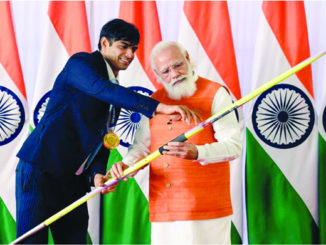
New Delhi (TIP): At the end of the e-auction of Prime Minister Narendra Modi’s mementos on Thursday, October 7, the maximum number of bids were received for the sculpture of Sardar Patel (140), while the highest bid value was for Olympic gold medallist Neeraj Chopra’s javelin (Rs 1.5 crore), the culture ministry said.
Among the items that received the most bids was a wooden Ganesha with 117 bids, a memento of the Pune metro line which got 104 bids and a memento of Victory flame which received 98 bids.
Following close on the heels of Chopra’s gold winning javelin, which received the highest bid in terms of value, were the autographed fence of Bhavani Devi (Rs 1.25 cr), Sumit Antil’s javelin (Rs 1.002 cr), Angavastra autographed by the Tokyo 2020 Paralympic contingent (Rs 1 cr) and Lovlina Borgohain’s boxing gloves (Rs 91 lakh).
The highlight items of this round of e-auctions included the sports memorabilia of the medal winning Tokyo 2020 Paralympic Games and the Tokyo 2020 Olympic Games; models of Ayodhya Ram mandir; Varanasi’s Rudraksh auditorium and many other precious and interesting collectibles.
In the e-auction, 1348 mementos were put up and around 8,600 bids were received.
This third round of e-auction of the gifts and mementos presented to Modi was held from September 17 to October 7. The proceeds of the e auction will go to the Namami Gange Mission.
At the last such auction, in September 2019, as many as 2,770 objects went under the hammer. These included paintings, sculptures, shawls, jackets and traditional musical instruments. The proceeds were also donated to the Namami Gange Mission. Source: PTI
A billion hopes were riding on the young shoulders of Anshu Malik in Oslo, Norway, during the World Wrestling Championships. She had already made history by winning her 57kg semifinal on Wednesday, October 6, becoming the first Indian woman wrestler to reach the final at the World Championships. However, the 20-year-old from Nidani village, Jind in Haryana, fell short in her quest to become the first Indian woman wrestler and second from the country after Sushil Kumar to become a world champion. Her shoulder gave way as she lost via fall to Helen Maouralis of USA, 2016 Olympics gold medallist (53kg) and 2020 bronze medal winner (57kg). Anshu, the reigning Asian Championships gold medallist, was in control of the final in the first period as she thwarted all the attacks of the American wrestler. She led 1-0 after the first period from a passivity point. But all changed seconds into the second period when Maroulis first scored a two-point take-down and then accrued another two points for exposure and then pinned Anshu to win.
New Delhi (TIP): Covid-19 patients who use blood thinners may have a nearly 50 per cent reduced risk of death and a 43 per cent lower risk of hospitalisation, according to a study published in Lancet’s EClinical Medicine journal.
The research was conducted on 6,195 patients over the age of 18, who were diagnosed with Covid-19 from March 4 to August 27, 2020, in 12 hospitals and 60 clinics in the US.
The researchers from the University of Minnesota, US, and Basel University in Switzerland analysed the relationship between 90-day anticoagulation therapy among out-patients before Covid-19 diagnosis and the risk for hospitalisation and mortality.
The researchers also evaluated the association between anticoagulation therapy, which is used to prevent blood clots, and mortality risk among admitted patients.
The study found that patients on blood thinners before contracting Covid-19 were 43 per cent less likely to be admitted to hospital, despite being older and having more chronic medical conditions than their peers.
Blood thinners, regardless of being used before being infected with Covid-19 or started when admitted to the hospital for treatment of the viral disease, reduce deaths by almost half, they added.
Overall, hospitalised Covid-19 patients benefit from blood thinners regardless of the type or dose of the medication used, the researchers noted.
“Many individuals with Covid-19 develop abnormal blood clots from high inflammation, which can lead to serious health complications and mortality,” said study lead author Sameh Hozayen, an assistant professor at the University of Minnesota.
“Blood thinners are medications prescribed to prevent blood clots in patients with a prior blood clot in their lungs or legs. They also prevent blood clots in the brain secondary to abnormal heart rhythms, like atrial fibrillation,” Hozayen wrote in the journal.
The researchers said blood thinners are the standard of treatment in these diseases, which is why they looked at data to see if it impacted hospitalisations related to Covid-19.
“We already know that overwhelmed hospitals have a higher risk for death among their patients, so reducing hospitalisation may have a positive impact during a Covid-19 surge,” Hozayen added.
The researchers also noted that about half the patients prescribed blood thinners for blood clots in their legs, lungs, abnormal heart rhythms or other reasons do not take them.
Increasing adherence for people already prescribed blood thinners can potentially reduce the bad effects of Covid-19, they said.
“At most centers around the world now, there are protocols for starting blood thinners when patients are first admitted to the hospital for Covid-19 — as it is a proven vital treatment option,” Hozayen said.
“Outside of Covid-19, the use of blood thinners is proven to be lifesaving for those with blood coagulations conditions,” the scientist added.
The team is currently working with research groups in other parts of the world such as Egypt to look at how blood thinners impact patients in less-invested health care systems and in different patient populations.
4 Pieces Boneless Chicken, 1/2 tsp Lemon juice, 1/2 tsp Red chilli powder, 1/2 tsp Salt, 1/2 tsp Ginger garlic paste, 1/2 tsp Curd, 1/2 tsp Red chilli powder, 1/4 tsp Salt, 1 tsp Coriander powder, 2 Tbsp Oil, 2 Nos Onion, sliced, 1 tsp Oil, 1 Bay leaf, 2 Nos Green cardamom, 1 Black cardamom, 1/2 Sticks Cinnamon, 1 tsp Ginger garlic paste, 2 Nos Tomato, 1 1/2 tsp Kasoori Methi, soaked, 1 Green chilli, 1 Cup Water.
Method
– Take chicken pieces in a deep bowl
– Add lemon juice, red chilli powder, salt and ginger garlic paste. Mix them thoroughly with bare hands
– Keep aside for 20 minutes to marinate.
– Take curd in a bowl, add red chilli powder, salt, coriander powder. Whisk it thoroughly.
– Now in a pan of hot oil, put onion and saute till golden brown. Grind it to make a paste.
– In the same pan, in some oil put marinated chicken and pan fry it till golden brown and a bit crisp.
– Now put bay leaf, green cardamom, black cardamom, cinnamon in a hot il pan and saute for a while.
– Add ginger garlic paste, saute some more and put chopped tomato, kasoori methi and the prepared curd mix. Mix them well and add the onion paste. Mix thoroughly.Now add the fried chicken and mix it with the gravy till the pieces are completely coated.
– Add green chilli and water, mix well. Bring to simmer. Put kasoori methi over and cover the pan to cook for a while.
– Open the pan when the curry starts to simmer a bit and the excess water is evaporated. Mix a little and serve hot.
Let’s be true, we all want glowing skin despite the makeup. Yes, we do like to dress up and put makeup on when we want to, it is tiring to see makeup as a necessity to hide our dull skin. We have envied celebs who have naturally flawless skin but what is the secret to their glow? A healthy and nutritious diet. Because it doesn’t matter what high-end products you use, the food we eat impacts us the most at the end of the day.
Binging on processed foods high in sugar and fat will not only make your skin dull but prone to acne and breakouts. And naturally, you don’t want that. Your diet needs to be rich in protein, vitamins, fibre with lots of fruits and vegetables. So next time if you go out for groceries, pick these items that we have listed below for glowing skin.
Chia Seeds
Chia seeds are full of omega 3 fatty acids and antioxidants that not only make the skin bright and beautiful but also have anti-ageing properties. Packed with minerals and vitamins, they also aid in the production of collagen.
Berries
Berries like strawberries or blueberries can give you glowing skin as well. They remove toxins from our bodies and also serve as a perfect snack. Having anti-inflammatory properties and being rich in vitamins, they reduce fine lines and wrinkles as well.
Almonds
Almonds are rich in Vitamin A that protects the skin from sun damage. They keep our blood vessels dilated which keep our skin hydrated in return. They contain fatty acids and vitamins that help us get rid of blemishes.
Fish
Fish is extremely good for our body and skin. The omega 3s and nutrients are essential for our skin to be glowing and healthy. Seawater fish like salmons, sardines are very healthy for us.
Leafy vegetables
This is the most important food of all. They are loaded with antioxidants and vitamins that can reduce the dullness of your skin and enhance its glow. Spinach, broccoli, lettuce, celery and coriander can do wonders to your skin.
These were the 5 superfoods you need to include in your diet. Turmeric is also a very helpful spice for getting glowing skin. Another thing that is a priority is to drink lots and lots of water to keep your skill hydrated throughout the day. And that’s it. Try these and see the difference. Source: Pinkvilla
Bollywood actress Richa Chada loved shooting for the series ‘Candy’ in the mountains so much that she’s planning to shoot her first production ‘Girls Will Be Girls’ in Uttarakhand. Directed by Shuchi Talati and produced through the banner Pushing Button Studios, the story is set in a Himalayan boarding school in a hill station in northern India. Richa said: “I loved shooting for ‘Candy’ and not only because it’s a gripping narrative but because of the location in which we were shooting. It was so peaceful and serene that I found it easier to focus than in the city.” The plot of the film revolves around the coming of age of a 16-year-old girl and her relationship with her mother. Source: IANS
The Nobel Prize in Chemistry has been jointly awarded to Benjamin List and David W.C. MacMillan for the development of asymmetric organocatalysis. Speaking on the occasion, Johan Åqvist, chair of the Nobel Committee for Chemistry said, “This concept for catalysis is as simple as it is ingenious, and the fact is that many people have wondered why we didn’t think of it earlier.” Several industries, as well as research areas, are dependent on chemists’ ability to construct molecules to form elastic and durable materials, store energy in batteries or inhibit the progression of diseases. Catalysts are essential for their progression as they control and accelerate chemical reactions, without being a part of the final product. Human bodies also contain thousands of catalysts in the form of enzymes that chisel out the molecules essential for life.
The researchers for long believed that there were only two types of catalysts– metals and enzymes, but in 2000, Benjamin List and David MacMillan, independent of each other, developed a third type– asymmetric organocatalysis. This impacted pharmaceutical research positively, thereby making Chemistry greener.
The Nobel Prize in Physics has been jointly awarded to Syukuro Manabe, Klaus Hasselmann and Giorgio Parisi for their groundbreaking contributions to help us understand complex physical systems.
One half of the prize has been awarded to Syukuro Manabe and Klaus Hasselmann for the physical modelling of Earth’s climate, quantifying variability and reliably predicting global warming.
The other half has been awarded to Giorgio Parisi for the discovery of the interplay of disorder and fluctuations in physical systems from atomic to planetary scales.
Speaking on the occasion, Thors Hans Hansson, chair of the Nobel Committee for Physics said, “The discoveries being recognised this year demonstrate that our knowledge about the climate rests on a solid scientific foundation, based on rigorous analysis of observations. This year’s Laureates have all contributed to us gaining deeper insight into the properties and evolution of complex physical systems.”
The Nobel Prize in Physiology or Medicine 2021 was jointly awarded to David Julius and Ardem Patapoutian for their discoveries of receptors for temperature and touch.
Speaking on the occasion, the Nobel jury said, “The groundbreaking discoveries…by this year’s Nobel Prize laureates have allowed us to understand how heat, cold and mechanical force can initiate the nerve impulses that allow us to perceive and adapt to the world around us.”
David Julius utilized capsaicin, a pungent compound from chilli peppers that induces a burning sensation to identify a sensor in the nerve endings of the skin that responds to heat.
Ardem Patapoutian used pressure-sensitive cells to discover a novel class of sensors that respond to mechanical stimuli in the skin and internal organs. Both the Nobel laureates have identified the missing links to help us understand the complex interplay between our senses and the environment. Their discoveries are being used to develop treatments for a wide range of diseases such as chronic pain.
Signup to our Newsletter!
Don’t miss out on all the happenings around the world