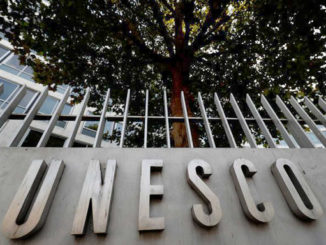
UNITED NATIONS (TIP): India was on Thursday, November 25, elected to the World Heritage Committee of the UN’s cultural organization for a four-year term, a week after the country was re-elected to the UNESCO Executive Board. “Happy to announce that India has won the seat on World Heritage Committee from the Asia Pacific region. I thank all our supporters for leading us to this historic win,” Minister of State for External Affairs Meenakashi Lekhi tweeted on Thursday. India to UNESCO (United Nations Educational, Scientific and Cultural Organisation) tweeted, “India gets elected to the World Heritage Committee with 142 votes for a four-year term from 2021-25!” On November 17, India won the re-election to the executive board of the UNESCO for the 2021-25 term. The committee is responsible for the implementation of the World Heritage Convention, defines the use of the World Heritage Fund and allocates financial assistance upon requests from States parties.
BERLIN (TIP): Germany crossed the threshold of 1,00,000 Covid-19-related deaths on Thursday, November 25, with a surge in infections posing a challenge for the new government. Another 351 persons have died from coronavirus, bringing the total since the start of the pandemic to 1,00,119, data from the Robert Koch Institute for infectious diseases showed. The number of new daily cases hit a new record of 75,961.
Hospitals in some areas, especially in eastern and southern Germany, are under pressure and leading virologist Christian Drosten warned that another 1,00,000 could die in the pandemic. The head of the Robert Koch Institute has put the mortality rate at about 0.8 per cent, meaning that at daily case numbers around 50,000, some 400 persons per day will end up dying. Germany’s incoming three-party government, which announced its coalition deal on Wednesday, said it would create a team of experts who would assess the situation on a daily basis.
Greens co-leader Annalena Baerbock said the new government, comprising the Social Democrats, Greens and Free Democrats, had set itself 10 days to decide if further restrictions are needed. The country should consider partial lockdowns, Ralph Brinkhaus, parliamentary leader of the Christian Democrats, said. Meanwhile, the EU’s drug regulator approved the use of Pfizer-BioNTech’s Covid-19 vaccine for children between the ages of five and 11 on Thursday, paving the way for them to be given a first shot as Europe struggles with a surge in cases. The European Medicines Agency recommended that Pfizer-BioNTech’s vaccine, approved for European Union use in teenagers between 12 and 17 years old since May, be given as an injection in the upper arm in two 10 microgram doses, three weeks apart. Adult doses contain 30 micrograms. Another European nation, France, has launched a plan to give Covid-19 booster shots to all adults, as it opted against further lockdown or curfew to help combat a worrying uptick in infections in the country. Cases have peaked in France, with daily new cases rising above the 30,000 mark.
WASHINGTON, DC (TIP): The United States has not made a determination yet on any potential Countering America’s Adversaries Through Sanctions Act (CAATSA) waiver to India with regard to its purchase of S-400 missile defense system from Russia, the Biden Administration said Tuesday, November 25. The State Department comments come a week after India started receiving the supplies of S-400 missile defense system from Russia and amidst calls from top Republican and Democratic lawmakers not to impose CAATSA sanctions on India. Asserting that it values its “strategic partnership” with India, a State Department official maintained the Biden Administration’s suspense over the issue by telling reporters CAATSA does not have a blanket or country-specific waiver provision attached to it. “We would need to refer you to the Indian government for any comments on potential deliveries of the S-400 system. But we have been clear when it comes to the system, not only in the Indian context but more broadly as well, that we’ve urged all of our allies, all of our partners to forego transactions with Russia that may risk triggering sanctions under so-called CAATSA, the Countering America’s Adversaries Through Sanctions Act. We have not made a determination on a potential waiver with respect to Indian arms transactions with Russia,” State Department Spokesperson Ned Price said. “CAATSA, however, does not have a blanket or country-specific waiver provision attached to it. We also know that our defense relationship with India has expanded and deepened significantly in recent years. It’s deep and commensurate with the broad and deep relationship that we have with India and its status as a major defense partner,” he said.
“We expect this strong momentum in our defense relationship to continue. We certainly value our strategic partnership with India. As you know, we had an opportunity to travel to India not all that long ago. In August, I believe it was, we’ve met with Foreign Minister Jaishankar many times. We have discussed this concern directly, including with the highest levels in the Indian government,” Price said in response to a question. Several members of the US Congress, he said, have shown deep interest on the issue. “It not for us to speak to any systems that the Indian government may or may not have received. It is for us to speak to the laws that are on the books and the requirements under those laws. Obviously, members of Congress are deeply interested in this as well. So, it’s a conversation that has been ongoing with our Indian partners,” Price said. “It’s a conversation that takes place in the context of a defense relationship that is meaningful to us, that is important both for United States and India, including in the context of a free and open Indo-Pacific. And so, I suspect those conversations will continue,” he said.
Price said that the 2+2 talks would be held soon in Washington DC.
“We’ve committed to the 2+2, again, because we have a significant relationship with India, including its status as a major defense partner. But I can assure you that there will be an opportunity for a 2+2 before long,” he said.
Last month, US Senators and India Caucus Co-Chairs Mark Warner and John Cornyn sent a letter to President Joe Biden encouraging him to waive CAATSA sanctions against India for buying military arms from Russia.
“While India has taken significant steps to reduce its purchases of Russian military equipment, it has a long history of purchasing arms from the Soviet Union, and later Russia. In 2018, India formally agreed to purchase Russian S-400 Triumf air-defense systems after having signed an initial agreement with Russia two years prior,” they said. “We are concerned that the upcoming transfer of these systems will trigger sanctions under the Countering America’s Adversaries Through Sanctions Act (CAATSA), which was enacted to hold Russia accountable for its malign behavior,” they wrote. “As such, we strongly encourage you to grant a CAATSA waiver to India for its planned purchase of the S-400 Triumf surface-to-air missile system. In cases where granting a waiver would advance the national security interests of the U.S., this waiver authority, as written into the law by Congress, allows the President additional discretion in applying sanctions,” the two Senators wrote.
WASHINGTON (TIP): President Joe Biden on Thursday, November 25, wished Americans a happy and closer-to-normal Thanksgiving, the second celebrated in the shadow of the coronavirus pandemic, in remarks welcoming the resumption of holiday traditions by millions of U.S. families — including his own, says an AP report.
“As we give thanks for what we have, we also keep in our hearts those who have been lost and those who have lost so much,” the president said in a videotaped greeting recorded with first lady Jill Biden at the White House before their trip to Nantucket, Massachusetts, for the holiday. On the island, the Bidens visited the Coast Guard station at Brant Point to meet with personnel there and virtually with U.S. service members from around the world. “I’m not joking when I say I’m thankful for these guys,” the president said when asked what he was thankful for, referring to the Coast Guard members standing ramrod straight before him on the grounds as he departed.
Reporters were kept out of the room for Biden’s virtual remarks, apparently because of tight space in the building. Well-wishers waved and cheered as Biden’s motorcade navigated the island’s narrow paved and cobblestone streets to and from the Coast Guard compound. Biden, whose late son Beau was a major in the Delaware Army National Guard, said he has watched U.S. service members in action around the world, from the South China Sea and Iraq and Afghanistan to South America. He said when foreigners wonder what America is, “they don’t see us here,” meaning civilians. “They see them,” he said of members of the Coast Guard and the other branches of the U.S. military. “It makes me proud.” From Nantucket, the Bidens also called in to the Macy’s Thanksgiving Day Parade, briefly bantering on air with NBC broadcaster Al Roker. Shut out a year ago, spectators again lined the route in Manhattan as some 8,000 participants joined the parade. Parade employees and volunteers had to be vaccinated against COVID-19 and wear masks. The extended first family went traditional for their Thanksgiving menu: roasted turkey, stuffing using a grandmother’s recipe and other fixings. Dessert was three kinds of pie, and — in no surprise to those who followed Biden in and out of ice cream shops on the campaign trail — chocolate chip ice cream. Biden and his wife started spending Thanksgiving in Nantucket since before they were married in 1977 because they were looking for a way out of choosing whose family to spend it with. They did not visit in 2015 following Beau’s death earlier that year from brain cancer at age 46, or in 2020, when the COVID-19 pandemic put the kibosh on big family gatherings.
Biden instead dined at home in Delaware last year with just his wife, daughter Ashley and her husband.
But this year, the president joined the millions of Americans who are celebrating the holiday with big groups of loved ones. Biden’s entire family flew up with him Tuesday night on Air Force One to resume the Thanksgiving tradition: his wife; son Hunter and his wife, Melissa and their toddler son Beau; daughter Ashley; and grandchildren Naomi, Finnegan, Maisy, Natalie and young Hunter, as well as Naomi’s fiancé, Peter Neal.
The president has credited the roll-out of COVID-19 vaccines with helping ease the return of family gatherings this holiday season, although a resurgent virus has fueled an increase in new infections in the U.S. The president and first lady both have had their full vaccine dose, and a booster.
Naomi Biden and her fiancé rode bicycles along on a local path just before her grandfather’s SUV departed the secluded home where the family is staying. The sprawling compound is owned by David Rubenstein, a billionaire philanthropist and co-founder of the Carlyle Group private equity firm.
Biden’s visit, his first as president, is markedly different from his previous holidays here when he was a U.S. senator and later vice president. Then, he might have been seen walking around downtown.
Jill Biden was heard telling the Coast Guard members she would see them again Friday night at Nantucket’s annual Christmas tree lighting, another Biden tradition. “We’re all going together,” she said of her family. The tree lighting ceremony is where Beau Biden proposed to his wife, Hallie, in 2001. They were wed on the island the following year. Biden is expected to return to the White House on Sunday.
Earlier, on November 19, following the tradition, Biden pardoned Peanut Butter the turkey during the 74th annual Thanksgiving turkey pardoning in the Rose Garden of the White House.
WASHINGTON, D.C. (TIP): The Internal Revenue Service, on November 23, announced that interest rates will remain the same for the calendar quarter beginning Jan. 1, 2022. The rates will be:
3% for overpayments (two (2) percent in the case of a corporation),
0.5% for the portion of a corporate overpayment exceeding $10,000,
3% for underpayments, and
5% for large corporate underpayments.
Under the Internal Revenue Code, the rate of interest is determined on a quarterly basis. For taxpayers other than corporations, the overpayment and underpayment rate is the federal short-term rate plus 3 percentage points.
Generally, in the case of a corporation, the underpayment rate is the federal short-term rate plus 3 percentage points and the overpayment rate is the federal short-term rate plus 2 percentage points. The rate for large corporate underpayments is the federal short-term rate plus 5 percentage points. The rate on the portion of a corporate overpayment of tax exceeding $10,000 for a taxable period is the federal short-term rate plus one-half (0.5) of a percentage point.
The interest rates announced today are computed from the federal short-term rate determined during October 2021 to take effect Nov. 1, 2021, based on daily compounding. Revenue Ruling 2021-24, announcing the rates of interest, is attached and will appear in Internal Revenue Bulletin 2021-50, dated Dec. 13, 2021.
ELMONT, NY (TIP): New York Kerala Center’s 29th Annual Awards Banquet was held at the Center’s auditorium in Elmont, NY on Saturday, November 13th, 2021. The Center honored six outstanding achievers in different categories and two doctors with special awards for their services during the pandemic. The honorees were: Dr. George M. Abraham, the President of the American College of Physicians, for outstanding achievements in Medicine and Professional Services, Dr. Devi Nampiaparampil, who is a practicing physician, media personality and was the Republican nominee for NYC Public Advocate, for notable contributions in Public Service, Mayor Robin J. Elackatt, Mayor of City of Missouri City, Texas, for notable achievements in political leadership, Chandrika Kurup, the director of Noopura Indian Classical Dance School, for contributions and achievements in Performing Arts, Mary Philip, who was a Lieutenant in the Indian Defense Force and a past President of the Indian Nurses Association of New York, for notable contributions in Nursing and Community Service, and Nandini P. Nair, Esq, who is a partner and co-chair of the Immigration and Naturalization practice group and serves on the Management Committee at Greenspoon Marder LLP, for notable services and achievements in Legal Services. Dr. Sabu Varghese and Dr. Blessy Mary Joseph, practicing physicians in New York, were honored with Special Award for notable services during the Pandemic in 2020 and 2021.
The program commenced with the American and Indian National anthems sung by Bailey Stephen and Lauren Joseph. President Alex K. Esthappan welcomed everybody after a brief introduction of the activities and goals of the Kerala Center. Indian Consul for Community Affairs, A. K. Vijayakrishnan, was the chief guest of the function. In his speech, Mr. Vijayakrishnan said that when the individuals of the community achieve excellence in their fields and do well for the community and society, it makes him happy. Their activities make relations between America and India stronger. The chief guest was introduced by Dr. Madhu Bhaskaran, the chairman of the Award Committee and Board of Directors.
Dr. George Abraham, who was also an awardee, was the keynote speaker. In his keynote speech, Dr. Abraham implored that we should strive to move forward by including everyone and treating everybody equally, and it is the duty of the leaders to make sure that this is happening. An organization gets much more strength when it becomes a melting pot of people and ideas, he concluded. Dr. George Abraham was introduced by Dr. Thomas Abraham, Chairman of the Trustee Board and Award Committee member and Consul A.K. Vijayakrishnan presented the award. Dr. Thomas Abraham also explained the process of selecting the awardees.
ACP President Dr. George Abraham receiving award from Indian Consul A.K. Vijayakrishnan. From l. to r. Kimmy John, Dr. Thomas Abraham, James Thottam, Dr. Madhu Bhaskaran, Consul Vijayakrishnan, Dr. Susan George, Dr. George Abraham, Alex Esthappan, Thambi Thalappillil and John Paul.
The award for Public Service went to Dr. Devi Nampiaparampil. She reflected in her speech the difficulties she and her family went through during the Covid-19 pandemic, which resulted in her determination to get involved in public service. She thanked the Malayali community for their tremendous support during her campaign for Public Advocate.Dr. Devi was introduced by Raju Thomas, Kerala Center Board Member and Attorney Appen Menon presented the award.
The award for political leadership went to Robin Elackatt, Mayor of City of Missouri City in Texas. He opinioned in his speech that when he came from the red state of Texas to the blue state of New York, he realized that many things he heard was just a story created by CNN. He added that Kerala Center’s award was the first recognition he got after becoming the mayor, whereas, prior to this event, he was receiving only blames. The Mayor was introduced by James Thomas, one of the youth representatives of the Kerala Center and Senator Kevin Thomas, the first Malayalee senator of New York, presented the award.
Missouri City Mayor Robin Elackatt Receiving award from NY State Senator Kevin Thomas. From l. to r.: James Thomas, Jimmy John, James Thottam, Dr. Madhu Bhaskaran, NY Senator Thomas, Mayor Elackatt, Alex Esthappan, John Paul and Dr. Thomas Abraham.
The award for legal services went to Nandini Nair, Esq. In her speech, she said that her parents, especially her mother who came alone to the United States with only $7 in her pocket to provide a better life for her family, is her guide and role model. She feels grateful that she is able to help so many newcomers as an immigration attorney today. Nandini Nair was introduced by Dr. Theresa Antony, Kerala Center board member and Dr. Asha Ramesh of Sabinsa Corp. presented the award.
The award for Nursing and Community leadership went to Mary Philip. In her speech she stated that Kerala Center’s activities are unique in nature and separates it from other organizations. She specifically mentioned the recognition of Nurses and other front-line workers and organizing flag hoisting by retired Indian Defense Force members on Indian Independence Day celebration as examples. Mary Philip was introduced by Christy John, NP and Dr. Unni Moopan, Kerala Center Trustee, presented the award.
The award for performing Arts went to Chandrika Kurup. In her speech, Mrs. Kurup expressed a lot of satisfaction that her students are now running their own successful dance schools and other related artist works here in America and in Kerala. Chandrika was introduced by Annie Esthappan, one of the youth representatives of the Kerala Center and former student of Mrs. Kurup, and Abraham Philip, CPA, presented the award.
The Center also honored two doctors. Dr. Sabu Varghese and Dr. Blessy Mary Joseph, with special awards for their services during the pandemic. They were introduced by Benzy Thomas, DNP, whose description of her experience treating Covid-19 patients were so touching to the audience. When Dr. Sabu explained his experience with a covid patient who was a doctor and his colleague who had to be on ventilator for more than six months, it was heart breaking. When Dr. Blessy spoke about her experience treating Covid patients, she could not control her emotions.Jose Kadapuram, Director of Kairali TV, USA, presented the award to Dr. Sabu and G. Mathai, trustee of Kerala Center, presented the award to Dr. Blessy Joseph. Their service to New Yorkers including Malayalees during the height of the pandemic is unforgettable. Each of the awardees was also presented a citation from New York State Senate and was presented by New York State Senator Kevin Thomas.
Kerala Center officials and Consul Vijayakrishnan with awardees. Front row, from l. to r.: Dr. George Abraham, Dr. Sabu Varghese, Dr. Blessy Joseph, Dr. Devi Nampiaparampil, Dancer and Teacher Chandrika Kurup, Nandini Nair Esq., Mary Philip and Mayor Robin Elackatt. Back row, from l. to r.: Dr. Thomas Abraham, Dr. Madhu Bhaskaran, Jimmy John, Alex Esthappan, G. Mathai, Consul A.K. Vijayakrishnan, John Paul, James Thottam, Raju Thomas, Abraham Thomas and P.T. Paulose.
As part of the Award Ceremony, a Souvenir was released by the committee chairman P.T. Paulose along with other committee members, John Paul and Abraham Thomas. by giving a copy of the Souvenir to Dr. Susan George, spouse of the keynote speaker Dr. George Abraham.
In the absence of Founder President Mr. E. M. Stephen, who was in charge of the Center for the last thirty years, Executive Director Thambi Thalappillil and Director Abraham Thomas took charge of the event. James Thottam was the chairman of the Award Dinner. The MC of the program, Daisy Palliparambil, impressed everybody with her outstanding performance. The songs sung by famous singer Shalini Rajendran and Lauren Joseph and dance by artists of the Noopura School of Dance made the awards night a more colorful one. Secretary Jimmy John concluded the ceremony with a vote of thanks to the guests, awardees, audience and everyone worked so hard to make it a successful event. With dinner, the Award Night came to an end.
Dancers from Noopura School of Dance performing at the Awards Night.
About The Kerala Center : The Kerala Center, located at Elmont (Long Island, New York), is an IRS Tax-Exempt 501 (c) (3) organization serving the Keralites and the Indian American community in the tri-state New York area. It was inaugurated in 1993. Kerala Center’s awards are the most prestigious among Indian American Malayalees.
NEW YORK (TIP): On Saturday, November 13, “Ekal Vidyalaya Foundation (EVF)” raised over $4 million in star-studded virtual Gala, called “Future of India”that highlighted pre-eminent speakers,Ekal’s eclectic accomplishments and youth’s contributions to its mission. As per Indian demography, two third of its population resides in villages. Ekal, as it is popularly known, currently has presence in over 102,000 rural-tribal areas all across India with a reach to over 300,000 such clusters of habitants. Although rooted in education, Ekal has blossomed into providing healthcare, integrated village development, empowering functionality and new-age technology to these rural folks.
Thistwo-hourevent, co-chaired by Mohan Wanchoo and Kamlesh Shah, both successful entrepreneurs and philanthropist, saw consistent overwhelming response from the donors, from the moment it opened up till it was capped by youthful entertainment by “Penn-Masala’, a youthful group of famous singers from “University of Pennsylvania”. The funds raised at the Gala were for specific projects, such as tailoring training centers, E-shiksha, Ekal-on-Wheels, Telemedicine, Gramotthan Research Centers, and Integrated Village Development. Mohan Wanchoo, who pioneered Gala events at Ekal, regaled viewers with a personal story of how hospitable tribal villagers were in the midst of a horrific tragedy that they had endured earlier. As a professional singer he mesmerized the viewers with an inspiring song in his melodious voice. Kamlesh Shah elaborated on Ekal’s aggressive fight with Covid-19 pandemic and the steps,that were taken to fight misinformation about the virus and the treatment.From the interspersed interviews of rural children, it was quite evident that Ekal has fired up their imagination to aspire for becoming Doctors, Soldiers, Teachers etc. Ekal’s women-centric empowerment activities and education as a tool for progress touched a nerve with all three chief guest speakers who whole heartedly supported Ekal’s selfless mission for the future of India.Kiran Mozumdar-Shaw, founder of Biocon and recipient of ‘Padma Bhushan’ honor,emphasized the need for digital tracking of patients by the tech-savvy nursing caretakers, as the core pointfor managing the pandemic.Coming from a humble family,Renu Khator, President of University of Houston system chancellor, stressed on the important role the education has played throughout her Steller career. She lauded EVF’s efforts for women empowerment. Naren Chaudhary, CEO of highly successful ‘Panera Bread’ brand, explained how his daughter –‘Aisha’ – was the central motivating factor in whatever he did in his life. He expressed unequivocal passion for his country – India–where he had witnessed ‘spirit of humanity’ in his own time of acute needto save Aisha. Ranjani Saigal, the Executive Director of Ekal-USA assured him that his daughter’s legacy lives through what Ekal does best. For every $1 a donor invests in Ekal activities, Ekal volunteers provides $8 worth of selfless volunteer efforts. Ekal’s youth-wing had raised substantial amount of funding to arrest the spread of Covid pandemic. During the Gala, they freely talked about what attracted them most to this largest social endeavor, supported by the Indians and NRIs, in dozen countries. Ekal supports all its activities without any regards to a particular region, religion or gender.
A galaxy of Bollywood stars – from Hema Malini, Boney Kapoor, Subhash Ghai to Varun Dhavan, Udit Narayan, Alia Bhatt – provided glitz with their enthusiastic support for Ekal. A ZEE-TV ‘2019 Cine Awards’ clip, showedthree Ekal alumni students honored, for exceptional achievements. This public honor was bestowed on ‘Pinky Karmakar’ of Assam who was the torchbearer at 2012 London Olympics, ‘Divya Malgave’ of Maharashtra who won a Gold Medal at ‘International Intermediate Karat Championship’ and ‘Ramchandra Verma’ of U.P. who has made his birthplace– ‘Aligunj’ – an ideal ‘Gaav’ (village). While unveiling the roadmap for thefuture,Suresh Iyer, the President of Ekal-USA, confirmed that the essential objectives ofall the projects are two-fold – first, to prevent migration of rural folks to urban areas for lack of opportunities and second, to increase the economic and social impact on their lives. He appealed viewers to join hands with Ekal for the better ‘Future of India’.
QUEENS, NY (TIP): “It is a great day for democracy and freedom and a humongous victory for the farmers in their struggle for justice and fairness. The enormous sacrifices they have made in this struggle show the indomitable human spirit that has overcome the arrogant misuse of power at the highest order. We also salute 700 of those farmers who have lost their lives during this struggle. An apology should be forthcoming as well for name-callings at the farmers such as ‘anti-nationals’ for exercising their legitimate rights to protest government policies”, said George Abraham, Vice-Chairman of the IOCUSA. It is not lost on anyone that the timing of this decision has a lot to do with upcoming elections in some key states such as U.P. and Punjab, where farmers are a very influential voting bloc. In the last five years, their governance showed little regard in addressing the grievances of ordinary people but favored the crony capitalists who are the big beneficiaries. While we welcome the Prime Minister’s announcement, the parliament should convene at the earliest to repeal these laws and reinstate the Minimum Price Guarantee as demanded by the farmers. We also appeal to the government to pay reparations to those farmers who lost their lives during the struggle.
NEW YORK (TIP): New Jersey Transit will add buses and trains to help passengers get to the airport and shopping centers over the Thanksgiving holiday. It’ll also offer transportation services for residents interested in attending the Macy’s Thanksgiving Day Parade in New York City
Officials advise customers to purchase tickets in advance
Early getaway rail and bus service will be available starting Wednesday, November 24, to accommodate increased travel. That’ll also boost capacity for those traveling to Newark Liberty International Airport and those leaving work.
Before the pandemic, the day before Thanksgiving was the busiest day of the year at the airport’s rail station with ridership about twice of a typical day, NJ Transit said.
NEW YORK, NY(TIP): City Council Member Peter Koo today joined with Flushing-based organizations to distribute 200 turkeys to community senior centers, public housing residents, and faith-based institutions. Sponsors of this year’s Thanksgiving turkey donations include Council Member Peter Koo, Flushing Chinese Business Association and American Foods Merchant Alliance.
AUBURNDALE, QUEENS (TIP): Assemblyman Edward Braunstein (D-Bayside) and Senator John Liu announced that the New York State Liquor Authority (SLA) has officially suspended the license of “Silk Hookah Lounge LLC,” known as Kloud Tequila Grill and Hookah Lounge. Effective immediately, no alcohol is allowed to be sold or consumed on the premises at 192-08 Northern Boulevard.
The business has been the source of numerous health, safety and quality of life concerns in recent months. Local residents and small business owners have reported a host of disturbing issues, including the sale of alcohol to intoxicated patrons, public urination, drag racing, public sex acts, loud music and littering.
On November 13th, concerns escalated when a shooting that left two people wounded occurred outside of the business. The NYPD investigation determined that the shooting followed an altercation where patrons were denied entry during a private party taking place inside. Officers apprehended a 19-year-old with a loaded firearm at the scene. While the license suspension is an important step in the right direction, Braunstein, Liu and civic leaders are calling on the SLA to permanently revoke Kloud’s license in order to protect the welfare of the Auburndale community. “The issues involving Kloud Tequila Grill extend well beyond unneighborly behavior. For months, the local community has been raising concerns that the ownership and patrons of this establishment were engaged in activity that severely compromised public health and safety,” said Assemblyman Edward Braunstein. “While the SLA’s ruling to suspend Kloud’s liquor license is a good first start, more needs to be done. I continue to urge the SLA to do the right thing by the Auburndale community and permanently revoke Kloud’s license. Enough is enough.” “Now that SLA has pulled their liquor license, we can say with confidence that the forecast for Kloud Tequila Grill is dark and stormy,” said Senator John Liu. “The recent gun violence of the last week was the last straw for the state, but our community knew Kloud was dangerous from the beginning. Any business that operates with such blatant disregard for their neighbors should take warning that our community won’t stand for it, and we will fight tooth and nail to make sure our neighborhoods are safe.” “On behalf of the Auburndale Northern Association, I’d like to thank Assemblyman Ed Braunstein and Senator John Liu’s tireless efforts to ensure the public safety and quality of life of our community,” said Auburndale Northern Association Member Alexandra Han. “This outcome clearly demonstrates that when people get together and take action, we can achieve great things. While we are grateful for this temporary suspension, there were plenty of warning signs before the gun violence of last week. We urge the NYS Liquor Authority to continue to do the right thing by fully revoking Kloud (Silk)’s liquor license.” “CB 11 has been fielding complaints and dealing with the fallout from many quality-of-life disturbances from the bar known as Kloud Tequila Grill for months, and are outraged by the recent escalation of community violence that has spilled out of the establishment and into the neighborhood,” said Community Board 11 District Manager Joseph Marziliano. “The Board office will continue to work with State Senator Liu and Assembly Member Braunstein to rally the various city and state agencies to enforce the laws and hold Kloud accountable.” The SLA has indicated that it intends to seek the permanent cancellation or revocation of Kloud’s license.
Islamabad (TIP): An 11-year-old Hindu boy was sexually assaulted and brutally murdered in Pakistan’s Sindh province, according to a media report on Saturday. The boy went missing on Friday evening and his body was later found on Saturday in an abandoned house in Babarloi town in Khairpur Mir area of the province, his family members said.
“The entire family was busy with Guru Nanak’s birthday events. We do not know how the child went missing. He was found dead in the house at 11 pm,” Raj Kumar, a relative of the child, was quoted as saying by The Express Tribune newspaper.
“He was a grade five student, and was born in 2011,” he said, adding that the whole area was gripped by fear after the horrific incident.
The Station House Officer (SHO) of Babarloi police station said the boy was strangled to death before the culprits sexually assaulted him. “We have arrested two men, one of whom has confessed to the crime,” the SHO said.
Zubair Mahar of Child Protection Authority Sukkur said there were also torture marks on the minor’s body.
It was the second such incident in the province in the last few weeks, he said.
“A short while ago, a minor girl from the Hindu community in Saleh Pat, Sukkur district, went missing. The police have also announced Rs 2.5 million reward for her recovery, but it has all been in vain,” Mahar said. There have been several reports of atrocities on Hindus and other minority communities in Pakistan. According to the 2017 census, Hindus constitute the largest religious minority in Pakistan followed by Christians make up the second largest religious minority. The Ahmadis, Sikhs and Parsis are also among the notable religious minorities in Pakistan. Cases of sexual violence against children have also frequently come up in Pakistan. Earlier this week, police in Rawalpindi arrested a schoolteacher suspected of sexually abusing a seven-year-old girl at a school in the garrison city. PTI
Bangkok (TIP): Myanmar’s state election commission announced it is prosecuting the country’s ousted leader, Aung San Suu Kyi, and 15 other senior political figures for alleged fraud in last November’s general election.
The announcement was published on Tuesday in the state-run Global New Light of Myanmar newspaper and other official media. Allegations of widespread electoral fraud were the main reason cited by the military for its February 1 seizure of power that toppled Suu Kyi’s government. Her National League for Democracy party was about to begin a second five-year term in office after its landslide victory in the polls. The army-backed Union Solidarity and Development Party suffered unexpectedly heavy losses.
Independent observers, such as the Asian Network for Free Elections, found no evidence of substantive irregularities in the polls, though they criticised some aspects.
The action by the Union Election Commission could potentially result in Suu Kyi’s party being dissolved and unable to participate in a new election the military has promised will take place within two years of its takeover. However, the commission’s notice, dated Monday, did not specify which laws would be used to prosecute the accused.
In May, the military-appointed new head of the election commission said his agency would consider dissolving Suu Kyi’s former governing party for alleged involvement in electoral fraud and have its leaders charged with treason. AP
Dhaka (TIP): The Supreme Court of Bangladesh has relieved Judge Begum Mosammat Kamrunnahar Nahar of court duties after she made a controversial observation in her judgment that the police should not register a rape case 72 hours after the offence was committed, according to media reports. PTI
Pak singer starts classes for Af refugee girls
Islamabad (TIP): A Pakistani singer has taken upon herself to ensure that the refugee girls live their dreams. Shakila Naz, a known Pashto language singer, has started music classes for refugee girls, who recently escaped from Afghanistan after the Taliban rule. IANS
Kabul (TIP): A prominent doctor was kidnapped and killed in northern Afghanistan, his family has said. Mohamed Nader Alemi was abducted two months ago in the city of Mazar-i-Sharif, and his kidnappers demanded a ransom for his release, his son Roheen Alemi said on Friday. The family eventually paid them $350,000, after negotiating down their initial demand of more than twice that, he said.
Despite the payment, the kidnappers then killed Alemi, leaving his body in the street, his son said. They called the family and told them where to find it on Thursday, he said.
“My father was badly tortured, there are signs of harm on his body,” Roheen Alemi said.
Alemi, a psychiatrist, worked for the government’s provincial hospital in Mazar-i-Sharif. He also owned a private clinic, said to be the city’s first private psychiatric clinic.
Under the previous, US-backed government, crime swelled, including frequent kidnappings for ransom, which prompted several businessmen to flee Afghanistan. The abductions have continued since the Taliban seized power on August 15, though with lower frequency.
The Taliban Interior Ministry spokesman, Saeed Khosty, said Taliban forces arrested eight suspected kidnappers who were behind the abductions of three people, including Alemi, in Balkh Province, where Mazar-i-Sharif is located. He said two of those abducted were rescued but that Alemi was killed before the rescue.
Police were searching for two associates of the eight arrested men who were believed to have killed the doctor.
“The Islamic Emirate is committed to find and punish the perpetrators,” he said, using the Taliban name for Afghanistan.
Meanwhile, the Taliban-run Finance Ministry announced that all government employees will be paid a three months salary, which had been unpaid since the Taliban takeover. The lack of pay for government workers has been one factor fuelling a spike in poverty in Afghanistan amid a crumbling economy.
US special representative for Afghanistan, Thomas West, responded to an open letter sent earlier this week by the Taliban foreign minister to the American Congress. In the letter, Amir Khan Muttaqi said American sanctions on the Taliban are fuelling the economic crisis and urged Congress to release billions in Afghan assets.
West said in a series of tweets that the Taliban had been warned that non-humanitarian aid to Afghanistan would be cut off if the insurgents seized power militarily rather than reaching a negotiated settlement.
Legitimacy “must be earned” by establishing an inclusive government and respecting the rights of women and minorities, “including equal access to education and employment”, he said. West added that the US is providing $474 million in humanitarian aid to Afghanistan through UN agencies. AP
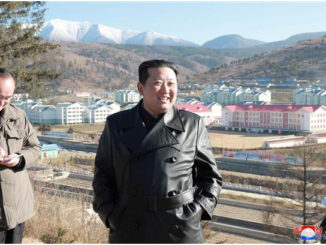
Seoul (TIP): North Korean leader Kim Jong Un visited a new city being built near the border with China and a sacred mountain revered by his family, state media reported on Tuesday, in his first public appearance in more than a month. The northern alpine town of Samjiyon is being transformed into a massive economic hub, called a “socialist utopia by officials, equipped with new apartments, hotels, a ski resort and commercial, cultural and medical facilities.
The developing city is near Mount Paektu, the holy mountain where Kim’s family claims its roots, and he has made multiple visits since 2018, with the official KCNA news agency touting it as “epitome of modern civilisation.”
KCNA said Kim’s latest trip was designed to inspect the third and last phase of construction, due to be completed by the end of this year after delays caused by international sanctions and the coronavirus pandemic.
KCNA did not give a date for Kim’s visit, but it is the first report of public activity by the leader for 35 days, since he gave a speech at a defence exhibition, his longest absence since 2014.
The young, reclusive leader’s disappearance from state media often sparks speculation over his health or whereabouts. South Korea’s intelligence agency said late last month that he had no health issues.
“He said Samjiyon has turned into an example of a mountainous modern city under socialism and a standard of rural development thanks to the workers’ steadfast struggle despite the unfavourable northern environment,” KCNA said.
Kim said building the new city provided experience in construction, design and technologies that would boost economic growth for other regions.
The city is one of the largest initiatives Pyongyang has launched as part of Kim’s push for a “self-reliant” economy as the country faces international sanctions over its nuclear and missile programmes.
Nearly two years after sealing borders to head off Covid-19, North Korea has recently resumed rail freight with China, the latest sign that they could reopen the border soon. Reuters
Durhan (TIP): Durham University in England is offering training to support students working in the sex industry. They have offered its students online courses on how to stay safe while working as a prostitute.
The university also noted that there was an “emerging trend” of its graduates to join the sex industry.
The university’s students union emailed all students and staff advertising a “training opportunity” for “students involved in the adult sex industry”.
The course is created by the Durham Students Union amid rising rates of Durham graduates prostituting themselves or producing explicit content online. The lessons would be designed to provide support and guidance to staff and students who become involved in the sex industry.
The training was important to “ensure that students can be safe and make informed choices”, and pointed to an “emerging trend” of students joining the sex industry, reports Times.
Michelle Donelan, the UK’s Minister of State for Universities, criticised the university for “legitimising a dangerous industry” and “gross breach of its duty to protect” its students.
“Any university that does this is seriously failing in its duty to protect students,” Donelan said.
“It is right that vital support be offered to women who are exploited,” continued the Minister. “However, this course seeks to normalise the sale of sex, which has no place in our universities.”
“We know this is an industry that can target young women and students and trap them in the role,” Donelan added. “Universities should focus on raising awareness of the dangers of this and supporting women. “
One session – advertised as “an interactive course that explores the challenges sex workers may face” – would have been fully booked. Durham University and the Students’ Union have reportedly received several complaints from students who said promotion of the courses to students and staff was drawing attention to the fact that prostitution was available on campus. “It could be a real problem, make it part of university culture and make sex work a normalised activity,” a student told the Times. (TNS)
London (TIP): An explosion outside Liverpool Women’s Hospital on Remembrance Sunday has been declared a terror incident by the British police on Monday.
The motive behind the attack, which ended in one fatality, remains unclear as Britain’s Counter Terrorism Police lead an investigation into the case involving a taxi explosion, alongside MI5 intelligence agency.
A fourth suspect has been arrested as part of the ongoing investigation as the Head of Counter Terrorism Policing North West, Russ Jackson, said the taxi passenger appeared to have made an “improvised explosive device” which caused the blast.
“The fare — a man — had asked to be taken to Liverpool Women’s Hospital, which was about 10 minutes away,” Jackson told reporters.
“As the taxi approached the drop-off point at the hospital an explosion occurred from within the car. This quickly engulfed it in flames. Remarkably the taxi driver escaped from the cab,” he said.
Earlier, three male suspects aged between 21 and 29 were arrested under the Terrorism Act following the car explosion outside the women’s hospital. — PTI
Melbourne (TIP): Australian Prime Minister Scott Morrison condemned the desecration of the statue of Mahatma Gandhi in Melbourne a day after it was unveiled by him.
Morrison in a statement said he was “devastated” to hear that the statue of Mahatma Gandhi at the Australia Indian Community Centre in Rowville, Victoria, had been vandalised after it was unveiled on Friday.
The Australian PM was trenchant in his criticism. “Australia is the most successful multicultural and immigration nation in the world and attacks on cultural monuments will not be tolerated. It is disgraceful and extremely disappointing to see this level of disrespect. Whoever is responsible for this has shown great disrespect to the Australian-Indian community and should be ashamed,” he told the local “South Asia Times”.
This is the first statue of Gandhi in Victoria and was donated by the Government of India. India’s Consul General in Melbourne Raj Kumar has also condemned the act. “When I saw the pictures I was really shocked. I could not believe this could happen here in Australia. Whoever has done this, is not of sound mind,’’ he told the SA Times. (TNS)
Seoul (TIP): South Korea said on Friday it scrambled fighter jets to respond to a group of Russian and Chinese warplanes that entered its air buffer zone unannounced. South Korea’s Joint Chiefs of Staff said it detected seven Russian and two Chinese military aircraft in the country’s air defence identification zone off its eastern coast.
Anticipating the moves, South Korea had already sent fighter jets and other aircraft to the area to prevent accidental clashes, but the Russian and Chinese planes left without breaching South Korea’s territorial airspace, the Joint Chiefs of Staff said. China later told South Korea through a military communication channel that the flights were part of its routine military exercises with Russia.
“(We) assess the current situation as a joint exercise between China and Russia and additional analysis is needed,” the Joint Chiefs of Staff said in a statement.
Air defence identification zones usually expand beyond the country’s territory to allow more time to respond to potentially hostile aircraft. Military planes entering another country’s air defence identification zone are required to notify it in advance.
Chinese and Russian warplanes have often entered South Korea’s air defence identification zones in recent years as they increasingly flex their muscle amid an intensifying competition with the United States. In 2019, South Korea said its fighter jets fired hundreds of warning shots toward a Russian military plane that it said twice violated its national airspace off its eastern coast. Russia then denied that its aircraft entered South Korea’s territory. —AP
KHARTOUM (TIP): Security forces shot dead at least 15 persons and wounded several others as thousands of Sudanese took to the streets on Wednesday on the deadliest day in a month of demonstrations against military rule, medics said. The protesters, marching against an October 25 coup across the capital Khartoum and in the cities of Bahri and Omdurman, demanded a full handover to civilian authorities and for the leaders of the coup to be put on trial. Security forces fired live rounds and tear gas to prevent gatherings in all three cities, and mobile phone communications were cut, witnesses said. State television said there were injuries among protesters and police. “The coup forces used live bullets heavily in different areas of the capital and there are tens of gunshot injuries, some of them in serious condition,” said the Central Committee of Sudanese Doctors, a group aligned with the protest movement. Reuters
Today, in the absence of any other new initiative that would bring the two countries closer together, the Kartarpur Sahib Gurdwara remains both geographically and metaphorically a unique, lonely structure across a bleak landscape.
Despite the growing chasm between India and Pakistan, the passage was opened once again ahead of Guru Nanak’s 552nd birth anniversary. Right by the Ravi riverbed in Pakistan’s Narowal district of Punjab, with hardly a building in the distance on any side, the three-story Kartarpur Sahib Gurdwara is a lonely and unique structure. In 2018, sleepy hamlets nearby awoke to the furious sounds of construction, as Pakistan’s then newly elected Prime Minister Imran Khan accepted an old Indian proposal, revived by Prime Minister Narendra Modi, to open a “pilgrim corridor” between the two countries. The corridor would connect the Indian town of Baba Dera Nanak in Gurdaspur district, where the Sikh founder Guru Nanak spent much of his life and the Kartarpur Sahib Gurdwara built originally on the spot where he meditated, less than five kilometers away, that had been divided by the thoughtless pen of imperial British officers who wrought India’s partition in 1947.
For more than 70 years, pilgrims would line up at the last border point on the Indian side, to climb a rickety watch-post and view Kartarpur Sahib through a telescope lens. With the number of Sikhs in Pakistan dwindling, and access to Kartarpur quite rough compared with the gurdwara at Guru Nanak’s birthplace at Nankana Sahib, the shrine had fallen into disuse. While Sikh “jathas” or groups are given visas as part of an agreement for Hindus and Sikh to religious sites in Pakistan, in exchange for visits by Muslim groups to various mosques and shrines in India, these are hard to come by. This was also true for the larger non-Sikh population that venerates Guru Nanak, a Hindu born in 1469, who brought Hindu and Muslim followers together to found Sikhism with the message of “Ik Onkar” (One God) that he spread in travels far and wide until his death in 1539.
The Gurdwara, small in comparison to the scale of more modern Sikh shrines, has immense spiritual importance, say historians. The idea of the organized Langar, or communal kitchen where rich and poor alike of all faiths can come together to cook, serve and eat a meal, which is a distinctive tradition of the Sikh faith, is believed to have been started here. The shrine is the repository of one of the last copies of the original Guru Granth Sahib, the holy book. In his book (Sketches from a Howdah: Lady Canning’s Tours 1858-1861), Pakistani historian Fakir Syed Aijazuddin recounts how a visiting British dignitary, Lady Canning, was shown the Granth, possibly a first for an outsider in three centuries, which she described it in detail in her 1860 journal as “a thick quarto -sized (approximately 10”X 8”) book written in a peculiar character and language”. According to legend, the original gurdwara by the river also housed a Hindu ‘samadhi’ and a Muslim ‘grave’ of Nanak, as final gesture to uniting his followers who belonged to both faiths and followed in his path as the first Sikhs. In 1947, when Pakistan was carved out of India, the location of the Ravi River decided the gurdwara’s fate was in Pakistan, and Sikhs living in Baba Dera Nanak spoke about how they had to flee their homes on the Pakistani side, not realizing that they may never be able to visit their beloved shrine again for decades.
Suicide attack
Back to 2019, and between the decision to lay the foundation stone for the restoration of the 500-year-old gurdwara, the construction of a massive compound around it on the Pakistani side, the departure and arrival building on the Indian side, and the building of a road to carry pilgrims on both sides of the border, a near-conflict broke out between both countries. After a massive suicide bomb attack that killed 40 CRPF soldiers in Pulwama in February 2019, India carried out air strikes on the Pakistani town of Balakot, leading to counterstrikes by Pakistan along the Line of Control.
A few months later, the Modi Government amended Article 370 and bifurcated the State of Jammu and Kashmir into two Union Territories, triggering a series of diplomatic measures by Pakistan, including the recall of High Commissioners, cancelling all trade links and closing its airspace. Conquering the rancor between India and Pakistan was a near impossible feat, and the future of the Kartarpur project, due to be inaugurated in November to mark the 550th birth anniversary of Guru Nanak seemed dim. However, just a few months after exchanging volleys at the UN that year, Mr. Modi and Mr. Khan decided to persevere with the project, and the Kartarpur Corridor was inaugurated on November 9, 2019, allowing the first group of 550 Indian pilgrims to cross over into Pakistan.
The pilgrims did not need a visa, and were allowed into Pakistan by a special arrangement that registers them on the Indian side, and lets them visit Kartarpur for the day. Such international human corridors normally work when there is a natural disaster, a conflict where civilians are caught or a refugee crisis, but Kartarpur is a rare peacetime, pilgrim corridor. Inaugurating the integrated check post at Baba Dera Nanak, Mr. Modi thanked Mr. Khan and likened the opening of the corridor to the fall of the Berlin Wall, leading many to believe Kartarpur would mark the beginning of other new initiatives between India and Pakistan, rolling back the break in ties. That was not to be. The inauguration of the Gurdwara corridor was marred by the presence of “Khalistani separatist elements”, which New Delhi protested, and security officials said they worried about the corridor being misused for the movement of spies, weapons, cash and drugs, cautioning against increasing the number of pilgrims allowed per day beyond a few hundreds. Pakistan was willing to raise the number to 10,000, provided they would each pay an entrance fee of $20. India stipulated that each corridor traveler could carry no more than ₹11,000 and a bag weighing no more than 7 kg. Despite all the restrictions and procedural delays with registering for the journey, nearly 45,000 Indians and OCIs (Overseas citizens of India) visited Kartarpur on the corridor in the first two months (by January 31, 2020), an average of about 500 per day.
More trouble
More trouble followed. Within just four months of opening, the corridor had to be closed due to the COVID-19 pandemic in March 2020, as India and Pakistan imposed lockdowns and international travel restrictions. The year that has followed has seen unabated tensions between the two countries, relieved very intermittently by a COVID health initiative for SAARC countries, an LoC ceasefire, an invitation from India to Pakistan for a conference on Afghanistan in Delhi (which was rejected), and an international cricket match between the two countries. Against all odds, and despite the growing chasm between India and Pakistan, Kartarpur Sahib Gurdwara and the corridor opened once again on November 17, ahead of Guru Nanak’s 552nd birth anniversary.
“The spirit of Kartarpur continues to live. Centuries after his death, Guru Nanak’s message conquers politics, bridges divides and provides a corridor to mutual humanism,” historian Fakir Aijazuddin told The Hindu, when asked about the reopening, in what most would see as an over-optimistic sentiment given the times.
Today, in the absence of any other new initiative that would bring the two countries closer together, the Kartarpur Sahib Gurdwara remains both geographically and metaphorically a unique, lonely structure across a bleak landscape.
(The author is National Editor and Diplomatic Affairs Editor, The Hindu)
“The Vision and Mission of Oneness, as enunciated by Guru Nanak Rai Ji (circa 1469 to 1539) The Prophet of Unification of Humanity, is based on the premise: “There is One Light of Our Creator in All”. Hence, everyone is my own relative. I am a friend to all. The feeling of “the other” or adversary or stranger leads to the monstrous thought of duality and then results in the emergence of the demonic forces of domination, exploitation, discrimination, resulting in war and bloodbath.”
On the 552nd Anniversary of his Blessed-Advent, let’s offer our homage to Satguru Nanak Sahib Ji (circa 1469-1539) The Enlightened One, by way of abiding by his Sacred Tenets of Amity, Humility, Liberty, Equality, Compassion, Empathy, Peace, Love, Justice and Fair-Play. His basic teachings also include ‘Kirat’ (honest earning of a livelihood) offering ‘Sewa'(selfless-service to humanity) with a spirit of empathy & compassion) while remaining in a conscious-state of ‘Simran’ (constant-remembrance of Our Creator). This would yield infinite equipoise to a true seeker of GOD.
Guru Nanak, The Prophet of Oneness of Humanity is a unique amalgamation of a multifaceted embodiment, by way of being a composer and singer of Divine poetry, a politically aware social-reformer and globe-trotter and a staunch advocate of interfaith goodwill, women’s rights and human rights, who was centuries ahead of his times
While being all of these, he was a householder and a farmer, who always practiced before he preached. He did not lay any claims to any wisdom, yet followers would see the Divine Light in Guru Nanak. His principles were replicated by all of his nine successors, up to Guru Gobind Singh Ji, who completed The Mission and anointed the Scripture as Guru Granth Sahib Ji, in circa 1708.
Guru Nanak Sahib Ji lived his last 17 years at the city of Kartarpur. Since 1947, the era of post-partition of India, when the nation was bifurcated, Sikhs had been denied access to several historic Gurdwaras, in Pakistan, including Nankana Sahib, the birthplace of Guru Nanak Sahib Ji. With Divine Grace, the miraculous opening of Kartarpur-Corridor was manifested on the 10th of November 2019, just two days prior to the 550th anniversary of the Blessed-Advent of Guru Nanak Ji.
Guru Nanak Ji denounced celibacy, asceticism and renunciation, unequivocally, stating that anyone could experience Divine realization (Nirvaan, Moksh, Emancipation, Salvation, Liberation) even while living with a family, instead of shunning society and going to the mountains, caves and forests. The Guru says, “GOD resides in the human-body and can be attained through introspection”.
Guru Nanak Sahib Ji sayeth: “Human-birth has been attained to make concerted endeavors towards fostering Oneness of Humanity”.
Guru Sahib taught humanity to deal in the ‘True-Business’ and ‘Real Trade’ of disseminating Love, Peace, Harmony and Equality, while shunning all varieties of discrimination, bigotry, domination, tyranny, prejudice, bias, superstitions, rituals et al. Only then could humanity register a well-deserved ‘Profit of Godly Blessings’, enabling The Soul to have an extremely smooth transition, after shedding the perishable body. The Guru advises thus: “always remember the ultimate reality of death as nobody is assured of inhaling the next breath”.
The Divine Guru traversed to various countries across several continents, during his 4 Holy Tours, covering 27000 miles in 25 years of his 70-year sojourn onthis planet, fostering Goodwill amongst races, cultures, religions and tribal traditions.
Furthermore, The Divine Guru enunciated his Tenets thus: “All of the human interactions must be replete with Divine-Love & Godly-Light, Lifelong-Learning, Selfless Humanitarian-Service in a Spirit-of-Sharing, Amity, Tolerance, Acceptance, Understanding, leading to a Harmonious Co-existence for ALL.
Guru Sahib deliberately chose special and sacred days to visit the highest centers of learning and places of pilgrimage of various religions and sects like Hinduism, Buddhism, Jainism, Zoroastrianism, Islam and Christianity, opining that the Divine-Message with which he was entrusted by The Creator to convey to the masses, could be attained only at large gatherings.
He went up the Himalayas to have a dialogue with the Nath sect of Yogis. Interesting details and routes of such journeys are available at: https://satguru.weebly.com/
The Vision and Mission of Oneness, as enunciated by Guru Nanak Rai Ji (circa 1469 to 1539) The Prophet of Unification of Humanity, is based on the premise: “There is One Light of Our Creator in All”. Hence, everyone is my own relative. I am a friend to all. The feeling of “the other” or adversary or stranger leads to the monstrous thought of duality and then results in the emergence of the demonic forces of domination, exploitation, discrimination, resulting in war and bloodbath. His 9th successor, Guru Gobind Singh Ji (1666 to 1708) continued the Divine legacy, stating “Recognize humanity as one race, ethnicity, creed”, verily in consonance with the thought of Guru Nanak Sahib Ji. Since the year 1708, the Eternal Guru of the Sikhs is Guru Granth (The Holy Scripture in rhyme) that includes the sacred verses spoken by saints and Seers, affiliated to various Faiths.
Guru Nanak Ji emphasized upon the “Religion of Righteousness”, thereby implying that an ideal Divine-Life can be lived, only when humans are empathetic towards everyone in the world. This is the reason, for which the Soul has attained this unique species of a human-frame, with a brain to decide and a heart to experience the joy and sorrow of everyone, and not just one’s own. Rising over and above one’s vested interest would enable one to remain sacredly truthful and loyal to one’s True Divine-Calling.
The ‘burning issues’ that prompted Guru Nanak Ji to raise his vociferous voice were War, Poverty, Education, Environment of Our Planet, Human Rights, Our Shrinking Freedom, Discrimination.
Despite the materialistic human-evolution and massive strides in the spheres of science and technology, leading to a comfortable and luxurious lifestyle, the Aspirations of the Soul have been neglected.
The world is up in flames, today, even more than it was during the life and time of the Blessed Advent of the Divine Preceptor, Guru Nanak (1469-1539). In one verse, he laments and exclaims: “I can visualize the entire humanity engulfed in flames of hatred and bloodshed and righteousness has taken wings”. Guru Nanak Sahib saw in his deep, meditative trance that the entire earth was ablaze with the fires of hatred, prejudice, intolerance, bigotry, superstition, hollow ritualism, and so he set out on his world tour to remind humanity of the lessons of “Divinity in Humanity”.
It is not “religion” (per se, i.e., the various religious teachings, faiths, beliefs, traditions, cultures) that is the cause for all misery. Rather, the real culprit is the MIND (the corrupted form of the Pristine and Sublime SOUL) which is influenced by an illusion to harbor distorted, biased, prejudiced viewpoints. The malady afflicting humanity results from a misinterpretation of religious teachings or sheer ignorance or (sometimes) deliberate hatred originating from a sense of vested interest and misplaced views on account of race, ethnicity, religion, lineage, caste, creed, culture, nationality, power, authority, gender, education, economic status is the real cause of ALL suffering inflicted upon millions of people. The Divine Preceptor, Guru Nanak preached the message of “One God of All, One God for All, One God in All” and actually lived by setting precedents. He emphasized upon reverence for all Prophets and for Scriptures of all religions, while enjoying the birthright and freedom of following one’s own heart in practicing a religion of one’s choice.
The title GURU means “an enlightened spiritual Master” and not an ordinary worldly teacher or an expert etc. The word SIKH means a perpetual learner for the entire lifetime, a disciple or follower of the Guru.
Guru Nanak Sahib says: “GOD, the Omniscient, Omnipotent, Omnipresent ONE is worshipped in innumerable ways and remembered by infinite Hallowed Names, yet GOD remains Only One Entity or the Sole Power and not many or different for people of diverse races, religions, regions, cultures”.
It is ONLY through meaningful dialogue that we would learn about the commonalities and similarities amongst people of various backgrounds, and that’s how all of us can be empowered to live, harmoniously, despite the “so-called differences” of race, ethnicity, religion, region, color, caste, creed, gender, culture, lineage, appearance, rituals, ceremonies, traditions, customs, economic status, position of political power, social clout etc. and the list goes on. If we do not communicate with each other, we tend to remain ignorant about the other. Then, we become fearful or we generate hatred or both of these increases.
When some humans indulge in domination and subjugation, there starts a never-ending war, resulting in massive bloodshed, misery, leaving orphans and widows. This war of attrition and hatred continues, unabated, for generations and centuries. We must work, in tandem, to engage in all such activities, that are meant for the Good of All, in consonance with the inherent nature of the Eternal Soul which is an intrinsic part of the Primal Soul, GOD.
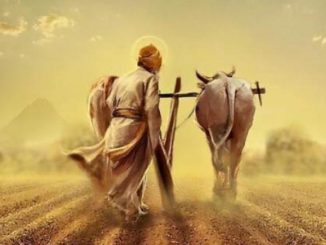
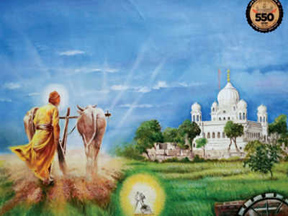
The ‘Kirat’ (endeavor) philosophy, the ethos of work-culture, espoused by Guru Nanak Dev Ji revolves around the basic concepts of honest earnings, compassionate sharing and remembrance of Divine Noumenon to remain in a blissful state of equipoise. Guruji lived his entire life, in consonance with these revolutionary principles, aimed at Good of All. He ensured that such Divine Tenets reached the masses, even if he to encounter the ruthlessly tyrannical rulers of his times. He lived his last many years at Kartarpur in present-day Pakistan, where he kept himself busy with agricultural activities, of course in addition to his regular congregations pertaining to his spiritual inclinations. By maintaining such an ideal lifestyle, Guru Sahib set an exemplary precedent for his disciples who were Sikhs, Hindus and Muslims, who looked up to him as their role-model, not merely at the human level but also as their spiritual mentor. ‘Guru Nanak farming’ soon became an enjoyable ‘bliss-laboratory’, for the enthusiastic householders, who loved their farmlands, protected and befriended the animals and birds, harvested crops to be used for their families as also to provide fodder for other creatures. And all crops were gotten organically, sans the usage of any fertilizers and chemicals. All the time, they enjoyed the company of cattle, butterflies, birds, honeybees. And, not to forget the fish in the ponds. All of this was not merely earning a livelihood but an entirely soul-soothing and a spirit-rejuvenating unique lifestyle, connecting them with The Divine One in every creature of Our Creator. The Guru proclaimed, “air is the Guru, water is the father, earth is the mother”.
In present-day Punjab, the culture of Kirat is totally devastated. Farmlands have turned barren deserts. The water-table is fast receding. Manure, chemicals and pesticides have ruined the soil. Farming has been reduced to a business accruing massive losses. The farmer is becoming an ailing victim of the menace of killer-cancerous and other diseases. Mother earth has lost its naturally characteristic nutrient values. While burning the futile remnants of some crops, the farmers fail to realize that they are burning innumerable earth-friendly worms and also impacting the existence and subsistence of several species of birds. Today, the already critical situation has reached a point where the initially nature-lover farmer is on the precipice of a catastrophe, having been driven to embrace death, by taking recourse to suicide. Decades of manipulative machinations by the corporate sector have eaten at the roots of the life of the populace and life of earth. Looking to increase yields and profits, the farmers have ended up, burdened by mountains of loans culminating in traumatic mental, emotional and psychological ailments.
Toiling on their farmlands has, always, been the ideal and pivotal way of life for all Punjabis. However, such a lifestyle has, apparently, evaporated from Punjab, the granary of India, once upon a time. It is the end of a bygone Golden-Era. The youth are, especially, increasingly distancing themselves from Kirat traditions and culture. The youth are replacing the agricultural implements with their new acquisitions, the ‘ornamental’ motorbikes and cellular phones and are flaunting a totally different kind of lavish lifestyle. The youth have been misguided towards a destructive destination, by elements inimical to the affluence of Punjabis in various spheres of endeavor. Earlier in 1947, millions of Punjabis were made sacrificial lambs and slaughtered at the altar of ugly, sinister politics. The survivors were devoid of their lands. After a breather-of-sorts, arrived 1984 when the hearts and souls of Punjabis were, once again, tortured and several thousands were killed or made to disappear without a trace, during the era of Naxalite and wave of Militancy. Those who were happily treading on the progressively Divine-Path, illumined by Guru Nanak, with the objective of helping many others are left in a destitute and reclusive plight. The appetite of the ‘killer-machine’ was not satiated and then the 6th river of drug-menace was created in the land of 5 natural-rivers, the land which was once blessed by the touch of the sacred feet of several Divine Persona, Gurus, saints, seers, scholars. The famed river ‘White-Bein’ in Sultanpur Lodhi, associated with Guru Nanak Sahibji, has been polluted beyond imagination.
Guru Nanak Sahibji and his disciples had not envisioned such a destructive life replete with environmental pollution and corruptible humanity which enjoys the ruination of fellow humans and extinction of other species from planet earth. The texture of the social-fabric has been fragmented due to the twin-diseases of religious-divide and differences of caste-creed. Politicians rule the roost, to accumulate limitless wealth, at the expense of the life of millions, whose blood is being sucked, verily similar to how Guru Nanak Sahibji had given the description of his times, through his Sacred Gurbaani.
During the final-leg of the life-journey of Guru Nanak Sahibji emphatically stressed upon the paramount significance of ‘Sangat & Pangat’ (congregation and community-kitchen) by inspiring his disciples to adopt this way of life. Guru Sahibji shared all the crops, fruits and vegetables with the community. Guru Sahibji practiced equality, justice and fair-play, by involving the community in the farming activities, thereby laying the foundations of farm-communes, living in peace and harmonious coexistence. This was an exceptionally revolutionary concept, five centuries ago. Profits were shared as in a cooperative society or organization, wherein each primary member has the right to equal shares or units. This measure, initiated by The Guru, ensured the empowerment of the downtrodden segments of society, including those who were economically weak, the suppressed womenfolk deprived of their rights by dominant males in the family and the oppressed so-called low castes. Such decisions paved the way for everyone to live with dignity, security and in peace. Women started enjoying respect and they regained self-esteem. Gurbani laments about the castigation and oppression suffered by women, thus: “why ridicule a woman? from a woman, man is born; within a woman, man is conceived; to a woman, he is engaged and married’’.
Guru Nanak Devji undertook pedestrian Holy Journeys (Udaasiaan) in four directions, travelling thousands of miles, with the objective of having progressively meaningful discussions with decision makers, the clergy, saints and seers from divergent belief systems, while putting forth his own philosophy, in an open exchange of views. Although his family background was not related to agriculture, yet Guru Nanak took to farming during the last several years of his life. His father, Shri Kalyaan Daas ji was responsible (as the Patwaari) for maintaining the financial records of Rai Bulaar, the Muslim ruler of Talwandi. His family also owned substantial lands. Guru Nanak, in his youthful years, was employed as a storekeeper. However, he adopted farming as his vocation, during his final years, considering the need of the hour to make the people self-reliant, by motivating many to take to farming. Guru ji mentions various crops in his Gurbaani, while using them as metaphors, for instance writing about wheat, rice, cotton, coconut, mango, sunflower, sugarcane, varieties of trees, and also about his love for animals and birds. Guru Nanak had a soft corner for ecology and preached about conservation of the environment.
However, today, Punjab, Punjabis, their farmlands and farming profession are, all, facing an identity-crisis. The rulers, in connivance with the corporate, are bent upon usurping the farmlands, thereby rendering the farmers totally destitute going into a state of pain and penury. The progressive Vision and Legacy of Guru Nanak Ji is not being honored. Three black laws have been enacted targeting towards monopolizing farming in the hands of the corporate world, who are already ultra rich. To register their vociferous protest against the deceptive, cruel laws, lakhs of farmers have been braving the extremities of weather and atrocities of authorities, sitting on various borders of Delhi, for the past one year. During this long phase of struggle, between 600 and 700 old and young farmers have succumbed to the vagaries of nature or have been tortured by the elite. The conspiracy against the farmers is being exposed. Their voices of anguish are falling on deaf ears but the ‘Sons of the Soil’ are relentless in waging a Peaceful-War, toregain their birthright to hold on to their soil and their heritage. Five centuries ago, Guru Nanak had proclaimed, during a direct encounter with the ruthless, tyrannical Mughal Babur: “kings are hungry lions; their servants, rabid dogs. They are foes of soothing restful sleep; they are mindless servile cogs. The lackeys of the evil king; waving talon and claw. They prey on common gentlefolk; their tender flesh they gnaw”. The Guru lamented the miserable plight of the defenseless populace, saying “O’ Lord, don’t You feel the pain of the weak and the meek, who are being crushed, ruthlessly”.
The scenario, today, is akin to the situation during the life and times of Guru Sahibji. Yet, the factor of consolation is that the Divine Legacy and Sacred Tenets of Guru Nanak’s philosophy have remained engrained in the psyche of the masses and they are not surrendering before the oppressors and are fighting the battle, valiantly. Rising over and above the distinctions and differences of caste, creed, religion, region, the farming sector has formed a formidable alliance. Abiding by the Divine Teachings of Guru Nanak Sahib, such staunch sense of resilience of the farmers shall, most certainly, fructify into eventual success and the victors shall be empowered to stop the migration of their youngsters, who have been going abroad in large numbers.