Month: November 2021

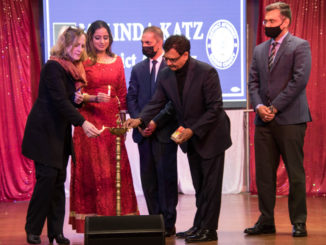
  • Queens District Attorney Melinda Katz hosts a Diwali celebration

    Queens District Attorney Melinda Katz hosts a Diwali celebration

    Consulates of India, Nepal and Guyana join the Indian origin community in celebrations

    Melinda Katz sharing her thoughts with the gatheringMelinda Katz.
    Consul Vipul Dev of Indian Consulate offered greetings on behalf of the Consul General of India.
    Assemblywoman Jennifer Rajkumar spoke of her being the first Hindu to be elected to New York State Assembly.
    Glimpses of cultural performances.
    Glimpses of cultural performances.
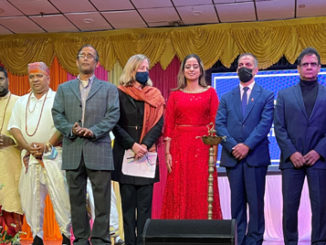
    A group of performers with Melinda Katz and assemblywoman Jennifer Katz.
    A view of the gathering.

    QUEENS, NY (TIP): Queens lived up to its reputation of being culturally and ethnicallythe most diverse borough of the country on November 8 when the Queens County District Attorney Melinda Katz hosted the Diwali festival at the large Gujarati Samaj auditorium. Though essentially the festival of the Hindus, one could see in the gathering people from various faiths and ethnicities celebrating the festival of lights.

    Queens is home to a large number of Hindus from India, the west Indies and elsewhere. Over the years the Hindu community has steadily made inroads into politics with quite a few of them having been elected. A Hindu Jennifer Rajkumar is a New York State Assemblywoman. Recently, Krishnan was elected a New York City Councilmember. A budding Hindu politician is Dilip Chauhan. And, a good part is the community has understood well the need to have allies. Hence, there is a close working relationship which exists between all ethnic and religious groups whether the Hindus, the Sikhs, the Jains, the Moslems, the Jews, the Christians, the Buddhists. And the credit for the communal and social cohesion goes in part to the administration. Melinda’s Diwali festival celebration is one such example.

    The simple word for the Queens DA Diwali celebration is “excellent”. The event was very well organized with the minutest details taken care of. The entire program from the prayers and lamp lighting to the remarks by the dignitaries to the cultural presentations, all wentoffvery well. The organizers did wonders with the event. I have only superlatives for the program and program organizers.

    Melinda Katz spoke of the multicultural mosaic of the Borough of Queens and praised the residents for their contribution, even as she congratulated and thanked the organizers of the event, her staff, the Gujarati Samaj for their support, the dignitaries which included Vishnu Prasad Gautam, Consul General of Nepal, Fazal Yussuf, Advisor to Consulate General of Guyana, and Vipul Dev, Consul, Political and PIC from Consulate General of India, for their gracious presence,  the politicians present which included Assemblywoman Jennifer Rajkumar and others, the priests from various shrines who offered prayers, the participants in the various cultural events and their parents, and the gathering. Those who addressed the gathering included Assemblywoman Jennifer Rajkumar, Vishnu Prasad Gautam, Consul General of Nepal, Fazal Yussuf, Advisor to Consulate General of Guyana, and Vipul Dev, Consul, Political and PIC from Consulate General of India, The cultural program presented by various groups thrilled the gathering.

    Rokeya Akhtar, the DA’s Community Liaison officer, Malini Shah and Somnath Ghimire worked in close cooperation to make the event the success it became.

  • Uphaar sentence: Delhi court shows the strength of judicial process

    For the families of victims of the 1997 Uphaar cinema tragedy in Delhi — 59 people lost their lives and more than 100 were injured when a fire broke out during the screening of Hindi film ‘Border’ — it has been a relentless struggle for justice, and to hold accountable those responsible for the lapses. Over two decades later, a sense of closure has been elusive. A Delhi court’s conviction and awarding of seven-year jail terms to cinema owners and real estate barons Sushil and Gopal Ansal, and three other accused, for tampering with evidence brings renewed hope. As does the judgment by Chief Metropolitan Magistrate Pankaj Sharma that the foundation of judiciary is premised on the trust and confidence of the people; any action aimed to thwart that foundation cannot be permitted and is required to be dealt with utmost strictness. Sentenced to a two-year jail term by the Supreme Court in 2015, the Ansals were released taking into account the prison time they had served on the condition that they pay Rs 30 crore fine each, to be used for building a trauma center. Reviewing its decision later, the apex court had sent Gopal back to jail for a year, sparing the brother because of old age. In the fresh conviction, the lower court has observed that the accused had destroyed critical documents ‘which were capable of proving their complicity’ in the tragedy. In other words, it goes on to say, they fiddled with the judicial system to escape punishment by scuttling the trial process, showing deep disrespect for the law and the victims.

    Fined Rs 2.25 crore each, the Ansals will have to bear all expenses of the complainant, the Uphaar victims’ association, during the course of the long trial and after that, compensation will be paid to those who lost family members. Money can provide little solace, what could is the court’s observation that the collective cry of society must be responded by way of appropriate punishment to prevent recurrence of such crimes. The wheels of justice move slowly, but move they certainly do.

    (Tribune, India)

  • India must be clear on how it wants to shape Afghanistan’s destiny under the Taliban

    By holding the Third Regional Security Dialogue on Afghanistan, chaired by NSA Ajit Doval this week, New Delhi has sent out three strong messages: one, that it wishes to remain an important and engaged player in the future of Afghanistan; second, that with the exit of U.S.-NATO troops, the ideal solution to the situation is through consensus in Afghanistan’s extended neighborhood including Russia; and third, that the Afghan humanitarian crisis should be the region’s immediate priority and political differences can be set aside to help. It is the last message that spurred New Delhi to invite the NSAs from China and Pakistan, despite the LAC standoff and deep differences with the Imran Khan government over Kashmir and cross-border terrorism. By declining the invitation, Beijing and Islamabad have made it clear that they do not intend to assist India in its Afghan engagement, further demonstrated by the Khan government’s churlishness in refusing India road access to send wheat and medicines to Kabul. To that end, the Delhi Declaration issued by the eight participating nations, including Iran and Russia, is a milestone in keeping India inside the discussion on Afghanistan. The declaration goes farther than the previous such regional discussion of SCO countries in Dushanbe in September, in its strong language on terrorism, terror financing and radicalization. It also expands on the need for an inclusive government in Kabul that will replace the Interim Taliban regime, and promotes a national reconciliation process.

    While the consensus over the Delhi Declaration is a creditable feat, it does not paper over all the differences between India and the other countries over their far stronger engagement with Kabul. For instance, Turkmenistan sent a Ministerial delegation to discuss connectivity with the Taliban, while Uzbekistan accorded the visiting Taliban Deputy PM full protocol and discussed trade, transit and the construction of a railway line. Russia and Iran still maintain their embassies in Kabul, and a “Troika-plus” U.S.-China-Russia-Pakistan engagement is taking place with the Taliban Foreign Minister, in Islamabad this week. With the “normalization” of ties with the Taliban regime growing, New Delhi must now consider how far it wishes to go in its engagement with Afghanistan. On the one hand, India has publicly held talks with Taliban officials twice and expressed solidarity with Afghans, but on the other has refused practically all visa seekers, made no monetary contribution to the humanitarian crisis there, and has made no bid to continue with plans for trade and connectivity with Afghanistan. India’s desire to lead the discussion on Afghanistan’s destiny, as demonstrated by the NSA dialogue, is a worthy goal for a regional leader, but can only be fulfilled once the Government defines more clearly what it wants its Afghan role to be, despite all its differences with the regime now in power.

    (The Hindu)

  • Jawaharlal Nehru’s unerasable legacy!

    By George Abraham

    14th November is the birthday of India’s First Prime Minister Jawaharlal Nehru, celebrated as Children’s Day in India.

    Nehru’s contribution to making of a modern India cannot be ignored despite the uncouth attempts of the present government to trash one of the greatest men of India and the world.

    History has a weird way of remaining alive, sphinx style.

    -EDITOR


    Nehru, the freedom fighter, along side Mahatma Gandhi
    Nehru, the first Prime Minister of India unfurls the National Flag -the Tricolor at the Red Fort, August 15, 1947
    The voice of the billions at the United Nations.

    November 14 has been a ‘Chacha Nehru’s Day’ for so long I can remember, signifying the fondness the first prime minister of India had for the children of India. Growing up in Kerala and being active in the ‘All Kerala Balajana Sakhyam’ (largest Children’s organization in the world after the 4H club at the time), Nehru’s legacy loomed large on many of those organized events where his deep sense of commitment for the future of the young generation was widely acknowledged and admired. In those days, the very question of ‘who is after Nehru’ evoked a sense of anxiety and apprehension in the people’s minds across India. However, 57 years after his death, the question is no longer about celebrating his legacy as the ‘architect of modern India’ but more about how we could defend his life’s work from being tarnished by vested interests and prevent its erasure from history. Ever since Bhartiya Janata Party came to power at the Centre, we are not only witnessing a torrent of criticism by Prime Minister Modi and other officials of the past leaders in the Congress party but a targeted one vilifying and demonizing Jawaharlal Nehru in particular. We are at a point where Nehru’s name does not even find mention in the National Archive’s exhibition on the ‘Quit India’ movement.

    It has almost become an obsession for the BJP government to diminish Nehru’s contribution to the development of India using various means that include scrubbing Nehru’s name from state-sponsored history textbooks in schools and outright tales from Prime Minister’s speech in Parliament blaming Nehru for partition. The right-wing influencers and the trolls have joined the chorus inculcating a negative image of Nehru with his lineage, character, and culture within the mindset of the young ones who tend to rely on social media for their information and learning. The Diaspora, the biggest beneficiary of Nehru’s visionary policies regarding Education and other social development, has turned a blind eye towards this incessant attack by RSS and its affiliates and done very little to offset the spread of misinformation. Although Nehru’s accomplishments on the world stage are so phenomenal compared to the office’s current occupant, the PIO/NRI community prefers to be silent as if in obedience to the wishes of the power elites in Delhi.

    Nevertheless, the Diaspora is busy celebrating various Indian festivals and keen to remember Mahatma Gandhi, who patronized and pampered Nehru and finally propped him to the helm of Indian politics. However, one wonders whether it is due to sincere reverence to Gandhian principles or to display our outward allegiance to peace and harmony to an unsuspecting American audience. When Gandhian principles are being trampled in India, many of these same folks tend to look the other way.

    One of the favorite topics of attacks directed against Nehru is that he has engineered the partition of India for selfish ends. For any history student, it becomes clear that it is not only Congress but British, Muslim League, and Hindu Mahasabha were all part of a larger dynamics at work under the terror of ongoing massacres at the time of independence. V.D. Savarkar’s two-nation theory and Mohammad Ali Jinnah’s adamant demand for Pakistan might have an even more prominent role in creating that undesirable outcome. However, when such stormy winds buffeted the nation, Pandit Nehru steered a newly emerging nation, bringing peace and stability. Some historians also believe that if Nehru and Patel had not accepted the division, it could well have led to the dismemberment of India as we know it today.

    What I admire most about him is his self-effacing service to India. He spent almost ten years of his life in prison, fighting for freedom and justice at a time when there was no assurance that it would happen in his lifetime. Among the founding fathers of modern India, Nehru alone had given serious thought to India’s place in the global community. He was able to educate the Indian populace on external affairs even before independence.

    India took giant strides under his leadership in areas of Agriculture, Industry, and Technology. He developed agriculture by boosting irrigation facilities with Bhakra Nangal, Hirakund, and Nagarjuna Sagar Dams. Nehru set up heavy industries in a country that was not even producing a safety pin for its consumers and developed educational and research institutions with a number of universities, such as IITs, IIMs, ISRO, BARC, Council of Scientific Indian research (CSIR), and All India Institute of Medical Sciences (AIIMS). He was determined to carry India forward into the modern age with scientific discovery and technological advancements. If India today is successful in Space or Nuclear programs, the credit is squarely due to the visionary mindset of Nehru. It is worth remembering that when Nehru started on this transformational venture, the literacy rate in India was 14 percent, and the life expectancy at 39. Unlike the current dispensation, Nehru was a quintessential democrat who engaged the members of the Parliament in meaningful discourse and refused to see a critic with vindictive revenge. He recognized that dissent is an integral part of the debate, which is vital in a democracy.  He did it with utmost grace and civility. Today, even within the Diaspora, people are running scared of a regime that monitors and punishes people for differing opinions.

    The forces at work belittling Nehru’s contributions, demeaning his reputation, and removing many of the institutions he has put in places such as the Planning Commission and National Integration Council, are engaged in a total disservice to the nation. Jawaharlal Nehru will remain a great icon in the hearts and minds of Indians for generations to come, even after many of the detractors and vocal critics have been gone and become nothing more than a distant memory! As an adage goes, a statue has never been set up to honor a critic! Nehru’s legacy is too intertwined with the history of modern India,and it is simply unerasable from the nation’s DNA.

    (The author is a former Chief Technology Officer of the United Nations. He is Vice Chairman of the Indian Overseas Congress, USA. He can be reached at gta777@gmail.com)

  • What to Know About COVID-19 Vaccine Boosters

    What to Know About COVID-19 Vaccine Boosters

    By Dr. Dave A. Chokshi

    Recently, important updates about the COVID-19 vaccine were announced—that certain people are now eligible for a “booster” dose. Since the beginning of COVID-19, our scientific understanding of the virus has constantly evolved, and many New Yorkers understandably have questions about this new development.

    I would like to provide the “who, why, and where” about boosters.

    Who should get a booster? All three brands of booster shots are available for many New Yorkers—Pfizer, Moderna, and Johnson & Johnson—and “mixing and matching” of the vaccines is safe. But who is eligible for a booster depends on the vaccine you originally received.

    At this time, the Pfizer and Moderna boosters are approved for certain people vaccinated at least six months ago—specifically, people who are aged 65 or older, adults with underlying medical conditions (like diabetes), and adults at higher risk of exposure due to their job (like health care workers) or due to where they live (like nursing home residents). The Johnson & Johnson booster is approved for anyone ages 18 or older who received at least two months ago—as I did. Since “mixing and matching” is now authorized, Johnson & Johnson recipients can get a booster of any of the three authorized vaccines (Moderna, Pfizer, or Johnson & Johnson). There is limited data showing that Moderna or Pfizer vaccines could result in higher antibody levels.

    Why get a booster? The science continues to show that all three of the authorized COVID-19 vaccines are safe and save lives. That’s why getting more New Yorkers vaccinated with their first and second doses remains the most important thing. The booster adds another layer of protection—it is meant to “boost” your immunity. This is particularly important for people who are most at risk for severe illness.

    Where can New Yorkers get a booster? In New York City, booster shots are available at sites in all five boroughs, and for in-home vaccination. To find a location near you, go to nyc.gov/vaccinefinder. The vaccines are free at City sites to all New Yorkers, regardless of immigration status.

    Already, over 250,000 New Yorkers have received a booster shot. That means thousands of New Yorkers will have stronger protection from COVID-19. They will be able to gather with friends, family and loved ones more safely. And for any New Yorkers who are still unvaccinated, I urge you to take the first step today—join 6 million other New Yorkers and get vaccinated. It is our single best way out of this pandemic and a return to normal life again.

    (Dr. Chokshi is New York City’s Health Commissioner)


  • This Diwali, the RNC is Investing in Indian Americans

    This Diwali, the RNC is Investing in Indian Americans

    By Niraj Antani, State Senator, Ohio

    Today (Nov 5) marks the end of the celebration of Diwali for Hindus across the world. Diwali celebrates the victory of light over darkness and is the biggest and most significant holiday for our community. Across the country, there is a new light rising as Hindu and Indian Americans writ large are embracing common-sense, conservative policies amidst the darkness and failures of Joe Biden and the Democrats’ radical agenda.

    The failures of Joe Biden and the Democrats are clear. Rising prices, soaring crime, and an economy leaving so many behind are a threat to our families’ well-being. It’s no wonder why Indian Americans are realizing they have a home in the Republican Party. The GOP shares our values. Republicans’ message of economic prosperity, freedom, and security is resonating.

    At this moment, the Republican National Committee (RNC) is investing in the Indian American community like never before. On Saturday, the RNC will open a community center in Dallas with a focus on reaching Indian Americans living there. This office will be a hub of political action where volunteers can make phone calls, organize for door knocking, and learn how to effect real change. They’ll establish a catalyst for reaching out to neighbors and fighting for the ideas that enabled so many Indian Americans to achieve the American Dream. Above all, this community center – and more community centers to come – will allow Republicans to better understand and serve the needs of Indian Americans so we can build a stronger country together.

    This continues a trend of the Republican Party attracting diverse candidates and making important gains with minority communities. The RNC has opened nine minority engagement community centers across the country and are on track to open thirty-five by November 2022. With these investments, the RNC will have eyes and ears to listen and learn from different voices and identify how we can reach even more voters. This will build on historic progress made by President Trump and Republicans in 2020 and in recent elections in Virginia, where minority voters backed the GOP in record numbers and new minority voices like Virginia’s first Black female Lieutenant Governor Winsome Sears and Virginia’s first Hispanic American Attorney General Jason Miyares were elected to office.

    As Indian Americans, we play a crucial role in shaping the Republican Party. Indian Americans increased their support for Republicans between 2016 and 2020 by over 10%, according to AAPI Data. This week’s sweeping victories in Virginia, Pennsylvania, and across the nation show that the GOP’s message is resonating with Americans of all backgrounds. We cannot afford to wait on Biden’s failing administration. The time for action is now. By establishing a permanent presence in new communities, we look forward to building relationships, having conversations, and learning how to better represent all Indian Americans as we move towards the 2022 election and beyond.To Hindu and Indian Americans during this Diwali, the RNC extends a warm invitation to call our community centers home. We wish you a happy and blessed end to this holiday and we look forward to hearing from you and your family soon.

    (Antani, a Republican, is the 1st Indian American State Senator in Ohio history and the youngest Indian American elected official in the United States.)

     (OPED submitted by Nainoa Johsens, Director of Asian Pacific American Media, Republican National Committee)

  • The case of demonetization in India

    The case of demonetization in India

    By Kaushik Jayaram

    Five years on, the trajectory of the policy demonstrates that popular narratives can trump economic facts.

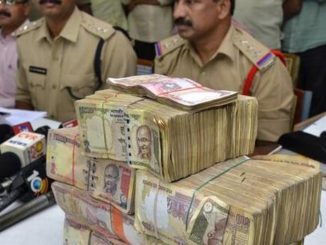
    Five years later, most observers have concluded that this policy was a failure. Very little of its declared objectives — of eliminating black money, corruption, moving towards a “less cash and more digital economy”, or increased tax compliance — were achieved. Expectations of windfall gains of some ₹2 trillion-3 trillion failed to materialize as more than 99.3% of the cancelled notes returned to the banks. If black money had existed as stockpiles of illegal cash, clearly all of it was very efficiently laundered. If the objective was to register a permanent upward shift in the tax base, it failed miserably. Perhaps the most telling evidence of the failure is that the cash-in-circulation has now exceeded pre-demonetization levels.

    The demonetization of high-value currency in India in 2016 is a classic case of policy based on faulty narratives. Paradoxically, the failure of the policy does not appear to dent the narrative and, consequently, there is very little price to pay for its failure.

    Popular narratives play a much bigger role in economic policymaking than economists and policymakers acknowledge. If, indeed, these narratives are grounded more in myth than reality, the impact of such policy can be devastating. The demonetization of high-value currency in India in 2016 is a classic case of policy based on faulty narratives. Paradoxically, the failure of the policy does not appear to dent the narrative and, consequently, there is very little price to pay for its failure.

    Across time, the impact

    Narratives are often intertwined in the cultural belief systems of the society. Thus, the Great Depression of the 1930s came to be associated with the excesses of the “roaring twenties”, though many economic factors were responsible. The Weimar hyperinflation of 1921-24 is so deeply embedded in the German consciousness, that even now, nearly 100 years after the event, German society treasures financial stability and distrusts public debt. Fiscal conservatism remains the dominant narrative and has inhibited the post-2008 recovery in Europe. Though the recent novel coronavirus pandemic crisis has led to Keynesian remedies on steroids in many countries, there is already a murmuring of fiscal imprudence fueling inflation.

    Indeed, narratives in economics, as in other social sciences, create myths which endure despite rational appeal to facts. The demonetization story in India is also based on popular myth, the folklore of black money and its association with physical cash. The idea of demonetizing large denomination currency as a tool to flush out undeclared hoards of cash was not new. It was done on two previous occasions, in 1946 and 1978, with poor results. But, unlike the limited impact of the previous events, the demonetization in 2016 caused widespread disruption in the economy, whose costs are still to be properly reckoned.

    Five years later, most observers have concluded that this policy was a failure. Very little of its declared objectives — of eliminating black money, corruption, moving towards a “less cash and more digital economy”, or increased tax compliance — were achieved. Expectations of windfall gains of some ₹2 trillion-3 trillion failed to materialize as more than 99.3% of the cancelled notes returned to the banks. If black money had existed as stockpiles of illegal cash, clearly all of it was very efficiently laundered. If the objective was to register a permanent upward shift in the tax base, it failed miserably. Perhaps the most telling evidence of the failure is that the cash-in-circulation has now exceeded pre-demonetization levels.

    Touching a chord

    And, post-COVID-19, reliance on cash is much higher, and with more higher denomination notes in circulation. By every measure, demonetization as economic policy was a gross failure. But, as a narrative, it was presented and received in an altogether different light. Despite its manifest failure, the power of the narrative was such that it succeeded in creating a favorable or positive view of the policy.

    The folklore of black money and the vivid imagery that accompanies it is easily recognized and understood by the common people, who witness corruption in daily life and see it play out in the cinema, newspaper stories or in daily conversation over the years. The very term, black money, is a loaded phrase, where the specie itself acquires a symbolic and a substantive form. The wealth, representing ill-gotten gains, is perceived to be accumulated invariably in stacks of currency notes and gold, hoarded in safes, boxes, or ingeniously concealed cupboards.

    The idea of dramatic action and the striking of a powerful blow against this wealth is deeply satisfying psychologically. It is the stuff of epics. The specter of black money has been invoked frequently in Indian politics, sometimes truthfully and more often cynically. The narrative of black money is almost always couched in deeply moral terms.

    It does not matter, as repeatedly emphasized in several economic studies, there is nothing to distinguish black or white money, except in the way it comes into being. Although income from corruption or criminal activities is by definition black money, most black money is earned through perfectly legal activities though not declared to the tax authorities. More importantly, black money is not really kept in cash except in small quantities but mostly accumulated through real estate and other assets. However, the way the narrative was framed made it hard for critics to explain their opposition. To denounce it outright would suggest that they have a vested interest in defending black money and corruption.

    Here’s what Raghuram Rajan said about demonetization

    When it became clear that the cancelled currency was being returned to the banks in larger numbers than expected, the narrative changed focus from black money and fake currency to digital/cashless payments, the latter being elevated to some higher purpose than what it actually is, a mere technological change.

    Linked sub-themes

    A key point in selling the story was to introduce complementary sub-themes to reinforce the main narrative and, at times, to obscure the facts on the ground. Virtue signaling was key: appeals to nationalism and patriotism are always handy, while modernity and change are implied as means to progress towards some form of technological utopia.

    The call to sacrifice has deep resonance in India, as elsewhere. The act (of demonetization) was an act of collective sacrifice. The people in long queues were reminded of the sacrifices of the soldiers guarding the nation’s borders and not to think of their own suffering. Indeed, there was satisfaction in being told that the rich had it worse. In reality, the sacrifice called for was somewhat skewed in its impact, and the suffering of the poor was disproportionately greater.

    The real irony lies in the fact that the moral high ground claimed by the demonetization narrative worked better than contesting narratives of observed reality. It worked because it understood the nature of the moral economy of the poor. For the poor, long used to being at the receiving end of the state and its representatives, the impact of demonetization would be one more blow in a series of blows with which they had to perforce deal. At least in this instance, there would seem to be a measure of justice if the rich really did suffer more.

    Despite the overwhelming evidence to the contrary, five years after the event, the Government does not acknowledge any failure, or have even a smidgeon of doubt. Noticeably, however, there have been no tall claims of success either.

    A self-inflicted shock

    Most of the studies, opinion polls, media reports and anecdotal evidence showed an overwhelming support for the policy. Despite personal hardship, long queues, and the loss of income and savings, there was a degree of ambiguity in criticizing the decision. Most tended to distinguish the intention from the reality. That the policy was good but perhaps not implemented well seemed to be the main theme. This effectively insulated the original sin — that the very design of the policy ensured its outcome.

    The case of demonetization demonstrates that popular narratives can trump economic facts.

    It is clear that where narratives succeed there is very little political cost. A failed policy that carries no cost is likely to generate more such policies. Unlike most economic shocks, which could be traced to endogenous or exogenous causes, demonetization was an entirely self-inflicted shock, which was very likely carried out as much in a sincere belief in the narrative as in cynical political calculation.

    (The author is a former central banker who worked for many years in an international financial organization)

  • Queens District Attorney Melinda Katz hosts a Diwali celebration

    Queens District Attorney Melinda Katz hosts a Diwali celebration

    Consulates of India, Nepal and Guyana join the Indian origin community in celebrations

    Read the story on page 3

  • Updated lawsuit against BAPS alleges use of forced labor at more temple sites across US: Report

    Updated lawsuit against BAPS alleges use of forced labor at more temple sites across US: Report

    NEW YORK (TIP): A prominent Hindu organization is facing new allegations in an updated lawsuit that it lured laborers from India and forced hundreds of workers to work for low wages at its temple sites across the United States. In May this year, a group of Indian workers had filed a lawsuit in US District Court alleging violations of human trafficking and wage law against Bochasanwasi Akshar Purushottam Swaminarayan Sanstha (BAPS), saying they were confined and forced to work for about USD 1 on constructing the massive Swaminarayan temple in New Jersey.

    The New York Times said in a report on Wednesday, November 10, that in the lawsuit filed in New Jersey federal court and amended last month, BAPS has been accused “of luring laborers from India to work on temples near Atlanta, Chicago, Houston and Los Angeles, as well as in Robbinsville, New Jersey, paying them just USD 450 a month.”   “The amended lawsuit expanded those claims to include temples around the country where some of the men said they were also sent to work. Hundreds of workers were potentially exploited, the lawsuit claimed,” the NYT report said.

    The report had in May said that the complaint had named six men who were among over 200 Indian nationals brought to the US starting from around 2018 on religious visas ‘R-1 visas’. The men were made to work “grueling hours under often dangerous conditions on the New Jersey site”, the NYT report had said.

    India Civil Watch International (ICWI) had said in a statement in May to PTI that starting in the early hours on May 11, an FBI-led raid rescued around 200 workers, “most of them Dalits, Bahujans, and Adivasis”, from the premises of the Swaminarayan Temple in Robbinsville, New Jersey, reportedly the largest Hindu temple in the US.

    The amended complaint accused BAPS officials of “violating state labor laws and the Racketeer Influenced and Corrupt Organizations Act, better known as RICO, which was created to go after organized crime,” the report said.

    The complaint lists allegations including “forced labor, trafficking with respect to forced labor, document servitude, conspiracy, and confiscation of immigration documents with the intent to engage in fraud in foreign laborcontracting” as well as failure to pay minimum wage”.

    ICWI had said the workers were being paid USD 1.2 per hour, well below the current US federal minimum wage of USD 7.25 per hour, and below even the minimum wage going as far back as 1963.

    The NYT report had said the workers “lived in trailers hidden from view and had been promised jobs helping to build the temple” in Robbinsville with “standard work hours and ample time off”.

    However, the workers did manual labor on the site, “working nearly 13 hours a day lifting large stones, operating cranes and other heavy machinery, building roads and storm sewers, digging ditches and shoveling snow, all for the equivalent of about USD 450 per month. They were paid USD 50 in cash, with the rest deposited in accounts in India”.

    BAPS officials have denied any wrongdoing. In May, Lenin Joshi, a spokesman for BAPS, also disputed the accusations, saying the workers did complicated work connecting stones that had been hand-carved in India, the report had said. “They have to be fit together like a jigsaw puzzle. In that process, we need specialized artisans. We are naturally shaken by this turn of events and are sure that once the full facts come out, we will be able to provide answers and show that these accusations and allegations are without merit,” Joshi had said in the report. (Source: PTI)

  • Punjab Assembly unanimously passes resolution rejecting Centre’s order on BSF jurisdiction

    Punjab Assembly unanimously passes resolution rejecting Centre’s order on BSF jurisdiction

    I.S. Saluja

    CHANDIGARH (TIP):The PunjabAssembly,on November11, unanimously passed a resolution rejecting Centre’s order on BSF jurisdiction. The official resolution to reject the Central notification extending the jurisdiction of BSF from 15 km to 50 km.was moved by Deputy CM Sukhjinder Randhawa. Just before the resolution was brought in, two BJP MLAs Arun Narang and Dinesh Babbu left the House. The House urged the state government to take up the matter with the Centre and get the notification withdrawn. Randhawa said they would move the High Court and the Supreme Court over the notification.

    SAD leader Bikram Majithia hit out at the treasury benches over “double standards” of the Congress government on deployment of the BSF. He said that on the one hand, the Home Minister is deploying BSF in jails whereas on the other he is opposing the BSF’s increase in jurisdiction along the border. On the contention raised by Majthia, Channi said the draft of the resolution was passed at an all-party meeting. Navjot Sidhu hit out at Sukhbir Badal and Majithia for being absent at the party meeting where the resolution on BSF was passed.

    In the debate over the BSF versus Punjab Police, Raja Warring said Sukhbir Badal and Harsimrat Badal themselves did not trust Punjab Police as they had central security forces to guard them. Randhawa also joined Warring in targeting the Badals. MLA Parminder Dhindsa sought clarification from Channi about his meeting with Union Home Minister Amit Shah. The notification on the BSF had been issued after Channi met Shah. AAP MLA Aman Arora questioned the timing of the October 11 orders issued by the Centre on BSF, after Channi met Shah. He questioned the state government over not moving the Supreme Court on the BSF notification. Leader of Opposition Harpal Cheema pointed out that former CM Capt Amarinder Singh misguided the state on the matter of security.

  • Afghanistan mustn’t become terror haven: NSAs’ meet

    Afghanistan mustn’t become terror haven: NSAs’ meet

    Delhi Declaration emphasizes joint fight against terror

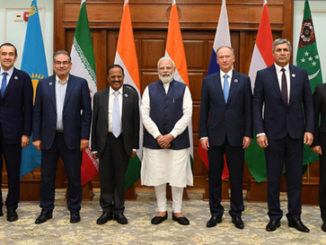
    NEW DELHI (TIP): The Delhi Declaration of Regional National Security Advisers (NSAs) today called for collective cooperation against radicalization, extremism, separatism and drug trafficking in the region.

    Meeting for the first time in Delhi, NSAs of eight countries issued a joint declaration that also emphasized that Afghanistan’s territory should not be used for sheltering, training, planning or financing by terror acts.

    Also Read ‘Some vocal, others careful in opening notes on Afghan situation’ on Page 15

    Hosted by NSA Ajit Doval, the meeting was taking place a day ahead of the “Extended Troika” in Islamabad that would also be attended by Taliban Acting Foreign Minister Amir Khan Muttaqi and new US envoy for Afghanistan Tom West. NSA Ajit Doval has called upon all regional countries to step up consultation and coordination on Afghanistan to enhance collective security. Opening the “Delhi Regional Security Dialogue on Afghanistan”, Doval called for closer coordination among the regional countries since the events in Afghanistan would have important implications for its neighbors and the region.

    Doval will be briefed about deliberations at the “Troika Plus” of the US, China, Pakistan and Russia in Islamabad along with Muttaqi when the US Afghan Envoy flies over to India later this week.

    The Delhi dialogue especially discussed the security situation in Afghanistan and its regional and global ramifications. The NSAs paid special attention to the current political situation in that country and threats arising from terrorism, radicalization and drug trafficking as well as the need for humanitarian assistance, stated an MEA release. The declaration reaffirmed a firm commitment of all eight participants to combat terrorism and ensure that Afghanistan would never become a safe haven for global terrorism. It also stressed the necessity of an inclusive government that has representation from all sections of their society. It also noted that the UN has a central role to play in Afghanistan and reiterated that humanitarian assistance should be provided in an unimpeded, direct and assured manner. The assistance should be distributed in a non-discriminatory manner, it added.

    (With inputs from agencies)

  • T20 World Cup: Daryl Mitchell stars as New Zealand down England to reach maiden final

    T20 World Cup: Daryl Mitchell stars as New Zealand down England to reach maiden final

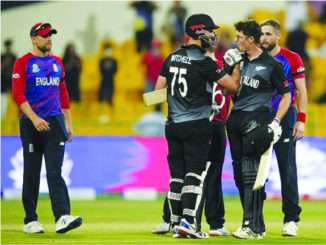
    ABU DHABI (TIP): Opener Daryl Mitchell smashed an unbeaten 72 to lead New Zealand into their first-ever Twenty20 World Cup final with a thrilling five-wicket victory over England on Wednesday, November 10. Chasing 166 for victory, New Zealand were in trouble at 13-2 and 107-4 when Jimmy Neesham turned the semi-final on its head with an 11-ball 27 to help achieve the target with one over to spare in Abu Dhabi. With 20 needed off the final 12 balls, Mitchell smashed Chris Woakes for two sixes and a four before his 47-ball blitz triggered wild celebrations in the New Zealand dugout.

    New Zealand will face either Australia or Pakistan in Sunday’s final.

    They suffered early blows after Woakes struck on the third ball to send Martin Guptill trudging back to the pavilion for four.

    The fast bowler then got skipper Kane Williamson’s prized scalp for five after the batsman attempted a scoop shot to be caught at fine-leg.

    Mitchell and Devon Conway put on 82 runs for the third wicket but Liam Livingstone struck with his leg spin to have Conway stumped for 46.

    New man Neesham took the bowling head on as he smashed Chris Jordan for two sixes – one of them nearly caught at the boundary by Bairstow but his knee touched the rope – and a four to get 23 runs from the over.

    He finally fell to Adil Rashid’s googly with Eoin Morgan holding on to a catch at extra cover.

    Earlier Moeen Ali smashed an unbeaten 51 to steer England to 166-four after being invited to bat as Kiwi skipper Williamson won an all-important toss.

    England lost their openers including Jos Buttler for 29, lbw off Ish Sodhi.

    In-form Moeen But Moeen hit back with his 37-ball knock and put on a key partnership of 63 with Dawid Malan, who hit 41, for the third wicket.

    Pace bowlers Tim Southee and Trent Boult kept a tight leash in the first three overs before Buttler smashed two successive boundaries. In-form Buttler tried to rebuild but an attempt to reverse sweep leg-spinner Sodhi got him trapped lbw for 29 off 24 deliveries.

    The opener, who moved past Pakistan’s Babar Azam as the leading batsman in the tournament with 269 runs, reviewed the call but replays suggested the ball would have hit his off stump.

    The left-handed Malan, who was dropped on 10 by wicketkeeper Conway off Neesham, hit the first six of the innings off Southee in the 16th over but departed next ball caught behind.

    But Moeen launched an attack as he hit Sodhi for a six and then smashed Milne for two hits over the fence.

    Livingstone hit 17 off 10 balls before departing and Moeen completed his first fifty of the tournament with a boundary off Neesham.

                    Source: AFP

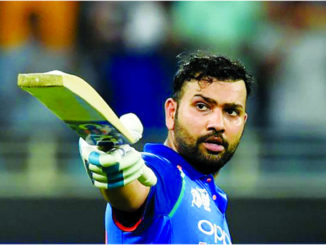
  • Rohit Sharma named new India T20 cricket captain

    Rohit Sharma named new India T20 cricket captain

    Rohit Sharma has been named the new captain of India’s T20 side, replacing Virat Kohli, the cricket board said after the side were dumped out of the World Cup.

    The Board of Cricket Control of India (BCCI) on Tuesday tweeted that the 34-year-old opening batsman was “named the T20I Captain for India” as it announced the squad for an upcoming tour by New Zealand. Fellow opener KL Rahul has been named Rohit’s deputy.

    Kohli, who took over T20I captaincy in 2017, had announced his decision to step down in September, citing his “immense workload”. He remains the skipper of the one-day and Test teams. The announcement follows news that former batting legend Rahul Dravid was replacing Ravi Shastri as coach for all formats following the World Cup, where India failed to qualify for the semi-finals.

  • PSG player Aminata Diallo arrested after attack on teammate

    Paris Saint-Germain midfielder Aminata Diallo has been taken into police custody in connection with an attack on one of her teammates, prosecutors said Wednesday, November 10. The 26-year-old Diallo was arrested on Wednesday morning by Versailles police as part of an investigation into “an attack on the club’s players” last Thursday evening, PSG said in a statement.

    The Versailles prosecutor’s office confirmed to The Associated Press that Diallo was taken into custody, and that Kheira Hamraoui had been attacked. No other details were given.

    Hamraoui and Diallo are PSG teammates and the midfielders also play for France’s national team.

    “Paris Saint-Germain condemns in the strongest possible terms the violence committed,” PSG said. “Since Thursday evening the club has taken all necessary measures to guarantee the health, well-being and safety of its entire women’s team.”

    PSG added that it will work closely with the Versailles police to clarify the facts.

    “The club is paying close attention to the progress of the proceedings and will study what action to take,” PSG said.

    No other information was given, but several French media reports said Hamraoui was attacked following an evening out with Diallo and another teammate, who was not identified.

    Broadcaster BFM TV reported that Diallo was driving them back when several people wearing masks attacked, and that Hamraoui was hit several times with a metal bar and needed stitches to her hands and legs.

    Diallo started in midfield for PSG on Tuesday night in a 4-0 home win against Real Madrid in the group stage of the Champions League. Hamraoui rejoined PSG in the offseason from Barcelona, which beat PSG in the Champions League semifinals in the spring.

  • Djokovic wraps up end-of-year world number one spot

    Novak Djokovic has wrapped up the end-of-year number one ranking after winning the Paris Masters tournament. The Serb, who won three of the year’s four Grand Slam tournaments, finishes the year top for the seventh time, overtaking Pete Sampras who achieved the feat six times. Djokovic is more than 3,000 points ahead of US Open champion Daniil Medvedev after beating the Russian in the Paris final on Sunday. The other big winner in the ATP rankings released Monday was Alexander Zverev, who has equalled his career-high ranking of third.

  • Play up with your hair for parties

    Go for two top knots or a French braid instead of tying your hair in a boring bun for a fun party, say experts.

    French braid

    –              Begin with using a dry shampoo on your lengths and ends to help create texture.

    –              Take a centre parting and braid your hair on both sides using the French braid technique.

    –              Continue braiding till you reach the nape area and secure it with rubber bands.

    –              Open up the braids a little bit and spray finishing spray for hold.

    Centre-parted wavy hair

    –              Spray a prepping product on the roots, lengths and ends to give thickness and volume.

    –              Blast dry the hair so that the product is worked into the hair.

    –              Use a tong and curl the ends using big vertical sections.

    –              Open up the curls and use a hairspray for hold and shine.

    Low side bun

    –              Use volumising spray on the lengths and ends for body and texture.

    –              Work the product into the hair with a brush and dryer.

    –              Take a side parting and tie your hair into a low ponytail at the nape area and secure it with a rubber band.

    –              Use a curling tong and tong the hair that is in the ponytail to create some movement.

    –              Twist the hair into a low bun and pin it up with bobby pins, pull out a few strands and finish by applying a hairspray for added shine.

    Two top knots

    –              Apply a smoothing cream on your lengths and ends for a soft and smooth texture.

    –              Take a centre parting and divide the hair into two equal parts.

    –              Tie two high ponytails of both sides of the parting and secure them with rubber bands.

    –              Twist the hair in the ponytail and wrap it around to look like a top knot. Secure it with pins.

    –              Repeat the same on both sides.

    Messy ponytail

    –              To achieve the messy ponytail, apply a texturising spray to the lengths and end.

    –              Tie a high pony and secure it with a rubber band.

    –              Some loose pieces for a messy effect and finish by spraying a shine hairspray.

    Usage of Mustard Oil

    –              Imparts a natural Skin Glow: Since centuries Indians have been applying Mustard Oil as body oil for massage before their baths. One can use it to massage dry areas prior to a bath. For removing tan, mustard oil can be mixed with besan, yogurt and lemon juice and used as a body pack.

    –              Prepping your skin: Dry patchy skin is a common problem that we all face during harsh winters and this can be a major hindrance while getting ready for a party. One can apply a few drops of mustard oil and rub it along the face, let it remain for few minutes before washing it in water. The skin becomes smooth and ready for applying foundation and make up.

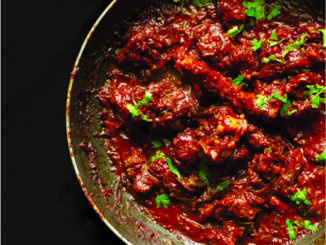
  • Rajasthani Jungli Maas

    Rajasthani Jungli Maas

    Jungli Maas is a delicious spicy mutton recipe from Rajasthan usually cooked in the jungle while on hunting. As Jungli Maas recipe required very few ingredients so it is perfect non vegetarian recipe to cook in outdoors or while hunting birds or animals. Jungli Maas got its flavour with dried red chillies, salt and ghee. You can also add garlic to enhance the flavour of the dish. The hero of the recipe is Meat so let it shine without adding any fancy ingredients or spices.

    Ingredients

    • Mutton or Goat meat (with bone)- 1 kilograms, Garlic cloves- 8 to 10, Dried red chillies- 15 to 20 or to taste, Ghee or Clarified Butter- ½ cup, Salt- to taste

    Method

    • Marinate mutton with the ingredients mentioned under marination ingredients section. Ensure that you mix them properly. Keep it aside for 30 minutes for oil, spice and juices to penetrate.
    • Heat water in a pan. Add dried red chillies, coriander seeds, green cardamom, peppercorn to the pan. Allow the mixture to boil nicely. It should not take more than 10 to 12 minutes. Once done you will see that the dried chillies has gone soft and tender.
    • Separate all the wet ingredients from Water through a sieve. Do not throw the water. We will use it later.
    • Place all wet ingredients and garlic cloves in a grinder and grind it to a fine paste. At this point all your prep work is done. Time to get to the curry going.
    • Heat mustard oil in a non stick pan. Add black peppercorns, cinnamon sticks, bay leaves, cumin seeds and Star Anise to the pan. This is done to slightly flavour the oil. Now add onions and saute till they are golden brown.
    • Add garlic paste and saute for 5 minutes on low flame. Add the marinated mutton to the onions and sauté on low heat for 10 minutes.
    • Add 1/2 cup of strained spiced water(that we had retained) to the pan and let the mutton cook in it on medium heat for 15 minutes.
    • Add the rest of grinded magic spice mixture and 4 cups of strained spiced water to the mutton.Cover and cook for about 60 to 75 minutes on low flame or until the mutton is cooked properly. Once done, garnish it with fresh chopped coriander and serve hot
  • Interesting facts about Lord Ganesha

    Interesting facts about Lord Ganesha

    Lord Ganesha is the Son of Lord Shiva and Goddess Parvati. Since he is born out of their union, he personifies life, duality, and manifestation in diverse aspects. Ganesha is highly charming and mesmerizing. He is the remover of problems and obstacles. Lord Ganesha is worshiped by both Jainism and Buddhism.

    The head of Lord Ganesha symbolizes the Atman or the soul, which is considered the ultimate reality of humanity and his human body symbolizes Maya, the trappings of earthly existence. Below are some of the interesting facts about Lord Ganesha.

    Lord Ganesha Wrote the Mahabharata

    It is believed that Rishi Vyasa requested Lord Ganesha to write the Mahabharata as he recited it. He decided to do it after Vyasa agreed to recite it without any interruptions and Vyasa, in turn, made him promise he would understand what was being said before he wrote it down.

    Meaning of Ganapati

    ‘Gana’ means category. Everything that we perceive through our senses or grasp through our mind can be expressed in terms of category. The principle from which all such categories have manifested themselves is Ganapati, the Lord of categories. In effect, it means the origin of the whole creation, God Himself;

    Meaning of Gajanana or Gajamukha

    A common Sanskrit word to denote elephant is ‘Gaja’.Hence the name Gajanana or Gajamukha (elephant-faced) for Ganapati. But the word ‘Gaja’ has a deeper connotation. ‘Ga’ indicates ‘Gati’, the final goal towards which the entire creation is moving. ‘Ja’ stands for ‘Janma’ or birth or origin. Hence ‘Gaja’ signifies God from whom the worlds have come out and towards whom they are progressing, to be ultimately dissolved in Him. The elephant head is thus purely symbolical and points to this truth.

    A factor we observe in creation is its two-fold manifestation as the microcosm (Suksmanda) and macrocosm (Brahmanda). Each is a replica of the other. They are one in two and two in one. The elephant head stands for the macrocosm and the human body for the microcosm. The two forms one unit. Since the macrocosm is the goal of the microcosm, the elephant part has been given greater prominence by making it the head.

    Elephant-Human form of Ganapati

    The elephant-human form of Ganapati is the iconographical representation of the great Vedantic dictum, ‘tat-tvam-asi'(which means You the apparently limited individual are in essence the Cosmic Truth, the Absolute). The elephant stands for the cosmic whereas the human stands for the individual.

    Wives of Lord Ganesha

    According to scriptures, Lord Ganesh had two wives Ridhhi (representing Prosperity) and Sidhhi (representing Intellectual Enlightenment). Furthermore, he had two sons – Ridhhi bore him Subha (representing Auspiciousness) while Sidhhi bore him Labha (representing Profit).

    Birth of Lord Ganesha

    According to Shiva Purana, it was Parvati’s friends Jaya and Vijaya’s decision to make Lord Ganesha. They had suggested Parvati that Nandi and others follow the instructions of Lord Shiva only. Therefore, there should be someone who follows Parvati’s orders too. Hence, Parvati made Ganesha from the dirt of her body.

    Ganesh’s clothes

    Lord Ganesha is usually portrayed wearing red and yellow clothes where red signifies the shakti and material reality and yellow symbolizes purity, peace, and truthfulness.

    Elephant Head

    Elephants are known for their wisdom and effortlessness. The larger head of an elephant signifies prosperity and power. An elephant neither walks around obstacles nor can any obstacles stop. It removes the obstacles and walks ahead.

    Big belly

    In most of the paintings, the Lord is depicted with a large belly. The large belly of the lord Symbolizes generosity and complete acceptance.

    Wide mouth and large ears

    The wide mouth of Ganesha represents that one must spend less time talking and utilizing one’s energies for thinking or doing. Large ears signify listening skills.

    Small eyes

    The small eyes of Ganesha denote the one having sharped focus and acute concentration.

    Arms

    The four arms indicate that the Ganesha is omnipresent and omnipotent. The right side symbolizes reason, and the left side symbolizes emotions.

    Axe

    Lord Ganesha holds an axe in the upper left hand and a noose in the upper right hand. The axe symbolizes the reduction of all desires, bearers of pain and suffering.

    Tusk

    The two tusks of the Lord denote the two aspects of the human personality, wisdom and emotion. The broken tusk of the Lord signifies the ability to keep the good and throw away the bad. It was his broken tusk with which the ancient scripture Mahabharat was written.

    Lotus

    Lord Ganesha is often depicted withholding a lotus in hand. It signifies that one must live in the world without being affected by others.

    Mouse

    A mouse is the vehicle of Lord Ganesha. It represents the lordship or control over fear, hesitation, and doubt. It means that Lord Ganesha has no ego.

                    Source: Vedicfeed

  • Indian-origin in UAE hails new civil law for non-Muslims

    Indian-origin in UAE hails new civil law for non-Muslims

    ABU DHABI (TIP): The Indian community in the United Arab Emirates on Monday, November 8, hailed the landmark new civil law for non-Muslims in Abu Dhabi, the capital and the second-most populous city of the Gulf nation, which has been introduced by the emirate with an aim to maintain its competitive edge as a regional commercial hub and emerge as the most attractive destination for talent and skills. In his capacity as the Ruler of the Emirate of Abu Dhabi, President Sheikh Khalifa bin Zayed Al Nahyan on Sunday issued a law to regulate personal status matters for non-Muslims in Abu Dhabi to provide a flexible and advanced judicial mechanism for the determination of personal status disputes for non-Muslims. The decision, which is the first of its kind in the world, will enhance the Emirate’s position and global competitiveness as one of the most attractive destinations for talent and skills, the official WAM news agency reported. Reacting to the decision, Ipshita Sharma, International Publishing Sales Manager, termed it as “an incredible gesture for those of us who think of the UAE as home.” “I have been here for 12 years now and it feels more and more like we’re being included in the narrative of the country despite our religion, nationality and beliefs,” says Sharma, who is based in Dubai.

    According to M Unnikrishnan, a communications professional, the new Abu Dhabi civil law on marriage, divorce, custody, and inheritance for non-Muslims is promising for its residents.

    “By introducing a new legal framework for non-Muslims, the UAE’s leadership has ensured a flexible and advanced judicial mechanism aligned with international practices,” he says.

    For Unnikrishnan, who is based in Abu Dhabi, the announcement of the reforms while the UAE is celebrating its Golden Jubilee celebrations, is yet another milestone in the history of the nation.

    “Bilingual court procedures, the right to divorce, equal rights for partners on the custody of children, dedicated special courts for non-Muslim family matters, etc. are some of the features of the reform, guaranteeing transparency in upholding the rights,” he said. “Connected with the legal overhaul in November last year, the new measures will safeguard the rights of all the affected people,” says Unnikrishnan.

    Kevin Bayan, a Filippino national, who is working in the healthcare sector in Abu Dhabi, said the new set of rules will make the civil cases less complex. “So, it will come as a blessing for the residents and expats, living for a longer period in the country. The flexibility, priority, and the advanced approach taken while formulating the new law are commendable,” he said.

    “Over the years, UAE has been giving attention and focus to the residents to ensure that their rights and needs are taken care of. I think the aspects in the law regarding marriage, divorce, and child custody are advanced and capable of guaranteeing the rights of individuals and their children,” he added. Dubai-based Chandrashekhar Bhatia of Maharashtra Business Forum said that the law is a good move for the country.

    “It is very useful for non-Muslims as in case of child custody, both the parties will be responsible for the care of their children now. The community should welcome this,” he said.

    An Indian technician living in Abu Dhabi said the details related to the new law are still not known.

    “We should wait for more details to emerge. Specifically on inheritance law, I am looking for clarity how this will go in parallel to Indian inheritance law. Suppose one has property in UAE and India both but don’t have a will,” he said on the condition of anonymity.

    The law, which is in line with international best practices, guarantees the right of non-Muslims to be subject to an internationally acknowledged law that is familiar to them in terms of culture, customs and language, according to a report in the Khaleej Times.

    It will also help in protecting the best interests of children, particularly in the case of parental separation, it said.

    The move will further enhance the Emirate’s position and global competitiveness as one of the most attractive destinations for talent and skills, it said.

    The law consists of 20 articles divided into several chapters covering civil marriage, divorce, joint custody of children and inheritance, the WAM report said.

    Youssef Saeed Al Abri, Undersecretary of the Abu Dhabi Judicial Department (ADJD), said that the new legislation is the first of its kind in the world as it deals with the smallest details regarding non-Muslim family life. The new law applies civil principles in the regulation of family matters, Al Abri was quoted as saying by the official news agency. He also said the establishment of the first court dedicated to non-Muslim family matters, which would be in both English and Arabic to facilitate understanding of judicial procedures by foreigners and to improve judicial transparency. Al Abri added that the Abu Dhabi Judicial Department has been working in order to provide innovative solutions to non-Muslims’ personal status issues that are brought before the courts, after studying and analyzing them and working to come up with sophisticated legislative solutions that provide a modern judicial framework for foreigners residing in the Emirate of Abu Dhabi to resolve family disputes in a flexible manner in line with international best practices, the Gulf News reported.

  • Indian-origin kidnapped brothers in South Africa returned to parents after 3 weeks

    Indian-origin kidnapped brothers in South Africa returned to parents after 3 weeks

    The boys were abducted by seven armed men wearing white overalls in two vehicles that blocked the car they were travelling in on their way to school on October 21

    JOHANNESBURG (TIP):The four young sons of a South African Indian-origin businessman have been safely returned to their parents after they were abducted on their way to school three weeks ago by armed gunmen. Police confirmed that Zidan (who turned seven on Saturday while in captivity), Zayyad, 11, Alaan, 13, and Zia, 15, the sons of businessman Nazim Moti, who is based in Polokwane, were found unharmed and in good spirits on Wednesday evening. The boys were abducted by seven armed men wearing white overalls in two vehicles that blocked the car they were travelling in on their way to school on October 21. The driver was left unharmed.

    Police spokesman Vish Naidoo said police received a call from residents of Tshwane in Pretoria, who said the four children arrived at their house, saying that they were dropped off at a road nearby.

    The children were first medically examined before being handed over to their ecstatic parents.

    “The doctor said they were in good health and our observation when they were handed back to their parents was that they were in very high spirits,” Naidoo said, adding that a team of forensic and clinical psychologists would visit the family on Thursday to interview the boys to see what information they could provide.

    Naidoo said they did not want to exhaust the children too much after their ordeal. “The important thing now is to see what information we can get from them to help us in tracing and successfully arresting those who were responsible for the kidnapping,” Naidoo said. Naidoo dismissed suggestions that the police had been unable to make headway in the case as people across the country prayed for the safe return of the boys.

    “We have not spoken about this as in all kidnapping cases, because we believe that speaking about it publicly had the potential of placing the lives of the children at greater risk,” Naidoo said.

    “A lot of work has been done already and whether the release was a result of (the police) closing the net on the kidnappers or not is still to be determined, but there was a multi-disciplinary integrated team put into place from the time that the report was made to us that the children were kidnapped. A large team of specialized police officers countrywide had been deployed to investigate the case,” he said. No information was available on whether any ransom was paid for the release of the children. Earlier, Martin Ewe, a senior researcher at the Institute for Security Studies and an expert on organized crime in Africa, said he believed that a ransom was involved.

    ”When children are abducted, it’s usually children of rich families. Criminals will spot a child, notice that the family is wealthy and think here is a chance to make some money,” Ewi told the Afrikaans news service Netwerk 24.

    Ewi said since 2016 there has been an increase in the number of wealthy families being targeted.

    (Source:  PTI)

  • Indian American police officer critically wounded in Georgia after being shot while responding to domestic dispute

    Indian American police officer critically wounded in Georgia after being shot while responding to domestic dispute

    ATLANTA (TIP): A 38-year-old Indian American police officer was critically injured after a person fired at him and fled the scene while he was responding to a domestic dispute in the US state of Georgia, according to media reports on Monday, November 8. Investigators in Georgia and NBA (National Basketball Association) Hall of Famer Shaquille O’Neal have offered a USD 30,000 reward for any information on the suspect who shot and wounded Paramhans Desai last week, abcnews.com reported.

    Henry County Police Officer Desai was responding to a domestic disturbance on Thursday, November 4, and was attempting to make an arrest when Jordan Jackson, 22, of McDonough, Georgia, allegedly shot at him and fled the scene in a car, the report said, quoting a statement issued by the Henry County Police Department.

    Desai was taken to Grady Medical Centre and was listed in critical, but stable condition on Sunday, police said.

    Desai is married and has two children. He has been with the Henry County Police department for two years and previously worked for the Georgia Department of Corrections and DeKalb County Police, the report said, quoting police. According to local news portal fox5atlanta.com, officer Desai, a 17-year law enforcement veteran, was shot by Jackson while responding to a 911 call on Keys Ferry Road.

    Police announced a USD 30,000 reward leading to the successful arrest and indictment of Jackson. Henry County Sheriff’s Office and the US Marshall’s Service each put up USD 10,000 and Crime Stoppers Greater Atlanta and O’Neal, who took a role with the sheriff’s office as director of community relations earlier this year, each contributing USD 5,000, the report said. In 2019, Indian-American Sikh police officer Sandeep Singh Dhaliwal, who was in his early 40s, was shot multiple times from behind and killed in “ruthless, cold-blooded way” during a traffic stop in Texas. Dhaliwal was married and a father to three children.

  • Canada is the new hub for Indian entrepreneurs

    Canada is the new hub for Indian entrepreneurs

    OTTAWA (TIP): Is America’s loss Canada’s gain? Young Indian entrepreneurs are increasingly finding many advantages and benefits in business immigration to Canada. Canada has now become a hub of booming businesses. Entrepreneurs, investors, as well as people starting a new business venture from all over the world, are these days looking for options in Canada. There are a lot of reasons why individuals are willing to settle and start their business in Canada. First of all, the Government of Canada is extremely welcoming when it comes to setting up new businesses and companies. As we’re aware that Canada has a diverse population and has a perfect blend of different cultures and communities living together, which means there are people belonging to different backgrounds looking to consume different products and services. Canada having people from diverse backgrounds gives more options to budding entrepreneurs to look at. In India, the trend of coming up with “startup” ideas is now surfacing. The pandemic that lasted for almost two years did affect India and Canada’s economy greatly and now that everything has again started to settle, Canada has a set of programs to offer like the Intra-Company Transfer Program, Canada Startup Visa Program, specially designed to help budding entrepreneurs from India & all over the world to gain special visas & start their business there. There are startups like Videotap and Zaggle that started in India but then soon earned a place in the Canadian market as well.

    In order to start a business in Canada, it is not necessary for an individual to have professional expertise. Gaining a Canadian visa requires a little bit of technical knowledge and a little experience, you’re good to go. Through the Startup Visa Program offered by Canada, one can not only start a trade there but can also become a Permanent Resident along with his complete family. Canada offers premium healthcare facilities to all the people residing there. Also, primary education is comparatively cheaper & also free in some of the provinces. All these benefits make Canada a reliable choice for Indians to relocate.

    Canada was also ranked #1 out of 78 countries in the recently released 2021 Best Countries Report from US News & World Report. It received tremendous marks in the Entrepreneurship and Open for Business categories. Canada scored 79.6 and was ranked 23rd in the world in terms of ease of doing business in 2020.

    Canada was ranked #9 with a score of 77.9 in the 2021 Index of Economic Freedom falling in the Mostly Free Category while India is at #121, falling in the Mostly Unfree Category with a score of 56.5. As of 2020, Canada’s GDP per capita stands at $43,295 while India’s is at $1,928. A robust business strategy is required even for the best of business ideas; hence, it is advisable that people having an intent to relocate to Canada.

  • British-Sikh Army officer Polar Preet sets off for South Pole adventure

    British-Sikh Army officer Polar Preet sets off for South Pole adventure

    Nirpal S Shergill

    LONDON (TIP): A 32-year-old British Sikh Army officer and physiotherapist is on a mission to become the first Indian-origin female to complete a solo, unsupported trek to the South Pole and is flying out to Chile on Sunday to begin her adventure. Captain Harpreet Chandi, known as Polar Preet, will be travelling 700 miles while pulling a pulk or sledge with all of her kit, battling temperatures of minus 50 degrees Celsius and wind speeds of up to 60mph.

    Writing on her online blog, she notes that the journey will take approximately 45-47 days during which she plans to upload a live tracking map for people to be able to follow her daily voice blogs.

    “I want to take as many of you as possible on this journey with me so I hope you enjoy following,” writes Chandi.

    Currently based at a Medical Regiment in the north-west of England, Chandi’s primary role is to organize and validate training for medics in the Army as Clinical Training Officer.

    She is completing her master’s degree in Sports and Exercise Medicine, part time, at Queen Mary’s University in London and has been using two large tires as a substitute for the heavy sledge she will be dragging along in Antarctica for her polar training.

    “Antarctica is the coldest, highest, driest and windiest continent on earth. Nobody lives there permanently. I didn’t know much about the continent when I first started planning and that is what inspired me to go there,” she explains.

    “Hopefully doing something that pushes me so far out of my comfort zone will inspire others to believe in themselves and push their boundaries. There are only a few female adventurers that have completed a solo, unsupported trek on this continent. It is time to add some more names, diversity and to make history,” she says.

    Chandi has always been keen to push the human body to its limits and sees her latest mission as part of this wider research. “Nothing is impossible. I’ve always had this idea that I can achieve something great, something that allows me to be a role model. I want my eight-year-old niece to grow up without boundaries, knowing the possibilities of what you can achieve in life are endless,” she reflects. As an “endurance athlete”, Chandi has run marathons and ultra-marathons and, as an Army officer, completed large scale exercises and deployments in Nepal, Kenya and most recently a six-month United Nations peacekeeping tour to South Sudan. “Anything ambitious can feel out of reach at the beginning but every bit of training I complete brings me closer to my goal. My training expeditions in Greenland and Norway have helped prepare me and my goal is now in reach,” she declares.