Month: February 2022

  • Tom Holland is grateful for fans’ responses to No Way Home

    Tom Holland values the enthusiastic fan reactions to Spider-Man: No Way Home more than the film’s massive box office gross. Even before its release in December, Spider-Man: No Way Home was building up to be one of the web-most slinger’s successful films.

    No Way Home, which sees Holland’s Peter Parker coping with the multiverse after a spell gone bad, reintroduces various performers from previous Spider-Man films, the most noteworthy of which being Tobey Maguire and Andrew Garfield. However, the final outcome is the most important to Holland. Holland discussed No Way Home’s enormous success in a recent interview with the BBC’s Zoe Ball Breakfast Show. He remarked that even during filming, it was evident that something exceptional was happening, but it couldn’t compare to how he feels now that the picture is out. Holland said that the fan response has moved him the most.

  • Richa Chadha wishes to explore dancing on-screen

    Actor Richa Chadha feels it’s a loss that she hasn’t done any films that made use of her dance skills, and admits she wants to explore that side of herself as an artiste. “I learnt dance in Delhi for 10 years, starting from the age of six, straight up till I was in high school. Today, I can confidently say that the rhythm that it introduced in my body has made me an able performer,” she says, adding, “It is actually quite puzzling and amusing that I haven’t done any films that really utilised my dancing potential.” The 35-year-old continues, “Also, I haven’t chosen films that consciously have a lot of songs or items and songs. I guess that is one of the reasons as well.” However, she hopes to do “that in the future someday” as dance has helped her appreciate her body and given her a lot of grace. “It has helped me be agile, and flexible. It has also helped me mentally in appreciating classical forms because Indian classical forms are by far the most evolved dance form anywhere in the world,” she admits.

  • Ranveer has this reaction after watching Deepika’s Gehraiyaan

    Ever since the trailer of Gehraiyaan has released fans have been eagerly waiting for the film to release. They cannot keep calm and have been going gaga over everything related to the film. Be it the songs or the clips from the movie, everything has been receiving a lot of love. Well, the actors are on a promotional spree these days and step out to promote the film every day. They have been opening their hearts out about their journey in the film and we are getting to hear new stories related to the film each day. In the latest interview, Deepika Padukone revealed hubby Ranveer Singh’s reaction after he watched the movie.

    Deepika Padukone while speaking to Indianexpress.com revealed that Gehraiyaan looks like the most intense film she has done since the 2015 release Tamasha that starred Ranbir Kapoor opposite her. This Imtiaz Ali film received a lot of love from the fans and become one of the most loved movies of Ranbir and Deepika. Well, talking about what hubby Ranveer Singh said after watching the film DP revealed that he too felt that this is the most intense film she has done.

    Deepika Padukone further added that her character of Alisha Khanna in Gehraiyaan has shades of Shoojit Sircar’s Piku and Tara from Tamasha because of the way they have been written. But, she quipped that her character in Gehraiyaan is ‘probably the most complex character, which makes this role different and extremely challenging’ than whatever she has done.

    Talking about Gehraiyaan, the title track of the film was recently released and fans are pouring in love for it. The Ananya Panday, Siddhant Chaturvedi, Dhairya Karwa and Deepika Padukone movie is all set to release on February 11 on Amazon Prime.  Source: Pinkvilla

  • Anand actor Ramesh Deo passes away at 93 due to heart attack

    Veteran actor Ramesh Deo who had worked in movies including Anand and Mere Apne passed away at the age of 93 in Mumbai on February 02. His son Abhinay Deo confirmed the news to Indian Express. Abhinay said, “He passed away due to heart attack around 8:30 pm tonight at Kokilaben Dhirubhai Ambani Hospital. He was 93.” The late actor has credit to numerous movies in his name and was quite acclaimed in the Marathi film industry as well. Ramesh Deo had worked in several movies including Anand, Aapki Kasam, Mere Apne, Mr. India, Khilona, Hulchul among others. So far, he had worked in around 285 Hindi cinemas and 190 Marathi films. He had also produced feature films, TV serials, and ad films. He has done notable work in the entertainment industry. The news of his death broke the hearts of his fans as they took to social media to express their grief. A fan wrote, “Rest In Peace Ramesh Deo Saab.” Another user tweeted, “Marathi cinema has lost a doyen. Rest in Peace Ramesh Deo.” Similar tweets flooded in after the sad news came out.

  • India records 1.49 lakh new Covid cases, 1,072 more deaths

    India records 1.49 lakh new Covid cases, 1,072 more deaths

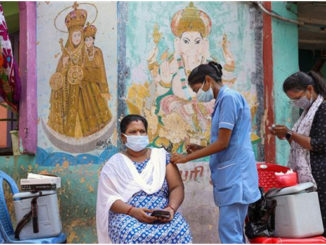
    New Delhi (TIP)-India added 1,49,394 new Covid cases, taking the total tally to 4,19,52,712, while the active cases further declined to 14,35,569, according to the Union Health Ministry data updated on Friday, Feb 4. The death toll climbed to 5,00,055 with 1,072 fresh fatalities, the data updated at 8 am stated. The active cases comprised 3.42 per cent of the total infections, while the national Covid recovery rate improved to 95.39 per cent, the ministry said. A reduction of 98,352 cases has been recorded in the active Covid caseload in a span of 24 hours. The 1,072 new fatalities include 601 from Kerala and 75 from Maharashtra.

    Of the 601 deaths in Kerala, 36 were reported in the last 24 hours, 124 were those which occurred in the last few days but were not recorded due to late receipt of documents and 441 were designated as Covid deaths after  receiving appeals based on the new guidelines of the Centre and the directions of the Supreme Court, the state government said on Thursday.

    A total of 5,00,055 deaths have been reported so far in the country including 1,42,859 from Maharashtra, 56,701 from Kerala, 39,197 from Karnataka, 37,666 from Tamil Nadu, 25,932 from Delhi, 23,277 from Uttar Pradesh and 20,723 from West Bengal.

    3rd Covid wave affected youngsters more, sore throat commonest sign: ICMR

    The third wave of Covid 19 affected younger people more with sore throat emerging the commonest symptom.

    An ICMR analysis of 1,520 (564 fully jabbed and 956 unvaccinated or half jabbed) Covid 19 patients admitted to 37 hospitals between November 15, 2021 and January 17, 2022 revealed the mean age of the hospitalised at 44 years against 55 years in the second wave.

    Nearly half – 46 pc—of the hospitalised young had comorbidities and all symptoms were less severe as compared to the second wave.

    Among fully vaccinated, 10.2 pc died and 91 pc of these had comorbidities.

    Proportion of deaths among unvaccinated was much higher at 22 pc with 83 pc reporting comorbidities.

    Oxygen requirement was lesser among jabbed (36.1 pc needed oxygen) as against the unvaccinated (45.5 pc needed Oxygen.).

    Percentage of the vaccinated requiring mechanical ventilation was 5.4 pc as against 11.2 pc un-vaccinated.

                    Source: PTI and TNS

  • Galwan clash: China suffered higher losses than reported, says Australian newspaper

    Galwan clash: China suffered higher losses than reported, says Australian newspaper

    New Delhi (TIP)- China’s losses in the Galwan Valley clash in 2020 were much higher than reported with many soldiers drowning while crossing a fast-flowing river in darkness, an investigative Australian newspaper claimed on Wednesday, February 2.

    The Klaxon cited findings by unnamed researchers and mainland Chinese bloggers in the report and said they have declined to be named on security grounds, but their findings appear to “shed significant light on the saga”.

    “Claims of substantial Chinese casualties are not new, however evidence provided by a group of social media researchers, which The Klaxon has independently built on, appears to support claims that China’s casualties extended well beyond the four soldiers named by Beijing,” it said. The report said it also showed the extreme lengths Beijing has gone to silence discussion about the battle.

    “China’s losses in the high-altitude 2020 Galwan Valley border clash with India — the deadliest confrontation between the two giants in over four decades — were much higher than reported with many soldiers drowning while crossing a fast-flowing, sub-zero river in darkness, new research claims,” the report said.

    The eastern Ladakh border row escalated after the Galwan Valley clashes on June 15, 2020. Twenty Indian Army personnel laid down their lives in the clashes that marked the most serious military conflicts between the two sides in decades.

    In February last year, China officially acknowledged that five Chinese military officers and soldiers were killed in the clashes with the Indian Army though it is widely believed that the death toll was higher.

    The Klaxon cited a report into the matter titled “Galwan Decoded” that it said has been prepared by a group of social media researchers.

    “The researchers have declined to be named on security grounds, but their findings appear to shed significant light on the saga,” it said.

    The Klaxon said the report cited a year-long investigation involving discussions with mainland Chinese bloggers, information obtained from mainland-based Chinese citizens and media reports that have since been deleted by Chinese authorities.

    “A lot of facts about what really happened, what led to the skirmish, have been hidden by Beijing,” it quoted from the report. Source: PTI

  • 4,984 criminal cases involving legislators pending in courts: Amicus Curiae

    New Delhi (TIP)-A total of 4,984 criminal cases involving legislators were pending in various courts across the country as on December 1, 2021, according to data compiled by the Amicus Curiae who is assisting the Supreme Court court in a matter in which the top court had ordered setting up of special courts to fast-track cases against MPs and MLAs. The report by Amicus Curiae Senior Advocate Vijay Hansaria, which is based on data provided by the various High Courts, said that “despite a series of directions by” the SC “and continuous monitoring, as many as 4,984 cases are pending out of which 1,899 cases are more than 5 years old”.

    The report which was submitted to the top court Thursday by Advocate on Record Sneha Kalita pointed out that “the total number of cases pending as on December 2018 were 4,110; and as on October 2020 were 4,859”. “Even after disposal of 2,775 cases after 04.12.2018, the cases against MPs/MLAs have increased from 4,122 to 4,984. This shows that more and more persons with criminal antecedents are occupying the seats in the Parliament and the State Legislative Assemblies,” the report said.

                    Source: The Indian Express

  • Haryana law for quota in private sector jobs put on hold

    Chandigarh (TIP)-In a relief for many private sector companies, the Punjab and Haryana High Court on Thursday, Feb 3,  granted an interim stay on a Haryana government law providing 75 per cent reservation in private sector jobs for residents of the state.A bench of justices Ajay Tewari and Pankaj Jain passed the order on pleas filed by various industry associations from Faridabad and other bodies from Haryana including Gurgaon. Haryana’s Additional Advocate General Jagbir Singh Malik said the state will be filing a Special Leave Petition (SLP) against the order before the Supreme Court. “The court has granted an interim stay and we are filing SLP against this order,” Malik said over the phone. The court admitted multiple petitions against implementation of the law — Haryana State Employment of Local Candidates Act, 2020, counsel of one of the petitioners said. The interim order has come as a relief for companies in the state which feel that the Act would have a bearing on their future business operations and investment. The Act provides 75 per cent reservation in the private sector to job seekers from the state and came into force from January 15 after being notified in November last year. It applies to jobs offering a maximum gross monthly  salary or wages of Rs 30,000.

    Haryana govt moves SC challenging HC order

    The Haryana government on Friday approached the Supreme Court challenging the stay by the Punjab and Haryana High Court on the state law providing 75 pc quota to locals in private jobs. The state government, in its plea, argued that the High Court passed the order on the plea after hearing the matter for just 90 seconds.

    Appearing for the Haryana Government, Solicitor General Tushar Mehta, mentioned the matter before CJI NV Ramana bench and contended that “yesterday the High Court after hearing him for 90 seconds admitted the plea and stayed the Act”. On Tushar Mehta’s request, the SC bench agreed to hear the matter on February 7, Monday, subject to placing an order of the High Court on record.

    NEET-PG 2022 deferred by 6-8 weeks

    The Union Health Ministry has postponed the National Eligibility cum Entrance Test (NEET-PG) 2022. The exam was scheduled to be held on March 12.  The ministry has deferred the exam by 6-8 weeks and has not announced any new exam schedule as of now. The fresh exam dates will be released in due course of time. The Supreme Court  was also hearing a plea seeking postponement of the NEET-PG 2022. On January 25, six MBBS graduates had filed a plea in the Supreme Court seeking postponement of the National Eligibility-cum-Entrance Test (NEET) scheduled on March 12 for admissions in postgraduate medical courses, claiming that many MBBS graduates would not be able to take up the examination due to non-completion of the mandatory internship period.

  • ED arrests Punjab CM Channi’s nephew on charges of money laundering ahead of polls

    ED arrests Punjab CM Channi’s nephew on charges of money laundering ahead of polls

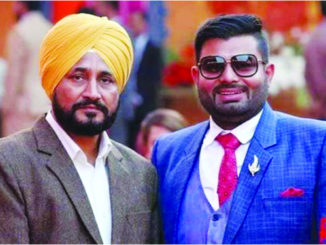
    New Delhi (TIP)- The Enforcement Directorate (ED) has arrested Bhupinder Singh alias Honey, nephew of Punjab Chief Minister Charanjit Singh Channi, in a money laundering case linked to alleged illegal sand mining in the border state, officials said on Friday, Feb 4.

    They said Honey was arrested under the provisions of the Prevention of Money Laundering Act (PMLA) late Thursday night after several hours of questioning at the agency’s office in Jalandhar. Sources claimed he was evasive in his replies and was hence taken into custody. The ED will produce him before a special PMLA court in Mohali on Friday seeking his remand.

    Honey is the son of Channi’s sister-in-law. On January 18, the agency had raided his premises and claimed to have seized about Rs 8 crore cash and “incriminating” documents. Property belonging to a few others were also raided.

    The development comes days before Congress leader Rahul Gandhi is likely to announce the party’s chief ministerial candidate in the poll-bound state. Gandhi is expected to make this announcement during his virtual rally in Ludhiana on Sunday and Channi is stated to be the front runner. Punjab will go to polls on February 20.

    After the raids last months, ED sources had claimed that the agency had recovered over Rs 10 crore in cash and several documents, of which Rs 8 crore and most of the papers were seized from premises linked to Honey alone.

    About Rs 2 crore cash was seized from the premises linked to a person identified as Sandeep Kumar.

    The ED had then issued a statement saying those covered in the raids included Kudratdeep Singh, Pinjore Royalty company and its partners/shareholders, Kanwarmahip Singh, Manpreet Singh, Sunil Kumar Joshi, Jagveer Inder Singh, Randeep Singh, Providers Overseas Consultants Pvt Ltd and its other directors, shareholders, including Honey and Sandeep Kumar, at Mohali, Ludhiana, Rupnagar, Fatehgarh Sahib and Pathankot.

    Channi had told reporters that as relatives of West Bengal Chief Minister Mamata Banerjee were raided during the Assembly polls in that state, the “same pattern” was being followed by the ED in Punjab to “pressure” him, his ministers and the Congress party members.

    The ED filed a criminal case under PMLA last November.

    The case is based on a 2018 FIR at the Shaheed Bhagat Singh (SBS) Nagar police station that pressed charges under the Indian Penal Code and Mines and Minerals (Regulation of Development) Act, 1957.         Source: PTI

  • Supreme Court defers hearing on Navjot Sidhu road rage case plea to February 25

    Chandigarh (TIP)-The Supreme Court today deferred to February 25 the hearing on a petition seeking review of its 2018 order letting off Punjab Congress chief Navjot Singh Sidhu with a fine of Rs 1,000 in a 32-year-old road rage case in which one Gurnam Singh had died.

    The order by a Bench of Justice AM Khanwilkar and Justice SK Kaul came as a reprieve for the cricketer-turned-politician ahead of the Punjab Assembly poll to be held on February 20. The deferment came after senior advocate P Chidambaram, representing Sidhu, submitted that the advocate-on-record in the case was changed last night and he needed time to file reply to the review petition. Initially, the Bench proposed to defer it to February 21 but finally it posted the matter for hearing on February 25 as Chidambaram urged that it be listed on any date after February 23. “On a lighter side, two weeks’ time is crucial for him,” the top court said.

    The Bench took exception to a letter circulated by Sidhu’s new counsel seeking four-week adjournment that said the matter had been “unexpectedly listed”.               Source: TNS

  • UP Polls: Akhilesh picks bastion Karhal, Bhim Army chief to take on CM Yogi

    UP Polls: Akhilesh picks bastion Karhal, Bhim Army chief to take on CM Yogi

    Lucknow (TIP)- Samajwadi Party president Akhilesh Yadav will contest the UP Assembly polls from Karhal in Mainpuri district, party’s national spokesperson Ashutosh Verma said. Akhilesh Yadav, an MP from Azamgarh, had on Wednesday, Feb 2,  said he would decide on contesting the Assembly polls after talking to the people. SP founder Mulayam Singh Yadav represents Mainpuri constituency in Parliament. Meanwhile, Bhim Army chief Chandra Shekhar Aazad had been fielded from Gorakhpur Urban seat, from where Chief Minister Yogi Adityanath will face is first Assembly poll. Azaad, a prominent face, heads the Aazad Samaj Party (Kanshiram) which announced his nomination. Gorakhpur Sadar goes to polls on March 3 in the sixth phase.

    Source: PTI

  • Govt proposes measures to deter tax evasion, cut litigation

    Govt proposes measures to deter tax evasion, cut litigation

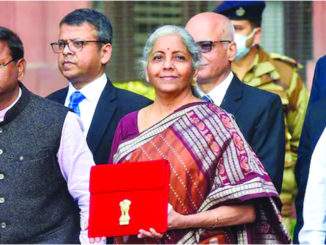
    The government proposals related to the direct taxes will further simplify the tax system, promote voluntary compliance by taxpayers, and reduce litigation, Union finance minister Nirmala Sitharaman said on Tuesday, Feb 1,  while presenting the budget for the fiscal year 2022-23. In order to increase deterrence among tax evaders, Sitharaman proposed to provide no set off, of losses, against undisclosed income detected during search operations. Underlining the existing ambiguity, Sitharaman said that set off, of losses, are brought forward against undisclosed income detected in search operations to avoid payment of tax.

    “It has been observed that in many cases where undisclosed income or suppression of sales etc. is detected, payment of tax is avoided by setting off, of losses,” the finance minister said. “In order to bring certainty and to increase deterrence among tax evaders, I propose to provide that no set off, of any loss shall be allowed against undisclosed income detected during search and survey operations,” she added.

    Sitharaman also proposed new measures to reduce litigation involving identical issues in order to save time and resources. The litigation will be reduced by restricting the filing of a further appeal if the question of law is identical to a question is identical to the one pending in appeal before the jurisdictional High Court or Supreme Court. The filing will be deferred till such question of law is decided by the jurisdictional High Court or the Supreme Court.

    “It has been observed that a lot of time and resources are consumed in filing of appeals which involve identical issues…This will greatly help in reducing the repeated litigation between taxpayers and the department,” Sitharaman said in the budget speech.

    ‘Didn’t increase tax burden on people,’ says FM; explains why

    Nirmala Sitharaman said  that she did not attempt to increase the taxes in the Union Budget she presented in Parliament today. She added that the government has continued this tradition from last year, when the Prime Minister Narendra Modi directed the officials to not burden the common man with higher taxes during Covid-19. “I did not increase the taxes. I want to repeat this – I didn’t do it last year as well as this year. I did not make any attempt to earn a single paisa through taxes,” Sitharaman said at a post-Budget press conference. “Last year, the Prime Minister had ordered us not to increase taxes during the pandemic time, even if there is huge fiscal deficit. He said the public should not face the additional burden of taxes during this time.”

    ‘Crypto tax’ is here. India imposes 30% tax on proceeds of digital assets

    In a significant move that is believed to have brought cryptocurrencies and non-fungible tokens (NFTs) under a tax net, finance minister Nirmala Sitharaman on Tuesday, Feb 1,  announced a 30 per cent tax on any income from the transfer of virtual digital assets, specifying that no deductions and exemptions will be allowed.

    The gifts are to be taxed on the hands of the recipient, she said, adding that there will also be a 1 per cent tax deducted at source (TDS) on the payments made for the transfer of digital assets. It was also announced that any loss made on the transaction of such digital assets cannot be set off against any other gain.

    “Any income from virtual digital assets is taxable at 30 per cent,” the finance minister said while presenting the federal budget. “There will be no deduction with exception of the cost of acquisition. The TDS is applicable beyond a specified monetary threshold, and the gift of virtual currencies is taxable in the hands of the recipient.”

    In her Budget announcement, finance minister Nirmala Sitharaman also said that the country’s central bank, the Reserve Bank of India (RBI), will introduce a digital currency in the next financial year using blockchain and other supporting technology.

    “Introduction of a central bank digital currency will give a big boost to the digital economy,” Nirmala Sitharaman said on Tuesday while presenting the federal budget. “Digital currency will also lead to a more efficient and cheaper currency management system.” Ahead of the Union Budget announcement this year, speculation was rife regarding the central government’s official stance towards cryptocurrencies and any potential taxes that might be imposed on the same.                 Source: HT

  • Budget 2022-23-Big on hopes, short on ideas

    Budget 2022-23-Big on hopes, short on ideas

    The Budget aims to focus on infrastructure and connectivity, but lacks growth-invigorating proposals

    India’s Finance Minister Nirmala Sitharaman’s fourth successive budget, while commonsensical in its approach, is not exactly bubbling with new ideas. With the economy still in search of durable momentum that could help entrench the recovery from the last fiscal year’s record contraction, Ms. Sitharaman has missed an opportunity to address the flagging consumer spending in the wake of erosion in real incomes and savings through a combination of tax breaks for the middle class and cash handouts for the poor.

    And even as the Minister acknowledges the role public capital expenditure could play in crowding-in private investment at a time when “private investments seem to require that support” and help to ‘pump-prime’ demand in the economy, the Budget outlay of Rs 7.50 lakh-crore for the capital account marks just a 24.4% increase from the revised estimate of ?6.03 lakh-crore for the current fiscal. To be sure, Ms. Sitharaman’s speech highlights the PM GatiShakti, a “transformative approach for economic growth and sustainable development” that is to be powered by the ‘seven engines’ of roads, railways, airports, ports, mass transport, waterways, and logistics infrastructure. While the broad sweep of the public infrastructure envisioned by the programme could potentially be truly transformative if it were to be executed as imagined, the Budget is largely short on details where it concerns the specifics and pencils in some figures only for the roads and railways components.

    The Budget lists a ‘Master Plan for Expressways’ that will be formulated in 2022-23 under the scheme and projects the addition of 25,000 kilometres of roads to the National Highways network. The talk of enabling seamless multimodal movement of goods and people and providing multimodal connectivity between mass urban transit systems and railway stations, however, all sound a familiar refrain from past speeches.

    Spending outlays on several other key sectors including health care, rural development and the vital jobs and income providing national rural employment guarantee scheme have all shrunk as a percentage of overall expenditure in the Budget estimates for fiscal 2023 from the revised estimates for the current year, even if in some cases only marginally. That these sectors have been forced to bear the impact of the Government’s keenness to broadly stick to a fiscal consolidation road map — with the Budget projecting a narrowing of the fiscal deficit to 6.4% of GDP in 2022-23, from a revised estimate for 6.9% — reflects on its priorities. Government spending on health care ought to have instead been significantly increased, with the lessons from the ongoing pandemic’s first two waves serving to illuminate the need for a sizeable enlargement of the public health infrastructure. A source of some solace, though, is the announcement of a ‘National Tele Mental Health Programme’ to address mental health problems that have been exacerbated by the claustrophobic lockdowns and plethora of anxieties triggered by the pandemic.

    In a nod to the ruling party’s nationalist moorings and in line with the Government’s push to increase self reliance or AtmaNirbharta, the Finance Minister has proposed a series of tariff and policy steps that could help bolster domestic manufacturing in the long run. A key policy element is a commitment to reduce import dependence in procurement for the country’s defence forces.

    To that end the Minister has proposed earmarking 68% of the armed forces’ capital procurement budget to domestic industry in 2022-23, a not insignificant increase from the current fiscal’s 58% target. The tariff rationalisations, which cover a broad swathe of items ranging from electronics, gems and jewellery, chemicals, inputs used by MSME units and project and capital goods, could, however, have varying short-term impacts.

    Specifically, the move to phase out the concessional rates in capital goods and project imports gradually and apply a moderate tariff of 7.5% could in the short term hurt infrastructure projects and the setting up of new manufacturing capacity, some proposed exemptions for advanced machinery notwithstanding. The Minister has tried to address the raging debate over how to deal with virtual currencies by adopting a twin-track approach. On the one hand Ms. Sitharaman proposes to introduce in the coming fiscal year a Central Bank Digital Currency that she posits will impart a big boost to the digital economy and “lead to a more efficient and cheaper currency management system”. The RBI-issued Digital Rupee would leverage blockchain and other related technologies.

    In parallel, she intends to tax income from the transfer of any virtual digital asset at the rate of 30%, with deduction allowed only for the cost of acquisition. It remains to be seen if the Government’s efforts at bringing the mushrooming trade and investment in a multiplicity of virtual digital assets including cryptocurrencies under the tax net would have a salutary impact besides adding a revenue stream to the exchequer. The Minister’s latest budget also skirts mention of the asset monetisation plan mentioned in the last Budget and shows a sharp decline in capital receipts from disinvestment. With just Rs 65,000 crore budgeted from asset sale for fiscal 2023, as opposed to Rs 78,000 crore as per the revised estimates for the current fiscal, the Minister has had to increase gross borrowings to Rs 14.95 lakh-crore, a 24% increase from the current fiscal’s budget estimate but a far sharper 43% jump from the revised estimate of Rs 10.46 lakh-crore. The resource crunch manifest in the proposed higher debt issuance is ultimately bound to get more acute in the days ahead, given the Budget’s lack of growth-invigorating proposals.

                    Source: The Hindu

  • India in history this Week-February 4, 2022, to February 10, 2022

    India in history this Week-February 4, 2022, to February 10, 2022

    04 FEBRUARY

    1628       Shah Jahan was declared Emperor of Agra.

    1881       The first issue of the daily newspaper ‘Kesari’ appeared in the editing of Lokmanya Tilak.

    1938       Birju Maharaj, the famous Kathak artist of the country, was born.

    1974       Physicist Satendra Nath Bose, who discovered God Particle, died.

    2004       The world-changing social networking site Facebook launched.

    1909       Narayan Sane, the batsman and Indian umpire was born in Vidarbha.

    1974       The famous mathematician Satyendra Nath Bose died.

    05 FEBRUARY

    1630       The seventh Sikh Guru Har Rai was born in Kiratpu.

    1916       Hindi poet Janki Vallabh Shastri was born.

    2007       Sunita Williams of Indian origin became the most time woman in space.

    1916       Famous poet Janaki Vallabh Shastri was born.

    1915       Wireless message sent for the first time by a moving train was received to the railway station.

    06 FEBRUARY

    2002       India sneaks into the border, shoots down Pakistan spy plane.

    1999       The country’s first Pace Maker Bank was established in 1999 in Kolkata.

    2009       On February 6, 2009, India provided financial assistance of Rs 9.45 crore for the construction of three large dams along its border with Nepal.

    07 FEBRUARY

    1931       Freedom fighter and lawyer Motilal Nehru died.

    2000       The first meeting of the joint opposition between India and the United States began in Washington on February 7, 2000.

    2009       Maharashtra Governor SC Jamir conferred the 12th and the first woman President of Independent India, Pratibha Patil, with the title of D.Litt.

    2010       The 19th International Book Fair held at Pragati Maidan in Delhi ended on 7 February 2010. Let us tell you that this fair lasted for 9 days, in which about 2 thousand publishers took part.

    1898       Ramabai Ambedkar, wife of Dr. Bhimrao Ambedkar, was born in 1898.

    08 FEBRUARY

    1897       Zakir Hussain, the third President of the country, was born.

    1941       Jagjit Singh was born who gave Urdu and Ghazals a place in every house in India.

    1943       Freedom fighter Netaji Subhash Chandra Bose left for Japan via a ferry from Kell, Germany.

    1986       Prepaid taxi service was started for the first time at Delhi Airport.

    09 FEBRUARY

    1960       Maratha general Dattaji Shinde died.

    1951       In 1951, the task of making a list was started to conduct the first census in independent India.

    1931       For the first time in India in 1931, a stamp with a picture was issued in honor of a person.

    2009       The Supreme Court on 9 February 2009 gave notice to the UP government on illegal construction in and around the Taj.

    2010       The Indian government banned commercial cultivation of Bt brinjal on February 9, 2010, indefinitely.

    10 FEBRUARY

    1846       The battle of Sobraon started between the East India Company and the Sikhs.

    2013       36 people were killed and 39 others were injured in a stampede during the Kumbh Mela ceremony in Allahabad. 1847: Bengali poet writer Navinchandra Sen was born.

    1818       Third and final battle between the British and Marathas was fought at Rampur.

    2009       Famous classical singer Pandit Bhimsen Joshi was awarded the Bharat Ratna, the country’s highest civilian honor

  • US lawmakers join Indians in celebrating 73rd Republic Day

    US lawmakers join Indians in celebrating 73rd Republic Day

    WASHINGTON, D.C.(TIP): Top American lawmakers joined 130 crore Indians and the Indian diaspora across the world in celebrating the country’s 73rd Republic Day on Wednesday. “Today we join with people around the world who cherish pluralism, equality and democracy as we celebrate India’s birth as a constitutional republic. Wishing India a happy 73rd Republic Day,” the Senate Foreign Relations Committee said, which was also tweeted by its chairman, Senator Bob Menendez.”To all our friends celebrating today, Happy 73rd Republic Day. On this important day, India celebrates the promise of the world’s largest democracy to secure ‘all its citizens justice, liberty, equality, and fraternity’,” tweeted Senator John Cornyn, Co-Chair of the Senate India Caucus.

    “I wish a Happy Republic Day to our friends and strategic partners in India. When I served as the US ambassador to Japan, I was honored to help raise America’s critical Quad partnership with India, Australia and Japan to new heights,” Senator Bill Hagerty said.

    Senator Jim Risch, Ranking Member of the Senate Foreign Relations Committee, said this Republic Day, he appreciates the strong US-India relationship and looks forward to working with his Indian counterparts to further advance a free and open Indo-Pacific region bilaterally and through the Quad. “From the world’s oldest democracy to the world’s largest democracy, we congratulate India celebrating its 73rd Republic Day today, and marking 75 years of independence this year!” Congressman Jim Costa said in a tweet.Congressman Steve Chabot, who is the co-chair of the House Caucus on India and Indian Americans, wished a happy Republic Day to the citizens of India.

    “They gained independence from the British in 1947. Three years later, the Indian Constitution came into effect. India now has the world’s largest democracy,” he said.

    (Source: PTI)

  • Gandhi Memorial Foundation observes Gandhiji’s 74th Punyatithi as Shaheed Diwas

    Gandhi Memorial Foundation observes Gandhiji’s 74th Punyatithi as Shaheed Diwas

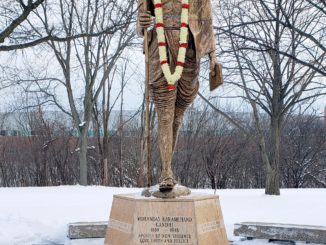
    CHICAGO, IL (TIP):  Mahatma Gandhi’s 74th death anniversary was observed on January 30, 2022 at 11:00 am at Mahatma Gandhi Statue in the National Heritage Park on McCormick Boulevard in Skokie, Illinois. Father of the Nation, Mahatma Gandhi was remembered with  singing of “Gandhi’s favorite Bhajans” and Powerful Tributes by Gandhi Memorial Foundation Board Members and Floral tributes by Consulate General of Chicago Mr. Amit Kumar and his wife Mrs Surabhi Kumar.

    The contribution of Mahatma Gandhi towards the nation and its independence is well known in Indian History. He was a great freedom fighter who taught the lesson of non-violence to the whole world and worked on building the unity of the nation which was broken by the British. After India got Independence in 1947, Bapu stayed away from politics and started working on harmony, peace, and brotherhood among the people. On Friday – January 30, 1948 at 5:17 PM the Father of the Nation was assassinated by Nathuram Godse in the year 1948 at Gandhi Smriti in the Birla House during the evening prayers. January 30 is the day when Mahatma Gandhi was martyred, and the Government of India announced the day as Shaheed Diwas or Martyrs’ Day (Sarvodaya Day).

    The event started by Shree Gurusamy welcoming remarks. Prayer songs “Vaishnav Janto and Raghupati Raghav Rajaram” led by Bhartiben Desai were very inspiring. Consul General Amit Kumar’s remembrance of Gandhiji’s talisman quotation was very timely. Dr Sriram Sonty remembered the Last few minutes of Mahatma Gandhiji’ Life. The White and Red color beautiful Garland was donated by Srinivas and Kavitha. Tea and snacks provided and brought by Consul Ranjit Singhji’s team. Diptiji put lots of efforts to call snow removal service because of over 10-inch snow by Mahatma Gandhi Statue in the National Heritage Park. Due to very cold weather (16 Degree Fahrenheit) the event was only for 15 minutes.

    (Photographs and Press release by: Asian Media USA)

  • FIA hosts India’s 73rd Republic Day 2022 Celebration

    FIA hosts India’s 73rd Republic Day 2022 Celebration

    Bollywood Star Poonam DhillonLaunches FIA’s new Scholarship Program

    CHICAGO,  IL (TIP): Federation of Indian Associations [FIA] Chicago, status 501(c)(3), a premier community umbrella organization — hosted its first signature event of the year 2022, Celebrating India’s 73rd Republic Day with great fervor and enthusiasm, at Chicago Marriott Northwest, at Hoffman Estates, IL on Jan 29th, 2022. This limited seating event was broadcasted virtually via zoom and Facebook live, in adherence to the latest covid 19 guidelines per State of IL regulations.

    The event was promptly started at 7PM (CT) by the emcees Richa Chand & Vinita Gulabani, starting with the beautiful rendition of the American National Anthem by Nitya Rao and the Indian National Anthem by Ananya Ghosh. Sunil Shah Chairman and Founder of the FIA welcomed the people at the event and outlined the yeoman services provided by the FIA in the recent past during and after the pandemic. He briefly welcomed and introduced the new team under the new president Hitesh Gandhi. He spoke of the plans for the new year and mentioned that to commemorate Azadi Ka Amrit Mahotsav FIA Chicago has intent to start their own community center to facilitate better ongoing services to community people. Shah in his closing remarks, spoke,” Freedom in our Heart, Pride in our Soul, Purity in our Blood. Let us Salute our Motherland India!!”

    Congressman Raja Krishnamoorthi in his inimitable style addressed the cheering audience and expressed great joy and best wishes to Team FIA and the entire Indian community for the outstanding contributions, over more than a decade now.

    Immediate past president Dr. Kamal Patel was welcomed on the stage. He outlined the achievements of the FIA during his tenure last year as the outgoing president of the FIA and welcomed the new team led by Hitesh Gandhi. Onkar Sanga in his brief address congratulated the FIA for their achievements in the last year and wished that the new team would take the FIA to greater heights.

    Hitesh Gandhi the new president for the year 2022 outlined his plan for the new year. He listed out the activities and events that would take place during the year and thanked the FIA board for the trust that was shown in his ability to lead the FIA to greater heights in the new year. The FIA Board was introduced and immediately followed by the traditional lamp lighting ceremony. The patriotic song “Ae Mere Watan Ke Logo” by Jitendra Balsara reminded everyone of the beautiful motherland India. The audience cheered as they watched an energetic dance performance by the students of SR Dance Academy, choreographed by Elizar Rodriguez.

    The Chief Guest Consul General Amit Kumar in his address, wished everyone a Happy Republic Day and spoke about the enormous progress India has made in the last several years and mentioned that India is now positioned to succeed even more as we approach 75 years of India’s Independence, and getting ready for Azadi Ka Amrit Mahotsav, an initiative by Govt, of India. He spoke about the covid pandemic, and despite its challenges how India successfully carried on its vaccination drives and the role of technology and innovation.

    Other leaders who spoke at the event were: Mayor Oakbrook Dr Gopal Lalmalani, Mayor Hoffman Estates, William D Mcleod, Mayor Schaumburg Tom Dailly (via zoom), Village President Hanover Park Rodney Craig, Illinois Gen Assembly Rep Michelle Mussman, Secretary of State candidate – Alexi Giannoulias (via zoom), Senator Laura Murphy.

    Mayor William D Mcleod and Mayor Tom Dailly presented commemorative plaques to FIA on behalf of Village of Hoffman Estates and Village of Schaumburg, respectively.

    On a somber note, the FIA paid tributes to Mir Ali who passed away recently by facilitating his wife with an honorary plaque for his dedicated service to FIA and a Scholarship grant of $1000 to his daughter Nida Ali.

    In total 3 Grant Scholarships were provided to students. These were announced by FIA Chairman Sunil Shah and given away by Consul General of India, Amit Kumar, Deepak Kant Vyas CEO Redberri, Anil Loomba (virtual) Hitesh and Kim Bhatt, the Bhatt Foundation, Deepak Kant Vyas CEO Redberri. The other two students who were the recipient of scholarship names are Ria Sharma from Stevenson Highschool & Jaisnav Rajesh from Waubonsie Valley High School.

    Hitesh Bhatt, Founder & Kim Bhatt, President of the Bhatt Foundation were honored with a Plaque and were acknowledged for their sponsorship support to FIA. In their speech, the Bhatt’s, shared their message of “Improving Global HealthCare and Education through Innovation”. They touched upon their philanthropic work in USA / India / Honduras / Africa and expressed their interest in supporting FIA’s initiatives as well.

    Other prominent speakers present were Dr Vijay Prabhakar, Mr Zakaria & Dr Anil Oroskar. Brij Sharma, Manny Lingaiah, Harish Kolasani, Ajeet Singh, Vandana Jhingan, Pradeep B Shukla, Gladson Verghese, Yogi Bhardwaj, Harry Siddhu and many others were present.

    Aparna Chakravarty and Mukhtar Shah provided musical entertainment. Mukhtar Shah (Voice of Mukesh) gave a beautiful tribute to Late Mr Mir Ali FIA Director through his songs.

    The highlight of the event was a very exciting live zoom session with the legendary Bollywood actress Poonam Dhillon from India. She was introduced by Asha Oraskar & welcomed by FIA General Secretary Richa Chand. Followed up by questions and appreciation remarks by Hitesh & Kim Bhatt, Pinky Thakkar, Hitesh Gandhi, Neil Khot, Ajeet Singh, Sunil Shah, Vinita Gulabani, Anu Malhotra, Altaf Bukhari, Kaashif Khan, Pratik Deshpande.The event ended with a vote of thanks by the Cultural Secretary Pika Munshi. Music provided by DJ Sanjay. Technical Director Phani Krishna, and Photography & Video coverage by Asian Media. Program assistance by Neil Khot, Neelam Jai, Jitendra Balsara & Anu Malhotra.

    The event was well attended with Covid-19 guidelines being in place by the Consul General of India, Amit Kumar, Congressman Raja Krishnamoorthi, Mayor Tom Dailly, Deepak Kant Vyas CEO Redberri, Hitesh and Kim Bhatt of the Bhatt Foundation, Mayors and Senators. The technical support of the event was provided by AANA (Artists Association of North America) Phani Krishna, Naveen Karna and Prachi Jaitly and Asian Media USA.

    (Based on a Press release issued by FIA. Photographs / Asian Media USA)

  • Diaspora has been important pillar of India-US relationship: Ambassador Sandhu

    Diaspora has been important pillar of India-US relationship: Ambassador Sandhu

    WASHINGTON D.C. (TIP): The Indian-American diaspora has played an important role in strengthening the India-US relationship, the country’s top envoy said here on Wednesday, January 26, a day after the Indian government announced Padma Bhushan civilian awards to three eminent Indian-Americans. “The diaspora has been an important pillar of the relationship, which continues to strengthen ties through its achievements in diverse sectors and contribute to India’s development journey,” India’s Ambassador to the US Taranjit Singh Sandhu told the community during a virtual celebration of the country’s 73rd Republic Day.

    Addressing thousands of Indian-Americans, who joined the celebrations through various social media outlets, Sandhu said this year, three of the distinguished diaspora members had been conferred the Padma Bhushan – Madhu Jaffrey for popularizing Indian cuisine, Satya Nadella and Sundar Pichai for their leadership in the technology sector.

    “This is a matter of pride for all of us, as well as a testament to the strength of the community,” Sandhu said from the lawns of India House, the official residence of India’s Ambassador to the US, in Washington DC.

    In his remarks, the Indian ambassador said the United States had been a key partner for his country.

    “As Prime Minister (Narendra) Modi mentioned in his remarks at the Bilateral Summit with President (Joe) Biden last year, we are witnessing a transformative period in the India-US strategic partnership driven by tradition, talent, technology, trade and trusteeship. All of us are working towards realizing the full potential of this consequential relationship,” he said.

    Observing that this year is special as the county celebrates the 75th anniversary of its independence as Azadi Ka Amrit Mahotsav, Sandhu said India today is better placed to face the increasing challenges and complexities that the world encounters.

    (Source: PTI)

  • Budget 2022: India’s job crisis leading to a ‘nowhere generation’

    Budget 2022: India’s job crisis leading to a ‘nowhere generation’

    Job prospects for the young look bleak in India

    By Craig Jeffrey and Jane Dyson

    Hundreds of millions of poorly employed young people, many of them highly educated, challenge the story of India’s rise and boosterish projections of Asia benefiting from a “demographic dividend”.

     India aims to create six million jobs over the next five years, according to this week’s budget announcements. It will not be easy: the country’s unemployment rate has exceeded most emerging economies in recent years. Craig Jeffrey and Jane Dyson, who have studied joblessness in India, write on the nature of unemployment in India.

    In the mid-2000s, a group of students at a college in Meerut, Uttar Pradesh, jokingly referred to themselves as a “nowhere generation”.

    Worn down by years of fruitless attempts to acquire government employment, this group said that they were stuck between their rural homes and dream of urban mobility. “Berozgaari” (unemployment) seemed to have left them high and dry – marooned by modernity.

    “Well, our life has just become about timepass,” they would say. (Timepass is an Indian English word which means spending time without a purpose in life.) In the last two weeks, as the scale of India’s employment crisis has become more evident, media and popular attention has swung again to the phenomenon of the “unemployed youth” in India.

    Unemployed youth demanding jobs in a rally.

    Hundreds of millions of poorly employed young people, many of them highly educated, challenge the story of India’s rise and boosterish projections of Asia benefiting from a “demographic dividend”. The problem of unemployment, as evident in the mid-2000s, has grown substantially since that time. As concern about unemployment intensifies, the media spotlight inevitably swings between loud demonstrations and the stump speeches of the politicians.

    But if we adjust our gaze and put aside received stereotypes about unemployed youth as a danger to society, we might ask: What are young people actually doing at the everyday level in India? How do they spend their time? How do they relate to their communities? How are they changing India?

    Over the past 25 years, we have carried out research in Uttar Pradesh and Uttarakhand states on the experiences and actions of unemployed young people aged between 18 and 35. This research has involved living and working with unemployed young people for many years in Meerut district in Uttar Pradesh and in Chamoli district in Uttarakhand.

    The depth of social suffering is striking. Unemployed young people encounter cluster of disappointments. They lack money, cannot make good on familial expectations, often lack a sense of respect, and frequently face problems managing their marriages.

    For men, a lack of a “pukki naukri” (permanent job) often undermines their identity as breadwinners. Added to this, they often feel bitter about the time they invested in education and job searches.

    Work is also connected to citizenship. Many young people spent their teens and early twenties dreaming of serving the nation through obtaining jobs in government service that have become ludicrously difficult to secure.

    Bihar railways exam violence: ‘We are graduates, we are hungry’

    Small wonder that many unemployed young people, especially men, have become cynical and detached, describing themselves as people “doing nothing” or engaged only in timepass. Nowhere generation is everywhere, it seems.

    But such self-stereotypes of the unemployed and underemployed “doing nothing” – or of them being “nowhere” – should not be taken at face value.

    Young people are often closely involved in forms of entrepreneurship at the everyday level. They find “fallback” work, not necessarily of high quality or utilizing all of their skills, but good enough to offer some sense that better employment may materialize in the future.

    What is also remarkable is the extent of the community service performed by young people who are unemployed and under-employed. This section of society has become the mainstay of India’s civil society.

    At the most mundane level, these young people often act as interpreters of social change, volunteers and helpers for others in their villages or town neighborhoods. They help people access state services. They circulate new ideas, for example regarding technology, microcredit, religious practice, environmental care, and development.

    Sometimes these young people protest, but most often this mobilization is around services and infrastructure rather than politics. They want a better maths teacher or an extension to their school.

    One thing that many unemployed young people have told us is that even if they cannot help themselves, they may be able to help the generation coming after them.

    Younger youth – teenagers and pre-teens – are grappling with educational and career choices that are new and which their own parents struggle to understand. The generation in the middle, unemployed or underemployed 18-35-year-olds who have had to live through recent struggles of seeking work, become the key “beech ki pidhi” (intermediary generation).

    To paint this picture is not to romanticize either young people or unemployment. But it is to acknowledge a center of energy in the Indian population – unemployed young people in their late teens, twenties or early thirties who live in ordinary places across India. They are crucial to India’s and the world’s future trajectories.

    How could external organizations better support this community of young people? Perhaps India’s enormous Mahatma Gandhi National Rural Employment Guarantee Scheme could be expanded to include structured opportunities for young people to undertake the type of community service they are leading. Maybe efforts could be made to find ways to accredit active unemployed or under-employed young people with skills.

    One thing is clear: Youth themselves are desperately eager for such opportunities.

    (Craig Jeffrey and Jane Dyson teach Human Geography at the University of Melbourne. Jeffrey is author of several books on India, including Timepass: Youth, Class, and the Politics of Waiting in India. Dyson is author of Working Childhoods: Youth, Agency and the Environment in India.)

    (Source: BBC)


  • Punjab economy, expatriate Punjabis, and the role of Punjab government

    Punjab economy, expatriate Punjabis, and the role of Punjab government

    By Gurmit Singh Palahi
    English translation by Amarjit Singh Anand

    Successive governments in Punjab have only exploited the expatriate Punjabis for their narrow and selfish ends, never protecting their interests in the State. They are disillusioned, their love of their native land, notwithstanding. They could yet  be inspired to look towards Punjab if their grievances are redressed, and they are treated with love and respect, and not merely as ATM machines. 

    Always during the election season, the ruling clique begins remembering the Non-Resident Punjabis. Whether the polls are for local bodies, like panchayats at the village level  or for the State Assembly, political aspirants start sending invitations and cherishing reminiscences from the olden-golden days. They make it a point to entice them to Punjab, by offering alluring schemes because the NRIs wield considerably extraordinary influence over their relatives and close acquaintances living in Punjab.

    The residents of  the Bigger  Palace i.e., the Central government initiates dialogue by facilitating various communication channels including organizing glittering Expatriate Conventions and Galas, where the crème de la crème drawn from the uppermost echelons are very selectively invited and are honored with impressive plaques and verbal encomiums from the rostrum. Some hollow promises (to be broken later) are gifted to the ‘elite NRIs. Nothing happens. Status-quo is maintained by the promise-makers. The Non-Resident Indians return to their adopted residences, empty-handed, after having emptied their coffers into the deep dark wellof party-funds. The Akali-BJP-combine assembled such annual extravaganzas, for several years, in order to attract the targeted NRIs while trying to prove a ‘spirit-of-camaraderie’ with them. Myriad dreams were woven and presented by the rulers. Promises were churned out to provide legal redress to the expatriates, pertaining to the latter’s properties, which had been usurped by their relatives, using forged documents.

    The Congressoutfit had actively energized the NRI-Sabha in Jalandhar and had brought their chosen-ones into the limelight.   This group in Jalandhar was optimally utilized by the Akalisduring their regime, with great enthusiasm. It was highlighted as the great well-wisher and trouble-shooter for the NRIs, but it turned out to be a damp-squib, when the Sabha-outfit became a puppet in the hands of Punjab bureaucracy with their ‘rightful-red-tape’ and a rubber-stamp of the politicians. After swallowing millions from the pockets of NRIs, no solace, succor and solutions were provided to resolve their issues.Their occupied properties were not restored to the NRIs. On the contrary, some vested interests including the mighty triumvirate of politicians, police, administrative-cadre, working in cohesive-tandem along with the land-mafia, enhanced the misery and pain of the NRIs, manifold and in multifarious ways. The corrupt system digested the hard-earned wealth of the expatriates, giving them false hopes. Astonishingly, many such NRIs who were unable to present themselves during the court-hearings, were shockingly pronounced declared-absconders. The list of such NRIs, who were defrauded by their own relatives, is pretty voluminous. They had no option but to reconcile with their plight and stay quiet about the whole messy imbroglio.NRI Sabha, NRI-Police stations and the newly instituted NRI-Cell could do absolutely nothing to provide even an iota of relief to the NRIs.

    When the Akali-BJP government felt the need for financial support from NRIs, frequent appeals were made. Akalis opened a Single Window, whereby NRIs were encouraged to initiate business ventures and they did make really massive investments in their land of origin with the objective of improving the conditions in their native place, an ailing Punjab. However, the InspectorRaj did not let the motivated NRIs move forward with their noble plans and they had to return abroad, sans achieving anything substantial. Many NRIs opened charitable hospitals and made hefty donations to schools and colleges. Sports facilities were created whereby Tournaments, Heritage Fairs and Cultural Events were also organized to inspire the youth to engage in healthy lifestyle, shunning the menace of drugs. However, NRIs were made to fail in these divine endeavors and also in preventing the rise in cases of prevalence of the dreaded cancer. NRIs suffered financial losses, desperation, frustration, mental anguish and physical exhaustion. Many NRIs established engineering and management colleges, hotels, banquet and wedding halls. Their aim was not only to make monetary gains, but to revitalize the economy. But the situation is an open secret, as many such colleges are on the verge of closure.

    After ruling the roost during his tenure of four years, Captain Congress team has, yet once again, felt the need of reaching out to NRIs. Congress was quite aghast with NRIs who had not openly voted for Aam Aadmi Party but also given it huge donations during the previous Assembly elections. It’s a different story, altogether, that Aam Aadmi Party failed to deliver, due to their infighting,  and all dreams of NRIs were shattered, regarding refurbishing the economy.

    The major areas which were of concern to the NRIs included overall growth, economic progress, rooting-out corruption, wiping-out drugs, enhancing employment avenues, prevention of suicides by desperate farmers and laborers. The NRIs had wished nobody would remain hungry and would get proper nourishment. Congress government in Punjab remained indifferentfor four years towards the NRIs. Congress remained evasive and did not facilitate elections in the NRI-Sabha,  and all other NRI matters were  ignored. Distances increased between Congress and NRIs, but the latter could not be totally sidelined as they have always had an immensely significant role to play in Punjab politics. Therefore, Congress conducted the elections to NRI-Sabha some time ago and appointed their close confidantes as honorary coordinators in USA, Canada, U.K. and Australia. Amongst these are Daljit Singh Sahota and Manjit Singh Nijjar in the U.K.; In the USA, Sarabjit Singh in California and Rajbir Singh Randhawa and others; Sukhminder Singh Khaira, Nachhatar Singh Kooner and others in Canada. NRI Commission has also been activated in Punjab, wherein a DGP rank official oversees the NRI matters. Punjab government has appealed to NRI Punjabis to contribute to the wellbeing of the State. The Minister for NRI-affairs, Gurmit Singh Sodhi appealed to them to lend a helping hand in reviving the economy. Now it remains to be seen how the NRIs would be welcomed by the politicians, bureaucracy and officialdom.

    NRIs always wish for the wellbeing of Punjab. They have, always provided massive support to all movements emanating from Punjab. NRIs always provided heavy relief during droughts, floods or any natural calamity. When the central rulers wanted to impose the black laws upon the farming sector, NRI Punjabi groups having divergent ideologies in Canada, USA and UK  forgot their rivalries and demonstrated cohesively in favor of the farmers. They were also campaigning pro-actively on the social media. NRIs owe their primary loyalties to their native Punjab. They feel and share the pain of Punjab as they realize that the youth is afflicted with the menace of drugs, unemployment and is flying abroad in search of greener pastures. The Centre has been depriving Punjab of its rich water resources. Cancer is rampant in Punjab. For all these reasons, NRI Punjabi community, individually and as part of conclaves, always come forward to happily discharge their responsibility, whenever a clarion-call is sent in their direction.

    However, another discouraging factor is that government officials and some natives in Punjab misbehaved with NRIs, during the Corona-Covid pandemic, which thy are unable to forget. They were held in confinement, as if they were responsible for the widespread occurrence of the pandemic in Punjab. NRIs were given the impression that they were foreigners in their own motherland. Announcements were made against them; notices of solitary confinement were slapped outside their houses, and they faced humiliation in government offices. The public, too, misbehaved and became the cause for emotional distress of the NRIs. So, with such a backdrop, it is to be seen whether NRIs would respond favorably to the fresh  invitation. If Punjab government is seriously contemplating a role for  the NRIs in revival of the economy, then a comprehensive package needs to be given out as an incentive to make them feel welcomed and encouraged, just akin to such packages which any government would dole out to large industrial houses and to the corporate sector. Other factors which are quintessential pre-requisites include a 24-hour uninterrupted electricity supply, minimal interference of the InspectorRaj, concretized  assurances pertaining to security provisions safeguarding NRIs from the trio which is unofficially ruling the State as a parallel government. All such measures could play a crucial role in motivating the NRIs to head towards Punjab with rejuvenated enthusiasm and bold initiatives, ventures and plans for growth of Punjab. Such bold schemes from the government can be easily offered. A recent example relates to a decision regarding Bathinda where land would be given out to Corporates for a paltry Rupee One, on a 33-year lease for Block Drug Parks, with the provision of an extendable period of lease up to 99 years. Two rupees per unit electric supply and One rupee per 1000 liters water supply would be provided, as per this plan. Punjab Cabinet has given their clearance. The price of the land where the park is envisioned, is to the tune of 3,000 crore rupees. The Centre shall allocate 1876 crore and Punjab State government will chip in 1000 crore.

    The NRIs could be inspired to look towards Punjab if their grievances are redressed. They are looking forward to an affectionate, loving, respectful welcome, whereby their endeavors are appreciated with reciprocity of provision of requisite infrastructural facilitation and incentives which safeguard their investments. The NRIs want their offspring and future  generations to return to Punjab with honor and pride to be inspired by massive noble, worthy contributions made by their ancestors.

    If the Punjab government is pondering on the lines of exploring serious business, then :

    1)      Assurances should be forthcoming about various institutions like NRI-Sabha, NRI Commission, NRI Police department, NRI Court system

    2)      Protection must be provided for the land and properties of NRIs.

    3)      Safety of NRIs (their person and money) must be ensured, during the period of their stay in Punjab.

    4)      Cases must be withdrawn against Punjabi NRIs who were declared  absconders

    5)      Special NRI-zone must be established at airports in Punjab, to cater to their proper hospitality.

    6)      The children of NRIs must be welcomed to the State, to let them relish the rich legacy of their ancestors and to taste the vibrancy of Punjabi hospitality culture, language, heritage and history.

    Only then shall NRI Punjabis trust the government and the public of Punjab and would turn again  towards Punjab to revive its economy. As of now, the NRIs get a feel that the government, relatives and friends are eager only to empty  their pockets.

    (The author, Gurmit Singh Palahi,  is a retired principal and well-known columnist. He is currently President of Punjabi Columnists Patrakar Manch. He can be reached at gurmitpalahi@yahoo.com

    The translator, Amarjit Singh Anand, is  a thinker and writer.He can be reached at asa1ny@yahoo.com)

  • Mild Fluctuations in Share of National and Regional Parties

    Mild Fluctuations in Share of National and Regional Parties

    By Prabhjot Singh

    A careful analysis of the election results since 1967 would reveal that the percentage of votes polled by national parties, mainly the Congress, except for 1977 and 1997, has been more than 50. In 1967, for example, when Punjab had its first coalition government — the United Front — the Congress had polled 36.56 per cent of the total votes against 26.47 per cent votes polled by all state parties. The overall votes polled by national parties, including the Congress, Jana Sangh, CPI, CPM, Praja Socialist Party and Swatantra Party — was 56.60. In 1969, the share of national parties rose to 58.34 per cent, with the Congress increasing its share to 39.18 per cent while the state parties accounted for only 30.44 per cent of the votes. In 1972, when the Congress returned to power in the State, the share of the national parties increased slightly to 58.77 per cent while those of state parties dropped to 28.73 per cent. The Congress had taken its poll percentage to 42.84, which had been surpassed only twice afterwards, first in 1980 when the Congress got 45.19 per cent of the total votes polled and again in 1992 when it got 43.71 per cent votes.

    The 1992 election was exceptional in the history of Punjab. The mainstream Shiromani Akali Dal boycotted the elections. A faction of the Dal, led by the then rebel Akali leader, Capt Amarinder Singh, contested 58 seats and won only three. This was the only occasion when the percentage of votes dropped to 23.82, the lowest ever. The other lowest being 64.33 in 1980. The share of national parties dropped to 40.29 per cent, the only time below 50 per cent, in 1997 when besides 26.59 per cent of the votes secured by the Congress, all the national parties, including the BJP, CPI and CPM had aggregated 40.29 per cent. The most distinguishing aspect of Punjab politics has been that the Akalis, even at times securing clear majority, have been aligning themselves with the Jana Sangh/Bharatiya Janata Party. This combination alienated both Sikh and Hindu votes from the once powerful Congress.

    The emergence of the Bahujan Samaj Party in the 1992 elections saw this political outfit of the downtrodden getting 16.32 per cent of the valid votes polled which in the 1992 elections was more than three times that secured by the Akali Dal led by Capt Amarinder Singh. Interestingly, the BSP had bagged nine seats against three by the Akalis. The BSP, however, failed to maintain its tempo and in the 1997 elections, after witnessing a vertical split-leading to the formation of the Bahujan Semaj Morcha headed by Mr. Satnam Singh Kainth — saw its share of vote coming down to 7.48 per cent of the total valid votes and its share in the Vidhan Sabha dropping to one. The electorate in Punjab have known to participate in the process enthusiastically, averaging more than 64 per cent in all the previous elections held in the State so far.

    Till date, the Shiromani Akali Dal has never crossed the 40 per cent barrier. Its best performance was in 1985 when it got 38.01 per cent of the total valid votes. In 1997, this percentage dropped slightly to 37.64. Besides the Congress and the Akali Dal, other main players in Punjab politics have been Jana Sangh/BJP, CPI, CPM and briefly the Janata Party, which in the 1977 elections polled 14.99 per cent votes to win 25 seats out of 41 candidates put up by it.

    The Communists — the CPI and the CPM — put together had been aggregating about 9 to 10 percent of the total valid votes polled till 1997. The exceptions were the 1967 and 1969 election when they polled less than 8 per cent but since 1972, they have been averaging 9 per cent and above. In the 1967 elections they polled 8.46 per cent votes, 7.91 per cent in 1969, 9.77 per cent in 1972 and 9.60 per cent in 1977 winning eight, six, 11 and 15 seats collectively, respectively.

    In 1980, they crossed the double figure mark, aggregating 10.52 per cent to win 14 seats — nine by the CPI and five by the CPM. Since then, their share, both in percentage of valid votes and seats in the Vidhan Sabha, has been dropping as in the 1997 elections, they got only 4.77 per cent of total valid votes with two seats in the Vidhan Sabha. In the last Vidhan Sabha, the Communists went unrepresented. During the first term of Capt Amarinder Singh as Chief Minister, both the Communist legislators, defected and joined Congress. Since then, the Communists had been drawing a blank in Vidhan Sabha elections.

    (Prabhjot Singh is a veteran journalist with over three decades of experience covering a wide spectrum of subjects and stories. He has covered  Punjab and Sikh affairs for more than three decades besides covering seven Olympics and several major sporting events and hosting TV shows. For more in-depth analysis please visit probingeye.com  or follow him on Twitter.com/probingeye)

  • It may not be a Tussle between Congress and SAD any more

    It may not be a Tussle between Congress and SAD any more

    By Prabhjot Singh

    Punjab has been one of those states that has not only won against two-decade long terror-driver turbulence but also for its reiteration and trust in strong democratic norms. After partition of the country in 1947, Congress domination in State politics continued till 1966. Since then, Punjab has been witnessing a fierce tussle for power between a national party — Congress — and a regional party — Shiromani Akali Dal (SAD).

    This time, the State may have a new political party or alliance at the helm of affairs.  Both Shiromani Akali Dal and Congress have witnessed groups of senior leaders walking out to form their own outfits. Punjab Lok Congress is the offshoot of Congress while Samyukta Akali Dal is the breakaway group of Shiromani Akali Dal.

    In the last elections in 2017, the new entrant, Aam Aadmi Party (AAP), after its roaring success in Delhi, managed to push the SAD-BJP alliance to third position by winning 20 seats.

    Among new entrants are the Shiromani Akali Dal-Bahujan Samaj Party alliance, Bhartiya Janata Party-Punjab Lok Congress-Samyukta Akali Dal alliance and Samyukat Samaj Morcha (Balbir Singh Rajewal).

    Incidentally, SAD had always enjoyed the support of Bharatiya Janata Party, a major national party, as its alliance partner. In 2021, this oldest alliance crumbled after the Union Government passed the three Farm Laws.

    The Congress and the SAD, as two major political opponents, have been ruling the state alternately since reorganization of the State on November 1, 1966. Their rules have been punctuated with spells of varying periods of the President’s rule. These Presidential intervention on recommendation of the Governor were either because of political uncertainty or because of terrorism that engulfed the state for over two decades since late 1979.

    It was because of terrorism that State also witnessed major boycott of the electoral process, first in 1985 when certain wings of the Akalis stayed away and then in 1992 when the mainstream Akali Dal boycotted the elections. In 1991 when Chandrasekhar was Prime Minister and elections were called to restore democracy in the State, Congress decided to stay away. Intriguingly, a day before polling was to be held in the State, elections were called off as the Centre Congress had come back to power and the minority government of Chandrasekhar bowed out.

    Akalis had protested the last-minute cancellation maintaining that more than 30 candidates had fallen to the bullets of terrorists while reposing their faith in democracy. Subsequently when elections were called again in February 1992, Akalis led by Parkash Singh Badal, boycotted. Only a fraction of Akalis led by Amarinder Singh contested on 58 of 117 seats and won on three. BJP, the traditional alliance partner of Akalis, however, participated in the 1992 elections though without much success. Even its Hindu card at that time did not work.

    While the Congress has enjoyed seven full-term governments — those of 1952, 1957, 1962, 1972, 1992, 2002 and 2017 the Shiromani Akali Dal that made history in 1997 by becoming the first non-Congress party to complete its first full term in office since Independence, has repeated its 1997 feat in 2007 and 2012.The only time Punjab electors did not give any party or alliance a clear mandate was the 1967 election, the first after the reorganization of the State. Congress got only 48 in a house of 104.

    It was during this time that the Akalis had their first tryst with power by getting the entire Opposition united to form the United Front government. It was the first multi-party coalition government in the State.  In 1985, after signing of the Rajiv-Longowal accord, Akalis graduated to absolute power, winning 73 of the 100 Vidhan Sabha seats they contested. In the 1997 elections, they took this supremacy for power a step further by improving their individual tally to 75 out of 92 seats contested by them.

  • Politics of freebies: ECI should curb menace, ensure level playing field

    With five states going to the polls this month, political parties are vying desperately with each other to woo voters through freebies — in cash or in kind. Most of the grand promises, if implemented, are likely to drain the fast-depleting financial resources of states such as Punjab. Calling it a serious issue, the Supreme Court has sought replies from the Centre and the Election Commission of India (ECI) on a petition seeking directions to freeze the election symbol or deregister a party that promises or distributes ‘irrational freebies’ in the run-up to the polls. The apex court has expressed concern that the freebie budget is exceeding the regular budget, depriving the stakeholders of a level playing field. The SC Bench has also taken the ECI to task for failing to come up with stringent guidelines to curb the menace.

    The competitive populism makes it amply clear that various parties don’t want to look beyond the upcoming election. What matters to them is coming to power — or retaining it — at any cost, even as the pressing issues of public interest are put on the backburner. Fund-rich parties get an unfair advantage as they have much more to offer as allurements to the electorate. The telling impact of sops was visible in the 2021 Kerala Assembly elections. Two years after being routed in the Lok Sabha polls, the ruling Left Democratic Front got elected for a second straight term with a thumping majority. What worked for the CPM-led front was the distribution of free food kits. Though the ECI had suspended the controversial exercise after getting complaints, the Kerala High Court had stayed the poll panel’s order, while directing the state government not to give the impression that the doling out of food was aimed at influencing voters.

    There is no denying that freebies vitiate the poll process and undermine democratic polity. The ECI needs to frame rules that prohibit or restrict populist announcements during the last six months of a government’s tenure, and not just after the model code of conduct is enforced. Only with firm resolve can the sop opera be discouraged and eventually discontinued.

    (Tribune, India)

  • Big on hopes, short on ideas: On Union Budget 2022-23

    The Budget aims to focus on infrastructure and connectivity, but lacks growth-invigorating proposals

    Finance Minister Nirmala Sitharaman’s fourth successive budget, while commonsensical in its approach, is not exactly bubbling with new ideas. With the economy still in search of durable momentum that could help entrench the recovery from the last fiscal year’s record contraction, Ms. Sitharaman has missed an opportunity to address the flagging consumer spending in the wake of erosion in real incomes and savings through a combination of tax breaks for the middle class and cash handouts for the poor. And even as the Minister acknowledges the role public capital expenditure could play in crowding-in private investment at a time when “private investments seem to require that support” and help to ‘pump-prime’ demand in the economy, the Budget outlay of ₹7.50 lakh-crore for the capital account marks just a 24.4% increase from the revised estimate of ₹6.03 lakh-crore for the current fiscal. To be sure, Ms. Sitharaman’s speech highlights the PM GatiShakti, a “transformative approach for economic growth and sustainable development” that is to be powered by the ‘seven engines’ of roads, railways, airports, ports, mass transport, waterways, and logistics infrastructure. While the broad sweep of the public infrastructure envisioned by the programme could potentially be truly transformative if it were to be executed as imagined, the Budget is largely short on details where it concerns the specifics and pencils in some figures only for the roads and railways components. The Budget lists a ‘Master Plan for Expressways’ that will be formulated in 2022-23 under the scheme and projects the addition of 25,000 kilometers of roads to the National Highways network. The talk of enabling seamless multimodal movement of goods and people and providing multimodal connectivity between mass urban transit systems and railway stations, however, all sound a familiar refrain from past speeches.

    Spending outlays on several other key sectors including health care, rural development and the vital jobs and income providing national rural employment guarantee scheme have all shrunk as a percentage of overall expenditure in the Budget estimates for fiscal 2023 from the revised estimates for the current year, even if in some cases only marginally. That these sectors have been forced to bear the impact of the Government’s keenness to broadly stick to a fiscal consolidation road map — with the Budget projecting a narrowing of the fiscal deficit to 6.4% of GDP in 2022-23, from a revised estimate for 6.9% — reflects on its priorities. Government spending on health care ought to have instead been significantly increased, with the lessons from the ongoing pandemic’s first two waves serving to illuminate the need for a sizeable enlargement of the public health infrastructure. A source of some solace, though, is the announcement of a ‘National Tele Mental Health Programme’ to address mental health problems that have been exacerbated by the claustrophobic lockdowns and plethora of anxieties triggered by the pandemic.

    In a nod to the ruling party’s nationalist moorings and in line with the Government’s push to increase self-reliance or AtmaNirbharta, the Finance Minister has proposed a series of tariff and policy steps that could help bolster domestic manufacturing in the long run. A key policy element is a commitment to reduce import dependence in procurement for the country’s defense forces. To that end the Minister has proposed earmarking 68% of the armed forces’ capital procurement budget to domestic industry in 2022-23, a not insignificant increase from the current fiscal’s 58% target. The tariff rationalizations, which cover a broad swathe of items ranging from electronics, gems and jewelry, chemicals, inputs used by MSME units and project and capital goods, could, however, have varying short-term impacts. Specifically, the move to phase out the concessional rates in capital goods and project imports gradually and apply a moderate tariff of 7.5% could in the short term hurt infrastructure projects and the setting up of new manufacturing capacity, some proposed exemptions for advanced machinery notwithstanding. The Minister has tried to address the raging debate over how to deal with virtual currencies by adopting a twin-track approach. On the one hand Ms. Sitharaman proposes to introduce in the coming fiscal year a Central Bank Digital Currency that she posits will impart a big boost to the digital economy and “lead to a more efficient and cheaper currency management system”. The RBI-issued Digital Rupee would leverage blockchain and other related technologies. In parallel, she intends to tax income from the transfer of any virtual digital asset at the rate of 30%, with deduction allowed only for the cost of acquisition. It remains to be seen if the Government’s efforts at bringing the mushrooming trade and investment in a multiplicity of virtual digital assets including cryptocurrencies under the tax net would have a salutary impact besides adding a revenue stream to the exchequer. The Minister’s latest budget also skirts mention of the asset monetization plan mentioned in the last Budget and shows a sharp decline in capital receipts from disinvestment. With just ₹65,000 crore budgeted from asset sale for fiscal 2023, as opposed to ₹78,000 crore as per the revised estimates for the current fiscal, the Minister has had to increase gross borrowings to ₹14.95 lakh-crore, a 24% increase from the current fiscal’s budget estimate but a far sharper 43% jump from the revised estimate of ₹10.46 lakh-crore. The resource crunch manifest in the proposed higher debt issuance is ultimately bound to get more acute in the days ahead, given the Budget’s lack of growth-invigorating proposals.

    (The Hindu)

  • Pegasus: The new Cyber Weapon for dismantling democracy

    Pegasus: The new Cyber Weapon for dismantling democracy

    By George Abraham

    “There is little doubt that the use of Pegasus is an assault on the right to privacy everywhere and specifically an attack on the very fabric of Indian democracy. Undoubtedly, the Government is responsible for monitoring people involved in criminal wrongdoings, and there are established procedures involving the judiciary laid out for it. However, targeting opposition leaders, journalists, and regular citizenry for surveilling for their God-given right to express themselves is tantamount to undermining the democracy itself. This Pegasus scandal exposes the mindset of the current leadership, and it does not bode well for the future of India.”

    “The state cannot get a free pass every time by raising national security concerns. No omnibus prohibition can be called against judicial review.”- Supreme Court of India

    The New York Times recently reported that India had purchased the Pegasus software from an Israeli company, NSO, as part of the multi-billion-dollar armaments deal that included sophisticated weapons and intelligence gear. The report also said that the purchase was finalized during the visit of Prime Minister Narendra Modi to Israel and cleared by the then Prime Minister Benjamin Netanyahu in 2017. Once again, the Government officials in India kept their silence on the New York Times story. Earlier, the Supreme Court in India has ordered an independent probe into Pegasus upon a ruling that came after petitions were filed which sought an investigation into allegations of unauthorized surveillance. The Court stated while ordering the inquiry that “the mere invocation of national security by the State does not render the Court a mute spectator.”

    The Court also listed several compelling circumstances that were weighed before issuing an order. The right to privacy and freedom of speech are alleged to be impacted, and the entire citizenry is affected by such allegations due to the potential chilling effect. The bench went on to say that the “right to privacy is directly infringed when there is surveillance or spying done on an individual, either by the State or by an external agency” and “if done by the State, the same must be justified on constitutional grounds .” During the hearing, the Centre had filed a brief affidavit “unequivocally” denying the allegations and said the matter involved national security concerns. The Indian Express recently reported that two Cybersecurity experts had told the Supreme Court-appointed committee on the Pegasus issue that there is concrete evidence that the application was used to spy on the petitioners.

    The NSO group claims that the product it sells to government clients is intended to collect data from the mobile devices of specific individuals suspected to be involved in serious crime and terror. However, contrary to their assertion, it has been reported that this spyware has been widely misused. In response, a global consortium of more than 80 journalists from 17 media outlets in 10 countries came together under the ‘Pegasus project’ coordinated by Forbidden Stories with the technical support of Amnesty International’s Security Lab. Their findings shed light on the fact that at least 180 journalists across the globe have been selected as targets in countries like India, Mexico, Hungary, Morocco and France, and others. Potential targets also included human rights activists, academics, businesspeople, lawyers, doctors, union leaders, diplomats, politicians, and several heads of state.

    In a recent column, Siddharth Varadarajan, of ‘The Wire’ wrote further on his interaction with Ronen  Bergman of the New York Times stating that the Indian leadership showed ‘specific interest’ in and ‘specific emphasis’ on acquiring the controversial spyware. The column went on to say that the forensic tests by Amnesty International’s tech lab revealed the presence of military-grade spyware on the smartphones of several journalists, including two of the publication’s founding editors, investigative journalists Paranjoy Guha Thakurta and Sushant Singh and the leading opposition strategist Prashant Kishor. Their numbers were part of a leaked database of probable Pegasus targets, including Congress leader Rahul Gandhi, former election commissioner Ashok Lavasa, and former CBI director Alok Verma.

    What is Pegasus? Pegasus is a spyware that can be covertly installed on mobile phones running most versions of iOS and Android. Pegasus can be installed on the phone through vulnerabilities in common apps such as SMS, WhatsApp, iMessage, or by tricking a target into clicking a malicious link. Once installed, Pegasus can theoretically harvest any data from the device  (SMS, Emails, WhatsApp chats, photos, videos, calendar, or contacts) and transmit it back to the attacker. It could also activate a camera or a microphone, record calls, and scan the GPS data. When iPhone is compromised, it’s done insuch a way that allows the attacker to obtain so-called root privileges, or administrative rights, on the device. Pegasus could easily do more than what the device owner can do.

    For a long time, Israel has used the sale of sophisticated weapons as part of its broader efforts to win diplomatic successes abroad or at the United Nations. Subsequently to this agreement, India voted in favor of Israel by denying observer status at the UN’s Economic and Social Council to a Palestinian human rights organization. India has maintained a commitment to the Palestinian cause for decades, and its records at the United Nations speak for itself. This sudden about-face by India is viewed as a betrayal of the Palestinian people, and Pegasus may have a lot to do with it. It is not only India that has changed its attitude towards Israel after a Pegasus deal; a few countries, including Mexico and Panama, also appeared to have done the same. After installing Pegasus spyware in Panama City in 2012, Panama’s Government voted to oppose the United Nations decision to upgrade the status of the Palestinian delegation.

    The story of Khadija Ismayilova’s is available in the public domain. In Azerbaijan, an oil-rich nation nestled next to the Caspian Sea, has increasingly stifled free speech and dissent in the last decade. Ismayilova’s investigation into the ruling family had made her a prime target of her own Government. The authorities had thrown the book at her arresting her: surreptitiously filming her during sex, accusing her of driving a colleague to suicide, and eventually charging her with tax fraud and sentencing her to seven years in prison. However, she was released on bail after 18 months and banned from leaving the country for five years. So, in 2021, at the end of the travel ban, when Ismayilova packed away all her belongings boarded a plane to Ankara, Turkey, she may have thought she was leaving all that behind. Little did she know the most invasive spy was coming with her. For nearly three years, Khadija Ismayilova’s phone was regularly infected with Pegasus. “All night, I have been thinking about what I did with my phone. I feel guilty for the messages I have sent. I feel guilty for the sources who sent me information thinking that some encrypted messaging ways are secure, and they didn’t know my phone was infected,” she told reporters. “My family members are also victimized. The sources are victimized, and private secrets of the people I have been working with are victimized,” she added.

    There is little doubt that the use of Pegasus is an assault on the right to privacy everywhere and specifically an attack on the very fabric of Indian democracy. Undoubtedly, the Government is responsible for monitoring people involved in criminal wrongdoings, and there are established procedures involving the judiciary laid out for it. However, targeting opposition leaders, journalists, and regular citizenry for surveilling for their God-given right to express themselves is tantamount to undermining the democracy itself. This Pegasus scandal exposes the mindset of the current leadership, and it does not bode well for the future of India.

    (Author is a former Chief Technology Officer of the United Nations and the Vice-Chairman of the Indian Overseas Congress, USA. He can be reached atgta777@gmail.com)